Inequalities
Inequalities
We recall that comparison of two numbers is based on their
locations on the real line.
Inequalities
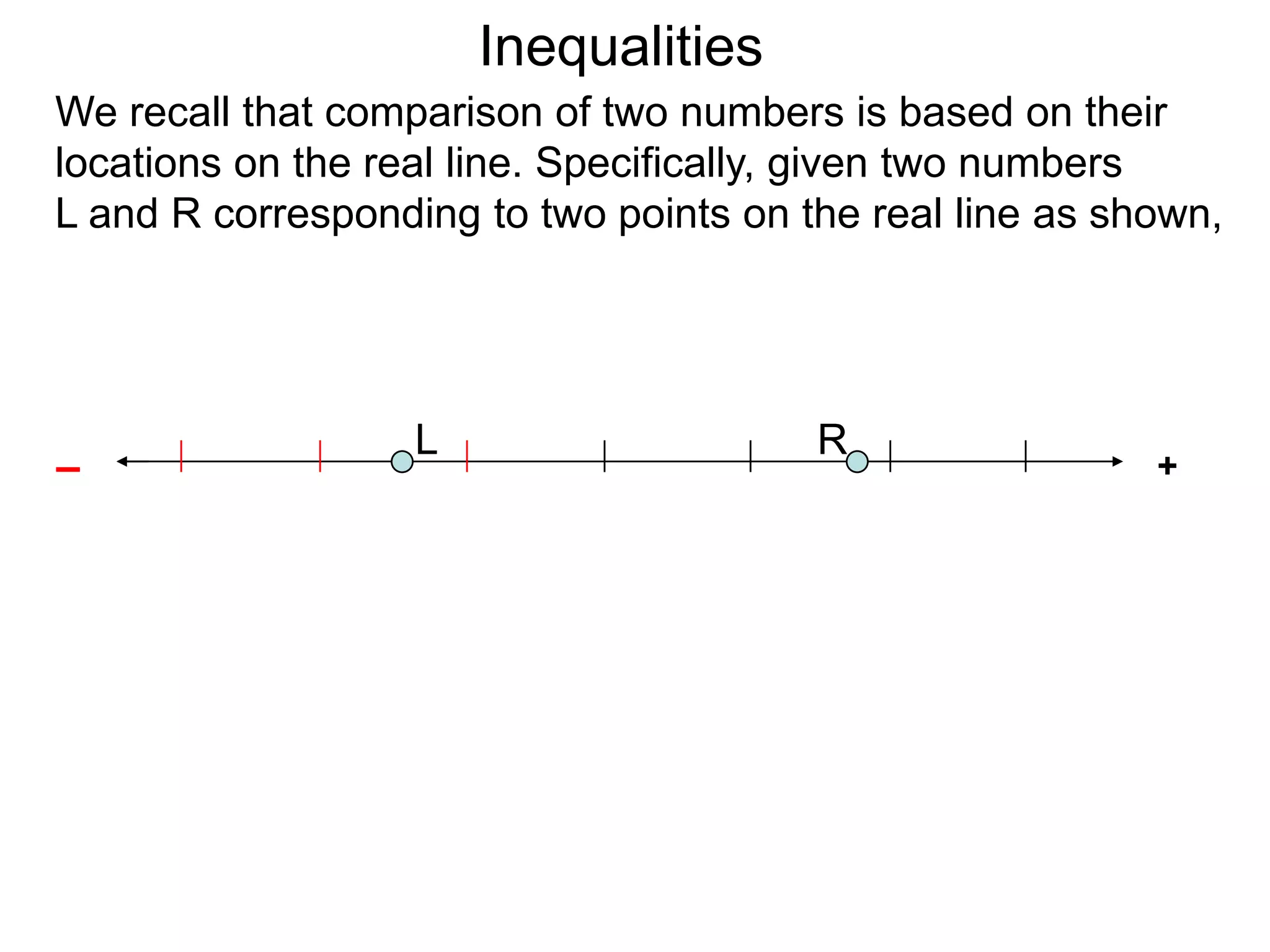
We recall that comparison of two numbers is based on their
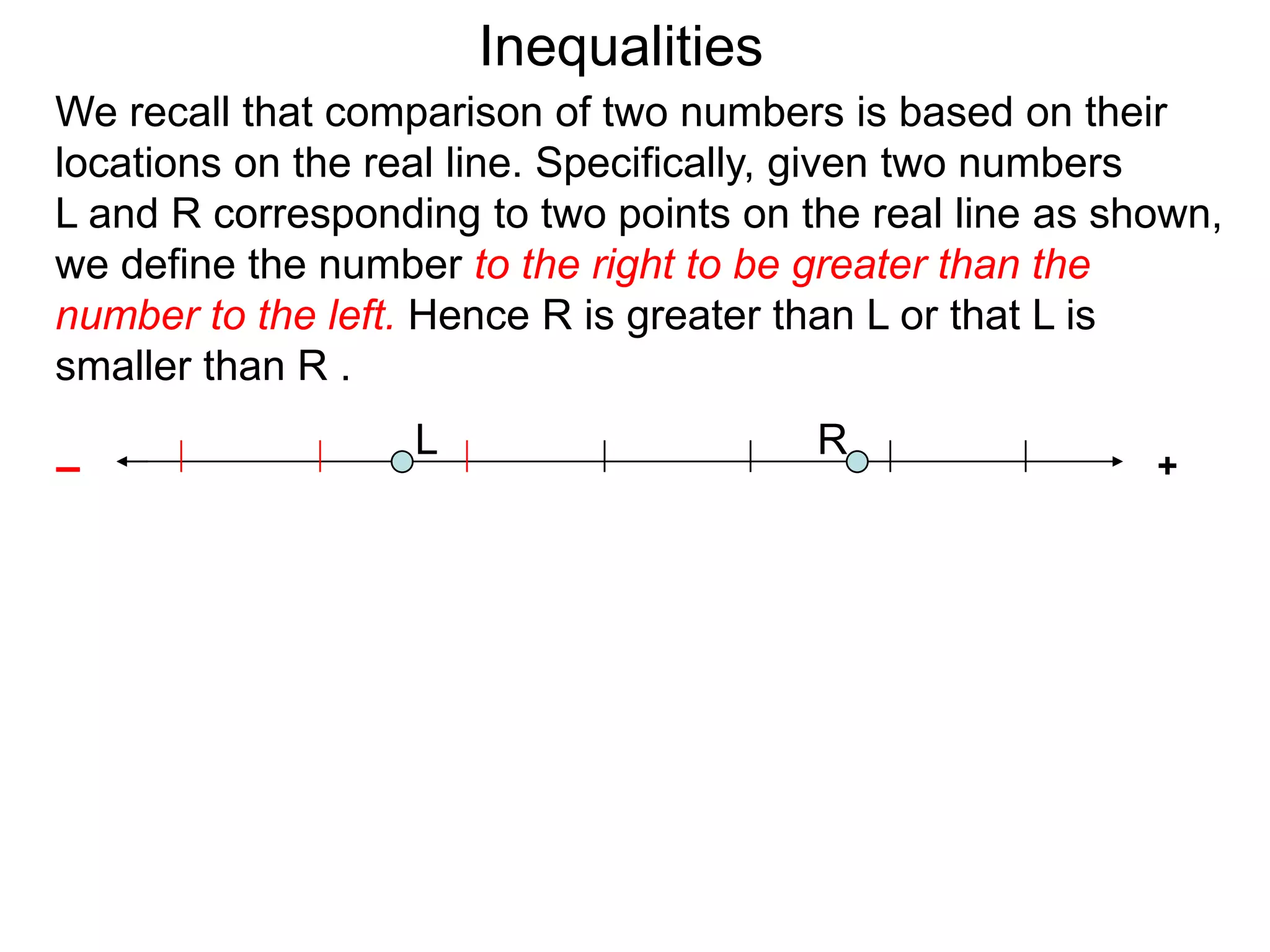
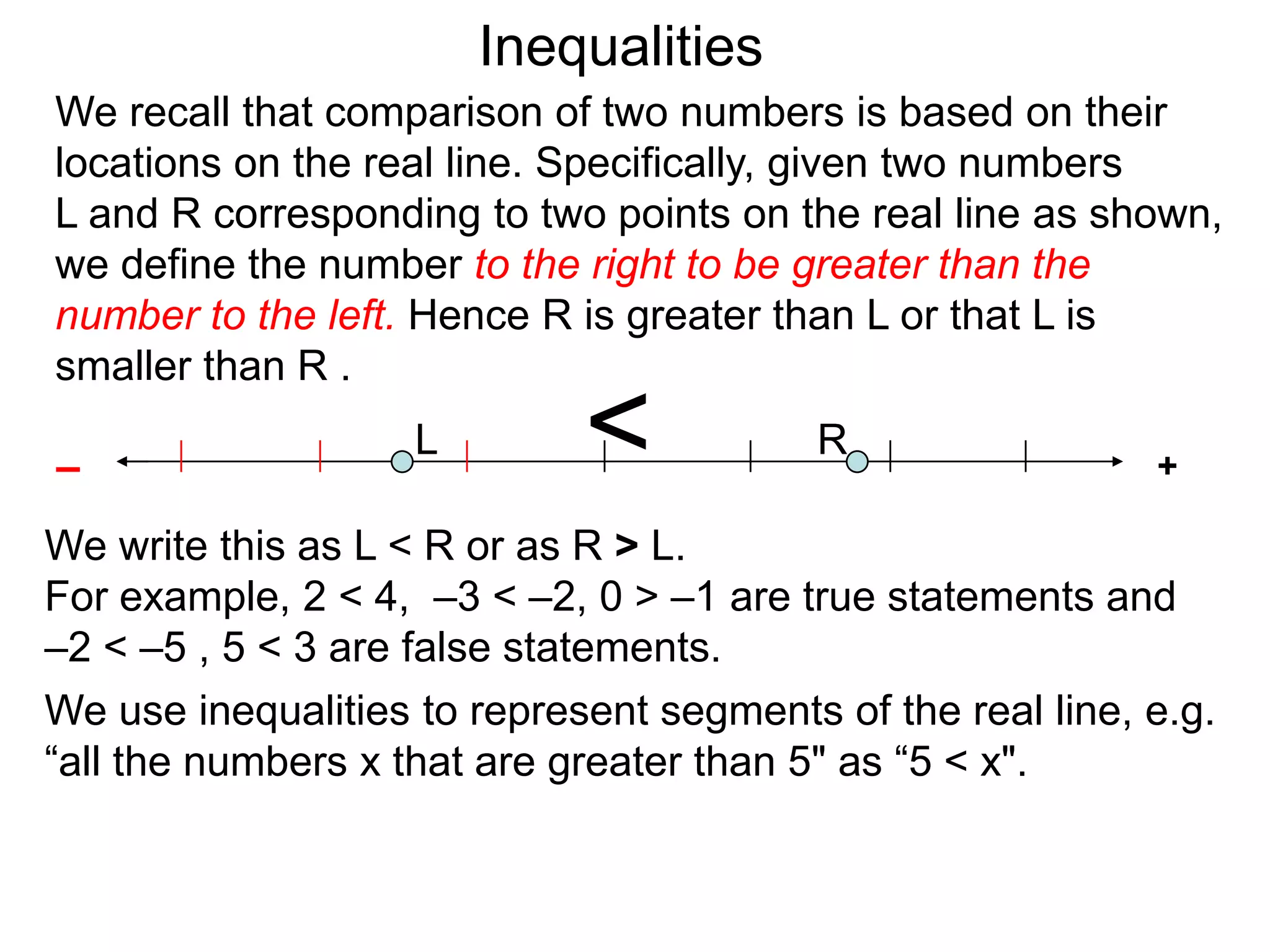
locations on the real line. Specifically, given two numbers
L and R corresponding to two points on the real line as shown,


                   L                    R
–                                                         +
Inequalities
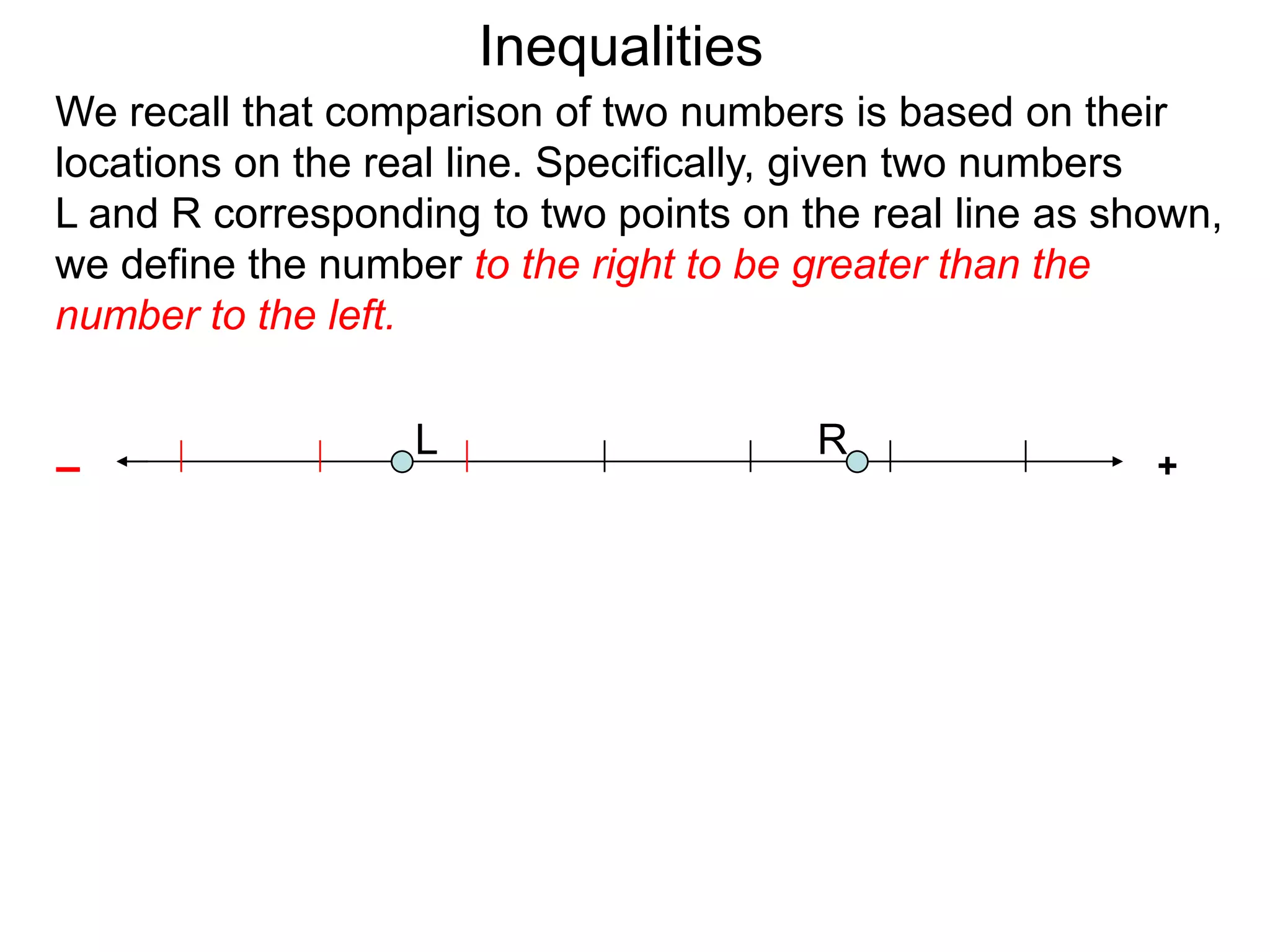
We recall that comparison of two numbers is based on their
locations on the real line. Specifically, given two numbers
L and R corresponding to two points on the real line as shown,
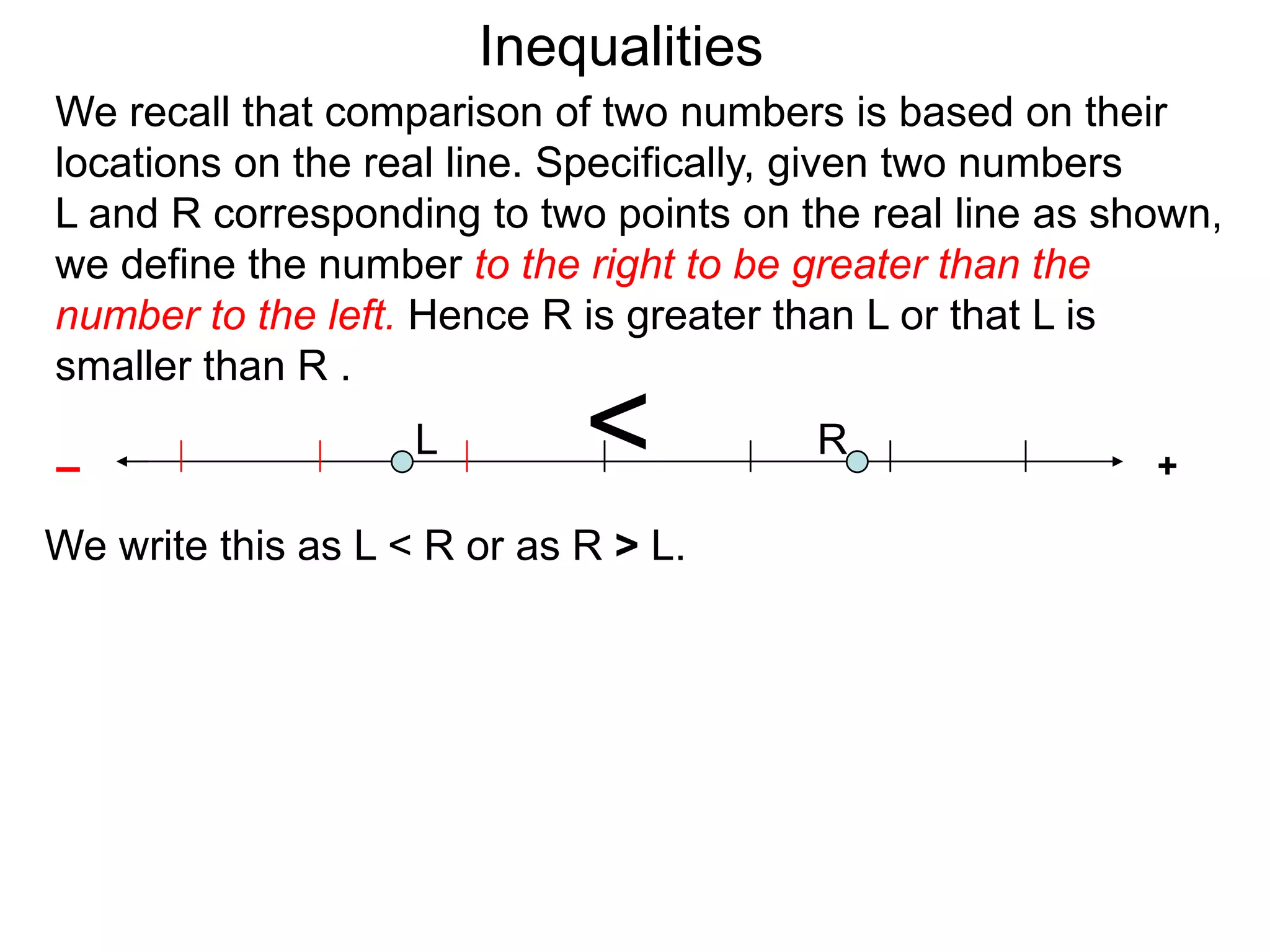
we define the number to the right to be greater than the
number to the left.

                   L                    R
–                                                         +
Inequalities
We recall that comparison of two numbers is based on their
locations on the real line. Specifically, given two numbers
L and R corresponding to two points on the real line as shown,
we define the number to the right to be greater than the
number to the left. Hence R is greater than L or that L is
smaller than R .
                   L                    R
–                                                         +
Inequalities
We recall that comparison of two numbers is based on their
locations on the real line. Specifically, given two numbers
L and R corresponding to two points on the real line as shown,
we define the number to the right to be greater than the
number to the left. Hence R is greater than L or that L is
smaller than R .

–
                    L        <          R
                                                          +

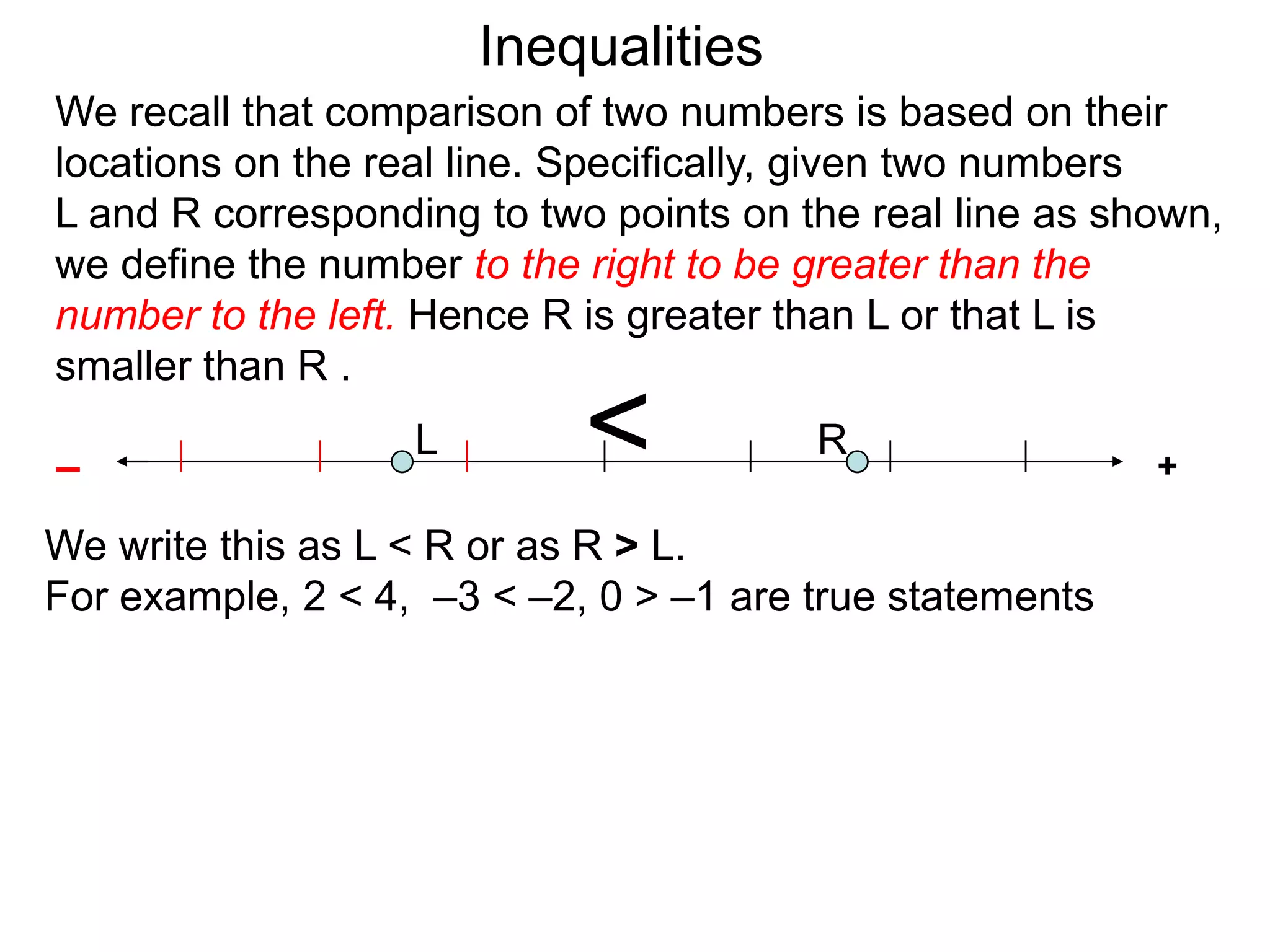
We write this as L < R or as R > L.
Inequalities
We recall that comparison of two numbers is based on their
locations on the real line. Specifically, given two numbers
L and R corresponding to two points on the real line as shown,
we define the number to the right to be greater than the
number to the left. Hence R is greater than L or that L is
smaller than R .

–
                   L        <           R
                                                          +

We write this as L < R or as R > L.
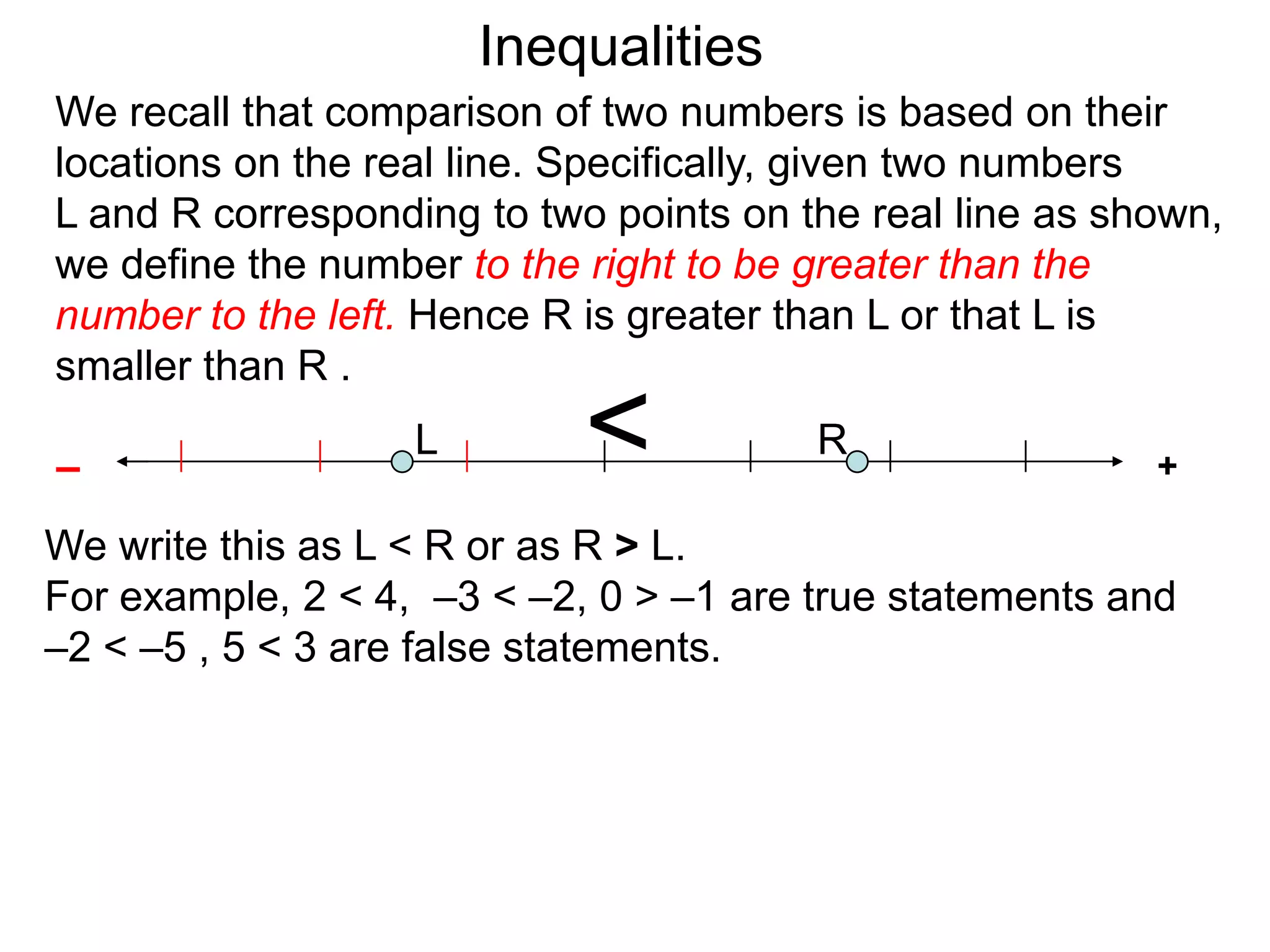
For example, 2 < 4, –3 < –2, 0 > –1 are true statements
Inequalities
We recall that comparison of two numbers is based on their
locations on the real line. Specifically, given two numbers
L and R corresponding to two points on the real line as shown,
we define the number to the right to be greater than the
number to the left. Hence R is greater than L or that L is
smaller than R .

–
                   L        <           R
                                                          +

We write this as L < R or as R > L.
For example, 2 < 4, –3 < –2, 0 > –1 are true statements and
–2 < –5 , 5 < 3 are false statements.
Inequalities
We recall that comparison of two numbers is based on their
locations on the real line. Specifically, given two numbers
L and R corresponding to two points on the real line as shown,
we define the number to the right to be greater than the
number to the left. Hence R is greater than L or that L is
smaller than R .

–
                    L        <            R
                                                            +

We write this as L < R or as R > L.
For example, 2 < 4, –3 < –2, 0 > –1 are true statements and
–2 < –5 , 5 < 3 are false statements.
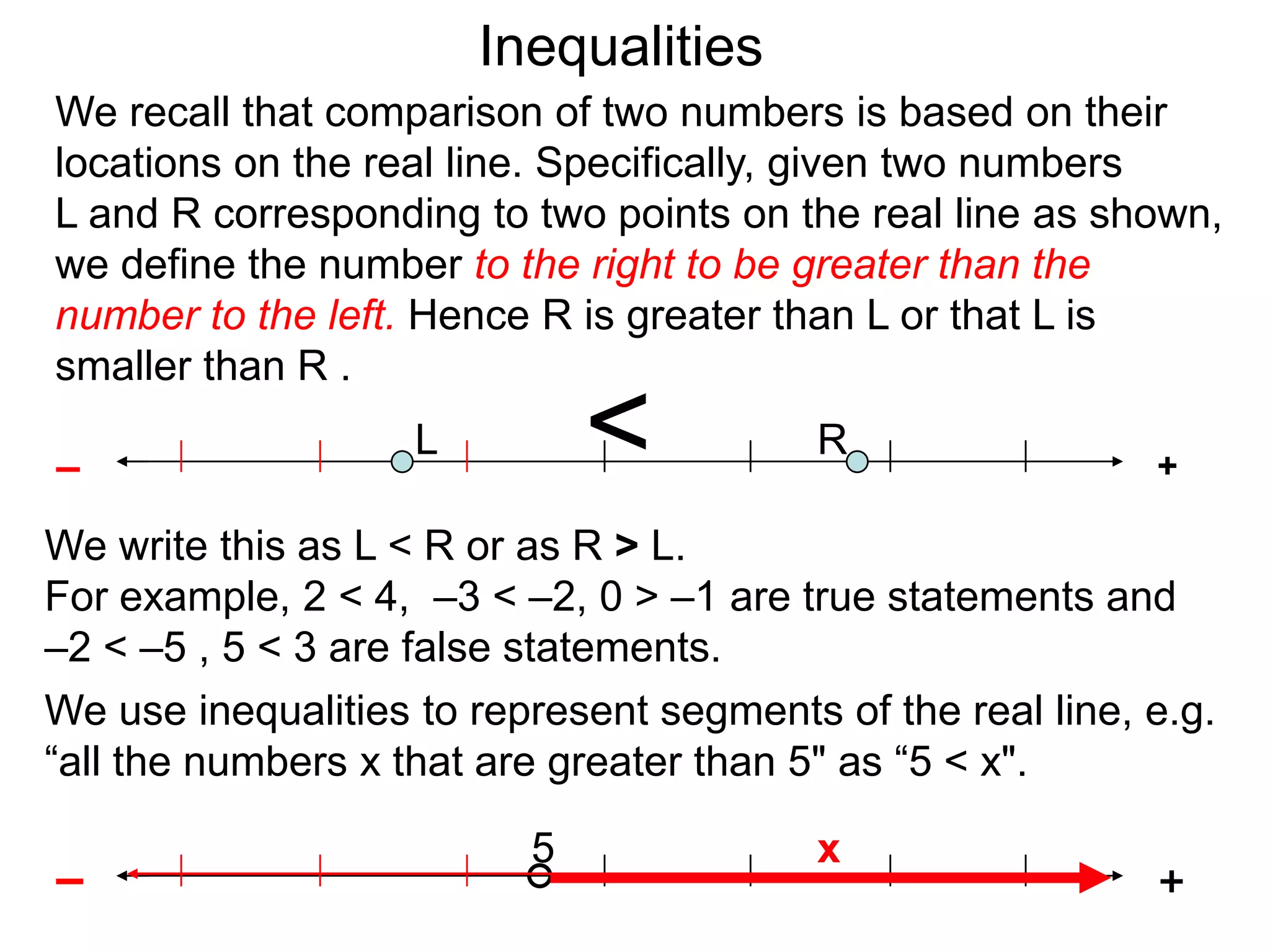
We use inequalities to represent segments of the real line, e.g.
“all the numbers x that are greater than 5" as “5 < x".
Inequalities
We recall that comparison of two numbers is based on their
locations on the real line. Specifically, given two numbers
L and R corresponding to two points on the real line as shown,
we define the number to the right to be greater than the
number to the left. Hence R is greater than L or that L is
smaller than R .

–
                    L         <           R
                                                            +

We write this as L < R or as R > L.
For example, 2 < 4, –3 < –2, 0 > –1 are true statements and
–2 < –5 , 5 < 3 are false statements.
We use inequalities to represent segments of the real line, e.g.
“all the numbers x that are greater than 5" as “5 < x".

                          5               x
–                                                           +
Inequalities
In general, we write "a < x" for all In picture,
Inequalities
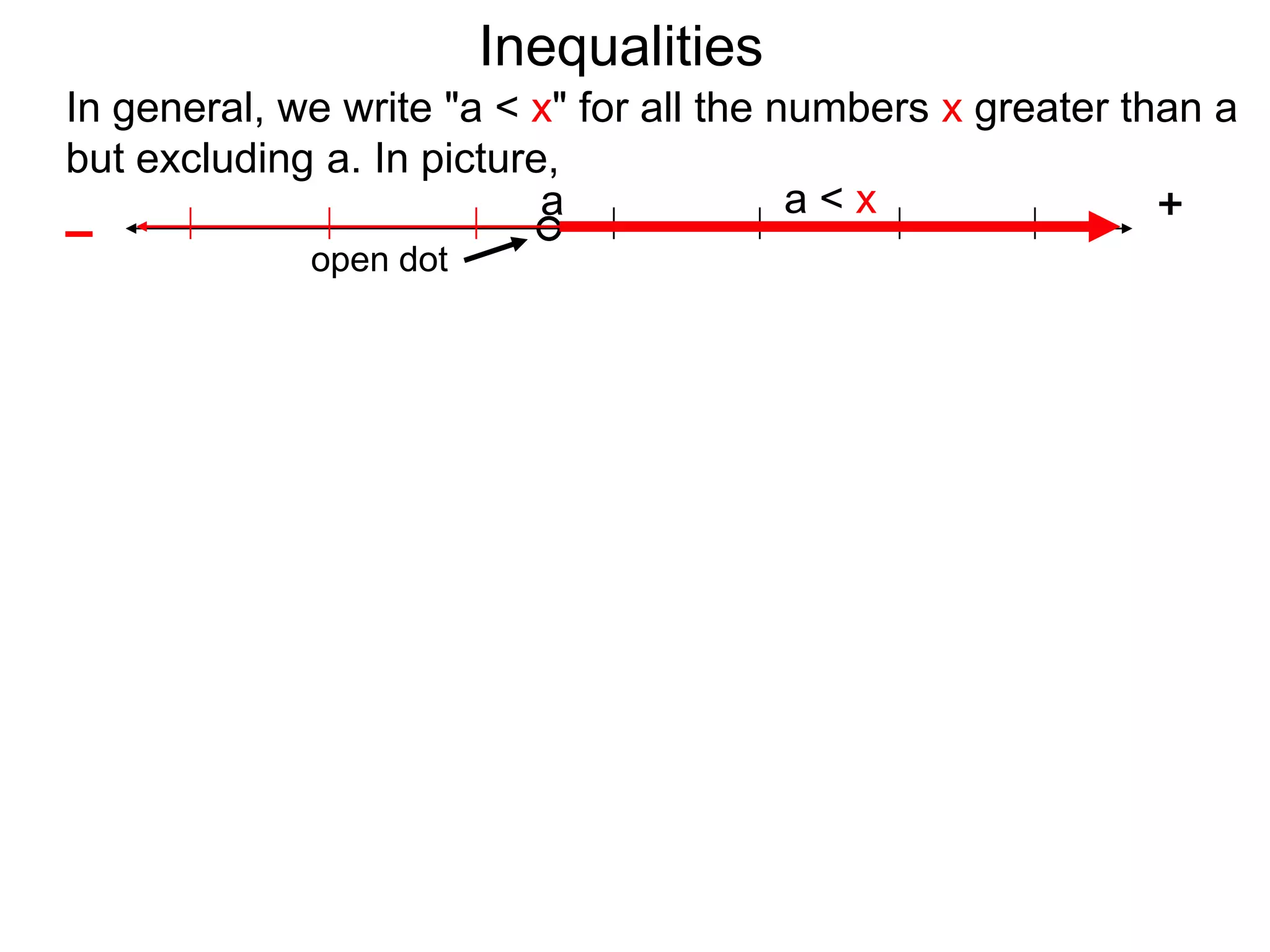
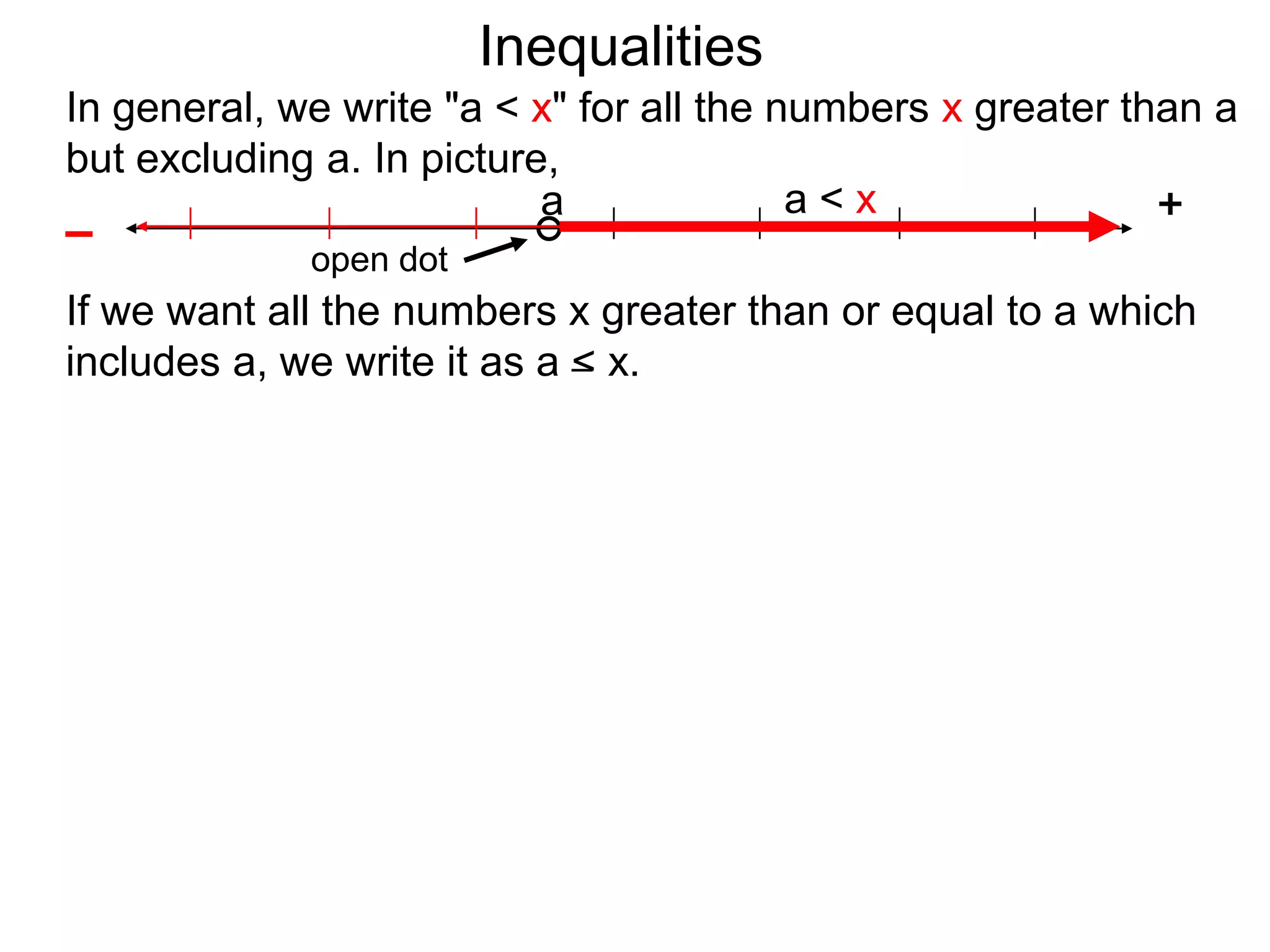
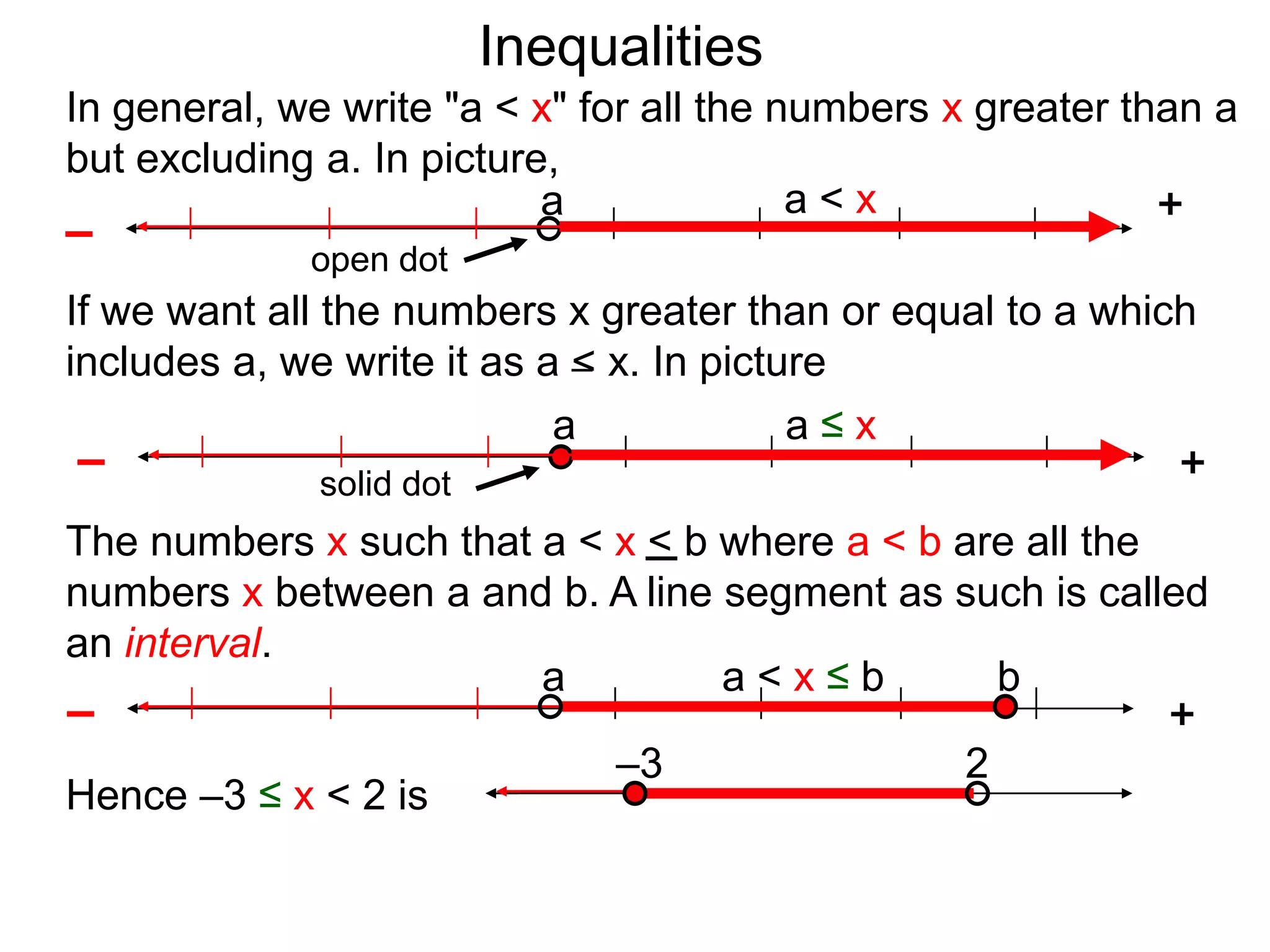
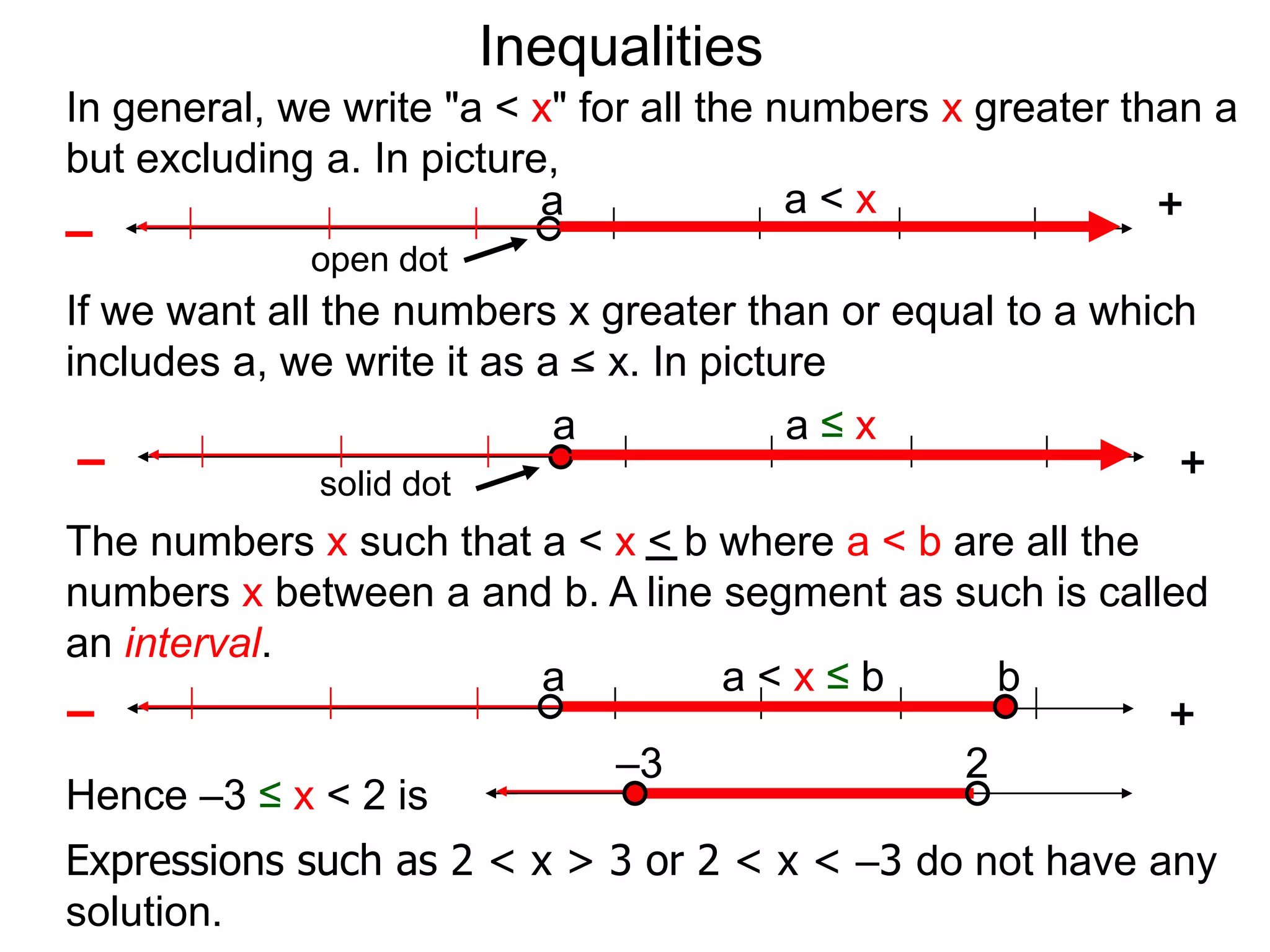
In general, we write "a < x" for all the numbers x greater than a
but excluding a. In picture,
                           a              a<x                +
–
             open dot
Inequalities
In general, we write "a < x" for all the numbers x greater than a
but excluding a. In picture,
                           a              a<x                +
–
             open dot
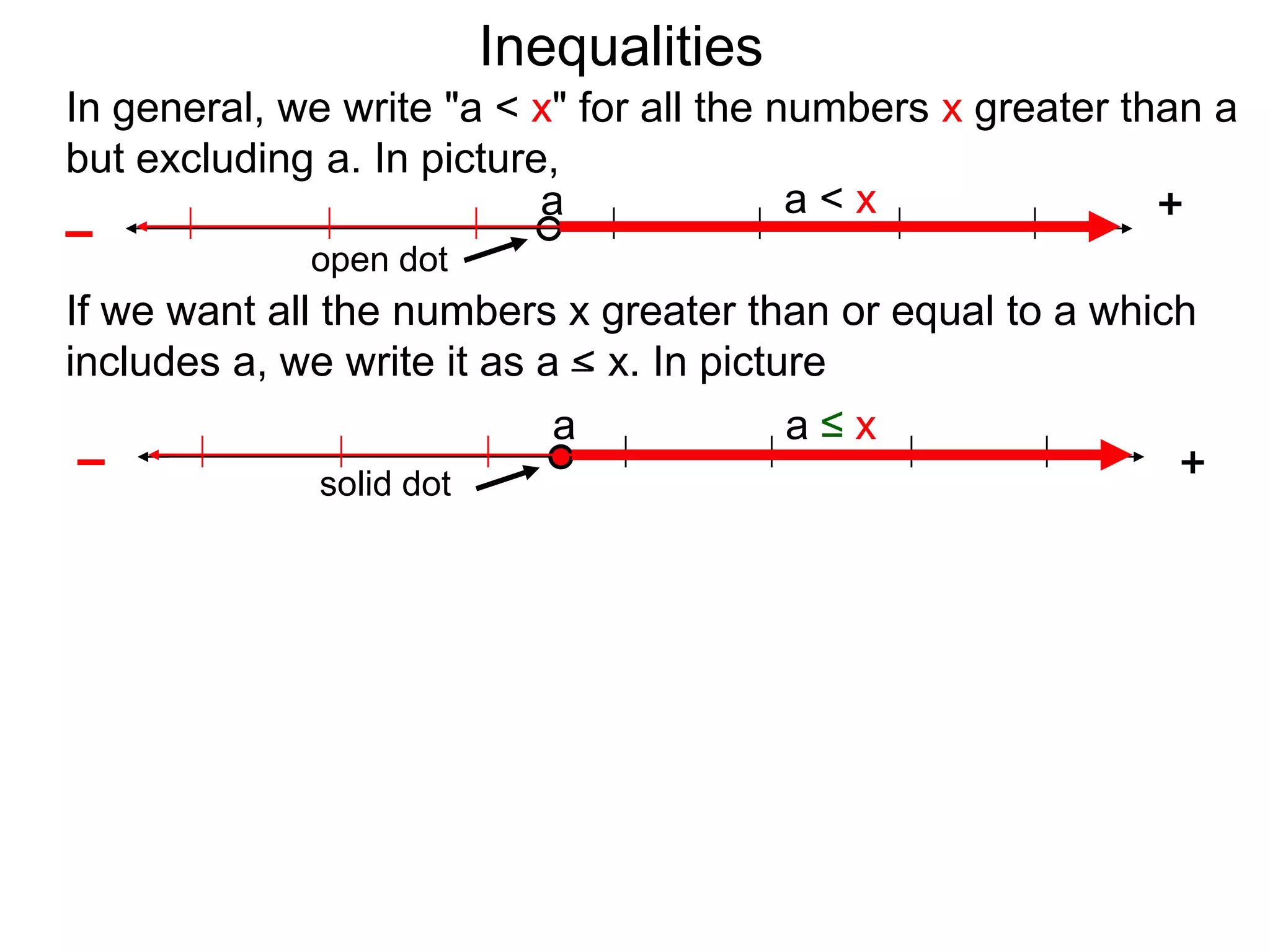
If we want all the numbers x greater than or equal to a which
includes a, we write it as a < x.
Inequalities
In general, we write "a < x" for all the numbers x greater than a
but excluding a. In picture,
                           a              a<x                +
–
             open dot
If we want all the numbers x greater than or equal to a which
includes a, we write it as a < x. In picture
                            a             a≤x
 –             solid dot
                                                            +
Inequalities
In general, we write "a < x" for all the numbers x greater than a
but excluding a. In picture,
                           a              a<x                +
–
             open dot
If we want all the numbers x greater than or equal to a which
includes a, we write it as a < x. In picture
                            a             a≤x
 –             solid dot
                                                            +

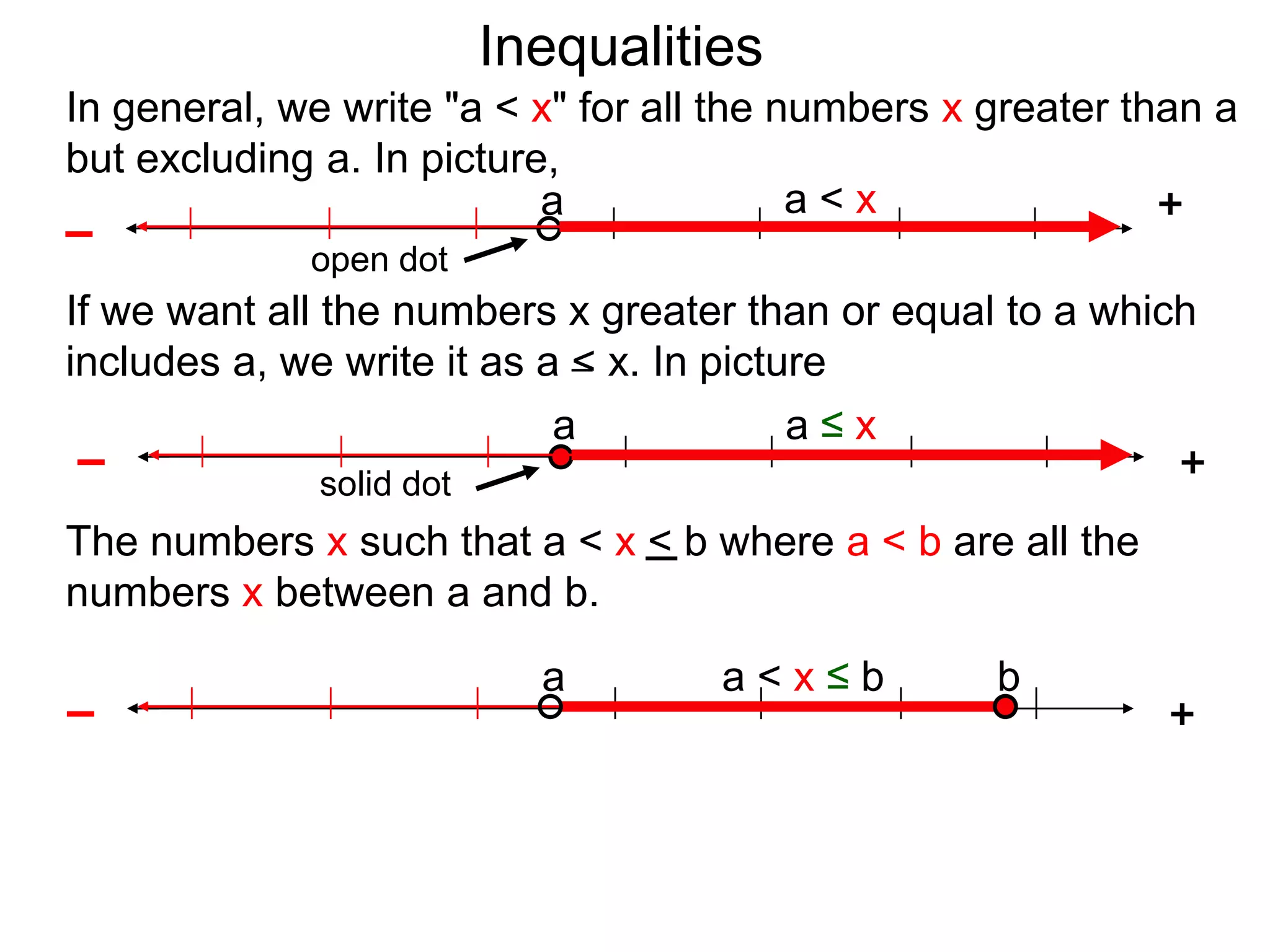
The numbers x such that a < x < b where a < b are all the
numbers x between a and b.
                          a         a<x≤b          b
–                                                            +
Inequalities
In general, we write "a < x" for all the numbers x greater than a
but excluding a. In picture,
                           a              a<x                +
–
             open dot
If we want all the numbers x greater than or equal to a which
includes a, we write it as a < x. In picture
                            a             a≤x
 –             solid dot
                                                            +

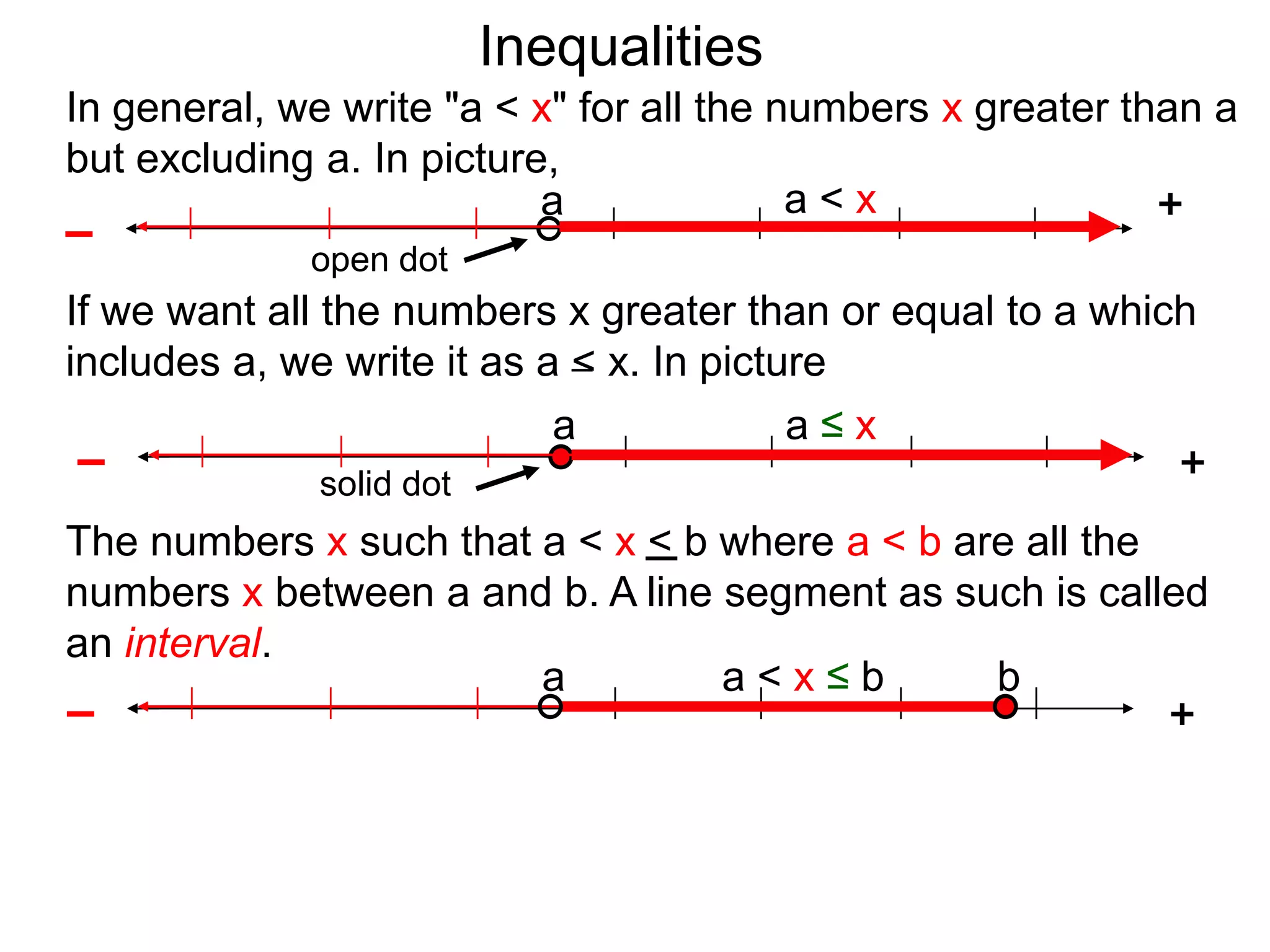
The numbers x such that a < x < b where a < b are all the
numbers x between a and b. A line segment as such is called
an interval.
                        a         a<x≤b         b
–                                                         +
Inequalities
In general, we write "a < x" for all the numbers x greater than a
but excluding a. In picture,
                           a              a<x                +
–
             open dot
If we want all the numbers x greater than or equal to a which
includes a, we write it as a < x. In picture
                            a             a≤x
 –             solid dot
                                                            +

The numbers x such that a < x < b where a < b are all the
numbers x between a and b. A line segment as such is called
an interval.
                        a         a<x≤b          b
–                                                         +
                            –3                 2
Hence –3 ≤ x < 2 is
Inequalities
In general, we write "a < x" for all the numbers x greater than a
but excluding a. In picture,
                           a              a<x                +
–
             open dot
If we want all the numbers x greater than or equal to a which
includes a, we write it as a < x. In picture
                            a             a≤x
 –             solid dot
                                                            +

The numbers x such that a < x < b where a < b are all the
numbers x between a and b. A line segment as such is called
an interval.
                        a         a<x≤b          b
–                                                         +
                            –3                 2
Hence –3 ≤ x < 2 is
Expressions such as 2 < x > 3 or 2 < x < –3 do not have any
solution.
Inequalities
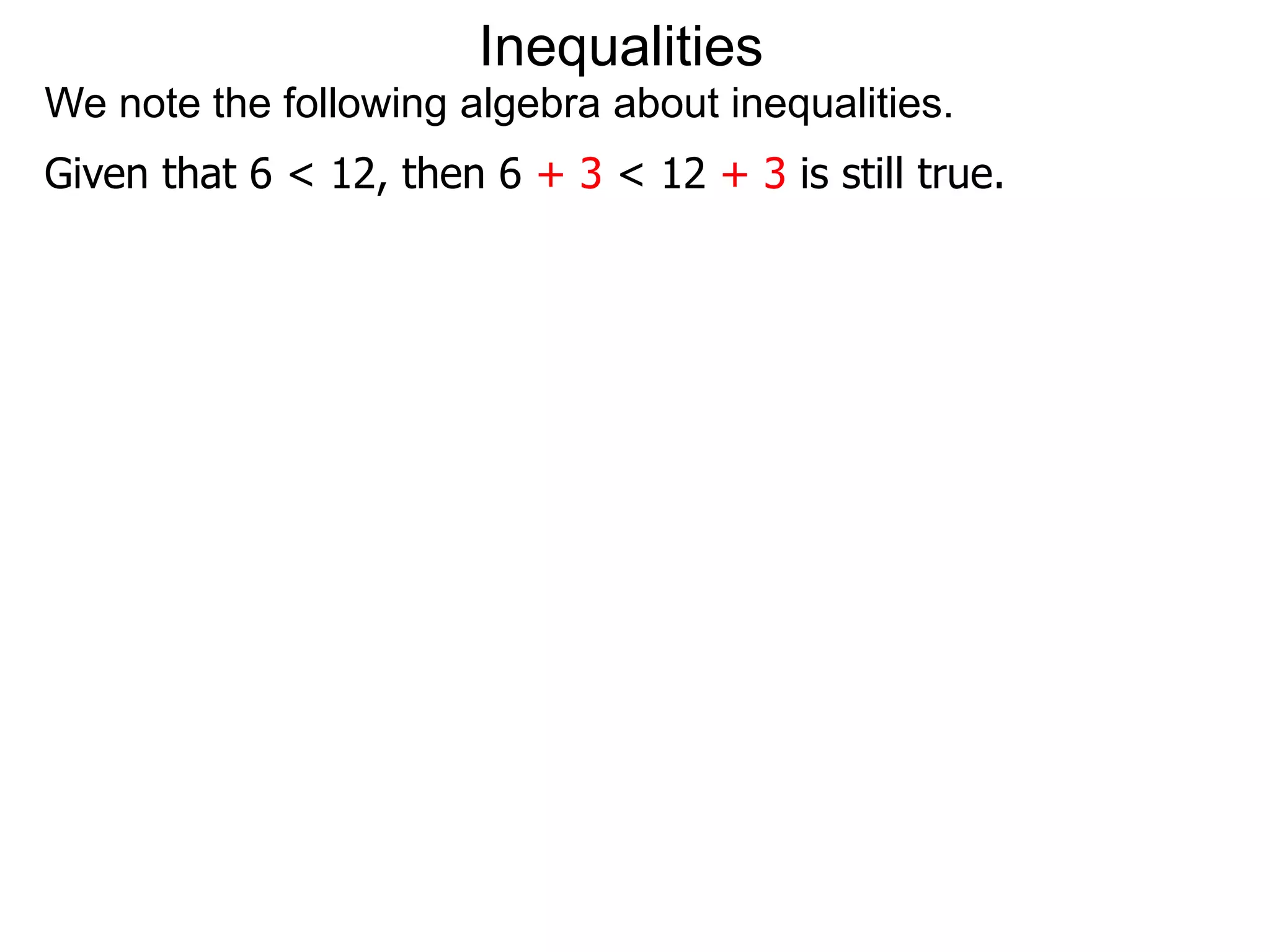
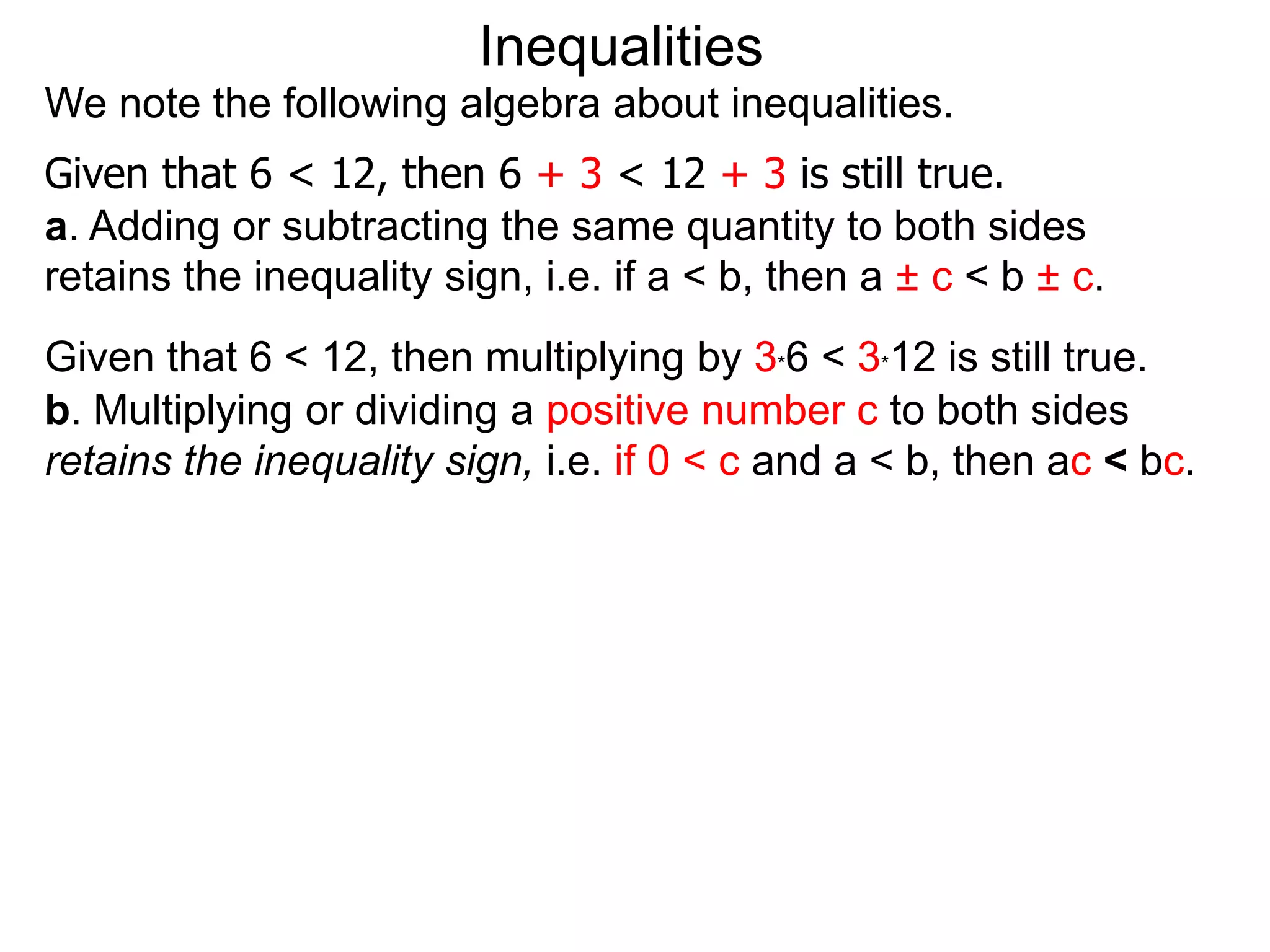
We note the following algebra about inequalities.
Inequalities
We note the following algebra about inequalities.
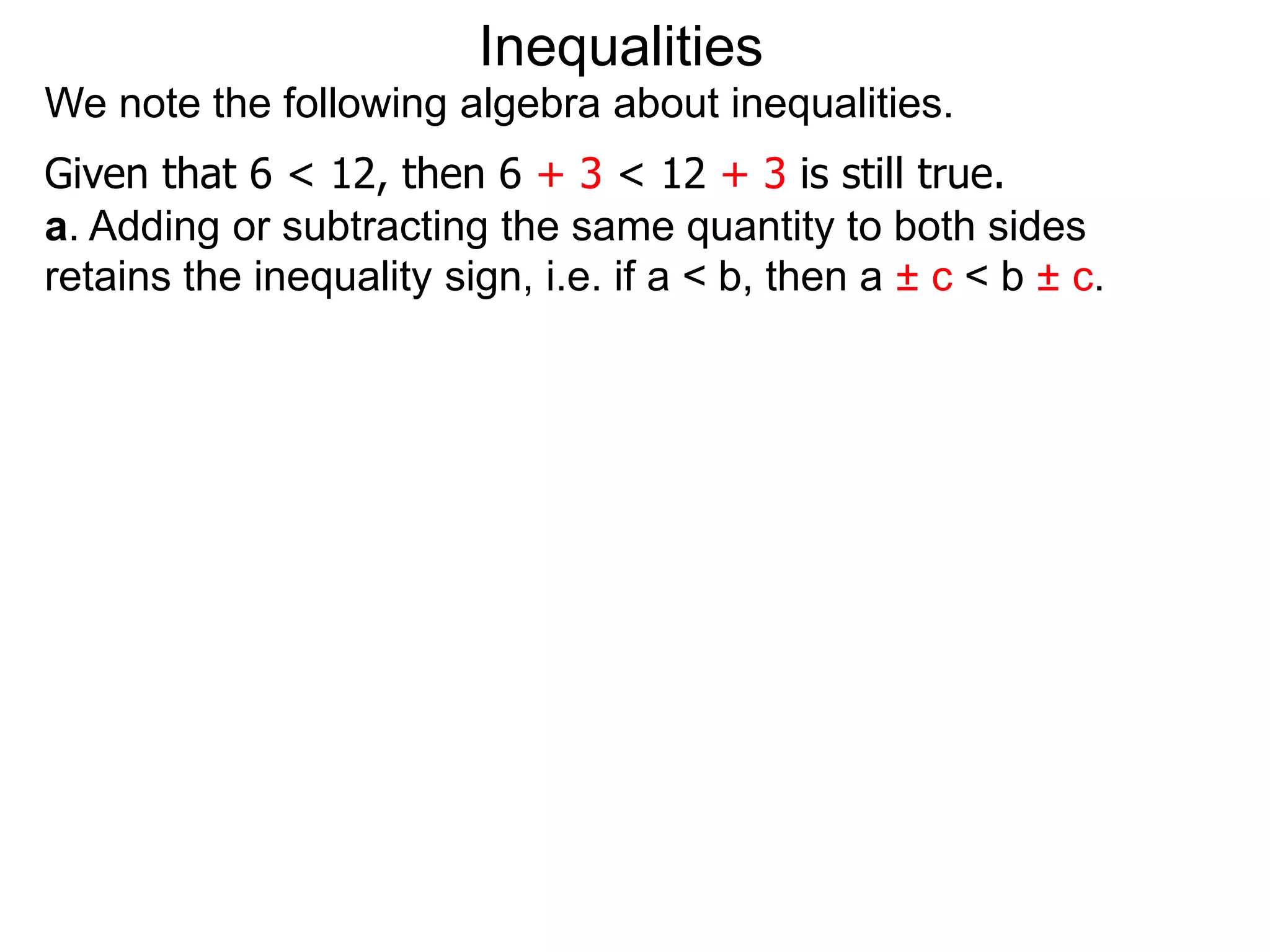
Given that 6 < 12, then 6 + 3 < 12 + 3 is still true.
Inequalities
We note the following algebra about inequalities.
Given that 6 < 12, then 6 + 3 < 12 + 3 is still true.
a. Adding or subtracting the same quantity to both sides
retains the inequality sign,
Inequalities
We note the following algebra about inequalities.
Given that 6 < 12, then 6 + 3 < 12 + 3 is still true.
a. Adding or subtracting the same quantity to both sides
retains the inequality sign, i.e. if a < b, then a ± c < b ± c.
Inequalities
We note the following algebra about inequalities.
Given that 6 < 12, then 6 + 3 < 12 + 3 is still true.
a. Adding or subtracting the same quantity to both sides
retains the inequality sign, i.e. if a < b, then a ± c < b ± c.
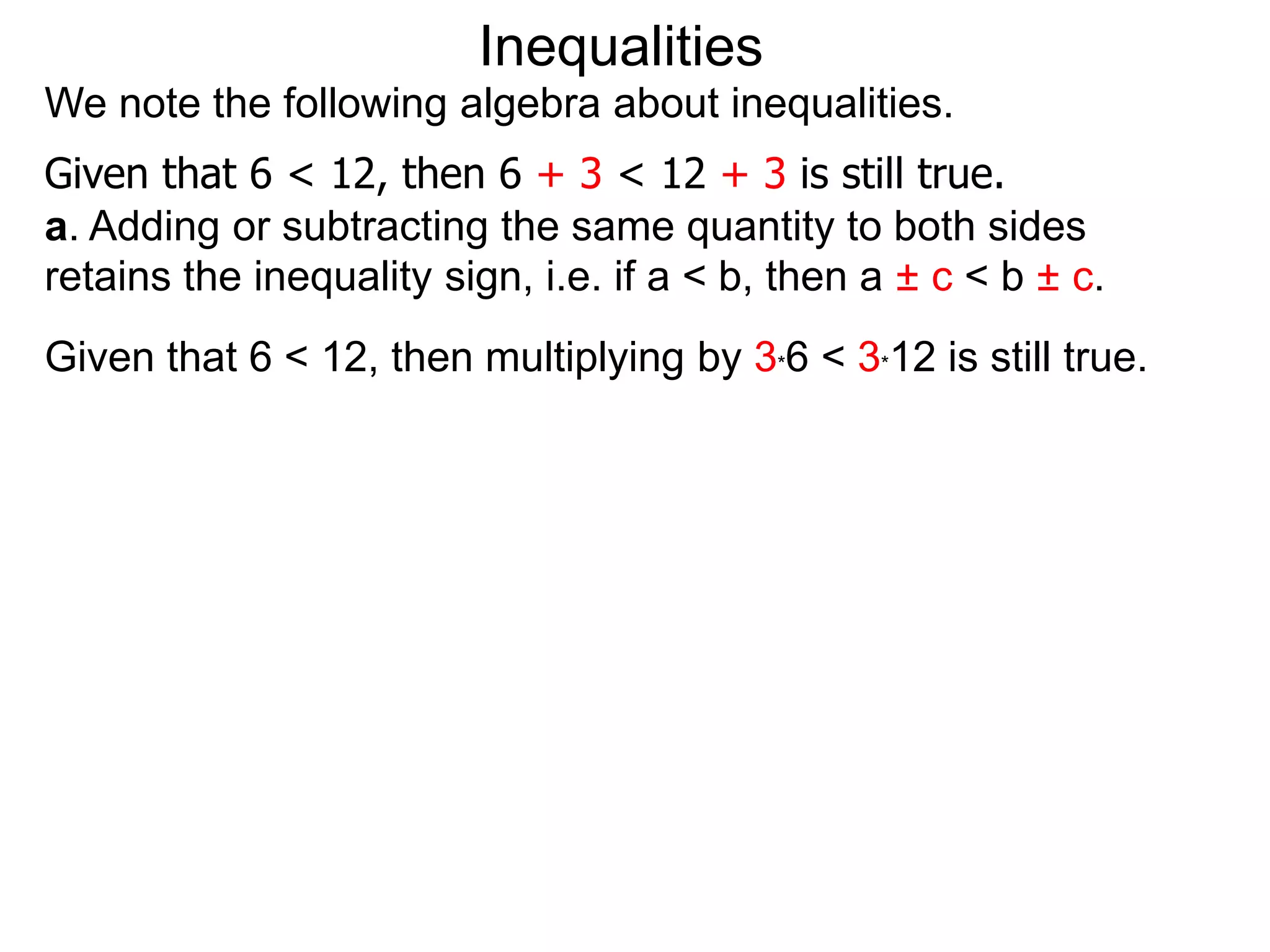
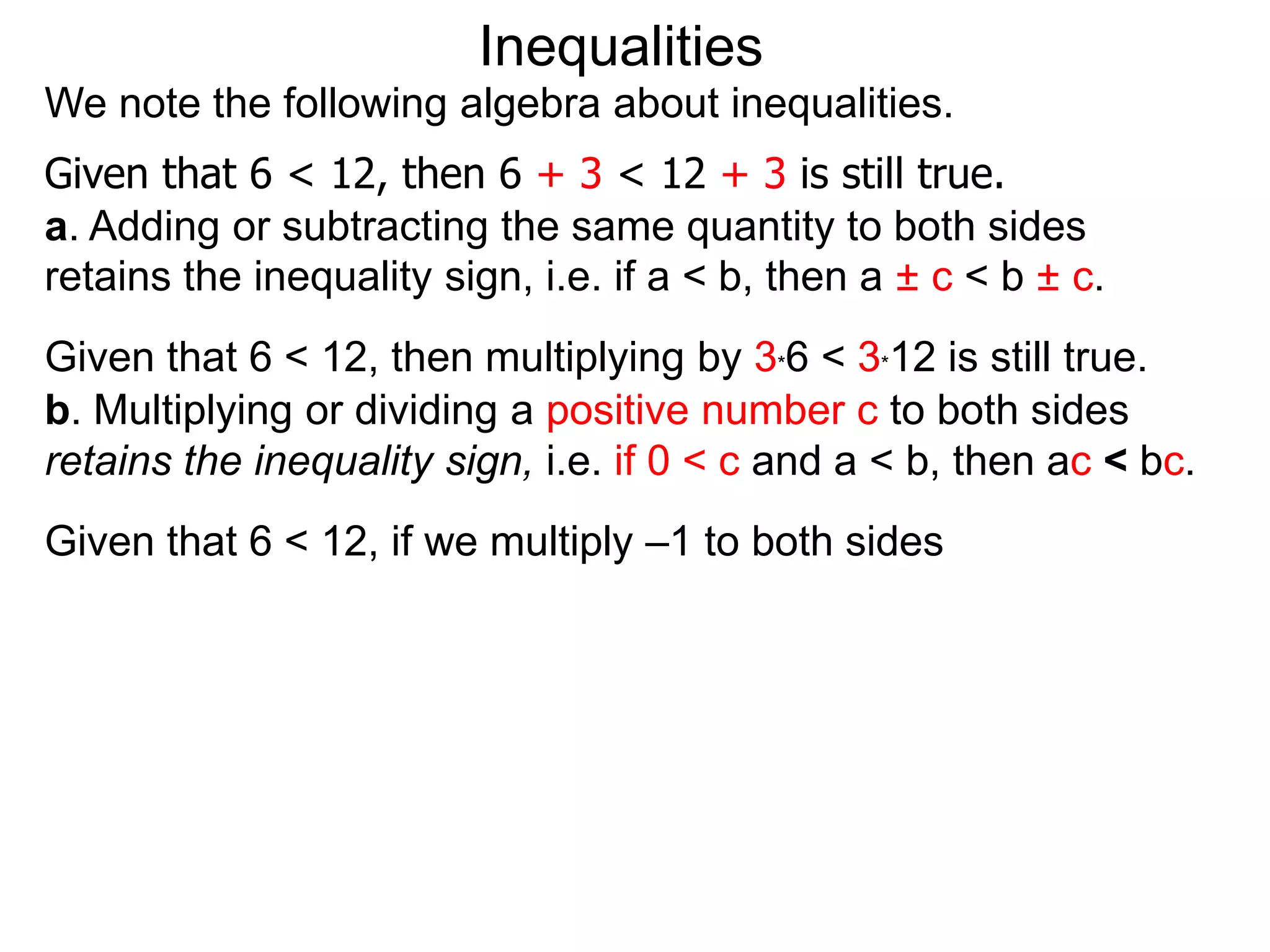
Given that 6 < 12, then multiplying by 3*6 < 3*12 is still true.
Inequalities
We note the following algebra about inequalities.
Given that 6 < 12, then 6 + 3 < 12 + 3 is still true.
a. Adding or subtracting the same quantity to both sides
retains the inequality sign, i.e. if a < b, then a ± c < b ± c.
Given that 6 < 12, then multiplying by 3*6 < 3*12 is still true.
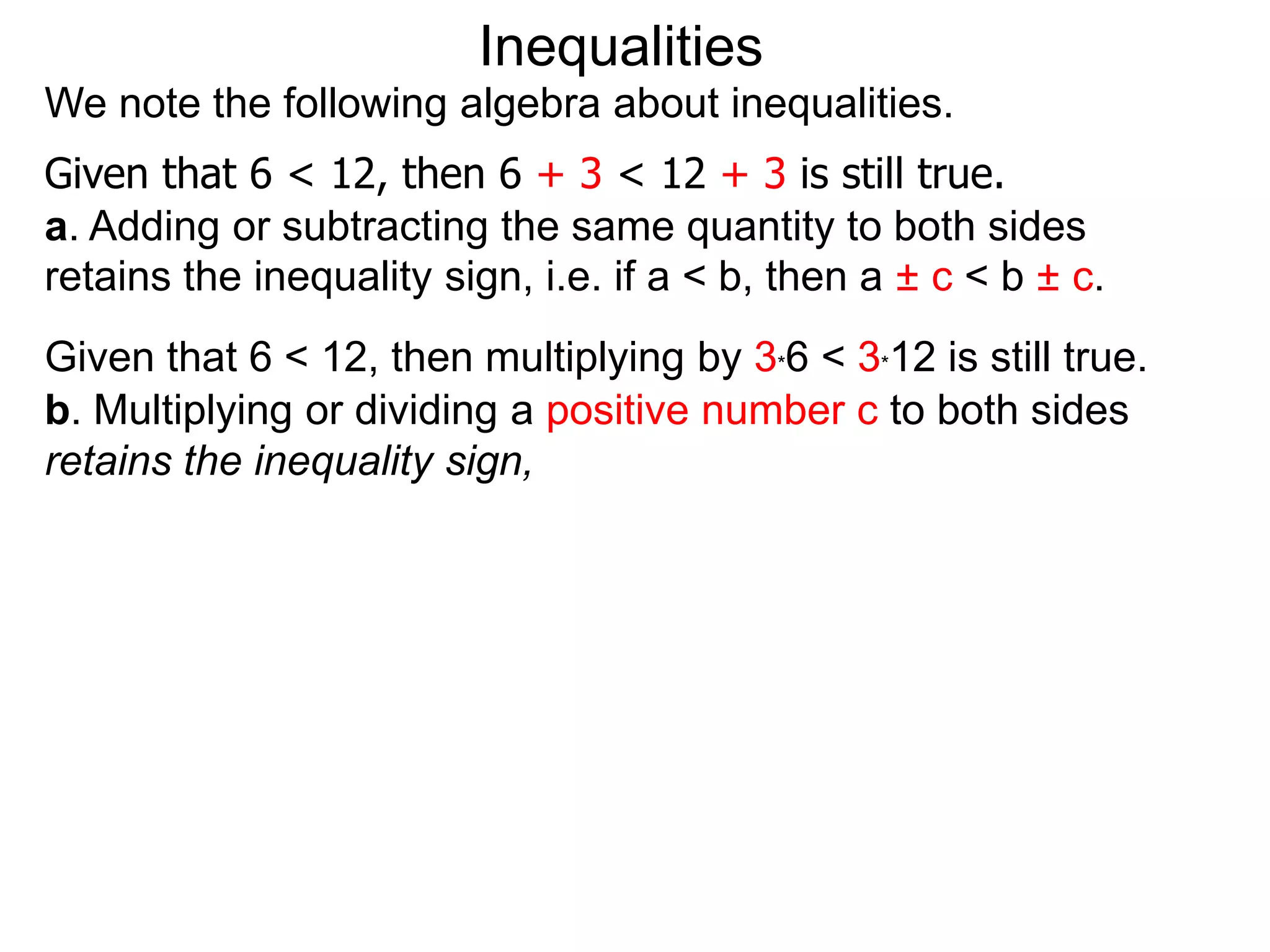
b. Multiplying or dividing a positive number c to both sides
retains the inequality sign,
Inequalities
We note the following algebra about inequalities.
Given that 6 < 12, then 6 + 3 < 12 + 3 is still true.
a. Adding or subtracting the same quantity to both sides
retains the inequality sign, i.e. if a < b, then a ± c < b ± c.
Given that 6 < 12, then multiplying by 3*6 < 3*12 is still true.
b. Multiplying or dividing a positive number c to both sides
retains the inequality sign, i.e. if 0 < c and a < b, then ac < bc.
Inequalities
We note the following algebra about inequalities.
Given that 6 < 12, then 6 + 3 < 12 + 3 is still true.
a. Adding or subtracting the same quantity to both sides
retains the inequality sign, i.e. if a < b, then a ± c < b ± c.
Given that 6 < 12, then multiplying by 3*6 < 3*12 is still true.
b. Multiplying or dividing a positive number c to both sides
retains the inequality sign, i.e. if 0 < c and a < b, then ac < bc.
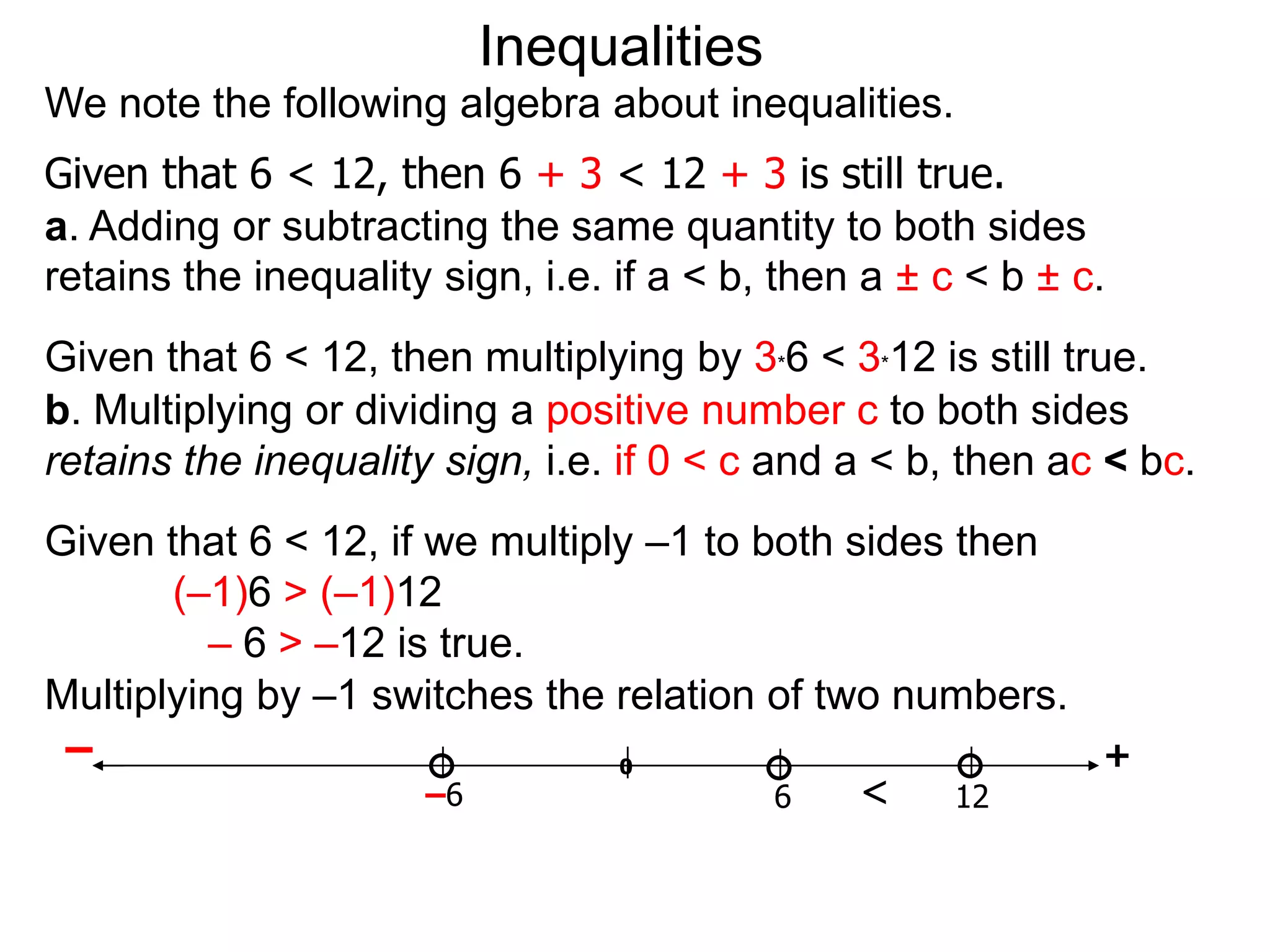
Given that 6 < 12, if we multiply –1 to both sides
Inequalities
We note the following algebra about inequalities.
Given that 6 < 12, then 6 + 3 < 12 + 3 is still true.
a. Adding or subtracting the same quantity to both sides
retains the inequality sign, i.e. if a < b, then a ± c < b ± c.
Given that 6 < 12, then multiplying by 3*6 < 3*12 is still true.
b. Multiplying or dividing a positive number c to both sides
retains the inequality sign, i.e. if 0 < c and a < b, then ac < bc.
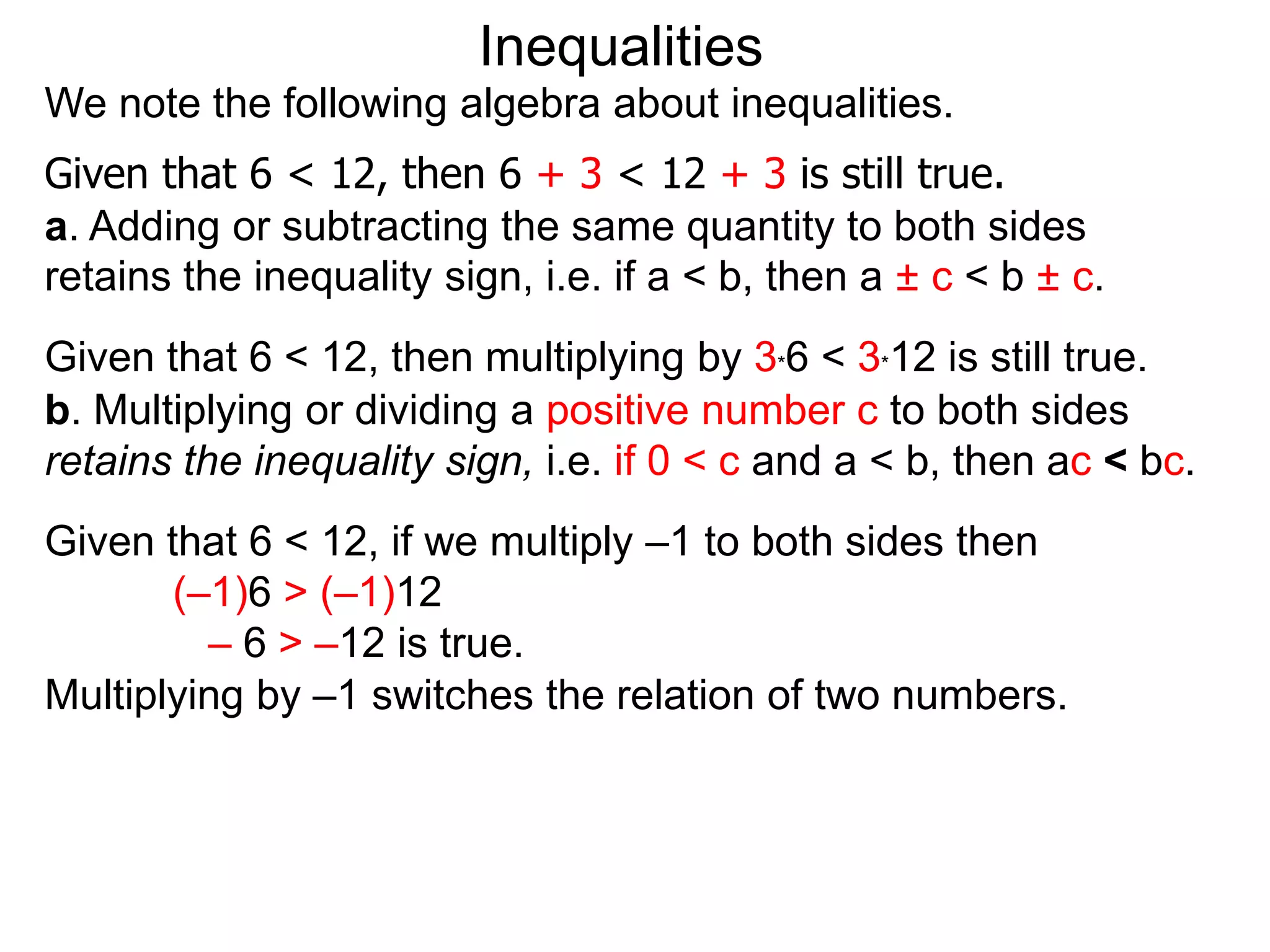
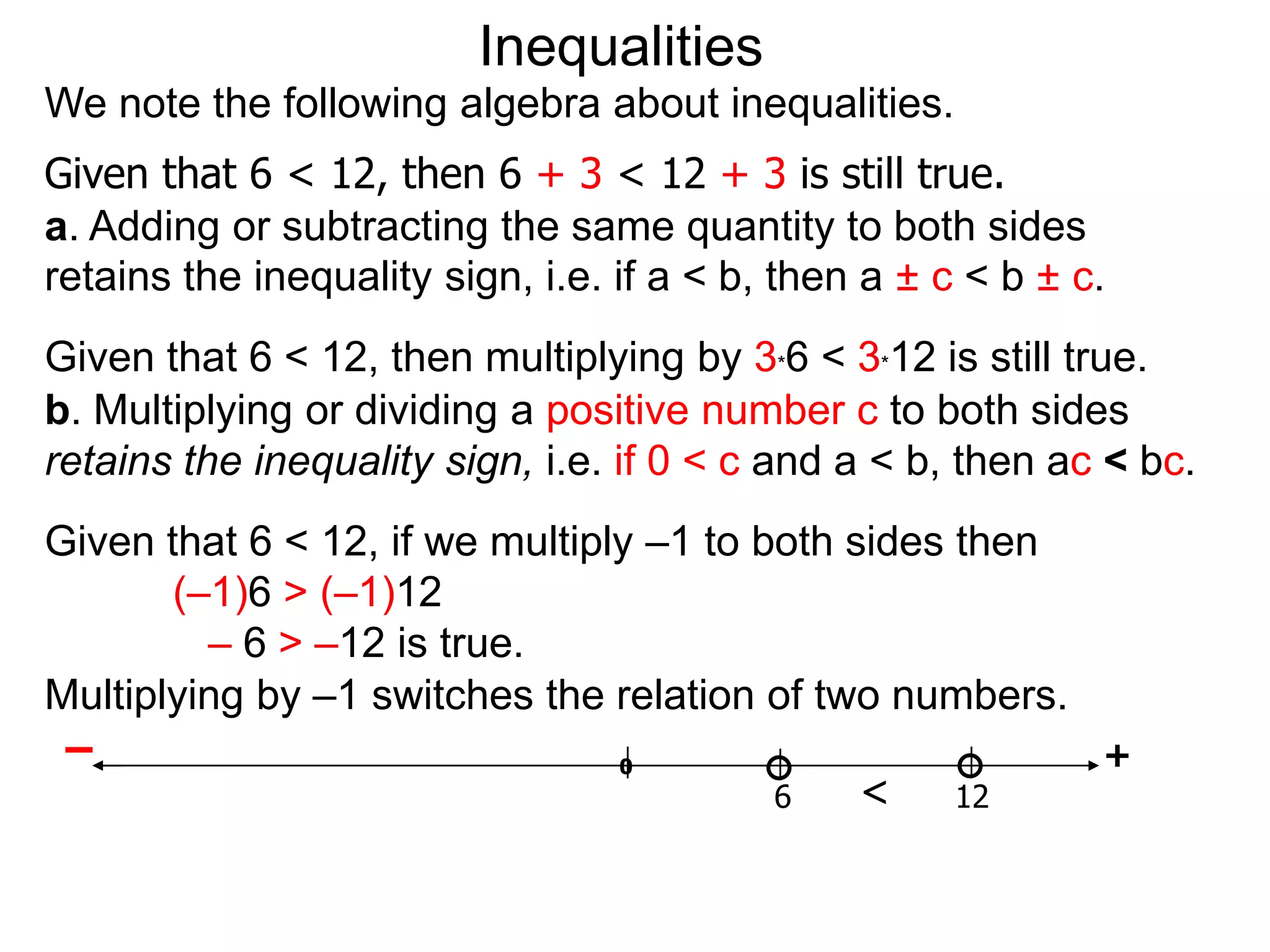
Given that 6 < 12, if we multiply –1 to both sides then
       (–1)6 > (–1)12
         – 6 > –12 is true.
Inequalities
We note the following algebra about inequalities.
Given that 6 < 12, then 6 + 3 < 12 + 3 is still true.
a. Adding or subtracting the same quantity to both sides
retains the inequality sign, i.e. if a < b, then a ± c < b ± c.
Given that 6 < 12, then multiplying by 3*6 < 3*12 is still true.
b. Multiplying or dividing a positive number c to both sides
retains the inequality sign, i.e. if 0 < c and a < b, then ac < bc.
Given that 6 < 12, if we multiply –1 to both sides then
       (–1)6 > (–1)12
         – 6 > –12 is true.
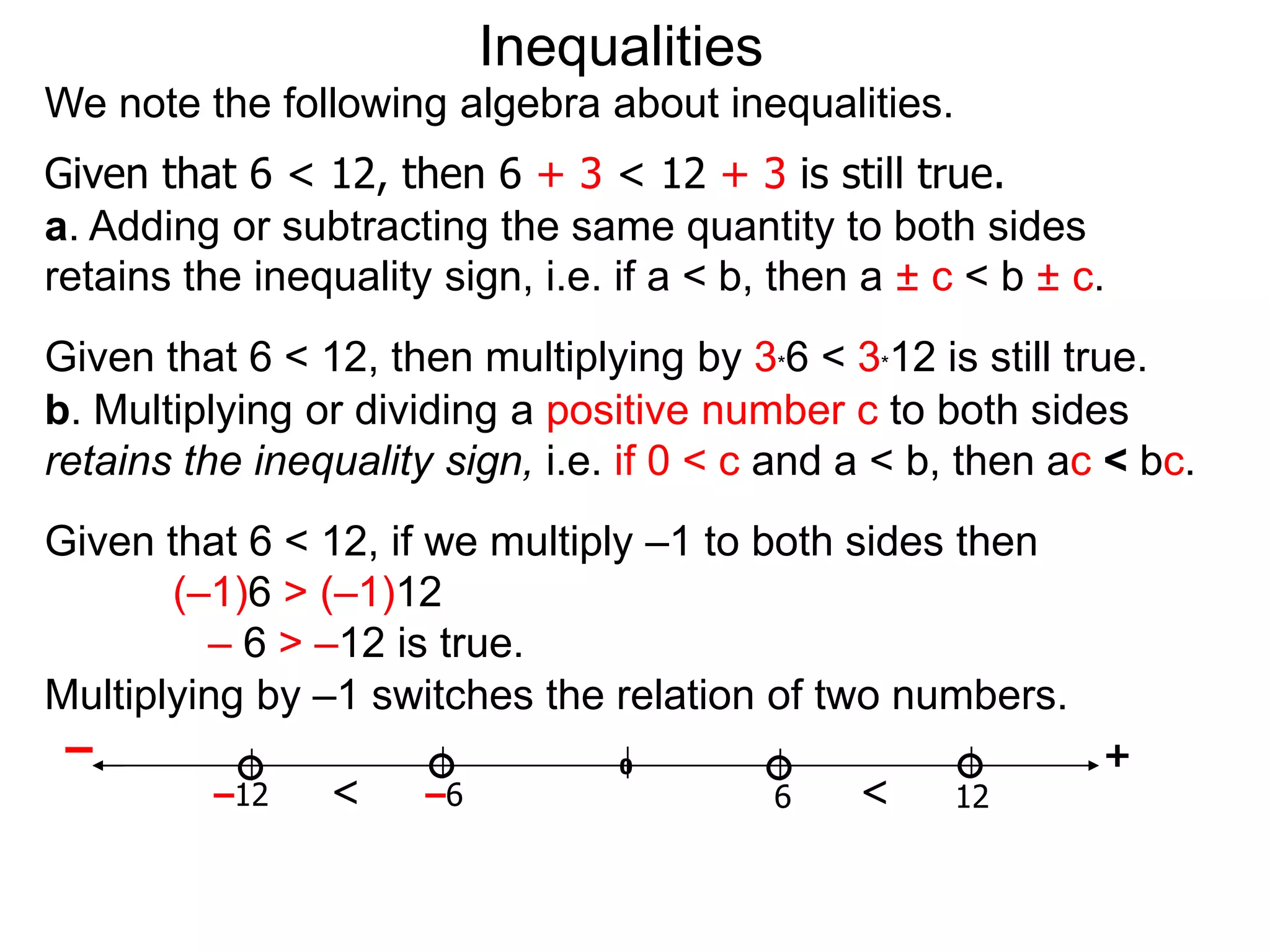
Multiplying by –1 switches the relation of two numbers.
Inequalities
We note the following algebra about inequalities.
Given that 6 < 12, then 6 + 3 < 12 + 3 is still true.
a. Adding or subtracting the same quantity to both sides
retains the inequality sign, i.e. if a < b, then a ± c < b ± c.
Given that 6 < 12, then multiplying by 3*6 < 3*12 is still true.
b. Multiplying or dividing a positive number c to both sides
retains the inequality sign, i.e. if 0 < c and a < b, then ac < bc.
Given that 6 < 12, if we multiply –1 to both sides then
       (–1)6 > (–1)12
         – 6 > –12 is true.
Multiplying by –1 switches the relation of two numbers.
 –                              0                       +
                                         6    <    12
Inequalities
We note the following algebra about inequalities.
Given that 6 < 12, then 6 + 3 < 12 + 3 is still true.
a. Adding or subtracting the same quantity to both sides
retains the inequality sign, i.e. if a < b, then a ± c < b ± c.
Given that 6 < 12, then multiplying by 3*6 < 3*12 is still true.
b. Multiplying or dividing a positive number c to both sides
retains the inequality sign, i.e. if 0 < c and a < b, then ac < bc.
Given that 6 < 12, if we multiply –1 to both sides then
       (–1)6 > (–1)12
         – 6 > –12 is true.
Multiplying by –1 switches the relation of two numbers.
 –                              0                       +
                      –6                 6    <    12
Inequalities
We note the following algebra about inequalities.
Given that 6 < 12, then 6 + 3 < 12 + 3 is still true.
a. Adding or subtracting the same quantity to both sides
retains the inequality sign, i.e. if a < b, then a ± c < b ± c.
Given that 6 < 12, then multiplying by 3*6 < 3*12 is still true.
b. Multiplying or dividing a positive number c to both sides
retains the inequality sign, i.e. if 0 < c and a < b, then ac < bc.
Given that 6 < 12, if we multiply –1 to both sides then
       (–1)6 > (–1)12
         – 6 > –12 is true.
Multiplying by –1 switches the relation of two numbers.
 –                              0                       +
          –12   <     –6                 6    <    12
Inequalities
We note the following algebra about inequalities.
Given that 6 < 12, then 6 + 3 < 12 + 3 is still true.
a. Adding or subtracting the same quantity to both sides
retains the inequality sign, i.e. if a < b, then a ± c < b ± c.
Given that 6 < 12, then multiplying by 3*6 < 3*12 is still true.
b. Multiplying or dividing a positive number c to both sides
retains the inequality sign, i.e. if 0 < c and a < b, then ac < bc.
Given that 6 < 12, if we multiply –1 to both sides then
       (–1)6 > (–1)12
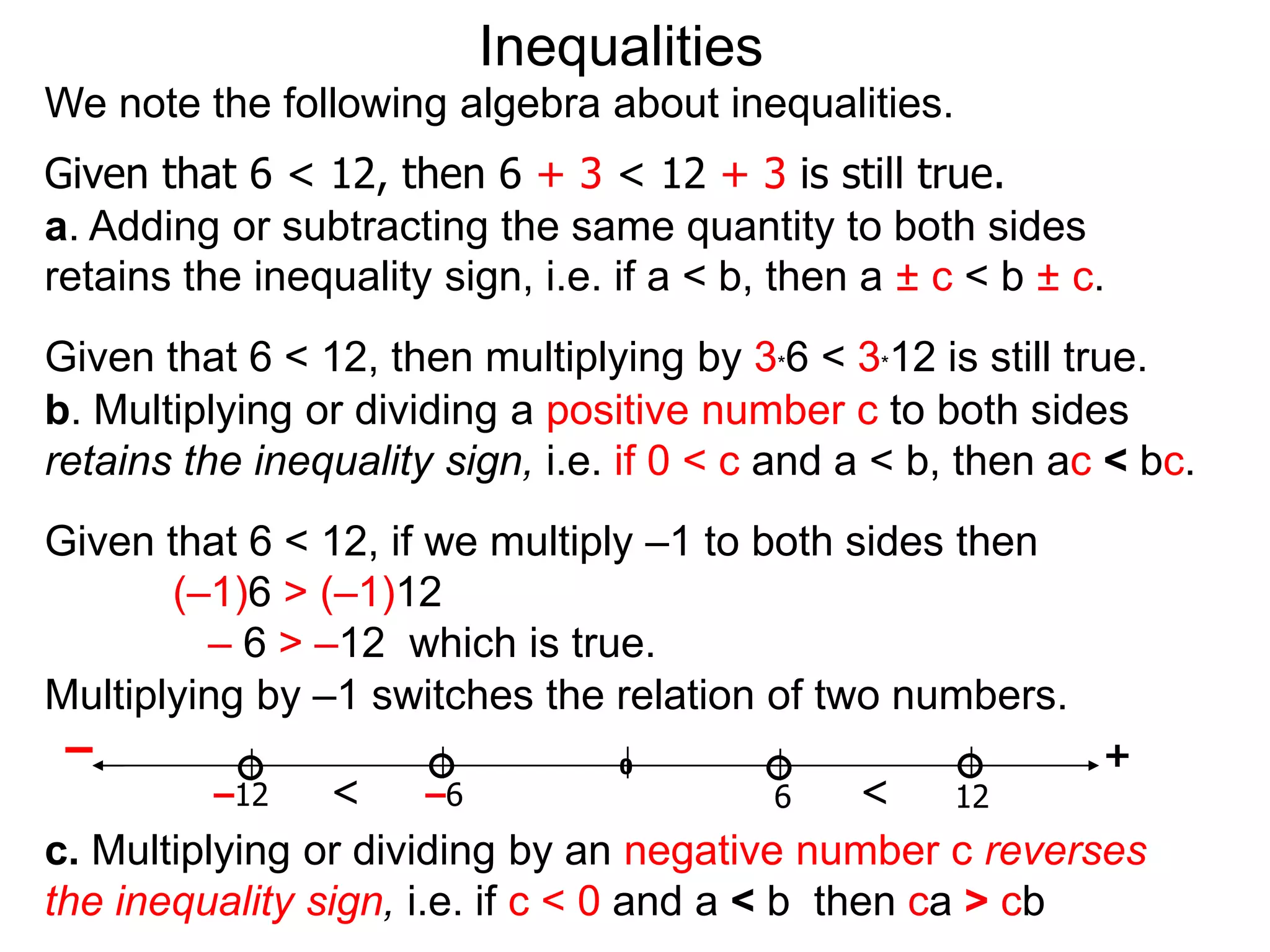
         – 6 > –12 which is true.
Multiplying by –1 switches the relation of two numbers.
 –                                 0                      +
          –12   <      –6                  6   <    12
c. Multiplying or dividing by an negative number c reverses
the inequality sign, i.e. if c < 0 and a < b then ca > cb
Inequalities
Following are the steps for solving linear inequalities.
Inequalities
Following are the steps for solving linear inequalities.
1. Simplify both sides of the inequalities.
Inequalities
Following are the steps for solving linear inequalities.
1. Simplify both sides of the inequalities.
2. Gather the x-terms to one side and the number-terms to the
   other sides (use the “change side-change sign” rule).
Inequalities
Following are the steps for solving linear inequalities.
1. Simplify both sides of the inequalities.
2. Gather the x-terms to one side and the number-terms to the
   other sides (use the “change side-change sign” rule).
3. Multiply or divide to get x. If we multiply or divide by
   negative numbers to both sides, the inequality sign must be
   turned around.
Inequalities
Following are the steps for solving linear inequalities.
1. Simplify both sides of the inequalities.
2. Gather the x-terms to one side and the number-terms to the
   other sides (use the “change side-change sign” rule).
3. Multiply or divide to get x. If we multiply or divide by
   negative numbers to both sides, the inequality sign must be
   turned around. (This rule can be avoided by keeping the
   x-term positive.)
Inequalities
Following are the steps for solving linear inequalities.
1. Simplify both sides of the inequalities.
2. Gather the x-terms to one side and the number-terms to the
   other sides (use the “change side-change sign” rule).
3. Multiply or divide to get x. If we multiply or divide by
   negative numbers to both sides, the inequality sign must be
   turned around. (This rule can be avoided by keeping the
   x-term positive.)
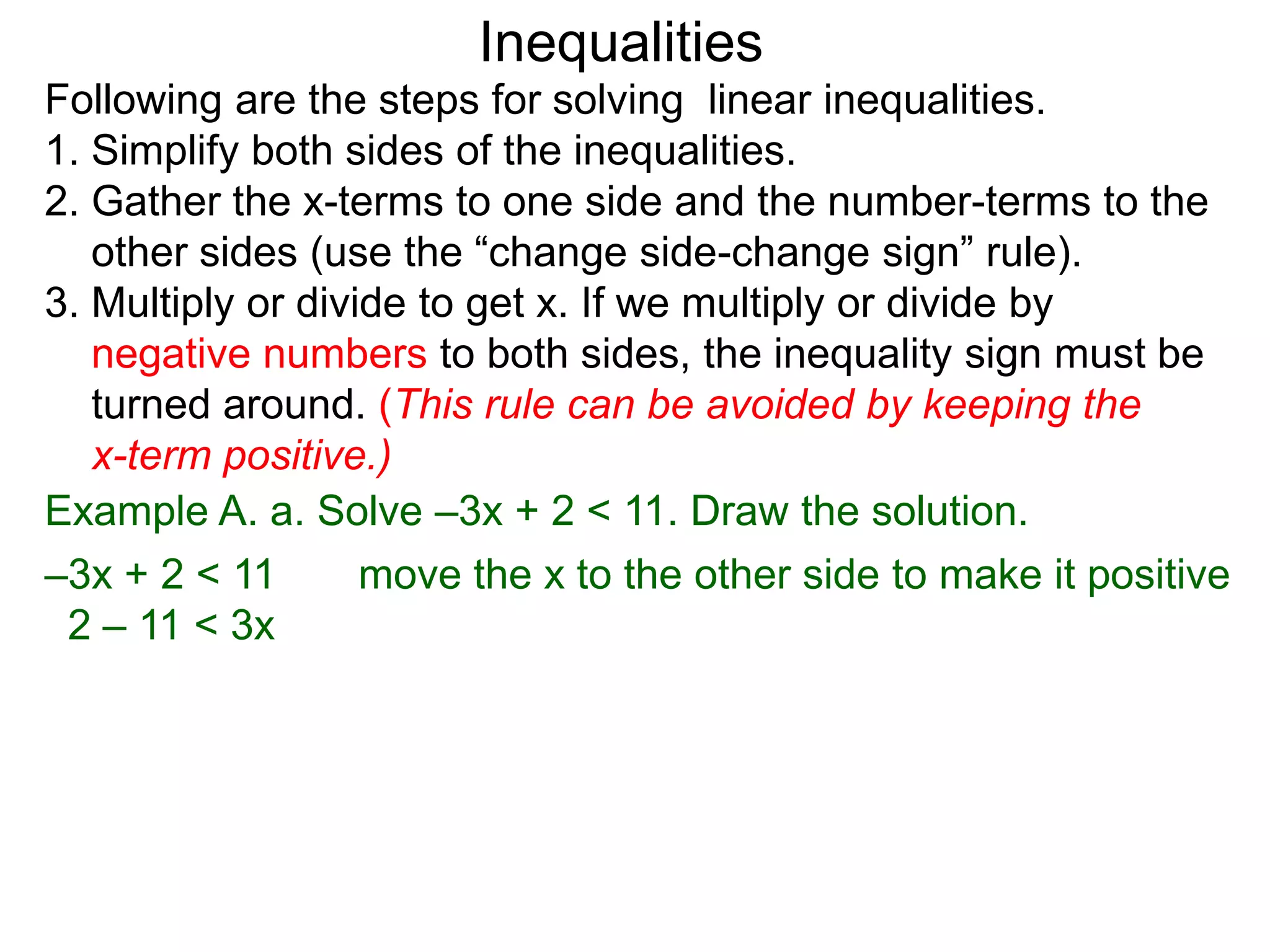
Example A. a. Solve –3x + 2 < 11. Draw the solution.
Inequalities
Following are the steps for solving linear inequalities.
1. Simplify both sides of the inequalities.
2. Gather the x-terms to one side and the number-terms to the
   other sides (use the “change side-change sign” rule).
3. Multiply or divide to get x. If we multiply or divide by
   negative numbers to both sides, the inequality sign must be
   turned around. (This rule can be avoided by keeping the
   x-term positive.)
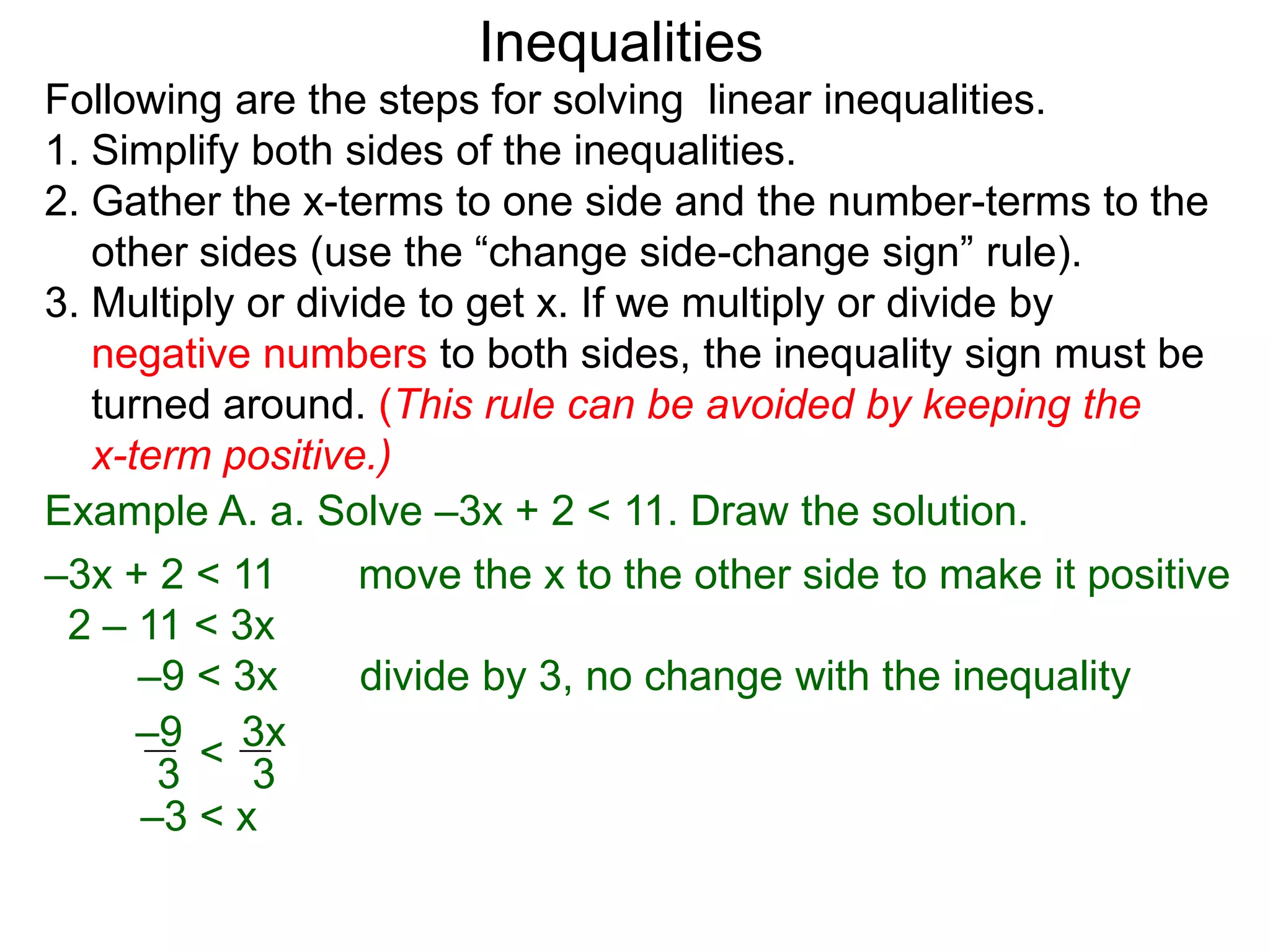
Example A. a. Solve –3x + 2 < 11. Draw the solution.
–3x + 2 < 11       move the x to the other side to make it positive
Inequalities
Following are the steps for solving linear inequalities.
1. Simplify both sides of the inequalities.
2. Gather the x-terms to one side and the number-terms to the
   other sides (use the “change side-change sign” rule).
3. Multiply or divide to get x. If we multiply or divide by
   negative numbers to both sides, the inequality sign must be
   turned around. (This rule can be avoided by keeping the
   x-term positive.)
Example A. a. Solve –3x + 2 < 11. Draw the solution.
–3x + 2 < 11       move the x to the other side to make it positive
 2 – 11 < 3x
Inequalities
Following are the steps for solving linear inequalities.
1. Simplify both sides of the inequalities.
2. Gather the x-terms to one side and the number-terms to the
   other sides (use the “change side-change sign” rule).
3. Multiply or divide to get x. If we multiply or divide by
   negative numbers to both sides, the inequality sign must be
   turned around. (This rule can be avoided by keeping the
   x-term positive.)
Example A. a. Solve –3x + 2 < 11. Draw the solution.
–3x + 2 < 11       move the x to the other side to make it positive
 2 – 11 < 3x
      –9 < 3x
Inequalities
Following are the steps for solving linear inequalities.
1. Simplify both sides of the inequalities.
2. Gather the x-terms to one side and the number-terms to the
   other sides (use the “change side-change sign” rule).
3. Multiply or divide to get x. If we multiply or divide by
   negative numbers to both sides, the inequality sign must be
   turned around. (This rule can be avoided by keeping the
   x-term positive.)
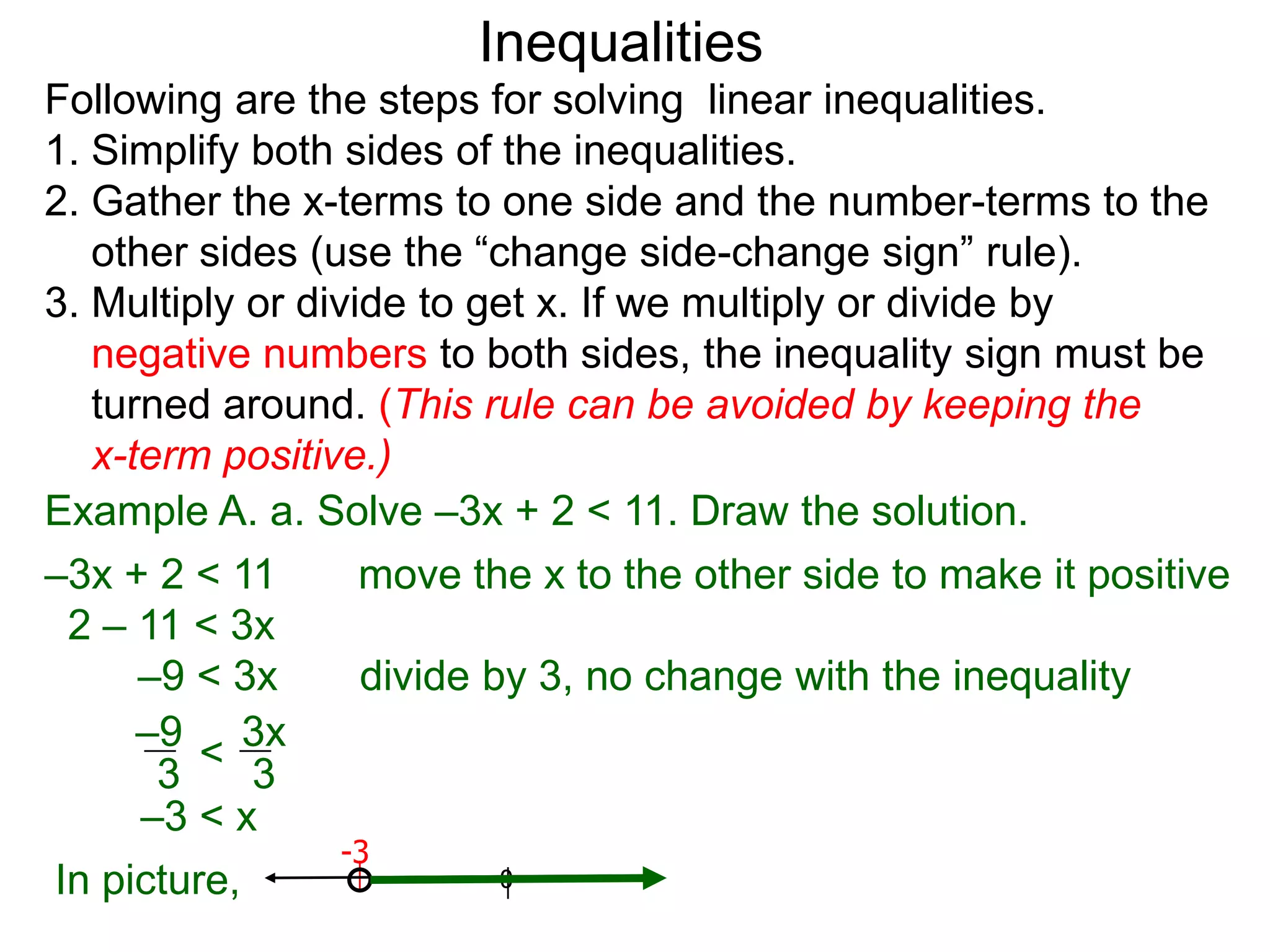
Example A. a. Solve –3x + 2 < 11. Draw the solution.
–3x + 2 < 11       move the x to the other side to make it positive
 2 – 11 < 3x
      –9 < 3x      divide by 3, no change with the inequality
      –9 3x
       3 < 3
      –3 < x
Inequalities
Following are the steps for solving linear inequalities.
1. Simplify both sides of the inequalities.
2. Gather the x-terms to one side and the number-terms to the
   other sides (use the “change side-change sign” rule).
3. Multiply or divide to get x. If we multiply or divide by
   negative numbers to both sides, the inequality sign must be
   turned around. (This rule can be avoided by keeping the
   x-term positive.)
Example A. a. Solve –3x + 2 < 11. Draw the solution.
–3x + 2 < 11       move the x to the other side to make it positive
 2 – 11 < 3x
      –9 < 3x      divide by 3, no change with the inequality
      –9 3x
       3 < 3
      –3 < x
                  -3
In picture,                0
Inequalities
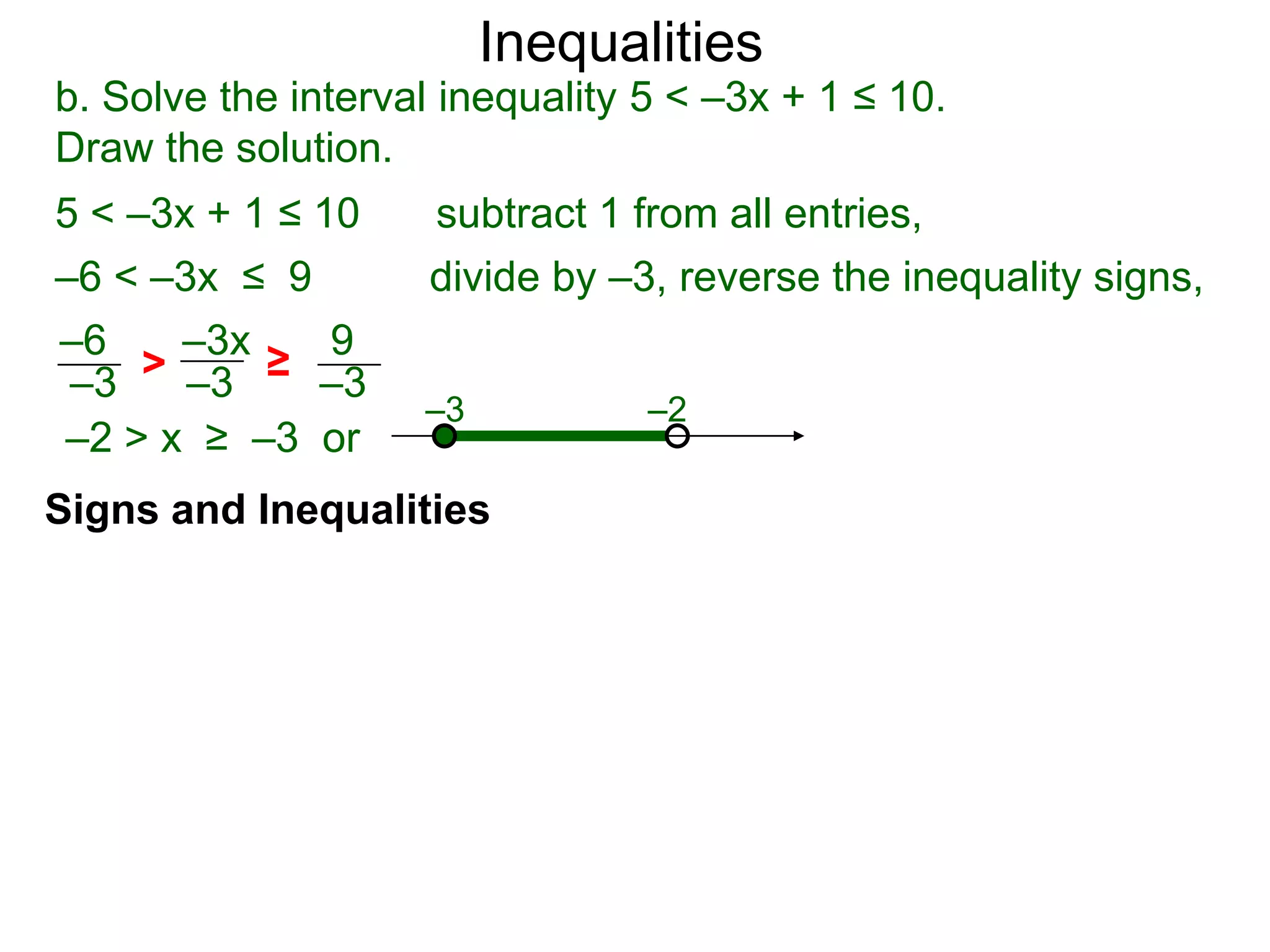
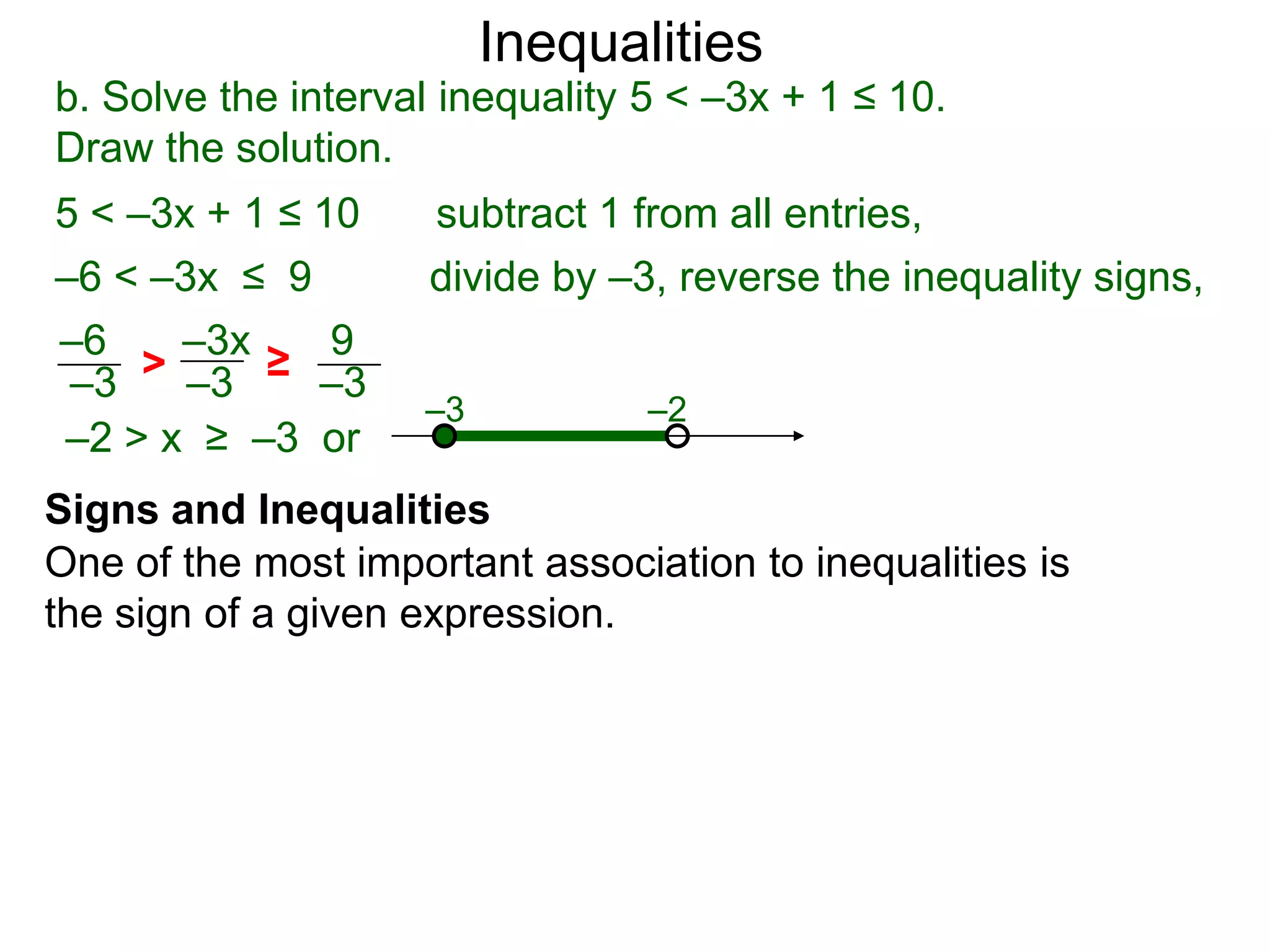
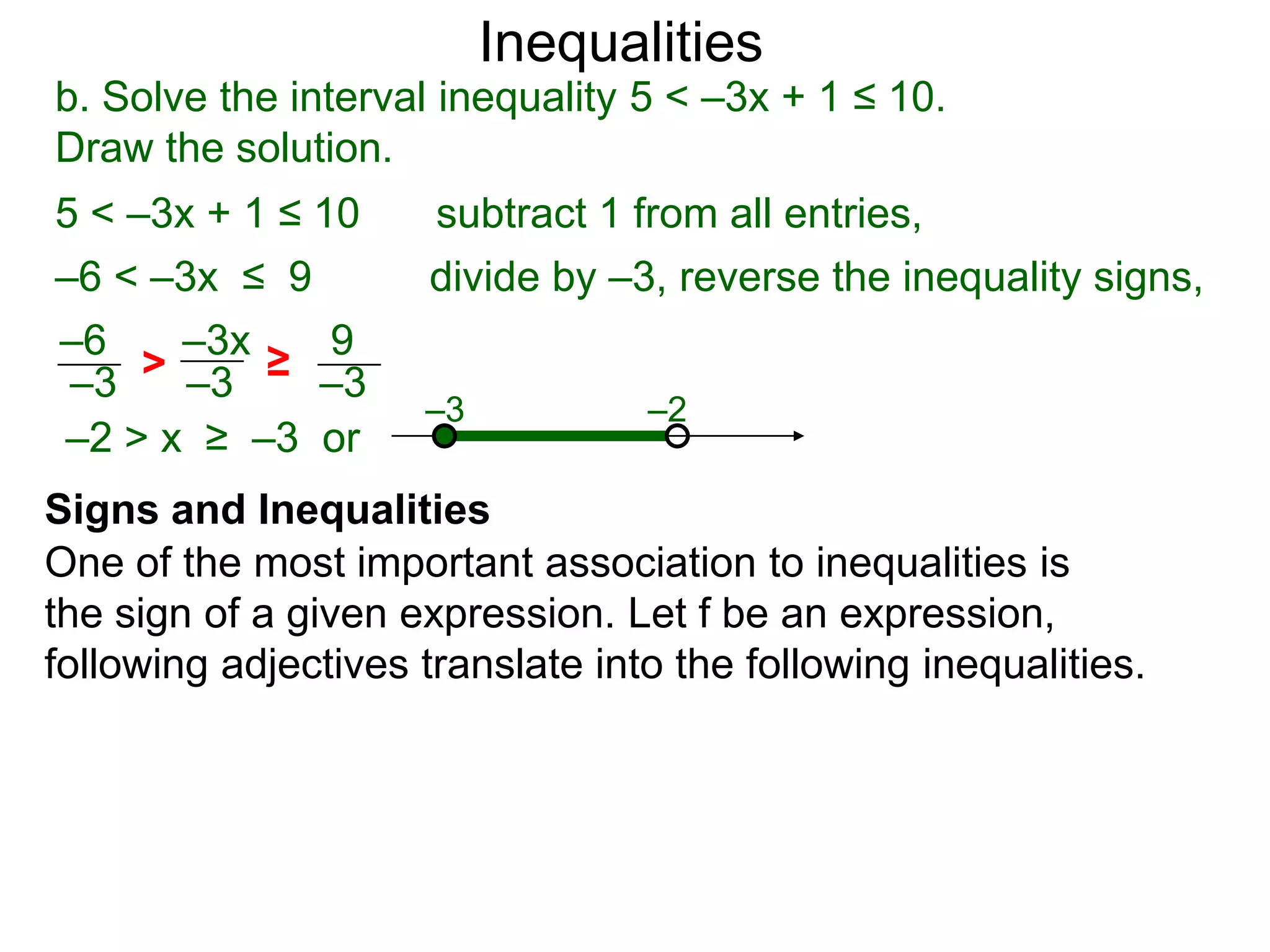
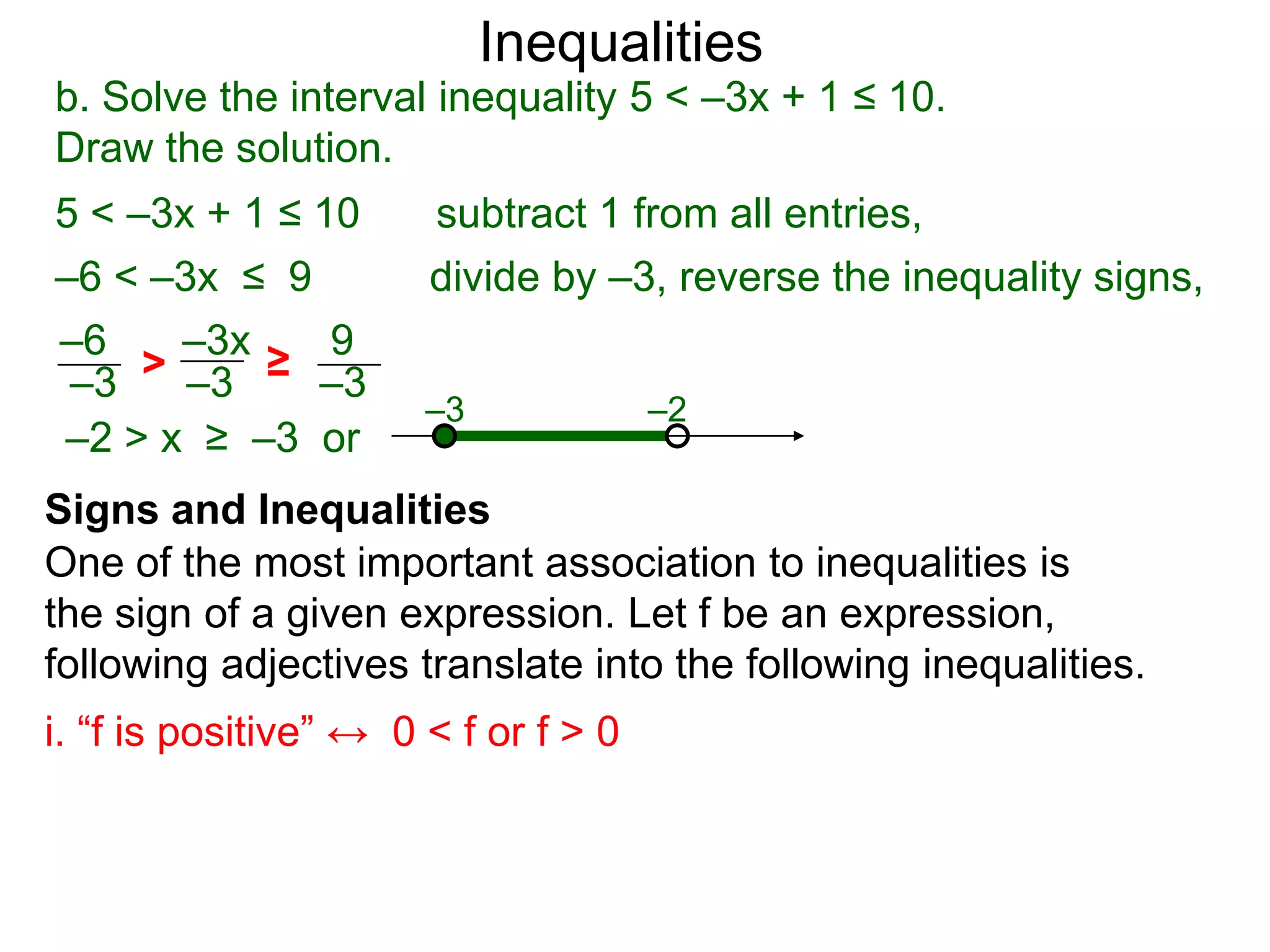
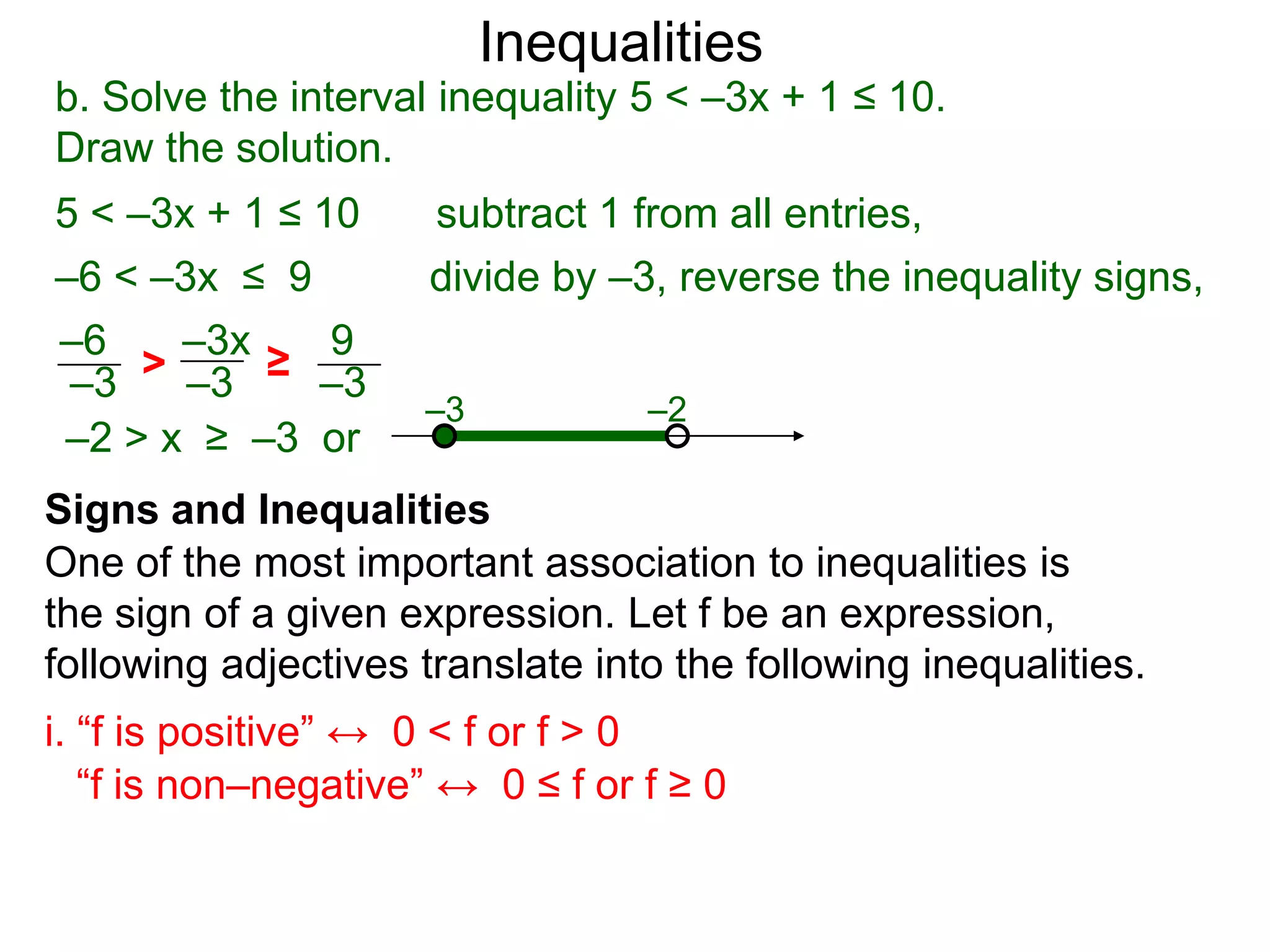
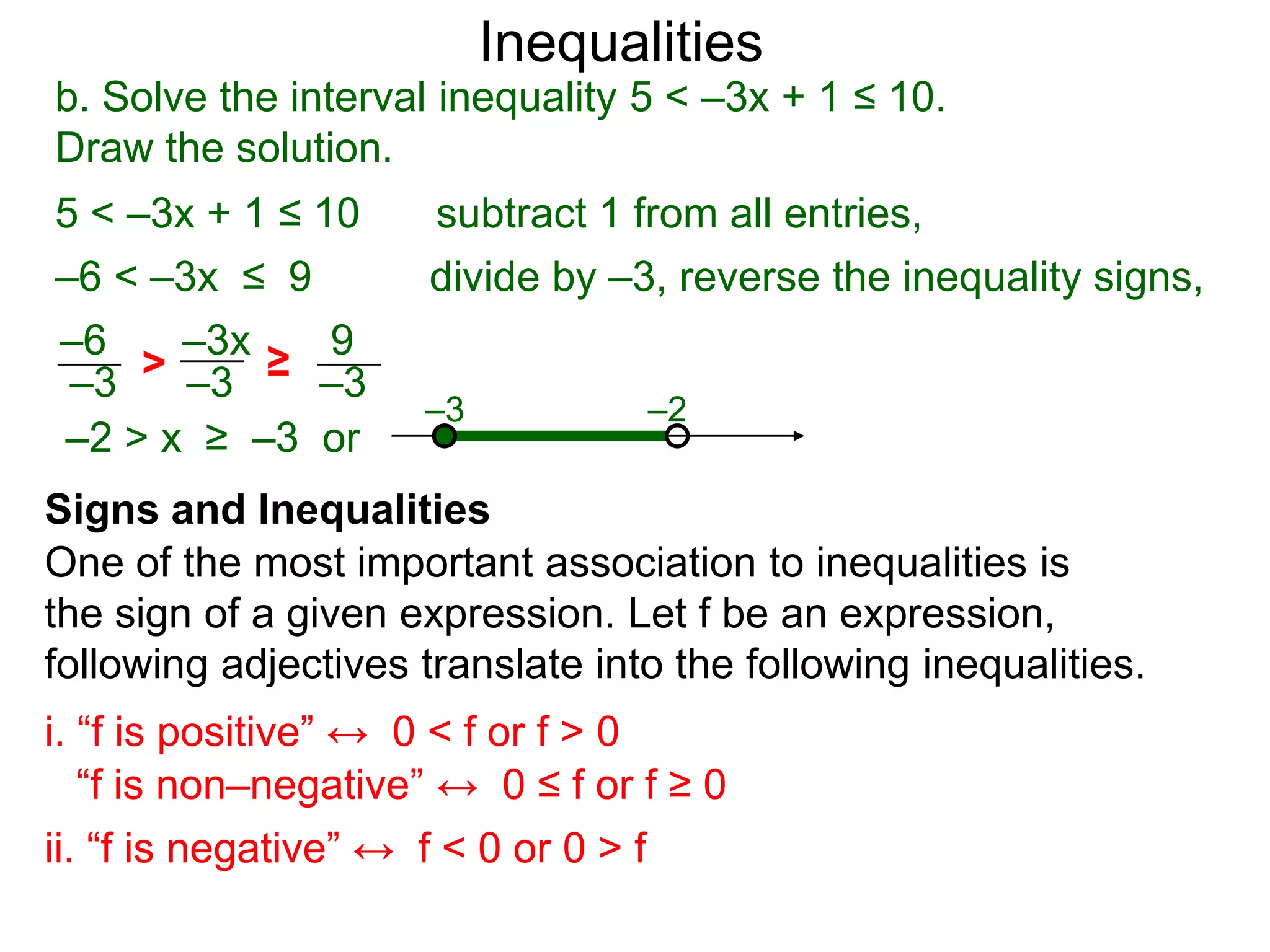
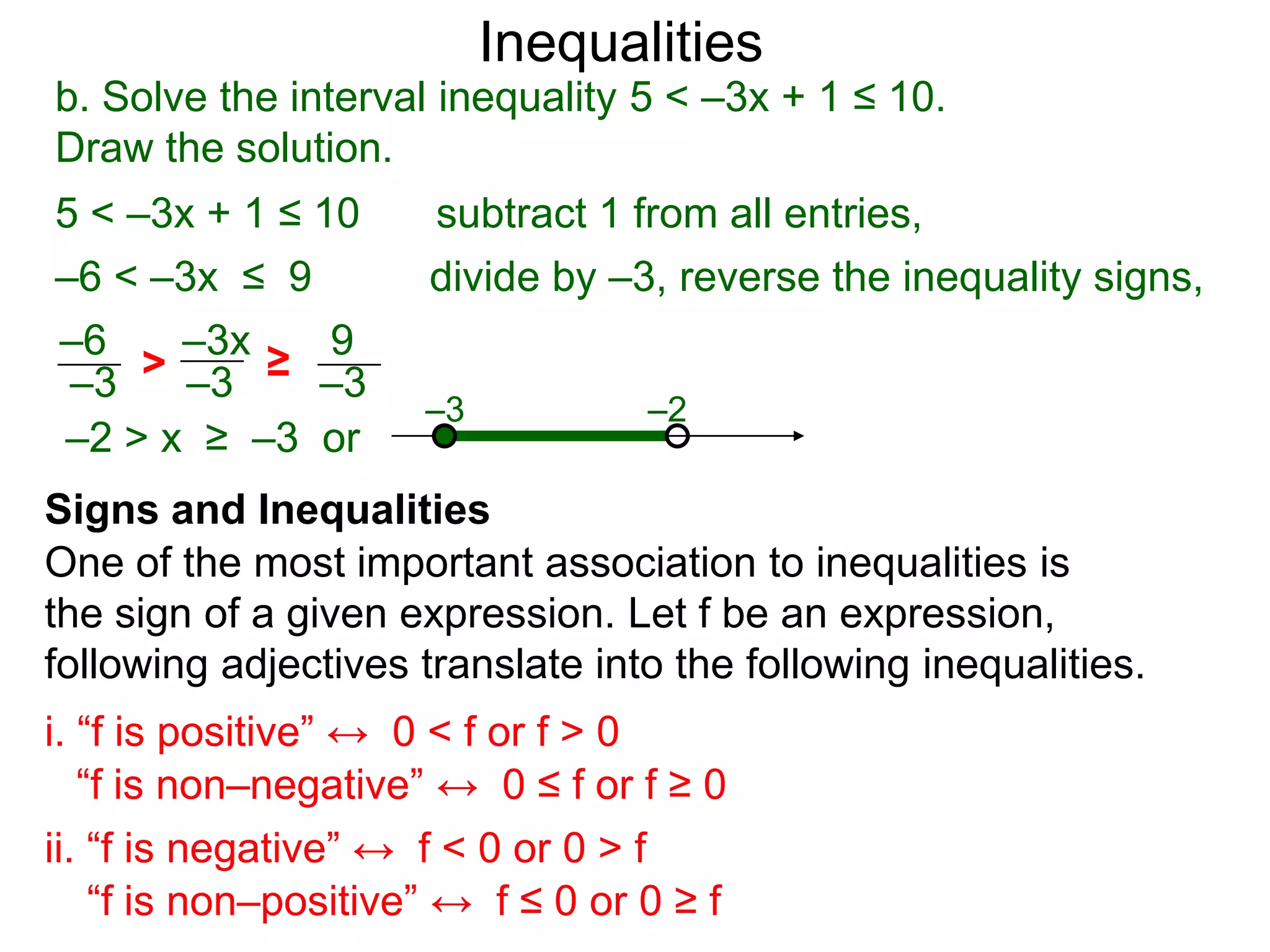
b. Solve the interval inequality 5 < –3x + 1 ≤ 10.
Draw the solution.
Inequalities
b. Solve the interval inequality 5 < –3x + 1 ≤ 10.
Draw the solution.
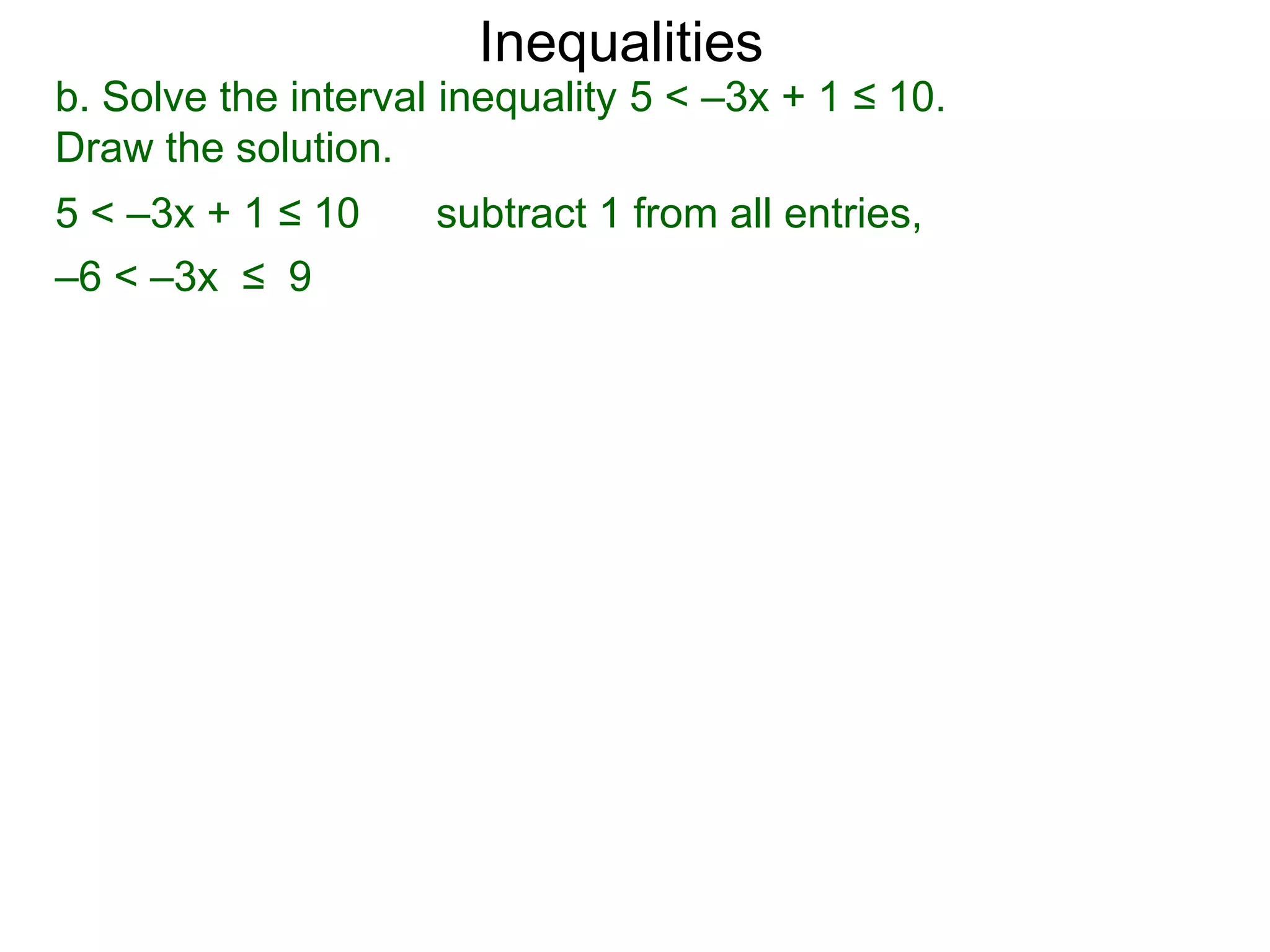
5 < –3x + 1 ≤ 10     subtract 1 from all entries,
Inequalities
b. Solve the interval inequality 5 < –3x + 1 ≤ 10.
Draw the solution.
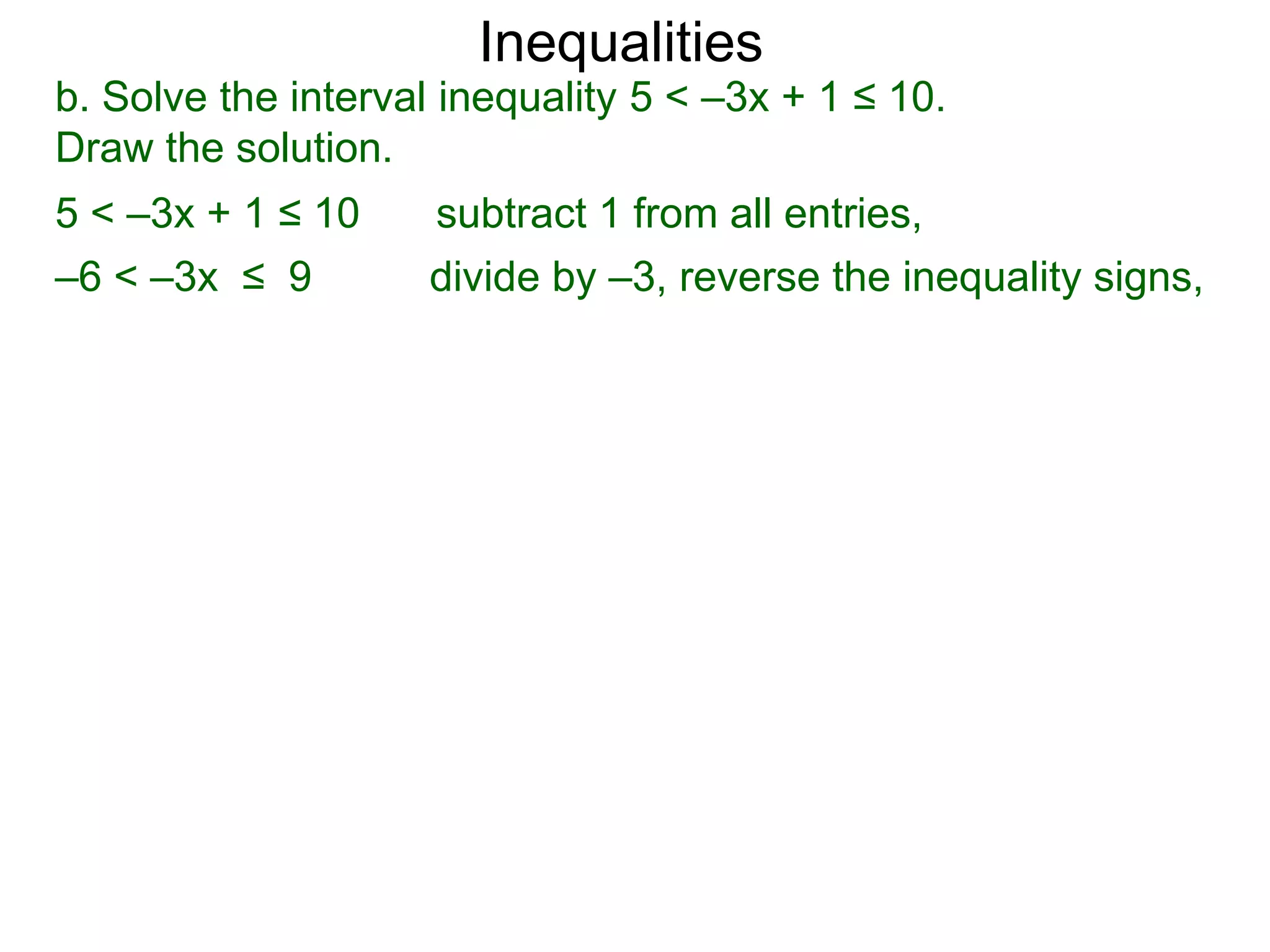
5 < –3x + 1 ≤ 10     subtract 1 from all entries,
–6 < –3x ≤ 9
Inequalities
b. Solve the interval inequality 5 < –3x + 1 ≤ 10.
Draw the solution.
5 < –3x + 1 ≤ 10     subtract 1 from all entries,
–6 < –3x ≤ 9         divide by –3, reverse the inequality signs,
Inequalities
b. Solve the interval inequality 5 < –3x + 1 ≤ 10.
Draw the solution.
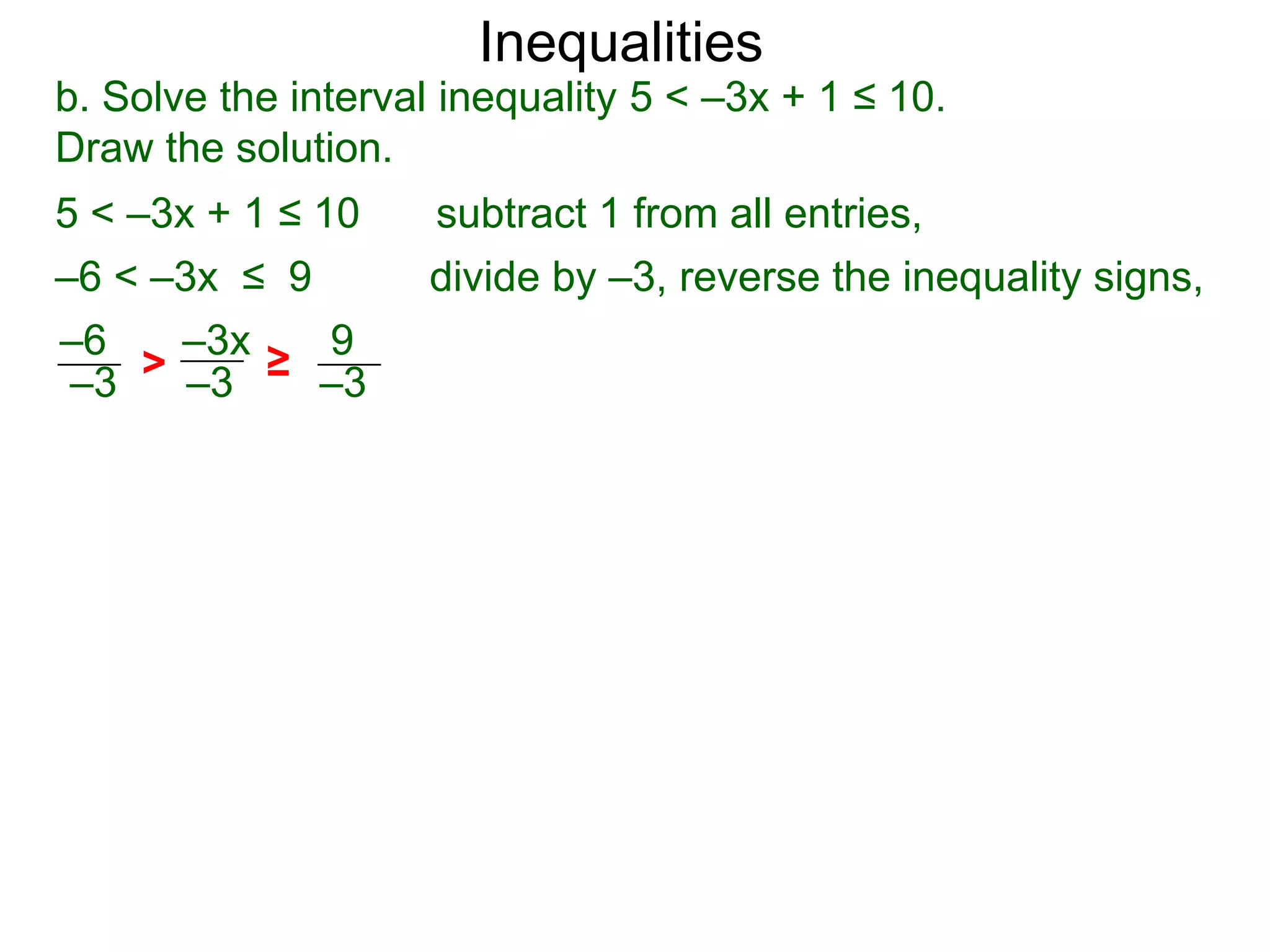
5 < –3x + 1 ≤ 10     subtract 1 from all entries,
–6 < –3x ≤ 9         divide by –3, reverse the inequality signs,
–6   –3x  9
–3 > –3 ≥ –3
Inequalities
b. Solve the interval inequality 5 < –3x + 1 ≤ 10.
Draw the solution.
5 < –3x + 1 ≤ 10     subtract 1 from all entries,
–6 < –3x ≤ 9         divide by –3, reverse the inequality signs,
–6    –3x   9
–3  > –3 ≥ –3
                    –3           –2
–2 > x ≥ –3 or
Inequalities
b. Solve the interval inequality 5 < –3x + 1 ≤ 10.
Draw the solution.
5 < –3x + 1 ≤ 10     subtract 1 from all entries,
–6 < –3x ≤ 9         divide by –3, reverse the inequality signs,
–6    –3x   9
–3  > –3 ≥ –3
                    –3           –2
–2 > x ≥ –3 or
Signs and Inequalities
Inequalities
b. Solve the interval inequality 5 < –3x + 1 ≤ 10.
Draw the solution.
5 < –3x + 1 ≤ 10     subtract 1 from all entries,
–6 < –3x ≤ 9         divide by –3, reverse the inequality signs,
–6    –3x   9
–3  > –3 ≥ –3
                    –3           –2
–2 > x ≥ –3 or
Signs and Inequalities
One of the most important association to inequalities is
the sign of a given expression.
Inequalities
b. Solve the interval inequality 5 < –3x + 1 ≤ 10.
Draw the solution.
5 < –3x + 1 ≤ 10      subtract 1 from all entries,
–6 < –3x ≤ 9          divide by –3, reverse the inequality signs,
–6    –3x   9
–3  > –3 ≥ –3
                     –3           –2
–2 > x ≥ –3 or
Signs and Inequalities
One of the most important association to inequalities is
the sign of a given expression. Let f be an expression,
following adjectives translate into the following inequalities.
Inequalities
b. Solve the interval inequality 5 < –3x + 1 ≤ 10.
Draw the solution.
5 < –3x + 1 ≤ 10       subtract 1 from all entries,
–6 < –3x ≤ 9           divide by –3, reverse the inequality signs,
–6    –3x   9
–3  > –3 ≥ –3
                       –3             –2
–2 > x ≥ –3 or
Signs and Inequalities
One of the most important association to inequalities is
the sign of a given expression. Let f be an expression,
following adjectives translate into the following inequalities.
i. “f is positive” ↔ 0 < f or f > 0
Inequalities
b. Solve the interval inequality 5 < –3x + 1 ≤ 10.
Draw the solution.
5 < –3x + 1 ≤ 10      subtract 1 from all entries,
–6 < –3x ≤ 9          divide by –3, reverse the inequality signs,
–6    –3x   9
–3  > –3 ≥ –3
                     –3           –2
–2 > x ≥ –3 or
Signs and Inequalities
One of the most important association to inequalities is
the sign of a given expression. Let f be an expression,
following adjectives translate into the following inequalities.
i. “f is positive” ↔ 0 < f or f > 0
   “f is non–negative” ↔ 0 ≤ f or f ≥ 0
Inequalities
b. Solve the interval inequality 5 < –3x + 1 ≤ 10.
Draw the solution.
5 < –3x + 1 ≤ 10      subtract 1 from all entries,
–6 < –3x ≤ 9          divide by –3, reverse the inequality signs,
–6    –3x   9
–3  > –3 ≥ –3
                     –3           –2
–2 > x ≥ –3 or
Signs and Inequalities
One of the most important association to inequalities is
the sign of a given expression. Let f be an expression,
following adjectives translate into the following inequalities.
i. “f is positive” ↔ 0 < f or f > 0
   “f is non–negative” ↔ 0 ≤ f or f ≥ 0
ii. “f is negative” ↔ f < 0 or 0 > f
Inequalities
b. Solve the interval inequality 5 < –3x + 1 ≤ 10.
Draw the solution.
5 < –3x + 1 ≤ 10      subtract 1 from all entries,
–6 < –3x ≤ 9          divide by –3, reverse the inequality signs,
–6    –3x   9
–3  > –3 ≥ –3
                      –3           –2
–2 > x ≥ –3 or
Signs and Inequalities
One of the most important association to inequalities is
the sign of a given expression. Let f be an expression,
following adjectives translate into the following inequalities.
i. “f is positive” ↔ 0 < f or f > 0
   “f is non–negative” ↔ 0 ≤ f or f ≥ 0
ii. “f is negative” ↔ f < 0 or 0 > f
    “f is non–positive” ↔ f ≤ 0 or 0 ≥ f
Inequalities
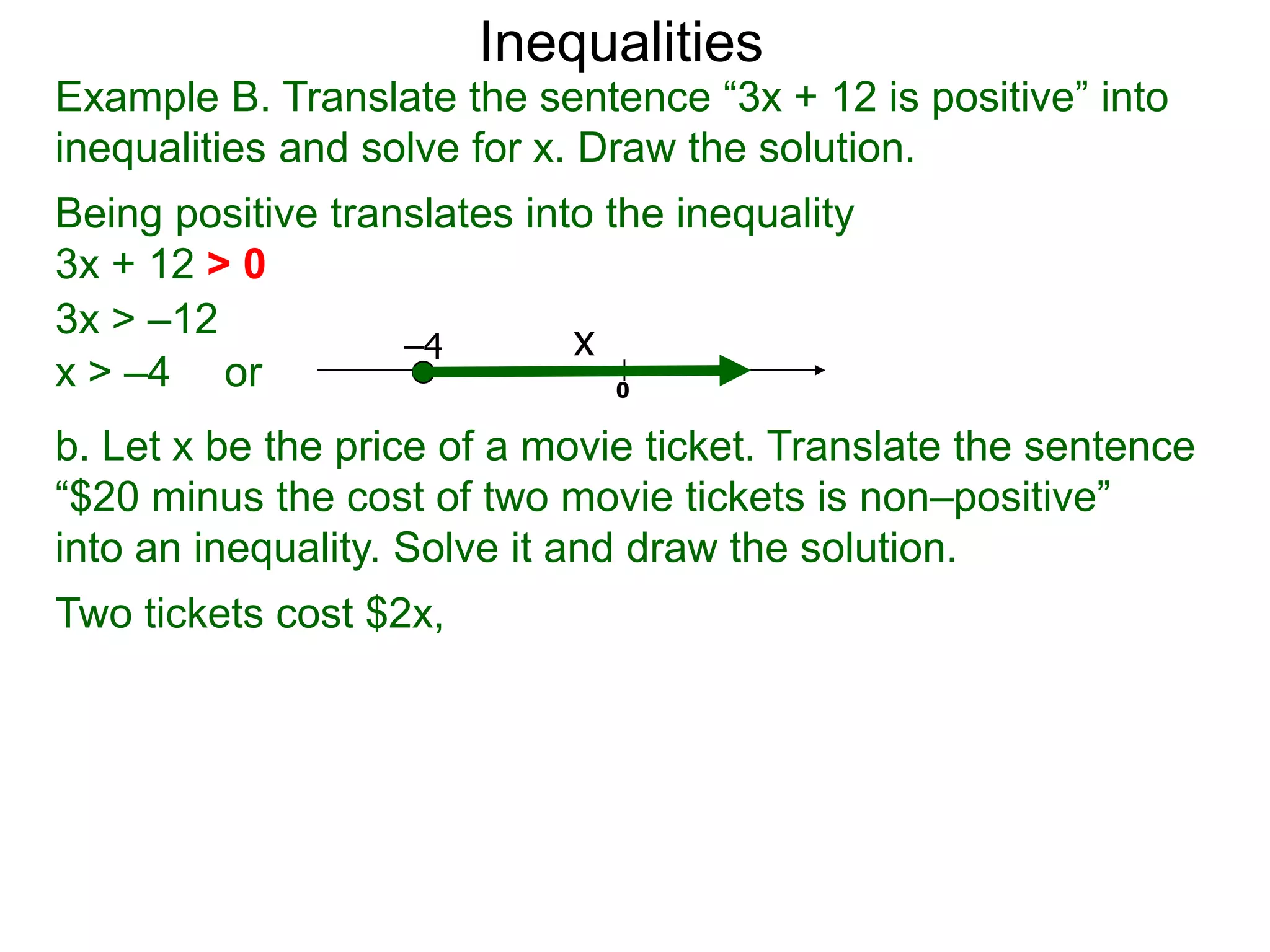
Example B. Translate the sentence “3x + 12 is positive” into
inequalities and solve for x. Draw the solution.
Inequalities
Example B. Translate the sentence “3x + 12 is positive” into
inequalities and solve for x. Draw the solution.
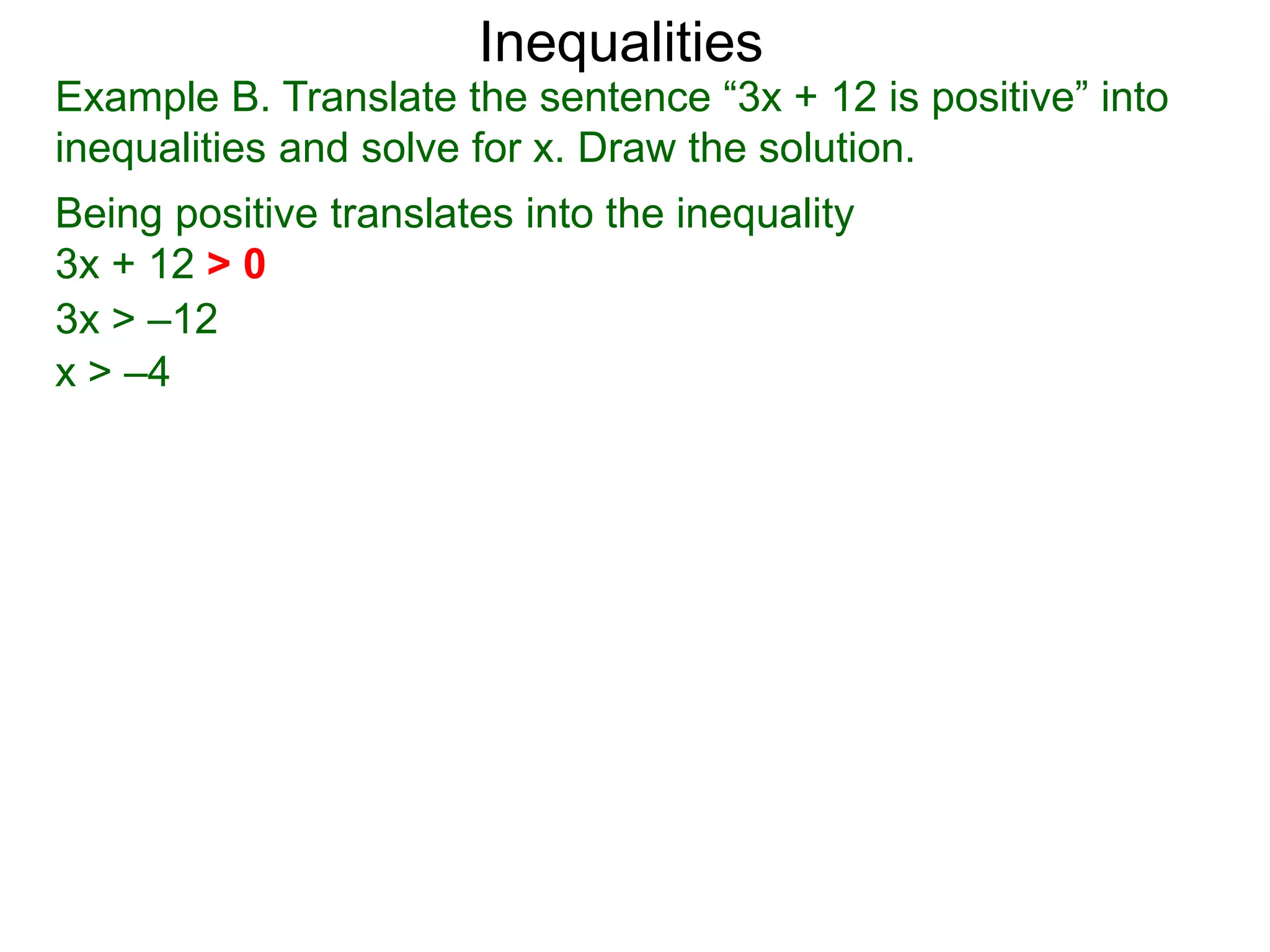
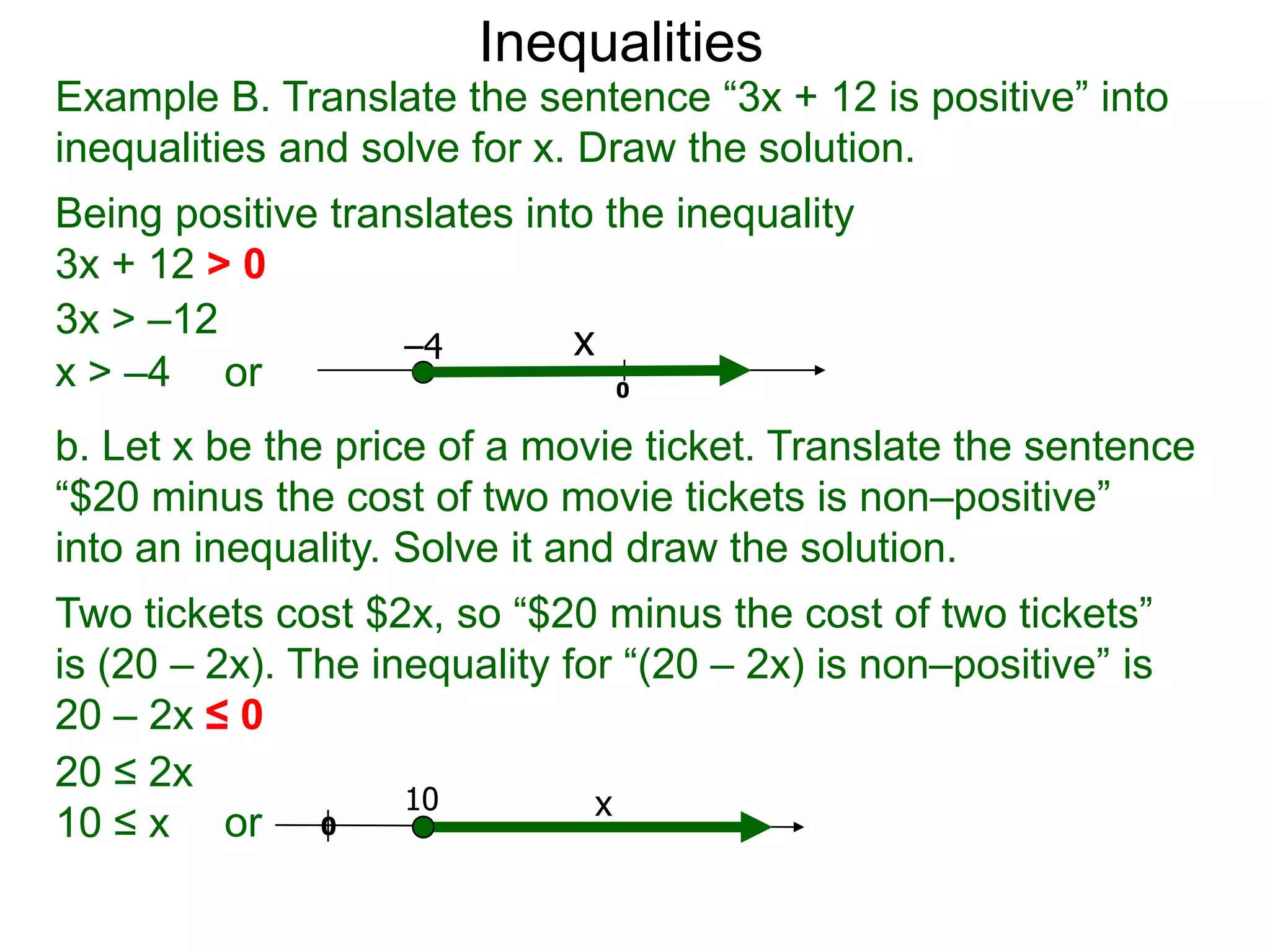
Being positive translates into the inequality
3x + 12 > 0
Inequalities
Example B. Translate the sentence “3x + 12 is positive” into
inequalities and solve for x. Draw the solution.
Being positive translates into the inequality
3x + 12 > 0
3x > –12
x > –4
Inequalities
Example B. Translate the sentence “3x + 12 is positive” into
inequalities and solve for x. Draw the solution.
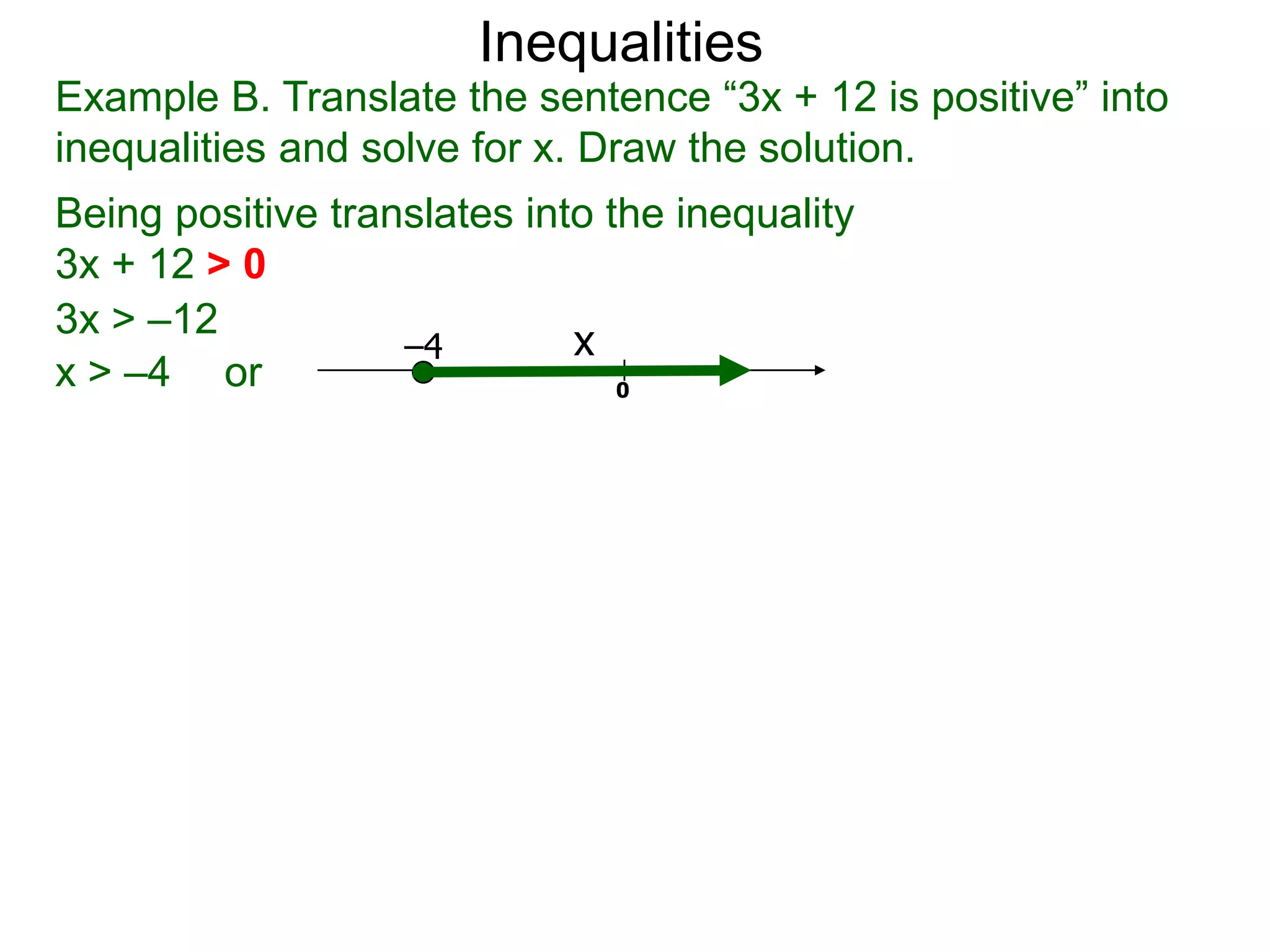
Being positive translates into the inequality
3x + 12 > 0
3x > –12
                   –4        x
x > –4 or                       0
Inequalities
Example B. Translate the sentence “3x + 12 is positive” into
inequalities and solve for x. Draw the solution.
Being positive translates into the inequality
3x + 12 > 0
3x > –12
                   –4        x
x > –4 or                       0

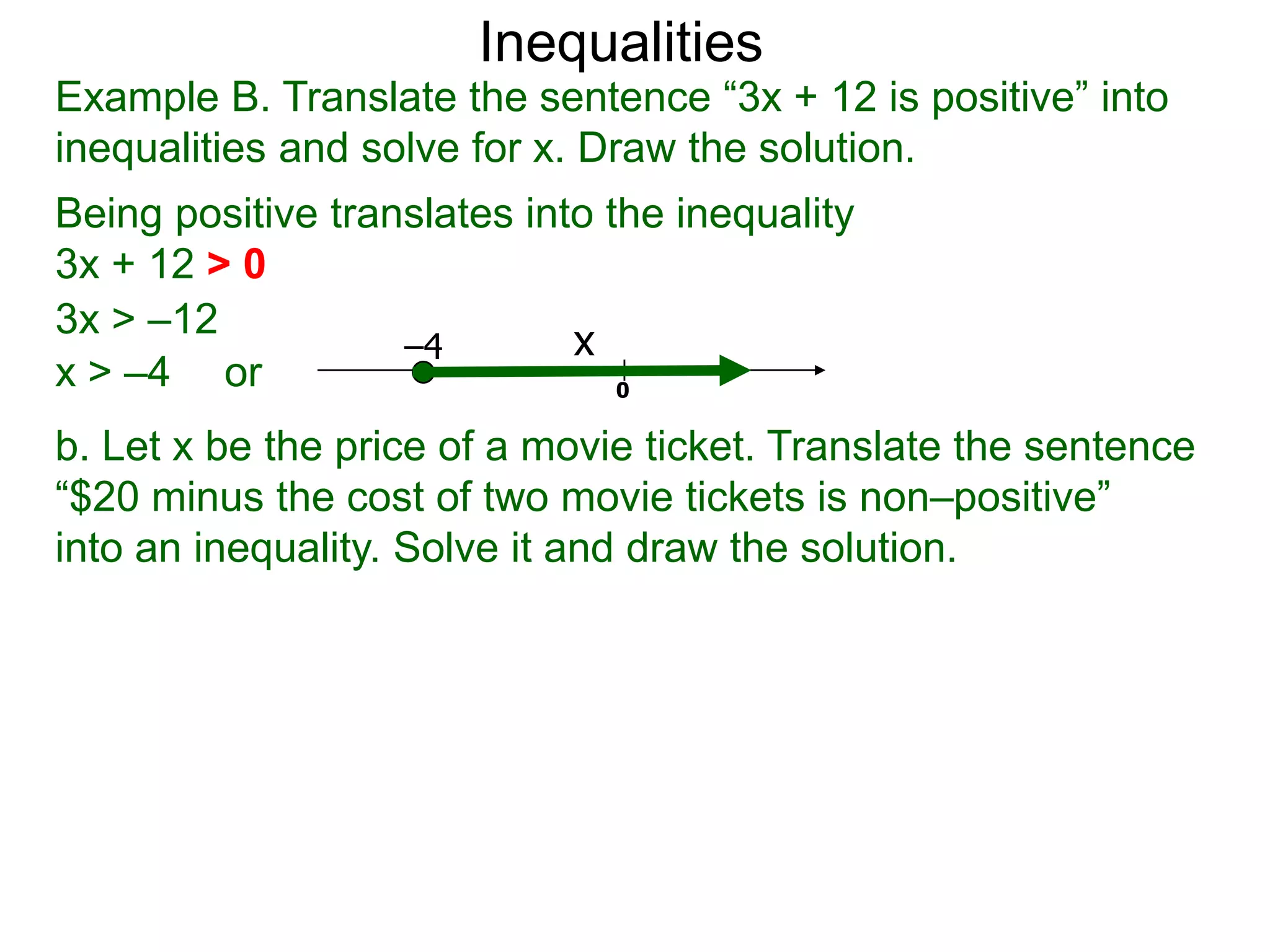
b. Let x be the price of a movie ticket. Translate the sentence
“$20 minus the cost of two movie tickets is non–positive”
into an inequality. Solve it and draw the solution.
Inequalities
Example B. Translate the sentence “3x + 12 is positive” into
inequalities and solve for x. Draw the solution.
Being positive translates into the inequality
3x + 12 > 0
3x > –12
                   –4        x
x > –4 or                       0

b. Let x be the price of a movie ticket. Translate the sentence
“$20 minus the cost of two movie tickets is non–positive”
into an inequality. Solve it and draw the solution.
Two tickets cost $2x,
Inequalities
Example B. Translate the sentence “3x + 12 is positive” into
inequalities and solve for x. Draw the solution.
Being positive translates into the inequality
3x + 12 > 0
3x > –12
                   –4        x
x > –4 or                       0

b. Let x be the price of a movie ticket. Translate the sentence
“$20 minus the cost of two movie tickets is non–positive”
into an inequality. Solve it and draw the solution.
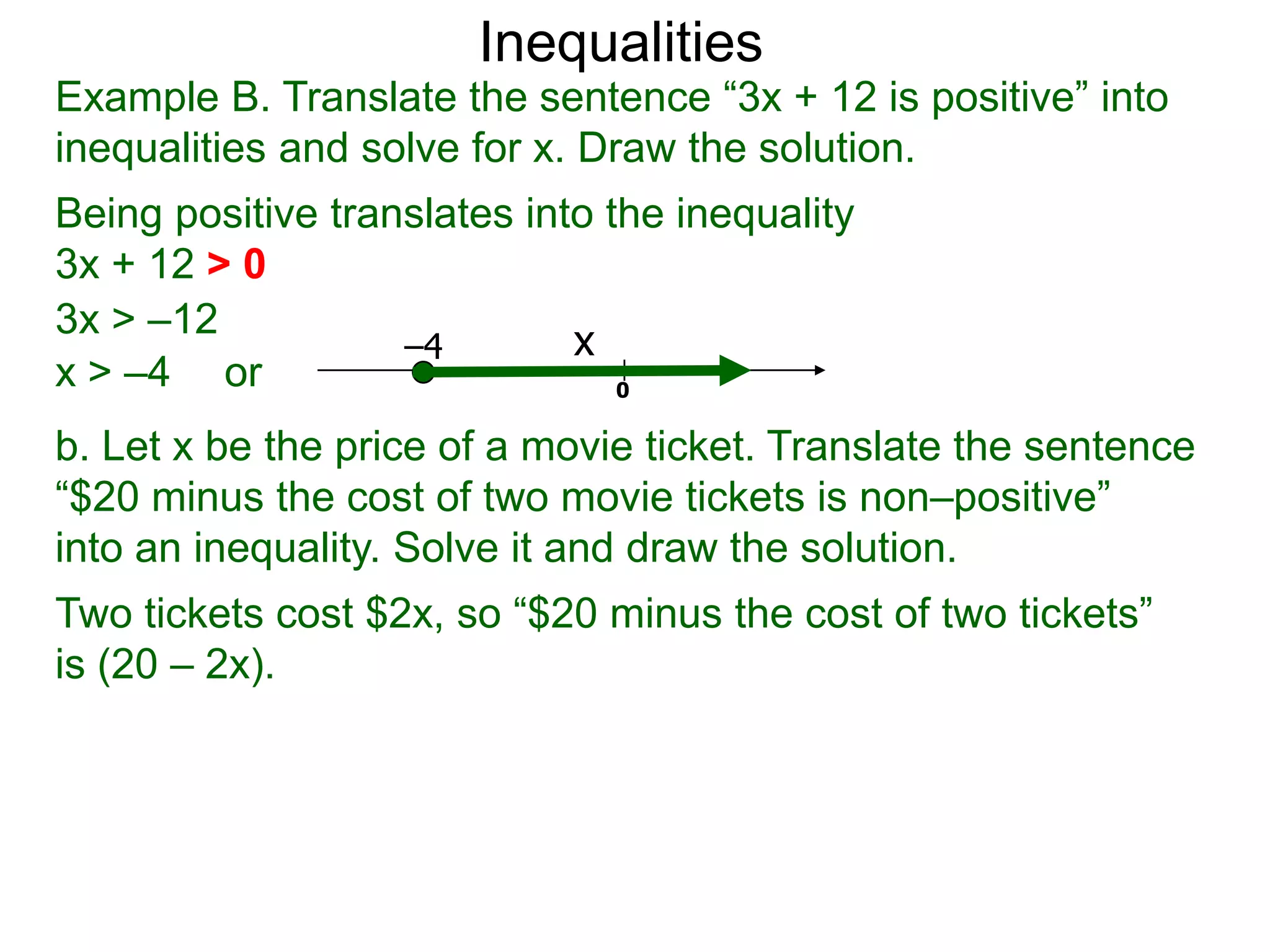
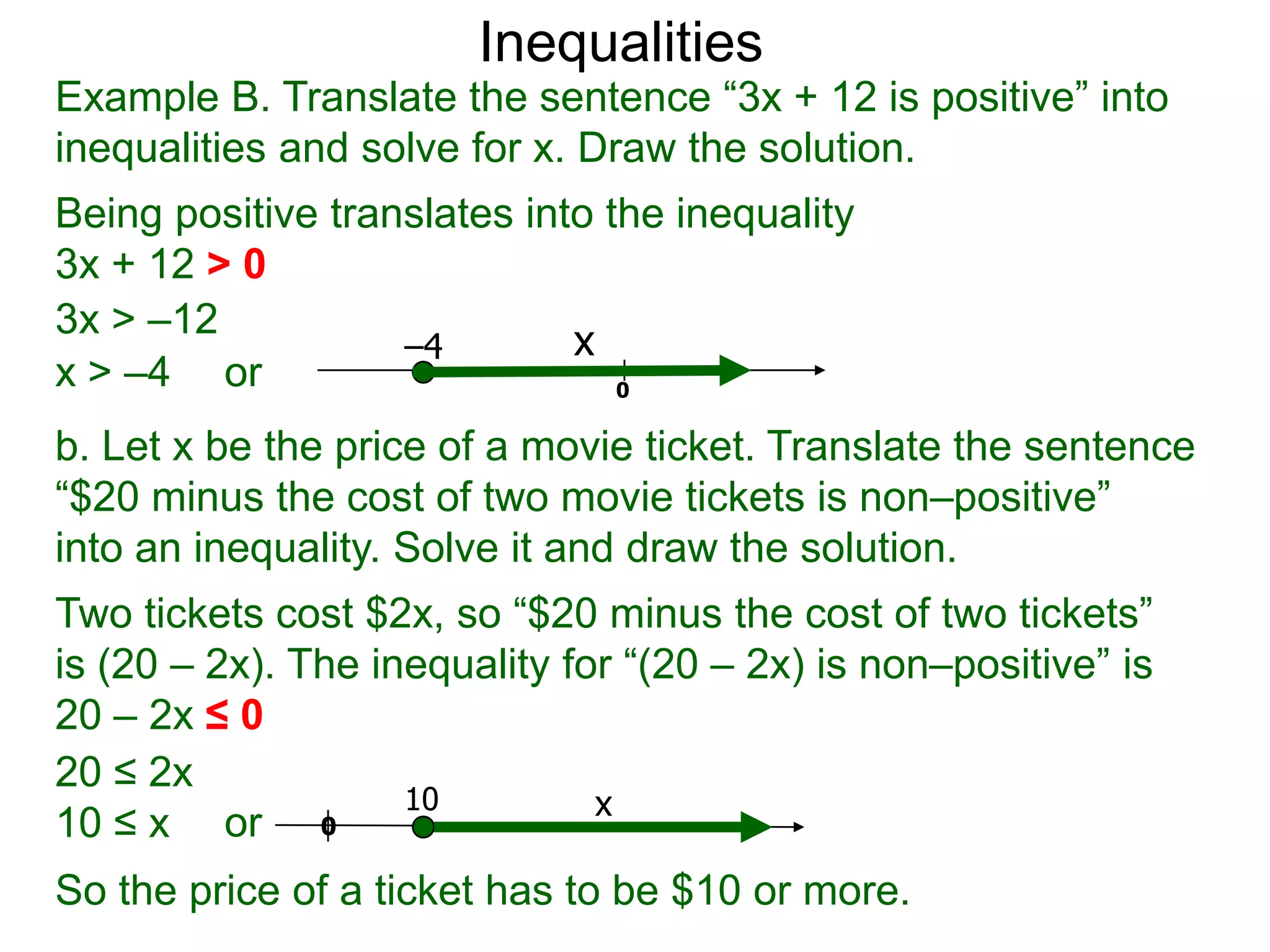
Two tickets cost $2x, so “$20 minus the cost of two tickets”
is (20 – 2x).
Inequalities
Example B. Translate the sentence “3x + 12 is positive” into
inequalities and solve for x. Draw the solution.
Being positive translates into the inequality
3x + 12 > 0
3x > –12
                   –4        x
x > –4 or                       0

b. Let x be the price of a movie ticket. Translate the sentence
“$20 minus the cost of two movie tickets is non–positive”
into an inequality. Solve it and draw the solution.
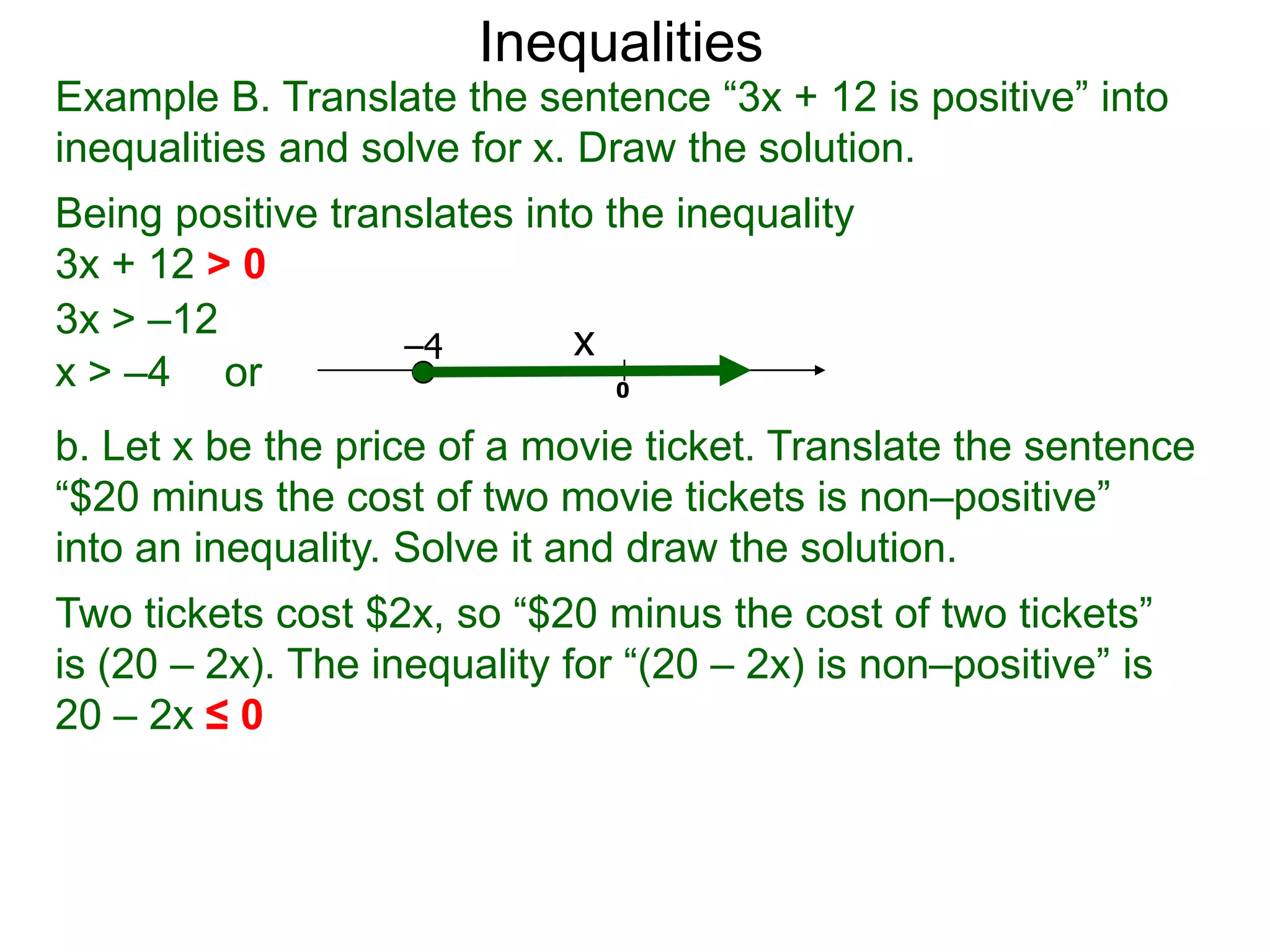
Two tickets cost $2x, so “$20 minus the cost of two tickets”
is (20 – 2x). The inequality for “(20 – 2x) is non–positive” is
20 – 2x ≤ 0
Inequalities
Example B. Translate the sentence “3x + 12 is positive” into
inequalities and solve for x. Draw the solution.
Being positive translates into the inequality
3x + 12 > 0
3x > –12
                   –4        x
x > –4 or                       0

b. Let x be the price of a movie ticket. Translate the sentence
“$20 minus the cost of two movie tickets is non–positive”
into an inequality. Solve it and draw the solution.
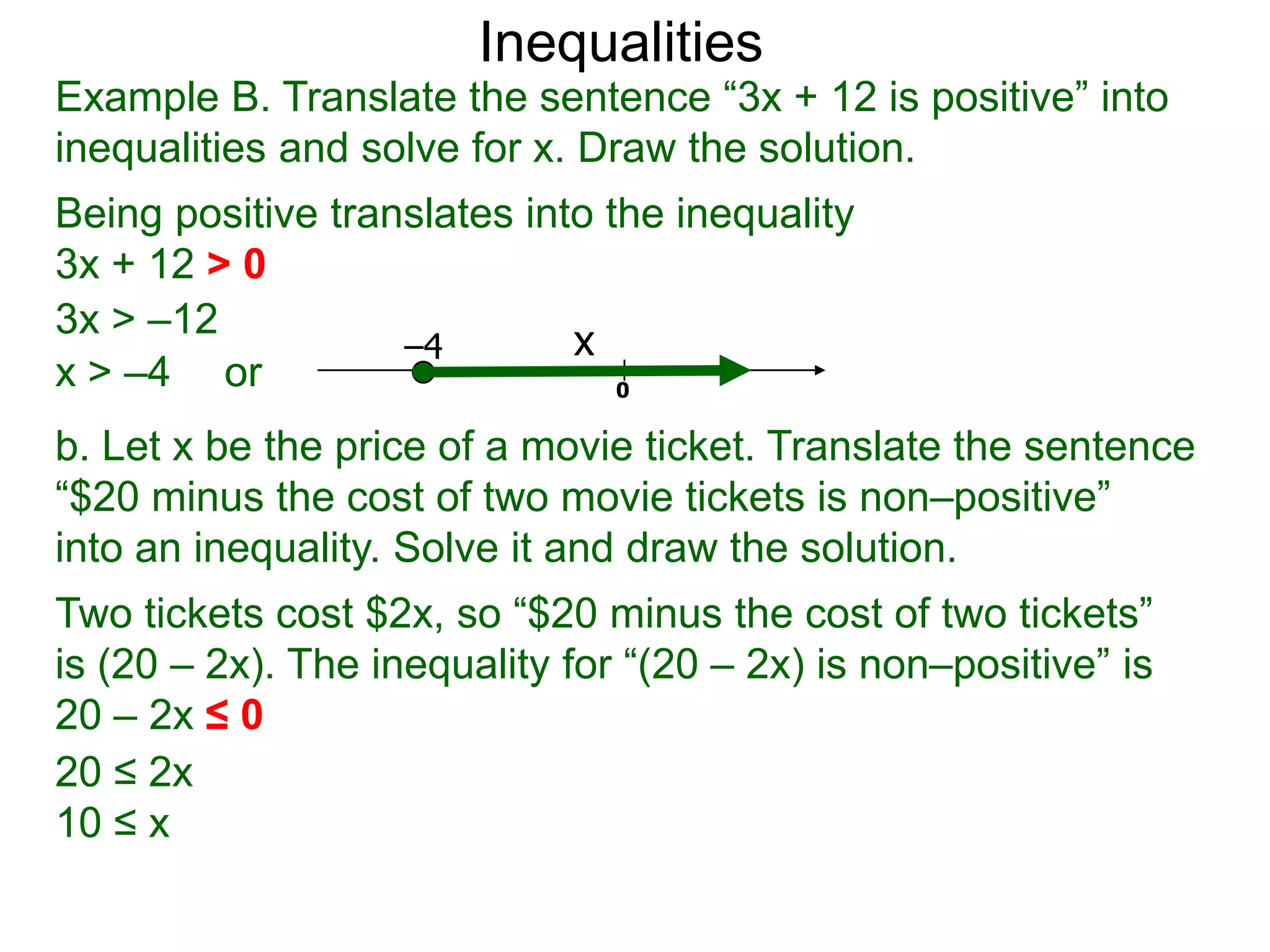
Two tickets cost $2x, so “$20 minus the cost of two tickets”
is (20 – 2x). The inequality for “(20 – 2x) is non–positive” is
20 – 2x ≤ 0
20 ≤ 2x
10 ≤ x
Inequalities
Example B. Translate the sentence “3x + 12 is positive” into
inequalities and solve for x. Draw the solution.
Being positive translates into the inequality
3x + 12 > 0
3x > –12
                   –4        x
x > –4 or                       0

b. Let x be the price of a movie ticket. Translate the sentence
“$20 minus the cost of two movie tickets is non–positive”
into an inequality. Solve it and draw the solution.
Two tickets cost $2x, so “$20 minus the cost of two tickets”
is (20 – 2x). The inequality for “(20 – 2x) is non–positive” is
20 – 2x ≤ 0
20 ≤ 2x
                    10         x
10 ≤ x or 0
Inequalities
Example B. Translate the sentence “3x + 12 is positive” into
inequalities and solve for x. Draw the solution.
Being positive translates into the inequality
3x + 12 > 0
3x > –12
                   –4        x
x > –4 or                       0

b. Let x be the price of a movie ticket. Translate the sentence
“$20 minus the cost of two movie tickets is non–positive”
into an inequality. Solve it and draw the solution.
Two tickets cost $2x, so “$20 minus the cost of two tickets”
is (20 – 2x). The inequality for “(20 – 2x) is non–positive” is
20 – 2x ≤ 0
20 ≤ 2x
                    10         x
10 ≤ x or 0
So the price of a ticket has to be $10 or more.
Inequalities
Intersection and Union (∩ & U)
Inequalities
Intersection and Union (∩ & U)
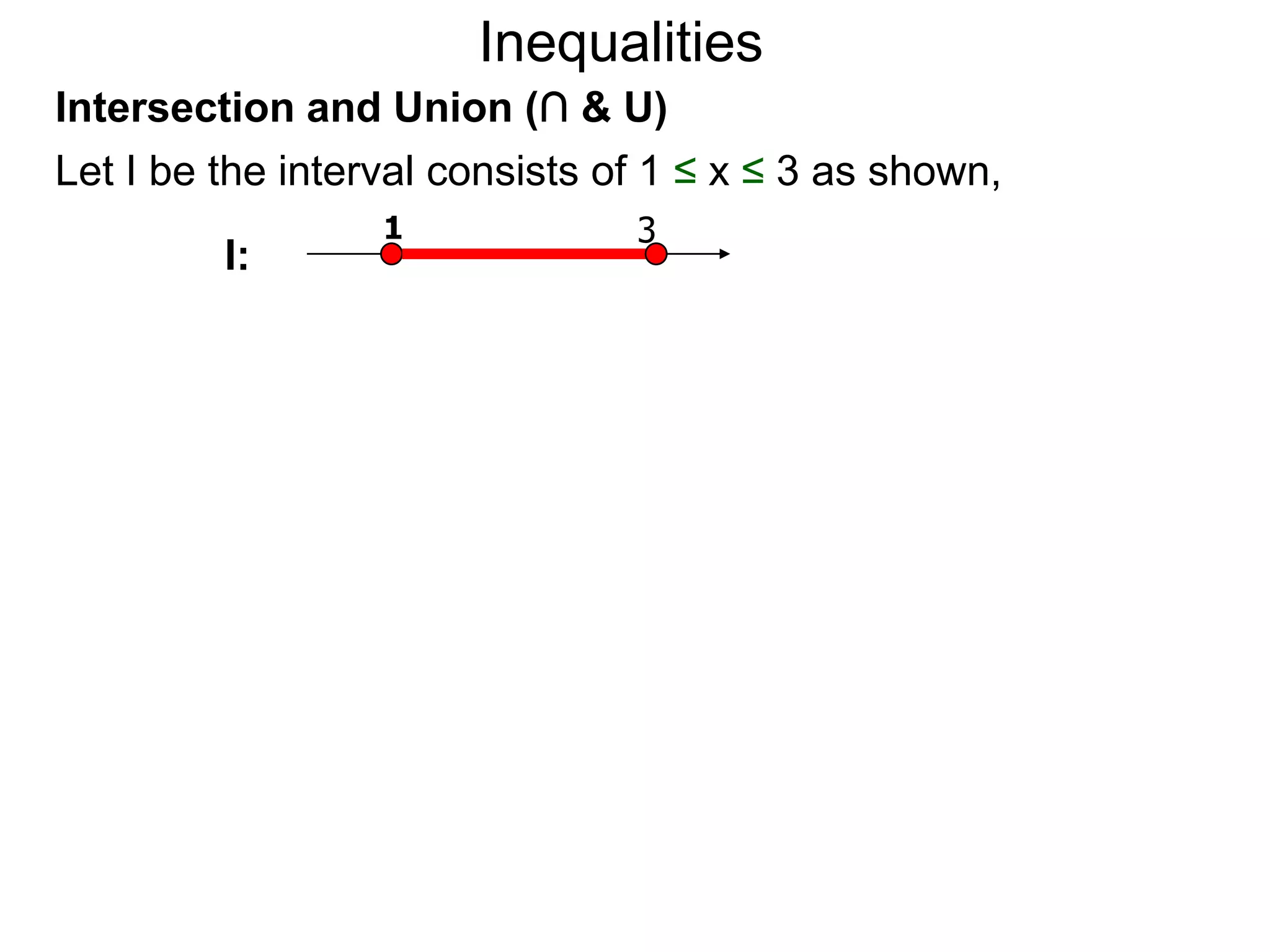
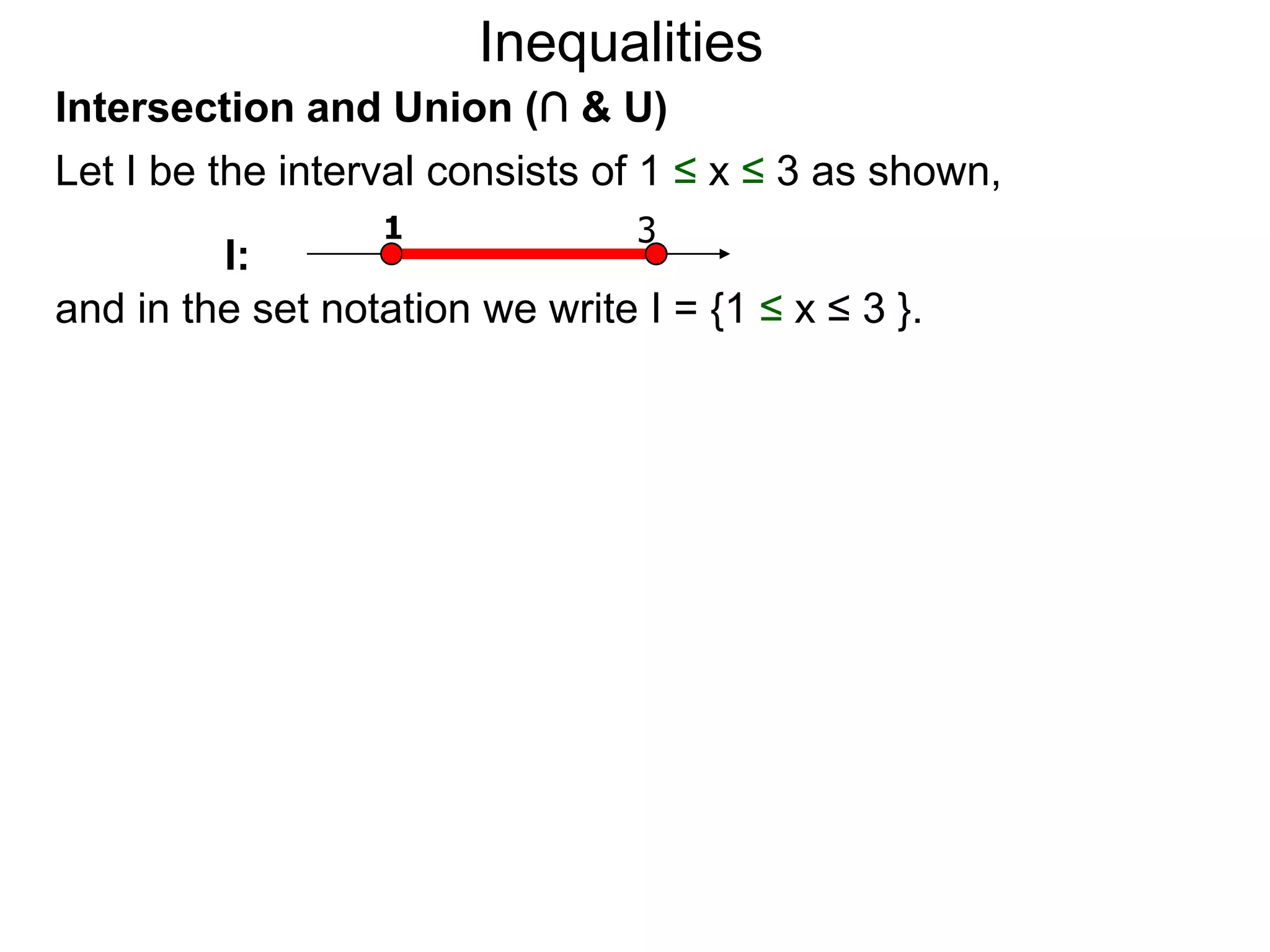
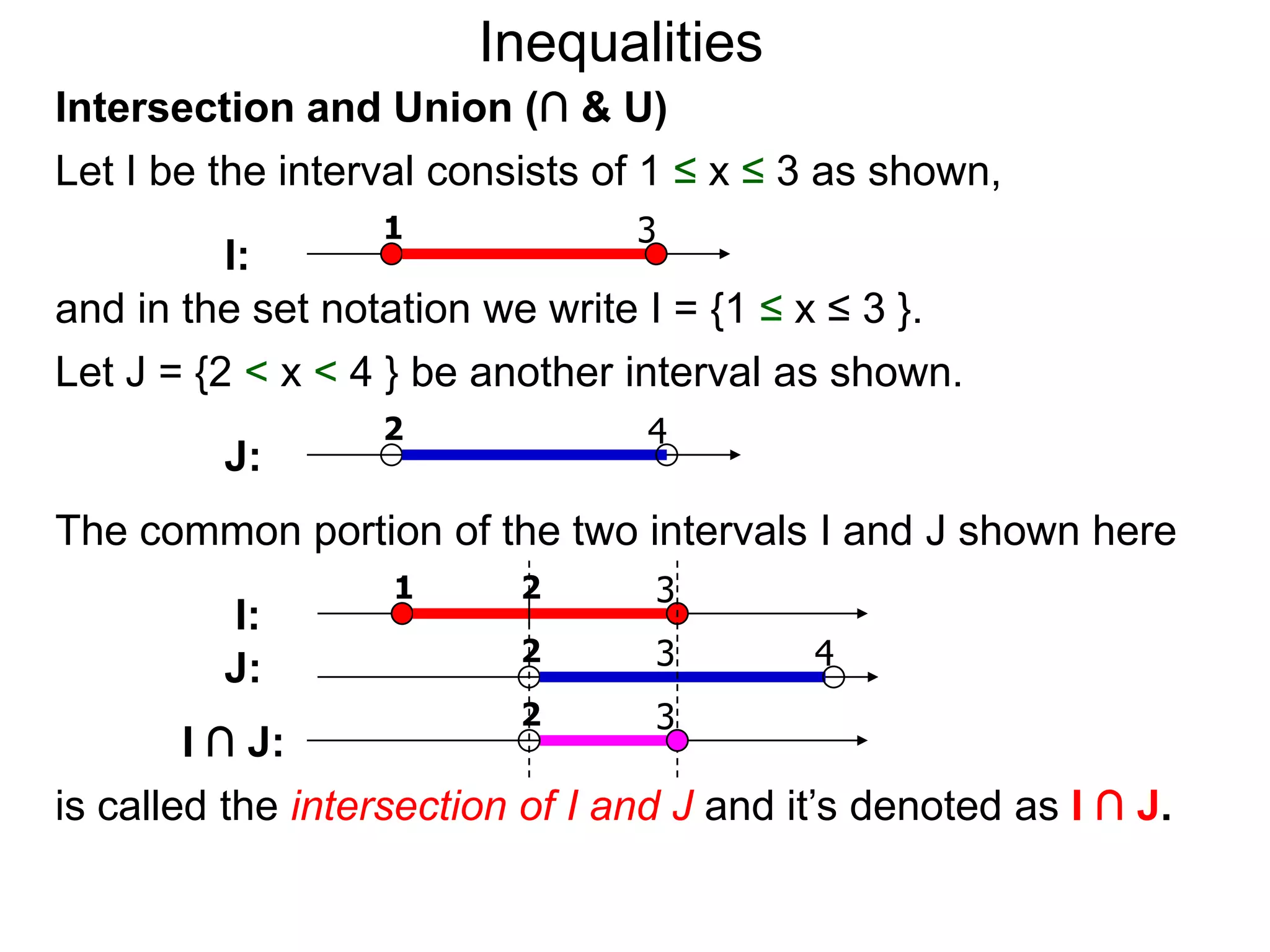
Let I be the interval consists of 1 ≤ x ≤ 3 as shown,
                  1             3
         I:
Inequalities
Intersection and Union (∩ & U)
Let I be the interval consists of 1 ≤ x ≤ 3 as shown,
                  1              3
         I:
and in the set notation we write I = {1 ≤ x ≤ 3 }.
Inequalities
Intersection and Union (∩ & U)
Let I be the interval consists of 1 ≤ x ≤ 3 as shown,
                  1             3
          I:
and in the set notation we write I = {1 ≤ x ≤ 3 }.
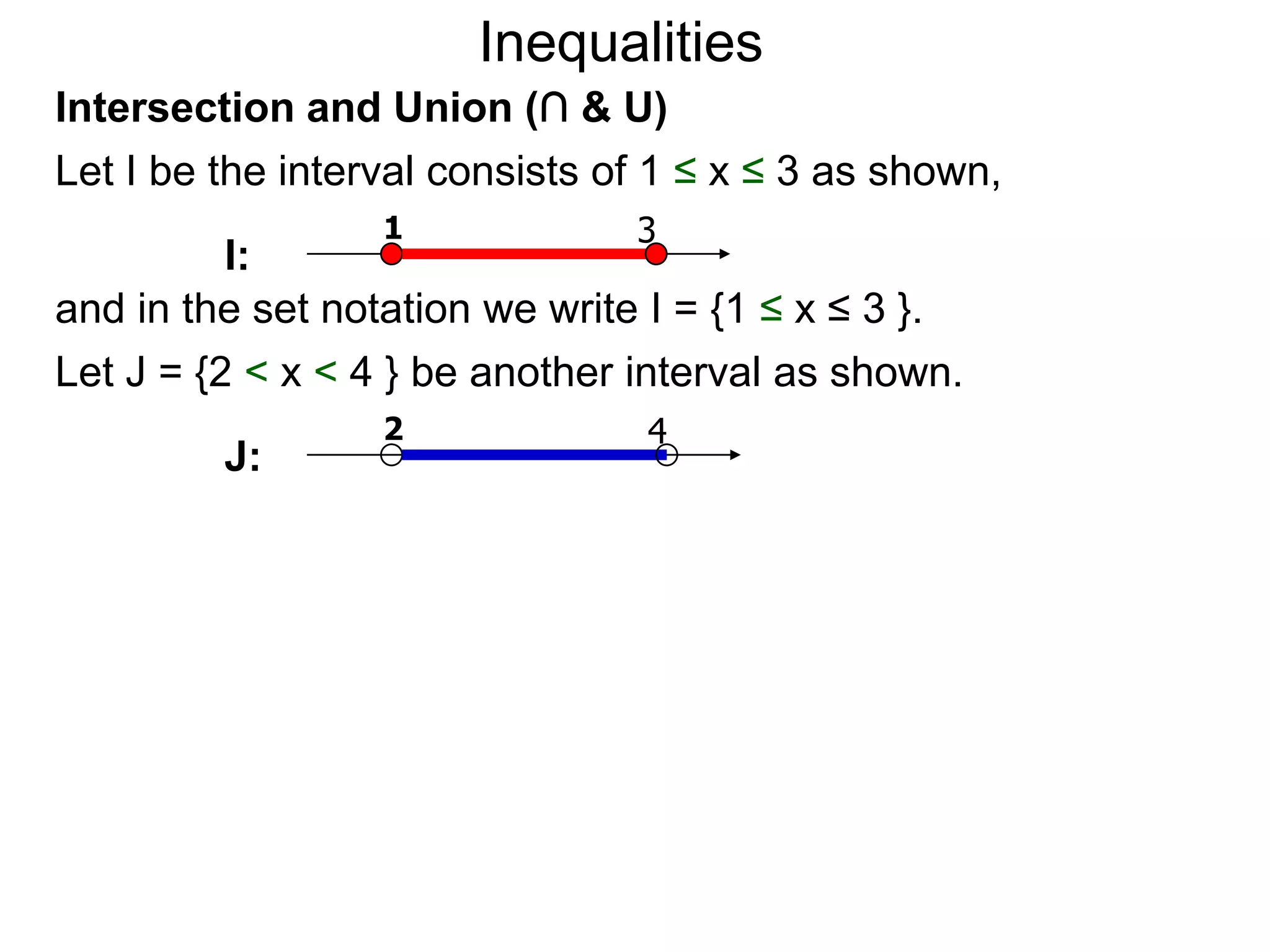
Let J = {2 < x < 4 } be another interval as shown.
                  2              4
         J:
Inequalities
Intersection and Union (∩ & U)
Let I be the interval consists of 1 ≤ x ≤ 3 as shown,
                  1             3
          I:
and in the set notation we write I = {1 ≤ x ≤ 3 }.
Let J = {2 < x < 4 } be another interval as shown.
                  2              4
         J:
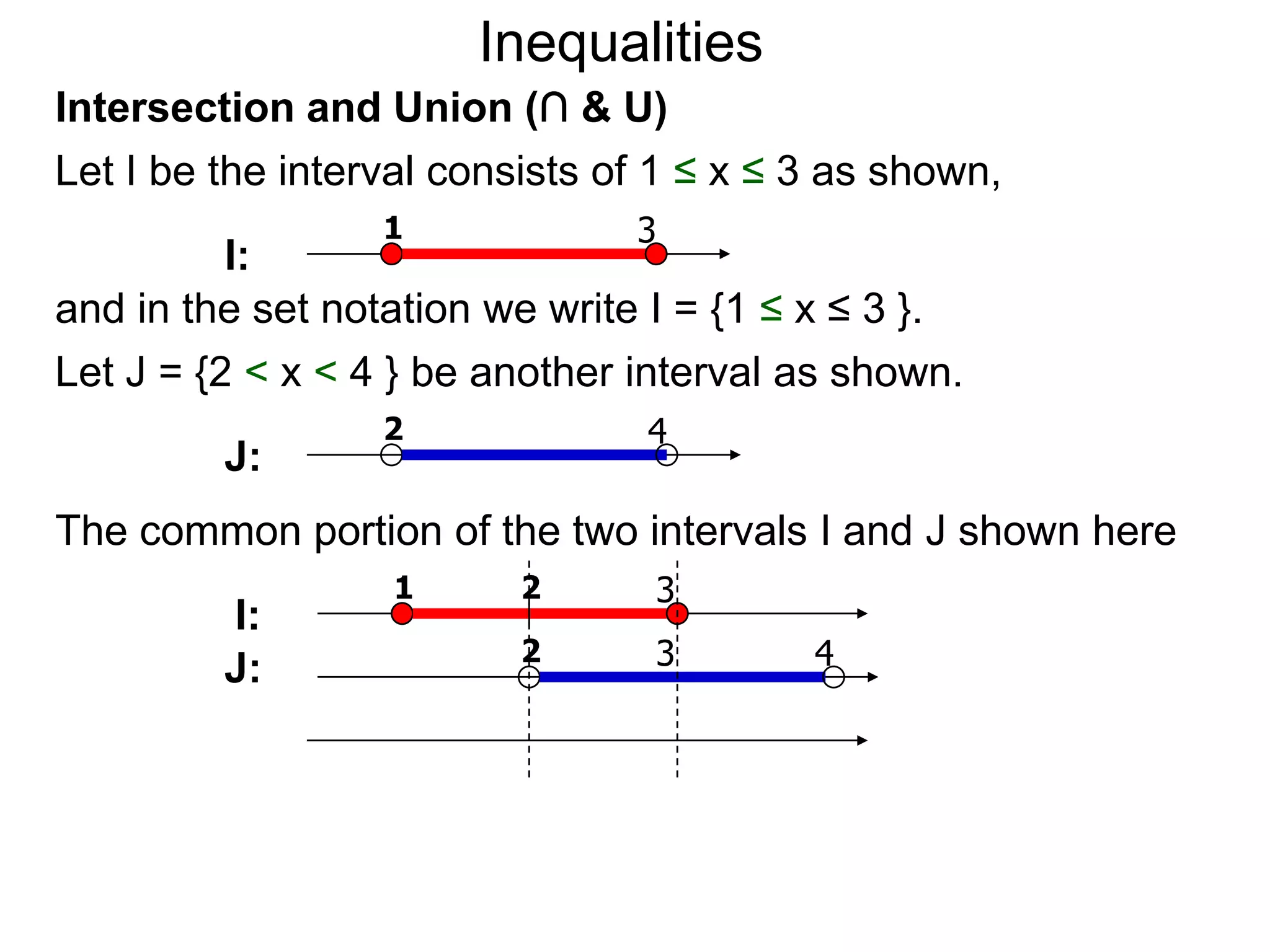
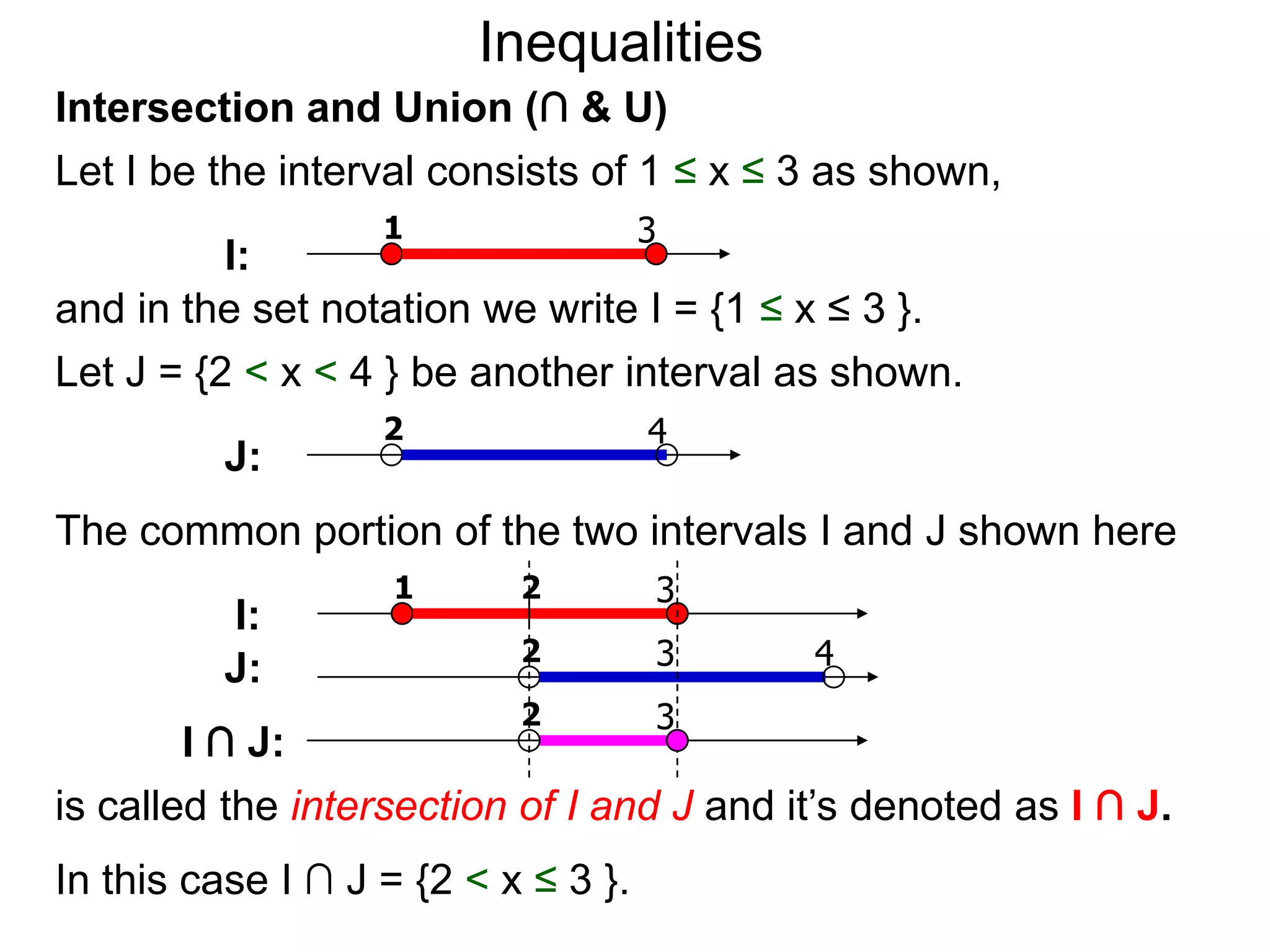
The common portion of the two intervals I and J shown here
                  1       2      3
         I:
                          2      3        4
         J:
Inequalities
Intersection and Union (∩ & U)
Let I be the interval consists of 1 ≤ x ≤ 3 as shown,
                  1             3
          I:
and in the set notation we write I = {1 ≤ x ≤ 3 }.
Let J = {2 < x < 4 } be another interval as shown.
                  2              4
         J:
The common portion of the two intervals I and J shown here
                  1       2      3
         I:
                          2      3        4
         J:
                          2      3
Inequalities
Intersection and Union (∩ & U)
Let I be the interval consists of 1 ≤ x ≤ 3 as shown,
                  1              3
          I:
and in the set notation we write I = {1 ≤ x ≤ 3 }.
Let J = {2 < x < 4 } be another interval as shown.
                  2              4
         J:
The common portion of the two intervals I and J shown here
                   1      2       3
         I:
                          2       3        4
         J:
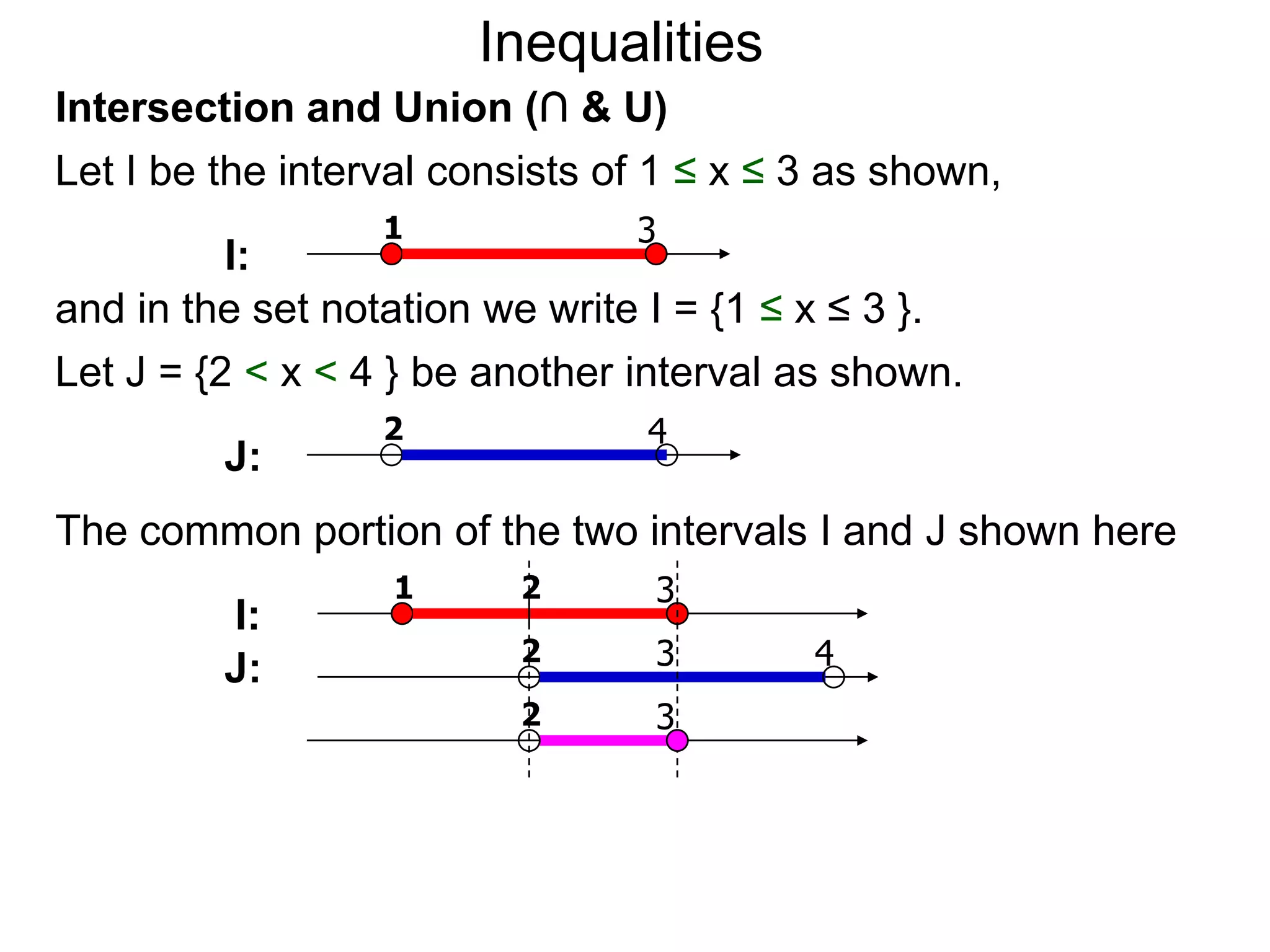
                          2       3
        I ∩ J:
is called the intersection of I and J and it’s denoted as I ∩ J.
Inequalities
Intersection and Union (∩ & U)
Let I be the interval consists of 1 ≤ x ≤ 3 as shown,
                   1                 3
          I:
and in the set notation we write I = {1 ≤ x ≤ 3 }.
Let J = {2 < x < 4 } be another interval as shown.
                   2                 4
          J:
The common portion of the two intervals I and J shown here
                    1      2         3
          I:
                           2         3     4
          J:
                           2         3
        I ∩ J:
is called the intersection of I and J and it’s denoted as I ∩ J.
In this case I ∩ J = {2 < x ≤ 3 }.
Inequalities
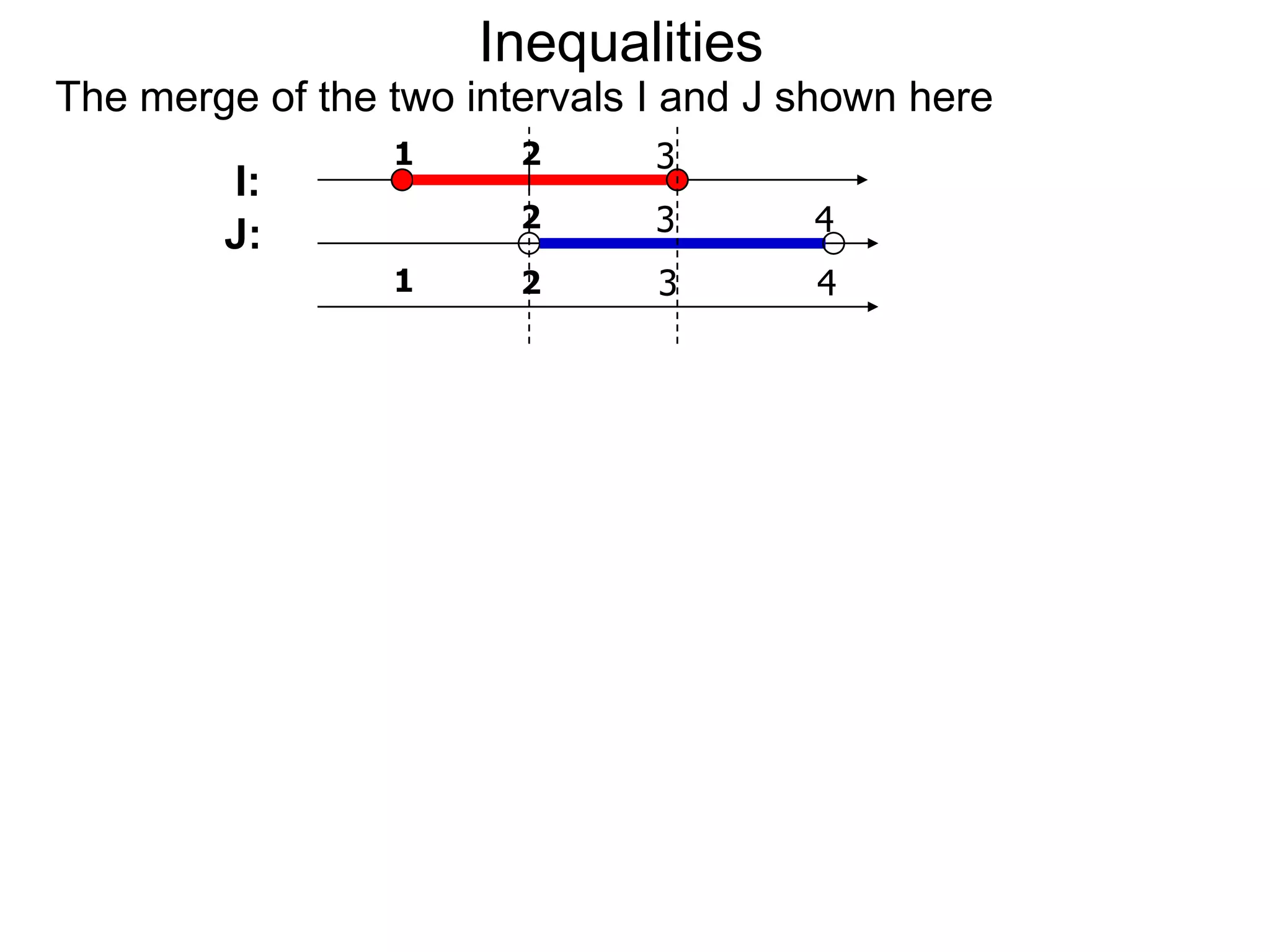
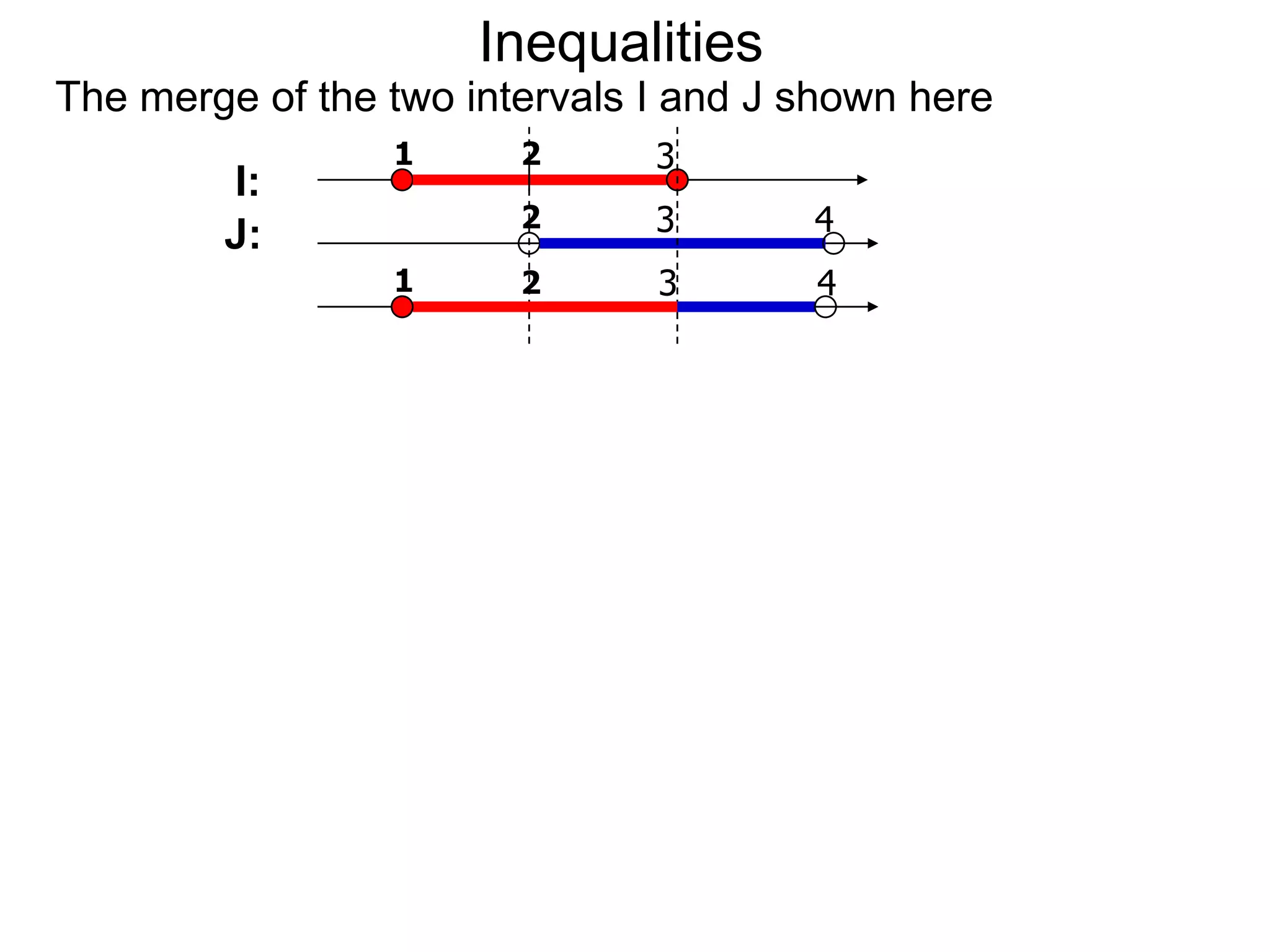
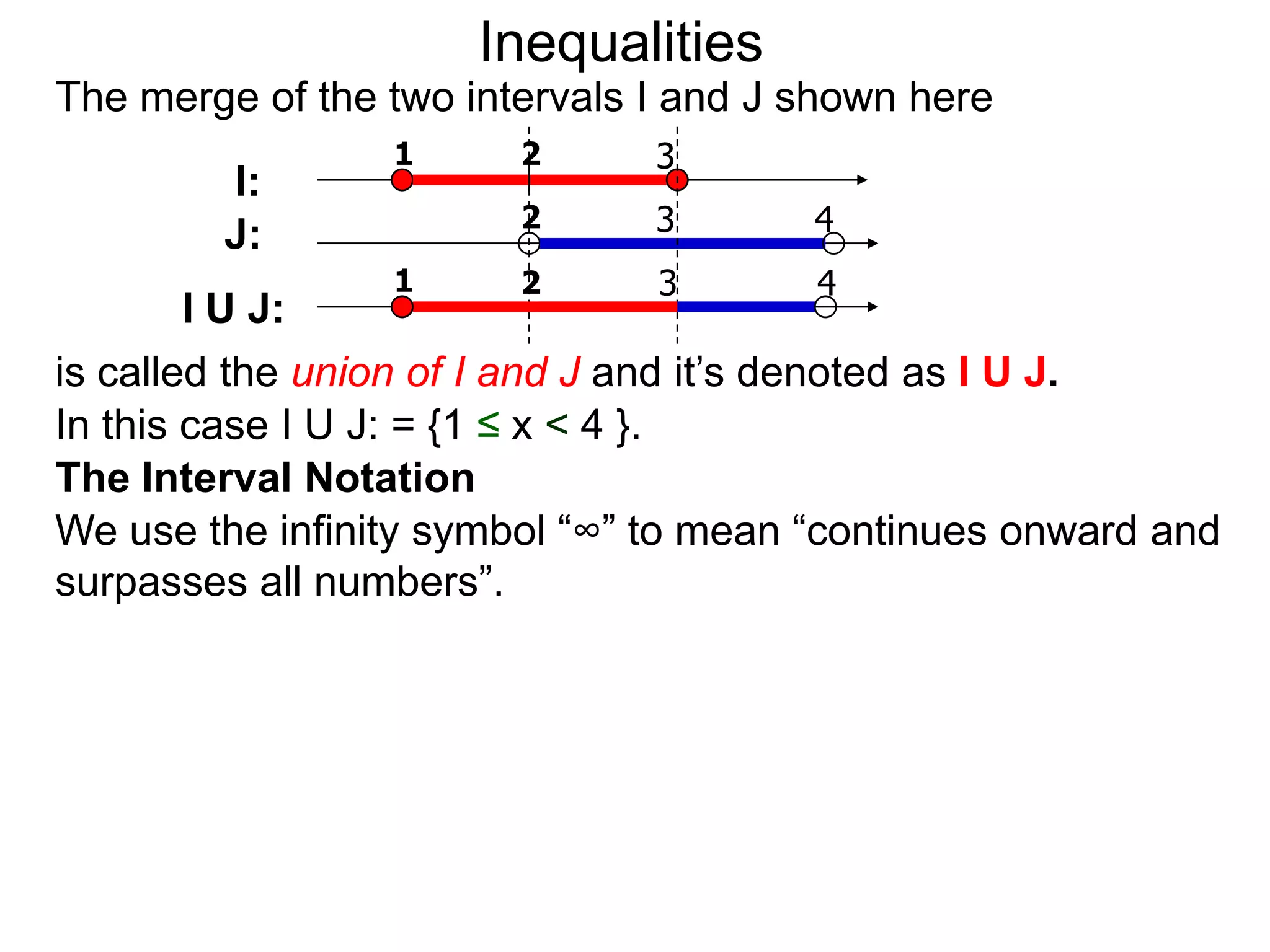
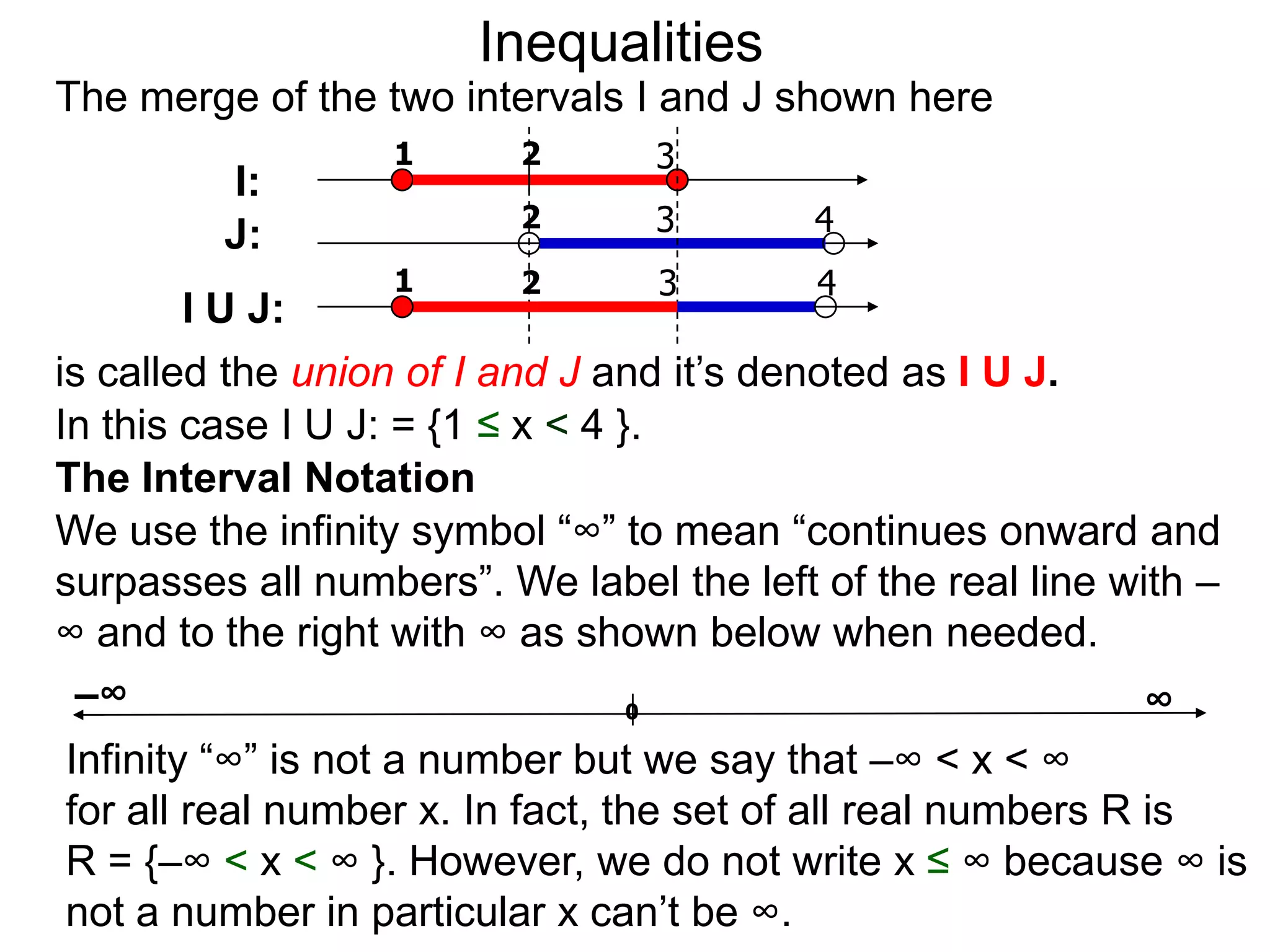
The merge of the two intervals I and J shown here
Inequalities
The merge of the two intervals I and J shown here
                 1      2      3
        I:
                        2      3       4
        J:
                 1      2      3       4
Inequalities
The merge of the two intervals I and J shown here
                 1      2      3
        I:
                        2      3       4
        J:
                 1      2      3       4
Inequalities
The merge of the two intervals I and J shown here
                   1      2       3
         I:
                          2       3        4
         J:
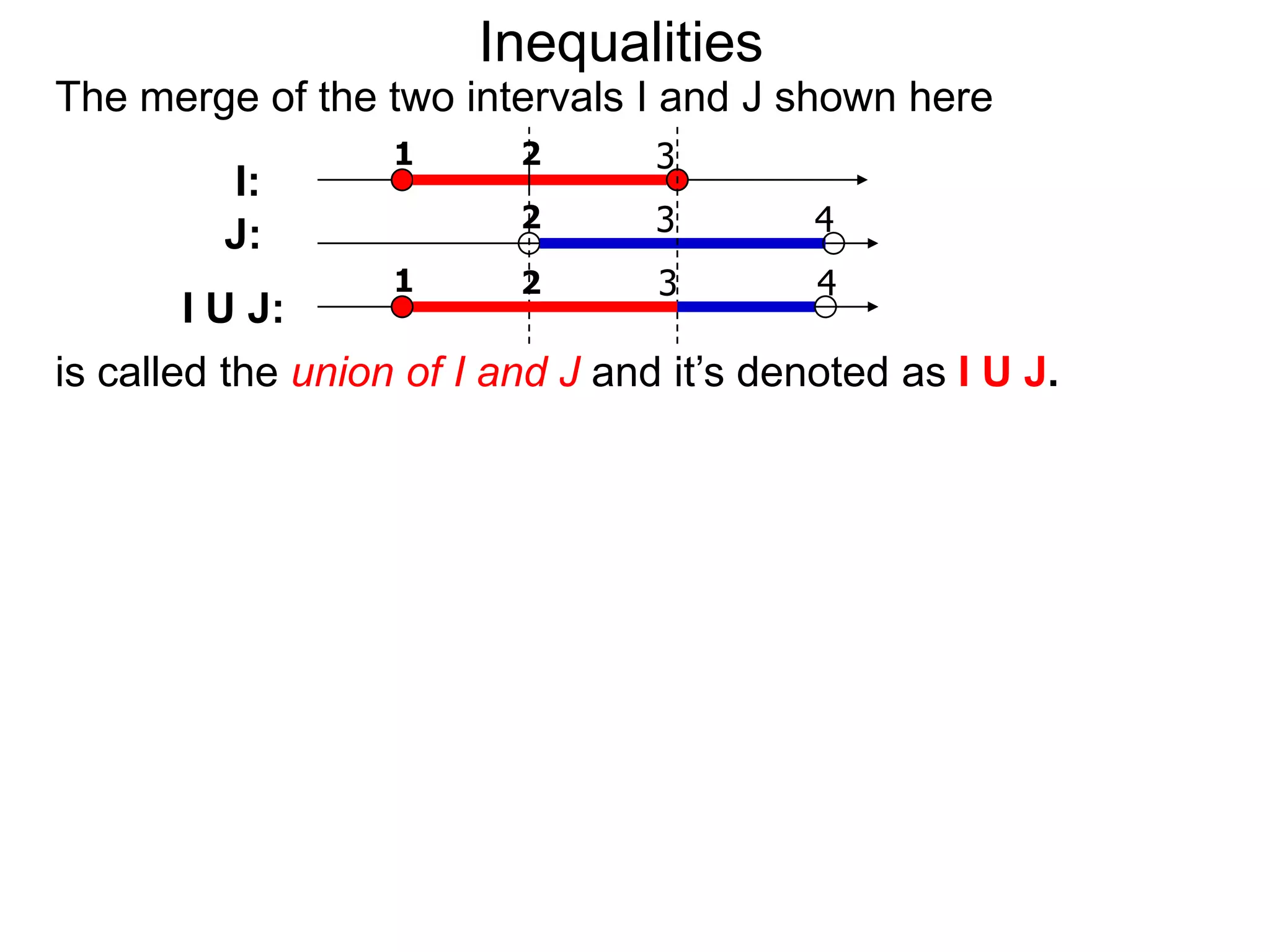
                   1      2       3        4
        I U J:
is called the union of I and J and it’s denoted as I U J.
Inequalities
The merge of the two intervals I and J shown here
                   1      2       3
         I:
                          2       3        4
         J:
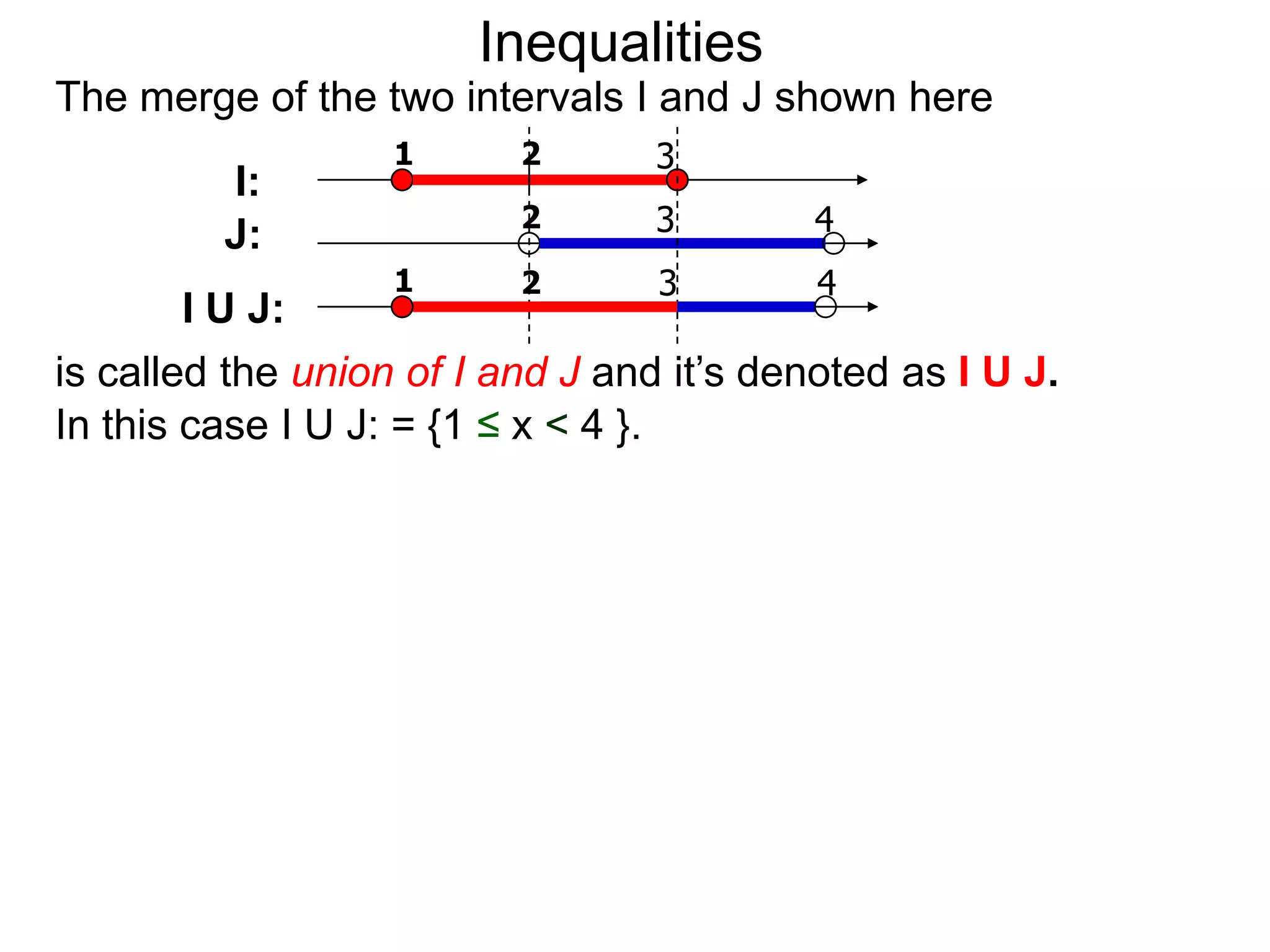
                   1      2       3        4
        I U J:
is called the union of I and J and it’s denoted as I U J.
In this case I U J: = {1 ≤ x < 4 }.
Inequalities
The merge of the two intervals I and J shown here
                   1      2       3
         I:
                          2       3        4
         J:
                   1      2       3        4
        I U J:
is called the union of I and J and it’s denoted as I U J.
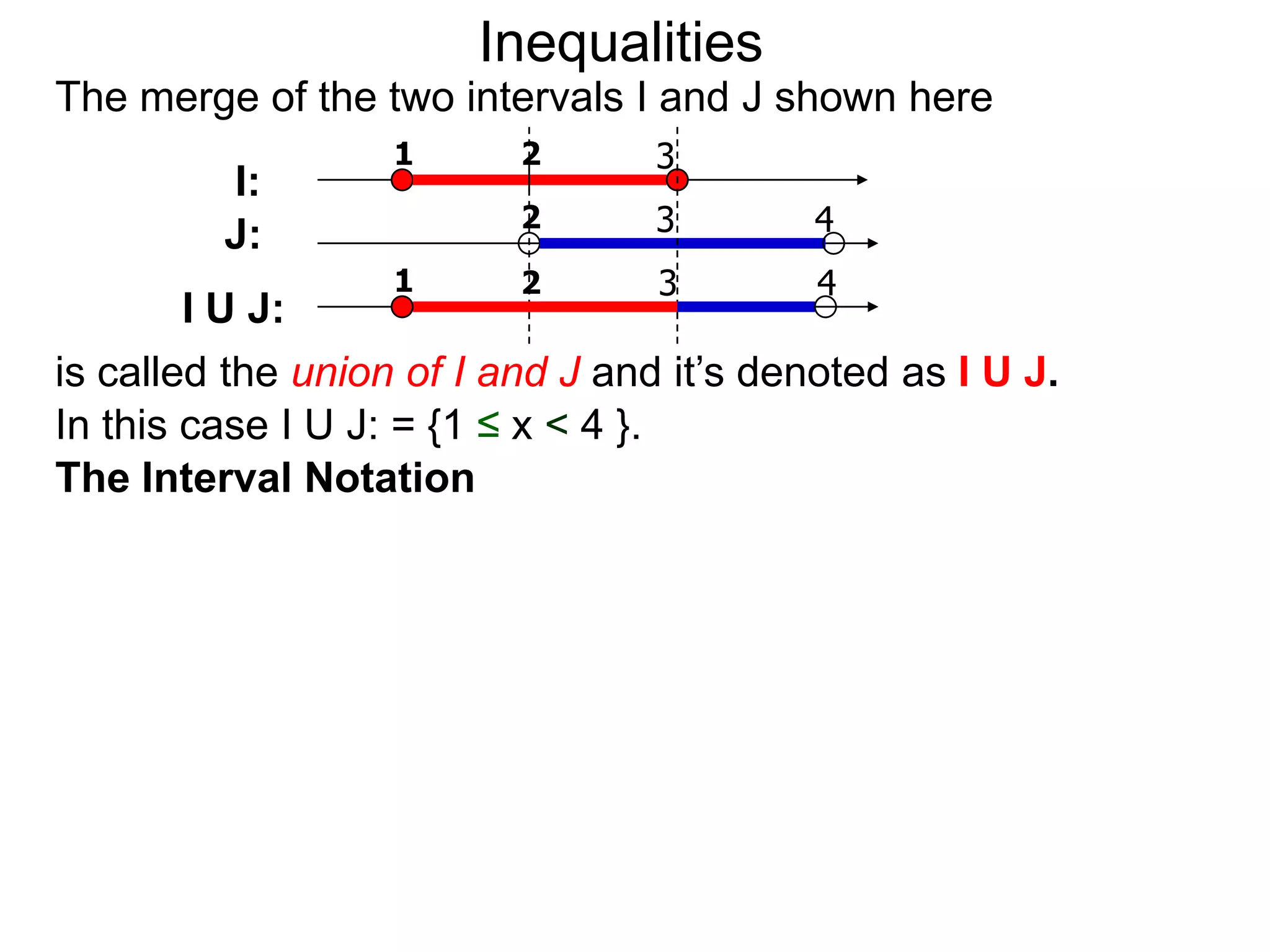
In this case I U J: = {1 ≤ x < 4 }.
The Interval Notation
Inequalities
The merge of the two intervals I and J shown here
                 1      2      3
        I:
                        2      3       4
        J:
                 1      2      3       4
        I U J:
is called the union of I and J and it’s denoted as I U J.
In this case I U J: = {1 ≤ x < 4 }.
The Interval Notation
We use the infinity symbol “∞” to mean “continues onward and
surpasses all numbers”.
Inequalities
The merge of the two intervals I and J shown here
                  1      2       3
         I:
                         2       3        4
         J:
                  1      2       3        4
        I U J:
is called the union of I and J and it’s denoted as I U J.
In this case I U J: = {1 ≤ x < 4 }.
The Interval Notation
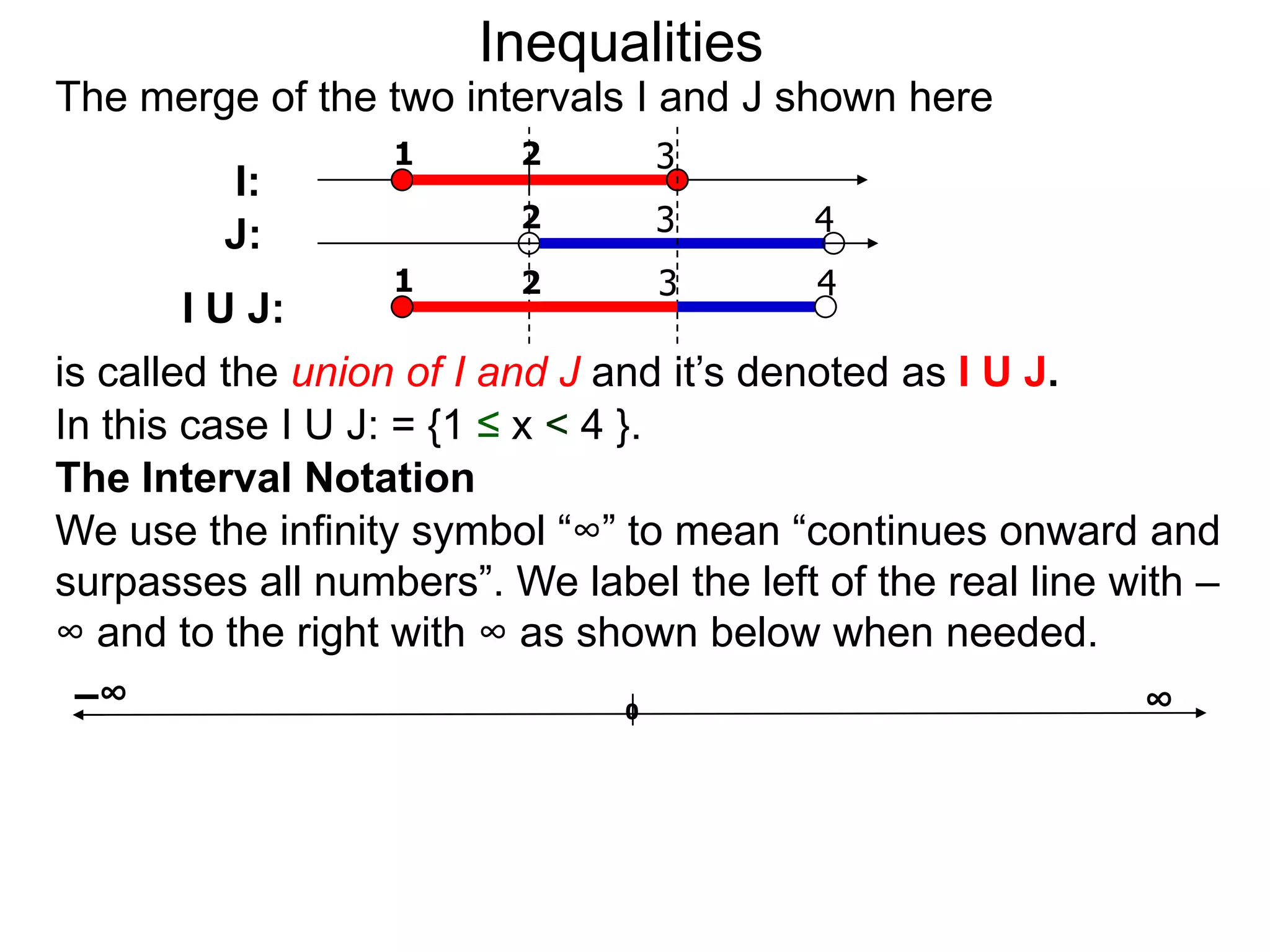
We use the infinity symbol “∞” to mean “continues onward and
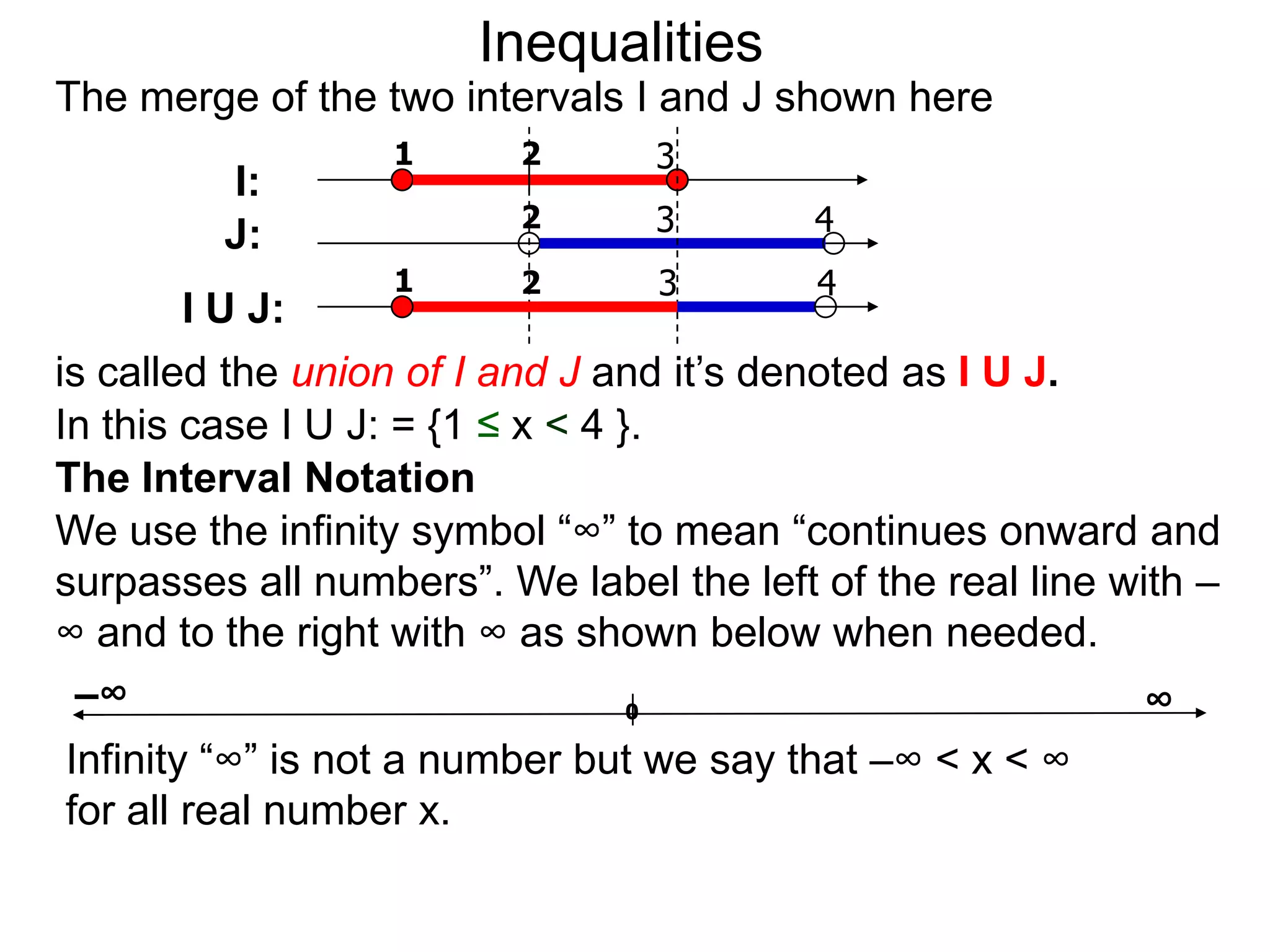
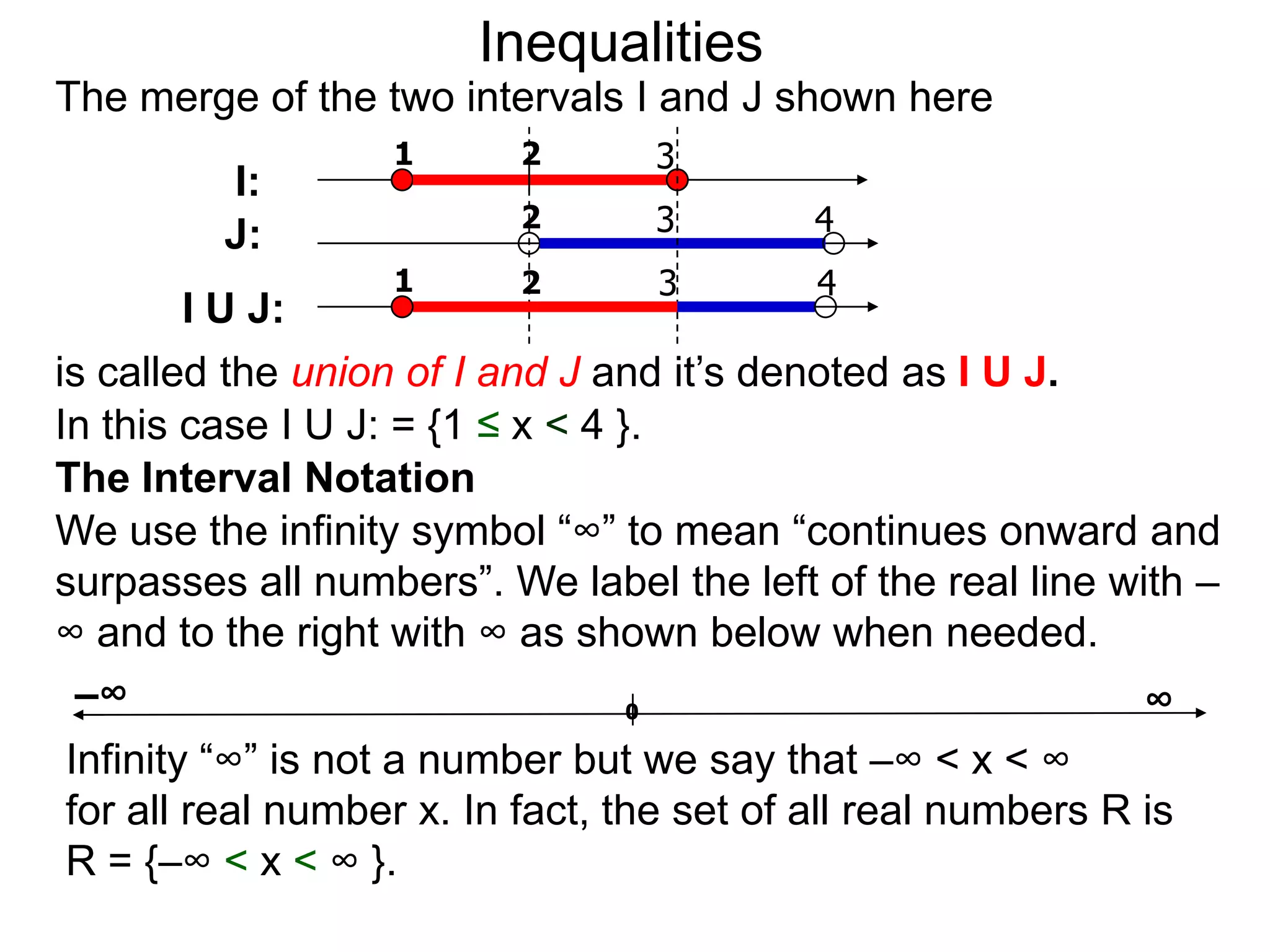
surpasses all numbers”. We label the left of the real line with –
∞ and to the right with ∞ as shown below when needed.
 –∞                               0                          ∞
Inequalities
The merge of the two intervals I and J shown here
                  1      2       3
         I:
                         2       3        4
         J:
                  1      2       3        4
        I U J:
is called the union of I and J and it’s denoted as I U J.
In this case I U J: = {1 ≤ x < 4 }.
The Interval Notation
We use the infinity symbol “∞” to mean “continues onward and
surpasses all numbers”. We label the left of the real line with –
∞ and to the right with ∞ as shown below when needed.
 –∞                               0                          ∞
Infinity “∞” is not a number but we say that –∞ < x < ∞
for all real number x.
Inequalities
The merge of the two intervals I and J shown here
                  1       2       3
         I:
                          2       3        4
         J:
                  1       2       3        4
        I U J:
is called the union of I and J and it’s denoted as I U J.
In this case I U J: = {1 ≤ x < 4 }.
The Interval Notation
We use the infinity symbol “∞” to mean “continues onward and
surpasses all numbers”. We label the left of the real line with –
∞ and to the right with ∞ as shown below when needed.
 –∞                               0                          ∞
Infinity “∞” is not a number but we say that –∞ < x < ∞
for all real number x. In fact, the set of all real numbers R is
R = {–∞ < x < ∞ }.
Inequalities
The merge of the two intervals I and J shown here
                  1      2       3
         I:
                         2       3        4
         J:
                  1      2       3        4
        I U J:
is called the union of I and J and it’s denoted as I U J.
In this case I U J: = {1 ≤ x < 4 }.
The Interval Notation
We use the infinity symbol “∞” to mean “continues onward and
surpasses all numbers”. We label the left of the real line with –
∞ and to the right with ∞ as shown below when needed.
 –∞                               0                          ∞
Infinity “∞” is not a number but we say that –∞ < x < ∞
for all real number x. In fact, the set of all real numbers R is
R = {–∞ < x < ∞ }. However, we do not write x ≤ ∞ because ∞ is
not a number in particular x can’t be ∞.
Inequalities
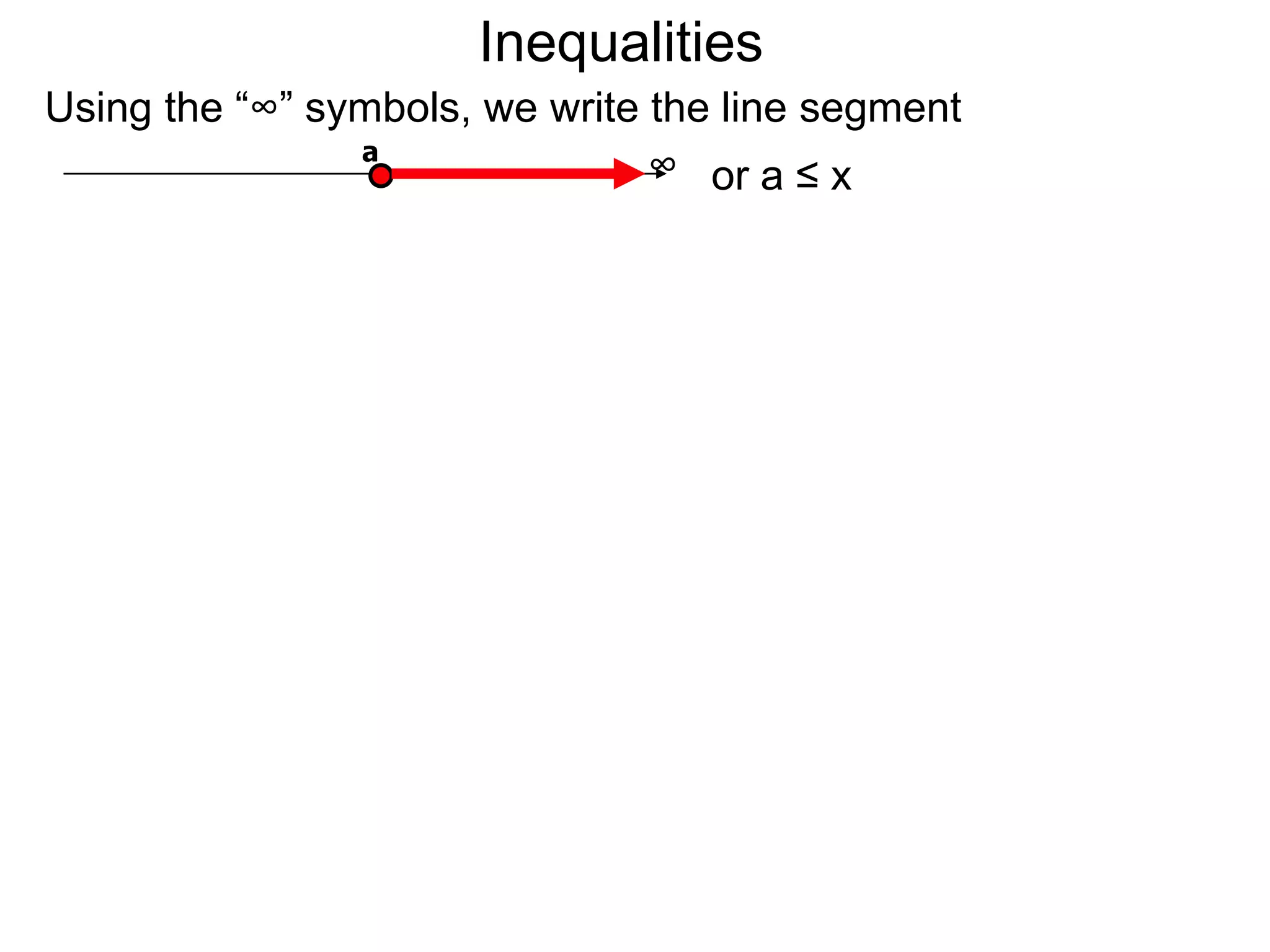
Using the “∞” symbols, we write the line segment
                a
                                ∞ or a ≤ x
Inequalities
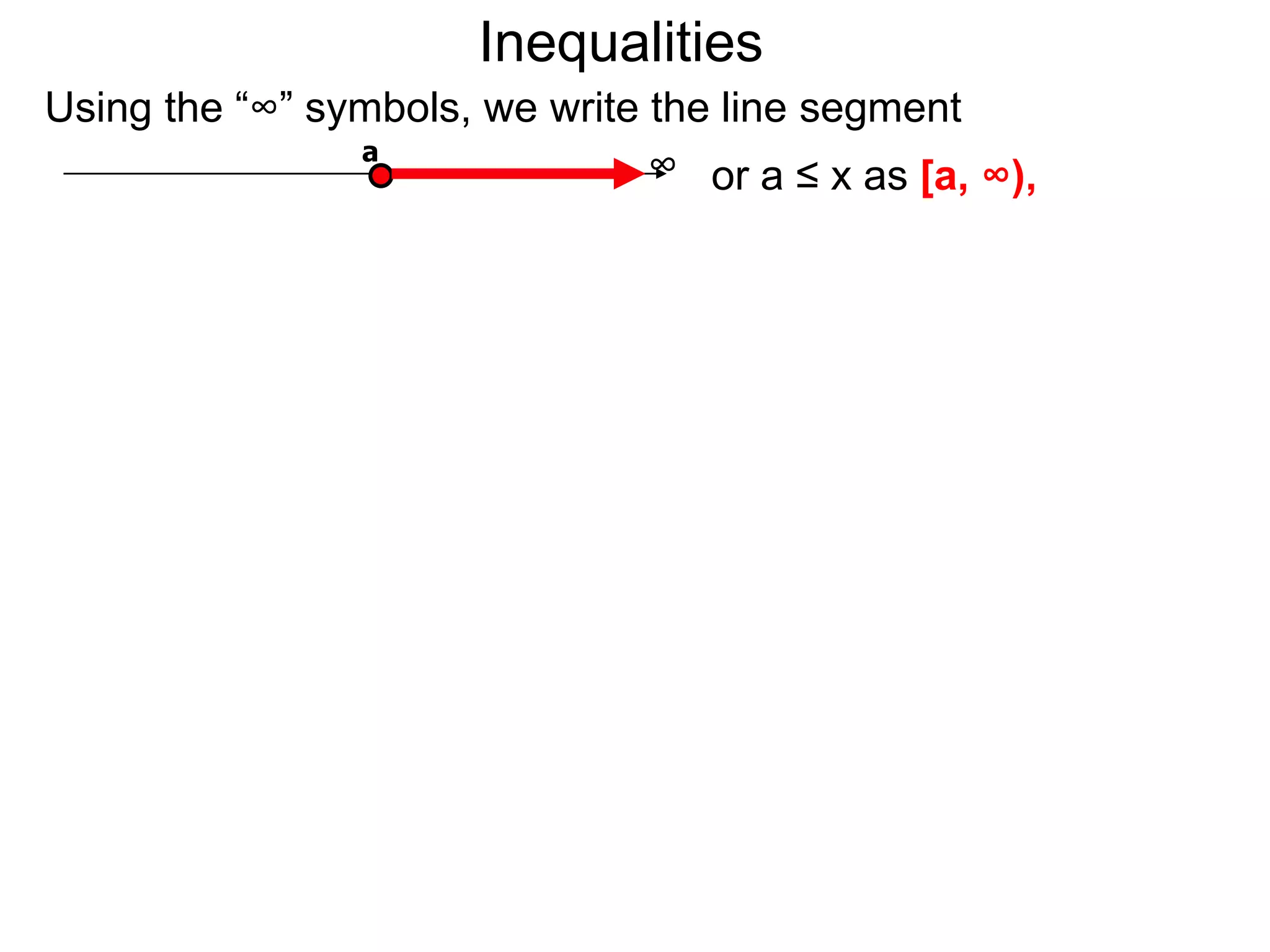
Using the “∞” symbols, we write the line segment
                a
                                ∞ or a ≤ x as [a, ∞),
Inequalities
Using the “∞” symbols, we write the line segment
                a
                                ∞ or a ≤ x as [a, ∞),


We use ] or [ to include the end points,
Inequalities
Using the “∞” symbols, we write the line segment
                a
                                ∞ or a ≤ x as [a, ∞),
                 a
                                 ∞ or a < x as (a, ∞),


We use ] or [ to include the end points, ) and ( to exclude the
end points.
Inequalities
Using the “∞” symbols, we write the line segment
                a
                                ∞ or a ≤ x as [a, ∞),
                 a
                                 ∞ or a < x as (a, ∞),
–∞               a
                                     or x ≤ a as (–∞, a],
–∞               a
                                     or x < a as (–∞, a),


We use ] or [ to include the end points, ) and ( to exclude the
end points.
Inequalities
Using the “∞” symbols, we write the line segment
                a
                                ∞ or a ≤ x as [a, ∞),
                 a
                                 ∞ or a < x as (a, ∞),
–∞               a
                                     or x ≤ a as (–∞, a],
–∞               a
                                     or x < a as (–∞, a),
Let a, b be two numbers such that a < b, we write the intervals
     a              b
                                  or a ≤ x ≤ b as [a, b],
     a                b
                                   or a < x < b as (a, b),
     a                b
                                   or a ≤ x < b as [a, b),
     a                b
                                   or a < x ≤ b as (a, b],
We use ] or [ to include the end points, ) and ( to exclude the
end points.
Inequalities
Using the “∞” symbols, we write the line segment
                a
                                ∞ or a ≤ x as [a, ∞),
                 a
                                 ∞ or a < x as (a, ∞),
–∞               a
                                    or x ≤ a as (–∞, a],
–∞               a
                                    or x < a as (–∞, a),
Let a, b be two numbers such that a < b, we write the intervals
     a              b
                                  or a ≤ x ≤ b as [a, b],
     a                b
                                   or a < x < b as (a, b),
     a                b
                                   or a ≤ x < b as [a, b),
     a                b
                                   or a < x ≤ b as (a, b],
We use ] or [ to include the end points, ) and ( to exclude the
end points. Note the interval notation (a, b) is the same as the
coordinate of a point so its interpretation depends on the context.
Inequalities
The interval [a, a] consists of exactly one point {x = a}.
Inequalities
The interval [a, a] consists of exactly one point {x = a}.
The empty set which contains nothing is denoted as Φ = { }.
Inequalities
The interval [a, a] consists of exactly one point {x = a}.
The empty set which contains nothing is denoted as Φ = { }.
The interval (a, a) or (a, a] or [a, a) = Φ.
Inequalities
The interval [a, a] consists of exactly one point {x = a}.
The empty set which contains nothing is denoted as Φ = { }.
The interval (a, a) or (a, a] or [a, a) = Φ.
Inequalities
The interval [a, a] consists of exactly one point {x = a}.
Inequalities
The interval [a, a] consists of exactly one point {x = a}.
The empty set which contains nothing is denoted as Φ = { }.
Inequalities
The interval [a, a] consists of exactly one point {x = a}.
The empty set which contains nothing is denoted as Φ = { }.
The interval (a, a) or (a, a] or [a, a) = Φ.
Inequalities
The interval [a, a] consists of exactly one point {x = a}.
The empty set which contains nothing is denoted as Φ = { }.
The interval (a, a) or (a, a] or [a, a) = Φ.
Example C. Given intervals I, J , and K, do the set operation.
Draw. Put the answer in the interval and the inequality notation.
   –4        –1
I:                0           J: x > –2         K: –3 < x ≤ 1
Inequalities
The interval [a, a] consists of exactly one point {x = a}.
The empty set which contains nothing is denoted as Φ = { }.
The interval (a, a) or (a, a] or [a, a) = Φ.
Example C. Given intervals I, J , and K, do the set operation.
Draw. Put the answer in the interval and the inequality notation.
   –4        –1
I:                0           J: x > –2         K: –3 < x ≤ 1
a. K U J


b. K ∩ I
Inequalities
The interval [a, a] consists of exactly one point {x = a}.
The empty set which contains nothing is denoted as Φ = { }.
The interval (a, a) or (a, a] or [a, a) = Φ.
Example C. Given intervals I, J , and K, do the set operation.
Draw. Put the answer in the interval and the inequality notation.
   –4        –1
I:                0           J: x > –2         K: –3 < x ≤ 1
a. K U J
    –3           1
             0
         K


b. K ∩ I
Inequalities
The interval [a, a] consists of exactly one point {x = a}.
The empty set which contains nothing is denoted as Φ = { }.
The interval (a, a) or (a, a] or [a, a) = Φ.
Example C. Given intervals I, J , and K, do the set operation.
Draw. Put the answer in the interval and the inequality notation.
   –4        –1
I:                0           J: x > –2         K: –3 < x ≤ 1
a. K U J
    –3       –2       1
                  0
         K


b. K ∩ I
Inequalities
The interval [a, a] consists of exactly one point {x = a}.
The empty set which contains nothing is denoted as Φ = { }.
The interval (a, a) or (a, a] or [a, a) = Φ.
Example C. Given intervals I, J , and K, do the set operation.
Draw. Put the answer in the interval and the inequality notation.
   –4        –1
I:                0           J: x > –2         K: –3 < x ≤ 1
a. K U J
    –3       –2       1                    –3
                  0          so K U J is          0
         K


b. K ∩ I
Inequalities
The interval [a, a] consists of exactly one point {x = a}.
The empty set which contains nothing is denoted as Φ = { }.
The interval (a, a) or (a, a] or [a, a) = Φ.
Example C. Given intervals I, J , and K, do the set operation.
Draw. Put the answer in the interval and the inequality notation.
   –4        –1
I:                0           J: x > –2         K: –3 < x ≤ 1
a. K U J
    –3       –2       1                    –3
                  0          so K U J is          0
         K
Hence K U J is (–3, ∞) or {–3 < x}.

b. K ∩ I
Inequalities
The interval [a, a] consists of exactly one point {x = a}.
The empty set which contains nothing is denoted as Φ = { }.
The interval (a, a) or (a, a] or [a, a) = Φ.
Example C. Given intervals I, J , and K, do the set operation.
Draw. Put the answer in the interval and the inequality notation.
   –4        –1
I:                0           J: x > –2         K: –3 < x ≤ 1
a. K U J
    –3     –2       1                             –3
                0                   so K U J is        0


Hence K U J is (–3, ∞) or {–3 < x}.

b. K ∩ I
           –3               K
                                1
                        0
Inequalities
The interval [a, a] consists of exactly one point {x = a}.
The empty set which contains nothing is denoted as Φ = { }.
The interval (a, a) or (a, a] or [a, a) = Φ.
Example C. Given intervals I, J , and K, do the set operation.
Draw. Put the answer in the interval and the inequality notation.
   –4        –1
I:                0           J: x > –2         K: –3 < x ≤ 1
a. K U J
    –3     –2        1                             –3
                0                    so K U J is        0


Hence K U J is (–3, ∞) or {–3 < x}.

b. K ∩ I
           –3                    1
    –4              –1   0
                             K
    I
Inequalities
The interval [a, a] consists of exactly one point {x = a}.
The empty set which contains nothing is denoted as Φ = { }.
The interval (a, a) or (a, a] or [a, a) = Φ.
Example C. Given intervals I, J , and K, do the set operation.
Draw. Put the answer in the interval and the inequality notation.
   –4        –1
I:                0           J: x > –2         K: –3 < x ≤ 1
a. K U J
    –3     –2        1                             –3
                0                    so K U J is        0


Hence K U J is (–3, ∞) or {–3 < x}.

b. K ∩ I
           –3                    1
    –4              –1   0
                             K
    I
The common or overlapping portion is shown.
Inequalities
The interval [a, a] consists of exactly one point {x = a}.
The empty set which contains nothing is denoted as Φ = { }.
The interval (a, a) or (a, a] or [a, a) = Φ.
Example C. Given intervals I, J , and K, do the set operation.
Draw. Put the answer in the interval and the inequality notation.
   –4        –1
I:                0           J: x > –2         K: –3 < x ≤ 1
a. K U J
    –3     –2        1                             –3
                0                    so K U J is        0


Hence K U J is (–3, ∞) or {–3 < x}.

b. K ∩ I
           –3                    1
    –4              –1   0
                             K
    I
The common or overlapping portion is shown.
Hence K ∩ I is (–3, –1) or {–3 < x < –1}
Inequalities
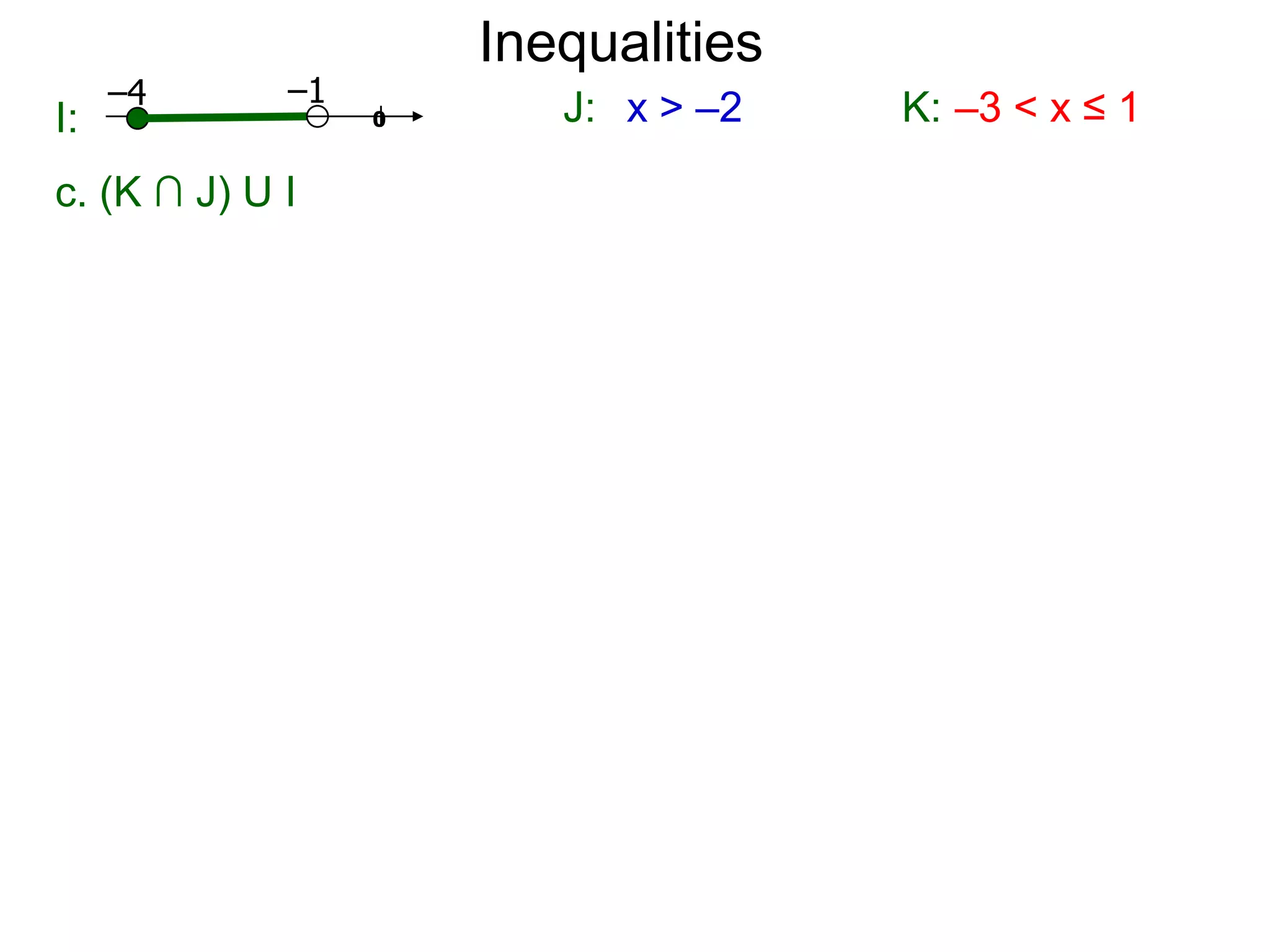
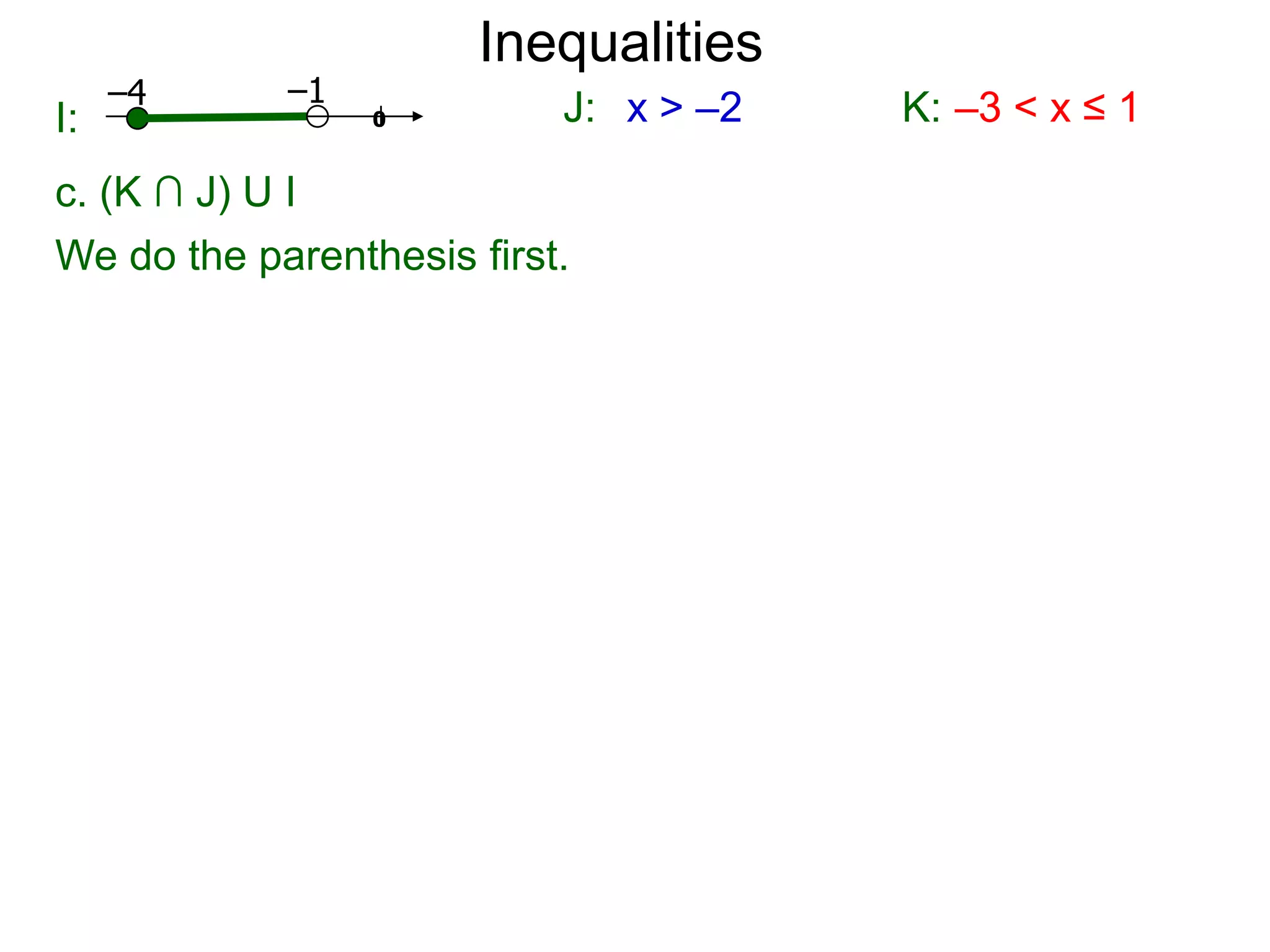
     –4      –1
I:                0      J: x > –2   K: –3 < x ≤ 1
c. (K ∩ J) U I
Inequalities
     –4     –1
I:               0         J: x > –2   K: –3 < x ≤ 1
c. (K ∩ J) U I
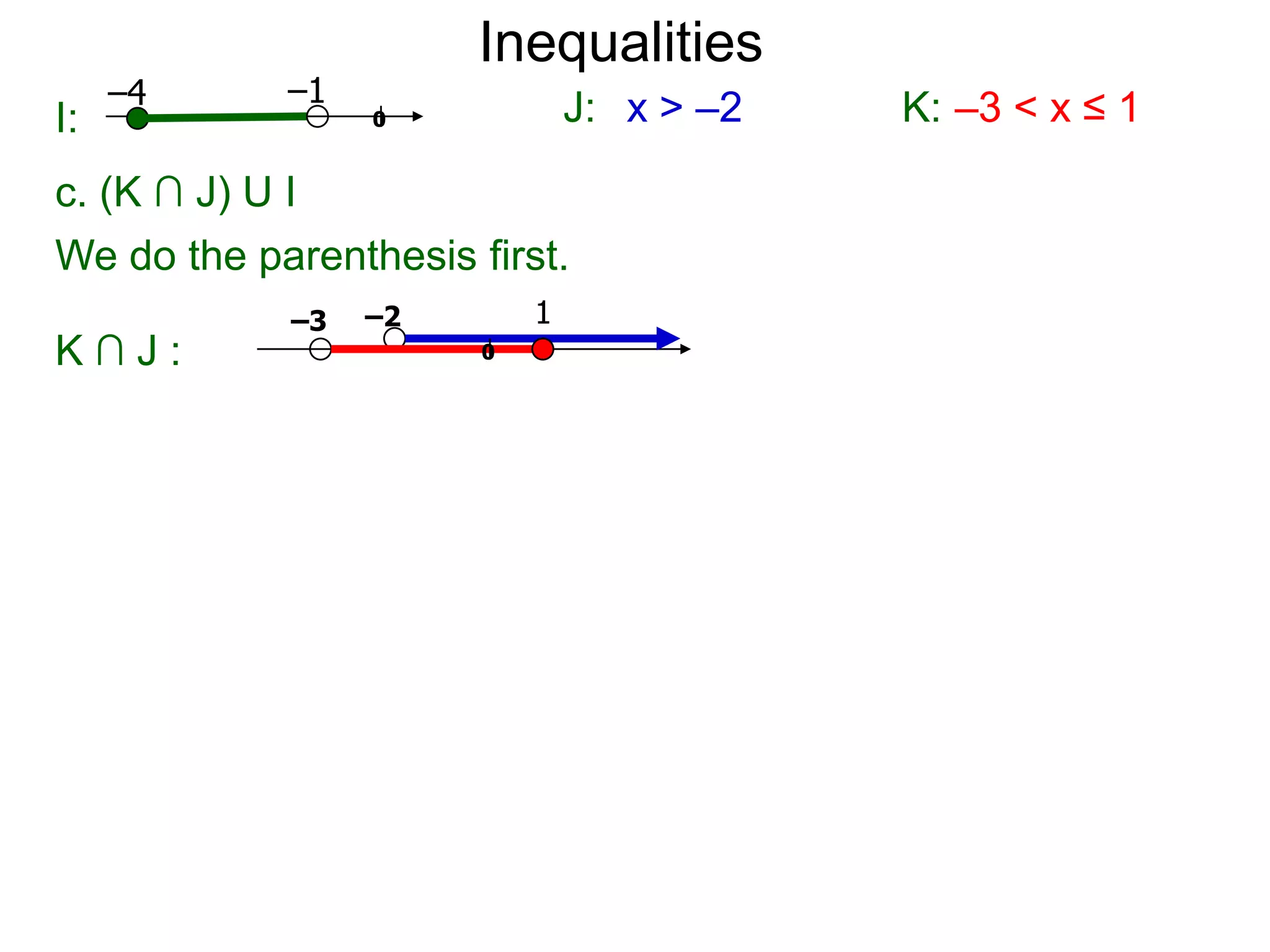
We do the parenthesis first.
Inequalities
     –4     –1
I:               0             J: x > –2   K: –3 < x ≤ 1
c. (K ∩ J) U I
We do the parenthesis first.
            –3   –2        1
K∩J:                   0
Inequalities
     –4       –1
I:                 0            J: x > –2   K: –3 < x ≤ 1
c. (K ∩ J) U I
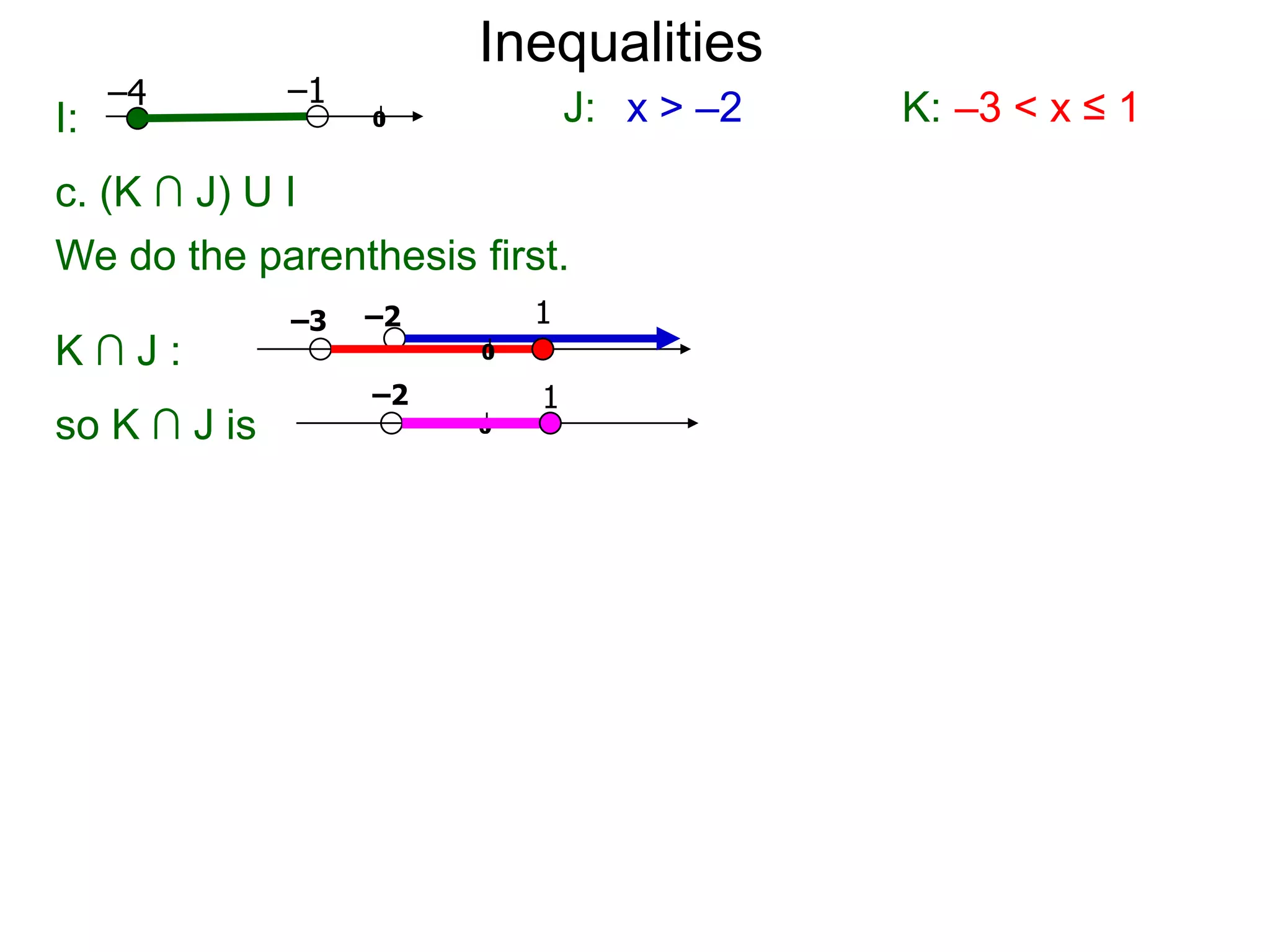
We do the parenthesis first.
              –3   –2       1
K∩J:                    0

                   –2       1
so K ∩ J is             0
Inequalities
     –4       –1
I:                 0                 J: x > –2     K: –3 < x ≤ 1
c. (K ∩ J) U I
We do the parenthesis first.
              –3   –2            1
K∩J:                         0

                   –2            1
so K ∩ J is                  0


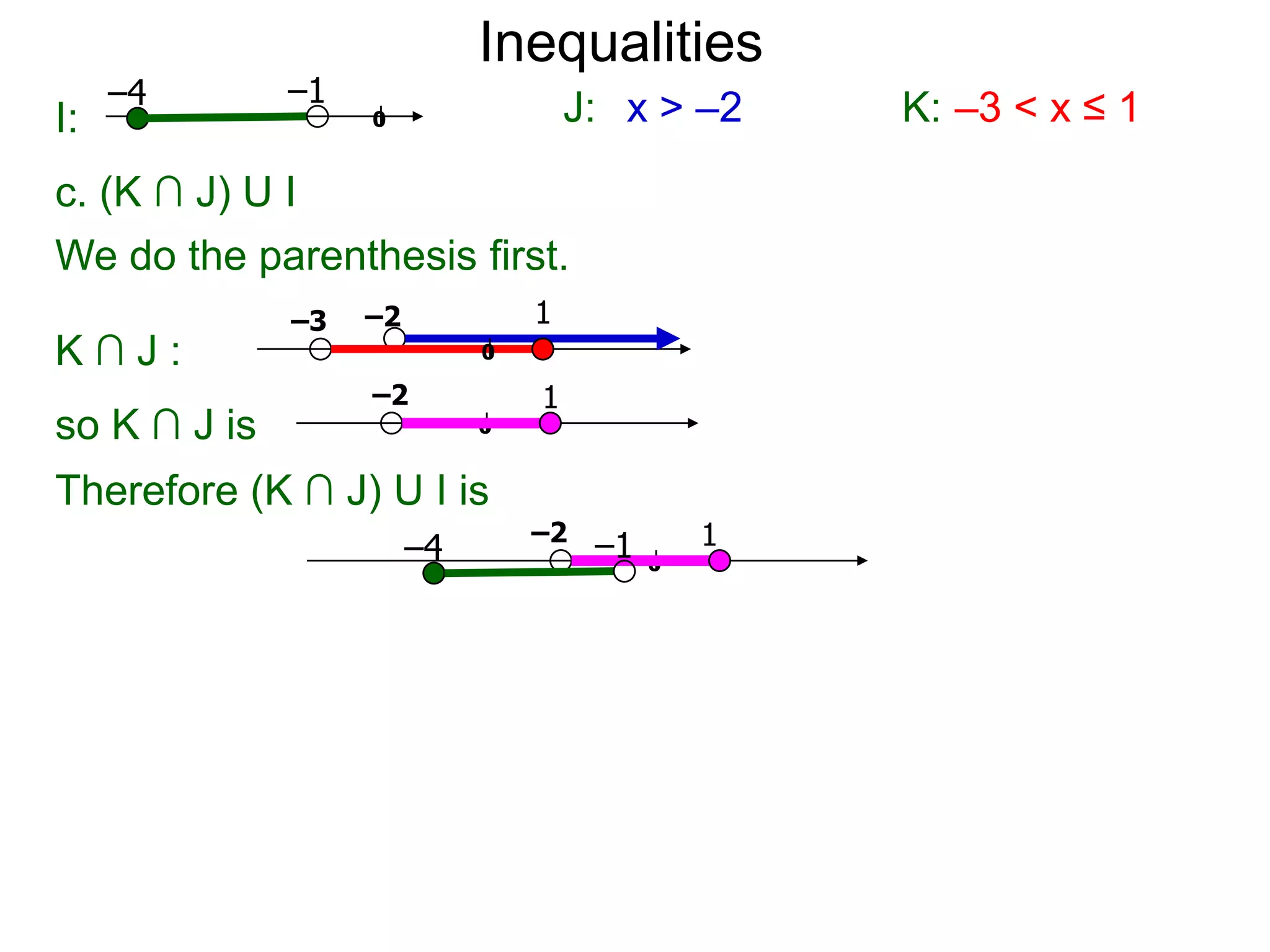
Therefore (K ∩ J) U I is
                        –4       –2
                                      –1       1
                                           0
Inequalities
     –4       –1
I:                 0                 J: x > –2     K: –3 < x ≤ 1
c. (K ∩ J) U I
We do the parenthesis first.
              –3   –2            1
K∩J:                         0

                   –2            1
so K ∩ J is                  0


Therefore (K ∩ J) U I is
                        –4       –2
                                      –1       1
                                           0


so (K ∩ J) U I = {–4 < x ≤ 1} or (–4, 1]
Inequalities
     –4       –1
I:                 0                 J: x > –2     K: –3 < x ≤ 1
c. (K ∩ J) U I
We do the parenthesis first.
              –3   –2            1
K∩J:                         0

                   –2            1
so K ∩ J is                  0


Therefore (K ∩ J) U I is
                        –4       –2
                                      –1       1
                                           0


so (K ∩ J) U I = {–4 < x ≤ 1} or (–4, 1]

Your turn. Find K ∩ (J U I ). Is this the same as (K ∩ J) U I?

41 interval notation and review on inequalities

  • 1.
  • 2.
    Inequalities We recall thatcomparison of two numbers is based on their locations on the real line.
  • 3.
    Inequalities We recall thatcomparison of two numbers is based on their locations on the real line. Specifically, given two numbers L and R corresponding to two points on the real line as shown, L R – +
  • 4.
    Inequalities We recall thatcomparison of two numbers is based on their locations on the real line. Specifically, given two numbers L and R corresponding to two points on the real line as shown, we define the number to the right to be greater than the number to the left. L R – +
  • 5.
    Inequalities We recall thatcomparison of two numbers is based on their locations on the real line. Specifically, given two numbers L and R corresponding to two points on the real line as shown, we define the number to the right to be greater than the number to the left. Hence R is greater than L or that L is smaller than R . L R – +
  • 6.
    Inequalities We recall thatcomparison of two numbers is based on their locations on the real line. Specifically, given two numbers L and R corresponding to two points on the real line as shown, we define the number to the right to be greater than the number to the left. Hence R is greater than L or that L is smaller than R . – L < R + We write this as L < R or as R > L.
  • 7.
    Inequalities We recall thatcomparison of two numbers is based on their locations on the real line. Specifically, given two numbers L and R corresponding to two points on the real line as shown, we define the number to the right to be greater than the number to the left. Hence R is greater than L or that L is smaller than R . – L < R + We write this as L < R or as R > L. For example, 2 < 4, –3 < –2, 0 > –1 are true statements
  • 8.
    Inequalities We recall thatcomparison of two numbers is based on their locations on the real line. Specifically, given two numbers L and R corresponding to two points on the real line as shown, we define the number to the right to be greater than the number to the left. Hence R is greater than L or that L is smaller than R . – L < R + We write this as L < R or as R > L. For example, 2 < 4, –3 < –2, 0 > –1 are true statements and –2 < –5 , 5 < 3 are false statements.
  • 9.
    Inequalities We recall thatcomparison of two numbers is based on their locations on the real line. Specifically, given two numbers L and R corresponding to two points on the real line as shown, we define the number to the right to be greater than the number to the left. Hence R is greater than L or that L is smaller than R . – L < R + We write this as L < R or as R > L. For example, 2 < 4, –3 < –2, 0 > –1 are true statements and –2 < –5 , 5 < 3 are false statements. We use inequalities to represent segments of the real line, e.g. “all the numbers x that are greater than 5" as “5 < x".
  • 10.
    Inequalities We recall thatcomparison of two numbers is based on their locations on the real line. Specifically, given two numbers L and R corresponding to two points on the real line as shown, we define the number to the right to be greater than the number to the left. Hence R is greater than L or that L is smaller than R . – L < R + We write this as L < R or as R > L. For example, 2 < 4, –3 < –2, 0 > –1 are true statements and –2 < –5 , 5 < 3 are false statements. We use inequalities to represent segments of the real line, e.g. “all the numbers x that are greater than 5" as “5 < x". 5 x – +
  • 11.
    Inequalities In general, wewrite "a < x" for all In picture,
  • 12.
    Inequalities In general, wewrite "a < x" for all the numbers x greater than a but excluding a. In picture, a a<x + – open dot
  • 13.
    Inequalities In general, wewrite "a < x" for all the numbers x greater than a but excluding a. In picture, a a<x + – open dot If we want all the numbers x greater than or equal to a which includes a, we write it as a < x.
  • 14.
    Inequalities In general, wewrite "a < x" for all the numbers x greater than a but excluding a. In picture, a a<x + – open dot If we want all the numbers x greater than or equal to a which includes a, we write it as a < x. In picture a a≤x – solid dot +
  • 15.
    Inequalities In general, wewrite "a < x" for all the numbers x greater than a but excluding a. In picture, a a<x + – open dot If we want all the numbers x greater than or equal to a which includes a, we write it as a < x. In picture a a≤x – solid dot + The numbers x such that a < x < b where a < b are all the numbers x between a and b. a a<x≤b b – +
  • 16.
    Inequalities In general, wewrite "a < x" for all the numbers x greater than a but excluding a. In picture, a a<x + – open dot If we want all the numbers x greater than or equal to a which includes a, we write it as a < x. In picture a a≤x – solid dot + The numbers x such that a < x < b where a < b are all the numbers x between a and b. A line segment as such is called an interval. a a<x≤b b – +
  • 17.
    Inequalities In general, wewrite "a < x" for all the numbers x greater than a but excluding a. In picture, a a<x + – open dot If we want all the numbers x greater than or equal to a which includes a, we write it as a < x. In picture a a≤x – solid dot + The numbers x such that a < x < b where a < b are all the numbers x between a and b. A line segment as such is called an interval. a a<x≤b b – + –3 2 Hence –3 ≤ x < 2 is
  • 18.
    Inequalities In general, wewrite "a < x" for all the numbers x greater than a but excluding a. In picture, a a<x + – open dot If we want all the numbers x greater than or equal to a which includes a, we write it as a < x. In picture a a≤x – solid dot + The numbers x such that a < x < b where a < b are all the numbers x between a and b. A line segment as such is called an interval. a a<x≤b b – + –3 2 Hence –3 ≤ x < 2 is Expressions such as 2 < x > 3 or 2 < x < –3 do not have any solution.
  • 19.
    Inequalities We note thefollowing algebra about inequalities.
  • 20.
    Inequalities We note thefollowing algebra about inequalities. Given that 6 < 12, then 6 + 3 < 12 + 3 is still true.
  • 21.
    Inequalities We note thefollowing algebra about inequalities. Given that 6 < 12, then 6 + 3 < 12 + 3 is still true. a. Adding or subtracting the same quantity to both sides retains the inequality sign,
  • 22.
    Inequalities We note thefollowing algebra about inequalities. Given that 6 < 12, then 6 + 3 < 12 + 3 is still true. a. Adding or subtracting the same quantity to both sides retains the inequality sign, i.e. if a < b, then a ± c < b ± c.
  • 23.
    Inequalities We note thefollowing algebra about inequalities. Given that 6 < 12, then 6 + 3 < 12 + 3 is still true. a. Adding or subtracting the same quantity to both sides retains the inequality sign, i.e. if a < b, then a ± c < b ± c. Given that 6 < 12, then multiplying by 3*6 < 3*12 is still true.
  • 24.
    Inequalities We note thefollowing algebra about inequalities. Given that 6 < 12, then 6 + 3 < 12 + 3 is still true. a. Adding or subtracting the same quantity to both sides retains the inequality sign, i.e. if a < b, then a ± c < b ± c. Given that 6 < 12, then multiplying by 3*6 < 3*12 is still true. b. Multiplying or dividing a positive number c to both sides retains the inequality sign,
  • 25.
    Inequalities We note thefollowing algebra about inequalities. Given that 6 < 12, then 6 + 3 < 12 + 3 is still true. a. Adding or subtracting the same quantity to both sides retains the inequality sign, i.e. if a < b, then a ± c < b ± c. Given that 6 < 12, then multiplying by 3*6 < 3*12 is still true. b. Multiplying or dividing a positive number c to both sides retains the inequality sign, i.e. if 0 < c and a < b, then ac < bc.
  • 26.
    Inequalities We note thefollowing algebra about inequalities. Given that 6 < 12, then 6 + 3 < 12 + 3 is still true. a. Adding or subtracting the same quantity to both sides retains the inequality sign, i.e. if a < b, then a ± c < b ± c. Given that 6 < 12, then multiplying by 3*6 < 3*12 is still true. b. Multiplying or dividing a positive number c to both sides retains the inequality sign, i.e. if 0 < c and a < b, then ac < bc. Given that 6 < 12, if we multiply –1 to both sides
  • 27.
    Inequalities We note thefollowing algebra about inequalities. Given that 6 < 12, then 6 + 3 < 12 + 3 is still true. a. Adding or subtracting the same quantity to both sides retains the inequality sign, i.e. if a < b, then a ± c < b ± c. Given that 6 < 12, then multiplying by 3*6 < 3*12 is still true. b. Multiplying or dividing a positive number c to both sides retains the inequality sign, i.e. if 0 < c and a < b, then ac < bc. Given that 6 < 12, if we multiply –1 to both sides then (–1)6 > (–1)12 – 6 > –12 is true.
  • 28.
    Inequalities We note thefollowing algebra about inequalities. Given that 6 < 12, then 6 + 3 < 12 + 3 is still true. a. Adding or subtracting the same quantity to both sides retains the inequality sign, i.e. if a < b, then a ± c < b ± c. Given that 6 < 12, then multiplying by 3*6 < 3*12 is still true. b. Multiplying or dividing a positive number c to both sides retains the inequality sign, i.e. if 0 < c and a < b, then ac < bc. Given that 6 < 12, if we multiply –1 to both sides then (–1)6 > (–1)12 – 6 > –12 is true. Multiplying by –1 switches the relation of two numbers.
  • 29.
    Inequalities We note thefollowing algebra about inequalities. Given that 6 < 12, then 6 + 3 < 12 + 3 is still true. a. Adding or subtracting the same quantity to both sides retains the inequality sign, i.e. if a < b, then a ± c < b ± c. Given that 6 < 12, then multiplying by 3*6 < 3*12 is still true. b. Multiplying or dividing a positive number c to both sides retains the inequality sign, i.e. if 0 < c and a < b, then ac < bc. Given that 6 < 12, if we multiply –1 to both sides then (–1)6 > (–1)12 – 6 > –12 is true. Multiplying by –1 switches the relation of two numbers. – 0 + 6 < 12
  • 30.
    Inequalities We note thefollowing algebra about inequalities. Given that 6 < 12, then 6 + 3 < 12 + 3 is still true. a. Adding or subtracting the same quantity to both sides retains the inequality sign, i.e. if a < b, then a ± c < b ± c. Given that 6 < 12, then multiplying by 3*6 < 3*12 is still true. b. Multiplying or dividing a positive number c to both sides retains the inequality sign, i.e. if 0 < c and a < b, then ac < bc. Given that 6 < 12, if we multiply –1 to both sides then (–1)6 > (–1)12 – 6 > –12 is true. Multiplying by –1 switches the relation of two numbers. – 0 + –6 6 < 12
  • 31.
    Inequalities We note thefollowing algebra about inequalities. Given that 6 < 12, then 6 + 3 < 12 + 3 is still true. a. Adding or subtracting the same quantity to both sides retains the inequality sign, i.e. if a < b, then a ± c < b ± c. Given that 6 < 12, then multiplying by 3*6 < 3*12 is still true. b. Multiplying or dividing a positive number c to both sides retains the inequality sign, i.e. if 0 < c and a < b, then ac < bc. Given that 6 < 12, if we multiply –1 to both sides then (–1)6 > (–1)12 – 6 > –12 is true. Multiplying by –1 switches the relation of two numbers. – 0 + –12 < –6 6 < 12
  • 32.
    Inequalities We note thefollowing algebra about inequalities. Given that 6 < 12, then 6 + 3 < 12 + 3 is still true. a. Adding or subtracting the same quantity to both sides retains the inequality sign, i.e. if a < b, then a ± c < b ± c. Given that 6 < 12, then multiplying by 3*6 < 3*12 is still true. b. Multiplying or dividing a positive number c to both sides retains the inequality sign, i.e. if 0 < c and a < b, then ac < bc. Given that 6 < 12, if we multiply –1 to both sides then (–1)6 > (–1)12 – 6 > –12 which is true. Multiplying by –1 switches the relation of two numbers. – 0 + –12 < –6 6 < 12 c. Multiplying or dividing by an negative number c reverses the inequality sign, i.e. if c < 0 and a < b then ca > cb
  • 33.
    Inequalities Following are thesteps for solving linear inequalities.
  • 34.
    Inequalities Following are thesteps for solving linear inequalities. 1. Simplify both sides of the inequalities.
  • 35.
    Inequalities Following are thesteps for solving linear inequalities. 1. Simplify both sides of the inequalities. 2. Gather the x-terms to one side and the number-terms to the other sides (use the “change side-change sign” rule).
  • 36.
    Inequalities Following are thesteps for solving linear inequalities. 1. Simplify both sides of the inequalities. 2. Gather the x-terms to one side and the number-terms to the other sides (use the “change side-change sign” rule). 3. Multiply or divide to get x. If we multiply or divide by negative numbers to both sides, the inequality sign must be turned around.
  • 37.
    Inequalities Following are thesteps for solving linear inequalities. 1. Simplify both sides of the inequalities. 2. Gather the x-terms to one side and the number-terms to the other sides (use the “change side-change sign” rule). 3. Multiply or divide to get x. If we multiply or divide by negative numbers to both sides, the inequality sign must be turned around. (This rule can be avoided by keeping the x-term positive.)
  • 38.
    Inequalities Following are thesteps for solving linear inequalities. 1. Simplify both sides of the inequalities. 2. Gather the x-terms to one side and the number-terms to the other sides (use the “change side-change sign” rule). 3. Multiply or divide to get x. If we multiply or divide by negative numbers to both sides, the inequality sign must be turned around. (This rule can be avoided by keeping the x-term positive.) Example A. a. Solve –3x + 2 < 11. Draw the solution.
  • 39.
    Inequalities Following are thesteps for solving linear inequalities. 1. Simplify both sides of the inequalities. 2. Gather the x-terms to one side and the number-terms to the other sides (use the “change side-change sign” rule). 3. Multiply or divide to get x. If we multiply or divide by negative numbers to both sides, the inequality sign must be turned around. (This rule can be avoided by keeping the x-term positive.) Example A. a. Solve –3x + 2 < 11. Draw the solution. –3x + 2 < 11 move the x to the other side to make it positive
  • 40.
    Inequalities Following are thesteps for solving linear inequalities. 1. Simplify both sides of the inequalities. 2. Gather the x-terms to one side and the number-terms to the other sides (use the “change side-change sign” rule). 3. Multiply or divide to get x. If we multiply or divide by negative numbers to both sides, the inequality sign must be turned around. (This rule can be avoided by keeping the x-term positive.) Example A. a. Solve –3x + 2 < 11. Draw the solution. –3x + 2 < 11 move the x to the other side to make it positive 2 – 11 < 3x
  • 41.
    Inequalities Following are thesteps for solving linear inequalities. 1. Simplify both sides of the inequalities. 2. Gather the x-terms to one side and the number-terms to the other sides (use the “change side-change sign” rule). 3. Multiply or divide to get x. If we multiply or divide by negative numbers to both sides, the inequality sign must be turned around. (This rule can be avoided by keeping the x-term positive.) Example A. a. Solve –3x + 2 < 11. Draw the solution. –3x + 2 < 11 move the x to the other side to make it positive 2 – 11 < 3x –9 < 3x
  • 42.
    Inequalities Following are thesteps for solving linear inequalities. 1. Simplify both sides of the inequalities. 2. Gather the x-terms to one side and the number-terms to the other sides (use the “change side-change sign” rule). 3. Multiply or divide to get x. If we multiply or divide by negative numbers to both sides, the inequality sign must be turned around. (This rule can be avoided by keeping the x-term positive.) Example A. a. Solve –3x + 2 < 11. Draw the solution. –3x + 2 < 11 move the x to the other side to make it positive 2 – 11 < 3x –9 < 3x divide by 3, no change with the inequality –9 3x 3 < 3 –3 < x
  • 43.
    Inequalities Following are thesteps for solving linear inequalities. 1. Simplify both sides of the inequalities. 2. Gather the x-terms to one side and the number-terms to the other sides (use the “change side-change sign” rule). 3. Multiply or divide to get x. If we multiply or divide by negative numbers to both sides, the inequality sign must be turned around. (This rule can be avoided by keeping the x-term positive.) Example A. a. Solve –3x + 2 < 11. Draw the solution. –3x + 2 < 11 move the x to the other side to make it positive 2 – 11 < 3x –9 < 3x divide by 3, no change with the inequality –9 3x 3 < 3 –3 < x -3 In picture, 0
  • 44.
    Inequalities b. Solve theinterval inequality 5 < –3x + 1 ≤ 10. Draw the solution.
  • 45.
    Inequalities b. Solve theinterval inequality 5 < –3x + 1 ≤ 10. Draw the solution. 5 < –3x + 1 ≤ 10 subtract 1 from all entries,
  • 46.
    Inequalities b. Solve theinterval inequality 5 < –3x + 1 ≤ 10. Draw the solution. 5 < –3x + 1 ≤ 10 subtract 1 from all entries, –6 < –3x ≤ 9
  • 47.
    Inequalities b. Solve theinterval inequality 5 < –3x + 1 ≤ 10. Draw the solution. 5 < –3x + 1 ≤ 10 subtract 1 from all entries, –6 < –3x ≤ 9 divide by –3, reverse the inequality signs,
  • 48.
    Inequalities b. Solve theinterval inequality 5 < –3x + 1 ≤ 10. Draw the solution. 5 < –3x + 1 ≤ 10 subtract 1 from all entries, –6 < –3x ≤ 9 divide by –3, reverse the inequality signs, –6 –3x 9 –3 > –3 ≥ –3
  • 49.
    Inequalities b. Solve theinterval inequality 5 < –3x + 1 ≤ 10. Draw the solution. 5 < –3x + 1 ≤ 10 subtract 1 from all entries, –6 < –3x ≤ 9 divide by –3, reverse the inequality signs, –6 –3x 9 –3 > –3 ≥ –3 –3 –2 –2 > x ≥ –3 or
  • 50.
    Inequalities b. Solve theinterval inequality 5 < –3x + 1 ≤ 10. Draw the solution. 5 < –3x + 1 ≤ 10 subtract 1 from all entries, –6 < –3x ≤ 9 divide by –3, reverse the inequality signs, –6 –3x 9 –3 > –3 ≥ –3 –3 –2 –2 > x ≥ –3 or Signs and Inequalities
  • 51.
    Inequalities b. Solve theinterval inequality 5 < –3x + 1 ≤ 10. Draw the solution. 5 < –3x + 1 ≤ 10 subtract 1 from all entries, –6 < –3x ≤ 9 divide by –3, reverse the inequality signs, –6 –3x 9 –3 > –3 ≥ –3 –3 –2 –2 > x ≥ –3 or Signs and Inequalities One of the most important association to inequalities is the sign of a given expression.
  • 52.
    Inequalities b. Solve theinterval inequality 5 < –3x + 1 ≤ 10. Draw the solution. 5 < –3x + 1 ≤ 10 subtract 1 from all entries, –6 < –3x ≤ 9 divide by –3, reverse the inequality signs, –6 –3x 9 –3 > –3 ≥ –3 –3 –2 –2 > x ≥ –3 or Signs and Inequalities One of the most important association to inequalities is the sign of a given expression. Let f be an expression, following adjectives translate into the following inequalities.
  • 53.
    Inequalities b. Solve theinterval inequality 5 < –3x + 1 ≤ 10. Draw the solution. 5 < –3x + 1 ≤ 10 subtract 1 from all entries, –6 < –3x ≤ 9 divide by –3, reverse the inequality signs, –6 –3x 9 –3 > –3 ≥ –3 –3 –2 –2 > x ≥ –3 or Signs and Inequalities One of the most important association to inequalities is the sign of a given expression. Let f be an expression, following adjectives translate into the following inequalities. i. “f is positive” ↔ 0 < f or f > 0
  • 54.
    Inequalities b. Solve theinterval inequality 5 < –3x + 1 ≤ 10. Draw the solution. 5 < –3x + 1 ≤ 10 subtract 1 from all entries, –6 < –3x ≤ 9 divide by –3, reverse the inequality signs, –6 –3x 9 –3 > –3 ≥ –3 –3 –2 –2 > x ≥ –3 or Signs and Inequalities One of the most important association to inequalities is the sign of a given expression. Let f be an expression, following adjectives translate into the following inequalities. i. “f is positive” ↔ 0 < f or f > 0 “f is non–negative” ↔ 0 ≤ f or f ≥ 0
  • 55.
    Inequalities b. Solve theinterval inequality 5 < –3x + 1 ≤ 10. Draw the solution. 5 < –3x + 1 ≤ 10 subtract 1 from all entries, –6 < –3x ≤ 9 divide by –3, reverse the inequality signs, –6 –3x 9 –3 > –3 ≥ –3 –3 –2 –2 > x ≥ –3 or Signs and Inequalities One of the most important association to inequalities is the sign of a given expression. Let f be an expression, following adjectives translate into the following inequalities. i. “f is positive” ↔ 0 < f or f > 0 “f is non–negative” ↔ 0 ≤ f or f ≥ 0 ii. “f is negative” ↔ f < 0 or 0 > f
  • 56.
    Inequalities b. Solve theinterval inequality 5 < –3x + 1 ≤ 10. Draw the solution. 5 < –3x + 1 ≤ 10 subtract 1 from all entries, –6 < –3x ≤ 9 divide by –3, reverse the inequality signs, –6 –3x 9 –3 > –3 ≥ –3 –3 –2 –2 > x ≥ –3 or Signs and Inequalities One of the most important association to inequalities is the sign of a given expression. Let f be an expression, following adjectives translate into the following inequalities. i. “f is positive” ↔ 0 < f or f > 0 “f is non–negative” ↔ 0 ≤ f or f ≥ 0 ii. “f is negative” ↔ f < 0 or 0 > f “f is non–positive” ↔ f ≤ 0 or 0 ≥ f
  • 57.
    Inequalities Example B. Translatethe sentence “3x + 12 is positive” into inequalities and solve for x. Draw the solution.
  • 58.
    Inequalities Example B. Translatethe sentence “3x + 12 is positive” into inequalities and solve for x. Draw the solution. Being positive translates into the inequality 3x + 12 > 0
  • 59.
    Inequalities Example B. Translatethe sentence “3x + 12 is positive” into inequalities and solve for x. Draw the solution. Being positive translates into the inequality 3x + 12 > 0 3x > –12 x > –4
  • 60.
    Inequalities Example B. Translatethe sentence “3x + 12 is positive” into inequalities and solve for x. Draw the solution. Being positive translates into the inequality 3x + 12 > 0 3x > –12 –4 x x > –4 or 0
  • 61.
    Inequalities Example B. Translatethe sentence “3x + 12 is positive” into inequalities and solve for x. Draw the solution. Being positive translates into the inequality 3x + 12 > 0 3x > –12 –4 x x > –4 or 0 b. Let x be the price of a movie ticket. Translate the sentence “$20 minus the cost of two movie tickets is non–positive” into an inequality. Solve it and draw the solution.
  • 62.
    Inequalities Example B. Translatethe sentence “3x + 12 is positive” into inequalities and solve for x. Draw the solution. Being positive translates into the inequality 3x + 12 > 0 3x > –12 –4 x x > –4 or 0 b. Let x be the price of a movie ticket. Translate the sentence “$20 minus the cost of two movie tickets is non–positive” into an inequality. Solve it and draw the solution. Two tickets cost $2x,
  • 63.
    Inequalities Example B. Translatethe sentence “3x + 12 is positive” into inequalities and solve for x. Draw the solution. Being positive translates into the inequality 3x + 12 > 0 3x > –12 –4 x x > –4 or 0 b. Let x be the price of a movie ticket. Translate the sentence “$20 minus the cost of two movie tickets is non–positive” into an inequality. Solve it and draw the solution. Two tickets cost $2x, so “$20 minus the cost of two tickets” is (20 – 2x).
  • 64.
    Inequalities Example B. Translatethe sentence “3x + 12 is positive” into inequalities and solve for x. Draw the solution. Being positive translates into the inequality 3x + 12 > 0 3x > –12 –4 x x > –4 or 0 b. Let x be the price of a movie ticket. Translate the sentence “$20 minus the cost of two movie tickets is non–positive” into an inequality. Solve it and draw the solution. Two tickets cost $2x, so “$20 minus the cost of two tickets” is (20 – 2x). The inequality for “(20 – 2x) is non–positive” is 20 – 2x ≤ 0
  • 65.
    Inequalities Example B. Translatethe sentence “3x + 12 is positive” into inequalities and solve for x. Draw the solution. Being positive translates into the inequality 3x + 12 > 0 3x > –12 –4 x x > –4 or 0 b. Let x be the price of a movie ticket. Translate the sentence “$20 minus the cost of two movie tickets is non–positive” into an inequality. Solve it and draw the solution. Two tickets cost $2x, so “$20 minus the cost of two tickets” is (20 – 2x). The inequality for “(20 – 2x) is non–positive” is 20 – 2x ≤ 0 20 ≤ 2x 10 ≤ x
  • 66.
    Inequalities Example B. Translatethe sentence “3x + 12 is positive” into inequalities and solve for x. Draw the solution. Being positive translates into the inequality 3x + 12 > 0 3x > –12 –4 x x > –4 or 0 b. Let x be the price of a movie ticket. Translate the sentence “$20 minus the cost of two movie tickets is non–positive” into an inequality. Solve it and draw the solution. Two tickets cost $2x, so “$20 minus the cost of two tickets” is (20 – 2x). The inequality for “(20 – 2x) is non–positive” is 20 – 2x ≤ 0 20 ≤ 2x 10 x 10 ≤ x or 0
  • 67.
    Inequalities Example B. Translatethe sentence “3x + 12 is positive” into inequalities and solve for x. Draw the solution. Being positive translates into the inequality 3x + 12 > 0 3x > –12 –4 x x > –4 or 0 b. Let x be the price of a movie ticket. Translate the sentence “$20 minus the cost of two movie tickets is non–positive” into an inequality. Solve it and draw the solution. Two tickets cost $2x, so “$20 minus the cost of two tickets” is (20 – 2x). The inequality for “(20 – 2x) is non–positive” is 20 – 2x ≤ 0 20 ≤ 2x 10 x 10 ≤ x or 0 So the price of a ticket has to be $10 or more.
  • 68.
  • 69.
    Inequalities Intersection and Union(∩ & U) Let I be the interval consists of 1 ≤ x ≤ 3 as shown, 1 3 I:
  • 70.
    Inequalities Intersection and Union(∩ & U) Let I be the interval consists of 1 ≤ x ≤ 3 as shown, 1 3 I: and in the set notation we write I = {1 ≤ x ≤ 3 }.
  • 71.
    Inequalities Intersection and Union(∩ & U) Let I be the interval consists of 1 ≤ x ≤ 3 as shown, 1 3 I: and in the set notation we write I = {1 ≤ x ≤ 3 }. Let J = {2 < x < 4 } be another interval as shown. 2 4 J:
  • 72.
    Inequalities Intersection and Union(∩ & U) Let I be the interval consists of 1 ≤ x ≤ 3 as shown, 1 3 I: and in the set notation we write I = {1 ≤ x ≤ 3 }. Let J = {2 < x < 4 } be another interval as shown. 2 4 J: The common portion of the two intervals I and J shown here 1 2 3 I: 2 3 4 J:
  • 73.
    Inequalities Intersection and Union(∩ & U) Let I be the interval consists of 1 ≤ x ≤ 3 as shown, 1 3 I: and in the set notation we write I = {1 ≤ x ≤ 3 }. Let J = {2 < x < 4 } be another interval as shown. 2 4 J: The common portion of the two intervals I and J shown here 1 2 3 I: 2 3 4 J: 2 3
  • 74.
    Inequalities Intersection and Union(∩ & U) Let I be the interval consists of 1 ≤ x ≤ 3 as shown, 1 3 I: and in the set notation we write I = {1 ≤ x ≤ 3 }. Let J = {2 < x < 4 } be another interval as shown. 2 4 J: The common portion of the two intervals I and J shown here 1 2 3 I: 2 3 4 J: 2 3 I ∩ J: is called the intersection of I and J and it’s denoted as I ∩ J.
  • 75.
    Inequalities Intersection and Union(∩ & U) Let I be the interval consists of 1 ≤ x ≤ 3 as shown, 1 3 I: and in the set notation we write I = {1 ≤ x ≤ 3 }. Let J = {2 < x < 4 } be another interval as shown. 2 4 J: The common portion of the two intervals I and J shown here 1 2 3 I: 2 3 4 J: 2 3 I ∩ J: is called the intersection of I and J and it’s denoted as I ∩ J. In this case I ∩ J = {2 < x ≤ 3 }.
  • 76.
    Inequalities The merge ofthe two intervals I and J shown here
  • 77.
    Inequalities The merge ofthe two intervals I and J shown here 1 2 3 I: 2 3 4 J: 1 2 3 4
  • 78.
    Inequalities The merge ofthe two intervals I and J shown here 1 2 3 I: 2 3 4 J: 1 2 3 4
  • 79.
    Inequalities The merge ofthe two intervals I and J shown here 1 2 3 I: 2 3 4 J: 1 2 3 4 I U J: is called the union of I and J and it’s denoted as I U J.
  • 80.
    Inequalities The merge ofthe two intervals I and J shown here 1 2 3 I: 2 3 4 J: 1 2 3 4 I U J: is called the union of I and J and it’s denoted as I U J. In this case I U J: = {1 ≤ x < 4 }.
  • 81.
    Inequalities The merge ofthe two intervals I and J shown here 1 2 3 I: 2 3 4 J: 1 2 3 4 I U J: is called the union of I and J and it’s denoted as I U J. In this case I U J: = {1 ≤ x < 4 }. The Interval Notation
  • 82.
    Inequalities The merge ofthe two intervals I and J shown here 1 2 3 I: 2 3 4 J: 1 2 3 4 I U J: is called the union of I and J and it’s denoted as I U J. In this case I U J: = {1 ≤ x < 4 }. The Interval Notation We use the infinity symbol “∞” to mean “continues onward and surpasses all numbers”.
  • 83.
    Inequalities The merge ofthe two intervals I and J shown here 1 2 3 I: 2 3 4 J: 1 2 3 4 I U J: is called the union of I and J and it’s denoted as I U J. In this case I U J: = {1 ≤ x < 4 }. The Interval Notation We use the infinity symbol “∞” to mean “continues onward and surpasses all numbers”. We label the left of the real line with – ∞ and to the right with ∞ as shown below when needed. –∞ 0 ∞
  • 84.
    Inequalities The merge ofthe two intervals I and J shown here 1 2 3 I: 2 3 4 J: 1 2 3 4 I U J: is called the union of I and J and it’s denoted as I U J. In this case I U J: = {1 ≤ x < 4 }. The Interval Notation We use the infinity symbol “∞” to mean “continues onward and surpasses all numbers”. We label the left of the real line with – ∞ and to the right with ∞ as shown below when needed. –∞ 0 ∞ Infinity “∞” is not a number but we say that –∞ < x < ∞ for all real number x.
  • 85.
    Inequalities The merge ofthe two intervals I and J shown here 1 2 3 I: 2 3 4 J: 1 2 3 4 I U J: is called the union of I and J and it’s denoted as I U J. In this case I U J: = {1 ≤ x < 4 }. The Interval Notation We use the infinity symbol “∞” to mean “continues onward and surpasses all numbers”. We label the left of the real line with – ∞ and to the right with ∞ as shown below when needed. –∞ 0 ∞ Infinity “∞” is not a number but we say that –∞ < x < ∞ for all real number x. In fact, the set of all real numbers R is R = {–∞ < x < ∞ }.
  • 86.
    Inequalities The merge ofthe two intervals I and J shown here 1 2 3 I: 2 3 4 J: 1 2 3 4 I U J: is called the union of I and J and it’s denoted as I U J. In this case I U J: = {1 ≤ x < 4 }. The Interval Notation We use the infinity symbol “∞” to mean “continues onward and surpasses all numbers”. We label the left of the real line with – ∞ and to the right with ∞ as shown below when needed. –∞ 0 ∞ Infinity “∞” is not a number but we say that –∞ < x < ∞ for all real number x. In fact, the set of all real numbers R is R = {–∞ < x < ∞ }. However, we do not write x ≤ ∞ because ∞ is not a number in particular x can’t be ∞.
  • 87.
    Inequalities Using the “∞”symbols, we write the line segment a ∞ or a ≤ x
  • 88.
    Inequalities Using the “∞”symbols, we write the line segment a ∞ or a ≤ x as [a, ∞),
  • 89.
    Inequalities Using the “∞”symbols, we write the line segment a ∞ or a ≤ x as [a, ∞), We use ] or [ to include the end points,
  • 90.
    Inequalities Using the “∞”symbols, we write the line segment a ∞ or a ≤ x as [a, ∞), a ∞ or a < x as (a, ∞), We use ] or [ to include the end points, ) and ( to exclude the end points.
  • 91.
    Inequalities Using the “∞”symbols, we write the line segment a ∞ or a ≤ x as [a, ∞), a ∞ or a < x as (a, ∞), –∞ a or x ≤ a as (–∞, a], –∞ a or x < a as (–∞, a), We use ] or [ to include the end points, ) and ( to exclude the end points.
  • 92.
    Inequalities Using the “∞”symbols, we write the line segment a ∞ or a ≤ x as [a, ∞), a ∞ or a < x as (a, ∞), –∞ a or x ≤ a as (–∞, a], –∞ a or x < a as (–∞, a), Let a, b be two numbers such that a < b, we write the intervals a b or a ≤ x ≤ b as [a, b], a b or a < x < b as (a, b), a b or a ≤ x < b as [a, b), a b or a < x ≤ b as (a, b], We use ] or [ to include the end points, ) and ( to exclude the end points.
  • 93.
    Inequalities Using the “∞”symbols, we write the line segment a ∞ or a ≤ x as [a, ∞), a ∞ or a < x as (a, ∞), –∞ a or x ≤ a as (–∞, a], –∞ a or x < a as (–∞, a), Let a, b be two numbers such that a < b, we write the intervals a b or a ≤ x ≤ b as [a, b], a b or a < x < b as (a, b), a b or a ≤ x < b as [a, b), a b or a < x ≤ b as (a, b], We use ] or [ to include the end points, ) and ( to exclude the end points. Note the interval notation (a, b) is the same as the coordinate of a point so its interpretation depends on the context.
  • 94.
    Inequalities The interval [a,a] consists of exactly one point {x = a}.
  • 95.
    Inequalities The interval [a,a] consists of exactly one point {x = a}. The empty set which contains nothing is denoted as Φ = { }.
  • 96.
    Inequalities The interval [a,a] consists of exactly one point {x = a}. The empty set which contains nothing is denoted as Φ = { }. The interval (a, a) or (a, a] or [a, a) = Φ.
  • 97.
    Inequalities The interval [a,a] consists of exactly one point {x = a}. The empty set which contains nothing is denoted as Φ = { }. The interval (a, a) or (a, a] or [a, a) = Φ.
  • 98.
    Inequalities The interval [a,a] consists of exactly one point {x = a}.
  • 99.
    Inequalities The interval [a,a] consists of exactly one point {x = a}. The empty set which contains nothing is denoted as Φ = { }.
  • 100.
    Inequalities The interval [a,a] consists of exactly one point {x = a}. The empty set which contains nothing is denoted as Φ = { }. The interval (a, a) or (a, a] or [a, a) = Φ.
  • 101.
    Inequalities The interval [a,a] consists of exactly one point {x = a}. The empty set which contains nothing is denoted as Φ = { }. The interval (a, a) or (a, a] or [a, a) = Φ. Example C. Given intervals I, J , and K, do the set operation. Draw. Put the answer in the interval and the inequality notation. –4 –1 I: 0 J: x > –2 K: –3 < x ≤ 1
  • 102.
    Inequalities The interval [a,a] consists of exactly one point {x = a}. The empty set which contains nothing is denoted as Φ = { }. The interval (a, a) or (a, a] or [a, a) = Φ. Example C. Given intervals I, J , and K, do the set operation. Draw. Put the answer in the interval and the inequality notation. –4 –1 I: 0 J: x > –2 K: –3 < x ≤ 1 a. K U J b. K ∩ I
  • 103.
    Inequalities The interval [a,a] consists of exactly one point {x = a}. The empty set which contains nothing is denoted as Φ = { }. The interval (a, a) or (a, a] or [a, a) = Φ. Example C. Given intervals I, J , and K, do the set operation. Draw. Put the answer in the interval and the inequality notation. –4 –1 I: 0 J: x > –2 K: –3 < x ≤ 1 a. K U J –3 1 0 K b. K ∩ I
  • 104.
    Inequalities The interval [a,a] consists of exactly one point {x = a}. The empty set which contains nothing is denoted as Φ = { }. The interval (a, a) or (a, a] or [a, a) = Φ. Example C. Given intervals I, J , and K, do the set operation. Draw. Put the answer in the interval and the inequality notation. –4 –1 I: 0 J: x > –2 K: –3 < x ≤ 1 a. K U J –3 –2 1 0 K b. K ∩ I
  • 105.
    Inequalities The interval [a,a] consists of exactly one point {x = a}. The empty set which contains nothing is denoted as Φ = { }. The interval (a, a) or (a, a] or [a, a) = Φ. Example C. Given intervals I, J , and K, do the set operation. Draw. Put the answer in the interval and the inequality notation. –4 –1 I: 0 J: x > –2 K: –3 < x ≤ 1 a. K U J –3 –2 1 –3 0 so K U J is 0 K b. K ∩ I
  • 106.
    Inequalities The interval [a,a] consists of exactly one point {x = a}. The empty set which contains nothing is denoted as Φ = { }. The interval (a, a) or (a, a] or [a, a) = Φ. Example C. Given intervals I, J , and K, do the set operation. Draw. Put the answer in the interval and the inequality notation. –4 –1 I: 0 J: x > –2 K: –3 < x ≤ 1 a. K U J –3 –2 1 –3 0 so K U J is 0 K Hence K U J is (–3, ∞) or {–3 < x}. b. K ∩ I
  • 107.
    Inequalities The interval [a,a] consists of exactly one point {x = a}. The empty set which contains nothing is denoted as Φ = { }. The interval (a, a) or (a, a] or [a, a) = Φ. Example C. Given intervals I, J , and K, do the set operation. Draw. Put the answer in the interval and the inequality notation. –4 –1 I: 0 J: x > –2 K: –3 < x ≤ 1 a. K U J –3 –2 1 –3 0 so K U J is 0 Hence K U J is (–3, ∞) or {–3 < x}. b. K ∩ I –3 K 1 0
  • 108.
    Inequalities The interval [a,a] consists of exactly one point {x = a}. The empty set which contains nothing is denoted as Φ = { }. The interval (a, a) or (a, a] or [a, a) = Φ. Example C. Given intervals I, J , and K, do the set operation. Draw. Put the answer in the interval and the inequality notation. –4 –1 I: 0 J: x > –2 K: –3 < x ≤ 1 a. K U J –3 –2 1 –3 0 so K U J is 0 Hence K U J is (–3, ∞) or {–3 < x}. b. K ∩ I –3 1 –4 –1 0 K I
  • 109.
    Inequalities The interval [a,a] consists of exactly one point {x = a}. The empty set which contains nothing is denoted as Φ = { }. The interval (a, a) or (a, a] or [a, a) = Φ. Example C. Given intervals I, J , and K, do the set operation. Draw. Put the answer in the interval and the inequality notation. –4 –1 I: 0 J: x > –2 K: –3 < x ≤ 1 a. K U J –3 –2 1 –3 0 so K U J is 0 Hence K U J is (–3, ∞) or {–3 < x}. b. K ∩ I –3 1 –4 –1 0 K I The common or overlapping portion is shown.
  • 110.
    Inequalities The interval [a,a] consists of exactly one point {x = a}. The empty set which contains nothing is denoted as Φ = { }. The interval (a, a) or (a, a] or [a, a) = Φ. Example C. Given intervals I, J , and K, do the set operation. Draw. Put the answer in the interval and the inequality notation. –4 –1 I: 0 J: x > –2 K: –3 < x ≤ 1 a. K U J –3 –2 1 –3 0 so K U J is 0 Hence K U J is (–3, ∞) or {–3 < x}. b. K ∩ I –3 1 –4 –1 0 K I The common or overlapping portion is shown. Hence K ∩ I is (–3, –1) or {–3 < x < –1}
  • 111.
    Inequalities –4 –1 I: 0 J: x > –2 K: –3 < x ≤ 1 c. (K ∩ J) U I
  • 112.
    Inequalities –4 –1 I: 0 J: x > –2 K: –3 < x ≤ 1 c. (K ∩ J) U I We do the parenthesis first.
  • 113.
    Inequalities –4 –1 I: 0 J: x > –2 K: –3 < x ≤ 1 c. (K ∩ J) U I We do the parenthesis first. –3 –2 1 K∩J: 0
  • 114.
    Inequalities –4 –1 I: 0 J: x > –2 K: –3 < x ≤ 1 c. (K ∩ J) U I We do the parenthesis first. –3 –2 1 K∩J: 0 –2 1 so K ∩ J is 0
  • 115.
    Inequalities –4 –1 I: 0 J: x > –2 K: –3 < x ≤ 1 c. (K ∩ J) U I We do the parenthesis first. –3 –2 1 K∩J: 0 –2 1 so K ∩ J is 0 Therefore (K ∩ J) U I is –4 –2 –1 1 0
  • 116.
    Inequalities –4 –1 I: 0 J: x > –2 K: –3 < x ≤ 1 c. (K ∩ J) U I We do the parenthesis first. –3 –2 1 K∩J: 0 –2 1 so K ∩ J is 0 Therefore (K ∩ J) U I is –4 –2 –1 1 0 so (K ∩ J) U I = {–4 < x ≤ 1} or (–4, 1]
  • 117.
    Inequalities –4 –1 I: 0 J: x > –2 K: –3 < x ≤ 1 c. (K ∩ J) U I We do the parenthesis first. –3 –2 1 K∩J: 0 –2 1 so K ∩ J is 0 Therefore (K ∩ J) U I is –4 –2 –1 1 0 so (K ∩ J) U I = {–4 < x ≤ 1} or (–4, 1] Your turn. Find K ∩ (J U I ). Is this the same as (K ∩ J) U I?