Chapter 2

The strategic role and objectives
of operations
                     Source: Honda Motor Company


               Slack, Chambers and Johnston, Operations Management 5th Edition © Nigel Slack, Stuart Chambers, and Robert Johnston 2007
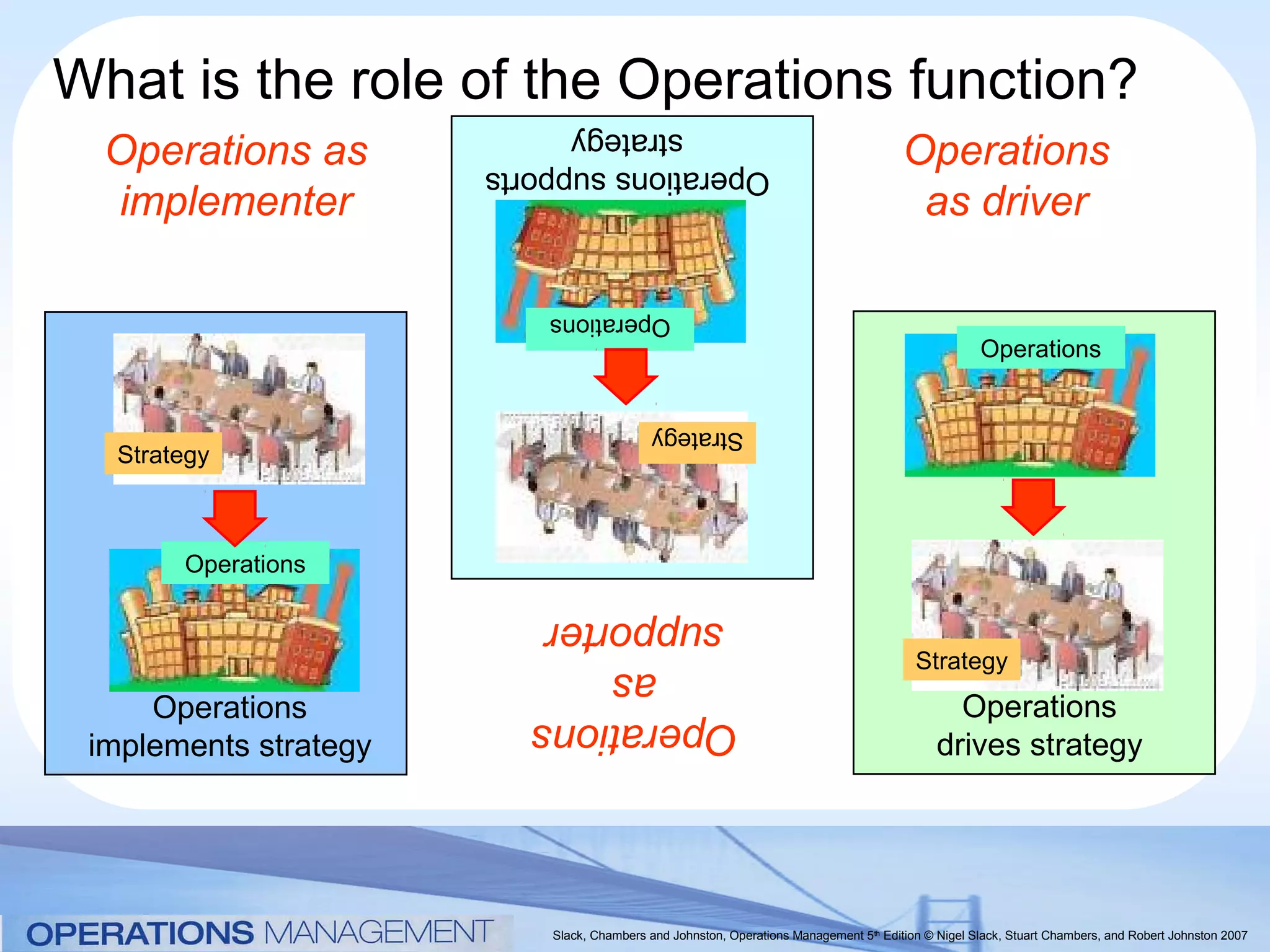
What is the role of the Operations function?
  Operations as                                                                        Operations
                            strategy
                       Operations supports
  implementer                                                                           as driver

                           Operations
                                                                                                    Operations


                                            Strategy
  Strategy


       Operations

                          supporter
                             as                                                          Strategy
     Operations           Operations                                                           Operations
 implements strategy                                                                         drives strategy


                           Slack, Chambers and Johnston, Operations Management 5th Edition © Nigel Slack, Stuart Chambers, and Robert Johnston 2007
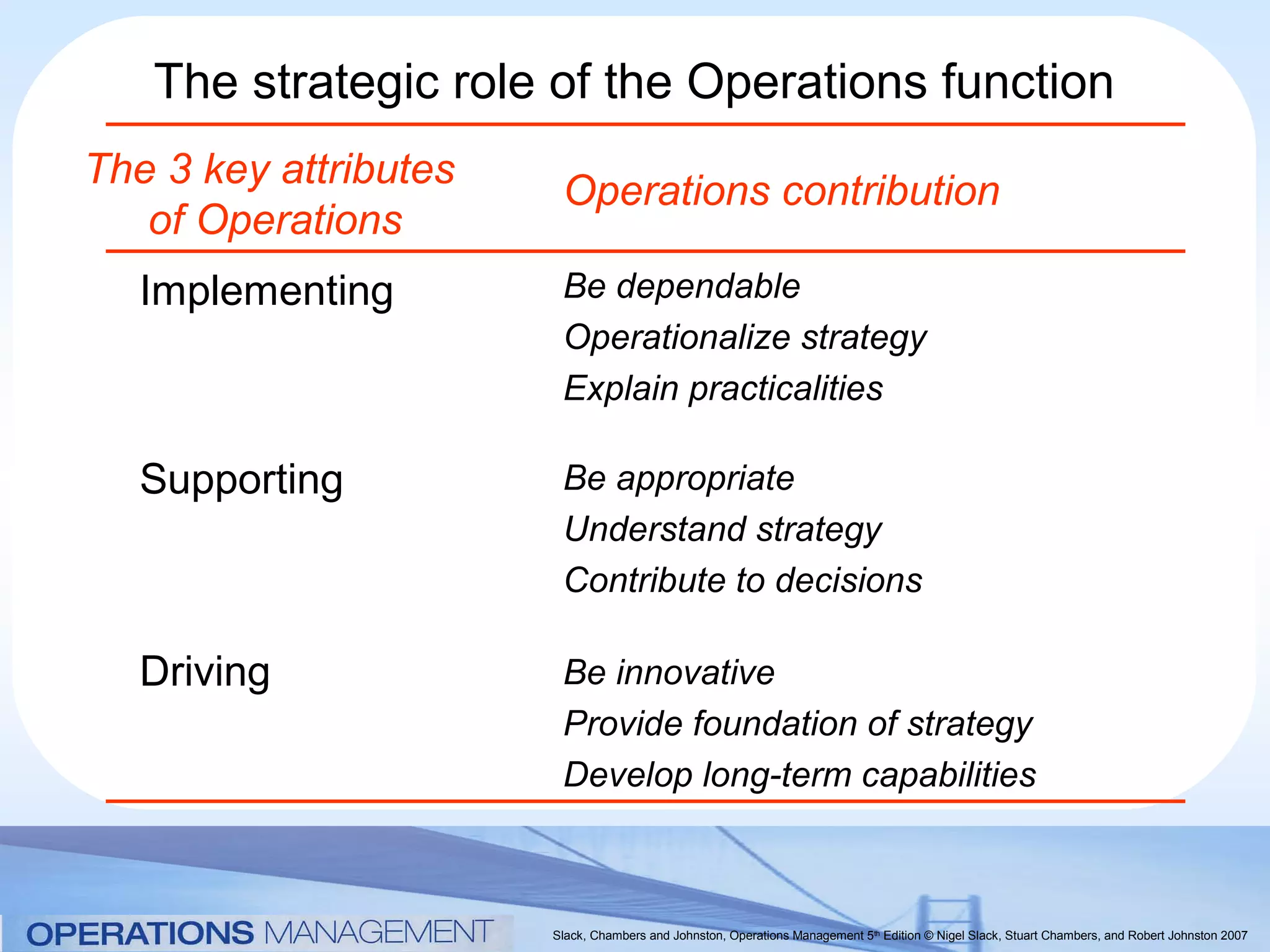
The strategic role of the Operations function
The 3 key attributes
                        Operations contribution
   of Operations
   Implementing         Be dependable
                        Operationalize strategy
                        Explain practicalities

   Supporting           Be appropriate
                        Understand strategy
                        Contribute to decisions

   Driving              Be innovative
                        Provide foundation of strategy
                        Develop long-term capabilities


                       Slack, Chambers and Johnston, Operations Management 5th Edition © Nigel Slack, Stuart Chambers, and Robert Johnston 2007
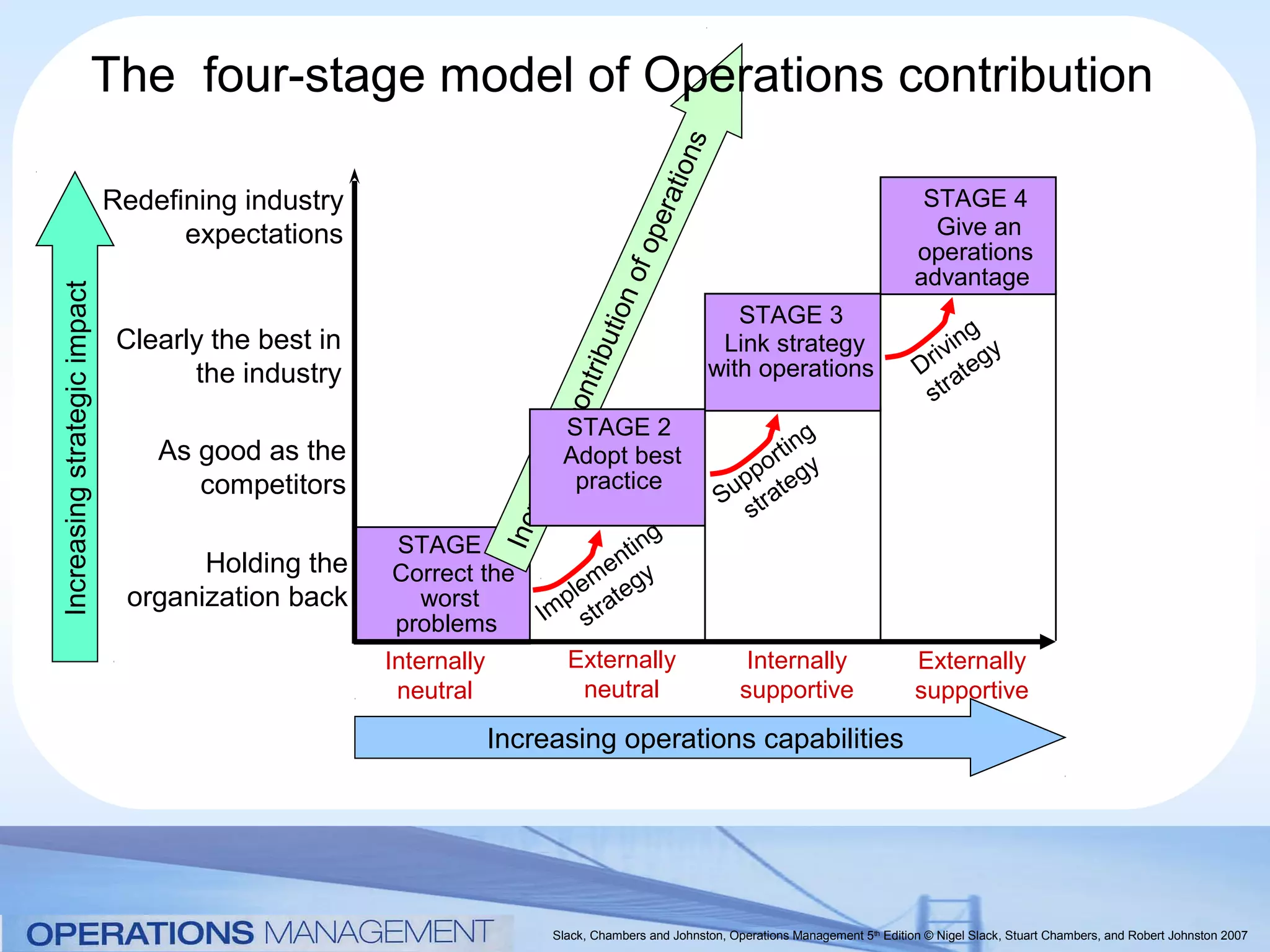
The four-stage model of Operations contribution


                                                                                            ons
                                                                                           ti
                              Redefining industry                                                                                       STAGE 4


                                                                                        era
                                    expectations                                                                                         Give an


                                                                                            p
                                                                                                                                       operations


                                                                                        of o
                                                                                                                                       advantage
Increasing strategic impact


                                                                                   tion
                                                                                                      STAGE 3
                               Clearly the best in                                                  Link strategy                           ing


                                                                              ribu
                                                                                                   with operations                       riv egy
                                                                                                                                        D at
                                     the industry
                                                                                                                                         str


                                                                          ont
                                                                          c
                                                                           STAGE 2
                                                                                                                ng
                                                                                                            rt i y


                                                                       ng
                                  As good as the                           Adopt best                     o
                                                                                                       pp t eg

                                                                          si
                                     competitors                            practice
                                                                                                     Su tra
                                                                      rea
                                                                  Inc                                   s
                                                                                    g
                                                     STAGE 1                    t in
                                     Holding the     Correct the              en
                                                                             m gy
                               organization back       worst              ple te
                                                                        Im stra
                                                     problems
                                                     Internally                Externally                 Internally                   Externally
                                                      neutral                   neutral                  supportive                    supportive

                                                                  Increasing operations capabilities


                                                                         Slack, Chambers and Johnston, Operations Management 5th Edition © Nigel Slack, Stuart Chambers, and Robert Johnston 2007
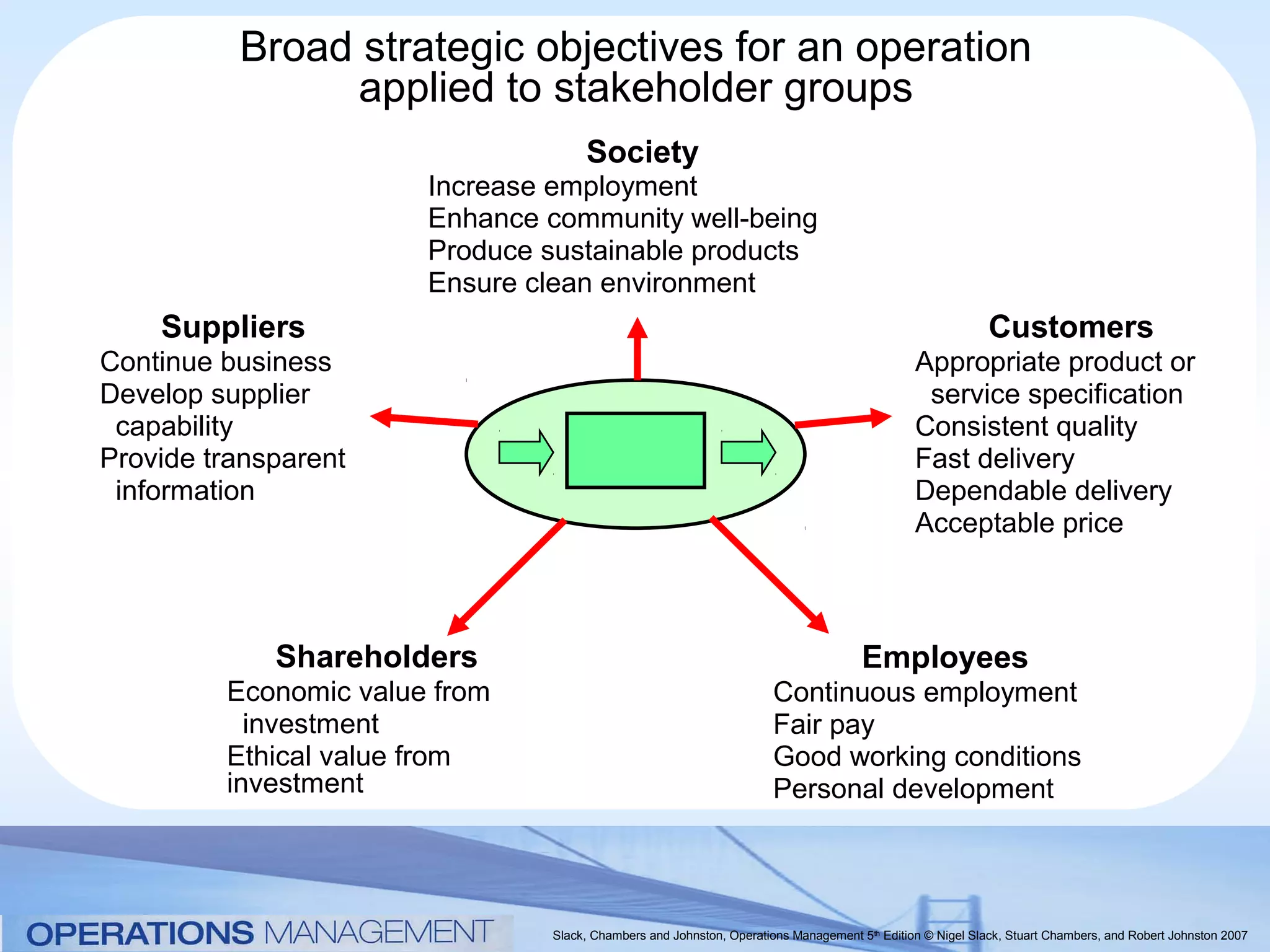
Broad strategic objectives for an operation
                applied to stakeholder groups
                                    Society
                       Increase employment
                       Enhance community well-being
                       Produce sustainable products
                       Ensure clean environment
    Suppliers                                                                                             Customers
Continue business                                                                            Appropriate product or
Develop supplier                                                                              service specification
 capability                                                                                  Consistent quality
Provide transparent                                                                          Fast delivery
 information                                                                                 Dependable delivery
                                                                                             Acceptable price


             Shareholders                                                           Employees
         Economic value from                                         Continuous employment
           investment                                                Fair pay
         Ethical value from                                          Good working conditions
         investment                                                  Personal development


                               Slack, Chambers and Johnston, Operations Management 5th Edition © Nigel Slack, Stuart Chambers, and Robert Johnston 2007
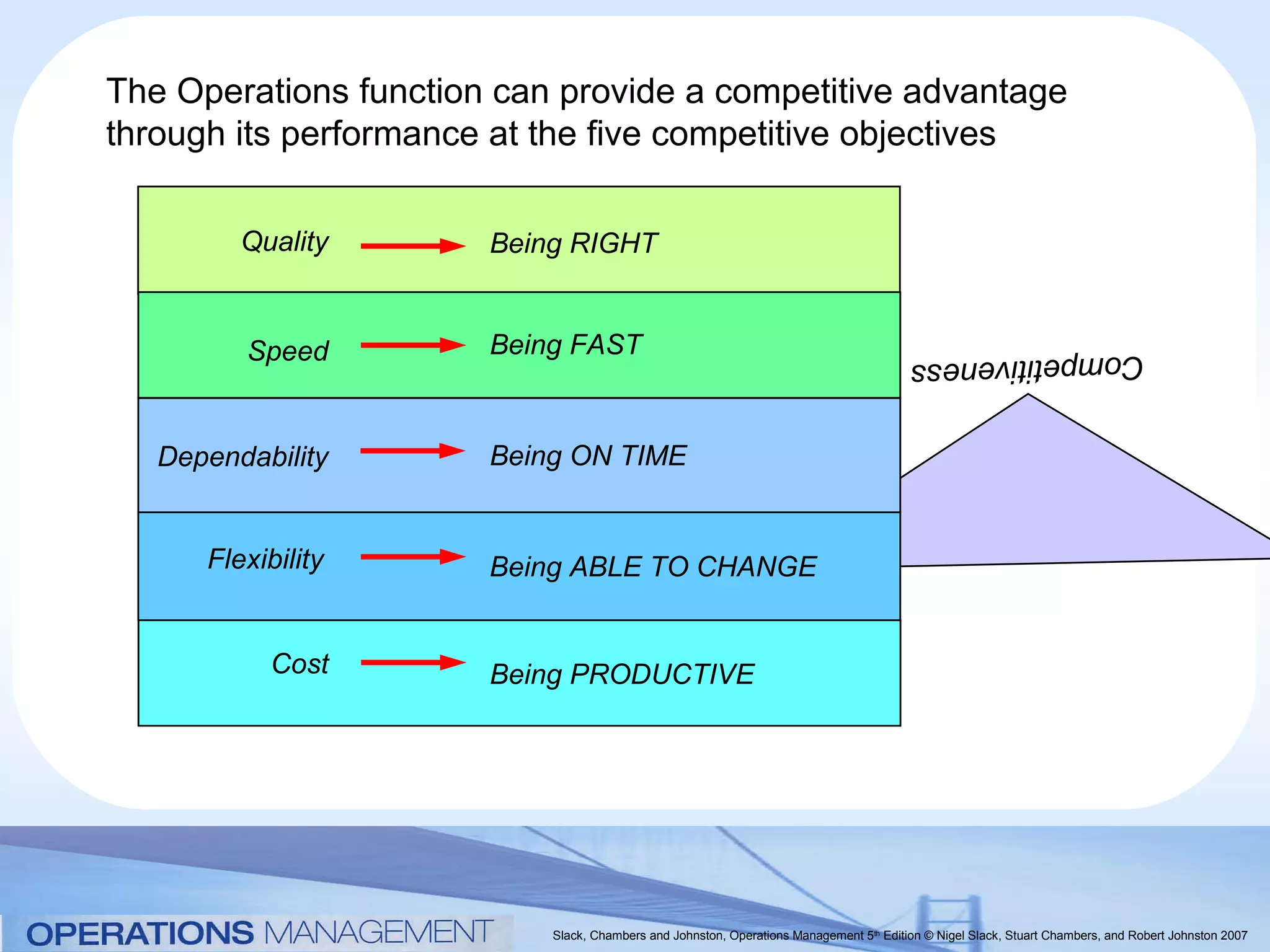
The Operations function can provide a competitive advantage
through its performance at the five competitive objectives

         Quality       Being RIGHT


         Speed         Being FAST                                                       Competitiveness


   Dependability       Being ON TIME


      Flexibility      Being ABLE TO CHANGE


            Cost       Being PRODUCTIVE


                           Slack, Chambers and Johnston, Operations Management 5th Edition © Nigel Slack, Stuart Chambers, and Robert Johnston 2007
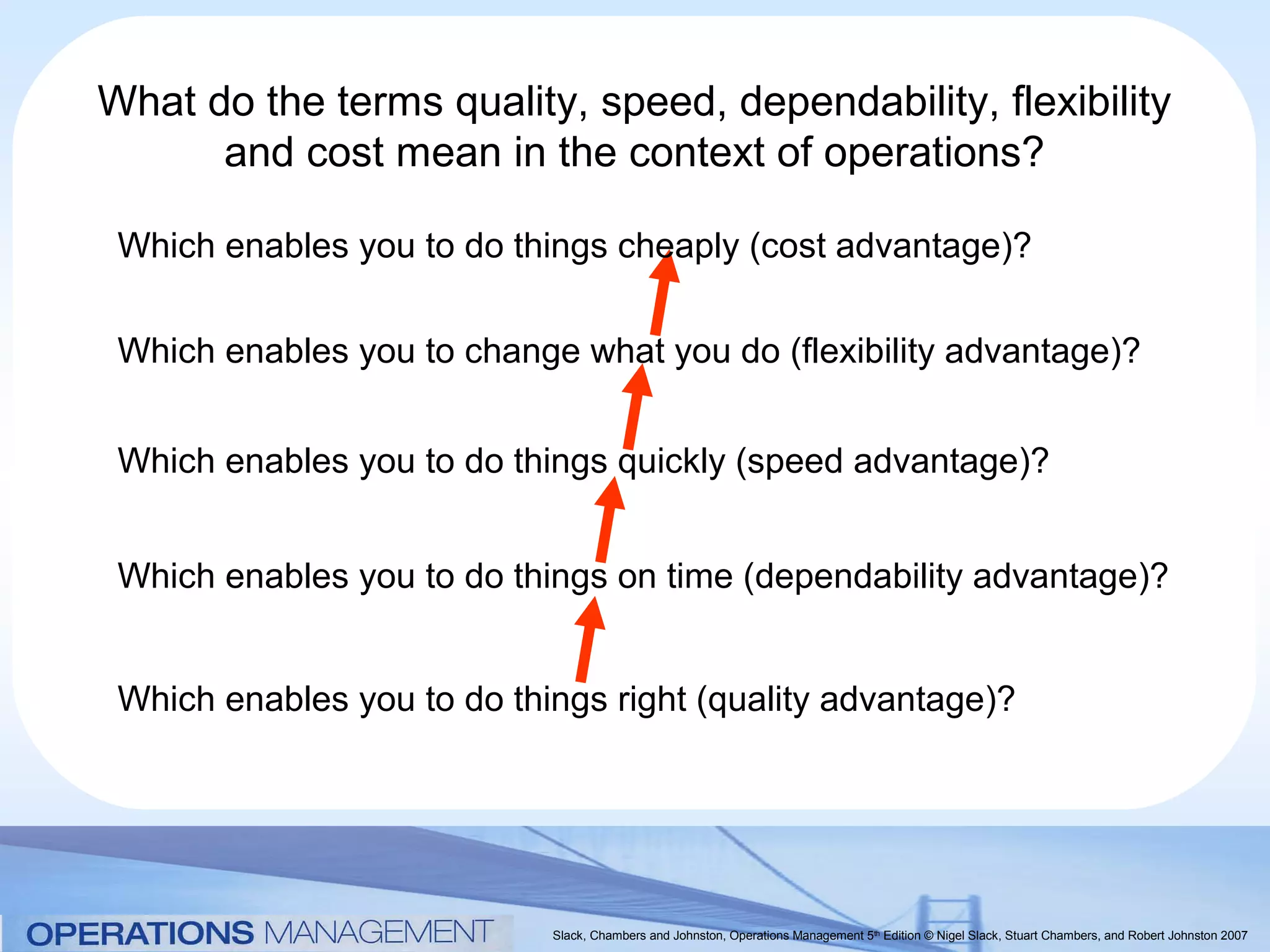
What do the terms quality, speed, dependability, flexibility
      and cost mean in the context of operations?

 Which enables you to do things cheaply (cost advantage)?

 Which enables you to change what you do (flexibility advantage)?


 Which enables you to do things quickly (speed advantage)?


 Which enables you to do things on time (dependability advantage)?


 Which enables you to do things right (quality advantage)?


                            Slack, Chambers and Johnston, Operations Management 5th Edition © Nigel Slack, Stuart Chambers, and Robert Johnston 2007
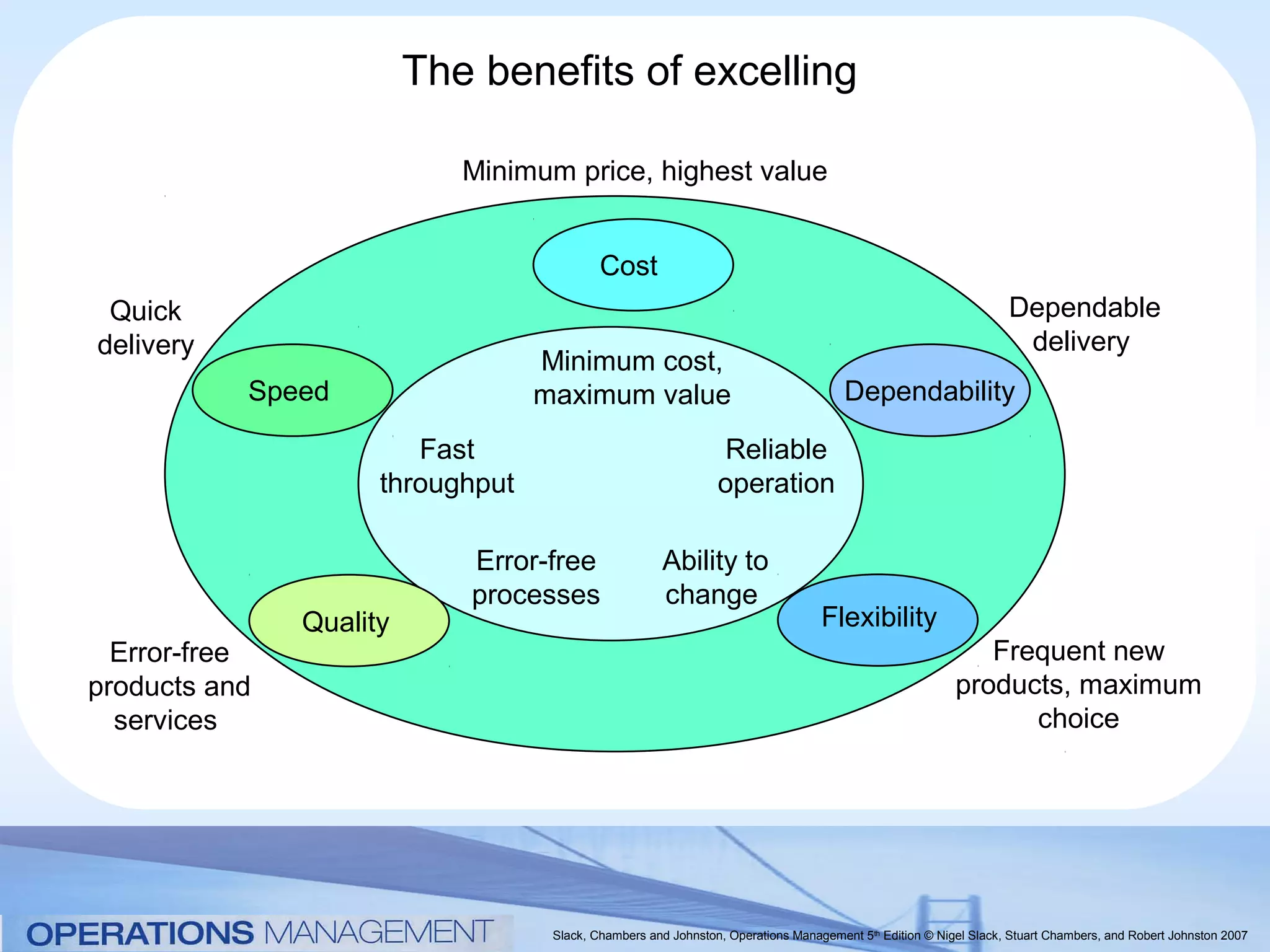
The benefits of excelling

                            Minimum price, highest value


                                           Cost
 Quick                                                                                                           Dependable
delivery                                                                                                          delivery
                                  Minimum cost,
           Speed                  maximum value                                      Dependability

                        Fast                                   Reliable
                     throughput                                operation

                            Error-free               Ability to
                            processes                change
               Quality                                                           Flexibility
  Error-free                                                                                               Frequent new
products and                                                                                            products, maximum
  services                                                                                                    choice


                                   Slack, Chambers and Johnston, Operations Management 5th Edition © Nigel Slack, Stuart Chambers, and Robert Johnston 2007
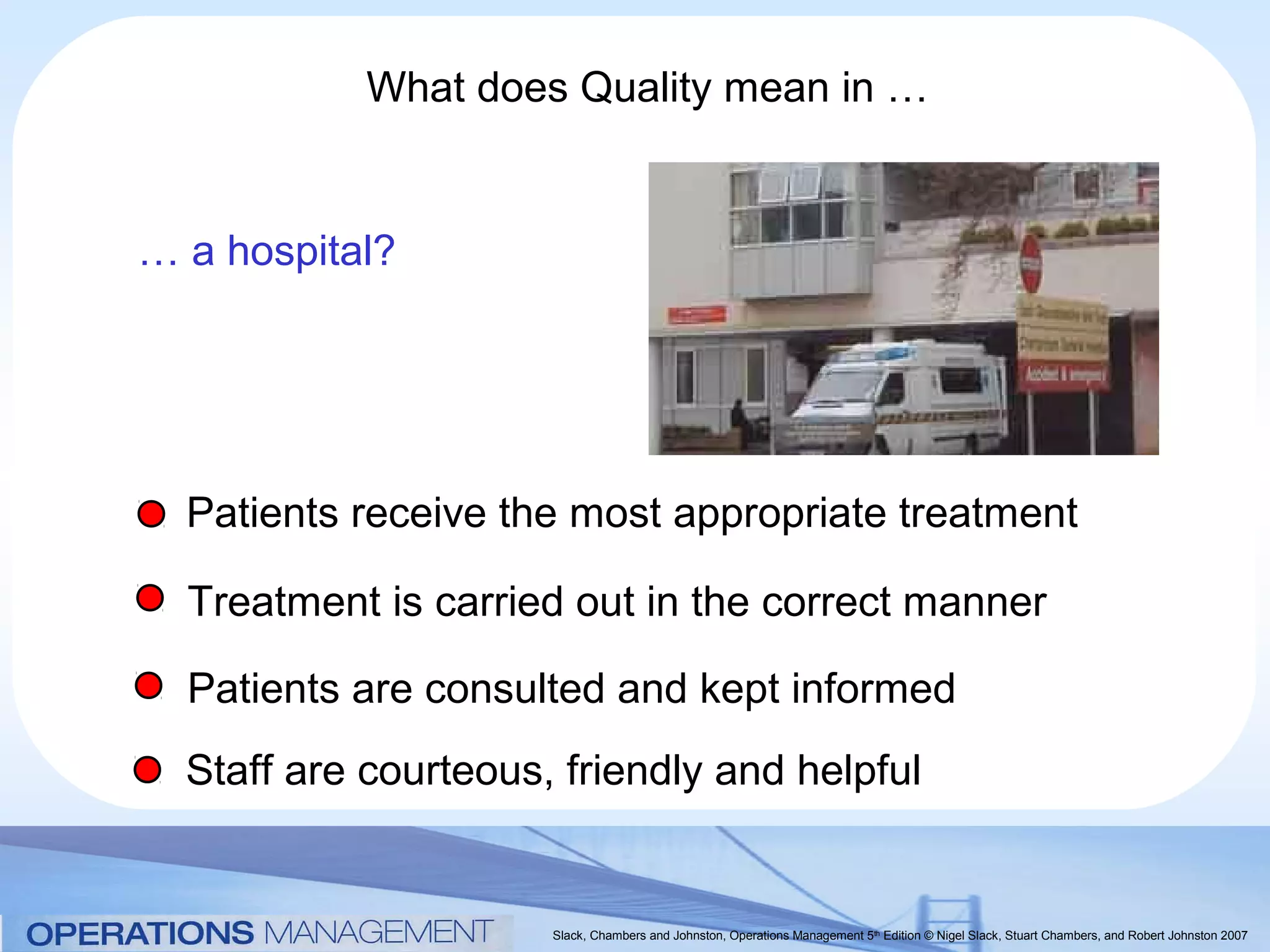
What does Quality mean in …


… a hospital?


  Patients receive the most appropriate treatment

  Treatment is carried out in the correct manner

  Patients are consulted and kept informed
  Staff are courteous, friendly and helpful


                      Slack, Chambers and Johnston, Operations Management 5th Edition © Nigel Slack, Stuart Chambers, and Robert Johnston 2007
What does Quality mean in …


… an automobile plant?


  All assembly is to specification

  Product is reliable
  All parts are made to specification

  The product is attractive and blemish-free


                        Slack, Chambers and Johnston, Operations Management 5th Edition © Nigel Slack, Stuart Chambers, and Robert Johnston 2007
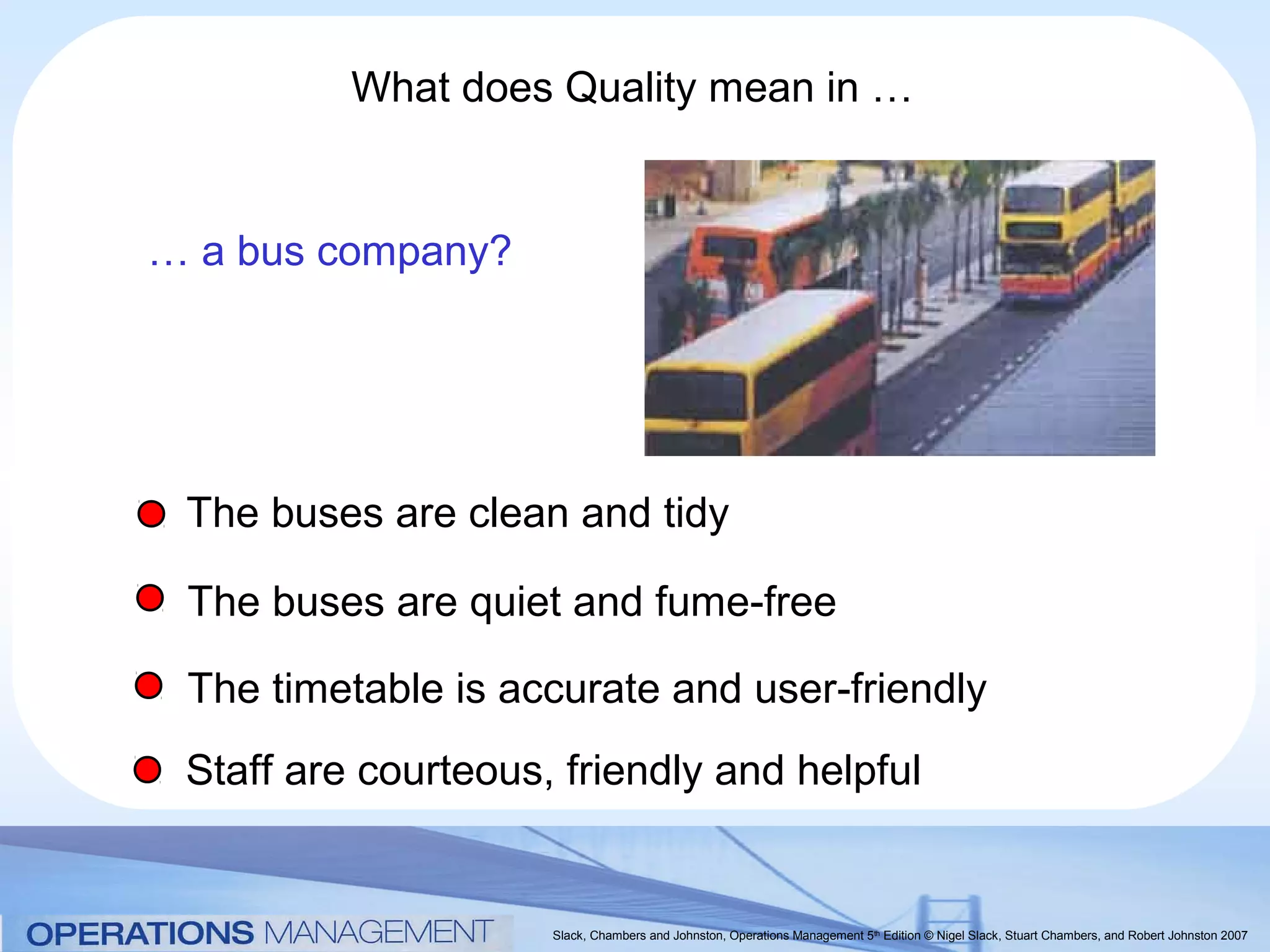
What does Quality mean in …


… a bus company?


 The buses are clean and tidy

 The buses are quiet and fume-free

 The timetable is accurate and user-friendly
 Staff are courteous, friendly and helpful


                     Slack, Chambers and Johnston, Operations Management 5th Edition © Nigel Slack, Stuart Chambers, and Robert Johnston 2007
What does Quality mean in …


… a supermarket?


 The store is clean and tidy

 Décor is appropriate and attractive

 Goods are in good condition
 Staff are courteous, friendly and helpful


                     Slack, Chambers and Johnston, Operations Management 5th Edition © Nigel Slack, Stuart Chambers, and Robert Johnston 2007
Quality
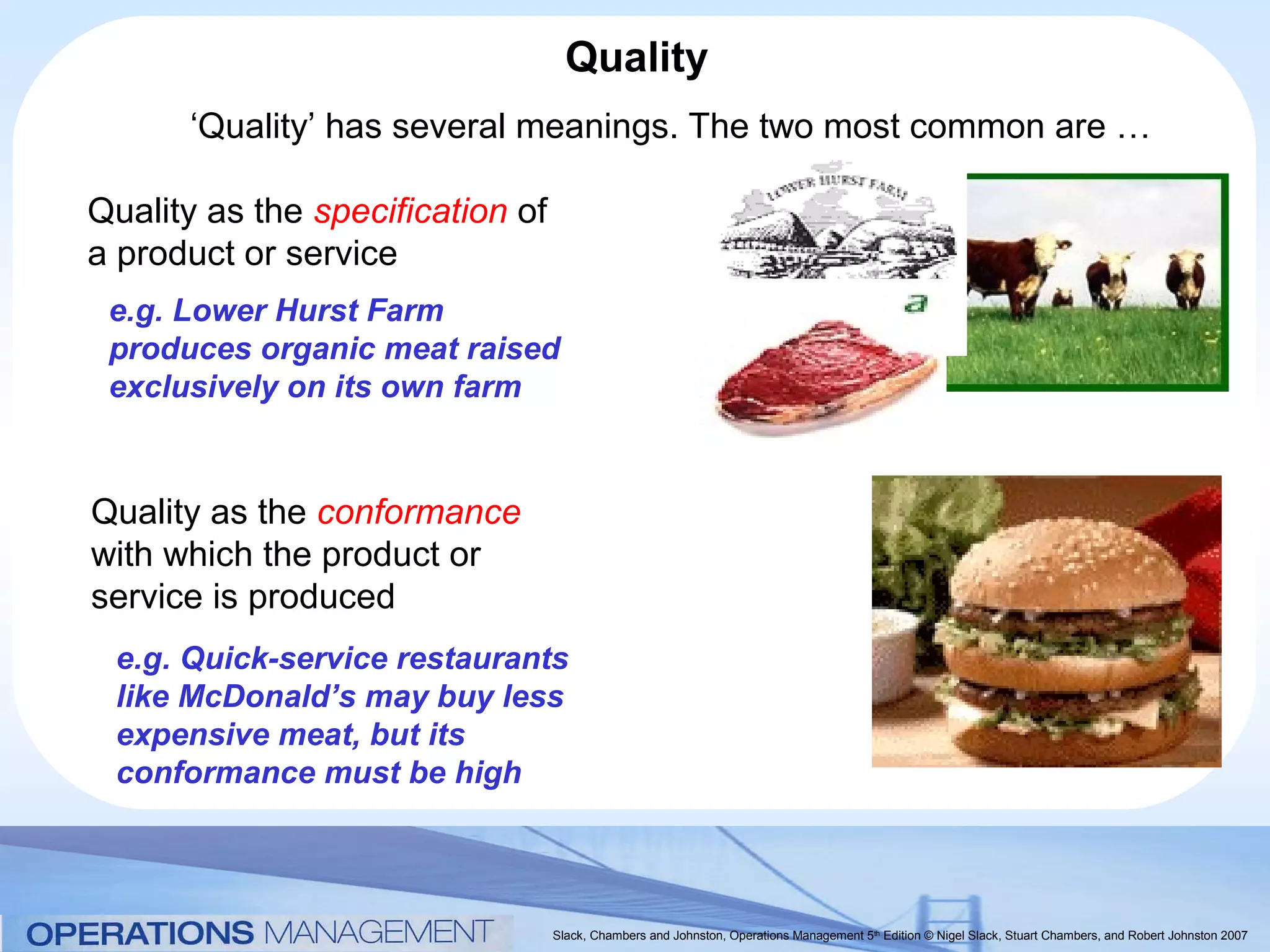
      ‘Quality’ has several meanings. The two most common are …

Quality as the specification of
a product or service
 e.g. Lower Hurst Farm
 produces organic meat raised
 exclusively on its own farm


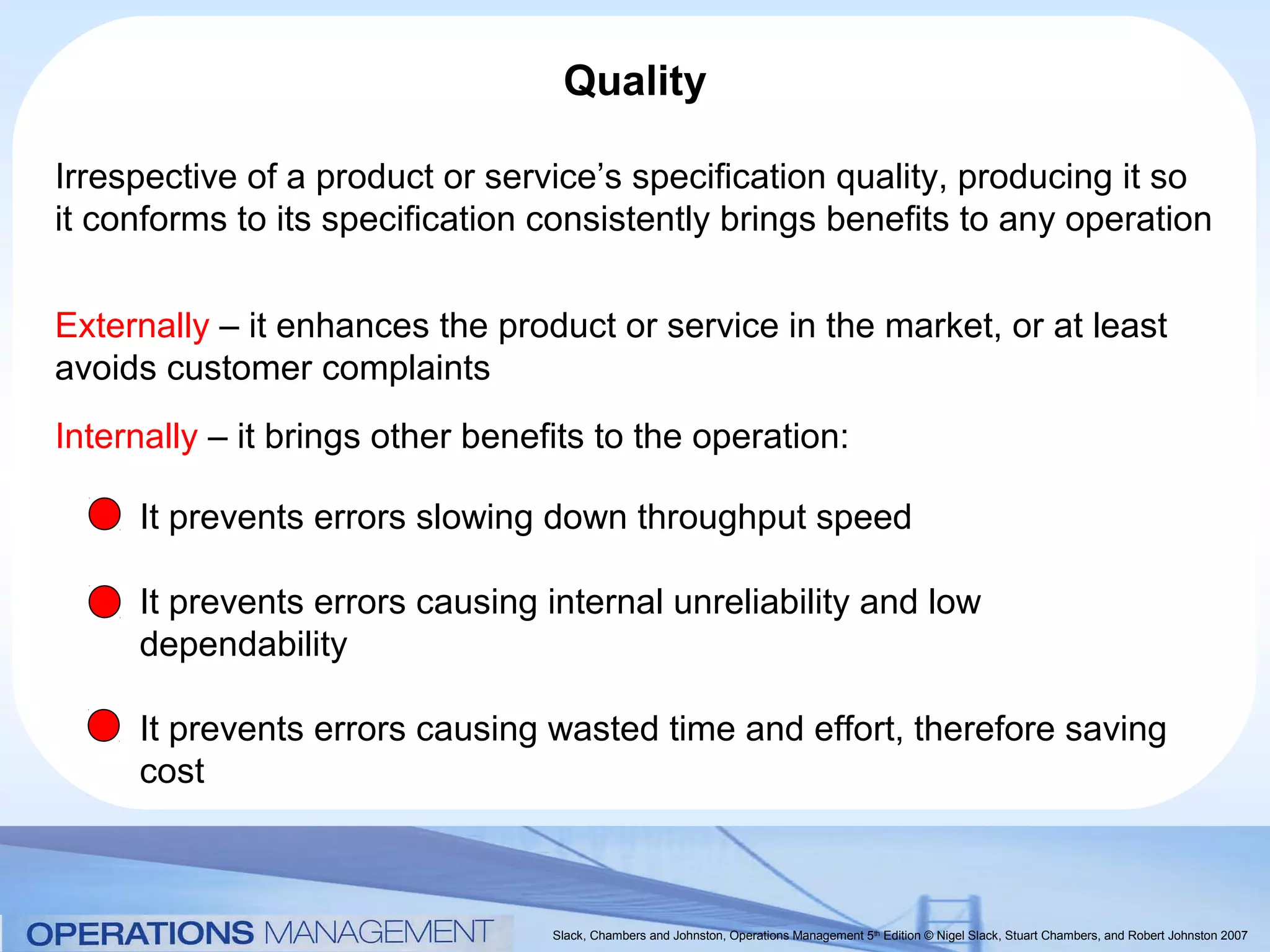
Quality as the conformance
with which the product or
service is produced
 e.g. Quick-service restaurants
 like McDonald’s may buy less
 expensive meat, but its
 conformance must be high


                                  Slack, Chambers and Johnston, Operations Management 5th Edition © Nigel Slack, Stuart Chambers, and Robert Johnston 2007
Quality

Irrespective of a product or service’s specification quality, producing it so
it conforms to its specification consistently brings benefits to any operation


Externally – it enhances the product or service in the market, or at least
avoids customer complaints
Internally – it brings other benefits to the operation:

     It prevents errors slowing down throughput speed

     It prevents errors causing internal unreliability and low
     dependability

     It prevents errors causing wasted time and effort, therefore saving
     cost


                                  Slack, Chambers and Johnston, Operations Management 5th Edition © Nigel Slack, Stuart Chambers, and Robert Johnston 2007
Quality
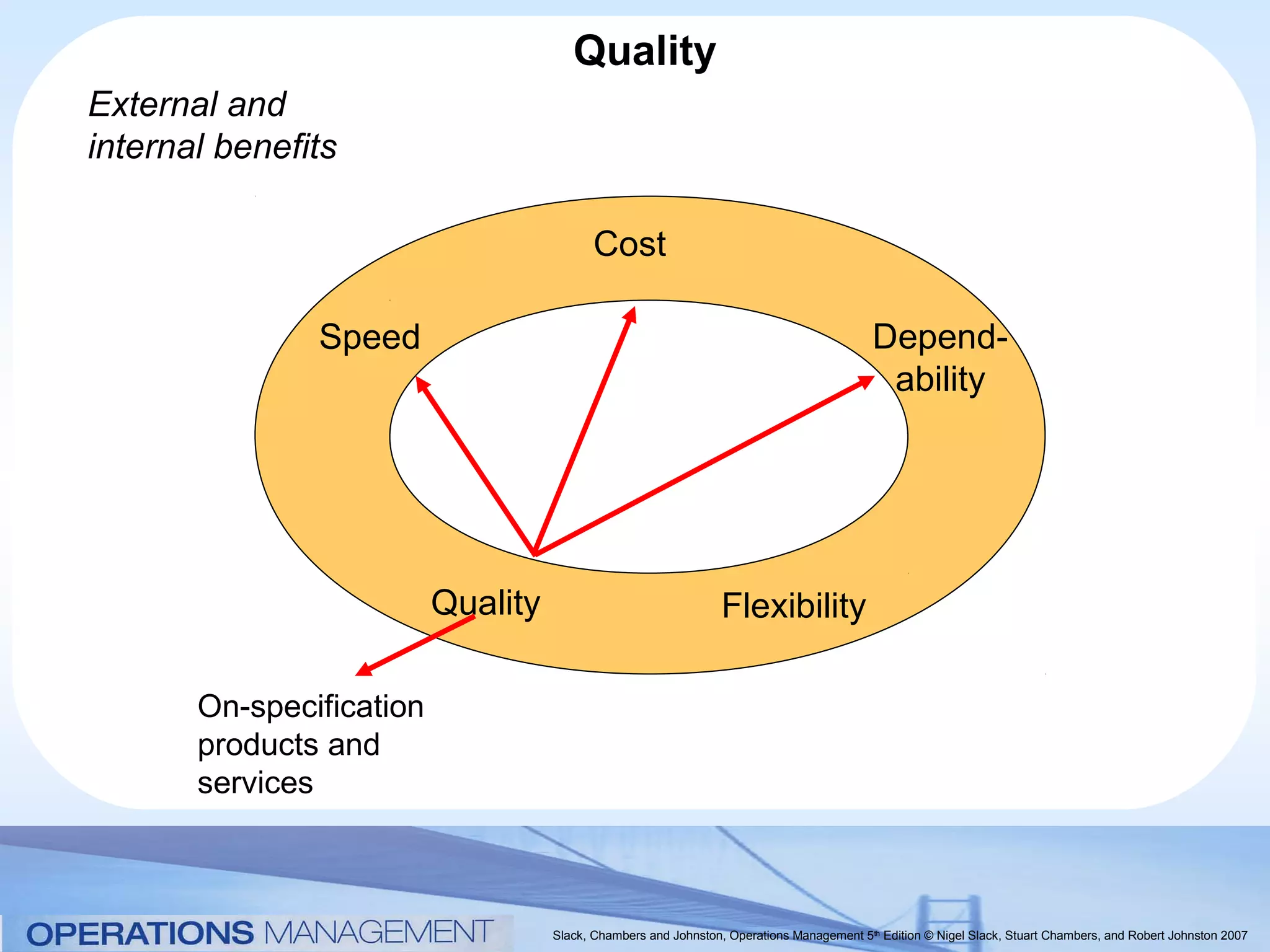
External and
internal benefits

                                           Cost

               Speed                                                                       Depend-
                                                                                            ability


                          Quality                                Flexibility

       On-specification
       products and
       services


                                    Slack, Chambers and Johnston, Operations Management 5th Edition © Nigel Slack, Stuart Chambers, and Robert Johnston 2007
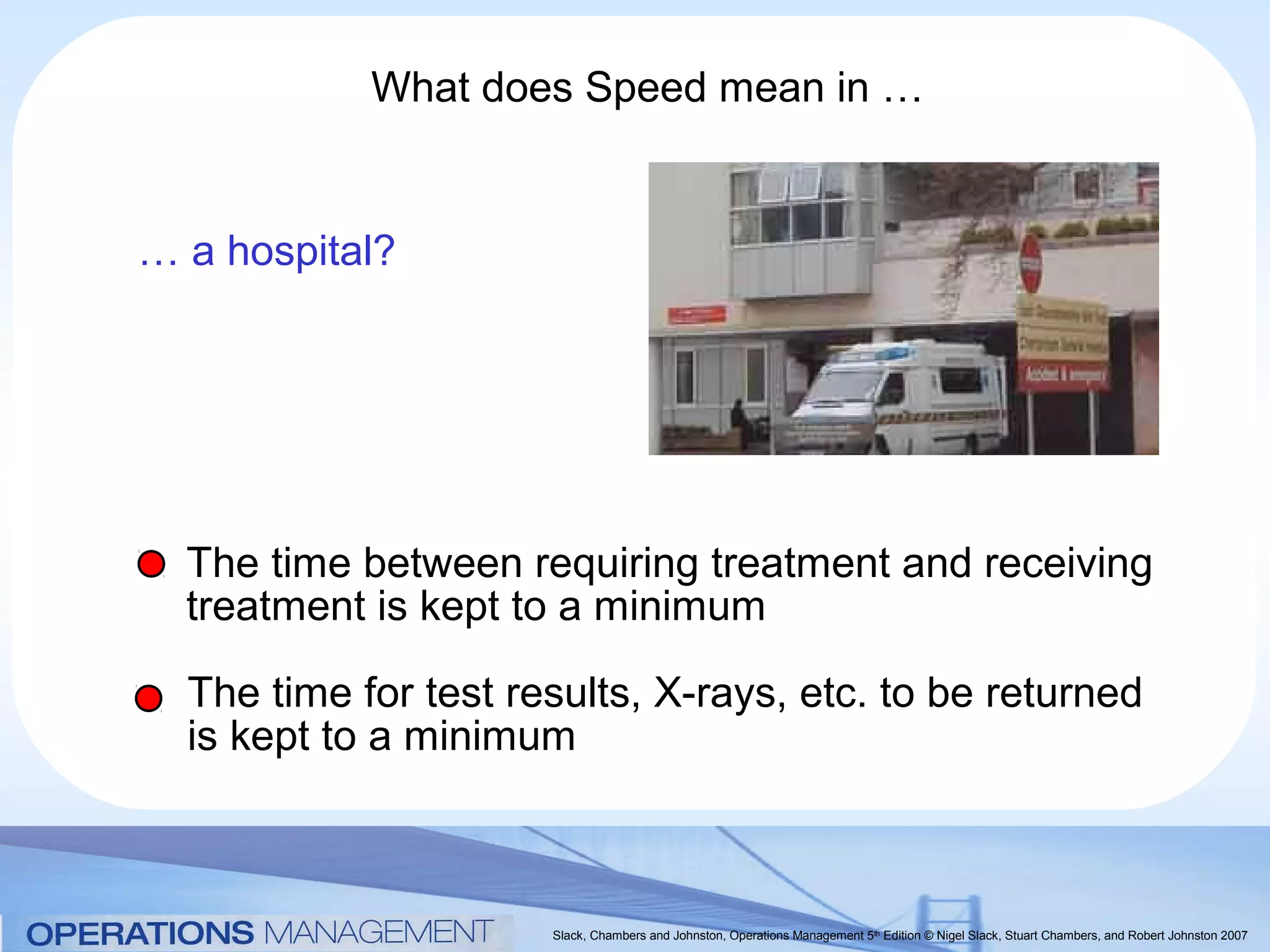
What does Speed mean in …


… a hospital?


  The time between requiring treatment and receiving
  treatment is kept to a minimum

  The time for test results, X-rays, etc. to be returned
  is kept to a minimum


                      Slack, Chambers and Johnston, Operations Management 5th Edition © Nigel Slack, Stuart Chambers, and Robert Johnston 2007
What does Speed mean in …


… an automobile plant?


  The time between dealers requesting a vehicle of a
  particular specification and receiving it is minimized

  The time to deliver spares to service centres is
  minimized


                      Slack, Chambers and Johnston, Operations Management 5th Edition © Nigel Slack, Stuart Chambers, and Robert Johnston 2007
What does Speed mean in …


… a bus company?


 The time between a customer setting out on the
 journey and reaching his or her destination is kept
 to a minimum


                     Slack, Chambers and Johnston, Operations Management 5th Edition © Nigel Slack, Stuart Chambers, and Robert Johnston 2007
What does Speed mean in …


… a supermarket?


 The time for the total transaction of going to the
 supermarket, making the purchases and returning
 is minimized
 Goods are immediately available


                    Slack, Chambers and Johnston, Operations Management 5th Edition © Nigel Slack, Stuart Chambers, and Robert Johnston 2007
Speed

Speed again has different interpretations, externally and internally

Externally – it means the elapsed time between a customer asking for a
product or service and getting it (in a satisfactory condition)
It often enhances the value of the product or service to customers

Internally – it brings other benefits to the operation:


      It helps to overcome internal problems by maintaining dependability


      It reduces the need to manage transformed resources as they pass
      through the operation, therefore saving cost


                                  Slack, Chambers and Johnston, Operations Management 5th Edition © Nigel Slack, Stuart Chambers, and Robert Johnston 2007
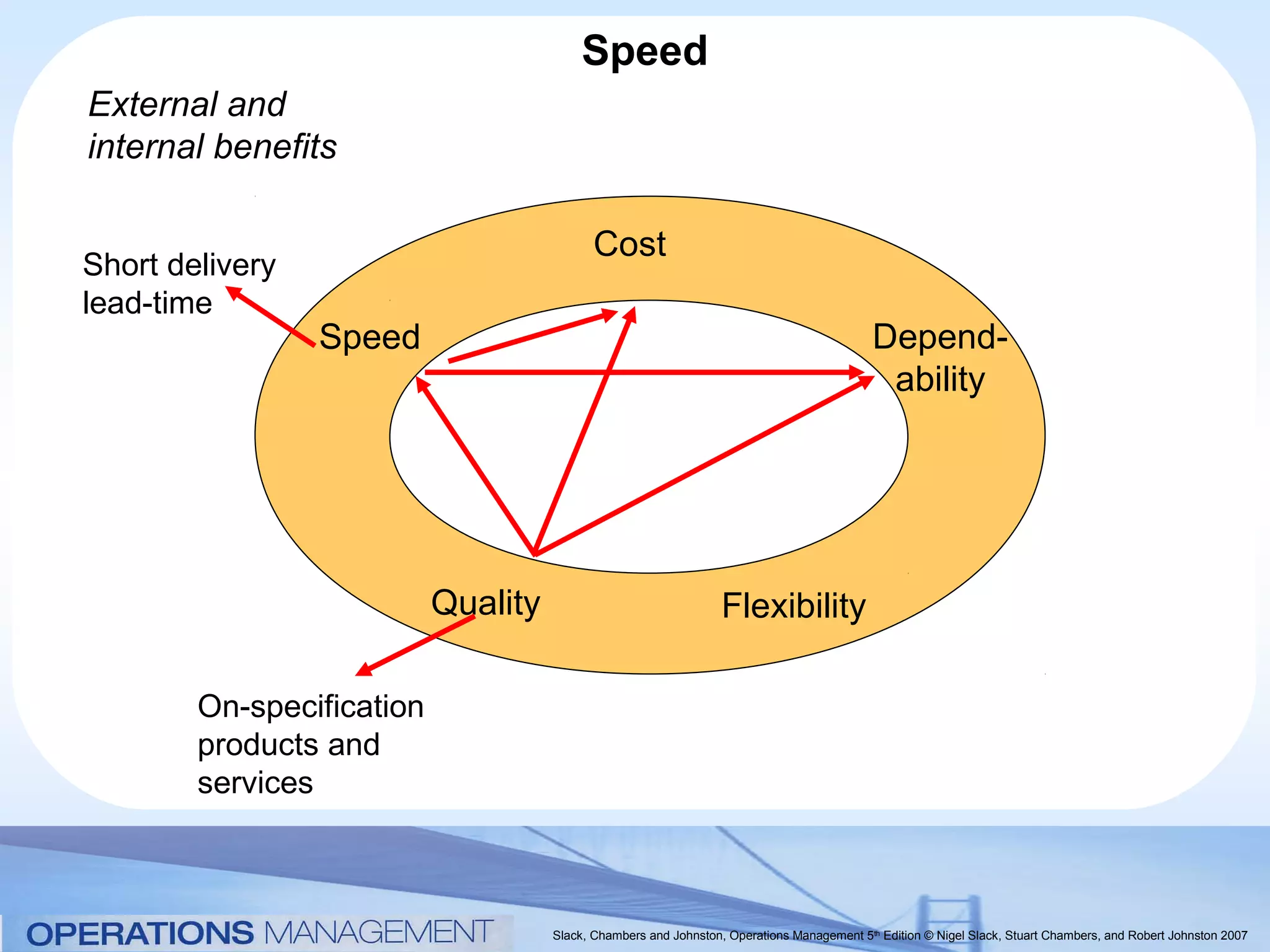
Speed
External and
internal benefits

                                            Cost
Short delivery
lead-time
                 Speed                                                                      Depend-
                                                                                             ability


                           Quality                                Flexibility

        On-specification
        products and
        services


                                     Slack, Chambers and Johnston, Operations Management 5th Edition © Nigel Slack, Stuart Chambers, and Robert Johnston 2007
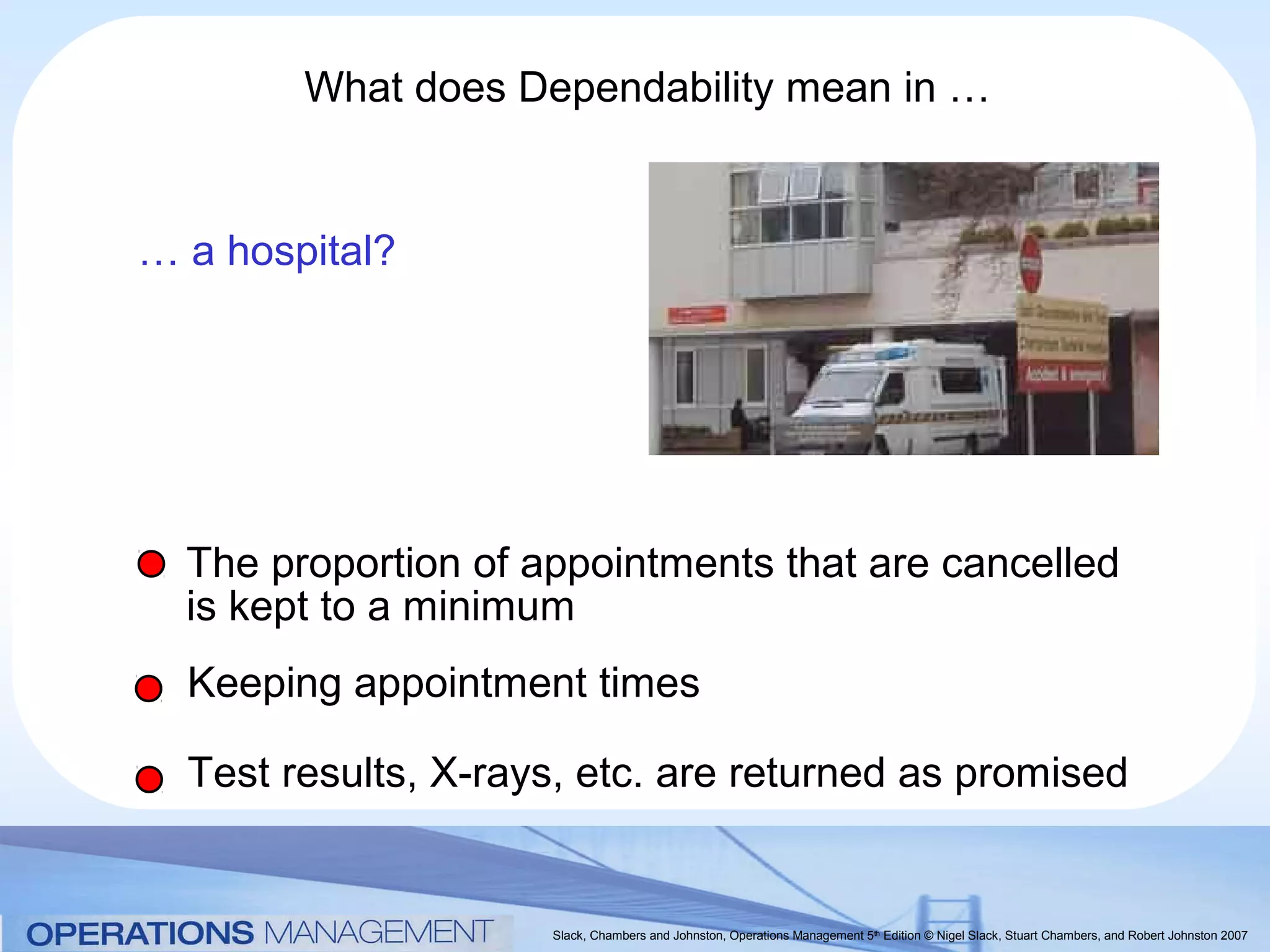
What does Dependability mean in …


… a hospital?


  The proportion of appointments that are cancelled
  is kept to a minimum
  Keeping appointment times

  Test results, X-rays, etc. are returned as promised


                     Slack, Chambers and Johnston, Operations Management 5th Edition © Nigel Slack, Stuart Chambers, and Robert Johnston 2007
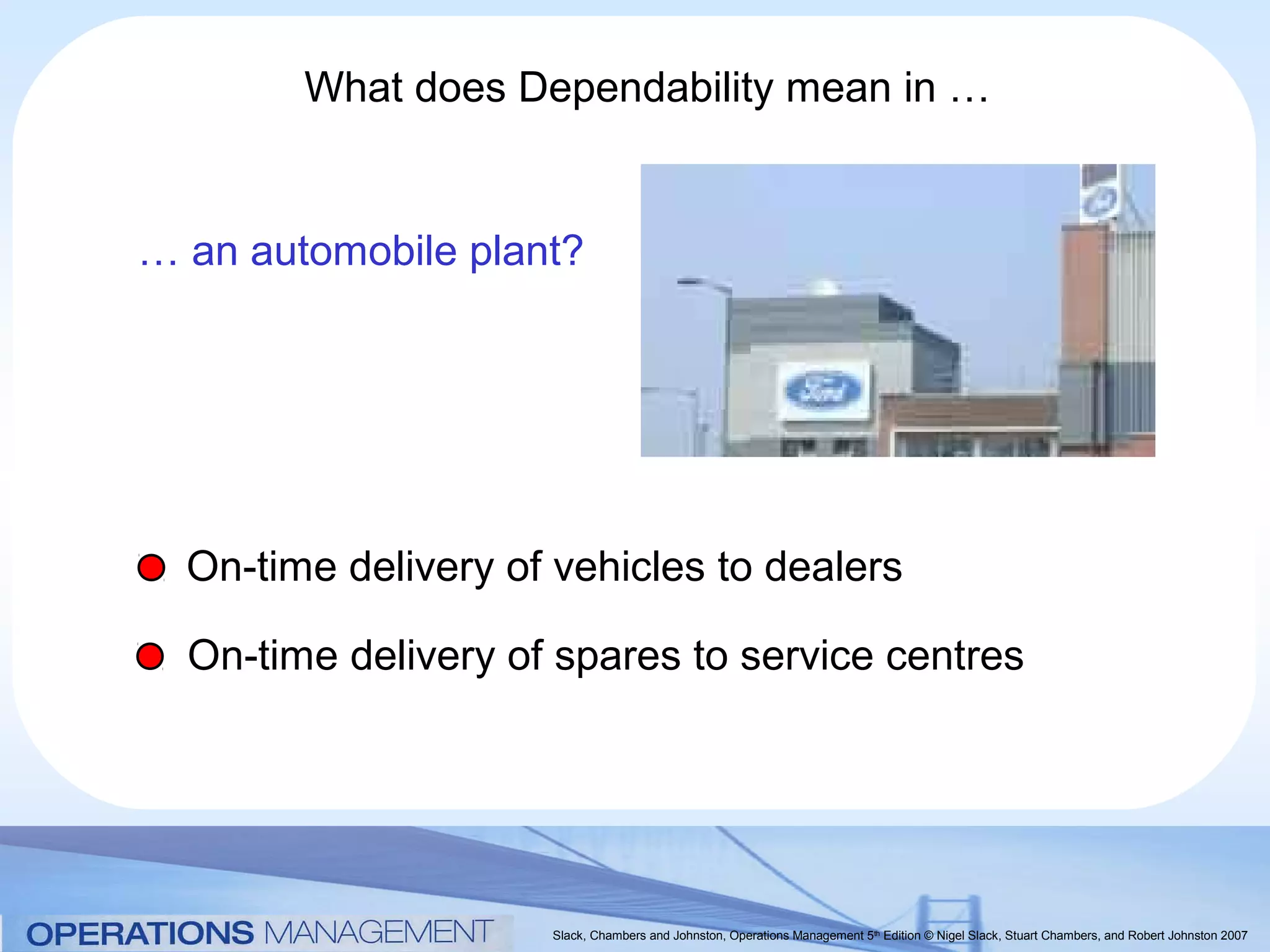
What does Dependability mean in …


… an automobile plant?


  On-time delivery of vehicles to dealers

  On-time delivery of spares to service centres


                     Slack, Chambers and Johnston, Operations Management 5th Edition © Nigel Slack, Stuart Chambers, and Robert Johnston 2007
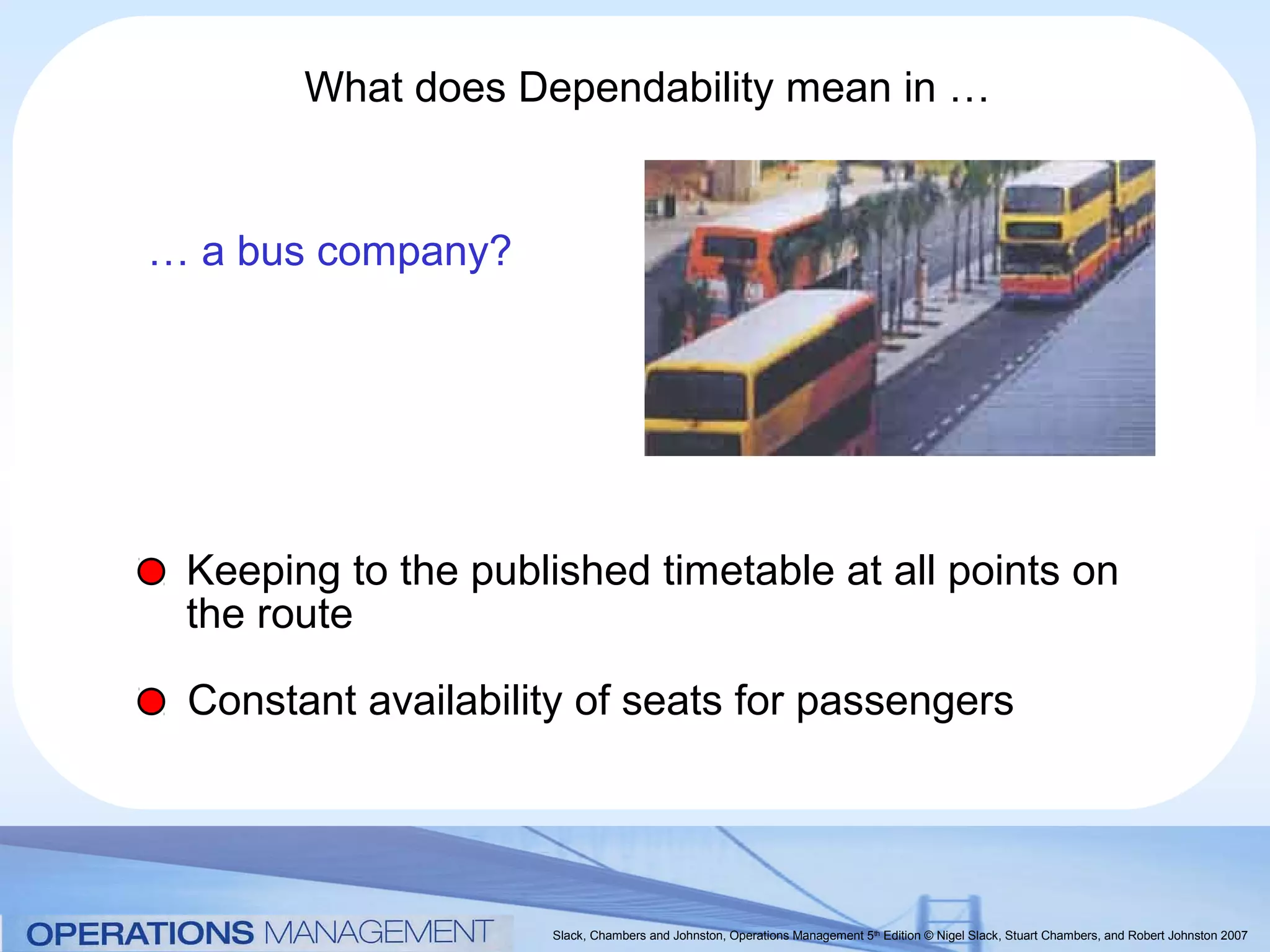
What does Dependability mean in …


… a bus company?


 Keeping to the published timetable at all points on
 the route

 Constant availability of seats for passengers


                     Slack, Chambers and Johnston, Operations Management 5th Edition © Nigel Slack, Stuart Chambers, and Robert Johnston 2007
What does Dependability mean in …


… a supermarket?


 Predictable opening hours
 Proportion of goods out of stock kept to a minimum

 Keeping to reasonable queuing times

 Constant availability of parking


                     Slack, Chambers and Johnston, Operations Management 5th Edition © Nigel Slack, Stuart Chambers, and Robert Johnston 2007
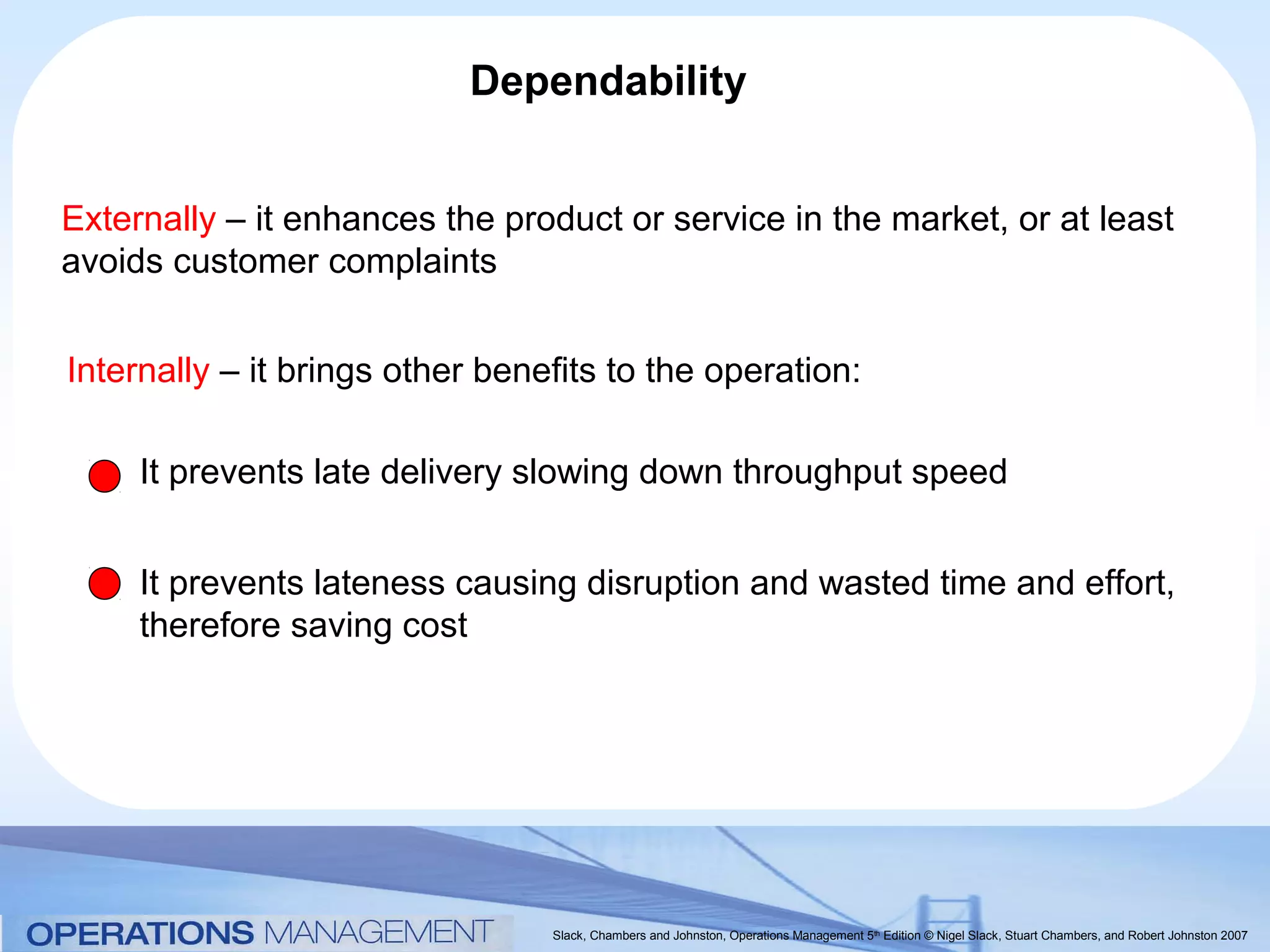
Dependability


Externally – it enhances the product or service in the market, or at least
avoids customer complaints


Internally – it brings other benefits to the operation:

     It prevents late delivery slowing down throughput speed


     It prevents lateness causing disruption and wasted time and effort,
     therefore saving cost


                                 Slack, Chambers and Johnston, Operations Management 5th Edition © Nigel Slack, Stuart Chambers, and Robert Johnston 2007
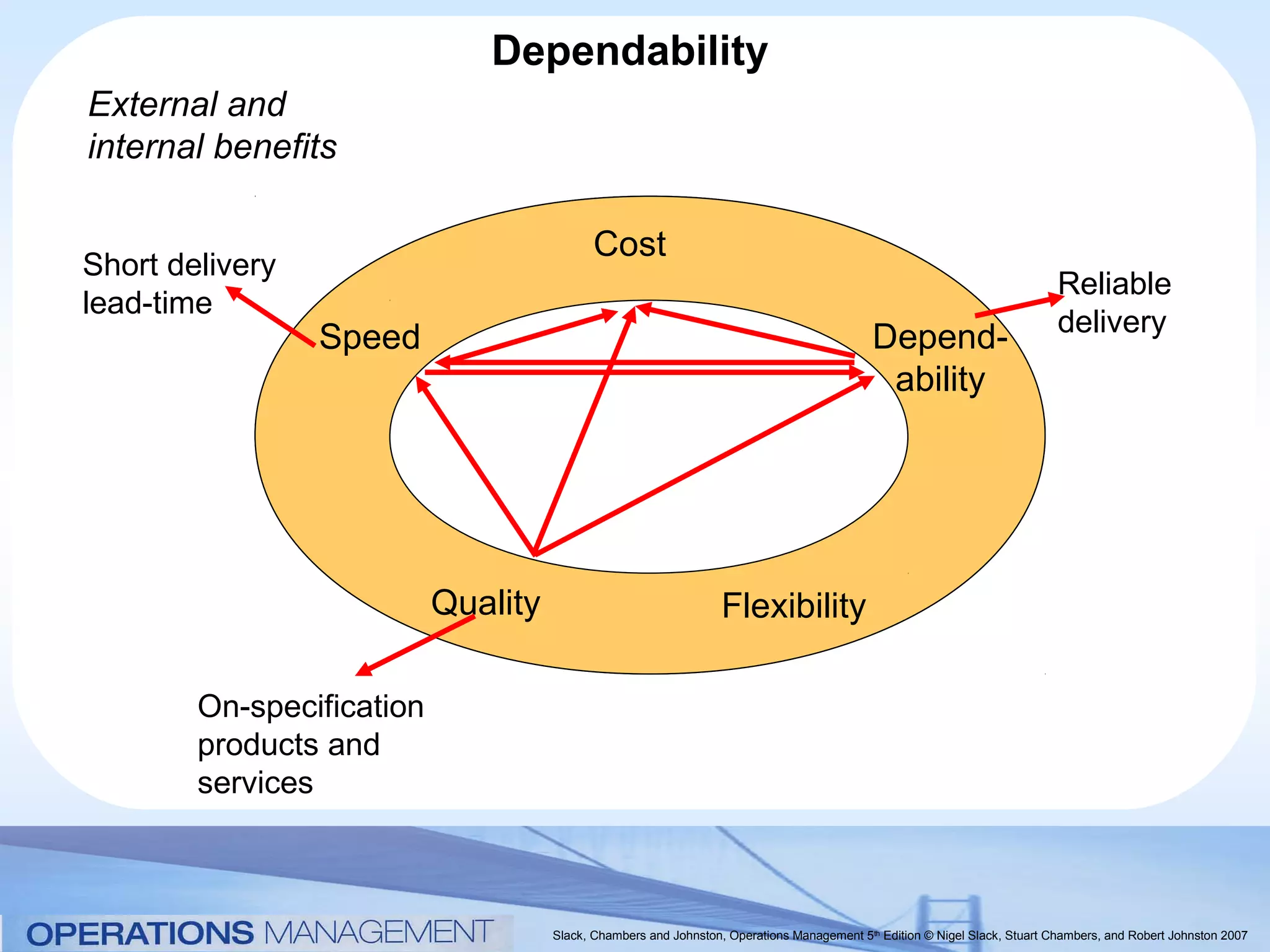
Dependability
External and
internal benefits

                                            Cost
Short delivery
                                                                                                                            Reliable
lead-time
                                                                                                                            delivery
                 Speed                                                                      Depend-
                                                                                             ability


                           Quality                                Flexibility

        On-specification
        products and
        services


                                     Slack, Chambers and Johnston, Operations Management 5th Edition © Nigel Slack, Stuart Chambers, and Robert Johnston 2007
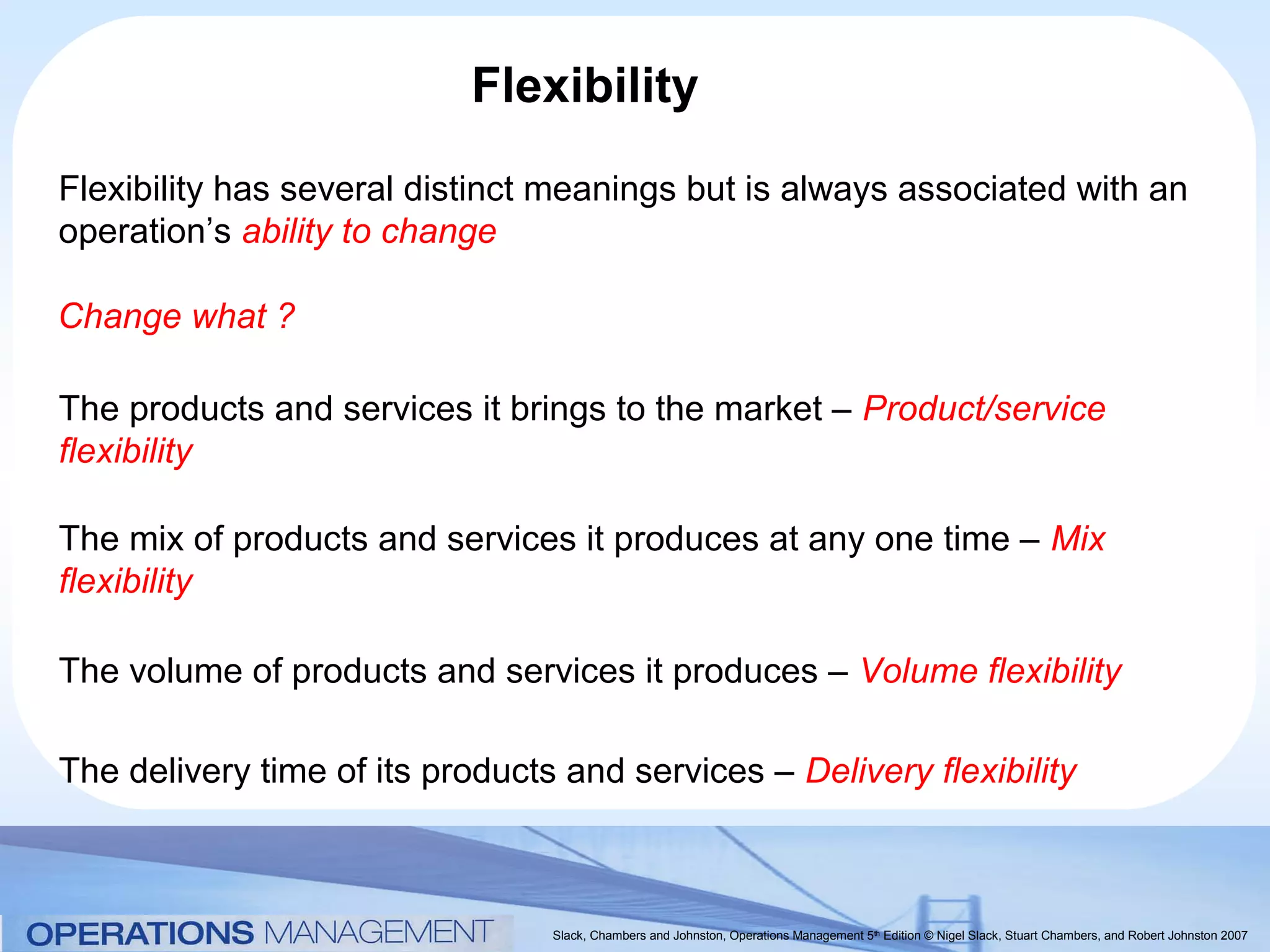
Flexibility
Flexibility has several distinct meanings but is always associated with an
operation’s ability to change

Change what ?

The products and services it brings to the market – Product/service
flexibility

The mix of products and services it produces at any one time – Mix
flexibility

The volume of products and services it produces – Volume flexibility

The delivery time of its products and services – Delivery flexibility


                                 Slack, Chambers and Johnston, Operations Management 5th Edition © Nigel Slack, Stuart Chambers, and Robert Johnston 2007
What does Flexibility mean in …


… a hospital?


  Introducing new treatments

  Providing a wide range of treatments

  The ability to adjust the number of patients treated

  The ability to reschedule appointments


                      Slack, Chambers and Johnston, Operations Management 5th Edition © Nigel Slack, Stuart Chambers, and Robert Johnston 2007
What does Flexibility mean in …


… an automobile plant?


  The introduction of new models
  A wide range of options
  The ability to adjust the number of vehicles
  manufactured
  The ability to reschedule manufacturing priorities


                     Slack, Chambers and Johnston, Operations Management 5th Edition © Nigel Slack, Stuart Chambers, and Robert Johnston 2007
What does Flexibility mean in …


… a bus company?


 The introduction of new routes and excursions
 A large number of locations served

 The ability to adjust the frequency of services

 The ability to reschedule trips


                     Slack, Chambers and Johnston, Operations Management 5th Edition © Nigel Slack, Stuart Chambers, and Robert Johnston 2007
What does Flexibility mean in …


… a supermarket?


 The introduction of new lines

 A wide range of goods stocked

 The ability to adjust the number of customers served

 The ability to get out-of-stock items


                     Slack, Chambers and Johnston, Operations Management 5th Edition © Nigel Slack, Stuart Chambers, and Robert Johnston 2007
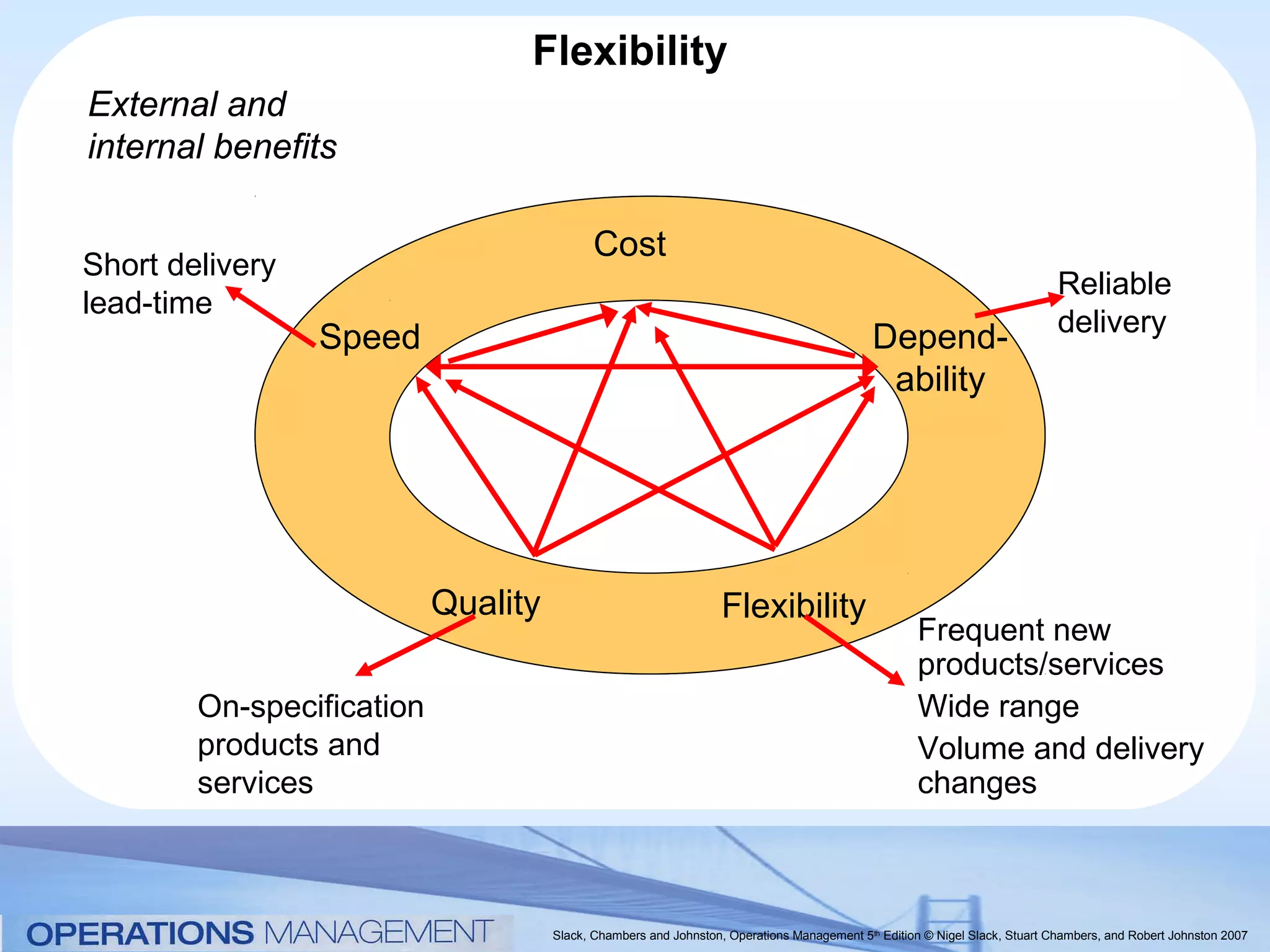
Flexibility
External and
internal benefits

                                            Cost
Short delivery
                                                                                                                            Reliable
lead-time
                                                                                                                            delivery
                 Speed                                                                      Depend-
                                                                                             ability


                           Quality                                Flexibility
                                                                                                   Frequent new
                                                                                                   products/services
        On-specification                                                                           Wide range
        products and                                                                               Volume and delivery
        services                                                                                   changes


                                     Slack, Chambers and Johnston, Operations Management 5th Edition © Nigel Slack, Stuart Chambers, and Robert Johnston 2007
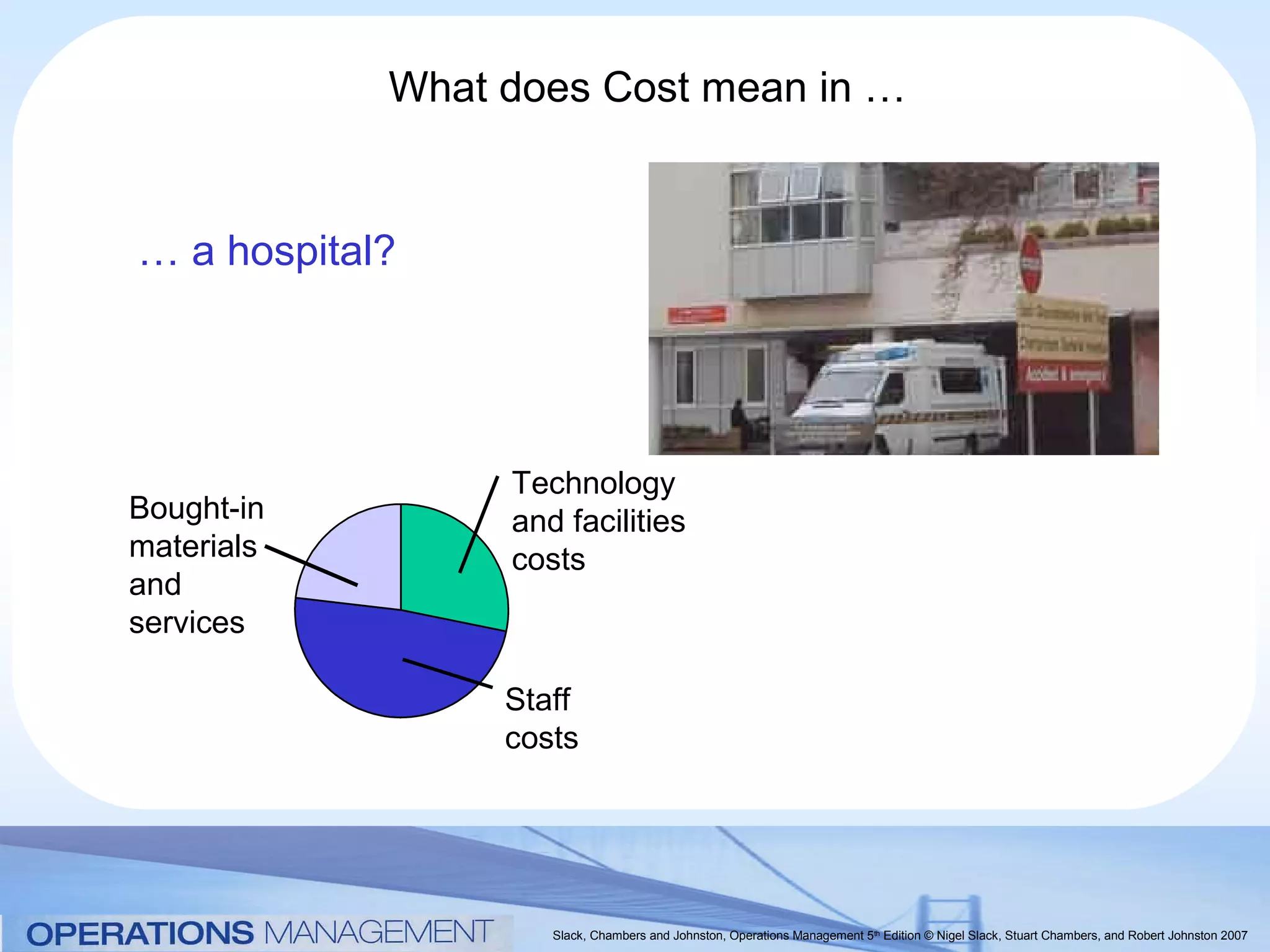
What does Cost mean in …


… a hospital?


                 Technology
Bought-in        and facilities
materials        costs
and
services

                 Staff
                 costs


                    Slack, Chambers and Johnston, Operations Management 5th Edition © Nigel Slack, Stuart Chambers, and Robert Johnston 2007
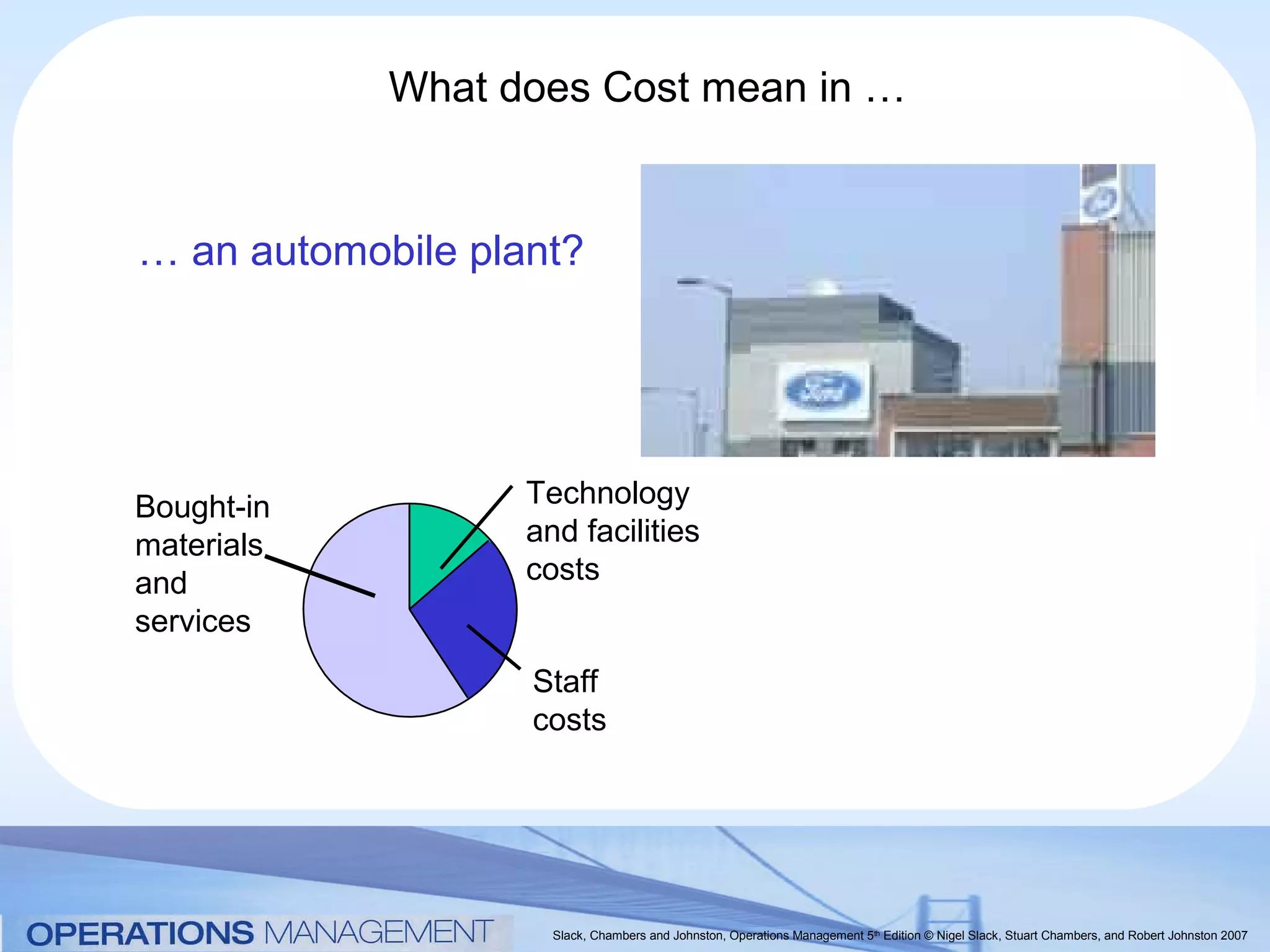
What does Cost mean in …


… an automobile plant?


Bought-in          Technology
materials          and facilities
and                costs
services
                   Staff
                   costs


                     Slack, Chambers and Johnston, Operations Management 5th Edition © Nigel Slack, Stuart Chambers, and Robert Johnston 2007
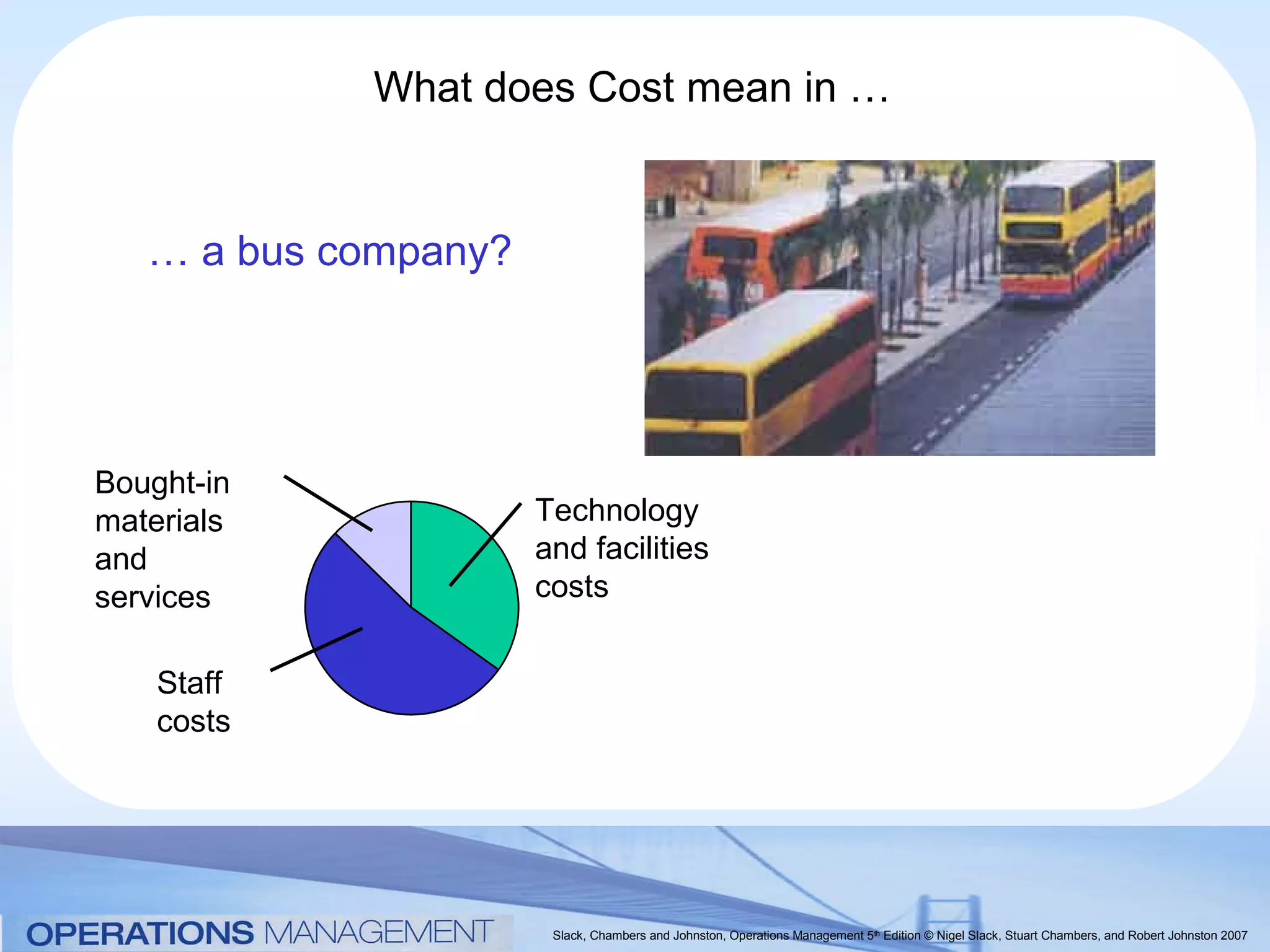
What does Cost mean in …


   … a bus company?


Bought-in
materials             Technology
and                   and facilities
services              costs


    Staff
    costs


                       Slack, Chambers and Johnston, Operations Management 5th Edition © Nigel Slack, Stuart Chambers, and Robert Johnston 2007
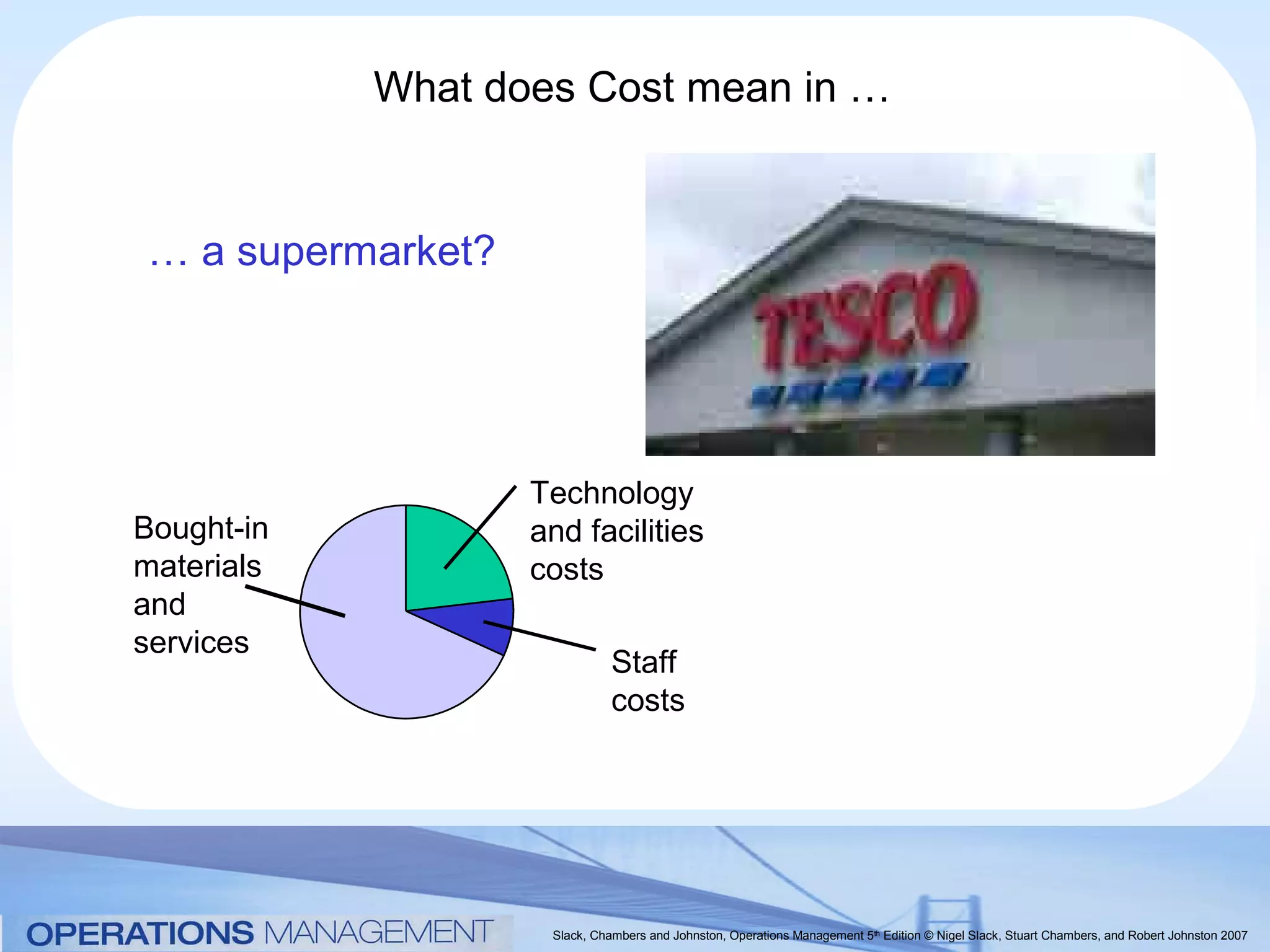
What does Cost mean in …


… a supermarket?


                   Technology
Bought-in          and facilities
materials          costs
and
services
                              Staff
                              costs


                    Slack, Chambers and Johnston, Operations Management 5th Edition © Nigel Slack, Stuart Chambers, and Robert Johnston 2007
Cost
The cost of producing products and services is obviously
influenced by many factors such as input costs, but two
important sets are …
     The 4 V’s: volume
                variety
                variation
                visibility
     The internal performance of the operation in terms of
                quality
                speed
                dependability
                flexibility


                          Slack, Chambers and Johnston, Operations Management 5th Edition © Nigel Slack, Stuart Chambers, and Robert Johnston 2007
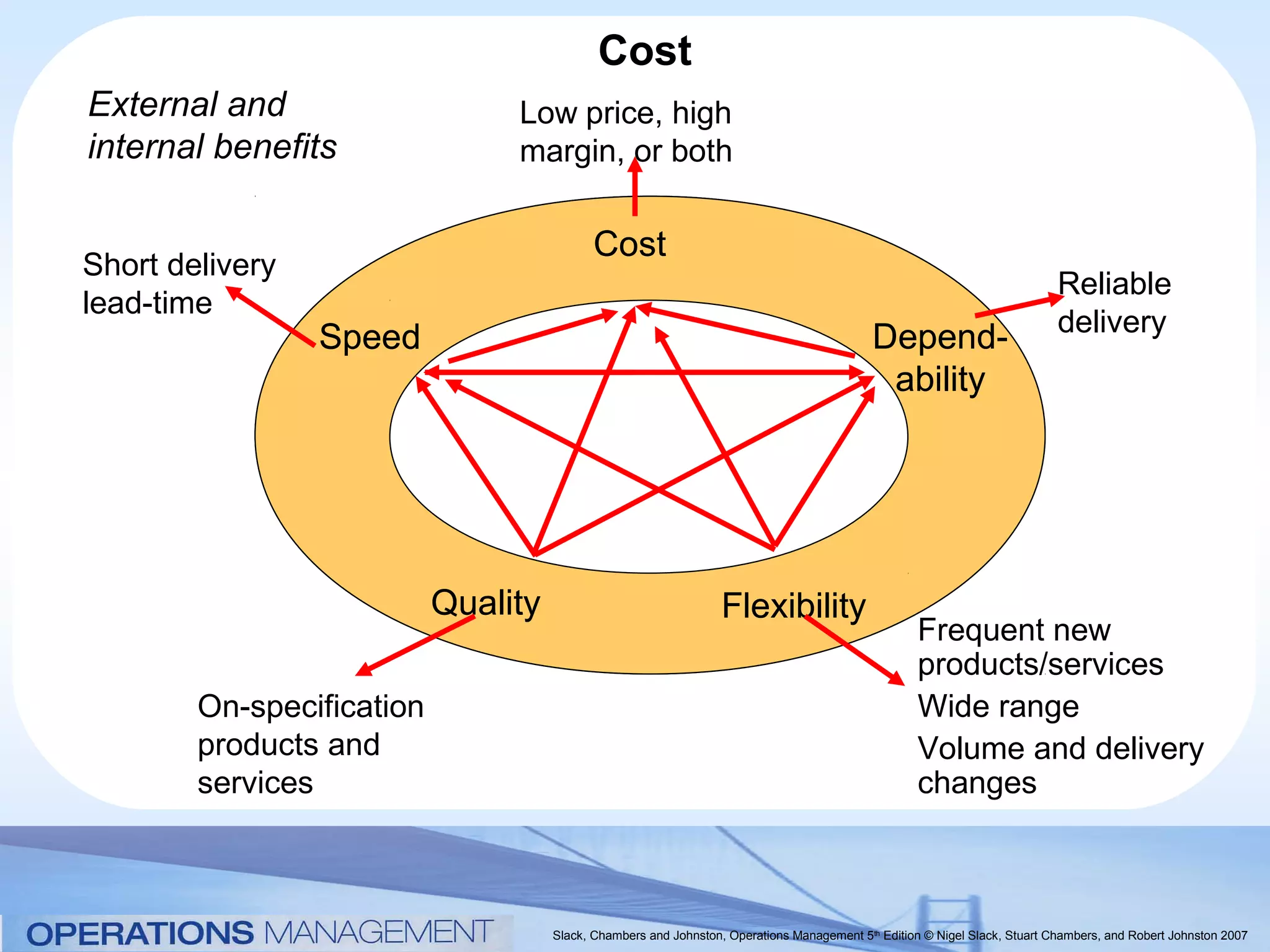
Cost
External and                    Low price, high
internal benefits               margin, or both

                                            Cost
Short delivery
                                                                                                                            Reliable
lead-time
                                                                                                                            delivery
                 Speed                                                                      Depend-
                                                                                             ability


                           Quality                                Flexibility
                                                                                                   Frequent new
                                                                                                   products/services
        On-specification                                                                           Wide range
        products and                                                                               Volume and delivery
        services                                                                                   changes


                                     Slack, Chambers and Johnston, Operations Management 5th Edition © Nigel Slack, Stuart Chambers, and Robert Johnston 2007
Polar diagrams


Polar diagrams are used to indicate the relative
importance of each performance objective to an
operation or process


They can also be used to indicate the difference
between different products and services produced by an
operation or process


                      Slack, Chambers and Johnston, Operations Management 5th Edition © Nigel Slack, Stuart Chambers, and Robert Johnston 2007
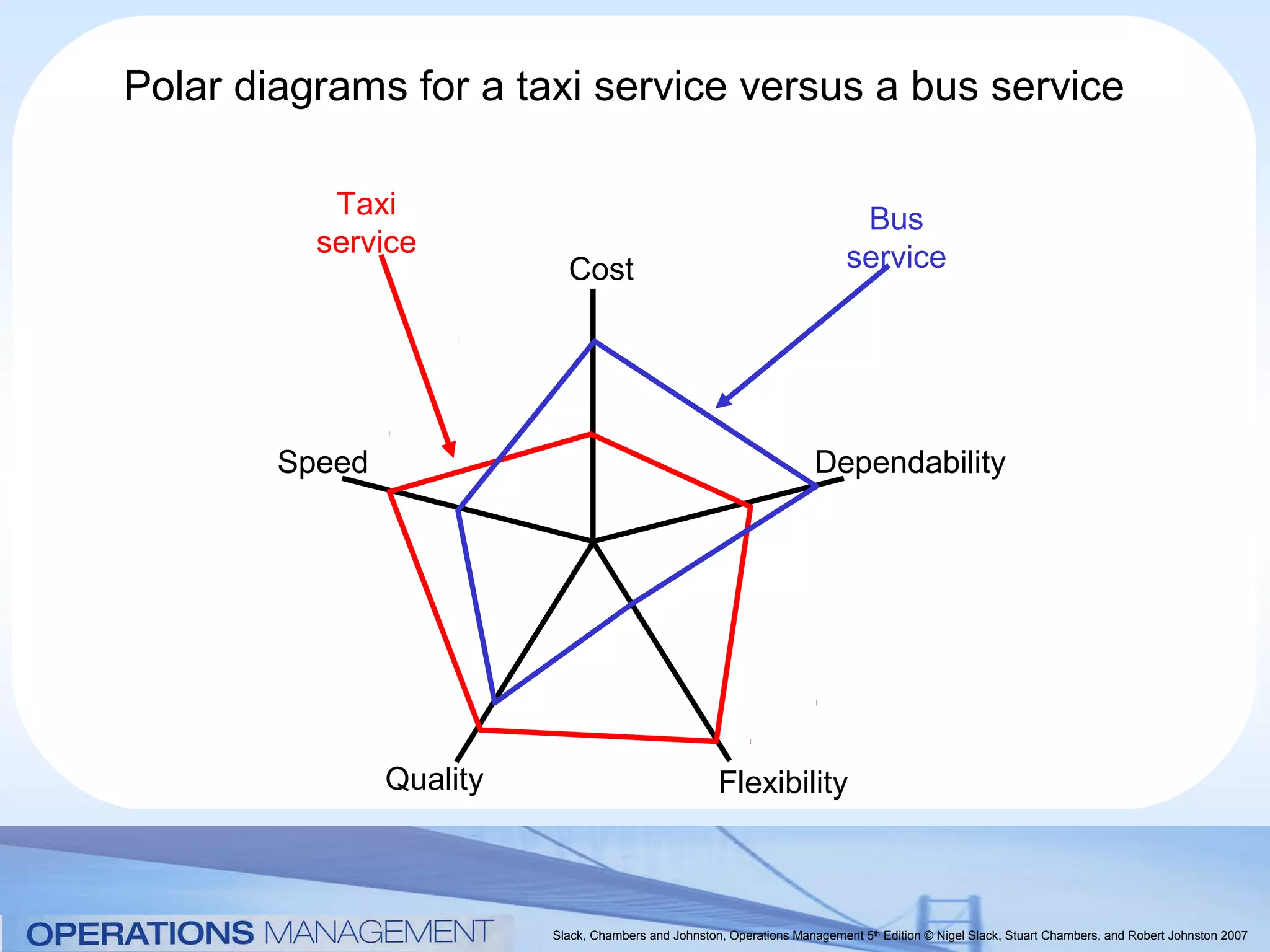
Polar diagrams for a taxi service versus a bus service

           Taxi                                                              Bus
          service                                                           service
                            Cost


        Speed                                                          Dependability


                Quality                               Flexibility


                          Slack, Chambers and Johnston, Operations Management 5th Edition © Nigel Slack, Stuart Chambers, and Robert Johnston 2007
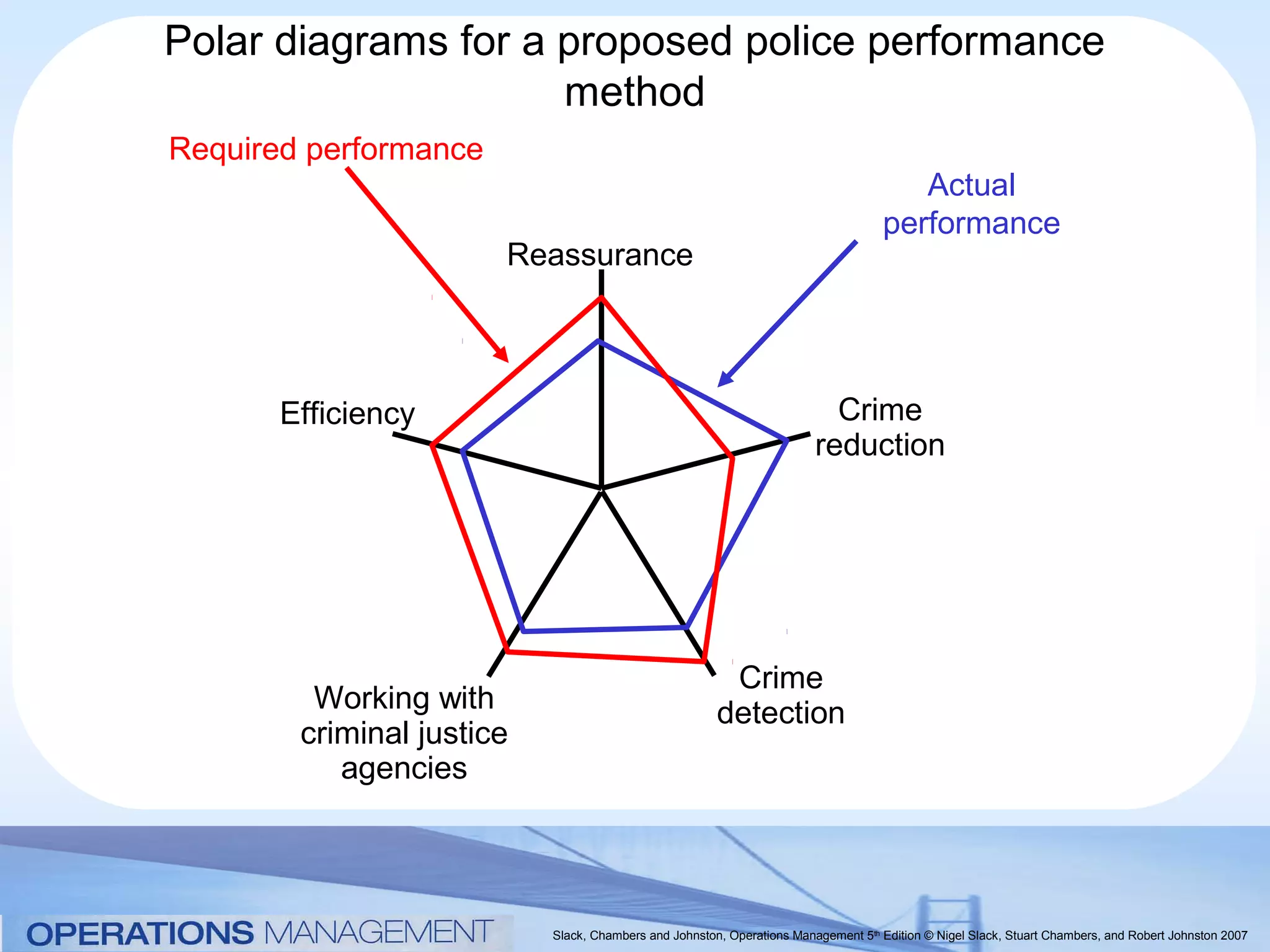
Polar diagrams for a proposed police performance
                     method
Required performance
                                                                                      Actual
                                                                                   performance
                       Reassurance


       Efficiency                                                         Crime
                                                                        reduction


                                                        Crime
         Working with                                  detection
        criminal justice
           agencies


                           Slack, Chambers and Johnston, Operations Management 5th Edition © Nigel Slack, Stuart Chambers, and Robert Johnston 2007
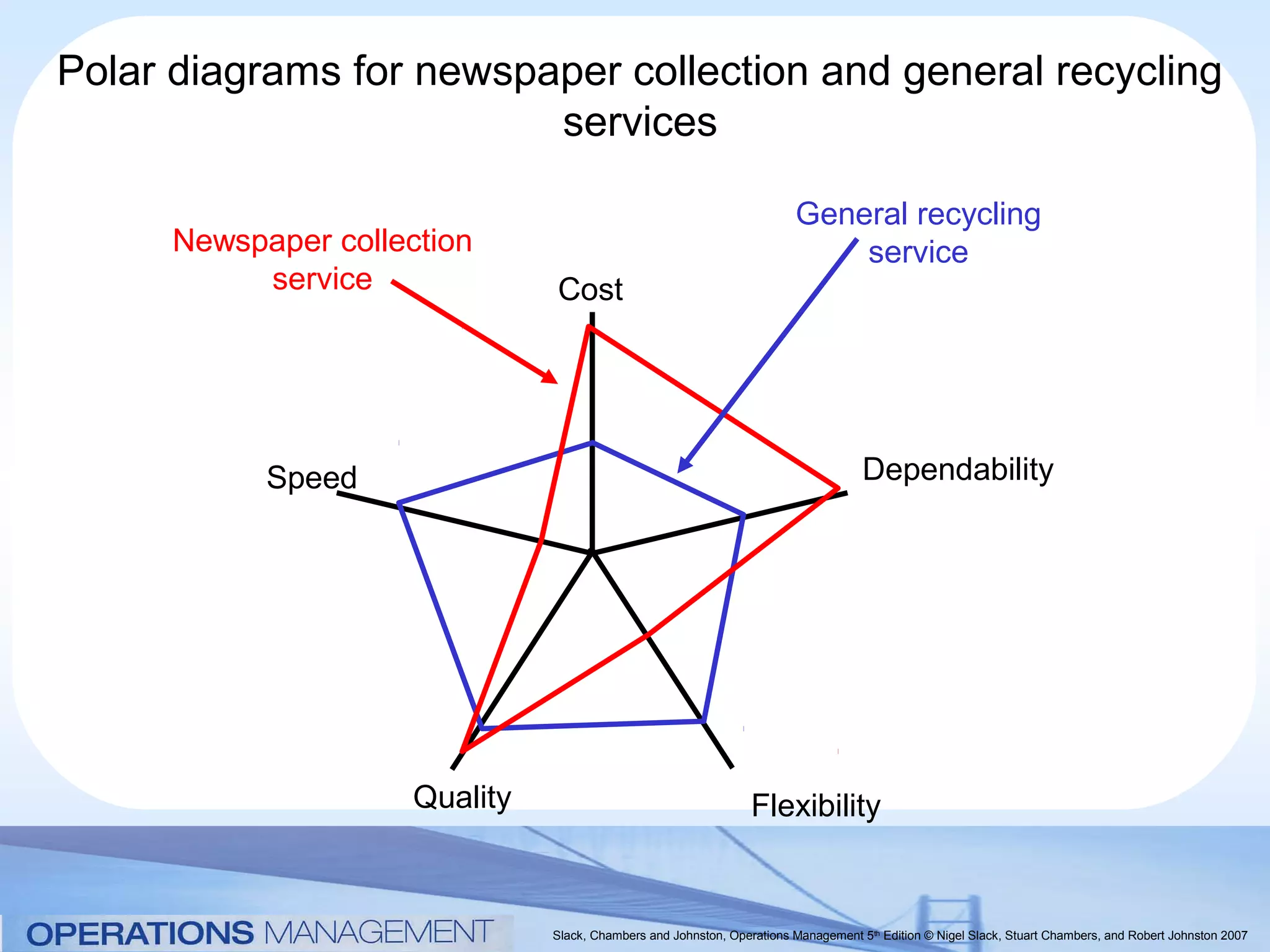
Polar diagrams for newspaper collection and general recycling
                         services

                                                                         General recycling
      Newspaper collection                                                   service
           service              Cost


            Speed                                                                    Dependability


                      Quality                                     Flexibility


                                Slack, Chambers and Johnston, Operations Management 5th Edition © Nigel Slack, Stuart Chambers, and Robert Johnston 2007
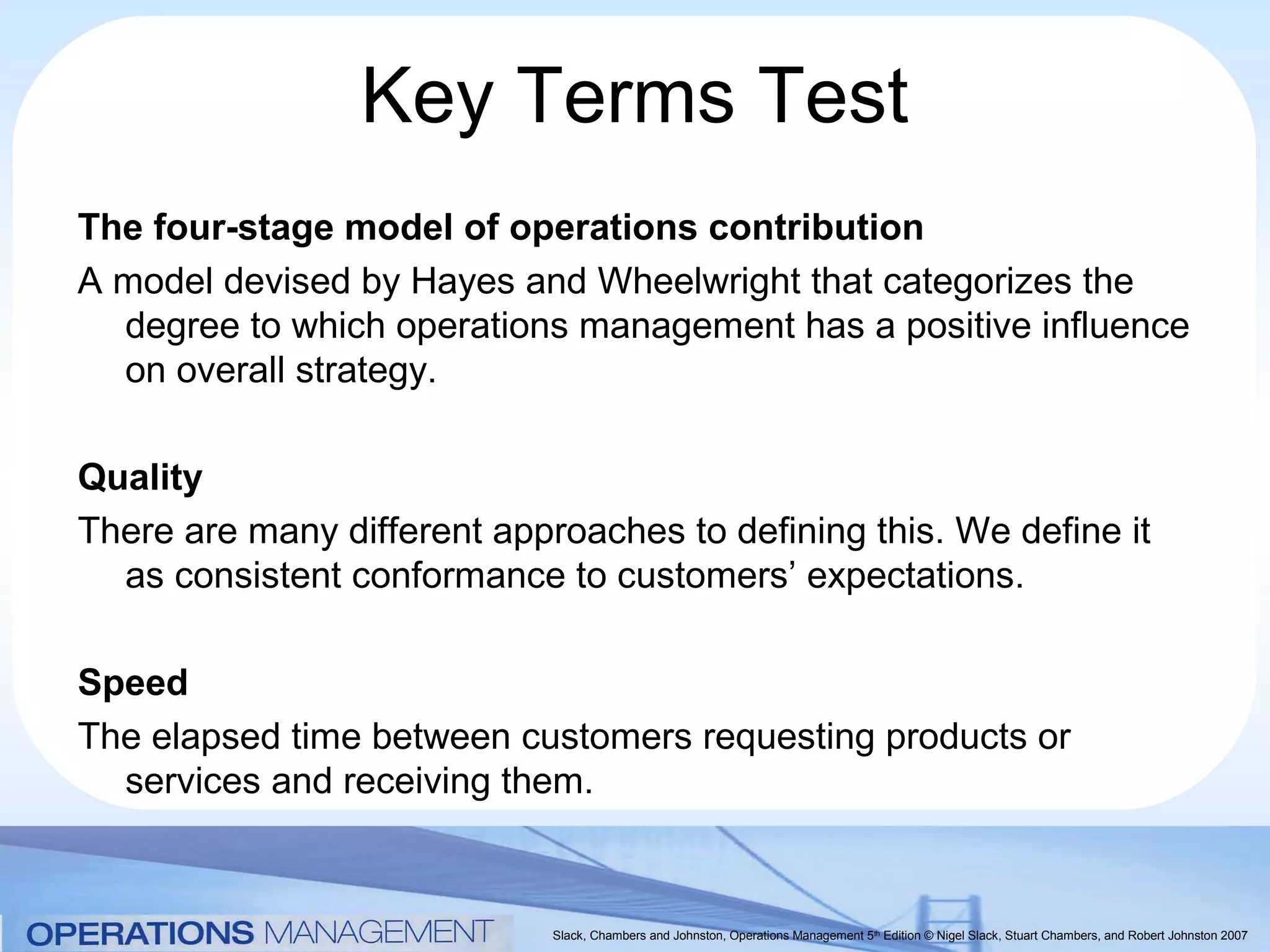
Key Terms Test
The four-stage model of operations contribution
A model devised by Hayes and Wheelwright that categorizes the
  degree to which operations management has a positive influence
  on overall strategy.

Quality
There are many different approaches to defining this. We define it
  as consistent conformance to customers’ expectations.

Speed
The elapsed time between customers requesting products or
  services and receiving them.


                             Slack, Chambers and Johnston, Operations Management 5th Edition © Nigel Slack, Stuart Chambers, and Robert Johnston 2007
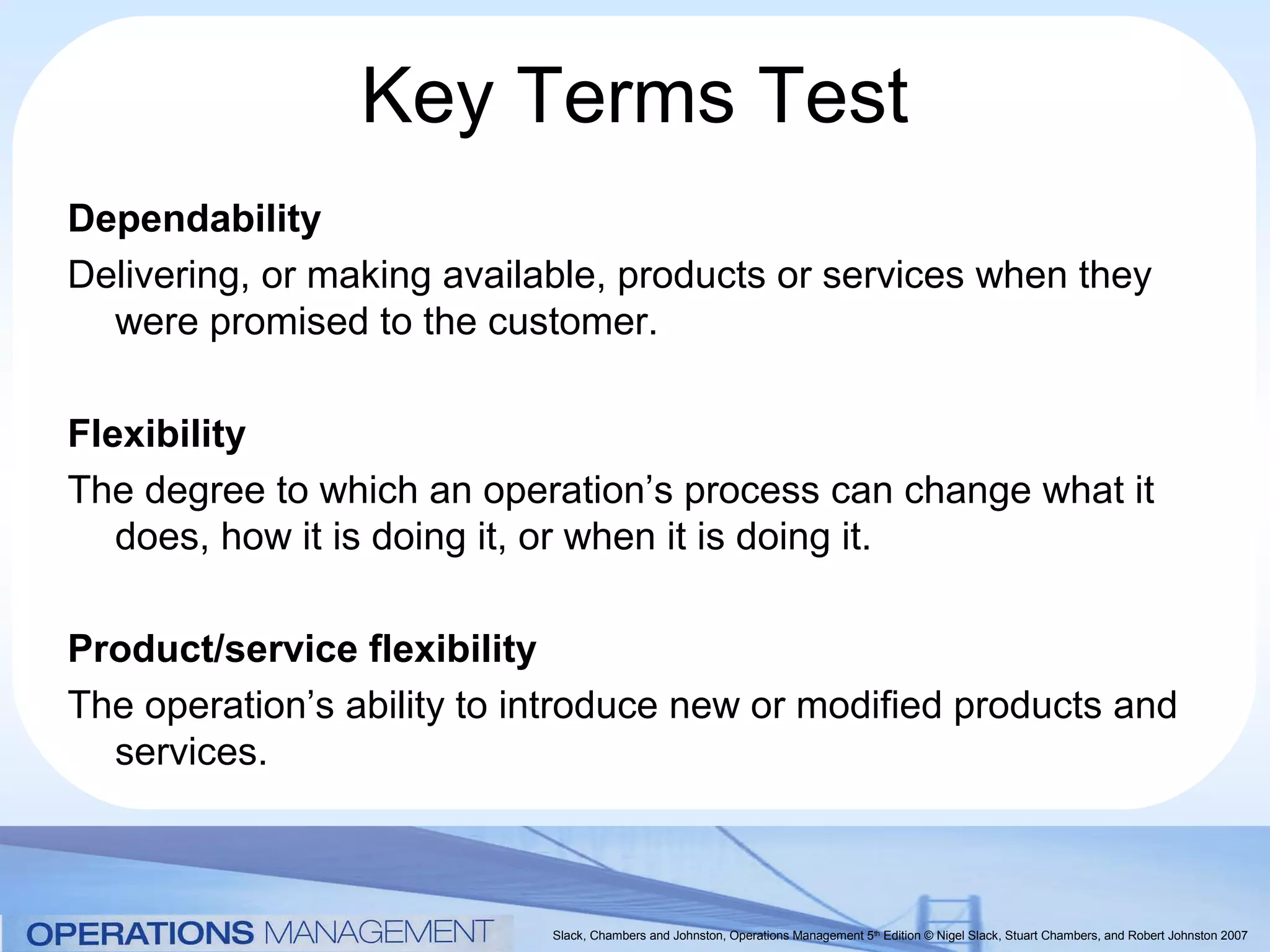
Key Terms Test
Dependability
Delivering, or making available, products or services when they
  were promised to the customer.

Flexibility
The degree to which an operation’s process can change what it
   does, how it is doing it, or when it is doing it.

Product/service flexibility
The operation’s ability to introduce new or modified products and
  services.


                            Slack, Chambers and Johnston, Operations Management 5th Edition © Nigel Slack, Stuart Chambers, and Robert Johnston 2007
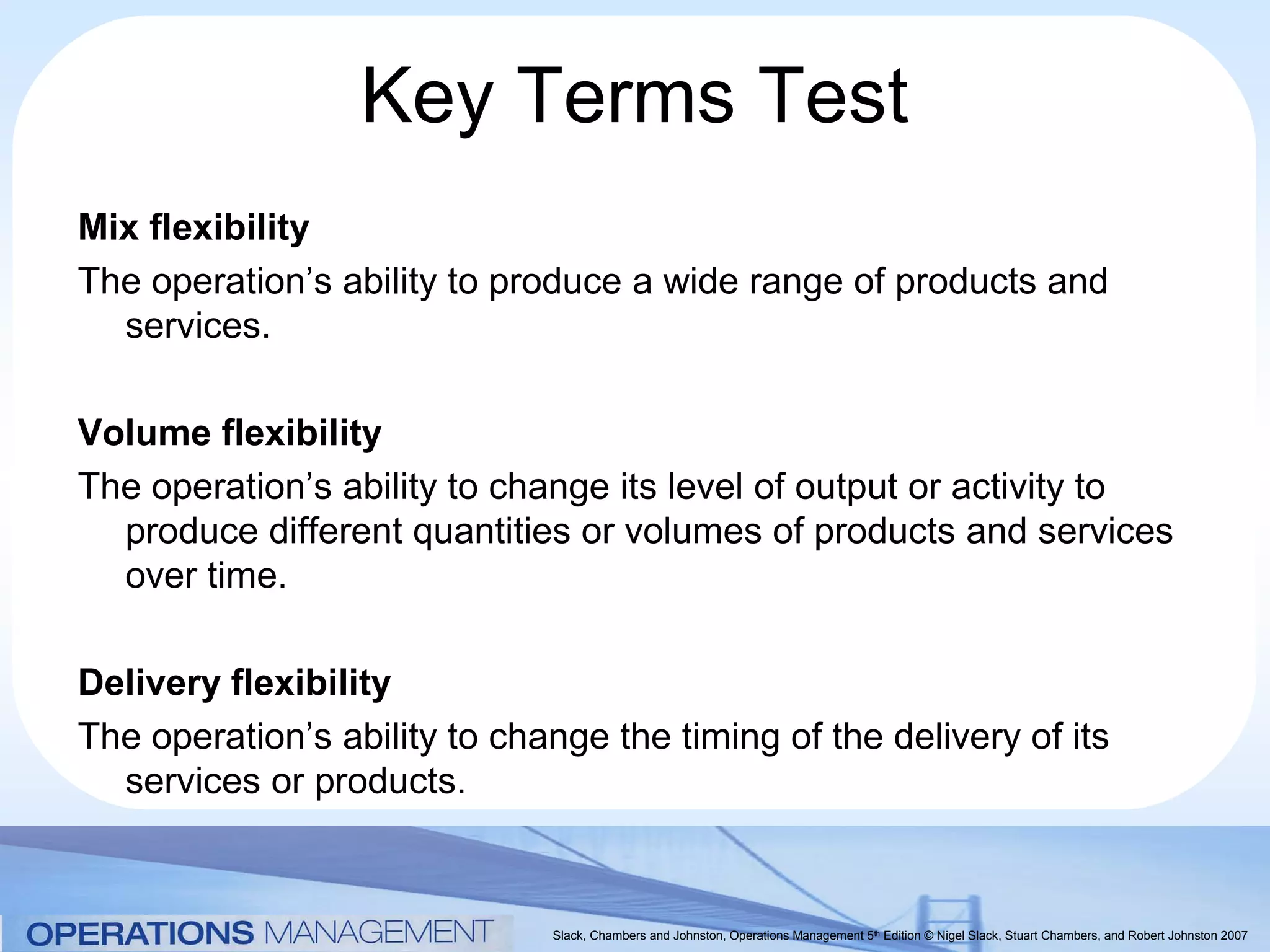
Key Terms Test
Mix flexibility
The operation’s ability to produce a wide range of products and
  services.

Volume flexibility
The operation’s ability to change its level of output or activity to
  produce different quantities or volumes of products and services
  over time.
Delivery flexibility
The operation’s ability to change the timing of the delivery of its
  services or products.

                              Slack, Chambers and Johnston, Operations Management 5th Edition © Nigel Slack, Stuart Chambers, and Robert Johnston 2007
Key Terms Test
Mass customization
The ability to produce products or services in high volume, yet vary
  their specification to the needs of individual customers or types
  of customer.

Agility
The ability of an operation to respond quickly and at low cost as
  market requirements change.

Productivity
The ratio of what is produced by an operation or process to what is
  required to produce it, that is, the output from the operation
  divided by the input to the operation.


                             Slack, Chambers and Johnston, Operations Management 5th Edition © Nigel Slack, Stuart Chambers, and Robert Johnston 2007

Role of operations, objectives of operations

  • 1.
    Chapter 2 The strategicrole and objectives of operations Source: Honda Motor Company Slack, Chambers and Johnston, Operations Management 5th Edition © Nigel Slack, Stuart Chambers, and Robert Johnston 2007
  • 2.
    What is therole of the Operations function? Operations as Operations strategy Operations supports implementer as driver Operations Operations Strategy Strategy Operations supporter as Strategy Operations Operations Operations implements strategy drives strategy Slack, Chambers and Johnston, Operations Management 5th Edition © Nigel Slack, Stuart Chambers, and Robert Johnston 2007
  • 3.
    The strategic roleof the Operations function The 3 key attributes Operations contribution of Operations Implementing Be dependable Operationalize strategy Explain practicalities Supporting Be appropriate Understand strategy Contribute to decisions Driving Be innovative Provide foundation of strategy Develop long-term capabilities Slack, Chambers and Johnston, Operations Management 5th Edition © Nigel Slack, Stuart Chambers, and Robert Johnston 2007
  • 4.
    The four-stage modelof Operations contribution ons ti Redefining industry STAGE 4 era expectations Give an p operations of o advantage Increasing strategic impact tion STAGE 3 Clearly the best in Link strategy ing ribu with operations riv egy D at the industry str ont c STAGE 2 ng rt i y ng As good as the Adopt best o pp t eg si competitors practice Su tra rea Inc s g STAGE 1 t in Holding the Correct the en m gy organization back worst ple te Im stra problems Internally Externally Internally Externally neutral neutral supportive supportive Increasing operations capabilities Slack, Chambers and Johnston, Operations Management 5th Edition © Nigel Slack, Stuart Chambers, and Robert Johnston 2007
  • 5.
    Broad strategic objectivesfor an operation applied to stakeholder groups Society Increase employment Enhance community well-being Produce sustainable products Ensure clean environment Suppliers Customers Continue business Appropriate product or Develop supplier service specification capability Consistent quality Provide transparent Fast delivery information Dependable delivery Acceptable price Shareholders Employees Economic value from Continuous employment investment Fair pay Ethical value from Good working conditions investment Personal development Slack, Chambers and Johnston, Operations Management 5th Edition © Nigel Slack, Stuart Chambers, and Robert Johnston 2007
  • 6.
    The Operations functioncan provide a competitive advantage through its performance at the five competitive objectives Quality Being RIGHT Speed Being FAST Competitiveness Dependability Being ON TIME Flexibility Being ABLE TO CHANGE Cost Being PRODUCTIVE Slack, Chambers and Johnston, Operations Management 5th Edition © Nigel Slack, Stuart Chambers, and Robert Johnston 2007
  • 7.
    What do theterms quality, speed, dependability, flexibility and cost mean in the context of operations? Which enables you to do things cheaply (cost advantage)? Which enables you to change what you do (flexibility advantage)? Which enables you to do things quickly (speed advantage)? Which enables you to do things on time (dependability advantage)? Which enables you to do things right (quality advantage)? Slack, Chambers and Johnston, Operations Management 5th Edition © Nigel Slack, Stuart Chambers, and Robert Johnston 2007
  • 8.
    The benefits ofexcelling Minimum price, highest value Cost Quick Dependable delivery delivery Minimum cost, Speed maximum value Dependability Fast Reliable throughput operation Error-free Ability to processes change Quality Flexibility Error-free Frequent new products and products, maximum services choice Slack, Chambers and Johnston, Operations Management 5th Edition © Nigel Slack, Stuart Chambers, and Robert Johnston 2007
  • 9.
    What does Qualitymean in … … a hospital? Patients receive the most appropriate treatment Treatment is carried out in the correct manner Patients are consulted and kept informed Staff are courteous, friendly and helpful Slack, Chambers and Johnston, Operations Management 5th Edition © Nigel Slack, Stuart Chambers, and Robert Johnston 2007
  • 10.
    What does Qualitymean in … … an automobile plant? All assembly is to specification Product is reliable All parts are made to specification The product is attractive and blemish-free Slack, Chambers and Johnston, Operations Management 5th Edition © Nigel Slack, Stuart Chambers, and Robert Johnston 2007
  • 11.
    What does Qualitymean in … … a bus company? The buses are clean and tidy The buses are quiet and fume-free The timetable is accurate and user-friendly Staff are courteous, friendly and helpful Slack, Chambers and Johnston, Operations Management 5th Edition © Nigel Slack, Stuart Chambers, and Robert Johnston 2007
  • 12.
    What does Qualitymean in … … a supermarket? The store is clean and tidy Décor is appropriate and attractive Goods are in good condition Staff are courteous, friendly and helpful Slack, Chambers and Johnston, Operations Management 5th Edition © Nigel Slack, Stuart Chambers, and Robert Johnston 2007
  • 13.
    Quality ‘Quality’ has several meanings. The two most common are … Quality as the specification of a product or service e.g. Lower Hurst Farm produces organic meat raised exclusively on its own farm Quality as the conformance with which the product or service is produced e.g. Quick-service restaurants like McDonald’s may buy less expensive meat, but its conformance must be high Slack, Chambers and Johnston, Operations Management 5th Edition © Nigel Slack, Stuart Chambers, and Robert Johnston 2007
  • 14.
    Quality Irrespective of aproduct or service’s specification quality, producing it so it conforms to its specification consistently brings benefits to any operation Externally – it enhances the product or service in the market, or at least avoids customer complaints Internally – it brings other benefits to the operation: It prevents errors slowing down throughput speed It prevents errors causing internal unreliability and low dependability It prevents errors causing wasted time and effort, therefore saving cost Slack, Chambers and Johnston, Operations Management 5th Edition © Nigel Slack, Stuart Chambers, and Robert Johnston 2007
  • 15.
    Quality External and internal benefits Cost Speed Depend- ability Quality Flexibility On-specification products and services Slack, Chambers and Johnston, Operations Management 5th Edition © Nigel Slack, Stuart Chambers, and Robert Johnston 2007
  • 16.
    What does Speedmean in … … a hospital? The time between requiring treatment and receiving treatment is kept to a minimum The time for test results, X-rays, etc. to be returned is kept to a minimum Slack, Chambers and Johnston, Operations Management 5th Edition © Nigel Slack, Stuart Chambers, and Robert Johnston 2007
  • 17.
    What does Speedmean in … … an automobile plant? The time between dealers requesting a vehicle of a particular specification and receiving it is minimized The time to deliver spares to service centres is minimized Slack, Chambers and Johnston, Operations Management 5th Edition © Nigel Slack, Stuart Chambers, and Robert Johnston 2007
  • 18.
    What does Speedmean in … … a bus company? The time between a customer setting out on the journey and reaching his or her destination is kept to a minimum Slack, Chambers and Johnston, Operations Management 5th Edition © Nigel Slack, Stuart Chambers, and Robert Johnston 2007
  • 19.
    What does Speedmean in … … a supermarket? The time for the total transaction of going to the supermarket, making the purchases and returning is minimized Goods are immediately available Slack, Chambers and Johnston, Operations Management 5th Edition © Nigel Slack, Stuart Chambers, and Robert Johnston 2007
  • 20.
    Speed Speed again hasdifferent interpretations, externally and internally Externally – it means the elapsed time between a customer asking for a product or service and getting it (in a satisfactory condition) It often enhances the value of the product or service to customers Internally – it brings other benefits to the operation: It helps to overcome internal problems by maintaining dependability It reduces the need to manage transformed resources as they pass through the operation, therefore saving cost Slack, Chambers and Johnston, Operations Management 5th Edition © Nigel Slack, Stuart Chambers, and Robert Johnston 2007
  • 21.
    Speed External and internal benefits Cost Short delivery lead-time Speed Depend- ability Quality Flexibility On-specification products and services Slack, Chambers and Johnston, Operations Management 5th Edition © Nigel Slack, Stuart Chambers, and Robert Johnston 2007
  • 22.
    What does Dependabilitymean in … … a hospital? The proportion of appointments that are cancelled is kept to a minimum Keeping appointment times Test results, X-rays, etc. are returned as promised Slack, Chambers and Johnston, Operations Management 5th Edition © Nigel Slack, Stuart Chambers, and Robert Johnston 2007
  • 23.
    What does Dependabilitymean in … … an automobile plant? On-time delivery of vehicles to dealers On-time delivery of spares to service centres Slack, Chambers and Johnston, Operations Management 5th Edition © Nigel Slack, Stuart Chambers, and Robert Johnston 2007
  • 24.
    What does Dependabilitymean in … … a bus company? Keeping to the published timetable at all points on the route Constant availability of seats for passengers Slack, Chambers and Johnston, Operations Management 5th Edition © Nigel Slack, Stuart Chambers, and Robert Johnston 2007
  • 25.
    What does Dependabilitymean in … … a supermarket? Predictable opening hours Proportion of goods out of stock kept to a minimum Keeping to reasonable queuing times Constant availability of parking Slack, Chambers and Johnston, Operations Management 5th Edition © Nigel Slack, Stuart Chambers, and Robert Johnston 2007
  • 26.
    Dependability Externally – itenhances the product or service in the market, or at least avoids customer complaints Internally – it brings other benefits to the operation: It prevents late delivery slowing down throughput speed It prevents lateness causing disruption and wasted time and effort, therefore saving cost Slack, Chambers and Johnston, Operations Management 5th Edition © Nigel Slack, Stuart Chambers, and Robert Johnston 2007
  • 27.
    Dependability External and internal benefits Cost Short delivery Reliable lead-time delivery Speed Depend- ability Quality Flexibility On-specification products and services Slack, Chambers and Johnston, Operations Management 5th Edition © Nigel Slack, Stuart Chambers, and Robert Johnston 2007
  • 28.
    Flexibility Flexibility has severaldistinct meanings but is always associated with an operation’s ability to change Change what ? The products and services it brings to the market – Product/service flexibility The mix of products and services it produces at any one time – Mix flexibility The volume of products and services it produces – Volume flexibility The delivery time of its products and services – Delivery flexibility Slack, Chambers and Johnston, Operations Management 5th Edition © Nigel Slack, Stuart Chambers, and Robert Johnston 2007
  • 29.
    What does Flexibilitymean in … … a hospital? Introducing new treatments Providing a wide range of treatments The ability to adjust the number of patients treated The ability to reschedule appointments Slack, Chambers and Johnston, Operations Management 5th Edition © Nigel Slack, Stuart Chambers, and Robert Johnston 2007
  • 30.
    What does Flexibilitymean in … … an automobile plant? The introduction of new models A wide range of options The ability to adjust the number of vehicles manufactured The ability to reschedule manufacturing priorities Slack, Chambers and Johnston, Operations Management 5th Edition © Nigel Slack, Stuart Chambers, and Robert Johnston 2007
  • 31.
    What does Flexibilitymean in … … a bus company? The introduction of new routes and excursions A large number of locations served The ability to adjust the frequency of services The ability to reschedule trips Slack, Chambers and Johnston, Operations Management 5th Edition © Nigel Slack, Stuart Chambers, and Robert Johnston 2007
  • 32.
    What does Flexibilitymean in … … a supermarket? The introduction of new lines A wide range of goods stocked The ability to adjust the number of customers served The ability to get out-of-stock items Slack, Chambers and Johnston, Operations Management 5th Edition © Nigel Slack, Stuart Chambers, and Robert Johnston 2007
  • 33.
    Flexibility External and internal benefits Cost Short delivery Reliable lead-time delivery Speed Depend- ability Quality Flexibility Frequent new products/services On-specification Wide range products and Volume and delivery services changes Slack, Chambers and Johnston, Operations Management 5th Edition © Nigel Slack, Stuart Chambers, and Robert Johnston 2007
  • 34.
    What does Costmean in … … a hospital? Technology Bought-in and facilities materials costs and services Staff costs Slack, Chambers and Johnston, Operations Management 5th Edition © Nigel Slack, Stuart Chambers, and Robert Johnston 2007
  • 35.
    What does Costmean in … … an automobile plant? Bought-in Technology materials and facilities and costs services Staff costs Slack, Chambers and Johnston, Operations Management 5th Edition © Nigel Slack, Stuart Chambers, and Robert Johnston 2007
  • 36.
    What does Costmean in … … a bus company? Bought-in materials Technology and and facilities services costs Staff costs Slack, Chambers and Johnston, Operations Management 5th Edition © Nigel Slack, Stuart Chambers, and Robert Johnston 2007
  • 37.
    What does Costmean in … … a supermarket? Technology Bought-in and facilities materials costs and services Staff costs Slack, Chambers and Johnston, Operations Management 5th Edition © Nigel Slack, Stuart Chambers, and Robert Johnston 2007
  • 38.
    Cost The cost ofproducing products and services is obviously influenced by many factors such as input costs, but two important sets are … The 4 V’s: volume variety variation visibility The internal performance of the operation in terms of quality speed dependability flexibility Slack, Chambers and Johnston, Operations Management 5th Edition © Nigel Slack, Stuart Chambers, and Robert Johnston 2007
  • 39.
    Cost External and Low price, high internal benefits margin, or both Cost Short delivery Reliable lead-time delivery Speed Depend- ability Quality Flexibility Frequent new products/services On-specification Wide range products and Volume and delivery services changes Slack, Chambers and Johnston, Operations Management 5th Edition © Nigel Slack, Stuart Chambers, and Robert Johnston 2007
  • 40.
    Polar diagrams Polar diagramsare used to indicate the relative importance of each performance objective to an operation or process They can also be used to indicate the difference between different products and services produced by an operation or process Slack, Chambers and Johnston, Operations Management 5th Edition © Nigel Slack, Stuart Chambers, and Robert Johnston 2007
  • 41.
    Polar diagrams fora taxi service versus a bus service Taxi Bus service service Cost Speed Dependability Quality Flexibility Slack, Chambers and Johnston, Operations Management 5th Edition © Nigel Slack, Stuart Chambers, and Robert Johnston 2007
  • 42.
    Polar diagrams fora proposed police performance method Required performance Actual performance Reassurance Efficiency Crime reduction Crime Working with detection criminal justice agencies Slack, Chambers and Johnston, Operations Management 5th Edition © Nigel Slack, Stuart Chambers, and Robert Johnston 2007
  • 43.
    Polar diagrams fornewspaper collection and general recycling services General recycling Newspaper collection service service Cost Speed Dependability Quality Flexibility Slack, Chambers and Johnston, Operations Management 5th Edition © Nigel Slack, Stuart Chambers, and Robert Johnston 2007
  • 44.
    Key Terms Test Thefour-stage model of operations contribution A model devised by Hayes and Wheelwright that categorizes the degree to which operations management has a positive influence on overall strategy. Quality There are many different approaches to defining this. We define it as consistent conformance to customers’ expectations. Speed The elapsed time between customers requesting products or services and receiving them. Slack, Chambers and Johnston, Operations Management 5th Edition © Nigel Slack, Stuart Chambers, and Robert Johnston 2007
  • 45.
    Key Terms Test Dependability Delivering,or making available, products or services when they were promised to the customer. Flexibility The degree to which an operation’s process can change what it does, how it is doing it, or when it is doing it. Product/service flexibility The operation’s ability to introduce new or modified products and services. Slack, Chambers and Johnston, Operations Management 5th Edition © Nigel Slack, Stuart Chambers, and Robert Johnston 2007
  • 46.
    Key Terms Test Mixflexibility The operation’s ability to produce a wide range of products and services. Volume flexibility The operation’s ability to change its level of output or activity to produce different quantities or volumes of products and services over time. Delivery flexibility The operation’s ability to change the timing of the delivery of its services or products. Slack, Chambers and Johnston, Operations Management 5th Edition © Nigel Slack, Stuart Chambers, and Robert Johnston 2007
  • 47.
    Key Terms Test Masscustomization The ability to produce products or services in high volume, yet vary their specification to the needs of individual customers or types of customer. Agility The ability of an operation to respond quickly and at low cost as market requirements change. Productivity The ratio of what is produced by an operation or process to what is required to produce it, that is, the output from the operation divided by the input to the operation. Slack, Chambers and Johnston, Operations Management 5th Edition © Nigel Slack, Stuart Chambers, and Robert Johnston 2007

Editor's Notes