By Bill Donegan, MSCS
Director of Engineering
SMART Holdings USA

http://www.linkedin.com/in/billdonegan                    Week 11: How to Succeed
                                                          and Think Like an Engineer
                                                          §   Cost Strategies

                                                          §   Focus

                                                          §   Differentiation
Required Text:
How to Succeed As an Engineer
By Todd Yuzuriha
                                                          §   Competitor product analysis
Institute of Electrical & Electronics Engineers
ISBN- 9780780347359
A concise reference on engineering survival skills,
this book shows readers how to take charge of their
                                                          §   Making a difference as an engineer
career in order to survive and excel in today's
engineering world. It will improve the reader's ability
to communicate, solve problems, make technical
decisions, lead projects, and impact business results.
                                                          §   Exchange rates and engineers

                                                          §   Finance and today’s engineer

                                                          §   Financial linkages
Introduction
●   There's more to engineering than math!
    ●   You have to understand others, and make yourself
        understood (Communication).
    ●   You have to plot out what you are going to do and
        how you are going to do it (Strategic Planning).
    ●   You need to understand how you are going to pay
        for and make money from what you are going to do
        (Finance).
    ●   You need to understand the mathematics of chance
        (Statistics).
    ●   You need to pull different activities together to
        accomplish a result (Project management).
Communications
●   Personal Communications
    ●   (Talking to yourself)
●   Interpersonal Communtications
●   Getting along with others
Personal Communications
●   Develop a strategic plan for yourself:
    ●   Lifetime goals
    ●   Development plan
    ●   Shorter term goals
    ●   Environment
Personal Communications
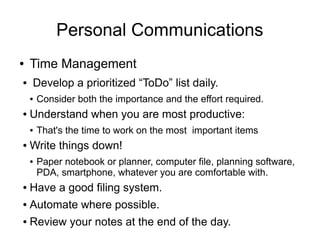
●   Time Management
●   Develop a prioritized “ToDo” list daily.
    ●   Consider both the importance and the effort required.
●   Understand when you are most productive:
    ●   That's the time to work on the most important items
●   Write things down!
    ●   Paper notebook or planner, computer file, planning software,
        PDA, smartphone, whatever you are comfortable with.
●   Have a good filing system.
●   Automate where possible.
●   Review your notes at the end of the day.
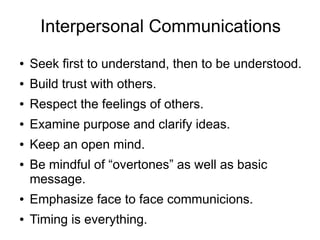
Interpersonal Communications
●   Seek first to understand, then to be understood.
●   Build trust with others.
●   Respect the feelings of others.
●   Examine purpose and clarify ideas.
●   Keep an open mind.
●   Be mindful of “overtones” as well as basic
    message.
●   Emphasize face to face communicions.
●   Timing is everything.
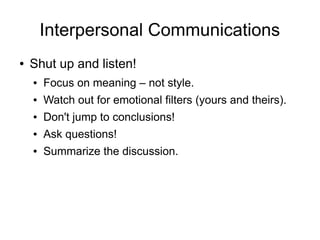
Interpersonal Communications
●   Shut up and listen!
    ●   Focus on meaning – not style.
    ●   Watch out for emotional filters (yours and theirs).
    ●   Don't jump to conclusions!
    ●   Ask questions!
    ●   Summarize the discussion.
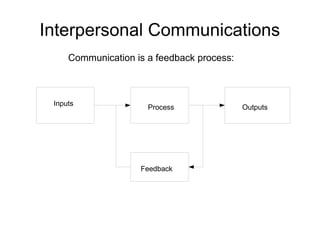
Interpersonal Communications
     Communication is a feedback process:


 Inputs
                      Process               Outputs


                    Feedback
Presentation Preparation
●   Who, what, when, why, where, how?
    ●   Know who you will be addressing.
    ●   Know what you will be telling them.
    ●   Understand the timing of your presentation.
    ●   Now why they might be interested.
    ●   Understand the physical environment.
    ●   Tailor your message to the medium.
Practical matters
●   Get along with your boss and co-workers.
    ●   Respect and trust are key.
    ●   With boss – make sure you know goals and priorities.
    ●   With co-workers – ID ways to collaborate.
        – Help each other out.
    ●   When problems arise:
        –Take the initiative.
       – Keep the temperature down!
       – LISTEN!
●   Remember, you don't have to be friends with everyone you
    work with / for, but you still have to work together!
Strategic Planning
●   Definition.
●   Generic Strategies.
    ●   Cost Leadership.
    ●   Differentiation.
    ●   Focus.
●   How to contribute as an engineer.
●   Pitfalls.
Strategic Planning
●   Definition:
    ●   Goals.
        –   Values, Products, Markets, Finances
    ●   Capabilities.
    ●   Business Environment.
        –   New Entrants, Substitution.
        –   Buyers, Suppliers, Competitors
Strategic Planning
●   Generic Strategies:
    ●   Cost Leadership
        –   Cost is not the same as price.
    ●   Differentiation
        –   Example: Apple Mac's priced higher than Wintel PC's.
    ●   Focus
        –   Go after a niche.
    ●   Be first on the market!
Strategic Planning
●   How to Contribute as an Engineer:
    ●   Know what your customers want.
    ●   Know the competitors products, and how yours
        compare.
    ●   Develop an efficient product development process.
Strategic Planning
●   Pitfalls
    ●   A Strategic Plan is long term and directional. It is
        not the place for specific measurements.
    ●   A Strategic Plan is not a forecast.
    ●   Strategic Planning requires a deep knowledge of
        the larger business environment.
        –   New entrants, Substitution, Competition.
        –   Buyers, Suppliers.
        –   “You've got to know the territory!”
Finance
●   Business as a Dynamic System
●   Financial Reporting
●   Financial Analysis
●   Making a Difference as an Engineer
●   International Finance
Finance
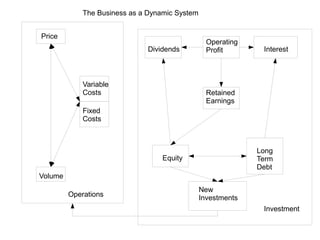
●   The Business as a Dynamic System:
    ●   Operations Concerns
        –   Target Market, Pricing Strategy
        –   Deployment of Assets, Cost Effectiveness
        –   Operating Leverage
    ●   Investment Concerns
        –   Disposition of Profits:
             ●   Dividends → Owners / Stockholders
             ●   Interest → Lenders / Bondholders
             ●   Reinvestment of Profits → RDT&E, Expansion
        –   Financial Leverage
The Business as a Dynamic System


Price
                                                  Operating
                               Dividends          Profit       Interest


             Variable
             Costs                                Retained
                                                  Earnings
             Fixed
             Costs


                                                              Long
                                   Equity                     Term
                                                              Debt
Volume
                                                New
         Operations                             Investments
                                                               Investment
Statistics
●   OK, so there's still a lot of math!
●   Primary applications:
    ●   Statistical Process Control (SPC)
    ●   Design of Experiments (DOE)
Statistics
            60                              Normal Distribution


            50


            40
Frequency


            30
                                                                                  Data


            20
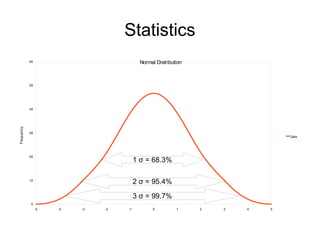
                                          1 σ = 68.3%

            10
                                          2 σ = 95.4%

                                          3 σ = 99.7%
             0
                 -5   -5   -3   -2   -1          0          1     2   3   4   5
Statistics
●   Statistical Process Control
    ●   Need to control variability.
    ●   Decide what is important to measure – then
        measure it.
    ●   Consider the mean (arithmetic average), the range
        of values, and the standard deviation.
    ●   Consider the percent that fail to meet specifications.
    ●   Perform Pareto analysis to determine where the
        problems occur.
Statistics
●   Design of Experiments
    ●   State objective
    ●   Define acceptable risks – primary and secondary
    ●   Determine significant difference
    ●   Determine variables
    ●   Calculate sample size
    ●   Establish test criteria
    ●   Perform experiment
    ●   Compare results with test criteria
    ●   Make a decision
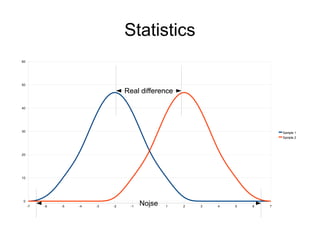
Statistics
60


50

                                   Real difference

40


30                                                                           Sample 1
                                                                             Sample 2


20


10


 0
     -7   -6   -5   -4   -3   -2    -1
                                         Noise
                                           0     1   2   3   4   5   6   7
Project Management
●   Pulling it all together
    ●   Effective Communication
    ●   Align with Strategic Plan
    ●   Align with Financial Goals
    ●   Use Statistics for Control
    ●   Use Management Tools
Project Management
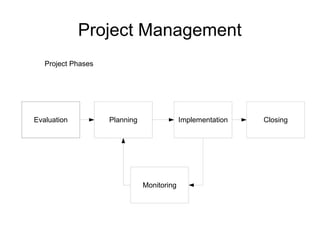
   Project Phases


Evaluation          Planning                Implementation   Closing


                               Monitoring
Project Management
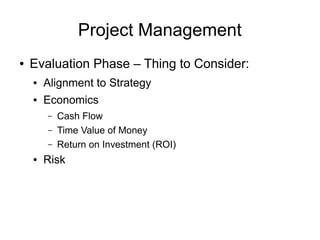
●   Evaluation Phase – Thing to Consider:
    ●   Alignment to Strategy
    ●   Economics
        –   Cash Flow
        –   Time Value of Money
        –   Return on Investment (ROI)
    ●   Risk
Project Management
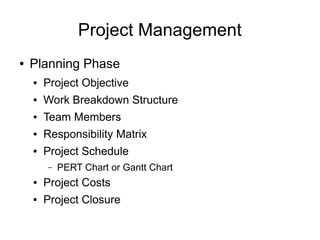
●   Planning Phase
    ●   Project Objective
    ●   Work Breakdown Structure
    ●   Team Members
    ●   Responsibility Matrix
    ●   Project Schedule
        –   PERT Chart or Gantt Chart
    ●   Project Costs
    ●   Project Closure
Project Management
●   Implementation Phase
    ●   PM role is mainly communication
        –   Project team reviews
        –   Executive reviews
        –   Customer reviews
    ●   Conflict resolution
        –   Forcing – only when necessary
        –   Avoiding – bad idea!
        –   Accommodating – can lead to more conflict.
        –   Compromising – politics at its best and worst.
        –   Collaborating – best solution when possible.
Project Management
●   Monitoring Projects
    ●   Planning is good – but it don't mean a thing if you
        don't track the implementation against the plan.
    ●   Software such as Microsoft Project can help – but it
        does not do the job for you.
    ●   Track actual vs. current plan vs. original plan on
        your PERT or Gantt charts.
    ●   Need regular status meetings (teleconferences or
        web conferences are good here).
Project Management
●   Closing Projects
    ●   “It ain't over until it's over!” (L. P. Berra)
    ●   Write a final project report.
    ●   Recognition of team members and outsiders.
    ●   Transfer the technology.
    ●   Transfer the team members appropriately.
    ●   Celebrate!
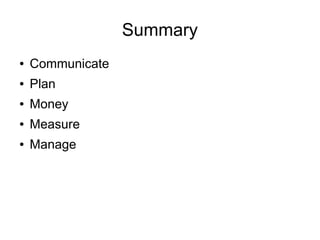
Summary
●   Communicate
●   Plan
●   Money
●   Measure
●   Manage

How To Think Like An Engineer

  • 1.
    By Bill Donegan,MSCS Director of Engineering SMART Holdings USA http://www.linkedin.com/in/billdonegan Week 11: How to Succeed and Think Like an Engineer § Cost Strategies § Focus § Differentiation Required Text: How to Succeed As an Engineer By Todd Yuzuriha § Competitor product analysis Institute of Electrical & Electronics Engineers ISBN- 9780780347359 A concise reference on engineering survival skills, this book shows readers how to take charge of their § Making a difference as an engineer career in order to survive and excel in today's engineering world. It will improve the reader's ability to communicate, solve problems, make technical decisions, lead projects, and impact business results. § Exchange rates and engineers § Finance and today’s engineer § Financial linkages
  • 2.
    Introduction ● There's more to engineering than math! ● You have to understand others, and make yourself understood (Communication). ● You have to plot out what you are going to do and how you are going to do it (Strategic Planning). ● You need to understand how you are going to pay for and make money from what you are going to do (Finance). ● You need to understand the mathematics of chance (Statistics). ● You need to pull different activities together to accomplish a result (Project management).
  • 3.
    Communications ● Personal Communications ● (Talking to yourself) ● Interpersonal Communtications ● Getting along with others
  • 4.
    Personal Communications ● Develop a strategic plan for yourself: ● Lifetime goals ● Development plan ● Shorter term goals ● Environment
  • 5.
    Personal Communications ● Time Management ● Develop a prioritized “ToDo” list daily. ● Consider both the importance and the effort required. ● Understand when you are most productive: ● That's the time to work on the most important items ● Write things down! ● Paper notebook or planner, computer file, planning software, PDA, smartphone, whatever you are comfortable with. ● Have a good filing system. ● Automate where possible. ● Review your notes at the end of the day.
  • 6.
    Interpersonal Communications ● Seek first to understand, then to be understood. ● Build trust with others. ● Respect the feelings of others. ● Examine purpose and clarify ideas. ● Keep an open mind. ● Be mindful of “overtones” as well as basic message. ● Emphasize face to face communicions. ● Timing is everything.
  • 7.
    Interpersonal Communications ● Shut up and listen! ● Focus on meaning – not style. ● Watch out for emotional filters (yours and theirs). ● Don't jump to conclusions! ● Ask questions! ● Summarize the discussion.
  • 8.
    Interpersonal Communications Communication is a feedback process: Inputs Process Outputs Feedback
  • 9.
    Presentation Preparation ● Who, what, when, why, where, how? ● Know who you will be addressing. ● Know what you will be telling them. ● Understand the timing of your presentation. ● Now why they might be interested. ● Understand the physical environment. ● Tailor your message to the medium.
  • 10.
    Practical matters ● Get along with your boss and co-workers. ● Respect and trust are key. ● With boss – make sure you know goals and priorities. ● With co-workers – ID ways to collaborate. – Help each other out. ● When problems arise: –Take the initiative. – Keep the temperature down! – LISTEN! ● Remember, you don't have to be friends with everyone you work with / for, but you still have to work together!
  • 11.
    Strategic Planning ● Definition. ● Generic Strategies. ● Cost Leadership. ● Differentiation. ● Focus. ● How to contribute as an engineer. ● Pitfalls.
  • 12.
    Strategic Planning ● Definition: ● Goals. – Values, Products, Markets, Finances ● Capabilities. ● Business Environment. – New Entrants, Substitution. – Buyers, Suppliers, Competitors
  • 13.
    Strategic Planning ● Generic Strategies: ● Cost Leadership – Cost is not the same as price. ● Differentiation – Example: Apple Mac's priced higher than Wintel PC's. ● Focus – Go after a niche. ● Be first on the market!
  • 14.
    Strategic Planning ● How to Contribute as an Engineer: ● Know what your customers want. ● Know the competitors products, and how yours compare. ● Develop an efficient product development process.
  • 15.
    Strategic Planning ● Pitfalls ● A Strategic Plan is long term and directional. It is not the place for specific measurements. ● A Strategic Plan is not a forecast. ● Strategic Planning requires a deep knowledge of the larger business environment. – New entrants, Substitution, Competition. – Buyers, Suppliers. – “You've got to know the territory!”
  • 16.
    Finance ● Business as a Dynamic System ● Financial Reporting ● Financial Analysis ● Making a Difference as an Engineer ● International Finance
  • 17.
    Finance ● The Business as a Dynamic System: ● Operations Concerns – Target Market, Pricing Strategy – Deployment of Assets, Cost Effectiveness – Operating Leverage ● Investment Concerns – Disposition of Profits: ● Dividends → Owners / Stockholders ● Interest → Lenders / Bondholders ● Reinvestment of Profits → RDT&E, Expansion – Financial Leverage
  • 18.
    The Business asa Dynamic System Price Operating Dividends Profit Interest Variable Costs Retained Earnings Fixed Costs Long Equity Term Debt Volume New Operations Investments Investment
  • 19.
    Statistics ● OK, so there's still a lot of math! ● Primary applications: ● Statistical Process Control (SPC) ● Design of Experiments (DOE)
  • 20.
    Statistics 60 Normal Distribution 50 40 Frequency 30 Data 20 1 σ = 68.3% 10 2 σ = 95.4% 3 σ = 99.7% 0 -5 -5 -3 -2 -1 0 1 2 3 4 5
  • 21.
    Statistics ● Statistical Process Control ● Need to control variability. ● Decide what is important to measure – then measure it. ● Consider the mean (arithmetic average), the range of values, and the standard deviation. ● Consider the percent that fail to meet specifications. ● Perform Pareto analysis to determine where the problems occur.
  • 22.
    Statistics ● Design of Experiments ● State objective ● Define acceptable risks – primary and secondary ● Determine significant difference ● Determine variables ● Calculate sample size ● Establish test criteria ● Perform experiment ● Compare results with test criteria ● Make a decision
  • 23.
    Statistics 60 50 Real difference 40 30 Sample 1 Sample 2 20 10 0 -7 -6 -5 -4 -3 -2 -1 Noise 0 1 2 3 4 5 6 7
  • 24.
    Project Management ● Pulling it all together ● Effective Communication ● Align with Strategic Plan ● Align with Financial Goals ● Use Statistics for Control ● Use Management Tools
  • 25.
    Project Management Project Phases Evaluation Planning Implementation Closing Monitoring
  • 26.
    Project Management ● Evaluation Phase – Thing to Consider: ● Alignment to Strategy ● Economics – Cash Flow – Time Value of Money – Return on Investment (ROI) ● Risk
  • 27.
    Project Management ● Planning Phase ● Project Objective ● Work Breakdown Structure ● Team Members ● Responsibility Matrix ● Project Schedule – PERT Chart or Gantt Chart ● Project Costs ● Project Closure
  • 28.
    Project Management ● Implementation Phase ● PM role is mainly communication – Project team reviews – Executive reviews – Customer reviews ● Conflict resolution – Forcing – only when necessary – Avoiding – bad idea! – Accommodating – can lead to more conflict. – Compromising – politics at its best and worst. – Collaborating – best solution when possible.
  • 29.
    Project Management ● Monitoring Projects ● Planning is good – but it don't mean a thing if you don't track the implementation against the plan. ● Software such as Microsoft Project can help – but it does not do the job for you. ● Track actual vs. current plan vs. original plan on your PERT or Gantt charts. ● Need regular status meetings (teleconferences or web conferences are good here).
  • 30.
    Project Management ● Closing Projects ● “It ain't over until it's over!” (L. P. Berra) ● Write a final project report. ● Recognition of team members and outsiders. ● Transfer the technology. ● Transfer the team members appropriately. ● Celebrate!
  • 31.
    Summary ● Communicate ● Plan ● Money ● Measure ● Manage