Developing an Effective Business Model
Lecture#07
Topic Objectives
1. Describe a business model.
2. Explain business model innovation.
3. Discuss the importance of having a clearly articulated business model.
4. Discuss the concept of the value chain.
5. Identify a business model’s two potential fatal flaws.
6. Identify a business model’s four major components.
7. Explain the meaning of the term business concept blind spot.
8. Define the term core competency and describe its importance.
9. Explain the concept of supply chain management.
10. Explain the concept of fulfillment and support.
What is a Business
Model
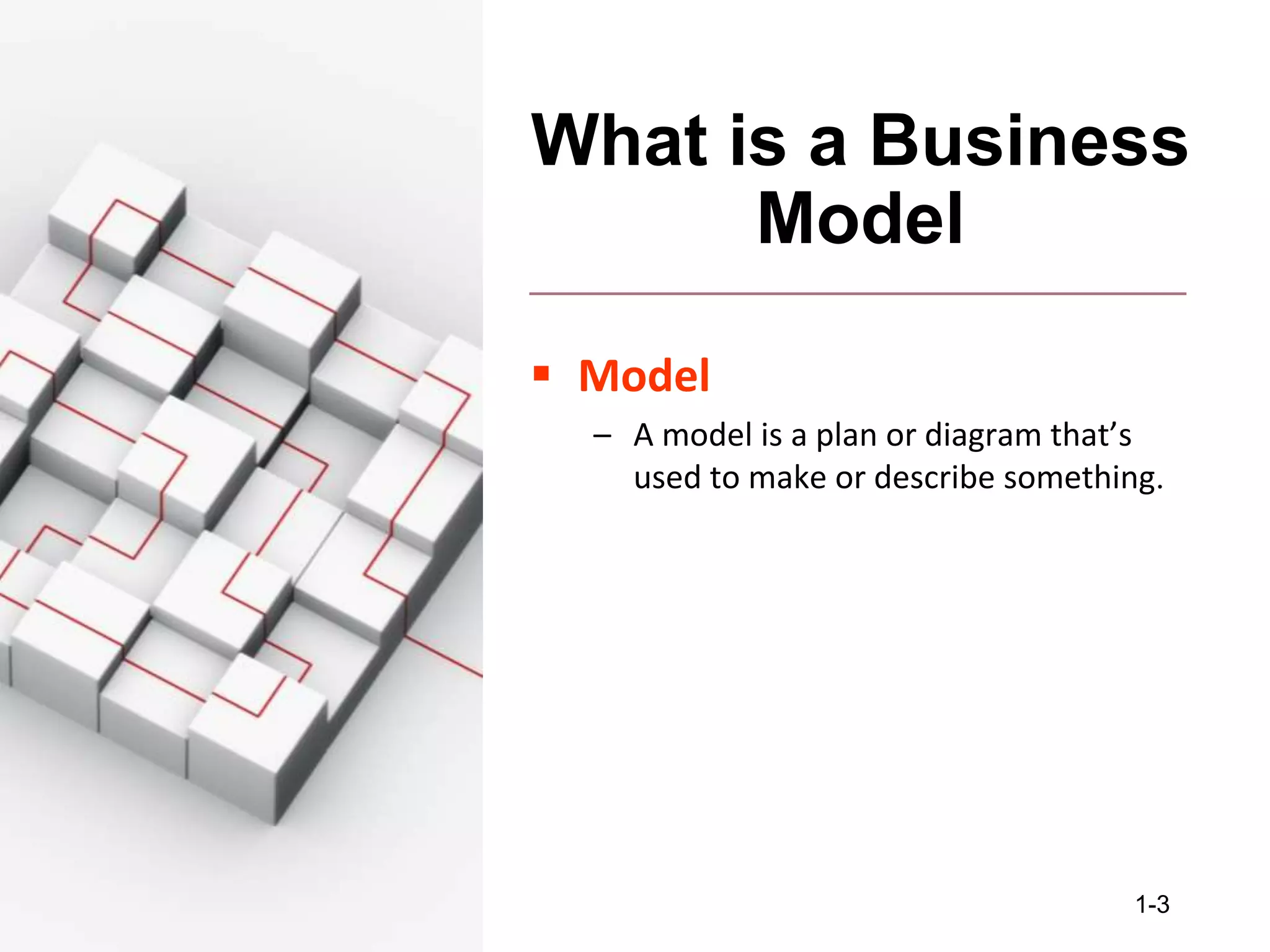
 Model
– A model is a plan or diagram that’s
used to make or describe something.
1-3
What is a Business Model
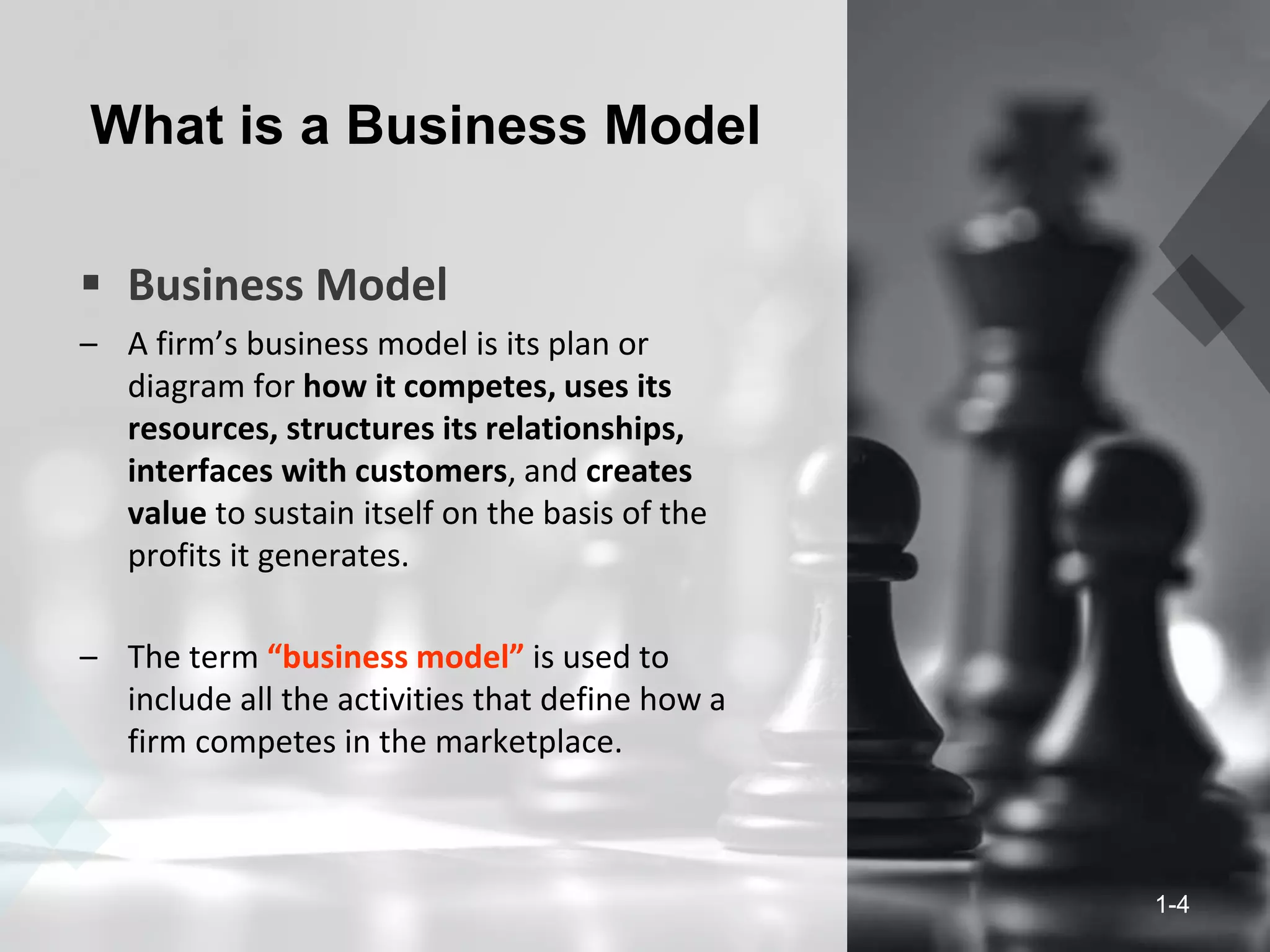
 Business Model
– A firm’s business model is its plan or
diagram for how it competes, uses its
resources, structures its relationships,
interfaces with customers, and creates
value to sustain itself on the basis of the
profits it generates.
– The term “business model” is used to
include all the activities that define how a
firm competes in the marketplace.
1-4
1-5
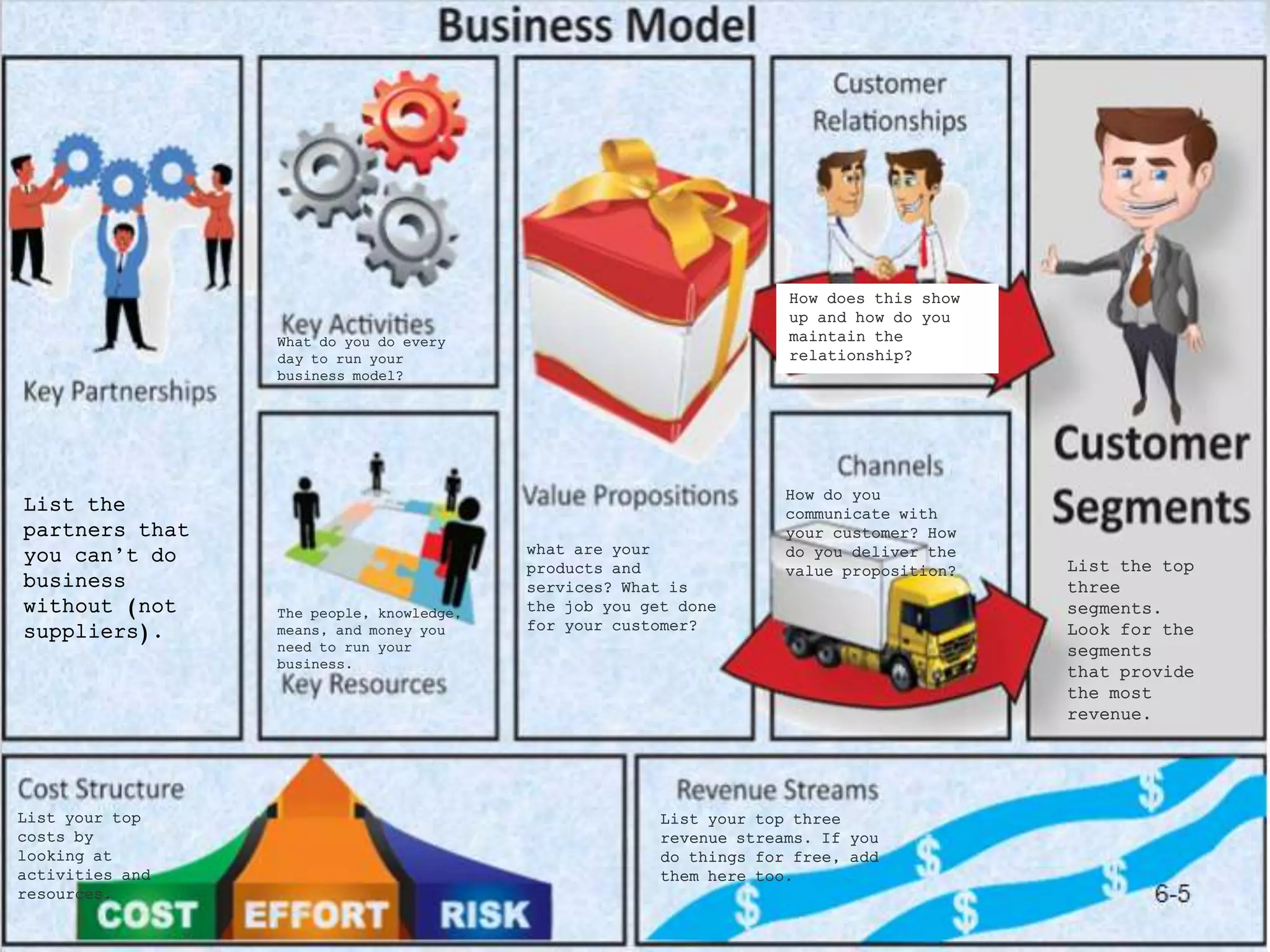
List the
partners that
you can’t do
business
without (not
suppliers).
What do you do every
day to run your
business model?
The people, knowledge,
means, and money you
need to run your
business.
How do you
communicate with
your customer? How
do you deliver the
value proposition?
what are your
products and
services? What is
the job you get done
for your customer?
How does this show
up and how do you
maintain the
relationship?
List the top
three
segments.
Look for the
segments
that provide
the most
revenue.
List your top three
revenue streams. If you
do things for free, add
them here too.
List your top
costs by
looking at
activities and
resources.
Dell’s Business
Model
Beyond Its Own Boundaries
 It’s important to understand that a firm’s
business model takes it beyond its own
boundaries.
 Almost all firms partner with others to
make their business models work.
 In Dell’s case, it needs the cooperation
of its suppliers, customers, and many
others to make its business model
possible.
1-6
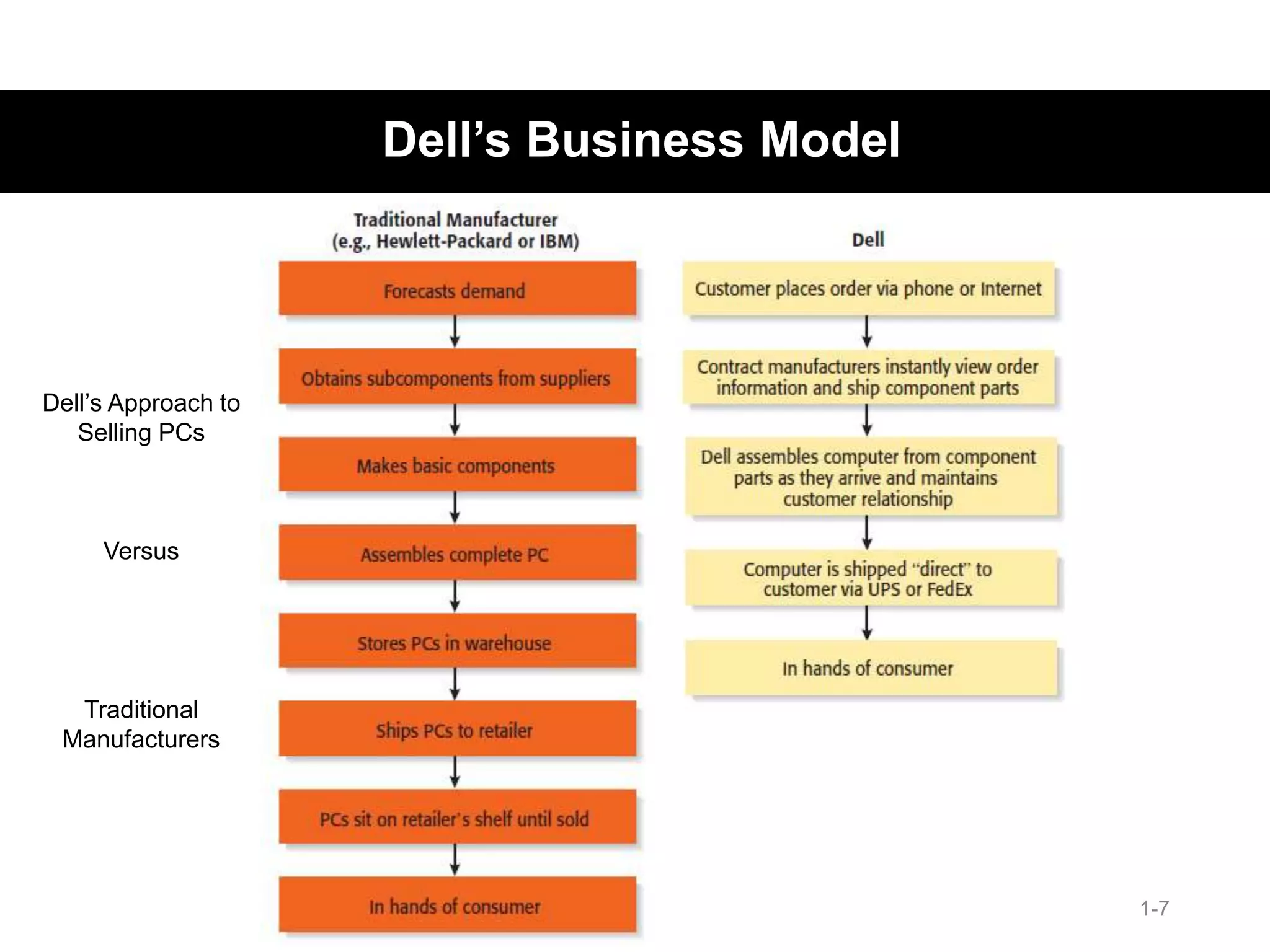
Dell’s Business Model
1-7
Dell’s Approach to
Selling PCs
Versus
Traditional
Manufacturers
• Having a clearly articulated business model is important
because it does the following:
1-8
 Serves as an ongoing extension of feasibility analysis. A business model
continually asks the question, “Does this business make sense?”
 Focuses attention on how all the elements of a business fit together and
constitute a working whole.
 Describes why the network of participants needed to make a business
idea viable are willing to work together.
 Articulates a company’s core logic to all stakeholders, including all
employees.
Importance of Business Model
Diversity of Business Model
1-9
 There is NO standard business model for an industry or
for a target market within an industry.
 However, over time, the most successful business
models in an industry predominate and sustain while
the weaker models lag behind
 There are always opportunities for business model
innovation.
Diversity or
Variety in
Business Models
Business Model Innovation
1-10
Netflix is an example of
a business model
innovator
How Business
Models Emerge
 The Value Chain (a Diagnostic Tool)
– The value chain is the string of activities that
moves a product from the raw material stage,
through manufacturing and distribution, and
ultimately to the end user.
– By studying a product’s or service’s value chain,
an organization can identify ways to create
additional value and assess whether it has the
means to do so.
– Value chain analysis is also helpful in identifying
opportunities for new businesses and in
understanding how business models emerge.
1-11
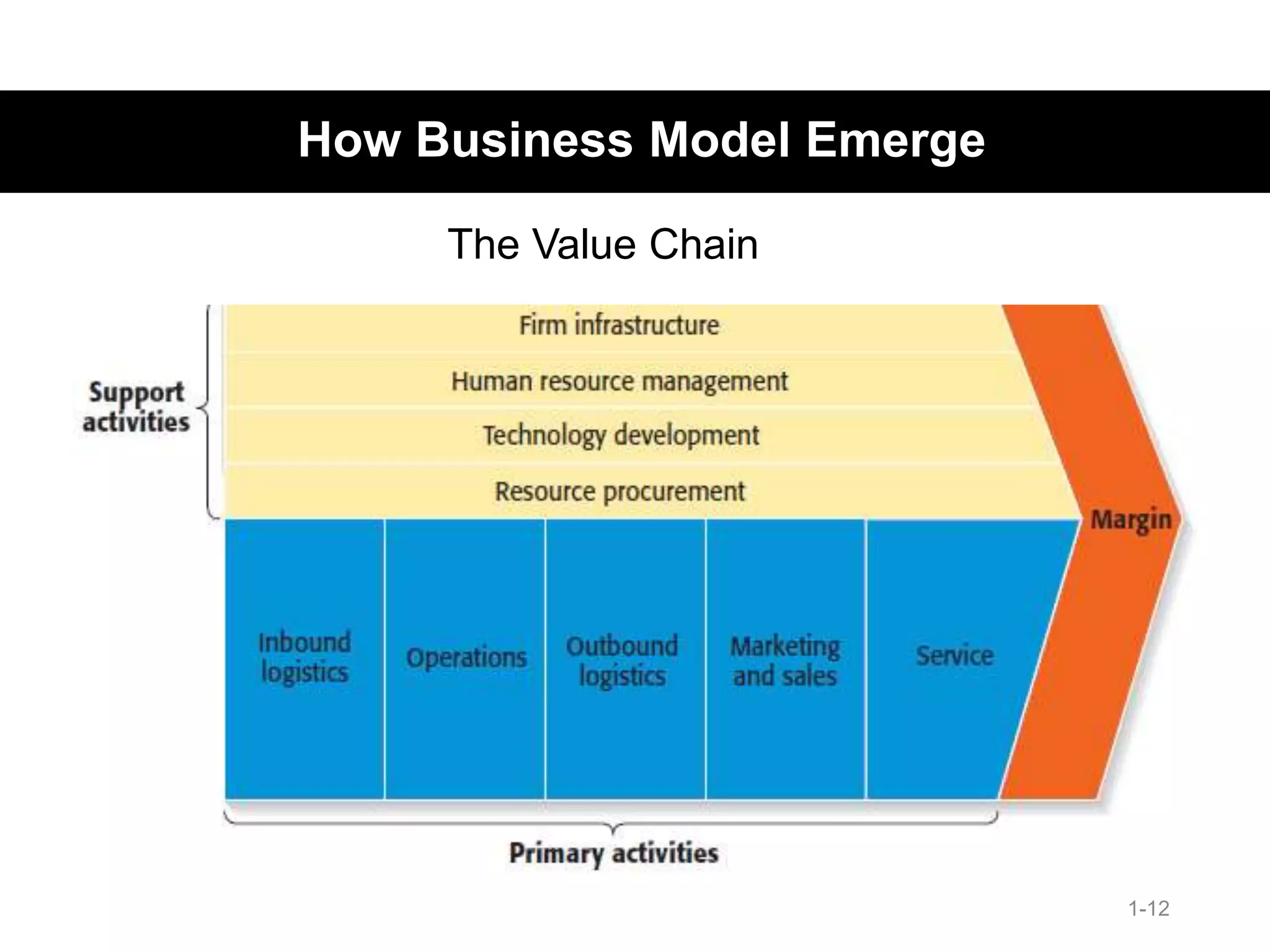
How Business Model Emerge
1-12
The Value Chain
How Business
Models Emerge
 The Value Chain (Continued)
– Entrepreneurs look at the value chain of a product or a
service to pinpoint where the value chain can be made
more effective or to spot where additional “value” can be
added.
– This type of analysis may focus on:
• A single primary activity such as marketing and sales.
• The interface between one stage of the value chain
and another, such as the interface between
operations and outgoing logistics.
• One of the support activities, such as human
resource management.
1-13
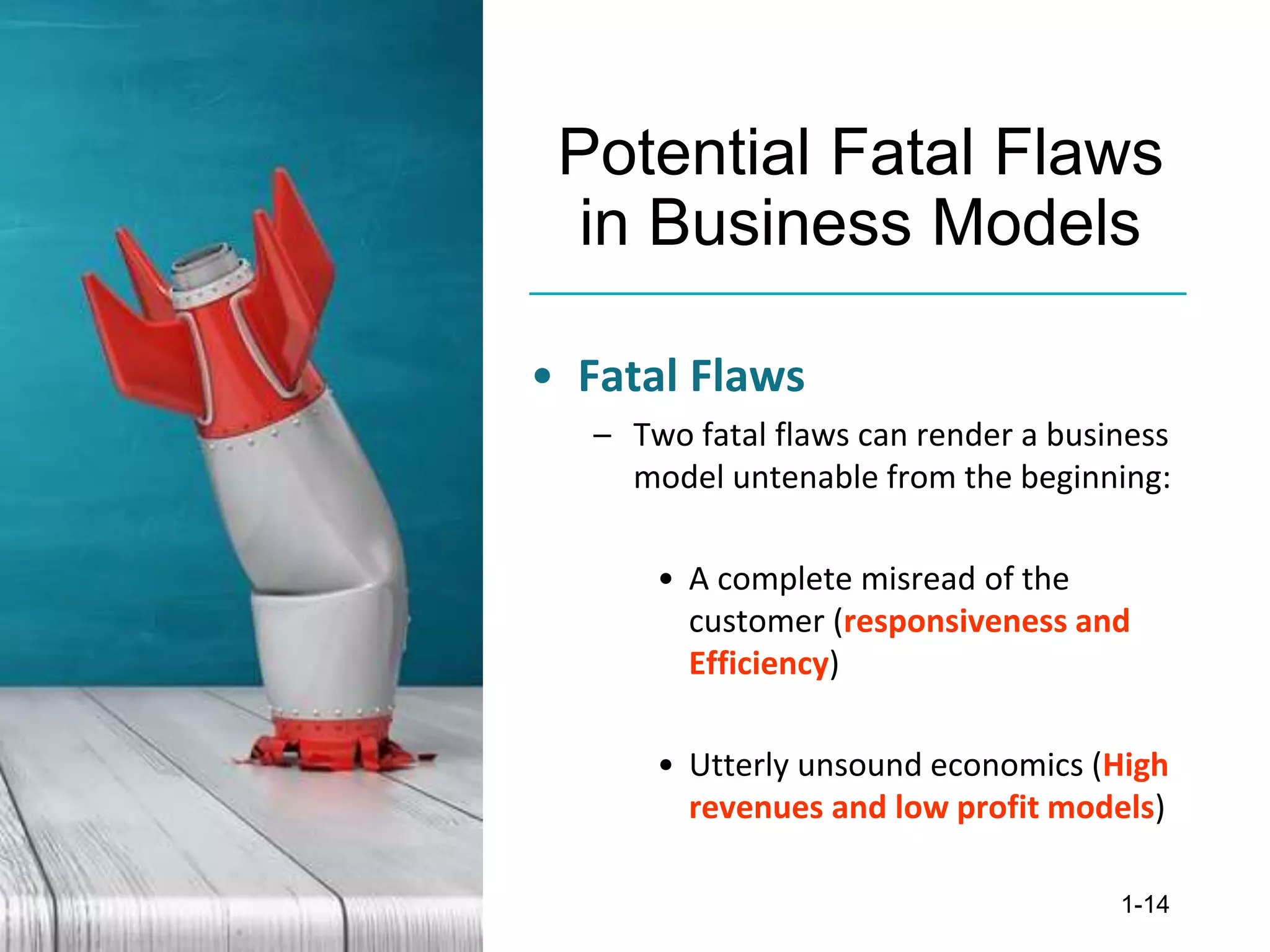
Potential Fatal Flaws
in Business Models
• Fatal Flaws
– Two fatal flaws can render a business
model untenable from the beginning:
• A complete misread of the
customer (responsiveness and
Efficiency)
• Utterly unsound economics (High
revenues and low profit models)
1-14
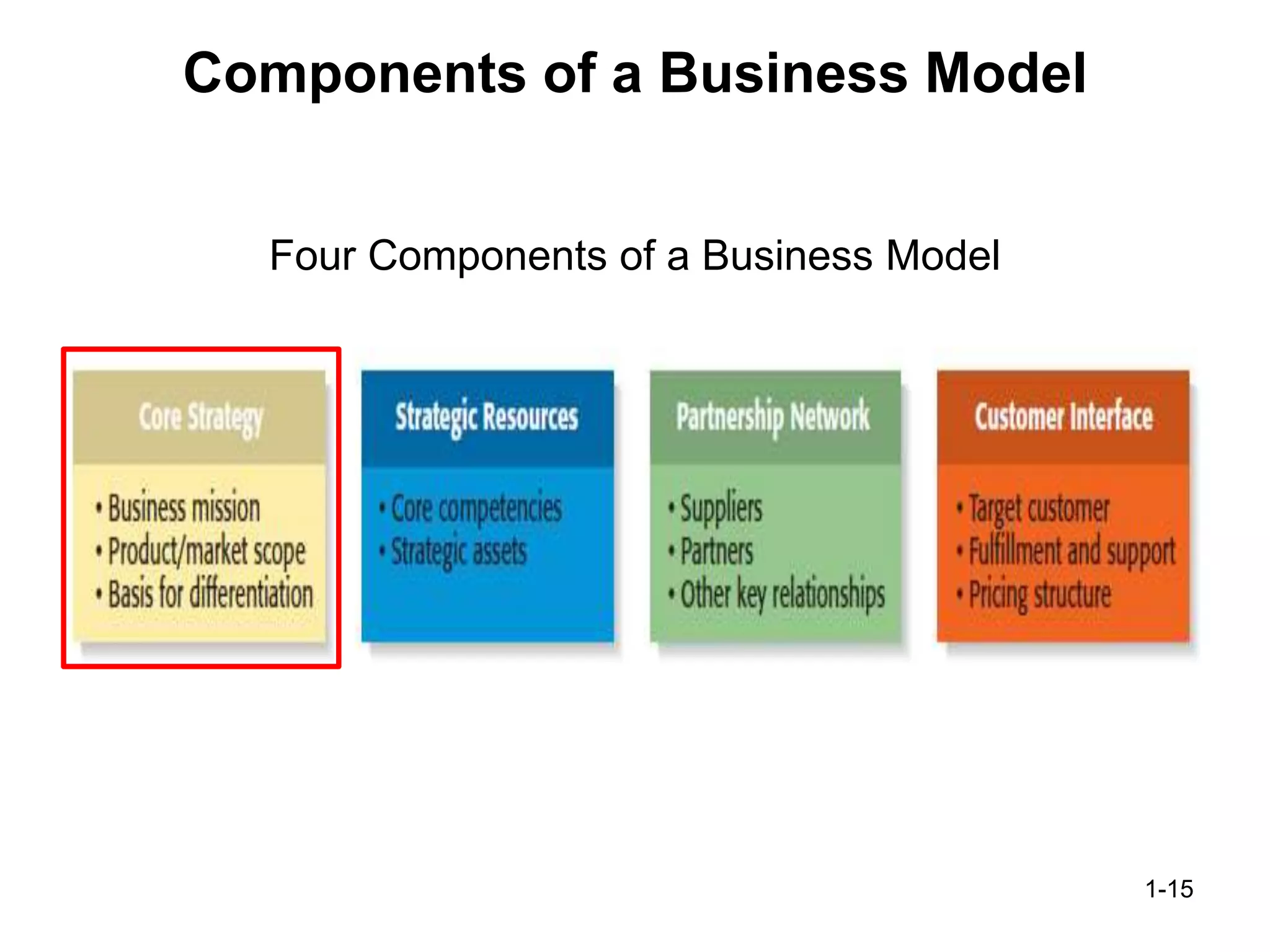
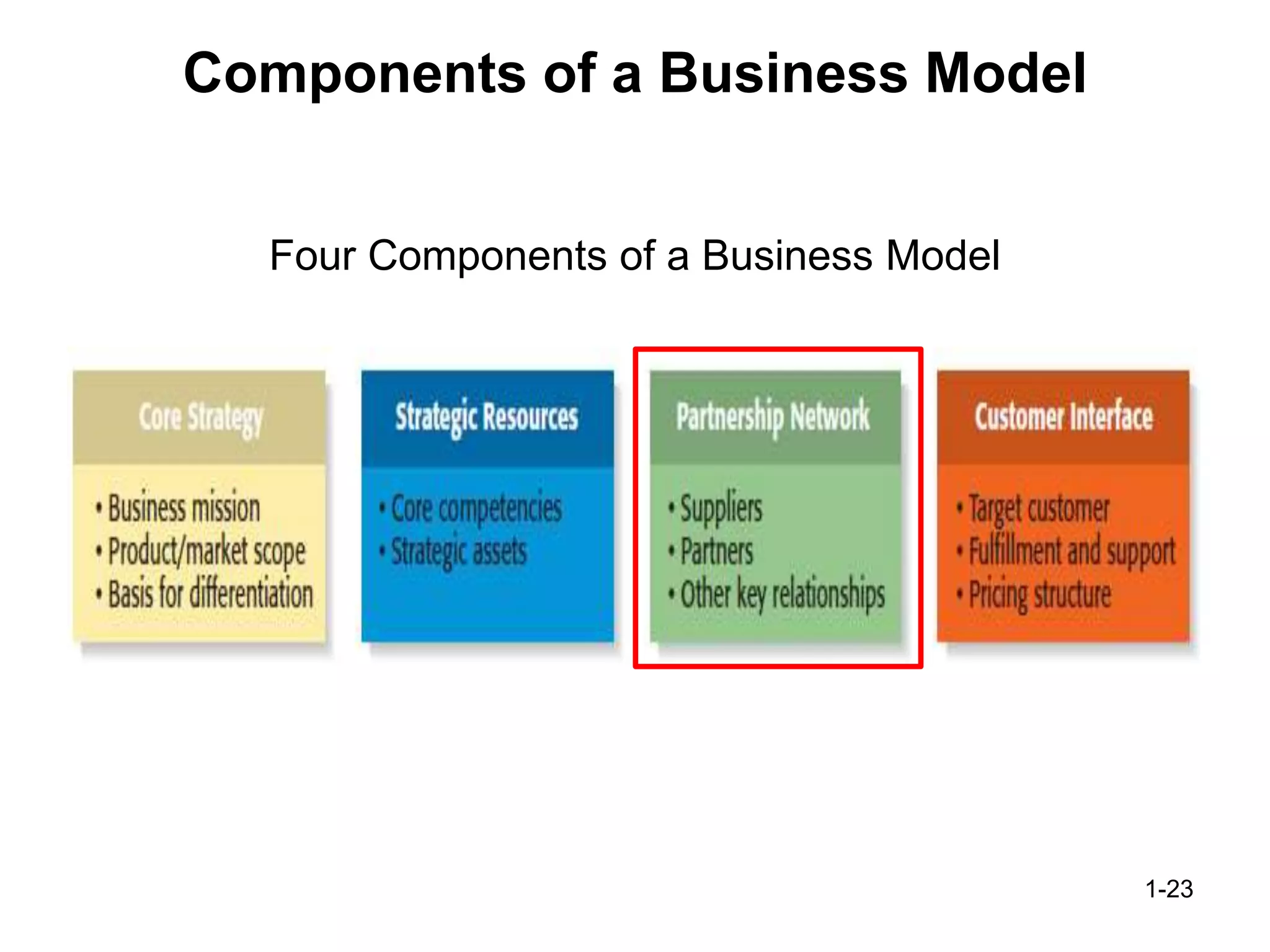
Components of a Business Model
Four Components of a Business Model
1-15
Components of a Business Model
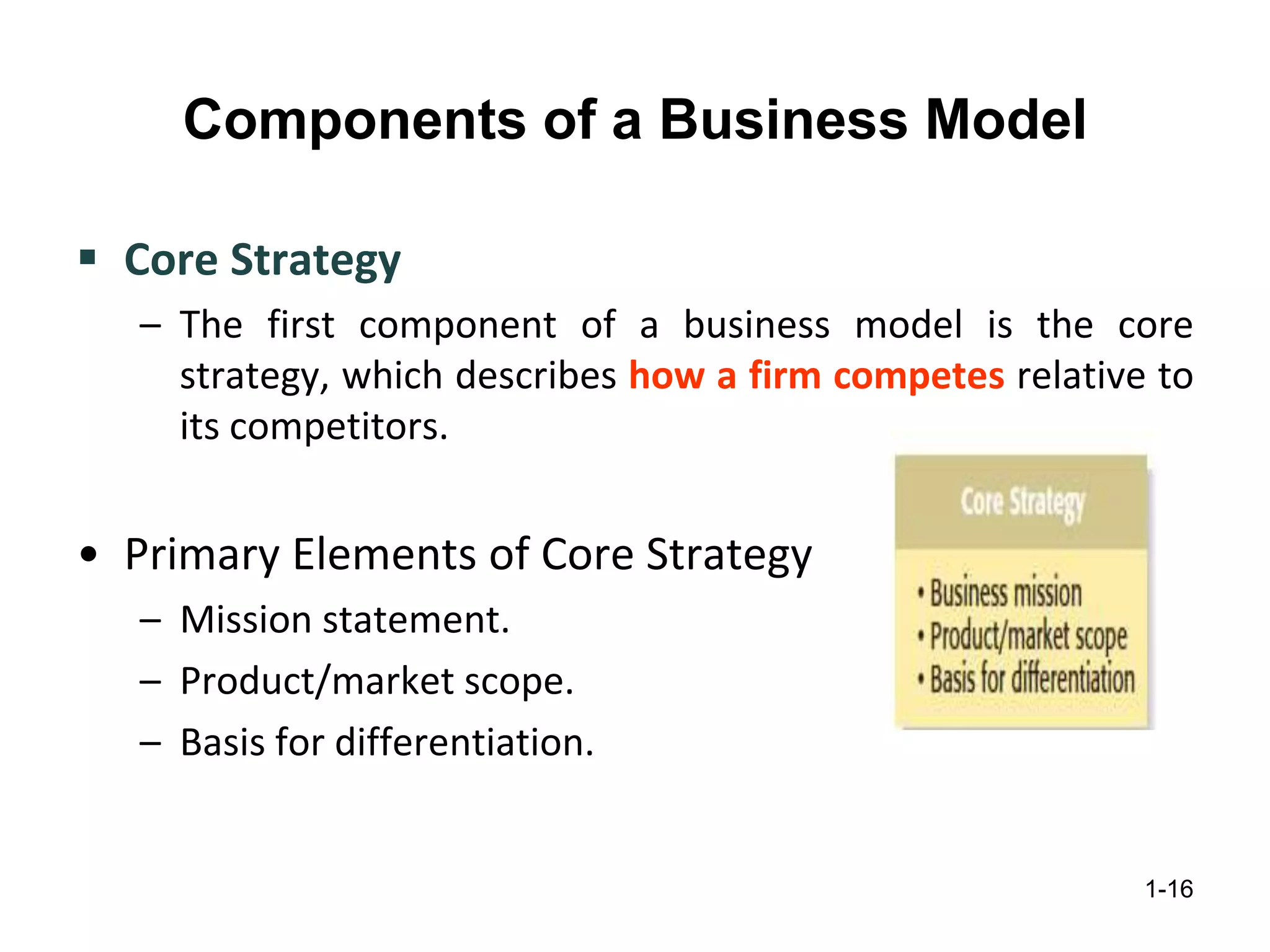
 Core Strategy
– The first component of a business model is the core
strategy, which describes how a firm competes relative to
its competitors.
• Primary Elements of Core Strategy
– Mission statement.
– Product/market scope.
– Basis for differentiation.
1-16
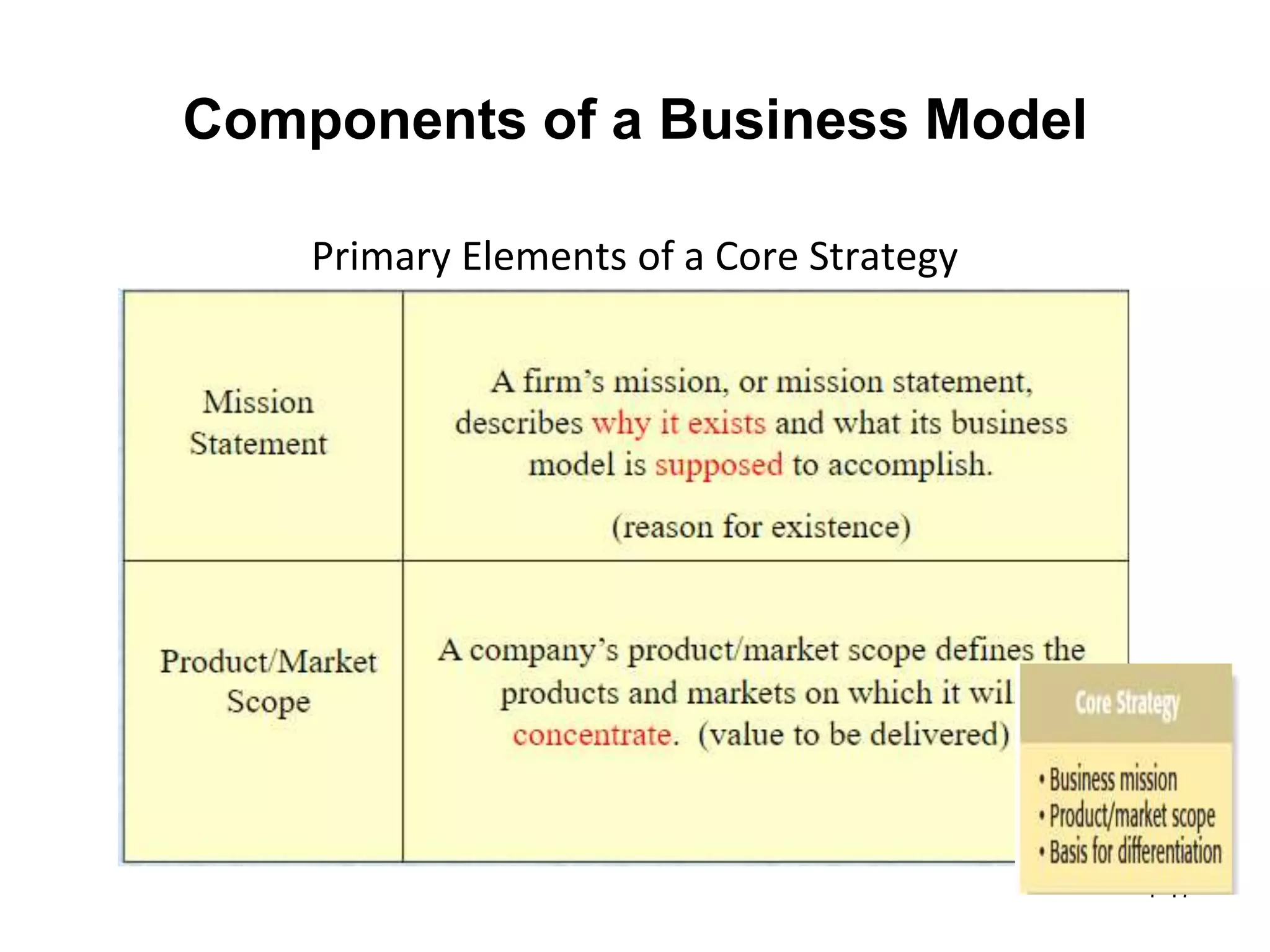
Components of a Business Model
Primary Elements of a Core Strategy
1-17
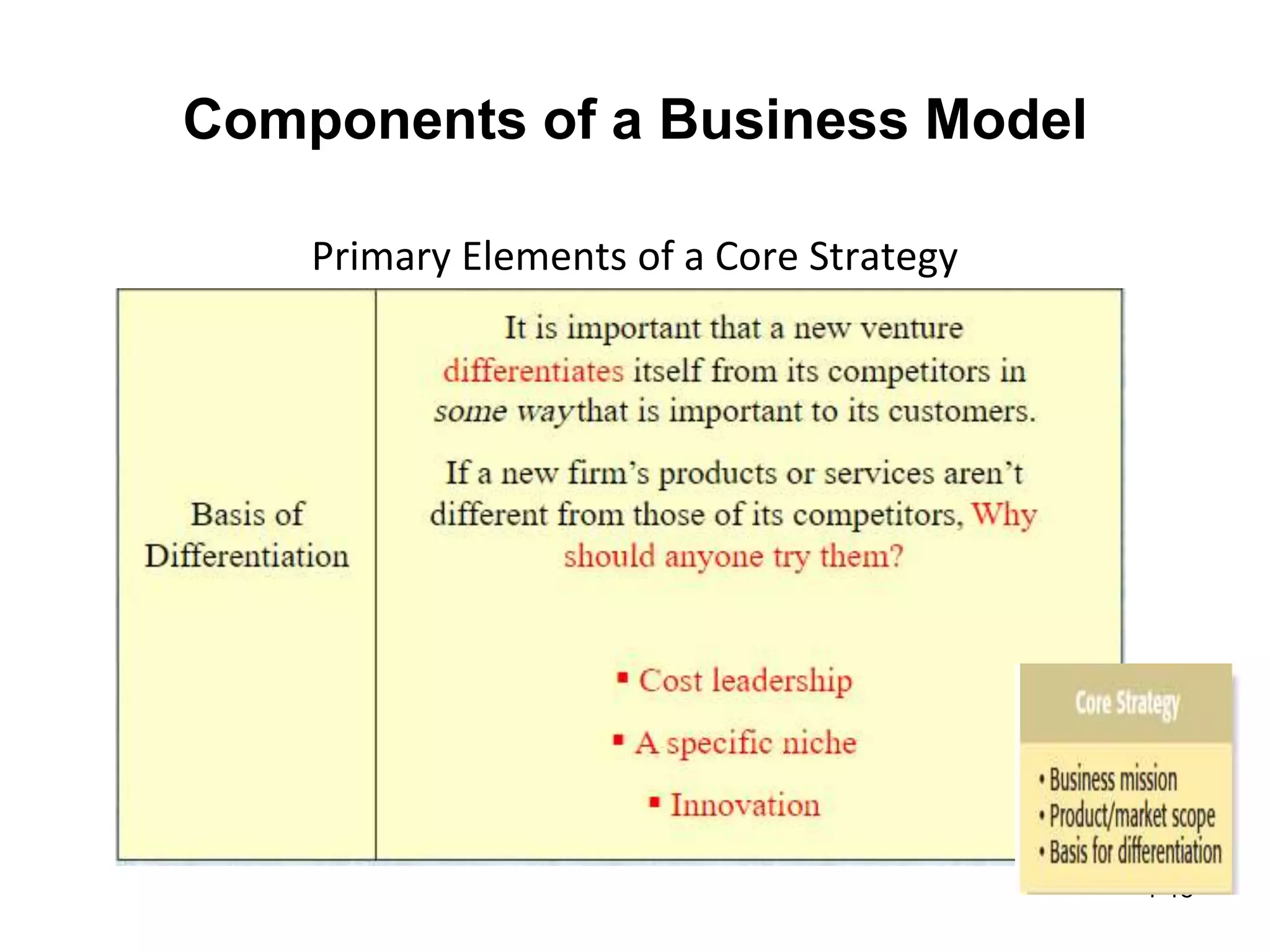
Components of a Business Model
Primary Elements of a Core Strategy
1-18
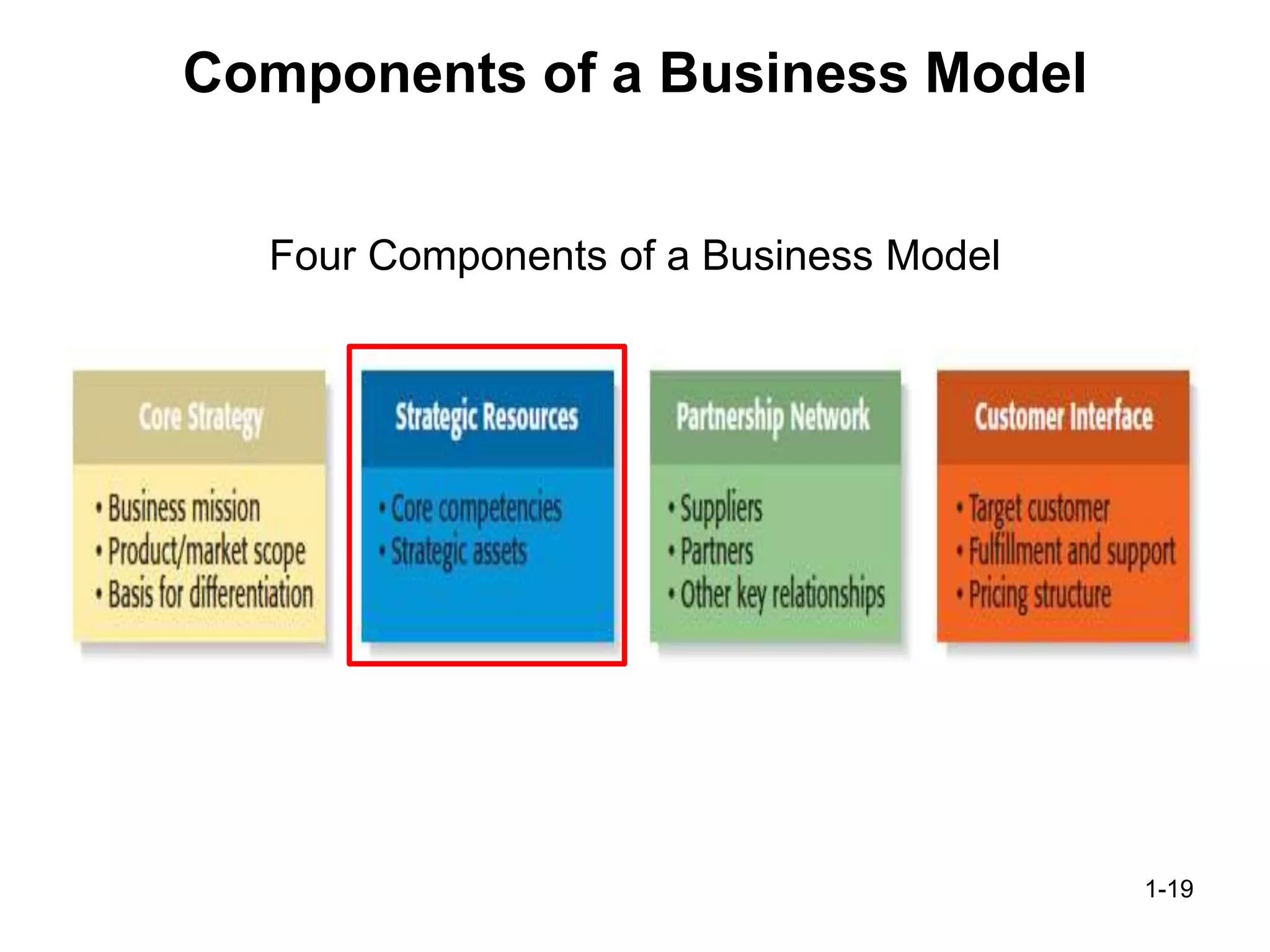
Components of a Business Model
Four Components of a Business Model
1-19
Strategic Resources
– A firm is not able to implement a strategy without resources, so the resources
a firm has affects its business model substantially.
• For a new venture, its strategic resources may initially be limited to the
competencies of its founders, the opportunity they have identified, and
the unique way they plan to serve their market.
– The two most important strategic resources are:
• A firm’s core competencies.
• Strategic assets / Unique resources
1-20
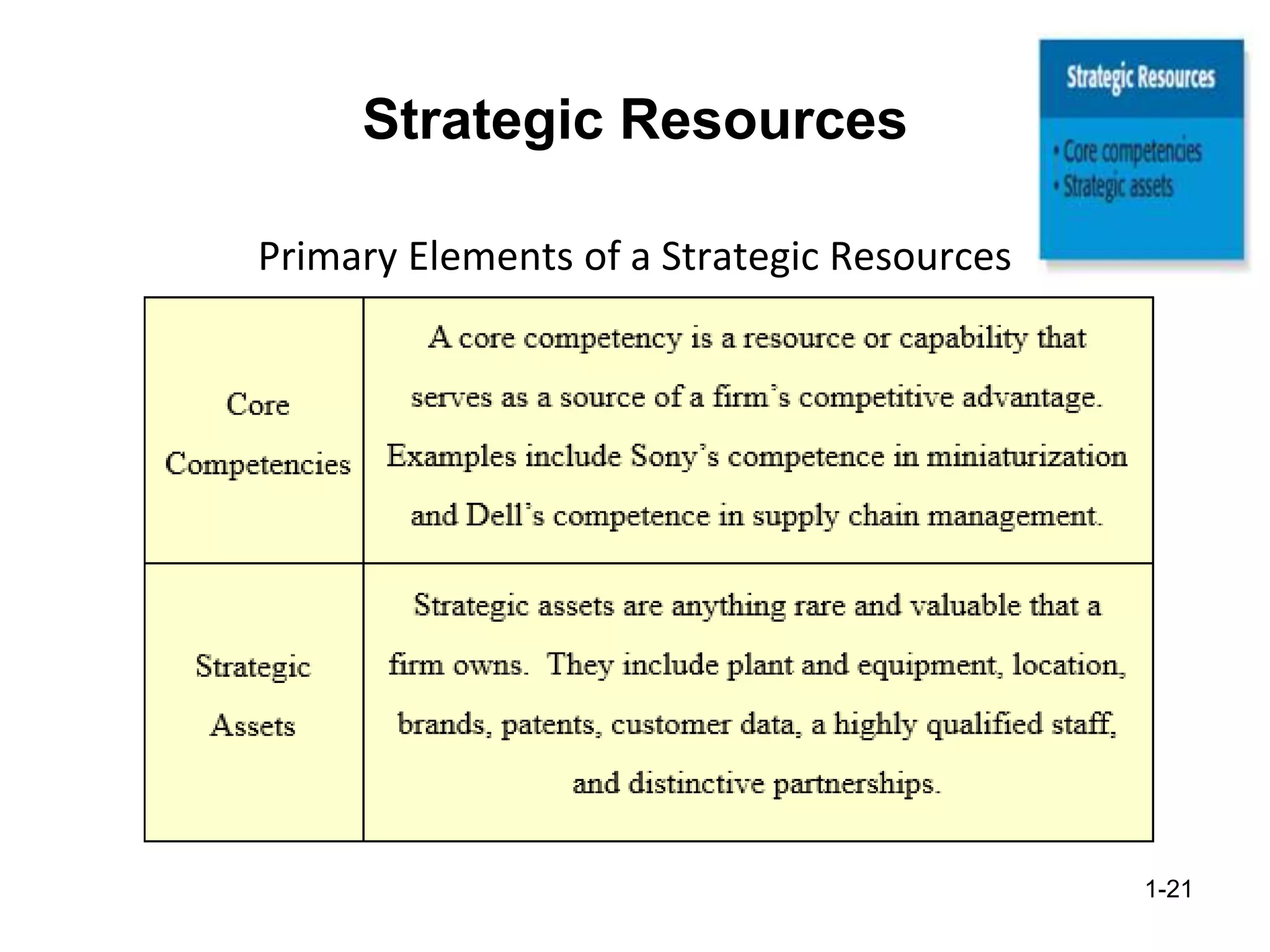
Strategic Resources
Primary Elements of a Strategic Resources
1-21
Importance of Strategic Resources
– New ventures ultimately try to combine their core competencies and strategic
assets to create a sustainable competitive advantage.
– This factor is one that investors pay close attention when evaluating a business.
– A sustainable competitive advantage is achieved by implementing a value-
creating strategy that is unique and not easy to imitate.
This type of advantage is achievable when a firm has strategic resources and the
ability to use them (ability to use is essential) 1-22
Components of a Business Model
Four Components of a Business Model
1-23
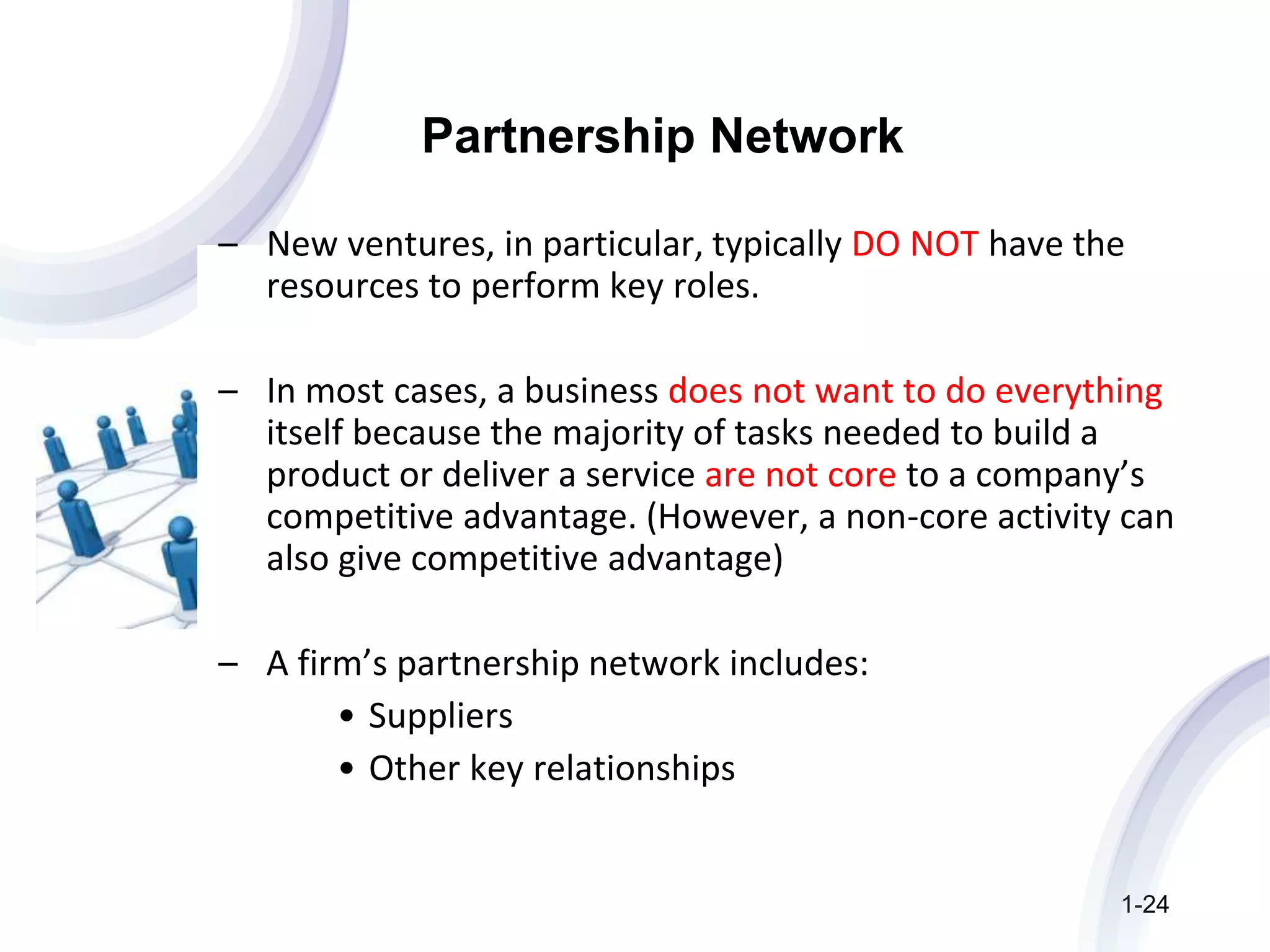
Partnership Network
– New ventures, in particular, typically DO NOT have the
resources to perform key roles.
– In most cases, a business does not want to do everything
itself because the majority of tasks needed to build a
product or deliver a service are not core to a company’s
competitive advantage. (However, a non-core activity can
also give competitive advantage)
– A firm’s partnership network includes:
• Suppliers
• Other key relationships
1-24
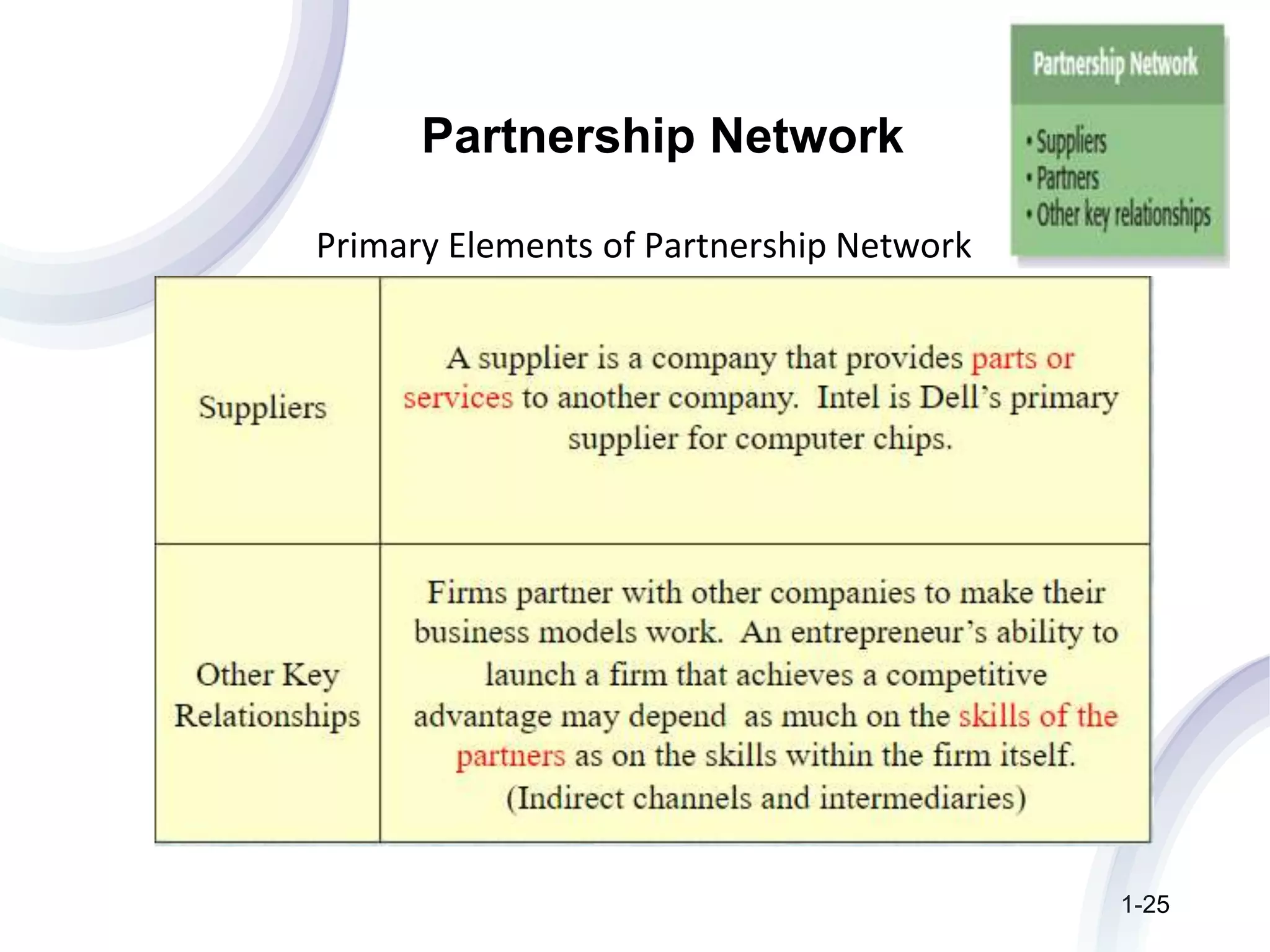
Partnership Network
Primary Elements of Partnership Network
1-25
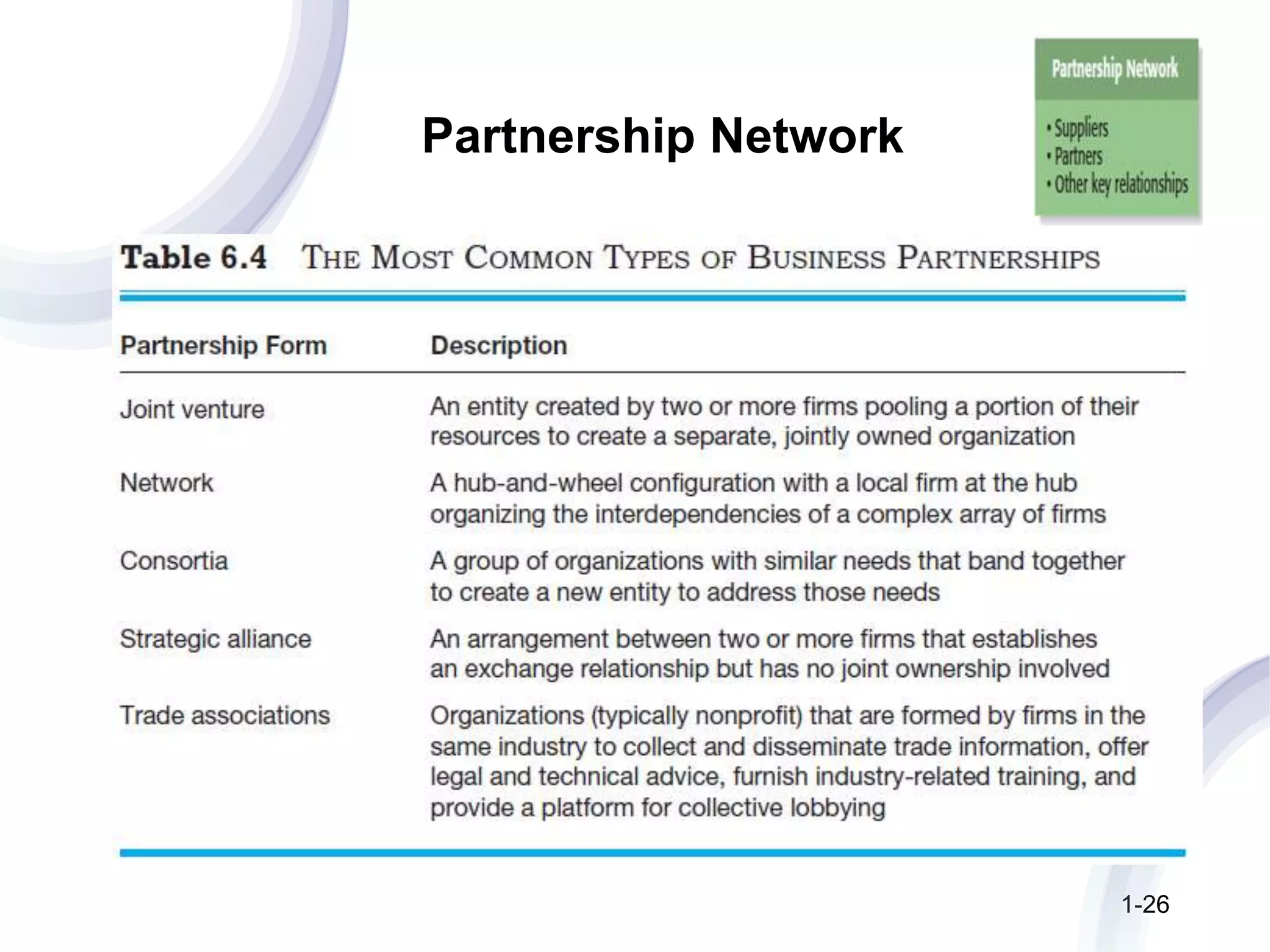
Partnership Network
1-26
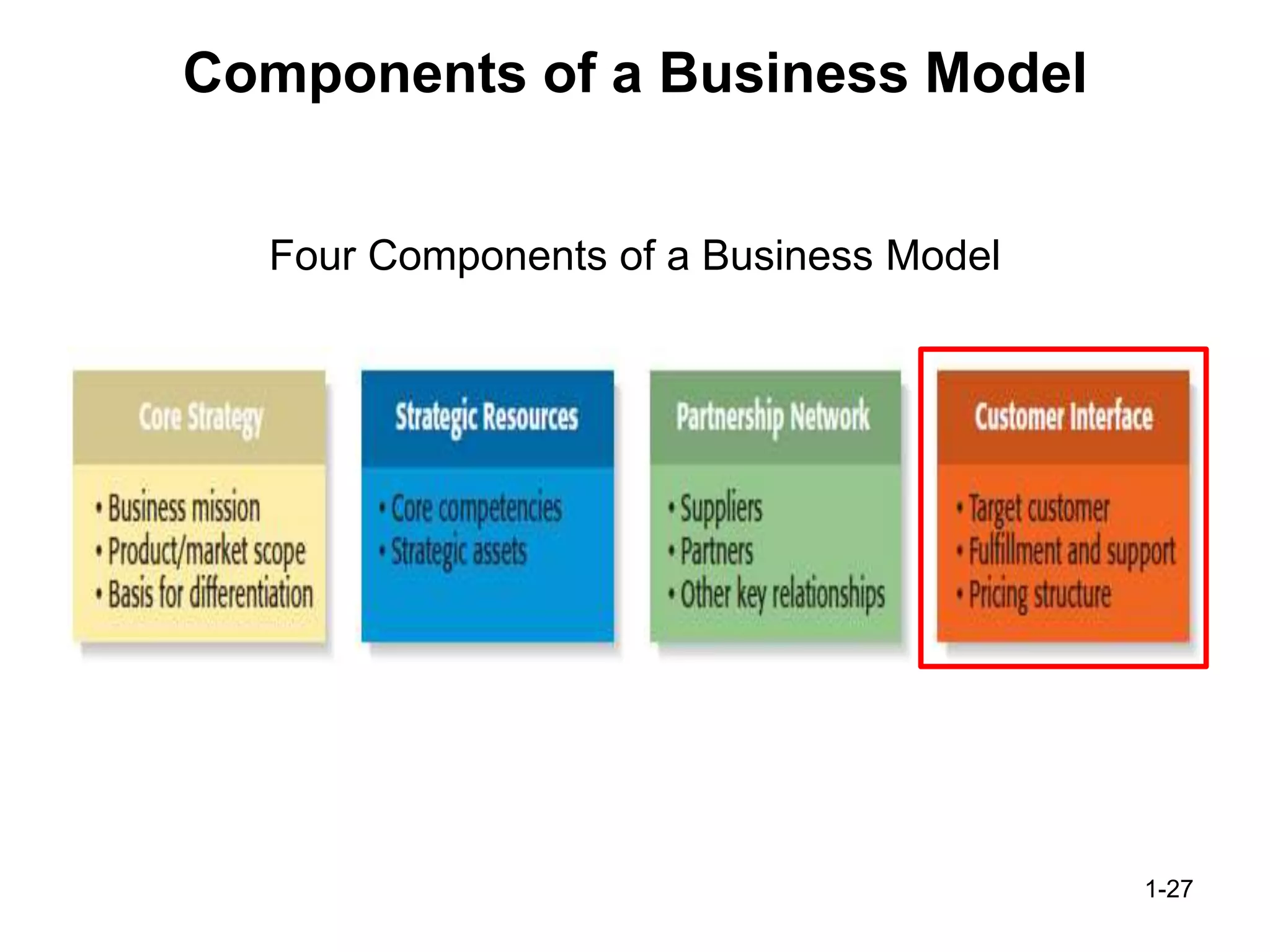
Components of a Business Model
Four Components of a Business Model
1-27
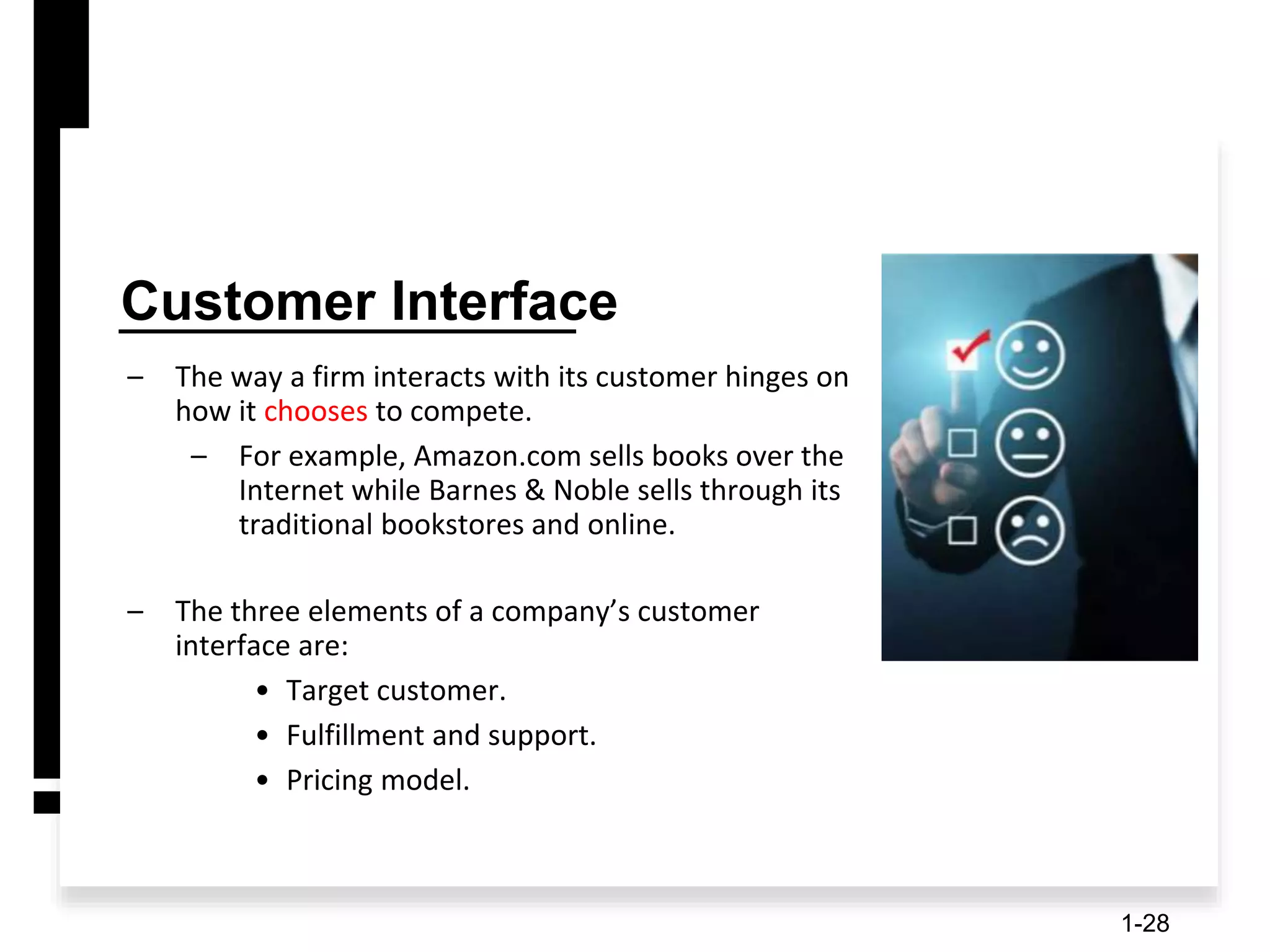
Customer Interface
– The way a firm interacts with its customer hinges on
how it chooses to compete.
– For example, Amazon.com sells books over the
Internet while Barnes & Noble sells through its
traditional bookstores and online.
– The three elements of a company’s customer
interface are:
• Target customer.
• Fulfillment and support.
• Pricing model.
1-28
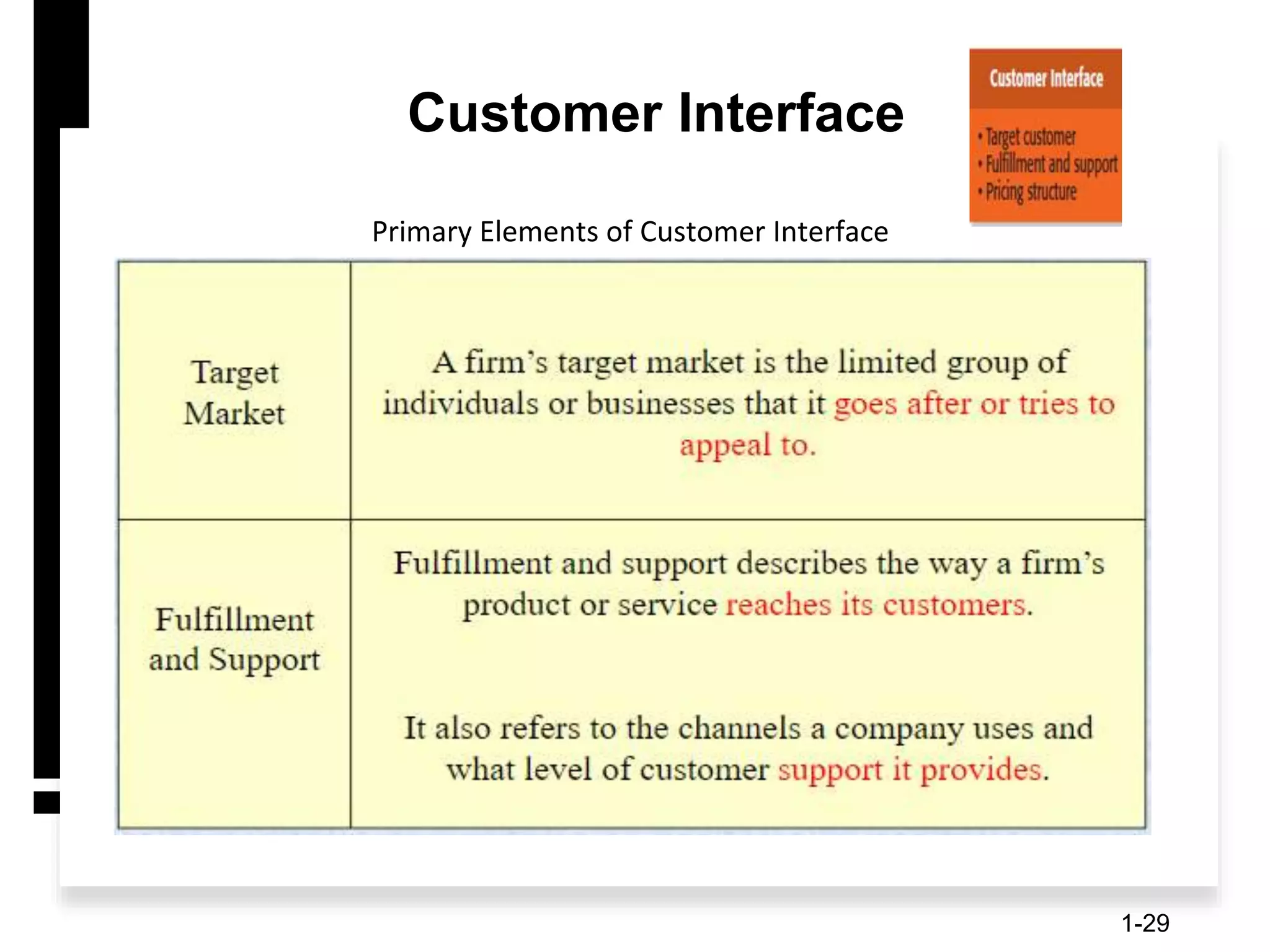
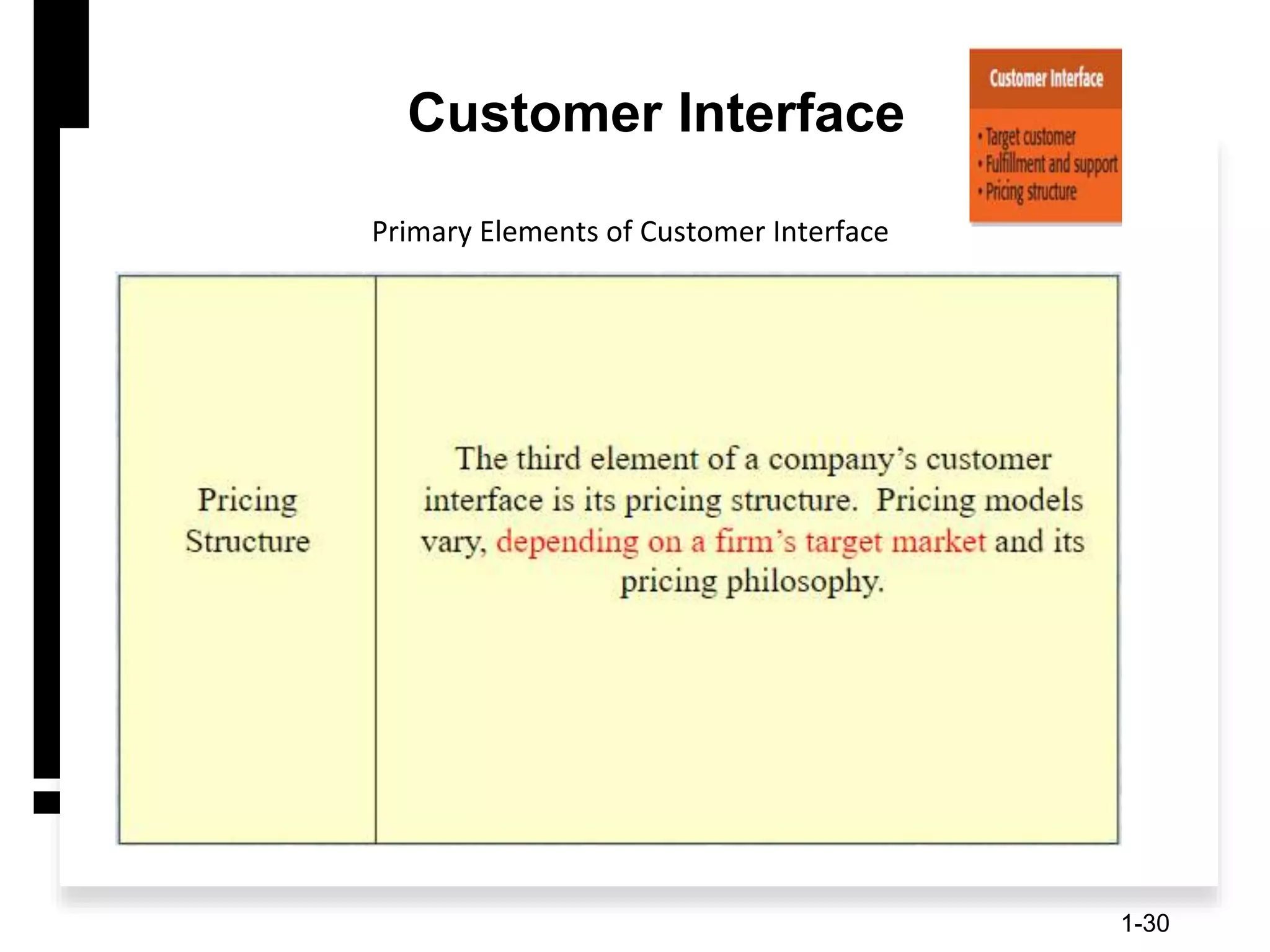
Customer Interface
Primary Elements of Customer Interface
1-29
Customer Interface
Primary Elements of Customer Interface
1-30
Recap: The importance of
Business Models
– It is very useful for a new venture to look at
itself in a holistic manner and understand
that it must construct an effective “business
model” to be successful.
– Everyone that does business with a firm, from
its customers to its partners, does so on a
voluntary basis. As a result, a firm must
motivate its customers and its partners to
play along.
– Close attention to each of the primary
elements of a firm’s business model is
essential for a new venture’s success.
1-31

Lecture#07-Developing an Effective Business Model.pptx

  • 1.
    Developing an EffectiveBusiness Model Lecture#07
  • 2.
    Topic Objectives 1. Describea business model. 2. Explain business model innovation. 3. Discuss the importance of having a clearly articulated business model. 4. Discuss the concept of the value chain. 5. Identify a business model’s two potential fatal flaws. 6. Identify a business model’s four major components. 7. Explain the meaning of the term business concept blind spot. 8. Define the term core competency and describe its importance. 9. Explain the concept of supply chain management. 10. Explain the concept of fulfillment and support.
  • 3.
    What is aBusiness Model  Model – A model is a plan or diagram that’s used to make or describe something. 1-3
  • 4.
    What is aBusiness Model  Business Model – A firm’s business model is its plan or diagram for how it competes, uses its resources, structures its relationships, interfaces with customers, and creates value to sustain itself on the basis of the profits it generates. – The term “business model” is used to include all the activities that define how a firm competes in the marketplace. 1-4
  • 5.
    1-5 List the partners that youcan’t do business without (not suppliers). What do you do every day to run your business model? The people, knowledge, means, and money you need to run your business. How do you communicate with your customer? How do you deliver the value proposition? what are your products and services? What is the job you get done for your customer? How does this show up and how do you maintain the relationship? List the top three segments. Look for the segments that provide the most revenue. List your top three revenue streams. If you do things for free, add them here too. List your top costs by looking at activities and resources.
  • 6.
    Dell’s Business Model Beyond ItsOwn Boundaries  It’s important to understand that a firm’s business model takes it beyond its own boundaries.  Almost all firms partner with others to make their business models work.  In Dell’s case, it needs the cooperation of its suppliers, customers, and many others to make its business model possible. 1-6
  • 7.
    Dell’s Business Model 1-7 Dell’sApproach to Selling PCs Versus Traditional Manufacturers
  • 8.
    • Having aclearly articulated business model is important because it does the following: 1-8  Serves as an ongoing extension of feasibility analysis. A business model continually asks the question, “Does this business make sense?”  Focuses attention on how all the elements of a business fit together and constitute a working whole.  Describes why the network of participants needed to make a business idea viable are willing to work together.  Articulates a company’s core logic to all stakeholders, including all employees. Importance of Business Model
  • 9.
    Diversity of BusinessModel 1-9  There is NO standard business model for an industry or for a target market within an industry.  However, over time, the most successful business models in an industry predominate and sustain while the weaker models lag behind  There are always opportunities for business model innovation. Diversity or Variety in Business Models
  • 10.
    Business Model Innovation 1-10 Netflixis an example of a business model innovator
  • 11.
    How Business Models Emerge The Value Chain (a Diagnostic Tool) – The value chain is the string of activities that moves a product from the raw material stage, through manufacturing and distribution, and ultimately to the end user. – By studying a product’s or service’s value chain, an organization can identify ways to create additional value and assess whether it has the means to do so. – Value chain analysis is also helpful in identifying opportunities for new businesses and in understanding how business models emerge. 1-11
  • 12.
    How Business ModelEmerge 1-12 The Value Chain
  • 13.
    How Business Models Emerge The Value Chain (Continued) – Entrepreneurs look at the value chain of a product or a service to pinpoint where the value chain can be made more effective or to spot where additional “value” can be added. – This type of analysis may focus on: • A single primary activity such as marketing and sales. • The interface between one stage of the value chain and another, such as the interface between operations and outgoing logistics. • One of the support activities, such as human resource management. 1-13
  • 14.
    Potential Fatal Flaws inBusiness Models • Fatal Flaws – Two fatal flaws can render a business model untenable from the beginning: • A complete misread of the customer (responsiveness and Efficiency) • Utterly unsound economics (High revenues and low profit models) 1-14
  • 15.
    Components of aBusiness Model Four Components of a Business Model 1-15
  • 16.
    Components of aBusiness Model  Core Strategy – The first component of a business model is the core strategy, which describes how a firm competes relative to its competitors. • Primary Elements of Core Strategy – Mission statement. – Product/market scope. – Basis for differentiation. 1-16
  • 17.
    Components of aBusiness Model Primary Elements of a Core Strategy 1-17
  • 18.
    Components of aBusiness Model Primary Elements of a Core Strategy 1-18
  • 19.
    Components of aBusiness Model Four Components of a Business Model 1-19
  • 20.
    Strategic Resources – Afirm is not able to implement a strategy without resources, so the resources a firm has affects its business model substantially. • For a new venture, its strategic resources may initially be limited to the competencies of its founders, the opportunity they have identified, and the unique way they plan to serve their market. – The two most important strategic resources are: • A firm’s core competencies. • Strategic assets / Unique resources 1-20
  • 21.
    Strategic Resources Primary Elementsof a Strategic Resources 1-21
  • 22.
    Importance of StrategicResources – New ventures ultimately try to combine their core competencies and strategic assets to create a sustainable competitive advantage. – This factor is one that investors pay close attention when evaluating a business. – A sustainable competitive advantage is achieved by implementing a value- creating strategy that is unique and not easy to imitate. This type of advantage is achievable when a firm has strategic resources and the ability to use them (ability to use is essential) 1-22
  • 23.
    Components of aBusiness Model Four Components of a Business Model 1-23
  • 24.
    Partnership Network – Newventures, in particular, typically DO NOT have the resources to perform key roles. – In most cases, a business does not want to do everything itself because the majority of tasks needed to build a product or deliver a service are not core to a company’s competitive advantage. (However, a non-core activity can also give competitive advantage) – A firm’s partnership network includes: • Suppliers • Other key relationships 1-24
  • 25.
    Partnership Network Primary Elementsof Partnership Network 1-25
  • 26.
  • 27.
    Components of aBusiness Model Four Components of a Business Model 1-27
  • 28.
    Customer Interface – Theway a firm interacts with its customer hinges on how it chooses to compete. – For example, Amazon.com sells books over the Internet while Barnes & Noble sells through its traditional bookstores and online. – The three elements of a company’s customer interface are: • Target customer. • Fulfillment and support. • Pricing model. 1-28
  • 29.
    Customer Interface Primary Elementsof Customer Interface 1-29
  • 30.
    Customer Interface Primary Elementsof Customer Interface 1-30
  • 31.
    Recap: The importanceof Business Models – It is very useful for a new venture to look at itself in a holistic manner and understand that it must construct an effective “business model” to be successful. – Everyone that does business with a firm, from its customers to its partners, does so on a voluntary basis. As a result, a firm must motivate its customers and its partners to play along. – Close attention to each of the primary elements of a firm’s business model is essential for a new venture’s success. 1-31