Principle of Accounting


              Chapter 2
   Statement of Financial Position


       Foreign Trade University
Statement of Financial Position
(Balance Sheet)
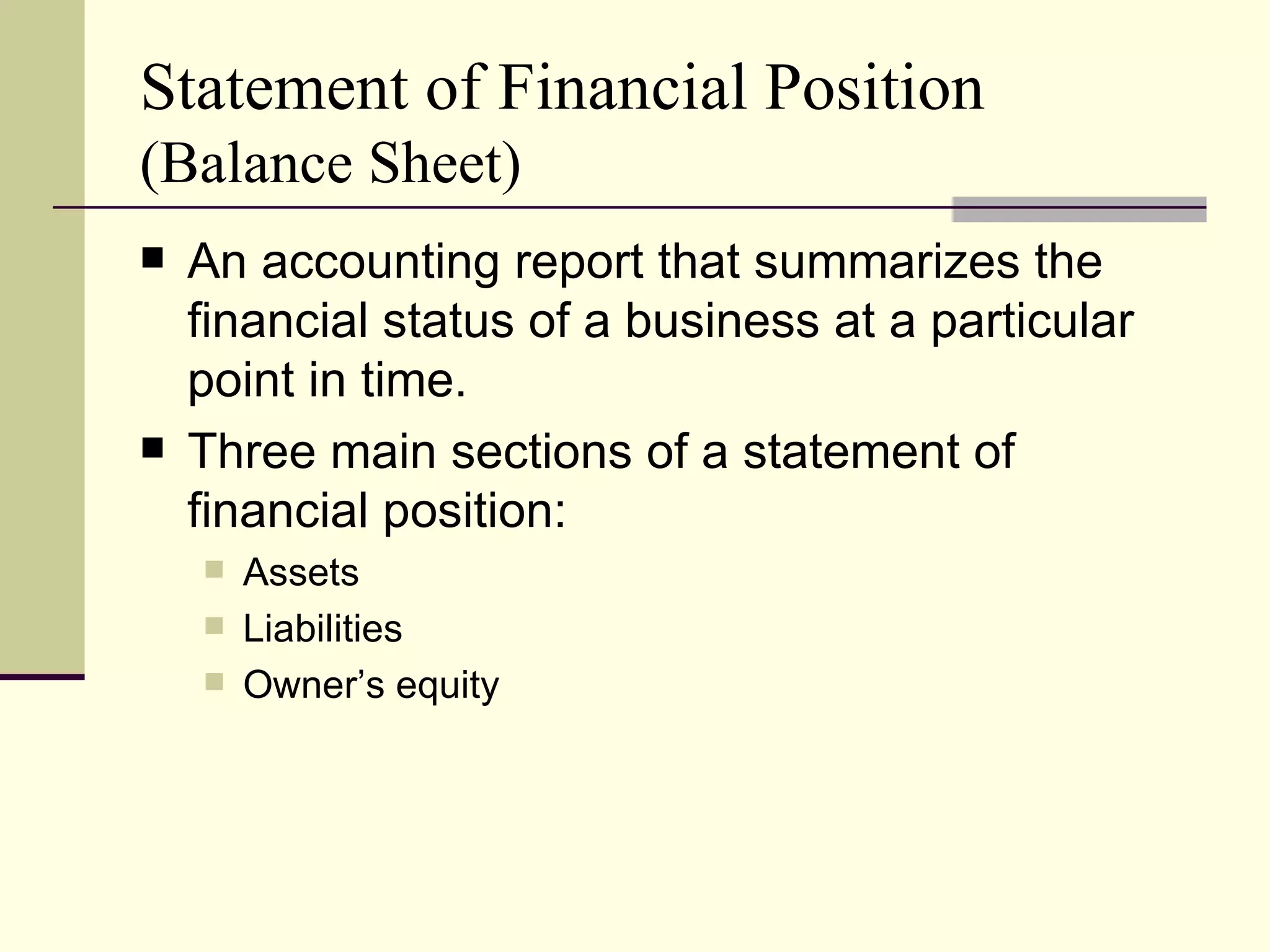
   An accounting report that summarizes the
    financial status of a business at a particular
    point in time.
   Three main sections of a statement of
    financial position:
       Assets
       Liabilities
       Owner’s equity
Statement of Financial Position
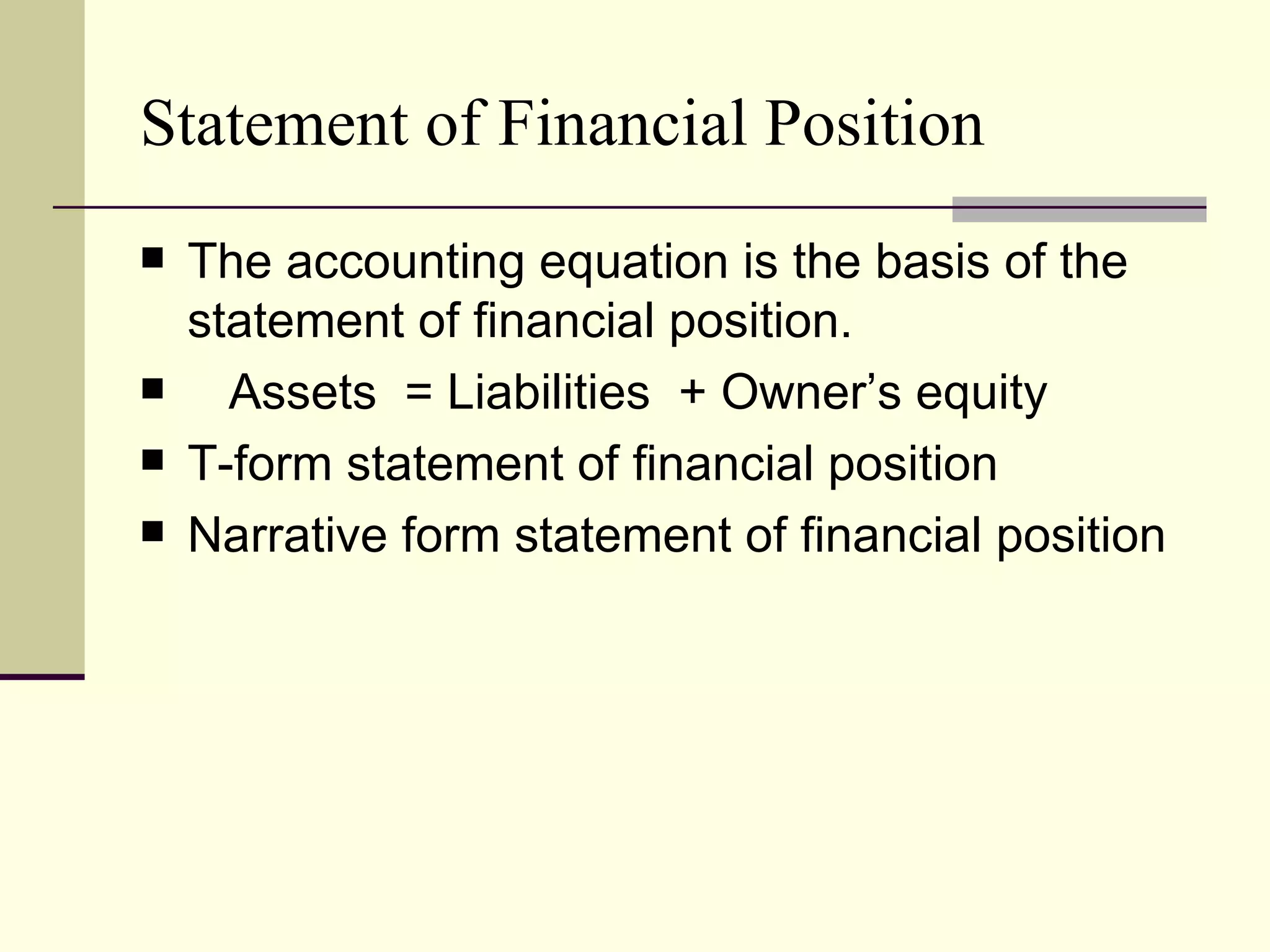
   The accounting equation is the basis of the
    statement of financial position.
     Assets = Liabilities + Owner’s equity
   T-form statement of financial position
   Narrative form statement of financial position
T-form statement of financial position

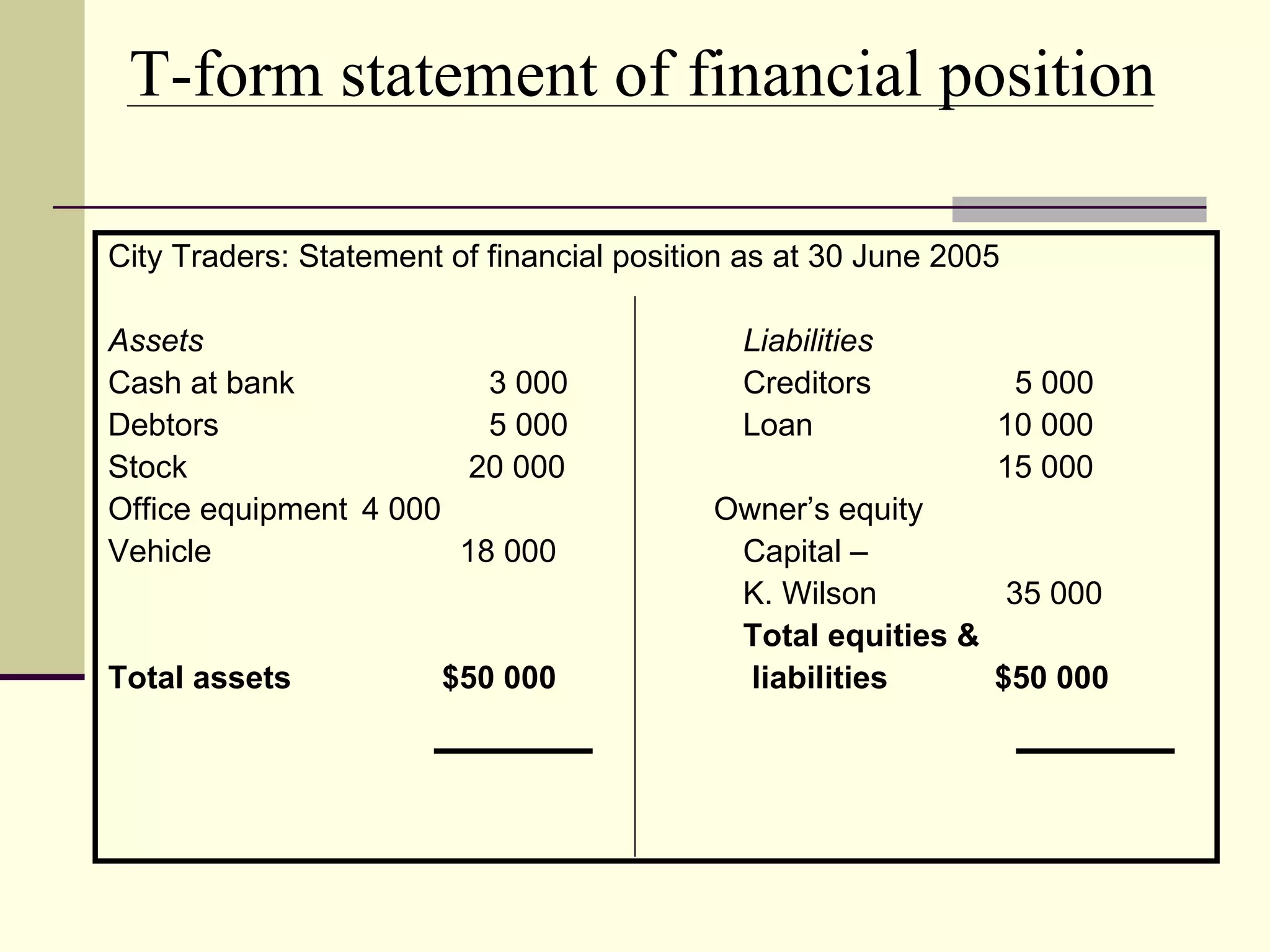
City Traders: Statement of financial position as at 30 June 2005

Assets                                       Liabilities
Cash at bank             3 000               Creditors          5 000
Debtors                  5 000               Loan              10 000
Stock                   20 000                                 15 000
Office equipment 4 000                     Owner’s equity
Vehicle                18 000               Capital –
                                            K. Wilson         35 000
                                            Total equities &
Total assets           $50 000               liabilities     $50 000
Statement of Financial Position
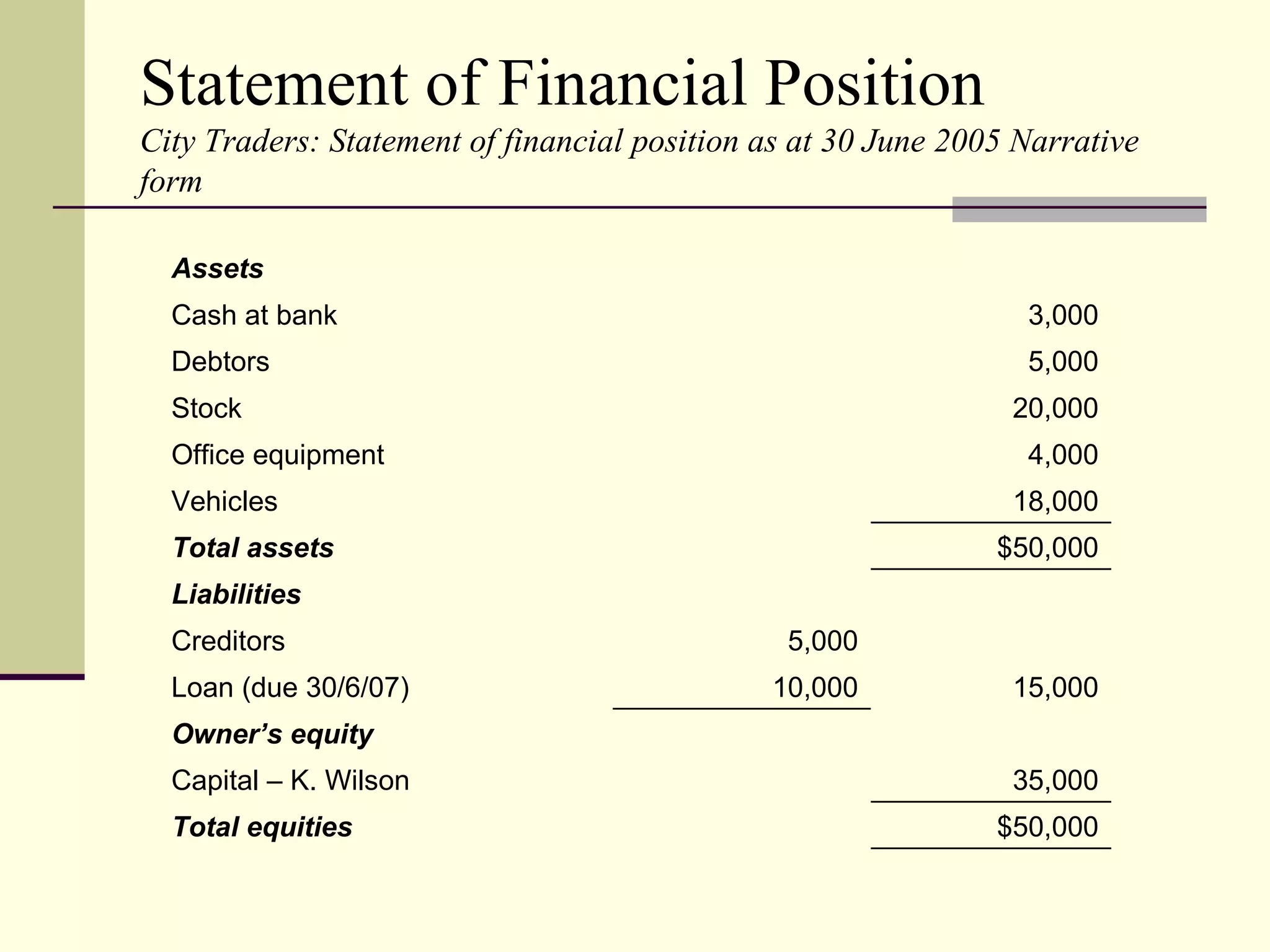
City Traders: Statement of financial position as at 30 June 2005 Narrative
form

  Assets
  Cash at bank                                                   3,000
  Debtors                                                        5,000
  Stock                                                         20,000
  Office equipment                                               4,000
  Vehicles                                                      18,000
  Total assets                                                 $50,000
  Liabilities
  Creditors                                    5,000
  Loan (due 30/6/07)                          10,000            15,000
  Owner’s equity
  Capital – K. Wilson                                           35,000
  Total equities                                               $50,000
Statement of Financial Position
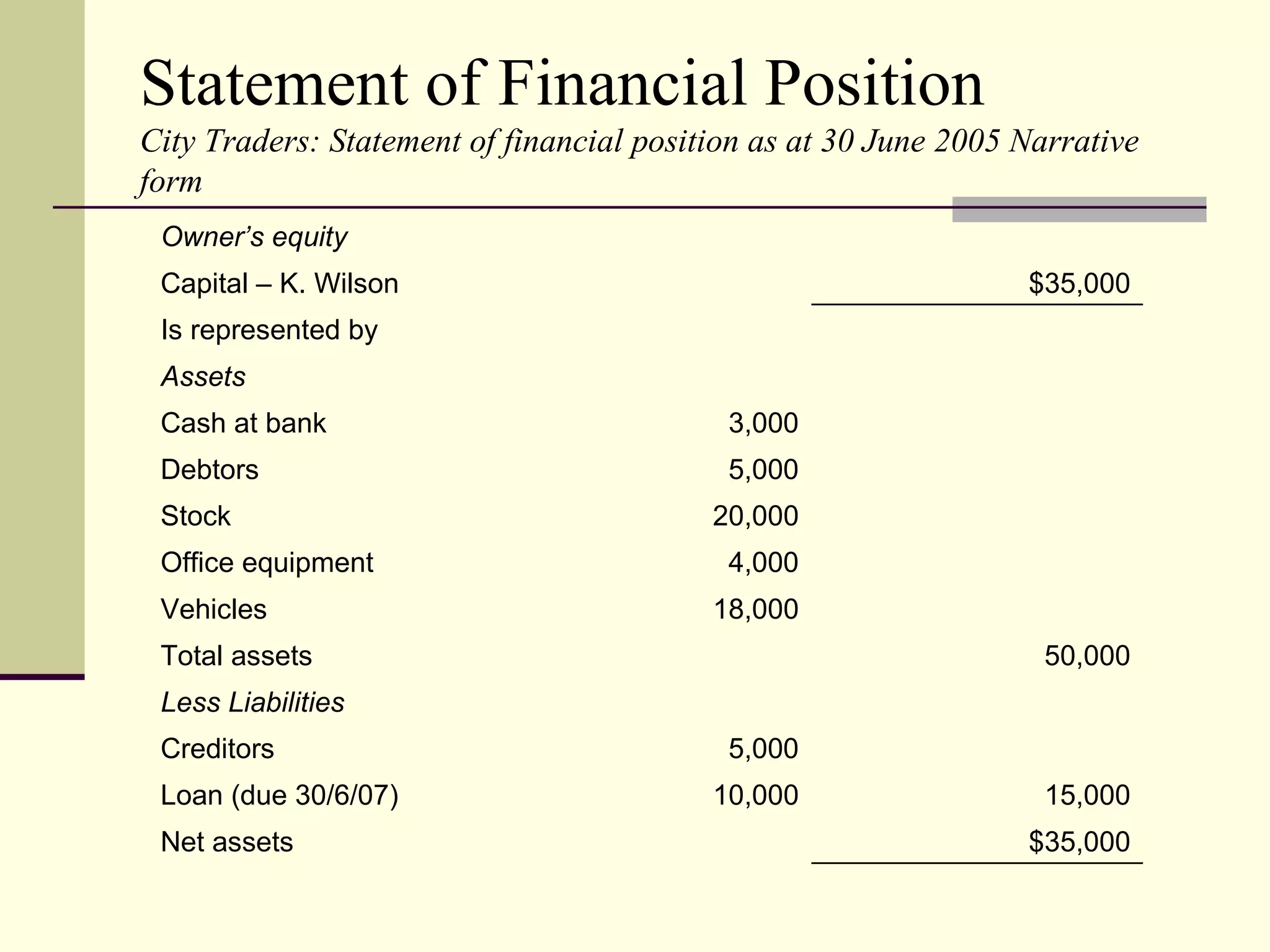
City Traders: Statement of financial position as at 30 June 2005 Narrative
form
 Owner’s equity
 Capital – K. Wilson                                             $35,000
 Is represented by
 Assets
 Cash at bank                              3,000
 Debtors                                   5,000
 Stock                                    20,000
 Office equipment                          4,000
 Vehicles                                 18,000
 Total assets                                                      50,000
 Less Liabilities
 Creditors                                 5,000
 Loan (due 30/6/07)                       10,000                   15,000
 Net assets                                                      $35,000
Classification in the Statement of
Financial Position
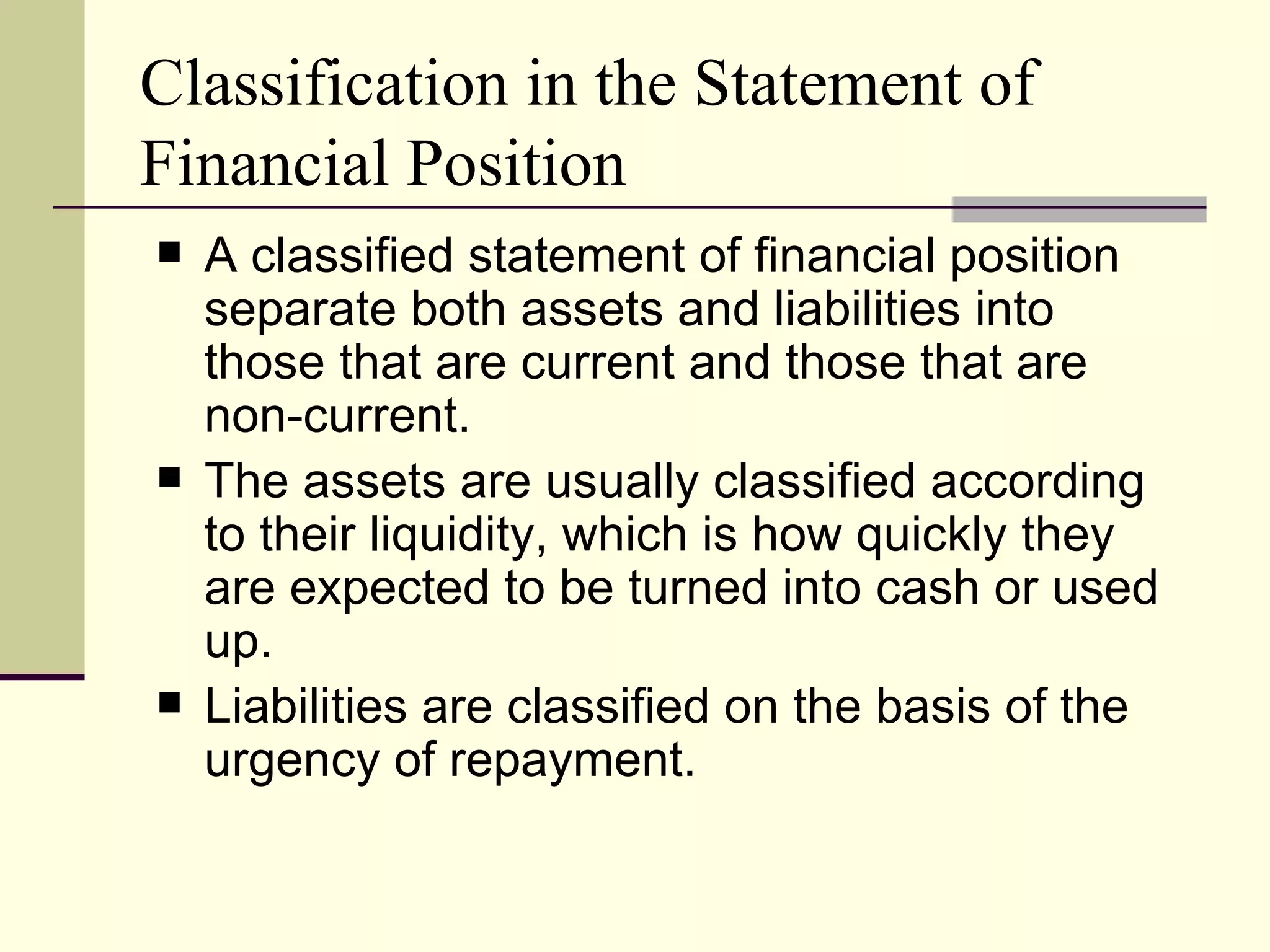
   A classified statement of financial position
    separate both assets and liabilities into
    those that are current and those that are
    non-current.
   The assets are usually classified according
    to their liquidity, which is how quickly they
    are expected to be turned into cash or used
    up.
   Liabilities are classified on the basis of the
    urgency of repayment.
Classification in the Statement of
Financial Position (Cont’d)
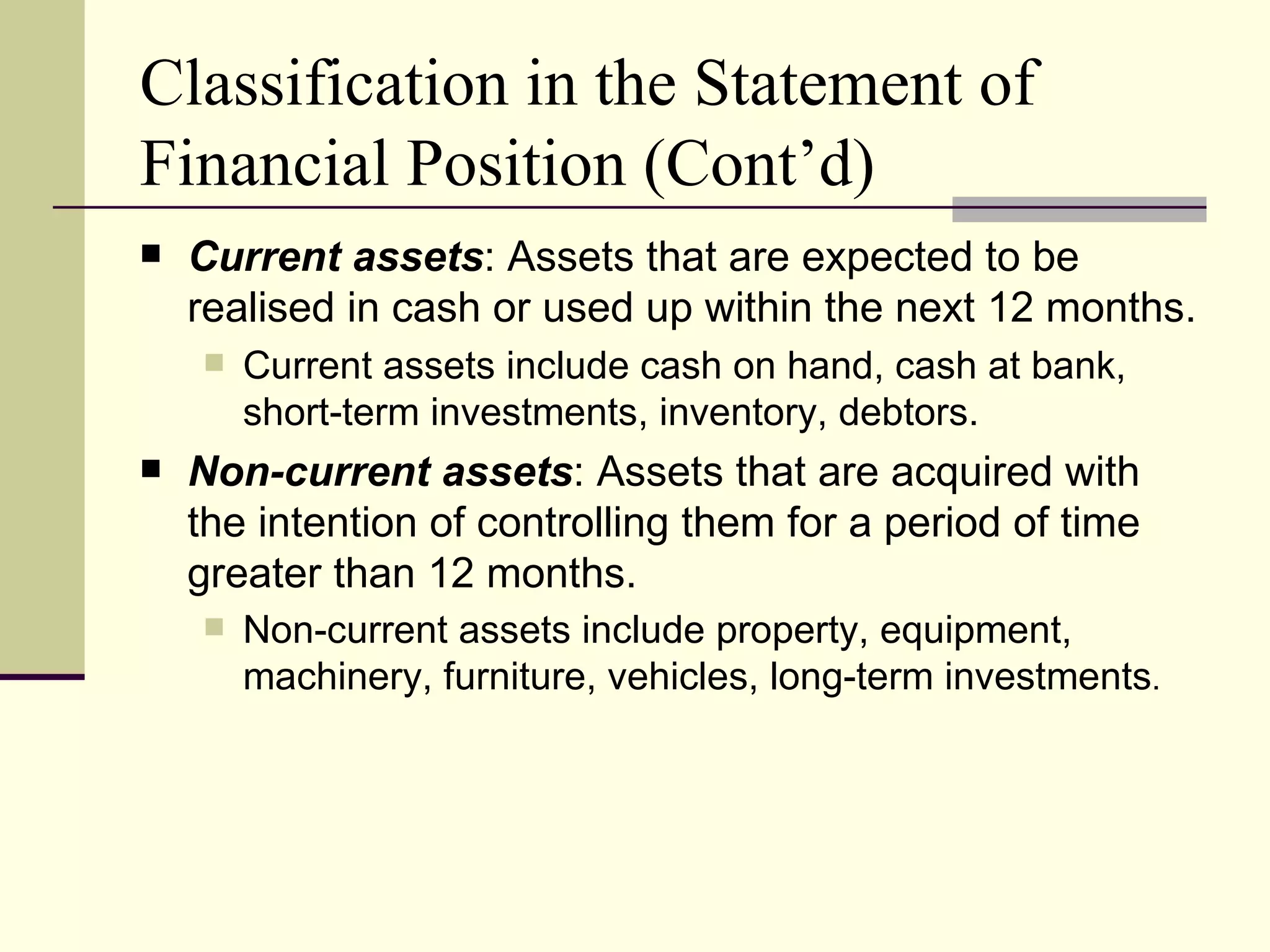
   Current assets: Assets that are expected to be
    realised in cash or used up within the next 12 months.
       Current assets include cash on hand, cash at bank,
        short-term investments, inventory, debtors.
   Non-current assets: Assets that are acquired with
    the intention of controlling them for a period of time
    greater than 12 months.
       Non-current assets include property, equipment,
        machinery, furniture, vehicles, long-term investments.
Classification in the Statement of
Financial Position (Cont’d)
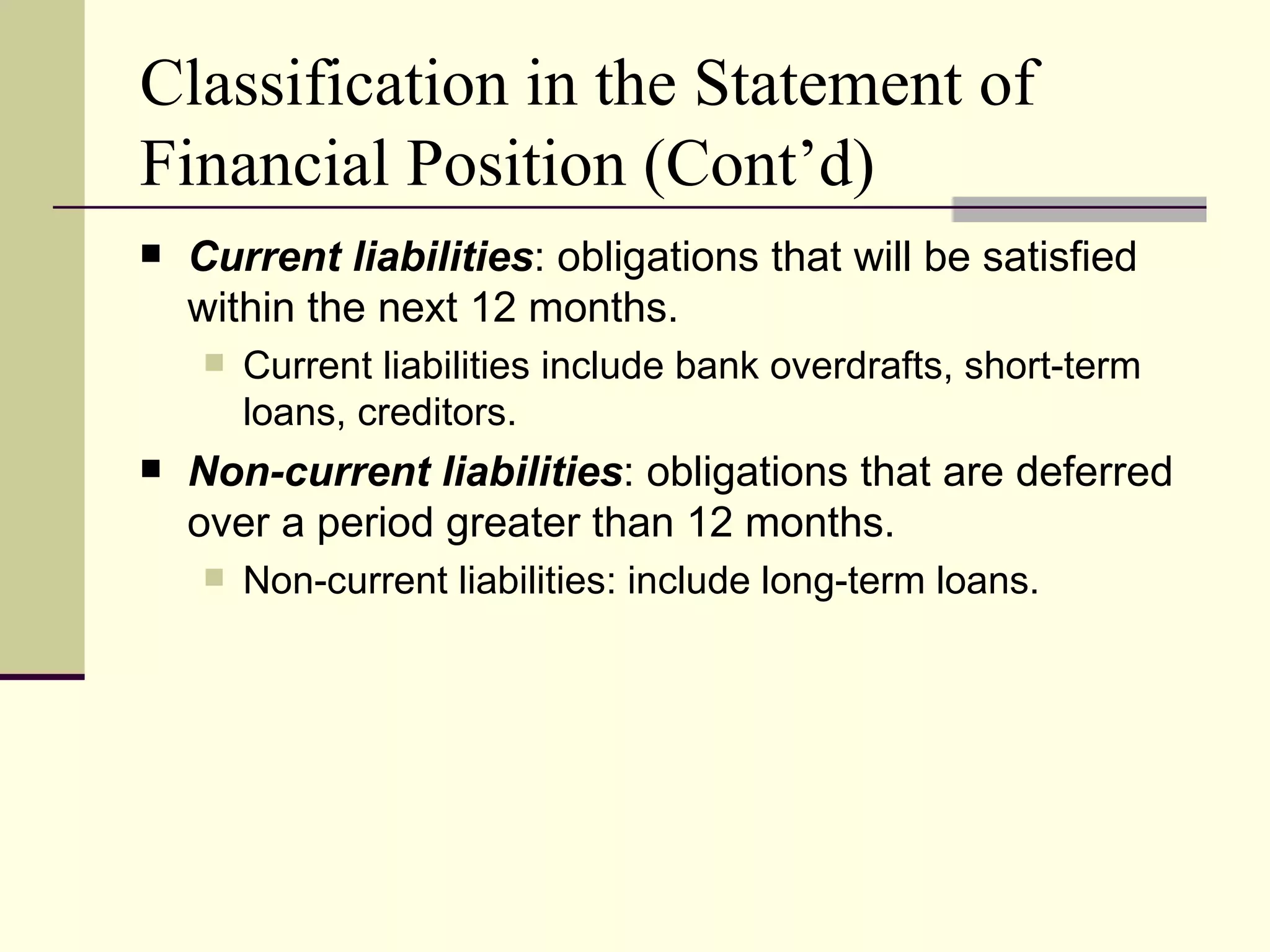
   Current liabilities: obligations that will be satisfied
    within the next 12 months.
       Current liabilities include bank overdrafts, short-term
        loans, creditors.
   Non-current liabilities: obligations that are deferred
    over a period greater than 12 months.
       Non-current liabilities: include long-term loans.
Classified statement of financial
  position (T-form)
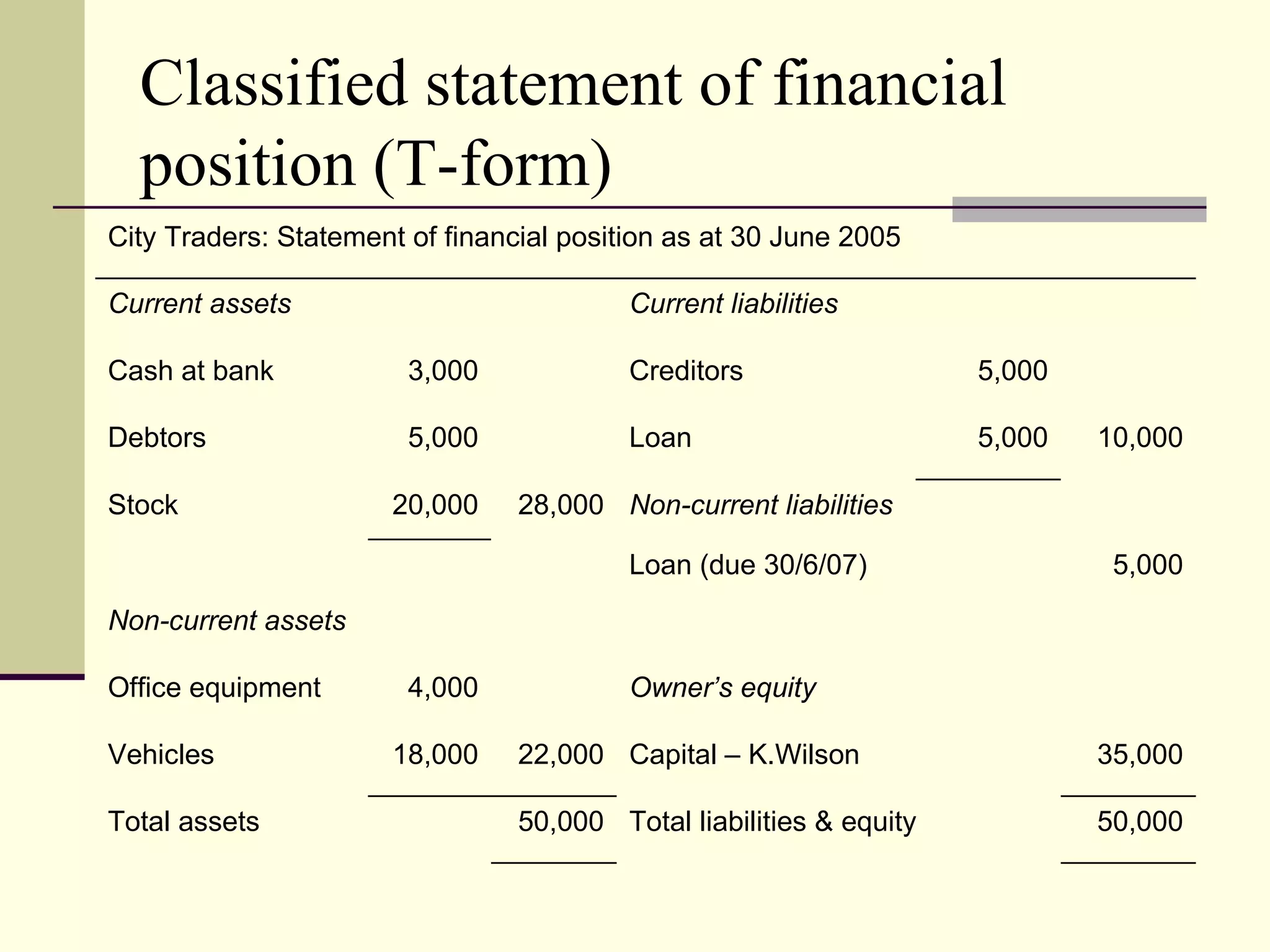
City Traders: Statement of financial position as at 30 June 2005

Current assets                            Current liabilities

Cash at bank            3,000             Creditors                  5,000

Debtors                 5,000             Loan                       5,000   10,000

Stock                 20,000     28,000 Non-current liabilities

                                          Loan (due 30/6/07)                  5,000
Non-current assets

Office equipment        4,000             Owner’s equity

Vehicles              18,000     22,000 Capital – K.Wilson                   35,000

Total assets                     50,000 Total liabilities & equity           50,000
Classified statement of financial position – Narrative form
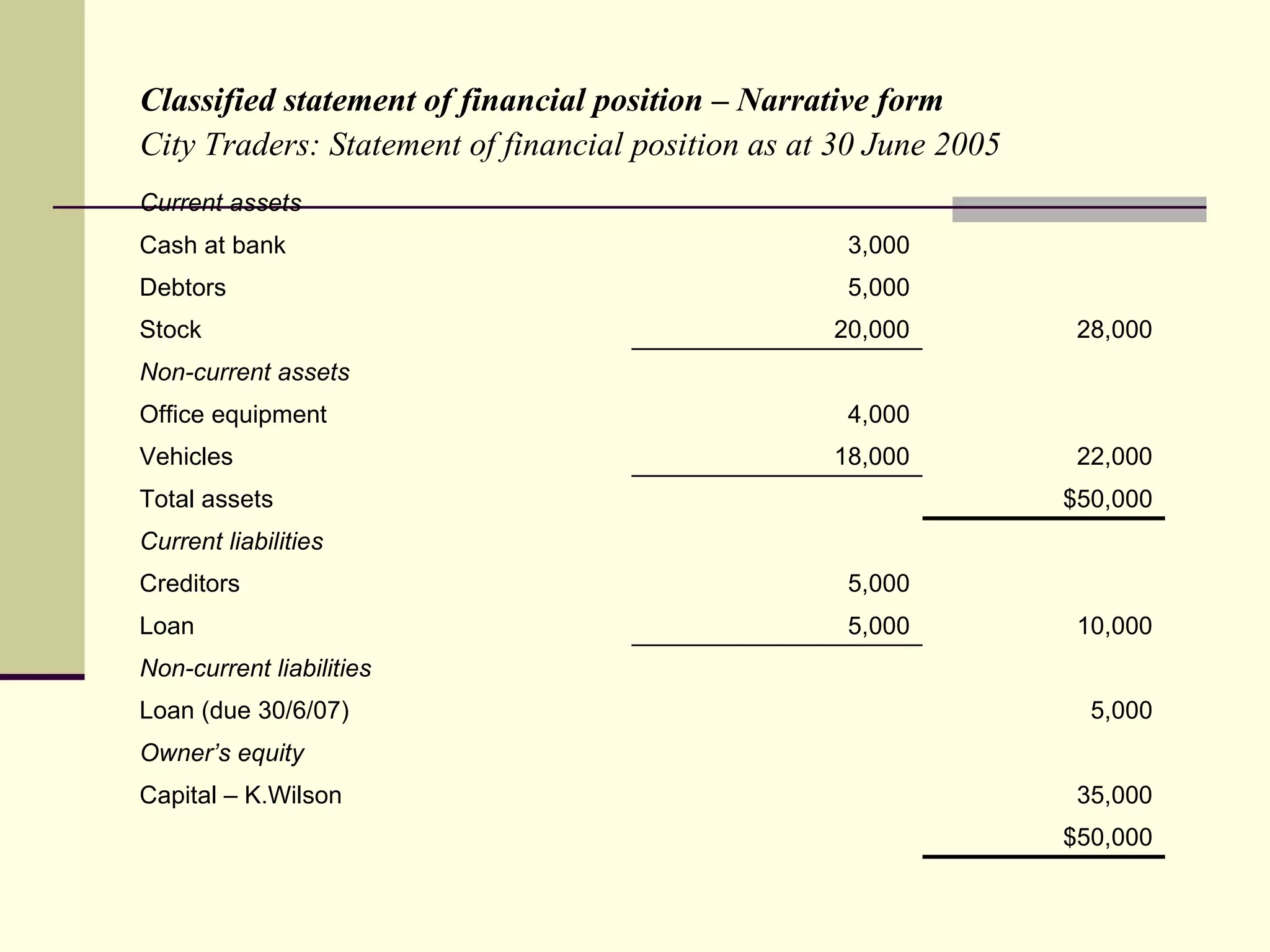
City Traders: Statement of financial position as at 30 June 2005
Current assets
Cash at bank                                        3,000
Debtors                                             5,000
Stock                                              20,000           28,000
Non-current assets
Office equipment                                    4,000
Vehicles                                           18,000           22,000
Total assets                                                       $50,000
Current liabilities
Creditors                                           5,000
Loan                                                5,000           10,000
Non-current liabilities
Loan (due 30/6/07)                                                   5,000
Owner’s equity
Capital – K.Wilson                                                  35,000
                                                                   $50,000
Classified statement of financial position – Narrative form
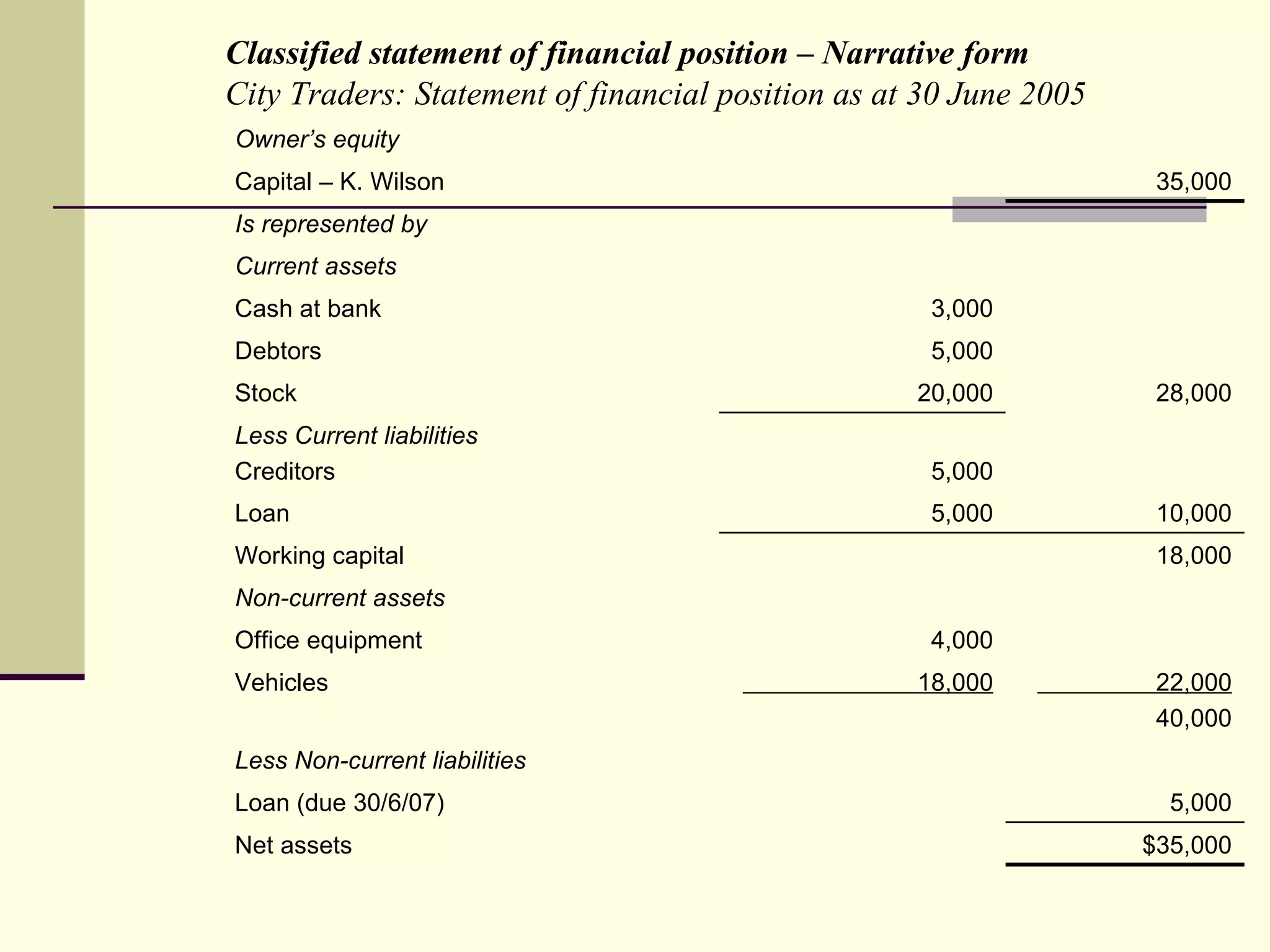
City Traders: Statement of financial position as at 30 June 2005
Owner’s equity
Capital – K. Wilson                                                 35,000
Is represented by
Current assets
Cash at bank                                        3,000
Debtors                                             5,000
Stock                                              20,000           28,000
Less Current liabilities
Creditors                                           5,000
Loan                                                5,000           10,000
Working capital                                                     18,000
Non-current assets
Office equipment                                    4,000
Vehicles                                           18,000           22,000
                                                                    40,000
Less Non-current liabilities
Loan (due 30/6/07)                                                   5,000
Net assets                                                         $35,000
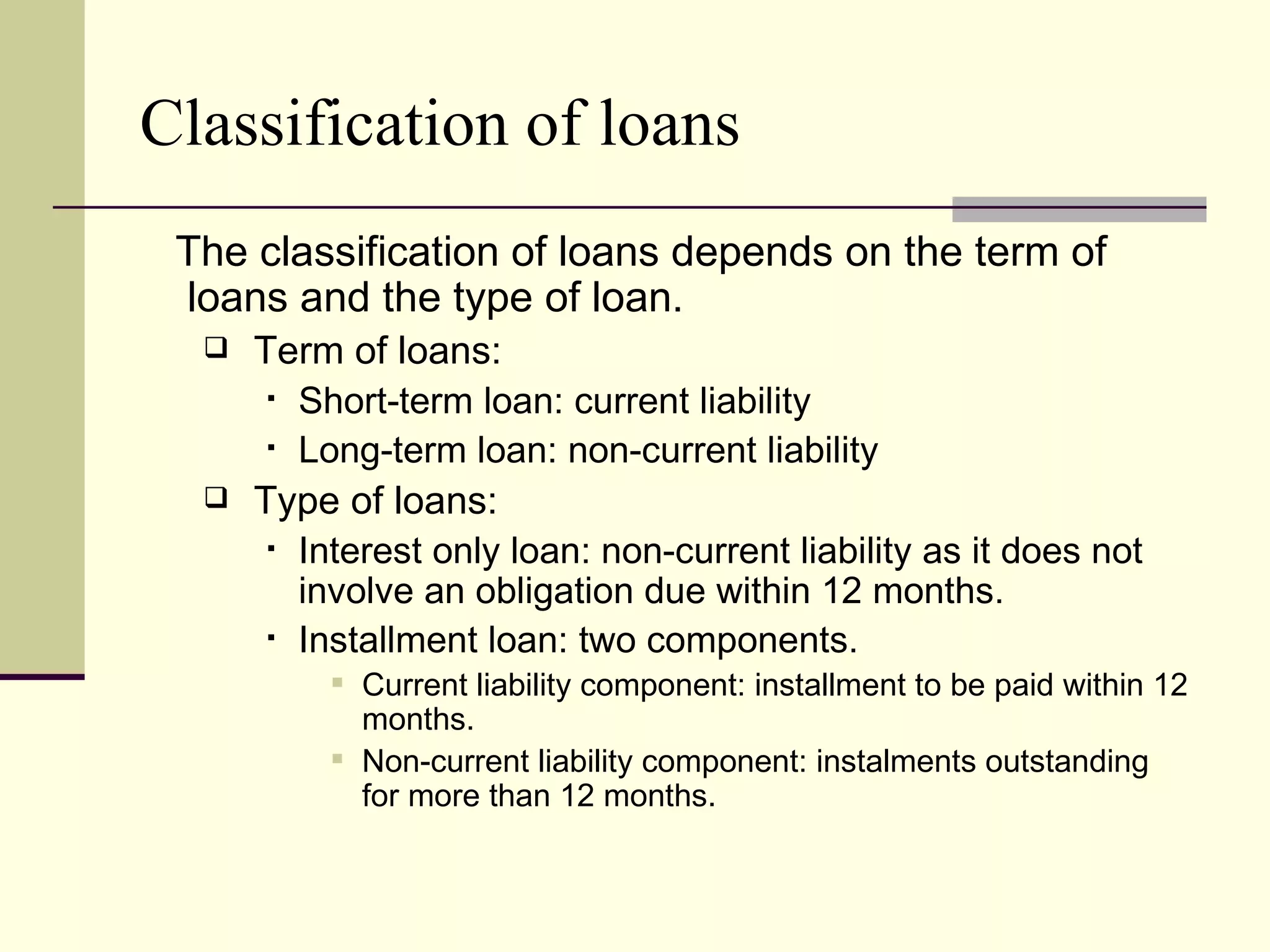
Classification of loans
 The classification of loans depends on the term of
 loans and the type of loan.
     Term of loans:
        Short-term loan: current liability

        Long-term loan: non-current liability

     Type of loans:
        Interest only loan: non-current liability as it does not

         involve an obligation due within 12 months.
        Installment loan: two components.

            Current liability component: installment to be paid within 12
             months.
            Non-current liability component: instalments outstanding
             for more than 12 months.
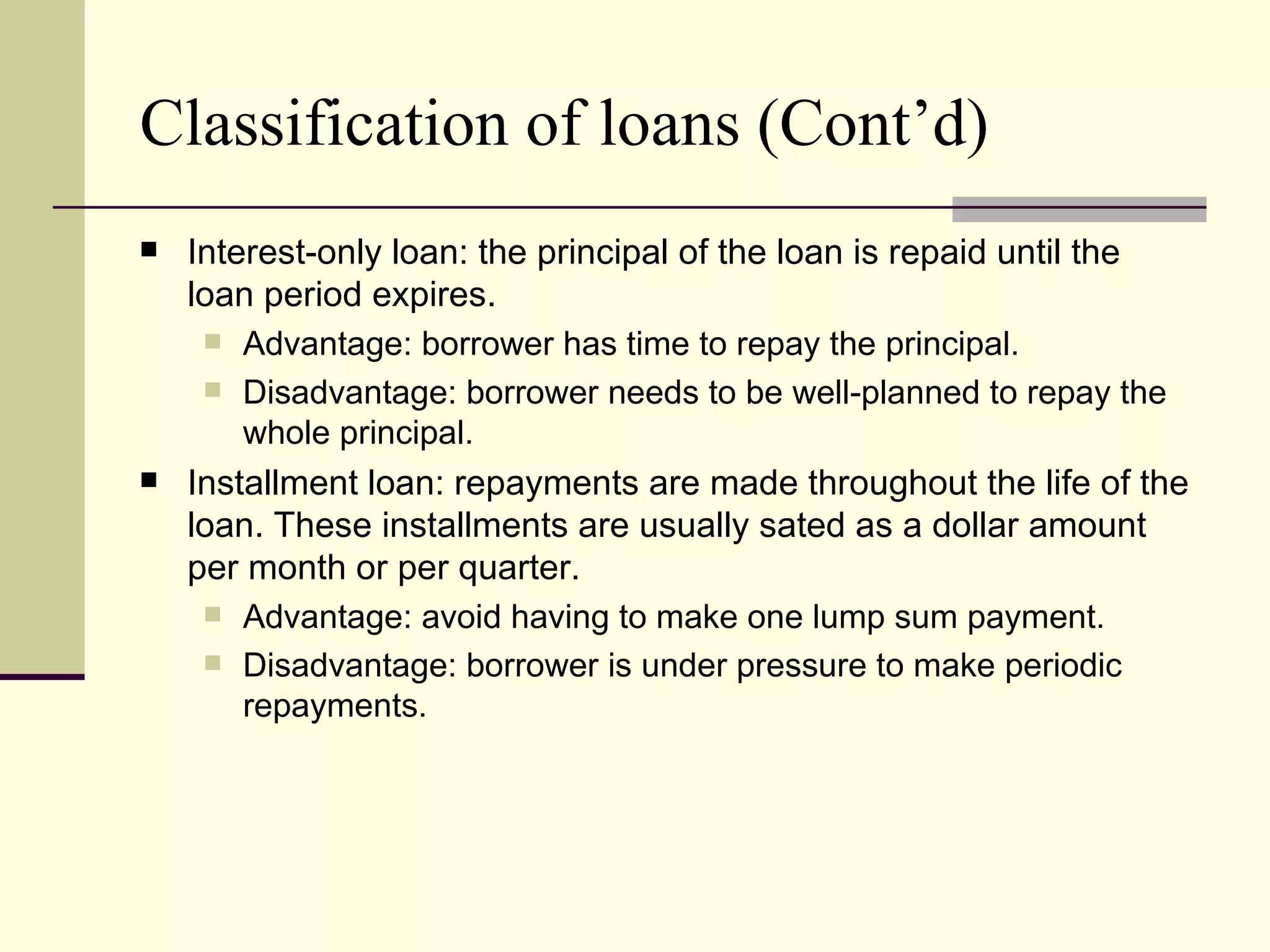
Classification of loans (Cont’d)
   Interest-only loan: the principal of the loan is repaid until the
    loan period expires.
      Advantage: borrower has time to repay the principal.
      Disadvantage: borrower needs to be well-planned to repay the
        whole principal.
   Installment loan: repayments are made throughout the life of the
    loan. These installments are usually sated as a dollar amount
    per month or per quarter.
      Advantage: avoid having to make one lump sum payment.
      Disadvantage: borrower is under pressure to make periodic
        repayments.
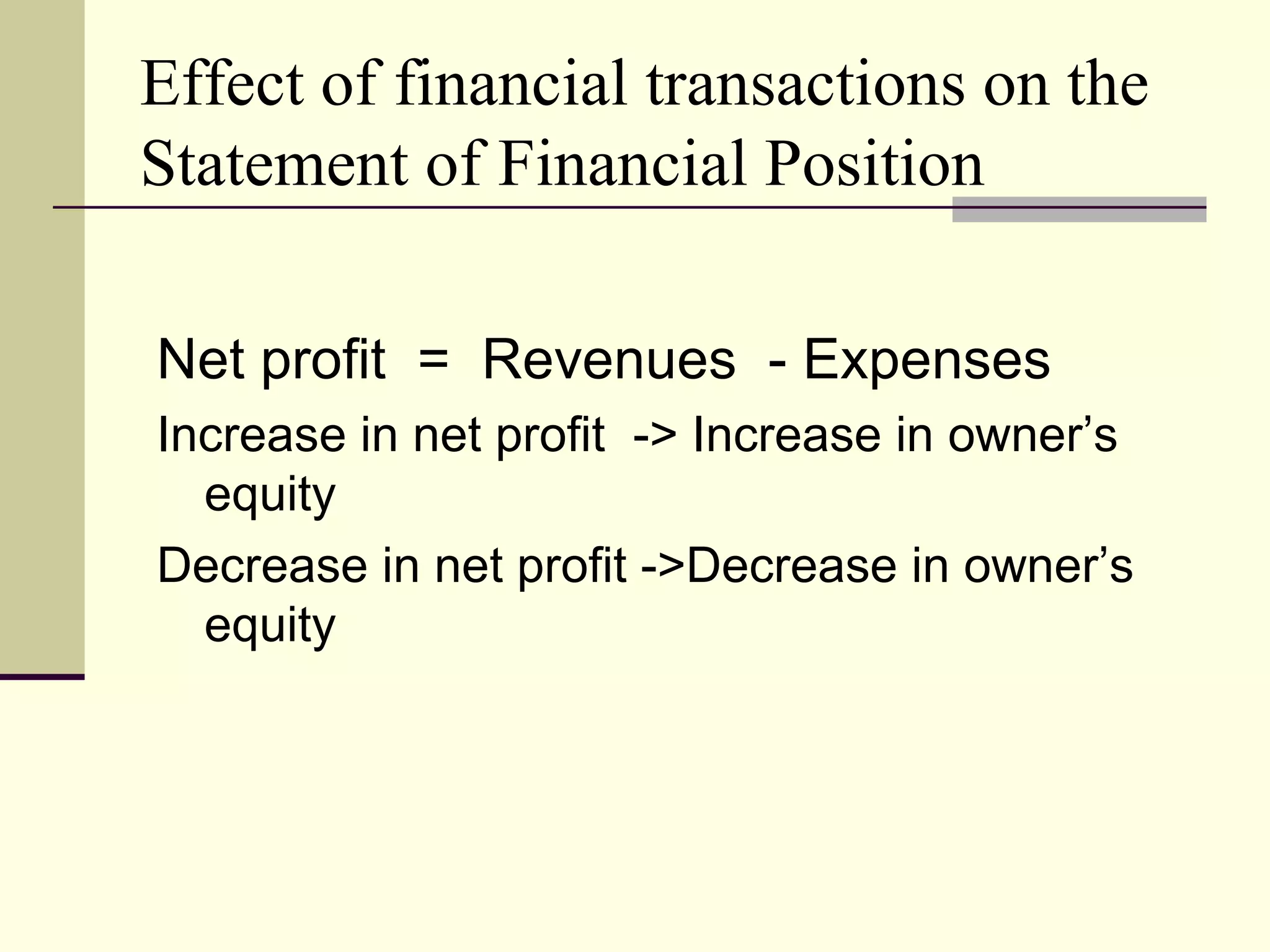
Effect of financial transactions on the
Statement of Financial Position

Net profit = Revenues - Expenses
Increase in net profit -> Increase in owner’s
  equity
Decrease in net profit ->Decrease in owner’s
  equity
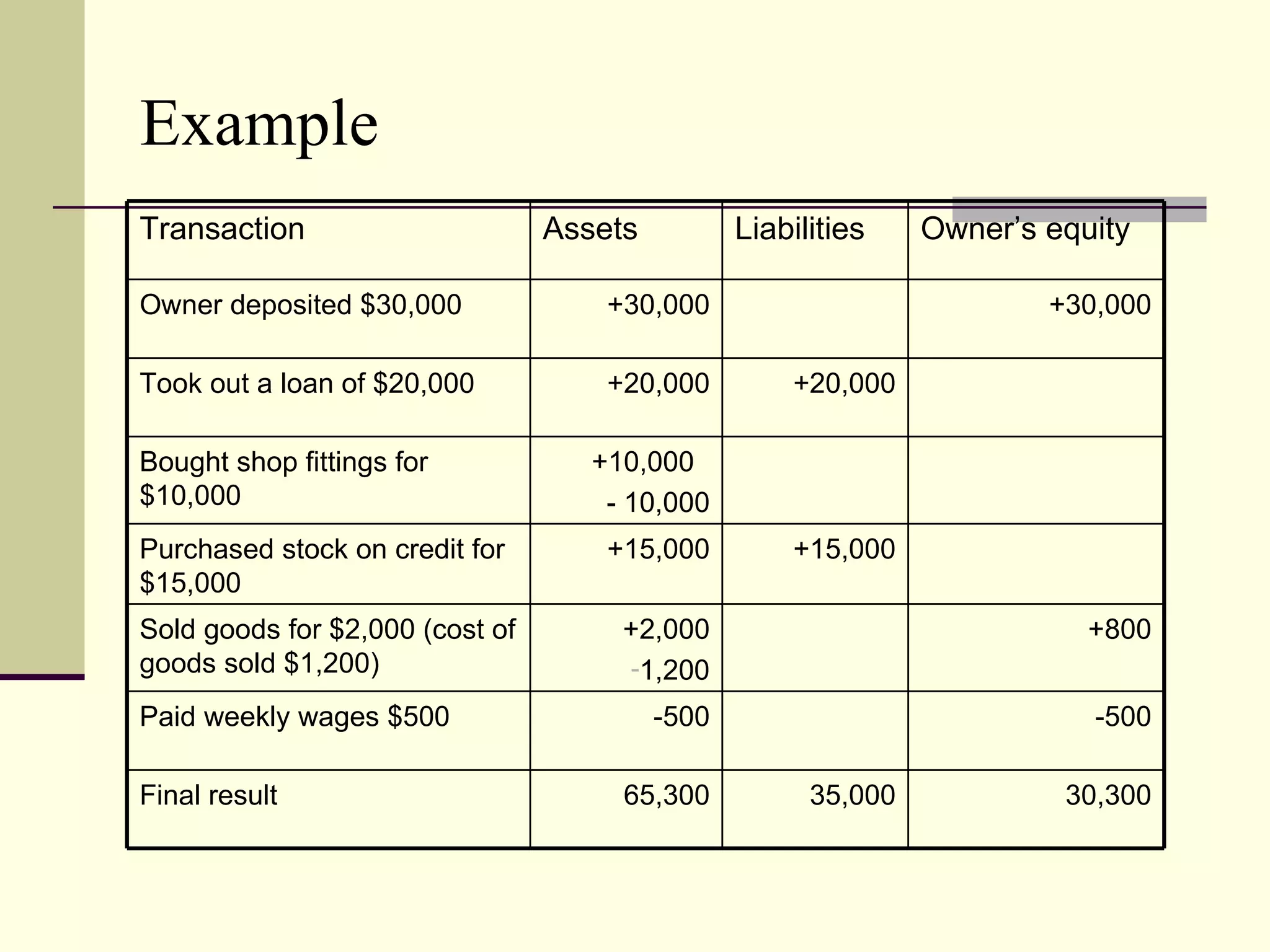
Example
Transaction                      Assets          Liabilities    Owner’s equity

Owner deposited $30,000              +30,000                            +30,000

Took out a loan of $20,000           +20,000         +20,000

Bought shop fittings for            +10,000
$10,000                              - 10,000
Purchased stock on credit for        +15,000         +15,000
$15,000
Sold goods for $2,000 (cost of        +2,000                               +800
goods sold $1,200)                    -1,200
Paid weekly wages $500                    -500                             -500

Final result                          65,300           35,000            30,300
Practice questions
Exercise 2.2
Exercise 2.5
Homework
 Exercise 2.3
 Exercise 2.6
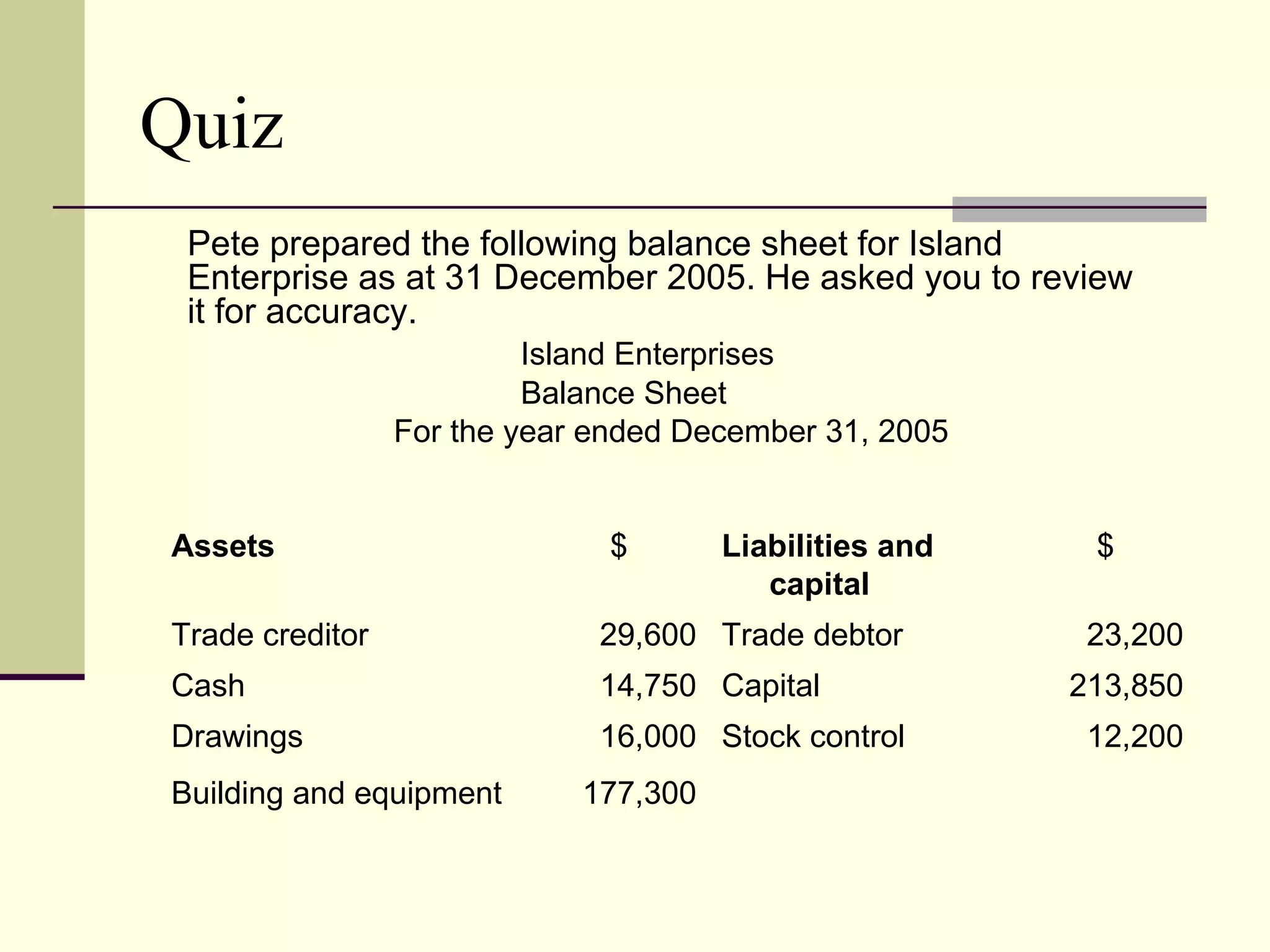
Quiz
 Pete prepared the following balance sheet for Island
 Enterprise as at 31 December 2005. He asked you to review
 it for accuracy.
                          Island Enterprises
                          Balance Sheet
                 For the year ended December 31, 2005


Assets                         $       Liabilities and    $
                                          capital
Trade creditor                29,600 Trade debtor         23,200
Cash                          14,750 Capital             213,850
Drawings                      16,000 Stock control        12,200
Building and equipment       177,300

Chapter 2.statement of financial position clc

  • 1.
    Principle of Accounting Chapter 2 Statement of Financial Position Foreign Trade University
  • 2.
    Statement of FinancialPosition (Balance Sheet)  An accounting report that summarizes the financial status of a business at a particular point in time.  Three main sections of a statement of financial position:  Assets  Liabilities  Owner’s equity
  • 3.
    Statement of FinancialPosition  The accounting equation is the basis of the statement of financial position.  Assets = Liabilities + Owner’s equity  T-form statement of financial position  Narrative form statement of financial position
  • 4.
    T-form statement offinancial position City Traders: Statement of financial position as at 30 June 2005 Assets Liabilities Cash at bank 3 000 Creditors 5 000 Debtors 5 000 Loan 10 000 Stock 20 000 15 000 Office equipment 4 000 Owner’s equity Vehicle 18 000 Capital – K. Wilson 35 000 Total equities & Total assets $50 000 liabilities $50 000
  • 5.
    Statement of FinancialPosition City Traders: Statement of financial position as at 30 June 2005 Narrative form Assets Cash at bank 3,000 Debtors 5,000 Stock 20,000 Office equipment 4,000 Vehicles 18,000 Total assets $50,000 Liabilities Creditors 5,000 Loan (due 30/6/07) 10,000 15,000 Owner’s equity Capital – K. Wilson 35,000 Total equities $50,000
  • 6.
    Statement of FinancialPosition City Traders: Statement of financial position as at 30 June 2005 Narrative form Owner’s equity Capital – K. Wilson $35,000 Is represented by Assets Cash at bank 3,000 Debtors 5,000 Stock 20,000 Office equipment 4,000 Vehicles 18,000 Total assets 50,000 Less Liabilities Creditors 5,000 Loan (due 30/6/07) 10,000 15,000 Net assets $35,000
  • 7.
    Classification in theStatement of Financial Position  A classified statement of financial position separate both assets and liabilities into those that are current and those that are non-current.  The assets are usually classified according to their liquidity, which is how quickly they are expected to be turned into cash or used up.  Liabilities are classified on the basis of the urgency of repayment.
  • 8.
    Classification in theStatement of Financial Position (Cont’d)  Current assets: Assets that are expected to be realised in cash or used up within the next 12 months.  Current assets include cash on hand, cash at bank, short-term investments, inventory, debtors.  Non-current assets: Assets that are acquired with the intention of controlling them for a period of time greater than 12 months.  Non-current assets include property, equipment, machinery, furniture, vehicles, long-term investments.
  • 9.
    Classification in theStatement of Financial Position (Cont’d)  Current liabilities: obligations that will be satisfied within the next 12 months.  Current liabilities include bank overdrafts, short-term loans, creditors.  Non-current liabilities: obligations that are deferred over a period greater than 12 months.  Non-current liabilities: include long-term loans.
  • 10.
    Classified statement offinancial position (T-form) City Traders: Statement of financial position as at 30 June 2005 Current assets Current liabilities Cash at bank 3,000 Creditors 5,000 Debtors 5,000 Loan 5,000 10,000 Stock 20,000 28,000 Non-current liabilities Loan (due 30/6/07) 5,000 Non-current assets Office equipment 4,000 Owner’s equity Vehicles 18,000 22,000 Capital – K.Wilson 35,000 Total assets 50,000 Total liabilities & equity 50,000
  • 11.
    Classified statement offinancial position – Narrative form City Traders: Statement of financial position as at 30 June 2005 Current assets Cash at bank 3,000 Debtors 5,000 Stock 20,000 28,000 Non-current assets Office equipment 4,000 Vehicles 18,000 22,000 Total assets $50,000 Current liabilities Creditors 5,000 Loan 5,000 10,000 Non-current liabilities Loan (due 30/6/07) 5,000 Owner’s equity Capital – K.Wilson 35,000 $50,000
  • 12.
    Classified statement offinancial position – Narrative form City Traders: Statement of financial position as at 30 June 2005 Owner’s equity Capital – K. Wilson 35,000 Is represented by Current assets Cash at bank 3,000 Debtors 5,000 Stock 20,000 28,000 Less Current liabilities Creditors 5,000 Loan 5,000 10,000 Working capital 18,000 Non-current assets Office equipment 4,000 Vehicles 18,000 22,000 40,000 Less Non-current liabilities Loan (due 30/6/07) 5,000 Net assets $35,000
  • 13.
    Classification of loans The classification of loans depends on the term of loans and the type of loan.  Term of loans:  Short-term loan: current liability  Long-term loan: non-current liability  Type of loans:  Interest only loan: non-current liability as it does not involve an obligation due within 12 months.  Installment loan: two components.  Current liability component: installment to be paid within 12 months.  Non-current liability component: instalments outstanding for more than 12 months.
  • 14.
    Classification of loans(Cont’d)  Interest-only loan: the principal of the loan is repaid until the loan period expires.  Advantage: borrower has time to repay the principal.  Disadvantage: borrower needs to be well-planned to repay the whole principal.  Installment loan: repayments are made throughout the life of the loan. These installments are usually sated as a dollar amount per month or per quarter.  Advantage: avoid having to make one lump sum payment.  Disadvantage: borrower is under pressure to make periodic repayments.
  • 15.
    Effect of financialtransactions on the Statement of Financial Position Net profit = Revenues - Expenses Increase in net profit -> Increase in owner’s equity Decrease in net profit ->Decrease in owner’s equity
  • 16.
    Example Transaction Assets Liabilities Owner’s equity Owner deposited $30,000 +30,000 +30,000 Took out a loan of $20,000 +20,000 +20,000 Bought shop fittings for +10,000 $10,000 - 10,000 Purchased stock on credit for +15,000 +15,000 $15,000 Sold goods for $2,000 (cost of +2,000 +800 goods sold $1,200) -1,200 Paid weekly wages $500 -500 -500 Final result 65,300 35,000 30,300
  • 17.
  • 18.
  • 19.
    Quiz Pete preparedthe following balance sheet for Island Enterprise as at 31 December 2005. He asked you to review it for accuracy. Island Enterprises Balance Sheet For the year ended December 31, 2005 Assets $ Liabilities and $ capital Trade creditor 29,600 Trade debtor 23,200 Cash 14,750 Capital 213,850 Drawings 16,000 Stock control 12,200 Building and equipment 177,300