consumers:
         Digital consumers:
implications for libraries (and society)

                 Professor David Nicholas
                  CIBER research group
                University College London
                 david.nicholas@ucl.ac.uk
       http://www.ucl.ac.uk/infostudies/research/ciber
Background: choice and change

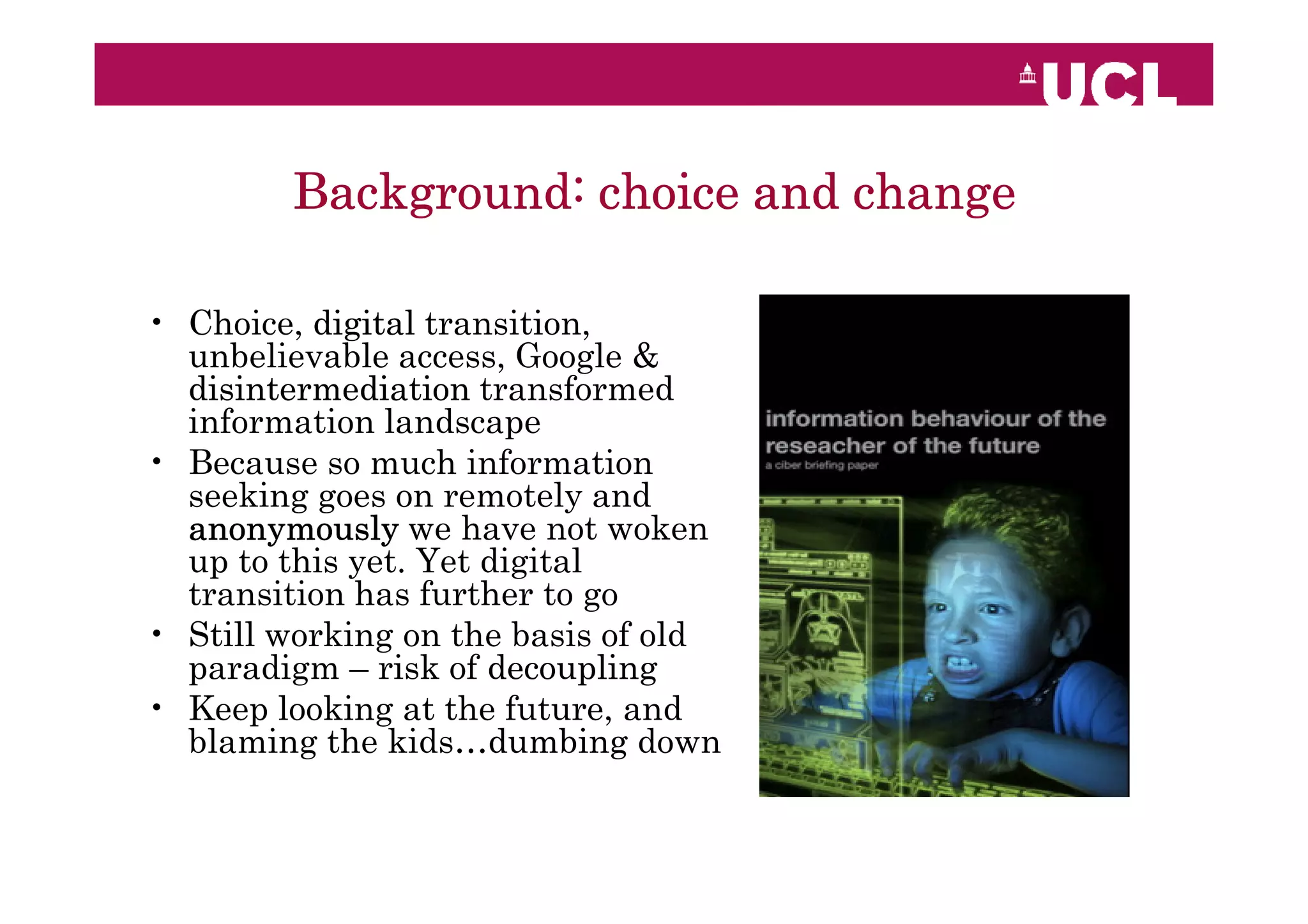
• Choice, digital transition,
  unbelievable access, Google &
  disintermediation transformed
  information landscape
• Because so much information
  seeking goes on remotely and
  anonymously we have not woken
  up to this yet. Yet digital
  transition has further to go
• Still working on the basis of old
  paradigm – risk of decoupling
• Keep looking at the future, and
  blaming the kids…dumbing down
                      dumbing
What have we learnt?


• Seven years of building an evidence base from
  the digital footprints people leave behind
• What people do and not what they say they do
• And what they do follows….
Tremendous activity and going up and up

• Access main driver. More people
  drawn into information net (all
  librarians now!) & existing users can
  search more freely & flexibly.
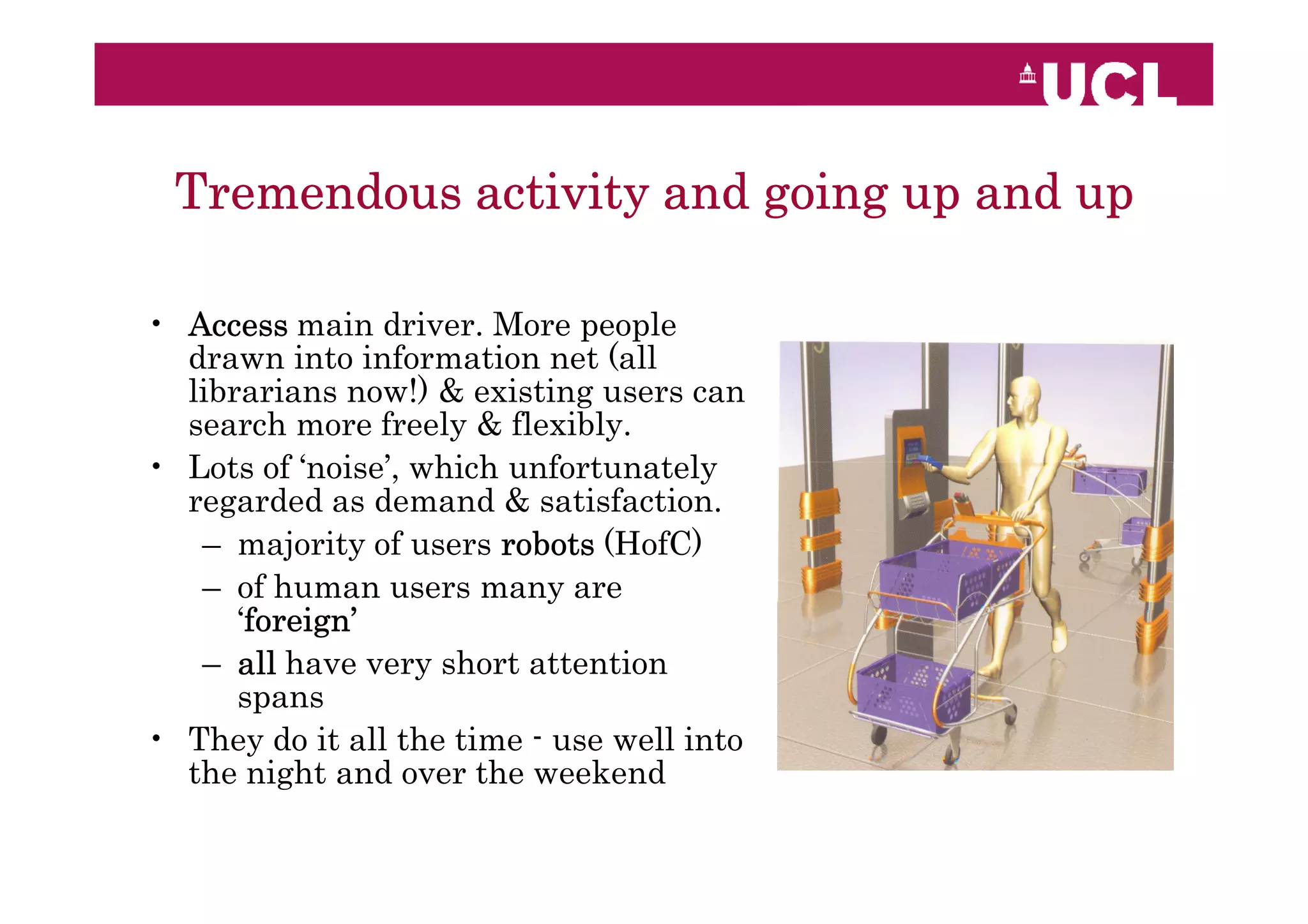
• Lots of ‘noise’, which unfortunately
  regarded as demand & satisfaction.
   – majority of users robots (HofC)
   – of human users many are
      ‘foreign’
       foreign’
   – all have very short attention
      spans
• They do it all the time - use well into
  the night and over the weekend
Consumers like it simple


• Users avoid carefully-crafted discovery systems.
  Everyone likes Google – Physicists and Historians,
  included.
• Advanced search used rarely, and hardly at all by users
  in highly-rated research institutions.
• Add-ons and innovations distinctly a minority sport –
  email alerts, VLEs, blogs. And as for federated
  searching forget it!
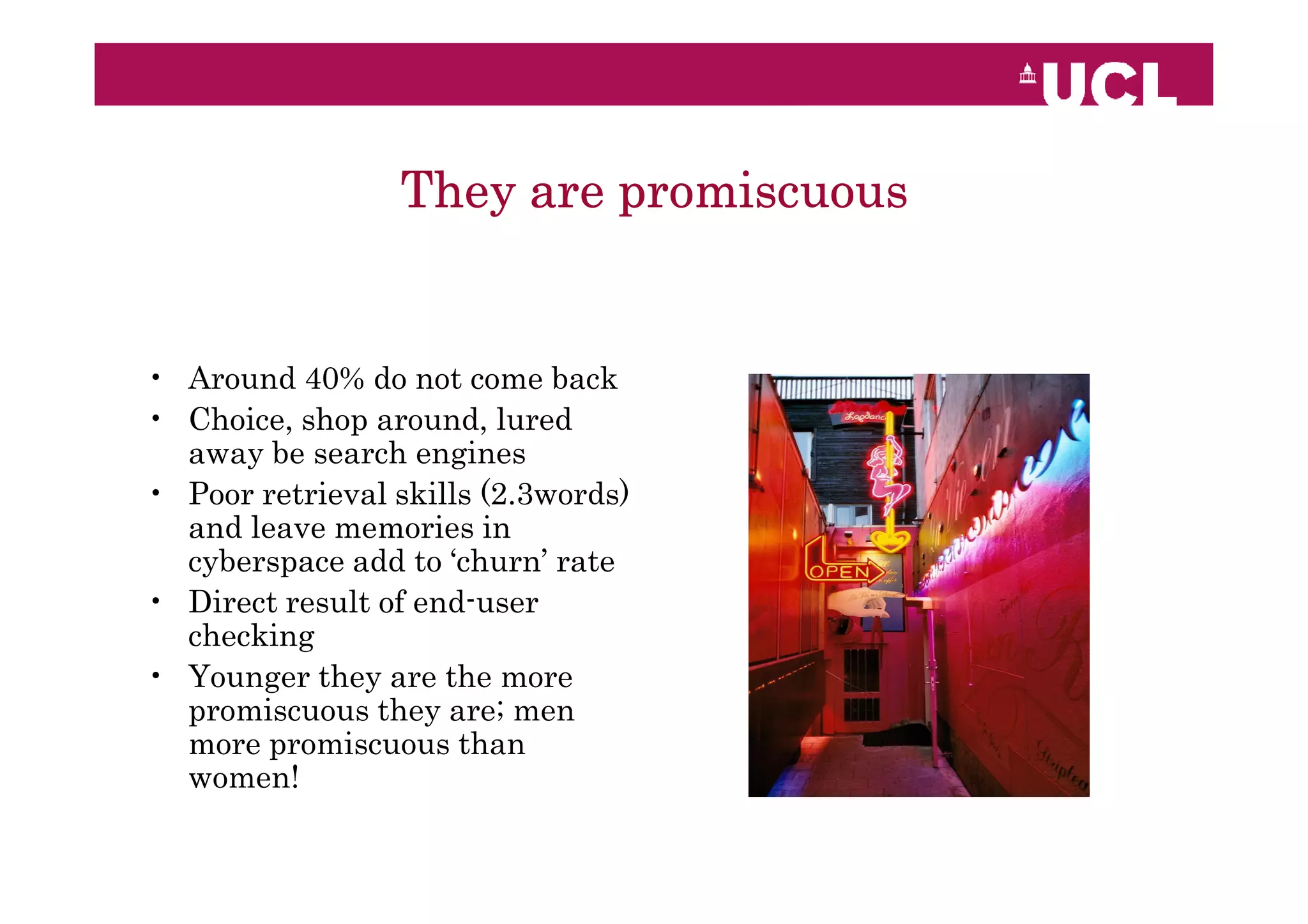
They are promiscuous


• Around 40% do not come back
• Choice, shop around, lured
  away be search engines
• Poor retrieval skills (2.3words)
  and leave memories in
  cyberspace add to ‘churn’ rate
• Direct result of end-user
  checking
• Younger they are the more
  promiscuous they are; men
  more promiscuous than
  women!
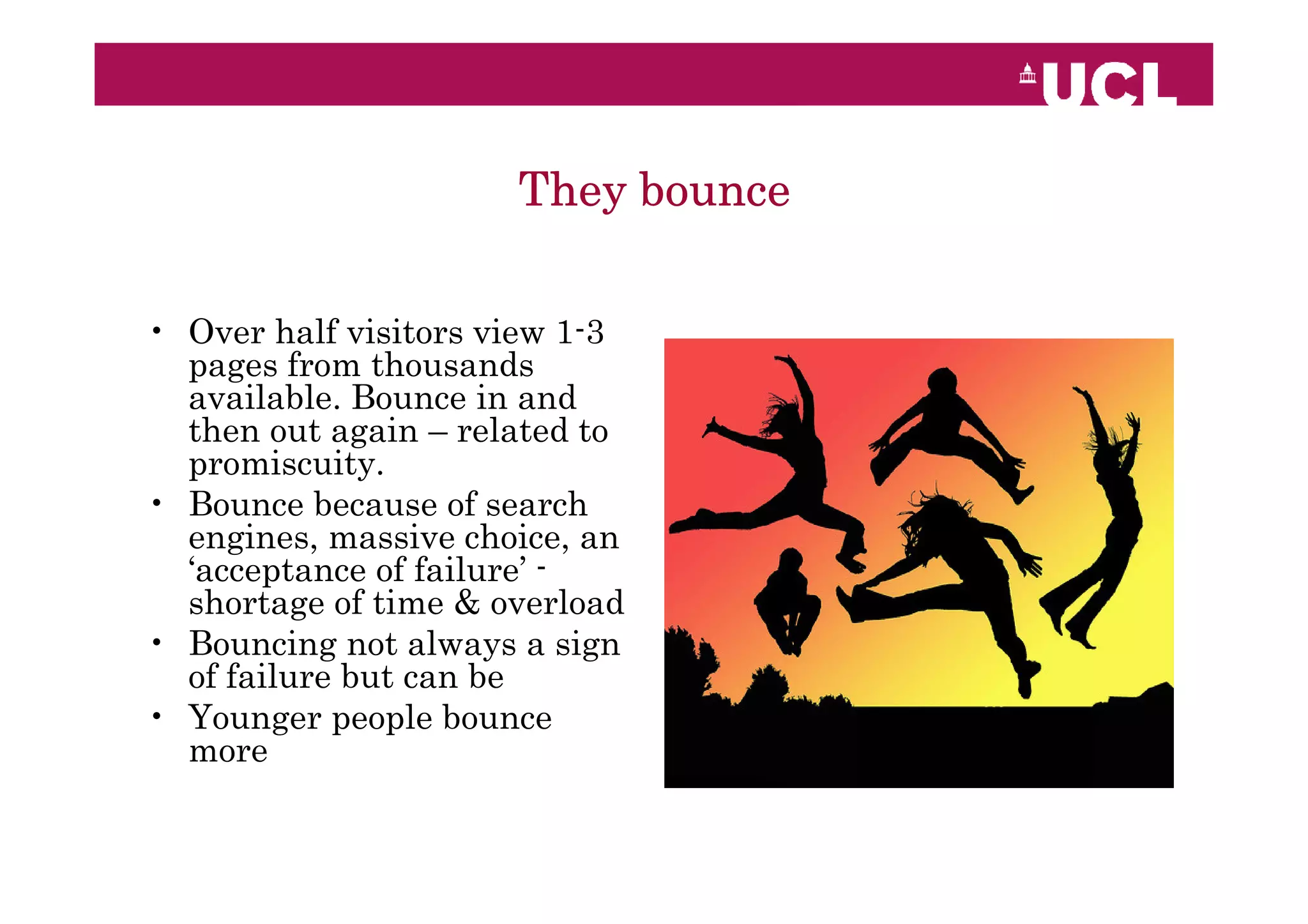
They bounce

• Over half visitors view 1-3
  pages from thousands
  available. Bounce in and
  then out again – related to
  promiscuity.
• Bounce because of search
  engines, massive choice, an
  ‘acceptance of failure’ -
  shortage of time & overload
• Bouncing not always a sign
  of failure but can be
• Younger people bounce
  more
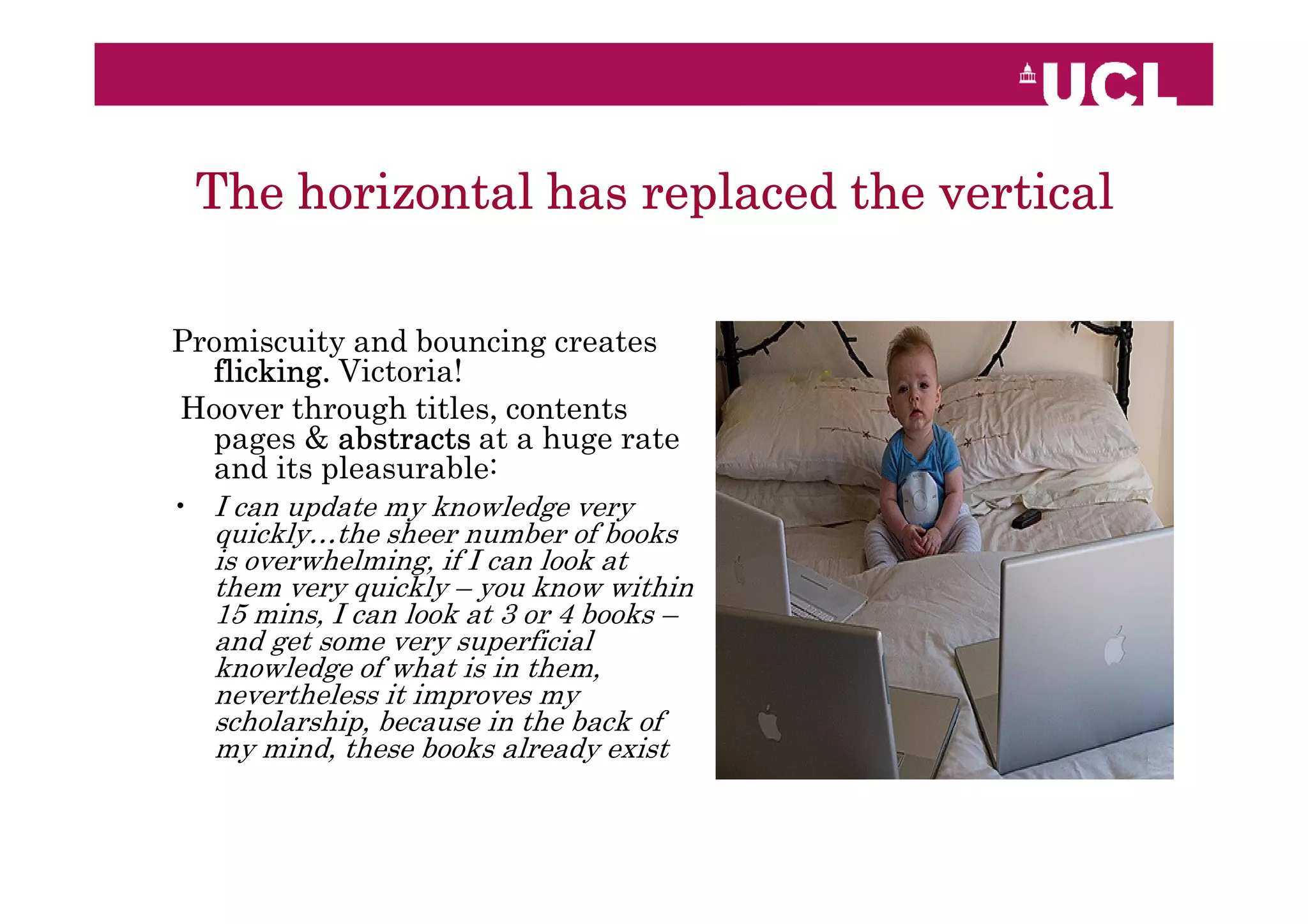
The horizontal has replaced the vertical

Promiscuity and bouncing creates
  flicking. Victoria!
Hoover through titles, contents
  pages & abstracts at a huge rate
  and its pleasurable:
• I can update my knowledge very
  quickly…the sheer number of books
  is overwhelming, if I can look at
  them very quickly – you know within
  15 mins, I can look at 3 or 4 books –
  and get some very superficial
  knowledge of what is in them,
  nevertheless it improves my
  scholarship, because in the back of
  my mind, these books already exist
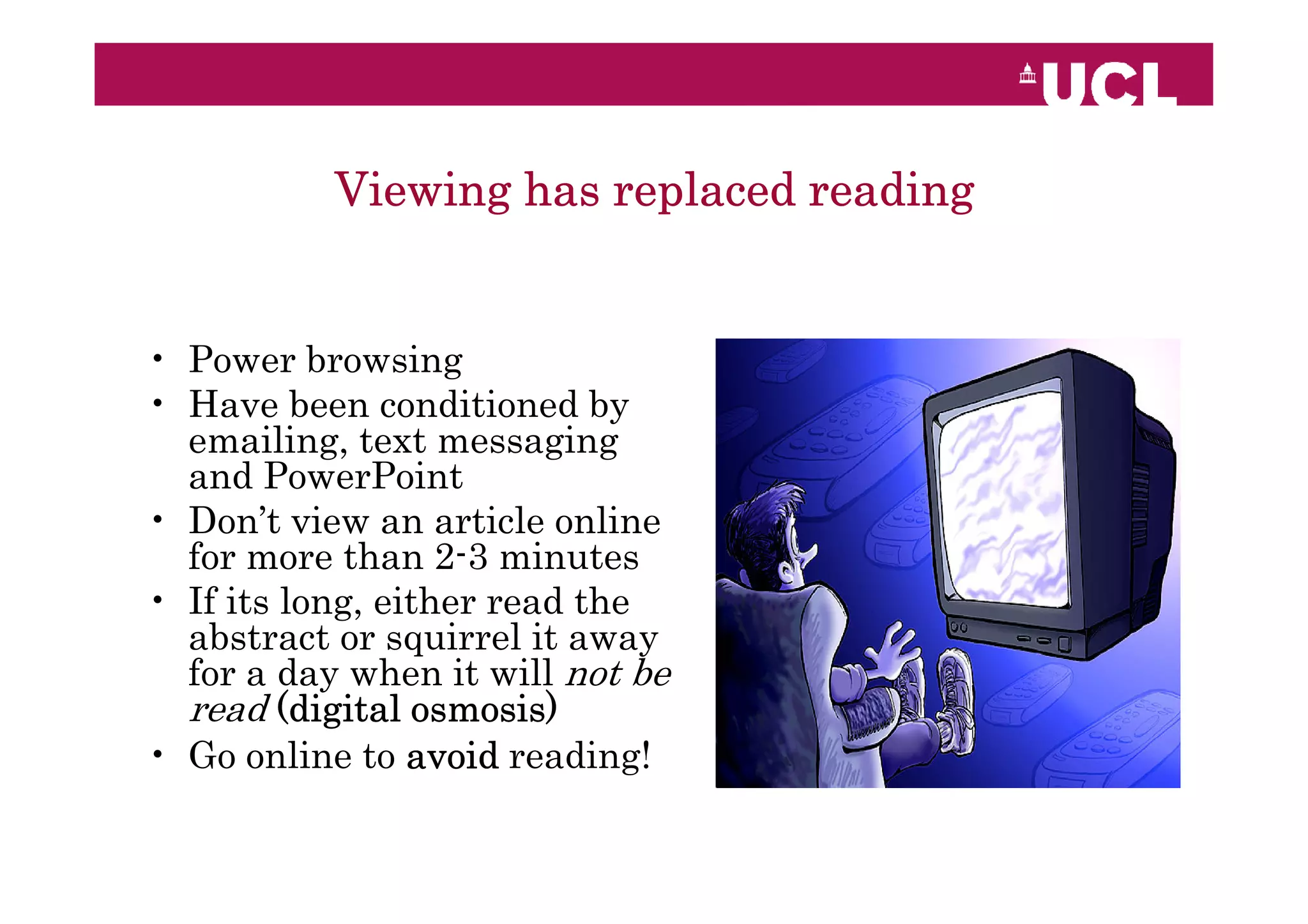
Viewing has replaced reading


• Power browsing
• Have been conditioned by
  emailing, text messaging
  and PowerPoint
• Don’t view an article online
  for more than 2-3 minutes
• If its long, either read the
  abstract or squirrel it away
  for a day when it will not be
  read (digital osmosis)
• Go online to avoid reading!
Consumers want ‘immersive’ social
         information environments


• Social networking starts at home!
• Returned book trolley!
Brand is more complicated than you think


• Difficult in cyberspace:
  responsibility/authority almost
  impossible in a digital environment
  – so many players, so many brands
• Do librarians have brand or
  authority?
• Also what you think is brand is not
  what other people think. Tesco!
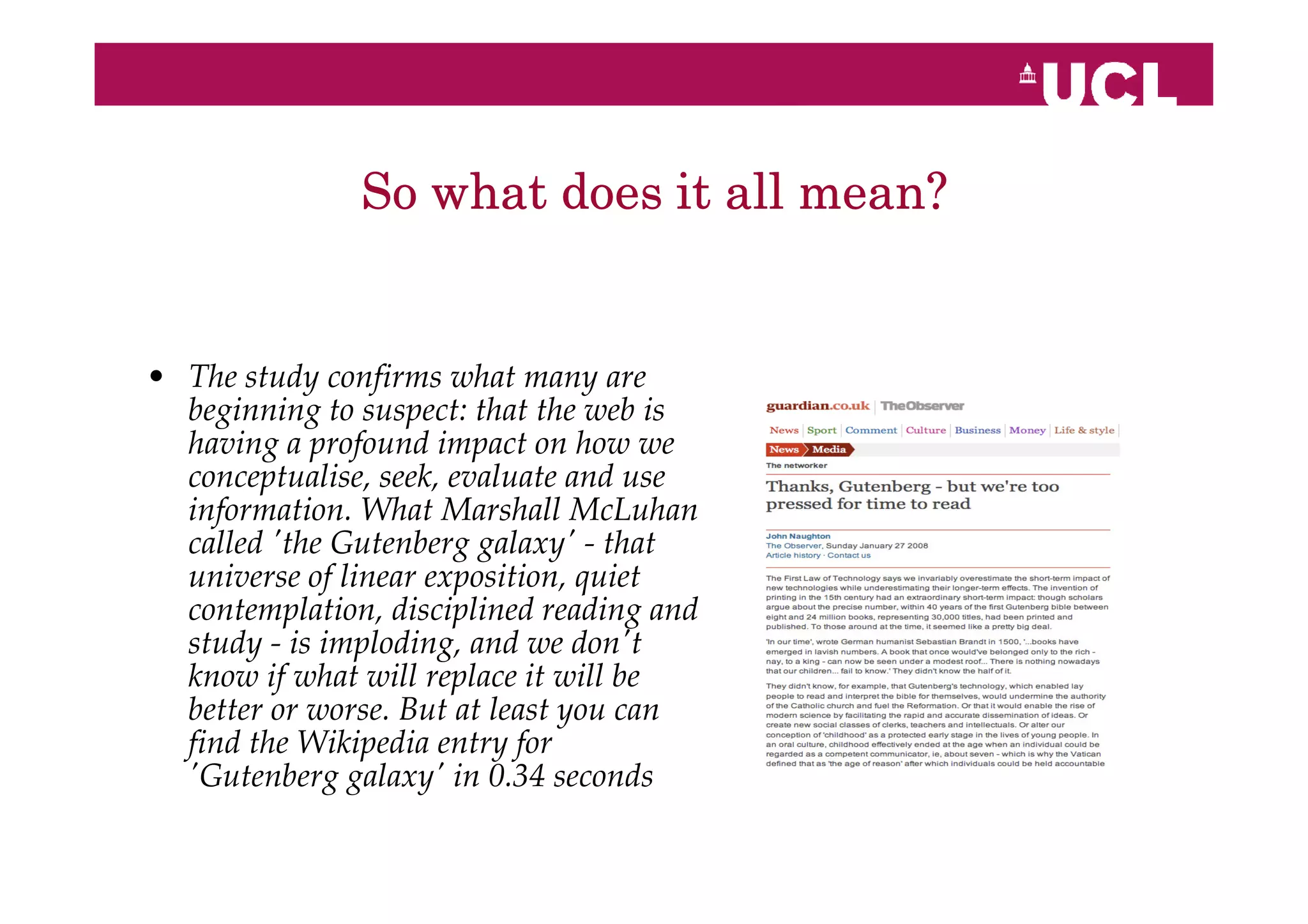
So what does it all mean?


• The study confirms what many are
  beginning to suspect: that the web is
  having a profound impact on how we
  conceptualise, seek, evaluate and use
  information. What Marshall McLuhan
  called 'the Gutenberg galaxy' - that
  universe of linear exposition, quiet
  contemplation, disciplined reading and
  study - is imploding, and we don't
  know if what will replace it will be
  better or worse. But at least you can
  find the Wikipedia entry for
  'Gutenberg galaxy' in 0.34 seconds
Conclusion

• Was it always so and worked with the wrong (ideal)
  models?
• We are all the Google Generation
• Fast information for a fast food generation
• ‘I’ information rather then ‘peer’ information
• Understanding information seeking a prerequisite to
  determining outcomes…access is not an outcome
• Are we really benefiting from the information society
  and always on. Fast forwarding the e-citizen to what?
• And whose responsibility – libraries decoupling and
  publishers the new librarians?
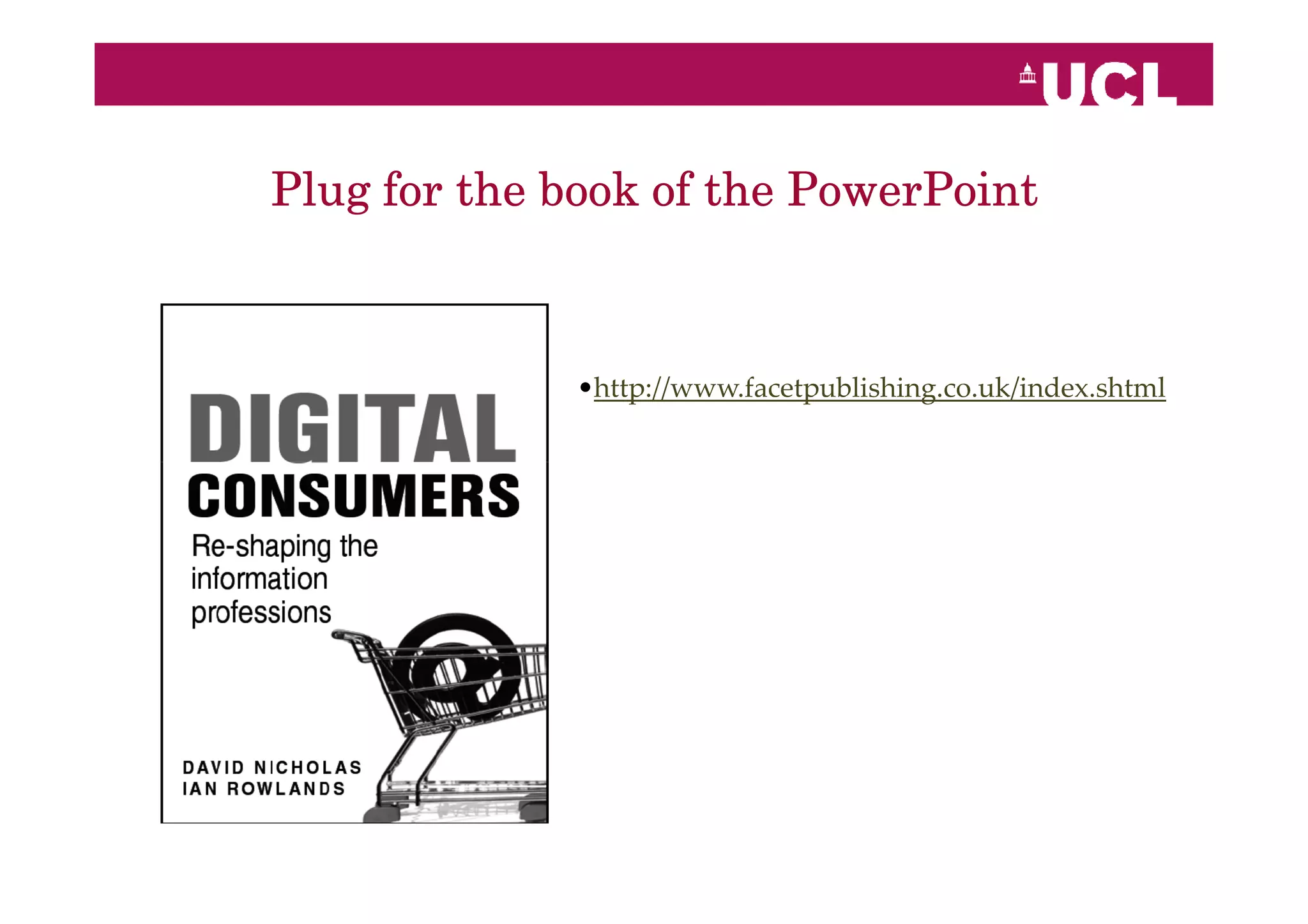
Plug for the book of the PowerPoint


             •http://www.facetpublishing.co.uk/index.shtml
Plug for the television programme!


• BBC 2 Digital Revolution. Filming at UCL on 14th
  November. On the box in January and on the web
  at http://www.bbc.co.uk/blogs/digitalrevolution/

David Nicholas Digital Consumers Implications For Libraries

  • 1.
    consumers: Digital consumers: implications for libraries (and society) Professor David Nicholas CIBER research group University College London david.nicholas@ucl.ac.uk http://www.ucl.ac.uk/infostudies/research/ciber
  • 2.
    Background: choice andchange • Choice, digital transition, unbelievable access, Google & disintermediation transformed information landscape • Because so much information seeking goes on remotely and anonymously we have not woken up to this yet. Yet digital transition has further to go • Still working on the basis of old paradigm – risk of decoupling • Keep looking at the future, and blaming the kids…dumbing down dumbing
  • 3.
    What have welearnt? • Seven years of building an evidence base from the digital footprints people leave behind • What people do and not what they say they do • And what they do follows….
  • 4.
    Tremendous activity andgoing up and up • Access main driver. More people drawn into information net (all librarians now!) & existing users can search more freely & flexibly. • Lots of ‘noise’, which unfortunately regarded as demand & satisfaction. – majority of users robots (HofC) – of human users many are ‘foreign’ foreign’ – all have very short attention spans • They do it all the time - use well into the night and over the weekend
  • 5.
    Consumers like itsimple • Users avoid carefully-crafted discovery systems. Everyone likes Google – Physicists and Historians, included. • Advanced search used rarely, and hardly at all by users in highly-rated research institutions. • Add-ons and innovations distinctly a minority sport – email alerts, VLEs, blogs. And as for federated searching forget it!
  • 6.
    They are promiscuous •Around 40% do not come back • Choice, shop around, lured away be search engines • Poor retrieval skills (2.3words) and leave memories in cyberspace add to ‘churn’ rate • Direct result of end-user checking • Younger they are the more promiscuous they are; men more promiscuous than women!
  • 7.
    They bounce • Overhalf visitors view 1-3 pages from thousands available. Bounce in and then out again – related to promiscuity. • Bounce because of search engines, massive choice, an ‘acceptance of failure’ - shortage of time & overload • Bouncing not always a sign of failure but can be • Younger people bounce more
  • 8.
    The horizontal hasreplaced the vertical Promiscuity and bouncing creates flicking. Victoria! Hoover through titles, contents pages & abstracts at a huge rate and its pleasurable: • I can update my knowledge very quickly…the sheer number of books is overwhelming, if I can look at them very quickly – you know within 15 mins, I can look at 3 or 4 books – and get some very superficial knowledge of what is in them, nevertheless it improves my scholarship, because in the back of my mind, these books already exist
  • 9.
    Viewing has replacedreading • Power browsing • Have been conditioned by emailing, text messaging and PowerPoint • Don’t view an article online for more than 2-3 minutes • If its long, either read the abstract or squirrel it away for a day when it will not be read (digital osmosis) • Go online to avoid reading!
  • 10.
    Consumers want ‘immersive’social information environments • Social networking starts at home! • Returned book trolley!
  • 11.
    Brand is morecomplicated than you think • Difficult in cyberspace: responsibility/authority almost impossible in a digital environment – so many players, so many brands • Do librarians have brand or authority? • Also what you think is brand is not what other people think. Tesco!
  • 12.
    So what doesit all mean? • The study confirms what many are beginning to suspect: that the web is having a profound impact on how we conceptualise, seek, evaluate and use information. What Marshall McLuhan called 'the Gutenberg galaxy' - that universe of linear exposition, quiet contemplation, disciplined reading and study - is imploding, and we don't know if what will replace it will be better or worse. But at least you can find the Wikipedia entry for 'Gutenberg galaxy' in 0.34 seconds
  • 13.
    Conclusion • Was italways so and worked with the wrong (ideal) models? • We are all the Google Generation • Fast information for a fast food generation • ‘I’ information rather then ‘peer’ information • Understanding information seeking a prerequisite to determining outcomes…access is not an outcome • Are we really benefiting from the information society and always on. Fast forwarding the e-citizen to what? • And whose responsibility – libraries decoupling and publishers the new librarians?
  • 14.
    Plug for thebook of the PowerPoint •http://www.facetpublishing.co.uk/index.shtml
  • 15.
    Plug for thetelevision programme! • BBC 2 Digital Revolution. Filming at UCL on 14th November. On the box in January and on the web at http://www.bbc.co.uk/blogs/digitalrevolution/