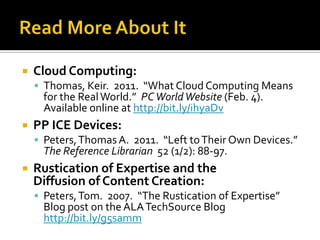
In the Clouds, With a Personal, Portable Computer, By Professor Plum:Clues Concerning the Impact and Opportunities of the eReading Revolution on Libraries and Library StaffA talk given by Tom Peters at the Kanawha County Public Library Staff Development DayCharleston, West Virginia, February 23, 2011
Talkin’ About a Revolution!These slides are online at http://www.tapinformation.com/KanawhaTalk201102.htm
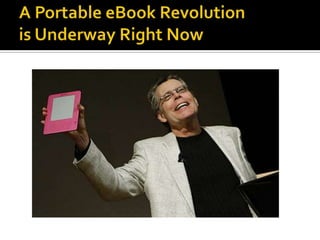
A Portable eBook Revolution is Underway Right Now
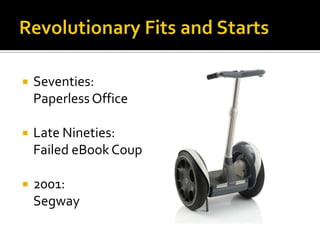
Revolutionary Fits and StartsSeventies:  Paperless OfficeLate Nineties:  Failed eBook Coup2001:  Segway
Amazing Revolutions UnderwayGlobal mobile phone revolution.5.3 billion mobile cellular subscriptions in 2010.76.2 subscriptions for every 100 pe0ple worldwide.Source: http://www.itu.int/ITU-D/ict/statistics/at_glance/KeyTelecom.html Portable eReading revolution.
My Two Professional FearsMobile Revolution(Fear of missed opportunities)Portable eReading Revolution(Fear of being muscled out)
People and Tech RevolutionsWhat can we learn from history?
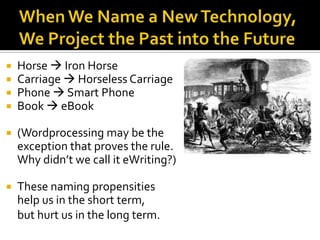
When We Name a New Technology, We Project the Past into the FutureHorse  Iron HorseCarriage  Horseless CarriagePhone  Smart PhoneBook  eBook(Wordprocessingmay be the exception that proves the rule.  Why didn’t we call it eWriting?)These naming propensities help us in the short term, but hurt us in the long term.
The Cloudiness of Cloud ComputingJust about everybody is always connected to the Internet, unless they consciously choose to be offline.What does this mean for the development of library experiences (content, systems, services)? How will eReading in the cloud work?
ReadingWhat do we know?  Where is it headed?
What Is Reading?Gist of the Wikipedia Definition:   A complex process of decoding symbols for the intention of deriving and/or constructing meaning.http://en.wikipedia.org/wiki/Reading_(process)My Tentative Definition:  People interacting with texts, thus constituting a sensory, cognitive, and emotional experience that is complete, complex, and satisfying .  Reading as Sensory IntakeVisual Reading:  printed on paper or digital
Auditory Reading:  analog or digital, prepackaged, downloadable, or streaming
Tactile Reading:  braille (printed or digital)*************************************
Olfactory Reading:  e.g., Olfactory Webhttp://www.downloadsquad.com/2009/04/08/weird-wednesday-whatever-happened-to-the-olfactory-web/Gustatory Reading:  Devouring a Good Bookhttp://www.books2eat.comLet’s Bracket Some StuffeBooks as Searchable Databases:NetLibrary, eBrary, EBL, etc.Let’s focus on books intended to be read “cover to cover” on portable electronic devices primarily for avocational interests. Tactile, Olfactory, and Gustatory Reading
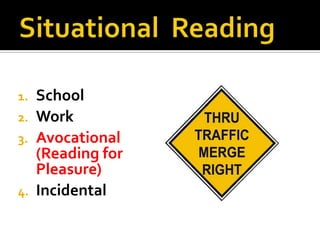
Situational  ReadingSchoolWorkAvocational(Reading for Pleasure)Incidental
Let’s Focus on Avocational ReadersIn any given year, a slight majority of adult Americans claim to have read anything for pleasure (i.e., not related to work or school)50.2 % of adult Americans (approx. 113 million) engaged in literary reading in 2008. Source:  NEA Report, “Reading on the Rise” (January 2009).  Available as free PDF file at http://www.nea.gov/pub/pubLit.php
U.S. Portable eReadingDevices:  U.S. represents approx. 75% of world market.  Q3 2010: 2.7 million units shipped worldwideWorldwide in 2010: sales $1.9 billion (11 million units).  Sources: http://www.boston.com/business/ticker/2011/02/yankee_group_e-.html and  http://www.digitalhome.ca/2011/01/media-tablet-and-ereader-sales-continue-to-grow-at-a-torrid-pace/Software:  Scads of apps for netbooks, tablets, smartphones, gaming devices, desktops, etc.Content:  U.S. trade wholesale ebook sales in Q3 2010 were almost $120 million.Source:  http://www.idpf.org/doc_library/industrystats.htm
Not-So-Bold PredictionThe future of sustained reading for pleasure will be primarily portable eReading.
What Does This Portend for Libraries & Library Staff Members?New user expectations.New sources of content.New genres and formats.New services for individual readers & groups.New “competition” from non-library sectors.New skill sets for staff members.
Portable eReadingIn the U.S., with or without Libraries
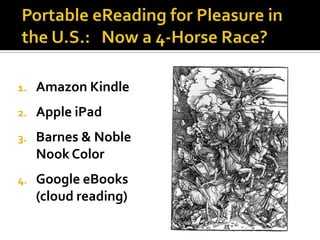
Portable eReading for Pleasure in the U.S.:   Now a 4-Horse Race?Amazon KindleApple iPadBarnes & Noble Nook ColorGoogle eBooks (cloud reading)
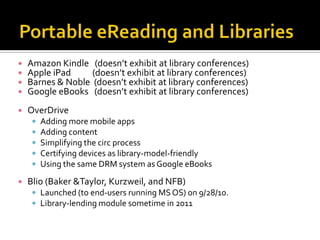
Portable eReading and LibrariesAmazon Kindle   (doesn’t exhibit at library conferences)
Apple iPad          (doesn’t exhibit at library conferences)
Barnes & Noble  (doesn’t exhibit at library conferences)
Google eBooks   (doesn’t exhibit at library conferences)
OverDrive
Adding more mobile apps
Adding content
Simplifying the circ process
Certifying devices as library-model-friendly
Using the same DRM system as Google eBooks
Blio (Baker &Taylor, Kurzweil, and NFB)
Launched (to end-users running MS OS) on 9/28/10.
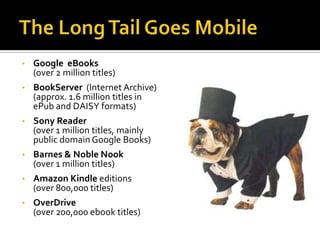
Library-lending module sometime in 2011The Long Tail Goes MobileGoogle  eBooks(over 2 million titles)
BookServer(Internet Archive) (approx. 1.6 million titles in ePub and DAISY formats)
Sony Reader (over 1 million titles, mainly public domain Google Books)
Barnes & Noble Nook(over 1 million titles)
Amazon Kindle editions (over 800,000 titles)
OverDrive(over 200,000 ebook titles)Who and What is at Risk?If portable eReading for pleasure becomes an unbundled, commercial enterprise serving individual readers, the at-risk groups include:BookstoresLibrariesHave NotsStudents, Scholars, and ResearchersVoracious Readers
Left to Their Own DevicesMobile eReading experiences require some sort of portable device.
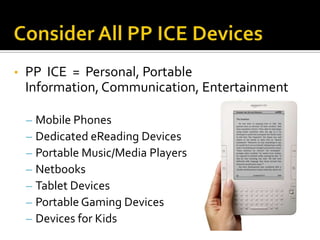
Consider All PP ICE DevicesPP  ICE  =  Personal, Portable Information, Communication, Entertainment
Mobile Phones
Dedicated eReading Devices
Portable Music/Media Players
Netbooks
Tablet Devices
Portable Gaming Devices
Devices for KidsFuture of Devices and LibrariesFor millennia (until about last year) libraries had to be in the device business.From now on, most (but not all) library users will provide their own PP ICE’s.Implications for the right of first sale.See http://www.idealog.com/blog/ (Feb. 12)Libraries will be free to concentrate on content, services, and communities.

Kanawha talk 2011 02

  • 1.
    In the Clouds,With a Personal, Portable Computer, By Professor Plum:Clues Concerning the Impact and Opportunities of the eReading Revolution on Libraries and Library StaffA talk given by Tom Peters at the Kanawha County Public Library Staff Development DayCharleston, West Virginia, February 23, 2011
  • 2.
    Talkin’ About aRevolution!These slides are online at http://www.tapinformation.com/KanawhaTalk201102.htm
  • 3.
    A Portable eBookRevolution is Underway Right Now
  • 4.
    Revolutionary Fits andStartsSeventies: Paperless OfficeLate Nineties: Failed eBook Coup2001: Segway
  • 5.
    Amazing Revolutions UnderwayGlobalmobile phone revolution.5.3 billion mobile cellular subscriptions in 2010.76.2 subscriptions for every 100 pe0ple worldwide.Source: http://www.itu.int/ITU-D/ict/statistics/at_glance/KeyTelecom.html Portable eReading revolution.
  • 6.
    My Two ProfessionalFearsMobile Revolution(Fear of missed opportunities)Portable eReading Revolution(Fear of being muscled out)
  • 7.
    People and TechRevolutionsWhat can we learn from history?
  • 8.
    When We Namea New Technology, We Project the Past into the FutureHorse  Iron HorseCarriage  Horseless CarriagePhone  Smart PhoneBook  eBook(Wordprocessingmay be the exception that proves the rule. Why didn’t we call it eWriting?)These naming propensities help us in the short term, but hurt us in the long term.
  • 9.
    The Cloudiness ofCloud ComputingJust about everybody is always connected to the Internet, unless they consciously choose to be offline.What does this mean for the development of library experiences (content, systems, services)? How will eReading in the cloud work?
  • 10.
    ReadingWhat do weknow? Where is it headed?
  • 11.
    What Is Reading?Gistof the Wikipedia Definition: A complex process of decoding symbols for the intention of deriving and/or constructing meaning.http://en.wikipedia.org/wiki/Reading_(process)My Tentative Definition: People interacting with texts, thus constituting a sensory, cognitive, and emotional experience that is complete, complex, and satisfying . Reading as Sensory IntakeVisual Reading: printed on paper or digital
  • 12.
    Auditory Reading: analog or digital, prepackaged, downloadable, or streaming
  • 13.
    Tactile Reading: braille (printed or digital)*************************************
  • 14.
    Olfactory Reading: e.g., Olfactory Webhttp://www.downloadsquad.com/2009/04/08/weird-wednesday-whatever-happened-to-the-olfactory-web/Gustatory Reading: Devouring a Good Bookhttp://www.books2eat.comLet’s Bracket Some StuffeBooks as Searchable Databases:NetLibrary, eBrary, EBL, etc.Let’s focus on books intended to be read “cover to cover” on portable electronic devices primarily for avocational interests. Tactile, Olfactory, and Gustatory Reading
  • 15.
  • 16.
    Let’s Focus onAvocational ReadersIn any given year, a slight majority of adult Americans claim to have read anything for pleasure (i.e., not related to work or school)50.2 % of adult Americans (approx. 113 million) engaged in literary reading in 2008. Source: NEA Report, “Reading on the Rise” (January 2009). Available as free PDF file at http://www.nea.gov/pub/pubLit.php
  • 17.
    U.S. Portable eReadingDevices: U.S. represents approx. 75% of world market. Q3 2010: 2.7 million units shipped worldwideWorldwide in 2010: sales $1.9 billion (11 million units). Sources: http://www.boston.com/business/ticker/2011/02/yankee_group_e-.html and http://www.digitalhome.ca/2011/01/media-tablet-and-ereader-sales-continue-to-grow-at-a-torrid-pace/Software: Scads of apps for netbooks, tablets, smartphones, gaming devices, desktops, etc.Content: U.S. trade wholesale ebook sales in Q3 2010 were almost $120 million.Source: http://www.idpf.org/doc_library/industrystats.htm
  • 18.
    Not-So-Bold PredictionThe futureof sustained reading for pleasure will be primarily portable eReading.
  • 19.
    What Does ThisPortend for Libraries & Library Staff Members?New user expectations.New sources of content.New genres and formats.New services for individual readers & groups.New “competition” from non-library sectors.New skill sets for staff members.
  • 20.
    Portable eReadingIn theU.S., with or without Libraries
  • 21.
    Portable eReading forPleasure in the U.S.: Now a 4-Horse Race?Amazon KindleApple iPadBarnes & Noble Nook ColorGoogle eBooks (cloud reading)
  • 22.
    Portable eReading andLibrariesAmazon Kindle (doesn’t exhibit at library conferences)
  • 23.
    Apple iPad (doesn’t exhibit at library conferences)
  • 24.
    Barnes & Noble (doesn’t exhibit at library conferences)
  • 25.
    Google eBooks (doesn’t exhibit at library conferences)
  • 26.
  • 27.
  • 28.
  • 29.
  • 30.
    Certifying devices aslibrary-model-friendly
  • 31.
    Using the sameDRM system as Google eBooks
  • 32.
    Blio (Baker &Taylor,Kurzweil, and NFB)
  • 33.
    Launched (to end-usersrunning MS OS) on 9/28/10.
  • 34.
    Library-lending module sometimein 2011The Long Tail Goes MobileGoogle eBooks(over 2 million titles)
  • 35.
    BookServer(Internet Archive) (approx.1.6 million titles in ePub and DAISY formats)
  • 36.
    Sony Reader (over1 million titles, mainly public domain Google Books)
  • 37.
    Barnes & NobleNook(over 1 million titles)
  • 38.
    Amazon Kindle editions(over 800,000 titles)
  • 39.
    OverDrive(over 200,000 ebooktitles)Who and What is at Risk?If portable eReading for pleasure becomes an unbundled, commercial enterprise serving individual readers, the at-risk groups include:BookstoresLibrariesHave NotsStudents, Scholars, and ResearchersVoracious Readers
  • 40.
    Left to TheirOwn DevicesMobile eReading experiences require some sort of portable device.
  • 41.
    Consider All PPICE DevicesPP ICE = Personal, Portable Information, Communication, Entertainment
  • 42.
  • 43.
  • 44.
  • 45.
  • 46.
  • 47.
  • 48.
    Devices for KidsFutureof Devices and LibrariesFor millennia (until about last year) libraries had to be in the device business.From now on, most (but not all) library users will provide their own PP ICE’s.Implications for the right of first sale.See http://www.idealog.com/blog/ (Feb. 12)Libraries will be free to concentrate on content, services, and communities.