CMI Presentation on Organisational Change Maturity Model
The document discusses the Organisational Change Maturity Model and its importance in effectively managing change within organizations. It emphasizes the need for strategic leadership, business readiness, and project change management, supported by a culture of feedback and collaboration. Survey results indicate that many organizations struggle with overall maturity in change management, highlighting a disparity between strategic leadership capabilities and business/project change management execution.
In this document
Powered by AI
Introduction to change agility and the organizational change maturity model.
Analyzes the rapid changes driving organizations and the failure of traditional methodologies.
Discusses characteristics of mature organizations that effectively manage change, emphasizing leadership.
Details the research sources and methodology used to study change management capabilities.
Outlines key areas of effective change management, emphasizing leadership, readiness, and project management.
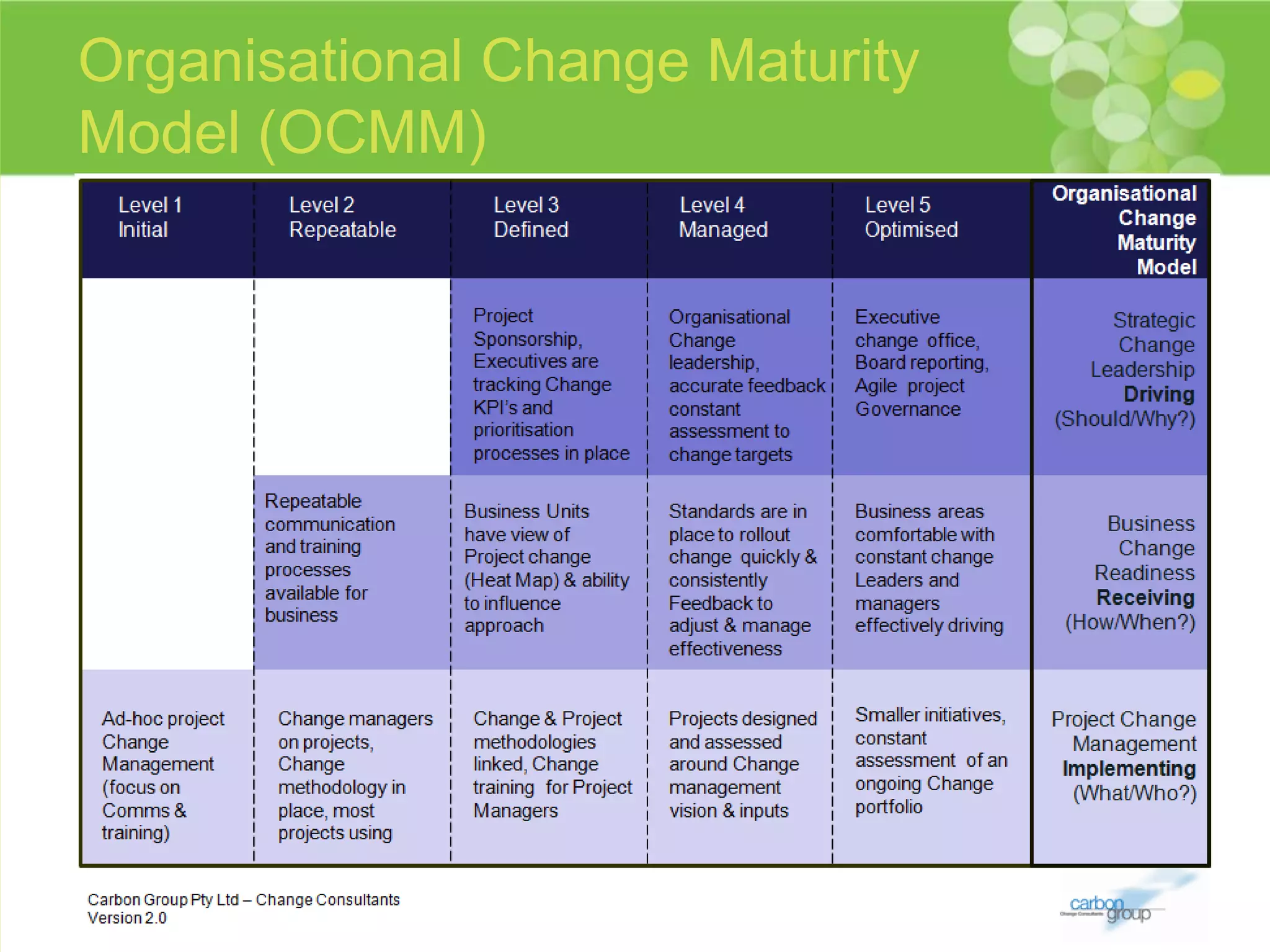
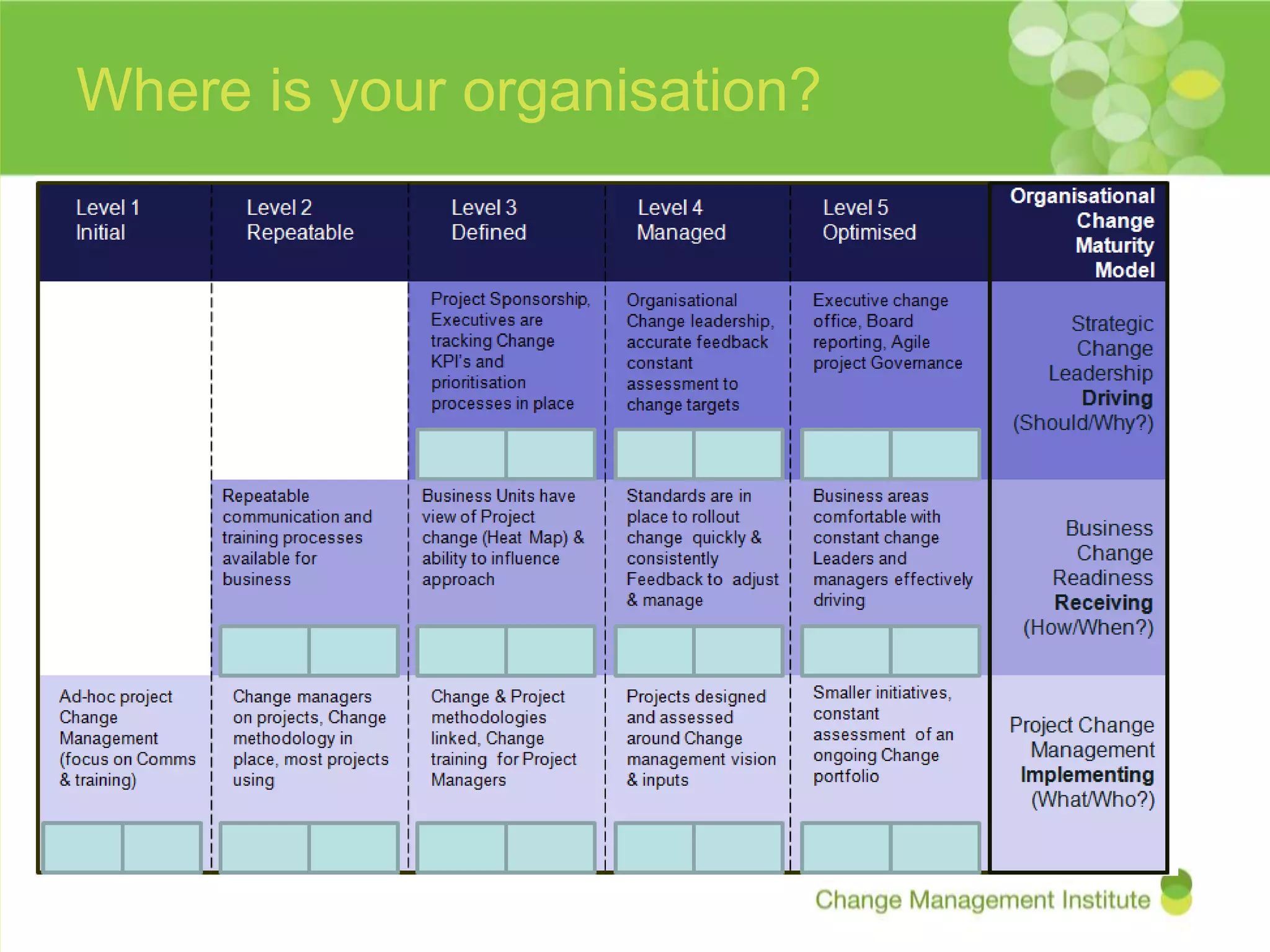
Introduces the Organizational Change Maturity Model.
Describes the role of strategic leadership in supporting change and the importance of feedback.
Explains how organizations can prepare for change through collaboration and established processes.
Highlights the importance of consistent change methodologies within project management.
Presents survey results indicating maturity levels of organizations in change management.
Details findings on the maturity levels across strategic, business, and project change management.
Discusses methods for ongoing assessment of change management effectiveness across organizations.
Explores the implications of change management's maturity on organizational outcomes.
Encourages organizations to assess their current position in change management.
Invites questions and provides contact information for further discussions.
Agenda
• Background
• Organisational Change Maturity
Model
• Survey results
• So what...
• Where are you?
3.
Background
Changes arebeing driven constantly and
at great speed
Big Programs are still failing despite
advances in Project Management, Change
Management , Governance & Leadership
Mismatch of Agile Software Development
& lean methodologies to traditional
Waterfall governance
Organisational change is bigger than the
sum of its project parts
5.
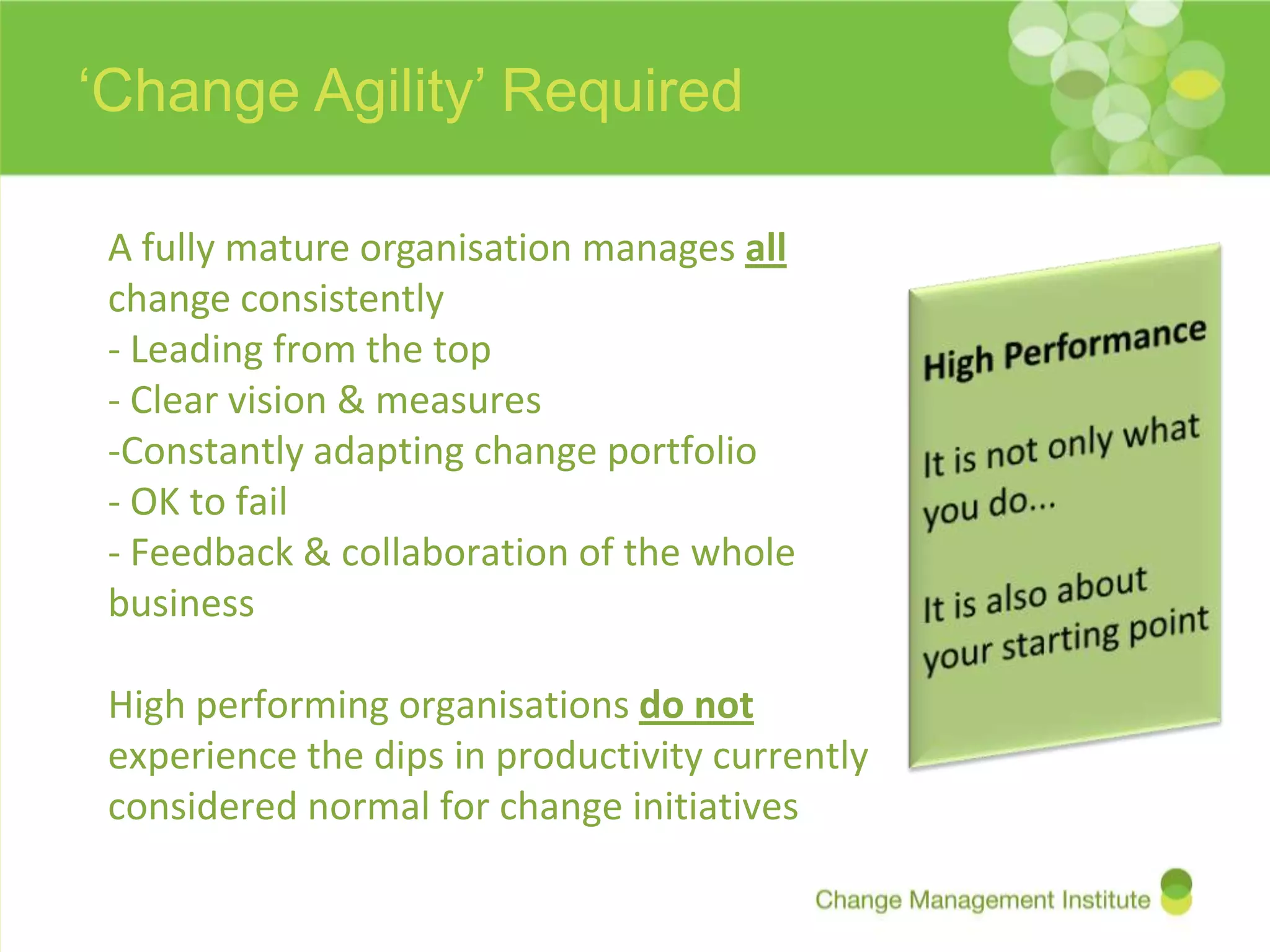
‘Change Agility’ Required
A fully mature organisation manages all
change consistently
- Leading from the top
- Clear vision & measures
-Constantly adapting change portfolio
- OK to fail
- Feedback & collaboration of the whole
business
High performing organisations do not
experience the dips in productivity currently
considered normal for change initiatives
7.
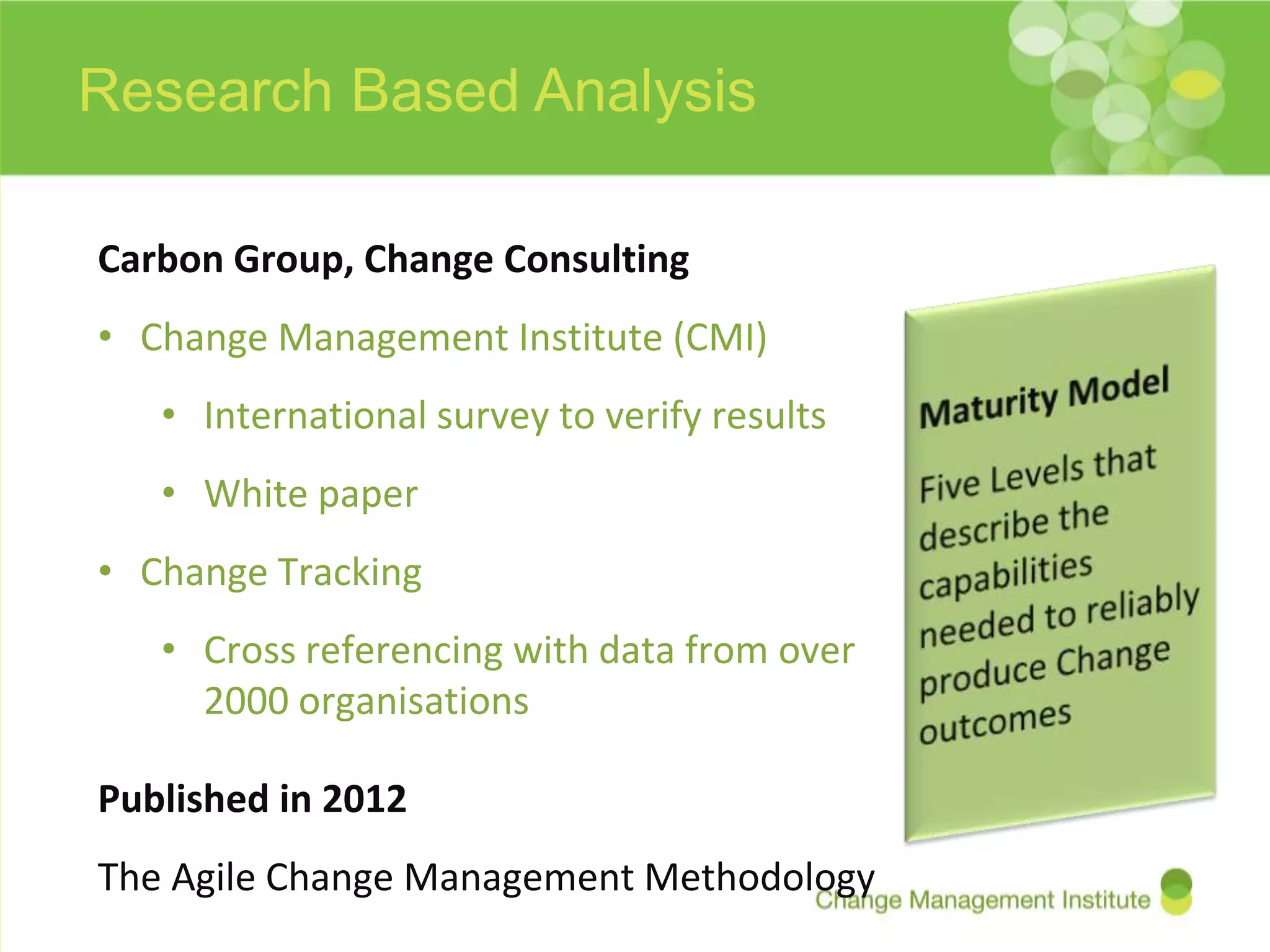
Research Based Analysis
CarbonGroup, Change Consulting
• Change Management Institute (CMI)
• International survey to verify results
• White paper
• Change Tracking
• Cross referencing with data from over
2000 organisations
Published in 2012
The Agile Change Management Methodology
8.
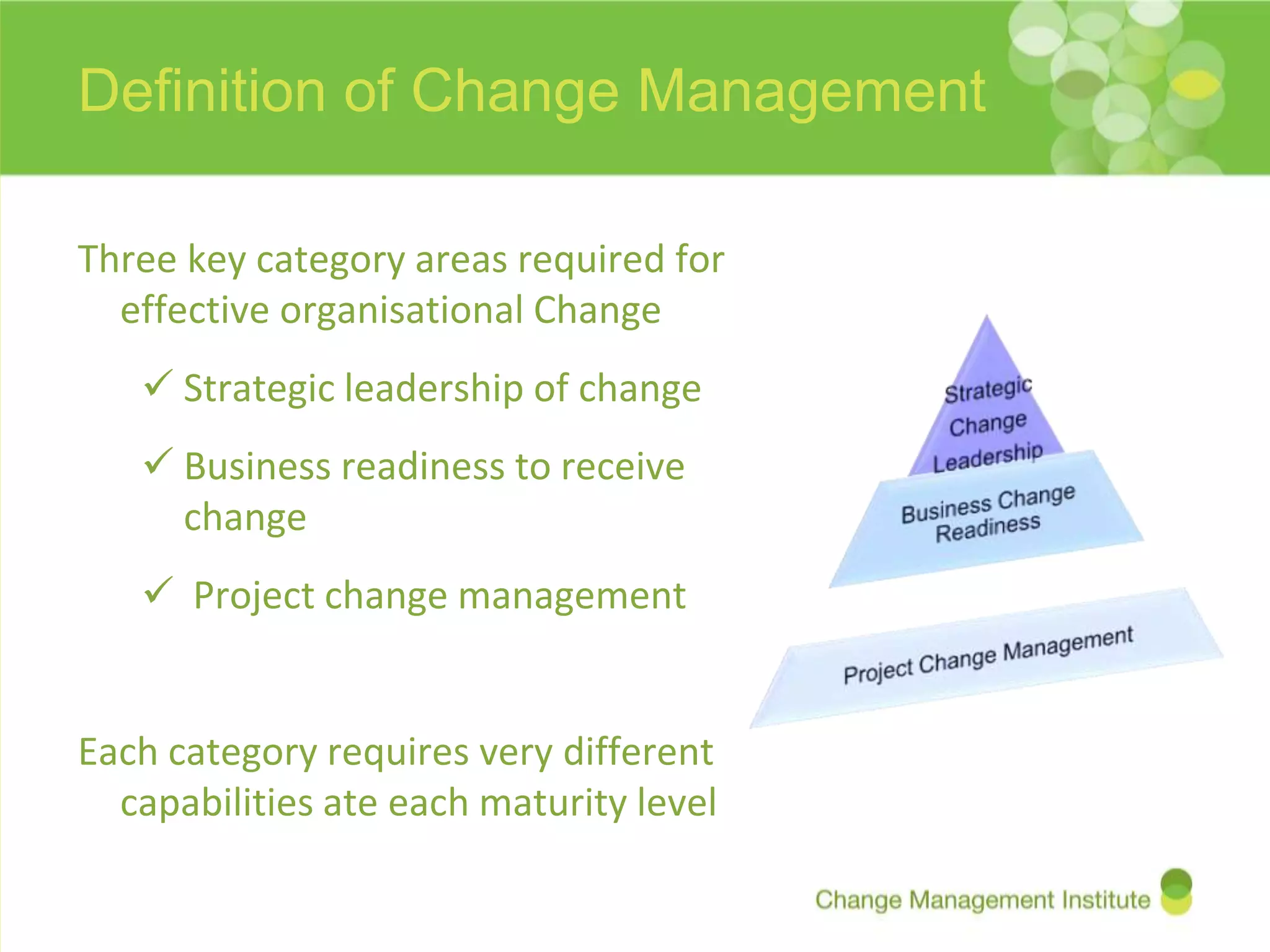
Definition of ChangeManagement
Three key category areas required for
effective organisational Change
Strategic leadership of change
Business readiness to receive
change
Project change management
Each category requires very different
capabilities ate each maturity level
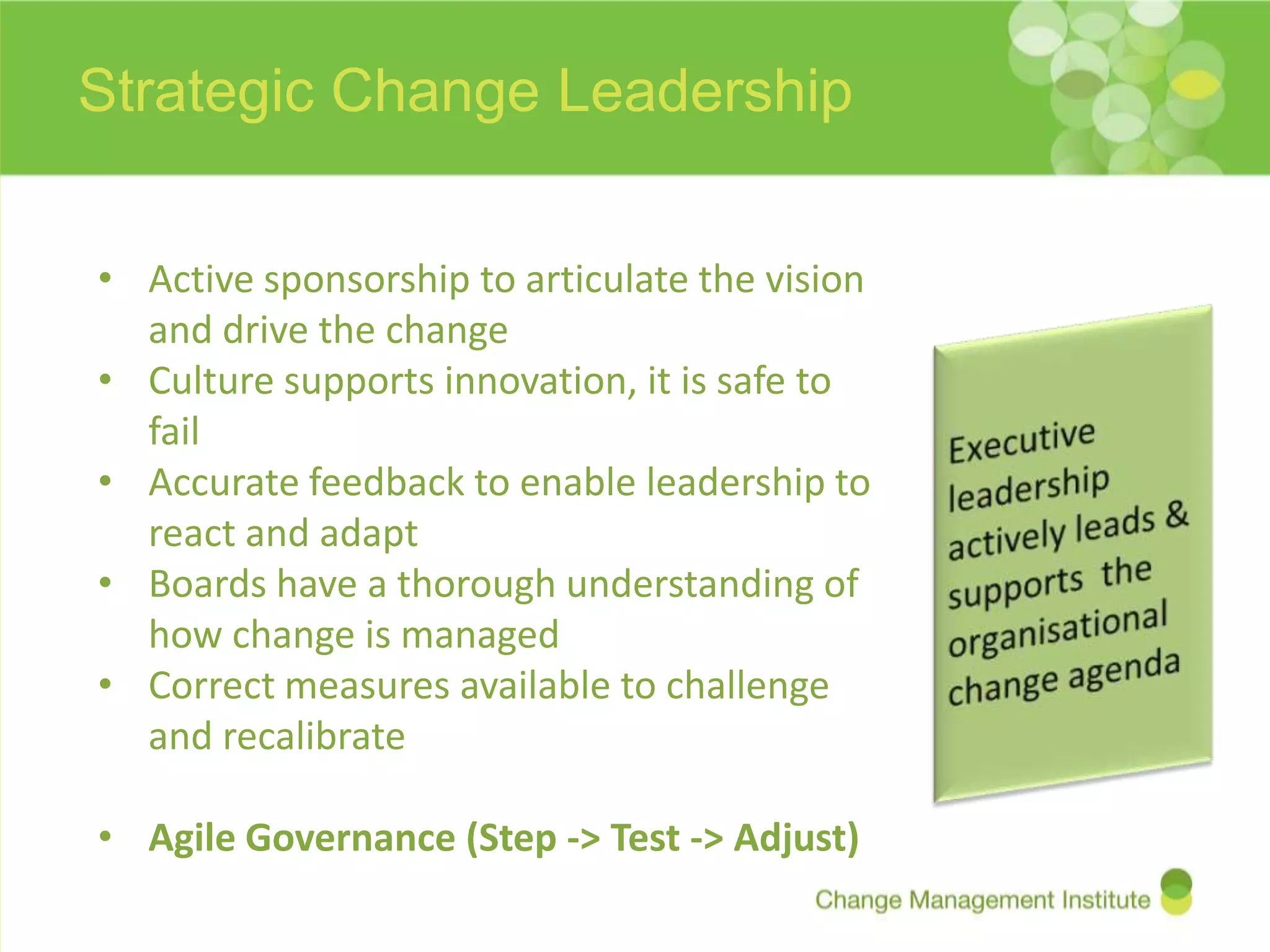
Strategic Change Leadership
•Active sponsorship to articulate the vision
and drive the change
• Culture supports innovation, it is safe to
fail
• Accurate feedback to enable leadership to
react and adapt
• Boards have a thorough understanding of
how change is managed
• Correct measures available to challenge
and recalibrate
• Agile Governance (Step -> Test -> Adjust)
11.
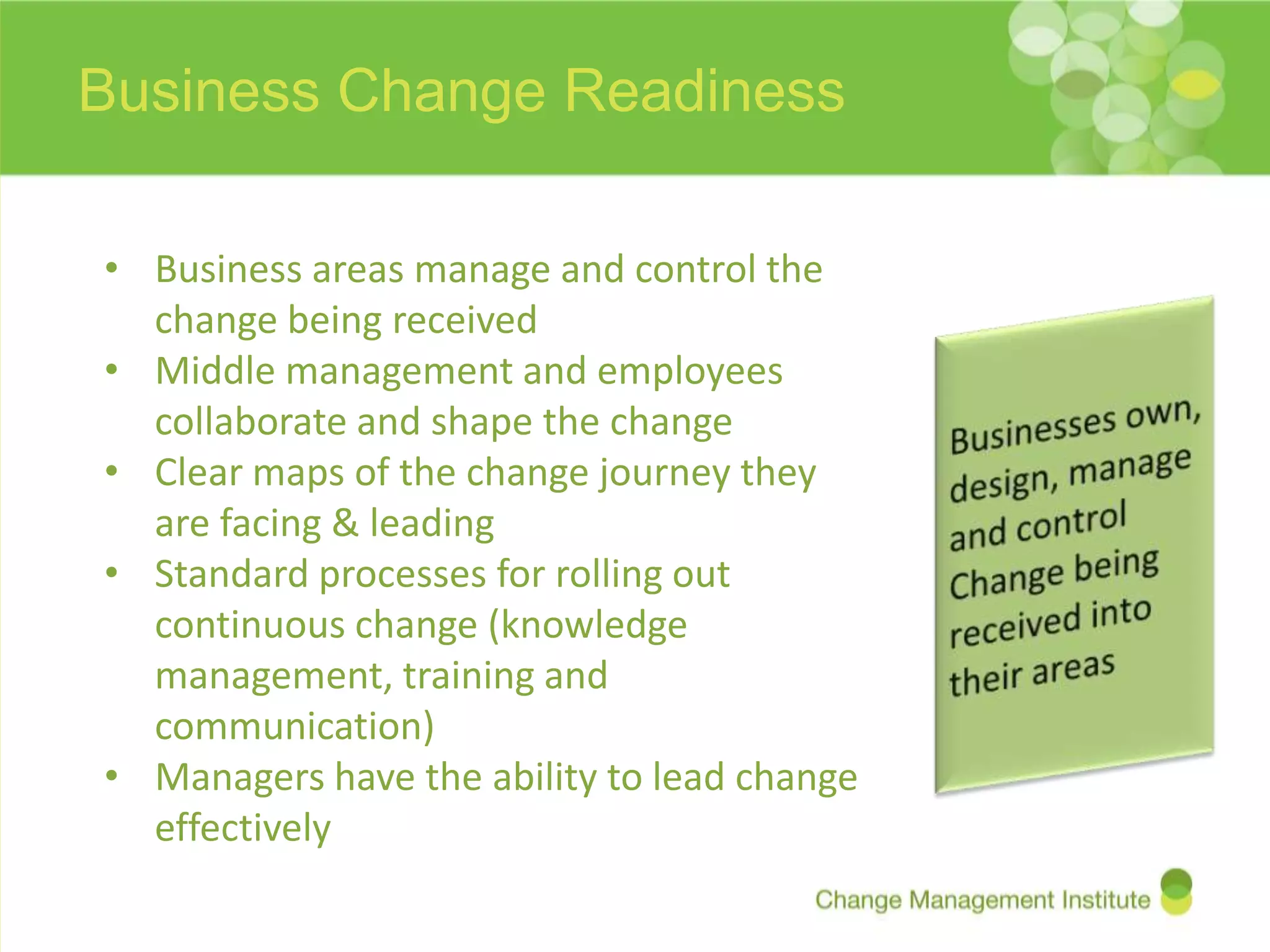
Business Change Readiness
•Business areas manage and control the
change being received
• Middle management and employees
collaborate and shape the change
• Clear maps of the change journey they
are facing & leading
• Standard processes for rolling out
continuous change (knowledge
management, training and
communication)
• Managers have the ability to lead change
effectively
12.
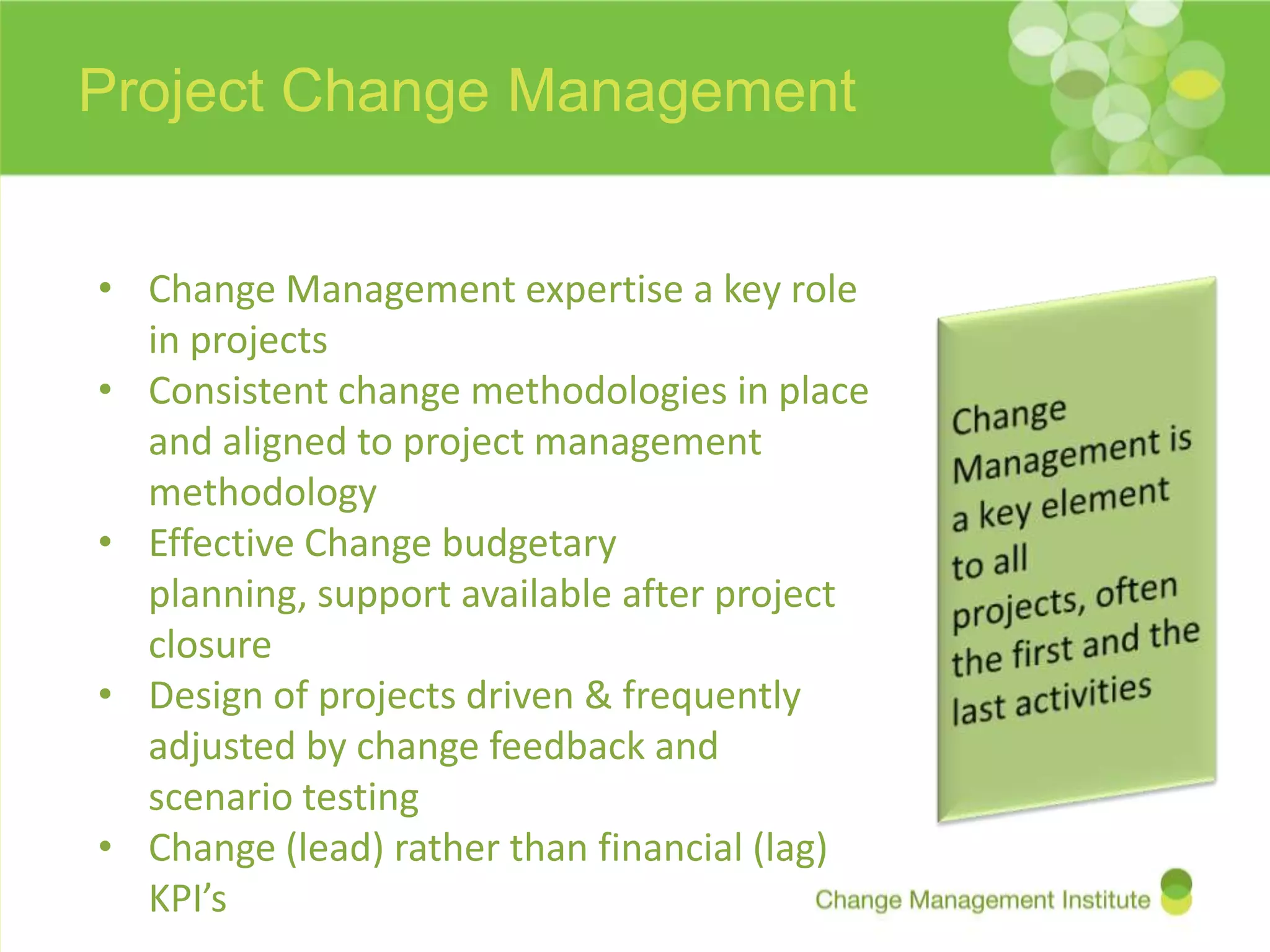
Project Change Management
•Change Management expertise a key role
in projects
• Consistent change methodologies in place
and aligned to project management
methodology
• Effective Change budgetary
planning, support available after project
closure
• Design of projects driven & frequently
adjusted by change feedback and
scenario testing
• Change (lead) rather than financial (lag)
KPI’s
13.
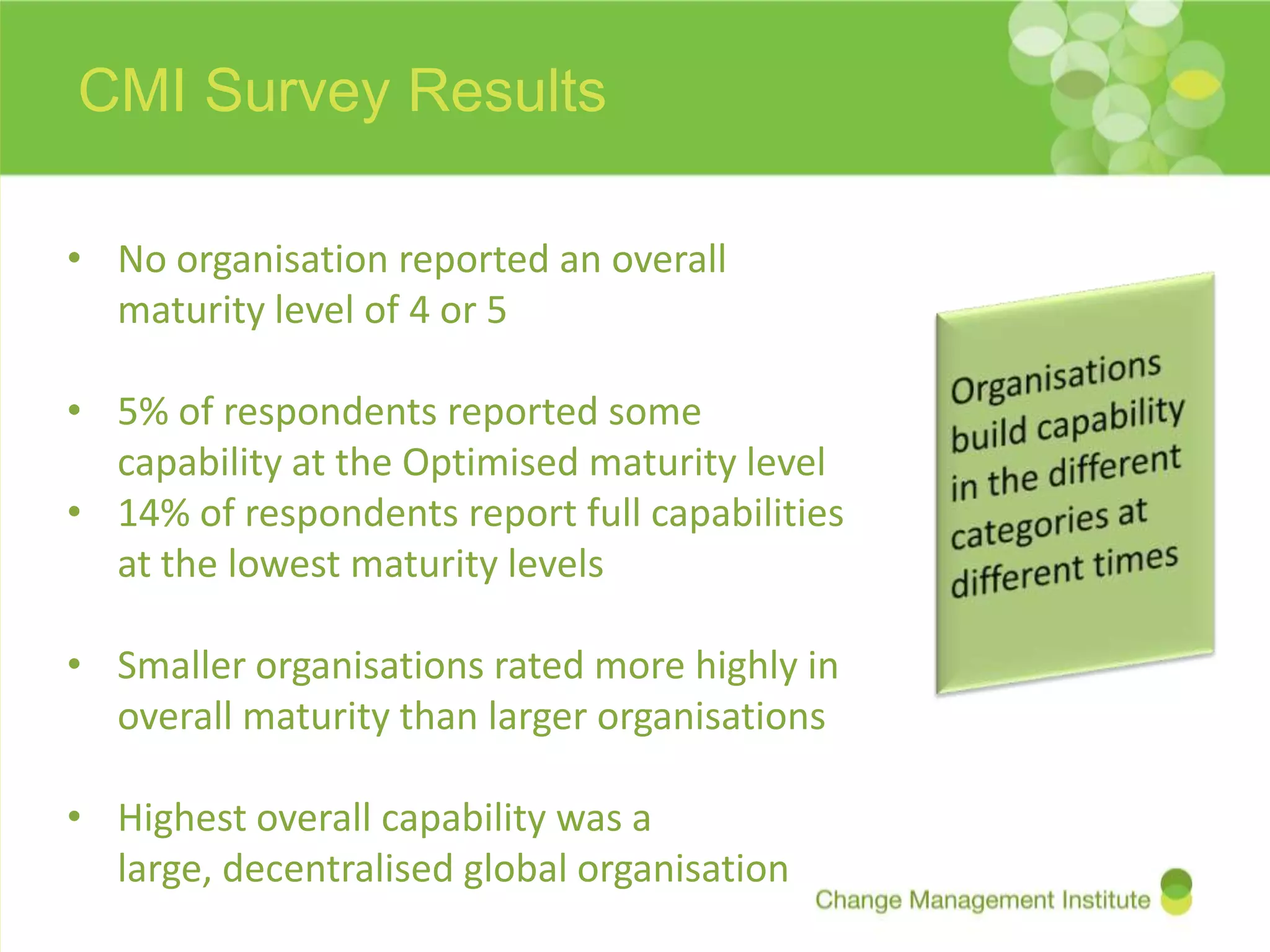
CMI Survey Results
•No organisation reported an overall
maturity level of 4 or 5
• 5% of respondents reported some
capability at the Optimised maturity level
• 14% of respondents report full capabilities
at the lowest maturity levels
• Smaller organisations rated more highly in
overall maturity than larger organisations
• Highest overall capability was a
large, decentralised global organisation
14.
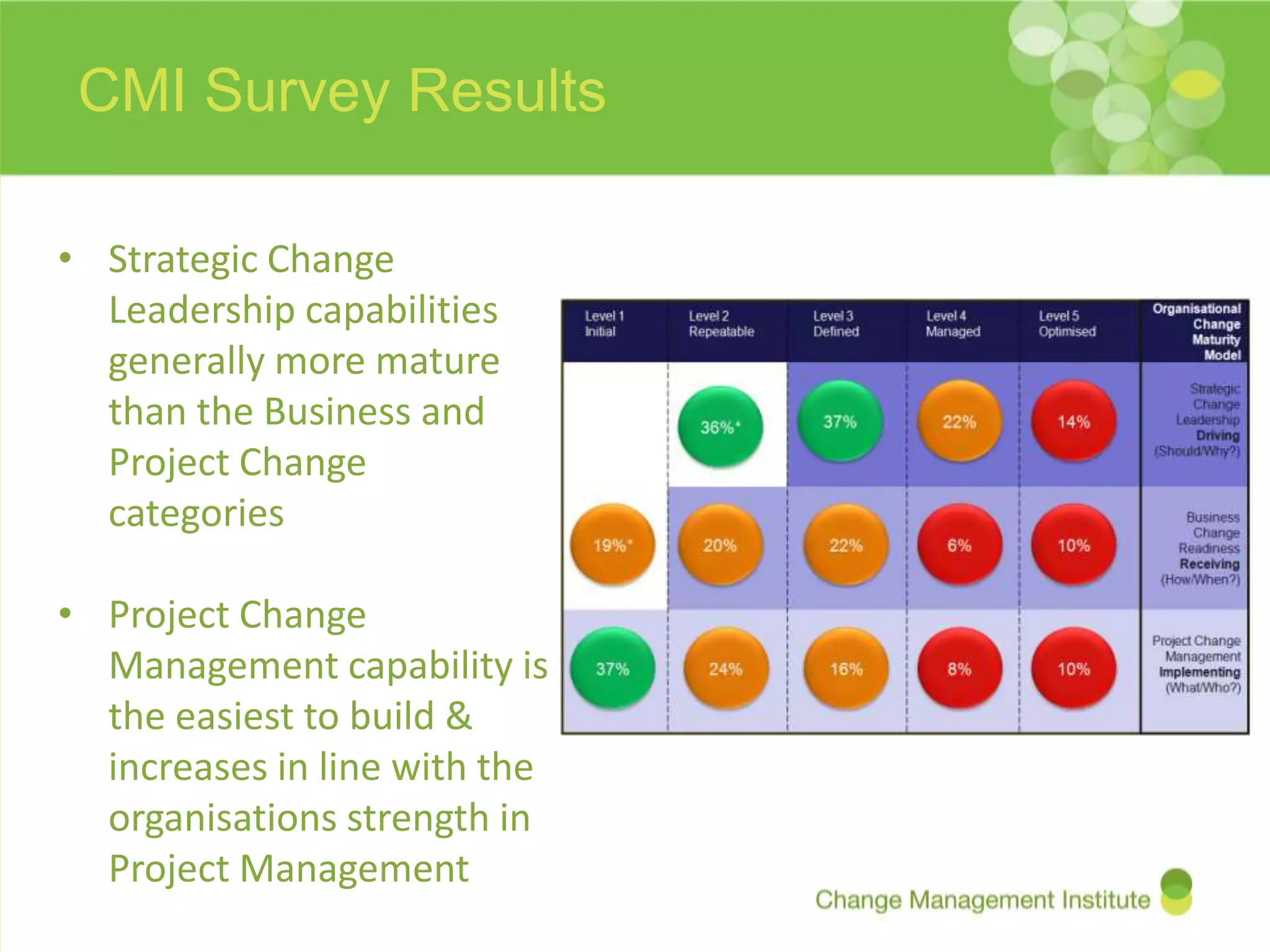
CMI Survey Results
•Strategic Change
Leadership capabilities
generally more mature
than the Business and
Project Change
categories
• Project Change
Management capability is
the easiest to build &
increases in line with the
organisations strength in
Project Management
15.
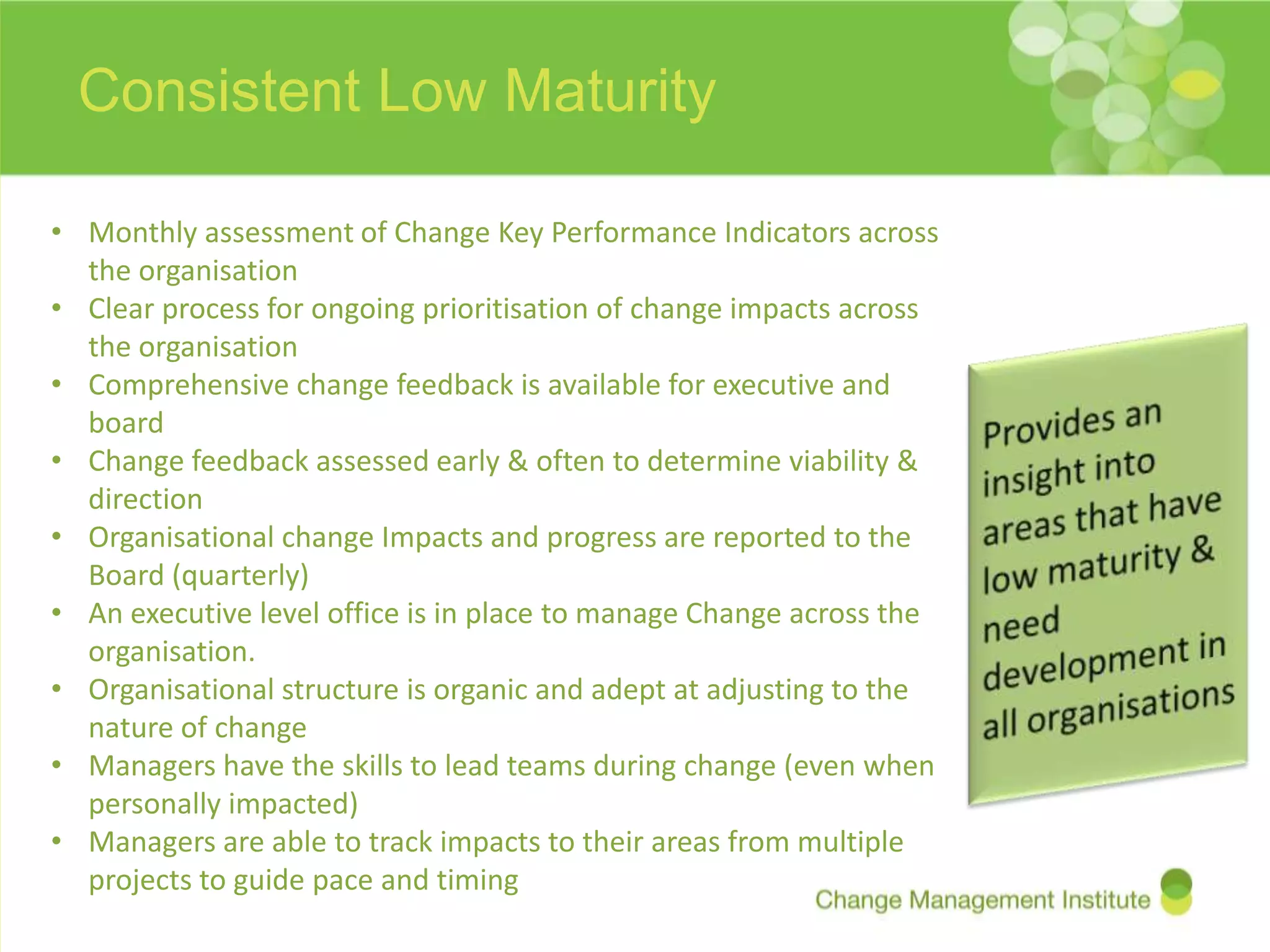
Consistent Low Maturity
•Monthly assessment of Change Key Performance Indicators across
the organisation
• Clear process for ongoing prioritisation of change impacts across
the organisation
• Comprehensive change feedback is available for executive and
board
• Change feedback assessed early & often to determine viability &
direction
• Organisational change Impacts and progress are reported to the
Board (quarterly)
• An executive level office is in place to manage Change across the
organisation.
• Organisational structure is organic and adept at adjusting to the
nature of change
• Managers have the skills to lead teams during change (even when
personally impacted)
• Managers are able to track impacts to their areas from multiple
projects to guide pace and timing
16.
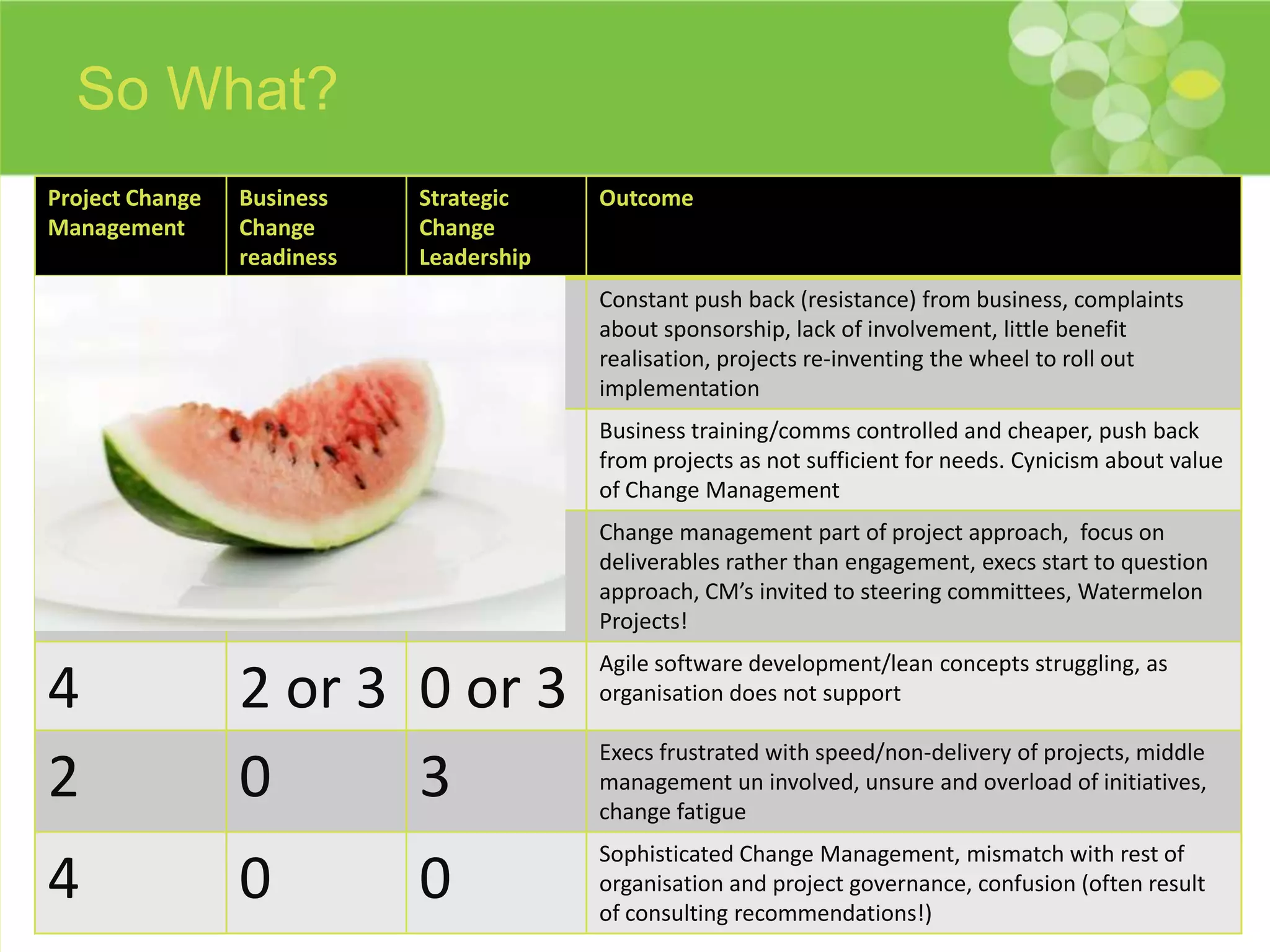
So What?
Project Change Business Strategic Outcome
Management Change Change
readiness Leadership
Constant push back (resistance) from business, complaints
1 0 0 about sponsorship, lack of involvement, little benefit
realisation, projects re-inventing the wheel to roll out
implementation
Business training/comms controlled and cheaper, push back
1 or 2 2 0 from projects as not sufficient for needs. Cynicism about value
of Change Management
Change management part of project approach, focus on
2 or 3 3 1 deliverables rather than engagement, execs start to question
approach, CM’s invited to steering committees, Watermelon
Projects!
Agile software development/lean concepts struggling, as
4 2 or 3 0 or 3 organisation does not support
Execs frustrated with speed/non-delivery of projects, middle
2 0 3 management un involved, unsure and overload of initiatives,
change fatigue
Sophisticated Change Management, mismatch with rest of
4 0 0 organisation and project governance, confusion (often result
of consulting recommendations!)
#4 There’s not one company that you would talk to that you would tell them to stop run big programs who would say “No”. If we can’t predict the future; if open and honest feedback needs to be available to those making the decisions and project failure is the natural order of things; Change Management concepts become even more important to a company’s survival.
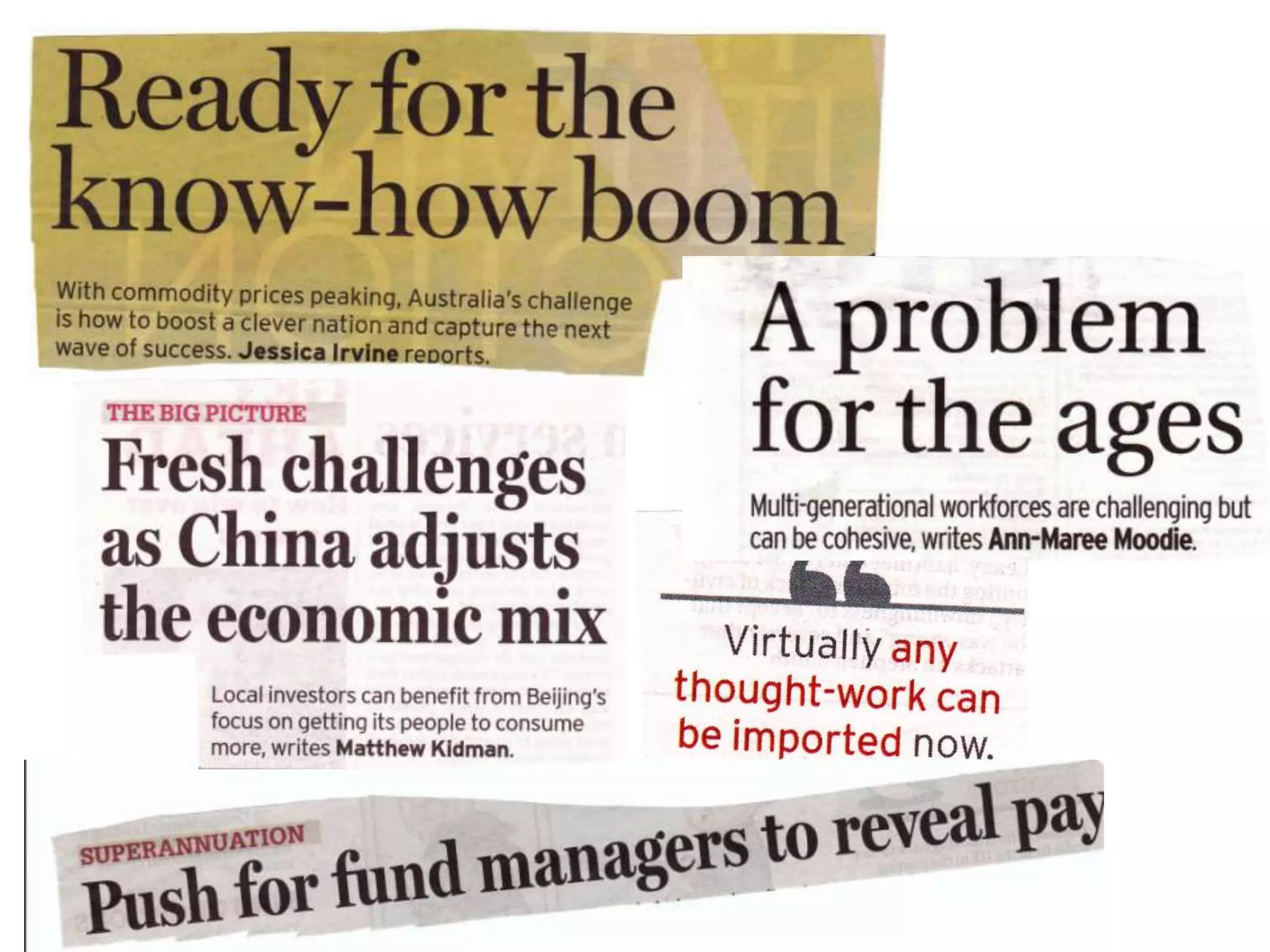
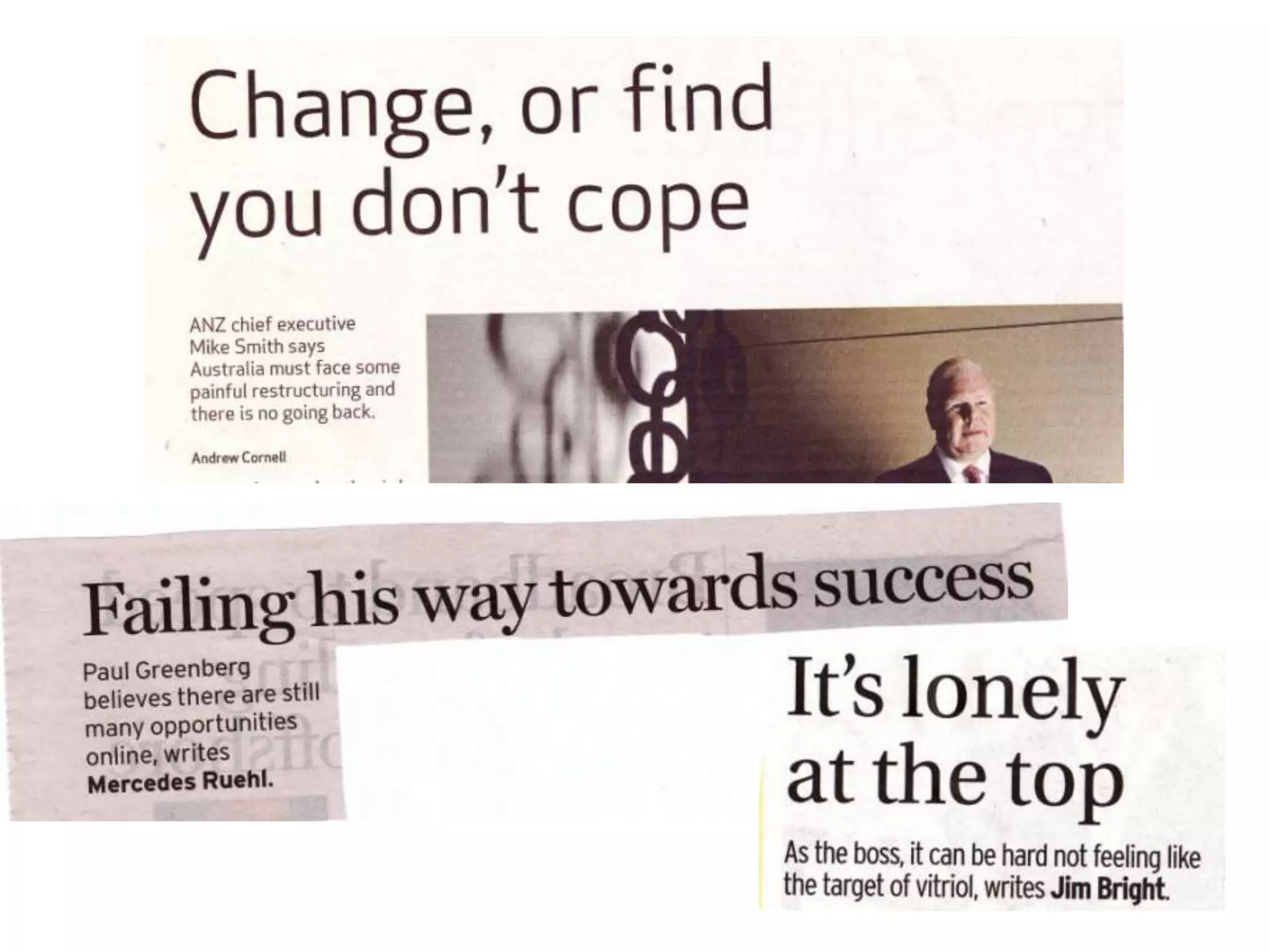
#5 Change coming from everywhere – these are the headlines from the newspapers for one day!Regulatory Change – complianceEconomic – expense reduction – outsourcingEconomic – new MarketsDemographic changes – Technology improvements
#6 There are five levels defined along the continuum of the CMMInitial (chaotic, ad hoc, individual heroics) - the starting point a new capabilityRepeatable - the capability has developed such that it is possible to repeat effectivelyDefined - the capability is defined to a level that it has become standard across the businessManaged - the capability has matured to a level that it is quantitatively managed and reported against agreed metrics.Optimized – The capability has been optimized and is providing competitive advantage to the organization.
#7 Lets have a look at some more headlines – It’s not new, but it’s not being thought of in it’s entirety, spot of the old Systems thinking
#8 A second period of research then identified and clarified the different levels of maturity for each of the categories; Change Leadership (Drivers of the change), Business Change Readiness (Receivers of the change) and Project Change Management (Implementers of the change). A global survey of Change Management practitioners was undertaken by the Change Management Institute and Carbon Group over a two month period at the end of 2011. They helped us to classify the capabilities that would be in place for each of the categories at each of the maturity levels. Initial research was carried out while working with a number of large organizations in Australia, what worked and what did not. There is often confusion in explaining ‘what’ change management, and this may be due in part to these three categories.
#9 A second period of research then identified and clarified the different levels of maturity for each of the categories; Change Leadership (Drivers of the change), Business Change Readiness (Receivers of the change) and Project Change Management (Implementers of the change). A global survey of Change Management practitioners was undertaken by the Change Management Institute and Carbon Group over a two month period at the end of 2011. They helped us to classify the capabilities that would be in place for each of the categories at each of the maturity levels. Initial research was carried out while working with a number of large organizations in Australia, what worked and what did not. There is often confusion in explaining ‘what’ change management, and this may be due in part to these three categories.
#10 This research identified that each of these change management categories has a different purpose and needs; they can develop differing levels of maturity at the same time and for different reasons. However there are a number of key dependencies, and if a capability was missing in one category, another may develop increased maturity to fill the gap.
#11 The new normal’ requires an approach with far greater flexibility and a different way of working for top teamsAn organisation that has developed to level five maturity has full executive sponsorship of change and is constantly accessing customer and employee feedback to review and adjust change portfolios.
#12 Maturity in Business Change readiness begins with the recognition that it is not the project that ‘owns’ the changes in the business, rather each area has a responsibility to manage and control the change being received. Managers are often unclear about the best ways to manage change, their focus is on maintaining the status quo rather than on how to constantly change or adjust what they are doing
#13 Developing capability in Project Change Management starts with an understanding that the ‘people’ side of projects should be addressed with training and communications through to an optimized situation where project change feedback and collaboration is leveraged to accurately initiate, design and direct the approaches takenThere are a number of recognized methodologies that have been developed to help projects manage the people side of change. However, a change methodology will not in itself ensure effective change, the change process is interactive, complex and non linear and requires the support of experienced change practitioners who are able to test scenarios and work effectively with key business stakeholders and leaders to adjust the approach
#14 Developing capability in Project Change Management starts with an understanding that the ‘people’ side of projects should be addressed with training and communications through to an optimized situation where project change feedback and collaboration is leveraged to accurately initiate, design and direct the approaches taken
#15 Developing capability in Project Change Management starts with an understanding that the ‘people’ side of projects should be addressed with training and communications through to an optimized situation where project change feedback and collaboration is leveraged to accurately initiate, design and direct the approaches taken
#16 Developing capability in Project Change Management starts with an understanding that the ‘people’ side of projects should be addressed with training and communications through to an optimized situation where project change feedback and collaboration is leveraged to accurately initiate, design and direct the approaches taken