Evaluation of change
    management during ERP
      implementation at
         Easy Mobile

             GROUP 5
Henry, John, Sonwabo, Ted and Ian
DEFINITION
      Change management is an organized, systematic application of
                                  organized,
    knowledge, tools, and resources of change that provide organizations
           with a key process to achieve their business strategy


                           OBJECTIVES
The case study seeks to evaluate the process and impact of change
management intervention at Easy Mobile wireless implementation of an ERP
system.
 It is going to look at :
           how the process of change management was implemented against
         theoretical and industry practices.

       It will identify the key challenges, opportunities and actions
      undertaken as part of the intervention

         and make recommendations for future improvements.
WHY CHANGE MANAGEMENT ?
The potential risks of ERP failure are caused by;

  Fear of the psychological aspects of change by management and staff.
  Employees fear of acceptance due to their limited ability to perform at a level required by the system,
  Potential need for staff re-skilling and this lends it’s self to lower productivity levels due to learning curve
                           re-
phenomenon
  ERP systems impose their own logic on organisations and they may be a source of cultural change
  They tend to alter internal power structures which results in resistance to change
  ERP systems usually result in managers loss of their autonomy, independence, control of data and process
hence they hence they are usually resisted by those losing power and accepted by those gaining power.

Change management initiatives help to;

  Minimise the adverse effects of resistance to change, these could include
              High implementation costs,
              Poor service delivery resulting in loss of competitive advantage,
              Loss of staff.
  Deliberately manage people’s expectations about change.
  Minimise the cost of change and damage caused by transformation.
  Create an environment for employees to respond consistently and positively to the change.
                                                                                    change.
  Provide awareness
  Ensure understanding
  Facilitate acceptance
  Care, listen, and respond
  Manage people’s expectations
  Ensure readiness
  Champion the project
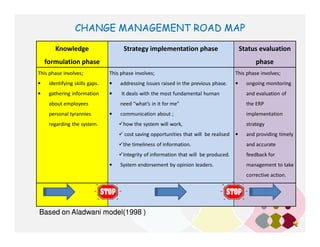
CHANGE MANAGEMENT ROAD MAP

        Knowledge                     Strategy implementation phase                         Status evaluation
    formulation phase                                                                             phase
This phase involves;            This phase involves;                                    This phase involves;
•    identifying skills gaps.   •   addressing issues raised in the previous phase.     •     ongoing monitoring
•    gathering information      •    It deals with the most fundamental human                 and evaluation of
     about employees                need “what’s in it for me”                                the ERP
     personal tyrannies         •   communication about ;                                     implementation
     regarding the system.            how the system will work,                               strategy
                                      cost saving opportunities that will be realised   •     and providing timely
                                      the timeliness of information.                          and accurate
                                      Integrity of information that will be produced.         feedback for
                                •   System endorsement by opinion leaders.                    management to take
                                                                                              corrective action.


Based on Aladwani model(1998 )
Organizational Change Phases
    and Communication


           Comfort

                     Unaware
 Insight
                      Denial

            Anxiety


What will I do differently tomorrow?
                           tomorrow?
Easy Mobile ERP
                Change Management Strategy


                                                                   Data conversion to
                                                                   Easy Mobile Oracle
                                                                      ERP Prototype       Easy Mobile Oracle
 Easy Mobile Oracle     Easy Mobile Oracle                                                   ERP System
   ERP Prototype        ERP Prototype (CRP                         across Supply Chain
                                              Training Material                           Transition Support
       System               3) sign off                             Module, Finance,
                                                                   Project Accounting          Strategy
                                                                    & Asset Tracking


Communications Support:
                  Support:
•Creating a shared understanding of the Build phase deliverables and milestones.
                                                                     milestones.
•Creating a Build Phase Awareness amongst all stakeholders
•To maintain a positive perception about the e-volution project
                                             e-

          Impact Analysis: People, Processes, Strategy, Structure, Technology, Policies

          We need to understand what is going to be different and determine the impact on
          people so that we know what to do to support people to understand and adopt the
          system
REPORTED RESULTS OF EASY MOBILE
             CHANGE MANAGEMENT
Satisfactory outcomes
  Active and visible sponsorship
  Use of organizational change management processes & tools
  Effective communications
  Employee involvement
  Effective project leadership and planning

Unsatisfactory outcomes

  The change agent forced to change personnel during implementation.
                                                         implementation.
  The long engagement duration => Executive fatigue and disengaged.
                                                            disengaged.
  Change initiative scope limited to implementation
  Off-
  Off-site resort engagements created an ERP elite club perceptions.
                                                          perceptions.
  Unqualified process champions identified late.
                                            late.
  The leaders who lost control of processes resisted the change.
                                                          change.
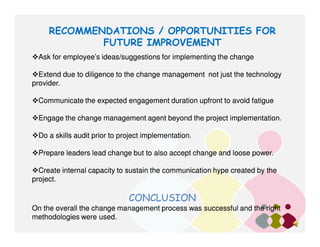
RECOMMENDATIONS / OPPORTUNITIES FOR
             FUTURE IMPROVEMENT
 Ask for employee’s ideas/suggestions for implementing the change

  Extend due to diligence to the change management not just the technology
provider.
provider.

 Communicate the expected engagement duration upfront to avoid fatigue

 Engage the change management agent beyond the project implementation.
                                                       implementation.

 Do a skills audit prior to project implementation.
                                    implementation.

 Prepare leaders lead change but to also accept change and loose power.
                                                                 power.

  Create internal capacity to sustain the communication hype created by the
project.

                              CONCLUSION
On the overall the change management process was successful and the right
methodologies were used.

Group 5 change management presentation

  • 1.
    Evaluation of change management during ERP implementation at Easy Mobile GROUP 5 Henry, John, Sonwabo, Ted and Ian
  • 2.
    DEFINITION Change management is an organized, systematic application of organized, knowledge, tools, and resources of change that provide organizations with a key process to achieve their business strategy OBJECTIVES The case study seeks to evaluate the process and impact of change management intervention at Easy Mobile wireless implementation of an ERP system. It is going to look at : how the process of change management was implemented against theoretical and industry practices. It will identify the key challenges, opportunities and actions undertaken as part of the intervention and make recommendations for future improvements.
  • 3.
    WHY CHANGE MANAGEMENT? The potential risks of ERP failure are caused by; Fear of the psychological aspects of change by management and staff. Employees fear of acceptance due to their limited ability to perform at a level required by the system, Potential need for staff re-skilling and this lends it’s self to lower productivity levels due to learning curve re- phenomenon ERP systems impose their own logic on organisations and they may be a source of cultural change They tend to alter internal power structures which results in resistance to change ERP systems usually result in managers loss of their autonomy, independence, control of data and process hence they hence they are usually resisted by those losing power and accepted by those gaining power. Change management initiatives help to; Minimise the adverse effects of resistance to change, these could include High implementation costs, Poor service delivery resulting in loss of competitive advantage, Loss of staff. Deliberately manage people’s expectations about change. Minimise the cost of change and damage caused by transformation. Create an environment for employees to respond consistently and positively to the change. change. Provide awareness Ensure understanding Facilitate acceptance Care, listen, and respond Manage people’s expectations Ensure readiness Champion the project
  • 4.
    CHANGE MANAGEMENT ROADMAP Knowledge Strategy implementation phase Status evaluation formulation phase phase This phase involves; This phase involves; This phase involves; • identifying skills gaps. • addressing issues raised in the previous phase. • ongoing monitoring • gathering information • It deals with the most fundamental human and evaluation of about employees need “what’s in it for me” the ERP personal tyrannies • communication about ; implementation regarding the system. how the system will work, strategy cost saving opportunities that will be realised • and providing timely the timeliness of information. and accurate Integrity of information that will be produced. feedback for • System endorsement by opinion leaders. management to take corrective action. Based on Aladwani model(1998 )
  • 5.
    Organizational Change Phases and Communication Comfort Unaware Insight Denial Anxiety What will I do differently tomorrow? tomorrow?
  • 6.
    Easy Mobile ERP Change Management Strategy Data conversion to Easy Mobile Oracle ERP Prototype Easy Mobile Oracle Easy Mobile Oracle Easy Mobile Oracle ERP System ERP Prototype ERP Prototype (CRP across Supply Chain Training Material Transition Support System 3) sign off Module, Finance, Project Accounting Strategy & Asset Tracking Communications Support: Support: •Creating a shared understanding of the Build phase deliverables and milestones. milestones. •Creating a Build Phase Awareness amongst all stakeholders •To maintain a positive perception about the e-volution project e- Impact Analysis: People, Processes, Strategy, Structure, Technology, Policies We need to understand what is going to be different and determine the impact on people so that we know what to do to support people to understand and adopt the system
  • 7.
    REPORTED RESULTS OFEASY MOBILE CHANGE MANAGEMENT Satisfactory outcomes Active and visible sponsorship Use of organizational change management processes & tools Effective communications Employee involvement Effective project leadership and planning Unsatisfactory outcomes The change agent forced to change personnel during implementation. implementation. The long engagement duration => Executive fatigue and disengaged. disengaged. Change initiative scope limited to implementation Off- Off-site resort engagements created an ERP elite club perceptions. perceptions. Unqualified process champions identified late. late. The leaders who lost control of processes resisted the change. change.
  • 8.
    RECOMMENDATIONS / OPPORTUNITIESFOR FUTURE IMPROVEMENT Ask for employee’s ideas/suggestions for implementing the change Extend due to diligence to the change management not just the technology provider. provider. Communicate the expected engagement duration upfront to avoid fatigue Engage the change management agent beyond the project implementation. implementation. Do a skills audit prior to project implementation. implementation. Prepare leaders lead change but to also accept change and loose power. power. Create internal capacity to sustain the communication hype created by the project. CONCLUSION On the overall the change management process was successful and the right methodologies were used.