ARCHITECTURAL SPACE AS A NETWORK
  PHYSICAL AND VIRTUAL COMMUNITIES

  Dr Kerstin Sailer
  Bartlett School of Graduate Studies, University College London


  Lorentz Workshop ‘Innovation at the Verge – Computational Models of Physical / Virtual Space Interaction’,
ArchitecturalNL, 17-21aDec 2012
  Leiden / Space as Network                                                             Dr Kerstin Sailer, December 2012
Architectural Space as a Network
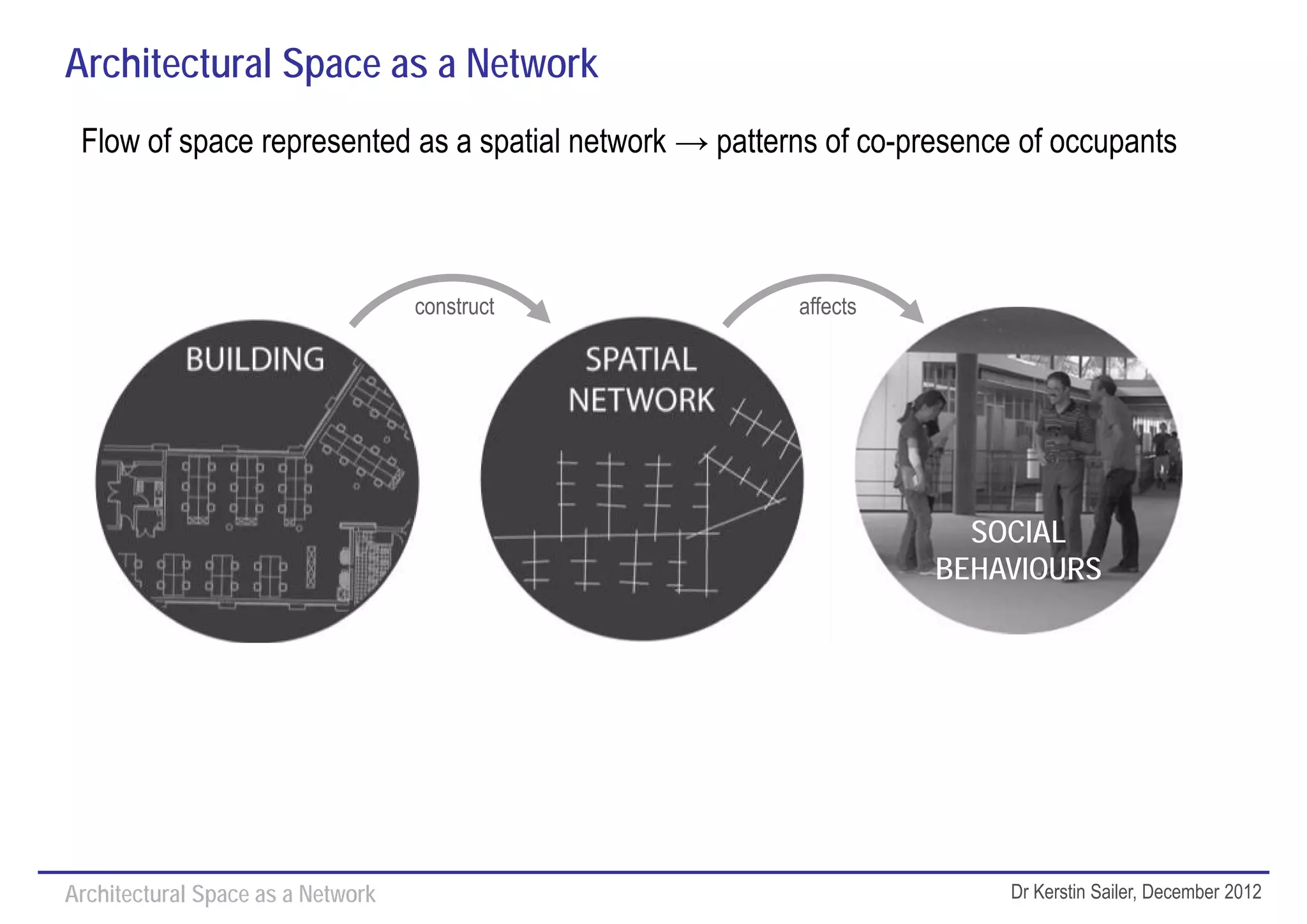
 Flow of space represented as a spatial network → patterns of co-presence of occupants


                                   construct            affects


                                                                     SOCIAL
                                                                   BEHAVIOURS


Architectural Space as a Network                                         Dr Kerstin Sailer, December 2012
Architectural Space as a Network
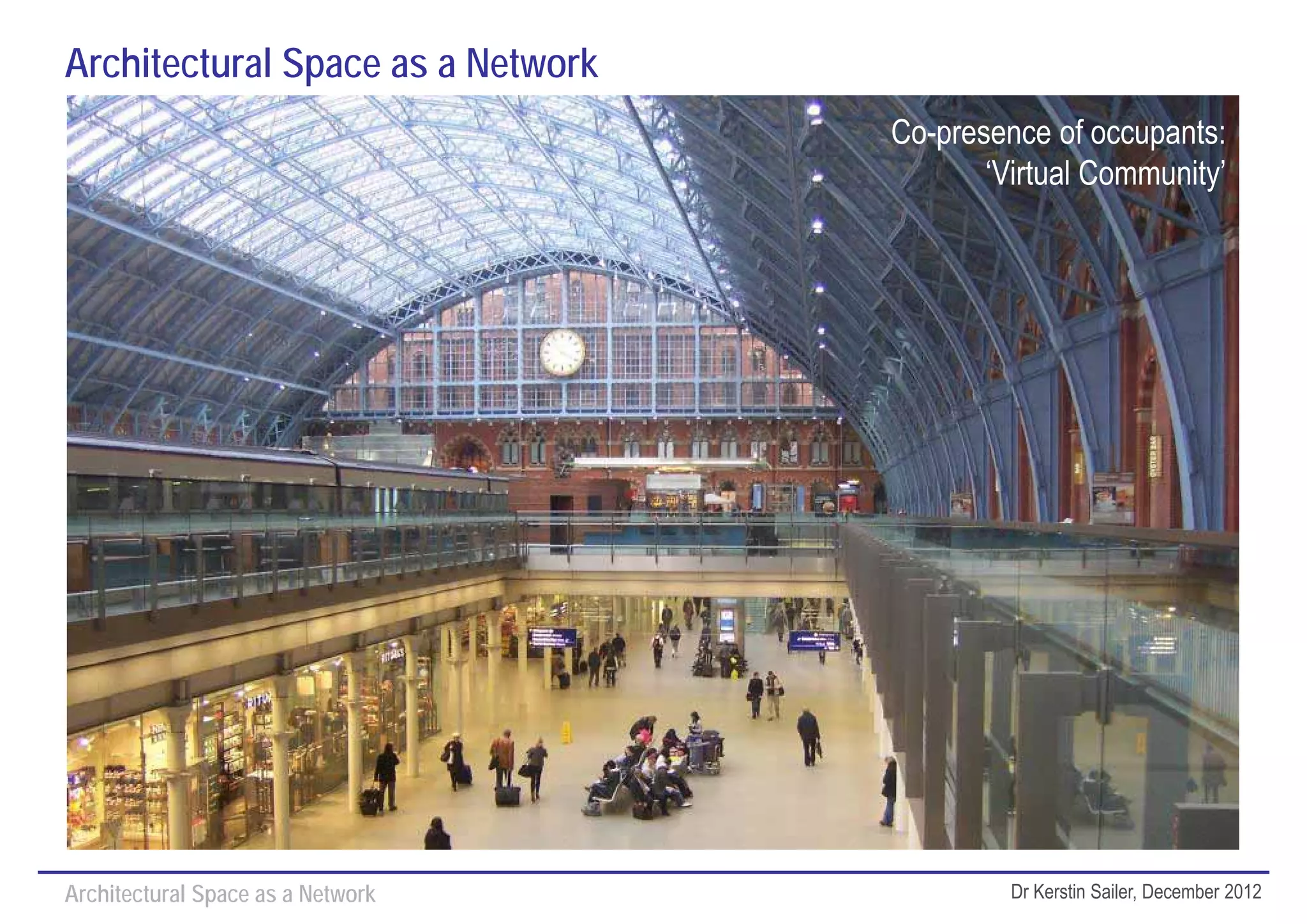
                                   Co-presence of occupants:
                                          ‘Virtual Community’


Architectural Space as a Network            Dr Kerstin Sailer, December 2012
Architectural Space as a Network


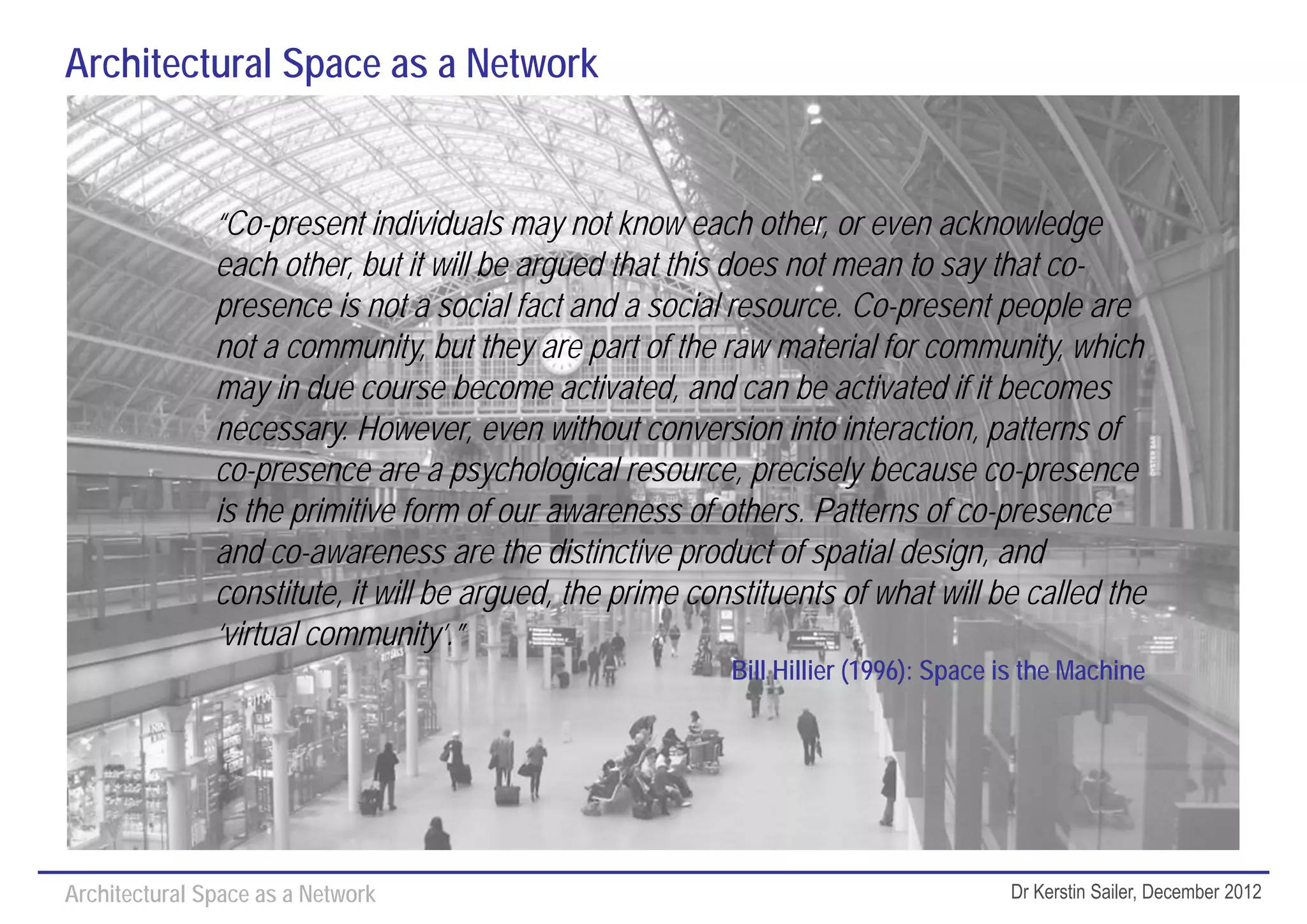
               “Co-present individuals may not know each other, or even acknowledge
               each other, but it will be argued that this does not mean to say that co-
               presence is not a social fact and a social resource. Co-present people are
               not a community, but they are part of the raw material for community, which
               may in due course become activated, and can be activated if it becomes
               necessary. However, even without conversion into interaction, patterns of
               co-presence are a psychological resource, precisely because co-presence
               is the primitive form of our awareness of others. Patterns of co-presence
               and co-awareness are the distinctive product of spatial design, and
               constitute, it will be argued, the prime constituents of what will be called the
               ‘virtual community’.”
                                                           Bill Hillier (1996): Space is the Machine


Architectural Space as a Network                                                      Dr Kerstin Sailer, December 2012
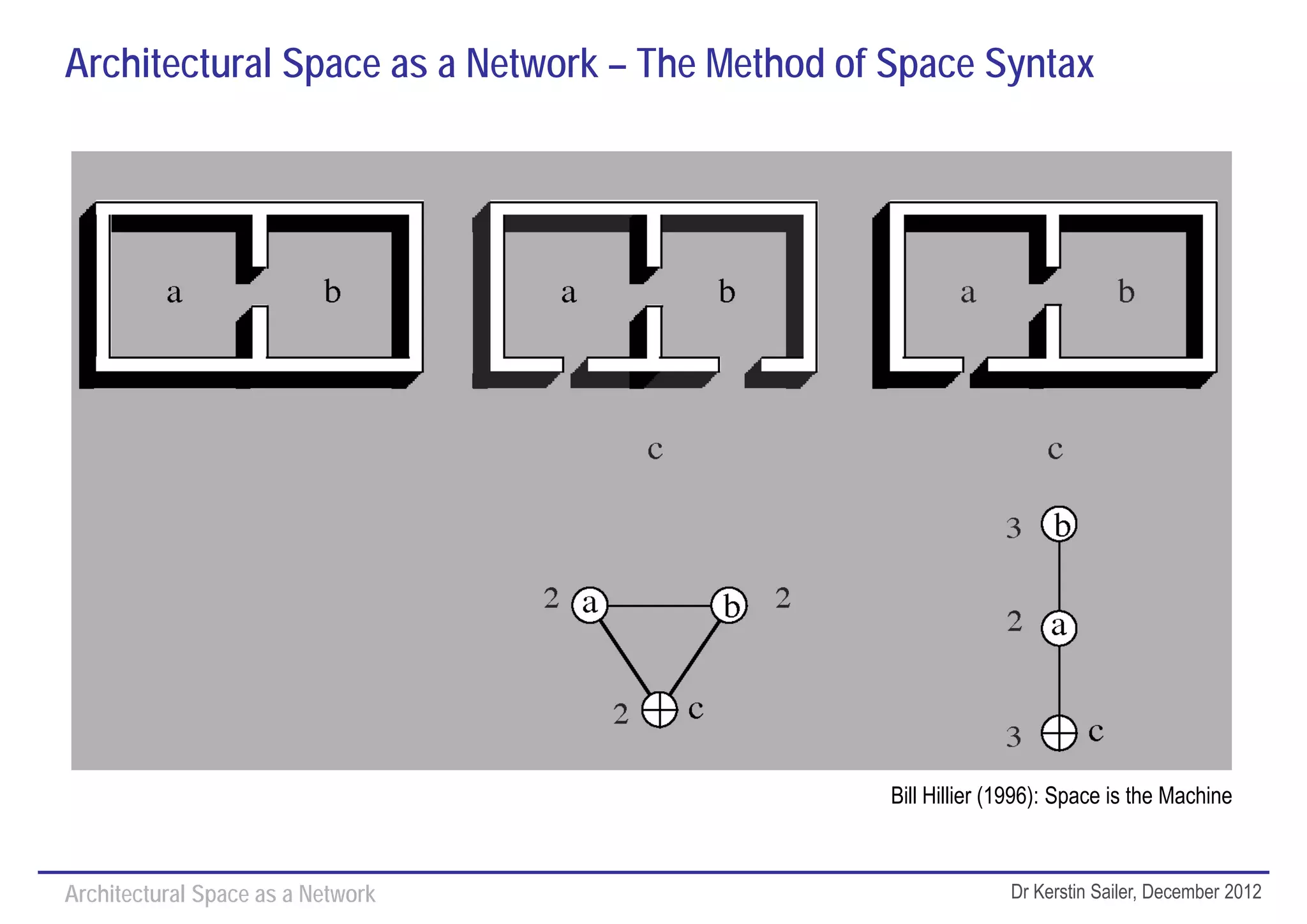
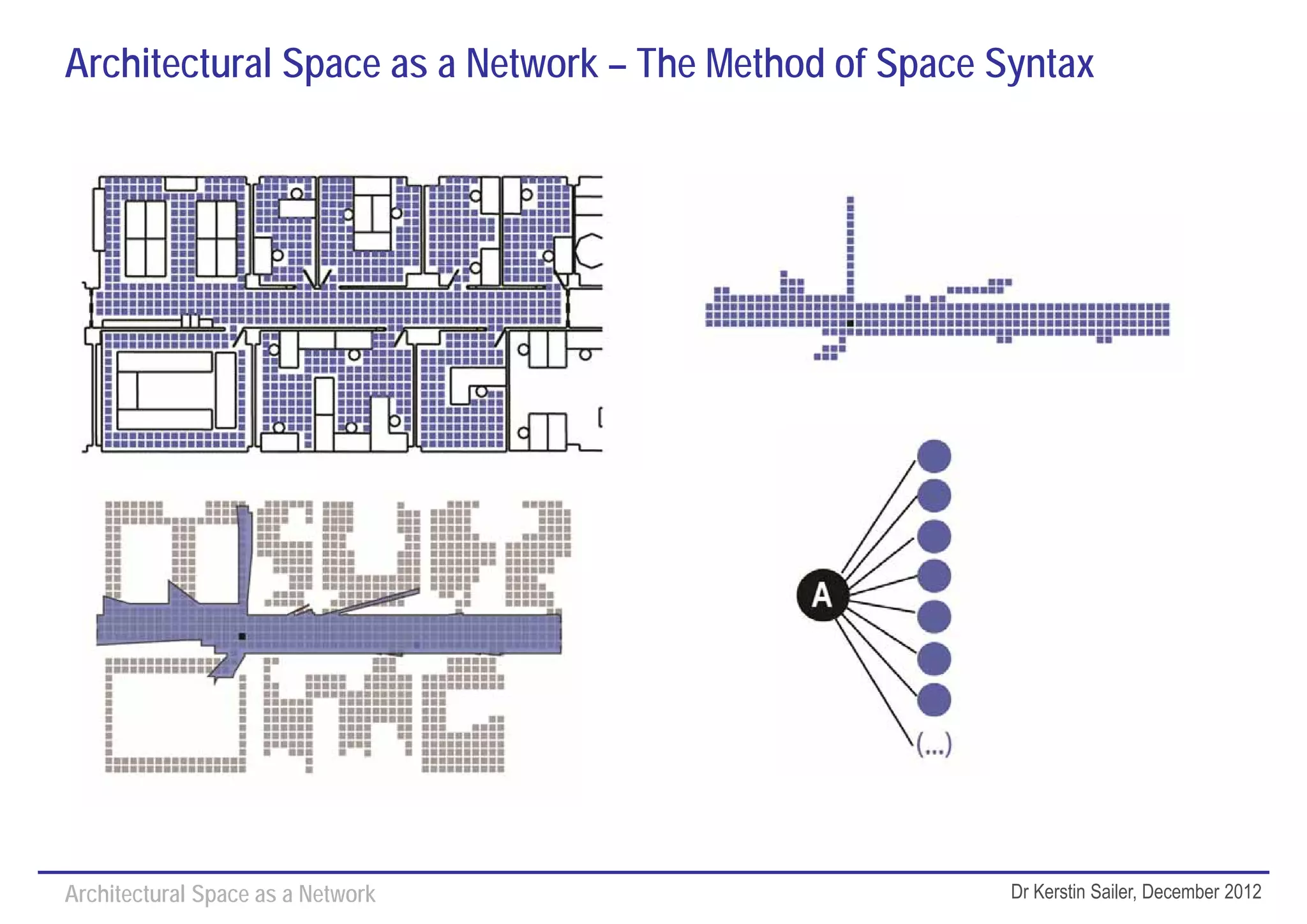
Architectural Space as a Network – The Method of Space Syntax


                                                Bill Hillier (1996): Space is the Machine


Architectural Space as a Network                              Dr Kerstin Sailer, December 2012
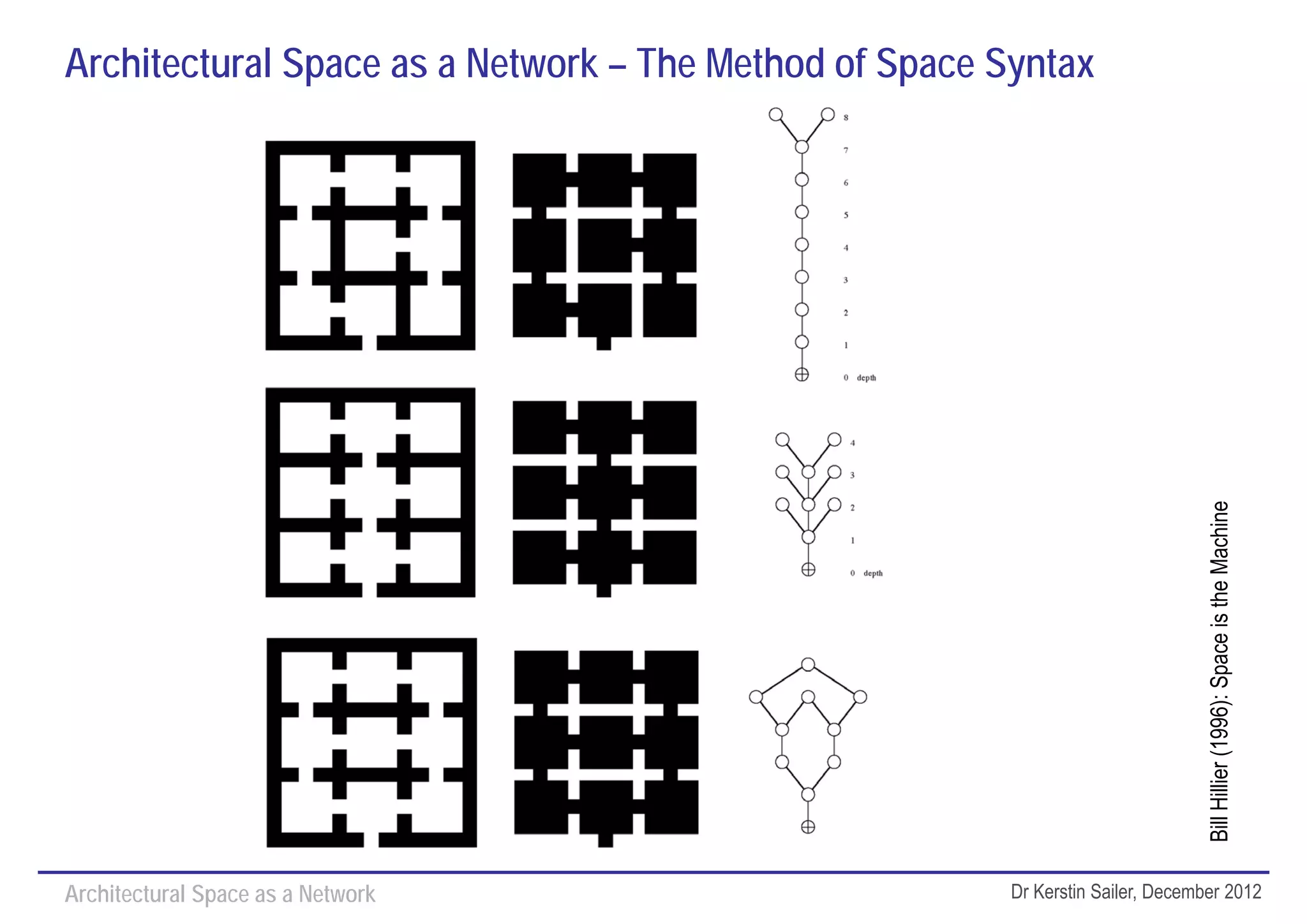
Architectural Space as a Network – The Method of Space Syntax


                                                                                Bill Hillier (1996): Space is the Machine
Architectural Space as a Network                        Dr Kerstin Sailer, December 2012
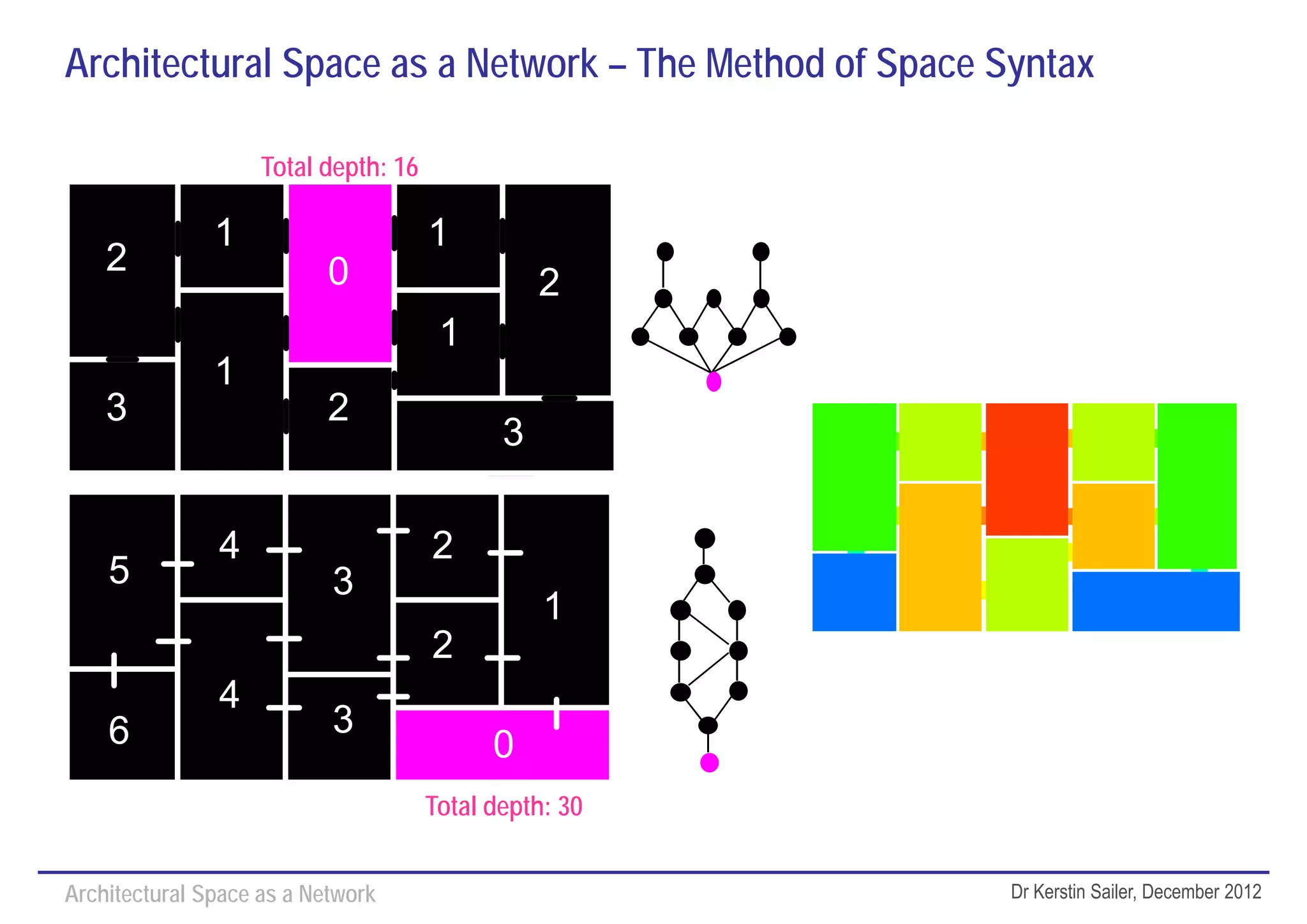
Architectural Space as a Network – The Method of Space Syntax

                    Total depth: 16

               1                      1
    2                      0                     2
                                       1
               1
    3                      2
                                             3
                                            10

               4                      2
    5                      3
                                                 1
                                      2
               4
    6                      3
                                           0
                                           10
                                      Total depth: 30


Architectural Space as a Network                        Dr Kerstin Sailer, December 2012
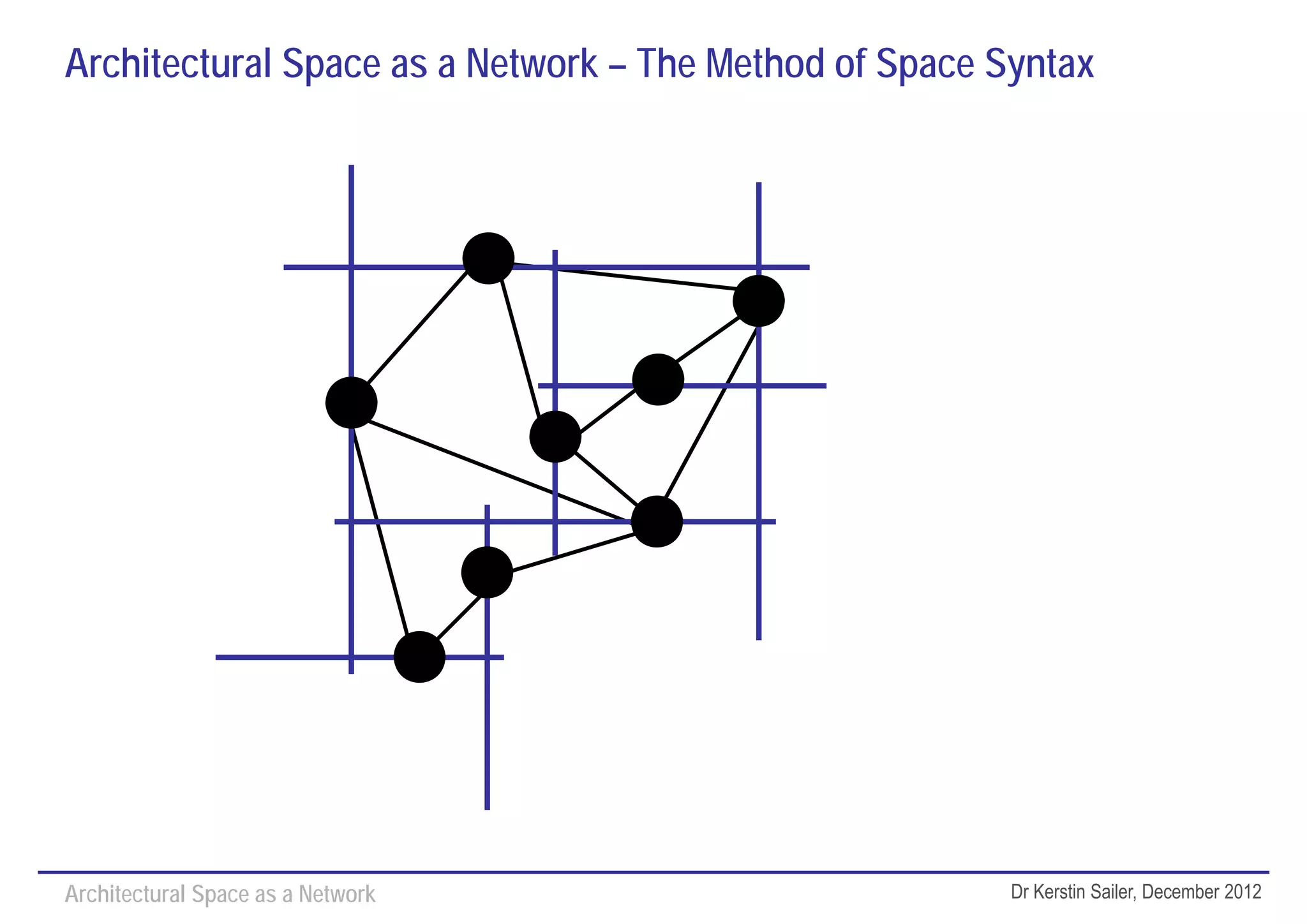
Architectural Space as a Network – The Method of Space Syntax


Architectural Space as a Network                        Dr Kerstin Sailer, December 2012
Architectural Space as a Network – The Method of Space Syntax


Architectural Space as a Network                        Dr Kerstin Sailer, December 2012
Architectural Space as a Network – The Method of Space Syntax


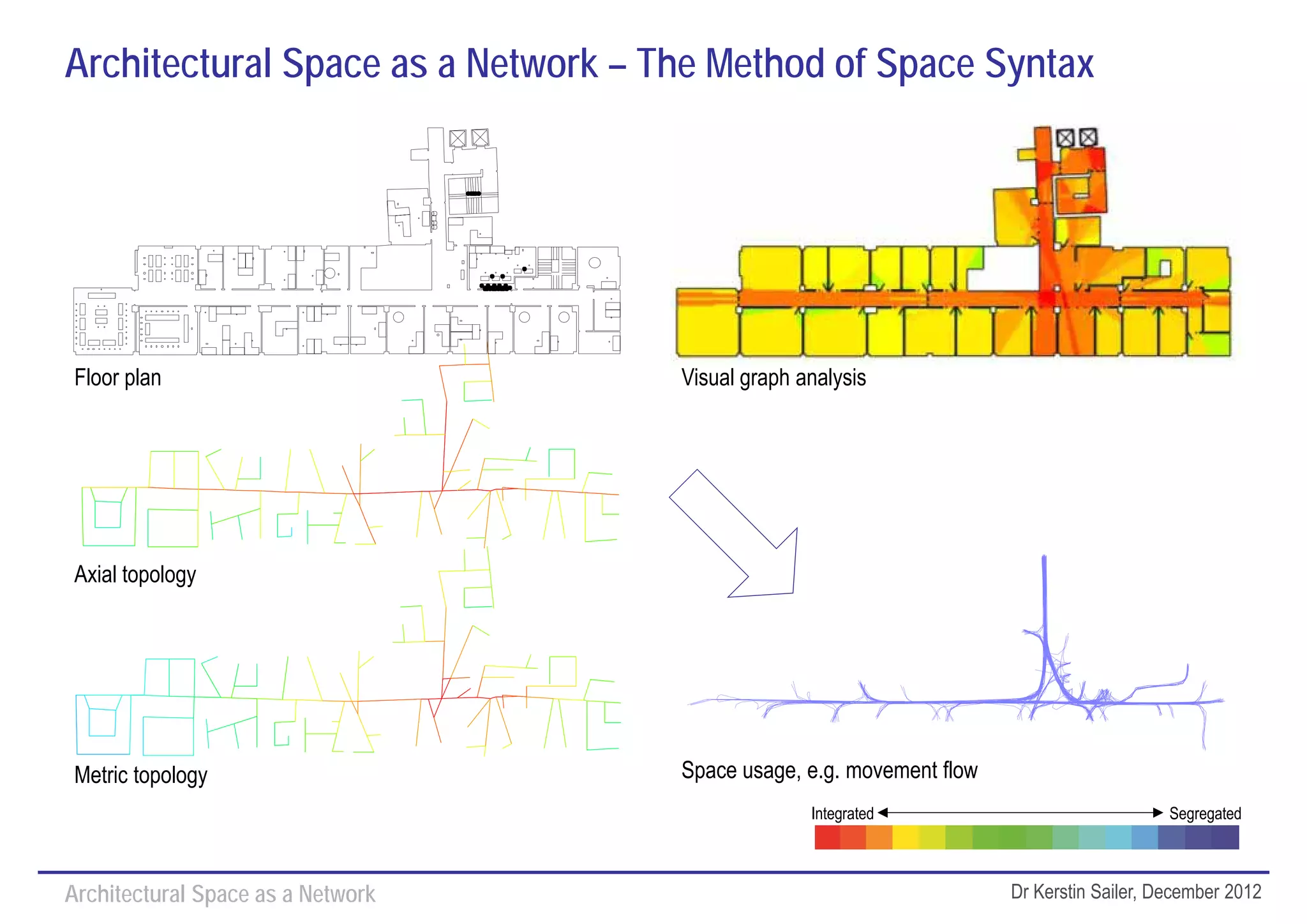
Floor plan                          Visual graph analysis


Axial topology


Metric topology                     Space usage, e.g. movement flow
                                                  Integrated                              Segregated


Architectural Space as a Network                                      Dr Kerstin Sailer, December 2012
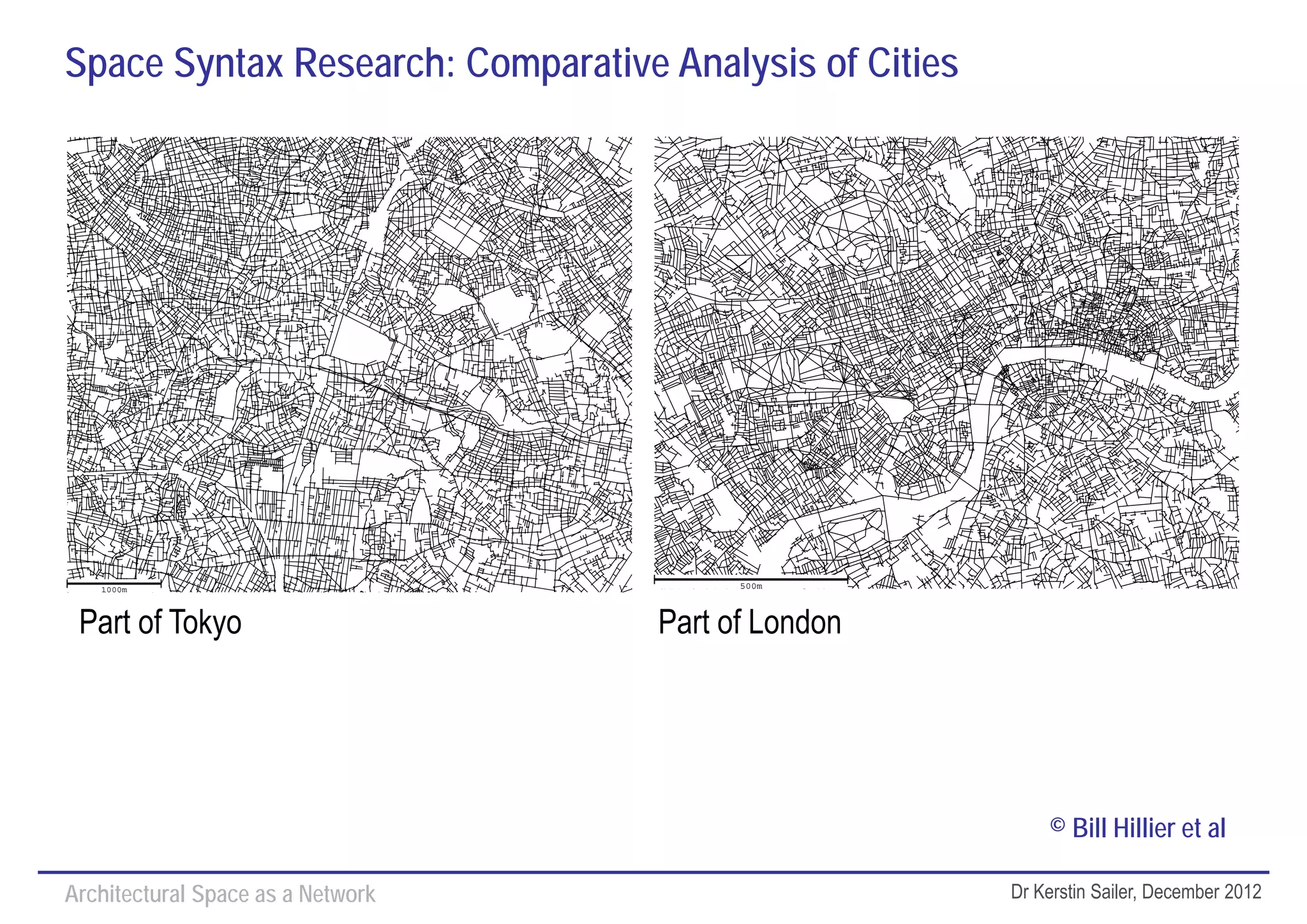
Space Syntax Research: Comparative Analysis of Cities


   1000m                                 500m


 Part of Tokyo                     Part of London


                                                            © Bill Hillier et al

Architectural Space as a Network                        Dr Kerstin Sailer, December 2012
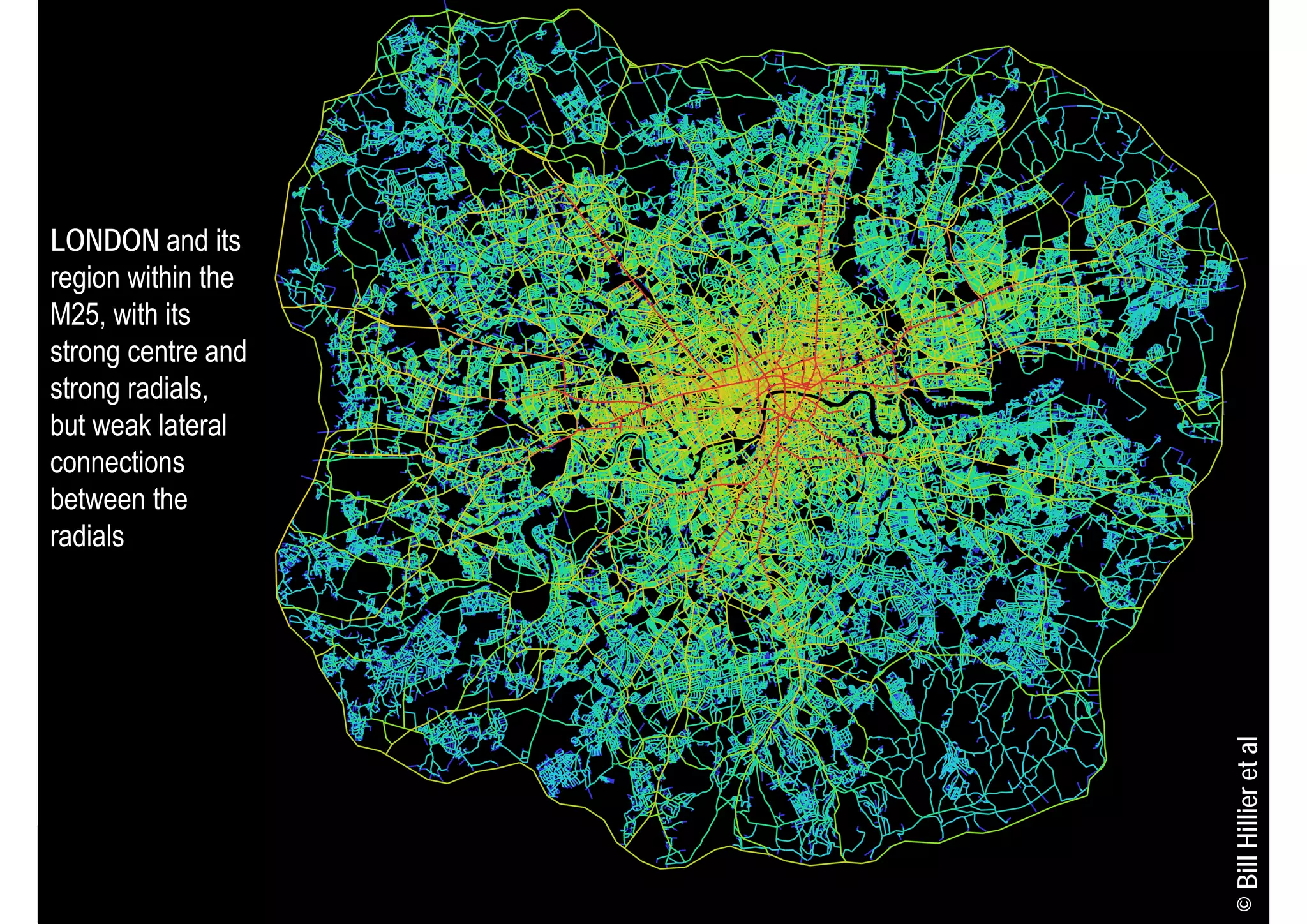
LONDON and its
region within the
M25, with its
strong centre and
strong radials,
but weak lateral
connections
between the
radials


                                                                © Bill Hillier et al
                         10000m
 Architectural Space as a Network   Dr Kerstin Sailer, December 2012
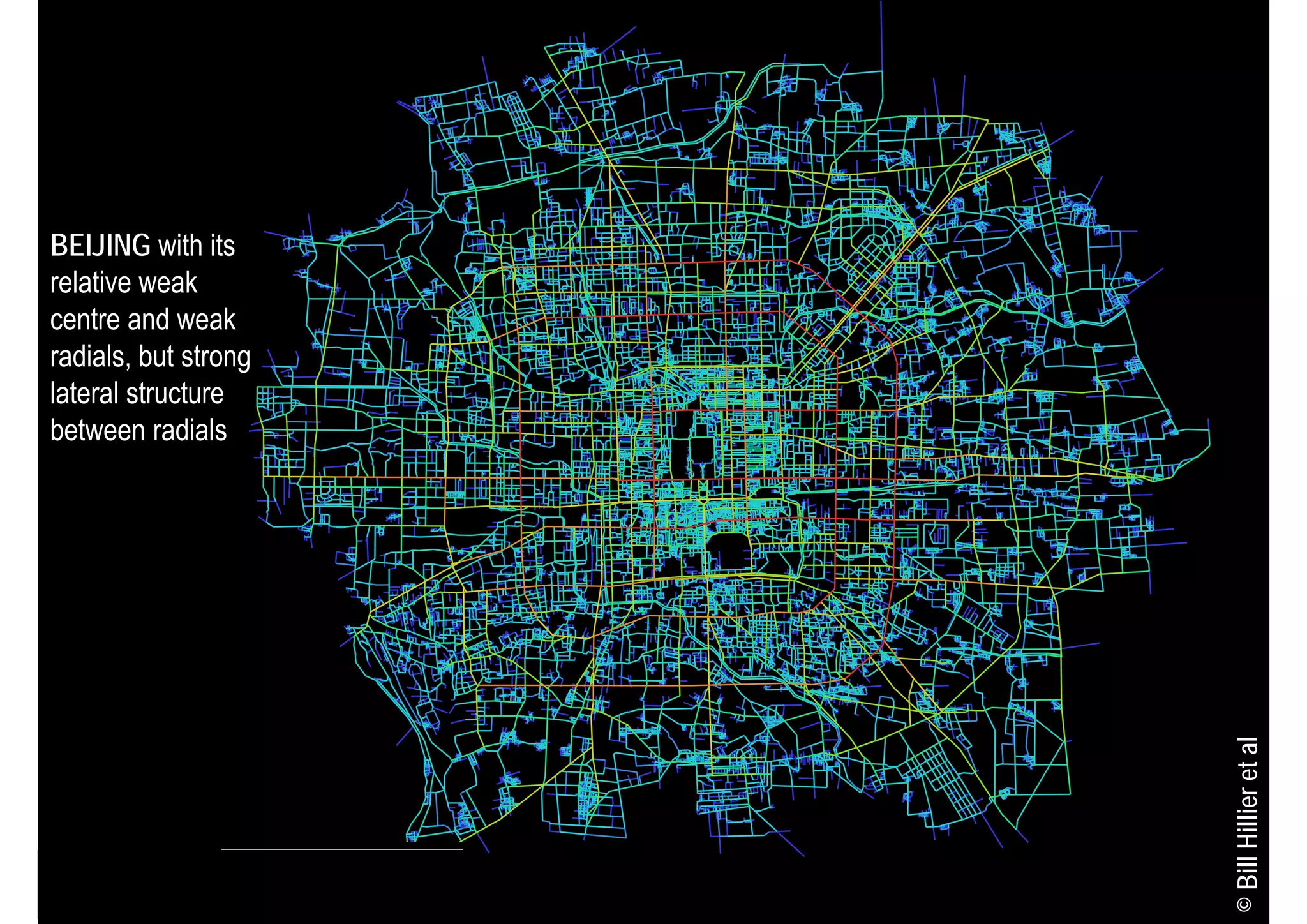
BEIJING with its
relative weak
centre and weak
radials, but strong
lateral structure
between radials


                                                                © Bill Hillier et al
                          10000m
 Architectural Space as a Network   Dr Kerstin Sailer, December 2012
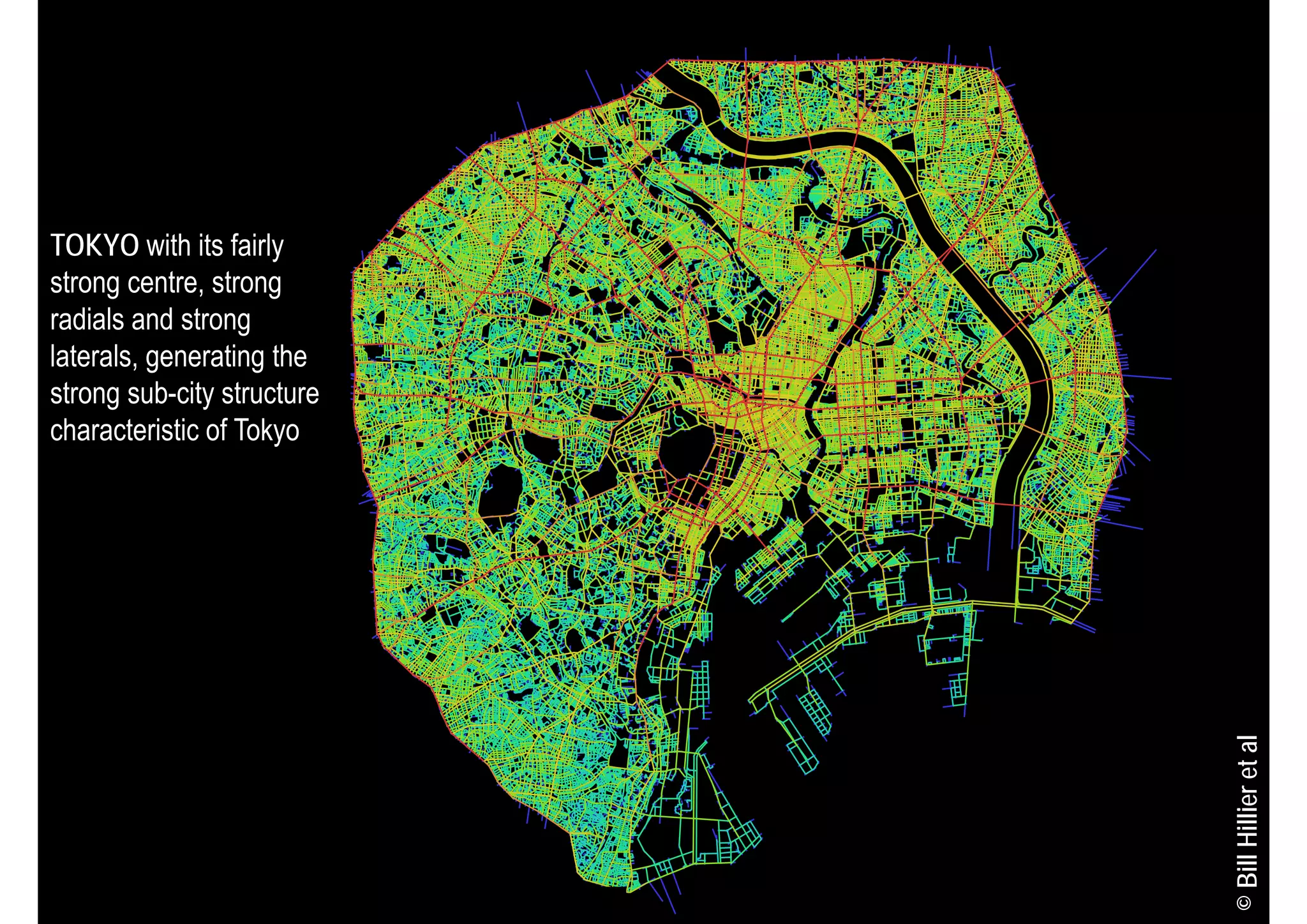
TOKYO with its fairly
strong centre, strong
radials and strong
laterals, generating the
strong sub-city structure
characteristic of Tokyo


                                                                         © Bill Hillier et al
 Architectural Space as a Network            Dr Kerstin Sailer, December 2012
                                    10000m
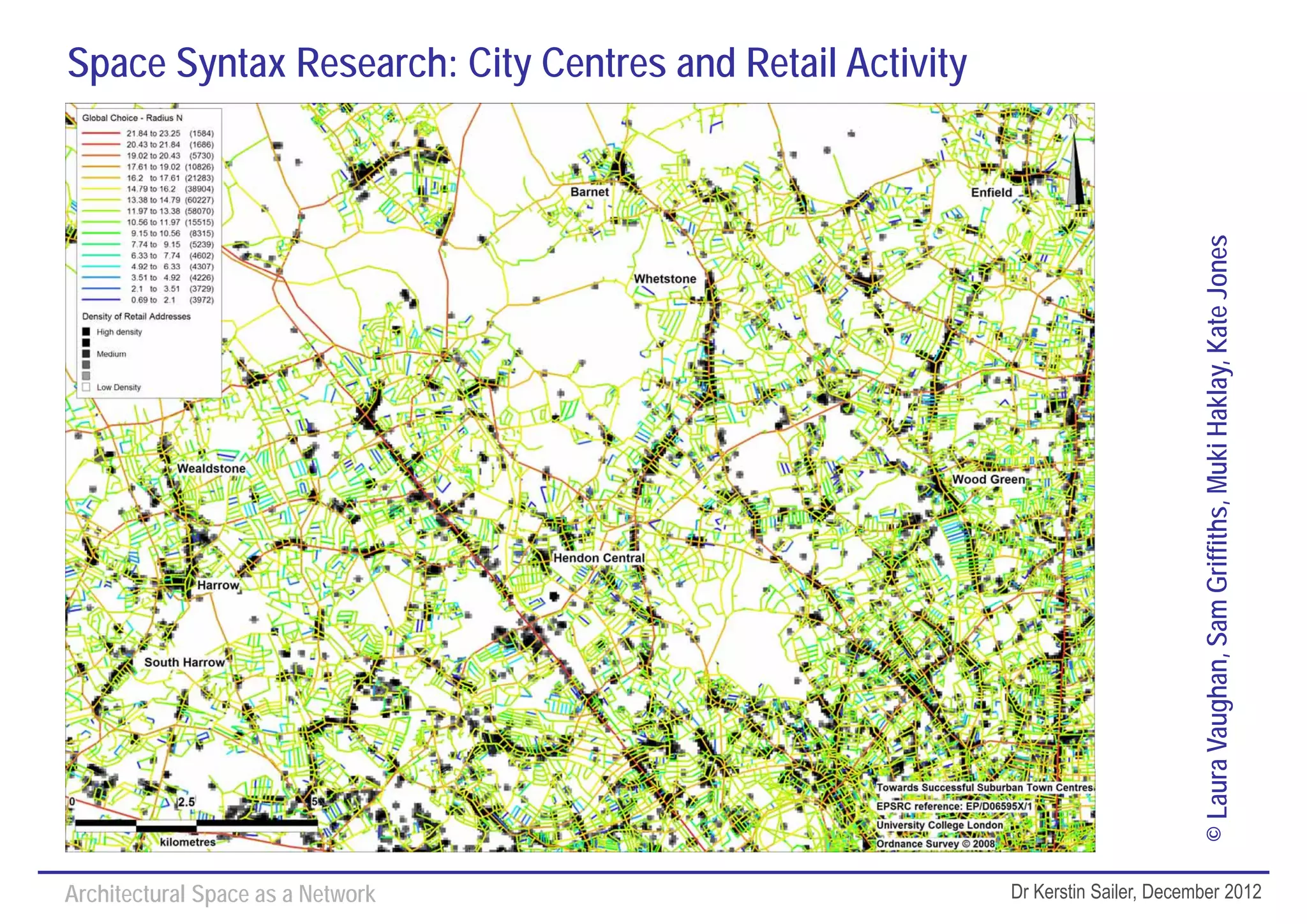
Space Syntax Research: City Centres and Retail Activity


                                                                                  © Laura Vaughan, Sam Griffiths, Muki Haklay, Kate Jones
Architectural Space as a Network                          Dr Kerstin Sailer, December 2012
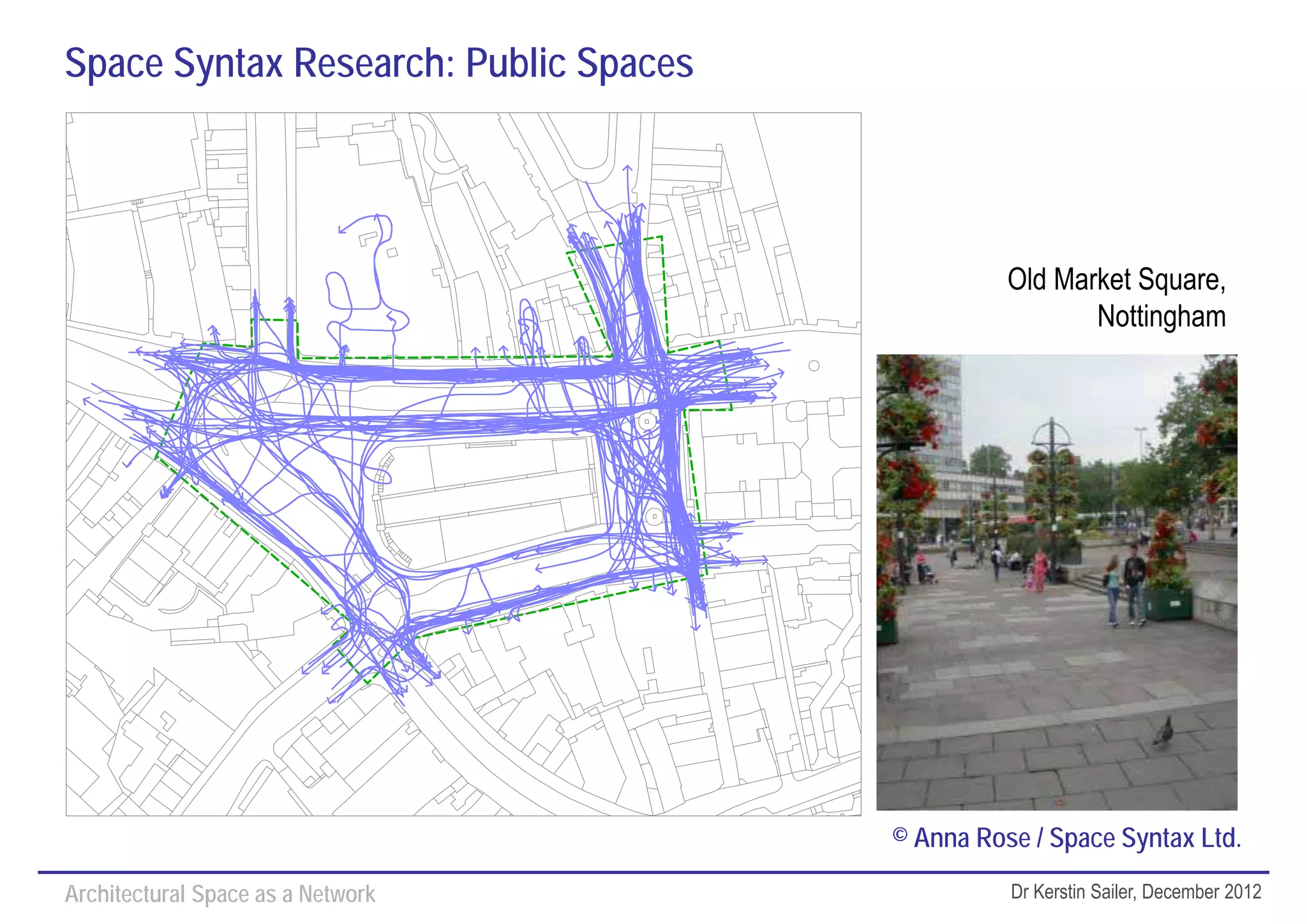
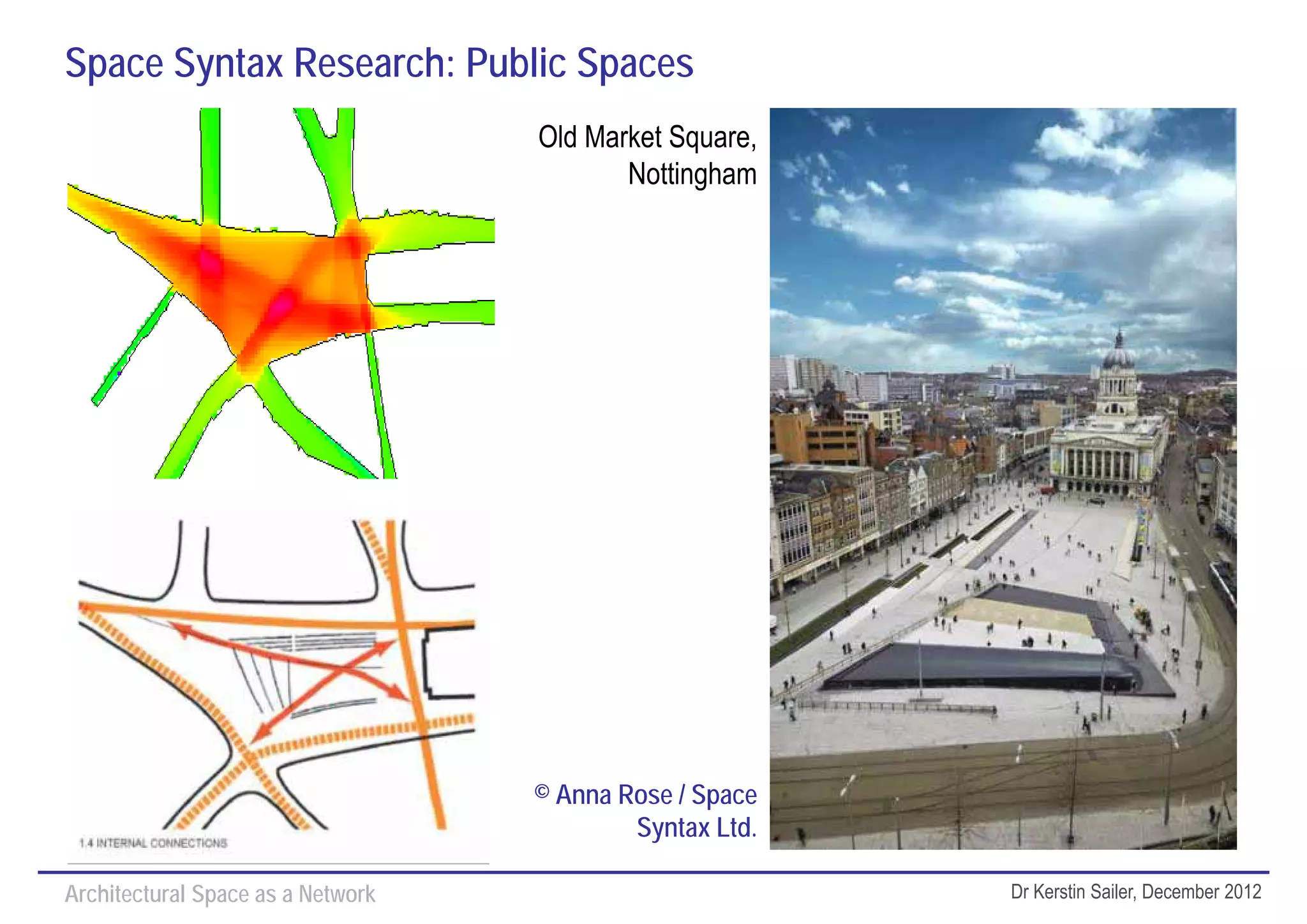
Space Syntax Research: Public Spaces


                                                 Old Market Square,
                                                        Nottingham


                                       © Anna Rose / Space Syntax Ltd.

Architectural Space as a Network                 Dr Kerstin Sailer, December 2012
Space Syntax Research: Public Spaces
                                   Old Market Square,
                                          Nottingham


                                   © Anna Rose / Space
                                           Syntax Ltd.

Architectural Space as a Network                         Dr Kerstin Sailer, December 2012
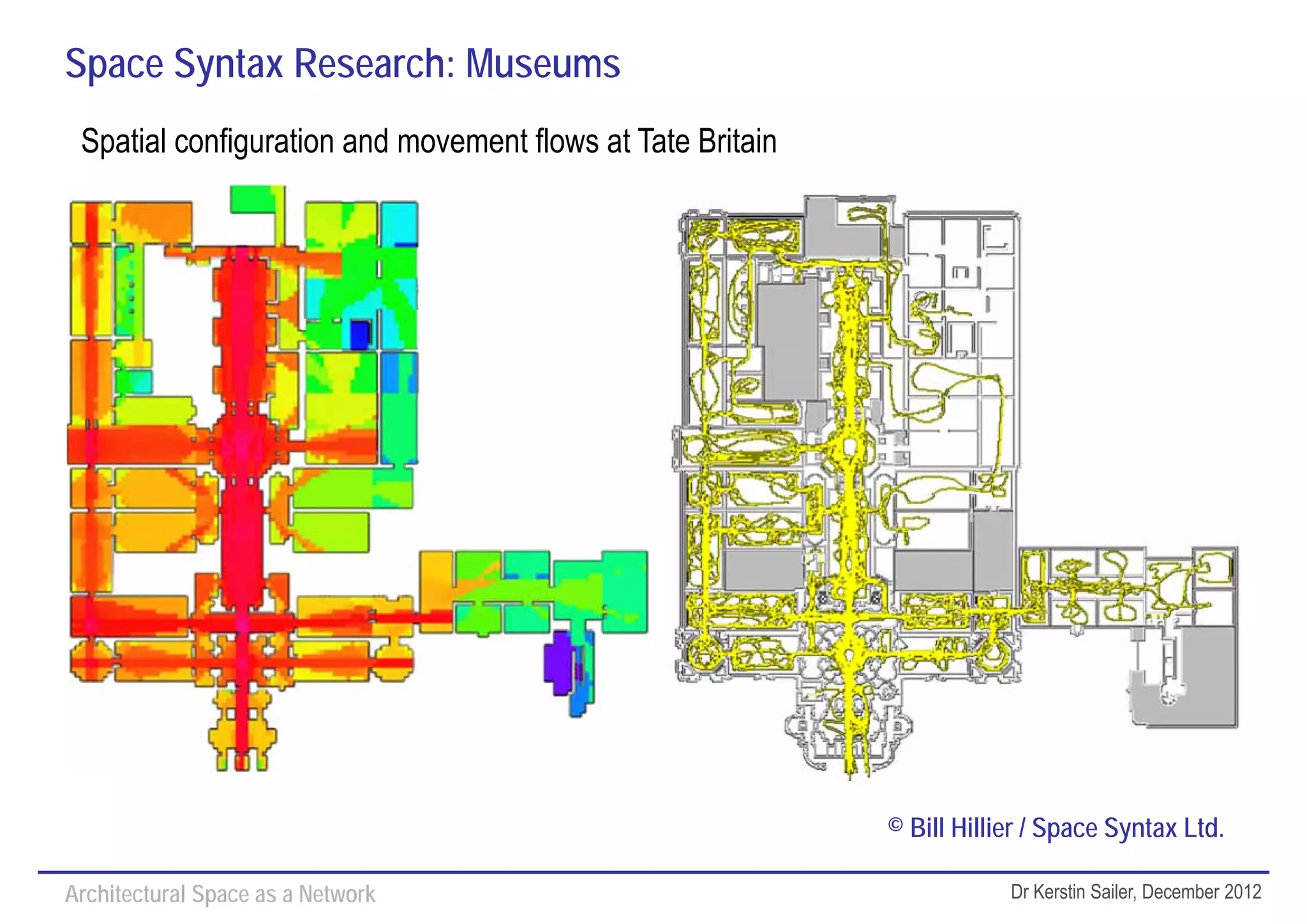
Space Syntax Research: Museums
 Spatial configuration and movement flows at Tate Britain


                                                                  SOCIAL
                                                                BEHAVIOURS


                                                            © Bill Hillier / Space Syntax Ltd.

Architectural Space as a Network                                        Dr Kerstin Sailer, December 2012
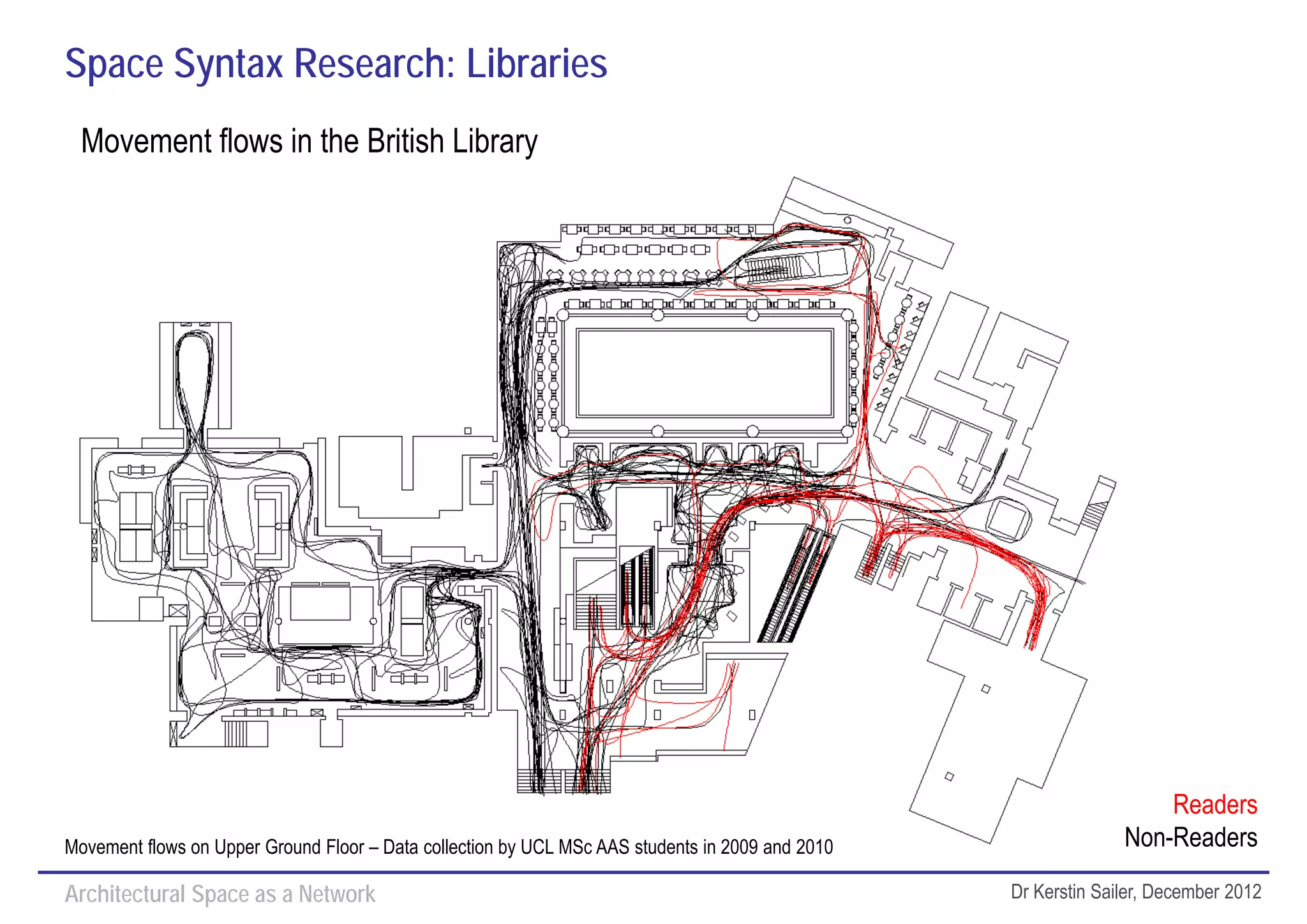
Space Syntax Research: Libraries
  Movement flows in the British Library


                                                                                                                    Readers
Movement flows on Upper Ground Floor – Data collection by UCL MSc AAS students in 2009 and 2010                 Non-Readers

Architectural Space as a Network                                                                  Dr Kerstin Sailer, December 2012
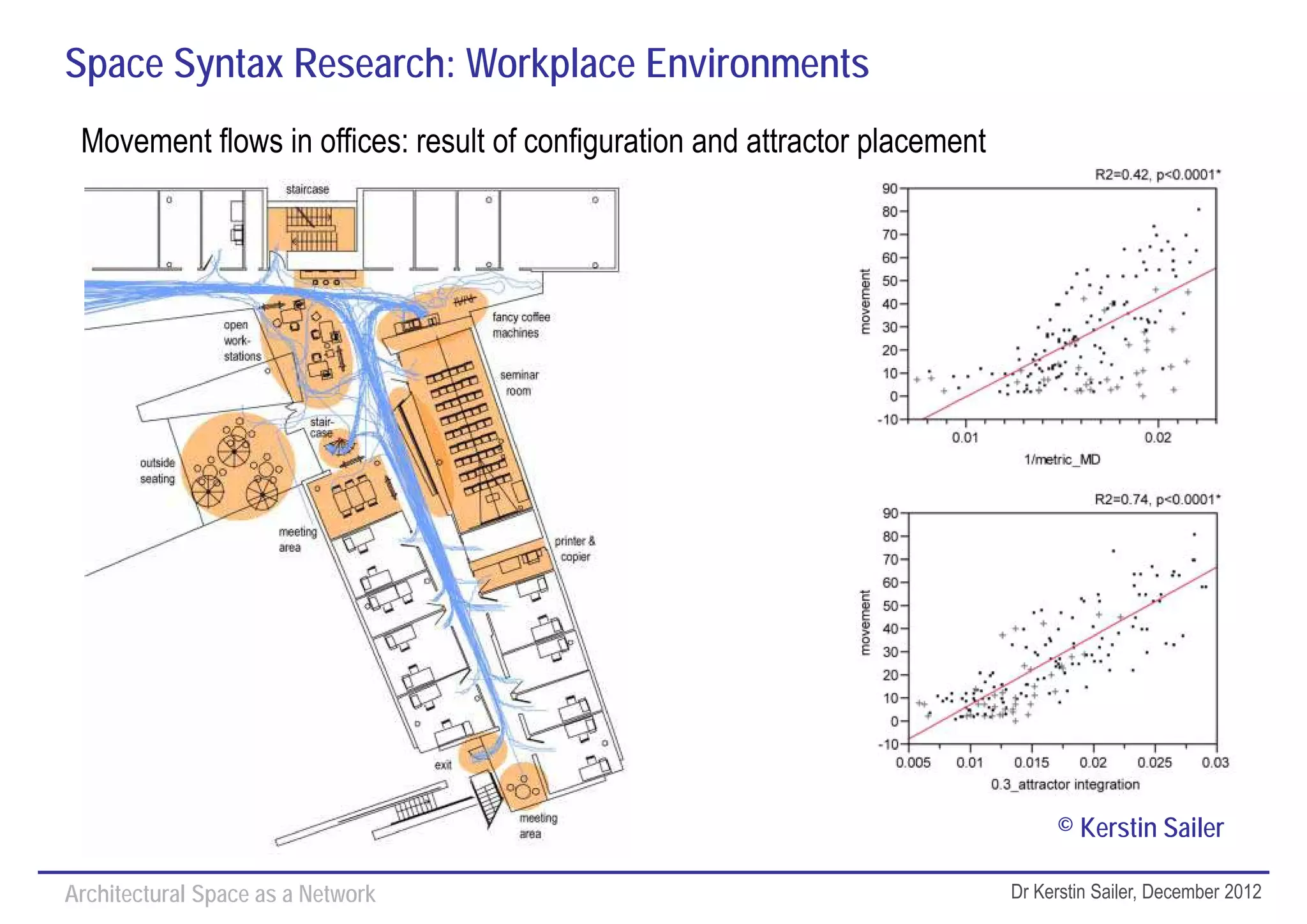
Space Syntax Research: Workplace Environments
 Movement flows in offices: result of configuration and attractor placement


                                                                        SOCIAL
                                                                      BEHAVIOURS


                                                                                   © Kerstin Sailer

Architectural Space as a Network                                              Dr Kerstin Sailer, December 2012
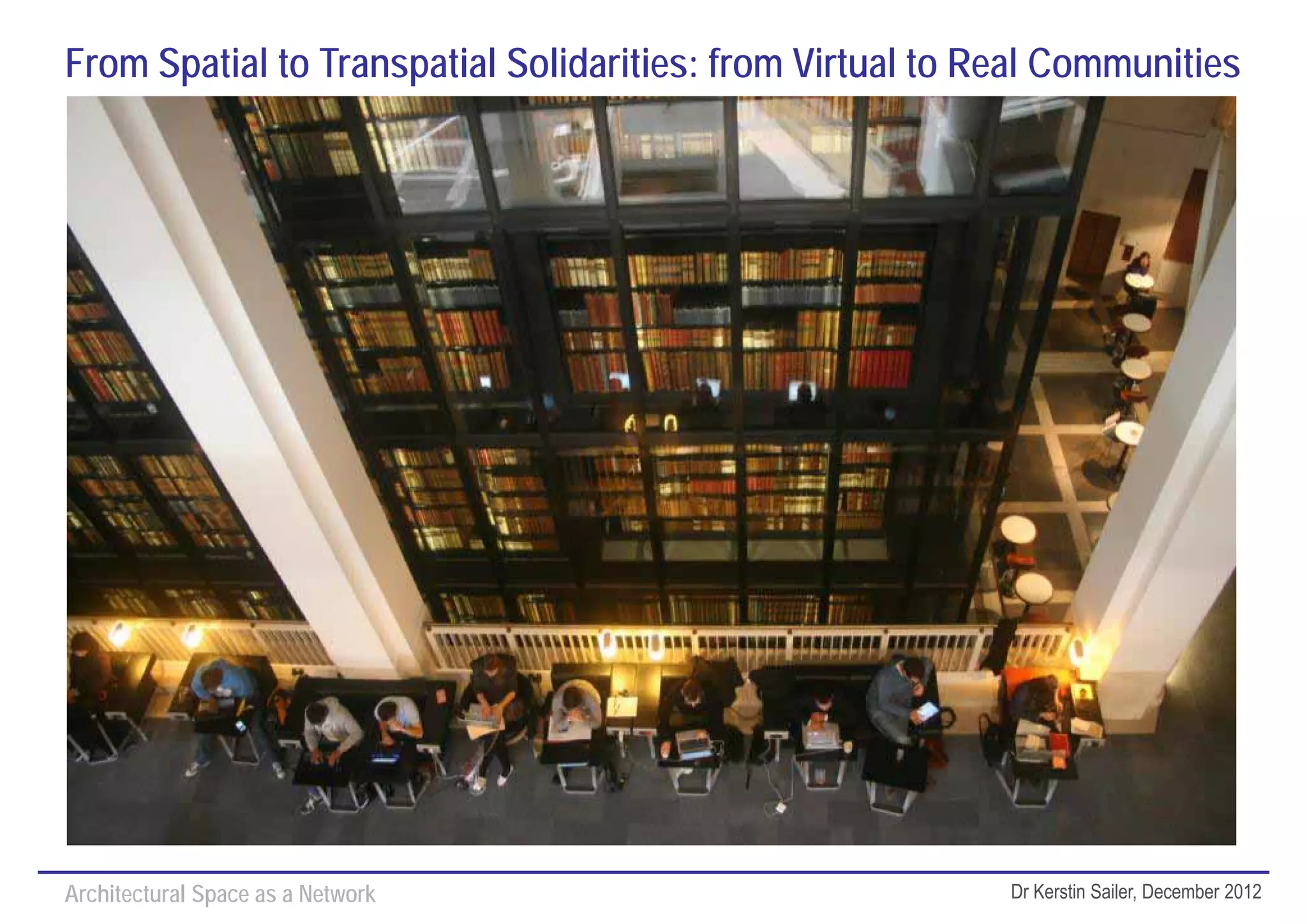
From Spatial to Transpatial Solidarities: from Virtual to Real Communities


                                                        SOCIAL
                                                      BEHAVIOURS


Architectural Space as a Network                           Dr Kerstin Sailer, December 2012
Spatial and Transpatial Solidarities
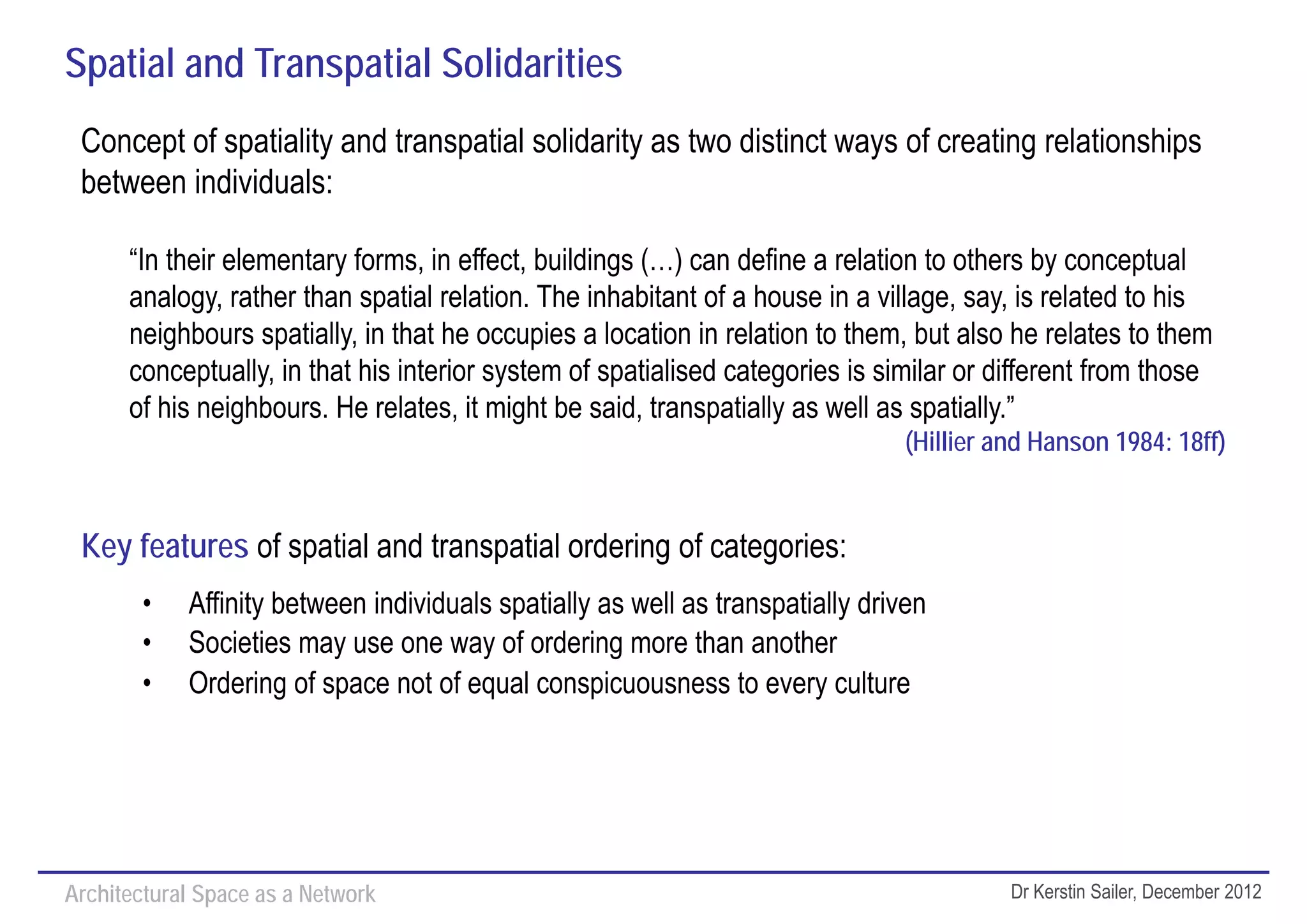
 Concept of spatiality and transpatial solidarity as two distinct ways of creating relationships
 between individuals:

      “In their elementary forms, in effect, buildings (…) can define a relation to others by conceptual
      analogy, rather than spatial relation. The inhabitant of a house in a village, say, is related to his
      neighbours spatially, in that he occupies a location in relation to them, but also he relates to them
      conceptually, in that his interior system of spatialised categories is similar or different from those
      of his neighbours. He relates, it might be said, transpatially as well as spatially.”
                                                                               (Hillier and Hanson 1984: 18ff)


 Key features of spatial and transpatial ordering of categories:
        •   Affinity between individuals spatially as well as transpatially driven
        •   Societies may use one way of ordering more than another
        •   Ordering of space not of equal conspicuousness to every culture


Architectural Space as a Network                                                         Dr Kerstin Sailer, December 2012
Spatial and Transpatial Solidarities

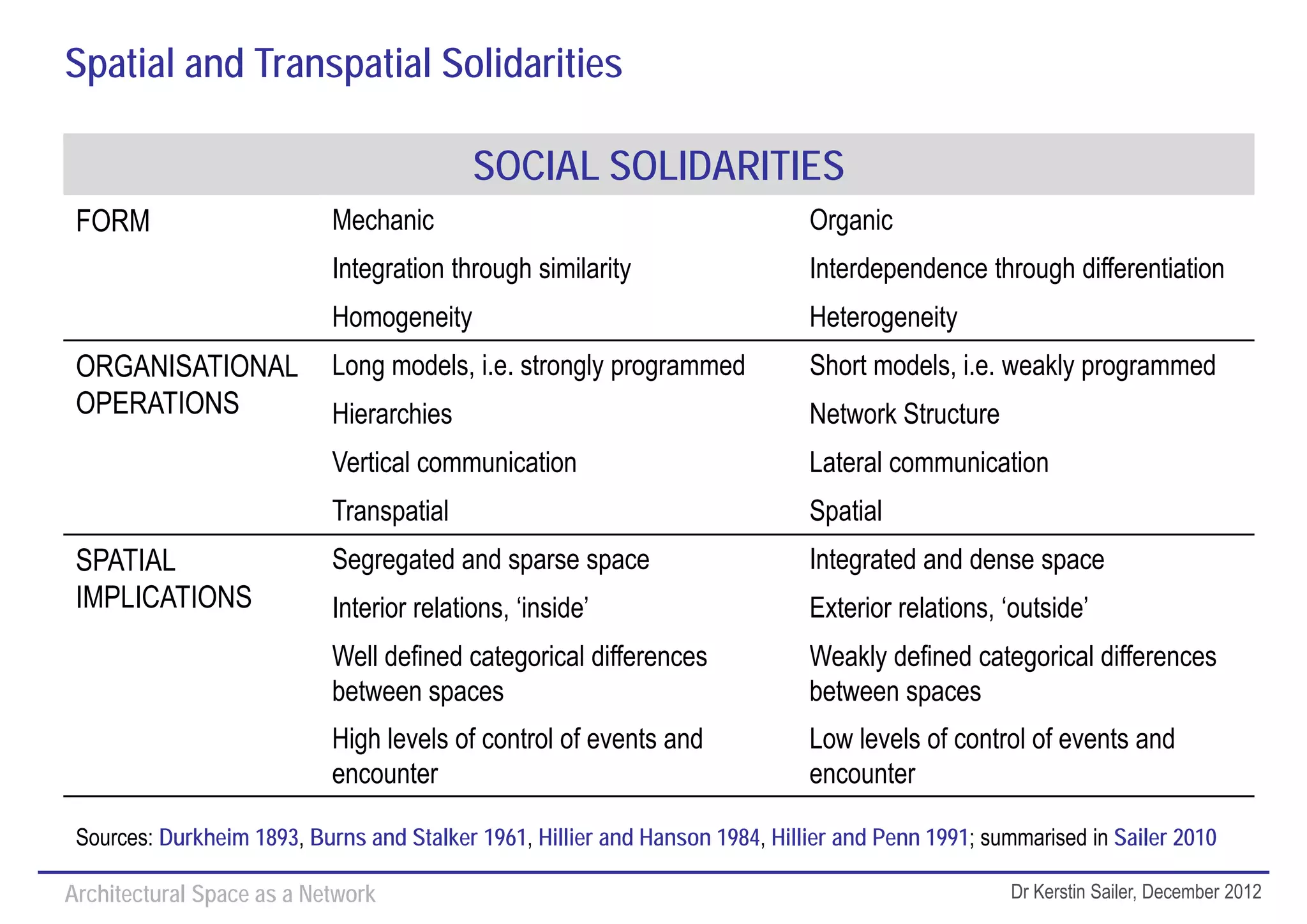
                                           SOCIAL SOLIDARITIES
 FORM                       Mechanic                                          Organic
                            Integration through similarity                    Interdependence through differentiation
                            Homogeneity                                       Heterogeneity
 ORGANISATIONAL             Long models, i.e. strongly programmed             Short models, i.e. weakly programmed
 OPERATIONS                 Hierarchies                                       Network Structure
                            Vertical communication                            Lateral communication
                            Transpatial                                       Spatial
 SPATIAL                    Segregated and sparse space                       Integrated and dense space
 IMPLICATIONS               Interior relations, ‘inside’                      Exterior relations, ‘outside’
                            Well defined categorical differences              Weakly defined categorical differences
                            between spaces                                    between spaces
                            High levels of control of events and              Low levels of control of events and
                            encounter                                         encounter

 Sources: Durkheim 1893, Burns and Stalker 1961, Hillier and Hanson 1984, Hillier and Penn 1991; summarised in Sailer 2010

Architectural Space as a Network                                                                    Dr Kerstin Sailer, December 2012
Spatial and Transpatial Solidarities
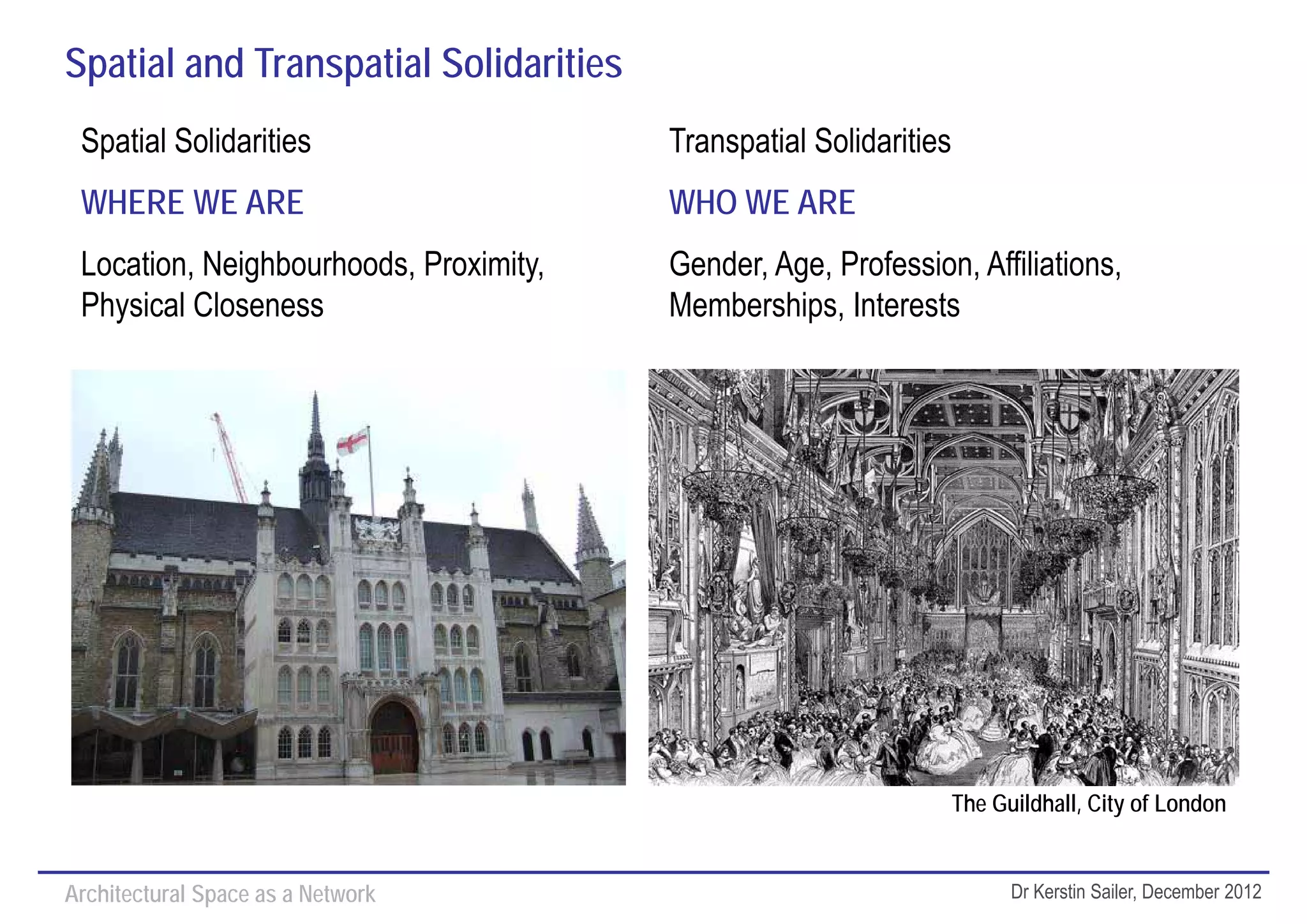
 Spatial Solidarities                   Transpatial Solidarities
 WHERE WE ARE                           WHO WE ARE
 Location, Neighbourhoods, Proximity,   Gender, Age, Profession, Affiliations,
 Physical Closeness                     Memberships, Interests


                                                                   The Guildhall, City of London


Architectural Space as a Network                                         Dr Kerstin Sailer, December 2012
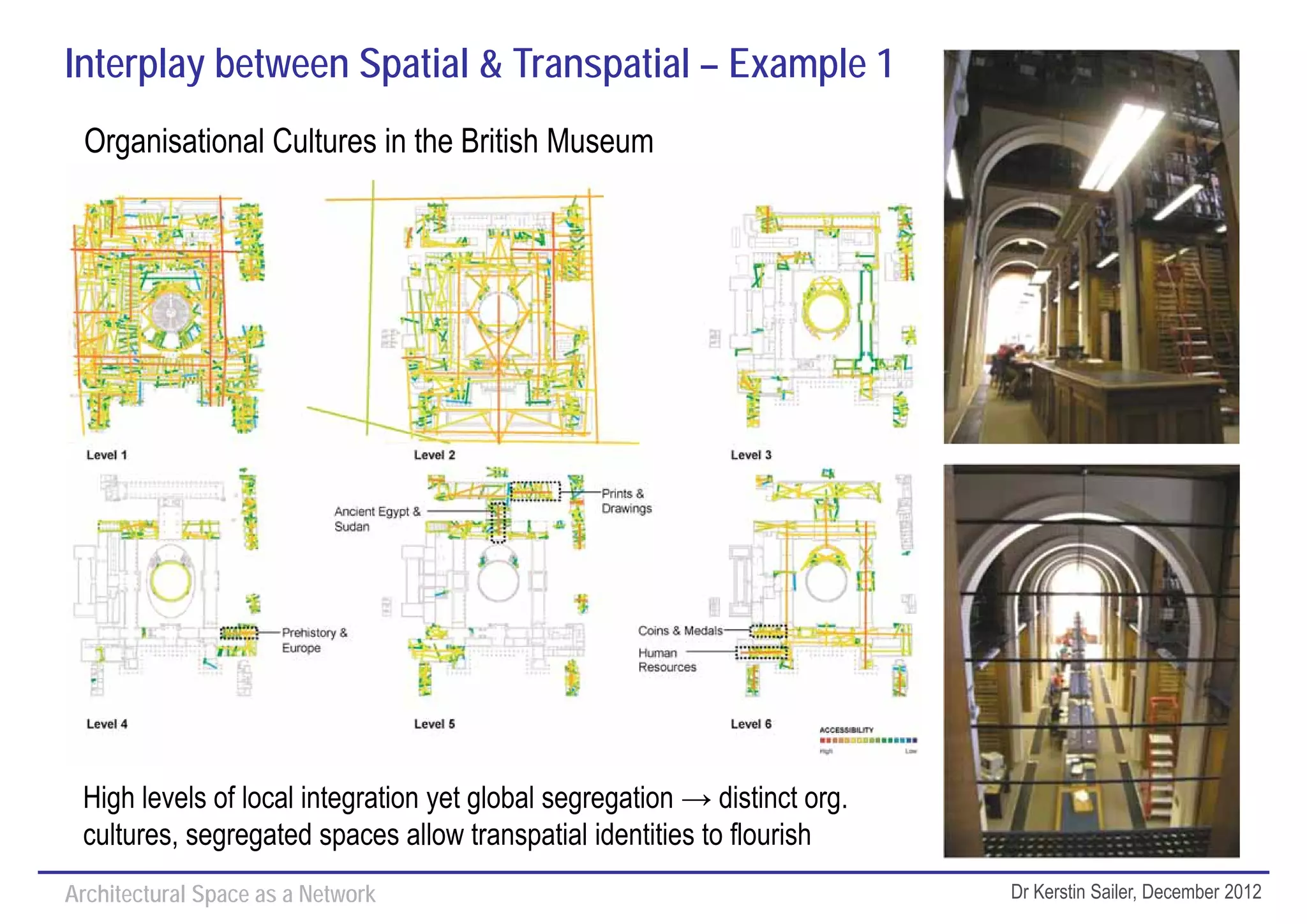
Interplay between Spatial & Transpatial – Example 1
 Organisational Cultures in the British Museum


 High levels of local integration yet global segregation → distinct org.
 cultures, segregated spaces allow transpatial identities to flourish
Architectural Space as a Network                                           Dr Kerstin Sailer, December 2012
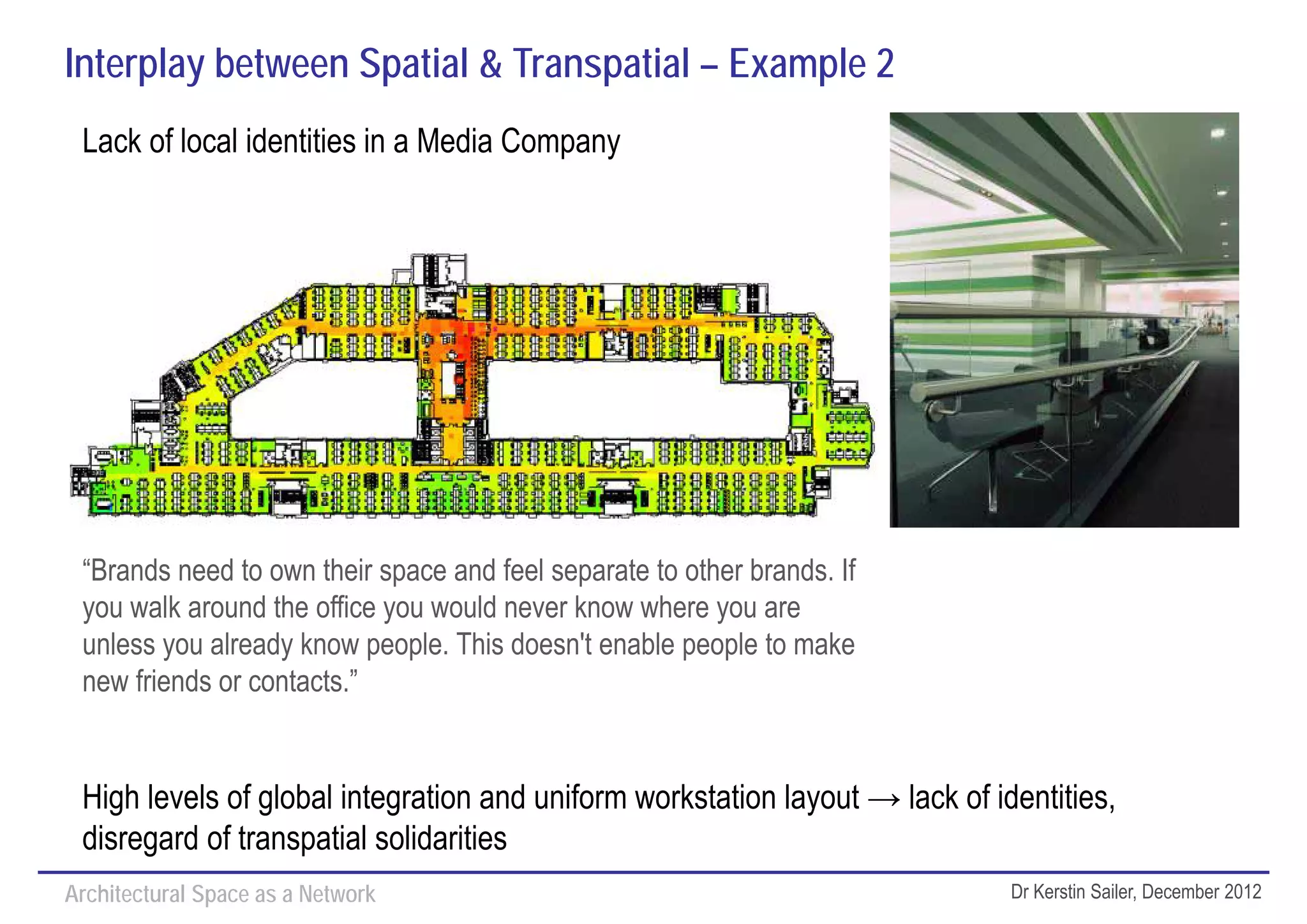
Interplay between Spatial & Transpatial – Example 2
 Lack of local identities in a Media Company


 “Brands need to own their space and feel separate to other brands. If
 you walk around the office you would never know where you are
 unless you already know people. This doesn't enable people to make
 new friends or contacts.”


 High levels of global integration and uniform workstation layout → lack of identities,
 disregard of transpatial solidarities
Architectural Space as a Network                                              Dr Kerstin Sailer, December 2012
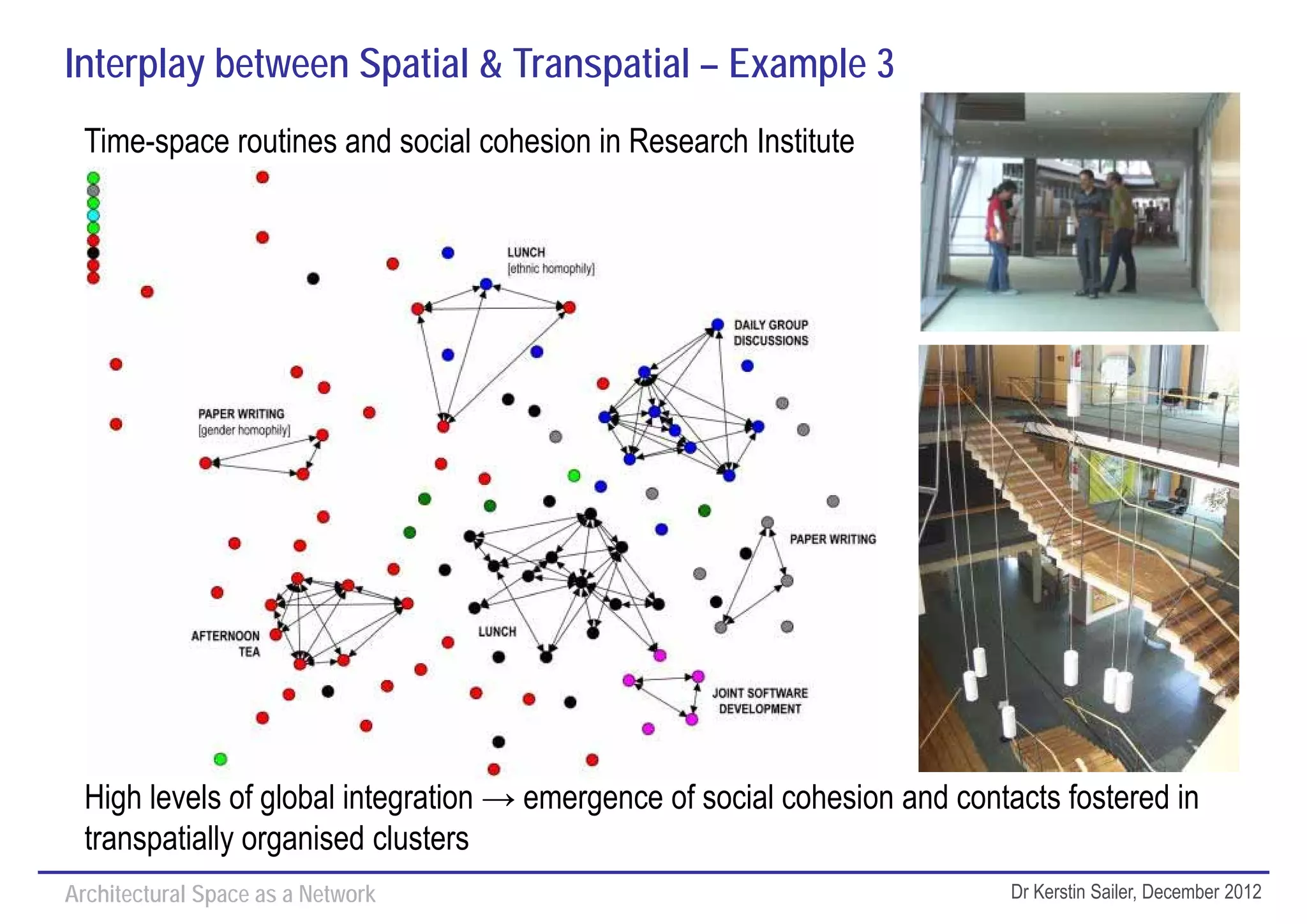
Interplay between Spatial & Transpatial – Example 3
 Time-space routines and social cohesion in Research Institute


  High levels of global integration → emergence of social cohesion and contacts fostered in
  transpatially organised clusters
Architectural Space as a Network                                           Dr Kerstin Sailer, December 2012
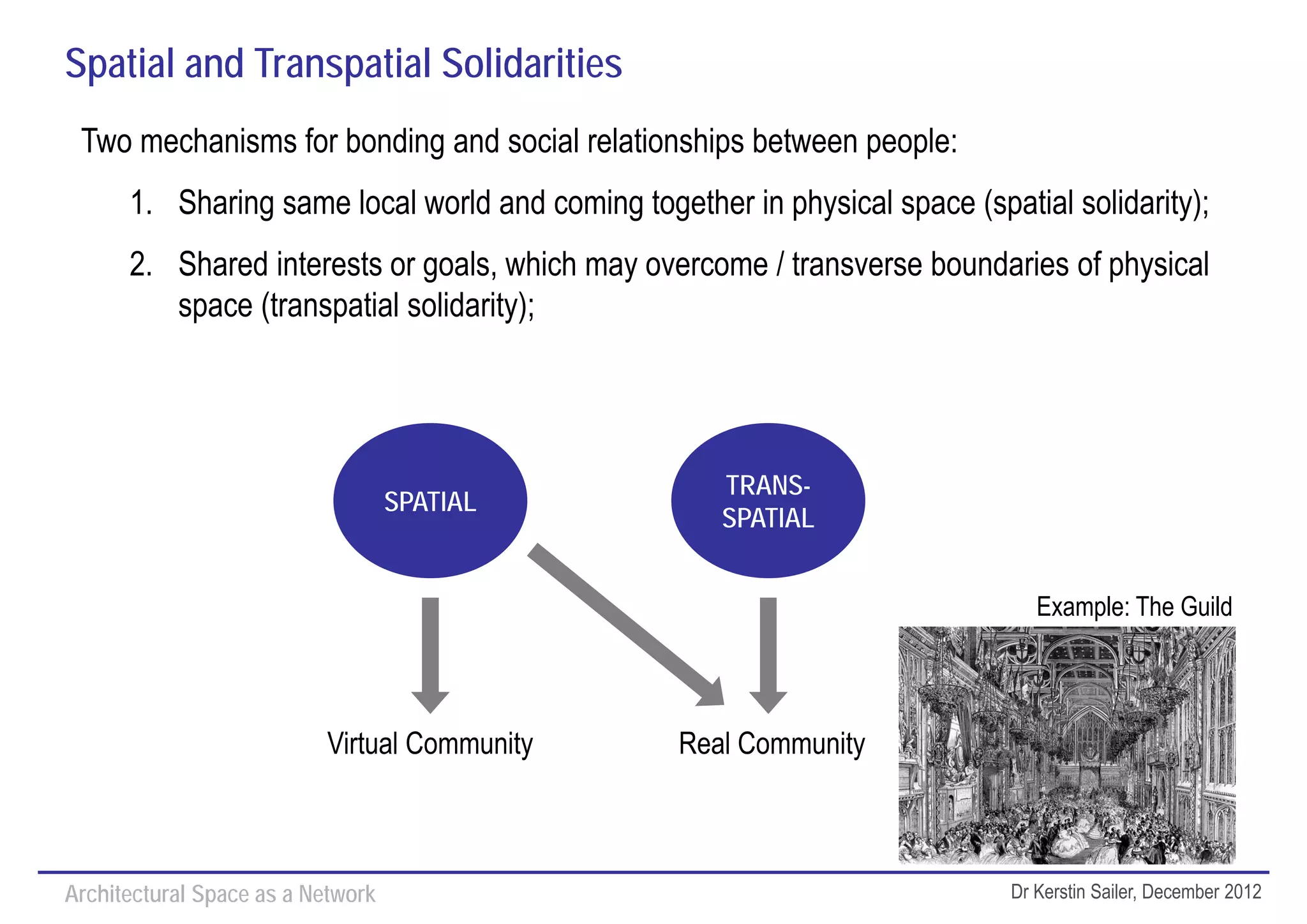
Spatial and Transpatial Solidarities
 Two mechanisms for bonding and social relationships between people:
      1. Sharing same local world and coming together in physical space (spatial solidarity);
      2. Shared interests or goals, which may overcome / transverse boundaries of physical
         space (transpatial solidarity);


                                                     TRANS-
                                   SPATIAL
                                                     SPATIAL


                                                                                Example: The Guild


                          Virtual Community       Real Community


Architectural Space as a Network                                             Dr Kerstin Sailer, December 2012
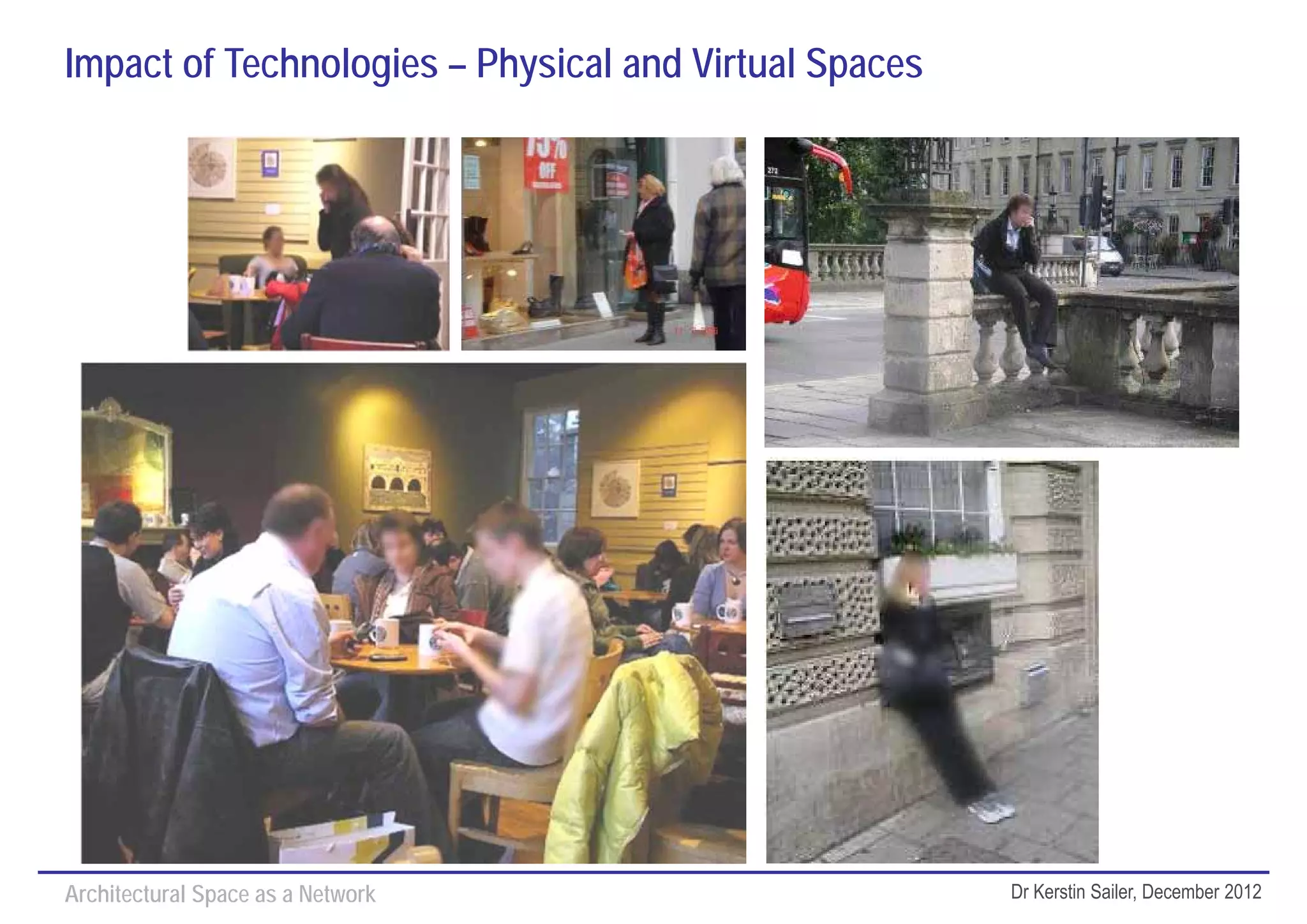
Impact of Technologies – Physical and Virtual Spaces


Architectural Space as a Network                       Dr Kerstin Sailer, December 2012
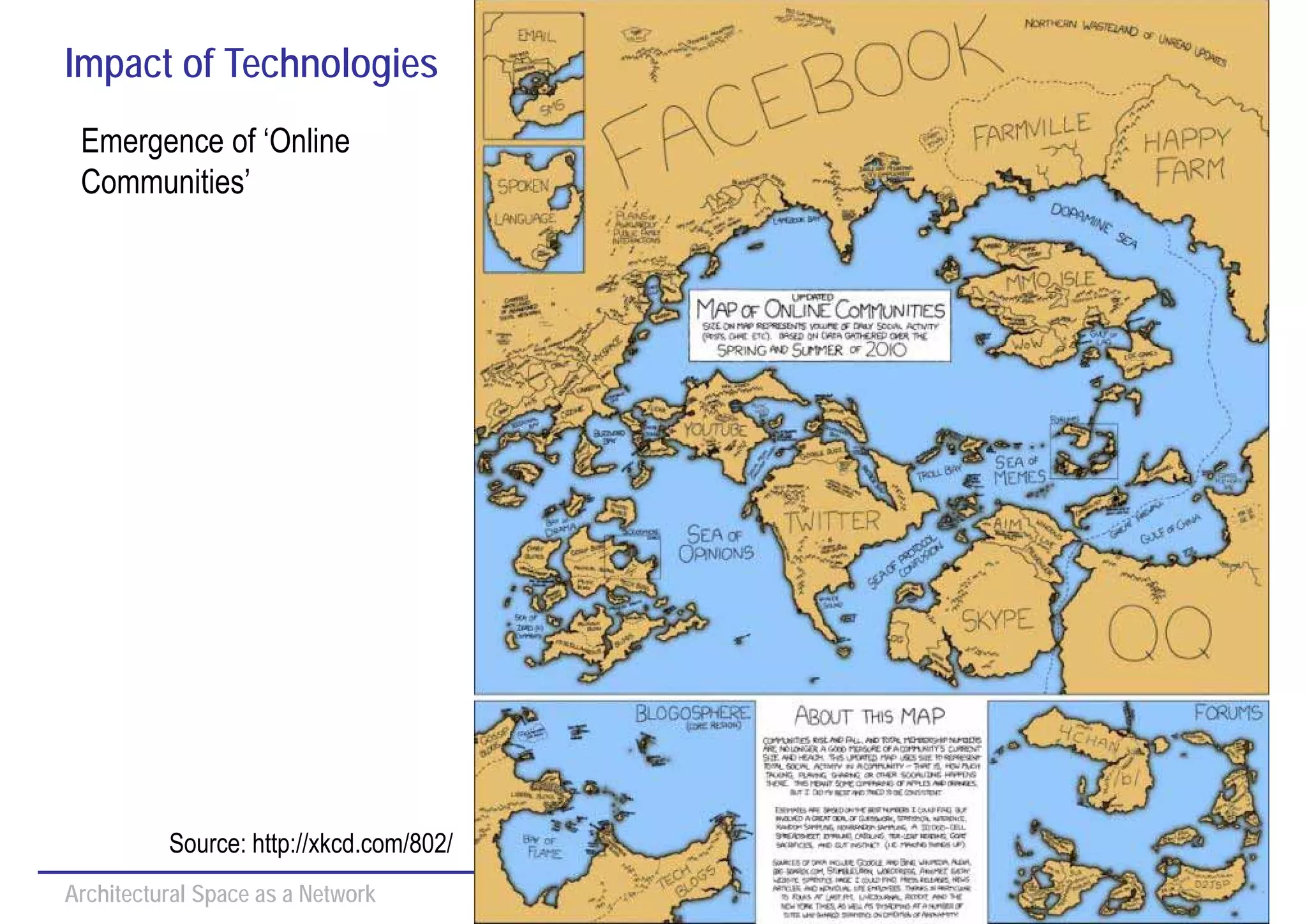
Impact of Technologies
 Emergence of ‘Online
 Communities’


          Source: http://xkcd.com/802/
Architectural Space as a Network         Dr Kerstin Sailer, December 2012
Impact of Technologies – Networked Individualism
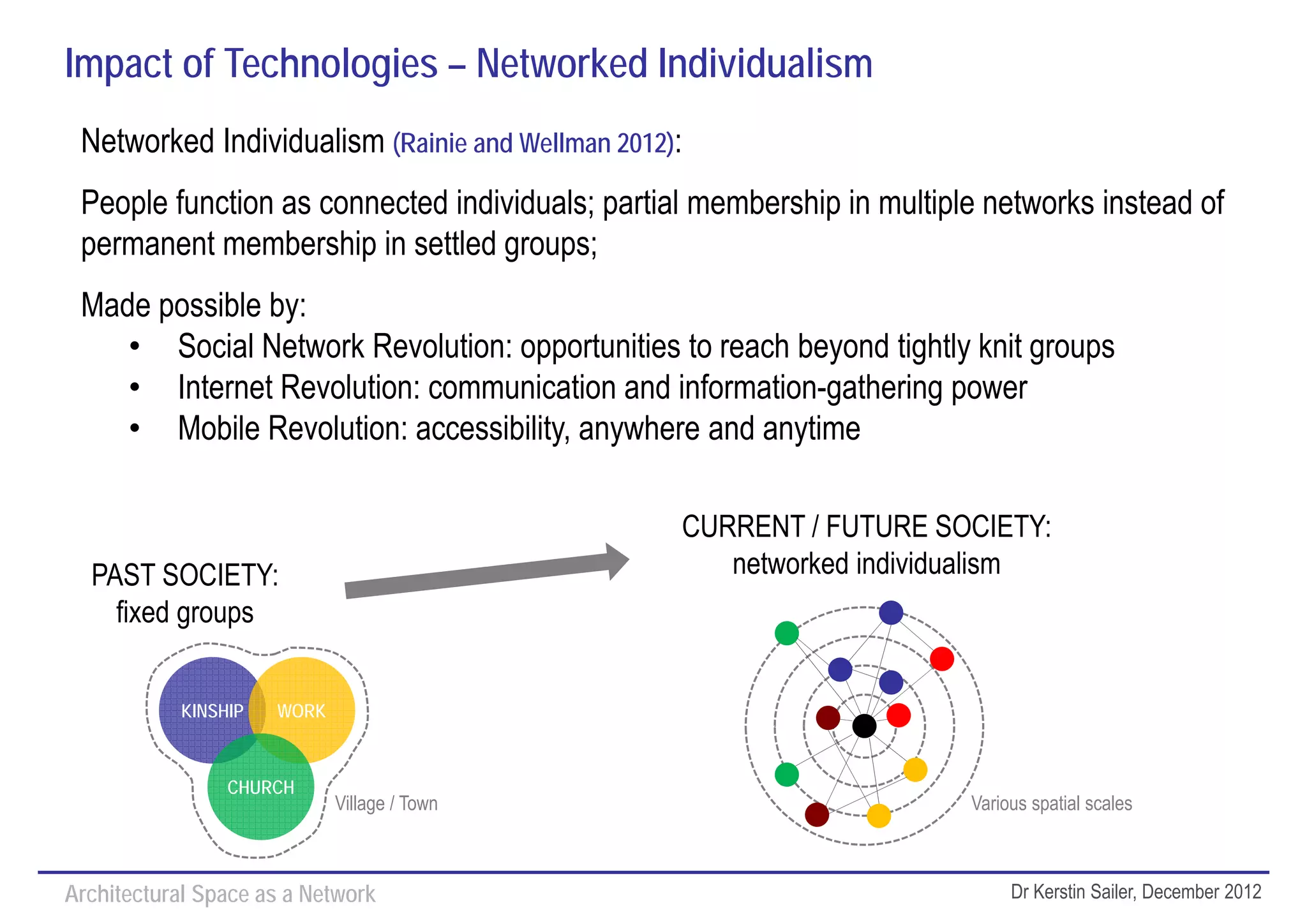
 Networked Individualism (Rainie and Wellman 2012):
 People function as connected individuals; partial membership in multiple networks instead of
 permanent membership in settled groups;
 Made possible by:
    • Social Network Revolution: opportunities to reach beyond tightly knit groups
    • Internet Revolution: communication and information-gathering power
    • Mobile Revolution: accessibility, anywhere and anytime

                                                  CURRENT / FUTURE SOCIETY:
  PAST SOCIETY:                                      networked individualism
    fixed groups


           KINSHIP   WORK


                CHURCH
                            Village / Town                              Various spatial scales


Architectural Space as a Network                                             Dr Kerstin Sailer, December 2012
Impact of Technologies: Physical and Digital Space
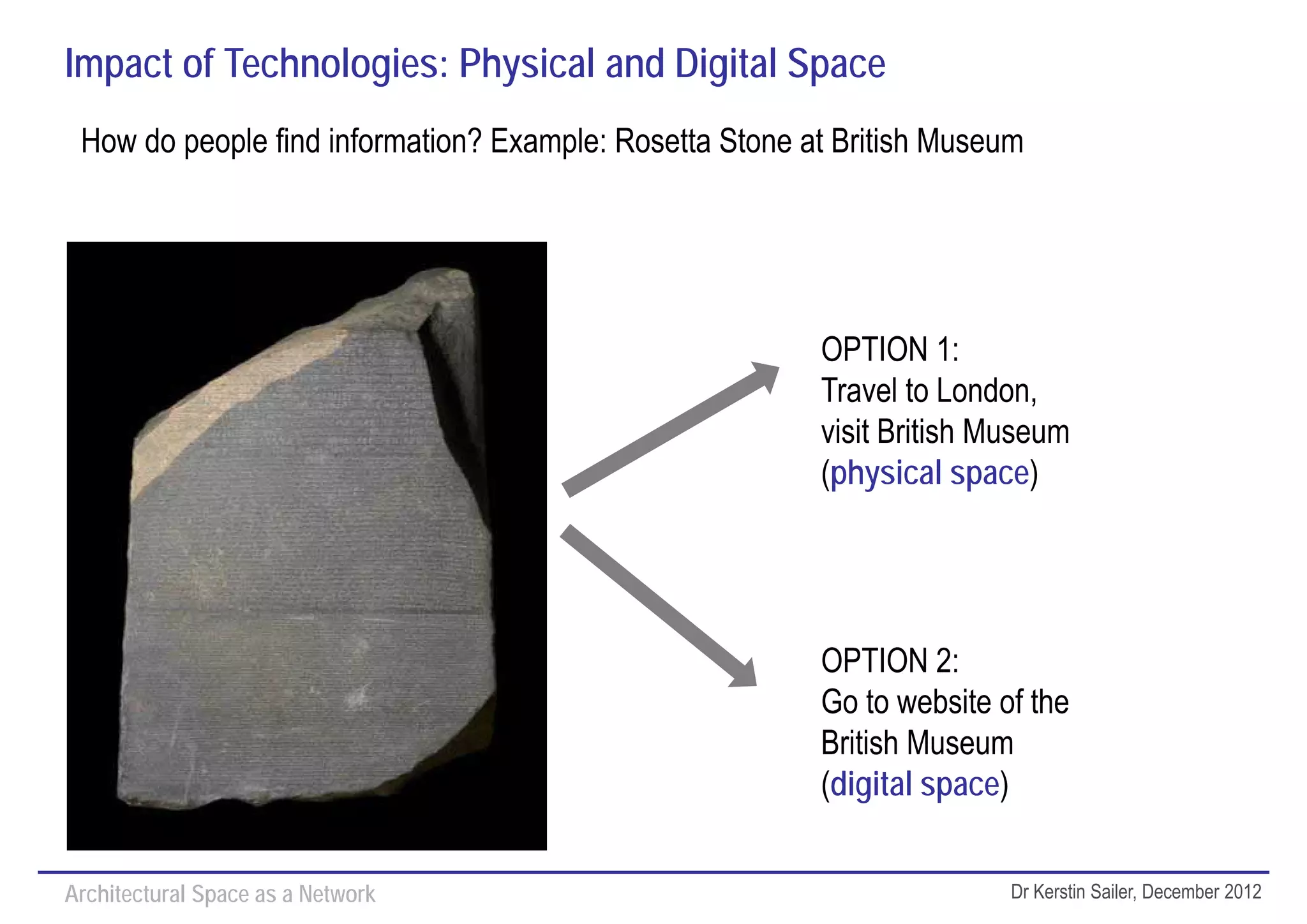
 How do people find information? Example: Rosetta Stone at British Museum


                                                         OPTION 1:
                                                         Travel to London,
                                                         visit British Museum
                                                         (physical space)


                                                         OPTION 2:
                                                         Go to website of the
                                                         British Museum
                                                         (digital space)


Architectural Space as a Network                                        Dr Kerstin Sailer, December 2012
Impact of Technologies: Physical and Digital Space
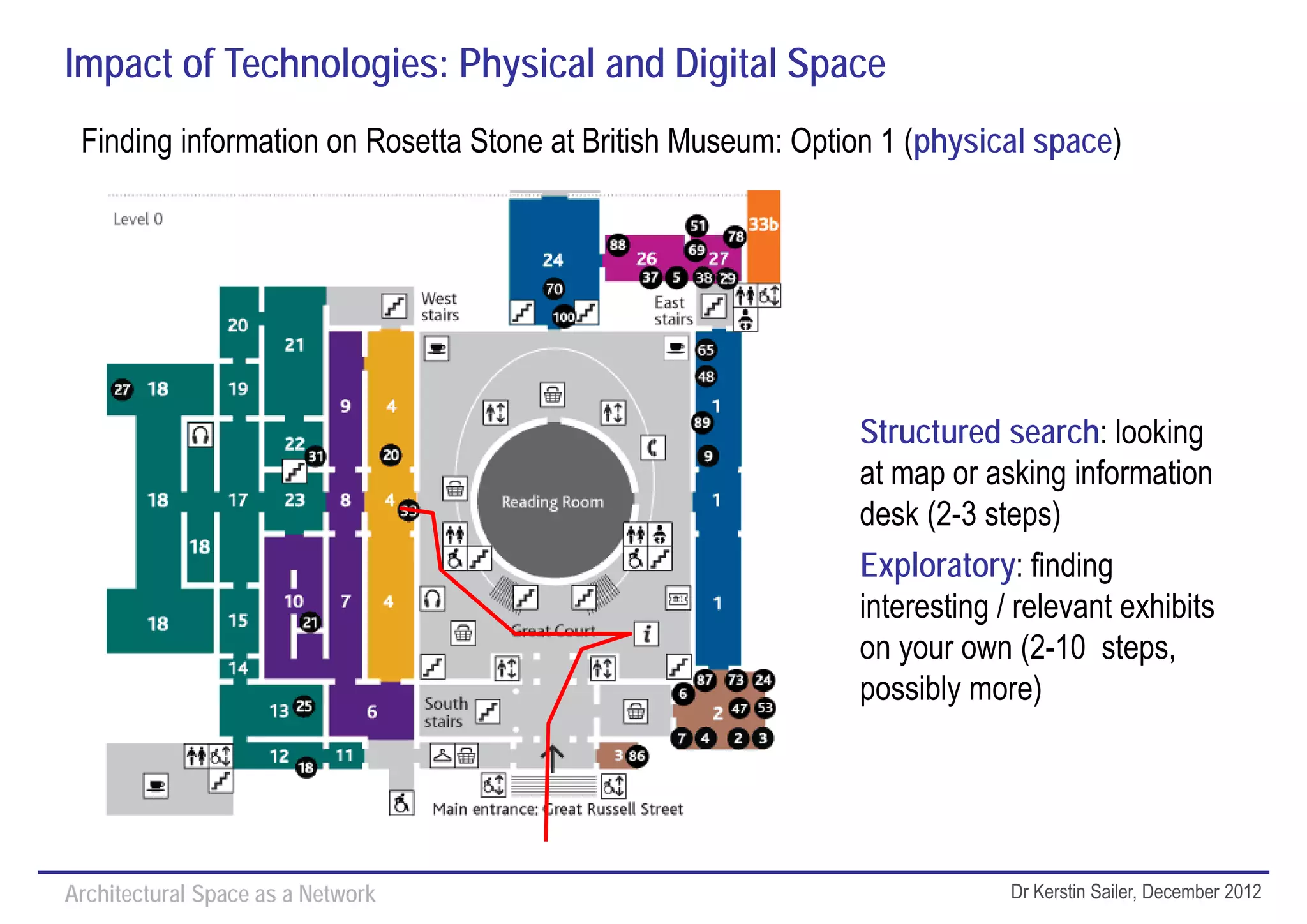
 Finding information on Rosetta Stone at British Museum: Option 1 (physical space)


                                                             Structured search: looking
                                                             at map or asking information
                                                             desk (2-3 steps)
                                                             Exploratory: finding
                                                             interesting / relevant exhibits
                                                             on your own (2-10 steps,
                                                             possibly more)


Architectural Space as a Network                                          Dr Kerstin Sailer, December 2012
Impact of Technologies: Physical and Digital Space
 Finding information on Rosetta Stone at British Museum: Option 2 (digital space)


                                                                     Structured search:
                                                                     typing name of exhibit
                                                                     into search box (2
                                                                     steps)
                                                                     [Exploratory: clicking
                                                                     through the online
                                                                     collections (3-10
                                                                     steps, possibly more)]


Architectural Space as a Network                                          Dr Kerstin Sailer, December 2012
Impact of Technologies: Physical and Digital Space
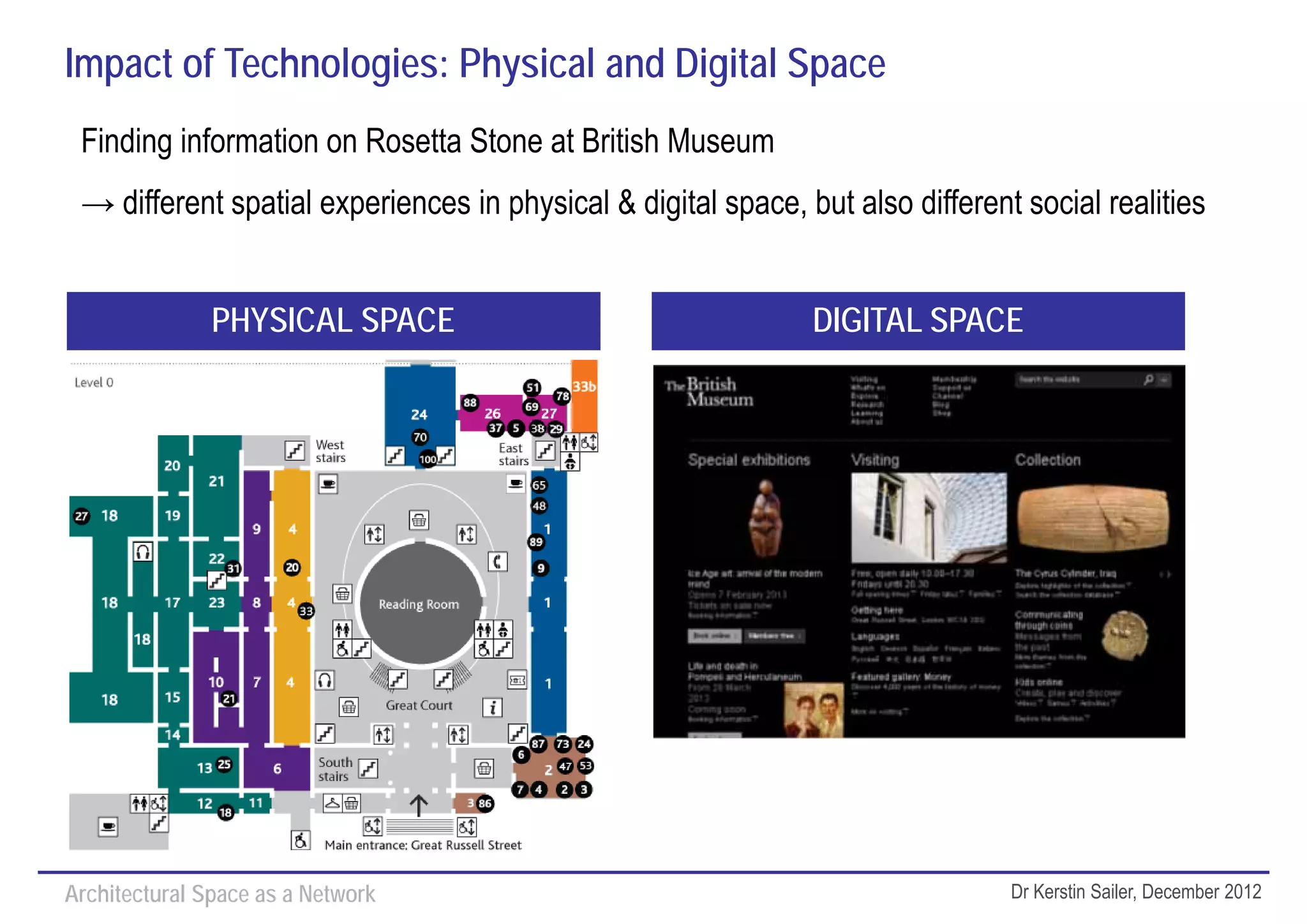
 Finding information on Rosetta Stone at British Museum
 → different spatial experiences in physical & digital space, but also different social realities


               PHYSICAL SPACE                                  DIGITAL SPACE


Architectural Space as a Network                                                Dr Kerstin Sailer, December 2012
Impact of Technologies: Physical and Digital Space
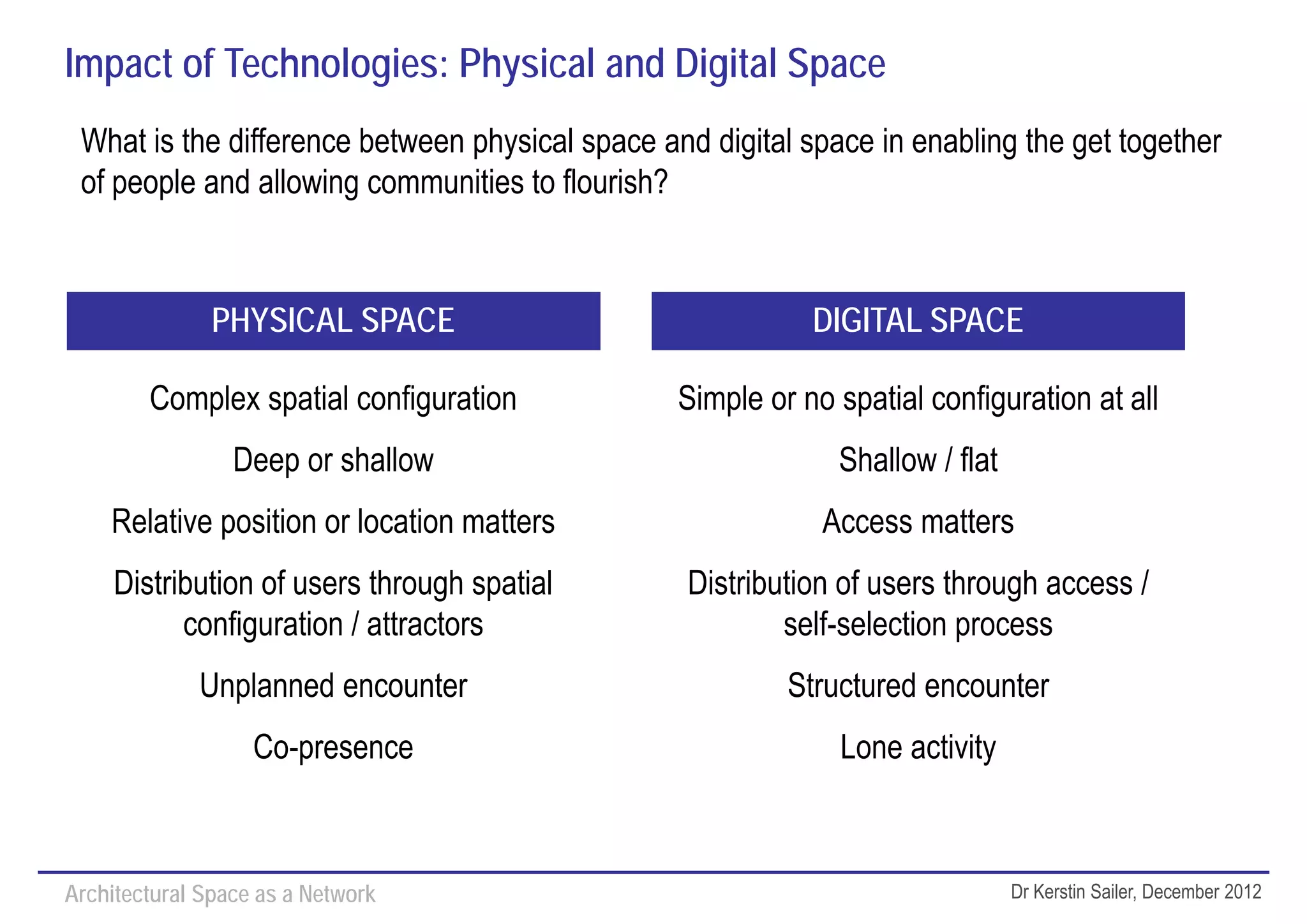
 What is the difference between physical space and digital space in enabling the get together
 of people and allowing communities to flourish?


               PHYSICAL SPACE                               DIGITAL SPACE

        Complex spatial configuration            Simple or no spatial configuration at all
                 Deep or shallow                              Shallow / flat
    Relative position or location matters                    Access matters
     Distribution of users through spatial       Distribution of users through access /
           configuration / attractors                    self-selection process
             Unplanned encounter                          Structured encounter
                   Co-presence                                Lone activity


Architectural Space as a Network                                               Dr Kerstin Sailer, December 2012
Conclusions
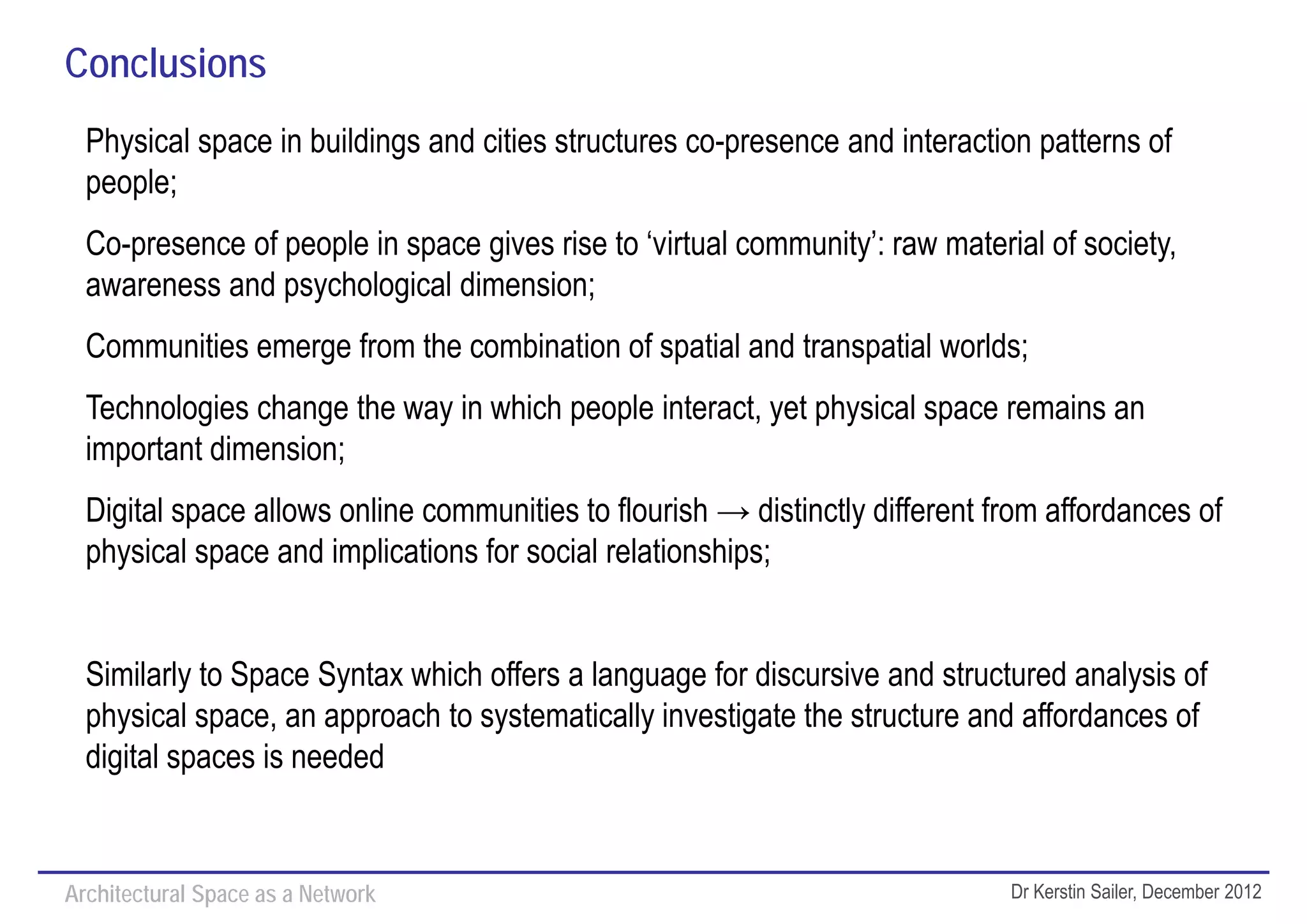
  Physical space in buildings and cities structures co-presence and interaction patterns of
  people;
  Co-presence of people in space gives rise to ‘virtual community’: raw material of society,
  awareness and psychological dimension;
  Communities emerge from the combination of spatial and transpatial worlds;
  Technologies change the way in which people interact, yet physical space remains an
  important dimension;
  Digital space allows online communities to flourish → distinctly different from affordances of
  physical space and implications for social relationships;


  Similarly to Space Syntax which offers a language for discursive and structured analysis of
  physical space, an approach to systematically investigate the structure and affordances of
  digital spaces is needed


Architectural Space as a Network                                              Dr Kerstin Sailer, December 2012
Thank you!
  Email: k.sailer@ucl.ac.uk
  Twitter: @kerstinsailer


                                                       Dr Kerstin Sailer
                                         Lecturer in Complex Buildings
                                   Bartlett School of Graduate Studies
                                             University College London
                                              14 Upper Woburn Place
                                                   London WC1H 0NN
Architectural Space as a Network              Dr Kerstin Sailer, December 2012
                                                        United Kingdom

Architectural Space as a Network - Physical and Virtual Communities

  • 1.
    ARCHITECTURAL SPACE ASA NETWORK PHYSICAL AND VIRTUAL COMMUNITIES Dr Kerstin Sailer Bartlett School of Graduate Studies, University College London Lorentz Workshop ‘Innovation at the Verge – Computational Models of Physical / Virtual Space Interaction’, ArchitecturalNL, 17-21aDec 2012 Leiden / Space as Network Dr Kerstin Sailer, December 2012
  • 2.
    Architectural Space asa Network Flow of space represented as a spatial network → patterns of co-presence of occupants construct affects SOCIAL BEHAVIOURS Architectural Space as a Network Dr Kerstin Sailer, December 2012
  • 3.
    Architectural Space asa Network Co-presence of occupants: ‘Virtual Community’ Architectural Space as a Network Dr Kerstin Sailer, December 2012
  • 4.
    Architectural Space asa Network “Co-present individuals may not know each other, or even acknowledge each other, but it will be argued that this does not mean to say that co- presence is not a social fact and a social resource. Co-present people are not a community, but they are part of the raw material for community, which may in due course become activated, and can be activated if it becomes necessary. However, even without conversion into interaction, patterns of co-presence are a psychological resource, precisely because co-presence is the primitive form of our awareness of others. Patterns of co-presence and co-awareness are the distinctive product of spatial design, and constitute, it will be argued, the prime constituents of what will be called the ‘virtual community’.” Bill Hillier (1996): Space is the Machine Architectural Space as a Network Dr Kerstin Sailer, December 2012
  • 5.
    Architectural Space asa Network – The Method of Space Syntax Bill Hillier (1996): Space is the Machine Architectural Space as a Network Dr Kerstin Sailer, December 2012
  • 6.
    Architectural Space asa Network – The Method of Space Syntax Bill Hillier (1996): Space is the Machine Architectural Space as a Network Dr Kerstin Sailer, December 2012
  • 7.
    Architectural Space asa Network – The Method of Space Syntax Total depth: 16 1 1 2 0 2 1 1 3 2 3 10 4 2 5 3 1 2 4 6 3 0 10 Total depth: 30 Architectural Space as a Network Dr Kerstin Sailer, December 2012
  • 8.
    Architectural Space asa Network – The Method of Space Syntax Architectural Space as a Network Dr Kerstin Sailer, December 2012
  • 9.
    Architectural Space asa Network – The Method of Space Syntax Architectural Space as a Network Dr Kerstin Sailer, December 2012
  • 10.
    Architectural Space asa Network – The Method of Space Syntax Floor plan Visual graph analysis Axial topology Metric topology Space usage, e.g. movement flow Integrated Segregated Architectural Space as a Network Dr Kerstin Sailer, December 2012
  • 11.
    Space Syntax Research:Comparative Analysis of Cities 1000m 500m Part of Tokyo Part of London © Bill Hillier et al Architectural Space as a Network Dr Kerstin Sailer, December 2012
  • 12.
    LONDON and its regionwithin the M25, with its strong centre and strong radials, but weak lateral connections between the radials © Bill Hillier et al 10000m Architectural Space as a Network Dr Kerstin Sailer, December 2012
  • 13.
    BEIJING with its relativeweak centre and weak radials, but strong lateral structure between radials © Bill Hillier et al 10000m Architectural Space as a Network Dr Kerstin Sailer, December 2012
  • 14.
    TOKYO with itsfairly strong centre, strong radials and strong laterals, generating the strong sub-city structure characteristic of Tokyo © Bill Hillier et al Architectural Space as a Network Dr Kerstin Sailer, December 2012 10000m
  • 15.
    Space Syntax Research:City Centres and Retail Activity © Laura Vaughan, Sam Griffiths, Muki Haklay, Kate Jones Architectural Space as a Network Dr Kerstin Sailer, December 2012
  • 16.
    Space Syntax Research:Public Spaces Old Market Square, Nottingham © Anna Rose / Space Syntax Ltd. Architectural Space as a Network Dr Kerstin Sailer, December 2012
  • 17.
    Space Syntax Research:Public Spaces Old Market Square, Nottingham © Anna Rose / Space Syntax Ltd. Architectural Space as a Network Dr Kerstin Sailer, December 2012
  • 18.
    Space Syntax Research:Museums Spatial configuration and movement flows at Tate Britain SOCIAL BEHAVIOURS © Bill Hillier / Space Syntax Ltd. Architectural Space as a Network Dr Kerstin Sailer, December 2012
  • 19.
    Space Syntax Research:Libraries Movement flows in the British Library Readers Movement flows on Upper Ground Floor – Data collection by UCL MSc AAS students in 2009 and 2010 Non-Readers Architectural Space as a Network Dr Kerstin Sailer, December 2012
  • 20.
    Space Syntax Research:Workplace Environments Movement flows in offices: result of configuration and attractor placement SOCIAL BEHAVIOURS © Kerstin Sailer Architectural Space as a Network Dr Kerstin Sailer, December 2012
  • 21.
    From Spatial toTranspatial Solidarities: from Virtual to Real Communities SOCIAL BEHAVIOURS Architectural Space as a Network Dr Kerstin Sailer, December 2012
  • 22.
    Spatial and TranspatialSolidarities Concept of spatiality and transpatial solidarity as two distinct ways of creating relationships between individuals: “In their elementary forms, in effect, buildings (…) can define a relation to others by conceptual analogy, rather than spatial relation. The inhabitant of a house in a village, say, is related to his neighbours spatially, in that he occupies a location in relation to them, but also he relates to them conceptually, in that his interior system of spatialised categories is similar or different from those of his neighbours. He relates, it might be said, transpatially as well as spatially.” (Hillier and Hanson 1984: 18ff) Key features of spatial and transpatial ordering of categories: • Affinity between individuals spatially as well as transpatially driven • Societies may use one way of ordering more than another • Ordering of space not of equal conspicuousness to every culture Architectural Space as a Network Dr Kerstin Sailer, December 2012
  • 23.
    Spatial and TranspatialSolidarities SOCIAL SOLIDARITIES FORM Mechanic Organic Integration through similarity Interdependence through differentiation Homogeneity Heterogeneity ORGANISATIONAL Long models, i.e. strongly programmed Short models, i.e. weakly programmed OPERATIONS Hierarchies Network Structure Vertical communication Lateral communication Transpatial Spatial SPATIAL Segregated and sparse space Integrated and dense space IMPLICATIONS Interior relations, ‘inside’ Exterior relations, ‘outside’ Well defined categorical differences Weakly defined categorical differences between spaces between spaces High levels of control of events and Low levels of control of events and encounter encounter Sources: Durkheim 1893, Burns and Stalker 1961, Hillier and Hanson 1984, Hillier and Penn 1991; summarised in Sailer 2010 Architectural Space as a Network Dr Kerstin Sailer, December 2012
  • 24.
    Spatial and TranspatialSolidarities Spatial Solidarities Transpatial Solidarities WHERE WE ARE WHO WE ARE Location, Neighbourhoods, Proximity, Gender, Age, Profession, Affiliations, Physical Closeness Memberships, Interests The Guildhall, City of London Architectural Space as a Network Dr Kerstin Sailer, December 2012
  • 25.
    Interplay between Spatial& Transpatial – Example 1 Organisational Cultures in the British Museum High levels of local integration yet global segregation → distinct org. cultures, segregated spaces allow transpatial identities to flourish Architectural Space as a Network Dr Kerstin Sailer, December 2012
  • 26.
    Interplay between Spatial& Transpatial – Example 2 Lack of local identities in a Media Company “Brands need to own their space and feel separate to other brands. If you walk around the office you would never know where you are unless you already know people. This doesn't enable people to make new friends or contacts.” High levels of global integration and uniform workstation layout → lack of identities, disregard of transpatial solidarities Architectural Space as a Network Dr Kerstin Sailer, December 2012
  • 27.
    Interplay between Spatial& Transpatial – Example 3 Time-space routines and social cohesion in Research Institute High levels of global integration → emergence of social cohesion and contacts fostered in transpatially organised clusters Architectural Space as a Network Dr Kerstin Sailer, December 2012
  • 28.
    Spatial and TranspatialSolidarities Two mechanisms for bonding and social relationships between people: 1. Sharing same local world and coming together in physical space (spatial solidarity); 2. Shared interests or goals, which may overcome / transverse boundaries of physical space (transpatial solidarity); TRANS- SPATIAL SPATIAL Example: The Guild Virtual Community Real Community Architectural Space as a Network Dr Kerstin Sailer, December 2012
  • 29.
    Impact of Technologies– Physical and Virtual Spaces Architectural Space as a Network Dr Kerstin Sailer, December 2012
  • 30.
    Impact of Technologies Emergence of ‘Online Communities’ Source: http://xkcd.com/802/ Architectural Space as a Network Dr Kerstin Sailer, December 2012
  • 31.
    Impact of Technologies– Networked Individualism Networked Individualism (Rainie and Wellman 2012): People function as connected individuals; partial membership in multiple networks instead of permanent membership in settled groups; Made possible by: • Social Network Revolution: opportunities to reach beyond tightly knit groups • Internet Revolution: communication and information-gathering power • Mobile Revolution: accessibility, anywhere and anytime CURRENT / FUTURE SOCIETY: PAST SOCIETY: networked individualism fixed groups KINSHIP WORK CHURCH Village / Town Various spatial scales Architectural Space as a Network Dr Kerstin Sailer, December 2012
  • 32.
    Impact of Technologies:Physical and Digital Space How do people find information? Example: Rosetta Stone at British Museum OPTION 1: Travel to London, visit British Museum (physical space) OPTION 2: Go to website of the British Museum (digital space) Architectural Space as a Network Dr Kerstin Sailer, December 2012
  • 33.
    Impact of Technologies:Physical and Digital Space Finding information on Rosetta Stone at British Museum: Option 1 (physical space) Structured search: looking at map or asking information desk (2-3 steps) Exploratory: finding interesting / relevant exhibits on your own (2-10 steps, possibly more) Architectural Space as a Network Dr Kerstin Sailer, December 2012
  • 34.
    Impact of Technologies:Physical and Digital Space Finding information on Rosetta Stone at British Museum: Option 2 (digital space) Structured search: typing name of exhibit into search box (2 steps) [Exploratory: clicking through the online collections (3-10 steps, possibly more)] Architectural Space as a Network Dr Kerstin Sailer, December 2012
  • 35.
    Impact of Technologies:Physical and Digital Space Finding information on Rosetta Stone at British Museum → different spatial experiences in physical & digital space, but also different social realities PHYSICAL SPACE DIGITAL SPACE Architectural Space as a Network Dr Kerstin Sailer, December 2012
  • 36.
    Impact of Technologies:Physical and Digital Space What is the difference between physical space and digital space in enabling the get together of people and allowing communities to flourish? PHYSICAL SPACE DIGITAL SPACE Complex spatial configuration Simple or no spatial configuration at all Deep or shallow Shallow / flat Relative position or location matters Access matters Distribution of users through spatial Distribution of users through access / configuration / attractors self-selection process Unplanned encounter Structured encounter Co-presence Lone activity Architectural Space as a Network Dr Kerstin Sailer, December 2012
  • 37.
    Conclusions Physicalspace in buildings and cities structures co-presence and interaction patterns of people; Co-presence of people in space gives rise to ‘virtual community’: raw material of society, awareness and psychological dimension; Communities emerge from the combination of spatial and transpatial worlds; Technologies change the way in which people interact, yet physical space remains an important dimension; Digital space allows online communities to flourish → distinctly different from affordances of physical space and implications for social relationships; Similarly to Space Syntax which offers a language for discursive and structured analysis of physical space, an approach to systematically investigate the structure and affordances of digital spaces is needed Architectural Space as a Network Dr Kerstin Sailer, December 2012
  • 38.
    Thank you! Email: k.sailer@ucl.ac.uk Twitter: @kerstinsailer Dr Kerstin Sailer Lecturer in Complex Buildings Bartlett School of Graduate Studies University College London 14 Upper Woburn Place London WC1H 0NN Architectural Space as a Network Dr Kerstin Sailer, December 2012 United Kingdom