1. The U.S. e-commerce market is large at over $200 billion annually, growing at 9% each year, and still has room to expand as only 9% of retail is online.
2. New e-commerce business models focusing on areas like group buying and flash sales have emerged and gained traction in recent years.
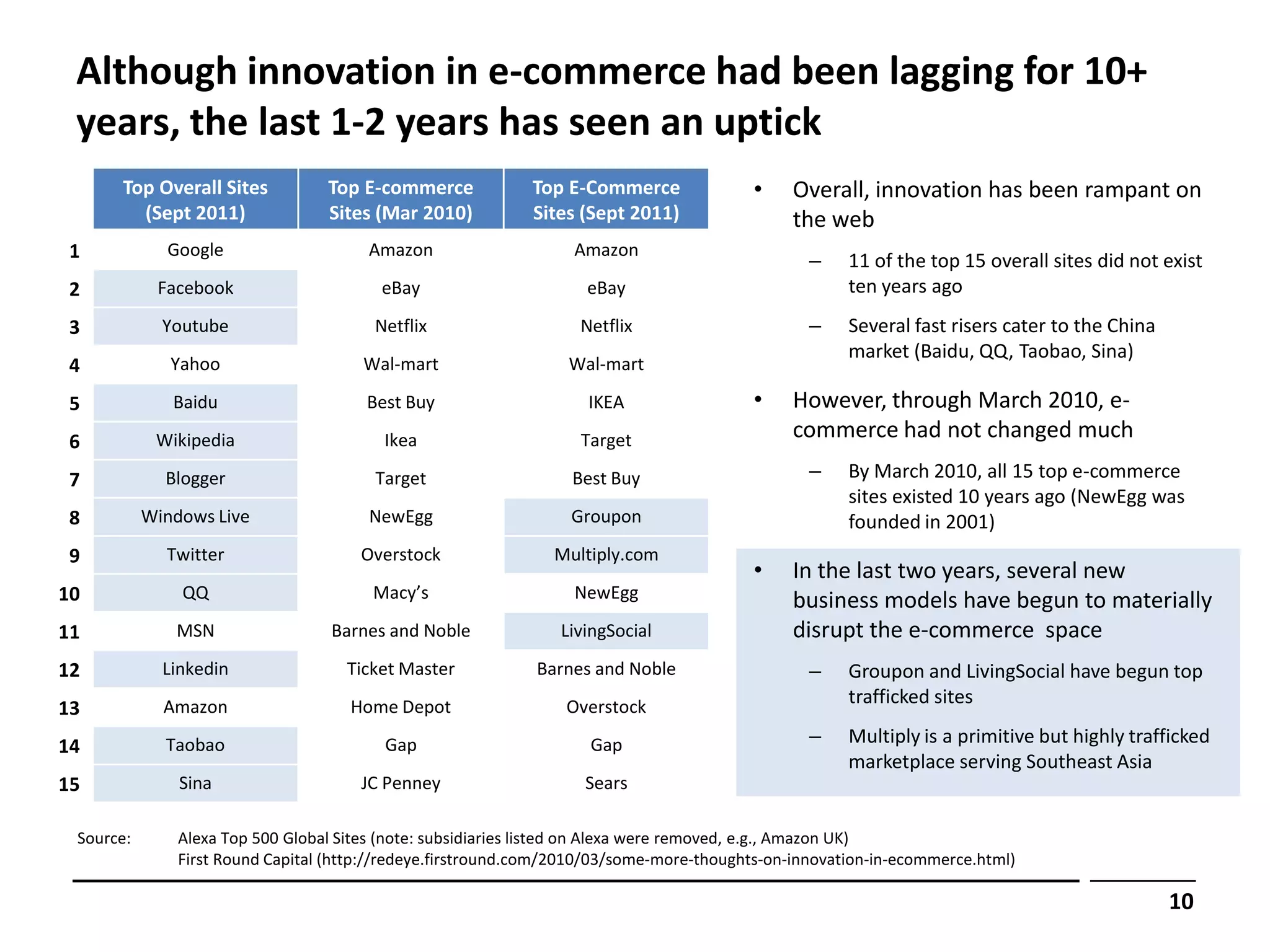
3. While innovation in e-commerce was lagging for over 10 years, the past 1-2 years have seen more disruption from companies adopting new models and targeting different customer segments with innovations in areas like mobile and social commerce.
The U.S. e-commerce market is growing rapidly, projected to exceed $200B with a 9% CAGR until 2015. Key trends include rising consumer adoption, innovations in business models, and the importance of mobile and social commerce.
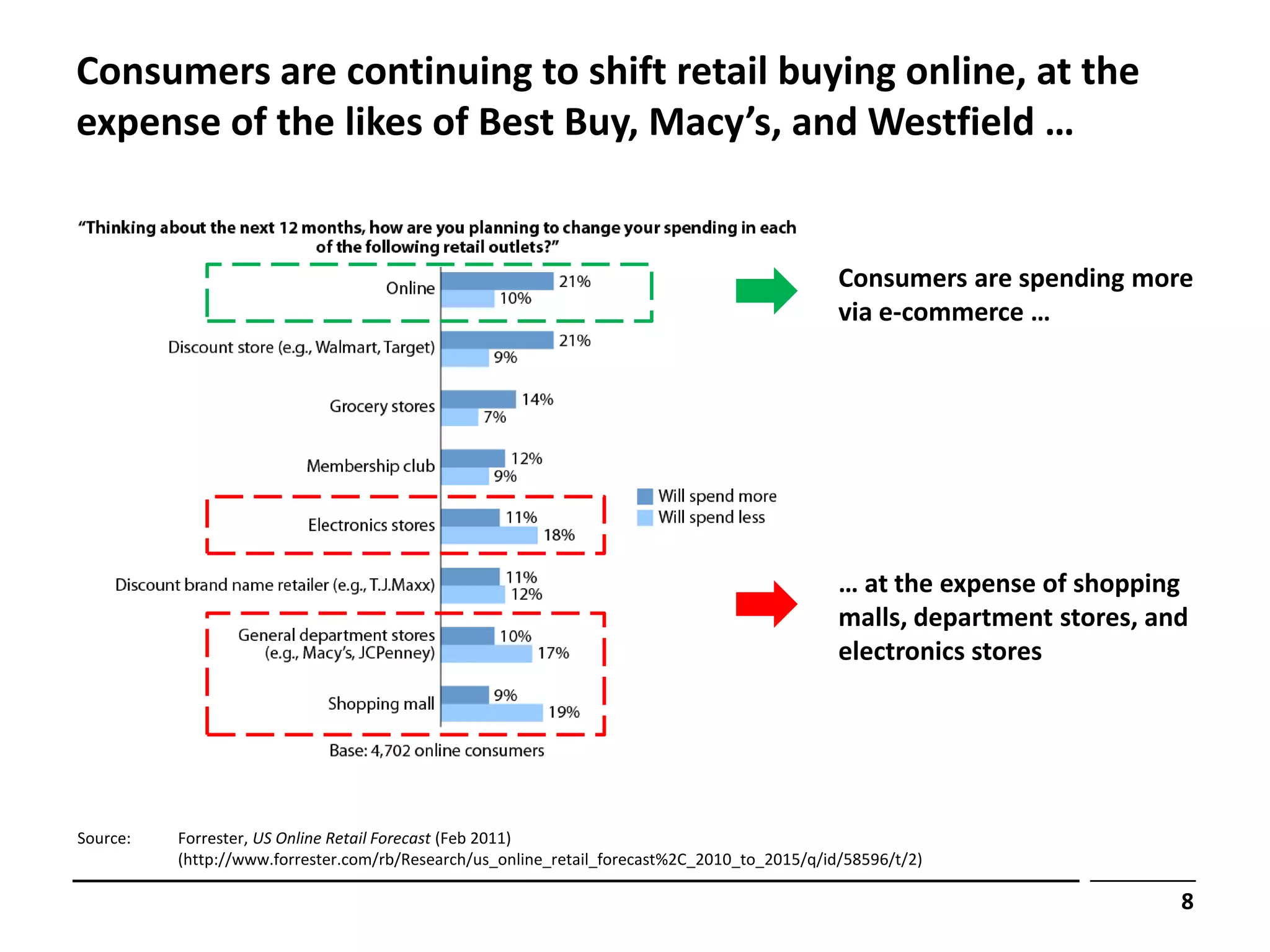
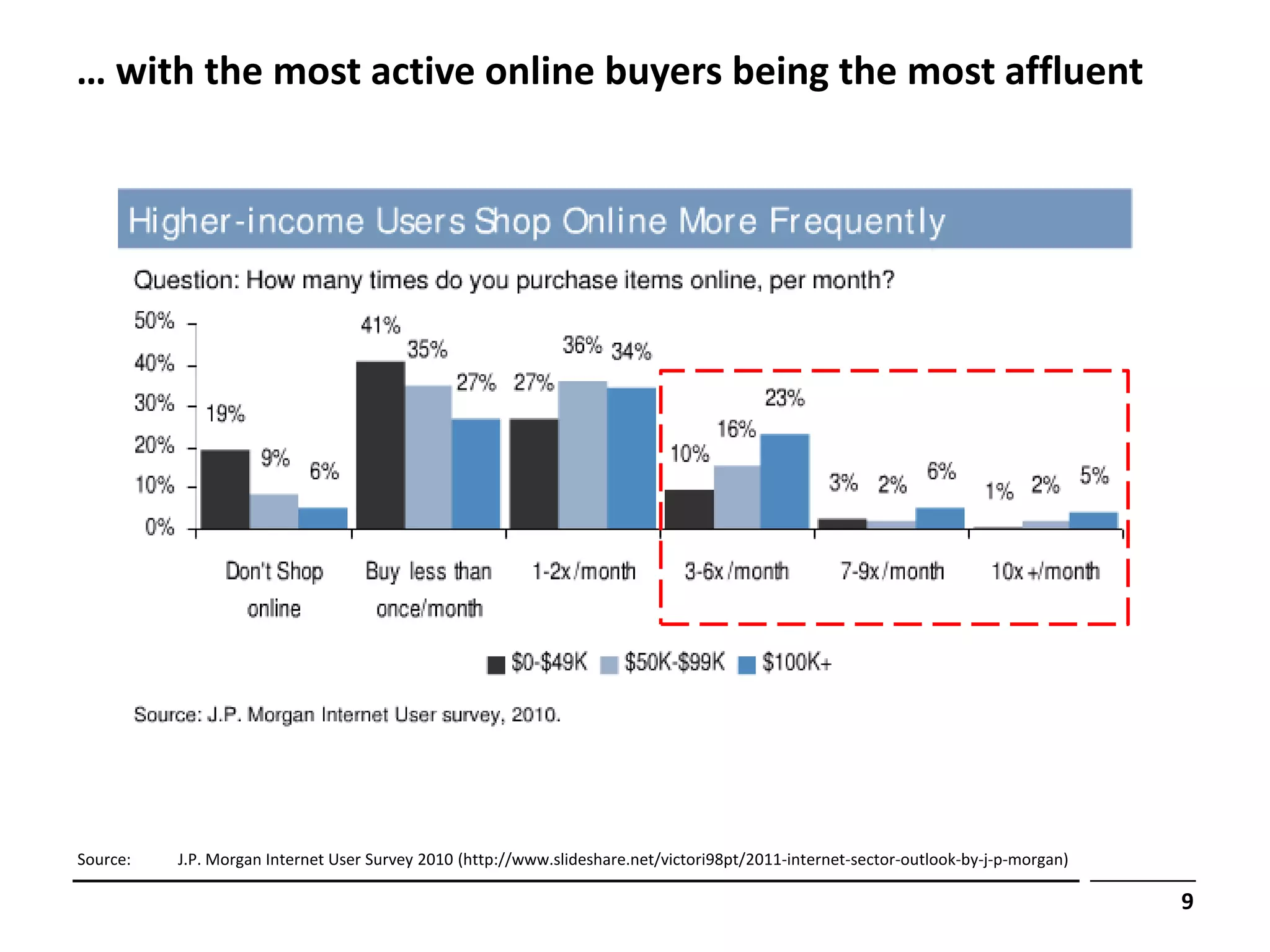
E-commerce comprises 9% of total retail, with an increase in online shoppers projected. Key stats include 239M internet users and a notable shift towards online shopping, especially among affluent consumers.
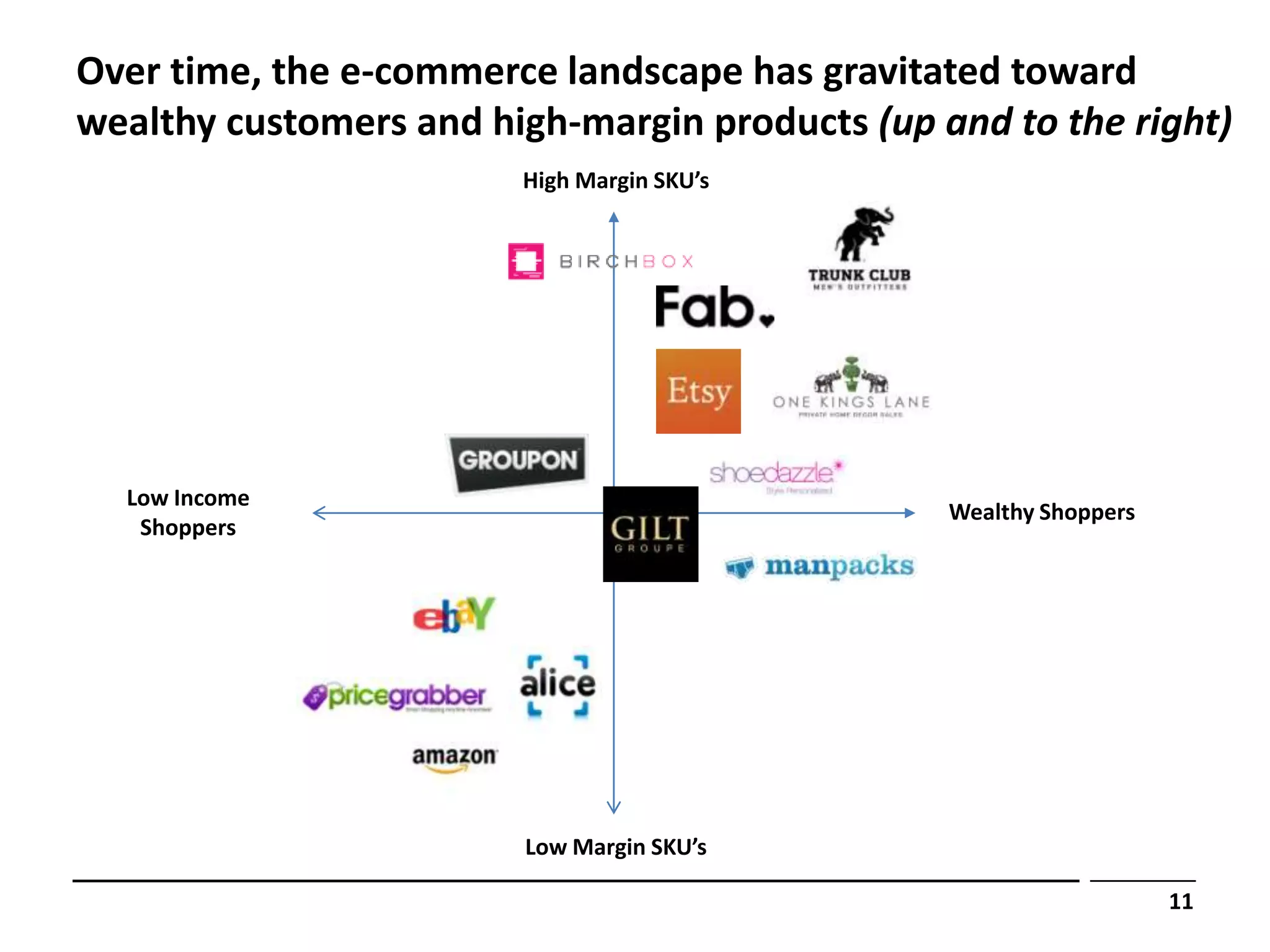
Recent e-commerce innovations include startups targeting high-margin goods. Major players like Amazon and eBay are slow to adapt, leaving opportunities for new entrants to gain market share.
The e-commerce sector follows a cycle of innovation from nascent business models to saturation. Models discussed: flash sales, group buying, C2C marketplaces, and personalization strategies.
Group buying and subscription models face challenges like customer churn and increasing acquisition costs. Many daily deal sites have shut down due to dissatisfaction and unsustainable business practices.
Flash sale sites face declining remnant inventory and lower discounts. Customers seek curated, exclusive deals; startups are emerging to provide unique products and experiences.
Subscription e-commerce is growing, providing benefits like curation and convenience. Success varies, with some companies building loyalty through celebrity endorsements and personalized offerings.
C2C marketplaces are rising, led by platforms like AirBnB and Etsy. They segment into hard goods, rentals, and services with varying levels of success among startups disrupting traditional models.
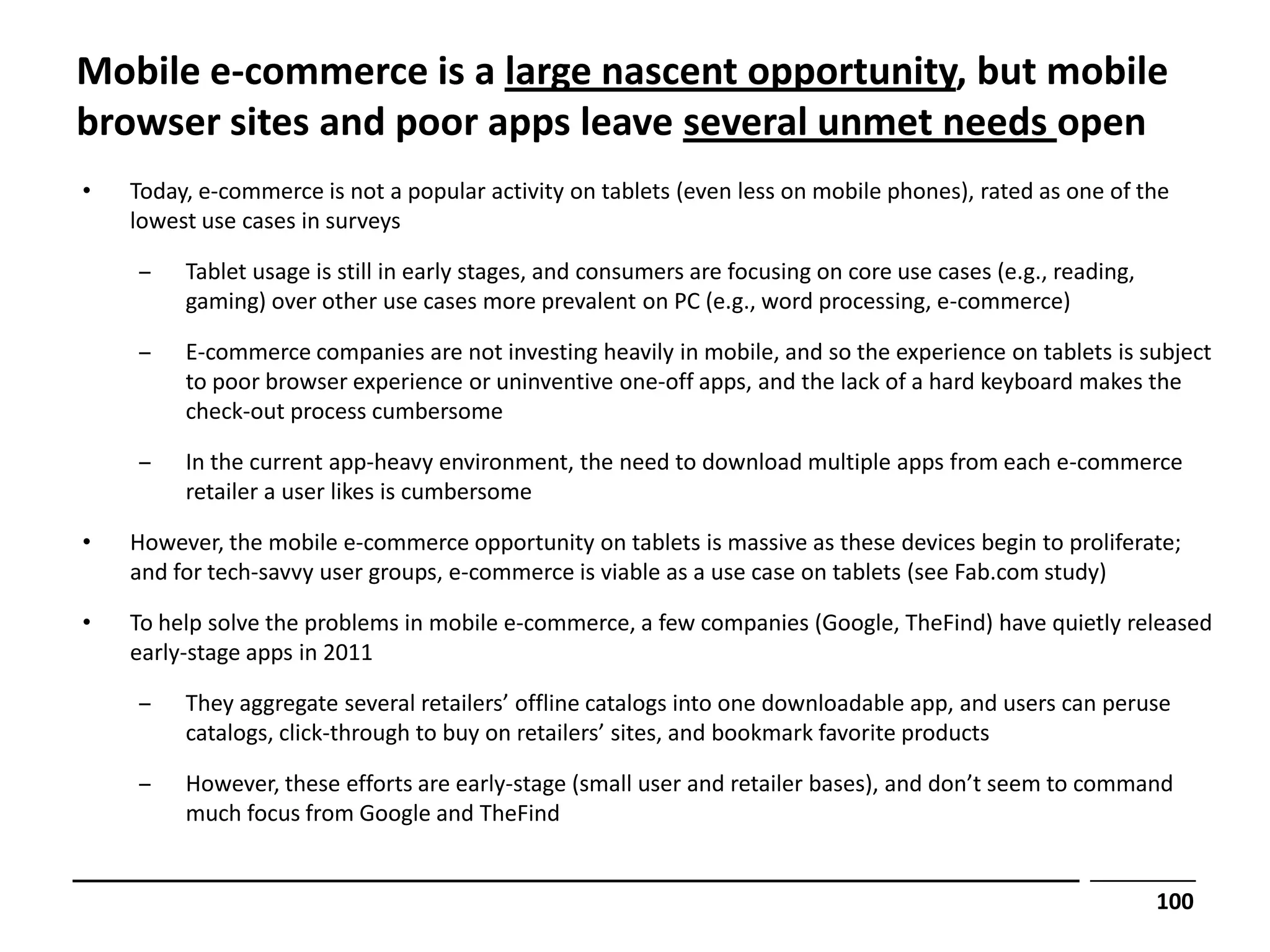
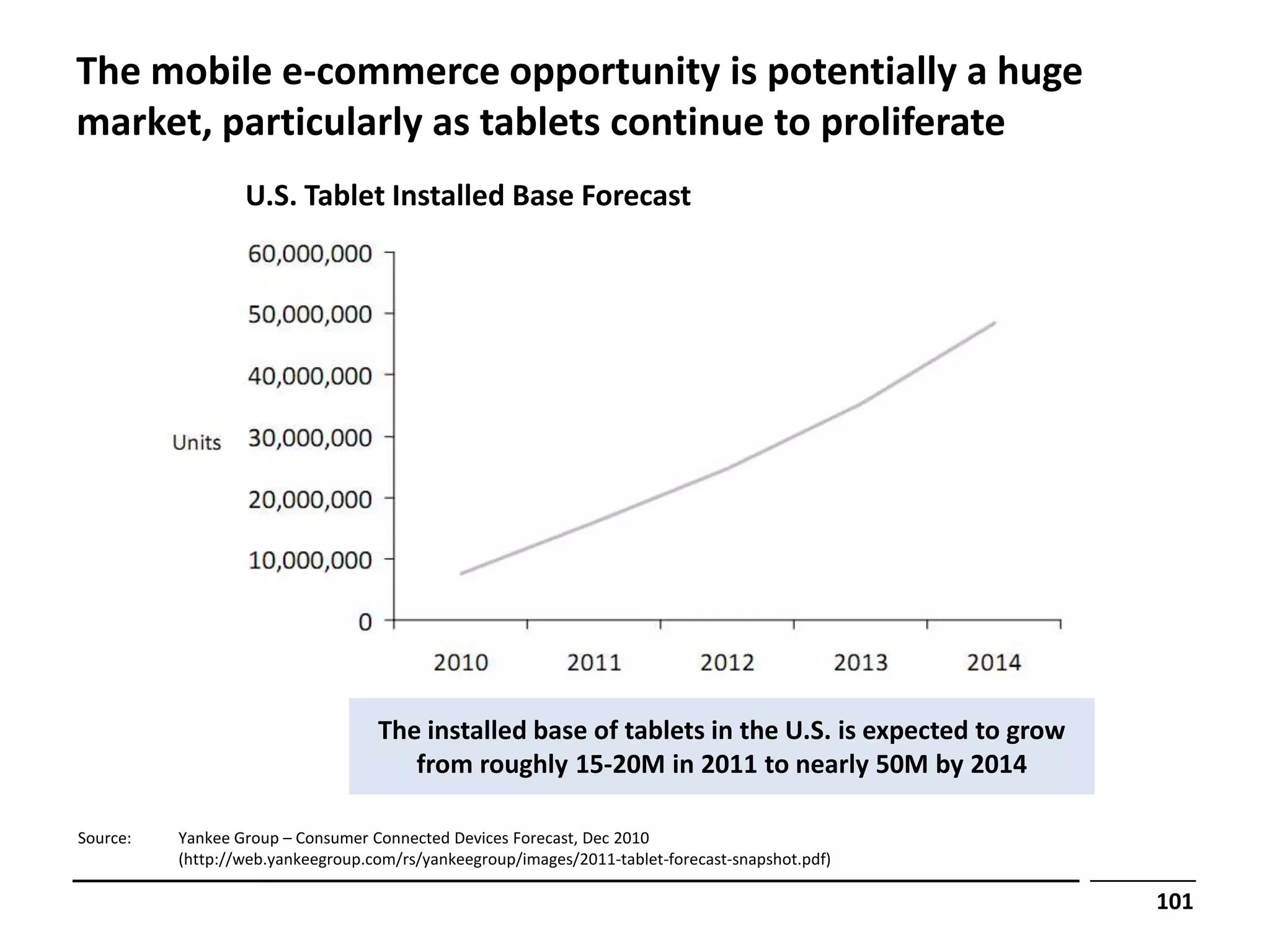
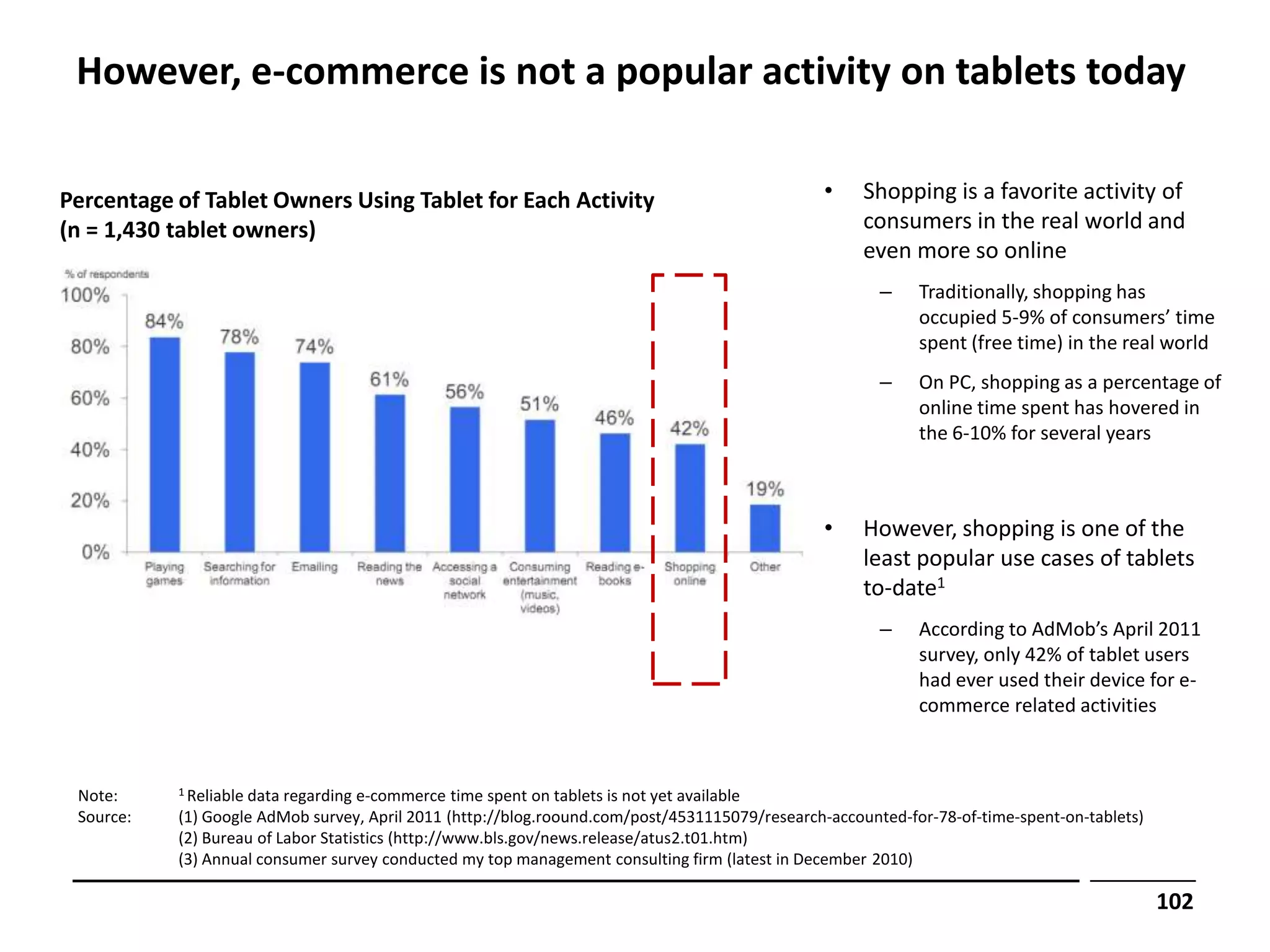
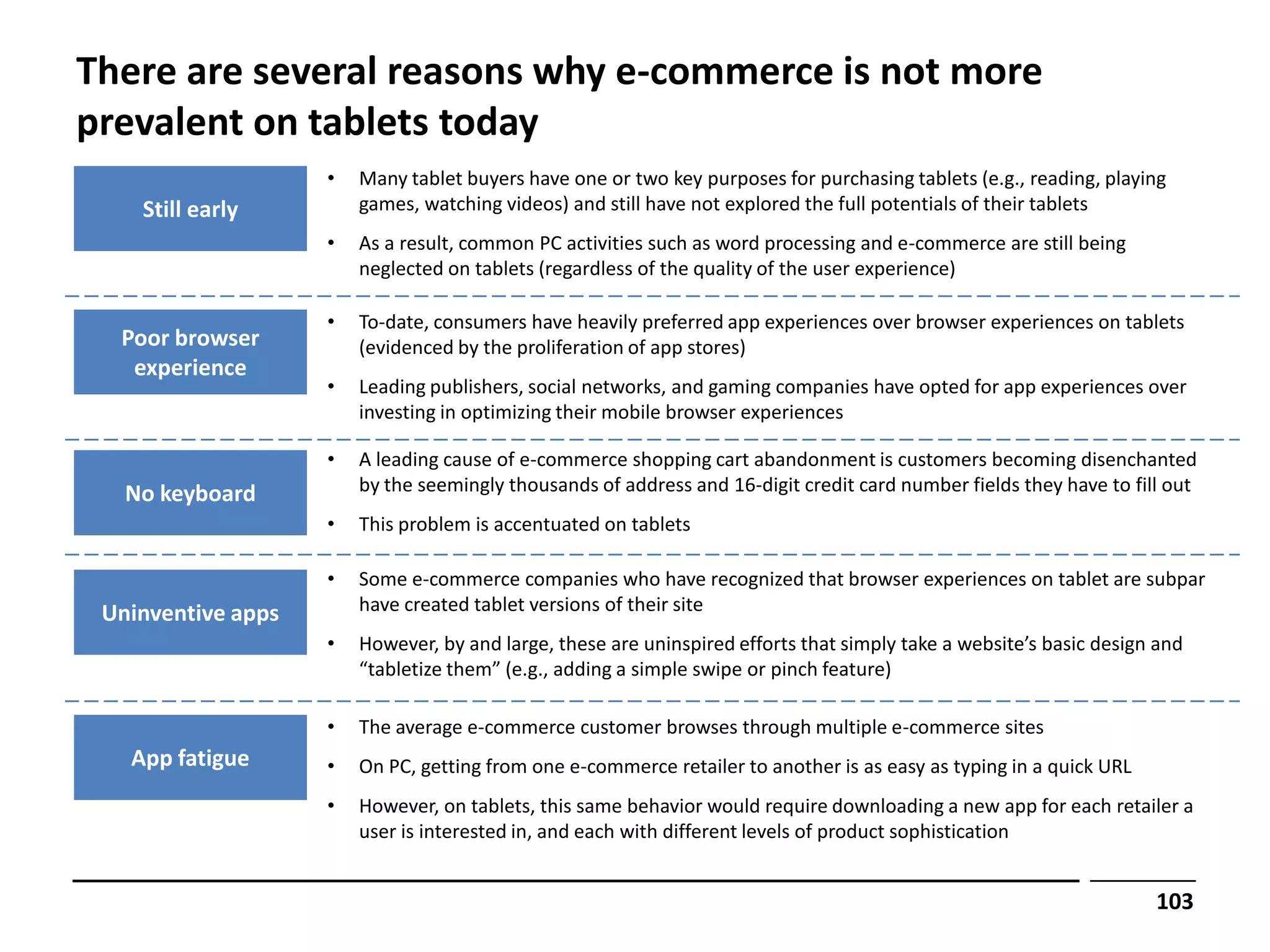
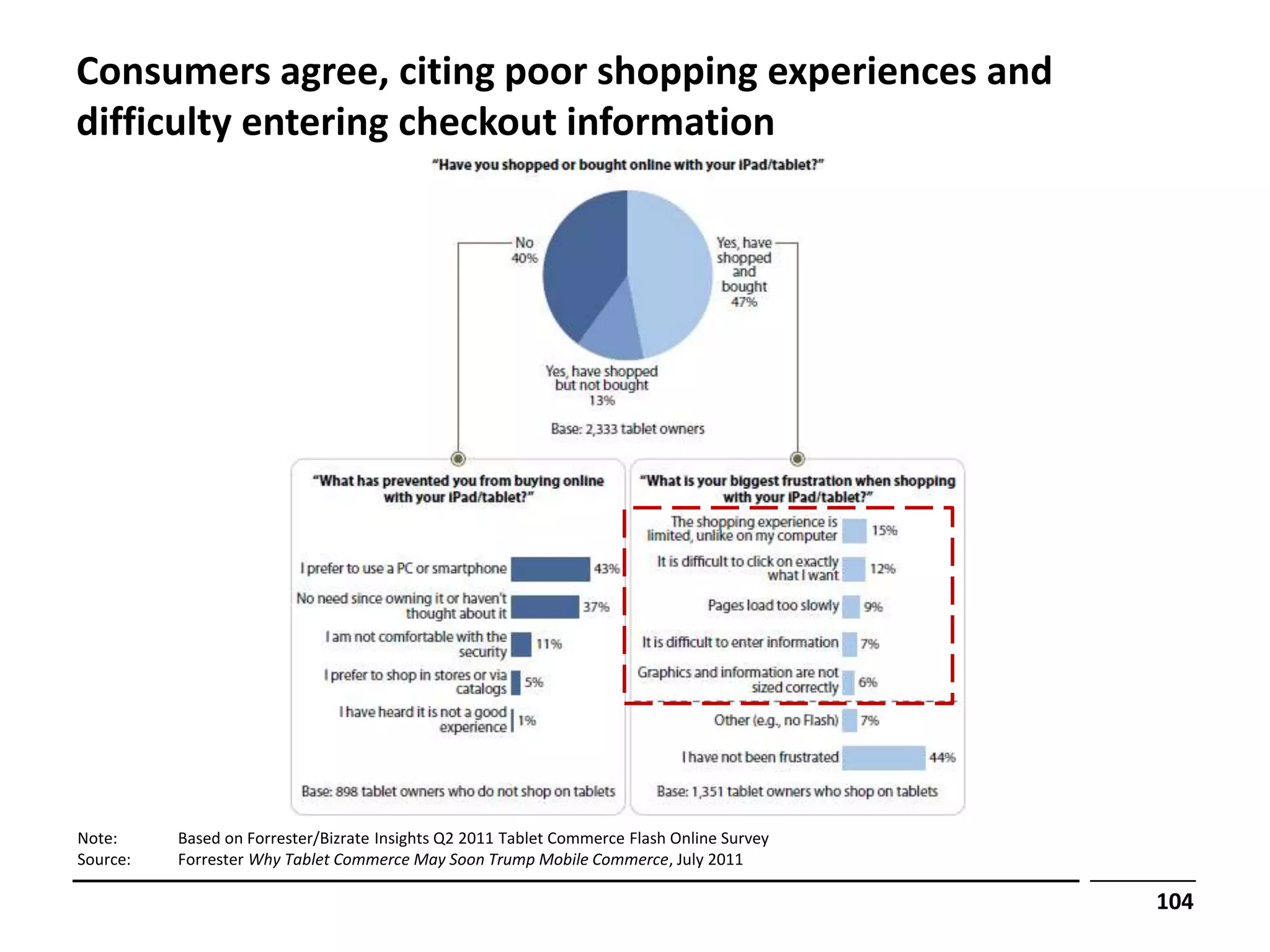
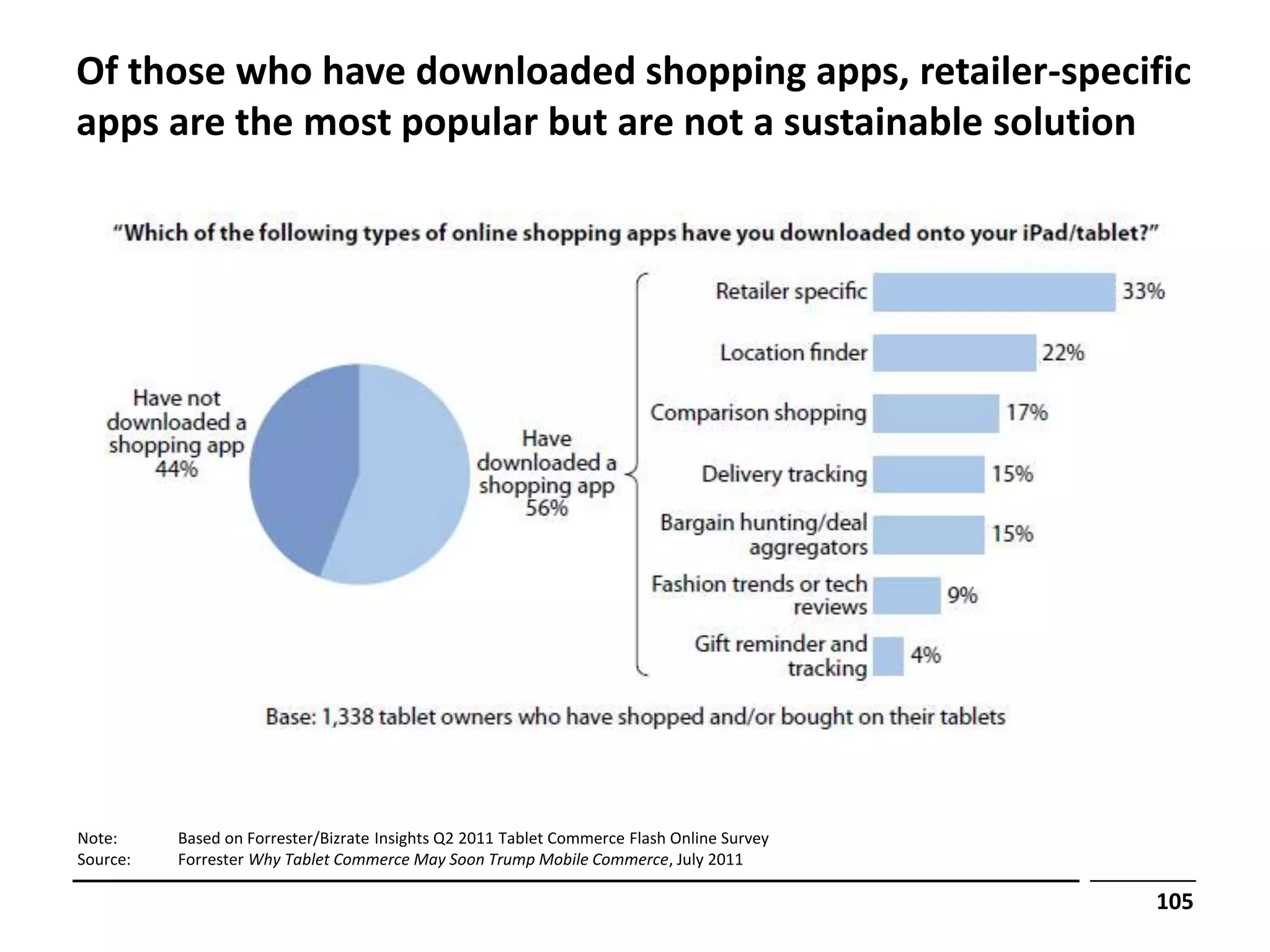
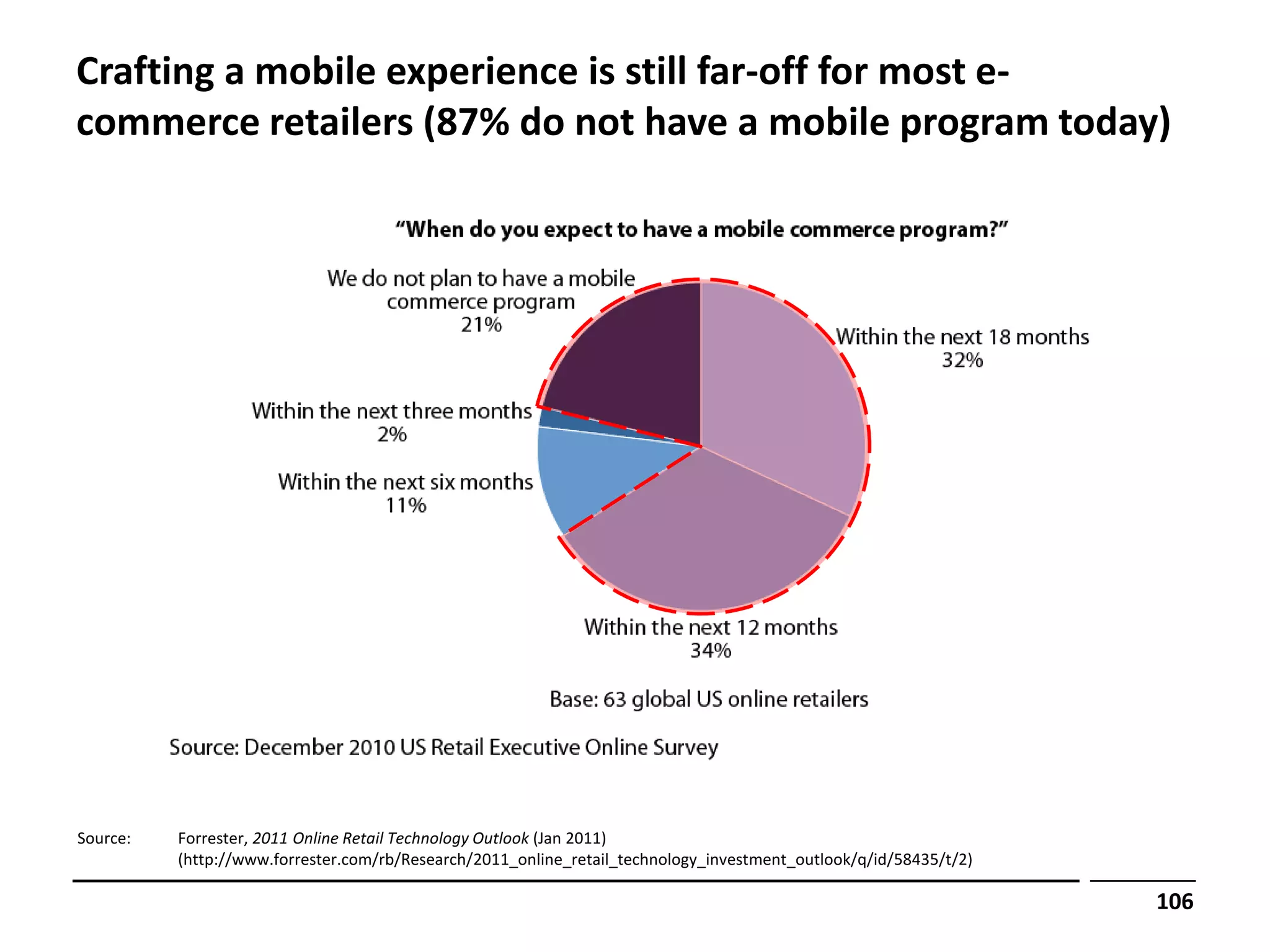
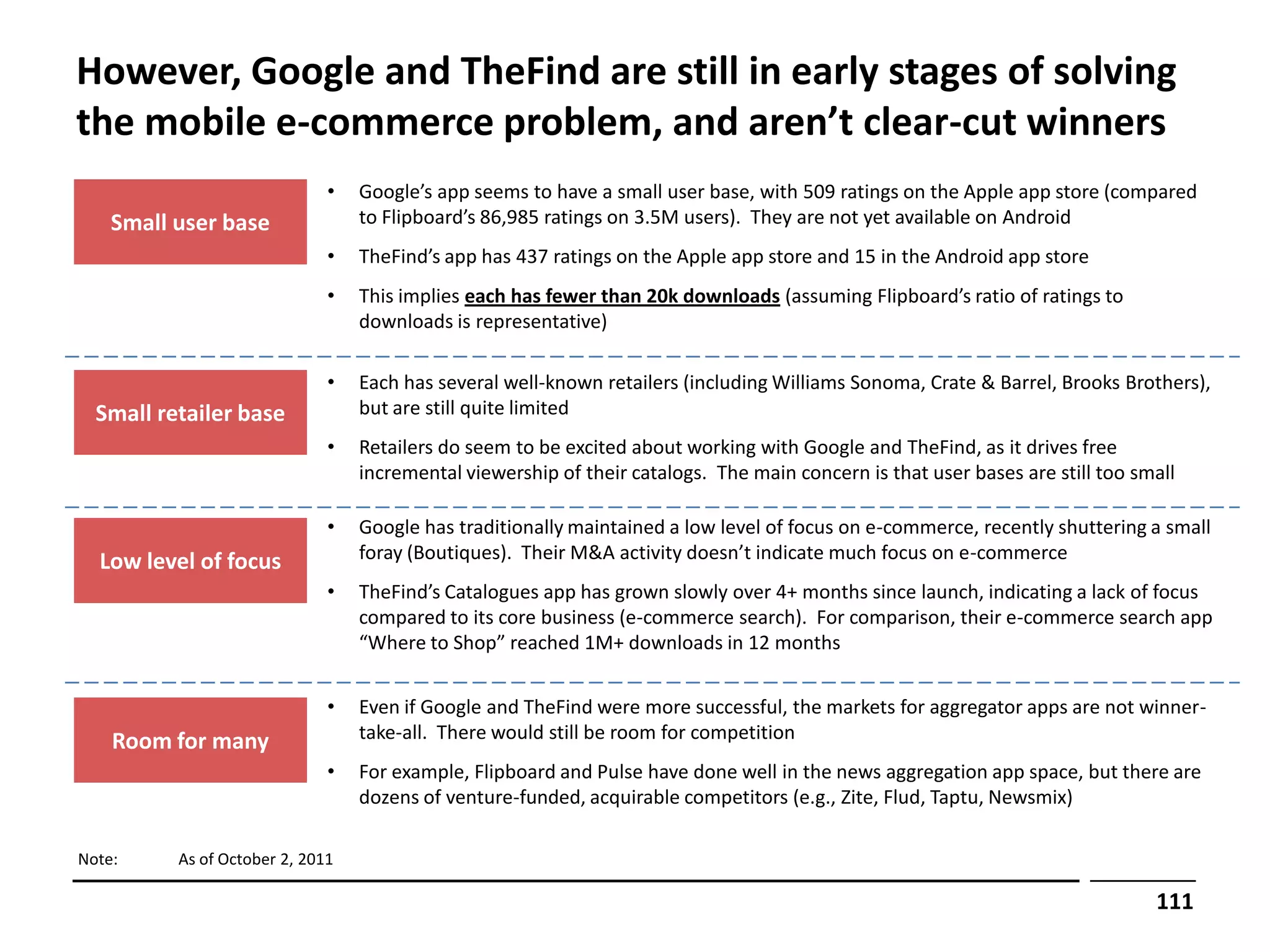
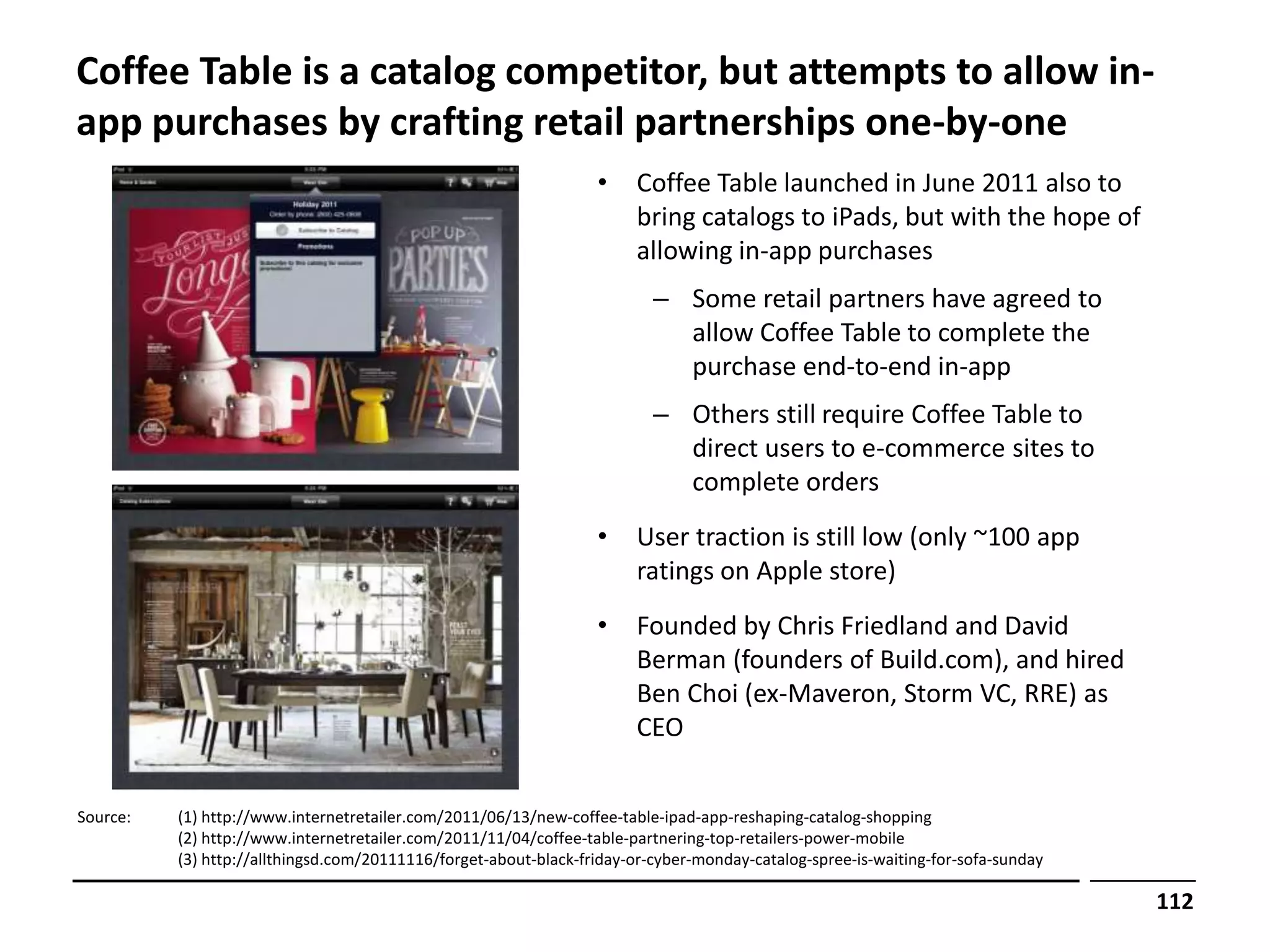
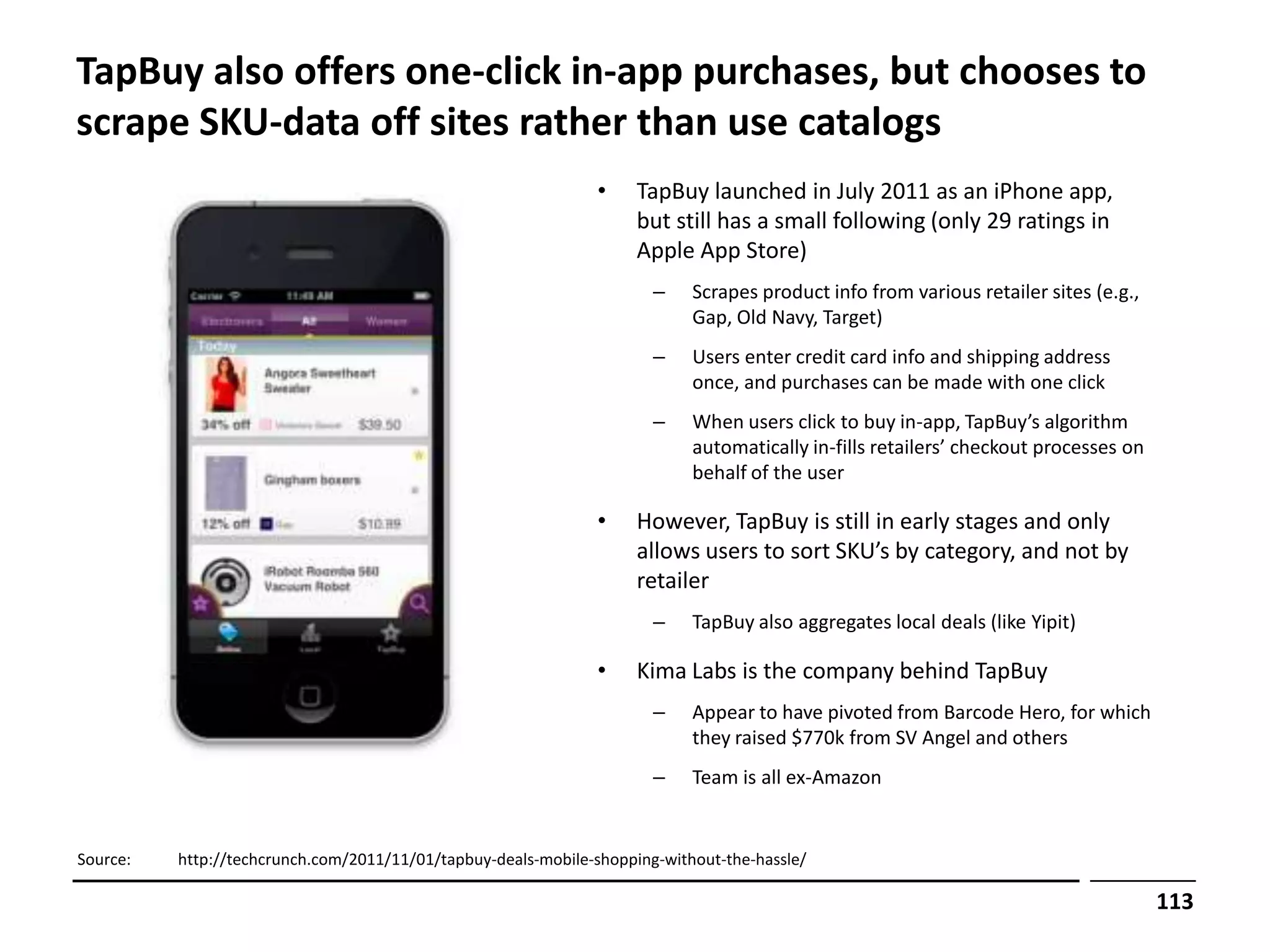
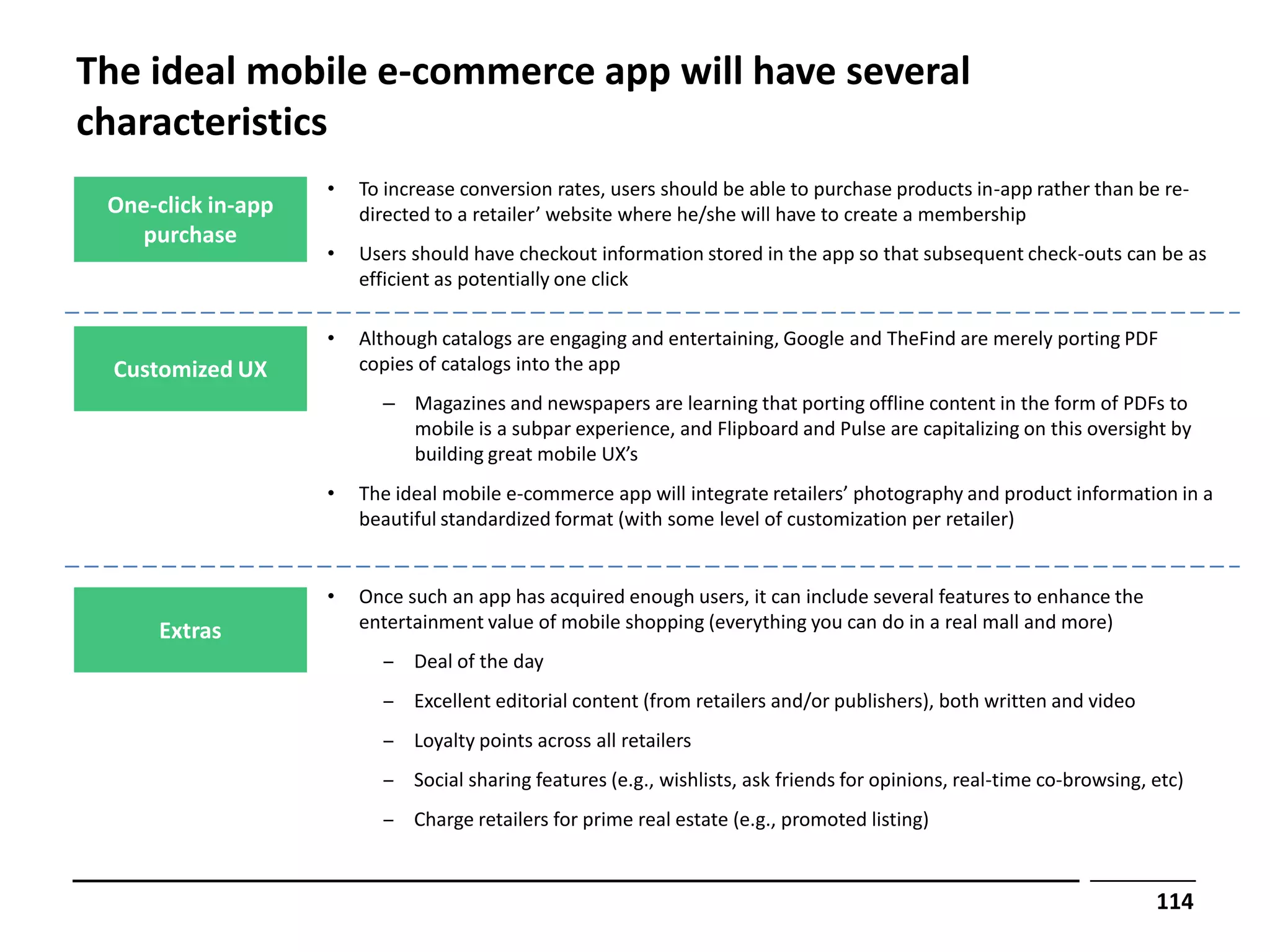
Mobile e-commerce is still nascent, with poor app experiences and high cart abandonment rates. However, it presents significant opportunities as tablet use increases and consumer habits evolve.
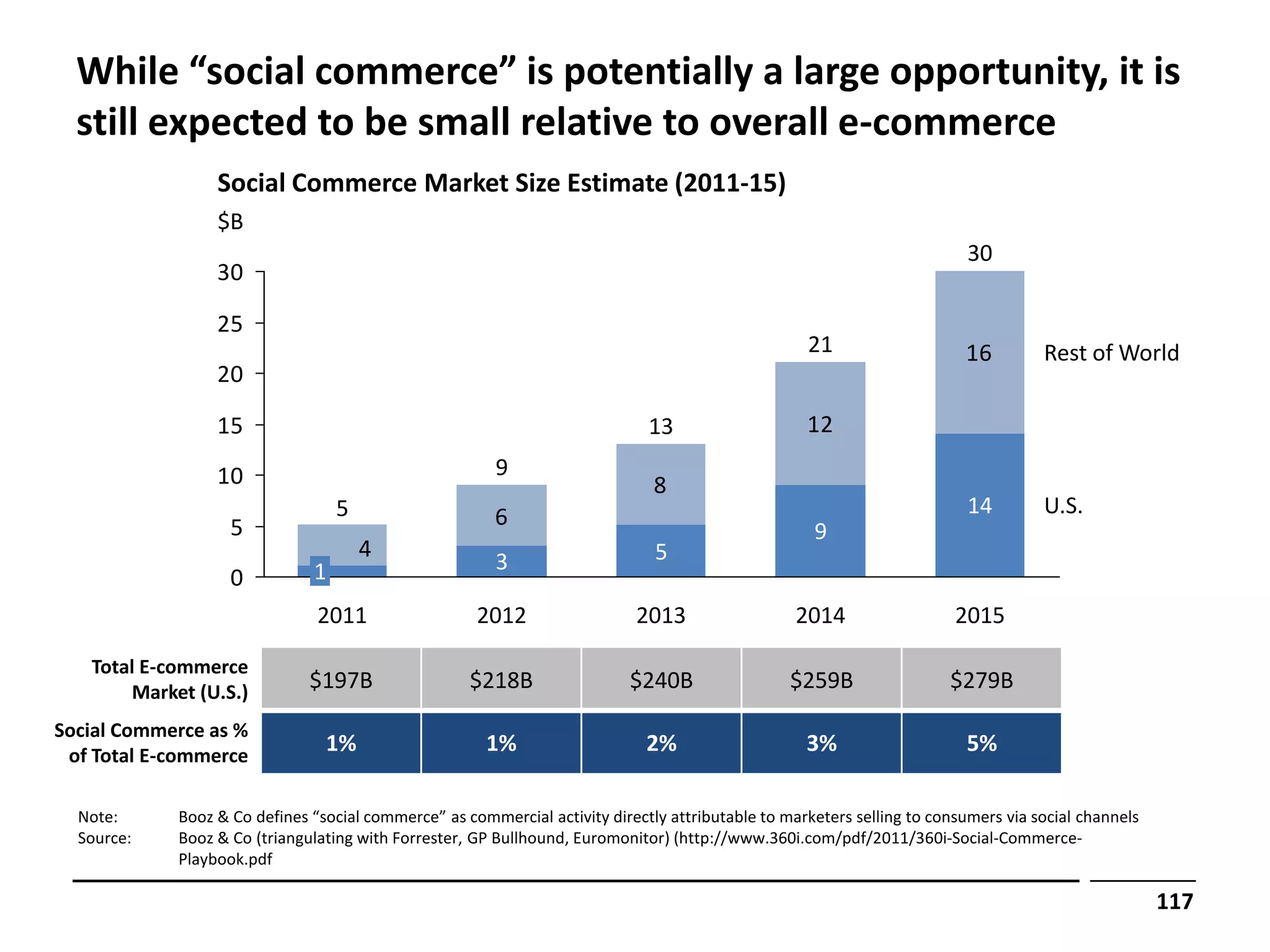
Social commerce is expected to grow, but is currently small compared to total e-commerce. Challenges include lower engagement and the need for brands to leverage social platforms effectively.
U.S. E-commerce Landscape& Trends
February 2012
Josh Yang
jyang@mba2012.hbs.edu Harvard Business School
twitter.com/joshhyang Independent Student Research
Confidential
2.
Executive Summary (1of 3)
• The U.S. e-commerce market is big ($200B+), getting bigger (9% CAGR through 2015), and still early (only
9% of total retail)
‒ Market growth has been driven by consumers becoming increasingly Internet-connected and credit
card holding, and these consumers being increasingly open to purchasing online
• As the overall e-commerce market has expanded in dollar value, e-commerce start-ups (e.g., niche
retailers, service providers) have started to command large enough addressable markets to become
sustainable businesses
‒ In the last two years, several new business models have garnered VC attention and begun to scale
(e.g., group buying, flash sales, subscription, online brands)
‒ Consumers have shown a newfound willingness to test new e-commerce business models (see
ShoeDazzle, RenttheRunway, Gilt Groupe), but these are primarily wealthier consumers
‒ The only new e-commerce business model that has gained significant traction with the mass
consumer is group buying
• There is are still several avenues to creating new opportunities for in e-commerce business
‒ New business models are still being born – personalization companies like Trunk Club and online
brands like Warby Parker continue to bring offline models into existence online
‒ There is also room for companies to clone or apply existing business models to new product
categories, and/or target to different customer segments (e.g., low-end vs. high-end, male vs.
female)
‒ Start-ups often take existing business models and apply a marketing pivot or alternate strategy
2
3.
Executive Summary (2of 3)
• However, e-commerce business models that don’t provide real long-term value to consumers will likely
meet consumer disenchantment, churn, and end up as just a passing trend
• In general, the newer business models that have emerged (e.g., subscription, C2C marketplaces, flash
sales) tend to be focused on impulse purchases
‒ Although planned purchases make up the majority of retail spend historically, older companies like
Amazon and Wayfair seem to have locked up planned purchasing on the web, as this revolves more
around search and catalog layouts than email digests
‒ Impulse buying has taken off targeted at those with more to spend, but the problem here is that
these purchases generally have higher rates of regret after purchase (i.e., more returns and/or churn)
• Two newer business models that are less reliant on impulse purchases are online brands and crowdsourced
demand
‒ Online brands are simply new brands that have chosen online as the marketing channel of choice
over offline – barriers to entry in online brands includes the expertise required to build a vertically
integrated supply chain
‒ Crowdsourced demand start-ups (e.g., Modcloth) also rely less on impulse purchases, as do social
bookmarking start-ups like Pinterest, where users create product wishlists for “buy later”
3
4.
Executive Summary (3of 3)
• As more eyeballs move from PC to mobile, mobile e-commerce will become very important, and the
experience today is still in early stages
‒ Currently, few e-commerce companies are focused on mobile, leaving consumers to browse e-
commerce sites on browsers or download one app per retailer that actually has one
‒ There is critical distribution problem for mobile e-commerce, too, as consumers must download
one new app for each retailer
‒ Start-ups tackling the space include Coffee Table, TheFind Catalogue, and Google Catalog, but they
are very basic preliminary products
• Finally, the proliferation of social networks in recent years could potentially open up opportunities to
create inherently social shopping experiences online; however, this opportunity has yet to be cracked
‒ Most of the social commerce activity occurring today are Facebook pop-up stores and
Twitter/Facebook buttons embedded on e-commerce product pages
‒ Some companies also use the social graph to make referral programs easier
‒ However, no clear class of scalable, defensible start-ups has come out of social commerce yet
4
The U.S. e-commercemarket is big ($200B+), getting bigger (9%
CAGR through 2015), and still early (only 9% of total retail)
U.S. E-Commerce Market (2009-15)
$B
300 279 CAGR
259 (11-15)
250 240
218
197
200 176
157
150
9.1%
100
50
0
2009A 2010A 2011F 2012F 2013F 2014F 2015F
Total U.S. Retail
(Trillion Dollars)
$1.9T $2.2T $2.2T $2.2T $2.4T $2.4T $2.5T 3.8%
E-Commerce as % of
8% 8% 9% 10% 10% 11% 11%
Total Retail
E-Commerce as % of
Total Retail 11% 11% 12% 13% 14% 15% 15%
(excluding grocery)
Source: Forrester, US Online Retail Forecast (Feb 2011)
(http://www.forrester.com/rb/Research/us_online_retail_forecast%2C_2010_to_2015/q/id/58596/t/2)
6
7.
More Internet usersare using the web for shopping, and
frequency per user is expected to increase
U.S. E-Commerce Shopper Data (2004-13E)
E-commerce Shopper Data Units 2004 2005 2006 2007 2008 2009 2010E 2011E 2012E 2013E
E-commerce Penetration
Internet Population [M] 186 195 203 211 217 222 227 231 235 239
Online Shoppers [M] 104 117 130 143 153 160 170 176 184 189
E-commerce Penetration of Internet Population [%] 55.9% 60.0% 64.0% 67.8% 70.5% 72.1% 74.9% 76.2% 78.3% 79.1%
E-commerce Shopper Stats
Shopping Sessions / shopper / month [M] 1.90 1.75 1.88 1.91 1.87 1.99 2.13 2.25 2.38 2.45
Average price / session [M] 39.50 41.25 43.00 45.50 45.00 41.00 41.50 43.00 44.00 46.00
Product return rate [%] 10.0% 9.0% 9.0% 8.0% 8.0% 8.0% 8.0% 8.0% 8.0% 8.0%
Source: Department of Commerce, Internet World Stats, Company reports, JP Morgan 2011 Internet Sector Outlook
(http://www.slideshare.net/victori98pt/2011-internet-sector-outlook-by-j-p-morgan)
7
8.
Consumers are continuingto shift retail buying online, at the
expense of the likes of Best Buy, Macy’s, and Westfield …
Consumers are spending more
via e-commerce …
… at the expense of shopping
malls, department stores, and
electronics stores
Source: Forrester, US Online Retail Forecast (Feb 2011)
(http://www.forrester.com/rb/Research/us_online_retail_forecast%2C_2010_to_2015/q/id/58596/t/2)
8
9.
… with themost active online buyers being the most affluent
Source: J.P. Morgan Internet User Survey 2010 (http://www.slideshare.net/victori98pt/2011-internet-sector-outlook-by-j-p-morgan)
9
10.
Although innovation ine-commerce had been lagging for 10+
years, the last 1-2 years has seen an uptick
Top Overall Sites Top E-commerce Top E-Commerce • Overall, innovation has been rampant on
(Sept 2011) Sites (Mar 2010) Sites (Sept 2011) the web
1 Google Amazon Amazon
– 11 of the top 15 overall sites did not exist
2 Facebook eBay eBay ten years ago
3 Youtube Netflix Netflix – Several fast risers cater to the China
market (Baidu, QQ, Taobao, Sina)
4 Yahoo Wal-mart Wal-mart
5 Baidu Best Buy IKEA • However, through March 2010, e-
6 Wikipedia Ikea Target commerce had not changed much
7 Blogger Target Best Buy – By March 2010, all 15 top e-commerce
sites existed 10 years ago (NewEgg was
8 Windows Live NewEgg Groupon founded in 2001)
9 Twitter Overstock Multiply.com
• In the last two years, several new
10 QQ Macy’s NewEgg business models have begun to materially
11 MSN Barnes and Noble LivingSocial disrupt the e-commerce space
12 Linkedin Ticket Master Barnes and Noble – Groupon and LivingSocial have begun top
Amazon Home Depot Overstock trafficked sites
13
14 Taobao Gap Gap – Multiply is a primitive but highly trafficked
marketplace serving Southeast Asia
15 Sina JC Penney Sears
Source: Alexa Top 500 Global Sites (note: subsidiaries listed on Alexa were removed, e.g., Amazon UK)
First Round Capital (http://redeye.firstround.com/2010/03/some-more-thoughts-on-innovation-in-ecommerce.html)
10
11.
Over time, thee-commerce landscape has gravitated toward
wealthy customers and high-margin products (up and to the right)
High Margin SKU’s
Low Income
Wealthy Shoppers
Shoppers
Low Margin SKU’s
11
12.
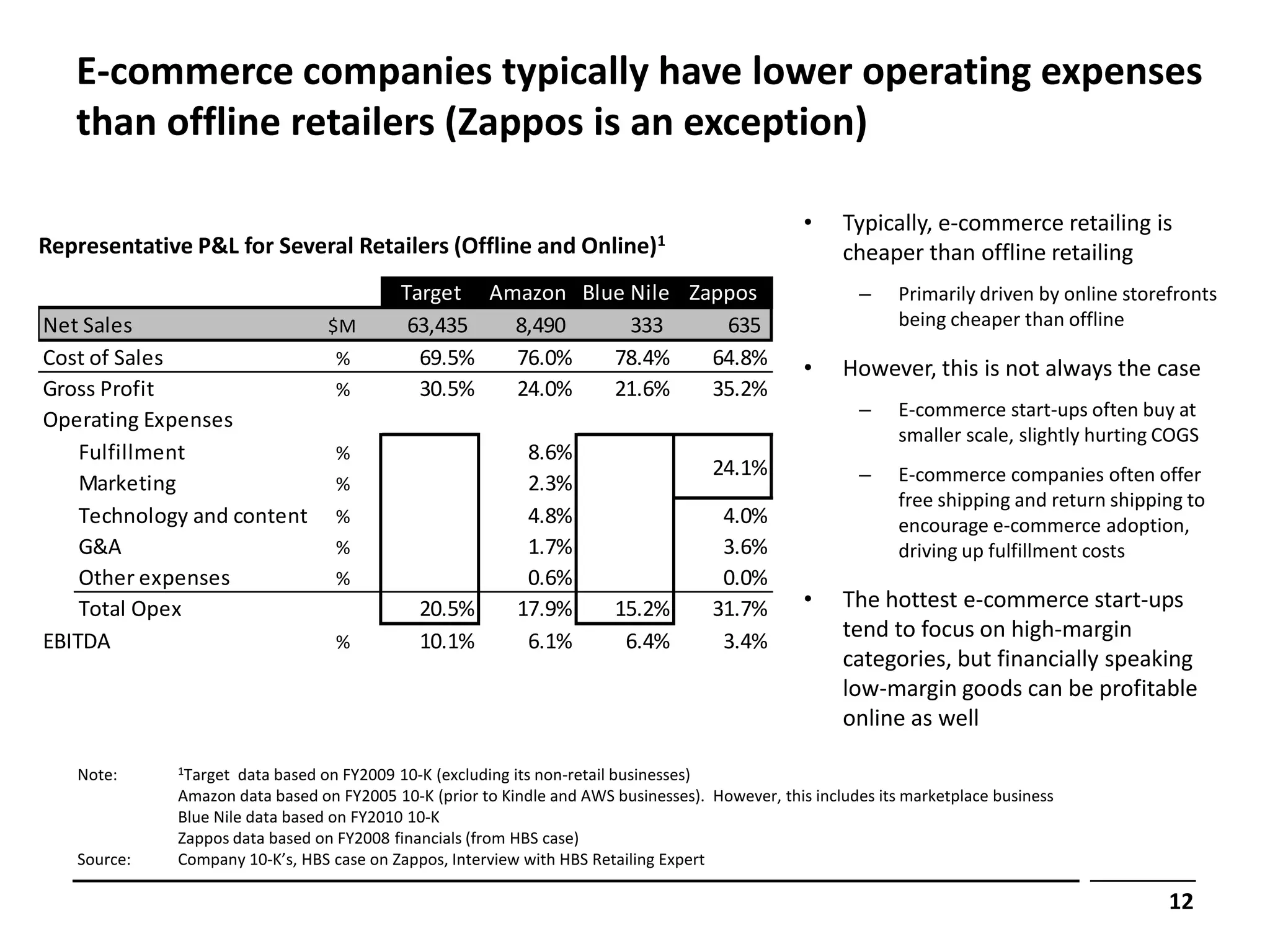
E-commerce companies typicallyhave lower operating expenses
than offline retailers (Zappos is an exception)
• Typically, e-commerce retailing is
Representative P&L for Several Retailers (Offline and Online)1 cheaper than offline retailing
Target Amazon Blue Nile Zappos – Primarily driven by online storefronts
Net Sales $M 63,435 8,490 333 635 being cheaper than offline
Cost of Sales % 69.5% 76.0% 78.4% 64.8% • However, this is not always the case
Gross Profit % 30.5% 24.0% 21.6% 35.2%
– E-commerce start-ups often buy at
Operating Expenses
smaller scale, slightly hurting COGS
Fulfillment % 8.6%
24.1% – E-commerce companies often offer
Marketing % 2.3%
free shipping and return shipping to
Technology and content % 4.8% 4.0% encourage e-commerce adoption,
G&A % 1.7% 3.6% driving up fulfillment costs
Other expenses % 0.6% 0.0%
Total Opex 20.5% 17.9% 15.2% 31.7% • The hottest e-commerce start-ups
EBITDA % 10.1% 6.1% 6.4% 3.4%
tend to focus on high-margin
categories, but financially speaking
low-margin goods can be profitable
online as well
Note: 1Target data based on FY2009 10-K (excluding its non-retail businesses)
Amazon data based on FY2005 10-K (prior to Kindle and AWS businesses). However, this includes its marketplace business
Blue Nile data based on FY2010 10-K
Zappos data based on FY2008 financials (from HBS case)
Source: Company 10-K’s, HBS case on Zappos, Interview with HBS Retailing Expert
12
13.
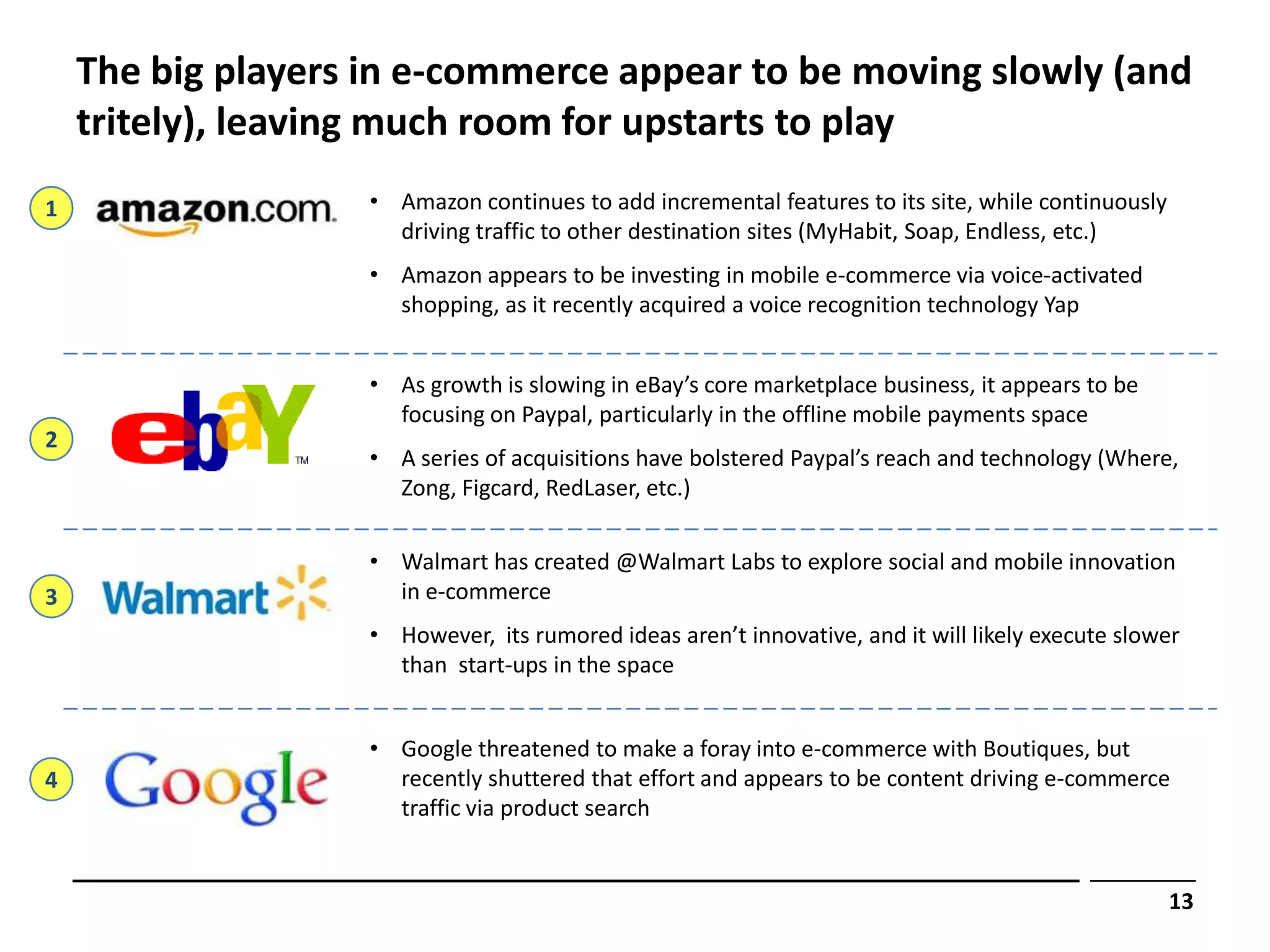
The big playersin e-commerce appear to be moving slowly (and
tritely), leaving much room for upstarts to play
1 • Amazon continues to add incremental features to its site, while continuously
driving traffic to other destination sites (MyHabit, Soap, Endless, etc.)
• Amazon appears to be investing in mobile e-commerce via voice-activated
shopping, as it recently acquired a voice recognition technology Yap
• As growth is slowing in eBay’s core marketplace business, it appears to be
focusing on Paypal, particularly in the offline mobile payments space
2
• A series of acquisitions have bolstered Paypal’s reach and technology (Where,
Zong, Figcard, RedLaser, etc.)
• Walmart has created @Walmart Labs to explore social and mobile innovation
3 in e-commerce
• However, its rumored ideas aren’t innovative, and it will likely execute slower
than start-ups in the space
• Google threatened to make a foray into e-commerce with Boutiques, but
4 recently shuttered that effort and appears to be content driving e-commerce
traffic via product search
13
14.
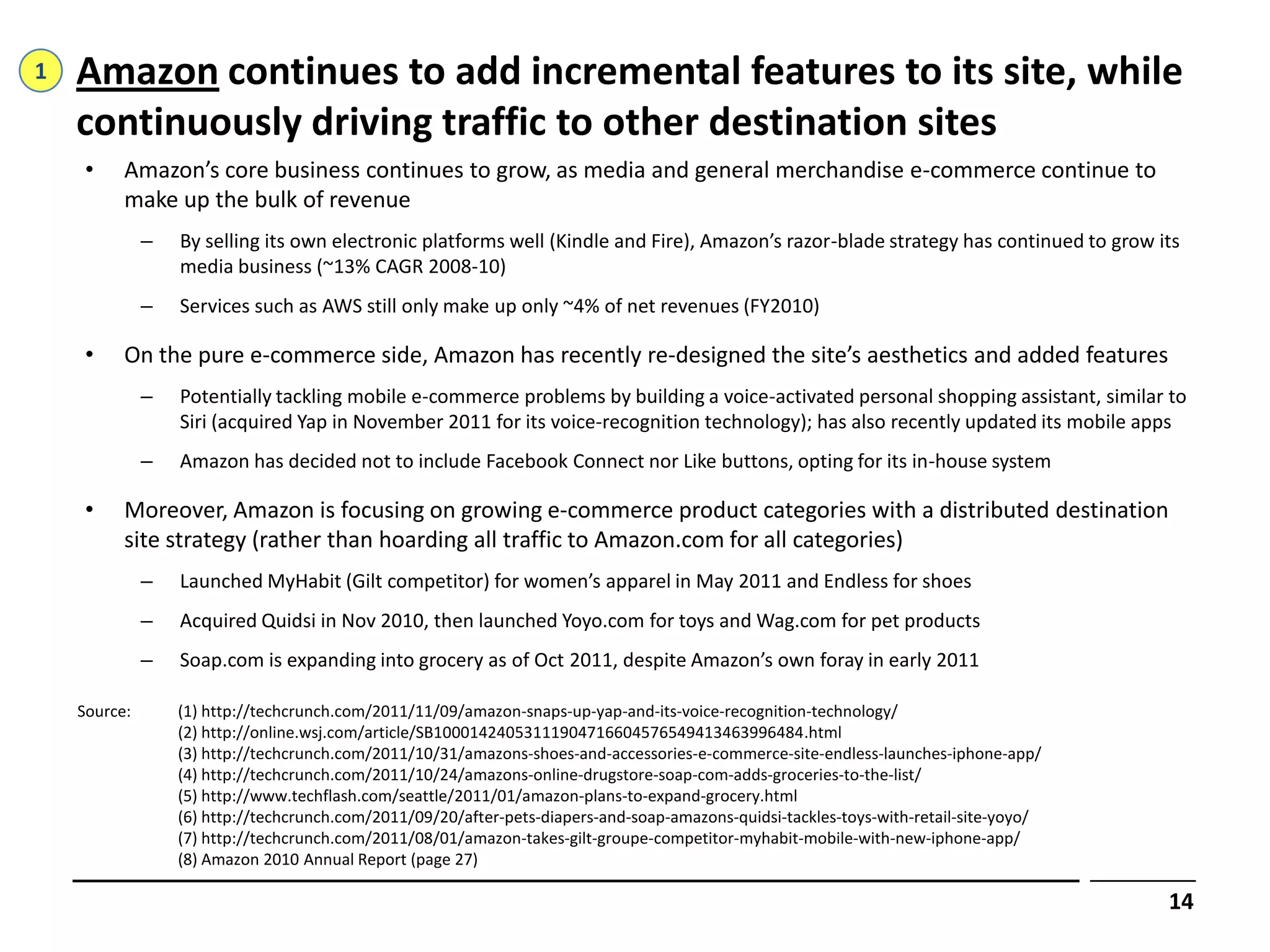
1 Amazon continues to add incremental features to its site, while
continuously driving traffic to other destination sites
• Amazon’s core business continues to grow, as media and general merchandise e-commerce continue to
make up the bulk of revenue
– By selling its own electronic platforms well (Kindle and Fire), Amazon’s razor-blade strategy has continued to grow its
media business (~13% CAGR 2008-10)
– Services such as AWS still only make up only ~4% of net revenues (FY2010)
• On the pure e-commerce side, Amazon has recently re-designed the site’s aesthetics and added features
– Potentially tackling mobile e-commerce problems by building a voice-activated personal shopping assistant, similar to
Siri (acquired Yap in November 2011 for its voice-recognition technology); has also recently updated its mobile apps
– Amazon has decided not to include Facebook Connect nor Like buttons, opting for its in-house system
• Moreover, Amazon is focusing on growing e-commerce product categories with a distributed destination
site strategy (rather than hoarding all traffic to Amazon.com for all categories)
– Launched MyHabit (Gilt competitor) for women’s apparel in May 2011 and Endless for shoes
– Acquired Quidsi in Nov 2010, then launched Yoyo.com for toys and Wag.com for pet products
– Soap.com is expanding into grocery as of Oct 2011, despite Amazon’s own foray in early 2011
Source: (1) http://techcrunch.com/2011/11/09/amazon-snaps-up-yap-and-its-voice-recognition-technology/
(2) http://online.wsj.com/article/SB10001424053111904716604576549413463996484.html
(3) http://techcrunch.com/2011/10/31/amazons-shoes-and-accessories-e-commerce-site-endless-launches-iphone-app/
(4) http://techcrunch.com/2011/10/24/amazons-online-drugstore-soap-com-adds-groceries-to-the-list/
(5) http://www.techflash.com/seattle/2011/01/amazon-plans-to-expand-grocery.html
(6) http://techcrunch.com/2011/09/20/after-pets-diapers-and-soap-amazons-quidsi-tackles-toys-with-retail-site-yoyo/
(7) http://techcrunch.com/2011/08/01/amazon-takes-gilt-groupe-competitor-myhabit-mobile-with-new-iphone-app/
(8) Amazon 2010 Annual Report (page 27)
14
15.
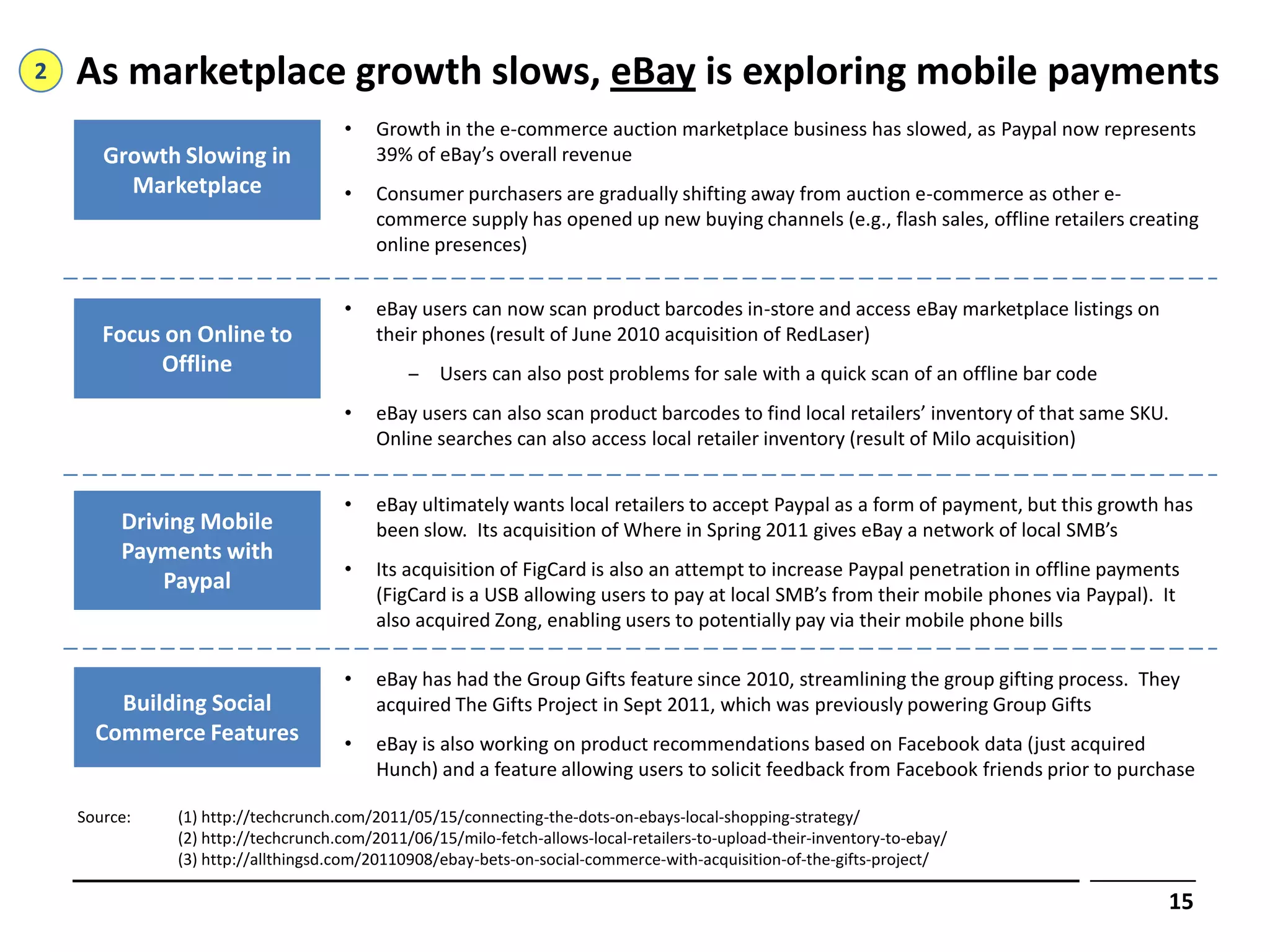
2 As marketplace growth slows, eBay is exploring mobile payments
• Growth in the e-commerce auction marketplace business has slowed, as Paypal now represents
Growth Slowing in 39% of eBay’s overall revenue
Marketplace • Consumer purchasers are gradually shifting away from auction e-commerce as other e-
commerce supply has opened up new buying channels (e.g., flash sales, offline retailers creating
online presences)
• eBay users can now scan product barcodes in-store and access eBay marketplace listings on
Focus on Online to their phones (result of June 2010 acquisition of RedLaser)
Offline ‒ Users can also post problems for sale with a quick scan of an offline bar code
• eBay users can also scan product barcodes to find local retailers’ inventory of that same SKU.
Online searches can also access local retailer inventory (result of Milo acquisition)
• eBay ultimately wants local retailers to accept Paypal as a form of payment, but this growth has
Driving Mobile been slow. Its acquisition of Where in Spring 2011 gives eBay a network of local SMB’s
Payments with
• Its acquisition of FigCard is also an attempt to increase Paypal penetration in offline payments
Paypal
(FigCard is a USB allowing users to pay at local SMB’s from their mobile phones via Paypal). It
also acquired Zong, enabling users to potentially pay via their mobile phone bills
• eBay has had the Group Gifts feature since 2010, streamlining the group gifting process. They
Building Social acquired The Gifts Project in Sept 2011, which was previously powering Group Gifts
Commerce Features • eBay is also working on product recommendations based on Facebook data (just acquired
Hunch) and a feature allowing users to solicit feedback from Facebook friends prior to purchase
Source: (1) http://techcrunch.com/2011/05/15/connecting-the-dots-on-ebays-local-shopping-strategy/
(2) http://techcrunch.com/2011/06/15/milo-fetch-allows-local-retailers-to-upload-their-inventory-to-ebay/
(3) http://allthingsd.com/20110908/ebay-bets-on-social-commerce-with-acquisition-of-the-gifts-project/
15
16.
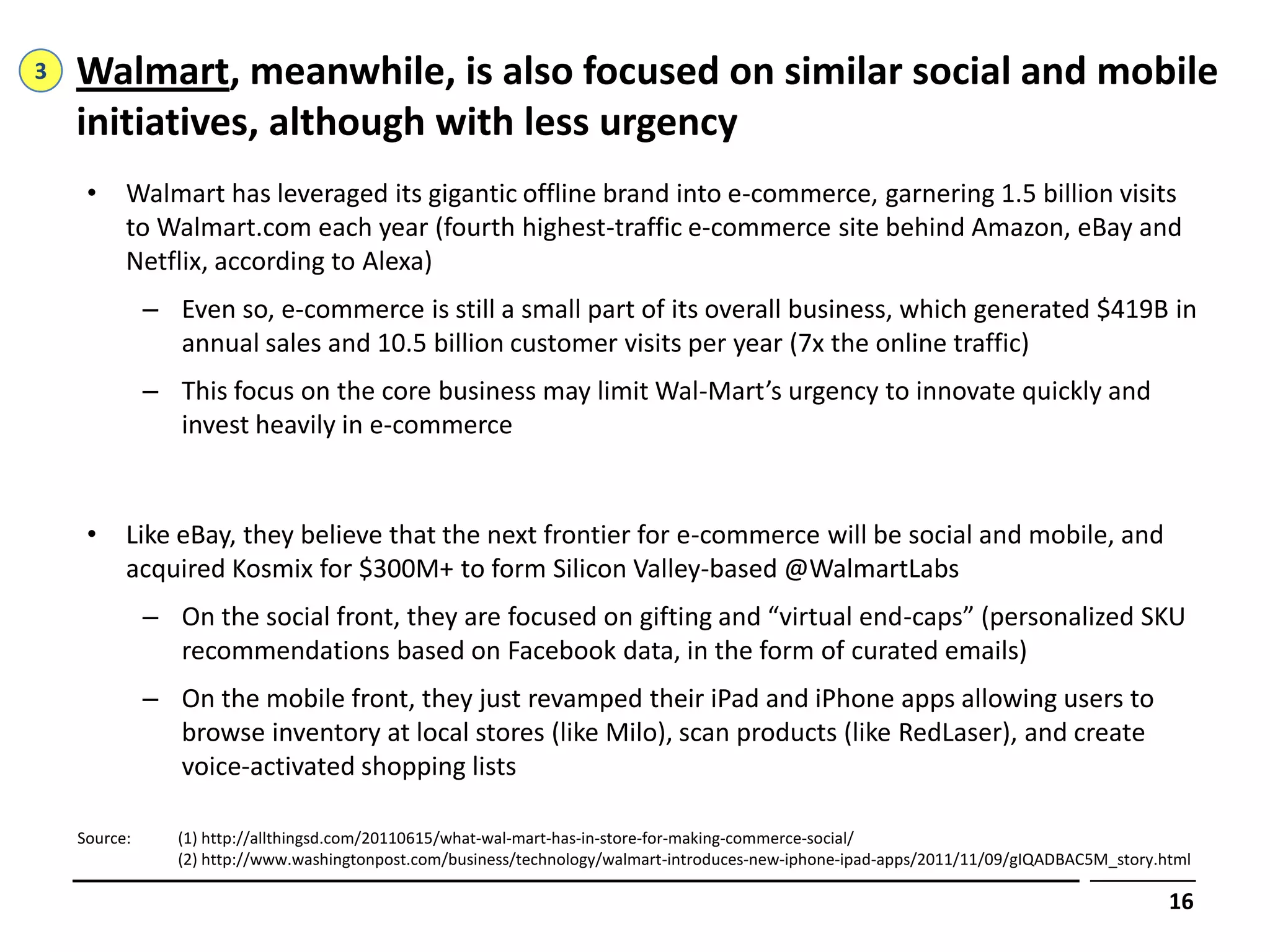
3 Walmart, meanwhile, is also focused on similar social and mobile
initiatives, although with less urgency
• Walmart has leveraged its gigantic offline brand into e-commerce, garnering 1.5 billion visits
to Walmart.com each year (fourth highest-traffic e-commerce site behind Amazon, eBay and
Netflix, according to Alexa)
– Even so, e-commerce is still a small part of its overall business, which generated $419B in
annual sales and 10.5 billion customer visits per year (7x the online traffic)
– This focus on the core business may limit Wal-Mart’s urgency to innovate quickly and
invest heavily in e-commerce
• Like eBay, they believe that the next frontier for e-commerce will be social and mobile, and
acquired Kosmix for $300M+ to form Silicon Valley-based @WalmartLabs
– On the social front, they are focused on gifting and “virtual end-caps” (personalized SKU
recommendations based on Facebook data, in the form of curated emails)
– On the mobile front, they just revamped their iPad and iPhone apps allowing users to
browse inventory at local stores (like Milo), scan products (like RedLaser), and create
voice-activated shopping lists
Source: (1) http://allthingsd.com/20110615/what-wal-mart-has-in-store-for-making-commerce-social/
(2) http://www.washingtonpost.com/business/technology/walmart-introduces-new-iphone-ipad-apps/2011/11/09/gIQADBAC5M_story.html
16
17.
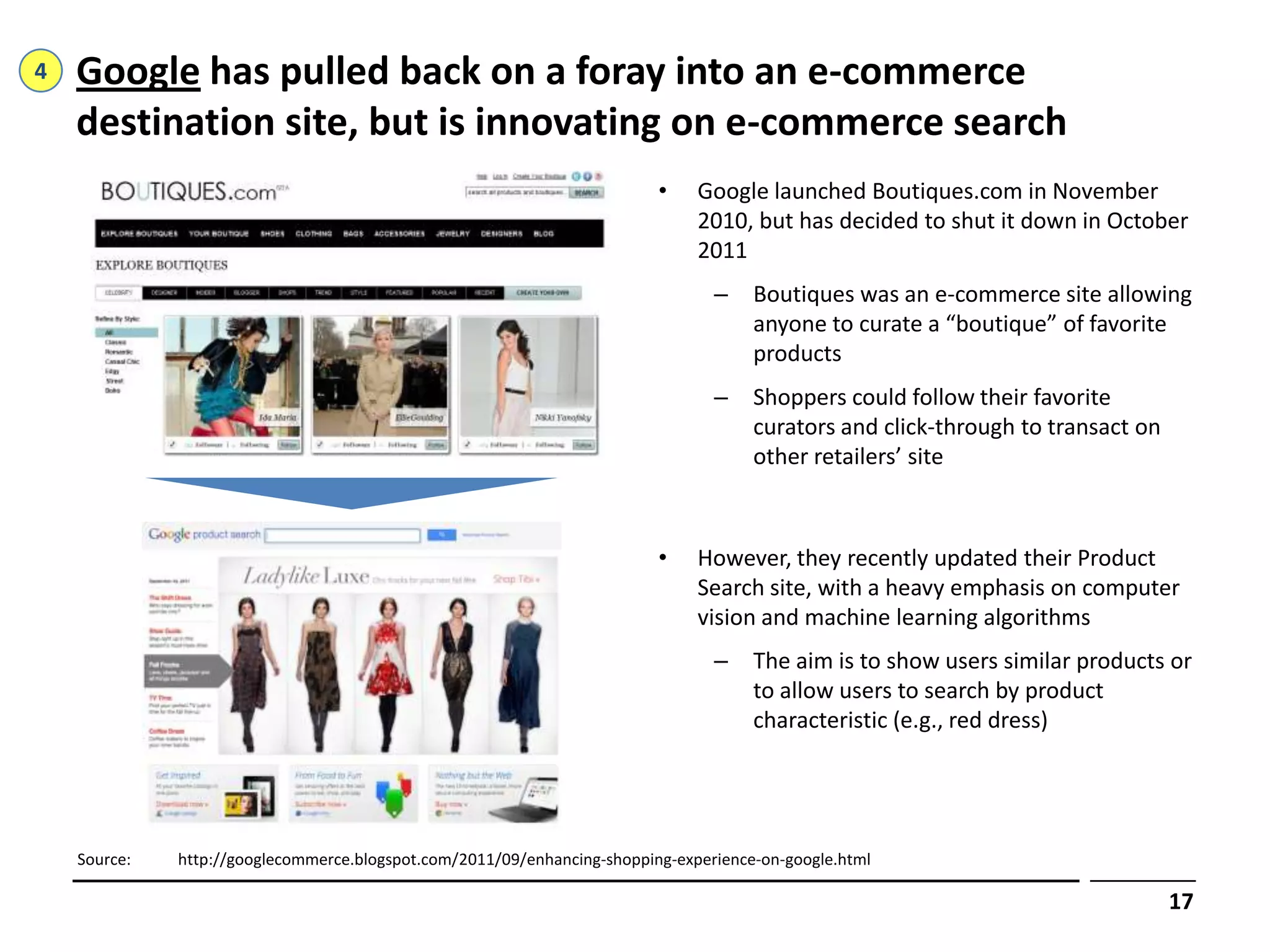
4 Google has pulled back on a foray into an e-commerce
destination site, but is innovating on e-commerce search
• Google launched Boutiques.com in November
2010, but has decided to shut it down in October
2011
– Boutiques was an e-commerce site allowing
anyone to curate a “boutique” of favorite
products
– Shoppers could follow their favorite
curators and click-through to transact on
other retailers’ site
• However, they recently updated their Product
Search site, with a heavy emphasis on computer
vision and machine learning algorithms
– The aim is to show users similar products or
to allow users to search by product
characteristic (e.g., red dress)
Source: http://googlecommerce.blogspot.com/2011/09/enhancing-shopping-experience-on-google.html
17
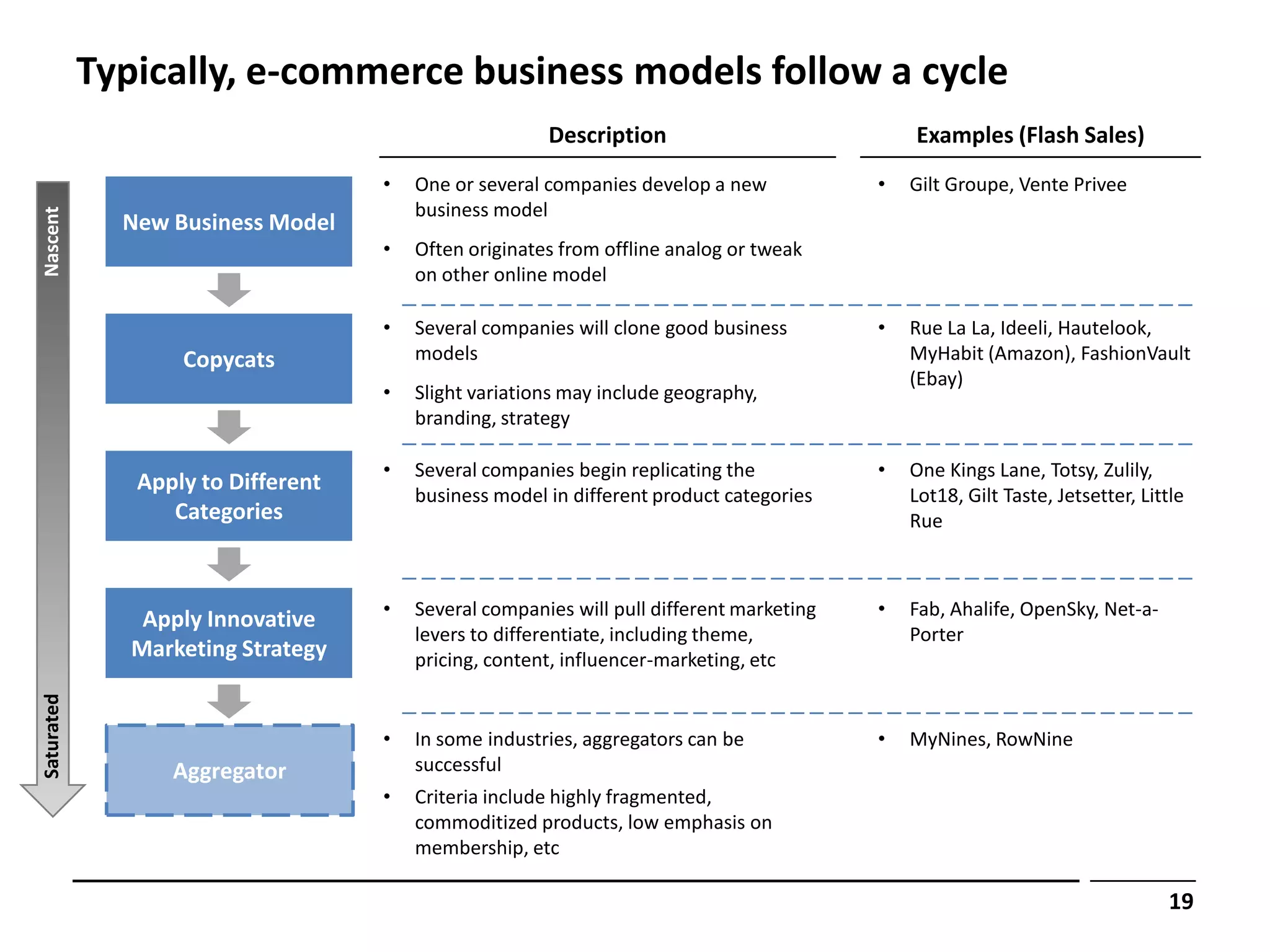
Typically, e-commerce businessmodels follow a cycle
Description Examples (Flash Sales)
• One or several companies develop a new • Gilt Groupe, Vente Privee
business model
Nascent
New Business Model
• Often originates from offline analog or tweak
on other online model
• Several companies will clone good business • Rue La La, Ideeli, Hautelook,
Copycats models MyHabit (Amazon), FashionVault
(Ebay)
• Slight variations may include geography,
branding, strategy
• Several companies begin replicating the • One Kings Lane, Totsy, Zulily,
Apply to Different
business model in different product categories Lot18, Gilt Taste, Jetsetter, Little
Categories Rue
• Several companies will pull different marketing • Fab, Ahalife, OpenSky, Net-a-
Apply Innovative
levers to differentiate, including theme, Porter
Marketing Strategy pricing, content, influencer-marketing, etc
Saturated
• In some industries, aggregators can be • MyNines, RowNine
Aggregator successful
• Criteria include highly fragmented,
commoditized products, low emphasis on
membership, etc
19
20.
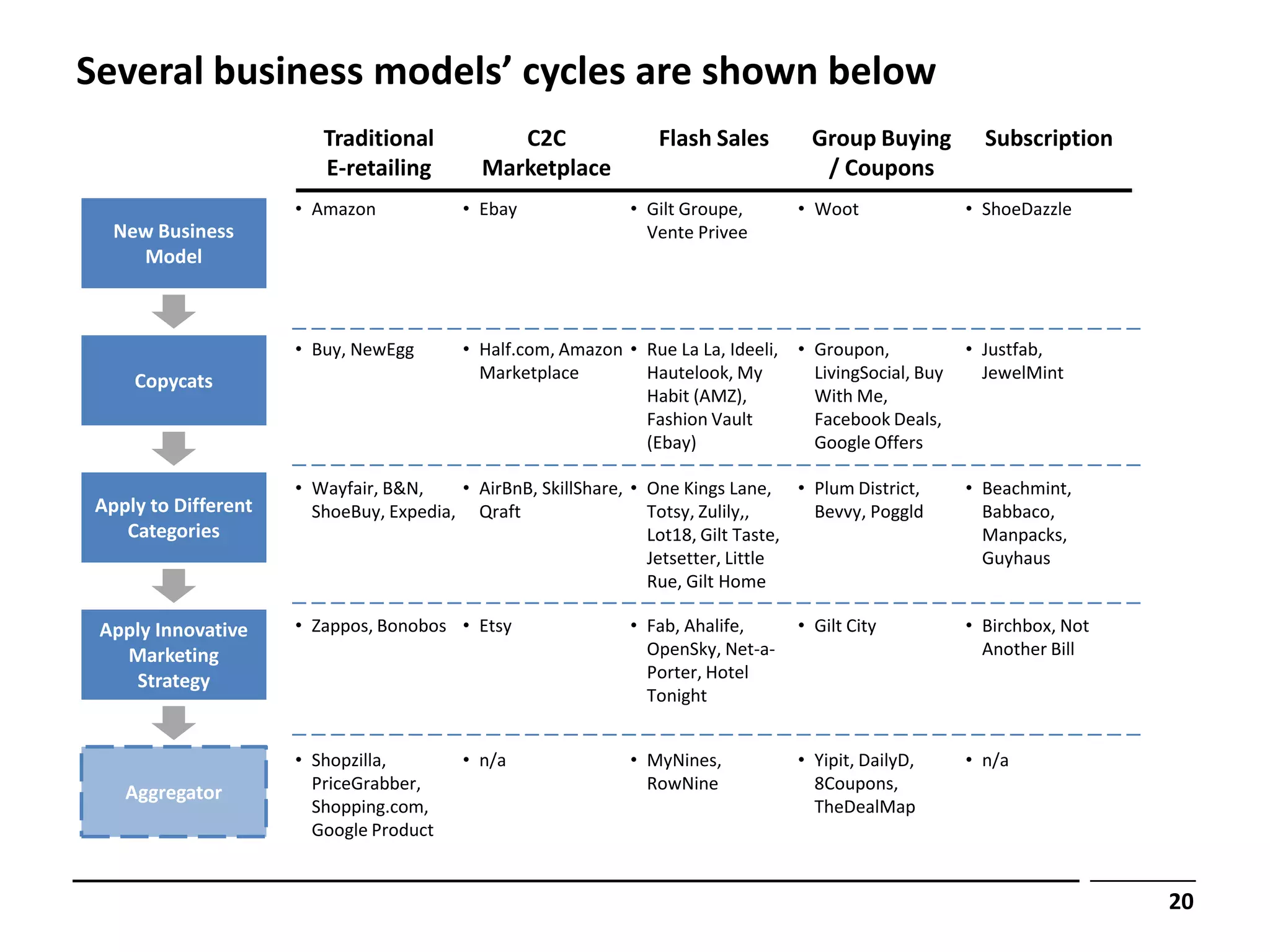
Several business models’cycles are shown below
Traditional C2C Flash Sales Group Buying Subscription
E-retailing Marketplace / Coupons
• Amazon • Ebay • Gilt Groupe, • Woot • ShoeDazzle
New Business Vente Privee
Model
• Buy, NewEgg • Half.com, Amazon • Rue La La, Ideeli, • Groupon, • Justfab,
Copycats Marketplace Hautelook, My LivingSocial, Buy JewelMint
Habit (AMZ), With Me,
Fashion Vault Facebook Deals,
(Ebay) Google Offers
• Wayfair, B&N, • AirBnB, SkillShare, • One Kings Lane, • Plum District, • Beachmint,
Apply to Different ShoeBuy, Expedia, Qraft Totsy, Zulily,, Bevvy, Poggld Babbaco,
Categories Lot18, Gilt Taste, Manpacks,
Jetsetter, Little Guyhaus
Rue, Gilt Home
Apply Innovative • Zappos, Bonobos • Etsy • Fab, Ahalife, • Gilt City • Birchbox, Not
Marketing OpenSky, Net-a- Another Bill
Strategy Porter, Hotel
Tonight
• Shopzilla, • n/a • MyNines, • Yipit, DailyD, • n/a
Aggregator PriceGrabber, RowNine 8Coupons,
Shopping.com, TheDealMap
Google Product
20
21.
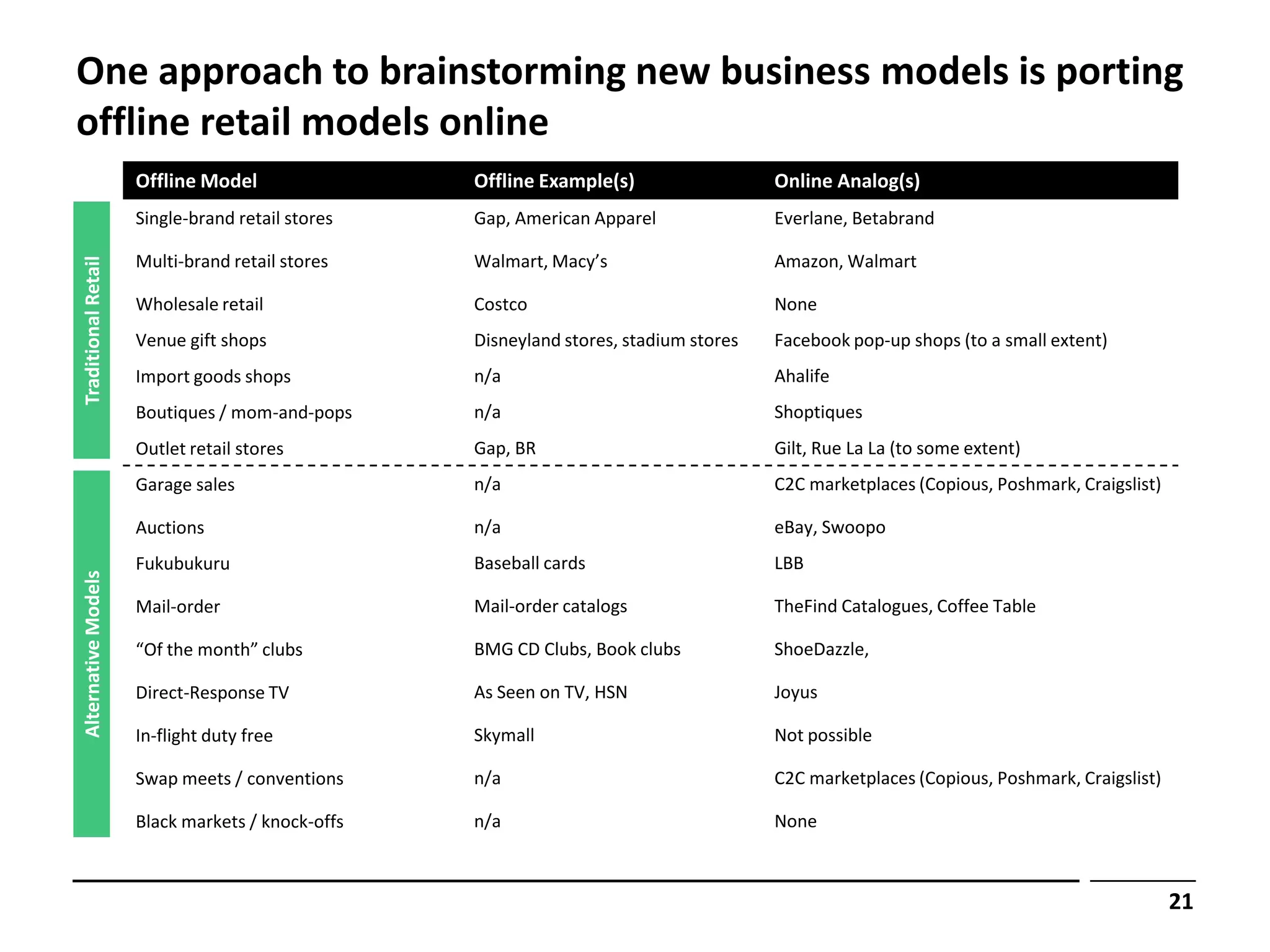
One approach tobrainstorming new business models is porting
offline retail models online
Offline Model Offline Example(s) Online Analog(s)
Single-brand retail stores Gap, American Apparel Everlane, Betabrand
Multi-brand retail stores Walmart, Macy’s Amazon, Walmart
Traditional Retail
Wholesale retail Costco None
Venue gift shops Disneyland stores, stadium stores Facebook pop-up shops (to a small extent)
Import goods shops n/a Ahalife
Boutiques / mom-and-pops n/a Shoptiques
Outlet retail stores Gap, BR Gilt, Rue La La (to some extent)
Garage sales n/a C2C marketplaces (Copious, Poshmark, Craigslist)
Auctions n/a eBay, Swoopo
Fukubukuru Baseball cards LBB
Alternative Models
Mail-order Mail-order catalogs TheFind Catalogues, Coffee Table
“Of the month” clubs BMG CD Clubs, Book clubs ShoeDazzle,
Direct-Response TV As Seen on TV, HSN Joyus
In-flight duty free Skymall Not possible
Swap meets / conventions n/a C2C marketplaces (Copious, Poshmark, Craigslist)
Black markets / knock-offs n/a None
21
22.
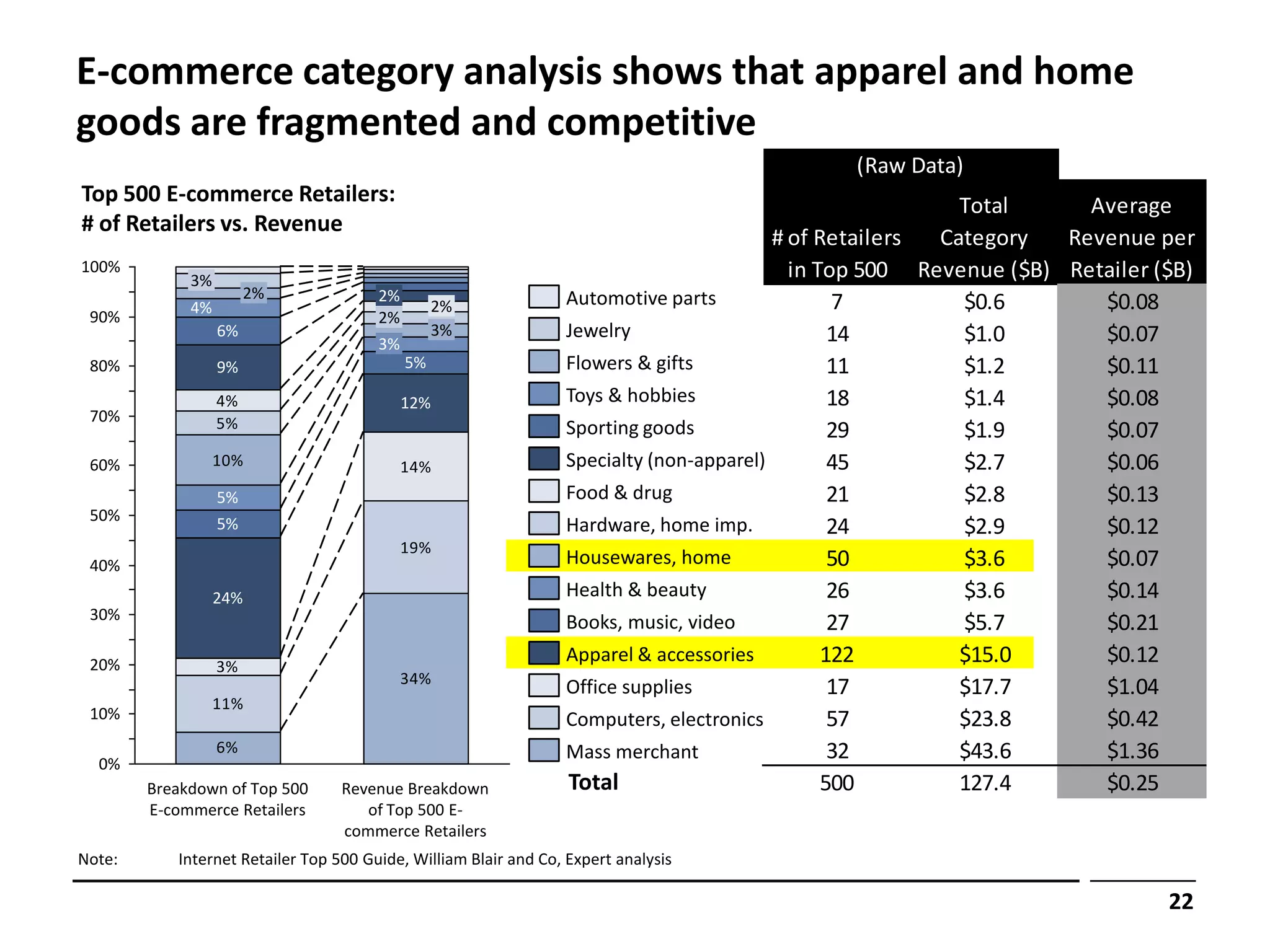
E-commerce category analysisshows that apparel and home
goods are fragmented and competitive
(Raw Data)
Top 500 E-commerce Retailers: Total Average
# of Retailers vs. Revenue
# of Retailers Category Revenue per
100% in Top 500 Revenue ($B) Retailer ($B)
3%
2% 2% Automotive parts
4% 2% 7 $0.6 $0.08
90% 2%
6% 3% Jewelry 14 $1.0 $0.07
3%
80% 9% 5% Flowers & gifts 11 $1.2 $0.11
4% 12% Toys & hobbies 18 $1.4 $0.08
70% 5% Sporting goods 29 $1.9 $0.07
60% 10% 14% Specialty (non-apparel) 45 $2.7 $0.06
5% Food & drug 21 $2.8 $0.13
50% 5% Hardware, home imp. 24 $2.9 $0.12
19%
40% Housewares, home 50 $3.6 $0.07
24% Health & beauty 26 $3.6 $0.14
30% Books, music, video 27 $5.7 $0.21
20% 3%
Apparel & accessories 122 $15.0 $0.12
34%
Office supplies 17 $17.7 $1.04
11%
10% Computers, electronics 57 $23.8 $0.42
6% Mass merchant 32 $43.6 $1.36
0%
Breakdown of Top 500 Revenue Breakdown Total 500 127.4 $0.25
E-commerce Retailers of Top 500 E-
commerce Retailers
Note: Internet Retailer Top 500 Guide, William Blair and Co, Expert analysis
22
23.
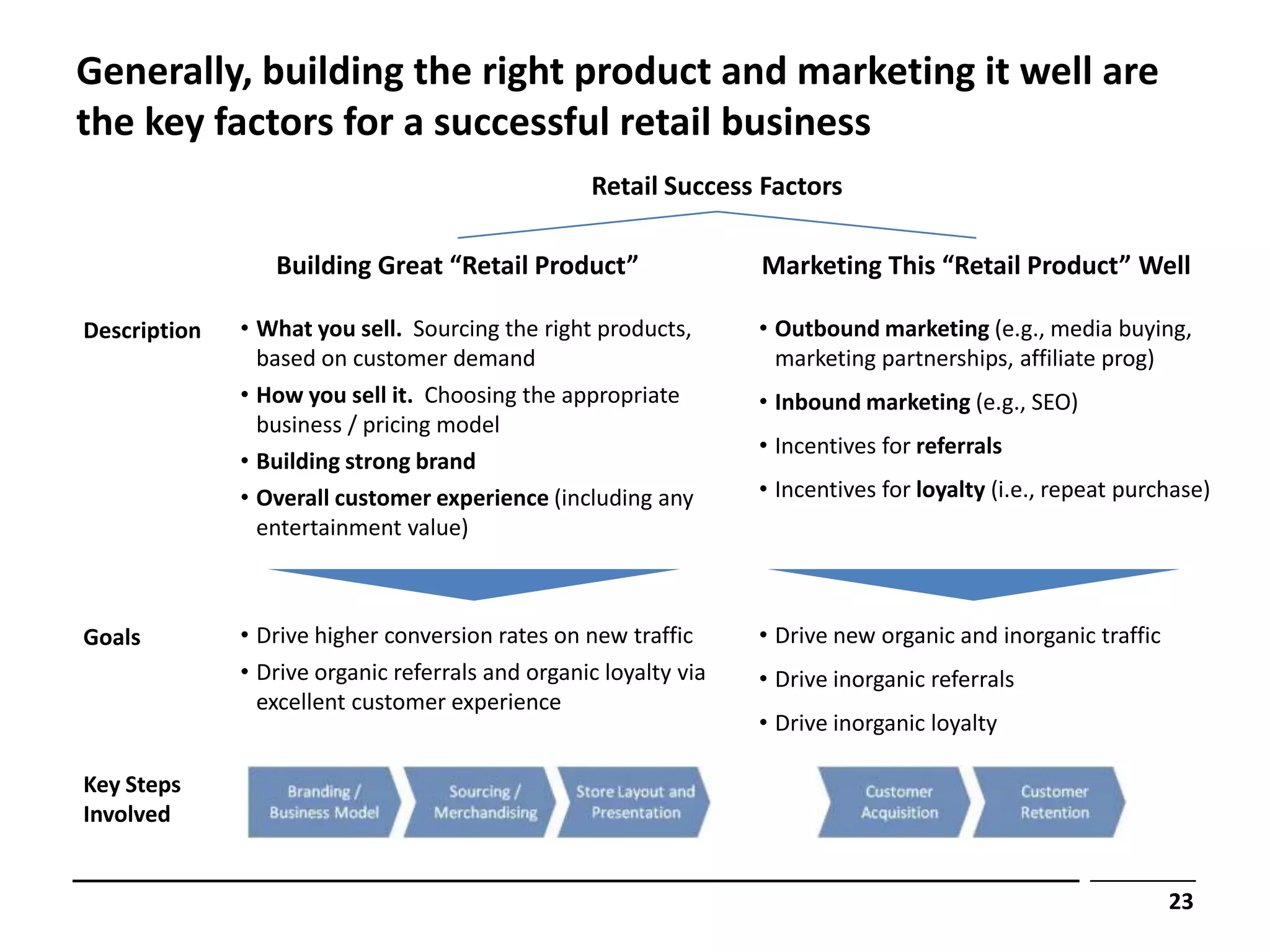
Generally, building theright product and marketing it well are
the key factors for a successful retail business
Retail Success Factors
Building Great “Retail Product” Marketing This “Retail Product” Well
Description • What you sell. Sourcing the right products, • Outbound marketing (e.g., media buying,
based on customer demand marketing partnerships, affiliate prog)
• How you sell it. Choosing the appropriate • Inbound marketing (e.g., SEO)
business / pricing model
• Incentives for referrals
• Building strong brand
• Overall customer experience (including any • Incentives for loyalty (i.e., repeat purchase)
entertainment value)
Goals • Drive higher conversion rates on new traffic • Drive new organic and inorganic traffic
• Drive organic referrals and organic loyalty via • Drive inorganic referrals
excellent customer experience
• Drive inorganic loyalty
Key Steps
Involved
23
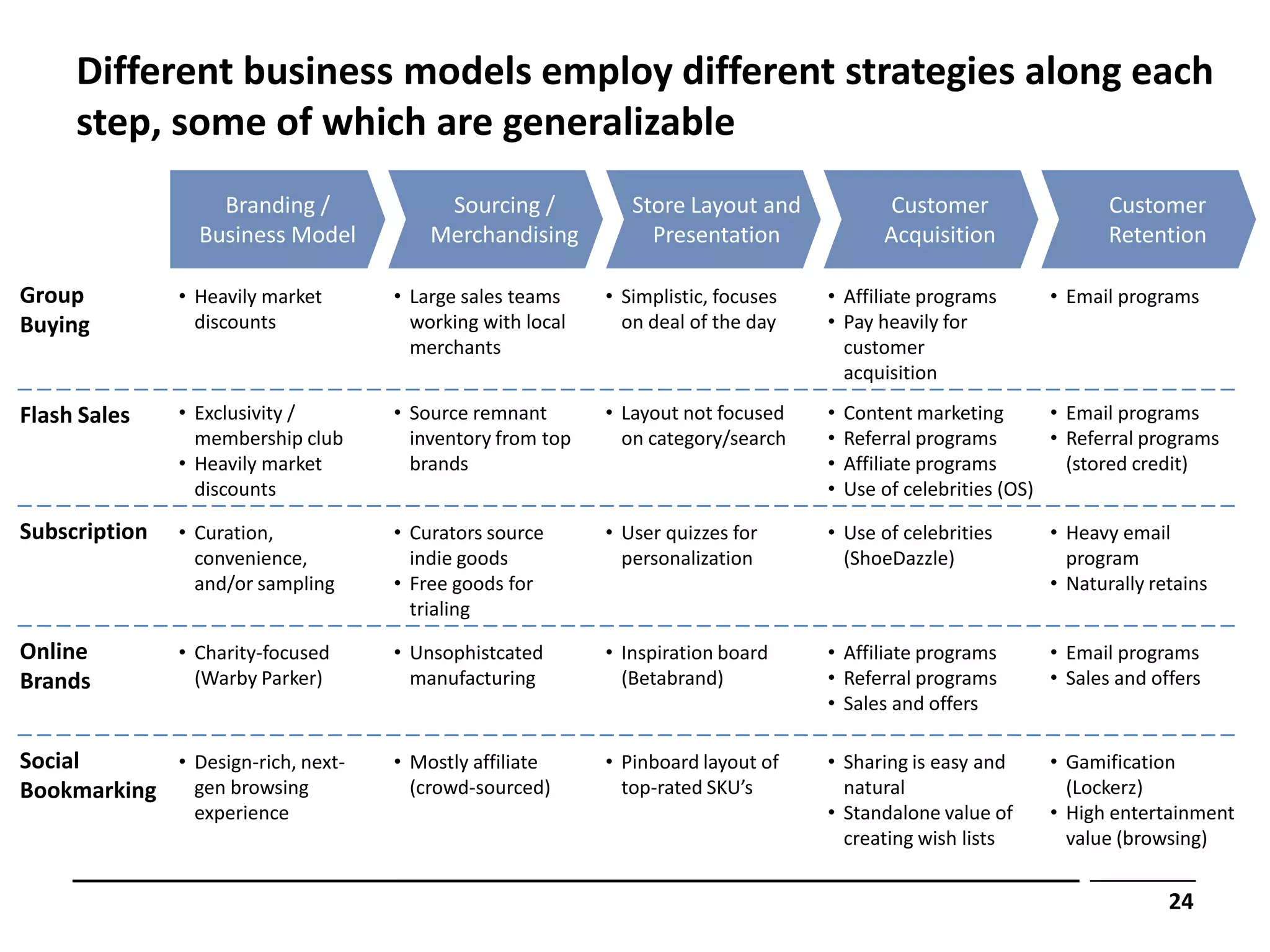
24.
Different business modelsemploy different strategies along each
step, some of which are generalizable
Branding / Sourcing / Store Layout and Customer Customer
Business Model Merchandising Presentation Acquisition Retention
Group • Heavily market • Large sales teams • Simplistic, focuses • Affiliate programs • Email programs
Buying discounts working with local on deal of the day • Pay heavily for
merchants customer
acquisition
Flash Sales • Exclusivity / • Source remnant • Layout not focused • Content marketing • Email programs
membership club inventory from top on category/search • Referral programs • Referral programs
• Heavily market brands • Affiliate programs (stored credit)
discounts • Use of celebrities (OS)
Subscription • Curation, • Curators source • User quizzes for • Use of celebrities • Heavy email
convenience, indie goods personalization (ShoeDazzle) program
and/or sampling • Free goods for • Naturally retains
trialing
Online • Charity-focused • Unsophistcated • Inspiration board • Affiliate programs • Email programs
Brands (Warby Parker) manufacturing (Betabrand) • Referral programs • Sales and offers
• Sales and offers
Social • Design-rich, next- • Mostly affiliate • Pinboard layout of • Sharing is easy and • Gamification
Bookmarking gen browsing (crowd-sourced) top-rated SKU’s natural (Lockerz)
experience • Standalone value of • High entertainment
creating wish lists value (browsing)
24
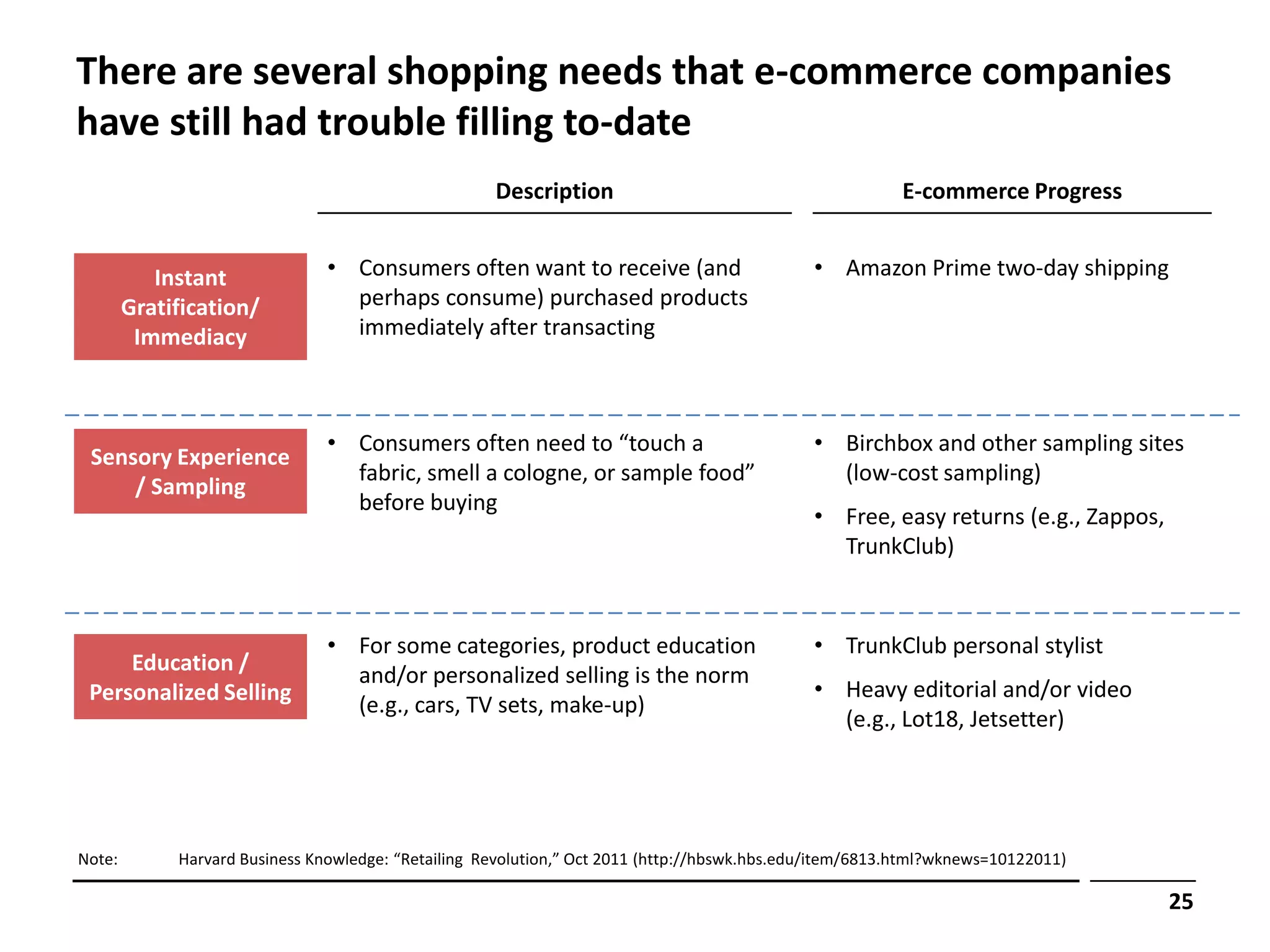
25.
There are severalshopping needs that e-commerce companies
have still had trouble filling to-date
Description E-commerce Progress
Instant • Consumers often want to receive (and • Amazon Prime two-day shipping
Gratification/ perhaps consume) purchased products
Immediacy immediately after transacting
• Consumers often need to “touch a • Birchbox and other sampling sites
Sensory Experience
fabric, smell a cologne, or sample food” (low-cost sampling)
/ Sampling
before buying
• Free, easy returns (e.g., Zappos,
TrunkClub)
• For some categories, product education • TrunkClub personal stylist
Education /
and/or personalized selling is the norm
Personalized Selling • Heavy editorial and/or video
(e.g., cars, TV sets, make-up)
(e.g., Lot18, Jetsetter)
Note: Harvard Business Knowledge: “Retailing Revolution,” Oct 2011 (http://hbswk.hbs.edu/item/6813.html?wknews=10122011)
25
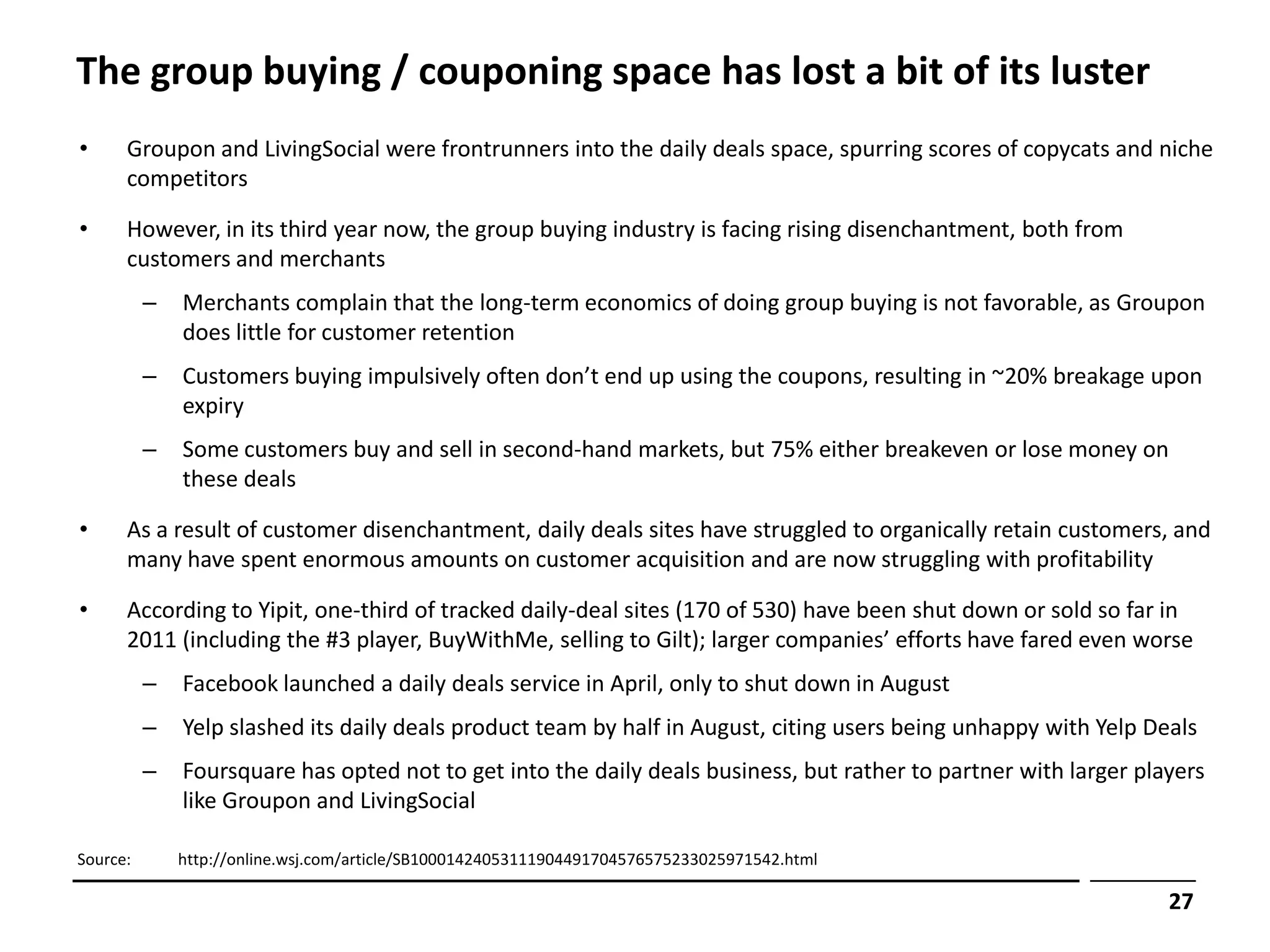
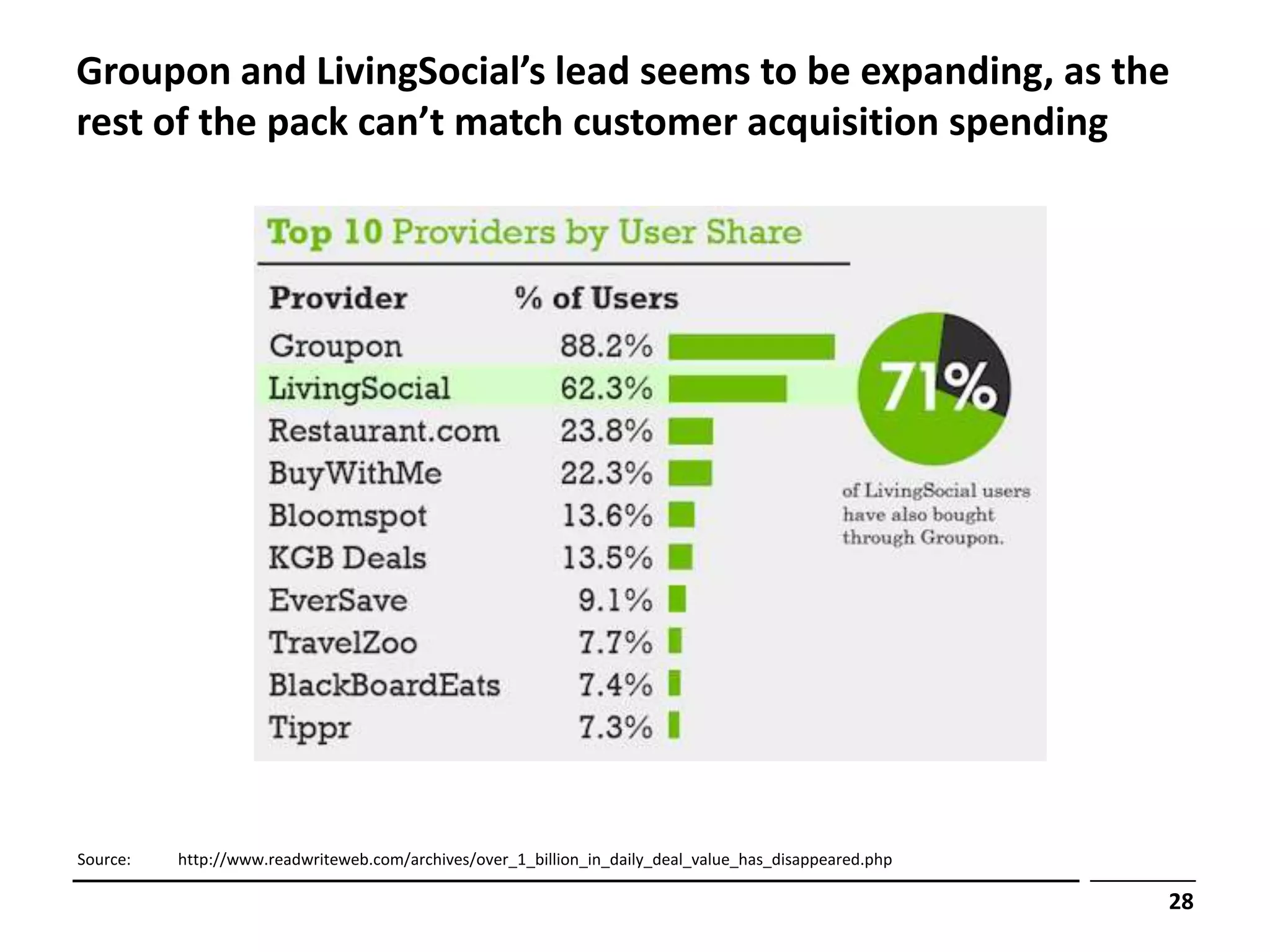
The group buying/ couponing space has lost a bit of its luster
• Groupon and LivingSocial were frontrunners into the daily deals space, spurring scores of copycats and niche
competitors
• However, in its third year now, the group buying industry is facing rising disenchantment, both from
customers and merchants
– Merchants complain that the long-term economics of doing group buying is not favorable, as Groupon
does little for customer retention
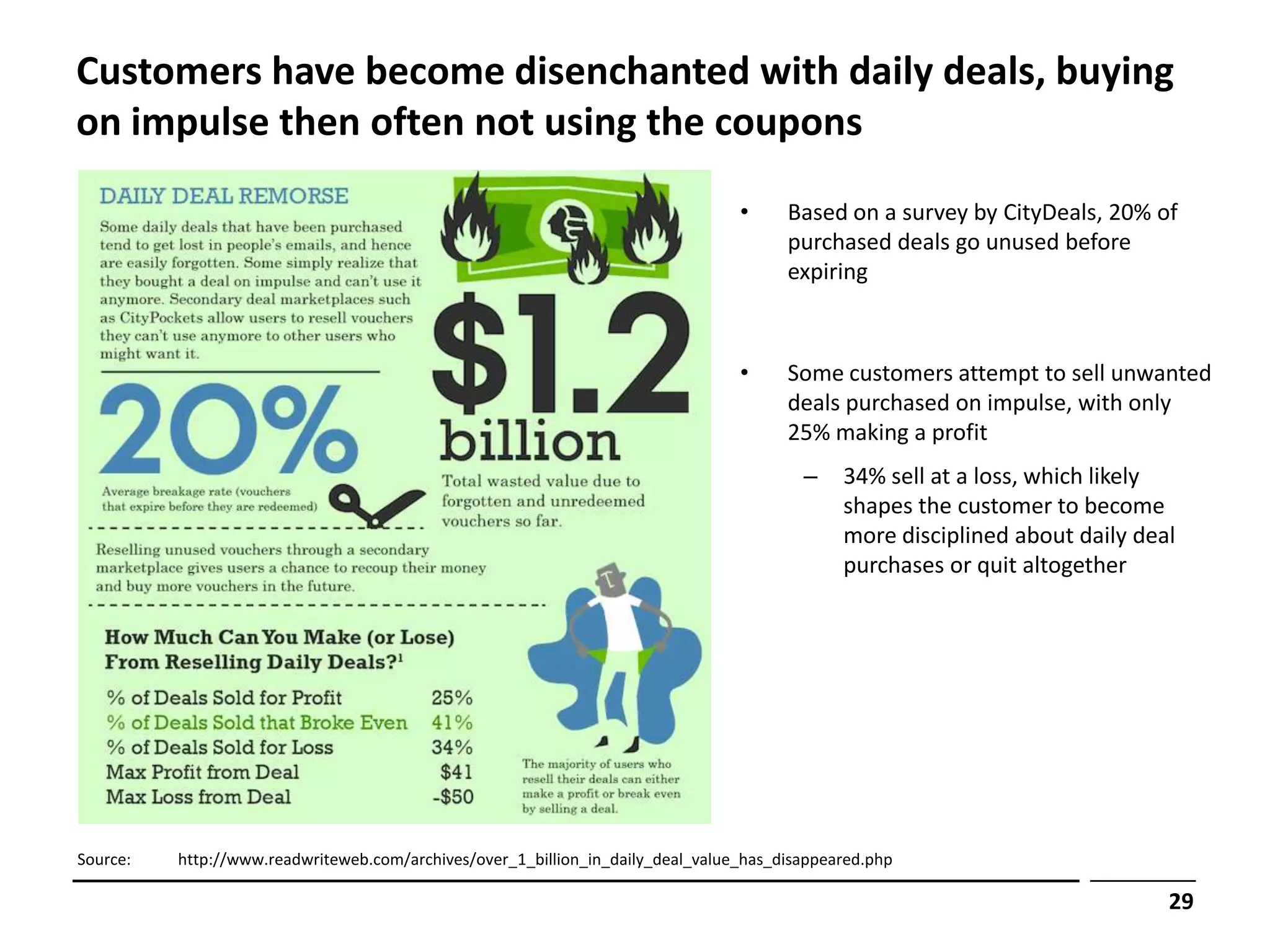
– Customers buying impulsively often don’t end up using the coupons, resulting in ~20% breakage upon
expiry
– Some customers buy and sell in second-hand markets, but 75% either breakeven or lose money on
these deals
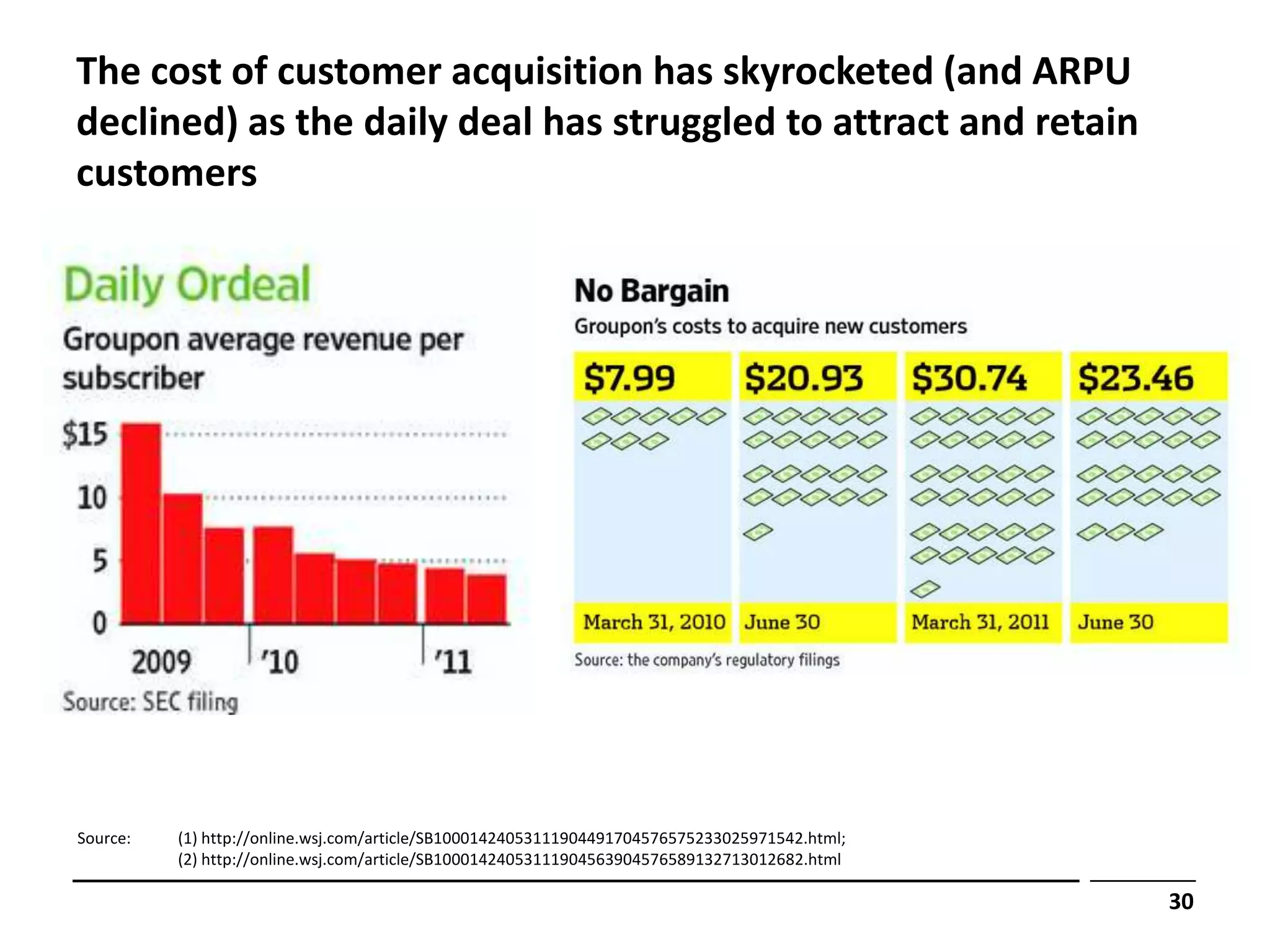
• As a result of customer disenchantment, daily deals sites have struggled to organically retain customers, and
many have spent enormous amounts on customer acquisition and are now struggling with profitability
• According to Yipit, one-third of tracked daily-deal sites (170 of 530) have been shut down or sold so far in
2011 (including the #3 player, BuyWithMe, selling to Gilt); larger companies’ efforts have fared even worse
– Facebook launched a daily deals service in April, only to shut down in August
– Yelp slashed its daily deals product team by half in August, citing users being unhappy with Yelp Deals
– Foursquare has opted not to get into the daily deals business, but rather to partner with larger players
like Groupon and LivingSocial
Source: http://online.wsj.com/article/SB10001424053111904491704576575233025971542.html
27
28.
Groupon and LivingSocial’slead seems to be expanding, as the
rest of the pack can’t match customer acquisition spending
Source: http://www.readwriteweb.com/archives/over_1_billion_in_daily_deal_value_has_disappeared.php
28
29.
Customers have becomedisenchanted with daily deals, buying
on impulse then often not using the coupons
• Based on a survey by CityDeals, 20% of
purchased deals go unused before
expiring
• Some customers attempt to sell unwanted
deals purchased on impulse, with only
25% making a profit
– 34% sell at a loss, which likely
shapes the customer to become
more disciplined about daily deal
purchases or quit altogether
Source: http://www.readwriteweb.com/archives/over_1_billion_in_daily_deal_value_has_disappeared.php
29
30.
The cost ofcustomer acquisition has skyrocketed (and ARPU
declined) as the daily deal has struggled to attract and retain
customers
Source: (1) http://online.wsj.com/article/SB10001424053111904491704576575233025971542.html;
(2) http://online.wsj.com/article/SB10001424053111904563904576589132713012682.html
30
31.
JungleCents is ane-commerce coupon company, selling
vouchers and helping customers discover new retailers
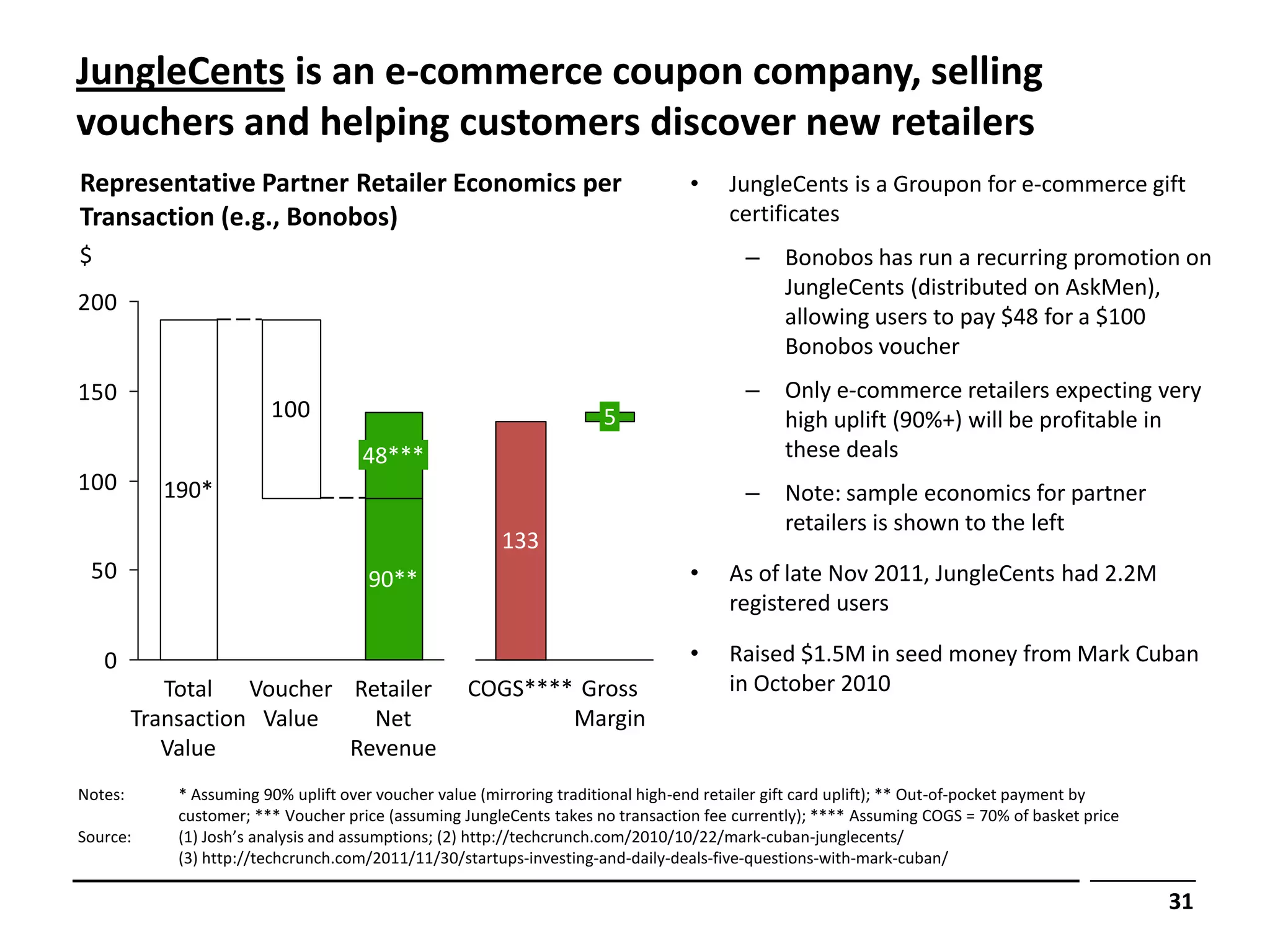
Representative Partner Retailer Economics per • JungleCents is a Groupon for e-commerce gift
Transaction (e.g., Bonobos) certificates
$ – Bonobos has run a recurring promotion on
JungleCents (distributed on AskMen),
200
allowing users to pay $48 for a $100
Bonobos voucher
150 – Only e-commerce retailers expecting very
100 5 high uplift (90%+) will be profitable in
48*** these deals
100 190* – Note: sample economics for partner
retailers is shown to the left
133
50 90** • As of late Nov 2011, JungleCents had 2.2M
registered users
0 • Raised $1.5M in seed money from Mark Cuban
Total Voucher Retailer COGS**** Gross in October 2010
Transaction Value Net Margin
Value Revenue
Notes: * Assuming 90% uplift over voucher value (mirroring traditional high-end retailer gift card uplift); ** Out-of-pocket payment by
customer; *** Voucher price (assuming JungleCents takes no transaction fee currently); **** Assuming COGS = 70% of basket price
Source: (1) Josh’s analysis and assumptions; (2) http://techcrunch.com/2010/10/22/mark-cuban-junglecents/
(3) http://techcrunch.com/2011/11/30/startups-investing-and-daily-deals-five-questions-with-mark-cuban/
31
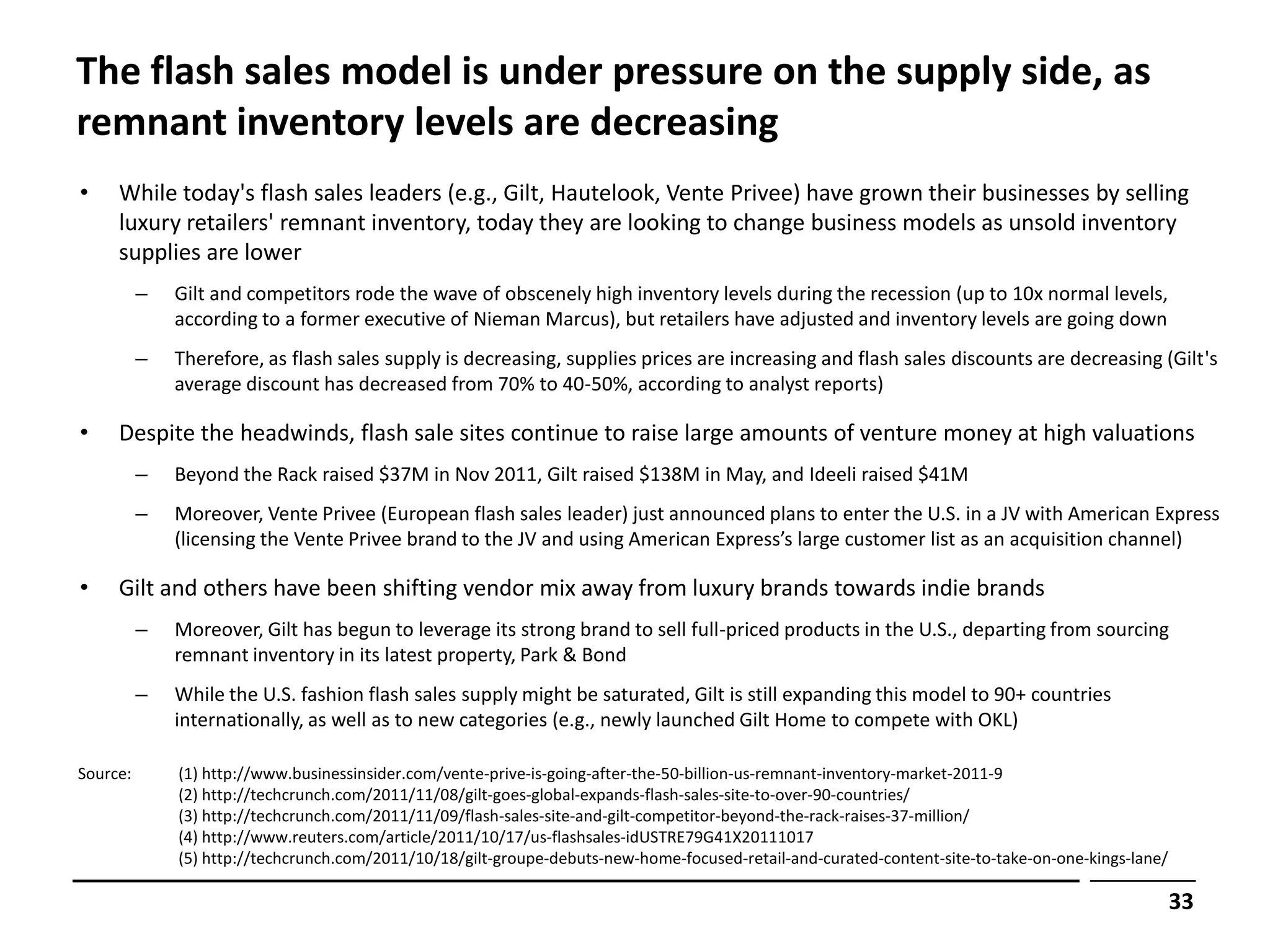
The flash salesmodel is under pressure on the supply side, as
remnant inventory levels are decreasing
• While today's flash sales leaders (e.g., Gilt, Hautelook, Vente Privee) have grown their businesses by selling
luxury retailers' remnant inventory, today they are looking to change business models as unsold inventory
supplies are lower
– Gilt and competitors rode the wave of obscenely high inventory levels during the recession (up to 10x normal levels,
according to a former executive of Nieman Marcus), but retailers have adjusted and inventory levels are going down
– Therefore, as flash sales supply is decreasing, supplies prices are increasing and flash sales discounts are decreasing (Gilt's
average discount has decreased from 70% to 40-50%, according to analyst reports)
• Despite the headwinds, flash sale sites continue to raise large amounts of venture money at high valuations
– Beyond the Rack raised $37M in Nov 2011, Gilt raised $138M in May, and Ideeli raised $41M
– Moreover, Vente Privee (European flash sales leader) just announced plans to enter the U.S. in a JV with American Express
(licensing the Vente Privee brand to the JV and using American Express’s large customer list as an acquisition channel)
• Gilt and others have been shifting vendor mix away from luxury brands towards indie brands
– Moreover, Gilt has begun to leverage its strong brand to sell full-priced products in the U.S., departing from sourcing
remnant inventory in its latest property, Park & Bond
– While the U.S. fashion flash sales supply might be saturated, Gilt is still expanding this model to 90+ countries
internationally, as well as to new categories (e.g., newly launched Gilt Home to compete with OKL)
Source: (1) http://www.businessinsider.com/vente-prive-is-going-after-the-50-billion-us-remnant-inventory-market-2011-9
(2) http://techcrunch.com/2011/11/08/gilt-goes-global-expands-flash-sales-site-to-over-90-countries/
(3) http://techcrunch.com/2011/11/09/flash-sales-site-and-gilt-competitor-beyond-the-rack-raises-37-million/
(4) http://www.reuters.com/article/2011/10/17/us-flashsales-idUSTRE79G41X20111017
(5) http://techcrunch.com/2011/10/18/gilt-groupe-debuts-new-home-focused-retail-and-curated-content-site-to-take-on-one-kings-lane/
33
34.
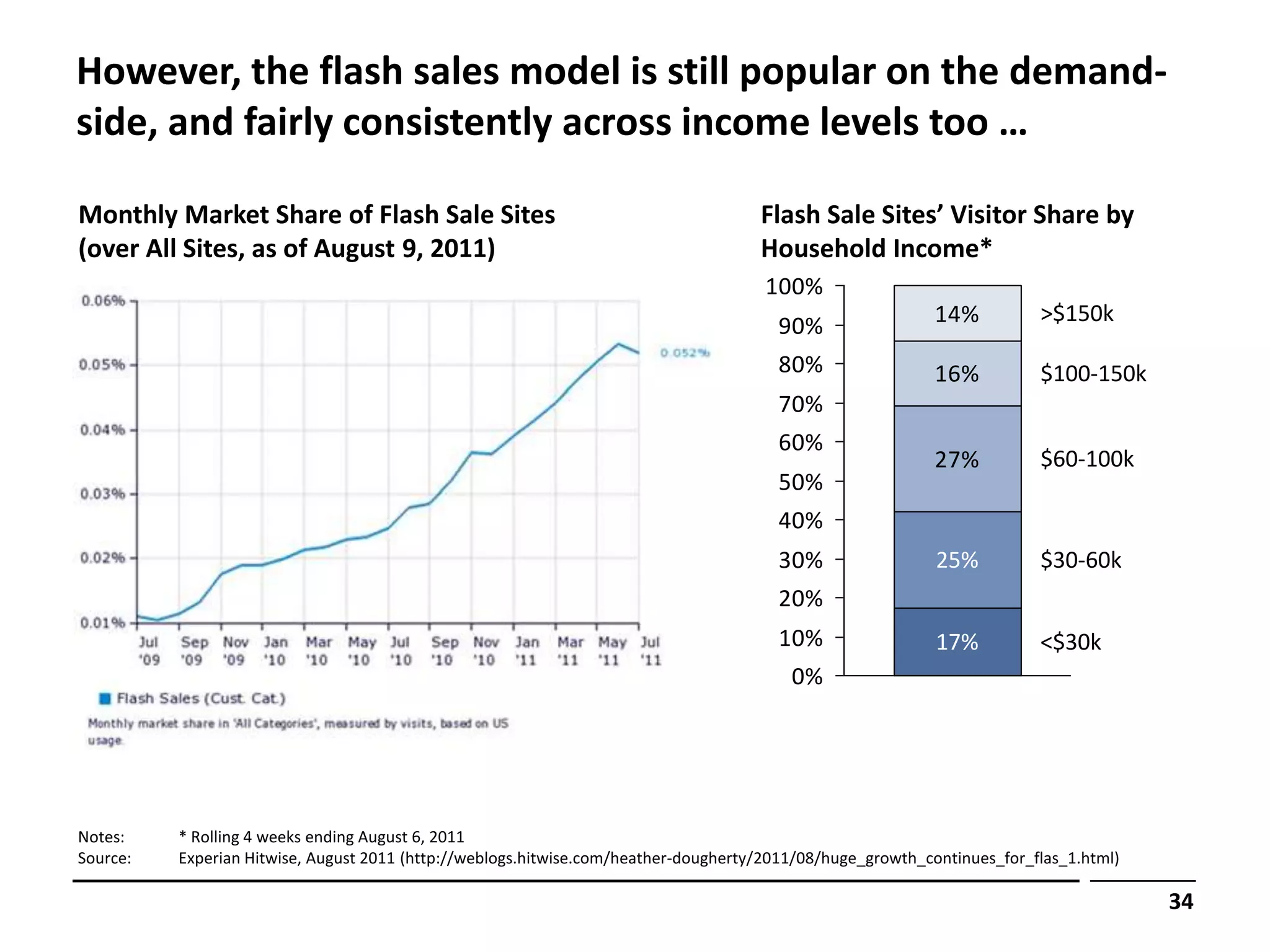
However, the flashsales model is still popular on the demand-
side, and fairly consistently across income levels too …
Monthly Market Share of Flash Sale Sites Flash Sale Sites’ Visitor Share by
(over All Sites, as of August 9, 2011) Household Income*
100%
14% >$150k
90%
80% 16% $100-150k
70%
60%
27% $60-100k
50%
40%
30% 25% $30-60k
20%
10% 17% <$30k
0%
Notes: * Rolling 4 weeks ending August 6, 2011
Source: Experian Hitwise, August 2011 (http://weblogs.hitwise.com/heather-dougherty/2011/08/huge_growth_continues_for_flas_1.html)
34
35.
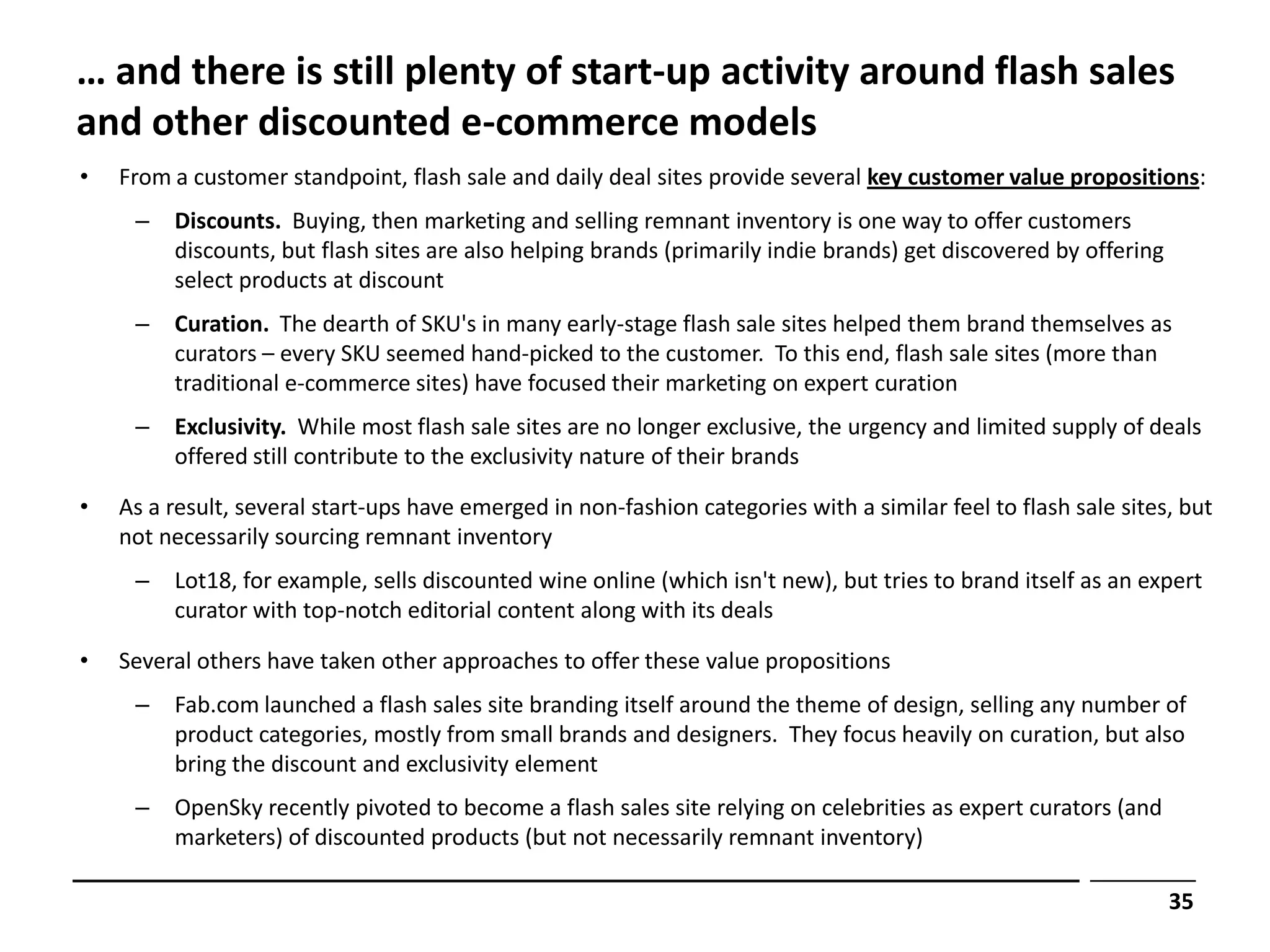
… and thereis still plenty of start-up activity around flash sales
and other discounted e-commerce models
• From a customer standpoint, flash sale and daily deal sites provide several key customer value propositions:
– Discounts. Buying, then marketing and selling remnant inventory is one way to offer customers
discounts, but flash sites are also helping brands (primarily indie brands) get discovered by offering
select products at discount
– Curation. The dearth of SKU's in many early-stage flash sale sites helped them brand themselves as
curators – every SKU seemed hand-picked to the customer. To this end, flash sale sites (more than
traditional e-commerce sites) have focused their marketing on expert curation
– Exclusivity. While most flash sale sites are no longer exclusive, the urgency and limited supply of deals
offered still contribute to the exclusivity nature of their brands
• As a result, several start-ups have emerged in non-fashion categories with a similar feel to flash sale sites, but
not necessarily sourcing remnant inventory
– Lot18, for example, sells discounted wine online (which isn't new), but tries to brand itself as an expert
curator with top-notch editorial content along with its deals
• Several others have taken other approaches to offer these value propositions
– Fab.com launched a flash sales site branding itself around the theme of design, selling any number of
product categories, mostly from small brands and designers. They focus heavily on curation, but also
bring the discount and exclusivity element
– OpenSky recently pivoted to become a flash sales site relying on celebrities as expert curators (and
marketers) of discounted products (but not necessarily remnant inventory)
35
36.
Flash sales e-commercehas contributed several customer
acquisition best practices to the e-commerce ecosystem
• Traditionally, e-commerce e-mail programs were seen as spammy
Email Programs
• However, given the “daily” nature of flash deals, consumers began to accept well-
crafted daily emails from flash and daily deal sites
• Other e-commerce sites have begun using content-filled email programs (e.g., Etsy)
• Excellent editorial, photography, and videos are being used in blog forms to attract
“Content and
and retain customers, pointing them to products
Commerce”
• Flash sales sites like Net-a-Porter and Gilt are bringing “content and commerce” to
the forefront as a key customer acquisition tool
• One Kings Lane, Lot18, Birchbox, and Etsy are just a few other companies building
out heavy content programs
• Flash sales took off as social media sharing features were becoming mainstream, and
Referral Programs made inviting friends to an e-commerce membership easy
• Along with flash sales’ belief in high lifetime value (retaining customers with email
and content programs), many offer credit discounts to members who successfully
invite friends to join as members
Source: http://www.quora.com/Why-is-e-commerce-such-a-hot-area-in-venture-capital-now
36
37.
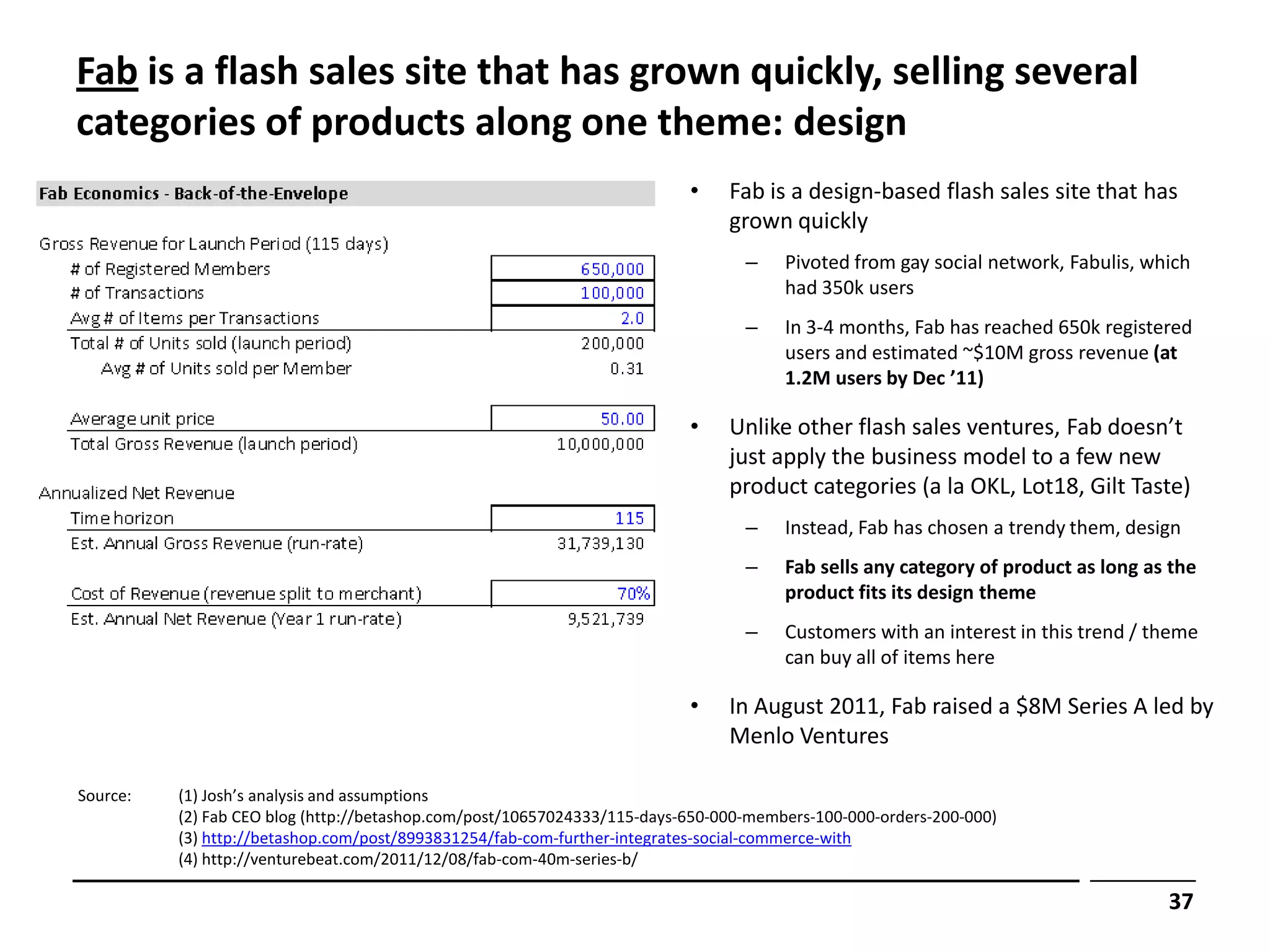
Fab is aflash sales site that has grown quickly, selling several
categories of products along one theme: design
• Fab is a design-based flash sales site that has
grown quickly
– Pivoted from gay social network, Fabulis, which
had 350k users
– In 3-4 months, Fab has reached 650k registered
users and estimated ~$10M gross revenue (at
1.2M users by Dec ’11)
• Unlike other flash sales ventures, Fab doesn’t
just apply the business model to a few new
product categories (a la OKL, Lot18, Gilt Taste)
– Instead, Fab has chosen a trendy them, design
– Fab sells any category of product as long as the
product fits its design theme
– Customers with an interest in this trend / theme
can buy all of items here
• In August 2011, Fab raised a $8M Series A led by
Menlo Ventures
Source: (1) Josh’s analysis and assumptions
(2) Fab CEO blog (http://betashop.com/post/10657024333/115-days-650-000-members-100-000-orders-200-000)
(3) http://betashop.com/post/8993831254/fab-com-further-integrates-social-commerce-with
(4) http://venturebeat.com/2011/12/08/fab-com-40m-series-b/
37
38.
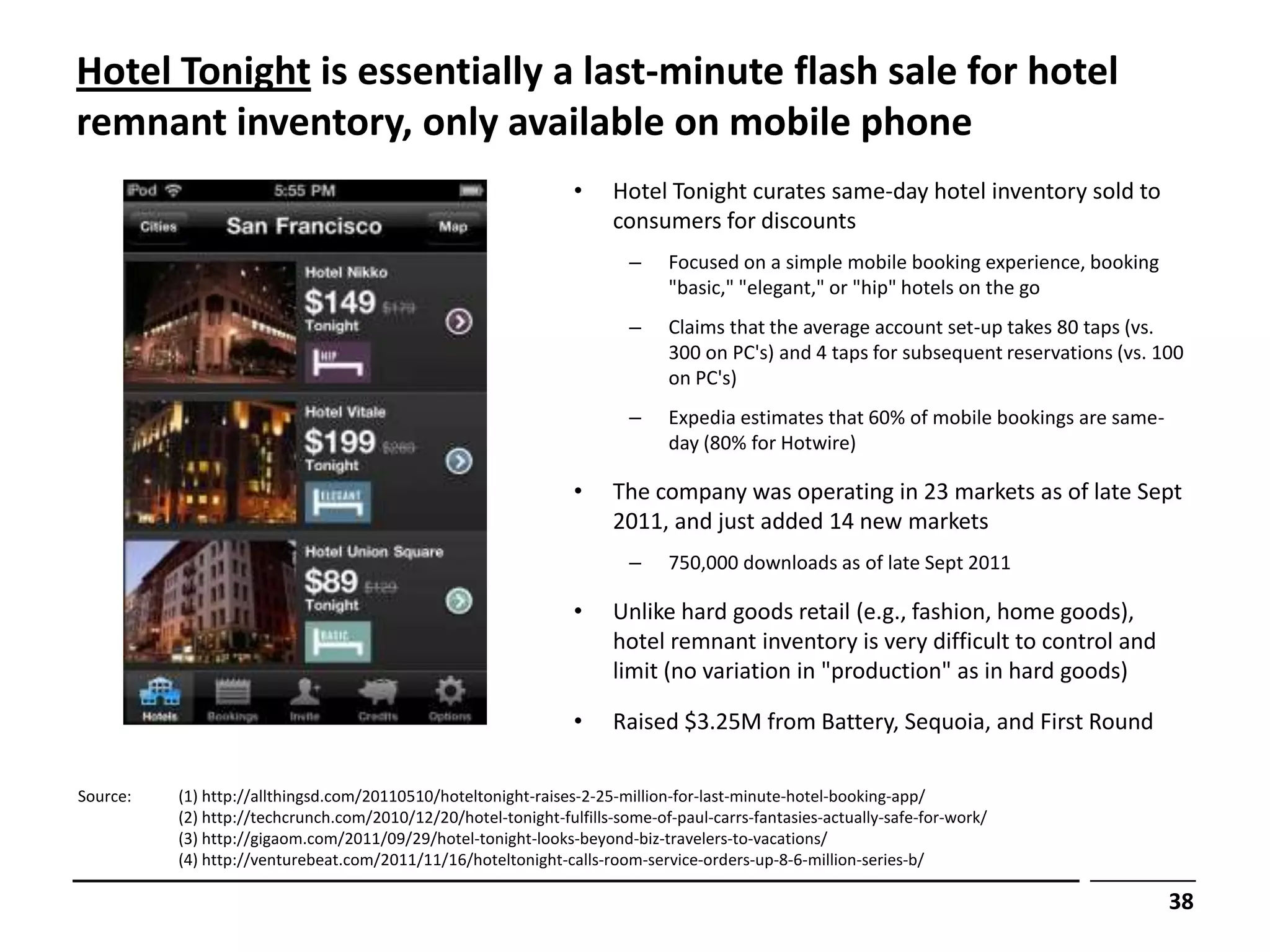
Hotel Tonight isessentially a last-minute flash sale for hotel
remnant inventory, only available on mobile phone
• Hotel Tonight curates same-day hotel inventory sold to
consumers for discounts
– Focused on a simple mobile booking experience, booking
"basic," "elegant," or "hip" hotels on the go
– Claims that the average account set-up takes 80 taps (vs.
300 on PC's) and 4 taps for subsequent reservations (vs. 100
on PC's)
– Expedia estimates that 60% of mobile bookings are same-
day (80% for Hotwire)
• The company was operating in 23 markets as of late Sept
2011, and just added 14 new markets
– 750,000 downloads as of late Sept 2011
• Unlike hard goods retail (e.g., fashion, home goods),
hotel remnant inventory is very difficult to control and
limit (no variation in "production" as in hard goods)
• Raised $3.25M from Battery, Sequoia, and First Round
Source: (1) http://allthingsd.com/20110510/hoteltonight-raises-2-25-million-for-last-minute-hotel-booking-app/
(2) http://techcrunch.com/2010/12/20/hotel-tonight-fulfills-some-of-paul-carrs-fantasies-actually-safe-for-work/
(3) http://gigaom.com/2011/09/29/hotel-tonight-looks-beyond-biz-travelers-to-vacations/
(4) http://venturebeat.com/2011/11/16/hoteltonight-calls-room-service-orders-up-8-6-million-series-b/
38
39.
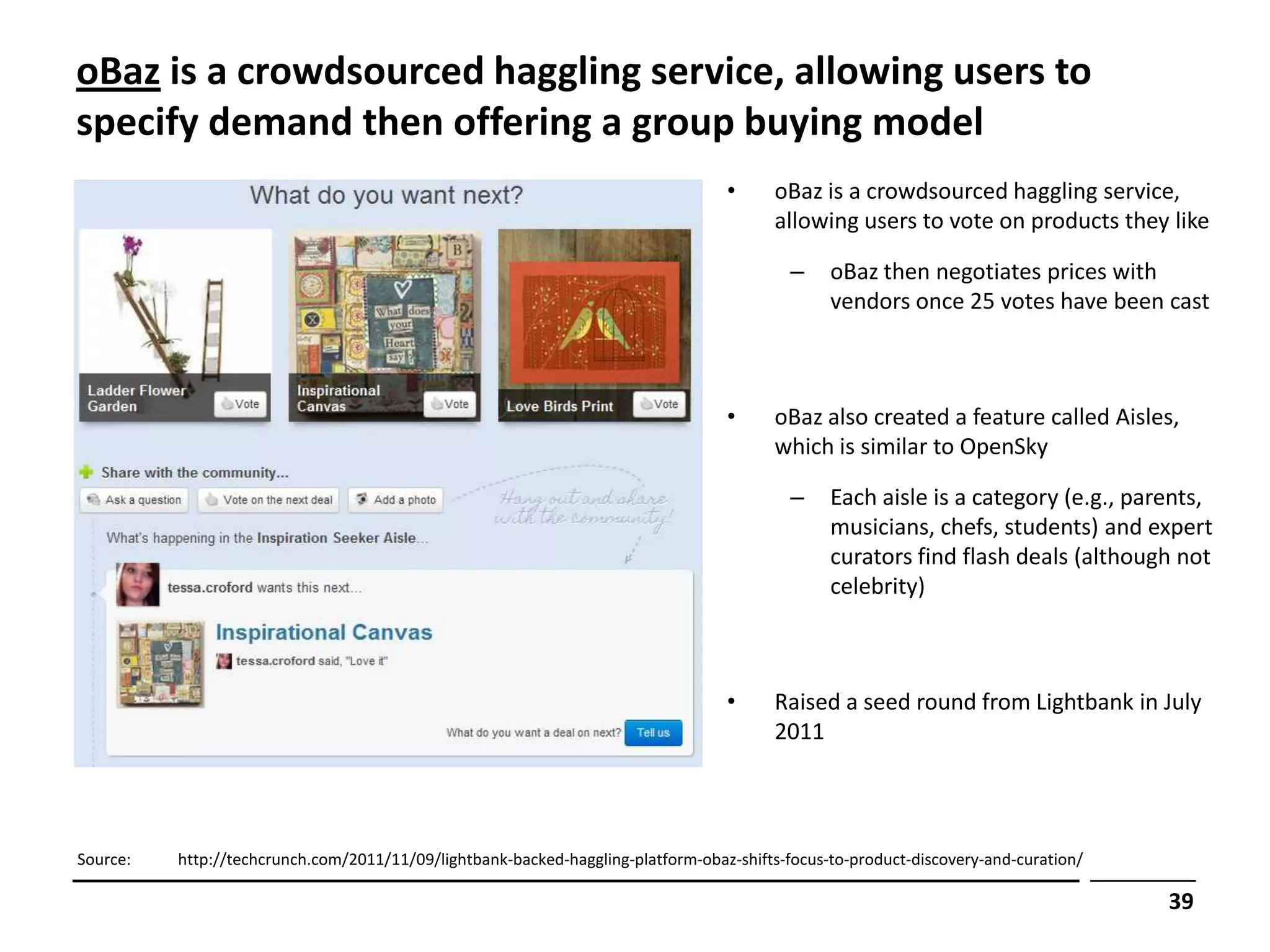
oBaz is acrowdsourced haggling service, allowing users to
specify demand then offering a group buying model
• oBaz is a crowdsourced haggling service,
allowing users to vote on products they like
– oBaz then negotiates prices with
vendors once 25 votes have been cast
• oBaz also created a feature called Aisles,
which is similar to OpenSky
– Each aisle is a category (e.g., parents,
musicians, chefs, students) and expert
curators find flash deals (although not
celebrity)
• Raised a seed round from Lightbank in July
2011
Source: http://techcrunch.com/2011/11/09/lightbank-backed-haggling-platform-obaz-shifts-focus-to-product-discovery-and-curation/
39
40.
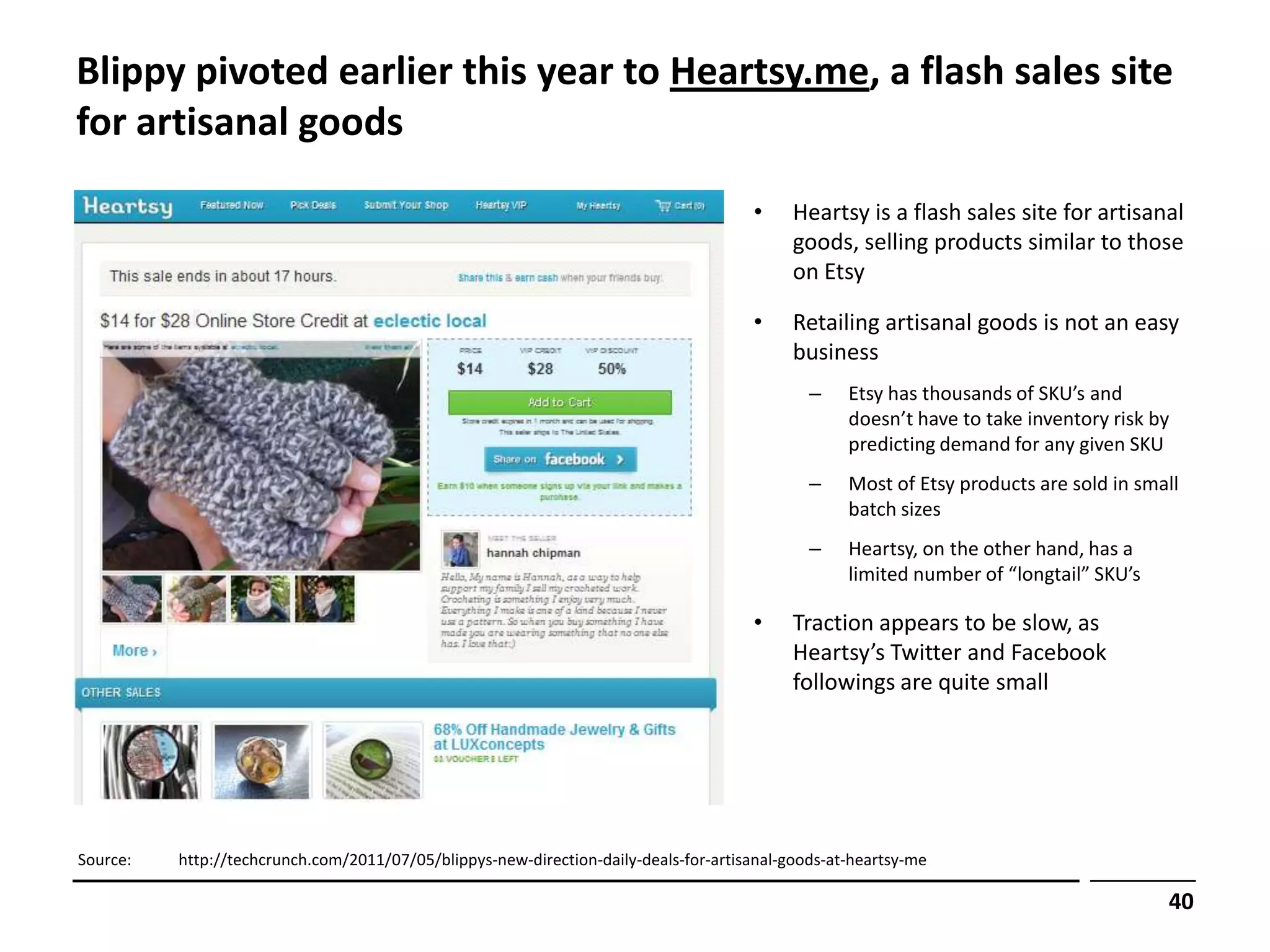
Blippy pivoted earlierthis year to Heartsy.me, a flash sales site
for artisanal goods
• Heartsy is a flash sales site for artisanal
goods, selling products similar to those
on Etsy
• Retailing artisanal goods is not an easy
business
– Etsy has thousands of SKU’s and
doesn’t have to take inventory risk by
predicting demand for any given SKU
– Most of Etsy products are sold in small
batch sizes
– Heartsy, on the other hand, has a
limited number of “longtail” SKU’s
• Traction appears to be slow, as
Heartsy’s Twitter and Facebook
followings are quite small
Source: http://techcrunch.com/2011/07/05/blippys-new-direction-daily-deals-for-artisanal-goods-at-heartsy-me
40
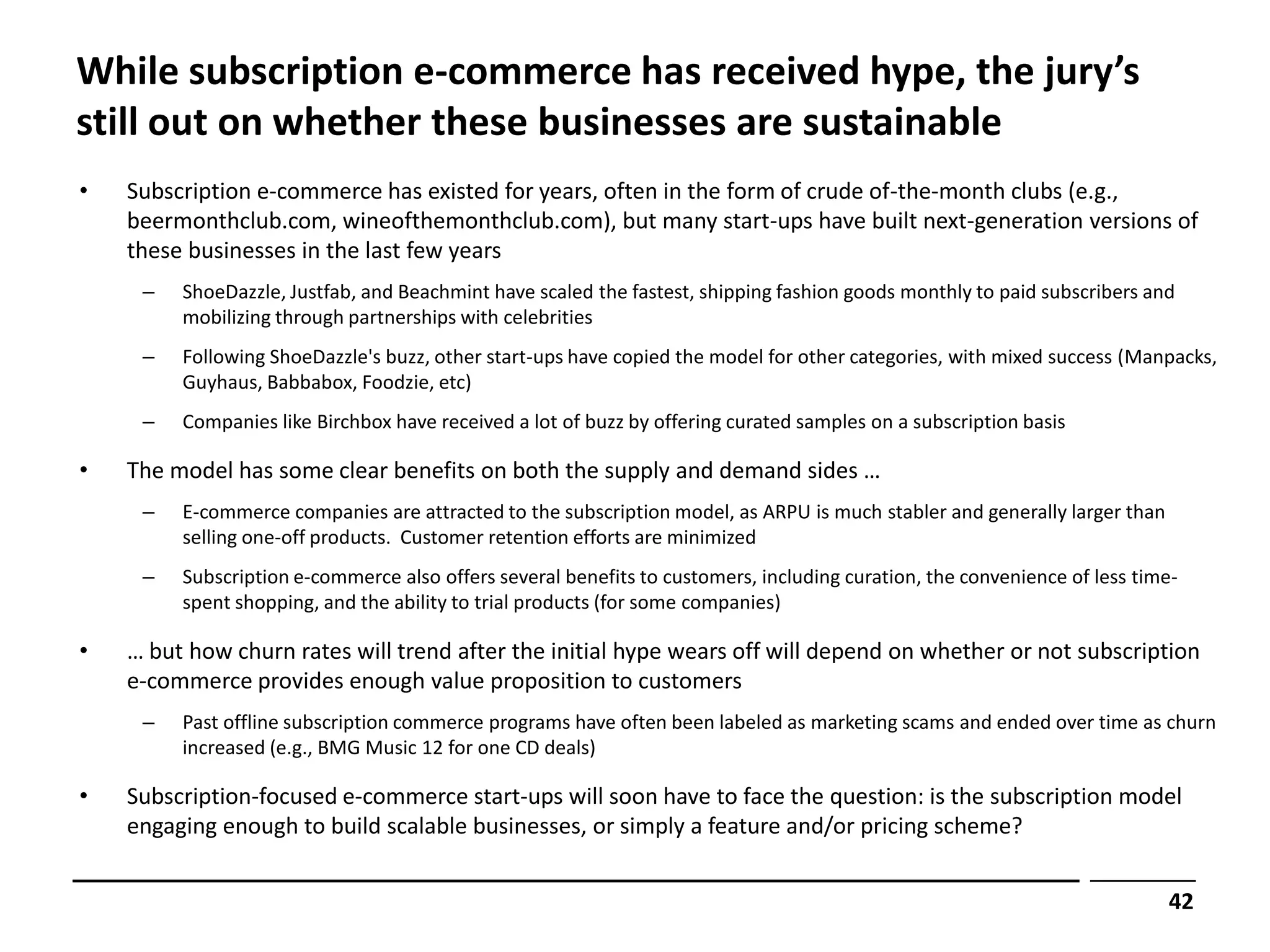
While subscription e-commercehas received hype, the jury’s
still out on whether these businesses are sustainable
• Subscription e-commerce has existed for years, often in the form of crude of-the-month clubs (e.g.,
beermonthclub.com, wineofthemonthclub.com), but many start-ups have built next-generation versions of
these businesses in the last few years
– ShoeDazzle, Justfab, and Beachmint have scaled the fastest, shipping fashion goods monthly to paid subscribers and
mobilizing through partnerships with celebrities
– Following ShoeDazzle's buzz, other start-ups have copied the model for other categories, with mixed success (Manpacks,
Guyhaus, Babbabox, Foodzie, etc)
– Companies like Birchbox have received a lot of buzz by offering curated samples on a subscription basis
• The model has some clear benefits on both the supply and demand sides …
– E-commerce companies are attracted to the subscription model, as ARPU is much stabler and generally larger than
selling one-off products. Customer retention efforts are minimized
– Subscription e-commerce also offers several benefits to customers, including curation, the convenience of less time-
spent shopping, and the ability to trial products (for some companies)
• … but how churn rates will trend after the initial hype wears off will depend on whether or not subscription
e-commerce provides enough value proposition to customers
– Past offline subscription commerce programs have often been labeled as marketing scams and ended over time as churn
increased (e.g., BMG Music 12 for one CD deals)
• Subscription-focused e-commerce start-ups will soon have to face the question: is the subscription model
engaging enough to build scalable businesses, or simply a feature and/or pricing scheme?
42
43.
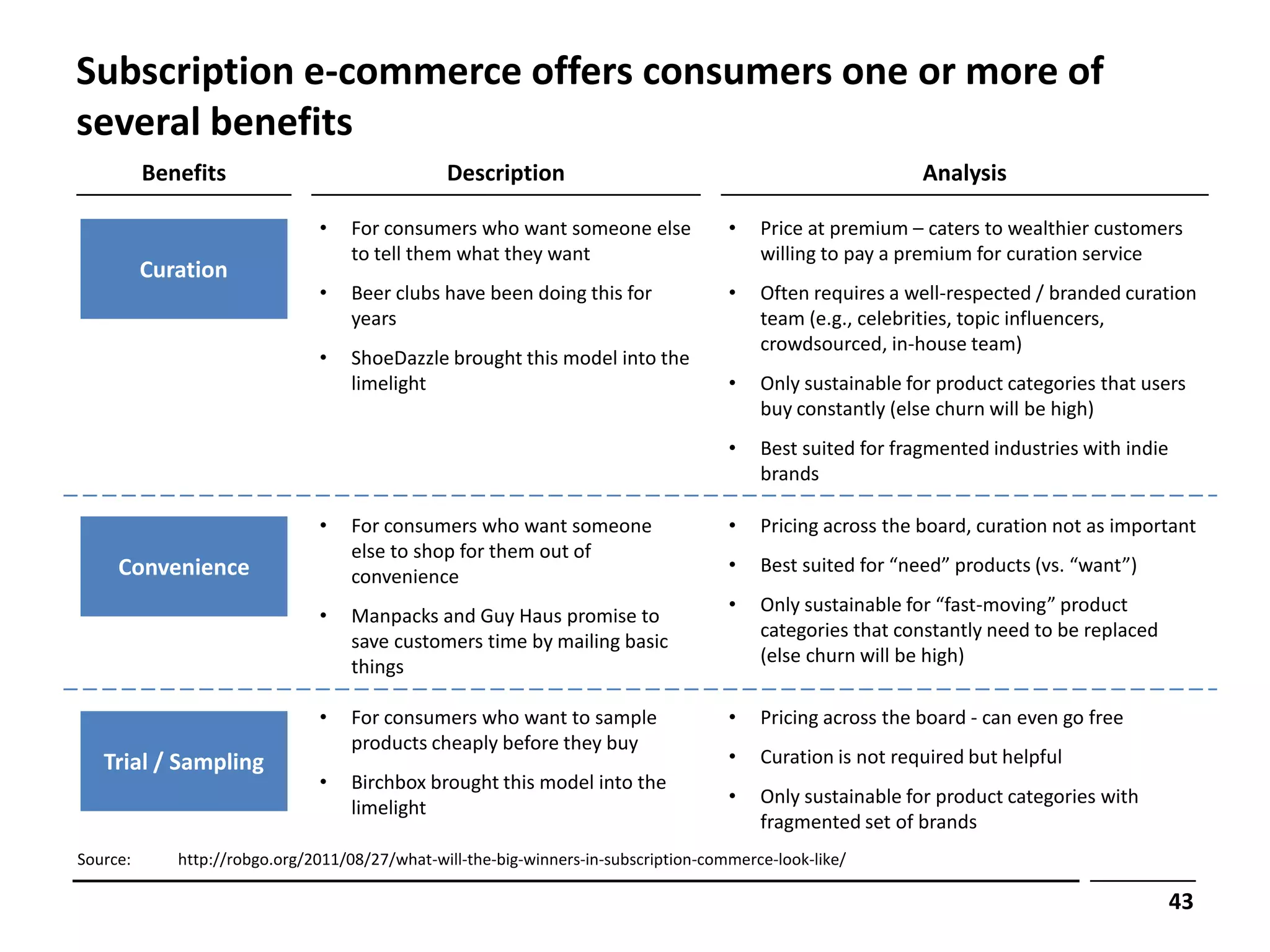
Subscription e-commerce offersconsumers one or more of
several benefits
Benefits Description Analysis
• For consumers who want someone else • Price at premium – caters to wealthier customers
to tell them what they want willing to pay a premium for curation service
Curation
• Beer clubs have been doing this for • Often requires a well-respected / branded curation
years team (e.g., celebrities, topic influencers,
crowdsourced, in-house team)
• ShoeDazzle brought this model into the
limelight • Only sustainable for product categories that users
buy constantly (else churn will be high)
• Best suited for fragmented industries with indie
brands
• For consumers who want someone • Pricing across the board, curation not as important
else to shop for them out of
Convenience • Best suited for “need” products (vs. “want”)
convenience
• Only sustainable for “fast-moving” product
• Manpacks and Guy Haus promise to
categories that constantly need to be replaced
save customers time by mailing basic
(else churn will be high)
things
• For consumers who want to sample • Pricing across the board - can even go free
products cheaply before they buy
Trial / Sampling • Curation is not required but helpful
• Birchbox brought this model into the
• Only sustainable for product categories with
limelight
fragmented set of brands
Source: http://robgo.org/2011/08/27/what-will-the-big-winners-in-subscription-commerce-look-like/
43
44.
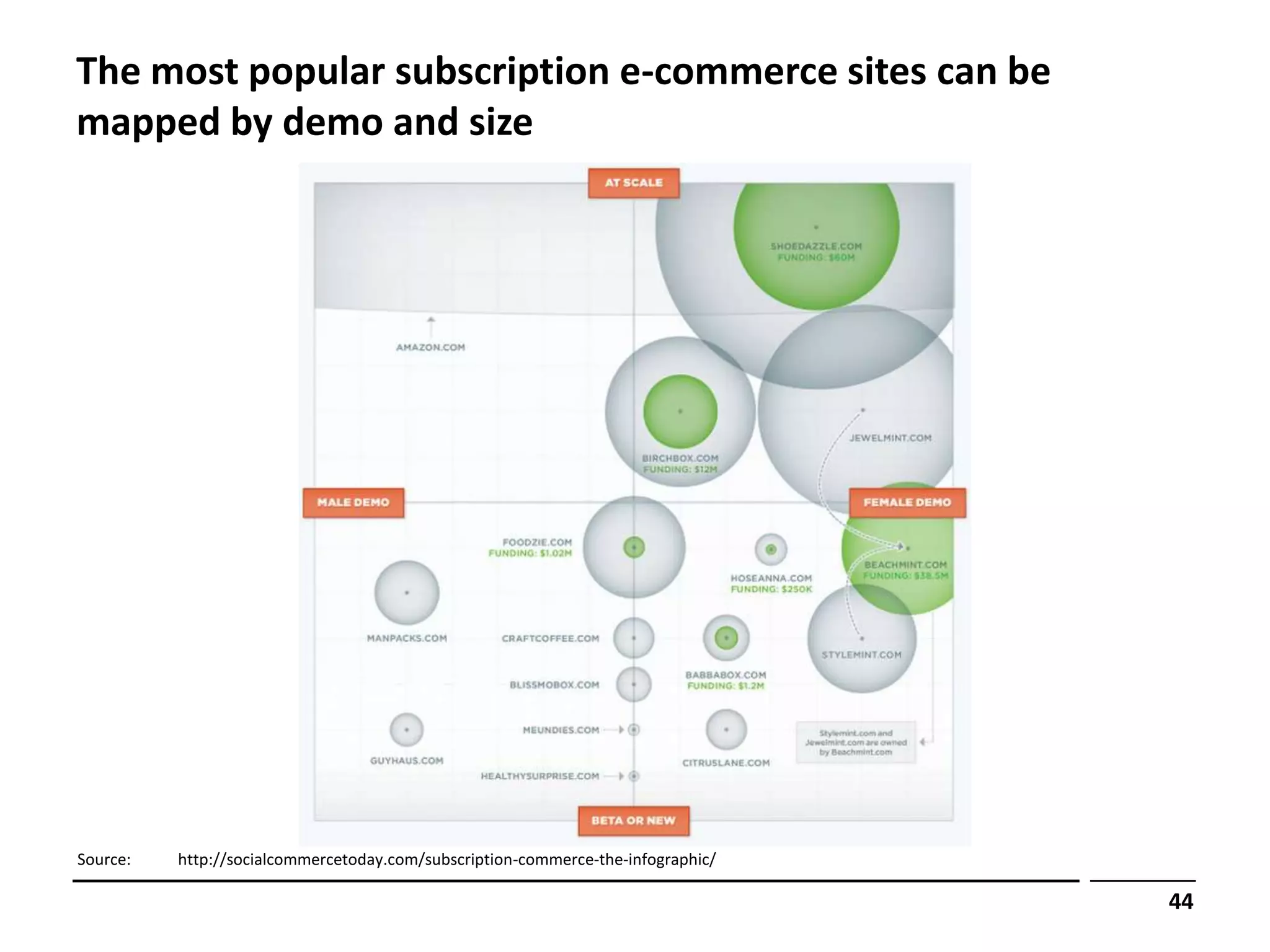
The most popularsubscription e-commerce sites can be
mapped by demo and size
Source: http://socialcommercetoday.com/subscription-commerce-the-infographic/
44
45.
ShoeDazzle was afrontrunner in the subscription e-commerce
space, leveraging celebrity influence as a “curator”
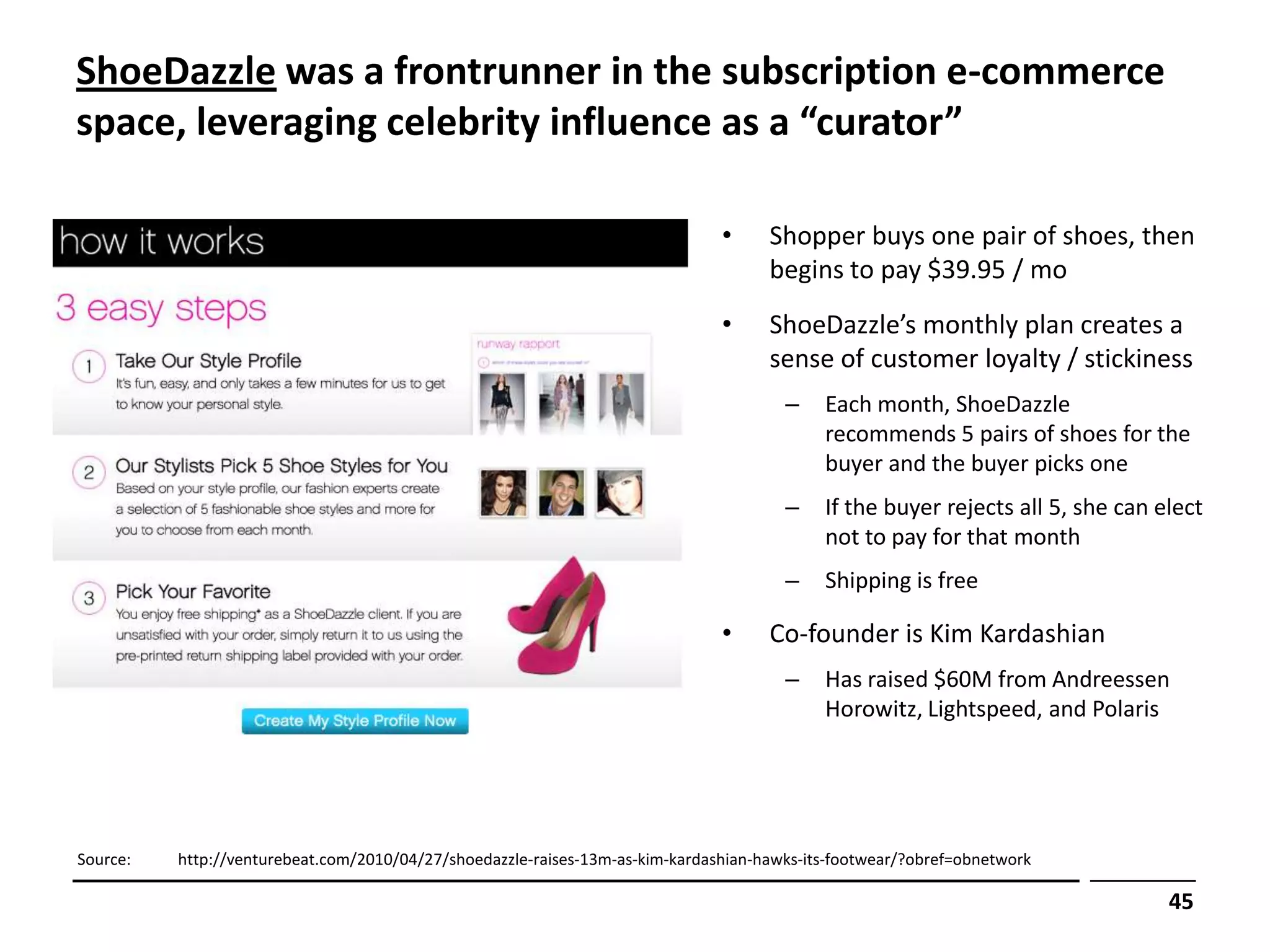
• Shopper buys one pair of shoes, then
begins to pay $39.95 / mo
• ShoeDazzle’s monthly plan creates a
sense of customer loyalty / stickiness
– Each month, ShoeDazzle
recommends 5 pairs of shoes for the
buyer and the buyer picks one
– If the buyer rejects all 5, she can elect
not to pay for that month
– Shipping is free
• Co-founder is Kim Kardashian
– Has raised $60M from Andreessen
Horowitz, Lightspeed, and Polaris
Source: http://venturebeat.com/2010/04/27/shoedazzle-raises-13m-as-kim-kardashian-hawks-its-footwear/?obref=obnetwork
45
46.
Justfab and Beachminthave also taken the celebrity-curation
subscription model, with more emphasis on new categories
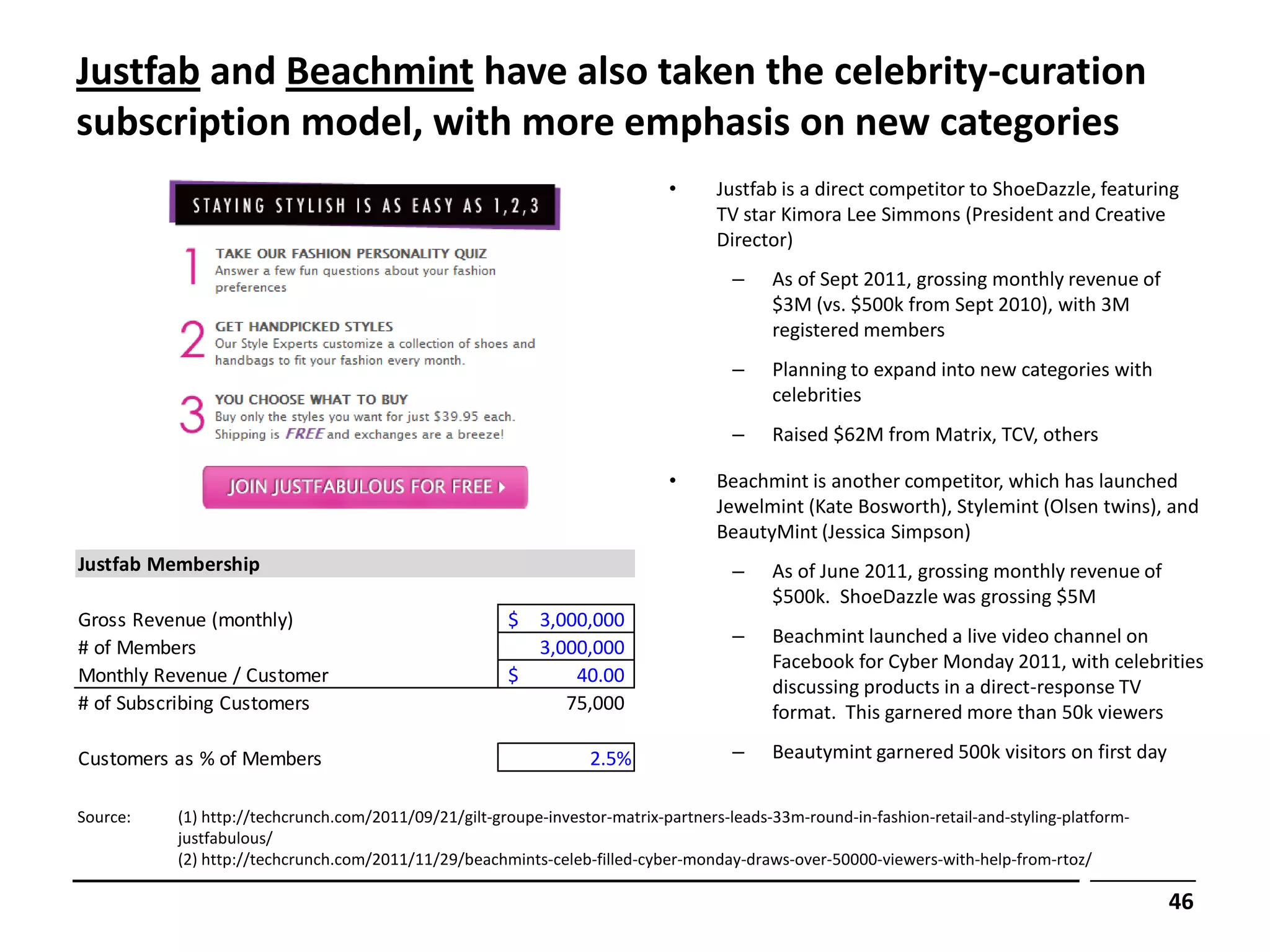
• Justfab is a direct competitor to ShoeDazzle, featuring
TV star Kimora Lee Simmons (President and Creative
Director)
– As of Sept 2011, grossing monthly revenue of
$3M (vs. $500k from Sept 2010), with 3M
registered members
– Planning to expand into new categories with
celebrities
– Raised $62M from Matrix, TCV, others
• Beachmint is another competitor, which has launched
Jewelmint (Kate Bosworth), Stylemint (Olsen twins), and
BeautyMint (Jessica Simpson)
Justfab Membership – As of June 2011, grossing monthly revenue of
$500k. ShoeDazzle was grossing $5M
Gross Revenue (monthly) $ 3,000,000
– Beachmint launched a live video channel on
# of Members 3,000,000
Facebook for Cyber Monday 2011, with celebrities
Monthly Revenue / Customer $ 40.00
discussing products in a direct-response TV
# of Subscribing Customers 75,000 format. This garnered more than 50k viewers
Customers as % of Members 2.5% – Beautymint garnered 500k visitors on first day
Source: (1) http://techcrunch.com/2011/09/21/gilt-groupe-investor-matrix-partners-leads-33m-round-in-fashion-retail-and-styling-platform-
justfabulous/
(2) http://techcrunch.com/2011/11/29/beachmints-celeb-filled-cyber-monday-draws-over-50000-viewers-with-help-from-rtoz/
46
47.
Babbaco is asubscription site for kids educational products
Description Investment Thesis
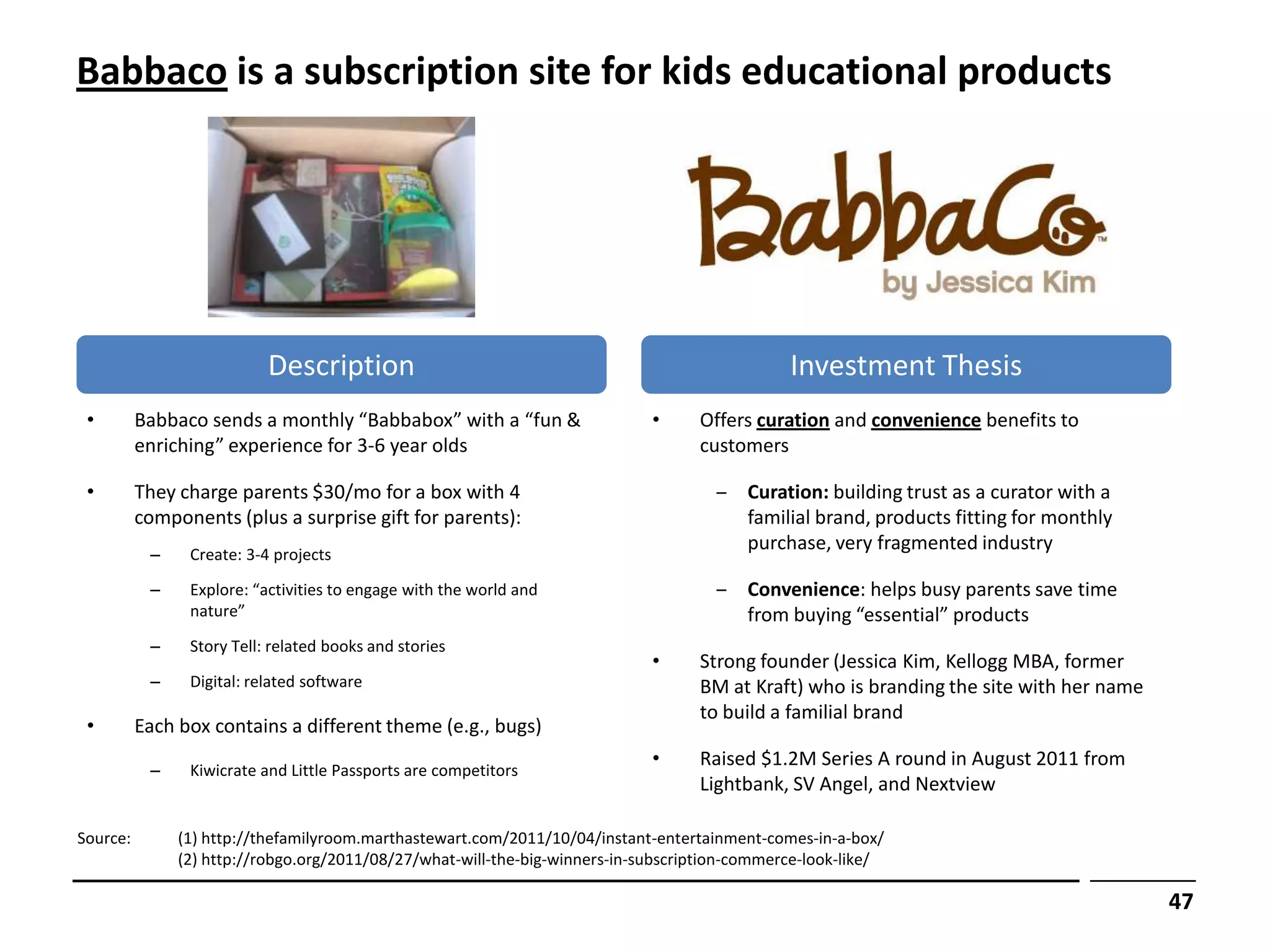
• Babbaco sends a monthly “Babbabox” with a “fun & • Offers curation and convenience benefits to
enriching” experience for 3-6 year olds customers
• They charge parents $30/mo for a box with 4 ‒ Curation: building trust as a curator with a
components (plus a surprise gift for parents): familial brand, products fitting for monthly
purchase, very fragmented industry
– Create: 3-4 projects
– Explore: “activities to engage with the world and ‒ Convenience: helps busy parents save time
nature” from buying “essential” products
– Story Tell: related books and stories
• Strong founder (Jessica Kim, Kellogg MBA, former
– Digital: related software BM at Kraft) who is branding the site with her name
to build a familial brand
• Each box contains a different theme (e.g., bugs)
• Raised $1.2M Series A round in August 2011 from
– Kiwicrate and Little Passports are competitors
Lightbank, SV Angel, and Nextview
Source: (1) http://thefamilyroom.marthastewart.com/2011/10/04/instant-entertainment-comes-in-a-box/
(2) http://robgo.org/2011/08/27/what-will-the-big-winners-in-subscription-commerce-look-like/
47
48.
H.Bloom is asubscription site for kids educational products
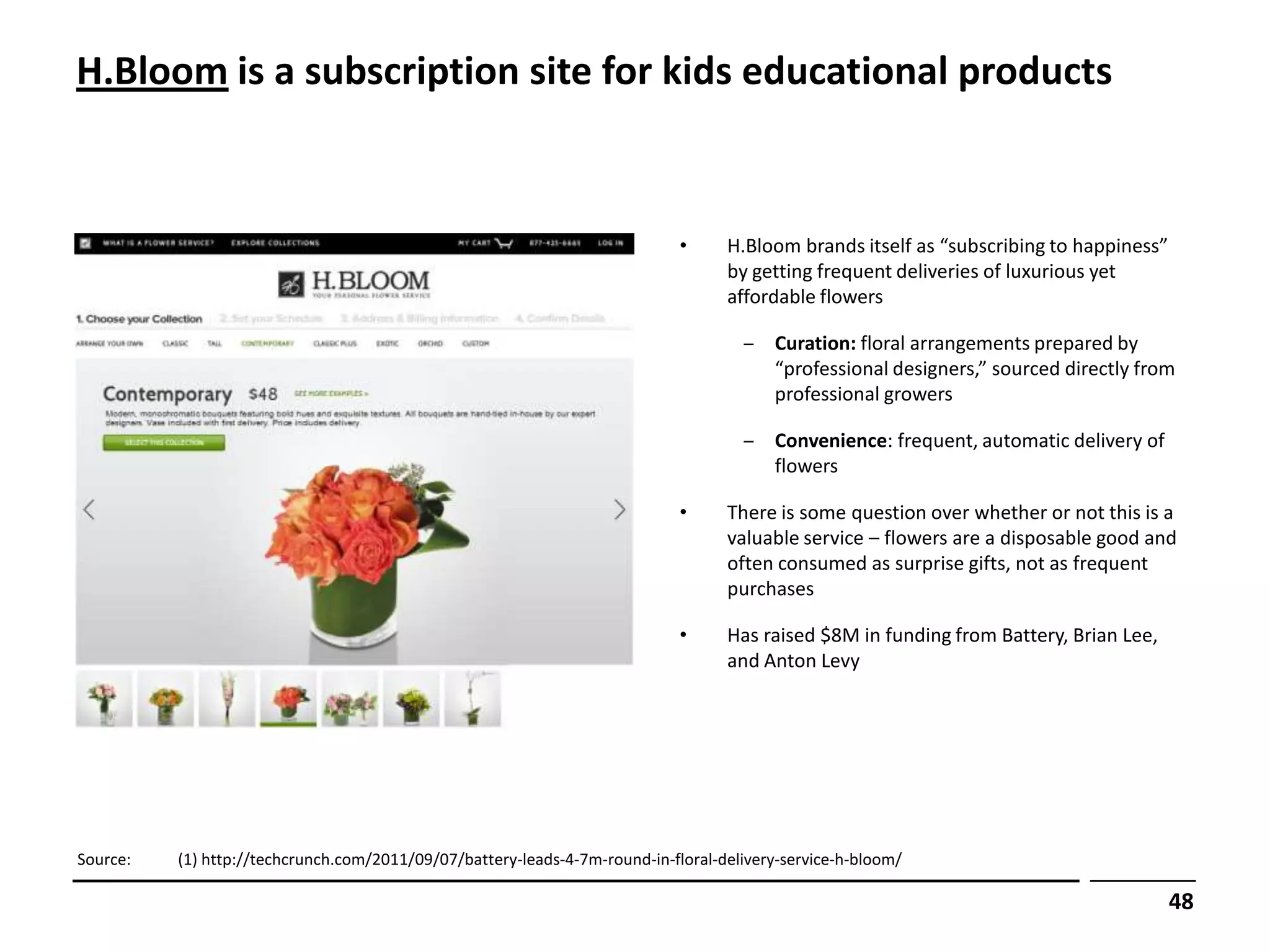
• H.Bloom brands itself as “subscribing to happiness”
by getting frequent deliveries of luxurious yet
affordable flowers
‒ Curation: floral arrangements prepared by
“professional designers,” sourced directly from
professional growers
‒ Convenience: frequent, automatic delivery of
flowers
• There is some question over whether or not this is a
valuable service – flowers are a disposable good and
often consumed as surprise gifts, not as frequent
purchases
• Has raised $8M in funding from Battery, Brian Lee,
and Anton Levy
Source: (1) http://techcrunch.com/2011/09/07/battery-leads-4-7m-round-in-floral-delivery-service-h-bloom/
48
49.
Blissmobox is asubscription site for organic / health goods, with
a flash sales arm as well
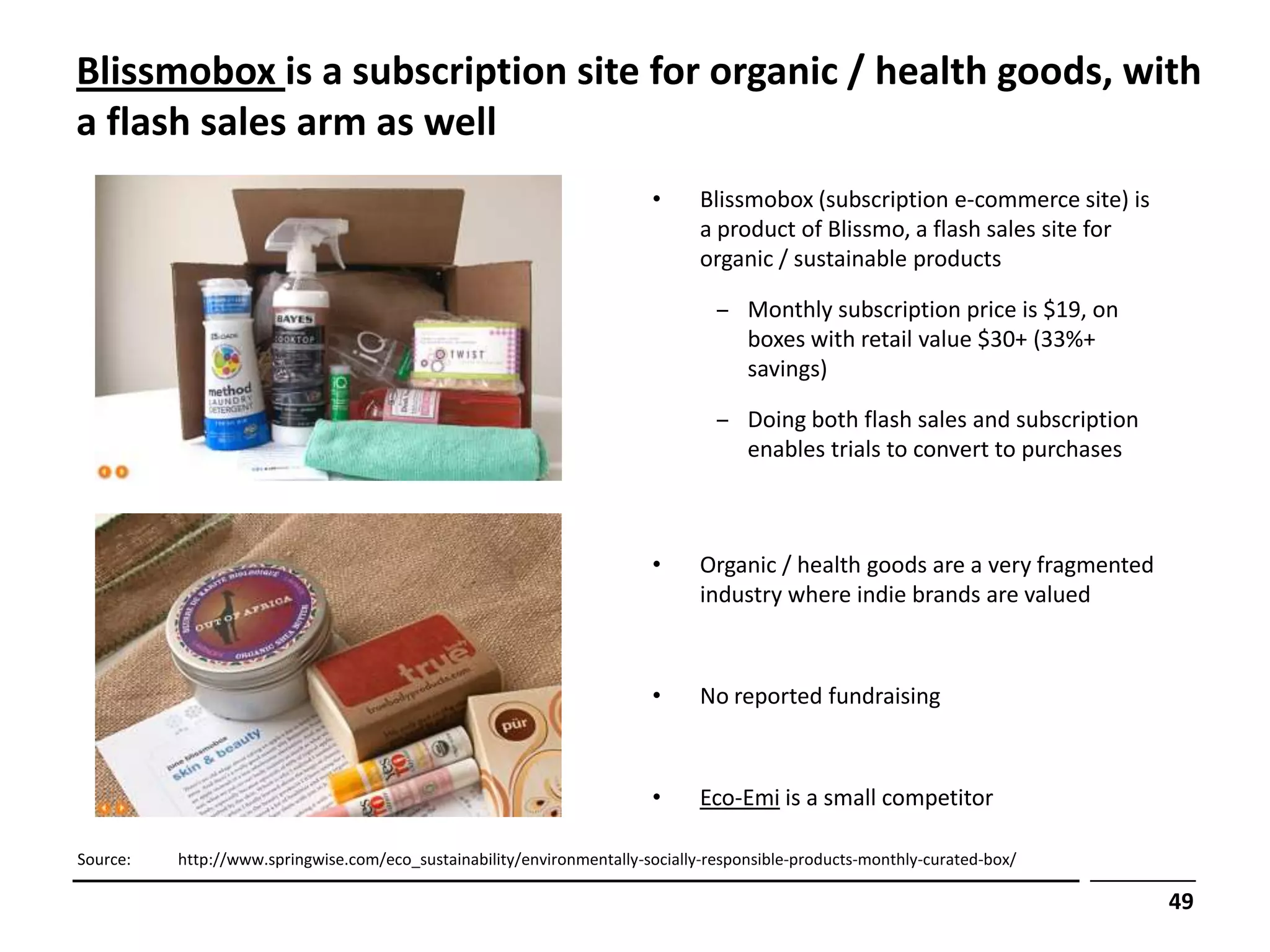
• Blissmobox (subscription e-commerce site) is
a product of Blissmo, a flash sales site for
organic / sustainable products
‒ Monthly subscription price is $19, on
boxes with retail value $30+ (33%+
savings)
‒ Doing both flash sales and subscription
enables trials to convert to purchases
• Organic / health goods are a very fragmented
industry where indie brands are valued
• No reported fundraising
• Eco-Emi is a small competitor
Source: http://www.springwise.com/eco_sustainability/environmentally-socially-responsible-products-monthly-curated-box/
49
50.
Quarterly.co allows usersto pick “contributors” (influencers)
they want to receive gifts from each quarter
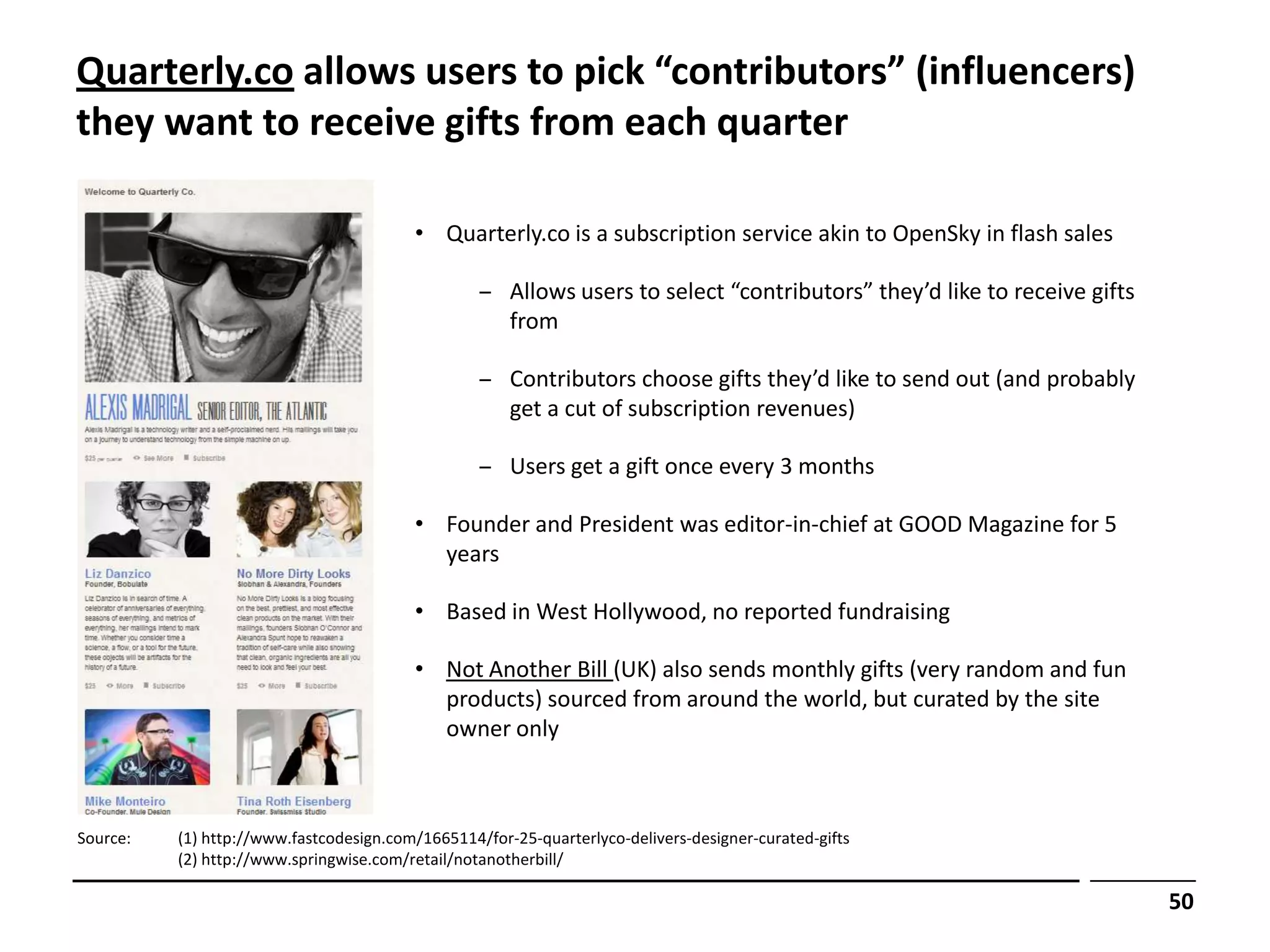
• Quarterly.co is a subscription service akin to OpenSky in flash sales
‒ Allows users to select “contributors” they’d like to receive gifts
from
‒ Contributors choose gifts they’d like to send out (and probably
get a cut of subscription revenues)
‒ Users get a gift once every 3 months
• Founder and President was editor-in-chief at GOOD Magazine for 5
years
• Based in West Hollywood, no reported fundraising
• Not Another Bill (UK) also sends monthly gifts (very random and fun
products) sourced from around the world, but curated by the site
owner only
Source: (1) http://www.fastcodesign.com/1665114/for-25-quarterlyco-delivers-designer-curated-gifts
(2) http://www.springwise.com/retail/notanotherbill/
50
51.
MeUndies is apremium underwear company based in Beverly
Hills
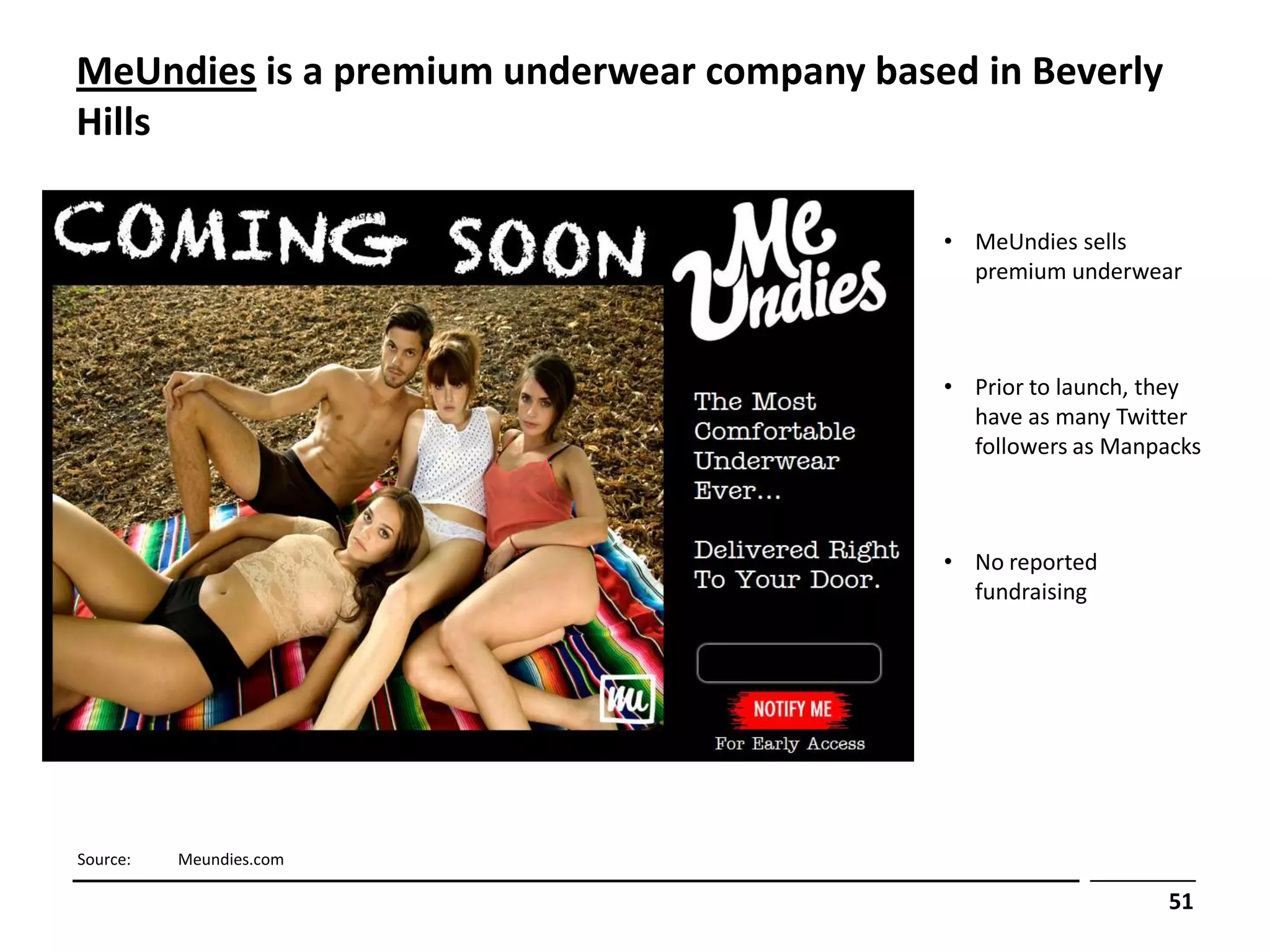
• MeUndies sells
premium underwear
• Prior to launch, they
have as many Twitter
followers as Manpacks
• No reported
fundraising
Source: Meundies.com
51
52.
Companies like Birchboxhave seized the opportunity to package
samples (sourced at no cost) into subscription programs
• Sampling is a more economically enticing model of subscription e-commerce, as companies typically face no
COGS and can potentially be paid on both sides (brands pay for sample distribution and consumers pay for
products)
– Operating profit margins are in the 25% range for a representative early-stage company in this space
(<10k customers), and they project margins to increase to 30-40% as the company scales (assuming
little advertising spend)
– Costs primarily reside in SG&A, outsourced warehousing and logistics, salaries, etc.
• Vendors often have un-distributed trial inventory (some estimates believe this is 90%+), so companies like
Birchbox are desirable partners
– Historically, samples are distributed in retail stores (for free or sold), through the mail (e.g., with Sunday newspapers), or
other channels (e.g., hotels)
– Online distribution of samples has yet to scale
• While vendors desire that sampling results in full-sized product purchases, they also value customer
feedback, which Birchbox aims to offer but to a limit (voluntary user surveys, user preferences, etc)
52
53.
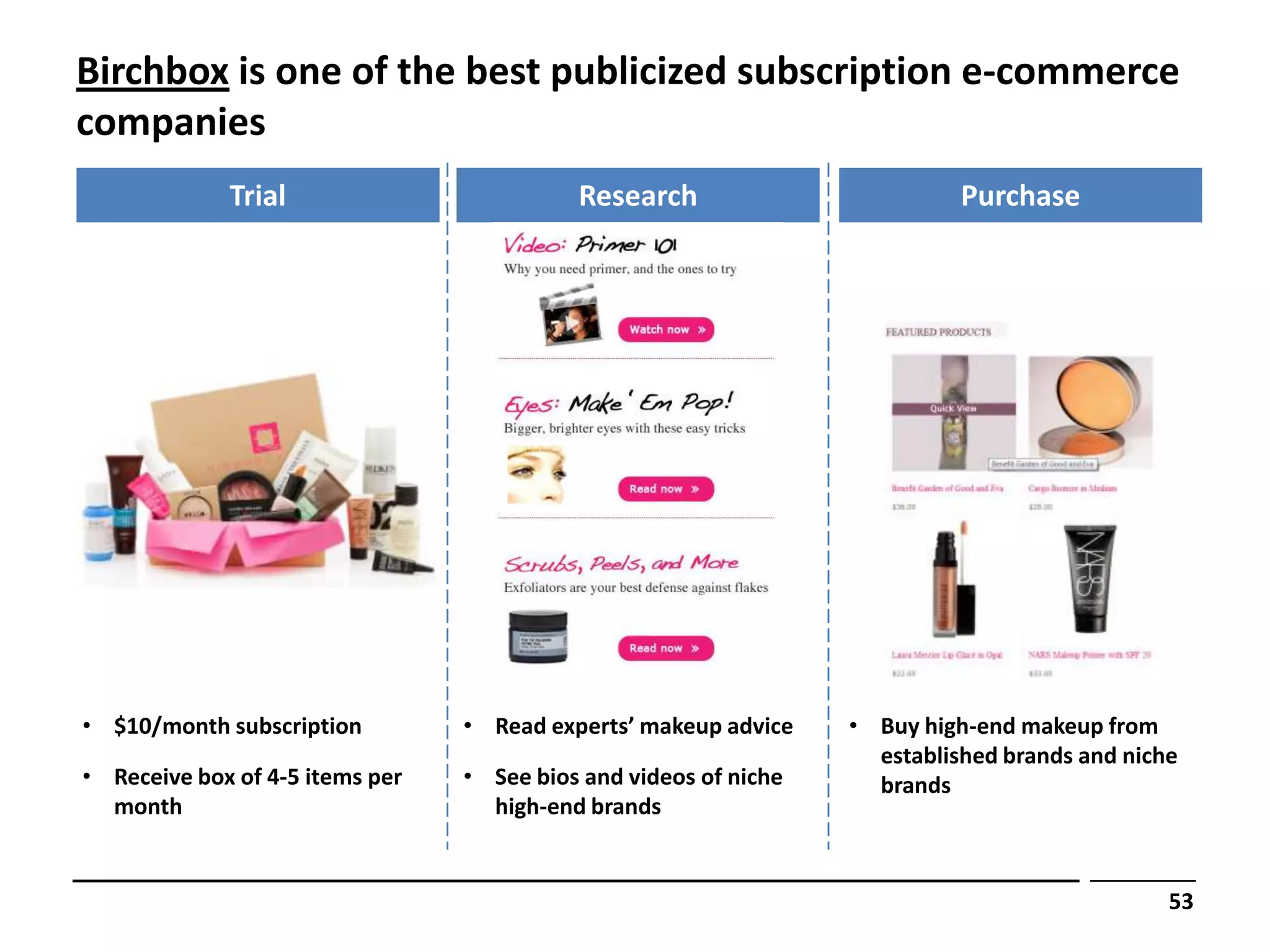
Birchbox is oneof the best publicized subscription e-commerce
companies
Trial Research Purchase
• $10/month subscription • Read experts’ makeup advice • Buy high-end makeup from
established brands and niche
• Receive box of 4-5 items per • See bios and videos of niche brands
month high-end brands
53
54.
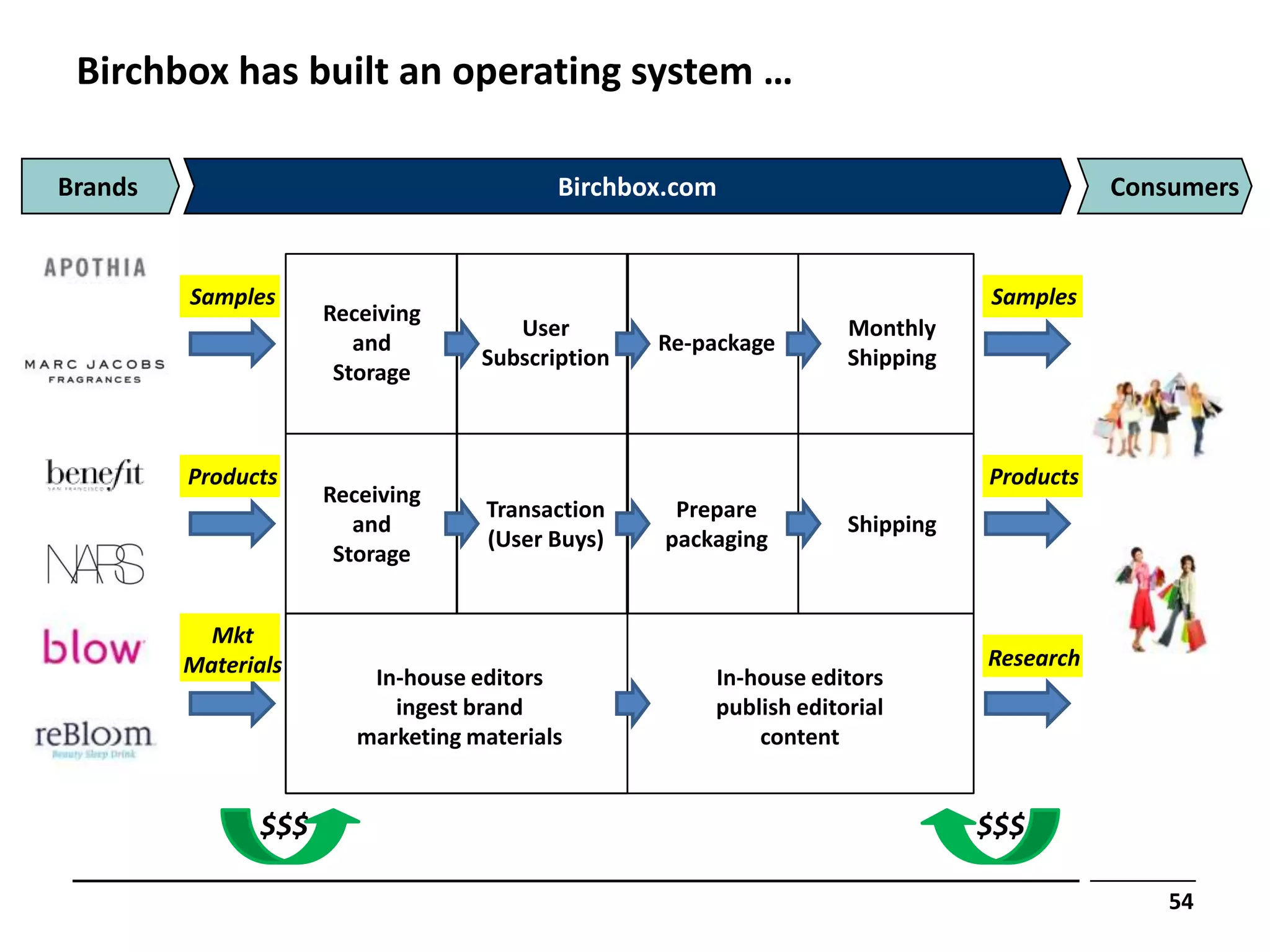
Birchbox has builtan operating system …
Brands Birchbox.com Consumers
Samples Samples
Receiving
User Monthly
and Re-package
Subscription Shipping
Storage
Products Products
Receiving
Transaction Prepare
and Shipping
(User Buys) packaging
Storage
Mkt
Materials Research
In-house editors In-house editors
ingest brand publish editorial
marketing materials content
$$$ $$$
54
55.
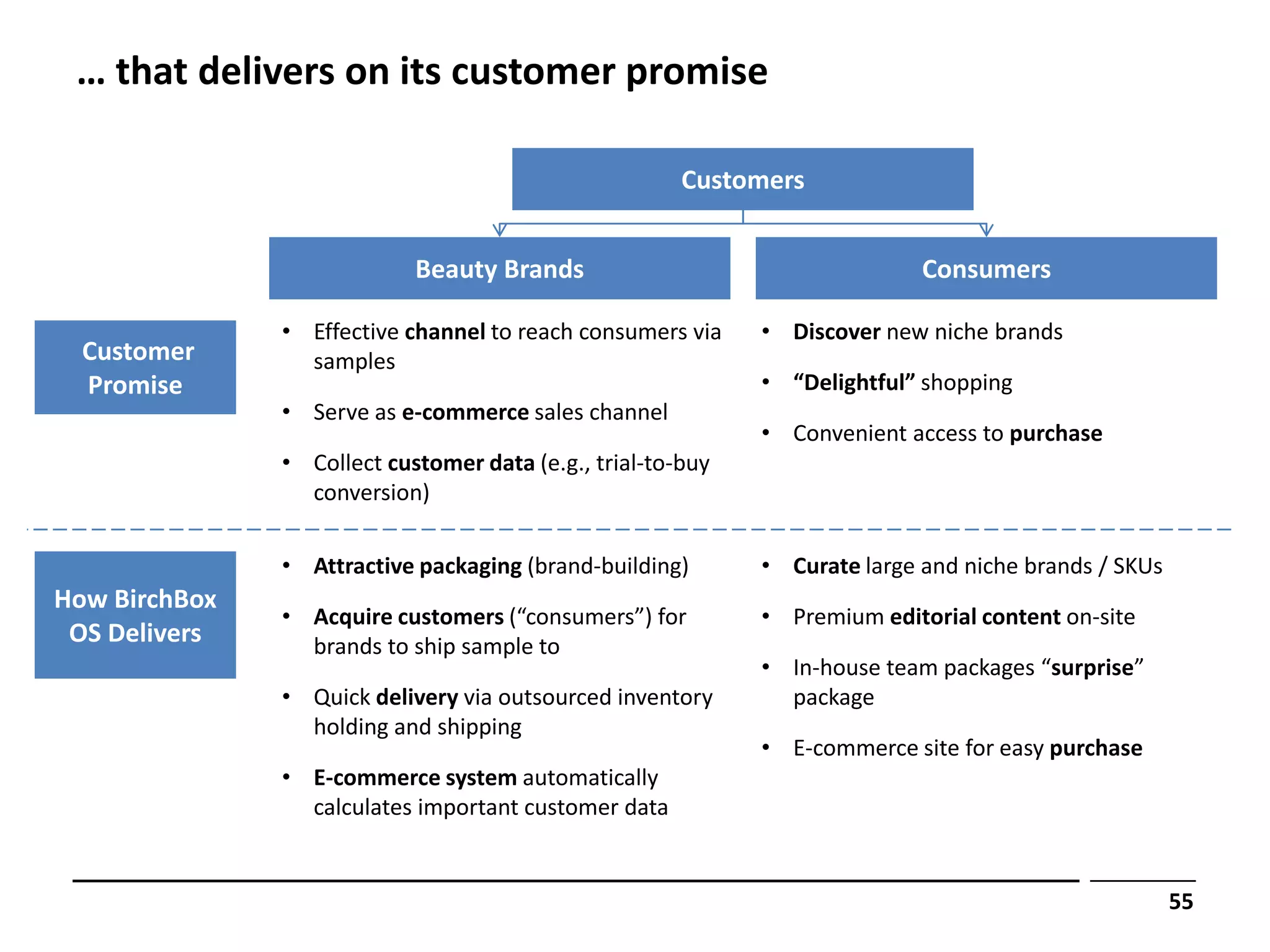
… that deliverson its customer promise
Customers
Beauty Brands Consumers
• Effective channel to reach consumers via • Discover new niche brands
Customer samples
Promise • “Delightful” shopping
• Serve as e-commerce sales channel
• Convenient access to purchase
• Collect customer data (e.g., trial-to-buy
conversion)
• Attractive packaging (brand-building) • Curate large and niche brands / SKUs
How BirchBox
• Acquire customers (“consumers”) for • Premium editorial content on-site
OS Delivers brands to ship sample to
• In-house team packages “surprise”
• Quick delivery via outsourced inventory package
holding and shipping
• E-commerce site for easy purchase
• E-commerce system automatically
calculates important customer data
55
56.
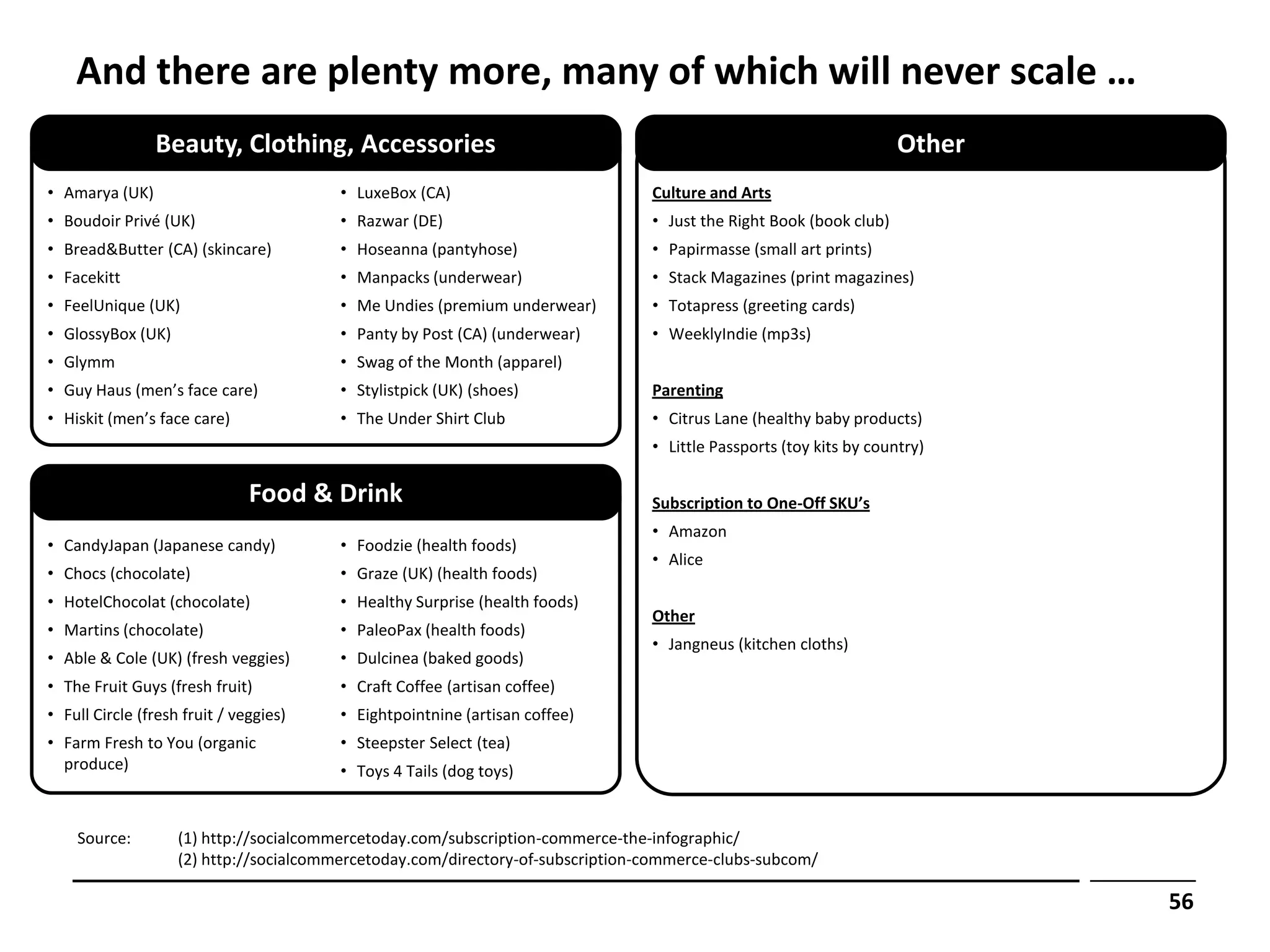
And there areplenty more, many of which will never scale …
Beauty, Clothing, Accessories Other
• Amarya (UK) • LuxeBox (CA) Culture and Arts
• Boudoir Privé (UK) • Razwar (DE) • Just the Right Book (book club)
• Bread&Butter (CA) (skincare) • Hoseanna (pantyhose) • Papirmasse (small art prints)
• Facekitt • Manpacks (underwear) • Stack Magazines (print magazines)
• FeelUnique (UK) • Me Undies (premium underwear) • Totapress (greeting cards)
• GlossyBox (UK) • Panty by Post (CA) (underwear) • WeeklyIndie (mp3s)
• Glymm • Swag of the Month (apparel)
• Guy Haus (men’s face care) • Stylistpick (UK) (shoes) Parenting
• Hiskit (men’s face care) • The Under Shirt Club • Citrus Lane (healthy baby products)
• Little Passports (toy kits by country)
Food & Drink Subscription to One-Off SKU’s
• Amazon
• CandyJapan (Japanese candy) • Foodzie (health foods)
• Alice
• Chocs (chocolate) • Graze (UK) (health foods)
• HotelChocolat (chocolate) • Healthy Surprise (health foods)
Other
• Martins (chocolate) • PaleoPax (health foods)
• Jangneus (kitchen cloths)
• Able & Cole (UK) (fresh veggies) • Dulcinea (baked goods)
• The Fruit Guys (fresh fruit) • Craft Coffee (artisan coffee)
• Full Circle (fresh fruit / veggies) • Eightpointnine (artisan coffee)
• Farm Fresh to You (organic • Steepster Select (tea)
produce) • Toys 4 Tails (dog toys)
Source: (1) http://socialcommercetoday.com/subscription-commerce-the-infographic/
(2) http://socialcommercetoday.com/directory-of-subscription-commerce-clubs-subcom/
56
C2C marketplaces havebecome a popular start-up model
recently, led by niche sites like AirBnB
• Online C2C marketplaces can be broadly segmented into three buckets: hard good purchases (e.g., eBay),
hard good rentals (AirBnB), and services (Skillshare)
‒ Traditionally, eBay is the preeminent online marketplace and facilitated transactions on hard good
purchases. Direct competitors threatened eBay for the general merchandise market, while niche
players like Etsy targeted hand-crafted goods and expanded to tangential categories
‒ Meanwhile, Craigslist has traditionally served as the go-to portal for consumers looking for hard good
rentals and services online (and to some extent, hard good purchases), but without facilitating
transactions
‒ However, lately, niche players have risen up to make monetizable businesses out of Craisglist use cases
(e.g., AirBnB for temporary housing, OKCupid for personals, TaskRabbit for errands, Skillshare for
lessons, etc)
• Traditional models of online marketplaces (or intermediate solutions like Craigslist) leave many unmet needs
on the table, which these start-ups are tackling but few have perfected
‒ Hard good purchases: seller’s time spent uploading product information, trust in sellers shipping on-
time (or at all), inaccurate representation of product quality / condition
‒ Hard good rentals: safety / trust in both buyers and sellers, ease of working with insurance companies,
true need for rental across multiple geographies (e.g., Uber is only useful in certain large cities)
‒ Services: safety and trust in sellers, ability of relationships to be taken offline after initial transaction
58
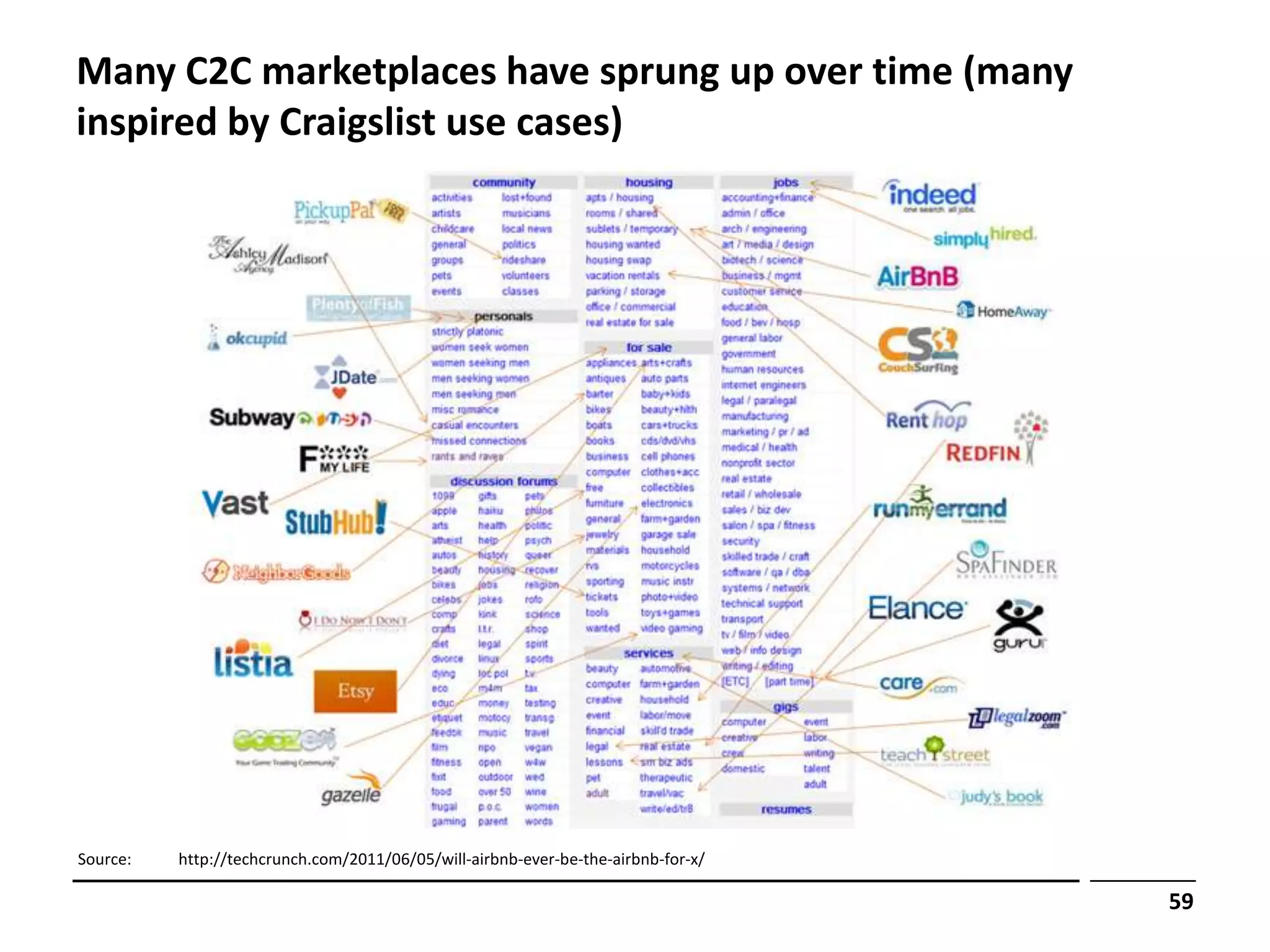
59.
Many C2C marketplaceshave sprung up over time (many
inspired by Craigslist use cases)
Source: http://techcrunch.com/2011/06/05/will-airbnb-ever-be-the-airbnb-for-x/
59
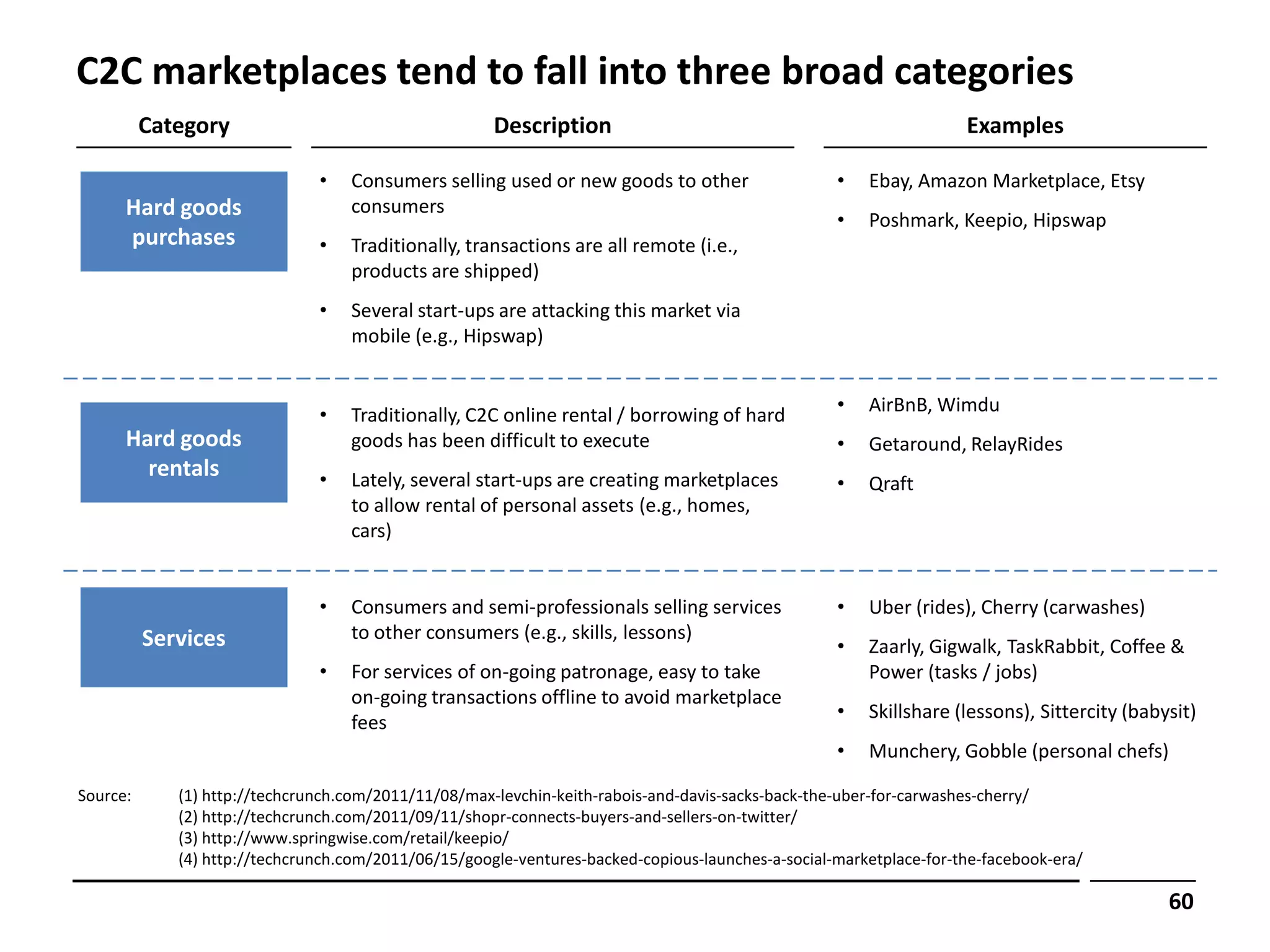
60.
C2C marketplaces tendto fall into three broad categories
Category Description Examples
• Consumers selling used or new goods to other • Ebay, Amazon Marketplace, Etsy
Hard goods consumers
• Poshmark, Keepio, Hipswap
purchases • Traditionally, transactions are all remote (i.e.,
products are shipped)
• Several start-ups are attacking this market via
mobile (e.g., Hipswap)
• Traditionally, C2C online rental / borrowing of hard • AirBnB, Wimdu
Hard goods goods has been difficult to execute • Getaround, RelayRides
rentals • Lately, several start-ups are creating marketplaces • Qraft
to allow rental of personal assets (e.g., homes,
cars)
• Consumers and semi-professionals selling services • Uber (rides), Cherry (carwashes)
Services to other consumers (e.g., skills, lessons)
• Zaarly, Gigwalk, TaskRabbit, Coffee &
• For services of on-going patronage, easy to take Power (tasks / jobs)
on-going transactions offline to avoid marketplace
• Skillshare (lessons), Sittercity (babysit)
fees
• Munchery, Gobble (personal chefs)
Source: (1) http://techcrunch.com/2011/11/08/max-levchin-keith-rabois-and-davis-sacks-back-the-uber-for-carwashes-cherry/
(2) http://techcrunch.com/2011/09/11/shopr-connects-buyers-and-sellers-on-twitter/
(3) http://www.springwise.com/retail/keepio/
(4) http://techcrunch.com/2011/06/15/google-ventures-backed-copious-launches-a-social-marketplace-for-the-facebook-era/
60
61.
Poshmark is oneof several start-ups trying to disrupt hard good
purchase marketplaces, with an easy mobile posting process
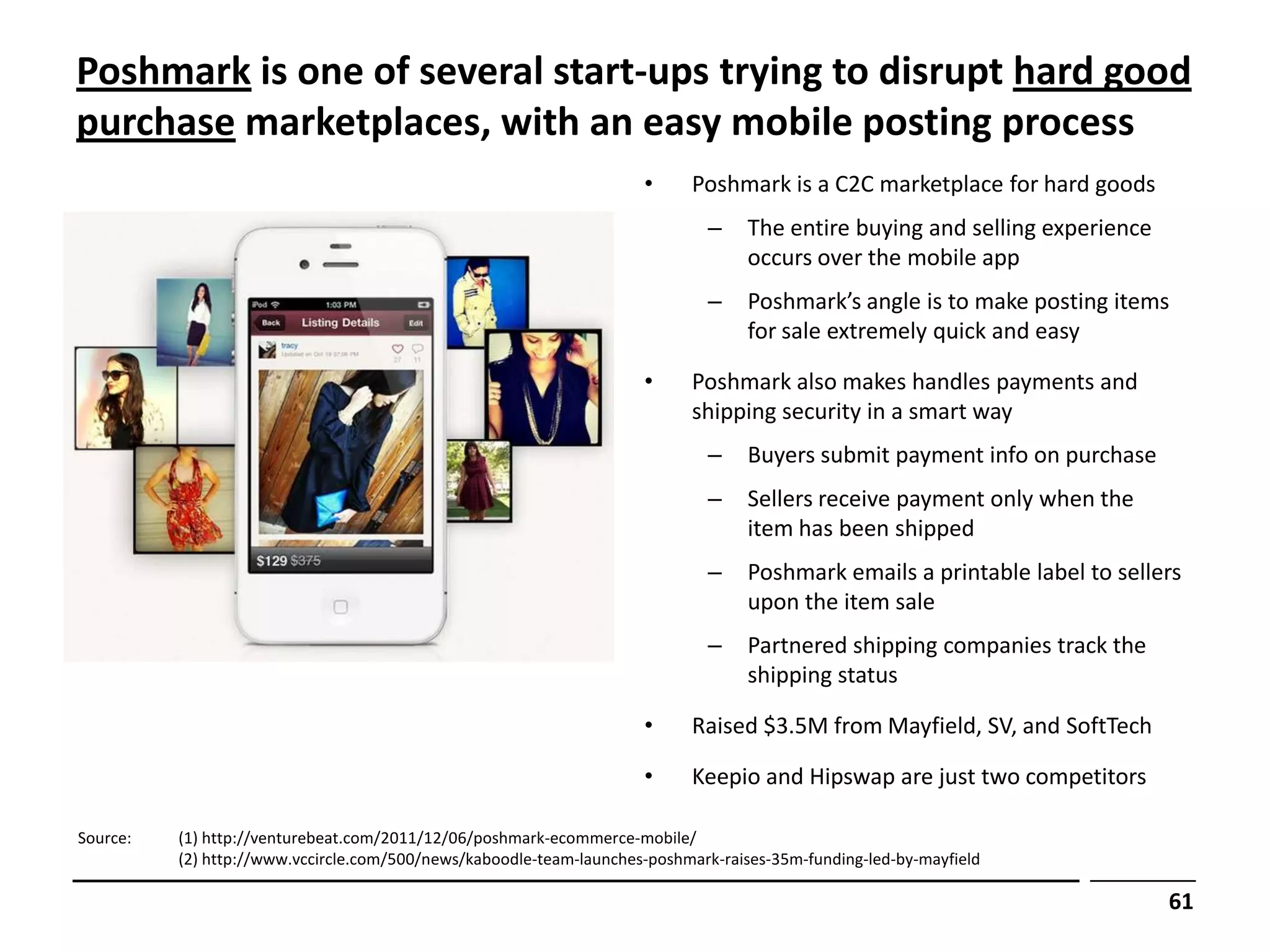
• Poshmark is a C2C marketplace for hard goods
– The entire buying and selling experience
occurs over the mobile app
– Poshmark’s angle is to make posting items
for sale extremely quick and easy
• Poshmark also makes handles payments and
shipping security in a smart way
– Buyers submit payment info on purchase
– Sellers receive payment only when the
item has been shipped
– Poshmark emails a printable label to sellers
upon the item sale
– Partnered shipping companies track the
shipping status
• Raised $3.5M from Mayfield, SV, and SoftTech
• Keepio and Hipswap are just two competitors
Source: (1) http://venturebeat.com/2011/12/06/poshmark-ecommerce-mobile/
(2) http://www.vccircle.com/500/news/kaboodle-team-launches-poshmark-raises-35m-funding-led-by-mayfield
61
62.
Several hard goodrental marketplaces are highlighted below
• AirBnB is the prominent brand among hard good marketplaces, allowing consumers to rent out
homes on a nightly or weekly basis. They recently expanded to several-month sublets.
• AirBnB is also thinking about car-sharing services (e.g., host rents out house AND car)
• International competition includes 9flats, Wimdu, Crashpadder, Couchsurfing, etc.
• Unlike Zipcar (which manages its own fleet of cars), Getaround and RelayRides allow consumers to
rent out their cars to other consumers.
• Getaround takes a 40% commission on rent fees, but offers insurance, roadside assistance, and
support. 5,000+ cars signed up (more than half of Zipcar’s fleet) and “tens of thousands” of users;
raised $3.4M from Redpoint, General Catalyst, and prominent angels.
• RelayRides takes 35% (but 20% goes to insurance) commission on rent fees. Raised $13M+ from
General Motors Ventures, Google Ventures, August Capital, and others
• Qraft is a C2C rental marketplace for “toys” – boats, RV’s, cars, bikes, planes, gear
• Prices range from $10 to $10,000 day
• Qraft will need to do deal with insurance and license issues for several types of rentals, as well as
consumer skepticism and distrust over lending out these toys
Source: (1) http://techcrunch.com/2011/09/13/qraft-the-airbnb-for-planes-trains-and-automobiles-and-by-trains-i-mean-boats/
(2) http://techcrunch.com/2011/09/09/car-rental-marketplace-getaround-gets-around-3-4-million/
(3) http://techcrunch.com/2011/10/26/carsharing-service-relayrides-raises-another-3-million-led-by-gm-ventures/
(4) http://techcrunch.com/2011/10/31/airbnb-is-thinking-about-going-after-getaround-with-car-sharing-service/
(5) http://techcrunch.com/2011/09/01/airbnb-launches-sublets-tempts-early-adopters-with-200-off-each-months-rent/
62
63.
Several services C2Cmarketplaces are highlighted below
• Zaarly, Gigwalk, and Taskrabbit focus on allowing the buyer to post jobs and set prices rather than
the seller.
• Zaarly has raised $15M, Gigwalk $1.7M, and TaskRabbit $6M
• Skillshare is a marketplace allowing people to post lessons and consumers to purchase these
lessons (e.g., knitting, tennis, coding); raised $3M+ from Union Square and Spark Capital
• Coffee & Power launched in November 2011 as a skill-based jobs marketplace, allowing sellers to
post jobs they’re willing to do; raised $1M from Jeff Bezos, Greylock, Mitch Kapor, and others
• The Amazings and Dabble are similar, but Amazings is focusing on a niche (starting with retirees)
• Gobble and Munchery allow personal chefs to post menus, sell meals ($12-22), and specify delivery
areas online; consumers can search chefs by city, review chefs, and pay online
• Gobble has raised $1.2M from Founder Collective, SV Angel, and prominent angels
• Vayable and Shioube allow consumers to offer guided experiences / tours to other consumers (e.g.,
local home-cooked meal, pub crawl, tour, etc)
• Vayable requires a 15% commission fee on sellers and a 3% transaction fee from buyers
• SideTour just raised $1.5M
Source: (1) http://techcrunch.com/2011/04/22/vayable-is-a-marketplace-for-unique-travel-experiences/
(2) http://techcrunch.com/2011/05/03/munchery-wants-to-bring-personal-chefs-to-the-masses/
(3) http://www.fastcompany.com/1787106/shiroube-makes-travel-social-cheap-weird
(4) http://techcrunch.com/2011/11/01/second-life-founder-launches-coffee-power-a-jeff-bezos-backed-marketplace-for-skill-based-jobs
(5) http://techcrunch.com/2011/10/17/from-graffiti-lessons-to-olympic-luging-sidetour-raises-1-5-million/
(6) http://www.springwise.com/lifestyle_leisure/uk-retirees-paid-share-skills-group-activities/
(7) http://www.springwise.com/lifestyle_leisure/online-community-marketplace-lets-users-discover-teach-host-class/
63
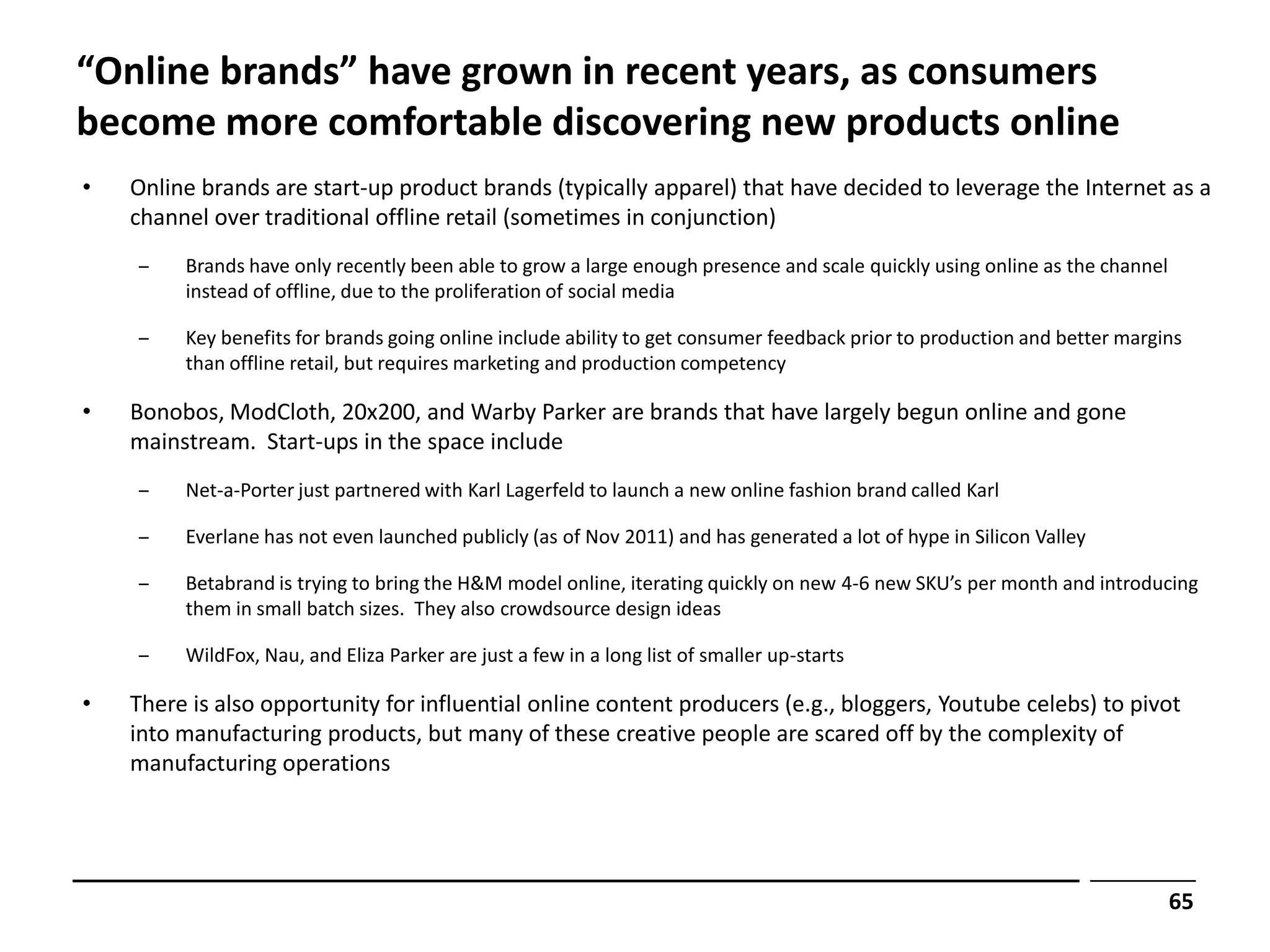
“Online brands” havegrown in recent years, as consumers
become more comfortable discovering new products online
• Online brands are start-up product brands (typically apparel) that have decided to leverage the Internet as a
channel over traditional offline retail (sometimes in conjunction)
‒ Brands have only recently been able to grow a large enough presence and scale quickly using online as the channel
instead of offline, due to the proliferation of social media
‒ Key benefits for brands going online include ability to get consumer feedback prior to production and better margins
than offline retail, but requires marketing and production competency
• Bonobos, ModCloth, 20x200, and Warby Parker are brands that have largely begun online and gone
mainstream. Start-ups in the space include
‒ Net-a-Porter just partnered with Karl Lagerfeld to launch a new online fashion brand called Karl
‒ Everlane has not even launched publicly (as of Nov 2011) and has generated a lot of hype in Silicon Valley
‒ Betabrand is trying to bring the H&M model online, iterating quickly on new 4-6 new SKU’s per month and introducing
them in small batch sizes. They also crowdsource design ideas
‒ WildFox, Nau, and Eliza Parker are just a few in a long list of smaller up-starts
• There is also opportunity for influential online content producers (e.g., bloggers, Youtube celebs) to pivot
into manufacturing products, but many of these creative people are scared off by the complexity of
manufacturing operations
65
66.
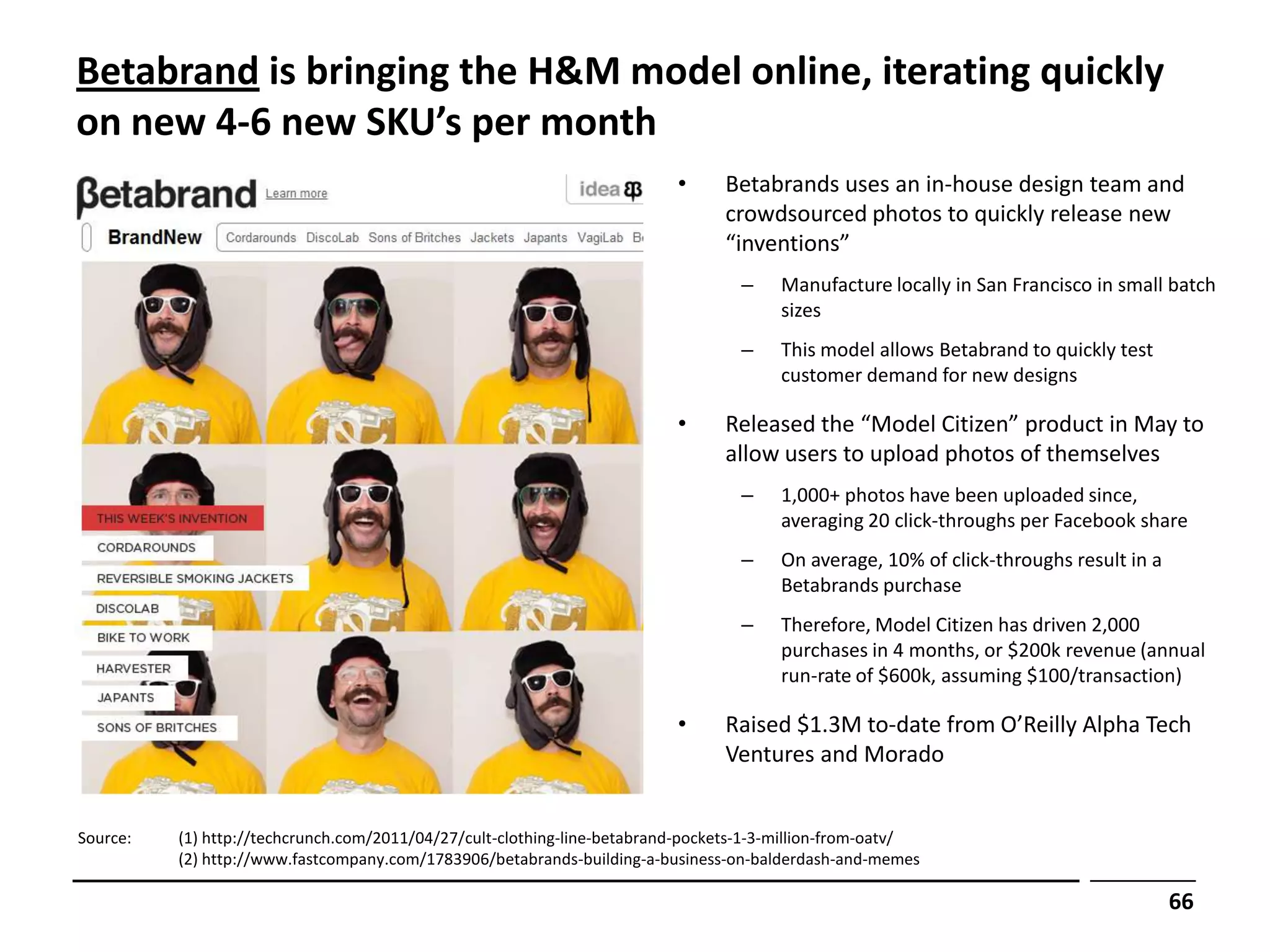
Betabrand is bringingthe H&M model online, iterating quickly
on new 4-6 new SKU’s per month
• Betabrands uses an in-house design team and
crowdsourced photos to quickly release new
“inventions”
– Manufacture locally in San Francisco in small batch
sizes
– This model allows Betabrand to quickly test
customer demand for new designs
• Released the “Model Citizen” product in May to
allow users to upload photos of themselves
– 1,000+ photos have been uploaded since,
averaging 20 click-throughs per Facebook share
– On average, 10% of click-throughs result in a
Betabrands purchase
– Therefore, Model Citizen has driven 2,000
purchases in 4 months, or $200k revenue (annual
run-rate of $600k, assuming $100/transaction)
• Raised $1.3M to-date from O’Reilly Alpha Tech
Ventures and Morado
Source: (1) http://techcrunch.com/2011/04/27/cult-clothing-line-betabrand-pockets-1-3-million-from-oatv/
(2) http://www.fastcompany.com/1783906/betabrands-building-a-business-on-balderdash-and-memes
66
67.
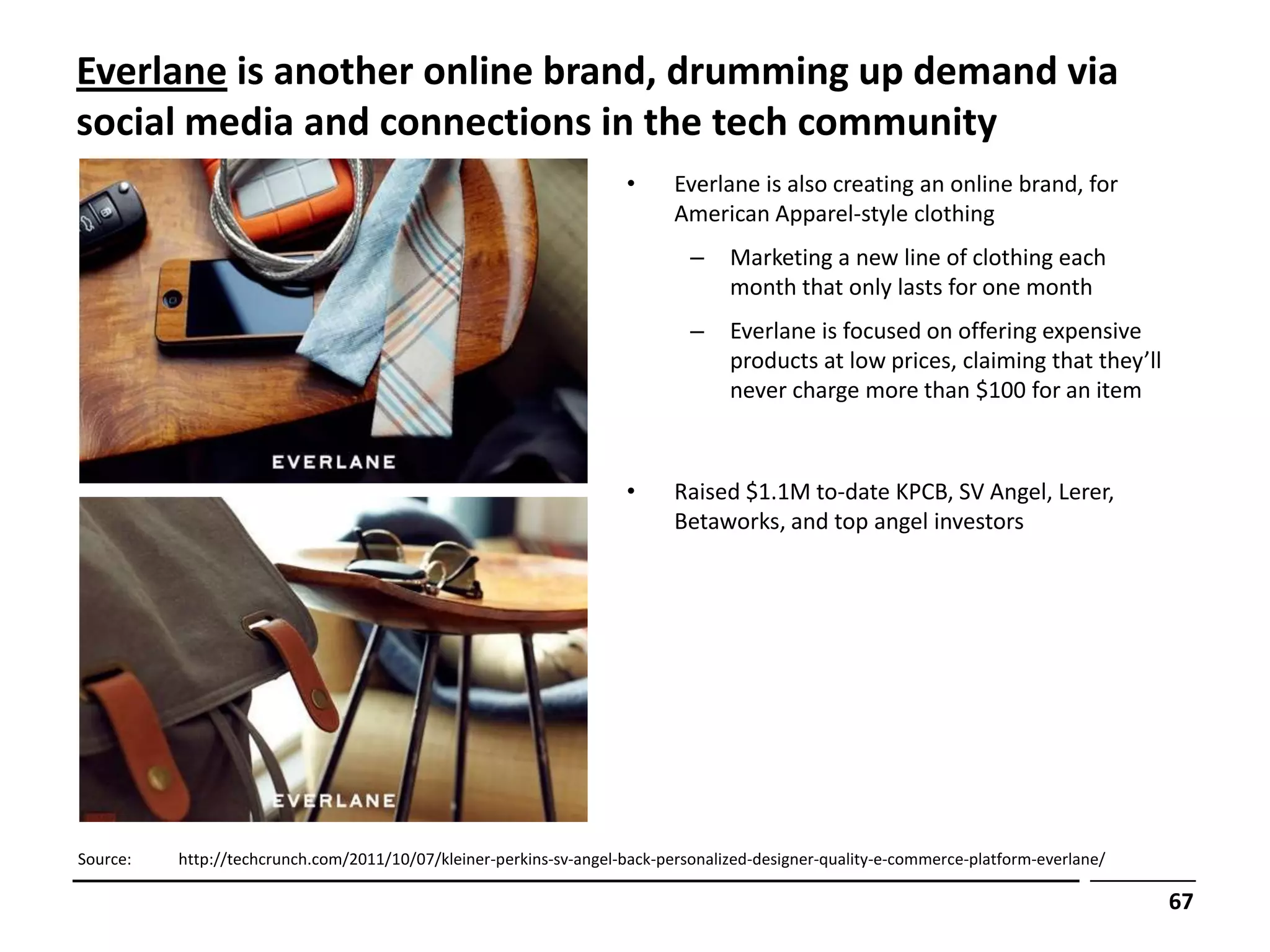
Everlane is anotheronline brand, drumming up demand via
social media and connections in the tech community
• Everlane is also creating an online brand, for
American Apparel-style clothing
– Marketing a new line of clothing each
month that only lasts for one month
– Everlane is focused on offering expensive
products at low prices, claiming that they’ll
never charge more than $100 for an item
• Raised $1.1M to-date KPCB, SV Angel, Lerer,
Betaworks, and top angel investors
Source: http://techcrunch.com/2011/10/07/kleiner-perkins-sv-angel-back-personalized-designer-quality-e-commerce-platform-everlane/
67
68.
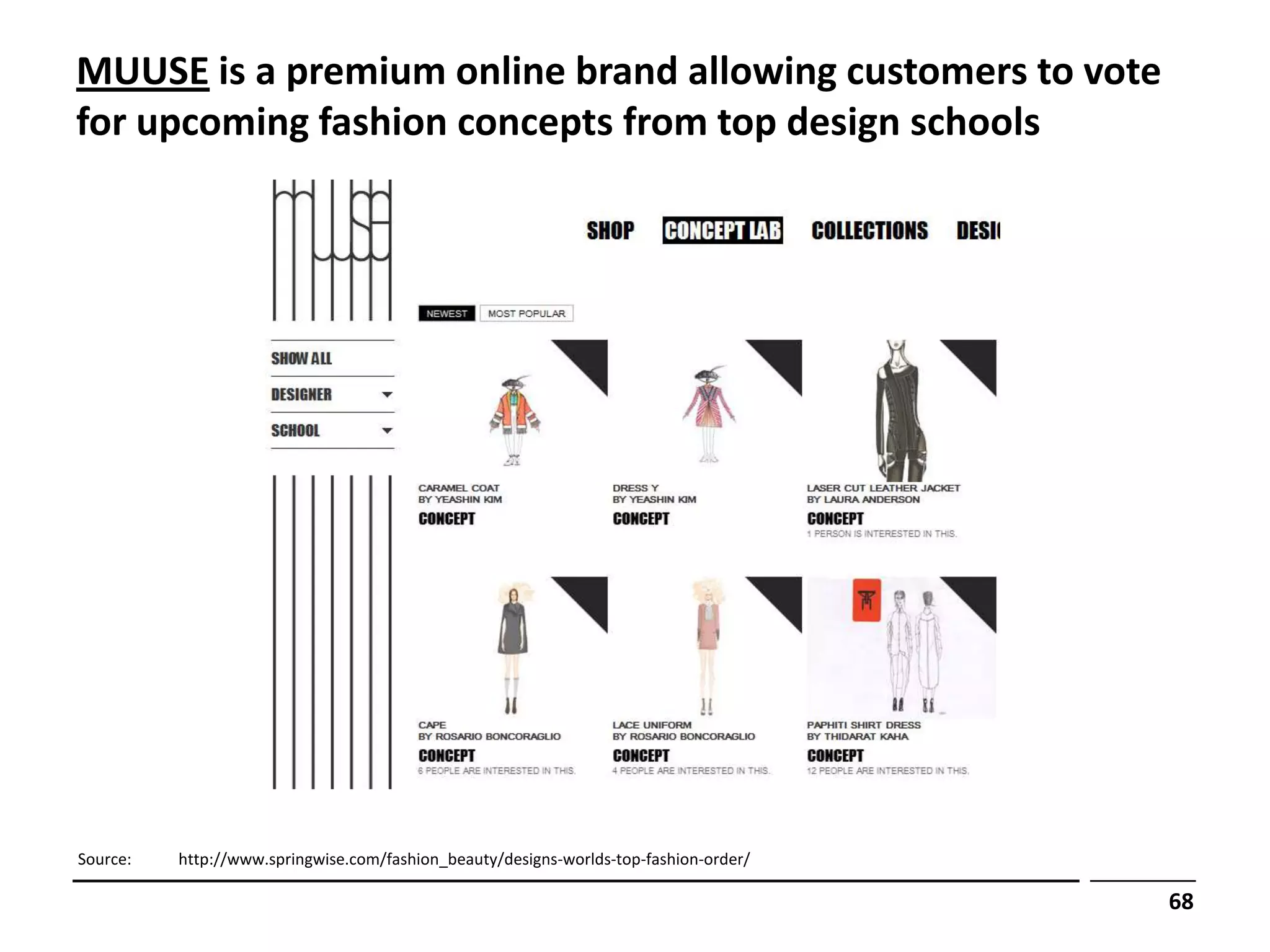
MUUSE is apremium online brand allowing customers to vote
for upcoming fashion concepts from top design schools
Source: http://www.springwise.com/fashion_beauty/designs-worlds-top-fashion-order/
68
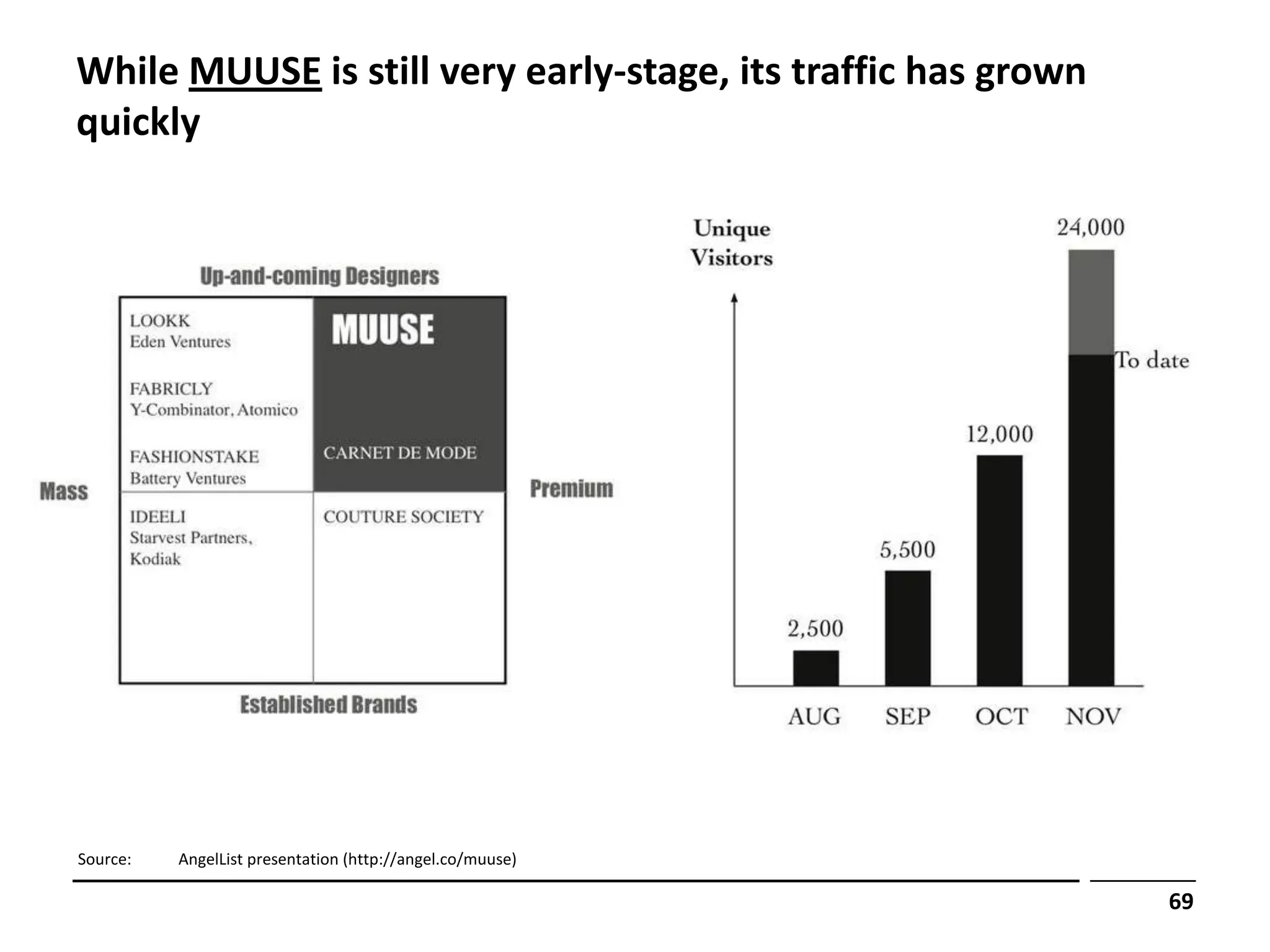
69.
While MUUSE isstill very early-stage, its traffic has grown
quickly
Source: AngelList presentation (http://angel.co/muuse)
69
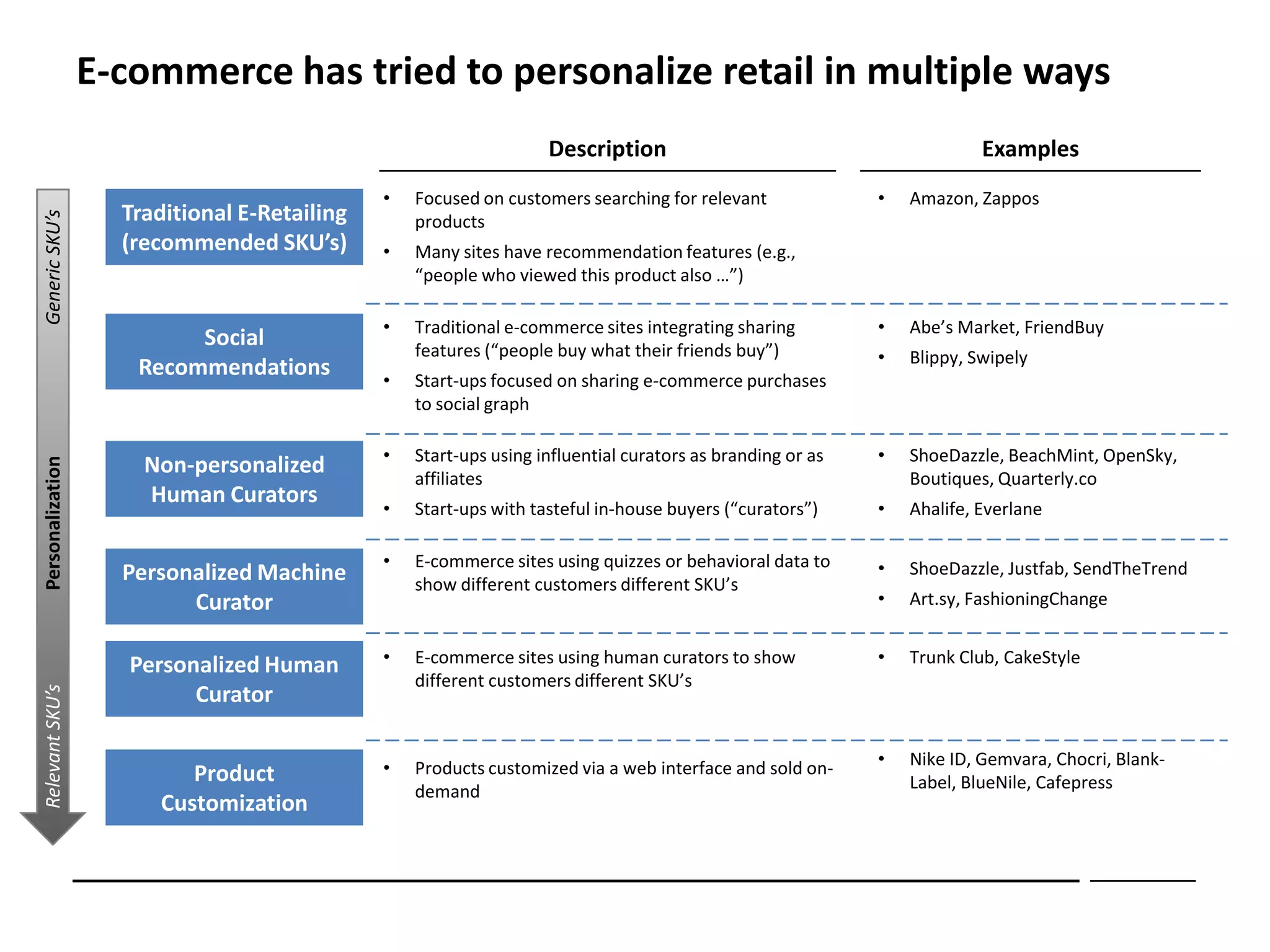
E-commerce has triedto personalize retail in multiple ways
Description Examples
• Focused on customers searching for relevant • Amazon, Zappos
Traditional E-Retailing
Generic SKU’s
products
(recommended SKU’s) • Many sites have recommendation features (e.g.,
“people who viewed this product also …”)
• Traditional e-commerce sites integrating sharing • Abe’s Market, FriendBuy
Social features (“people buy what their friends buy”) • Blippy, Swipely
Recommendations • Start-ups focused on sharing e-commerce purchases
to social graph
• Start-ups using influential curators as branding or as • ShoeDazzle, BeachMint, OpenSky,
Non-personalized
Personalization
affiliates Boutiques, Quarterly.co
Human Curators
• Start-ups with tasteful in-house buyers (“curators”) • Ahalife, Everlane
• E-commerce sites using quizzes or behavioral data to • ShoeDazzle, Justfab, SendTheTrend
Personalized Machine show different customers different SKU’s
Curator • Art.sy, FashioningChange
Personalized Human • E-commerce sites using human curators to show • Trunk Club, CakeStyle
different customers different SKU’s
Curator
Relevant SKU’s
• Products customized via a web interface and sold on- • Nike ID, Gemvara, Chocri, Blank-
Product Label, BlueNile, Cafepress
demand
Customization
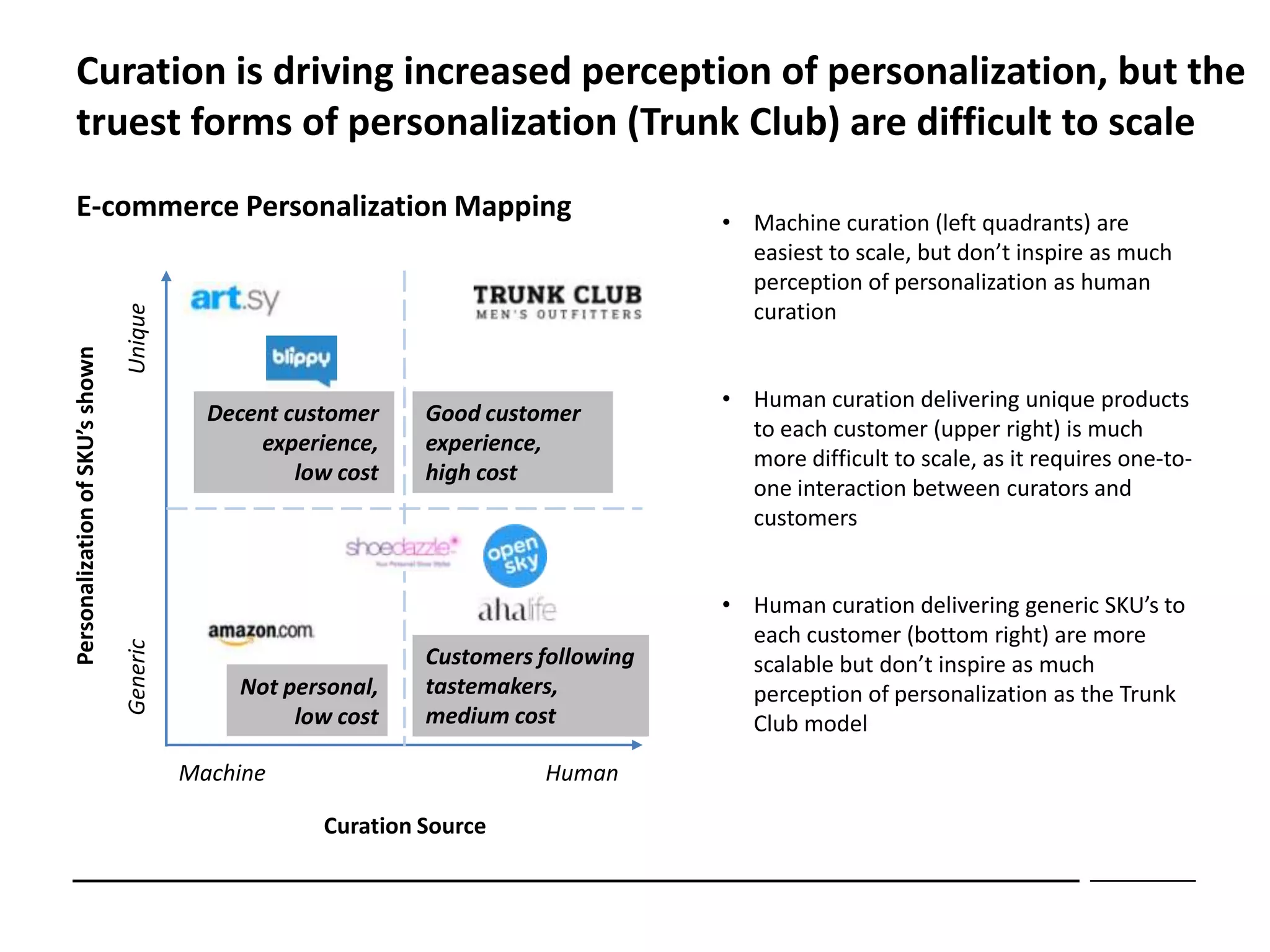
72.
Curation is drivingincreased perception of personalization, but the
truest forms of personalization (Trunk Club) are difficult to scale
E-commerce Personalization Mapping • Machine curation (left quadrants) are
easiest to scale, but don’t inspire as much
perception of personalization as human
curation
Unique
Personalization of SKU’s shown
• Human curation delivering unique products
Decent customer Good customer
to each customer (upper right) is much
experience, experience,
more difficult to scale, as it requires one-to-
low cost high cost
one interaction between curators and
customers
• Human curation delivering generic SKU’s to
each customer (bottom right) are more
Generic
Customers following scalable but don’t inspire as much
Not personal, tastemakers, perception of personalization as the Trunk
low cost medium cost Club model
Machine Human
Curation Source
73.
Send The Trendpersonalizes product recommendations at
users based on a style quiz, and categorizes products by trend
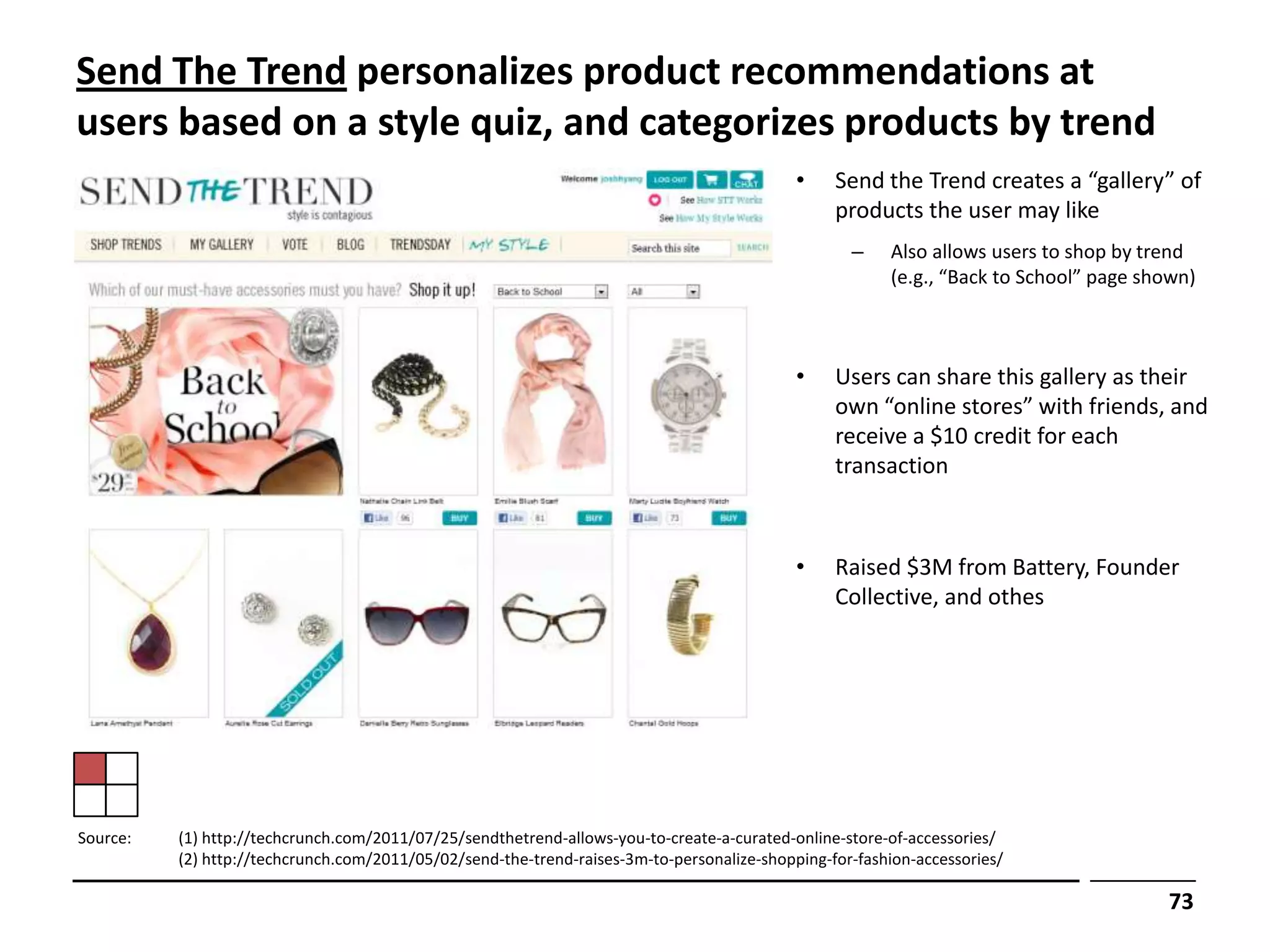
• Send the Trend creates a “gallery” of
products the user may like
– Also allows users to shop by trend
(e.g., “Back to School” page shown)
• Users can share this gallery as their
own “online stores” with friends, and
receive a $10 credit for each
transaction
• Raised $3M from Battery, Founder
Collective, and othes
Source: (1) http://techcrunch.com/2011/07/25/sendthetrend-allows-you-to-create-a-curated-online-store-of-accessories/
(2) http://techcrunch.com/2011/05/02/send-the-trend-raises-3m-to-personalize-shopping-for-fashion-accessories/
73
74.
Fashioning Change isan e-commerce site offering suggestions
for green alternatives to the products users indicate preferring
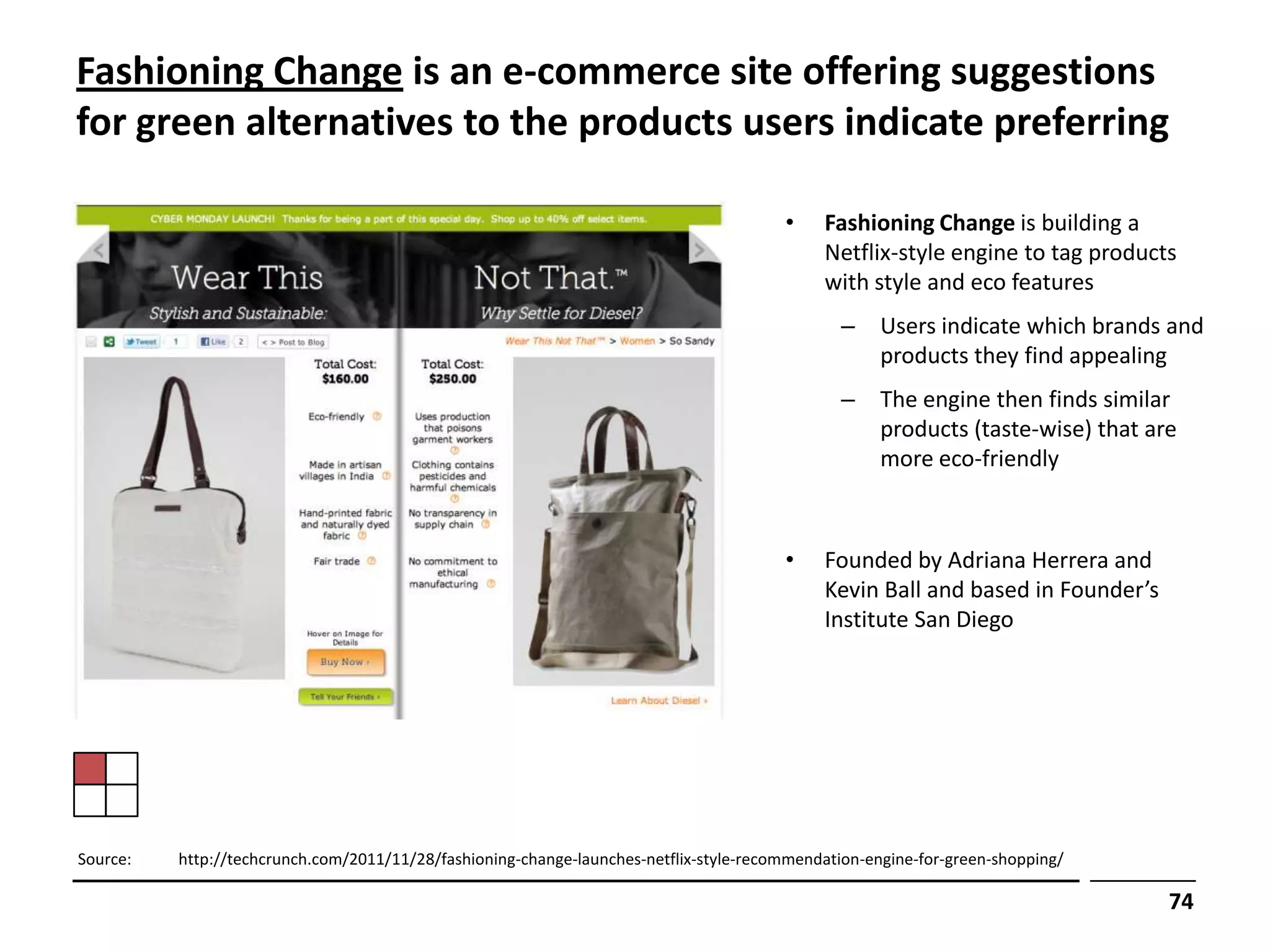
• Fashioning Change is building a
Netflix-style engine to tag products
with style and eco features
– Users indicate which brands and
products they find appealing
– The engine then finds similar
products (taste-wise) that are
more eco-friendly
• Founded by Adriana Herrera and
Kevin Ball and based in Founder’s
Institute San Diego
Source: http://techcrunch.com/2011/11/28/fashioning-change-launches-netflix-style-recommendation-engine-for-green-shopping/
74
75.
Shoptiques curates fashioninventory from boutique retailers
and sells to an exclusive community of members
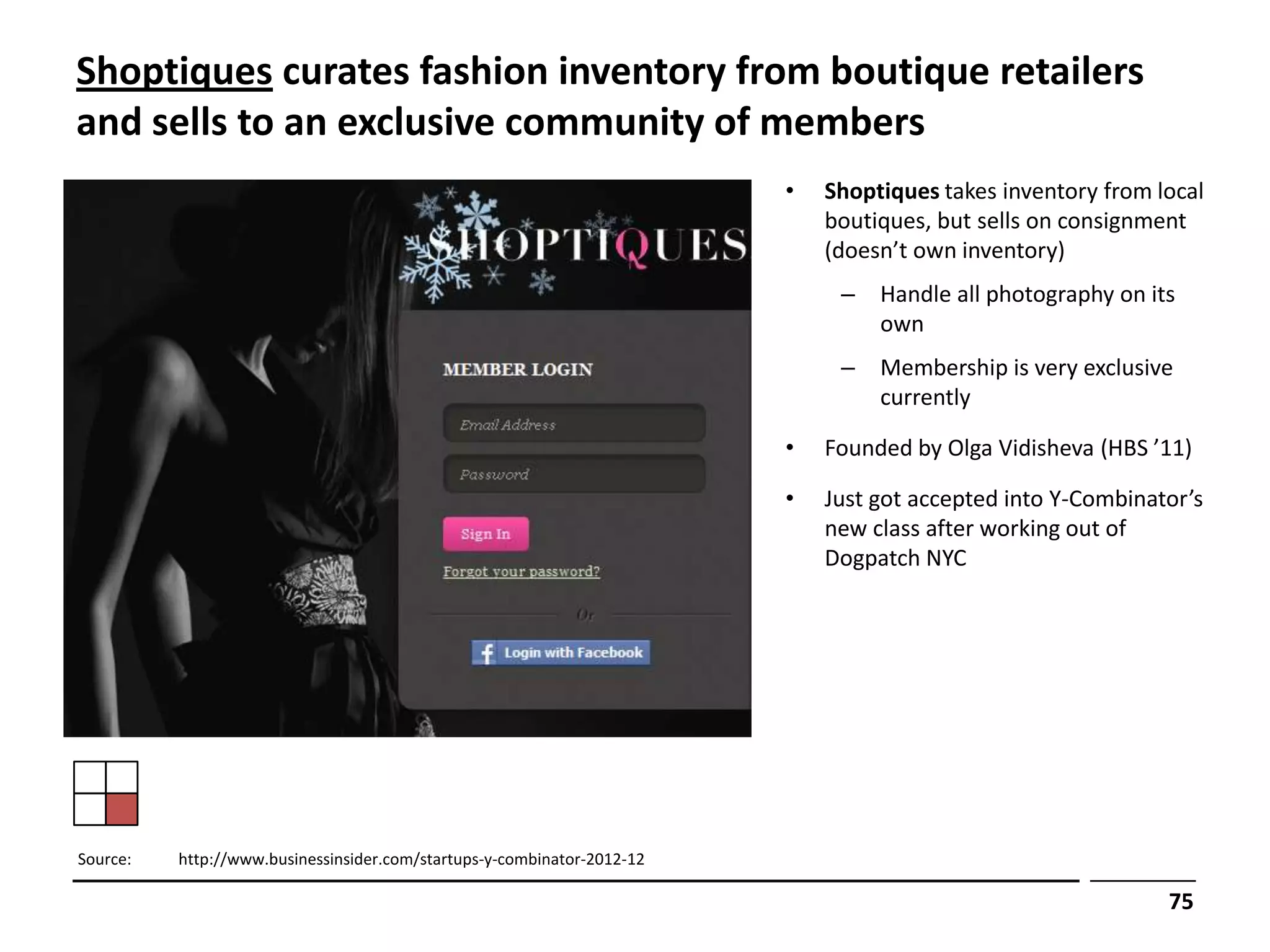
• Shoptiques takes inventory from local
boutiques, but sells on consignment
(doesn’t own inventory)
– Handle all photography on its
own
– Membership is very exclusive
currently
• Founded by Olga Vidisheva (HBS ’11)
• Just got accepted into Y-Combinator’s
new class after working out of
Dogpatch NYC
Source: http://www.businessinsider.com/startups-y-combinator-2012-12
75
76.
CakeStyle is anupstart Trunk Club for women
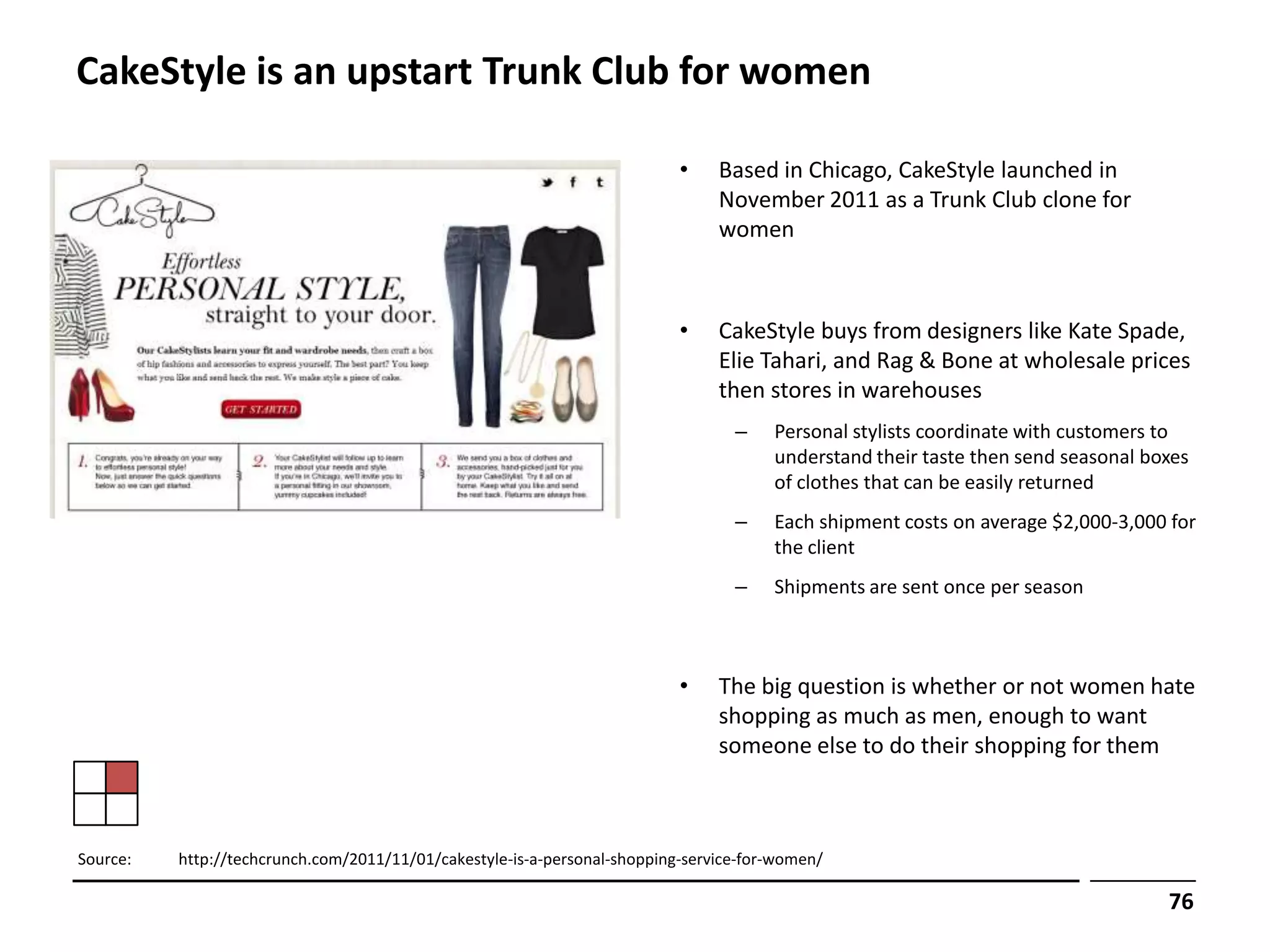
• Based in Chicago, CakeStyle launched in
November 2011 as a Trunk Club clone for
women
• CakeStyle buys from designers like Kate Spade,
Elie Tahari, and Rag & Bone at wholesale prices
then stores in warehouses
– Personal stylists coordinate with customers to
understand their taste then send seasonal boxes
of clothes that can be easily returned
– Each shipment costs on average $2,000-3,000 for
the client
– Shipments are sent once per season
• The big question is whether or not women hate
shopping as much as men, enough to want
someone else to do their shopping for them
Source: http://techcrunch.com/2011/11/01/cakestyle-is-a-personal-shopping-service-for-women/
76
77.
Customization has slowedas a trend, as the model has
generally failed to gain traction and prove scalability
• Co-creation e-commerce isn’t new but has begun to enter the mainstream recently
– Co-creation sites allow consumers to design their own products for purchase and/or buy products others have designed
– CafePress launched in 1999 to allow users to design custom t-shirts, mugs, and accessories. Later, start-ups like Zazzle,
Skreened, StickerGiant, and Lulu emerged offering easy-to-customize products
– Several co-creation companies have taken off from Germany in recent years (e.g., Chocri, Spreadshirt) and have
expanded to the U.S. and UK
• Co-creation companies typically become cash-flow positive quickly because customized products sell at a
premium and are sold on-demand (i.e., there is no excess inventory)
• To date, start-ups riding the co-creation wave have primarily been e-commerce destination sites focused on
a particular product category (or group of categories), and employ one or more of several business models:
– Consumers design, then buy their own products (e.g., NikeID, BlueNile, Chocri, Blank-Label, Shirtsmyway, etc.)
– Consumers buy products designed by other consumers or indie designers (e.g., MyFab, ModCloth, Threadless, etc.)
– Consumers connect with manufacturers and co-design offline (e.g., Custommade)
• Two problems the co-creation market faces today are scalability and design-manufacturing accuracy
– Scalability. Companies will need to be creative about how to scale their businesses as consumer demand increases,
since it will be harder for manufacturing to benefit from economies of scale
– Design-manufacturing accuracy. Despite strong user interfaces allowing users to design their own products, a fraction
of users will be dissatisfied with how the product actually turns out (i.e., requires stronger, more accurate UIs)
Source: (1) http://www.readwriteweb.com/start/2010/03/is-america-on-the-verge-of-a-co-creation-invasion.php
(2) http://www.crunchgear.com/2010/07/21/new-wave-of-web-services-brings-customization-to-commerce/
77
78.
Several companies haveinteractive features allowing users to
design their own clothing and transact List Not Exhaustive
• Offers an interactive tool to allow consumers to choose design and fitted sizes of shirts in the $60-100
Blank-Label range (per shirt)
• Launched in Oct 2009, based in Shanghai; had supply chain issues in May 2010 when it reached 1,080
unique customers with $100k+ revenue for the month
• Claims that the most important feature for consumers is the fitting; however, very few consumers
know their measurements (need to go to a tailor to get these numbers)
ShirtsMyWay • ShirtsMyWay is a competitor with a stronger user interface and better selection but more expensive
($100-150 price range)
• Customized clothing for girls age 6-12, allowing designers to select variety of clothing items
FashionPlaytes (sweaters, shirts, etc.) with variety of colors and designs
• Canada-based retailer offering custom tailored suits online starting at $199
IndoChino
• Funded by Burda Digital Ventures and Boris Wertz
• Threadless is a T-shirt design site allowing users to submit t-shirt designs and the community to vote
Threadless and buy top design tees
• Spreadshirt is similar to Threadless but more focused on allowing designers to open shops than for
Spreadshirt community-voted designs
Source: (1) http://www.crunchgear.com/2010/06/18/shirtsmyway-design-your-own-dress-shirt/
(2) http://techcrunch.com/2008/04/29/indochino-offers-tailor-made-suits/
78
79.
A few othersapply customized e-commerce to other categories
List Not Exhaustive
• Allows users to design their own chocolate bars (ingredients inside) a la Pinkberry
Chocri
• Minimum order of two bars; available for bulk purchases for weddings, events, retail, etc.
• Allows users to design their own boxes of granola-based cereal a la Pinkberry
MeAndGoji
• Primarily focused on allowing users to design iPad and iPod skins with any picture, but have expanded
Infectious to other categories such as skateboards, car decals, wall decals, t-shirts, art prints, etc.
• Raised $750k in seed funding in 2007 from True Ventures
• Allows users to design t-shirts, mugs, binders, posters, etc.
Zazzle
• Allows users to design their own handbags starting at $85; top designs are saved for others to buy
LaudiVidni
• Rickshaw Bagworks is similar company
BlueNile and • Allows users to design their own jewelry, including rings, gems, necklaces, earrings, bracelets, etc.
Gemvara
Shortomatic • Allows users to design their own swimming trunks
Source: (1) http://scg.mit.edu/index.php?option=com_content&view=article&id=84:the-mit-smart-customization-seminar-
2010&catid=35:smart-customization-events&Itemid=109; (2) http://www.nytimes.com/2010/05/16/business/16proto.html?_r=1
79
80.
UPcload is buildinga technology to allow users to easily get
their full clothing measurements ingested into the cloud
• One of the key problems facing e-
commerce customization is the difficulty in
fitting precisely
• UPcload ships consumers a standard-sized
CD for calibration, and UPcload software
calculates sizes using a webcam
– Specific measurements of arm
length, chest circumference and
more are calculated and converted
into reliable clothing size
recommendations
• Based in Berlin
Source: http://www.springwise.com/fashion_beauty/online-shopper-clothing-size-profile-webcam/
80
Crowdsourced demand e-commercecompanies have raised
good funding, and social bookmarking could be the next wave
• For years, companies like ModCloth, FashionStake, and MyFab have tapped the wisdom of the crowds to
validate upcoming product designs and sourcing decisions
– Younger start-ups like MUUSE (and to some extent, Betabrand) also crowdsource demand for new
designs
– However, to solicit feedback on upcoming products from the crowds, these companies have to
drive traffic to their voting pages, which is not easy and requires on-going marketing
– Thus, these become relatively difficult to scale
• The current social bookmarking phenomenon is more appealing to users and perhaps evolving into e-
commerce applications, although it is less flexible in predicting demand
– Pinterest’s fast traffic growth indicates that social bookmarking is an activity that appeals to
consumers
– Users seem to enjoy bookmarking “things” from around the web, perusing others’ bookmarks, and
voting and commenting on bookmarks
– While market leaders Pinterest, SVPPLY, and TheFancy direct users’ attention to “pins” that link to
e-commerce sites (and collect affiliate revenue), they have not attempted to be retailers
– Smaller upstarts have begun to recognize the connection between browsing bookmarks and
buying: Lockerz and Curisma are both sourcing their own products
82
83.
Quirky allows consumersto submit product ideas, incentivizes the crowd
to vote (with royalties), and manufactures the highest voted products
• Quirky allows consumers to submit product
(“invention”) ideas for $10, and if the product
becomes manufactured offers perpetual
royalties
– The community votes products up and
down
– 30% of gross revenue is shared with
those who participated (35% to
inventor, 65% to those who voted)
• Raised $23M to-date from Norwest, RRE, and
others
Source: http://techcrunch.com/2010/06/30/modcloth-funding/
83
84.
MyFab crowdsources productdesign and allows consumers to
buy these products direct from China factories
Idea Product Transaction
Manufacturer
Designer Retailer Consumer
(Factory)
• Showroom costs
Traditional Furniture Retail Model • Catalog costs
• Customer demand projected by historical sales (causing • Inventory costs / risk
unsold inventory) • Warehousing costs
• Still ideal for big brand manufacturers • Transportation costs
Product
Manufacturer
Consumer
(Factory)
MyFab Model MyFab
• Customer demand projected by Idea (Retailer) Transaction and
user voting and on-demand orders
(causing no unsold inventory)
Product Feedback
• Ideal for small / indie designers Designers:
84
85.
Like MyFab, ModClothis an indie clothing company that crowdsources
clothing design and allows consumers to vote on designs to manufacture
• ModCloth takes clothing designs from indie designers and its buyers select top styles to manufacture and
sell on its site
– Like MyFab, ModCloth empowers the designer community to submit designs and users to vote on the best designs in
order to gauge demand before production
– Unlike MyFab, ModCloth does not produce on-demand; rather, their model attempts to minimize unsold inventory via
user voting, but still holds inventory and warehousing, “making bets on a wide variety of products”
– Consequently, MyFab shipment timeframes are standard 1-5 day periods (because not on-demand)
• However, ModCloth seems limited as a crowdsourcing platform in that they have a threshold number of
products they will ever want to display on the site (and threshold number of buyers reviewing designs),
which creates a ceiling for the number of designers that can be “empowered” to submit designs
– This, in effect, makes them a niche retail brand outsourcing its design to indie designers (e.g., a longtail Zara)
• ModCloth launched slowly in 2002 but has ramped in the past few years
– Achieved $3.2MM revenue in 2008, scaled to $19MM in 2009, and is expecting much stronger growth in 2010
– Raised $19.8MM Series B in June 2010 from Accel and existing investors Floodgate and First Round Capital
Source: http://techcrunch.com/2010/06/30/modcloth-funding/
85
86.
Lockerz is alsoa social bookmarking site, but uses game
mechanics to incentivize activity and sell discounted goods
19M+ registered members and 45M+ monthly unique visitors
Source: http://techcrunch.com/2011/08/10/lockerz-opens-up-social-commerce-and-sharing-network-to-non-members-signs-deal-with-emi
86
87.
Curisma is asocial bookmarking tool (like Pinterest) that also
offers daily deals
• Like Pinterest, TheFancy, and SVPPLY, Curisma is
a browser bookmarking tool
– The tool is focused on bookmarking e-
commerce items, though, as it requires the
user enter the product price range
– The site allows users to follow others and
re-pin (“want”) others’ items, or indicate
that they already own (“have”) them
• Curisma is sourcing and selling daily deals to
Curisma users, inspired by what people are
pinning
– They claim that daily deals are
personalized based on the things users pin
or like
• Founded by two MIT grad students (Fatma Yalcin
and Eugene Gorelik)
Source: http://techcrunch.com/2011/11/27/curisma-offers-diy-coolhunting/
87
88.
Lyst is apremium e-commerce bookmarking site, allowing
authenticated designers to add new SKU’s
• Unlike Pinterest and others, users cannot
bookmark new products to the site
– Only authenticated designers and super-
users can add new products
– Products are purchased off-site, so Lyst likely
takes affiliate cuts of conversions
– Users, however, can re-pin (“Add to Lyst”)
products to their own “lysts”
• Ultimately, Lyst’s model is similar to a
consignment-only store, taking no inventory risk
and operating on affiliate revenues
– However, Lyst approaches online retailing
from a wish-list and impulse buying
perspective, rather than a search-and-
catalog perspective
• Lyst has a decent Facebook following (40,000
likes), having only launched in Sept 2011 in London
• Raised an undisclosed amount from Accel
Source: http://techcrunch.com/2011/09/16/lyst-comes-out-of-the-closet-to-open-up-high-fashion-world/
88
A few variationsof the rental model have been applied online,
but few have been runaway successes
Note: Models not mutually exclusive
Pure Rental Rent-to-buy Peer-to-peer
Description • Sites employing a traditional • Sites allowing renters to keep • Sites allowing one user to rent to
rental model products another user
• Renter pays, receives shipped • Renter pays, receives shipped • Some sites allow payment, others
product, returns by due date product, has option to return the are free
(often using set return package) product or keep it for a “buy
price”
Key Players
(sample)
Source: (1) BV Capital / Crate&Barrel Conference Presentation (August 2010);
(2) http://worldaccordingtocarp.wordpress.com/2010/02/01/the-new-golden-age-of-renting/
(3) http://techcrunch.com/2011/08/21/luxemi-is-a-rent-the-runway-for-indian-clothes-and-jewelry/
90
91.
Art seems tobe a good category for a rental service
• Art e-rental addresses a large market, as the average
homeowner has several pieces of art and often grows tired of
the same art
– Also lightweight and easy to ship both ways
• TurningArt charges customers $10-30/month and sends them
a frame and initial art piece
– Customers can send art pieces back to TurningArt and
request a new piece at their own frequency with free
shipping
– If users want to keep the piece, they can buy the art
(and previous rental spend counts as credit toward this
buy)
– Based in Boston, TurningArt raised $750k in May 2011
– Artsicle is a direct competitor
• Art.sy has an increased focus on art discovery, building the Art
Genome Project to tag each art piece with ~200
characteristics
– Is this overkill for art? The business model is unclear as
they are still in private beta
– Art.sy has raised ~$1.5M from prominent angels
Source: (1) http://www.finsmes.com/2011/05/turningart-secures-750k-seed-funding.html
(2) http://mashable.com/2011/03/01/artsicle/
91
92.
Although auctioning isa time-tested commerce model offline,
it has not fared well online to-date
• While auctioning is a real, time-tested commerce model offline, its transition to online has been difficult.
Online auctions haven't proved to be a better value proposition than normal e-commerce retailing
models
– Auctions don't necessarily make products cheaper for buyers, and auctions take more time and attention for
buyers, with the possibility that they end up losing on auctions they spent time on
– Offline, auctions are typically used for charitable purposes or for letting the "market" determine prices when pricing
is ambiguous.
– Additionally, they are typically social events and done in real-time with large groups, an experience not replicated
online to-date
• Several companies in the auction space have shut down or pulled back
– eBay, which has long been the leader in auction-based e-commerce, appears to be shifting away from the auction
model and toward a traditional “buy-it-now” model
“… Initially, eBay started selling long-tail inventory and they sold it in an auction format and that made sense at
the time. Today, eBay is 30-35 percent auctions. A lot of the inventory on eBay today is brand new …”
John Donahoe, CEO, eBay (June 2, 2010)
– Swoopo (and clones Bigdeal, Madbid, etc) were penny-auction sites that charged small fees (1 to 25 cents) for users
to bid on items, but this overhyped model has hit the deadpool amidst scam talks
– CharityBuzz brings the niche charity auction model online, but has scaled slowly
Source: http://d8.allthingsd.com/20100602/john-donahoe-session/
92
Sneakpeeq is likea flash sale site, but has a unique pricing
scheme which feels a bit too much like Swoopo
• Sneakpeeq sells merchants’ goods on its site as
any other flash sale site would, but covers the
sales price (see orange button below)
– Once a user clicks on the “peeq” button,
the current price is revealed
– Each successive “peeq” drops the price
until the unit has been purchased, and the
price will reset to its original starting price
• This gamified pricing scheme can be helpful to
drive additional engagement, but there are
several problems:
– Feels very “sketchy” a la Swoopo
– A savvy customer knows that she’s just
doing extra work to get the product down
to the price she’d pay on a normal flash
sale site
• Sneakpeeq has raised $2.7M
Source: http://techcrunch.com/2011/05/23/sneaqpeeq-is-the-social-shopping-mall-where-as-you-shop-the-price-drops/
94
95.
mydeco is afurniture-focused e-commerce marketplace with a
3D home design tool for consumers to visualize product pairings
• Mydeco began as a 3D home design tool
website and has gradually shifted to a
marketplace
– Users can create elaborate rooms
with mydeco’s sophisticated design
tools
– Others can view users’ rooms with
tagged products
• Mydeco is also launching a new e-
commerce site where it curates a small
number of boutique furniture brands
• Raised over £10M from BV Capital and
EVC Partners
Source: http://eu.techcrunch.com/2011/11/23/mydeco-designs-itself-a-new-direction-as-a-retailer/
95
96.
Monocle Order isa members’ club, specifically for sunglasses
• Monocle Order is a members’ club for
sunglasses
– Upon the first purchase (at full retail price),
the customer gets 50% all future purchases
(and free shipping)
• This model may be interesting in that it
incentivizes a few things:
– Alleviates consumer pressure from paying
full-price on the first item (high-margin), as
they anticipate future benefit from this
first purchase
– Incentivizes consumers to buy from your
store vs. others for future purchases (as
long as the 50% discount price is slightly
lower than competitors but still a
profitable transaction)
Source: http://techcrunch.com/2011/05/23/sneaqpeeq-is-the-social-shopping-mall-where-as-you-shop-the-price-drops/
96
97.
Joyus is anonline video site with e-commerce focused on
women’s goods
• Joyus is attempting to bring the Home
Shopping Network model online
– Users find sales on Joyus.com, each of
which centers around a 2-3 minute
video with direct links to products in
inventory
– Below the video, users can browse all
products mentioned in the video in a
catalog setting
– Purchases are completed on-site
• Amassed over 11k Twitter followers
• Raised $7.9M from Accel, Harrison Metal,
and others
Source: http://www.fastcompany.com/1781405/joyus-fashion-video-commerce-fabulous
97
98.
Snapsort is buildingsleek product recommendation destination
sites by vertical, based on user-inputted product criteria
Source: http://techcrunch.com/2011/08/19/snapsort-raises-500k-to-expand-its-product-recommendation-engine/
98
Mobile e-commerce isa large nascent opportunity, but mobile
browser sites and poor apps leave several unmet needs open
• Today, e-commerce is not a popular activity on tablets (even less on mobile phones), rated as one of the
lowest use cases in surveys
‒ Tablet usage is still in early stages, and consumers are focusing on core use cases (e.g., reading,
gaming) over other use cases more prevalent on PC (e.g., word processing, e-commerce)
‒ E-commerce companies are not investing heavily in mobile, and so the experience on tablets is subject
to poor browser experience or uninventive one-off apps, and the lack of a hard keyboard makes the
check-out process cumbersome
‒ In the current app-heavy environment, the need to download multiple apps from each e-commerce
retailer a user likes is cumbersome
• However, the mobile e-commerce opportunity on tablets is massive as these devices begin to proliferate;
and for tech-savvy user groups, e-commerce is viable as a use case on tablets (see Fab.com study)
• To help solve the problems in mobile e-commerce, a few companies (Google, TheFind) have quietly released
early-stage apps in 2011
‒ They aggregate several retailers’ offline catalogs into one downloadable app, and users can peruse
catalogs, click-through to buy on retailers’ sites, and bookmark favorite products
‒ However, these efforts are early-stage (small user and retailer bases), and don’t seem to command
much focus from Google and TheFind
100
101.
The mobile e-commerceopportunity is potentially a huge
market, particularly as tablets continue to proliferate
U.S. Tablet Installed Base Forecast
The installed base of tablets in the U.S. is expected to grow
from roughly 15-20M in 2011 to nearly 50M by 2014
Source: Yankee Group – Consumer Connected Devices Forecast, Dec 2010
(http://web.yankeegroup.com/rs/yankeegroup/images/2011-tablet-forecast-snapshot.pdf)
101
102.
However, e-commerce isnot a popular activity on tablets today
Percentage of Tablet Owners Using Tablet for Each Activity • Shopping is a favorite activity of
(n = 1,430 tablet owners) consumers in the real world and
even more so online
– Traditionally, shopping has
occupied 5-9% of consumers’ time
spent (free time) in the real world
– On PC, shopping as a percentage of
online time spent has hovered in
the 6-10% for several years
• However, shopping is one of the
least popular use cases of tablets
to-date1
– According to AdMob’s April 2011
survey, only 42% of tablet users
had ever used their device for e-
commerce related activities
Note: 1 Reliable
data regarding e-commerce time spent on tablets is not yet available
Source: (1) Google AdMob survey, April 2011 (http://blog.roound.com/post/4531115079/research-accounted-for-78-of-time-spent-on-tablets)
(2) Bureau of Labor Statistics (http://www.bls.gov/news.release/atus2.t01.htm)
(3) Annual consumer survey conducted my top management consulting firm (latest in December 2010)
102
103.
There are severalreasons why e-commerce is not more
prevalent on tablets today
• Many tablet buyers have one or two key purposes for purchasing tablets (e.g., reading, playing
Still early games, watching videos) and still have not explored the full potentials of their tablets
• As a result, common PC activities such as word processing and e-commerce are still being
neglected on tablets (regardless of the quality of the user experience)
• To-date, consumers have heavily preferred app experiences over browser experiences on tablets
Poor browser (evidenced by the proliferation of app stores)
experience
• Leading publishers, social networks, and gaming companies have opted for app experiences over
investing in optimizing their mobile browser experiences
• A leading cause of e-commerce shopping cart abandonment is customers becoming disenchanted
No keyboard by the seemingly thousands of address and 16-digit credit card number fields they have to fill out
• This problem is accentuated on tablets
• Some e-commerce companies who have recognized that browser experiences on tablet are subpar
Uninventive apps have created tablet versions of their site
• However, by and large, these are uninspired efforts that simply take a website’s basic design and
“tabletize them” (e.g., adding a simple swipe or pinch feature)
• The average e-commerce customer browses through multiple e-commerce sites
App fatigue • On PC, getting from one e-commerce retailer to another is as easy as typing in a quick URL
• However, on tablets, this same behavior would require downloading a new app for each retailer a
user is interested in, and each with different levels of product sophistication
103
104.
Consumers agree, citingpoor shopping experiences and
difficulty entering checkout information
Note: Based on Forrester/Bizrate Insights Q2 2011 Tablet Commerce Flash Online Survey
Source: Forrester Why Tablet Commerce May Soon Trump Mobile Commerce, July 2011
104
105.
Of those whohave downloaded shopping apps, retailer-specific
apps are the most popular but are not a sustainable solution
Note: Based on Forrester/Bizrate Insights Q2 2011 Tablet Commerce Flash Online Survey
Source: Forrester Why Tablet Commerce May Soon Trump Mobile Commerce, July 2011
105
106.
Crafting a mobileexperience is still far-off for most e-
commerce retailers (87% do not have a mobile program today)
Source: Forrester, 2011 Online Retail Technology Outlook (Jan 2011)
(http://www.forrester.com/rb/Research/2011_online_retail_technology_investment_outlook/q/id/58435/t/2)
106
107.
Less than halfof the top 30 e-commerce retailers have iPad
apps, and none have iPad optimized websites
Source: http://techcrunch.com/2011/12/05/retailers-arent-ready-for-ipad-shopping-trend/
107
108.
Though e-commerce isnot a popular use case for tablets yet,
conversion rates can potentially be high
• Fab presented raw data (in blue font) after only 1 week of launch, and estimated conversion rates across
platforms showed that iPad (browser) was higher than Windows PC’s and just lower than Macs
Operating System (Stats for Week 1) Visits % of Revenue Est Revenue # of Conversions Conversion Rate
Macintosh 196,092 57.95% 208,861 2,089 1.065%
Windows 190,566 31.08% 112,018 1,120 0.588%
iPhone 53,947 3.61% 13,018 130 0.241%
iPad 26,219 6.61% 23,838 238 0.909%
Android 14,155 0.33% 1,204 12 0.085%
iPod 2,600 0.00% - - 0.000%
(not set) 2,554 0.01% 36 0 0.014%
Linux 2,281 0.40% 1,442 14 0.632%
Blackberry 1,608 0.00% - - 0.000%
Total 490,022 100.0% 360,417 3,604 0.736%
• Fab customers (skews tech-savvy male) are actually manually typing in 16-digit CC numbers
and filling out e-commerce fields on their iPads
• Screen size has a huge impact on whether a person completes an e-commerce purchase on
mobile devices (iPad with higher rates than iPhone)
Source: (1) Josh’s analysis
(2) http://betashop.com/post/6688589482/one-week-of-fab-com-70-of-revenue-and-nearly
108
109.
Google and TheFindhave launched early versions of e-
commerce aggregator apps, using offline PDF catalogs
Catalog page Product page Wishlist (bookmarks)
Note: Google Catalogs screenshots shown
109
110.
They allow usersto peruse retailers’ catalogs, create shareable
wishlists, and click-through to buy on retailers’ sites
• Catalogs are a better shopping experience than traditional e-commerce layouts, providing a premium,
entertaining reading experience (great fit for tablet) with the useful feature to bookmark / buy with one click
– TheFind, a venture-backed e-commerce search engine founded in 2005, launched an e-commerce tablet app
“Catalogue” in May 2011 for the iPad and Android devices
– Three months later, Google launched an iPad app called Catalogs, which is almost a direct clone of TheFind’s Catalogue
(it even has most of the same retailers on-board)
– Each app has worked with partner retailers to upload PDF versions of their offline catalogs or lookbooks (quarterly or
monthly)
• These apps have several interesting features
– Users can flip through top catalogs of the day or search by retailer or category, and subscribe to retailers to get
updated catalogs automatically delivered to their app
– While flipping through catalogs, users can click into any product to open up a basic product page in-app. These product
pages have limited data (i.e., not all the product info available on retailers’ site). User can click-through to buy on
retailers’ site
– Additionally, users can bookmark favorite products into wish lists (which will likely become sharable one day)
– Google’s app also has a scrapbook feature, allowing users to “snip” pages of a catalog then “paste” and edit into
scrapbooks, similar to Polyvore
Source: (1) http://searchengineland.com/thefind-catalogue-the-return-of-google-catalogs-78140
(2) http://googleblog.blogspot.com/2011/08/shop-your-favorite-catalogs-with-google.html
(3) http://www.mobilecommercedaily.com/2011/05/24/crate-and-barrel-sephora-among-national-brands-in-new-catalog-app
110
111.
However, Google andTheFind are still in early stages of solving
the mobile e-commerce problem, and aren’t clear-cut winners
• Google’s app seems to have a small user base, with 509 ratings on the Apple app store (compared
Small user base to Flipboard’s 86,985 ratings on 3.5M users). They are not yet available on Android
• TheFind’s app has 437 ratings on the Apple app store and 15 in the Android app store
• This implies each has fewer than 20k downloads (assuming Flipboard’s ratio of ratings to
downloads is representative)
• Each has several well-known retailers (including Williams Sonoma, Crate & Barrel, Brooks Brothers),
Small retailer base but are still quite limited
• Retailers do seem to be excited about working with Google and TheFind, as it drives free
incremental viewership of their catalogs. The main concern is that user bases are still too small
• Google has traditionally maintained a low level of focus on e-commerce, recently shuttering a small
Low level of focus foray (Boutiques). Their M&A activity doesn’t indicate much focus on e-commerce
• TheFind’s Catalogues app has grown slowly over 4+ months since launch, indicating a lack of focus
compared to its core business (e-commerce search). For comparison, their e-commerce search app
“Where to Shop” reached 1M+ downloads in 12 months
• Even if Google and TheFind were more successful, the markets for aggregator apps are not winner-
Room for many take-all. There would still be room for competition
• For example, Flipboard and Pulse have done well in the news aggregation app space, but there are
dozens of venture-funded, acquirable competitors (e.g., Zite, Flud, Taptu, Newsmix)
Note: As of October 2, 2011
111
112.
Coffee Table isa catalog competitor, but attempts to allow in-
app purchases by crafting retail partnerships one-by-one
• Coffee Table launched in June 2011 also to
bring catalogs to iPads, but with the hope of
allowing in-app purchases
– Some retail partners have agreed to
allow Coffee Table to complete the
purchase end-to-end in-app
– Others still require Coffee Table to
direct users to e-commerce sites to
complete orders
• User traction is still low (only ~100 app
ratings on Apple store)
• Founded by Chris Friedland and David
Berman (founders of Build.com), and hired
Ben Choi (ex-Maveron, Storm VC, RRE) as
CEO
Source: (1) http://www.internetretailer.com/2011/06/13/new-coffee-table-ipad-app-reshaping-catalog-shopping
(2) http://www.internetretailer.com/2011/11/04/coffee-table-partnering-top-retailers-power-mobile
(3) http://allthingsd.com/20111116/forget-about-black-friday-or-cyber-monday-catalog-spree-is-waiting-for-sofa-sunday
112
113.
TapBuy also offersone-click in-app purchases, but chooses to
scrape SKU-data off sites rather than use catalogs
• TapBuy launched in July 2011 as an iPhone app,
but still has a small following (only 29 ratings in
Apple App Store)
– Scrapes product info from various retailer sites (e.g.,
Gap, Old Navy, Target)
– Users enter credit card info and shipping address
once, and purchases can be made with one click
– When users click to buy in-app, TapBuy’s algorithm
automatically in-fills retailers’ checkout processes on
behalf of the user
• However, TapBuy is still in early stages and only
allows users to sort SKU’s by category, and not by
retailer
– TapBuy also aggregates local deals (like Yipit)
• Kima Labs is the company behind TapBuy
– Appear to have pivoted from Barcode Hero, for which
they raised $770k from SV Angel and others
– Team is all ex-Amazon
Source: http://techcrunch.com/2011/11/01/tapbuy-deals-mobile-shopping-without-the-hassle/
113
114.
The ideal mobilee-commerce app will have several
characteristics
• To increase conversion rates, users should be able to purchase products in-app rather than be re-
One-click in-app directed to a retailer’ website where he/she will have to create a membership
purchase
• Users should have checkout information stored in the app so that subsequent check-outs can be as
efficient as potentially one click
• Although catalogs are engaging and entertaining, Google and TheFind are merely porting PDF
Customized UX copies of catalogs into the app
– Magazines and newspapers are learning that porting offline content in the form of PDFs to
mobile is a subpar experience, and Flipboard and Pulse are capitalizing on this oversight by
building great mobile UX’s
• The ideal mobile e-commerce app will integrate retailers’ photography and product information in a
beautiful standardized format (with some level of customization per retailer)
• Once such an app has acquired enough users, it can include several features to enhance the
Extras entertainment value of mobile shopping (everything you can do in a real mall and more)
‒ Deal of the day
‒ Excellent editorial content (from retailers and/or publishers), both written and video
‒ Loyalty points across all retailers
‒ Social sharing features (e.g., wishlists, ask friends for opinions, real-time co-browsing, etc)
‒ Charge retailers for prime real estate (e.g., promoted listing)
114
Experts believe socialcommerce is essentially about turning
the traditionally one-way marketing funnel into a viral loop
Source: (1) http://socialcommercetoday.com/speed-summary-adobe-whitepaper-on-the-business-value-of-the-facebook-like/
116
117.
While “social commerce”is potentially a large opportunity, it is
still expected to be small relative to overall e-commerce
Social Commerce Market Size Estimate (2011-15)
$B
30
30
25
21 16 Rest of World
20
15 13 12
10 9
8
5 6 14 U.S.
5 9
4 5
1 3
0
2011 2012 2013 2014 2015
Total E-commerce
Market (U.S.)
$197B $218B $240B $259B $279B
Social Commerce as %
of Total E-commerce
1% 1% 2% 3% 5%
Note: Booz & Co defines “social commerce” as commercial activity directly attributable to marketers selling to consumers via social channels
Source: Booz & Co (triangulating with Forrester, GP Bullhound, Euromonitor) (http://www.360i.com/pdf/2011/360i-Social-Commerce-
Playbook.pdf
117
118.
To-date, only ~25%of Facebook users have shared products
Source: 8thBridge: Social Commerce IQ (http://socialcommercetoday.com/speed-summary-social-commerce-iq-report-from-8thbridge/)
118
119.
On average, mediaproducts and consumer electronics are the
categories with lowest social commerce prowess to-date
Source: 8thBridge: Social Commerce IQ (http://socialcommercetoday.com/speed-summary-social-commerce-iq-report-from-8thbridge/)
119
120.
Product views resultingfrom social recommendations (e.g.,
likes) tend to result in higher conversion
Product views from ‘likes’ accounted … while orders from ‘likes’ accounted
for 1.1-1.6% of overall product views … for 1.7-2.2% of overall orders
Source: Adobe Online Marketing Suite: Best Practice Guide
(http://assets.omniture.com/en/downloads/datasheets/2510.white_paper.facebook.measure_like_value.pdf)
120
121.
Victoria’s Secret andAdidas have extremely strong Facebook
reach relative to competition
Top 25 Retailers on Facebook (as of September 2011)
Victoria’s Secret 15.3 Gucci 5.4
adidas Originals 11.2 Aeropostale 5.2
Victoria’s Secret Pink 10.4 Forever 21 5.2
Walmart 9.3 Nike 5.1
Burberry 8.6 Best Buy 4.7
Levi’s 7.5
Ralph Lauren 4.0
WWE 6.8
NFL 3.9
Lacoste 6.5
Hot Topic 3.5
Hollister Co. 6.0
Kohl’s Dolce & Gabbana 3.3
5.8
Target 5.6 GameStop 2.8
Abercrombie & Fitch 5.5 Old Navy 2.5
American Eagle 5.4 Macy’s 2.5
0 2 4 6 8 10 12 14 16 0 1 2 3 4 5 6
Millions of Fans Millions of Fans
Source: Channel Advisor Facebook Commerce Index (http://socialcommercetoday.com/top-25-retailers-on-facebook-list-and-download/)
121
122.
The value ofFacebook “fan-hood” can be significant
• In general, the referral value of a
Facebook fan can be calculated:
Advocacy Value of a Fan
=
% of New Customers Coming
From Referrals
x
New Customer Revenue
x
1/Total Number of Fans
x
80%
Source: http://socialcommercetoday.com/how-to-calculate-fan-value-fan-economics-101/
122
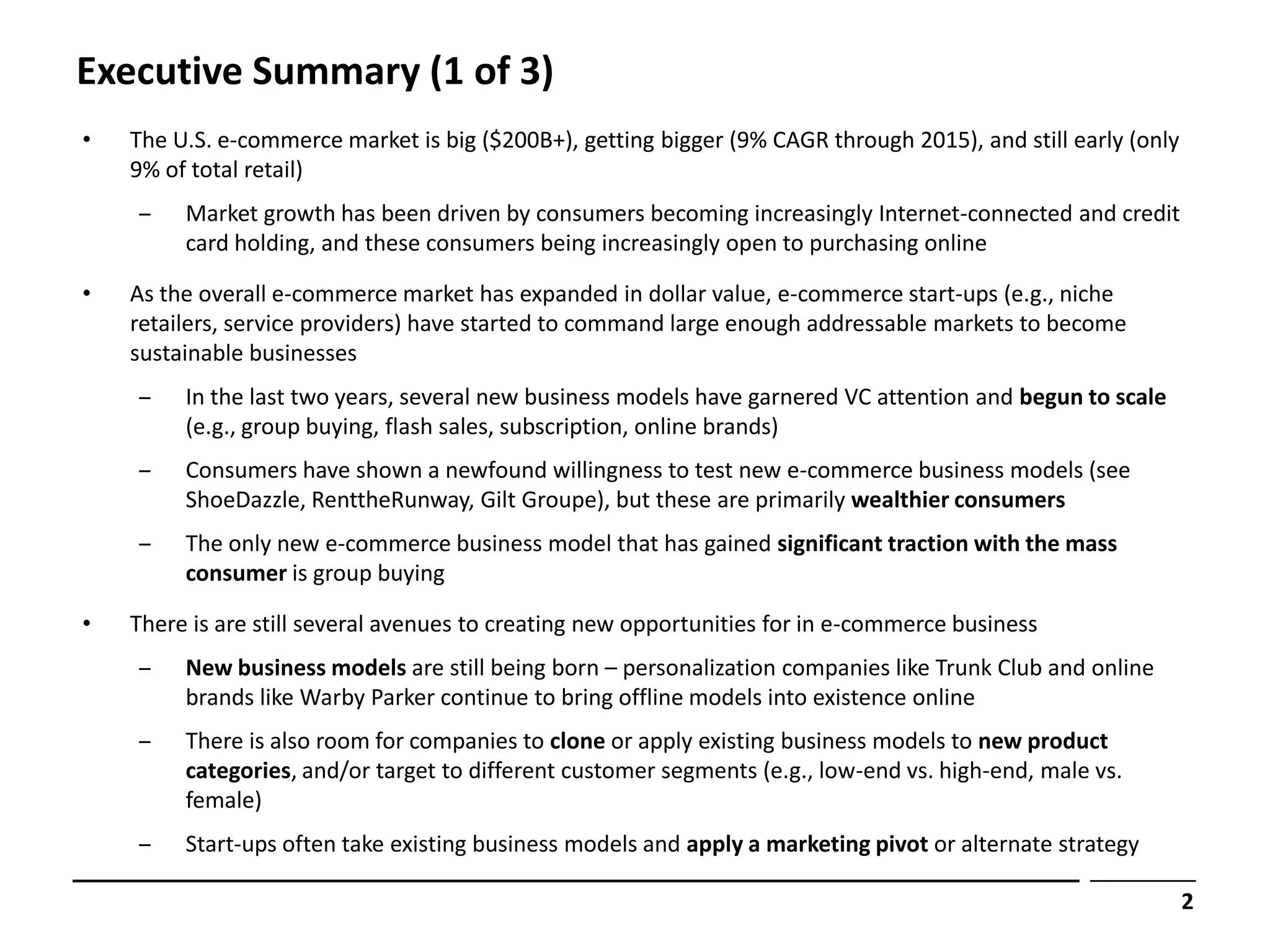
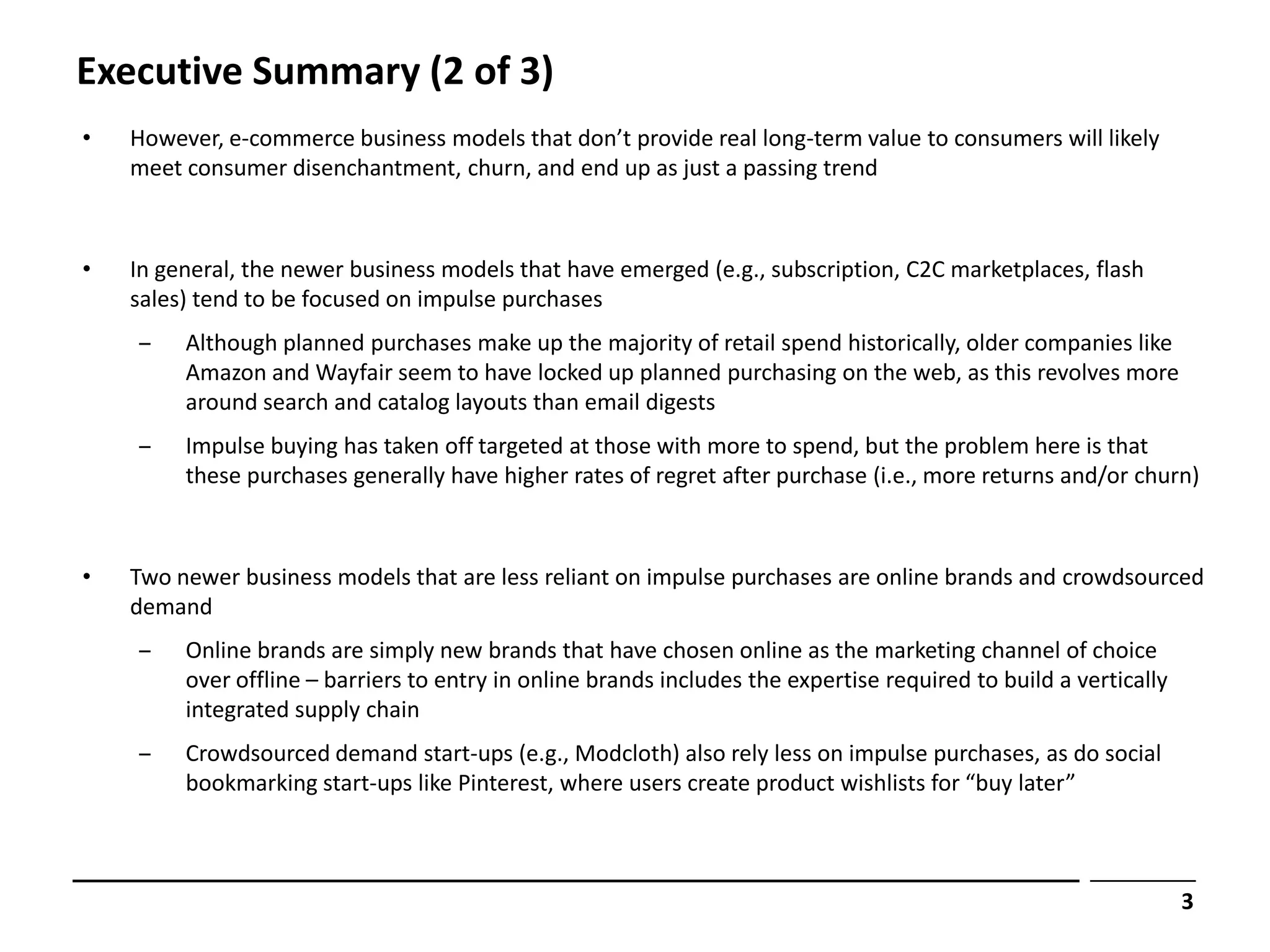
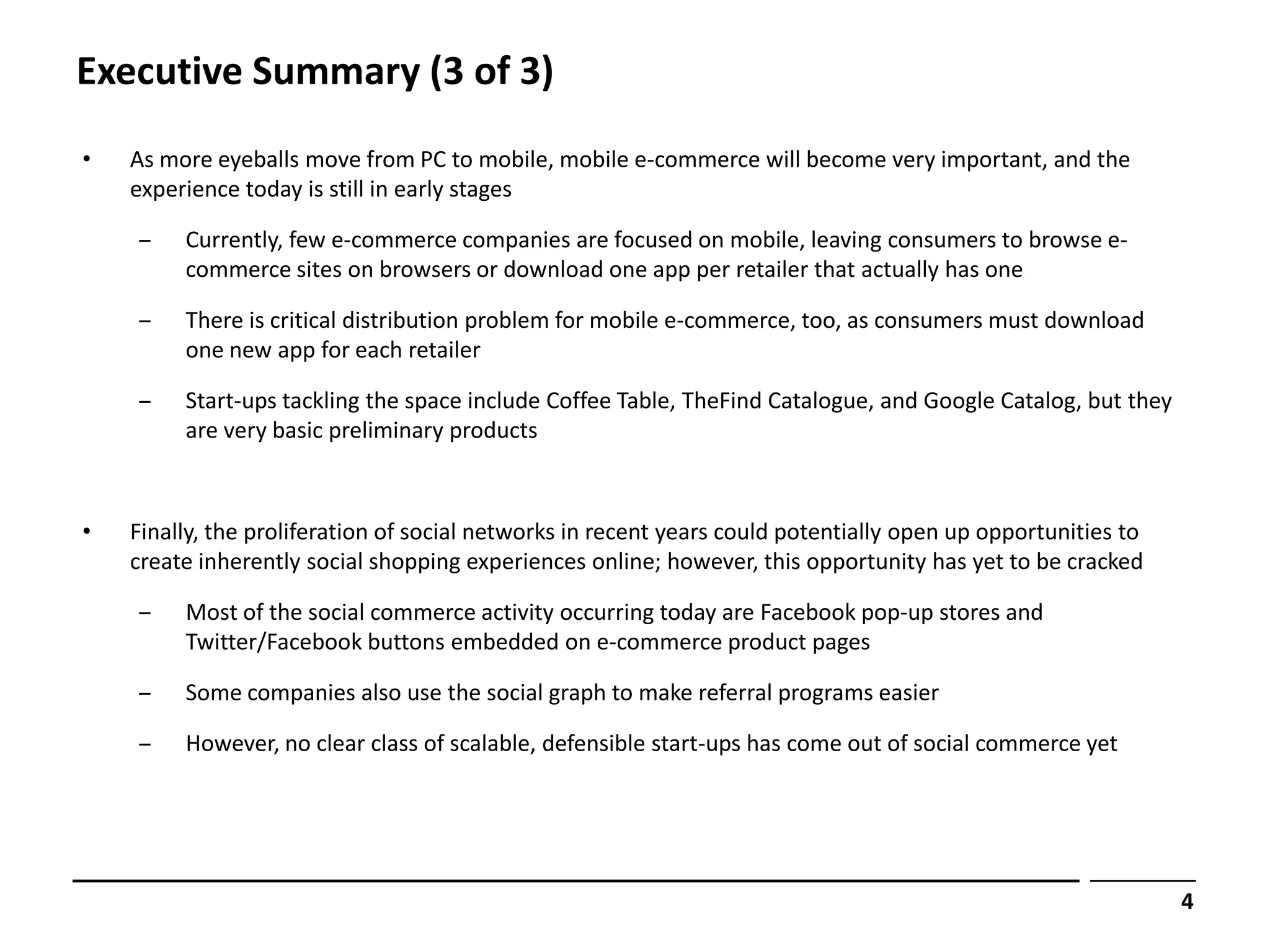
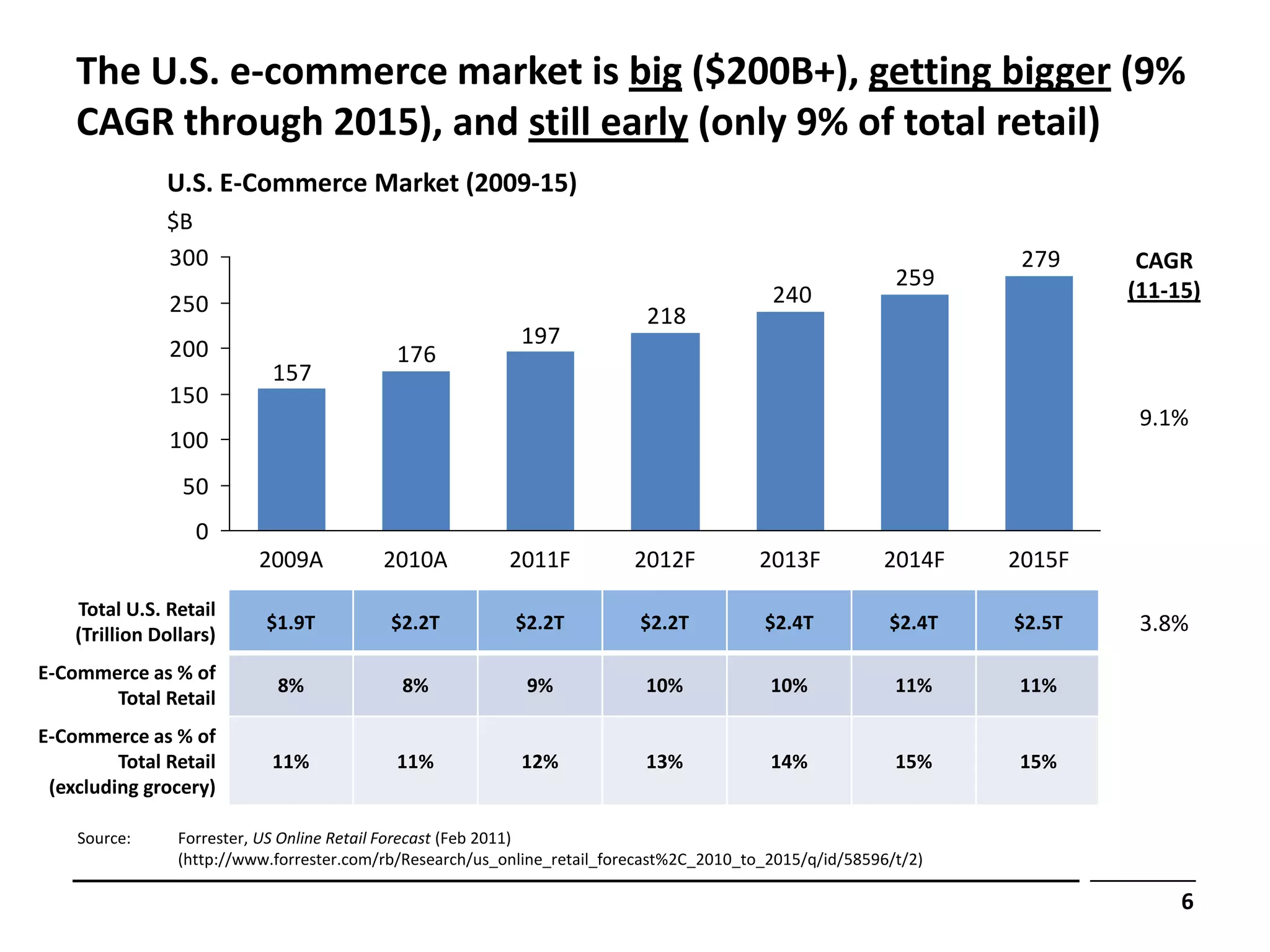
![More Internet users are using the web for shopping, and
frequency per user is expected to increase
U.S. E-Commerce Shopper Data (2004-13E)
E-commerce Shopper Data Units 2004 2005 2006 2007 2008 2009 2010E 2011E 2012E 2013E
E-commerce Penetration
Internet Population [M] 186 195 203 211 217 222 227 231 235 239
Online Shoppers [M] 104 117 130 143 153 160 170 176 184 189
E-commerce Penetration of Internet Population [%] 55.9% 60.0% 64.0% 67.8% 70.5% 72.1% 74.9% 76.2% 78.3% 79.1%
E-commerce Shopper Stats
Shopping Sessions / shopper / month [M] 1.90 1.75 1.88 1.91 1.87 1.99 2.13 2.25 2.38 2.45
Average price / session [M] 39.50 41.25 43.00 45.50 45.00 41.00 41.50 43.00 44.00 46.00
Product return rate [%] 10.0% 9.0% 9.0% 8.0% 8.0% 8.0% 8.0% 8.0% 8.0% 8.0%
Source: Department of Commerce, Internet World Stats, Company reports, JP Morgan 2011 Internet Sector Outlook
(http://www.slideshare.net/victori98pt/2011-internet-sector-outlook-by-j-p-morgan)
7](https://image.slidesharecdn.com/e-commercelandscape-120129165410-phpapp02/75/E-commerce-Landscape-2012-7-2048.jpg)