This document provides an overview of Backus-Naur Form (BNF), which is a metalanguage used to describe the formal grammar of programming languages. It discusses what BNF is, how it represents grammar rules using terminals, nonterminals, and operators like ::= and |, examples of grammar rules written in BNF, and some limitations of BNF. The document also mentions that BNF uses recursion to define elements like integers and is essential for compiler construction.
Metalanguages
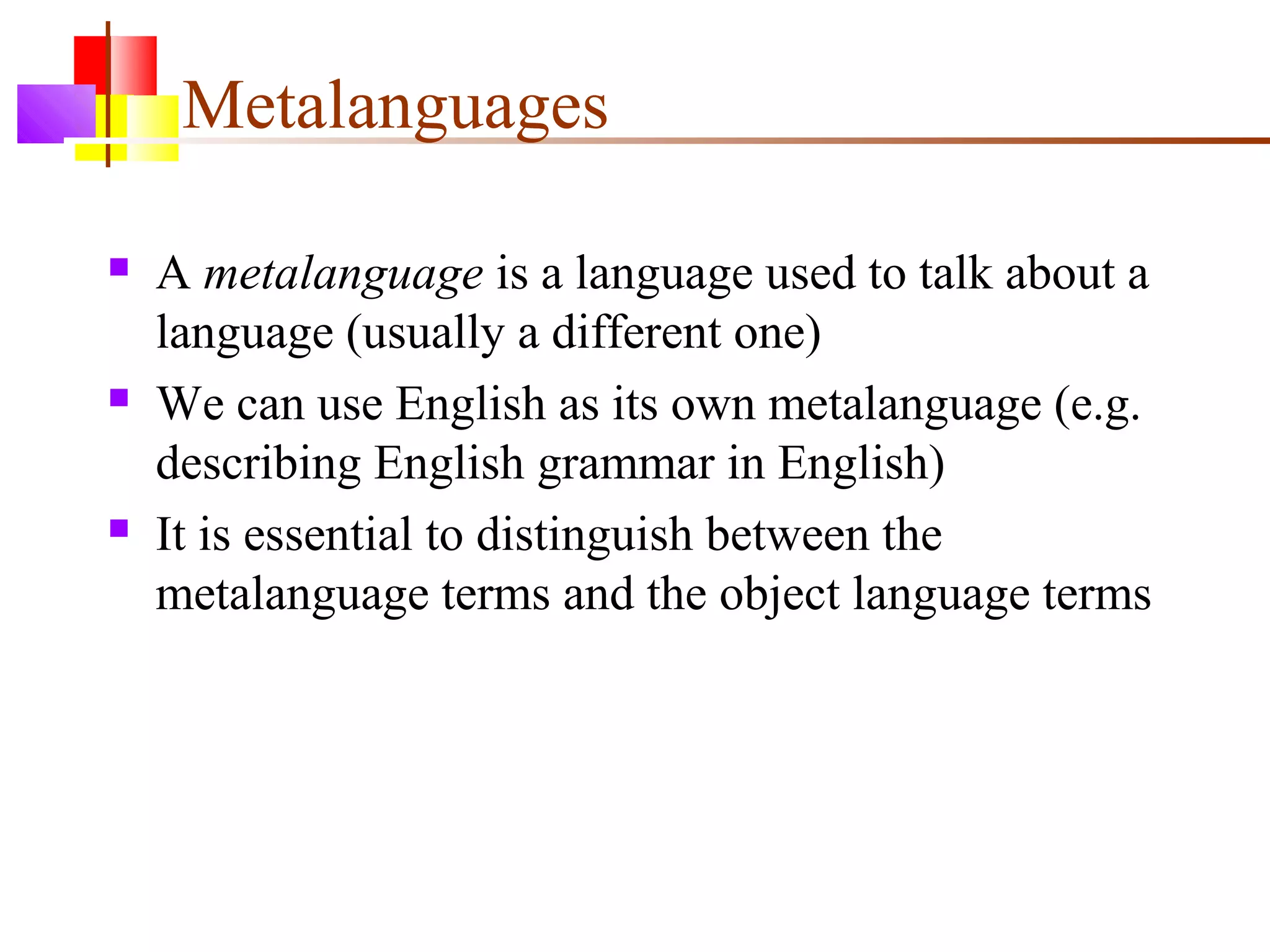
A metalanguageis a language used to talk about a
language (usually a different one)
We can use English as its own metalanguage (e.g.
describing English grammar in English)
It is essential to distinguish between the
metalanguage terms and the object language terms
3.
BNF
BNF standsfor either Backus-Naur Form or Backus
Normal Form
BNF is a metalanguage used to describe the
grammar of a programming language
BNF is formal and precise
BNF is a notation for context-free grammars
BNF is essential in compiler construction
There are many dialects of BNF in use, but…
…the differences are almost always minor
4.
BNF
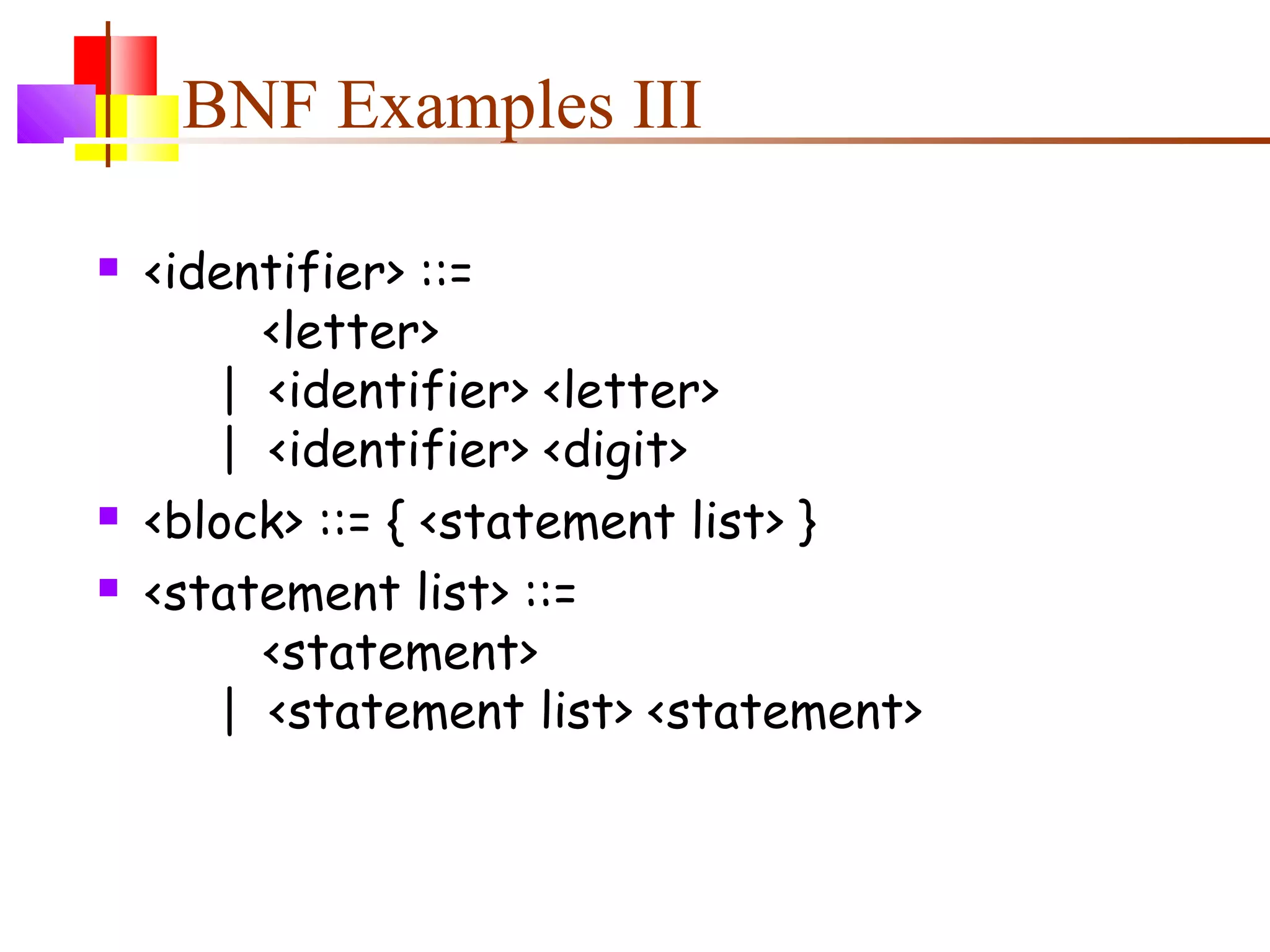
< >indicate a nonterminal that needs to be further
expanded, e.g. <variable>
Symbols not enclosed in < > are terminals; they
represent themselves, e.g. if, while, (
The symbol ::= means is defined as
The symbol | means or; it separates alternatives, e.g.
<addop> ::= + | -
This is all there is to “plain” BNF; but we will discuss
extended BNF (EBNF) later in this lecture
5.
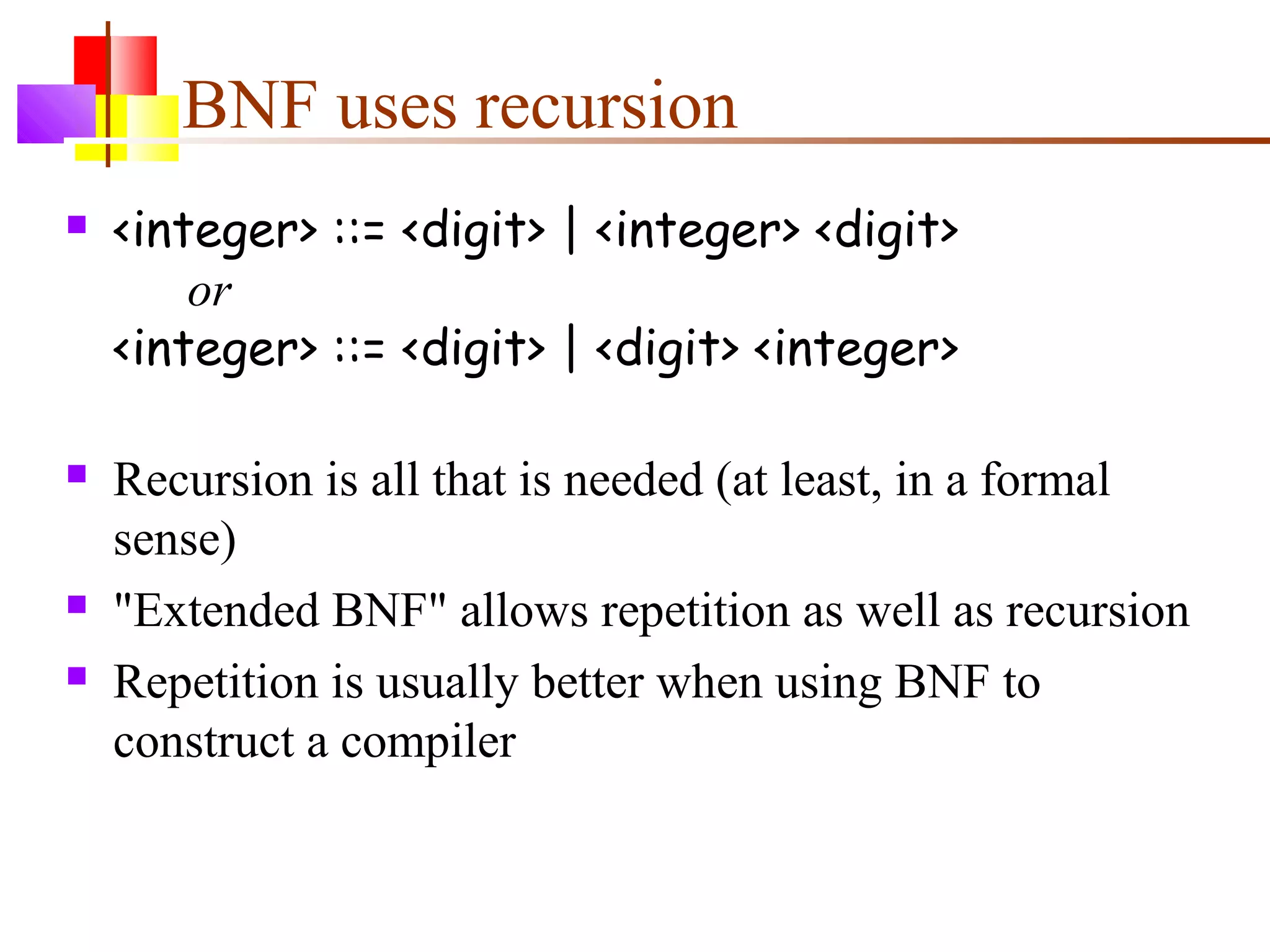
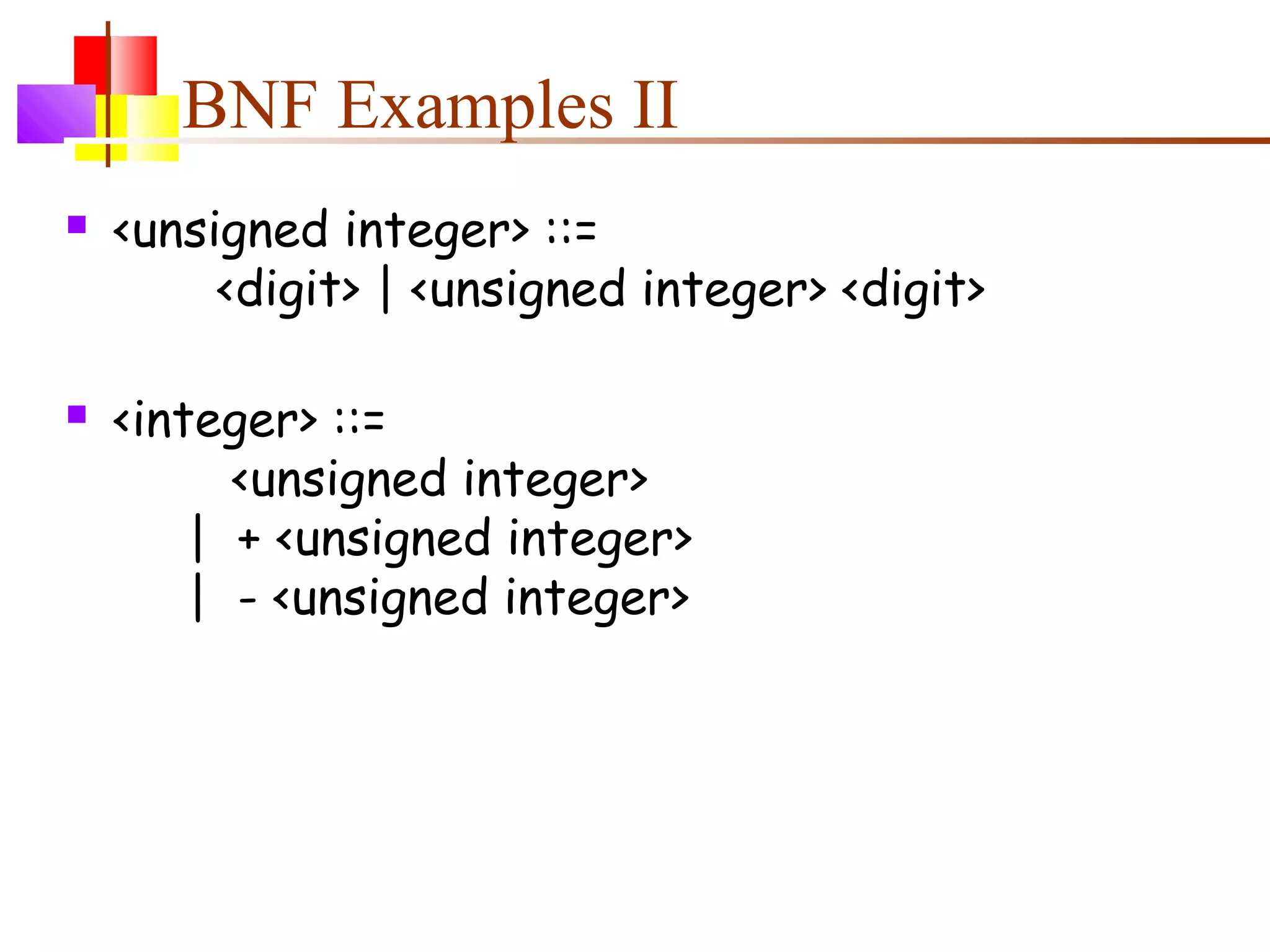
BNF uses recursion
<integer> ::= <digit> | <integer> <digit>
or
<integer> ::= <digit> | <digit> <integer>
Recursion is all that is needed (at least, in a formal
sense)
"Extended BNF" allows repetition as well as recursion
Repetition is usually better when using BNF to
construct a compiler
Extended BNF
Thefollowing are pretty standard:
[ ] enclose an optional part of the rule
Example:
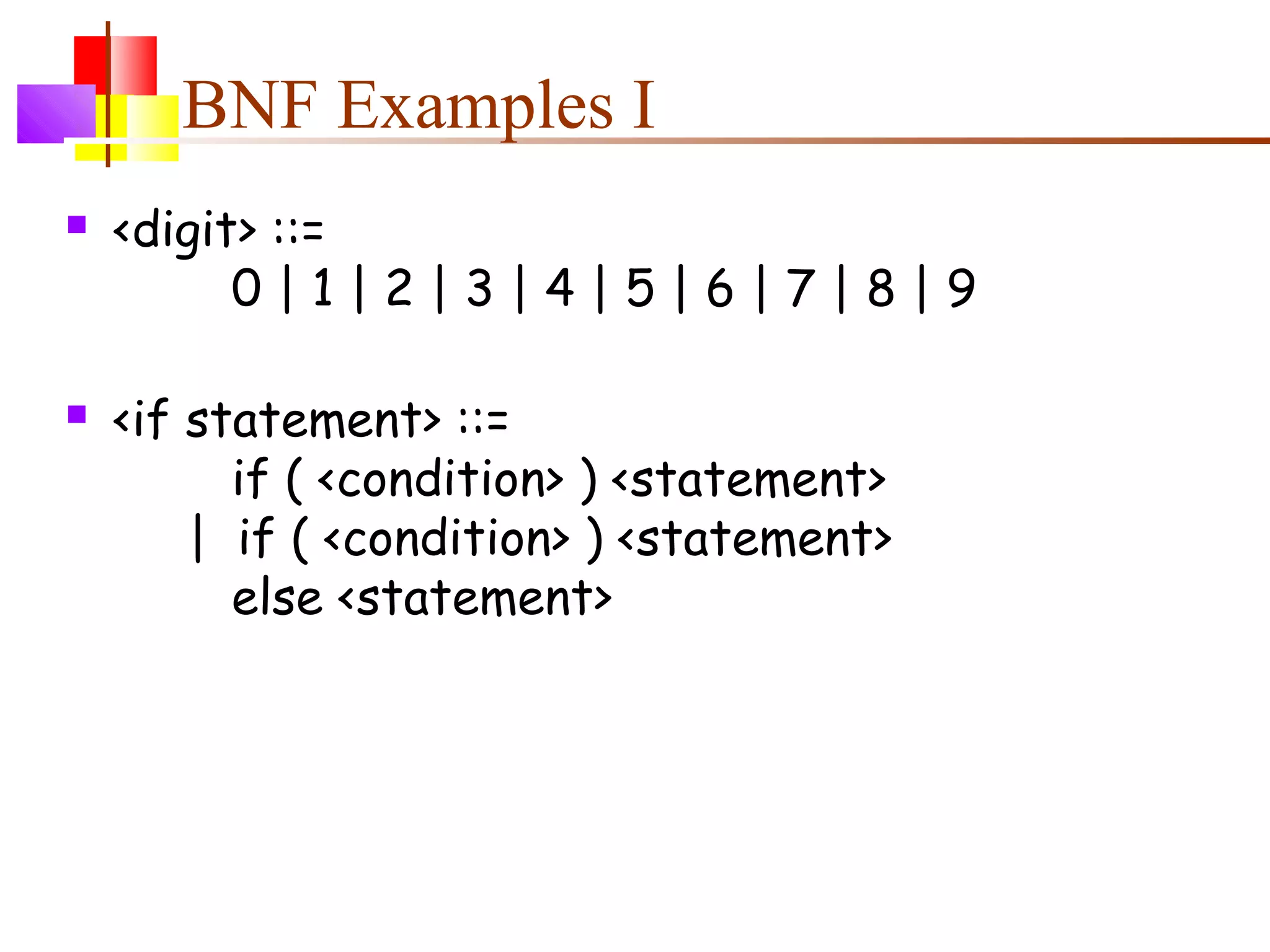
<if statement> ::=
if ( <condition> ) <statement> [ else <statement> ]
{ } mean the enclosed can be repeated any number of times
(including zero)
Example:
<parameter list> ::= ( )
| ( { <parameter> , } <parameter> )
11.
Variations
The precedingnotation is the original and most
common notation
BNF was designed before we had boldface, color, more
than one font, etc.
A typical modern variation might:
Use boldface to indicate multi-character terminals
Quote single-character terminals (because boldface isn’t so
obvious in this case)
Example:
if_statement ::=
if "(" condition ")" statement [ else statement ]
12.
Limitations of BNF
No easy way to impose length limitations, such as
maximum length of variable names
No easy way to describe ranges, such as 1 to 31
No way at all to impose distributed requirements, such
as, a variable must be declared before it is used
Describes only syntax, not semantics
Nothing clearly better has been devised



![Extended BNF
The following are pretty standard:
[ ] enclose an optional part of the rule
Example:
<if statement> ::=
if ( <condition> ) <statement> [ else <statement> ]
{ } mean the enclosed can be repeated any number of times
(including zero)
Example:
<parameter list> ::= ( )
| ( { <parameter> , } <parameter> )](https://image.slidesharecdn.com/25-bnf-140707113859-phpapp01/75/25-bnf-10-2048.jpg)
![Variations
The preceding notation is the original and most
common notation
BNF was designed before we had boldface, color, more
than one font, etc.
A typical modern variation might:
Use boldface to indicate multi-character terminals
Quote single-character terminals (because boldface isn’t so
obvious in this case)
Example:
if_statement ::=
if "(" condition ")" statement [ else statement ]](https://image.slidesharecdn.com/25-bnf-140707113859-phpapp01/75/25-bnf-11-2048.jpg)


