
Software Design and Development


Meta Languages in SDD
Contents
Course Specifications


       1. BNF


       2. EBNF


       3. Railroad diagram


       4. examples


      NSW BOS Course Specifications
BNF
                   Contents


Abbreviation for Backus-Naur form.

BNF is a metalanguage used to define the syntax of a programming language.


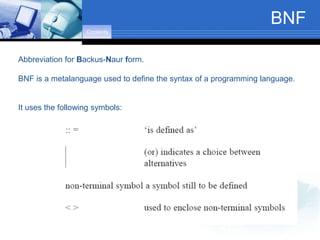
It uses the following symbols:
BNF
                                                   Contents                                                                                                              examples


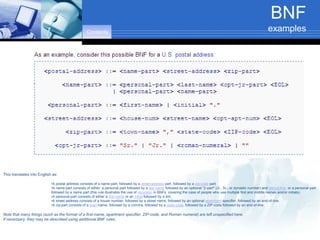
This translates into English as:

                            •A postal address consists of a name-part, followed by a street-address part, followed by a zip-code part.
                            •A name-part consists of either: a personal-part followed by a last name followed by an optional "jr-part" (Jr., Sr., or dynastic number) and end-of-line, or a personal part
                            followed by a name part (this rule illustrates the use of recursion in BNFs, covering the case of people who use multiple first and middle names and/or initials).
                            •A personal-part consists of either a first name or an initial followed by a dot.
                            •A street address consists of a house number, followed by a street name, followed by an optional apartment specifier, followed by an end-of-line.
                            •A zip-part consists of a town-name, followed by a comma, followed by a state code, followed by a ZIP-code followed by an end-of-line.

Note that many things (such as the format of a first-name, apartment specifier, ZIP-code, and Roman numeral) are left unspecified here.
If necessary, they may be described using additional BNF rules.
EBNF
                   Contents


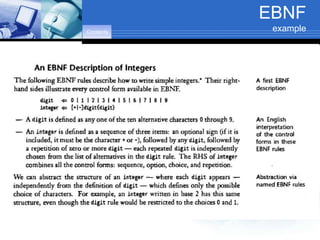
Abbreviation for extended Backus-Naur form.
EBNF is a metalanguage used to define the syntax of a programming language.

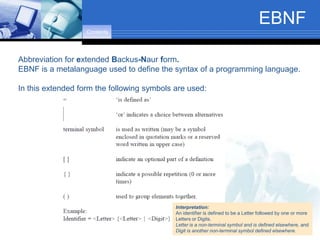
In this extended form the following symbols are used:


                                            Interpretation:
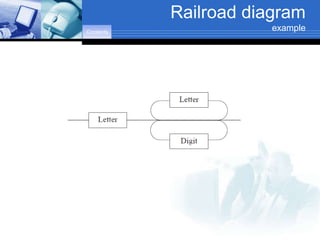
                                            An identifier is defined to be a Letter followed by one or more
                                            Letters or Digits.
                                            Letter is a non-terminal symbol and is defined elsewhere, and
                                            Digit is another non-terminal symbol defined elsewhere.
EBNF
Contents    example
Railroad diagram
                     Contents


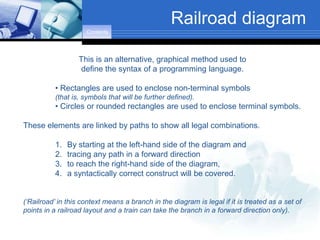
                  This is an alternative, graphical method used to
                   define the syntax of a programming language.

          • Rectangles are used to enclose non-terminal symbols
          (that is, symbols that will be further defined).
          • Circles or rounded rectangles are used to enclose terminal symbols.

These elements are linked by paths to show all legal combinations.

          1.   By starting at the left-hand side of the diagram and
          2.   tracing any path in a forward direction
          3.   to reach the right-hand side of the diagram,
          4.   a syntactically correct construct will be covered.


(‘Railroad’ in this context means a branch in the diagram is legal if it is treated as a set of
points in a railroad layout and a train can take the branch in a forward direction only).
Railroad diagram
Contents
                       example
BNF, EBNF, Railroad Diagram
                                            example
Contents


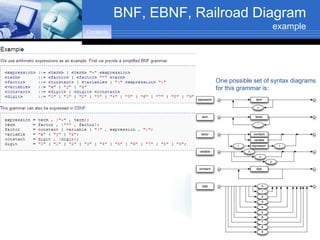
                         One possible set of syntax diagrams
                         for this grammar is:

Meta Languages

  • 1.
    Software Design andDevelopment Meta Languages in SDD
  • 2.
    Contents Course Specifications 1. BNF 2. EBNF 3. Railroad diagram 4. examples NSW BOS Course Specifications
  • 3.
    BNF Contents Abbreviation for Backus-Naur form. BNF is a metalanguage used to define the syntax of a programming language. It uses the following symbols:
  • 4.
    BNF Contents examples This translates into English as: •A postal address consists of a name-part, followed by a street-address part, followed by a zip-code part. •A name-part consists of either: a personal-part followed by a last name followed by an optional "jr-part" (Jr., Sr., or dynastic number) and end-of-line, or a personal part followed by a name part (this rule illustrates the use of recursion in BNFs, covering the case of people who use multiple first and middle names and/or initials). •A personal-part consists of either a first name or an initial followed by a dot. •A street address consists of a house number, followed by a street name, followed by an optional apartment specifier, followed by an end-of-line. •A zip-part consists of a town-name, followed by a comma, followed by a state code, followed by a ZIP-code followed by an end-of-line. Note that many things (such as the format of a first-name, apartment specifier, ZIP-code, and Roman numeral) are left unspecified here. If necessary, they may be described using additional BNF rules.
  • 5.
    EBNF Contents Abbreviation for extended Backus-Naur form. EBNF is a metalanguage used to define the syntax of a programming language. In this extended form the following symbols are used: Interpretation: An identifier is defined to be a Letter followed by one or more Letters or Digits. Letter is a non-terminal symbol and is defined elsewhere, and Digit is another non-terminal symbol defined elsewhere.
  • 6.
  • 7.
    Railroad diagram Contents This is an alternative, graphical method used to define the syntax of a programming language. • Rectangles are used to enclose non-terminal symbols (that is, symbols that will be further defined). • Circles or rounded rectangles are used to enclose terminal symbols. These elements are linked by paths to show all legal combinations. 1. By starting at the left-hand side of the diagram and 2. tracing any path in a forward direction 3. to reach the right-hand side of the diagram, 4. a syntactically correct construct will be covered. (‘Railroad’ in this context means a branch in the diagram is legal if it is treated as a set of points in a railroad layout and a train can take the branch in a forward direction only).
  • 8.
  • 9.
    BNF, EBNF, RailroadDiagram example Contents One possible set of syntax diagrams for this grammar is: