1


                  APPLYING RISK RADAR TO
                  HIGH RISK TECHNOLOGY
                  PROJECTS
                  Risk management is how adults manage projects
Niwot Ridge LLC
                  – Tim Lister, Principle, Fellow & Senior Consultant, Cutter Consortium
Risk
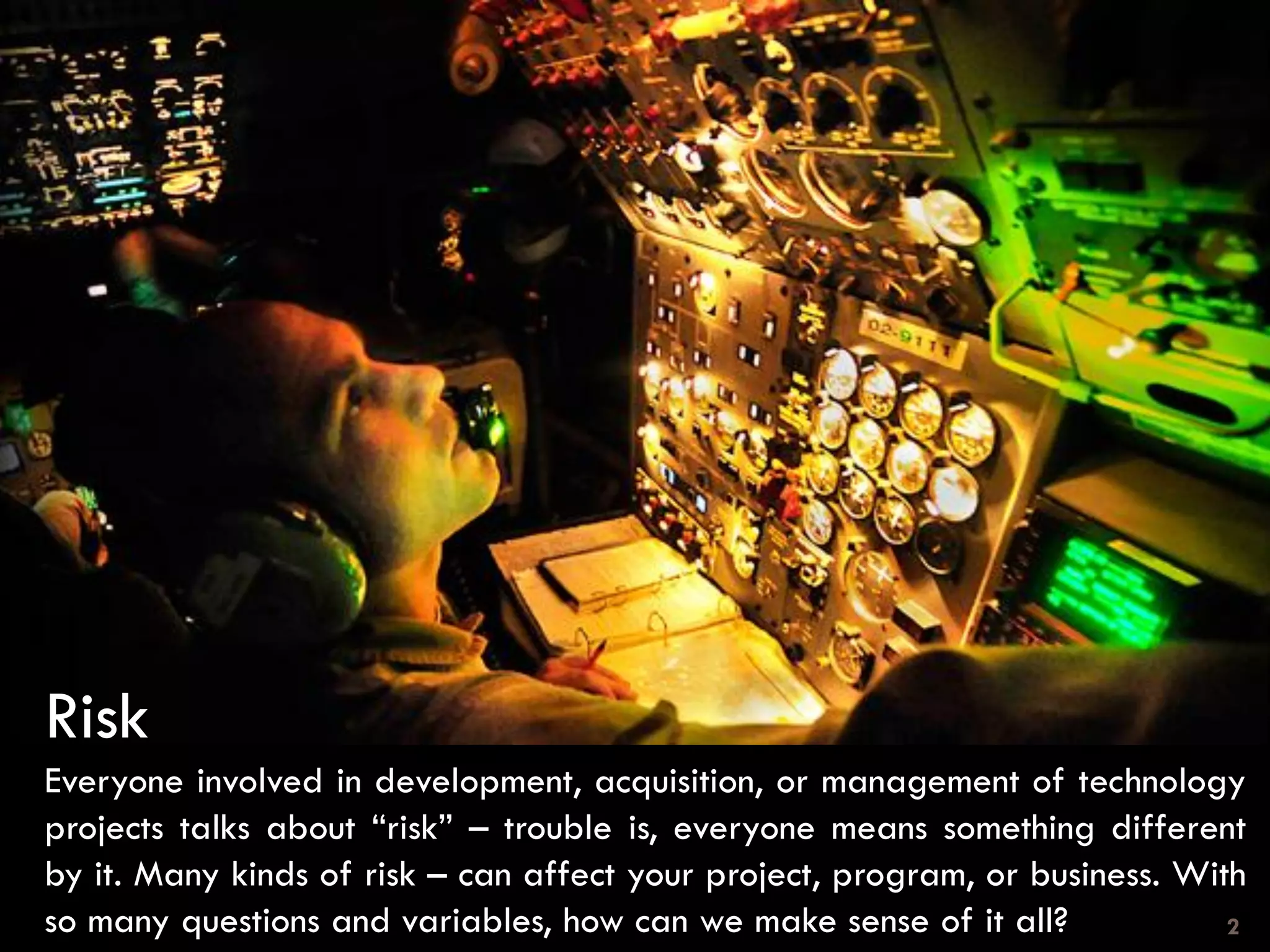
Everyone involved in development, acquisition, or management of technology
projects talks about “risk” – trouble is, everyone means something different
by it. Many kinds of risk – can affect your project, program, or business. With
so many questions and variables, how can we make sense of it all?             2
Risk is …
3


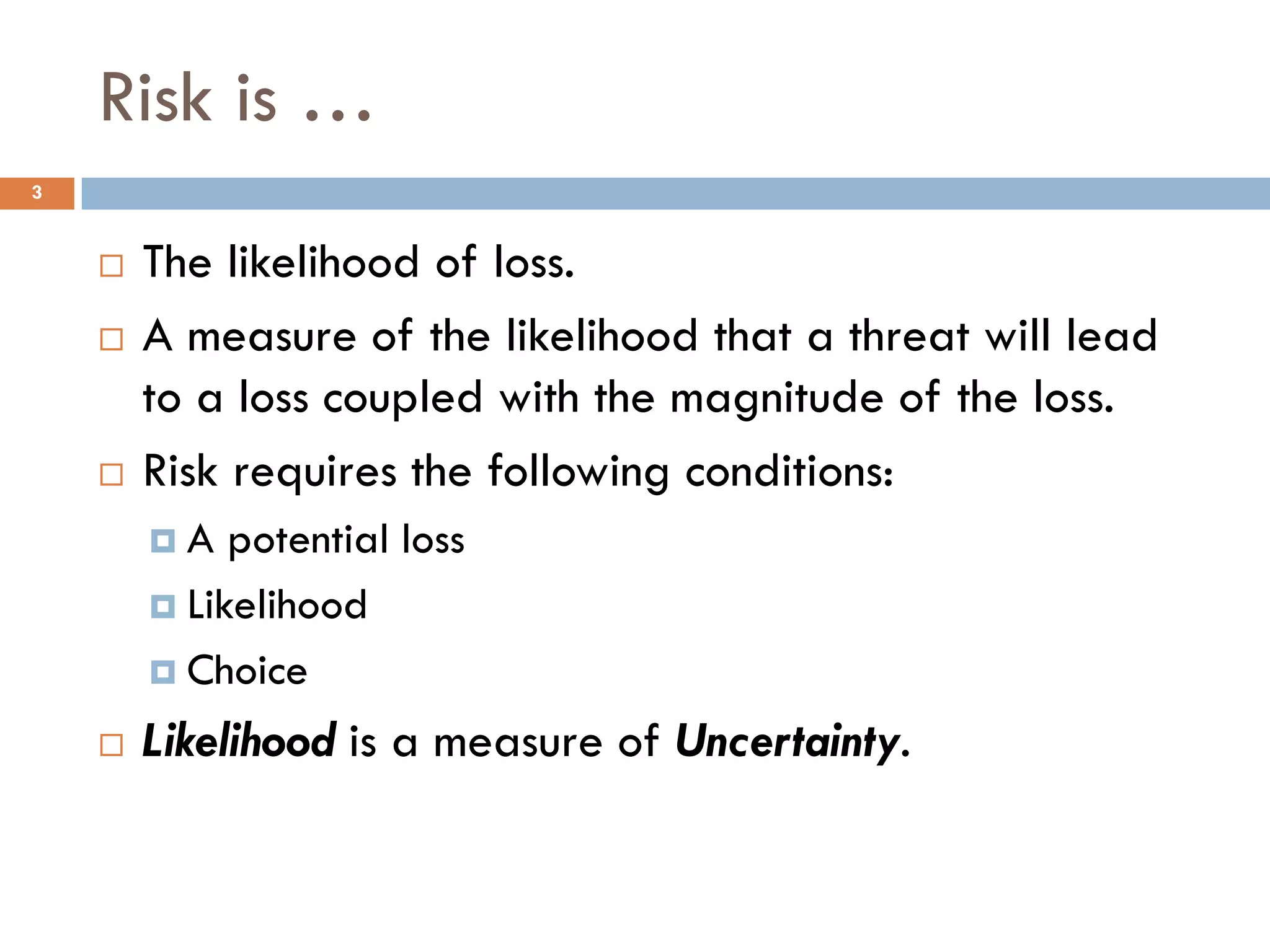
       The likelihood of loss.
       A measure of the likelihood that a threat will lead
        to a loss coupled with the magnitude of the loss.
       Risk requires the following conditions:
        A   potential loss
         Likelihood

         Choice

       Likelihood is a measure of Uncertainty.
What Is Uncertainty?
4


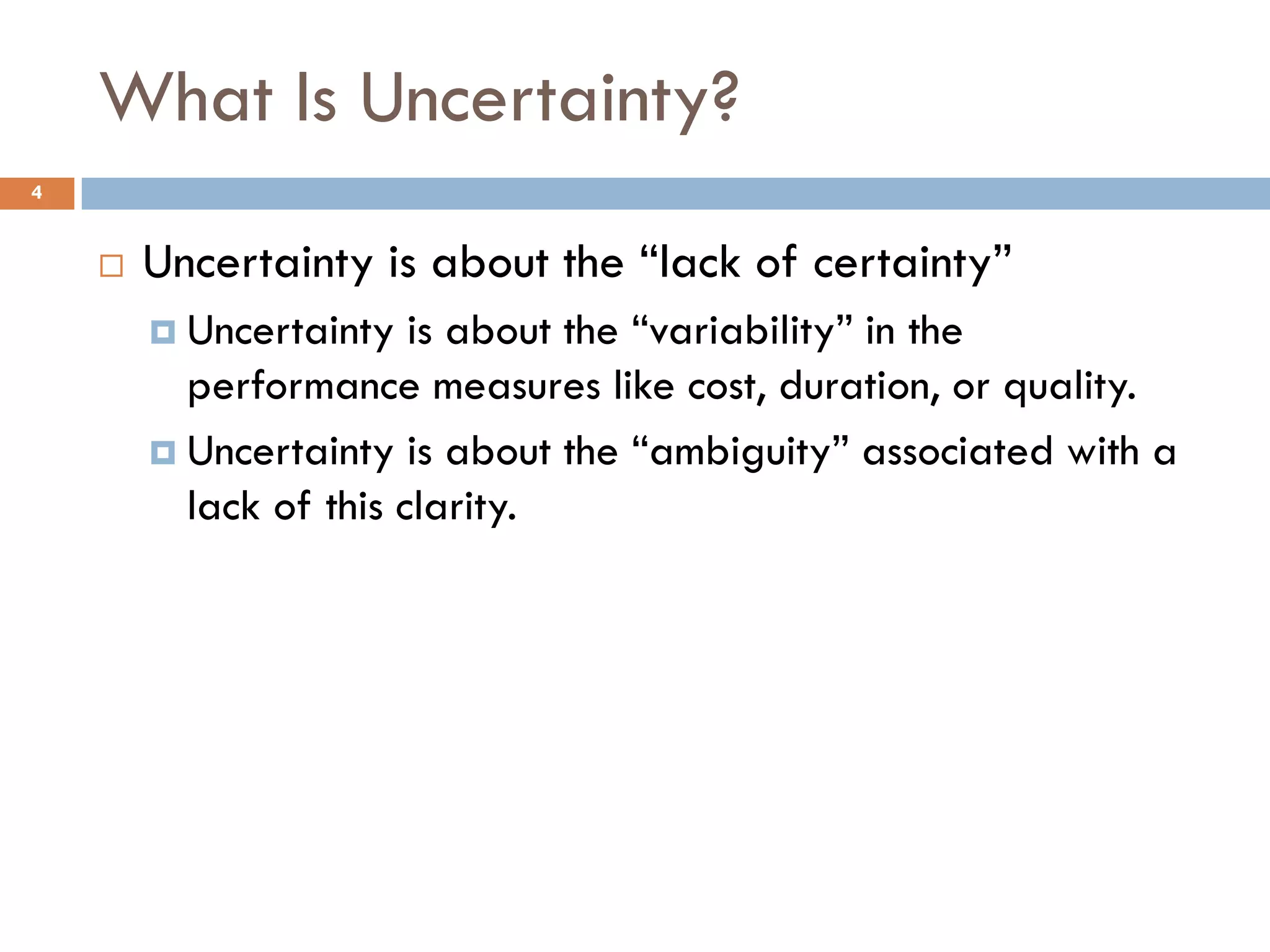
       Uncertainty is about the “lack of certainty”
         Uncertainty   is about the “variability” in the
          performance measures like cost, duration, or quality.
         Uncertainty is about the “ambiguity” associated with a
          lack of this clarity.
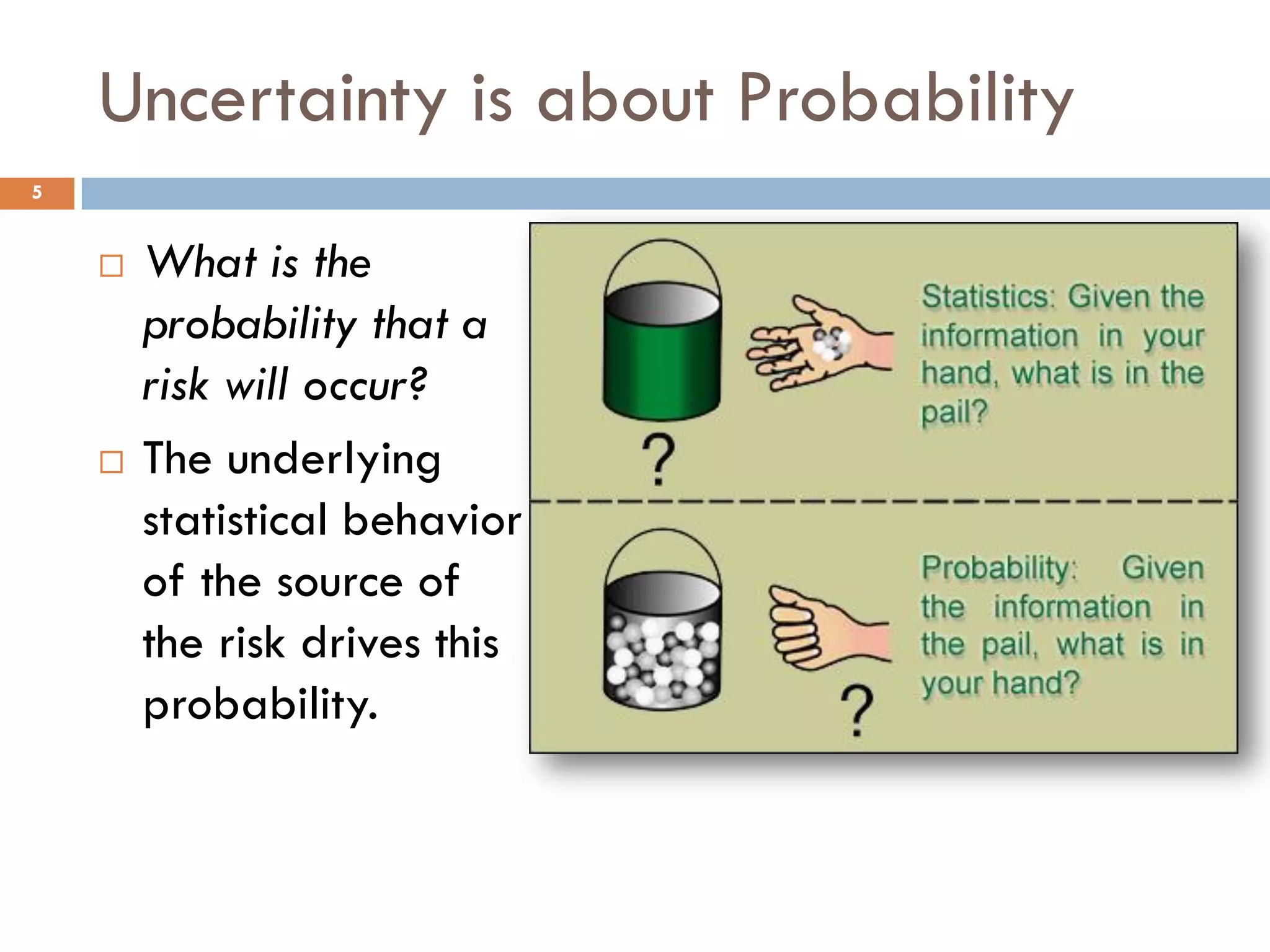
Uncertainty is about Probability
5


       What is the
        probability that a
        risk will occur?
       The underlying
        statistical behavior
        of the source of
        the risk drives this
        probability.
Components of Risk
6


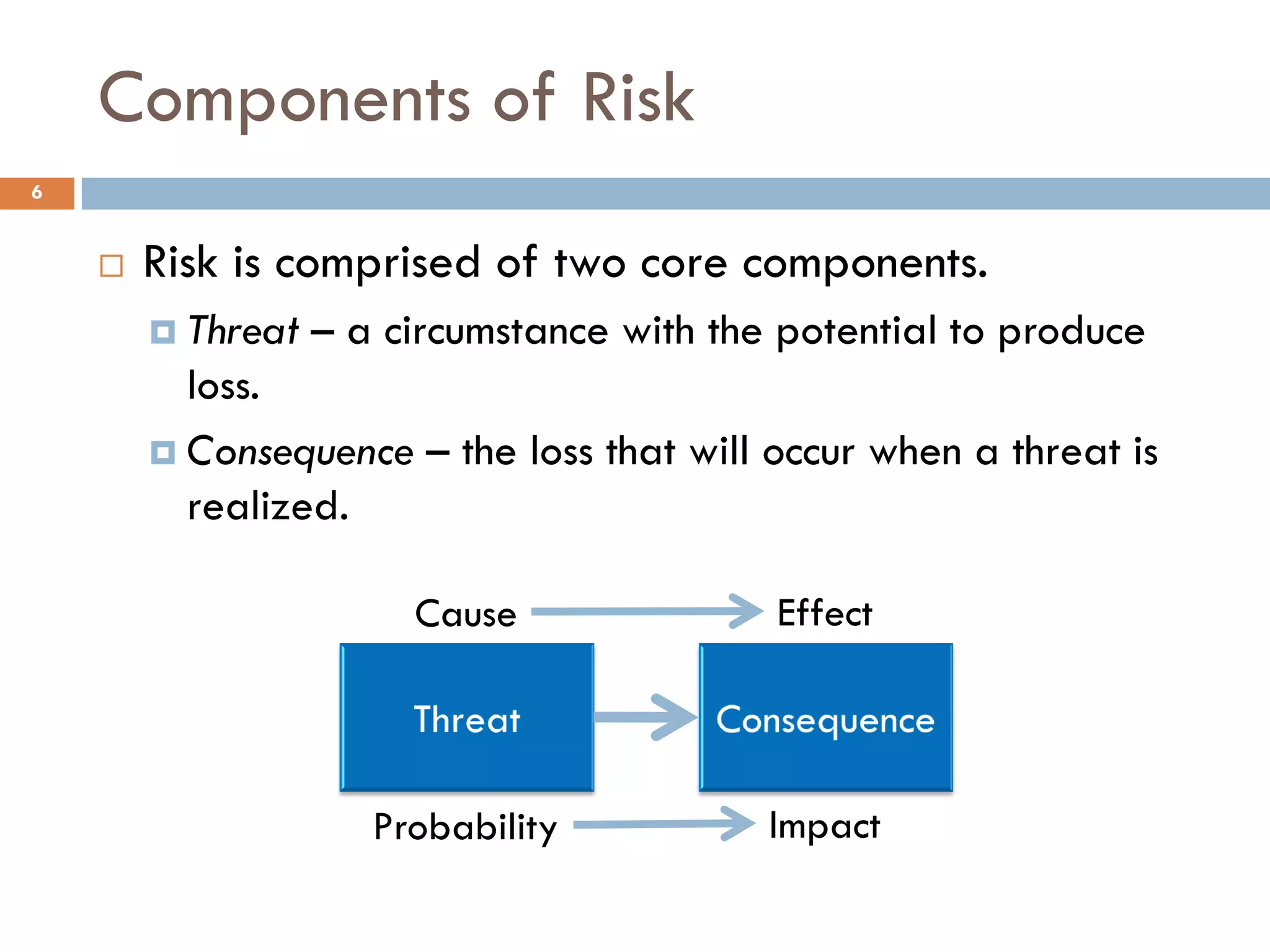
       Risk is comprised of two core components.
         Threat   – a circumstance with the potential to produce
          loss.
         Consequence – the loss that will occur when a threat is
          realized.

                        Cause               Effect


                      Probability           Impact
Risks are not the same as Issues
7


       An Issue is a loss or adverse consequence that has
        occurred or is certain to occur.
       An Issue has no uncertainty – the loss or adverse
        consequence has taken place or is certain to take
        place.
       An Issue or Problem can also lead to (or contribute
        to) other risks by:
         Creatinga circumstance that produces a new threat.
         Making an existing threat more likely to occur.

         Aggravating the consequences of existing risks.
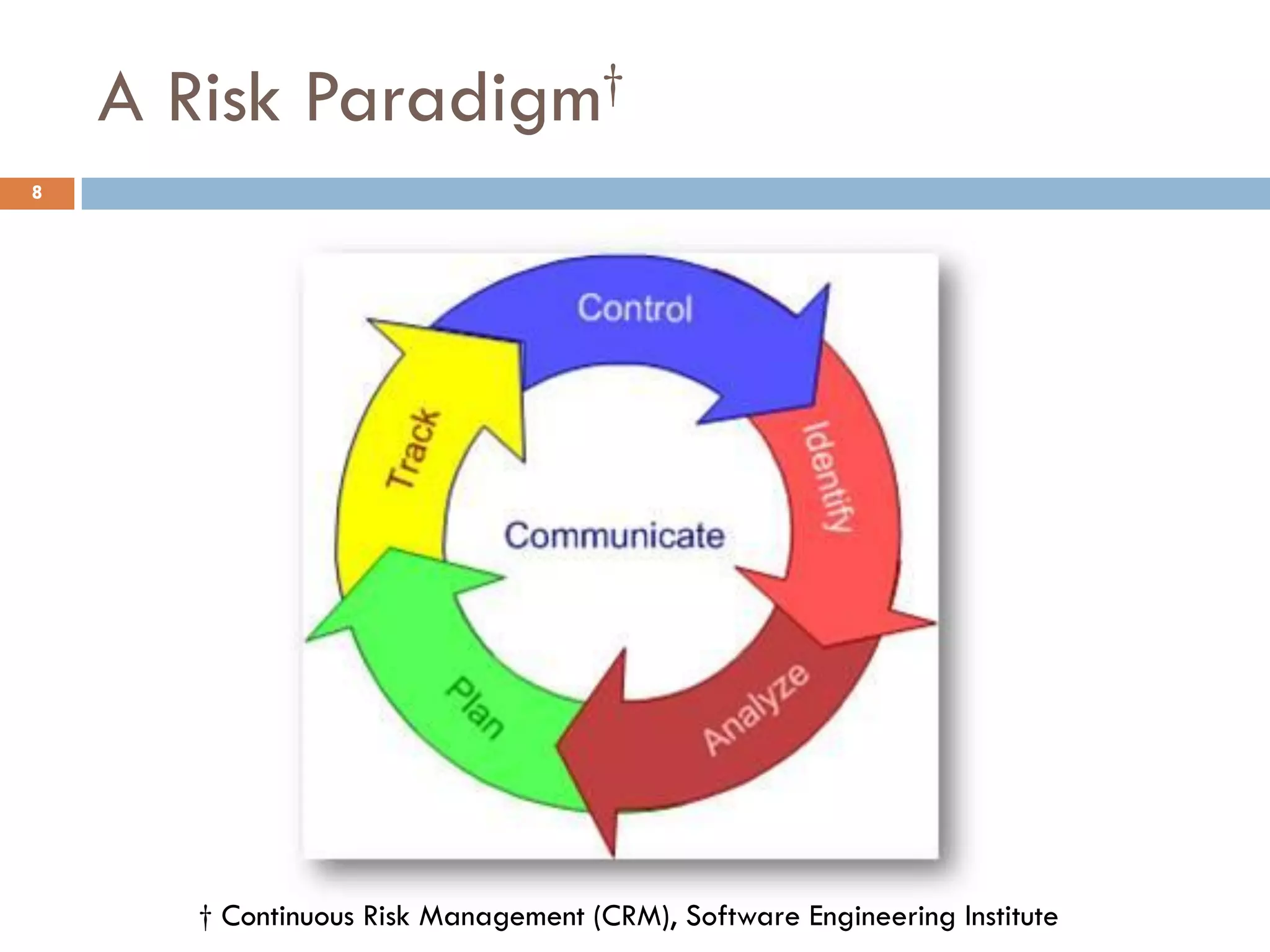
A Risk     Paradigm†
8


       † Continuous Risk Management (CRM), Software Engineering Institute
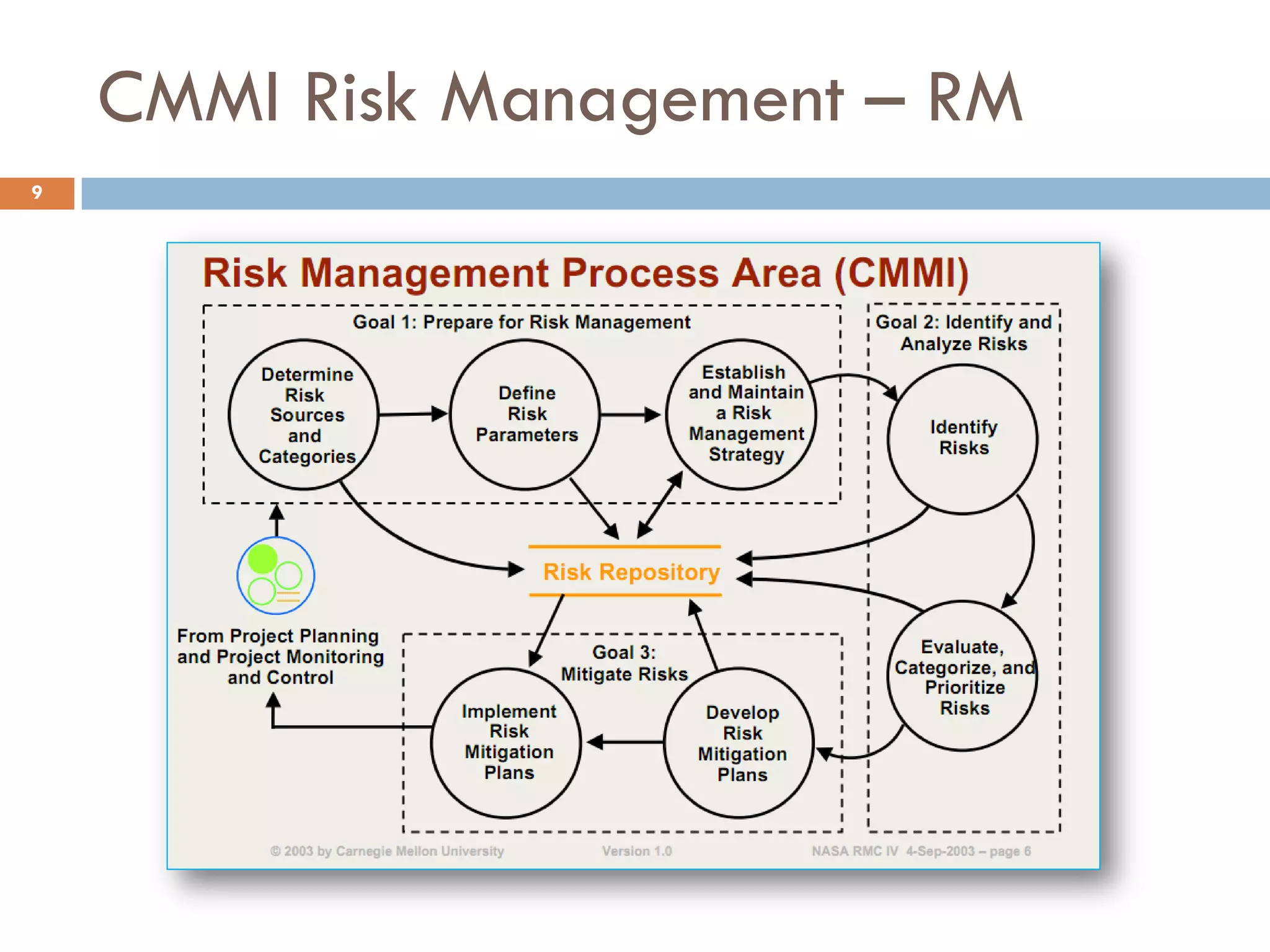
CMMI Risk Management – RM
9
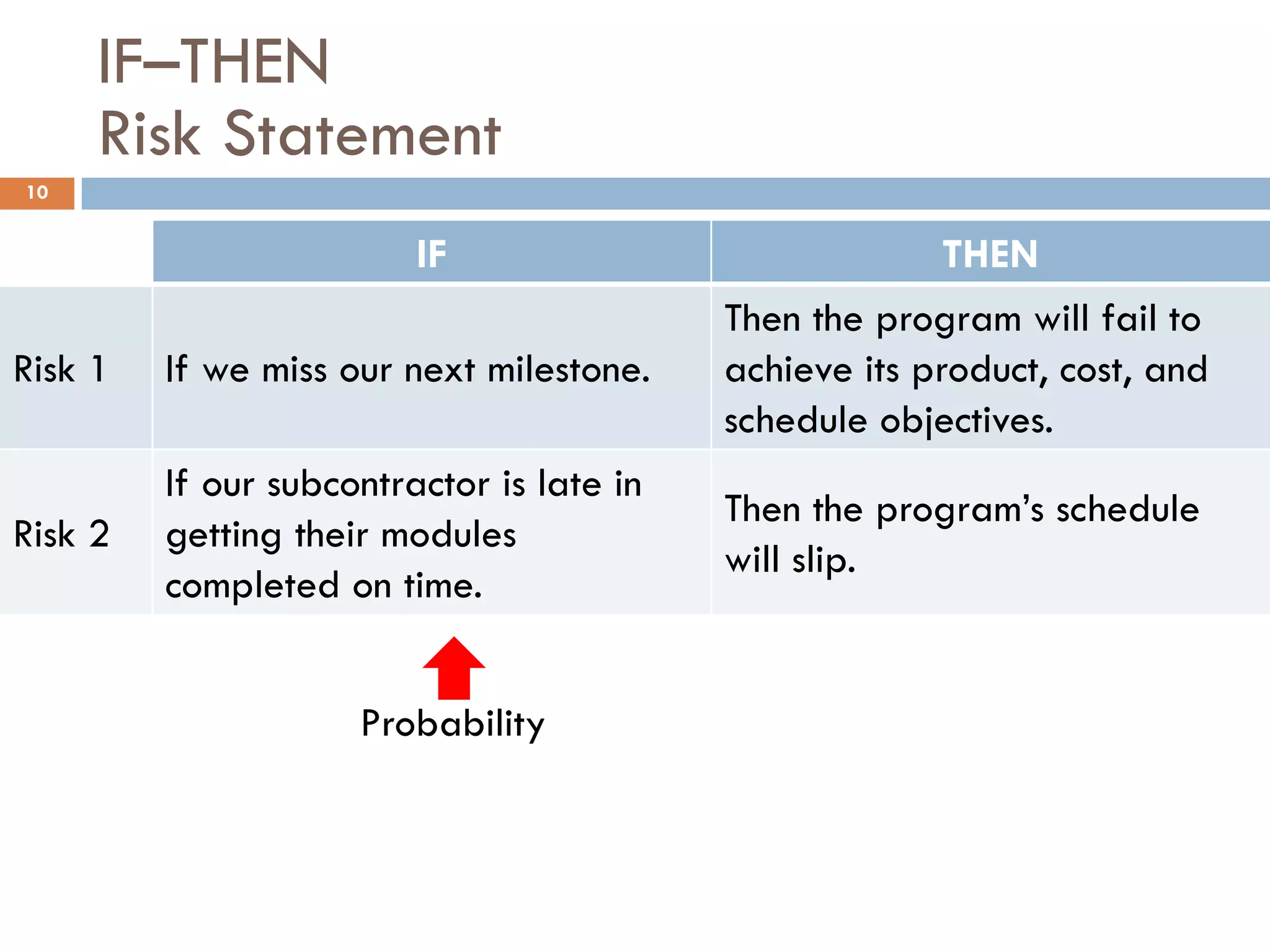
IF–THEN
     Risk Statement
10


                         IF                             THEN
                                           Then the program will fail to
Risk 1   If we miss our next milestone.    achieve its product, cost, and
                                           schedule objectives.
         If our subcontractor is late in
                                           Then the program’s schedule
Risk 2   getting their modules
                                           will slip.
         completed on time.


                     Probability
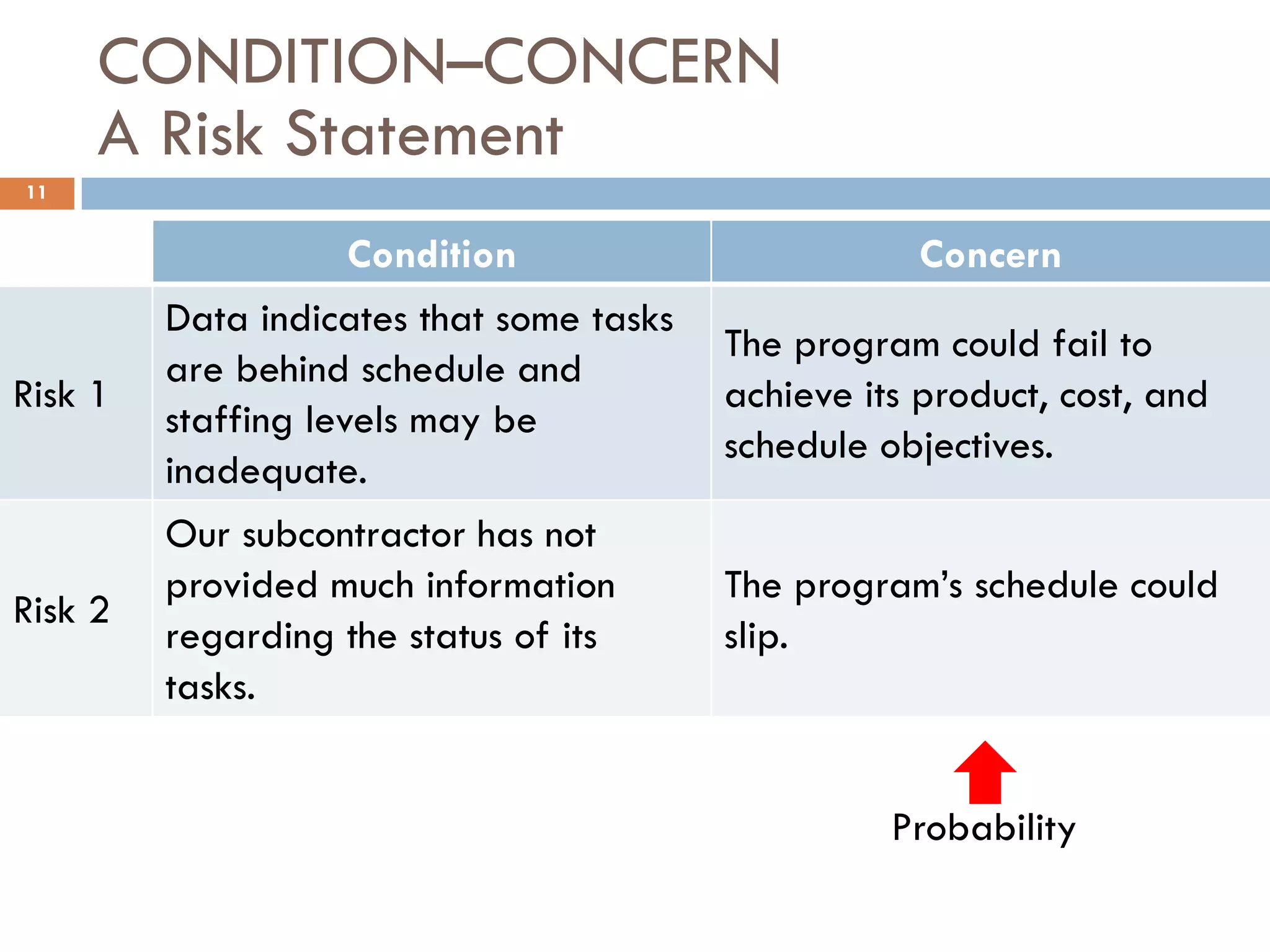
CONDITION–CONCERN
     A Risk Statement
11


                   Condition                          Concern
         Data indicates that some tasks
                                          The program could fail to
         are behind schedule and
Risk 1                                    achieve its product, cost, and
         staffing levels may be
                                          schedule objectives.
         inadequate.
         Our subcontractor has not
         provided much information        The program’s schedule could
Risk 2
         regarding the status of its      slip.
         tasks.


                                                    Probability
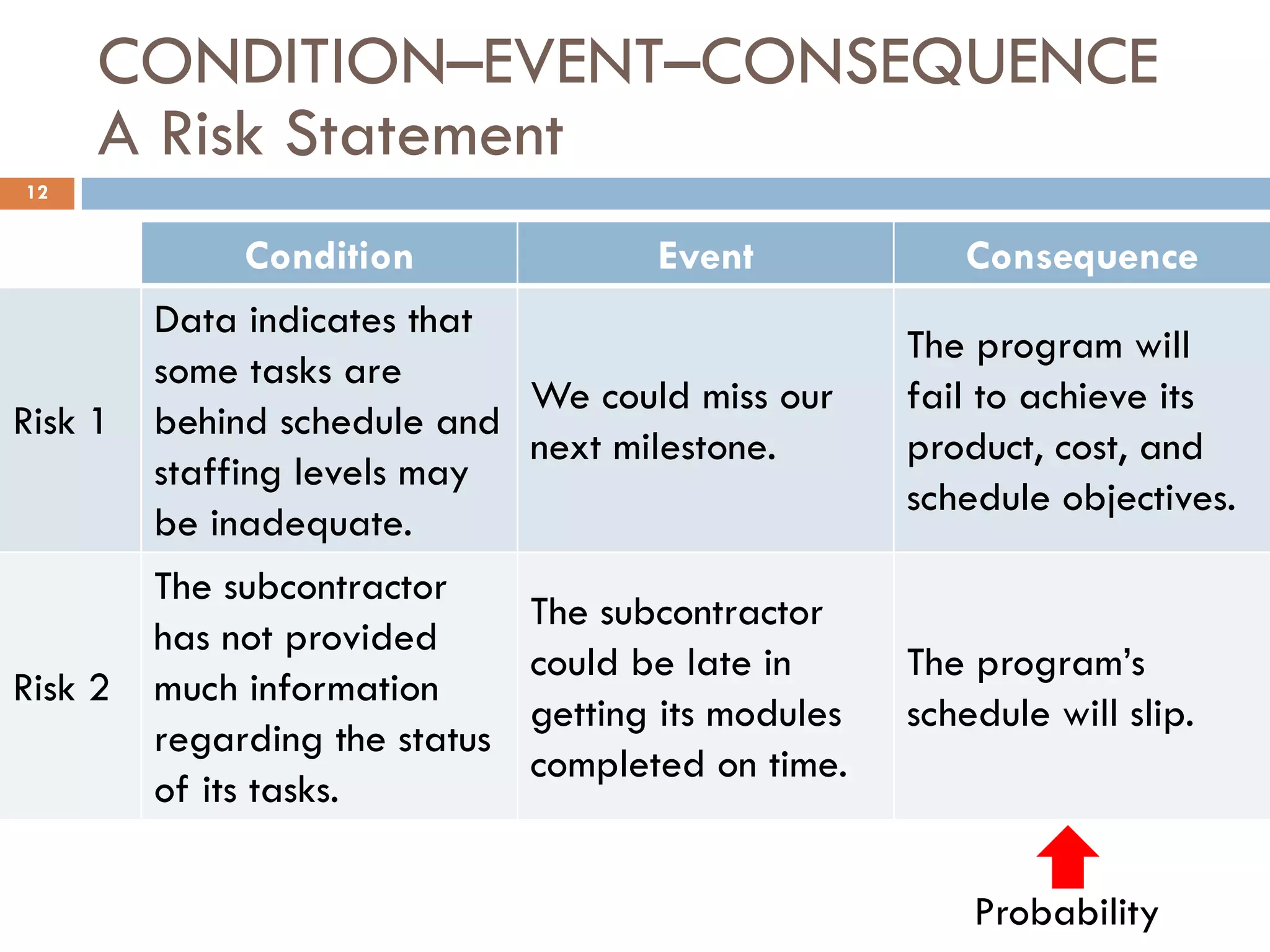
CONDITION–EVENT–CONSEQUENCE
     A Risk Statement
12


              Condition                Event             Consequence
         Data indicates that
                                                      The program will
         some tasks are
                                We could miss our     fail to achieve its
Risk 1   behind schedule and
                                next milestone.       product, cost, and
         staffing levels may
                                                      schedule objectives.
         be inadequate.
         The subcontractor
                                The subcontractor
         has not provided
                                could be late in      The program’s
Risk 2   much information
                                getting its modules   schedule will slip.
         regarding the status
                                completed on time.
         of its tasks.

                                                          Probability
Risk Handling Strategies
13


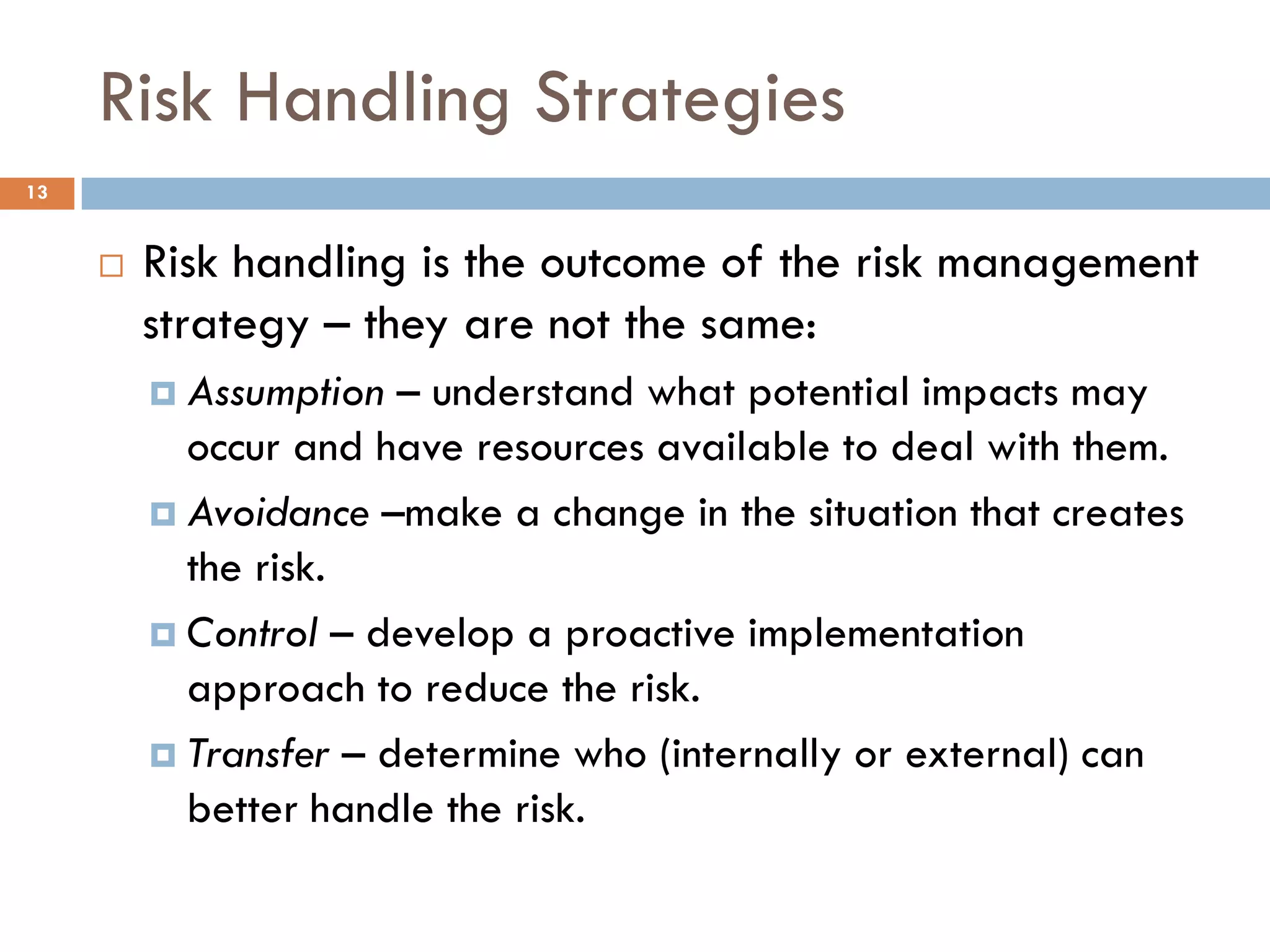
        Risk handling is the outcome of the risk management
         strategy – they are not the same:
          Assumption  – understand what potential impacts may
           occur and have resources available to deal with them.
          Avoidance –make a change in the situation that creates
           the risk.
          Control – develop a proactive implementation
           approach to reduce the risk.
          Transfer – determine who (internally or external) can
           better handle the risk.
Elements of Risk Analysis
14


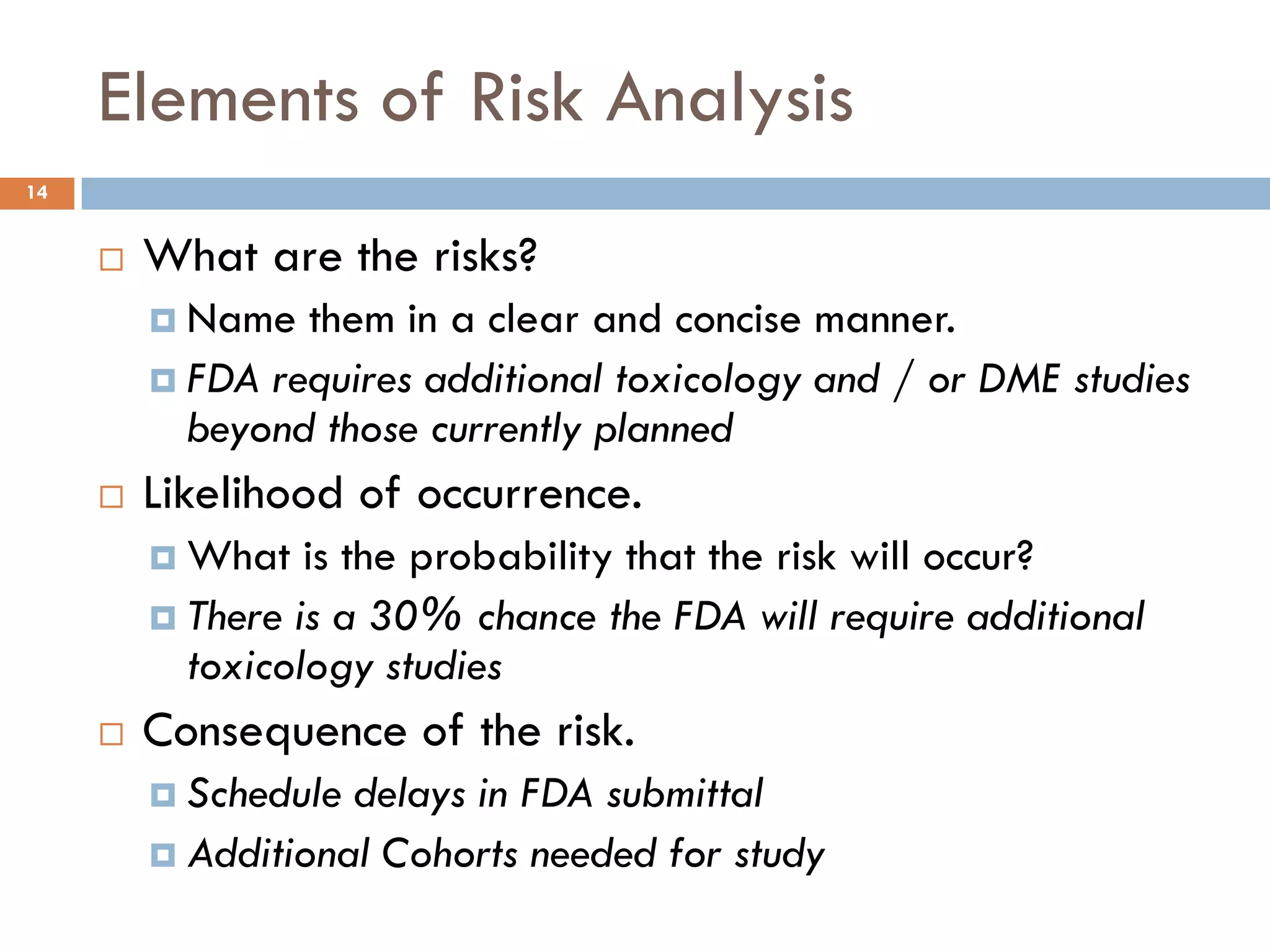
        What are the risks?
          Name  them in a clear and concise manner.
          FDA requires additional toxicology and / or DME studies
           beyond those currently planned
        Likelihood of occurrence.
          What   is the probability that the risk will occur?
          There is a 30% chance the FDA will require additional
           toxicology studies
        Consequence of the risk.
          Schedule delays in FDA submittal
          Additional Cohorts needed for study
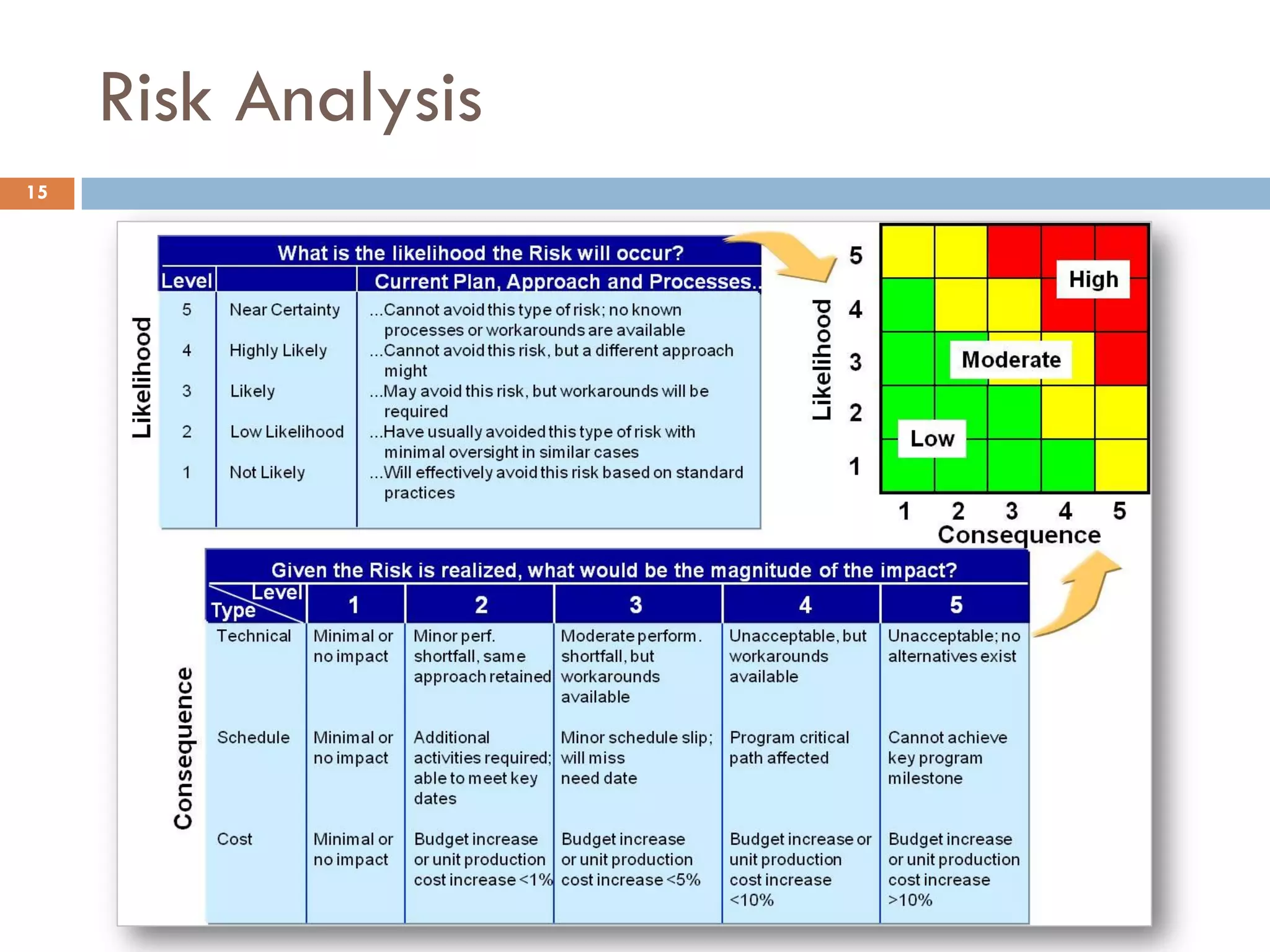
Risk Analysis
15
Example Risk Summary Grid
16

     1. FDA requires additional toxicology
        and/or ADME studies                                         15. Unsuccessful synthesis       16. GLP compliance at BSL–4
     2. FDA requires PK in pivotal animal                               scale–up from 50L to 300L        USAMRIID required for The Animal
        studies                                                     16. New impurities appear as a       Rule
                                                                        result of scale up

     3.    Insufficient subunit purification at
          vendor                                                                                     17. Two Segment II tox studies in
     4.    Failure of purification equipment at                                                          non–rodent and/or Segment I and
          J–M                                                                                            Segment III studies required for
     5.    New impurities appear as a result of                                                          Category B label
          scale up from 8L to 50L                               5
     6.    Subunits or API temporarily
          unavailable                                                                                18. FDA demands aerosol exposure
                                                                4
     7.    Lot failures of subunits, API or drug                                                         (i.e. viral challenge) experiments
                                                   Likelihood


          product                                                                                        be performed in nonhuman
     8.    One or more manufacturers not                        3                                        primate efficacy studies [L/H]
          cGMP
                                                                2

     10. Irreversible kidney toxicity is seen                                                        19. One of the pivotal animal efficacy
         in a subset of healthy volunteers at                   1
                                                                                                         studies fails to achieve primary
         therapeutic dose levels                                                                         clinical efficacy endpoint
     11. Clinical trial enrolls more slowly
         than expected.                                                1     2      3     4    5
     12. Positive signal in QTc study
                                                                                 Consequence
     13. FDA requests clinical data in                                                               20. No Observed Adverse Effect
         Special Populations pre–licensure                                         High                  Level is significantly lower than
     14. FDA requests larger clinical safety                                       Moderate              expected [L/H]
         database than initially proposed
                                                                                   Low
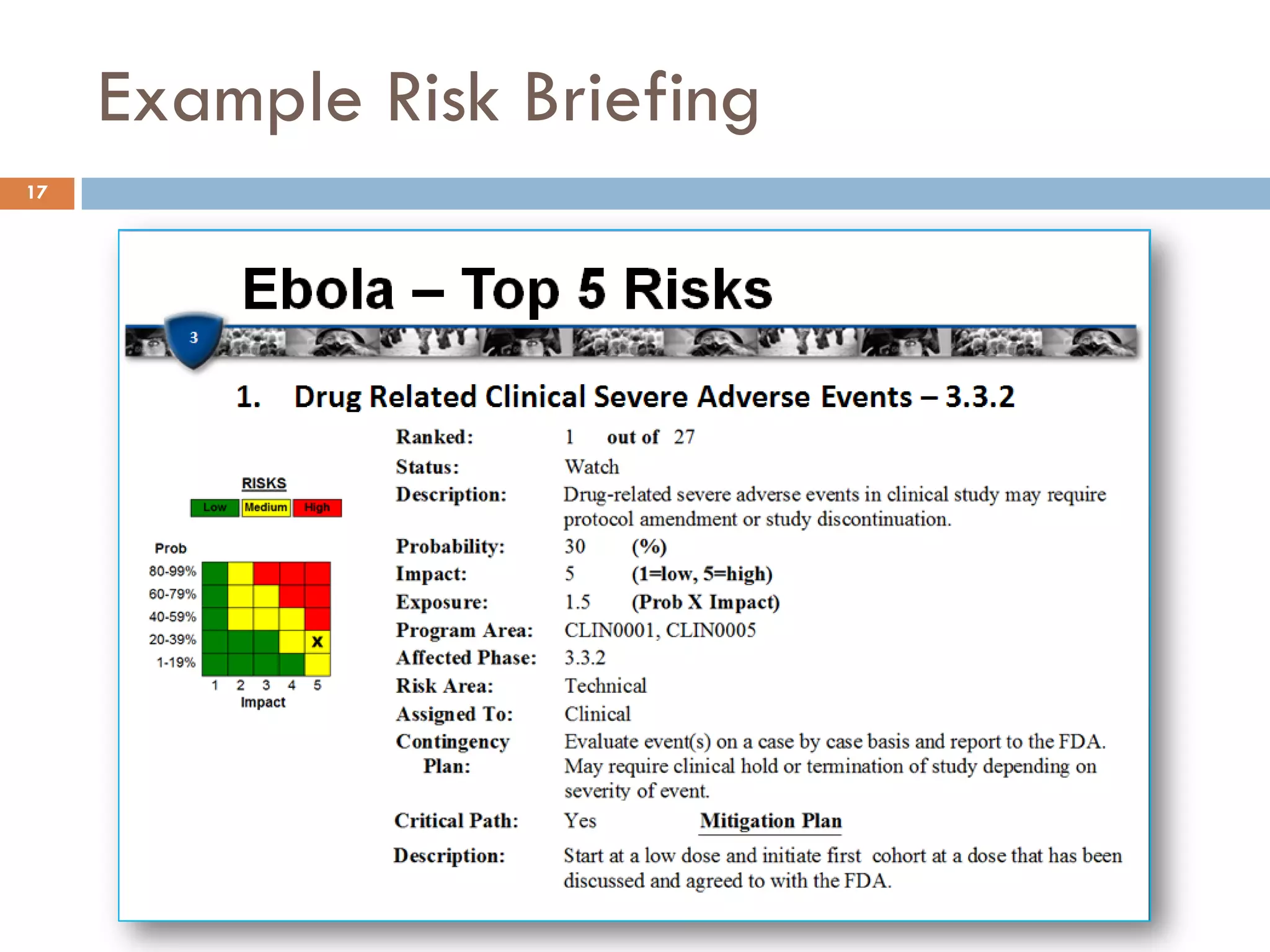
Example Risk Briefing
17

Applying risk radar (v2)

  • 1.
    1 APPLYING RISK RADAR TO HIGH RISK TECHNOLOGY PROJECTS Risk management is how adults manage projects Niwot Ridge LLC – Tim Lister, Principle, Fellow & Senior Consultant, Cutter Consortium
  • 2.
    Risk Everyone involved indevelopment, acquisition, or management of technology projects talks about “risk” – trouble is, everyone means something different by it. Many kinds of risk – can affect your project, program, or business. With so many questions and variables, how can we make sense of it all? 2
  • 3.
    Risk is … 3  The likelihood of loss.  A measure of the likelihood that a threat will lead to a loss coupled with the magnitude of the loss.  Risk requires the following conditions: A potential loss  Likelihood  Choice  Likelihood is a measure of Uncertainty.
  • 4.
    What Is Uncertainty? 4  Uncertainty is about the “lack of certainty”  Uncertainty is about the “variability” in the performance measures like cost, duration, or quality.  Uncertainty is about the “ambiguity” associated with a lack of this clarity.
  • 5.
    Uncertainty is aboutProbability 5  What is the probability that a risk will occur?  The underlying statistical behavior of the source of the risk drives this probability.
  • 6.
    Components of Risk 6  Risk is comprised of two core components.  Threat – a circumstance with the potential to produce loss.  Consequence – the loss that will occur when a threat is realized. Cause Effect Probability Impact
  • 7.
    Risks are notthe same as Issues 7  An Issue is a loss or adverse consequence that has occurred or is certain to occur.  An Issue has no uncertainty – the loss or adverse consequence has taken place or is certain to take place.  An Issue or Problem can also lead to (or contribute to) other risks by:  Creatinga circumstance that produces a new threat.  Making an existing threat more likely to occur.  Aggravating the consequences of existing risks.
  • 8.
    A Risk Paradigm† 8 † Continuous Risk Management (CRM), Software Engineering Institute
  • 9.
  • 10.
    IF–THEN Risk Statement 10 IF THEN Then the program will fail to Risk 1 If we miss our next milestone. achieve its product, cost, and schedule objectives. If our subcontractor is late in Then the program’s schedule Risk 2 getting their modules will slip. completed on time. Probability
  • 11.
    CONDITION–CONCERN A Risk Statement 11 Condition Concern Data indicates that some tasks The program could fail to are behind schedule and Risk 1 achieve its product, cost, and staffing levels may be schedule objectives. inadequate. Our subcontractor has not provided much information The program’s schedule could Risk 2 regarding the status of its slip. tasks. Probability
  • 12.
    CONDITION–EVENT–CONSEQUENCE A Risk Statement 12 Condition Event Consequence Data indicates that The program will some tasks are We could miss our fail to achieve its Risk 1 behind schedule and next milestone. product, cost, and staffing levels may schedule objectives. be inadequate. The subcontractor The subcontractor has not provided could be late in The program’s Risk 2 much information getting its modules schedule will slip. regarding the status completed on time. of its tasks. Probability
  • 13.
    Risk Handling Strategies 13  Risk handling is the outcome of the risk management strategy – they are not the same:  Assumption – understand what potential impacts may occur and have resources available to deal with them.  Avoidance –make a change in the situation that creates the risk.  Control – develop a proactive implementation approach to reduce the risk.  Transfer – determine who (internally or external) can better handle the risk.
  • 14.
    Elements of RiskAnalysis 14  What are the risks?  Name them in a clear and concise manner.  FDA requires additional toxicology and / or DME studies beyond those currently planned  Likelihood of occurrence.  What is the probability that the risk will occur?  There is a 30% chance the FDA will require additional toxicology studies  Consequence of the risk.  Schedule delays in FDA submittal  Additional Cohorts needed for study
  • 15.
  • 16.
    Example Risk SummaryGrid 16 1. FDA requires additional toxicology and/or ADME studies 15. Unsuccessful synthesis 16. GLP compliance at BSL–4 2. FDA requires PK in pivotal animal scale–up from 50L to 300L USAMRIID required for The Animal studies 16. New impurities appear as a Rule result of scale up 3. Insufficient subunit purification at vendor 17. Two Segment II tox studies in 4. Failure of purification equipment at non–rodent and/or Segment I and J–M Segment III studies required for 5. New impurities appear as a result of Category B label scale up from 8L to 50L 5 6. Subunits or API temporarily unavailable 18. FDA demands aerosol exposure 4 7. Lot failures of subunits, API or drug (i.e. viral challenge) experiments Likelihood product be performed in nonhuman 8. One or more manufacturers not 3 primate efficacy studies [L/H] cGMP 2 10. Irreversible kidney toxicity is seen 19. One of the pivotal animal efficacy in a subset of healthy volunteers at 1 studies fails to achieve primary therapeutic dose levels clinical efficacy endpoint 11. Clinical trial enrolls more slowly than expected. 1 2 3 4 5 12. Positive signal in QTc study Consequence 13. FDA requests clinical data in 20. No Observed Adverse Effect Special Populations pre–licensure High Level is significantly lower than 14. FDA requests larger clinical safety Moderate expected [L/H] database than initially proposed Low
  • 17.