HRIS: Pre Mortem Workshop
      August 10th 2011
Agenda
   Introduction
   Imagine a Fiasco
   Generate Risks from Failure
   Risk Analysis
   Next Steps


2
Introduction
    “A pre-mortem sets the team’s early mindset for risk sharing,
    transparency, trust, and opportunity to reduce the severity of a post-
    mortem. Start the pre-mortem by informing everyone that the program
    failed to meet its objectives and we are here to discuss the reasons for the
    failures. “

    “The ability to execute is very dependent on the severity and duration of
    the unknowns. Technical unknowns have the greatest potential program
    impact due to the “dictated innovation” necessary to keep to the contract.
    On the other hand, executional risks have a better chance of being
    controlled through additional/alternate resources or team task
    adjustments. In all cases, the sooner the team is aware of the future
    unknowns, the better the opportunity exists to make program adjustments
    to minimize impact. “


3
Imagine a Fiasco (Group)
    “ Assume you are looking into a crystal ball and seeing that the project has
    failed. It isn’t a simple failure either. It is a total, embarrassing, devastating
    failure. The people on the team are no longer talking to each other;
    customers are upset. Things have gone as wrong as they could. However,
    we cannot make out the reason for the failure and ask, “What could have
    caused this?”

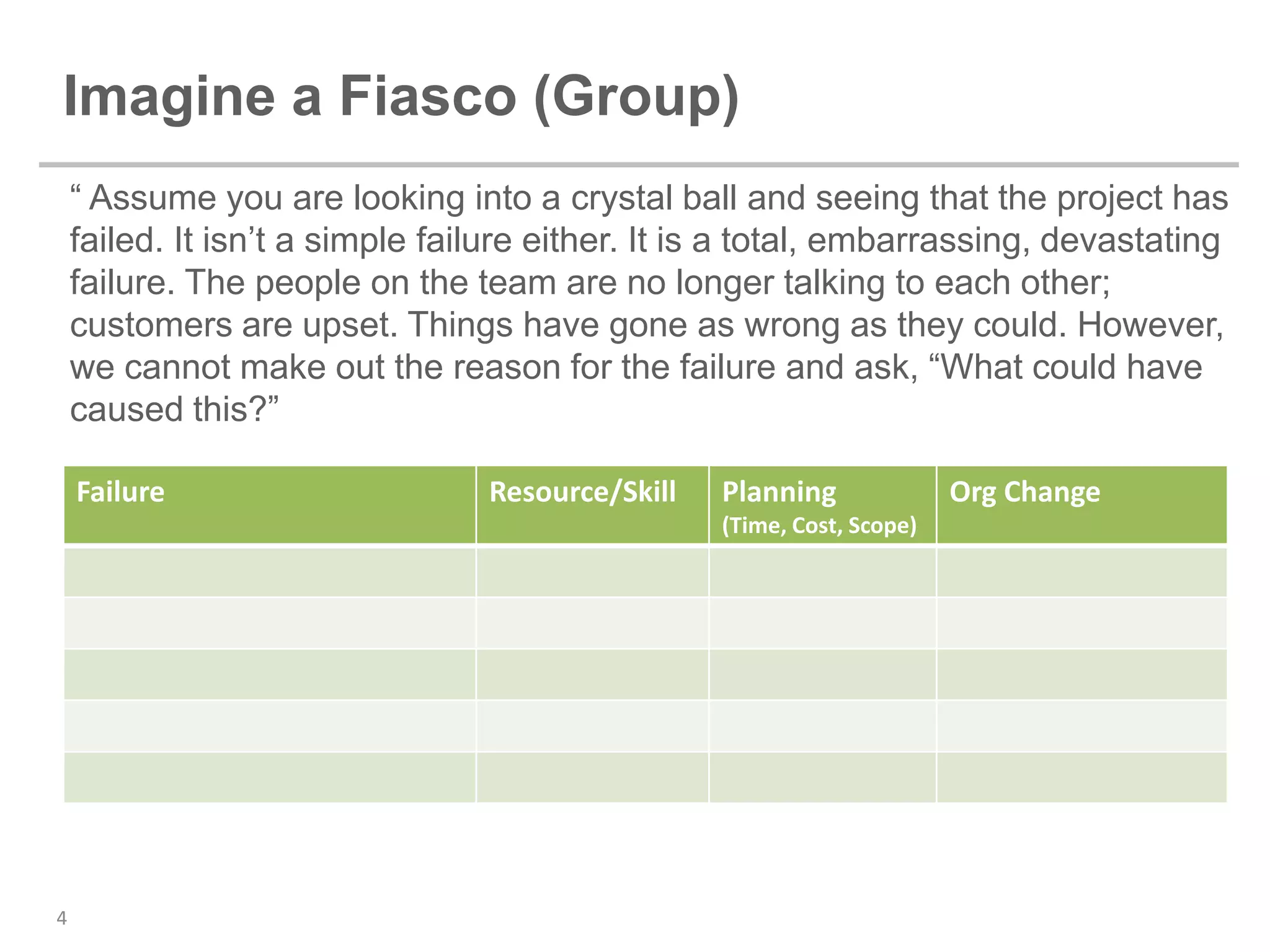
    Failure                      Resource/Skill   Planning              Org Change
                                                  (Time, Cost, Scope)


4
Generate Risks from Failure (Individual)
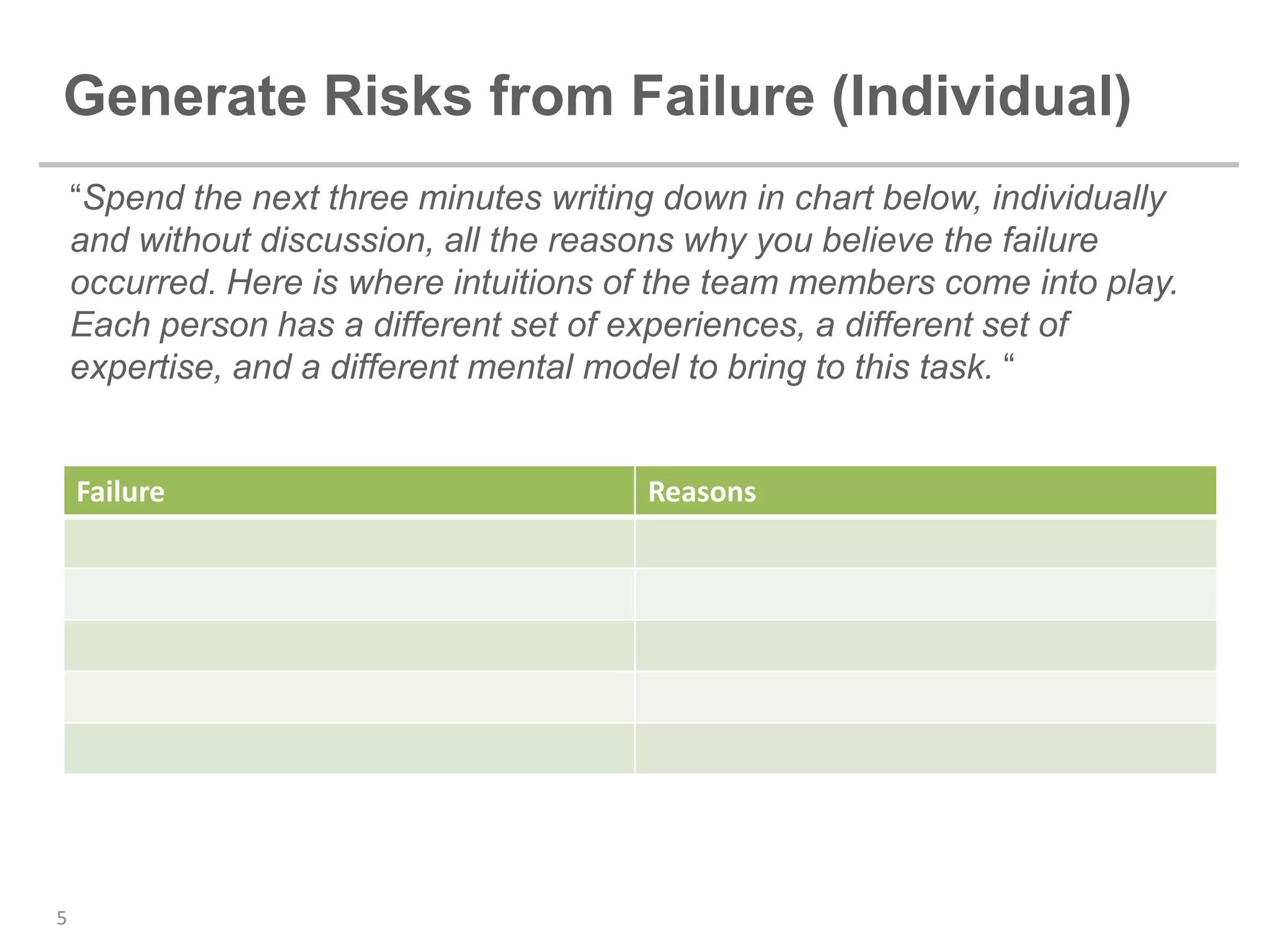
    “Spend the next three minutes writing down in chart below, individually
    and without discussion, all the reasons why you believe the failure
    occurred. Here is where intuitions of the team members come into play.
    Each person has a different set of experiences, a different set of
    expertise, and a different mental model to bring to this task. “


    Failure                             Reasons


5
Generate Risks from Failure (Individual)

    Failure          Reasons/Risks


6
Risk Analysis(Group)
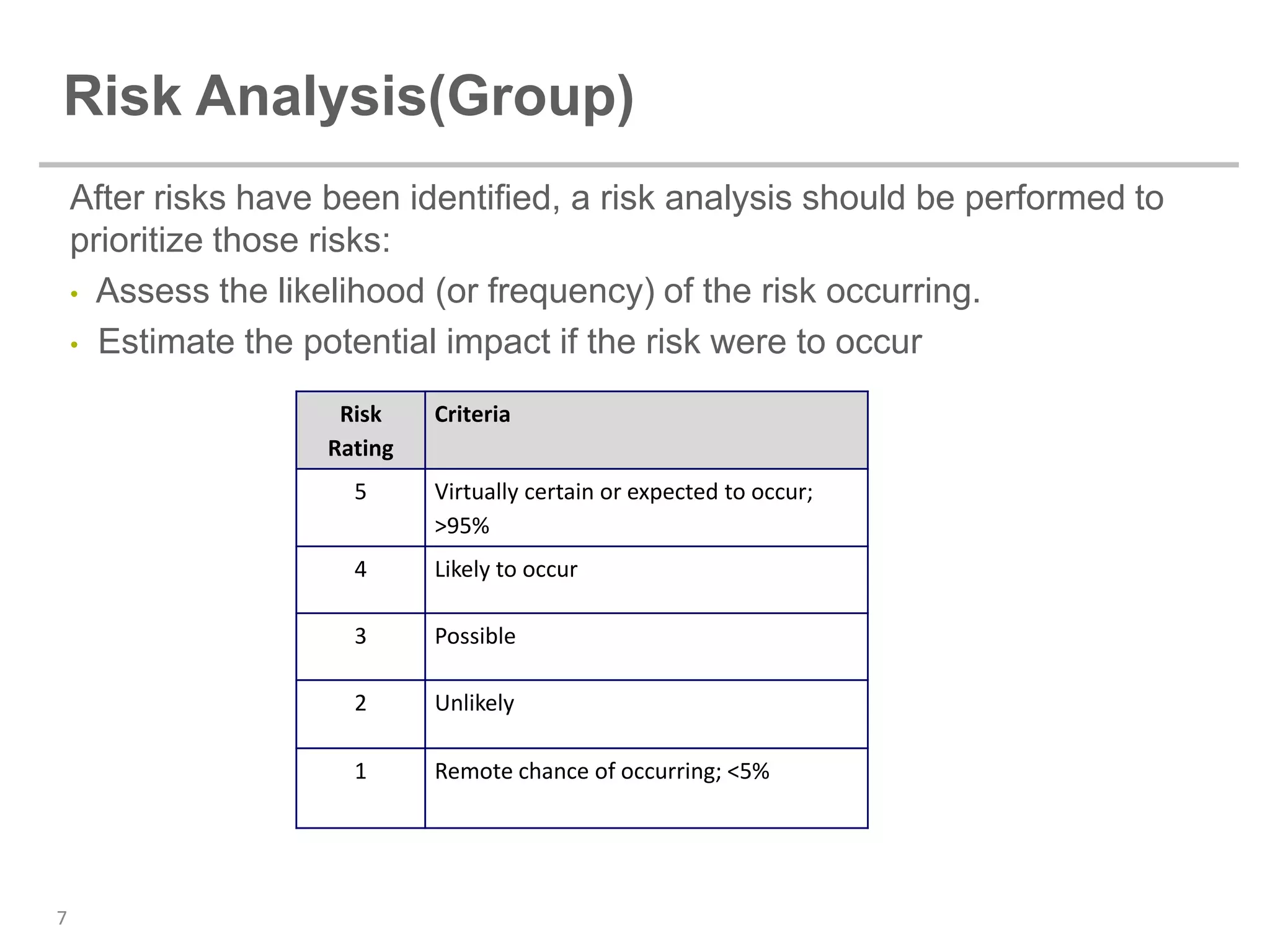
    After risks have been identified, a risk analysis should be performed to
    prioritize those risks:
    • Assess the likelihood (or frequency) of the risk occurring.

    • Estimate the potential impact if the risk were to occur

                     Risk    Criteria
                    Rating
                      5      Virtually certain or expected to occur;
                             >95%
                      4      Likely to occur

                      3      Possible

                      2      Unlikely

                      1      Remote chance of occurring; <5%


7
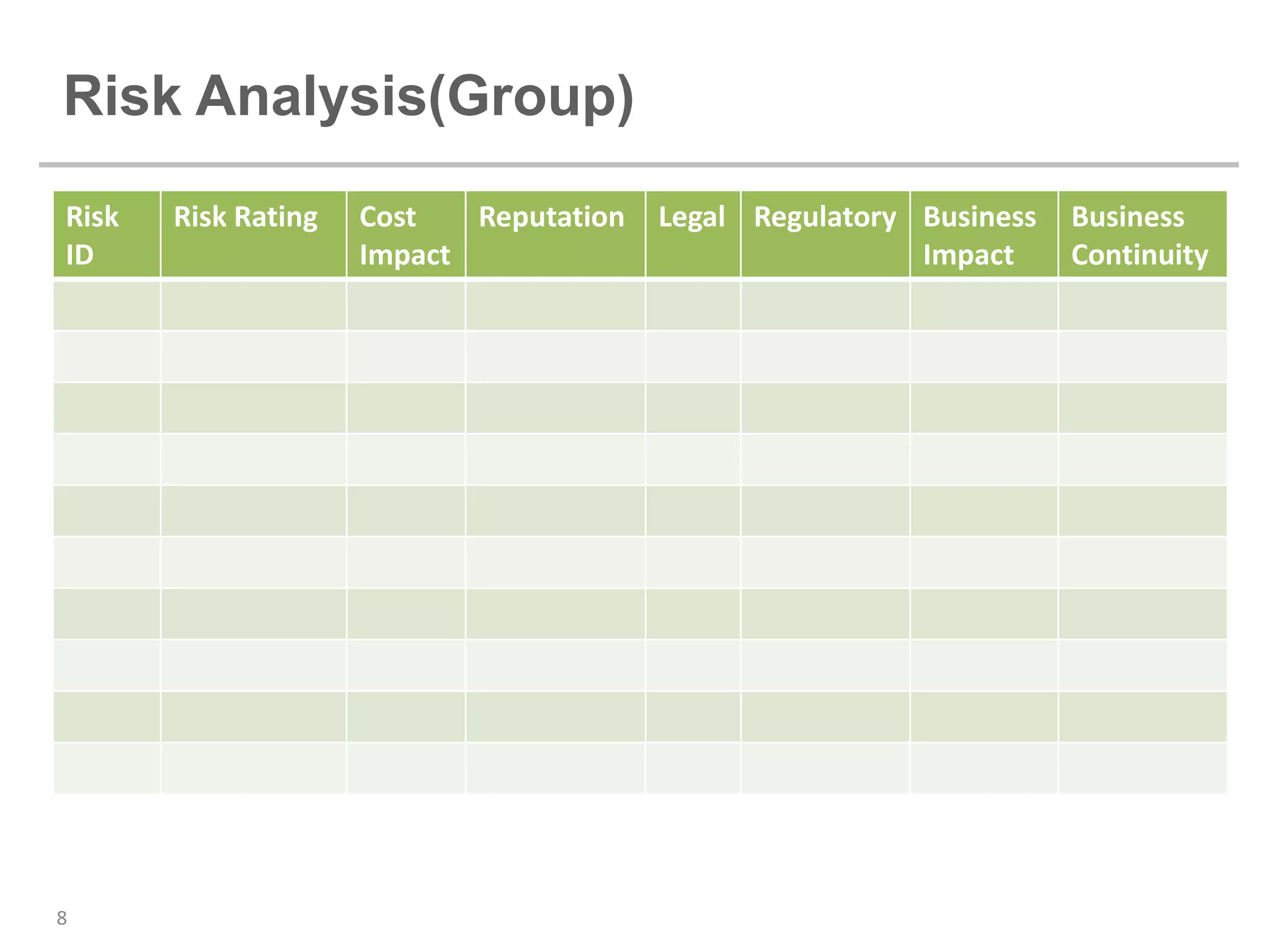
Risk Analysis(Group)
Risk   Risk Rating   Cost   Reputation   Legal Regulatory Business   Business
ID                   Impact                               Impact     Continuity


8
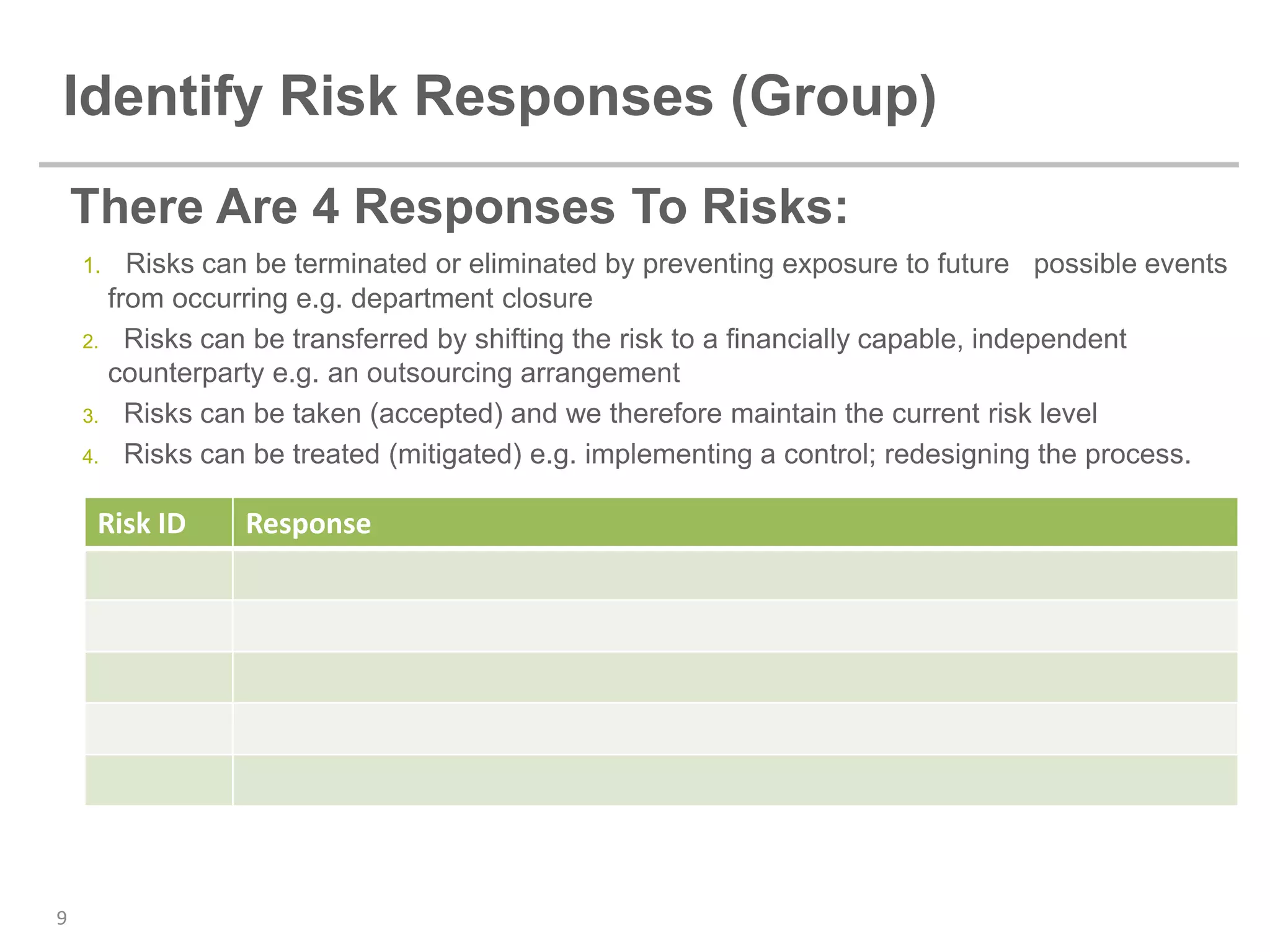
Identify Risk Responses (Group)
    There Are 4 Responses To Risks:
    1.     Risks can be terminated or eliminated by preventing exposure to future possible events
         from occurring e.g. department closure
    2.     Risks can be transferred by shifting the risk to a financially capable, independent
         counterparty e.g. an outsourcing arrangement
    3.     Risks can be taken (accepted) and we therefore maintain the current risk level
    4.     Risks can be treated (mitigated) e.g. implementing a control; redesigning the process.

     Risk ID       Response


9
Next Steps
 Follow Up Steps To This Meeting Include:

 1.   Consolidate The Lists From This Workshop
 2.   Revisit The Plan And Apply Learnings
 3.   Periodically Review The List Through Out Program Lifecycle


10

Hris Pre Mortem

  • 1.
    HRIS: Pre MortemWorkshop August 10th 2011
  • 2.
    Agenda  Introduction  Imagine a Fiasco  Generate Risks from Failure  Risk Analysis  Next Steps 2
  • 3.
    Introduction “A pre-mortem sets the team’s early mindset for risk sharing, transparency, trust, and opportunity to reduce the severity of a post- mortem. Start the pre-mortem by informing everyone that the program failed to meet its objectives and we are here to discuss the reasons for the failures. “ “The ability to execute is very dependent on the severity and duration of the unknowns. Technical unknowns have the greatest potential program impact due to the “dictated innovation” necessary to keep to the contract. On the other hand, executional risks have a better chance of being controlled through additional/alternate resources or team task adjustments. In all cases, the sooner the team is aware of the future unknowns, the better the opportunity exists to make program adjustments to minimize impact. “ 3
  • 4.
    Imagine a Fiasco(Group) “ Assume you are looking into a crystal ball and seeing that the project has failed. It isn’t a simple failure either. It is a total, embarrassing, devastating failure. The people on the team are no longer talking to each other; customers are upset. Things have gone as wrong as they could. However, we cannot make out the reason for the failure and ask, “What could have caused this?” Failure Resource/Skill Planning Org Change (Time, Cost, Scope) 4
  • 5.
    Generate Risks fromFailure (Individual) “Spend the next three minutes writing down in chart below, individually and without discussion, all the reasons why you believe the failure occurred. Here is where intuitions of the team members come into play. Each person has a different set of experiences, a different set of expertise, and a different mental model to bring to this task. “ Failure Reasons 5
  • 6.
    Generate Risks fromFailure (Individual) Failure Reasons/Risks 6
  • 7.
    Risk Analysis(Group) After risks have been identified, a risk analysis should be performed to prioritize those risks: • Assess the likelihood (or frequency) of the risk occurring. • Estimate the potential impact if the risk were to occur Risk Criteria Rating 5 Virtually certain or expected to occur; >95% 4 Likely to occur 3 Possible 2 Unlikely 1 Remote chance of occurring; <5% 7
  • 8.
    Risk Analysis(Group) Risk Risk Rating Cost Reputation Legal Regulatory Business Business ID Impact Impact Continuity 8
  • 9.
    Identify Risk Responses(Group) There Are 4 Responses To Risks: 1. Risks can be terminated or eliminated by preventing exposure to future possible events from occurring e.g. department closure 2. Risks can be transferred by shifting the risk to a financially capable, independent counterparty e.g. an outsourcing arrangement 3. Risks can be taken (accepted) and we therefore maintain the current risk level 4. Risks can be treated (mitigated) e.g. implementing a control; redesigning the process. Risk ID Response 9
  • 10.
    Next Steps FollowUp Steps To This Meeting Include: 1. Consolidate The Lists From This Workshop 2. Revisit The Plan And Apply Learnings 3. Periodically Review The List Through Out Program Lifecycle 10