CYQ Gym Instructor Session 5  Pulse Raiser Equipment
Session Objectives To identify suitable Pulse Raising equipment To explain the setting up of equipment Demonstrate coaching the client safely  (continued to next session)
Pulse Raiser Equipment When planning your programme you will need to include 3 pieces of CV equipment. Upright Bike (PR or cool down) Recumberant Bike (PR or cool down) Treadmill (aerobic curve) Cross trainer (PR or aerobic curve) Suggested use of CV equipment, however the choice is yours!
Explanation to Client 1. Tell client what the machine is called. 2. Explain why you are going on the machine (performing a PR to gradually increase HR and body temperature) Go through health & safety (verbally while checking)
Health & Safety Check around the machine for  obstacles, loose wires, ripped carpet, other! Check the equipment for faults –  ripped belts, broken pedal straps, broken handles, seats . Point out if something looks a minor hazard  and  reinforce the danger . Report to manager/maintenance if dangerous.
Teaching the Client! Demonstrate the correct set up of machine and demonstrate how to get on. Remember you are teaching a client what to do if they come to the gym again and they are on their own with no one helping them. You need to speak through what you are doing CONSTANTLY!
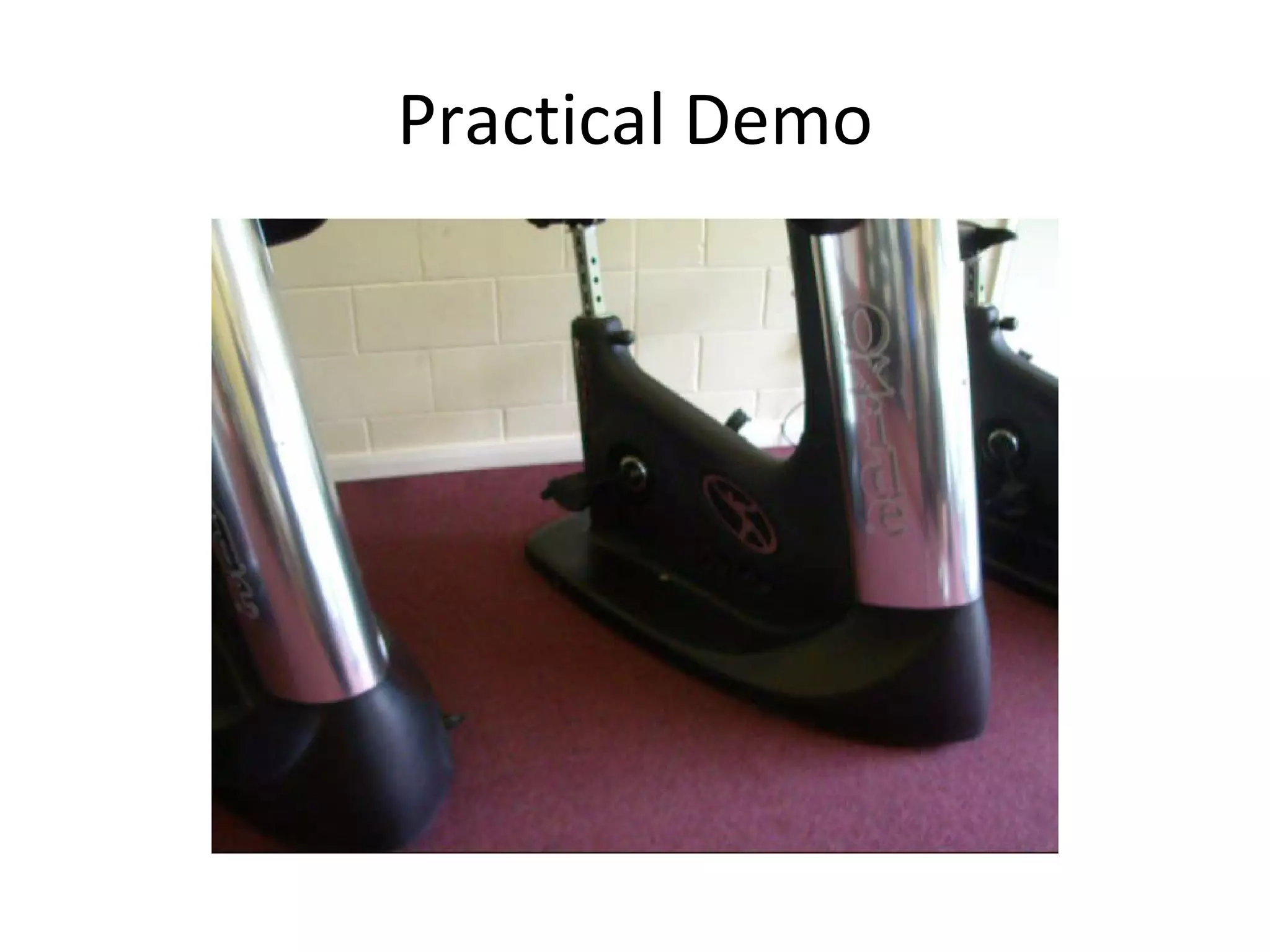
Practical Demo
Coaching Points - Bike Check area Check pedal straps for damage (bend knees) Measure seat against hip Adjust seat and shake for safety Step over central bar  Sit on seat then feet in straps Should be a slight bend in the outstretched knee if correct height. Core engaged, shoulders back start to pedal.
Cross Trainer Demo (volume off)
Coaching Points - CT Check area for safety. Ensure that one of the footplates is in the lowered position. Place one foot on the lowest foot plate and then step other foot on. Feet should be positioned to the front of the plate. Push in a forwards motion Keep core engaged, shoulders back, dont sway hips, movement coming through the hips.
Treadmill Demo
Coaching Points - Treadmill Check area (frayed belt) Get on the machine from the back Point out the emergency stop button Explain the dashboard controls Heel toe action Arms swinging by sides, palms open Core engaged, shoulders back, eyes forward Client to adjust speeds Observe from various angles (back)
Practical Task Using the worksheets In groups of 3  1 instructing  1 being the client (role play a beginner) 1 completing worksheet on the checklist of  instructors performance) When all 3 have been peer assessed on bike, move to the next piece of equipment.

Session 6 pulse raiser eqipment

  • 1.
    CYQ Gym InstructorSession 5 Pulse Raiser Equipment
  • 2.
    Session Objectives Toidentify suitable Pulse Raising equipment To explain the setting up of equipment Demonstrate coaching the client safely (continued to next session)
  • 3.
    Pulse Raiser EquipmentWhen planning your programme you will need to include 3 pieces of CV equipment. Upright Bike (PR or cool down) Recumberant Bike (PR or cool down) Treadmill (aerobic curve) Cross trainer (PR or aerobic curve) Suggested use of CV equipment, however the choice is yours!
  • 4.
    Explanation to Client1. Tell client what the machine is called. 2. Explain why you are going on the machine (performing a PR to gradually increase HR and body temperature) Go through health & safety (verbally while checking)
  • 5.
    Health & SafetyCheck around the machine for obstacles, loose wires, ripped carpet, other! Check the equipment for faults – ripped belts, broken pedal straps, broken handles, seats . Point out if something looks a minor hazard and reinforce the danger . Report to manager/maintenance if dangerous.
  • 6.
    Teaching the Client!Demonstrate the correct set up of machine and demonstrate how to get on. Remember you are teaching a client what to do if they come to the gym again and they are on their own with no one helping them. You need to speak through what you are doing CONSTANTLY!
  • 7.
  • 8.
    Coaching Points -Bike Check area Check pedal straps for damage (bend knees) Measure seat against hip Adjust seat and shake for safety Step over central bar Sit on seat then feet in straps Should be a slight bend in the outstretched knee if correct height. Core engaged, shoulders back start to pedal.
  • 9.
    Cross Trainer Demo(volume off)
  • 10.
    Coaching Points -CT Check area for safety. Ensure that one of the footplates is in the lowered position. Place one foot on the lowest foot plate and then step other foot on. Feet should be positioned to the front of the plate. Push in a forwards motion Keep core engaged, shoulders back, dont sway hips, movement coming through the hips.
  • 11.
  • 12.
    Coaching Points -Treadmill Check area (frayed belt) Get on the machine from the back Point out the emergency stop button Explain the dashboard controls Heel toe action Arms swinging by sides, palms open Core engaged, shoulders back, eyes forward Client to adjust speeds Observe from various angles (back)
  • 13.
    Practical Task Usingthe worksheets In groups of 3 1 instructing 1 being the client (role play a beginner) 1 completing worksheet on the checklist of instructors performance) When all 3 have been peer assessed on bike, move to the next piece of equipment.