YMCA	
  Awards	
  
Level	
  2	
  Cer0ficate	
  in	
  Fitness	
  Instruc0ng	
  (Gym-­‐
Based	
  Exercise)	
  (QCF)	
  
Unit	
  0tle:	
  
Planning	
  gym-­‐based	
  exercise	
  (F/600/9018)	
  
Unit	
  Aims	
  
The	
  learner	
  will:	
  
•  Understand	
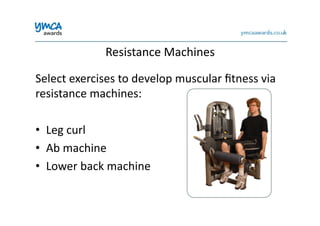
  how	
  to	
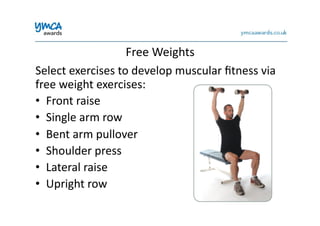
  collect	
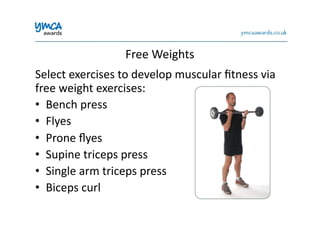
  client	
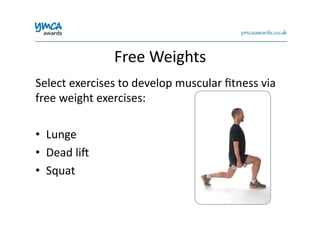
  informa0on	
  to	
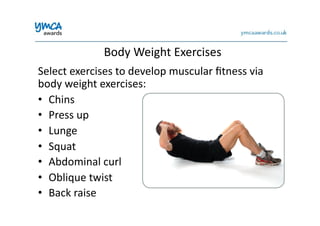
  plan	
  a	
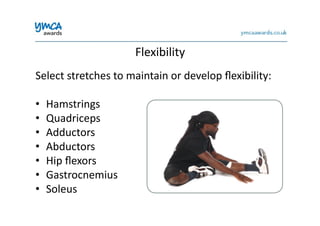
  gym-­‐
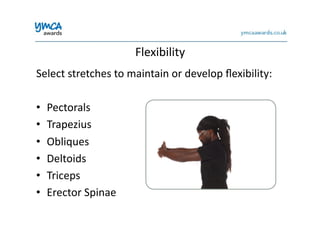
based	
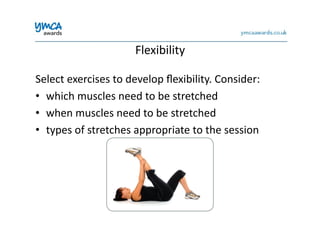
  session	
  
•  Understand	
  how	
  to	
  use	
  client	
  informa0on	
  to	
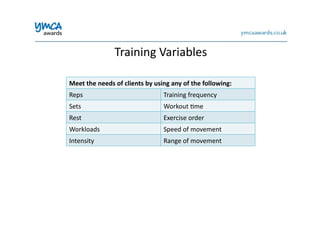
  plan	
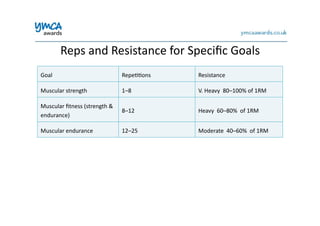
  gym-­‐
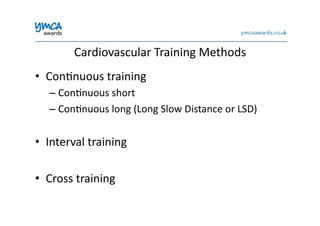
based	
  exercise	
  
•  Understand	
  how	
  to	
  plan	
  gym-­‐based	
  exercise	
  with	
  clients	
  
•  Be	
  able	
  to	
  collect	
  and	
  use	
  client	
  informa0on	
  to	
  plan	
  a	
  gym-­‐
based	
  exercise	
  programme	
  
•  Be	
  able	
  to	
  plan	
  a	
  gym-­‐based	
  exercise	
  programme	
  with	
  
clients	
  
Role	
  of	
  the	
  Instructor	
  
The	
  fitness	
  instructor	
  should	
  be	
  involved	
  in:	
  
•  Collec0ng	
  and	
  checking	
  client	
  informa0on	
  
•  Analysing	
  informa0on	
  	
  
•  Iden0fying	
  and	
  agreeing	
  basic	
  short,	
  medium	
  and	
  long	
  term	
  
goals	
  
•  Planning,	
  instruc0ng	
  and	
  evalua0ng	
  safe	
  and	
  appropriate	
  
gym-­‐based	
  exercise	
  sessions	
  
•  Providing	
  1:1	
  or	
  group	
  induc0ons	
  and	
  general	
  exercise	
  
programmes	
  
•  Selec0ng	
  relevant	
  exercises	
  and	
  designing	
  appropriate	
  
programmes	
  
Role	
  of	
  the	
  Instructor	
  
The	
  fitness	
  instructor	
  should	
  be	
  involved	
  in:	
  
•  Producing	
  suitable	
  programme	
  cards	
  for	
  clients/members	
  
•  Sugges0ng	
  relevant	
  adapta0ons	
  to	
  allow	
  for	
  individual	
  needs	
  
•  Using	
  logical	
  and	
  progressive	
  teaching	
  methodologies	
  
•  Selec0ng	
  and/or	
  correctly	
  demonstra0ng	
  a	
  variety	
  of	
  CV	
  and	
  RT	
  
methods	
  
•  Providing	
  clients/members	
  with	
  general	
  advice	
  on	
  how	
  to	
  progress	
  
•  Observing	
  clients/members	
  to	
  correct	
  unsafe	
  technique	
  where	
  
required	
  
Role	
  of	
  the	
  Instructor	
  
The fitness instructor should be involved in:
•  Producing suitable programme cards for clients/members
•  Suggesting relevant adaptations to allow for individual needs
•  Using logical and progressive teaching methodologies
•  Selecting and/or correctly demonstrating a variety of CV and
RT methods
•  Providing clients/members with general advice on how to
progress
•  Observing clients/members to correct unsafe technique where
required
By	
  the	
  end	
  of	
  the	
  session	
  you	
  will	
  be	
  able	
  to:	
  
•  Explain	
  the	
  process	
  of	
  informed	
  consent	
  
•  Describe	
  methods	
  to	
  collect	
  client	
  informa0on	
  
•  Describe	
  how	
  to	
  determine	
  which	
  method/s	
  of	
  collec0ng	
  
informa0on	
  are	
  appropriate	
  according	
  to	
  the	
  individual	
  
•  Explain	
  the	
  principles	
  of	
  screening	
  clients	
  prior	
  to	
  gym-­‐
based	
  exercise	
  to	
  include	
  the	
  use	
  of	
  the	
  PARQ	
  
How	
  to	
  Collect	
  Client	
  Informa0on	
  
Informed	
  Consent	
  
What	
  is	
  Informed	
  Consent?	
  
Iden%fying	
  the	
  associated	
  benefits	
  and	
  risks	
  of	
  the	
  exercise	
  in	
  
order	
  to	
  help	
  the	
  client	
  make	
  an	
  informed	
  decision	
  to	
  par%cipate	
  
What	
  is	
  Screening?	
  
	
  Establishing	
  an	
  individual’s	
  suitability	
  to	
  
	
  par%cipate	
  in	
  an	
  exercise	
  programme	
  
Screening	
  
Screening	
  
Methods	
  for	
  collec0ng	
  client	
  informa0on:	
  
•  Ques0onnaire	
  (PAR-­‐Q)	
  
•  Health	
  Commitment	
  Statement	
  
•  Interview	
  
•  Observa0on	
  
•  Physical	
  measurements	
  (e.g.	
  height,	
  weight	
  and	
  BMI)	
  
Consider	
  which	
  method	
  is	
  appropriate	
  to	
  the	
  individual	
  
Screening	
  
Consider	
  the	
  following:	
  
•  Suitability	
  to	
  par0cipate	
  
•  Medical	
  condi0ons	
  
•  Legal	
  and	
  professional	
  responsibili0es	
  
•  Confiden0ality	
  
•  Data	
  protec0on	
  
•  Verbal	
  re-­‐screening	
  
•  Review	
  of	
  previous	
  ques0onnaires	
  
•  Re-­‐check	
  of	
  physical	
  measurements	
  
By	
  the	
  end	
  of	
  the	
  session	
  you	
  will	
  be	
  able	
  to:	
  
•  Describe	
  the	
  factors,	
  based	
  on	
  client	
  screening,	
  which	
  may	
  
affect	
  safe	
  exercise	
  par0cipa0on	
  
•  Give	
  examples	
  of	
  how	
  client	
  informa0on	
  affects	
  the	
  planning	
  
of	
  gym-­‐based	
  exercise	
  
•  Iden0fy	
  the	
  reasons	
  for	
  temporary	
  deferral	
  of	
  exercise	
  
•  Explain	
  the	
  reasons	
  for	
  referring	
  clients	
  to	
  other	
  professionals	
  
How	
  to	
  Use	
  Client	
  Informa0on	
  	
  
to	
  Plan	
  the	
  Session	
  	
  
Screening	
  
Factors	
  affec0ng	
  par0cipa0on:	
  
•  Personal	
  goals	
  
•  Lifestyle	
  
•  Medical	
  history,	
  for	
  example:	
  
–  CV	
  health	
  
–  Musculoskeletal	
  injuries	
  
–  Pregnancy	
  
•  Physical	
  ac0vity	
  preferences/history	
  
Screening	
  
Ac0on	
  required	
  as	
  a	
  result	
  of	
  screening:	
  
•  Possible	
  deferral	
  
•  Adapta0ons	
  to	
  exercises	
  
•  Provision	
  of	
  alterna0ve	
  exercises	
  
Screening	
  
Reasons	
  for	
  temporary	
  deferral	
  of	
  exercise:	
  
•  Posi0ve	
  PARQ	
  
•  Visual/verbal	
  iden0fica0on	
  of	
  contraindica0ons	
  
Recognise	
  the	
  limita0ons	
  of	
  your	
  own	
  qualifica0on	
  and	
  
obtain	
  medical	
  clearance	
  
Planning	
  	
  
Gym-­‐Based	
  Exercise	
  1	
  
By	
  the	
  end	
  of	
  the	
  session	
  you	
  will	
  be	
  able	
  to:	
  
•  Select	
  appropriate	
  teaching	
  strategies	
  
•  Explain	
  why	
  it	
  is	
  important	
  to	
  agree	
  goals	
  and	
  
objec0ves	
  for	
  gym-­‐based	
  exercise	
  with	
  clients	
  
Goal	
  Seang	
  
Be	
  Smart!	
  
Specific	
  
Measurable	
  
Achievable	
  
Realis0c	
  
Time-­‐framed	
  
Planning	
  	
  
Gym-­‐Based	
  Exercise	
  2	
  
By	
  the	
  end	
  of	
  the	
  session	
  you	
  will	
  be	
  able	
  to:	
  
•  Discuss	
  the	
  purpose	
  of	
  a	
  warm	
  up	
  
•  Iden0fy	
  the	
  risks	
  of	
  not	
  warming	
  up	
  properly	
  
•  Describe	
  the	
  aims	
  of	
  the	
  mobility,	
  pulse-­‐raising	
  and	
  
preparatory	
  stretch	
  components	
  of	
  a	
  warm	
  up	
  
•  Plan	
  and	
  deliver	
  a	
  safe	
  and	
  effec0ve	
  warm	
  up	
  
Warm	
  Up	
  
Consider	
  the	
  following:	
  
•  Type	
  of	
  warm	
  up	
  (general	
  or	
  specific)	
  
•  Warm	
  up	
  components:	
  
– Mobility	
  
– Pulse-­‐raising	
  
– Prepara0on	
  stretches	
  
– Re-­‐warm	
  (if	
  necessary)	
  
•  Factors	
  affec0ng	
  a	
  warm	
  up	
  
Planning	
  	
  
Gym-­‐Based	
  Exercise	
  3	
  
By	
  the	
  end	
  of	
  the	
  session	
  you	
  will	
  be	
  able	
  to:	
  
•  Iden0fy	
  a	
  range	
  of	
  exercises	
  for	
  individual	
  
clients	
  to	
  develop	
  cardiovascular	
  fitness	
  
Cardiovascular	
  Fitness	
  
Select	
  exercises	
  to	
  develop	
  cardiovascular	
  
fitness:	
  
•  Upright	
  cycle	
  
•  Recumbent	
  cycle	
  
•  Treadmill	
  
•  Stepper	
  
•  Rowing	
  machine	
  
•  Ellip0cal	
  trainer	
  
•  Cross	
  trainer	
  
Planning	
  	
  
Gym-­‐Based	
  Exercise	
  4	
  
By	
  the	
  end	
  of	
  the	
  session	
  you	
  will	
  be	
  able	
  to:	
  
•  Iden0fy	
  a	
  range	
  of	
  exercises	
  for	
  individual	
  
clients	
  to	
  develop	
  muscular	
  fitness	
  using	
  
resistance	
  training	
  machines	
  
Resistance	
  Machines	
  
Select	
  exercises	
  to	
  develop	
  muscular	
  fitness	
  via	
  
resistance	
  machines:	
  
•  Seated	
  chest	
  press	
  
•  Seated	
  row	
  
•  Shoulder	
  press	
  
•  Lat	
  pull	
  down	
  
•  Bench	
  press/	
  
seated	
  chest	
  press	
  
•  Pec	
  dec	
  
Resistance	
  Machines	
  
Select	
  exercises	
  to	
  develop	
  muscular	
  fitness	
  via	
  
resistance	
  machines:	
  
•  Triceps	
  press/	
  
triceps	
  pushdown	
  
•  Biceps	
  curl	
  
•  Leg	
  press	
  
•  Seated	
  adductor	
  
•  Seated	
  abductor	
  
•  Leg	
  extension	
  
Resistance	
  Machines	
  
Select	
  exercises	
  to	
  develop	
  muscular	
  fitness	
  via	
  
resistance	
  machines:	
  
•  Leg	
  curl	
  
•  Ab	
  machine	
  
•  Lower	
  back	
  machine	
  
Planning	
  	
  
Gym-­‐Based	
  Exercise	
  5	
  
By	
  the	
  end	
  of	
  the	
  session	
  you	
  will	
  be	
  able	
  to:	
  
•  Iden0fy	
  a	
  range	
  of	
  exercises	
  for	
  individual	
  
clients	
  to	
  develop	
  muscular	
  fitness	
  using	
  free	
  
weights	
  (with	
  dumbbells	
  and	
  barbells)	
  
Free	
  Weights	
  
Select	
  exercises	
  to	
  develop	
  muscular	
  fitness	
  via	
  
free	
  weight	
  exercises:	
  
•  Front	
  raise	
  
•  Single	
  arm	
  row	
  
•  Bent	
  arm	
  pullover	
  
•  Shoulder	
  press	
  
•  Lateral	
  raise	
  
•  Upright	
  row	
  
Free	
  Weights	
  
Select	
  exercises	
  to	
  develop	
  muscular	
  fitness	
  via	
  
free	
  weight	
  exercises:	
  
•  Bench	
  press	
  
•  Flyes	
  
•  Prone	
  flyes	
  
•  Supine	
  triceps	
  press	
  
•  Single	
  arm	
  triceps	
  press	
  
•  Biceps	
  curl	
  
Free	
  Weights	
  
Select	
  exercises	
  to	
  develop	
  muscular	
  fitness	
  via	
  
free	
  weight	
  exercises:	
  
•  Lunge	
  
•  Dead	
  lig	
  
•  Squat	
  
Planning	
  	
  
Gym-­‐Based	
  Exercise	
  6	
  
By	
  the	
  end	
  of	
  the	
  session	
  you	
  will	
  be	
  able	
  to:	
  
•  Iden0fy	
  a	
  range	
  of	
  exercises	
  for	
  individual	
  
clients	
  to	
  develop	
  muscular	
  fitness	
  using	
  body	
  
weight	
  exercises	
  
Body	
  Weight	
  Exercises	
  
Select	
  exercises	
  to	
  develop	
  muscular	
  fitness	
  via	
  
body	
  weight	
  exercises:	
  
•  Chins	
  
•  Press	
  up	
  
•  Lunge	
  
•  Squat	
  
•  Abdominal	
  curl	
  
•  Oblique	
  twist	
  
•  Back	
  raise	
  
Planning	
  	
  
Gym-­‐Based	
  Exercise	
  7	
  
By	
  the	
  end	
  of	
  the	
  session	
  you	
  will	
  be	
  able	
  to:	
  
•  Iden0fy	
  a	
  range	
  of	
  exercises	
  for	
  individual	
  
clients	
  to	
  maintain	
  or	
  develop	
  flexibility	
  
Flexibility	
  
Select	
  stretches	
  to	
  maintain	
  or	
  develop	
  flexibility:	
  
•  Hamstrings	
  
•  Quadriceps	
  
•  Adductors	
  
•  Abductors	
  
•  Hip	
  flexors	
  
•  Gastrocnemius	
  
•  Soleus	
  
Flexibility	
  
Select	
  stretches	
  to	
  maintain	
  or	
  develop	
  flexibility:	
  
•  Pectorals	
  
•  Trapezius	
  
•  Obliques	
  
•  Deltoids	
  
•  Triceps	
  
•  Erector	
  Spinae	
  
Flexibility	
  
Select	
  exercises	
  to	
  develop	
  flexibility.	
  Consider:	
  
•  which	
  muscles	
  need	
  to	
  be	
  stretched	
  
•  when	
  muscles	
  need	
  to	
  be	
  stretched	
  
•  types	
  of	
  stretches	
  appropriate	
  to	
  the	
  session	
  
Cool	
  Down	
  
Consider	
  the	
  following:	
  
•  Cool	
  down	
  components:	
  
– Pulse-­‐lowering	
  (or	
  re-­‐warm	
  if	
  required)	
  
– Post-­‐workout	
  stretching	
  	
  
•  Maintenance	
  stretches	
  
•  Developmental	
  stretches	
  
•  Factors	
  affec0ng	
  a	
  cool	
  down	
  
Planning	
  	
  
Gym-­‐Based	
  Exercise	
  8	
  
By	
  the	
  end	
  of	
  the	
  session	
  you	
  will	
  be	
  able	
  to:	
  
•  Describe	
  how	
  to	
  plan	
  gym-­‐based	
  exercise	
  
using	
  circuit	
  formats	
  
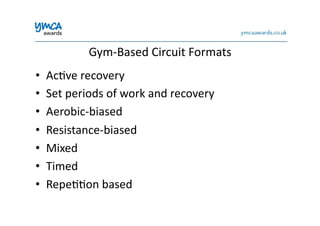
Gym-­‐Based	
  Circuit	
  Formats	
  
•  Ac0ve	
  recovery	
  
•  Set	
  periods	
  of	
  work	
  and	
  recovery	
  
•  Aerobic-­‐biased	
  
•  Resistance-­‐biased	
  
•  Mixed	
  
•  Timed	
  
•  Repe00on	
  based	
  
Example	
  of	
  a	
  CT	
  Format	
  
1.	
  Shoulder	
  press	
   7.	
  Seated	
  lever	
  row	
  
2.	
  Leg	
  press	
   8.	
  Leg	
  curl	
  
3.	
  Lat	
  pulldown	
   9.	
  Triceps	
  pushdown	
  
4.	
  Calf	
  raise	
   10.	
  Abdominal	
  crunch	
  
5.	
  Chest	
  press	
   11.	
  Biceps	
  curl	
  
6.	
  Leg	
  extension	
   12.	
  Back	
  extension	
  
Work	
  period:	
  45	
  seconds	
  
Rest	
  period:	
  30	
  seconds	
  
Resistance:	
  Approx	
  50%	
  of	
  1RM	
  
Collect	
  and	
  Use	
  Client	
  Informa0on	
  to	
  Plan	
  a	
  
Gym-­‐Based	
  Exercise	
  Programme	
  
By	
  the	
  end	
  of	
  the	
  session	
  you	
  will	
  be	
  able	
  to:	
  
•  Use	
  appropriate	
  methods	
  to	
  collect	
  informa0on	
  to	
  plan	
  a	
  
gym-­‐based	
  programme	
  
•  Check	
  the	
  informa0on	
  is	
  accurate	
  and	
  up	
  to	
  date	
  
•  Iden0fy	
  client	
  needs	
  and	
  poten0al,	
  and	
  any	
  possible	
  risks	
  
from	
  par0cipa0on	
  in	
  a	
  gym-­‐based	
  programme	
  
•  Maintain	
  client	
  confiden0ality	
  
Collect	
  and	
  Use	
  Client	
  Informa0on	
  to	
  Plan	
  a	
  
Gym-­‐Based	
  Exercise	
  Programme	
  
Workshop:	
  
•  In	
  pairs,	
  take	
  it	
  in	
  turns	
  to	
  be	
  the	
  instructor	
  and	
  the	
  client	
  
•  Collect	
  informa0on	
  from	
  your	
  ‘client’	
  using	
  one	
  or	
  more	
  
of	
  the	
  methods	
  described	
  earlier	
  in	
  the	
  programme	
  
•  Iden0fy	
  any	
  contraindica0ons	
  to	
  exercise	
  and	
  
recommend	
  deferral	
  or	
  alterna0ves	
  where	
  required	
  
Plan	
  a	
  Safe	
  and	
  Effec0ve	
  	
  
Gym-­‐Based	
  Session	
  
By	
  the	
  end	
  of	
  the	
  session	
  you	
  will	
  be	
  able	
  to:	
  
•  Agree	
  objec0ves	
  with	
  clients	
  	
  
•  Select	
  gym-­‐based	
  ac0vi0es	
  
•  Plan	
  how	
  to	
  minimise	
  risks	
  
Training	
  Variables	
  
Meet	
  the	
  needs	
  of	
  clients	
  by	
  using	
  any	
  of	
  the	
  following:	
  
Reps	
   Training	
  frequency	
  
Sets	
   Workout	
  0me	
  
Rest	
   Exercise	
  order	
  
Workloads	
   Speed	
  of	
  movement	
  
Intensity	
   Range	
  of	
  movement	
  
Reps	
  and	
  Resistance	
  for	
  Specific	
  Goals	
  
Goal	
   Repe00ons	
   Resistance	
  	
  
Muscular	
  strength	
   1–8	
   V.	
  Heavy	
  	
  80–100%	
  of	
  1RM	
  
Muscular	
  fitness	
  (strength	
  &	
  
endurance)	
  
8–12	
   Heavy	
  	
  60–80%	
  	
  of	
  1RM	
  	
  
Muscular	
  endurance	
   12–25	
   Moderate	
  	
  40–60%	
  	
  of	
  1RM	
  	
  
Cardiovascular	
  Training	
  Methods	
  
•  Con0nuous	
  training	
  
– Con0nuous	
  short	
  
– Con0nuous	
  long	
  (Long	
  Slow	
  Distance	
  or	
  LSD)	
  
•  Interval	
  training	
  
•  Cross	
  training	
  
Resistance	
  Training	
  Methods	
  
•  Single	
  set	
  training	
  
•  Circuit	
  resistance	
  training	
  
•  Basic	
  sets	
  
•  Delorme	
  and	
  Watkins	
  10	
  RM	
  system	
  
•  Berger	
  6	
  RM	
  system	
  
•  Pyramid	
  systems	
  
•  Super-­‐seang	
  
Plan	
  a	
  Safe	
  and	
  Effec0ve	
  	
  
Gym-­‐Based	
  Session	
  
By	
  the	
  end	
  of	
  the	
  session	
  you	
  will	
  be	
  able	
  to:	
  
•  Plan	
  how	
  to	
  minimise	
  risks	
  
Timing	
  and	
  Sequences	
  
Plan	
  realis0c	
  0mings	
  and	
  sequences	
  appropriate	
  
to:	
  
•  Fitness	
  level	
  
•  Environment	
  
•  Type	
  of	
  session	
  
•  Dura0on	
  of	
  session	
  
•  Programme	
  goals	
  
Risk	
  Management	
  
Plan	
  for	
  appropriate	
  checks	
  to	
  minimise	
  risk	
  in	
  
rela0on	
  to:	
  
•  Equipment	
  
•  Environment	
  
•  Emergency	
  procedures	
  
Programme	
  Cards	
  
•  Format	
  may	
  vary	
  from	
  gym	
  to	
  gym	
  
•  Include	
  a	
  warm	
  up	
  (including	
  stretches	
  if	
  appropriate)	
  
•  Include	
  resistance	
  ligs,	
  detailing:	
  	
  
–  Reps	
  
–  Sets	
  
–  Rest	
  	
  
–  Resistance	
  
•  Include	
  cardiovascular	
  training,	
  detailing:	
  	
  
–  Rate	
  (RPM/SPM/KPH/MPH)	
  
–  Level	
  
–  Resistance	
  
–  Dura0on	
  
•  Include	
  a	
  cool	
  down	
  with	
  stretching	
  (including	
  maintenance	
  and	
  
development	
  stretches	
  
PlanL2

PlanL2

  • 1.
    YMCA  Awards   Level  2  Cer0ficate  in  Fitness  Instruc0ng  (Gym-­‐ Based  Exercise)  (QCF)   Unit  0tle:   Planning  gym-­‐based  exercise  (F/600/9018)  
  • 2.
    Unit  Aims   The  learner  will:   •  Understand  how  to  collect  client  informa0on  to  plan  a  gym-­‐ based  session   •  Understand  how  to  use  client  informa0on  to  plan  gym-­‐ based  exercise   •  Understand  how  to  plan  gym-­‐based  exercise  with  clients   •  Be  able  to  collect  and  use  client  informa0on  to  plan  a  gym-­‐ based  exercise  programme   •  Be  able  to  plan  a  gym-­‐based  exercise  programme  with   clients  
  • 3.
    Role  of  the  Instructor   The  fitness  instructor  should  be  involved  in:   •  Collec0ng  and  checking  client  informa0on   •  Analysing  informa0on     •  Iden0fying  and  agreeing  basic  short,  medium  and  long  term   goals   •  Planning,  instruc0ng  and  evalua0ng  safe  and  appropriate   gym-­‐based  exercise  sessions   •  Providing  1:1  or  group  induc0ons  and  general  exercise   programmes   •  Selec0ng  relevant  exercises  and  designing  appropriate   programmes  
  • 4.
    Role  of  the  Instructor   The  fitness  instructor  should  be  involved  in:   •  Producing  suitable  programme  cards  for  clients/members   •  Sugges0ng  relevant  adapta0ons  to  allow  for  individual  needs   •  Using  logical  and  progressive  teaching  methodologies   •  Selec0ng  and/or  correctly  demonstra0ng  a  variety  of  CV  and  RT   methods   •  Providing  clients/members  with  general  advice  on  how  to  progress   •  Observing  clients/members  to  correct  unsafe  technique  where   required  
  • 5.
    Role  of  the  Instructor   The fitness instructor should be involved in: •  Producing suitable programme cards for clients/members •  Suggesting relevant adaptations to allow for individual needs •  Using logical and progressive teaching methodologies •  Selecting and/or correctly demonstrating a variety of CV and RT methods •  Providing clients/members with general advice on how to progress •  Observing clients/members to correct unsafe technique where required
  • 6.
    By  the  end  of  the  session  you  will  be  able  to:   •  Explain  the  process  of  informed  consent   •  Describe  methods  to  collect  client  informa0on   •  Describe  how  to  determine  which  method/s  of  collec0ng   informa0on  are  appropriate  according  to  the  individual   •  Explain  the  principles  of  screening  clients  prior  to  gym-­‐ based  exercise  to  include  the  use  of  the  PARQ   How  to  Collect  Client  Informa0on  
  • 7.
    Informed  Consent   What  is  Informed  Consent?   Iden%fying  the  associated  benefits  and  risks  of  the  exercise  in   order  to  help  the  client  make  an  informed  decision  to  par%cipate  
  • 8.
    What  is  Screening?    Establishing  an  individual’s  suitability  to    par%cipate  in  an  exercise  programme   Screening  
  • 9.
    Screening   Methods  for  collec0ng  client  informa0on:   •  Ques0onnaire  (PAR-­‐Q)   •  Health  Commitment  Statement   •  Interview   •  Observa0on   •  Physical  measurements  (e.g.  height,  weight  and  BMI)   Consider  which  method  is  appropriate  to  the  individual  
  • 10.
    Screening   Consider  the  following:   •  Suitability  to  par0cipate   •  Medical  condi0ons   •  Legal  and  professional  responsibili0es   •  Confiden0ality   •  Data  protec0on   •  Verbal  re-­‐screening   •  Review  of  previous  ques0onnaires   •  Re-­‐check  of  physical  measurements  
  • 11.
    By  the  end  of  the  session  you  will  be  able  to:   •  Describe  the  factors,  based  on  client  screening,  which  may   affect  safe  exercise  par0cipa0on   •  Give  examples  of  how  client  informa0on  affects  the  planning   of  gym-­‐based  exercise   •  Iden0fy  the  reasons  for  temporary  deferral  of  exercise   •  Explain  the  reasons  for  referring  clients  to  other  professionals   How  to  Use  Client  Informa0on     to  Plan  the  Session    
  • 12.
    Screening   Factors  affec0ng  par0cipa0on:   •  Personal  goals   •  Lifestyle   •  Medical  history,  for  example:   –  CV  health   –  Musculoskeletal  injuries   –  Pregnancy   •  Physical  ac0vity  preferences/history  
  • 13.
    Screening   Ac0on  required  as  a  result  of  screening:   •  Possible  deferral   •  Adapta0ons  to  exercises   •  Provision  of  alterna0ve  exercises  
  • 14.
    Screening   Reasons  for  temporary  deferral  of  exercise:   •  Posi0ve  PARQ   •  Visual/verbal  iden0fica0on  of  contraindica0ons   Recognise  the  limita0ons  of  your  own  qualifica0on  and   obtain  medical  clearance  
  • 15.
    Planning     Gym-­‐Based  Exercise  1   By  the  end  of  the  session  you  will  be  able  to:   •  Select  appropriate  teaching  strategies   •  Explain  why  it  is  important  to  agree  goals  and   objec0ves  for  gym-­‐based  exercise  with  clients  
  • 16.
    Goal  Seang   Be  Smart!   Specific   Measurable   Achievable   Realis0c   Time-­‐framed  
  • 17.
    Planning     Gym-­‐Based  Exercise  2   By  the  end  of  the  session  you  will  be  able  to:   •  Discuss  the  purpose  of  a  warm  up   •  Iden0fy  the  risks  of  not  warming  up  properly   •  Describe  the  aims  of  the  mobility,  pulse-­‐raising  and   preparatory  stretch  components  of  a  warm  up   •  Plan  and  deliver  a  safe  and  effec0ve  warm  up  
  • 18.
    Warm  Up   Consider  the  following:   •  Type  of  warm  up  (general  or  specific)   •  Warm  up  components:   – Mobility   – Pulse-­‐raising   – Prepara0on  stretches   – Re-­‐warm  (if  necessary)   •  Factors  affec0ng  a  warm  up  
  • 19.
    Planning     Gym-­‐Based  Exercise  3   By  the  end  of  the  session  you  will  be  able  to:   •  Iden0fy  a  range  of  exercises  for  individual   clients  to  develop  cardiovascular  fitness  
  • 20.
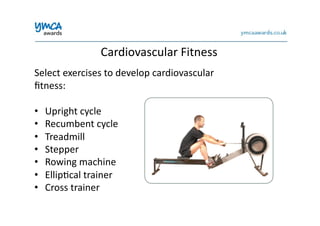
    Cardiovascular  Fitness   Select  exercises  to  develop  cardiovascular   fitness:   •  Upright  cycle   •  Recumbent  cycle   •  Treadmill   •  Stepper   •  Rowing  machine   •  Ellip0cal  trainer   •  Cross  trainer  
  • 21.
    Planning     Gym-­‐Based  Exercise  4   By  the  end  of  the  session  you  will  be  able  to:   •  Iden0fy  a  range  of  exercises  for  individual   clients  to  develop  muscular  fitness  using   resistance  training  machines  
  • 22.
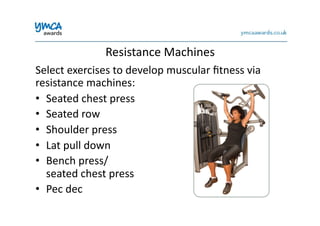
    Resistance  Machines   Select  exercises  to  develop  muscular  fitness  via   resistance  machines:   •  Seated  chest  press   •  Seated  row   •  Shoulder  press   •  Lat  pull  down   •  Bench  press/   seated  chest  press   •  Pec  dec  
  • 23.
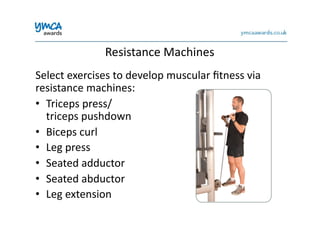
    Resistance  Machines   Select  exercises  to  develop  muscular  fitness  via   resistance  machines:   •  Triceps  press/   triceps  pushdown   •  Biceps  curl   •  Leg  press   •  Seated  adductor   •  Seated  abductor   •  Leg  extension  
  • 24.
    Resistance  Machines   Select  exercises  to  develop  muscular  fitness  via   resistance  machines:   •  Leg  curl   •  Ab  machine   •  Lower  back  machine  
  • 25.
    Planning     Gym-­‐Based  Exercise  5   By  the  end  of  the  session  you  will  be  able  to:   •  Iden0fy  a  range  of  exercises  for  individual   clients  to  develop  muscular  fitness  using  free   weights  (with  dumbbells  and  barbells)  
  • 26.
    Free  Weights   Select  exercises  to  develop  muscular  fitness  via   free  weight  exercises:   •  Front  raise   •  Single  arm  row   •  Bent  arm  pullover   •  Shoulder  press   •  Lateral  raise   •  Upright  row  
  • 27.
    Free  Weights   Select  exercises  to  develop  muscular  fitness  via   free  weight  exercises:   •  Bench  press   •  Flyes   •  Prone  flyes   •  Supine  triceps  press   •  Single  arm  triceps  press   •  Biceps  curl  
  • 28.
    Free  Weights   Select  exercises  to  develop  muscular  fitness  via   free  weight  exercises:   •  Lunge   •  Dead  lig   •  Squat  
  • 29.
    Planning     Gym-­‐Based  Exercise  6   By  the  end  of  the  session  you  will  be  able  to:   •  Iden0fy  a  range  of  exercises  for  individual   clients  to  develop  muscular  fitness  using  body   weight  exercises  
  • 30.
    Body  Weight  Exercises   Select  exercises  to  develop  muscular  fitness  via   body  weight  exercises:   •  Chins   •  Press  up   •  Lunge   •  Squat   •  Abdominal  curl   •  Oblique  twist   •  Back  raise  
  • 31.
    Planning     Gym-­‐Based  Exercise  7   By  the  end  of  the  session  you  will  be  able  to:   •  Iden0fy  a  range  of  exercises  for  individual   clients  to  maintain  or  develop  flexibility  
  • 32.
    Flexibility   Select  stretches  to  maintain  or  develop  flexibility:   •  Hamstrings   •  Quadriceps   •  Adductors   •  Abductors   •  Hip  flexors   •  Gastrocnemius   •  Soleus  
  • 33.
    Flexibility   Select  stretches  to  maintain  or  develop  flexibility:   •  Pectorals   •  Trapezius   •  Obliques   •  Deltoids   •  Triceps   •  Erector  Spinae  
  • 34.
    Flexibility   Select  exercises  to  develop  flexibility.  Consider:   •  which  muscles  need  to  be  stretched   •  when  muscles  need  to  be  stretched   •  types  of  stretches  appropriate  to  the  session  
  • 35.
    Cool  Down   Consider  the  following:   •  Cool  down  components:   – Pulse-­‐lowering  (or  re-­‐warm  if  required)   – Post-­‐workout  stretching     •  Maintenance  stretches   •  Developmental  stretches   •  Factors  affec0ng  a  cool  down  
  • 36.
    Planning     Gym-­‐Based  Exercise  8   By  the  end  of  the  session  you  will  be  able  to:   •  Describe  how  to  plan  gym-­‐based  exercise   using  circuit  formats  
  • 37.
    Gym-­‐Based  Circuit  Formats   •  Ac0ve  recovery   •  Set  periods  of  work  and  recovery   •  Aerobic-­‐biased   •  Resistance-­‐biased   •  Mixed   •  Timed   •  Repe00on  based  
  • 38.
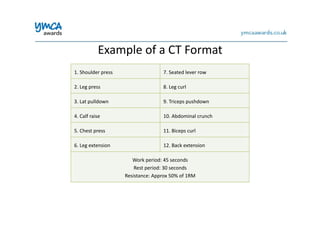
    Example  of  a  CT  Format   1.  Shoulder  press   7.  Seated  lever  row   2.  Leg  press   8.  Leg  curl   3.  Lat  pulldown   9.  Triceps  pushdown   4.  Calf  raise   10.  Abdominal  crunch   5.  Chest  press   11.  Biceps  curl   6.  Leg  extension   12.  Back  extension   Work  period:  45  seconds   Rest  period:  30  seconds   Resistance:  Approx  50%  of  1RM  
  • 39.
    Collect  and  Use  Client  Informa0on  to  Plan  a   Gym-­‐Based  Exercise  Programme   By  the  end  of  the  session  you  will  be  able  to:   •  Use  appropriate  methods  to  collect  informa0on  to  plan  a   gym-­‐based  programme   •  Check  the  informa0on  is  accurate  and  up  to  date   •  Iden0fy  client  needs  and  poten0al,  and  any  possible  risks   from  par0cipa0on  in  a  gym-­‐based  programme   •  Maintain  client  confiden0ality  
  • 40.
    Collect  and  Use  Client  Informa0on  to  Plan  a   Gym-­‐Based  Exercise  Programme   Workshop:   •  In  pairs,  take  it  in  turns  to  be  the  instructor  and  the  client   •  Collect  informa0on  from  your  ‘client’  using  one  or  more   of  the  methods  described  earlier  in  the  programme   •  Iden0fy  any  contraindica0ons  to  exercise  and   recommend  deferral  or  alterna0ves  where  required  
  • 41.
    Plan  a  Safe  and  Effec0ve     Gym-­‐Based  Session   By  the  end  of  the  session  you  will  be  able  to:   •  Agree  objec0ves  with  clients     •  Select  gym-­‐based  ac0vi0es   •  Plan  how  to  minimise  risks  
  • 42.
    Training  Variables   Meet  the  needs  of  clients  by  using  any  of  the  following:   Reps   Training  frequency   Sets   Workout  0me   Rest   Exercise  order   Workloads   Speed  of  movement   Intensity   Range  of  movement  
  • 43.
    Reps  and  Resistance  for  Specific  Goals   Goal   Repe00ons   Resistance     Muscular  strength   1–8   V.  Heavy    80–100%  of  1RM   Muscular  fitness  (strength  &   endurance)   8–12   Heavy    60–80%    of  1RM     Muscular  endurance   12–25   Moderate    40–60%    of  1RM    
  • 44.
    Cardiovascular  Training  Methods   •  Con0nuous  training   – Con0nuous  short   – Con0nuous  long  (Long  Slow  Distance  or  LSD)   •  Interval  training   •  Cross  training  
  • 45.
    Resistance  Training  Methods   •  Single  set  training   •  Circuit  resistance  training   •  Basic  sets   •  Delorme  and  Watkins  10  RM  system   •  Berger  6  RM  system   •  Pyramid  systems   •  Super-­‐seang  
  • 46.
    Plan  a  Safe  and  Effec0ve     Gym-­‐Based  Session   By  the  end  of  the  session  you  will  be  able  to:   •  Plan  how  to  minimise  risks  
  • 47.
    Timing  and  Sequences   Plan  realis0c  0mings  and  sequences  appropriate   to:   •  Fitness  level   •  Environment   •  Type  of  session   •  Dura0on  of  session   •  Programme  goals  
  • 48.
    Risk  Management   Plan  for  appropriate  checks  to  minimise  risk  in   rela0on  to:   •  Equipment   •  Environment   •  Emergency  procedures  
  • 49.
    Programme  Cards   • Format  may  vary  from  gym  to  gym   •  Include  a  warm  up  (including  stretches  if  appropriate)   •  Include  resistance  ligs,  detailing:     –  Reps   –  Sets   –  Rest     –  Resistance   •  Include  cardiovascular  training,  detailing:     –  Rate  (RPM/SPM/KPH/MPH)   –  Level   –  Resistance   –  Dura0on   •  Include  a  cool  down  with  stretching  (including  maintenance  and   development  stretches