Forces Year 11 Physics
Learning Intentions To identify the effect of forces acting on an object To recall some common examples of forces
Book Reference Page 33 Physics for CCEA
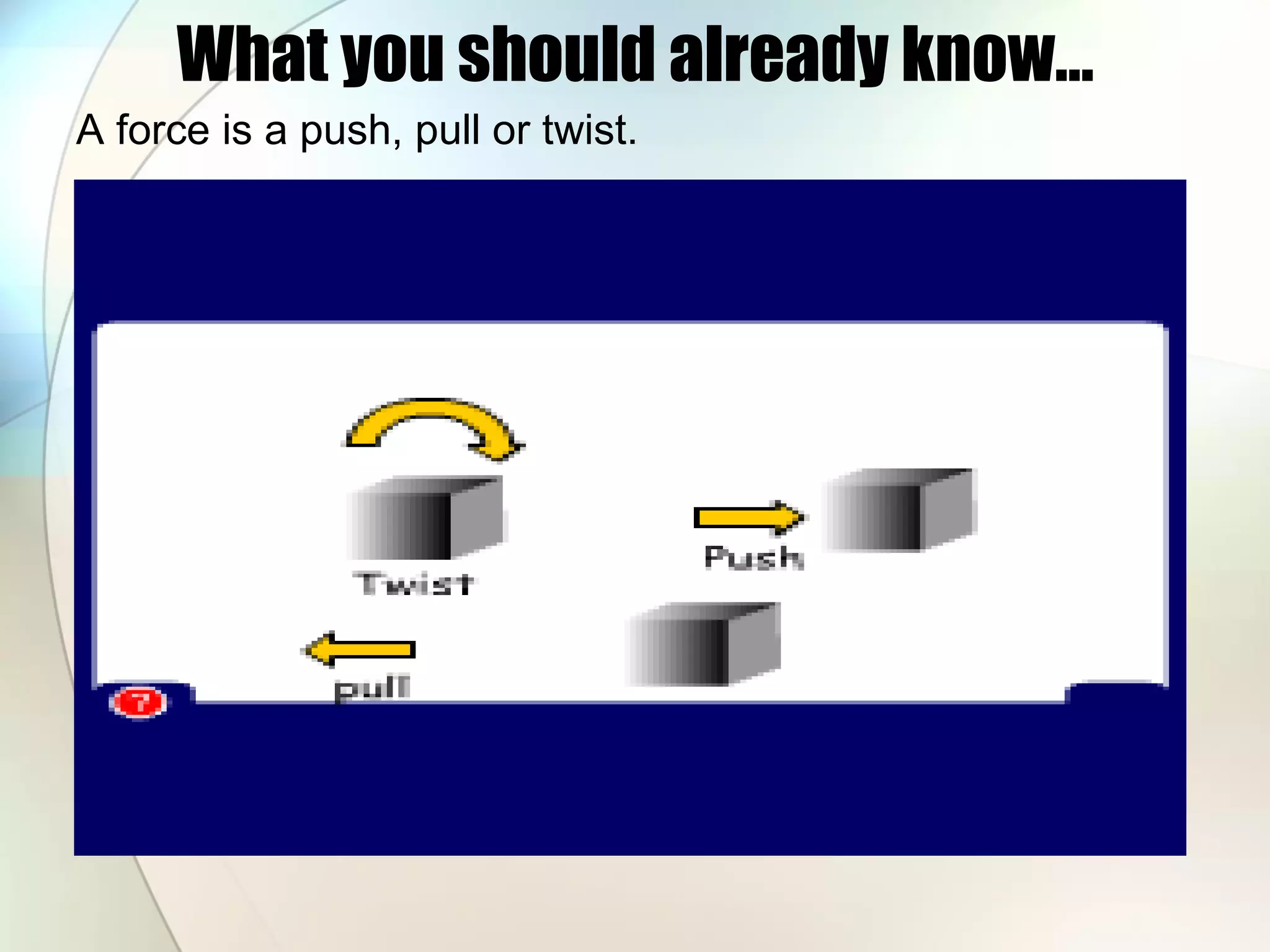
What you should already know… A force is a push, pull or twist.
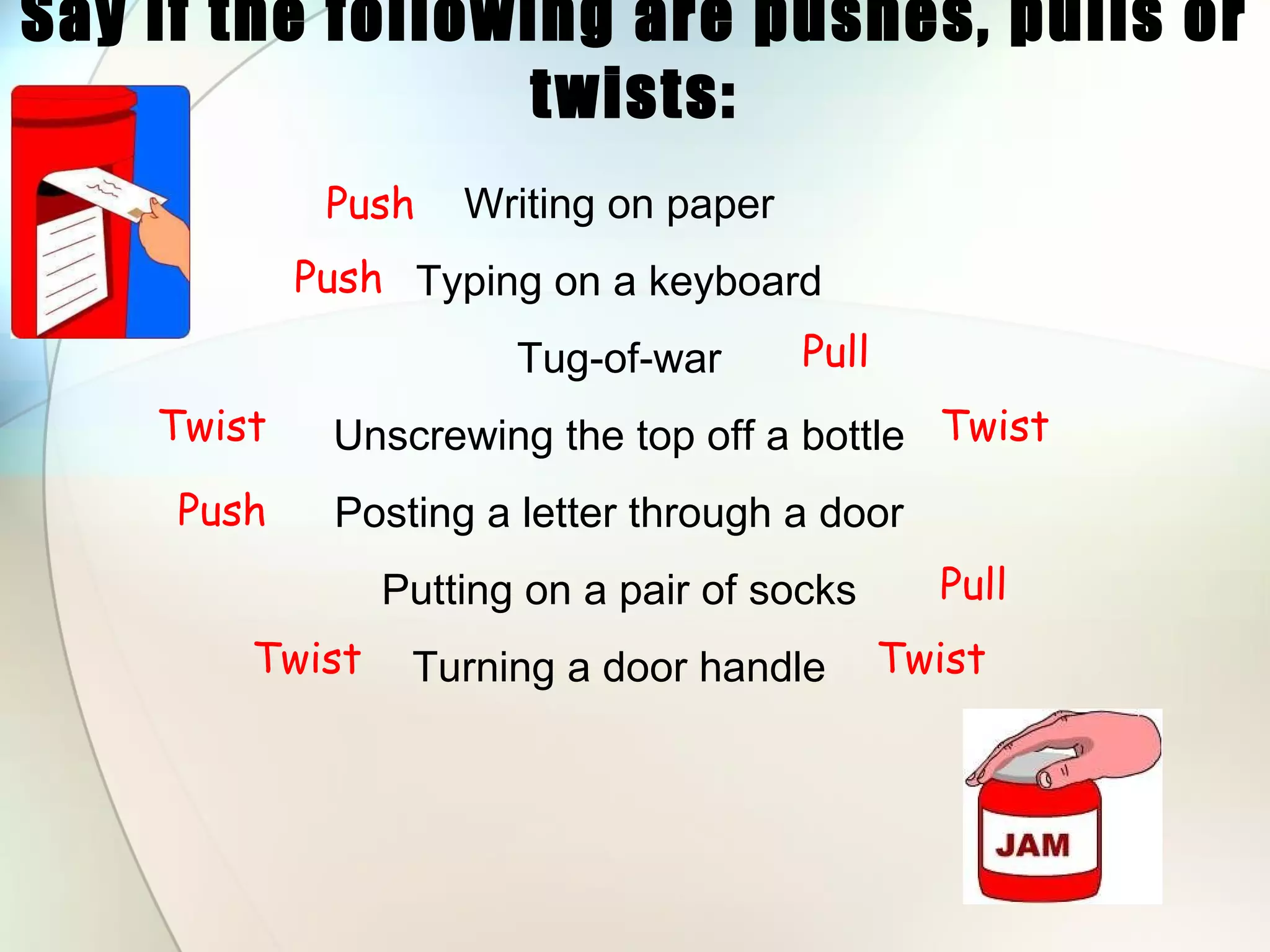
Say if the following are pushes, pulls or twists: Writing on paper Typing on a keyboard Tug-of-war Unscrewing the top off a bottle Posting a letter through a door Putting on a pair of socks Turning a door handle Pull Pull Push Push Push Twist Twist Twist Twist
Demos What is the effect of the force on the object? Can you name the force causing the effect?
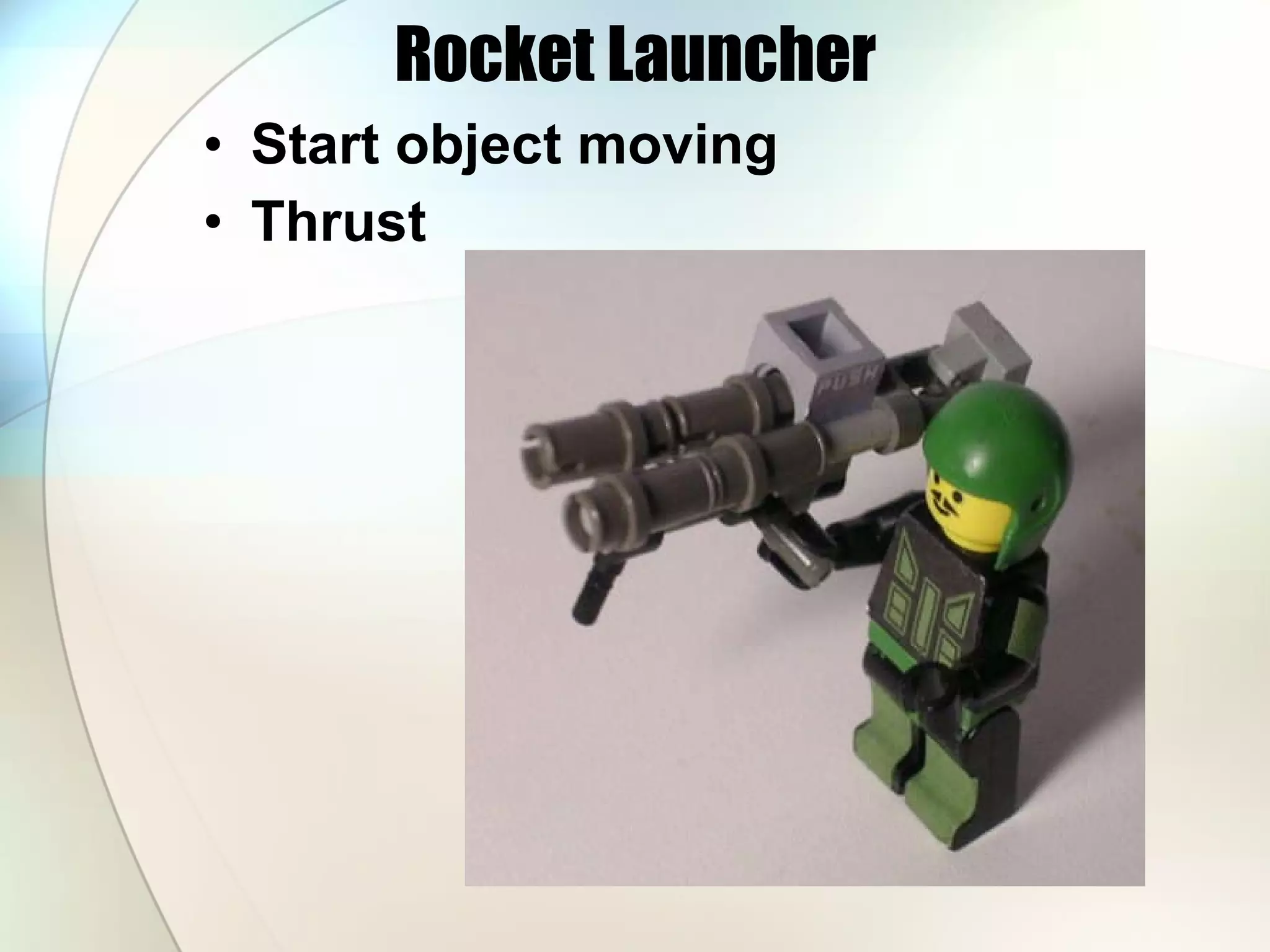
Rocket Launcher Start object moving Thrust
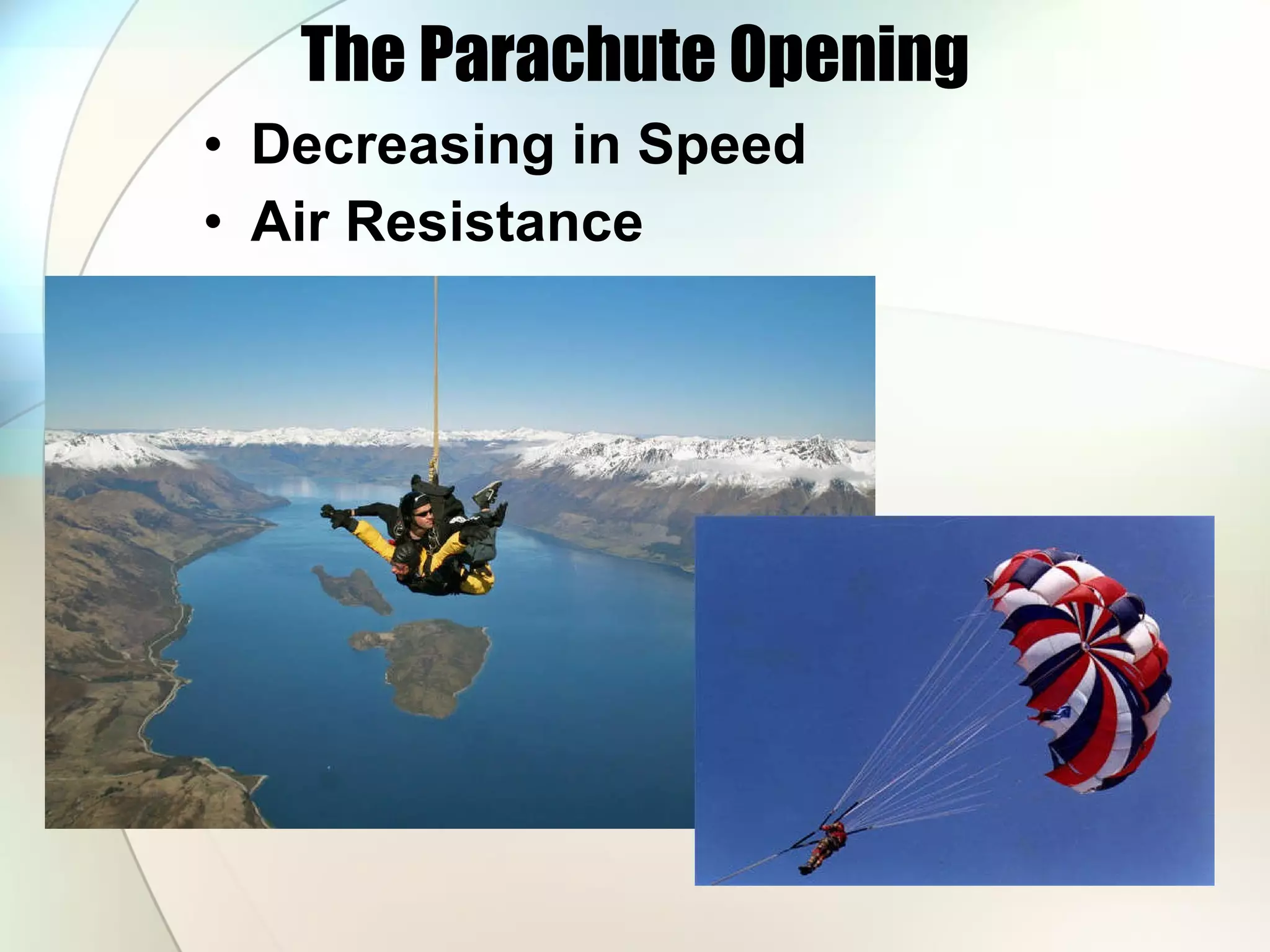
The Parachute Opening Decreasing in Speed Air Resistance
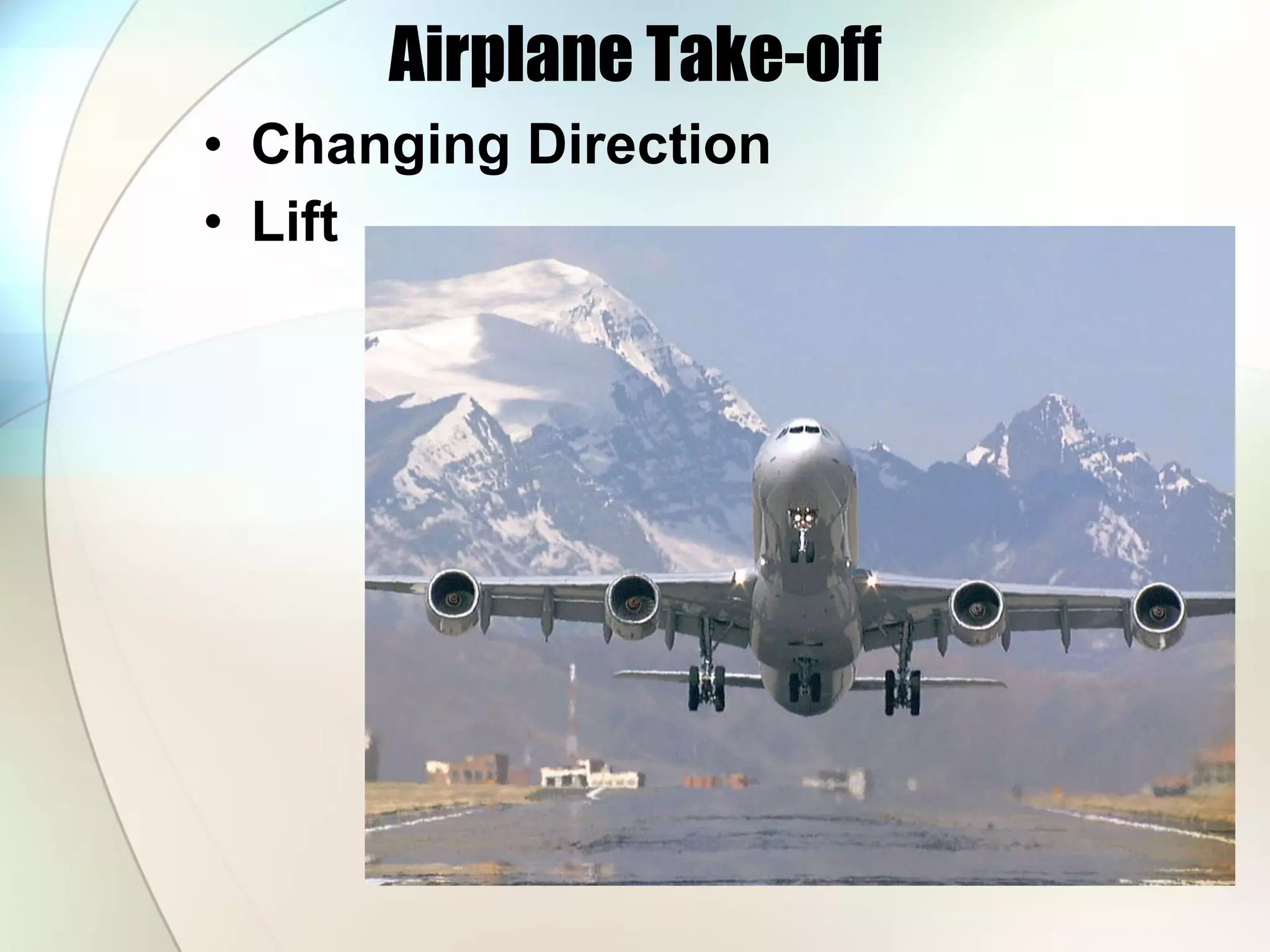
Airplane Take-off Changing Direction Lift
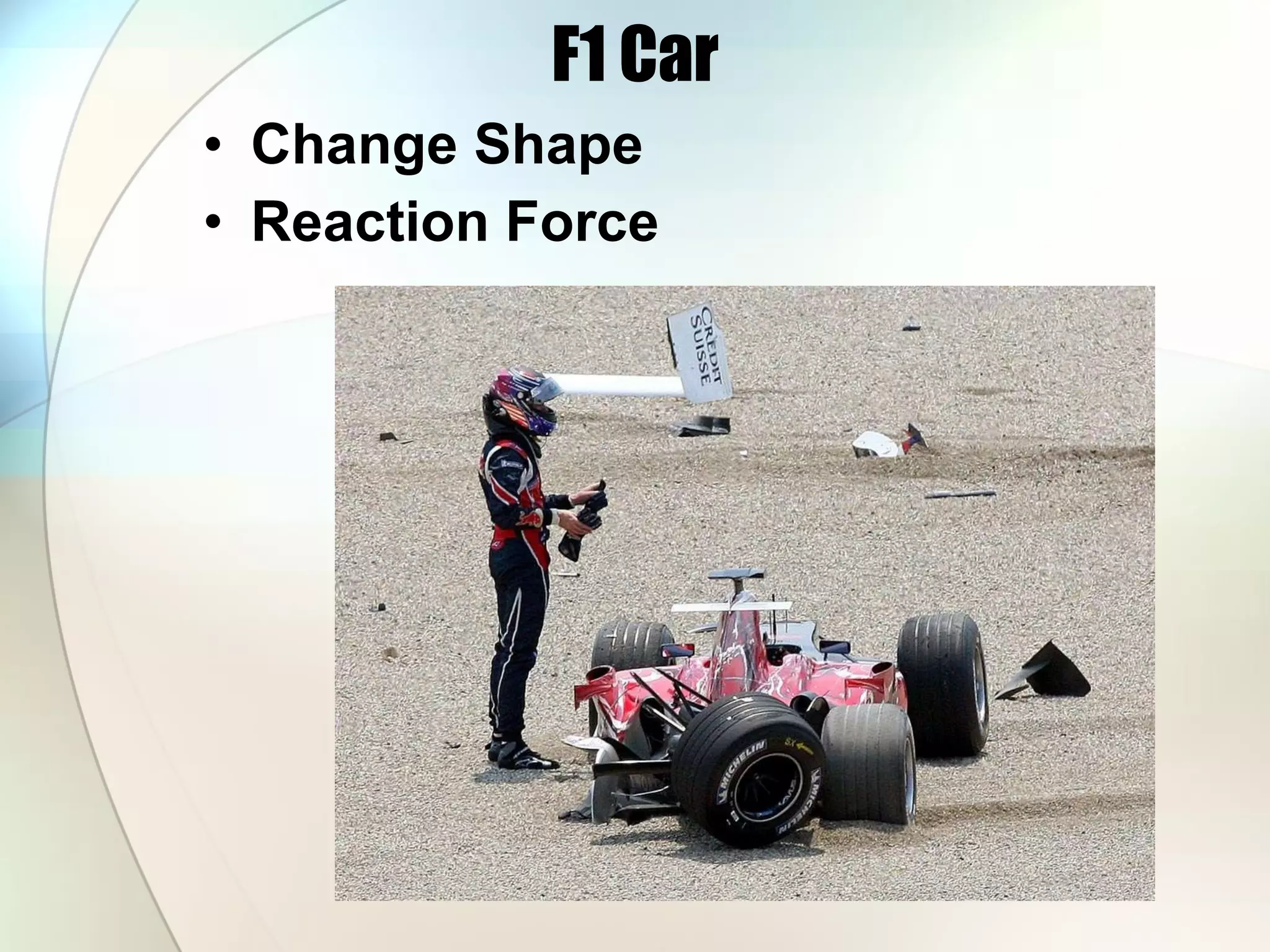
F1 Car Change Shape Reaction Force
The effects of a force A force can cause an object to… Increase/decrease in speed Change direction Change shape Start moving or stop moving
Learning Intentions Identify and   label forces  acting on an object Recall some  common examples  of forces Use a  Newton balance  to  measure  forces
Name a force
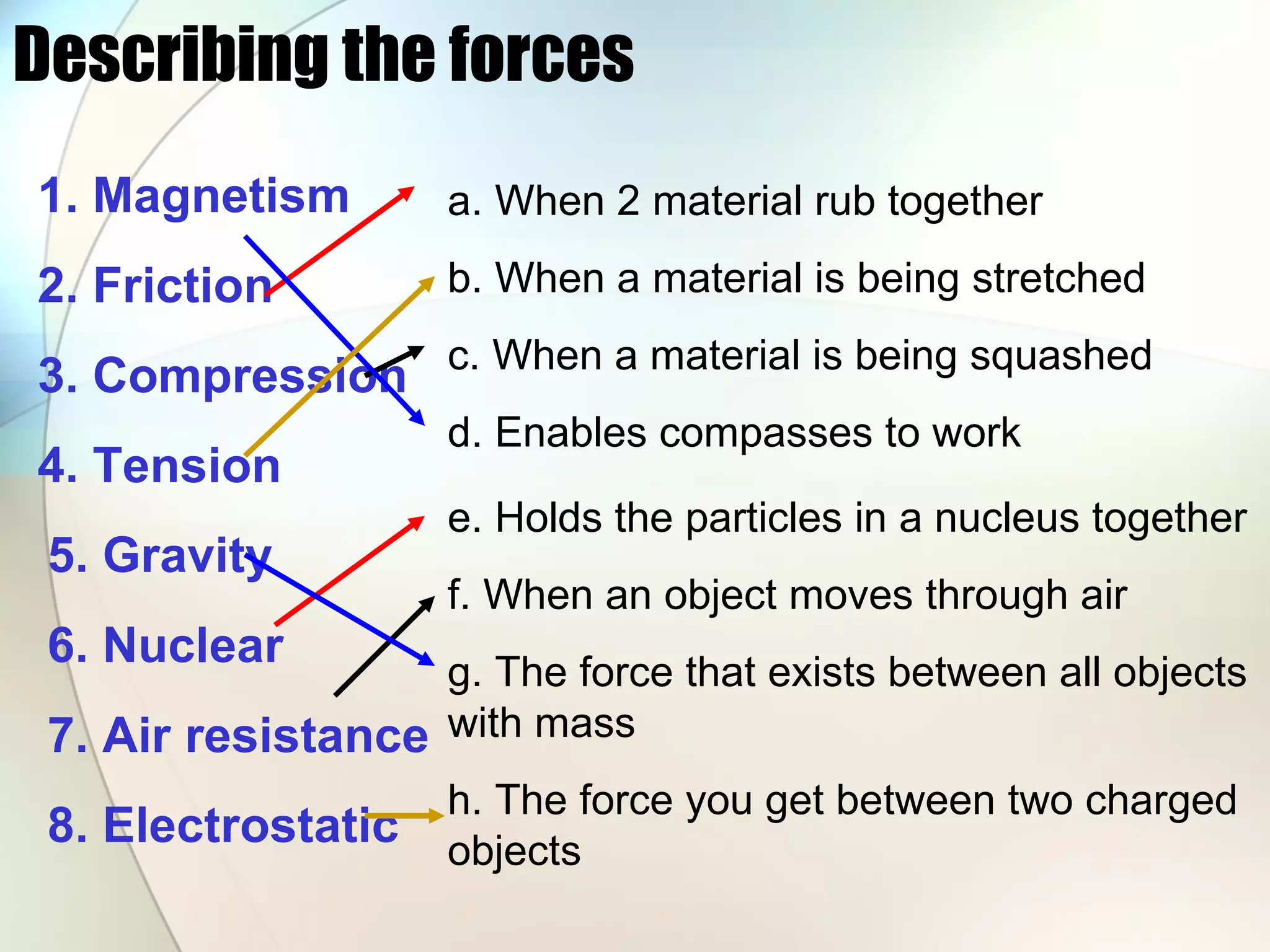
Describing the forces 1. Magnetism 2. Friction 3. Compression 4. Tension a. When 2 material rub together b. When a material is being stretched c. When a material is being squashed d. Enables compasses to work 5. Gravity 6. Nuclear 7. Air resistance 8. Electrostatic e. Holds the particles in a nucleus together f. When an object moves through air g. The force that exists between all objects with mass h. The force you get between two charged objects
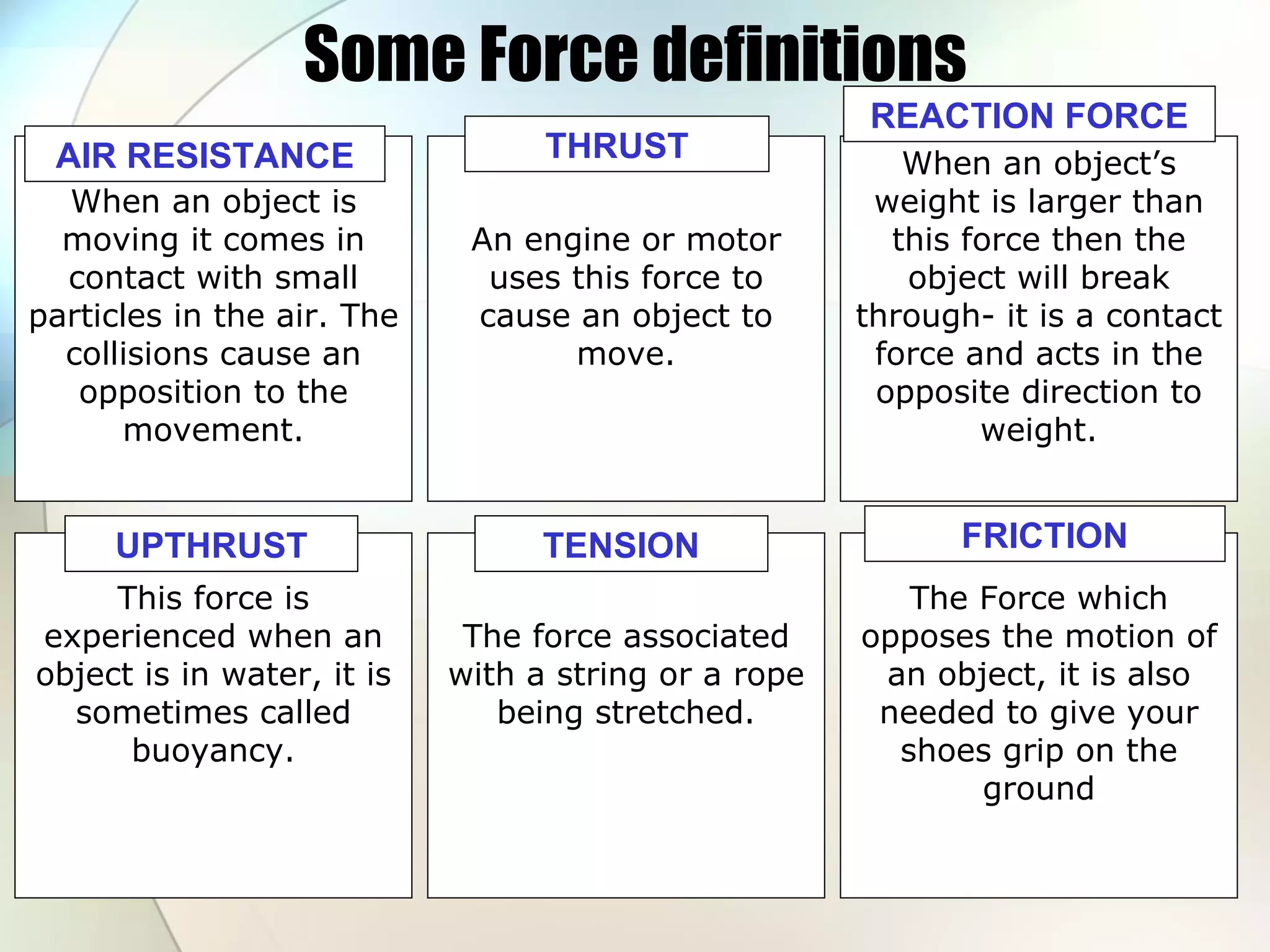
Some Force definitions When an object is moving it comes in contact with small particles in the air. The collisions cause an opposition to the movement. An engine or motor uses this force to cause an object to move. This force is experienced when an object is in water, it is sometimes called buoyancy. The force associated with a string or a rope being stretched. The Force which opposes the motion of an object, it is also needed to give your shoes grip on the ground When an object’s weight is larger than this force then the object will break through- it is a contact force and acts in the opposite direction to weight. FRICTION TENSION UPTHRUST THRUST AIR RESISTANCE REACTION FORCE
Learning Intentions Identify and   label forces  acting on an object Recall some  common examples  of forces Use a  Newton balance  to  measure  forces
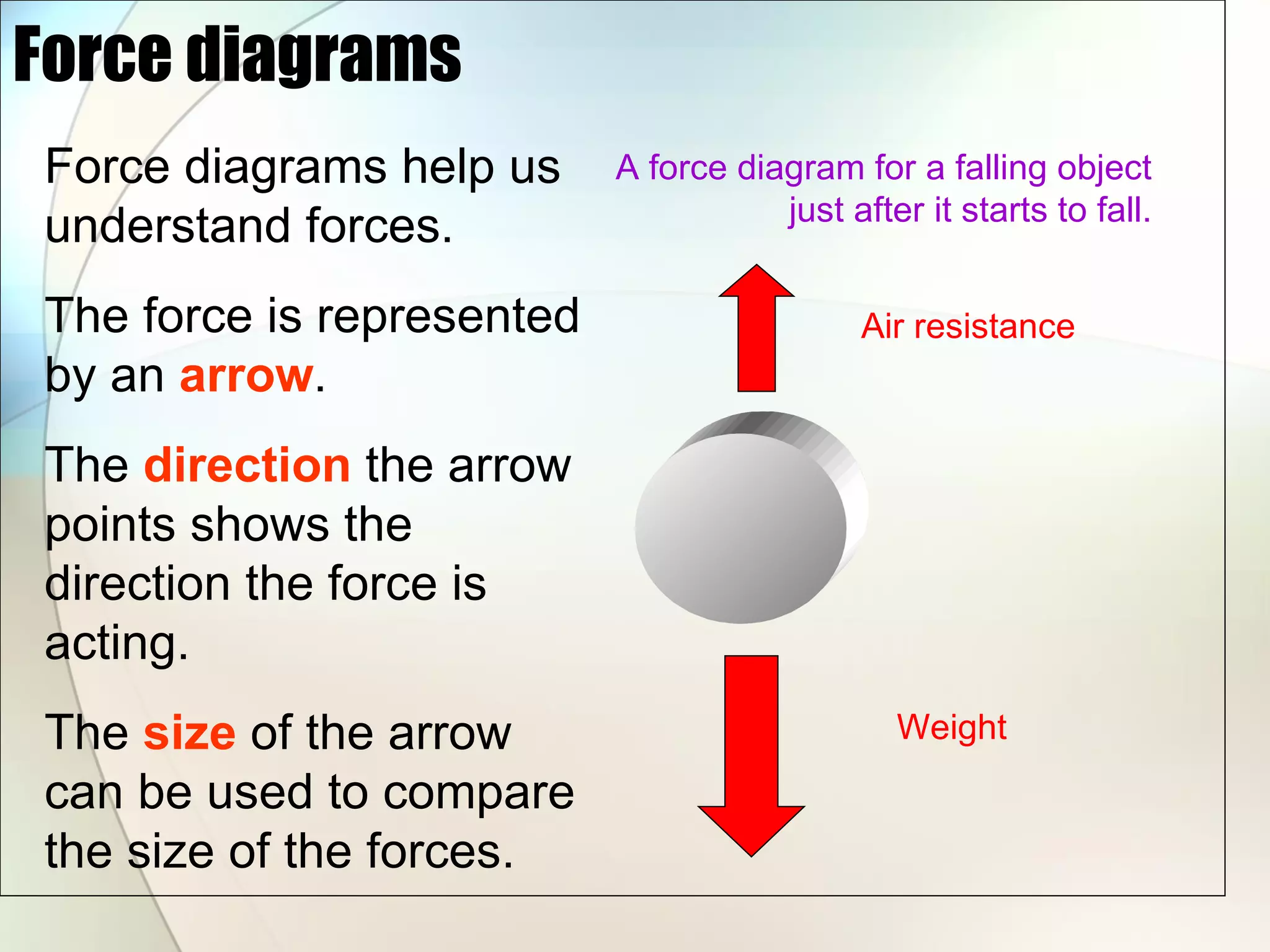
Force diagrams Force diagrams help us understand forces.  The force is represented by an  arrow .  The  direction  the arrow points shows the direction the force is acting.  The  size  of the arrow can be used to compare the size of the forces. A force diagram for a falling object just after it starts to fall. Air resistance Weight
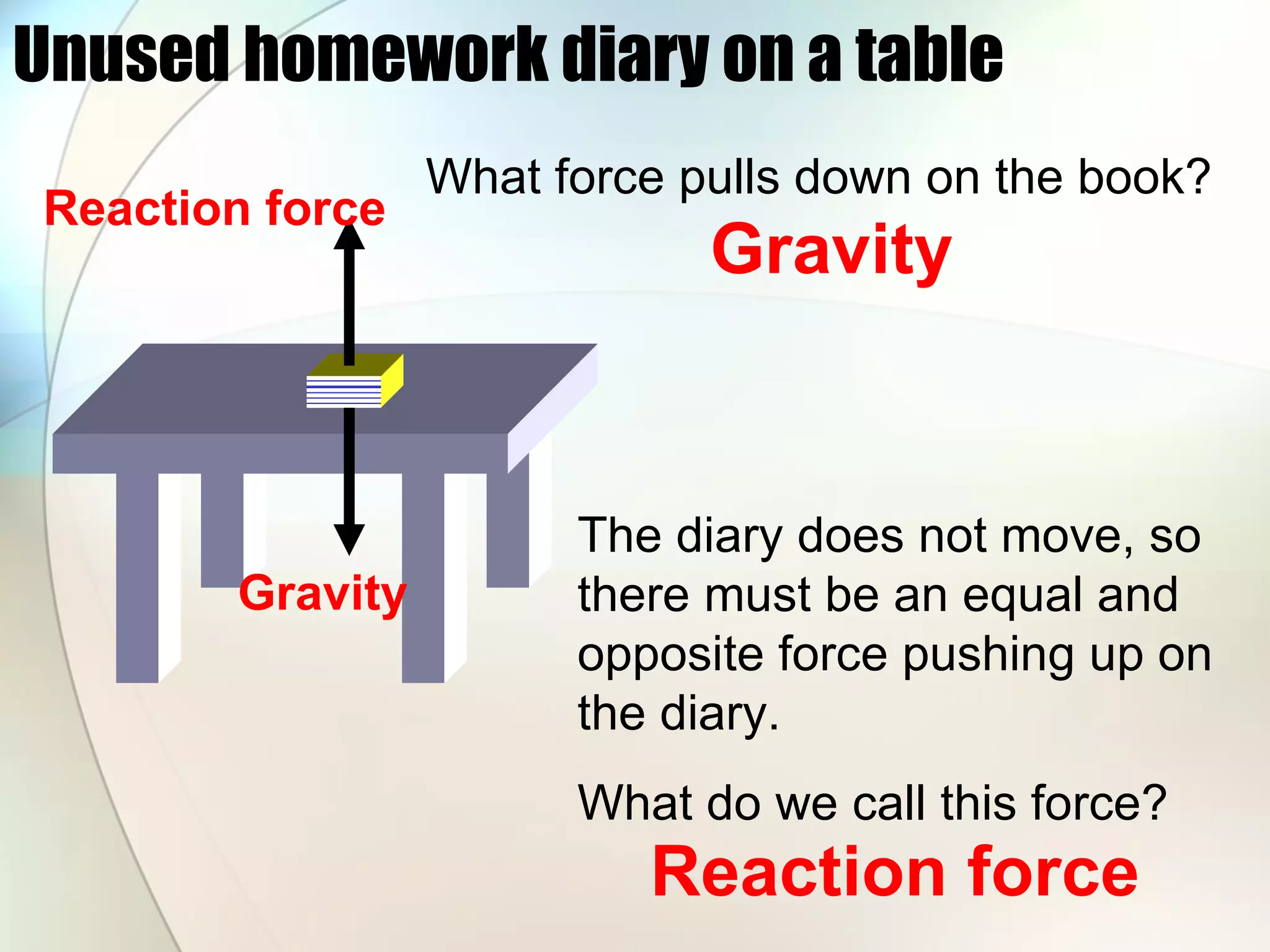
Unused homework diary on a table What force pulls down on the book? Gravity The diary does not move, so there must be an equal and opposite force pushing up on the diary.  What do we call this force? Reaction force Gravity Reaction force
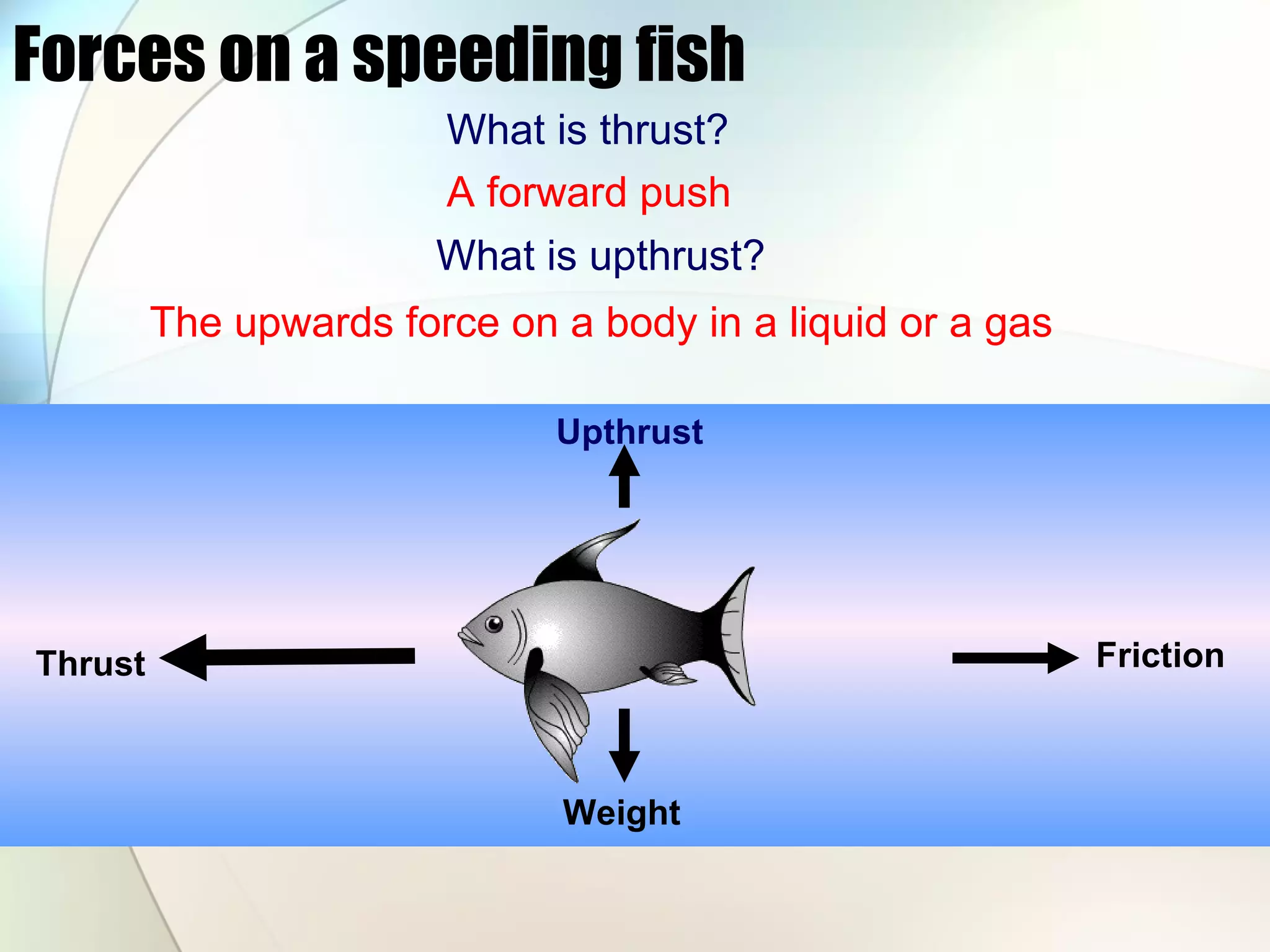
Forces on a speeding fish Upthrust Friction Thrust Weight What is thrust? A forward push What is upthrust? The upwards force on a body in a liquid or a gas
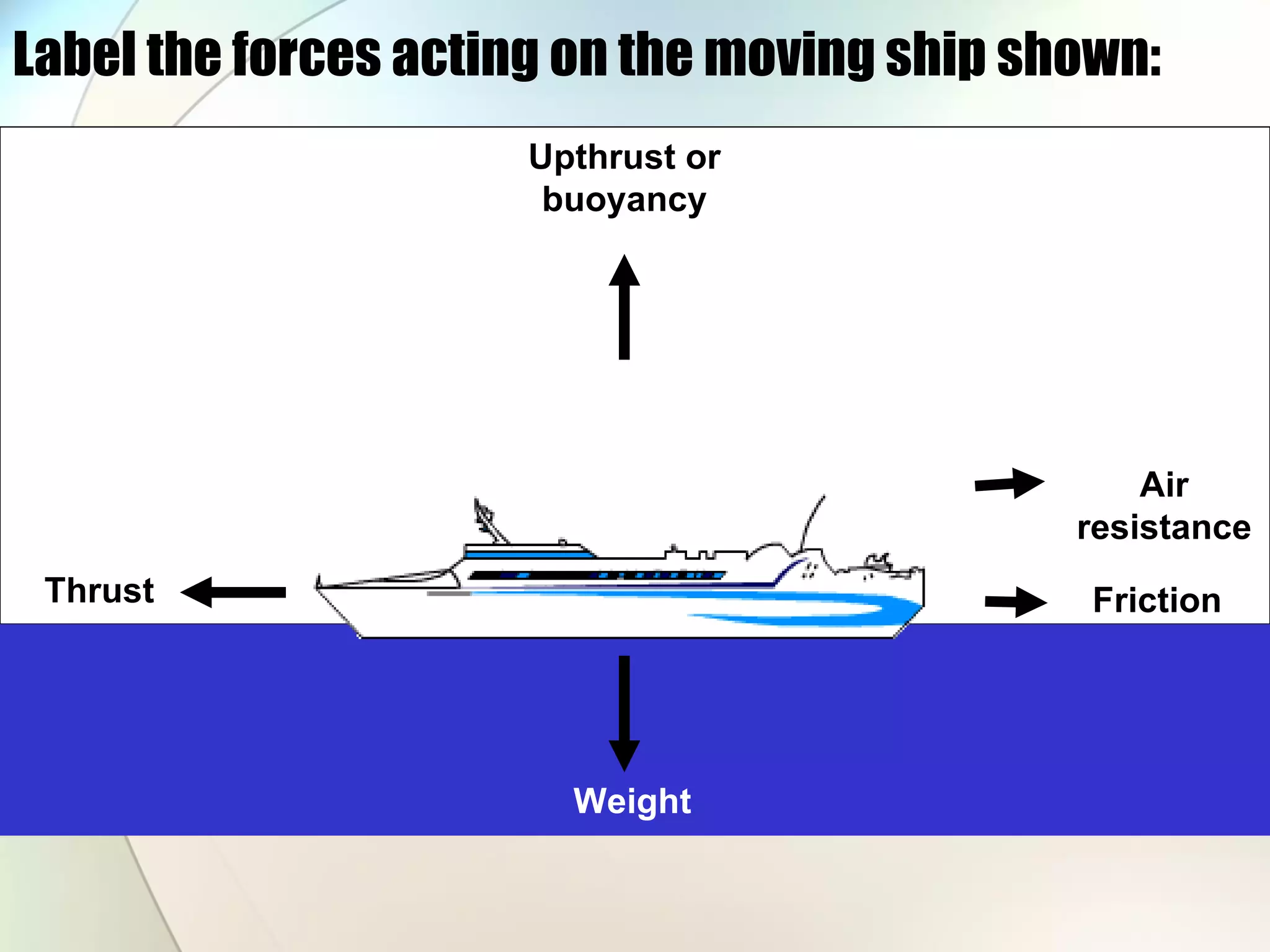
Label the forces acting on the moving ship shown: Upthrust or buoyancy Thrust Air resistance Friction Weight
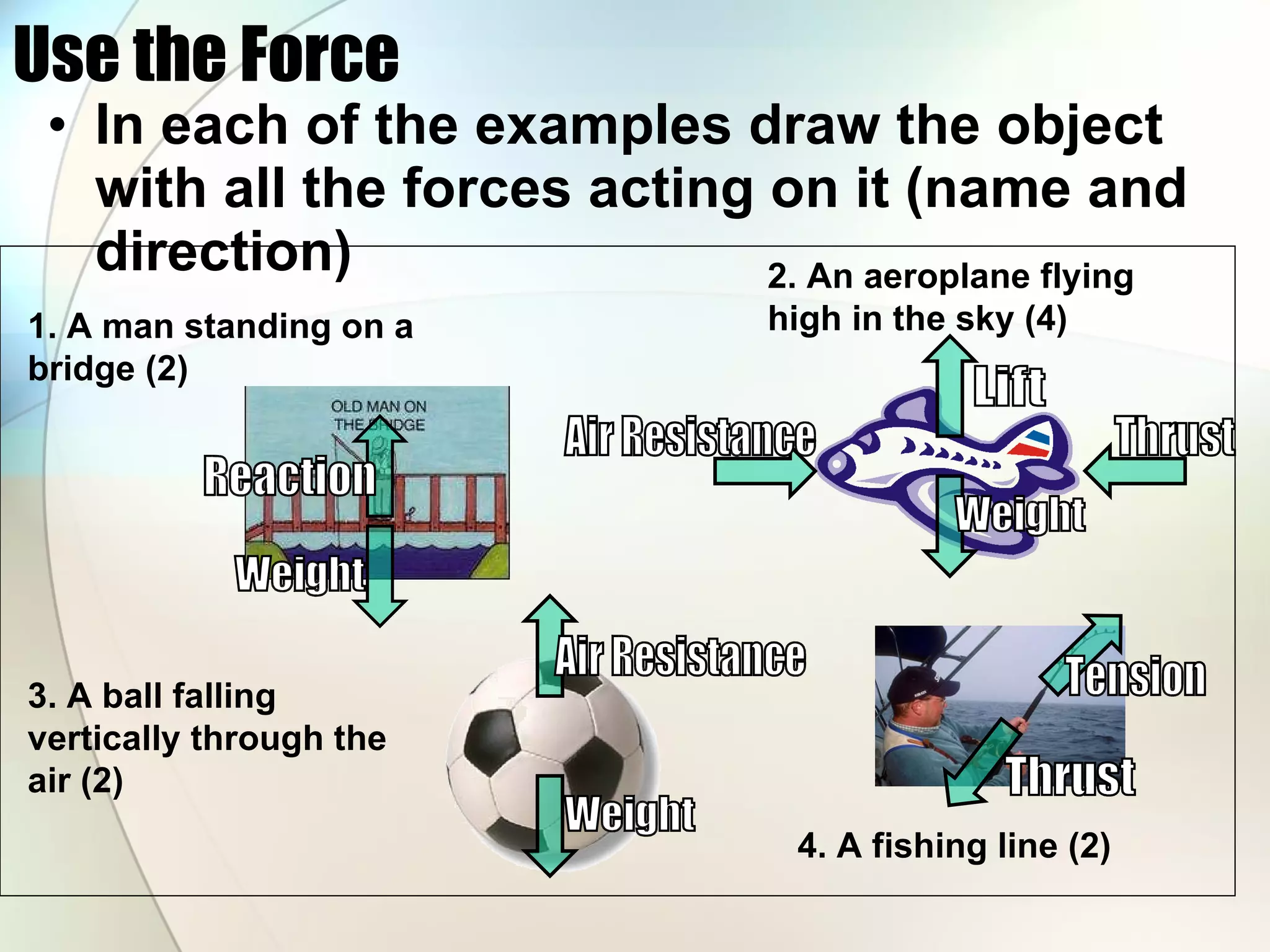
Use the Force In each of the examples draw the object with all the forces acting on it (name and direction) 1. A man standing on a bridge (2) 2. An aeroplane flying high in the sky (4) 3. A ball falling vertically through the air (2) 4. A fishing line (2) Weight Weight Weight Air Resistance Air Resistance Reaction Thrust Lift Tension Thrust
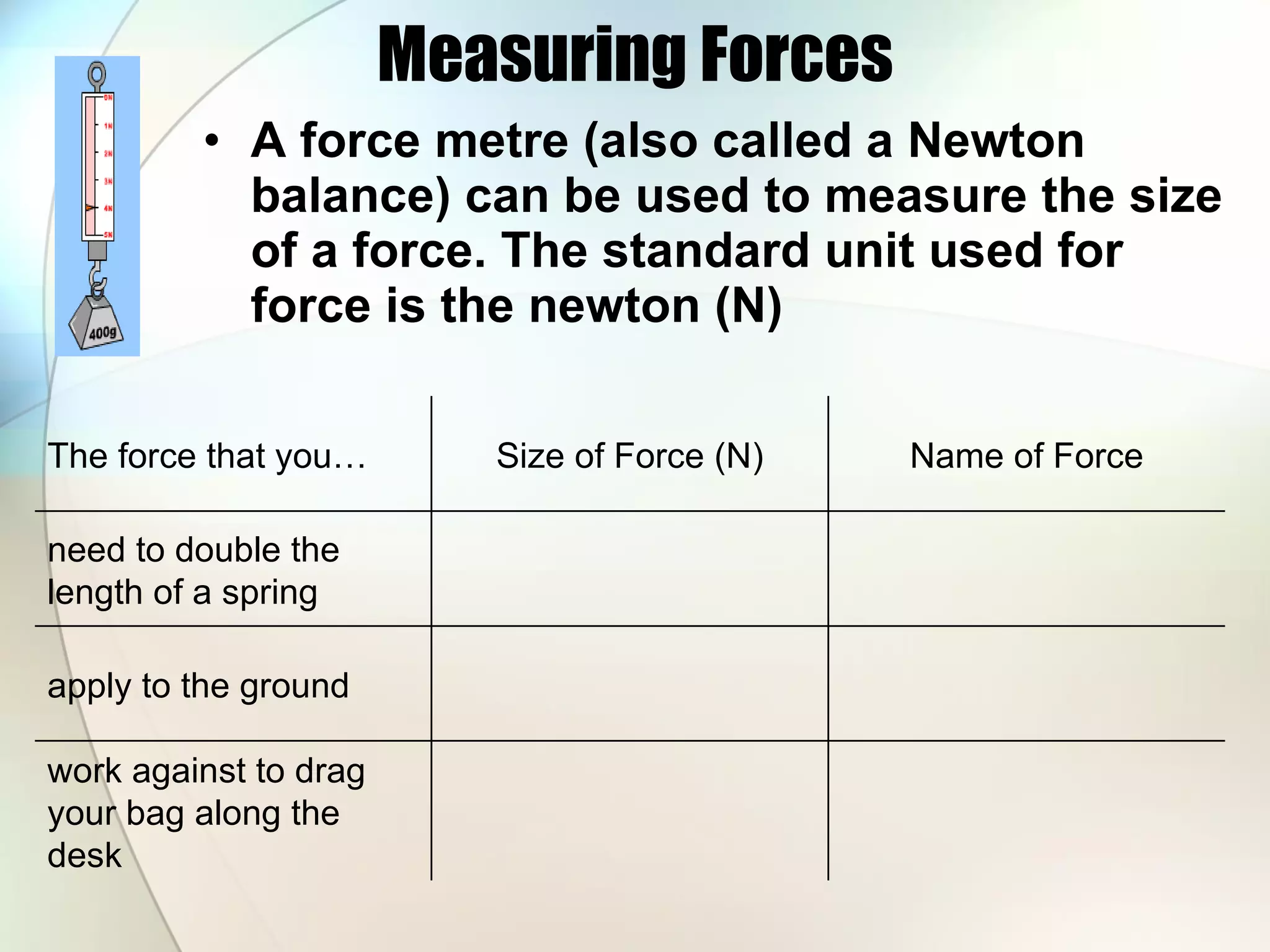
Measuring Forces A force metre (also called a Newton balance) can be used to measure the size of a force. The standard unit used for force is the newton (N) work against to drag your bag along the desk apply to the ground need to double the length of a spring Name of Force Size of Force (N) The force that you…

Forces Basics

  • 1.
  • 2.
    Learning Intentions Toidentify the effect of forces acting on an object To recall some common examples of forces
  • 3.
    Book Reference Page33 Physics for CCEA
  • 4.
    What you shouldalready know… A force is a push, pull or twist.
  • 5.
    Say if thefollowing are pushes, pulls or twists: Writing on paper Typing on a keyboard Tug-of-war Unscrewing the top off a bottle Posting a letter through a door Putting on a pair of socks Turning a door handle Pull Pull Push Push Push Twist Twist Twist Twist
  • 6.
    Demos What isthe effect of the force on the object? Can you name the force causing the effect?
  • 7.
    Rocket Launcher Startobject moving Thrust
  • 8.
    The Parachute OpeningDecreasing in Speed Air Resistance
  • 9.
  • 10.
    F1 Car ChangeShape Reaction Force
  • 11.
    The effects ofa force A force can cause an object to… Increase/decrease in speed Change direction Change shape Start moving or stop moving
  • 12.
    Learning Intentions Identifyand label forces acting on an object Recall some common examples of forces Use a Newton balance to measure forces
  • 13.
  • 14.
    Describing the forces1. Magnetism 2. Friction 3. Compression 4. Tension a. When 2 material rub together b. When a material is being stretched c. When a material is being squashed d. Enables compasses to work 5. Gravity 6. Nuclear 7. Air resistance 8. Electrostatic e. Holds the particles in a nucleus together f. When an object moves through air g. The force that exists between all objects with mass h. The force you get between two charged objects
  • 15.
    Some Force definitionsWhen an object is moving it comes in contact with small particles in the air. The collisions cause an opposition to the movement. An engine or motor uses this force to cause an object to move. This force is experienced when an object is in water, it is sometimes called buoyancy. The force associated with a string or a rope being stretched. The Force which opposes the motion of an object, it is also needed to give your shoes grip on the ground When an object’s weight is larger than this force then the object will break through- it is a contact force and acts in the opposite direction to weight. FRICTION TENSION UPTHRUST THRUST AIR RESISTANCE REACTION FORCE
  • 16.
    Learning Intentions Identifyand label forces acting on an object Recall some common examples of forces Use a Newton balance to measure forces
  • 17.
    Force diagrams Forcediagrams help us understand forces. The force is represented by an arrow . The direction the arrow points shows the direction the force is acting. The size of the arrow can be used to compare the size of the forces. A force diagram for a falling object just after it starts to fall. Air resistance Weight
  • 18.
    Unused homework diaryon a table What force pulls down on the book? Gravity The diary does not move, so there must be an equal and opposite force pushing up on the diary. What do we call this force? Reaction force Gravity Reaction force
  • 19.
    Forces on aspeeding fish Upthrust Friction Thrust Weight What is thrust? A forward push What is upthrust? The upwards force on a body in a liquid or a gas
  • 20.
    Label the forcesacting on the moving ship shown: Upthrust or buoyancy Thrust Air resistance Friction Weight
  • 21.
    Use the ForceIn each of the examples draw the object with all the forces acting on it (name and direction) 1. A man standing on a bridge (2) 2. An aeroplane flying high in the sky (4) 3. A ball falling vertically through the air (2) 4. A fishing line (2) Weight Weight Weight Air Resistance Air Resistance Reaction Thrust Lift Tension Thrust
  • 22.
    Measuring Forces Aforce metre (also called a Newton balance) can be used to measure the size of a force. The standard unit used for force is the newton (N) work against to drag your bag along the desk apply to the ground need to double the length of a spring Name of Force Size of Force (N) The force that you…

Editor's Notes

  • #4 Follow on from motion… we use the idea of a ‘force’ to grasp why objects change their motion or physically change
  • #5 This is a FLASH animation. Please click on the arrows to show the force.
  • #12 Newton’s Cradle – again demonstrates the 4 effects, two on each side moving in to hit the middle stationary ball will cause it to change shape
  • #14 Individually, at the back of the note book make a list of as many forces as possible. You can use our text book to give you some help. Find out how far we can go around the class without repeating the same name of a force…
  • #15 Have a think, again at the back of your book, match the number with the correct letter, name of the force with the description of the force.
  • #16 Each group will have a set of cards, lay them out with the name of the force facing up, pick up one and turn it over to read the description. Try to match the description to one of the names of a force, then pick up that name of a force and turn it over to read another description. Repeat this until you get all 6 names and descriptions. Write out in your book all 6 definitions Ping Pong ball in water - upthrust
  • #18 The next stage of understanding about forces is to consider a simple diagram of an object with the forces that are applied to it. An arrow is used to indicate the direction and the relative size of the force, as well as including the name of the force. 4 examples of force diagrams – add on the labels, arrows and names of the forces
  • #23 Using a Newton balance, find the size of the force in each of the activities. Give the name of the force in each case. Tension, Weight / Gravity, Friction