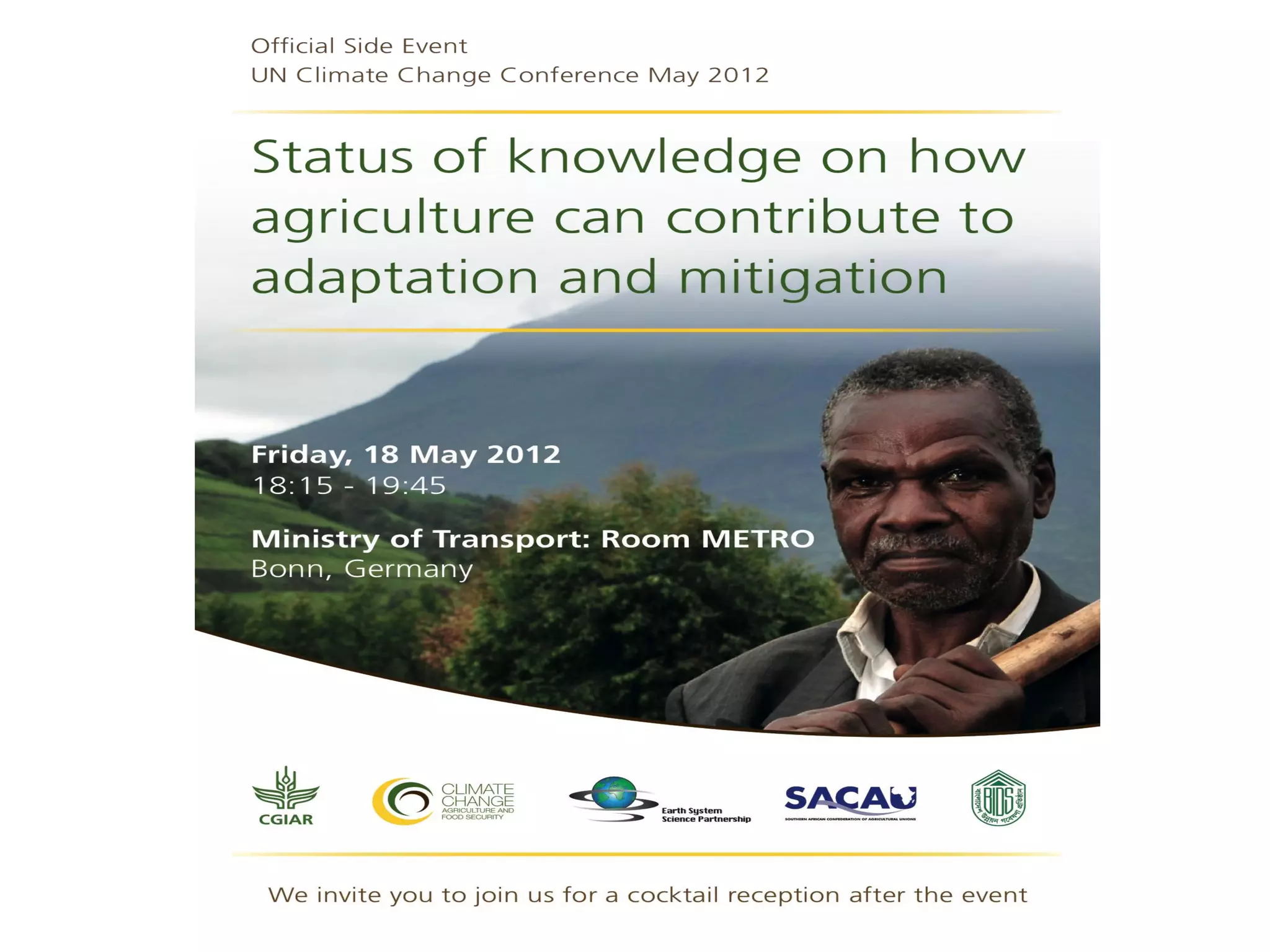
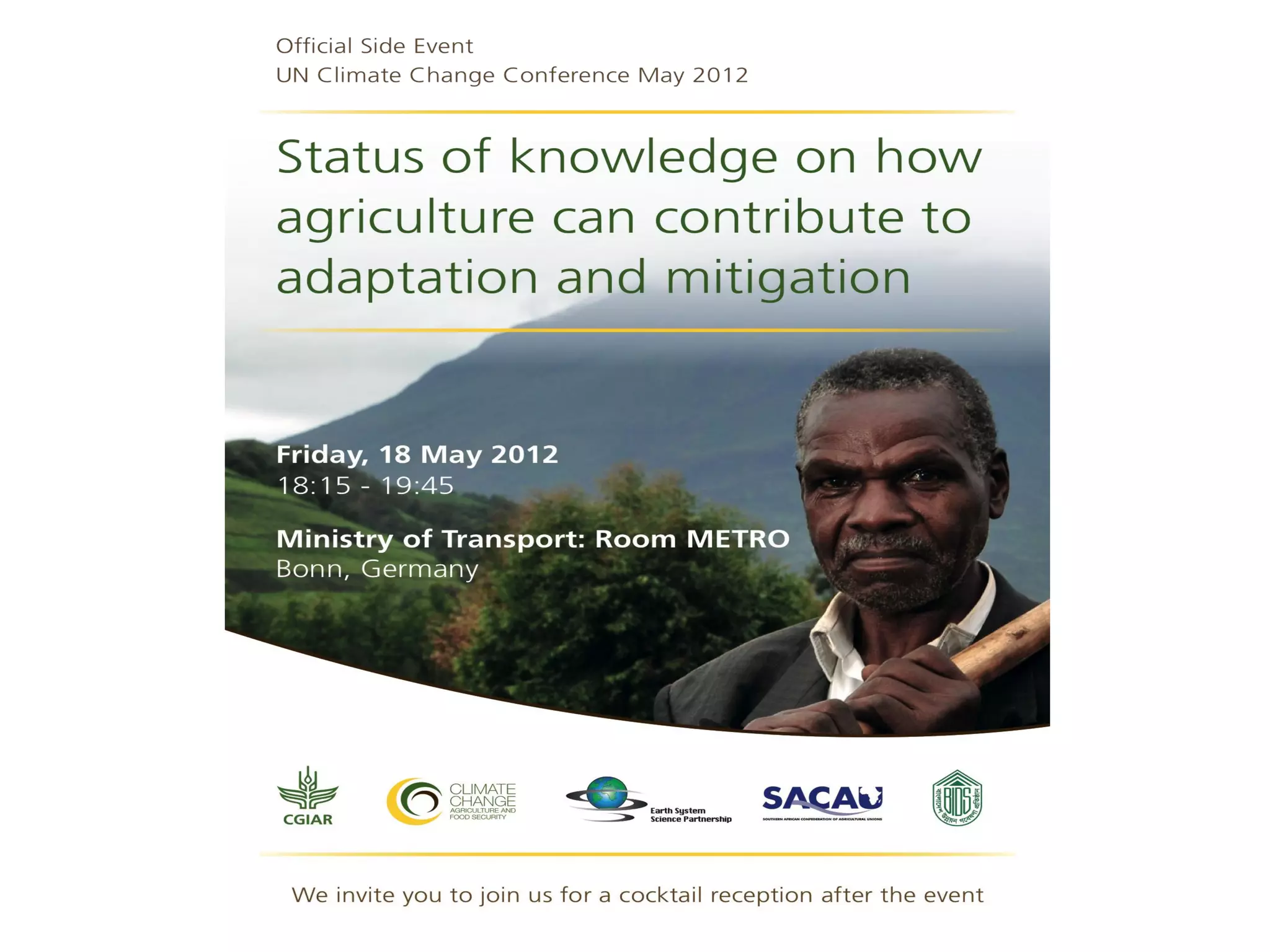
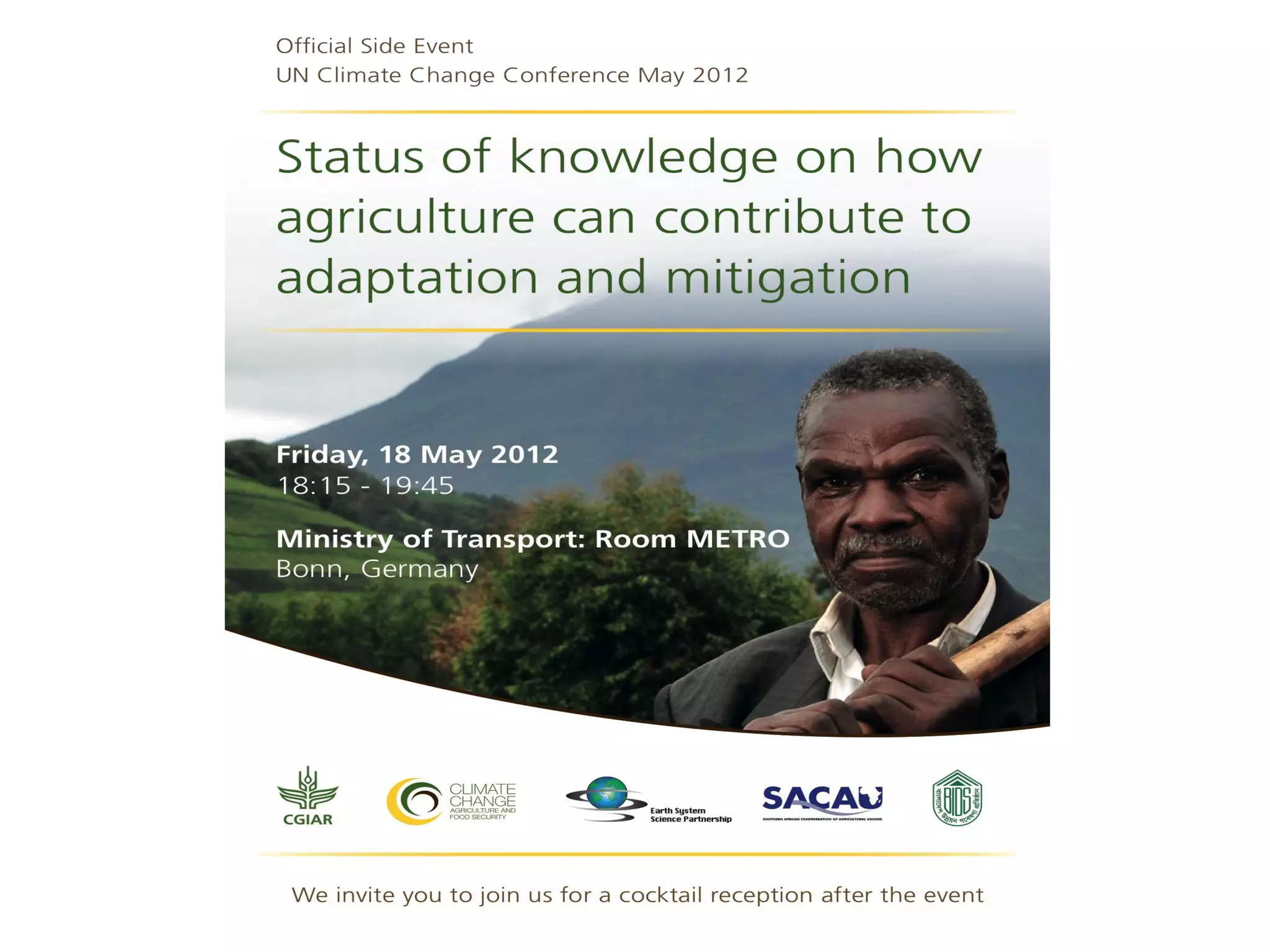
Event name


                    Title
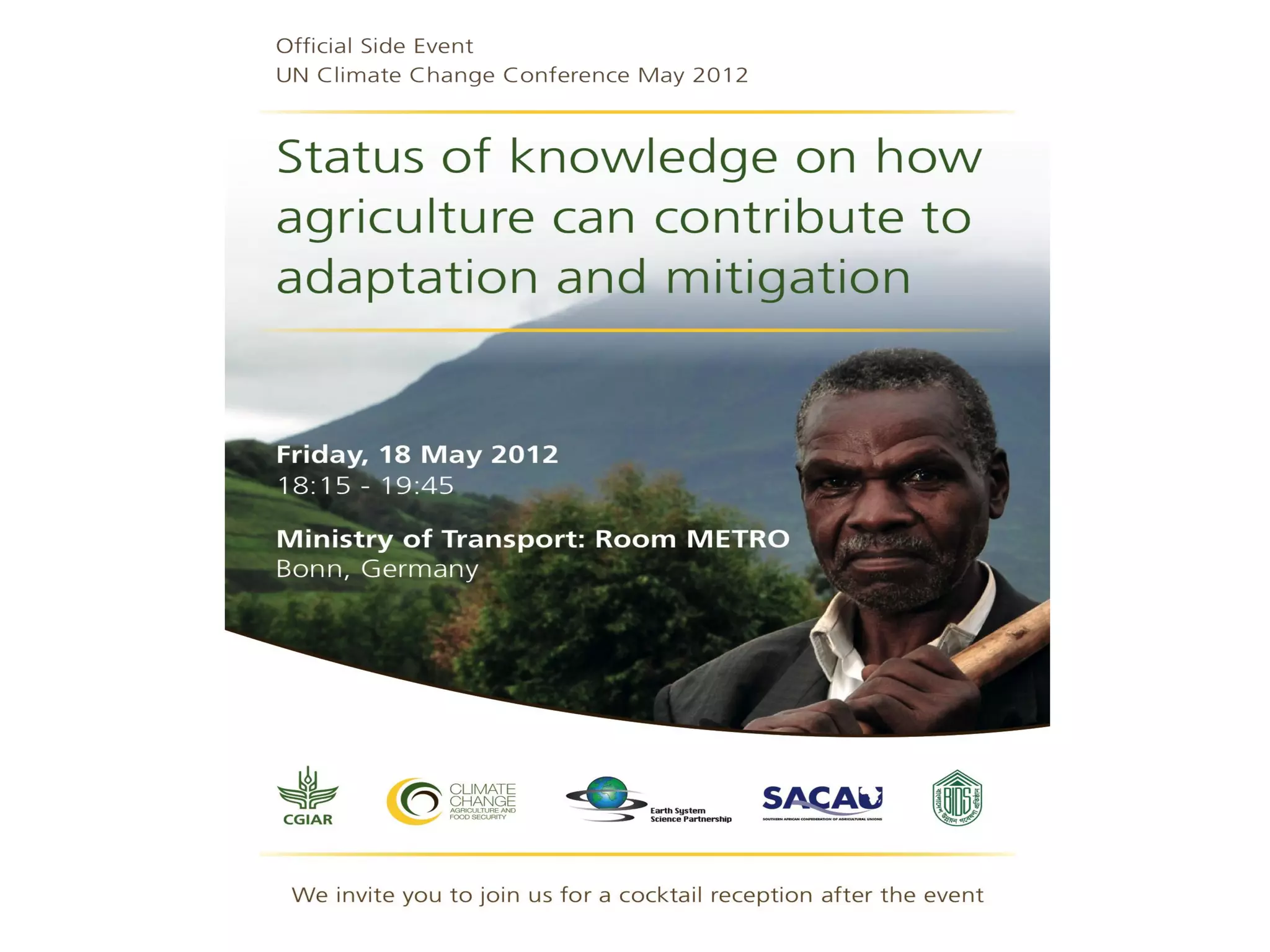
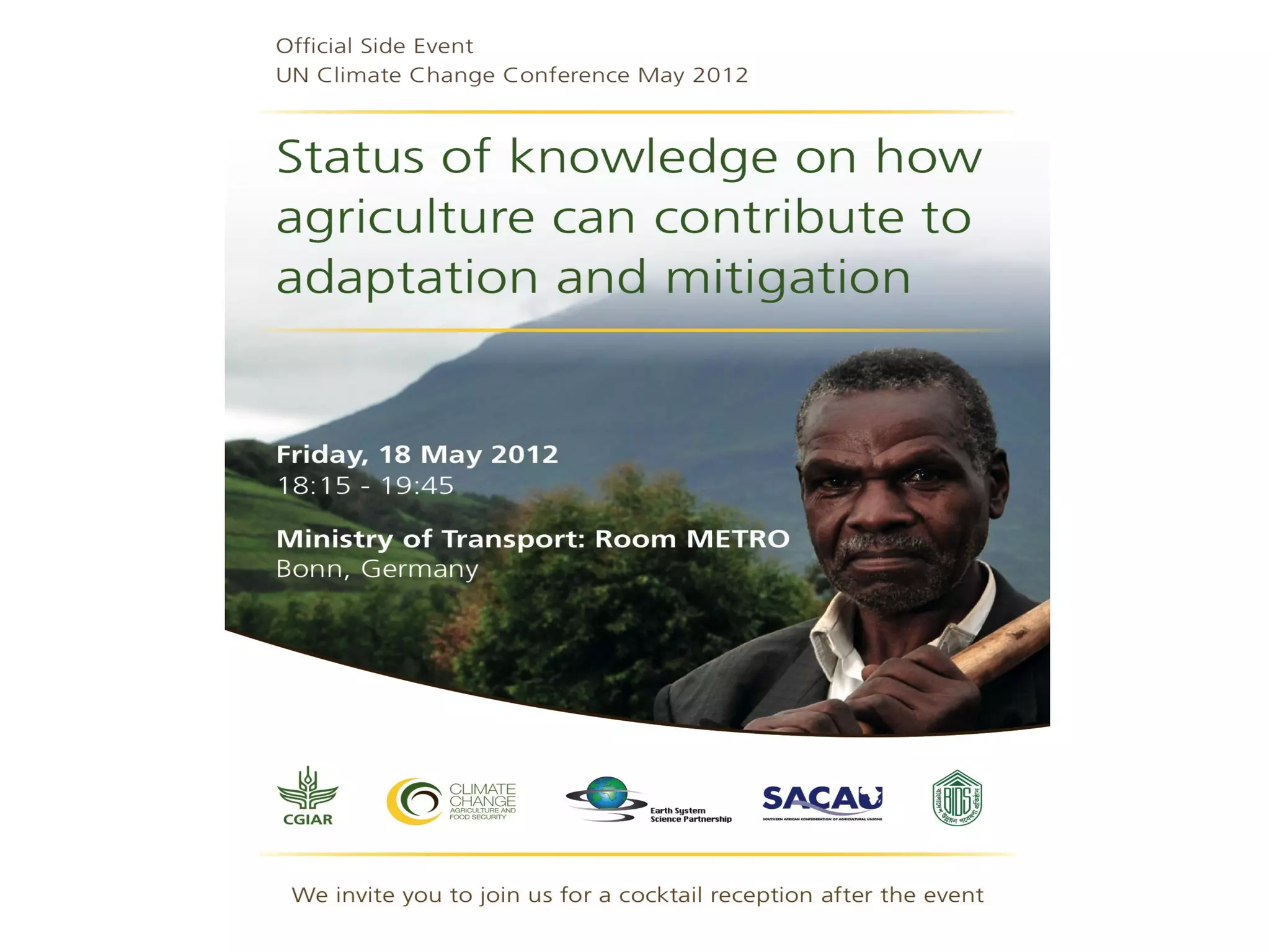
Status of knowledge on how
agriculture can contribute to
adaptation and mitigation
                                      James Kinyangi
                             Regional Program Leader
Agriculture in the UNFCCC
• At COP 17, Parties agreed on a Decision to advance discussions
  on agriculture during SBSTA 36
• Areas of commonality and divergence and to understand
  possible scenarios to bridge the differences
• Negotiators to identify innovative/new ideas that could be
  adopted to reach agreement
• Issues that support convergence of Parties and those aspects
  that are completely opposed to inclusion of agriculture in
  UNFCCC negotiations


 5/19/2012
Understanding the Submissions in
the Context of the Work of SBSTA
 A review was commissioned by COMESA and
 CCAFS, to synthesize the submissions to SBSTA,
 summarizing the issues relevant to agriculture:
 • number of submissions reviewed included Parties
   (21), IGOs (5) and NGOs (24)
 • covered issues of key scientific and technological
   aspects of agricultural adaptation, productivity,
   livelihoods and food security
  • identified actual and potential conflicts (divergent
      issues) in the submissions between African parties
      and those of other submissions
5/19/2012
The Issues Informing the Positions of
                Parties
  • priority issues identified under impacts, barriers to
    implementation of adaptation actions, measurements,
    technologies and approaches relevant to climate change
    adaptation
  • Parties recognize the existence of high quality scientific and
    technical information
  • They observe that there is a failure to recognize the need to
    address and improve understanding of the scientific,
    technical and socio-economic basis of adaptation.
  • Can be summarized as: Data for quantification; Science
    of adaptation; Technological development and
    application and tools and methods for measurements
5/19/2012
Divergent Issues; Is it Adaptation with
       Mitigation Co-Benefits?
  • Emerging position that Parties need to step up efforts to
    safeguard the agricultural sector against the worst effects of
    climate change since GHG mitigation approaches have long
    time-lags before the benefits can be realized
  • Some Parties including the Gambia on behalf of the LDCs
    acknowledge the positive interaction between mitigation and
    adaptation, thereby advocating for pursuit of climate actions that
    address both adaptation and mitigation
  • Potential tradeoffs between adaptation, food security and
    mitigation; so no clear distinction is made between small scale
    and large scale agricultures, and research, development and
    technology transfer are still undifferentiated

 5/19/2012
Is a Work Program on Agriculture a
       likely Outcome at SBSTA 36?
• Good news-majority of the submissions by the parties
  are in favor of a work program on agriculture
• Even those opposed-point out that UNFCCC does not
  allow for meaningful participation of smallholder farmers
  and that UNFCCC has mostly concentrated on
  measurement, reporting and verification
• Capture the mood-SBSTA should establish a
  framework for the work program on agriculture with a
  clear goal of supporting adaptation actions with
  mitigation co-benefits

5/19/2012
SBSTA Side Event, Bonn, May 2012


What could SBSTA do now on
        agriculture?

                                           Dr Sonja Vermeulen
                                     Head of Research, CCAFS
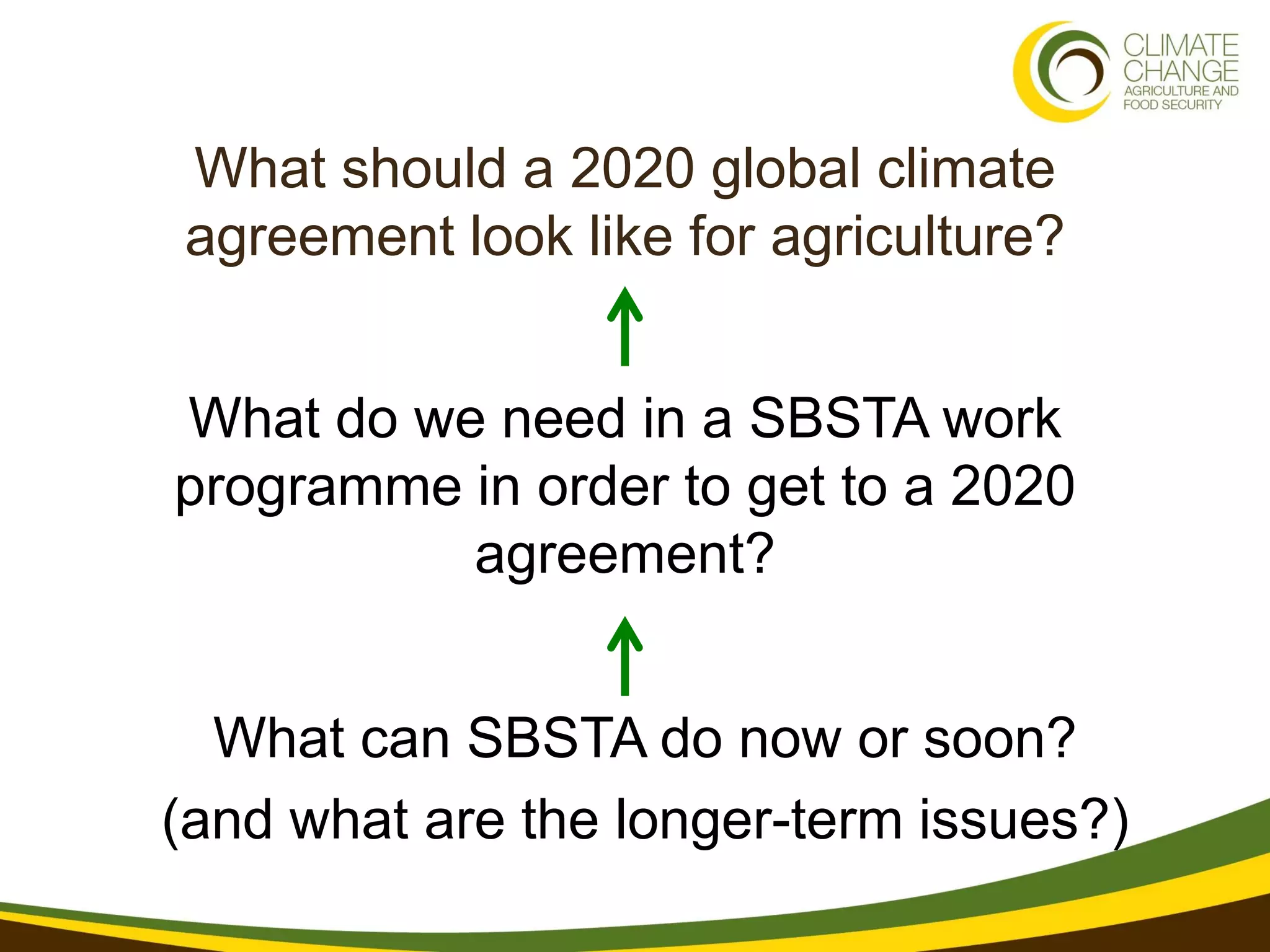
What should a 2020 global climate
agreement look like for agriculture?


What do we need in a SBSTA work
programme in order to get to a 2020
          agreement?


  What can SBSTA do now or soon?
(and what are the longer-term issues?)
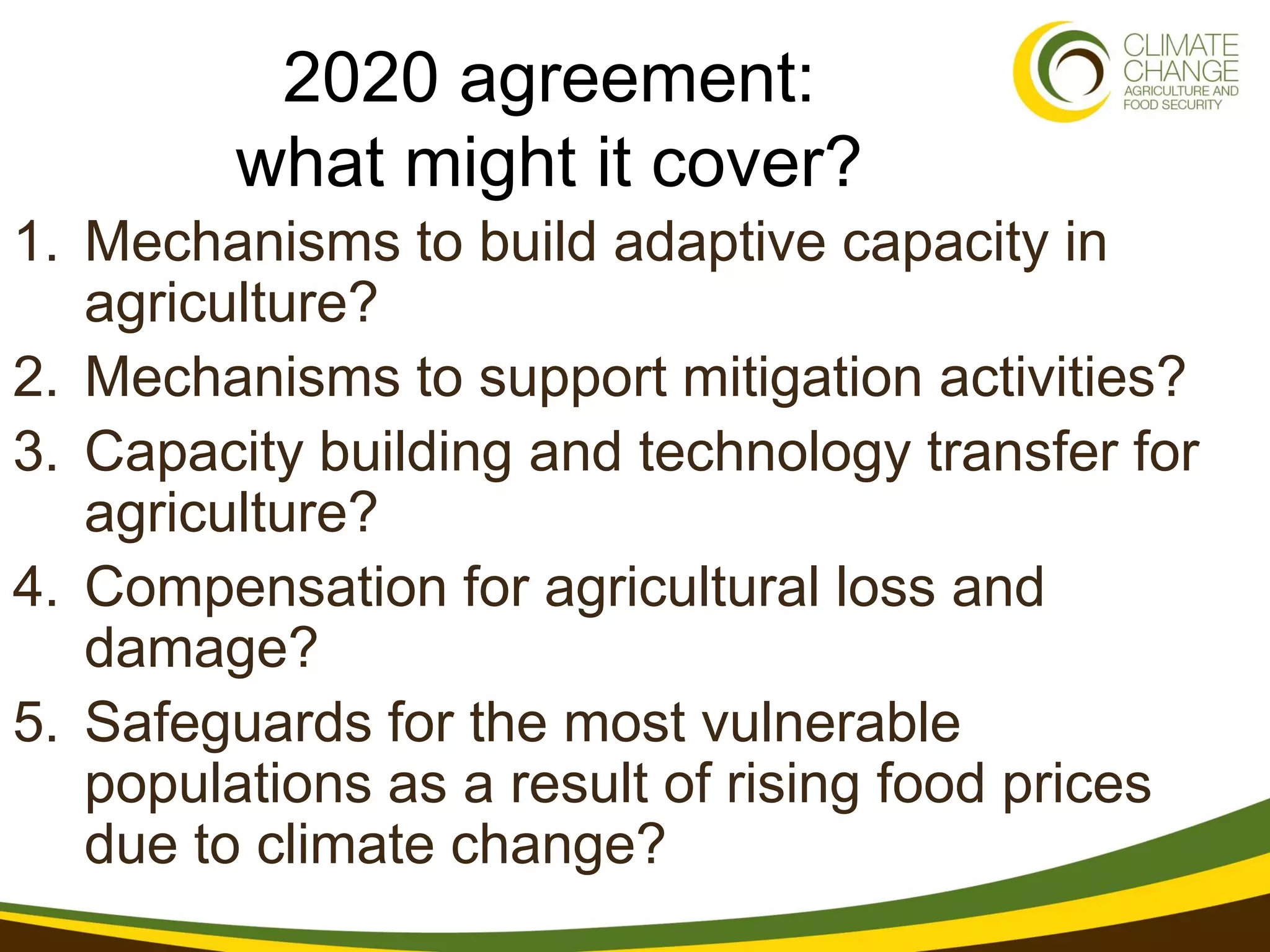
2020 agreement:
         what might it cover?
1. Mechanisms to build adaptive capacity in
   agriculture?
2. Mechanisms to support mitigation activities?
3. Capacity building and technology transfer for
   agriculture?
4. Compensation for agricultural loss and
   damage?
5. Safeguards for the most vulnerable
   populations as a result of rising food prices
   due to climate change?
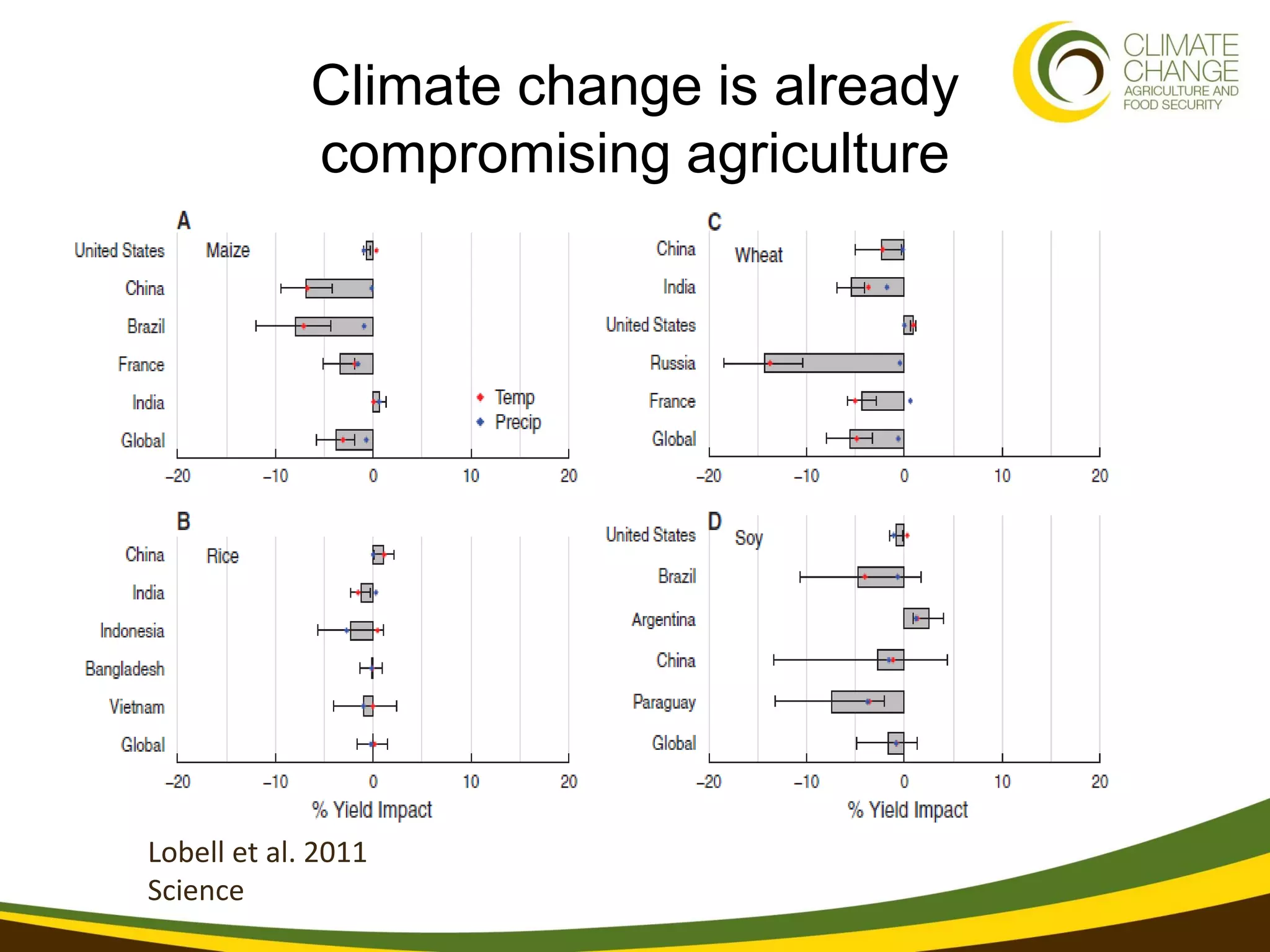
Climate change is already
             compromising agriculture


Lobell et al. 2011
Science
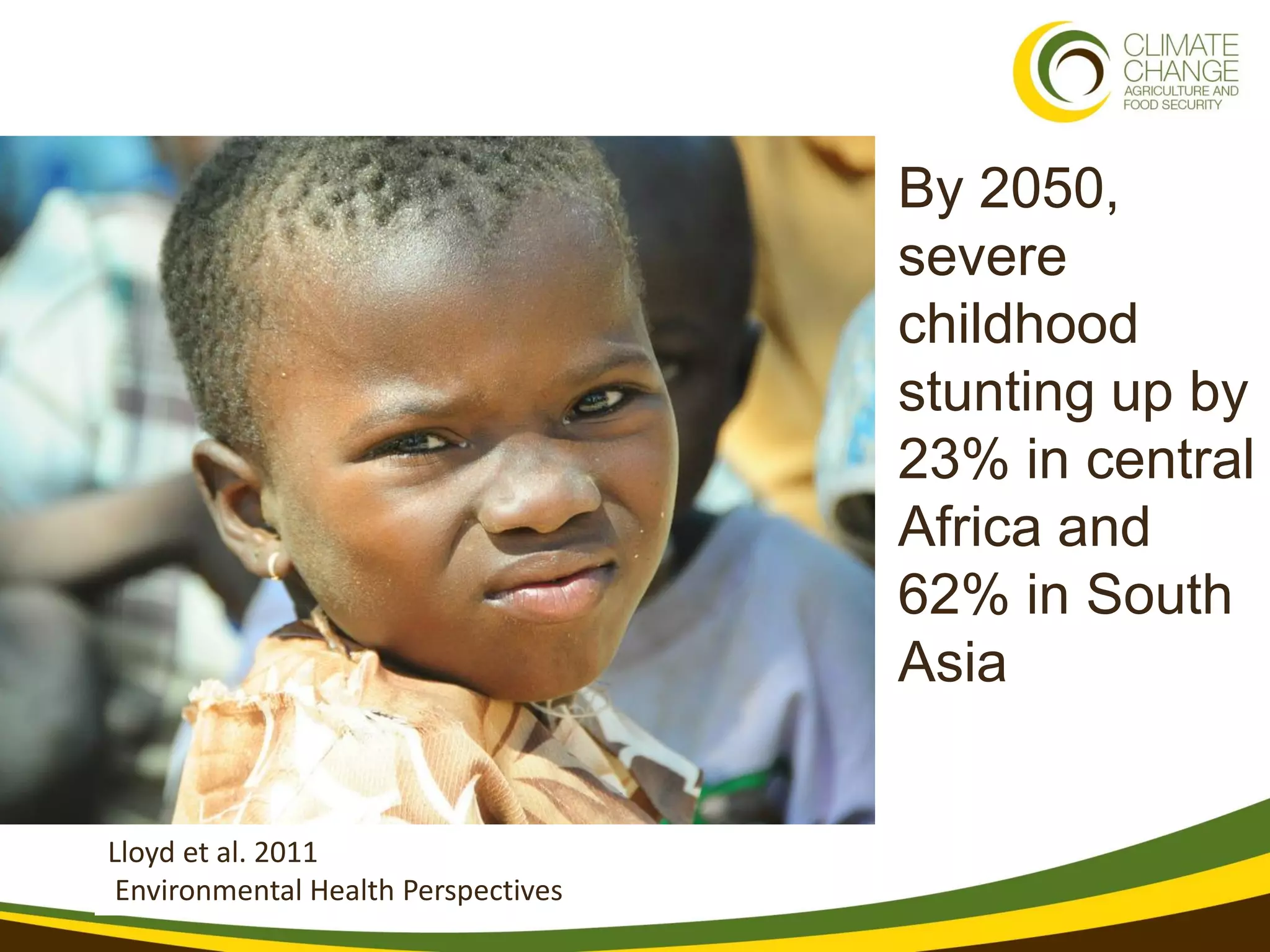
By 2050,
                                     severe
                                     childhood
                                     stunting up by
                                     23% in central
                                     Africa and
                                     62% in South
                                     Asia


Lloyd et al. 2011
 Environmental Health Perspectives
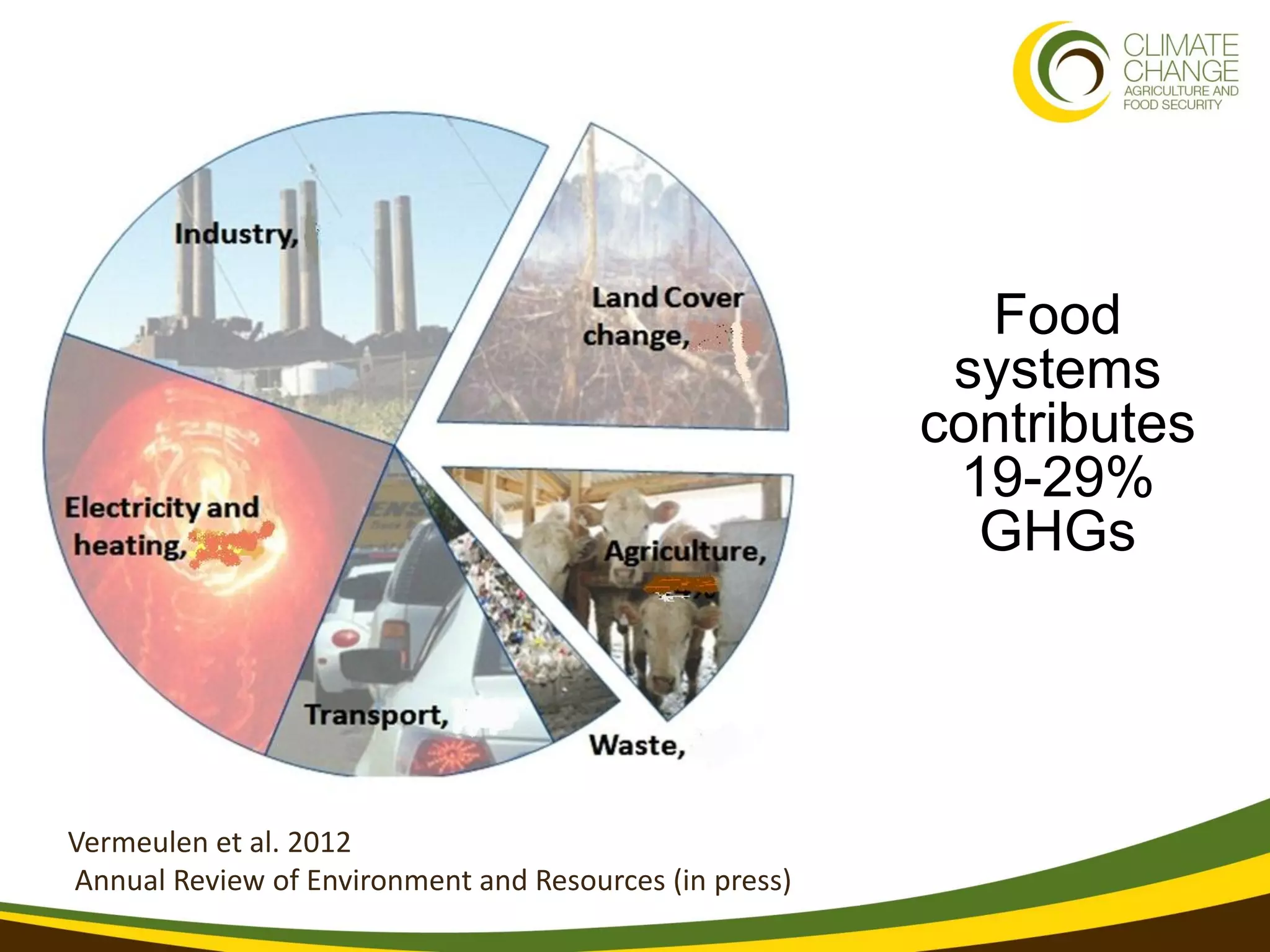
Food
                                                         systems
                                                        contributes
                                                         19-29%
                                                          GHGs


Vermeulen et al. 2012
Annual Review of Environment and Resources (in press)
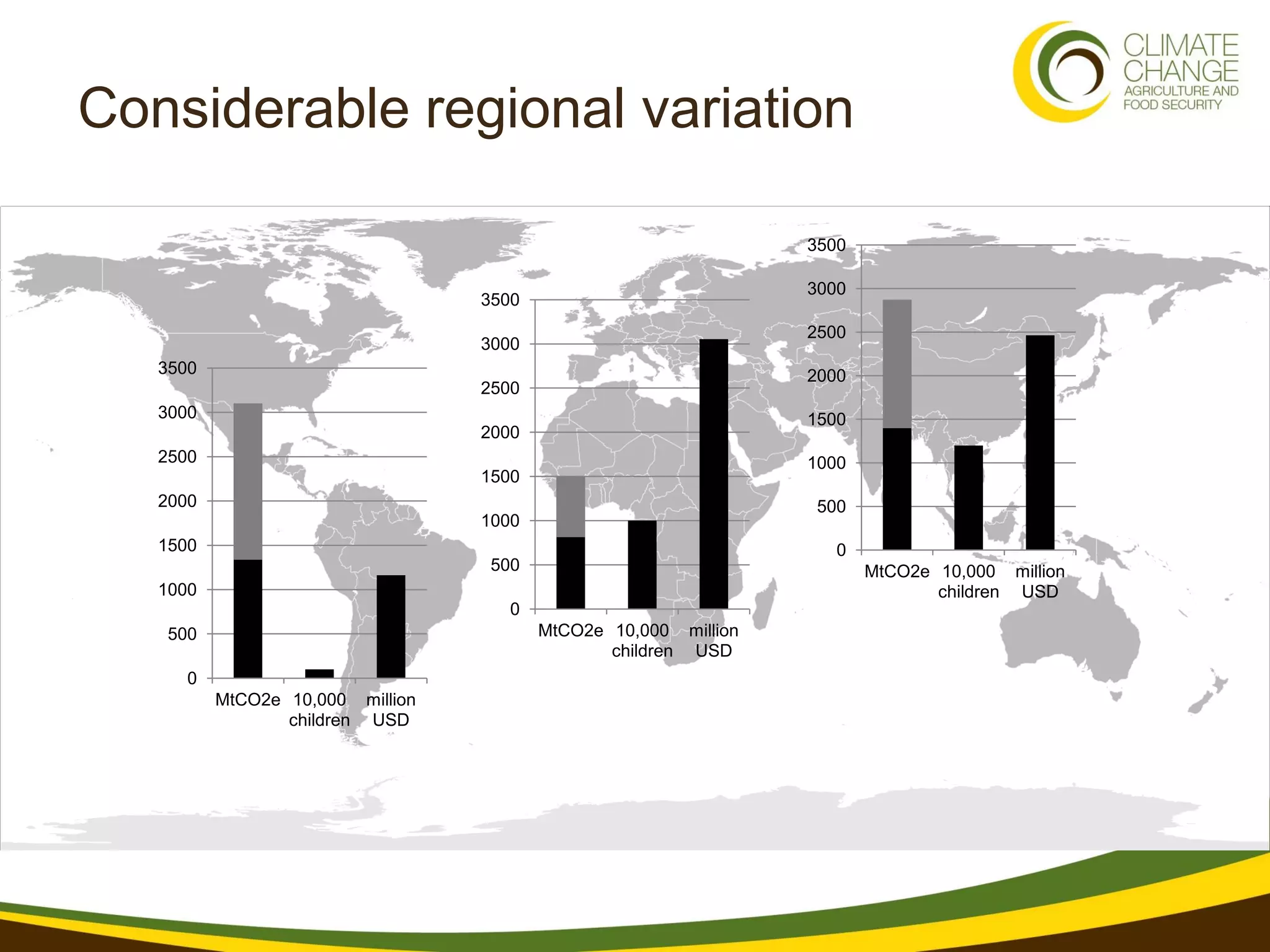
Considerable regional variation

                                                                 3500

                                                                 3000
                                  3500
                                                                 2500
                                  3000
   3500                                                          2000
                                  2500
   3000                                                          1500
                                  2000
   2500                                                          1000
                                  1500
   2000                                                           500
                                  1000
   1500                                                             0
                                   500                                  MtCO2e 10,000 million
   1000                                                                        children USD
                                     0
    500                                  MtCO2e 10,000 million
                                                children USD
      0
          MtCO2e 10,000 million
                 children USD
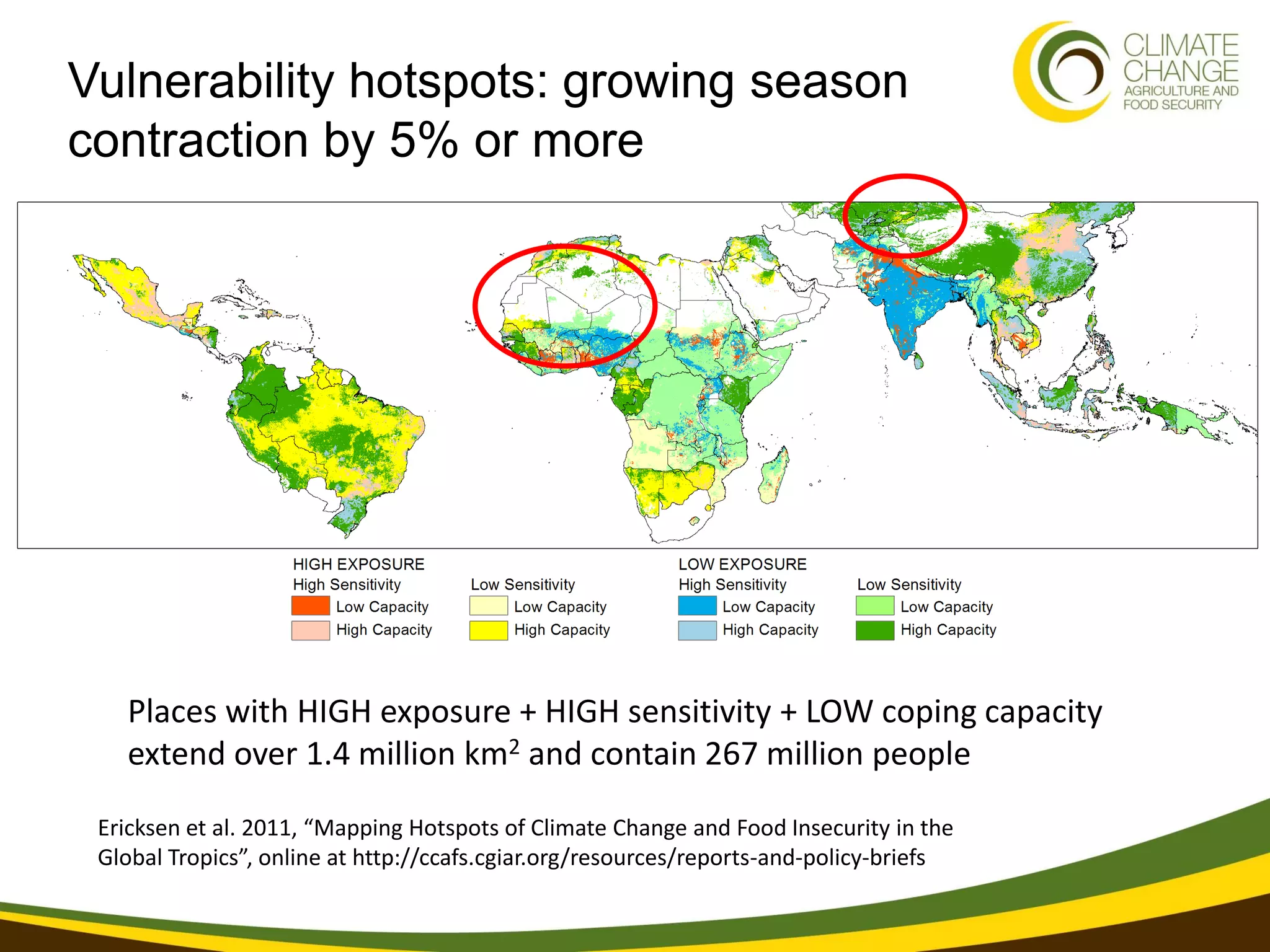
Vulnerability hotspots: growing season
contraction by 5% or more


   Places with HIGH exposure + HIGH sensitivity + LOW coping capacity
   extend over 1.4 million km2 and contain 267 million people

 Ericksen et al. 2011, “Mapping Hotspots of Climate Change and Food Insecurity in the
 Global Tropics”, online at http://ccafs.cgiar.org/resources/reports-and-policy-briefs
Know more…
• Types and magnitudes of impacts
• Categories of technical and institutional interventions
  that provide adaptive capacity in agriculture
• Most promising technical options for mitigation

                  Know less…
• Uncertainty on development pathways, emissions,
  level of response
• Local and regional specificities
• Complex interactions among climate change, food
  security, livelihoods
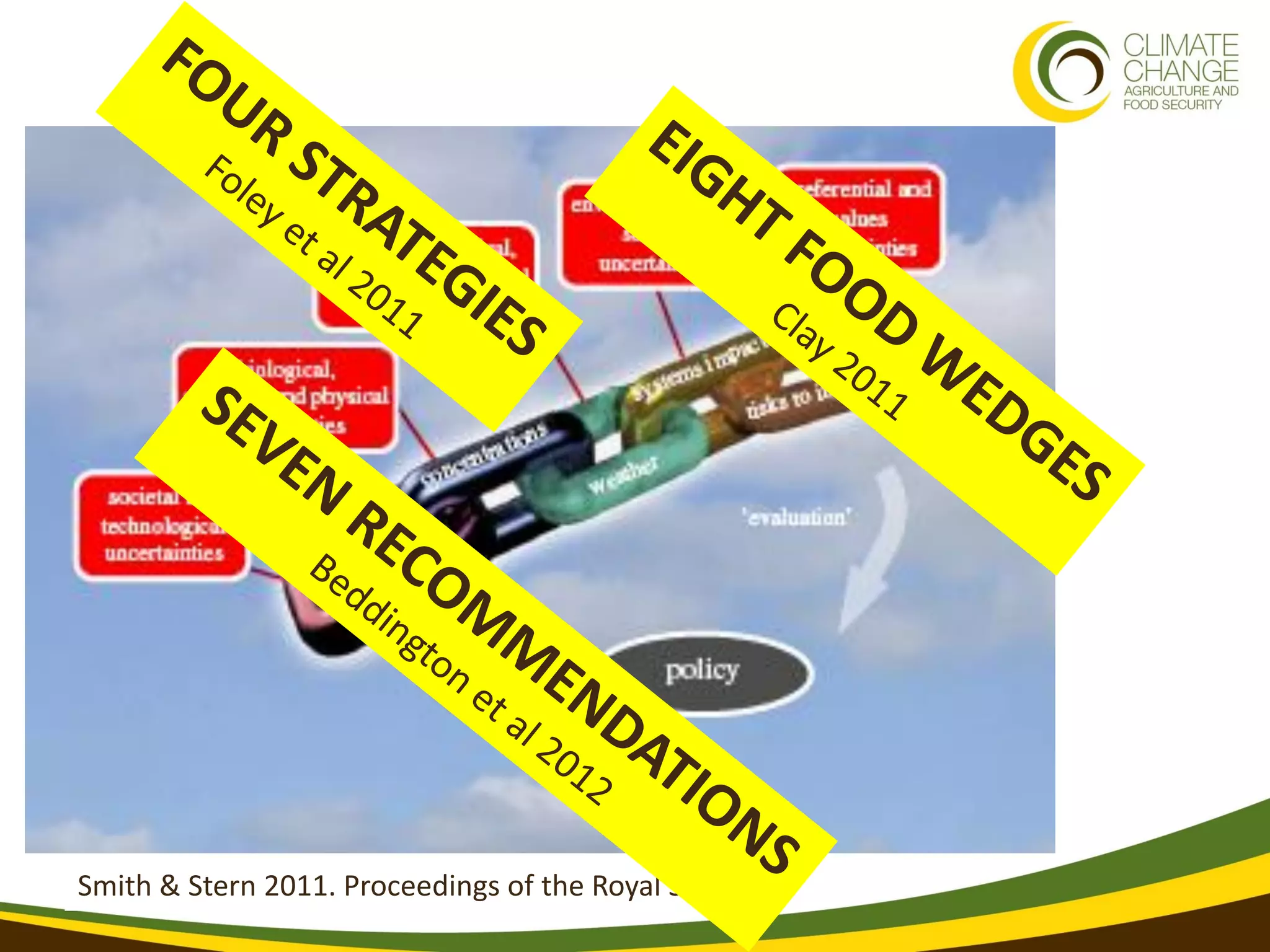
Smith & Stern 2011. Proceedings of the Royal Society
What could SBSTA do soon?
• Specify options for adaptation in different
  farming systems, taking advantage of synergies
  with food security & mitigation
• Improve methods and collect better
  measurements of GHG fluxes in different
  farming systems
• Establish methods to identify the most
  vulnerable households, farming systems and
  regions
Climate Change and Agriculture


• Significant impacts on farming already
• Farmers have already started taking
  action
• Transition not at the required scale/pace
• Agriculture has to be part of the solution
• Farmers face major obstacles
Farmers face many obstacles
• Access to Information, e.g. examples of
  implementable solutions
• Access to Technology
• Disconnect with research
• Lack necessary Financing
• Poor extension support
• Limited government/policy support all
  round
What Farmers Expect from
             SBSTA/UNFCCC
• Urgent, decisive action
• An Agriculture work program
• Clarity on GHG accounting from Agric and
  other land use
• Significant, targeted, accessible financing
  mechanisms for Agric – inclusive,
  transparent governance
• Implementable technology transfer
  mechanisms
Thank You
A greenhouse gas emissions measurement and
monitoring network and protocol for the agricultural
          sector in the developing world

                A CCAFS proposal


                                                 Henry Neufeldt
                              World Agroforestry Centre (ICRAF)
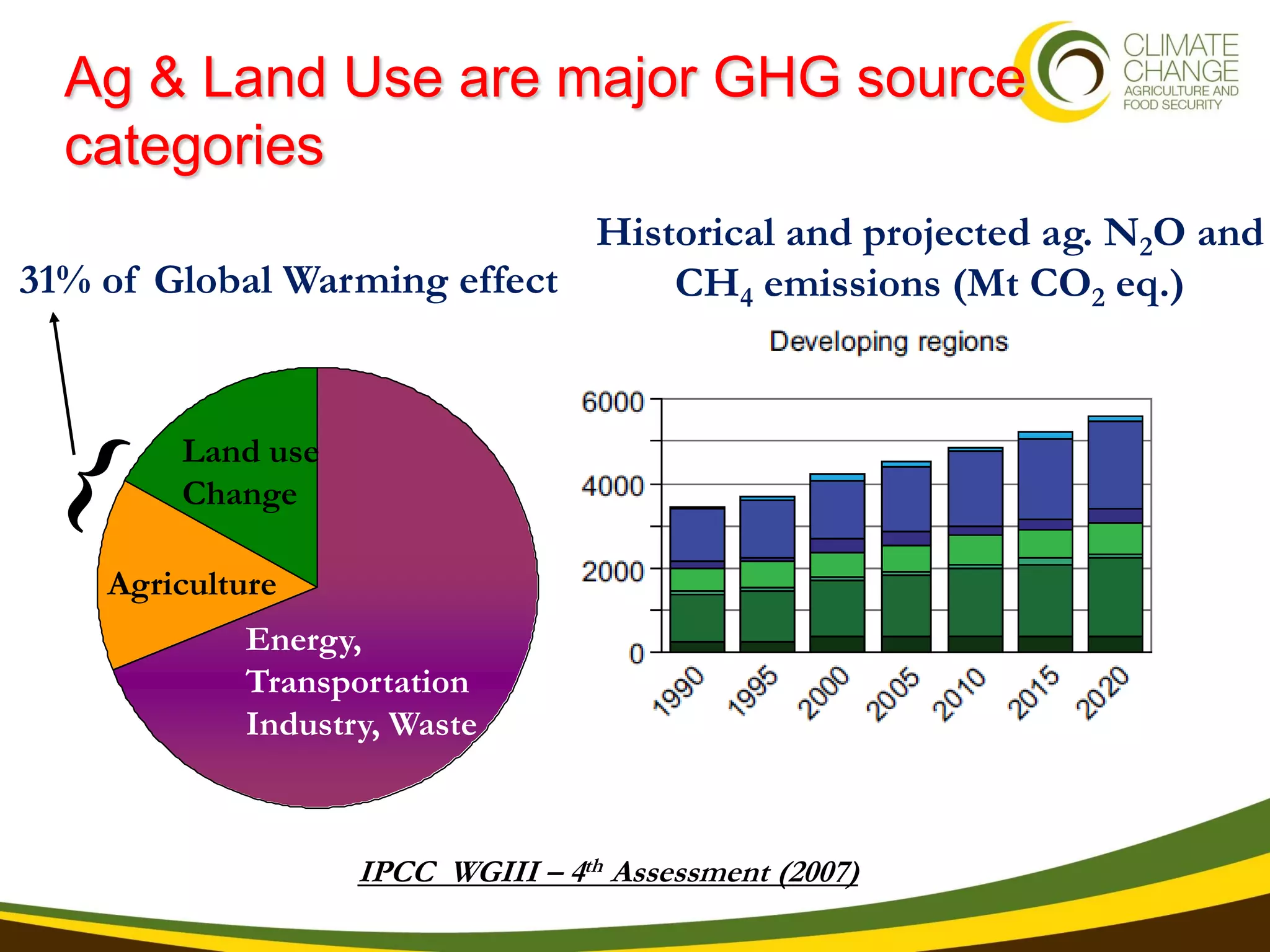
Ag & Land Use are major GHG source
  categories
                             Historical and projected ag. N2O and
31% of Global Warming effect     CH4 emissions (Mt CO2 eq.)


        Land use
        Change

    Agriculture
            Energy,
            Transportation
            Industry, Waste


                   IPCC WGIII – 4th Assessment (2007)
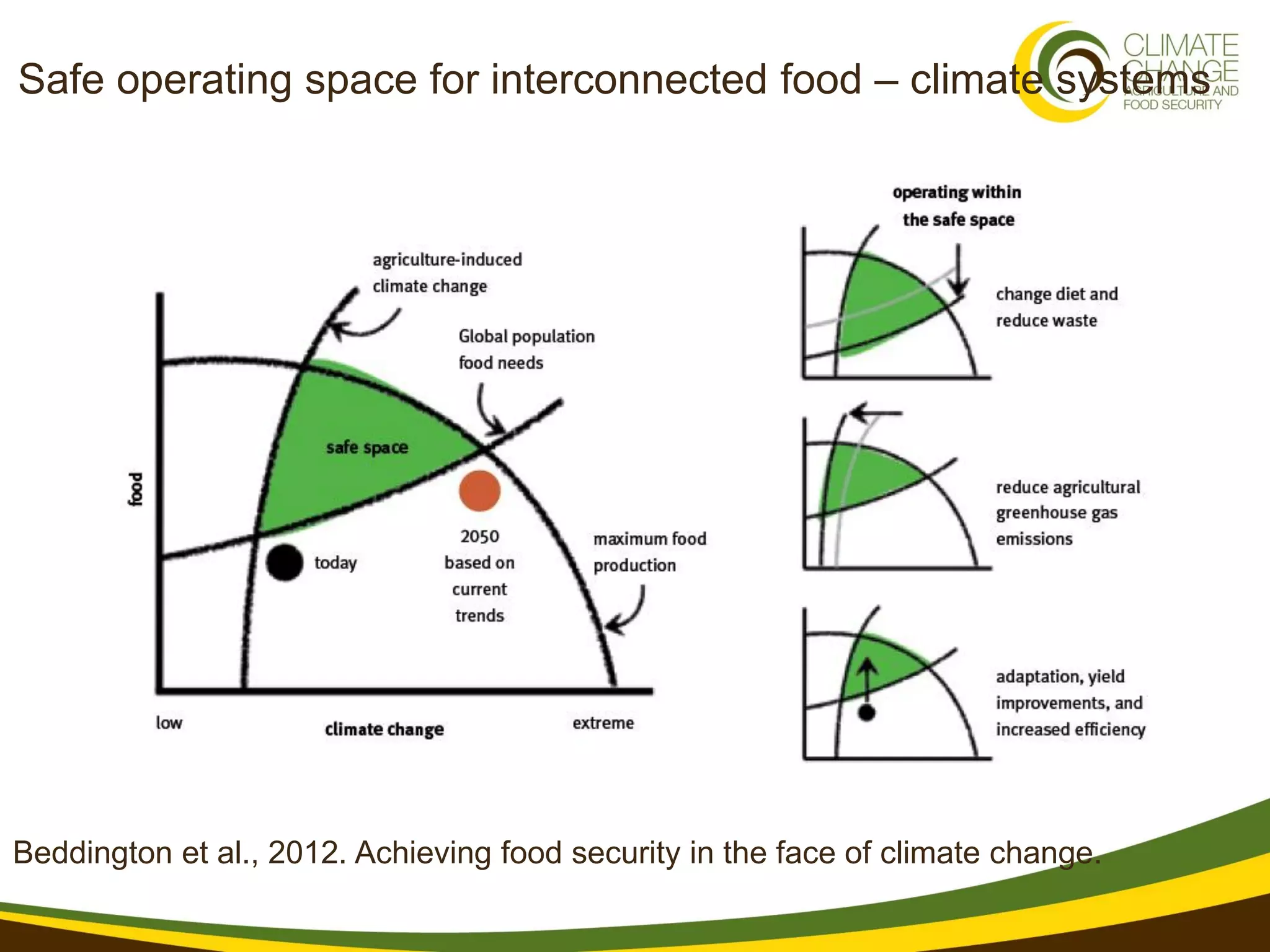
Safe operating space for interconnected food – climate systems


Beddington et al., 2012. Achieving food security in the face of climate change.
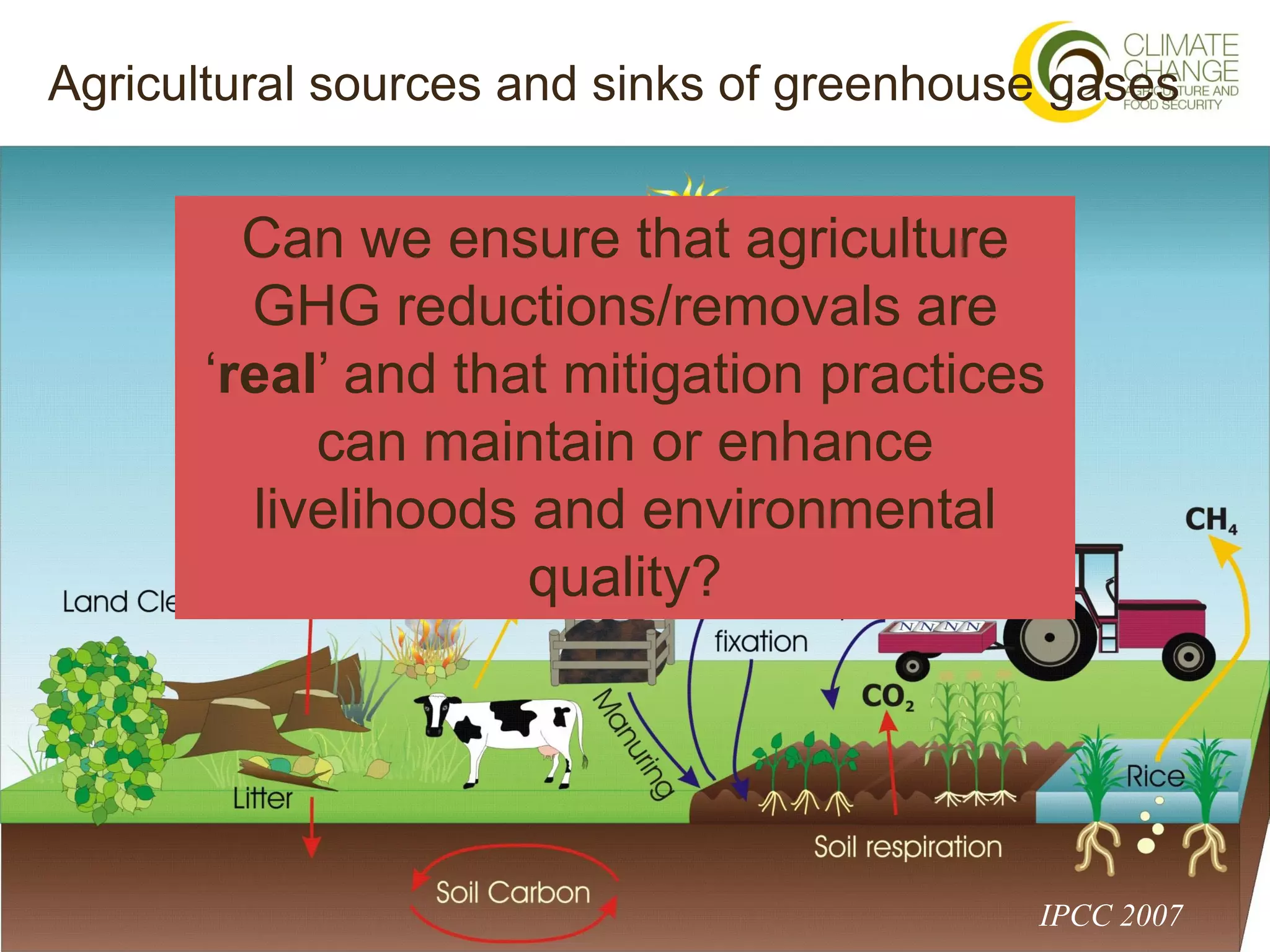
Agricultural sources and sinks of greenhouse gases


        Can we ensure that agriculture
        GHG reductions/removals are
      ‘real’ and that mitigation practices
           can maintain or enhance
        livelihoods and environmental
                    quality?


                                           IPCC 2007
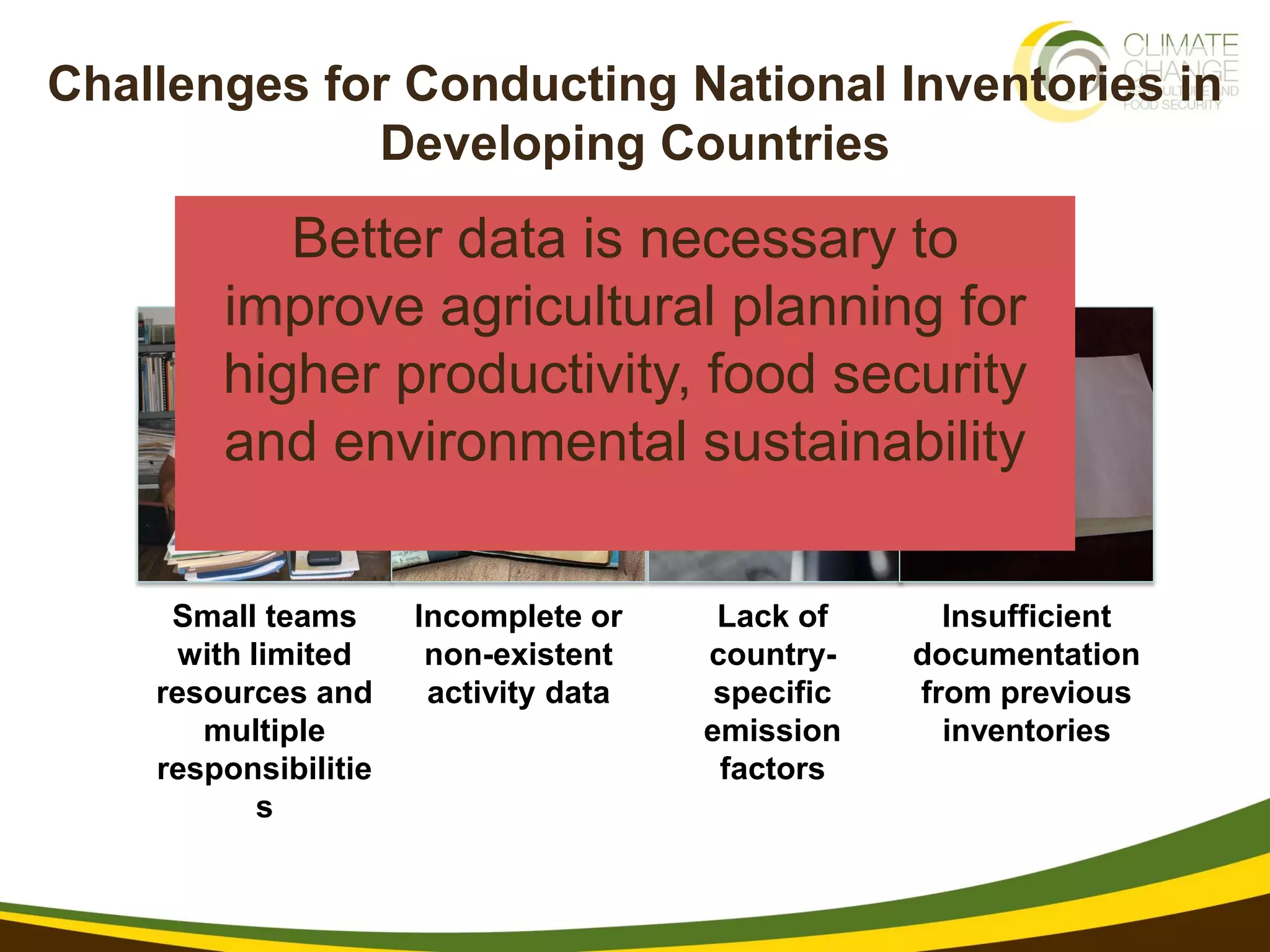
Challenges for Conducting National Inventories in
             Developing Countries
           Better data is necessary to
        improve agricultural planning for
        higher productivity, food security
        and environmental sustainability

     Small teams      Incomplete or     Lack of      Insufficient
      with limited     non-existent    country-    documentation
    resources and      activity data    specific   from previous
       multiple                        emission      inventories
    responsibilitie                     factors
            s
Outputs

• Measurements network in key systems where
  uncertainties could be very large
• Well designed, economically feasible and upscalable
  mitigation practices
• Trained local personnel and assistance in inventory
  development (currently done with default or very basic
  Tier 2 methods) Much better emission factors needed
  (uncertainty in Tier 1 methods = 50%)
• Well equipped labs
• A common protocol for GHG measurement at the whole
  farm and landscape level tested in 3 countries in Africa,
  Latin America and Asia
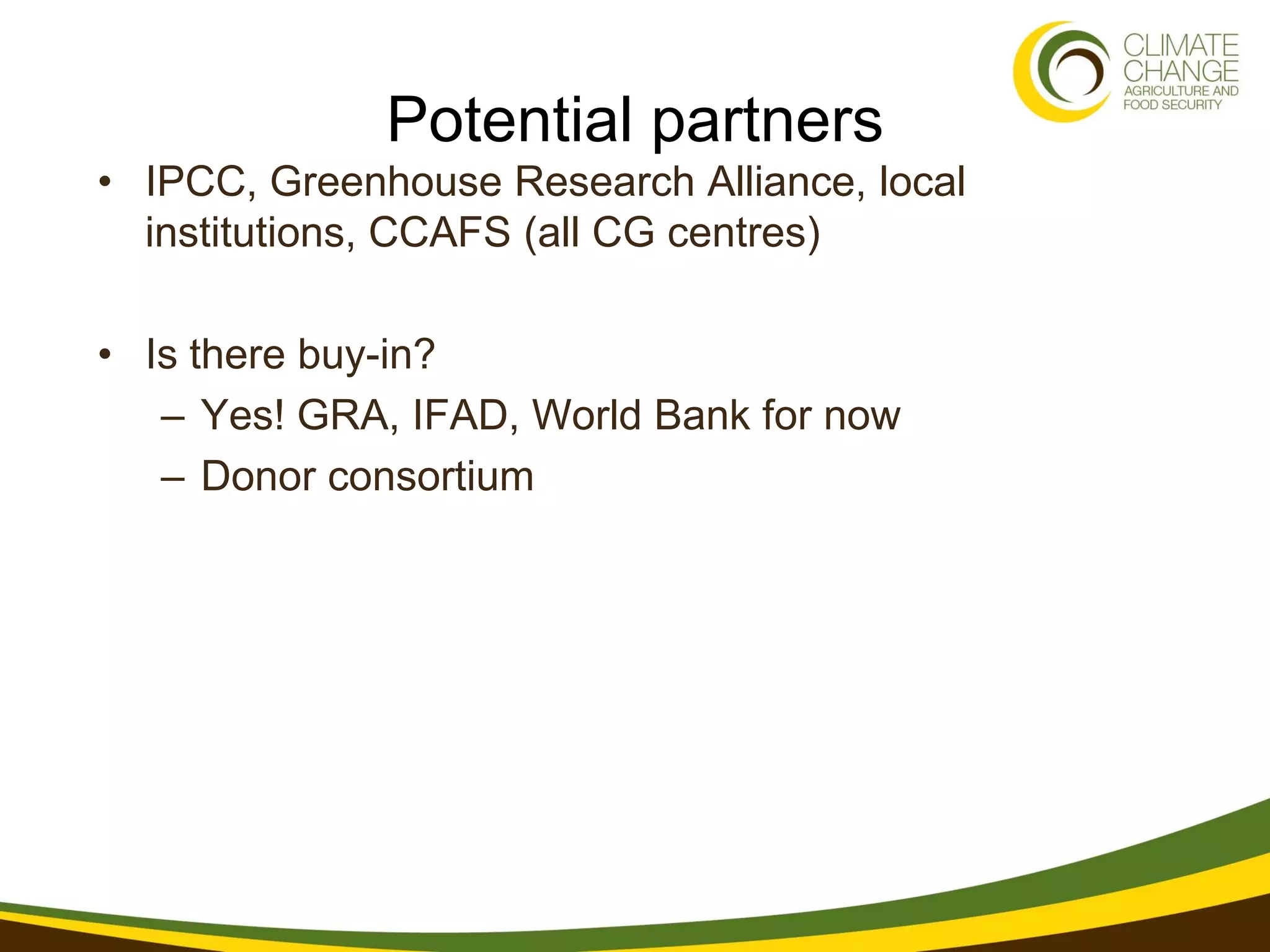
Potential partners
• IPCC, Greenhouse Research Alliance, local
  institutions, CCAFS (all CG centres)

• Is there buy-in?
   – Yes! GRA, IFAD, World Bank for now
   – Donor consortium
Next steps
•   Initial concept note drafted
•   Needs to be disseminated for feedback
•   Final draft ready by August
•   Begin work on protocol
•   Initial discussion with SROs in Africa, details
•   IPCC Emissions Task Force approached, details
•   Discussion with UNFCCC and donors
Reality check: what is feasible?
       A Possible Work Programme on
           Agriculture by SBSTA


                M. Asaduzzaman
                  Bangladesh
               May 18, 2012, Bonn


May 18, 2012     CCAFS Side Event on Agriculture   36
Present Mandate of SBSTA for a
          Work Programme on Agriculture
• Durban decision was on Exchange of Views for a Work Programme on
  Agriculture (WPA)
• Several issues to be considered in developing such a WPA
    – SBSTA general mandate and the multi-dimensionality of agriculture -
      policy and national circumstances (read politics) may be more important
      than technical and scientific issues – SBSTA needs to find its clear niche
      and decide how to integrate scientific & technical issues with policy issues
    – Defining agriculture (crop/non-crop, food/non-food)) – and activities for a
      particular type: production or production plus
    – How to handle core concerns of food security – should only availability
      through production be considered or aspects such as access and utilisation
      (nutrition)?
    – Intertwining of adaptation and mitigation and the boundary lines between
      them in relation to food security
• Fortunately, a huge literature on many aspects within UN system and
  outside exist
   May 18, 2012             CCAFS Side Event on Agriculture                    37
Possible Elements of a WPA
• A critical review of the existing works and literature on both scientific
  and policy issues
• Decide upon the gaps and stress the technical aspects of gaps to be
  filled up by SBSTA itself – rest to be forwarded with recommendation
  based on wide consultation to COP for a decision on how to address
  those important and inalienable issues particularly related to
  coordination and cooperation with other Conevention, UN and global
  bodies
• Examine specific and technical issues related to specific technology
  such as GMOs, prepare relevant technical notes and papers
• Development of simple technical tools for measurement of
  vulnerability of agriculture, adaptation needs, GHG emission and
  mitigation potentials without jeopardising food security – prepare
  relevant papers and notes
• Prepare and circulate for comments a report based on above works to
  Parties, Expert groups and other stakeholders, finalise and submit to
  COP for its final decision on the report as well as follow-up activities
  related finance, capacity-building, technology development and
  transfer


   May 18, 2012           CCAFS Side Event on Agriculture                38
THANK YOU

May 18, 2012   CCAFS Side Event on Agriculture   39
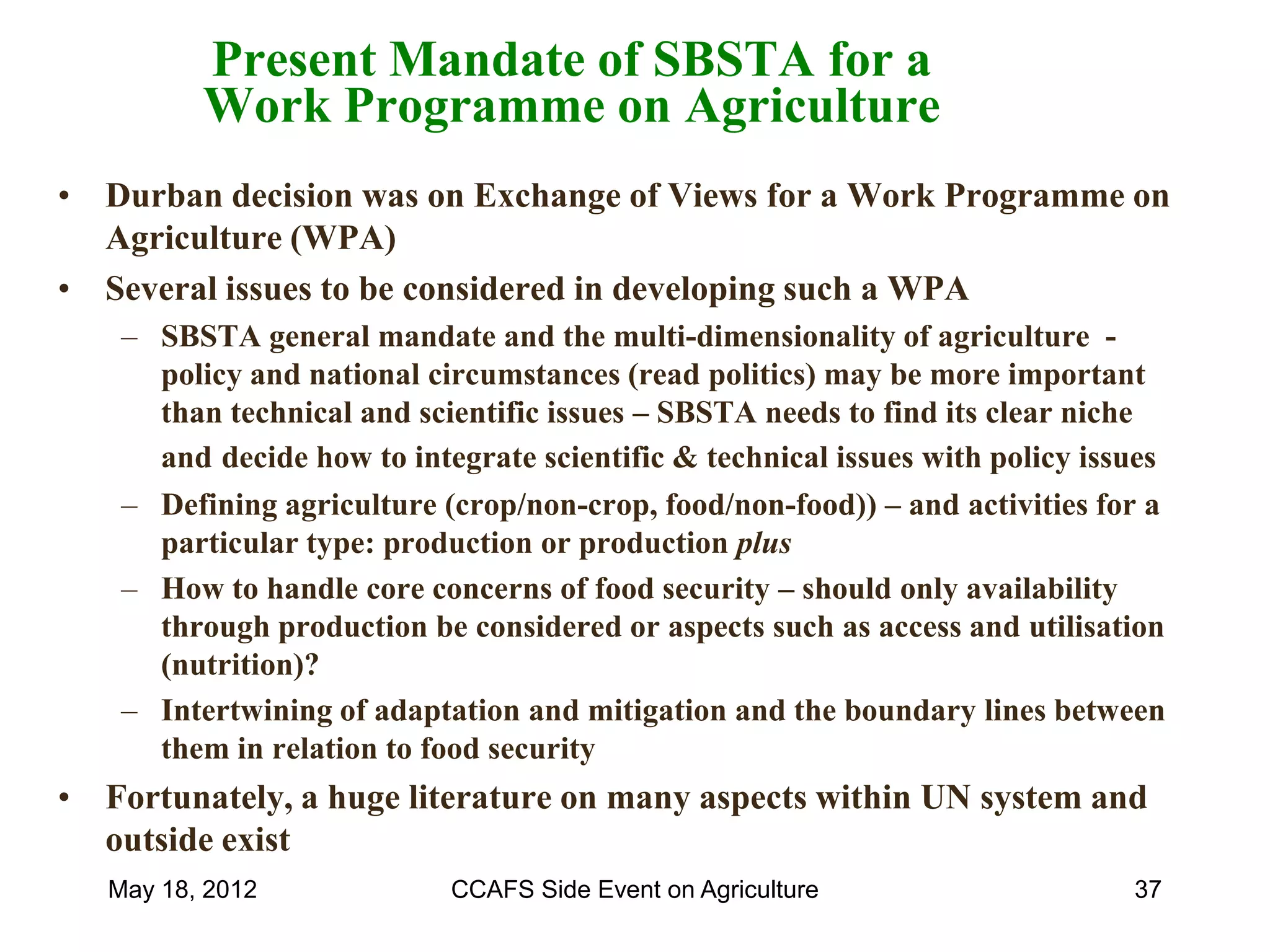
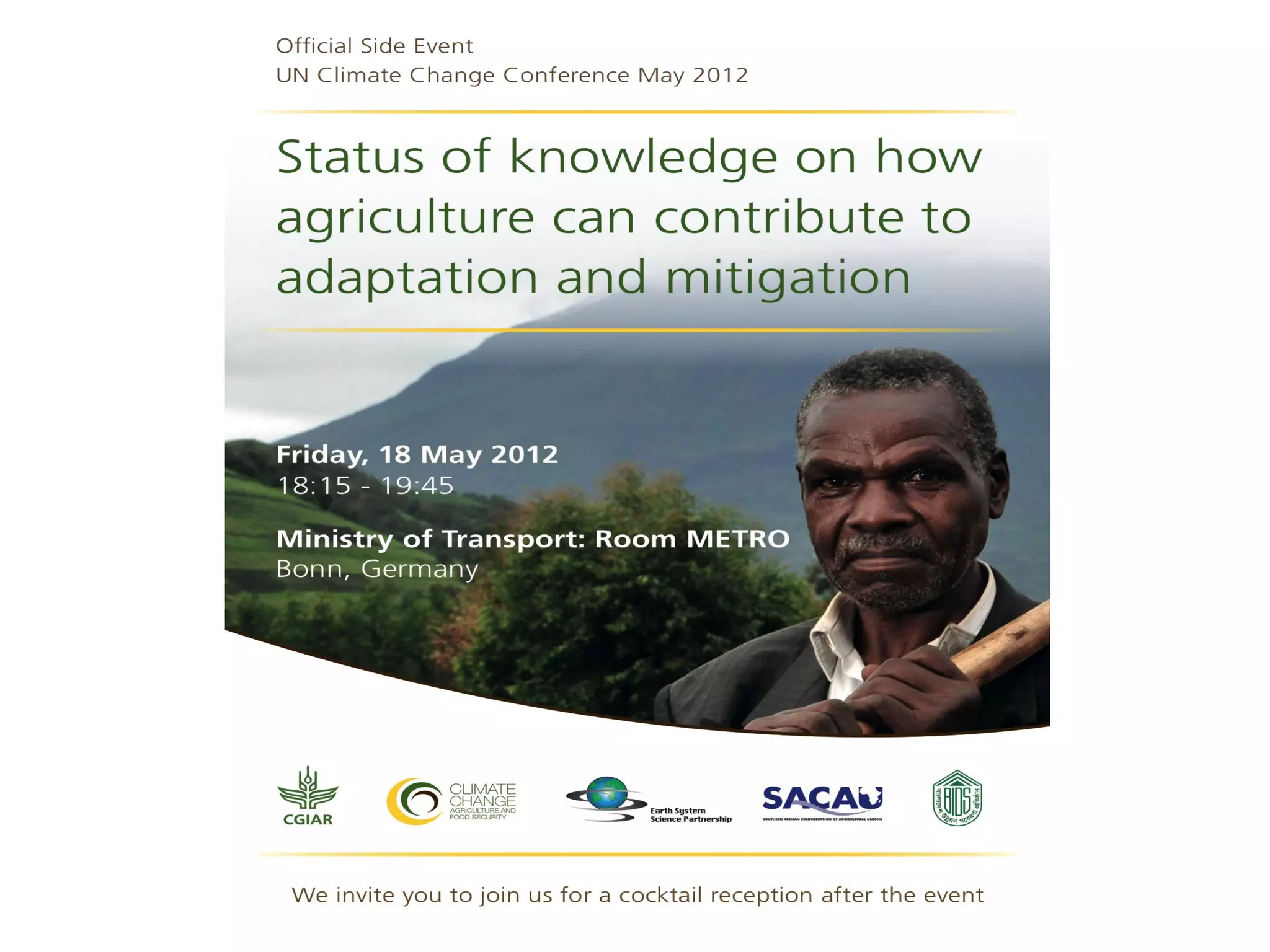
Presentations CCAFS Side Event during SBSTA 2012

Presentations CCAFS Side Event during SBSTA 2012

  • 2.
    Event name Title Status of knowledge on how agriculture can contribute to adaptation and mitigation James Kinyangi Regional Program Leader
  • 3.
    Agriculture in theUNFCCC • At COP 17, Parties agreed on a Decision to advance discussions on agriculture during SBSTA 36 • Areas of commonality and divergence and to understand possible scenarios to bridge the differences • Negotiators to identify innovative/new ideas that could be adopted to reach agreement • Issues that support convergence of Parties and those aspects that are completely opposed to inclusion of agriculture in UNFCCC negotiations 5/19/2012
  • 4.
    Understanding the Submissionsin the Context of the Work of SBSTA A review was commissioned by COMESA and CCAFS, to synthesize the submissions to SBSTA, summarizing the issues relevant to agriculture: • number of submissions reviewed included Parties (21), IGOs (5) and NGOs (24) • covered issues of key scientific and technological aspects of agricultural adaptation, productivity, livelihoods and food security • identified actual and potential conflicts (divergent issues) in the submissions between African parties and those of other submissions 5/19/2012
  • 5.
    The Issues Informingthe Positions of Parties • priority issues identified under impacts, barriers to implementation of adaptation actions, measurements, technologies and approaches relevant to climate change adaptation • Parties recognize the existence of high quality scientific and technical information • They observe that there is a failure to recognize the need to address and improve understanding of the scientific, technical and socio-economic basis of adaptation. • Can be summarized as: Data for quantification; Science of adaptation; Technological development and application and tools and methods for measurements 5/19/2012
  • 6.
    Divergent Issues; Isit Adaptation with Mitigation Co-Benefits? • Emerging position that Parties need to step up efforts to safeguard the agricultural sector against the worst effects of climate change since GHG mitigation approaches have long time-lags before the benefits can be realized • Some Parties including the Gambia on behalf of the LDCs acknowledge the positive interaction between mitigation and adaptation, thereby advocating for pursuit of climate actions that address both adaptation and mitigation • Potential tradeoffs between adaptation, food security and mitigation; so no clear distinction is made between small scale and large scale agricultures, and research, development and technology transfer are still undifferentiated 5/19/2012
  • 7.
    Is a WorkProgram on Agriculture a likely Outcome at SBSTA 36? • Good news-majority of the submissions by the parties are in favor of a work program on agriculture • Even those opposed-point out that UNFCCC does not allow for meaningful participation of smallholder farmers and that UNFCCC has mostly concentrated on measurement, reporting and verification • Capture the mood-SBSTA should establish a framework for the work program on agriculture with a clear goal of supporting adaptation actions with mitigation co-benefits 5/19/2012
  • 9.
    SBSTA Side Event,Bonn, May 2012 What could SBSTA do now on agriculture? Dr Sonja Vermeulen Head of Research, CCAFS
  • 10.
    What should a2020 global climate agreement look like for agriculture? What do we need in a SBSTA work programme in order to get to a 2020 agreement? What can SBSTA do now or soon? (and what are the longer-term issues?)
  • 11.
    2020 agreement: what might it cover? 1. Mechanisms to build adaptive capacity in agriculture? 2. Mechanisms to support mitigation activities? 3. Capacity building and technology transfer for agriculture? 4. Compensation for agricultural loss and damage? 5. Safeguards for the most vulnerable populations as a result of rising food prices due to climate change?
  • 12.
    Climate change isalready compromising agriculture Lobell et al. 2011 Science
  • 13.
    By 2050, severe childhood stunting up by 23% in central Africa and 62% in South Asia Lloyd et al. 2011 Environmental Health Perspectives
  • 14.
    Food systems contributes 19-29% GHGs Vermeulen et al. 2012 Annual Review of Environment and Resources (in press)
  • 15.
    Considerable regional variation 3500 3000 3500 2500 3000 3500 2000 2500 3000 1500 2000 2500 1000 1500 2000 500 1000 1500 0 500 MtCO2e 10,000 million 1000 children USD 0 500 MtCO2e 10,000 million children USD 0 MtCO2e 10,000 million children USD
  • 16.
    Vulnerability hotspots: growingseason contraction by 5% or more Places with HIGH exposure + HIGH sensitivity + LOW coping capacity extend over 1.4 million km2 and contain 267 million people Ericksen et al. 2011, “Mapping Hotspots of Climate Change and Food Insecurity in the Global Tropics”, online at http://ccafs.cgiar.org/resources/reports-and-policy-briefs
  • 17.
    Know more… • Typesand magnitudes of impacts • Categories of technical and institutional interventions that provide adaptive capacity in agriculture • Most promising technical options for mitigation Know less… • Uncertainty on development pathways, emissions, level of response • Local and regional specificities • Complex interactions among climate change, food security, livelihoods
  • 18.
    Smith & Stern2011. Proceedings of the Royal Society
  • 19.
    What could SBSTAdo soon? • Specify options for adaptation in different farming systems, taking advantage of synergies with food security & mitigation • Improve methods and collect better measurements of GHG fluxes in different farming systems • Establish methods to identify the most vulnerable households, farming systems and regions
  • 22.
    Climate Change andAgriculture • Significant impacts on farming already • Farmers have already started taking action • Transition not at the required scale/pace • Agriculture has to be part of the solution • Farmers face major obstacles
  • 23.
    Farmers face manyobstacles • Access to Information, e.g. examples of implementable solutions • Access to Technology • Disconnect with research • Lack necessary Financing • Poor extension support • Limited government/policy support all round
  • 24.
    What Farmers Expectfrom SBSTA/UNFCCC • Urgent, decisive action • An Agriculture work program • Clarity on GHG accounting from Agric and other land use • Significant, targeted, accessible financing mechanisms for Agric – inclusive, transparent governance • Implementable technology transfer mechanisms
  • 25.
  • 27.
    A greenhouse gasemissions measurement and monitoring network and protocol for the agricultural sector in the developing world A CCAFS proposal Henry Neufeldt World Agroforestry Centre (ICRAF)
  • 28.
    Ag & LandUse are major GHG source categories Historical and projected ag. N2O and 31% of Global Warming effect CH4 emissions (Mt CO2 eq.) Land use Change Agriculture Energy, Transportation Industry, Waste IPCC WGIII – 4th Assessment (2007)
  • 29.
    Safe operating spacefor interconnected food – climate systems Beddington et al., 2012. Achieving food security in the face of climate change.
  • 30.
    Agricultural sources andsinks of greenhouse gases Can we ensure that agriculture GHG reductions/removals are ‘real’ and that mitigation practices can maintain or enhance livelihoods and environmental quality? IPCC 2007
  • 31.
    Challenges for ConductingNational Inventories in Developing Countries Better data is necessary to improve agricultural planning for higher productivity, food security and environmental sustainability Small teams Incomplete or Lack of Insufficient with limited non-existent country- documentation resources and activity data specific from previous multiple emission inventories responsibilitie factors s
  • 32.
    Outputs • Measurements networkin key systems where uncertainties could be very large • Well designed, economically feasible and upscalable mitigation practices • Trained local personnel and assistance in inventory development (currently done with default or very basic Tier 2 methods) Much better emission factors needed (uncertainty in Tier 1 methods = 50%) • Well equipped labs • A common protocol for GHG measurement at the whole farm and landscape level tested in 3 countries in Africa, Latin America and Asia
  • 33.
    Potential partners • IPCC,Greenhouse Research Alliance, local institutions, CCAFS (all CG centres) • Is there buy-in? – Yes! GRA, IFAD, World Bank for now – Donor consortium
  • 34.
    Next steps • Initial concept note drafted • Needs to be disseminated for feedback • Final draft ready by August • Begin work on protocol • Initial discussion with SROs in Africa, details • IPCC Emissions Task Force approached, details • Discussion with UNFCCC and donors
  • 36.
    Reality check: whatis feasible? A Possible Work Programme on Agriculture by SBSTA M. Asaduzzaman Bangladesh May 18, 2012, Bonn May 18, 2012 CCAFS Side Event on Agriculture 36
  • 37.
    Present Mandate ofSBSTA for a Work Programme on Agriculture • Durban decision was on Exchange of Views for a Work Programme on Agriculture (WPA) • Several issues to be considered in developing such a WPA – SBSTA general mandate and the multi-dimensionality of agriculture - policy and national circumstances (read politics) may be more important than technical and scientific issues – SBSTA needs to find its clear niche and decide how to integrate scientific & technical issues with policy issues – Defining agriculture (crop/non-crop, food/non-food)) – and activities for a particular type: production or production plus – How to handle core concerns of food security – should only availability through production be considered or aspects such as access and utilisation (nutrition)? – Intertwining of adaptation and mitigation and the boundary lines between them in relation to food security • Fortunately, a huge literature on many aspects within UN system and outside exist May 18, 2012 CCAFS Side Event on Agriculture 37
  • 38.
    Possible Elements ofa WPA • A critical review of the existing works and literature on both scientific and policy issues • Decide upon the gaps and stress the technical aspects of gaps to be filled up by SBSTA itself – rest to be forwarded with recommendation based on wide consultation to COP for a decision on how to address those important and inalienable issues particularly related to coordination and cooperation with other Conevention, UN and global bodies • Examine specific and technical issues related to specific technology such as GMOs, prepare relevant technical notes and papers • Development of simple technical tools for measurement of vulnerability of agriculture, adaptation needs, GHG emission and mitigation potentials without jeopardising food security – prepare relevant papers and notes • Prepare and circulate for comments a report based on above works to Parties, Expert groups and other stakeholders, finalise and submit to COP for its final decision on the report as well as follow-up activities related finance, capacity-building, technology development and transfer May 18, 2012 CCAFS Side Event on Agriculture 38
  • 39.
    THANK YOU May 18,2012 CCAFS Side Event on Agriculture 39