Title to be inserted
How to design value chains programmes that address
climate risks: an IFAD-CGIAR learning event
Sonja Vermeulen
Head of Research
CGIAR Research Program on Climate Change, Agriculture and Food Security
February 2016
Good design in theory: IFAD’s
HTDN on Climate Risk
Assessments in Value Chains
Title to be inserted
http://www.ifad.org/knotes/climate/htdn_climate_vc.pdf
Title to be insertedIFAD How To Do Note: Climate Change
Risk Assessments in Value Chains
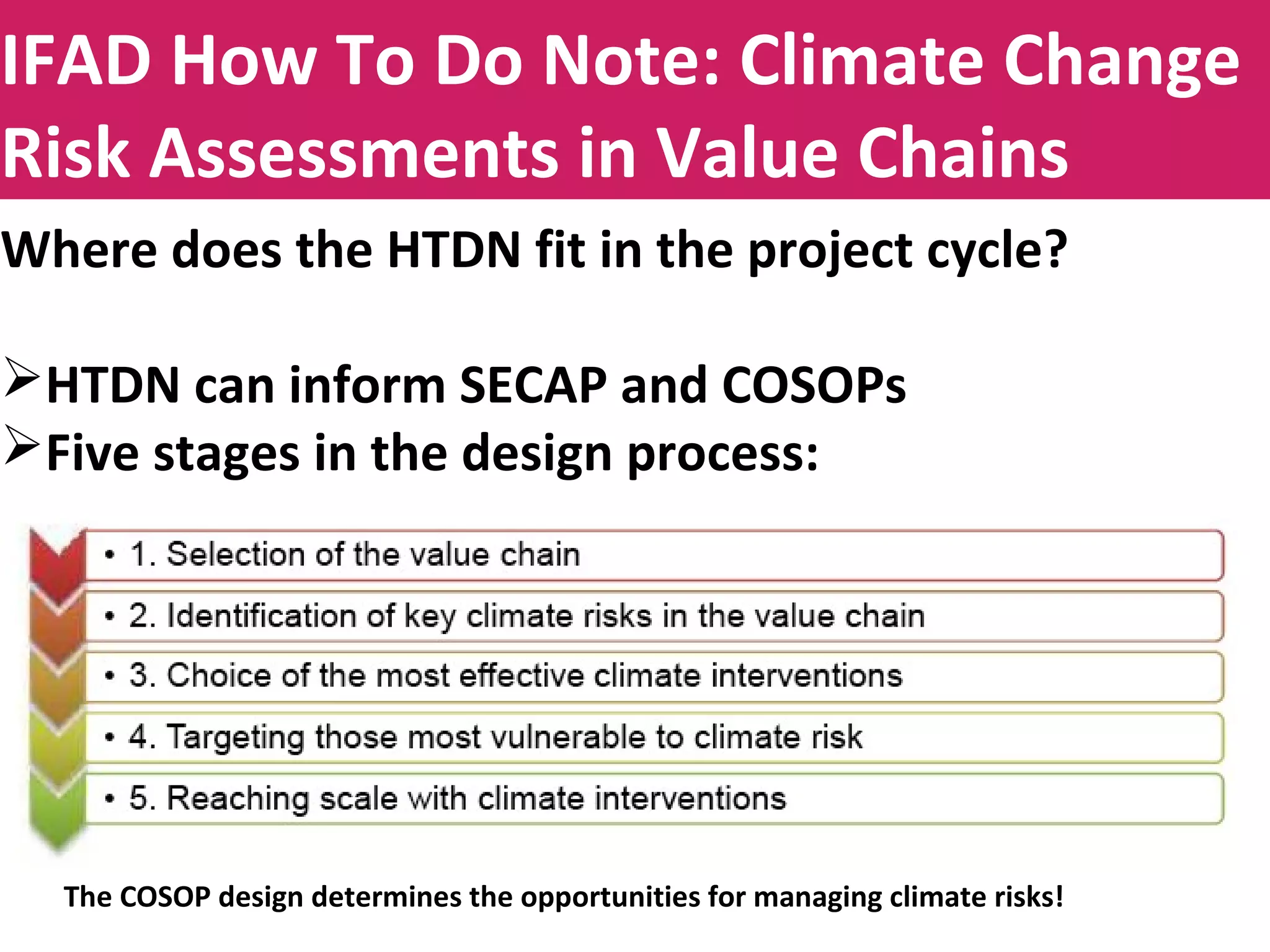
Where does the HTDN fit in the project cycle?
HTDN can inform SECAP and COSOPs
Five stages in the design process:
The COSOP design determines the opportunities for managing climate risks!
Title to be insertedIFAD How To Do Note: Climate Change
Risk Assessments in Value Chains
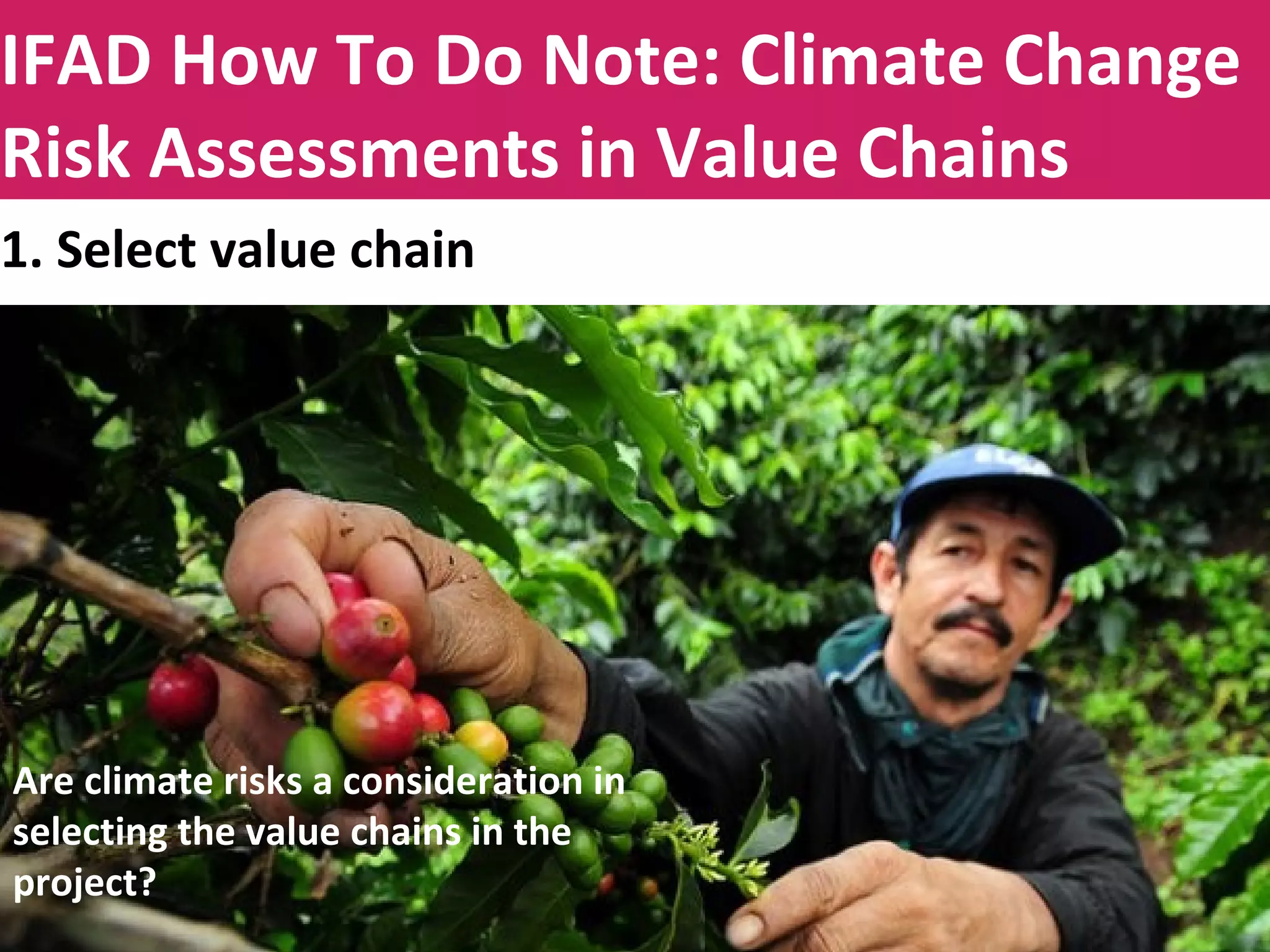
1. Select value chain
Are climate risks a consideration in
selecting the value chains in the
project?
Title to be insertedIFAD How To Do Note: Climate Change
Risk Assessments in Value Chains
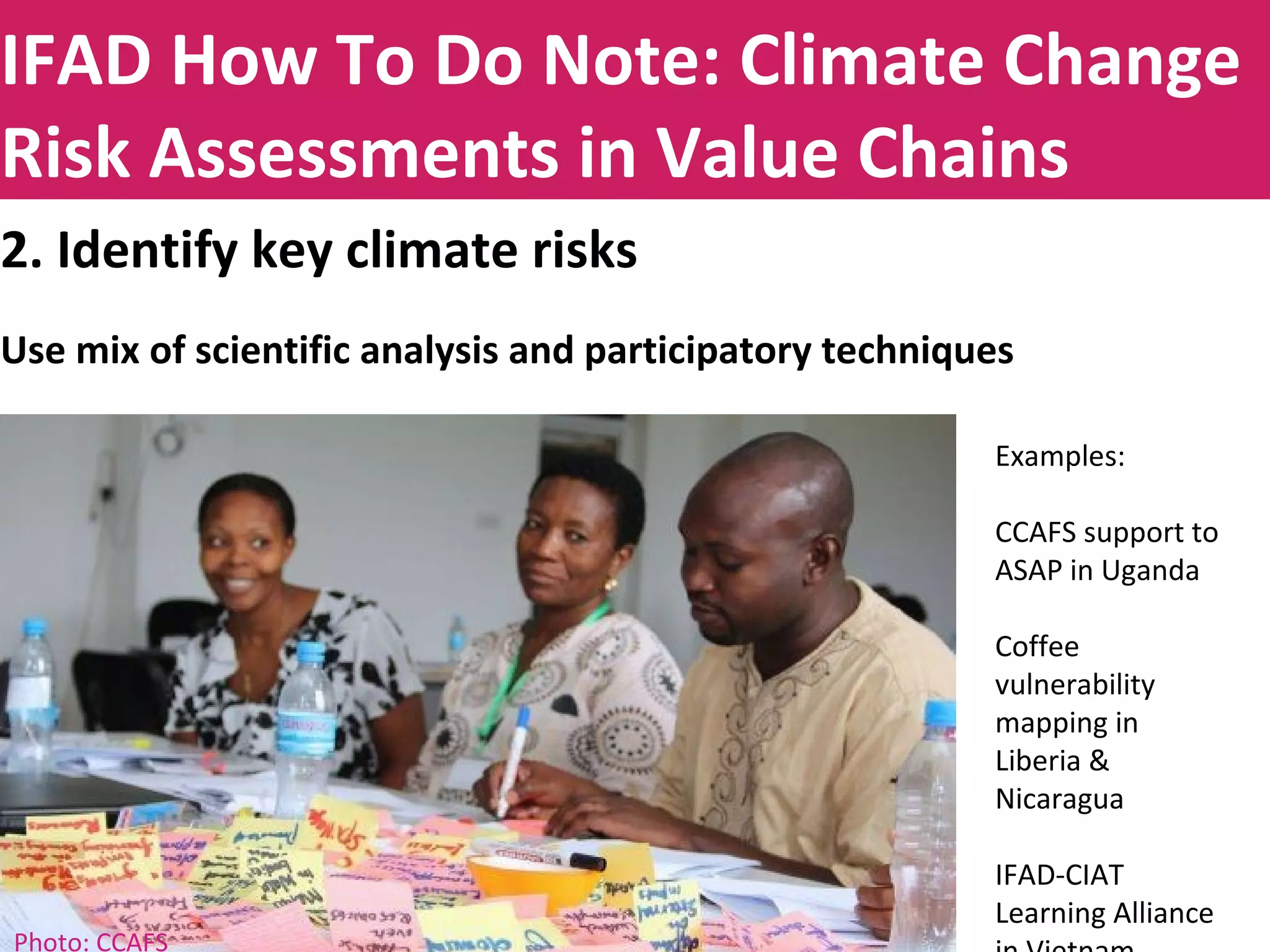
2. Identify key climate risks
Use mix of scientific analysis and participatory techniques
Examples:
CCAFS support to
ASAP in Uganda
Coffee
vulnerability
mapping in
Liberia &
Nicaragua
IFAD-CIAT
Learning Alliance
Photo: CCAFS
Title to be insertedIFAD How To Do Note: Climate Change
Risk Assessments in Value Chains
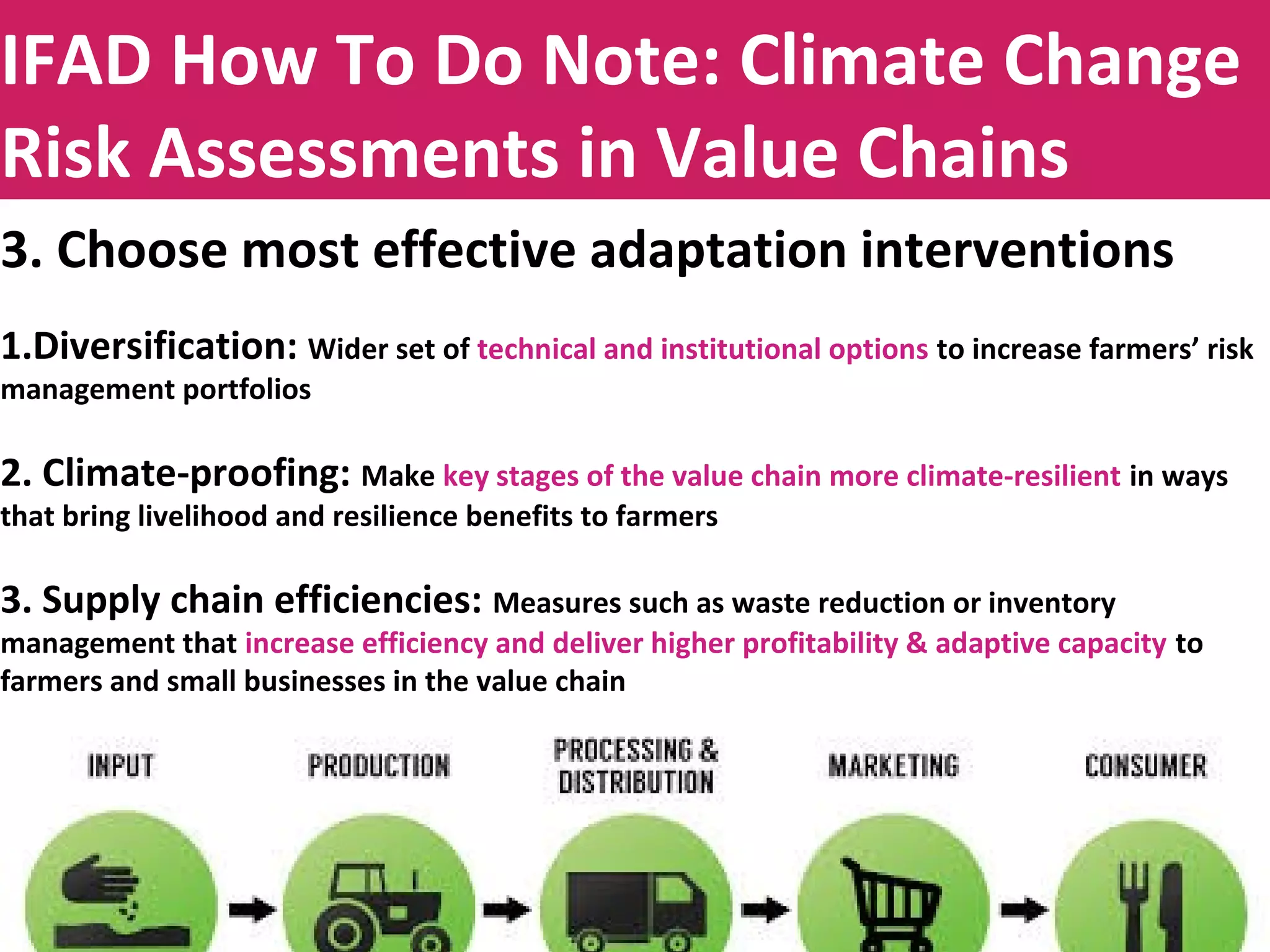
3. Choose most effective adaptation interventions
1.Diversification: Wider set of technical and institutional options to increase farmers’ risk
management portfolios
2. Climate-proofing: Make key stages of the value chain more climate-resilient in ways
that bring livelihood and resilience benefits to farmers
3. Supply chain efficiencies: Measures such as waste reduction or inventory
management that increase efficiency and deliver higher profitability & adaptive capacity to
farmers and small businesses in the value chain
Title to be insertedIFAD How To Do Note: Climate Change
Risk Assessments in Value Chains
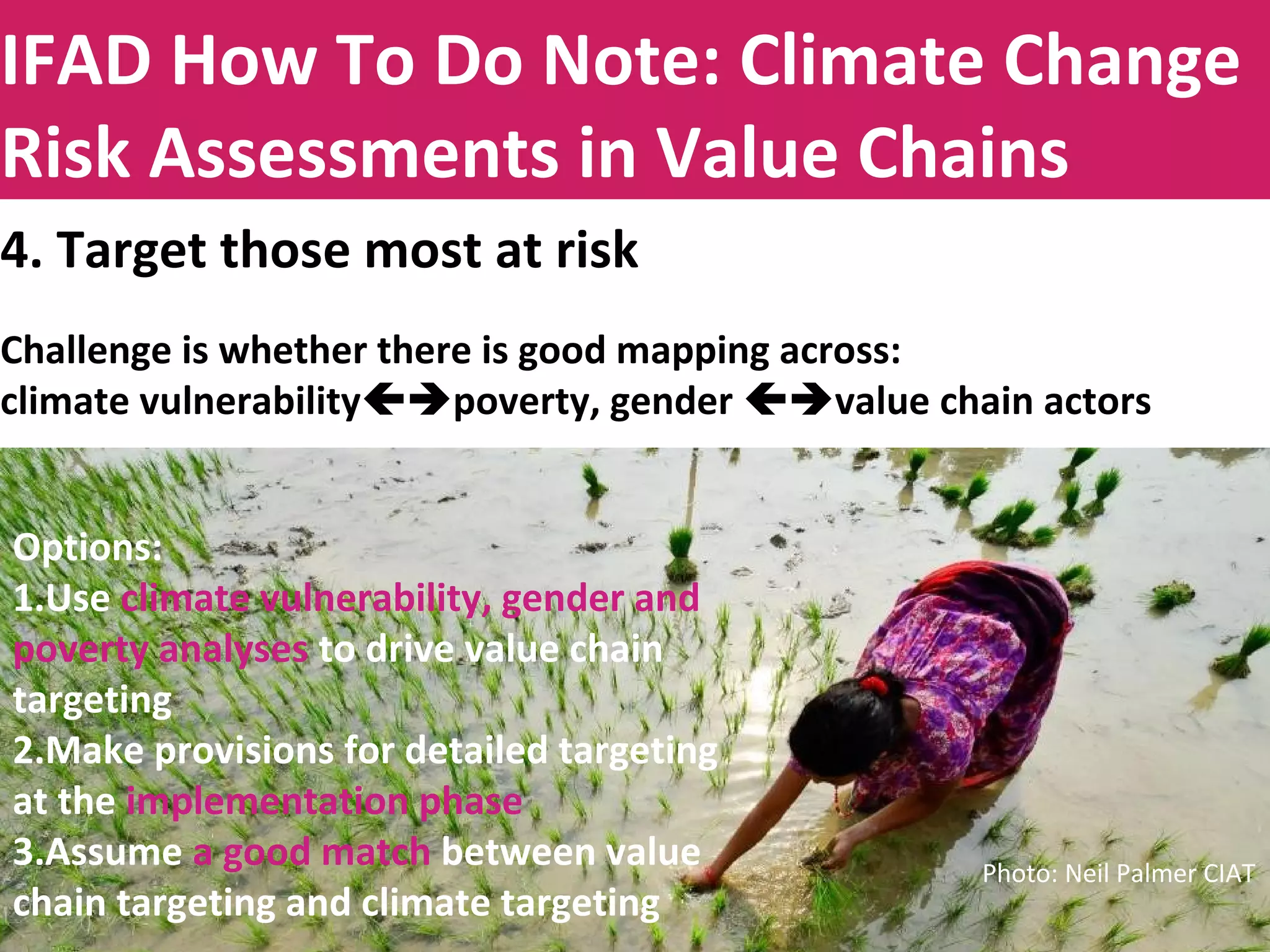
4. Target those most at risk
Challenge is whether there is good mapping across:
climate vulnerabilitypoverty, gender value chain actors
Options:
1.Use climate vulnerability analysis to drive value chain targeting
2.Make provisions for detailed targeting at the implementation phase
3.Assume a good match between value chain targeting and climate
targeting
Options:
1.Use climate vulnerability, gender and
poverty analyses to drive value chain
targeting
2.Make provisions for detailed targeting
at the implementation phase
3.Assume a good match between value
chain targeting and climate targeting
Photo: Neil Palmer CIAT
Title to be insertedIFAD How To Do Note: Climate Change
Risk Assessments in Value Chains
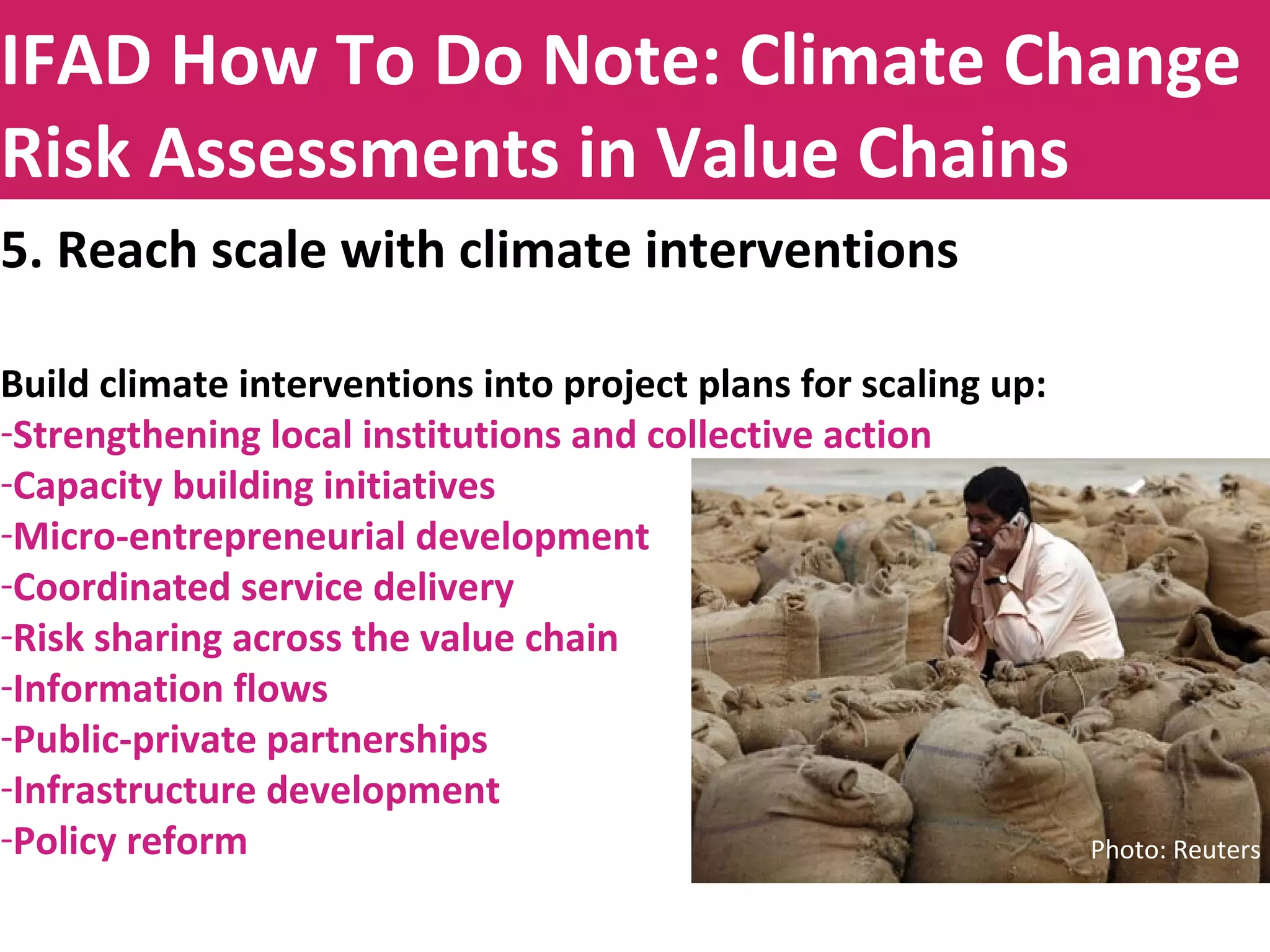
5. Reach scale with climate interventions
Build climate interventions into project plans for scaling up:
-Strengthening local institutions and collective action
-Capacity building initiatives
-Micro-entrepreneurial development
-Coordinated service delivery
-Risk sharing across the value chain
-Information flows
-Public-private partnerships
-Infrastructure development
-Policy reform Photo: Reuters
Title to be insertedIFAD How To Do Note: Climate Change
Risk Assessments in Value Chains
Opportunities and challenges
Still very few lessons to draw on for assessing and managing climate
risks across the full value chain
But now growing interest, for example:
-Australia: fisheries and seafood adaptation (industry & academia)
-Peru, Colombia, Ghana: building adaptation into voluntary certification
schemes (CIAT/Rainforest Alliance)
-Southeast Asia: full-chain risk analysis for the rice sector (ASEAN/GIZ)
-Uganda: dialogue theatres for risk analysis (IISD/MAK)
COMMON FEATURE: PLATFORMS FOR INTERACTION AMONG ALL VALUE CHAIN PARTICIPANTS
Title to be insertedIFAD How To Do Note: Climate Change
Risk Assessments in Value Chains
Opportunities and challenges
Still very few lessons to draw on for assessing and managing climate
risks across the full value chain
But now growing interest, for example:
-Australia: fisheries and seafood adaptation (industry & academia)
-Peru, Colombia, Ghana: building adaptation into voluntary certification
schemes (CIAT/Rainforest Alliance)
-Southeast Asia: full-chain risk analysis for the rice sector (ASEAN/GIZ)
-Uganda: dialogue theatres for risk analysis (IISD/MAK)
COMMON FEATURE: PLATFORMS FOR INTERACTION AMONG ALL VALUE CHAIN PARTICIPANTS

Good design in theory: IFAD’s How To Do Note on Climate Risk Assessments in Value Chains

  • 1.
    Title to beinserted How to design value chains programmes that address climate risks: an IFAD-CGIAR learning event Sonja Vermeulen Head of Research CGIAR Research Program on Climate Change, Agriculture and Food Security February 2016 Good design in theory: IFAD’s HTDN on Climate Risk Assessments in Value Chains
  • 2.
    Title to beinserted http://www.ifad.org/knotes/climate/htdn_climate_vc.pdf
  • 3.
    Title to beinsertedIFAD How To Do Note: Climate Change Risk Assessments in Value Chains Where does the HTDN fit in the project cycle? HTDN can inform SECAP and COSOPs Five stages in the design process: The COSOP design determines the opportunities for managing climate risks!
  • 4.
    Title to beinsertedIFAD How To Do Note: Climate Change Risk Assessments in Value Chains 1. Select value chain Are climate risks a consideration in selecting the value chains in the project?
  • 5.
    Title to beinsertedIFAD How To Do Note: Climate Change Risk Assessments in Value Chains 2. Identify key climate risks Use mix of scientific analysis and participatory techniques Examples: CCAFS support to ASAP in Uganda Coffee vulnerability mapping in Liberia & Nicaragua IFAD-CIAT Learning Alliance Photo: CCAFS
  • 6.
    Title to beinsertedIFAD How To Do Note: Climate Change Risk Assessments in Value Chains 3. Choose most effective adaptation interventions 1.Diversification: Wider set of technical and institutional options to increase farmers’ risk management portfolios 2. Climate-proofing: Make key stages of the value chain more climate-resilient in ways that bring livelihood and resilience benefits to farmers 3. Supply chain efficiencies: Measures such as waste reduction or inventory management that increase efficiency and deliver higher profitability & adaptive capacity to farmers and small businesses in the value chain
  • 7.
    Title to beinsertedIFAD How To Do Note: Climate Change Risk Assessments in Value Chains 4. Target those most at risk Challenge is whether there is good mapping across: climate vulnerabilitypoverty, gender value chain actors Options: 1.Use climate vulnerability analysis to drive value chain targeting 2.Make provisions for detailed targeting at the implementation phase 3.Assume a good match between value chain targeting and climate targeting Options: 1.Use climate vulnerability, gender and poverty analyses to drive value chain targeting 2.Make provisions for detailed targeting at the implementation phase 3.Assume a good match between value chain targeting and climate targeting Photo: Neil Palmer CIAT
  • 8.
    Title to beinsertedIFAD How To Do Note: Climate Change Risk Assessments in Value Chains 5. Reach scale with climate interventions Build climate interventions into project plans for scaling up: -Strengthening local institutions and collective action -Capacity building initiatives -Micro-entrepreneurial development -Coordinated service delivery -Risk sharing across the value chain -Information flows -Public-private partnerships -Infrastructure development -Policy reform Photo: Reuters
  • 9.
    Title to beinsertedIFAD How To Do Note: Climate Change Risk Assessments in Value Chains Opportunities and challenges Still very few lessons to draw on for assessing and managing climate risks across the full value chain But now growing interest, for example: -Australia: fisheries and seafood adaptation (industry & academia) -Peru, Colombia, Ghana: building adaptation into voluntary certification schemes (CIAT/Rainforest Alliance) -Southeast Asia: full-chain risk analysis for the rice sector (ASEAN/GIZ) -Uganda: dialogue theatres for risk analysis (IISD/MAK) COMMON FEATURE: PLATFORMS FOR INTERACTION AMONG ALL VALUE CHAIN PARTICIPANTS
  • 10.
    Title to beinsertedIFAD How To Do Note: Climate Change Risk Assessments in Value Chains Opportunities and challenges Still very few lessons to draw on for assessing and managing climate risks across the full value chain But now growing interest, for example: -Australia: fisheries and seafood adaptation (industry & academia) -Peru, Colombia, Ghana: building adaptation into voluntary certification schemes (CIAT/Rainforest Alliance) -Southeast Asia: full-chain risk analysis for the rice sector (ASEAN/GIZ) -Uganda: dialogue theatres for risk analysis (IISD/MAK) COMMON FEATURE: PLATFORMS FOR INTERACTION AMONG ALL VALUE CHAIN PARTICIPANTS

Editor's Notes

  • #6 Refer to IFAD examples from HTDN Use CIAT examples especially IFAD coffee work Risk analysis – refer to both Caroline’s and Peter’s presentations
  • #7 Refer to IFAD examples from HTDN Options analysis – refer to Peter’s presentation Also reference CCAFS prioritisation tools
  • #8 Refer to IFAD examples from HTDN Situation/vulnerability analysis – refer to Caroline’s presentation Reference gender HTDN and other IFAD tools