STRATEGIC TECHNOLOGY ROADMAP
            FOR


                                Carles Debart
                                Claire Utrecht
                                 Euan Granger
                        Javier Sanchez Quiros
                           Radoslava Tosheva
                                        Ying Li
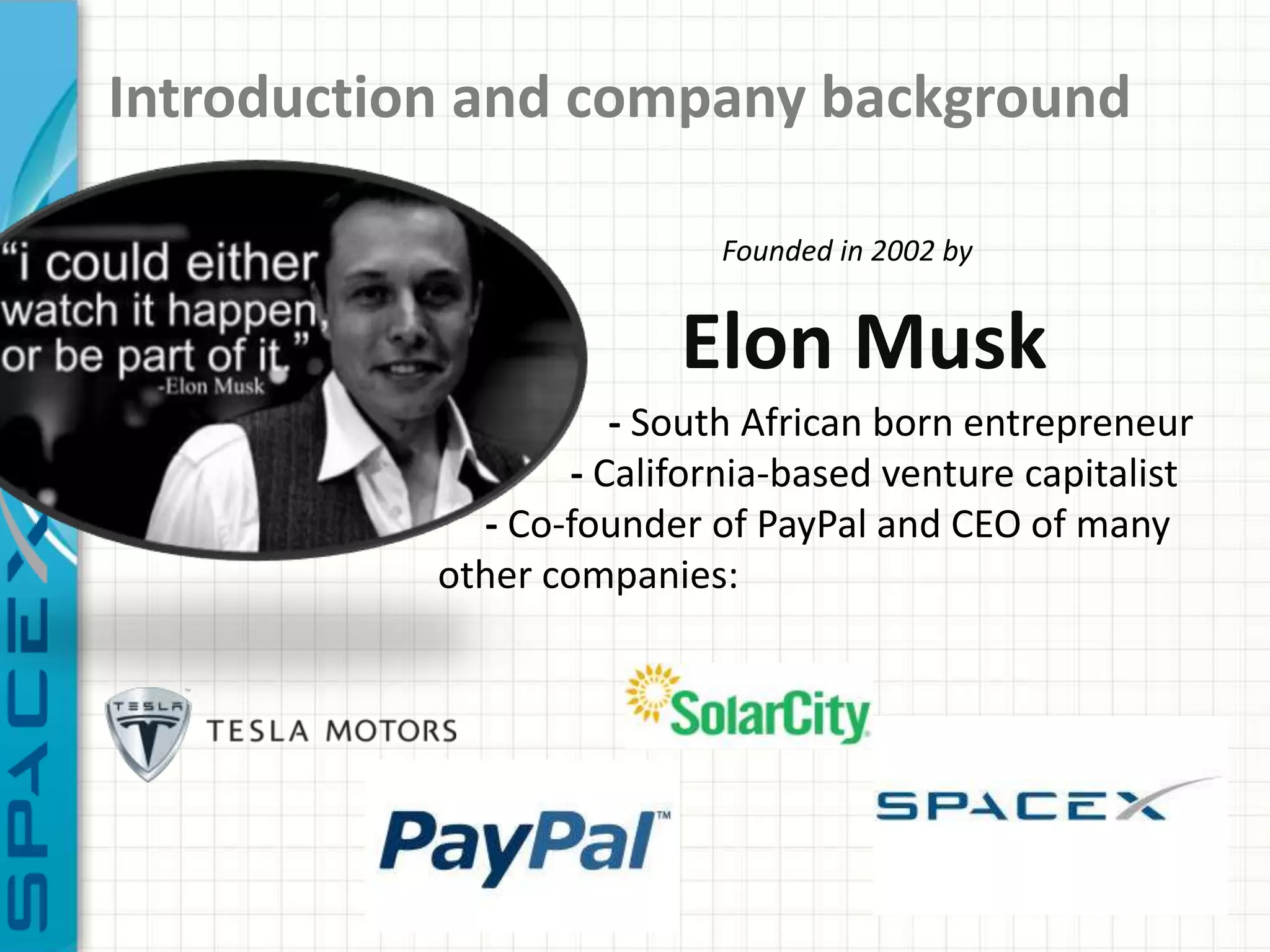
Introduction and company background

                           Founded in 2002 by


                         Elon Musk
                     - South African born entrepreneur
                  - California-based venture capitalist
             - Co-founder of PayPal and CEO of many
           other companies:
Introduction and company background II
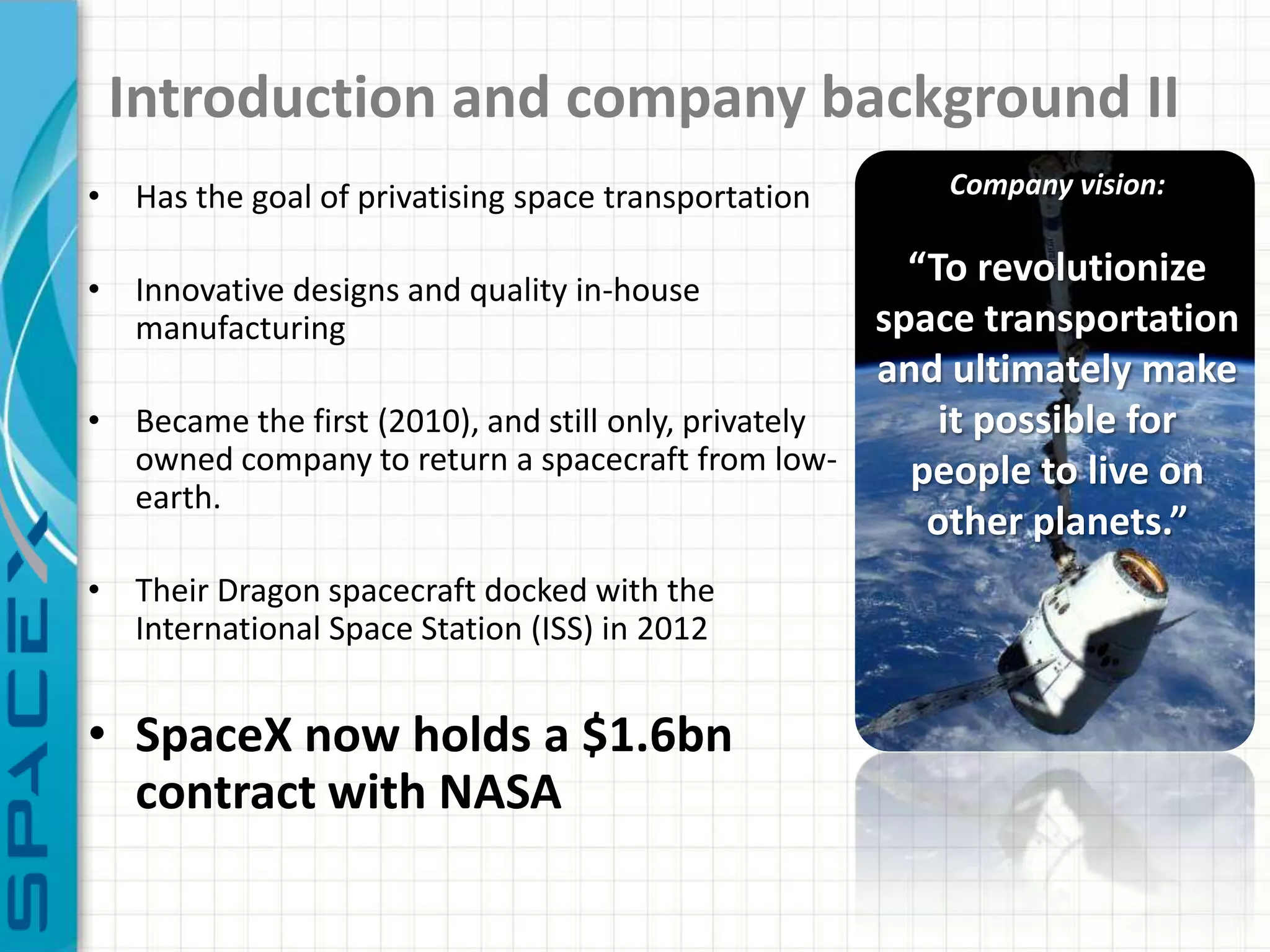
• Has the goal of privatising space transportation    Company vision:


• Innovative designs and quality in-house
                                                       “To revolutionize
  manufacturing                                      space transportation
                                                     and ultimately make
• Became the first (2010), and still only, privately     it possible for
  owned company to return a spacecraft from low-       people to live on
  earth.
                                                        other planets.”
• Their Dragon spacecraft docked with the
  International Space Station (ISS) in 2012


• SpaceX now holds a $1.6bn
  contract with NASA
Horizon scanning – PESTLE Analysis I
 Political & Legal
 - Bush administration ended the support for
 NASA space shuttle programme


                           - Obama’s programme still not defined whether
                           supporting private or public funding


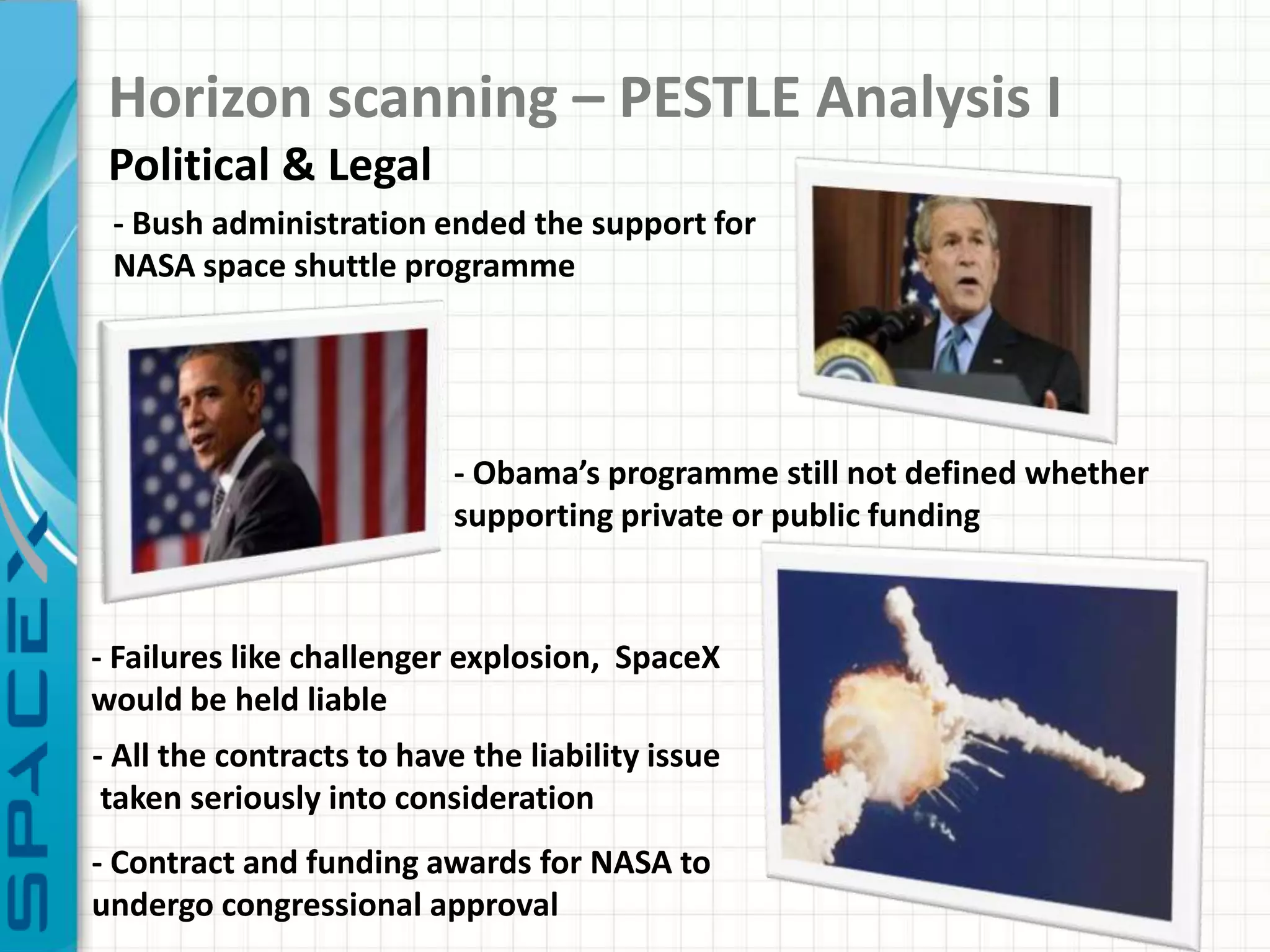
- Failures like challenger explosion, SpaceX
would be held liable
- All the contracts to have the liability issue
 taken seriously into consideration
- Contract and funding awards for NASA to
undergo congressional approval
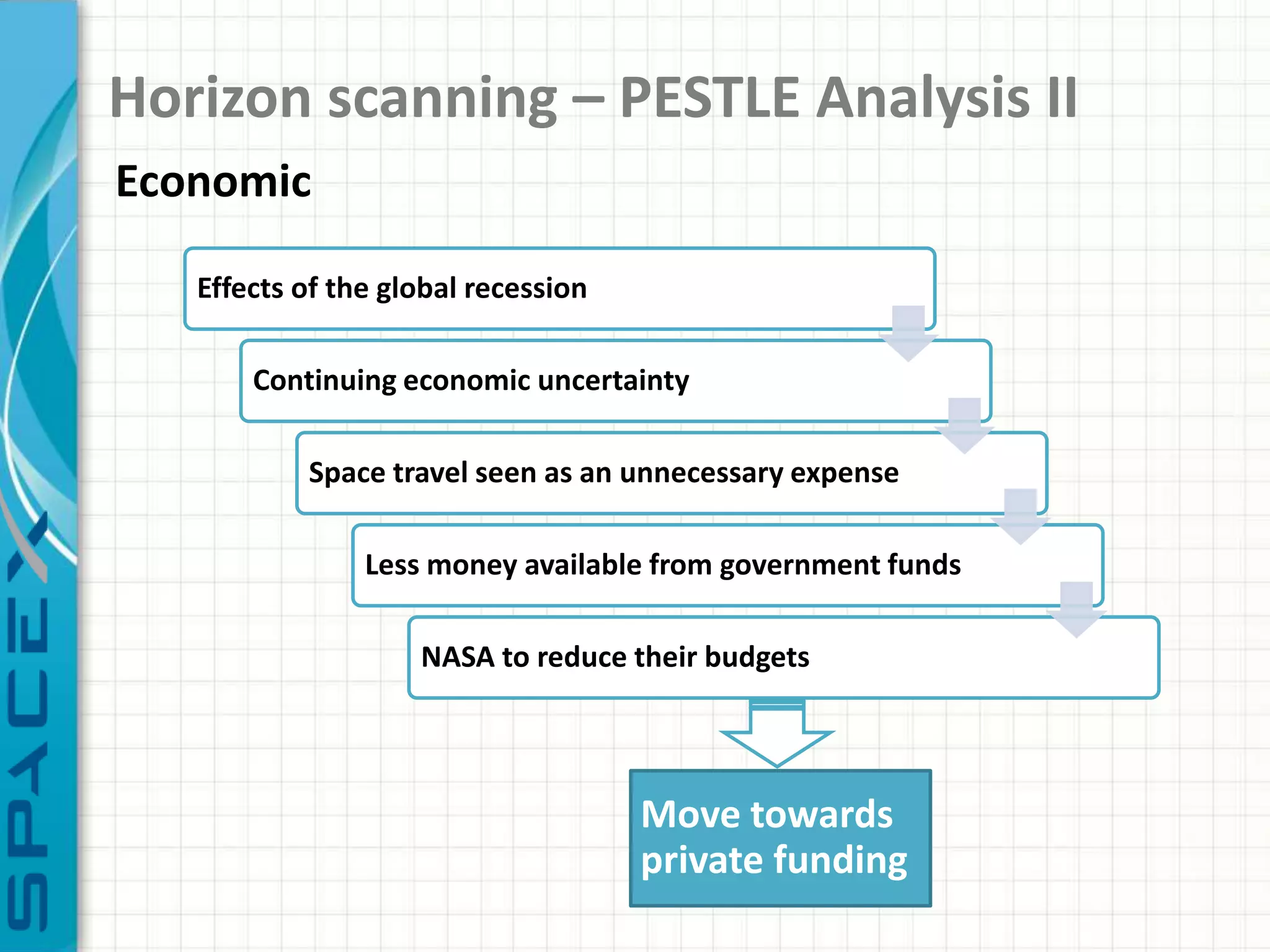
Horizon scanning – PESTLE Analysis II
Economic

   Effects of the global recession

       Continuing economic uncertainty

           Space travel seen as an unnecessary expense

                Less money available from government funds

                    NASA to reduce their budgets


                                     Move towards
                                     private funding
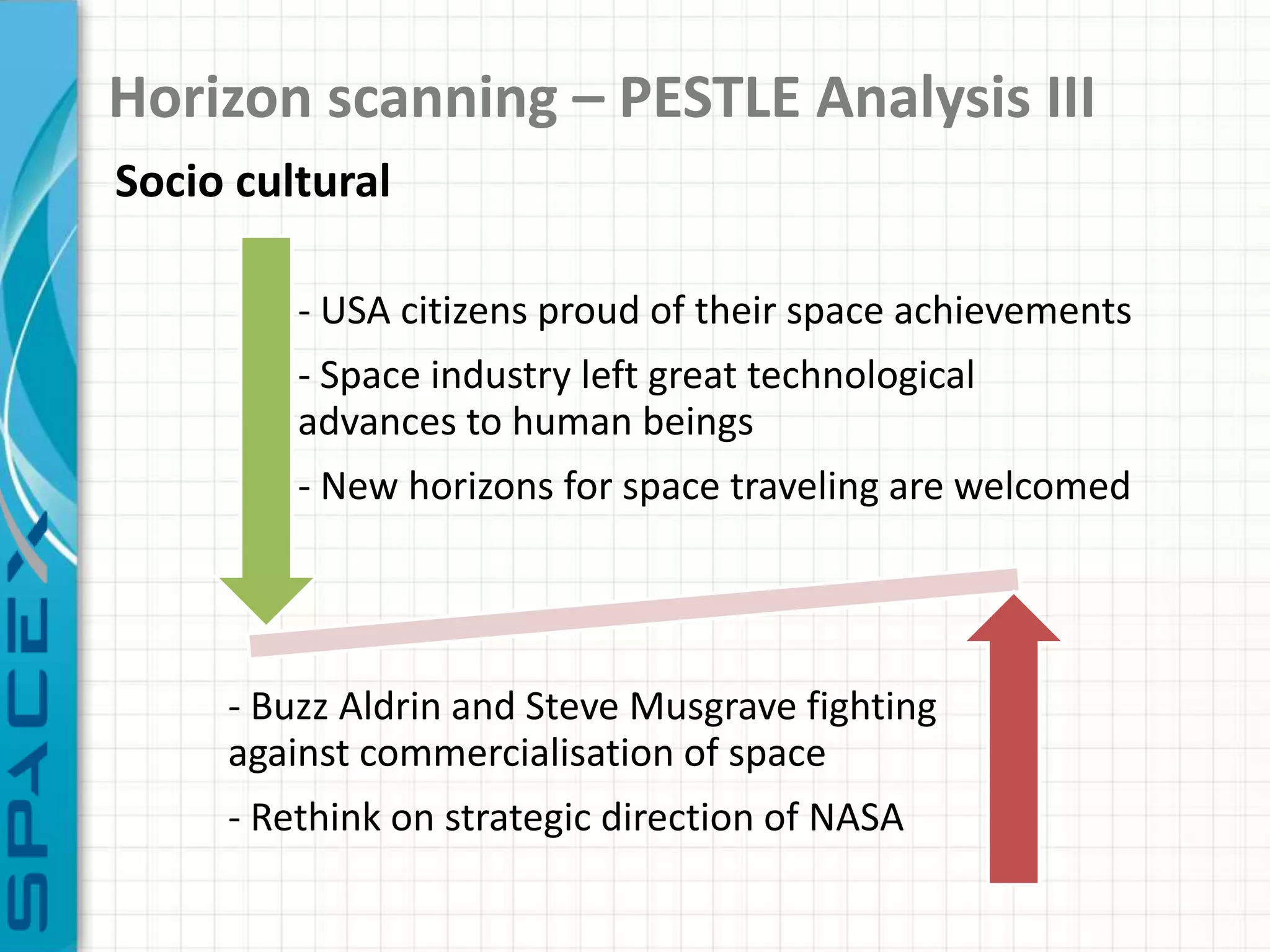
Horizon scanning – PESTLE Analysis III
Socio cultural

         - USA citizens proud of their space achievements
         - Space industry left great technological
         advances to human beings
         - New horizons for space traveling are welcomed


     - Buzz Aldrin and Steve Musgrave fighting
     against commercialisation of space
     - Rethink on strategic direction of NASA
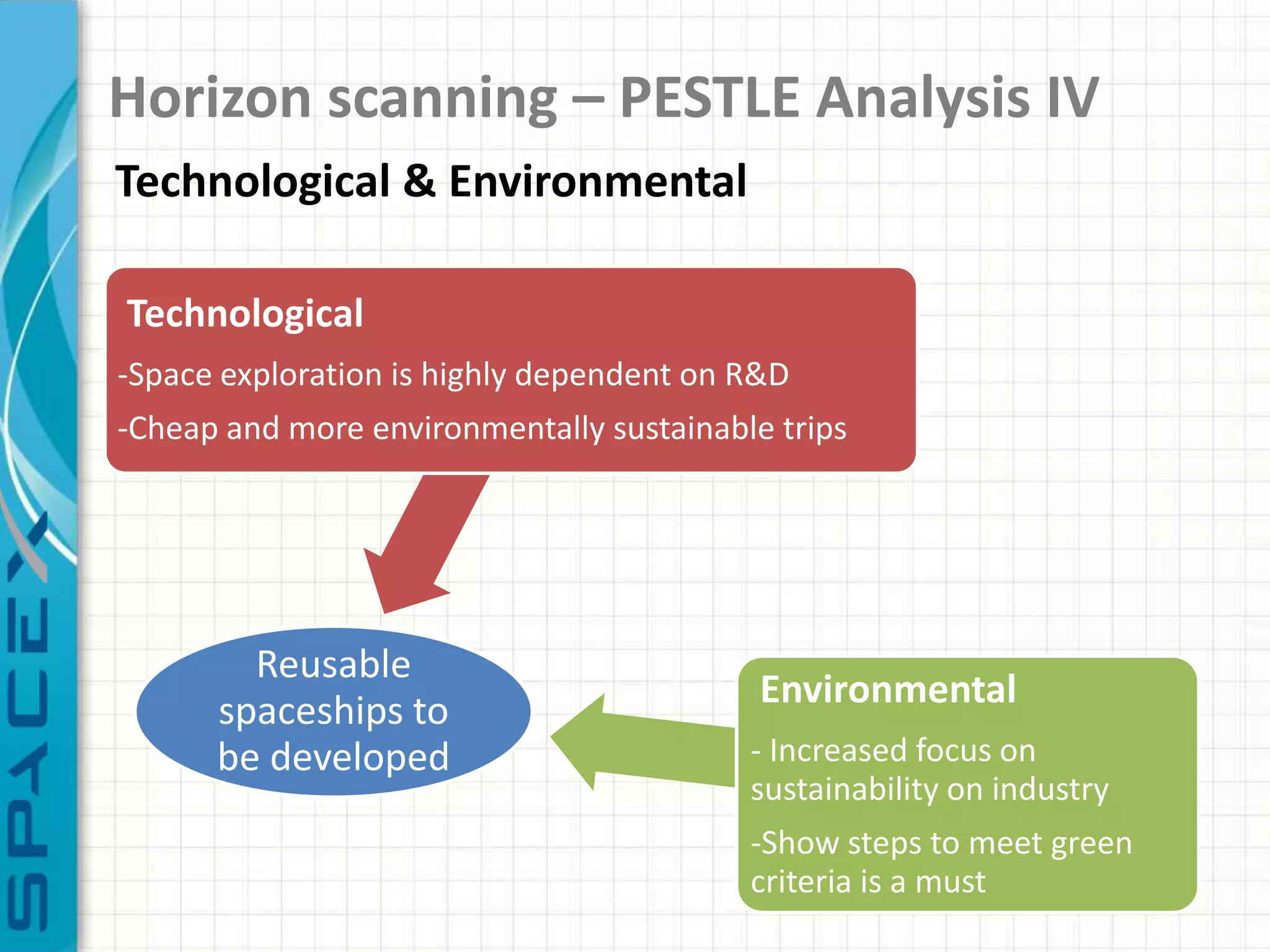
Horizon scanning – PESTLE Analysis IV
Technological & Environmental

Technological
-Space exploration is highly dependent on R&D
-Cheap and more environmentally sustainable trips


        Reusable
                                           Environmental
      spaceships to
      be developed                        - Increased focus on
                                          sustainability on industry
                                          -Show steps to meet green
                                          criteria is a must
Horizon scanning – PORTER’s 5 forces I
Industry competitors     [Moderate]

 Commercial       Governmental   Space tourism
Horizon scanning – PORTER’s 5 forces II
Threat of new entrants                [Low]
-   High level of capital to get started in the industry
-   Fast-paced technological advanced require high investment
-   Human resources are hard to find for space industry


Bargaining power of buyers                     [Low]
-   NASA prefers American companies for supply
-   SpaceX is the only American company to be approved by Congress
    as a NASA supplier


Bargaining power of suppliers                   [Moderate]
-   Very high standards of quality to be met


Threat of Substitutes                 [Low]
-   No substitutes for space vehicles at the moment
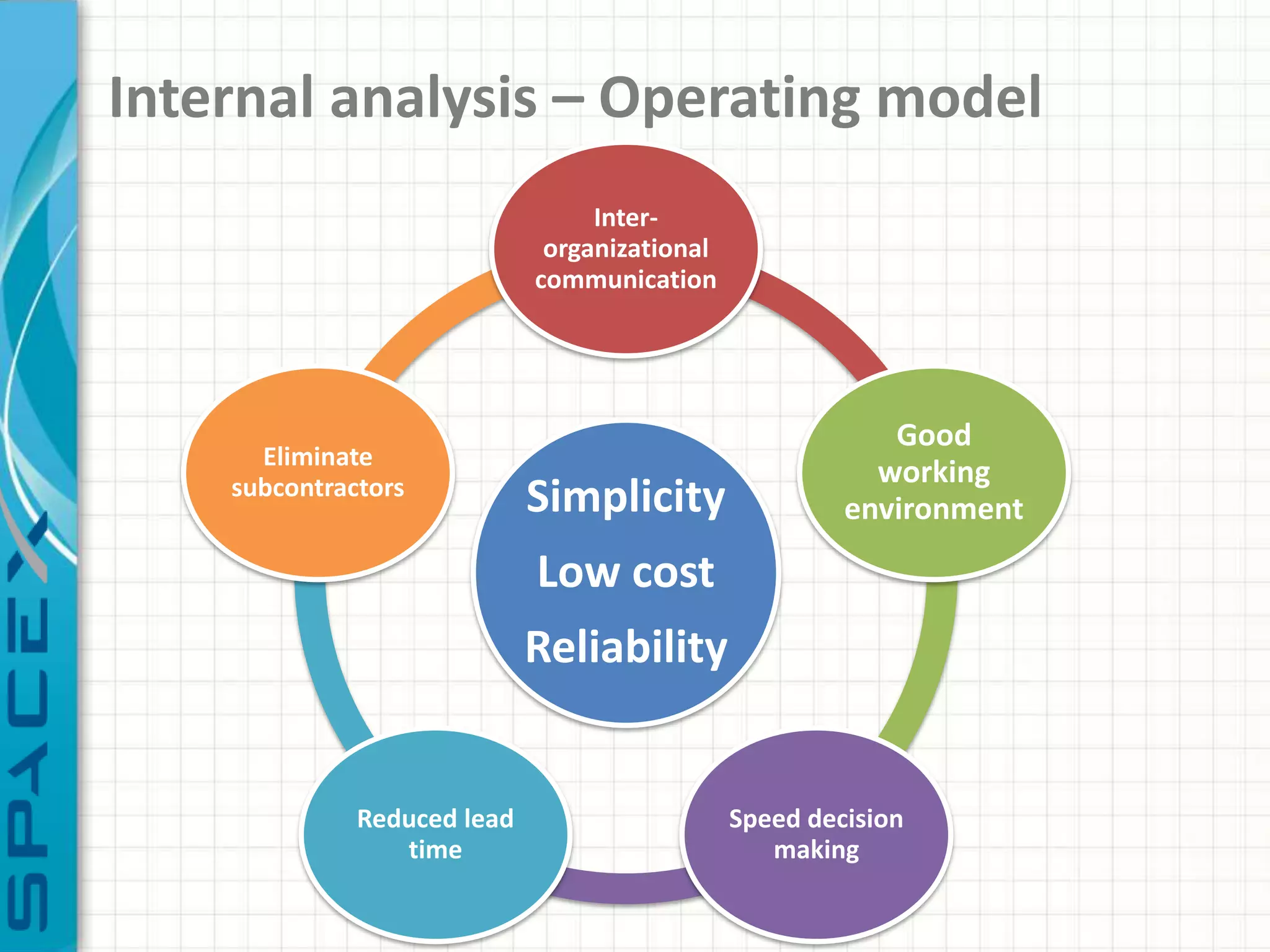
Internal analysis – Operating model
                                  Inter-
                              organizational
                             communication


                                                           Good
      Eliminate
                                                          working
    subcontractors
                             Simplicity                 environment

                             Low cost
                             Reliability


              Reduced lead                     Speed decision
                 time                             making
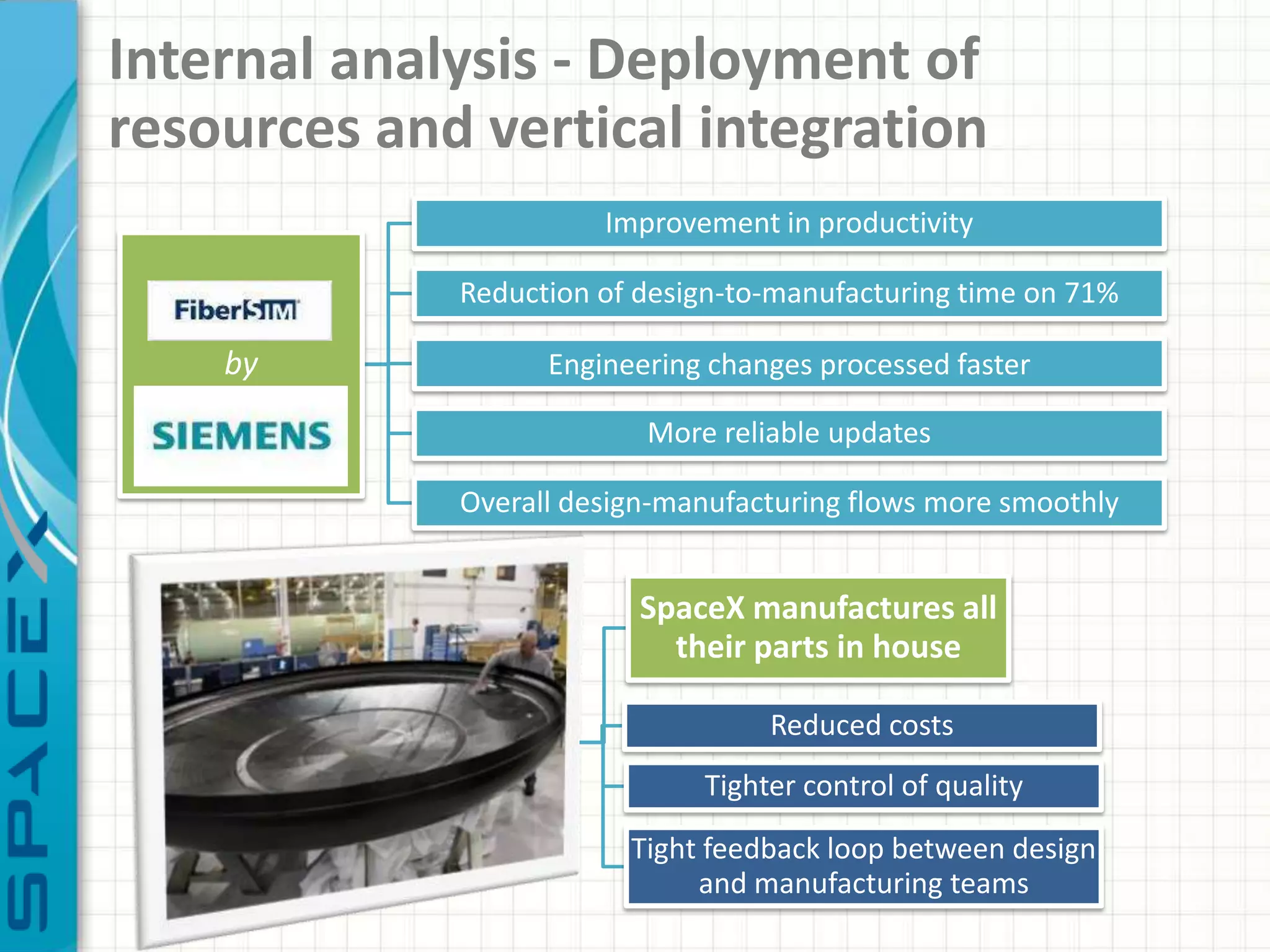
Internal analysis - Deployment of
resources and vertical integration
                       Improvement in productivity

             Reduction of design-to-manufacturing time on 71%

    by             Engineering changes processed faster

                          More reliable updates

             Overall design-manufacturing flows more smoothly


                          SpaceX manufactures all
                            their parts in house

                                   Reduced costs
                              Tighter control of quality
                         Tight feedback loop between design
                              and manufacturing teams
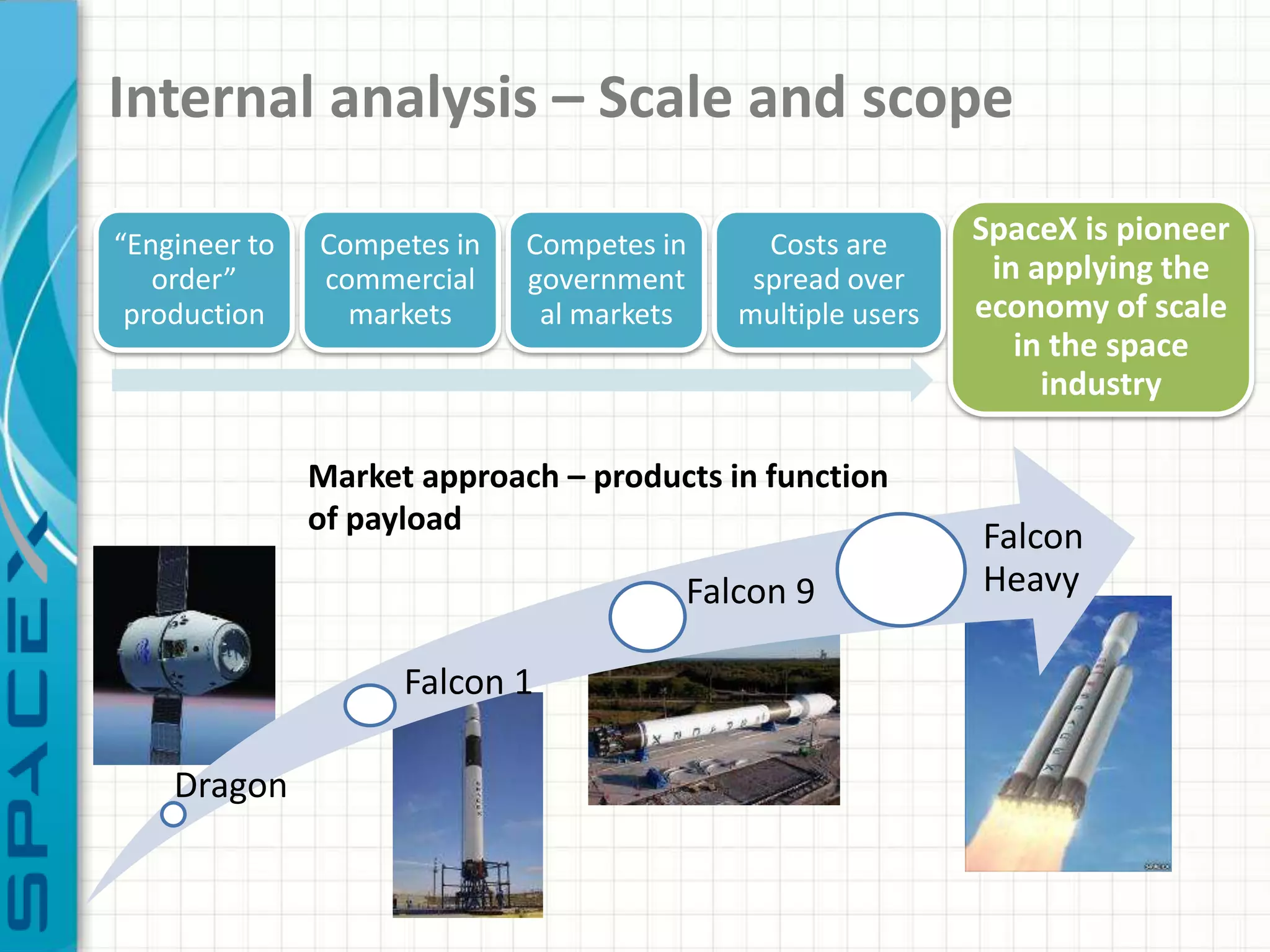
Internal analysis – Scale and scope

“Engineer to   Competes in   Competes in     Costs are      SpaceX is pioneer
   order”      commercial    government     spread over      in applying the
 production      markets      al markets   multiple users   economy of scale
                                                               in the space
                                                                 industry

               Market approach – products in function
               of payload
                                                            Falcon
                                       Falcon 9             Heavy

                     Falcon 1

    Dragon
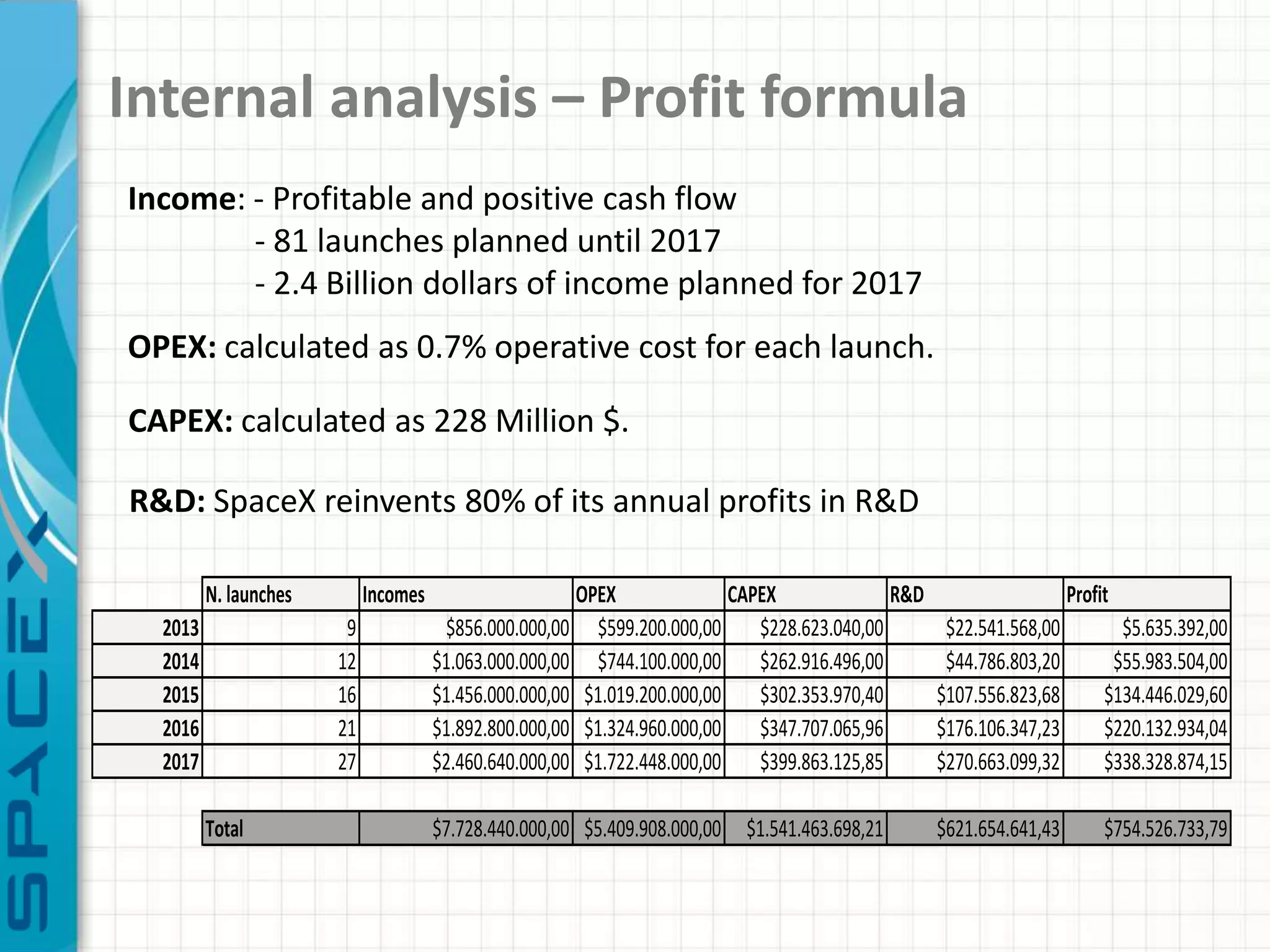
Internal analysis – Profit formula
Income: - Profitable and positive cash flow
        - 81 launches planned until 2017
        - 2.4 Billion dollars of income planned for 2017
OPEX: calculated as 0.7% operative cost for each launch.

CAPEX: calculated as 228 Million $.

R&D: SpaceX reinvents 80% of its annual profits in R&D

         N. launches        Incomes                    OPEX               CAPEX              R&D                     Profit
  2013                  9              $856.000.000,00 $599.200.000,00       $228.623.040,00        $22.541.568,00          $5.635.392,00
  2014                 12             $1.063.000.000,00 $744.100.000,00      $262.916.496,00        $44.786.803,20         $55.983.504,00
  2015                 16             $1.456.000.000,00 $1.019.200.000,00    $302.353.970,40       $107.556.823,68        $134.446.029,60
  2016                 21             $1.892.800.000,00 $1.324.960.000,00    $347.707.065,96       $176.106.347,23        $220.132.934,04
  2017                 27             $2.460.640.000,00 $1.722.448.000,00    $399.863.125,85       $270.663.099,32        $338.328.874,15

         Total                        $7.728.440.000,00 $5.409.908.000,00   $1.541.463.698,21      $621.654.641,43        $754.526.733,79
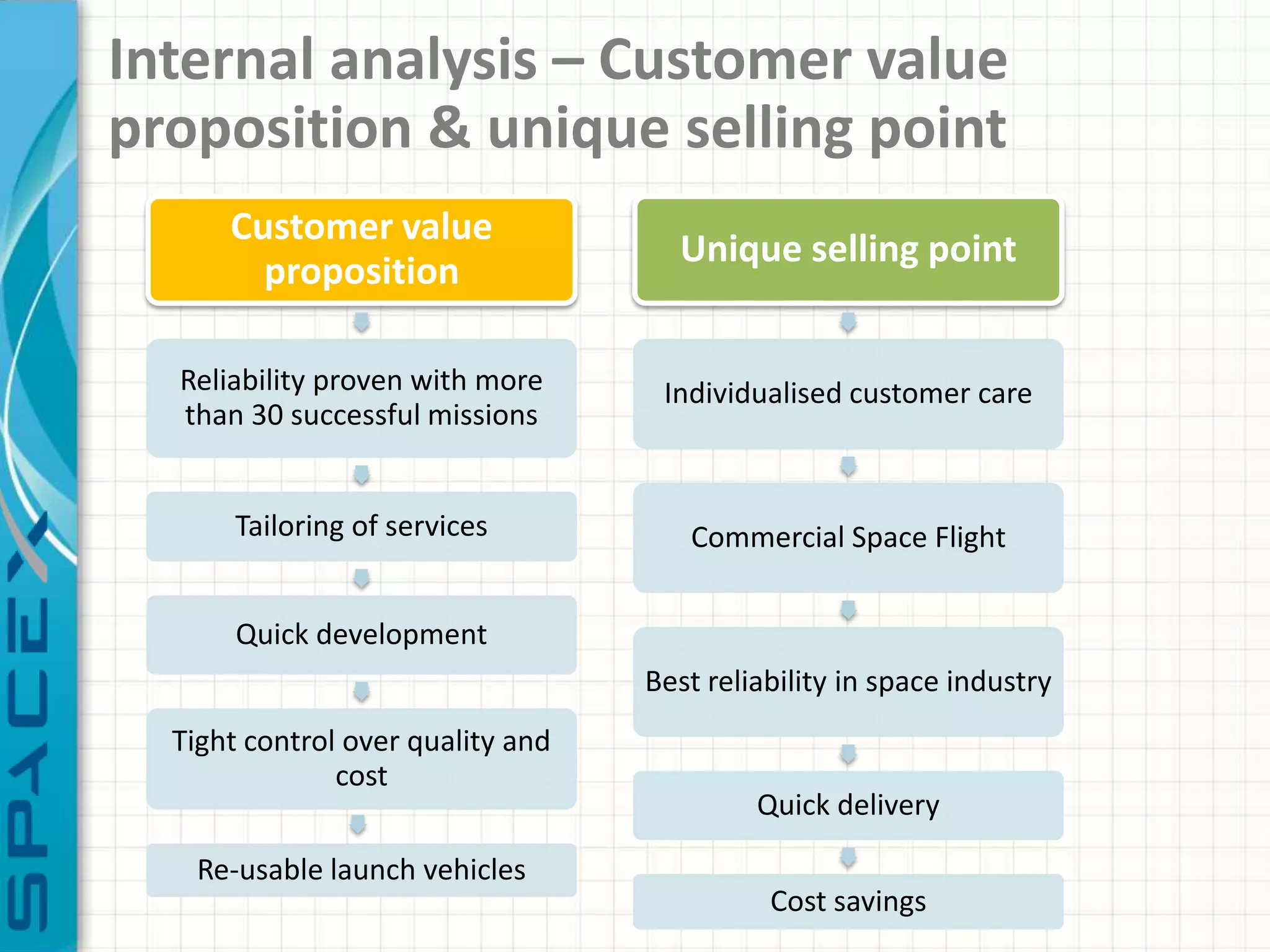
Internal analysis – Customer value
proposition & unique selling point
      Customer value
                                     Unique selling point
        proposition

  Reliability proven with more      Individualised customer care
  than 30 successful missions


       Tailoring of services          Commercial Space Flight


       Quick development
                                   Best reliability in space industry
  Tight control over quality and
               cost
                                            Quick delivery

   Re-usable launch vehicles
                                             Cost savings
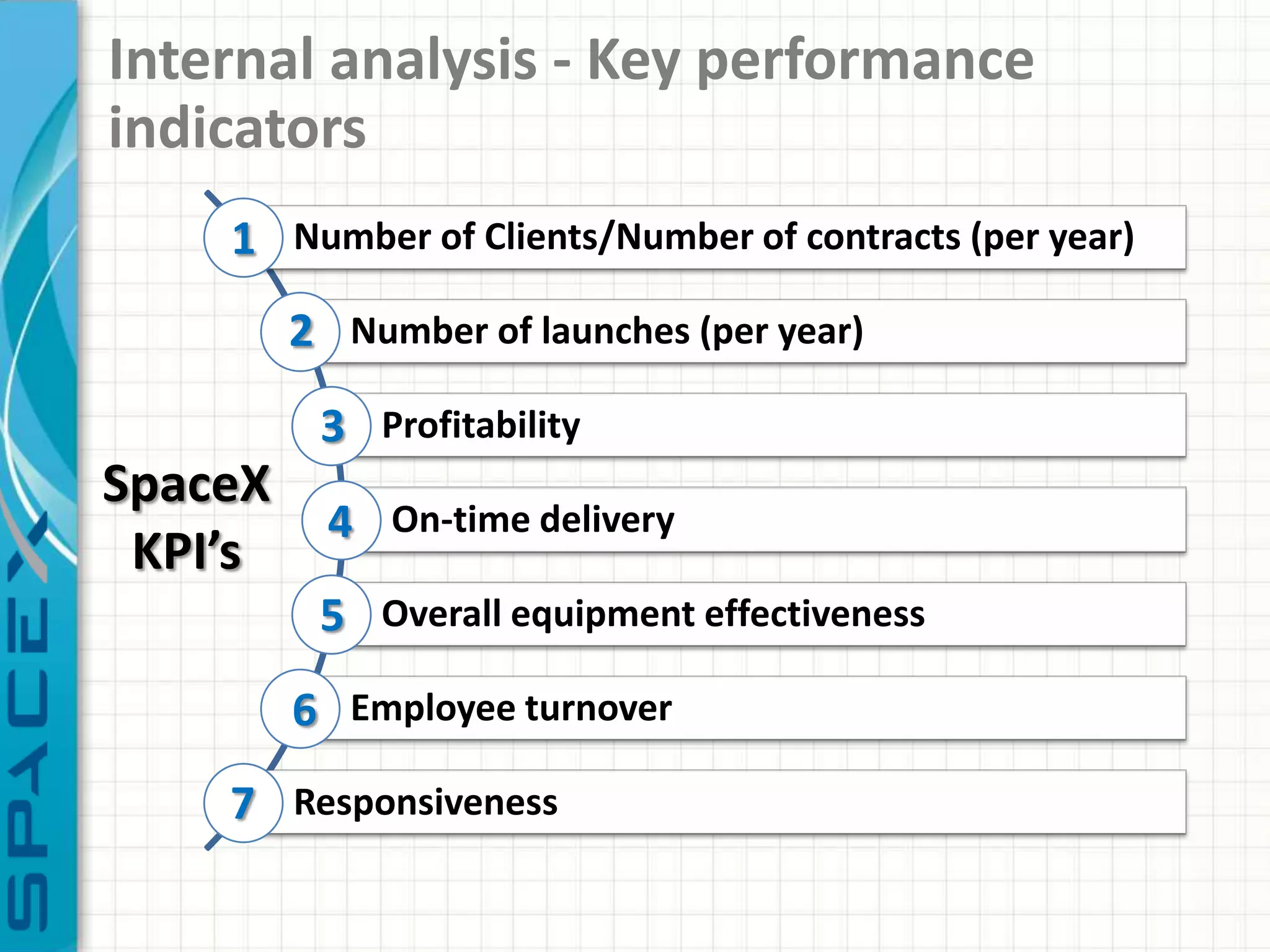
Internal analysis - Key performance
indicators
    1 Number of Clients/Number of contracts (per year)
         2 Number of launches (per year)
          3 Profitability
SpaceX
           4 On-time delivery
 KPI’s
          5 Overall equipment effectiveness
         6 Employee turnover
    7 Responsiveness
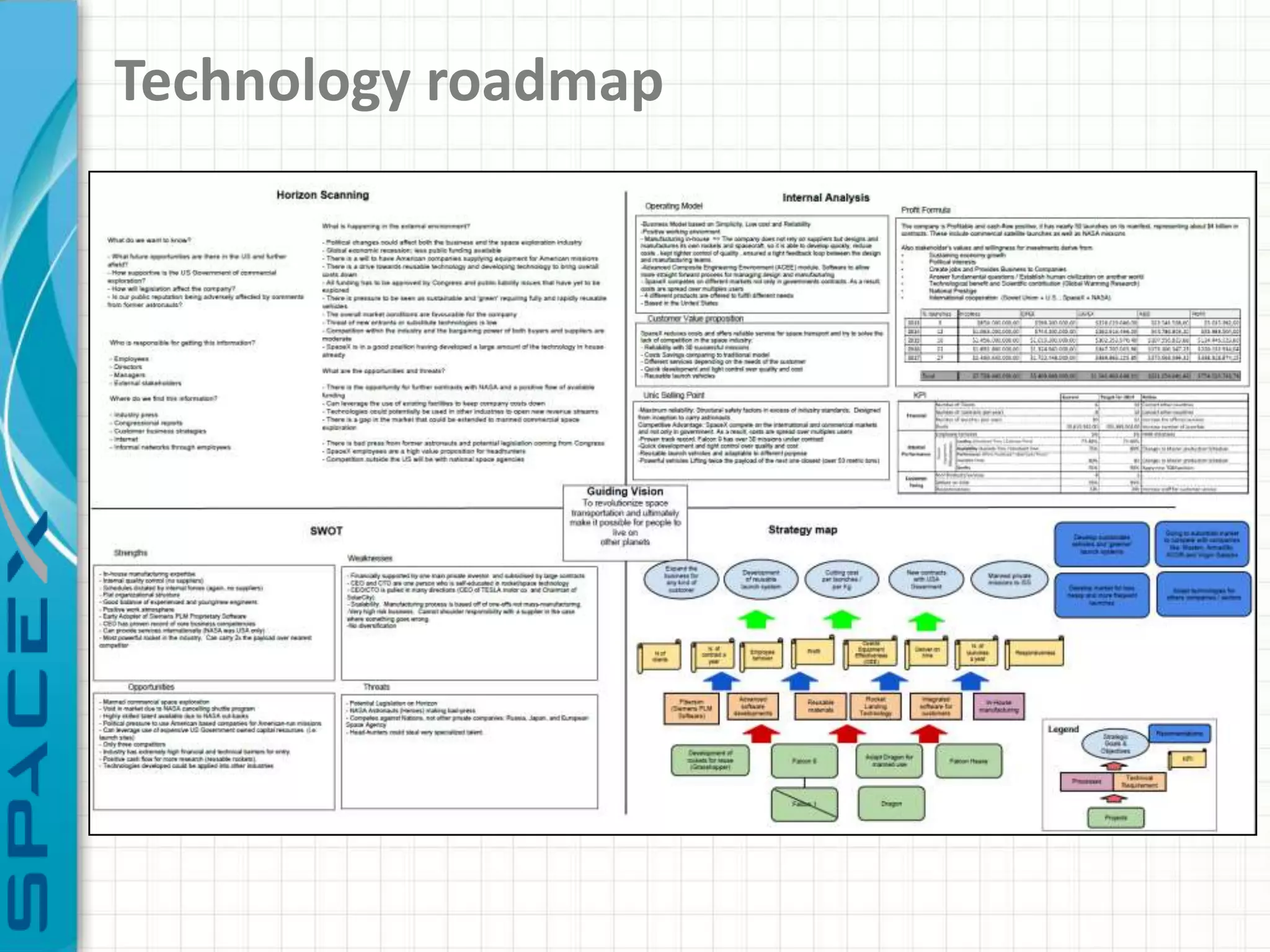
Technology roadmap
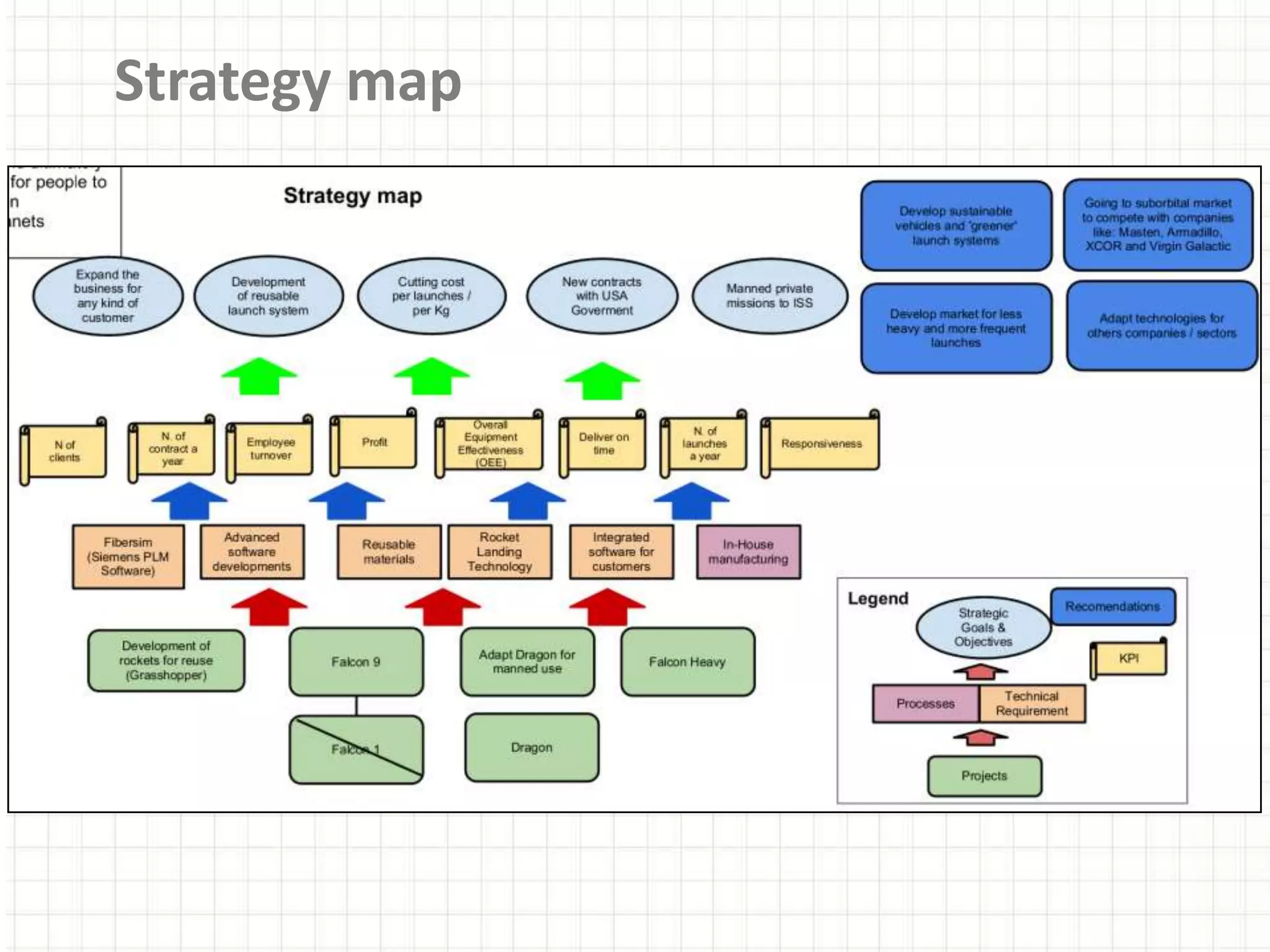
Strategy map
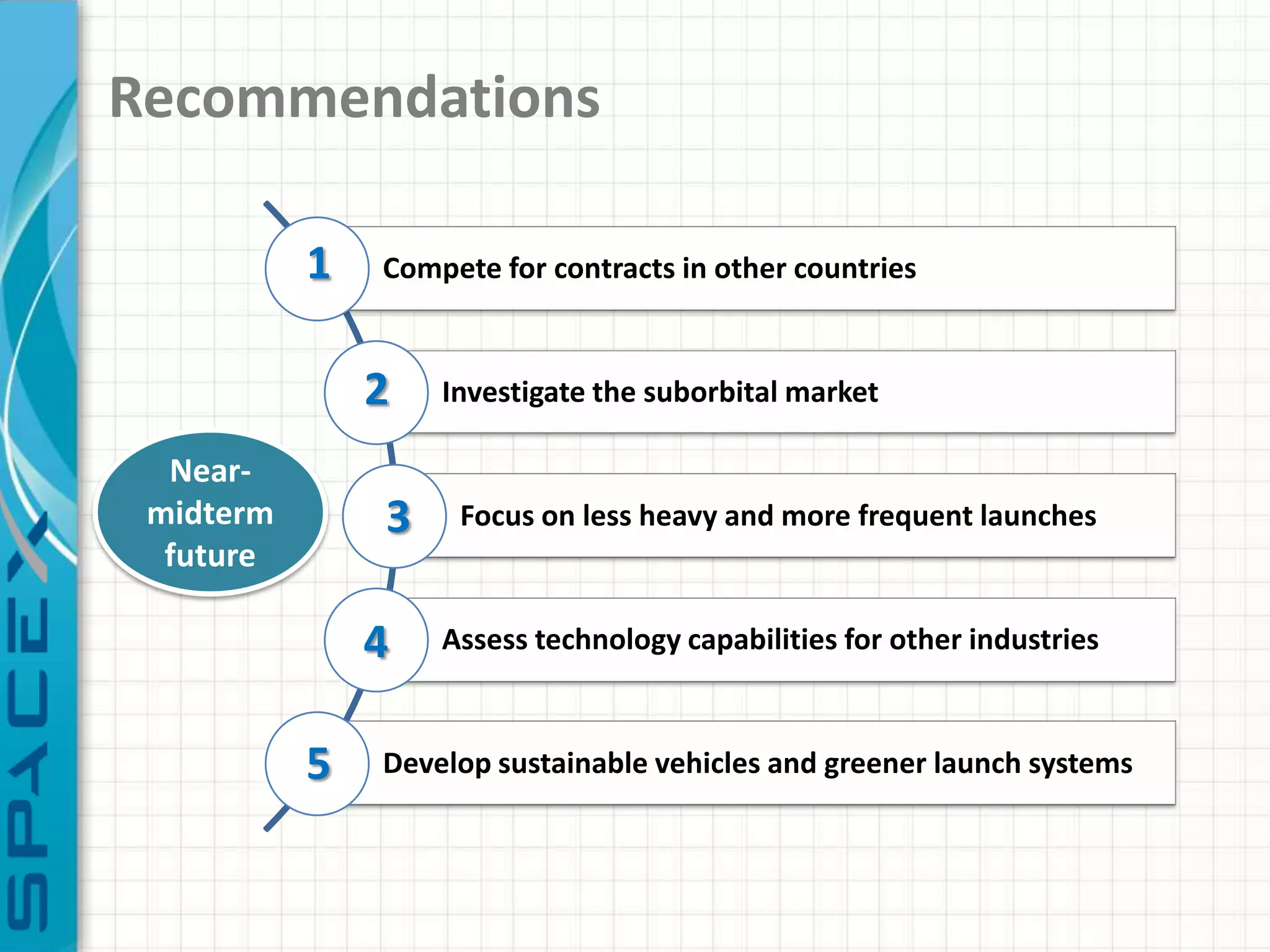
Recommendations

           1   Compete for contracts in other countries


               2   Investigate the suborbital market

  Near-
 midterm       3    Focus on less heavy and more frequent launches
  future

               4   Assess technology capabilities for other industries


           5   Develop sustainable vehicles and greener launch systems
End of presentation

                        Thank
                       you for
                         your
                      attention


                        Any
                      questions
                         ?

Strategic technology roadmap for space x

  • 1.
    STRATEGIC TECHNOLOGY ROADMAP FOR Carles Debart Claire Utrecht Euan Granger Javier Sanchez Quiros Radoslava Tosheva Ying Li
  • 2.
    Introduction and companybackground Founded in 2002 by Elon Musk - South African born entrepreneur - California-based venture capitalist - Co-founder of PayPal and CEO of many other companies:
  • 3.
    Introduction and companybackground II • Has the goal of privatising space transportation Company vision: • Innovative designs and quality in-house “To revolutionize manufacturing space transportation and ultimately make • Became the first (2010), and still only, privately it possible for owned company to return a spacecraft from low- people to live on earth. other planets.” • Their Dragon spacecraft docked with the International Space Station (ISS) in 2012 • SpaceX now holds a $1.6bn contract with NASA
  • 4.
    Horizon scanning –PESTLE Analysis I Political & Legal - Bush administration ended the support for NASA space shuttle programme - Obama’s programme still not defined whether supporting private or public funding - Failures like challenger explosion, SpaceX would be held liable - All the contracts to have the liability issue taken seriously into consideration - Contract and funding awards for NASA to undergo congressional approval
  • 5.
    Horizon scanning –PESTLE Analysis II Economic Effects of the global recession Continuing economic uncertainty Space travel seen as an unnecessary expense Less money available from government funds NASA to reduce their budgets Move towards private funding
  • 6.
    Horizon scanning –PESTLE Analysis III Socio cultural - USA citizens proud of their space achievements - Space industry left great technological advances to human beings - New horizons for space traveling are welcomed - Buzz Aldrin and Steve Musgrave fighting against commercialisation of space - Rethink on strategic direction of NASA
  • 7.
    Horizon scanning –PESTLE Analysis IV Technological & Environmental Technological -Space exploration is highly dependent on R&D -Cheap and more environmentally sustainable trips Reusable Environmental spaceships to be developed - Increased focus on sustainability on industry -Show steps to meet green criteria is a must
  • 8.
    Horizon scanning –PORTER’s 5 forces I Industry competitors [Moderate] Commercial Governmental Space tourism
  • 9.
    Horizon scanning –PORTER’s 5 forces II Threat of new entrants [Low] - High level of capital to get started in the industry - Fast-paced technological advanced require high investment - Human resources are hard to find for space industry Bargaining power of buyers [Low] - NASA prefers American companies for supply - SpaceX is the only American company to be approved by Congress as a NASA supplier Bargaining power of suppliers [Moderate] - Very high standards of quality to be met Threat of Substitutes [Low] - No substitutes for space vehicles at the moment
  • 10.
    Internal analysis –Operating model Inter- organizational communication Good Eliminate working subcontractors Simplicity environment Low cost Reliability Reduced lead Speed decision time making
  • 11.
    Internal analysis -Deployment of resources and vertical integration Improvement in productivity Reduction of design-to-manufacturing time on 71% by Engineering changes processed faster More reliable updates Overall design-manufacturing flows more smoothly SpaceX manufactures all their parts in house Reduced costs Tighter control of quality Tight feedback loop between design and manufacturing teams
  • 12.
    Internal analysis –Scale and scope “Engineer to Competes in Competes in Costs are SpaceX is pioneer order” commercial government spread over in applying the production markets al markets multiple users economy of scale in the space industry Market approach – products in function of payload Falcon Falcon 9 Heavy Falcon 1 Dragon
  • 13.
    Internal analysis –Profit formula Income: - Profitable and positive cash flow - 81 launches planned until 2017 - 2.4 Billion dollars of income planned for 2017 OPEX: calculated as 0.7% operative cost for each launch. CAPEX: calculated as 228 Million $. R&D: SpaceX reinvents 80% of its annual profits in R&D N. launches Incomes OPEX CAPEX R&D Profit 2013 9 $856.000.000,00 $599.200.000,00 $228.623.040,00 $22.541.568,00 $5.635.392,00 2014 12 $1.063.000.000,00 $744.100.000,00 $262.916.496,00 $44.786.803,20 $55.983.504,00 2015 16 $1.456.000.000,00 $1.019.200.000,00 $302.353.970,40 $107.556.823,68 $134.446.029,60 2016 21 $1.892.800.000,00 $1.324.960.000,00 $347.707.065,96 $176.106.347,23 $220.132.934,04 2017 27 $2.460.640.000,00 $1.722.448.000,00 $399.863.125,85 $270.663.099,32 $338.328.874,15 Total $7.728.440.000,00 $5.409.908.000,00 $1.541.463.698,21 $621.654.641,43 $754.526.733,79
  • 14.
    Internal analysis –Customer value proposition & unique selling point Customer value Unique selling point proposition Reliability proven with more Individualised customer care than 30 successful missions Tailoring of services Commercial Space Flight Quick development Best reliability in space industry Tight control over quality and cost Quick delivery Re-usable launch vehicles Cost savings
  • 15.
    Internal analysis -Key performance indicators 1 Number of Clients/Number of contracts (per year) 2 Number of launches (per year) 3 Profitability SpaceX 4 On-time delivery KPI’s 5 Overall equipment effectiveness 6 Employee turnover 7 Responsiveness
  • 16.
  • 17.
  • 18.
    Recommendations 1 Compete for contracts in other countries 2 Investigate the suborbital market Near- midterm 3 Focus on less heavy and more frequent launches future 4 Assess technology capabilities for other industries 5 Develop sustainable vehicles and greener launch systems
  • 19.
    End of presentation Thank you for your attention Any questions ?

Editor's Notes

  • #2 This template can be used as a starter file for presenting training materials in a group setting.SectionsRight-click on a slide to add sections. Sections can help to organize your slides or facilitate collaboration between multiple authors.NotesUse the Notes section for delivery notes or to provide additional details for the audience. View these notes in Presentation View during your presentation. Keep in mind the font size (important for accessibility, visibility, videotaping, and online production)Coordinated colors Pay particular attention to the graphs, charts, and text boxes.Consider that attendees will print in black and white or grayscale. Run a test print to make sure your colors work when printed in pure black and white and grayscale.Graphics, tables, and graphsKeep it simple: If possible, use consistent, non-distracting styles and colors.Label all graphs and tables.
  • #4 What will the audience be able to do after this training is complete? Briefly describe each objective how the audiencewill benefit from this presentation.
  • #5 Give a brief overview of the presentation. Describe the major focus of the presentation and why it is important.Introduce each of the major topics.To provide a road map for the audience, you can repeat this Overview slide throughout the presentation, highlighting the particular topic you will discuss next.
  • #6 Give a brief overview of the presentation. Describe the major focus of the presentation and why it is important.Introduce each of the major topics.To provide a road map for the audience, you can repeat this Overview slide throughout the presentation, highlighting the particular topic you will discuss next.
  • #7 Give a brief overview of the presentation. Describe the major focus of the presentation and why it is important.Introduce each of the major topics.To provide a road map for the audience, you can repeat this Overview slide throughout the presentation, highlighting the particular topic you will discuss next.
  • #8 Give a brief overview of the presentation. Describe the major focus of the presentation and why it is important.Introduce each of the major topics.To provide a road map for the audience, you can repeat this Overview slide throughout the presentation, highlighting the particular topic you will discuss next.
  • #9 Give a brief overview of the presentation. Describe the major focus of the presentation and why it is important.Introduce each of the major topics.To provide a road map for the audience, you can repeat this Overview slide throughout the presentation, highlighting the particular topic you will discuss next.
  • #10 Give a brief overview of the presentation. Describe the major focus of the presentation and why it is important.Introduce each of the major topics.To provide a road map for the audience, you can repeat this Overview slide throughout the presentation, highlighting the particular topic you will discuss next.
  • #11 Give a brief overview of the presentation. Describe the major focus of the presentation and why it is important.Introduce each of the major topics.To provide a road map for the audience, you can repeat this Overview slide throughout the presentation, highlighting the particular topic you will discuss next.
  • #12 Give a brief overview of the presentation. Describe the major focus of the presentation and why it is important.Introduce each of the major topics.To provide a road map for the audience, you can repeat this Overview slide throughout the presentation, highlighting the particular topic you will discuss next.
  • #13 Give a brief overview of the presentation. Describe the major focus of the presentation and why it is important.Introduce each of the major topics.To provide a road map for the audience, you can repeat this Overview slide throughout the presentation, highlighting the particular topic you will discuss next.
  • #14 Give a brief overview of the presentation. Describe the major focus of the presentation and why it is important.Introduce each of the major topics.To provide a road map for the audience, you can repeat this Overview slide throughout the presentation, highlighting the particular topic you will discuss next.
  • #15 Give a brief overview of the presentation. Describe the major focus of the presentation and why it is important.Introduce each of the major topics.To provide a road map for the audience, you can repeat this Overview slide throughout the presentation, highlighting the particular topic you will discuss next.
  • #16 Give a brief overview of the presentation. Describe the major focus of the presentation and why it is important.Introduce each of the major topics.To provide a road map for the audience, you can repeat this Overview slide throughout the presentation, highlighting the particular topic you will discuss next.
  • #17 Give a brief overview of the presentation. Describe the major focus of the presentation and why it is important.Introduce each of the major topics.To provide a road map for the audience, you can repeat this Overview slide throughout the presentation, highlighting the particular topic you will discuss next.
  • #18 Give a brief overview of the presentation. Describe the major focus of the presentation and why it is important.Introduce each of the major topics.To provide a road map for the audience, you can repeat this Overview slide throughout the presentation, highlighting the particular topic you will discuss next.
  • #19 Give a brief overview of the presentation. Describe the major focus of the presentation and why it is important.Introduce each of the major topics.To provide a road map for the audience, you can repeat this Overview slide throughout the presentation, highlighting the particular topic you will discuss next.