BayLISA, Oct 2013
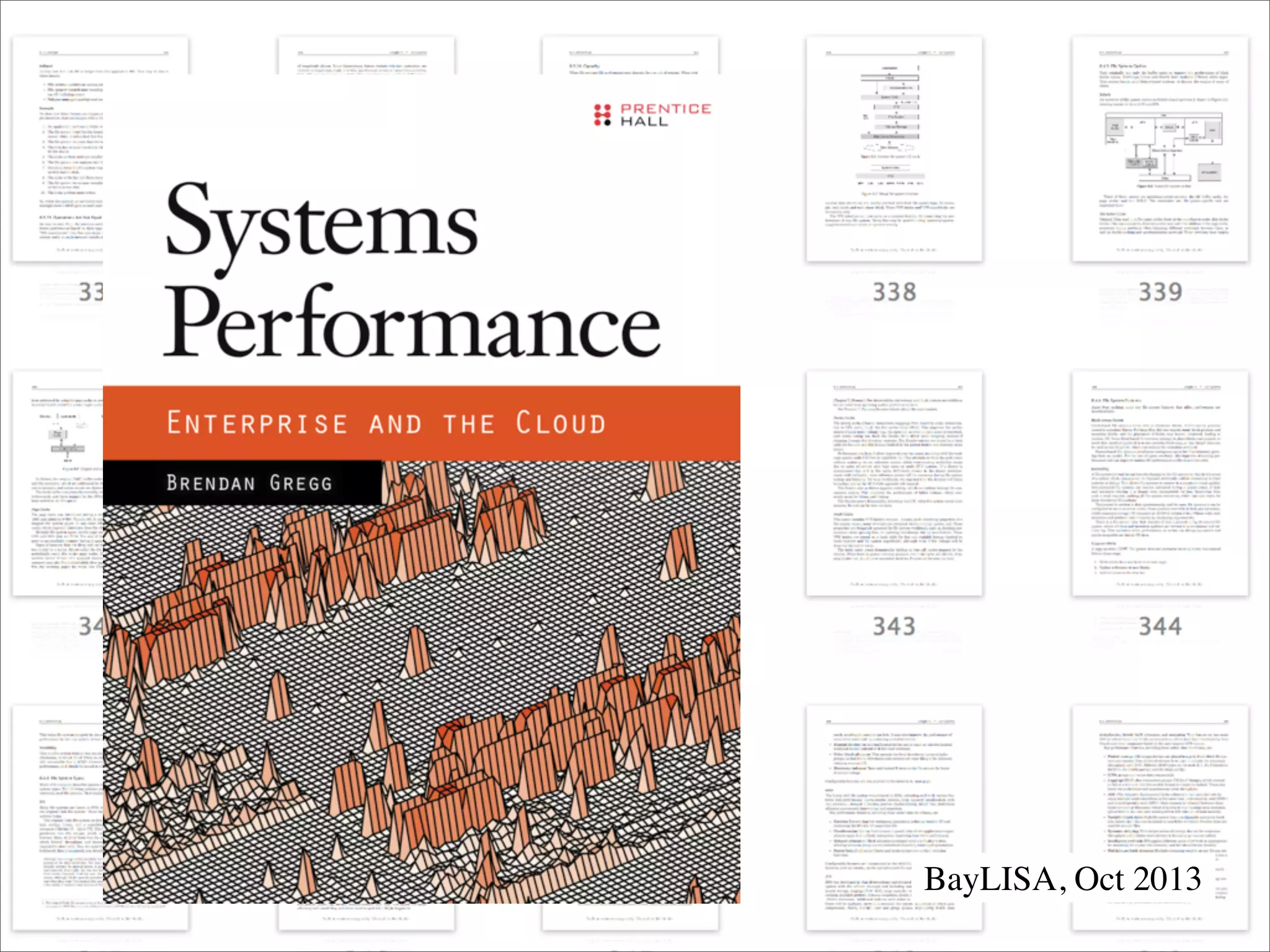
Systems Performance
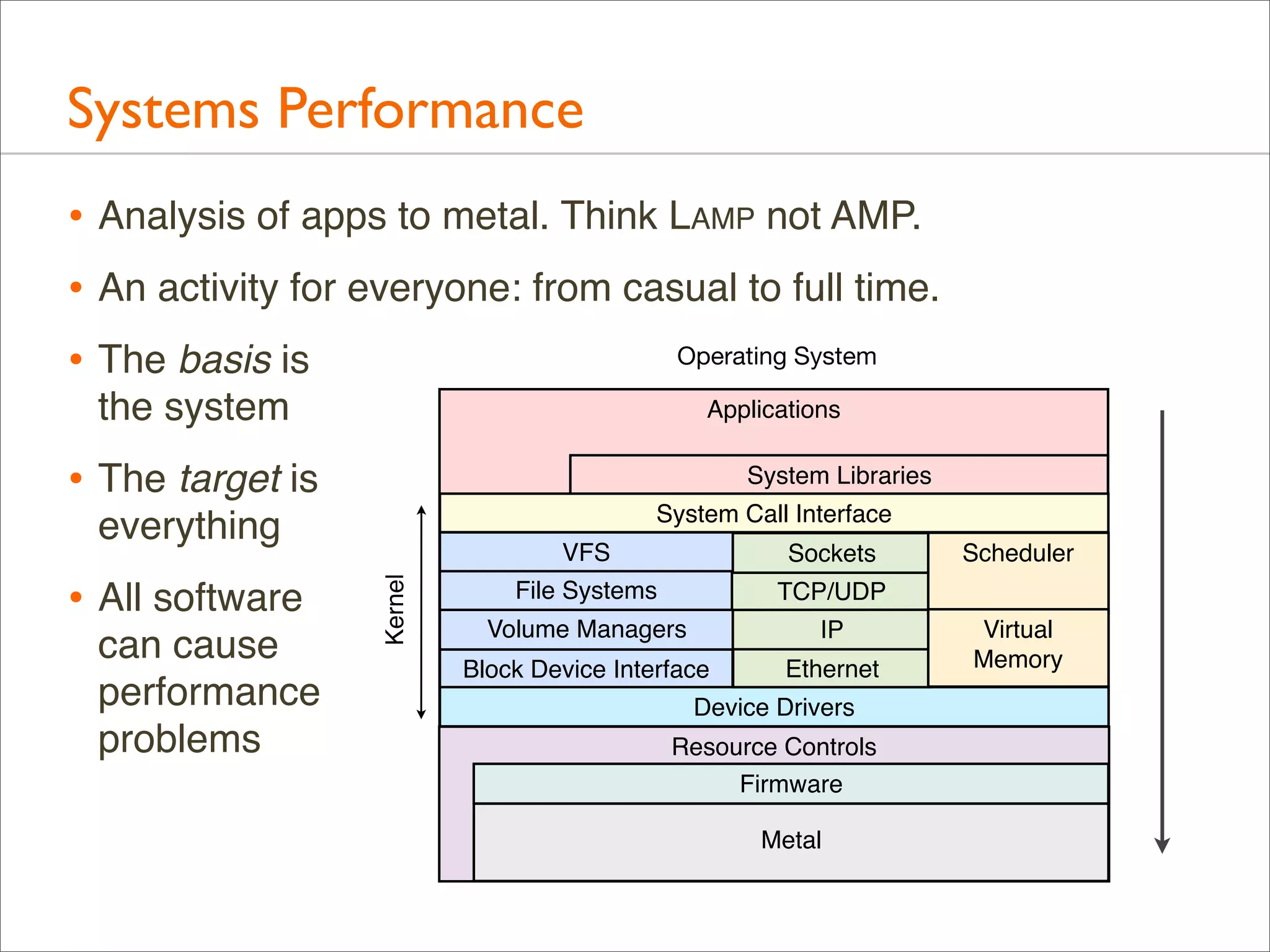
• Analysis of apps to metal. Think LAMP not AMP.
• An activity for everyone: from casual to full time.
Operating System
• The basis is
the system

Applications

• The target is

System Libraries
System Call Interface

everything
can cause
performance
problems

Kernel

• All software

VFS

Sockets

File Systems

TCP/UDP

Volume Managers

IP

Block Device Interface

Ethernet

Device Drivers
Resource Controls
Firmware
Metal

Scheduler
Virtual
Memory
Systems Performance: Enterprise and the Cloud
• Brendan Gregg (and many others); Prentice Hall, 2013
• 635 pages of chapters, plus appendices, etc
• Background, methodologies, examples
• Examples from:
• Linux (Ubuntu, Fedora, CentOS)
• illumos (SmartOS, OmniOS)
• Audience:
• Sysadmins, developers, everyone
• Enterprise and cloud environments
The Author: Brendan Gregg
• Currently at Joyent, previously Brendan@Sun, then Oracle
• Lead Performance Engineer: debugs perf on SmartOS/Linux/
Windows daily, small to large cloud environments, any layer of
the software stack, down to firmware and metal. Previously a
kernel engineer, performance consultant, trainer.

• Written hundreds of published perf tools (too many), including
the original iosnoop, iotop, execsnoop, nicstat, psio, etc.

• Created visualizations: heat maps for various uses, flame
graphs, frequency trails, cloud process graphs

• Developed methodologies: USE method, TSA method
• Co-authored books: DTrace, Solaris Performance and Tools
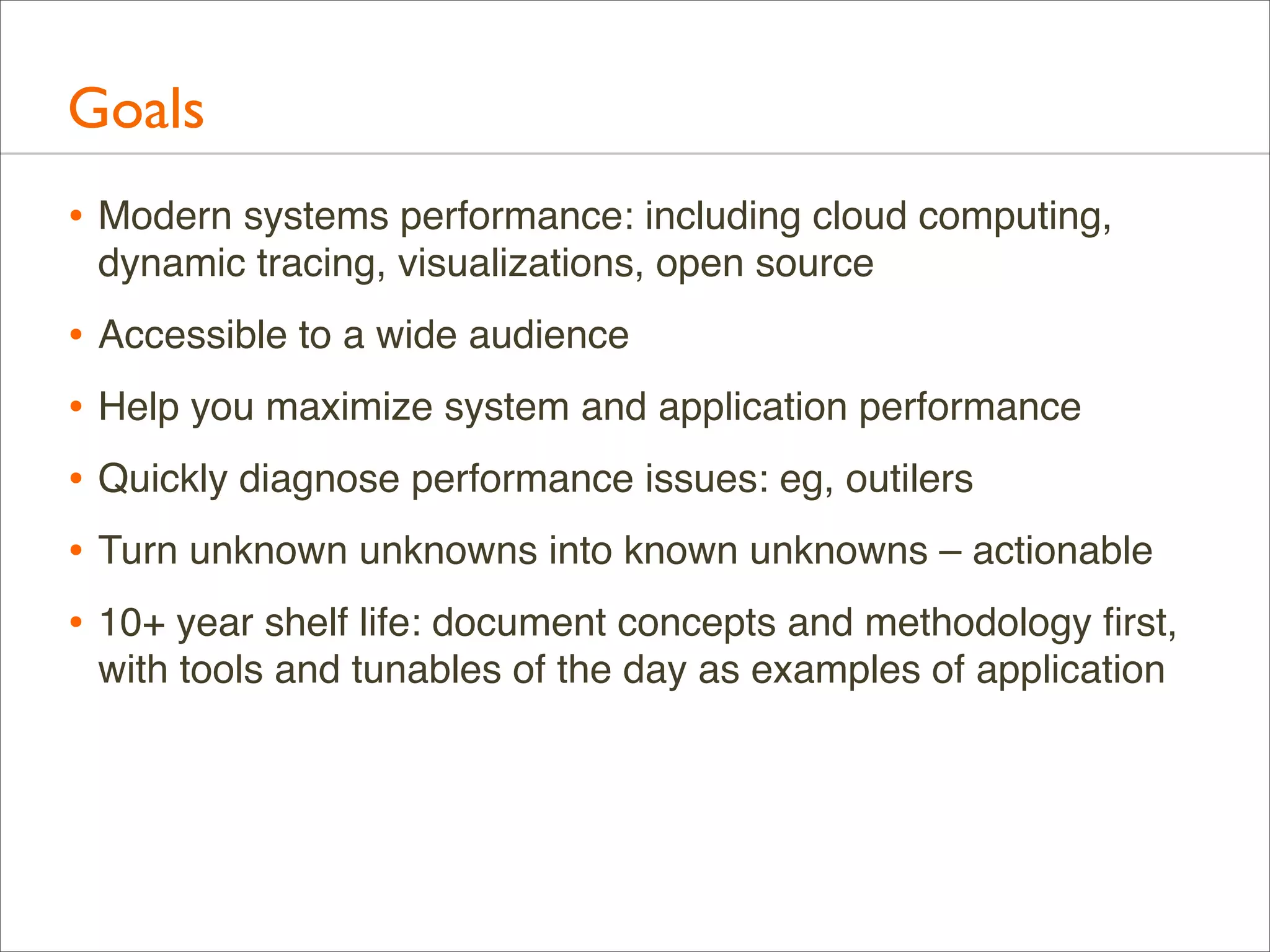
Goals
• Modern systems performance: including cloud computing,
dynamic tracing, visualizations, open source

• Accessible to a wide audience
• Help you maximize system and application performance
• Quickly diagnose performance issues: eg, outilers
• Turn unknown unknowns into known unknowns – actionable
• 10+ year shelf life: document concepts and methodology first,
with tools and tunables of the day as examples of application
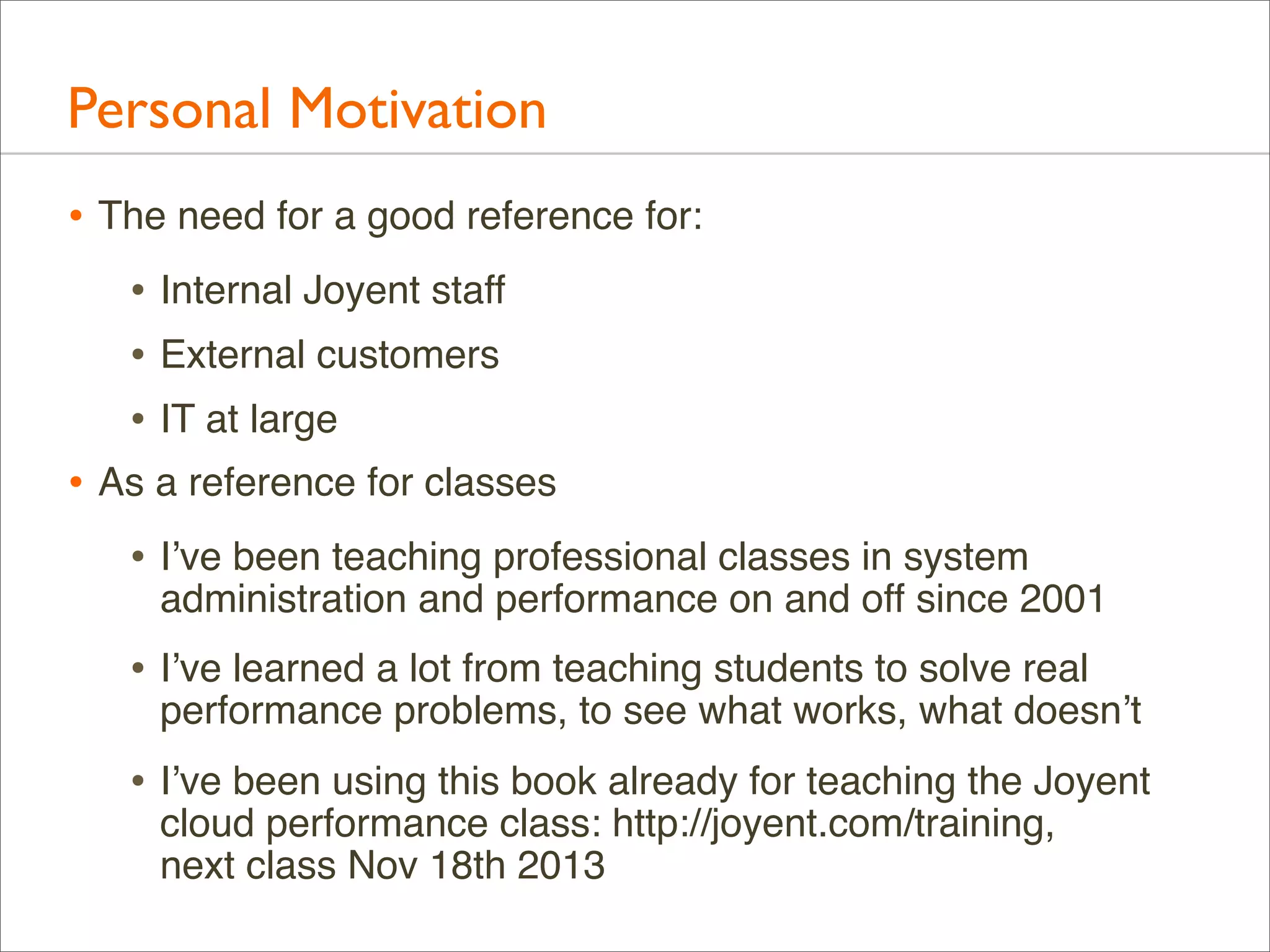
Personal Motivation
• The need for a good reference for:
• Internal Joyent staff
• External customers
• IT at large
• As a reference for classes
• I’ve been teaching professional classes in system

administration and performance on and off since 2001

• I’ve learned a lot from teaching students to solve real

performance problems, to see what works, what doesn’t

• I’ve been using this book already for teaching the Joyent
cloud performance class: http://joyent.com/training,
next class Nov 18th 2013
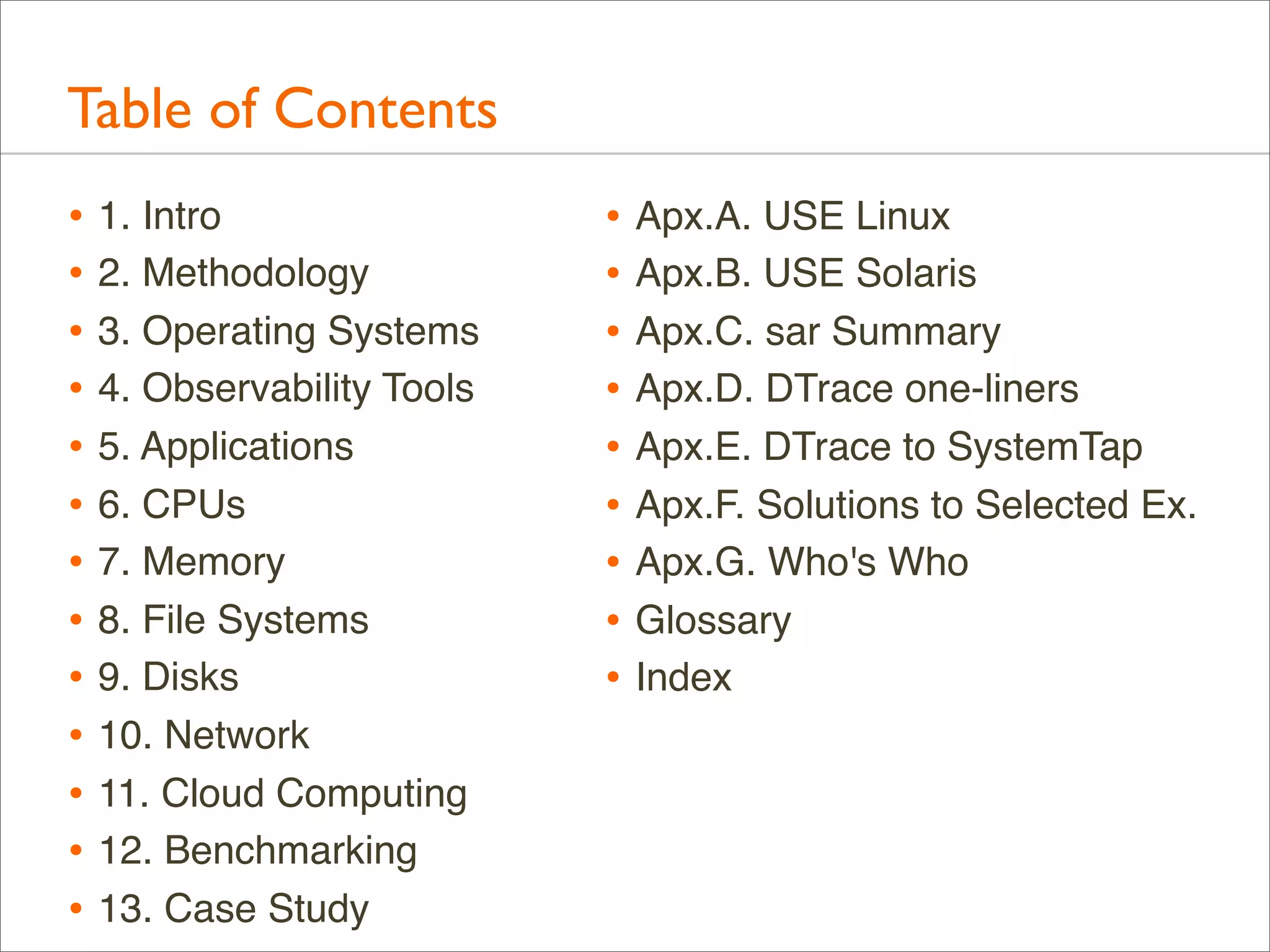
Table of Contents
• 1. Intro
• 2. Methodology
• 3. Operating Systems
• 4. Observability Tools
• 5. Applications
• 6. CPUs
• 7. Memory
• 8. File Systems
• 9. Disks
• 10. Network
• 11. Cloud Computing
• 12. Benchmarking
• 13. Case Study

• Apx.A. USE Linux
• Apx.B. USE Solaris
• Apx.C. sar Summary
• Apx.D. DTrace one-liners
• Apx.E. DTrace to SystemTap
• Apx.F. Solutions to Selected Ex.
• Apx.G. Who's Who
• Glossary
• Index
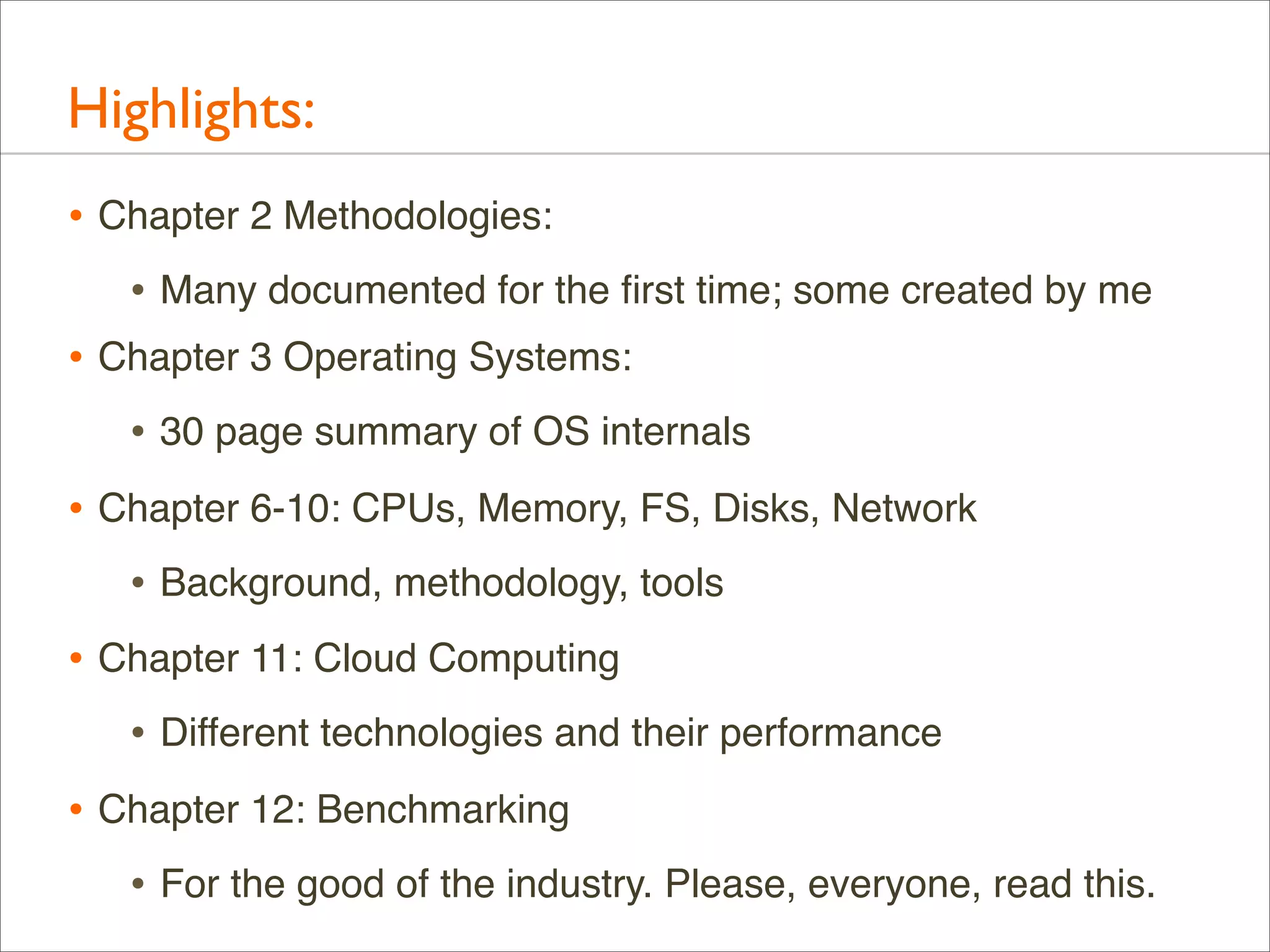
Highlights:
• Chapter 2 Methodologies:
• Many documented for the first time; some created by me
• Chapter 3 Operating Systems:
• 30 page summary of OS internals
• Chapter 6-10: CPUs, Memory, FS, Disks, Network
• Background, methodology, tools
• Chapter 11: Cloud Computing
• Different technologies and their performance
• Chapter 12: Benchmarking
• For the good of the industry. Please, everyone, read this.
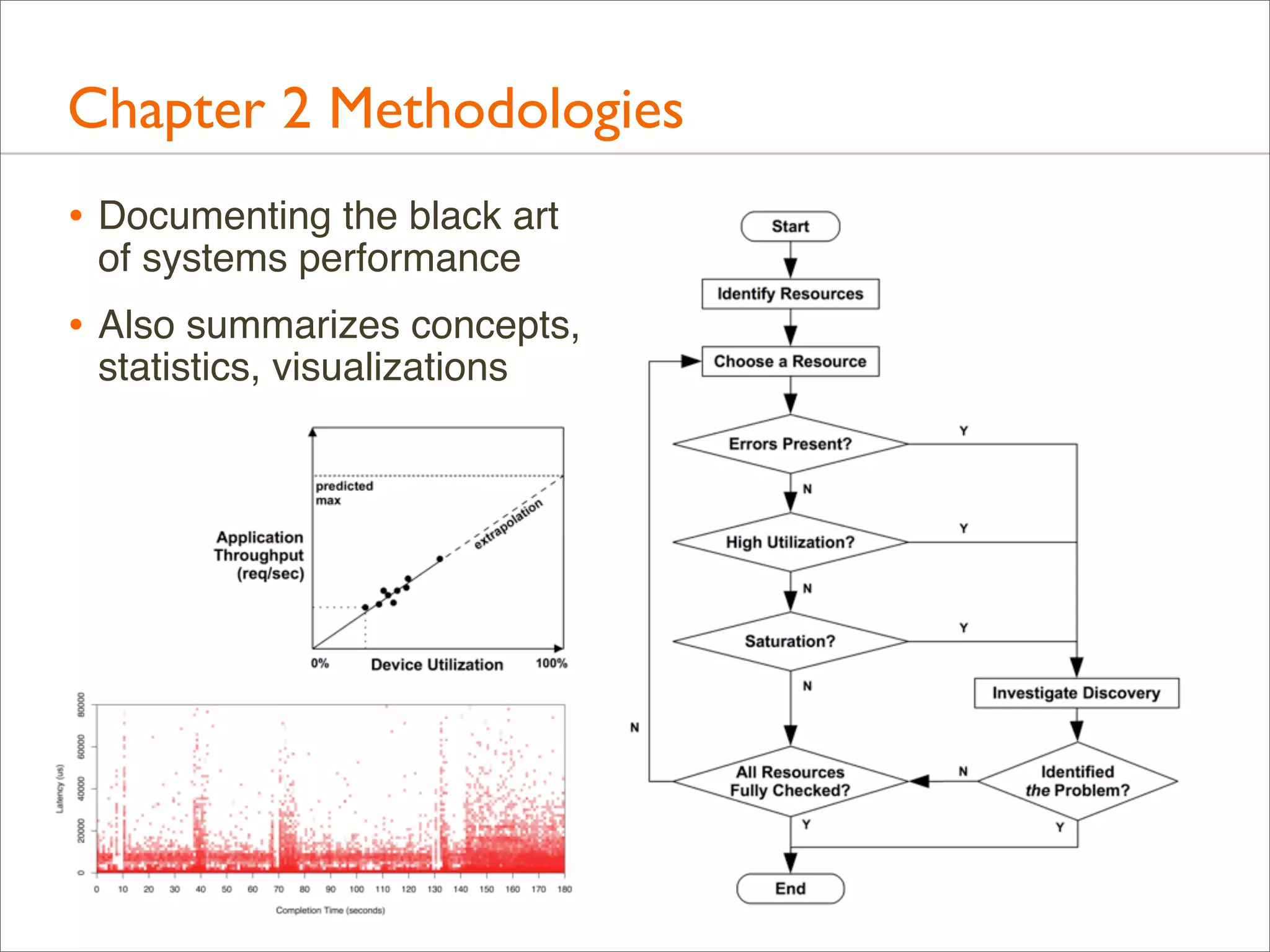
Chapter 2 Methodologies
• Documenting the black art
of systems performance

• Also summarizes concepts,
statistics, visualizations
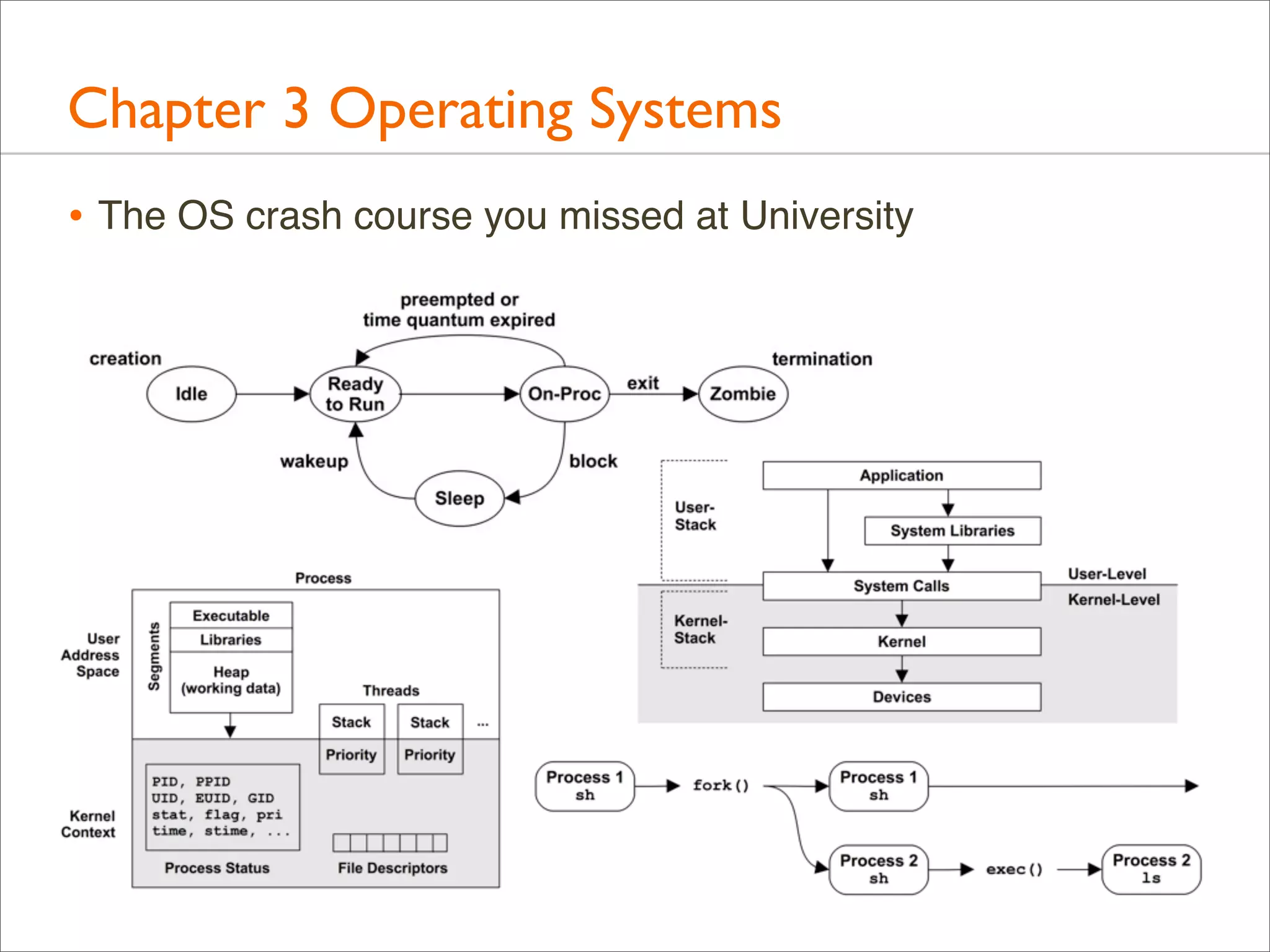
Chapter 3 Operating Systems
• The OS crash course you missed at University
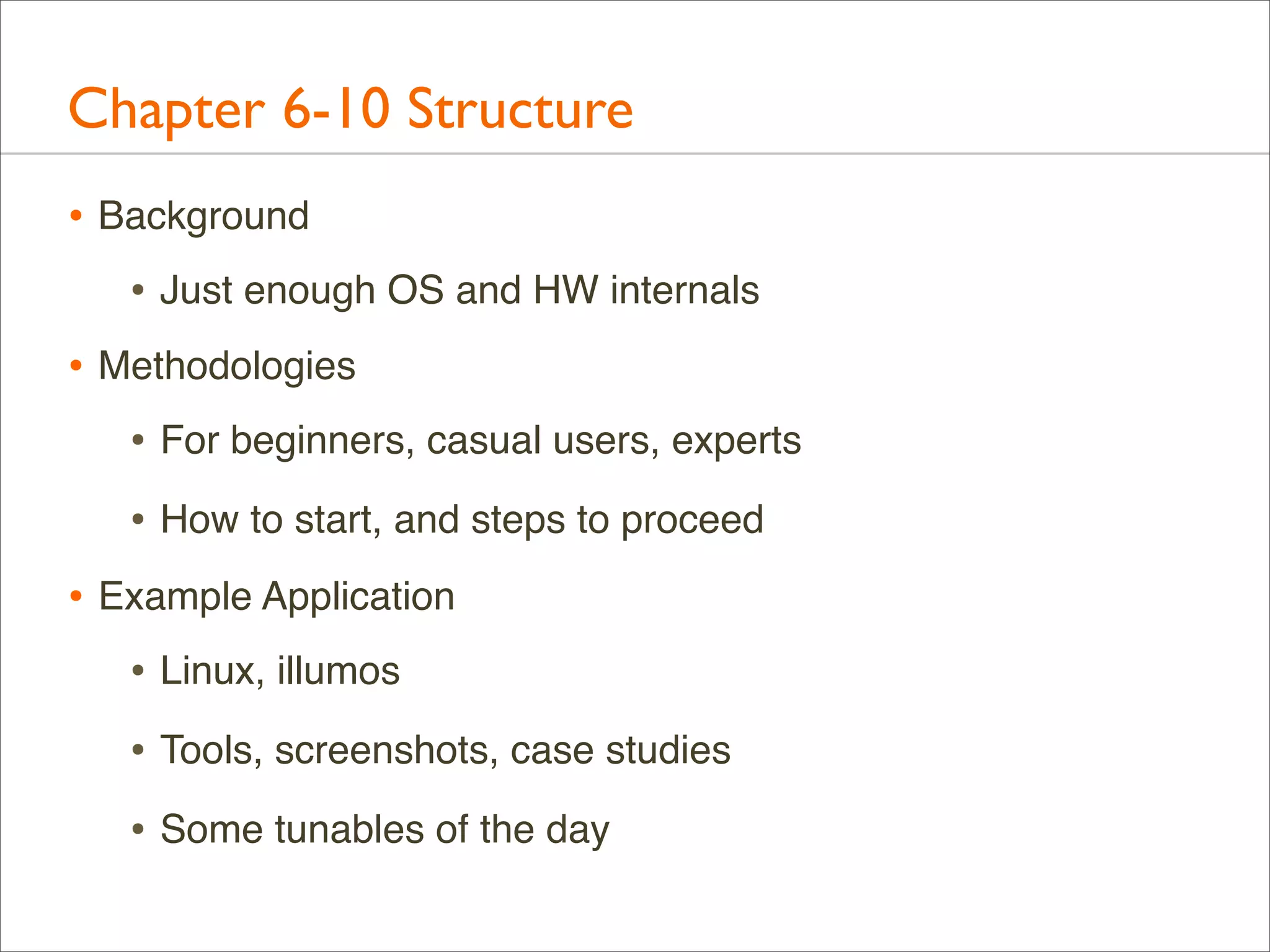
Chapter 6-10 Structure
• Background
• Just enough OS and HW internals
• Methodologies
• For beginners, casual users, experts
• How to start, and steps to proceed
• Example Application
• Linux, illumos
• Tools, screenshots, case studies
• Some tunables of the day
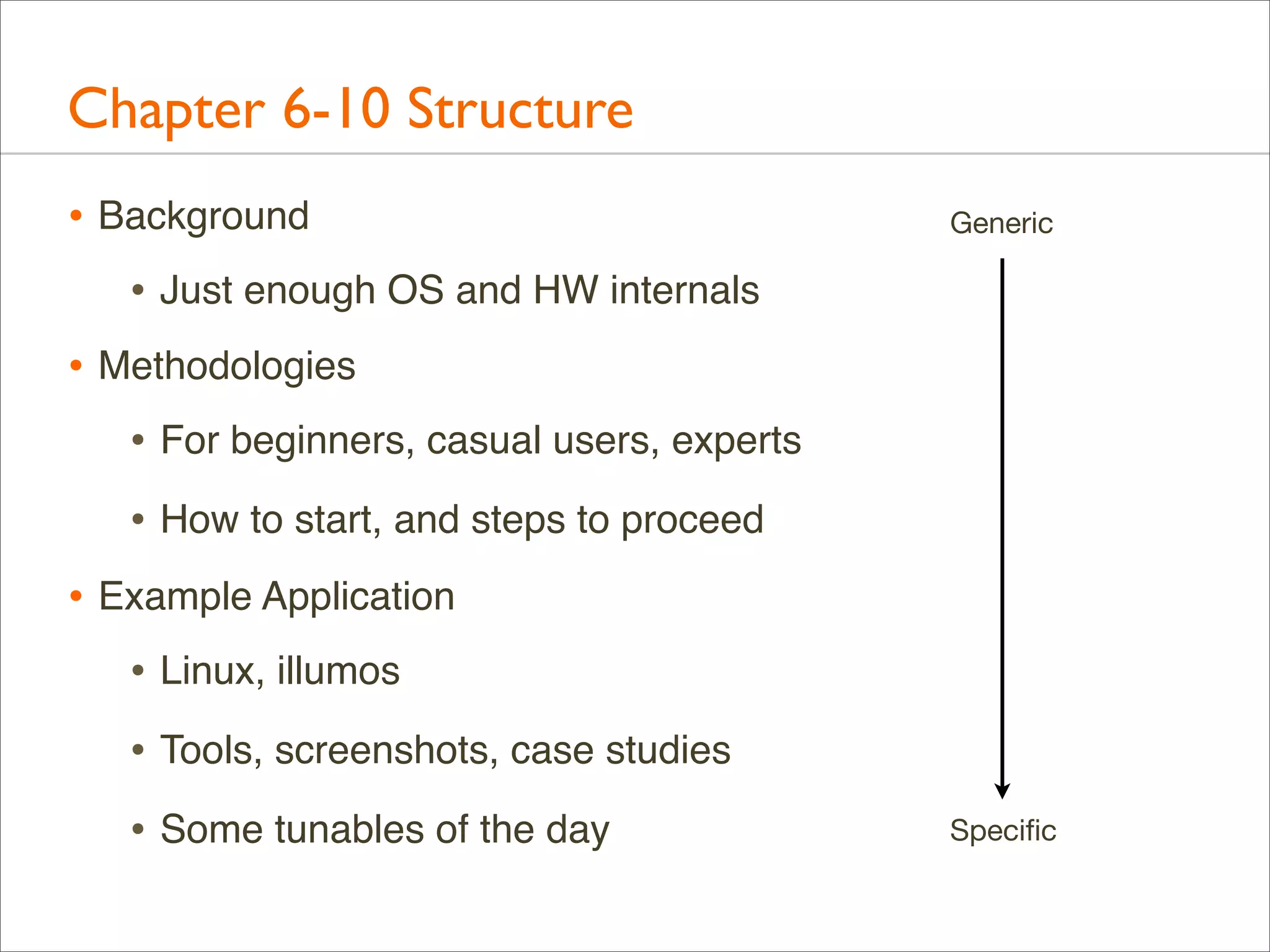
Chapter 6-10 Structure
• Background
• Just enough OS and HW internals

Generic

• Methodologies
• For beginners, casual users, experts
• How to start, and steps to proceed
• Example Application
• Linux, illumos
• Tools, screenshots, case studies
• Some tunables of the day

Specific
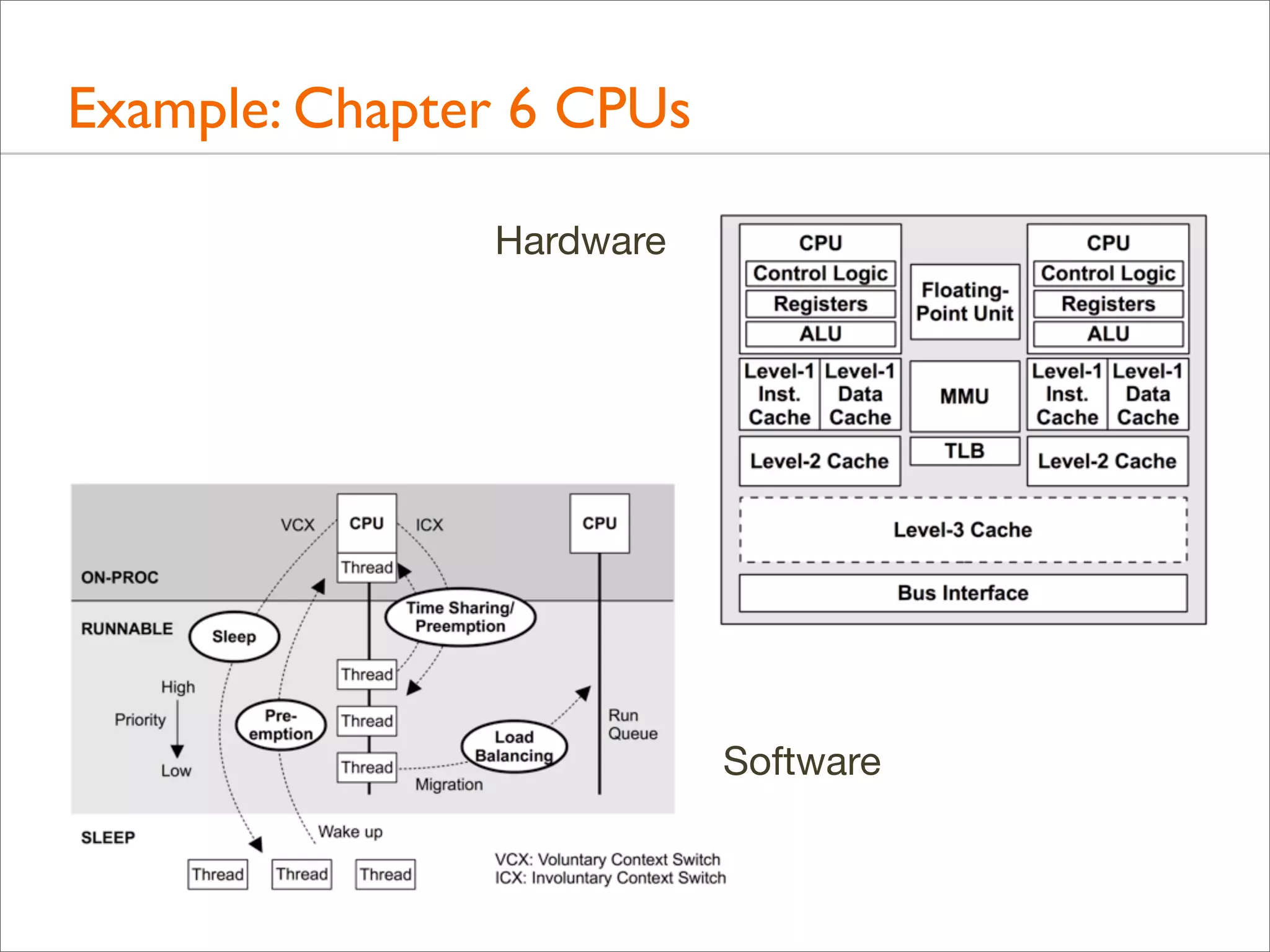
Example: Chapter 6 CPUs
Hardware

Software
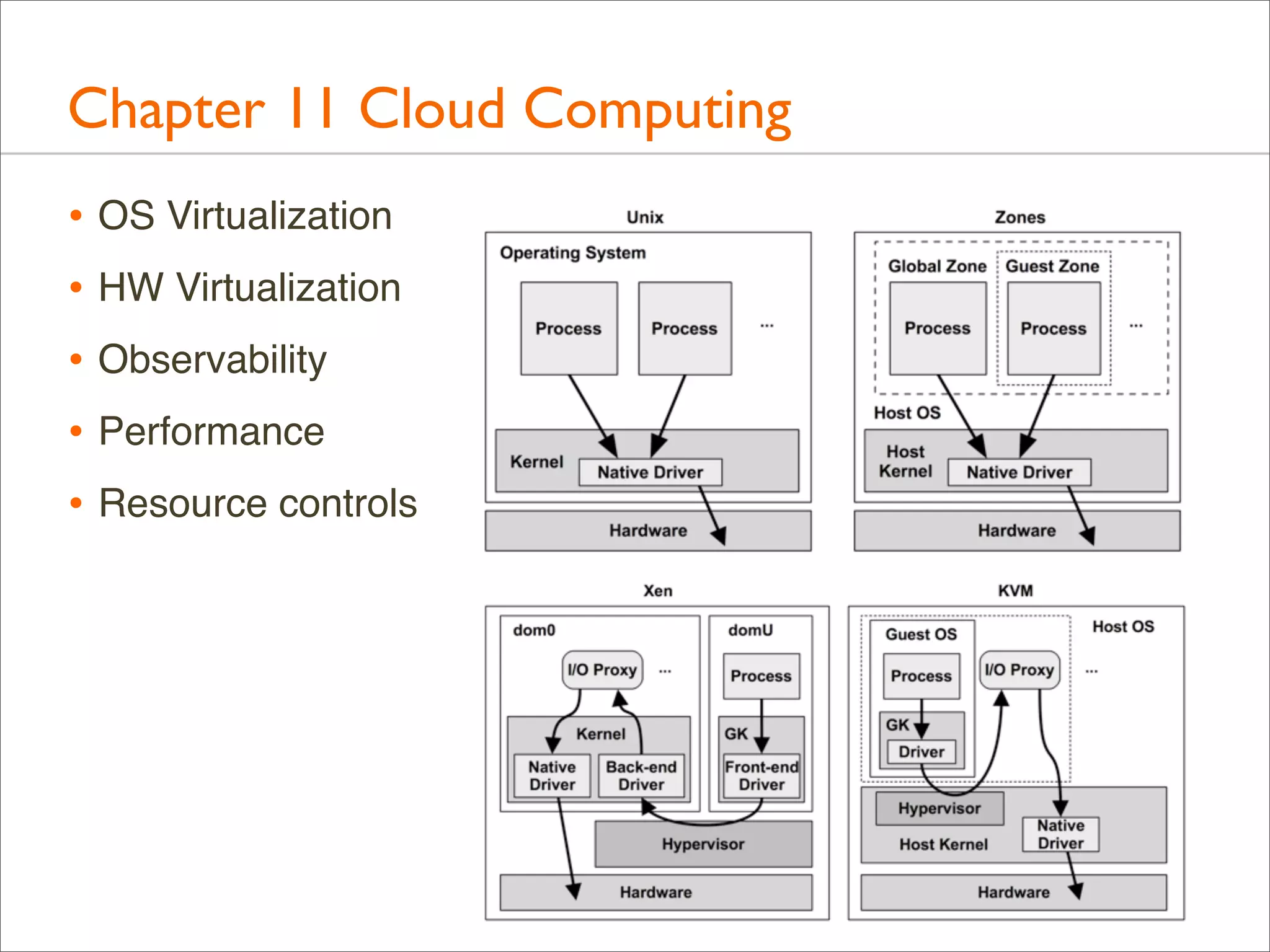
Chapter 11 Cloud Computing
• OS Virtualization
• HW Virtualization
• Observability
• Performance
• Resource controls
Modern Systems Performance
• Comparing 1990’s to 2010’s
1990’s Systems Performance
* Proprietary Unix, closed source, static tools
$ vmstat 1
kthr
memory
r b w
swap free re
0 0 0 8475356 565176 2
1 0 0 7983772 119164 0
0 0 0 8046208 181600 0
[...]

*
*
*
*
*

mf
8
0
0

page
disk
faults
cpu
pi po fr de sr cd cd s0 s5
in
sy
cs us sy id
0 0 0 0 1 0 0 -0 13 378 101 142 0 0 99
0 0 0 0 0 224 0 0 0 1175 5654 1196 1 15 84
0 0 0 0 0 322 0 0 0 1473 6931 1360 1 7 92

Limited metrics and documentation
Some perf issues could not be solved
Analysis methodology constrained by tools
Perf experts used inference and experimentation
Literature is still around
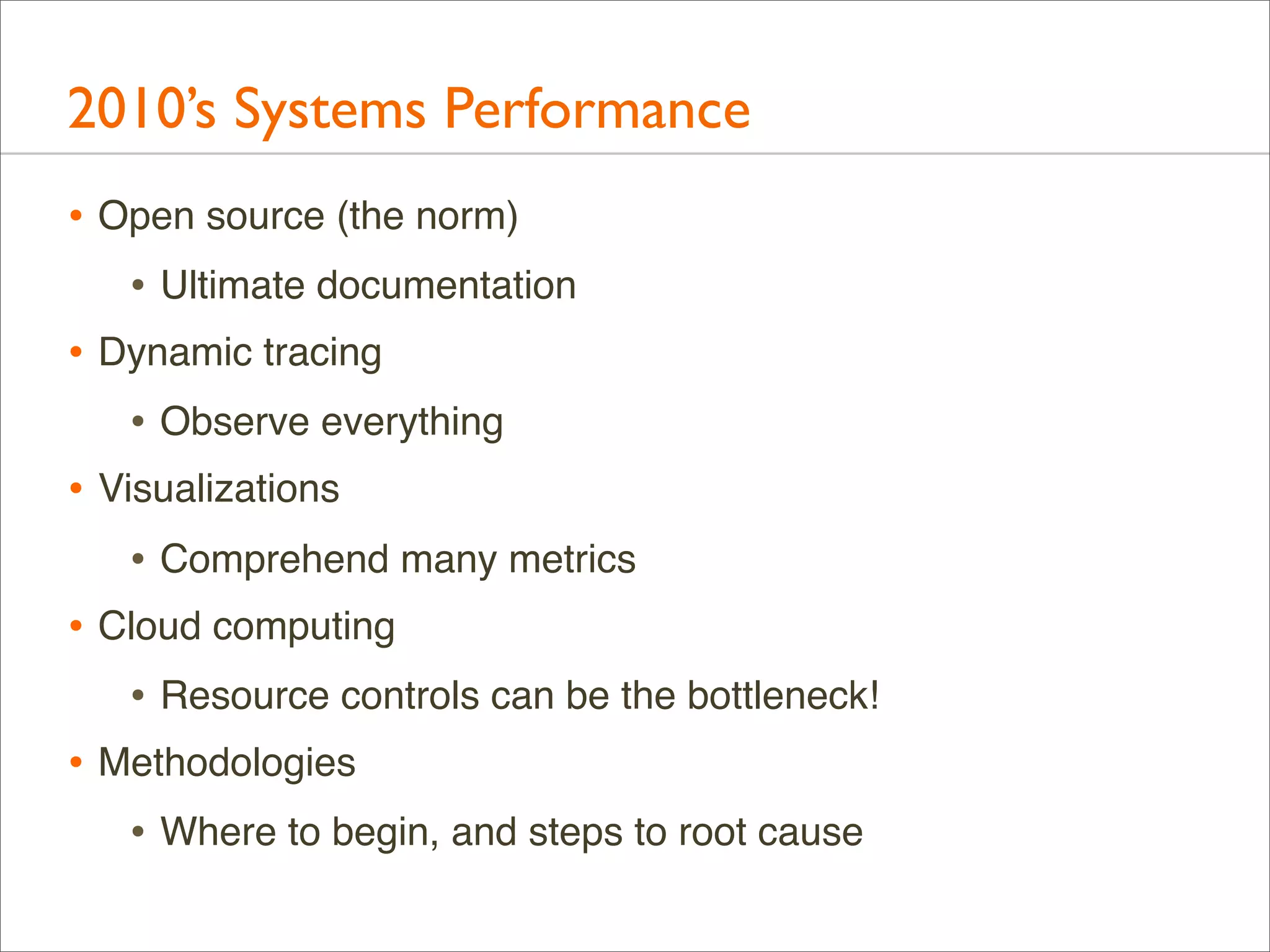
2010’s Systems Performance
• Open source (the norm)
• Ultimate documentation
• Dynamic tracing
• Observe everything
• Visualizations
• Comprehend many metrics
• Cloud computing
• Resource controls can be the bottleneck!
• Methodologies
• Where to begin, and steps to root cause
1990’s Performance Visualizations
Text-based and line graphs
$ iostat -x 1
device
sd0
sd5
sd12
sd12
sd13
sd14
sd15
sd16
nfs6
[...]

r/s
0.0
0.0
0.0
0.0
0.0
0.0
0.0
0.0
0.0

extended device statistics
w/s
kr/s
kw/s wait actv
0.1
5.2
3.9 0.0 0.0
0.0
0.0
0.0 0.0 0.0
0.2
0.2
1.1 0.0 0.0
0.0
0.0
0.0 0.0 0.0
0.0
0.0
0.0 0.0 0.0
0.0
0.0
0.0 0.0 0.0
0.0
0.0
0.0 0.0 0.0
0.0
0.0
0.0 0.0 0.0
0.0
0.0
0.0 0.0 0.0

svc_t
69.8
1.1
3.1
0.0
0.0
1.9
0.0
0.0
0.0

%w
0
0
0
0
0
0
0
0
0

%b
0
0
0
0
0
0
0
0
0
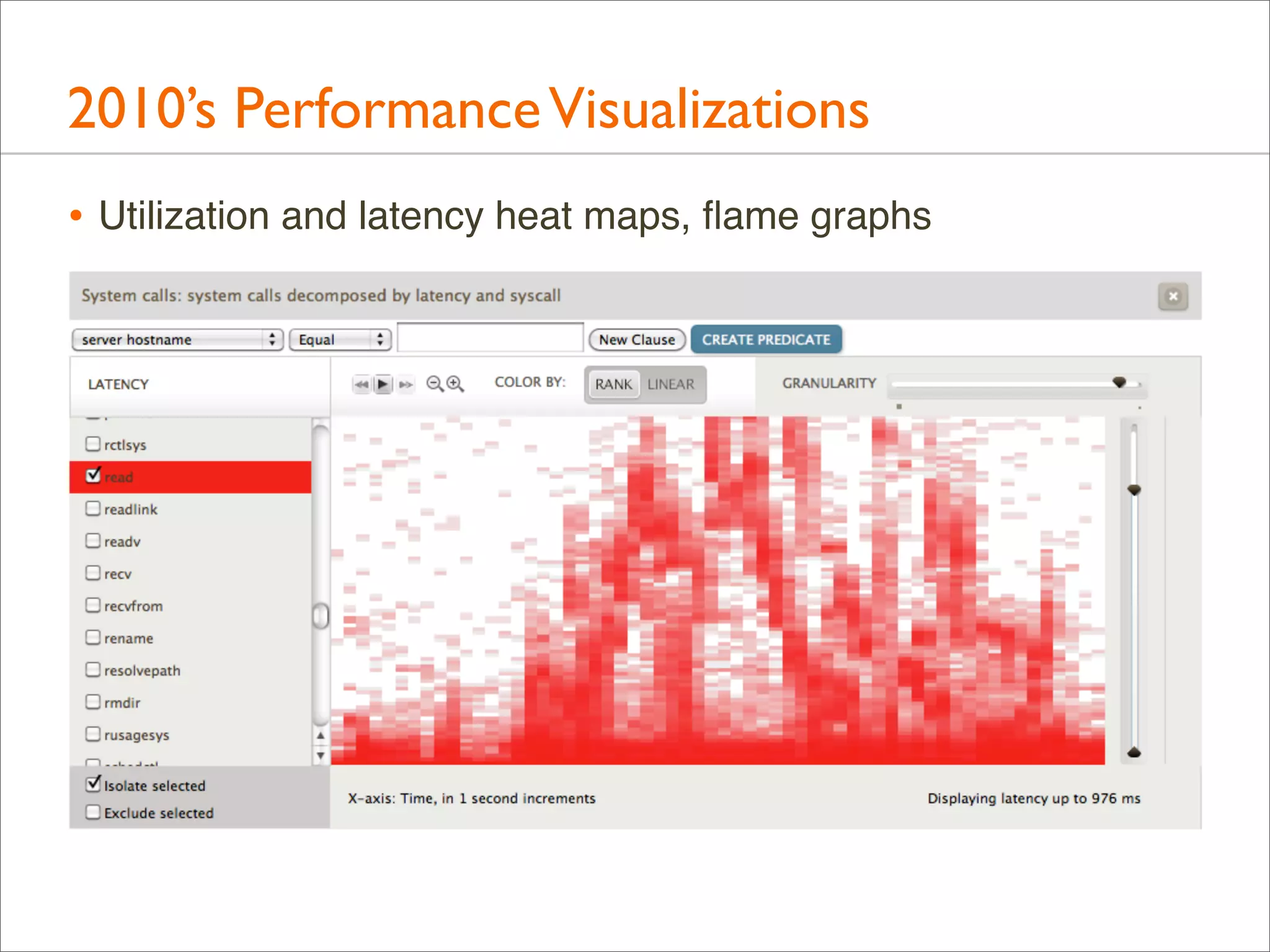
2010’s Performance Visualizations
• Utilization and latency heat maps, flame graphs
Modern Performance Analysis Tools
• Traditional tools
• Plus dynamic tracing to fill in gaps
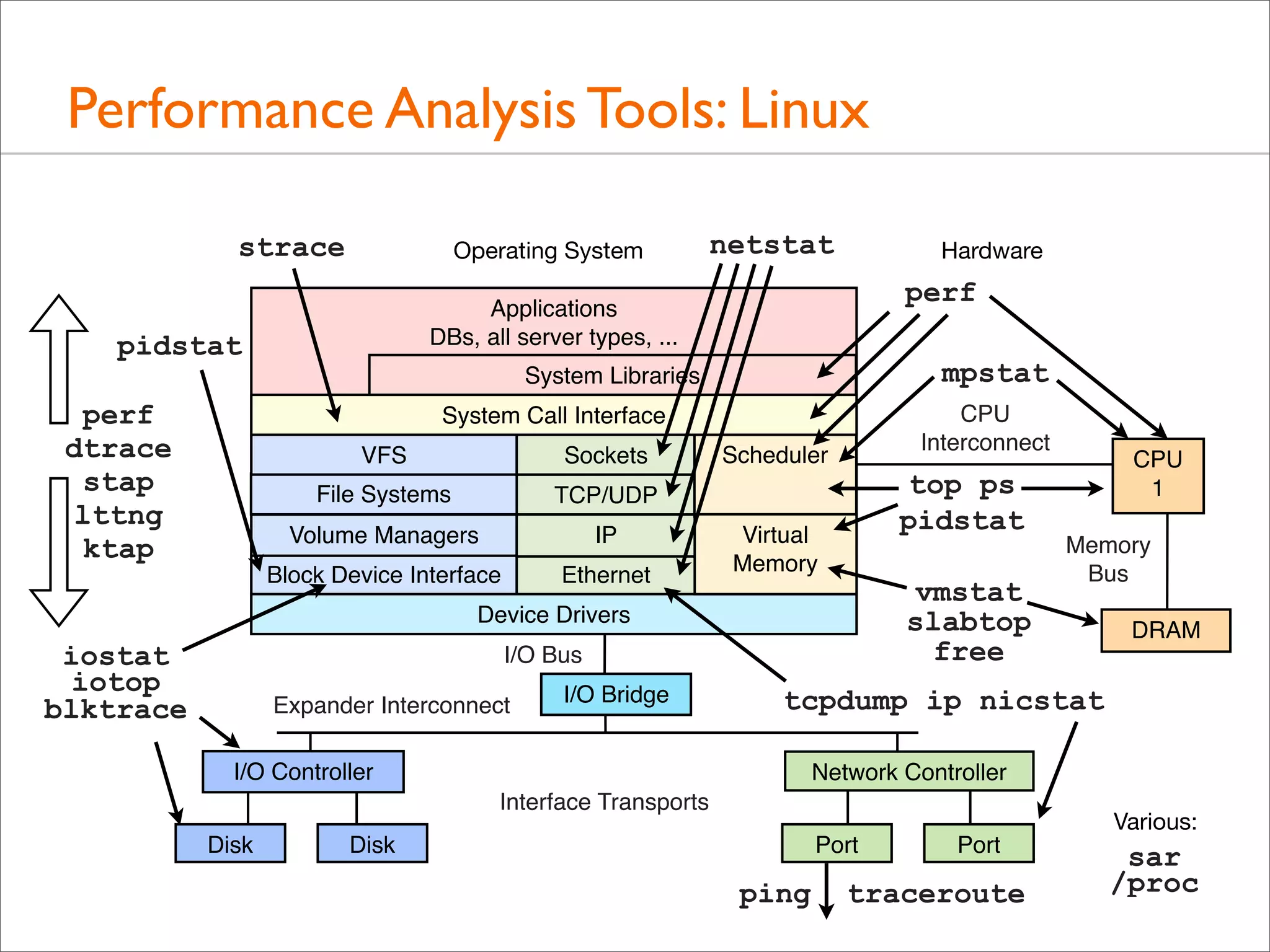
Performance Analysis Tools: Linux
strace

Operating System

netstat

Hardware

perf

Applications
DBs, all server types, ...

pidstat

mpstat

System Libraries

perf
dtrace
stap
lttng
ktap

CPU
Interconnect

System Call Interface
VFS

Sockets

File Systems

TCP/UDP

Volume Managers

IP

Block Device Interface

Ethernet

Scheduler

top ps
pidstat

Virtual
Memory

vmstat
slabtop
free

Device Drivers

iostat
iotop
blktrace

perf
Expander Interconnect

I/O Bus
I/O Bridge

tcpdump

I/O Controller
Disk

Memory
Bus

perf

DRAM

nicstat
ip

Network Controller
Interface Transports

Disk

CPU
1

Various:
Port

Swap

swapon

ping

Port

traceroute

sar
/proc
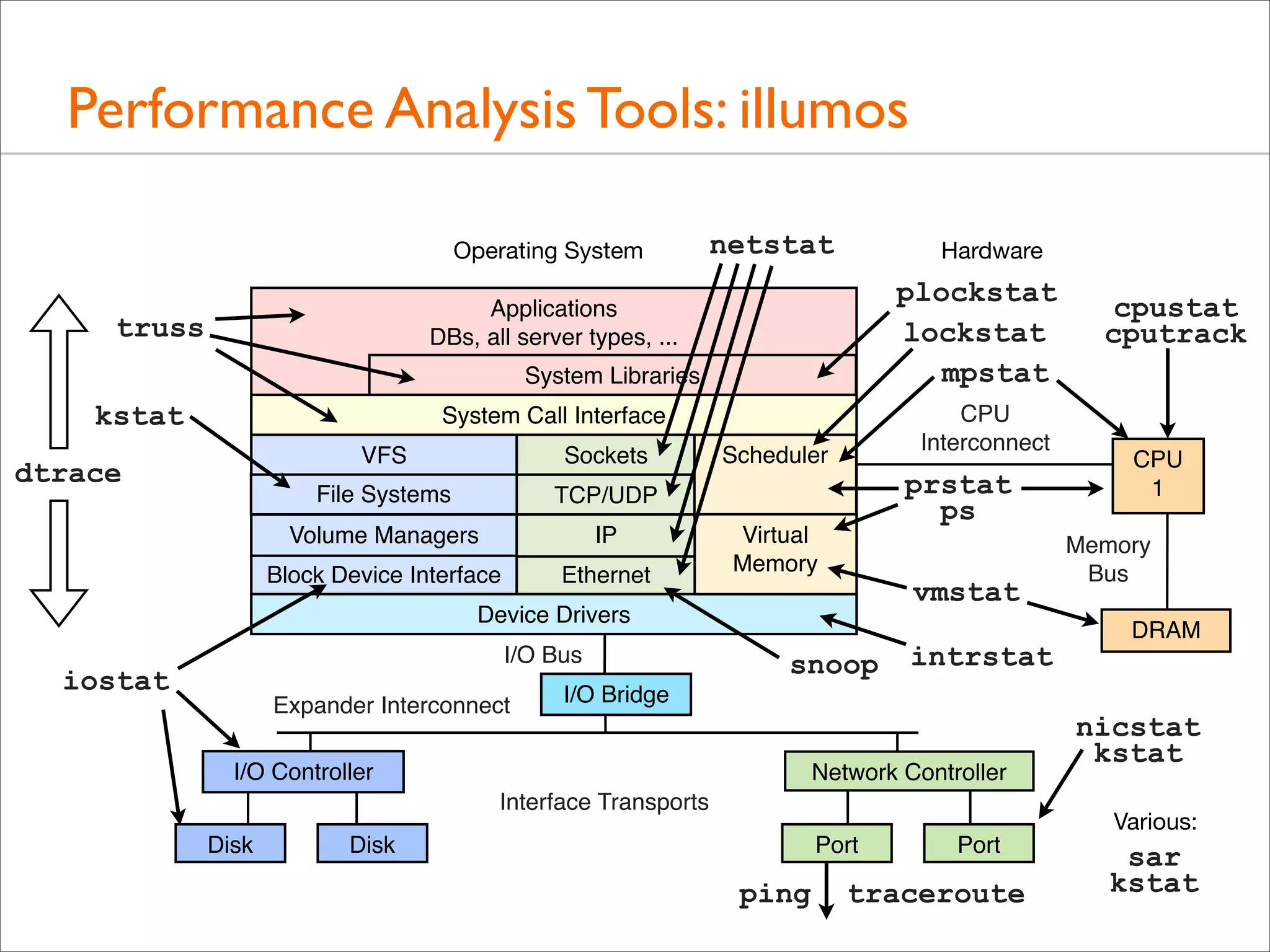
Performance Analysis Tools: illumos
Operating System

netstat

Hardware

plockstat
lockstat
mpstat

Applications
DBs, all server types, ...

truss

System Libraries

kstat

CPU
Interconnect

System Call Interface
VFS
File Systems

IP

Block Device Interface

Ethernet

Scheduler

TCP/UDP

Volume Managers

dtrace

Sockets

prstat
ps

Virtual
Memory

vmstat

Device Drivers

cpustat

iostat

Expander Interconnect

I/O Bus

snoop

intrstat

I/O Bridge

Memory
Bus
DRAM

Network Controller
Interface Transports

Disk

CPU
1

nicstat
kstat

I/O Controller
Disk

cpustat
cputrack

Various:
Port

Swap

swap

ping

Port

traceroute

sar
kstat
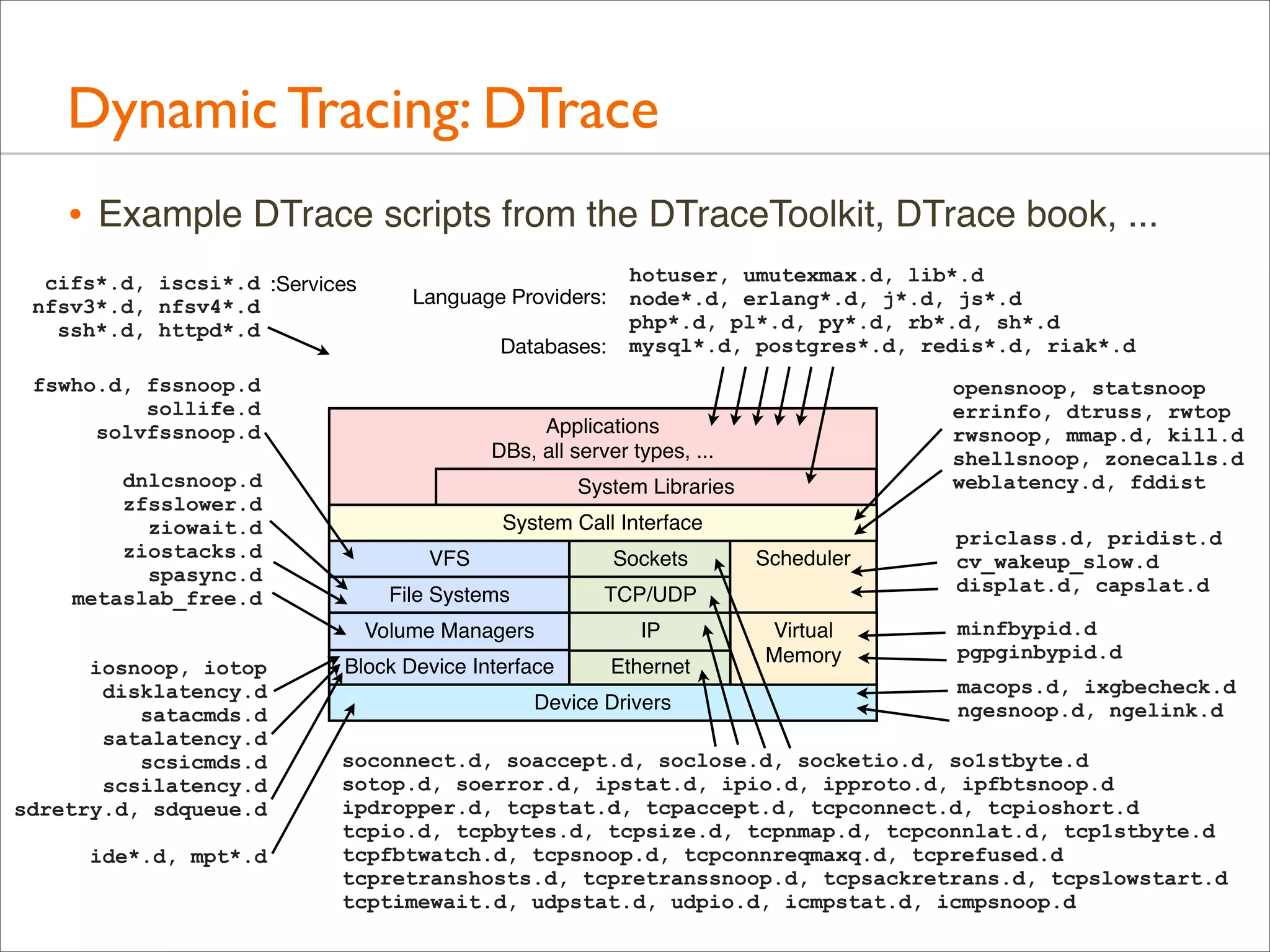
Dynamic Tracing: DTrace
•

Example DTrace scripts from the DTraceToolkit, DTrace book, ...

cifs*.d, iscsi*.d :Services
nfsv3*.d, nfsv4*.d
ssh*.d, httpd*.d

Language Providers:
Databases:

fswho.d, fssnoop.d
sollife.d
solvfssnoop.d
dnlcsnoop.d
zfsslower.d
ziowait.d
ziostacks.d
spasync.d
metaslab_free.d

hotuser, umutexmax.d, lib*.d
node*.d, erlang*.d, j*.d, js*.d
php*.d, pl*.d, py*.d, rb*.d, sh*.d
mysql*.d, postgres*.d, redis*.d, riak*.d

Applications
DBs, all server types, ...
System Libraries
System Call Interface

ide*.d, mpt*.d

VFS

Sockets

File Systems

IP

Block Device Interface

Ethernet

Scheduler

TCP/UDP

Volume Managers
iosnoop, iotop
disklatency.d
satacmds.d
satalatency.d
scsicmds.d
scsilatency.d
sdretry.d, sdqueue.d

opensnoop, statsnoop
errinfo, dtruss, rwtop
rwsnoop, mmap.d, kill.d
shellsnoop, zonecalls.d
weblatency.d, fddist

Device Drivers

Virtual
Memory

priclass.d, pridist.d
cv_wakeup_slow.d
displat.d, capslat.d
minfbypid.d
pgpginbypid.d
macops.d, ixgbecheck.d
ngesnoop.d, ngelink.d

soconnect.d, soaccept.d, soclose.d, socketio.d, so1stbyte.d
sotop.d, soerror.d, ipstat.d, ipio.d, ipproto.d, ipfbtsnoop.d
ipdropper.d, tcpstat.d, tcpaccept.d, tcpconnect.d, tcpioshort.d
tcpio.d, tcpbytes.d, tcpsize.d, tcpnmap.d, tcpconnlat.d, tcp1stbyte.d
tcpfbtwatch.d, tcpsnoop.d, tcpconnreqmaxq.d, tcprefused.d
tcpretranshosts.d, tcpretranssnoop.d, tcpsackretrans.d, tcpslowstart.d
tcptimewait.d, udpstat.d, udpio.d, icmpstat.d, icmpsnoop.d
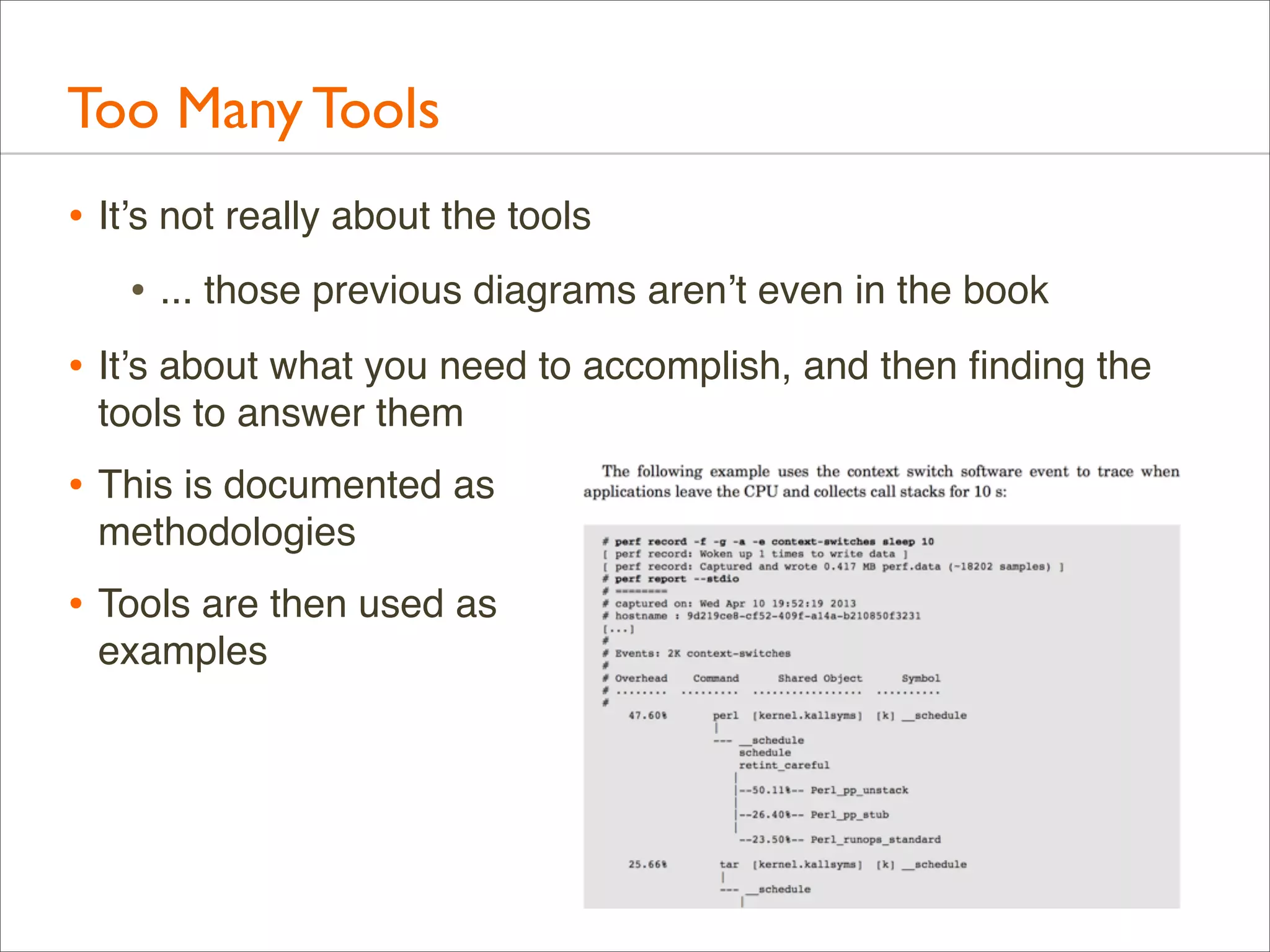
Too Many Tools
• It’s not really about the tools
• ... those previous diagrams aren’t even in the book
• It’s about what you need to accomplish, and then finding the
tools to answer them

• This is documented as
methodologies

• Tools are then used as
examples
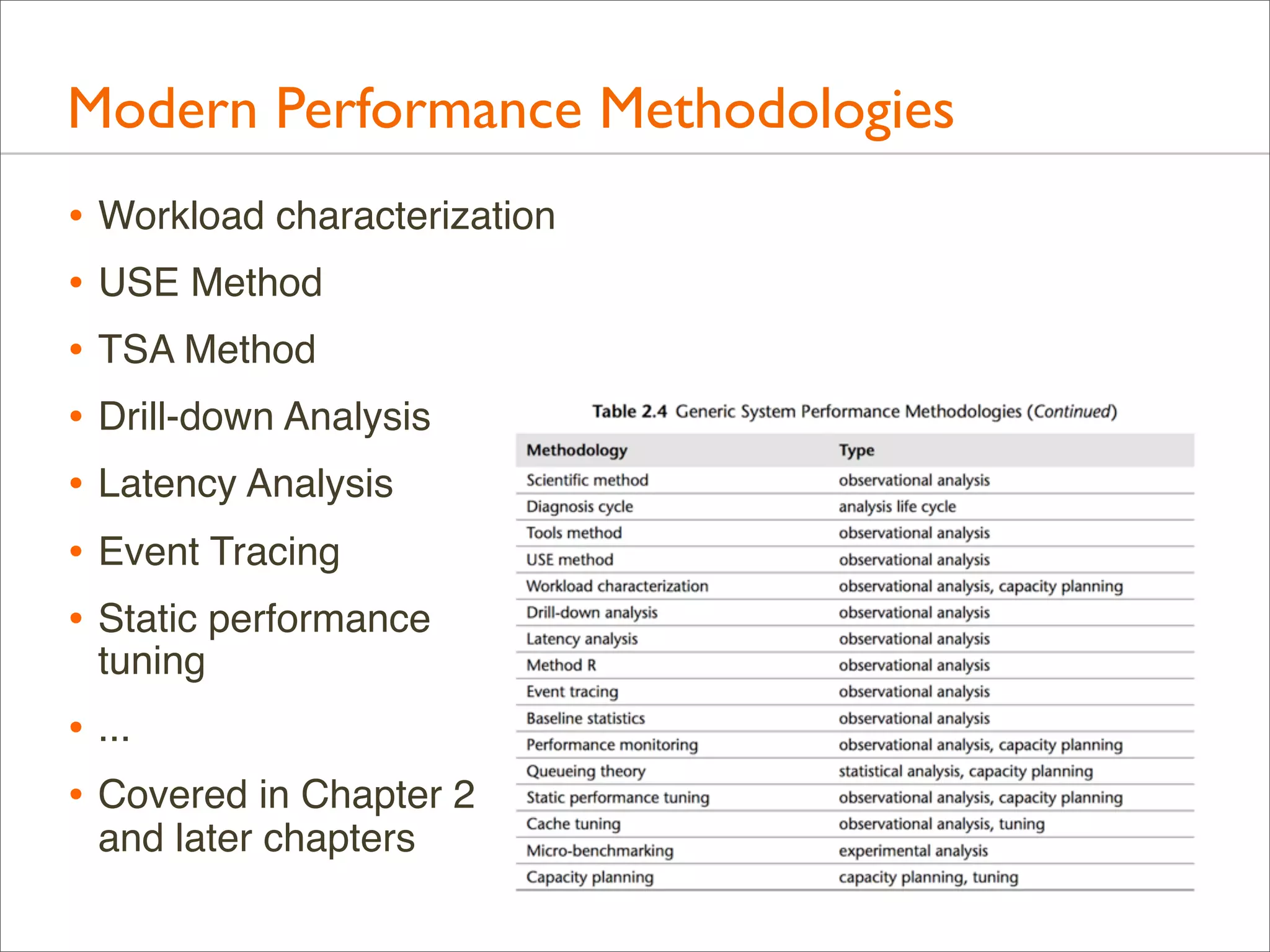
Modern Performance Methodologies
• Workload characterization
• USE Method
• TSA Method
• Drill-down Analysis
• Latency Analysis
• Event Tracing
• Static performance
tuning

• ...
• Covered in Chapter 2
and later chapters
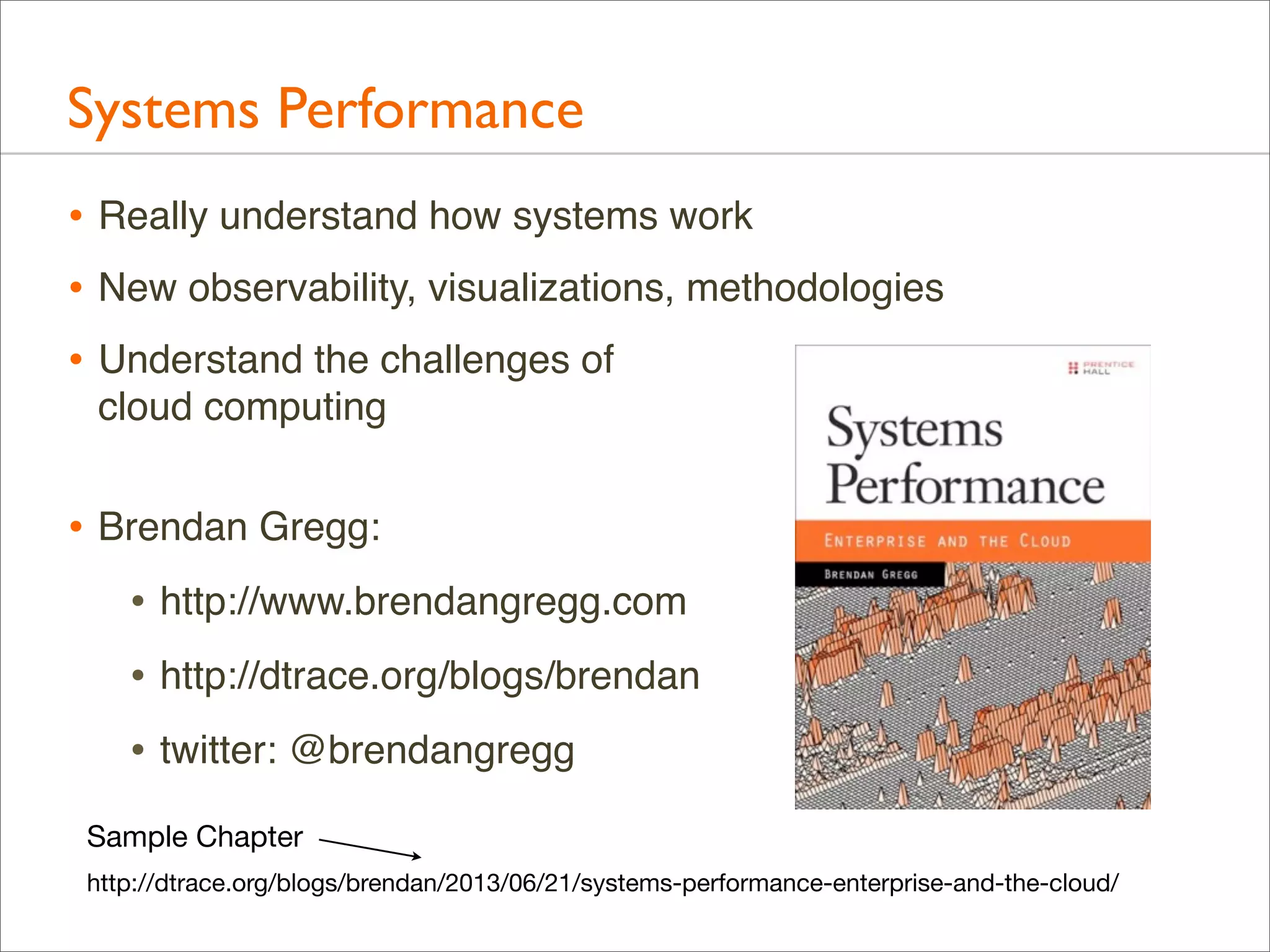
Systems Performance
• Really understand how systems work
• New observability, visualizations, methodologies
• Understand the challenges of
cloud computing

• Brendan Gregg:
• http://www.brendangregg.com
• http://dtrace.org/blogs/brendan
• twitter: @brendangregg
Sample Chapter
http://dtrace.org/blogs/brendan/2013/06/21/systems-performance-enterprise-and-the-cloud/

Systems Performance: Enterprise and the Cloud

  • 1.
  • 2.
    Systems Performance • Analysisof apps to metal. Think LAMP not AMP. • An activity for everyone: from casual to full time. Operating System • The basis is the system Applications • The target is System Libraries System Call Interface everything can cause performance problems Kernel • All software VFS Sockets File Systems TCP/UDP Volume Managers IP Block Device Interface Ethernet Device Drivers Resource Controls Firmware Metal Scheduler Virtual Memory
  • 3.
    Systems Performance: Enterpriseand the Cloud • Brendan Gregg (and many others); Prentice Hall, 2013 • 635 pages of chapters, plus appendices, etc • Background, methodologies, examples • Examples from: • Linux (Ubuntu, Fedora, CentOS) • illumos (SmartOS, OmniOS) • Audience: • Sysadmins, developers, everyone • Enterprise and cloud environments
  • 4.
    The Author: BrendanGregg • Currently at Joyent, previously Brendan@Sun, then Oracle • Lead Performance Engineer: debugs perf on SmartOS/Linux/ Windows daily, small to large cloud environments, any layer of the software stack, down to firmware and metal. Previously a kernel engineer, performance consultant, trainer. • Written hundreds of published perf tools (too many), including the original iosnoop, iotop, execsnoop, nicstat, psio, etc. • Created visualizations: heat maps for various uses, flame graphs, frequency trails, cloud process graphs • Developed methodologies: USE method, TSA method • Co-authored books: DTrace, Solaris Performance and Tools
  • 5.
    Goals • Modern systemsperformance: including cloud computing, dynamic tracing, visualizations, open source • Accessible to a wide audience • Help you maximize system and application performance • Quickly diagnose performance issues: eg, outilers • Turn unknown unknowns into known unknowns – actionable • 10+ year shelf life: document concepts and methodology first, with tools and tunables of the day as examples of application
  • 6.
    Personal Motivation • Theneed for a good reference for: • Internal Joyent staff • External customers • IT at large • As a reference for classes • I’ve been teaching professional classes in system administration and performance on and off since 2001 • I’ve learned a lot from teaching students to solve real performance problems, to see what works, what doesn’t • I’ve been using this book already for teaching the Joyent cloud performance class: http://joyent.com/training, next class Nov 18th 2013
  • 7.
    Table of Contents •1. Intro • 2. Methodology • 3. Operating Systems • 4. Observability Tools • 5. Applications • 6. CPUs • 7. Memory • 8. File Systems • 9. Disks • 10. Network • 11. Cloud Computing • 12. Benchmarking • 13. Case Study • Apx.A. USE Linux • Apx.B. USE Solaris • Apx.C. sar Summary • Apx.D. DTrace one-liners • Apx.E. DTrace to SystemTap • Apx.F. Solutions to Selected Ex. • Apx.G. Who's Who • Glossary • Index
  • 8.
    Highlights: • Chapter 2Methodologies: • Many documented for the first time; some created by me • Chapter 3 Operating Systems: • 30 page summary of OS internals • Chapter 6-10: CPUs, Memory, FS, Disks, Network • Background, methodology, tools • Chapter 11: Cloud Computing • Different technologies and their performance • Chapter 12: Benchmarking • For the good of the industry. Please, everyone, read this.
  • 9.
    Chapter 2 Methodologies •Documenting the black art of systems performance • Also summarizes concepts, statistics, visualizations
  • 10.
    Chapter 3 OperatingSystems • The OS crash course you missed at University
  • 11.
    Chapter 6-10 Structure •Background • Just enough OS and HW internals • Methodologies • For beginners, casual users, experts • How to start, and steps to proceed • Example Application • Linux, illumos • Tools, screenshots, case studies • Some tunables of the day
  • 12.
    Chapter 6-10 Structure •Background • Just enough OS and HW internals Generic • Methodologies • For beginners, casual users, experts • How to start, and steps to proceed • Example Application • Linux, illumos • Tools, screenshots, case studies • Some tunables of the day Specific
  • 13.
    Example: Chapter 6CPUs Hardware Software
  • 14.
    Chapter 11 CloudComputing • OS Virtualization • HW Virtualization • Observability • Performance • Resource controls
  • 15.
    Modern Systems Performance •Comparing 1990’s to 2010’s
  • 16.
    1990’s Systems Performance *Proprietary Unix, closed source, static tools $ vmstat 1 kthr memory r b w swap free re 0 0 0 8475356 565176 2 1 0 0 7983772 119164 0 0 0 0 8046208 181600 0 [...] * * * * * mf 8 0 0 page disk faults cpu pi po fr de sr cd cd s0 s5 in sy cs us sy id 0 0 0 0 1 0 0 -0 13 378 101 142 0 0 99 0 0 0 0 0 224 0 0 0 1175 5654 1196 1 15 84 0 0 0 0 0 322 0 0 0 1473 6931 1360 1 7 92 Limited metrics and documentation Some perf issues could not be solved Analysis methodology constrained by tools Perf experts used inference and experimentation Literature is still around
  • 17.
    2010’s Systems Performance •Open source (the norm) • Ultimate documentation • Dynamic tracing • Observe everything • Visualizations • Comprehend many metrics • Cloud computing • Resource controls can be the bottleneck! • Methodologies • Where to begin, and steps to root cause
  • 18.
    1990’s Performance Visualizations Text-basedand line graphs $ iostat -x 1 device sd0 sd5 sd12 sd12 sd13 sd14 sd15 sd16 nfs6 [...] r/s 0.0 0.0 0.0 0.0 0.0 0.0 0.0 0.0 0.0 extended device statistics w/s kr/s kw/s wait actv 0.1 5.2 3.9 0.0 0.0 0.0 0.0 0.0 0.0 0.0 0.2 0.2 1.1 0.0 0.0 0.0 0.0 0.0 0.0 0.0 0.0 0.0 0.0 0.0 0.0 0.0 0.0 0.0 0.0 0.0 0.0 0.0 0.0 0.0 0.0 0.0 0.0 0.0 0.0 0.0 0.0 0.0 0.0 0.0 0.0 svc_t 69.8 1.1 3.1 0.0 0.0 1.9 0.0 0.0 0.0 %w 0 0 0 0 0 0 0 0 0 %b 0 0 0 0 0 0 0 0 0
  • 19.
    2010’s Performance Visualizations •Utilization and latency heat maps, flame graphs
  • 20.
    Modern Performance AnalysisTools • Traditional tools • Plus dynamic tracing to fill in gaps
  • 21.
    Performance Analysis Tools:Linux strace Operating System netstat Hardware perf Applications DBs, all server types, ... pidstat mpstat System Libraries perf dtrace stap lttng ktap CPU Interconnect System Call Interface VFS Sockets File Systems TCP/UDP Volume Managers IP Block Device Interface Ethernet Scheduler top ps pidstat Virtual Memory vmstat slabtop free Device Drivers iostat iotop blktrace perf Expander Interconnect I/O Bus I/O Bridge tcpdump I/O Controller Disk Memory Bus perf DRAM nicstat ip Network Controller Interface Transports Disk CPU 1 Various: Port Swap swapon ping Port traceroute sar /proc
  • 22.
    Performance Analysis Tools:illumos Operating System netstat Hardware plockstat lockstat mpstat Applications DBs, all server types, ... truss System Libraries kstat CPU Interconnect System Call Interface VFS File Systems IP Block Device Interface Ethernet Scheduler TCP/UDP Volume Managers dtrace Sockets prstat ps Virtual Memory vmstat Device Drivers cpustat iostat Expander Interconnect I/O Bus snoop intrstat I/O Bridge Memory Bus DRAM Network Controller Interface Transports Disk CPU 1 nicstat kstat I/O Controller Disk cpustat cputrack Various: Port Swap swap ping Port traceroute sar kstat
  • 23.
    Dynamic Tracing: DTrace • ExampleDTrace scripts from the DTraceToolkit, DTrace book, ... cifs*.d, iscsi*.d :Services nfsv3*.d, nfsv4*.d ssh*.d, httpd*.d Language Providers: Databases: fswho.d, fssnoop.d sollife.d solvfssnoop.d dnlcsnoop.d zfsslower.d ziowait.d ziostacks.d spasync.d metaslab_free.d hotuser, umutexmax.d, lib*.d node*.d, erlang*.d, j*.d, js*.d php*.d, pl*.d, py*.d, rb*.d, sh*.d mysql*.d, postgres*.d, redis*.d, riak*.d Applications DBs, all server types, ... System Libraries System Call Interface ide*.d, mpt*.d VFS Sockets File Systems IP Block Device Interface Ethernet Scheduler TCP/UDP Volume Managers iosnoop, iotop disklatency.d satacmds.d satalatency.d scsicmds.d scsilatency.d sdretry.d, sdqueue.d opensnoop, statsnoop errinfo, dtruss, rwtop rwsnoop, mmap.d, kill.d shellsnoop, zonecalls.d weblatency.d, fddist Device Drivers Virtual Memory priclass.d, pridist.d cv_wakeup_slow.d displat.d, capslat.d minfbypid.d pgpginbypid.d macops.d, ixgbecheck.d ngesnoop.d, ngelink.d soconnect.d, soaccept.d, soclose.d, socketio.d, so1stbyte.d sotop.d, soerror.d, ipstat.d, ipio.d, ipproto.d, ipfbtsnoop.d ipdropper.d, tcpstat.d, tcpaccept.d, tcpconnect.d, tcpioshort.d tcpio.d, tcpbytes.d, tcpsize.d, tcpnmap.d, tcpconnlat.d, tcp1stbyte.d tcpfbtwatch.d, tcpsnoop.d, tcpconnreqmaxq.d, tcprefused.d tcpretranshosts.d, tcpretranssnoop.d, tcpsackretrans.d, tcpslowstart.d tcptimewait.d, udpstat.d, udpio.d, icmpstat.d, icmpsnoop.d
  • 24.
    Too Many Tools •It’s not really about the tools • ... those previous diagrams aren’t even in the book • It’s about what you need to accomplish, and then finding the tools to answer them • This is documented as methodologies • Tools are then used as examples
  • 25.
    Modern Performance Methodologies •Workload characterization • USE Method • TSA Method • Drill-down Analysis • Latency Analysis • Event Tracing • Static performance tuning • ... • Covered in Chapter 2 and later chapters
  • 26.
    Systems Performance • Reallyunderstand how systems work • New observability, visualizations, methodologies • Understand the challenges of cloud computing • Brendan Gregg: • http://www.brendangregg.com • http://dtrace.org/blogs/brendan • twitter: @brendangregg Sample Chapter http://dtrace.org/blogs/brendan/2013/06/21/systems-performance-enterprise-and-the-cloud/