
Ā© K.Becker
CNIE 2014
Gamification
a Different
Paradigm of
Pedagogy
Katrin Becker
5: Thur. May 15 11:30-12:30
Ā© K.Becker
CNIE 2014
1. What am I playing now?
2. A New Paradigm of Education?
3. How Does Gamification Fit?
4. Gamification is NOT New
5. Gamification IS New
6. Is Gamification a Different Paradigm?
7. Resources
Outline
Gamification: A Different Paradigm of Pedagogy 2
Ā© K.Becker
CNIE 2014
Katrin Becker,
PhD
Who Am I?
Ā© K.Becker
CNIE 2014
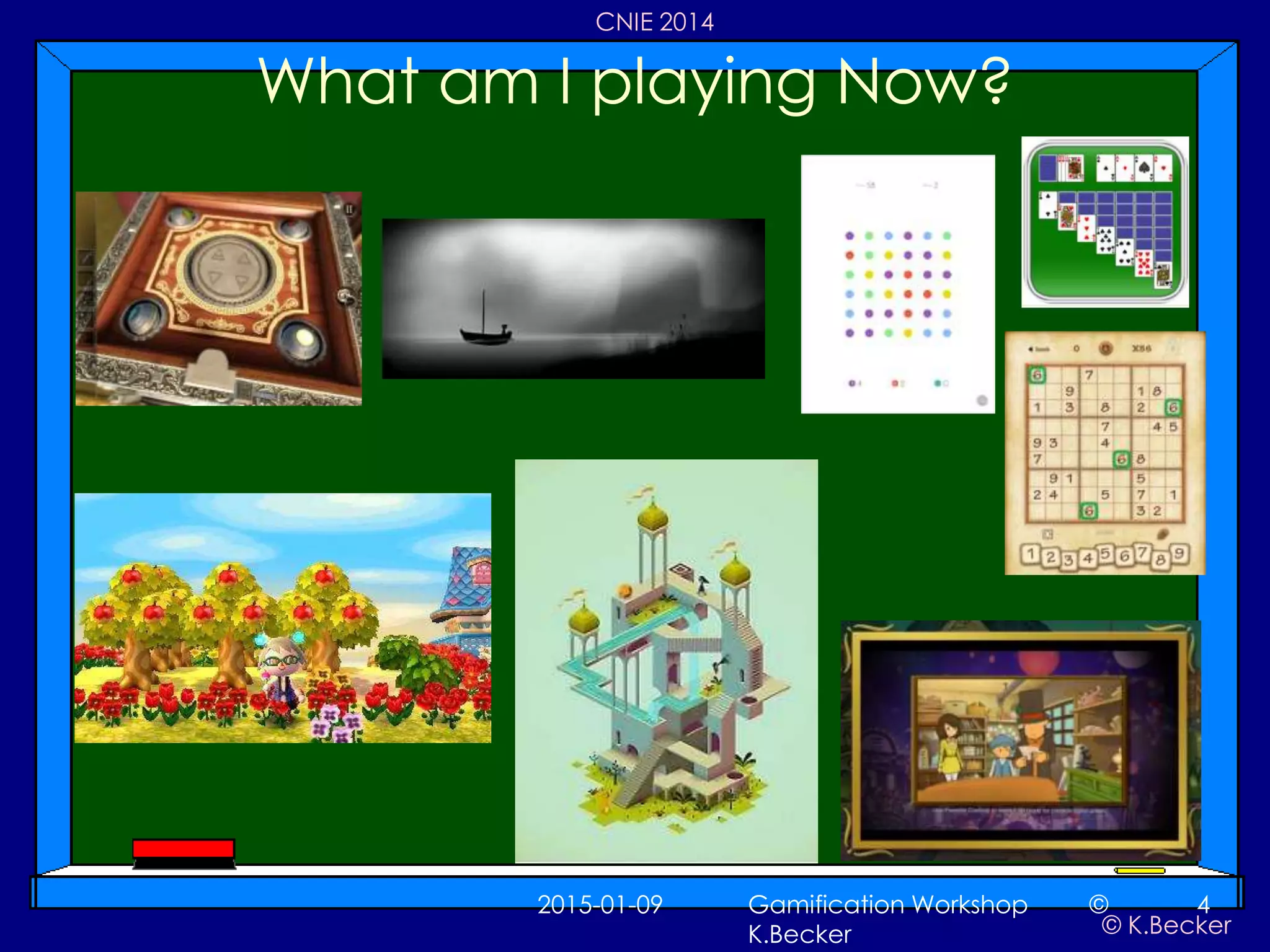
What am I playing Now?
2015-01-09 Gamification Workshop Ā©
K.Becker
4
Ā© K.Becker
CNIE 2014
ļ‚§ Childcare so parents can work.
ļ‚§ Socialization (Entrainment to authority)
ļ‚§ Creation of an efficient underclass of
workers.
ļ‚§ Teaching Good Test-Taking Behavior
ļ‚§ Schools are:
ļ‚§ hierarchical
ļ‚§ authoritarian
ļ‚§ do not encourage personal agency
What are Schools For?
Gamification: A Different Paradigm of Pedagogy 5
Brenda Laurel
Ā© K.Becker
CNIE 2014
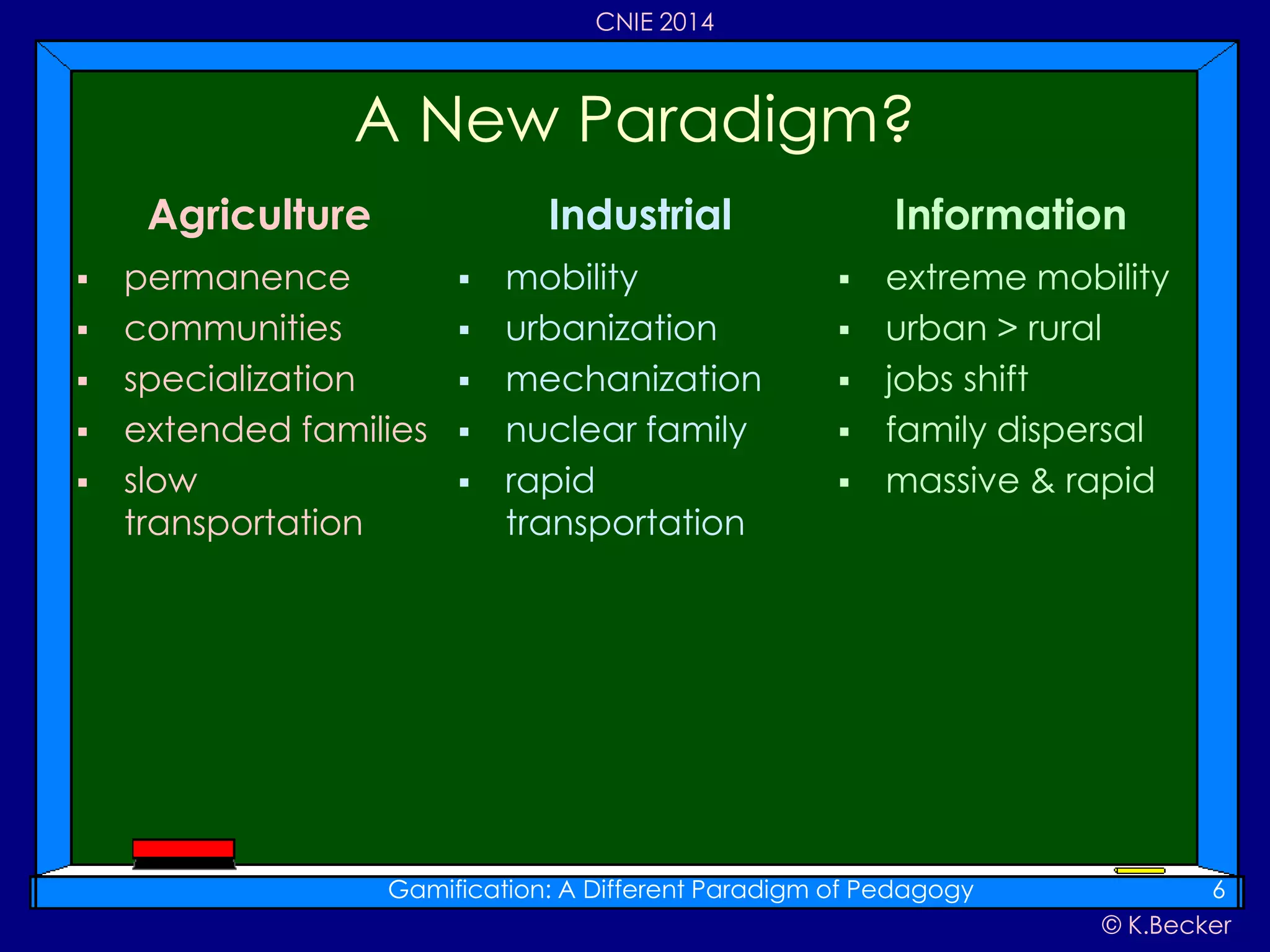
A New Paradigm?
Agriculture
ļ‚§ permanence
ļ‚§ communities
ļ‚§ specialization
ļ‚§ extended families
ļ‚§ slow
transportation
Gamification: A Different Paradigm of Pedagogy 6
Industrial
ļ‚§ mobility
ļ‚§ urbanization
ļ‚§ mechanization
ļ‚§ nuclear family
ļ‚§ rapid
transportation
Information
ļ‚§ extreme mobility
ļ‚§ urban > rural
ļ‚§ jobs shift
ļ‚§ family dispersal
ļ‚§ massive & rapid
Ā© K.Becker
CNIE 2014
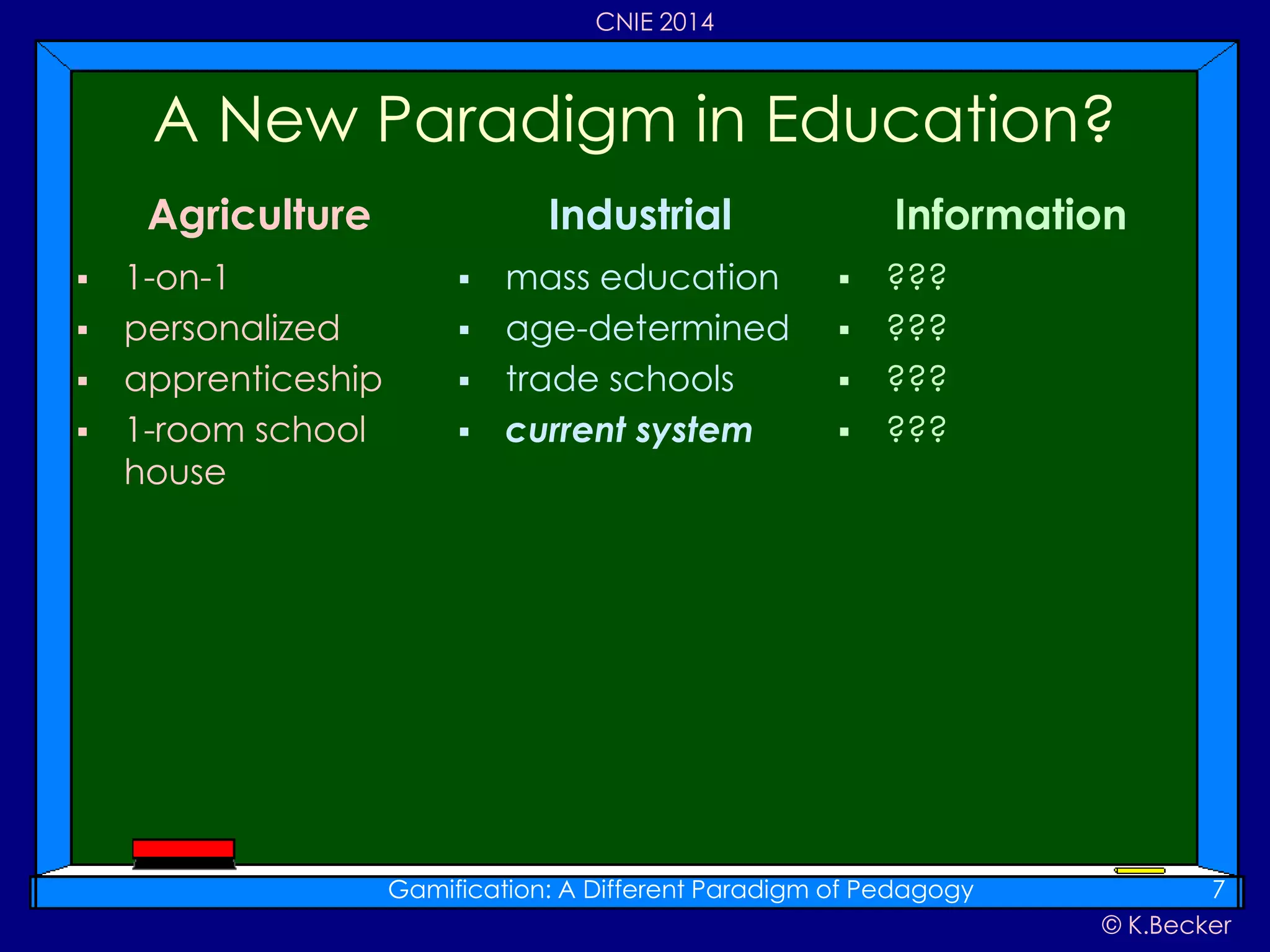
A New Paradigm in Education?
Agriculture
ļ‚§ 1-on-1
ļ‚§ personalized
ļ‚§ apprenticeship
ļ‚§ 1-room school
house
Gamification: A Different Paradigm of Pedagogy 7
Industrial
ļ‚§ mass education
ļ‚§ age-determined
ļ‚§ trade schools
ļ‚§ current system
Information
ļ‚§ ???
ļ‚§ ???
ļ‚§ ???
ļ‚§ ???
Ā© K.Becker
CNIE 2014
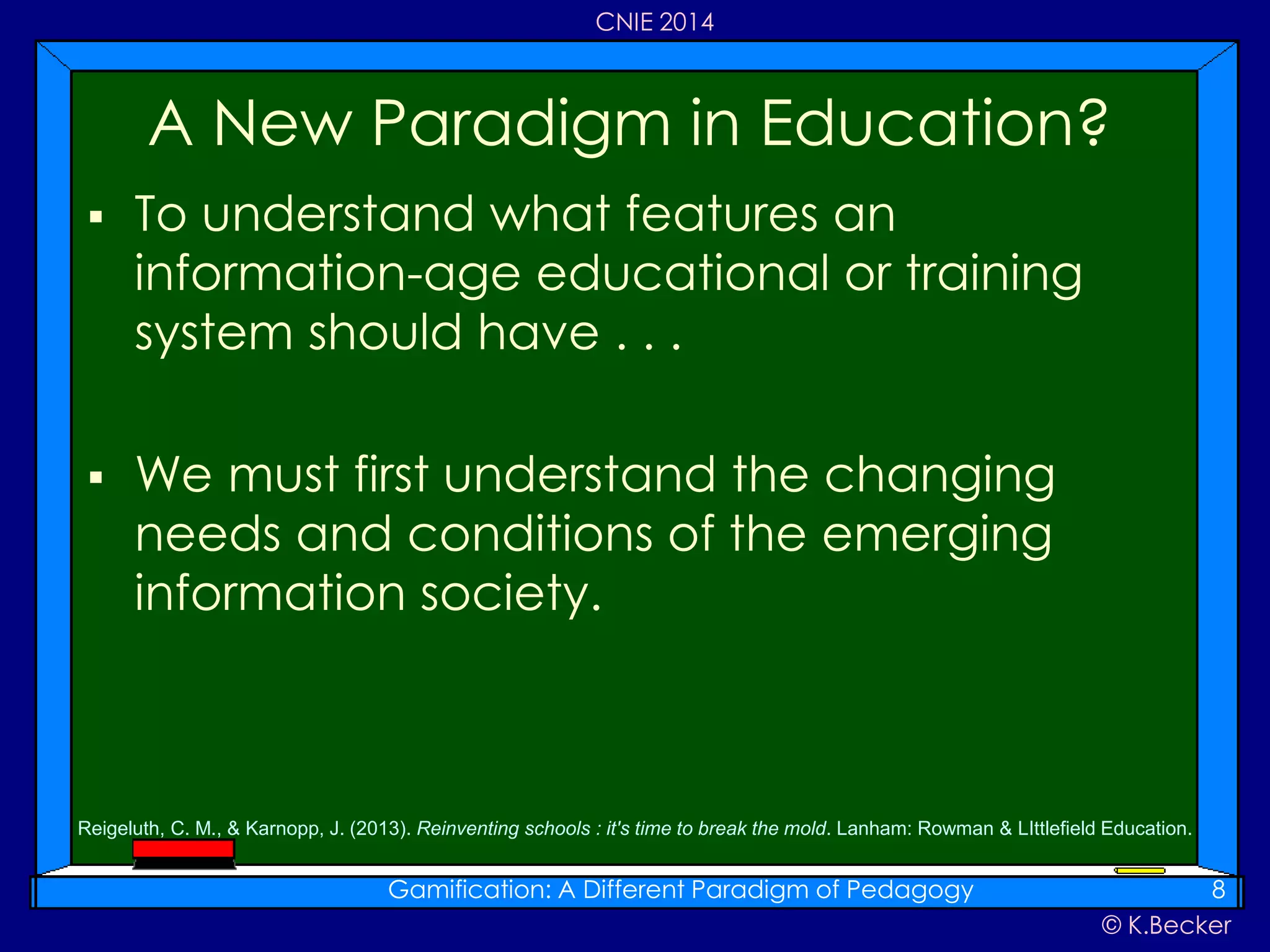
ļ‚§ To understand what features an
information-age educational or training
system should have . . .
ļ‚§ We must first understand the changing
needs and conditions of the emerging
information society.
A New Paradigm in Education?
Gamification: A Different Paradigm of Pedagogy 8
Reigeluth, C. M., & Karnopp, J. (2013). Reinventing schools : it's time to break the mold. Lanham: Rowman & LIttlefield Education.
Ā© K.Becker
CNIE 2014
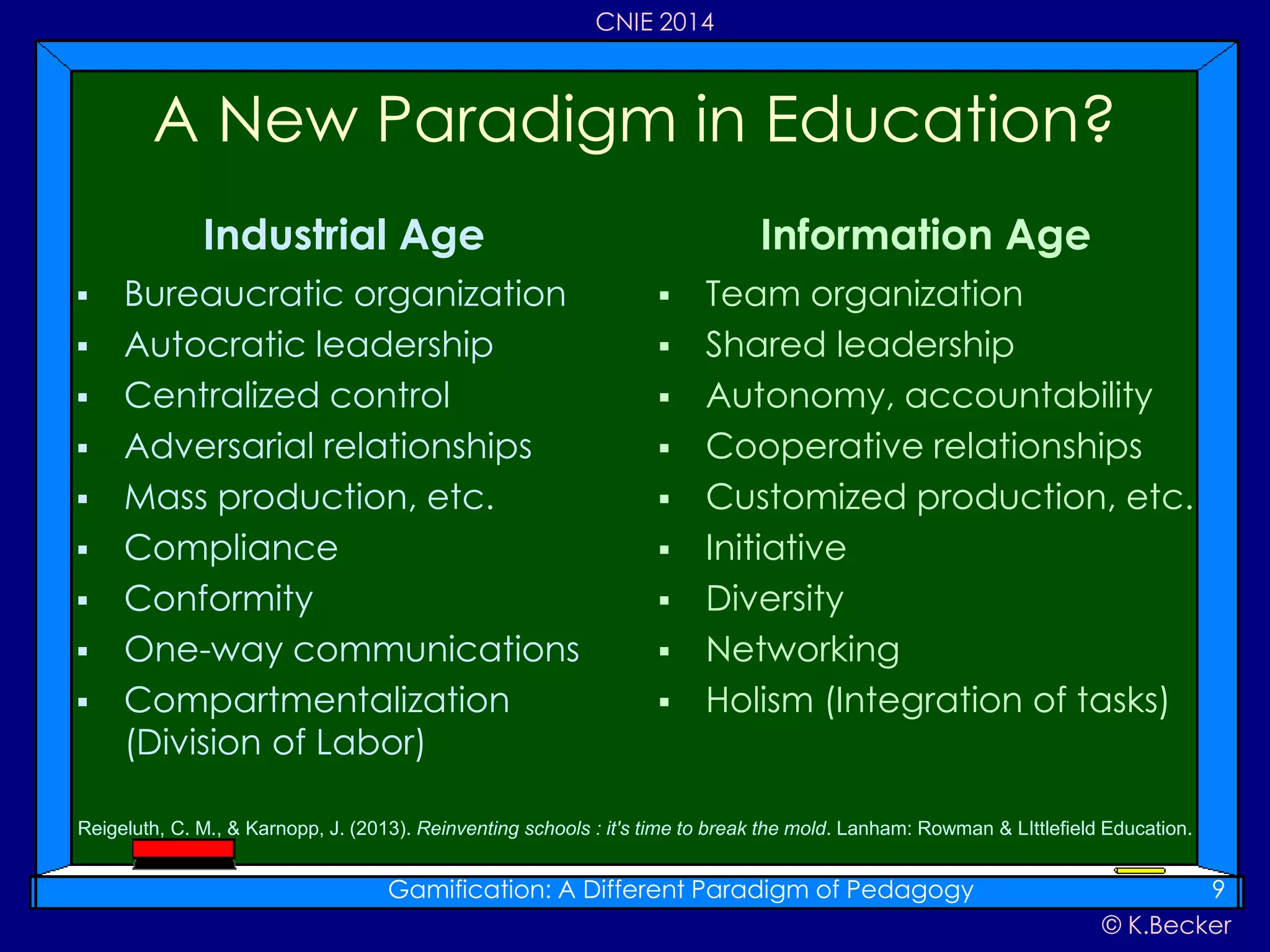
A New Paradigm in Education?
Industrial Age
ļ‚§ Bureaucratic organization
ļ‚§ Autocratic leadership
ļ‚§ Centralized control
ļ‚§ Adversarial relationships
ļ‚§ Mass production, etc.
ļ‚§ Compliance
ļ‚§ Conformity
ļ‚§ One-way communications
ļ‚§ Compartmentalization
(Division of Labor)
Information Age
ļ‚§ Team organization
ļ‚§ Shared leadership
ļ‚§ Autonomy, accountability
ļ‚§ Cooperative relationships
ļ‚§ Customized production, etc.
ļ‚§ Initiative
ļ‚§ Diversity
ļ‚§ Networking
ļ‚§ Holism (Integration of tasks)
Gamification: A Different Paradigm of Pedagogy 9
Reigeluth, C. M., & Karnopp, J. (2013). Reinventing schools : it's time to break the mold. Lanham: Rowman & LIttlefield Education.
Ā© K.Becker
CNIE 2014
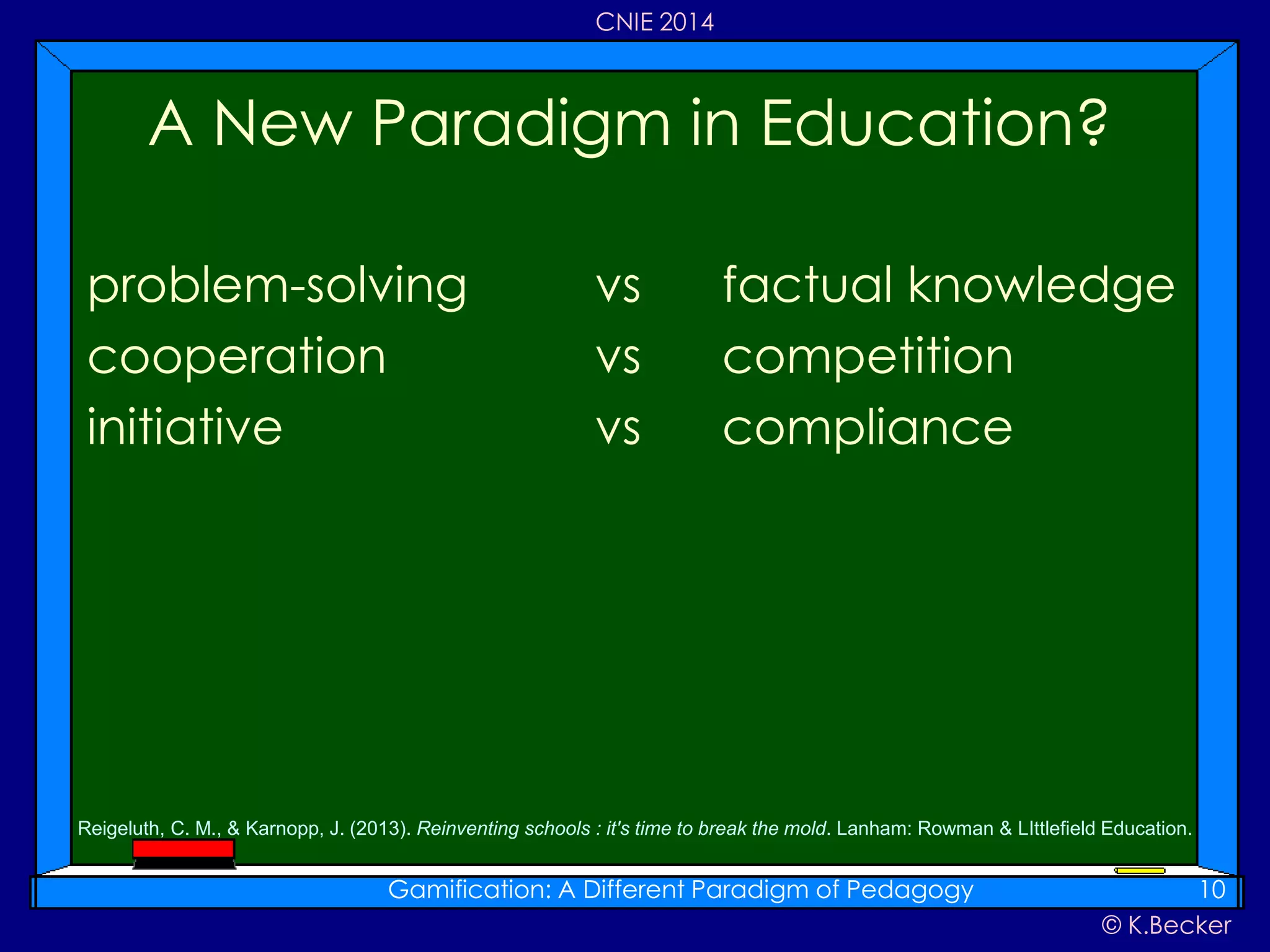
problem-solving vs factual knowledge
cooperation vs competition
initiative vs compliance
A New Paradigm in Education?
Gamification: A Different Paradigm of Pedagogy 10
Reigeluth, C. M., & Karnopp, J. (2013). Reinventing schools : it's time to break the mold. Lanham: Rowman & LIttlefield Education.
Ā© K.Becker
CNIE 2014
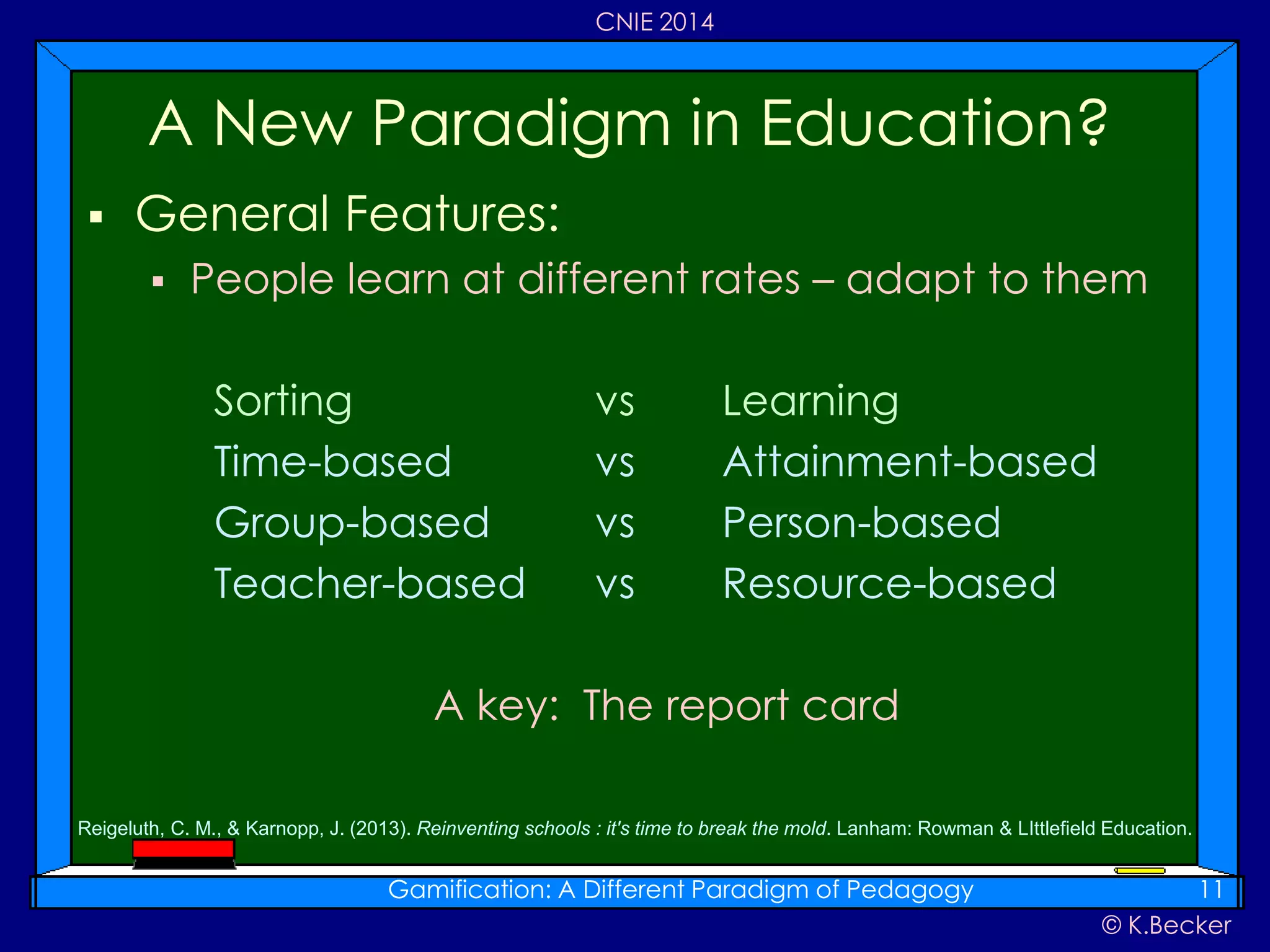
ļ‚§ General Features:
ļ‚§ People learn at different rates – adapt to them
Sorting vs Learning
Time-based vs Attainment-based
Group-based vs Person-based
Teacher-based vs Resource-based
A key: The report card
A New Paradigm in Education?
Gamification: A Different Paradigm of Pedagogy 11
Reigeluth, C. M., & Karnopp, J. (2013). Reinventing schools : it's time to break the mold. Lanham: Rowman & LIttlefield Education.
Ā© K.Becker
CNIE 2014
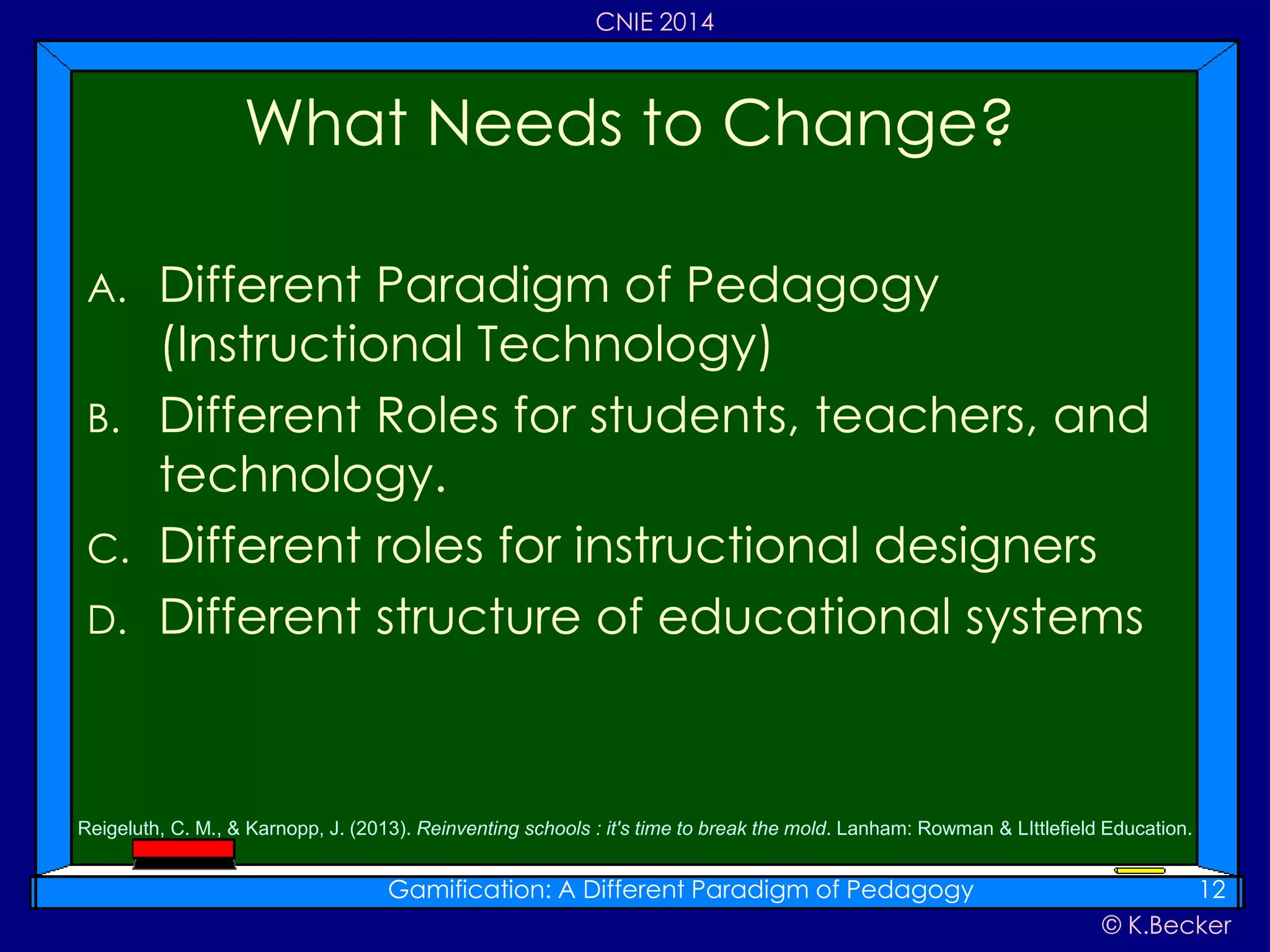
A. Different Paradigm of Pedagogy
(Instructional Technology)
B. Different Roles for students, teachers, and
technology.
C. Different roles for instructional designers
D. Different structure of educational systems
What Needs to Change?
Gamification: A Different Paradigm of Pedagogy 12
Reigeluth, C. M., & Karnopp, J. (2013). Reinventing schools : it's time to break the mold. Lanham: Rowman & LIttlefield Education.
Ā© K.Becker
CNIE 2014
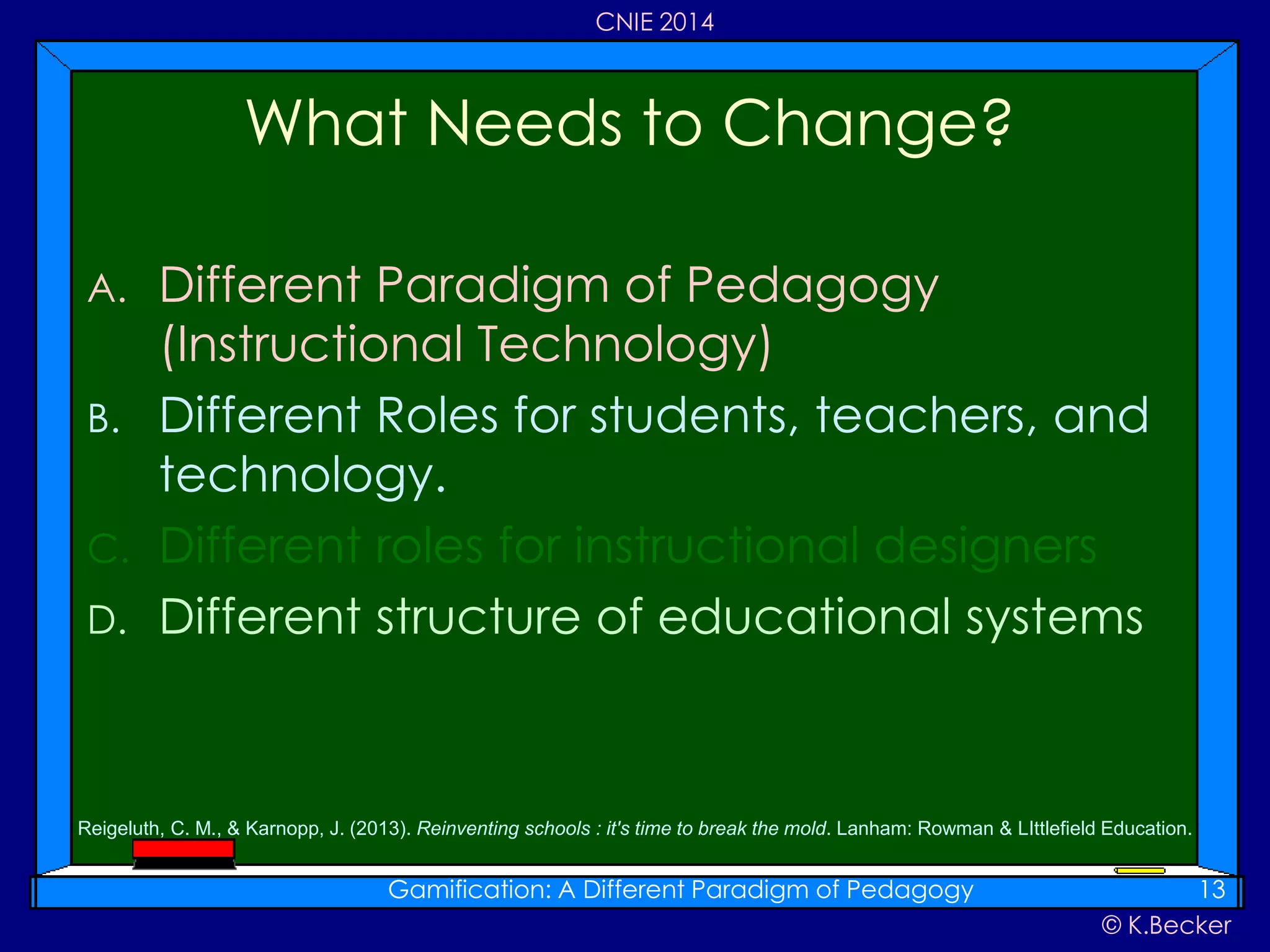
A. Different Paradigm of Pedagogy
(Instructional Technology)
B. Different Roles for students, teachers, and
technology.
C. Different roles for instructional designers
D. Different structure of educational systems
What Needs to Change?
Gamification: A Different Paradigm of Pedagogy 13
Reigeluth, C. M., & Karnopp, J. (2013). Reinventing schools : it's time to break the mold. Lanham: Rowman & LIttlefield Education.
Ā© K.Becker
CNIE 2014
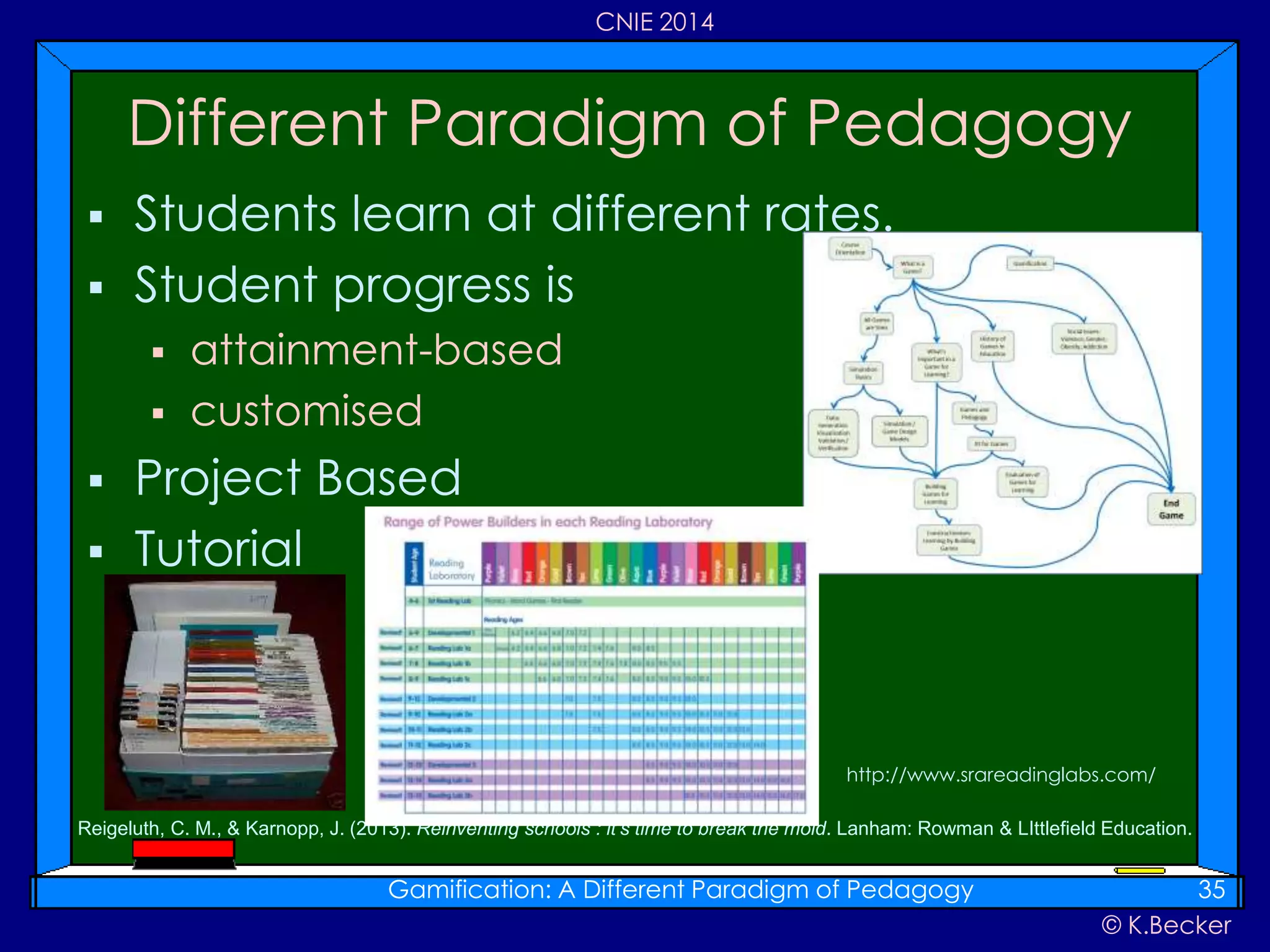
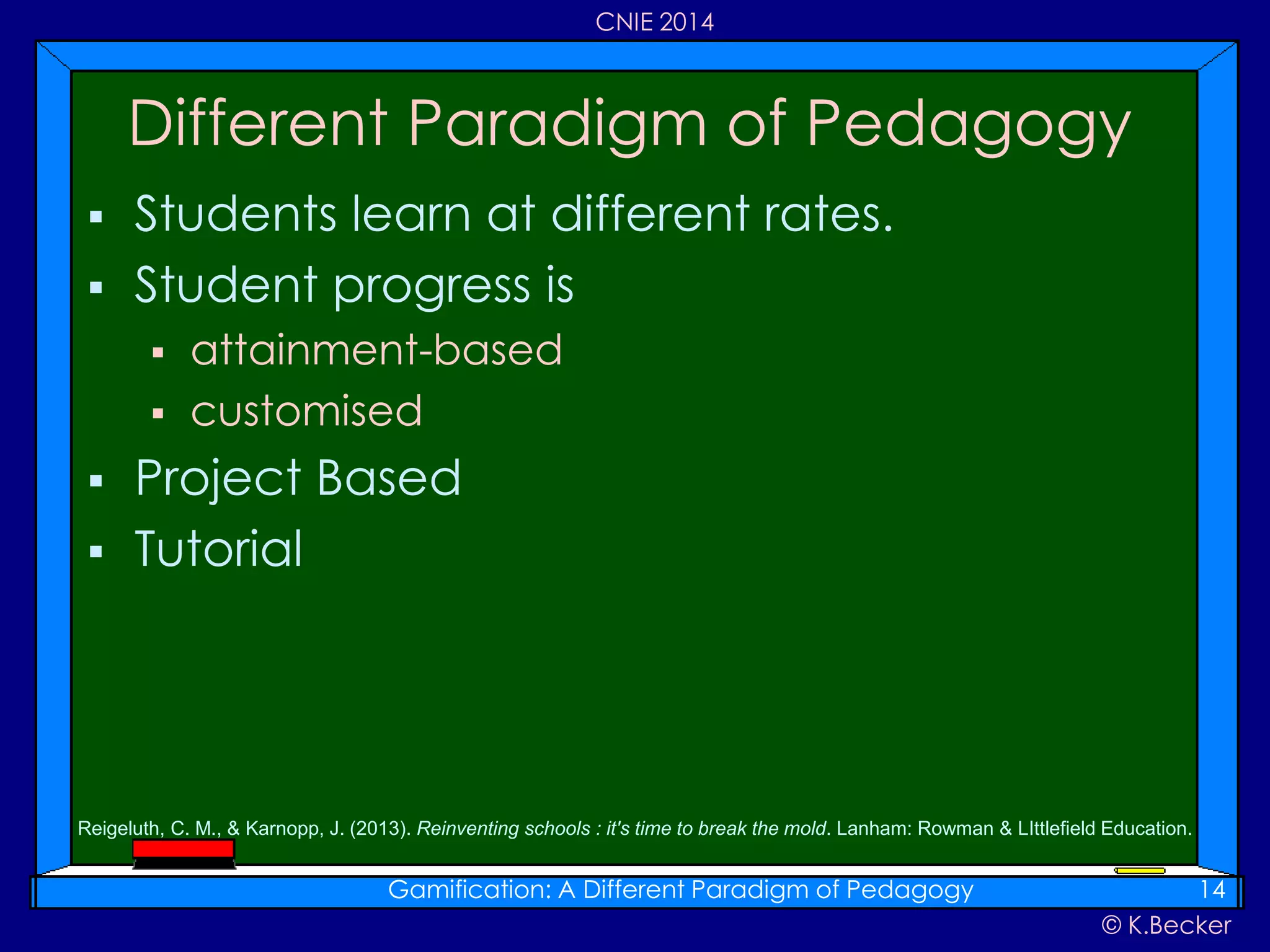
ļ‚§ Students learn at different rates.
ļ‚§ Student progress is
ļ‚§ attainment-based
ļ‚§ customised
ļ‚§ Project Based
ļ‚§ Tutorial
Different Paradigm of Pedagogy
Gamification: A Different Paradigm of Pedagogy 14
Reigeluth, C. M., & Karnopp, J. (2013). Reinventing schools : it's time to break the mold. Lanham: Rowman & LIttlefield Education.
Ā© K.Becker
CNIE 2014
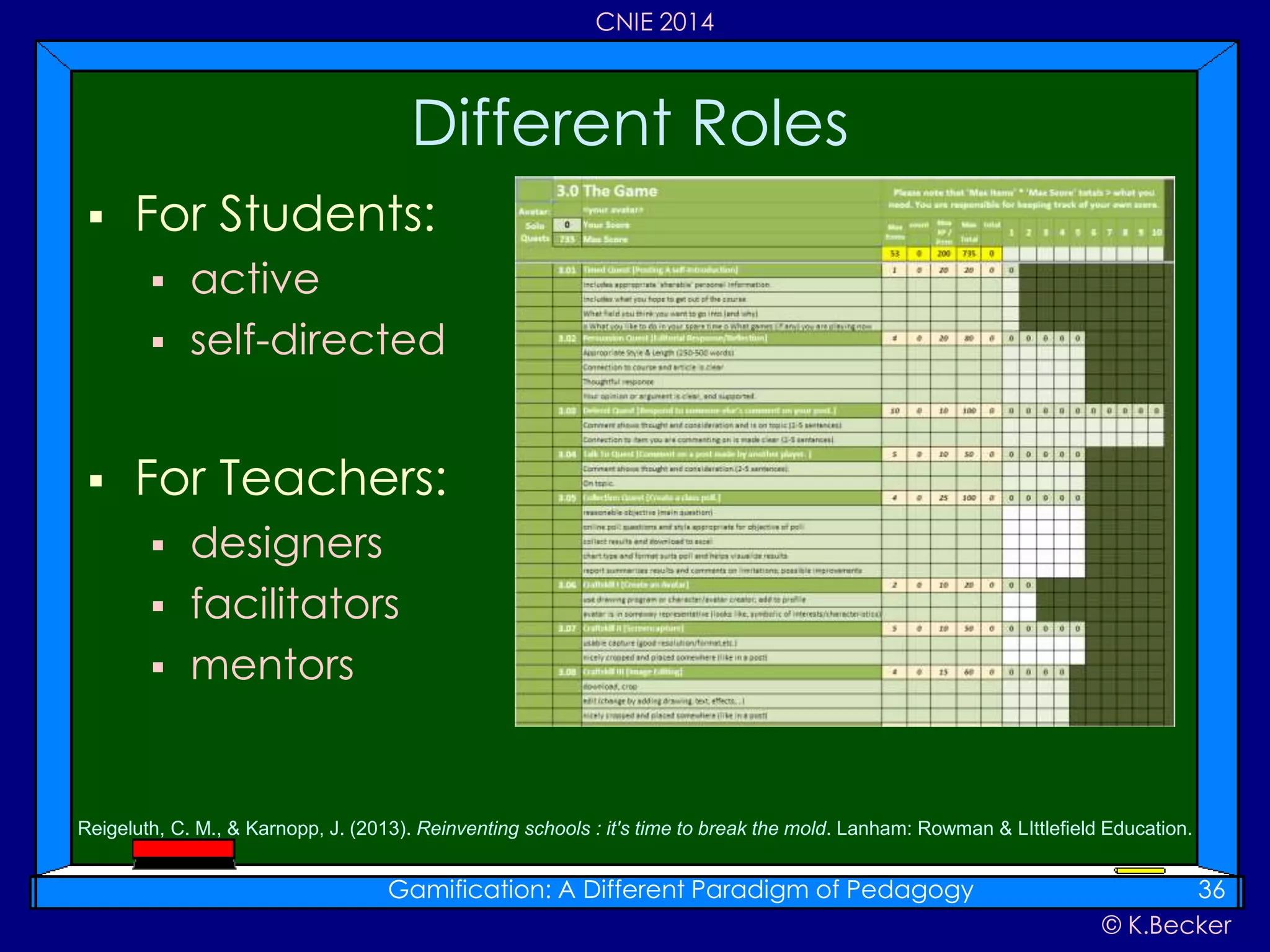
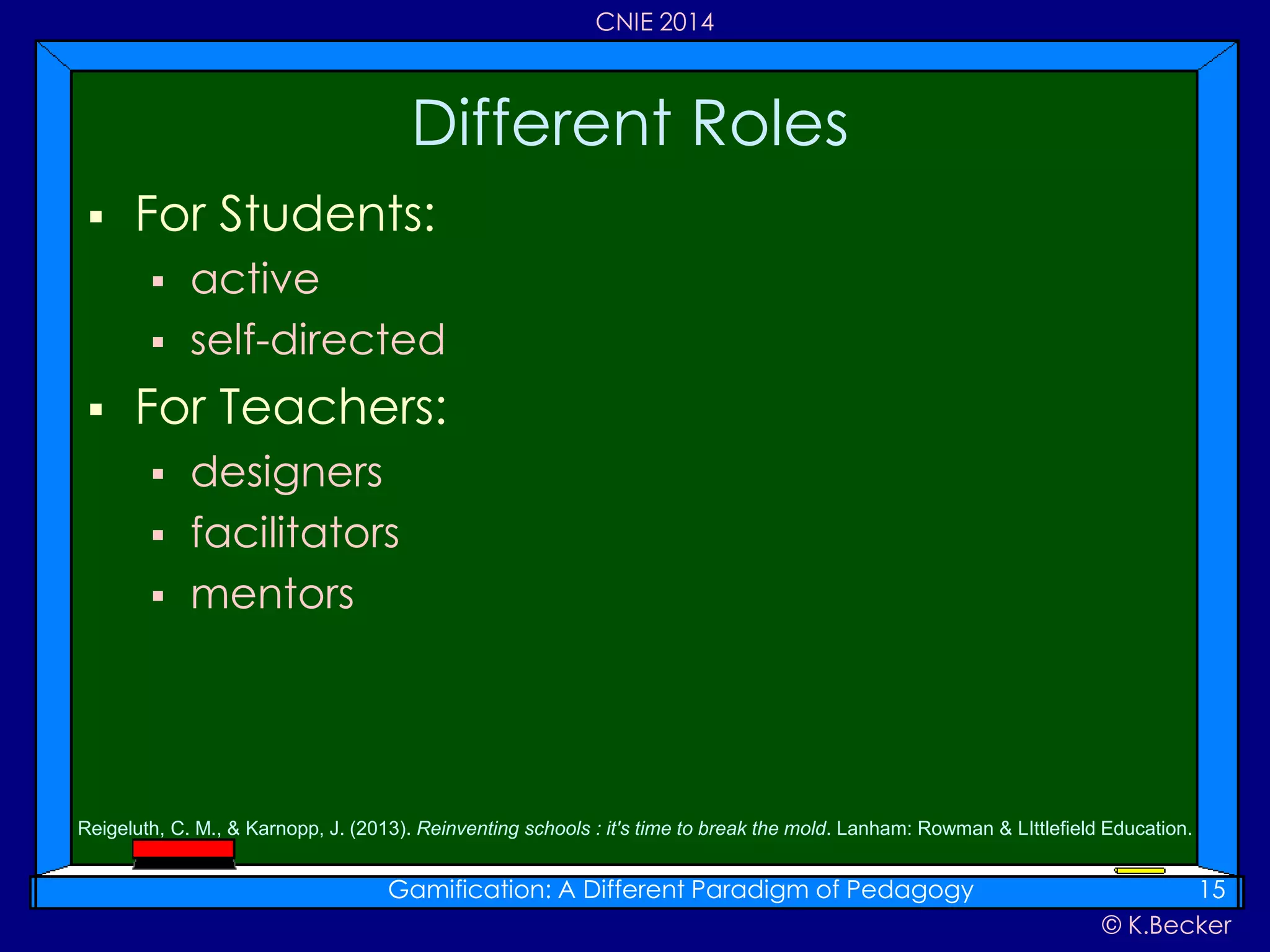
ļ‚§ For Students:
ļ‚§ active
ļ‚§ self-directed
ļ‚§ For Teachers:
ļ‚§ designers
ļ‚§ facilitators
ļ‚§ mentors
Different Roles
Gamification: A Different Paradigm of Pedagogy 15
Reigeluth, C. M., & Karnopp, J. (2013). Reinventing schools : it's time to break the mold. Lanham: Rowman & LIttlefield Education.
Ā© K.Becker
CNIE 2014
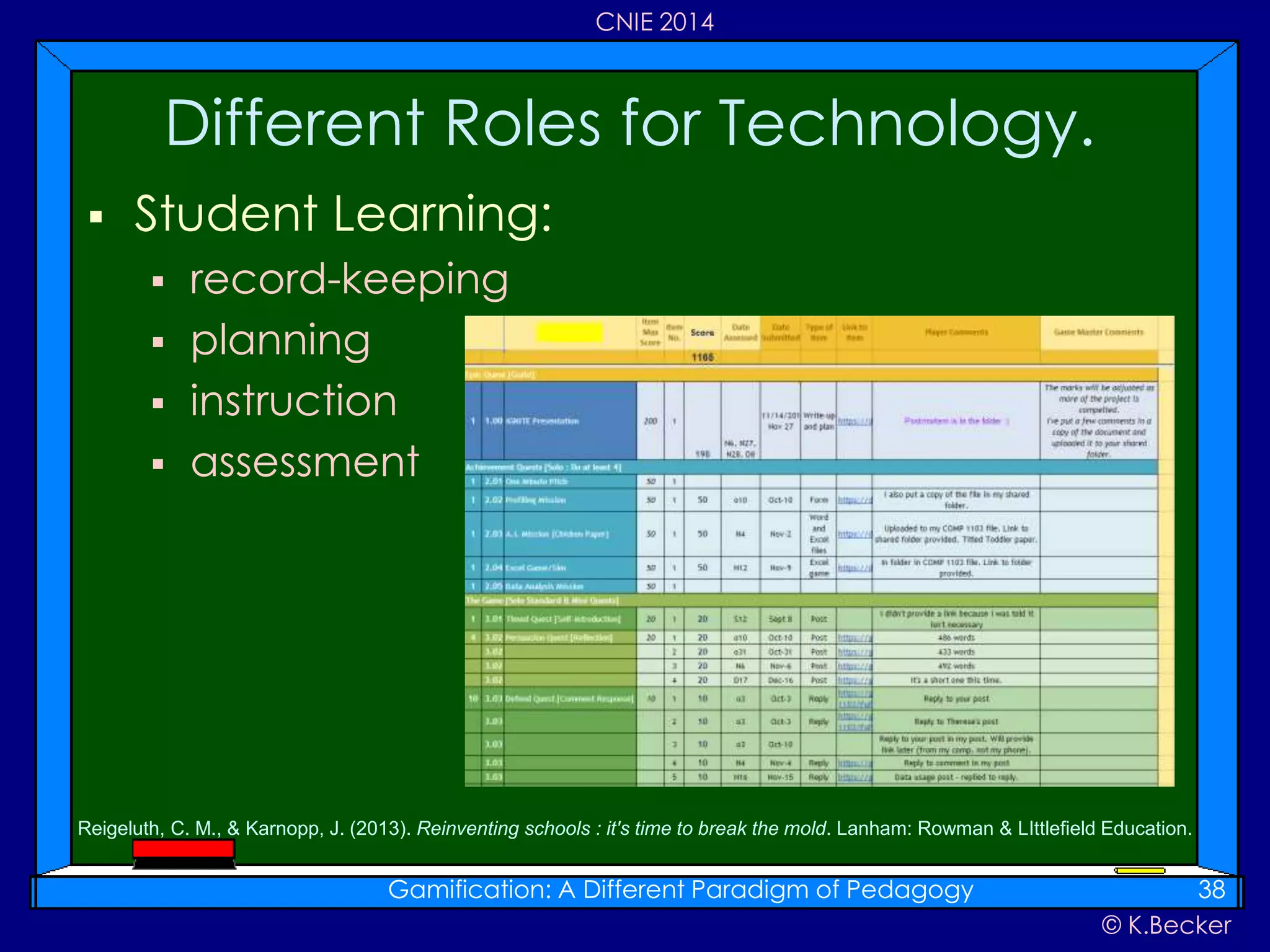
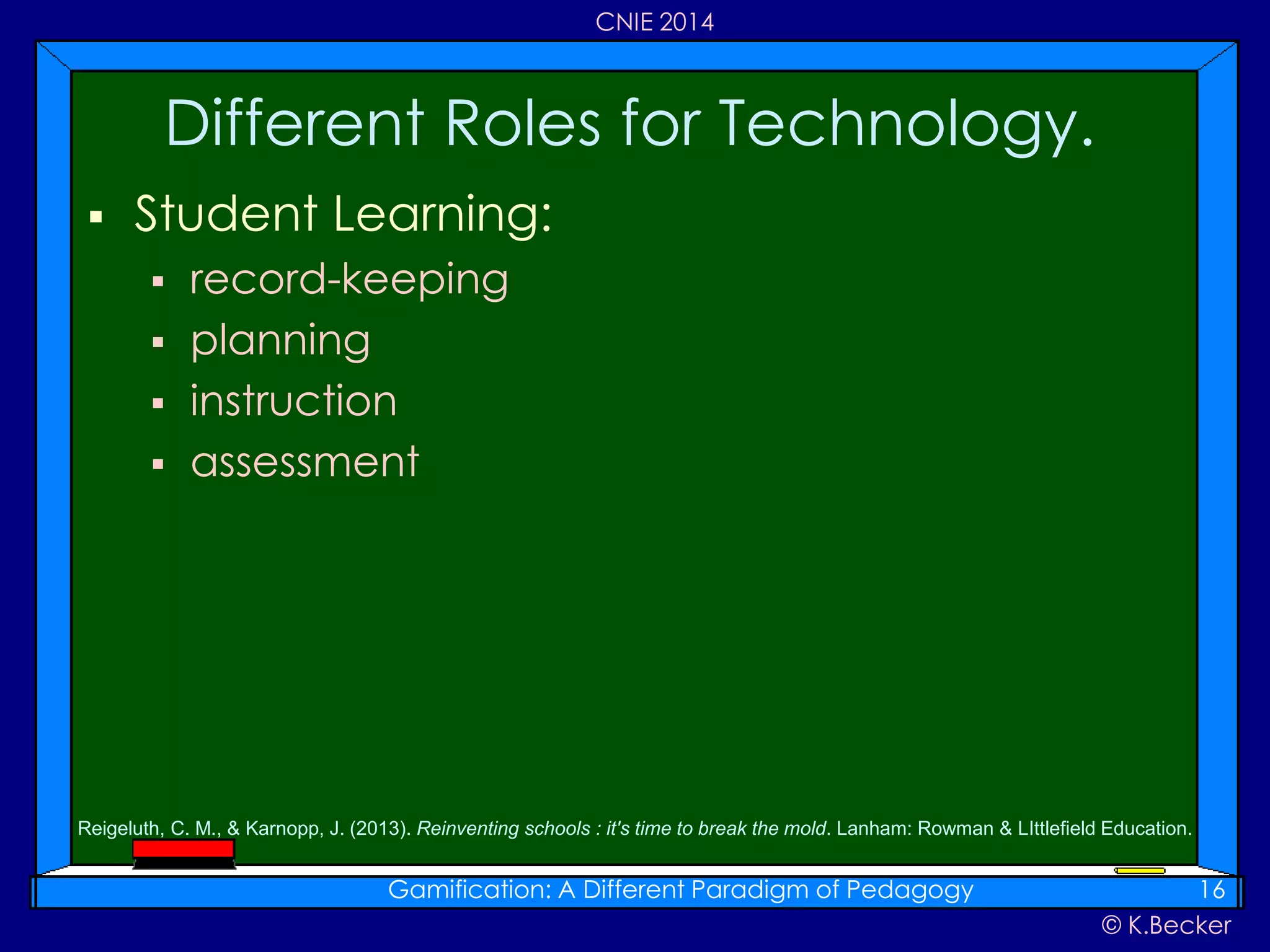
ļ‚§ Student Learning:
ļ‚§ record-keeping
ļ‚§ planning
ļ‚§ instruction
ļ‚§ assessment
Different Roles for Technology.
Gamification: A Different Paradigm of Pedagogy 16
Reigeluth, C. M., & Karnopp, J. (2013). Reinventing schools : it's time to break the mold. Lanham: Rowman & LIttlefield Education.
Ā© K.Becker
CNIE 2014
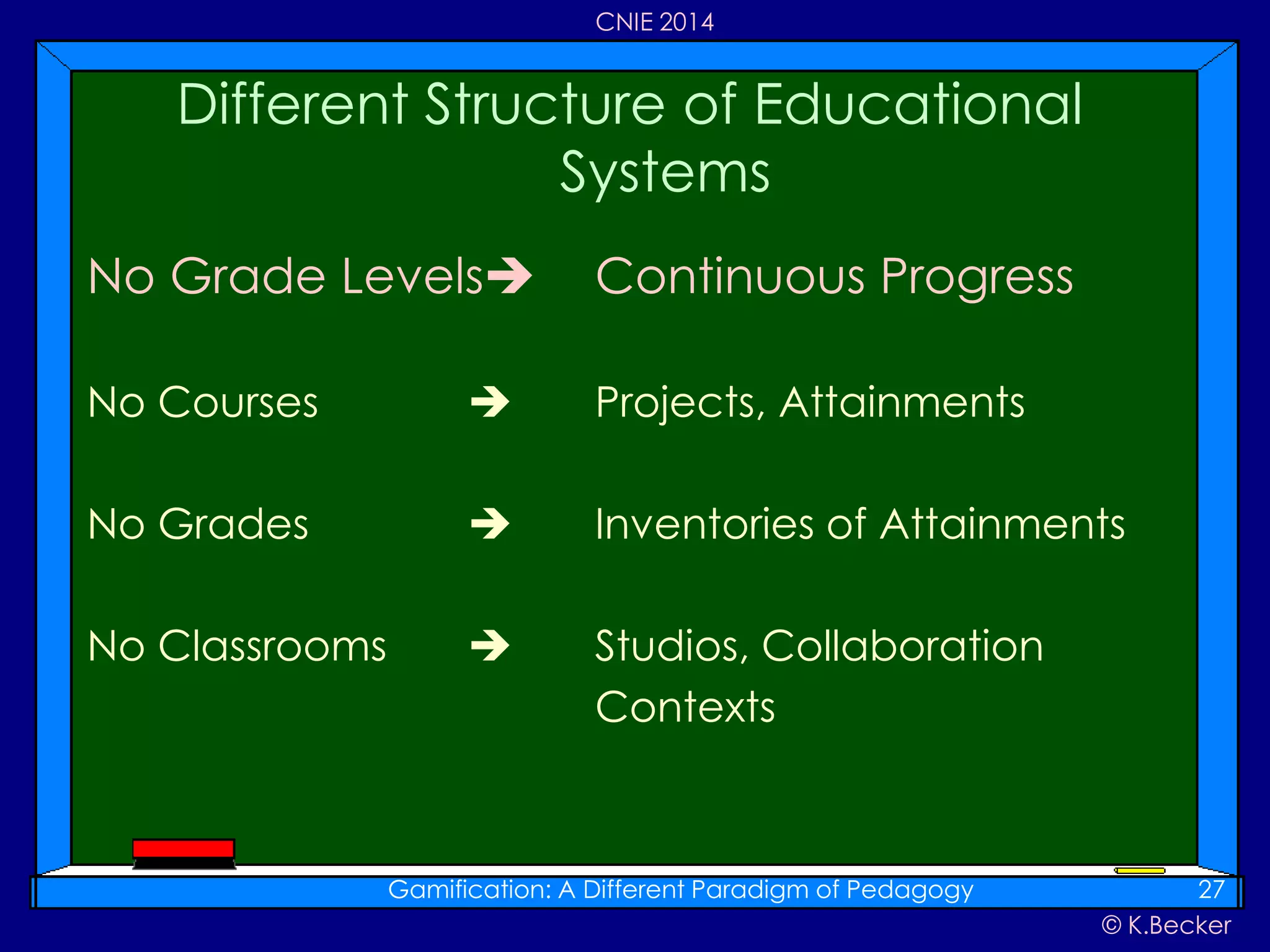
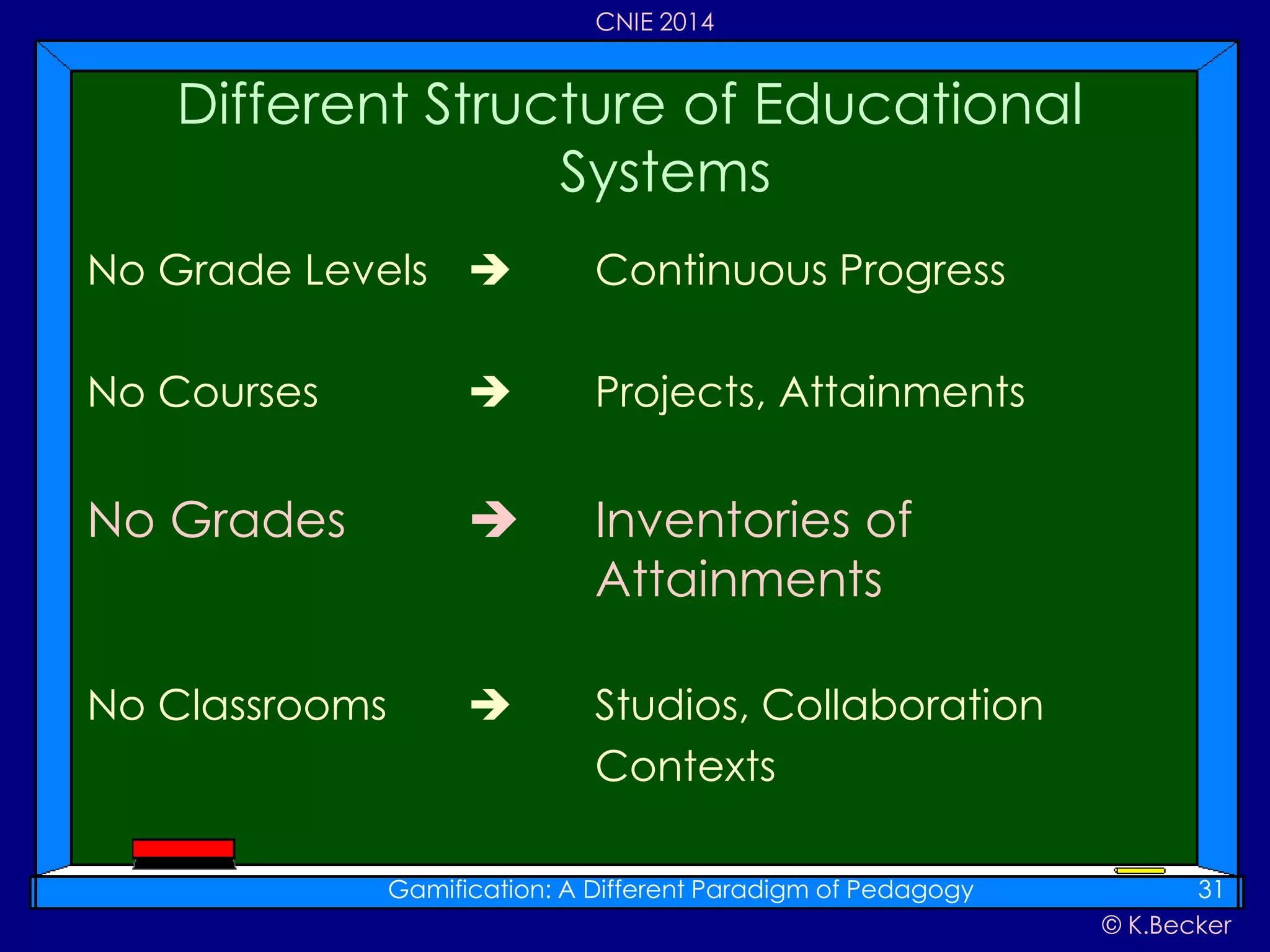
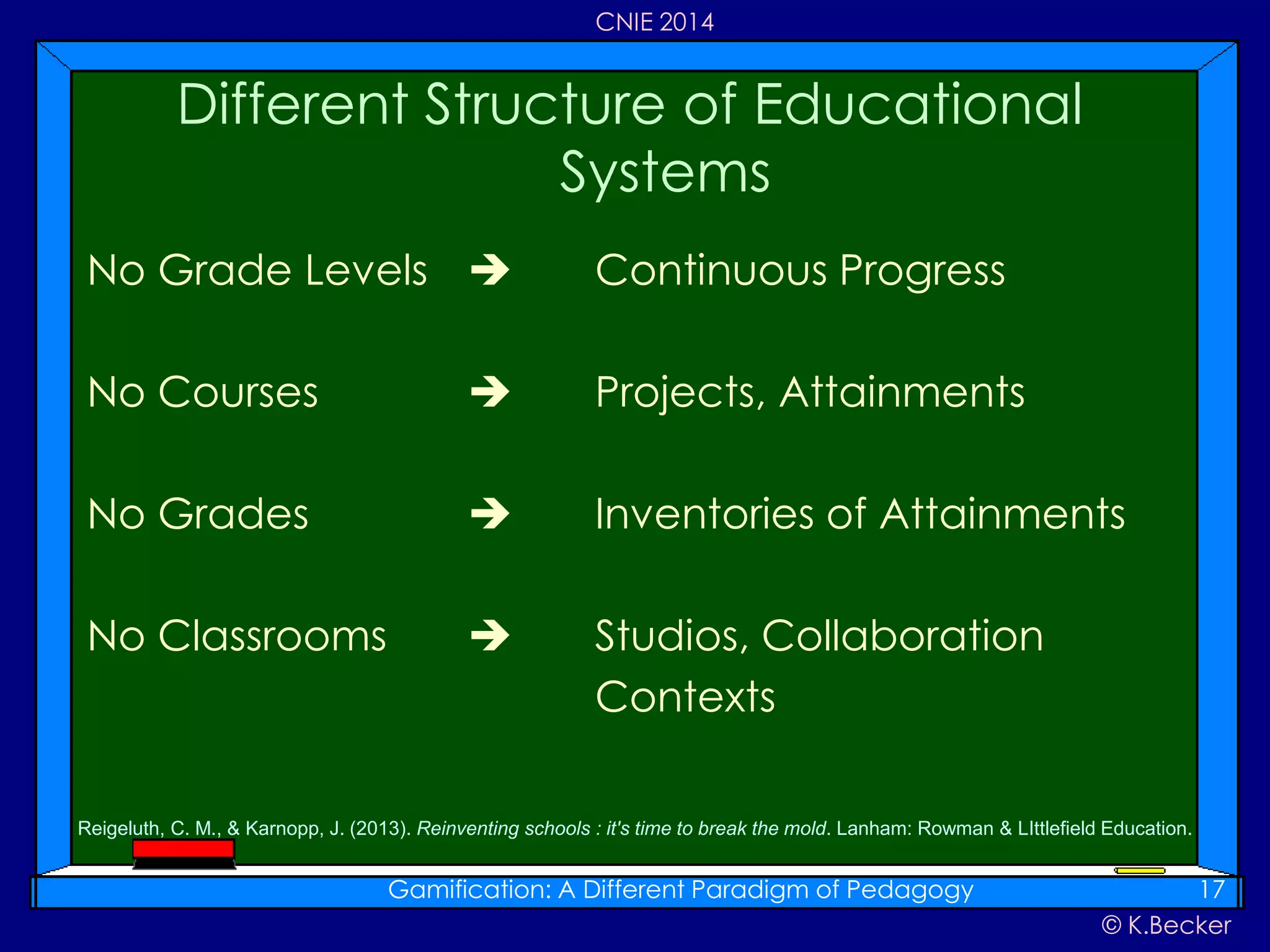
No Grade Levels  Continuous Progress
No Courses  Projects, Attainments
No Grades  Inventories of Attainments
No Classrooms  Studios, Collaboration
Contexts
Different Structure of Educational
Systems
Gamification: A Different Paradigm of Pedagogy 17
Reigeluth, C. M., & Karnopp, J. (2013). Reinventing schools : it's time to break the mold. Lanham: Rowman & LIttlefield Education.
Ā© K.Becker
CNIE 2014
The use of game elements
in non-game contexts.
How Does Gamification Fit?
Gamification: A Different Paradigm of Pedagogy 18
Deterding, S. (2012). 9.5 Theses on the Power and Efficacy of Gamification. Microsoft Research. [Microsoft
Research Video] Retrieved from http://research.microsoft.com/apps/video/dl.aspx?id=174677&l=i on 12 October
2012.
Ā© K.Becker
CNIE 2014
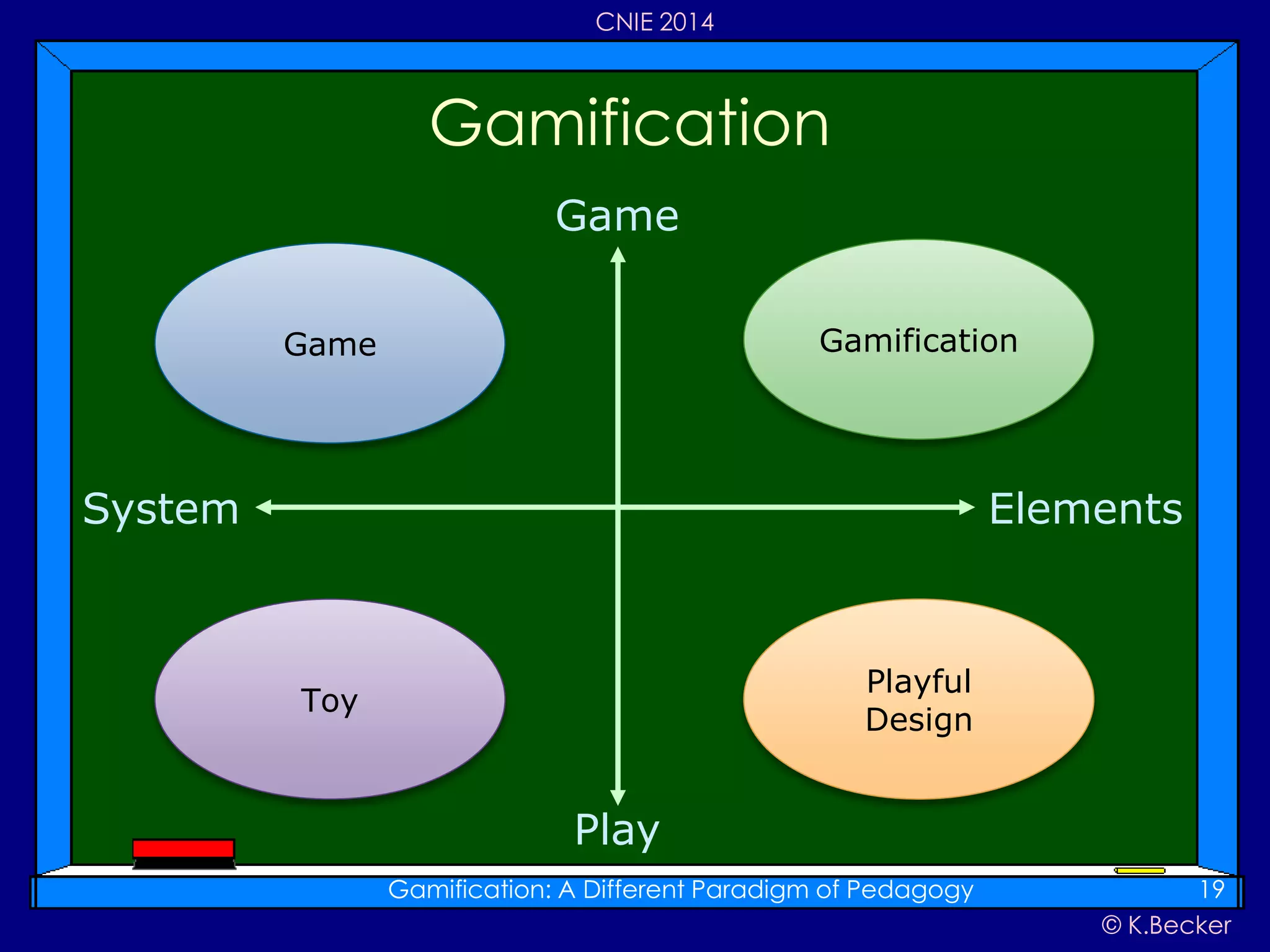
Gamification
Gamification: A Different Paradigm of Pedagogy 19
System Elements
Game
Play
GamificationGame
Playful
Design
Toy
Ā© K.Becker
CNIE 2014
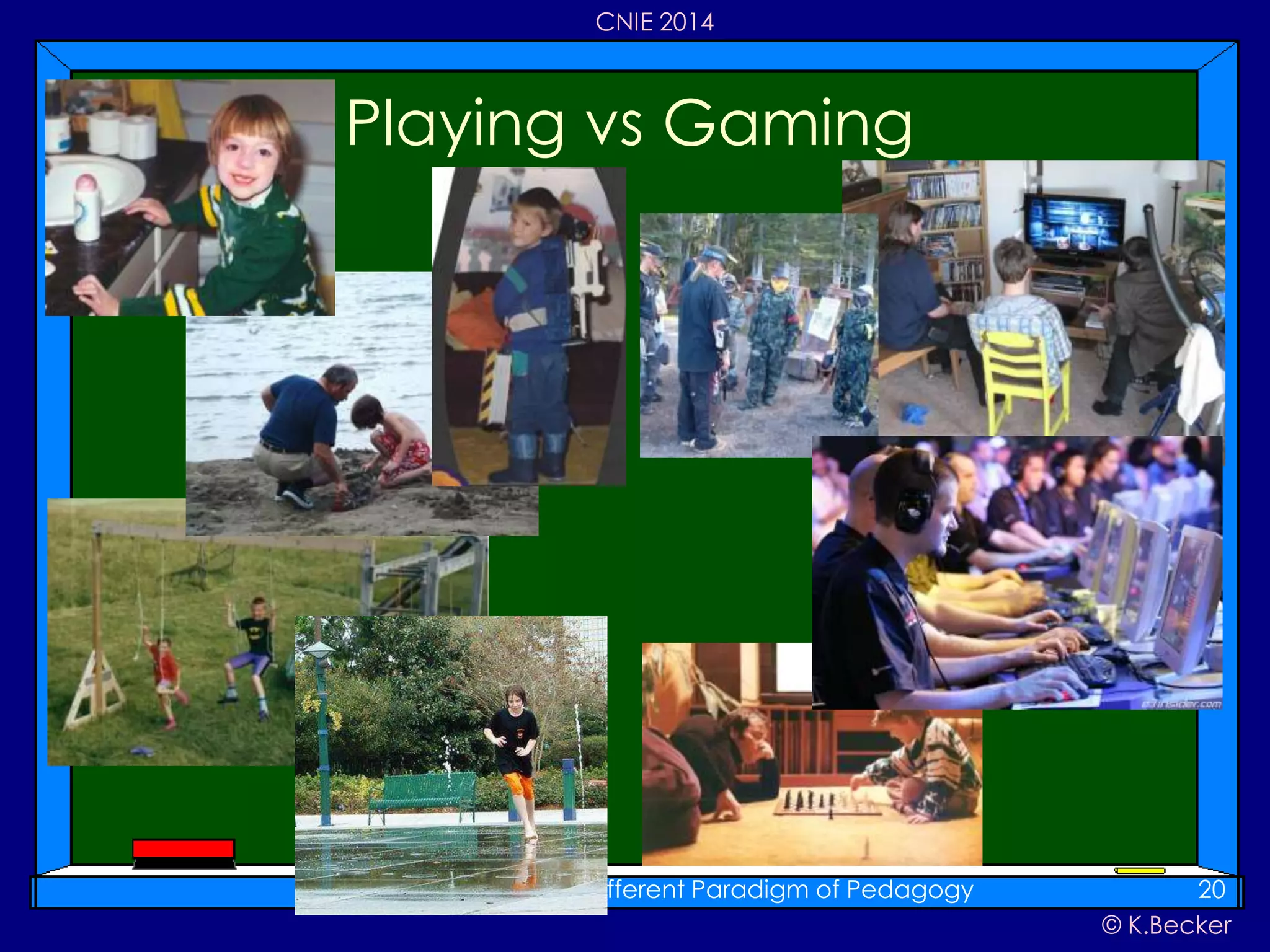
Playing vs Gaming
Gamification: A Different Paradigm of Pedagogy 20
Ā© K.Becker
CNIE 2014
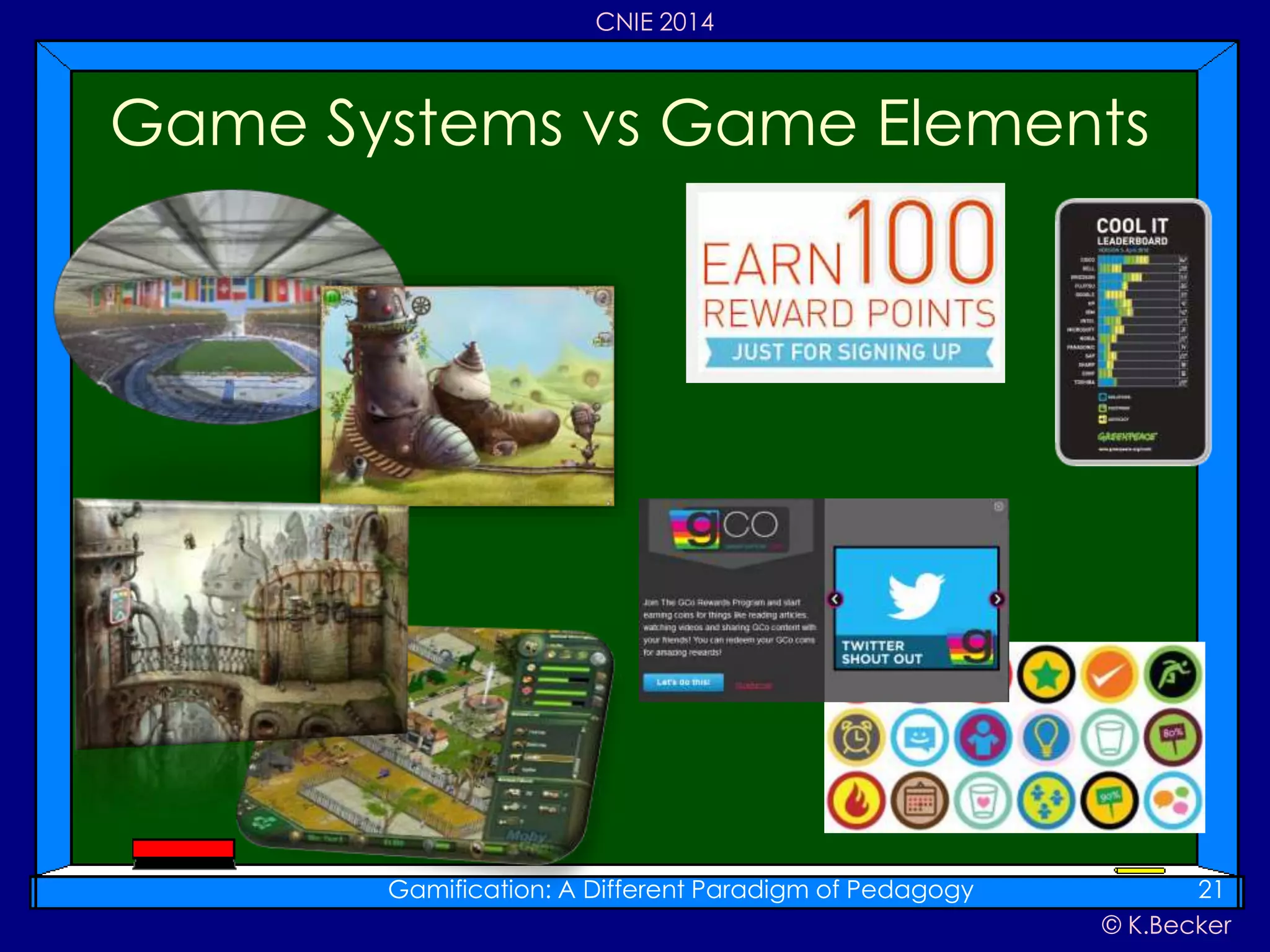
Game Systems vs Game Elements
Gamification: A Different Paradigm of Pedagogy 21
Ā© K.Becker
CNIE 2014
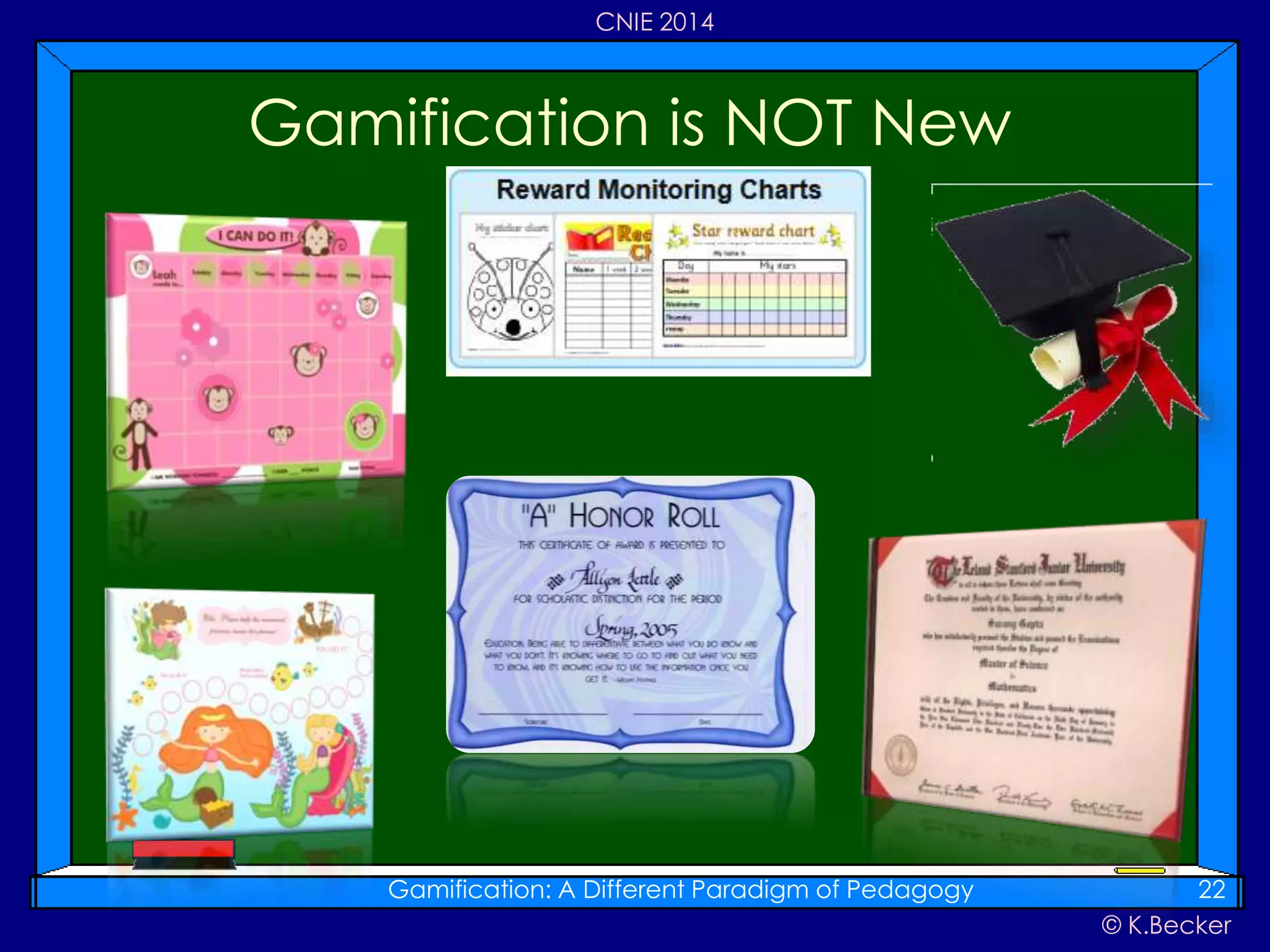
Gamification is NOT New
Gamification: A Different Paradigm of Pedagogy 22
Ā© K.Becker
CNIE 2014
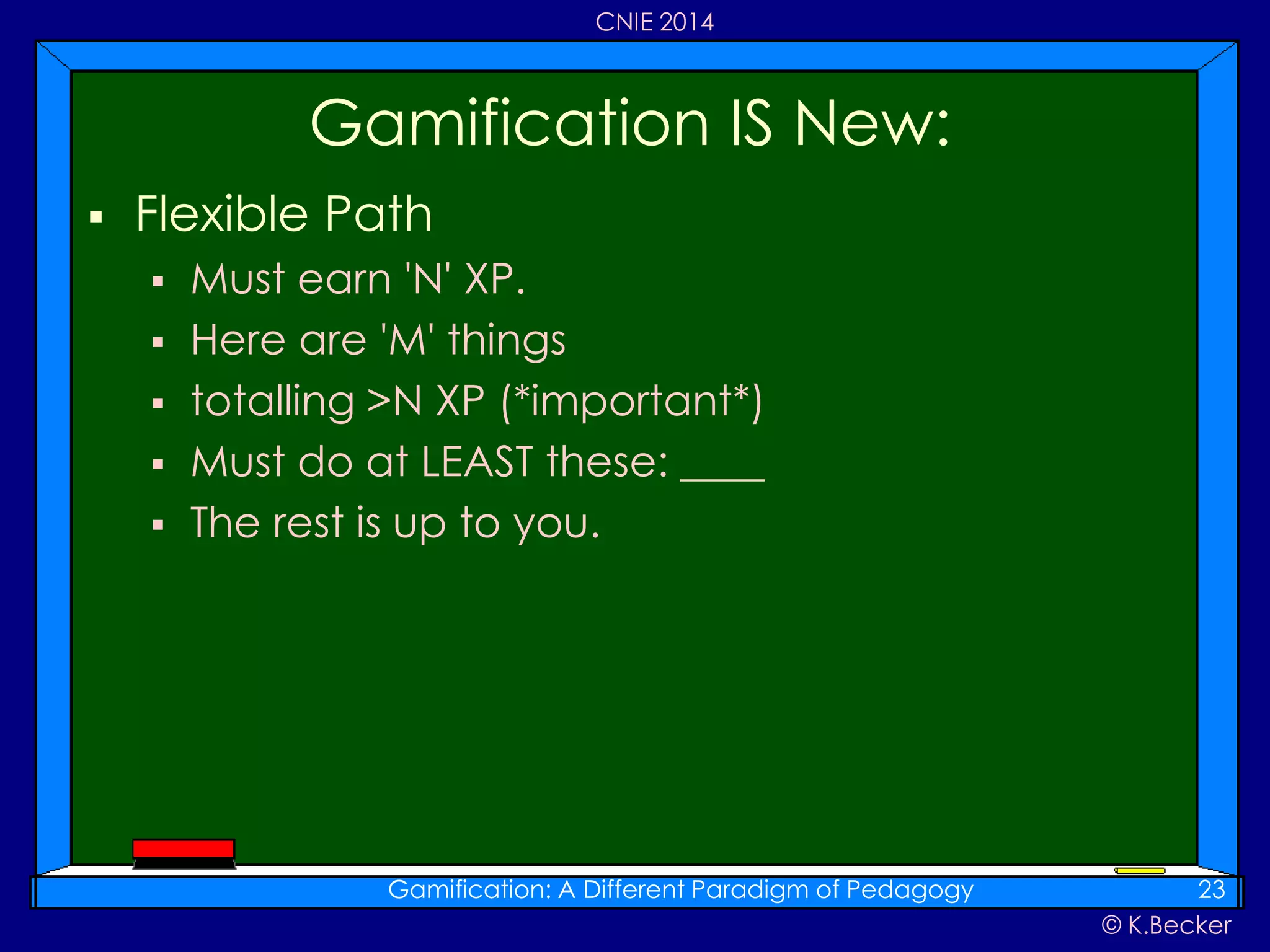
ļ‚§ Flexible Path
ļ‚§ Must earn 'N' XP.
ļ‚§ Here are 'M' things
ļ‚§ totalling >N XP (*important*)
ļ‚§ Must do at LEAST these: ____
ļ‚§ The rest is up to you.
Gamification IS New:
Gamification: A Different Paradigm of Pedagogy 23
Ā© K.Becker
CNIE 2014
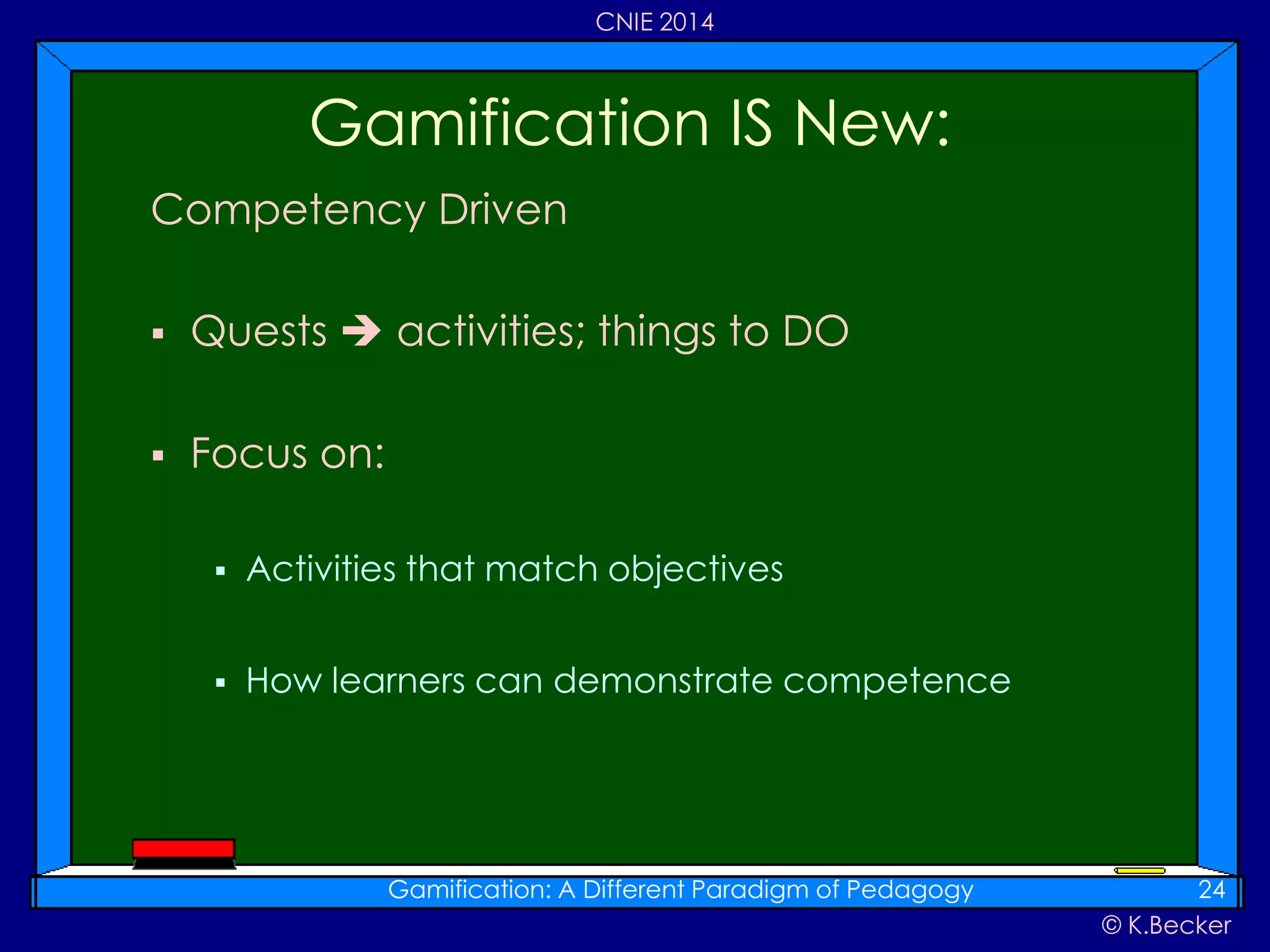
Competency Driven
ļ‚§ Quests  activities; things to DO
ļ‚§ Focus on:
ļ‚§ Activities that match objectives
ļ‚§ How learners can demonstrate competence
Gamification IS New:
Gamification: A Different Paradigm of Pedagogy 24
Ā© K.Becker
CNIE 2014
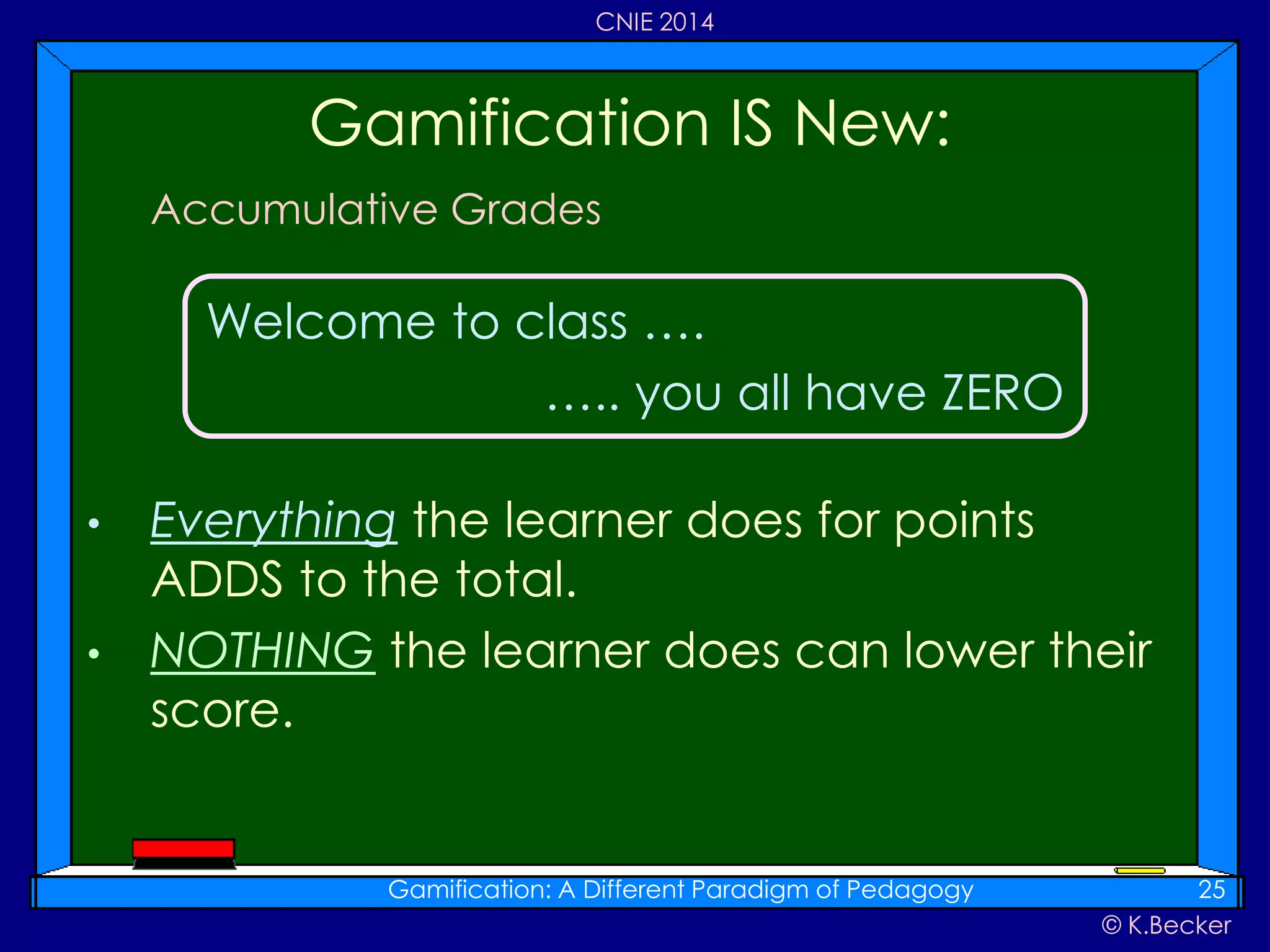
Accumulative Grades
• Everything the learner does for points
ADDS to the total.
• NOTHING the learner does can lower their
score.
Gamification IS New:
Gamification: A Different Paradigm of Pedagogy 25
Welcome to class ….
….. you all have ZERO
Ā© K.Becker
CNIE 2014
ļ‚§ Structure of Educational Systems
ļ‚§ Student Progress
ļ‚§ Student Work
ļ‚§ Student & Teacher Roles
ļ‚§ Roles for Technology
Back to Reigeluth's Different
Paradigm of Pedagogy
Gamification: A Different Paradigm of Pedagogy 26
Ā© K.Becker
CNIE 2014
No Grade Levels Continuous Progress
No Courses  Projects, Attainments
No Grades  Inventories of Attainments
No Classrooms  Studios, Collaboration
Contexts
Different Structure of Educational
Systems
Gamification: A Different Paradigm of Pedagogy 27
Ā© K.Becker
CNIE 2014
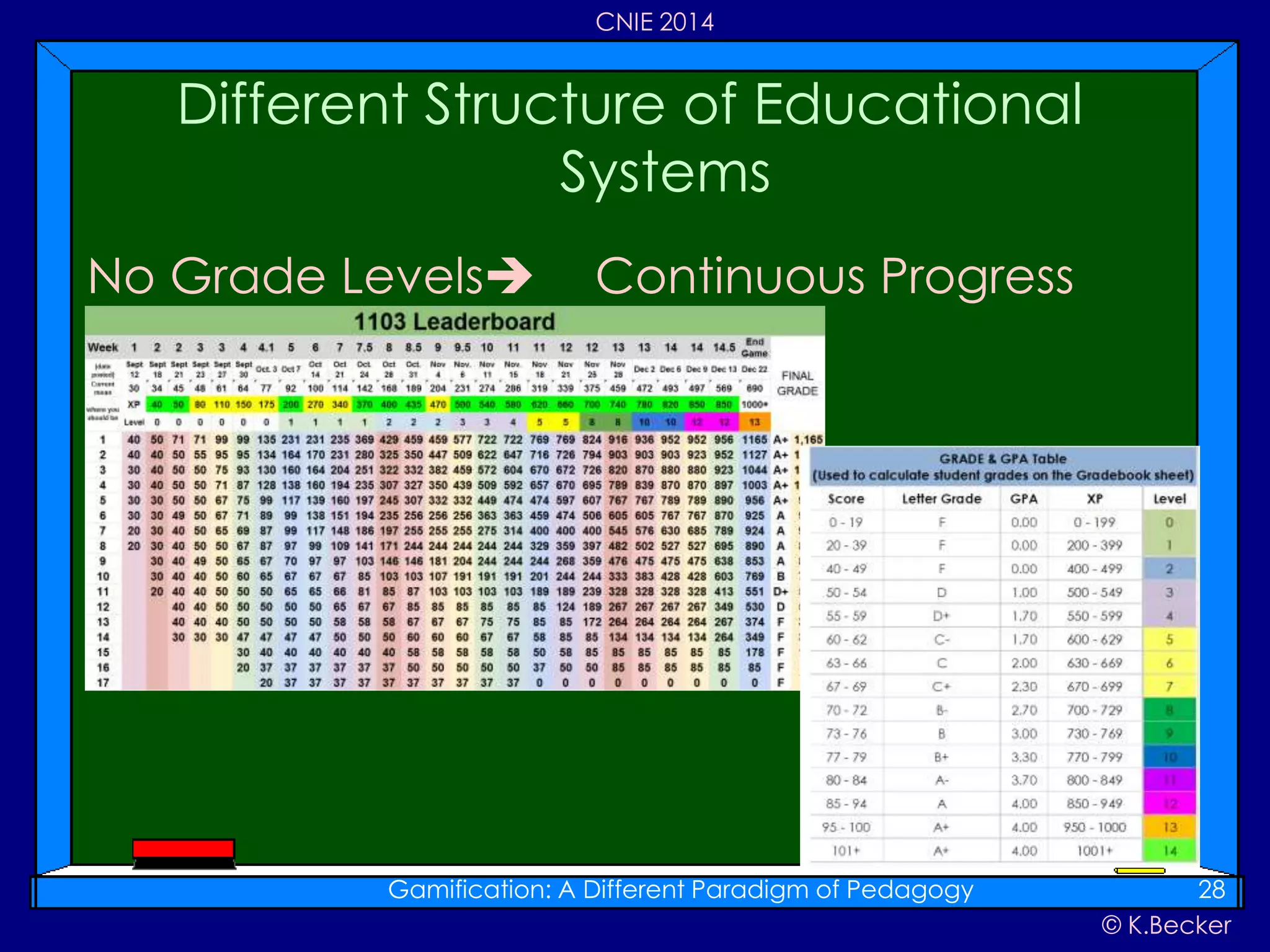
No Grade Levels Continuous Progress
Different Structure of Educational
Systems
Gamification: A Different Paradigm of Pedagogy 28
Ā© K.Becker
CNIE 2014
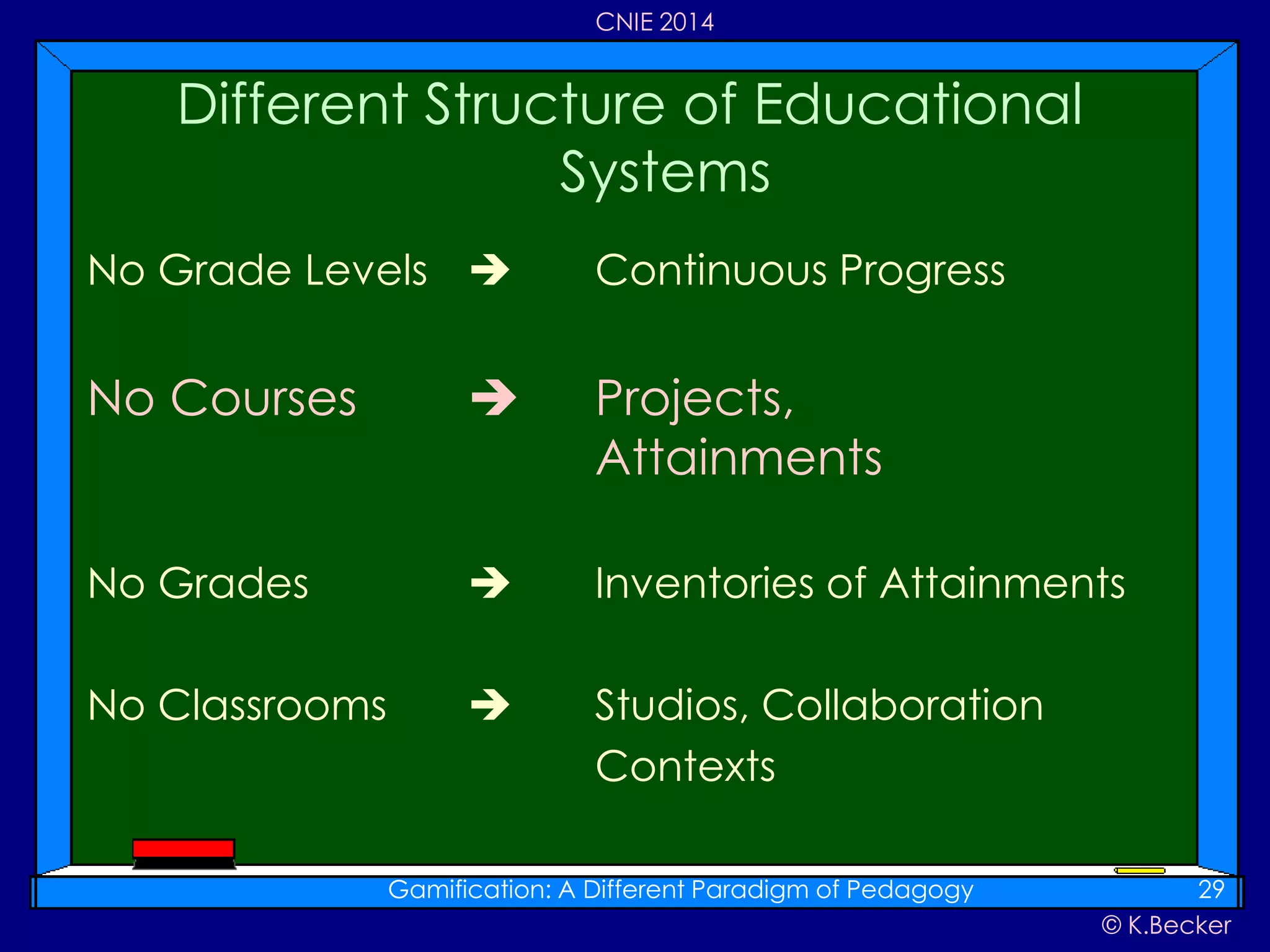
No Grade Levels  Continuous Progress
No Courses  Projects,
Attainments
No Grades  Inventories of Attainments
No Classrooms  Studios, Collaboration
Contexts
Different Structure of Educational
Systems
Gamification: A Different Paradigm of Pedagogy 29
Ā© K.Becker
CNIE 2014
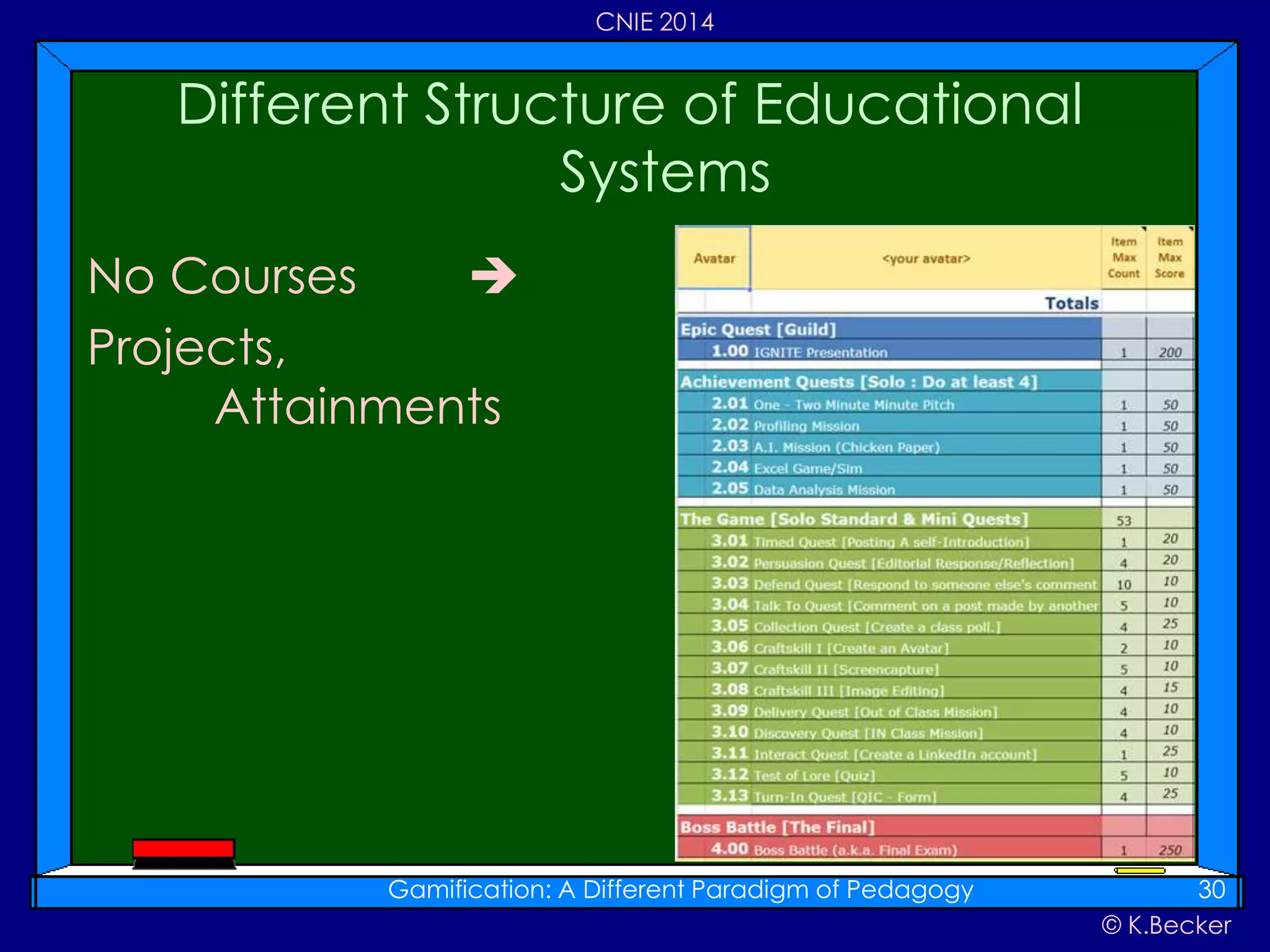
No Courses 
Projects,
Attainments
Different Structure of Educational
Systems
Gamification: A Different Paradigm of Pedagogy 30
Ā© K.Becker
CNIE 2014
No Grade Levels  Continuous Progress
No Courses  Projects, Attainments
No Grades  Inventories of
Attainments
No Classrooms  Studios, Collaboration
Contexts
Different Structure of Educational
Systems
Gamification: A Different Paradigm of Pedagogy 31
Ā© K.Becker
CNIE 2014
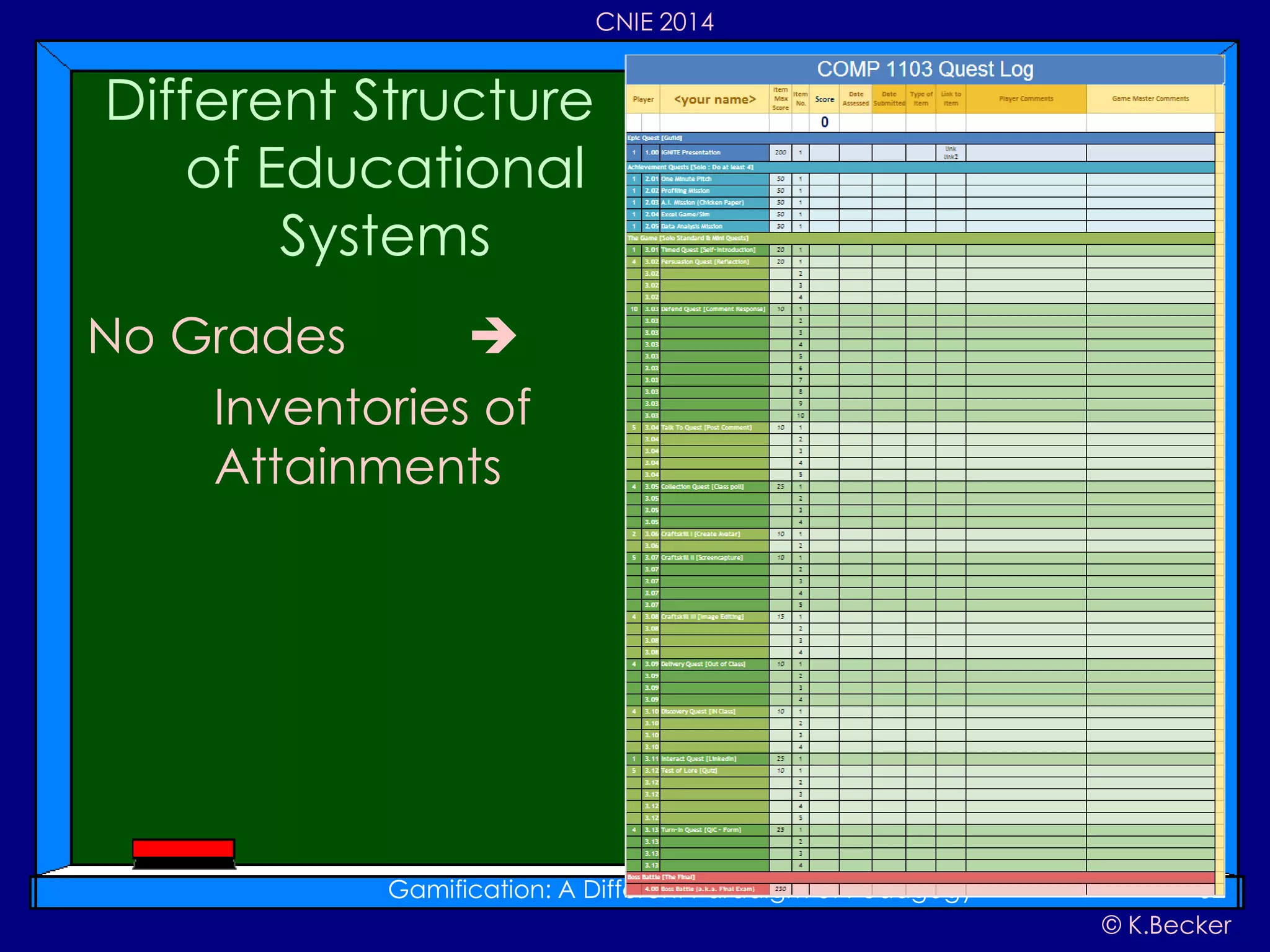
No Grades 
Inventories of
Attainments
Different Structure
of Educational
Systems
Gamification: A Different Paradigm of Pedagogy 32
Ā© K.Becker
CNIE 2014
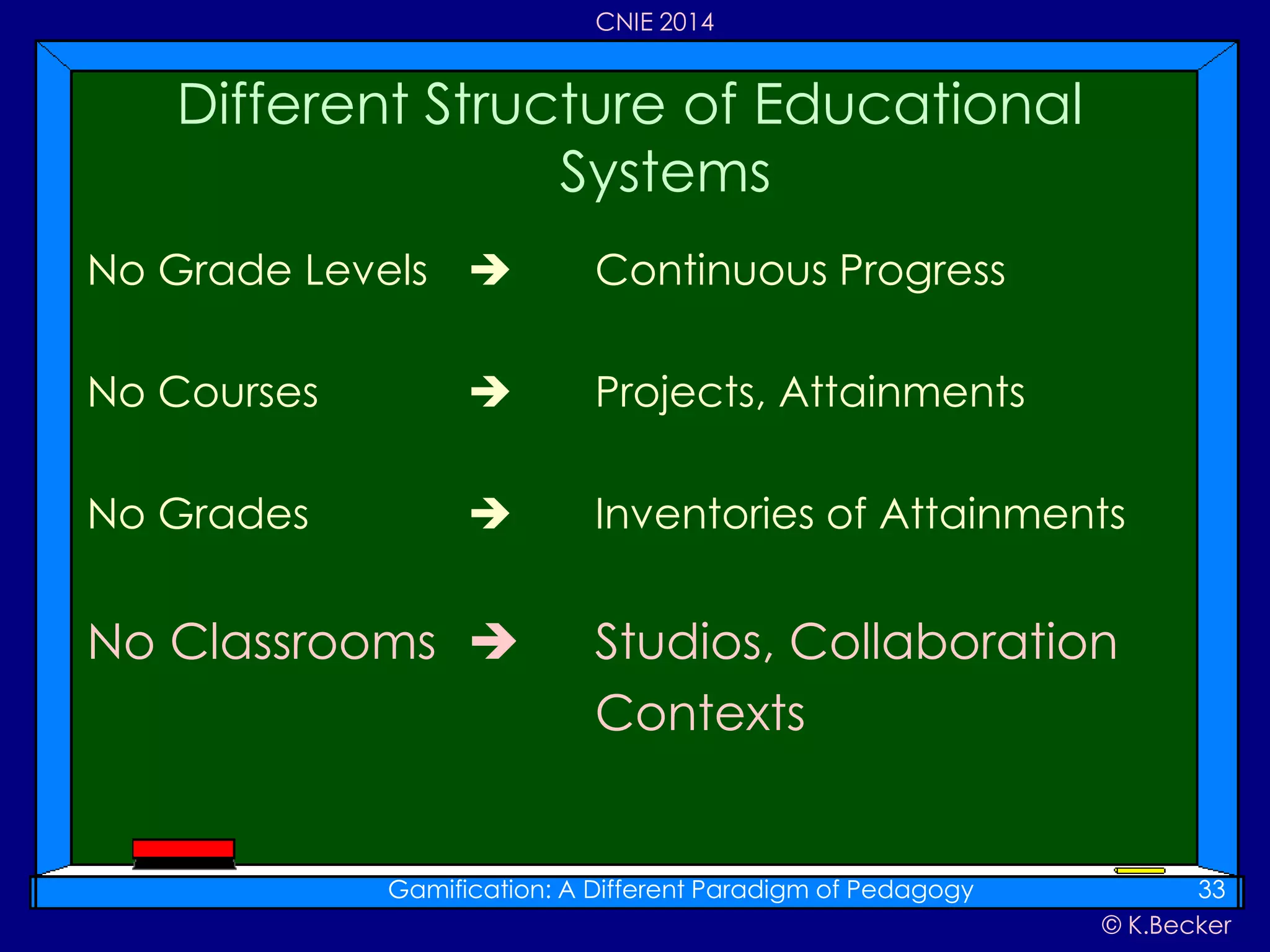
No Grade Levels  Continuous Progress
No Courses  Projects, Attainments
No Grades  Inventories of Attainments
No Classrooms  Studios, Collaboration
Contexts
Different Structure of Educational
Systems
Gamification: A Different Paradigm of Pedagogy 33
Ā© K.Becker
CNIE 2014
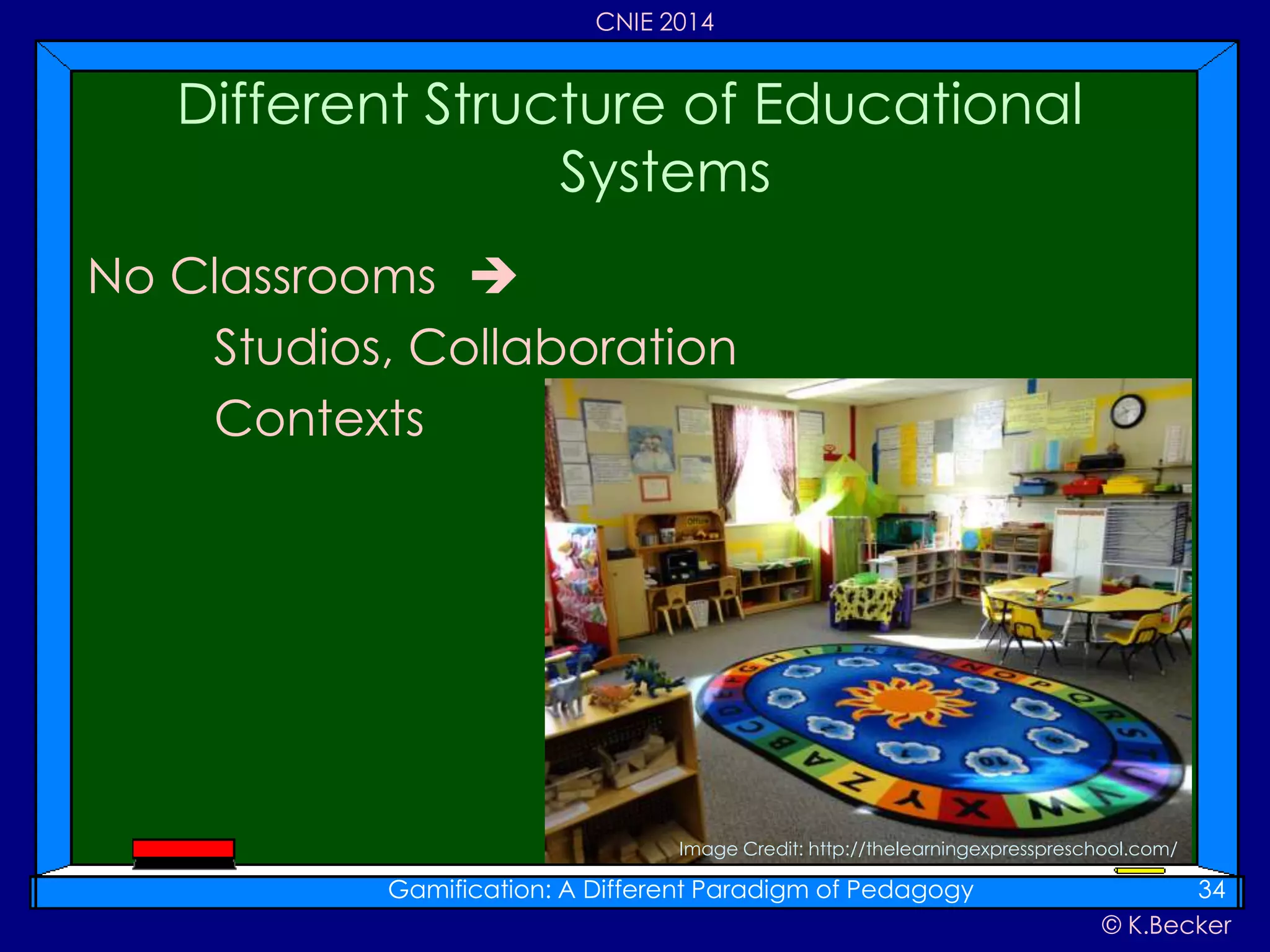
No Classrooms 
Studios, Collaboration
Contexts
Different Structure of Educational
Systems
Gamification: A Different Paradigm of Pedagogy 34
Image Credit: http://thelearningexpresspreschool.com/
Ā© K.Becker
CNIE 2014
ļ‚§ Students learn at different rates.
ļ‚§ Student progress is
ļ‚§ attainment-based
ļ‚§ customised
ļ‚§ Project Based
ļ‚§ Tutorial
Different Paradigm of Pedagogy
Gamification: A Different Paradigm of Pedagogy 35
Reigeluth, C. M., & Karnopp, J. (2013). Reinventing schools : it's time to break the mold. Lanham: Rowman & LIttlefield Education.
http://www.srareadinglabs.com/
Ā© K.Becker
CNIE 2014
ļ‚§ For Students:
ļ‚§ active
ļ‚§ self-directed
ļ‚§ For Teachers:
ļ‚§ designers
ļ‚§ facilitators
ļ‚§ mentors
Different Roles
Gamification: A Different Paradigm of Pedagogy 36
Reigeluth, C. M., & Karnopp, J. (2013). Reinventing schools : it's time to break the mold. Lanham: Rowman & LIttlefield Education.
Ā© K.Becker
CNIE 2014
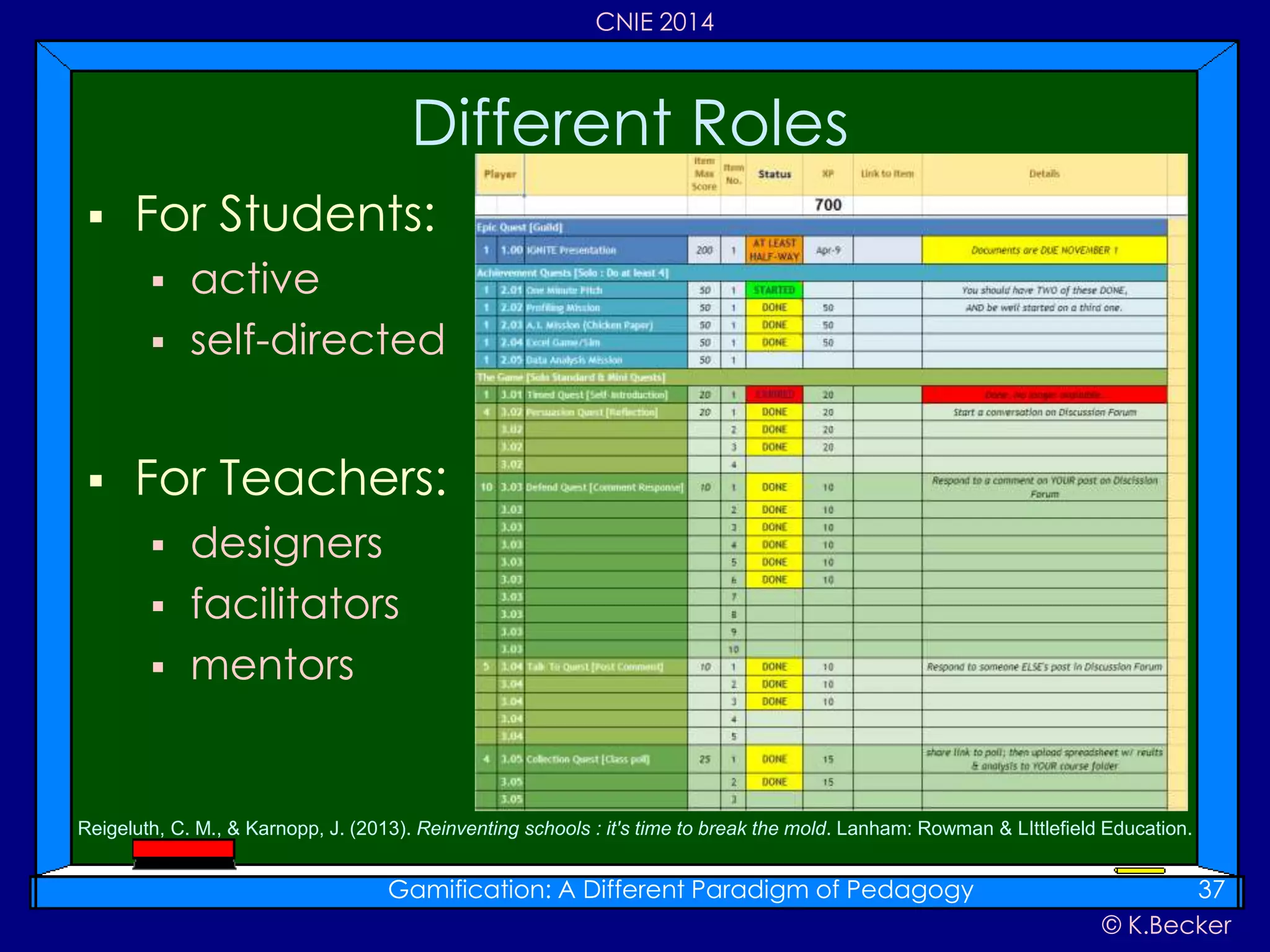
ļ‚§ For Students:
ļ‚§ active
ļ‚§ self-directed
ļ‚§ For Teachers:
ļ‚§ designers
ļ‚§ facilitators
ļ‚§ mentors
Different Roles
Gamification: A Different Paradigm of Pedagogy 37
Reigeluth, C. M., & Karnopp, J. (2013). Reinventing schools : it's time to break the mold. Lanham: Rowman & LIttlefield Education.
Ā© K.Becker
CNIE 2014
ļ‚§ Student Learning:
ļ‚§ record-keeping
ļ‚§ planning
ļ‚§ instruction
ļ‚§ assessment
Different Roles for Technology.
Gamification: A Different Paradigm of Pedagogy 38
Reigeluth, C. M., & Karnopp, J. (2013). Reinventing schools : it's time to break the mold. Lanham: Rowman & LIttlefield Education.
Ā© K.Becker
CNIE 2014
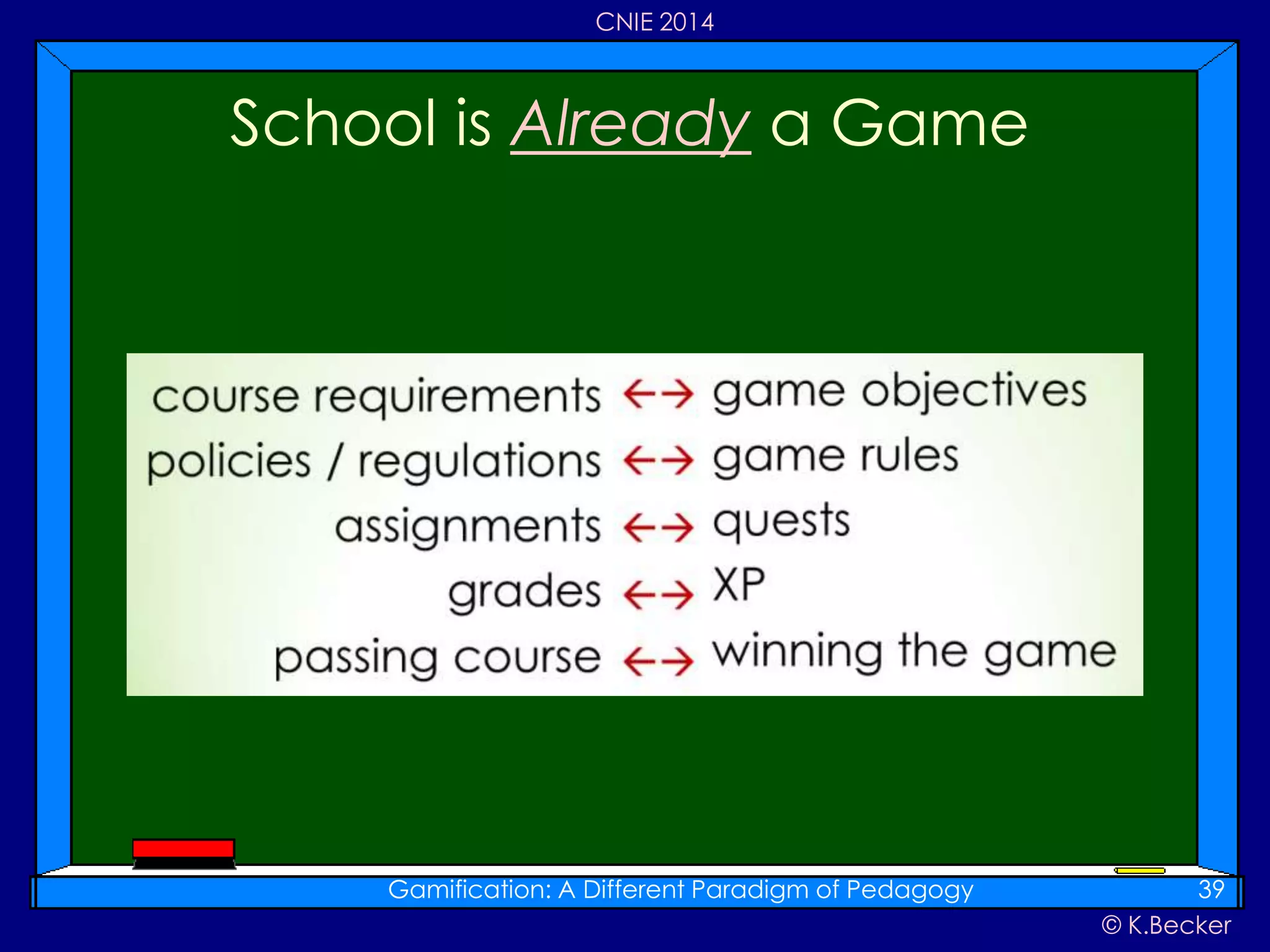
School is Already a Game
Gamification: A Different Paradigm of Pedagogy 39
Ā© K.Becker
CNIE 2014
1. Flexible Path
2. Flexible Schedule
3. Self-Directed
4. Maximal Choice
5. Accumulative Grading
Key Differences
Gamification: A Different Paradigm of Pedagogy 40
Ā© K.Becker
CNIE 2014
Questions? Comments?
Gamification: A Different Paradigm of Pedagogy 41
Ā© K.Becker
CNIE 2014
In a recent online presentation Charles M. Reigeluth, he said that the future of Ed Tech
would require a change of paradigm of pedagogy. Gamification is one such new
pedagogy that can be implemented without the need for institutional systemic change.
ā€˜Gamification’ is the use of game elements in non-game contexts and since the term’s first
appearance in 2006, it has become a trending topic on many education forums. This
presentation reports on the gamification of 2 university courses: one a grad-level education
course and the other a freshman computer course.
While many aspects of gamification are *not* new, some are, and when taken together
create a pedagogy that could be one of Reigeluth’s different paradigms. His requirements
for a new paradigm includes a requirement for attainment-based, continuous student
progress that is learner-centered, personalized, and self-directed. Gamification, done right,
is all those things.
The Gamification Paradigm includes:
1. Strict cumulative grading.
2. More tasks to choose from than needed for a perfect score.
3. Flexible path through content to demonstrate objectives.
4. Attainment-base student progress.
5. Criterion-referenced assessment.
The presentation will explain the structure of the courses that were taught, highlight
successes and failures, and conclude with strategies that can be used to incorporate
meaningful gamification into existing courses.
Abstract of Presentation:
Gamification: A Different Paradigm of Pedagogy 42
Ā© K.Becker
CNIE 2014
ļ‚§ Becker, K. (2004). Reconciling a Traditional Syllabus with an Inquiry-Based Introductory Course. The Journal of
Computing Science in Colleges, 20(2), 28-37.
ļ‚§ Becker, K. (2006). How much choice is too much? SIGCSE Bull., 38(4), 78-82. doi: 10.1145/1189136.1189176.
ļ‚§ Becker, K. (2007). Digital Game Based Learning, Once Removed: Teaching Teachers BRITISH JOURNAL OF
EDUCATIONAL TECHNOLOGY, SIG-GLUE Special Issue on Game-Based Learning 2007, 38(3), 478-488.
ļ‚§ Bogost, I. (2012). Persuasive Games: Exploitationware. Gamasutra. Retrieved from
http://www.gamasutra.com/view/feature/6366/persuasive_games_exploitationware.php
ļ‚§ Charles, D., Charles, T., McNeill, M., Bustard, D., & Black, M. (2011). Game-based feedback for educational
multi-user virtual environments. British Journal of Educational Technology, 42(4), 638-654. doi: 10.1111/j.1467-
8535.2010.01068.x.
ļ‚§ Deci, E. and Ryan, R. (2004). Handbook of Self-Determination Research. Rochester, NY: University of Rochester
Press.
ļ‚§ Deterding, S. (2012). 9.5 Theses on the Power and Efficacy of Gamification. Microsoft Research. [Microsoft
Research Video] Retrieved from http://research.microsoft.com/apps/video/dl.aspx?id=174677&l=i on 12
October 2012.
ļ‚§ Deterding, S., Dixon, D., Khaled, R., & Nacke, L. (2011). From game design elements to gamefulness: defining
"gamification". Paper presented at the Proceedings of the 15th International Academic MindTrek Conference:
Envisioning Future Media Environments, Tampere, Finland
ļ‚§ Kapp, K. M. (2012). The gamification of learning and instruction : game-based methods and strategies for
training and education. San Francisco, CA: Pfeiffer.
ļ‚§ Nicholson, S. (2012). A User-Centered Theoretical Framework for Meaningful Gamification. Paper presented at
the Games + Learning + Society 8.0, Madison, WI. on June 13
ļ‚§ Sheldon, L. (2012). The Multiplayer Classroom : Designing Coursework as a Game. Boston, Mass.: Course
Technology/Cengage Learning.
Resources
Gamification: A Different Paradigm of Pedagogy 43

Gamification paradigm

  • 1.
    Ā© K.Becker CNIE 2014 Gamification aDifferent Paradigm of Pedagogy Katrin Becker 5: Thur. May 15 11:30-12:30
  • 2.
    Ā© K.Becker CNIE 2014 1.What am I playing now? 2. A New Paradigm of Education? 3. How Does Gamification Fit? 4. Gamification is NOT New 5. Gamification IS New 6. Is Gamification a Different Paradigm? 7. Resources Outline Gamification: A Different Paradigm of Pedagogy 2
  • 3.
    Ā© K.Becker CNIE 2014 KatrinBecker, PhD Who Am I?
  • 4.
    Ā© K.Becker CNIE 2014 Whatam I playing Now? 2015-01-09 Gamification Workshop Ā© K.Becker 4
  • 5.
    Ā© K.Becker CNIE 2014 ļ‚§Childcare so parents can work. ļ‚§ Socialization (Entrainment to authority) ļ‚§ Creation of an efficient underclass of workers. ļ‚§ Teaching Good Test-Taking Behavior ļ‚§ Schools are: ļ‚§ hierarchical ļ‚§ authoritarian ļ‚§ do not encourage personal agency What are Schools For? Gamification: A Different Paradigm of Pedagogy 5 Brenda Laurel
  • 6.
    Ā© K.Becker CNIE 2014 ANew Paradigm? Agriculture ļ‚§ permanence ļ‚§ communities ļ‚§ specialization ļ‚§ extended families ļ‚§ slow transportation Gamification: A Different Paradigm of Pedagogy 6 Industrial ļ‚§ mobility ļ‚§ urbanization ļ‚§ mechanization ļ‚§ nuclear family ļ‚§ rapid transportation Information ļ‚§ extreme mobility ļ‚§ urban > rural ļ‚§ jobs shift ļ‚§ family dispersal ļ‚§ massive & rapid
  • 7.
    Ā© K.Becker CNIE 2014 ANew Paradigm in Education? Agriculture ļ‚§ 1-on-1 ļ‚§ personalized ļ‚§ apprenticeship ļ‚§ 1-room school house Gamification: A Different Paradigm of Pedagogy 7 Industrial ļ‚§ mass education ļ‚§ age-determined ļ‚§ trade schools ļ‚§ current system Information ļ‚§ ??? ļ‚§ ??? ļ‚§ ??? ļ‚§ ???
  • 8.
    Ā© K.Becker CNIE 2014 ļ‚§To understand what features an information-age educational or training system should have . . . ļ‚§ We must first understand the changing needs and conditions of the emerging information society. A New Paradigm in Education? Gamification: A Different Paradigm of Pedagogy 8 Reigeluth, C. M., & Karnopp, J. (2013). Reinventing schools : it's time to break the mold. Lanham: Rowman & LIttlefield Education.
  • 9.
    Ā© K.Becker CNIE 2014 ANew Paradigm in Education? Industrial Age ļ‚§ Bureaucratic organization ļ‚§ Autocratic leadership ļ‚§ Centralized control ļ‚§ Adversarial relationships ļ‚§ Mass production, etc. ļ‚§ Compliance ļ‚§ Conformity ļ‚§ One-way communications ļ‚§ Compartmentalization (Division of Labor) Information Age ļ‚§ Team organization ļ‚§ Shared leadership ļ‚§ Autonomy, accountability ļ‚§ Cooperative relationships ļ‚§ Customized production, etc. ļ‚§ Initiative ļ‚§ Diversity ļ‚§ Networking ļ‚§ Holism (Integration of tasks) Gamification: A Different Paradigm of Pedagogy 9 Reigeluth, C. M., & Karnopp, J. (2013). Reinventing schools : it's time to break the mold. Lanham: Rowman & LIttlefield Education.
  • 10.
    Ā© K.Becker CNIE 2014 problem-solvingvs factual knowledge cooperation vs competition initiative vs compliance A New Paradigm in Education? Gamification: A Different Paradigm of Pedagogy 10 Reigeluth, C. M., & Karnopp, J. (2013). Reinventing schools : it's time to break the mold. Lanham: Rowman & LIttlefield Education.
  • 11.
    Ā© K.Becker CNIE 2014 ļ‚§General Features: ļ‚§ People learn at different rates – adapt to them Sorting vs Learning Time-based vs Attainment-based Group-based vs Person-based Teacher-based vs Resource-based A key: The report card A New Paradigm in Education? Gamification: A Different Paradigm of Pedagogy 11 Reigeluth, C. M., & Karnopp, J. (2013). Reinventing schools : it's time to break the mold. Lanham: Rowman & LIttlefield Education.
  • 12.
    Ā© K.Becker CNIE 2014 A.Different Paradigm of Pedagogy (Instructional Technology) B. Different Roles for students, teachers, and technology. C. Different roles for instructional designers D. Different structure of educational systems What Needs to Change? Gamification: A Different Paradigm of Pedagogy 12 Reigeluth, C. M., & Karnopp, J. (2013). Reinventing schools : it's time to break the mold. Lanham: Rowman & LIttlefield Education.
  • 13.
    Ā© K.Becker CNIE 2014 A.Different Paradigm of Pedagogy (Instructional Technology) B. Different Roles for students, teachers, and technology. C. Different roles for instructional designers D. Different structure of educational systems What Needs to Change? Gamification: A Different Paradigm of Pedagogy 13 Reigeluth, C. M., & Karnopp, J. (2013). Reinventing schools : it's time to break the mold. Lanham: Rowman & LIttlefield Education.
  • 14.
    Ā© K.Becker CNIE 2014 ļ‚§Students learn at different rates. ļ‚§ Student progress is ļ‚§ attainment-based ļ‚§ customised ļ‚§ Project Based ļ‚§ Tutorial Different Paradigm of Pedagogy Gamification: A Different Paradigm of Pedagogy 14 Reigeluth, C. M., & Karnopp, J. (2013). Reinventing schools : it's time to break the mold. Lanham: Rowman & LIttlefield Education.
  • 15.
    Ā© K.Becker CNIE 2014 ļ‚§For Students: ļ‚§ active ļ‚§ self-directed ļ‚§ For Teachers: ļ‚§ designers ļ‚§ facilitators ļ‚§ mentors Different Roles Gamification: A Different Paradigm of Pedagogy 15 Reigeluth, C. M., & Karnopp, J. (2013). Reinventing schools : it's time to break the mold. Lanham: Rowman & LIttlefield Education.
  • 16.
    Ā© K.Becker CNIE 2014 ļ‚§Student Learning: ļ‚§ record-keeping ļ‚§ planning ļ‚§ instruction ļ‚§ assessment Different Roles for Technology. Gamification: A Different Paradigm of Pedagogy 16 Reigeluth, C. M., & Karnopp, J. (2013). Reinventing schools : it's time to break the mold. Lanham: Rowman & LIttlefield Education.
  • 17.
    © K.Becker CNIE 2014 NoGrade Levels  Continuous Progress No Courses  Projects, Attainments No Grades  Inventories of Attainments No Classrooms  Studios, Collaboration Contexts Different Structure of Educational Systems Gamification: A Different Paradigm of Pedagogy 17 Reigeluth, C. M., & Karnopp, J. (2013). Reinventing schools : it's time to break the mold. Lanham: Rowman & LIttlefield Education.
  • 18.
    Ā© K.Becker CNIE 2014 Theuse of game elements in non-game contexts. How Does Gamification Fit? Gamification: A Different Paradigm of Pedagogy 18 Deterding, S. (2012). 9.5 Theses on the Power and Efficacy of Gamification. Microsoft Research. [Microsoft Research Video] Retrieved from http://research.microsoft.com/apps/video/dl.aspx?id=174677&l=i on 12 October 2012.
  • 19.
    Ā© K.Becker CNIE 2014 Gamification Gamification:A Different Paradigm of Pedagogy 19 System Elements Game Play GamificationGame Playful Design Toy
  • 20.
    Ā© K.Becker CNIE 2014 Playingvs Gaming Gamification: A Different Paradigm of Pedagogy 20
  • 21.
    Ā© K.Becker CNIE 2014 GameSystems vs Game Elements Gamification: A Different Paradigm of Pedagogy 21
  • 22.
    Ā© K.Becker CNIE 2014 Gamificationis NOT New Gamification: A Different Paradigm of Pedagogy 22
  • 23.
    Ā© K.Becker CNIE 2014 ļ‚§Flexible Path ļ‚§ Must earn 'N' XP. ļ‚§ Here are 'M' things ļ‚§ totalling >N XP (*important*) ļ‚§ Must do at LEAST these: ____ ļ‚§ The rest is up to you. Gamification IS New: Gamification: A Different Paradigm of Pedagogy 23
  • 24.
    Ā© K.Becker CNIE 2014 CompetencyDriven ļ‚§ Quests  activities; things to DO ļ‚§ Focus on: ļ‚§ Activities that match objectives ļ‚§ How learners can demonstrate competence Gamification IS New: Gamification: A Different Paradigm of Pedagogy 24
  • 25.
    Ā© K.Becker CNIE 2014 AccumulativeGrades • Everything the learner does for points ADDS to the total. • NOTHING the learner does can lower their score. Gamification IS New: Gamification: A Different Paradigm of Pedagogy 25 Welcome to class …. ….. you all have ZERO
  • 26.
    Ā© K.Becker CNIE 2014 ļ‚§Structure of Educational Systems ļ‚§ Student Progress ļ‚§ Student Work ļ‚§ Student & Teacher Roles ļ‚§ Roles for Technology Back to Reigeluth's Different Paradigm of Pedagogy Gamification: A Different Paradigm of Pedagogy 26
  • 27.
    © K.Becker CNIE 2014 NoGrade Levels Continuous Progress No Courses  Projects, Attainments No Grades  Inventories of Attainments No Classrooms  Studios, Collaboration Contexts Different Structure of Educational Systems Gamification: A Different Paradigm of Pedagogy 27
  • 28.
    © K.Becker CNIE 2014 NoGrade Levels Continuous Progress Different Structure of Educational Systems Gamification: A Different Paradigm of Pedagogy 28
  • 29.
    © K.Becker CNIE 2014 NoGrade Levels  Continuous Progress No Courses  Projects, Attainments No Grades  Inventories of Attainments No Classrooms  Studios, Collaboration Contexts Different Structure of Educational Systems Gamification: A Different Paradigm of Pedagogy 29
  • 30.
    © K.Becker CNIE 2014 NoCourses  Projects, Attainments Different Structure of Educational Systems Gamification: A Different Paradigm of Pedagogy 30
  • 31.
    © K.Becker CNIE 2014 NoGrade Levels  Continuous Progress No Courses  Projects, Attainments No Grades  Inventories of Attainments No Classrooms  Studios, Collaboration Contexts Different Structure of Educational Systems Gamification: A Different Paradigm of Pedagogy 31
  • 32.
    © K.Becker CNIE 2014 NoGrades  Inventories of Attainments Different Structure of Educational Systems Gamification: A Different Paradigm of Pedagogy 32
  • 33.
    © K.Becker CNIE 2014 NoGrade Levels  Continuous Progress No Courses  Projects, Attainments No Grades  Inventories of Attainments No Classrooms  Studios, Collaboration Contexts Different Structure of Educational Systems Gamification: A Different Paradigm of Pedagogy 33
  • 34.
    © K.Becker CNIE 2014 NoClassrooms  Studios, Collaboration Contexts Different Structure of Educational Systems Gamification: A Different Paradigm of Pedagogy 34 Image Credit: http://thelearningexpresspreschool.com/
  • 35.
    Ā© K.Becker CNIE 2014 ļ‚§Students learn at different rates. ļ‚§ Student progress is ļ‚§ attainment-based ļ‚§ customised ļ‚§ Project Based ļ‚§ Tutorial Different Paradigm of Pedagogy Gamification: A Different Paradigm of Pedagogy 35 Reigeluth, C. M., & Karnopp, J. (2013). Reinventing schools : it's time to break the mold. Lanham: Rowman & LIttlefield Education. http://www.srareadinglabs.com/
  • 36.
    Ā© K.Becker CNIE 2014 ļ‚§For Students: ļ‚§ active ļ‚§ self-directed ļ‚§ For Teachers: ļ‚§ designers ļ‚§ facilitators ļ‚§ mentors Different Roles Gamification: A Different Paradigm of Pedagogy 36 Reigeluth, C. M., & Karnopp, J. (2013). Reinventing schools : it's time to break the mold. Lanham: Rowman & LIttlefield Education.
  • 37.
    Ā© K.Becker CNIE 2014 ļ‚§For Students: ļ‚§ active ļ‚§ self-directed ļ‚§ For Teachers: ļ‚§ designers ļ‚§ facilitators ļ‚§ mentors Different Roles Gamification: A Different Paradigm of Pedagogy 37 Reigeluth, C. M., & Karnopp, J. (2013). Reinventing schools : it's time to break the mold. Lanham: Rowman & LIttlefield Education.
  • 38.
    Ā© K.Becker CNIE 2014 ļ‚§Student Learning: ļ‚§ record-keeping ļ‚§ planning ļ‚§ instruction ļ‚§ assessment Different Roles for Technology. Gamification: A Different Paradigm of Pedagogy 38 Reigeluth, C. M., & Karnopp, J. (2013). Reinventing schools : it's time to break the mold. Lanham: Rowman & LIttlefield Education.
  • 39.
    Ā© K.Becker CNIE 2014 Schoolis Already a Game Gamification: A Different Paradigm of Pedagogy 39
  • 40.
    Ā© K.Becker CNIE 2014 1.Flexible Path 2. Flexible Schedule 3. Self-Directed 4. Maximal Choice 5. Accumulative Grading Key Differences Gamification: A Different Paradigm of Pedagogy 40
  • 41.
    Ā© K.Becker CNIE 2014 Questions?Comments? Gamification: A Different Paradigm of Pedagogy 41
  • 42.
    Ā© K.Becker CNIE 2014 Ina recent online presentation Charles M. Reigeluth, he said that the future of Ed Tech would require a change of paradigm of pedagogy. Gamification is one such new pedagogy that can be implemented without the need for institutional systemic change. ā€˜Gamification’ is the use of game elements in non-game contexts and since the term’s first appearance in 2006, it has become a trending topic on many education forums. This presentation reports on the gamification of 2 university courses: one a grad-level education course and the other a freshman computer course. While many aspects of gamification are *not* new, some are, and when taken together create a pedagogy that could be one of Reigeluth’s different paradigms. His requirements for a new paradigm includes a requirement for attainment-based, continuous student progress that is learner-centered, personalized, and self-directed. Gamification, done right, is all those things. The Gamification Paradigm includes: 1. Strict cumulative grading. 2. More tasks to choose from than needed for a perfect score. 3. Flexible path through content to demonstrate objectives. 4. Attainment-base student progress. 5. Criterion-referenced assessment. The presentation will explain the structure of the courses that were taught, highlight successes and failures, and conclude with strategies that can be used to incorporate meaningful gamification into existing courses. Abstract of Presentation: Gamification: A Different Paradigm of Pedagogy 42
  • 43.
    Ā© K.Becker CNIE 2014 ļ‚§Becker, K. (2004). Reconciling a Traditional Syllabus with an Inquiry-Based Introductory Course. The Journal of Computing Science in Colleges, 20(2), 28-37. ļ‚§ Becker, K. (2006). How much choice is too much? SIGCSE Bull., 38(4), 78-82. doi: 10.1145/1189136.1189176. ļ‚§ Becker, K. (2007). Digital Game Based Learning, Once Removed: Teaching Teachers BRITISH JOURNAL OF EDUCATIONAL TECHNOLOGY, SIG-GLUE Special Issue on Game-Based Learning 2007, 38(3), 478-488. ļ‚§ Bogost, I. (2012). Persuasive Games: Exploitationware. Gamasutra. Retrieved from http://www.gamasutra.com/view/feature/6366/persuasive_games_exploitationware.php ļ‚§ Charles, D., Charles, T., McNeill, M., Bustard, D., & Black, M. (2011). Game-based feedback for educational multi-user virtual environments. British Journal of Educational Technology, 42(4), 638-654. doi: 10.1111/j.1467- 8535.2010.01068.x. ļ‚§ Deci, E. and Ryan, R. (2004). Handbook of Self-Determination Research. Rochester, NY: University of Rochester Press. ļ‚§ Deterding, S. (2012). 9.5 Theses on the Power and Efficacy of Gamification. Microsoft Research. [Microsoft Research Video] Retrieved from http://research.microsoft.com/apps/video/dl.aspx?id=174677&l=i on 12 October 2012. ļ‚§ Deterding, S., Dixon, D., Khaled, R., & Nacke, L. (2011). From game design elements to gamefulness: defining "gamification". Paper presented at the Proceedings of the 15th International Academic MindTrek Conference: Envisioning Future Media Environments, Tampere, Finland ļ‚§ Kapp, K. M. (2012). The gamification of learning and instruction : game-based methods and strategies for training and education. San Francisco, CA: Pfeiffer. ļ‚§ Nicholson, S. (2012). A User-Centered Theoretical Framework for Meaningful Gamification. Paper presented at the Games + Learning + Society 8.0, Madison, WI. on June 13 ļ‚§ Sheldon, L. (2012). The Multiplayer Classroom : Designing Coursework as a Game. Boston, Mass.: Course Technology/Cengage Learning. Resources Gamification: A Different Paradigm of Pedagogy 43

Editor's Notes

  • #5Ā Ben Sawyer along with David Rejeski coined the term "Serious Games" in relation to digital games. At the various Serious Games venues he helped organize, Ben always insisted that presenters include a slide in their presentations that shows what games they are playing. Here's how he explains it on his website: A tip to those working in, or with videogames... try playing them! We're amazed how often people who put themselves forward as experts onĀ games and serious games are far from serious aboutĀ playing games.Ā We're quite serious.Ā We now require all speakers at ourĀ game events to provide the audience with a list of the last few gamesĀ they've played.Ā We provide the same list for ourselves whenever weĀ speak.