2020 | 1
To copy or adapt this material, see
OpportunityCulture.org/terms-of-use
Multi-Classroom Leadership
When Students & Teachers
Are at Home
This is a working draft. Feedback is welcome.
This deck is for Opportunity Culture districts and
schools that have already implemented Multi-
Classroom Leadership, in full or in part. Other
districts and states wanting to transition to teacher-
led teams to provide teachers with more support
remotely should contact Public Impact for
assistance. Please see more resources on
https://www.opportunityculture.org/teach-and-
learn-from-home/
2020 | 2
Contents
Topics
Multi-Classroom Leadership
Online Learning Research Summary
High-Connection At-Home Learning
Lower-Connection At-Home Learning
Recommended Shifts: Technology
Recommended Shifts: Role
Recommended Shifts: Instructional
Recommended Shifts: Schedule
Action Planner & Citations
2020 | 3
Multi-Classroom Leadership
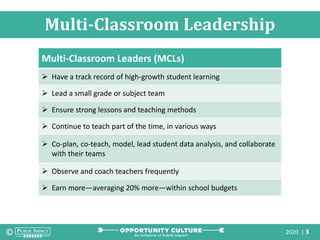
Multi-Classroom Leaders (MCLs)
 Have a track record of high-growth student learning
 Lead a small grade or subject team
 Ensure strong lessons and teaching methods
 Continue to teach part of the time, in various ways
 Co-plan, co-teach, model, lead student data analysis, and collaborate
with their teams
 Observe and coach teachers frequently
 Earn more—averaging 20% more—within school budgets
2020 | 4
Strong Gains for MCL Teams
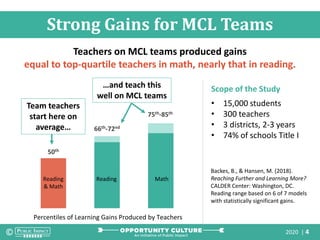
Teachers on MCL teams produced gains
equal to top-quartile teachers in math, nearly that in reading.
50th
66th-72nd
75th-85th
Percentiles of Learning Gains Produced by Teachers
Reading
& Math
MathReading
Team teachers
start here on
average…
Scope of the Study
• 15,000 students
• 300 teachers
• 3 districts, 2-3 years
• 74% of schools Title I
Backes, B., & Hansen, M. (2018).
Reaching Further and Learning More?
CALDER Center: Washington, DC.
Reading range based on 6 of 7 models
with statistically significant gains.
…and teach this
well on MCL teams
2020 | 5
Multi-Classroom Leadership
• What makes Multi-Classroom Leadership work well at your school?
• What do you want to keep, ideally, when shifting to at-home work?
 MCL and Other Roles?
 Instructional Elements?
 Technology?
 Schedules?
 Other?
 Other?
2020 | 6
Multi-Classroom Leadership
How can Multi-Classroom Leadership work when both
students and teachers are at home?
In response to the COVID-19 pandemic, this deck provides
considerations and recommendations for Opportunity Culture
schools to continue achieving high-growth student learning and
developing students’ critical social-emotional skills—and
providing strong support to teaching teams.
Recognizing that each student and teacher has differing—and
some very challenging—circumstances at home, and different
access to resources, the recommendations here are intended
to help the most students possible learn and thrive at this time.
2020 | 7
Online Learning Research Summary
All-Online—No Face-to-Face
Teaching—Doesn’t Work Well
for Most Students
• Researchers from Columbia, MIT,
Northwestern, and the University of Toronto
synthesized findings from 22 rigorous
studies: Overall, students performed
significantly worse in fully online classes.1
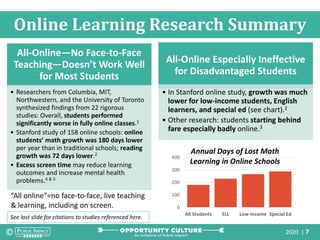
• Stanford study of 158 online schools: online
students’ math growth was 180 days lower
per year than in traditional schools; reading
growth was 72 days lower.2
• Excess screen time may reduce learning
outcomes and increase mental health
problems.4 & 5
All-Online Especially Ineffective
for Disadvantaged Students
• In Stanford online study, growth was much
lower for low-income students, English
learners, and special ed (see chart).2
• Other research: students starting behind
fare especially badly online.3
0
100
200
300
400
All Students ELL Low-Income Special Ed
Annual Days of Lost Math
Learning in Online Schools
See last slide for citations to studies referenced here.
“All online”=no face-to-face, live teaching
& learning, including on screen.
2020 | 8
High-Connection At-Home Learning
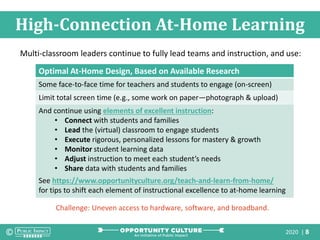
Optimal At-Home Design, Based on Available Research
Some face-to-face time for teachers and students to engage (on-screen)
Limit total screen time (e.g., some work on paper—photograph & upload)
And continue using elements of excellent instruction:
• Connect with students and families
• Lead the (virtual) classroom to engage students
• Execute rigorous, personalized lessons for mastery & growth
• Monitor student learning data
• Adjust instruction to meet each student’s needs
• Share data with students and families
See https://www.opportunityculture.org/teach-and-learn-from-home/
for tips to shift each element of instructional excellence to at-home learning
Multi-classroom leaders continue to fully lead teams and instruction, and use:
Challenge: Uneven access to hardware, software, and broadband.
2020 | 9
High-Connection At-Home Learning
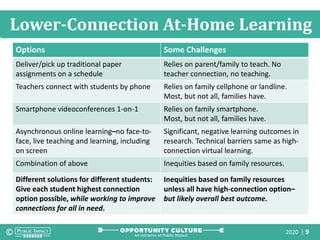
Options Some Challenges
Deliver/pick up traditional paper
assignments on a schedule
Relies on parent/family to teach. No
teacher connection, no teaching.
Teachers connect with students by phone Relies on family cellphone or landline.
Most, but not all, families have.
Smartphone videoconferences 1-on-1 Relies on family smartphone.
Most, but not all, families have.
Asynchronous online learning–no face-to-
face, live teaching and learning, including
on screen
Significant, negative learning outcomes in
research. Technical barriers same as high-
connection virtual learning.
Combination of above Inequities based on family resources.
Different solutions for different students:
Give each student highest connection
option possible, while working to improve
connections for all in need.
Inequities based on family resources
unless all have high-connection option–
but likely overall best outcome.
Lower-Connection At-Home Learning
2020 | 10
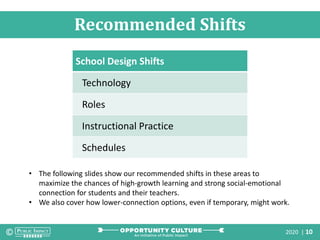
Recommended Shifts
School Design Shifts
Technology
Roles
Instructional Practice
Schedules
• The following slides show our recommended shifts in these areas to
maximize the chances of high-growth learning and strong social-emotional
connection for students and their teachers.
• We also cover how lower-connection options, even if temporary, might work.
2020 | 11
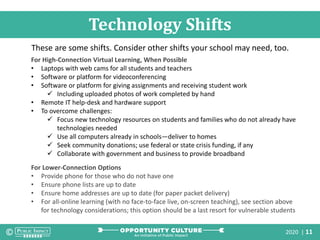
Technology Shifts
For High-Connection Virtual Learning, When Possible
• Laptops with web cams for all students and teachers
• Software or platform for videoconferencing
• Software or platform for giving assignments and receiving student work
 Including uploaded photos of work completed by hand
• Remote IT help-desk and hardware support
• To overcome challenges:
 Focus new technology resources on students and families who do not already have
technologies needed
 Use all computers already in schools—deliver to homes
 Seek community donations; use federal or state crisis funding, if any
 Collaborate with government and business to provide broadband
For Lower-Connection Options
• Provide phone for those who do not have one
• Ensure phone lists are up to date
• Ensure home addresses are up to date (for paper packet delivery)
• For all-online learning (with no face-to-face live, on-screen teaching), see section above
for technology considerations; this option should be a last resort for vulnerable students
These are some shifts. Consider other shifts your school may need, too.
2020 | 12
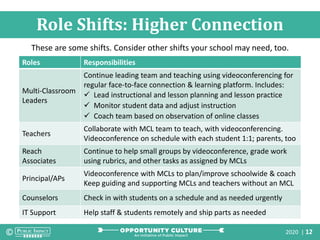
Role Shifts: Higher Connection
These are some shifts. Consider other shifts your school may need, too.
Roles Responsibilities
Multi-Classroom
Leaders
Continue leading team and teaching using videoconferencing for
regular face-to-face connection & learning platform. Includes:
 Lead instructional and lesson planning and lesson practice
 Monitor student data and adjust instruction
 Coach team based on observation of online classes
Teachers
Collaborate with MCL team to teach, with videoconferencing.
Videoconference on schedule with each student 1:1; parents, too
Reach
Associates
Continue to help small groups by videoconference, grade work
using rubrics, and other tasks as assigned by MCLs
Principal/APs
Videoconference with MCLs to plan/improve schoolwide & coach
Keep guiding and supporting MCLs and teachers without an MCL
Counselors Check in with students on a schedule and as needed urgently
IT Support Help staff & students remotely and ship parts as needed
2020 | 13
Role Shifts: Lower Connection
Roles Responsibilities
Multi-Classroom
Leaders
Continue to lead team in a more limited range of activities
 Lead selection of paper assignments sent to each student
 Monitor student data and adjust materials sent home
 (Team has no lesson planning; only phone observation/coaching)
Teachers
Check in by phone with each student 1:1 on a schedule, to engage
and provide mini-tutorials as needed; also with parents if possible
Reach Associates
Grade work using rubrics, and other tasks as assigned by MCLs
Check in with students and parents by phone, as MCL assigns
Principal/APs
Video- (ideal) or phone-conference with MCLs to plan and improve
Keep guiding and supporting MCLs and teachers without an MCL
APs or Other Organize phone check-ins and assignment delivery schedules
Counselors Check in with students by phone on a schedule and when urgent
IT Support For online use, help staff & students remotely; ship parts needed
Bus drivers Deliver/pick up paper assignments (possibly with food delivery)
2020 | 14
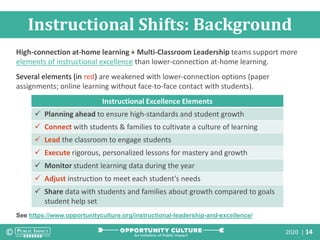
Instructional Shifts: Background
High-connection at-home learning + Multi-Classroom Leadership teams support more
elements of instructional excellence than lower-connection at-home learning.
Several elements (in red) are weakened with lower-connection options (paper
assignments; online learning without face-to-face contact with students).
See https://www.opportunityculture.org/instructional-leadership-and-excellence/
Instructional Excellence Elements
 Planning ahead to ensure high-standards and student growth
 Connect with students & families to cultivate a culture of learning
 Lead the classroom to engage students
 Execute rigorous, personalized lessons for mastery and growth
 Monitor student learning data during the year
 Adjust instruction to meet each student’s needs
 Share data with students and families about growth compared to goals
student help set
2020 | 15
Instructional Shifts: Higher Connection
For High-Connection At-Home Learning, When Possible
• Teaching methods:
• Teachers spend part of each class teaching live via videoconference
• Teaching is mostly with part of the class for short segments (e.g., 6–15 students)
• Class time may begin in a larger group briefly
• Small-group videoconferences allow eye contact (research says this boosts learning)
• Small-group instruction:
• In small groups, teachers facilitate discussion and analysis and may lecture some
• Examples: dissecting a poem, working a math proof, giving a phonics lesson
• Students interact face to face with the teacher and one another.
• When students are not with teachers, they:
• Complete assignments
• Do skills practice
• Work on individual and group projects
• Assignments are:
• Communicated by teachers and turned in by students on a learning platform.
• Due at the end of the period, end of the day, or a future date specified.
These are some shifts. Consider other shifts your school may need, too.
Make needed arrangements
for students with IEPs and
English language learners
2020 | 16
Instructional Shifts: Lower Connection
For Lower-Connection Options
• Teaching methods:
• Teachers select right-fit paper materials for each student (paper packet delivery)
• Or teachers assign online student work
• Teachers conduct student phone check-ins for connection and mini-tutorials
• Students complete all work alone (or with parent/family support, if available):
• Study lessons on paper or online
• Complete assignments on paper or online
• Do skills practice on paper or online
• Work on individual and group projects
• Assignments are:
• Communicated by teachers and turned in by students on a learning platform, or
communicated through paper packets delivered and picked up on a schedule
• Due on a specified date for packet pick-up (paper) or online, such as weekly
These are some shifts. Consider other shifts your school may need, too.
Make needed arrangements
for students with IEPs and
English language learners
2020 | 17
Schedule Shifts: Higher Connection
For High-Connection At-Home Learning, When Possible
• Establish a schedule, so students have structure and certainty
• Establish virtual “office hours” for quick teacher-student check-ins
• Use same schedule as in-school learning, for continuity:
 Daily “class” schedule stays the same
 After videoconferencing, students complete assigned work during the
rest of the “period” or by end of day/week.
 Maintain usual times for meetings of MCL teams, MCL and teachers’ one-
on-ones, and principal and each MCL, by videoconference
• Or use condensed schedule, for continuity and flexibility:
 Keep daily “class” schedules in the same order, but condensed in shorter
periods; students complete work by end of day/week
 Use other half of the day for planning and the usual meetings of MCL
teams, MCL and teachers’ one-on-ones, and principal and each MCL, by
phone or videoconference. Schedule to promote team effectiveness.
These are some shifts. Consider other shifts your school may need, too.
2020 | 18
Instructional Shifts: Lower Connection
For Lower-Connection Options
• Schedule teacher-student phone checks-ins at a set time
• Establish phone “office hours” for urgent student needs
• Make paper assignments due at end of week for home pickup
• Establish a new schedule for the usual meetings of MCL teams, MCL and
teachers’ one-on-ones, and principal and each MCL, by phone or
videoconference
These are some shifts. Consider other shifts your school may need, too.
2020 | 19
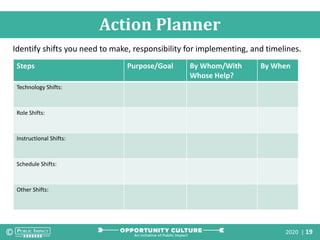
Action Planner
Steps Purpose/Goal By Whom/With
Whose Help?
By When
Technology Shifts:
Role Shifts:
Instructional Shifts:
Schedule Shifts:
Other Shifts:
Identify shifts you need to make, responsibility for implementing, and timelines.
2020 | 20
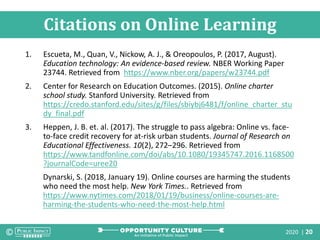
Citations on Online Learning
1. Escueta, M., Quan, V., Nickow, A. J., & Oreopoulos, P. (2017, August).
Education technology: An evidence-based review. NBER Working Paper
23744. Retrieved from https://www.nber.org/papers/w23744.pdf
2. Center for Research on Education Outcomes. (2015). Online charter
school study. Stanford University. Retrieved from
https://credo.stanford.edu/sites/g/files/sbiybj6481/f/online_charter_stu
dy_final.pdf
3. Heppen, J. B. et. al. (2017). The struggle to pass algebra: Online vs. face-
to-face credit recovery for at-risk urban students. Journal of Research on
Educational Effectiveness. 10(2), 272–296. Retrieved from
https://www.tandfonline.com/doi/abs/10.1080/19345747.2016.1168500
?journalCode=uree20
Dynarski, S. (2018, January 19). Online courses are harming the students
who need the most help. New York Times.. Retrieved from
https://www.nytimes.com/2018/01/19/business/online-courses-are-
harming-the-students-who-need-the-most-help.html
2020 | 21
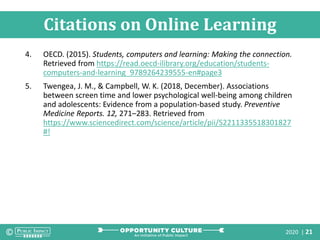
Citations on Online Learning
4. OECD. (2015). Students, computers and learning: Making the connection.
Retrieved from https://read.oecd-ilibrary.org/education/students-
computers-and-learning_9789264239555-en#page3
5. Twengea, J. M., & Campbell, W. K. (2018, December). Associations
between screen time and lower psychological well-being among children
and adolescents: Evidence from a population-based study. Preventive
Medicine Reports. 12, 271–283. Retrieved from
https://www.sciencedirect.com/science/article/pii/S2211335518301827
#!

Opportunity Culture

  • 1.
    2020 | 1 Tocopy or adapt this material, see OpportunityCulture.org/terms-of-use Multi-Classroom Leadership When Students & Teachers Are at Home This is a working draft. Feedback is welcome. This deck is for Opportunity Culture districts and schools that have already implemented Multi- Classroom Leadership, in full or in part. Other districts and states wanting to transition to teacher- led teams to provide teachers with more support remotely should contact Public Impact for assistance. Please see more resources on https://www.opportunityculture.org/teach-and- learn-from-home/
  • 2.
    2020 | 2 Contents Topics Multi-ClassroomLeadership Online Learning Research Summary High-Connection At-Home Learning Lower-Connection At-Home Learning Recommended Shifts: Technology Recommended Shifts: Role Recommended Shifts: Instructional Recommended Shifts: Schedule Action Planner & Citations
  • 3.
    2020 | 3 Multi-ClassroomLeadership Multi-Classroom Leaders (MCLs)  Have a track record of high-growth student learning  Lead a small grade or subject team  Ensure strong lessons and teaching methods  Continue to teach part of the time, in various ways  Co-plan, co-teach, model, lead student data analysis, and collaborate with their teams  Observe and coach teachers frequently  Earn more—averaging 20% more—within school budgets
  • 4.
    2020 | 4 StrongGains for MCL Teams Teachers on MCL teams produced gains equal to top-quartile teachers in math, nearly that in reading. 50th 66th-72nd 75th-85th Percentiles of Learning Gains Produced by Teachers Reading & Math MathReading Team teachers start here on average… Scope of the Study • 15,000 students • 300 teachers • 3 districts, 2-3 years • 74% of schools Title I Backes, B., & Hansen, M. (2018). Reaching Further and Learning More? CALDER Center: Washington, DC. Reading range based on 6 of 7 models with statistically significant gains. …and teach this well on MCL teams
  • 5.
    2020 | 5 Multi-ClassroomLeadership • What makes Multi-Classroom Leadership work well at your school? • What do you want to keep, ideally, when shifting to at-home work?  MCL and Other Roles?  Instructional Elements?  Technology?  Schedules?  Other?  Other?
  • 6.
    2020 | 6 Multi-ClassroomLeadership How can Multi-Classroom Leadership work when both students and teachers are at home? In response to the COVID-19 pandemic, this deck provides considerations and recommendations for Opportunity Culture schools to continue achieving high-growth student learning and developing students’ critical social-emotional skills—and providing strong support to teaching teams. Recognizing that each student and teacher has differing—and some very challenging—circumstances at home, and different access to resources, the recommendations here are intended to help the most students possible learn and thrive at this time.
  • 7.
    2020 | 7 OnlineLearning Research Summary All-Online—No Face-to-Face Teaching—Doesn’t Work Well for Most Students • Researchers from Columbia, MIT, Northwestern, and the University of Toronto synthesized findings from 22 rigorous studies: Overall, students performed significantly worse in fully online classes.1 • Stanford study of 158 online schools: online students’ math growth was 180 days lower per year than in traditional schools; reading growth was 72 days lower.2 • Excess screen time may reduce learning outcomes and increase mental health problems.4 & 5 All-Online Especially Ineffective for Disadvantaged Students • In Stanford online study, growth was much lower for low-income students, English learners, and special ed (see chart).2 • Other research: students starting behind fare especially badly online.3 0 100 200 300 400 All Students ELL Low-Income Special Ed Annual Days of Lost Math Learning in Online Schools See last slide for citations to studies referenced here. “All online”=no face-to-face, live teaching & learning, including on screen.
  • 8.
    2020 | 8 High-ConnectionAt-Home Learning Optimal At-Home Design, Based on Available Research Some face-to-face time for teachers and students to engage (on-screen) Limit total screen time (e.g., some work on paper—photograph & upload) And continue using elements of excellent instruction: • Connect with students and families • Lead the (virtual) classroom to engage students • Execute rigorous, personalized lessons for mastery & growth • Monitor student learning data • Adjust instruction to meet each student’s needs • Share data with students and families See https://www.opportunityculture.org/teach-and-learn-from-home/ for tips to shift each element of instructional excellence to at-home learning Multi-classroom leaders continue to fully lead teams and instruction, and use: Challenge: Uneven access to hardware, software, and broadband.
  • 9.
    2020 | 9 High-ConnectionAt-Home Learning Options Some Challenges Deliver/pick up traditional paper assignments on a schedule Relies on parent/family to teach. No teacher connection, no teaching. Teachers connect with students by phone Relies on family cellphone or landline. Most, but not all, families have. Smartphone videoconferences 1-on-1 Relies on family smartphone. Most, but not all, families have. Asynchronous online learning–no face-to- face, live teaching and learning, including on screen Significant, negative learning outcomes in research. Technical barriers same as high- connection virtual learning. Combination of above Inequities based on family resources. Different solutions for different students: Give each student highest connection option possible, while working to improve connections for all in need. Inequities based on family resources unless all have high-connection option– but likely overall best outcome. Lower-Connection At-Home Learning
  • 10.
    2020 | 10 RecommendedShifts School Design Shifts Technology Roles Instructional Practice Schedules • The following slides show our recommended shifts in these areas to maximize the chances of high-growth learning and strong social-emotional connection for students and their teachers. • We also cover how lower-connection options, even if temporary, might work.
  • 11.
    2020 | 11 TechnologyShifts For High-Connection Virtual Learning, When Possible • Laptops with web cams for all students and teachers • Software or platform for videoconferencing • Software or platform for giving assignments and receiving student work  Including uploaded photos of work completed by hand • Remote IT help-desk and hardware support • To overcome challenges:  Focus new technology resources on students and families who do not already have technologies needed  Use all computers already in schools—deliver to homes  Seek community donations; use federal or state crisis funding, if any  Collaborate with government and business to provide broadband For Lower-Connection Options • Provide phone for those who do not have one • Ensure phone lists are up to date • Ensure home addresses are up to date (for paper packet delivery) • For all-online learning (with no face-to-face live, on-screen teaching), see section above for technology considerations; this option should be a last resort for vulnerable students These are some shifts. Consider other shifts your school may need, too.
  • 12.
    2020 | 12 RoleShifts: Higher Connection These are some shifts. Consider other shifts your school may need, too. Roles Responsibilities Multi-Classroom Leaders Continue leading team and teaching using videoconferencing for regular face-to-face connection & learning platform. Includes:  Lead instructional and lesson planning and lesson practice  Monitor student data and adjust instruction  Coach team based on observation of online classes Teachers Collaborate with MCL team to teach, with videoconferencing. Videoconference on schedule with each student 1:1; parents, too Reach Associates Continue to help small groups by videoconference, grade work using rubrics, and other tasks as assigned by MCLs Principal/APs Videoconference with MCLs to plan/improve schoolwide & coach Keep guiding and supporting MCLs and teachers without an MCL Counselors Check in with students on a schedule and as needed urgently IT Support Help staff & students remotely and ship parts as needed
  • 13.
    2020 | 13 RoleShifts: Lower Connection Roles Responsibilities Multi-Classroom Leaders Continue to lead team in a more limited range of activities  Lead selection of paper assignments sent to each student  Monitor student data and adjust materials sent home  (Team has no lesson planning; only phone observation/coaching) Teachers Check in by phone with each student 1:1 on a schedule, to engage and provide mini-tutorials as needed; also with parents if possible Reach Associates Grade work using rubrics, and other tasks as assigned by MCLs Check in with students and parents by phone, as MCL assigns Principal/APs Video- (ideal) or phone-conference with MCLs to plan and improve Keep guiding and supporting MCLs and teachers without an MCL APs or Other Organize phone check-ins and assignment delivery schedules Counselors Check in with students by phone on a schedule and when urgent IT Support For online use, help staff & students remotely; ship parts needed Bus drivers Deliver/pick up paper assignments (possibly with food delivery)
  • 14.
    2020 | 14 InstructionalShifts: Background High-connection at-home learning + Multi-Classroom Leadership teams support more elements of instructional excellence than lower-connection at-home learning. Several elements (in red) are weakened with lower-connection options (paper assignments; online learning without face-to-face contact with students). See https://www.opportunityculture.org/instructional-leadership-and-excellence/ Instructional Excellence Elements  Planning ahead to ensure high-standards and student growth  Connect with students & families to cultivate a culture of learning  Lead the classroom to engage students  Execute rigorous, personalized lessons for mastery and growth  Monitor student learning data during the year  Adjust instruction to meet each student’s needs  Share data with students and families about growth compared to goals student help set
  • 15.
    2020 | 15 InstructionalShifts: Higher Connection For High-Connection At-Home Learning, When Possible • Teaching methods: • Teachers spend part of each class teaching live via videoconference • Teaching is mostly with part of the class for short segments (e.g., 6–15 students) • Class time may begin in a larger group briefly • Small-group videoconferences allow eye contact (research says this boosts learning) • Small-group instruction: • In small groups, teachers facilitate discussion and analysis and may lecture some • Examples: dissecting a poem, working a math proof, giving a phonics lesson • Students interact face to face with the teacher and one another. • When students are not with teachers, they: • Complete assignments • Do skills practice • Work on individual and group projects • Assignments are: • Communicated by teachers and turned in by students on a learning platform. • Due at the end of the period, end of the day, or a future date specified. These are some shifts. Consider other shifts your school may need, too. Make needed arrangements for students with IEPs and English language learners
  • 16.
    2020 | 16 InstructionalShifts: Lower Connection For Lower-Connection Options • Teaching methods: • Teachers select right-fit paper materials for each student (paper packet delivery) • Or teachers assign online student work • Teachers conduct student phone check-ins for connection and mini-tutorials • Students complete all work alone (or with parent/family support, if available): • Study lessons on paper or online • Complete assignments on paper or online • Do skills practice on paper or online • Work on individual and group projects • Assignments are: • Communicated by teachers and turned in by students on a learning platform, or communicated through paper packets delivered and picked up on a schedule • Due on a specified date for packet pick-up (paper) or online, such as weekly These are some shifts. Consider other shifts your school may need, too. Make needed arrangements for students with IEPs and English language learners
  • 17.
    2020 | 17 ScheduleShifts: Higher Connection For High-Connection At-Home Learning, When Possible • Establish a schedule, so students have structure and certainty • Establish virtual “office hours” for quick teacher-student check-ins • Use same schedule as in-school learning, for continuity:  Daily “class” schedule stays the same  After videoconferencing, students complete assigned work during the rest of the “period” or by end of day/week.  Maintain usual times for meetings of MCL teams, MCL and teachers’ one- on-ones, and principal and each MCL, by videoconference • Or use condensed schedule, for continuity and flexibility:  Keep daily “class” schedules in the same order, but condensed in shorter periods; students complete work by end of day/week  Use other half of the day for planning and the usual meetings of MCL teams, MCL and teachers’ one-on-ones, and principal and each MCL, by phone or videoconference. Schedule to promote team effectiveness. These are some shifts. Consider other shifts your school may need, too.
  • 18.
    2020 | 18 InstructionalShifts: Lower Connection For Lower-Connection Options • Schedule teacher-student phone checks-ins at a set time • Establish phone “office hours” for urgent student needs • Make paper assignments due at end of week for home pickup • Establish a new schedule for the usual meetings of MCL teams, MCL and teachers’ one-on-ones, and principal and each MCL, by phone or videoconference These are some shifts. Consider other shifts your school may need, too.
  • 19.
    2020 | 19 ActionPlanner Steps Purpose/Goal By Whom/With Whose Help? By When Technology Shifts: Role Shifts: Instructional Shifts: Schedule Shifts: Other Shifts: Identify shifts you need to make, responsibility for implementing, and timelines.
  • 20.
    2020 | 20 Citationson Online Learning 1. Escueta, M., Quan, V., Nickow, A. J., & Oreopoulos, P. (2017, August). Education technology: An evidence-based review. NBER Working Paper 23744. Retrieved from https://www.nber.org/papers/w23744.pdf 2. Center for Research on Education Outcomes. (2015). Online charter school study. Stanford University. Retrieved from https://credo.stanford.edu/sites/g/files/sbiybj6481/f/online_charter_stu dy_final.pdf 3. Heppen, J. B. et. al. (2017). The struggle to pass algebra: Online vs. face- to-face credit recovery for at-risk urban students. Journal of Research on Educational Effectiveness. 10(2), 272–296. Retrieved from https://www.tandfonline.com/doi/abs/10.1080/19345747.2016.1168500 ?journalCode=uree20 Dynarski, S. (2018, January 19). Online courses are harming the students who need the most help. New York Times.. Retrieved from https://www.nytimes.com/2018/01/19/business/online-courses-are- harming-the-students-who-need-the-most-help.html
  • 21.
    2020 | 21 Citationson Online Learning 4. OECD. (2015). Students, computers and learning: Making the connection. Retrieved from https://read.oecd-ilibrary.org/education/students- computers-and-learning_9789264239555-en#page3 5. Twengea, J. M., & Campbell, W. K. (2018, December). Associations between screen time and lower psychological well-being among children and adolescents: Evidence from a population-based study. Preventive Medicine Reports. 12, 271–283. Retrieved from https://www.sciencedirect.com/science/article/pii/S2211335518301827 #!