The document discusses research design and various aspects related to research design such as meaning, definitions, types, purposes, steps, and sampling. It defines research design as the plan and structure of investigation to obtain answers to research questions. Some key points include:
- Research design involves planning and structuring the research process including data collection and analysis.
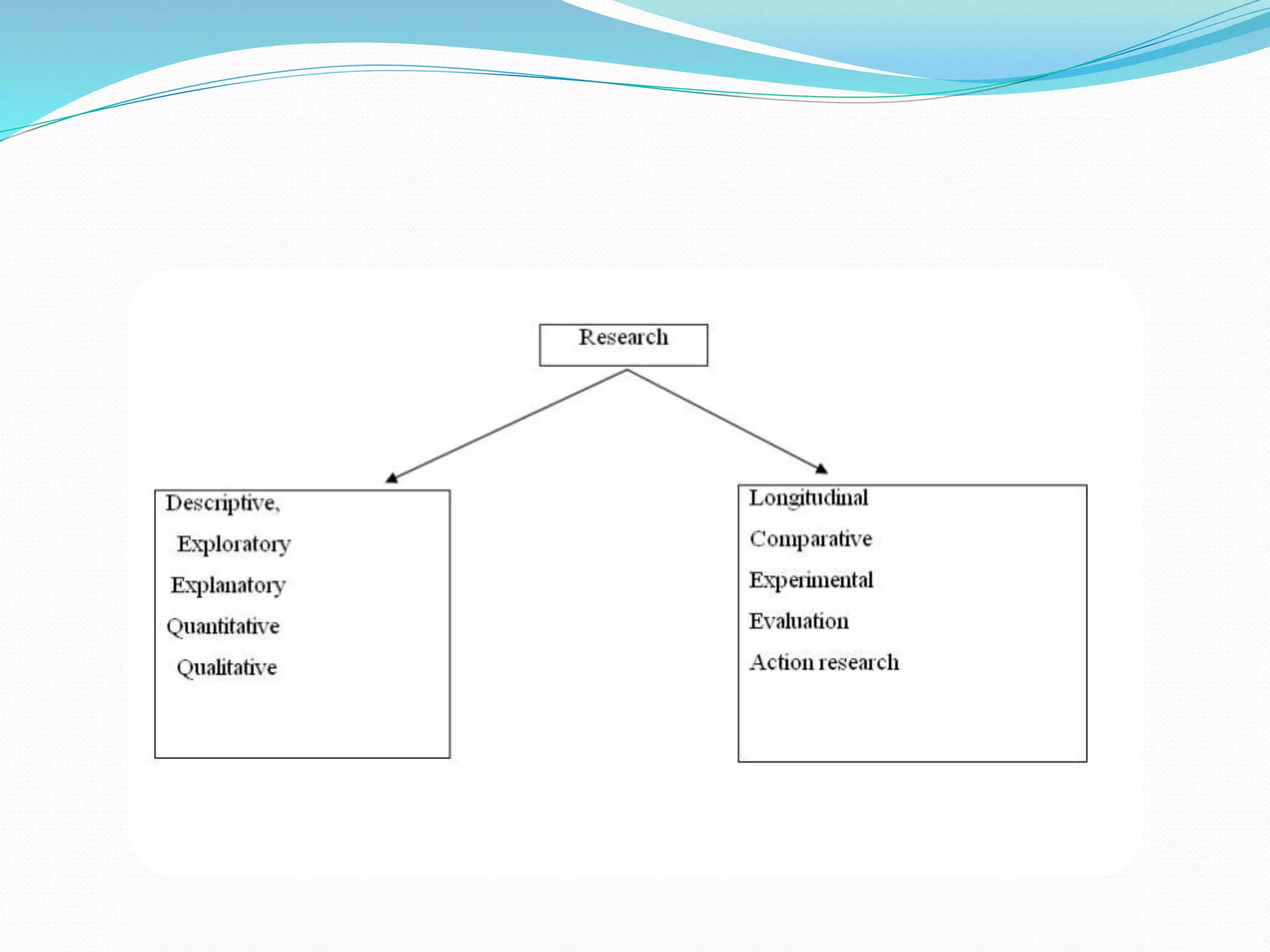
- Types of research design include qualitative, quantitative, descriptive, exploratory, experimental, evaluation, and action research designs.
- Sampling allows researchers to gather data from a subset of the population. Probability and non-probability sampling techniques are discussed.
Research isconsidered as the systematic effort made to
explore new areas of knowledge
It requires a planning.
Testing of validity and reliability are the major
emphasis in research hence a systematic plan is very
essential in research.
Research designing is considered as the beginning
phase of research
3.
Research involvestwo major stages one is the stage of
planning and other is the stage of execution. In the
first stage researchers construct a design and in the
second they collect data and analyses the data.
4.
Meaning
Design meansdrawing an outline, planning or
arranging details. It is process of making decisions
before the situations arises in which the decisions have
to be carried out. It is the planning of strategy to
conduct the research
5.
Design explainshow the researcher intends to conduct
the study. Especially it discuss about what is to be
observed, how is to be observed, how to record the
observation, analyze, interpret and generalize. So we
can say it as the detailed plan about the goals of the
research and its achievement.
6.
Definitions
William zikmund(1988)defined research as “ master
plan specifying the methods and procedures for
collecting and analyzing the needed information”
Martin(1974) Research design is the specification of
the problem, conceptual definitions, derivation of
hypothesis to test and defining of population to be
studied.Ackoff Russell said “planning various phases
and procedures relating to the formulation of research
efforts”
7.
There aremany forms of design. Some focuses on the
process of data collection only( Dickmen 1995) while
others extend their boundaries to cover data analysis
(Ragin 1994)
8.
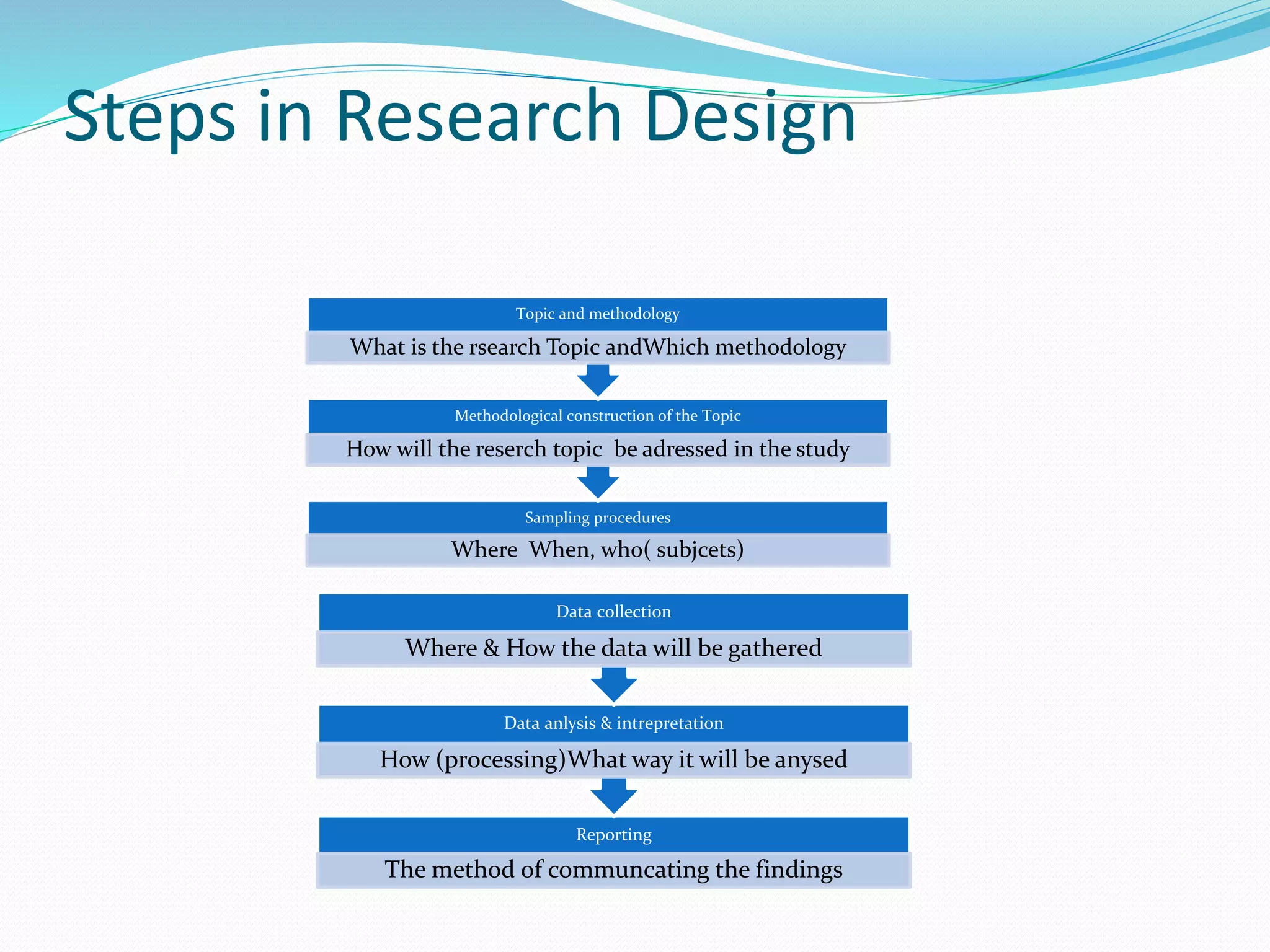
Steps in ResearchDesign
Sampling procedures
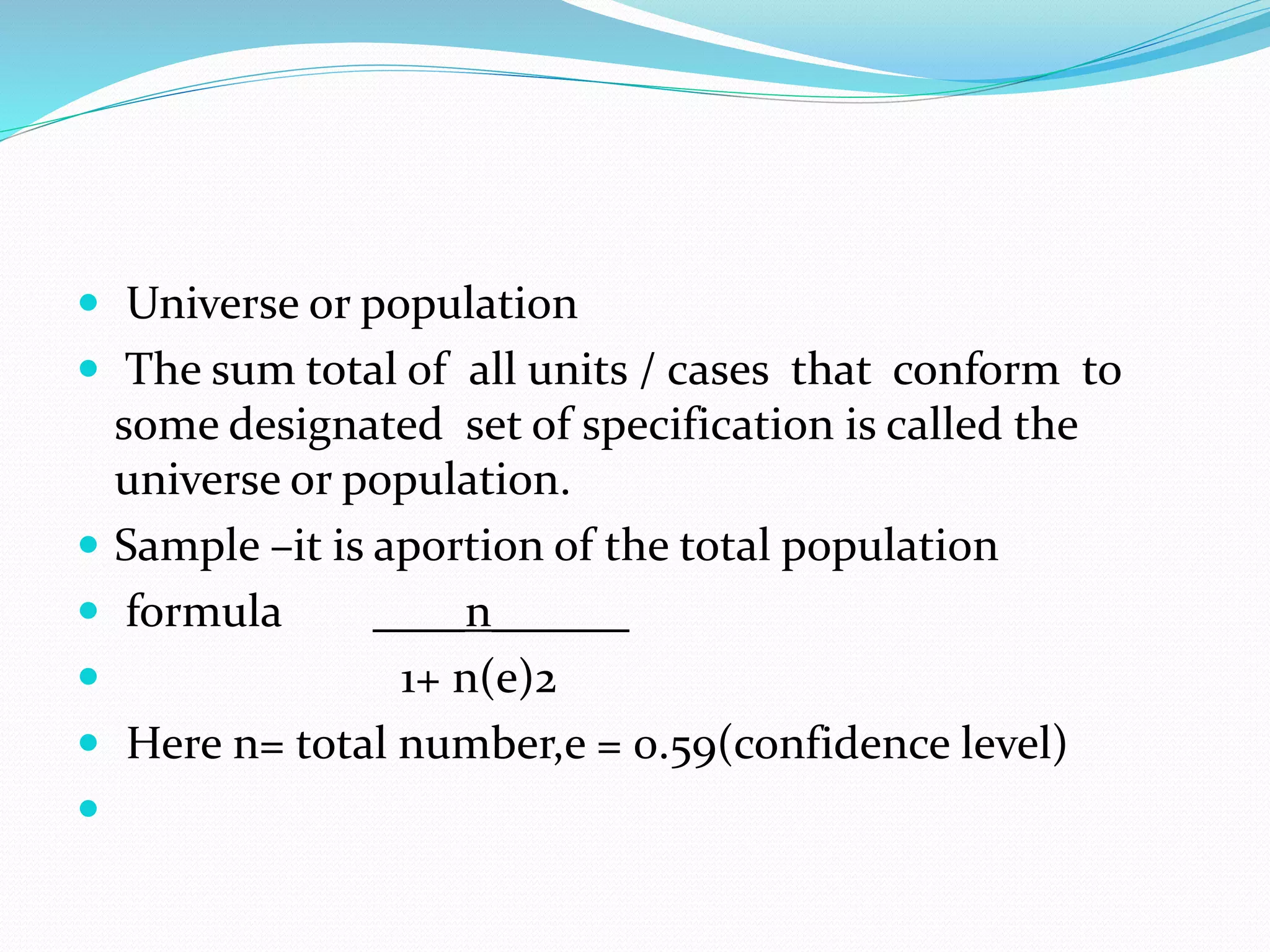
Where When, who( subjcets)
Methodological construction of the Topic
How will the reserch topic be adressed in the study
Topic and methodology
What is the rsearch Topic andWhich methodology
Reporting
The method of communcating the findings
Data anlysis & intrepretation
How (processing)What way it will be anysed
Data collection
Where & How the data will be gathered
9.
Types of researchdesign
The type of methodology adopted by any research
depends upon the central research objective and
questions (Crabtree & Miller, 1999; Denzin & Lincoln,
2000). A large number of research methodologies have
been identified, Galliers (1991) for example listing
fourteen, while Alavi and Carlson (1992), reported in
Pervan (1994), use a hierarchical taxonomy with three
levels and eighteen categories.
10.
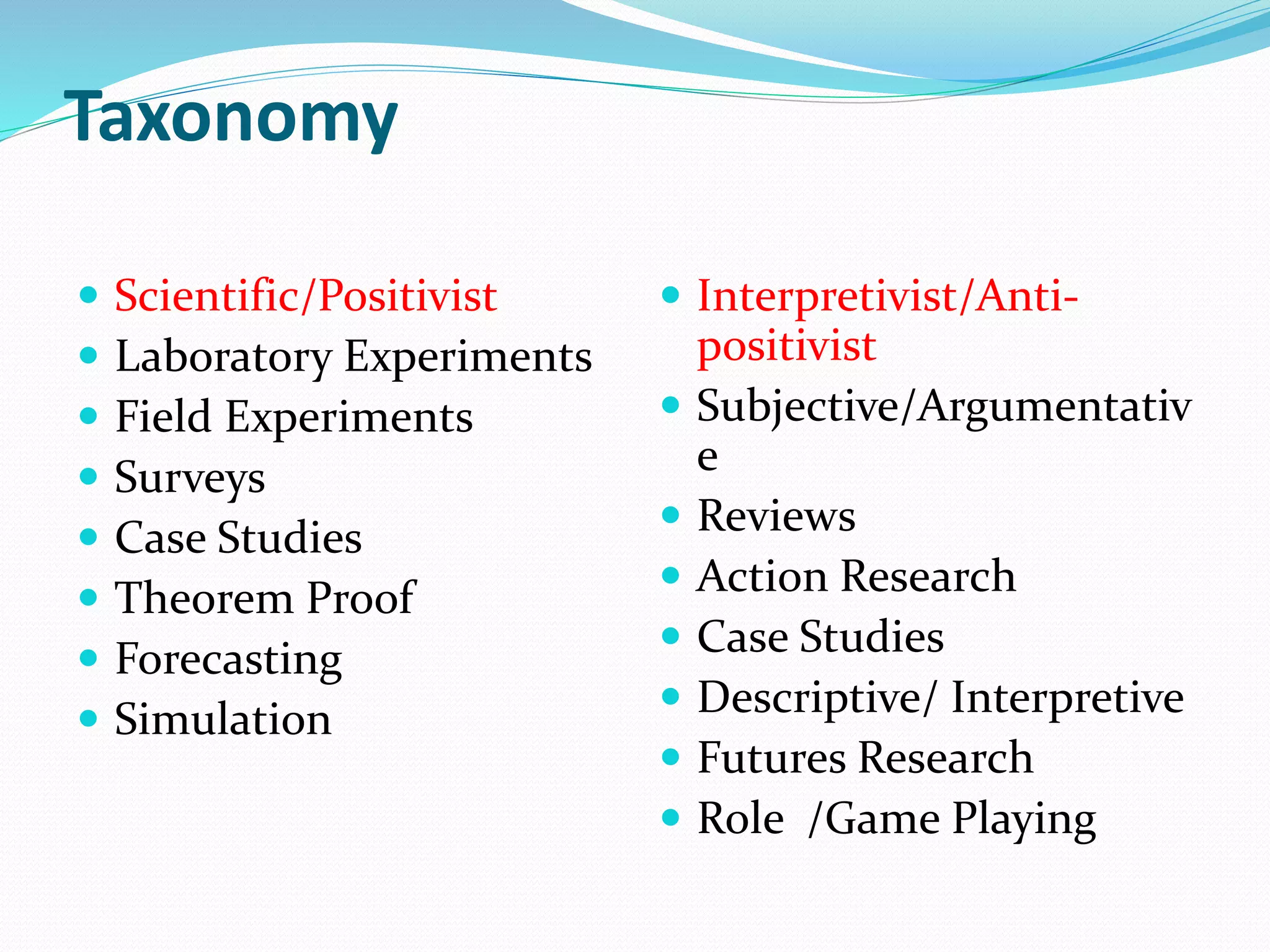
Taxonomy
Scientific/Positivist
LaboratoryExperiments
Field Experiments
Surveys
Case Studies
Theorem Proof
Forecasting
Simulation
Interpretivist/Anti-
positivist
Subjective/Argumentativ
e
Reviews
Action Research
Case Studies
Descriptive/ Interpretive
Futures Research
Role /Game Playing
12.
Purposes of Researchdesign
The purpose of the design depends up on the nature
and purposes of the study. the type of population,
reseracher experience, ideological background of the
researcher . etc.
13.
It providesa Blue print
While conducting a research researcher faces many
problems, what sample size, what type of data collection
method want to follow, are some of challenges in front of
the reseracher. It such contexts the research design act as
blue print to visualize the study.
It limits boundaries of research activities
A systematic procedure will be developed in research
design, it give clear idea about the hypothesis, data size ,
data collections etc.
It enables investigation to anticipate potential problem
( …………. Continues……
14.
……….continuation…
Through the literaturereview in research most of the
problem will be faced by the researcher in analyzing the
data and the nature of data will be cleared so it avoid
certain kind of errors in research.
Offers a guide that directs the research action and help to
rationalize the use of time and resources and to reduce
costs.
Helps to introduce a systematic approach to the research
operation
Entails openness and accountability
Makes replication easier and more effective
Enables accurate estimation of the whole research
activity
16.
The typeof methodology adopted by any research
depends upon the central research objective and
questions (Crabtree & Miller, 1999; Denzin & Lincoln,
2000). A large number of research methodologies have
been identified, Galliers (1991) for example listing
fourteen, while Alavi and Carlson (1992), reported in
Pervan (1994), use a hierarchical taxonomy with three
levels and eighteen categories.
17.
Qualitative research
Qualitativeresearch is an inquiry process of
understanding based on distinct and methodological
traditions of inquiry that explore a social or a human
problem.
18.
The researcherbuilds a complex, holistic picture, analyzes
words, reports detailed views of informants and conducts
the study in a natural setting.
To understand the processes or the how and why of a given
phenomenon qualitative research provides the necessary
in-depth analysis.
In qualitative research the qualitative data is collected by
the researcher and analyzed using one of the qualitative
data analysis methods.
Qualitative data are in depth descriptions of circumstances,
people, interactions, observed behaviors, events, attitudes,
thoughts and beliefs and direct quotes from people who
have experienced or are experiencing the phenomenon
19.
Fixed qualitative Design
It employs relatively a structured approach,
resembling the quantitative model. This model is
employed when reseracher has a clear idea about the
nature of the research topic and is interested in the
way which people respond to it.
20.
Flexible qualitative Design
It is the more common method in qualitative research
design. It contains six major steps.
It is constructed before the research commence.
It presented in a general and non-specific manner
allowing interpretation, leaving space for further
discussion
Allows freedom of unlimited movement data
collection and data analysis.
It is not based on objectivity.
21.
Quantitative Research
Thisresearch employs quantitative and statistical
analysis. It is based methodological principles of
positivism and adheres to the standard of strict
sampling and research design. A well defined structure
will be followed in quantitative research. In this design
the research will be progressed based on the sequence
of structured steps.
22.
Descriptive Research
Theresearch efforts developed to describes the social
situations, social events , social systems , structure of
the society are based on descriptive research design
Descriptive studies, as name suggests, describe as
accurately as possible the characteristics of a
group of people or a community.
23.
A researcherwho is interested in studying people of a
community, their age and sex composition, caste wise
distribution, affiliation to religion, level of education,
occupational status, designs his study as descriptive study.
Researcher may formulate a descriptive design of
study to know the proportion of people in a
particular population who favors' dowry or who
feels that child labour should be banned.
24.
Still othersmay be concerned with specific
prediction.
For example, what percentage of population
would enter voter’s list in the next census
operations?
What will be the size of the handicapped
population who will need financial assistance
in the next five-year plan? And so on.
25.
Here thereseracher observes, studies and describe
what he/she found.
Eg. Drug abuse among college students, increasing
political participation of Women,
Census studies.
Generally in descriptive research the data are collected
in a single situation pertaining to single time period.
This is called single subject or single cell design.
(Diagrams)
26.
Exploratory research
Exploratoryor causal research is mainly
concerned with causes or ‘why’ factor about
certain phenomena. In this type of research
the researcher studies a subject which is not
familiar to the area of knowledge.ie. Either
no information or little information is
available
27.
In thisresearch the researcher is unfamiliar with the
group and the subject which he /she is going to study.
Exploratory studies are suitable in studying certain
phenomena like deficiency in educational system,
corruption among political elite, harassment by police,
rural poverty etc
the hypothesis in an exploratory studies is related with
expressing relationship between two or more variables.
How A affects B that will be the content of hypothesis.
28.
Experimental research
Inthe study the researcher studies the effect through
comparison with experiment and without experiment
It is design in which some of the variables being
studied are manipulated
29.
In thesestudies the reseraher seek to control
conditions in order to observe the person or subjects
and to reach in conclusions
Here control means holding one factor constant while
others are free to vary in the experiment. One variable
independent is manipulated and its affect upon
another variable (dependant) is measured.
30.
. Inthis design the study contains two groups one is
controlled group (not exposed to experiment) and
other is experimental group (undergone through
experiment).
31.
Example
Eg: Teacherlecture on
strike and students
attitudinal changes
G1 –not exposed to the
session
G2- exposed to the
session
32.
Terms used inexperimental design
Experimental treatment, Test units, extraneous
variable, randomization of sample, repeated measures,
demand characteristics.
33.
Evaluation research
Acommon research usually conducted by sociologist,
economist, government officials, social workers with
a purpose to assess the existing policies, programmes,
and evaluate the utilization of funds etc. main
intention of this type of study is
34.
To discovergap in services
To investigate the alternative to meet the unmet needs
To predict the success of the planned programme
Analyze the cost effectiveness
Action research
Theorigins of action research, and the ways in which
action research is both perceived and conducted today,
are open to dispute, yet it "has been a distinctive form
of inquiry since the 1940s" (Elden and Chisholm, 1993)
The term 'action research' is popularly attributed to
Kurt Lewin (1946),
37.
Elden andChisholm (1993) go on to note that action
research is change oriented, seeking to introduce
changes with positive social values, the key focus of
the practice being on a problem and its solution
Palmer and Jacobson (1971) see action research as a
means of using research to promote social action.
Further to these descriptions, Rapoport (1970)
identifies action research as a form of inquiry that
seeks to address both the practical problems of people
and the goals of social science within a "mutually
acceptable ethical framework" (Susman, 1985).
38.
Action researchcan be described as a family of
research methodologies which pursue action (or
change) and research (or understanding) at the same
time.
Here in this method the procedures and steps are same
like any other research process but the role of
respondent and the manner in which the data are to
be collected is different
39.
the actionin the action research is situational(
solving the issue in a given situation ) collaborative
(efforts of researcher and
practitioners)participatory(researcher role is crucial)
and self evaluative ( constant evaluation )
40.
Is educative
Deals with individuals as members of social groups
Is problem-focused, context-specific and future-
orientated
Involves a change intervention
Involves a cyclic process in which research, action and
evaluation are interlinked
Aims at improvement and involvement
Eg: Marad case
42.
Sample
A sampleis a portion drawn from a larger
population .it will be representative of the population
only if it has same basic characteristics of the
population from which it is drawn. In sampling in
research our concern o is not about types of units
(person) to be observed. But with how many units of
what description and by what methods should be
chosen.(Straits 1999)
43.
Manheim(1977) “a sample is a part of the population
which is studied in order to make inferences about the
whole population.
sampling is a process of systematically selecting cases
for inclusion in a research project
44.
Sampling
The commonquestion asked in any research is always
about the data collection and related procedures.
Especially while conducting a survey in research to
collect the data whether they want to collect data from
the entire population? Or from a representative
portion? , are common questions.
Sampling is power technique applied with wide
application in social science research.
45.
Population refers“all those people with the
characteristics which the reseracher wants to study
within the context of a particular problem” it could be
all students in a college, patients in a hospital,
prisoners in prison, employees in a state, o particular
group of people from a state and so on
46.
Propose of Sampling
Studying a large population demands more resources
and its mobilization. Time, scattered population, wide
geographical area are often make sample as necessary
in research.(Sarantakos 1998)
Samples is suitable in scattered population ,
It offers high degree of accuracy because it deals with a
small number of people.
Time saving
Sampling is economical
47.
Principles of sampling
(Sarntakos1998)
Sample units must be chosen in a systematic and
objective manner
Sample units must be clearly defined and easily
identifiable
Sample units must be independent of each other.
Same units of sample should be used throughout the
study
In the selection process of sample, errors, bias should
be avoided and a sound criterion should be followed.
48.
Advantages
Reduce thenumber of larger population
It saves time and money
It saves destruction of units
It increases accuracy of data
It achieves greater response rate
It is easy to supervise
50.
Universe orpopulation
The sum total of all units / cases that conform to
some designated set of specification is called the
universe or population.
Sample –it is aportion of the total population
formula ____n______
1+ n(e)2
Here n= total number,e = 0.59(confidence level)
51.
Sampling element.-each entity from the population
about which a information is collected is called
sample element
Sampling Unit this is either a single member
(element) or collection of members (elements) subject
to data analysis in the sample.
52.
Sampling frame
It is the complete list of all units from which the
sample is drawn. Electoral roll, the list of patients in a
hospital, students in college etc. if we want to study
2200 women in a village out of the age group 18-50
year is 970. These 18-50 yrs would be the sampling
frame.
53.
Target population-itis one to which the reseracher
would like to generalize his results. In the above
mentioned example of awareness rights of women in
the rural area the target population is 970.
54.
Sampling Traits-it is the element on the basis of which
we take out the sample from the total universe. It
could be the attribute or variable( qualitative/
quantitative).rural area, age , gender, residence
55.
Sampling fraction-itis proportion of the total
population to be included in the sample. In the above
mentioned example the total women in the village is
2200, of whom 283(300) women are to be studied. The
sampling fraction thus comes to one seventh of
population.
56.
Parameters –Characteristics’of population is called
parameters, it is the summary description of a variable
for a population.
Sampling error- it is the difference between total
population value and the sampling value, it is the
degree to which the sample characteristics
approximate the characteristics of the total
population .
57.
Types of sampling
Probability sampling Non-Probability
Sampling
Simple random Sampling- Convenience Sampling
Stratified Sampling Purposive Sampling
Systematic sampling Quota sampling
Cluster sampling Snowball sampling
Multi –Stage sampling Volunteer sampling
Multi Phase Sampling