MELCS: Describes
adequately research
design (either quantitative
or qualitative), data
gathering , instrument,
sample, data collection
and analysis procedures,
prepares data gathering
instrument.
At the end of 1 hour period, at
least 80% of the students will be
able to:
A. Identify the different
research design.
B. Chooses appropriate
research design.
C. Explain the chosen research
design.
ACTIVITY 1: IDENTIFY ME
Identify the parts of a
research paper
1. You show the readers
and reviewers why your
research topic is worth
reading about and why
your paper warrants
their attention.
ANSWER INTRODUCTION
2. A survey of
scholarly sources
(such as books, journal
articles, and theses)
related to a specific
topic or research
question.
ANSWER
REVIEW OF
RELATED
LITERATURE
3. A statement of
expectation or
prediction that will be
tested by research.

ANSWER
HYPOTHESIS OR
ASSUMPTION
4. Illustrates what you
expect to find through your
research and it defines the
relevant variables for your
study and maps out how they
might relate to each other.
ANSWER
CONCEPTUAL
FRAMEWORK
5. A statement of a concern in
any area, a problem that needs
immediate solution, a recurring
difficulty that is necessary to
be taken out of the situation, or
a practical question from a
scholarly inquiry in different
disciplines.
ANSWER
RESEARCH
QUESTION
Activity 2
Give 1-2 words that will describe your
understanding of what is research
methodology.
Strategy used to
implement that plan.
Activity 2.1
Give 1-2 words that will describe
your prior knowledge on
research design.
Research design
-is a plan to answer
your research
question.
Research design
-process of structuring
techniques and strategies
that help researchers solve
their problems or answer
their questions
GUESS ME
GUESS what kind of research
design is applicable to the
given research title
Why did you say that
a given topic is a/an
______research
design?
An Action Research on the
Effectiveness of
Differentiated Instruction In
Teaching English for Grade
Four Classes
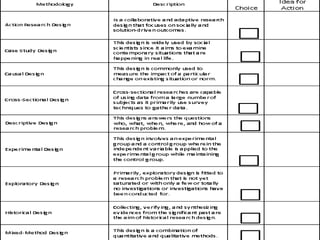
1. Action Research Design
-collaborative and adaptive
-focuses on socially and
solution driven outcomes
-mostly is applicable in the
teaching-learning process
Exploring The World Of A
Struggling Student: A Case
Study
2. Case Study Design
-used by social scientists
-examine contemporary
situations that are happening in
real life
-application of concepts and
theories as well as detailed
descriptions of unusual cases.
Behavior of
consumers towards
the changing price of
goods
3. Causal Design
-measure the impact of a
particular change on existing
situation or norm
-reflect on hypotheses testing
-difference in a phenomenon
leads to significant results.
A cross-sectional study on
past smoking habits and
current diagnoses of lung
cancer
4. Cross-Sectional Design
-researches are capable of using data
from a large number of subjects as it
primarily use survey techniques to
gather data
-measure differences between or
from among a diverse set of
participants, subjects, or phenomena
A Descriptive Study of
COVID-19–Related
Experiences and
Perspectives of a National
Sample of College
Students
5. Descriptive Design
-answers the questions who, what,
when, where, and how
-could not provide reasons or exact
answers to the question “why
-describe "what exists" in a situation
and its related variables
Efficacy of chlorhexidine
mouthwash on the prevention of
ventilator-associated
pneumonia (VAP) among
patients
6. Experimental Design
-involves an experimental group and a control
group
-independent variable is applied to the
experimental group while maintaining the
control group.
-may require the use of more groups and
measurements over periods of time to
validate the results.
-typically done in the field of medicine and
science.
A study into the
implications of COVID-
19 pandemic into the
global economy (few or
no earlier studies to
refer)
7. Exploratory Design
-is fitted to a research problem that is not
yet saturated or with only a few or totally
no investigations or investigations have
been conducted for
-may also deal with discovering the best
methodology to use in gathering
information
The Carabao and the
Encounter of the Law in
Nineteenth-Century
Philippines
The Indolence of the Filipino:
A Reflection
8. Historical Design
-Collecting, verifying, and synthesizing
evidences from the significant past are
the aim of historical research design
-involves data from secondary sources and
also primary documents and artifacts,
such as but not limited to records,
materials, archives and visual artifacts
like maps, images, and footages or
recordings
A Mixed Methods Research Study of
Parental Perception of Physical Activity and
Quality of Life of Children Under Home Lock
Down in the COVID-19 Pandemic
Mixed Methods Research of Adult Family
Care Home Residents and Informal
Caregivers
9. Mixed-Method Design
-combination of quantitative
and qualitative methods
-advantageous in the sense
that the strengths of one
method can be used to fulfill
the weaknesses of another
Ask the students to present their
own research topics and identify
the research design they will
used.
Guide Questions:
a. What design did you choose?
b. Describe the design and relate
the use of which in your
particular study.
c. Why did you choose such type?
Group GAS B
1. Factors influencing customer
satisfaction (group of Desservyn Castro)
2. Coping strategies used by the salon
owners (group of Ashley Valencia)
3. Cryptocurrency a solution for financial
crisis ( group of John Lester Samson)
4. Relationships multiple intelligence of
student and chooses strand in shs (group
of Alexa Ano)
5. Trends of milk tea (group of Tristan
Andrada)
6. The relationship between educational
achievement and economic status (group
of Mark Lamaan)
Why is it important that
you specifically
determine the research
design to be used in
your research paper?
What are the different
types of research design?
(first 5)
Express your answer in a
creative way.
Idea for Action:
Explain the reason for
choosing the kind of research
design applicable to your
research study.
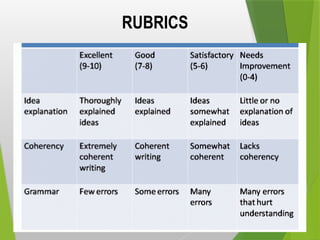
RUBRICS
Click in the icon below to insert your picture
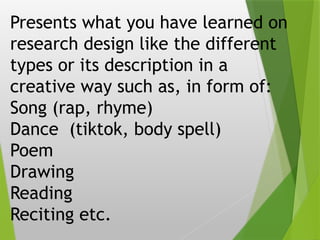
Presents what you have learned on
research design like the different
types or its description in a
creative way such as, in form of:
Song (rap, rhyme)
Dance (tiktok, body spell)
Poem
Drawing
Reading
Reciting etc.
THANK YOU
KUDOS!
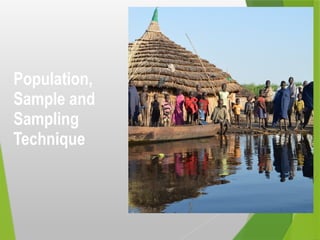
Population,
Sample and
Sampling
Technique
Definition
Population is the entire group of people, organisms
or things that share similar features and
characteristics which are of high relevance to the
research being conducted. In an action research
being conducted in a particular school, all students
can be considered the population.
Sample refers to members of a certain population. A
sample is a representation of the entire population
carrying the same characteristics. Taking the
enrolled learners in a particular school as
population, two sections or classes in that school
may serve as sample. The process of selecting the
samples is called sampling.
Definition
Sampling Technique pertains to the specific manner
or ways of selecting the sample which are discussed
in your previous classes in Research and
Mathematics. In quantitative research, sampling may
require statistical operations, to ensure that the
number of participants is sufficient to collect the
data needed; while in qualitative research, selecting
the specific number of samples has no definite rules.
However, the consideration should be ensured in
terms of saturation of the data about the topic and
the variation that is needed within the target
population.
The Research Instruments/Tools
Mechanical Devices. These include almost all tools
available in different laboratories for various
disciplines and areas. Cameras, recorders, tapes and
films are only a few devices that may be used in
collecting data for a historical or social science
research. Meanwhile,
microscopes, telescopes, flasks, tubes,
thermometers and other apparatuses are some
instruments for a scientific and experimental
research. Each discipline has its own designed

devices for its operation research work.
Clerical Tools. In the study if perceptions, emotions,
feelings, attitude and judgments, clerical tools like
questionnaire, interview, testing and other materials
are applicable. Most clerical tools are researcher-made
which are checked and validated by experts and
acceptable validation procedures. The following are the
common methods involved in clerical tools:
1. The questionnaire method
2. The interview method
3. The testing method
4. The experimental method
5. The library method
Common Data Collection Instruments
1. Documentary Review. This is the process of
obtaining information from relevant
documents. It is practical and efficient since
the data can be manageable enough which
can come from public records, personal
documents
and physical evidences.
2. Interview
It its basic definition, interview is the process of asking questions
to key informants or respondents about the topics of the research. The
researcher should have enough training and background in administering
this kind of data-gathering. This can be done through face-to-face, over
the telephone or computer-assisted.
A. Structured Interview. The researcher would have to construct and
organize questions which the respondents will answer. The researcher
does not ask other questions aside from what has been prepared prior to
the interview.
B. Unstructured Interview. In this type of interview, the researcher holds
only an outline of topics. The questions will be spontaneously asked to
form a conversation with the interviewee. Probing skills in questioning is
highly necessary.
C. Semi-Structured Interview. This is a blend of the two previous types of
interview. It is where the researcher prepares questions and still ask
follow up questions to the interviewee for a sort of elaboration in order to
form a in-depth probing.
3. Observation.
Tracking physical, behavioral and other aspects from the
target sample over a period of time is the major concern of
the researcher in this method.
A. Naturalistic Observation. The researcher observes the
subjects in their actual setting or natural environment without
the intrusion or involvement of the researcher.
B. Participative Observation. This interview requires the
researcher to be involved in the activities of the subjects. In
this way, the researcher would directly know and feel what
the subject experiences.
C. Non-naturalistic Observation. In this interview, the subjects
are taken away from their usual situation and will experience
the ideal conditions set by the researcher.
4. Questionnaire-Checklist.
This is one of the commonly used data collection instruments
among other. Questionnaire-checklists are easy to administer
and efficient in gathering large volume of data. Basically, the
respondents would provide answers to the prepared set of
questions like the following:
A. Tag Questions. These questions are answerable by yes or no.
B. Multiple Choice. This is the usual way of getting
answer/response from the respondents basically by giving a
question and options to choose from.
C. Open-ended Questions. The respondents would have top
continue an incomplete statement.
D.Coding/Ranking. In this type, the respondents are asked to
rank or give numerical rating for the information required of
them. This may come in a form of a checklist with a scale.
E. Short-responses Questions. These are
subjective questions that require short
answers. This gives the respondents the
freedom to express their ideas and opinions.
F. Combination. This refers to the combination
of the different form of questions in a single
questionnaire.
5. Focus group discussion
It is composed of totally diverse set of
individuals to express their personal views
about the topic. They can agree or disagree
with each other about the issues. FGD is a
way to understand the perspectives which
cannot be explained by statistical data. The
researcher should be skilled in moderating
and documenting the conduct to gather the
needed data
Activity: Analyze the given the research scenario in every item
and identify the appropriate data collection instrument for it.
1. Jesse and Jerwin are conducting their research about the behaviour of their pet
dogs in the different areas in their house.
2. Roku and Aki are interested in knowing the perceptions of students in their strand
about the changes that are happening in the country in terms of environment.
3. A group of researchers would like to describe the feelings of adolescents about
being at home for several months.
4. Group B is studying the facts and papers regarding the decision of the Students’
Council about the creation of online student portal.
5. Emmarie and Franz are siblings and they would like to balance the distribution of
the household chores among the 6 siblings.
Activity: Analyze the given the research scenario in every item
and identify the appropriate data collection instrument for it.
1. Observation
2. Questionnaire-checklist
3. Interview
4. Document review
5. Focus group discussion

The different research design either quantitative or qualitative

  • 1.
    MELCS: Describes adequately research design(either quantitative or qualitative), data gathering , instrument, sample, data collection and analysis procedures, prepares data gathering instrument.
  • 2.
    At the endof 1 hour period, at least 80% of the students will be able to: A. Identify the different research design. B. Chooses appropriate research design. C. Explain the chosen research design.
  • 3.
    ACTIVITY 1: IDENTIFYME Identify the parts of a research paper
  • 4.
    1. You showthe readers and reviewers why your research topic is worth reading about and why your paper warrants their attention.
  • 5.
  • 6.
    2. A surveyof scholarly sources (such as books, journal articles, and theses) related to a specific topic or research question.
  • 7.
  • 8.
    3. A statementof expectation or prediction that will be tested by research.

  • 9.
  • 10.
    4. Illustrates whatyou expect to find through your research and it defines the relevant variables for your study and maps out how they might relate to each other.
  • 11.
  • 12.
    5. A statementof a concern in any area, a problem that needs immediate solution, a recurring difficulty that is necessary to be taken out of the situation, or a practical question from a scholarly inquiry in different disciplines.
  • 13.
  • 14.
    Activity 2 Give 1-2words that will describe your understanding of what is research methodology.
  • 15.
  • 16.
    Activity 2.1 Give 1-2words that will describe your prior knowledge on research design.
  • 17.
    Research design -is aplan to answer your research question.
  • 18.
    Research design -process ofstructuring techniques and strategies that help researchers solve their problems or answer their questions
  • 19.
    GUESS ME GUESS whatkind of research design is applicable to the given research title
  • 20.
    Why did yousay that a given topic is a/an ______research design?
  • 21.
    An Action Researchon the Effectiveness of Differentiated Instruction In Teaching English for Grade Four Classes
  • 22.
    1. Action ResearchDesign -collaborative and adaptive -focuses on socially and solution driven outcomes -mostly is applicable in the teaching-learning process
  • 23.
    Exploring The WorldOf A Struggling Student: A Case Study
  • 24.
    2. Case StudyDesign -used by social scientists -examine contemporary situations that are happening in real life -application of concepts and theories as well as detailed descriptions of unusual cases.
  • 25.
    Behavior of consumers towards thechanging price of goods
  • 26.
    3. Causal Design -measurethe impact of a particular change on existing situation or norm -reflect on hypotheses testing -difference in a phenomenon leads to significant results.
  • 27.
    A cross-sectional studyon past smoking habits and current diagnoses of lung cancer
  • 28.
    4. Cross-Sectional Design -researchesare capable of using data from a large number of subjects as it primarily use survey techniques to gather data -measure differences between or from among a diverse set of participants, subjects, or phenomena
  • 29.
    A Descriptive Studyof COVID-19–Related Experiences and Perspectives of a National Sample of College Students
  • 30.
    5. Descriptive Design -answersthe questions who, what, when, where, and how -could not provide reasons or exact answers to the question “why -describe "what exists" in a situation and its related variables
  • 31.
    Efficacy of chlorhexidine mouthwashon the prevention of ventilator-associated pneumonia (VAP) among patients
  • 32.
    6. Experimental Design -involvesan experimental group and a control group -independent variable is applied to the experimental group while maintaining the control group. -may require the use of more groups and measurements over periods of time to validate the results. -typically done in the field of medicine and science.
  • 33.
    A study intothe implications of COVID- 19 pandemic into the global economy (few or no earlier studies to refer)
  • 34.
    7. Exploratory Design -isfitted to a research problem that is not yet saturated or with only a few or totally no investigations or investigations have been conducted for -may also deal with discovering the best methodology to use in gathering information
  • 35.
    The Carabao andthe Encounter of the Law in Nineteenth-Century Philippines The Indolence of the Filipino: A Reflection
  • 36.
    8. Historical Design -Collecting,verifying, and synthesizing evidences from the significant past are the aim of historical research design -involves data from secondary sources and also primary documents and artifacts, such as but not limited to records, materials, archives and visual artifacts like maps, images, and footages or recordings
  • 37.
    A Mixed MethodsResearch Study of Parental Perception of Physical Activity and Quality of Life of Children Under Home Lock Down in the COVID-19 Pandemic Mixed Methods Research of Adult Family Care Home Residents and Informal Caregivers
  • 38.
    9. Mixed-Method Design -combinationof quantitative and qualitative methods -advantageous in the sense that the strengths of one method can be used to fulfill the weaknesses of another
  • 39.
    Ask the studentsto present their own research topics and identify the research design they will used. Guide Questions: a. What design did you choose? b. Describe the design and relate the use of which in your particular study. c. Why did you choose such type?
  • 40.
    Group GAS B 1.Factors influencing customer satisfaction (group of Desservyn Castro) 2. Coping strategies used by the salon owners (group of Ashley Valencia) 3. Cryptocurrency a solution for financial crisis ( group of John Lester Samson) 4. Relationships multiple intelligence of student and chooses strand in shs (group of Alexa Ano) 5. Trends of milk tea (group of Tristan Andrada) 6. The relationship between educational achievement and economic status (group of Mark Lamaan)
  • 41.
    Why is itimportant that you specifically determine the research design to be used in your research paper?
  • 42.
    What are thedifferent types of research design? (first 5) Express your answer in a creative way.
  • 43.
    Idea for Action: Explainthe reason for choosing the kind of research design applicable to your research study.
  • 45.
    RUBRICS Click in theicon below to insert your picture
  • 46.
    Presents what youhave learned on research design like the different types or its description in a creative way such as, in form of: Song (rap, rhyme) Dance (tiktok, body spell) Poem Drawing Reading Reciting etc.
  • 47.
  • 48.
  • 49.
    Definition Population is theentire group of people, organisms or things that share similar features and characteristics which are of high relevance to the research being conducted. In an action research being conducted in a particular school, all students can be considered the population. Sample refers to members of a certain population. A sample is a representation of the entire population carrying the same characteristics. Taking the enrolled learners in a particular school as population, two sections or classes in that school may serve as sample. The process of selecting the samples is called sampling.
  • 50.
    Definition Sampling Technique pertainsto the specific manner or ways of selecting the sample which are discussed in your previous classes in Research and Mathematics. In quantitative research, sampling may require statistical operations, to ensure that the number of participants is sufficient to collect the data needed; while in qualitative research, selecting the specific number of samples has no definite rules. However, the consideration should be ensured in terms of saturation of the data about the topic and the variation that is needed within the target population.
  • 51.
    The Research Instruments/Tools MechanicalDevices. These include almost all tools available in different laboratories for various disciplines and areas. Cameras, recorders, tapes and films are only a few devices that may be used in collecting data for a historical or social science research. Meanwhile, microscopes, telescopes, flasks, tubes, thermometers and other apparatuses are some instruments for a scientific and experimental research. Each discipline has its own designed devices for its operation research work.

  • 52.
    Clerical Tools. Inthe study if perceptions, emotions, feelings, attitude and judgments, clerical tools like questionnaire, interview, testing and other materials are applicable. Most clerical tools are researcher-made which are checked and validated by experts and acceptable validation procedures. The following are the common methods involved in clerical tools: 1. The questionnaire method 2. The interview method 3. The testing method 4. The experimental method 5. The library method
  • 53.
    Common Data CollectionInstruments 1. Documentary Review. This is the process of obtaining information from relevant documents. It is practical and efficient since the data can be manageable enough which can come from public records, personal documents and physical evidences.
  • 54.
    2. Interview It itsbasic definition, interview is the process of asking questions to key informants or respondents about the topics of the research. The researcher should have enough training and background in administering this kind of data-gathering. This can be done through face-to-face, over the telephone or computer-assisted. A. Structured Interview. The researcher would have to construct and organize questions which the respondents will answer. The researcher does not ask other questions aside from what has been prepared prior to the interview. B. Unstructured Interview. In this type of interview, the researcher holds only an outline of topics. The questions will be spontaneously asked to form a conversation with the interviewee. Probing skills in questioning is highly necessary. C. Semi-Structured Interview. This is a blend of the two previous types of interview. It is where the researcher prepares questions and still ask follow up questions to the interviewee for a sort of elaboration in order to form a in-depth probing.
  • 55.
    3. Observation. Tracking physical,behavioral and other aspects from the target sample over a period of time is the major concern of the researcher in this method. A. Naturalistic Observation. The researcher observes the subjects in their actual setting or natural environment without the intrusion or involvement of the researcher. B. Participative Observation. This interview requires the researcher to be involved in the activities of the subjects. In this way, the researcher would directly know and feel what the subject experiences. C. Non-naturalistic Observation. In this interview, the subjects are taken away from their usual situation and will experience the ideal conditions set by the researcher.
  • 56.
    4. Questionnaire-Checklist. This isone of the commonly used data collection instruments among other. Questionnaire-checklists are easy to administer and efficient in gathering large volume of data. Basically, the respondents would provide answers to the prepared set of questions like the following: A. Tag Questions. These questions are answerable by yes or no. B. Multiple Choice. This is the usual way of getting answer/response from the respondents basically by giving a question and options to choose from. C. Open-ended Questions. The respondents would have top continue an incomplete statement. D.Coding/Ranking. In this type, the respondents are asked to rank or give numerical rating for the information required of them. This may come in a form of a checklist with a scale.
  • 57.
    E. Short-responses Questions.These are subjective questions that require short answers. This gives the respondents the freedom to express their ideas and opinions. F. Combination. This refers to the combination of the different form of questions in a single questionnaire.
  • 58.
    5. Focus groupdiscussion It is composed of totally diverse set of individuals to express their personal views about the topic. They can agree or disagree with each other about the issues. FGD is a way to understand the perspectives which cannot be explained by statistical data. The researcher should be skilled in moderating and documenting the conduct to gather the needed data
  • 59.
    Activity: Analyze thegiven the research scenario in every item and identify the appropriate data collection instrument for it. 1. Jesse and Jerwin are conducting their research about the behaviour of their pet dogs in the different areas in their house. 2. Roku and Aki are interested in knowing the perceptions of students in their strand about the changes that are happening in the country in terms of environment. 3. A group of researchers would like to describe the feelings of adolescents about being at home for several months. 4. Group B is studying the facts and papers regarding the decision of the Students’ Council about the creation of online student portal. 5. Emmarie and Franz are siblings and they would like to balance the distribution of the household chores among the 6 siblings.
  • 60.
    Activity: Analyze thegiven the research scenario in every item and identify the appropriate data collection instrument for it. 1. Observation 2. Questionnaire-checklist 3. Interview 4. Document review 5. Focus group discussion