Historical Background
• Denver II (1992) Previously the Denver
Developmental Screening test, DDST (1967)
• Used by health providers to identify
developmental problems in young children.
• Has been used and standardized in over 12
countries. Used to screen over 50 million
children.
• Used in public health clinics, private
practices, and early education programs.
• Has been translated in several language
• Standardized in over a dozen countries
• American Academy of Pediatrics Council with
Disabilities has the Denver II on their
approved screening tools list.
Overview
• Administered to children ages birth to six
years
• Assesses a child’s performance on various age-
appropriate tasks
• Screens for possible problems
• Designed to compare a given child’s
performance with the performance of other
children the same age
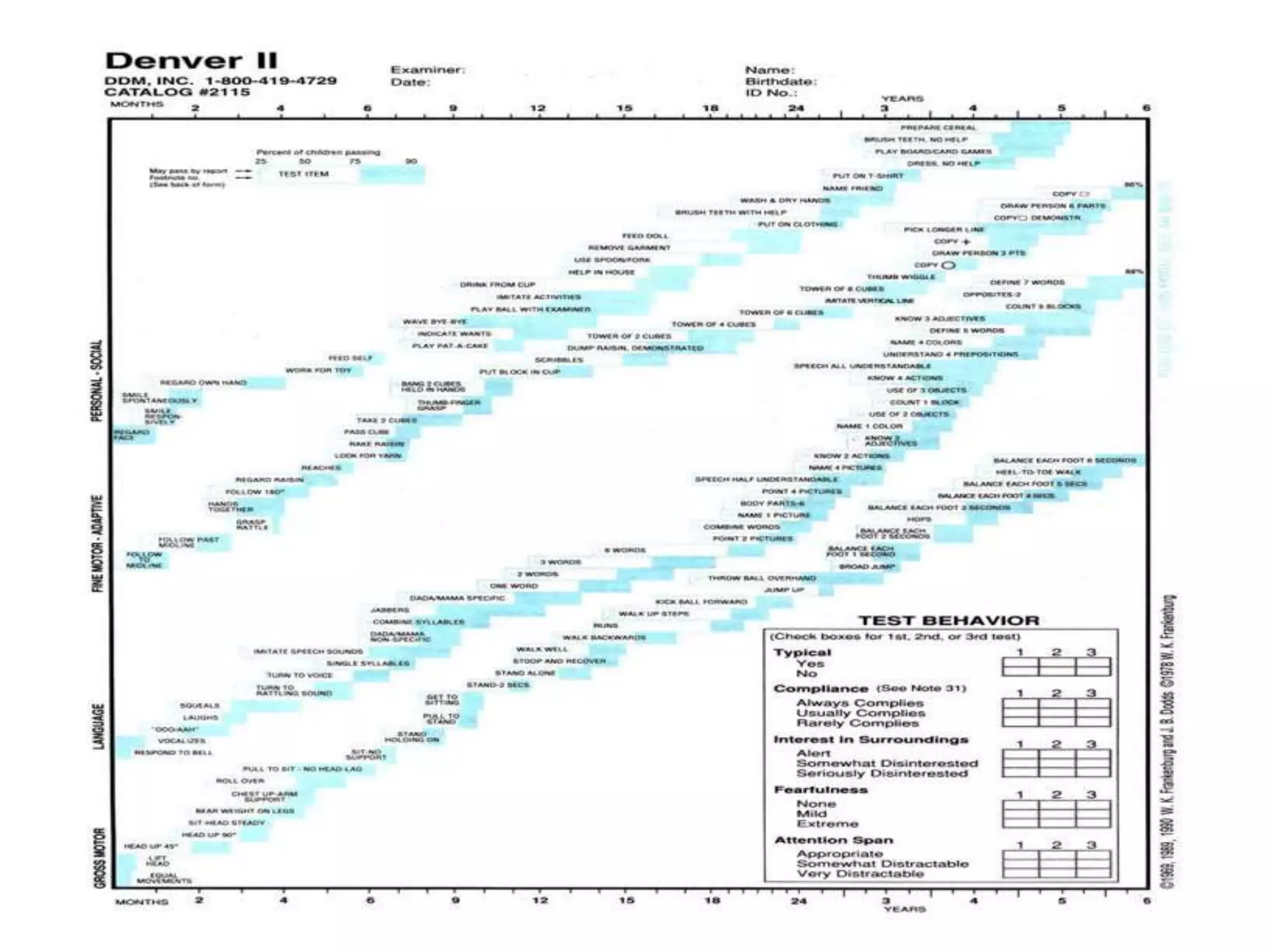
Consists of 125 tasks, or items.
Includes four areas:
• 1. Personal –Social: Getting along with
people and caring for personal needs
• 2. Fine Motor-Adaptive: Eye hand
coordination, manipulation of small objects,
and problem solving
• 3. Language: Hearing, understanding, and
using language
• 4. Gross Motor: sitting, walking, jumping, and
overall large muscle movement
• Includes five “Test Behavior” items to be
completed after the test.
• Subjectively allows screener to assess the
child’s overall behavior
• Designed to be used in a clinical setting by a
variety of professionals
• Must be administered in the standardized
manner
What the Denver is not ?
• Not an I.Q. test
• Not a diagnostic tool
Value of the Denver II
• Provide an organized clinical impression of a
child’s overall development
• To alert the user to potential developmental
difficulties .
• Used to determine how a child compares to
other children
It is not a predictor of later development
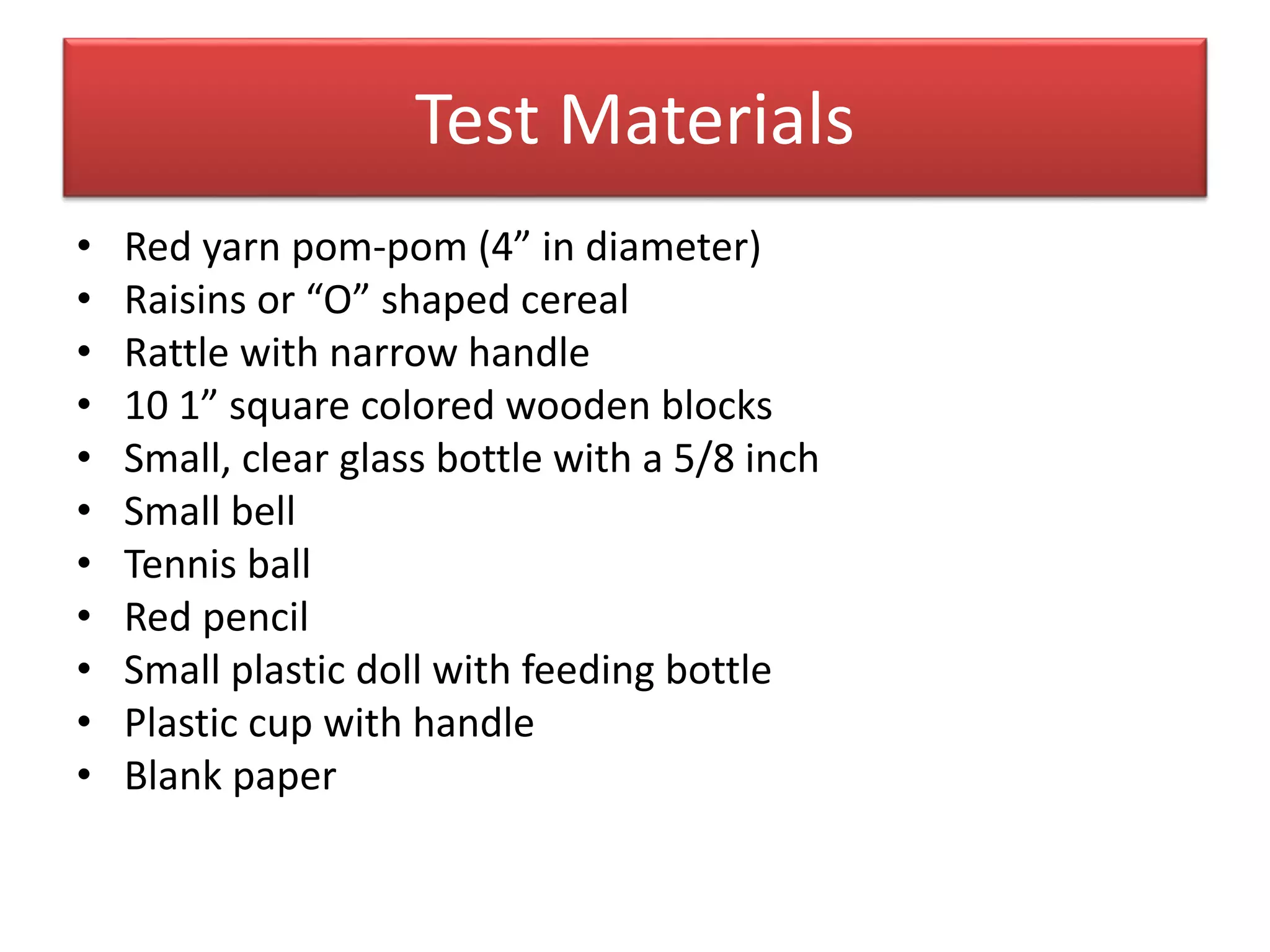
Test Materials
• Red yarn pom-pom (4” in diameter)
• Raisins or “O” shaped cereal
• Rattle with narrow handle
• 10 1” square colored wooden blocks
• Small, clear glass bottle with a 5/8 inch
• Small bell
• Tennis ball
• Red pencil
• Small plastic doll with feeding bottle
• Plastic cup with handle
• Blank paper
Materials
• Items come in a test kit (except for blank paper)
• Access to table and chairs (examiner, caregiver
and child if appropriate
• For babies, a blanket or cushioned pad is needed
• Substituting materials may reduced reliability in
comparing a tested child with the norms
• Children need to be supervised appropriately
with test materials to prevent choking or injury
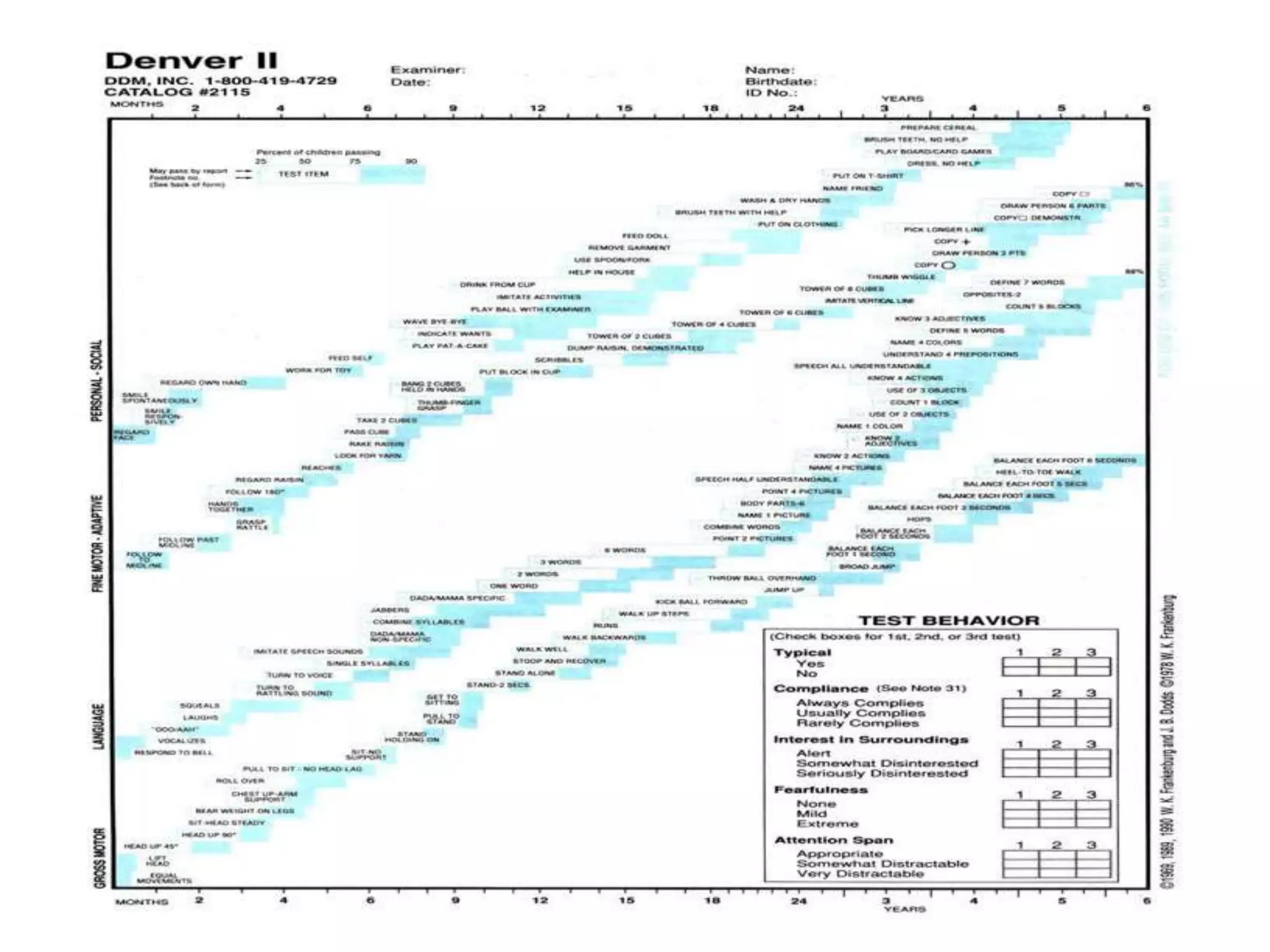
Test Form
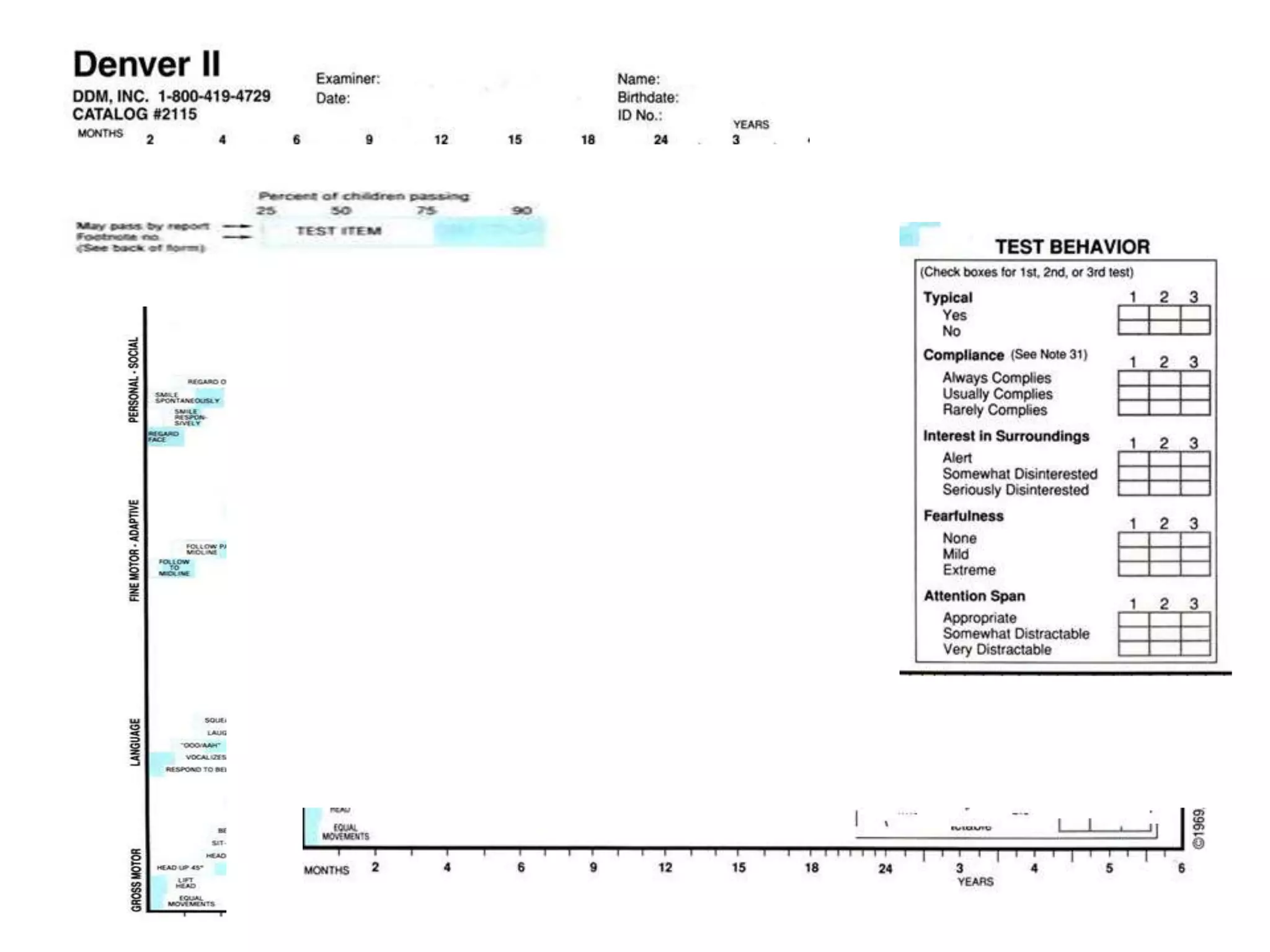
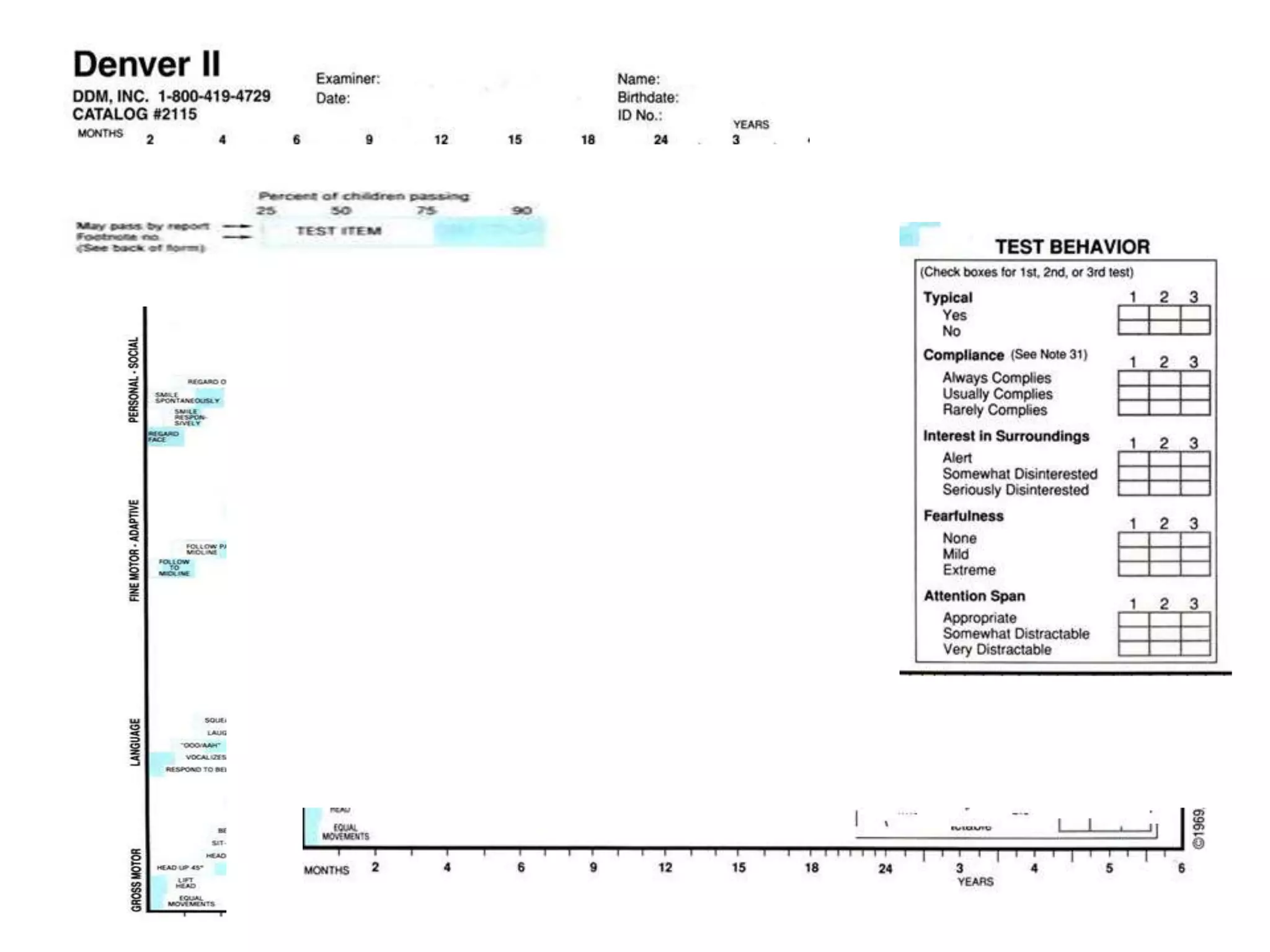
• Locate four sections on far left: Personal –
Social, Fine Motor, Language, and Gross
Motor.
• Locate the age scales on the top of the test
form and at the bottom
• Each mark on the scale from the first mark to
the 24 month mark represents one month
• After 24 months, each mark equals 3 month
intervals.
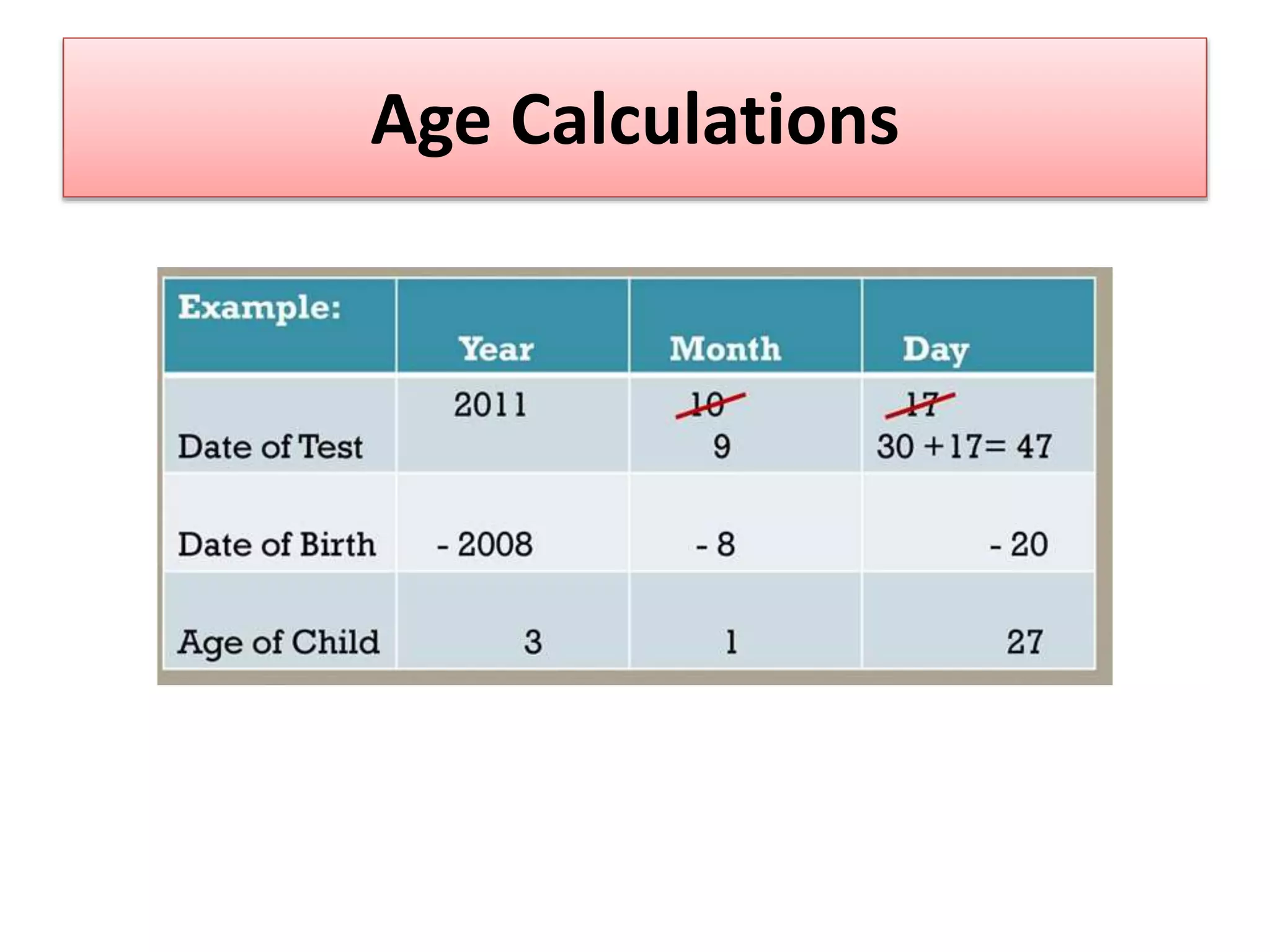
Age Calculations
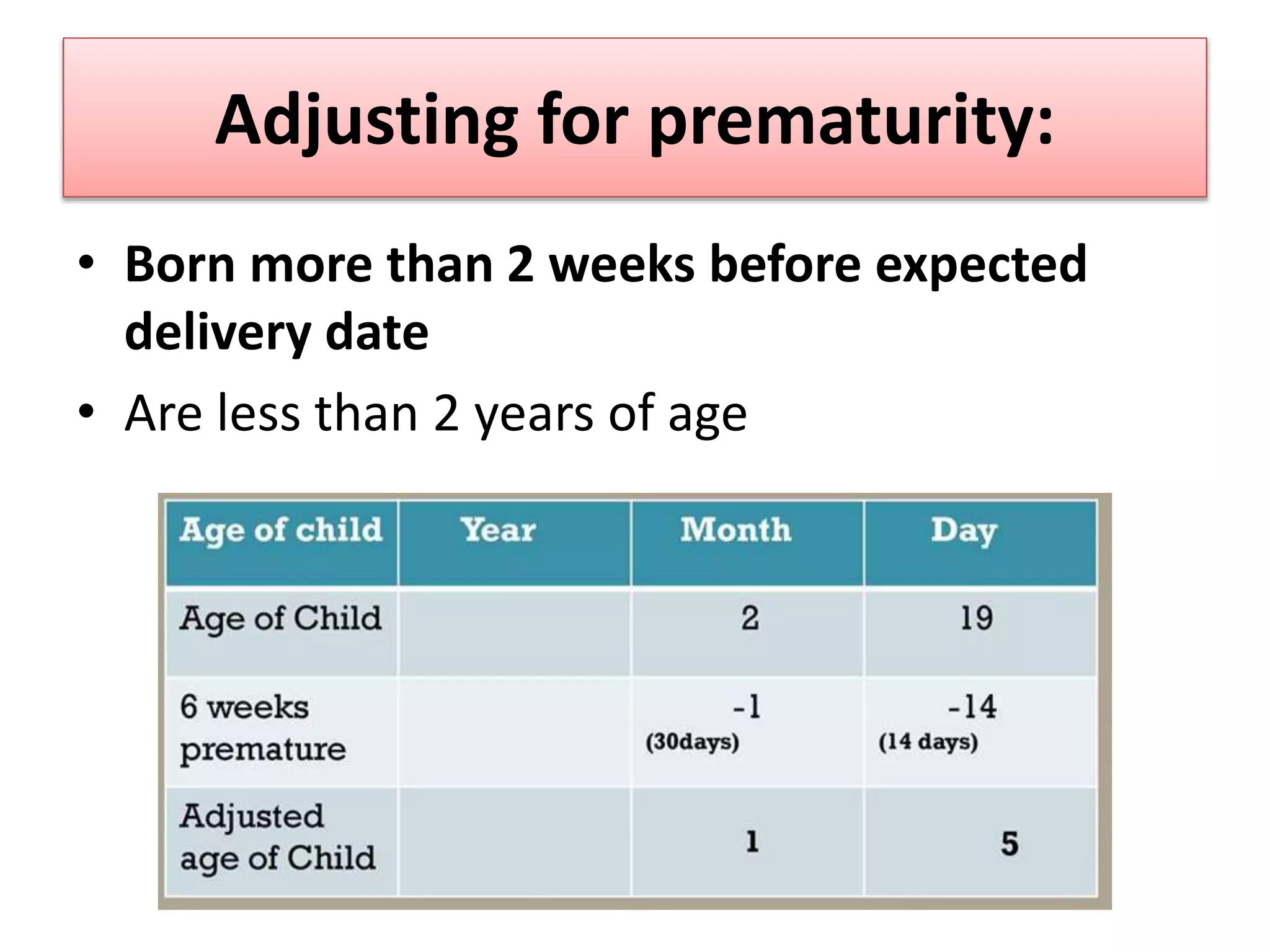
Adjusting for prematurity:
• Born more than 2 weeks before expected
delivery date
• Are less than 2 years of age
Test Administration
• Should be given with the parent or primary
caregiver present
• Make caregiver and child comfortable to elicit
most natural response
• Remove boots or shoes that might restrict the
child motor movements
• Young child may sit on caregiver’s lap, older child
should sit so arms can rest upon the table
• Elbows should be level with table top
• Infants may be evaluated on the floor
• It should be shared with parent that the tool is
to determine the child’s current
developmental status and that the child is
not expected to pass all of the items.
• Allow child to have appropriate item to
manipulate while you ask parent the “Report”
questions.
• Items requiring less active participation & can
perform easily should be administered first
• Items in Fine Motor-Adaptive next (items that
do not require child to speak)
• Language items next
• and last the Gross Motor items Gross Motor
requires more confidence which is gained as
test progresses.
• Keep test kit out of sight of child. Keep only
materials being used for current activity on
the table
• For infants, it is recommended that all items
be administered with the baby lying down to
be tested together
• Testing should begin with items that fall
completely to the left of the child’s age line,
and continue to the right.
Number of Items to be tested
• Depends on age and ability of child
• Step 1: in each sector, administer at least three
items nearest to and totally to the left of the age
line and every item that is intersected by the age
line
• Step 2: if the child is unable to perform any item
in step 1 (fails, refuses, has had no opportunity)
administer additional items to left in the
appropriate sector until child passes three
consecutive items
Scoring
• P = Pass-child successfully performs item, or caregiver
reports that child does item
• F = Fail-child does not successfully perform item, or
report from caregiver is that child does not do item
• N O = No Opportunity-the child has not had the
chance to perform the item, due to restrictions from
the caregiver or other reasons (May only be used on
report items)
• R = For Refusal – the child refuses to attempt the item.
You can minimize this by telling the child to do rather
than asking. Report items cannot be scored as refusals.
• Continue to administer items to the right of any
passes in each sector until three failures are
recorded
• The child may be given up to three trials to
perform each item, when appropriate, before
scoring a failure
• Ask the caregiver or parent if the results are
typical of child’s performance. Consider if the
child is ill, hungry, upset, etc.
• Rescheduling may be necessary if child is not
being cooperative
Advanced Item
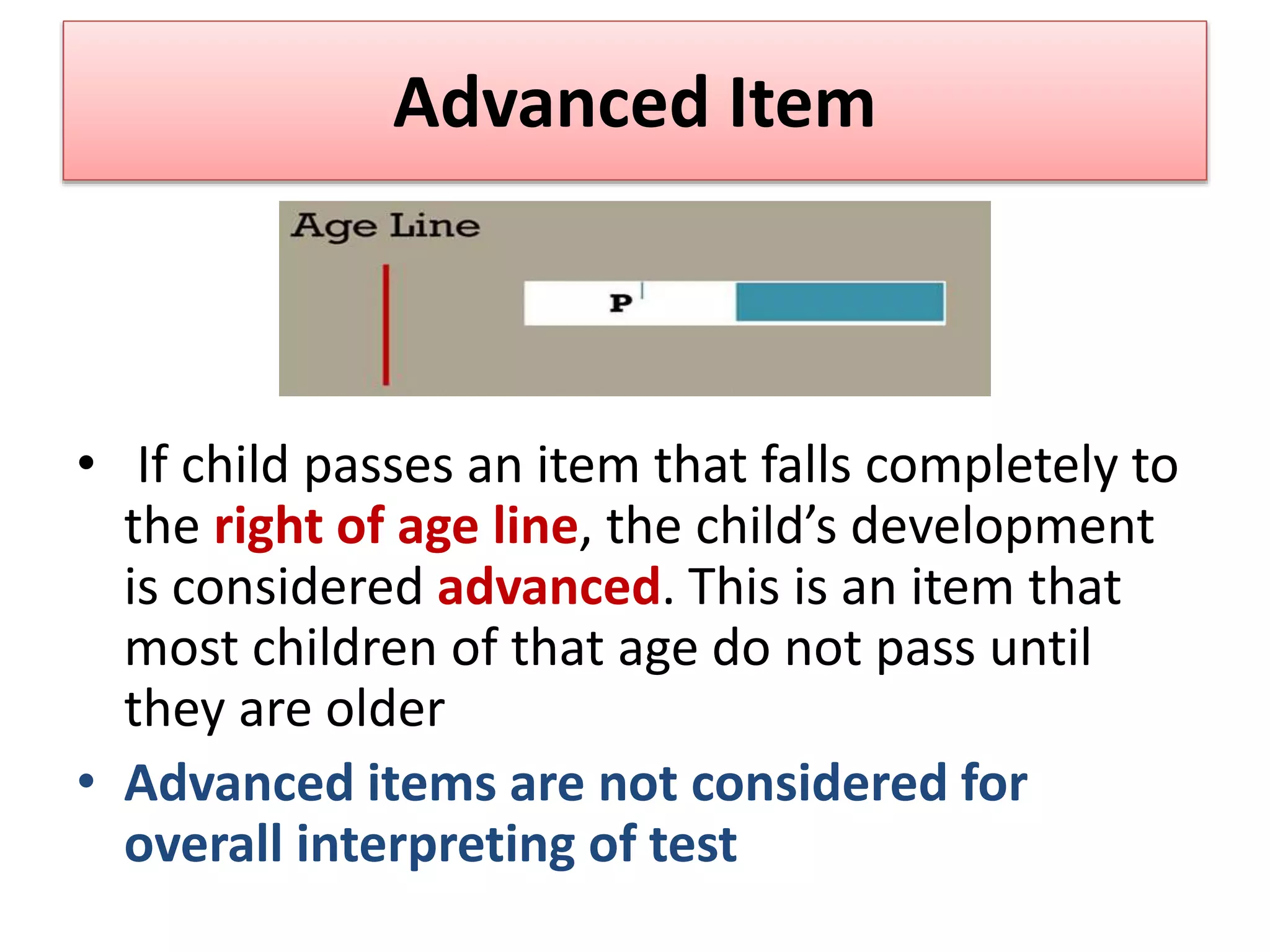
• If child passes an item that falls completely to
the right of age line, the child’s development
is considered advanced. This is an item that
most children of that age do not pass until
they are older
• Advanced items are not considered for
overall interpreting of test
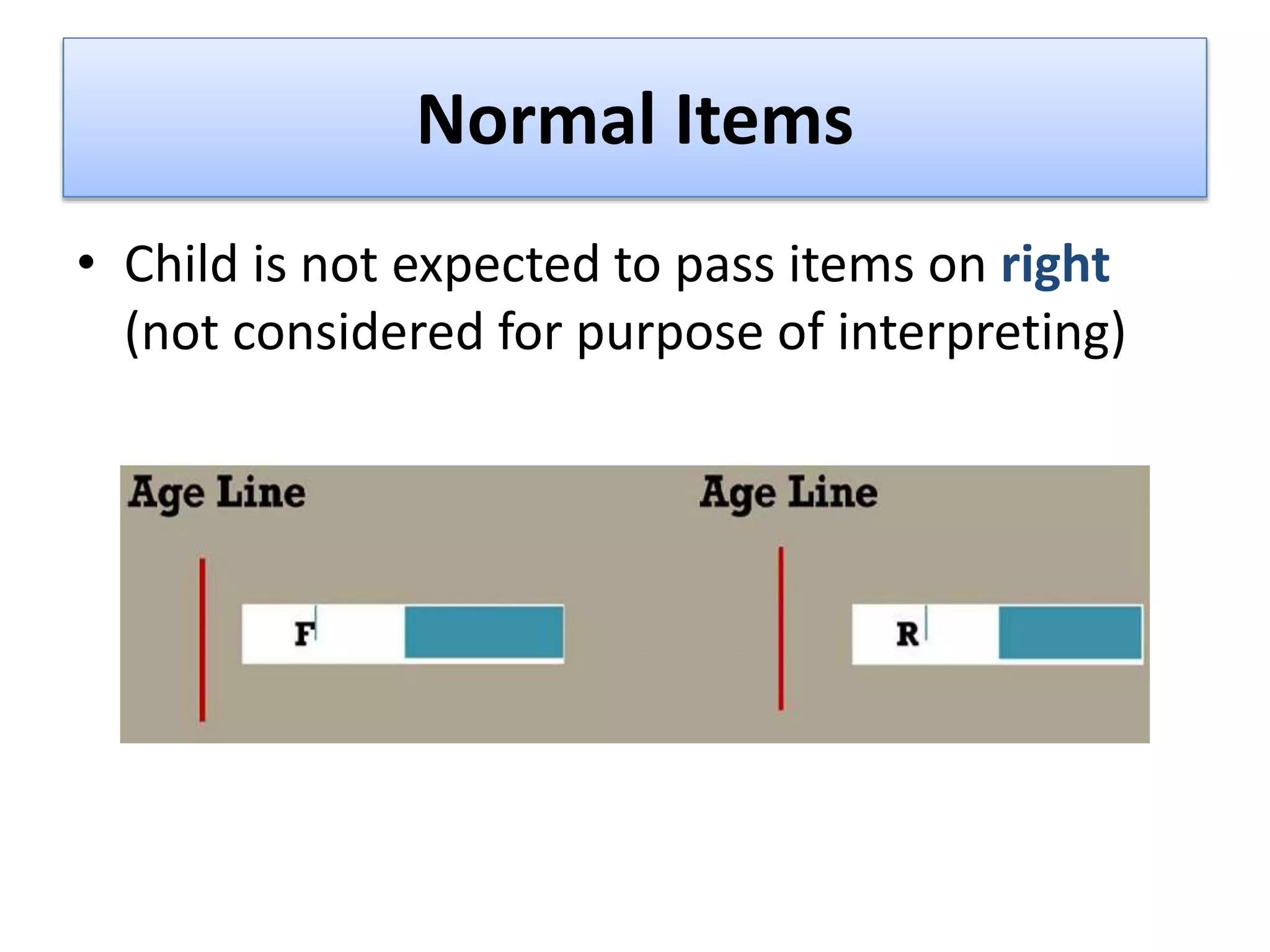
Normal Items
• Child is not expected to pass items on right
(not considered for purpose of interpreting)
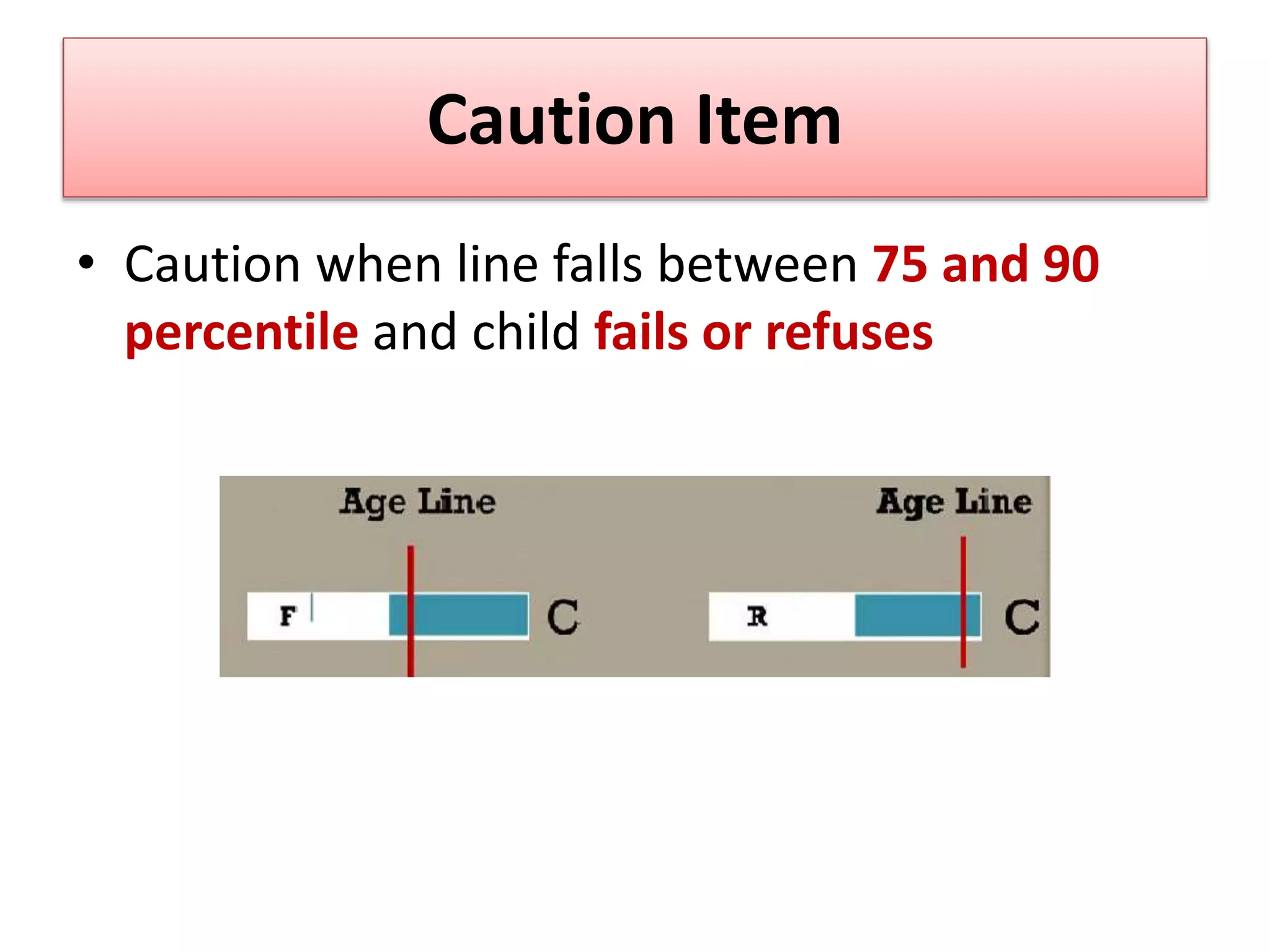
Caution Item
• Caution when line falls between 75 and 90
percentile and child fails or refuses
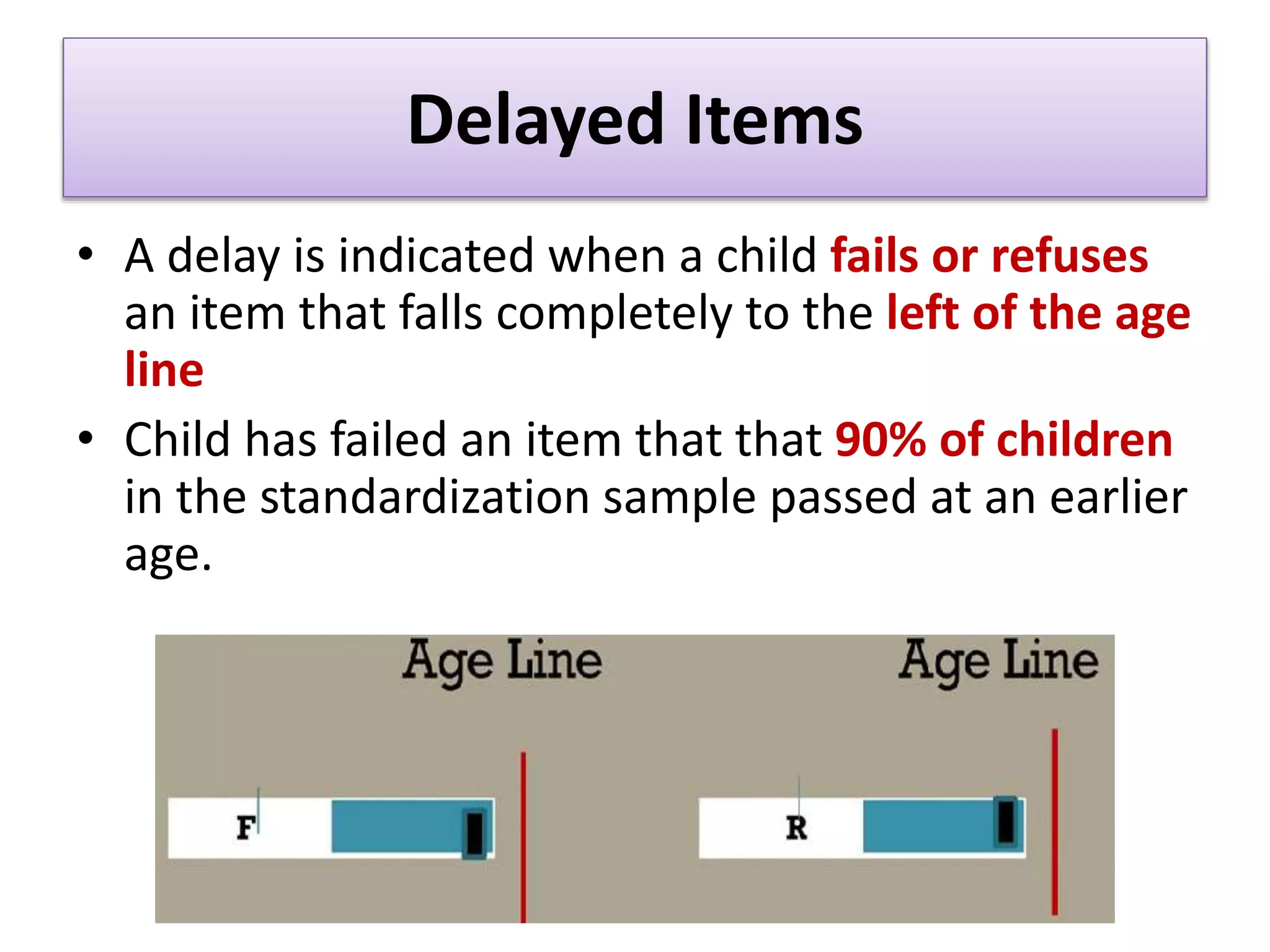
Delayed Items
• A delay is indicated when a child fails or refuses
an item that falls completely to the left of the age
line
• Child has failed an item that that 90% of children
in the standardization sample passed at an earlier
age.
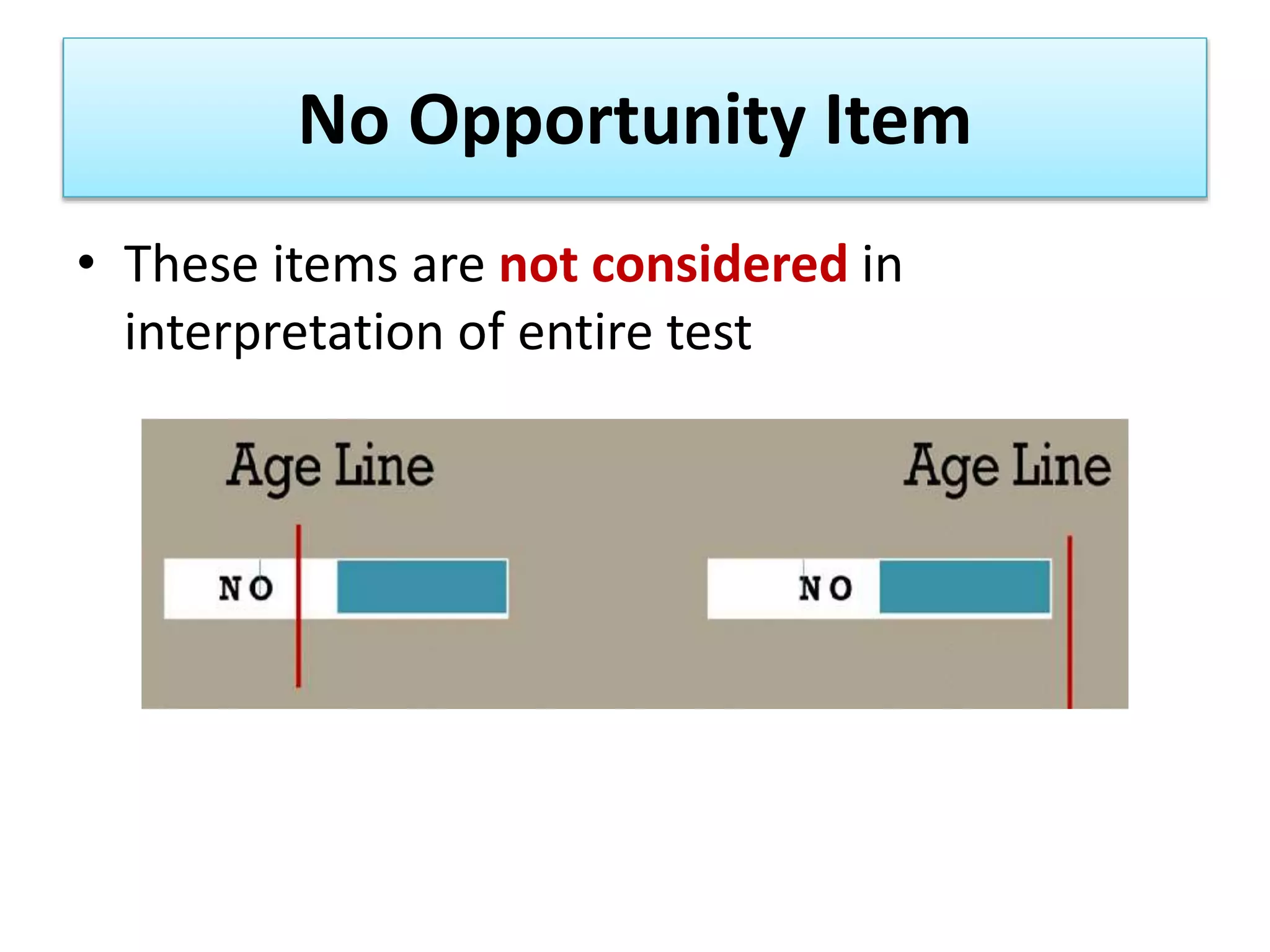
No Opportunity Item
• These items are not considered in
interpretation of entire test
Interpretation of the Test
• Normal: No delays and a maximum of 1
caution
• Suspect: two or more Cautions and /or One
or more Delays ,Rescreen in 1-2 weeks.
• Untestable: Refusal scores on one or more
items completely to the left of the age line or
on more than one item intersected by the age
line in the area of 75% - 90% area
Referral Considerations
• After rescreening, test result is suspect or
untestable
• Number of cautions and delays
• Clinical history, examination
• Availability of referral resouces
THANKS FOR YOUR
ATTENTION

Developmental Screening test (Denver II - Overview)

  • 4.
    Historical Background • DenverII (1992) Previously the Denver Developmental Screening test, DDST (1967) • Used by health providers to identify developmental problems in young children. • Has been used and standardized in over 12 countries. Used to screen over 50 million children.
  • 5.
    • Used inpublic health clinics, private practices, and early education programs. • Has been translated in several language • Standardized in over a dozen countries • American Academy of Pediatrics Council with Disabilities has the Denver II on their approved screening tools list.
  • 6.
    Overview • Administered tochildren ages birth to six years • Assesses a child’s performance on various age- appropriate tasks • Screens for possible problems • Designed to compare a given child’s performance with the performance of other children the same age
  • 7.
    Consists of 125tasks, or items. Includes four areas: • 1. Personal –Social: Getting along with people and caring for personal needs • 2. Fine Motor-Adaptive: Eye hand coordination, manipulation of small objects, and problem solving • 3. Language: Hearing, understanding, and using language • 4. Gross Motor: sitting, walking, jumping, and overall large muscle movement
  • 8.
    • Includes five“Test Behavior” items to be completed after the test. • Subjectively allows screener to assess the child’s overall behavior • Designed to be used in a clinical setting by a variety of professionals • Must be administered in the standardized manner
  • 9.
    What the Denveris not ? • Not an I.Q. test • Not a diagnostic tool
  • 10.
    Value of theDenver II • Provide an organized clinical impression of a child’s overall development • To alert the user to potential developmental difficulties . • Used to determine how a child compares to other children It is not a predictor of later development
  • 11.
    Test Materials • Redyarn pom-pom (4” in diameter) • Raisins or “O” shaped cereal • Rattle with narrow handle • 10 1” square colored wooden blocks • Small, clear glass bottle with a 5/8 inch • Small bell • Tennis ball • Red pencil • Small plastic doll with feeding bottle • Plastic cup with handle • Blank paper
  • 12.
    Materials • Items comein a test kit (except for blank paper) • Access to table and chairs (examiner, caregiver and child if appropriate • For babies, a blanket or cushioned pad is needed • Substituting materials may reduced reliability in comparing a tested child with the norms • Children need to be supervised appropriately with test materials to prevent choking or injury
  • 15.
    Test Form • Locatefour sections on far left: Personal – Social, Fine Motor, Language, and Gross Motor. • Locate the age scales on the top of the test form and at the bottom • Each mark on the scale from the first mark to the 24 month mark represents one month • After 24 months, each mark equals 3 month intervals.
  • 16.
  • 17.
    Adjusting for prematurity: •Born more than 2 weeks before expected delivery date • Are less than 2 years of age
  • 18.
    Test Administration • Shouldbe given with the parent or primary caregiver present • Make caregiver and child comfortable to elicit most natural response • Remove boots or shoes that might restrict the child motor movements • Young child may sit on caregiver’s lap, older child should sit so arms can rest upon the table • Elbows should be level with table top • Infants may be evaluated on the floor
  • 19.
    • It shouldbe shared with parent that the tool is to determine the child’s current developmental status and that the child is not expected to pass all of the items. • Allow child to have appropriate item to manipulate while you ask parent the “Report” questions.
  • 20.
    • Items requiringless active participation & can perform easily should be administered first • Items in Fine Motor-Adaptive next (items that do not require child to speak) • Language items next • and last the Gross Motor items Gross Motor requires more confidence which is gained as test progresses.
  • 21.
    • Keep testkit out of sight of child. Keep only materials being used for current activity on the table • For infants, it is recommended that all items be administered with the baby lying down to be tested together • Testing should begin with items that fall completely to the left of the child’s age line, and continue to the right.
  • 22.
    Number of Itemsto be tested • Depends on age and ability of child • Step 1: in each sector, administer at least three items nearest to and totally to the left of the age line and every item that is intersected by the age line • Step 2: if the child is unable to perform any item in step 1 (fails, refuses, has had no opportunity) administer additional items to left in the appropriate sector until child passes three consecutive items
  • 23.
    Scoring • P =Pass-child successfully performs item, or caregiver reports that child does item • F = Fail-child does not successfully perform item, or report from caregiver is that child does not do item • N O = No Opportunity-the child has not had the chance to perform the item, due to restrictions from the caregiver or other reasons (May only be used on report items) • R = For Refusal – the child refuses to attempt the item. You can minimize this by telling the child to do rather than asking. Report items cannot be scored as refusals.
  • 24.
    • Continue toadminister items to the right of any passes in each sector until three failures are recorded • The child may be given up to three trials to perform each item, when appropriate, before scoring a failure • Ask the caregiver or parent if the results are typical of child’s performance. Consider if the child is ill, hungry, upset, etc. • Rescheduling may be necessary if child is not being cooperative
  • 25.
    Advanced Item • Ifchild passes an item that falls completely to the right of age line, the child’s development is considered advanced. This is an item that most children of that age do not pass until they are older • Advanced items are not considered for overall interpreting of test
  • 26.
    Normal Items • Childis not expected to pass items on right (not considered for purpose of interpreting)
  • 27.
    Caution Item • Cautionwhen line falls between 75 and 90 percentile and child fails or refuses
  • 28.
    Delayed Items • Adelay is indicated when a child fails or refuses an item that falls completely to the left of the age line • Child has failed an item that that 90% of children in the standardization sample passed at an earlier age.
  • 29.
    No Opportunity Item •These items are not considered in interpretation of entire test
  • 30.
    Interpretation of theTest • Normal: No delays and a maximum of 1 caution • Suspect: two or more Cautions and /or One or more Delays ,Rescreen in 1-2 weeks. • Untestable: Refusal scores on one or more items completely to the left of the age line or on more than one item intersected by the age line in the area of 75% - 90% area
  • 31.
    Referral Considerations • Afterrescreening, test result is suspect or untestable • Number of cautions and delays • Clinical history, examination • Availability of referral resouces
  • 32.