Standard Tools for Everyday Programming
Community Heckling
 On twitter #tek09 (or #phptek) and #spldg
 DG’s for drinking game (you’ll see why later)
 IRC is open, I can see backlog – constructive criticism
 is good

 Comment on http://joind.in/talk/view/186
 No comments on hair, clothes, or my fat belly –
 constructive criticism is welcome ;)
I have a Problem
Recursively iterate through
 directories
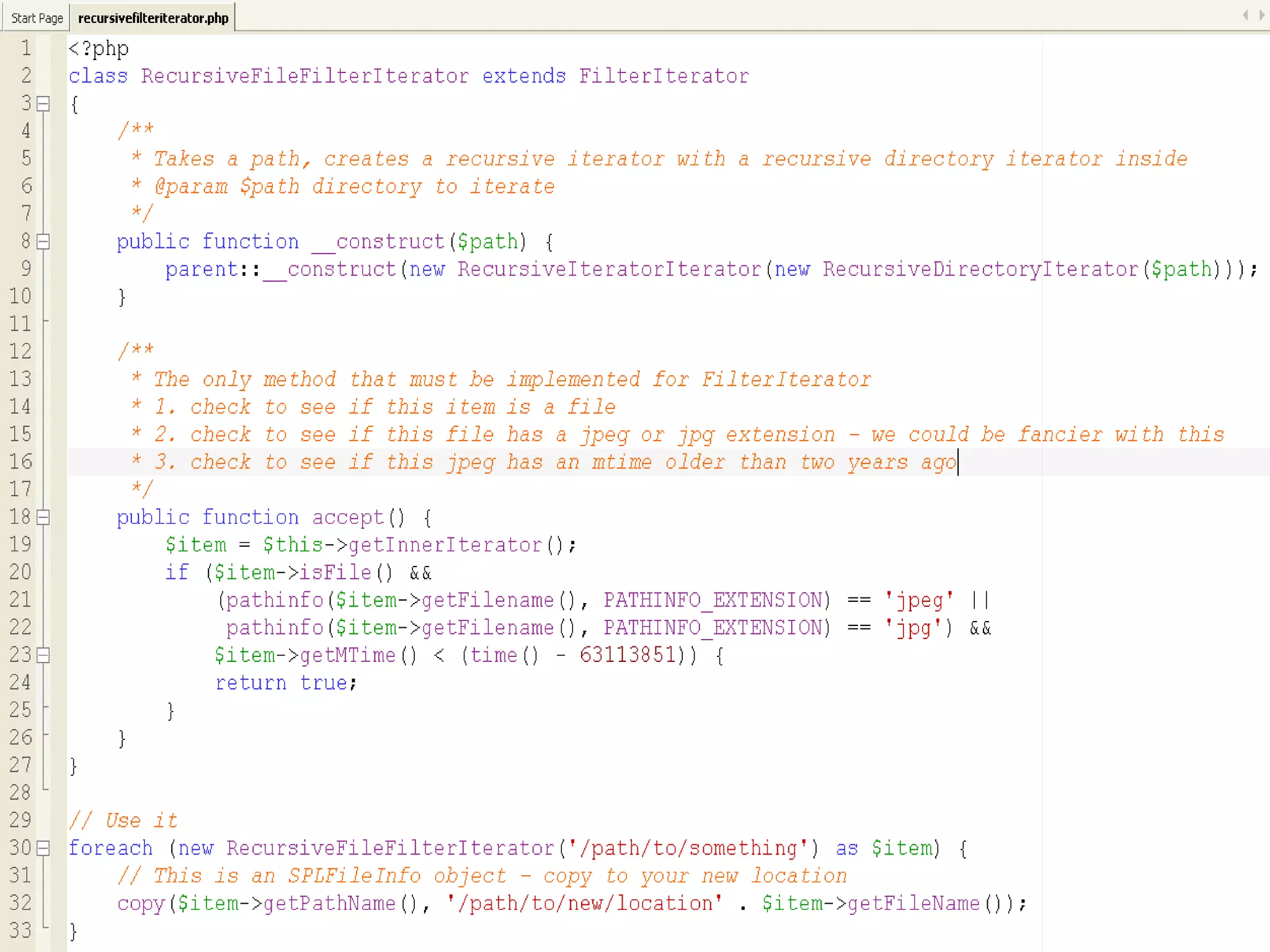
Find all .jpg files
Check last modified dates
Moved the ones older than two
 years to new location
How should I do this?
 Some nasty recursive use of scandir() to get my lists
 Or PHP’s dir() function and looping
 array_map() with a convoluted callback


I think I’m going to need a lot of code….
SPL to the Rescue!
             RecursiveDirectoryIterator
             RecursiveIteratorIterator
             FilterIterator
             SplFileInfo


                  What fun tools we have!
And not the kind you kick out of IRC
What is SPL?
       tandard HP ibrary

  A library of standard interfaces,
 classes, and functions designed to
    solve common programming
     problems and allow engine
            overloading.
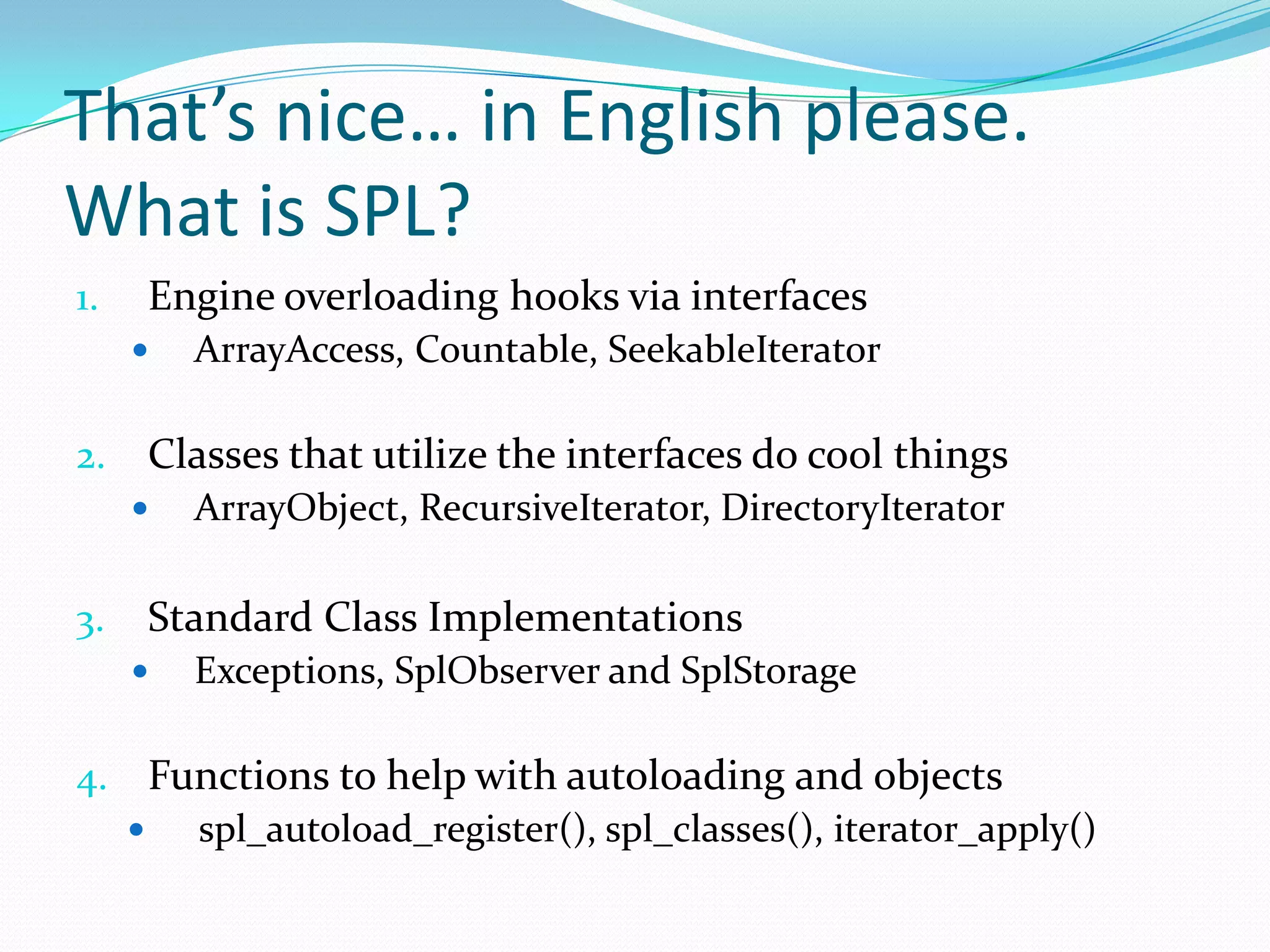
That’s nice… in English please.
What is SPL?
1.   Engine overloading hooks via interfaces
        ArrayAccess, Countable, SeekableIterator

2.   Classes that utilize the interfaces do cool things
        ArrayObject, RecursiveIterator, DirectoryIterator

3.   Standard Class Implementations
        Exceptions, SplObserver and SplStorage

4. Functions to help with autoloading and objects
    spl_autoload_register(), spl_classes(), iterator_apply()
But… it’s an extension right?
   SPL is an extension
   SPL is a core extension
   SPL cannot be built shared
   SPL should not be turned off
   SPL is present in PHP since 5.0 (almost 5 years ago)
   As of 5.3, SPL cannot be turned off without altering
    source

If you don’t have SPL, whoever built your PHP is an idiot
(or an evil genius – it’s HARD).
Helper functions from SPL to you
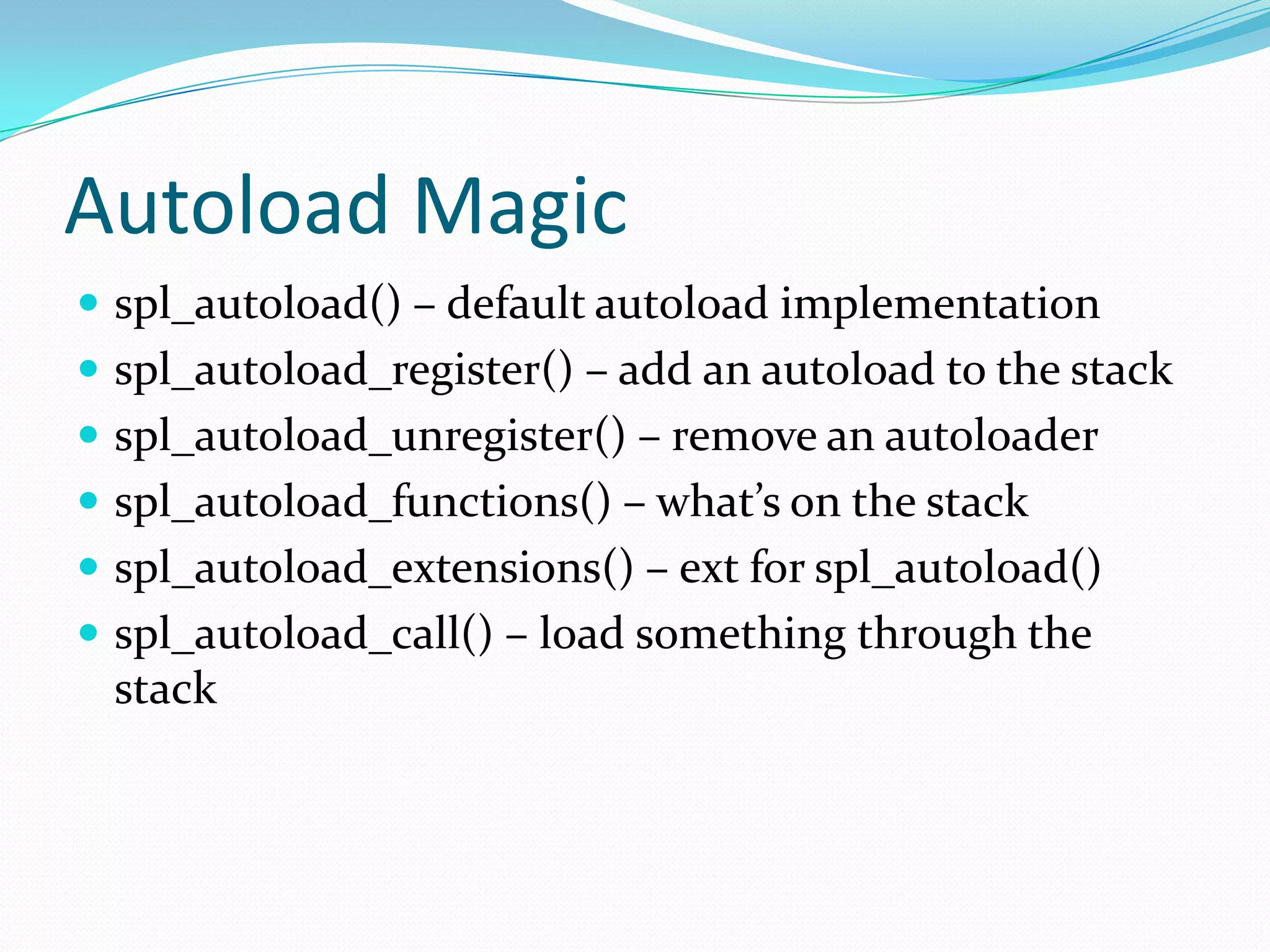
Autoload Magic
 spl_autoload() – default autoload implementation
 spl_autoload_register() – add an autoload to the stack
 spl_autoload_unregister() – remove an autoloader
 spl_autoload_functions() – what’s on the stack
 spl_autoload_extensions() – ext for spl_autoload()
 spl_autoload_call() – load something through the
 stack
Isn’t __autoload good enough?
 Combining different libraries with different naming
  conventions
 Dealing with different types of files (templates,
  classes) in different locations
 Changing autoload in use during runtime
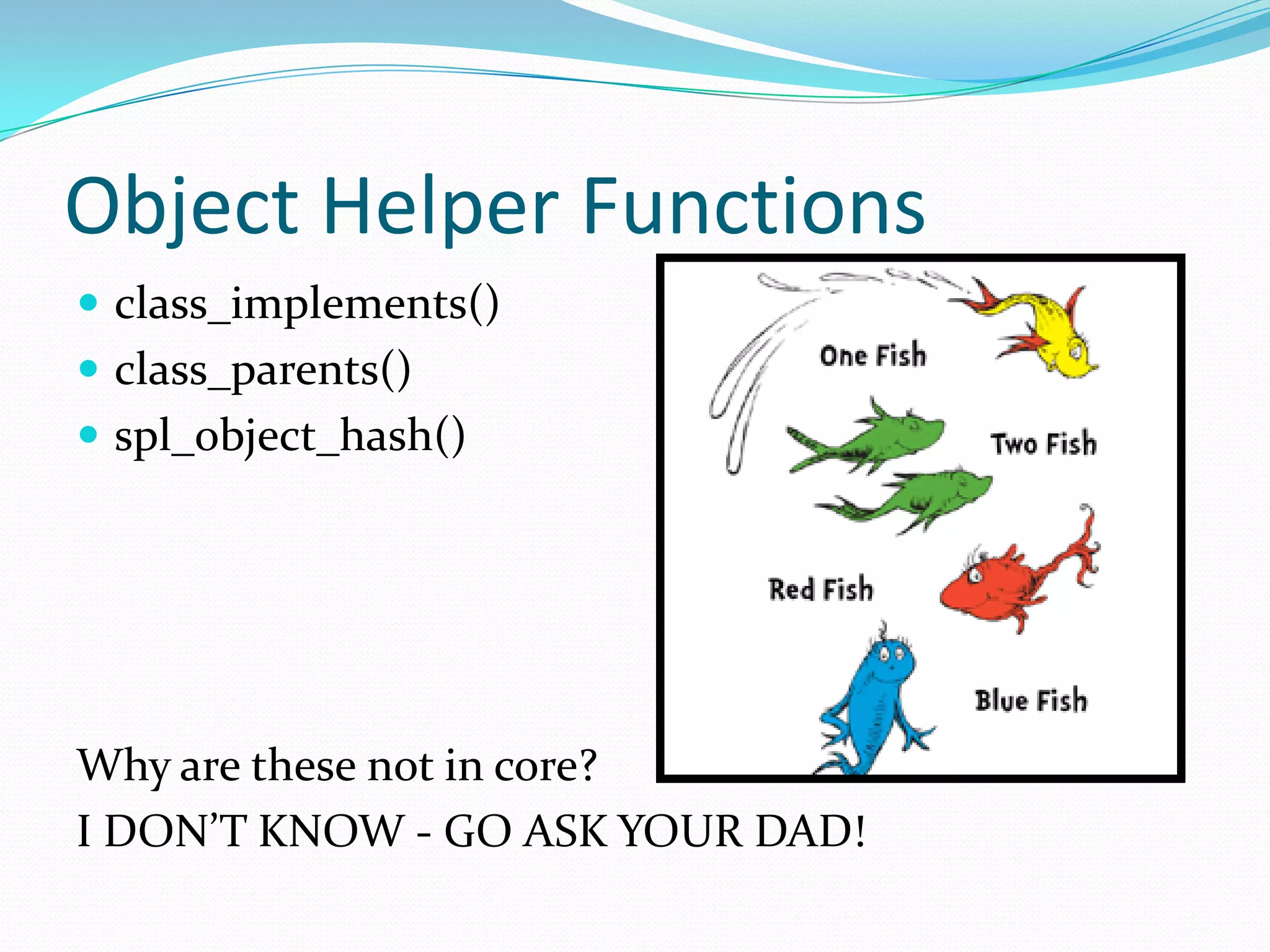
Object Helper Functions
 class_implements()
 class_parents()
 spl_object_hash()


Why are these not in core?
I DON’T KNOW - GO ASK YOUR DAD!
Nothing but Templates
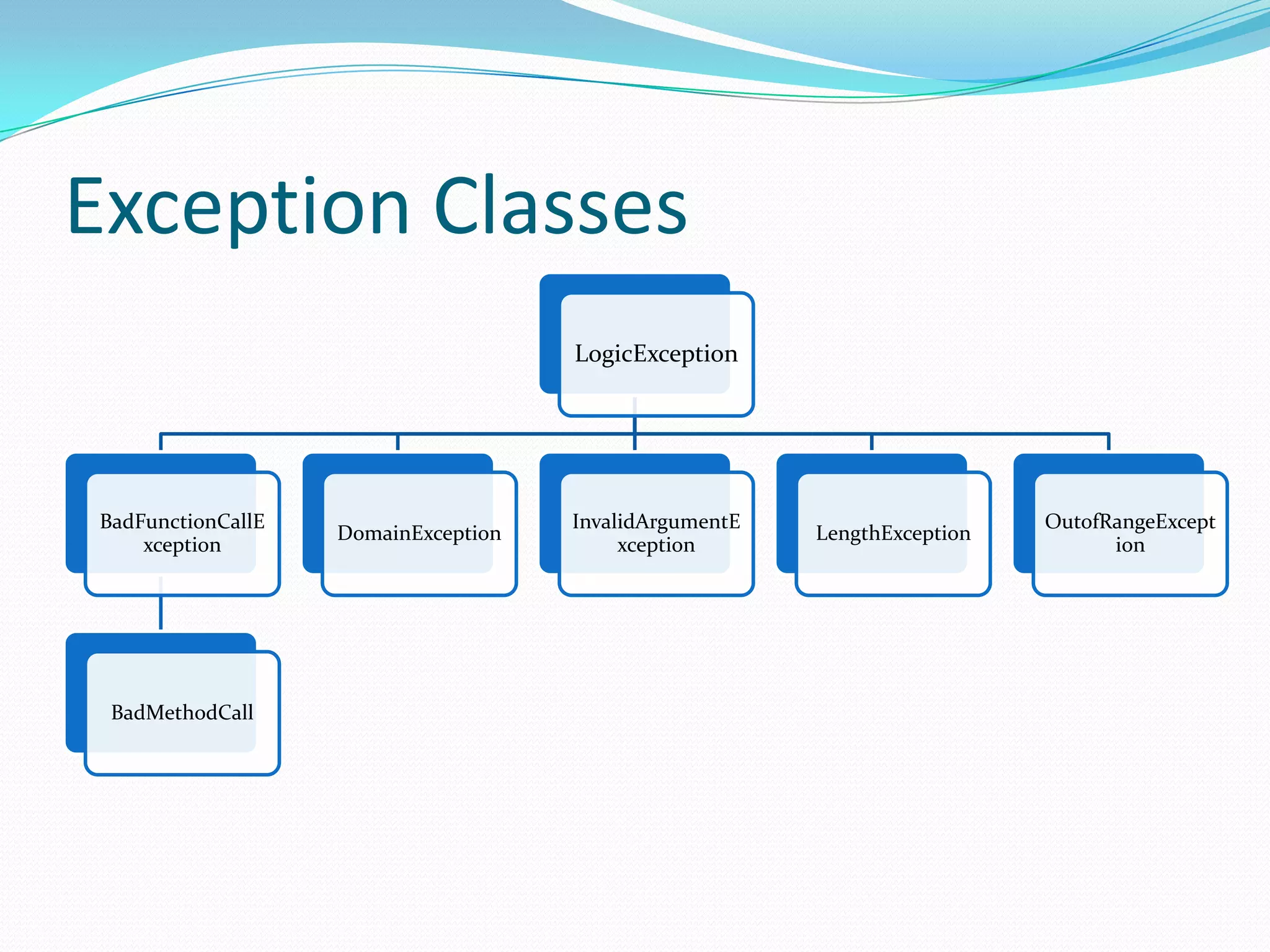
Exception Classes
                                     LogicException


BadFunctionCallE                     InvalidArgumentE                     OutofRangeExcept
                   DomainException                      LengthException
    xception                              xception                              ion


 BadMethodCall
Exception Classes

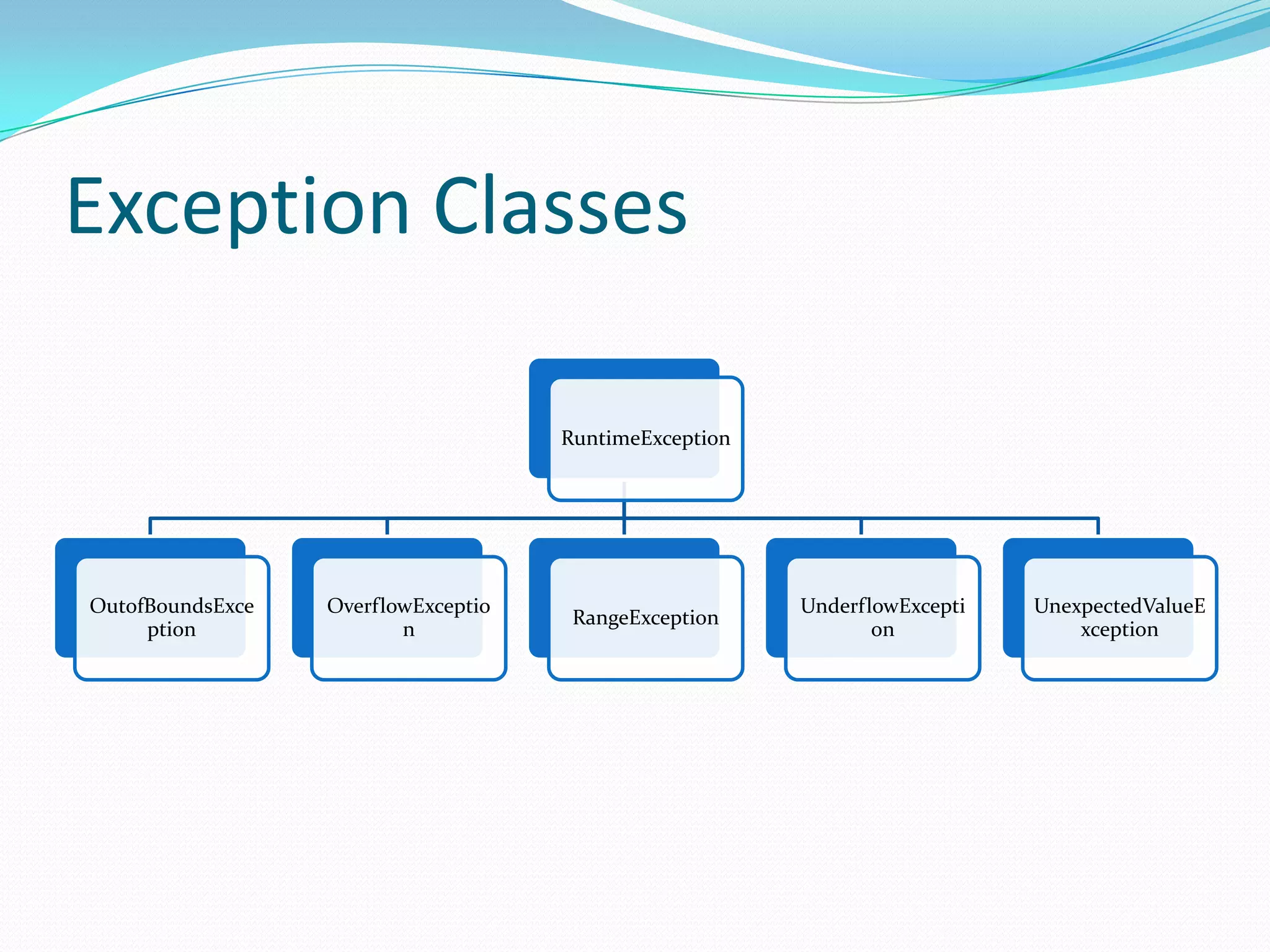
                                     RuntimeException


OutofBoundsExce   OverflowExceptio                      UnderflowExcepti   UnexpectedValueE
                                      RangeException
     ption               n                                     on              xception
So what does SPL offer?
 A standard set of Exceptions that all inherit from
  PHP’s Exception base class
 A standard way to set up exceptions by what kind they
  are
 Do I recommend it? Depends on how exceptions are
  used in your application.
Foreach is your bestest friend! Foreach an object today!
The iterator drinking game!
 Every time someone says the word iterator tonight,
  take a drink
 Start a conversation with me, and you’ll be gone in
  about five minutes

  It’s the SPL drinking game (tonight at cocktail hour)
Iterators
 What the heck is an iterator?
   A design pattern that is a generic solution to the
    problem of iterating over data in a consistent manner.
   Access the elements of an aggregate object sequentially
    without exposing its underlying representation.
 Why do I care?
   Ever need to go over a list of items returned from a
    database (well, duh)
   Or need to go over a list of items returned from a
    webservice?
   Ever used foreach?
Foreach it baby!
 Foreach is your friend
 iterators give your code consistent usage
 and you can add more functionality


 What else can you do with iterators?
   Extend Iterators to do what you need
   Chain Iterators: iteratoriteratoriteratoriterator


(that’s 5 shots)….
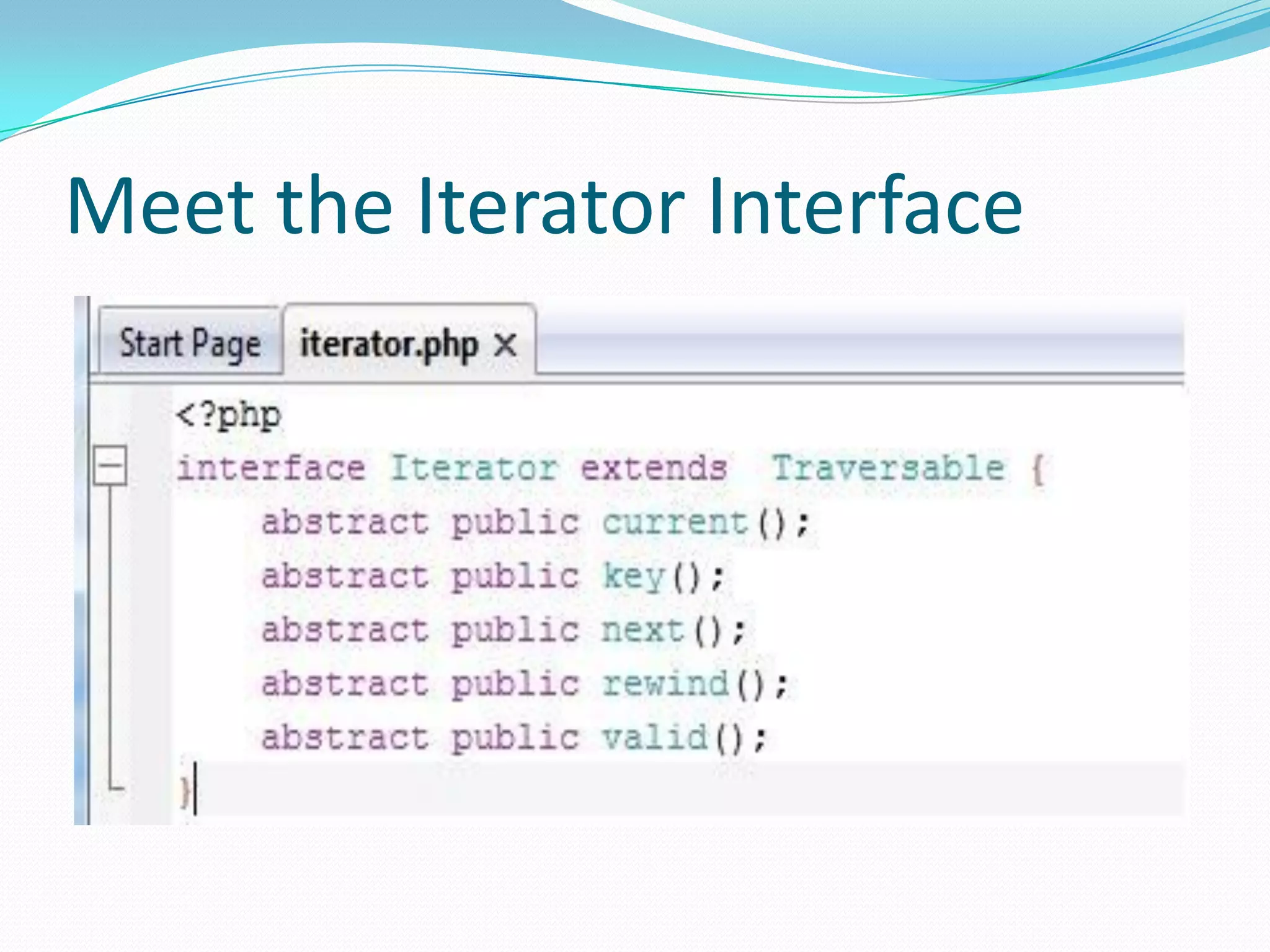
Meet the Iterator Interface
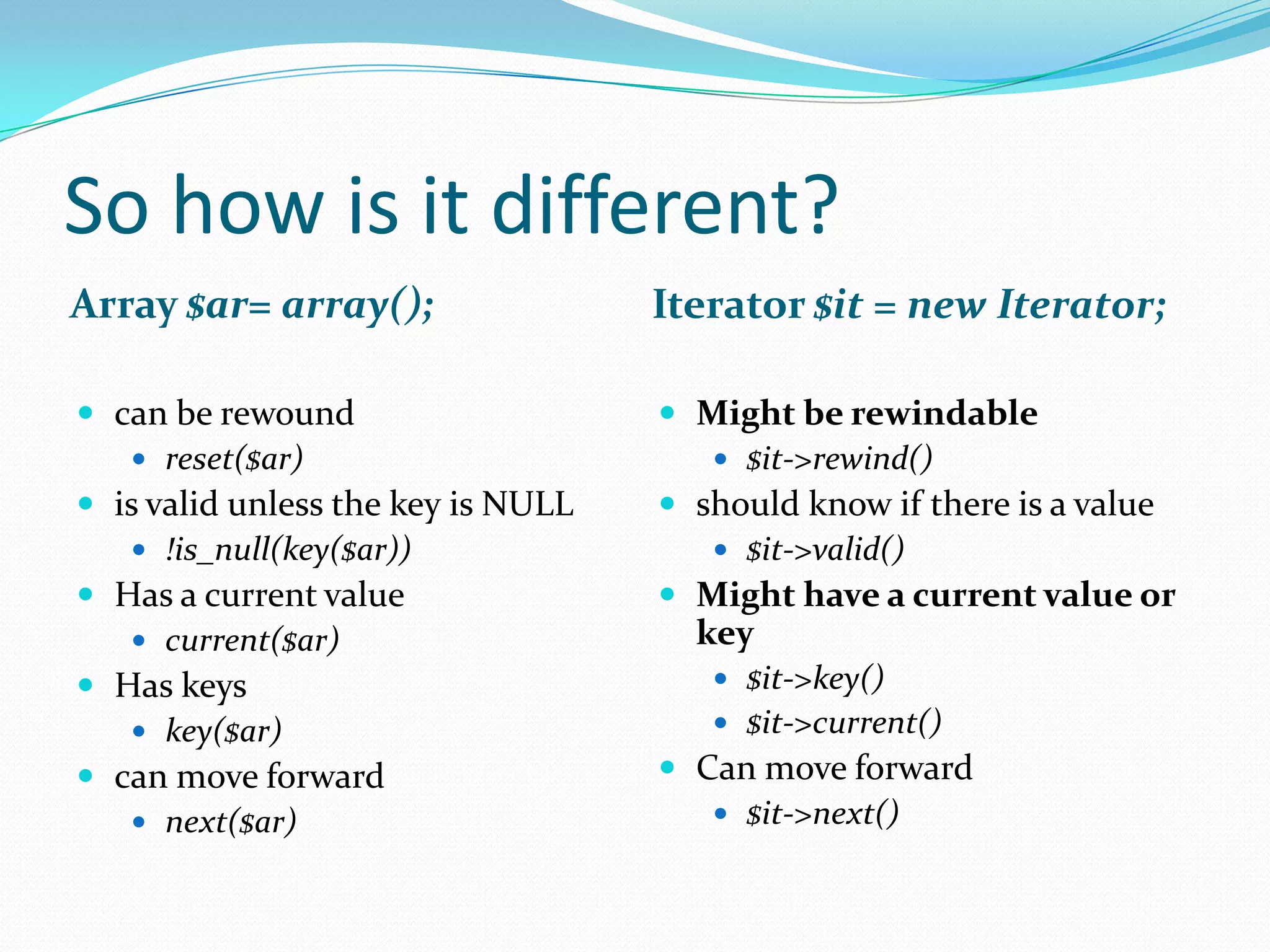
So how is it different?
Array $ar= array();                 Iterator $it = new Iterator;

 can be rewound                     Might be rewindable
    reset($ar)                         $it->rewind()
 is valid unless the key is NULL    should know if there is a value
    !is_null(key($ar))                 $it->valid()
 Has a current value                Might have a current value or
    current($ar)                     key
 Has keys                              $it->key()
    key($ar)                           $it->current()
 can move forward                   Can move forward
    next($ar)                          $it->next()
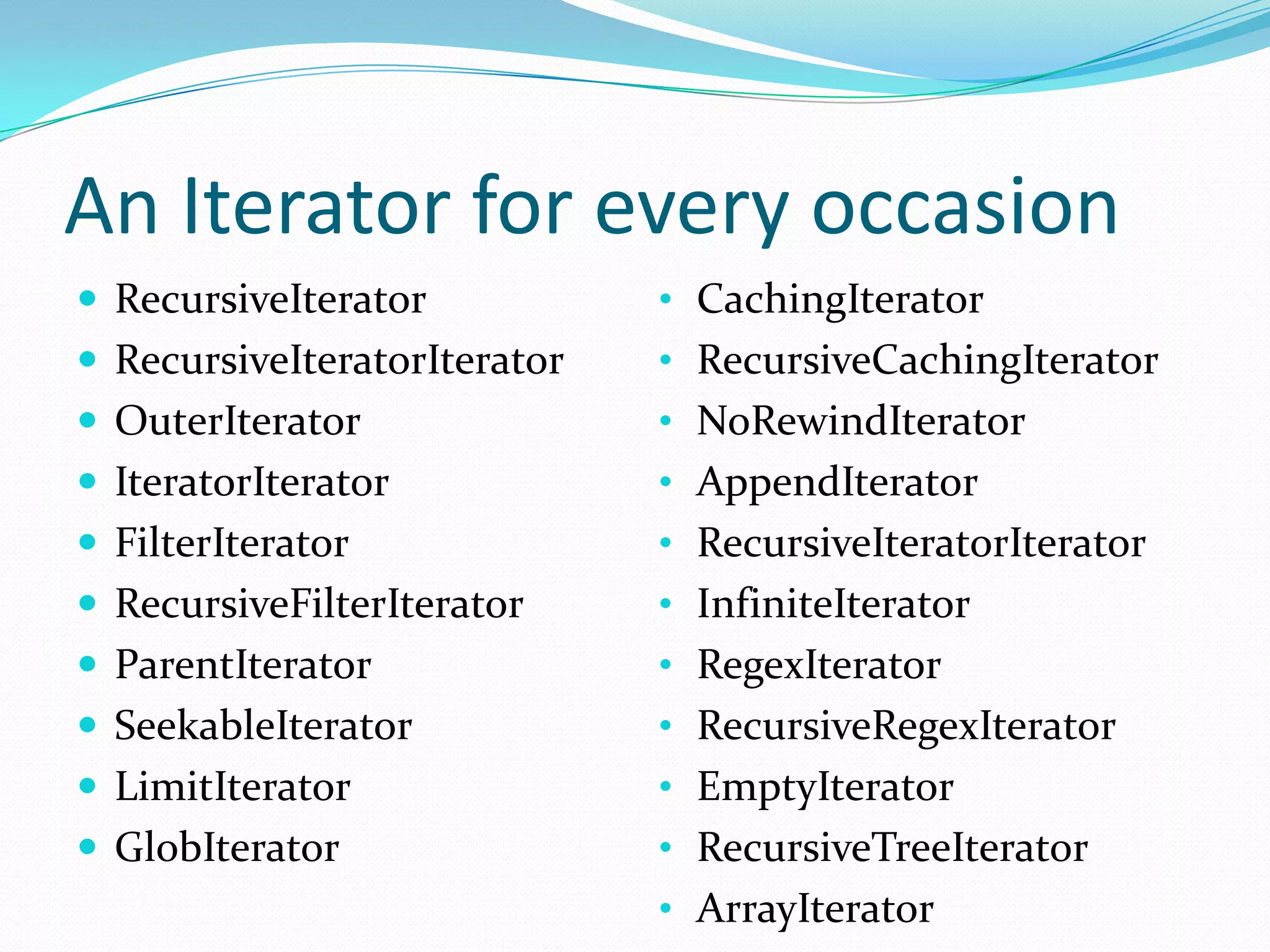
An Iterator for every occasion
 RecursiveIterator           • CachingIterator
 RecursiveIteratorIterator   • RecursiveCachingIterator
 OuterIterator               • NoRewindIterator
 IteratorIterator            • AppendIterator
 FilterIterator              • RecursiveIteratorIterator
 RecursiveFilterIterator     • InfiniteIterator
 ParentIterator              • RegexIterator
 SeekableIterator            • RecursiveRegexIterator
 LimitIterator               • EmptyIterator
 GlobIterator                • RecursiveTreeIterator
                              • ArrayIterator
See, the drinking game will be lots of fun….
Innie or an Outie?
          OuterIterator (interface)
            Extends Iterator
            Puts a wrapper around an iterator
             inside
            Has one additional method –
             getInnerIterator() that should be
             implemented
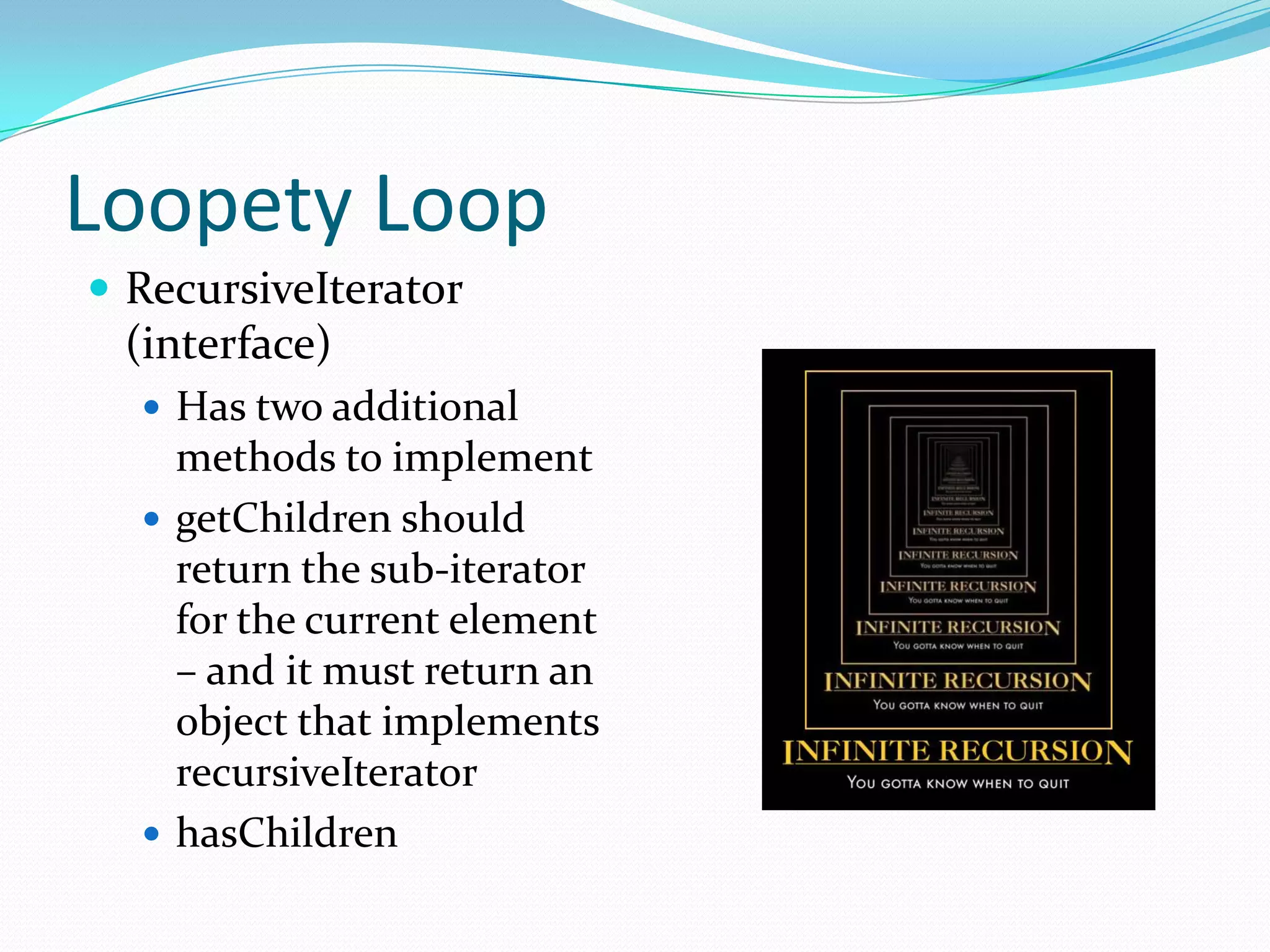
Loopety Loop
 RecursiveIterator
 (interface)
   Has two additional
    methods to implement
   getChildren should
    return the sub-iterator
    for the current element
    – and it must return an
    object that implements
    recursiveIterator
   hasChildren
Jumping ahead?
                  SeekableIterator
                  (interface)
                    Additional method –
                     seek(string $position)
                    Lets you jump to a
                     specific spot to start
                     iterating
Now on to classes
 Classes implement interfaces plus provide additional
  functionality
 Interfaces need you to fill in all the the required
  methods
 You can implement multiple interfaces
 You can’t extend multiple classes


Choose Wisely
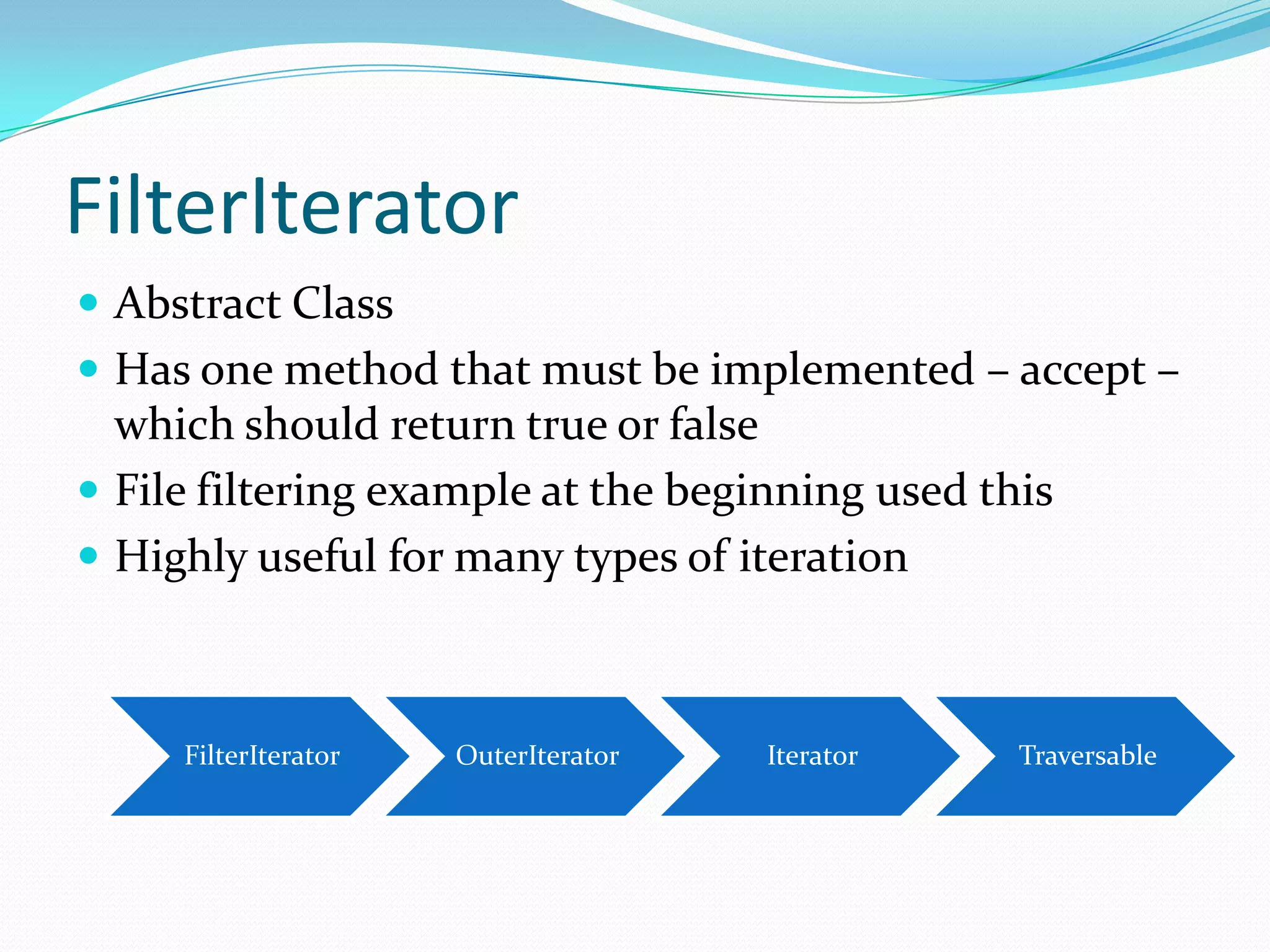
FilterIterator
 Abstract Class
 Has one method that must be implemented – accept –
  which should return true or false
 File filtering example at the beginning used this
 Highly useful for many types of iteration


     FilterIterator   OuterIterator   Iterator   Traversable
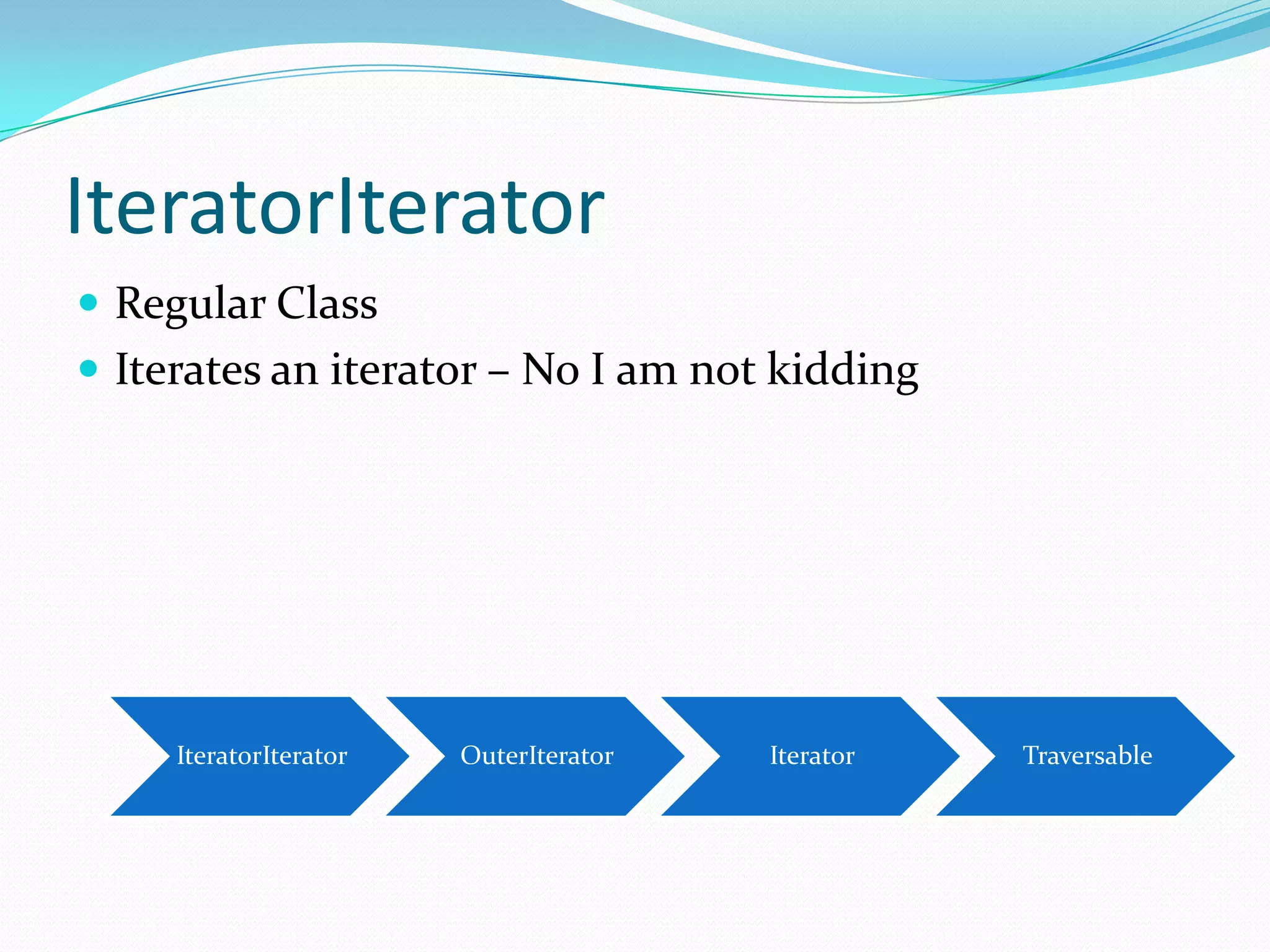
IteratorIterator
 Regular Class
 Iterates an iterator – No I am not kidding


     IteratorIterator   OuterIterator   Iterator   Traversable
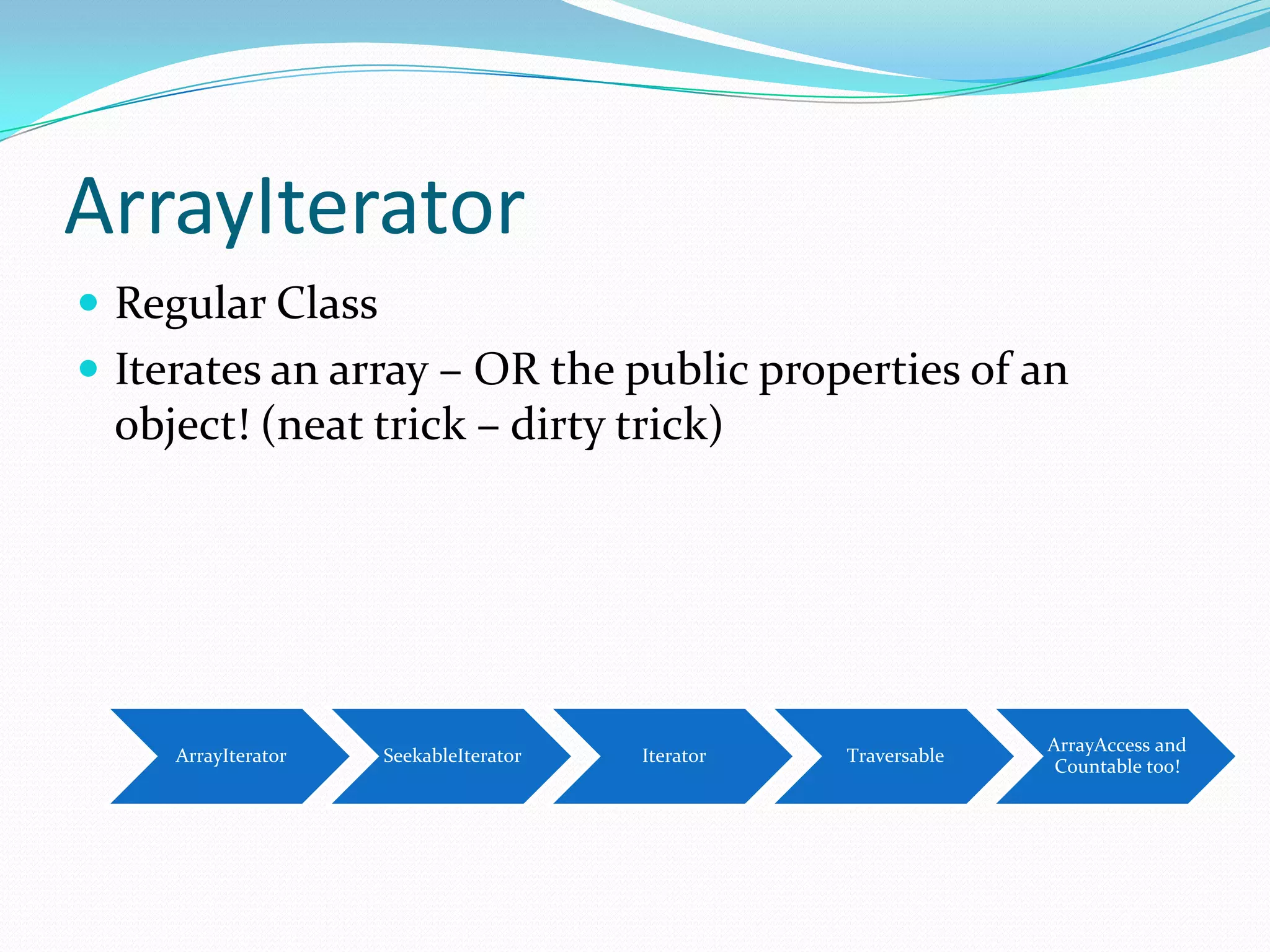
ArrayIterator
 Regular Class
 Iterates an array – OR the public properties of an
 object! (neat trick – dirty trick)


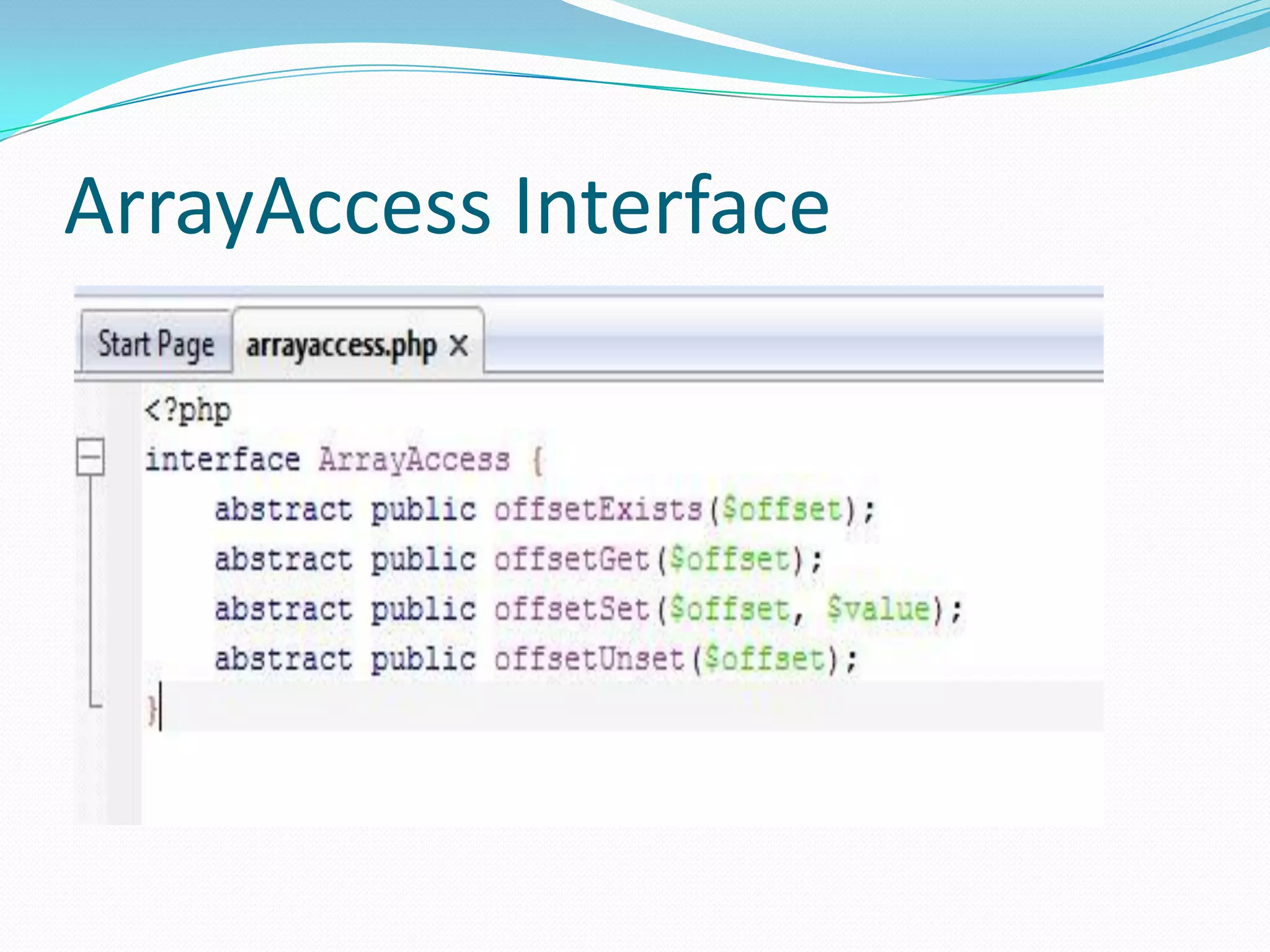
                                                                 ArrayAccess and
     ArrayIterator   SeekableIterator   Iterator   Traversable
                                                                  Countable too!
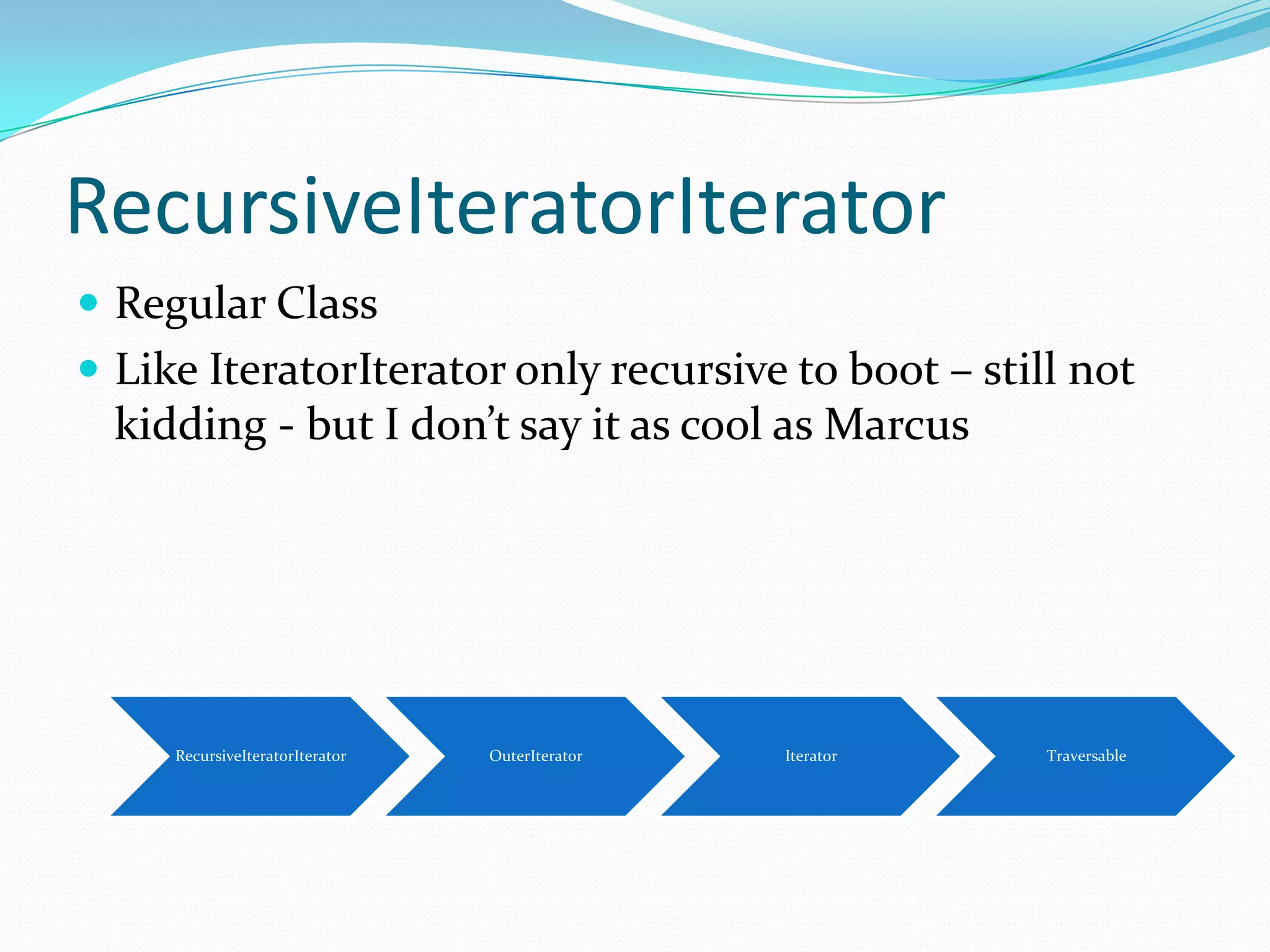
RecursiveIteratorIterator
 Regular Class
 Like IteratorIterator only recursive to boot – still not
  kidding - but I don’t say it as cool as Marcus


     RecursiveIteratorIterator   OuterIterator   Iterator   Traversable
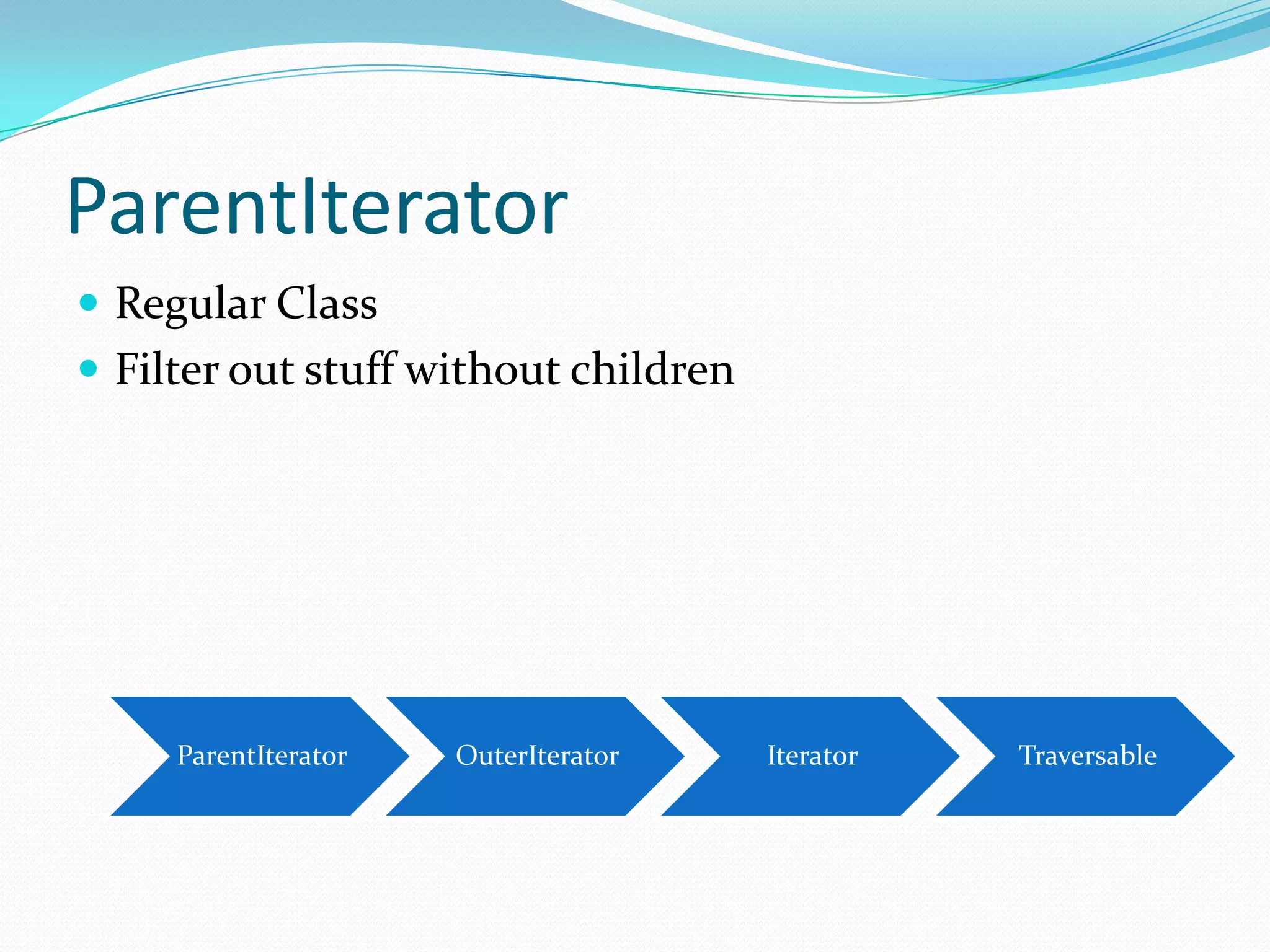
ParentIterator
 Regular Class
 Filter out stuff without children


     ParentIterator   OuterIterator   Iterator   Traversable
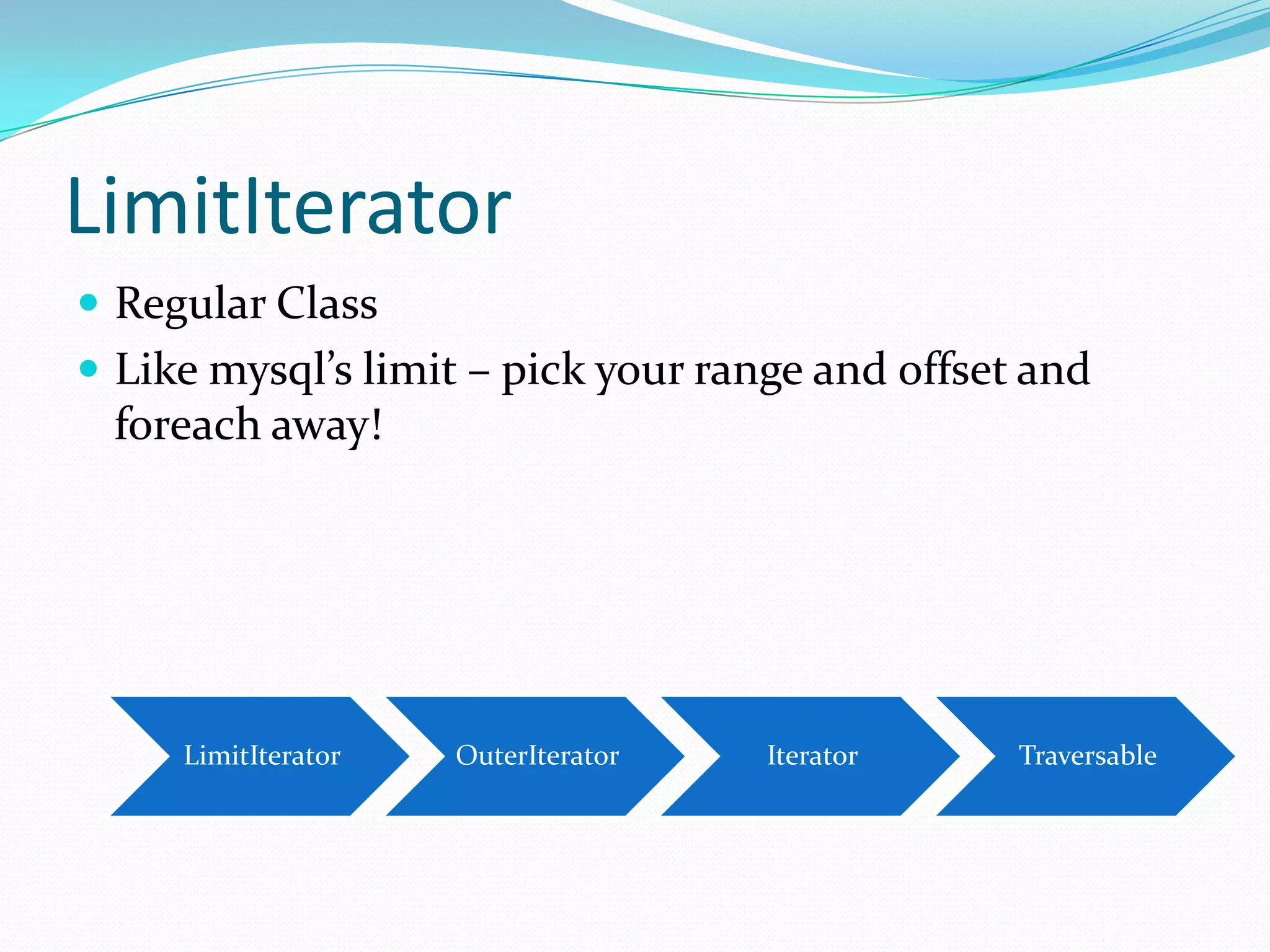
LimitIterator
 Regular Class
 Like mysql’s limit – pick your range and offset and
 foreach away!


     LimitIterator   OuterIterator   Iterator    Traversable
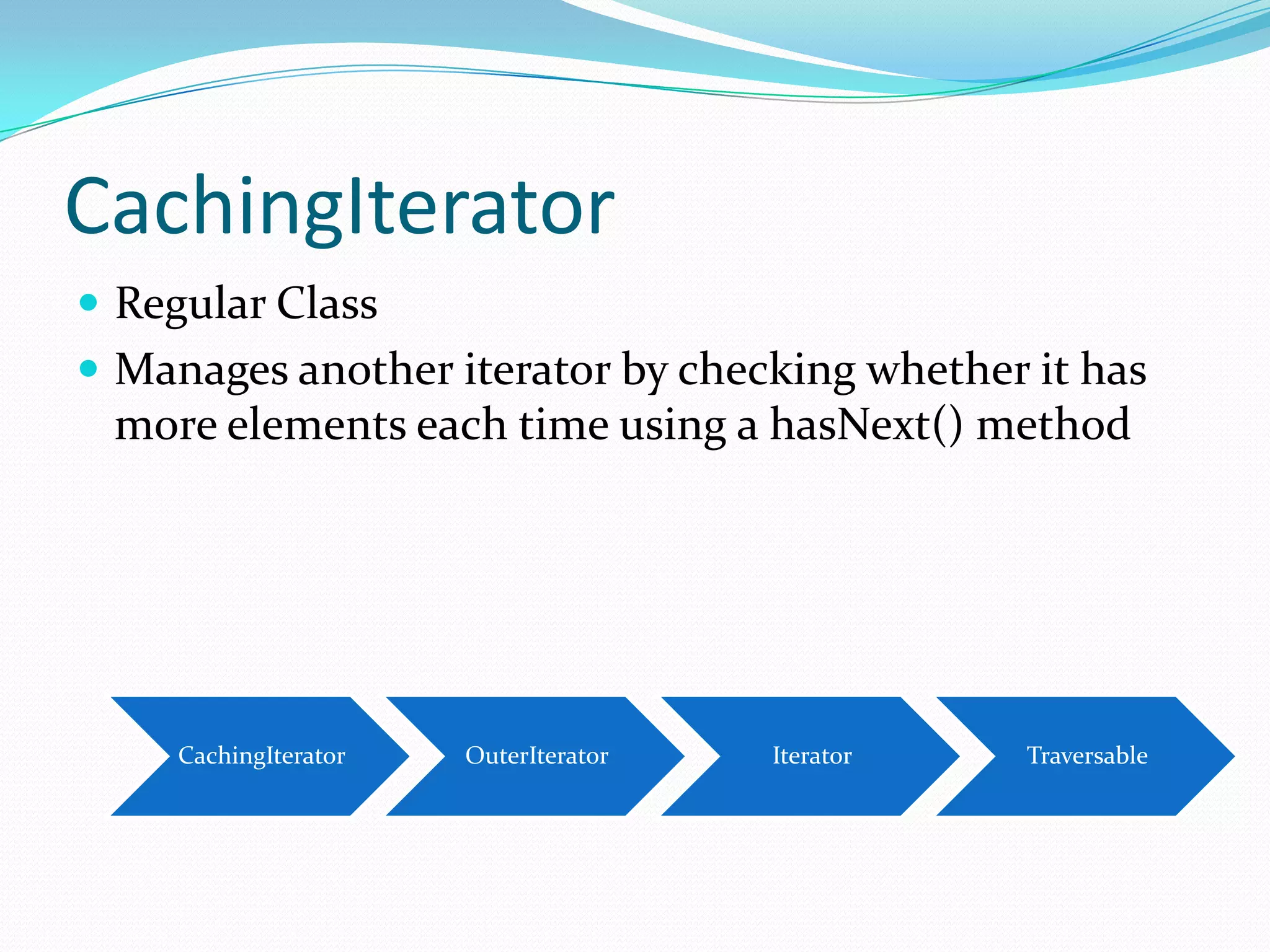
CachingIterator
 Regular Class
 Manages another iterator by checking whether it has
 more elements each time using a hasNext() method


     CachingIterator   OuterIterator   Iterator   Traversable
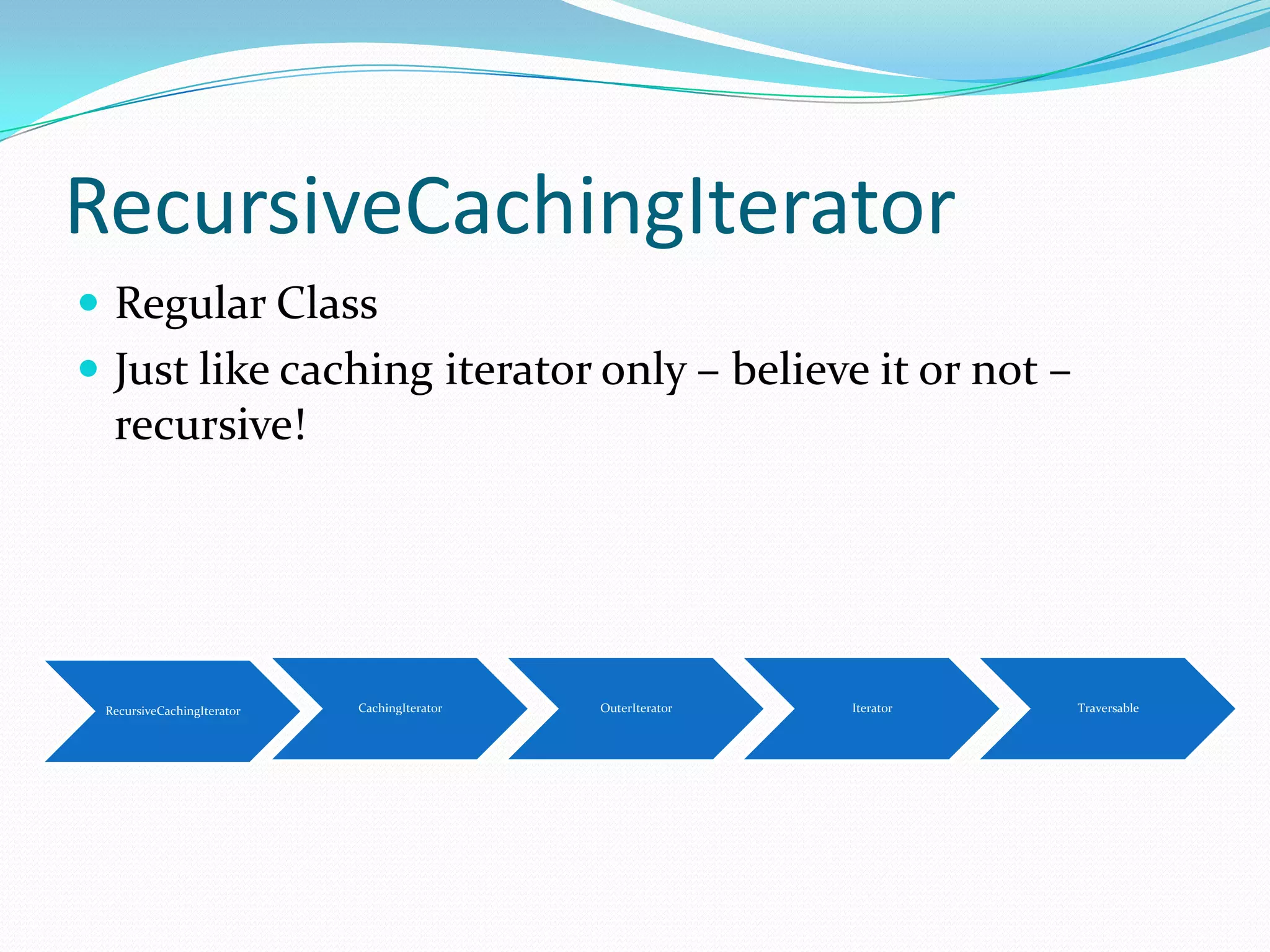
RecursiveCachingIterator
 Regular Class
 Just like caching iterator only – believe it or not –
  recursive!


 RecursiveCachingIterator   CachingIterator   OuterIterator   Iterator   Traversable
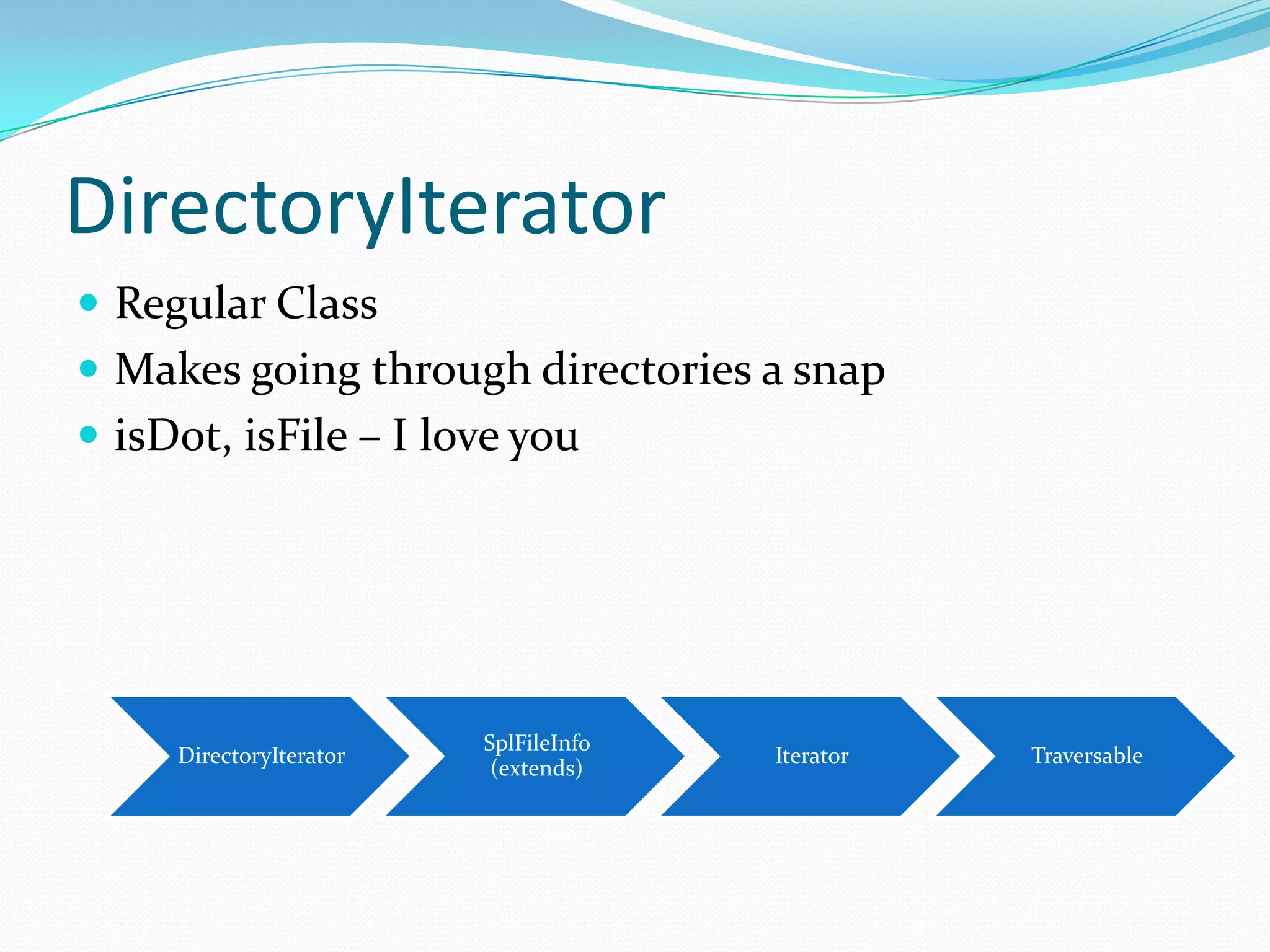
DirectoryIterator
 Regular Class
 Makes going through directories a snap
 isDot, isFile – I love you


                         SplFileInfo
     DirectoryIterator                 Iterator   Traversable
                          (extends)
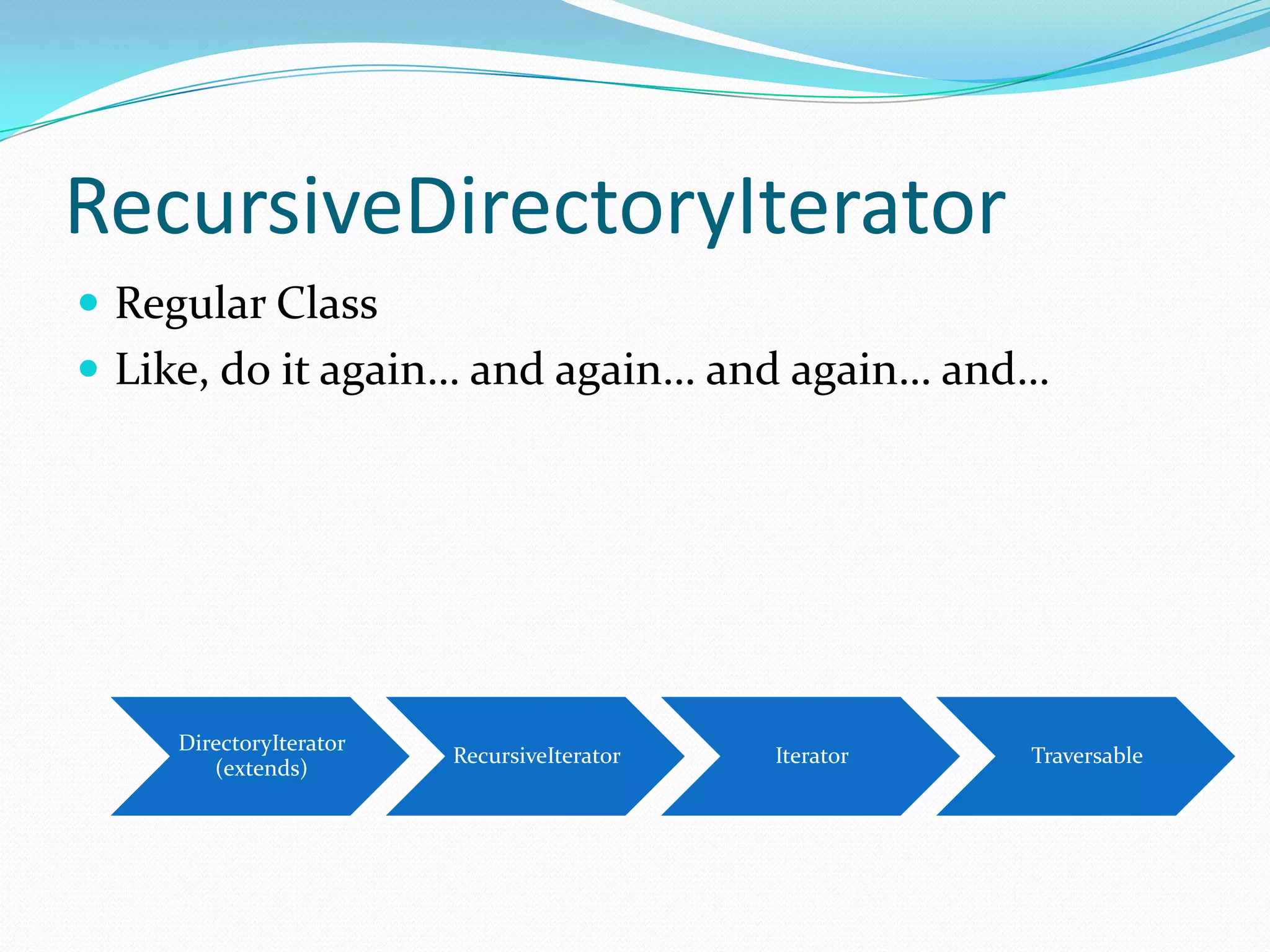
RecursiveDirectoryIterator
 Regular Class
 Like, do it again… and again… and again… and…


     DirectoryIterator
                         RecursiveIterator   Iterator   Traversable
        (extends)
Iterator Helper Functions
 iterator_apply() – like array_walk for your iterator
  implementing objects
 iterator_count() – count the items in your iterator (not
  quite the same as implementing countable::count)
 iterator_to_array() – copy all the stuff from your
  iterator into a regular PHP array

Even Superman
doesn’t work alone
Is it an array? An object? Why… it’s both!
ArrayAccess Interface
ArrayObject
 A class, NOT an interface
 It’s like arrayaccess on RedBull
 The manual LIES – for a full list of everything you can
  do with arrayobject, see
  http://www.php.net/~helly/php/ext/spl/
 Highlights
   exchangeArray
   getArrayCopy (get your internally stored array)
   Sorting methods
     ksort et al
Countable
 Interface you can
  implement with any
  class (not iterator
  specific, but used a lot
  for it)
 Implement the count
  method and you can use
  the count() PHP
  function on any object
SplObjectStorage
 This does not do what you think it does
 Use objects as array keys, uniquely, with no collision
  issues (you might get them from spl_object_hash)
 Remember you need the object to get the data back
  out, unless you’re simply iterating over the contents
 Regular class, no need to extend and fill in methods


 http://www.colder.ch/news/01-08-
  2009/34/splobjectstorage-for-a-fa.html
SPLFixedArray
 A fixed length, int key only array
 Why? It’s FAST (very fast) because it stores data
  differently “under the hood” in C
 Regular class, don’t need to extend and fill in any
  methods
 5.3+
SplObserver and SplSubject
 Abstract classes for anything using an observer pattern
 http://www.a-scripts.com/object-oriented-
 php/2009/02/21/the-observer-pattern/ - great
 common sense tutorial

 If you do event/observers in your code, extending
 these two makes good sense
SplFileInfo
 fancy class for a file
 all the file system functions in compact object form
    getMTime == filemtime
    openFile == fopen
Beyond arrays to the wild wild west
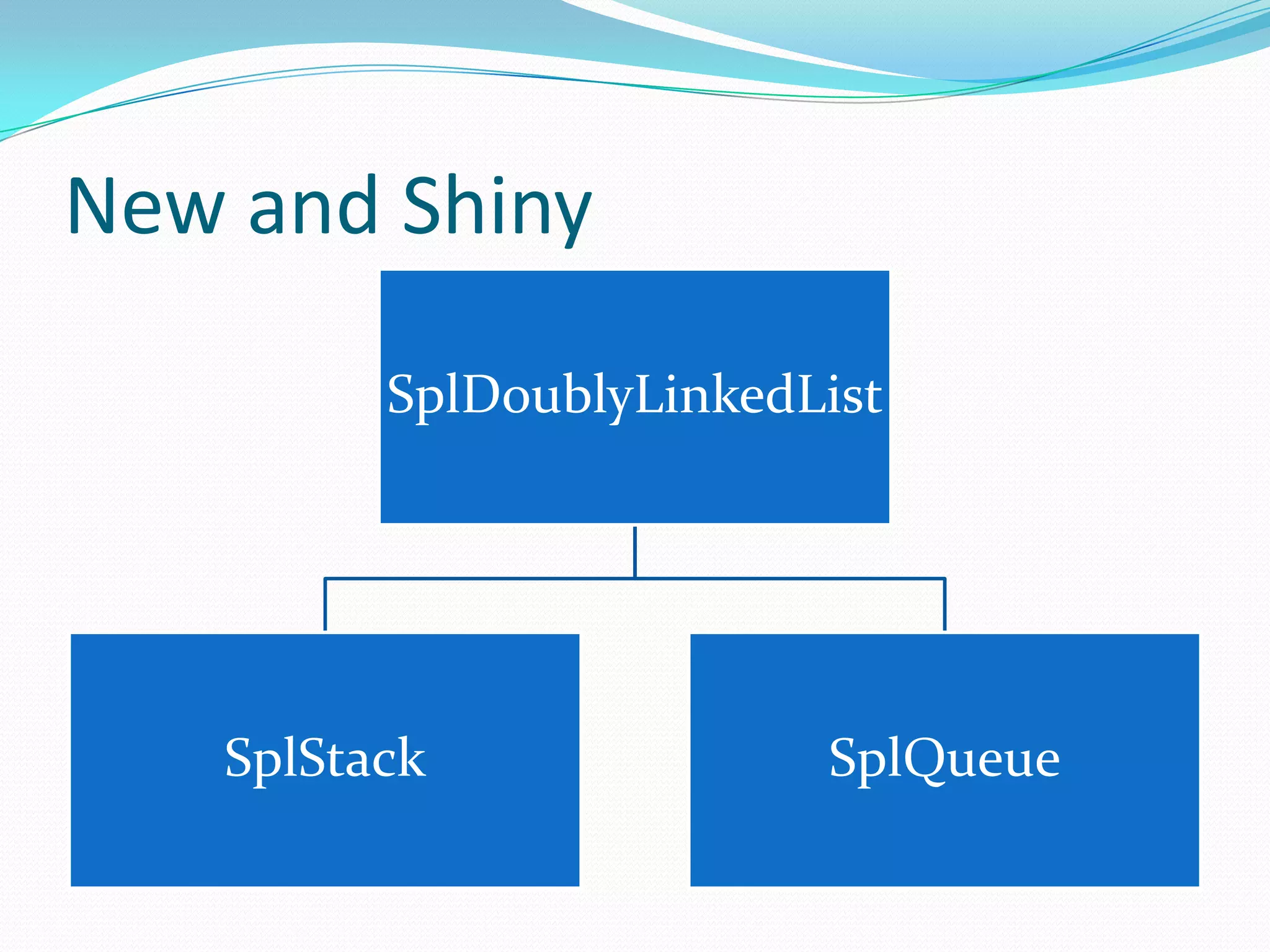
New and Shiny

         SplDoublyLinkedList


   SplStack              SplQueue
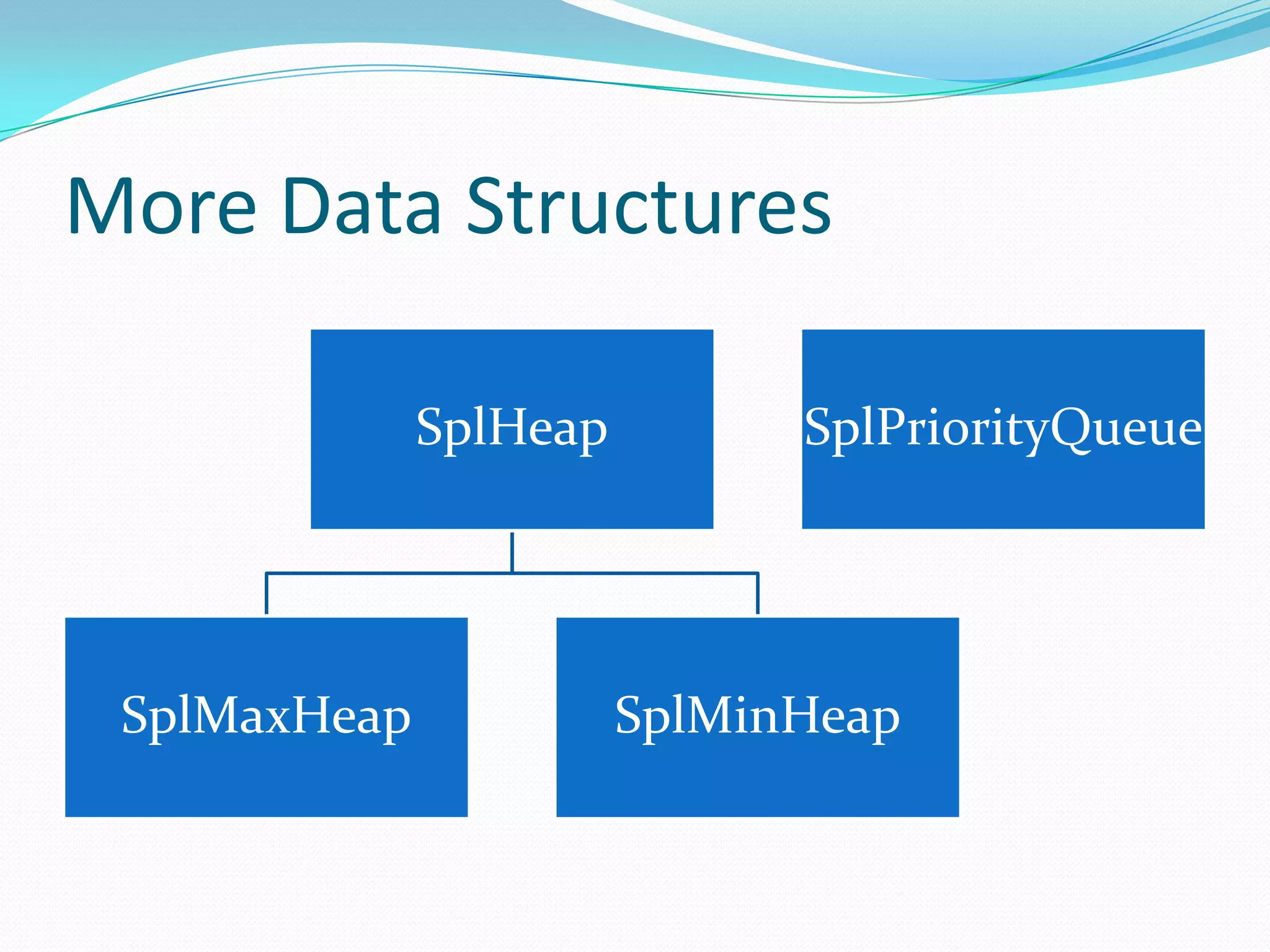
More Data Structures

              SplHeap         SplPriorityQueue


 SplMaxHeap             SplMinHeap
The Documentation Problem
 http://elizabethmariesmith.com/2009/02/setting-up-
 phd-on-windows/ - you can write docbook on any
 platform!

 Efnet - #php.doc channel
 http://doc.php.net
 phpdoc@lists.php.net – mailing list
 See me and start helping today!
Resources
 http://php.net/spl - spl docs
 http://php.net/~helly/php/ext/spl - Doxygen docs
 http://blueparabola.com/blog/spl-deserves-some-
 reiteration - some stuff about new data structures

 auroraeosrose@php.net

SPL to the Rescue - Tek 09

  • 1.
    Standard Tools forEveryday Programming
  • 2.
    Community Heckling  Ontwitter #tek09 (or #phptek) and #spldg  DG’s for drinking game (you’ll see why later)  IRC is open, I can see backlog – constructive criticism is good  Comment on http://joind.in/talk/view/186  No comments on hair, clothes, or my fat belly – constructive criticism is welcome ;)
  • 3.
    I have aProblem Recursively iterate through directories Find all .jpg files Check last modified dates Moved the ones older than two years to new location
  • 4.
    How should Ido this?  Some nasty recursive use of scandir() to get my lists  Or PHP’s dir() function and looping  array_map() with a convoluted callback I think I’m going to need a lot of code….
  • 6.
    SPL to theRescue!  RecursiveDirectoryIterator  RecursiveIteratorIterator  FilterIterator  SplFileInfo What fun tools we have!
  • 8.
    And not thekind you kick out of IRC
  • 9.
    What is SPL? tandard HP ibrary A library of standard interfaces, classes, and functions designed to solve common programming problems and allow engine overloading.
  • 10.
    That’s nice… inEnglish please. What is SPL? 1. Engine overloading hooks via interfaces  ArrayAccess, Countable, SeekableIterator 2. Classes that utilize the interfaces do cool things  ArrayObject, RecursiveIterator, DirectoryIterator 3. Standard Class Implementations  Exceptions, SplObserver and SplStorage 4. Functions to help with autoloading and objects  spl_autoload_register(), spl_classes(), iterator_apply()
  • 11.
    But… it’s anextension right?  SPL is an extension  SPL is a core extension  SPL cannot be built shared  SPL should not be turned off  SPL is present in PHP since 5.0 (almost 5 years ago)  As of 5.3, SPL cannot be turned off without altering source If you don’t have SPL, whoever built your PHP is an idiot (or an evil genius – it’s HARD).
  • 12.
  • 13.
    Autoload Magic  spl_autoload()– default autoload implementation  spl_autoload_register() – add an autoload to the stack  spl_autoload_unregister() – remove an autoloader  spl_autoload_functions() – what’s on the stack  spl_autoload_extensions() – ext for spl_autoload()  spl_autoload_call() – load something through the stack
  • 14.
    Isn’t __autoload goodenough?  Combining different libraries with different naming conventions  Dealing with different types of files (templates, classes) in different locations  Changing autoload in use during runtime
  • 15.
    Object Helper Functions class_implements()  class_parents()  spl_object_hash() Why are these not in core? I DON’T KNOW - GO ASK YOUR DAD!
  • 16.
  • 17.
    Exception Classes LogicException BadFunctionCallE InvalidArgumentE OutofRangeExcept DomainException LengthException xception xception ion BadMethodCall
  • 18.
    Exception Classes RuntimeException OutofBoundsExce OverflowExceptio UnderflowExcepti UnexpectedValueE RangeException ption n on xception
  • 19.
    So what doesSPL offer?  A standard set of Exceptions that all inherit from PHP’s Exception base class  A standard way to set up exceptions by what kind they are  Do I recommend it? Depends on how exceptions are used in your application.
  • 20.
    Foreach is yourbestest friend! Foreach an object today!
  • 21.
    The iterator drinkinggame!  Every time someone says the word iterator tonight, take a drink  Start a conversation with me, and you’ll be gone in about five minutes It’s the SPL drinking game (tonight at cocktail hour)
  • 22.
    Iterators  What theheck is an iterator?  A design pattern that is a generic solution to the problem of iterating over data in a consistent manner.  Access the elements of an aggregate object sequentially without exposing its underlying representation.  Why do I care?  Ever need to go over a list of items returned from a database (well, duh)  Or need to go over a list of items returned from a webservice?  Ever used foreach?
  • 23.
    Foreach it baby! Foreach is your friend  iterators give your code consistent usage  and you can add more functionality  What else can you do with iterators?  Extend Iterators to do what you need  Chain Iterators: iteratoriteratoriteratoriterator (that’s 5 shots)….
  • 24.
  • 25.
    So how isit different? Array $ar= array(); Iterator $it = new Iterator;  can be rewound  Might be rewindable  reset($ar)  $it->rewind()  is valid unless the key is NULL  should know if there is a value  !is_null(key($ar))  $it->valid()  Has a current value  Might have a current value or  current($ar) key  Has keys  $it->key()  key($ar)  $it->current()  can move forward  Can move forward  next($ar)  $it->next()
  • 26.
    An Iterator forevery occasion  RecursiveIterator • CachingIterator  RecursiveIteratorIterator • RecursiveCachingIterator  OuterIterator • NoRewindIterator  IteratorIterator • AppendIterator  FilterIterator • RecursiveIteratorIterator  RecursiveFilterIterator • InfiniteIterator  ParentIterator • RegexIterator  SeekableIterator • RecursiveRegexIterator  LimitIterator • EmptyIterator  GlobIterator • RecursiveTreeIterator • ArrayIterator
  • 27.
    See, the drinkinggame will be lots of fun….
  • 28.
    Innie or anOutie?  OuterIterator (interface)  Extends Iterator  Puts a wrapper around an iterator inside  Has one additional method – getInnerIterator() that should be implemented
  • 29.
    Loopety Loop  RecursiveIterator (interface)  Has two additional methods to implement  getChildren should return the sub-iterator for the current element – and it must return an object that implements recursiveIterator  hasChildren
  • 30.
    Jumping ahead?  SeekableIterator (interface)  Additional method – seek(string $position)  Lets you jump to a specific spot to start iterating
  • 31.
    Now on toclasses  Classes implement interfaces plus provide additional functionality  Interfaces need you to fill in all the the required methods  You can implement multiple interfaces  You can’t extend multiple classes Choose Wisely
  • 32.
    FilterIterator  Abstract Class Has one method that must be implemented – accept – which should return true or false  File filtering example at the beginning used this  Highly useful for many types of iteration FilterIterator OuterIterator Iterator Traversable
  • 33.
    IteratorIterator  Regular Class Iterates an iterator – No I am not kidding IteratorIterator OuterIterator Iterator Traversable
  • 34.
    ArrayIterator  Regular Class Iterates an array – OR the public properties of an object! (neat trick – dirty trick) ArrayAccess and ArrayIterator SeekableIterator Iterator Traversable Countable too!
  • 35.
    RecursiveIteratorIterator  Regular Class Like IteratorIterator only recursive to boot – still not kidding - but I don’t say it as cool as Marcus RecursiveIteratorIterator OuterIterator Iterator Traversable
  • 36.
    ParentIterator  Regular Class Filter out stuff without children ParentIterator OuterIterator Iterator Traversable
  • 37.
    LimitIterator  Regular Class Like mysql’s limit – pick your range and offset and foreach away! LimitIterator OuterIterator Iterator Traversable
  • 38.
    CachingIterator  Regular Class Manages another iterator by checking whether it has more elements each time using a hasNext() method CachingIterator OuterIterator Iterator Traversable
  • 39.
    RecursiveCachingIterator  Regular Class Just like caching iterator only – believe it or not – recursive! RecursiveCachingIterator CachingIterator OuterIterator Iterator Traversable
  • 40.
    DirectoryIterator  Regular Class Makes going through directories a snap  isDot, isFile – I love you SplFileInfo DirectoryIterator Iterator Traversable (extends)
  • 41.
    RecursiveDirectoryIterator  Regular Class Like, do it again… and again… and again… and… DirectoryIterator RecursiveIterator Iterator Traversable (extends)
  • 42.
    Iterator Helper Functions iterator_apply() – like array_walk for your iterator implementing objects  iterator_count() – count the items in your iterator (not quite the same as implementing countable::count)  iterator_to_array() – copy all the stuff from your iterator into a regular PHP array Even Superman doesn’t work alone
  • 43.
    Is it anarray? An object? Why… it’s both!
  • 44.
  • 45.
    ArrayObject  A class,NOT an interface  It’s like arrayaccess on RedBull  The manual LIES – for a full list of everything you can do with arrayobject, see http://www.php.net/~helly/php/ext/spl/  Highlights  exchangeArray  getArrayCopy (get your internally stored array)  Sorting methods  ksort et al
  • 46.
    Countable  Interface youcan implement with any class (not iterator specific, but used a lot for it)  Implement the count method and you can use the count() PHP function on any object
  • 47.
    SplObjectStorage  This doesnot do what you think it does  Use objects as array keys, uniquely, with no collision issues (you might get them from spl_object_hash)  Remember you need the object to get the data back out, unless you’re simply iterating over the contents  Regular class, no need to extend and fill in methods  http://www.colder.ch/news/01-08- 2009/34/splobjectstorage-for-a-fa.html
  • 48.
    SPLFixedArray  A fixedlength, int key only array  Why? It’s FAST (very fast) because it stores data differently “under the hood” in C  Regular class, don’t need to extend and fill in any methods  5.3+
  • 49.
    SplObserver and SplSubject Abstract classes for anything using an observer pattern  http://www.a-scripts.com/object-oriented- php/2009/02/21/the-observer-pattern/ - great common sense tutorial  If you do event/observers in your code, extending these two makes good sense
  • 50.
    SplFileInfo  fancy classfor a file  all the file system functions in compact object form  getMTime == filemtime  openFile == fopen
  • 51.
    Beyond arrays tothe wild wild west
  • 52.
    New and Shiny SplDoublyLinkedList SplStack SplQueue
  • 53.
    More Data Structures SplHeap SplPriorityQueue SplMaxHeap SplMinHeap
  • 54.
    The Documentation Problem http://elizabethmariesmith.com/2009/02/setting-up- phd-on-windows/ - you can write docbook on any platform!  Efnet - #php.doc channel  http://doc.php.net  phpdoc@lists.php.net – mailing list  See me and start helping today!
  • 55.
    Resources  http://php.net/spl -spl docs  http://php.net/~helly/php/ext/spl - Doxygen docs  http://blueparabola.com/blog/spl-deserves-some- reiteration - some stuff about new data structures  auroraeosrose@php.net