Propositional and
First-Order Logic


                    1
Propositional Logic


                      2
Propositional logic
• Proposition : A proposition is classified as a declarative
  sentence which is either true or false.
  eg: 1) It rained yesterday.
• Propositional symbols/variables: P, Q, S, ... (atomic
  sentences)
• Sentences are combined by Connectives:
   ∧ ...and            [conjunction]
   ∨ ...or             [disjunction]
   ⇒ ...implies        [implication / conditional]
   ⇔ ..is equivalent   [biconditional]
   ¬ ...not            [negation]
• Literal: atomic sentence or negated atomic sentence
                                                               3
Propositional logic (PL)
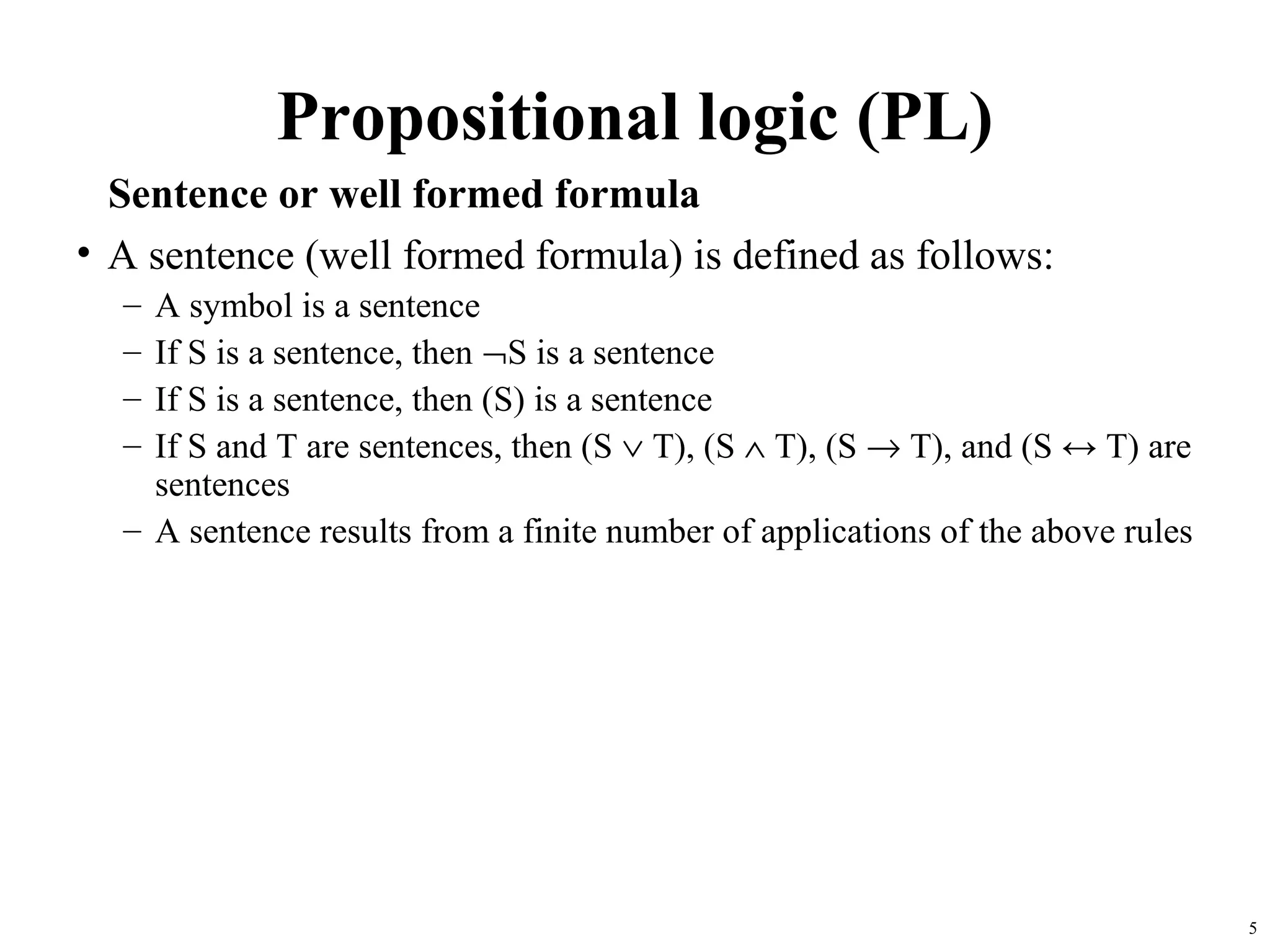
  Sentence or well formed formula
• A sentence (well formed formula) is defined as follows:
  – A symbol is a sentence
  – If S is a sentence, then ¬S is a sentence
  – If S is a sentence, then (S) is a sentence
  – If S and T are sentences, then (S ∨ T), (S ∧ T), (S → T), and (S ↔ T) are
    sentences
  – A sentence results from a finite number of applications of the above rules


                                                                                 5
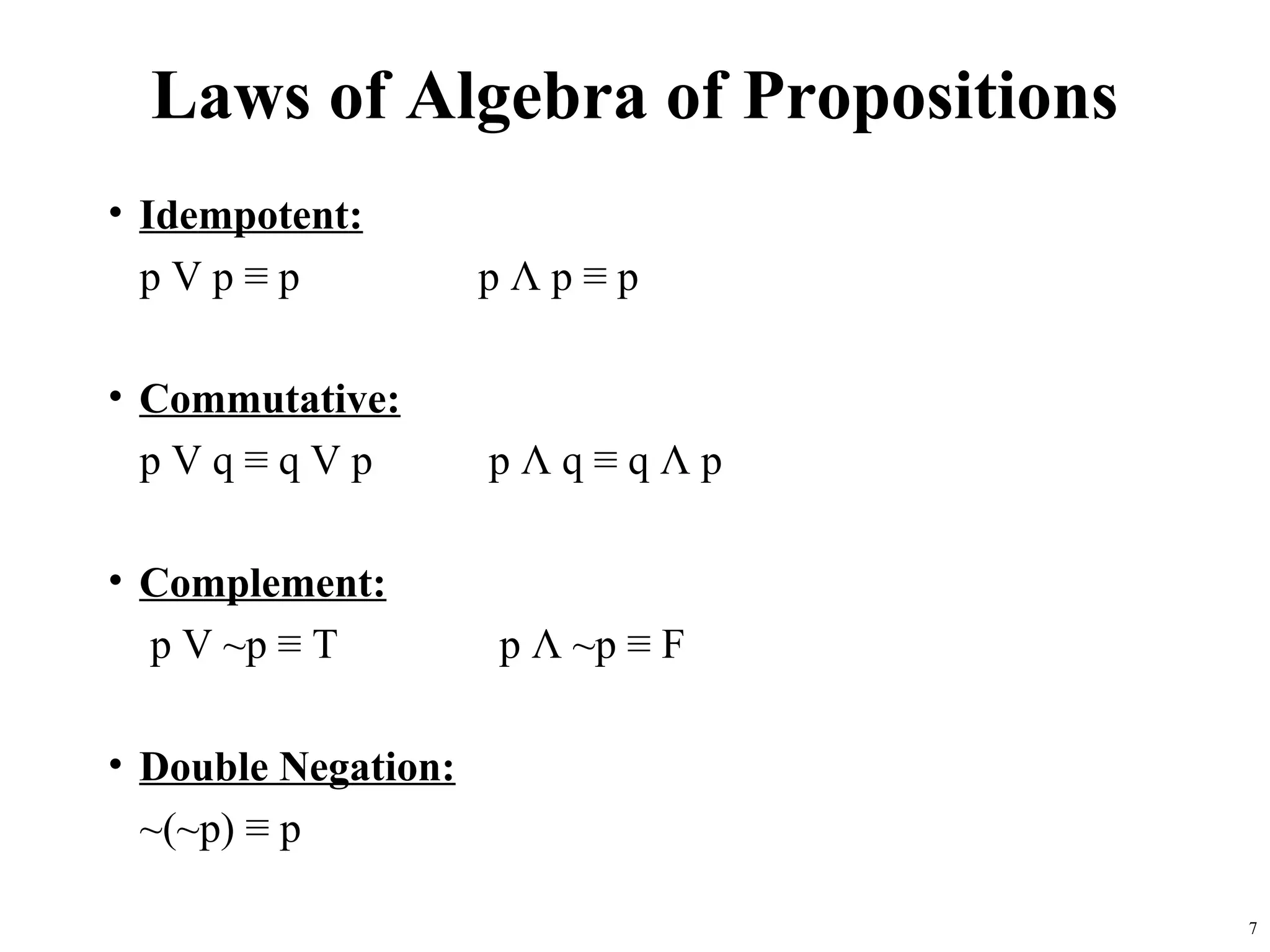
Laws of Algebra of Propositions
• Idempotent:
  pVp≡p              pΛp≡p

• Commutative:
  pVq≡qVp            pΛq≡qΛp

• Complement:
  p V ~p ≡ T         p Λ ~p ≡ F

• Double Negation:
  ~(~p) ≡ p

                                    7
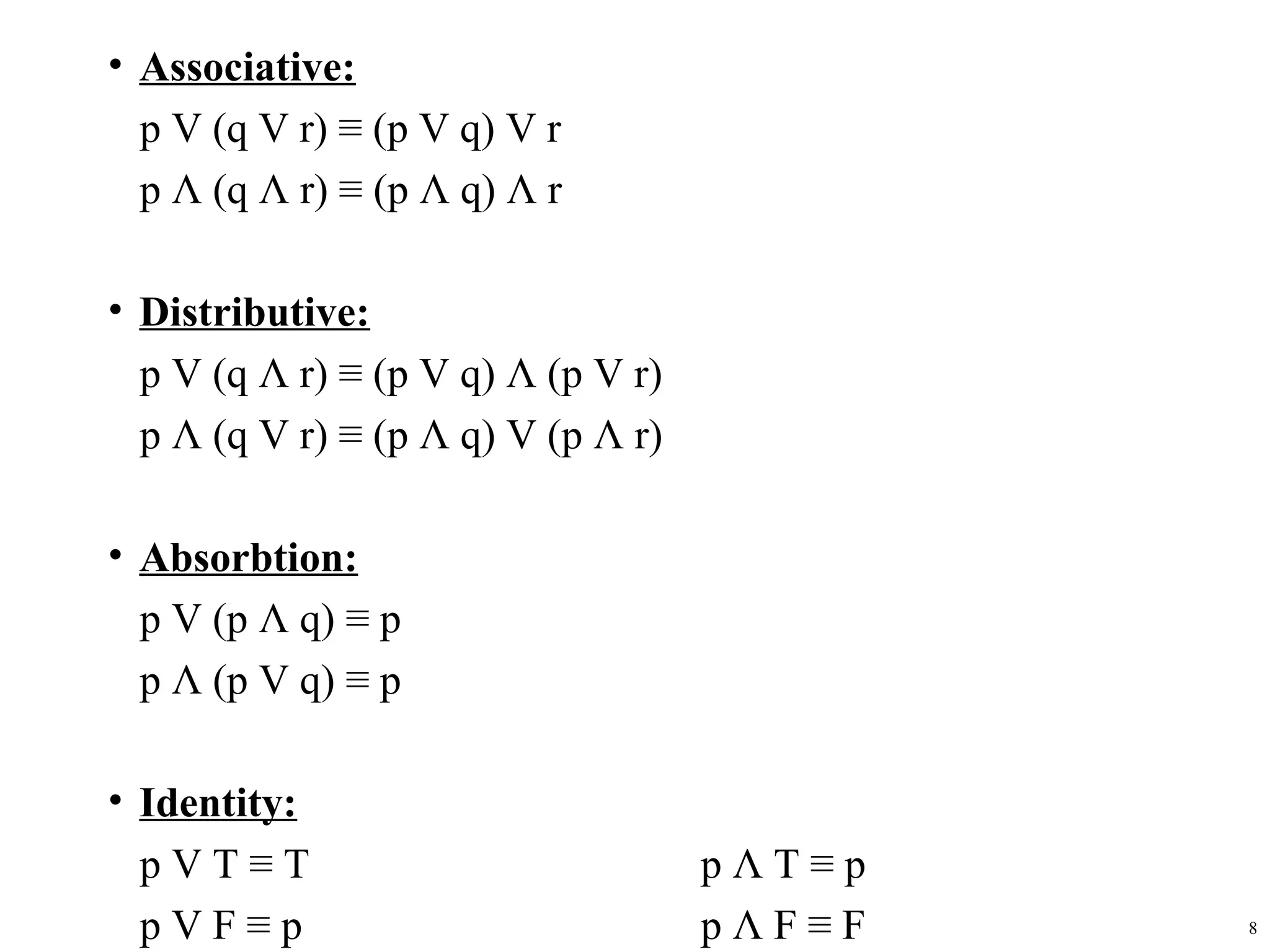
• Associative:
  p V (q V r) ≡ (p V q) V r
  p Λ (q Λ r) ≡ (p Λ q) Λ r

• Distributive:
  p V (q Λ r) ≡ (p V q) Λ (p V r)
  p Λ (q V r) ≡ (p Λ q) V (p Λ r)

• Absorbtion:
  p V (p Λ q) ≡ p
  p Λ (p V q) ≡ p

• Identity:
  pVT≡T                             pΛT≡p
  pVF≡p                             pΛF≡F   8
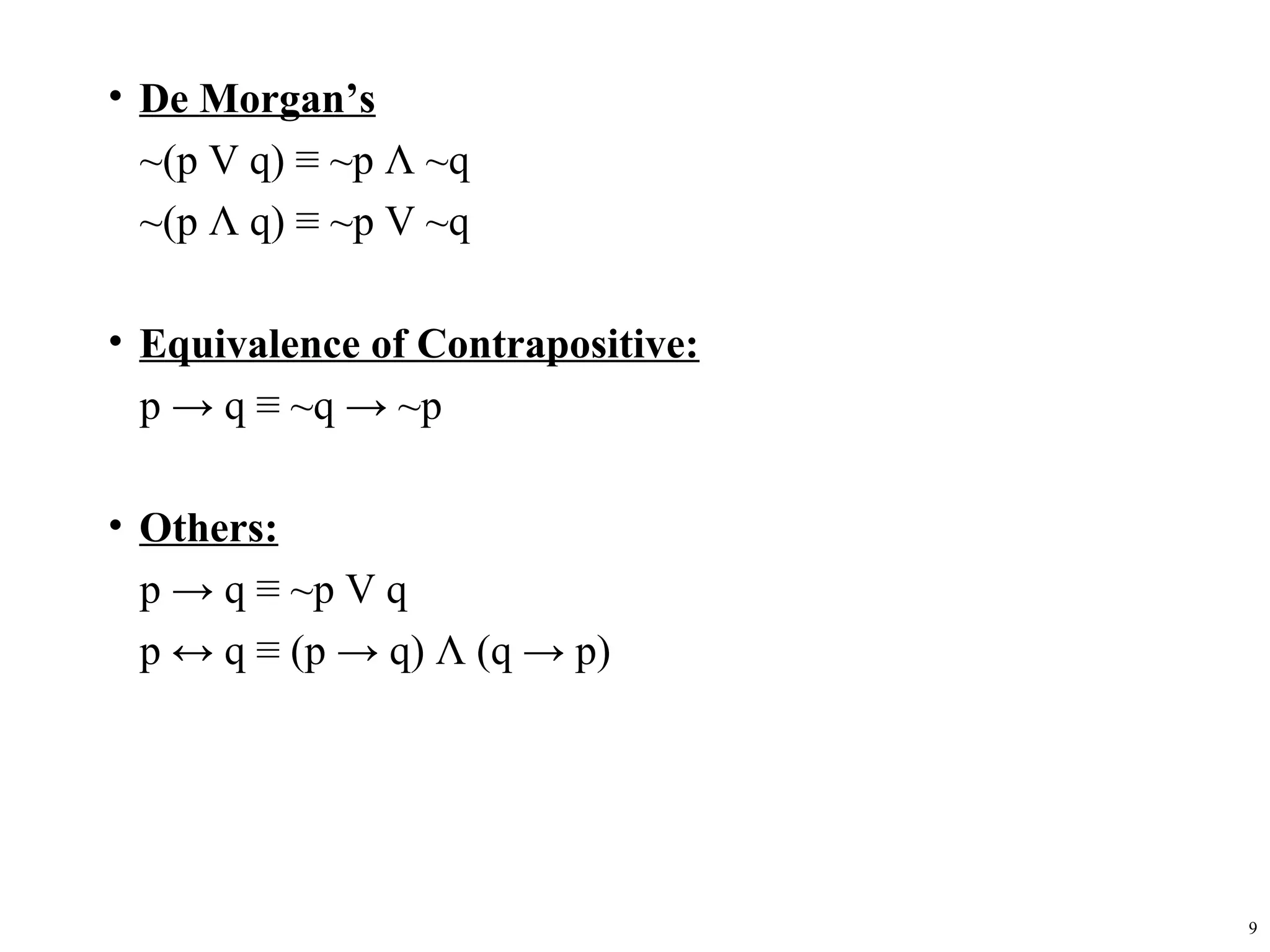
• De Morgan’s
  ~(p V q) ≡ ~p Λ ~q
  ~(p Λ q) ≡ ~p V ~q

• Equivalence of Contrapositive:
  p → q ≡ ~q → ~p

• Others:
  p → q ≡ ~p V q
  p ↔ q ≡ (p → q) Λ (q → p)


                                   9
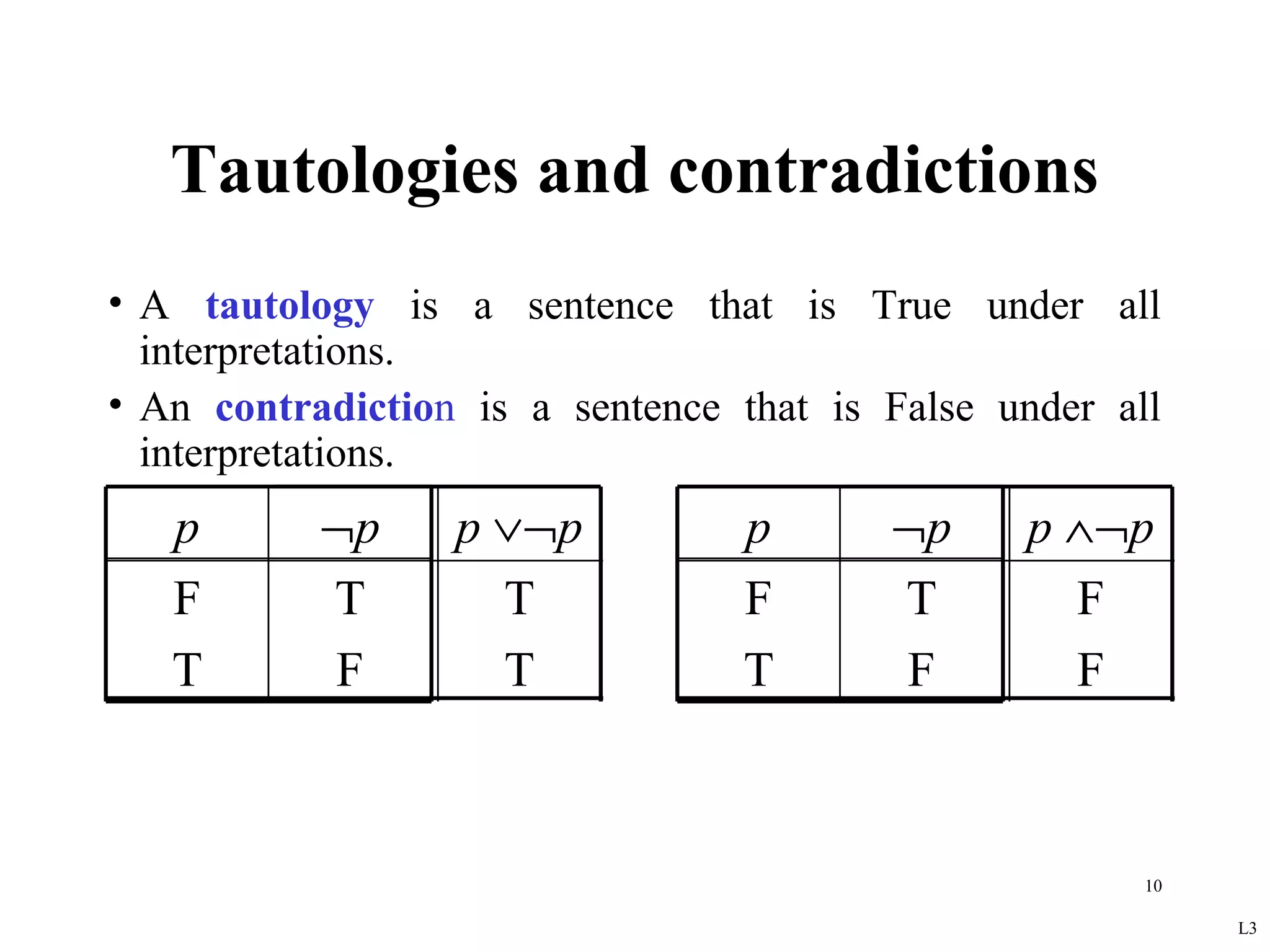
Tautologies and contradictions
• A tautology is a sentence that is True under all
  interpretations.
• An contradiction is a sentence that is False under all
  interpretations.
   p       ¬p     p ∨¬p          p       ¬p     p ∧¬p
   F       T        T            F       T        F
   T       F        T            T       F        F


                                                       10

                                                            L3
Tautology by truth table
p q ¬p p ∨q ¬p ∧(p ∨q )   [¬p ∧(p ∨q )]→q

T T    F   T      F             T

T F    F   T      F             T

F T    T   T      T             T

F F    T   F      F             T

                                       11

                                            L3
Propositional Logic - one last proof
  Show that [p ∧ (p → q)] → q is a tautology.
  We use ≡ to show that [p ∧ (p → q)] → q ≡ T.
[p ∧ (p → q)] → q
          ≡ [p ∧ (¬p ∨ q)] → q         substitution for →
          ≡ [(p ∧ ¬p) ∨ (p ∧ q)] → q   distributive
          ≡ [ F ∨ (p ∧ q)] → q         complement
          ≡ (p ∧ q) → q                identity
          ≡ ¬(p ∧ q) ∨ q               substitution for →
          ≡ (¬p ∨ ¬q) ∨ q              DeMorgan’s
          ≡ ¬p ∨ (¬q ∨ q )             associative
          ≡ ¬p ∨ T                     complement
          ≡T                           identity
            11/09/12

                                                            12
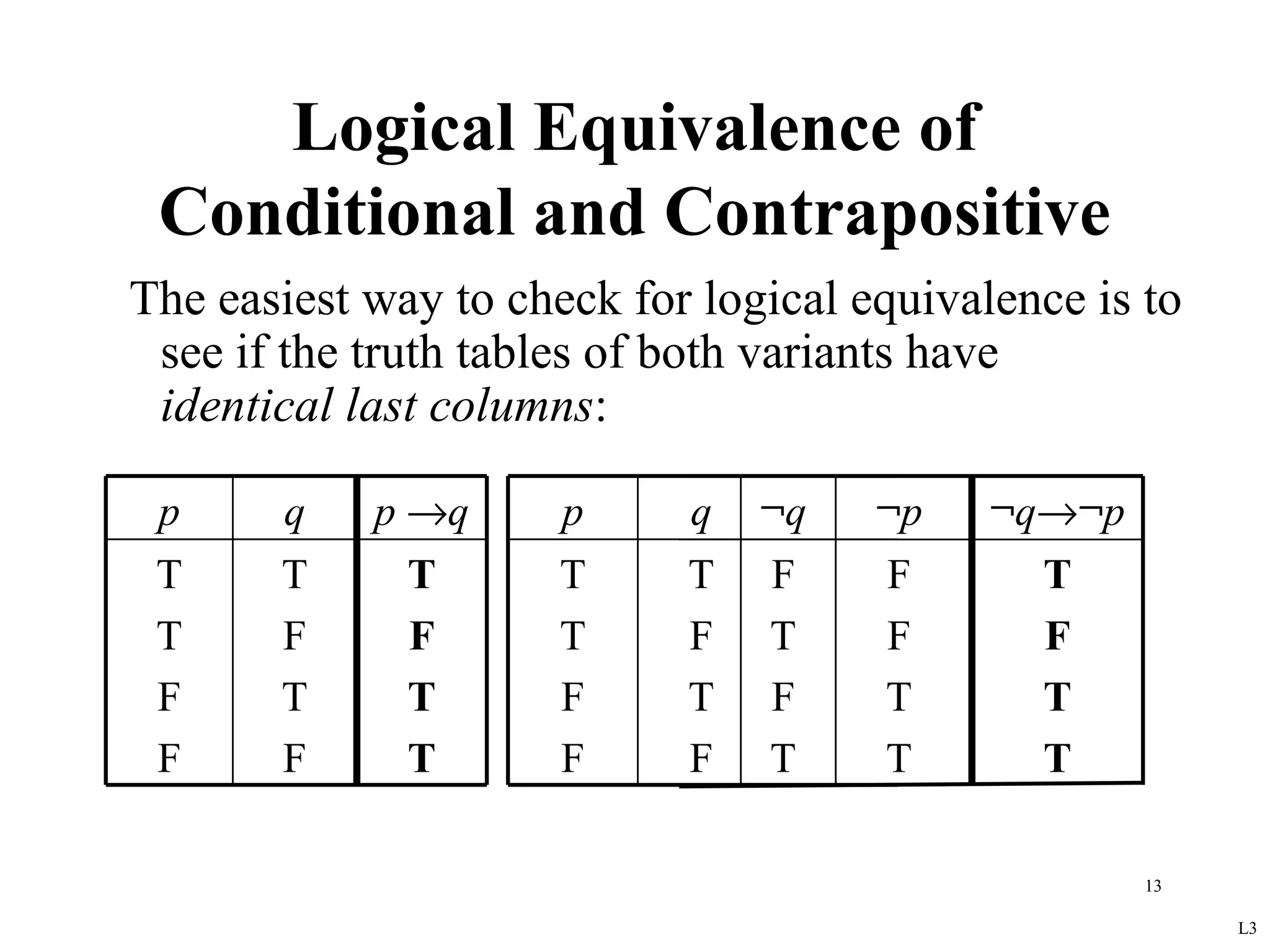
Logical Equivalence of
 Conditional and Contrapositive
The easiest way to check for logical equivalence is to
 see if the truth tables of both variants have
 identical last columns:

 p     q    p →q      p     q   ¬q    ¬p    ¬q→¬p
 T     T      T       T     T   F     F       T
 T     F      F       T     F   T     F       F
 F     T      T       F     T   F     T       T
 F     F      T       F     F   T     T       T

                                                    13

                                                         L3
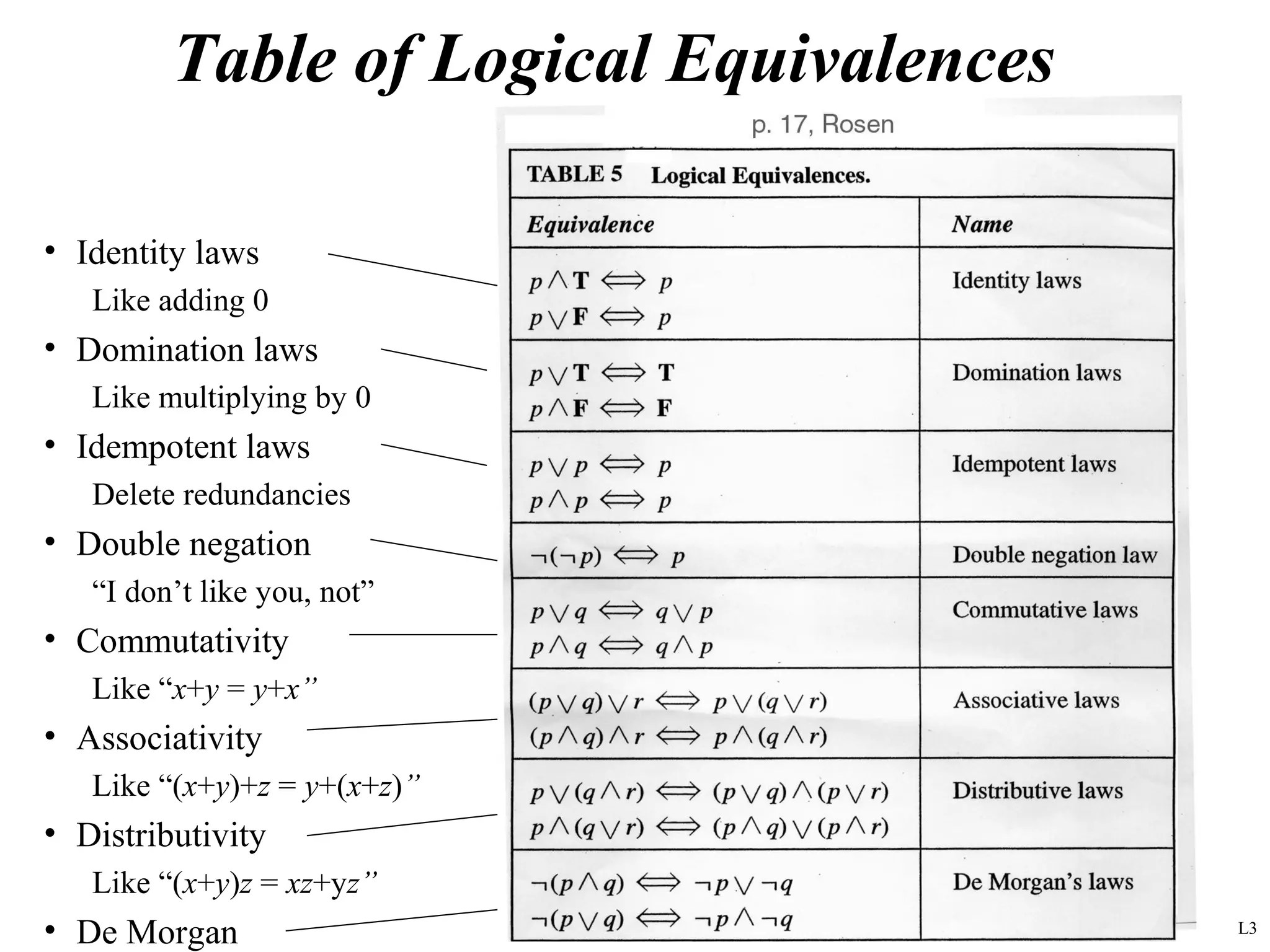
Table of Logical Equivalences

• Identity laws
   Like adding 0
• Domination laws
   Like multiplying by 0
• Idempotent laws
   Delete redundancies
• Double negation
   “I don’t like you, not”
• Commutativity
   Like “x+y = y+x”
• Associativity
   Like “(x+y)+z = y+(x+z)”
• Distributivity
   Like “(x+y)z = xz+yz”                 14

• De Morgan                                   L3
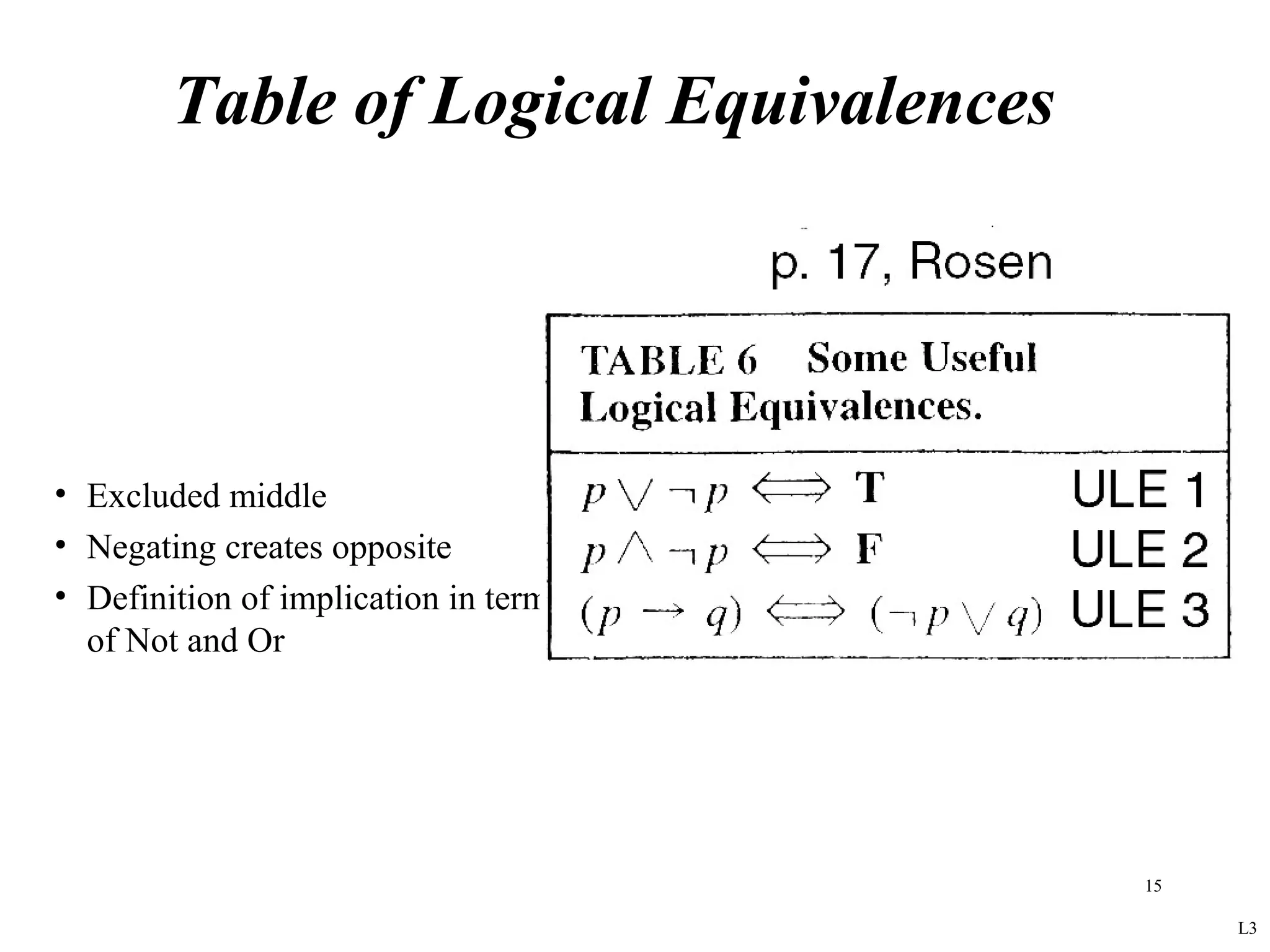
Table of Logical Equivalences


• Excluded middle
• Negating creates opposite
• Definition of implication in terms
  of Not and Or


                                        15

                                             L3
Inference rules
• Logical inference is used to create new sentences that
  logically follow from a given set of predicate calculus
  sentences (KB).


                                                            16
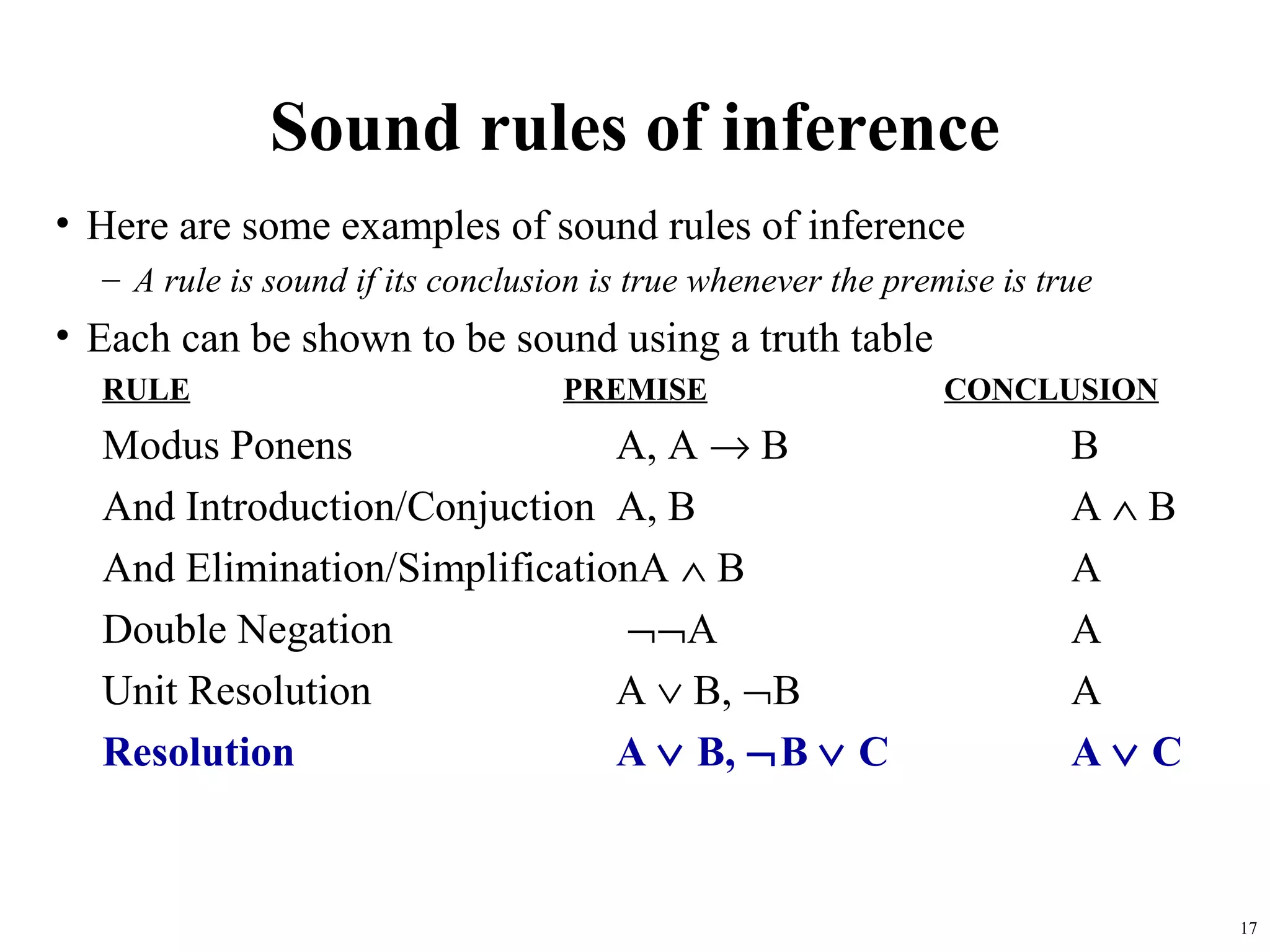
Sound rules of inference
• Here are some examples of sound rules of inference
  – A rule is sound if its conclusion is true whenever the premise is true
• Each can be shown to be sound using a truth table
  RULE                             PREMISE                     CONCLUSION
  Modus Ponens                 A, A → B                                 B
  And Introduction/Conjuction A, B                                      A∧B
  And Elimination/SimplificationA ∧ B                                   A
  Double Negation              ¬¬A                                      A
  Unit Resolution              A ∨ B, ¬B                                A
  Resolution                   A ∨ B, ¬B ∨ C                            A∨ C


                                                                               17
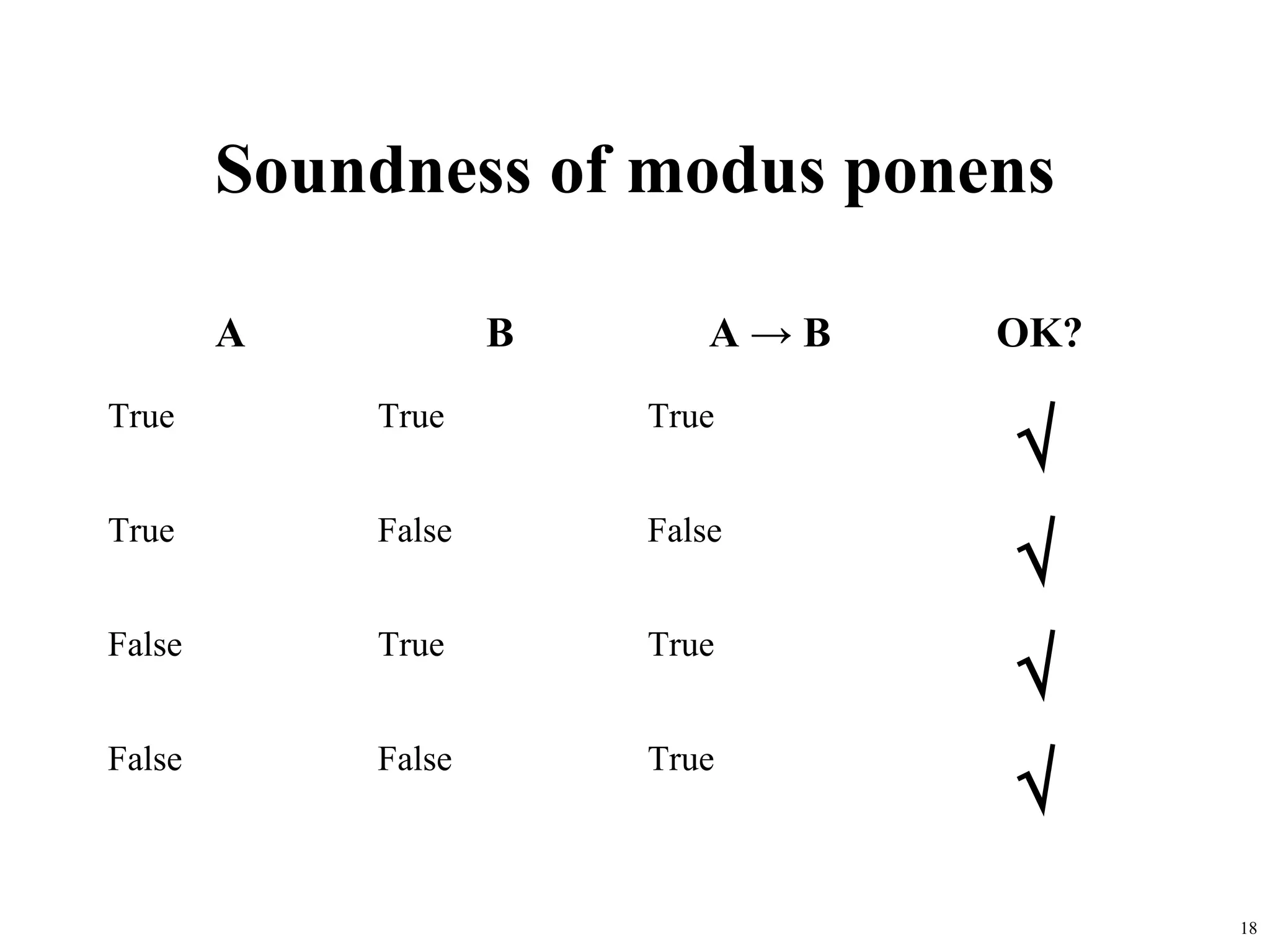
Soundness of modus ponens

        A           B       A→B   OK?
True        True        True
                                  √
True        False       False
                                  √
False       True        True
                                  √
False       False       True
                                  √
                                        18
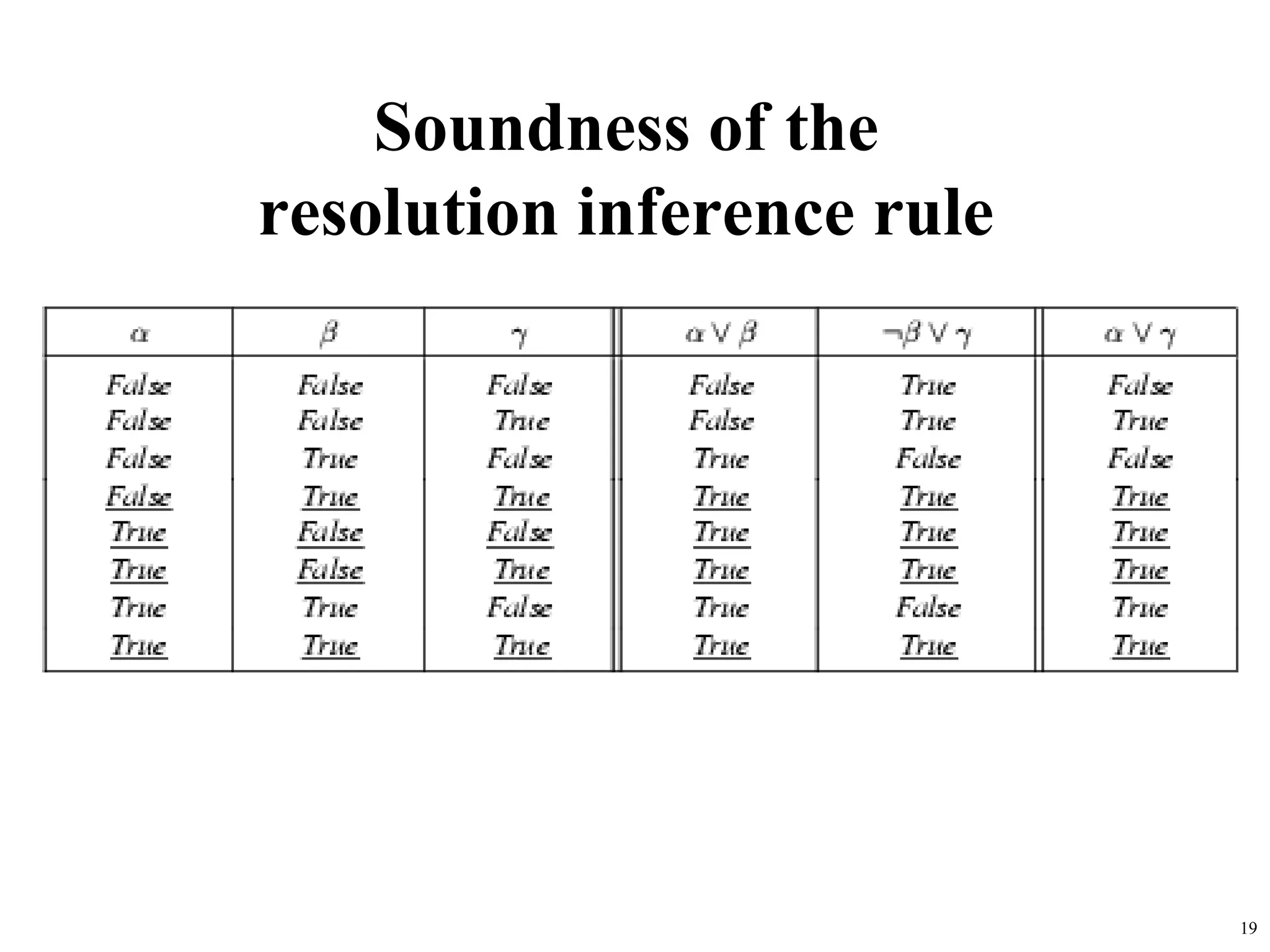
Soundness of the
resolution inference rule


                            19
Proving things
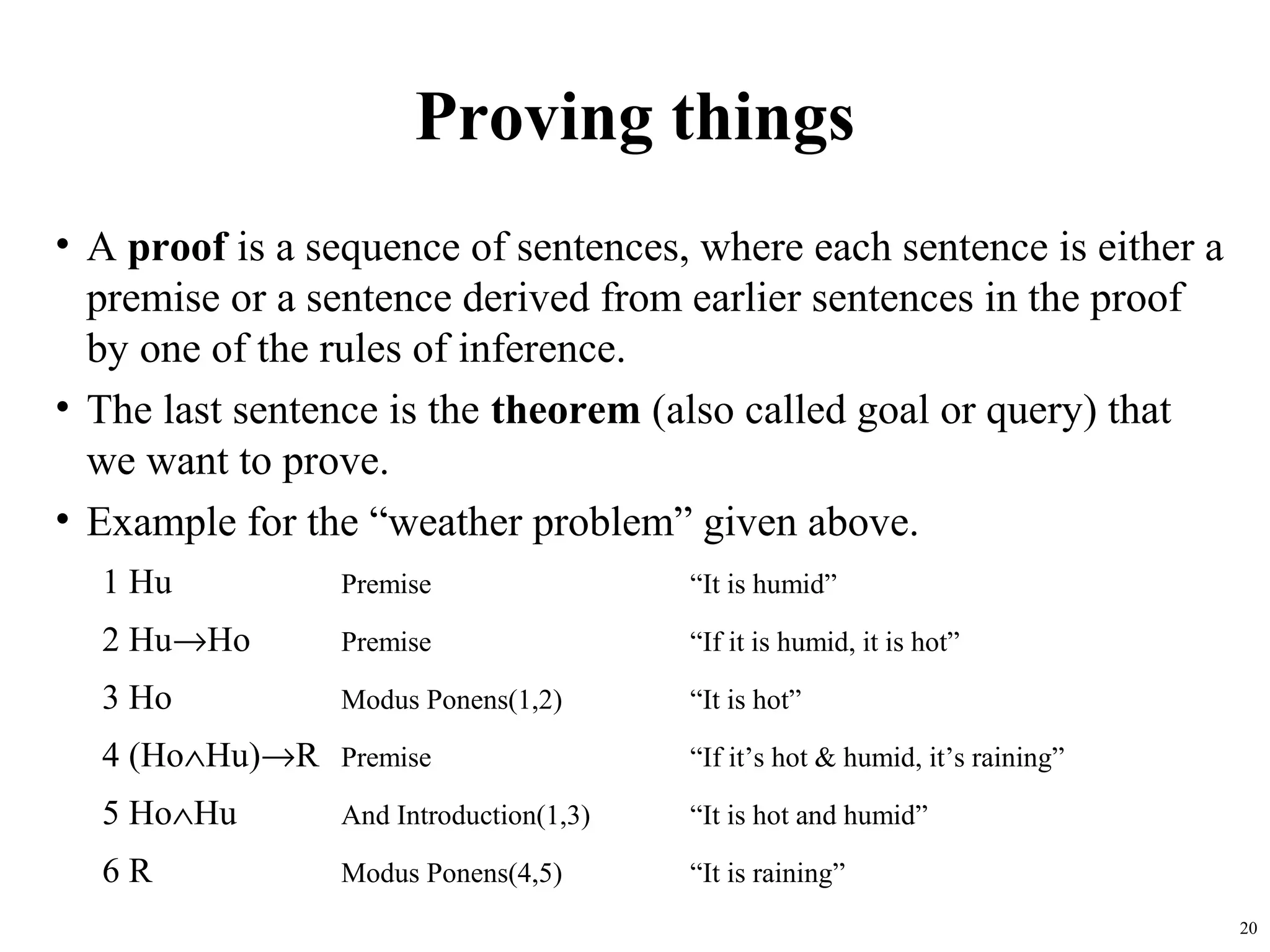
• A proof is a sequence of sentences, where each sentence is either a
  premise or a sentence derived from earlier sentences in the proof
  by one of the rules of inference.
• The last sentence is the theorem (also called goal or query) that
  we want to prove.
• Example for the “weather problem” given above.
  1 Hu          Premise                 “It is humid”

  2 Hu→Ho       Premise                 “If it is humid, it is hot”

  3 Ho          Modus Ponens(1,2)       “It is hot”

  4 (Ho∧Hu)→R Premise                   “If it’s hot & humid, it’s raining”

  5 Ho∧Hu       And Introduction(1,3)   “It is hot and humid”

  6R            Modus Ponens(4,5)       “It is raining”
                                                                              20
Problems with Propositional Logic


                                    21
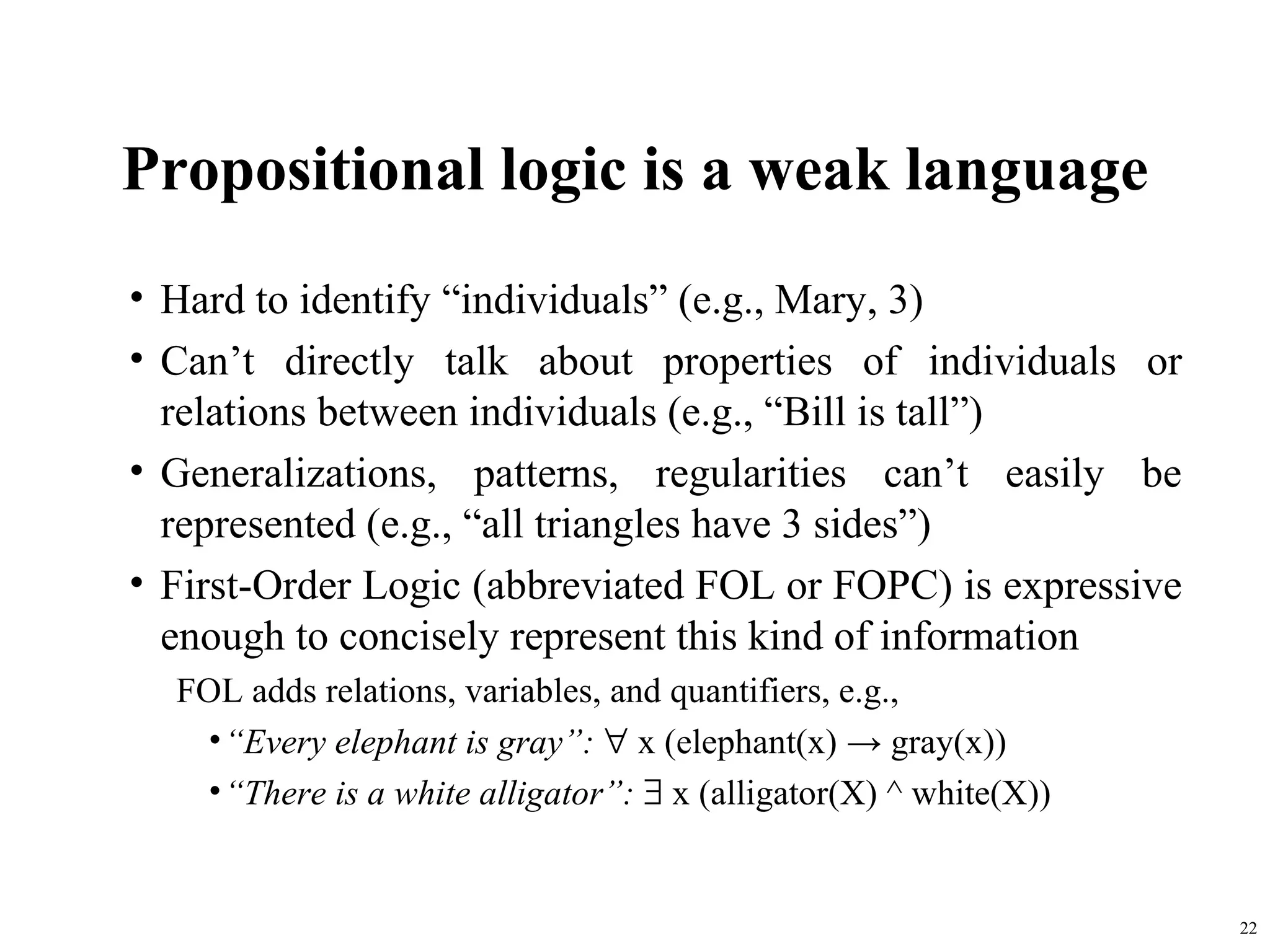
Propositional logic is a weak language
• Hard to identify “individuals” (e.g., Mary, 3)
• Can’t directly talk about properties of individuals or
  relations between individuals (e.g., “Bill is tall”)
• Generalizations, patterns, regularities can’t easily be
  represented (e.g., “all triangles have 3 sides”)
• First-Order Logic (abbreviated FOL or FOPC) is expressive
  enough to concisely represent this kind of information
  FOL adds relations, variables, and quantifiers, e.g.,
   • “Every elephant is gray”: ∀ x (elephant(x) → gray(x))
   • “There is a white alligator”: ∃ x (alligator(X) ^ white(X))


                                                                   22
First-Order Logic


                    23
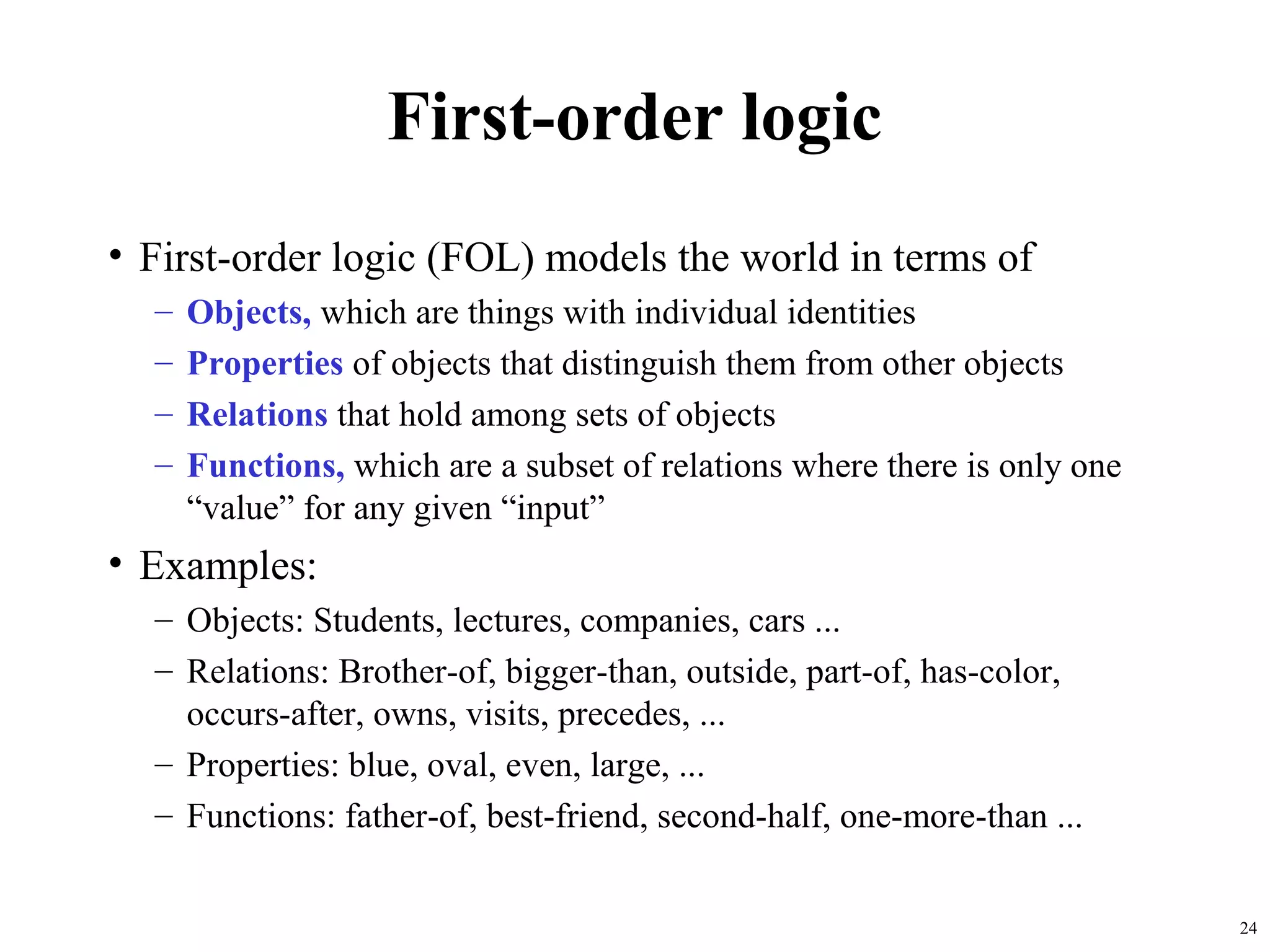
First-order logic
• First-order logic (FOL) models the world in terms of
  –   Objects, which are things with individual identities
  –   Properties of objects that distinguish them from other objects
  –   Relations that hold among sets of objects
  –   Functions, which are a subset of relations where there is only one
      “value” for any given “input”
• Examples:
  – Objects: Students, lectures, companies, cars ...
  – Relations: Brother-of, bigger-than, outside, part-of, has-color,
    occurs-after, owns, visits, precedes, ...
  – Properties: blue, oval, even, large, ...
  – Functions: father-of, best-friend, second-half, one-more-than ...


                                                                           24
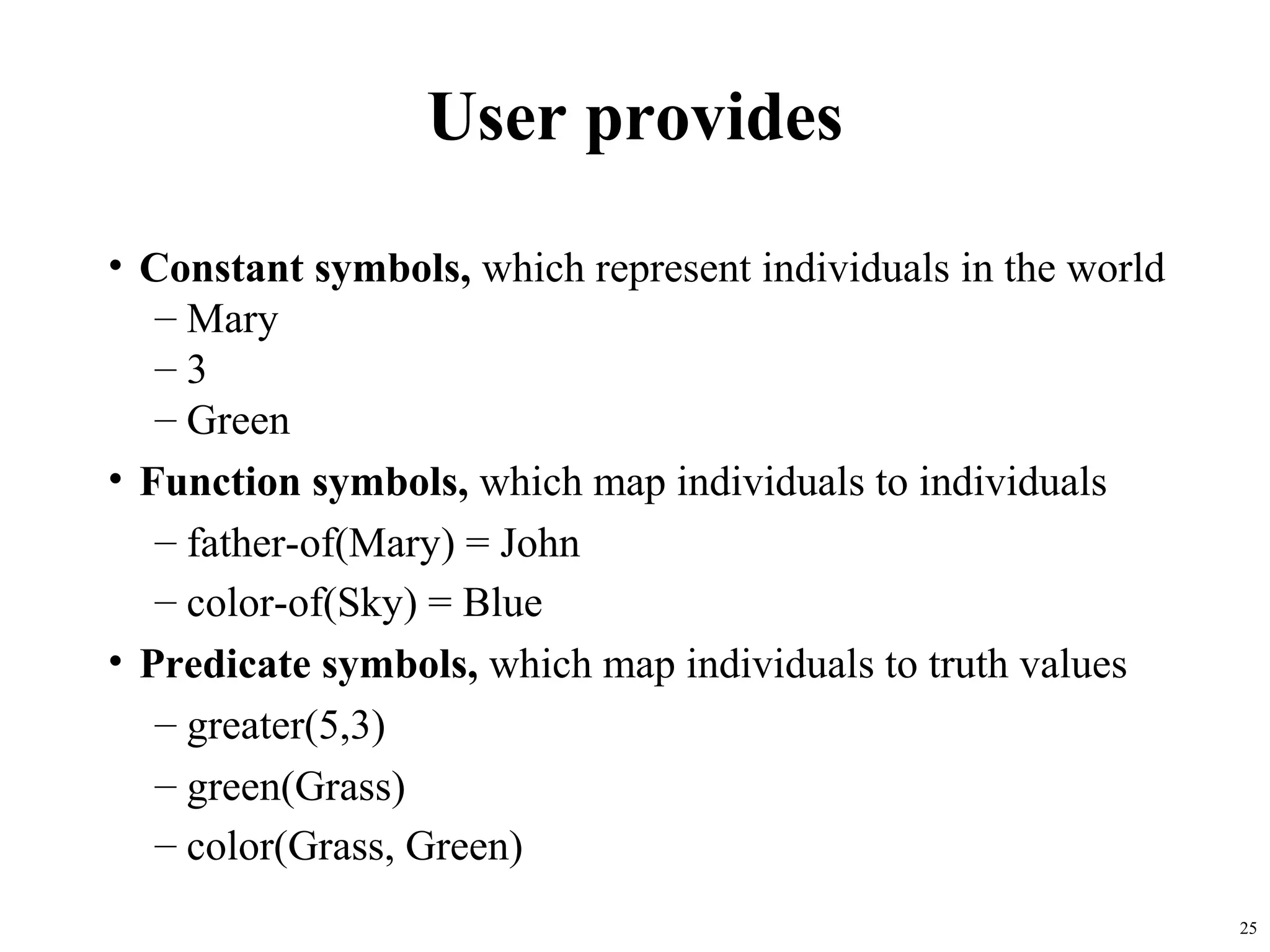
User provides
• Constant symbols, which represent individuals in the world
   – Mary
   –3
   – Green
• Function symbols, which map individuals to individuals
   – father-of(Mary) = John
   – color-of(Sky) = Blue
• Predicate symbols, which map individuals to truth values
   – greater(5,3)
   – green(Grass)
   – color(Grass, Green)
                                                               25
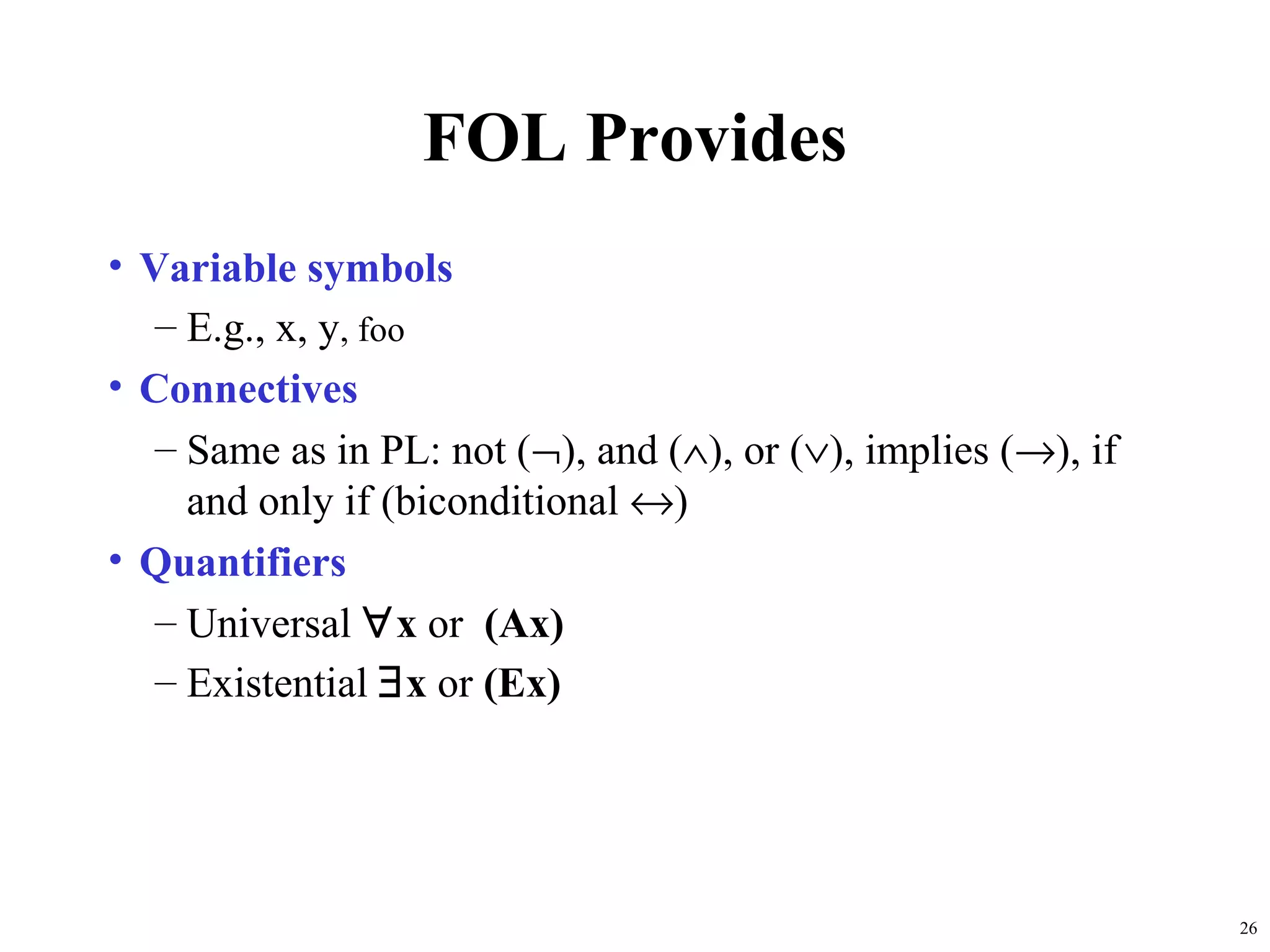
FOL Provides
• Variable symbols
   – E.g., x, y, foo
• Connectives
   – Same as in PL: not (¬), and (∧), or (∨), implies (→), if
     and only if (biconditional ↔)
• Quantifiers
   – Universal ∀x or (Ax)
   – Existential ∃x or (Ex)


                                                                26
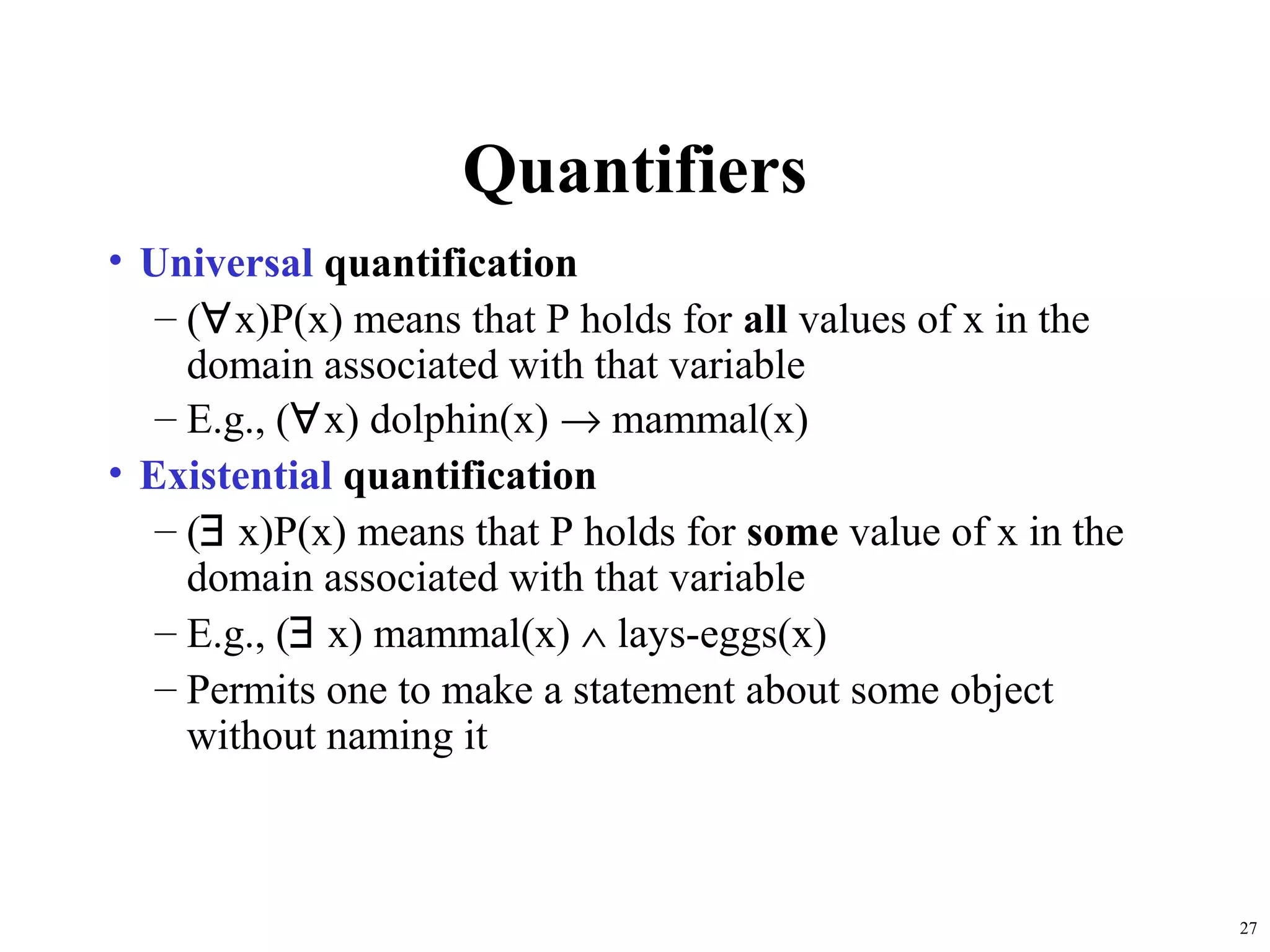
Quantifiers
• Universal quantification
   – (∀x)P(x) means that P holds for all values of x in the
     domain associated with that variable
   – E.g., (∀x) dolphin(x) → mammal(x)
• Existential quantification
   – (∃ x)P(x) means that P holds for some value of x in the
     domain associated with that variable
   – E.g., (∃ x) mammal(x) ∧ lays-eggs(x)
   – Permits one to make a statement about some object
     without naming it


                                                               27
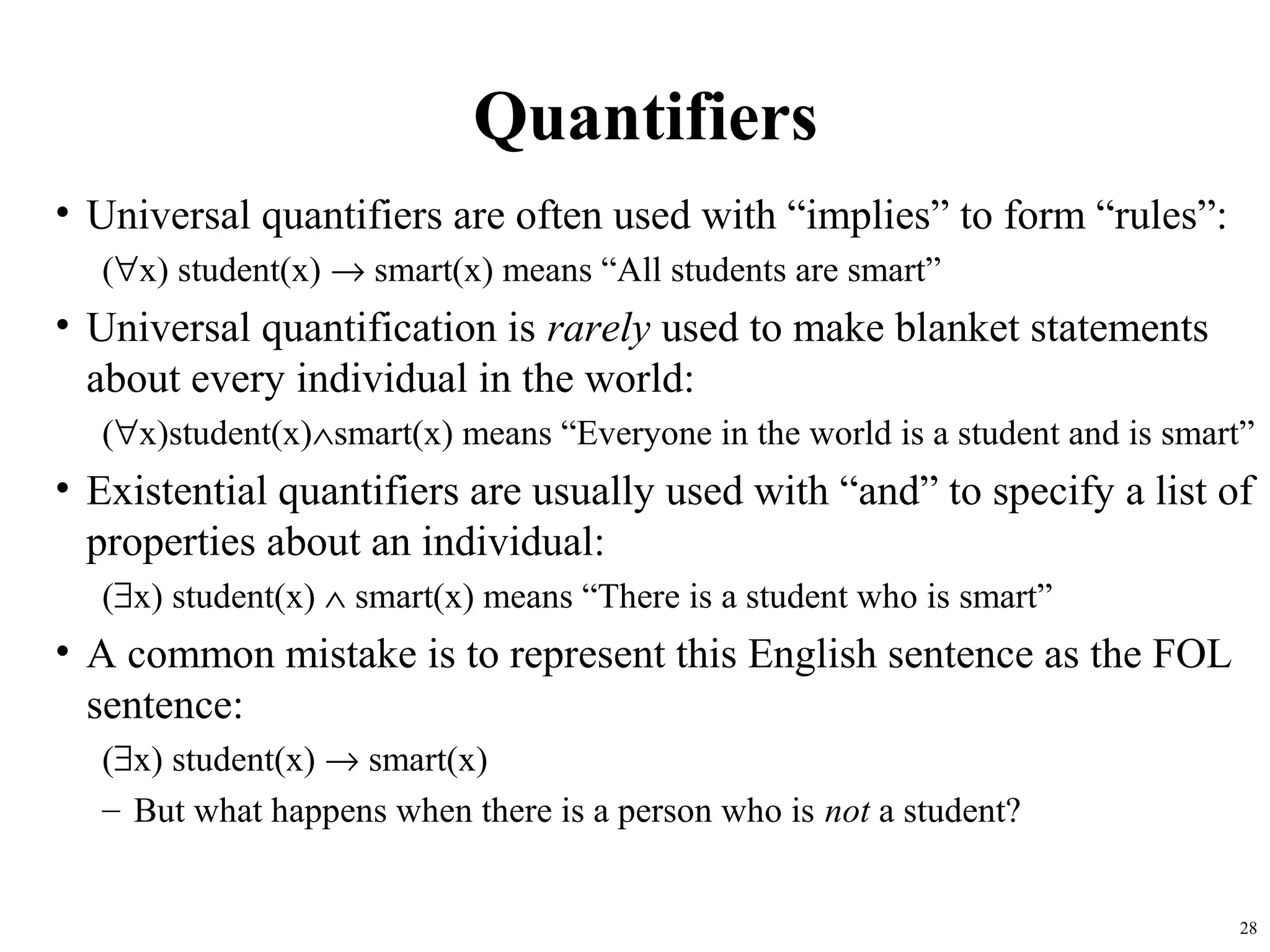
Quantifiers
• Universal quantifiers are often used with “implies” to form “rules”:
  (∀x) student(x) → smart(x) means “All students are smart”
• Universal quantification is rarely used to make blanket statements
  about every individual in the world:
  (∀x)student(x)∧smart(x) means “Everyone in the world is a student and is smart”
• Existential quantifiers are usually used with “and” to specify a list of
  properties about an individual:
  (∃x) student(x) ∧ smart(x) means “There is a student who is smart”
• A common mistake is to represent this English sentence as the FOL
  sentence:
  (∃x) student(x) → smart(x)
  – But what happens when there is a person who is not a student?


                                                                               28
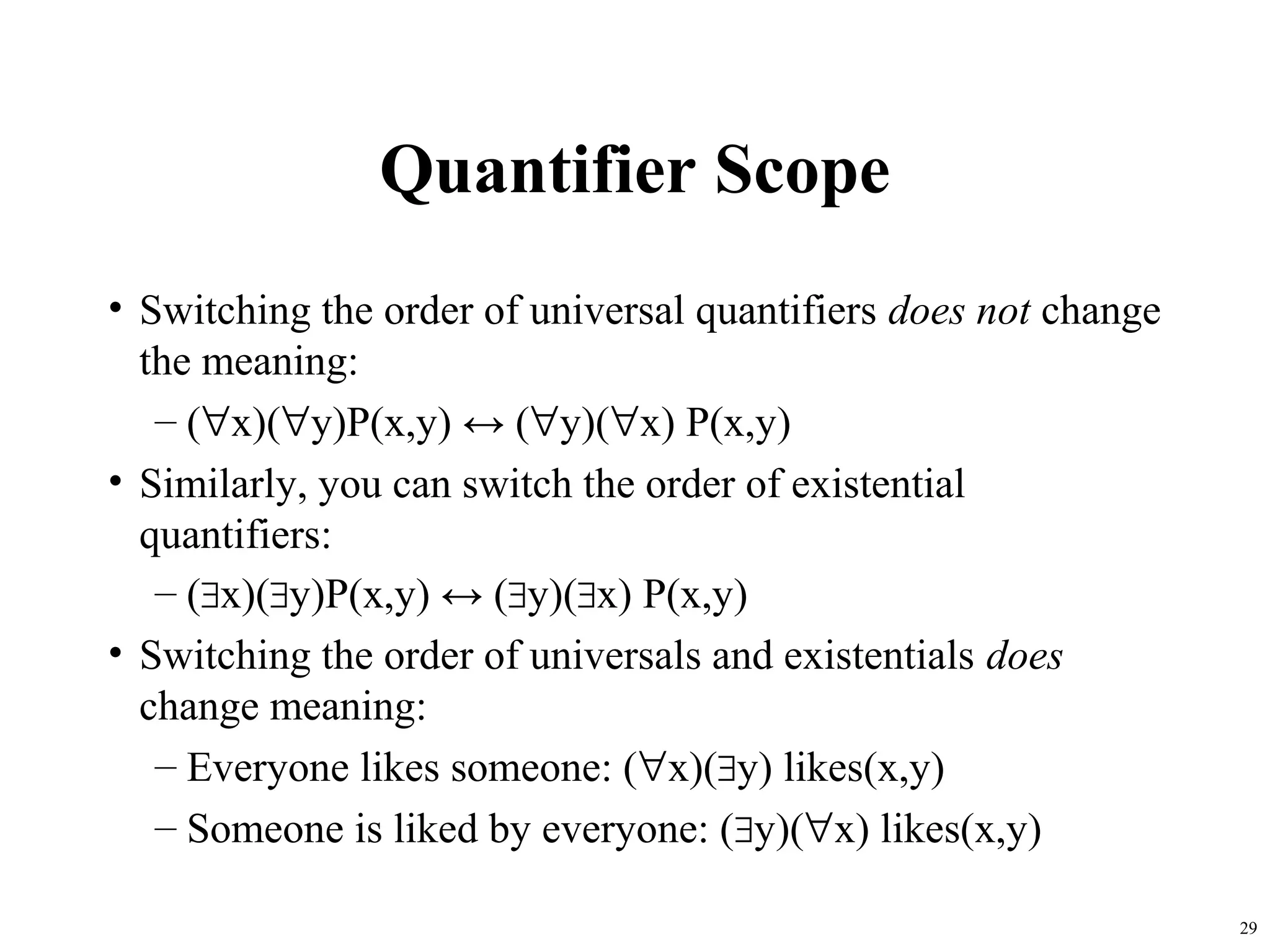
Quantifier Scope
• Switching the order of universal quantifiers does not change
  the meaning:
   – (∀x)(∀y)P(x,y) ↔ (∀y)(∀x) P(x,y)
• Similarly, you can switch the order of existential
  quantifiers:
   – (∃x)(∃y)P(x,y) ↔ (∃y)(∃x) P(x,y)
• Switching the order of universals and existentials does
  change meaning:
   – Everyone likes someone: (∀x)(∃y) likes(x,y)
   – Someone is liked by everyone: (∃y)(∀x) likes(x,y)

                                                                 29
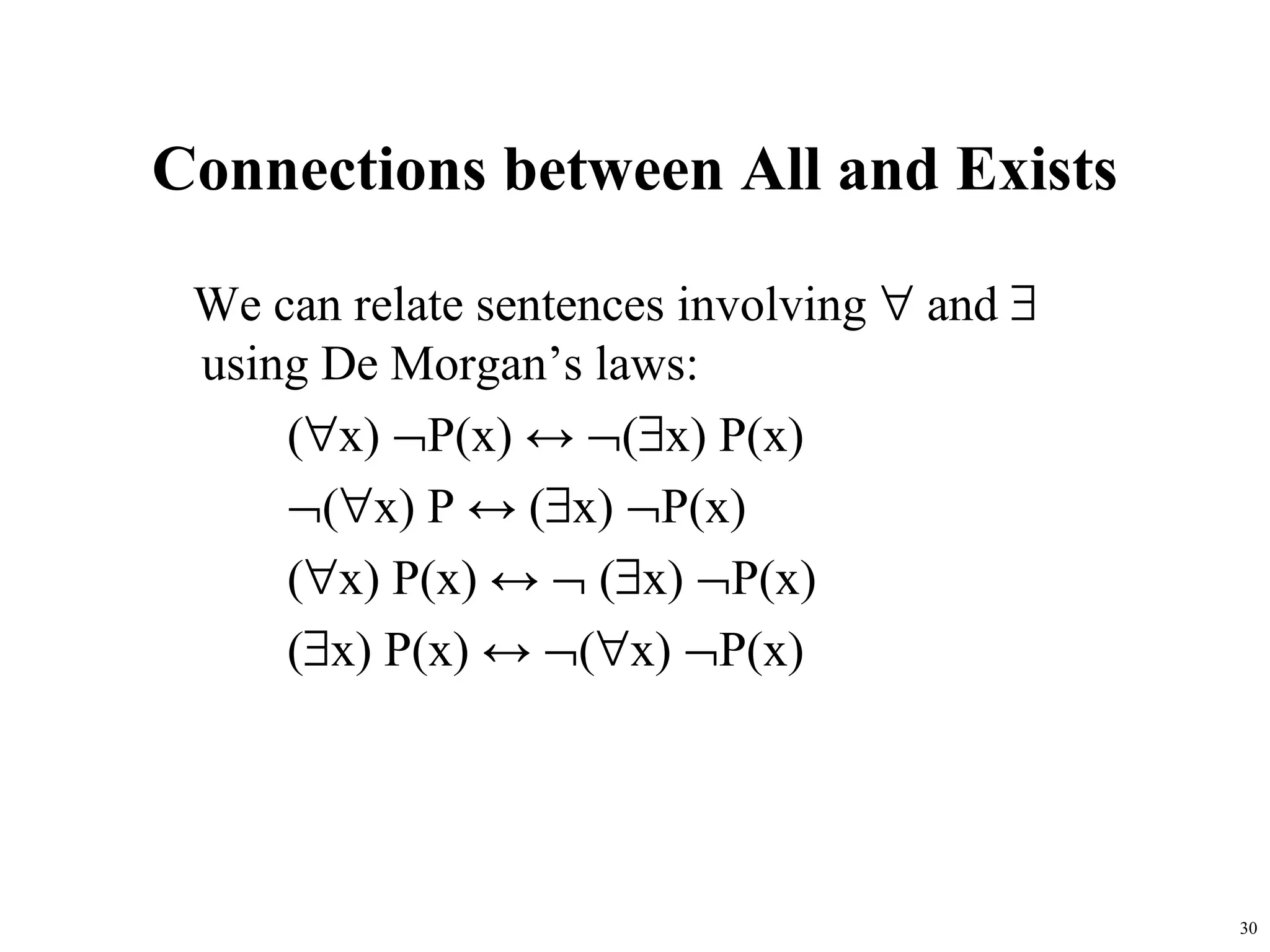
Connections between All and Exists

 We can relate sentences involving ∀ and ∃
 using De Morgan’s laws:
     (∀x) ¬P(x) ↔ ¬(∃x) P(x)
     ¬(∀x) P ↔ (∃x) ¬P(x)
     (∀x) P(x) ↔ ¬ (∃x) ¬P(x)
     (∃x) P(x) ↔ ¬(∀x) ¬P(x)


                                             30
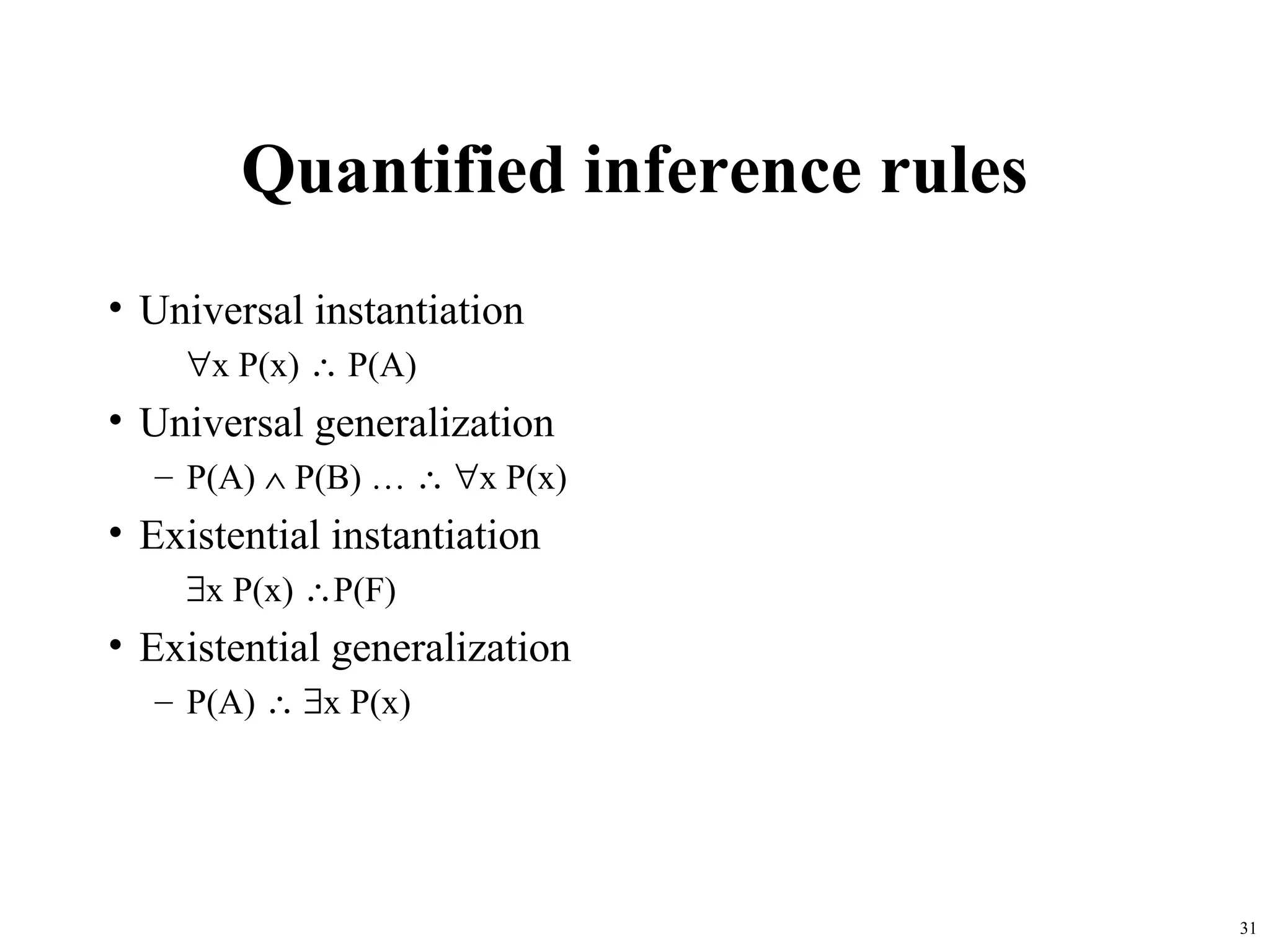
Quantified inference rules
• Universal instantiation
    ∀x P(x) ∴ P(A)
• Universal generalization
  – P(A) ∧ P(B) … ∴ ∀x P(x)
• Existential instantiation
    ∃x P(x) ∴P(F)
• Existential generalization
  – P(A) ∴ ∃x P(x)


                                     31
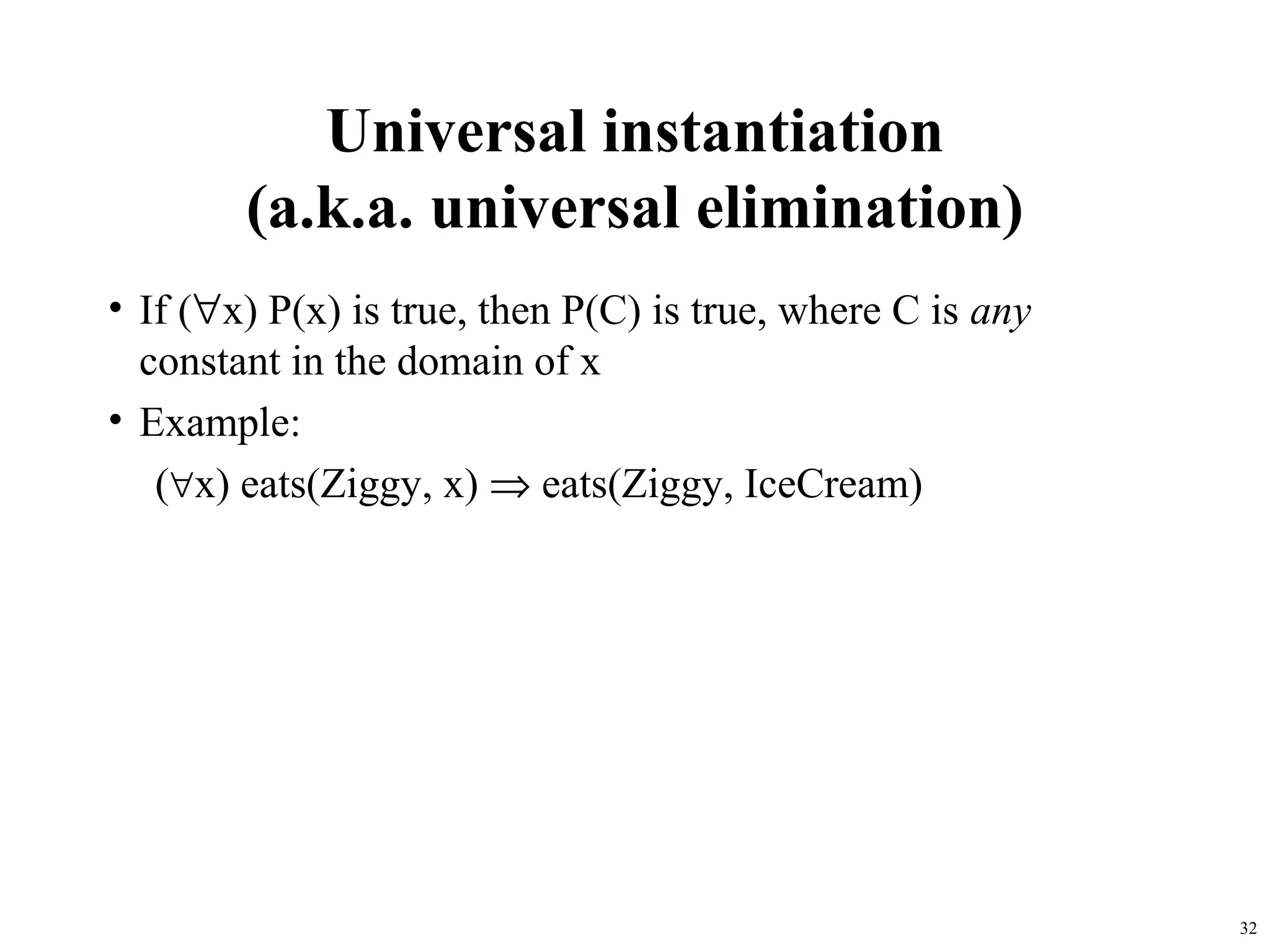
Universal instantiation
        (a.k.a. universal elimination)
• If (∀x) P(x) is true, then P(C) is true, where C is any
  constant in the domain of x
• Example:
   (∀x) eats(Ziggy, x) ⇒ eats(Ziggy, IceCream)


                                                            32
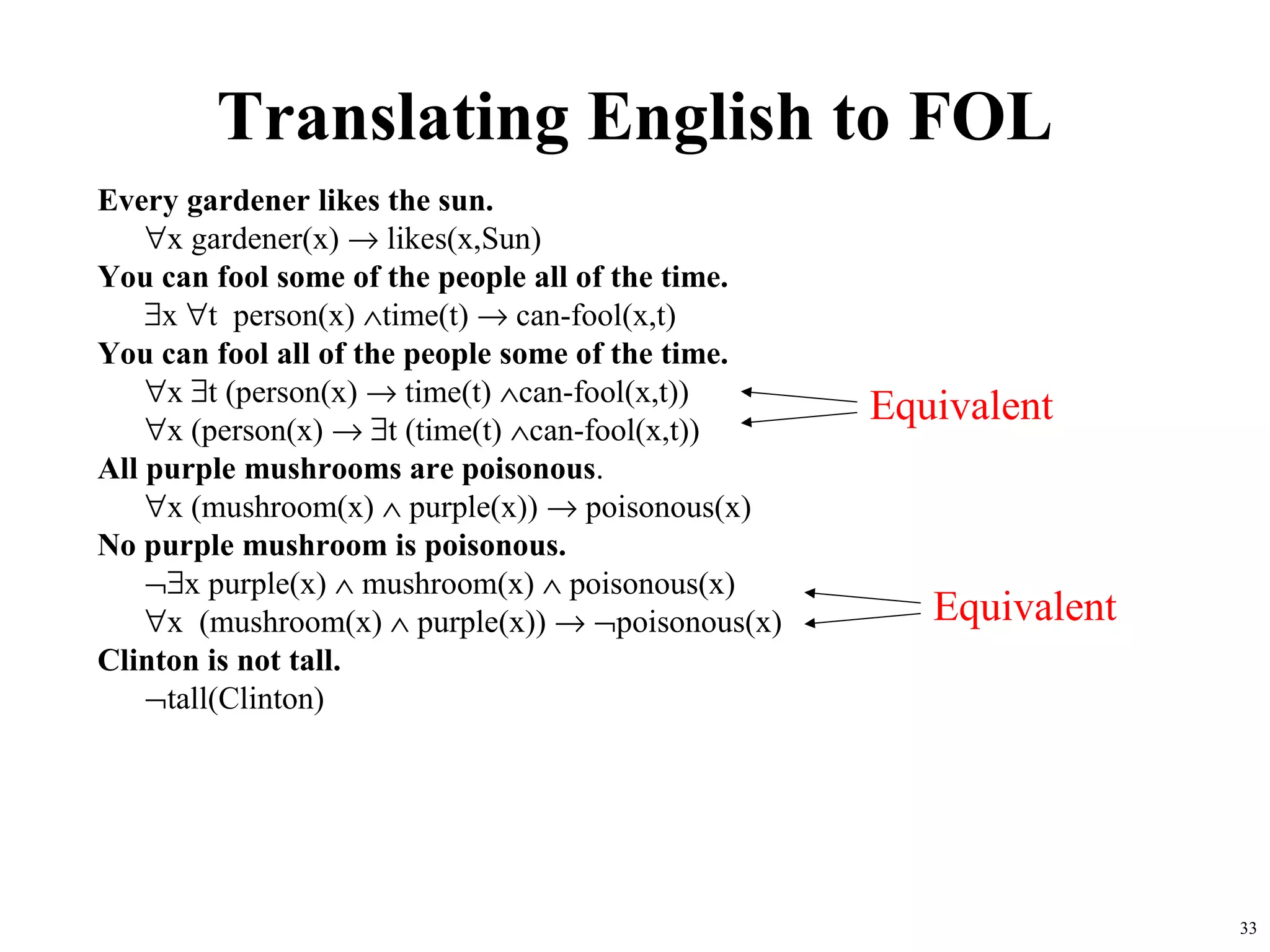
Translating English to FOL
Every gardener likes the sun.
    ∀x gardener(x) → likes(x,Sun)
You can fool some of the people all of the time.
    ∃x ∀t person(x) ∧time(t) → can-fool(x,t)
You can fool all of the people some of the time.
    ∀x ∃t (person(x) → time(t) ∧can-fool(x,t))
                                                   Equivalent
    ∀x (person(x) → ∃t (time(t) ∧can-fool(x,t))
All purple mushrooms are poisonous.
    ∀x (mushroom(x) ∧ purple(x)) → poisonous(x)
No purple mushroom is poisonous.
    ¬∃x purple(x) ∧ mushroom(x) ∧ poisonous(x)
    ∀x (mushroom(x) ∧ purple(x)) → ¬poisonous(x)      Equivalent
Clinton is not tall.
    ¬tall(Clinton)


                                                                   33
34

Propositional And First-Order Logic

  • 1.
  • 2.
  • 3.
    Propositional logic • Proposition: A proposition is classified as a declarative sentence which is either true or false. eg: 1) It rained yesterday. • Propositional symbols/variables: P, Q, S, ... (atomic sentences) • Sentences are combined by Connectives: ∧ ...and [conjunction] ∨ ...or [disjunction] ⇒ ...implies [implication / conditional] ⇔ ..is equivalent [biconditional] ¬ ...not [negation] • Literal: atomic sentence or negated atomic sentence 3
  • 4.
    Propositional logic (PL) Sentence or well formed formula • A sentence (well formed formula) is defined as follows: – A symbol is a sentence – If S is a sentence, then ¬S is a sentence – If S is a sentence, then (S) is a sentence – If S and T are sentences, then (S ∨ T), (S ∧ T), (S → T), and (S ↔ T) are sentences – A sentence results from a finite number of applications of the above rules 5
  • 5.
    Laws of Algebraof Propositions • Idempotent: pVp≡p pΛp≡p • Commutative: pVq≡qVp pΛq≡qΛp • Complement: p V ~p ≡ T p Λ ~p ≡ F • Double Negation: ~(~p) ≡ p 7
  • 6.
    • Associative: p V (q V r) ≡ (p V q) V r p Λ (q Λ r) ≡ (p Λ q) Λ r • Distributive: p V (q Λ r) ≡ (p V q) Λ (p V r) p Λ (q V r) ≡ (p Λ q) V (p Λ r) • Absorbtion: p V (p Λ q) ≡ p p Λ (p V q) ≡ p • Identity: pVT≡T pΛT≡p pVF≡p pΛF≡F 8
  • 7.
    • De Morgan’s ~(p V q) ≡ ~p Λ ~q ~(p Λ q) ≡ ~p V ~q • Equivalence of Contrapositive: p → q ≡ ~q → ~p • Others: p → q ≡ ~p V q p ↔ q ≡ (p → q) Λ (q → p) 9
  • 8.
    Tautologies and contradictions •A tautology is a sentence that is True under all interpretations. • An contradiction is a sentence that is False under all interpretations. p ¬p p ∨¬p p ¬p p ∧¬p F T T F T F T F T T F F 10 L3
  • 9.
    Tautology by truthtable p q ¬p p ∨q ¬p ∧(p ∨q ) [¬p ∧(p ∨q )]→q T T F T F T T F F T F T F T T T T T F F T F F T 11 L3
  • 10.
    Propositional Logic -one last proof Show that [p ∧ (p → q)] → q is a tautology. We use ≡ to show that [p ∧ (p → q)] → q ≡ T. [p ∧ (p → q)] → q ≡ [p ∧ (¬p ∨ q)] → q substitution for → ≡ [(p ∧ ¬p) ∨ (p ∧ q)] → q distributive ≡ [ F ∨ (p ∧ q)] → q complement ≡ (p ∧ q) → q identity ≡ ¬(p ∧ q) ∨ q substitution for → ≡ (¬p ∨ ¬q) ∨ q DeMorgan’s ≡ ¬p ∨ (¬q ∨ q ) associative ≡ ¬p ∨ T complement ≡T identity 11/09/12 12
  • 11.
    Logical Equivalence of Conditional and Contrapositive The easiest way to check for logical equivalence is to see if the truth tables of both variants have identical last columns: p q p →q p q ¬q ¬p ¬q→¬p T T T T T F F T T F F T F T F F F T T F T F T T F F T F F T T T 13 L3
  • 12.
    Table of LogicalEquivalences • Identity laws Like adding 0 • Domination laws Like multiplying by 0 • Idempotent laws Delete redundancies • Double negation “I don’t like you, not” • Commutativity Like “x+y = y+x” • Associativity Like “(x+y)+z = y+(x+z)” • Distributivity Like “(x+y)z = xz+yz” 14 • De Morgan L3
  • 13.
    Table of LogicalEquivalences • Excluded middle • Negating creates opposite • Definition of implication in terms of Not and Or 15 L3
  • 14.
    Inference rules • Logicalinference is used to create new sentences that logically follow from a given set of predicate calculus sentences (KB). 16
  • 15.
    Sound rules ofinference • Here are some examples of sound rules of inference – A rule is sound if its conclusion is true whenever the premise is true • Each can be shown to be sound using a truth table RULE PREMISE CONCLUSION Modus Ponens A, A → B B And Introduction/Conjuction A, B A∧B And Elimination/SimplificationA ∧ B A Double Negation ¬¬A A Unit Resolution A ∨ B, ¬B A Resolution A ∨ B, ¬B ∨ C A∨ C 17
  • 16.
    Soundness of modusponens A B A→B OK? True True True √ True False False √ False True True √ False False True √ 18
  • 17.
    Soundness of the resolutioninference rule 19
  • 18.
    Proving things • Aproof is a sequence of sentences, where each sentence is either a premise or a sentence derived from earlier sentences in the proof by one of the rules of inference. • The last sentence is the theorem (also called goal or query) that we want to prove. • Example for the “weather problem” given above. 1 Hu Premise “It is humid” 2 Hu→Ho Premise “If it is humid, it is hot” 3 Ho Modus Ponens(1,2) “It is hot” 4 (Ho∧Hu)→R Premise “If it’s hot & humid, it’s raining” 5 Ho∧Hu And Introduction(1,3) “It is hot and humid” 6R Modus Ponens(4,5) “It is raining” 20
  • 19.
  • 20.
    Propositional logic isa weak language • Hard to identify “individuals” (e.g., Mary, 3) • Can’t directly talk about properties of individuals or relations between individuals (e.g., “Bill is tall”) • Generalizations, patterns, regularities can’t easily be represented (e.g., “all triangles have 3 sides”) • First-Order Logic (abbreviated FOL or FOPC) is expressive enough to concisely represent this kind of information FOL adds relations, variables, and quantifiers, e.g., • “Every elephant is gray”: ∀ x (elephant(x) → gray(x)) • “There is a white alligator”: ∃ x (alligator(X) ^ white(X)) 22
  • 21.
  • 22.
    First-order logic • First-orderlogic (FOL) models the world in terms of – Objects, which are things with individual identities – Properties of objects that distinguish them from other objects – Relations that hold among sets of objects – Functions, which are a subset of relations where there is only one “value” for any given “input” • Examples: – Objects: Students, lectures, companies, cars ... – Relations: Brother-of, bigger-than, outside, part-of, has-color, occurs-after, owns, visits, precedes, ... – Properties: blue, oval, even, large, ... – Functions: father-of, best-friend, second-half, one-more-than ... 24
  • 23.
    User provides • Constantsymbols, which represent individuals in the world – Mary –3 – Green • Function symbols, which map individuals to individuals – father-of(Mary) = John – color-of(Sky) = Blue • Predicate symbols, which map individuals to truth values – greater(5,3) – green(Grass) – color(Grass, Green) 25
  • 24.
    FOL Provides • Variablesymbols – E.g., x, y, foo • Connectives – Same as in PL: not (¬), and (∧), or (∨), implies (→), if and only if (biconditional ↔) • Quantifiers – Universal ∀x or (Ax) – Existential ∃x or (Ex) 26
  • 25.
    Quantifiers • Universal quantification – (∀x)P(x) means that P holds for all values of x in the domain associated with that variable – E.g., (∀x) dolphin(x) → mammal(x) • Existential quantification – (∃ x)P(x) means that P holds for some value of x in the domain associated with that variable – E.g., (∃ x) mammal(x) ∧ lays-eggs(x) – Permits one to make a statement about some object without naming it 27
  • 26.
    Quantifiers • Universal quantifiersare often used with “implies” to form “rules”: (∀x) student(x) → smart(x) means “All students are smart” • Universal quantification is rarely used to make blanket statements about every individual in the world: (∀x)student(x)∧smart(x) means “Everyone in the world is a student and is smart” • Existential quantifiers are usually used with “and” to specify a list of properties about an individual: (∃x) student(x) ∧ smart(x) means “There is a student who is smart” • A common mistake is to represent this English sentence as the FOL sentence: (∃x) student(x) → smart(x) – But what happens when there is a person who is not a student? 28
  • 27.
    Quantifier Scope • Switchingthe order of universal quantifiers does not change the meaning: – (∀x)(∀y)P(x,y) ↔ (∀y)(∀x) P(x,y) • Similarly, you can switch the order of existential quantifiers: – (∃x)(∃y)P(x,y) ↔ (∃y)(∃x) P(x,y) • Switching the order of universals and existentials does change meaning: – Everyone likes someone: (∀x)(∃y) likes(x,y) – Someone is liked by everyone: (∃y)(∀x) likes(x,y) 29
  • 28.
    Connections between Alland Exists We can relate sentences involving ∀ and ∃ using De Morgan’s laws: (∀x) ¬P(x) ↔ ¬(∃x) P(x) ¬(∀x) P ↔ (∃x) ¬P(x) (∀x) P(x) ↔ ¬ (∃x) ¬P(x) (∃x) P(x) ↔ ¬(∀x) ¬P(x) 30
  • 29.
    Quantified inference rules •Universal instantiation ∀x P(x) ∴ P(A) • Universal generalization – P(A) ∧ P(B) … ∴ ∀x P(x) • Existential instantiation ∃x P(x) ∴P(F) • Existential generalization – P(A) ∴ ∃x P(x) 31
  • 30.
    Universal instantiation (a.k.a. universal elimination) • If (∀x) P(x) is true, then P(C) is true, where C is any constant in the domain of x • Example: (∀x) eats(Ziggy, x) ⇒ eats(Ziggy, IceCream) 32
  • 31.
    Translating English toFOL Every gardener likes the sun. ∀x gardener(x) → likes(x,Sun) You can fool some of the people all of the time. ∃x ∀t person(x) ∧time(t) → can-fool(x,t) You can fool all of the people some of the time. ∀x ∃t (person(x) → time(t) ∧can-fool(x,t)) Equivalent ∀x (person(x) → ∃t (time(t) ∧can-fool(x,t)) All purple mushrooms are poisonous. ∀x (mushroom(x) ∧ purple(x)) → poisonous(x) No purple mushroom is poisonous. ¬∃x purple(x) ∧ mushroom(x) ∧ poisonous(x) ∀x (mushroom(x) ∧ purple(x)) → ¬poisonous(x) Equivalent Clinton is not tall. ¬tall(Clinton) 33
  • 32.