The document discusses the Unified Payments Interface (UPI) system in India. It provides the following key points:
- UPI is an instant real-time payment system developed by NPCI that allows money transfers between bank accounts using a virtual payment address.
- UPI offers features like being open source, mobile-first, interoperable, instantaneous, secure, cheap, simple, innovative and easily adaptable.
- NPCI's central repository maps customers' Aadhaar numbers, mobile numbers and bank accounts to route payments based on these identifiers.
- The UPI system uses a virtual payment address architecture to facilitate payments between parties using identifiers like bank account numbers, Aad
In this document
Powered by AI
Introduction to NPCI and UPI, highlighting NPCI's role in retail payments and UPI's features like open-source and secure payments.
Explanation of AEPB and DBT systems in conjunction with NPCI, including customer identification using Adhaar and mobile numbers.
Details on how UPI transactions are processed by NPCI, involving payer and payee banks and transaction notifications.
Description of UPI gateway architecture, including virtual payment address structure and mapping identifiers like Adhaar and mobile numbers.
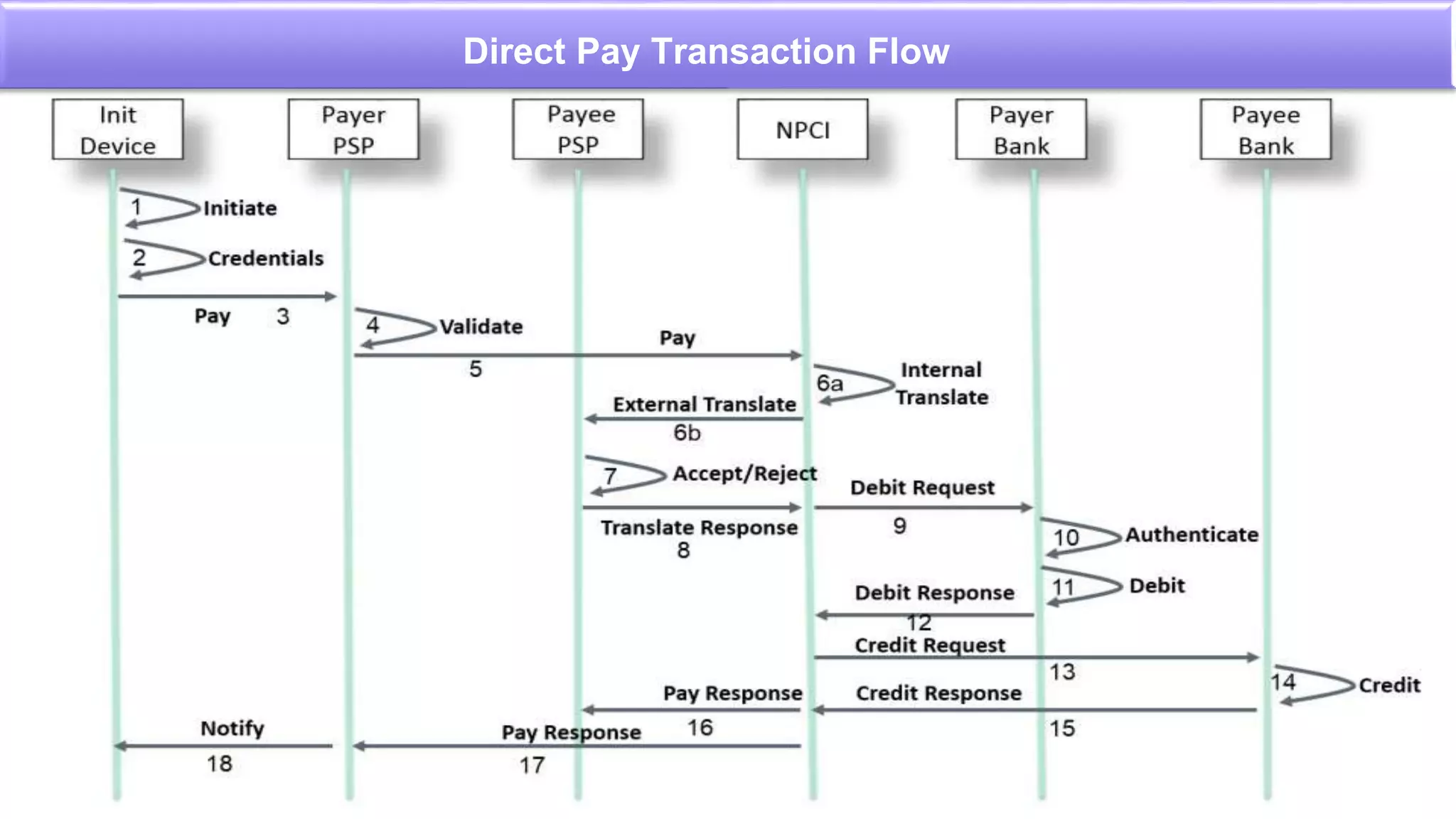
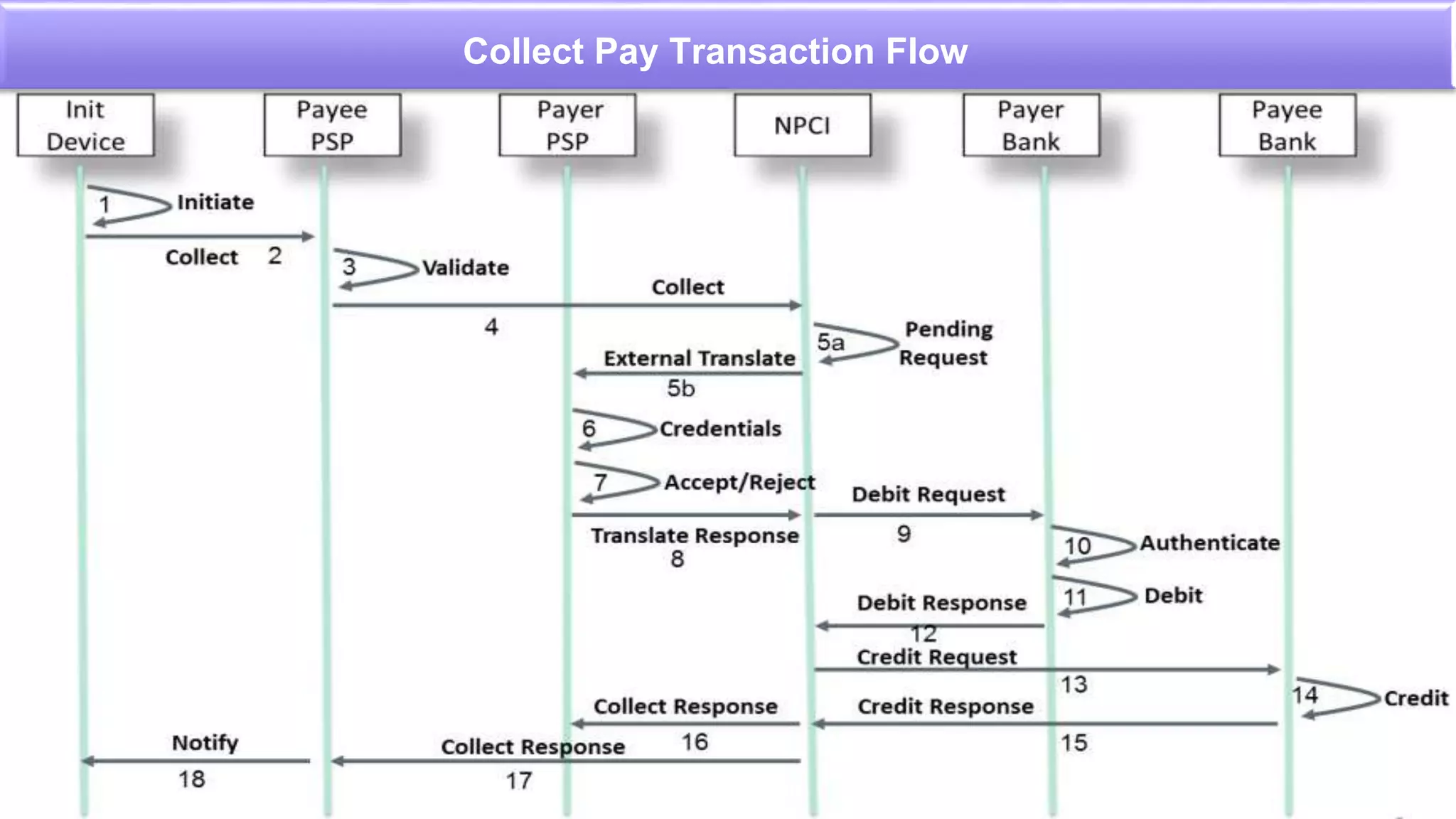
Different types of payment requests in UPI: Direct Pay (sender initiated) and Collect Pay (receiver requested) with transaction flows.
Details on APIs that support UPI transactions, including request and response handling, authentication, and security considerations.Information classification in UPI transactions, addressing sensitive, private data storage, and security protocols for data transmission.
Concludes the presentation, expressing gratitude to the audience.
NPCI
NPCI (National PaymentCorporation of India) is the umbrella
organization for all the retails payments in India, which is set up by RBI
and IBA in April 2009.
NPCI launched the IMPS.
NPCI launched the RuPay card.
NPCI`s current initiative is the launch the UPI.
4.
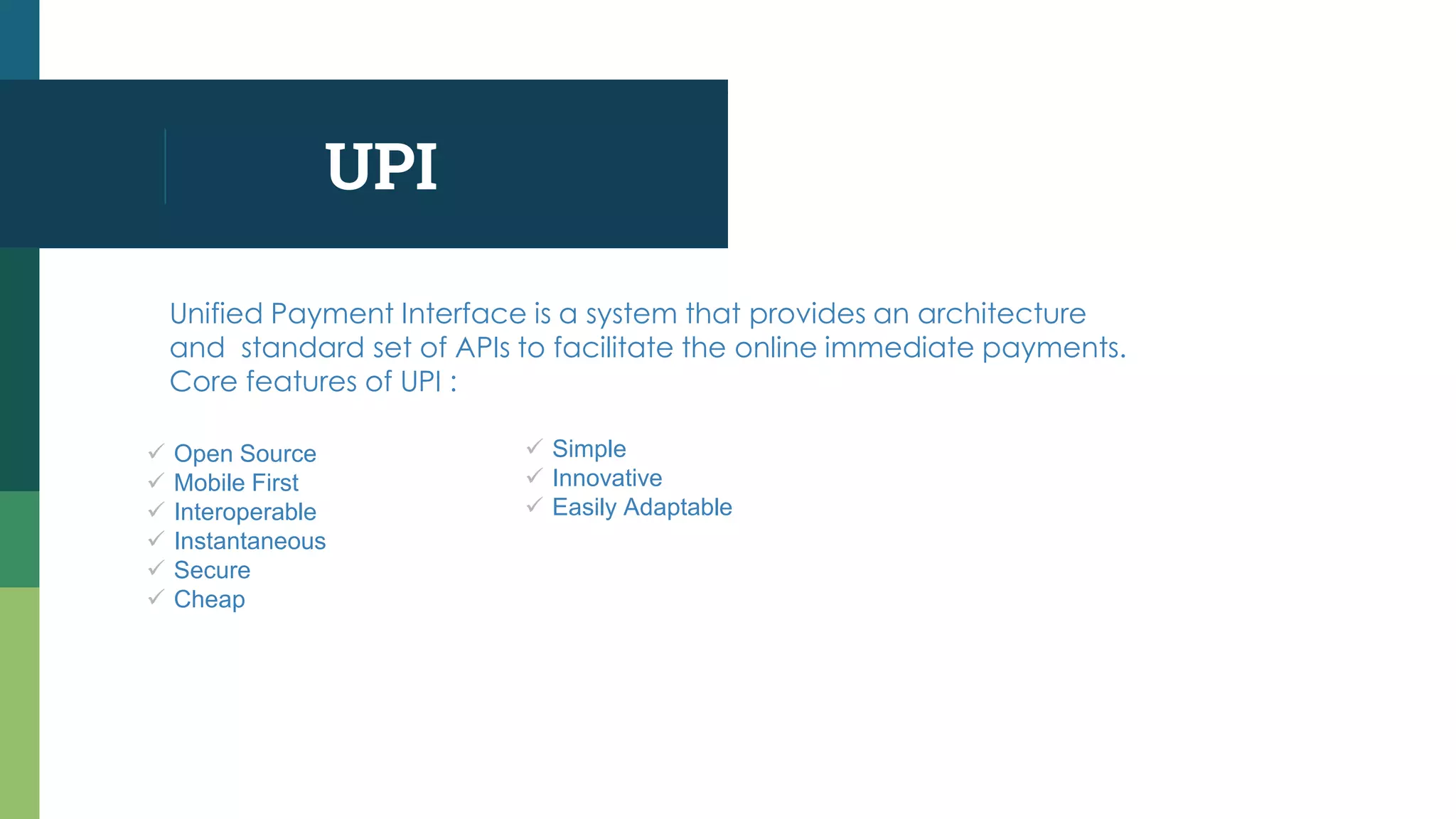
UPI
Unified Payment Interfaceis a system that provides an architecture
and standard set of APIs to facilitate the online immediate payments.
Core features of UPI :
Open Source
Mobile First
Interoperable
Instantaneous
Secure
Cheap
Simple
Innovative
Easily Adaptable
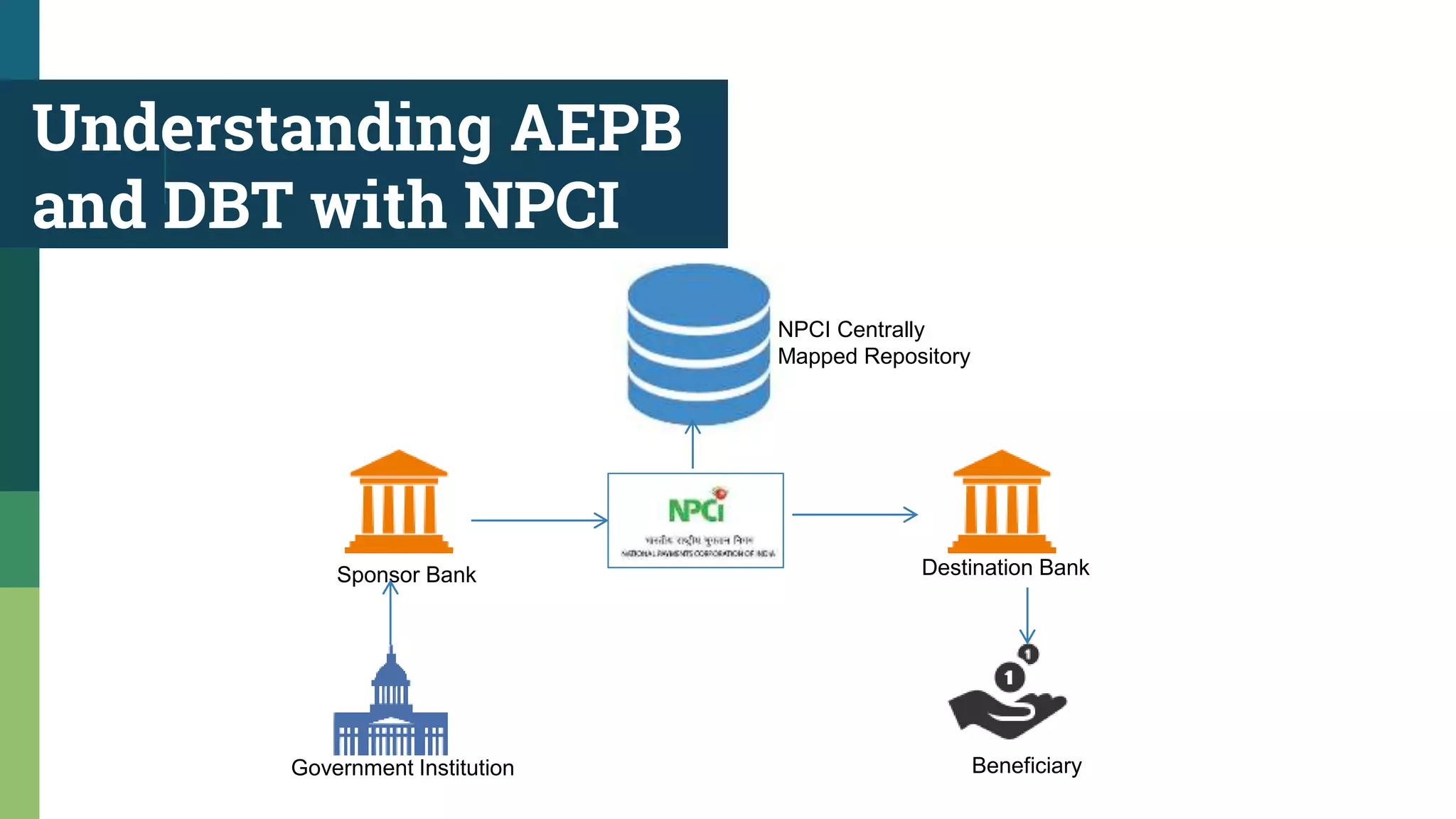
Understanding AEPB
and DBTwith NPCI
Government Institution
Sponsor Bank Destination Bank
Beneficiary
NPCI Centrally
Mapped Repository
8.
NPCI Central
Repository
NPCI’smaintains an association between customer’s Adhaar number, Mobile
number and Bank accounts. This central repository can be used to route payment
instructions based on Adhaar number or mobile number.
9.
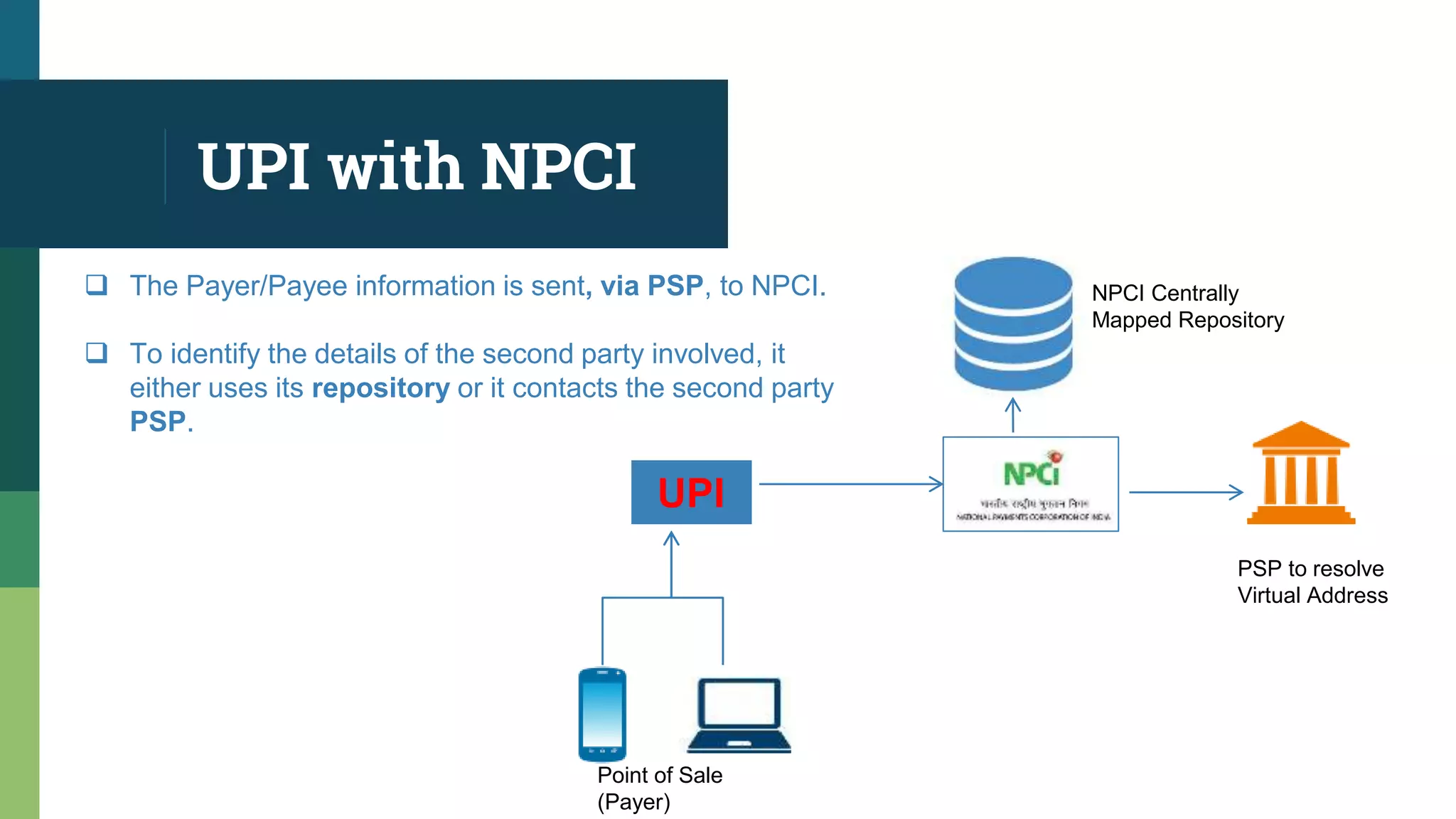
UPI with NPCI
Pointof Sale
(Payer)
NPCI Centrally
Mapped Repository
UPI
The Payer/Payee information is sent, via PSP, to NPCI.
To identify the details of the second party involved, it
either uses its repository or it contacts the second party
PSP.
PSP to resolve
Virtual Address
10.
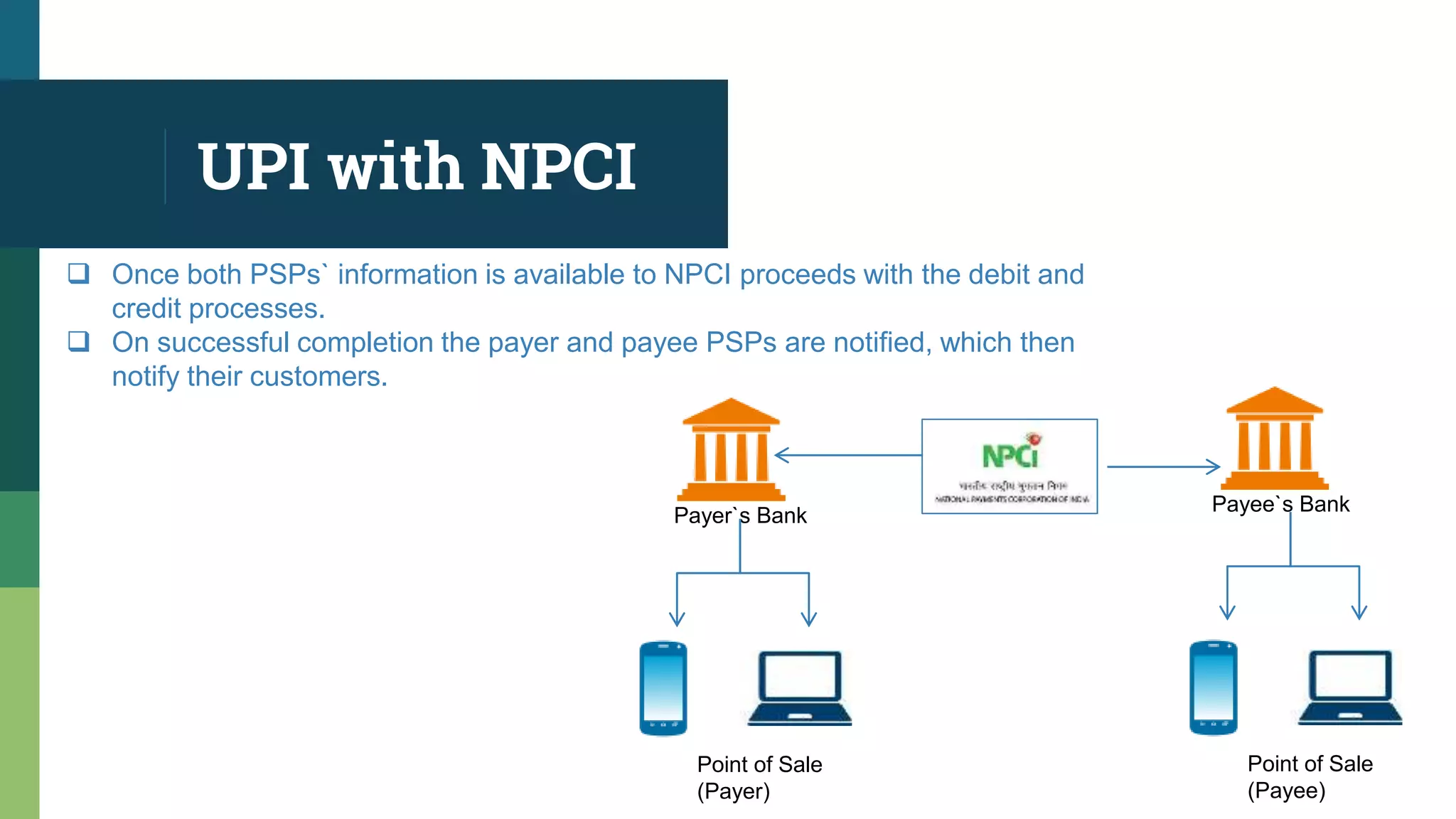
UPI with NPCI
Payer`sBank
Payee`s Bank
Point of Sale
(Payee)
Once both PSPs` information is available to NPCI proceeds with the debit and
credit processes.
On successful completion the payer and payee PSPs are notified, which then
notify their customers.
Point of Sale
(Payer)
Core Elements
in Payment
Other metadata attributes such as location, product code,
mobile number, device details, etc. as required.
Payer and Payee account and institution details for routing transaction.
Authentication credentials (password, PIN, biometrics, CVV, etc. as required for
debit, can be bank provided or 3rd party provided such as UIDAI).
Transaction amount.
Transaction reference.
Timestamp.
Virtual Payment
Address features
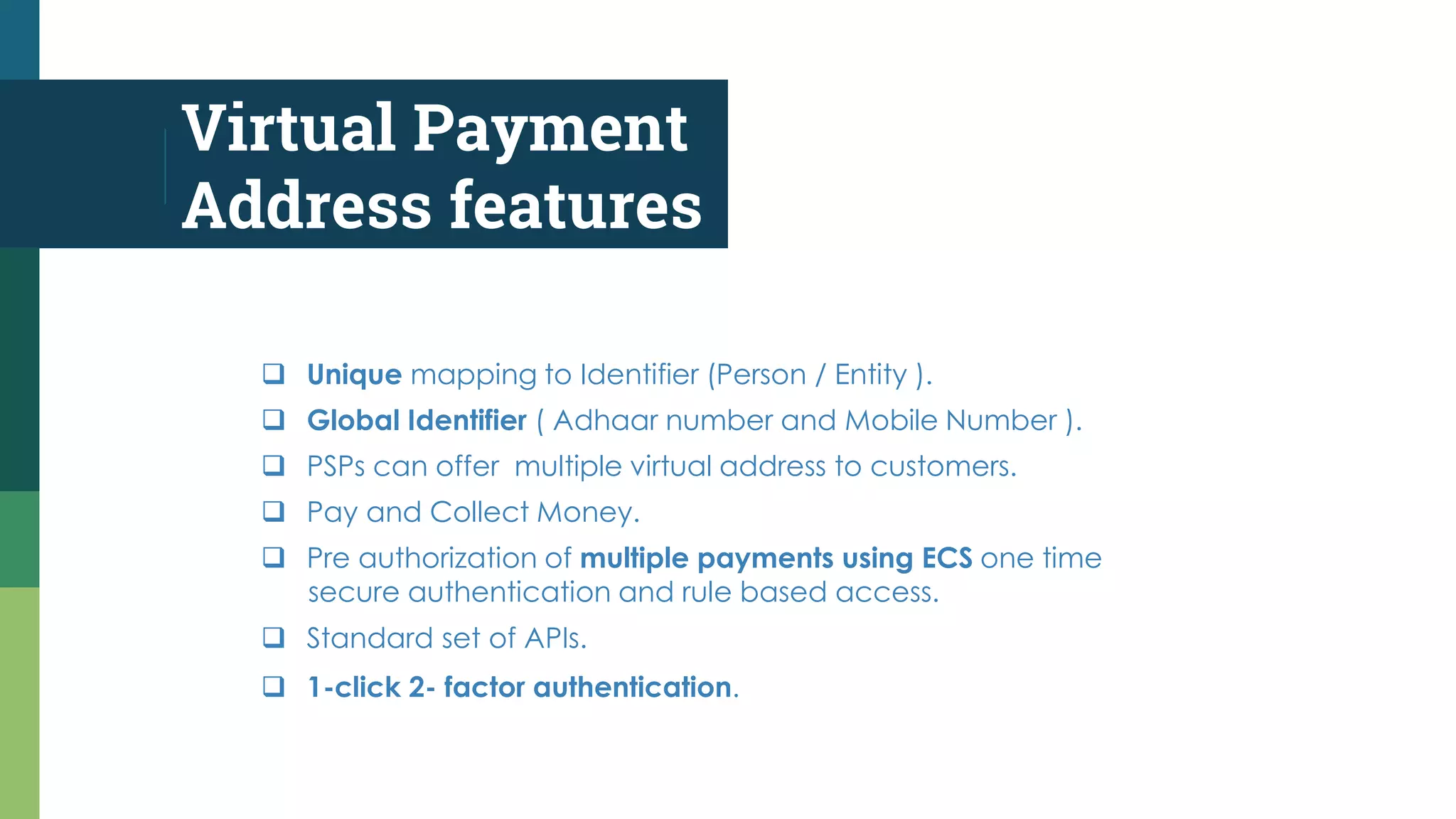
Unique mapping to Identifier (Person / Entity ).
Global Identifier ( Adhaar number and Mobile Number ).
PSPs can offer multiple virtual address to customers.
Pay and Collect Money.
Pre authorization of multiple payments using ECS one time
secure authentication and rule based access.
Standard set of APIs.
1-click 2- factor authentication.
16.
Virtual Address
Archietecture
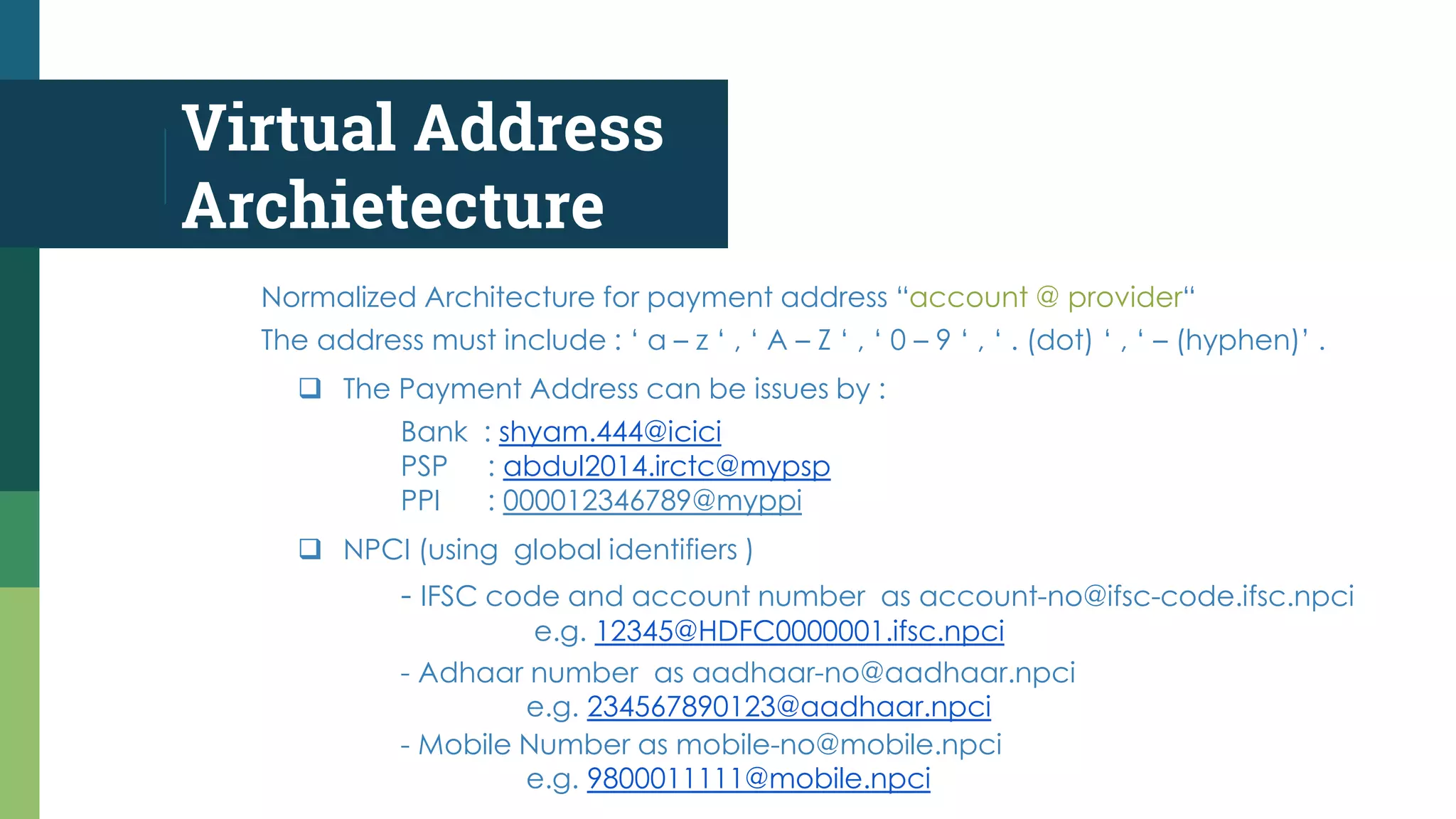
Normalized Architecturefor payment address “account @ provider“
The address must include : ‘ a – z ‘ , ‘ A – Z ‘ , ‘ 0 – 9 ‘ , ‘ . (dot) ‘ , ‘ – (hyphen)’ .
The Payment Address can be issues by :
Bank : shyam.444@icici
PSP : abdul2014.irctc@mypsp
PPI : 000012346789@myppi
NPCI (using global identifiers )
- IFSC code and account number as account-no@ifsc-code.ifsc.npci
e.g. 12345@HDFC0000001.ifsc.npci
- Adhaar number as aadhaar-no@aadhaar.npci
e.g. 234567890123@aadhaar.npci
- Mobile Number as mobile-no@mobile.npci
e.g. 9800011111@mobile.npci
17.
Virtual Address
Archietecture
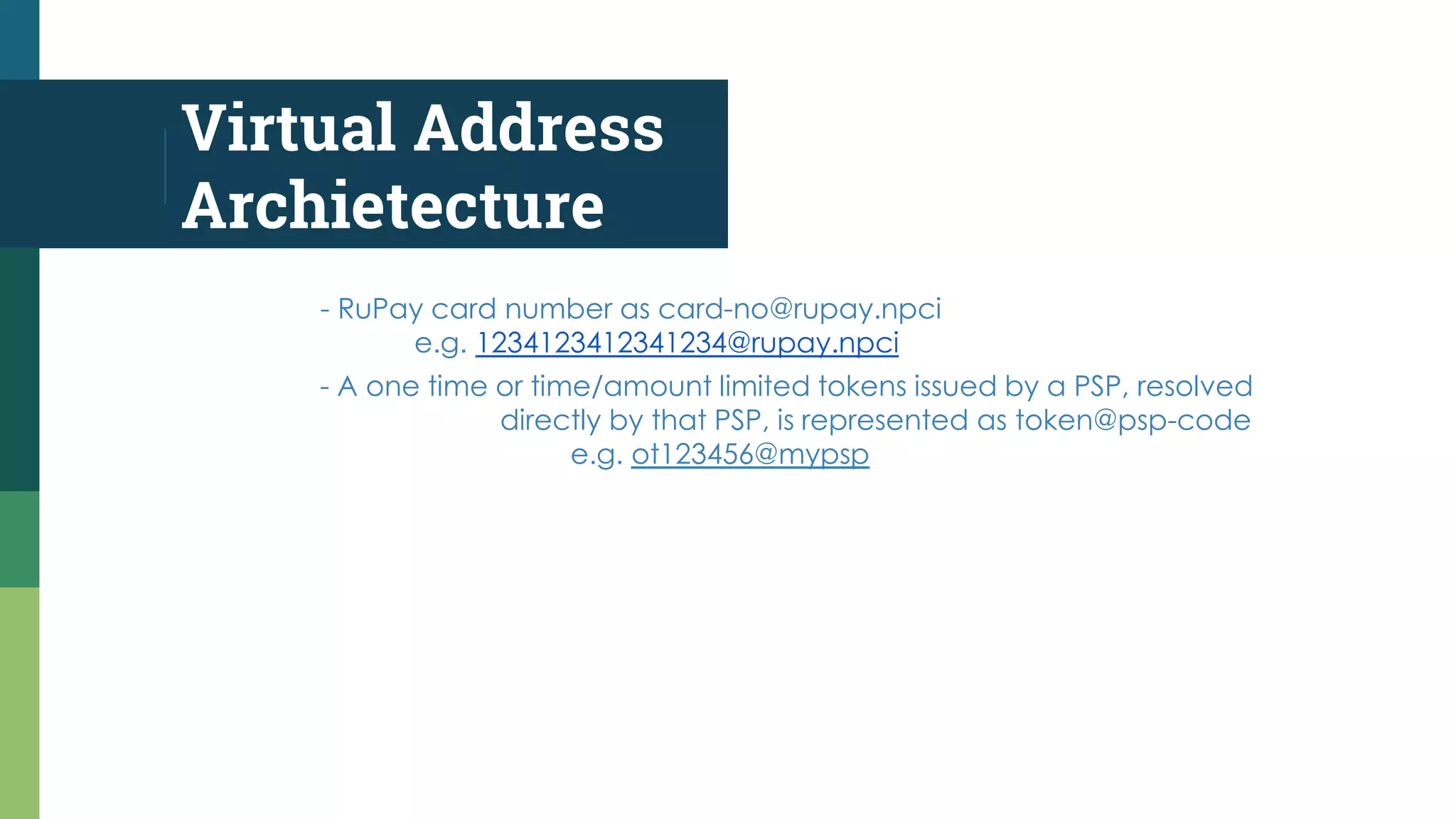
- RuPaycard number as card-no@rupay.npci
e.g. 1234123412341234@rupay.npci
- A one time or time/amount limited tokens issued by a PSP, resolved
directly by that PSP, is represented as token@psp-code
e.g. ot123456@mypsp
18.
Virtual Address
Archietecture
If thevirtual ID is not created using identifiers that NPCI
understands(Adhaar number, mobile number, IFCS code, Rupay card
number etc.) then NPCI requests PSP to decrypt address using Translate
APIs.
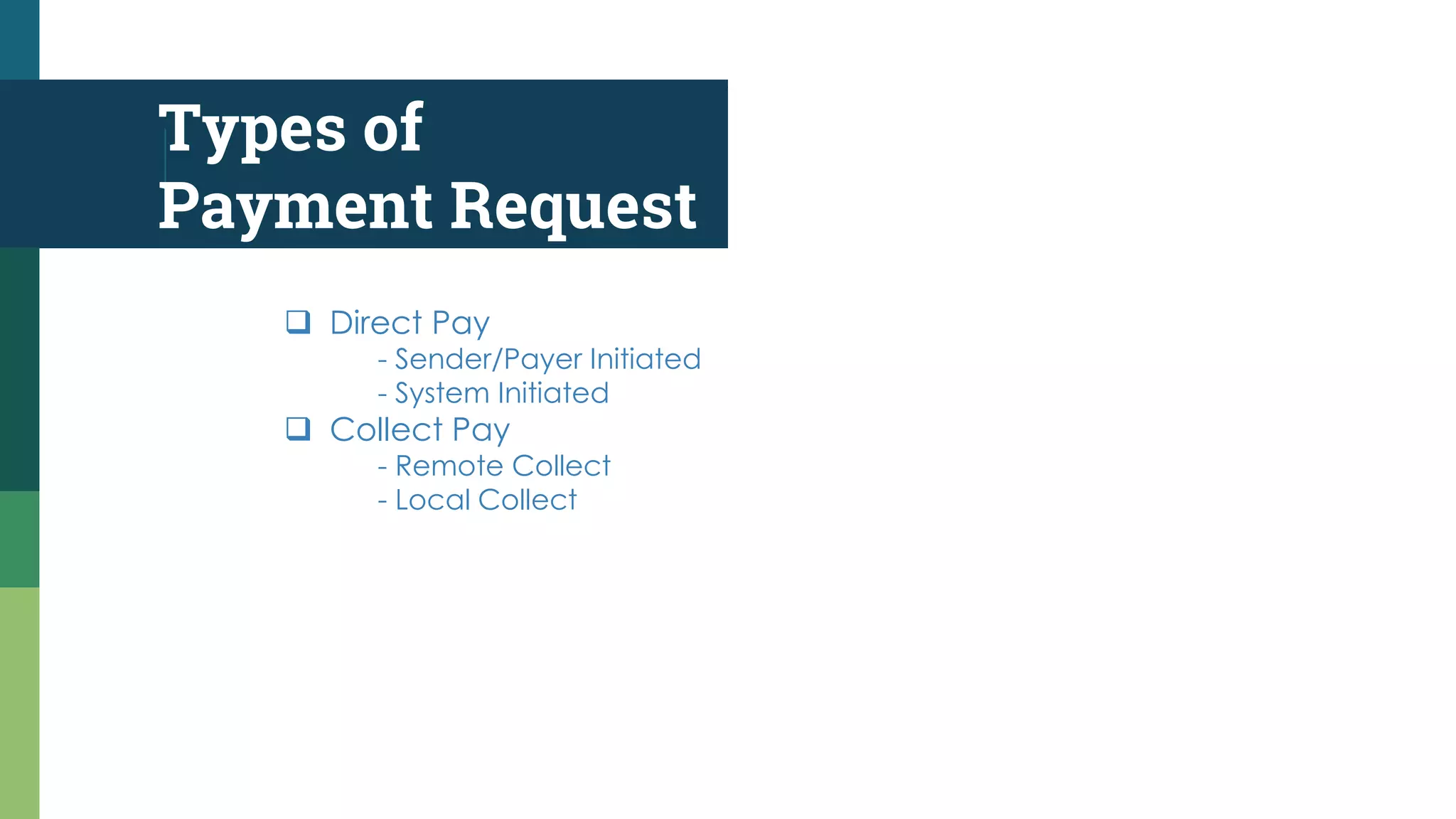
Types of
Payment Request
Direct Pay
- Sender/Payer Initiated
- System Initiated
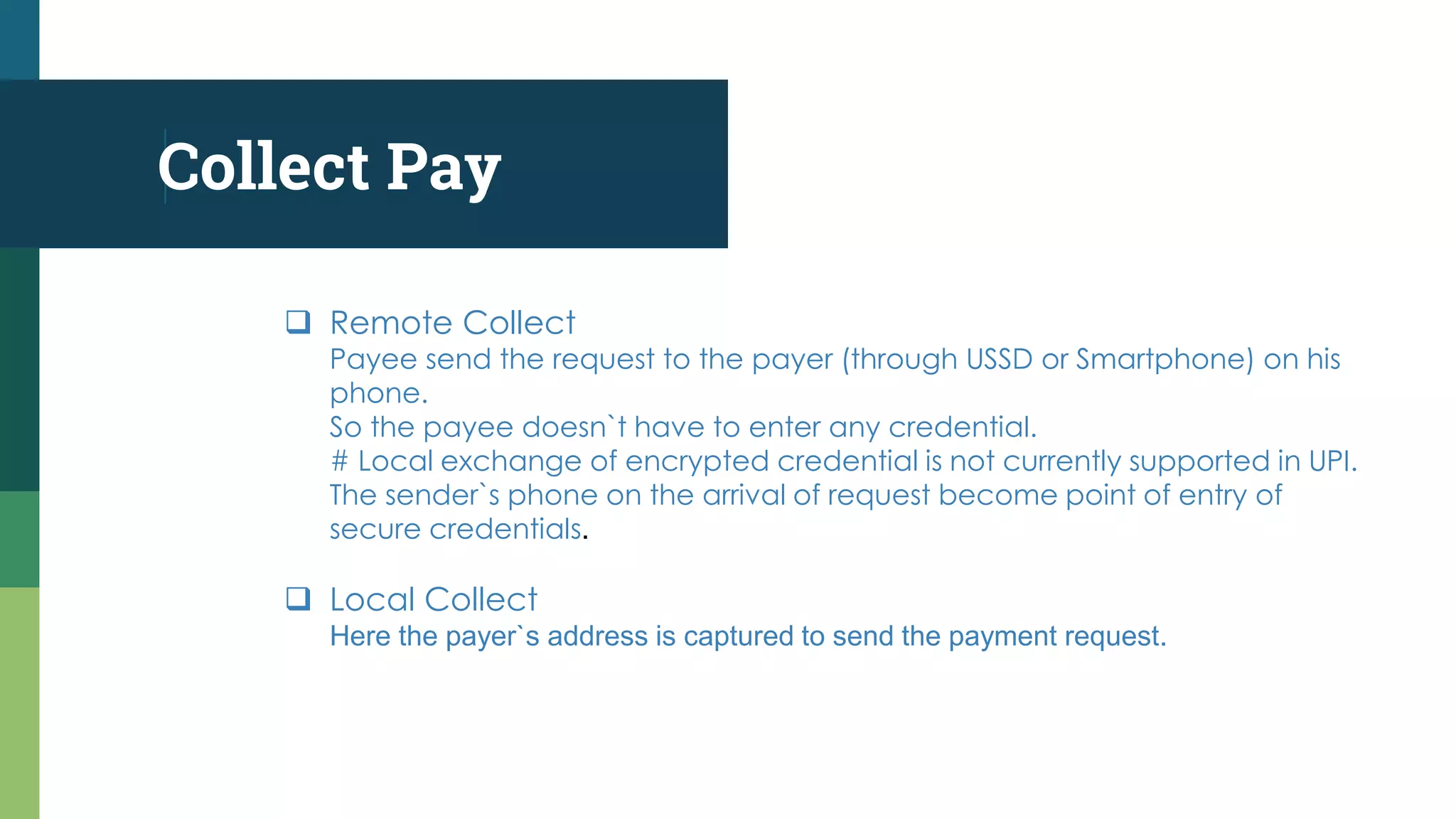
Collect Pay
- Remote Collect
- Local Collect
21.
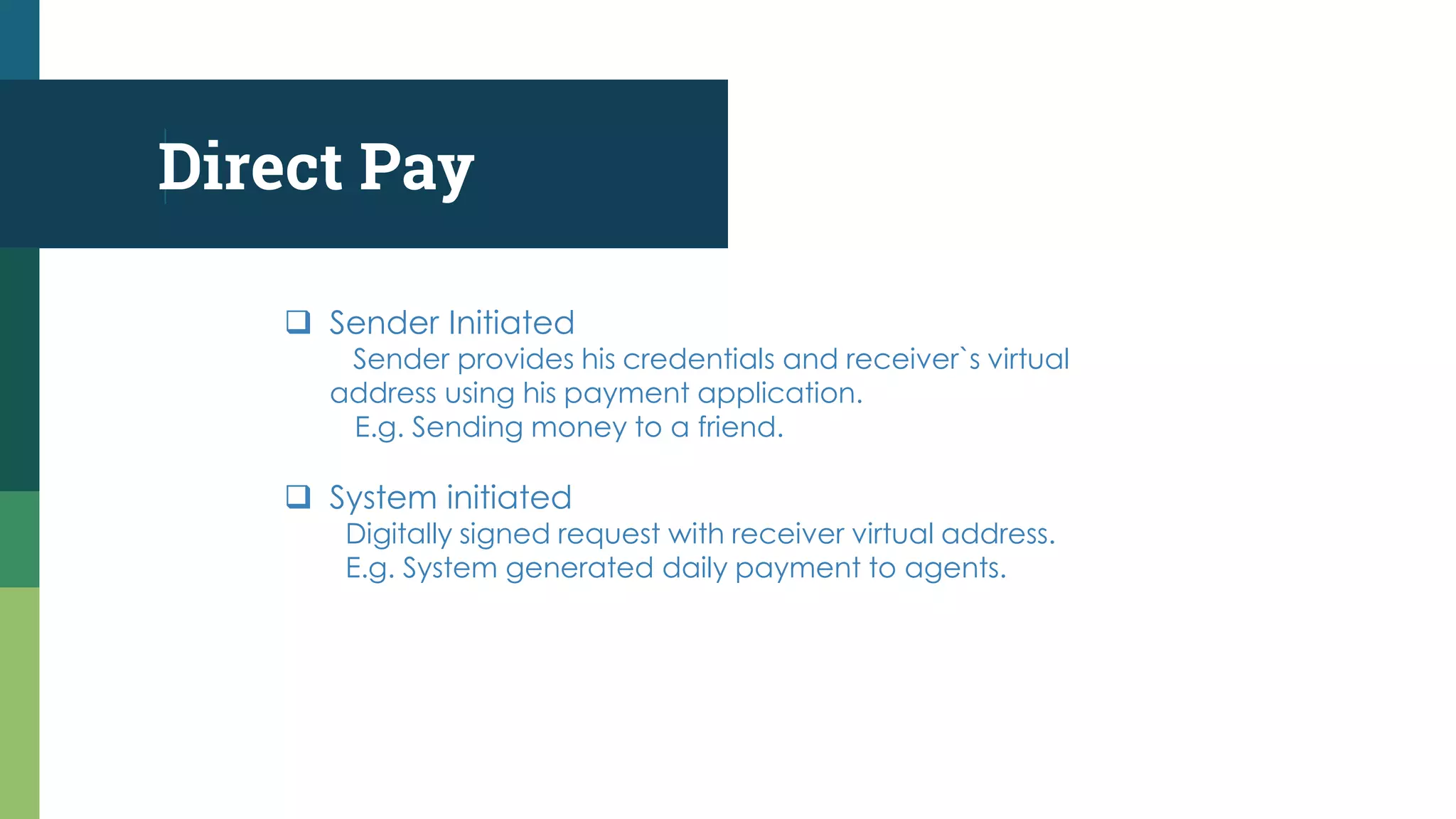
Direct Pay
SenderInitiated
Sender provides his credentials and receiver`s virtual
address using his payment application.
E.g. Sending money to a friend.
System initiated
Digitally signed request with receiver virtual address.
E.g. System generated daily payment to agents.
22.
Direct Pay
SenderInitiated
Sender provides his credentials and receiver`s virtual
address using his payment application.
E.g. Sending money to a friend.
System initiated
Digitally signed request with receiver virtual address.
E.g. System generated daily payment to agents.
Direct Pay Transaction Flow
23.
Collect Pay
RemoteCollect
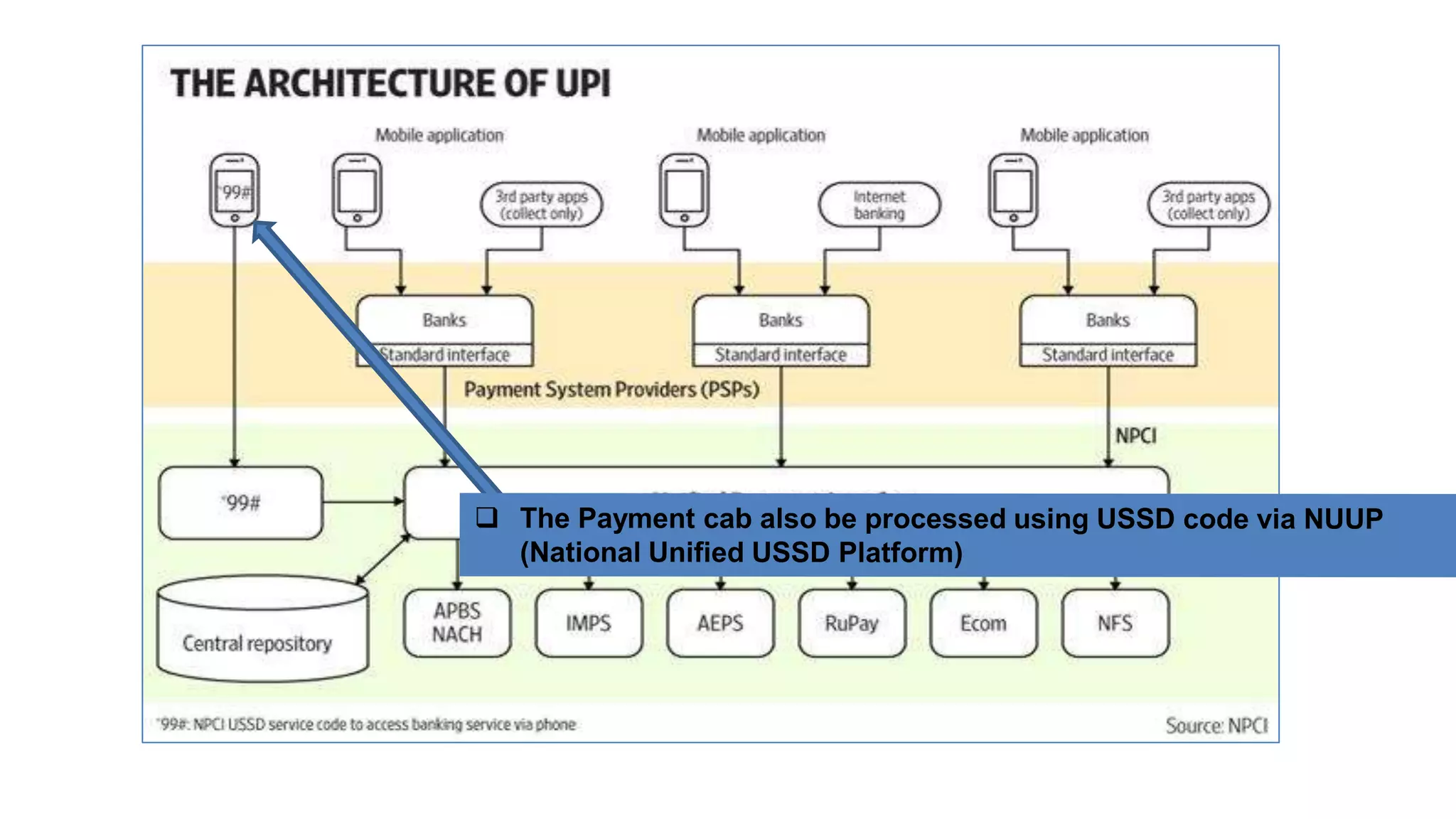
Payee send the request to the payer (through USSD or Smartphone) on his
phone.
So the payee doesn`t have to enter any credential.
# Local exchange of encrypted credential is not currently supported in UPI.
The sender`s phone on the arrival of request become point of entry of
secure credentials.
Local Collect
Here the payer`s address is captured to send the payment request.
Important
features of API
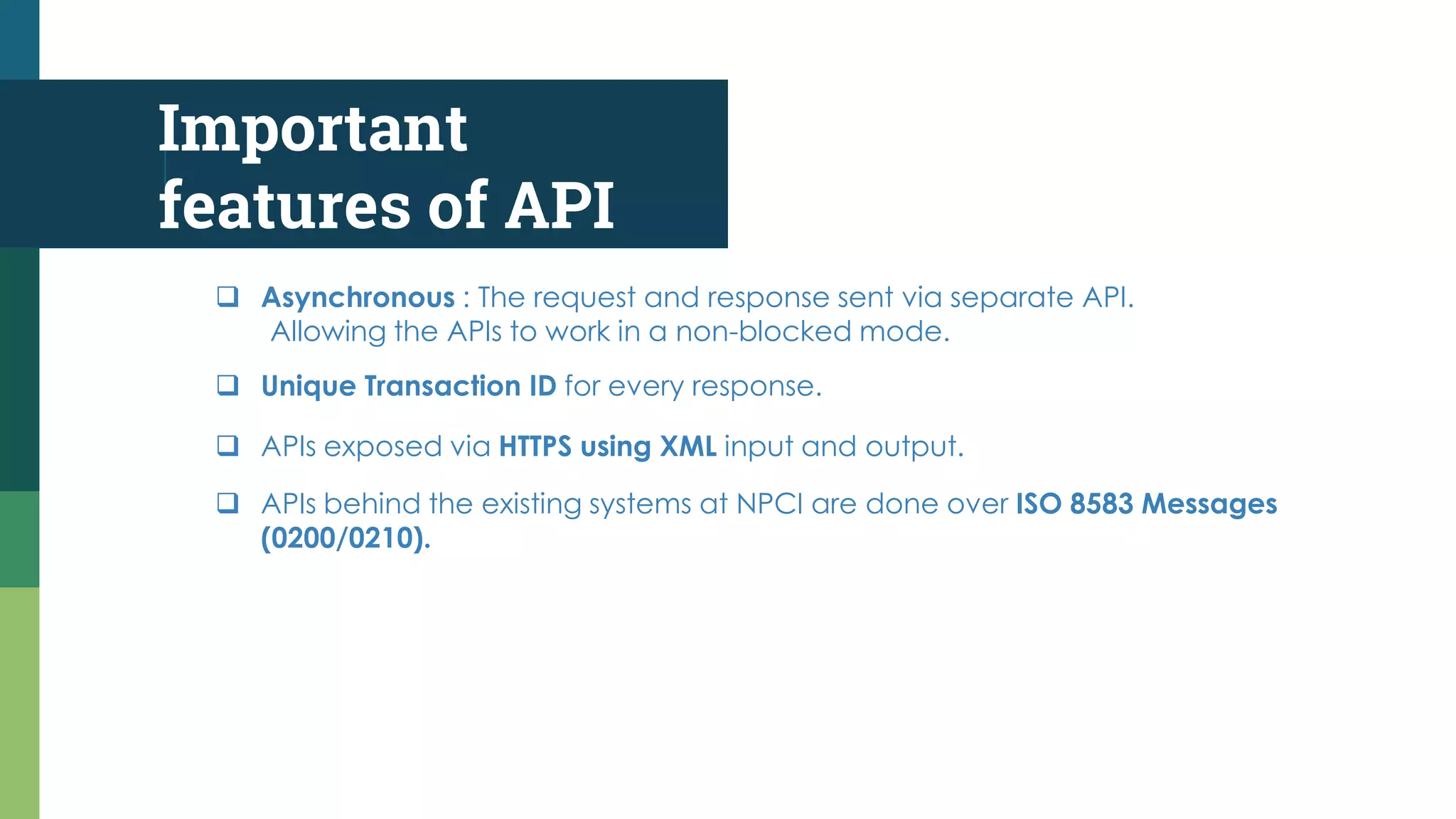
APIs behind the existing systems at NPCI are done over ISO 8583 Messages
(0200/0210).
Asynchronous : The request and response sent via separate API.
Allowing the APIs to work in a non-blocked mode.
Unique Transaction ID for every response.
APIs exposed via HTTPS using XML input and output.
27.
Important
features of API
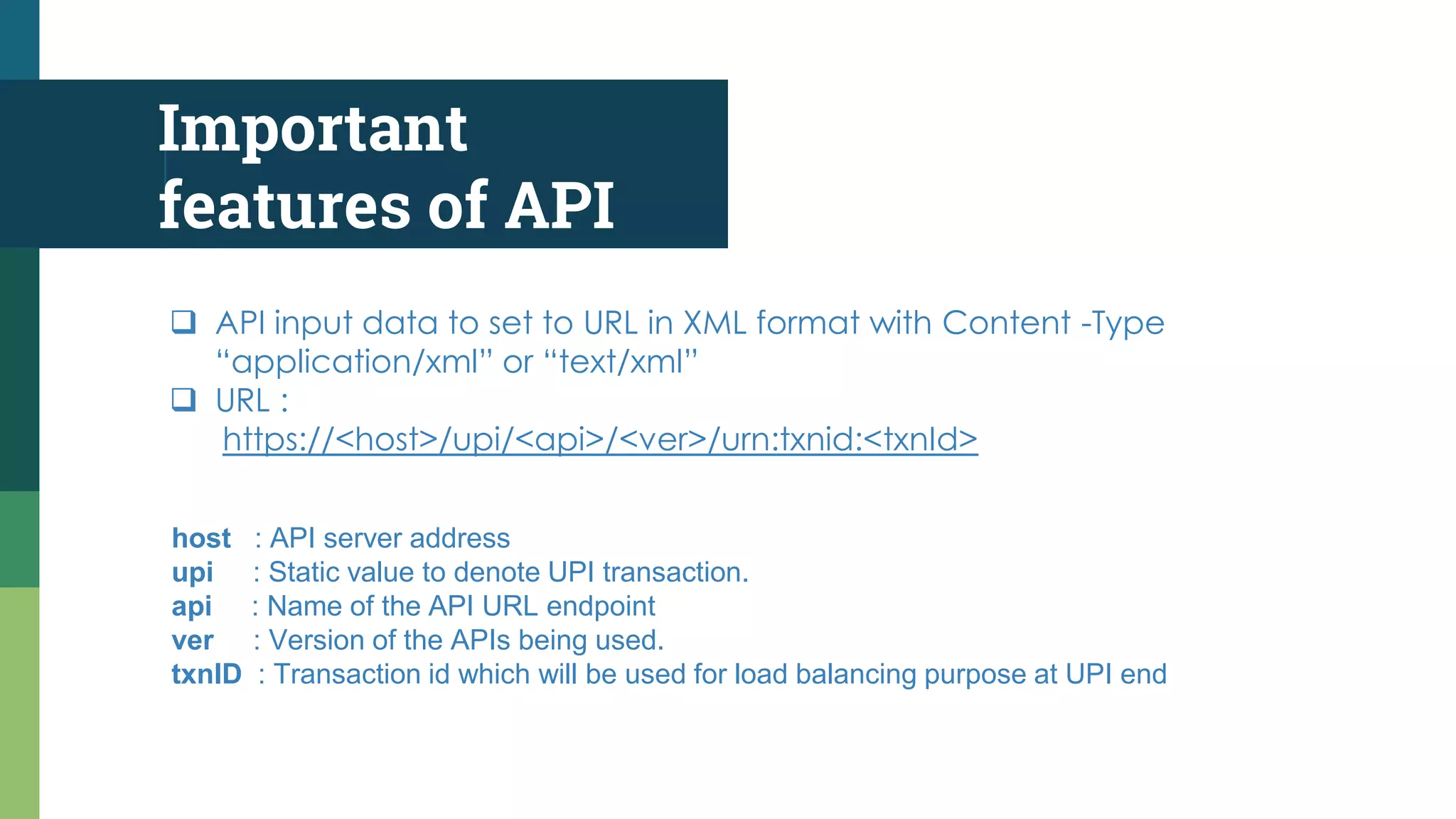
API input data to set to URL in XML format with Content -Type
“application/xml” or “text/xml”
URL :
https://<host>/upi/<api>/<ver>/urn:txnid:<txnId>
host : API server address
upi : Static value to denote UPI transaction.
api : Name of the API URL endpoint
ver : Version of the APIs being used.
txnID : Transaction id which will be used for load balancing purpose at UPI end
28.
Acknowledgement
API
All APIshave same ack response as given below:
<upi:Ack xmlns:upi="" api="" reqMsgId="" err="" ts=""/>
Ack : root element name of the acknowledgement message.
api : name of the API for which acknowledgement is given out.
reqMsgId : message ID of the input for which the acknowledgement is given out.
err : this denotes any error in receiving the original request message.
ts : the timestamp at which the receiver sends the acknowledgement.
API : ReqPay
Single API will be used for both Direct Pay and Collect Pay.
In Direct Pay, Sender will provide his/her complete credentials and only
the virtual address of the Receiver.
In Collect Pay, the Receiver will provider his complete credentials and
only the virtual address of the Sender.
31.
API : RespPay
To send back the response of the ReqPay API after the transaction.
32.
API : ReqAuthDetails
Used to authorize payment and also translate the PSP`s virtual address
to global identifiers like Mobile Number, Adhaar Number , Account +
ID)
33.
API : RespAuthDetails
This API is used by PSPs to authorize payment and send the required
details to NPCI
34.
API : ListPSP
This API allows the PSPs to request for all the registered PSPs with NPCI.
This data is used for validating the PSP during the process of
transaction.
35.
API : ListAccount
Providers
This API allows the PSPs to request for all the registered PSPs with NPCI.
This data is used for validating the PSP during the process of
transaction.
36.
API : ListKeys
This API allows the PSPs to request for and cache the list of public keys
of account providers and other entities in the UPI eco system
37.
API : ListAccount
API allows PSPs to find the list of accounts linked to the
mobile by an account provider.
38.
API : ListVerified
Address Entries
API allows PSPs to request a and cache the List of Verified Address
Entries to protect customers from attempts to spoof well known
merchants such as LIC, Indian Railways, ecommerce players, telecom
players, bill payment entities, etc.
39.
API : ValidateAddress
This API will be used by the PSPs when their customer wants
to add a beneficiary within PSP application (for sending & collecting
money).
40.
API : SetCredentials
This API is required for providing a unified channel for setting and
changing MPIN across various account providers.
41.
API : CheckTxn
Status
This API allows the PSPs to request for the status of the transaction. The
PSPs must request for status only after the specified timeout period.
42.
API : OTP-Request
This API allows the PSPs to request for an OTP for a particular customer
from an issuer.
API : HeartBeat
Messages
This API is a mechanism for UPI system monitoring.(monitoring
connection with PSPs and sending EOD to PSPs)
45.
API : RequestPending
Messages
This API allows PSP to request pending messages against a given
mobile number or Adhaar number
46.
API : RequestTxn
Confirmation
This API provides transaction status confirmation from UPI to PSP. At the
end of every transaction, this API will be initiated to second PSP for
status confirmation
47.
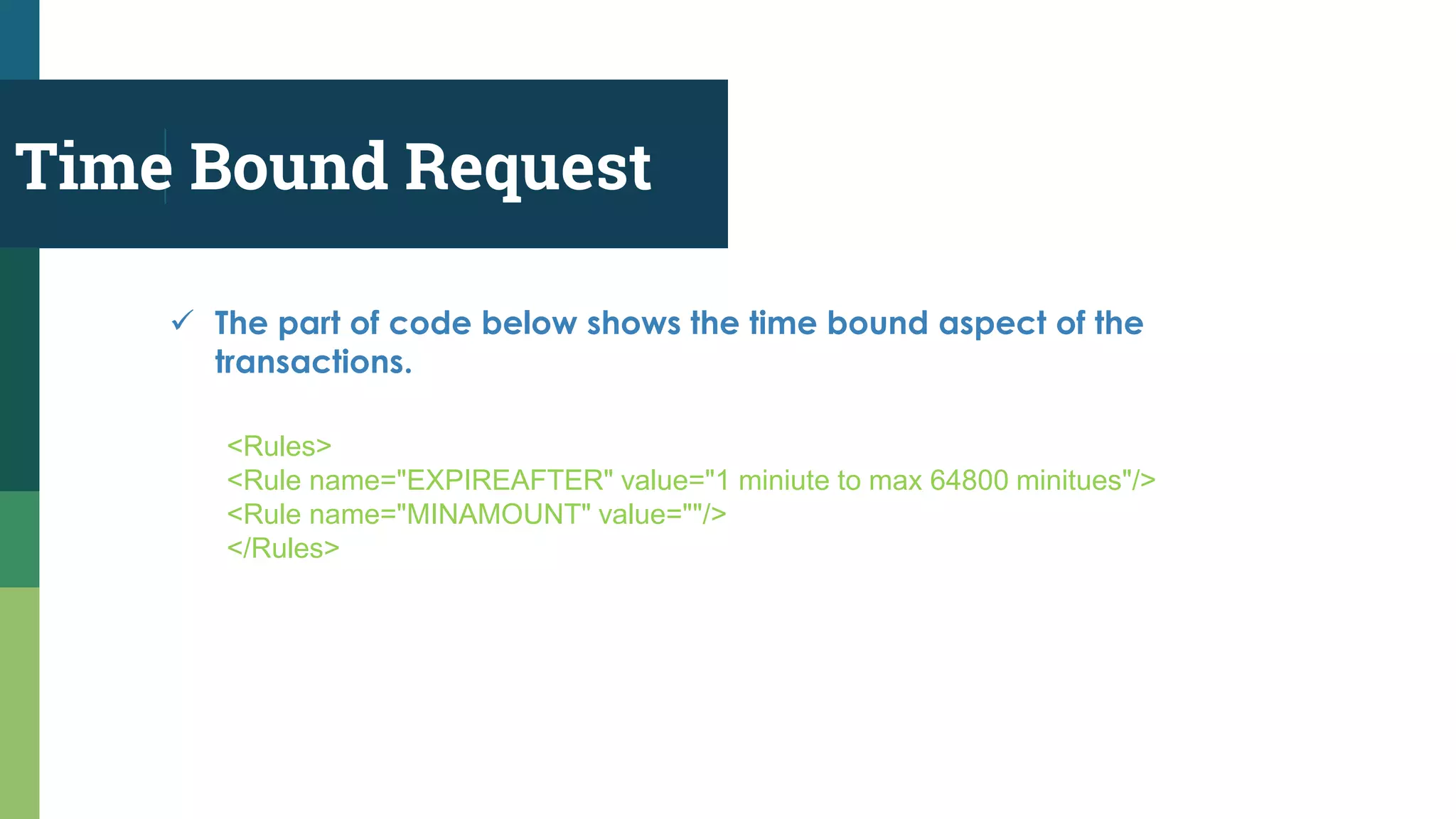
Time Bound Request
<Rules>
<Rulename="EXPIREAFTER" value="1 miniute to max 64800 minitues"/>
<Rule name="MINAMOUNT" value=""/>
</Rules>
The part of code below shows the time bound aspect of the
transactions.
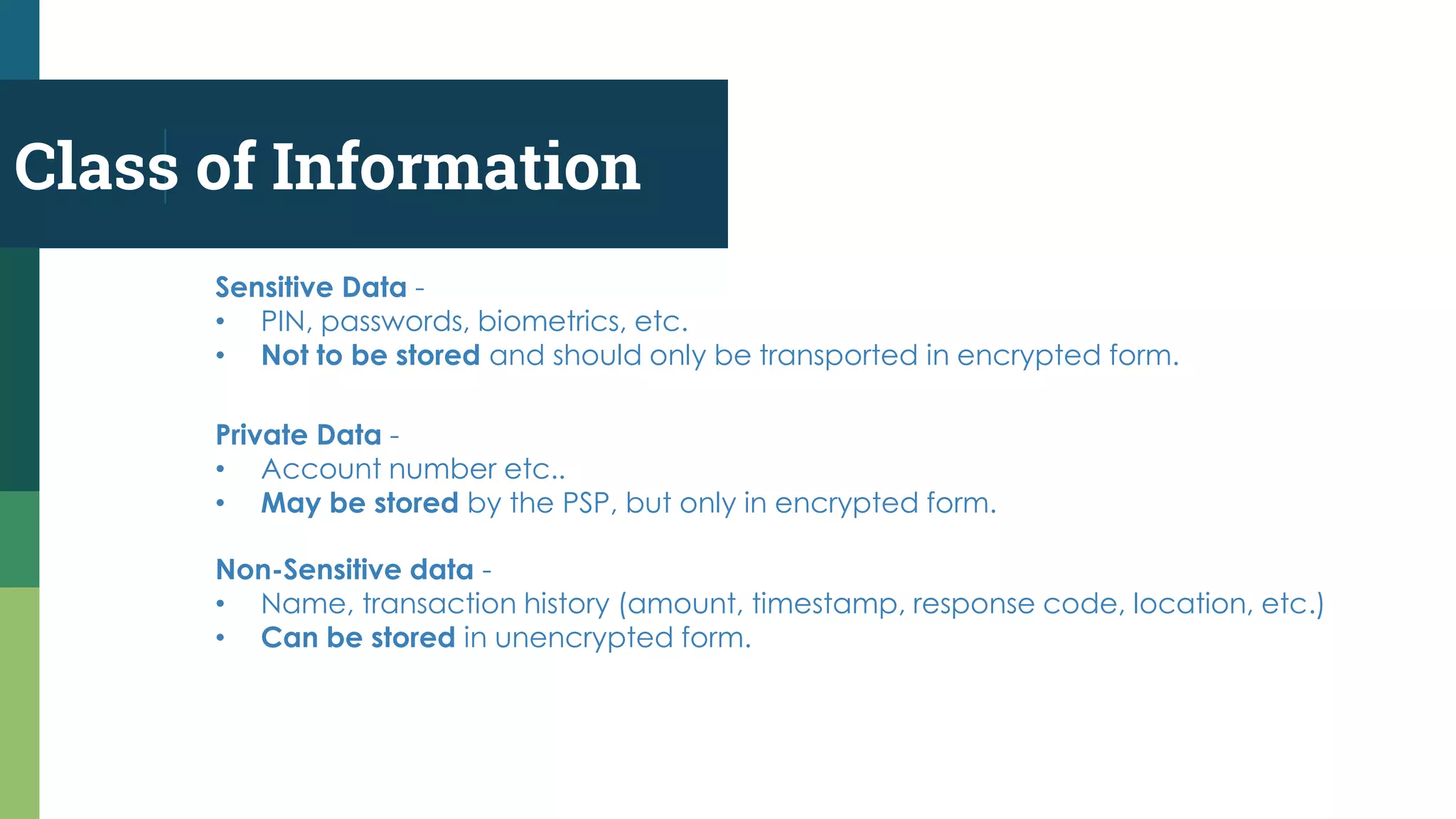
Class of Information
Non-Sensitivedata -
• Name, transaction history (amount, timestamp, response code, location, etc.)
• Can be stored in unencrypted form.
Sensitive Data -
• PIN, passwords, biometrics, etc.
• Not to be stored and should only be transported in encrypted form.
Private Data -
• Account number etc..
• May be stored by the PSP, but only in encrypted form.
50.
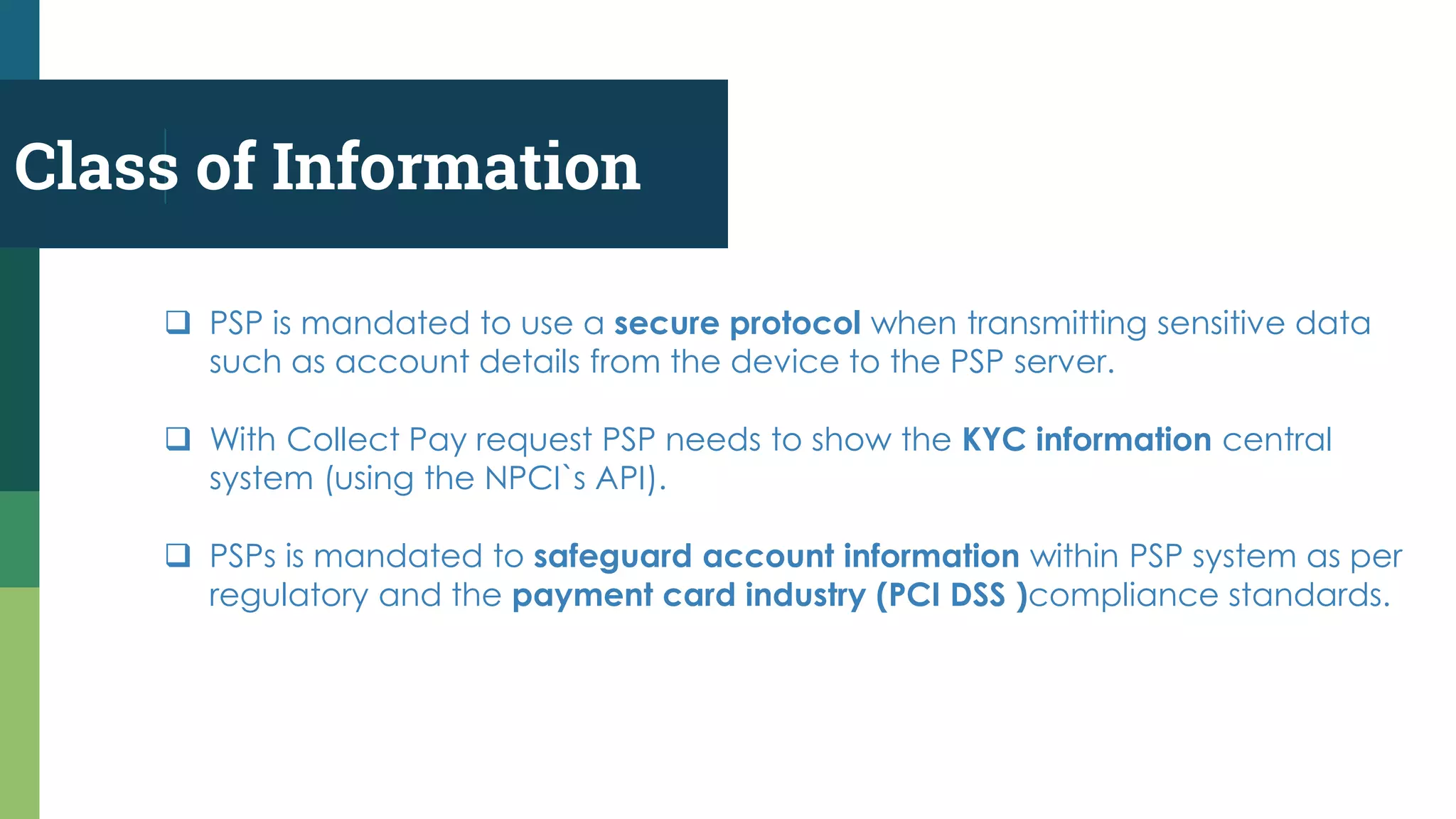
Class of Information
PSP is mandated to use a secure protocol when transmitting sensitive data
such as account details from the device to the PSP server.
With Collect Pay request PSP needs to show the KYC information central
system (using the NPCI`s API).
PSPs is mandated to safeguard account information within PSP system as per
regulatory and the payment card industry (PCI DSS )compliance standards.
51.
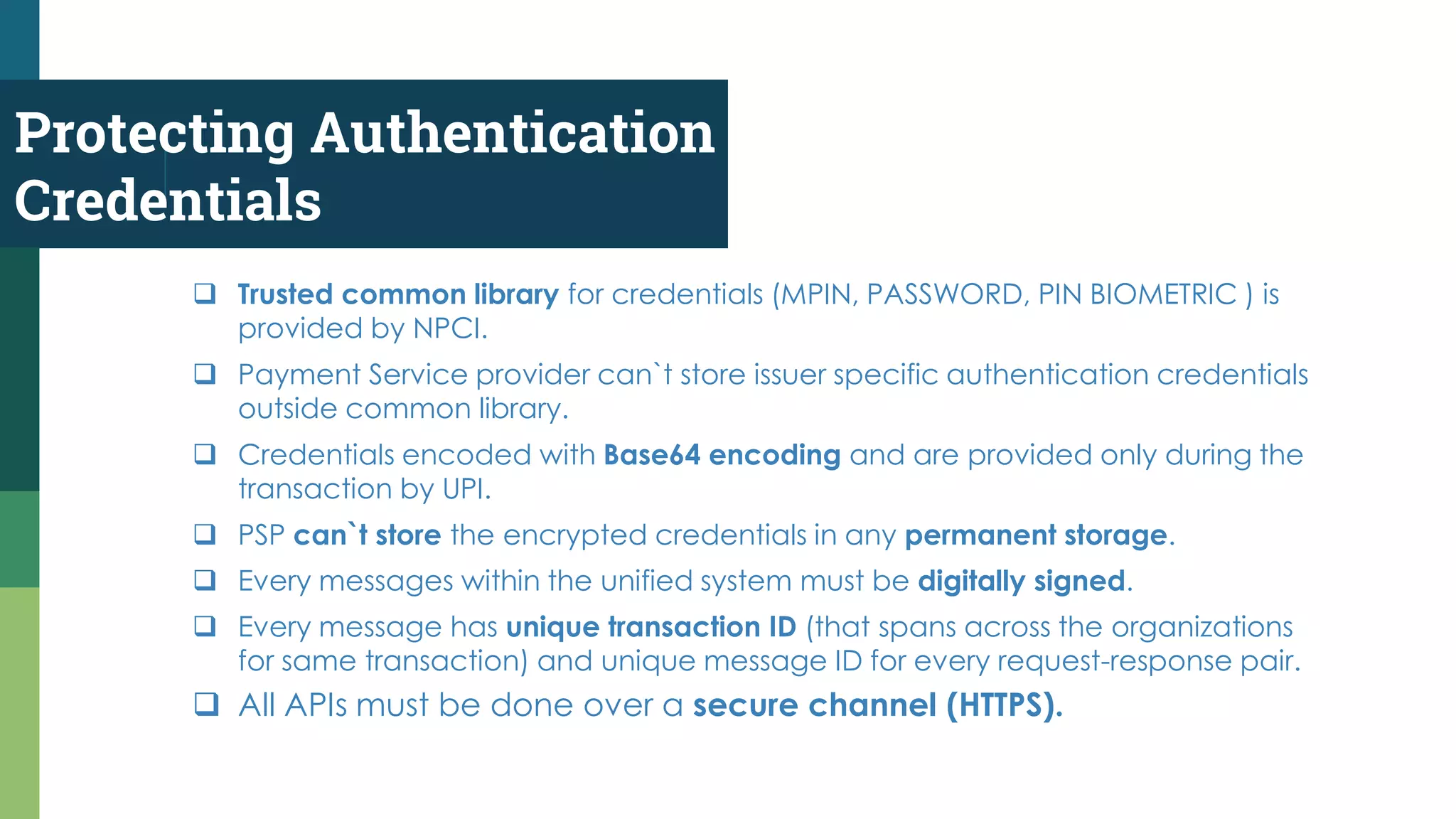
Protecting Authentication
Credentials
AllAPIs must be done over a secure channel (HTTPS).
Trusted common library for credentials (MPIN, PASSWORD, PIN BIOMETRIC ) is
provided by NPCI.
Payment Service provider can`t store issuer specific authentication credentials
outside common library.
Credentials encoded with Base64 encoding and are provided only during the
transaction by UPI.
PSP can`t store the encrypted credentials in any permanent storage.
Every messages within the unified system must be digitally signed.
Every message has unique transaction ID (that spans across the organizations
for same transaction) and unique message ID for every request-response pair.