Submitted By : Submitted To:
Raushan Kumar Dr. Brahmjot Bagga
Topic : Unified Payments Interface (UPI)
CONTENT
• Introduction
• Who Is Behind UPI
• How UPI Works With NPCI
• Core elements in payment
• Architecture of UPI
• Virtual Payment Address
• Types of Payment request
• Advantages
• Application
• Conclusion
WHAT IS UPI?
 It is payment system launched by NPCI.
 Facilitates fund transfer between two bank account.
 Support Peer to Peer connection.
 Advance version if IMPS.
 Support Seamless fund routing and merchant payments.
 Open source , easily adaptable , simple, cheap , mobile based, innovative.
WHO IS BEHIND UPI?
 NPCI(National Payments Corporation Of India).
 Umbrella organization for all retail payments system.
 Set up by RBI and IBA in April 2009.
 It launched the IMPS.
 It launched the RuPay card.
 Currently , launched UPI.
HOW UPI WORK WITH NPCI?
 A NPCI repository is used.
 Repository stores credentials about payer and payee.
 Route payments introductions (Adhaar no. or Mobile no.)
 Do switching, clearing and settlement of transactions.
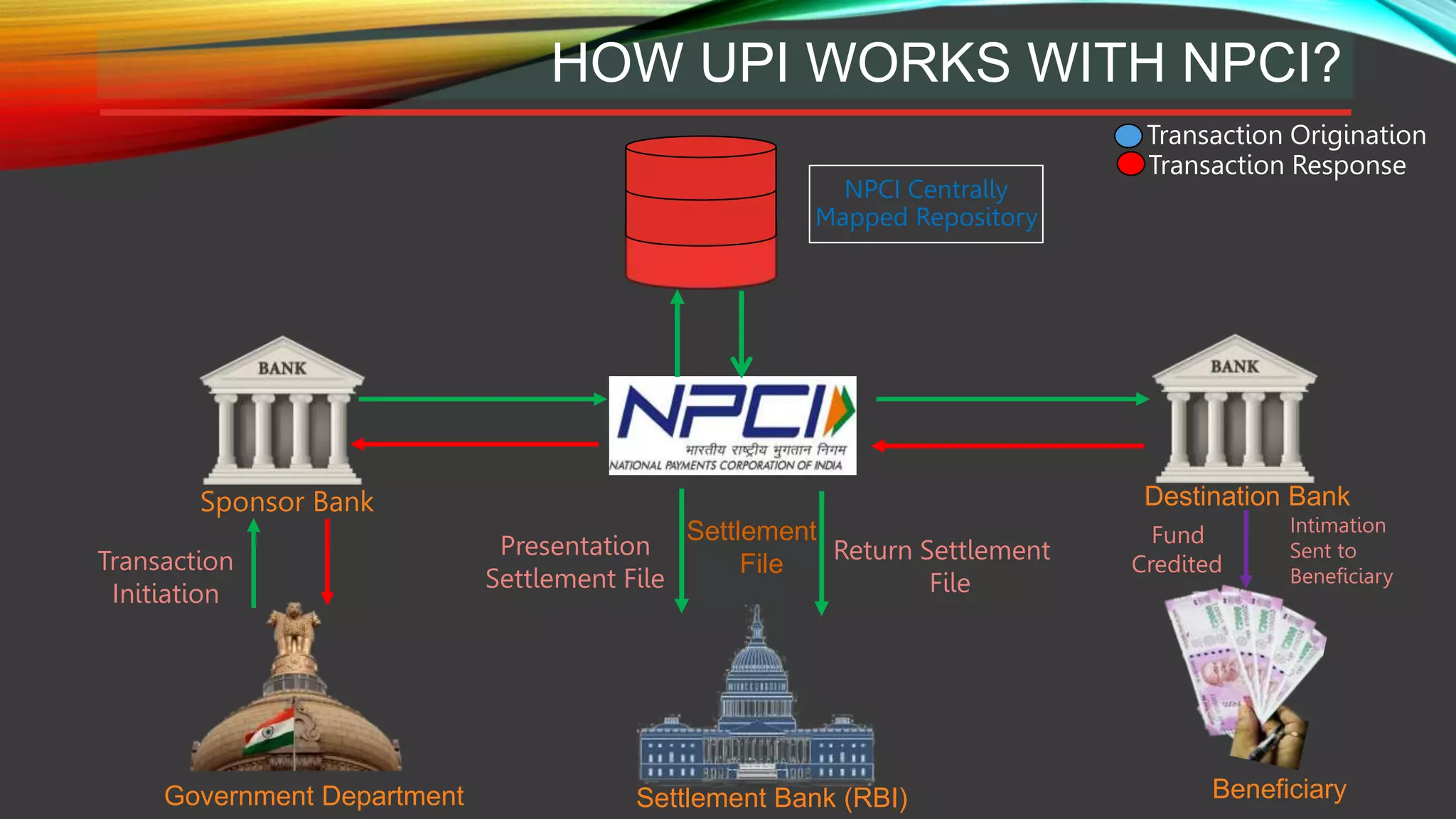
HOW UPI WORKS WITH NPCI?
NPCI Centrally
Mapped Repository
Sponsor Bank Destination Bank
Government Department Beneficiary
Settlement Bank (RBI)
Settlement
File
Presentation
Settlement File
Return Settlement
File
Transaction
Initiation
Fund
Credited
Intimation
Sent to
Beneficiary
Transaction Origination
Transaction Response
HOW UPI WORKS WITH NPCI?
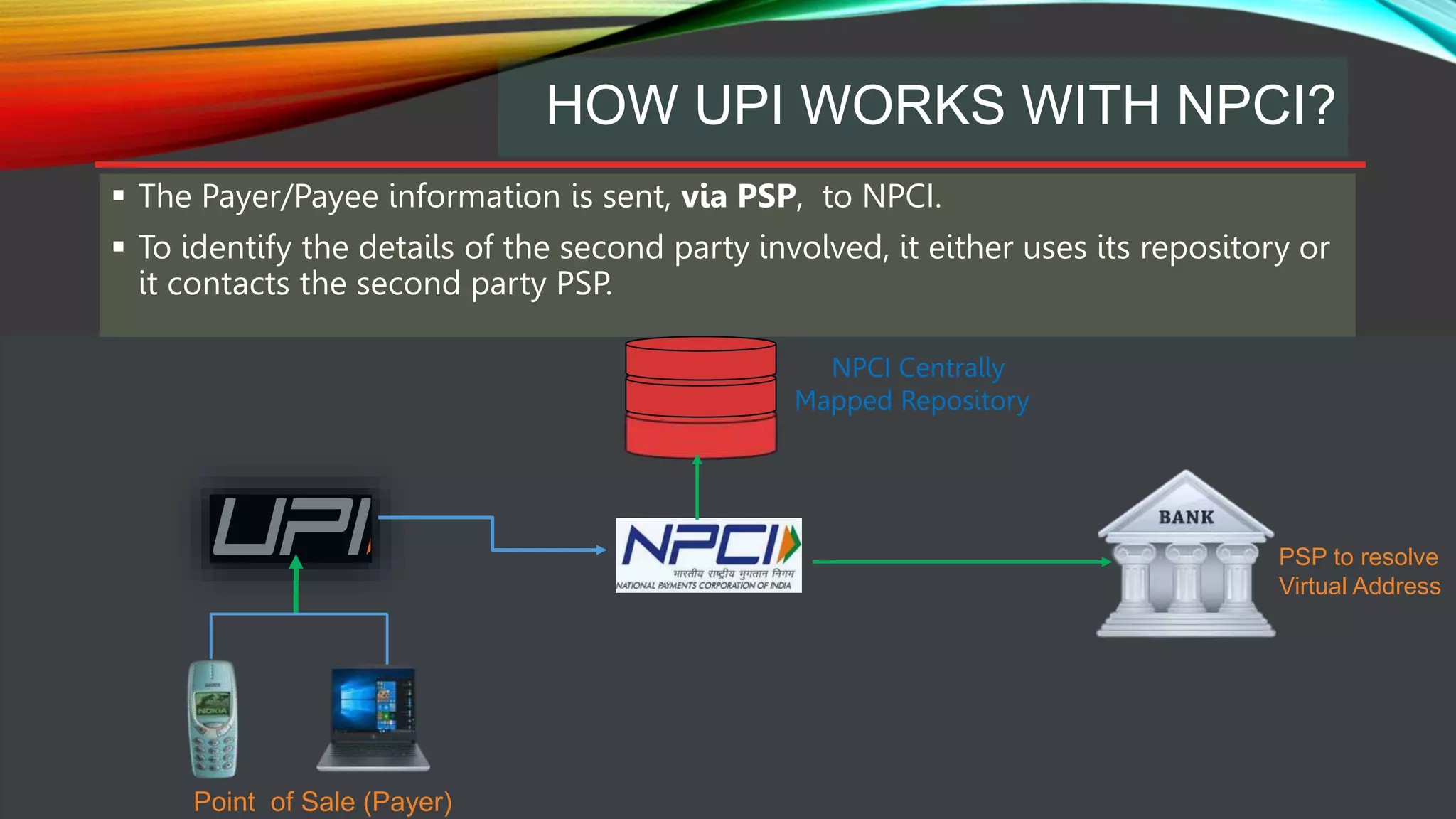
 The Payer/Payee information is sent, via PSP, to NPCI.
 To identify the details of the second party involved, it either uses its repository or
it contacts the second party PSP.
NPCI Centrally
Mapped Repository
PSP to resolve
Virtual Address
Point of Sale (Payer)
HOW UPI WORKS WITH NPCI?
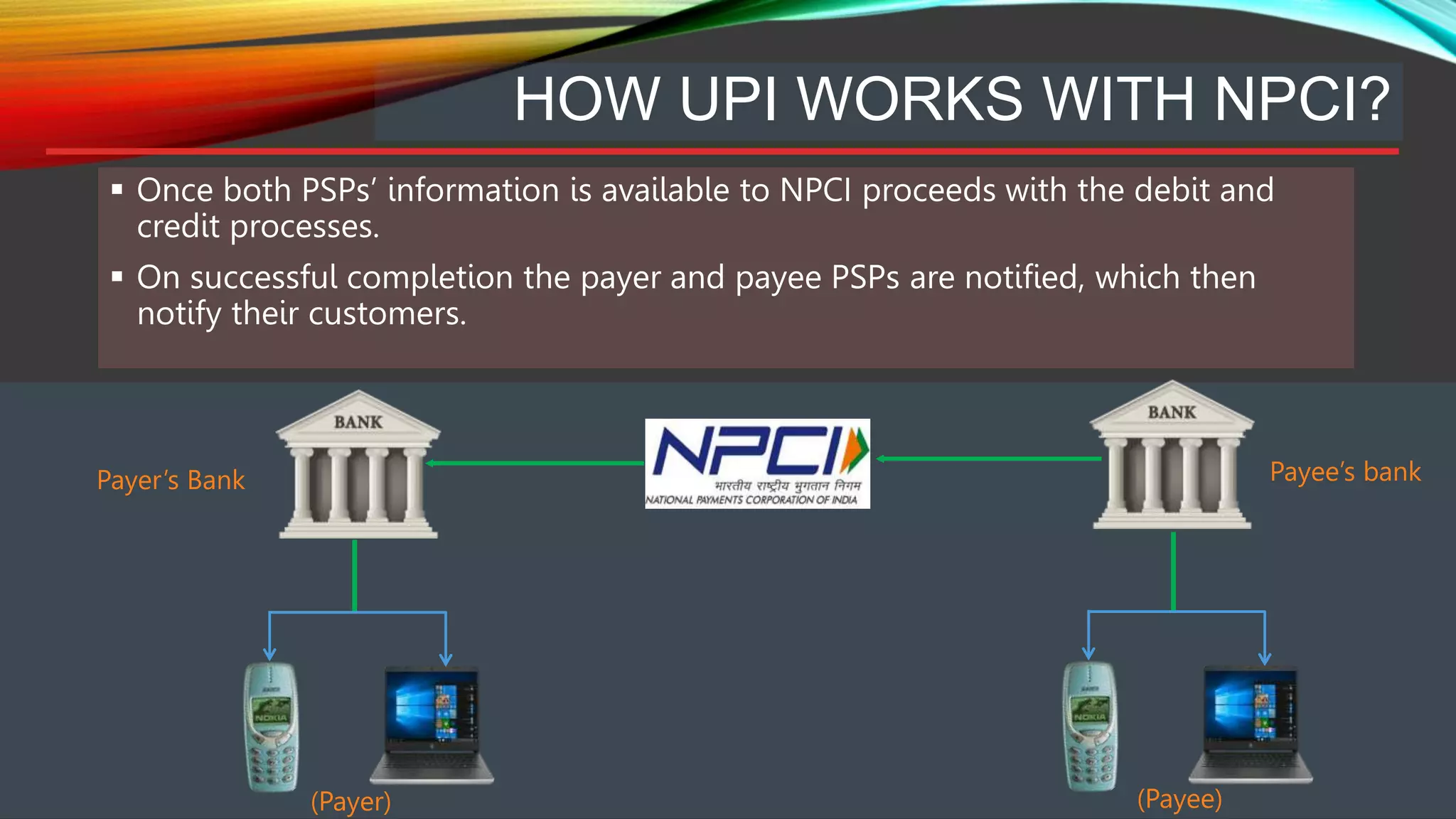
 Once both PSPs’ information is available to NPCI proceeds with the debit and
credit processes.
 On successful completion the payer and payee PSPs are notified, which then
notify their customers.
Payer’s Bank Payee’s bank
(Payer) (Payee)
CORE ELEMENTS IN PAYMENT
 Payer and Payee account and institution details for routing transaction.
 Authentication credentials (password, PIN, biometrics, CVV, etc. as required for
debit, can be bank provided or 3rd party provide such as UIDAI.
 Transaction amount.
 Timestamp.
 Other metadata attributes such as location, product code, mobile number, device
details, etc. as required.
*99#
3rd Party apps
(collect only)
Banks
Standard interface
Internet
Banking
Banks
Standard interface
3rd Party apps
(collect only)
Banks
Standard interface
Unified Payment Interface
Mobile Application Mobile Application Mobile Application
NPCI
*99#
Central repository
A P B S
N A C H
I M P S A E P S R u P a y E c o m N F S
*99#: NPCI USSD service code to access banking service via phone
Payment System Providers (PSPs)
THE ARCHITECTURE OF UPI
*99#
VIRTUAL PAYMENT ADDRESS
 Has unique mapping to Identifier (Person / Entity).
 Contain Global Identifier (Adhaar number and mobile Number).
 1-click 2-factor authentication.
 Pay and Collect Money.
 PSPs can offer multiple virtual address to customers.
 Rule based access.
VIRTUAL PAYMENT ADDRESS
 Normalized Architecture for payment address "account @ provider”.
 The address must include : ` a-z ` , ` A-Z ` , ` 0-9 ` , ` . (dot)` , `- (hyphen)’.
 The Payment Address can be issues by : Bank
:amit.8868@icici , PSP : rahul2017.irctc@mypsp
 NPCI (using global identifiers )
-IFSC code and account number as account-no@ifsc-code.ifsc.npci
e.g.12345@HDFC0000001.ifsc.npci
VIRTUAL PAYMENT ADDRESS
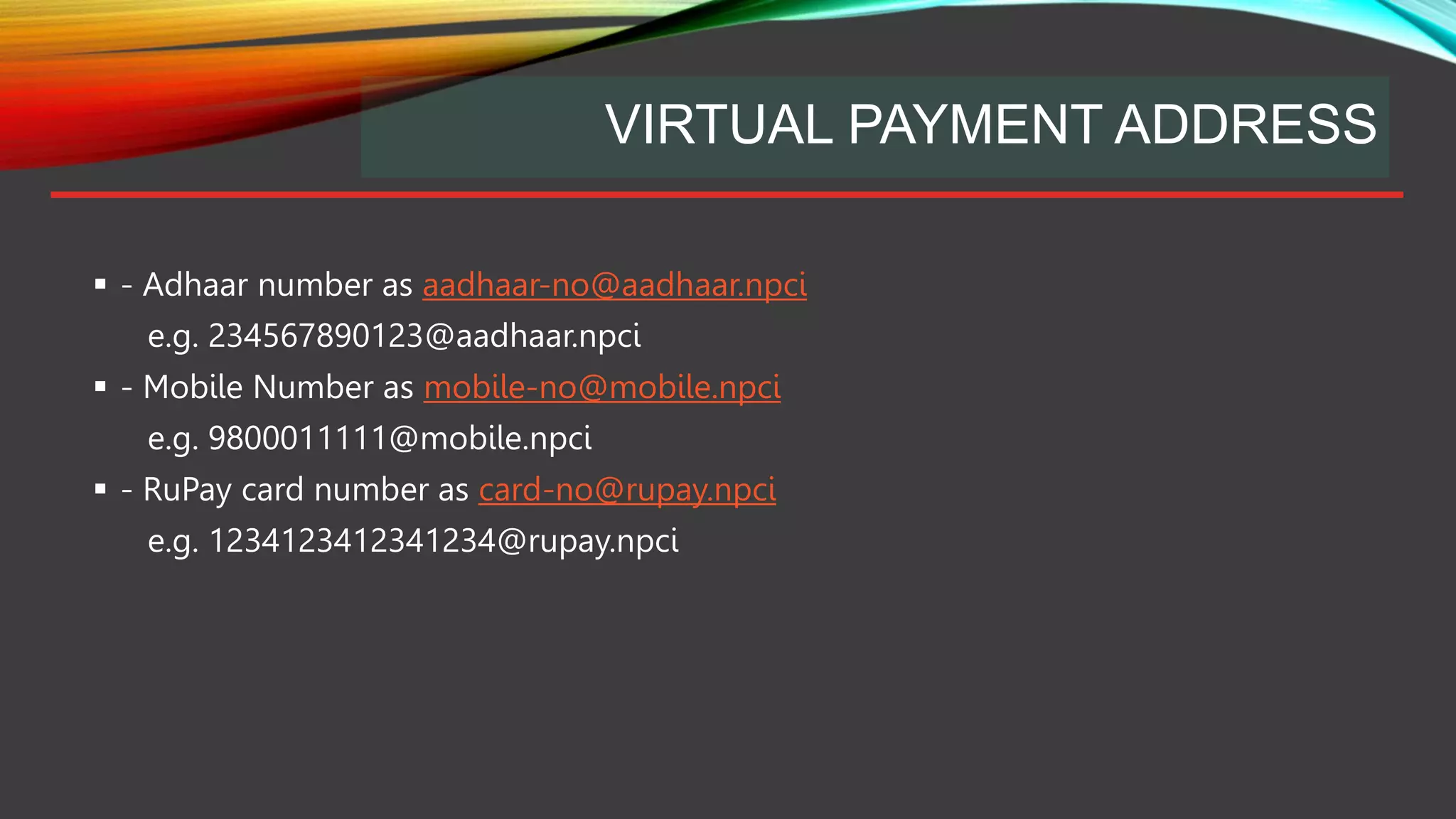
 - Adhaar number as aadhaar-no@aadhaar.npci
e.g. 234567890123@aadhaar.npci
 - Mobile Number as mobile-no@mobile.npci
e.g. 9800011111@mobile.npci
 - RuPay card number as card-no@rupay.npci
e.g. 1234123412341234@rupay.npci
TYPES OF PAYMENT REQUEST
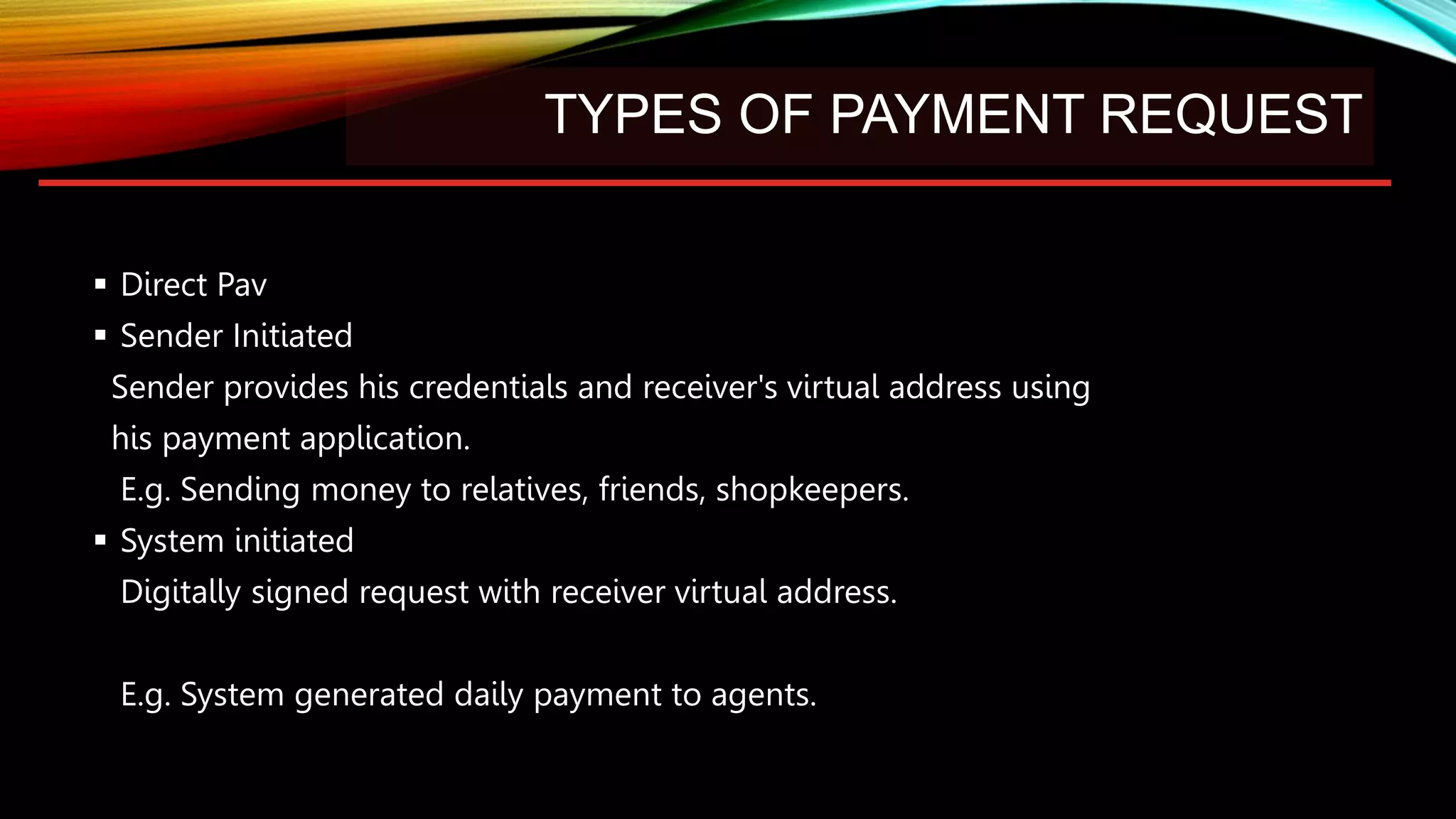
 Direct Pav
 Sender Initiated
Sender provides his credentials and receiver's virtual address using
his payment application.
E.g. Sending money to relatives, friends, shopkeepers.
 System initiated
Digitally signed request with receiver virtual address.
E.g. System generated daily payment to agents.
TYPES OF PAYMENT REQUEST
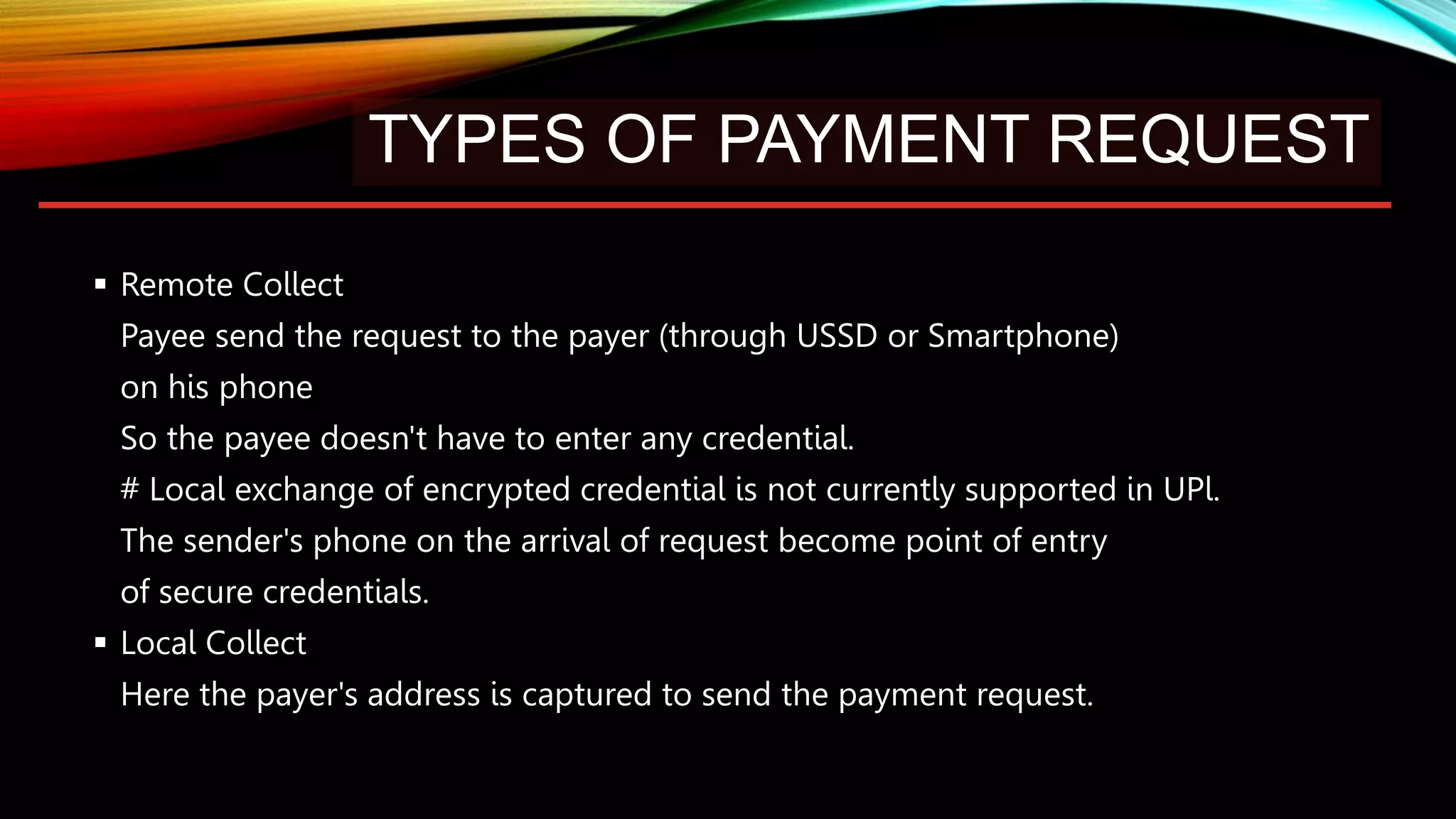
 Remote Collect
Payee send the request to the payer (through USSD or Smartphone)
on his phone
So the payee doesn't have to enter any credential.
# Local exchange of encrypted credential is not currently supported in UPl.
The sender's phone on the arrival of request become point of entry
of secure credentials.
 Local Collect
Here the payer's address is captured to send the payment request.
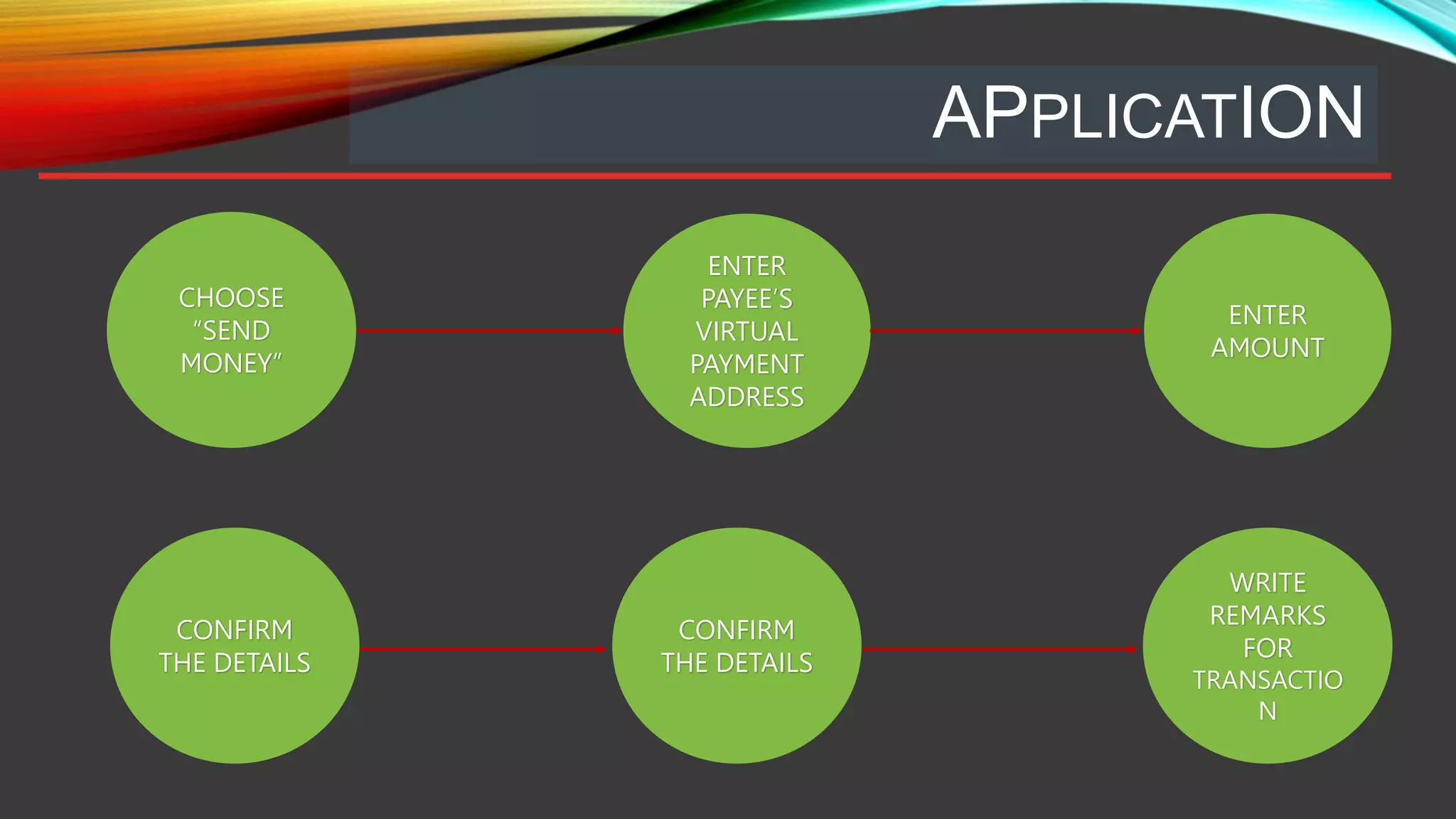
APPLICATION
ENTER
PAYEE’S
VIRTUAL
PAYMENT
ADDRESS
ENTER
AMOUNT
CONFIRM
THE DETAILS
WRITE
REMARKS
FOR
TRANSACTIO
N
CONFIRM
THE DETAILS
CHOOSE
“SEND
MONEY”
APPLICATION
 Sending money to relative
 Collecting money from friend
 Buying on an ecommerce site
 Buying railway ticket on IRCTC application
 Using a taxi services
ADVANTAGES
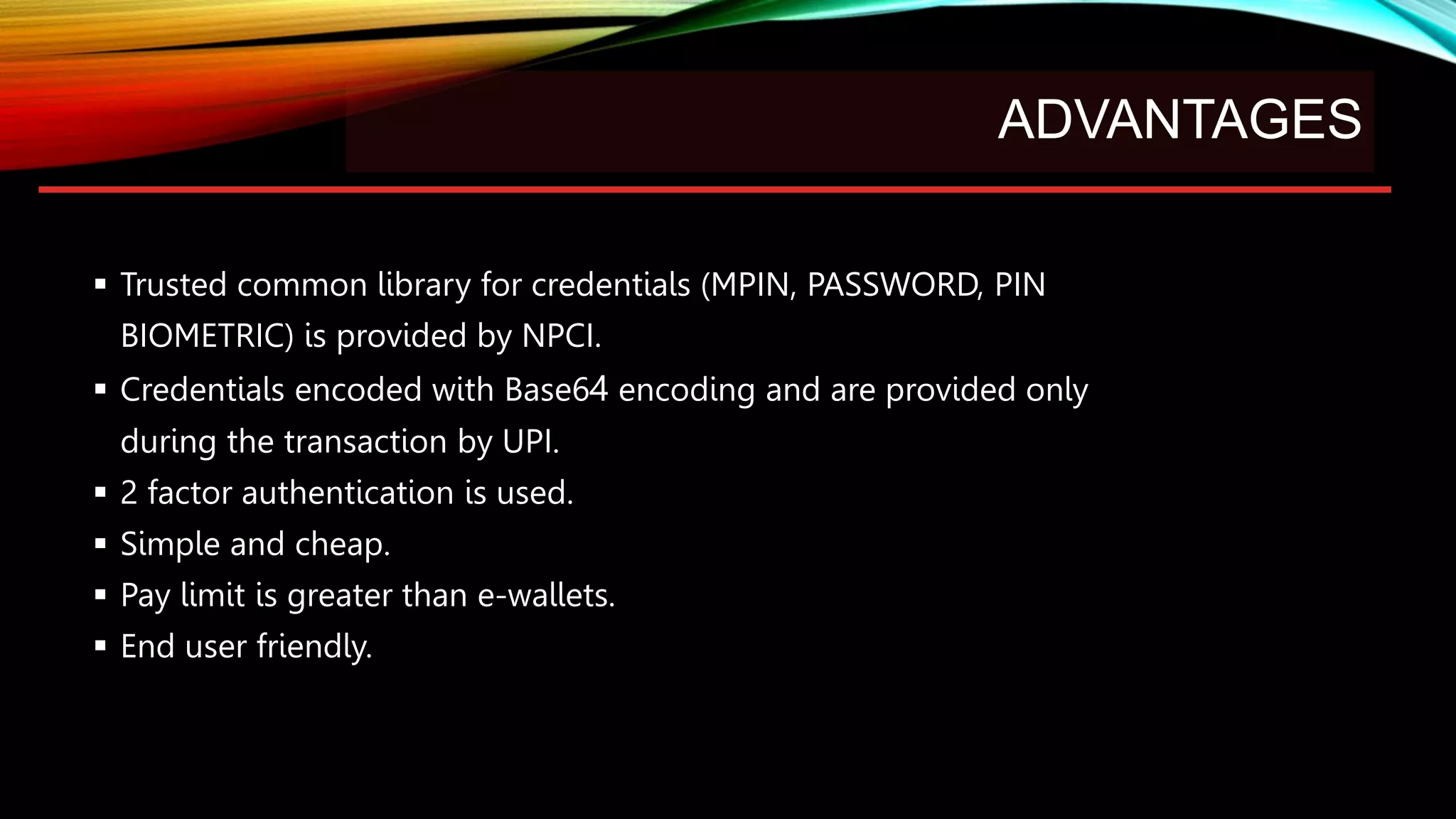
 Trusted common library for credentials (MPIN, PASSWORD, PIN
BIOMETRIC) is provided by NPCI.
 Credentials encoded with Base64 encoding and are provided only
during the transaction by UPI.
 2 factor authentication is used.
 Simple and cheap.
 Pay limit is greater than e-wallets.
 End user friendly.
CONCLUSION
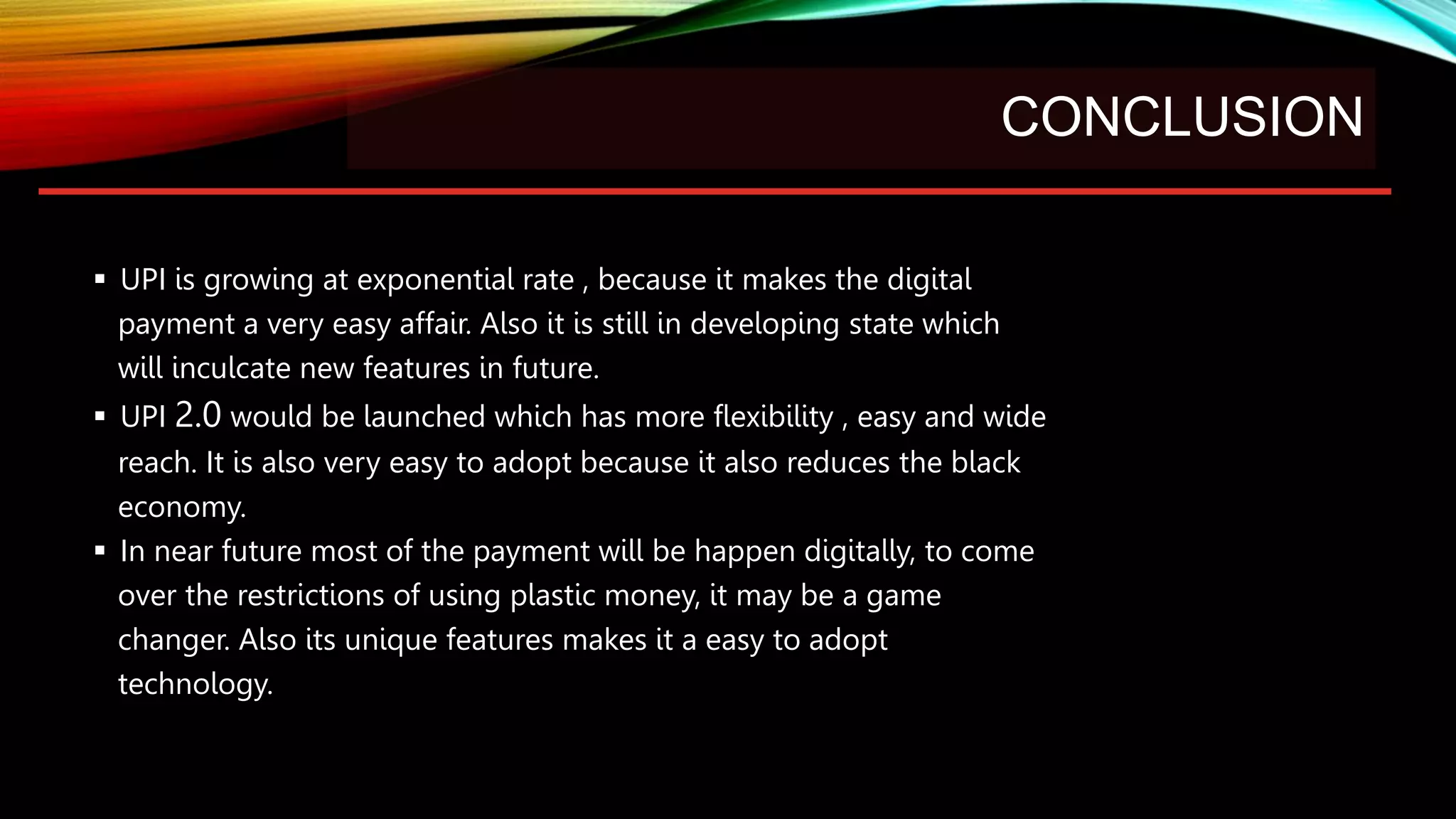
 UPI is growing at exponential rate , because it makes the digital
payment a very easy affair. Also it is still in developing state which
will inculcate new features in future.
 UPI 2.0 would be launched which has more flexibility , easy and wide
reach. It is also very easy to adopt because it also reduces the black
economy.
 In near future most of the payment will be happen digitally, to come
over the restrictions of using plastic money, it may be a game
changer. Also its unique features makes it a easy to adopt
technology.
REFERENCES
 [1] "RBI Payment System Vision document", RBI, 2012-15,
http://rbi.org.in/scripts/PublicationVisionDocuments.aspx?ID=664
 [2] "Committee on Comprehensive Financial Services for Small Businesses and Low Income
Households", RBI, January 2014,
http://www.rbi.org.in/Scripts/PüblicationReportDetails.aspx?UrlPage=&ID=727
 [3] "Report of the Technical Committee on Mobile Banking", RBI, February 2014,
http://www.rbi.org.in/Scripts/PublicationReportDetails.aspx?UrlPage=&ID=760#8
 [4] "Report on Enabling PKI in Payment System Applications", RBI, April 2014,
http://www.rbi.org.in/Scripts/PublicationReportDetails.aspx?UrlPage=&ID=765
 [5] "Pradhan Mantri Jan-Dhan Yojana", Ministry of Finance, August 2014,
http://www.pmjdy.gov.in/financial_literacy.aspx
 [6] "Report of the Task Force on an Aadhaar-Enabled Unified Payment Infrastructure", Finance
Ministry, February 2012,
http://finmin.nic.in/reports/Report_Task_Force_Aadhaar_PaymentInfra.pdf
Thank You !!!

UPI Presentation.pptx

  • 1.
    Submitted By :Submitted To: Raushan Kumar Dr. Brahmjot Bagga Topic : Unified Payments Interface (UPI)
  • 2.
    CONTENT • Introduction • WhoIs Behind UPI • How UPI Works With NPCI • Core elements in payment • Architecture of UPI • Virtual Payment Address • Types of Payment request • Advantages • Application • Conclusion
  • 3.
    WHAT IS UPI? It is payment system launched by NPCI.  Facilitates fund transfer between two bank account.  Support Peer to Peer connection.  Advance version if IMPS.  Support Seamless fund routing and merchant payments.  Open source , easily adaptable , simple, cheap , mobile based, innovative.
  • 4.
    WHO IS BEHINDUPI?  NPCI(National Payments Corporation Of India).  Umbrella organization for all retail payments system.  Set up by RBI and IBA in April 2009.  It launched the IMPS.  It launched the RuPay card.  Currently , launched UPI.
  • 5.
    HOW UPI WORKWITH NPCI?  A NPCI repository is used.  Repository stores credentials about payer and payee.  Route payments introductions (Adhaar no. or Mobile no.)  Do switching, clearing and settlement of transactions.
  • 6.
    HOW UPI WORKSWITH NPCI? NPCI Centrally Mapped Repository Sponsor Bank Destination Bank Government Department Beneficiary Settlement Bank (RBI) Settlement File Presentation Settlement File Return Settlement File Transaction Initiation Fund Credited Intimation Sent to Beneficiary Transaction Origination Transaction Response
  • 7.
    HOW UPI WORKSWITH NPCI?  The Payer/Payee information is sent, via PSP, to NPCI.  To identify the details of the second party involved, it either uses its repository or it contacts the second party PSP. NPCI Centrally Mapped Repository PSP to resolve Virtual Address Point of Sale (Payer)
  • 8.
    HOW UPI WORKSWITH NPCI?  Once both PSPs’ information is available to NPCI proceeds with the debit and credit processes.  On successful completion the payer and payee PSPs are notified, which then notify their customers. Payer’s Bank Payee’s bank (Payer) (Payee)
  • 9.
    CORE ELEMENTS INPAYMENT  Payer and Payee account and institution details for routing transaction.  Authentication credentials (password, PIN, biometrics, CVV, etc. as required for debit, can be bank provided or 3rd party provide such as UIDAI.  Transaction amount.  Timestamp.  Other metadata attributes such as location, product code, mobile number, device details, etc. as required.
  • 10.
    *99# 3rd Party apps (collectonly) Banks Standard interface Internet Banking Banks Standard interface 3rd Party apps (collect only) Banks Standard interface Unified Payment Interface Mobile Application Mobile Application Mobile Application NPCI *99# Central repository A P B S N A C H I M P S A E P S R u P a y E c o m N F S *99#: NPCI USSD service code to access banking service via phone Payment System Providers (PSPs) THE ARCHITECTURE OF UPI *99#
  • 11.
    VIRTUAL PAYMENT ADDRESS Has unique mapping to Identifier (Person / Entity).  Contain Global Identifier (Adhaar number and mobile Number).  1-click 2-factor authentication.  Pay and Collect Money.  PSPs can offer multiple virtual address to customers.  Rule based access.
  • 12.
    VIRTUAL PAYMENT ADDRESS Normalized Architecture for payment address "account @ provider”.  The address must include : ` a-z ` , ` A-Z ` , ` 0-9 ` , ` . (dot)` , `- (hyphen)’.  The Payment Address can be issues by : Bank :amit.8868@icici , PSP : rahul2017.irctc@mypsp  NPCI (using global identifiers ) -IFSC code and account number as account-no@ifsc-code.ifsc.npci e.g.12345@HDFC0000001.ifsc.npci
  • 13.
    VIRTUAL PAYMENT ADDRESS - Adhaar number as aadhaar-no@aadhaar.npci e.g. 234567890123@aadhaar.npci  - Mobile Number as mobile-no@mobile.npci e.g. 9800011111@mobile.npci  - RuPay card number as card-no@rupay.npci e.g. 1234123412341234@rupay.npci
  • 14.
    TYPES OF PAYMENTREQUEST  Direct Pav  Sender Initiated Sender provides his credentials and receiver's virtual address using his payment application. E.g. Sending money to relatives, friends, shopkeepers.  System initiated Digitally signed request with receiver virtual address. E.g. System generated daily payment to agents.
  • 15.
    TYPES OF PAYMENTREQUEST  Remote Collect Payee send the request to the payer (through USSD or Smartphone) on his phone So the payee doesn't have to enter any credential. # Local exchange of encrypted credential is not currently supported in UPl. The sender's phone on the arrival of request become point of entry of secure credentials.  Local Collect Here the payer's address is captured to send the payment request.
  • 16.
  • 17.
    APPLICATION  Sending moneyto relative  Collecting money from friend  Buying on an ecommerce site  Buying railway ticket on IRCTC application  Using a taxi services
  • 18.
    ADVANTAGES  Trusted commonlibrary for credentials (MPIN, PASSWORD, PIN BIOMETRIC) is provided by NPCI.  Credentials encoded with Base64 encoding and are provided only during the transaction by UPI.  2 factor authentication is used.  Simple and cheap.  Pay limit is greater than e-wallets.  End user friendly.
  • 19.
    CONCLUSION  UPI isgrowing at exponential rate , because it makes the digital payment a very easy affair. Also it is still in developing state which will inculcate new features in future.  UPI 2.0 would be launched which has more flexibility , easy and wide reach. It is also very easy to adopt because it also reduces the black economy.  In near future most of the payment will be happen digitally, to come over the restrictions of using plastic money, it may be a game changer. Also its unique features makes it a easy to adopt technology.
  • 20.
    REFERENCES  [1] "RBIPayment System Vision document", RBI, 2012-15, http://rbi.org.in/scripts/PublicationVisionDocuments.aspx?ID=664  [2] "Committee on Comprehensive Financial Services for Small Businesses and Low Income Households", RBI, January 2014, http://www.rbi.org.in/Scripts/PüblicationReportDetails.aspx?UrlPage=&ID=727  [3] "Report of the Technical Committee on Mobile Banking", RBI, February 2014, http://www.rbi.org.in/Scripts/PublicationReportDetails.aspx?UrlPage=&ID=760#8  [4] "Report on Enabling PKI in Payment System Applications", RBI, April 2014, http://www.rbi.org.in/Scripts/PublicationReportDetails.aspx?UrlPage=&ID=765  [5] "Pradhan Mantri Jan-Dhan Yojana", Ministry of Finance, August 2014, http://www.pmjdy.gov.in/financial_literacy.aspx  [6] "Report of the Task Force on an Aadhaar-Enabled Unified Payment Infrastructure", Finance Ministry, February 2012, http://finmin.nic.in/reports/Report_Task_Force_Aadhaar_PaymentInfra.pdf
  • 21.