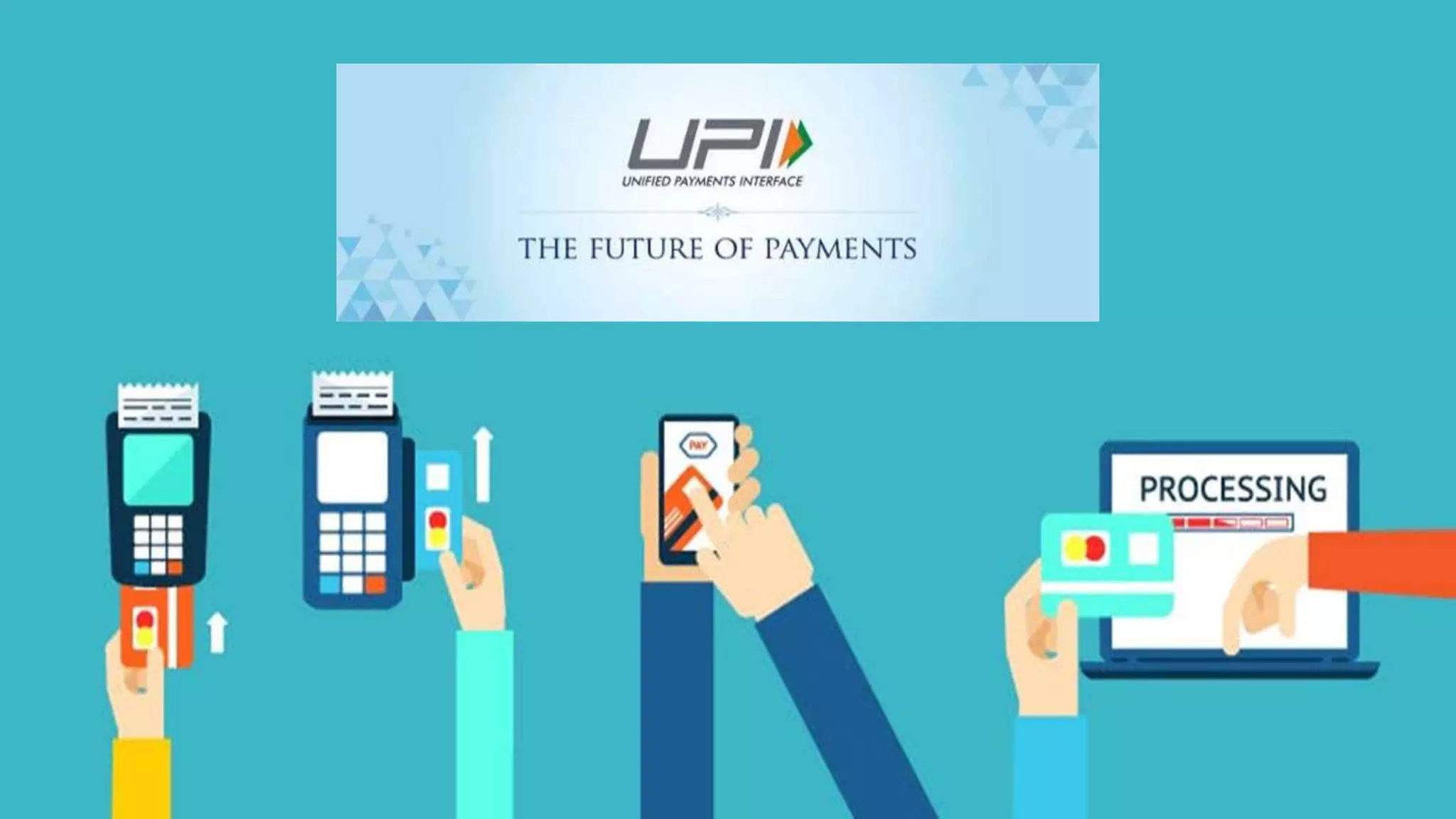
UPI
(UNIFIED PAYMENTS INTERFACE)
Made By :-
Akash Kumar Pandit
TTCS(A)
MGMCOET NOIDA
Content
▪ Introduction
▪ Overview of payment system
▪ Digital Payment Forecasting
▪ Modes of Payments
▪ Who is BehindUPI
▪ HowUPI works with NPCI
▪ Core elements in payment
▪ Architecture ofUPI
▪ Virtual PaymentAddress
▪ Types of Payment request
▪ Advantages
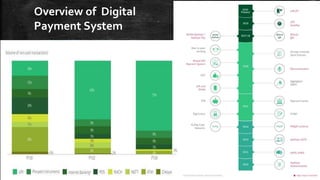
Overview of Digital
Payment System
Digital Payment Forecasting
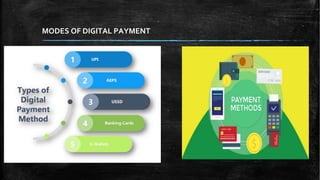
MODES OF DIGITAL PAYMENT
What is UPI?
• "Unified Payment Interface" (UPI) enables all bank account holders (of banks
participating in UPI) to send and receive money from their smartphones with a
single identifier (the virtual payments address) – without entering any
additional bank account information.
•
The Unified Payment Interface (UPI) can be thought of like an email ID for
your money. It will be an unique identifier that your bank uses to transfer
money and make payments using the IMPS (Immediate Payments Service)
INTRODUCTION
• Of late, you've probably been hearing a lot of jargon flying about money
transfers
- terms like UPI, NPCI, IMPS, among others. There's been a lot of
excitement about new UPI apps such like “Axis Bank’s Axis Pay”, “ICICI's
Pockets” ,“SBI’s pay” and ”Flipkart‘s PhonePe”, but what do these apps
do? I am here to help and make sense of all these terms.
• Ever since its launched in Jan 2016, we regularly get questions like What is
UPI, How does UPI work, How would it change the way I handle payments
in business, etc. In this presentation, I will try to explain this new payment
method in detail by answering a few questions.
Who is behind UPI?
• Unified Payment Interface is an initiative by National Payments Corporation of
India’s (NPCI), set up with the support of the Reserve Bank of India and Indian
Banks Association (IBA). The NCPI operates the Rupay payments infrastructure
that – like Visa and MasterCard – allows different banks to interconnect and
transfer funds.
• IMPS (Immediate Payments Service) is also an initiative of NPCI. UPI is the
advanced version of IMPS.
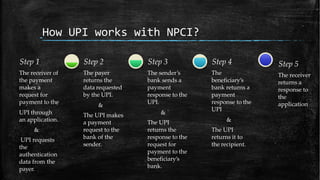
How UPI works with NPCI?
Step 1
The receiver of
the payment
makes a
request for
payment to the
UPI through
an application.
&
UPI requests
the
authentication
data from the
payer.
Step 2
The payer
returns the
data requested
by the UPI.
&
The UPI makes
a payment
request to the
bank of the
sender.
Step 3
The sender’s
bank sends a
payment
response to the
UPI.
&
The UPI
returns the
response to the
request for
payment to the
beneficiary’s
bank.
Step 4
The
beneficiary’s
bank returns a
payment
response to the
UPI
&
The UPI
returns it to
the recipient.
Step 5
The receiver
returns a
response to
the
application
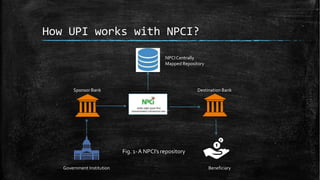
How UPI works with NPCI?
Government Institution Beneficiary
Destination Bank
NPCI Centrally
Mapped Repository
Sponsor Bank
Fig. 1-A NPCI’s repository
How UPI works with NPCI?
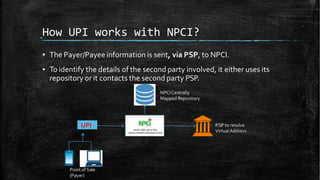
▪ The Payer/Payee information is sent, via PSP, to NPCI.
▪ To identify the details of the second party involved, it either uses its
repository or it contacts the second party PSP.
UPI
How UPI works with NPCI?
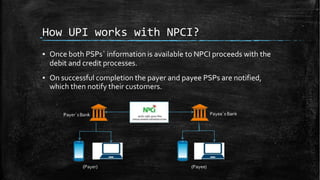
▪ Once both PSPs` information is available to NPCI proceeds with the
debit and credit processes.
▪ On successful completion the payer and payee PSPs are notified,
which then notify their customers.
AADHAR ENABLED PAYMENT STRUCTURE
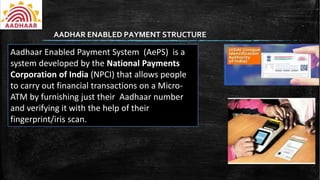
Aadhaar Enabled Payment System (AePS) is a
system developed by the National Payments
Corporation of India (NPCI) that allows people
to carry out financial transactions on a Micro-
ATM by furnishing just their Aadhaar number
and verifying it with the help of their
fingerprint/iris scan.
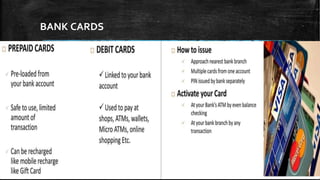
BANK CARDS
USSD-based mobile banking can be
used for fund transfers, checking
account balance, generating bank
statement, among other uses. The main
objective of the innovative *99#
payments service is to allow financial
inclusion of the underbanked and
economically weaker sections of the
society, and integrate them into
mainstream banking. In an effort to
make this service accessible to all, the
service is available in 12 languages,
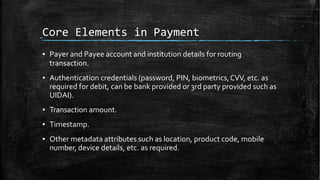
Core Elements in Payment
▪ Payer and Payee account and institution details for routing
transaction.
▪ Authentication credentials (password, PIN, biometrics,CVV, etc. as
required for debit, can be bank provided or 3rd party provided such as
UIDAI).
▪ Transaction amount.
▪ Timestamp.
▪ Other metadata attributes such as location, product code, mobile
number, device details, etc. as required.
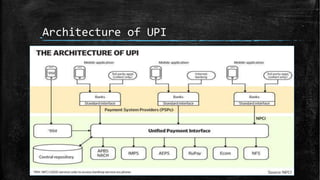
Architecture of UPI
• Nandan Nilekani said the
security is fool-proof as the
transaction will happen in a
highly encrypted format.
Already NPCI’s IMPS network
handles more than Rs.8,000
crore worth of transactions a
day, which will exponentially
increase with the use of
mobile phones.
• 2 Factor authentication –
similar to OTP will be there as
its mandated by RBI. In this
case, MPIN instead of OTP will
be used.
How secure is UPI?
What is Virtual PaymentAddress (VPA) ?
• The Virtual Payment Address or VPA
is an address given to the user of UPI
payment system to transfer fund.
BENEFITS
• You do not give bank account
number to receive money.
• It is easy to remember than the bank
account number and IFSC.
• To be more secure, you can change
the it whenever you suspect.
• You can get VPAof your choice.
RULES
• You can have many virtual payment
addresses
• You can change it whenever you
wish
• No two VPAwould be the same
• You can link many accounts with one
VPAbut you have to set an account
as the default.
• You can’t choose the suffix of the
VPA. It is fixed by the bank.
Types of payment request
▪ Direct Pay
▪ Sender Initiated
Sender provides his credentials and receiver`s virtual address using
his payment application.
E.g.Sending money to relatives, friends , shopkeepers.
▪ System initiated
Digitally signed request with receiver virtual address.
E.g.System generated daily payment to agents.
Types of payment request
▪ RemoteCollect
Payee send the request to the payer (throughUSSD or Smartphone)
on his phone.
So the payee doesn`t have to enter any credential.
# Local exchange of encrypted credential is not currently supported
inUPI.
The sender`s phone on the arrival of request become point of entry
of secure credentials.
▪ LocalCollect
Here the payer`s address is captured to send the payment request.
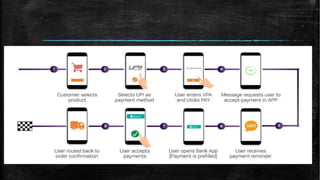
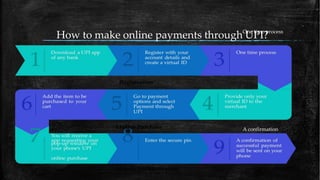
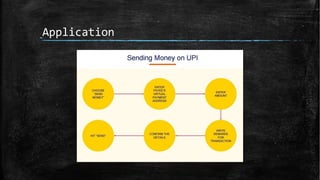
How to make online payments through UPI?
One time process
A confirmation
Application
Application
▪ Sending money to relative
▪ Collecting money from friend
▪ Buying on an ecommerce site
▪ Buying railway ticket on IRCTC application
▪ Using a taxi services
Advantages
▪ Trusted common library for credentials (MPIN, PASSWORD, PIN
BIOMETRIC ) is provided by NPCI.
▪ Credentials encoded with Base64 encoding and are provided only
during the transaction byUPI.
▪ 2 factor authentication is used.
▪ Simple and cheap.
▪ Pay limit is greater than e-wallets.
▪ End user friendly.
Conclusion
▪ UPI is growing at exponential rate , because it makes the digital
payment a very easy affair.Also it is still in developing state which
will inculcate new features in future.
▪ UPI 2.0 would be launched which has more flexibility , easy and wide
reach. It is also very easy to adopt because it also reduces the black
economy.
▪ In near future most of the payment will be happen digitally , to come
over the restrictions of using plastic money , it may be a game
changer.Also its unique features makes it a easy to adopt
technology.
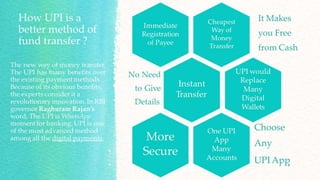
E-Wallets
• Transactions limited to Rs 10,000, lot
of people still not sure of its security
and ease of use.
• You need to load funds in the
e-wallets regularly.
• If you have Paytm or FreeCharge in
your phone and want to pay using it
but the merchant or seller does not
have it, you cannot use it.
• Wallets are privately owned
UPI
• Easier way for transactions, one-time
ID creation and good to go, banking
limit goes up to Rs 1 lakh
• It is connected to your bank account,
so it need not be refilled with money.
• On the other hand UPI is centralized.
It can be used across banks and
merchants.
• Whereas UPI is a govt. initiative by
the NPCI controlled by RBI
Why ‘UPI’ is better than ‘E-Wallets’ ?
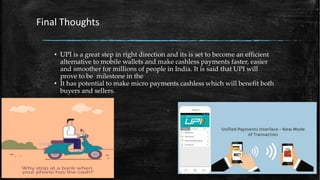
• UPI is a great step in right direction and its is set to become an efficient
alternative to mobile wallets and make cashless payments faster, easier
and smoother for millions of people in India. It is said that UPI will
prove to be milestone in the
• It has potential to make micro payments cashless which will benefit both
buyers and sellers.
Final Thoughts
References
▪ [1] “RBI PaymentSystemVision document”, RBI, 2012-15,
http://rbi.org.in/scripts/PublicationVisionDocuments.aspx?ID=664
▪ [2] “Committee onComprehensive Financial Services for Small Businesses and Low Income
Households”, RBI, January 2014,
http://www.rbi.org.in/Scripts/PublicationReportDetails.aspx?UrlPage=&ID=727
▪ [3] “Report of theTechnicalCommittee on Mobile Banking”, RBI, February 2014,
http://www.rbi.org.in/Scripts/PublicationReportDetails.aspx?UrlPage=&ID=760#8
▪ [4] “Report on Enabling PKI in Payment System Applications”, RBI,April 2014,
http://www.rbi.org.in/Scripts/PublicationReportDetails.aspx?UrlPage=&ID=765
▪ [5] “Pradhan MantriJan-DhanYojana”, Ministry of Finance,August 2014,
http://www.pmjdy.gov.in/financial_literacy.aspx
▪ [6] “Report of theTask Force on an Aadhaar-EnabledUnified Payment Infrastructure”, Finance
Ministry, February 2012,
http://finmin.nic.in/reports/Report_Task_Force_Aadhaar_PaymentInfra.pdf

present.pptx

  • 1.
    UPI (UNIFIED PAYMENTS INTERFACE) MadeBy :- Akash Kumar Pandit TTCS(A) MGMCOET NOIDA
  • 2.
    Content ▪ Introduction ▪ Overviewof payment system ▪ Digital Payment Forecasting ▪ Modes of Payments ▪ Who is BehindUPI ▪ HowUPI works with NPCI ▪ Core elements in payment ▪ Architecture ofUPI ▪ Virtual PaymentAddress ▪ Types of Payment request ▪ Advantages
  • 3.
  • 4.
  • 5.
  • 6.
    What is UPI? •"Unified Payment Interface" (UPI) enables all bank account holders (of banks participating in UPI) to send and receive money from their smartphones with a single identifier (the virtual payments address) – without entering any additional bank account information. • The Unified Payment Interface (UPI) can be thought of like an email ID for your money. It will be an unique identifier that your bank uses to transfer money and make payments using the IMPS (Immediate Payments Service)
  • 7.
    INTRODUCTION • Of late,you've probably been hearing a lot of jargon flying about money transfers - terms like UPI, NPCI, IMPS, among others. There's been a lot of excitement about new UPI apps such like “Axis Bank’s Axis Pay”, “ICICI's Pockets” ,“SBI’s pay” and ”Flipkart‘s PhonePe”, but what do these apps do? I am here to help and make sense of all these terms. • Ever since its launched in Jan 2016, we regularly get questions like What is UPI, How does UPI work, How would it change the way I handle payments in business, etc. In this presentation, I will try to explain this new payment method in detail by answering a few questions.
  • 8.
    Who is behindUPI? • Unified Payment Interface is an initiative by National Payments Corporation of India’s (NPCI), set up with the support of the Reserve Bank of India and Indian Banks Association (IBA). The NCPI operates the Rupay payments infrastructure that – like Visa and MasterCard – allows different banks to interconnect and transfer funds. • IMPS (Immediate Payments Service) is also an initiative of NPCI. UPI is the advanced version of IMPS.
  • 9.
    How UPI workswith NPCI? Step 1 The receiver of the payment makes a request for payment to the UPI through an application. & UPI requests the authentication data from the payer. Step 2 The payer returns the data requested by the UPI. & The UPI makes a payment request to the bank of the sender. Step 3 The sender’s bank sends a payment response to the UPI. & The UPI returns the response to the request for payment to the beneficiary’s bank. Step 4 The beneficiary’s bank returns a payment response to the UPI & The UPI returns it to the recipient. Step 5 The receiver returns a response to the application
  • 10.
    How UPI workswith NPCI? Government Institution Beneficiary Destination Bank NPCI Centrally Mapped Repository Sponsor Bank Fig. 1-A NPCI’s repository
  • 11.
    How UPI workswith NPCI? ▪ The Payer/Payee information is sent, via PSP, to NPCI. ▪ To identify the details of the second party involved, it either uses its repository or it contacts the second party PSP. UPI
  • 12.
    How UPI workswith NPCI? ▪ Once both PSPs` information is available to NPCI proceeds with the debit and credit processes. ▪ On successful completion the payer and payee PSPs are notified, which then notify their customers.
  • 14.
    AADHAR ENABLED PAYMENTSTRUCTURE Aadhaar Enabled Payment System (AePS) is a system developed by the National Payments Corporation of India (NPCI) that allows people to carry out financial transactions on a Micro- ATM by furnishing just their Aadhaar number and verifying it with the help of their fingerprint/iris scan.
  • 15.
  • 16.
    USSD-based mobile bankingcan be used for fund transfers, checking account balance, generating bank statement, among other uses. The main objective of the innovative *99# payments service is to allow financial inclusion of the underbanked and economically weaker sections of the society, and integrate them into mainstream banking. In an effort to make this service accessible to all, the service is available in 12 languages,
  • 18.
    Core Elements inPayment ▪ Payer and Payee account and institution details for routing transaction. ▪ Authentication credentials (password, PIN, biometrics,CVV, etc. as required for debit, can be bank provided or 3rd party provided such as UIDAI). ▪ Transaction amount. ▪ Timestamp. ▪ Other metadata attributes such as location, product code, mobile number, device details, etc. as required.
  • 19.
  • 20.
    • Nandan Nilekanisaid the security is fool-proof as the transaction will happen in a highly encrypted format. Already NPCI’s IMPS network handles more than Rs.8,000 crore worth of transactions a day, which will exponentially increase with the use of mobile phones. • 2 Factor authentication – similar to OTP will be there as its mandated by RBI. In this case, MPIN instead of OTP will be used. How secure is UPI?
  • 21.
    What is VirtualPaymentAddress (VPA) ? • The Virtual Payment Address or VPA is an address given to the user of UPI payment system to transfer fund. BENEFITS • You do not give bank account number to receive money. • It is easy to remember than the bank account number and IFSC. • To be more secure, you can change the it whenever you suspect. • You can get VPAof your choice. RULES • You can have many virtual payment addresses • You can change it whenever you wish • No two VPAwould be the same • You can link many accounts with one VPAbut you have to set an account as the default. • You can’t choose the suffix of the VPA. It is fixed by the bank.
  • 22.
    Types of paymentrequest ▪ Direct Pay ▪ Sender Initiated Sender provides his credentials and receiver`s virtual address using his payment application. E.g.Sending money to relatives, friends , shopkeepers. ▪ System initiated Digitally signed request with receiver virtual address. E.g.System generated daily payment to agents.
  • 23.
    Types of paymentrequest ▪ RemoteCollect Payee send the request to the payer (throughUSSD or Smartphone) on his phone. So the payee doesn`t have to enter any credential. # Local exchange of encrypted credential is not currently supported inUPI. The sender`s phone on the arrival of request become point of entry of secure credentials. ▪ LocalCollect Here the payer`s address is captured to send the payment request.
  • 24.
    How to makeonline payments through UPI? One time process A confirmation
  • 25.
  • 26.
    Application ▪ Sending moneyto relative ▪ Collecting money from friend ▪ Buying on an ecommerce site ▪ Buying railway ticket on IRCTC application ▪ Using a taxi services
  • 27.
    Advantages ▪ Trusted commonlibrary for credentials (MPIN, PASSWORD, PIN BIOMETRIC ) is provided by NPCI. ▪ Credentials encoded with Base64 encoding and are provided only during the transaction byUPI. ▪ 2 factor authentication is used. ▪ Simple and cheap. ▪ Pay limit is greater than e-wallets. ▪ End user friendly.
  • 28.
    Conclusion ▪ UPI isgrowing at exponential rate , because it makes the digital payment a very easy affair.Also it is still in developing state which will inculcate new features in future. ▪ UPI 2.0 would be launched which has more flexibility , easy and wide reach. It is also very easy to adopt because it also reduces the black economy. ▪ In near future most of the payment will be happen digitally , to come over the restrictions of using plastic money , it may be a game changer.Also its unique features makes it a easy to adopt technology.
  • 29.
    E-Wallets • Transactions limitedto Rs 10,000, lot of people still not sure of its security and ease of use. • You need to load funds in the e-wallets regularly. • If you have Paytm or FreeCharge in your phone and want to pay using it but the merchant or seller does not have it, you cannot use it. • Wallets are privately owned UPI • Easier way for transactions, one-time ID creation and good to go, banking limit goes up to Rs 1 lakh • It is connected to your bank account, so it need not be refilled with money. • On the other hand UPI is centralized. It can be used across banks and merchants. • Whereas UPI is a govt. initiative by the NPCI controlled by RBI Why ‘UPI’ is better than ‘E-Wallets’ ?
  • 31.
    • UPI isa great step in right direction and its is set to become an efficient alternative to mobile wallets and make cashless payments faster, easier and smoother for millions of people in India. It is said that UPI will prove to be milestone in the • It has potential to make micro payments cashless which will benefit both buyers and sellers. Final Thoughts
  • 32.
    References ▪ [1] “RBIPaymentSystemVision document”, RBI, 2012-15, http://rbi.org.in/scripts/PublicationVisionDocuments.aspx?ID=664 ▪ [2] “Committee onComprehensive Financial Services for Small Businesses and Low Income Households”, RBI, January 2014, http://www.rbi.org.in/Scripts/PublicationReportDetails.aspx?UrlPage=&ID=727 ▪ [3] “Report of theTechnicalCommittee on Mobile Banking”, RBI, February 2014, http://www.rbi.org.in/Scripts/PublicationReportDetails.aspx?UrlPage=&ID=760#8 ▪ [4] “Report on Enabling PKI in Payment System Applications”, RBI,April 2014, http://www.rbi.org.in/Scripts/PublicationReportDetails.aspx?UrlPage=&ID=765 ▪ [5] “Pradhan MantriJan-DhanYojana”, Ministry of Finance,August 2014, http://www.pmjdy.gov.in/financial_literacy.aspx ▪ [6] “Report of theTask Force on an Aadhaar-EnabledUnified Payment Infrastructure”, Finance Ministry, February 2012, http://finmin.nic.in/reports/Report_Task_Force_Aadhaar_PaymentInfra.pdf