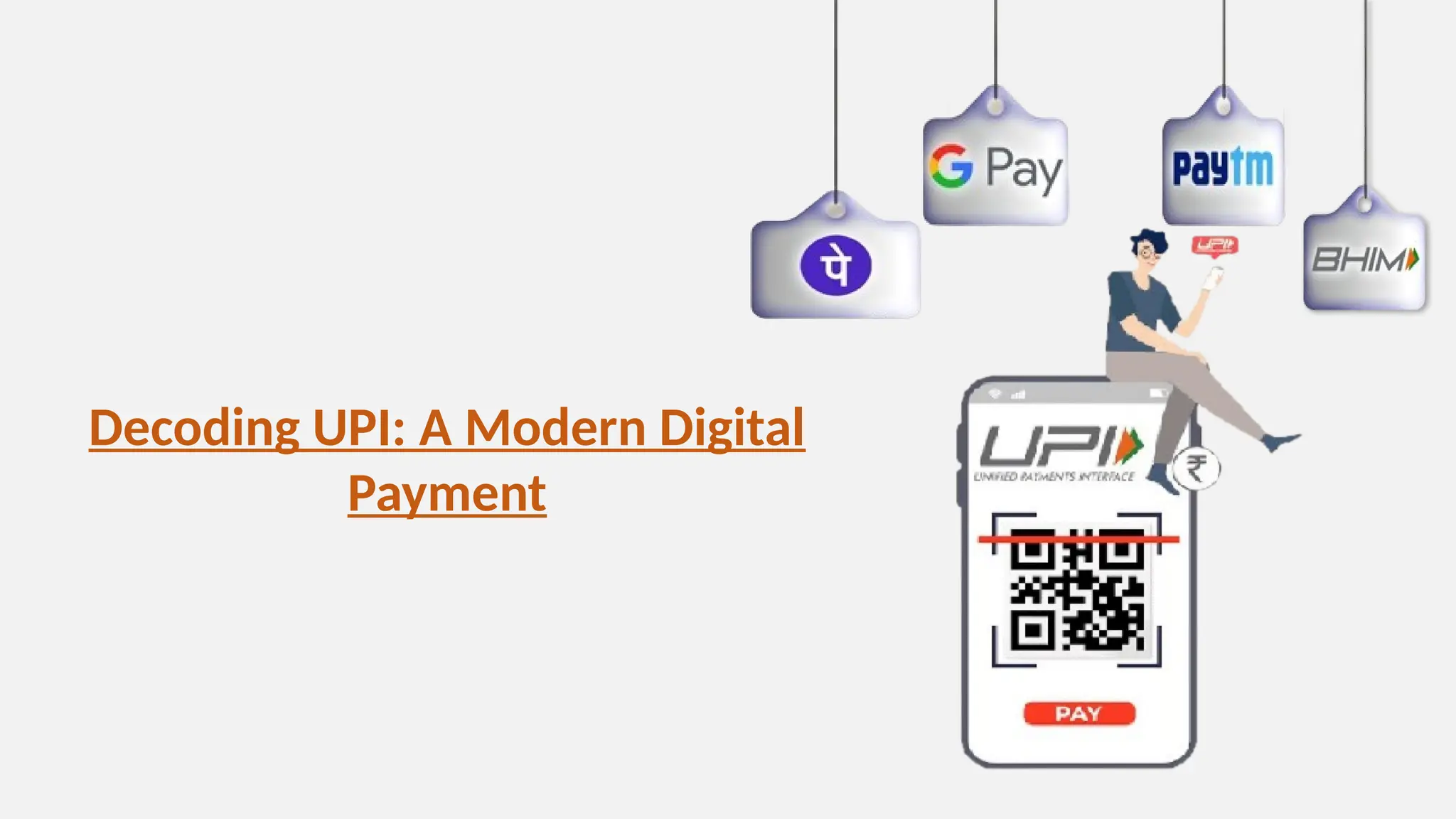
Decoding UPI: A Modern Digital
Payment
CONTENT
1. Introduction
2. Who is Behind UPI?
3. How UPI Works with NPCI?
4. Virtual Payment Address (VPA)
5. Types of Payment Requests
6. Security Mechanisms in UPI
7. Integration of AI in UPI
8. Blockchain in Digital Payments
9. Real-time Processing Technologies
10. Advantages of UPI
11. Future Trends in UPI
12. Conclusion
13. References
INTRODUCTION
- The rapid evolution of digital payments has ensured speed, security, and
interoperability.
- APIs enable seamless communication between banks & payment gateways.
- Integration of AI, blockchain, & cryptographic security.
- Focus on real-time transactions & fraud detection.
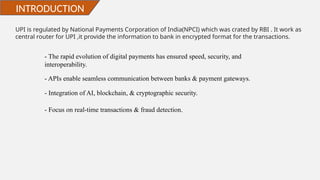
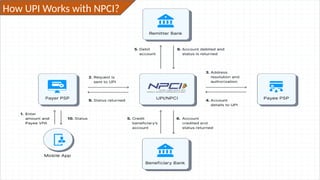
UPI is regulated by National Payments Corporation of India(NPCI) which was crated by RBI . It work as
central router for UPI ,it provide the information to bank in encrypted format for the transactions.
Who is Behind UPI?
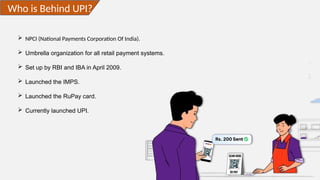
 NPCI (National Payments Corporation Of India).
 Umbrella organization for all retail payment systems.
 Set up by RBI and IBA in April 2009.
 Launched the IMPS.
 Launched the RuPay card.
 Currently launched UPI.
How UPI Works with NPCI?
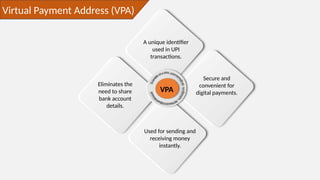
Virtual Payment Address (VPA)
A unique identifier
used in UPI
transactions.
VPA
Eliminates the
need to share
bank account
details.
Secure and
convenient for
digital payments.
Used for sending and
receiving money
instantly.
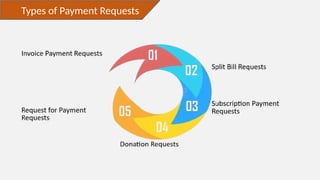
Types of Payment Requests
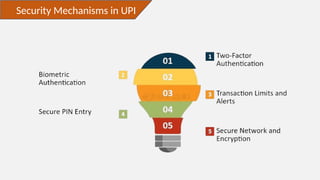
Security Mechanisms in UPI
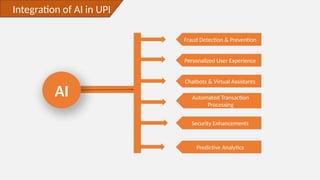
Integration of AI in UPI
AI
Fraud Detection & Prevention
Personalized User Experience
Chatbots & Virtual Assistants
Automated Transaction
Processing
Security Enhancements
Predictive Analytics
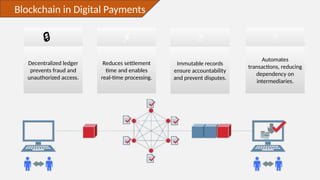
Blockchain in Digital Payments
Decentralized ledger
prevents fraud and
unauthorized access.
⚡
Reduces settlement
time and enables
real-time processing.
🏦
Immutable records
ensure accountability
and prevent disputes.
🤖
Automates
transactions, reducing
dependency on
intermediaries.
🔒
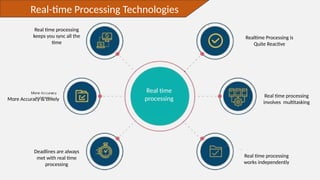
Real-time Processing Technologies
More Accuracy & timely
Real time processing
keeps you sync all the
time
Deadlines are always
met with real time
processing
Realtime Processing is
Quite Reactive
Real time processing
involves multitasking
Real time processing
works independently
Real time
processing
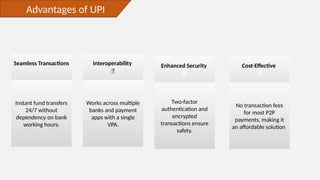
Advantages of UPI
Seamless Transactions
🚀
Instant fund transfers
24/7 without
dependency on bank
working hours.
Interoperability
🔄
Works across multiple
banks and payment
apps with a single
VPA.
Enhanced Security
🔒
Two-factor
authentication and
encrypted
transactions ensure
safety.
Cost-Effective
💰
No transaction fees
for most P2P
payments, making it
an affordable solution.
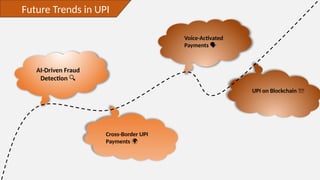
Future Trends in UPI
AI-Driven Fraud
Detection 🔍
Cross-Border UPI
Payments 🌍
Voice-Activated
Payments ️
🗣️
UPI on Blockchain 🔗💡
Conclusion
 UPI has transformed digital payments by ensuring seamless, secure, and real-time transactions.
 The integration of APIs, blockchain, AI-based fraud detection, and cryptographic security has
enhanced its efficiency and security.
 Its interoperability and real-time processing make it a benchmark for global digital payment systems.
 Advanced technologies like OAuth 2.0, tokenization, and smart contracts further strengthen security and
transparency.
 The future of UPI includes cross-border transactions, AI-driven financial insights, and expanded
adoption in global markets.
 UPI is a cornerstone of the cashless economy, continuously evolving to meet modern financial needs.
References
 National Payments Corporation of India (NPCI) - www.npci.org.in
 Reserve Bank of India (RBI) - www.rbi.org.in
 Unified Payments Interface (UPI) - www.upi.org.in
 Indian Banks’ Association (IBA) - www.iba.org.in
 NPCI UPI Transaction Reports - www.npci.org.in/statistics
 OAuth 2.0 Security Standards - oauth.net/2/
 Blockchain in Payments - www.ibm.com/blockchain/solutions/payments
 AI-based Fraud Detection in FinTech - www.finextra.com
 Tokenization in Digital Payments - www.paymentssource.com
 Smart Contracts and Decentralized Finance - www.coindesk.com
THANK YOU

Decoding UPI : A modern Digital Payment

  • 1.
    Decoding UPI: AModern Digital Payment
  • 2.
    CONTENT 1. Introduction 2. Whois Behind UPI? 3. How UPI Works with NPCI? 4. Virtual Payment Address (VPA) 5. Types of Payment Requests 6. Security Mechanisms in UPI 7. Integration of AI in UPI 8. Blockchain in Digital Payments 9. Real-time Processing Technologies 10. Advantages of UPI 11. Future Trends in UPI 12. Conclusion 13. References
  • 3.
    INTRODUCTION - The rapidevolution of digital payments has ensured speed, security, and interoperability. - APIs enable seamless communication between banks & payment gateways. - Integration of AI, blockchain, & cryptographic security. - Focus on real-time transactions & fraud detection. UPI is regulated by National Payments Corporation of India(NPCI) which was crated by RBI . It work as central router for UPI ,it provide the information to bank in encrypted format for the transactions.
  • 4.
    Who is BehindUPI?  NPCI (National Payments Corporation Of India).  Umbrella organization for all retail payment systems.  Set up by RBI and IBA in April 2009.  Launched the IMPS.  Launched the RuPay card.  Currently launched UPI.
  • 5.
    How UPI Workswith NPCI?
  • 6.
    Virtual Payment Address(VPA) A unique identifier used in UPI transactions. VPA Eliminates the need to share bank account details. Secure and convenient for digital payments. Used for sending and receiving money instantly.
  • 7.
  • 8.
  • 9.
    Integration of AIin UPI AI Fraud Detection & Prevention Personalized User Experience Chatbots & Virtual Assistants Automated Transaction Processing Security Enhancements Predictive Analytics
  • 10.
    Blockchain in DigitalPayments Decentralized ledger prevents fraud and unauthorized access. ⚡ Reduces settlement time and enables real-time processing. 🏦 Immutable records ensure accountability and prevent disputes. 🤖 Automates transactions, reducing dependency on intermediaries. 🔒
  • 11.
    Real-time Processing Technologies MoreAccuracy & timely Real time processing keeps you sync all the time Deadlines are always met with real time processing Realtime Processing is Quite Reactive Real time processing involves multitasking Real time processing works independently Real time processing
  • 12.
    Advantages of UPI SeamlessTransactions 🚀 Instant fund transfers 24/7 without dependency on bank working hours. Interoperability 🔄 Works across multiple banks and payment apps with a single VPA. Enhanced Security 🔒 Two-factor authentication and encrypted transactions ensure safety. Cost-Effective 💰 No transaction fees for most P2P payments, making it an affordable solution.
  • 13.
    Future Trends inUPI AI-Driven Fraud Detection 🔍 Cross-Border UPI Payments 🌍 Voice-Activated Payments ️ 🗣️ UPI on Blockchain 🔗💡
  • 14.
    Conclusion  UPI hastransformed digital payments by ensuring seamless, secure, and real-time transactions.  The integration of APIs, blockchain, AI-based fraud detection, and cryptographic security has enhanced its efficiency and security.  Its interoperability and real-time processing make it a benchmark for global digital payment systems.  Advanced technologies like OAuth 2.0, tokenization, and smart contracts further strengthen security and transparency.  The future of UPI includes cross-border transactions, AI-driven financial insights, and expanded adoption in global markets.  UPI is a cornerstone of the cashless economy, continuously evolving to meet modern financial needs.
  • 15.
    References  National PaymentsCorporation of India (NPCI) - www.npci.org.in  Reserve Bank of India (RBI) - www.rbi.org.in  Unified Payments Interface (UPI) - www.upi.org.in  Indian Banks’ Association (IBA) - www.iba.org.in  NPCI UPI Transaction Reports - www.npci.org.in/statistics  OAuth 2.0 Security Standards - oauth.net/2/  Blockchain in Payments - www.ibm.com/blockchain/solutions/payments  AI-based Fraud Detection in FinTech - www.finextra.com  Tokenization in Digital Payments - www.paymentssource.com  Smart Contracts and Decentralized Finance - www.coindesk.com
  • 16.