EMERGENCIES and HANDSIGNAL
COMMUNICATION
Objectives:
Activation of the EAP and getting quick, correct
response without creating patron panic
Emergency challenges depend on the type and the
location of pool or waterfront
Recognize how hand signals can play a role in
incident response
Maximize communication systems at beach fronts,
multi-pool complexes, and 50-meter pools
Acknowledge problems at special pools
3.
WHAT’S NEXT atthe LOCAL POOL?
EAP/EAS has been activated, rescue is in progress
BUT
How do you communicate appropriate response
without in noisy area or alarming bystanders
Universal hand signals, developed in Australia and
introduced in Europe, and now the U.S. are an
option
Value:
Quickly alert responders to probable medical emergency
Quietly alert responders without announcing to all by-
standers
Avoid embarrassment to victim
4.
TRADITIONAL RESPONSE
Whistles, 2-wayradios, colored flags
Common whistle protocol used in pool leisure
facilities
1 short blast – to gain attention of a swimmer
2 short blasts – to gain attention of a fellow lifeguard
3 short blasts – to signal a fellow lifeguard that an
emergency is taking place, action must be taken
1 long blow – to signal swimmers to clear the pool
Lifeguards respond according to training
5.
LEISURE and MULTI-POOLFACILITIES
Lifeguards use whistles and 2-way radios
Strategic placement of lifeguards provides visual
contact with fellow guards
Hand signals can quickly define needed
assistance
6.
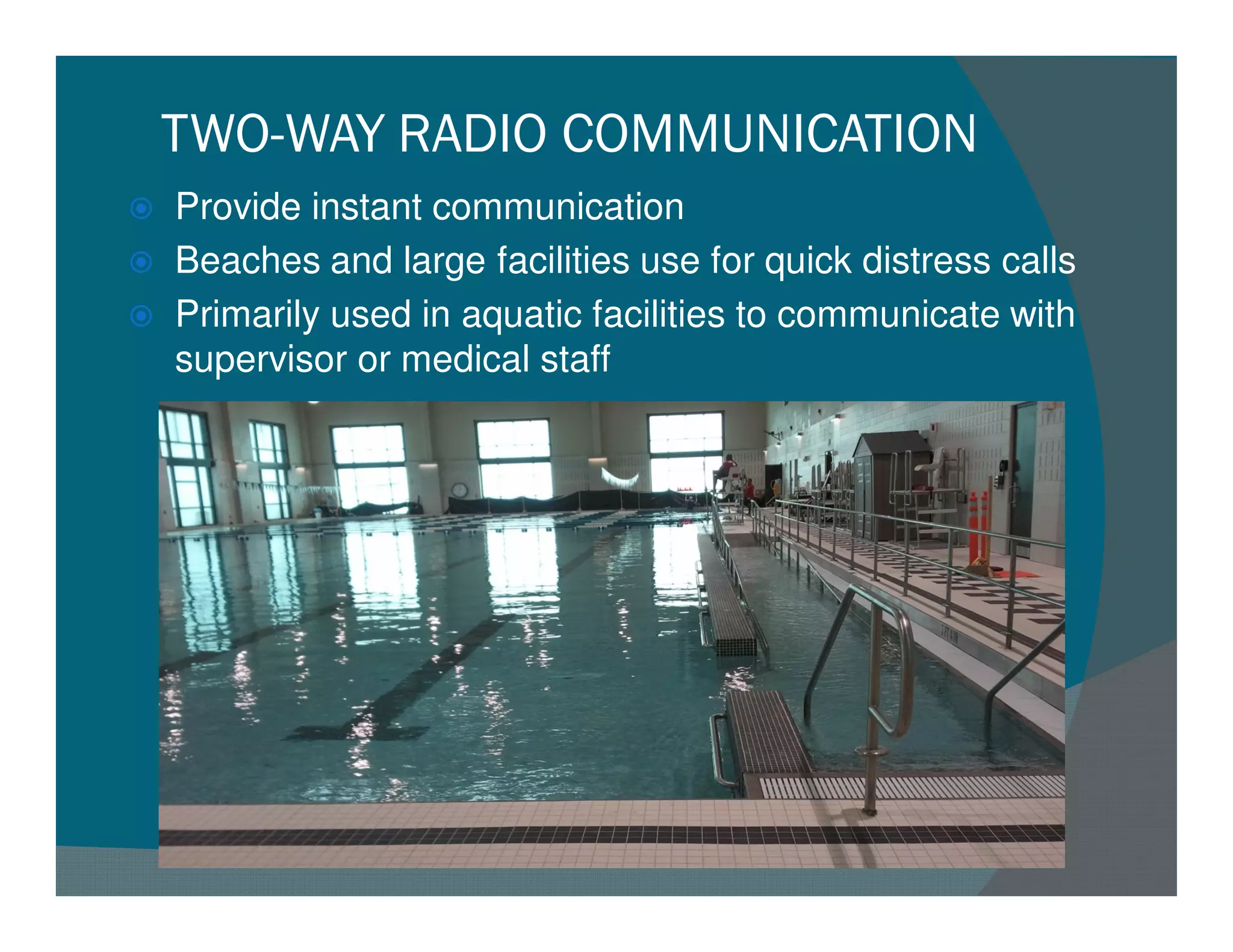
TWO-WAY RADIO COMMUNICATION
Provideinstant communication
Beaches and large facilities use for quick distress calls
Primarily used in aquatic facilities to communicate with
supervisor or medical staff
7.
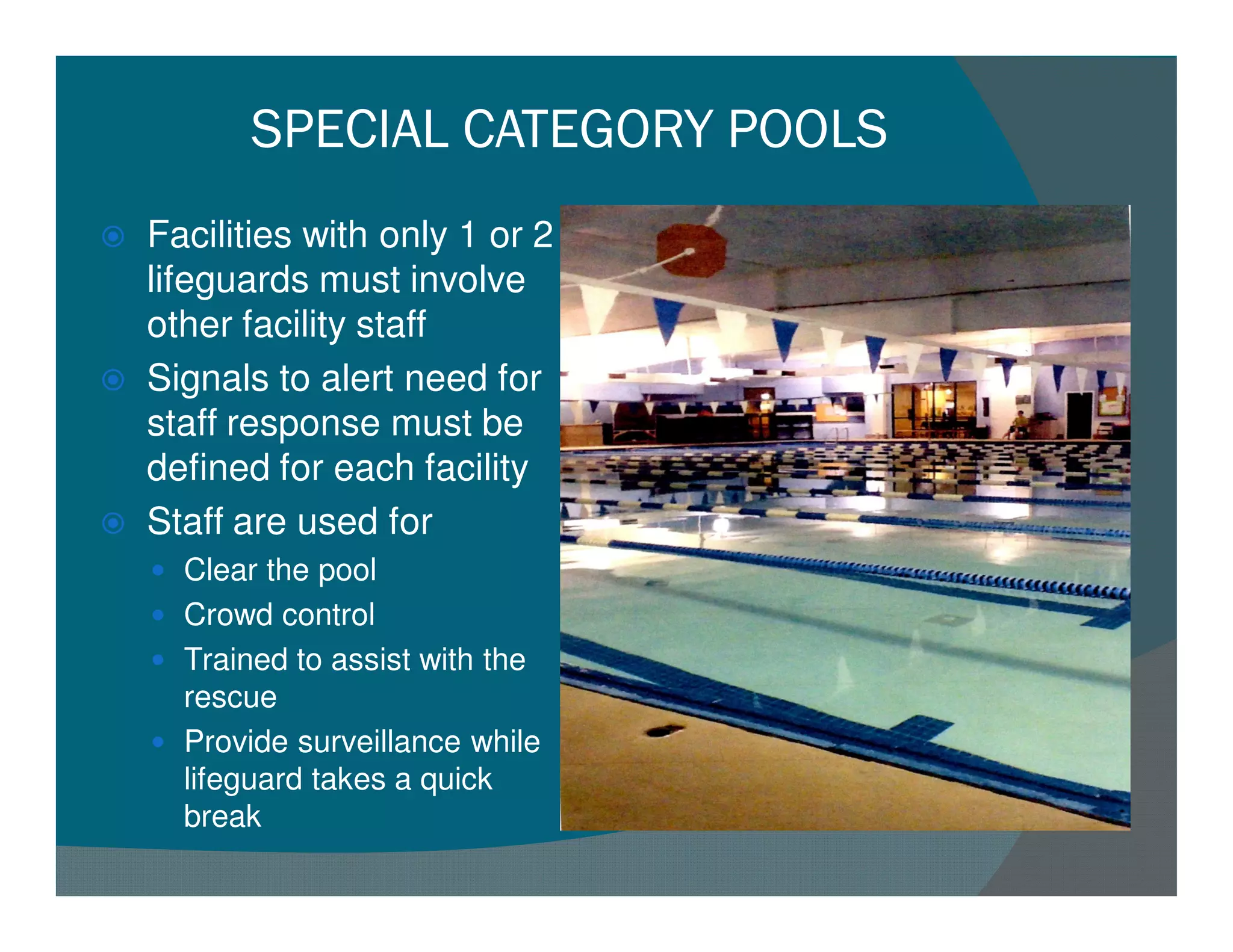
50 METER POOLS
Apool with one lifeguard
on the stand and one
lifeguard roaming at all
times
Whistle signals for quick
assistance is adequate
for 2nd lifeguard
Supervisor’s office is not
adjacent to pool;
2-way radio enables
access to management
and/or response team
8.
SPECIAL CATEGORY POOLS
Facilitieswith only 1 or 2
lifeguards must involve
other facility staff
Signals to alert need for
staff response must be
defined for each facility
Staff are used for
Clear the pool
Crowd control
Trained to assist with the
rescue
Provide surveillance while
lifeguard takes a quick
break
9.
BEACHFRONT and MULTI-POOL
COMMUNICATION OPTIONS
Common response to
emergencies
Two-way radios between
lifeguard stations
Rescue tubes or equipment
used for nonverbal
Communication
Challenges - maximizing
communication between
stations
10.
BEACHFRONT BASICS beforeEMERGENCIES
Flag color and Signs are approved and
encouraged by USLA and the International
Lifesaving Foundation
Help ensure Universal understanding of the
meaning for each color
Flags should be based on measurable criteria
Should be used to provided condition for an
entire beach area
A sign denoting the meaning for each color
flag should be easily visible for beach goers
11.
WARNING FLAGS
Green: Lowhazard (small surf)
Yellow: Moderate hazard (strong current)
Red: High hazard (contaminated water)
Red over Red: Water closed
Purple: Marine life present (jellyfish)
Yellow w/Black ball: Surfing prohibited
Black: Surfing permitted
Checkered: Use area boundary (swimming area)
Red over Yellow: Protected area (end of lifeguard)
Rescue Flotation DeviseSignals
(RFD: Rescue Tube)
Performed by lifeguard on land to provide
location/movement directions to the in water
rescuer
Move to the right or left – RFD is extended to the right or
left at the end of a fully extended arm
15.
USLA RFD SIGNALS- continued
Go Further Out- An RFD is held vertically between
two upraised arms
16.
USLA RFD SIGNALS- continued
Stay There- Arms are extended horizontally to the
sides without holding a rescue buoy.
17.
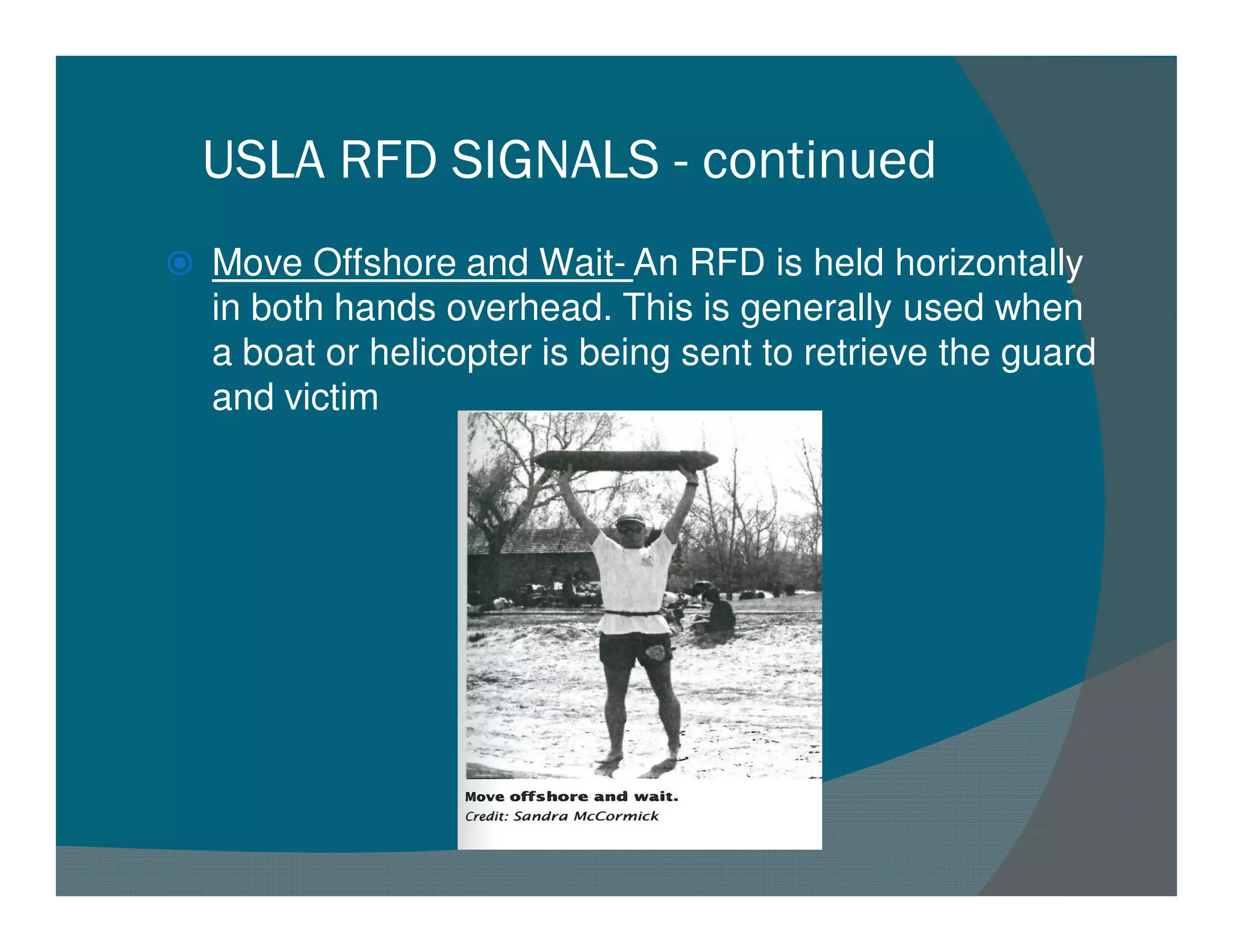
USLA RFD SIGNALS- continued
Move Offshore and Wait- An RFD is held horizontally
in both hands overhead. This is generally used when
a boat or helicopter is being sent to retrieve the guard
and victim
18.
IN-WATER RESCUER ARMSIGNALS
Arm signals are primarily used by responding
rescuer to initiate back-up or provide a victim
status up-date to land rescuers
This is completed:
Once control of the situation has been gained
The victim is stabilized
Once the in water rescuer provides the signal
the rescuers on shore should respond with the
same signal to ensure each signal was seen
and understood
Arm signals can be initiated by land rescuers to
communicate with in-water rescuers
19.
USLA IN-WATER ARMSIGNALS
All Clear - OK Resuscitation Case or
Oxygen Needed
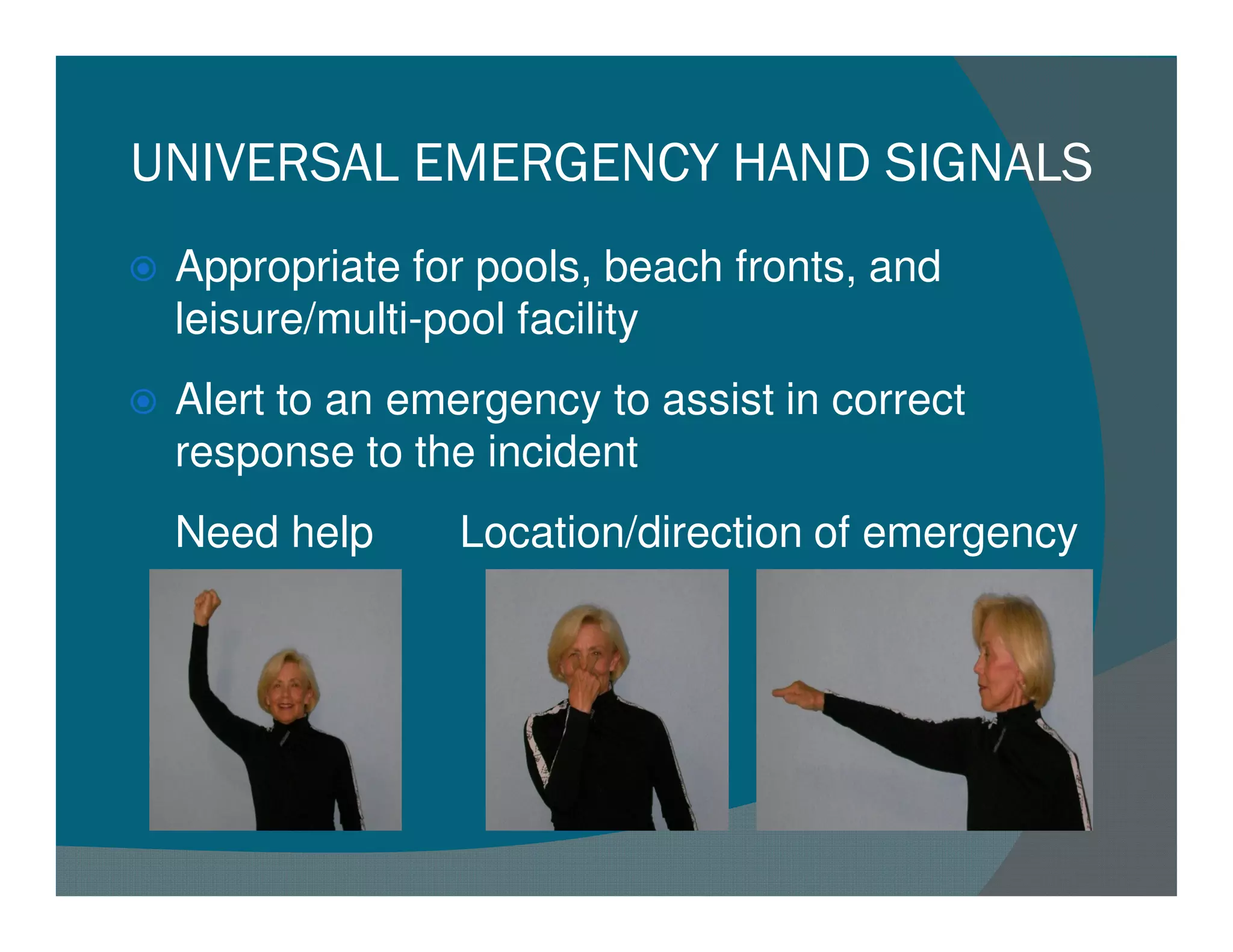
UNIVERSAL EMERGENCY HANDSIGNALS
Appropriate for pools, beach fronts, and
leisure/multi-pool facility
Alert to an emergency to assist in correct
response to the incident
Need help Location/direction of emergency
22.
HAND SIGNALS forBASIC SYMPTOMS
Breathing Problem Unconscious Choking
Heart Attack Stroke Seizure Spine/Neck Injury
23.
SITE SPECIFIC SIGNALS
Asite can develop their own signals to
communicate with staff and patrons.
Ensure that all parties understand the signals
and ensure there is a purpose to the signal.
RFD: Guard in Water is in the area- Place tube
perpendicular over head (straight) moving tube left
to right.
ARM: Call 911- Move finger in circle over head.
FLAG: Lowered Flag- Lifeguard in water come in
quickly, unless directed by tube signals.
24.
WHY CONSIDER ADOPTINGHAND SIGNALS
Some pools supplement lifeguards with video
monitoring – quickly relays essential information
Large pools/multi-pool complexes need simple
and quick communication between lifeguard
stations
Private pools with inadequate lifeguard staffing
Therapy pools
25.
INCORPORATING INTO CURRENTTRAINING
During training for specific emergencies, show
the hand signal that relates to it
Discuss how to incorporate into established
activation protocol – quickly identify area or
emergency and needed assistance
Radios and lifeguard flags adding hand signals
to relay messages to fellow guards
26.
UNIVERSAL SIGN LANGUAGE
Anew tool for the tool kit
Will it work for you?
How can you use it in multi-pool complexes
and beach waterfronts?
Any additional signs that you use?