Download to read offline

![5
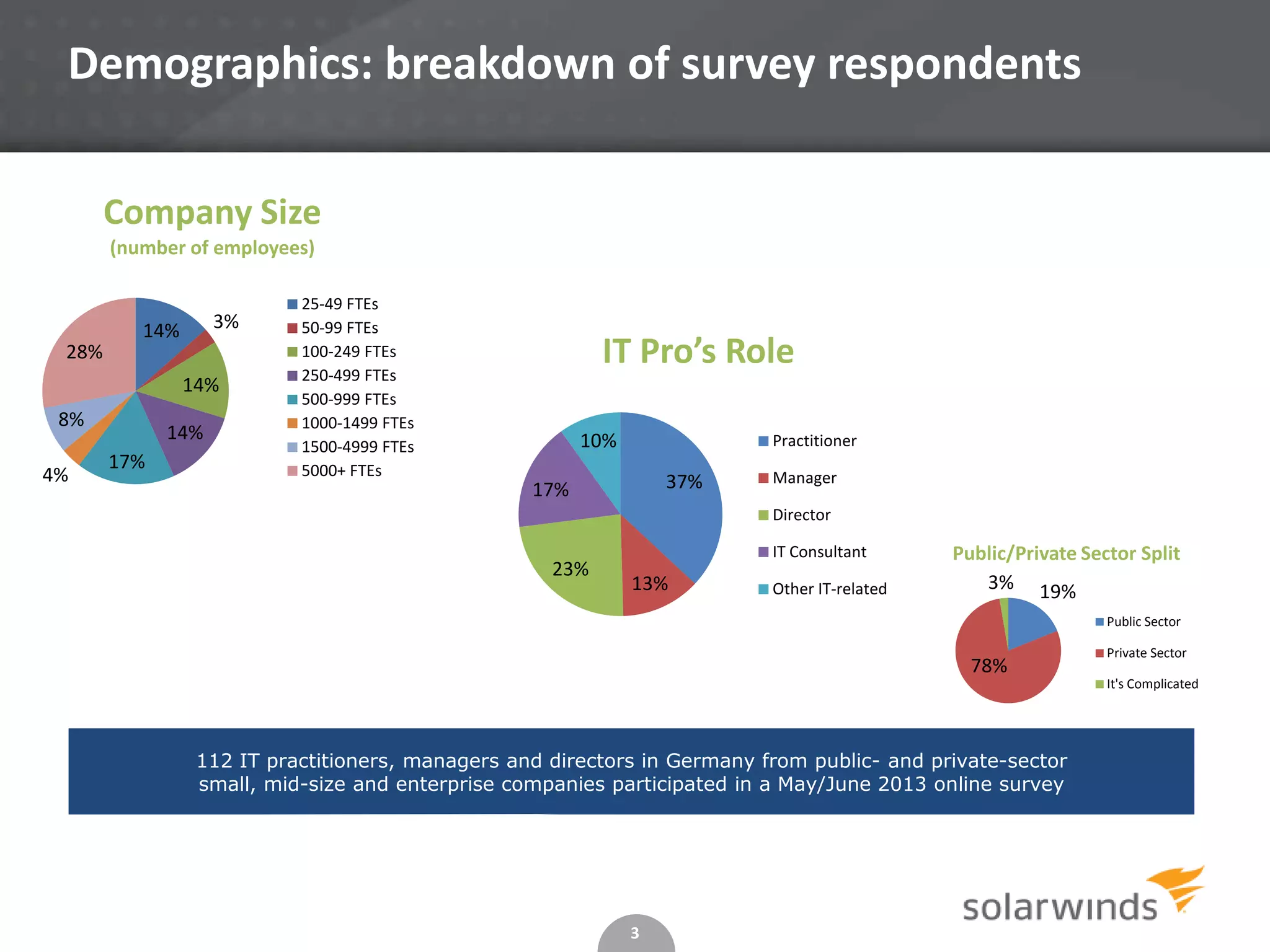
3.54
3.15
3.10
2.54
1.88
1 2 3 4 5
Compute virtualisation
Smarter equipment and/or
more complex equipment
Software Defined Networks
(SDN)/virtual networks
Video
conferencing/telepresence
Vendor proliferation
Technology Drivers
A1: Please rank which of the following technologies increase network
complexity the most for the networks that you manage with “1” meaning “most
impactful to network complexity” and “5” meaning “least impactful to network
complexity”, using each number only once: [provided “other” fill-in blank
option and “N/A-do not use/manage” option as well]
Top Drivers Impacting Network Complexity
#1
#2
IT professionals surveyed indicate that compute virtualisation, followed by smarter/more complex equipment
(such as you used to need 3 pieces of equipment to do what a single piece of equipment can do today) and
software defined networks (SDN)/virtual networks are the top three technology drivers
increasing network complexity today.
#3](https://image.slidesharecdn.com/solarwindsnetworkcomplexitydriversskillsetresearchger061813-130716073530-phpapp02/75/German-IT-Pros-Survey-Network-Complexity-5-2048.jpg)
![6
5.13
4.48
4.36
4.04
3.67
3.57
3.32
1 2 3 4 5 6 7
Mobility
Bring Your Own Device
(BYOD)
Distributed workforce and/or
telecommuters/work-from-…
Private cloud
Voice/Voice over Internet
Protocol (VoIP)
Public cloud or Software as a
Service (SaaS)
Video distribution and/or
video conferencing
Drivers in IT Operations
A2: IT professionals are increasingly asked to take on additional
responsibilities as new IT service offerings emerge. Please rank which of the
following areas increase network complexity the most for the networks that
you manage with “1” meaning “most impactful to network complexity” and “7”
meaning “least impactful to network complexity”, using each number only
once: [provided “other” fill-in blank option and “N/A-do not use/manage”
option as well]
Top Drivers Impacting Network Complexity
#1
#2
IT professionals surveyed indicate that mobility, Bring Your Own Device (BYOD), and distributed
workforce/telecommuters/work-from-home are the top three areas within IT Operations
impacting network complexity today.
#3](https://image.slidesharecdn.com/solarwindsnetworkcomplexitydriversskillsetresearchger061813-130716073530-phpapp02/75/German-IT-Pros-Survey-Network-Complexity-6-2048.jpg)
![7
2.37
1.83
1.66
1 2 3
Security (for example, denial
of service (DoS)
attacks, Adobe vulnerabilities)
Compliance (for
example, Payment Card
Industry-Data Security
Standard (PCI-…
Auditing (for example, IT
audits due to PCI-DSS, EU
Data Protection
Directive, HIPAA and other…
Drivers in
Business Operations
A3: IT professionals are increasingly asked to take on additional
responsibilities as new business operations requirements emerge. Please rank
which of the following areas increase network complexity the most for the
networks that you manage with “1” meaning “most impactful to network
complexity” and “3” meaning “least impactful to network complexity”, using
each number only once: [provided “other” fill-in blank option and “N/A-do not
use/manage” option as well]
Top Drivers Impacting Network Complexity
#1
IT professionals surveyed indicate that security (for example, denial of service (DoS) attacks, Adobe
vulnerabilities) is the top Business Operations driver increasing network complexity today.](https://image.slidesharecdn.com/solarwindsnetworkcomplexitydriversskillsetresearchger061813-130716073530-phpapp02/75/German-IT-Pros-Survey-Network-Complexity-7-2048.jpg)
![9
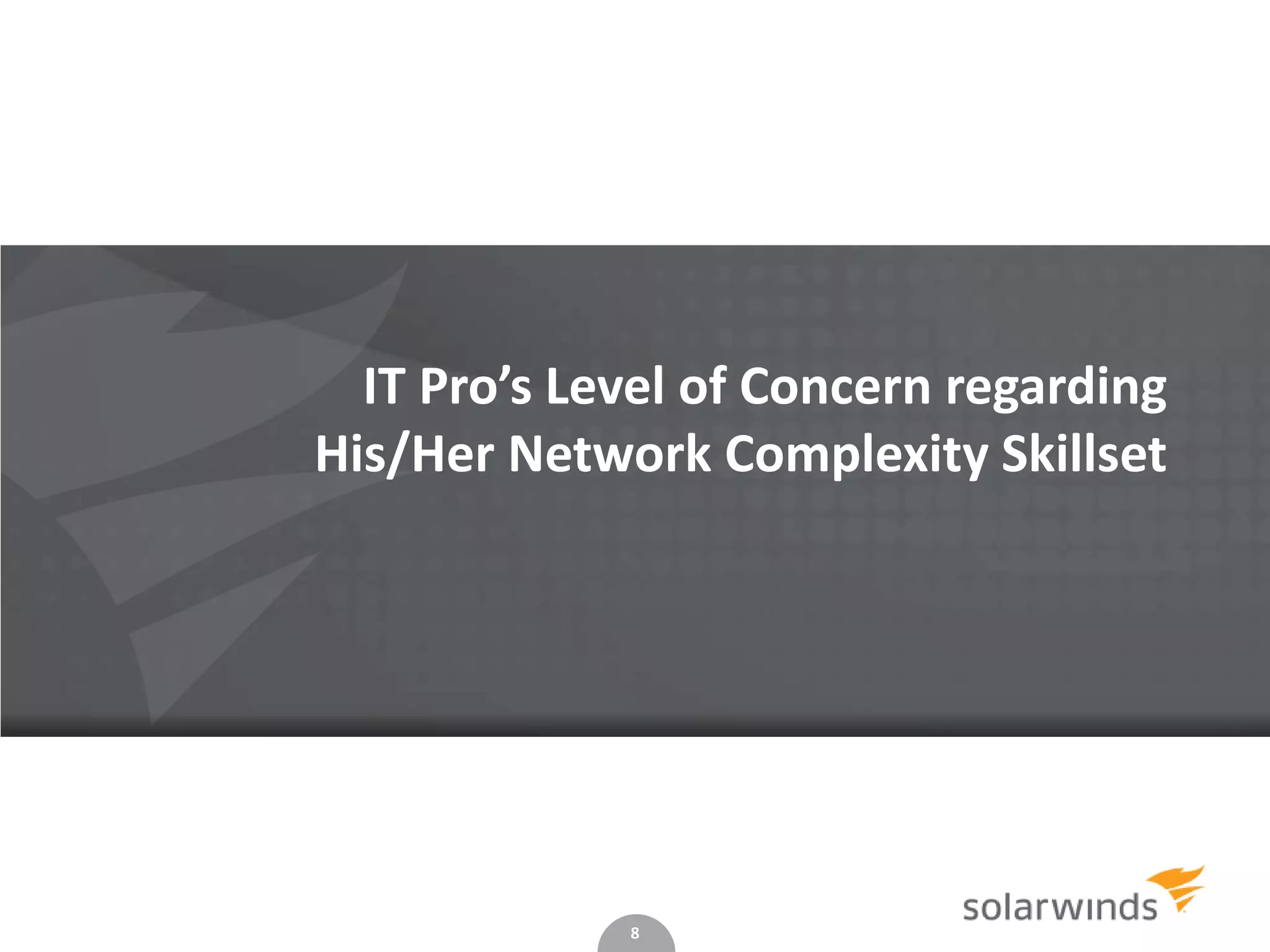
A3: Based on the definition of “network complexity” above, how much has
increased network complexity changed your IT role/responsibilities within the
last 3-5 years? [choose one: “it has greatly affected my
role/responsibilities”, “it has somewhat affected …”, “it has not affected …”, “do
not know”]
Level of Concern: IT Pro’s Network Complexity Skillset
Nearly 85% of IT professionals said network complexity has either somewhat affected or greatly affected
their role/responsibilities within the last 3-5 years.
34%
50%
13%
2%
Impact of Network Complexity on IT Role
in Last 3-5 Years
It has greatly affected my
role/responsibilities
It has somewhat affected
my role/responsibilities
It has not affected my
role/responsibilities
Do not know](https://image.slidesharecdn.com/solarwindsnetworkcomplexitydriversskillsetresearchger061813-130716073530-phpapp02/75/German-IT-Pros-Survey-Network-Complexity-9-2048.jpg)
![10
A4(b,c,e): How much do you agree or disagree with each of the following
statements? (please provide the degree to which you agree or disagree with
each statement by selecting from 1 (“do not agree at all”) to 10 (“agree
completely”): [provided “N/A” as well]
Level of Concern: IT Pro’s Network Complexity Skillset
IT professionals agree (moderately so) that their existing skillset has fully prepared them to deploy all the IT
network management solution(s) necessary to manage their company’s current complexity challenges. And
little agreement exists among IT pros regarding how concerned they are about their ability to succeed given
ever-increasing responsibilities that directly impact network complexity.
4.41
6.36
5.69
1 2 3 4 5 6 7 8 9 10
With my existing skillset, I am concerned about my ability to succeed given
the new technologies (such as smarter equipment) and ever-increasing IT
operations (such as cloud) and business operations (such as compliance)
responsibilities I've been given, a
With my existing skillset, I am fully prepared to deploy all the IT network
management solution(s) necessary to manage our current network
complexity challenges.
IT professionals should have a "generalist" IT skillset (such as network)
rather than a "specialist" IT skillset (such as server/application).
(1 (“do not agree at all”) 10 (“agree completely”))
Do NC drivers hinder an IT Pro’s success given his/her existing skillset?](https://image.slidesharecdn.com/solarwindsnetworkcomplexitydriversskillsetresearchger061813-130716073530-phpapp02/75/German-IT-Pros-Survey-Network-Complexity-10-2048.jpg)
![11
A4(a,d): How much do you agree or disagree with each of the following
statements? (please provide the degree to which you agree or disagree with
each statement by selecting from 1 (“do not agree at all”) to 10 (“agree
completely”): [provided “N/A” as well]
Level of Concern: IT Pro’s Network Complexity Skillset
IT professionals solidly agree that their company is prepared for growing network complexity challenges, yet IT
pros agree slightly less (moderate agreement) that they have already invested in all of the IT network
management solution(s) necessary to address current network complexity challenges.
6.33
7.05
1 2 3 4 5 6 7 8 9 10
My company has already invested in all of the IT network management
solution(s) necessary to address our current network complexity
challenges.
My company is prepared for our growing network complexity challenges.
(1 (“do not agree at all”) 10 (“agree completely”))
How confident are IT pros that their companies are prepared for
growing network complexity challenges?](https://image.slidesharecdn.com/solarwindsnetworkcomplexitydriversskillsetresearchger061813-130716073530-phpapp02/75/German-IT-Pros-Survey-Network-Complexity-11-2048.jpg)
![12
A9: What else does your company still need to do/obtain in order to be as
prepared as possible for growing network complexity? (please choose all that
apply) [provided “other” fill-in-the-blank response as well]
Level of Concern: IT Pro’s Network Complexity Skillset
Over 80% of IT professionals feel that their company still needs to train IT staff in order to be as prepared as
possible for growing network complexity. Almost half (48%) feel that their company needs to add network
management tools/software, and 40% feel their company needs to better prioritise existing IT resources in
order to be as prepared as possible for growing network complexity.
80.4%
48.2%
40.2%
32.1%
21.4%
5.4%
0% 25% 50% 75% 100%
Train IT staff
Add network management tools/SW
Better prioritize existing IT resources
Increase IT budget
Increase IT staff
Other
What else does an IT pro’s company still need to do/obtain in order to
be as prepared as possible for growing network complexity?](https://image.slidesharecdn.com/solarwindsnetworkcomplexitydriversskillsetresearchger061813-130716073530-phpapp02/75/German-IT-Pros-Survey-Network-Complexity-12-2048.jpg)

![14
A10: What is the single most important skill/skillset needed TODAY by IT
professionals to combat the challenges of network complexity? (please choose
only one) [provided “other” fill-in-the-blank response as well]
Addressing Gaps: IT Pro’s Network Complexity Skillset
Nearly one-fourth of all IT professionals feel that understanding of the business is the single most important
skillset needed today to combat the challenges of network complexity, followed by information security.
24.1%
17.0%
13.4%
13.4%
13.4%
10.7%
5.4%
1.8%
0.9%
0% 25% 50% 75% 100%
Understanding of the business
Information security
Cloud or SaaS
Compute virtualisation
Network engineering
Project management
Mobile applications and device management
Server management
Other
The single most important skillset needed today by IT pros
to combat the challenges of network complexity:](https://image.slidesharecdn.com/solarwindsnetworkcomplexitydriversskillsetresearchger061813-130716073530-phpapp02/75/German-IT-Pros-Survey-Network-Complexity-14-2048.jpg)
![15
A5(a): How much do you agree or disagree with each of the following
statements? (please provide the degree to which you agree or disagree with
each statement by selecting from 1 (“do not agree at all”) to 10 (“agree
completely”): [provided “N/A” as well]
Addressing Gaps: IT Pro’s Network Complexity Skillset
One-fifth (19%) of IT professionals solidly agree that their higher education sufficiently prepared them for their
current IT role. Another 38% of respondents somewhat agree that their higher education sufficiently prepared
them, while 30% of IT professionals are relatively undecided. And the remaining 13% believe that their higher
education did NOT sufficiently prepare them for their current IT role.
5.01
1 2 3 4 5 6 7 8 9 10
My higher education (university degree(s)
and/or vocational training) sufficiently
prepared me for my current IT role.
(1 (“do not agree at all”) 10 (“agree completely”))
Did higher education sufficiently prepare IT pros
for their current IT roles?](https://image.slidesharecdn.com/solarwindsnetworkcomplexitydriversskillsetresearchger061813-130716073530-phpapp02/75/German-IT-Pros-Survey-Network-Complexity-15-2048.jpg)
![16
A11: What will be the single most important skill/skillset needed IN FIVE YEARS
by IT professionals to combat the challenges of network complexity? (please
choose only one) [provided “other” fill-in-the-blank response as well]
Addressing Gaps: IT Pro’s Network Complexity Skillset
Understanding of the business (today’s single most important skillset) remains in the top spot when IT pros
look 5 years into the future to determine what will be the single most important skillset needed to combat the
future challenges of network complexity. Information security and cloud/Software-as-a-Service (SaaS) also
remain in the top three when IT pros look 5 years into the future.
32.1%
19.6%
14.3%
11.6%
7.1%
7.1%
5.4%
1.8%
0.9%
0% 25% 50% 75% 100%
Understanding of the business
Information security
Cloud or SaaS
Compute virtualisation
Project management
Network engineering
Mobile applications and device management
Other
Server management
The single most important skillset needed in 5 years by IT pros
to combat the future challenges of network complexity:](https://image.slidesharecdn.com/solarwindsnetworkcomplexitydriversskillsetresearchger061813-130716073530-phpapp02/75/German-IT-Pros-Survey-Network-Complexity-16-2048.jpg)
![17
A7: If you did not already possess the single most important skill needed
TODAY to combat the challenges of network complexity, how would you
realistically go about obtaining it? (please choose all that apply) [provided
“other” fill-in-the-blank response as well]
Addressing Gaps: IT Pro’s Network Complexity Skillset
Over 65% of IT professionals would obtain training in order to gain necessary skills/certifications for combating
network complexity. And 54% of IT pros would turn to online influencers/resources, while just over half (51%)
would participate in vendor learning.
65.2%
53.6%
50.9%
37.5%
30.4%
28.6%
21.4%
8.0%
3.6%
0% 25% 50% 75% 100%
Obtain training
Turn to online influencers/resources
Participate in vendor learning
Increase experience/expertise organically
Participate in peer-to-peer learning (such as…
Obtain certification
Participate in distance learning
Gain an/another university degree (undergraduate…
Other
Resources used for obtaining
any additional skills/certifications needed](https://image.slidesharecdn.com/solarwindsnetworkcomplexitydriversskillsetresearchger061813-130716073530-phpapp02/75/German-IT-Pros-Survey-Network-Complexity-17-2048.jpg)
![18
U4: What (if any) barriers have you encountered while trying to obtain network
management training (please think about the entire process – from gaining
approval to be trained through trying to complete the actual training)? [open-
ended/fill-in-the-blank]
Addressing Gaps: IT Pro’s Network Complexity Skillset
Nearly one-fourth of IT professionals (24%) consider budget constraints the biggest barrier to training, and another
one-fifth (20%) consider time to train a barrier; however 18% of IT pros do not feel they have any barriers to training.
24.3%
19.6%
17.8%
14.0%
11.2%
10.3%
2.8%
0% 25% 50% 75% 100%
Budget
Time to train
No barriers
Approval process
Training content
Other
Travel restriction/ban
Barriers (if any) to network management training
Sampling of Noteworthy Open-Ended Responses
Budget: “no budget planned”, “[no] available
budget”, “cost”, “external training courses are expensive and
time consuming”, “the costs of such training”
Time to Train: “scheduling”, “availability”, “time management”
Approval Process: “concrete value assessment for the company
is required”, “obtaining approval requires a great deal of
persuasion”
Training Content: “appropriate courses for our specific
requirements”, “lack of quality [content]”, “… cannot always find
suitable training for the skill level required …”, “no breadth of
options for new topics such as SDN”
Travel Restriction/Ban: “course location”, “distance to
providers”](https://image.slidesharecdn.com/solarwindsnetworkcomplexitydriversskillsetresearchger061813-130716073530-phpapp02/75/German-IT-Pros-Survey-Network-Complexity-18-2048.jpg)
![19
A6(a,b,c): How much do you agree or disagree with each of the following
statements? (please provide the degree to which you agree or disagree with
each statement by selecting from 1 (“do not agree at all”) to 10 (“agree
completely”): [provided “N/A” as well]
Addressing Gaps: IT Pro’s Network Complexity Skillset
IT professionals moderately agree that gaining approval to participate in training is a relatively painless process.
Slightly less IT pros are in agreement that most/all of their training for skills/certification takes place during work
hours, and even less IT pros are in agreement that scheduling a time for training (on their own or with a third
party) is a relatively painless process.
6.15
5.22
5.96
1 2 3 4 5 6 7 8 9 10
Gaining approval for me to participate in training (ie vendor
learning, distance learning, certifications, onsite training, offsite
training) is a relatively painless process within my company.
Scheduling a time for me to train (ie vendor training, distance
learning, certifications, onsite training, offsite training) on my own
or with a third party is a relatively painless process.
I undertake most/all of my training for needed skills/certification
during work hours.
(1 (“do not agree at all”) 10 (“agree completely”))
The Continuing Education Process](https://image.slidesharecdn.com/solarwindsnetworkcomplexitydriversskillsetresearchger061813-130716073530-phpapp02/75/German-IT-Pros-Survey-Network-Complexity-19-2048.jpg)
![20
A5(b,c,d): How much do you agree or disagree with each of the following
statements? (please provide the degree to which you agree or disagree with
each statement by selecting from 1 (“do not agree at all”) to 10 (“agree
completely”): [provided “N/A” as well]
Addressing Gaps: IT Pro’s Network Complexity Skillset
IT professionals show little agreement on whether today’s higher education is sufficiently preparing the next
generation of IT pros to meet tomorrow’s technology demands or that the amount of training required for
graduates entering the IT workforce sufficiently prepares them for entry-level positions. However, IT pros are in
agreement (moderately so) that graduates should have a “generalist” rather than a “specialist” IT skillset.
4.27
4.75
6.16
1 2 3 4 5 6 7 8 9 10
Today's higher education (university degree(s) and/or vocational
training) is sufficiently preparing the next generation of IT
professionals to meet tomorrow's technology demands.
The amount of training required for university graduates and
vocational graduates entering the IT workforce sufficently prepares
them for entry-level positions.
University and vocational graduates should have a "generalist" IT
skillset (such as network) rather than a "specialist" IT skillset (such
as server/application).
(1 (“do not agree at all”) 10 (“agree completely”))
Today’s Educational Standards and Tomorrow’s IT Professionals](https://image.slidesharecdn.com/solarwindsnetworkcomplexitydriversskillsetresearchger061813-130716073530-phpapp02/75/German-IT-Pros-Survey-Network-Complexity-20-2048.jpg)

The survey conducted by C. White Consulting reveals that IT professionals in Germany perceive network complexity to be driven primarily by compute virtualization, smarter equipment, and software-defined networks. The study indicates that nearly 85% of respondents believe network complexity has significantly affected their roles in recent years, and they express a need for further training to address the skill gaps. Key areas for improvement identified include enhancing IT staff training, adding network management tools, and better prioritizing existing resources.


![Coded Agents – with UiPath SDK + LangGraph [Virtual Hands-on Workshop]](https://cdn.slidesharecdn.com/ss_thumbnails/codedagentsdeck-251215155422-5497c599-thumbnail.jpg?width=640&height=640&fit=bounds)


