This document provides an introduction to reliability centered maintenance (RCM) terminology and concepts. It defines key terms like failure, failure mode, severity, probability of failure, and criticality. It also defines different types of maintenance like preventive maintenance, corrective maintenance, condition monitoring, and their relationships to RCM. The objective is to introduce the basic RCM process concepts and terminology.
Module 3Module 3
UNITIUNIT I
"Copyright 2002, Information Spectrum, Inc. All Rights Reserved."
INTRODUCTION TO RCMINTRODUCTION TO RCMINTRODUCTION TO RCMINTRODUCTION TO RCM
RCM TERMINOLOGY ANDRCM TERMINOLOGY AND
CONCEPTSCONCEPTS
RCM TERMINOLOGY ANDRCM TERMINOLOGY AND
CONCEPTSCONCEPTS
2.
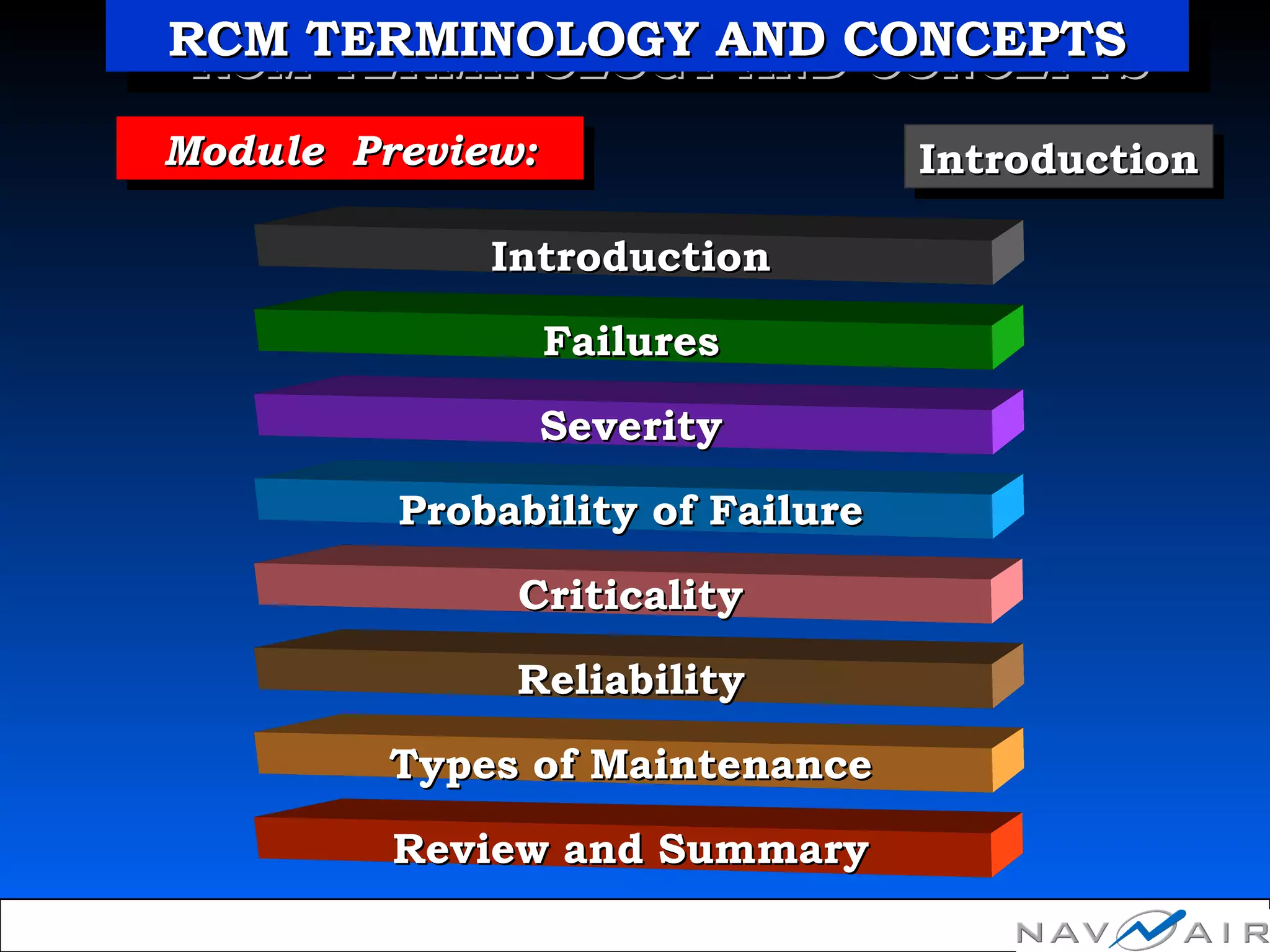
IntroductionIntroductionIntroductionIntroductionModule Preview:Module Preview:ModulePreview:Module Preview:
FailuresFailures
IntroductionIntroduction
SeveritySeverity
Probability of FailureProbability of Failure
ReliabilityReliability
Types of MaintenanceTypes of Maintenance
Review and SummaryReview and Summary
CriticalityCriticality
RCM TERMINOLOGY AND CONCEPTSRCM TERMINOLOGY AND CONCEPTSRCM TERMINOLOGY AND CONCEPTSRCM TERMINOLOGY AND CONCEPTS
3.
Module Objective:Module Objective:ModuleObjective:Module Objective:
This module will introduce basicThis module will introduce basic
concepts and terminology used in theconcepts and terminology used in the
RCM process.RCM process.
IntroductionIntroductionIntroductionIntroduction
RCM TERMINOLOGY AND CONCEPTSRCM TERMINOLOGY AND CONCEPTSRCM TERMINOLOGY AND CONCEPTSRCM TERMINOLOGY AND CONCEPTS
4.
Module Objective:Module Objective:ModuleObjective:Module Objective: IntroductionIntroductionIntroductionIntroduction
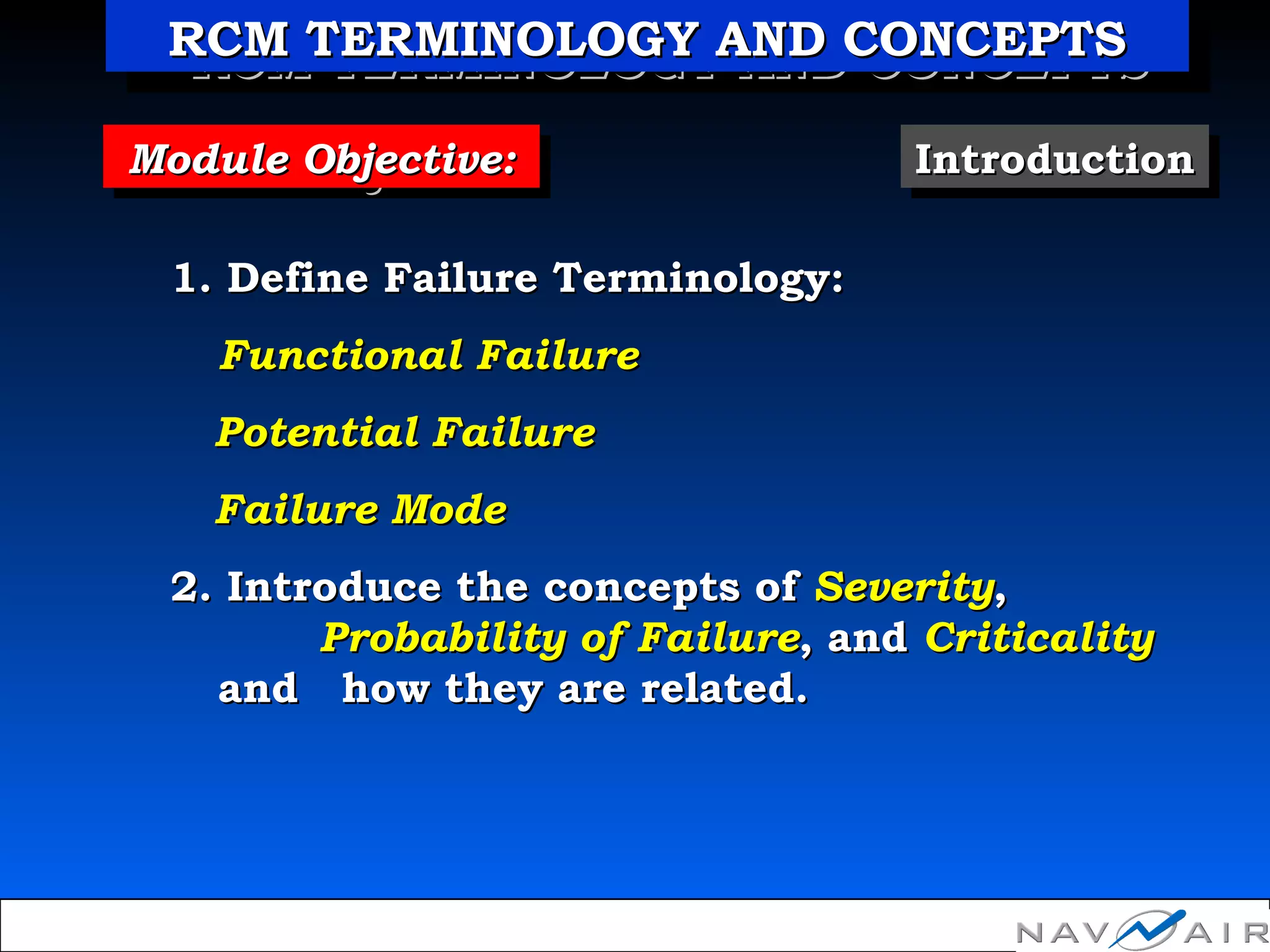
1. Define Failure Terminology:1. Define Failure Terminology:
Functional FailureFunctional Failure
Potential FailurePotential Failure
Failure ModeFailure Mode
2. Introduce the concepts of2. Introduce the concepts of SeveritySeverity,,
Probability of FailureProbability of Failure, and, and CriticalityCriticality
and how they are related.and how they are related.
RCM TERMINOLOGY AND CONCEPTSRCM TERMINOLOGY AND CONCEPTSRCM TERMINOLOGY AND CONCEPTSRCM TERMINOLOGY AND CONCEPTS
5.
Module Objective:Module Objective:ModuleObjective:Module Objective: IntroductionIntroductionIntroductionIntroduction
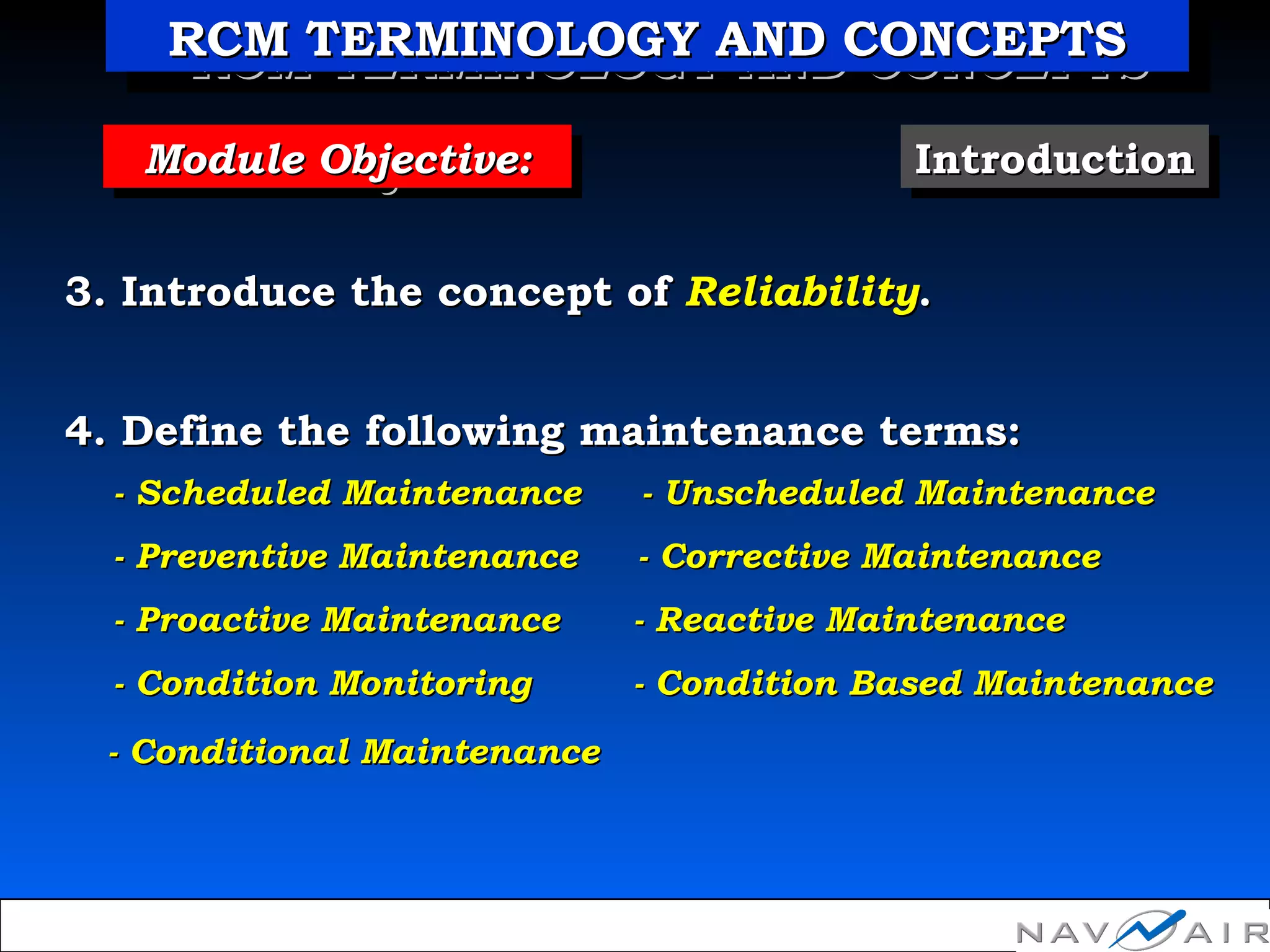
3. Introduce the concept of3. Introduce the concept of ReliabilityReliability..
4. Define the following maintenance terms:4. Define the following maintenance terms:
- Scheduled Maintenance - Unscheduled Maintenance- Scheduled Maintenance - Unscheduled Maintenance
- Preventive Maintenance - Corrective Maintenance- Preventive Maintenance - Corrective Maintenance
- Proactive Maintenance- Proactive Maintenance - Reactive Maintenance- Reactive Maintenance
- Condition Monitoring- Condition Monitoring - Condition Based Maintenance- Condition Based Maintenance
- Conditional Maintenance- Conditional Maintenance
RCM TERMINOLOGY AND CONCEPTSRCM TERMINOLOGY AND CONCEPTSRCM TERMINOLOGY AND CONCEPTSRCM TERMINOLOGY AND CONCEPTS
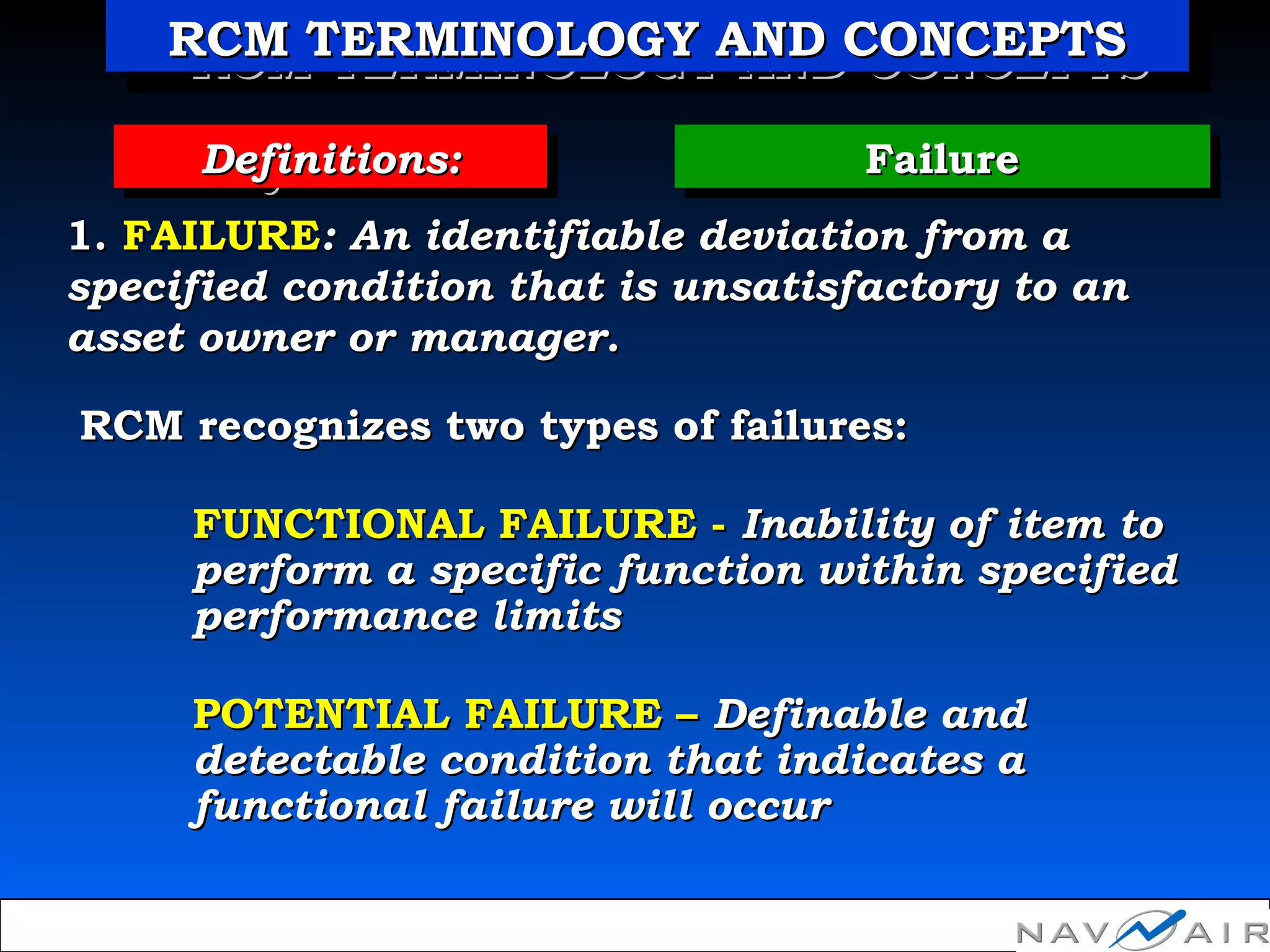
FailureFailureFailureFailureDefinitions:Definitions:Definitions:Definitions:
1.1. FAILUREFAILURE:: Anidentifiable deviation from aAn identifiable deviation from a
specified condition that is unsatisfactory to anspecified condition that is unsatisfactory to an
asset owner or manager.asset owner or manager.
RCM recognizes two types of failures:RCM recognizes two types of failures:
FUNCTIONAL FAILURE -FUNCTIONAL FAILURE - Inability of item toInability of item to
perform a specific function within specifiedperform a specific function within specified
performance limitsperformance limits
POTENTIAL FAILURE –POTENTIAL FAILURE – DefinableDefinable andand
detectable condition that indicates adetectable condition that indicates a
functional failure will occurfunctional failure will occur
RCM TERMINOLOGY AND CONCEPTSRCM TERMINOLOGY AND CONCEPTSRCM TERMINOLOGY AND CONCEPTSRCM TERMINOLOGY AND CONCEPTS
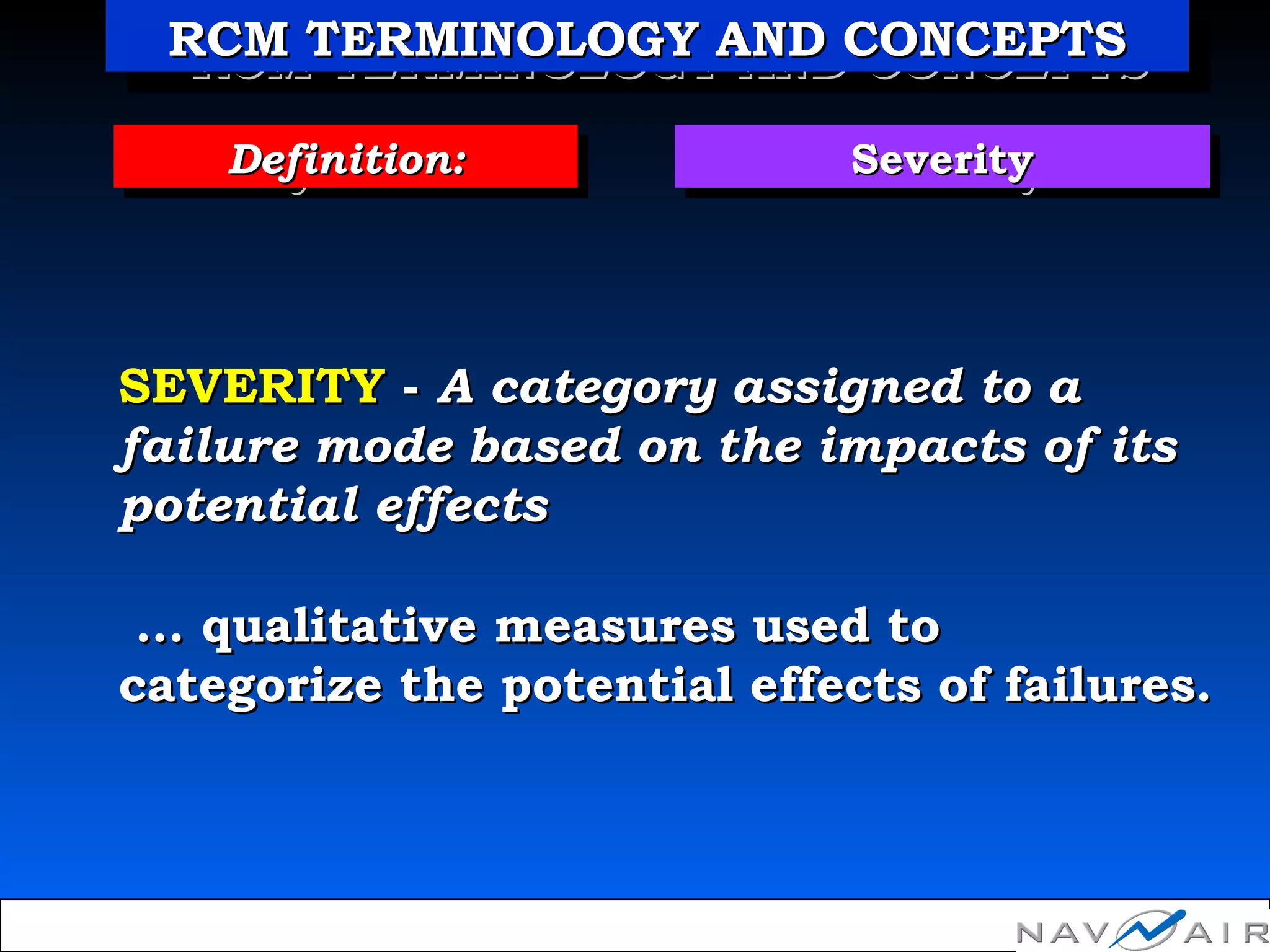
SeveritySeveritySeveritySeverityDefinition:Definition:Definition:Definition:
SEVERITYSEVERITY -- Acategory assigned to aA category assigned to a
failure mode based on the impacts of itsfailure mode based on the impacts of its
potential effectspotential effects
…… qualitative measures used toqualitative measures used to
categorize the potential effects of failures.categorize the potential effects of failures.
RCM TERMINOLOGY AND CONCEPTSRCM TERMINOLOGY AND CONCEPTSRCM TERMINOLOGY AND CONCEPTSRCM TERMINOLOGY AND CONCEPTS
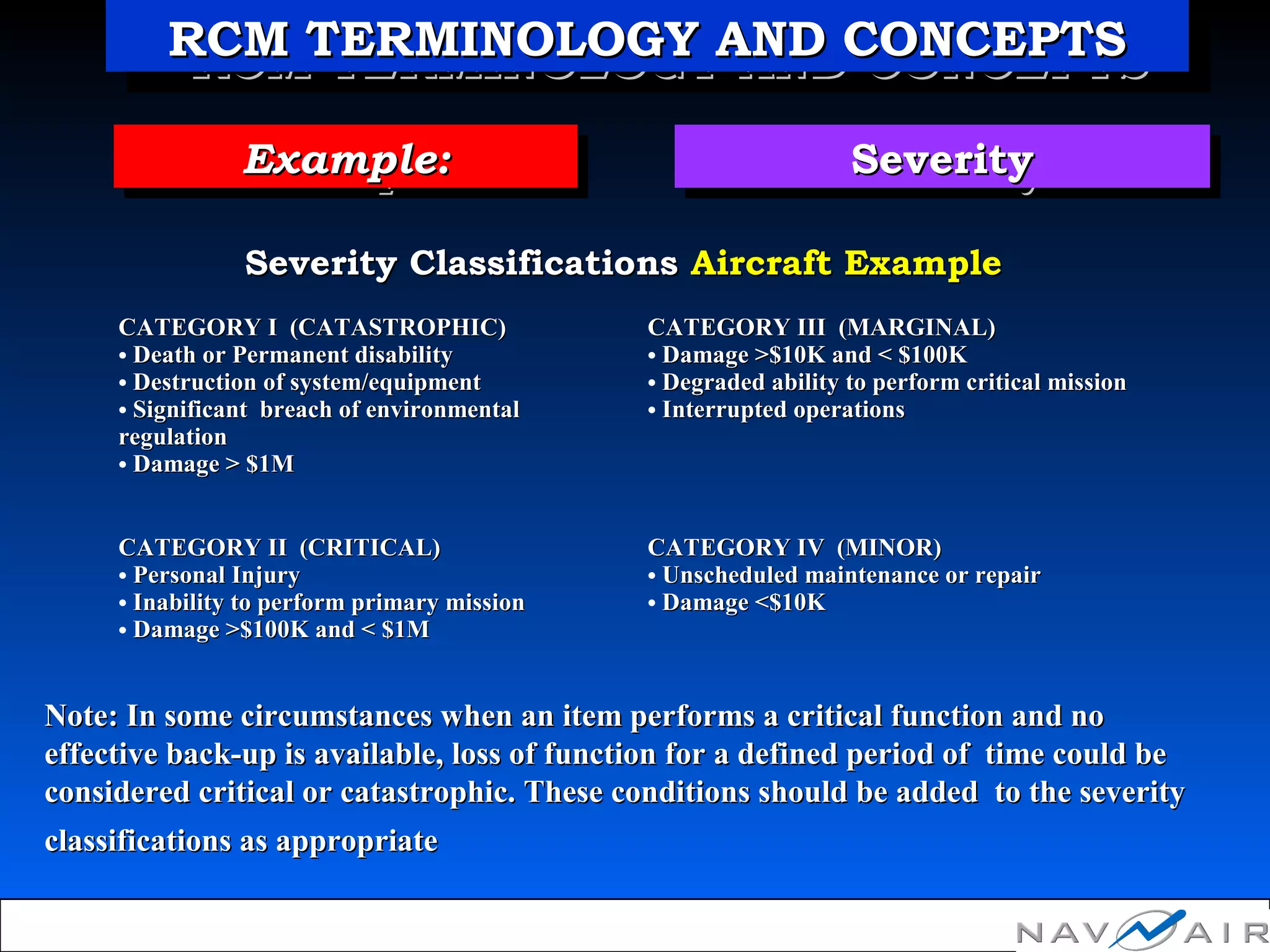
11.
CATEGORY I (CATASTROPHIC)CATEGORYI (CATASTROPHIC)
• Death or Permanent disabilityDeath or Permanent disability
• Destruction of system/equipmentDestruction of system/equipment
• Significant breach of environmentalSignificant breach of environmental
regulationregulation
• Damage > $1MDamage > $1M
CATEGORY III (MARGINAL)CATEGORY III (MARGINAL)
• Damage >$10K and < $100KDamage >$10K and < $100K
• Degraded ability to perform critical missionDegraded ability to perform critical mission
• Interrupted operationsInterrupted operations
CATEGORY II (CRITICAL)CATEGORY II (CRITICAL)
• Personal InjuryPersonal Injury
• Inability to perform primary missionInability to perform primary mission
• Damage >$100K and < $1MDamage >$100K and < $1M
CATEGORY IV (MINOR)CATEGORY IV (MINOR)
• Unscheduled maintenance or repairUnscheduled maintenance or repair
• Damage <$10KDamage <$10K
Example:Example:Example:Example: SeveritySeveritySeveritySeverity
Severity ClassificationsSeverity Classifications Aircraft ExampleAircraft Example
Note: In some circumstances when an item performs a critical function and noNote: In some circumstances when an item performs a critical function and no
effective back-up is available, loss of function for a defined period of time could beeffective back-up is available, loss of function for a defined period of time could be
considered critical or catastrophic. These conditions should be added to the severityconsidered critical or catastrophic. These conditions should be added to the severity
classifications as appropriateclassifications as appropriate
RCM TERMINOLOGY AND CONCEPTSRCM TERMINOLOGY AND CONCEPTSRCM TERMINOLOGY AND CONCEPTSRCM TERMINOLOGY AND CONCEPTS
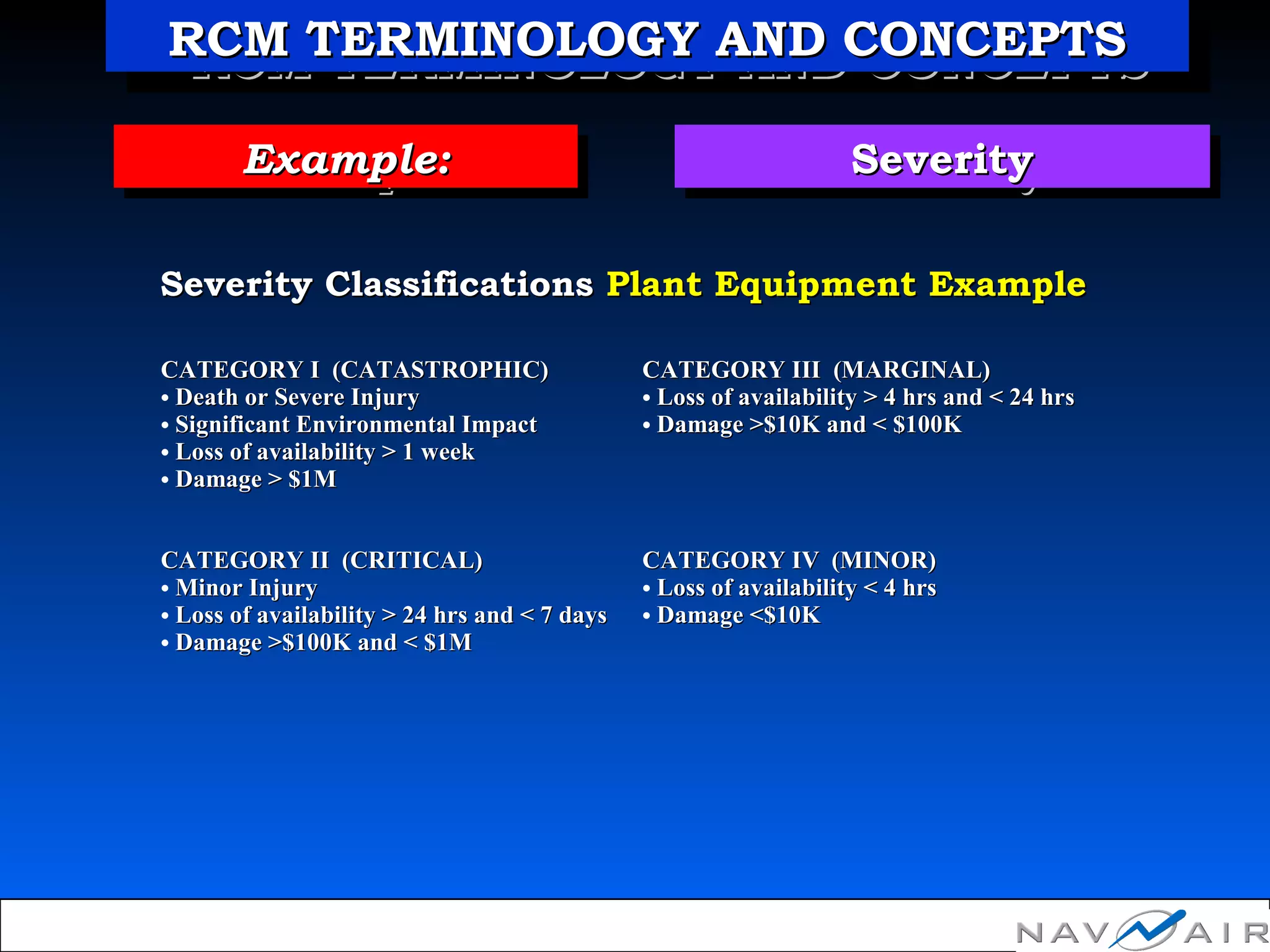
12.
CATEGORY I (CATASTROPHIC)CATEGORYI (CATASTROPHIC)
• Death or Severe InjuryDeath or Severe Injury
• Significant Environmental ImpactSignificant Environmental Impact
• Loss of availability > 1 weekLoss of availability > 1 week
• Damage > $1MDamage > $1M
CATEGORY III (MARGINAL)CATEGORY III (MARGINAL)
• Loss of availability > 4 hrs and < 24 hrsLoss of availability > 4 hrs and < 24 hrs
• Damage >$10K and < $100KDamage >$10K and < $100K
CATEGORY II (CRITICAL)CATEGORY II (CRITICAL)
• Minor InjuryMinor Injury
• Loss of availability > 24 hrs and < 7 daysLoss of availability > 24 hrs and < 7 days
• Damage >$100K and < $1MDamage >$100K and < $1M
CATEGORY IV (MINOR)CATEGORY IV (MINOR)
• Loss of availability < 4 hrsLoss of availability < 4 hrs
• Damage <$10KDamage <$10K
Example:Example:Example:Example: SeveritySeveritySeveritySeverity
Severity ClassificationsSeverity Classifications Plant Equipment ExamplePlant Equipment Example
RCM TERMINOLOGY AND CONCEPTSRCM TERMINOLOGY AND CONCEPTSRCM TERMINOLOGY AND CONCEPTSRCM TERMINOLOGY AND CONCEPTS
Probability of FailureProbabilityof FailureDefinition:Definition:Definition:Definition:
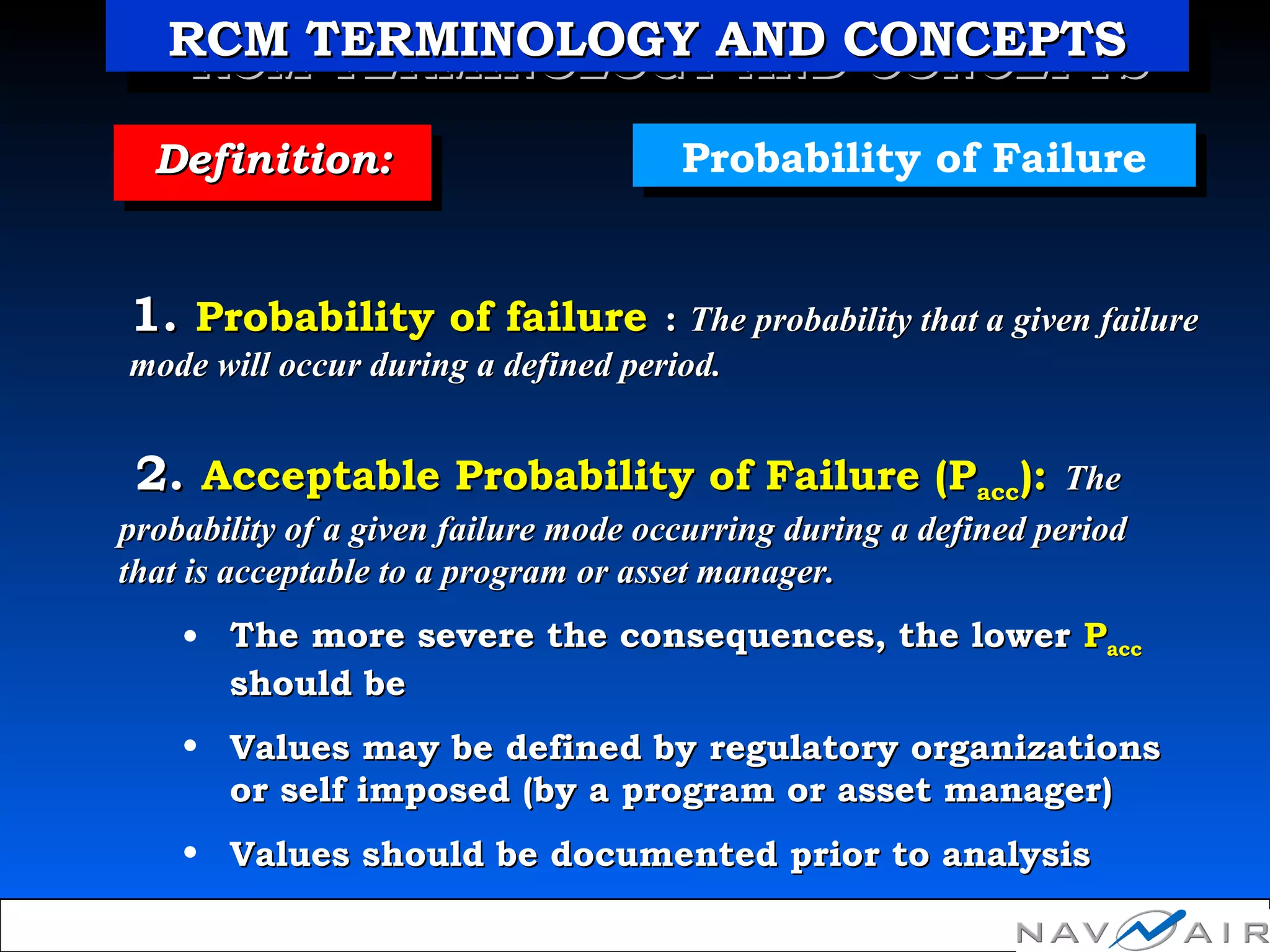
1.1. Probability of failureProbability of failure :: The probability that a given failureThe probability that a given failure
mode will occur during a defined period.mode will occur during a defined period.
2.2. Acceptable Probability of Failure (PAcceptable Probability of Failure (Paccacc):): TheThe
probability of a given failure mode occurring during a defined periodprobability of a given failure mode occurring during a defined period
that is acceptable to a program or asset manager.that is acceptable to a program or asset manager.
• The more severe the consequences, the lowerThe more severe the consequences, the lower PPaccacc
should beshould be
• Values may be defined by regulatory organizationsValues may be defined by regulatory organizations
or self imposed (by a program or asset manager)or self imposed (by a program or asset manager)
• Values should be documented prior to analysisValues should be documented prior to analysis
RCM TERMINOLOGY AND CONCEPTSRCM TERMINOLOGY AND CONCEPTSRCM TERMINOLOGY AND CONCEPTSRCM TERMINOLOGY AND CONCEPTS
15.
Probability of FailureProbabilityof FailureProbability of FailureProbability of FailureDefinition:Definition:Definition:Definition:
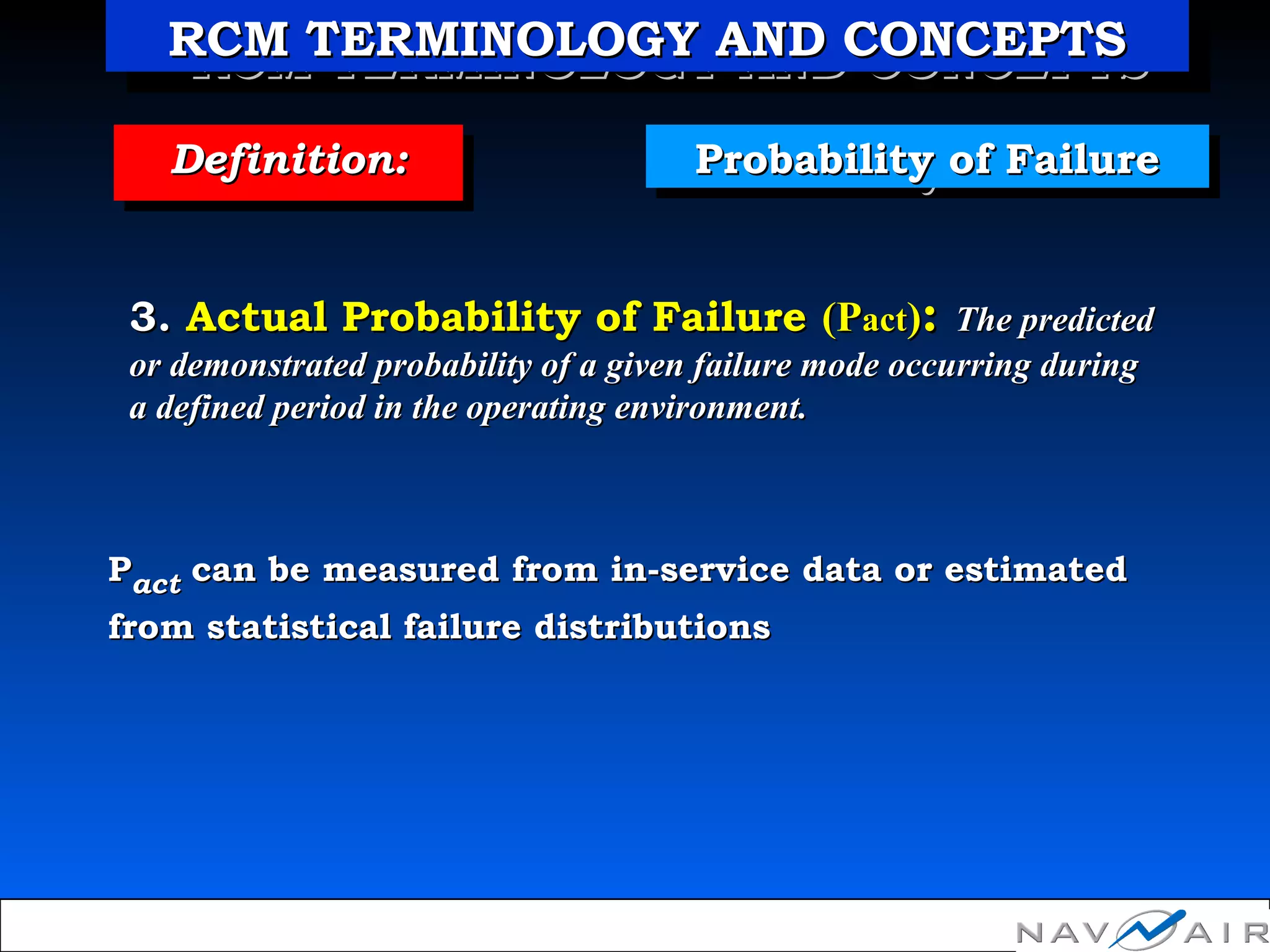
3.3. Actual Probability of FailureActual Probability of Failure (P(Pactact)):: The predictedThe predicted
or demonstrated probability of a given failure mode occurring duringor demonstrated probability of a given failure mode occurring during
a defined period in the operating environment.a defined period in the operating environment.
PPactact can be measured from in-service data or estimatedcan be measured from in-service data or estimated
from statistical failure distributionsfrom statistical failure distributions
RCM TERMINOLOGY AND CONCEPTSRCM TERMINOLOGY AND CONCEPTSRCM TERMINOLOGY AND CONCEPTSRCM TERMINOLOGY AND CONCEPTS
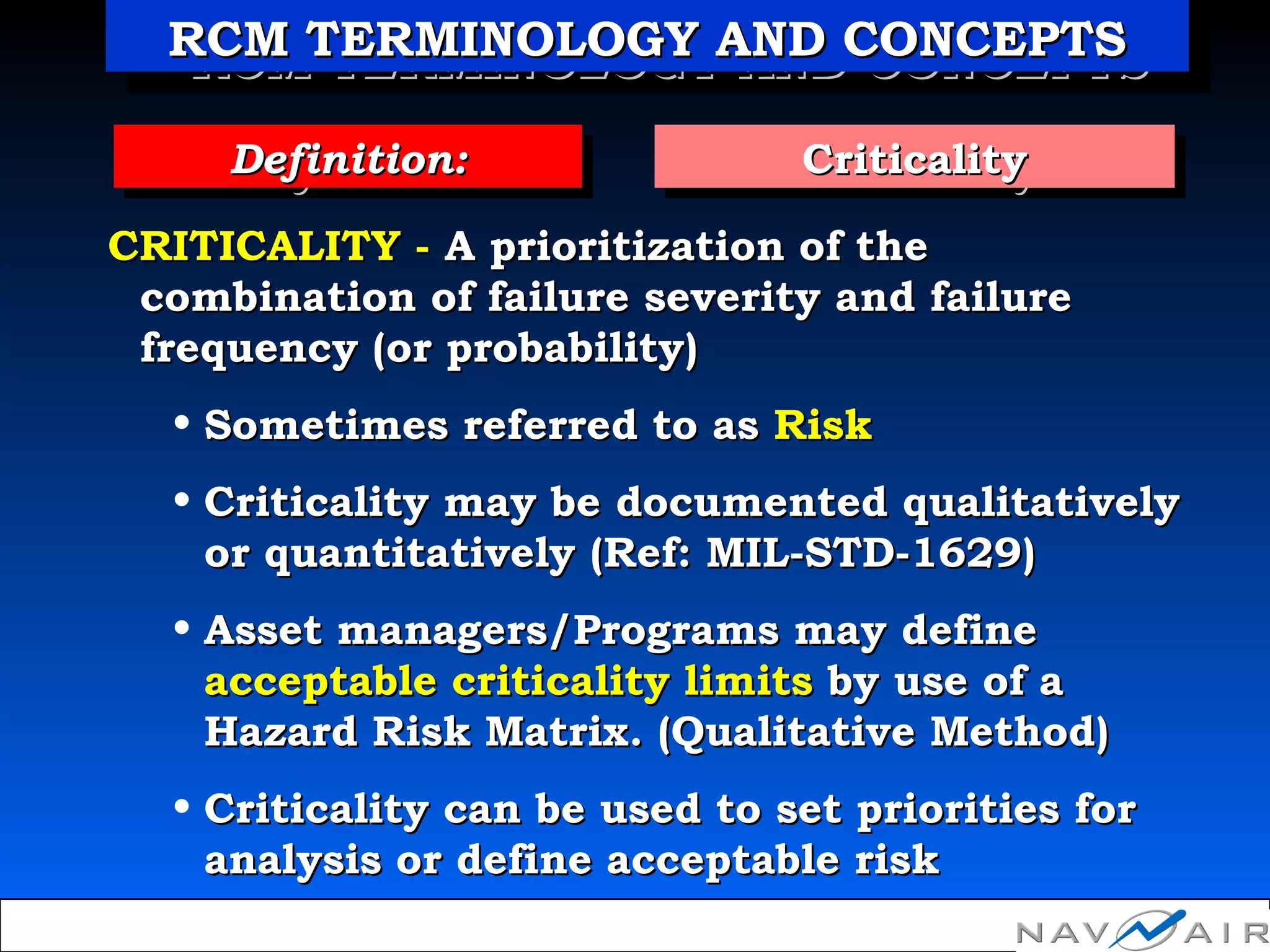
CRITICALITY -CRITICALITY -A prioritization of theA prioritization of the
combination of failure severity and failurecombination of failure severity and failure
frequency (or probability)frequency (or probability)
• Sometimes referred to asSometimes referred to as RiskRisk
• Criticality may beCriticality may be documented qualitativelydocumented qualitatively
or quantitativelyor quantitatively (Ref: MIL-STD-1629)(Ref: MIL-STD-1629)
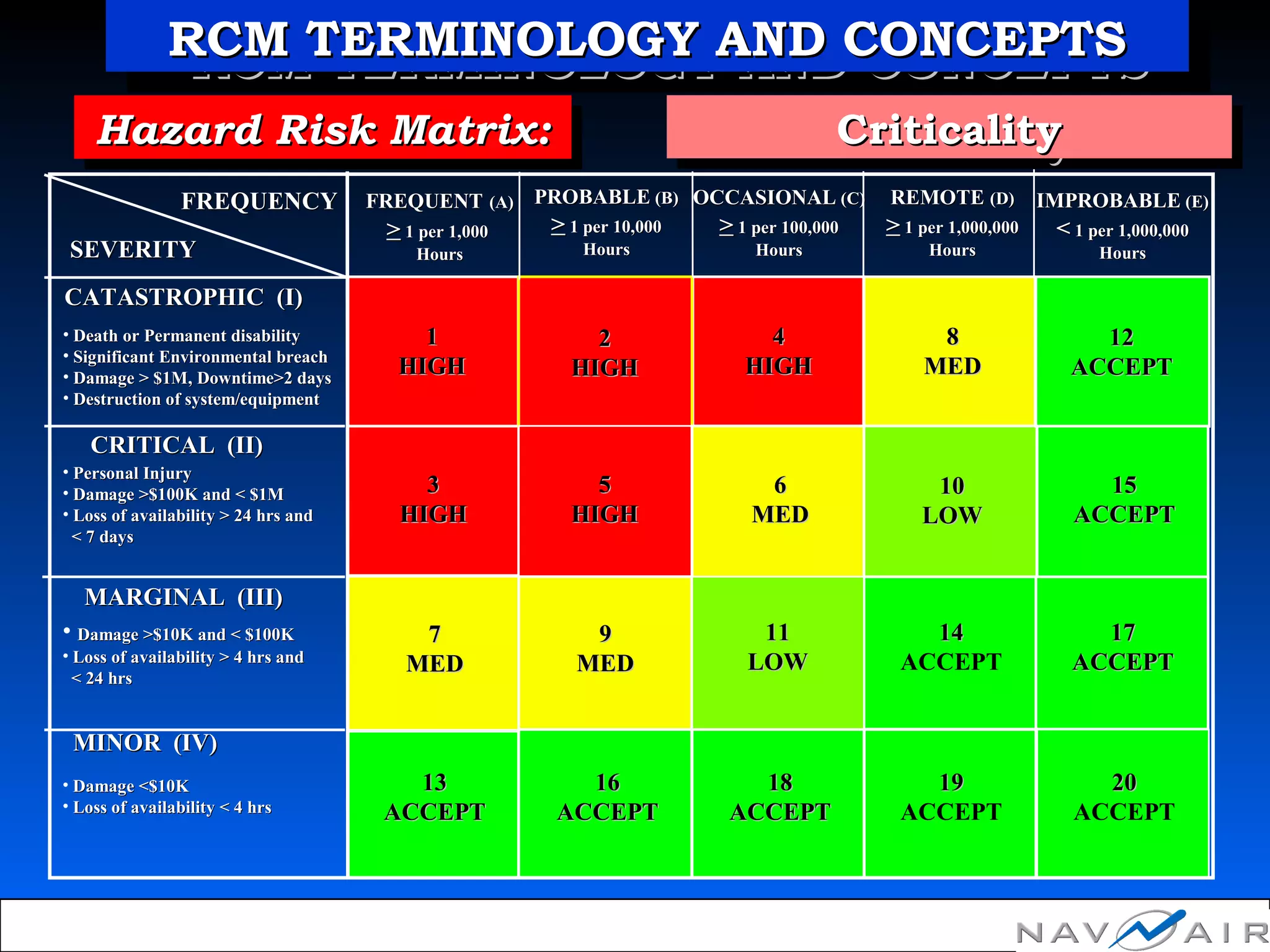
• Asset managers/Programs may defineAsset managers/Programs may define
acceptable criticality limitsacceptable criticality limits by use of aby use of a
Hazard Risk Matrix. (Qualitative Method)Hazard Risk Matrix. (Qualitative Method)
• Criticality can be used to set priorities forCriticality can be used to set priorities for
analysis or define acceptable riskanalysis or define acceptable risk
CriticalityCriticalityCriticalityCriticalityDefinition:Definition:Definition:Definition:
RCM TERMINOLOGY AND CONCEPTSRCM TERMINOLOGY AND CONCEPTSRCM TERMINOLOGY AND CONCEPTSRCM TERMINOLOGY AND CONCEPTS
18.
Hazard Risk Matrix:HazardRisk Matrix:Hazard Risk Matrix:Hazard Risk Matrix:
FREQUENCYFREQUENCY
SEVERITYSEVERITY
FREQUENTFREQUENT (A)(A)
>> 1 per 1,0001 per 1,000
HoursHours
PROBABLEPROBABLE (B)(B)
>> 1 per 10,0001 per 10,000
HoursHours
OCCASIONALOCCASIONAL (C)(C)
>> 1 per 100,0001 per 100,000
HoursHours
REMOTEREMOTE (D)(D)
>> 1 per 1,000,0001 per 1,000,000
HoursHours
IMPROBABLEIMPROBABLE (E)(E)
<< 1 per 1,000,0001 per 1,000,000
HoursHours
CATASTROPHIC (I)CATASTROPHIC (I)
CRITICAL (II)CRITICAL (II)
MARGINAL (III)MARGINAL (III)
MINOR (IV)MINOR (IV)
• Death or Permanent disabilityDeath or Permanent disability
• Significant Environmental breachSignificant Environmental breach
• Damage > $1M, Downtime>2 daysDamage > $1M, Downtime>2 days
• Destruction of system/equipmentDestruction of system/equipment
• Personal InjuryPersonal Injury
• Damage >$100K and < $1MDamage >$100K and < $1M
• Loss of availability > 24 hrs andLoss of availability > 24 hrs and
< 7 days< 7 days
• Damage >$10K and < $100KDamage >$10K and < $100K
• Loss of availability > 4 hrs andLoss of availability > 4 hrs and
< 24 hrs< 24 hrs
• Damage <$10KDamage <$10K
• Loss of availability < 4 hrsLoss of availability < 4 hrs
11
HIGHHIGH
33
HIGHHIGH
44
HIGHHIGH
22
HIGHHIGH
55
HIGHHIGH
88
MEDMED
66
MEDMED
77
MEDMED
99
MEDMED
1010
LOWLOW
1212
ACCEPTACCEPT
1313
ACCEPTACCEPT
1515
ACCEPTACCEPT
1616
ACCEPTACCEPT
1717
ACCEPTACCEPT
2020
ACCEPT
1919
ACCEPT
1414
ACCEPT
1111
LOWLOW
1818
ACCEPTACCEPT
CriticalityCriticalityCriticalityCriticality
RCM TERMINOLOGY AND CONCEPTSRCM TERMINOLOGY AND CONCEPTSRCM TERMINOLOGY AND CONCEPTSRCM TERMINOLOGY AND CONCEPTS
ReliabilityReliabilityReliabilityReliability
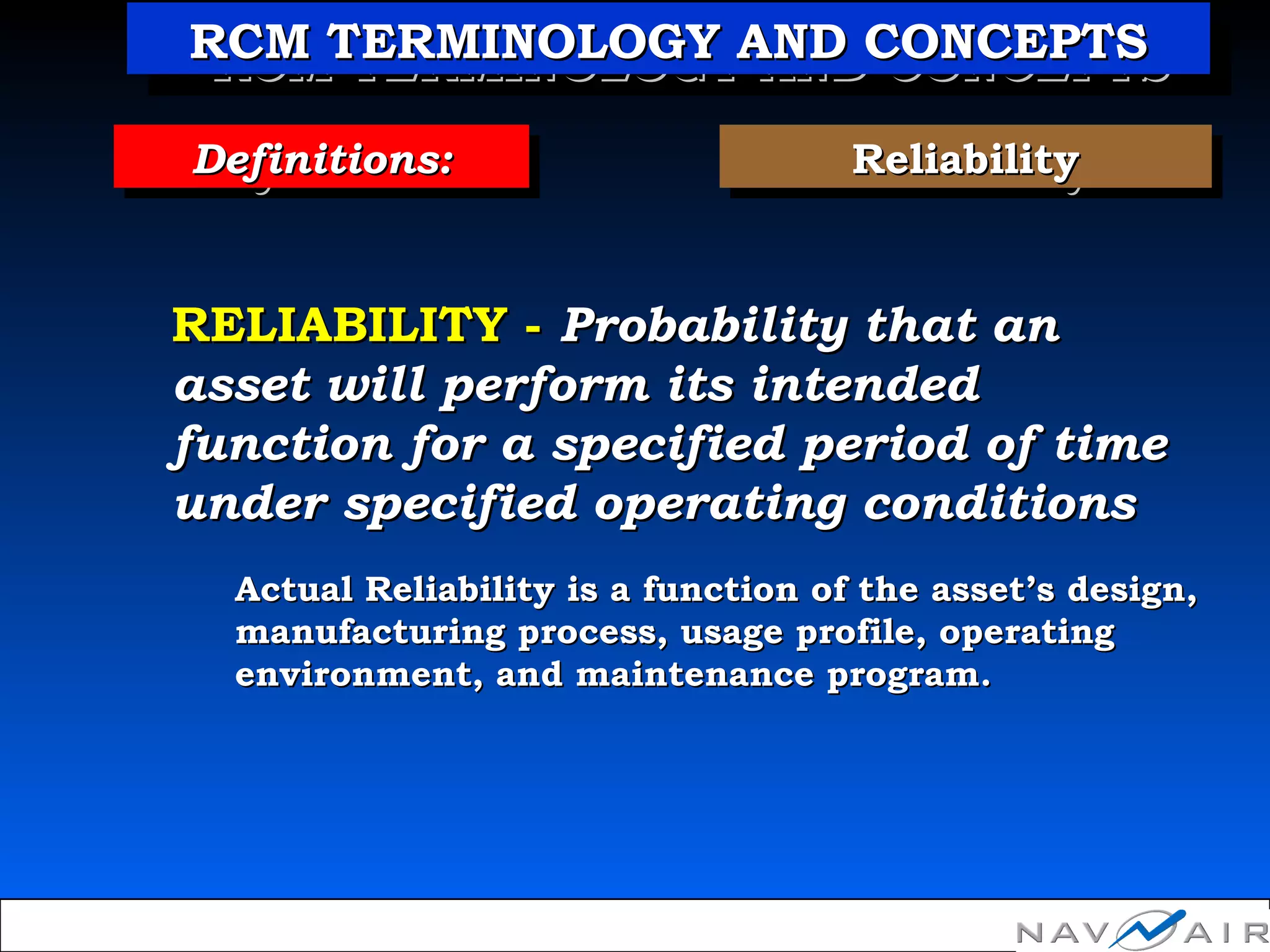
RELIABILITY -RELIABILITY -Probability that anProbability that an
asset will perform its intendedasset will perform its intended
function for a specified period of timefunction for a specified period of time
under specified operating conditionsunder specified operating conditions
Actual Reliability is a function of the asset’s design,Actual Reliability is a function of the asset’s design,
manufacturing process, usage profile, operatingmanufacturing process, usage profile, operating
environment, and maintenance program.environment, and maintenance program.
Definitions:Definitions:Definitions:Definitions:
RCM TERMINOLOGY AND CONCEPTSRCM TERMINOLOGY AND CONCEPTSRCM TERMINOLOGY AND CONCEPTSRCM TERMINOLOGY AND CONCEPTS
Types of MaintenanceTypesof MaintenanceTypes of MaintenanceTypes of MaintenanceDefinition:Definition:Definition:Definition:
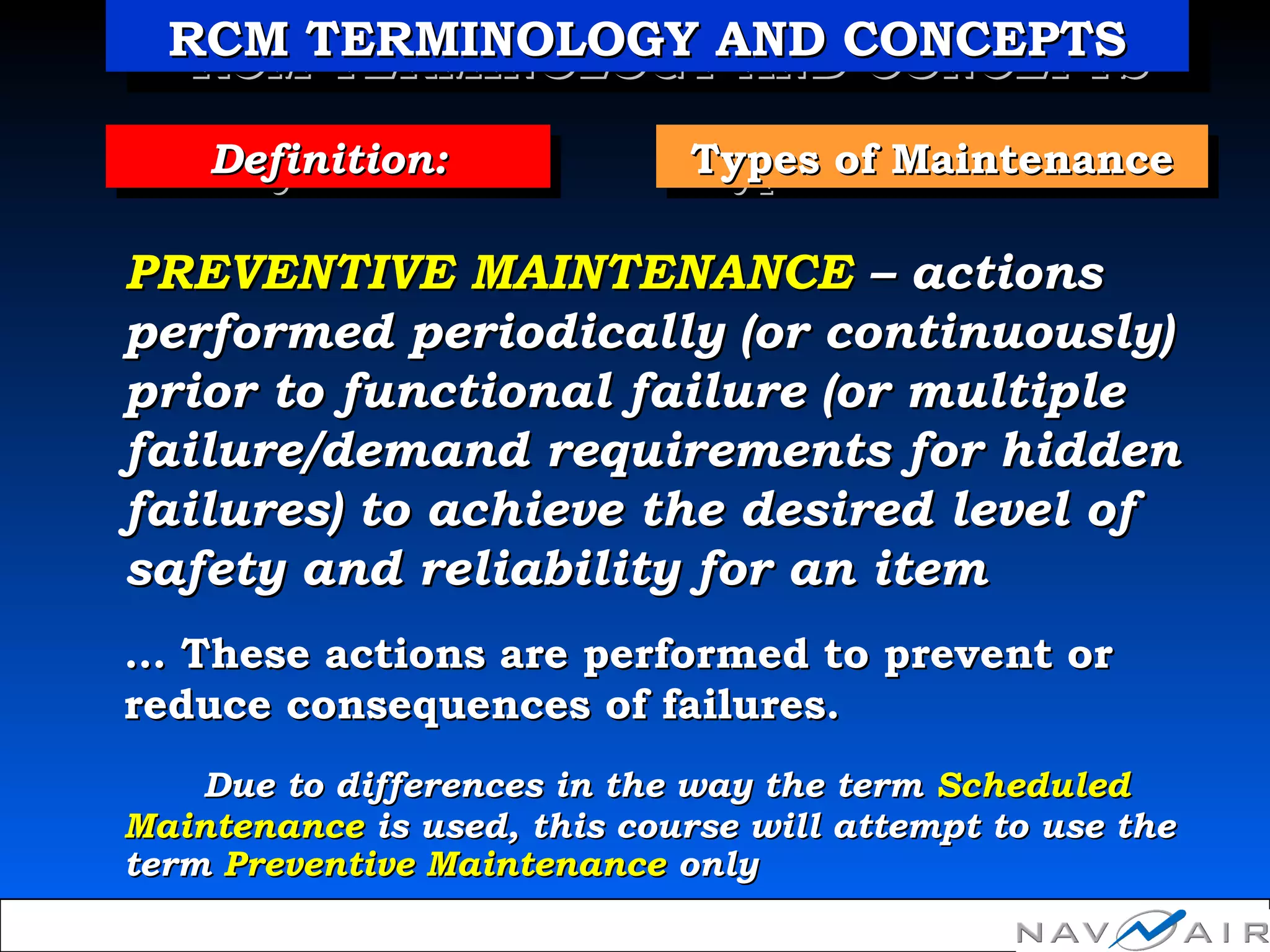
PREVENTIVE MAINTENANCEPREVENTIVE MAINTENANCE – actions– actions
performed periodically (or continuously)performed periodically (or continuously)
prior to functional failure (or multipleprior to functional failure (or multiple
failure/demand requirements for hiddenfailure/demand requirements for hidden
failures) to achieve the desired level offailures) to achieve the desired level of
safety and reliability for an itemsafety and reliability for an item
…… These actions are performed to prevent orThese actions are performed to prevent or
reduce consequences of failures.reduce consequences of failures.
Due to differences in the way the termDue to differences in the way the term ScheduledScheduled
MaintenanceMaintenance is used, this course will attempt to use theis used, this course will attempt to use the
termterm Preventive MaintenancePreventive Maintenance onlyonly
RCM TERMINOLOGY AND CONCEPTSRCM TERMINOLOGY AND CONCEPTSRCM TERMINOLOGY AND CONCEPTSRCM TERMINOLOGY AND CONCEPTS
23.
Types of MaintenanceTypesof MaintenanceTypes of MaintenanceTypes of MaintenanceDefinitionDefinitionDefinitionDefinition
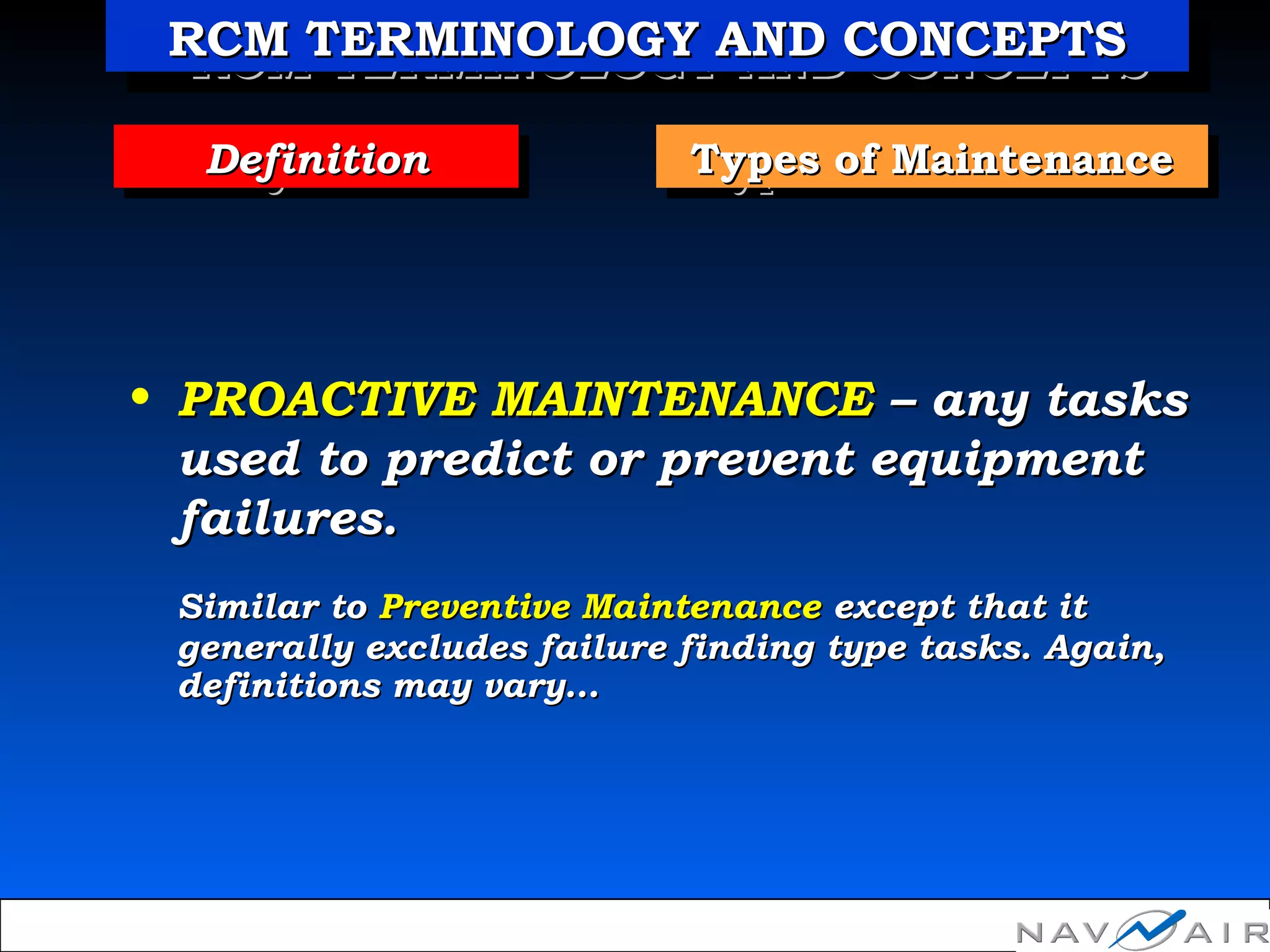
• PROACTIVE MAINTENANCEPROACTIVE MAINTENANCE – any tasks– any tasks
used to predict or prevent equipmentused to predict or prevent equipment
failures.failures.
Similar toSimilar to Preventive MaintenancePreventive Maintenance except that itexcept that it
generally excludes failure finding type tasks. Again,generally excludes failure finding type tasks. Again,
definitions may vary…definitions may vary…
RCM TERMINOLOGY AND CONCEPTSRCM TERMINOLOGY AND CONCEPTSRCM TERMINOLOGY AND CONCEPTSRCM TERMINOLOGY AND CONCEPTS
24.
Types of MaintenanceTypesof MaintenanceTypes of MaintenanceTypes of MaintenanceDefinition:Definition:Definition:Definition:
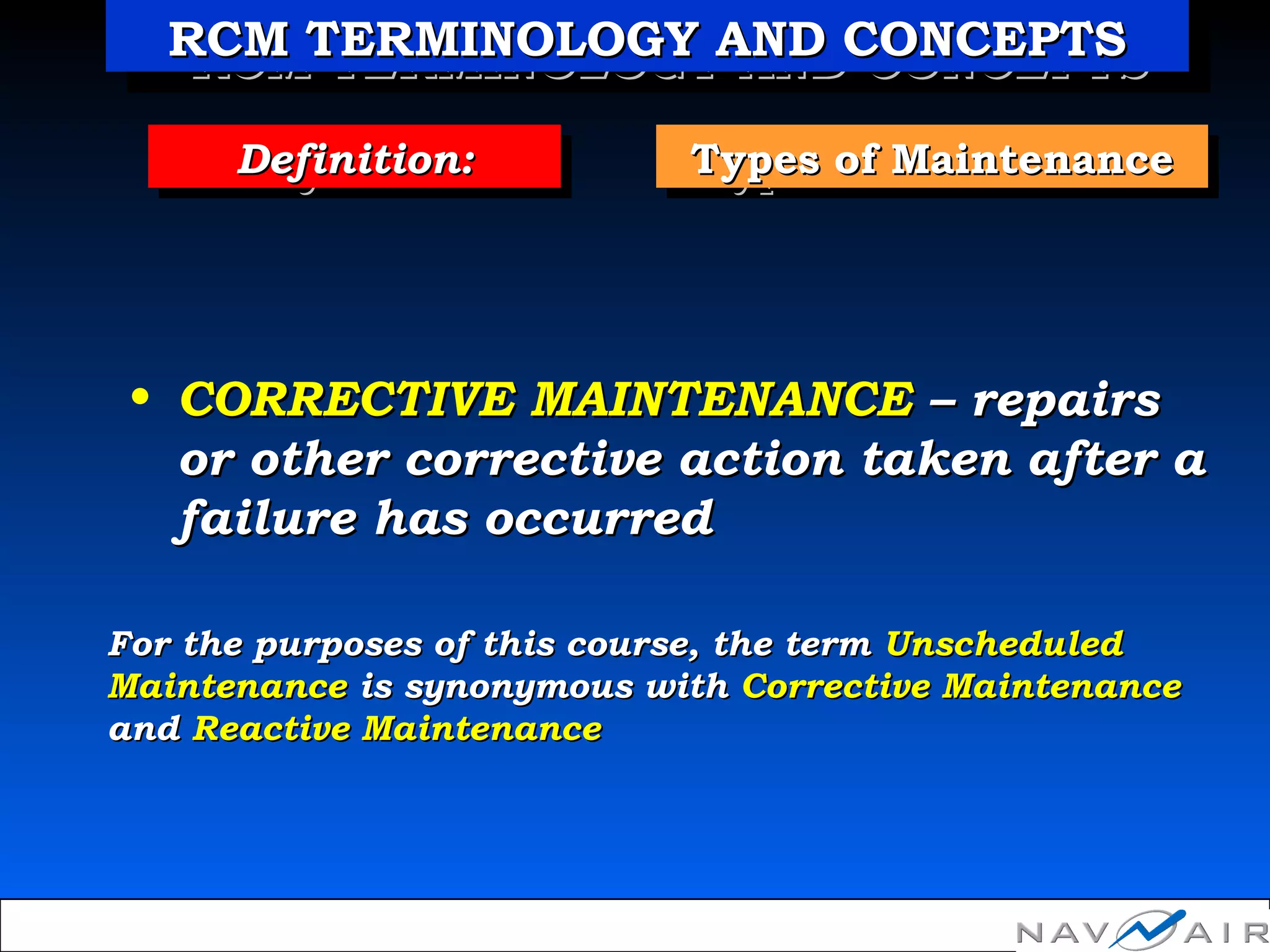
• CORRECTIVE MAINTENANCECORRECTIVE MAINTENANCE –– repairsrepairs
or other corrective action taken after aor other corrective action taken after a
failure has occurredfailure has occurred
For the purposes of this course, the termFor the purposes of this course, the term UnscheduledUnscheduled
MaintenanceMaintenance is synonymous withis synonymous with Corrective MaintenanceCorrective Maintenance
andand Reactive MaintenanceReactive Maintenance
RCM TERMINOLOGY AND CONCEPTSRCM TERMINOLOGY AND CONCEPTSRCM TERMINOLOGY AND CONCEPTSRCM TERMINOLOGY AND CONCEPTS
25.
Types of MaintenanceTypesof MaintenanceTypes of MaintenanceTypes of MaintenanceDefinition:Definition:Definition:Definition:
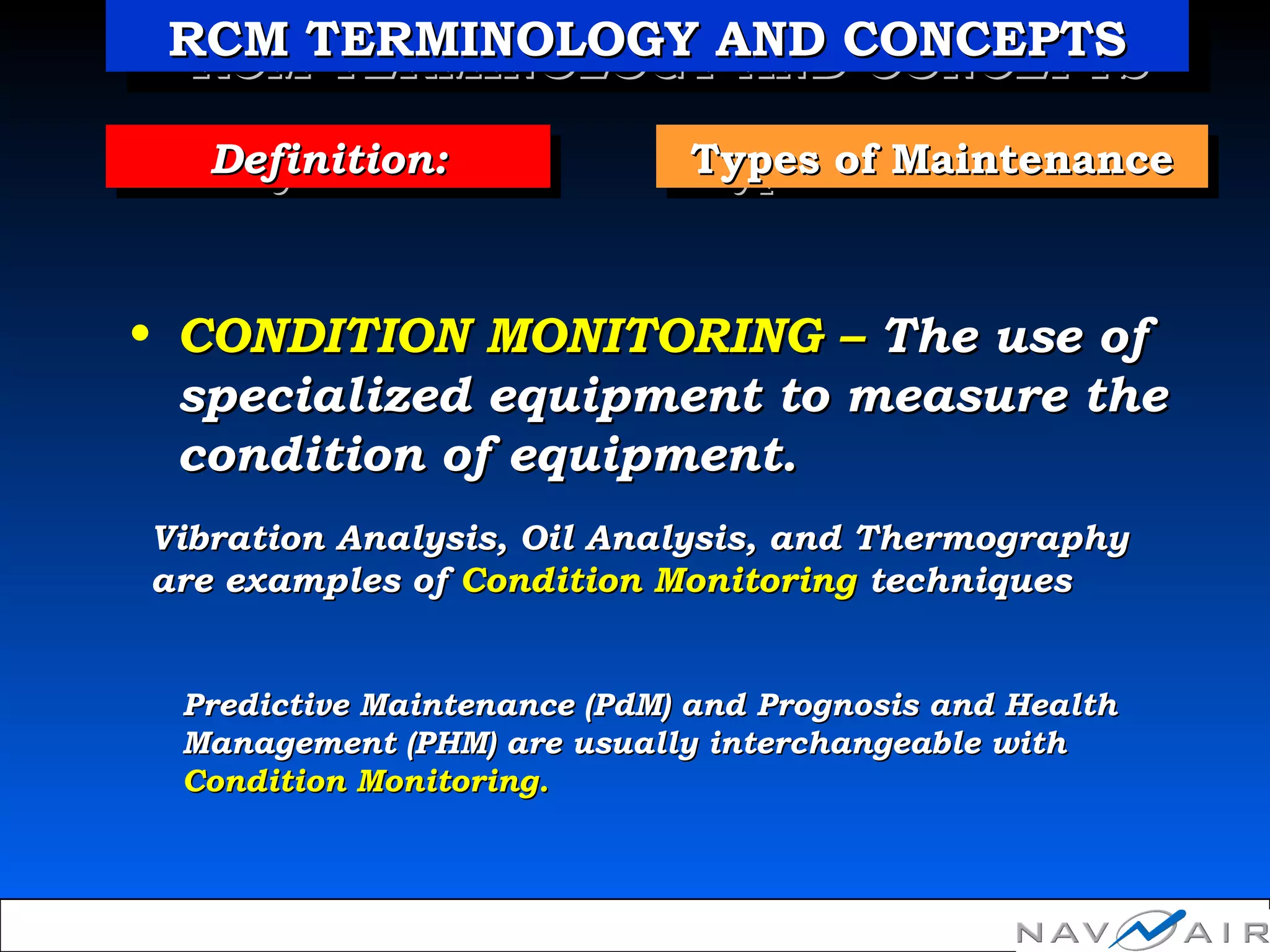
• CONDITION MONITORING –CONDITION MONITORING – The use ofThe use of
specialized equipment to measure thespecialized equipment to measure the
condition of equipment.condition of equipment.
Vibration Analysis, Oil Analysis, and ThermographyVibration Analysis, Oil Analysis, and Thermography
are examples ofare examples of Condition MonitoringCondition Monitoring techniquestechniques
Predictive Maintenance (PdM) and Prognosis and HealthPredictive Maintenance (PdM) and Prognosis and Health
Management (PHM) are usually interchangeable withManagement (PHM) are usually interchangeable with
Condition Monitoring.Condition Monitoring.
RCM TERMINOLOGY AND CONCEPTSRCM TERMINOLOGY AND CONCEPTSRCM TERMINOLOGY AND CONCEPTSRCM TERMINOLOGY AND CONCEPTS
26.
Types of MaintenanceTypesof MaintenanceTypes of MaintenanceTypes of MaintenanceDefinition:Definition:Definition:Definition:
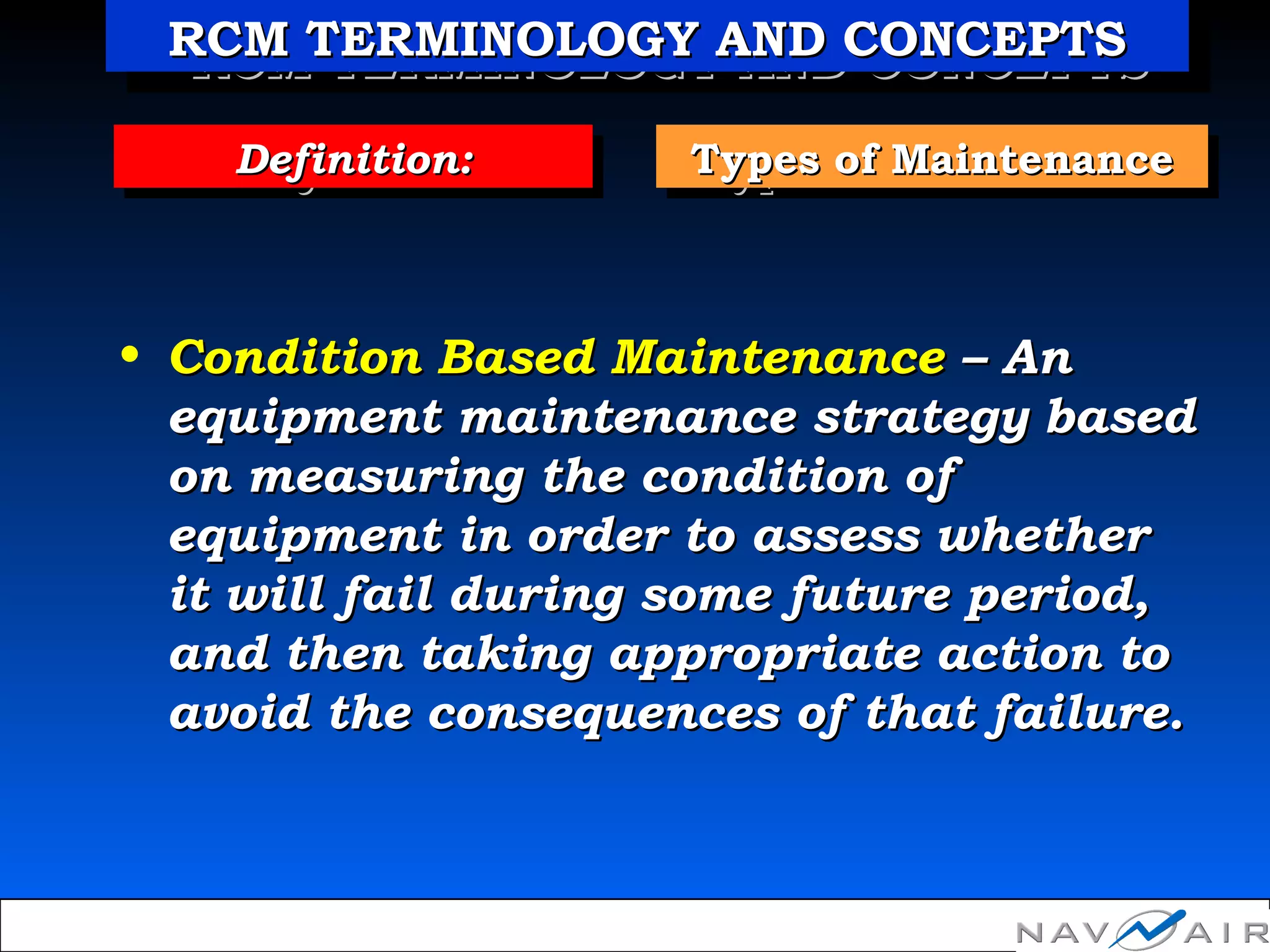
• Condition Based MaintenanceCondition Based Maintenance – An– An
equipment maintenance strategy basedequipment maintenance strategy based
on measuring the condition ofon measuring the condition of
equipment in order to assess whetherequipment in order to assess whether
it will fail during some future period,it will fail during some future period,
and then taking appropriate action toand then taking appropriate action to
avoid the consequences of that failure.avoid the consequences of that failure.
RCM TERMINOLOGY AND CONCEPTSRCM TERMINOLOGY AND CONCEPTSRCM TERMINOLOGY AND CONCEPTSRCM TERMINOLOGY AND CONCEPTS
27.
Types of MaintenanceTypesof MaintenanceTypes of MaintenanceTypes of MaintenanceDefinition:Definition:Definition:Definition:
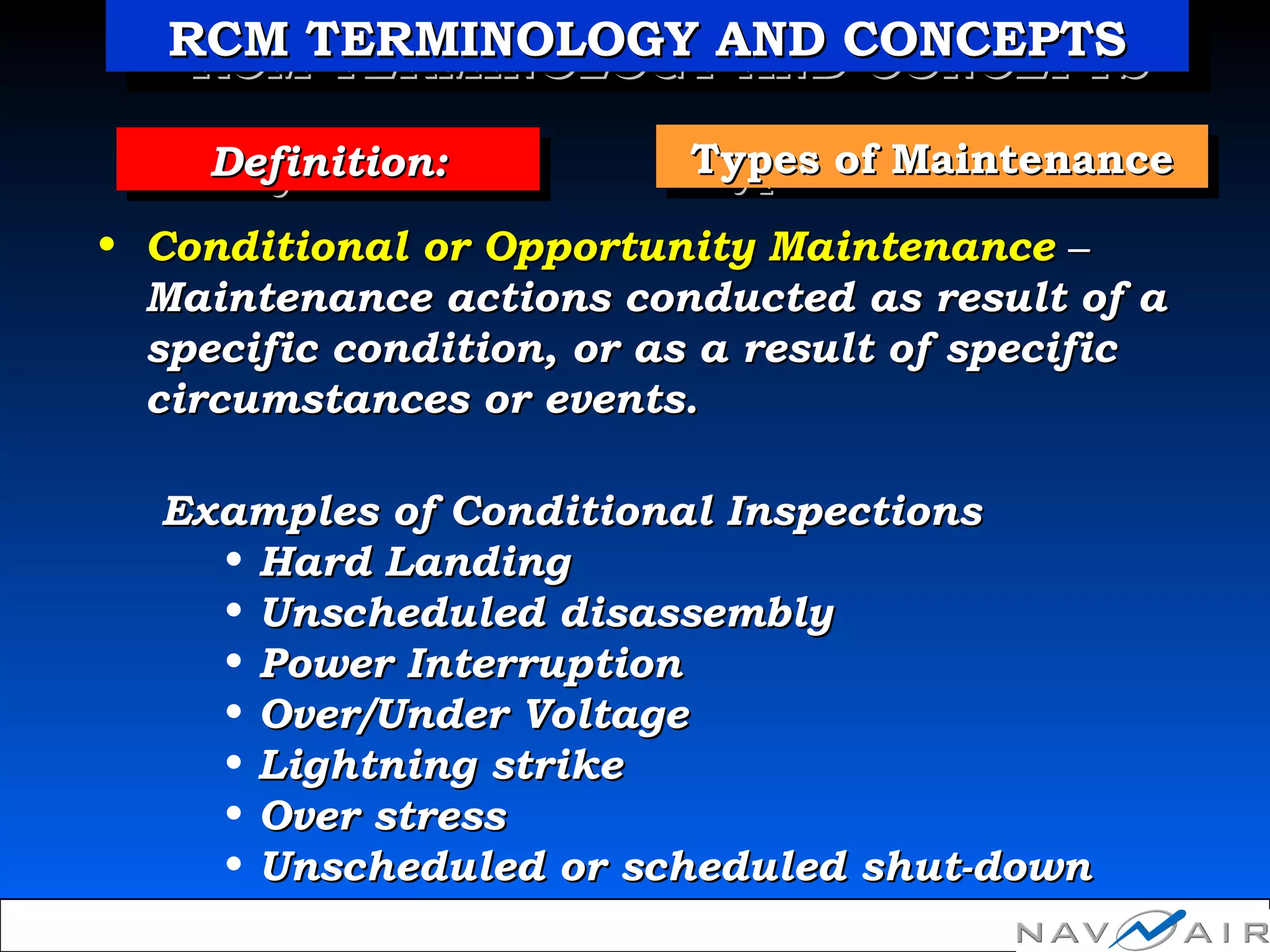
• Conditional or Opportunity MaintenanceConditional or Opportunity Maintenance ––
Maintenance actions conducted as result of aMaintenance actions conducted as result of a
specific condition, or as a result of specificspecific condition, or as a result of specific
circumstances or events.circumstances or events.
Examples of Conditional InspectionsExamples of Conditional Inspections
• Hard LandingHard Landing
• Unscheduled disassemblyUnscheduled disassembly
• Power InterruptionPower Interruption
• Over/Under VoltageOver/Under Voltage
• Lightning strikeLightning strike
• Over stressOver stress
• Unscheduled or scheduled shut-downUnscheduled or scheduled shut-down
RCM TERMINOLOGY AND CONCEPTSRCM TERMINOLOGY AND CONCEPTSRCM TERMINOLOGY AND CONCEPTSRCM TERMINOLOGY AND CONCEPTS
28.
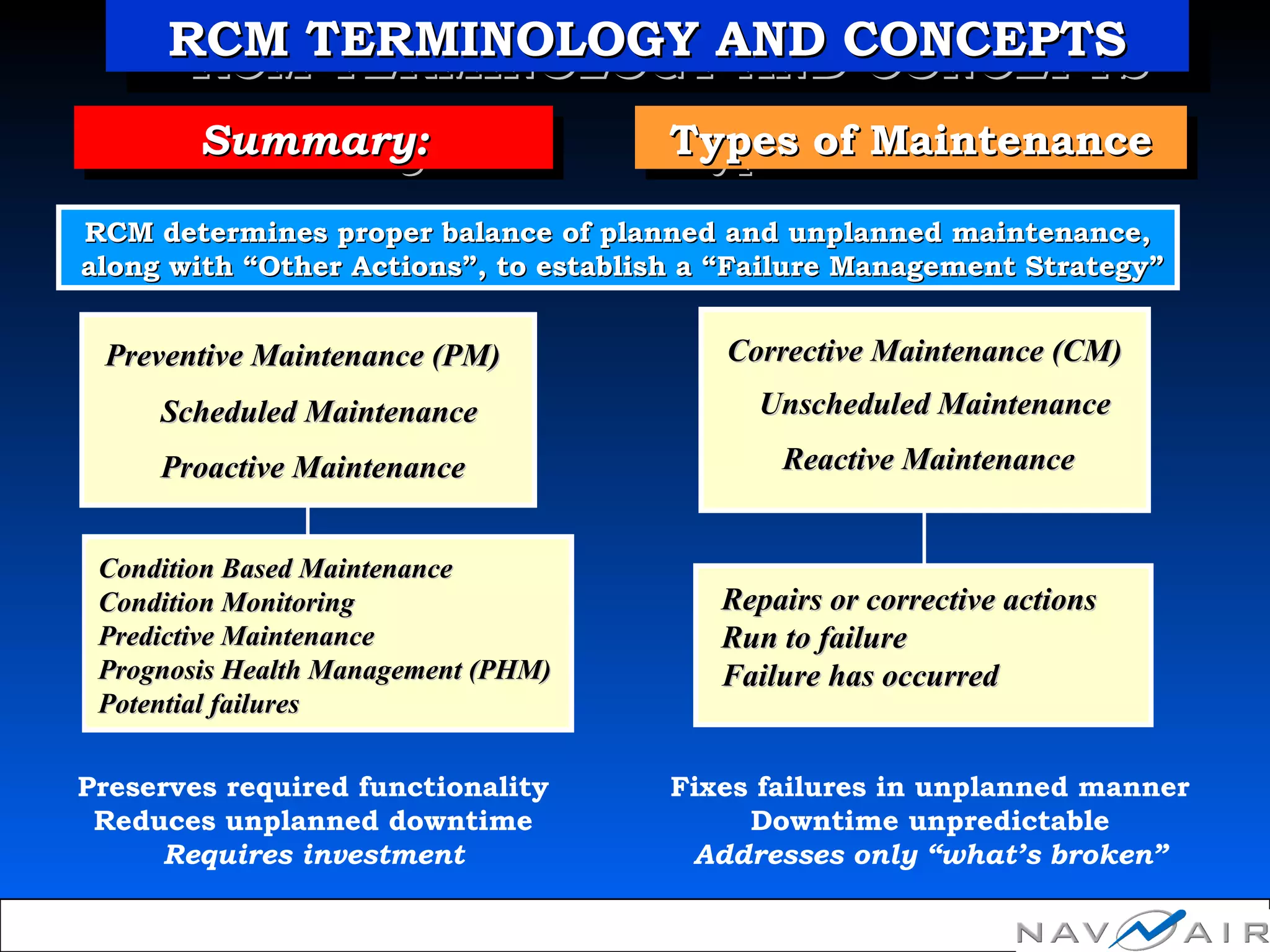
Proactive MaintenanceProactive Maintenance
PreventiveMaintenance (PM)Preventive Maintenance (PM)
Unscheduled MaintenanceUnscheduled Maintenance
Corrective Maintenance (CM)Corrective Maintenance (CM)
Reactive MaintenanceReactive Maintenance
Condition Based MaintenanceCondition Based Maintenance
Condition MonitoringCondition Monitoring
Predictive MaintenancePredictive Maintenance
Prognosis Health Management (PHM)Prognosis Health Management (PHM)
Potential failuresPotential failures
Repairs or corrective actionsRepairs or corrective actions
Run to failureRun to failure
Failure has occurredFailure has occurred
Preserves required functionality
Reduces unplanned downtime
Requires investment
Fixes failures in unplanned manner
Downtime unpredictable
Addresses only “what’s broken”
RCM determines proper balance of planned and unplanned maintenance,RCM determines proper balance of planned and unplanned maintenance,
along with “Other Actions”, to establish a “Failure Management Strategy”along with “Other Actions”, to establish a “Failure Management Strategy”
Scheduled MaintenanceScheduled Maintenance
Types of MaintenanceTypes of MaintenanceTypes of MaintenanceTypes of MaintenanceSummary:Summary:Summary:Summary:
RCM TERMINOLOGY AND CONCEPTSRCM TERMINOLOGY AND CONCEPTSRCM TERMINOLOGY AND CONCEPTSRCM TERMINOLOGY AND CONCEPTS
29.
Review and SummaryReviewand SummaryReview and SummaryReview and Summary
IntroductionIntroductionIntroductionIntroduction
RCM Terms & ConceptsRCM Terms & ConceptsRCM Terms & ConceptsRCM Terms & Concepts
– Learning ObjectivesLearning Objectives
– FailuresFailures
– SeveritySeverity
– Probability of FailureProbability of Failure
– CriticalityCriticality
– ReliabilityReliability
– Maintenance TermsMaintenance Terms
Module ObjectiveModule ObjectiveModule ObjectiveModule Objective
– Introduce the primary terminologyIntroduce the primary terminology
and basic concepts used in RCMand basic concepts used in RCM
RCM TERMINOLOGY AND CONCEPTSRCM TERMINOLOGY AND CONCEPTSRCM TERMINOLOGY AND CONCEPTSRCM TERMINOLOGY AND CONCEPTS
30.
End of Module
upnext……..
Unit II Module 1 RCM Process Overview
End of Module
up next……..
Unit II Module 1 RCM Process Overview
#3 &lt;number&gt;
A Preview of the Module contents. Keep an eye out for the Key Words listed on this preview slide.
They will become foundational for utilization of the RCM process.



![[DSC Europe 25] Debmalya Biswas - Agentification: the art of transforming man...](https://cdn.slidesharecdn.com/ss_thumbnails/r5azlggvtqiaiiusrqdr-4-251212103249-5a12c89b-thumbnail.jpg?width=640&height=640&fit=bounds)
![[DSC Europe 25] Branko Dzakula - From Defense to Attack: How AI Redefines Cyb...](https://cdn.slidesharecdn.com/ss_thumbnails/80bdzdxpr3ky2g0qvyk9-8-251211083048-ce5fc1ee-thumbnail.jpg?width=640&height=640&fit=bounds)

![[DSC Europe 25] Vladimir Jelic - The AI-Driven Security Shift From Reactive D...](https://cdn.slidesharecdn.com/ss_thumbnails/6g5gj25mtjwayniqem1t-6-251209104645-7a5a5fc6-thumbnail.jpg?width=640&height=640&fit=bounds)


![[DSC Europe 25] Milan Zdravkovic - The road less traveled in District Heating...](https://cdn.slidesharecdn.com/ss_thumbnails/nfaboniqwsz4ucyctnmy-2-milan-zdravkovic-dsc2025-the-road-less-traveled-in-district-heating-operation-251208151905-f56388a5-thumbnail.jpg?width=640&height=640&fit=bounds)

![[DSC Europe 25] Aleksandra Dragicevic - AI-Boosted Research in Healthcare: Fr...](https://cdn.slidesharecdn.com/ss_thumbnails/iqwngszurf2r7pi1lnnj-4-aleksandra-dragicevic-ad-dsc-europe-conference-20-251208151905-37c3238a-thumbnail.jpg?width=640&height=640&fit=bounds)
![[DSC Europe 25] Marija Vlajkovic & Andrea Radonjanin - Integration of AI tool...](https://cdn.slidesharecdn.com/ss_thumbnails/qf1jrglttoc3bm8s3aop-final-integration-of-ai-tools-251208151905-394f3a6a-thumbnail.jpg?width=640&height=640&fit=bounds)
![[DSC Europe 25] Milan Sekuloski - Data, Defence, and Development: Cybersecuri...](https://cdn.slidesharecdn.com/ss_thumbnails/dfrkwwx4qly6atqpbl4z-4-251209104645-c3d4b0ca-thumbnail.jpg?width=640&height=640&fit=bounds)


![[DSC Europe 25] Andy Cotgreave - Nothing is new in analytics.pptx](https://cdn.slidesharecdn.com/ss_thumbnails/mba4vzcurvoh5lfrd5zw-6-251205194645-341bbbbe-thumbnail.jpg?width=640&height=640&fit=bounds)
![[DSC Europe 25] Sara Polak - The Archaeology of Innovation: AI as the Next Cr...](https://cdn.slidesharecdn.com/ss_thumbnails/7ecbscdnt8mlcuqbd2ln-2-sara-polak-ai-creative-industries-251208152533-aa1fcf54-thumbnail.jpg?width=640&height=640&fit=bounds)

![[DSC Europe 25] Bogdan Daniel Maruneac - AI - It starts with you.pptx](https://cdn.slidesharecdn.com/ss_thumbnails/odov3snhrcqs9hx5ny2n-4-251205085715-f1daacfe-thumbnail.jpg?width=640&height=640&fit=bounds)