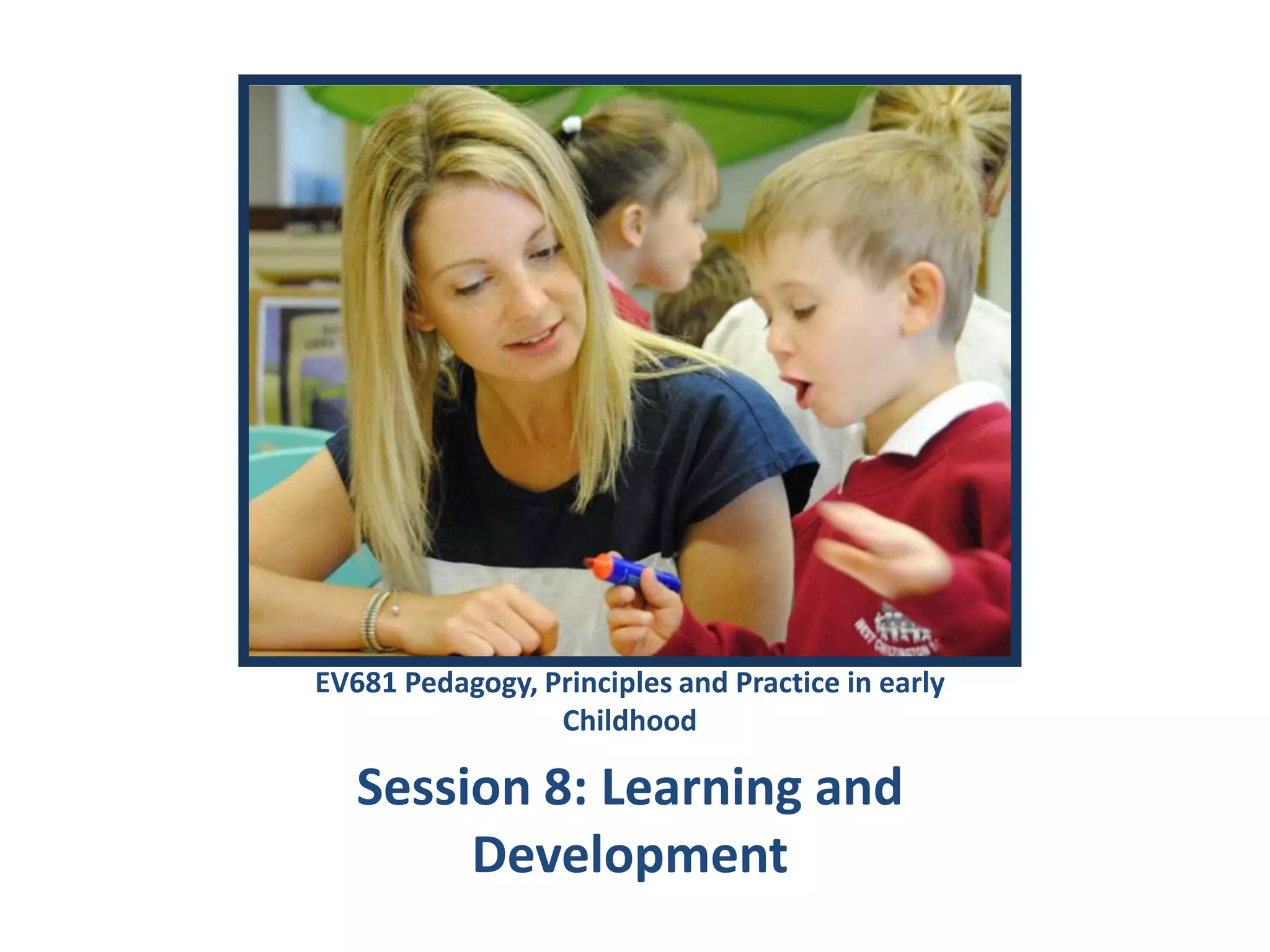
EV681 Pedagogy, Principles and Practice in early
Childhood

Session 8: Learning and
Development
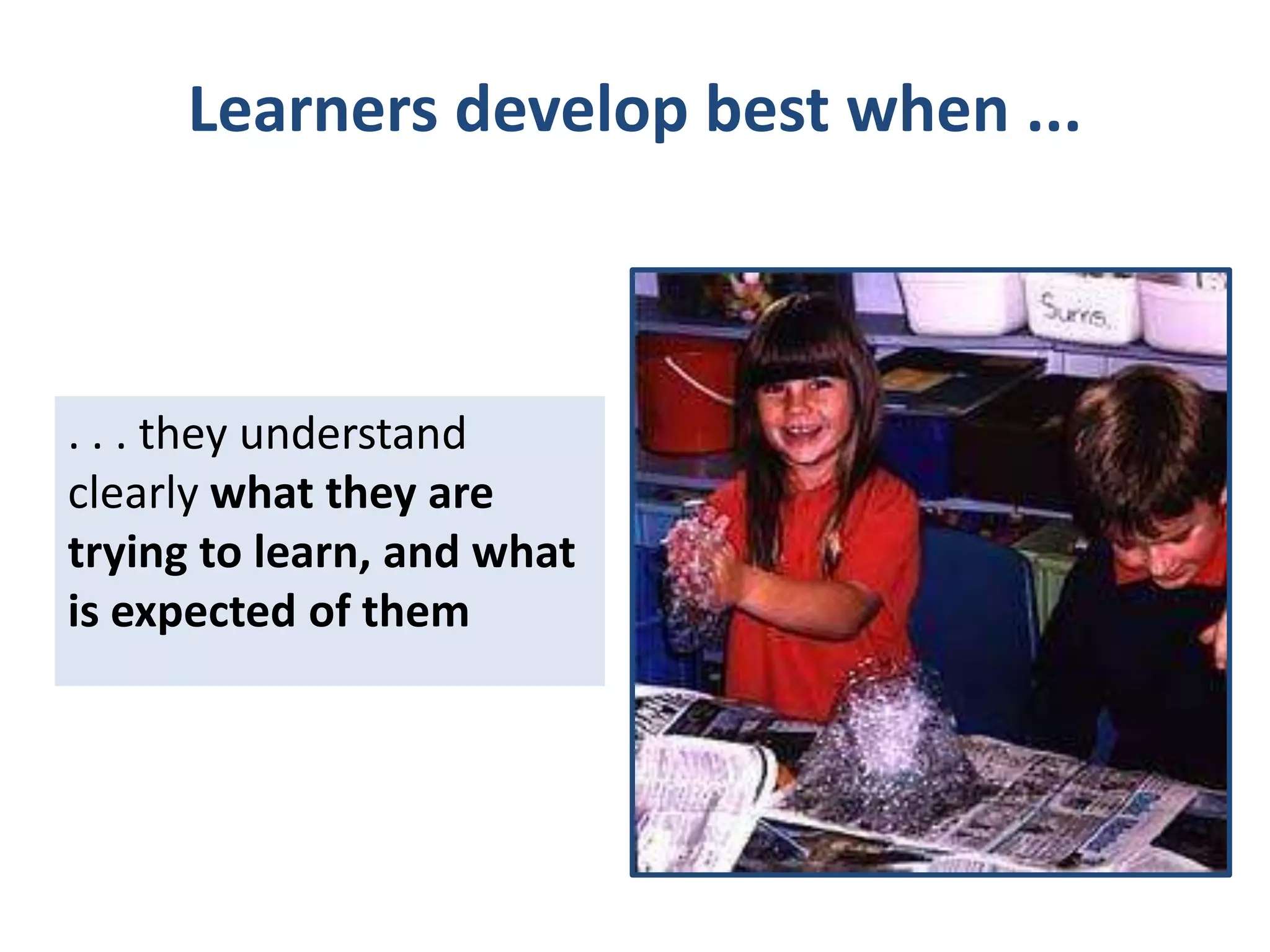
Learners develop best when ...

. . . they understand
clearly what they are
trying to learn, and what
is expected of them
What we need is an OAP
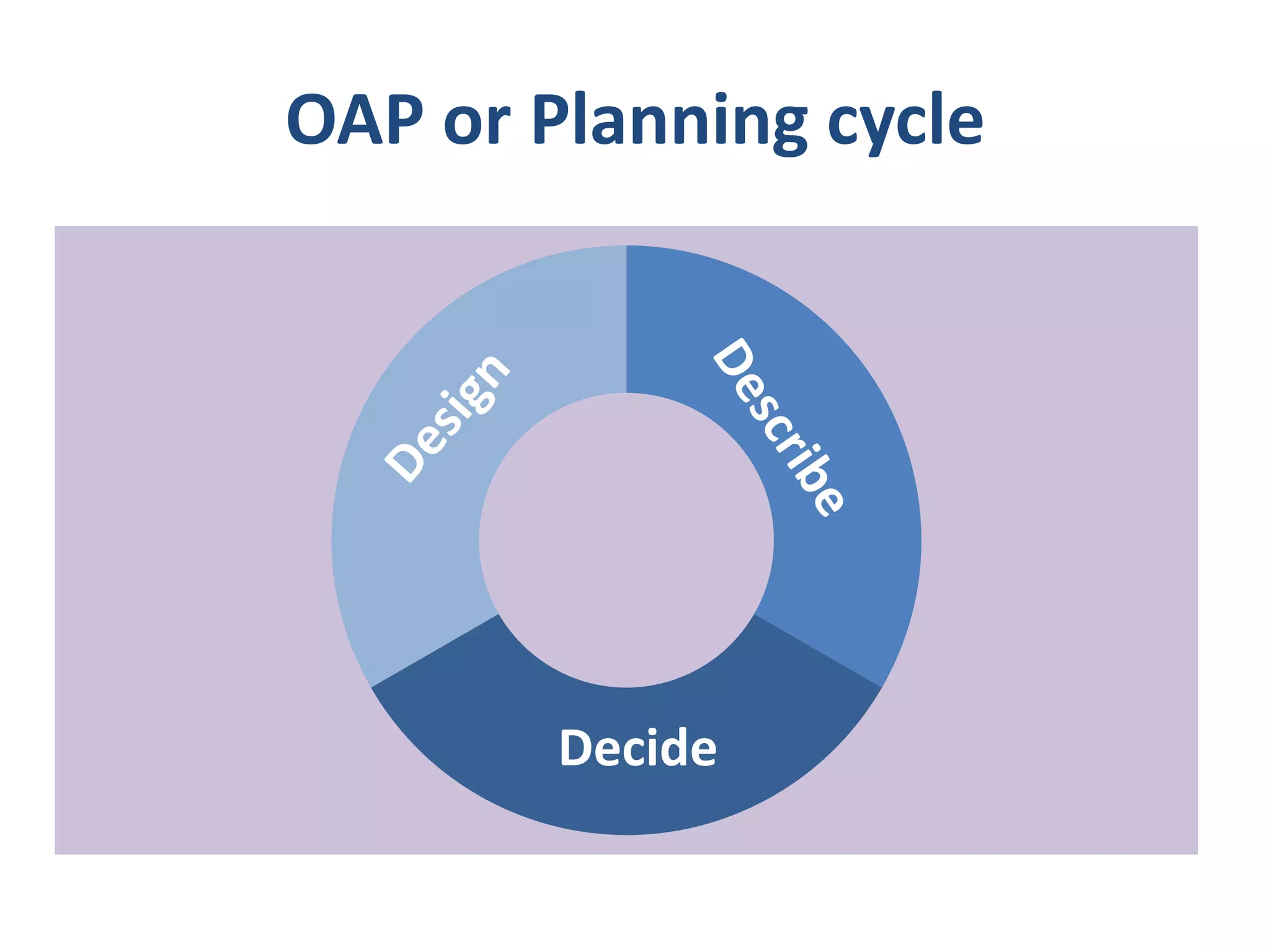
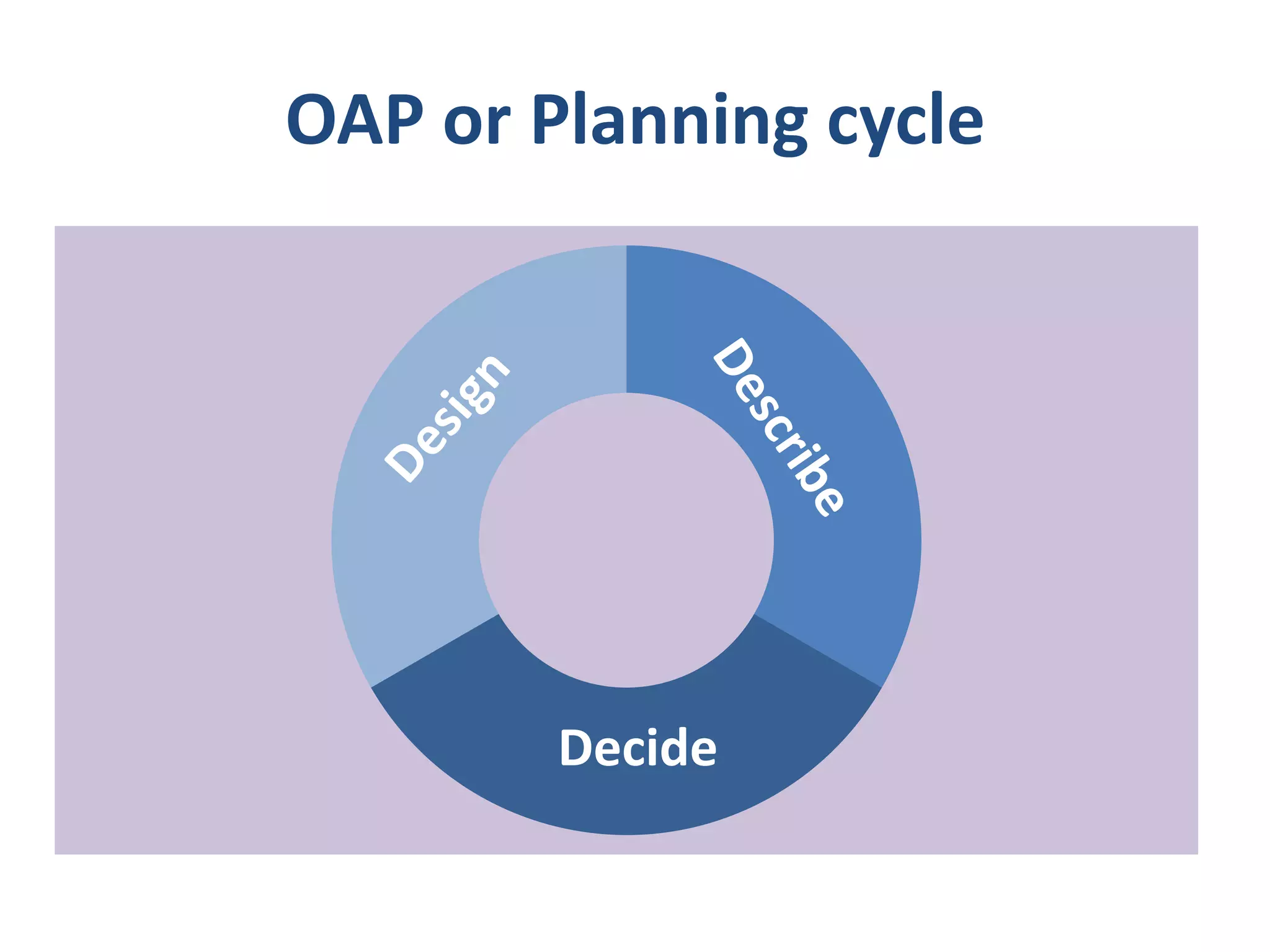
OAP or Planning cycle

Decide
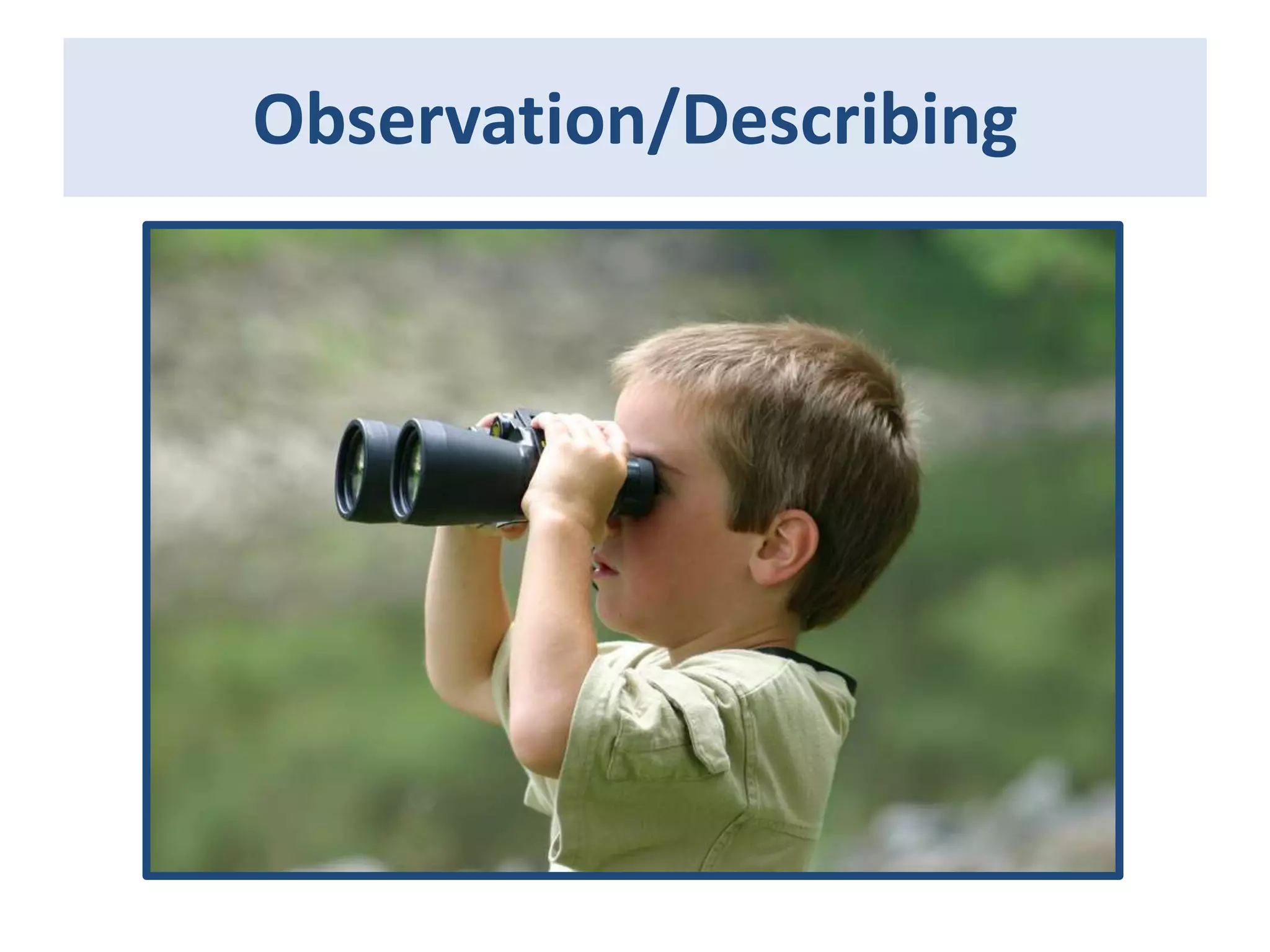
Observation/Describing
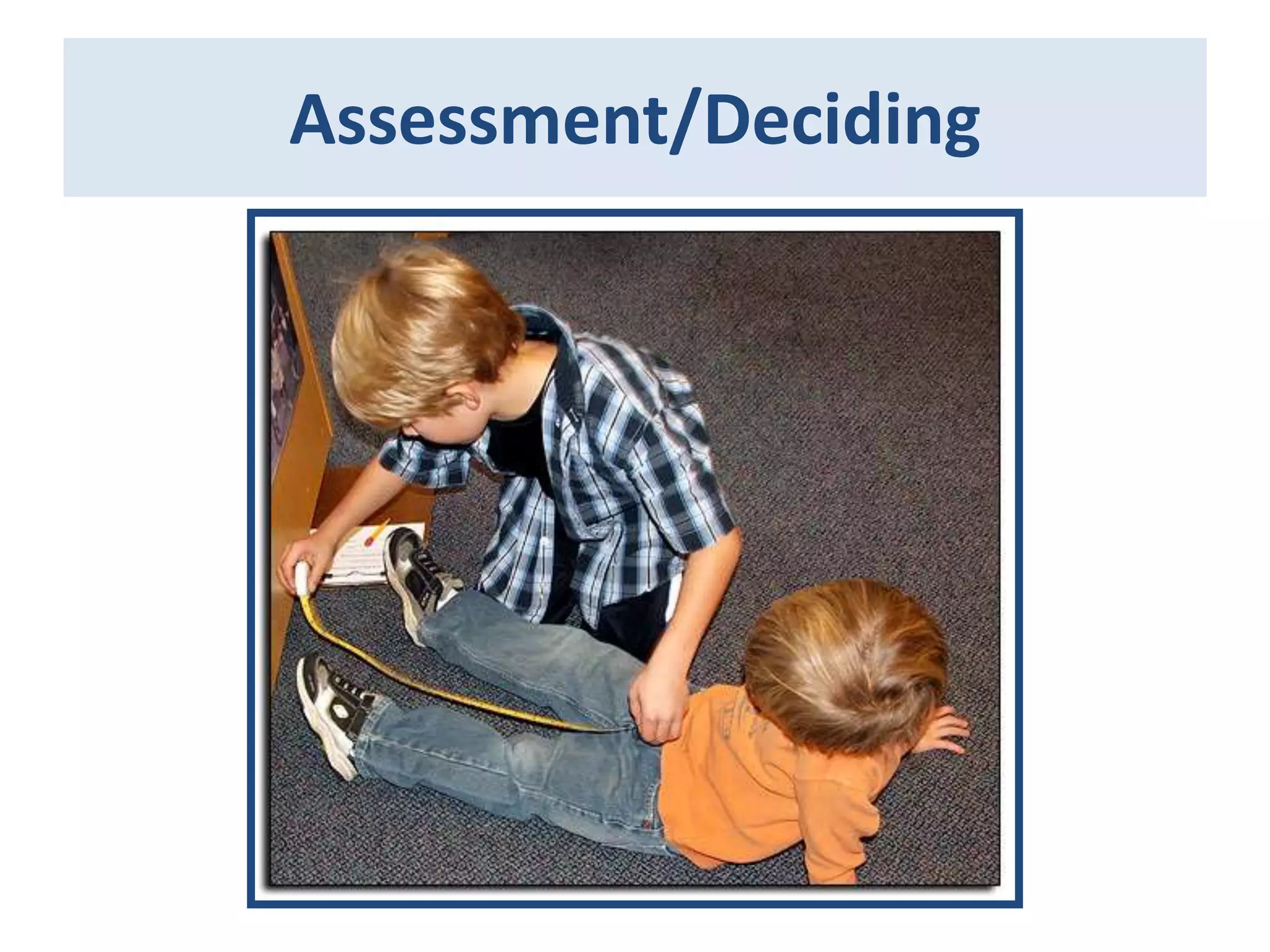
Assessment/Deciding
Assessment is for the
• Child - to ensure they are making
progress
• Family – for Home/School liaison, HLE
• Practitioner – to reflect on intervention
• Setting/learning environment - planning,
resources, etc.
• Government/LA – accountability
‘..provide an accurate national data set..’
(p7 EYFSP)
Assessment is . . .
• Assessment foci built into
plans/units/schemes of
work
• Praise / well done/rewards
/celebrations
• Verbal feedback to children
• Written feedback to children
/ ‘Marking’/comments on
work
• Tests
• Questions
• Talk for learning e.g. TPS,
lolly sticks

• On the hoof records
• Formalised records e.g.
guided reading
• Thumbs up and traffic lights
• Criteria for self and peer
assessment
• Plenaries
• Reports
• Parent conferences
• APP (Assessing Pupil
Progress frameworks) and
moderating
• Checklists
Robin Alexander says . . .
“Assessment for
learning.... is intrinsic to
pedagogy rather
than detached from it”
(p325)
Mary-Jane Drummond says. . .
Assessment has four characteristics:
1. It is embedded in everyday practice
2. It is observation based
3. It requires an interpretation
4. It indicates the way to better
learning and teaching
Adapted from 1993, p13
The EYFS guidance says . . .
“ Assessments are the decisions you make using what
you have observed about a child’s development
and/or learning” (Principles in to Practice 3.1, 2007)
“On-going formative assessment is at the heart of
effective early years practice.” (p3 DM 2012)
“On-going assessment . . . is an integral part of the
learning and development process.”(p10 Stat Framework 2012)
“effective assessment presents a holistic view of a
child”(p8 EYFSP Handbook, 2013)
“Accurate assessments take account of contributions
from a range of perspectives including the
child, their parents and other relevant adults.” (p8
EYFSP Handbook, 2013)
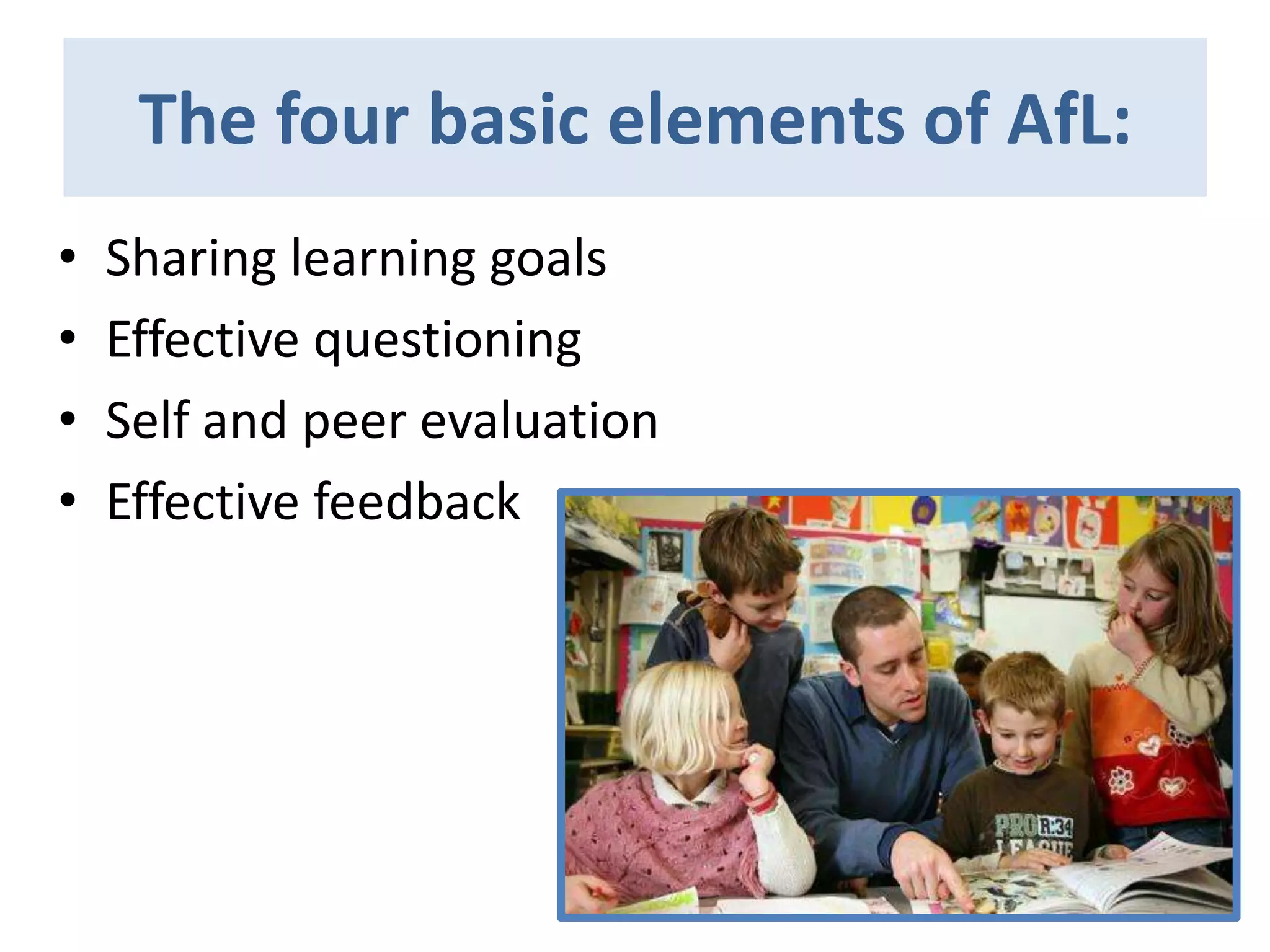
The four basic elements of AfL:
•
•
•
•

Sharing learning goals
Effective questioning
Self and peer evaluation
Effective feedback
Ted Wragg
Questioning
http://www.teachersmedia.co.uk/videos/hotresearch-questions
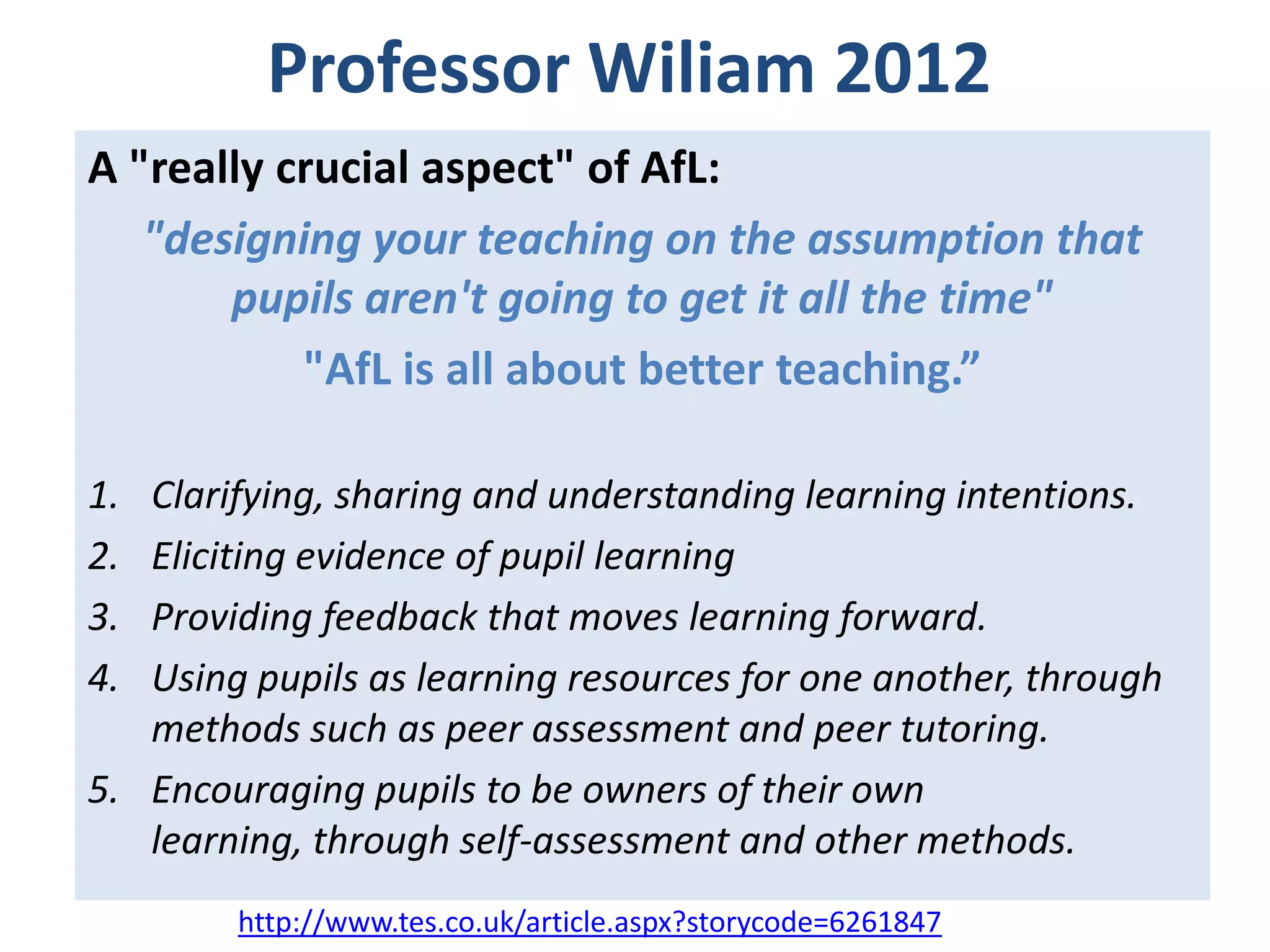
Professor Wiliam 2012
A "really crucial aspect" of AfL:
"designing your teaching on the assumption that
pupils aren't going to get it all the time"
"AfL is all about better teaching.”
1.
2.
3.
4.

Clarifying, sharing and understanding learning intentions.
Eliciting evidence of pupil learning
Providing feedback that moves learning forward.
Using pupils as learning resources for one another, through
methods such as peer assessment and peer tutoring.
5. Encouraging pupils to be owners of their own
learning, through self-assessment and other methods.
http://www.tes.co.uk/article.aspx?storycode=6261847
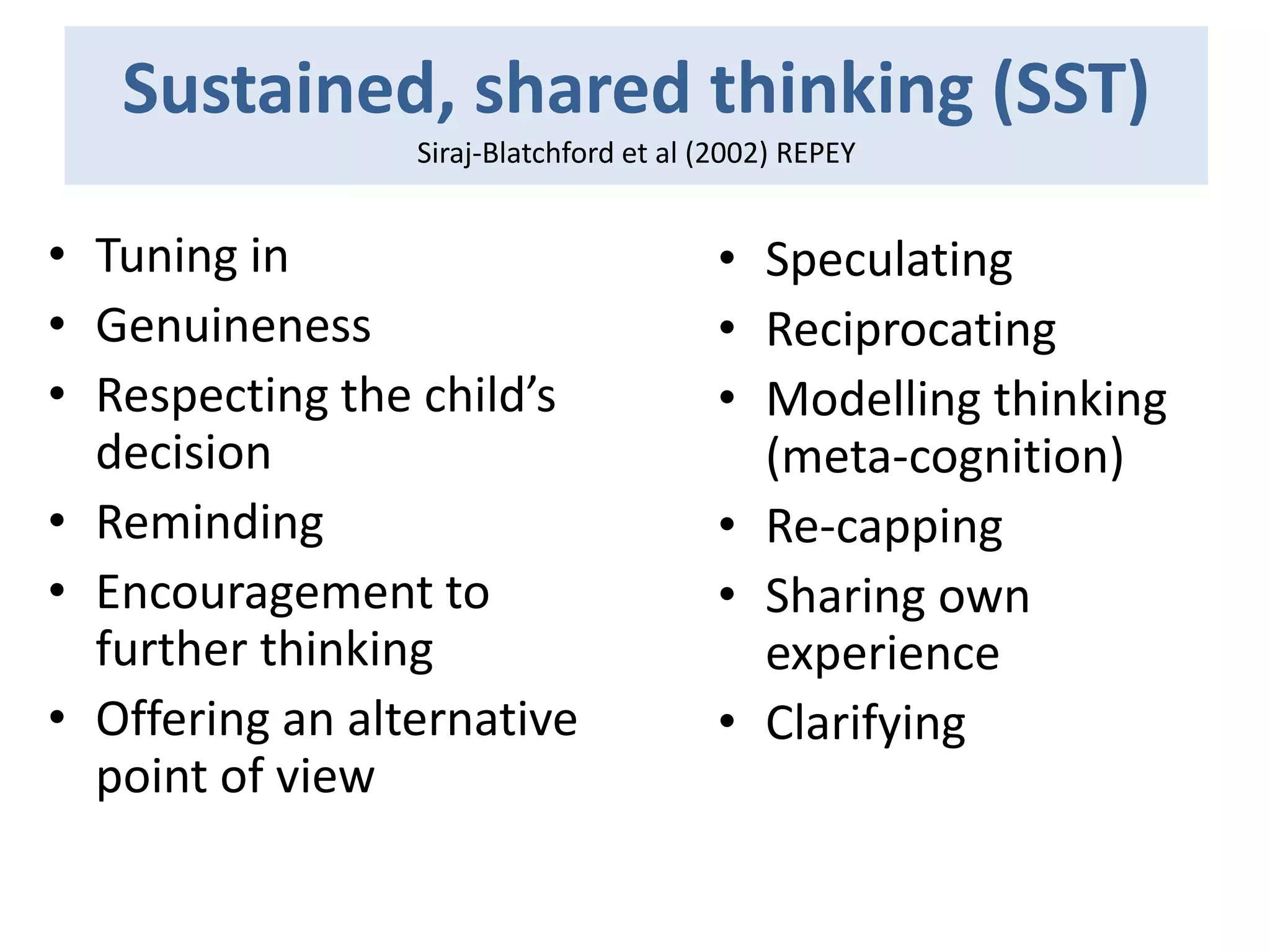
Sustained, shared thinking (SST)
Siraj-Blatchford et al (2002) REPEY

• Tuning in
• Genuineness
• Respecting the child’s
decision
• Reminding
• Encouragement to
further thinking
• Offering an alternative
point of view

• Speculating
• Reciprocating
• Modelling thinking
(meta-cognition)
• Re-capping
• Sharing own
experience
• Clarifying
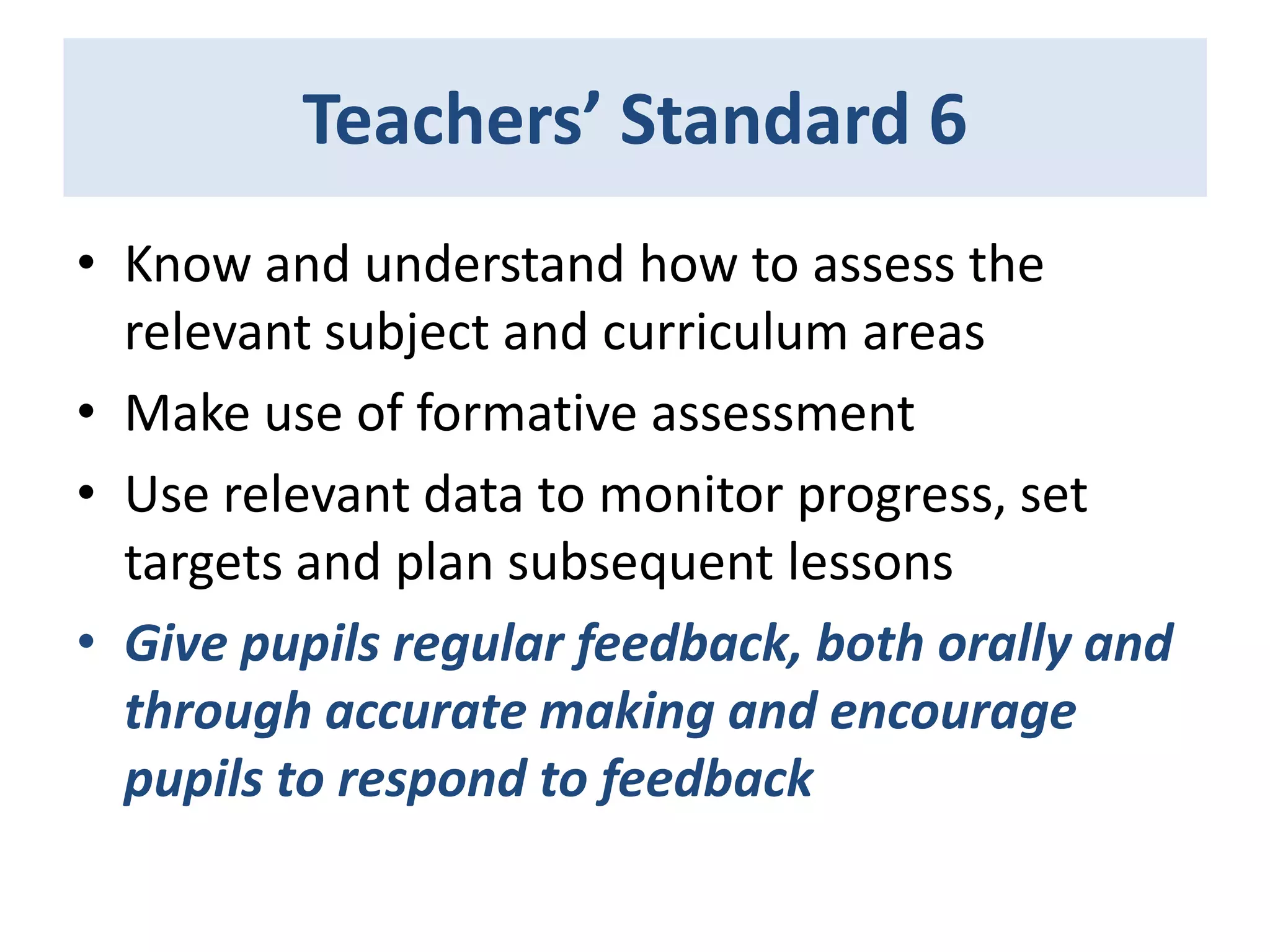
Teachers’ Standard 6
• Know and understand how to assess the
relevant subject and curriculum areas
• Make use of formative assessment
• Use relevant data to monitor progress, set
targets and plan subsequent lessons
• Give pupils regular feedback, both orally and
through accurate making and encourage
pupils to respond to feedback
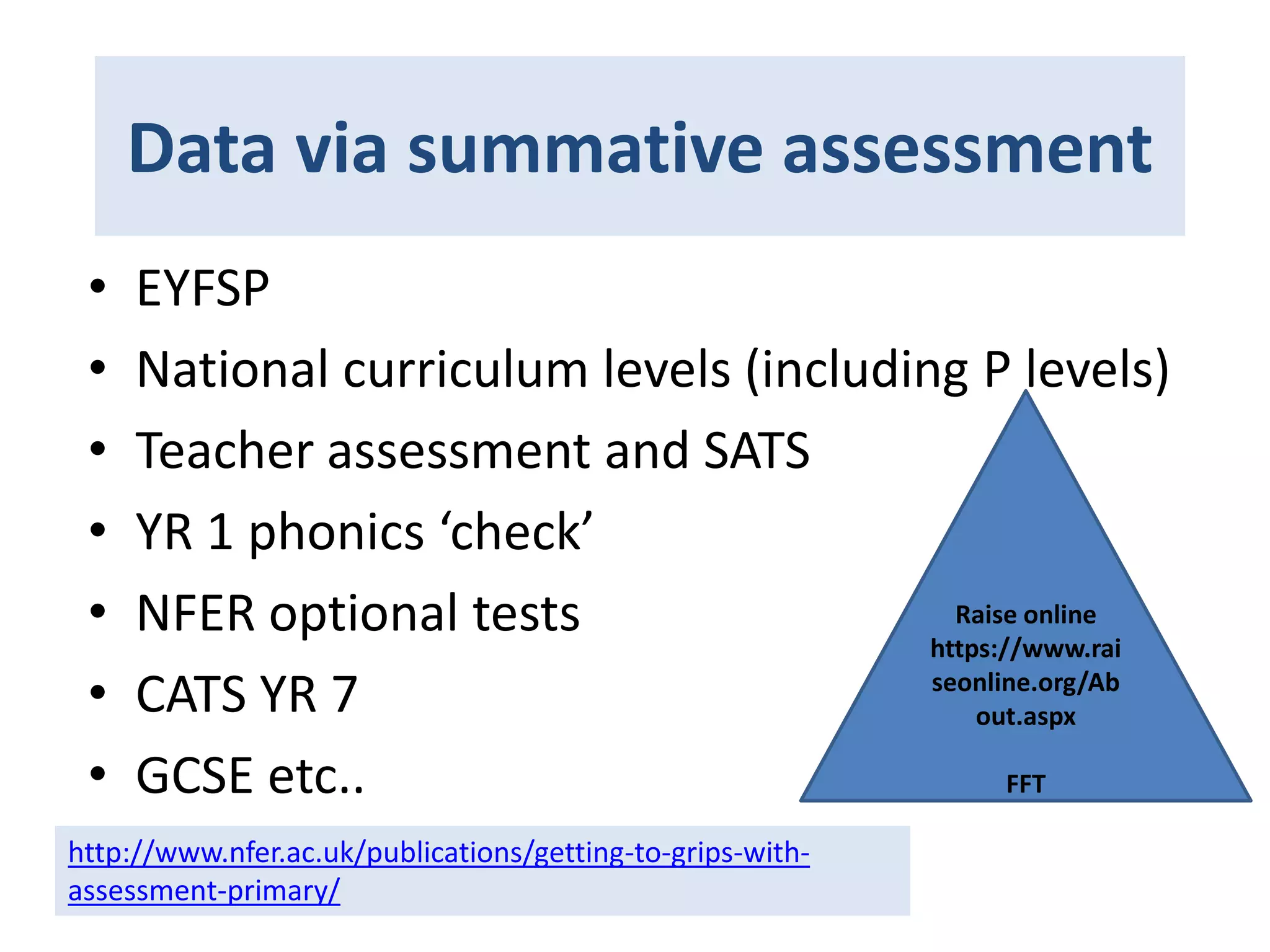
Data via summative assessment
•
•
•
•
•
•
•

EYFSP
National curriculum levels (including P levels)
Teacher assessment and SATS
YR 1 phonics ‘check’
Raise online
NFER optional tests
https://www.rai
seonline.org/Ab
CATS YR 7
out.aspx
FFT
GCSE etc..

http://www.nfer.ac.uk/publications/getting-to-grips-withassessment-primary/
Assessment in the National
Curriculum 2014
• No level descriptors
• Expectation of some “grading of pupil attainment in
the ‘core subjects’”
• Replacing the current writing test with teacher
assessment of writing composition (from 2013)
• Introducing the SPAG test from 2013:
spelling, grammar, punctuation and vocabulary.
http://www.hleducationservices.co.uk/wp-content/uploads/2012/07/english-grammar-spelling-andpunctuation-test-sample-materials.pdf

• Publishing more data in the performance table e.g.
a strong focus on the progress of every pupil. New
progress measures will be introduced to focus on
the performance of low, middle and high attainers.
The Early Years Foundation
Stage Profile
What do you know about this?
• In each group think about something you know
about the EYFSP . . .
• . . . and something you would like to know more
about the EYFSP

http://media.education.gov.uk/assets/files/pdf/2/2013_eyfs_handbook.pdf
http://www.education.gov.uk/schools/teachingandlearning/assessment/eyfs/b00217
443/eyfs-exemplification
The legal bit
• The EYFS Statutory Framework (DfE, 2012)
sets the standards for learning, development
and care for children birth to the end of YR
• The Childcare Act (2006): all EY providers must
ensure their provision meets these standards
• These standards are assessed by a statutory
assessment, the EYFSP
What has the EYFSP shown us
to date?
http://www.education.gov.uk/rsgateway/DB/SF
R/s001098/index.shtml
https://www.gov.uk/government/publications/e
arly-years-foundation-stage-profile-results2012-to-2013
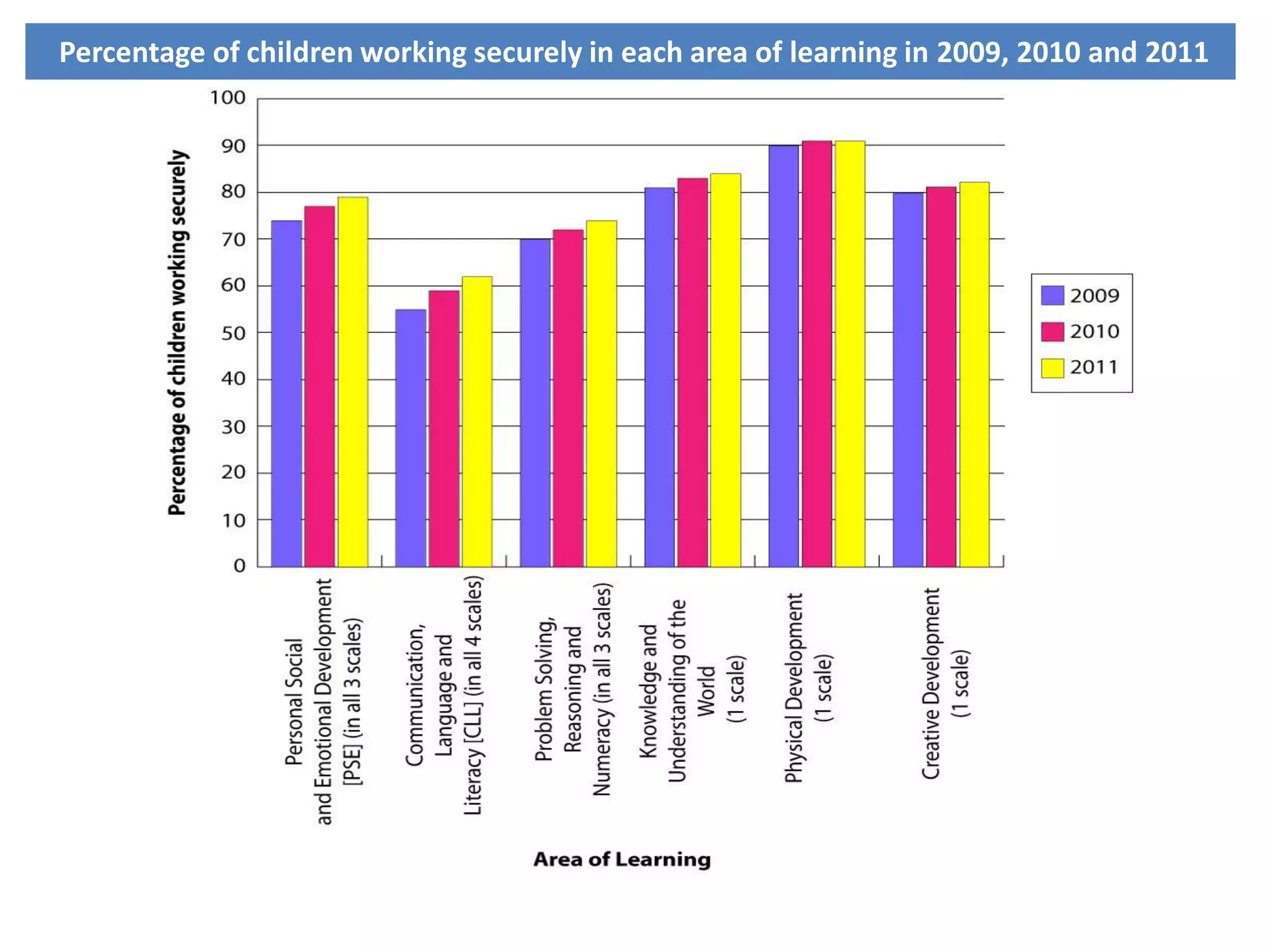
Percentage of children working securely in each area of learning in 2009, 2010 and 2011
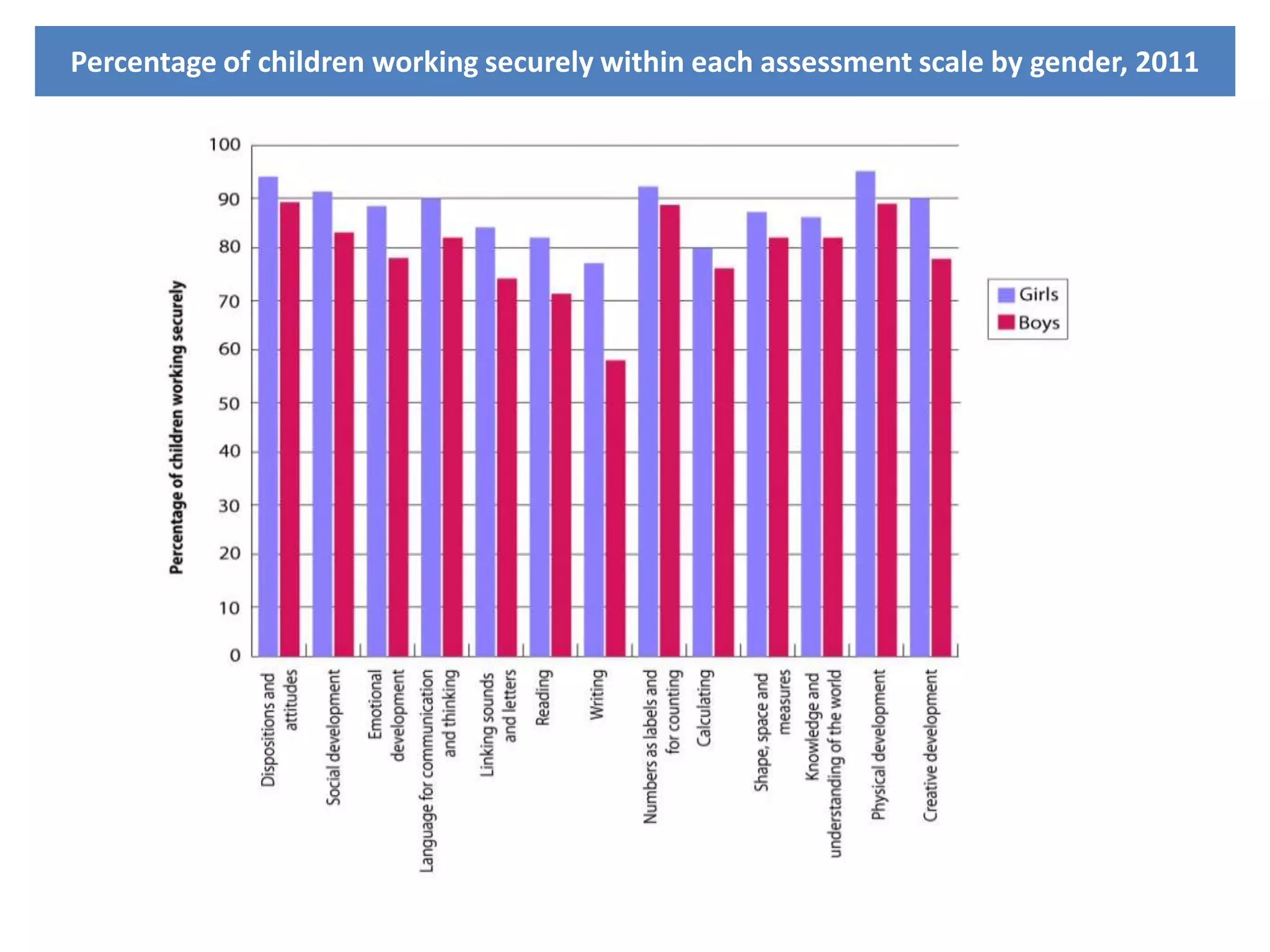
Percentage of children working securely within each assessment scale by gender, 2011
“. . . however convenient it might be to simplify
the reality of children’s learning, the treating of
everyone the same in order to produce a neat
tidy set of data . . . will inevitably result in that
most useless of exercises, the collection of data
that is unusable and meaningless.”
Dubiel, J in Featherstone & Featherstone (2008) p94
Building the Profile
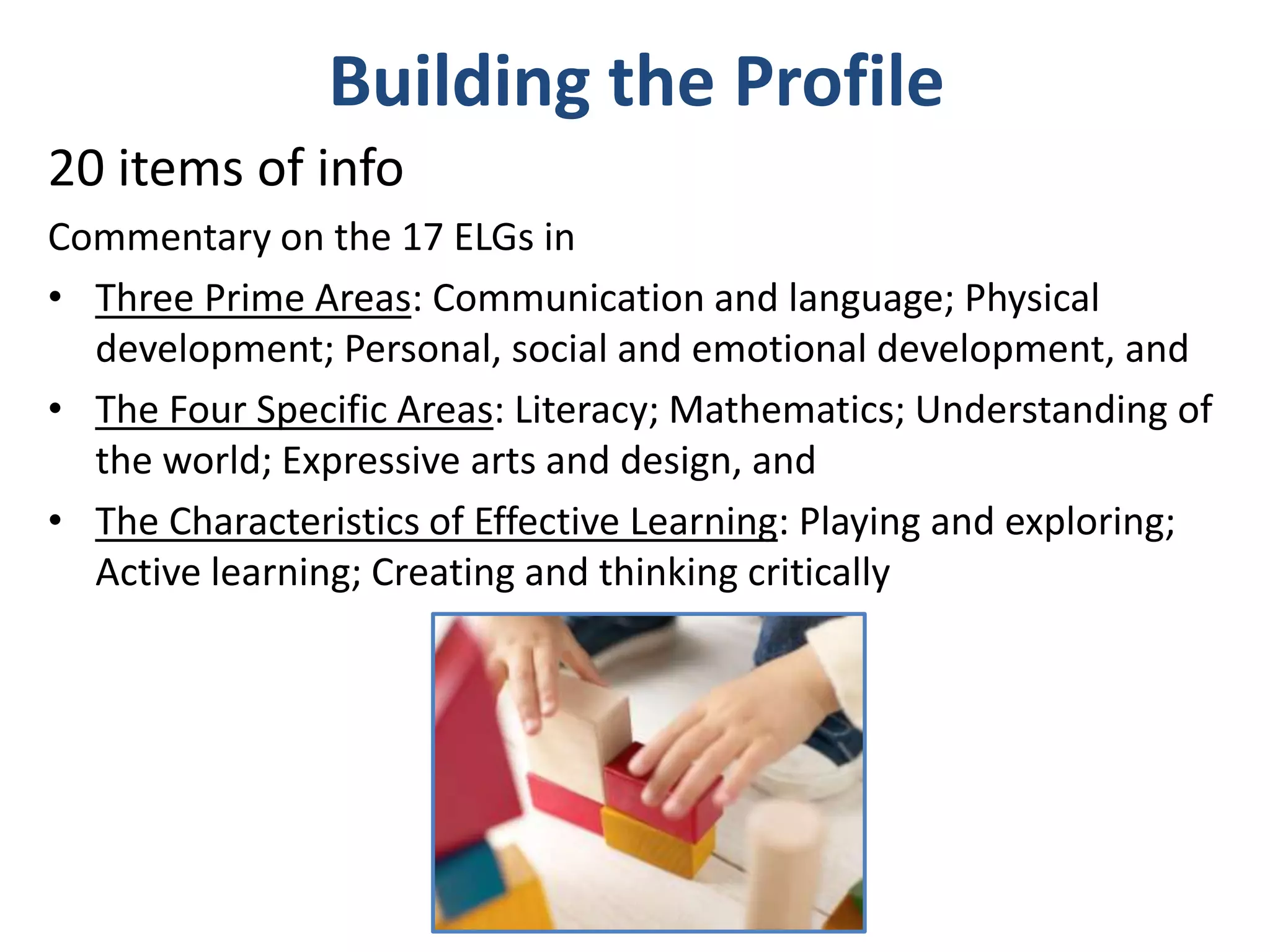
20 items of info
Commentary on the 17 ELGs in
• Three Prime Areas: Communication and language; Physical
development; Personal, social and emotional development, and
• The Four Specific Areas: Literacy; Mathematics; Understanding of
the world; Expressive arts and design, and
• The Characteristics of Effective Learning: Playing and exploring;
Active learning; Creating and thinking critically
What’s it for?
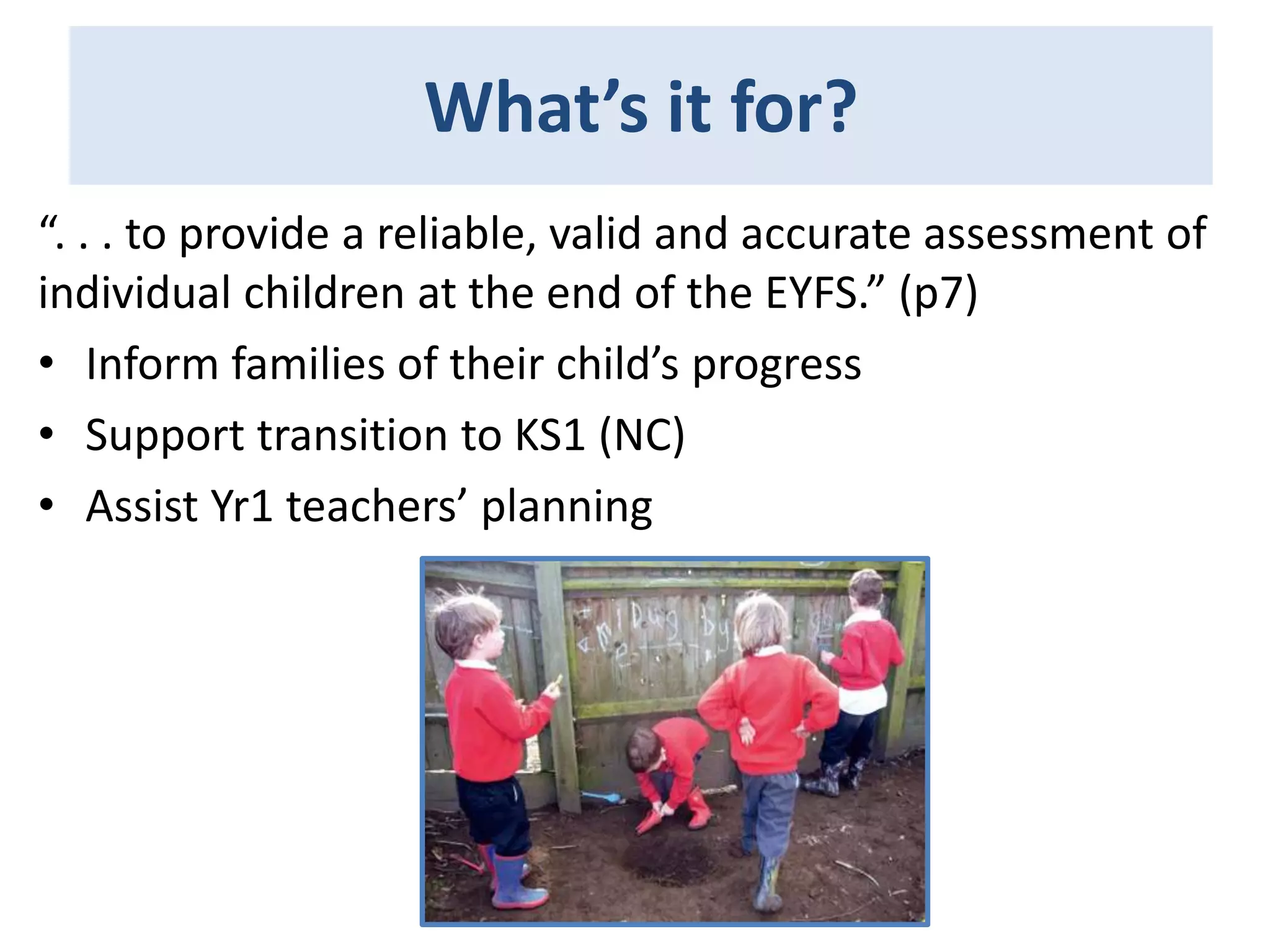
“. . . to provide a reliable, valid and accurate assessment of
individual children at the end of the EYFS.” (p7)
• Inform families of their child’s progress
• Support transition to KS1 (NC)
• Assist Yr1 teachers’ planning
What it’s not for
“The EYFSP is not intended to be
used for on-going assessment for
Early Years settings or Reception
classes.” (p5)
Completing the Profile
• Observations – every day interactions
• Contributions from family, other
colleagues, other settings/provision – and the
child!
• Summative but based on formative
assessment throughout year
“Practitioners . . . should be aware that the
definition of evidence is any material, knowledge
of the child, anecdotal incident or result of
observation or information from additional
sources that supports the overall picture of a
child’s development.
There is no requirement that it should be formally
recorded or documented; the extent to which the
practitioner chooses to record information will
depend on individual preference. Paperwork should
be kept to the minimum that practitioners require
to illustrate, support and recall their knowledge of
the child’s attainment.” (p12)
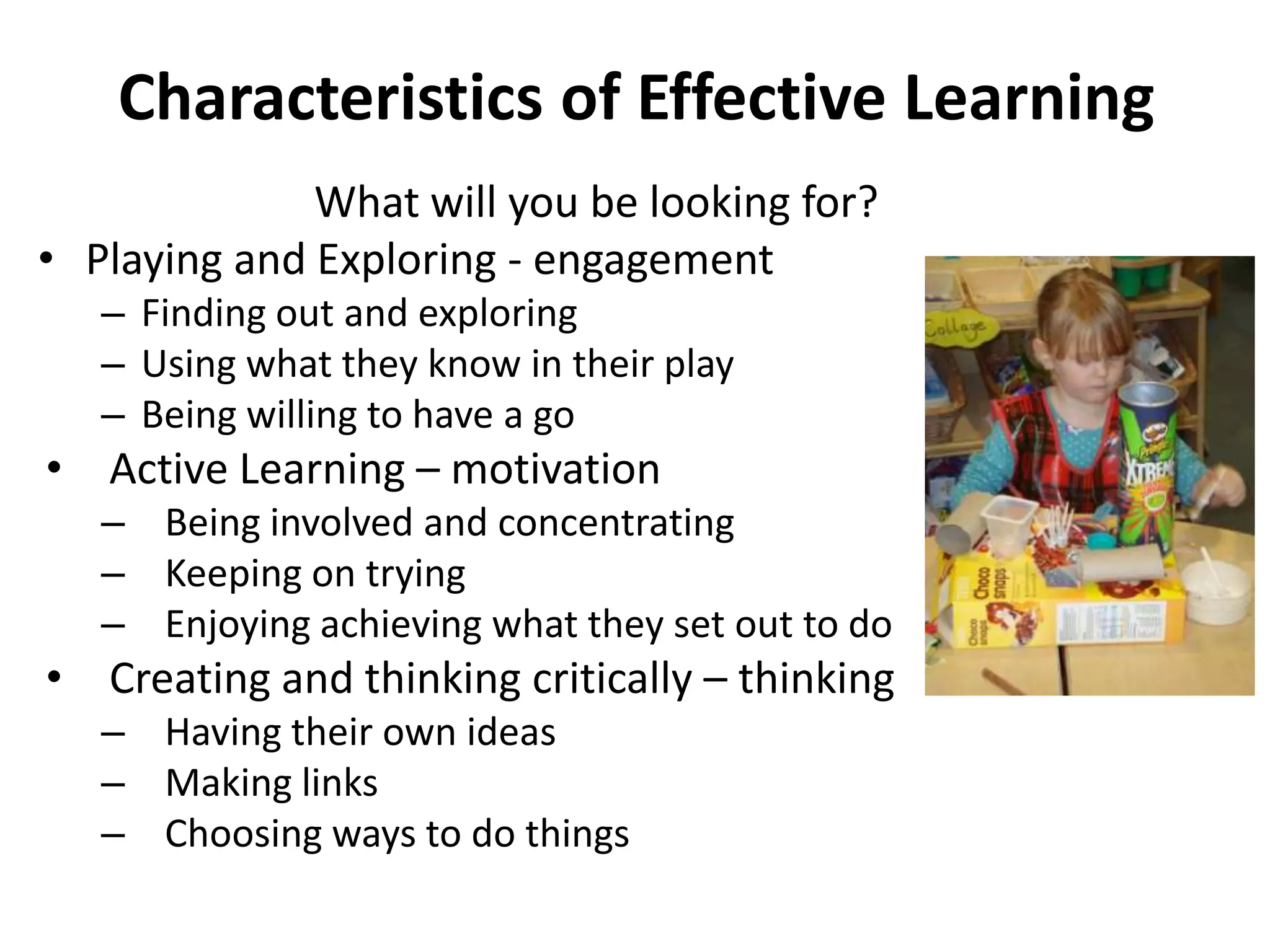
Characteristics of Effective Learning
What will you be looking for?
• Playing and Exploring - engagement
– Finding out and exploring
– Using what they know in their play
– Being willing to have a go

• Active Learning – motivation
– Being involved and concentrating
– Keeping on trying
– Enjoying achieving what they set out to do

• Creating and thinking critically – thinking
– Having their own ideas
– Making links
– Choosing ways to do things
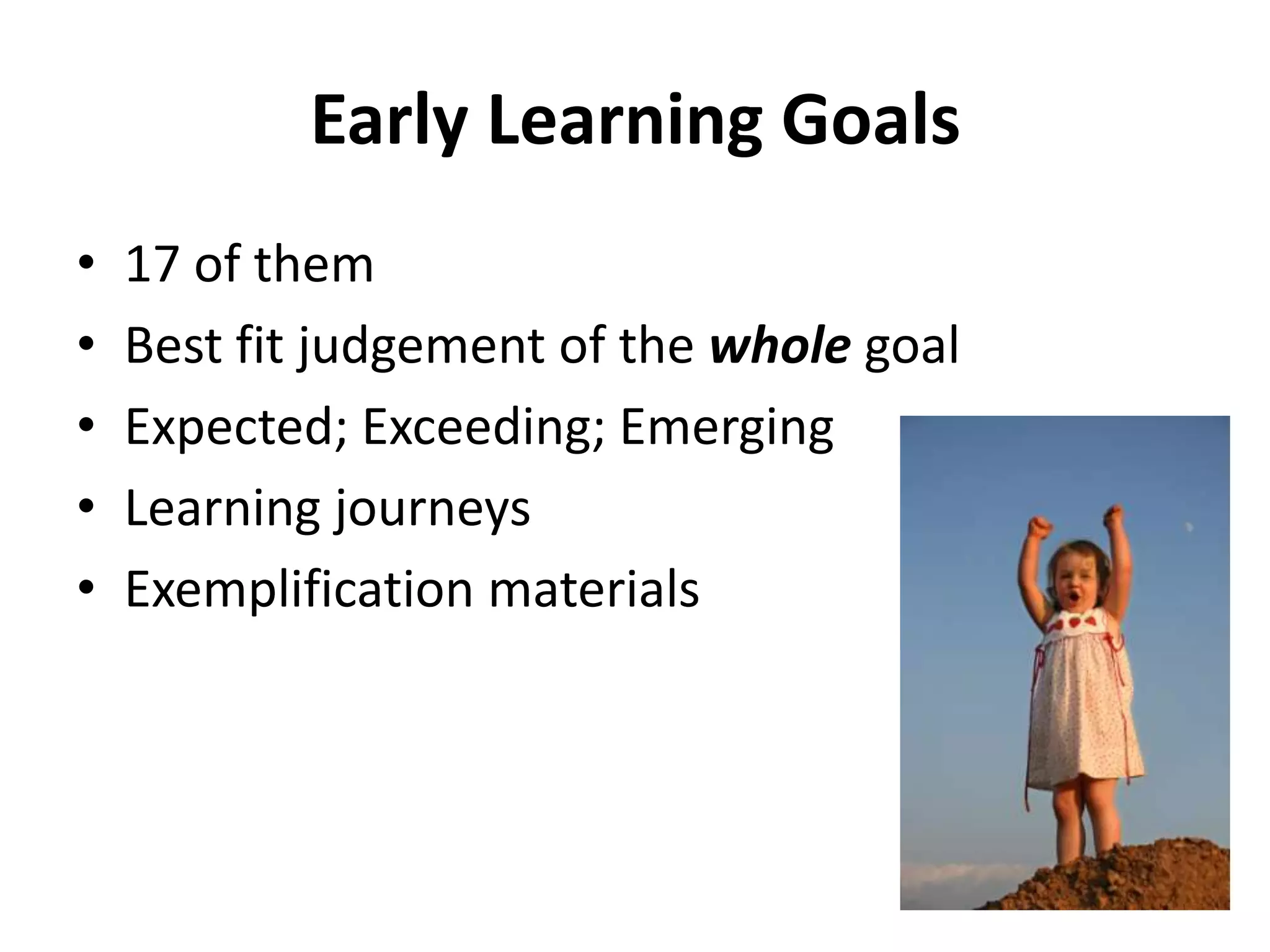
Early Learning Goals
•
•
•
•
•

17 of them
Best fit judgement of the whole goal
Expected; Exceeding; Emerging
Learning journeys
Exemplification materials
Assessment for learning: a whole
school approach
AfL: A whole school approach
http://www.teachersmedia.co.uk/videos/primar
y-assessment-for-learning-a-whole-schoolapproach
Planning
OAP or Planning cycle

Decide
Why plan?
• Part of a wider framework
(medium-term and long-term planning)
• To identify what, how and when you want the
children to learn
• To select appropriate teaching and learning
strategies – for ALL children
• To pin down what you intend to
see/hear
• To envision the future; where next
Good lesson plans
• Start from the child; recognition of what has been
learned or experienced
• Express what you intend the children to learn
• Identify the criteria for success in the learning
outcomes
• Detail the teacher’s role indicating the strategies and
opportunities for assessment
• Conclude with an overview of what needs to be
taught next, based on the assessment information
gained.
Learning Objectives
What is it you want the children to know,
understand, or be able to do by the end of this
lesson/session?
Can describe…, can perform…, can explain…, can
recall…, can compare…, can contrast…, can
label…, can list…, can match…, can draw…,
can collect…, can measure…, can choose…, can
justify…, can select…, etc. etc.
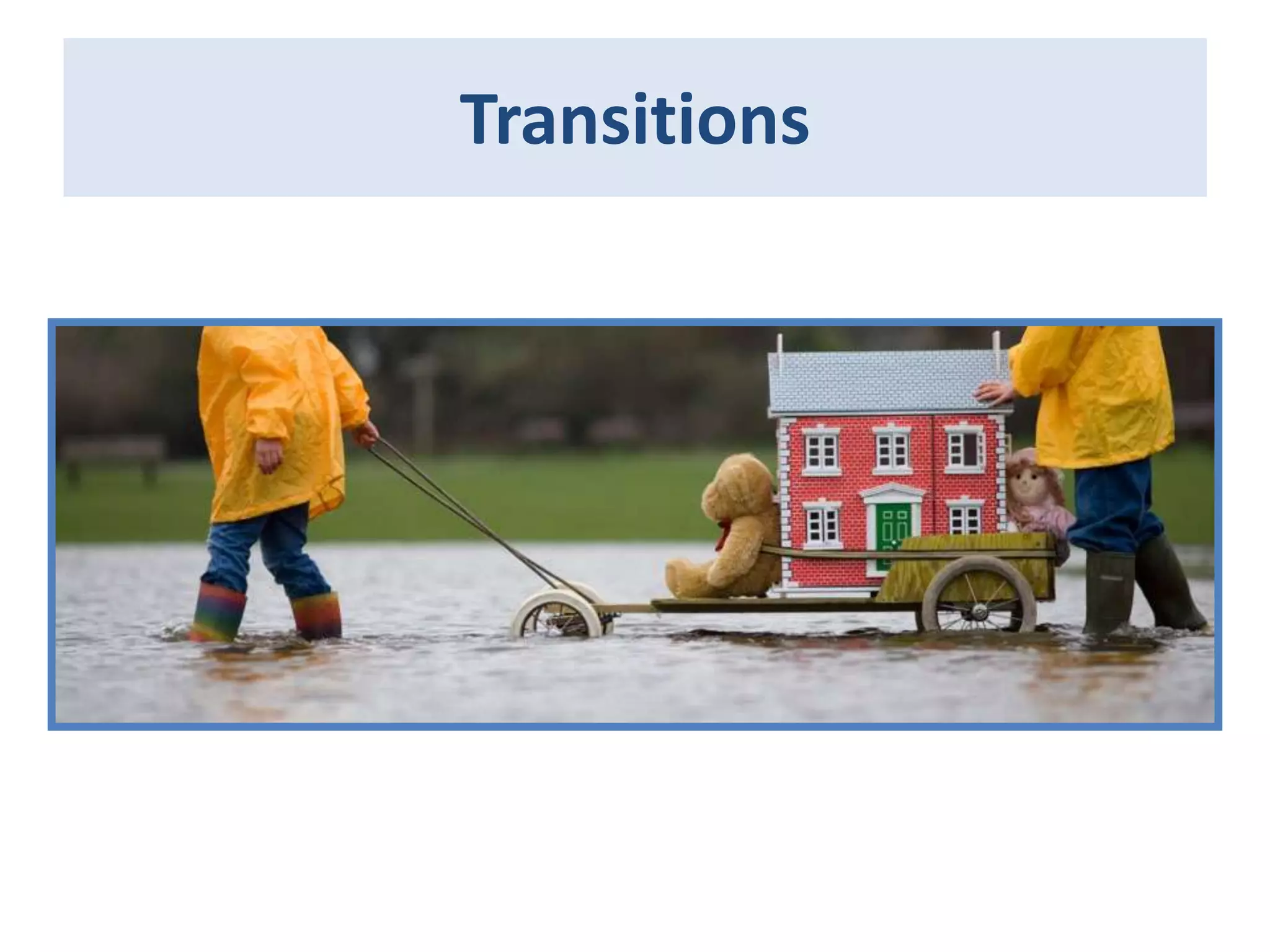
Transitions
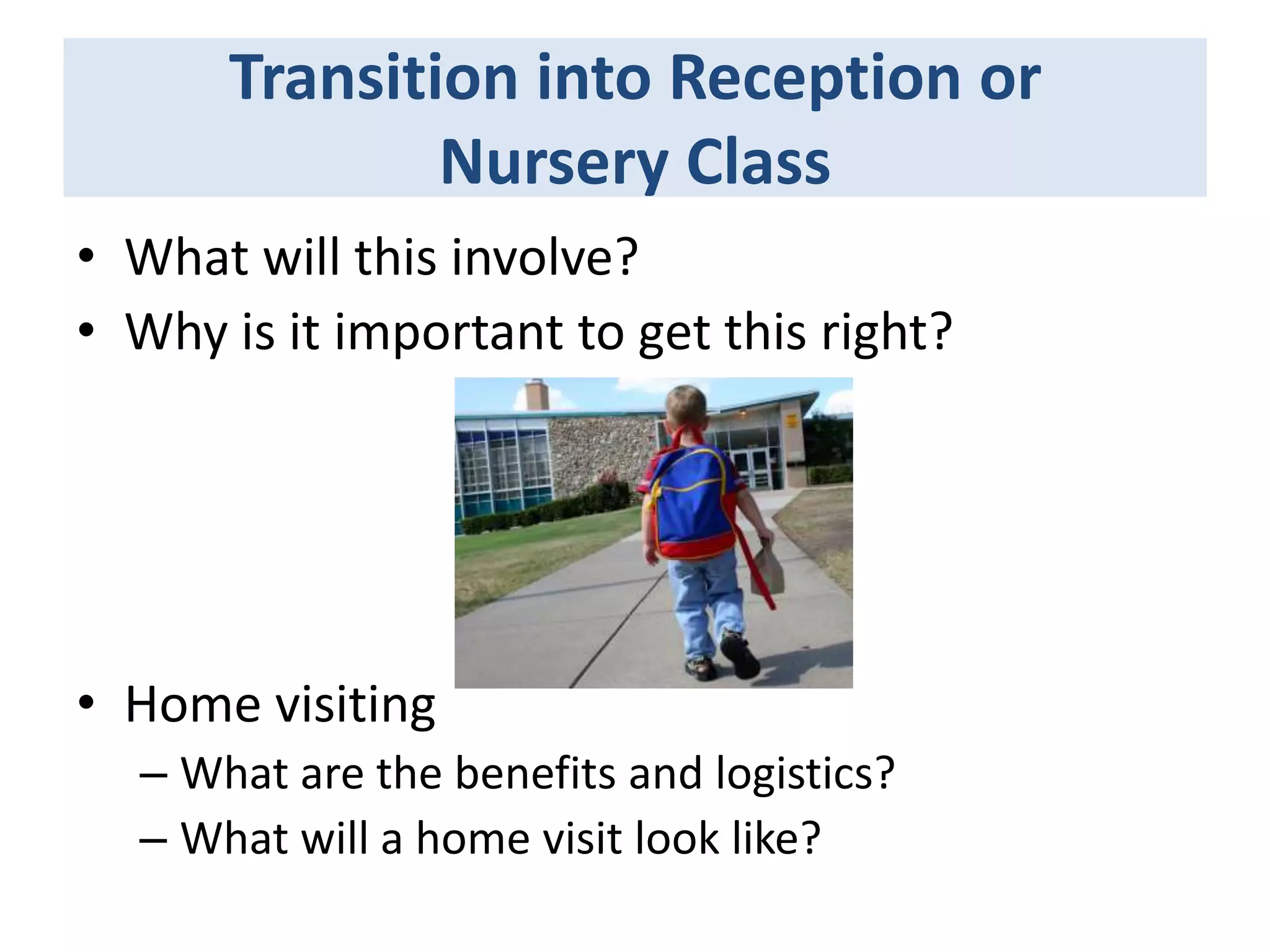
Transition into Reception or
Nursery Class
• What will this involve?
• Why is it important to get this right?

• Home visiting
– What are the benefits and logistics?
– What will a home visit look like?
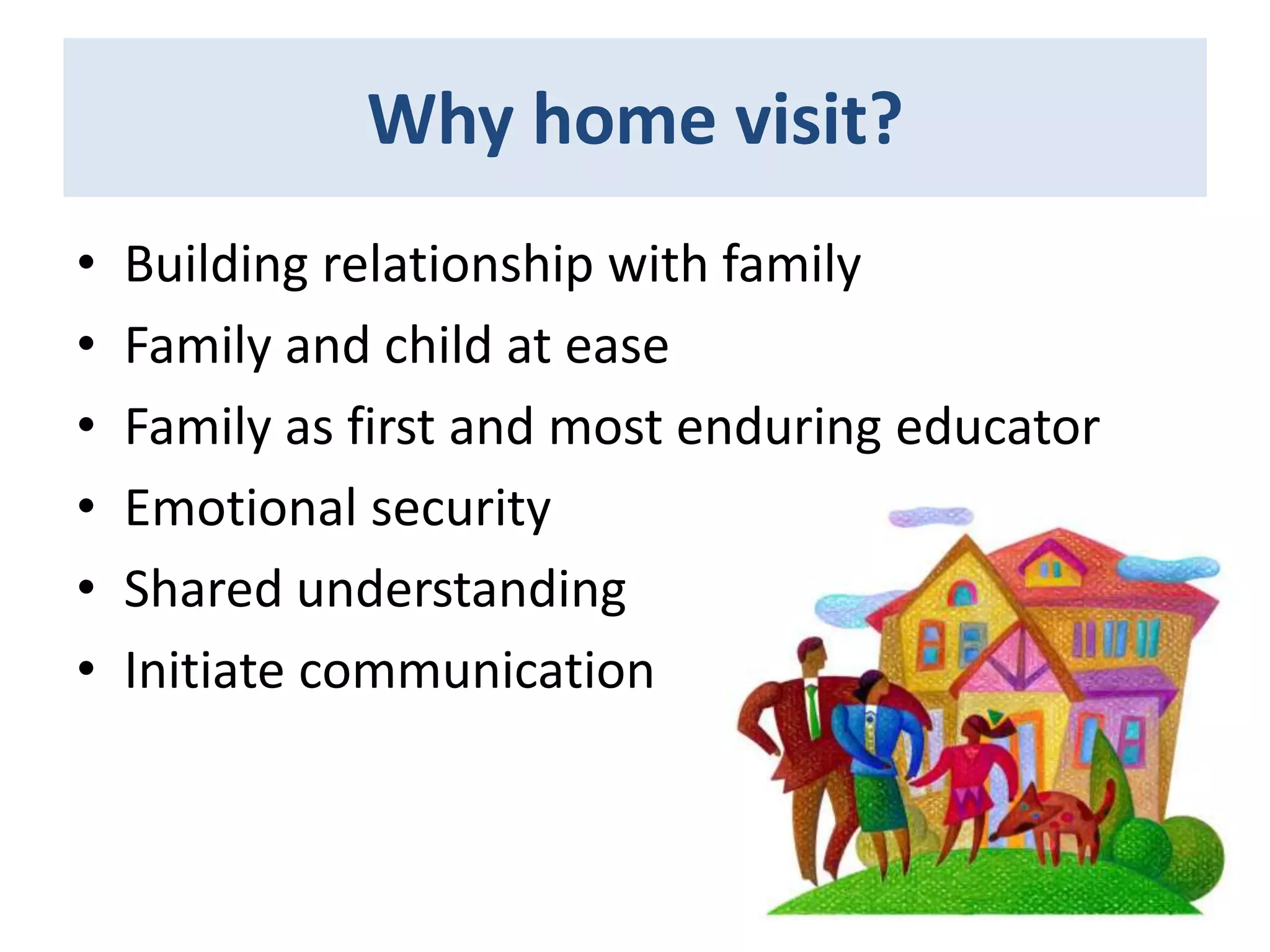
Why home visit?
•
•
•
•
•
•

Building relationship with family
Family and child at ease
Family as first and most enduring educator
Emotional security
Shared understanding
Initiate communication
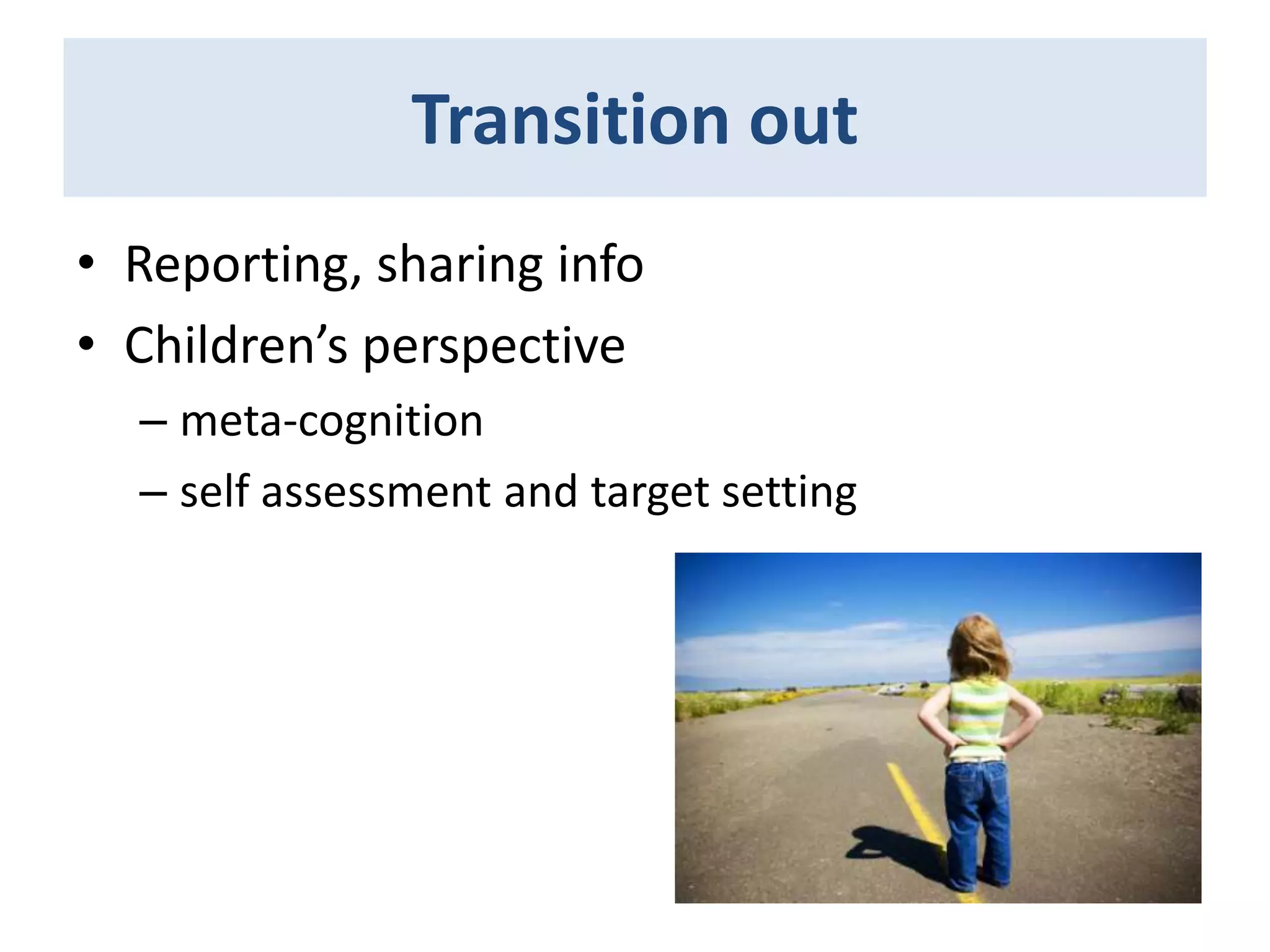
Transition out
• Reporting, sharing info
• Children’s perspective
– meta-cognition
– self assessment and target setting
What do children think?
• What do you like doing best?
• What do you think you can do now that you
couldn’t do when you were younger?
• What do you think you learn at nursery?
• What do you learn at home?
• What do you think you’re really good at?
• What do you find tricky or don’t like doing at
nursery?
Hutchin, V. (2008) Supporting Every Child’s Learning London:Hodder
and Stoughton (p78)
Suggested follow up
• Whizz through ‘Inside the Primary Black Box’
Harrison & Howard
• See Ch3 ‘Preparing children for the move to KS1’
(Aspire)
• Look at this journal article:
http://www.tandfonline.com/doi/pdf/10.1080/0
9575146.2010.512557
• Find out more about the Profile
• Download ‘Technology’ from the exemplification
materials
• SBT1 – find out more about transition

Learning and development

  • 1.
    EV681 Pedagogy, Principlesand Practice in early Childhood Session 8: Learning and Development
  • 2.
    Learners develop bestwhen ... . . . they understand clearly what they are trying to learn, and what is expected of them
  • 3.
    What we needis an OAP
  • 4.
    OAP or Planningcycle Decide
  • 5.
  • 6.
  • 7.
    Assessment is forthe • Child - to ensure they are making progress • Family – for Home/School liaison, HLE • Practitioner – to reflect on intervention • Setting/learning environment - planning, resources, etc. • Government/LA – accountability ‘..provide an accurate national data set..’ (p7 EYFSP)
  • 8.
    Assessment is .. . • Assessment foci built into plans/units/schemes of work • Praise / well done/rewards /celebrations • Verbal feedback to children • Written feedback to children / ‘Marking’/comments on work • Tests • Questions • Talk for learning e.g. TPS, lolly sticks • On the hoof records • Formalised records e.g. guided reading • Thumbs up and traffic lights • Criteria for self and peer assessment • Plenaries • Reports • Parent conferences • APP (Assessing Pupil Progress frameworks) and moderating • Checklists
  • 9.
    Robin Alexander says. . . “Assessment for learning.... is intrinsic to pedagogy rather than detached from it” (p325)
  • 10.
    Mary-Jane Drummond says.. . Assessment has four characteristics: 1. It is embedded in everyday practice 2. It is observation based 3. It requires an interpretation 4. It indicates the way to better learning and teaching Adapted from 1993, p13
  • 11.
    The EYFS guidancesays . . . “ Assessments are the decisions you make using what you have observed about a child’s development and/or learning” (Principles in to Practice 3.1, 2007) “On-going formative assessment is at the heart of effective early years practice.” (p3 DM 2012) “On-going assessment . . . is an integral part of the learning and development process.”(p10 Stat Framework 2012) “effective assessment presents a holistic view of a child”(p8 EYFSP Handbook, 2013) “Accurate assessments take account of contributions from a range of perspectives including the child, their parents and other relevant adults.” (p8 EYFSP Handbook, 2013)
  • 12.
    The four basicelements of AfL: • • • • Sharing learning goals Effective questioning Self and peer evaluation Effective feedback
  • 13.
  • 14.
    Professor Wiliam 2012 A"really crucial aspect" of AfL: "designing your teaching on the assumption that pupils aren't going to get it all the time" "AfL is all about better teaching.” 1. 2. 3. 4. Clarifying, sharing and understanding learning intentions. Eliciting evidence of pupil learning Providing feedback that moves learning forward. Using pupils as learning resources for one another, through methods such as peer assessment and peer tutoring. 5. Encouraging pupils to be owners of their own learning, through self-assessment and other methods. http://www.tes.co.uk/article.aspx?storycode=6261847
  • 15.
    Sustained, shared thinking(SST) Siraj-Blatchford et al (2002) REPEY • Tuning in • Genuineness • Respecting the child’s decision • Reminding • Encouragement to further thinking • Offering an alternative point of view • Speculating • Reciprocating • Modelling thinking (meta-cognition) • Re-capping • Sharing own experience • Clarifying
  • 16.
    Teachers’ Standard 6 •Know and understand how to assess the relevant subject and curriculum areas • Make use of formative assessment • Use relevant data to monitor progress, set targets and plan subsequent lessons • Give pupils regular feedback, both orally and through accurate making and encourage pupils to respond to feedback
  • 17.
    Data via summativeassessment • • • • • • • EYFSP National curriculum levels (including P levels) Teacher assessment and SATS YR 1 phonics ‘check’ Raise online NFER optional tests https://www.rai seonline.org/Ab CATS YR 7 out.aspx FFT GCSE etc.. http://www.nfer.ac.uk/publications/getting-to-grips-withassessment-primary/
  • 18.
    Assessment in theNational Curriculum 2014 • No level descriptors • Expectation of some “grading of pupil attainment in the ‘core subjects’” • Replacing the current writing test with teacher assessment of writing composition (from 2013) • Introducing the SPAG test from 2013: spelling, grammar, punctuation and vocabulary. http://www.hleducationservices.co.uk/wp-content/uploads/2012/07/english-grammar-spelling-andpunctuation-test-sample-materials.pdf • Publishing more data in the performance table e.g. a strong focus on the progress of every pupil. New progress measures will be introduced to focus on the performance of low, middle and high attainers.
  • 19.
    The Early YearsFoundation Stage Profile What do you know about this? • In each group think about something you know about the EYFSP . . . • . . . and something you would like to know more about the EYFSP http://media.education.gov.uk/assets/files/pdf/2/2013_eyfs_handbook.pdf http://www.education.gov.uk/schools/teachingandlearning/assessment/eyfs/b00217 443/eyfs-exemplification
  • 20.
    The legal bit •The EYFS Statutory Framework (DfE, 2012) sets the standards for learning, development and care for children birth to the end of YR • The Childcare Act (2006): all EY providers must ensure their provision meets these standards • These standards are assessed by a statutory assessment, the EYFSP
  • 21.
    What has theEYFSP shown us to date? http://www.education.gov.uk/rsgateway/DB/SF R/s001098/index.shtml https://www.gov.uk/government/publications/e arly-years-foundation-stage-profile-results2012-to-2013
  • 22.
    Percentage of childrenworking securely in each area of learning in 2009, 2010 and 2011
  • 23.
    Percentage of childrenworking securely within each assessment scale by gender, 2011
  • 24.
    “. . .however convenient it might be to simplify the reality of children’s learning, the treating of everyone the same in order to produce a neat tidy set of data . . . will inevitably result in that most useless of exercises, the collection of data that is unusable and meaningless.” Dubiel, J in Featherstone & Featherstone (2008) p94
  • 25.
    Building the Profile 20items of info Commentary on the 17 ELGs in • Three Prime Areas: Communication and language; Physical development; Personal, social and emotional development, and • The Four Specific Areas: Literacy; Mathematics; Understanding of the world; Expressive arts and design, and • The Characteristics of Effective Learning: Playing and exploring; Active learning; Creating and thinking critically
  • 26.
    What’s it for? “.. . to provide a reliable, valid and accurate assessment of individual children at the end of the EYFS.” (p7) • Inform families of their child’s progress • Support transition to KS1 (NC) • Assist Yr1 teachers’ planning
  • 27.
    What it’s notfor “The EYFSP is not intended to be used for on-going assessment for Early Years settings or Reception classes.” (p5)
  • 28.
    Completing the Profile •Observations – every day interactions • Contributions from family, other colleagues, other settings/provision – and the child! • Summative but based on formative assessment throughout year
  • 29.
    “Practitioners . .. should be aware that the definition of evidence is any material, knowledge of the child, anecdotal incident or result of observation or information from additional sources that supports the overall picture of a child’s development. There is no requirement that it should be formally recorded or documented; the extent to which the practitioner chooses to record information will depend on individual preference. Paperwork should be kept to the minimum that practitioners require to illustrate, support and recall their knowledge of the child’s attainment.” (p12)
  • 30.
    Characteristics of EffectiveLearning What will you be looking for? • Playing and Exploring - engagement – Finding out and exploring – Using what they know in their play – Being willing to have a go • Active Learning – motivation – Being involved and concentrating – Keeping on trying – Enjoying achieving what they set out to do • Creating and thinking critically – thinking – Having their own ideas – Making links – Choosing ways to do things
  • 31.
    Early Learning Goals • • • • • 17of them Best fit judgement of the whole goal Expected; Exceeding; Emerging Learning journeys Exemplification materials
  • 32.
    Assessment for learning:a whole school approach AfL: A whole school approach http://www.teachersmedia.co.uk/videos/primar y-assessment-for-learning-a-whole-schoolapproach
  • 33.
  • 34.
    OAP or Planningcycle Decide
  • 35.
    Why plan? • Partof a wider framework (medium-term and long-term planning) • To identify what, how and when you want the children to learn • To select appropriate teaching and learning strategies – for ALL children • To pin down what you intend to see/hear • To envision the future; where next
  • 36.
    Good lesson plans •Start from the child; recognition of what has been learned or experienced • Express what you intend the children to learn • Identify the criteria for success in the learning outcomes • Detail the teacher’s role indicating the strategies and opportunities for assessment • Conclude with an overview of what needs to be taught next, based on the assessment information gained.
  • 37.
    Learning Objectives What isit you want the children to know, understand, or be able to do by the end of this lesson/session? Can describe…, can perform…, can explain…, can recall…, can compare…, can contrast…, can label…, can list…, can match…, can draw…, can collect…, can measure…, can choose…, can justify…, can select…, etc. etc.
  • 38.
  • 39.
    Transition into Receptionor Nursery Class • What will this involve? • Why is it important to get this right? • Home visiting – What are the benefits and logistics? – What will a home visit look like?
  • 40.
    Why home visit? • • • • • • Buildingrelationship with family Family and child at ease Family as first and most enduring educator Emotional security Shared understanding Initiate communication
  • 41.
    Transition out • Reporting,sharing info • Children’s perspective – meta-cognition – self assessment and target setting
  • 42.
    What do childrenthink? • What do you like doing best? • What do you think you can do now that you couldn’t do when you were younger? • What do you think you learn at nursery? • What do you learn at home? • What do you think you’re really good at? • What do you find tricky or don’t like doing at nursery? Hutchin, V. (2008) Supporting Every Child’s Learning London:Hodder and Stoughton (p78)
  • 43.
    Suggested follow up •Whizz through ‘Inside the Primary Black Box’ Harrison & Howard • See Ch3 ‘Preparing children for the move to KS1’ (Aspire) • Look at this journal article: http://www.tandfonline.com/doi/pdf/10.1080/0 9575146.2010.512557 • Find out more about the Profile • Download ‘Technology’ from the exemplification materials • SBT1 – find out more about transition

Editor's Notes

  • #2 Looking at OAP
  • #3 We’re going to address this with the help of the OAP!
  • #5 OAP!
  • #6 Could we observe from a clip?Reflections on readingExperiences Who observes?Guilt free observingiPad recording‘Look, listen and note’
  • #7 Do we just mean measuring?What do we measure (assess)?How do we measure?Why do we measure?Who is it for?What experience have you of assessment?
  • #9 Critique methodsBreaks down into 2 broad types: summative (assessment of learning) and formative (assessment for learning)Scotland – Assessment is for learning
  • #10 Part 1:Formative assessment Values, beliefs again, T’s style – see article ‘There’s nothing so practical as a theory’Our young children are possibly the most tested/assessed in the world, but assessment doesn’t just mean testingSee Ch16
  • #11 Formative assessmentIs not THE toolAids planning Informs your roleShould involve othersEnriches your understanding of what a child has learnt and understood “is a process in which our understanding of children's learning, acquired through observation and reflection, can be used to evaluate and enrich the curriculum we offer” p12 2012Value ladenAssessment = provisional, partial, tentative, exploratory and . . . incomplete
  • #14 About 5min
  • #15 From the article: How it should beDylan Wiliam's key Assessment for Learning strategiesDiscuss how these will happen/look like; include any experience of these – one for each table?Again keep 3-5 in mind SST here – relates to all 5 points!
  • #16 REPEY defined sustained shared thinking as an episode in which two or more individuals 'work together' in an intellectual way to solve a problem, clarify a concept, evaluate activities or extend a narrative. Both parties must contribute to the thinking, and it must develop and extend.AfL!
  • #17 VerbalNon-verbalWritten
  • #18 Using data formatively:Who is meeting national expectationsWho is/isn’t making progress?Who is under-attaining from one year to the next?What does the ‘value-added’ tell us?FSMLooked after pupilsEALSchool actionStatemented
  • #19 For reflection . . .All rather vague as yet . . .
  • #22 Last summary of the ‘old’ profile and first summary of last year’s – the new profile.What’s the same in the results? Boys! The challenging expectations of the writing targets! Gap related to disadvantageLook at (or even sign up to) http://savechildhoodnetwork.ning.com/?xg_source=msg_mes_networkSave Childhood Network (was previously Open EYE group, headed by Richard House who edited ‘Too much too soon’, 2012 I think. Members are reputable and eminent figures in EY world and quite proactive!
  • #25 Wise words . . .
  • #26 The process
  • #27 Progress: attainment and achievementAttainment = what achild knows, understands and can doAchievement = taking account of child’s attainment and progress over time
  • #28 But you will see it used in many and various ways!
  • #29 Unique in that it is a summative assessment but informed from formative assessments – observations
  • #30 Support for those practitioners who believed many examples of evidence against each goal was requiredEmphasis on best fit judgement of (the trusted and professional) teacher
  • #31 Observed in child-initiated learningRepresent processes rather than end products/outcomes
  • #32 Exemplification materials vary in quality but still fairly helpful in supporting which of three ‘E’s are needed
  • #33 About 15 min – worth whizzing through. Good bit on self evaluation
  • #34 Where are we going?Why are we going there?How are we getting there?How will we know when we’ve arrived?
  • #35 OAP!
  • #36 Part of being a ‘skilful opportunist’ Planningfor all possibilities ‘A rehearsal of thought on paper’To ensure lessons address the learning you have identified drawn from the school’s planning scheme (it has to fit in with a wider framework)If you are well planned, there is more chance that learning will take place. Unplanned lessons can lead to confusion and possible a disruptive classroom. There is a link between planning and behaviour management! We also lose credibility as professionals. We don’t make the best use of others’ support. If no learning is taking place, we are just ‘day care’.
  • #37  Teacher’s roleTeacher intensiveTeacher in attendanceTeacher monitoringTeacher available And so back to our OAP!
  • #38 Keep them short – keep them simple – pitch them at an appropriate level
  • #39 Vertical – change of phase/contextHorizontal – change of teacher, change within phaseTransfer – move from one school or phase to anotherTransition – move from one year group to another
  • #41 Tricky things:Cost, staffing, choice of family, travelling, language, equality Forms/paperwork (what do you need to find out at this visit?), dates and times, role of two staff, play things from school, family learning packs . . . See Ephgrave book
  • #42 See reading (Fisher)Back to EYFSP again
  • #43 Even young children can self-assess
  • #44 ReadarticleReflect for session 10. Session 10 focussing on Positive relationships, e.g. working with others including prior professionals and families involved in transitionsSee http://dx.doi.org/10.1080/09575140802672576 This is another article by Julie Fisher re: transitions from the children’s view pointTransition in Nursery/Reception – find out more, see Handbook. Will be helpful for SBT3