ITIL V3 FoundationsAn Overview & IntroductionMark Brunner - 2009
Chapter 1Introduction
Presentation PurposeFundamental understanding of :ITSMInformation Technology Infrastructure LibraryService StrategyService DesignService TransitionService OperationContinual Service Improvement
Business & Information TechnologyInformation has become a value in itself IT aids existing Businesses by increasing efficiency and effectivenessIT enables new types of Business
This Changing World Speed of Business increasesGlobalization and lower transaction costs redefine BusinessBusiness models are redefined
What is Information TechnologyIT Changes meaning with context:IT as an "Organization''IT as a "Component''IT as a  Service''IT as an "Asset''
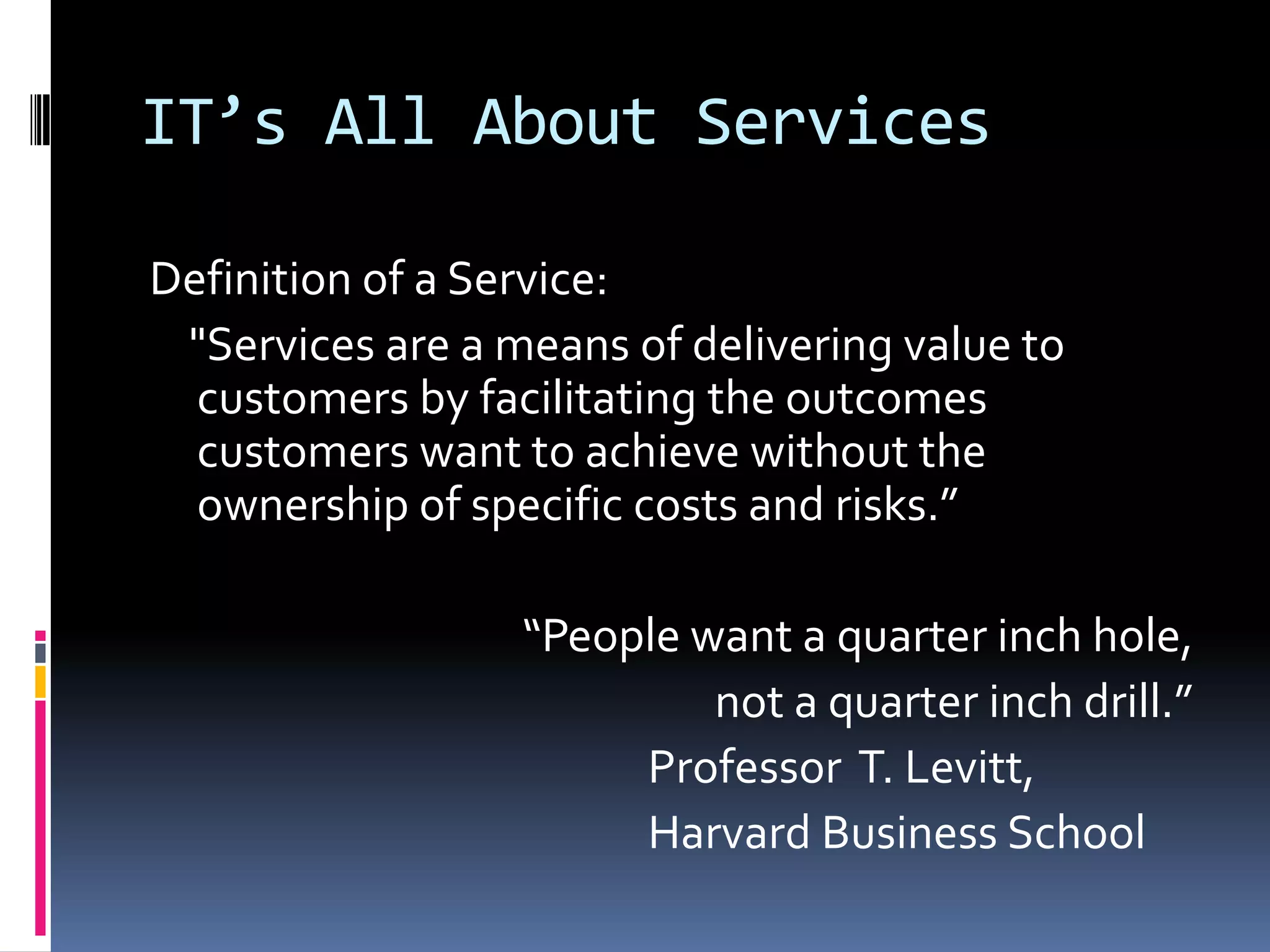
IT’s All About ServicesDefinition of a Service:    "Services are a means of delivering value to customers by facilitating the outcomes customers want to achieve without the ownership of specific costs and risks.”“People want a quarter inch hole,                   not a quarter inch drill.”					Professor  T. Levitt, 					Harvard Business School
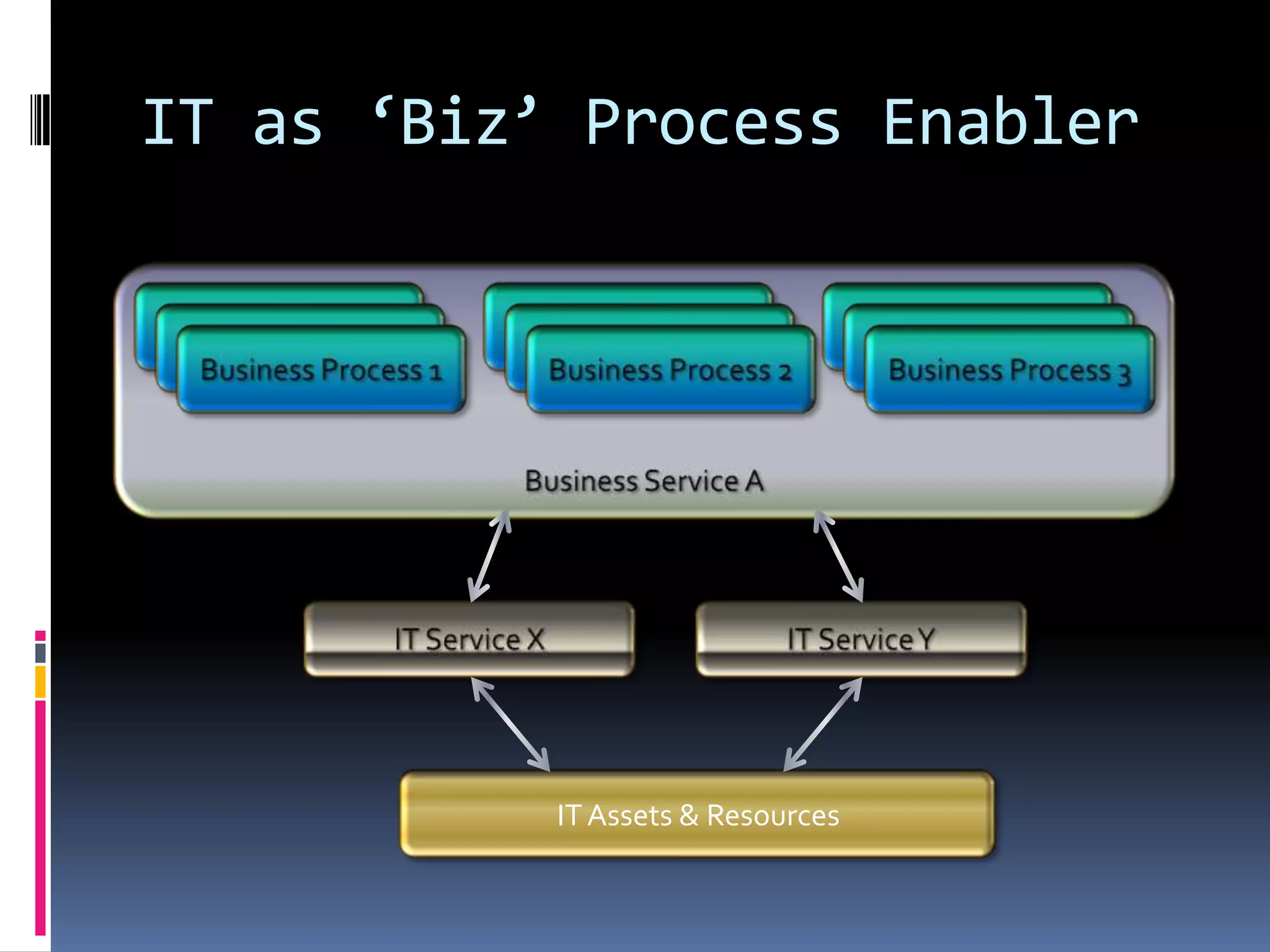
Business Service AIT as ‘Biz’ Process EnablerBusiness Process 1Business Process 2Business Process 3Business Process 1Business Process 2Business Process 3Business Process 1Business Process 2Business Process 3IT Service XIT Service YIT Assets & Resources
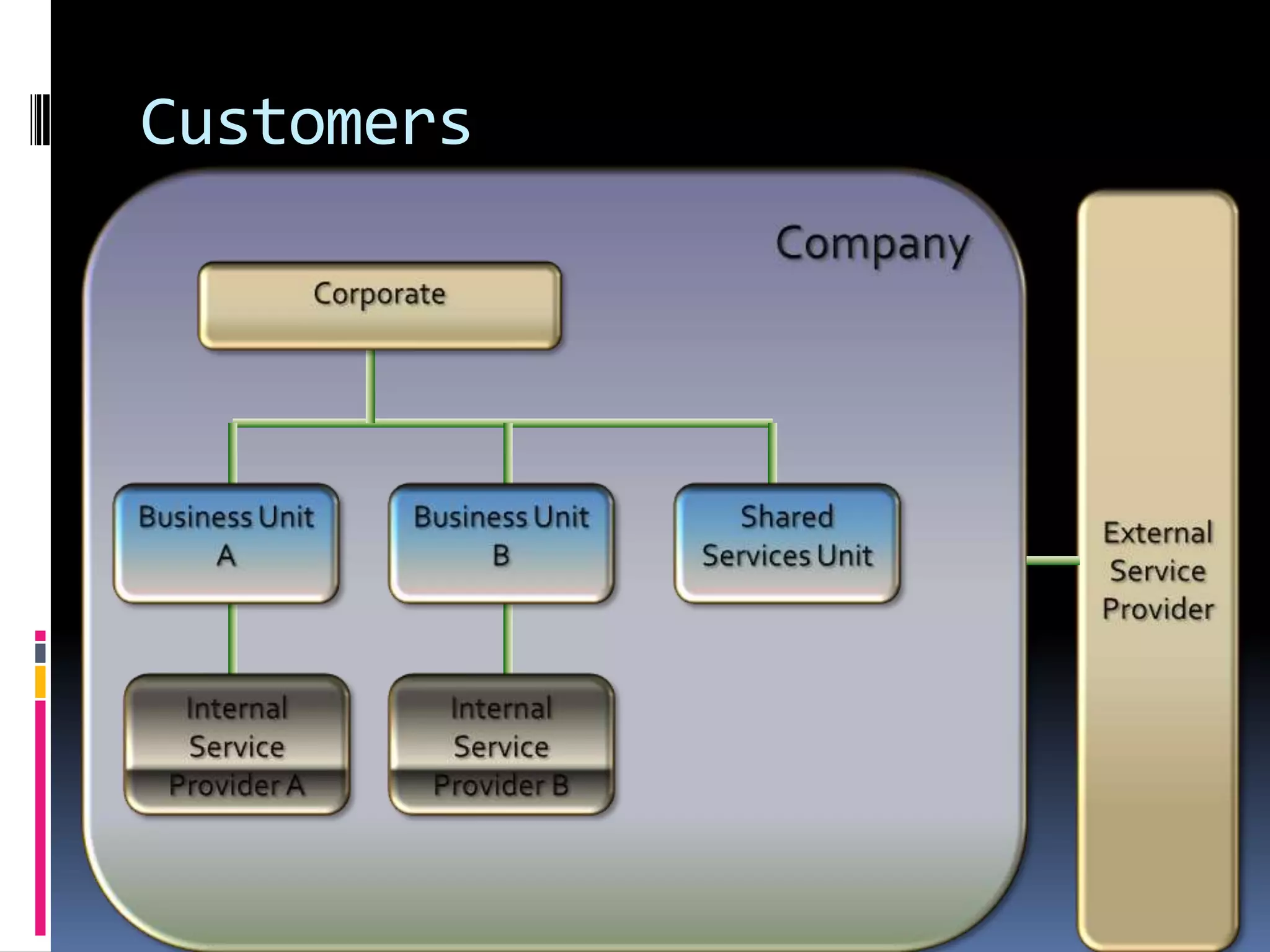
CompanyCustomersExternal Service ProviderCorporateBusiness Unit ABusiness Unit BShared Services UnitInternal Service Provider AInternal Service Provider B
Business / IT AlignmentCustomers of IT require IT Services that continuously support their Business needsIT should be aware of rapid changes in BusinessInternal providers face possible outsourcing and must run their IT as a Business
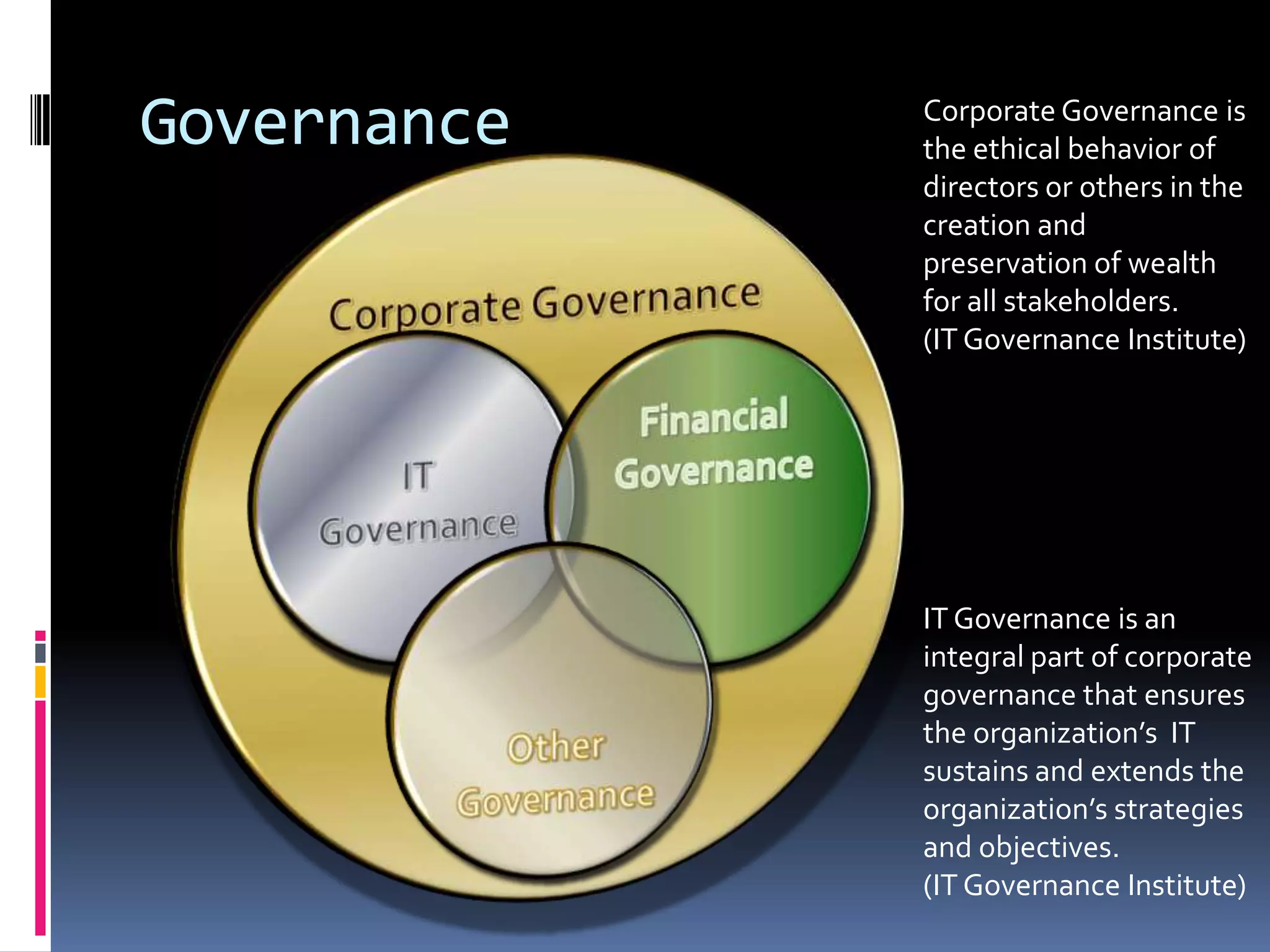
GovernanceCorporate Governance is the ethical behavior of directors or others in the creation and preservation of wealth for all stakeholders.(IT Governance Institute)Corporate GovernanceIT GovernanceFinancial GovernanceOther GovernanceIT Governance is an integral part of corporate governance that ensures the organization’s  IT sustains and extends the organization’s strategies and objectives.(IT Governance Institute)
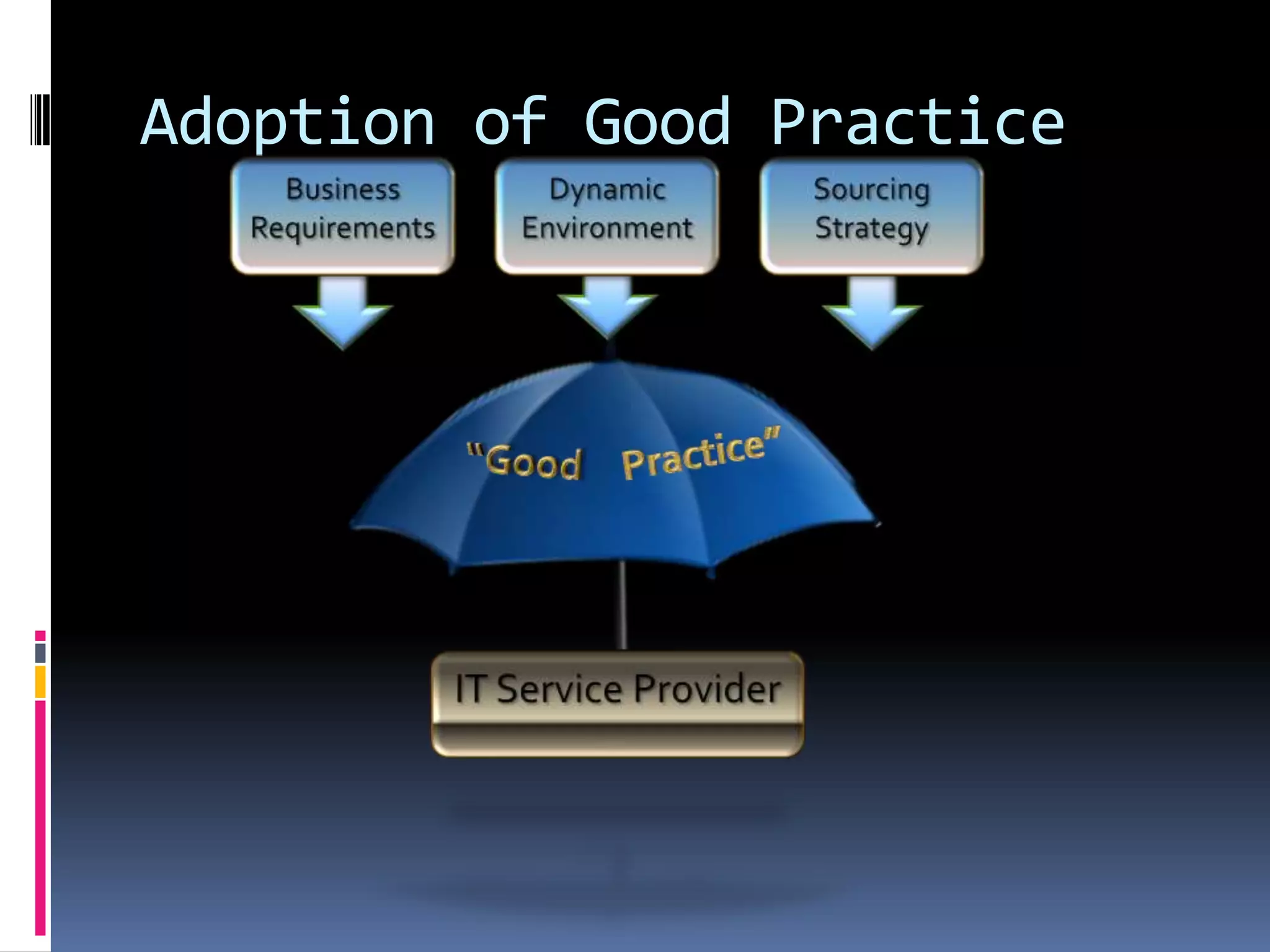
Adoption of Good PracticeBusiness RequirementsDynamic EnvironmentSourcing StrategyPractice”“GoodIT Service Provider
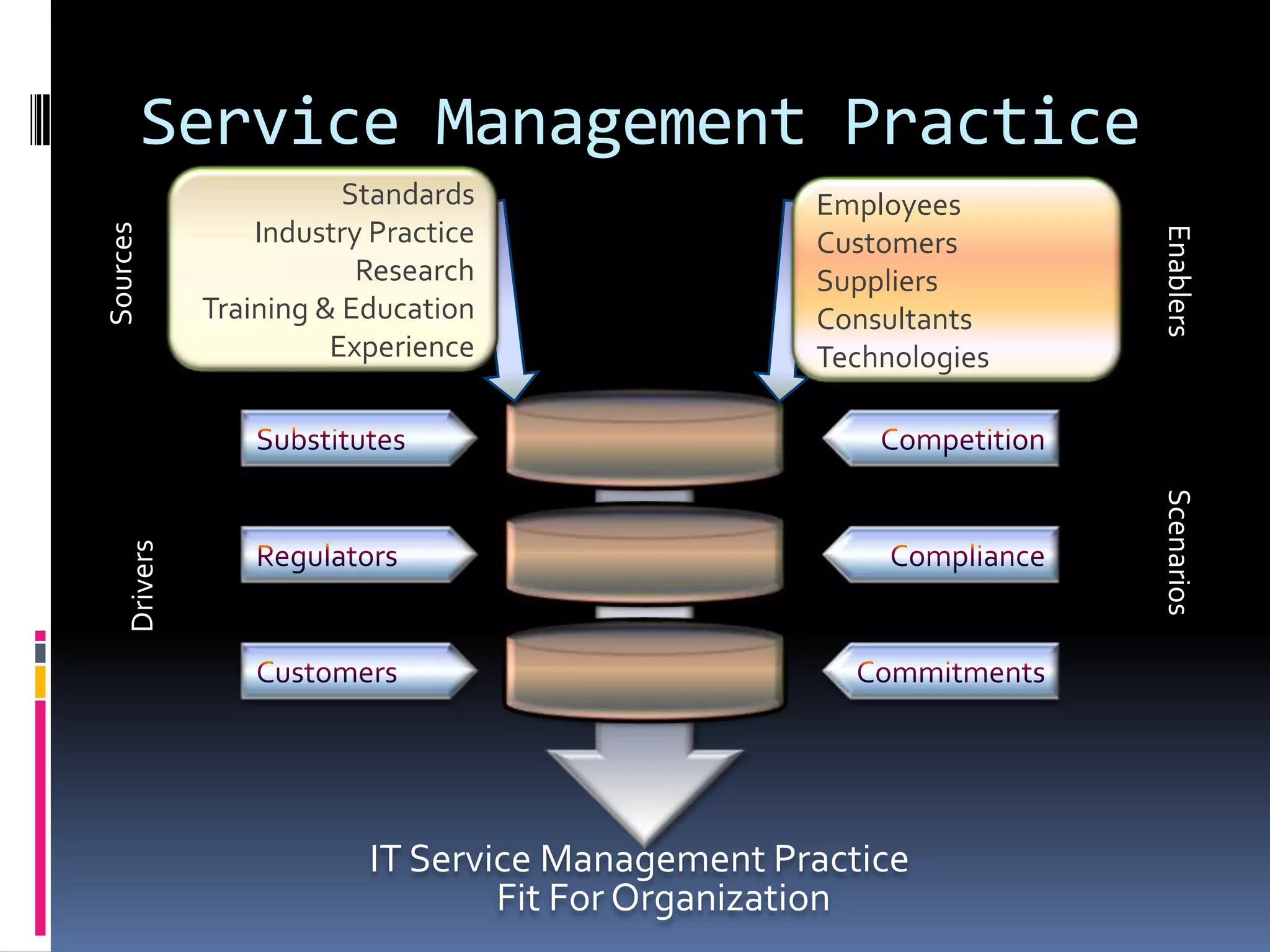
Service Management PracticeStandardsIndustry PracticeResearchTraining & EducationExperienceEmployeesCustomersSuppliersConsultantsTechnologiesSourcesEnablersSubstitutesCompetitionRegulatorsComplianceDriversScenariosCustomersCommitmentsIT Service Management Practice Fit For Organization
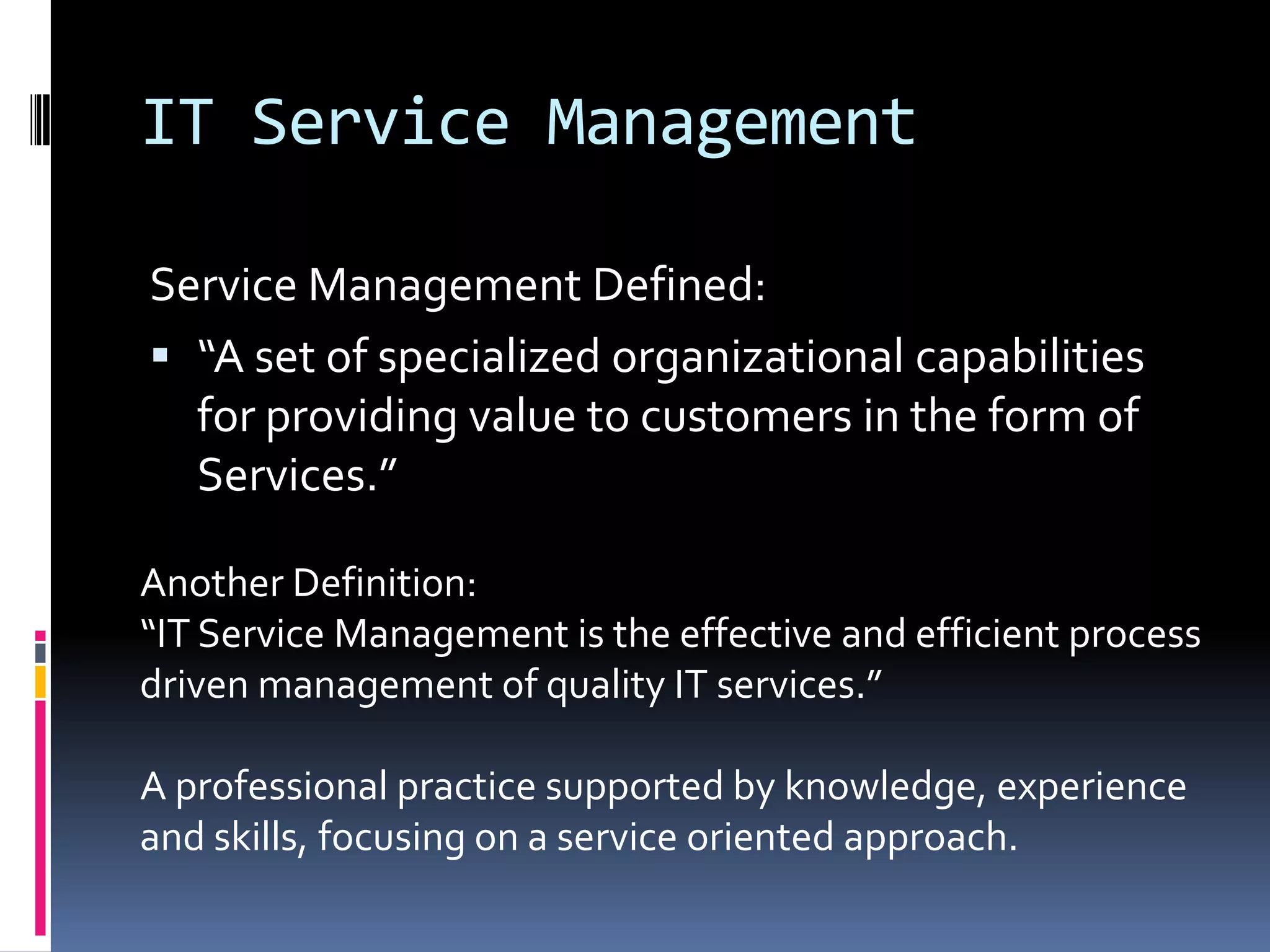
IT Service ManagementService Management Defined:“A set of specialized organizational capabilities for providing value to customers in the form of Services.”Another Definition:“IT Service Management is the effective and efficient process driven management of quality IT services.”A professional practice supported by knowledge, experience and skills, focusing on a service oriented approach.
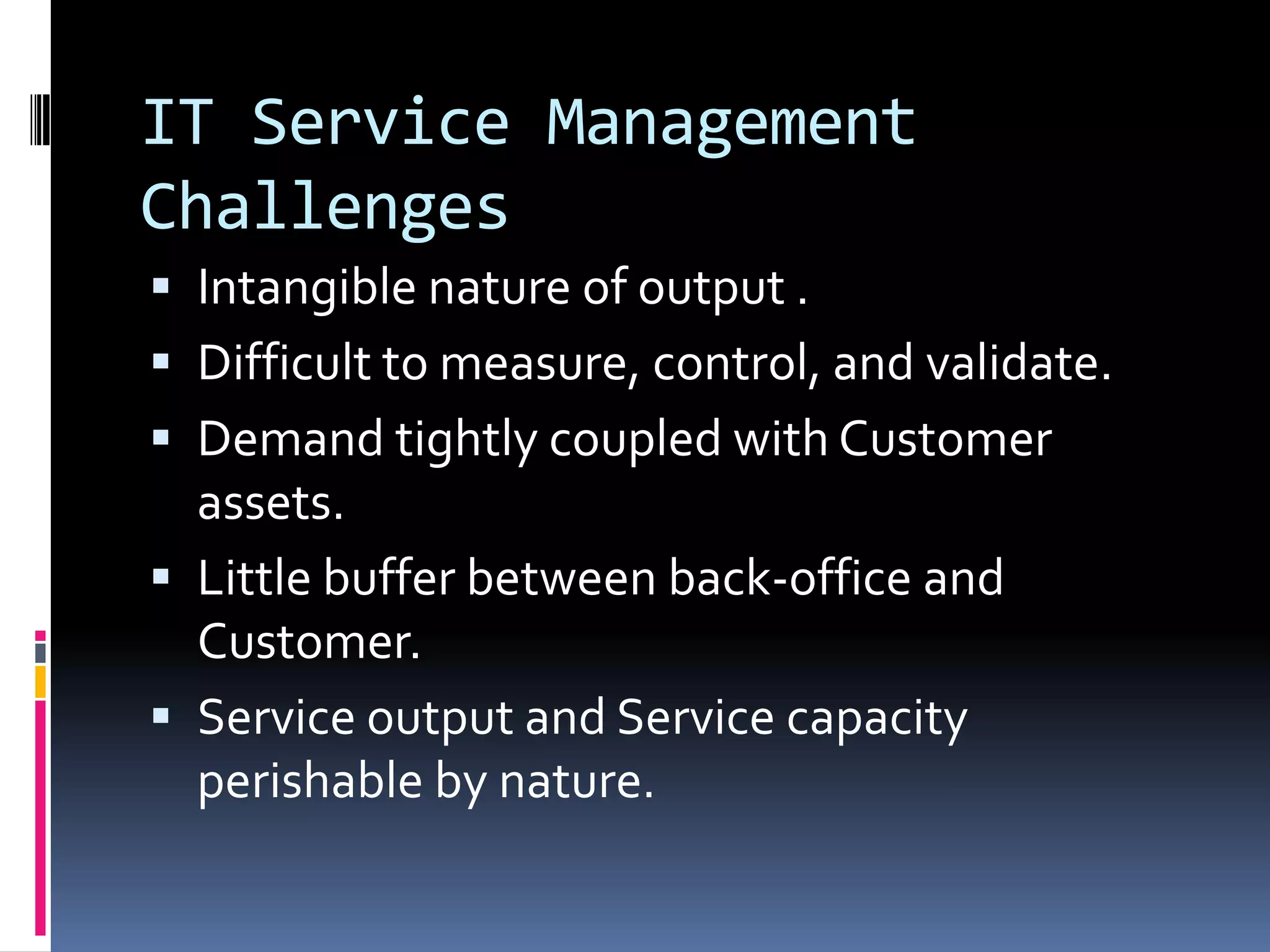
IT Service Management ChallengesIntangible nature of output .Difficult to measure, control, and validate.Demand tightly coupled with Customer assets.Little buffer between back-office and Customer.Service output and Service capacity perishable by nature.
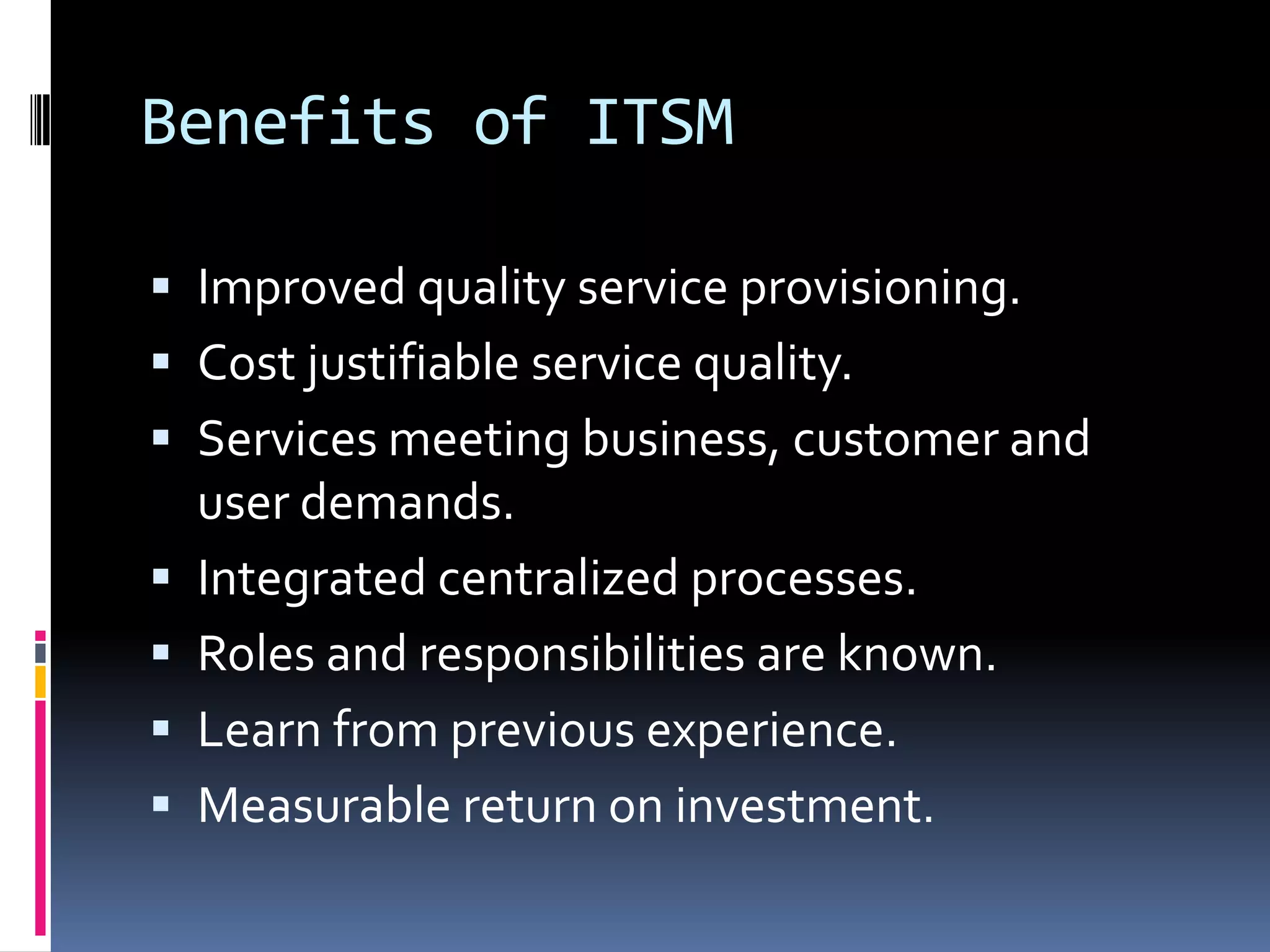
Benefits of ITSMImproved quality service provisioning.Cost justifiable service quality.Services meeting business, customer and user demands.Integrated centralized processes.Roles and responsibilities are known.Learn from previous experience.Measurable return on investment.
ITIL IntroductionITIL – IT Infrastructure LibraryHistory:Emerged in 1980’s.ITIL v2 in 2001ITIL v3 in 2007ITIL is not proprietaryBased on best practices in industryitSMF International User Group
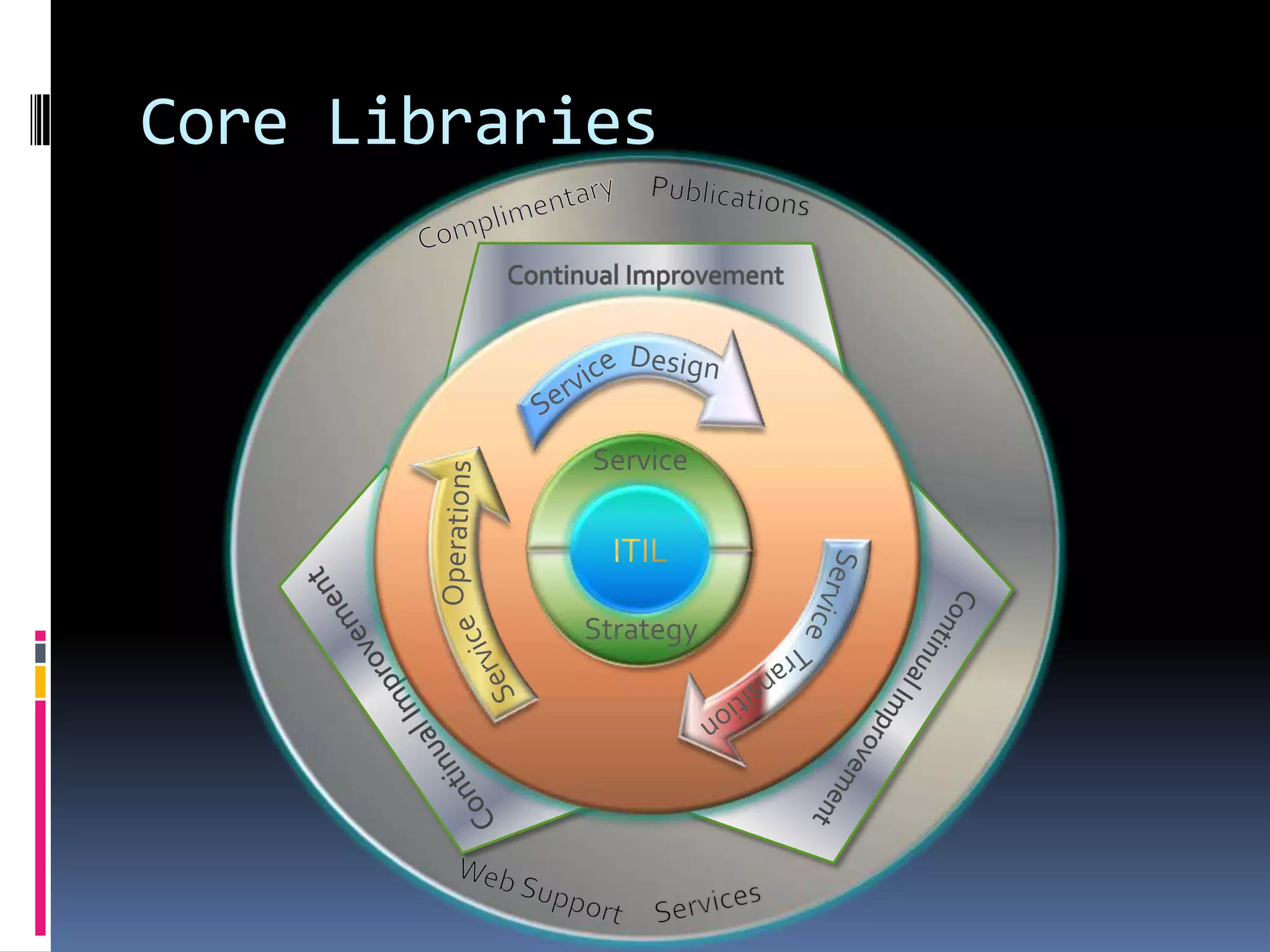
PublicationsComplimentaryContinual ImprovementDesignServiceServiceITILOperationsServiceContinual ImprovementCore LibrariesStrategyContinual ImprovementServiceTransitionWeb SupportServices
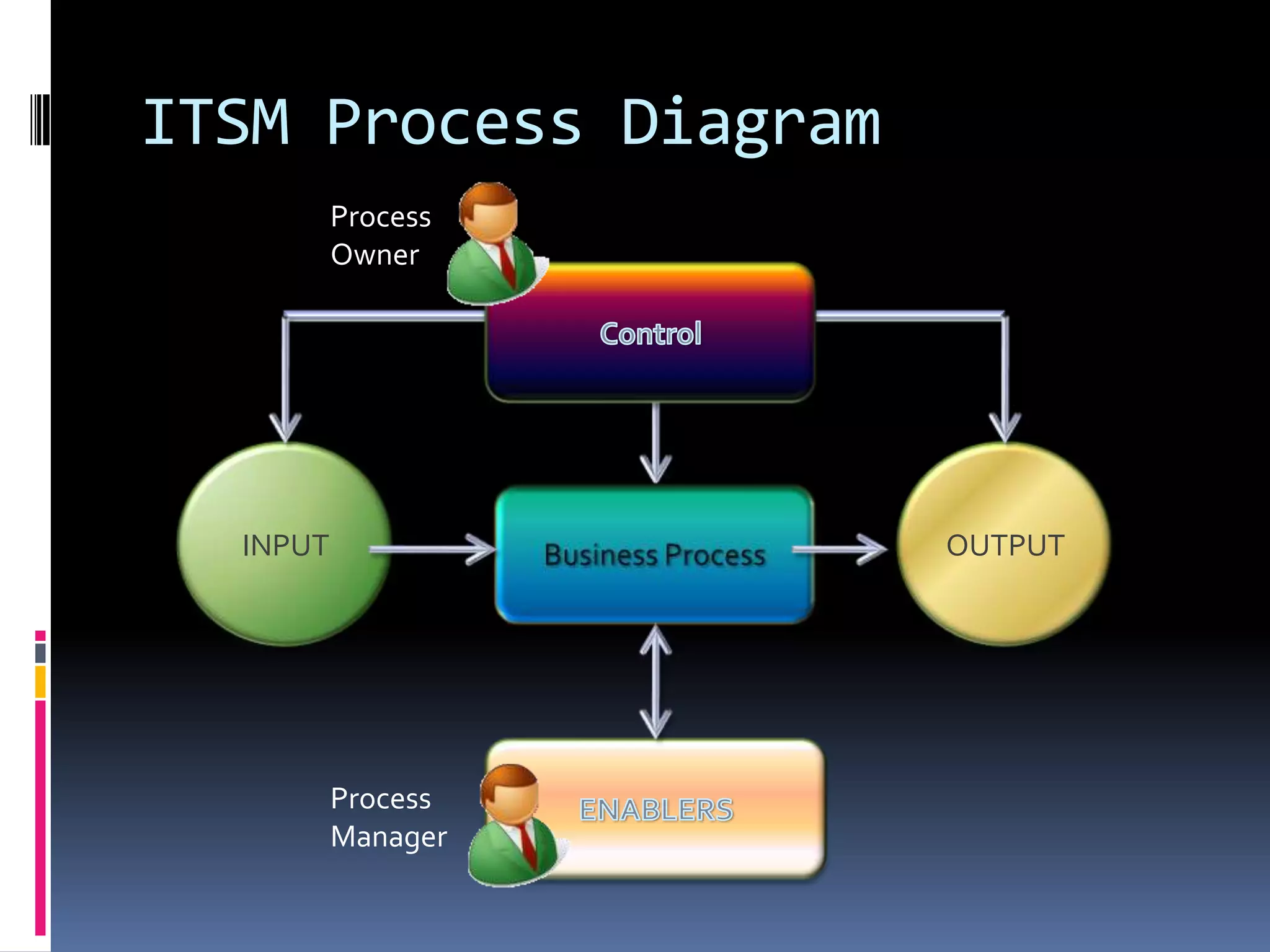
ITSM Process DiagramProcess OwnerControlINPUTOUTPUTBusiness Process ENABLERSProcess Manager
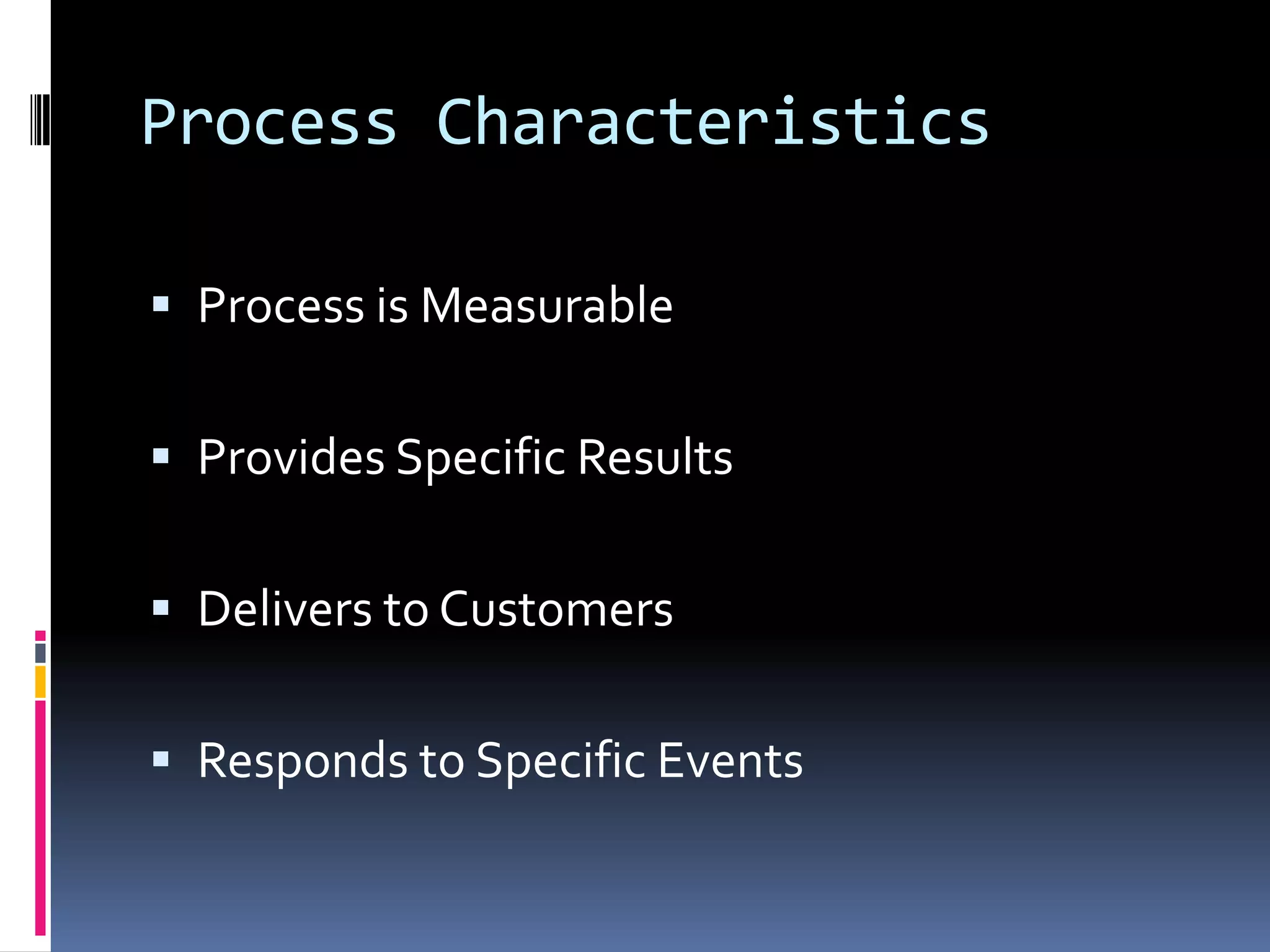
Process Definition“A set of coordinated activities combining and implementing resources and capabilities in order to produce an outcome, which, directly or indirectly, creates value for an external Customer or stakeholder.”Processes are strategic assets when they create advantage or market differentiation.Process CharacteristicsProcess is MeasurableProvides Specific ResultsDelivers to CustomersResponds to Specific Events
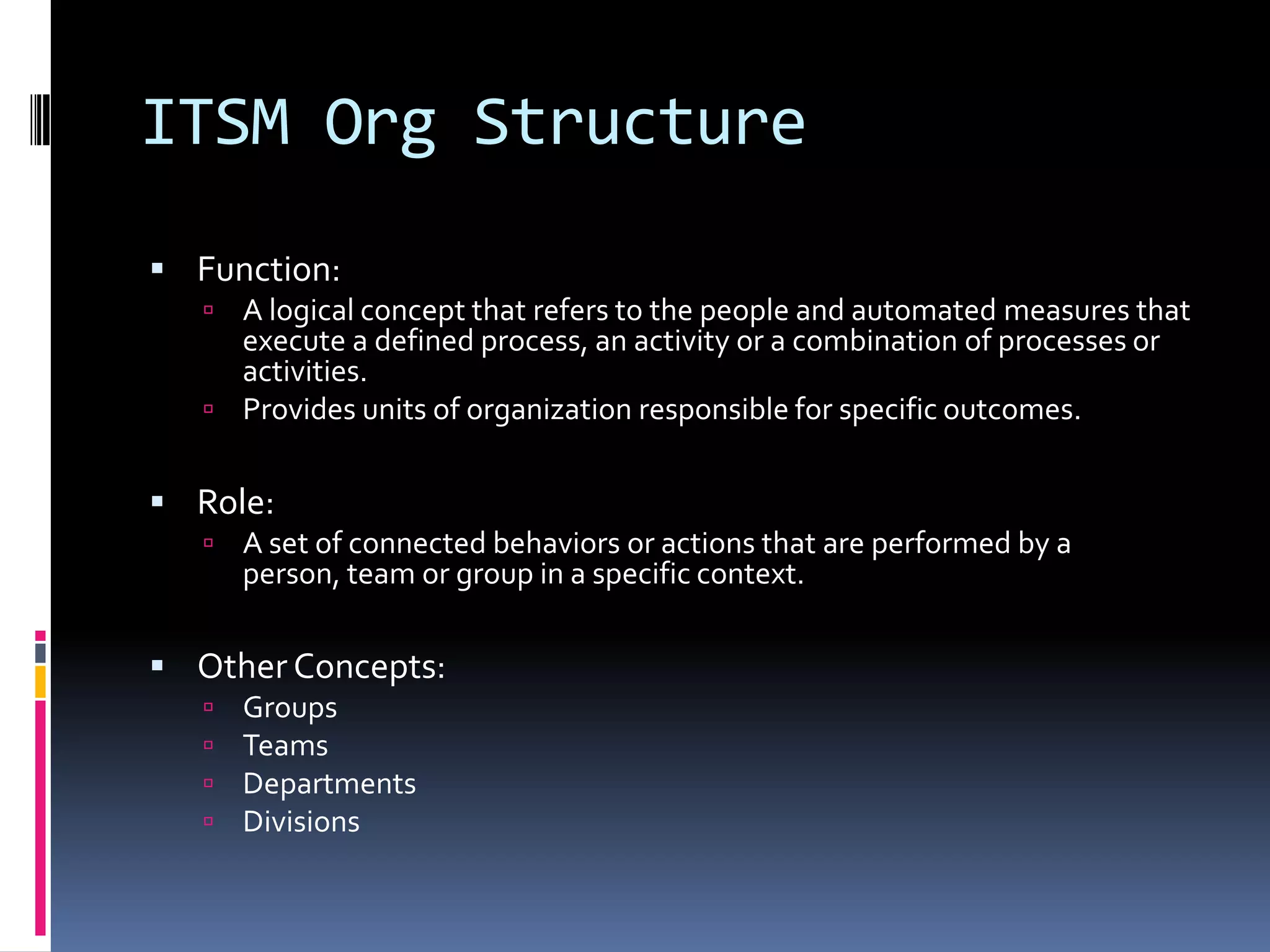
ITSM Org StructureFunction:A logical concept that refers to the people and automated measures that execute a defined process, an activity or a combination of processes or activities. Provides units of organization responsible for specific outcomes.Role:A set of connected behaviors or actions that are performed by a person, team or group in a specific context.Other Concepts:GroupsTeamsDepartmentsDivisions
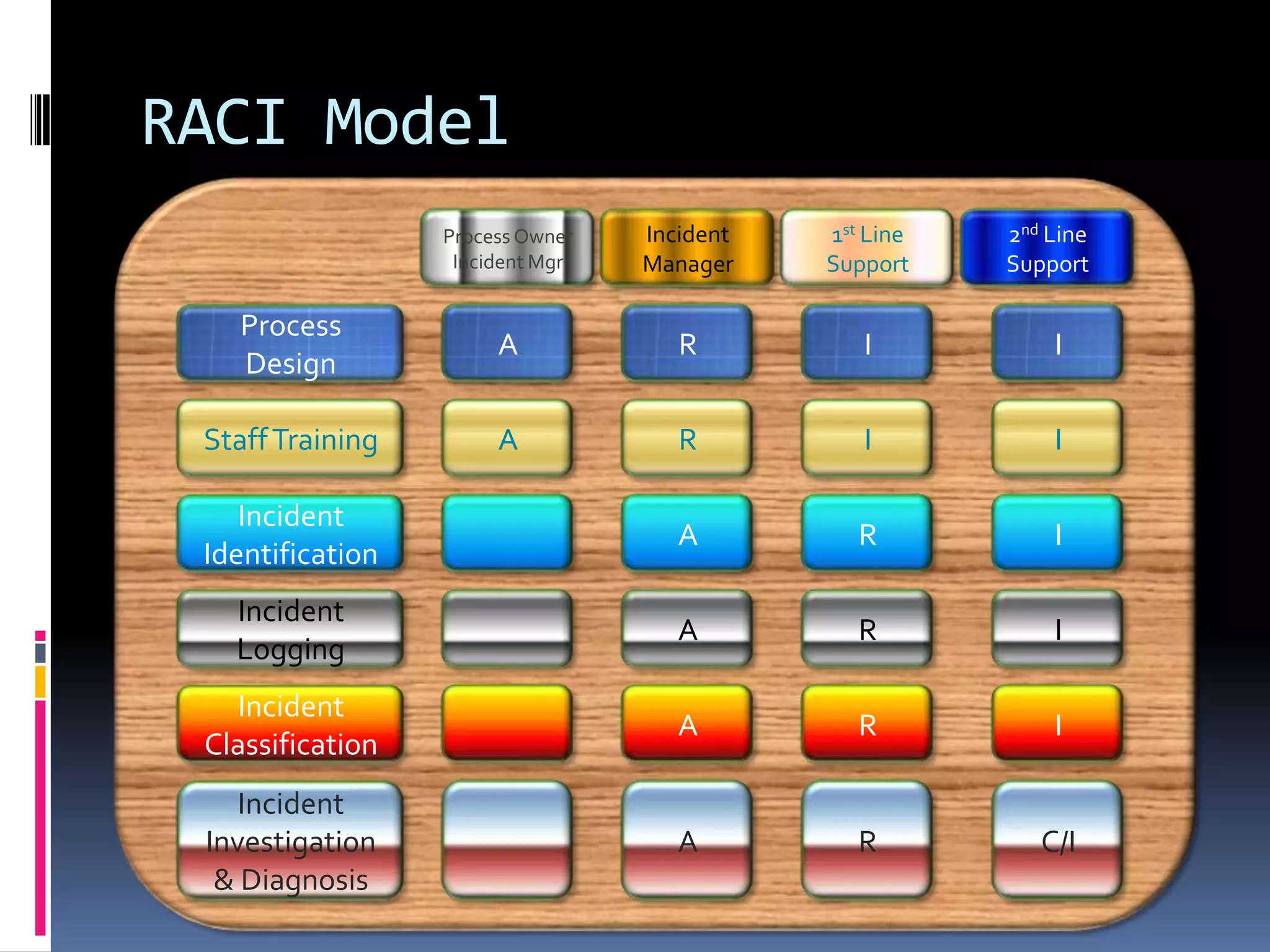
RACI ModelProcess Owner Incident MgrIncident Manager1st Line Support2nd Line SupportProcess DesignARIIStaff TrainingARIIIncident IdentificationARIIncident LoggingARIIncident ClassificationARIIncident Investigation & DiagnosisARC/I
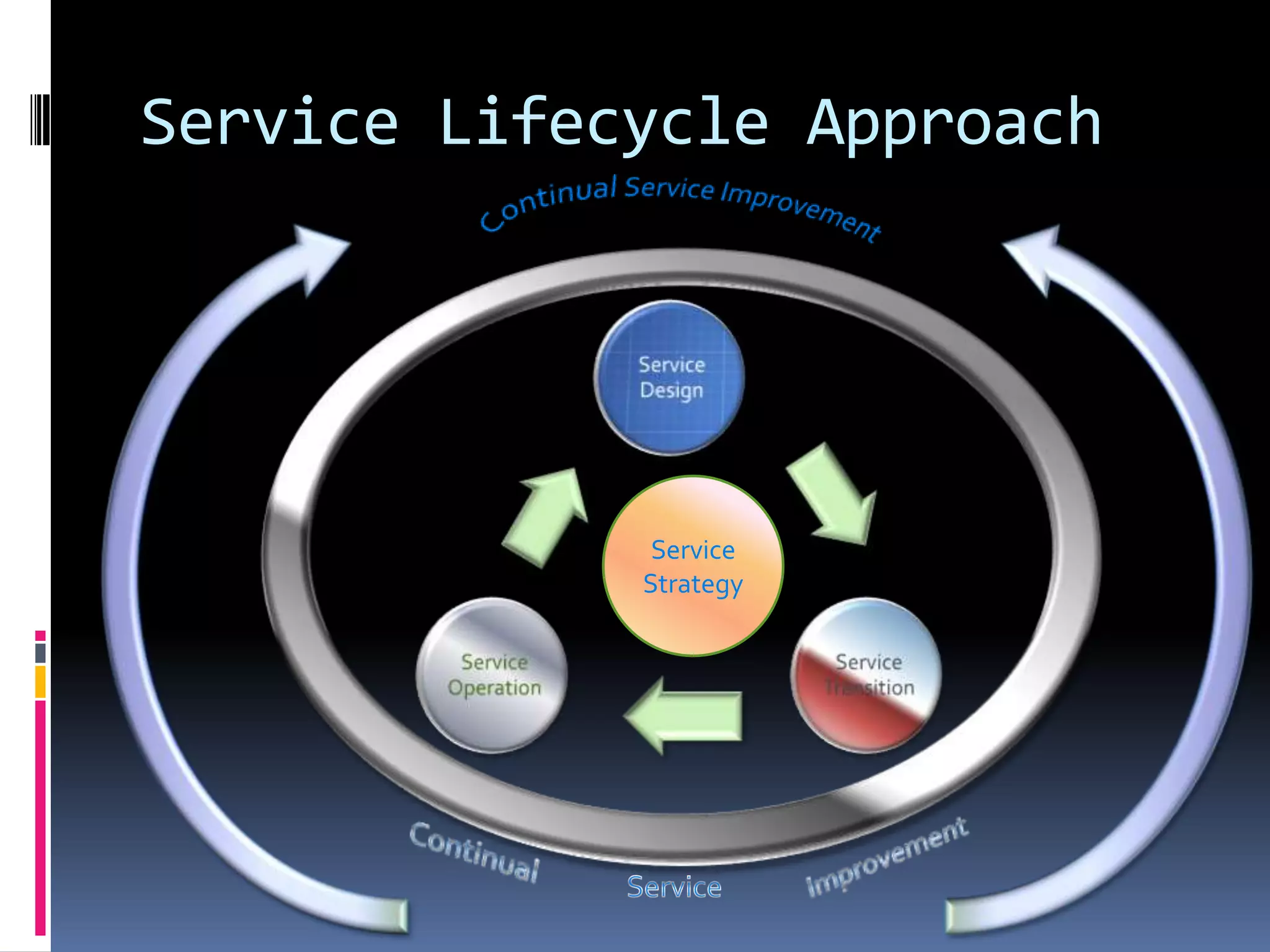
Service Lifecycle ApproachContinual Service ImprovementService StrategyContinualImprovementService
Focus On Service LifecycleService Lifecycle fundamental to ITIL refresh.Previously focused on delivery & support.Now aligns with business strategy.
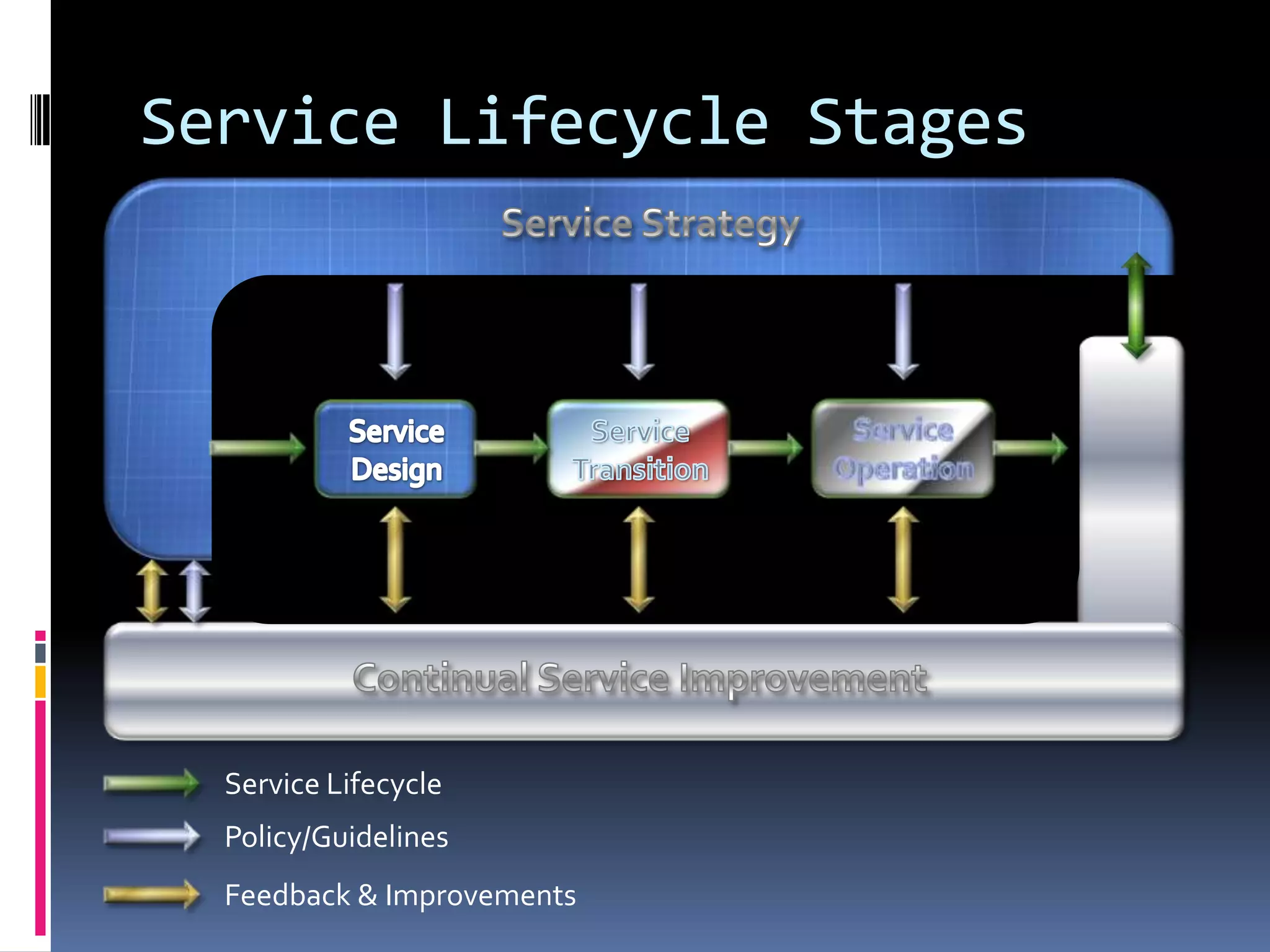
Service Lifecycle StagesService StrategyService DesignService TransitionService OperationContinual Service ImprovementService LifecyclePolicy/GuidelinesFeedback & Improvements
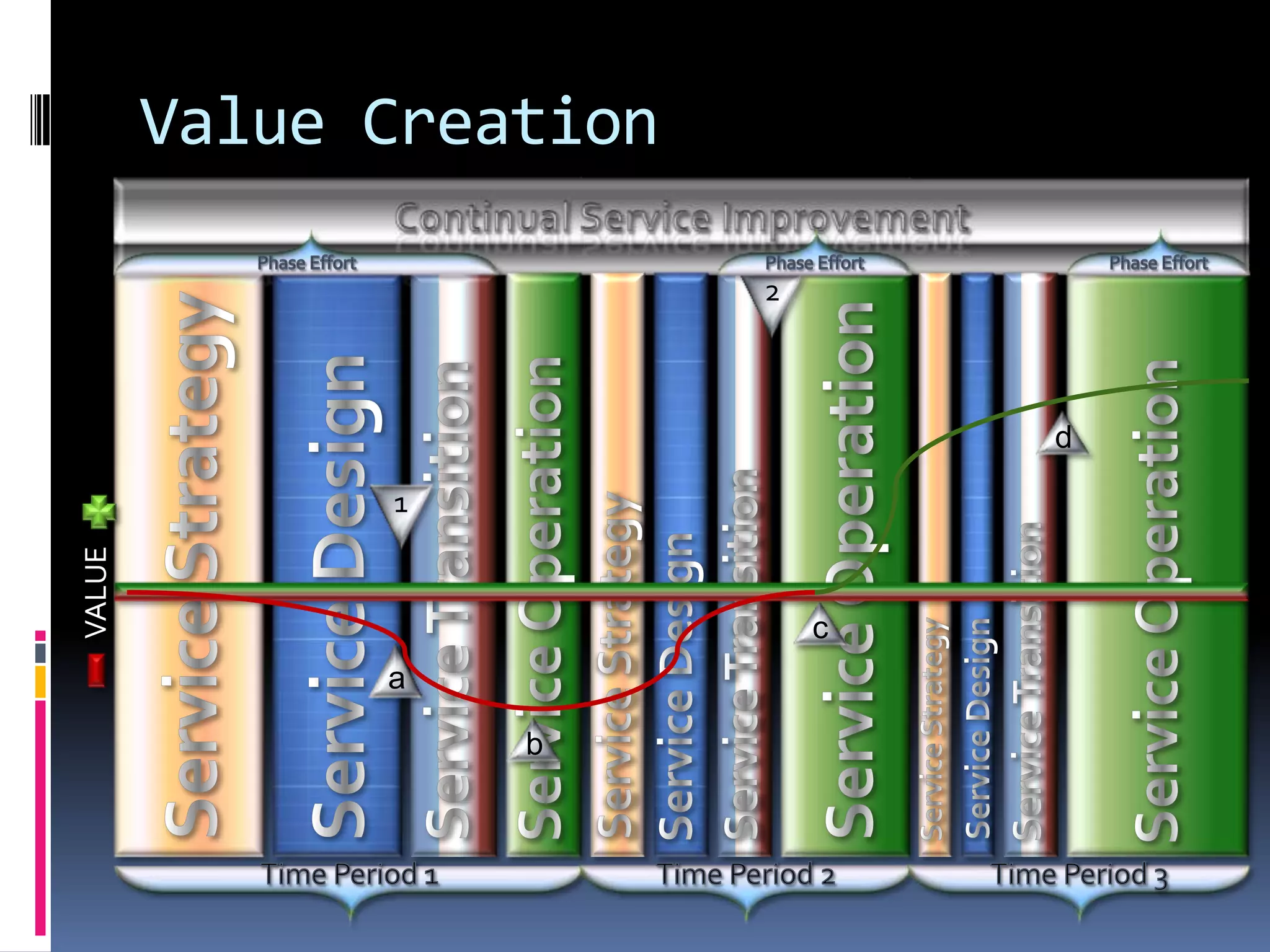
Continual Service ImprovementContinual Service ImprovementContinual Service ImprovementValue CreationPhase EffortPhase EffortPhase Effort2d1Service StrategyService OperationVALUEService DesignService OperationService TransitionService OperationcService TransitionService StrategyaService TransitionService DesignTime Period 1Service DesignService StrategybTime Period 3Time Period 2
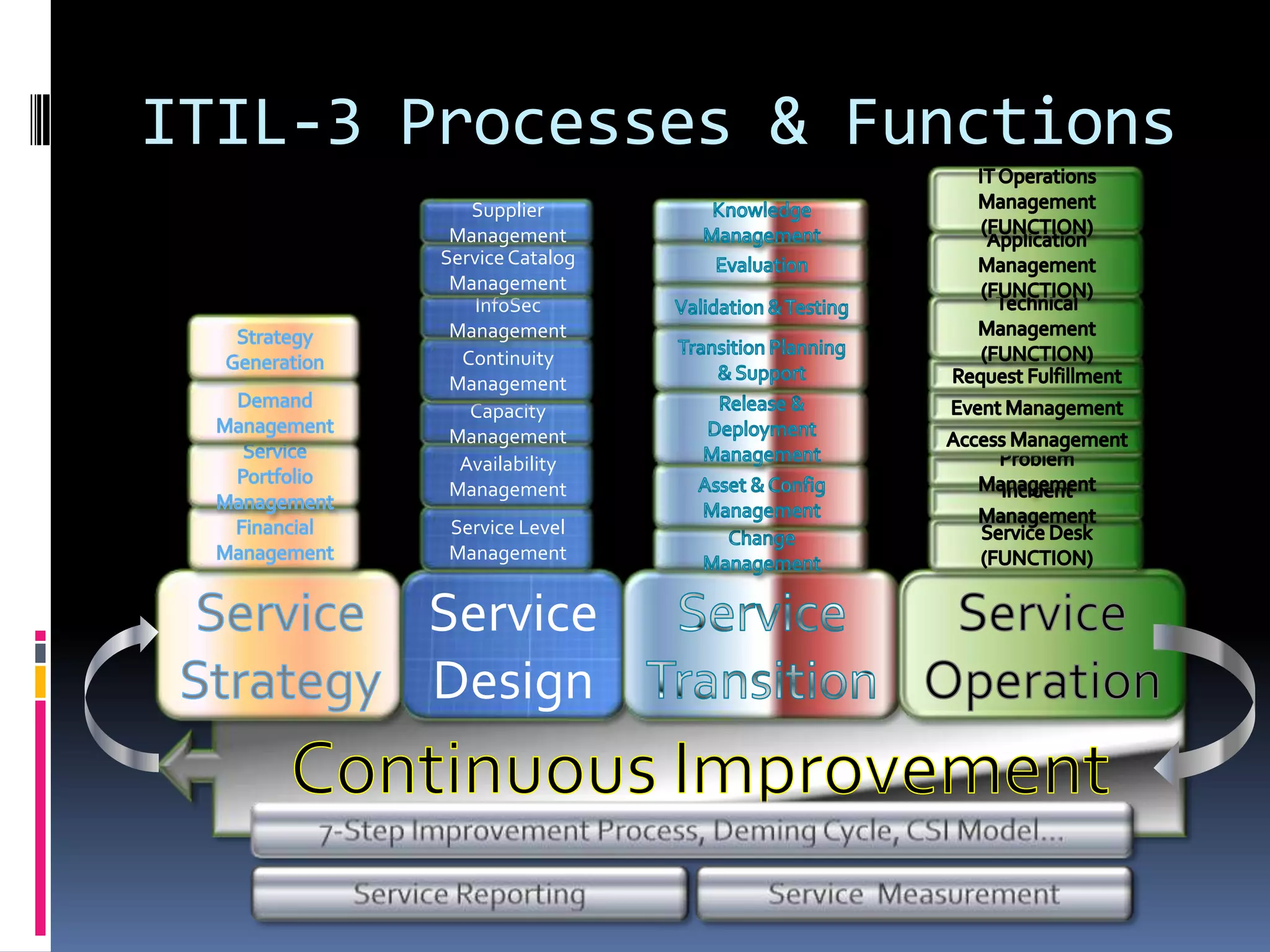
ITIL-3 Processes & FunctionsIT Operations Management(FUNCTION)Supplier ManagementKnowledge ManagementApplication Management(FUNCTION)Service Catalog ManagementEvaluationValidation & TestingInfoSecManagementTechnical Management(FUNCTION)Strategy GenerationTransition Planning & SupportContinuity ManagementRequest FulfillmentDemand ManagementRelease & Deployment  ManagementEvent ManagementCapacity ManagementAccess ManagementService Portfolio ManagementAvailability ManagementProblem ManagementAsset & Config  ManagementIncident ManagementFinancial ManagementService Level ManagementService Desk (FUNCTION)Change ManagementService StrategyService DesignService TransitionService OperationContinuous Improvement7-Step Improvement Process, Deming Cycle, CSI Model…Service ReportingService  Measurement
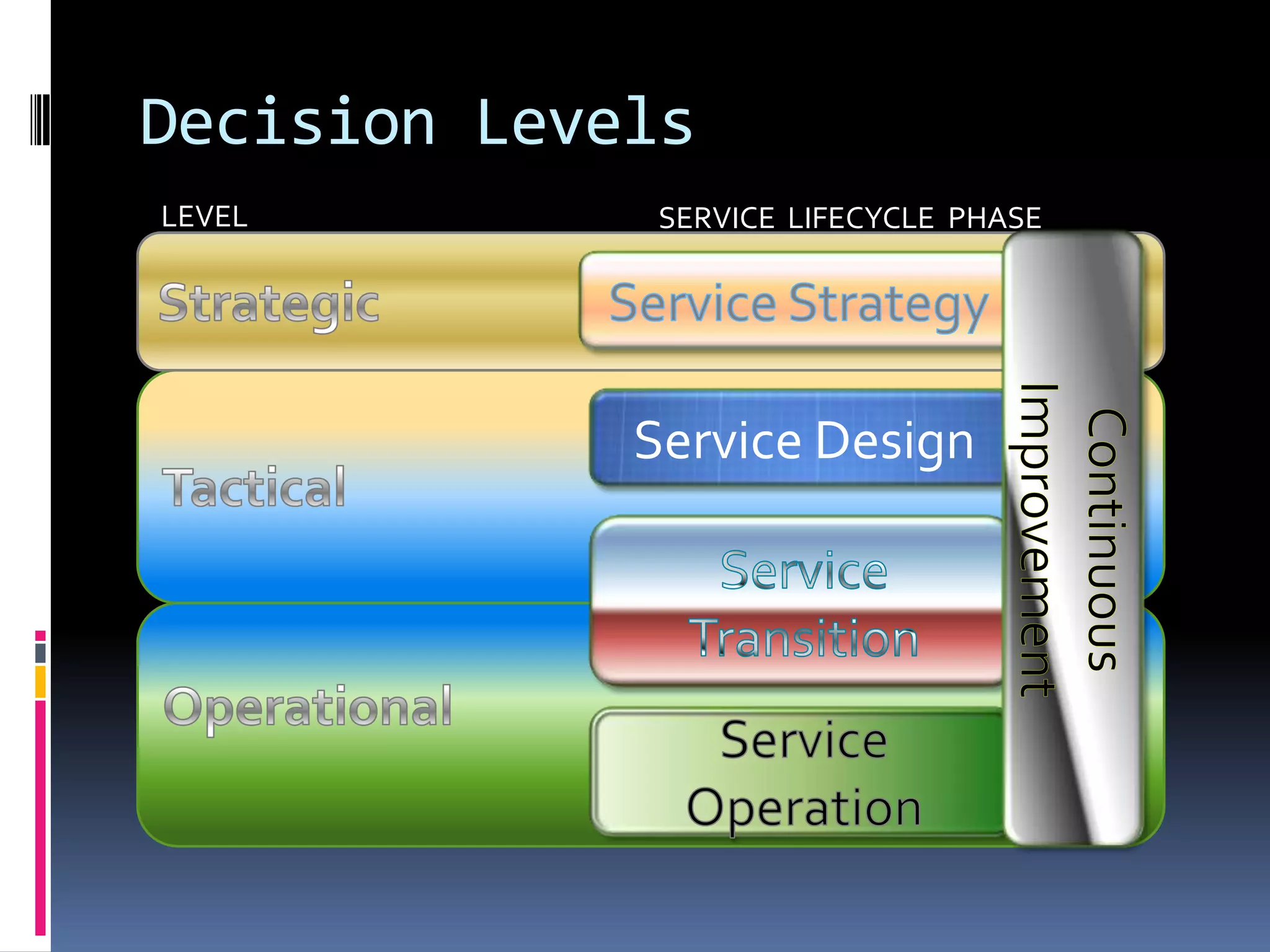
LEVELSERVICE  LIFECYCLE  PHASEStrategicDecision LevelsService StrategyTacticalService DesignContinuous ImprovementService TransitionOperationalService Operation
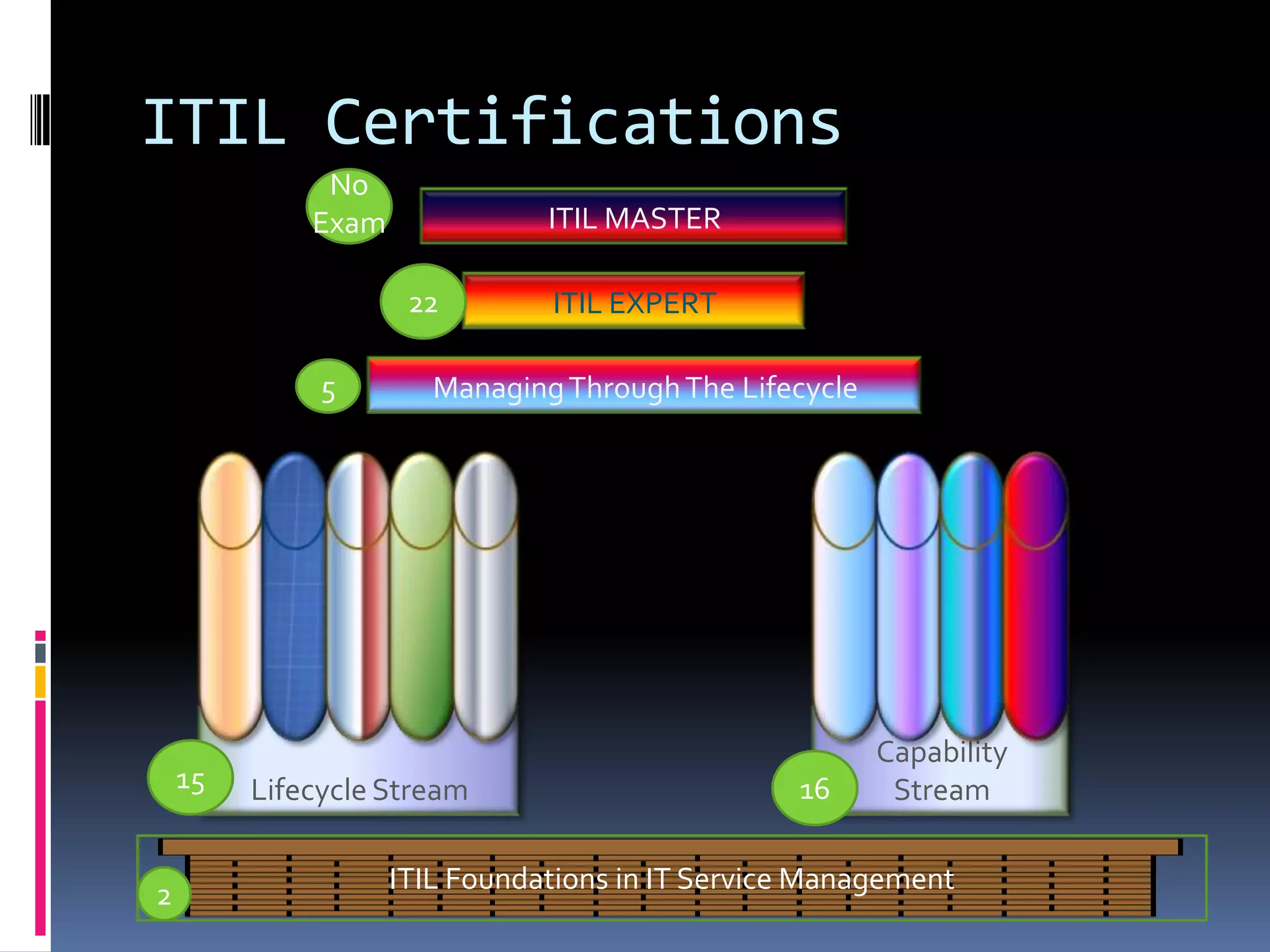
ITIL CertificationsNoExamITIL MASTER22ITIL EXPERTManaging Through The Lifecycle5Lifecycle StreamCapability Stream1516ITIL Foundations in IT Service Management2
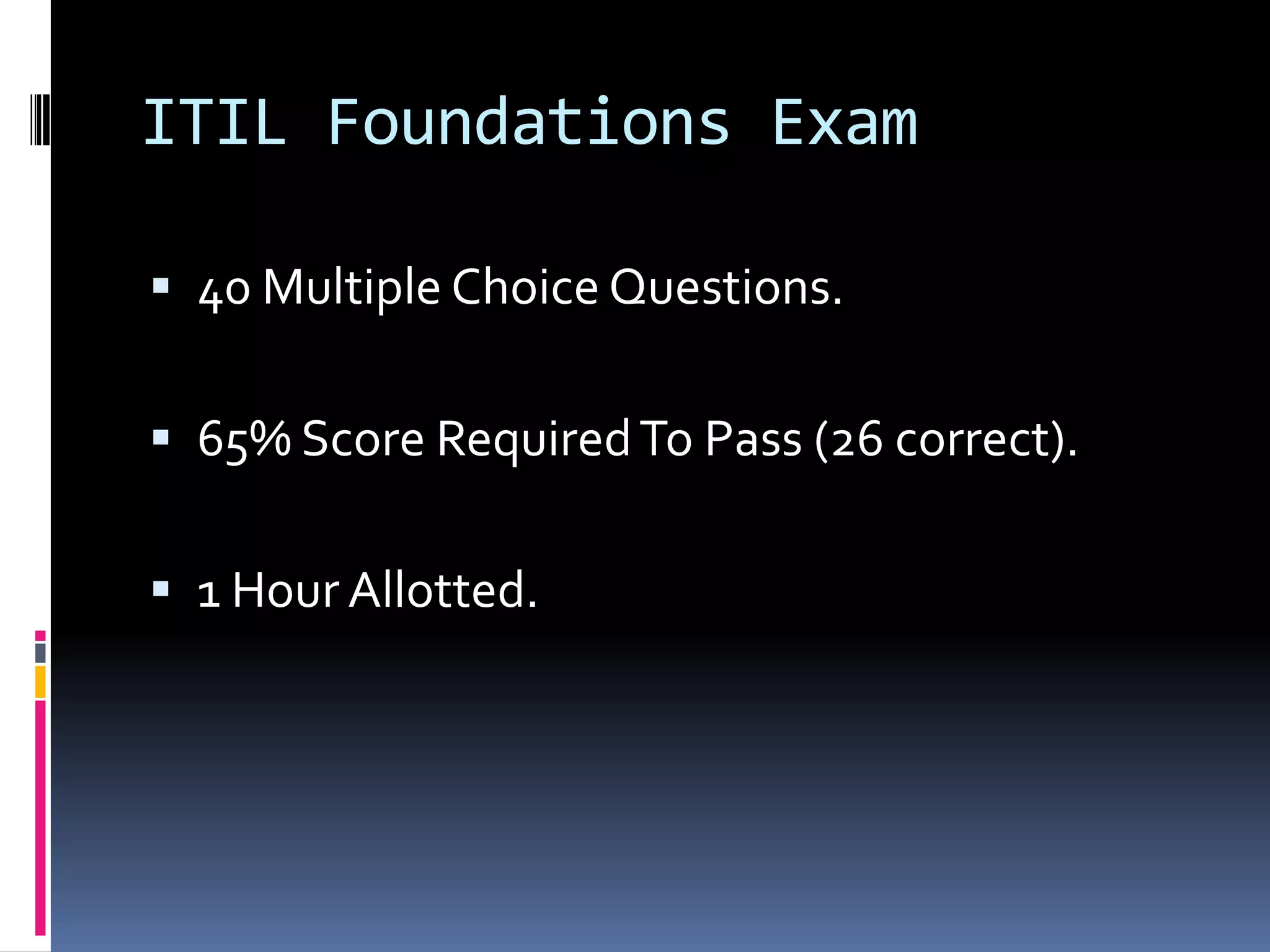
ITIL Foundations Exam40 Multiple Choice Questions.65% Score Required To Pass (26 correct).1 Hour Allotted.
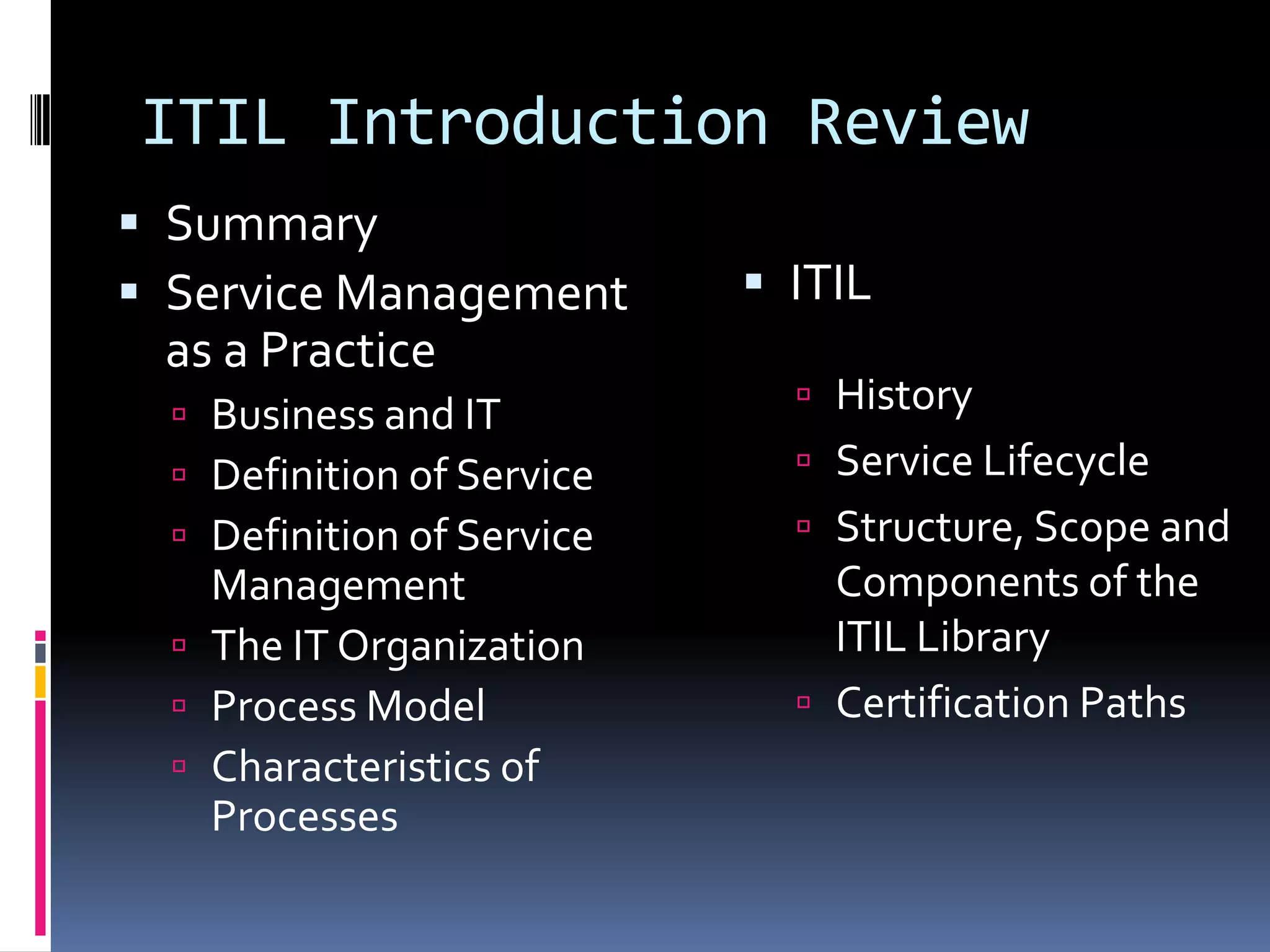
ITIL Introduction ReviewSummaryService Management as a PracticeBusiness and ITDefinition of ServiceDefinition of Service ManagementThe IT OrganizationProcess ModelCharacteristics of ProcessesITIL
History
Service Lifecycle

ITIL V3 Foundations Chapter1

  • 1.
    ITIL V3 FoundationsAnOverview & IntroductionMark Brunner - 2009
  • 2.
  • 3.
    Presentation PurposeFundamental understandingof :ITSMInformation Technology Infrastructure LibraryService StrategyService DesignService TransitionService OperationContinual Service Improvement
  • 4.
    Business & InformationTechnologyInformation has become a value in itself IT aids existing Businesses by increasing efficiency and effectivenessIT enables new types of Business
  • 5.
    This Changing WorldSpeed of Business increasesGlobalization and lower transaction costs redefine BusinessBusiness models are redefined
  • 6.
    What is InformationTechnologyIT Changes meaning with context:IT as an "Organization''IT as a "Component''IT as a Service''IT as an "Asset''
  • 7.
    IT’s All AboutServicesDefinition of a Service: "Services are a means of delivering value to customers by facilitating the outcomes customers want to achieve without the ownership of specific costs and risks.”“People want a quarter inch hole, not a quarter inch drill.” Professor T. Levitt, Harvard Business School
  • 8.
    Business Service AITas ‘Biz’ Process EnablerBusiness Process 1Business Process 2Business Process 3Business Process 1Business Process 2Business Process 3Business Process 1Business Process 2Business Process 3IT Service XIT Service YIT Assets & Resources
  • 9.
    CompanyCustomersExternal Service ProviderCorporateBusinessUnit ABusiness Unit BShared Services UnitInternal Service Provider AInternal Service Provider B
  • 10.
    Business / ITAlignmentCustomers of IT require IT Services that continuously support their Business needsIT should be aware of rapid changes in BusinessInternal providers face possible outsourcing and must run their IT as a Business
  • 11.
    GovernanceCorporate Governance isthe ethical behavior of directors or others in the creation and preservation of wealth for all stakeholders.(IT Governance Institute)Corporate GovernanceIT GovernanceFinancial GovernanceOther GovernanceIT Governance is an integral part of corporate governance that ensures the organization’s IT sustains and extends the organization’s strategies and objectives.(IT Governance Institute)
  • 12.
    Adoption of GoodPracticeBusiness RequirementsDynamic EnvironmentSourcing StrategyPractice”“GoodIT Service Provider
  • 13.
    Service Management PracticeStandardsIndustryPracticeResearchTraining & EducationExperienceEmployeesCustomersSuppliersConsultantsTechnologiesSourcesEnablersSubstitutesCompetitionRegulatorsComplianceDriversScenariosCustomersCommitmentsIT Service Management Practice Fit For Organization
  • 14.
    IT Service ManagementServiceManagement Defined:“A set of specialized organizational capabilities for providing value to customers in the form of Services.”Another Definition:“IT Service Management is the effective and efficient process driven management of quality IT services.”A professional practice supported by knowledge, experience and skills, focusing on a service oriented approach.
  • 15.
    IT Service ManagementChallengesIntangible nature of output .Difficult to measure, control, and validate.Demand tightly coupled with Customer assets.Little buffer between back-office and Customer.Service output and Service capacity perishable by nature.
  • 16.
    Benefits of ITSMImprovedquality service provisioning.Cost justifiable service quality.Services meeting business, customer and user demands.Integrated centralized processes.Roles and responsibilities are known.Learn from previous experience.Measurable return on investment.
  • 17.
    ITIL IntroductionITIL –IT Infrastructure LibraryHistory:Emerged in 1980’s.ITIL v2 in 2001ITIL v3 in 2007ITIL is not proprietaryBased on best practices in industryitSMF International User Group
  • 18.
  • 19.
    ITSM Process DiagramProcessOwnerControlINPUTOUTPUTBusiness Process ENABLERSProcess Manager
  • 20.
    Process Definition“A setof coordinated activities combining and implementing resources and capabilities in order to produce an outcome, which, directly or indirectly, creates value for an external Customer or stakeholder.”Processes are strategic assets when they create advantage or market differentiation.Process CharacteristicsProcess is MeasurableProvides Specific ResultsDelivers to CustomersResponds to Specific Events
  • 21.
    ITSM Org StructureFunction:Alogical concept that refers to the people and automated measures that execute a defined process, an activity or a combination of processes or activities. Provides units of organization responsible for specific outcomes.Role:A set of connected behaviors or actions that are performed by a person, team or group in a specific context.Other Concepts:GroupsTeamsDepartmentsDivisions
  • 22.
    RACI ModelProcess OwnerIncident MgrIncident Manager1st Line Support2nd Line SupportProcess DesignARIIStaff TrainingARIIIncident IdentificationARIIncident LoggingARIIncident ClassificationARIIncident Investigation & DiagnosisARC/I
  • 23.
    Service Lifecycle ApproachContinualService ImprovementService StrategyContinualImprovementService
  • 24.
    Focus On ServiceLifecycleService Lifecycle fundamental to ITIL refresh.Previously focused on delivery & support.Now aligns with business strategy.
  • 25.
    Service Lifecycle StagesServiceStrategyService DesignService TransitionService OperationContinual Service ImprovementService LifecyclePolicy/GuidelinesFeedback & Improvements
  • 26.
    Continual Service ImprovementContinualService ImprovementContinual Service ImprovementValue CreationPhase EffortPhase EffortPhase Effort2d1Service StrategyService OperationVALUEService DesignService OperationService TransitionService OperationcService TransitionService StrategyaService TransitionService DesignTime Period 1Service DesignService StrategybTime Period 3Time Period 2
  • 27.
    ITIL-3 Processes &FunctionsIT Operations Management(FUNCTION)Supplier ManagementKnowledge ManagementApplication Management(FUNCTION)Service Catalog ManagementEvaluationValidation & TestingInfoSecManagementTechnical Management(FUNCTION)Strategy GenerationTransition Planning & SupportContinuity ManagementRequest FulfillmentDemand ManagementRelease & Deployment ManagementEvent ManagementCapacity ManagementAccess ManagementService Portfolio ManagementAvailability ManagementProblem ManagementAsset & Config ManagementIncident ManagementFinancial ManagementService Level ManagementService Desk (FUNCTION)Change ManagementService StrategyService DesignService TransitionService OperationContinuous Improvement7-Step Improvement Process, Deming Cycle, CSI Model…Service ReportingService Measurement
  • 28.
    LEVELSERVICE LIFECYCLE PHASEStrategicDecision LevelsService StrategyTacticalService DesignContinuous ImprovementService TransitionOperationalService Operation
  • 29.
    ITIL CertificationsNoExamITIL MASTER22ITILEXPERTManaging Through The Lifecycle5Lifecycle StreamCapability Stream1516ITIL Foundations in IT Service Management2
  • 30.
    ITIL Foundations Exam40Multiple Choice Questions.65% Score Required To Pass (26 correct).1 Hour Allotted.
  • 31.
    ITIL Introduction ReviewSummaryServiceManagement as a PracticeBusiness and ITDefinition of ServiceDefinition of Service ManagementThe IT OrganizationProcess ModelCharacteristics of ProcessesITIL
  • 32.
  • 33.
  • 34.
    Structure, Scope andComponents of the ITIL Library
  • 35.
    Certification PathsThank YouThisis the end of Chapter 1.In the actual training presentation, there are: Over 200 slides.5 to 15 minutes worth of talking points per slide.Animated sequences to present and clarify concepts.Mark Brunner - 2009