“WORK FLOW OF CATH LAB PROCESS”
AT FORTIS MEMORIAL RESEARCH
INSTITUTE
Prepared By:
Mr.KULDEEP SINGH
27TH January 2016
Mob NO :9718386778
HOSPITAL INTRODUCTION
Fortis Memorial Research Institute (FMRI) is a multi-
super-speciality, quaternary care hospital with an
enviable international faculty, reputed clinicians,
including super-sub-specialists and speciality nurses,
supported by cutting–edge technology.
A premium referral hospital, it endeavours to be the
‘Mecca of Healthcare’ for Asia Pacific and beyond.
Set on a spacious 11-acre campus with 1000 beds,
this ‘Next Generation Hospital’ is built on the
foundation of ‘Trust’ and rests on four strong pillars:
Talent, Technology, Service and Infrastructure
2
HOSPITAL’S SPECIALITIES
 Minimal Access, Bariatric & GI
Surgery
 Plastic Surgery
 Ophthalmology
 Pulmonology
 Plastic Surgery
 Dental Sciences
 Internal Medicine
 Cosmetic & Plastic Surgery
 Medical Oncology
 Invasive Cardiology
 Ophthalmology
 Pediatrics
 Minimal Access Surgery (Gynae)
 Neonatology
 IVF
 Liver Transplant, GI
&HepatoPancreato Biliary Surgery
 Mental Health & Behavioural
Sciences
 Radiation Oncology
 Radiology
 Invasive Cardiology
 Rheumatology
 Newborn and Child Specialist
 ENT
 C-DOC (Centre of Excellence for
Diabetes, Metabolic Disorders and
Endocrinology)
 Gastroenterology &Hepatobiliary
Sciences3
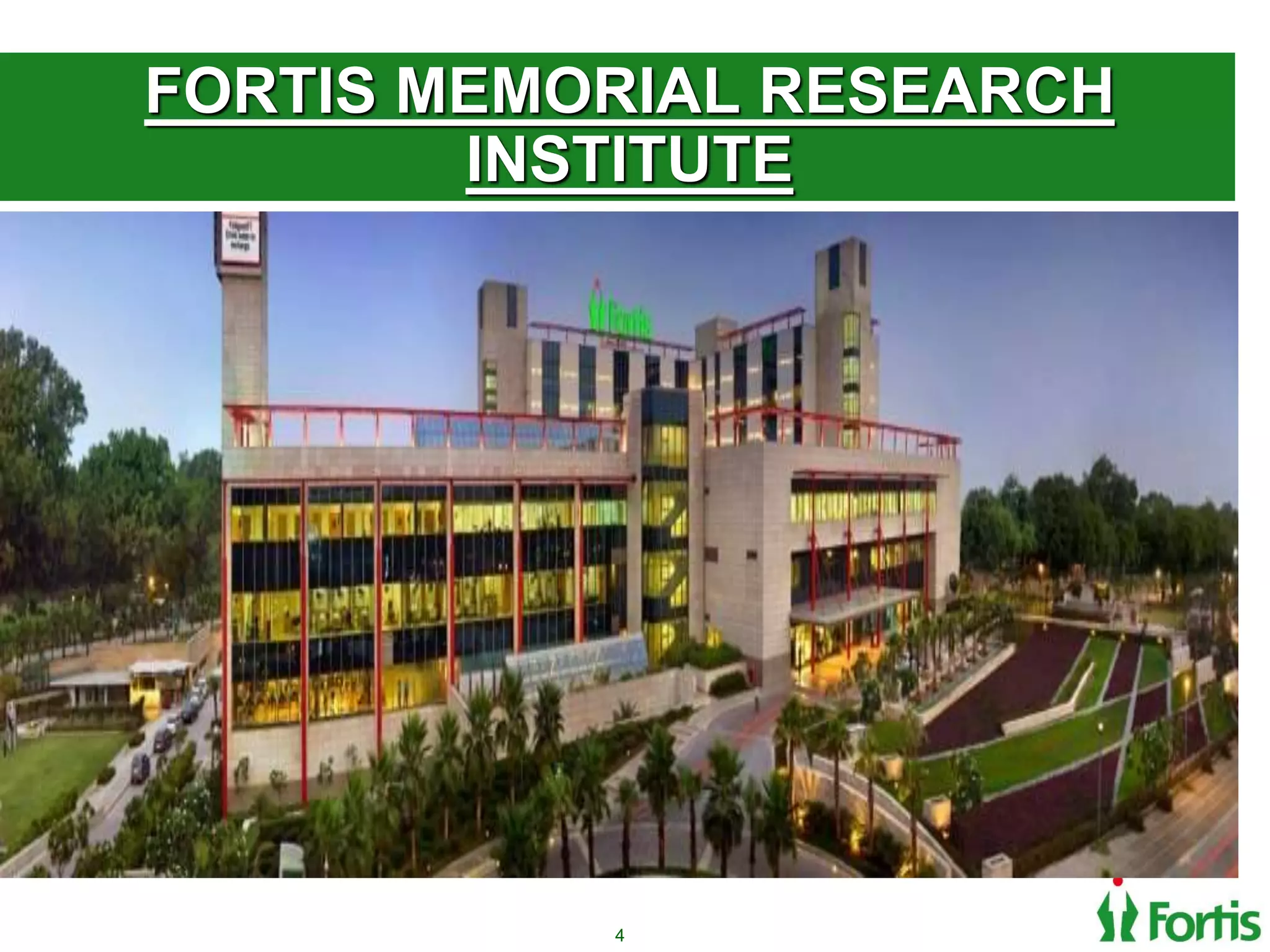
FORTIS MEMORIAL RESEARCH
INSTITUTE
4
CATH LAB
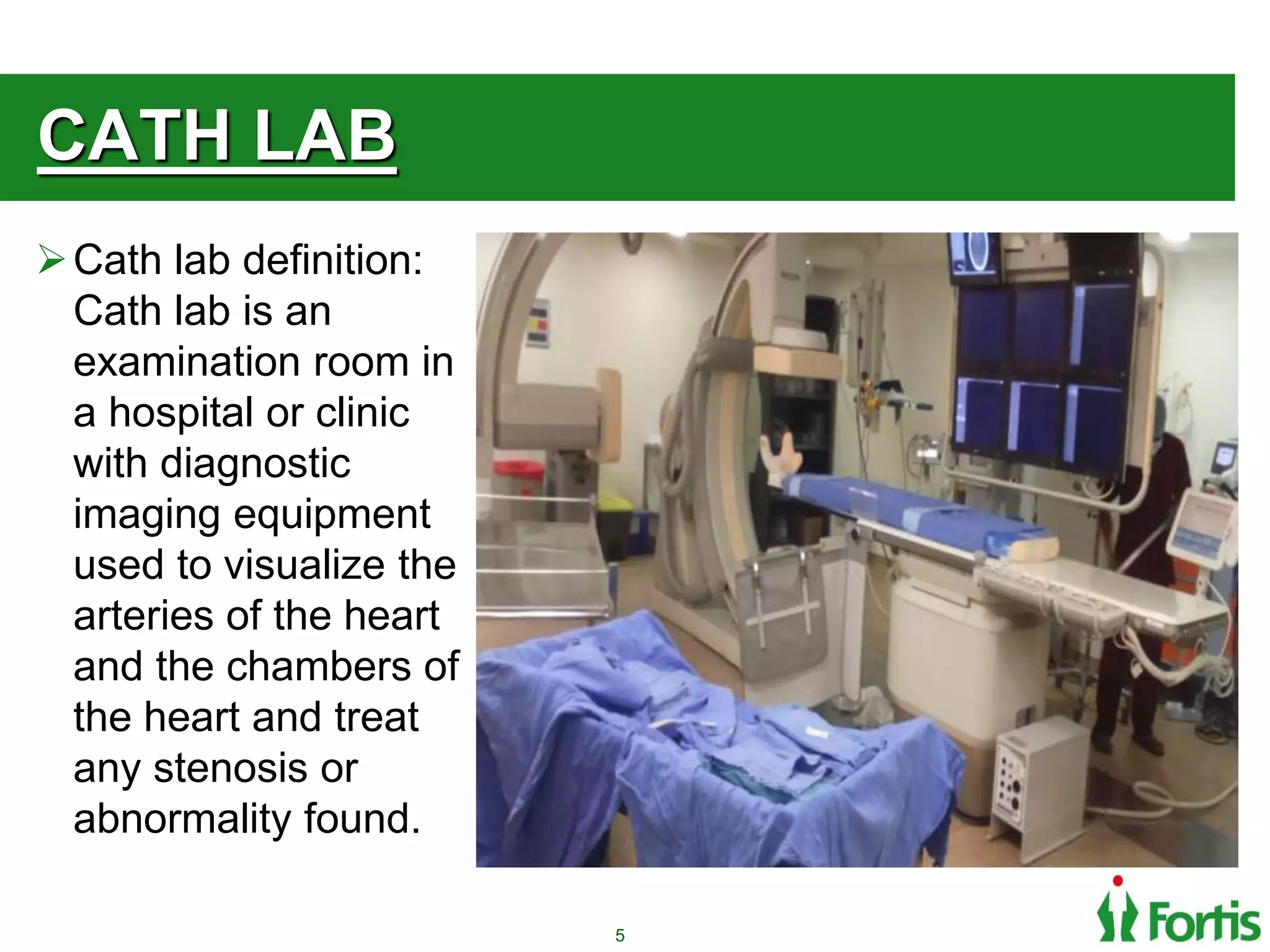
Cath lab definition:
Cath lab is an
examination room in
a hospital or clinic
with diagnostic
imaging equipment
used to visualize the
arteries of the heart
and the chambers of
the heart and treat
any stenosis or
abnormality found.
5
“WORK FLOW OF CATH LAB
PROCESS”
Patient admission process
Patient financial counseling
Coordinate with TPA process
Patient discharge process
To prepare and maintain Cath
lab data record
6
PATIENT ADMISSION PROCESS
 Admission request form to be filled by Treating Doctor
 Allocation of bed by Bed manager
 General consent form to be filled and signed by Patient
attendant
 Estimate of the advised procedure to be prepared
 Face sheet to be generated after getting all information &
document from the patient
 Stamp needs to be put on face sheet for financial clearance
of the procedure
 In case of TPA policy, Patient needs to submit TPA paper.
 TPA paper needs to be submitted in TPA desk for initial
approval of recommended procedure
7
PATIENT FINANCIAL COUNSELLING
Once completion of diagnostic test (CAG) if Dr
recommends for next procedure than service
coordinator needs to do financial counseling For further
procedure (PTCA) or other procedures.
Main points to be explained during financial
counselling:
• About room categories
• Package inclusions and exclusions
• About extra charges if there is an extra stay or
cross consultation done
8
PATIENT FINANCIAL COUNSELING
 Stent charge, it will depend number of stents
used in procedure
 Drug & consumable used in procedure (approx)
Finally do the sum of total and tell to attendant
and get a sign on patient financial counseling
paper
Note: In case of patient goes out of package
than charges will be extra for specific concern
such as Cross consultation Number of days stay
in room or ICU.
9
TPA PROCESS
 Prescription of the Drs
 Pre authorization form of TPA
 Dully fill up of pre authorization form by Drs
 Undertaking form for TPA insurance
 Estimation of procedure
 ECG report or CAG report or other investigation report
 Current ID card of the patient
 TPA policy & Card of the policy
 Finally send the original document to TPA office to get an
approval from TPA
 In case of further approval of TPA needs to do the same as
above
10
PATIENT DISCHARGE PROCESS
 In progress sheet Dr. needs to write discharge note in patient
file
 According to progress note, nursing staff needs to send the
billing papers to billing desk & needs to update discharge
intimation in the system
 Discharge summary to be prepared by Dr and dually signed by
treating Dr.
 In case of cash patient, patient attendant needs to do final
clearance in billing department or
 In case of TPA patient all the original documents, final bill and
discharge summary needs to be submitted to TPA desk to get
the final approval
 After getting the final approval from TPA billing will be closed
11
PATIENT DISCHARGE SUMMARY
Discharge Summary: is a patient’s history
document, which describes whole history about
patient during stay in hospital. There are few points
such as:
 DIAGNOSIS
 CHIEF COMPLAINTS
 HISTORY OF PRESENT ILLNESS
 PAST MEDICAL HISTORY
 SIGNIFICANT FINDINGS On examination
 COURSE IN HOSPITAL
 INVESTIGATION DONE
 CONDITION AT THE TIME OF DISCHARGE
 MEDICATION ON DISCHARGE
 FOLLOW UP ADVICE
 WHEN TO OBTAIN URGENT CARE
 IN CASE OF EMERGENCY PLEASE CONTACT FMRI EMERGENCY ON 0124 4962200, 0124 716 2200
12
TO PREPARE & MAINTAINED CATH
LAB DATA RECORDS
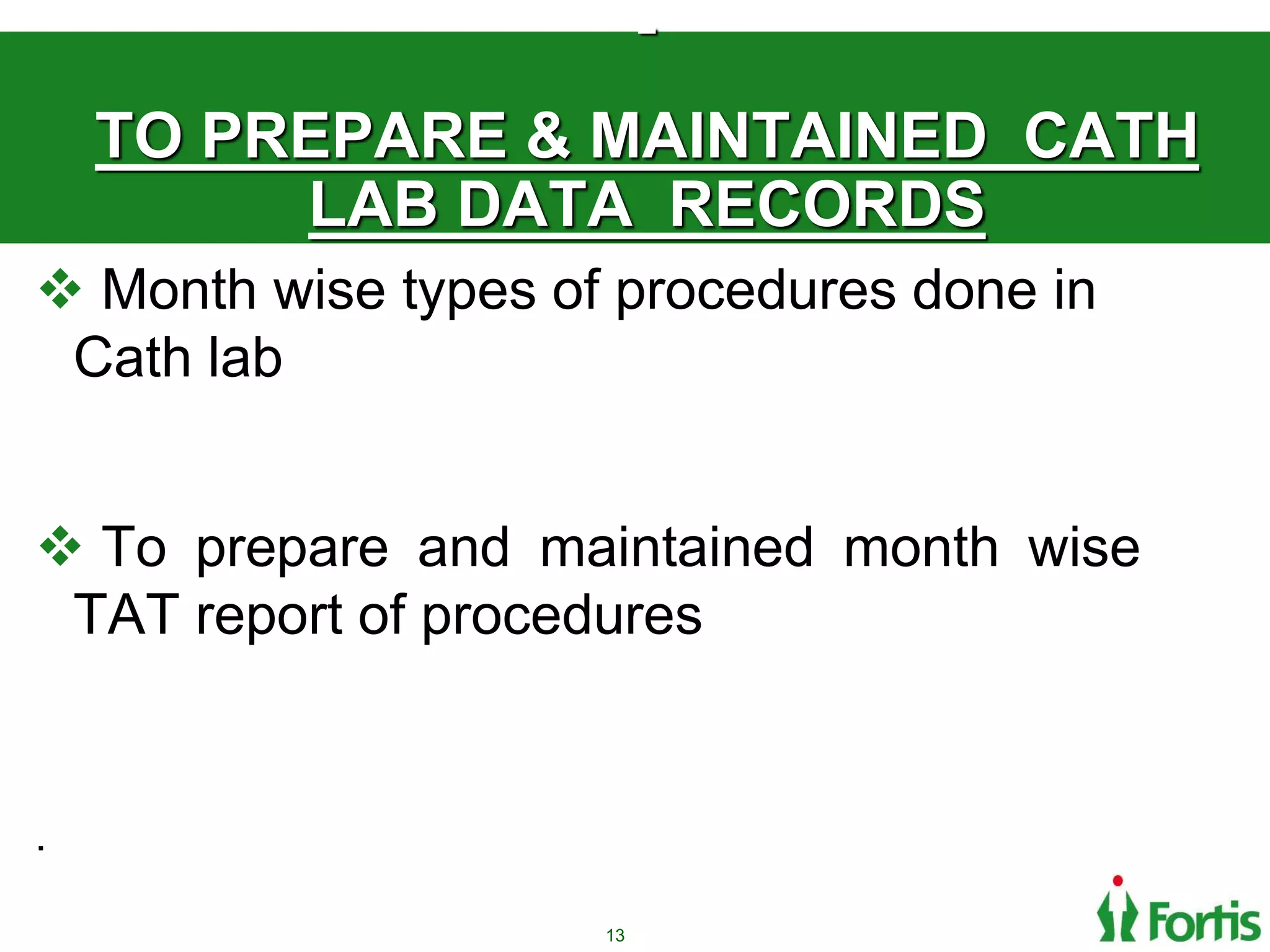
 Month wise types of procedures done in
Cath lab
 To prepare and maintained month wise
TAT report of procedures
.
13
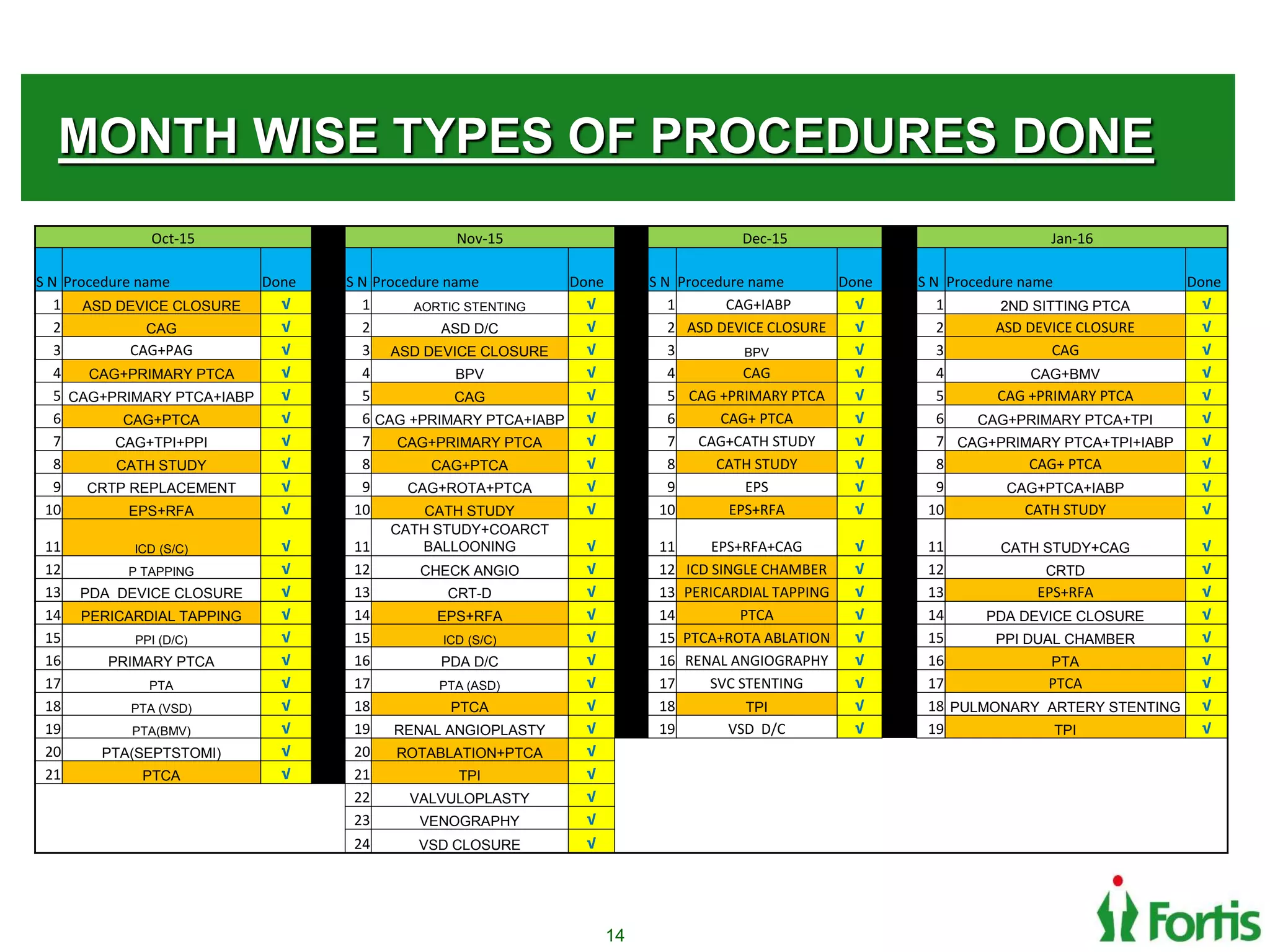
MONTH WISE TYPES OF PROCEDURES DONE
Oct-15 Nov-15 Dec-15 Jan-16
S N Procedure name Done S N Procedure name Done S N Procedure name Done S N Procedure name Done
1 ASD DEVICE CLOSURE √ 1 AORTIC STENTING √ 1 CAG+IABP √ 1 2ND SITTING PTCA √
2 CAG √ 2 ASD D/C √ 2 ASD DEVICE CLOSURE √ 2 ASD DEVICE CLOSURE √
3 CAG+PAG √ 3 ASD DEVICE CLOSURE √ 3 BPV √ 3 CAG √
4 CAG+PRIMARY PTCA √ 4 BPV √ 4 CAG √ 4 CAG+BMV √
5 CAG+PRIMARY PTCA+IABP √ 5 CAG √ 5 CAG +PRIMARY PTCA √ 5 CAG +PRIMARY PTCA √
6 CAG+PTCA √ 6 CAG +PRIMARY PTCA+IABP √ 6 CAG+ PTCA √ 6 CAG+PRIMARY PTCA+TPI √
7 CAG+TPI+PPI √ 7 CAG+PRIMARY PTCA √ 7 CAG+CATH STUDY √ 7 CAG+PRIMARY PTCA+TPI+IABP √
8 CATH STUDY √ 8 CAG+PTCA √ 8 CATH STUDY √ 8 CAG+ PTCA √
9 CRTP REPLACEMENT √ 9 CAG+ROTA+PTCA √ 9 EPS √ 9 CAG+PTCA+IABP √
10 EPS+RFA √ 10 CATH STUDY √ 10 EPS+RFA √ 10 CATH STUDY √
11 ICD (S/C) √ 11
CATH STUDY+COARCT
BALLOONING √ 11 EPS+RFA+CAG √ 11 CATH STUDY+CAG √
12 P TAPPING √ 12 CHECK ANGIO √ 12 ICD SINGLE CHAMBER √ 12 CRTD √
13 PDA DEVICE CLOSURE √ 13 CRT-D √ 13 PERICARDIAL TAPPING √ 13 EPS+RFA √
14 PERICARDIAL TAPPING √ 14 EPS+RFA √ 14 PTCA √ 14 PDA DEVICE CLOSURE √
15 PPI (D/C) √ 15 ICD (S/C) √ 15 PTCA+ROTA ABLATION √ 15 PPI DUAL CHAMBER √
16 PRIMARY PTCA √ 16 PDA D/C √ 16 RENAL ANGIOGRAPHY √ 16 PTA √
17 PTA √ 17 PTA (ASD) √ 17 SVC STENTING √ 17 PTCA √
18 PTA (VSD) √ 18 PTCA √ 18 TPI √ 18 PULMONARY ARTERY STENTING √
19 PTA(BMV) √ 19 RENAL ANGIOPLASTY √ 19 VSD D/C √ 19 TPI √
20 PTA(SEPTSTOMI) √ 20 ROTABLATION+PTCA √
21 PTCA √ 21 TPI √
22 VALVULOPLASTY √
23 VENOGRAPHY √
24 VSD CLOSURE √
14
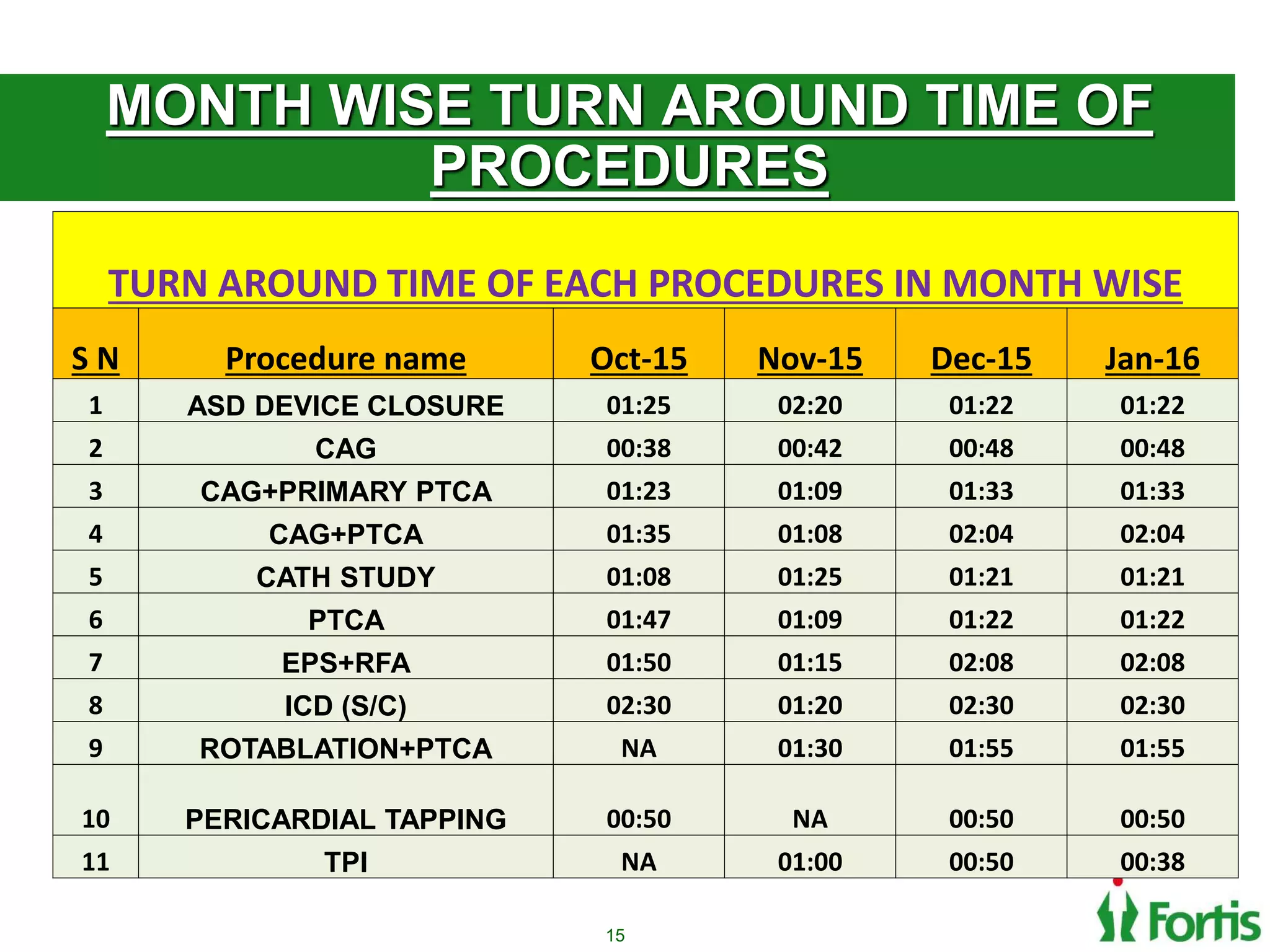
MONTH WISE TURN AROUND TIME OF
PROCEDURES
TURN AROUND TIME OF EACH PROCEDURES IN MONTH WISE
S N Procedure name Oct-15 Nov-15 Dec-15 Jan-16
1 ASD DEVICE CLOSURE 01:25 02:20 01:22 01:22
2 CAG 00:38 00:42 00:48 00:48
3 CAG+PRIMARY PTCA 01:23 01:09 01:33 01:33
4 CAG+PTCA 01:35 01:08 02:04 02:04
5 CATH STUDY 01:08 01:25 01:21 01:21
6 PTCA 01:47 01:09 01:22 01:22
7 EPS+RFA 01:50 01:15 02:08 02:08
8 ICD (S/C) 02:30 01:20 02:30 02:30
9 ROTABLATION+PTCA NA 01:30 01:55 01:55
10 PERICARDIAL TAPPING 00:50 NA 00:50 00:50
11 TPI NA 01:00 00:50 00:38
15
WAYS TO REDUCE TAT OF
PROCEDURE
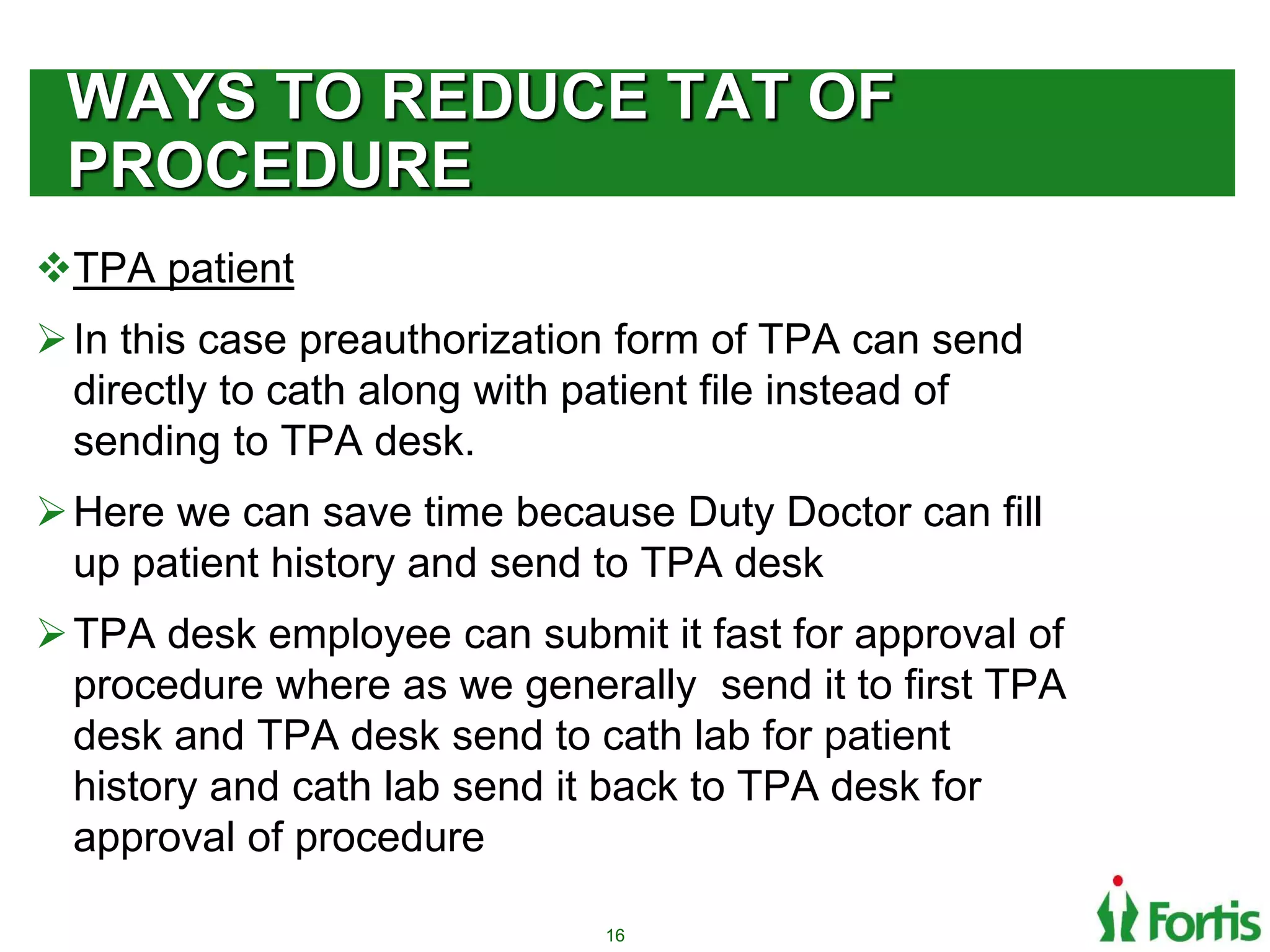
TPA patient
In this case preauthorization form of TPA can send
directly to cath along with patient file instead of
sending to TPA desk.
Here we can save time because Duty Doctor can fill
up patient history and send to TPA desk
TPA desk employee can submit it fast for approval of
procedure where as we generally send it to first TPA
desk and TPA desk send to cath lab for patient
history and cath lab send it back to TPA desk for
approval of procedure
16
WAYS TO REDUCE TAT OF
PROCEDURE
Cash patient for day cath procedure
We can save time if patient come along with
attendant
In this case we can send to patient directly to cath
lab instead of PCS office along with patient’s
attendant.
Patent’s attendant can go PCS office and do
admission formalities of patient
17
CHALLENGES DURING TRAINING
Maintaining the Cath lab scheduling
Responsible for efficiently patients
financial counseling till discharge of
patient
Responsible for complete of MRD
deficient files of the patients
Coordinate with attendants and front
office staff for clearance of the
procedure 18
EXECUTIVE SUMMARY OF PROJECT
 My project is on "WORK FLOW OF CATH LAB" At where
cardiac invasive procedures gets done by Drs with support staff.
I did work on how to improve TAT and learned couple of things
such as:
 Patients admission process
 Coordinate with TPA process
 Patients financial counselling services
 Patients discharge process
 To prepare and maintained Cath labs data record
 Doing patients round along with Doctor
19
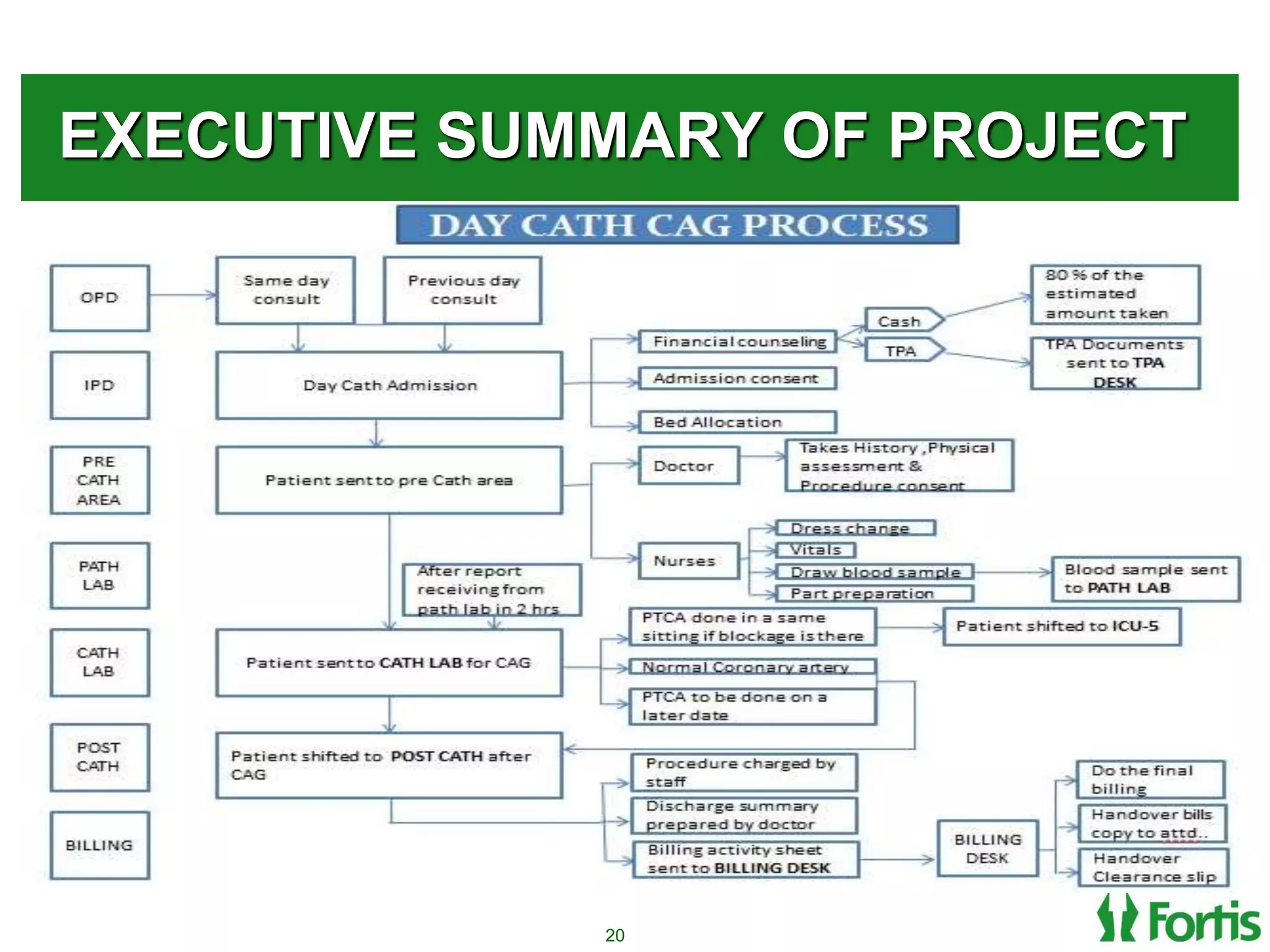
EXECUTIVE SUMMARY OF PROJECT
20
THANKING YOU !!!
21

Wrok flow of Cath lab Process

  • 1.
    “WORK FLOW OFCATH LAB PROCESS” AT FORTIS MEMORIAL RESEARCH INSTITUTE Prepared By: Mr.KULDEEP SINGH 27TH January 2016 Mob NO :9718386778
  • 2.
    HOSPITAL INTRODUCTION Fortis MemorialResearch Institute (FMRI) is a multi- super-speciality, quaternary care hospital with an enviable international faculty, reputed clinicians, including super-sub-specialists and speciality nurses, supported by cutting–edge technology. A premium referral hospital, it endeavours to be the ‘Mecca of Healthcare’ for Asia Pacific and beyond. Set on a spacious 11-acre campus with 1000 beds, this ‘Next Generation Hospital’ is built on the foundation of ‘Trust’ and rests on four strong pillars: Talent, Technology, Service and Infrastructure 2
  • 3.
    HOSPITAL’S SPECIALITIES  MinimalAccess, Bariatric & GI Surgery  Plastic Surgery  Ophthalmology  Pulmonology  Plastic Surgery  Dental Sciences  Internal Medicine  Cosmetic & Plastic Surgery  Medical Oncology  Invasive Cardiology  Ophthalmology  Pediatrics  Minimal Access Surgery (Gynae)  Neonatology  IVF  Liver Transplant, GI &HepatoPancreato Biliary Surgery  Mental Health & Behavioural Sciences  Radiation Oncology  Radiology  Invasive Cardiology  Rheumatology  Newborn and Child Specialist  ENT  C-DOC (Centre of Excellence for Diabetes, Metabolic Disorders and Endocrinology)  Gastroenterology &Hepatobiliary Sciences3
  • 4.
  • 5.
    CATH LAB Cath labdefinition: Cath lab is an examination room in a hospital or clinic with diagnostic imaging equipment used to visualize the arteries of the heart and the chambers of the heart and treat any stenosis or abnormality found. 5
  • 6.
    “WORK FLOW OFCATH LAB PROCESS” Patient admission process Patient financial counseling Coordinate with TPA process Patient discharge process To prepare and maintain Cath lab data record 6
  • 7.
    PATIENT ADMISSION PROCESS Admission request form to be filled by Treating Doctor  Allocation of bed by Bed manager  General consent form to be filled and signed by Patient attendant  Estimate of the advised procedure to be prepared  Face sheet to be generated after getting all information & document from the patient  Stamp needs to be put on face sheet for financial clearance of the procedure  In case of TPA policy, Patient needs to submit TPA paper.  TPA paper needs to be submitted in TPA desk for initial approval of recommended procedure 7
  • 8.
    PATIENT FINANCIAL COUNSELLING Oncecompletion of diagnostic test (CAG) if Dr recommends for next procedure than service coordinator needs to do financial counseling For further procedure (PTCA) or other procedures. Main points to be explained during financial counselling: • About room categories • Package inclusions and exclusions • About extra charges if there is an extra stay or cross consultation done 8
  • 9.
    PATIENT FINANCIAL COUNSELING Stent charge, it will depend number of stents used in procedure  Drug & consumable used in procedure (approx) Finally do the sum of total and tell to attendant and get a sign on patient financial counseling paper Note: In case of patient goes out of package than charges will be extra for specific concern such as Cross consultation Number of days stay in room or ICU. 9
  • 10.
    TPA PROCESS  Prescriptionof the Drs  Pre authorization form of TPA  Dully fill up of pre authorization form by Drs  Undertaking form for TPA insurance  Estimation of procedure  ECG report or CAG report or other investigation report  Current ID card of the patient  TPA policy & Card of the policy  Finally send the original document to TPA office to get an approval from TPA  In case of further approval of TPA needs to do the same as above 10
  • 11.
    PATIENT DISCHARGE PROCESS In progress sheet Dr. needs to write discharge note in patient file  According to progress note, nursing staff needs to send the billing papers to billing desk & needs to update discharge intimation in the system  Discharge summary to be prepared by Dr and dually signed by treating Dr.  In case of cash patient, patient attendant needs to do final clearance in billing department or  In case of TPA patient all the original documents, final bill and discharge summary needs to be submitted to TPA desk to get the final approval  After getting the final approval from TPA billing will be closed 11
  • 12.
    PATIENT DISCHARGE SUMMARY DischargeSummary: is a patient’s history document, which describes whole history about patient during stay in hospital. There are few points such as:  DIAGNOSIS  CHIEF COMPLAINTS  HISTORY OF PRESENT ILLNESS  PAST MEDICAL HISTORY  SIGNIFICANT FINDINGS On examination  COURSE IN HOSPITAL  INVESTIGATION DONE  CONDITION AT THE TIME OF DISCHARGE  MEDICATION ON DISCHARGE  FOLLOW UP ADVICE  WHEN TO OBTAIN URGENT CARE  IN CASE OF EMERGENCY PLEASE CONTACT FMRI EMERGENCY ON 0124 4962200, 0124 716 2200 12
  • 13.
    TO PREPARE &MAINTAINED CATH LAB DATA RECORDS  Month wise types of procedures done in Cath lab  To prepare and maintained month wise TAT report of procedures . 13
  • 14.
    MONTH WISE TYPESOF PROCEDURES DONE Oct-15 Nov-15 Dec-15 Jan-16 S N Procedure name Done S N Procedure name Done S N Procedure name Done S N Procedure name Done 1 ASD DEVICE CLOSURE √ 1 AORTIC STENTING √ 1 CAG+IABP √ 1 2ND SITTING PTCA √ 2 CAG √ 2 ASD D/C √ 2 ASD DEVICE CLOSURE √ 2 ASD DEVICE CLOSURE √ 3 CAG+PAG √ 3 ASD DEVICE CLOSURE √ 3 BPV √ 3 CAG √ 4 CAG+PRIMARY PTCA √ 4 BPV √ 4 CAG √ 4 CAG+BMV √ 5 CAG+PRIMARY PTCA+IABP √ 5 CAG √ 5 CAG +PRIMARY PTCA √ 5 CAG +PRIMARY PTCA √ 6 CAG+PTCA √ 6 CAG +PRIMARY PTCA+IABP √ 6 CAG+ PTCA √ 6 CAG+PRIMARY PTCA+TPI √ 7 CAG+TPI+PPI √ 7 CAG+PRIMARY PTCA √ 7 CAG+CATH STUDY √ 7 CAG+PRIMARY PTCA+TPI+IABP √ 8 CATH STUDY √ 8 CAG+PTCA √ 8 CATH STUDY √ 8 CAG+ PTCA √ 9 CRTP REPLACEMENT √ 9 CAG+ROTA+PTCA √ 9 EPS √ 9 CAG+PTCA+IABP √ 10 EPS+RFA √ 10 CATH STUDY √ 10 EPS+RFA √ 10 CATH STUDY √ 11 ICD (S/C) √ 11 CATH STUDY+COARCT BALLOONING √ 11 EPS+RFA+CAG √ 11 CATH STUDY+CAG √ 12 P TAPPING √ 12 CHECK ANGIO √ 12 ICD SINGLE CHAMBER √ 12 CRTD √ 13 PDA DEVICE CLOSURE √ 13 CRT-D √ 13 PERICARDIAL TAPPING √ 13 EPS+RFA √ 14 PERICARDIAL TAPPING √ 14 EPS+RFA √ 14 PTCA √ 14 PDA DEVICE CLOSURE √ 15 PPI (D/C) √ 15 ICD (S/C) √ 15 PTCA+ROTA ABLATION √ 15 PPI DUAL CHAMBER √ 16 PRIMARY PTCA √ 16 PDA D/C √ 16 RENAL ANGIOGRAPHY √ 16 PTA √ 17 PTA √ 17 PTA (ASD) √ 17 SVC STENTING √ 17 PTCA √ 18 PTA (VSD) √ 18 PTCA √ 18 TPI √ 18 PULMONARY ARTERY STENTING √ 19 PTA(BMV) √ 19 RENAL ANGIOPLASTY √ 19 VSD D/C √ 19 TPI √ 20 PTA(SEPTSTOMI) √ 20 ROTABLATION+PTCA √ 21 PTCA √ 21 TPI √ 22 VALVULOPLASTY √ 23 VENOGRAPHY √ 24 VSD CLOSURE √ 14
  • 15.
    MONTH WISE TURNAROUND TIME OF PROCEDURES TURN AROUND TIME OF EACH PROCEDURES IN MONTH WISE S N Procedure name Oct-15 Nov-15 Dec-15 Jan-16 1 ASD DEVICE CLOSURE 01:25 02:20 01:22 01:22 2 CAG 00:38 00:42 00:48 00:48 3 CAG+PRIMARY PTCA 01:23 01:09 01:33 01:33 4 CAG+PTCA 01:35 01:08 02:04 02:04 5 CATH STUDY 01:08 01:25 01:21 01:21 6 PTCA 01:47 01:09 01:22 01:22 7 EPS+RFA 01:50 01:15 02:08 02:08 8 ICD (S/C) 02:30 01:20 02:30 02:30 9 ROTABLATION+PTCA NA 01:30 01:55 01:55 10 PERICARDIAL TAPPING 00:50 NA 00:50 00:50 11 TPI NA 01:00 00:50 00:38 15
  • 16.
    WAYS TO REDUCETAT OF PROCEDURE TPA patient In this case preauthorization form of TPA can send directly to cath along with patient file instead of sending to TPA desk. Here we can save time because Duty Doctor can fill up patient history and send to TPA desk TPA desk employee can submit it fast for approval of procedure where as we generally send it to first TPA desk and TPA desk send to cath lab for patient history and cath lab send it back to TPA desk for approval of procedure 16
  • 17.
    WAYS TO REDUCETAT OF PROCEDURE Cash patient for day cath procedure We can save time if patient come along with attendant In this case we can send to patient directly to cath lab instead of PCS office along with patient’s attendant. Patent’s attendant can go PCS office and do admission formalities of patient 17
  • 18.
    CHALLENGES DURING TRAINING Maintainingthe Cath lab scheduling Responsible for efficiently patients financial counseling till discharge of patient Responsible for complete of MRD deficient files of the patients Coordinate with attendants and front office staff for clearance of the procedure 18
  • 19.
    EXECUTIVE SUMMARY OFPROJECT  My project is on "WORK FLOW OF CATH LAB" At where cardiac invasive procedures gets done by Drs with support staff. I did work on how to improve TAT and learned couple of things such as:  Patients admission process  Coordinate with TPA process  Patients financial counselling services  Patients discharge process  To prepare and maintained Cath labs data record  Doing patients round along with Doctor 19
  • 20.
  • 21.