IDX Innovation Design Experience
LexisNexis
November 2016
SAFe Framework and UX
Karen Ballinger | UX Operations Manager, SPC4
Goals for This Meetup
• Understand SAFe and its resonance with UX
– SAFe foundations
– Consider yourself an strategic advisor to the Product team
– Intentional vs emergent design
– UX designers and researchers are in the Solution Intent space,
spanning strategy and tactical delivery, we don’t develop code
– Interpret SAFe definitions in a UX way
• Workshop
– Write epics
– Write features
– Estimate effort using normalized story points
– Prioritize work using Weighted Shortest Job First (WSJF)
• Have fun with the Disney scenario
• Sum up and Retrospective
Out of Scope to Discuss
• Scrum 101
• PI planning –
– Purpose
– Pre-planning
– Inputs, outputs
– The session, what happens
– Post-planning
• Stories – how to write them
We thought we’d be designing
and developing like this:
But sometimes it feels like this:
http://www.scaledagileframework.com/
LEADERSHIP
Respectfor
peopleandculture
Flow
Innovation
Relentless
improvement
VALUE
House of Lean
Individuals and interactions over processes and tools
Working software over comprehensive documentation
Customer collaboration over contract negotiation
Responding to change over following a plan
Agile Manifesto
Value in the sustainably
shortest lead time
Lean-Agile Mindset
IDX Innovation Design Experience
House of LEAN – “The goal is to deliver the maximum customer
value in the sustainably shortest lead time, while providing highest
possible quality.”
• WHY are we doing this?
• Who are your customers?
– Know them well
– Group by segment, by role, by need, by age
– Create top 5-9 high level personas
• How are the personas different from each other?
• How are these roles changing?
• Why do the customers come to your product?
What are their goals? What are they trying to
accomplish?
• What problems do they have?
– Impediments, frustrations? Opportunities?
– Is this potentially a competitive differentiator?
• Which of the customers will see the value?
• Which customers are you trying to target in the
next year for maximum business and customer
value?
Customer Value in Portfolio/Discover Tier
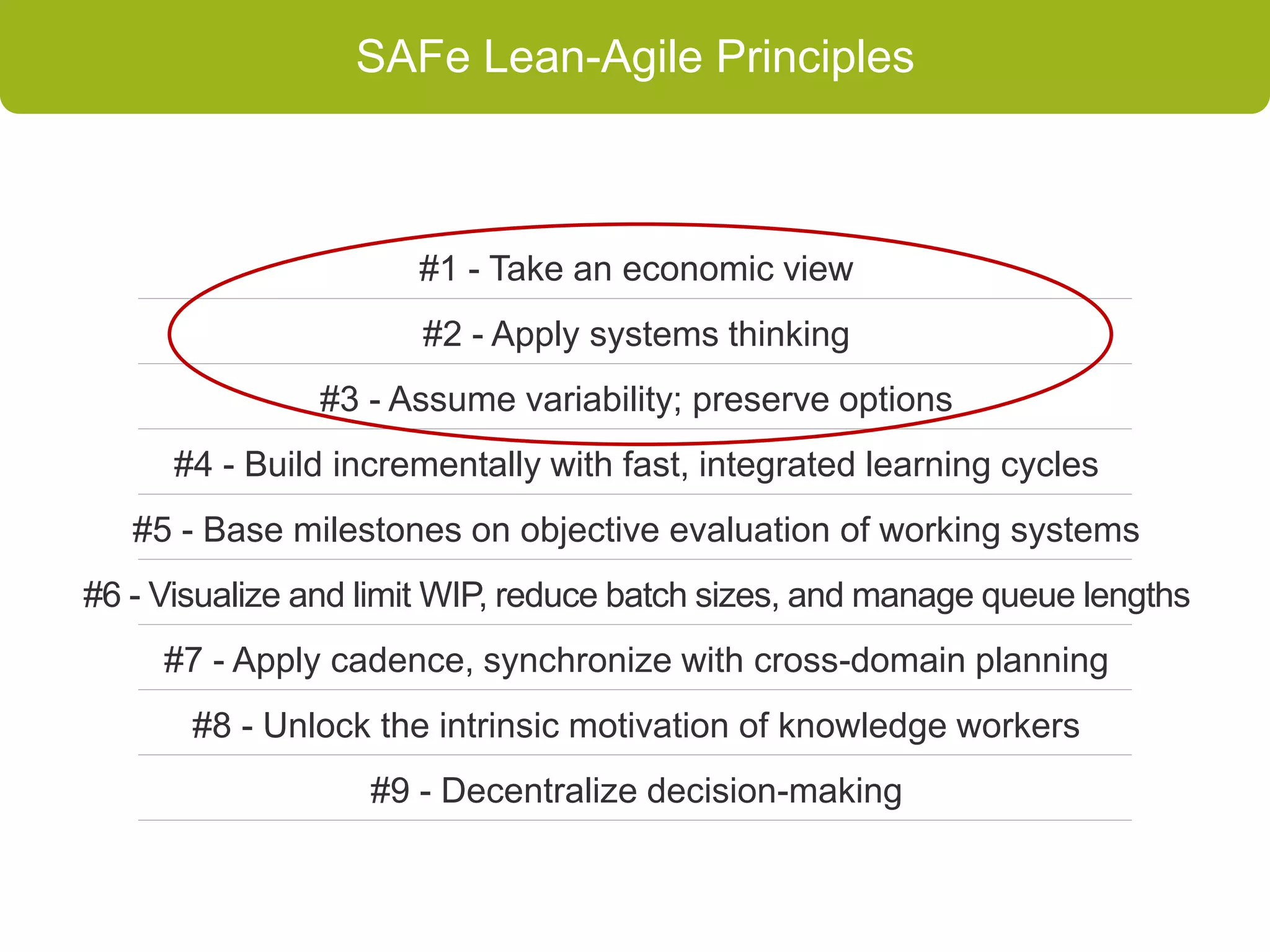
SAFe Lean-Agile Principles
#1 - Take an economic view
#2 - Apply systems thinking
#3 - Assume variability; preserve options
#4 - Build incrementally with fast, integrated learning cycles
#5 - Base milestones on objective evaluation of working systems
#6 - Visualize and limit WIP, reduce batch sizes, and manage queue lengths
#7 - Apply cadence, synchronize with cross-domain planning
#8 - Unlock the intrinsic motivation of knowledge workers
#9 - Decentralize decision-making
SAFe Core Values
IDX Innovation Design Experience
UX “Double-diamond”
IDX Innovation Design Experience
Discover
Define
Design
Deliver
• Portfolio = Discover
• Value Stream = Define
• Program = UX Design
• Team = Deliver
SAFe Framework & Double Diamond
IDX Innovation Design Experience
The Purpose of Each Tier
Portfolio:
• Organize the organization
around flow of value*
• Determine strategic
themes*, governance, and
budgets
• Determine value streams*
and business epics*
Program:
• Organize by teams of agile
teams (trains)
• Refine and deliver features*
that help accomplish the
vision and roadmap
• Coordinate interdependencies
*SAFe definitions
Value Stream:
• Organize large, mission-
critical, complex solutions
into release trains*
• Define the vision, roadmap,
capabilities*, release
milestones, etc.
• Inspect, demo and adapt at
the solution level
• Provide context to the trains
Team:
• Define, build, test and
release user stories* from
the backlog
Workshop: Disney Dayton
Vision, Theme, Value Stream
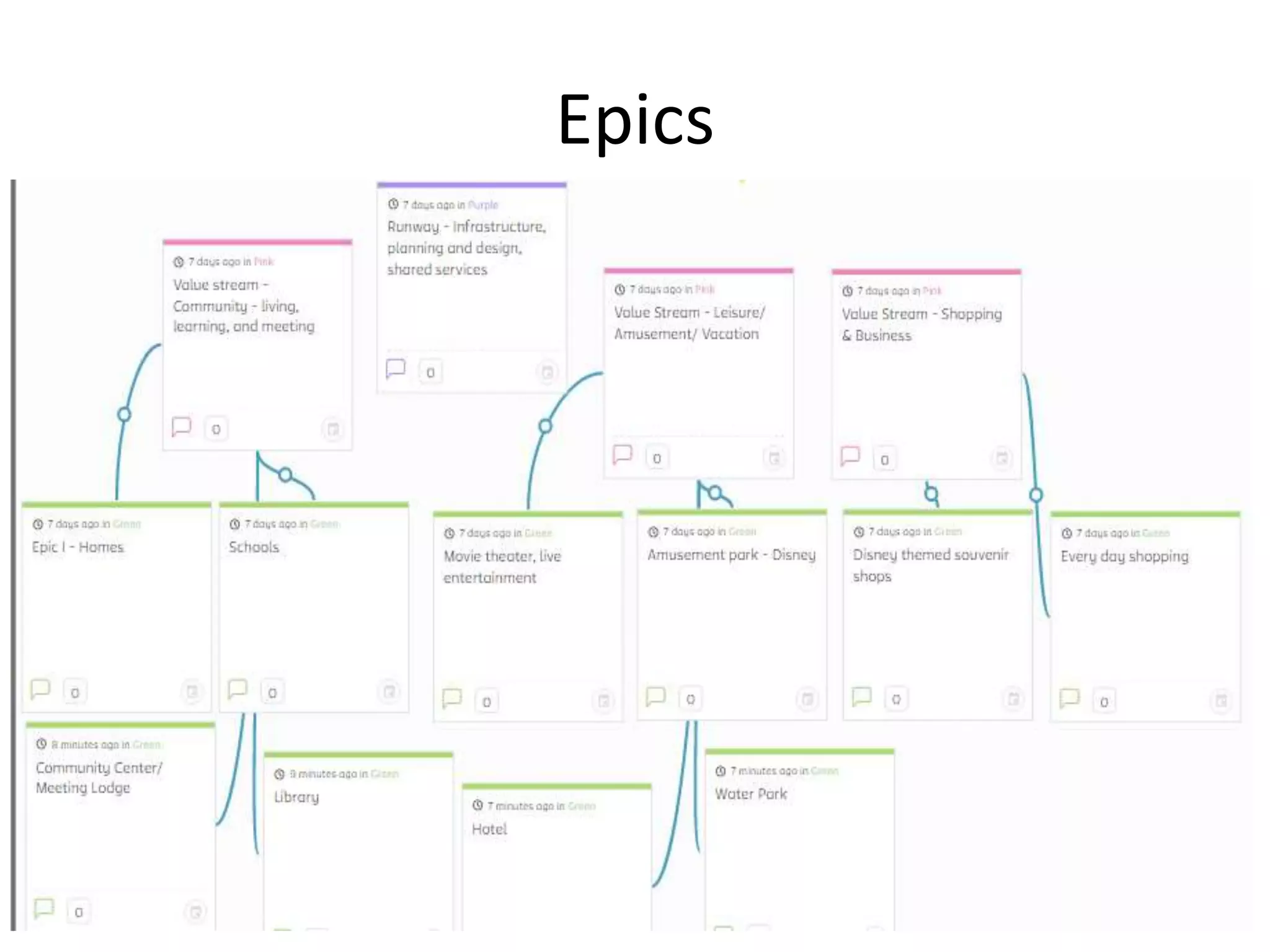
Epics
Runway and
Shared Services
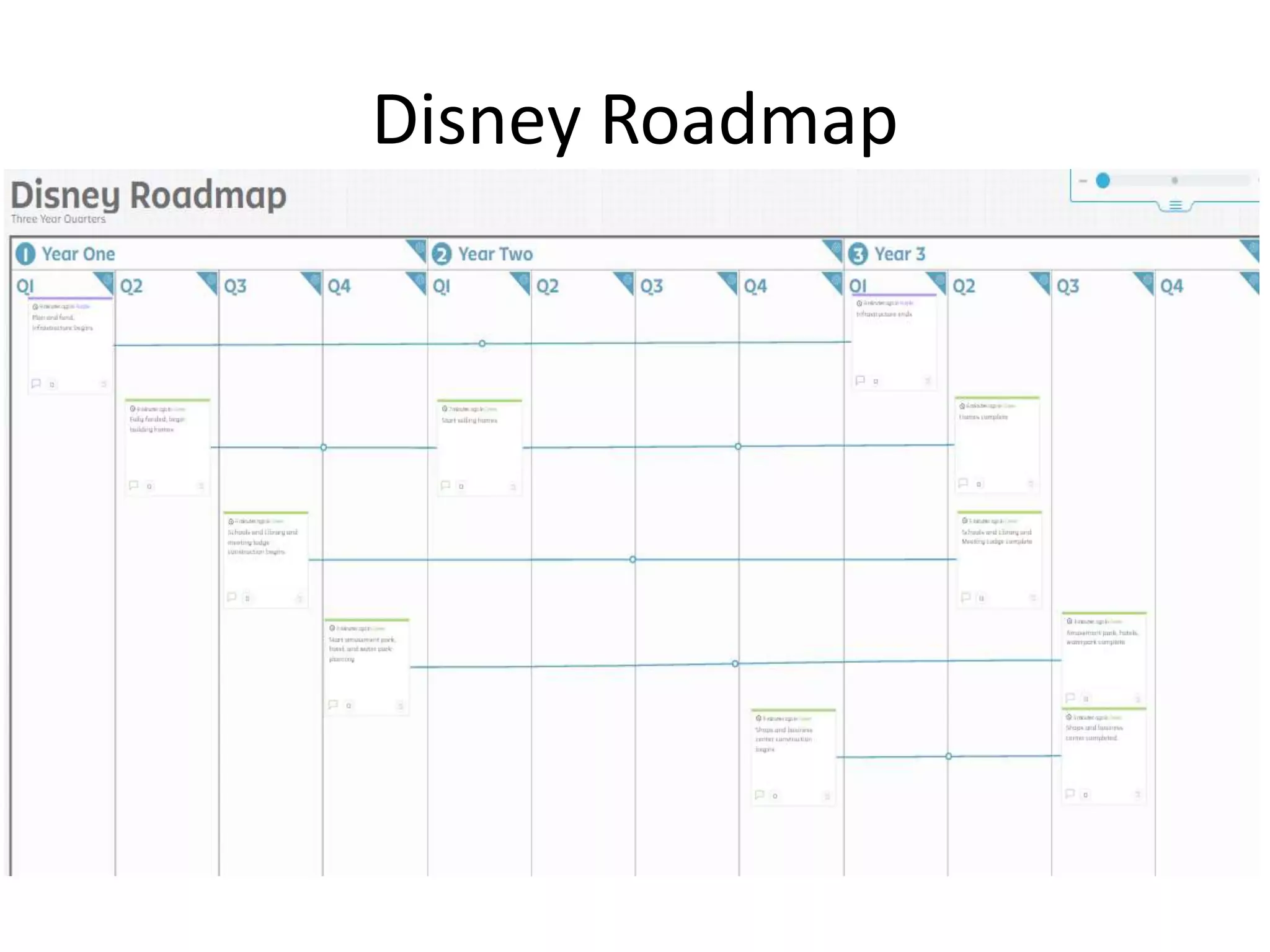
Disney Roadmap
Create One Epic Statement
Forward-looking Position Statement – High income home
For High-income Disney-loving home owners
Who Are looking for a smart, eco-friendly, and fun home in
Dayton
The Disney Community High-income Home
Is a High-broadband, LEEDs-certified, 5-bedroom
4-bathroom home with smart appliances
That Reduces footprint, reduces utility costs, and allows
homeowners to virtually connect to all appliances and
electronics which eases work-life balance
Unlike Other Dayton homes
Our Homes Are future-minded with a touch of whimsy
Scope
Success Criteria •
•
In scope
Out of scope
Non-functional Requirements
Create 5-10 Features with Benefits
Feature Benefits
Basement/foundation Storage, Extra living space, Tornado space
Man cave/Woman cave, Child playroom
Bedroom 1 - 4 Sleeping and relaxing location, clothing
storage
Office (Bedroom 5) Hi-broadband connection, working space
Kitchen Smart appliances, food prep and cooking
Cleanup and food storage
Living room Entertainment
Socializing, relaxing
Play area
Dining room Eating location, dumping ground for
papers
Roof/attic Protection, insulation, storage, etc
Bathrooms 1-4 Personal hygiene and waste removal,
clothing and linen storage
Garage Vehicle and tool storage location
Normalized Story Points –
Fibonacci Scale
Scale Days/weeks/months Story/feature/epic
1 One ideal day Small Story
2 2-3 ideal days Mid-sized story
3 One week Mid-to-large story
5 1 ½ weeks Mid-to-large story
8 Two weeks/two-week sprint Large story, maybe a feature
13 3 weeks/three-week sprint Feature
20 2 months Feature/Capability
40 3 months/program increment Feature/Capability
100 6 months Epic
200 1 year Epic
300 2-3 years Epic
Weighted Shortest Job First (WSJF)
• Economic concept: Do the job with the largest
value that will take the least amount of time
Feature Time
Criticality
User/ Business
value
Risk reduction/
Opp. enabler
Story
points
WSJF
Basement/Foundation
Bedroom
Kitchen
Living room
Power (runway)
Plumbing,water,
garbage(runway)
Frame
Dining room
Roof/attic…etc
http://www.scaledagileframework.com/
Corporations Using SAFe
• Cisco
• HP Enterprise
• Tomtom
• Lego
• Intel
• John Deer
• LexisNexis
• Kroger
• Vantiv
IDX Innovation Design Experience
References
• Scaled Agile Framework
• Mapping Experiences by James Kalbach (book)
• (Google) Sprint – How to Solve Big
Problems…Jake Knapp (book)
• Agile topics by Nielson Norman Group.com
• Integrating Agile and UX by User Zoom.com
• http://boxesandarrows.com/the-ux-professionals-
guide-to-working-with-agile-scrum-teams/ The
Recommendations section, by role, has a lot of
good advice.
• http://jpattonassociates.com/the-new-backlog/
• http://www.smashingmagazine.com/2012/11/desig
n-spikes-fit-big-picture-ux-agile-development/
• http://boxesandarrows.com/integrating-ux-into-the-
product-backlog/
Contact information:
Karen Ballinger
• Karen.ballinger@lexisnexis.com
• LinkedIn

SAFe Framework and UX - UX Meetup Dayton

  • 1.
    IDX Innovation DesignExperience LexisNexis November 2016 SAFe Framework and UX Karen Ballinger | UX Operations Manager, SPC4
  • 2.
    Goals for ThisMeetup • Understand SAFe and its resonance with UX – SAFe foundations – Consider yourself an strategic advisor to the Product team – Intentional vs emergent design – UX designers and researchers are in the Solution Intent space, spanning strategy and tactical delivery, we don’t develop code – Interpret SAFe definitions in a UX way • Workshop – Write epics – Write features – Estimate effort using normalized story points – Prioritize work using Weighted Shortest Job First (WSJF) • Have fun with the Disney scenario • Sum up and Retrospective
  • 3.
    Out of Scopeto Discuss • Scrum 101 • PI planning – – Purpose – Pre-planning – Inputs, outputs – The session, what happens – Post-planning • Stories – how to write them
  • 4.
    We thought we’dbe designing and developing like this:
  • 5.
    But sometimes itfeels like this:
  • 6.
  • 7.
    LEADERSHIP Respectfor peopleandculture Flow Innovation Relentless improvement VALUE House of Lean Individualsand interactions over processes and tools Working software over comprehensive documentation Customer collaboration over contract negotiation Responding to change over following a plan Agile Manifesto Value in the sustainably shortest lead time Lean-Agile Mindset
  • 8.
    IDX Innovation DesignExperience House of LEAN – “The goal is to deliver the maximum customer value in the sustainably shortest lead time, while providing highest possible quality.” • WHY are we doing this? • Who are your customers? – Know them well – Group by segment, by role, by need, by age – Create top 5-9 high level personas • How are the personas different from each other? • How are these roles changing? • Why do the customers come to your product? What are their goals? What are they trying to accomplish? • What problems do they have? – Impediments, frustrations? Opportunities? – Is this potentially a competitive differentiator? • Which of the customers will see the value? • Which customers are you trying to target in the next year for maximum business and customer value? Customer Value in Portfolio/Discover Tier
  • 9.
    SAFe Lean-Agile Principles #1- Take an economic view #2 - Apply systems thinking #3 - Assume variability; preserve options #4 - Build incrementally with fast, integrated learning cycles #5 - Base milestones on objective evaluation of working systems #6 - Visualize and limit WIP, reduce batch sizes, and manage queue lengths #7 - Apply cadence, synchronize with cross-domain planning #8 - Unlock the intrinsic motivation of knowledge workers #9 - Decentralize decision-making
  • 10.
  • 11.
    IDX Innovation DesignExperience UX “Double-diamond”
  • 12.
    IDX Innovation DesignExperience Discover Define Design Deliver • Portfolio = Discover • Value Stream = Define • Program = UX Design • Team = Deliver SAFe Framework & Double Diamond
  • 13.
    IDX Innovation DesignExperience The Purpose of Each Tier Portfolio: • Organize the organization around flow of value* • Determine strategic themes*, governance, and budgets • Determine value streams* and business epics* Program: • Organize by teams of agile teams (trains) • Refine and deliver features* that help accomplish the vision and roadmap • Coordinate interdependencies *SAFe definitions Value Stream: • Organize large, mission- critical, complex solutions into release trains* • Define the vision, roadmap, capabilities*, release milestones, etc. • Inspect, demo and adapt at the solution level • Provide context to the trains Team: • Define, build, test and release user stories* from the backlog
  • 14.
  • 15.
  • 16.
  • 17.
  • 18.
  • 19.
    Create One EpicStatement Forward-looking Position Statement – High income home For High-income Disney-loving home owners Who Are looking for a smart, eco-friendly, and fun home in Dayton The Disney Community High-income Home Is a High-broadband, LEEDs-certified, 5-bedroom 4-bathroom home with smart appliances That Reduces footprint, reduces utility costs, and allows homeowners to virtually connect to all appliances and electronics which eases work-life balance Unlike Other Dayton homes Our Homes Are future-minded with a touch of whimsy Scope Success Criteria • • In scope Out of scope Non-functional Requirements
  • 20.
    Create 5-10 Featureswith Benefits Feature Benefits Basement/foundation Storage, Extra living space, Tornado space Man cave/Woman cave, Child playroom Bedroom 1 - 4 Sleeping and relaxing location, clothing storage Office (Bedroom 5) Hi-broadband connection, working space Kitchen Smart appliances, food prep and cooking Cleanup and food storage Living room Entertainment Socializing, relaxing Play area Dining room Eating location, dumping ground for papers Roof/attic Protection, insulation, storage, etc Bathrooms 1-4 Personal hygiene and waste removal, clothing and linen storage Garage Vehicle and tool storage location
  • 21.
    Normalized Story Points– Fibonacci Scale Scale Days/weeks/months Story/feature/epic 1 One ideal day Small Story 2 2-3 ideal days Mid-sized story 3 One week Mid-to-large story 5 1 ½ weeks Mid-to-large story 8 Two weeks/two-week sprint Large story, maybe a feature 13 3 weeks/three-week sprint Feature 20 2 months Feature/Capability 40 3 months/program increment Feature/Capability 100 6 months Epic 200 1 year Epic 300 2-3 years Epic
  • 22.
    Weighted Shortest JobFirst (WSJF) • Economic concept: Do the job with the largest value that will take the least amount of time Feature Time Criticality User/ Business value Risk reduction/ Opp. enabler Story points WSJF Basement/Foundation Bedroom Kitchen Living room Power (runway) Plumbing,water, garbage(runway) Frame Dining room Roof/attic…etc
  • 23.
  • 24.
    Corporations Using SAFe •Cisco • HP Enterprise • Tomtom • Lego • Intel • John Deer • LexisNexis • Kroger • Vantiv
  • 25.
    IDX Innovation DesignExperience References • Scaled Agile Framework • Mapping Experiences by James Kalbach (book) • (Google) Sprint – How to Solve Big Problems…Jake Knapp (book) • Agile topics by Nielson Norman Group.com • Integrating Agile and UX by User Zoom.com • http://boxesandarrows.com/the-ux-professionals- guide-to-working-with-agile-scrum-teams/ The Recommendations section, by role, has a lot of good advice. • http://jpattonassociates.com/the-new-backlog/ • http://www.smashingmagazine.com/2012/11/desig n-spikes-fit-big-picture-ux-agile-development/ • http://boxesandarrows.com/integrating-ux-into-the- product-backlog/ Contact information: Karen Ballinger • Karen.ballinger@lexisnexis.com • LinkedIn

Editor's Notes

  • #7  SAMPLE SPEAKER NOTES: This is what is referred to as the “SAFe Big Picture”. At first, it may look complicated, but as we will see, it is actually a very straight-forward and logical representation. We will see that roles, artifacts, and activities are clearly defined based on proven principles and practices. Decomposing the SAFe Big Picture into it’s constituent parts, we’ll discover that it’s a simple, powerful and easily understood framework for managing complex software and systems development.  
  • #13 OVERVIEW: Introduce the Portfolio, Value Stream, Program, and Team levels. The Enterprise icon is highlighted to represent the connection between the enterprise business strategy and a SAFe Portfolio SAMPLE SPEAKER NOTES: Here we see the four levels of SAFe: Portfolio, Value Stream, Program, and Team. In the small to midsize enterprise, one SAFe portfolio can typically be used to govern the entire technical solution set. In the larger enterprise (those with more than 500 – 1,000 technical practitioners), there can be multiple SAFe portfolios, one for each line of business. Each SAFe portfolio contains a set of Value Streams and the additional elements necessary to provide funding and governance for the products, services, and Solutions that the Enterprise needs to fulfill some element of the business strategy. The Value Stream Level is intended for builders of large and complex solutions that typically require multiple ARTs, as well as the contribution of Suppliers. It is intended for enterprises that face the largest systems challenges, building multidisciplinary and cyber-physical systems that contain software, hardware, electrical and electronic, optics, mechanics, fluidics, and more. Not all organizations will need the Value Stream Level. (NOTE: If you are able to access the Scaled Agile Framework website, this would be a good time to demo the expand/collapse button) The Team and Program Levels make up the long-lived, self-organizing virtual organization known as the Agile Release Train (ART). Without teams, there can be no program. The ART plans, commits, and executes together. The “Agile Release Train” metaphor is used to communicate several key concepts: The train departs the station and arrives at the next destination on a reliable schedule, which provides for fixed cadence, standard ART velocity, and predictable planning (and in many cases, cadence-based releases). All “cargo,” including prototypes, models, software, hardware, documentation, etc., goes on the train. You’ll notice at the bottom the SAFe Core Values, Lean-Agile Mindset (represented by the House of Lean), and SAFe Principles. These articulate the time-proven principles upon which SAFe is based. Also on the bottom is “Implementing 1-2-3.” Based on the learning from hundreds of SAFe implementations, this simple model is a proven success model. Train implementers and Lean-Agile change agents Train all executives, managers, and leaders Train teams and launch Agile Release Trains In training all executives, managers, and leaders, you create your Lean-Agile Leaders, whom you’ll see on the left.    
  • #24  SAMPLE SPEAKER NOTES: This is what is referred to as the “SAFe Big Picture”. At first, it may look complicated, but as we will see, it is actually a very straight-forward and logical representation. We will see that roles, artifacts, and activities are clearly defined based on proven principles and practices. Decomposing the SAFe Big Picture into it’s constituent parts, we’ll discover that it’s a simple, powerful and easily understood framework for managing complex software and systems development.