@borjessonjonas
About SIP
SIP Routing
Jonas Borjesson
@borjessonjonas
NOTE
● This presentation has been recorded and can
be viewed here: vimeo.com/140267478
● This version has been adapted to be viewed
without transitions.
● Go to aboutsip.com to download the original
version.
● Follow @borjessonjonas to receive updates.
@borjessonjonas
Routing
● Understanding SIP routing is a must!
● SIP's flexible routing is what makes SIP so great*.
● The routing capabilities of SIP enables:
● Loosely coupled systems
● Ability for a very flexible application composition
model
● NAT/FW Traversal
● CONFUSION!
*According to myself. Many people may disagree...
@borjessonjonas
Questions
● How does a SIP request traverse the network?
● How do we know which transport protocol to use?
● How do the responses find their way back?
● Any difference for in-dialog requests?
@borjessonjonas
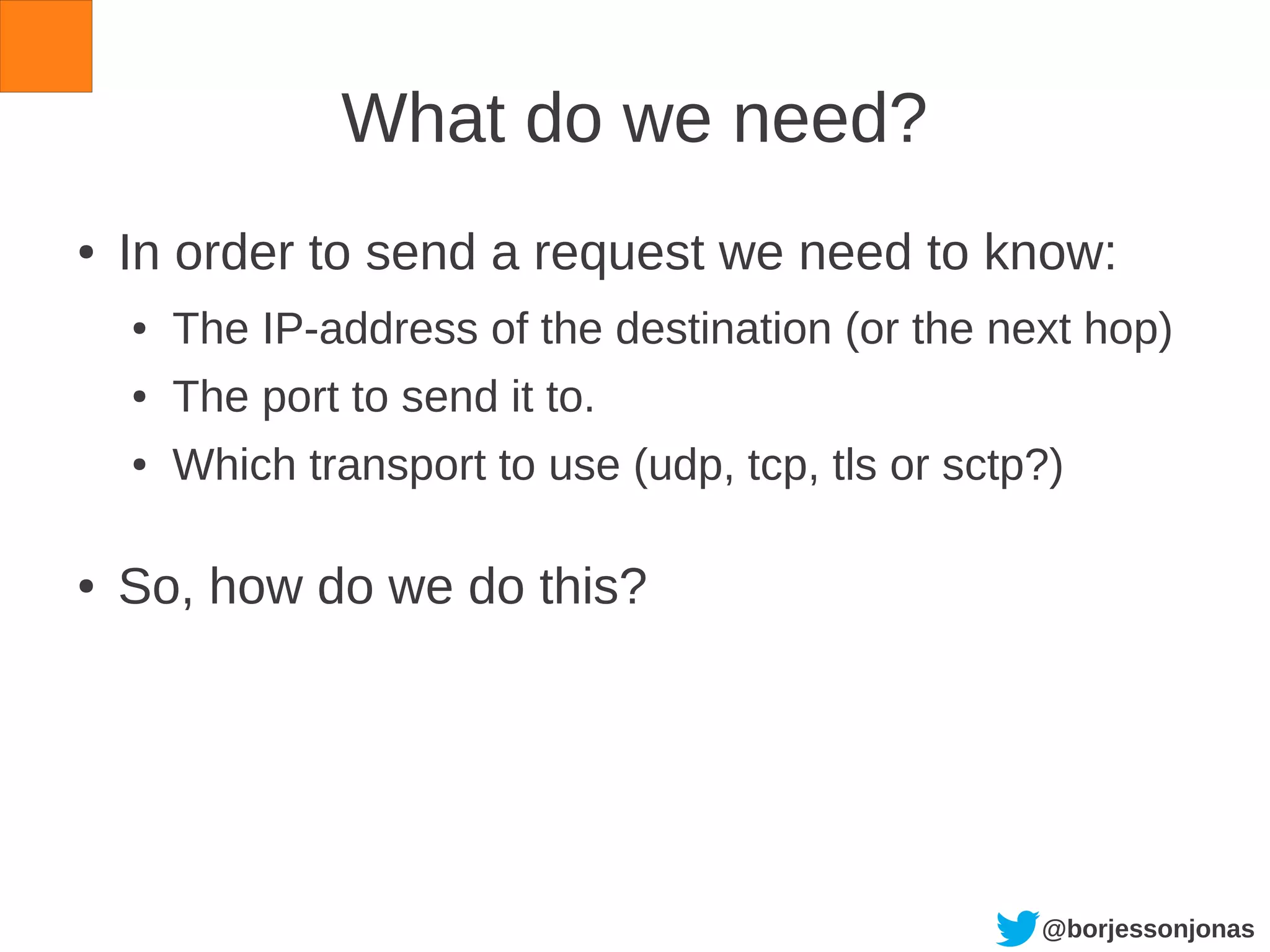
What do we need?
● In order to send a request we need to know:
● The IP-address of the destination (or the next hop)
● The port to send it to.
● Which transport to use (udp, tcp, tls or sctp?)
● So, how do we do this?
@borjessonjonas
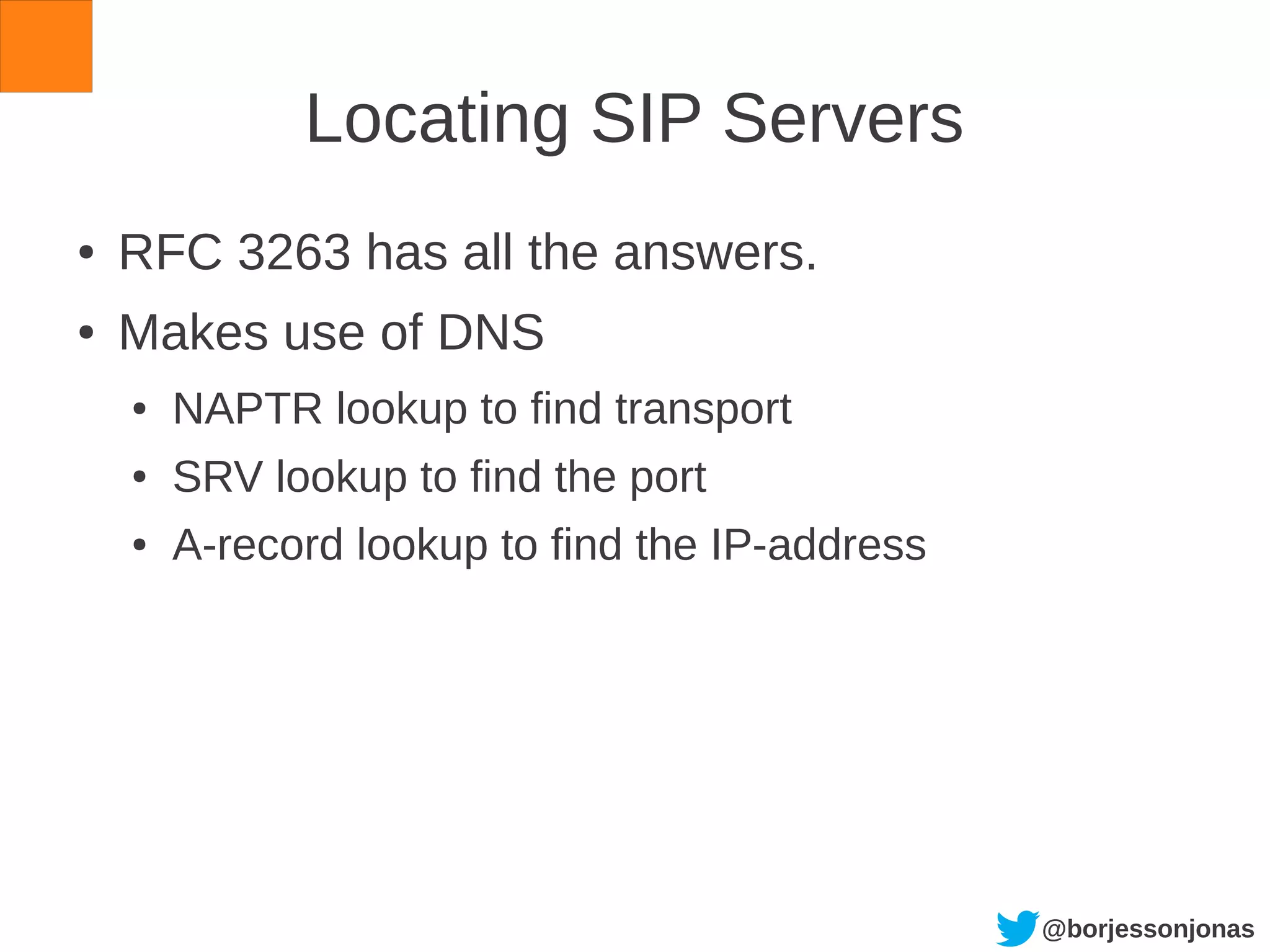
Locating SIP Servers
● RFC 3263 has all the answers.
● Makes use of DNS
● NAPTR lookup to find transport
● SRV lookup to find the port
● A-record lookup to find the IP-address
@borjessonjonas
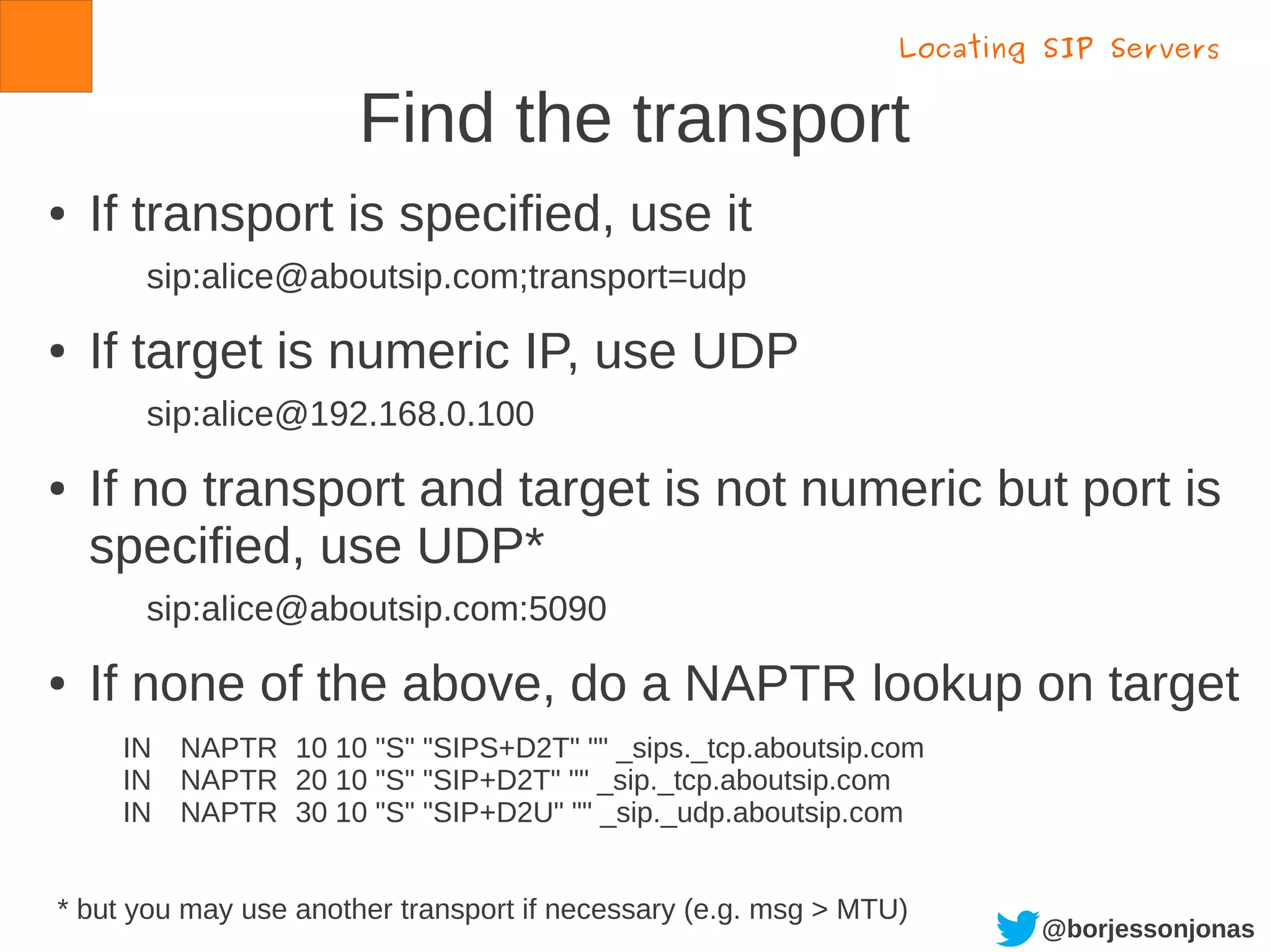
Find the transport
● If transport is specified, use it
sip:alice@aboutsip.com;transport=udp
● If target is numeric IP, use UDP
sip:alice@192.168.0.100
● If no transport and target is not numeric but port is
specified, use UDP*
sip:alice@aboutsip.com:5090
● If none of the above, do a NAPTR lookup on target
IN NAPTR 10 10 "S" "SIPS+D2T" "" _sips._tcp.aboutsip.com
IN NAPTR 20 10 "S" "SIP+D2T" "" _sip._tcp.aboutsip.com
IN NAPTR 30 10 "S" "SIP+D2U" "" _sip._udp.aboutsip.com
Locating SIP Servers
* but you may use another transport if necessary (e.g. msg > MTU)
@borjessonjonas
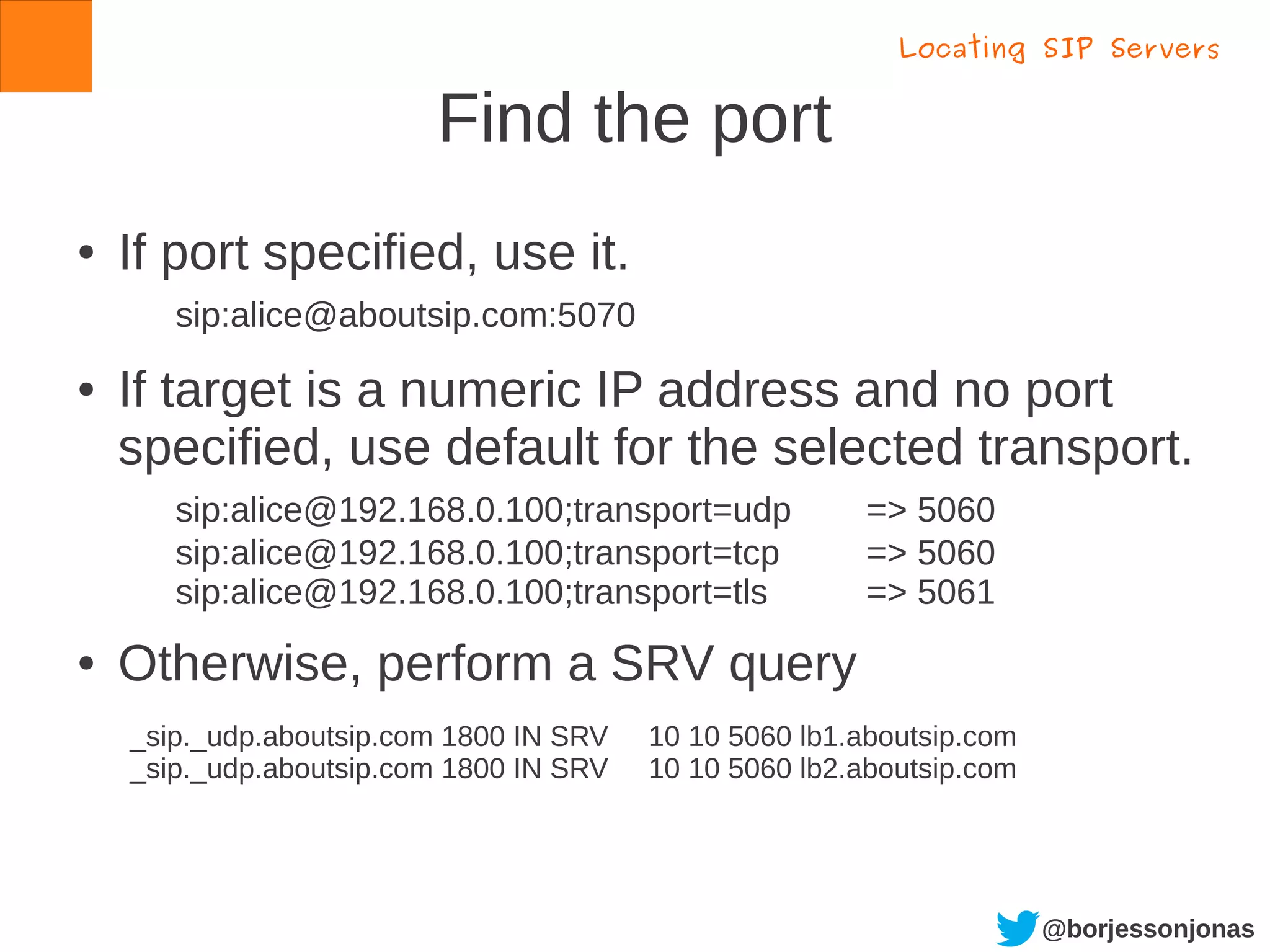
Find the port
● If port specified, use it.
sip:alice@aboutsip.com:5070
● If target is a numeric IP address and no port
specified, use default for the selected transport.
sip:alice@192.168.0.100;transport=udp => 5060
sip:alice@192.168.0.100;transport=tcp => 5060
sip:alice@192.168.0.100;transport=tls => 5061
● Otherwise, perform a SRV query
Locating SIP Servers
_sip._udp.aboutsip.com 1800 IN SRV 10 10 5060 lb1.aboutsip.com
_sip._udp.aboutsip.com 1800 IN SRV 10 10 5060 lb2.aboutsip.com
@borjessonjonas
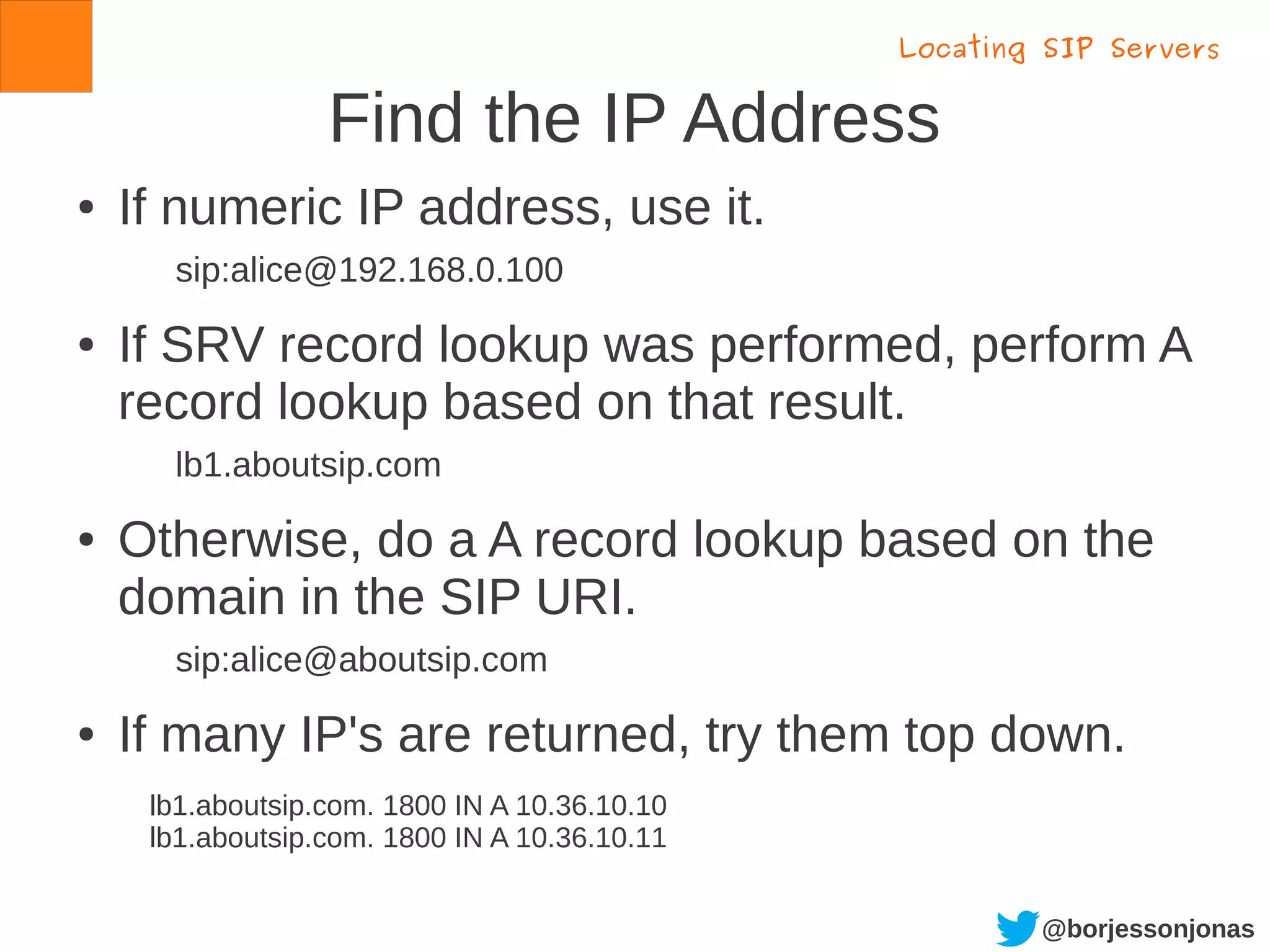
Find the IP Address
● If numeric IP address, use it.
sip:alice@192.168.0.100
● If SRV record lookup was performed, perform A
record lookup based on that result.
lb1.aboutsip.com
● Otherwise, do a A record lookup based on the
domain in the SIP URI.
sip:alice@aboutsip.com
● If many IP's are returned, try them top down.
Locating SIP Servers
lb1.aboutsip.com. 1800 IN A 10.36.10.10
lb1.aboutsip.com. 1800 IN A 10.36.10.11
@borjessonjonas
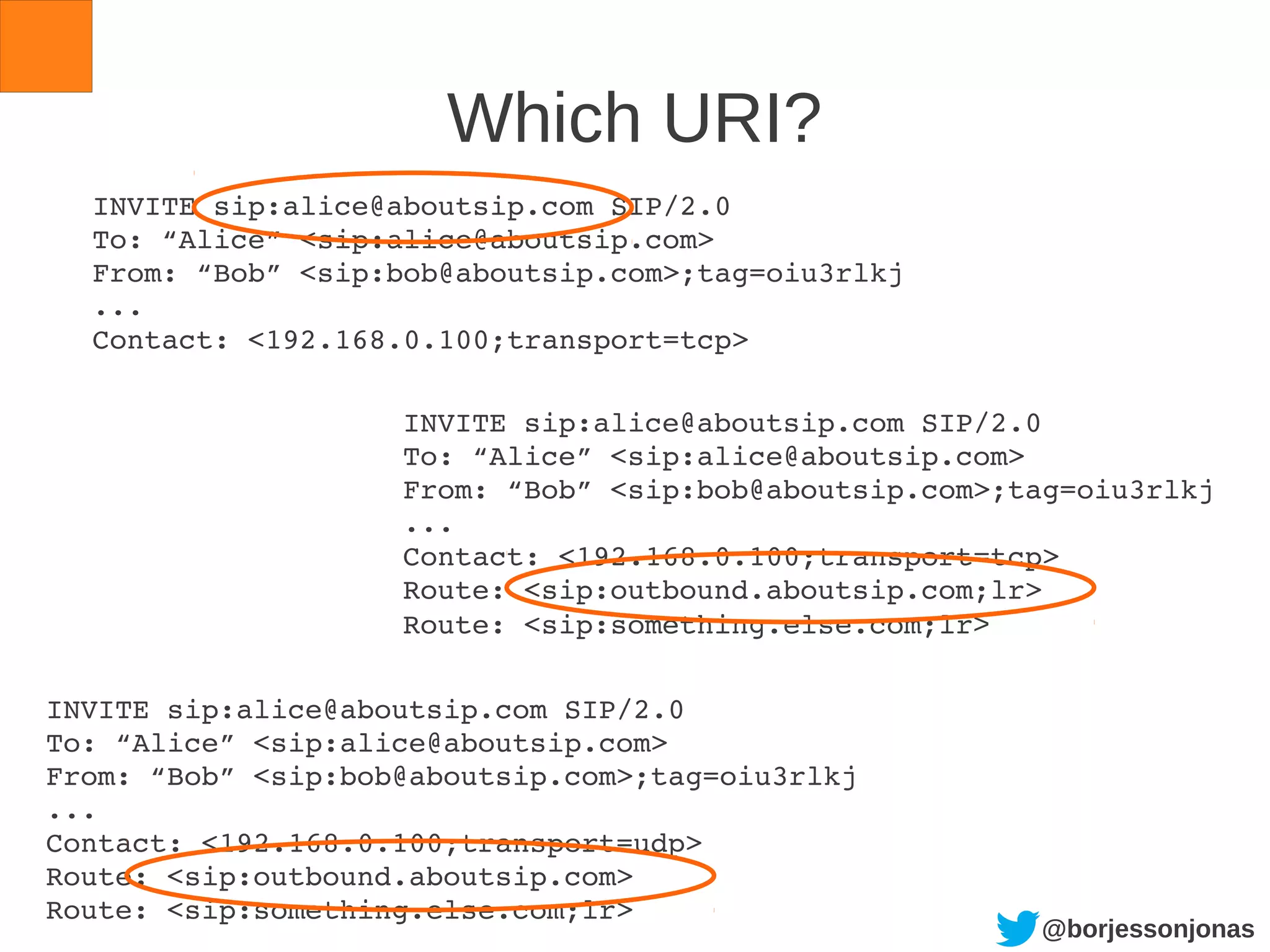
Which URI?
INVITE sip:alice@aboutsip.com SIP/2.0
To: “Alice” <sip:alice@aboutsip.com>
From: “Bob” <sip:bob@aboutsip.com>;tag=oiu3rlkj
...
Contact: <192.168.0.100;transport=tcp>
INVITE sip:alice@aboutsip.com SIP/2.0
To: “Alice” <sip:alice@aboutsip.com>
From: “Bob” <sip:bob@aboutsip.com>;tag=oiu3rlkj
...
Contact: <192.168.0.100;transport=tcp>
Route: <sip:outbound.aboutsip.com;lr>
Route: <sip:something.else.com;lr>
INVITE sip:alice@aboutsip.com SIP/2.0
To: “Alice” <sip:alice@aboutsip.com>
From: “Bob” <sip:bob@aboutsip.com>;tag=oiu3rlkj
...
Contact: <192.168.0.100;transport=udp>
Route: <sip:outbound.aboutsip.com>
Route: <sip:something.else.com;lr>
@borjessonjonas
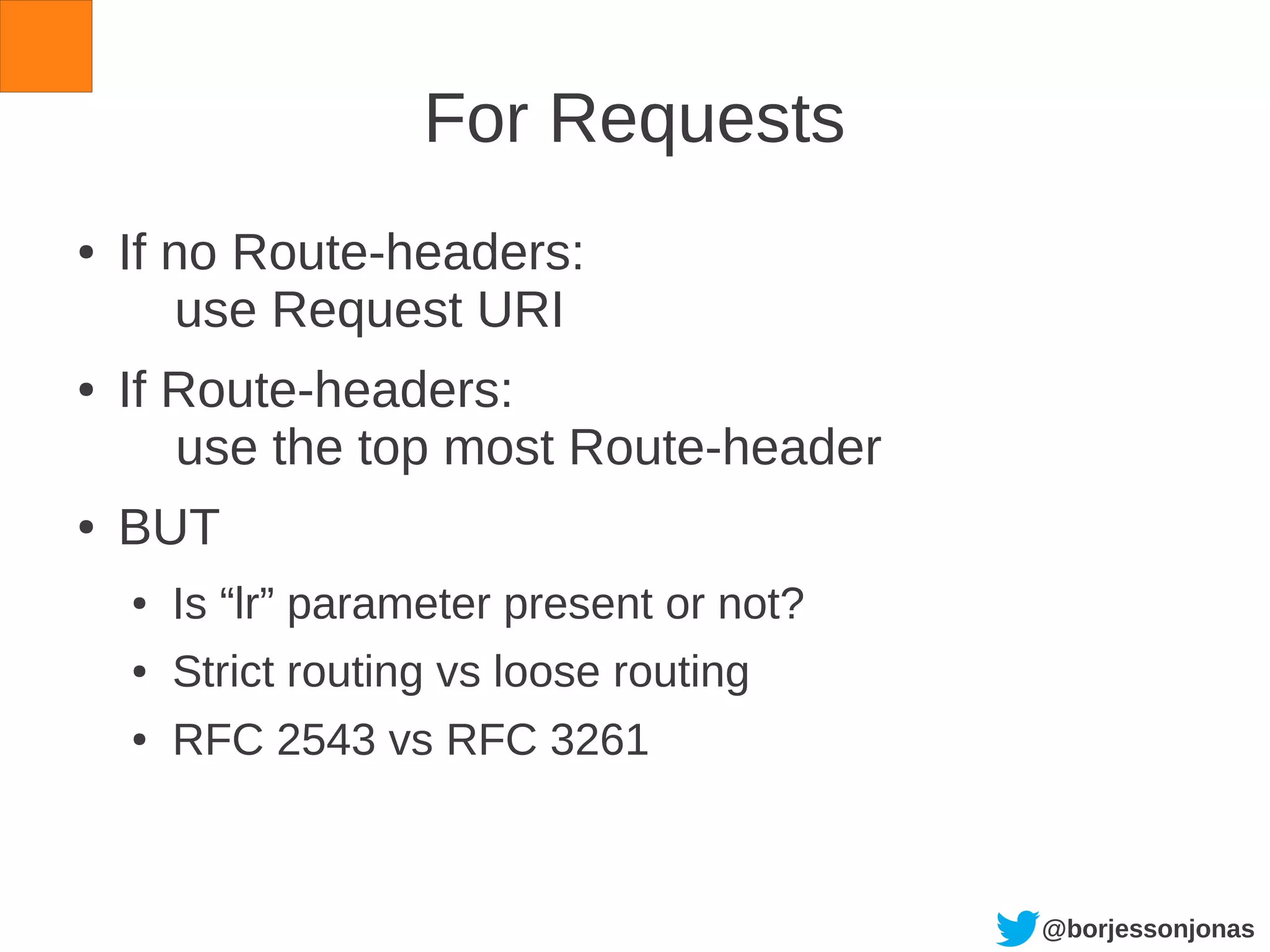
For Requests
● If no Route-headers:
use Request URI
● If Route-headers:
use the top most Route-header
● BUT
● Is “lr” parameter present or not?
● Strict routing vs loose routing
● RFC 2543 vs RFC 3261
@borjessonjonas
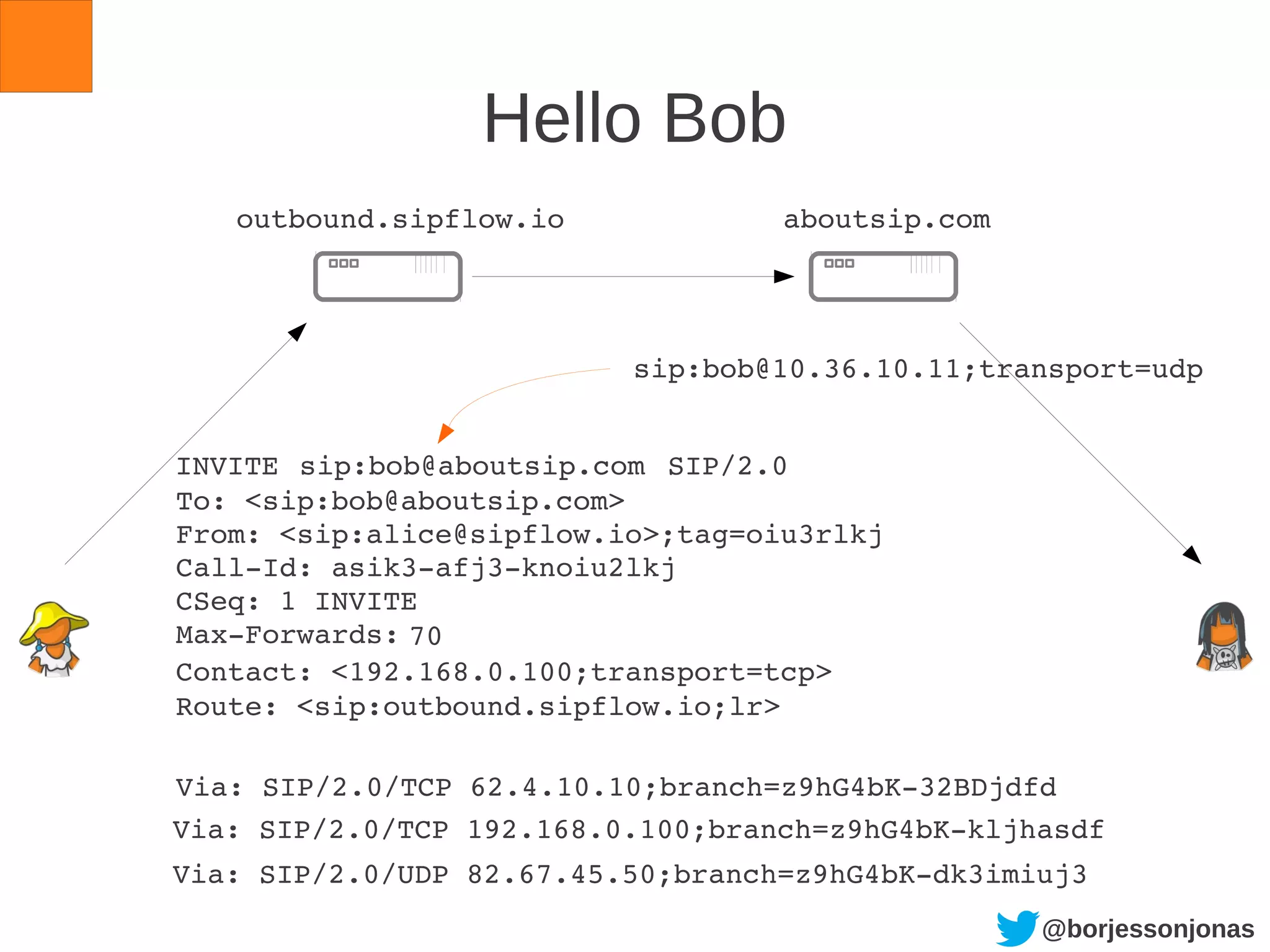
Hello Bob
To: <sip:bob@aboutsip.com>
From: <sip:alice@sipflow.io>;tag=oiu3rlkj
Call­Id: asik3­afj3­knoiu2lkj
CSeq: 1 INVITE
Max­Forwards:
outbound.sipflow.io aboutsip.com
Route: <sip:outbound.sipflow.io;lr>
70
Contact: <192.168.0.100;transport=tcp>
Via: SIP/2.0/TCP 192.168.0.100;branch=z9hG4bK­kljhasdf
Via: SIP/2.0/TCP 62.4.10.10;branch=z9hG4bK­32BDjdfd
INVITE sip:bob@aboutsip.com SIP/2.0
sip:bob@10.36.10.11;transport=udp
Via: SIP/2.0/UDP 82.67.45.50;branch=z9hG4bK­dk3imiuj3
@borjessonjonas
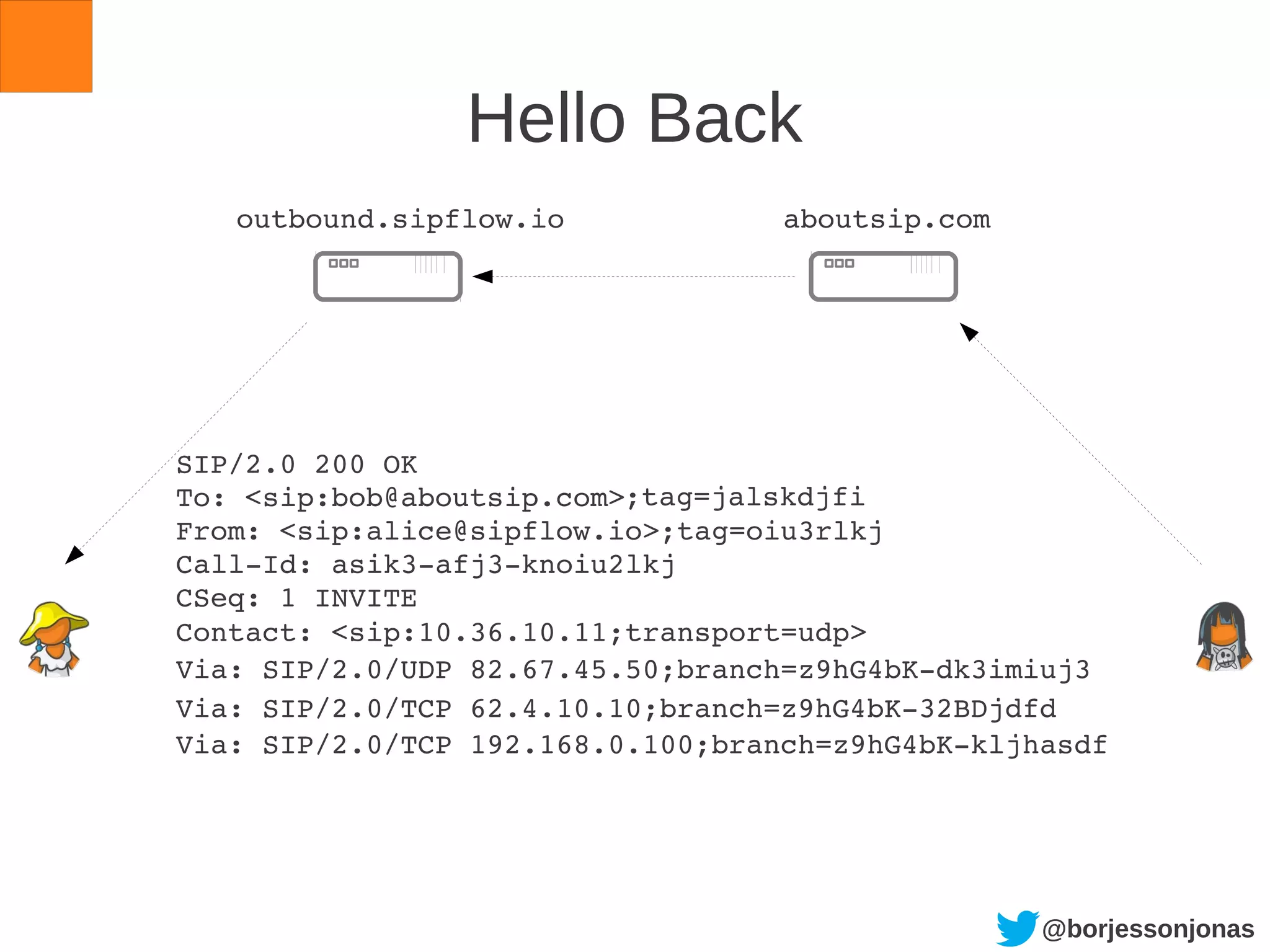
Hello Back
SIP/2.0 200 OK
To: <sip:bob@aboutsip.com>
From: <sip:alice@sipflow.io>;tag=oiu3rlkj
Call­Id: asik3­afj3­knoiu2lkj
CSeq: 1 INVITE
outbound.sipflow.io aboutsip.com
Contact: <sip:10.36.10.11;transport=udp>
Via: SIP/2.0/TCP 192.168.0.100;branch=z9hG4bK­kljhasdf
Via: SIP/2.0/TCP 62.4.10.10;branch=z9hG4bK­32BDjdfd
Via: SIP/2.0/UDP 82.67.45.50;branch=z9hG4bK­dk3imiuj3
;tag=jalskdjfi
@borjessonjonas
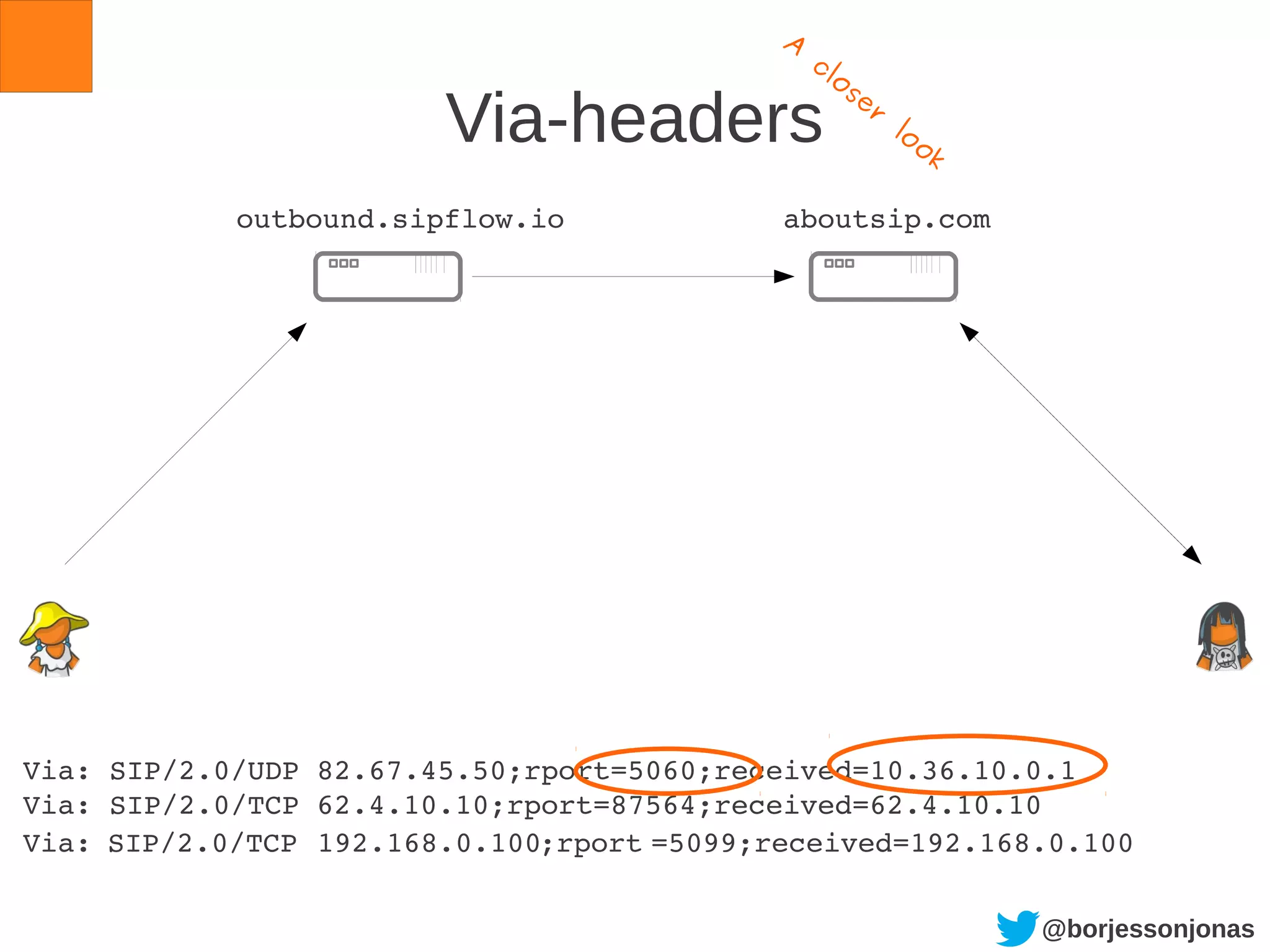
Via-headers
outbound.sipflow.io aboutsip.com
Via:  
Via: SIP/2.0/TCP 62.4.10.10;rport=87564;received=62.4.10.10
Via: SIP/2.0/UDP 82.67.45.50;rport=5060;received=10.36.10.0.1
A
closer
look
192.168.0.100;rportSIP/2.0/TCP ;received=192.168.0.100=5099
@borjessonjonas
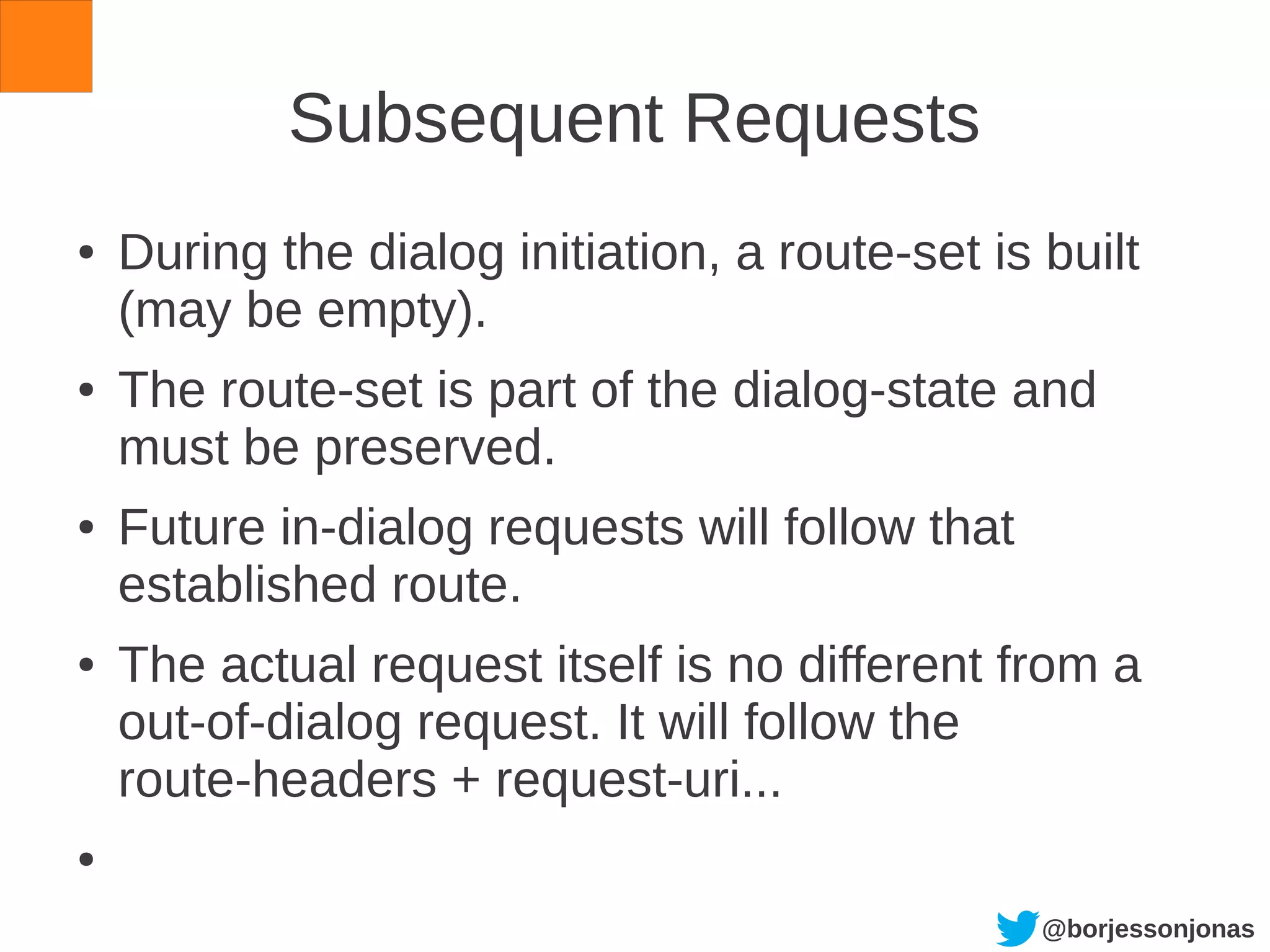
Subsequent Requests
● During the dialog initiation, a route-set is built
(may be empty).
● The route-set is part of the dialog-state and
must be preserved.
● Future in-dialog requests will follow that
established route.
● The actual request itself is no different from a
out-of-dialog request. It will follow the
route-headers + request-uri...
●
@borjessonjonas
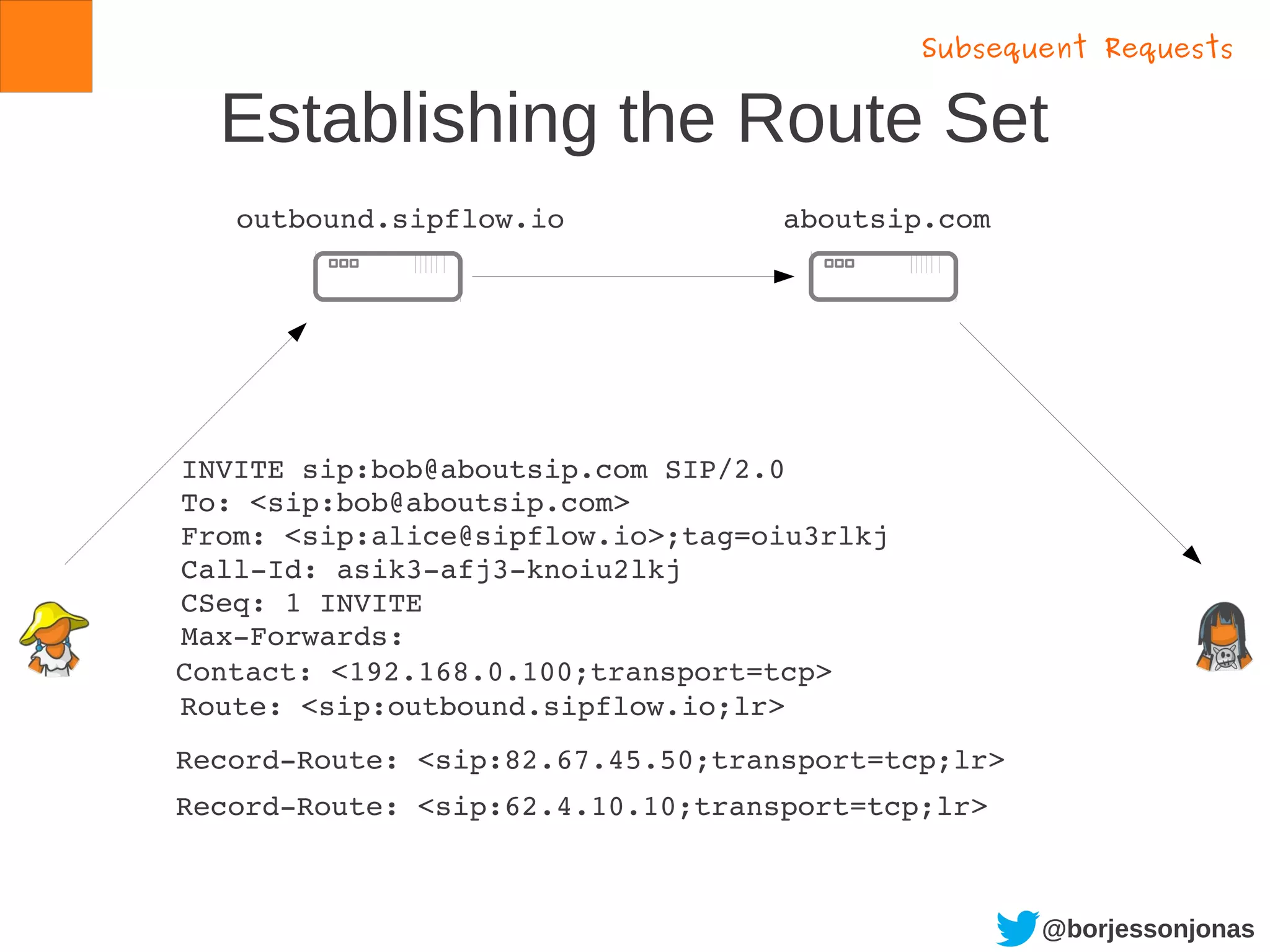
Establishing the Route Set
INVITE sip:bob@aboutsip.com SIP/2.0
To: <sip:bob@aboutsip.com>
From: <sip:alice@sipflow.io>;tag=oiu3rlkj
Call­Id: asik3­afj3­knoiu2lkj
CSeq: 1 INVITE
Max­Forwards:
outbound.sipflow.io aboutsip.com
Route: <sip:outbound.sipflow.io;lr>
Contact: <192.168.0.100;transport=tcp>
Record­Route: <sip:62.4.10.10;transport=tcp;lr>
Record­Route: <sip:82.67.45.50;transport=tcp;lr>
Subsequent Requests
@borjessonjonas
Establishing the Route Set
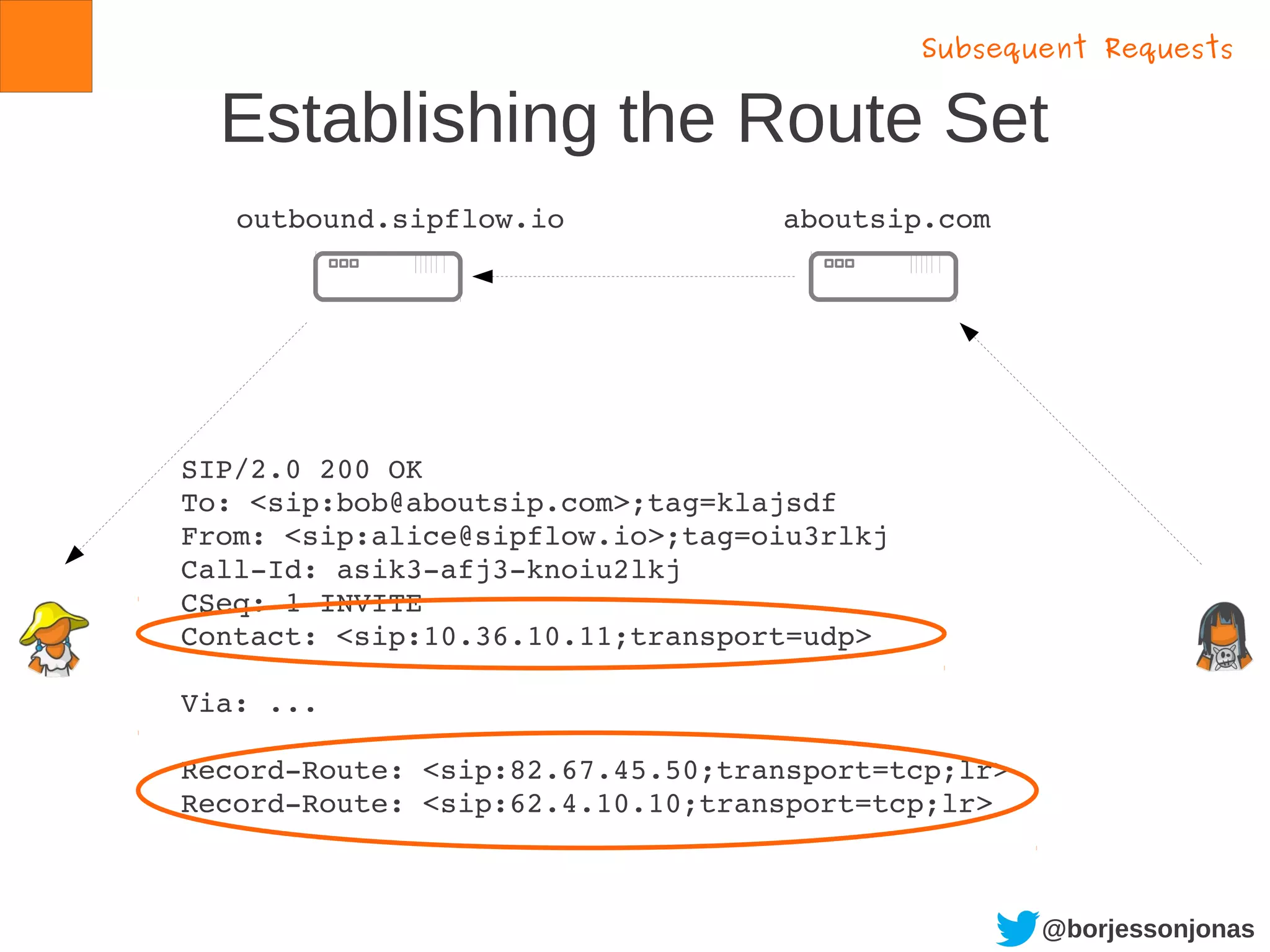
SIP/2.0 200 OK
To: <sip:bob@aboutsip.com>;tag=klajsdf
From: <sip:alice@sipflow.io>;tag=oiu3rlkj
Call­Id: asik3­afj3­knoiu2lkj
CSeq: 1 INVITE
Contact: <sip:10.36.10.11;transport=udp>
Via: ...
Record­Route: <sip:82.67.45.50;transport=tcp;lr>
Record­Route: <sip:62.4.10.10;transport=tcp;lr>
outbound.sipflow.io aboutsip.com
Subsequent Requests
@borjessonjonas
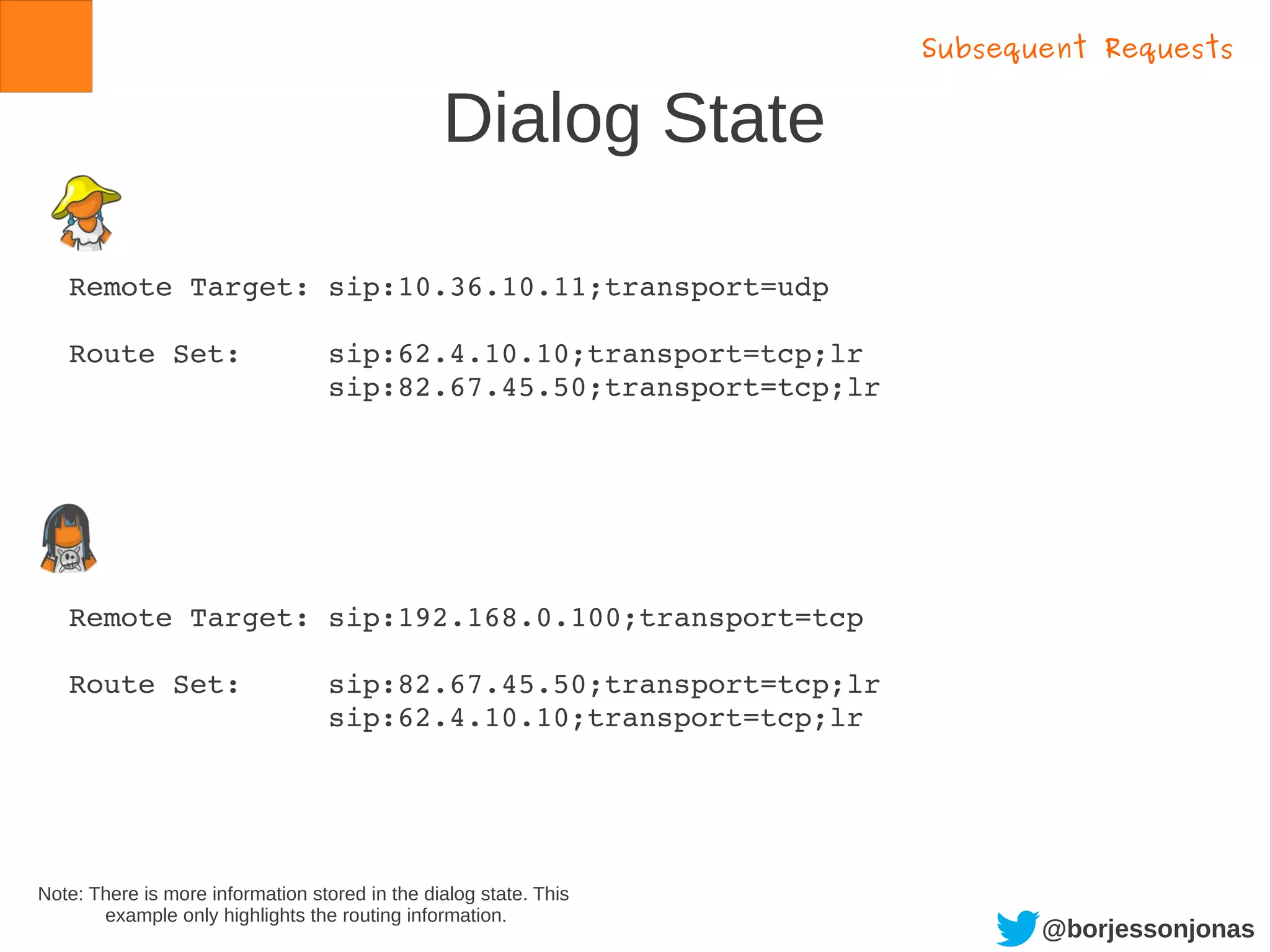
Dialog State
Remote Target: sip:10.36.10.11;transport=udp
Route Set:     sip:62.4.10.10;transport=tcp;lr
               sip:82.67.45.50;transport=tcp;lr
Subsequent Requests
Remote Target: sip:192.168.0.100;transport=tcp
Route Set:     sip:82.67.45.50;transport=tcp;lr
               sip:62.4.10.10;transport=tcp;lr
Note: There is more information stored in the dialog state. This
example only highlights the routing information.
@borjessonjonas
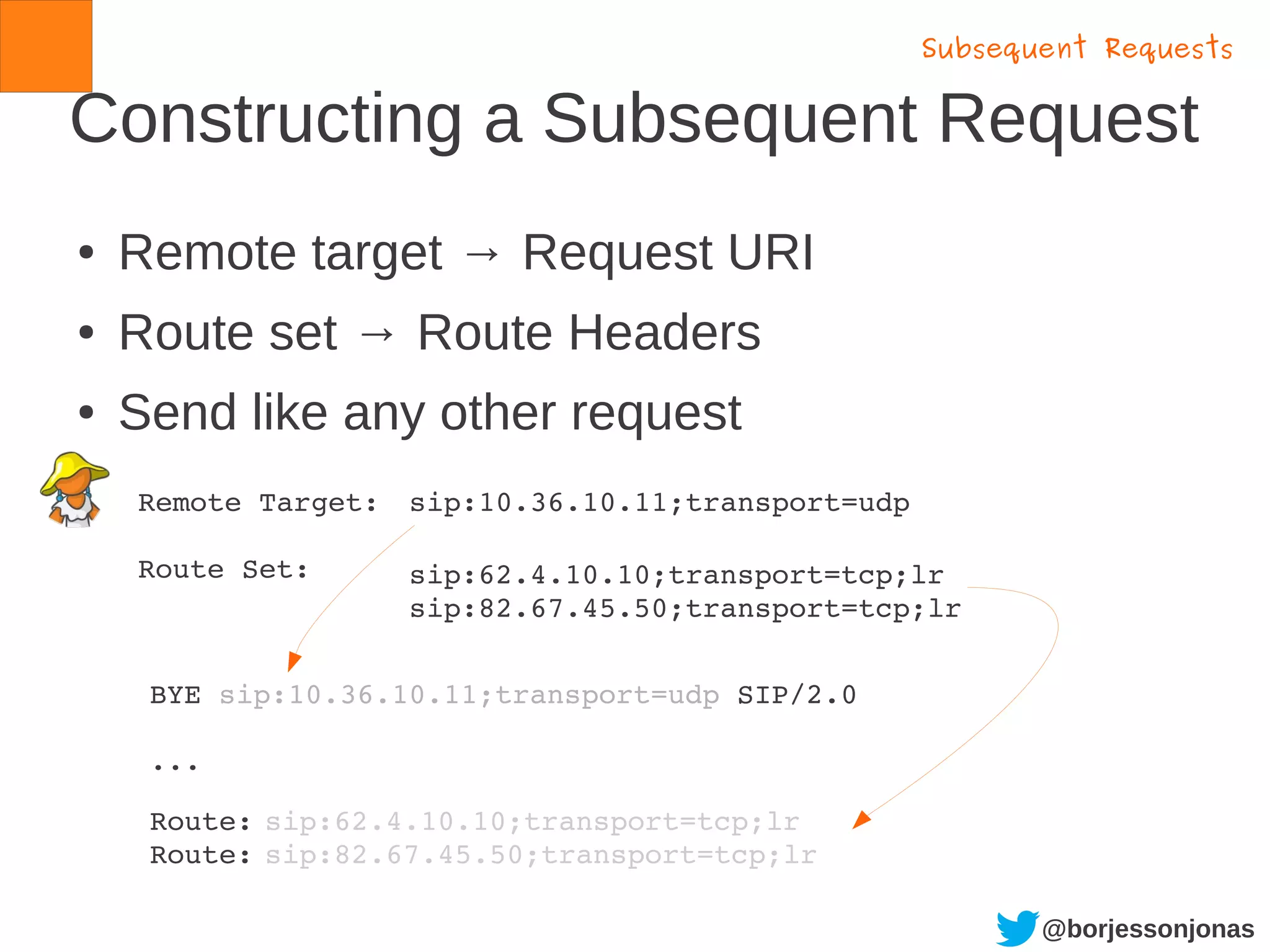
Constructing a Subsequent Request
● Remote target → Request URI
● Route set → Route Headers
● Send like any other request
Subsequent Requests
Remote Target: 
Route Set:
sip:10.36.10.11;transport=udp
sip:62.4.10.10;transport=tcp;lr
sip:82.67.45.50;transport=tcp;lr
BYE                               SIP/2.0
...
Route:
Route:
sip:10.36.10.11;transport=udp
sip:62.4.10.10;transport=tcp;lr
sip:82.67.45.50;transport=tcp;lr
@borjessonjonas
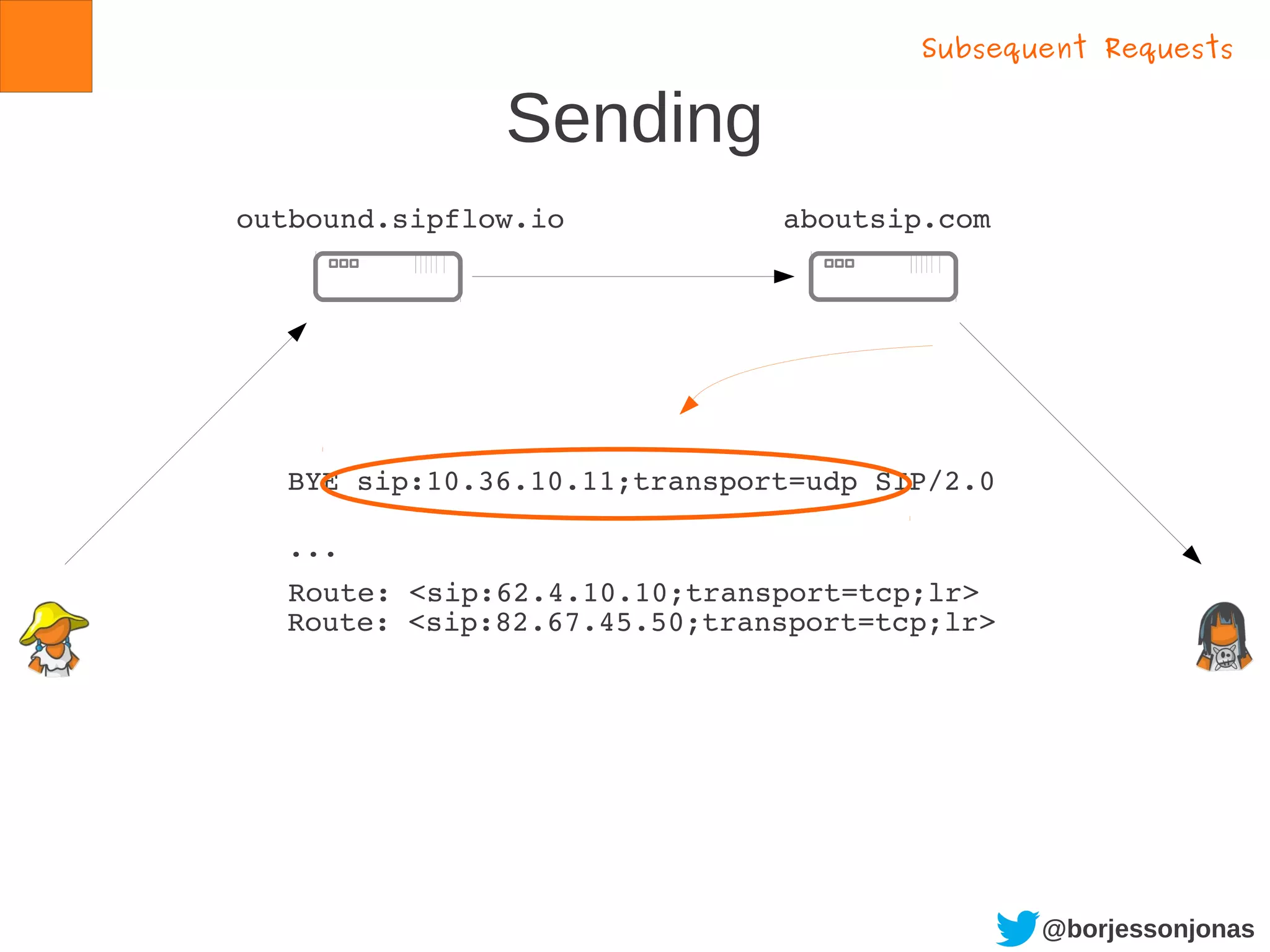
Sending
outbound.sipflow.io aboutsip.com
Subsequent Requests
BYE sip:10.36.10.11;transport=udp SIP/2.0
...
Route: <sip:62.4.10.10;transport=tcp;lr>
Route: <sip:82.67.45.50;transport=tcp;lr>
@borjessonjonas
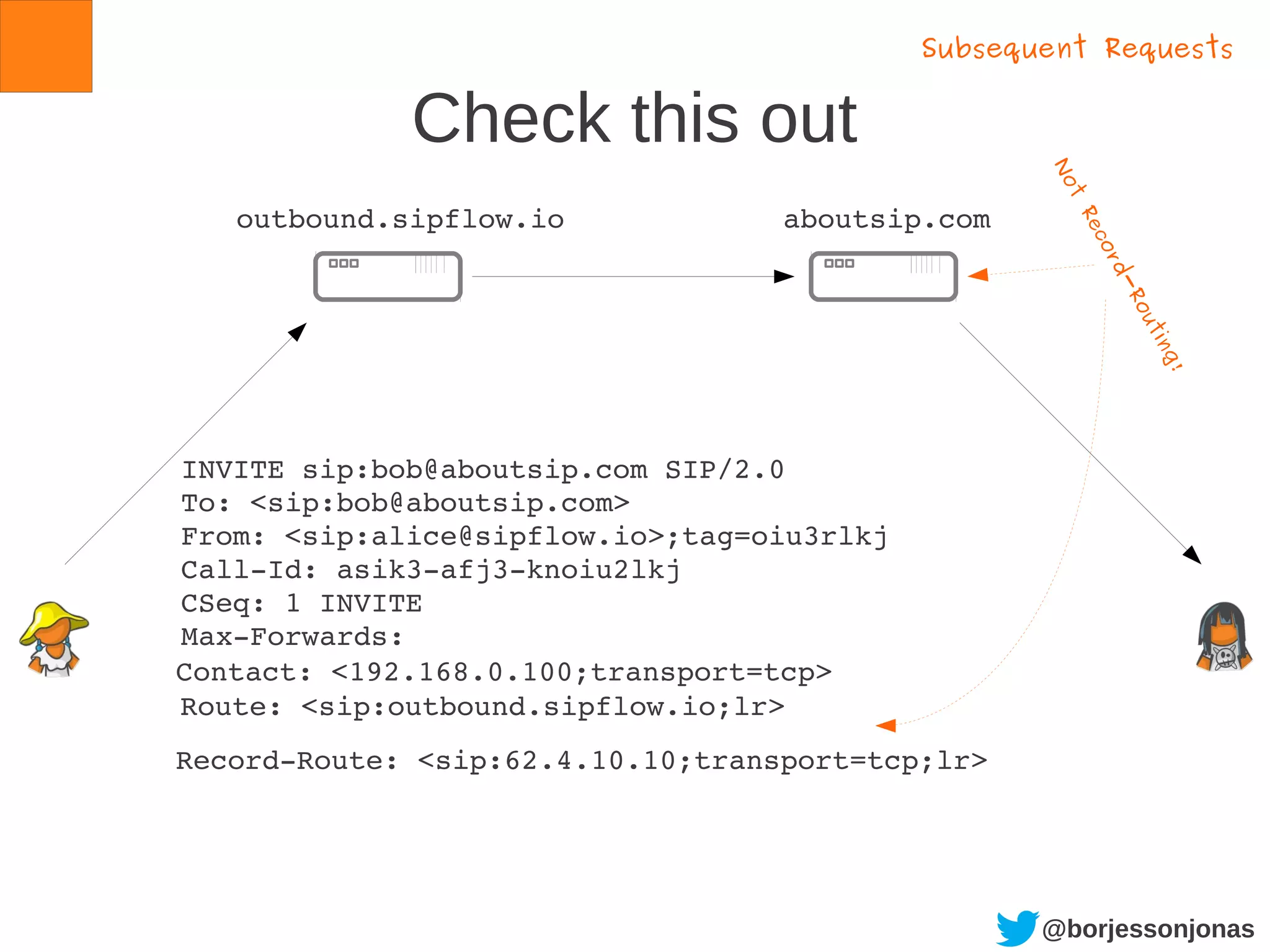
Check this out
INVITE sip:bob@aboutsip.com SIP/2.0
To: <sip:bob@aboutsip.com>
From: <sip:alice@sipflow.io>;tag=oiu3rlkj
Call­Id: asik3­afj3­knoiu2lkj
CSeq: 1 INVITE
Max­Forwards:
outbound.sipflow.io aboutsip.com
Route: <sip:outbound.sipflow.io;lr>
Contact: <192.168.0.100;transport=tcp>
Record­Route: <sip:62.4.10.10;transport=tcp;lr>
Subsequent Requests
Not
Record-Routing!
@borjessonjonas
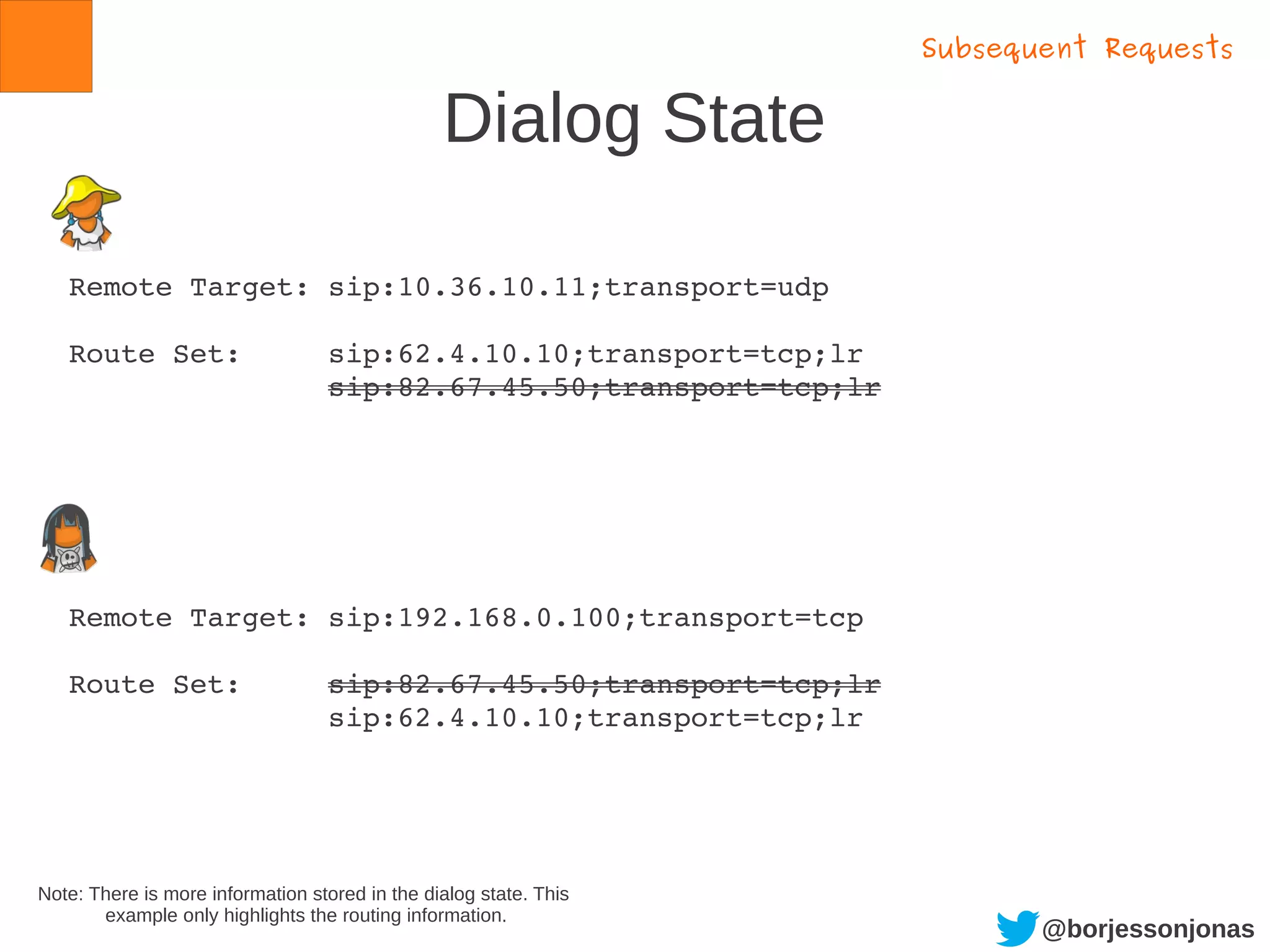
Dialog State
Remote Target: sip:10.36.10.11;transport=udp
Route Set:     sip:62.4.10.10;transport=tcp;lr
               sip:82.67.45.50;transport=tcp;lr
Subsequent Requests
Remote Target: sip:192.168.0.100;transport=tcp
Route Set:     sip:82.67.45.50;transport=tcp;lr
               sip:62.4.10.10;transport=tcp;lr
Note: There is more information stored in the dialog state. This
example only highlights the routing information.
@borjessonjonas
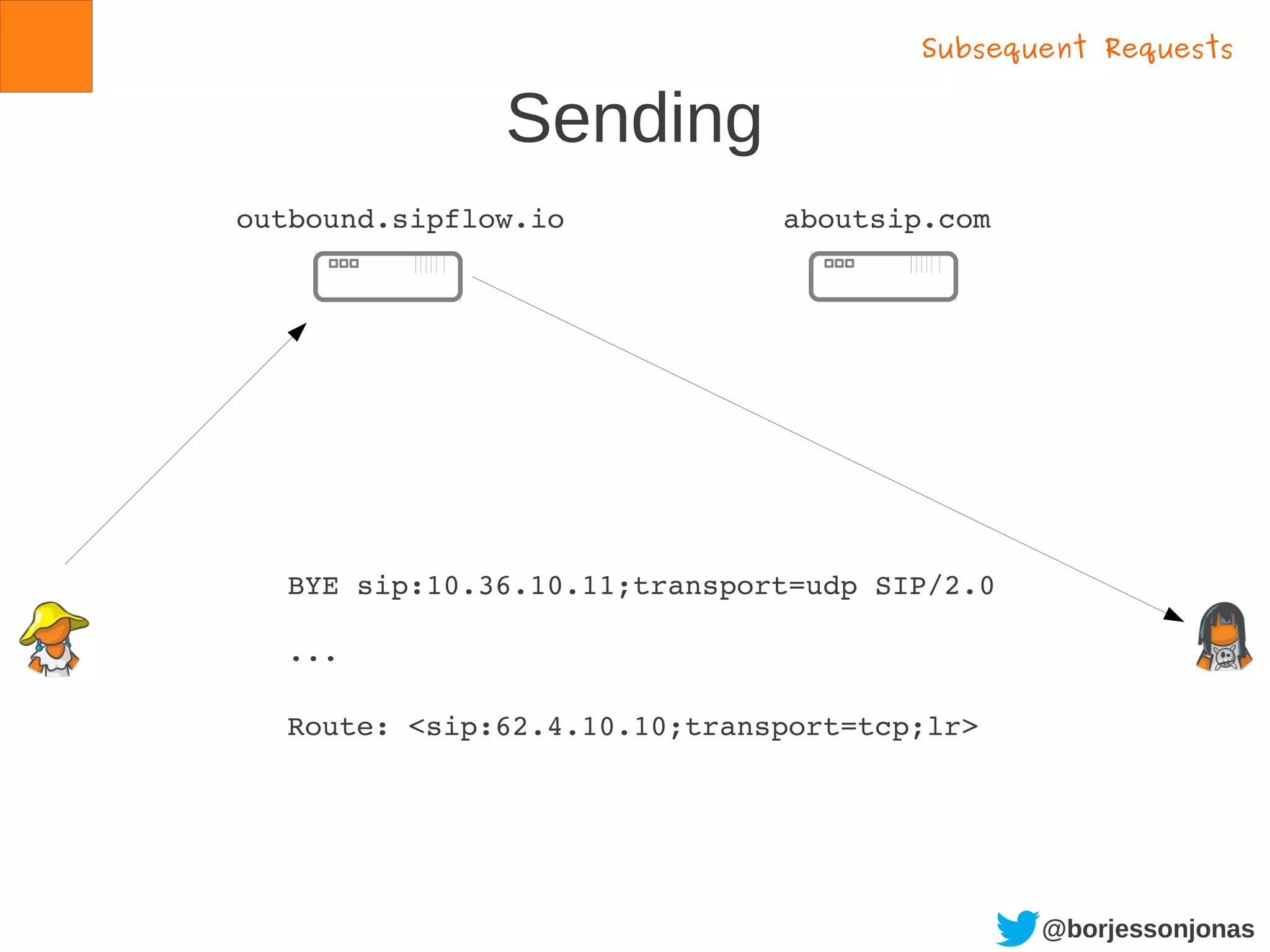
Sending
outbound.sipflow.io aboutsip.com
Subsequent Requests
BYE sip:10.36.10.11;transport=udp SIP/2.0
...
Route: <sip:62.4.10.10;transport=tcp;lr>
@borjessonjonas
Summary
@borjessonjonas
Summary
● RFC 3263 is important! Read it!
● RFC 3261 explains which the “next uri” is:
● Requests – follows Route-headers plus
Request-URI
● Responses – follows Via-headers
● Watch out for the old strict routing.
● Subsequent requests are really no different.
● Make sure you understand remote-target +
route set as stored in the Dialog State.
@borjessonjonas
More presentations and material
at aboutsip.com
Thanks!

Aboutsip - SIP Routing