Naming & Binding Paul Krzyzanowski [email_address] [email_address] Distributed Systems Except as otherwise noted, the content of this presentation is licensed under the Creative Commons Attribution 2.5 License.
My 15” MacBook Pro The rightmost computer on my desk Paul’s aluminum laptop, but not the big or the small one. hedwig hedwig.pk.org 192.168.60.148 00:14:51:ec:f2:5b
Naming things User names Login, email Machine names rlogin, email, web Files Devices Variables in programs Network services
Naming Service Allows you to look up  names Often returns an  address  as a response Might be implemented as Search through file Client-server program Database query …
What’s a name? Name : identifies what you want Address : identifies where it is Route : identifies how to get there Binding : associates a name with an address “ choose a lower-level-implementation for a higher-level semantic construct” RFC 1498: Inter-network Naming, addresses, routing
Names Need names for: Services : e.g., time of day Nodes : computer that can run services Paths : route Objects within service : e.g. files on a file server Naming convention can take any format Ideally one that will suit application and user E.g., human readable names for humans, binary identifiers for machines
Uniqueness of names Easy on a small scale Problematic on a large scale Hierarchy allows uniqueness to be maintained compound name : set of atomic names connected with a name separator
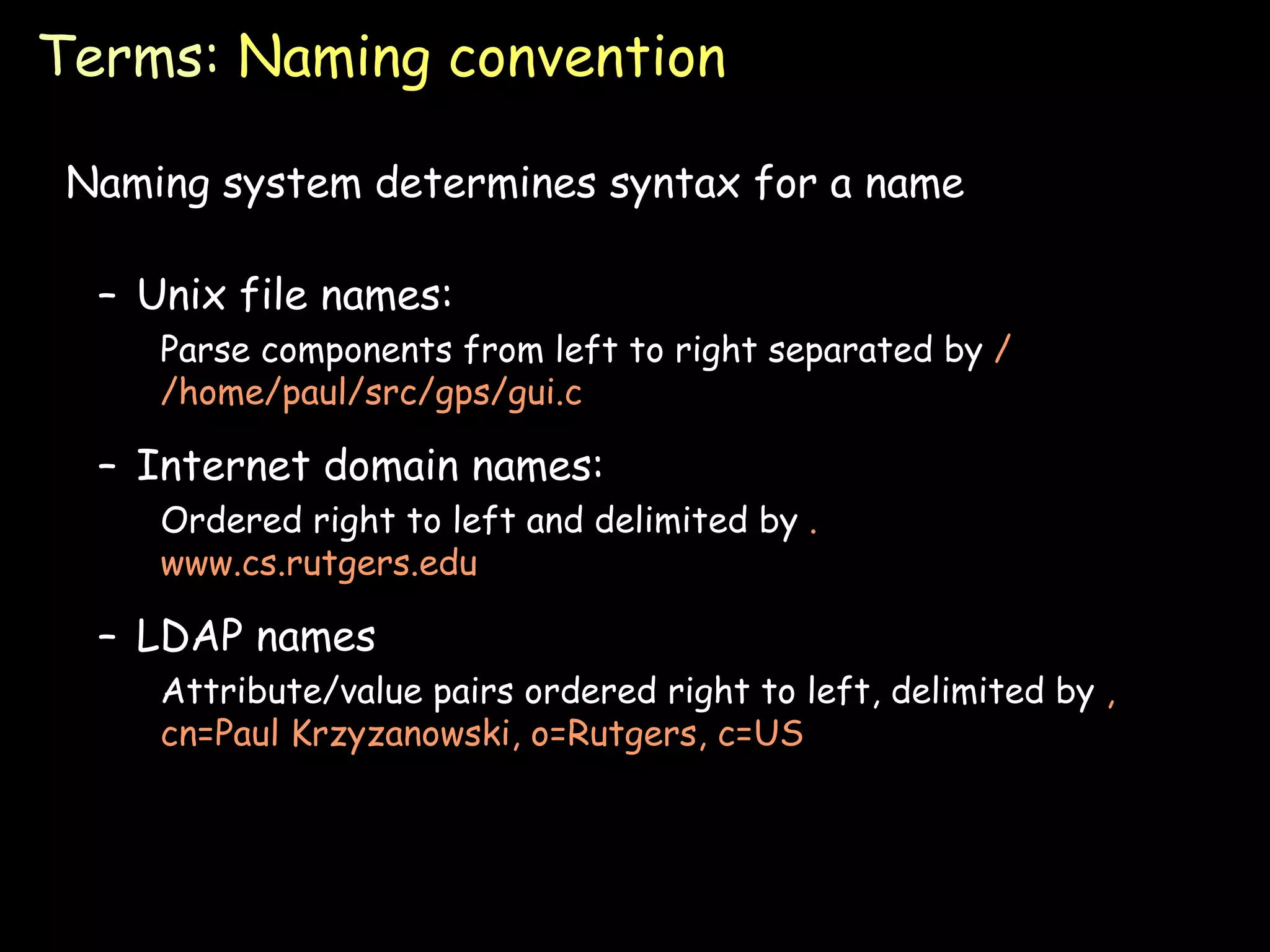
Terms:  Naming convention Naming system determines syntax for a name Unix file names: Parse components from left to right separated by  / /home/paul/src/gps/gui.c Internet domain names: Ordered right to left and delimited by  . www.cs.rutgers.edu LDAP names Attribute/value pairs ordered right to left, delimited by  ,   cn=Paul Krzyzanowski, o=Rutgers, c=US
Terms:  Context A particular set of  name    object  bindings Each context has an associated naming convention A name is  always  interpreted relative to some context E.g., directory  /usr  in the  UNIX file system
Terms:  Naming System Connected set of contexts of the same type (same naming convention) along with a common set of operations For example: System that implements DNS System that implements LDAP
Terms:  Name space Set of names in the naming system For example, Names of all files and directories in a UNIX file system
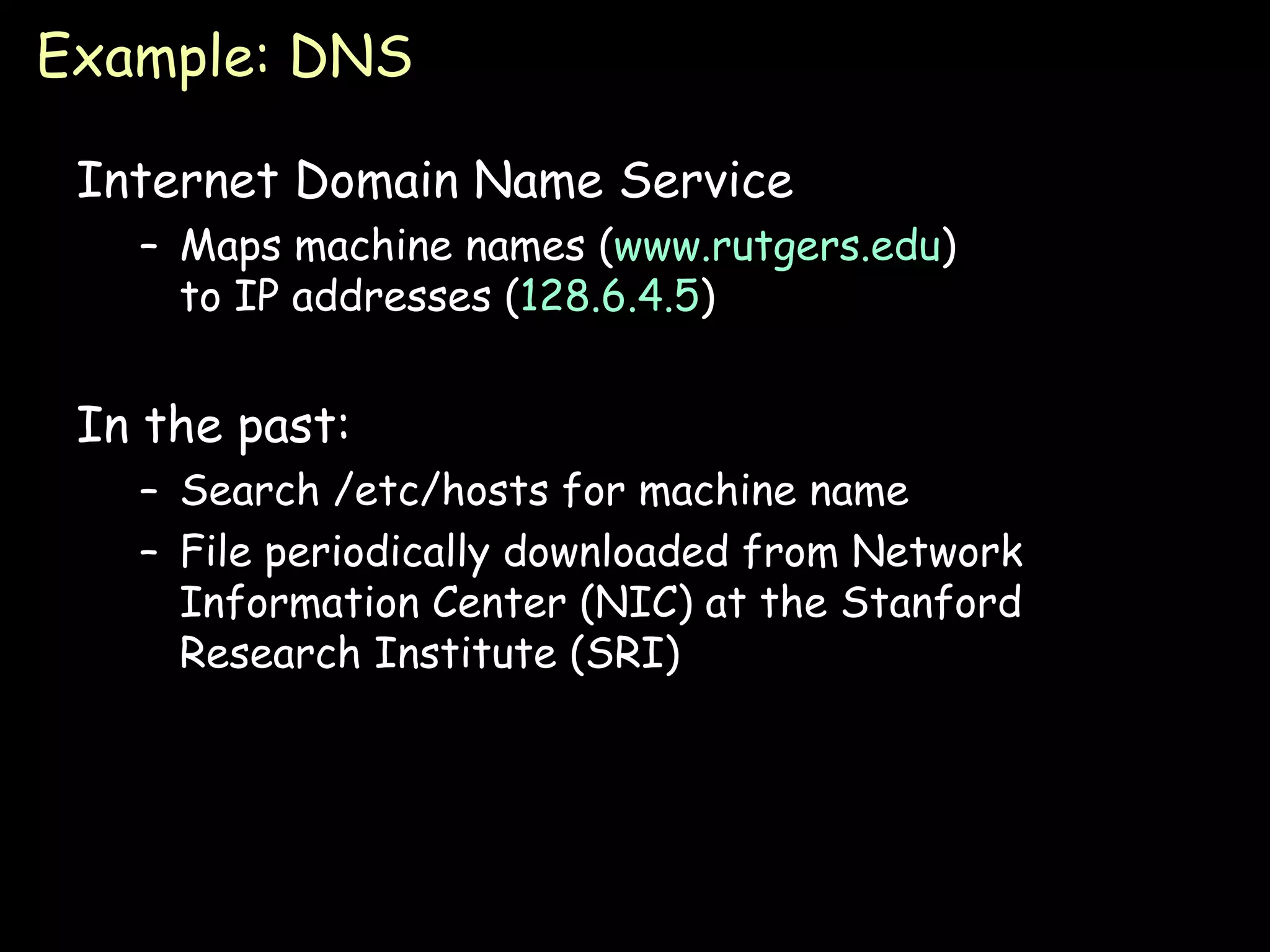
Terms:  Resolution Name lookup Return the underlying representation of the name For example, www.rutgers.edu    128.6.4.5
Directory Service Extension of naming service: Associates names with objects Allows objects to have attributes Can search based on attributes For example, Netscape directory: general-purpose directory service based on LDAP Directory can be object store: Look up printer object and send data stream to it
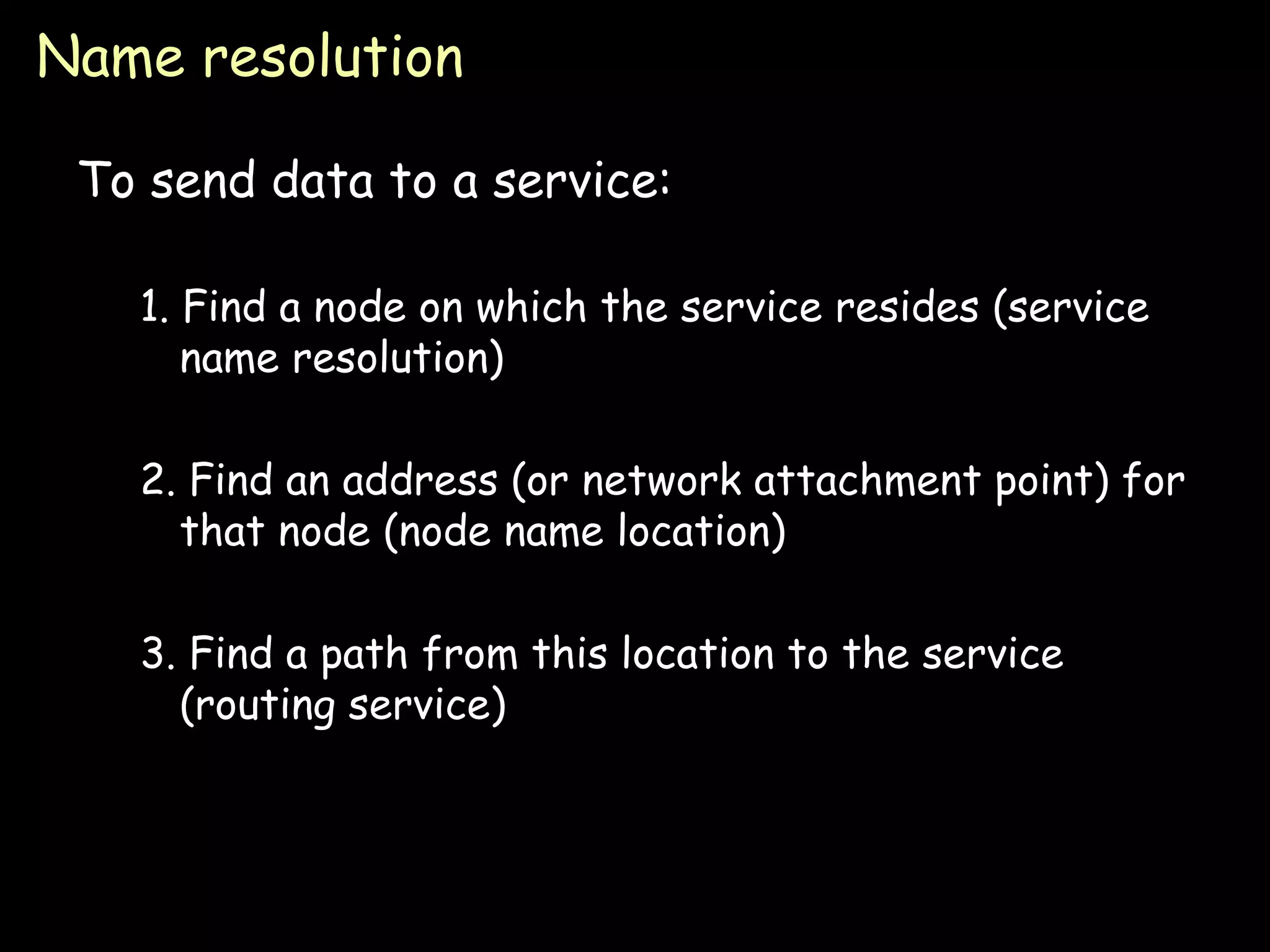
Name resolution To send data to a service: 1. Find a node on which the service resides (service name resolution) 2. Find an address (or network attachment point) for that node (node name location) 3. Find a path from this location to the service (routing service)
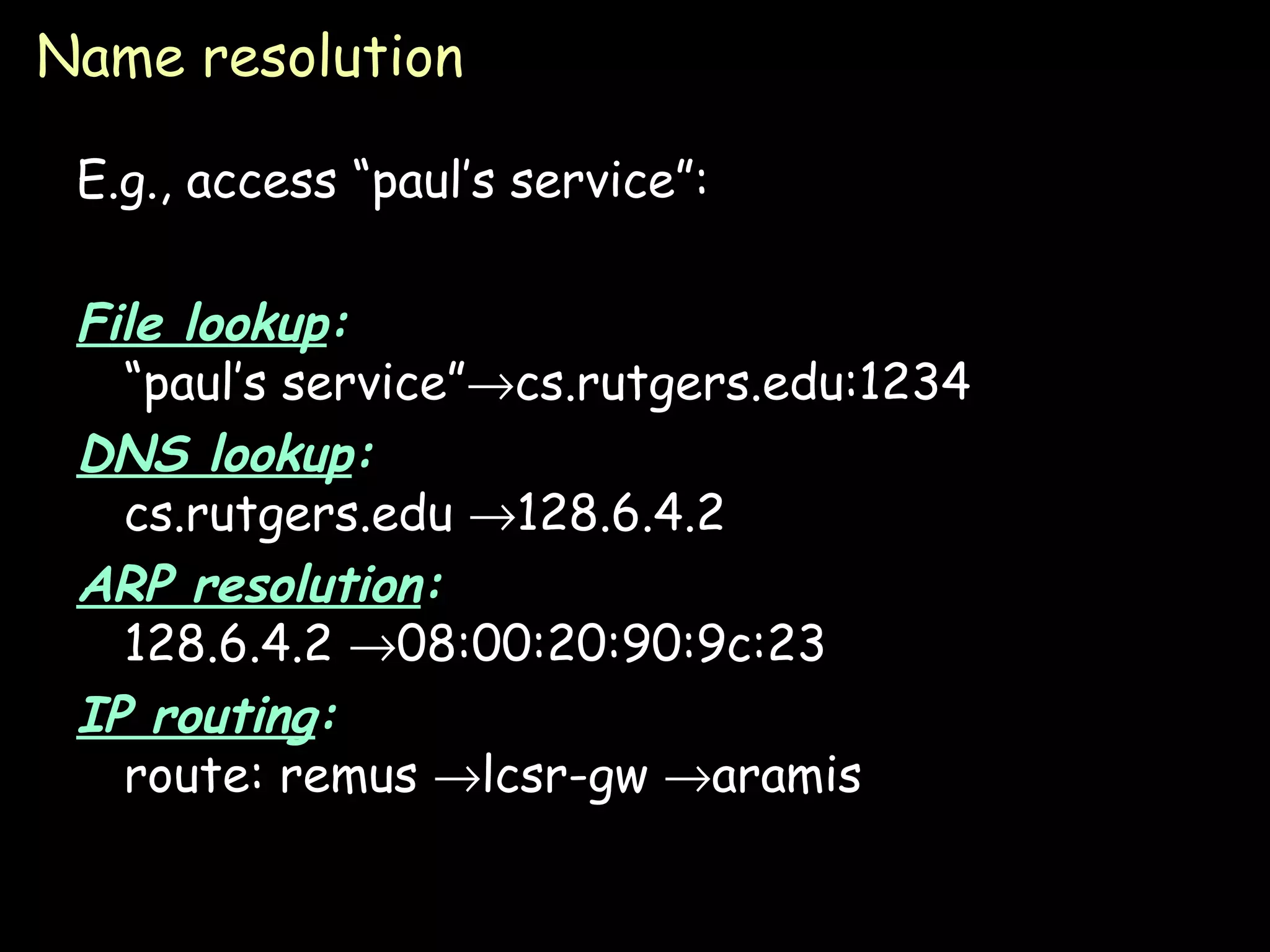
Name resolution E.g., access “paul’s service”: File lookup : “paul’s service”  cs.rutgers.edu:1234 DNS lookup : cs.rutgers.edu   128.6.4.2 ARP resolution : 128.6.4.2   08:00:20:90:9c:23 IP routing : route: remus   lcsr-gw   aramis
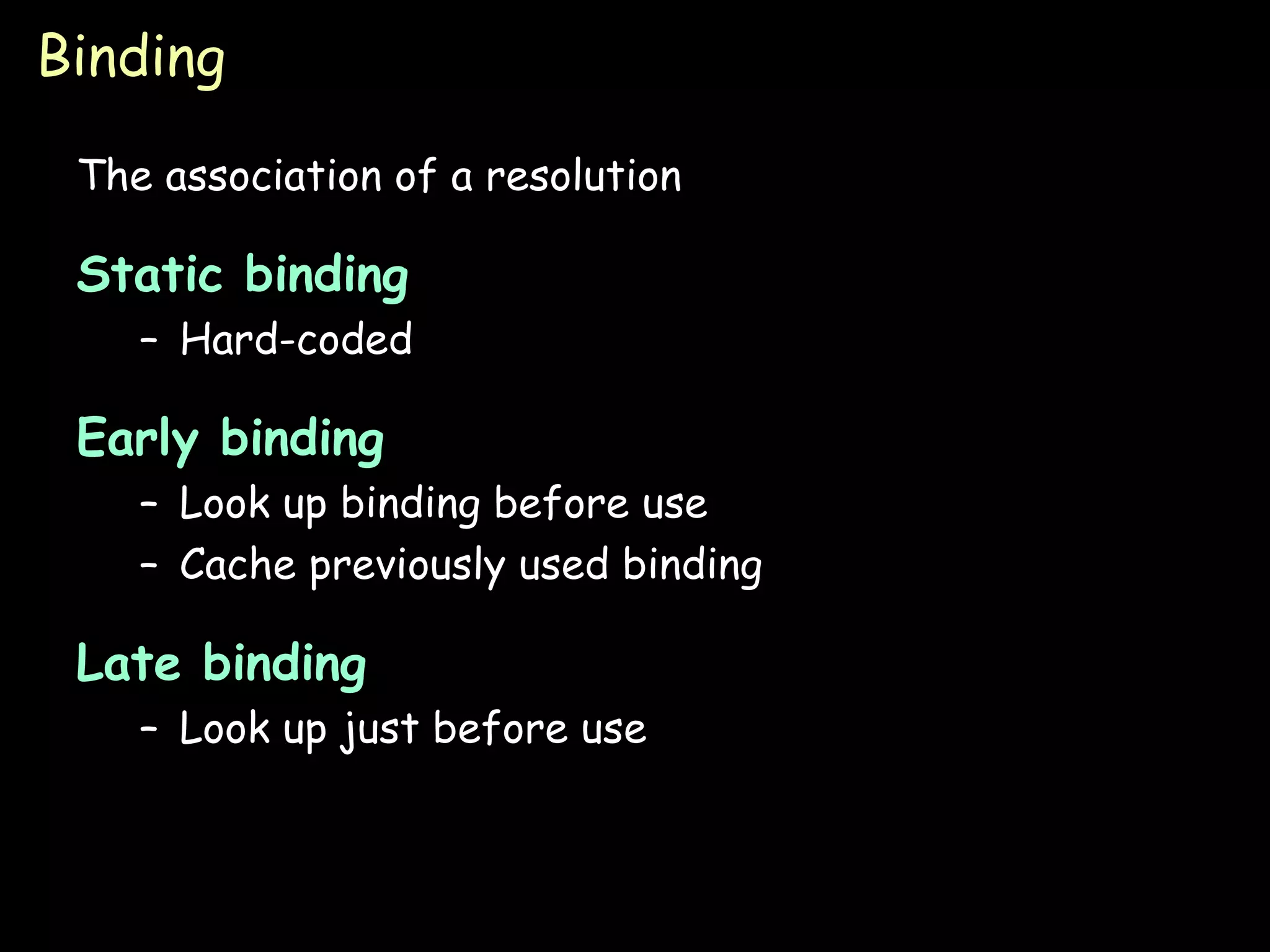
Binding The association of a resolution Static binding Hard-coded Early binding Look up binding before use Cache previously used binding Late binding Look up just before use
IP Domain Names Human readable names e.g.  remus.rutgers.edu Hierarchical naming scheme No relation to IP address or network class
Example: DNS Internet Domain Name Service Maps machine names ( www.rutgers.edu ) to IP addresses ( 128.6.4.5 ) In the past: Search /etc/hosts for machine name File periodically downloaded from Network Information Center (NIC) at the Stanford Research Institute (SRI)
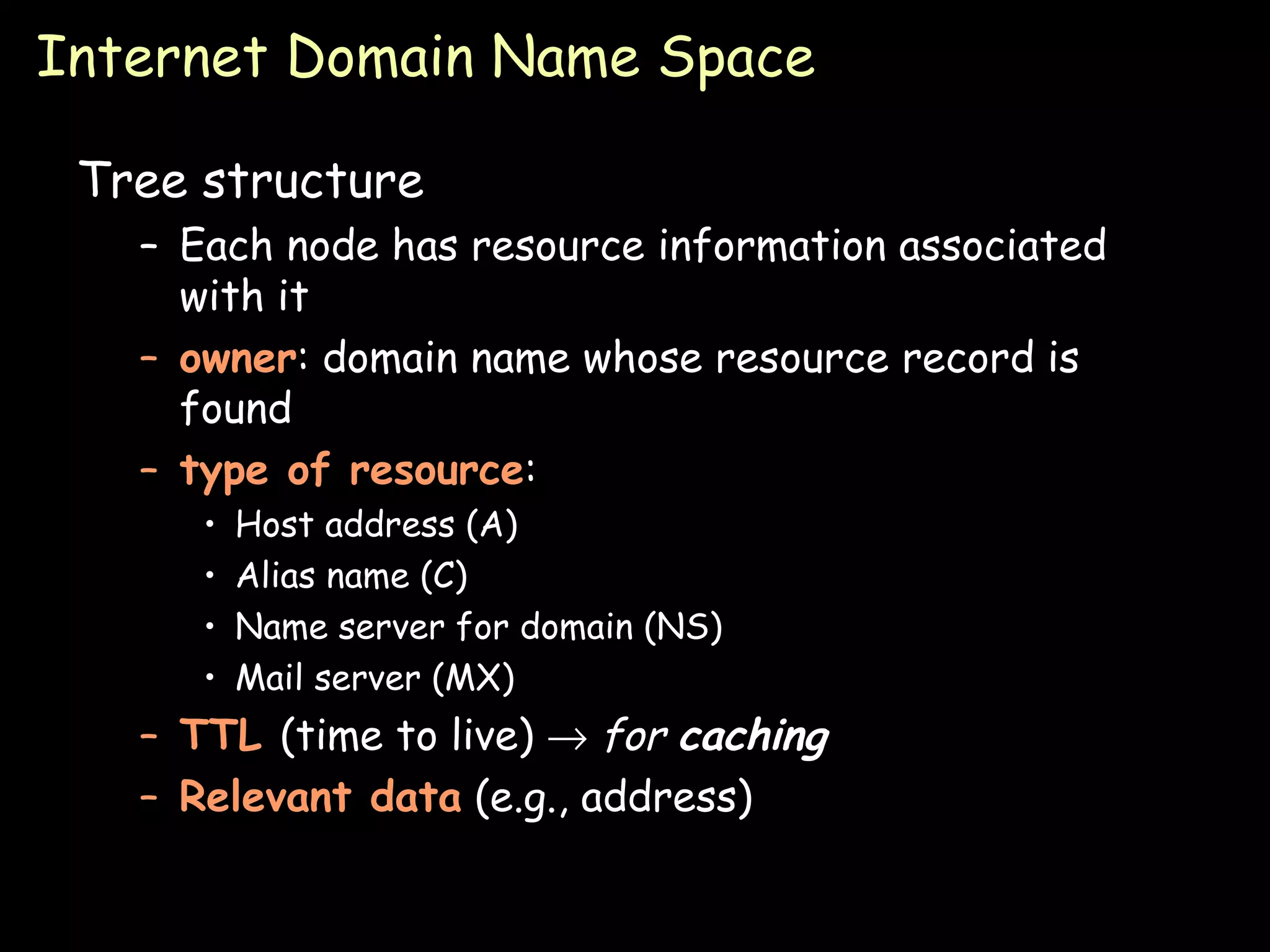
Internet Domain Name Space Tree structure Each node has resource information associated with it owner : domain name whose resource record is found type of resource : Host address (A) Alias name (C) Name server for domain (NS) Mail server (MX) TTL   (time to live)     for  caching Relevant data  (e.g., address)
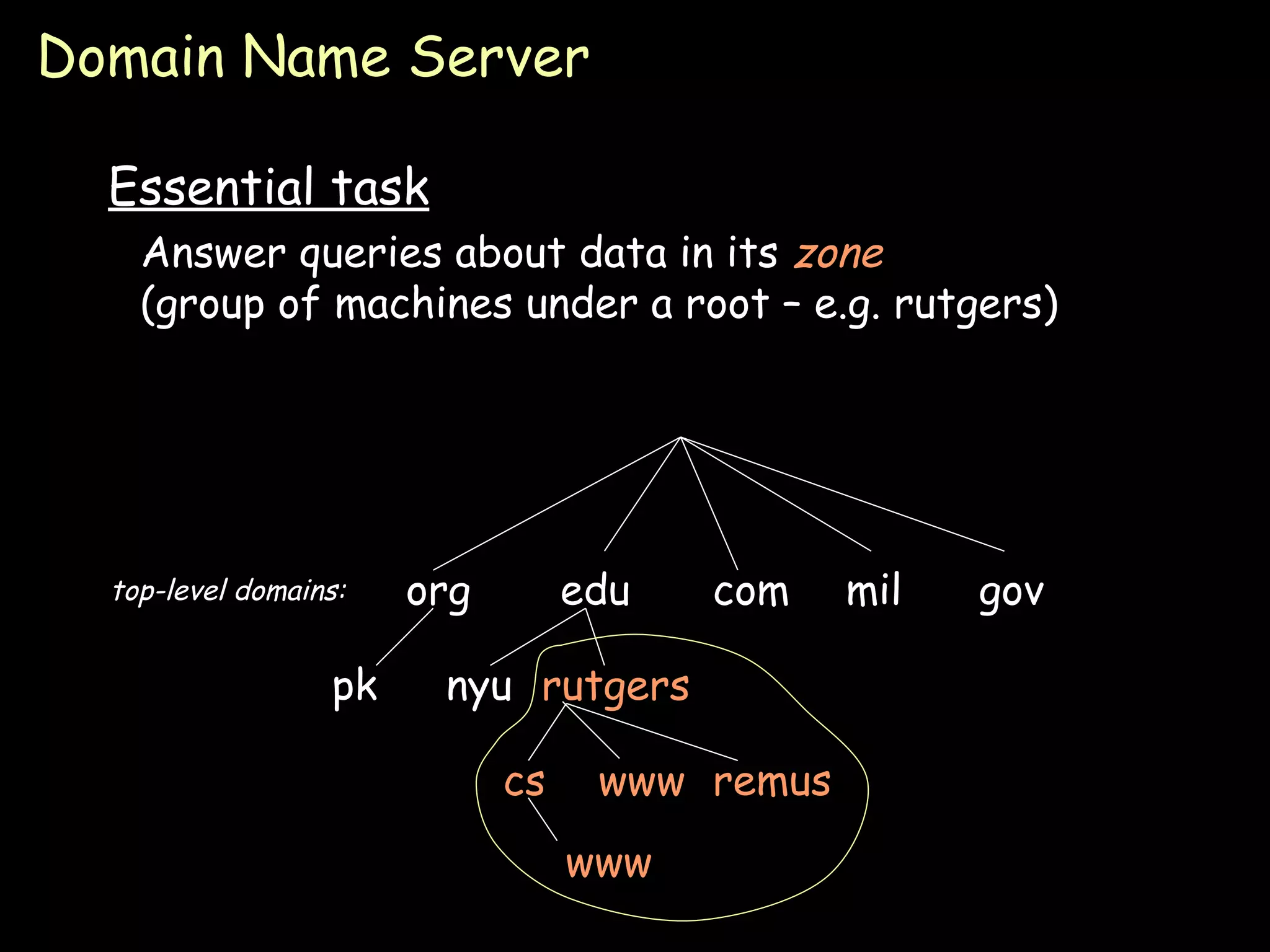
Domain Name Server Essential task Answer queries about data in its  zone (group of machines under a root – e.g. rutgers) org edu com mil gov pk nyu rutgers cs www remus top-level domains: www
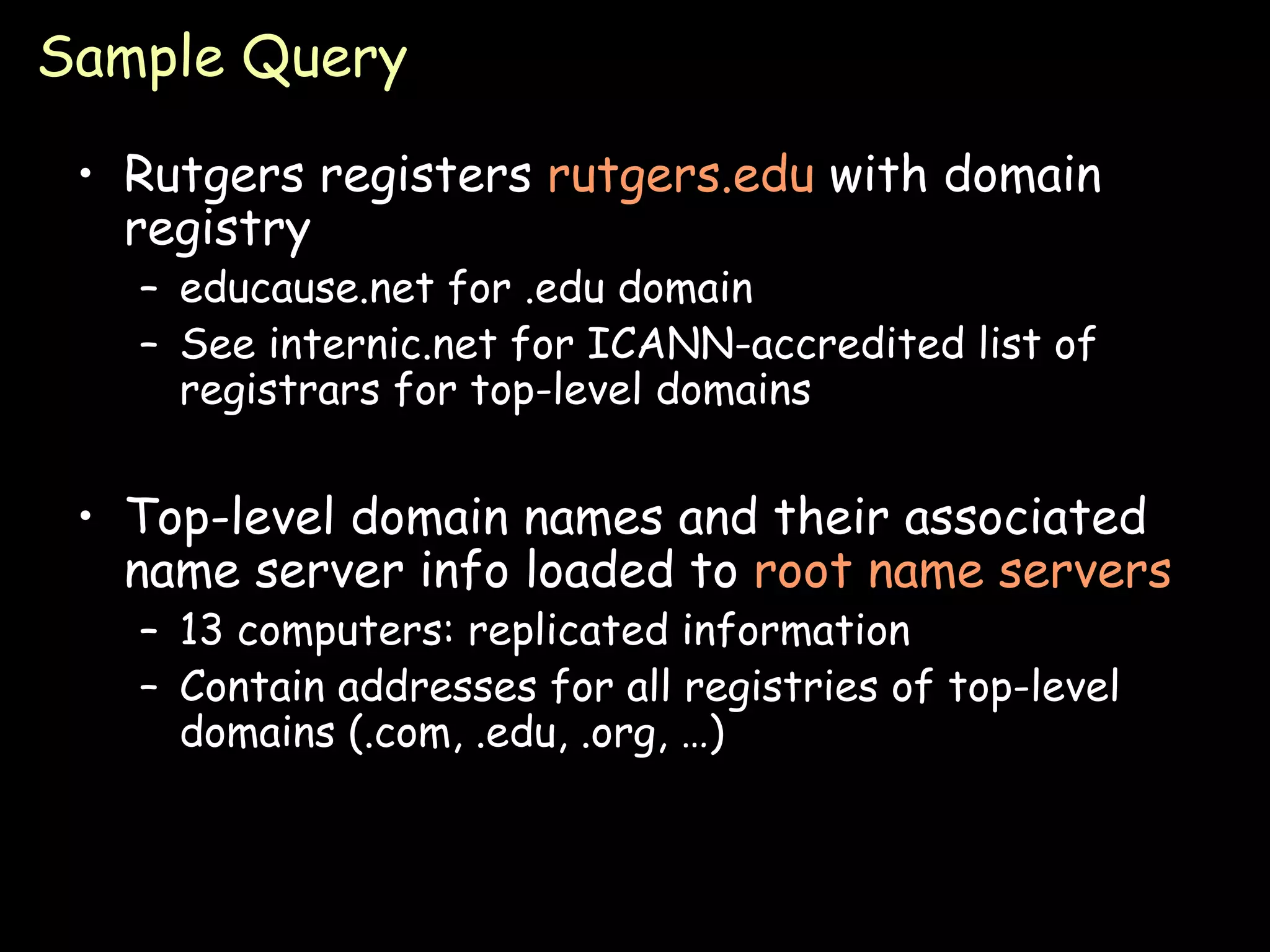
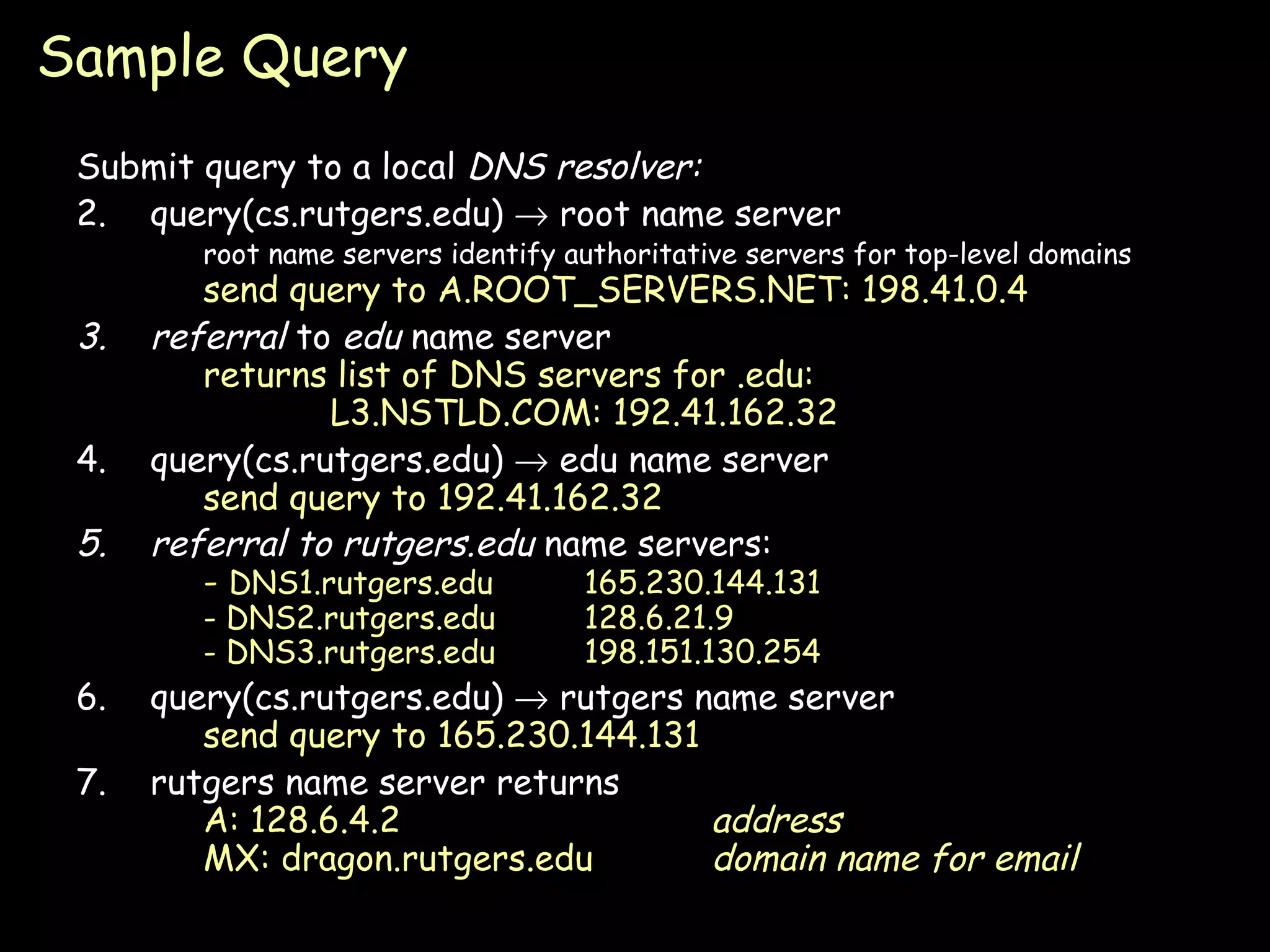
Sample Query Rutgers registers  rutgers.edu  with domain registry educause.net for .edu domain See internic.net for ICANN-accredited list of registrars for top-level domains Top-level domain names and their associated name server info loaded to  root name servers 13 computers: replicated information Contain addresses for all registries of top-level domains (.com, .edu, .org, …)
Sample Query Submit query to a local  DNS resolver: query(cs.rutgers.edu)    root name server root name servers identify authoritative servers for top-level domains send query to A.ROOT_SERVERS.NET: 198.41.0.4 referral  to  edu  name server returns list of DNS servers for .edu: L3.NSTLD.COM: 192.41.162.32 query(cs.rutgers.edu)    edu name server  send query to 192.41.162.32 referral to rutgers.edu  name servers: -  DNS1.rutgers.edu 165.230.144.131 - DNS2.rutgers.edu 128.6.21.9 - DNS3.rutgers.edu 198.151.130.254 query(cs.rutgers.edu)    rutgers name server send query to 165.230.144.131 rutgers name server returns A: 128.6.4.2 address MX: dragon.rutgers.edu domain name for email
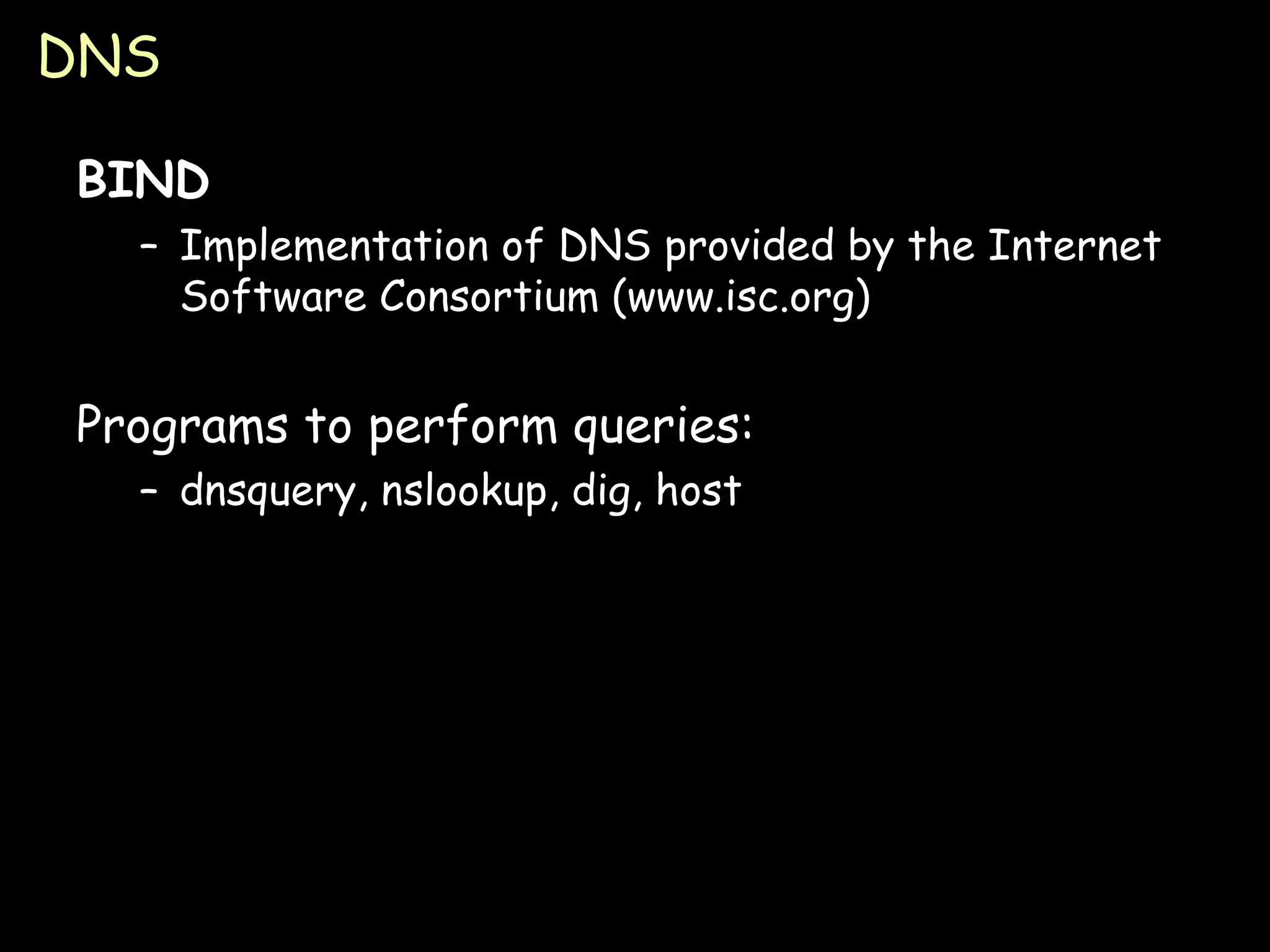
DNS BIND Implementation of DNS provided by the Internet Software Consortium (www.isc.org) Programs to perform queries: dnsquery, nslookup, dig, host
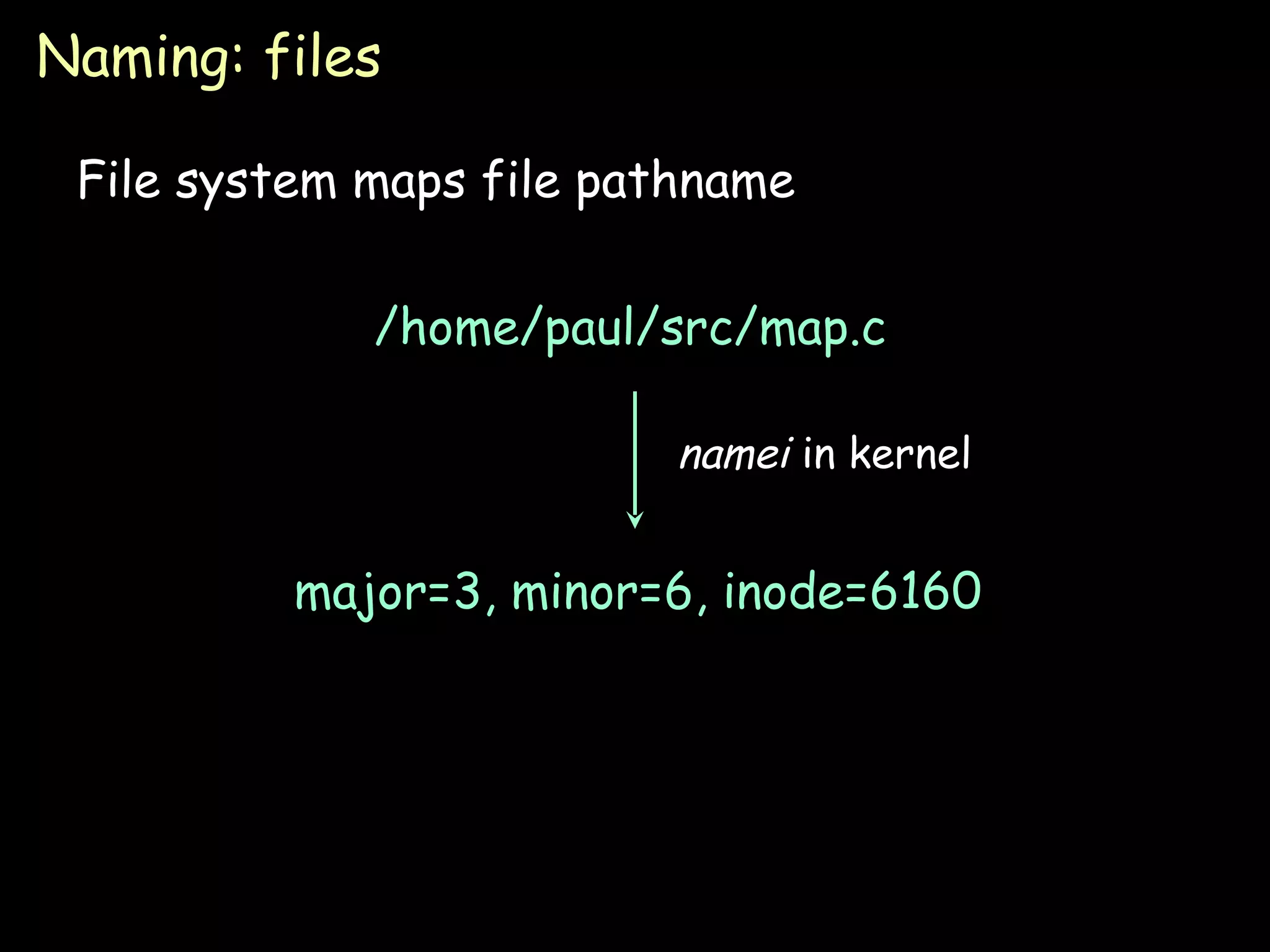
Naming: files File system maps file pathname /home/paul/src/map.c major=3, minor=6, inode=6160 namei  in kernel
The end.

Naming And Binding (Distributed computing)

  • 1.
    Naming & BindingPaul Krzyzanowski [email_address] [email_address] Distributed Systems Except as otherwise noted, the content of this presentation is licensed under the Creative Commons Attribution 2.5 License.
  • 2.
    My 15” MacBookPro The rightmost computer on my desk Paul’s aluminum laptop, but not the big or the small one. hedwig hedwig.pk.org 192.168.60.148 00:14:51:ec:f2:5b
  • 3.
    Naming things Usernames Login, email Machine names rlogin, email, web Files Devices Variables in programs Network services
  • 4.
    Naming Service Allowsyou to look up names Often returns an address as a response Might be implemented as Search through file Client-server program Database query …
  • 5.
    What’s a name?Name : identifies what you want Address : identifies where it is Route : identifies how to get there Binding : associates a name with an address “ choose a lower-level-implementation for a higher-level semantic construct” RFC 1498: Inter-network Naming, addresses, routing
  • 6.
    Names Need namesfor: Services : e.g., time of day Nodes : computer that can run services Paths : route Objects within service : e.g. files on a file server Naming convention can take any format Ideally one that will suit application and user E.g., human readable names for humans, binary identifiers for machines
  • 7.
    Uniqueness of namesEasy on a small scale Problematic on a large scale Hierarchy allows uniqueness to be maintained compound name : set of atomic names connected with a name separator
  • 8.
    Terms: Namingconvention Naming system determines syntax for a name Unix file names: Parse components from left to right separated by / /home/paul/src/gps/gui.c Internet domain names: Ordered right to left and delimited by . www.cs.rutgers.edu LDAP names Attribute/value pairs ordered right to left, delimited by , cn=Paul Krzyzanowski, o=Rutgers, c=US
  • 9.
    Terms: ContextA particular set of name  object bindings Each context has an associated naming convention A name is always interpreted relative to some context E.g., directory /usr in the UNIX file system
  • 10.
    Terms: NamingSystem Connected set of contexts of the same type (same naming convention) along with a common set of operations For example: System that implements DNS System that implements LDAP
  • 11.
    Terms: Namespace Set of names in the naming system For example, Names of all files and directories in a UNIX file system
  • 12.
    Terms: ResolutionName lookup Return the underlying representation of the name For example, www.rutgers.edu  128.6.4.5
  • 13.
    Directory Service Extensionof naming service: Associates names with objects Allows objects to have attributes Can search based on attributes For example, Netscape directory: general-purpose directory service based on LDAP Directory can be object store: Look up printer object and send data stream to it
  • 14.
    Name resolution Tosend data to a service: 1. Find a node on which the service resides (service name resolution) 2. Find an address (or network attachment point) for that node (node name location) 3. Find a path from this location to the service (routing service)
  • 15.
    Name resolution E.g.,access “paul’s service”: File lookup : “paul’s service”  cs.rutgers.edu:1234 DNS lookup : cs.rutgers.edu  128.6.4.2 ARP resolution : 128.6.4.2  08:00:20:90:9c:23 IP routing : route: remus  lcsr-gw  aramis
  • 16.
    Binding The associationof a resolution Static binding Hard-coded Early binding Look up binding before use Cache previously used binding Late binding Look up just before use
  • 17.
    IP Domain NamesHuman readable names e.g. remus.rutgers.edu Hierarchical naming scheme No relation to IP address or network class
  • 18.
    Example: DNS InternetDomain Name Service Maps machine names ( www.rutgers.edu ) to IP addresses ( 128.6.4.5 ) In the past: Search /etc/hosts for machine name File periodically downloaded from Network Information Center (NIC) at the Stanford Research Institute (SRI)
  • 19.
    Internet Domain NameSpace Tree structure Each node has resource information associated with it owner : domain name whose resource record is found type of resource : Host address (A) Alias name (C) Name server for domain (NS) Mail server (MX) TTL (time to live)  for caching Relevant data (e.g., address)
  • 20.
    Domain Name ServerEssential task Answer queries about data in its zone (group of machines under a root – e.g. rutgers) org edu com mil gov pk nyu rutgers cs www remus top-level domains: www
  • 21.
    Sample Query Rutgersregisters rutgers.edu with domain registry educause.net for .edu domain See internic.net for ICANN-accredited list of registrars for top-level domains Top-level domain names and their associated name server info loaded to root name servers 13 computers: replicated information Contain addresses for all registries of top-level domains (.com, .edu, .org, …)
  • 22.
    Sample Query Submitquery to a local DNS resolver: query(cs.rutgers.edu)  root name server root name servers identify authoritative servers for top-level domains send query to A.ROOT_SERVERS.NET: 198.41.0.4 referral to edu name server returns list of DNS servers for .edu: L3.NSTLD.COM: 192.41.162.32 query(cs.rutgers.edu)  edu name server send query to 192.41.162.32 referral to rutgers.edu name servers: - DNS1.rutgers.edu 165.230.144.131 - DNS2.rutgers.edu 128.6.21.9 - DNS3.rutgers.edu 198.151.130.254 query(cs.rutgers.edu)  rutgers name server send query to 165.230.144.131 rutgers name server returns A: 128.6.4.2 address MX: dragon.rutgers.edu domain name for email
  • 23.
    DNS BIND Implementationof DNS provided by the Internet Software Consortium (www.isc.org) Programs to perform queries: dnsquery, nslookup, dig, host
  • 24.
    Naming: files Filesystem maps file pathname /home/paul/src/map.c major=3, minor=6, inode=6160 namei in kernel
  • 25.