Inderjit Singh
Fixed-Mobile Convergence:
Meeting the Challenges – Today!
Inderjit Singh
Converged Communications
• Imagine starting a voice call on your home phone and transferring it
seamlessly to your mobile as you drive to work.
• Imagine sending a multimedia message from your car that later appears on
your TV screen.
• Imagine watching a movie on that same TV, pausing it in mid-show and
then watching it on a wireless PDA as you relax in the garden.
• Imagine having a cell phone conversation with two or three friends and
simultaneously sharing a video of the football match you are attending.
• Imagine that all of the above can be done with a single account, on a single
log-in with multiple devices over any number of access networks.
Inderjit Singh
Purview
• Trends in communication sector
• Towards Fixed-Mobile Convergence
• Enabling Technologies
• What are the Challenges Ahead?
Inderjit Singh
Trends in Telecom and Broadcasting
From…
• Monopoly
• Narrowband
• Single Service – Single
Technology
• Separate networks
• Central intelligence
• Circuit-switched
• Telecom
• Wireline
• Voice centric
• Copper infrastructure
To…
• Competition
• Broadband
• Multi Service – Multiple
Technology (Triple-play)
• Converged networks
• Distributed intelligence
• Packetized
• Telecom/IT Convergence
• Mobile and Converged
• Multimedia centric
• Optical infrastructure
• National
• Passive
• General
• Global
• Interactive
• Personalized Video
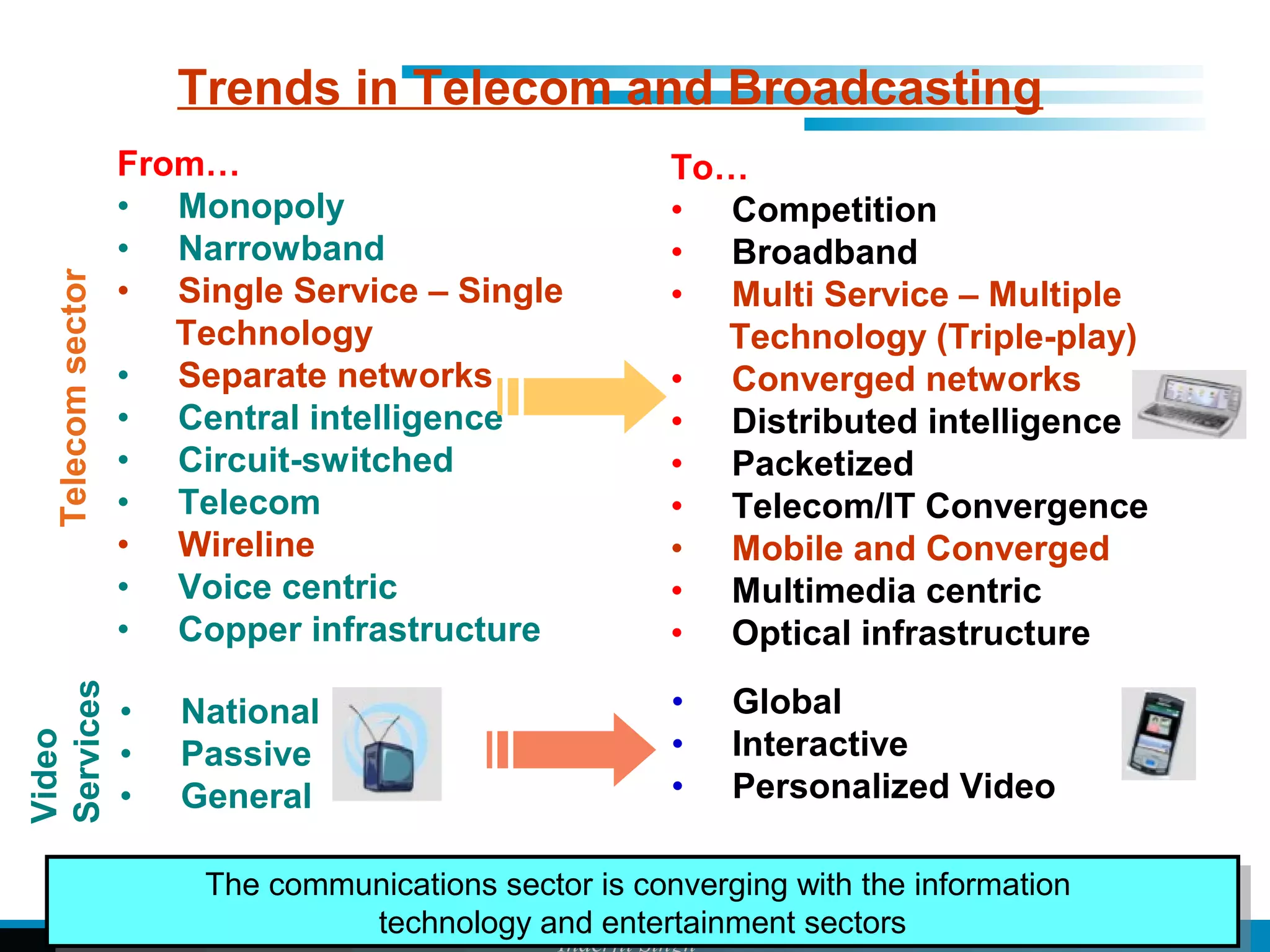
The communications sector is converging with the information
technology and entertainment sectors
The communications sector is converging with the information
technology and entertainment sectors
Telecomsector
Video
Services
Inderjit Singh
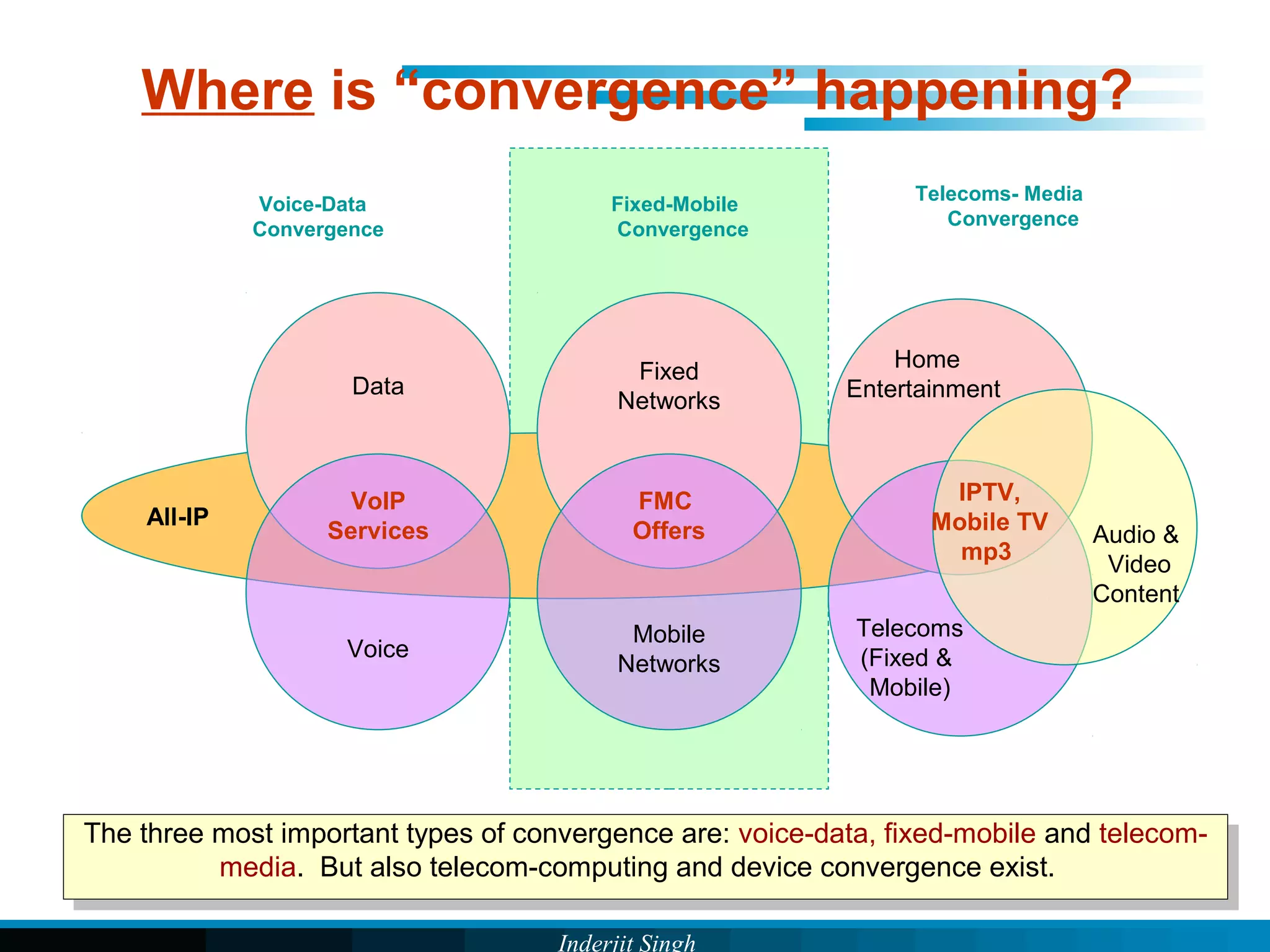
Where is “convergence” happening?
IPTV,
Mobile TV
mp3
FMC
Offers
VoIP
Services
Home
Entertainment
Telecoms
(Fixed &
Mobile)
Audio &
Video
Content
Voice
Data
Fixed
Networks
Mobile
Networks
Voice-Data
Convergence
Fixed-Mobile
Convergence
Telecoms- Media
Convergence
All-IP
The three most important types of convergence are: voice-data, fixed-mobile and telecom-
media. But also telecom-computing and device convergence exist.
The three most important types of convergence are: voice-data, fixed-mobile and telecom-
media. But also telecom-computing and device convergence exist.
Inderjit Singh
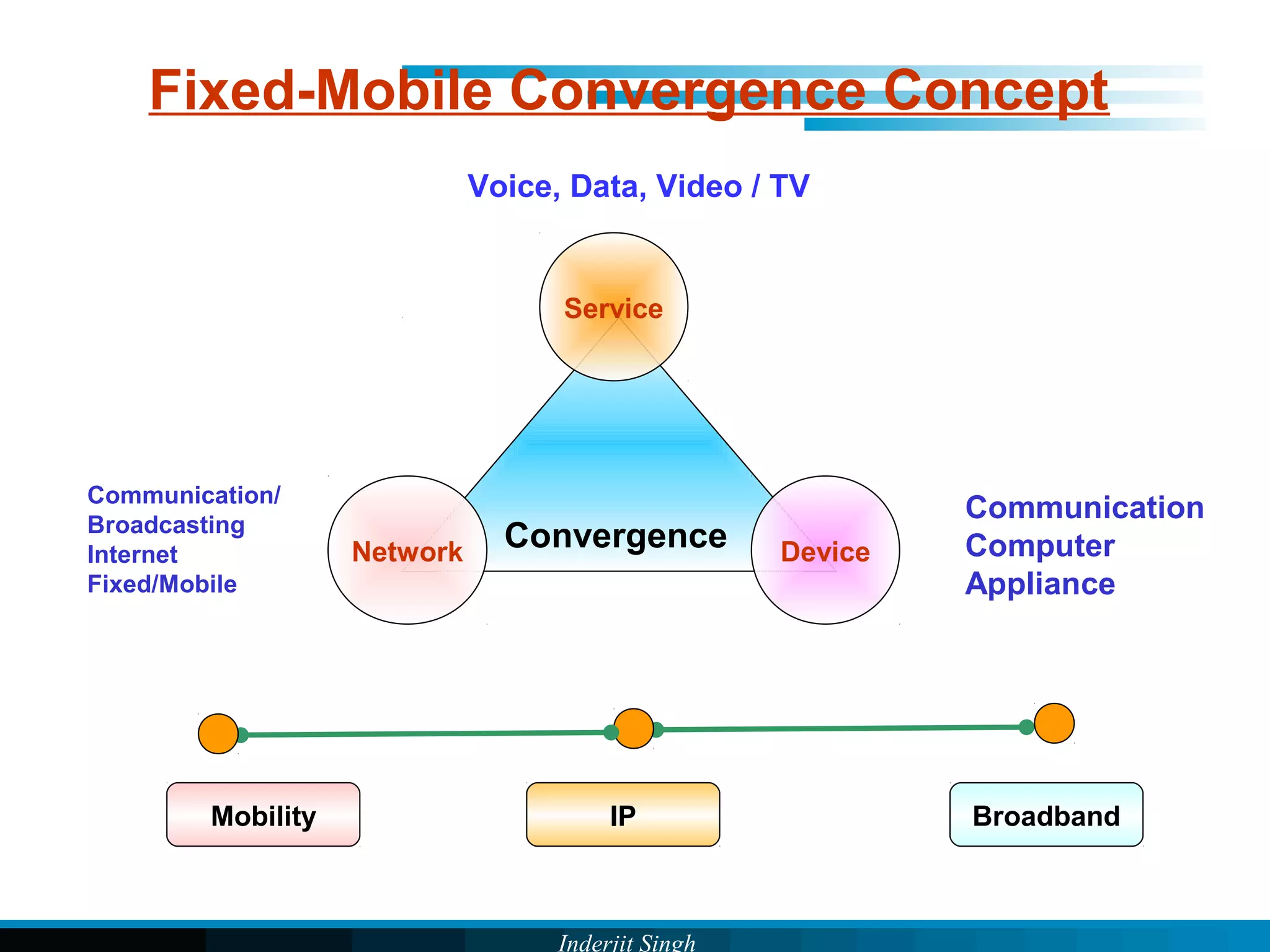
Fixed-Mobile Convergence Concept
Network Device
Service
Mobility IP Broadband
Communication
Computer
Appliance
Voice, Data, Video / TV
Communication/
Broadcasting
Internet
Fixed/Mobile
Convergence
Inderjit Singh
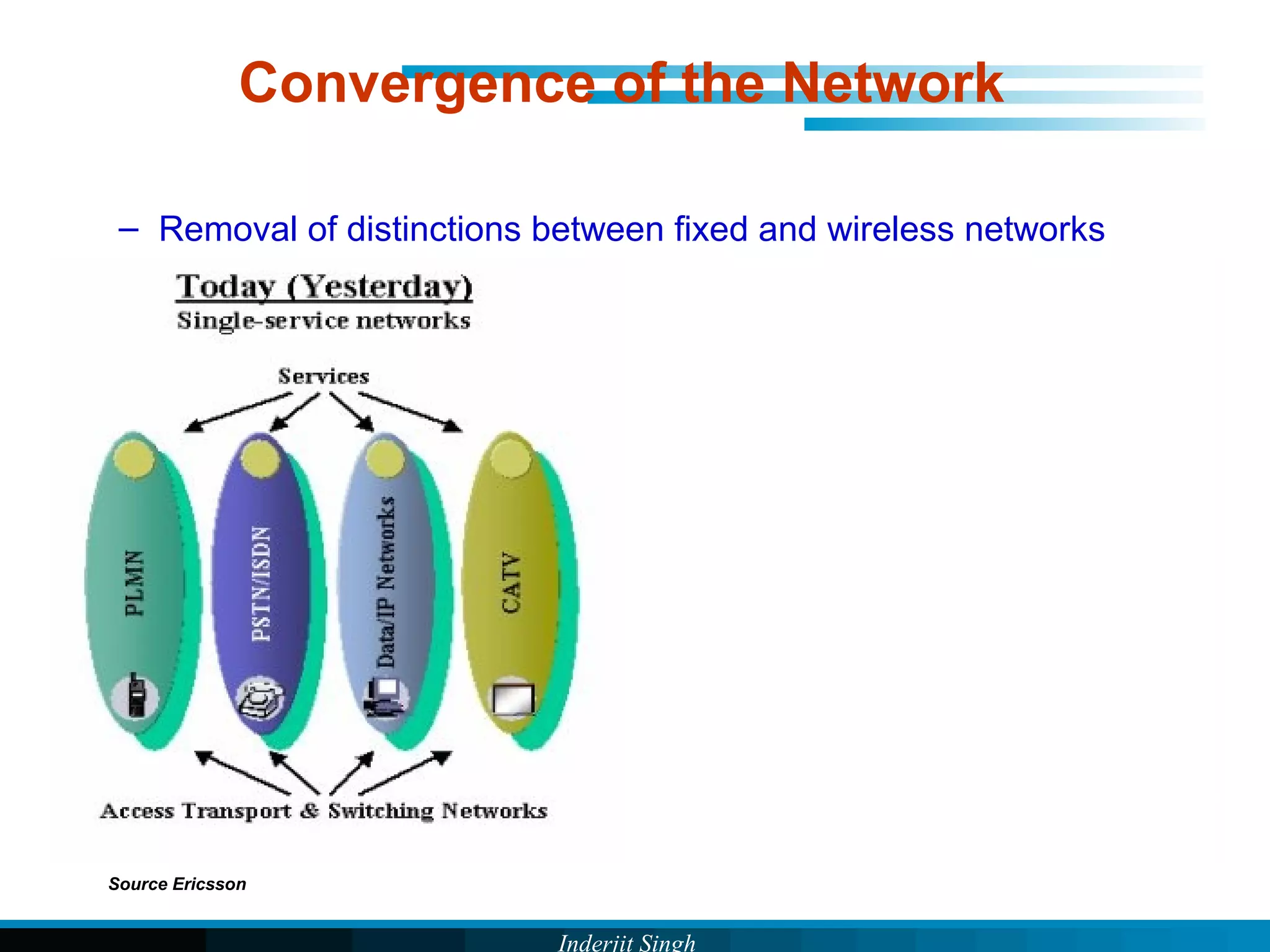
Convergence of the Network
– Removal of distinctions between fixed and wireless networks
Source Ericsson
Inderjit Singh
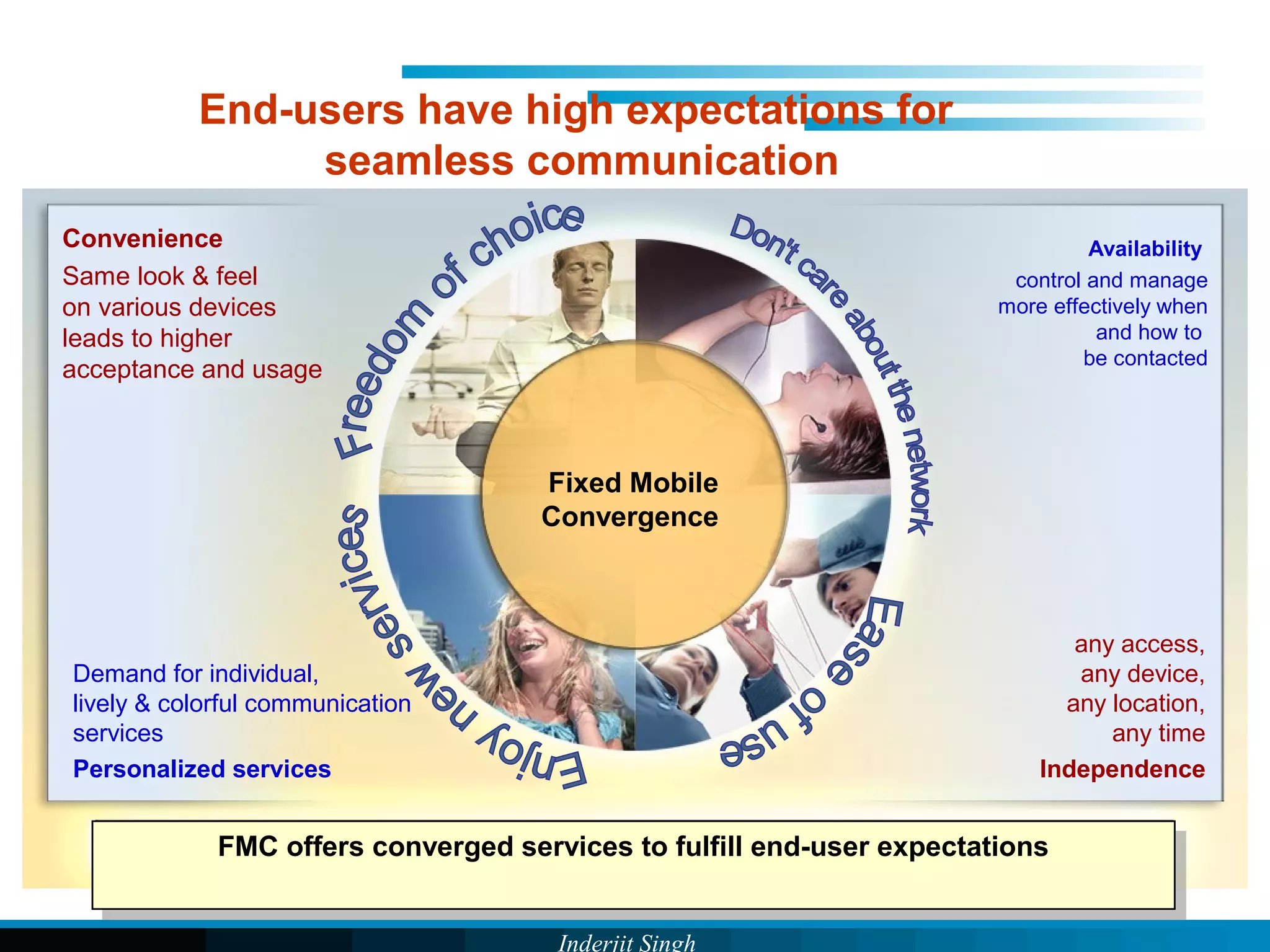
End-users have high expectations for
seamless communication
any access,
any device,
any location,
any time
Independence
Demand for individual,
lively & colorful communication
services
Personalized services
Availability
control and manage
more effectively when
and how to
be contacted
Convenience
Same look & feel
on various devices
leads to higher
acceptance and usage
Fixed Mobile
Convergence
FMC offers converged services to fulfill end-user expectationsFMC offers converged services to fulfill end-user expectations
Inderjit Singh
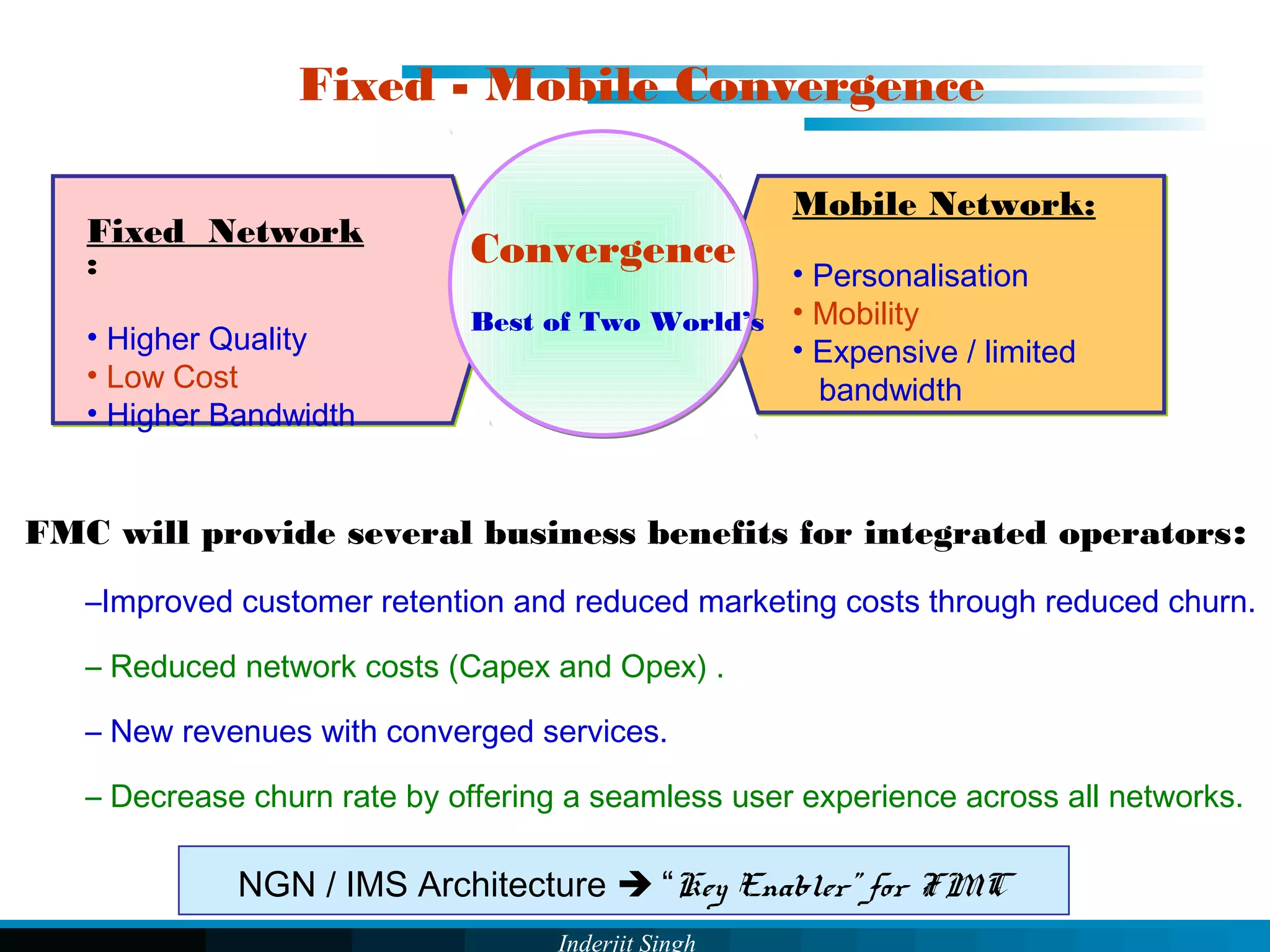
Fixed - Mobile Convergence
Fixed Network
:
• Higher Quality
• Low Cost
• Higher Bandwidth
Mobile Network:
• Personalisation
• Mobility
• Expensive / limited
bandwidth
Convergence
Best of Two World’s
FMC will provide several business benefits for integrated operators:
–Improved customer retention and reduced marketing costs through reduced churn.
– Reduced network costs (Capex and Opex) .
– New revenues with converged services.
– Decrease churn rate by offering a seamless user experience across all networks.
NGN / IMS Architecture  “Key Enabler” for FMC
Inderjit Singh
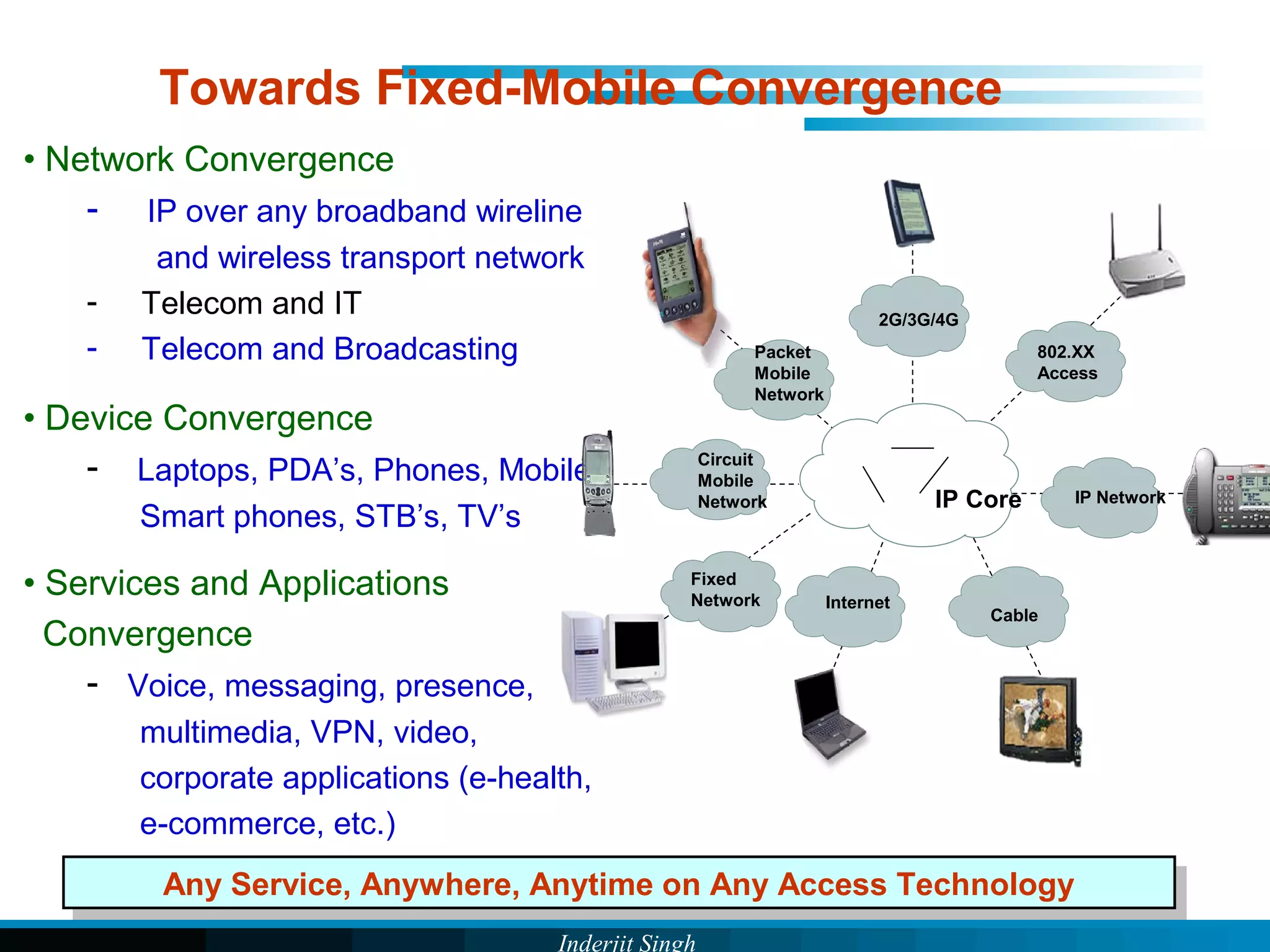
• Network Convergence
- IP over any broadband wireline
and wireless transport network
- Telecom and IT
- Telecom and Broadcasting
• Device Convergence
- Laptops, PDA’s, Phones, Mobile
Smart phones, STB’s, TV’s
• Services and Applications
Convergence
- Voice, messaging, presence,
multimedia, VPN, video,
corporate applications (e-health,
e-commerce, etc.)
Any Service, Anywhere, Anytime on Any Access TechnologyAny Service, Anywhere, Anytime on Any Access Technology
Towards Fixed-Mobile Convergence
IP Core
2G/3G/4G
Internet
Circuit
Mobile
Network
802.XX
Access
Packet
Mobile
Network
Fixed
Network
Cable
IP Network
Inderjit Singh
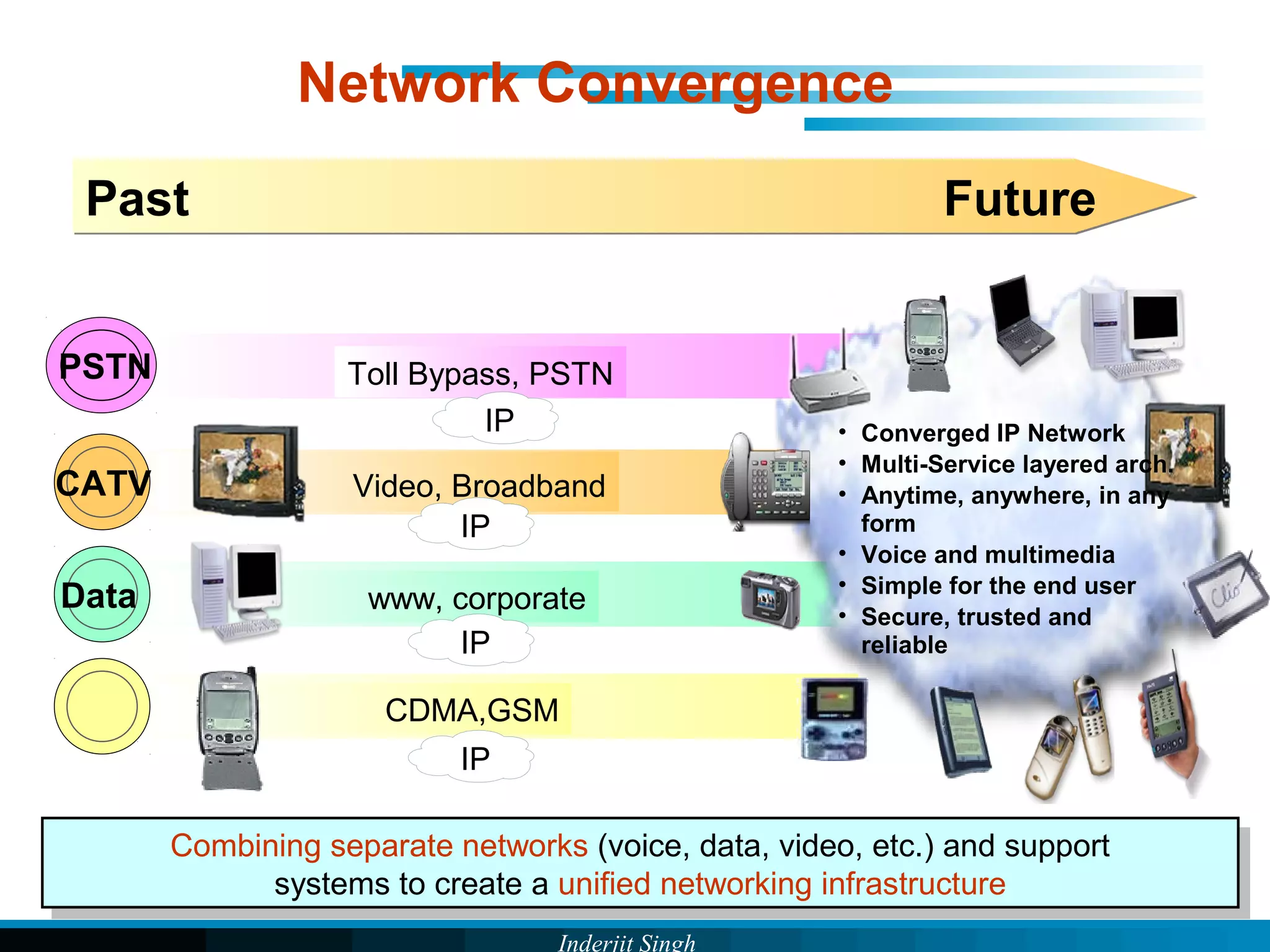
Network Convergence
Combining separate networks (voice, data, video, etc.) and support
systems to create a unified networking infrastructure
Combining separate networks (voice, data, video, etc.) and support
systems to create a unified networking infrastructure
Past FuturePast Future
Toll Bypass, PSTNPSTN
IP
www, corporateData
IP
Video, BroadbandCATV
IP
CDMA,GSM
IP
• Converged IP Network
• Multi-Service layered arch.
• Anytime, anywhere, in any
form
• Voice and multimedia
• Simple for the end user
• Secure, trusted and
reliable
Inderjit Singh
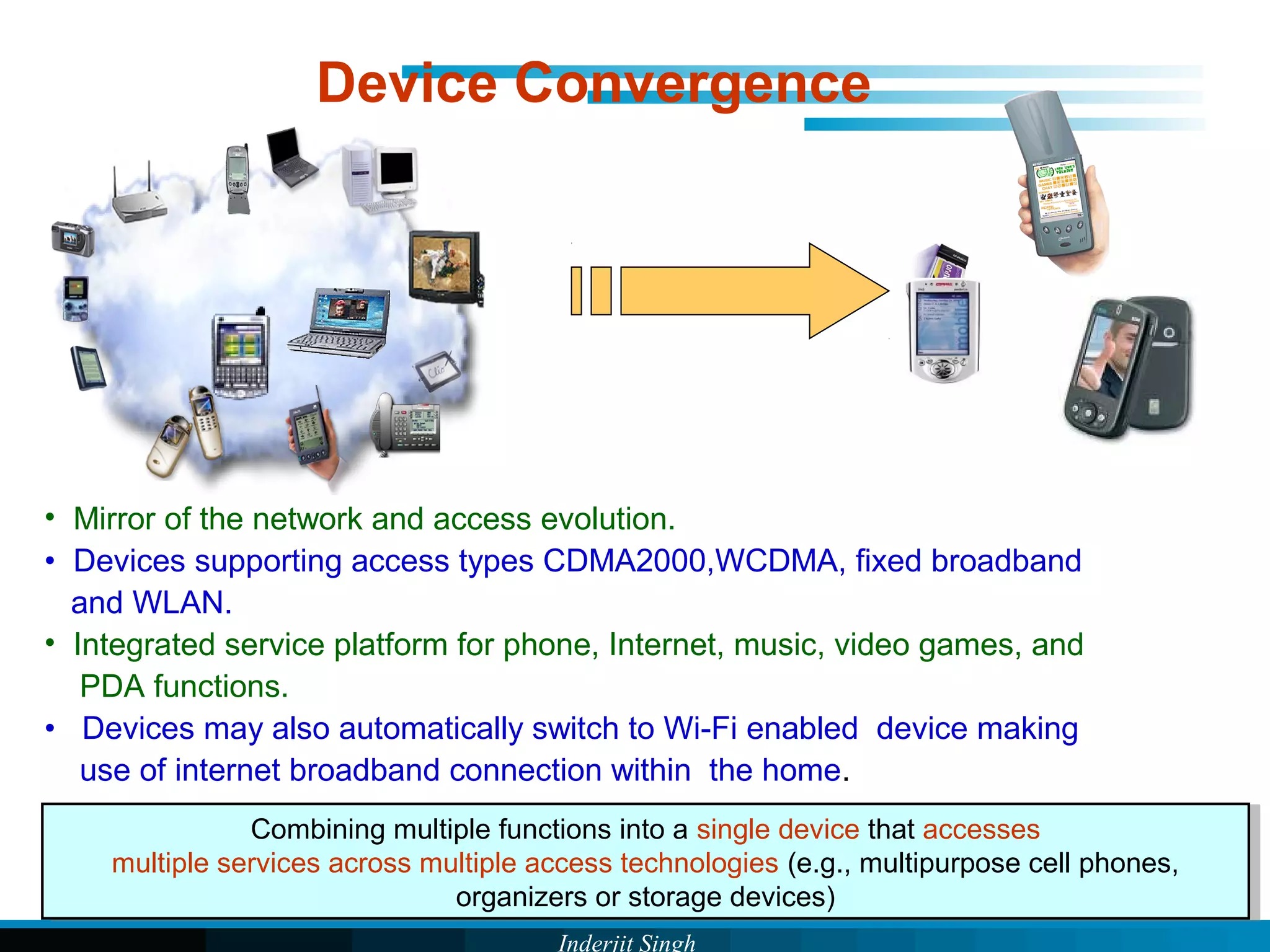
• Mirror of the network and access evolution.
• Devices supporting access types CDMA2000,WCDMA, fixed broadband
and WLAN.
• Integrated service platform for phone, Internet, music, video games, and
PDA functions.
• Devices may also automatically switch to Wi-Fi enabled device making
use of internet broadband connection within the home.
Combining multiple functions into a single device that accesses
multiple services across multiple access technologies (e.g., multipurpose cell phones,
organizers or storage devices)
Combining multiple functions into a single device that accesses
multiple services across multiple access technologies (e.g., multipurpose cell phones,
organizers or storage devices)
Device Convergence
Inderjit Singh
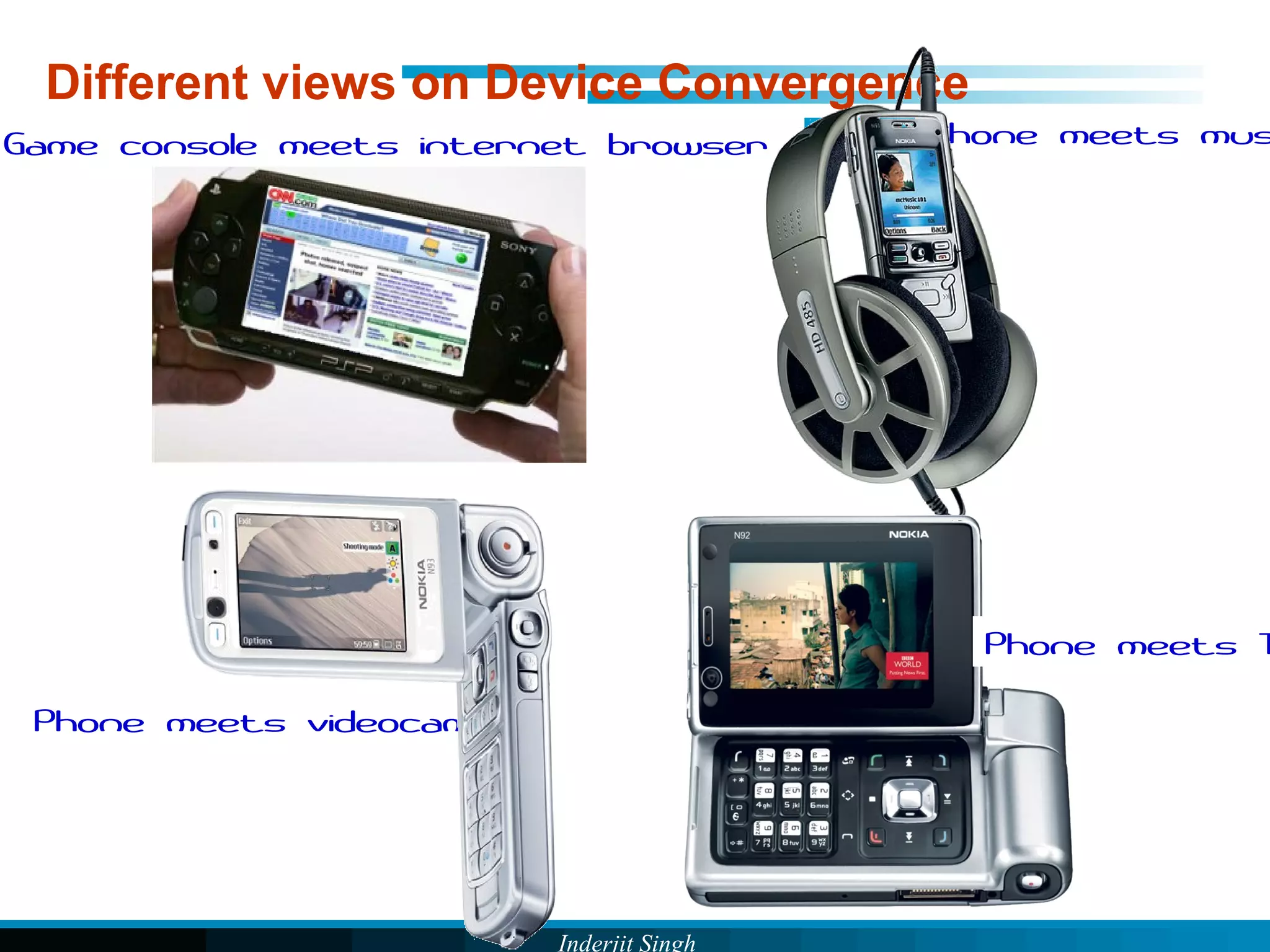
Different views on Device Convergence
Game console meets internet browser Phone meets mus
Phone meets T
Phone meets videocamera
Inderjit Singh
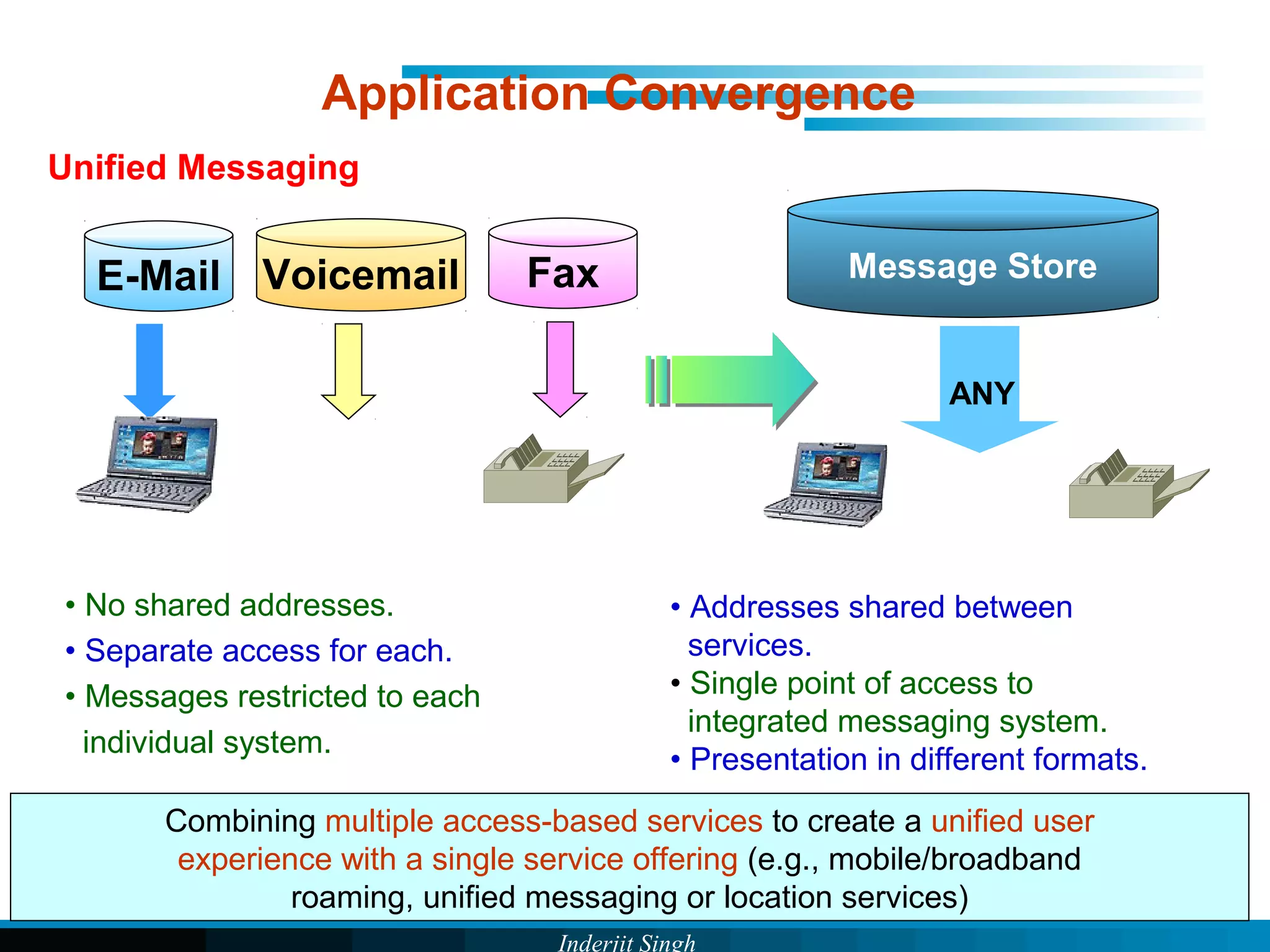
• No shared addresses.
• Separate access for each.
• Messages restricted to each
individual system.
Combining multiple access-based services to create a unified user
experience with a single service offering (e.g., mobile/broadband
roaming, unified messaging or location services)
Application Convergence
• Addresses shared between
services.
• Single point of access to
integrated messaging system.
• Presentation in different formats.
Unified Messaging
E-Mail Voicemail Fax Message Store
ANY
Inderjit Singh
Voice Mail and Unified Messaging Service
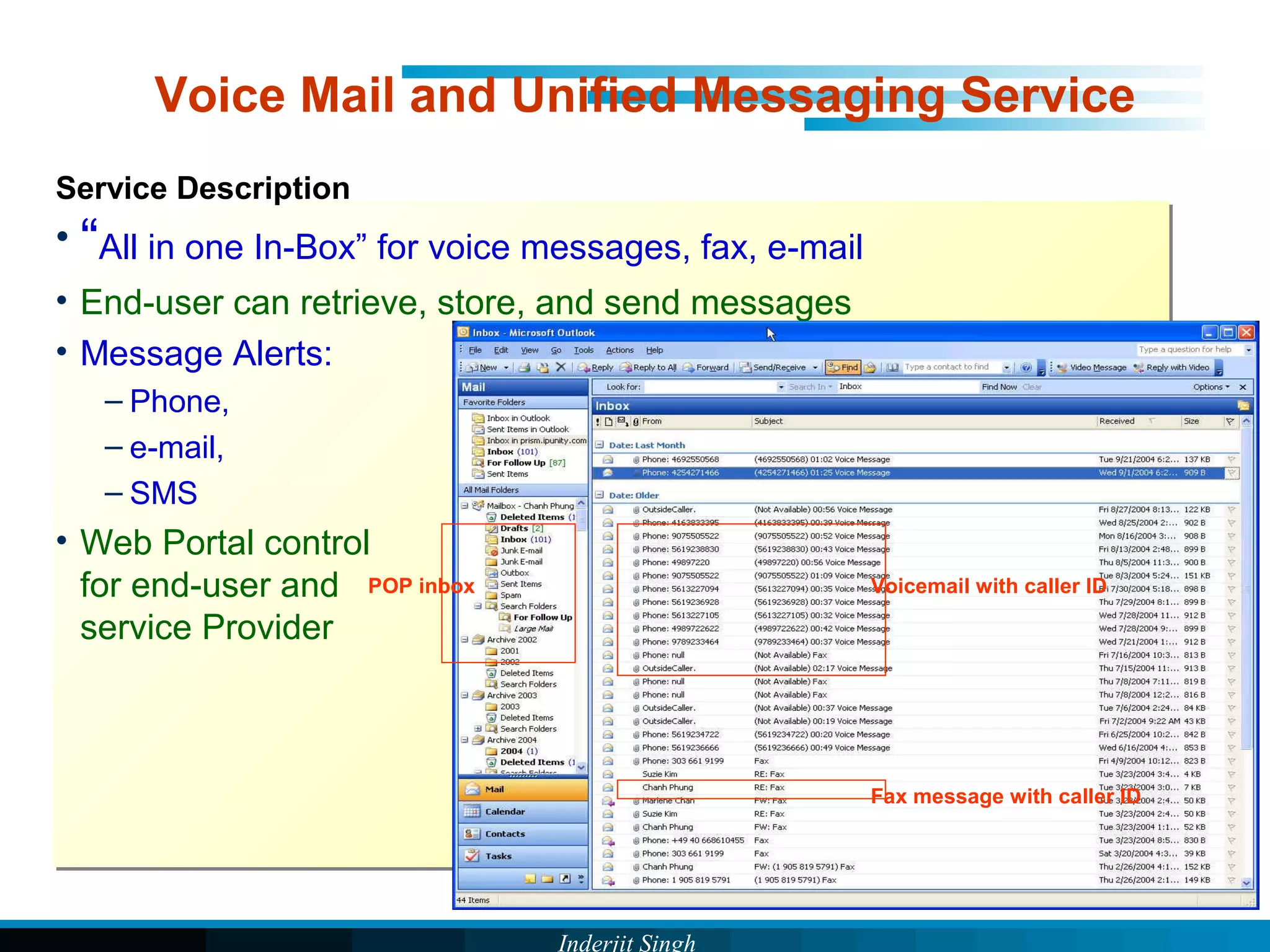
• “All in one In-Box” for voice messages, fax, e-mail
• End-user can retrieve, store, and send messages
• Message Alerts:
– Phone,
– e-mail,
– SMS
• Web Portal control
for end-user and
service Provider
• “All in one In-Box” for voice messages, fax, e-mail
• End-user can retrieve, store, and send messages
• Message Alerts:
– Phone,
– e-mail,
– SMS
• Web Portal control
for end-user and
service Provider
POP inbox
Fax message with caller ID
Voicemail with caller ID
Service Description
Inderjit Singh
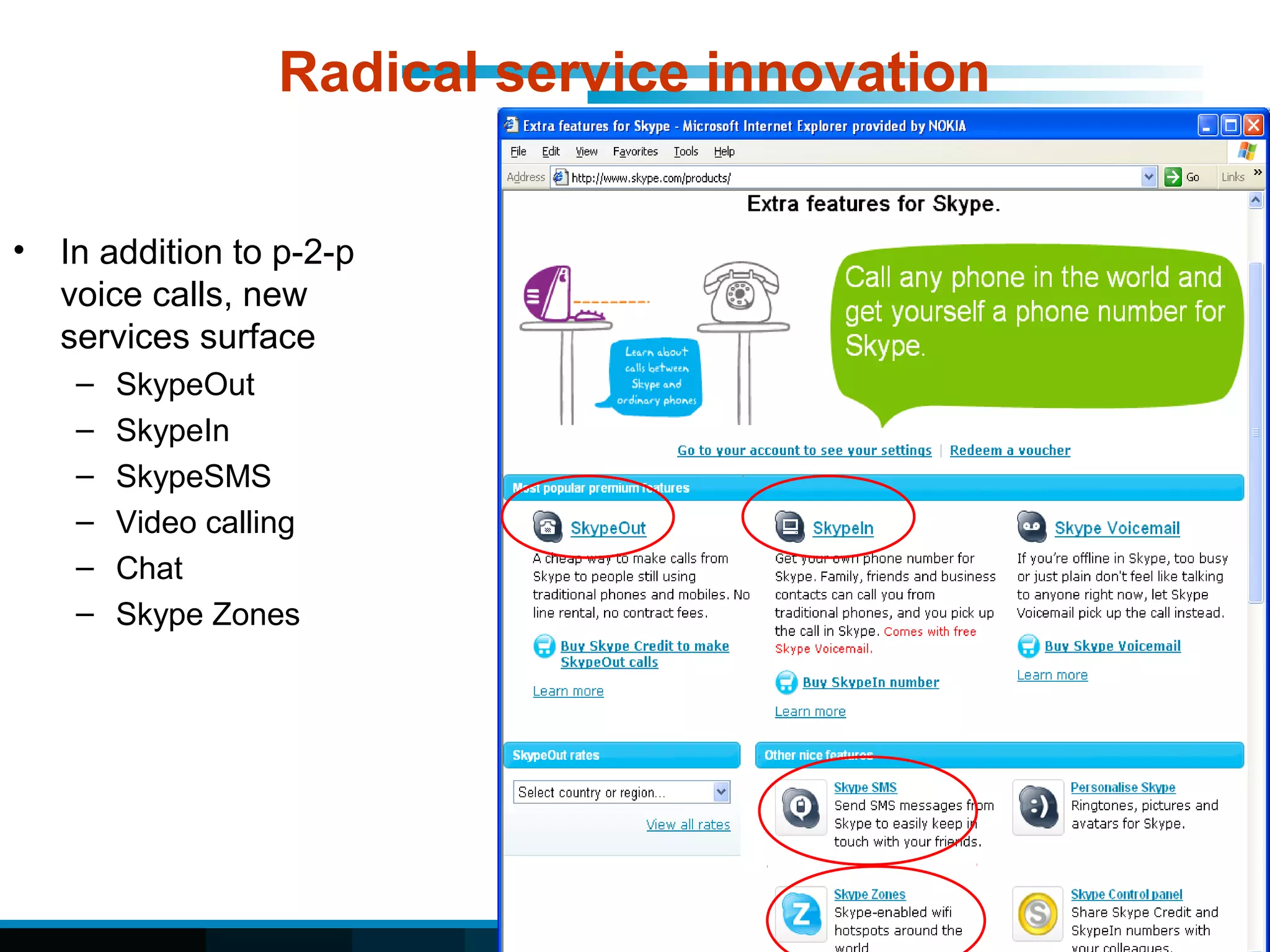
• In addition to p-2-p
voice calls, new
services surface
– SkypeOut
– SkypeIn
– SkypeSMS
– Video calling
– Chat
– Skype Zones
Radical service innovation
Inderjit Singh
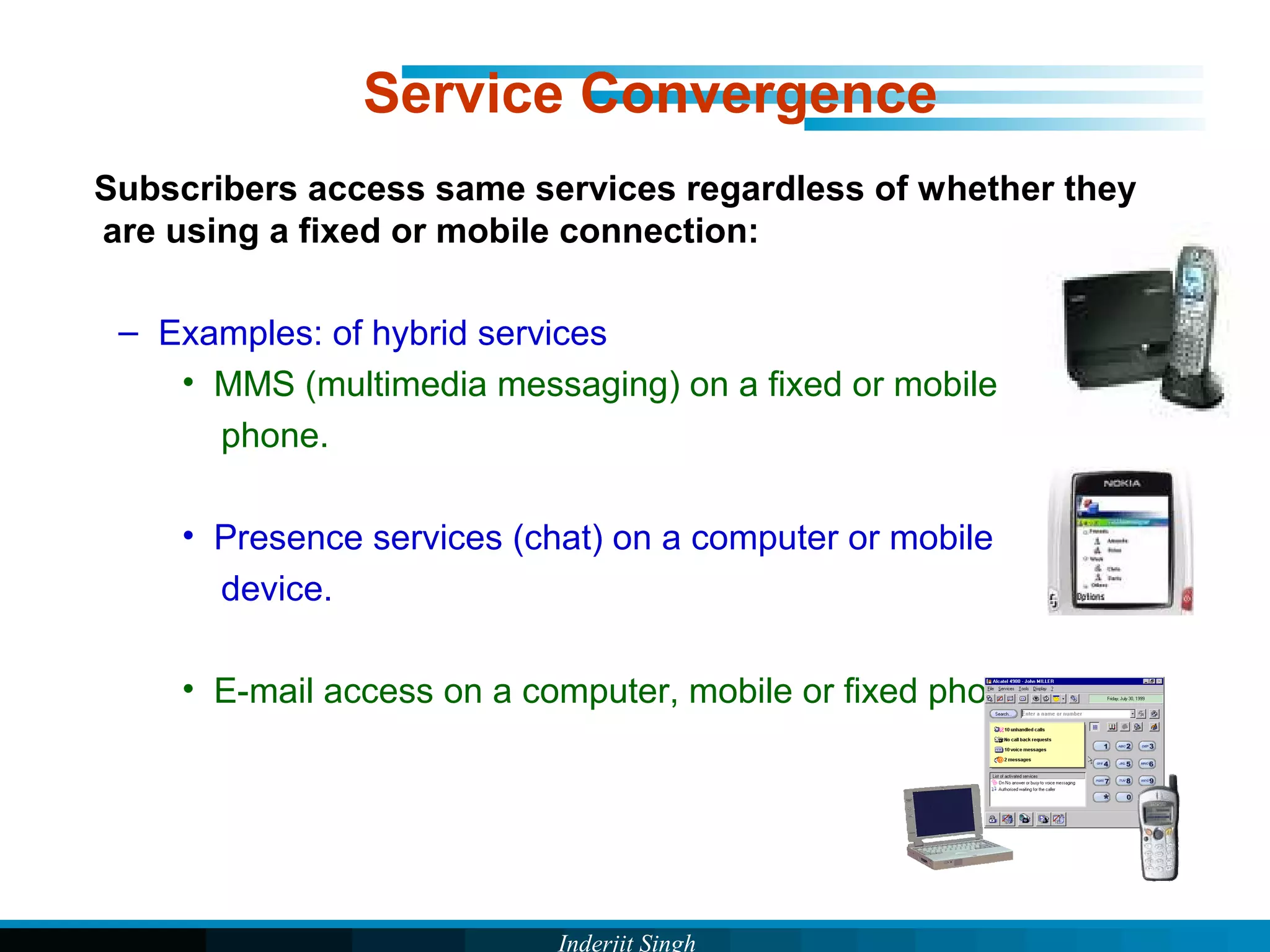
Service Convergence
Subscribers access same services regardless of whether they
are using a fixed or mobile connection:
– Examples: of hybrid services
• MMS (multimedia messaging) on a fixed or mobile
phone.
• Presence services (chat) on a computer or mobile
device.
• E-mail access on a computer, mobile or fixed phone
Inderjit Singh
Mobile
Networks
Fixed
Networks
Cable
Networks
ConvergedConverged
NGNNGN
PSTN
DSL
ISDN
GSMAnalogue
SMS
GPRS
WAP
HSPDA
UMTS
WiFi
WiMaX
UMA FMC
Triple
Play
VoIP
IPTV
Content
Sharing
ITV
P2P
VoD
IMFTP
email WWW Portals Web 2.0
ITIT
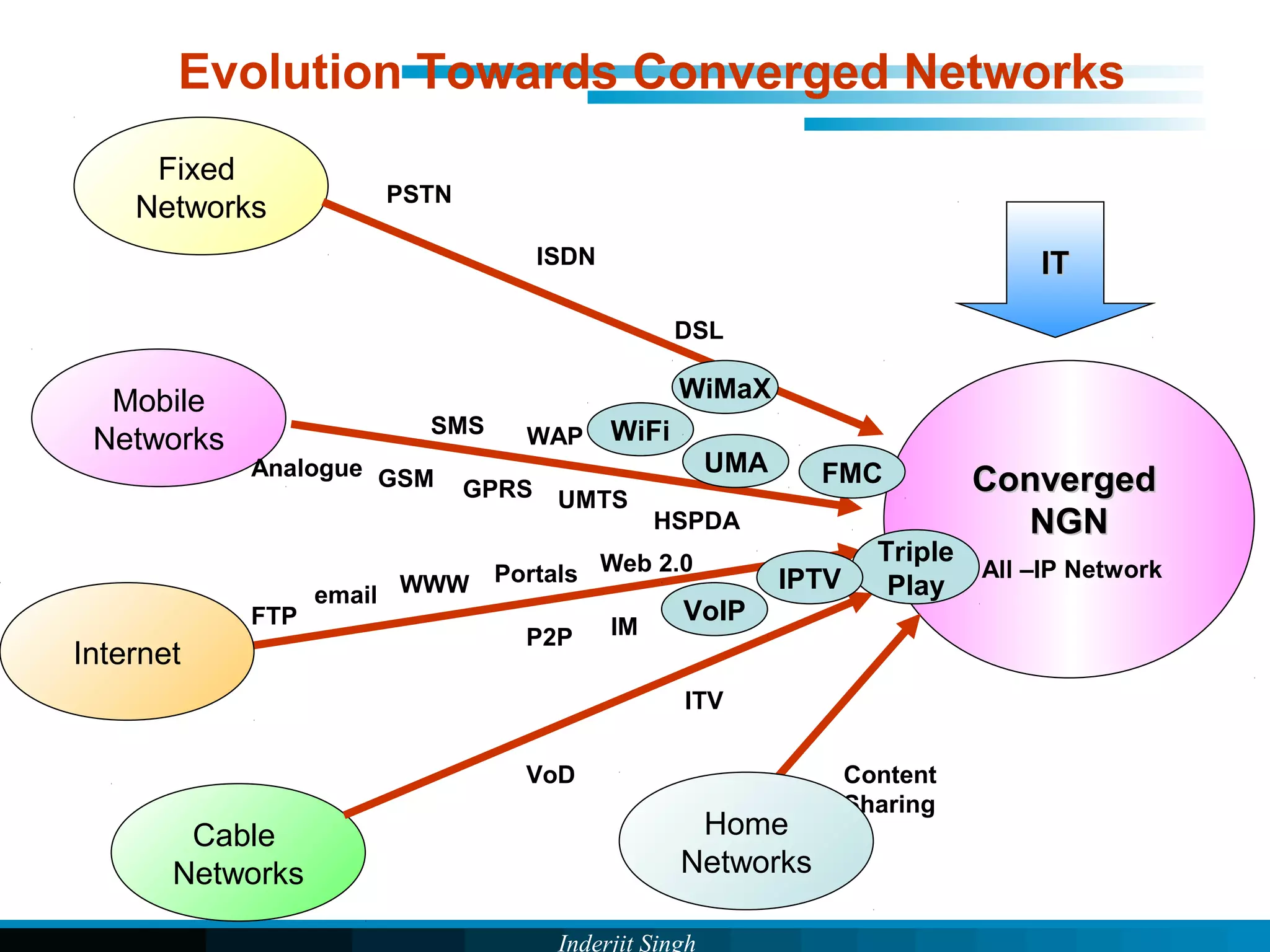
Evolution Towards Converged Networks
Home
Networks
Internet
All –IP Network
Inderjit Singh
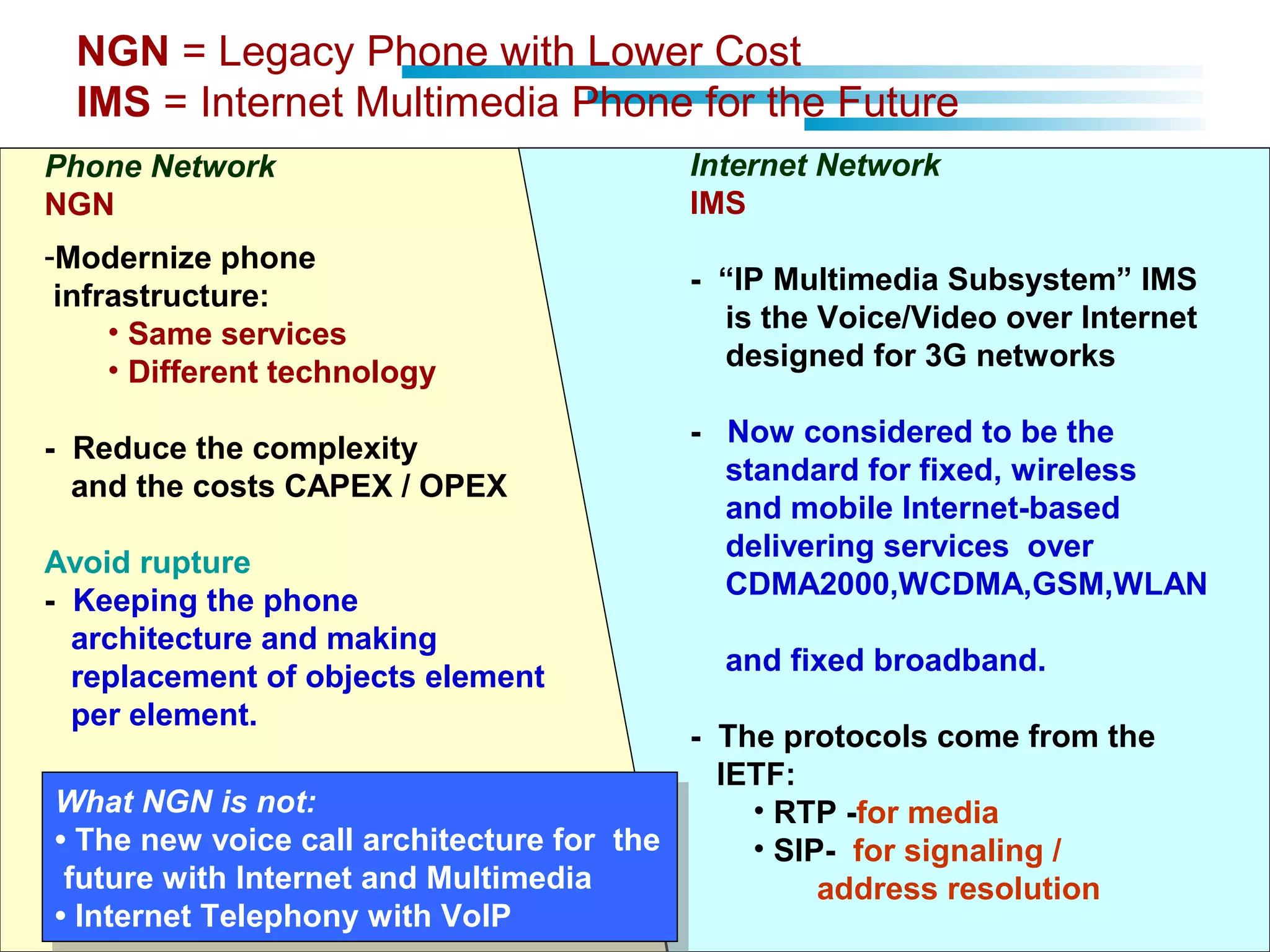
Internet Network
IMS
- “IP Multimedia Subsystem” IMS
is the Voice/Video over Internet
designed for 3G networks
- Now considered to be the
standard for fixed, wireless
and mobile Internet-based
delivering services over
CDMA2000,WCDMA,GSM,WLAN
and fixed broadband.
- The protocols come from the
IETF:
• RTP -for media
• SIP- for signaling /
address resolution
Phone Network
NGN
-Modernize phone
infrastructure:
• Same services
• Different technology
- Reduce the complexity
and the costs CAPEX / OPEX
Avoid rupture
- Keeping the phone
architecture and making
replacement of objects element
per element.
NGN = Legacy Phone with Lower Cost
IMS = Internet Multimedia Phone for the Future
What NGN is not:
• The new voice call architecture for the
future with Internet and Multimedia
• Internet Telephony with VoIP
What NGN is not:
• The new voice call architecture for the
future with Internet and Multimedia
• Internet Telephony with VoIP
Inderjit Singh
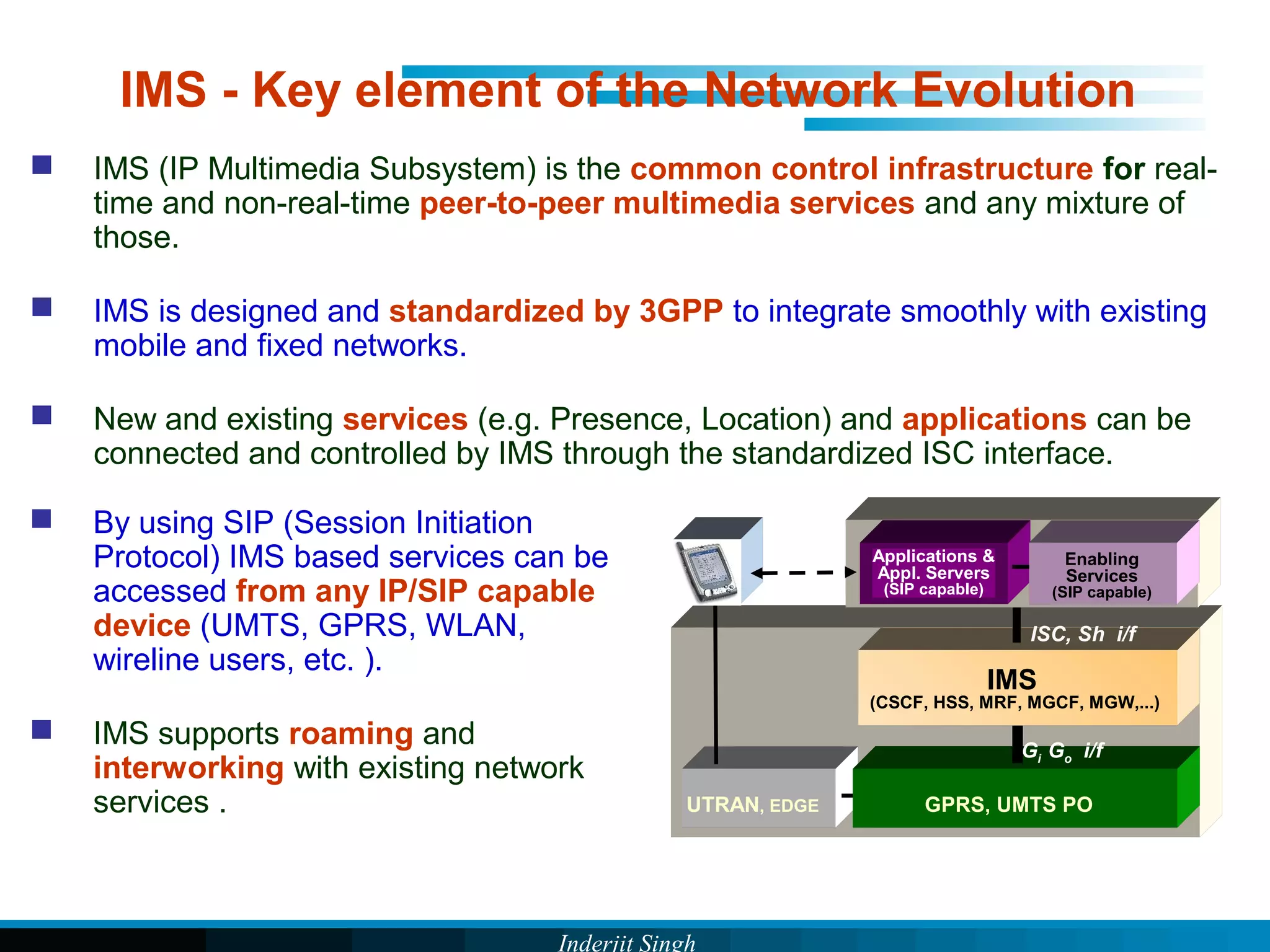
IMS - Key element of the Network Evolution
 IMS (IP Multimedia Subsystem) is the common control infrastructure for real-
time and non-real-time peer-to-peer multimedia services and any mixture of
those.
 IMS is designed and standardized by 3GPP to integrate smoothly with existing
mobile and fixed networks.
 New and existing services (e.g. Presence, Location) and applications can be
connected and controlled by IMS through the standardized ISC interface.
 By using SIP (Session Initiation
Protocol) IMS based services can be
accessed from any IP/SIP capable
device (UMTS, GPRS, WLAN,
wireline users, etc. ).
 IMS supports roaming and
interworking with existing network
services . UTRAN, EDGE
IMS
(CSCF, HSS, MRF, MGCF, MGW,...)
GPRS, UMTS PO
Gi Go i/f
Applications &
Appl. Servers
(SIP capable)
Enabling
Services
(SIP capable)
ISC, Sh i/f
Inderjit Singh
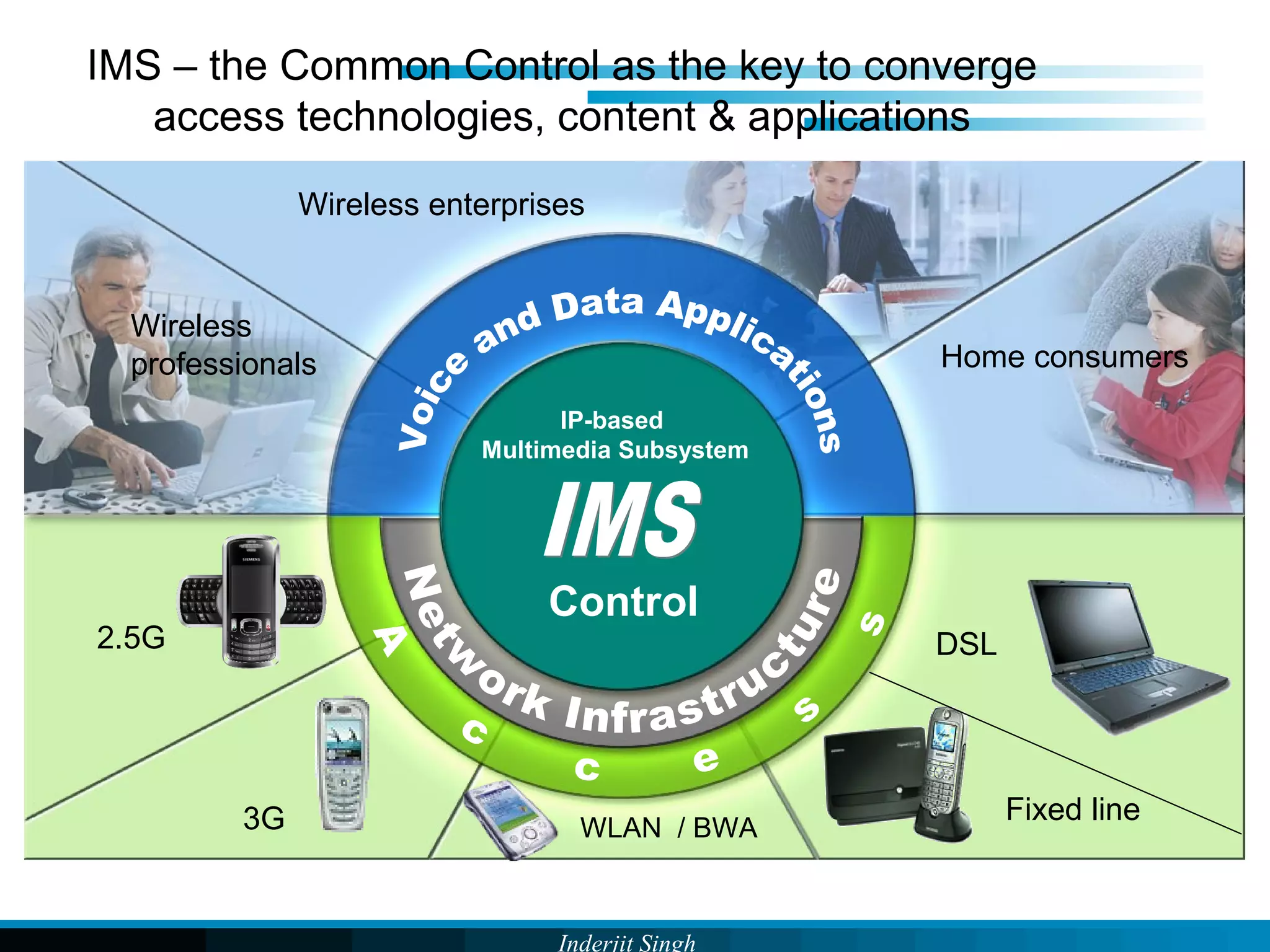
IMS – the Common Control as the key to converge
access technologies, content & applications
DSL
3G
2.5G
WLAN / BWA
Fixed line
Wireless
professionals Home consumers
Wireless enterprises
IP-based
Multimedia Subsystem
Control
Inderjit Singh
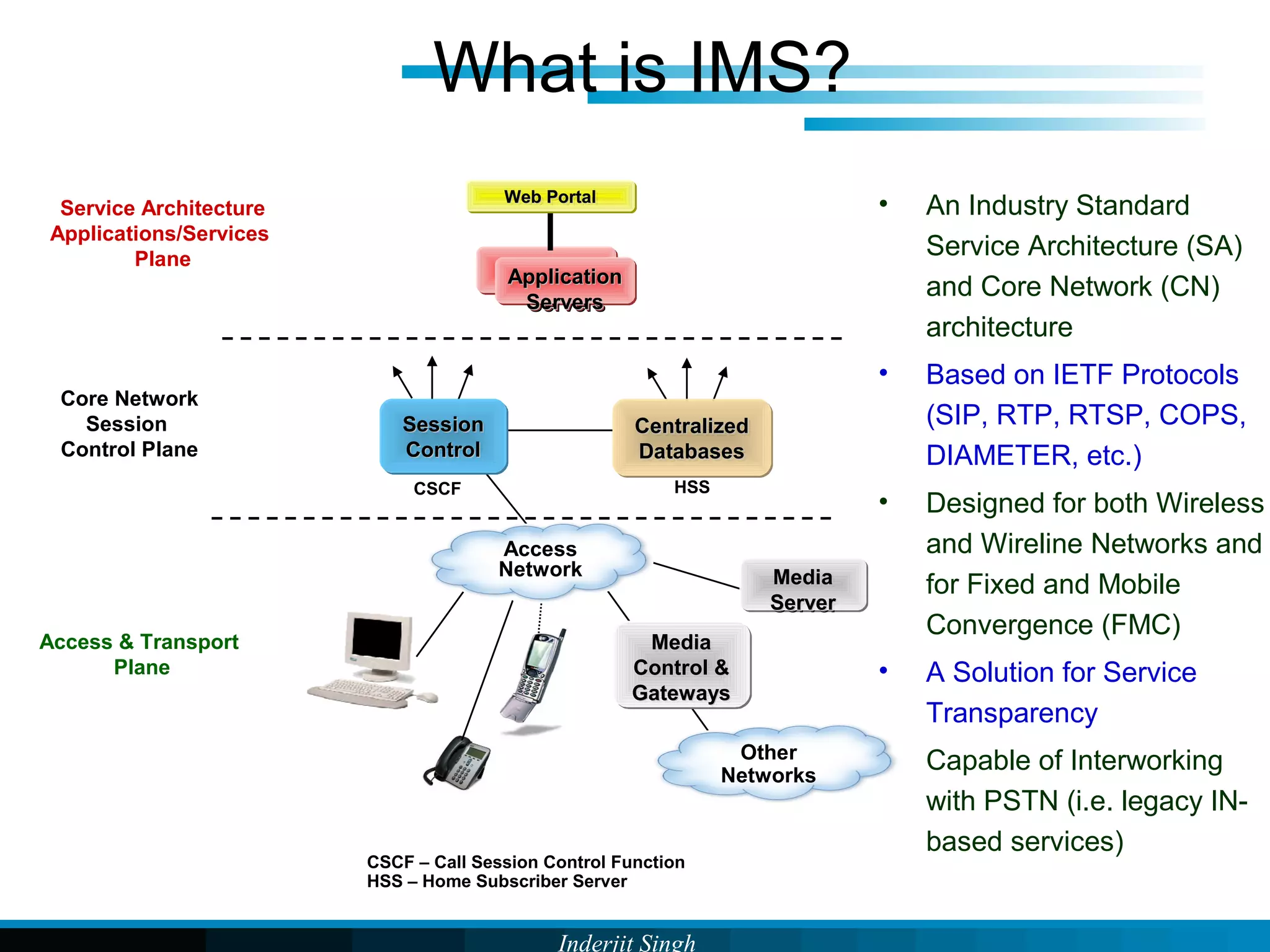
What is IMS?
• An Industry Standard
Service Architecture (SA)
and Core Network (CN)
architecture
• Based on IETF Protocols
(SIP, RTP, RTSP, COPS,
DIAMETER, etc.)
• Designed for both Wireless
and Wireline Networks and
for Fixed and Mobile
Convergence (FMC)
• A Solution for Service
Transparency
• Capable of Interworking
with PSTN (i.e. legacy IN-
based services)
CSCF – Call Session Control Function
HSS – Home Subscriber Server
Access & Transport
Plane
Core Network
Session
Control Plane
Service Architecture
Applications/Services
Plane
HSSCSCF
Access
Network
Other
Networks
Web PortalWeb PortalWeb PortalWeb Portal
ApplicationApplication
ServersServers
ApplicationApplication
ServersServers
SessionSession
ControlControl
SessionSession
ControlControl
CentralizedCentralized
DatabasesDatabases
CentralizedCentralized
DatabasesDatabases
MediaMedia
Control &Control &
GatewaysGateways
MediaMedia
Control &Control &
GatewaysGateways
MediaMedia
ServerServer
MediaMedia
ServerServer
Inderjit Singh
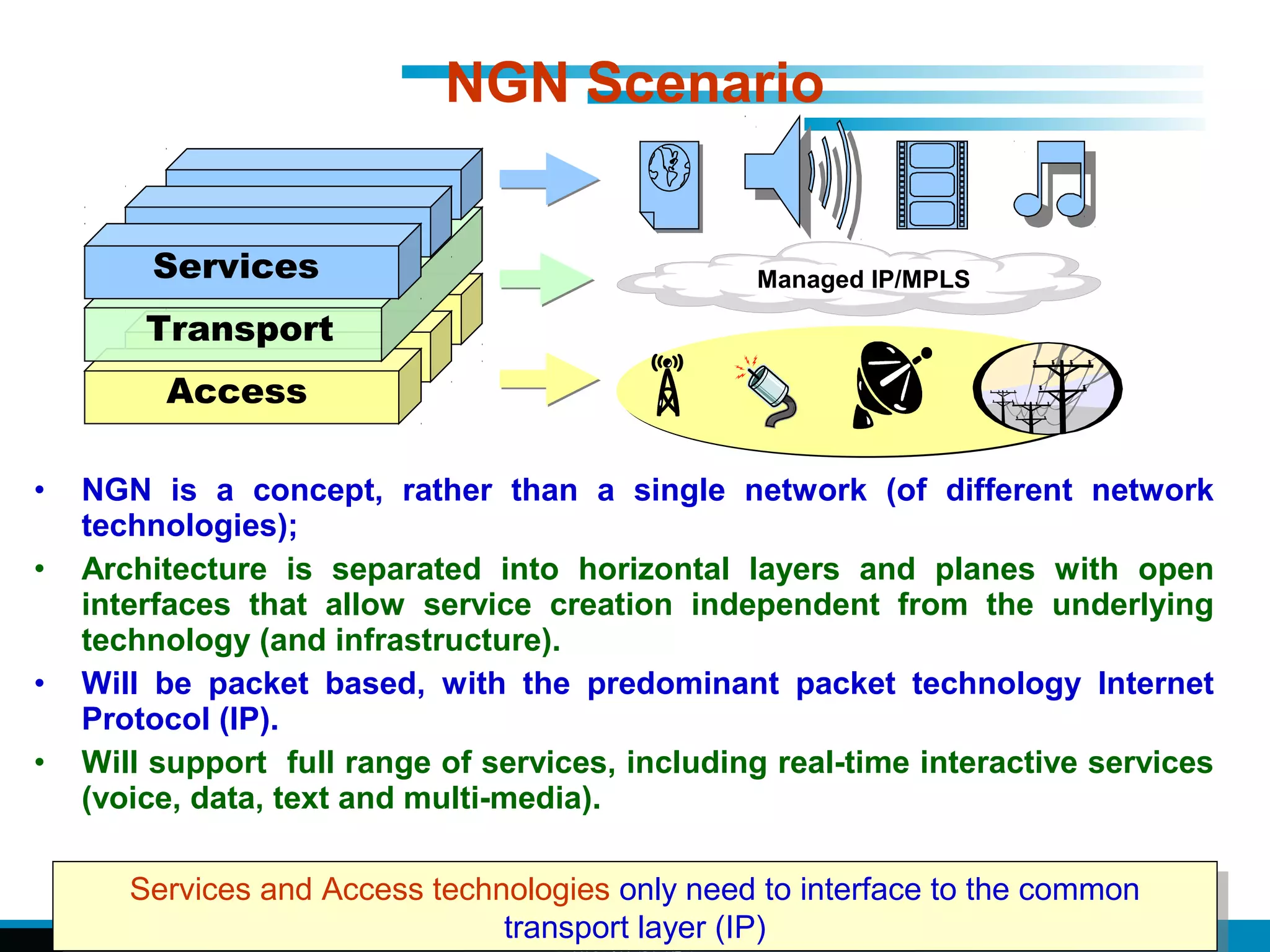
NGN Scenario
Services and Access technologies only need to interface to the common
transport layer (IP)
Services and Access technologies only need to interface to the common
transport layer (IP)
Access
Transport
Services Managed IP/MPLS
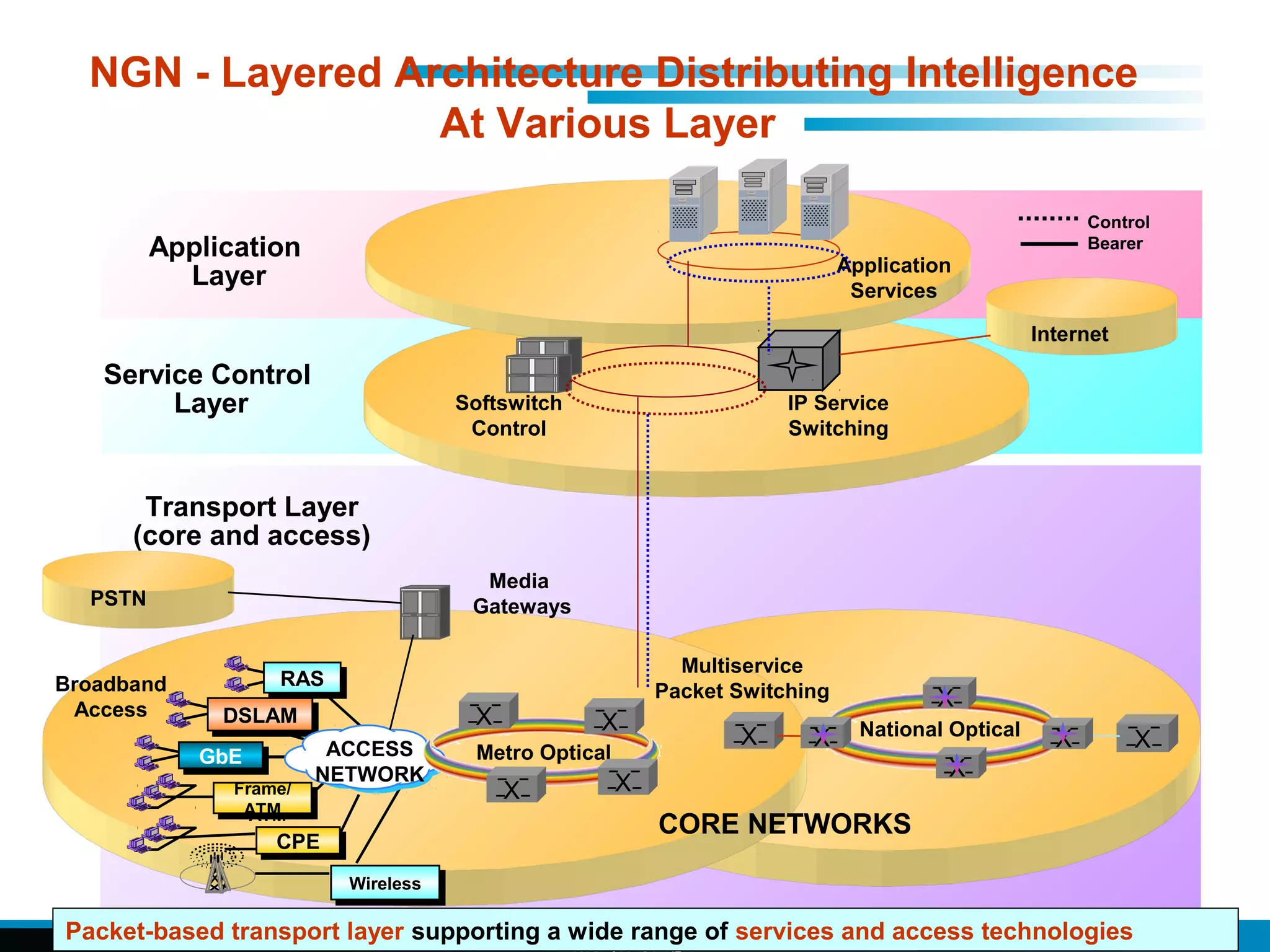
• NGN is a concept, rather than a single network (of different network
technologies);
• Architecture is separated into horizontal layers and planes with open
interfaces that allow service creation independent from the underlying
technology (and infrastructure).
• Will be packet based, with the predominant packet technology Internet
Protocol (IP).
• Will support full range of services, including real-time interactive services
(voice, data, text and multi-media).
Inderjit Singh
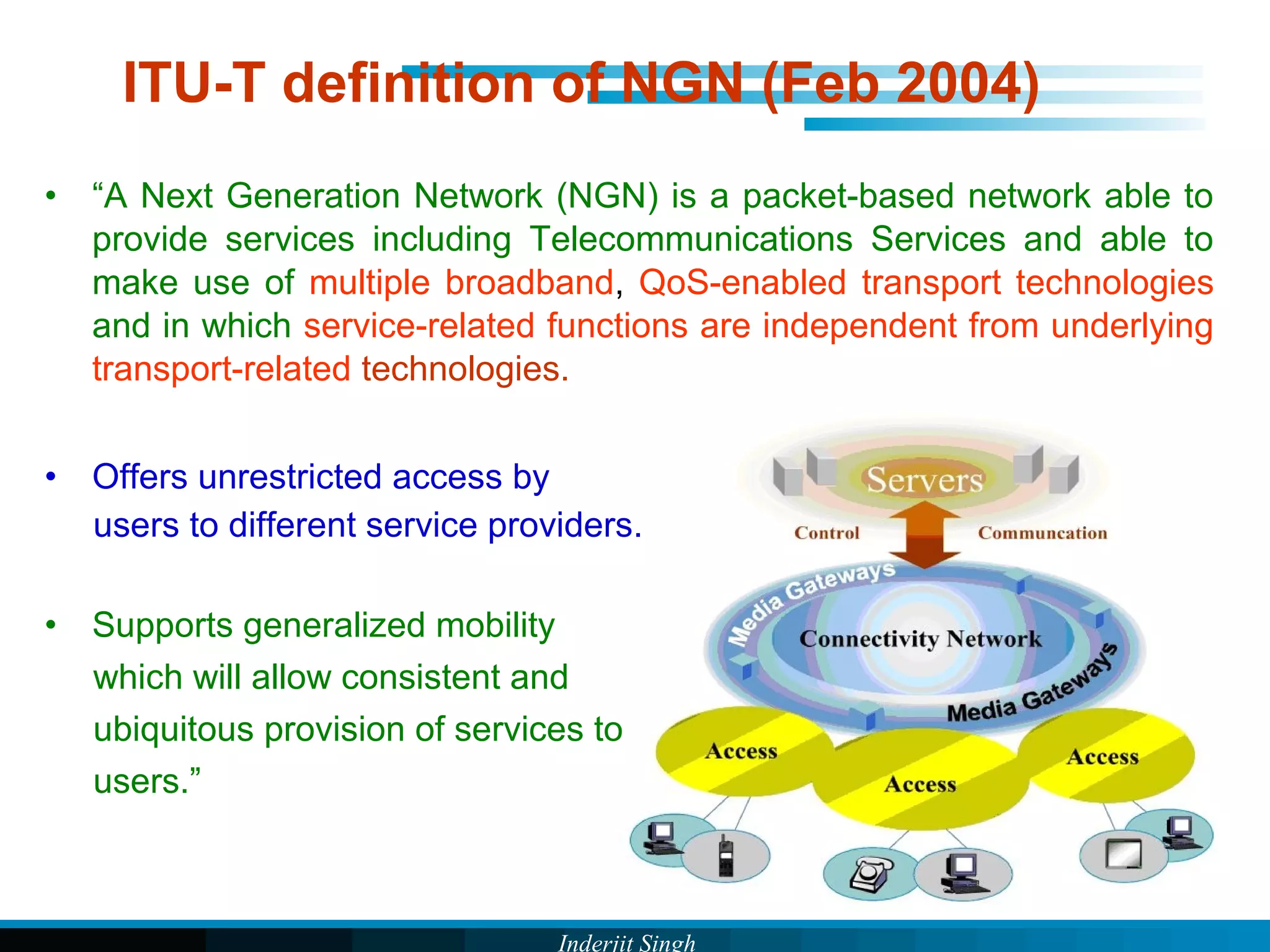
ITU-T definition of NGN (Feb 2004)
• “A Next Generation Network (NGN) is a packet-based network able to
provide services including Telecommunications Services and able to
make use of multiple broadband, QoS-enabled transport technologies
and in which service-related functions are independent from underlying
transport-related technologies.
• Offers unrestricted access by
users to different service providers.
• Supports generalized mobility
which will allow consistent and
ubiquitous provision of services to
users.”
Inderjit Singh
UMTS
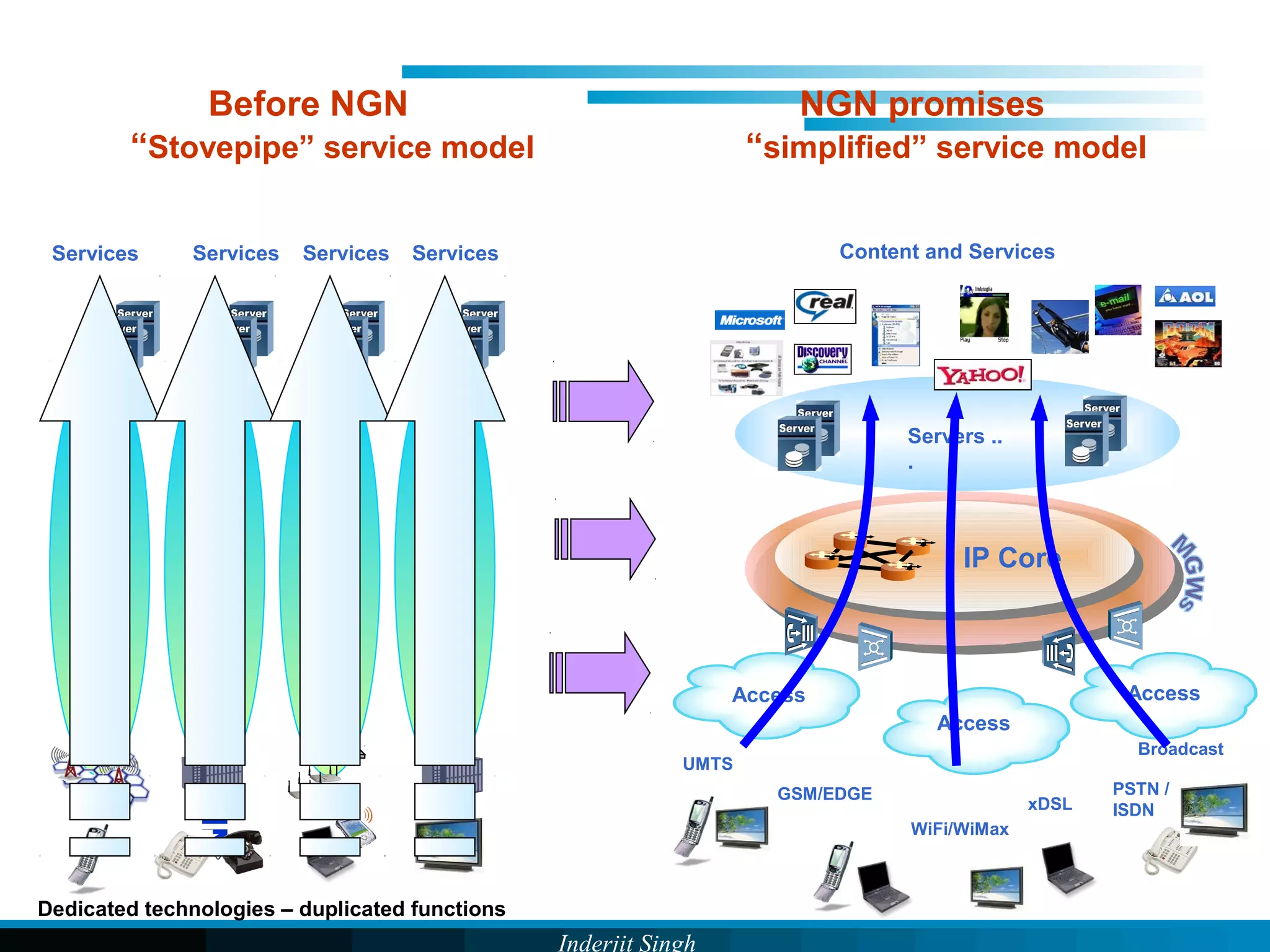
Before NGN
“Stovepipe” service model
Dedicated technologies – duplicated functions
Services Services Services
PLMN
PSTN/ISDN
Data/IP
CATV
IP Core
Access
Access
Access
GSM/EDGE
WiFi/WiMax
xDSL
PSTN /
ISDN
Broadcast
Content and Services
Servers ..
.
NGN promises
“simplified” service model
Services
Inderjit Singh
NGN - Layered Architecture Distributing Intelligence
At Various Layer
Application
Layer
Control
Bearer
Service Control
Layer Softswitch
Control
IP Service
Switching
Application
Services
Transport Layer
(core and access)
PSTN
Internet
Multiservice
Packet Switching
XX X X
X
CORE NETWORKS
X
National Optical
Broadband
Access
GbEGbE
DSLAMDSLAM
ACCESS
NETWORK
RASRAS
Frame/
ATM
Frame/
ATM
WirelessWireless
CPECPE
Media
Gateways
Metro Optical
X
XX
X
Packet-based transport layer supporting a wide range of services and access technologies
Inderjit Singh
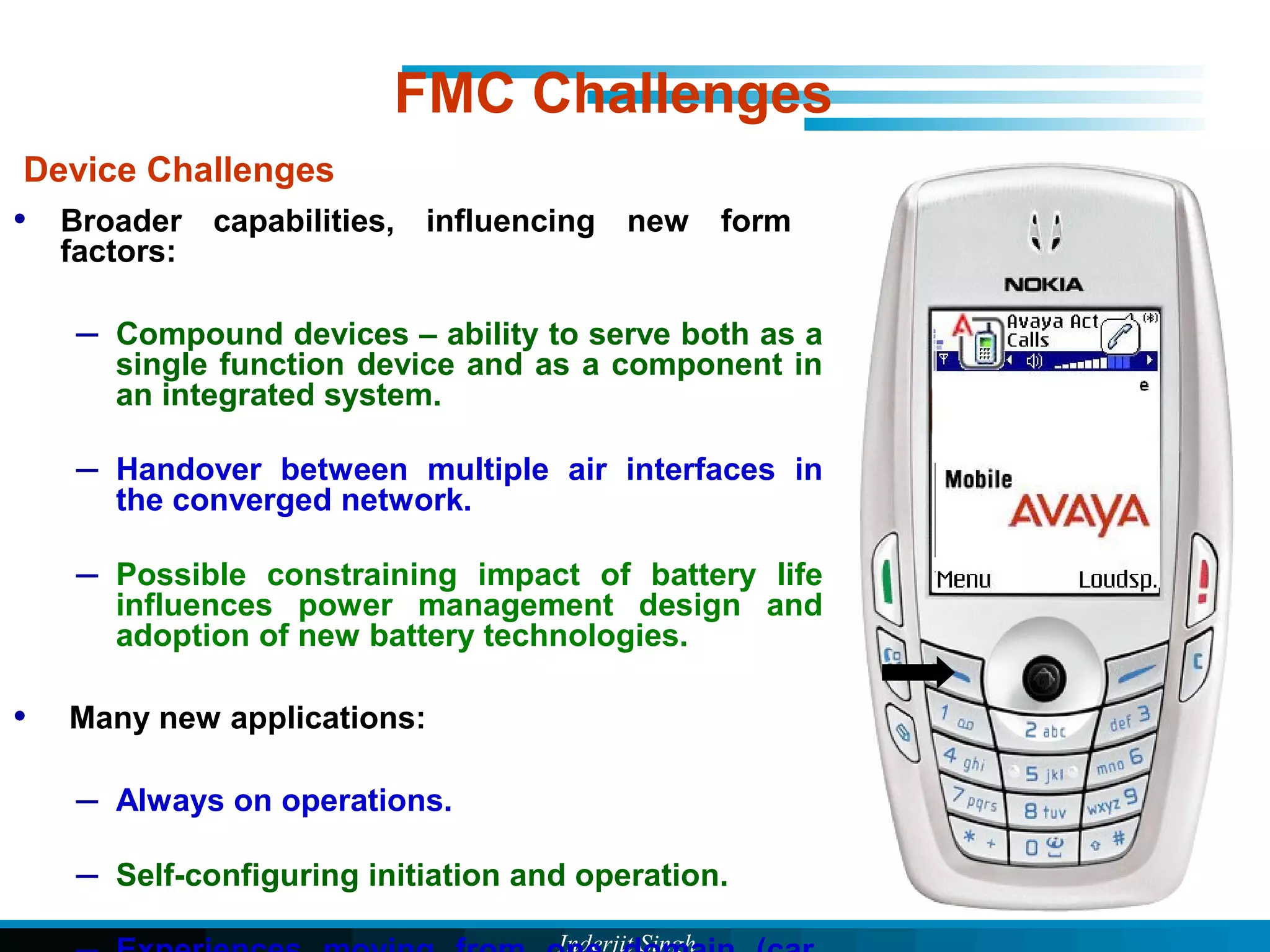
Device Challenges
• Broader capabilities, influencing new form
factors:
– Compound devices – ability to serve both as a
single function device and as a component in
an integrated system.
– Handover between multiple air interfaces in
the converged network.
– Possible constraining impact of battery life
influences power management design and
adoption of new battery technologies.
• Many new applications:
– Always on operations.
– Self-configuring initiation and operation.
FMC Challenges
Inderjit Singh
FMC Challenges
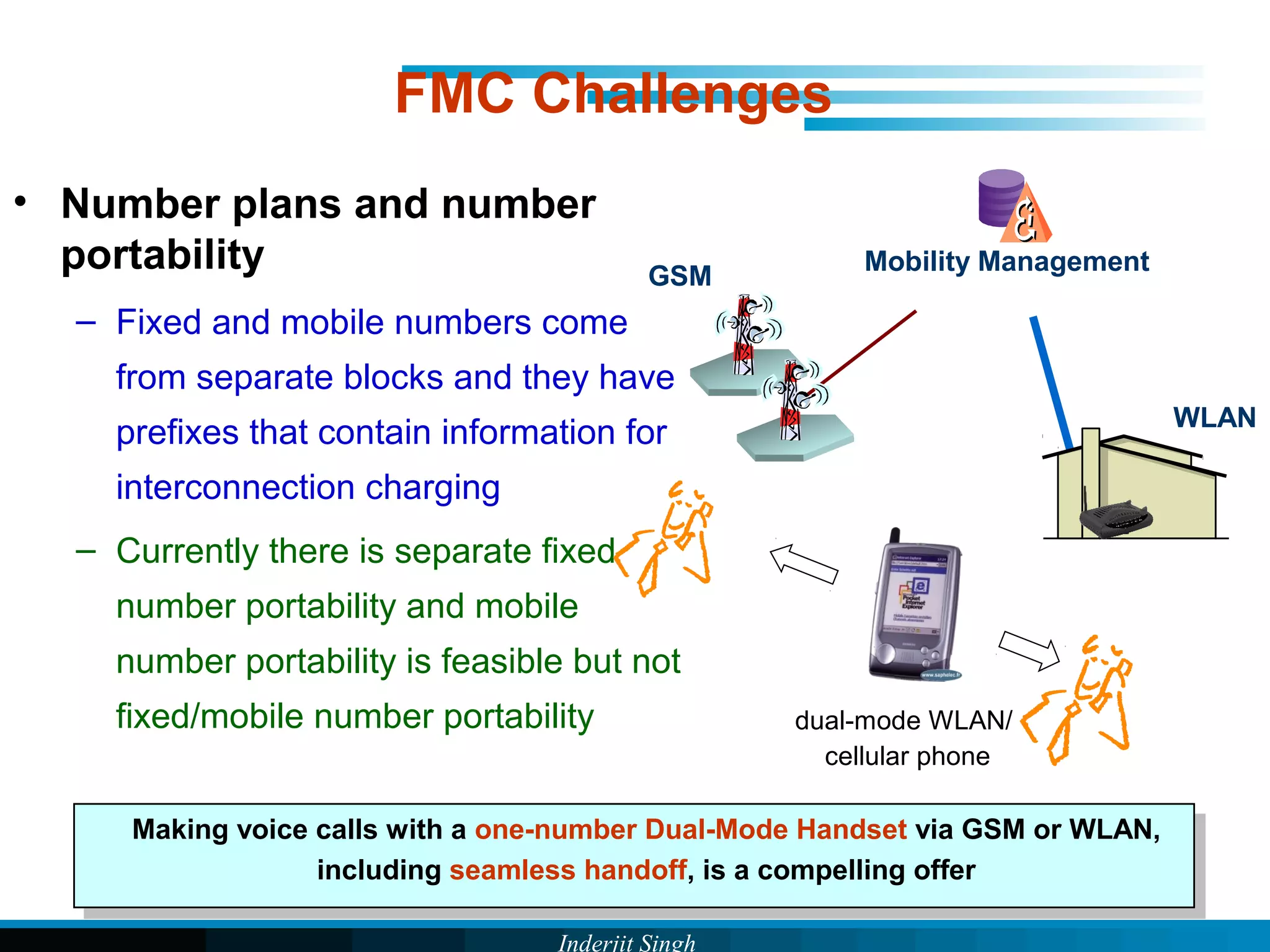
• Number plans and number
portability
– Fixed and mobile numbers come
from separate blocks and they have
prefixes that contain information for
interconnection charging
– Currently there is separate fixed
number portability and mobile
number portability is feasible but not
fixed/mobile number portability
WLAN
GSM
Mobility Management
dual-mode WLAN/
cellular phone
Making voice calls with a one-number Dual-Mode Handset via GSM or WLAN,
including seamless handoff, is a compelling offer
Making voice calls with a one-number Dual-Mode Handset via GSM or WLAN,
including seamless handoff, is a compelling offer
Inderjit Singh
FMC Challenges
• Directory services
– Fixed operators provide directory service to their customers. This catalogue
contains information on all fixed line customers.
– Currently mobile operators do not offer this kind of service and mobile
numbers are considered as personal data.
• Spectrum
– Access to licensed and unlicensed spectrum, deregulation of existing
allocations and spectrum trading.
• Interconnection
– Mobile party pays (MPP), calling party pays (CPP), symmetry of charging
and cost base.
Inderjit Singh
Conclusion
• FMC gives lots of possibilities but on the other hand it means
also new investments to operators.
• Very complex networks.
• Common standards have a great importance .
• How much the end users are willing to pay for the services?
Inderjit Singh
FMC will combine the convenience, freedom of
movement and personalized services of the
wireless world with the high quality and
speed of fixed communication.
Inderjit Singh
ThanksThanks

Fixed Mobile Convergence

  • 1.
  • 2.
    Inderjit Singh Converged Communications •Imagine starting a voice call on your home phone and transferring it seamlessly to your mobile as you drive to work. • Imagine sending a multimedia message from your car that later appears on your TV screen. • Imagine watching a movie on that same TV, pausing it in mid-show and then watching it on a wireless PDA as you relax in the garden. • Imagine having a cell phone conversation with two or three friends and simultaneously sharing a video of the football match you are attending. • Imagine that all of the above can be done with a single account, on a single log-in with multiple devices over any number of access networks.
  • 3.
    Inderjit Singh Purview • Trendsin communication sector • Towards Fixed-Mobile Convergence • Enabling Technologies • What are the Challenges Ahead?
  • 4.
    Inderjit Singh Trends inTelecom and Broadcasting From… • Monopoly • Narrowband • Single Service – Single Technology • Separate networks • Central intelligence • Circuit-switched • Telecom • Wireline • Voice centric • Copper infrastructure To… • Competition • Broadband • Multi Service – Multiple Technology (Triple-play) • Converged networks • Distributed intelligence • Packetized • Telecom/IT Convergence • Mobile and Converged • Multimedia centric • Optical infrastructure • National • Passive • General • Global • Interactive • Personalized Video The communications sector is converging with the information technology and entertainment sectors The communications sector is converging with the information technology and entertainment sectors Telecomsector Video Services
  • 5.
    Inderjit Singh Where is“convergence” happening? IPTV, Mobile TV mp3 FMC Offers VoIP Services Home Entertainment Telecoms (Fixed & Mobile) Audio & Video Content Voice Data Fixed Networks Mobile Networks Voice-Data Convergence Fixed-Mobile Convergence Telecoms- Media Convergence All-IP The three most important types of convergence are: voice-data, fixed-mobile and telecom- media. But also telecom-computing and device convergence exist. The three most important types of convergence are: voice-data, fixed-mobile and telecom- media. But also telecom-computing and device convergence exist.
  • 6.
    Inderjit Singh Fixed-Mobile ConvergenceConcept Network Device Service Mobility IP Broadband Communication Computer Appliance Voice, Data, Video / TV Communication/ Broadcasting Internet Fixed/Mobile Convergence
  • 7.
    Inderjit Singh Convergence ofthe Network – Removal of distinctions between fixed and wireless networks Source Ericsson
  • 8.
    Inderjit Singh End-users havehigh expectations for seamless communication any access, any device, any location, any time Independence Demand for individual, lively & colorful communication services Personalized services Availability control and manage more effectively when and how to be contacted Convenience Same look & feel on various devices leads to higher acceptance and usage Fixed Mobile Convergence FMC offers converged services to fulfill end-user expectationsFMC offers converged services to fulfill end-user expectations
  • 9.
    Inderjit Singh Fixed -Mobile Convergence Fixed Network : • Higher Quality • Low Cost • Higher Bandwidth Mobile Network: • Personalisation • Mobility • Expensive / limited bandwidth Convergence Best of Two World’s FMC will provide several business benefits for integrated operators: –Improved customer retention and reduced marketing costs through reduced churn. – Reduced network costs (Capex and Opex) . – New revenues with converged services. – Decrease churn rate by offering a seamless user experience across all networks. NGN / IMS Architecture  “Key Enabler” for FMC
  • 10.
    Inderjit Singh • NetworkConvergence - IP over any broadband wireline and wireless transport network - Telecom and IT - Telecom and Broadcasting • Device Convergence - Laptops, PDA’s, Phones, Mobile Smart phones, STB’s, TV’s • Services and Applications Convergence - Voice, messaging, presence, multimedia, VPN, video, corporate applications (e-health, e-commerce, etc.) Any Service, Anywhere, Anytime on Any Access TechnologyAny Service, Anywhere, Anytime on Any Access Technology Towards Fixed-Mobile Convergence IP Core 2G/3G/4G Internet Circuit Mobile Network 802.XX Access Packet Mobile Network Fixed Network Cable IP Network
  • 11.
    Inderjit Singh Network Convergence Combiningseparate networks (voice, data, video, etc.) and support systems to create a unified networking infrastructure Combining separate networks (voice, data, video, etc.) and support systems to create a unified networking infrastructure Past FuturePast Future Toll Bypass, PSTNPSTN IP www, corporateData IP Video, BroadbandCATV IP CDMA,GSM IP • Converged IP Network • Multi-Service layered arch. • Anytime, anywhere, in any form • Voice and multimedia • Simple for the end user • Secure, trusted and reliable
  • 12.
    Inderjit Singh • Mirrorof the network and access evolution. • Devices supporting access types CDMA2000,WCDMA, fixed broadband and WLAN. • Integrated service platform for phone, Internet, music, video games, and PDA functions. • Devices may also automatically switch to Wi-Fi enabled device making use of internet broadband connection within the home. Combining multiple functions into a single device that accesses multiple services across multiple access technologies (e.g., multipurpose cell phones, organizers or storage devices) Combining multiple functions into a single device that accesses multiple services across multiple access technologies (e.g., multipurpose cell phones, organizers or storage devices) Device Convergence
  • 13.
    Inderjit Singh Different viewson Device Convergence Game console meets internet browser Phone meets mus Phone meets T Phone meets videocamera
  • 14.
    Inderjit Singh • Noshared addresses. • Separate access for each. • Messages restricted to each individual system. Combining multiple access-based services to create a unified user experience with a single service offering (e.g., mobile/broadband roaming, unified messaging or location services) Application Convergence • Addresses shared between services. • Single point of access to integrated messaging system. • Presentation in different formats. Unified Messaging E-Mail Voicemail Fax Message Store ANY
  • 15.
    Inderjit Singh Voice Mailand Unified Messaging Service • “All in one In-Box” for voice messages, fax, e-mail • End-user can retrieve, store, and send messages • Message Alerts: – Phone, – e-mail, – SMS • Web Portal control for end-user and service Provider • “All in one In-Box” for voice messages, fax, e-mail • End-user can retrieve, store, and send messages • Message Alerts: – Phone, – e-mail, – SMS • Web Portal control for end-user and service Provider POP inbox Fax message with caller ID Voicemail with caller ID Service Description
  • 16.
    Inderjit Singh • Inaddition to p-2-p voice calls, new services surface – SkypeOut – SkypeIn – SkypeSMS – Video calling – Chat – Skype Zones Radical service innovation
  • 17.
    Inderjit Singh Service Convergence Subscribersaccess same services regardless of whether they are using a fixed or mobile connection: – Examples: of hybrid services • MMS (multimedia messaging) on a fixed or mobile phone. • Presence services (chat) on a computer or mobile device. • E-mail access on a computer, mobile or fixed phone
  • 18.
  • 19.
    Inderjit Singh Internet Network IMS -“IP Multimedia Subsystem” IMS is the Voice/Video over Internet designed for 3G networks - Now considered to be the standard for fixed, wireless and mobile Internet-based delivering services over CDMA2000,WCDMA,GSM,WLAN and fixed broadband. - The protocols come from the IETF: • RTP -for media • SIP- for signaling / address resolution Phone Network NGN -Modernize phone infrastructure: • Same services • Different technology - Reduce the complexity and the costs CAPEX / OPEX Avoid rupture - Keeping the phone architecture and making replacement of objects element per element. NGN = Legacy Phone with Lower Cost IMS = Internet Multimedia Phone for the Future What NGN is not: • The new voice call architecture for the future with Internet and Multimedia • Internet Telephony with VoIP What NGN is not: • The new voice call architecture for the future with Internet and Multimedia • Internet Telephony with VoIP
  • 20.
    Inderjit Singh IMS -Key element of the Network Evolution  IMS (IP Multimedia Subsystem) is the common control infrastructure for real- time and non-real-time peer-to-peer multimedia services and any mixture of those.  IMS is designed and standardized by 3GPP to integrate smoothly with existing mobile and fixed networks.  New and existing services (e.g. Presence, Location) and applications can be connected and controlled by IMS through the standardized ISC interface.  By using SIP (Session Initiation Protocol) IMS based services can be accessed from any IP/SIP capable device (UMTS, GPRS, WLAN, wireline users, etc. ).  IMS supports roaming and interworking with existing network services . UTRAN, EDGE IMS (CSCF, HSS, MRF, MGCF, MGW,...) GPRS, UMTS PO Gi Go i/f Applications & Appl. Servers (SIP capable) Enabling Services (SIP capable) ISC, Sh i/f
  • 21.
    Inderjit Singh IMS –the Common Control as the key to converge access technologies, content & applications DSL 3G 2.5G WLAN / BWA Fixed line Wireless professionals Home consumers Wireless enterprises IP-based Multimedia Subsystem Control
  • 22.
    Inderjit Singh What isIMS? • An Industry Standard Service Architecture (SA) and Core Network (CN) architecture • Based on IETF Protocols (SIP, RTP, RTSP, COPS, DIAMETER, etc.) • Designed for both Wireless and Wireline Networks and for Fixed and Mobile Convergence (FMC) • A Solution for Service Transparency • Capable of Interworking with PSTN (i.e. legacy IN- based services) CSCF – Call Session Control Function HSS – Home Subscriber Server Access & Transport Plane Core Network Session Control Plane Service Architecture Applications/Services Plane HSSCSCF Access Network Other Networks Web PortalWeb PortalWeb PortalWeb Portal ApplicationApplication ServersServers ApplicationApplication ServersServers SessionSession ControlControl SessionSession ControlControl CentralizedCentralized DatabasesDatabases CentralizedCentralized DatabasesDatabases MediaMedia Control &Control & GatewaysGateways MediaMedia Control &Control & GatewaysGateways MediaMedia ServerServer MediaMedia ServerServer
  • 23.
    Inderjit Singh NGN Scenario Servicesand Access technologies only need to interface to the common transport layer (IP) Services and Access technologies only need to interface to the common transport layer (IP) Access Transport Services Managed IP/MPLS • NGN is a concept, rather than a single network (of different network technologies); • Architecture is separated into horizontal layers and planes with open interfaces that allow service creation independent from the underlying technology (and infrastructure). • Will be packet based, with the predominant packet technology Internet Protocol (IP). • Will support full range of services, including real-time interactive services (voice, data, text and multi-media).
  • 24.
    Inderjit Singh ITU-T definitionof NGN (Feb 2004) • “A Next Generation Network (NGN) is a packet-based network able to provide services including Telecommunications Services and able to make use of multiple broadband, QoS-enabled transport technologies and in which service-related functions are independent from underlying transport-related technologies. • Offers unrestricted access by users to different service providers. • Supports generalized mobility which will allow consistent and ubiquitous provision of services to users.”
  • 25.
    Inderjit Singh UMTS Before NGN “Stovepipe”service model Dedicated technologies – duplicated functions Services Services Services PLMN PSTN/ISDN Data/IP CATV IP Core Access Access Access GSM/EDGE WiFi/WiMax xDSL PSTN / ISDN Broadcast Content and Services Servers .. . NGN promises “simplified” service model Services
  • 26.
    Inderjit Singh NGN -Layered Architecture Distributing Intelligence At Various Layer Application Layer Control Bearer Service Control Layer Softswitch Control IP Service Switching Application Services Transport Layer (core and access) PSTN Internet Multiservice Packet Switching XX X X X CORE NETWORKS X National Optical Broadband Access GbEGbE DSLAMDSLAM ACCESS NETWORK RASRAS Frame/ ATM Frame/ ATM WirelessWireless CPECPE Media Gateways Metro Optical X XX X Packet-based transport layer supporting a wide range of services and access technologies
  • 27.
    Inderjit Singh Device Challenges •Broader capabilities, influencing new form factors: – Compound devices – ability to serve both as a single function device and as a component in an integrated system. – Handover between multiple air interfaces in the converged network. – Possible constraining impact of battery life influences power management design and adoption of new battery technologies. • Many new applications: – Always on operations. – Self-configuring initiation and operation. FMC Challenges
  • 28.
    Inderjit Singh FMC Challenges •Number plans and number portability – Fixed and mobile numbers come from separate blocks and they have prefixes that contain information for interconnection charging – Currently there is separate fixed number portability and mobile number portability is feasible but not fixed/mobile number portability WLAN GSM Mobility Management dual-mode WLAN/ cellular phone Making voice calls with a one-number Dual-Mode Handset via GSM or WLAN, including seamless handoff, is a compelling offer Making voice calls with a one-number Dual-Mode Handset via GSM or WLAN, including seamless handoff, is a compelling offer
  • 29.
    Inderjit Singh FMC Challenges •Directory services – Fixed operators provide directory service to their customers. This catalogue contains information on all fixed line customers. – Currently mobile operators do not offer this kind of service and mobile numbers are considered as personal data. • Spectrum – Access to licensed and unlicensed spectrum, deregulation of existing allocations and spectrum trading. • Interconnection – Mobile party pays (MPP), calling party pays (CPP), symmetry of charging and cost base.
  • 30.
    Inderjit Singh Conclusion • FMCgives lots of possibilities but on the other hand it means also new investments to operators. • Very complex networks. • Common standards have a great importance . • How much the end users are willing to pay for the services?
  • 31.
    Inderjit Singh FMC willcombine the convenience, freedom of movement and personalized services of the wireless world with the high quality and speed of fixed communication.
  • 32.

Editor's Notes

  • #22 From an architectural point of view we have 3 horizontal layers in IMS: Connectivity & Access layer: IMS is intended to be an access-independent architecture. Interfaces for various access networks have been defined: GPRS, UMTS, GSM, WLAN, xDSL, PSTN, IP Control layer: SIP is the signalling protocol for IMS, and in this layer we find SIP-based core elements – the new parts in your network – as well as gateways to existing access networks; those are partly reused elements like the Media Gateway in the 3GPP Release 4 architecture. Application layer: Different kind of applications ca be used and re-used: SIP-based AS, legacy IN services over CAMEL interface (e.g. SMS, Calling Cards) and 3rd party AS via an OSA-gateway. For the completeness of an operator network, components for alarming, provisioning, charging and number mapping have to be existing as well.
  • #23 But to execute on a fixed-mobile strategy, we must have centralized control over the network infrastructure, the access to that infrastructure, and the services, applications and content that are delivered to end users. The 3GPP group has defined that control through its IP Multimedia Subsystem specification, which describes how 3G operators can bring new applications to wireless users and has emerged as a way to control the convergence of fixed-mobile networks.
  • #24 IMS is defined as a network architecture that defines functional elements. Each functional element does not have to relate one-to-one to a physical element. A number of functional elements can be incorporated into a physical element depending upon a vendors implementation. The Service Architecture defines standard methods for services to be introduced while the Core Network defines the interactions between functional elements. IMS is multimedia. Therefore you need to think beyond a typical voice call. The context could be voice, video or graphics; or a combination correlated between two or more parties. IMS begin with 3GPP and ETSI, both which have their roots in Europe. To introduce IMS in the U.S. there are some adoptions that will be needed to accommodate U.S. nuances. It is likely that these will be handled by TIA and ATIS. IMS relies heavily existing standards developed by the IETF. Organizations representing IMS are also heavily influencing the IETF activity to evolve or develop new standards needed to complete the IMS picture. FMC – Fixed Mobile Convergence is the new buzz word of the industry. IMS’s intended applicability is across wireless, wireline, cable, enterprise and other networks. One of the major attributes, which may have more play in wireless, is the idea of service transparency no matter what network you are in (e.g. the home or visited network). There is a recognition that IMS must evolve into the networks and that there needs to be interworking between existing functionality and the newly envisioned capabilities.