Livestock feeds in the CGIAR
 Research Programs


Alan Duncan
FAO West Africa Regional Workshop on Crop
Residues, Dakar 10-13 December 2012
ILRI in the CGIAR Research Programs


   ILRI leads one CGIAR Research Program– ‘Livestock and Fish’.

   ILRI leads a component of one CGIAR Research Program–
    ‘Agriculture for Nutrition and Health’
    This component works to prevent and control agriculture-associated diseases,
    including food-borne diseases, zoonoses and emerging infectious diseases.


   ILRI participates in five other CGIAR Research Programs
    Drylands
    Humid Tropics
    Policies, Institutions and Markets
    Water, Land and Ecosystems
    Climate Change, Agriculture and Food Security
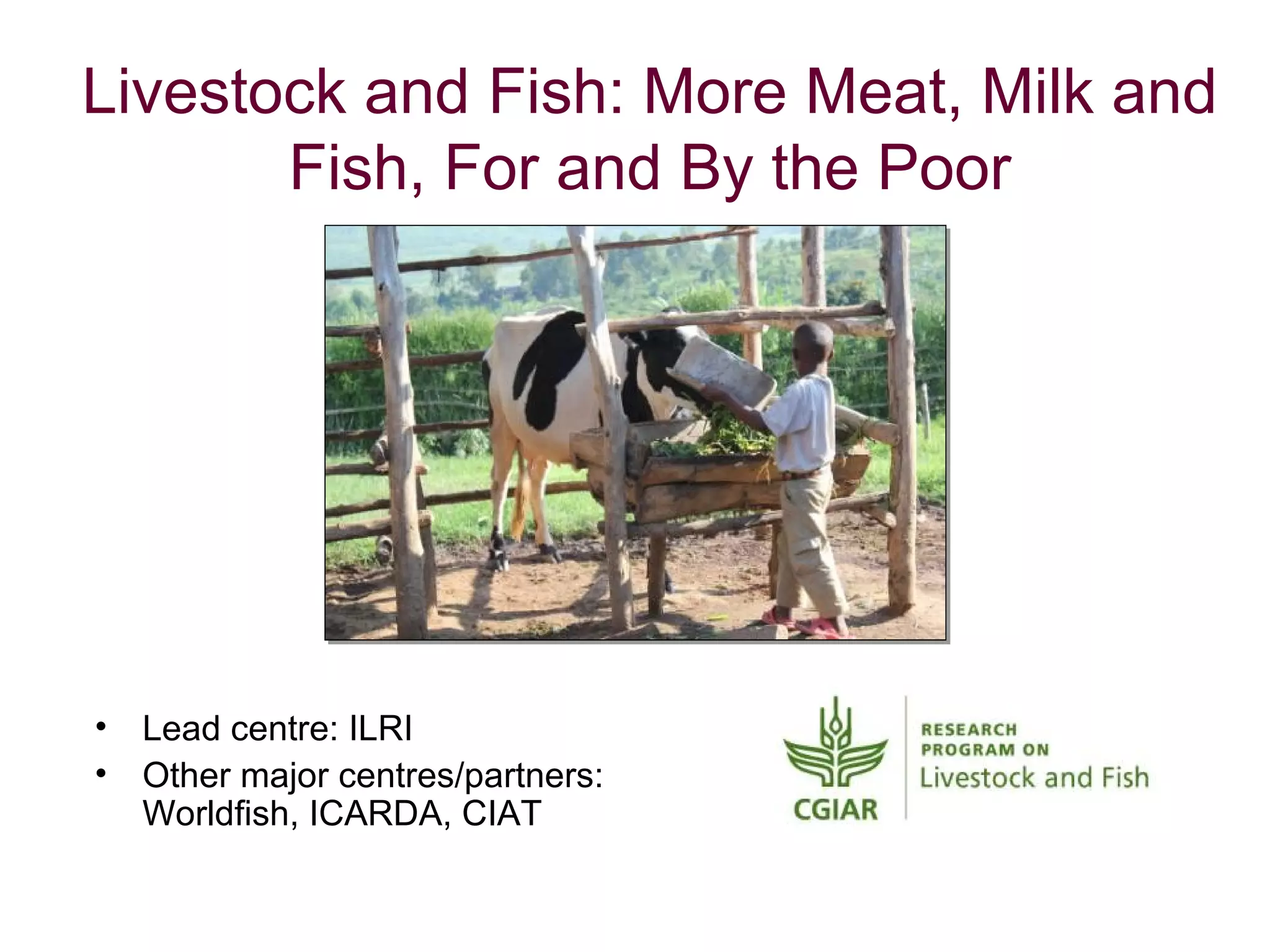
Livestock and Fish: More Meat, Milk and
       Fish, For and By the Poor


•   Lead centre: ILRI
•   Other major centres/partners:
    Worldfish, ICARDA, CIAT
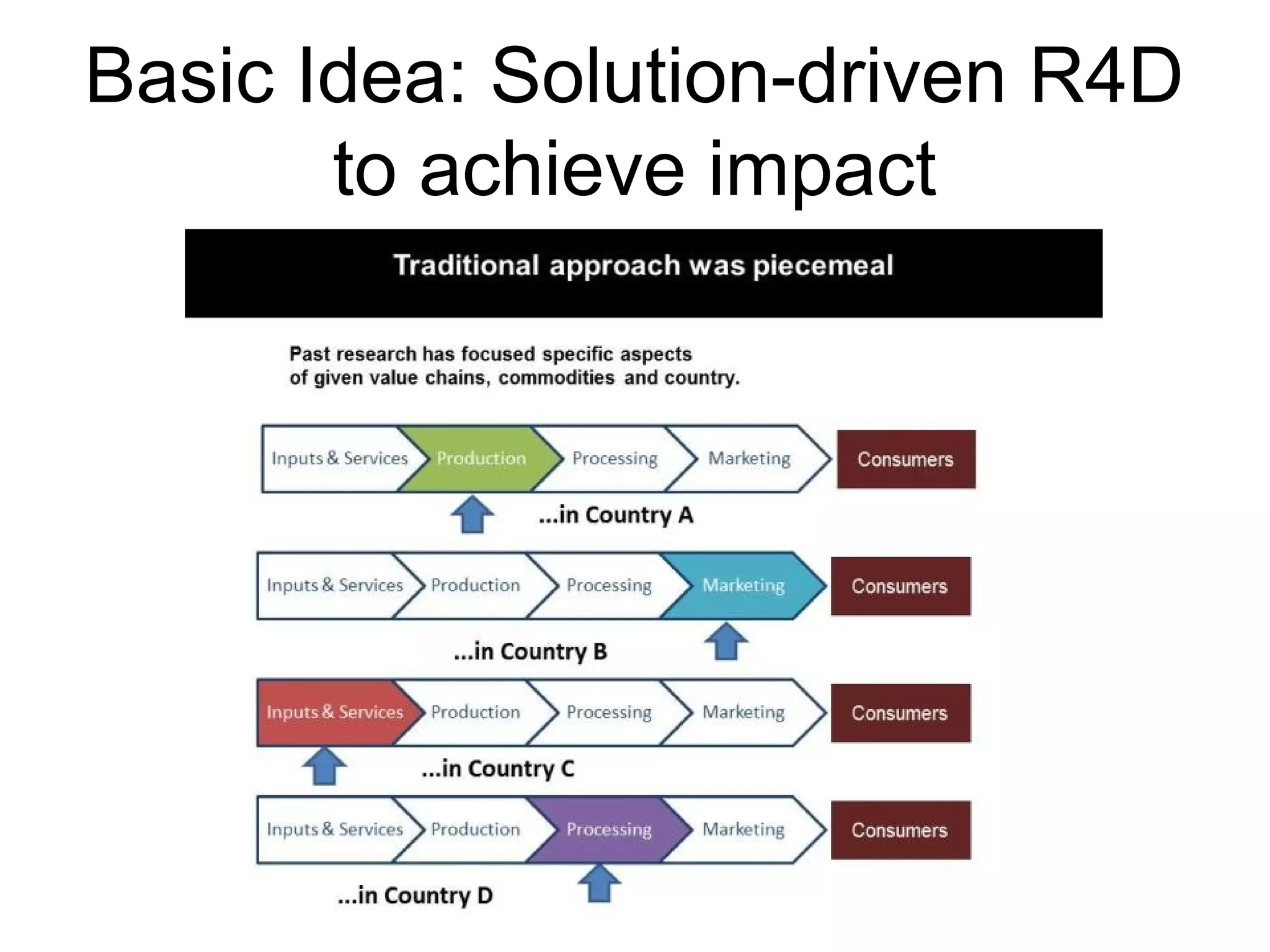
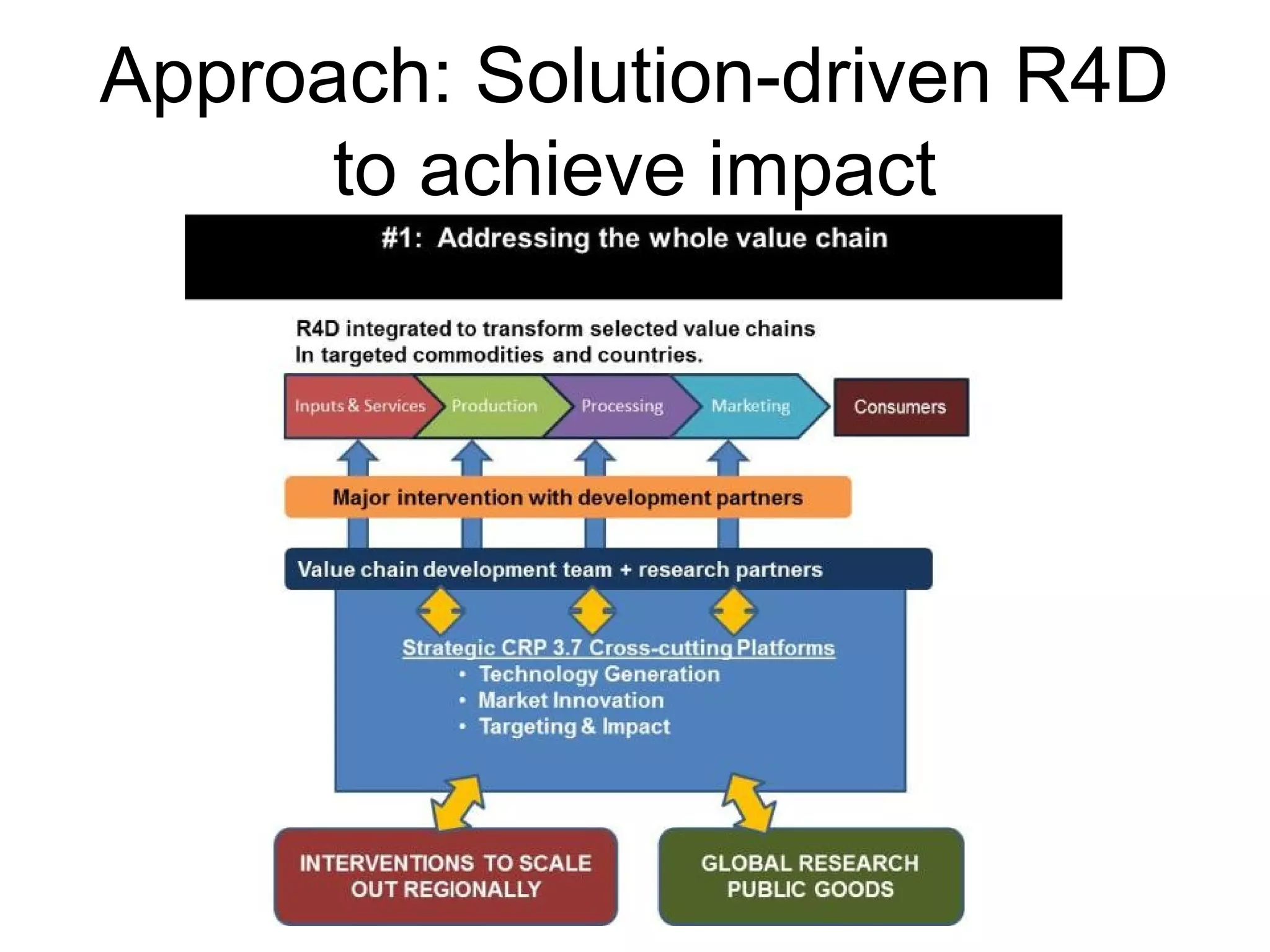
Basic Idea: Solution-driven R4D
       to achieve impact
Approach: Solution-driven R4D
      to achieve impact
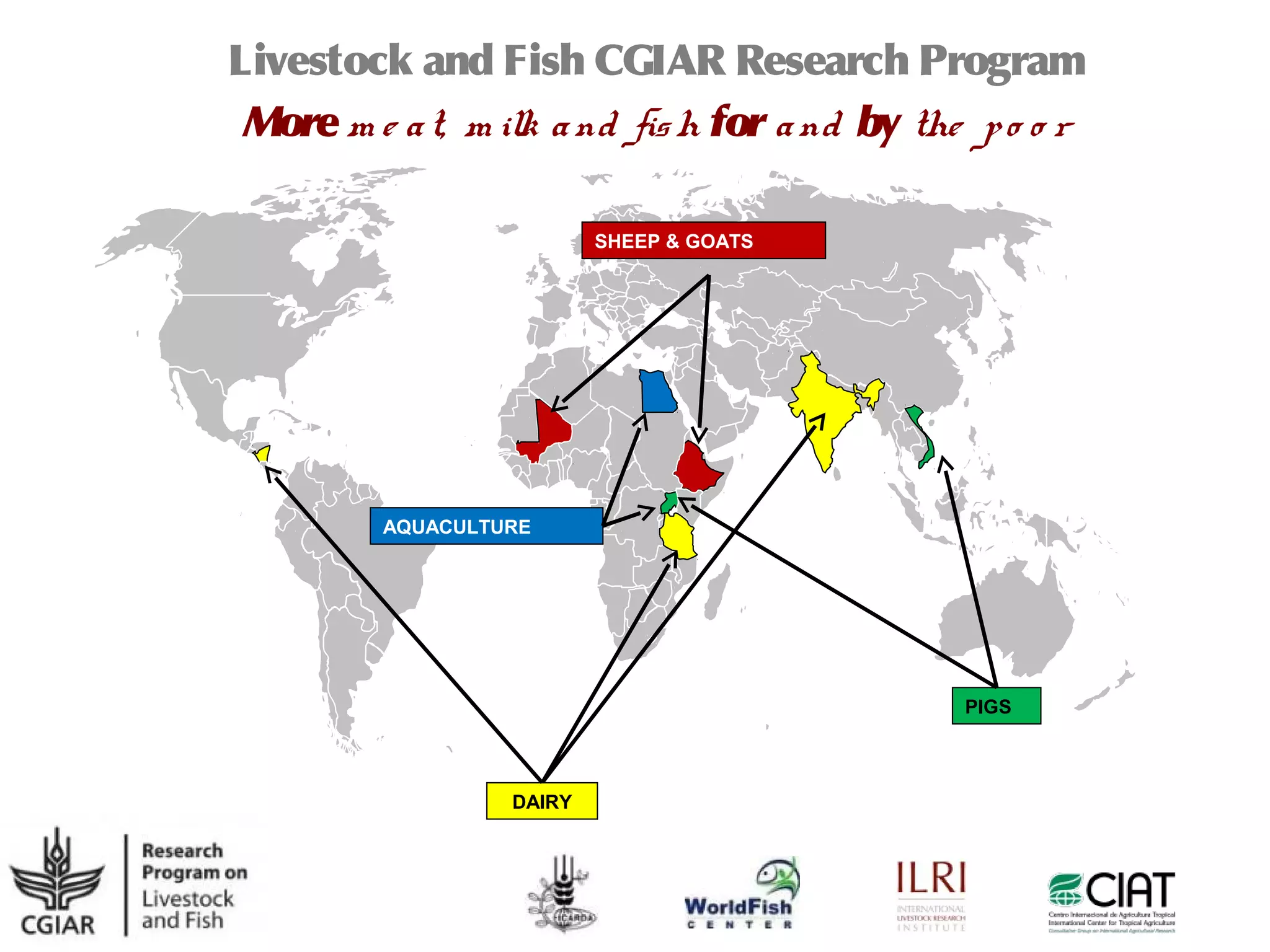
Livestock and Fish CGIAR Research Program
 More m e a t, m ilk a nd fis h for a nd by the p o o r

                          SHEEP & GOATS


         AQUACULTURE


                                               PIGS


                  DAIRY
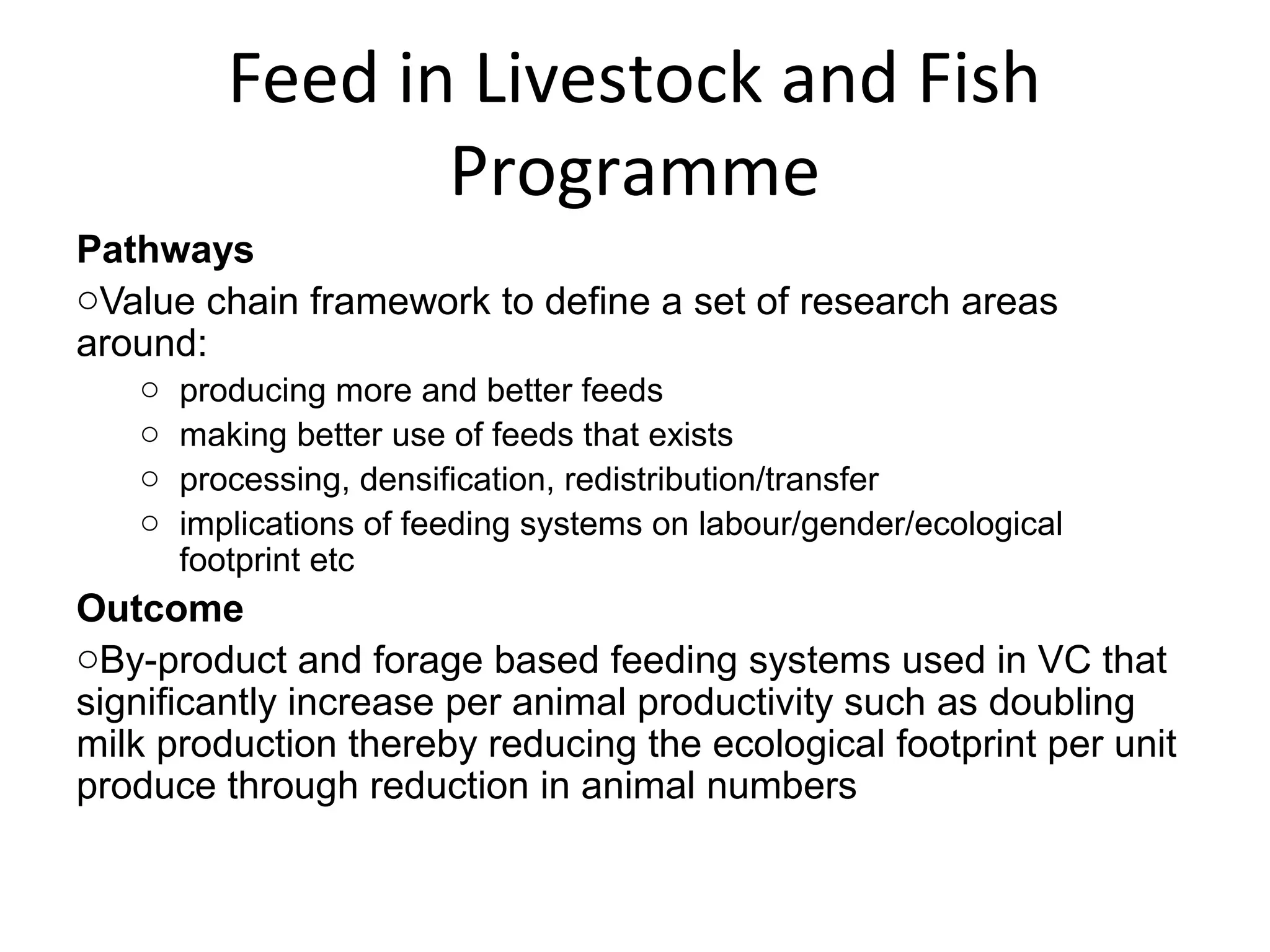
Feed in Livestock and Fish
                 Programme
Pathways
oValue chain framework to define a set of research areas
around:
   o   producing more and better feeds
   o   making better use of feeds that exists
   o   processing, densification, redistribution/transfer
   o   implications of feeding systems on labour/gender/ecological
       footprint etc
Outcome
oBy-product and forage based feeding systems used in VC that
significantly increase per animal productivity such as doubling
milk production thereby reducing the ecological footprint per unit
produce through reduction in animal numbers
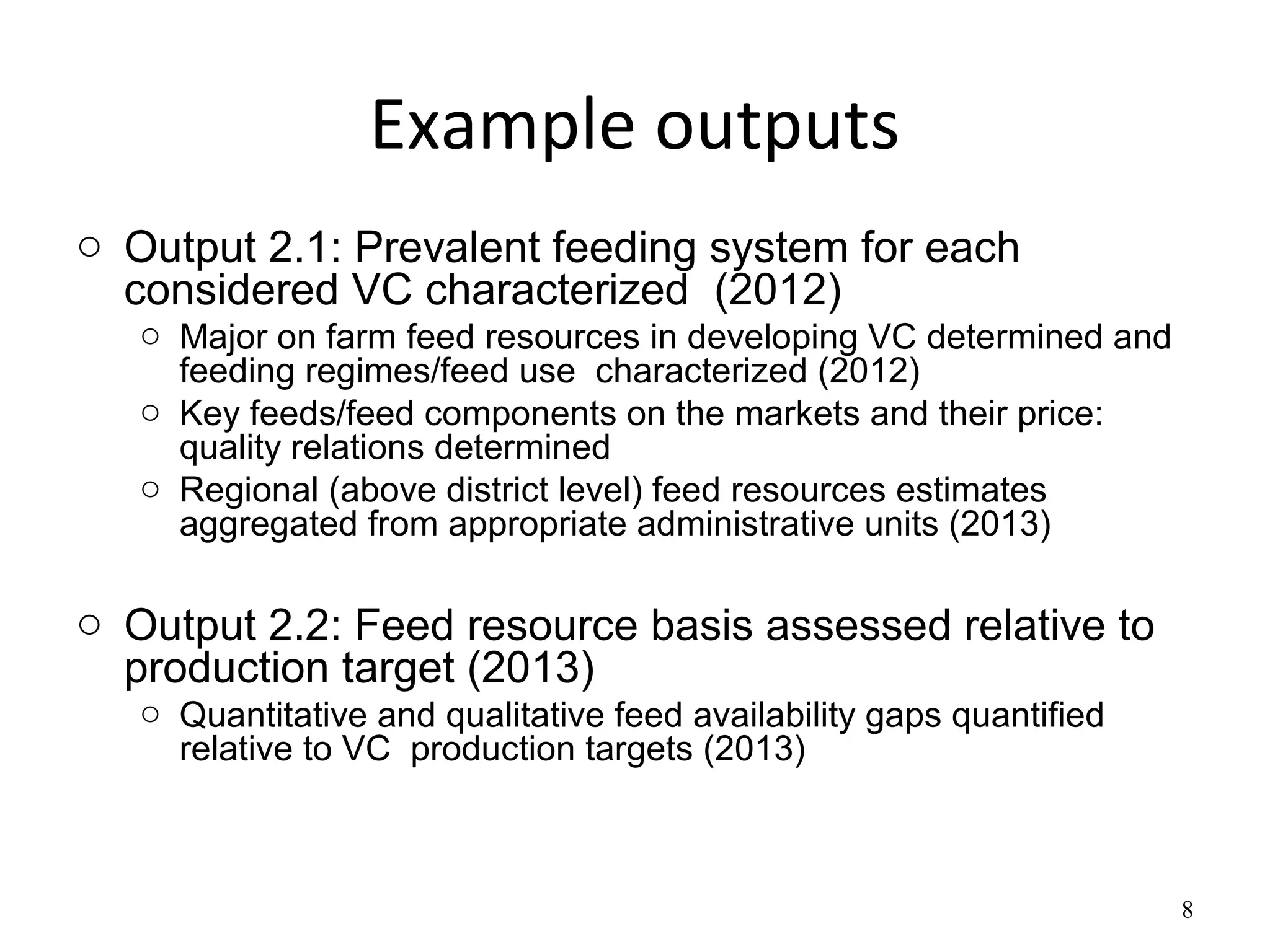
Example outputs
o Output 2.1: Prevalent feeding system for each
  considered VC characterized (2012)
   o Major on farm feed resources in developing VC determined and
     feeding regimes/feed use characterized (2012)
   o Key feeds/feed components on the markets and their price:
     quality relations determined
   o Regional (above district level) feed resources estimates
     aggregated from appropriate administrative units (2013)

o Output 2.2: Feed resource basis assessed relative to
  production target (2013)
   o Quantitative and qualitative feed availability gaps quantified
     relative to VC production targets (2013)


                                                                      8
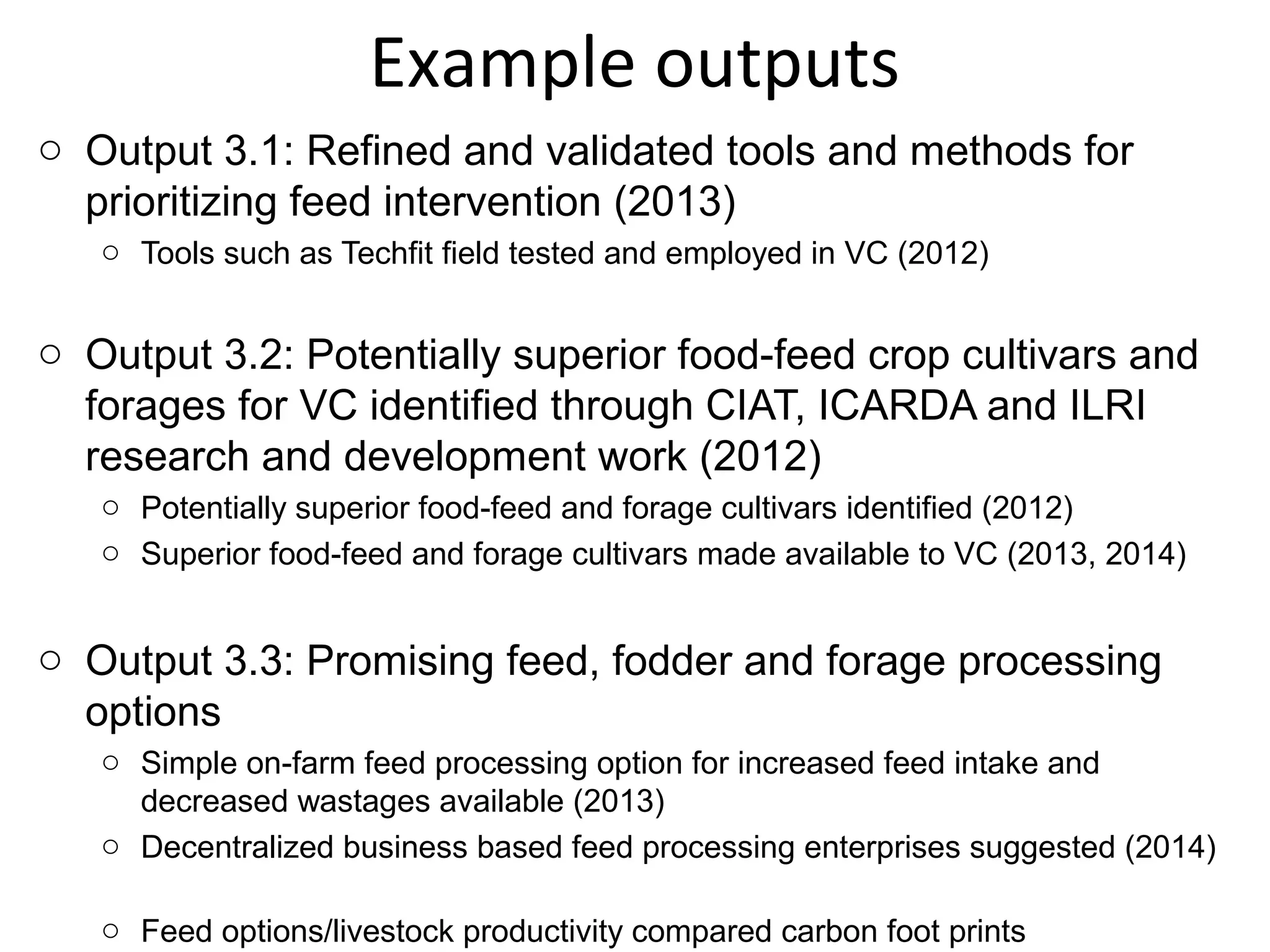
Example outputs
o Output 3.1: Refined and validated tools and methods for
  prioritizing feed intervention (2013)
   o Tools such as Techfit field tested and employed in VC (2012)


o Output 3.2: Potentially superior food-feed crop cultivars and
  forages for VC identified through CIAT, ICARDA and ILRI
  research and development work (2012)
   o Potentially superior food-feed and forage cultivars identified (2012)
   o Superior food-feed and forage cultivars made available to VC (2013, 2014)


o Output 3.3: Promising feed, fodder and forage processing
  options
   o Simple on-farm feed processing option for increased feed intake and
     decreased wastages available (2013)
   o Decentralized business based feed processing enterprises suggested (2014)

   o Feed options/livestock productivity compared carbon foot prints
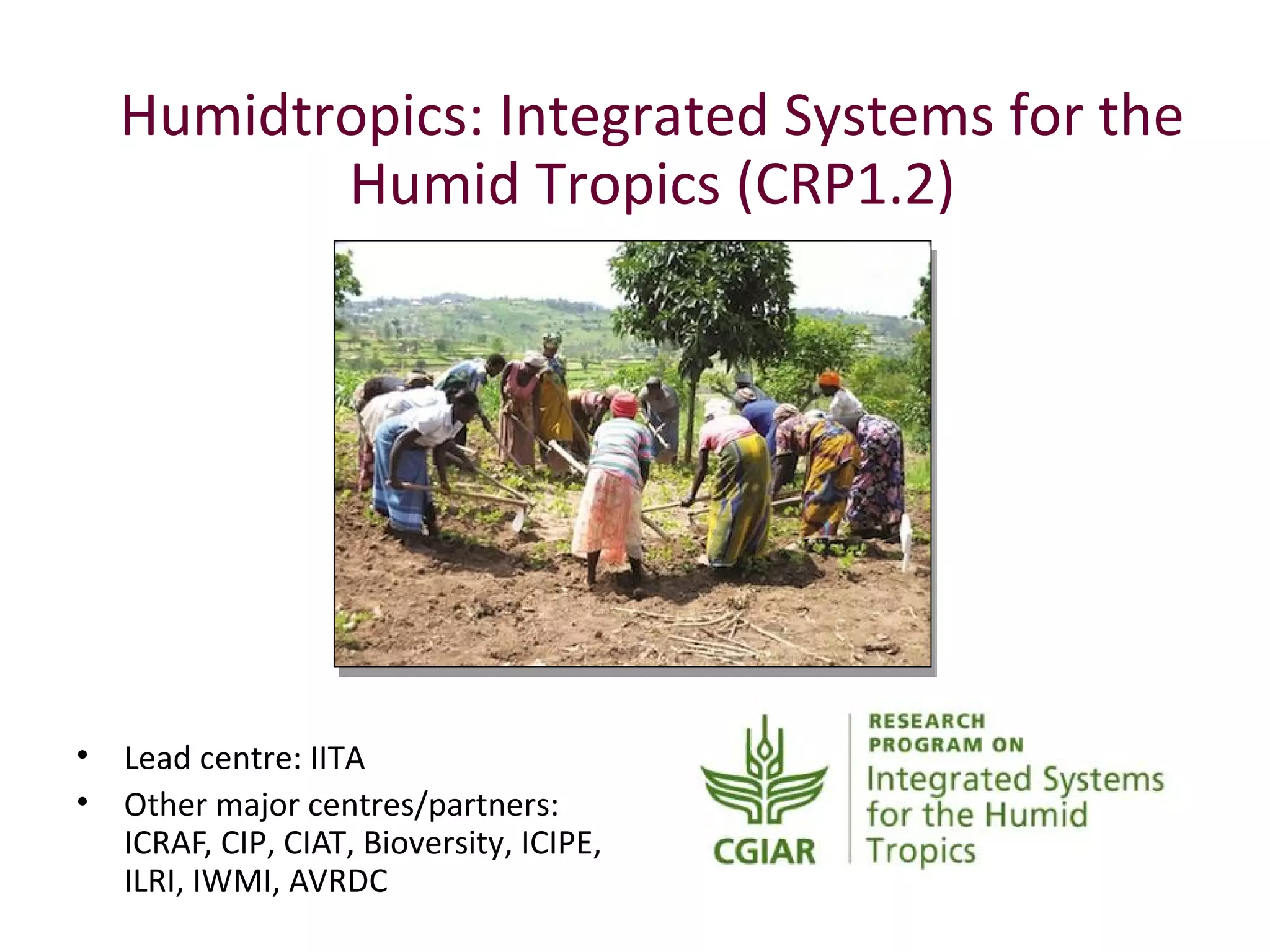
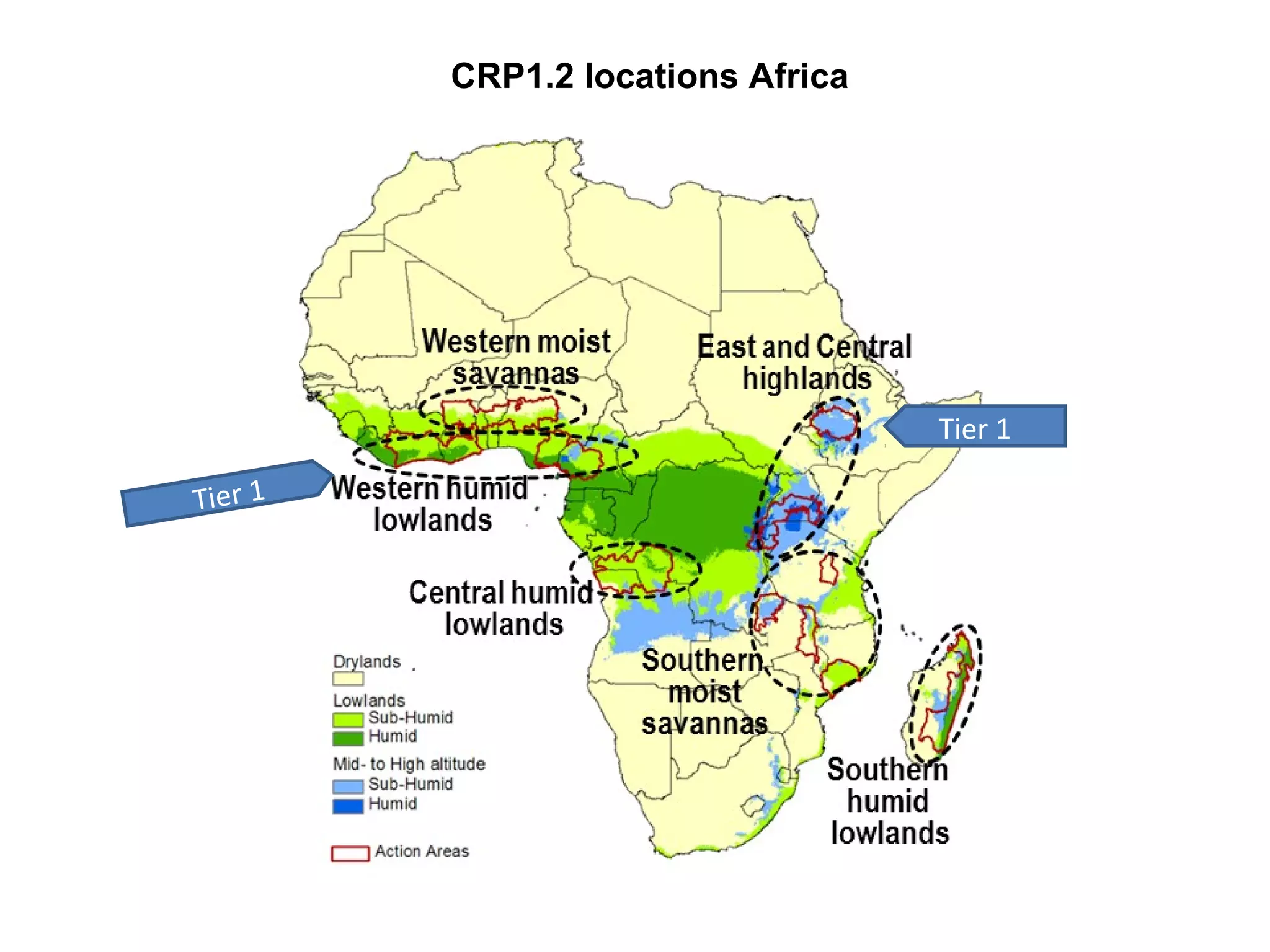
Humidtropics: Integrated Systems for the
           Humid Tropics (CRP1.2)


•   Lead centre: IITA
•   Other major centres/partners:
    ICRAF, CIP, CIAT, Bioversity, ICIPE,
    ILRI, IWMI, AVRDC
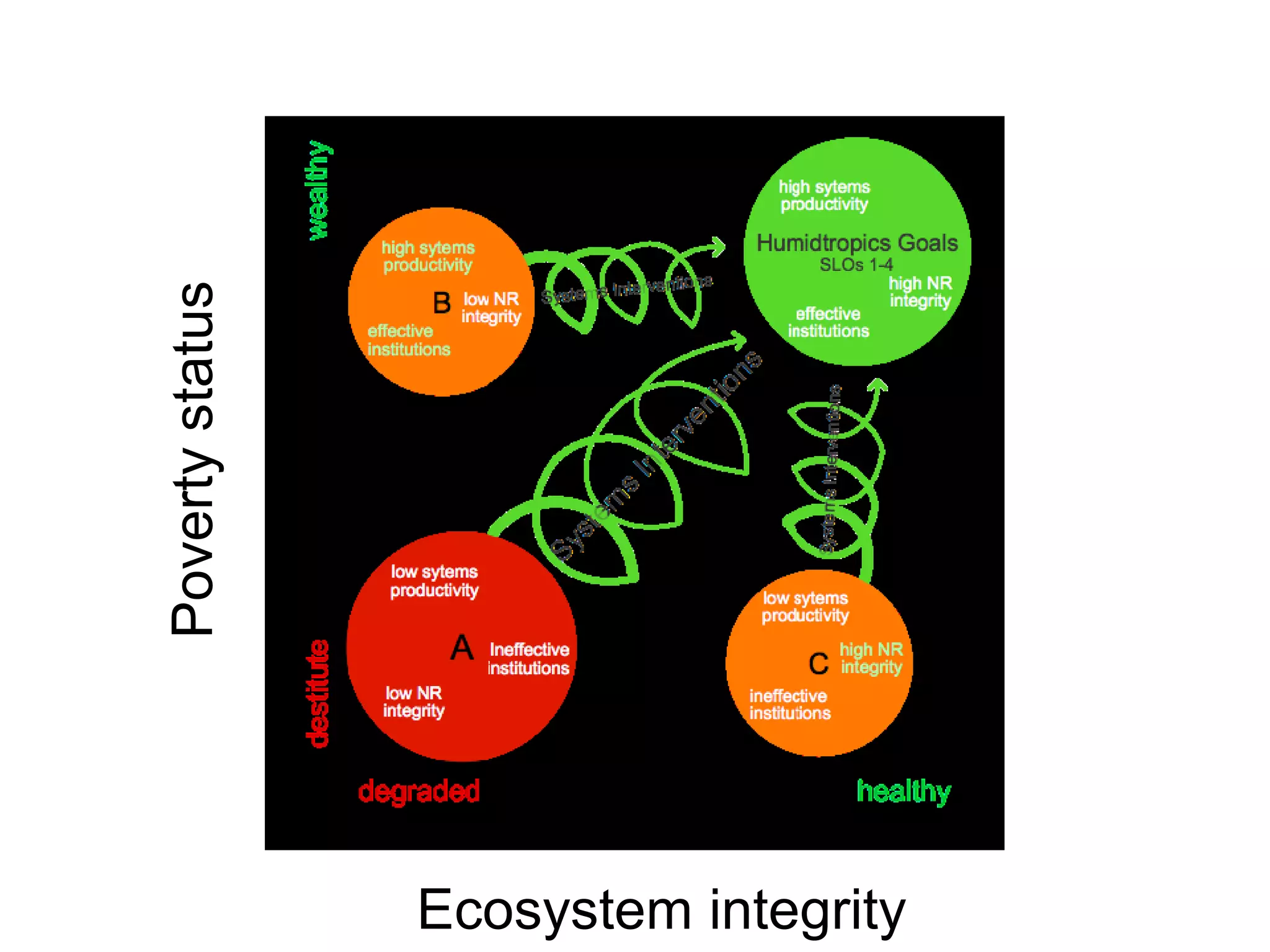
Poverty status


                 Ecosystem integrity
CRP1.2 locations Africa


                                   Tier 1

Tier 1
Potential feed-related research
  topics in Humidtropics CRP
Crop Livestock integration
• Manure management – labour issues - nutrient cycling
  – crop –livestock integration. With increasing livestock
  confinement looking at options for tighter manure
  management.
• Conservation agriculture – livestock lens. Combining
  inorganic and organic manures. Turning some of the
  knowledge around manure management and nutrient
  cycling into local innovations on the ground –
  addressing some of the constraints to sub-optimal
  management.
• Modelling on nutrient cycling at different scales (from
  field to landscape)
Whole farm productivity
• Looking at whole farm productivity. Assess
  how interventions in different farming
  enterprises (crops, livestock, off-farm) affect
  whole farm productivity and environmental
  footprint.
• Whole farm modelling approaches.
• Gender angle to this and we could develop
  tools and approaches to improve women’s
  participation.
Simple tools for technology
              prioritization
• FEAST (Feed assessment tool) – rapid feed
  resource assessment and participatory
  development of intervention strategies
• Techfit – tool for prioritizing feed technologies
  based on availability and requirements for
  land, labour, cash, inputs and knowledge
• SLATE – Sustainable livelihoods assessment
  tool. Rapid characterization of farm typologies
  to help target interventions.
Looking at whole system feed
               opportunities
• Feed opportunities often not recognized because they are
  not local
• E.g. Cassava peel in Nigeria
   – Cassava is one of IITA’s mandate crops. ILRI has strong interest
     in CR.
   – DM from residue in Nigeria = 1 m tonnes per year 99% of which
     is left to rot. Could be recycled through animals.
   – Most of the labour for cassava peeling is provided by women.
     Could look at mechanisms for value added in favour of women.
   – How to feed to animals? Wet or dry? Pelletizing? Ensiling? For
     which livestock species? What moisture content allows
     processing and so on? Transport options.
• Links with feed component of CRP3.7. e.g. case of sorghum
  stover in Andhra Pradesh
Mitigating livestock bads
• Environmental impacts of intensifying livestock
  production.
• For example
  – Intensifying systems in SE Asia – backyard pigs in
    areas of high population density. Effects on water
    quality, aerial emissions etc.
  – Improving livestock production efficiency to reduce
    GHG emissions – some desk assessments.
  – ILRI has started a mitigation programme to identify
    mitigation options (labs in East Africa, GHG
    measurements, productivity and economic
    assessments and modelling)
Innovation (R4D) platforms
• ILRI has a lot of experience now in application of
  innovation systems concepts. Many projects in many
  locations.
• ILRI has also been experimenting with business
  development service hubs in East Africa Dairy
  Development project
• Could use this background to develop system BDS hubs
  - wider than dairy or even livestock e.g. crop inputs,
  livestock inputs, tree establishment inputs.
• Links with CRP2 – ILRI leads the smallholder value
  chain component.
Livestock-tree interactions
• Potential research areas
  – Effects of livestock on tree establishment
  – trees and livestock feed
  – implications of tree introduction on labour e.g. for
    livestock feeding.
  – Lots of gender implications.
Dealing with biomass crisis
• Devising and assessing ways to derive more
  biomass from crop-based systems
  – improving residue quality/quantity – assessing
    fodder traits of existing cereal cultivars
  – relay cropping/inter cropping
  – trees on boundaries
• Building on global study on crop residue use in
  smallholder systems funded by Systemwide
  Livestock Programme.
Links
• http://www.ilri.org/animalfeeding

• http://livestockfish.cgiar.org/

Livestock feeds in the CGIAR Research Programs

  • 1.
    Livestock feeds inthe CGIAR Research Programs Alan Duncan FAO West Africa Regional Workshop on Crop Residues, Dakar 10-13 December 2012
  • 2.
    ILRI in theCGIAR Research Programs  ILRI leads one CGIAR Research Program– ‘Livestock and Fish’.  ILRI leads a component of one CGIAR Research Program– ‘Agriculture for Nutrition and Health’ This component works to prevent and control agriculture-associated diseases, including food-borne diseases, zoonoses and emerging infectious diseases.  ILRI participates in five other CGIAR Research Programs Drylands Humid Tropics Policies, Institutions and Markets Water, Land and Ecosystems Climate Change, Agriculture and Food Security
  • 3.
    Livestock and Fish:More Meat, Milk and Fish, For and By the Poor • Lead centre: ILRI • Other major centres/partners: Worldfish, ICARDA, CIAT
  • 4.
    Basic Idea: Solution-drivenR4D to achieve impact
  • 5.
  • 6.
    Livestock and FishCGIAR Research Program More m e a t, m ilk a nd fis h for a nd by the p o o r SHEEP & GOATS AQUACULTURE PIGS DAIRY
  • 7.
    Feed in Livestockand Fish Programme Pathways oValue chain framework to define a set of research areas around: o producing more and better feeds o making better use of feeds that exists o processing, densification, redistribution/transfer o implications of feeding systems on labour/gender/ecological footprint etc Outcome oBy-product and forage based feeding systems used in VC that significantly increase per animal productivity such as doubling milk production thereby reducing the ecological footprint per unit produce through reduction in animal numbers
  • 8.
    Example outputs o Output2.1: Prevalent feeding system for each considered VC characterized (2012) o Major on farm feed resources in developing VC determined and feeding regimes/feed use characterized (2012) o Key feeds/feed components on the markets and their price: quality relations determined o Regional (above district level) feed resources estimates aggregated from appropriate administrative units (2013) o Output 2.2: Feed resource basis assessed relative to production target (2013) o Quantitative and qualitative feed availability gaps quantified relative to VC production targets (2013) 8
  • 9.
    Example outputs o Output3.1: Refined and validated tools and methods for prioritizing feed intervention (2013) o Tools such as Techfit field tested and employed in VC (2012) o Output 3.2: Potentially superior food-feed crop cultivars and forages for VC identified through CIAT, ICARDA and ILRI research and development work (2012) o Potentially superior food-feed and forage cultivars identified (2012) o Superior food-feed and forage cultivars made available to VC (2013, 2014) o Output 3.3: Promising feed, fodder and forage processing options o Simple on-farm feed processing option for increased feed intake and decreased wastages available (2013) o Decentralized business based feed processing enterprises suggested (2014) o Feed options/livestock productivity compared carbon foot prints
  • 10.
    Humidtropics: Integrated Systemsfor the Humid Tropics (CRP1.2) • Lead centre: IITA • Other major centres/partners: ICRAF, CIP, CIAT, Bioversity, ICIPE, ILRI, IWMI, AVRDC
  • 11.
    Poverty status Ecosystem integrity
  • 13.
  • 14.
    Potential feed-related research topics in Humidtropics CRP
  • 15.
    Crop Livestock integration •Manure management – labour issues - nutrient cycling – crop –livestock integration. With increasing livestock confinement looking at options for tighter manure management. • Conservation agriculture – livestock lens. Combining inorganic and organic manures. Turning some of the knowledge around manure management and nutrient cycling into local innovations on the ground – addressing some of the constraints to sub-optimal management. • Modelling on nutrient cycling at different scales (from field to landscape)
  • 16.
    Whole farm productivity •Looking at whole farm productivity. Assess how interventions in different farming enterprises (crops, livestock, off-farm) affect whole farm productivity and environmental footprint. • Whole farm modelling approaches. • Gender angle to this and we could develop tools and approaches to improve women’s participation.
  • 17.
    Simple tools fortechnology prioritization • FEAST (Feed assessment tool) – rapid feed resource assessment and participatory development of intervention strategies • Techfit – tool for prioritizing feed technologies based on availability and requirements for land, labour, cash, inputs and knowledge • SLATE – Sustainable livelihoods assessment tool. Rapid characterization of farm typologies to help target interventions.
  • 18.
    Looking at wholesystem feed opportunities • Feed opportunities often not recognized because they are not local • E.g. Cassava peel in Nigeria – Cassava is one of IITA’s mandate crops. ILRI has strong interest in CR. – DM from residue in Nigeria = 1 m tonnes per year 99% of which is left to rot. Could be recycled through animals. – Most of the labour for cassava peeling is provided by women. Could look at mechanisms for value added in favour of women. – How to feed to animals? Wet or dry? Pelletizing? Ensiling? For which livestock species? What moisture content allows processing and so on? Transport options. • Links with feed component of CRP3.7. e.g. case of sorghum stover in Andhra Pradesh
  • 19.
    Mitigating livestock bads •Environmental impacts of intensifying livestock production. • For example – Intensifying systems in SE Asia – backyard pigs in areas of high population density. Effects on water quality, aerial emissions etc. – Improving livestock production efficiency to reduce GHG emissions – some desk assessments. – ILRI has started a mitigation programme to identify mitigation options (labs in East Africa, GHG measurements, productivity and economic assessments and modelling)
  • 20.
    Innovation (R4D) platforms •ILRI has a lot of experience now in application of innovation systems concepts. Many projects in many locations. • ILRI has also been experimenting with business development service hubs in East Africa Dairy Development project • Could use this background to develop system BDS hubs - wider than dairy or even livestock e.g. crop inputs, livestock inputs, tree establishment inputs. • Links with CRP2 – ILRI leads the smallholder value chain component.
  • 21.
    Livestock-tree interactions • Potentialresearch areas – Effects of livestock on tree establishment – trees and livestock feed – implications of tree introduction on labour e.g. for livestock feeding. – Lots of gender implications.
  • 22.
    Dealing with biomasscrisis • Devising and assessing ways to derive more biomass from crop-based systems – improving residue quality/quantity – assessing fodder traits of existing cereal cultivars – relay cropping/inter cropping – trees on boundaries • Building on global study on crop residue use in smallholder systems funded by Systemwide Livestock Programme.
  • 23.