An introduction to hl7 FHIR


A progress Report
Agenda
• Background
• Key Concepts
• Using FHIR in:
  – RESTful exchanges
  – Documents
  – Messages
  – Services
  – XDS

                        2
Executive Summary
• Implementer friendly new standard
• Enormous interest within HL7 Internationally
    – NZ has representative on the Management Board
• About a year old
• Collaborating with IHE, openEHR
• Using connectathons (IHE)
• Core infrastructure (resource format, REST, atom feeds
  etc) in DFC (draft for comment)
• Pharmacy, Patient Administration & Devices actively
  working on resources
• Aiming for general ballot in May 2013 for „CCDA‟ section
  level resources
• Aiming for DSTU (Draft Standard Trial Use) in 2014,
  normative 2 years after that.
                                                             3
Background: History of FHIR
• HL7 v2 around since 1981 - very successful
• HL7 v3 about 10 years old, but apart from CDA
  has poor adoption
• FHIR grew out of frustration with v3
    – too hard for implementers (More for modellers)
    – too long to develop
        • inclusive
    – CDA good, but documents not enough
•   Need a transition off v2
•   Take all good ideas from v2/v3/CDA
•   Mobile needs simple technology
•   Fast Healthcare Interoperability Resources
Scope of FHIR
• All aspects of healthcare interoperability
    – Within a facility
    – Between facilities
    – Mobile
• All specs on-line
   – Including examples
• Different „modalities‟
    –   On-line (REST)
    –   HATEOS
    –   Messaging (like v2)
    –   Documents (like CDA)
    –   Services
• XDS
                                               5
Relation to current standards
• Should I wait for FHIR
   – (and stop using v2 / CDA / etc)
• No:
   – FHIR is a work in progress
   – It’ll take time to mature
   – If it ain‟t broke...
• But:
   – If you are doing something new where FHIR will make
     it easier…
         • Spoiler alert: like XDS!!!

• So:
   – FHIR and other HL7 standards will co-exist for a long
     time                                                    6
Key concepts

Resources
Datatypes
Bundling
Profiles


               7
Resources
• Granular Clinical or Administrative Concept
   – Person, lab result, prescription, problem
   – imagine 100-150 of them
   – define by HL7 committees, with as much input from
     implementers as possible
• All resources can have Narrative
• All resources can have Extensions
• 80/20 with extensions
   – Core has attributes used by 80% of implementers
   – Built in Extension mechanism
• XML & JSON
• (Not just REST)
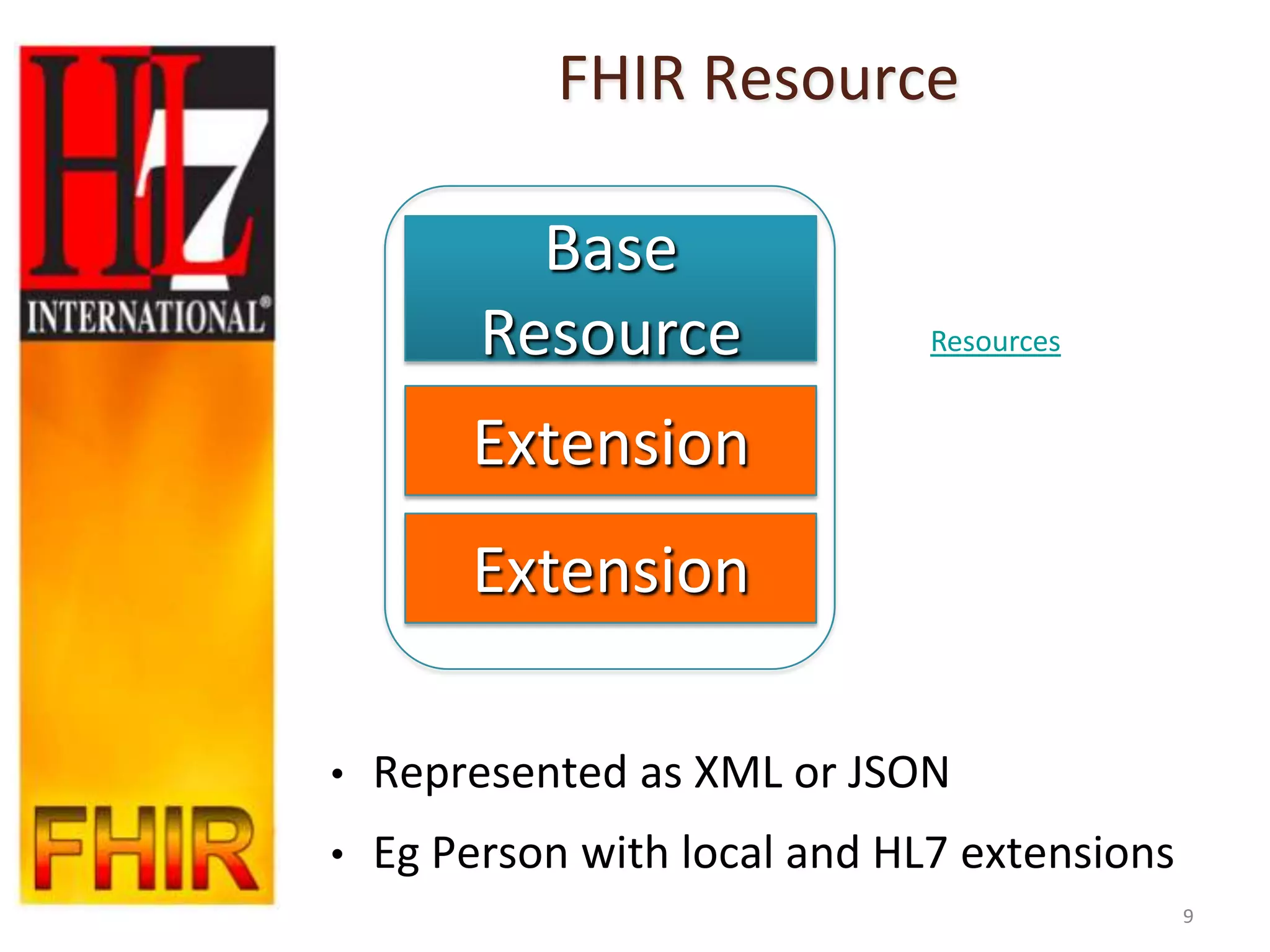
FHIR Resource

           Base
         Resource              Resources


        Extension
        Extension

•   Represented as XML or JSON
•   Eg Person with local and HL7 extensions
                                              9
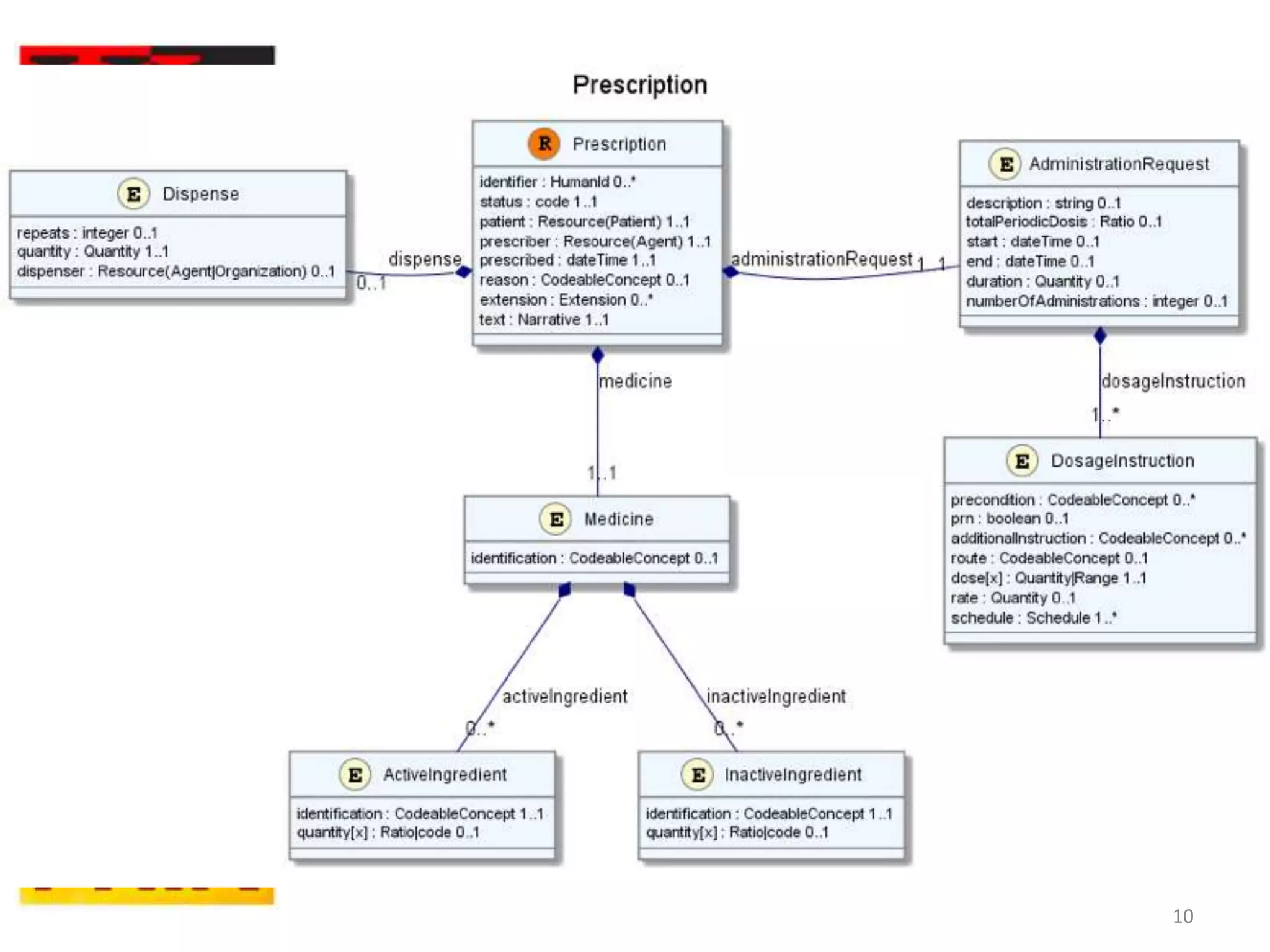
10
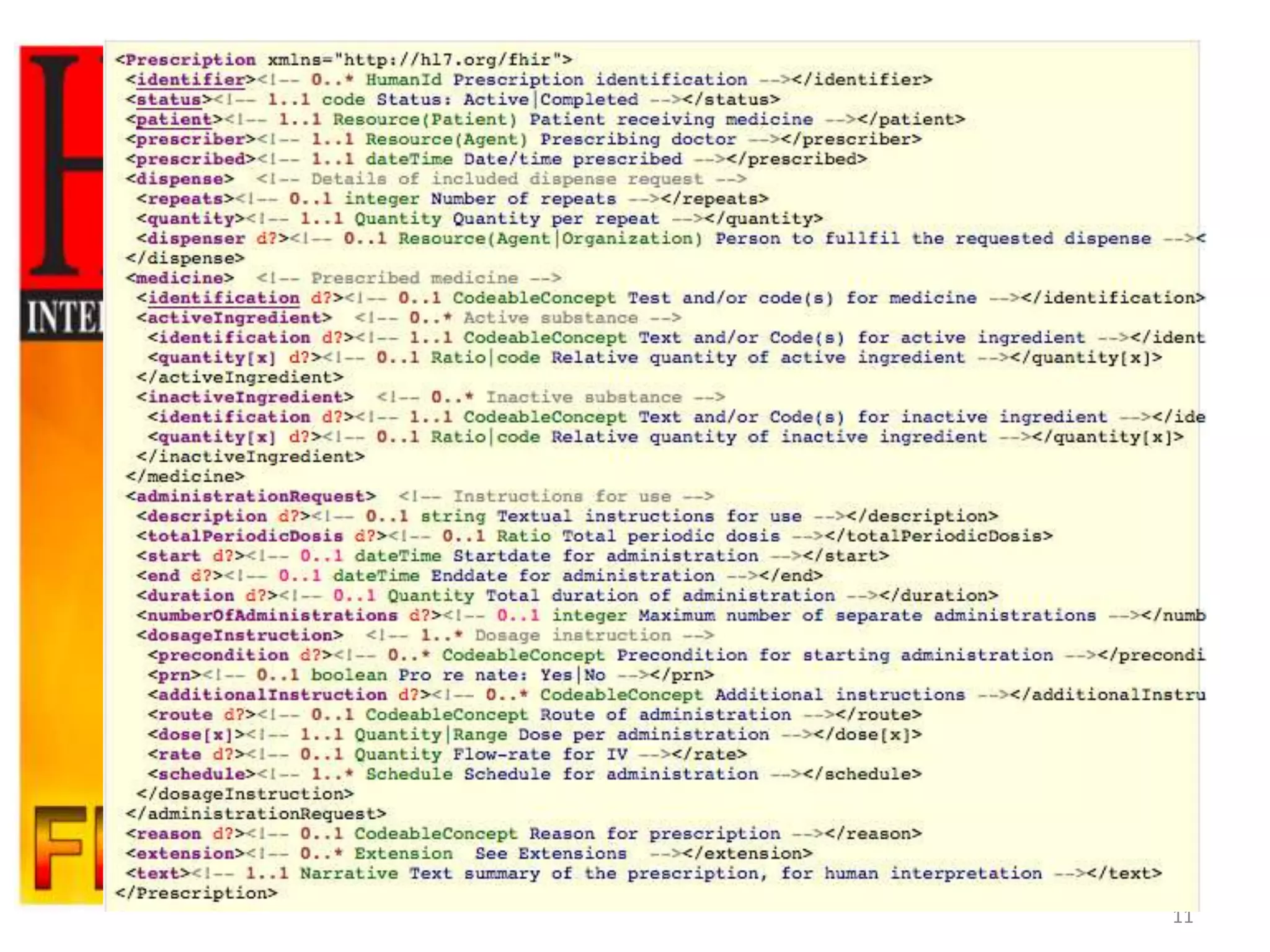
11
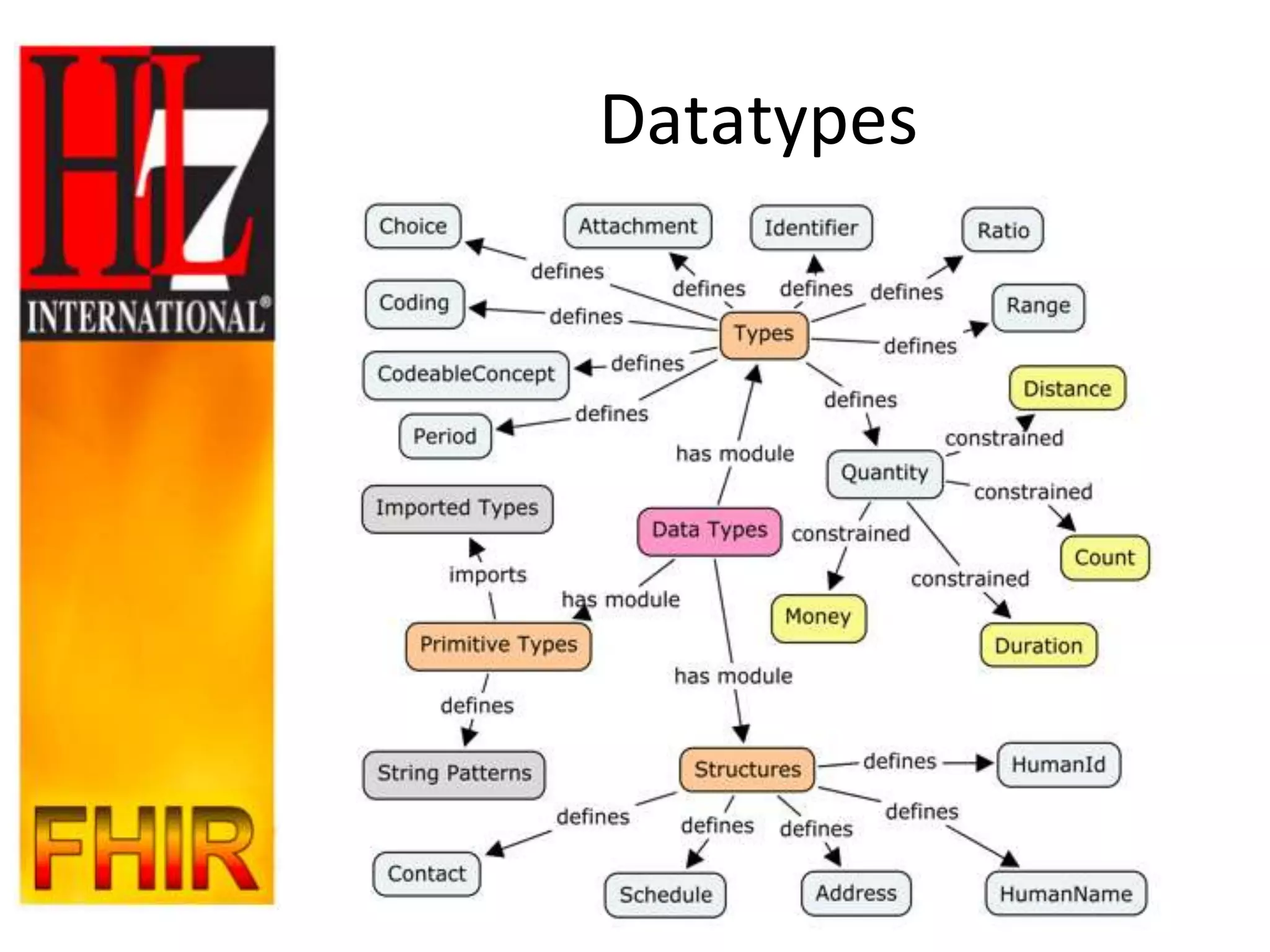
Datatypes
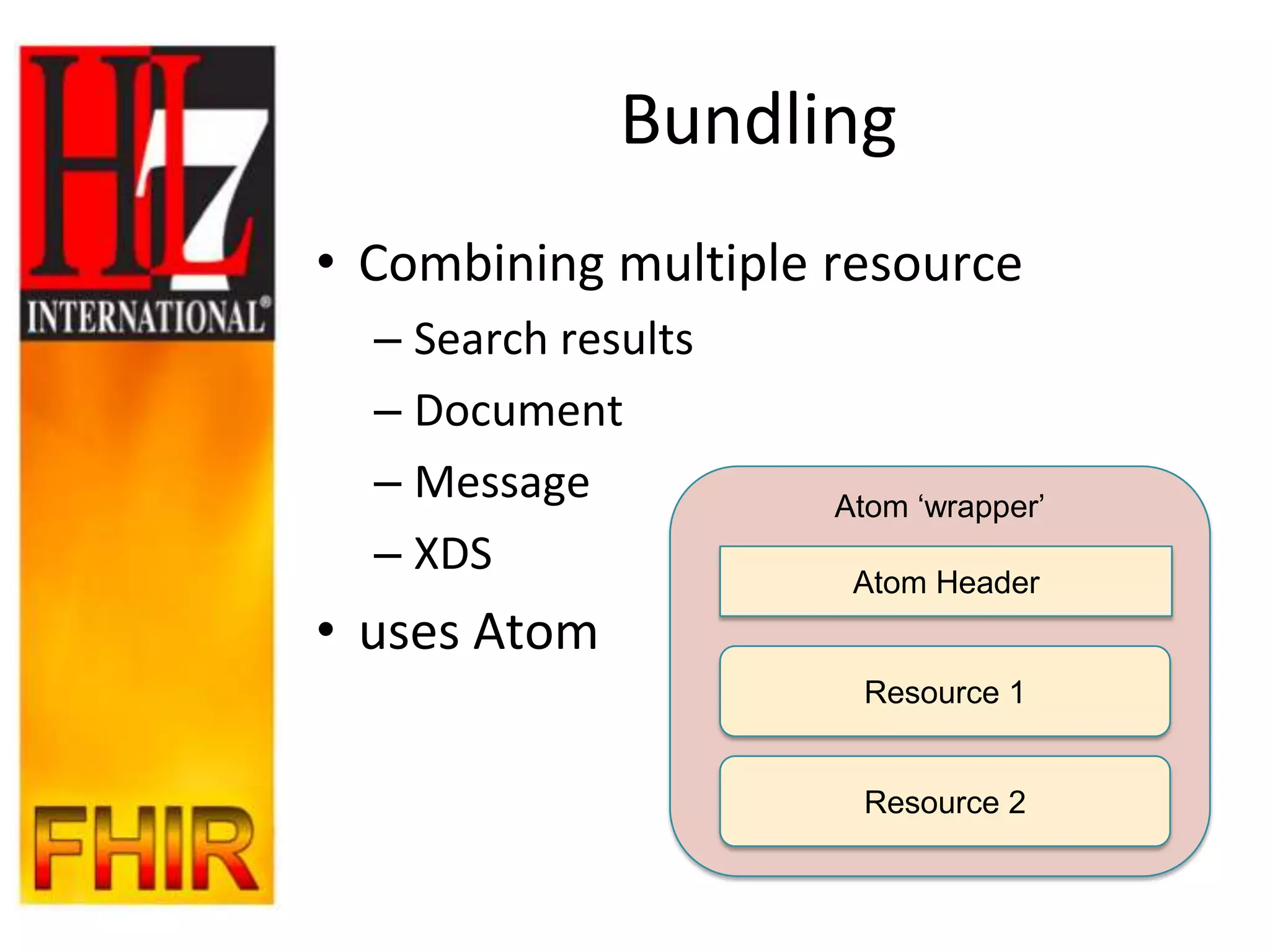
Bundling
• Combining multiple resource
  – Search results
  – Document
  – Message          Atom „wrapper‟
  – XDS               Atom Header
• uses Atom
                      Resource 1


                      Resource 2
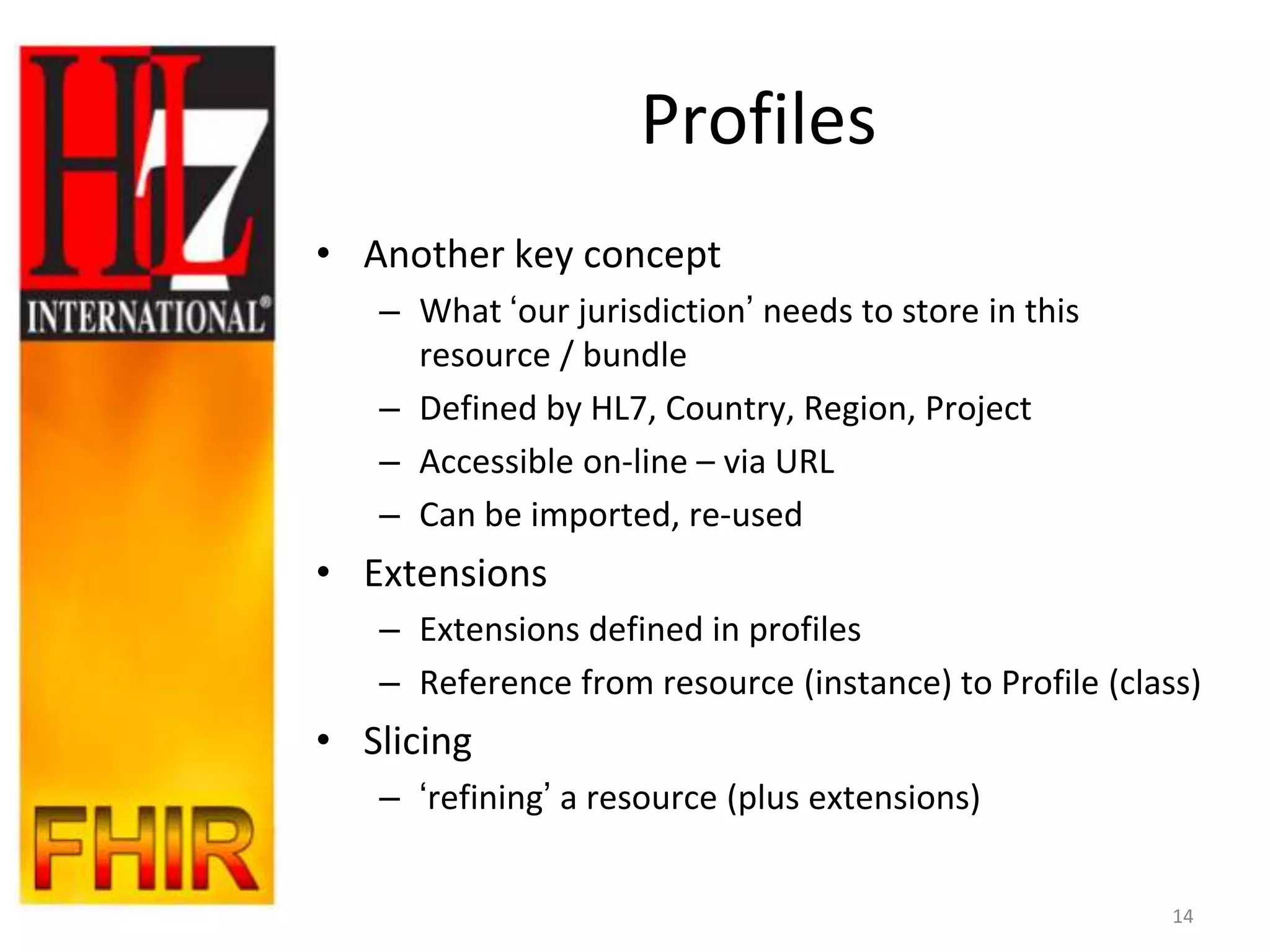
Profiles
• Another key concept
   – What „our jurisdiction‟ needs to store in this
     resource / bundle
   – Defined by HL7, Country, Region, Project
   – Accessible on-line – via URL
   – Can be imported, re-used
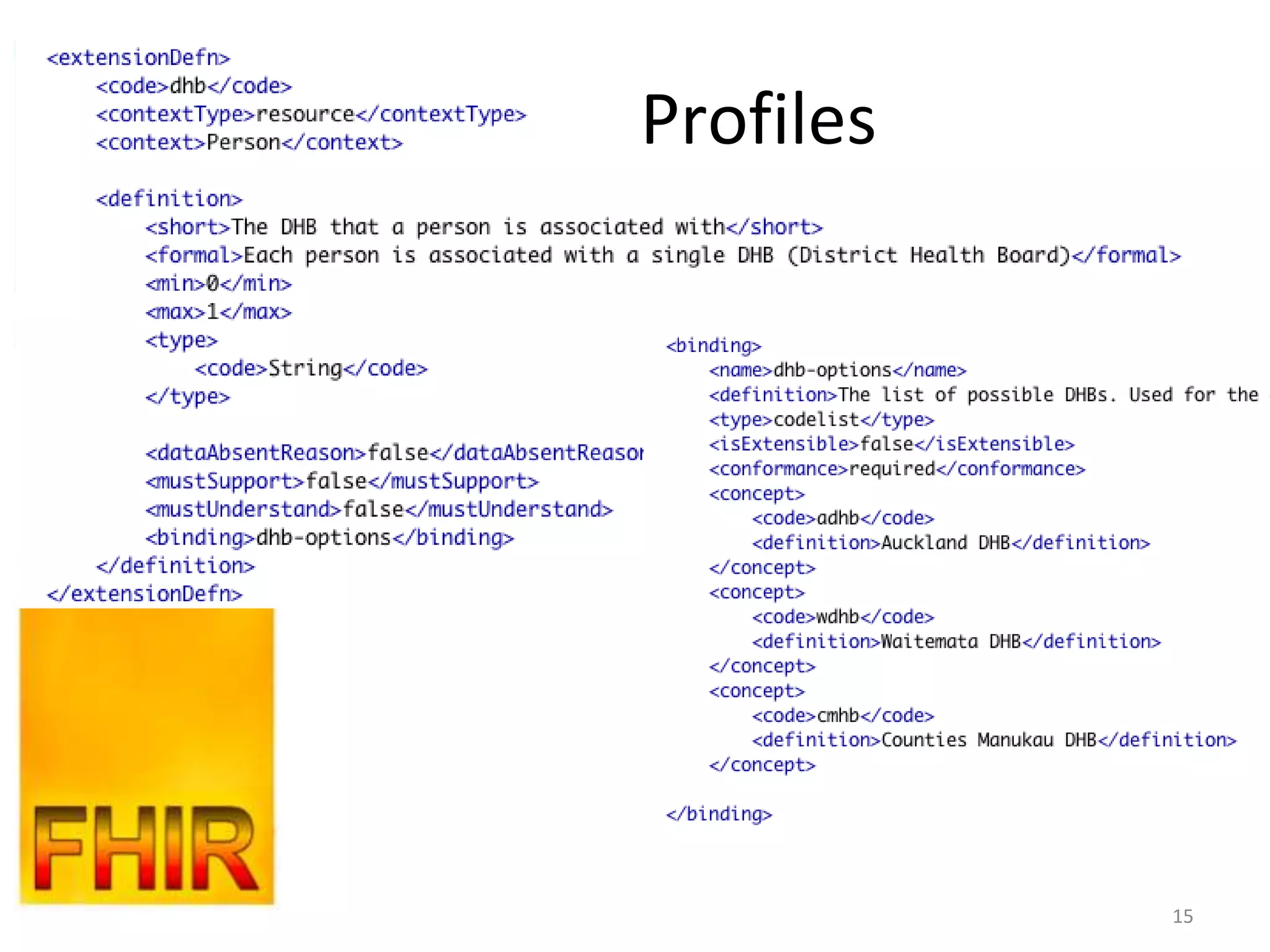
• Extensions
   – Extensions defined in profiles
   – Reference from resource (instance) to Profile (class)
• Slicing
   – „refining‟ a resource (plus extensions)


                                                        14
Profiles


           15
REST


       16
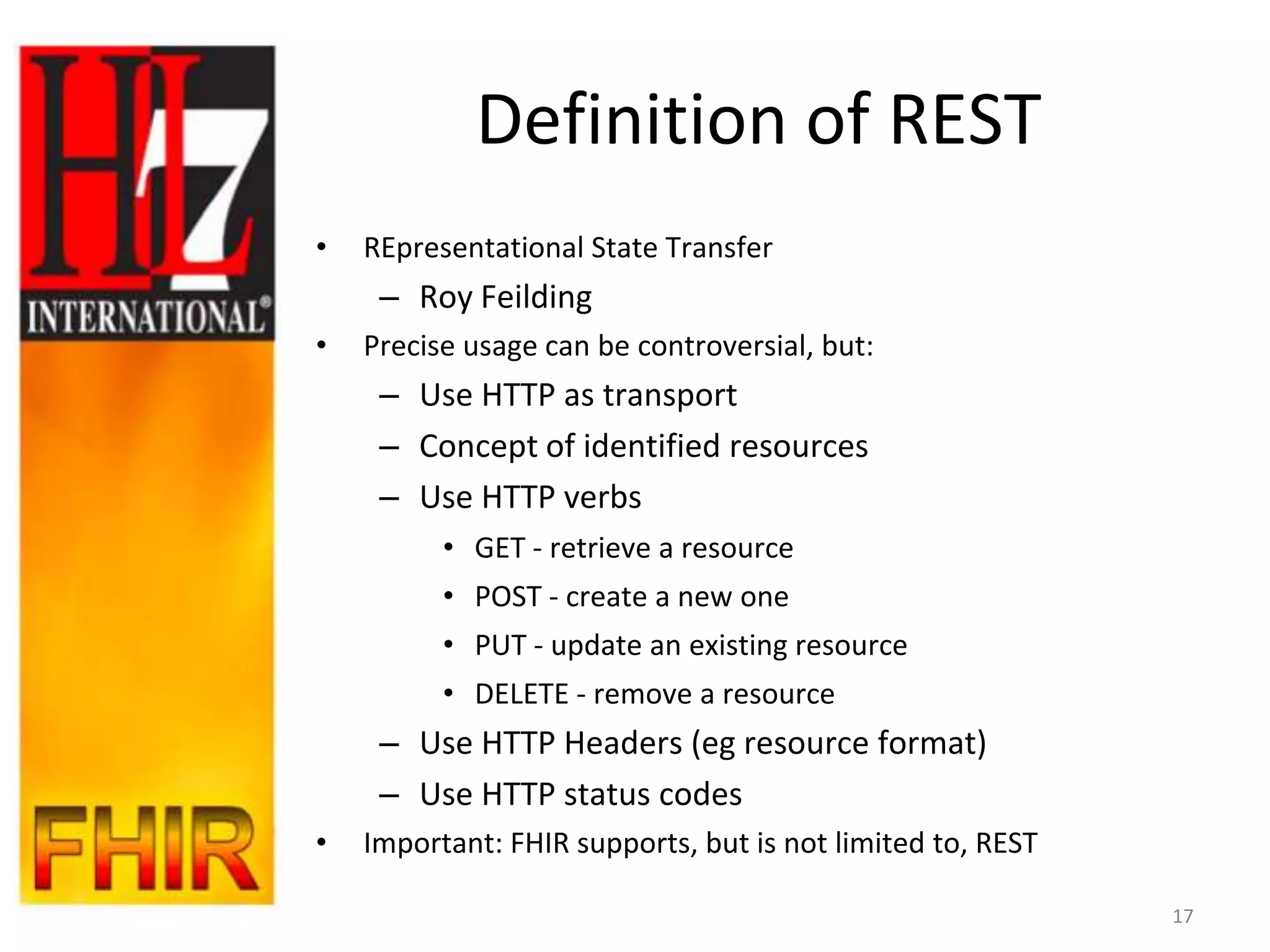
Definition of REST
•   REpresentational State Transfer
     – Roy Feilding
•   Precise usage can be controversial, but:
     – Use HTTP as transport
     – Concept of identified resources
     – Use HTTP verbs
          • GET - retrieve a resource
          • POST - create a new one
          • PUT - update an existing resource
          • DELETE - remove a resource
     – Use HTTP Headers (eg resource format)
     – Use HTTP status codes
•   Important: FHIR supports, but is not limited to, REST

                                                            17
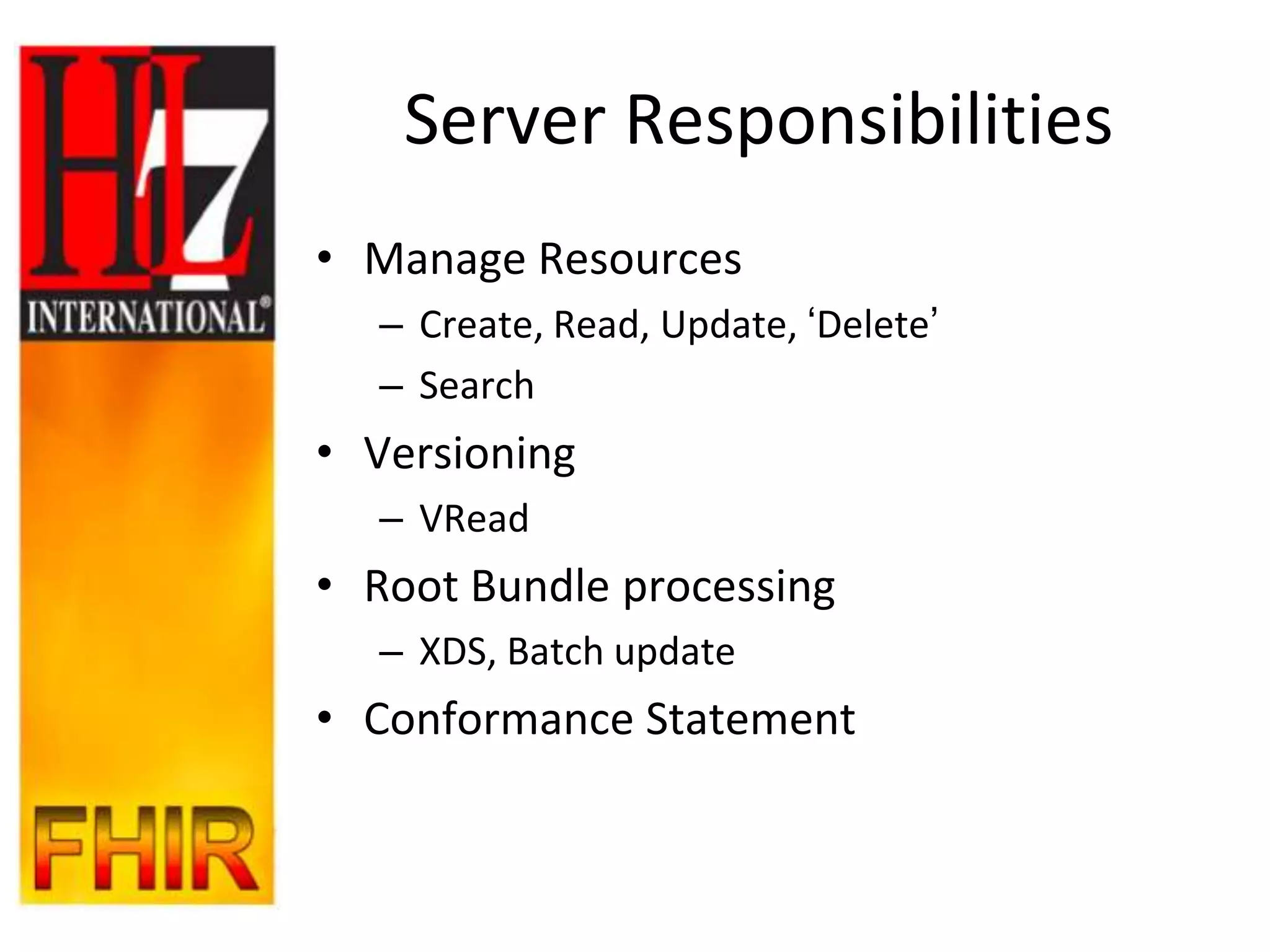
Server Responsibilities
• Manage Resources
  – Create, Read, Update, „Delete‟
  – Search
• Versioning
  – VRead
• Root Bundle processing
  – XDS, Batch update
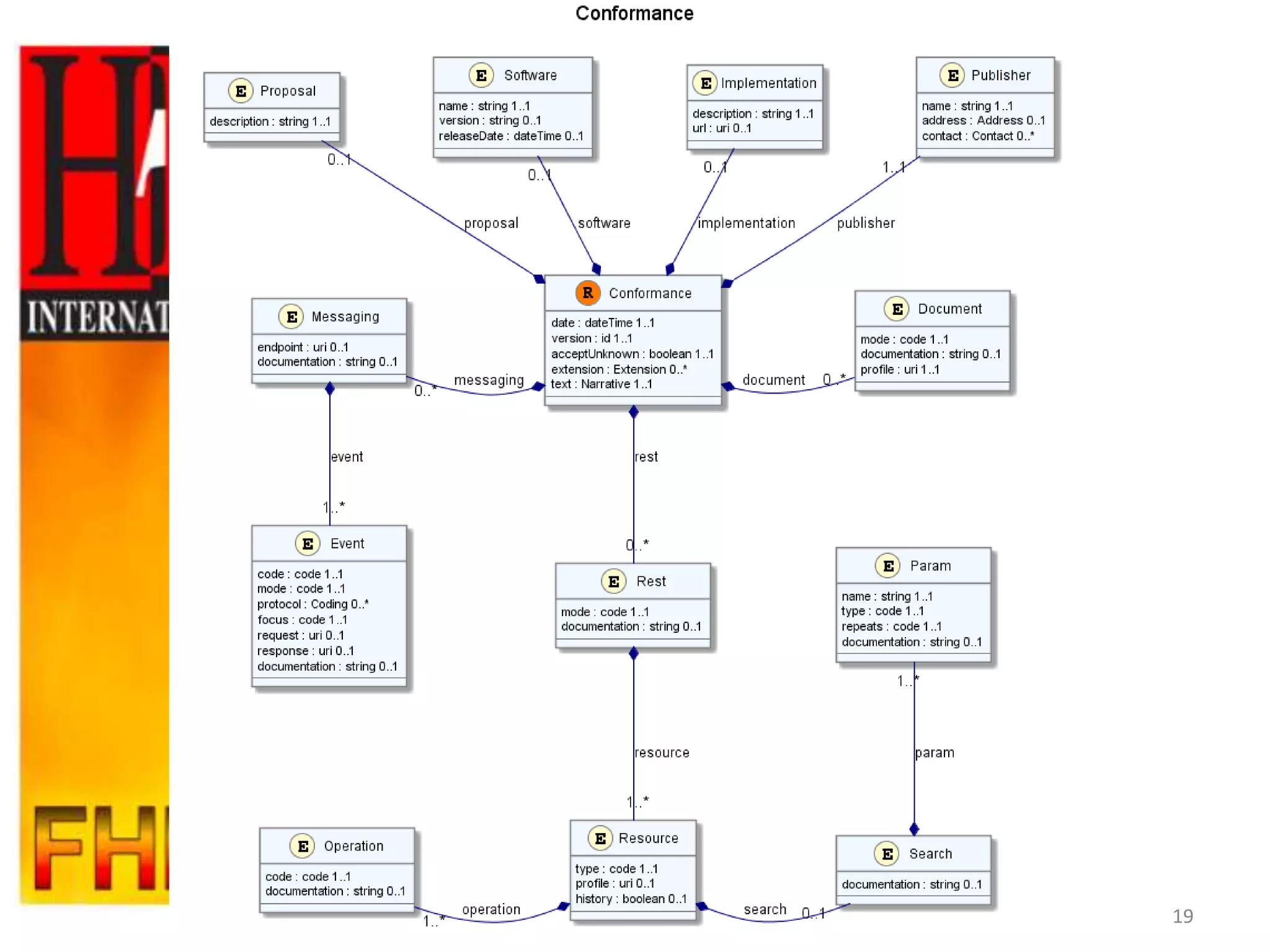
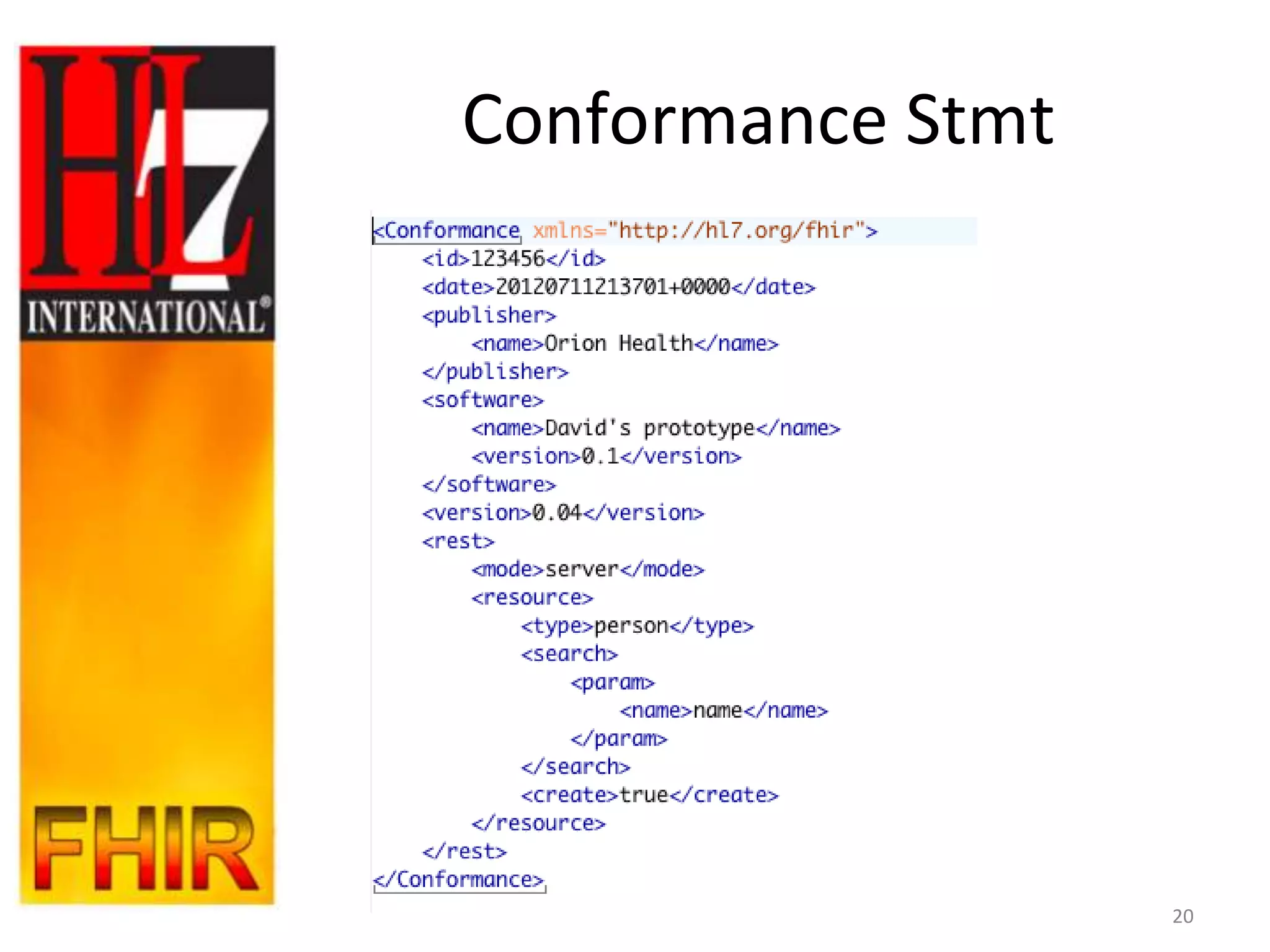
• Conformance Statement
Conformance Stmt


                   19
Conformance Stmt


                   20
DOCUMENTS


(Equivalent of CDA)


                      21
FHIR Document
                  Atom

             Document Header


                   Resource 1


                   Resource 2

                                              Document spec

•   A point in time collection of resources
•   Can be a „stand alone‟ document (like CDA) or a
    aggregated resource type (often profiled)
•   „child‟ resources are like CDA sections
                                                         22
MESSAGE


(Analogous to v2)


                    23
FHIR Message
                          Atom

                  Message Header


                           Resource 1


                           Resource 2

                                                                    Document spec
   Collection of resources sent as a result of some real-world event intended to accomplish a
    particular purpose
   Event Codes & Definitions, like HL7 v2
   V2 segments broadly map to resources
   Includes a “Message” resource, similar in purpose to Message wrapper and MSH
    segment
   May have associated behavior
   Can be conveyed via MLLP, SOAP or other means
                                                                                     24
Service


          25
SOAP Services
• For more sophisticated
  requirements
  – security
  – business process
  – working with hData
• Still use FHIR resources &
  packaging...
• Example of Person & Contacts

                                 26
XDS


      27
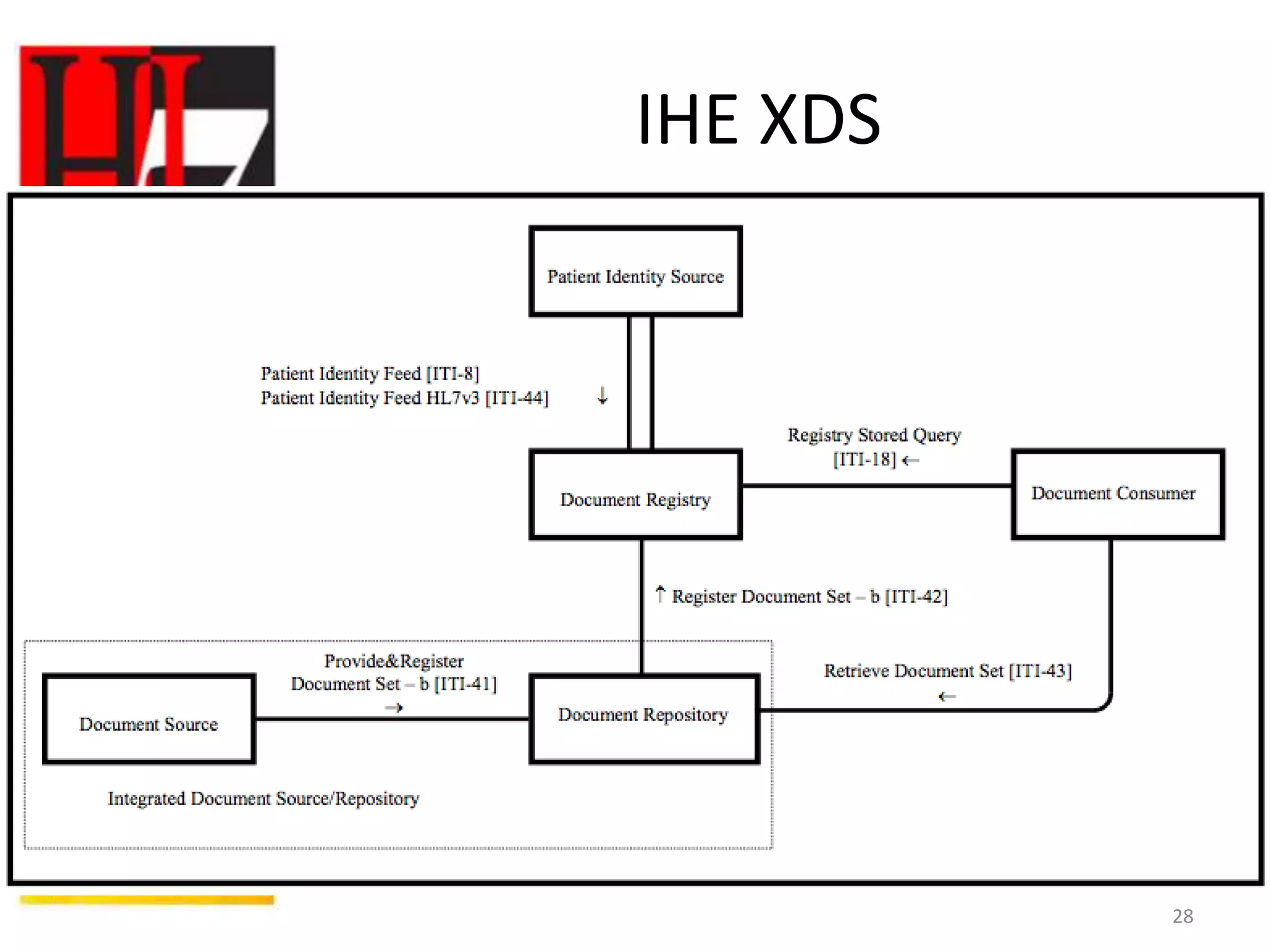
IHE XDS


          28
XDS Affinity Domain
• The users (regional / national /
  specialist)
  – Define what documents are stored and
    the meta data / processes
• Eg
  –   Security, Auditing, Access controls
  –   Privacy mechanisms and levels
  –   Folders
  –   Document metadata
       • Format
       • Class                              29
FHIR XDS
• a FHIR front end to XDS
  – work with MHD
• simplify access to XDS Server
  – XDS XML is hard!
• Others have taken this approach
  – This one will be standard
• Working with IHE MHD (Mobile
  Health Data)

                                    30
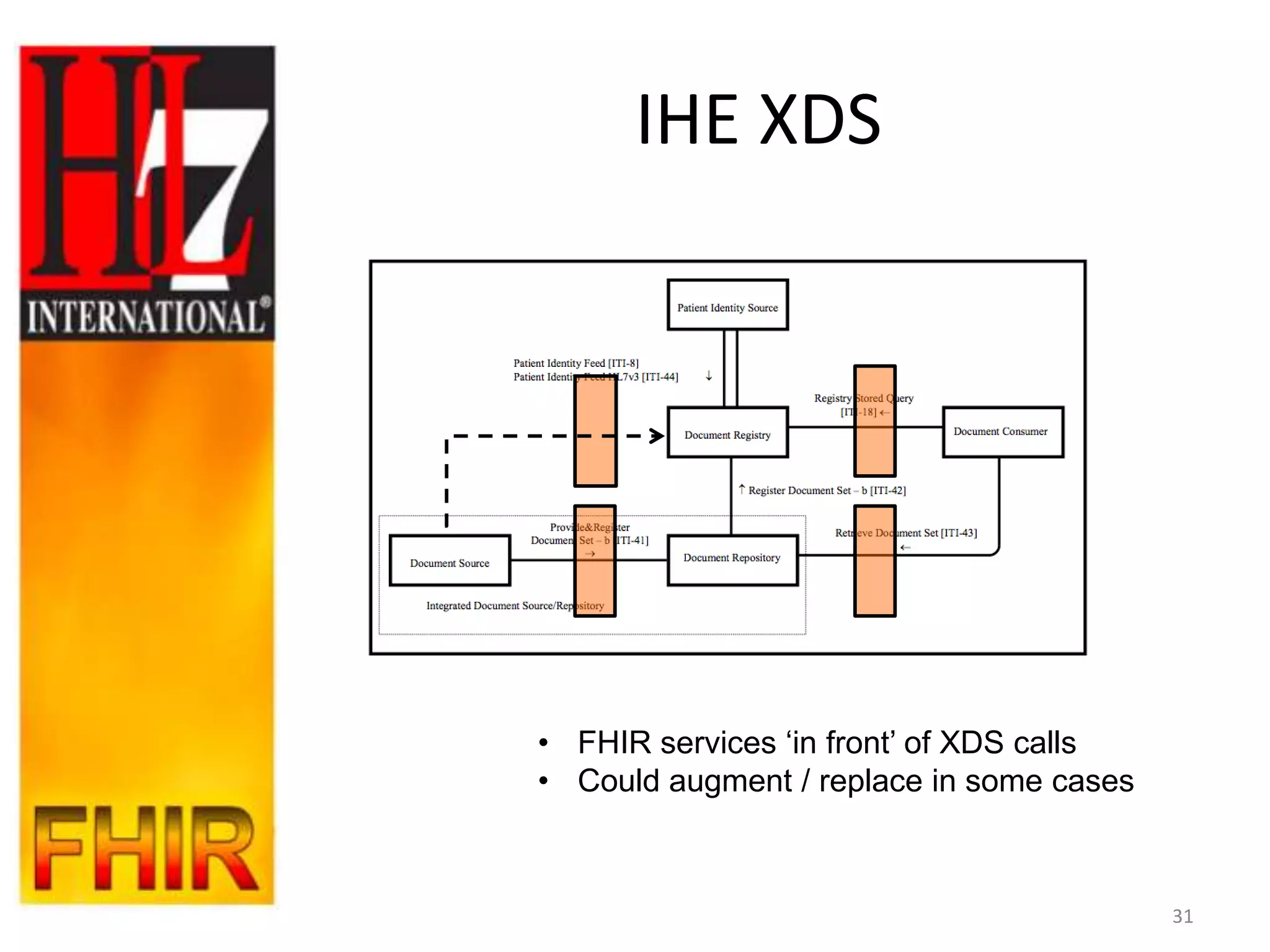
IHE XDS


• FHIR services „in front‟ of XDS calls
• Could augment / replace in some cases


                                          31
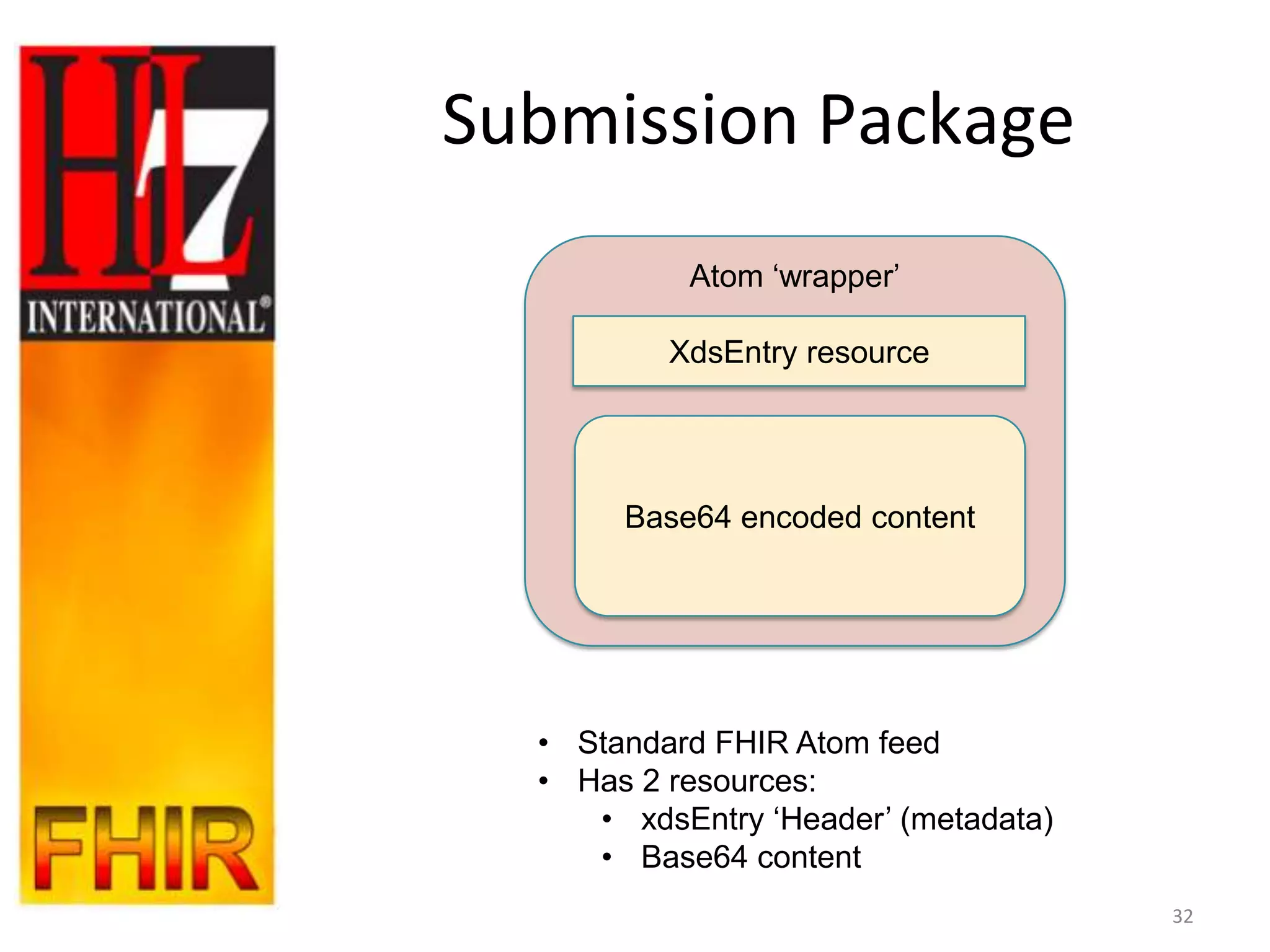
Submission Package
           Atom „wrapper‟

          XdsEntry resource


       Base64 encoded content


  • Standard FHIR Atom feed
  • Has 2 resources:
     • xdsEntry „Header‟ (metadata)
     • Base64 content
                                      32
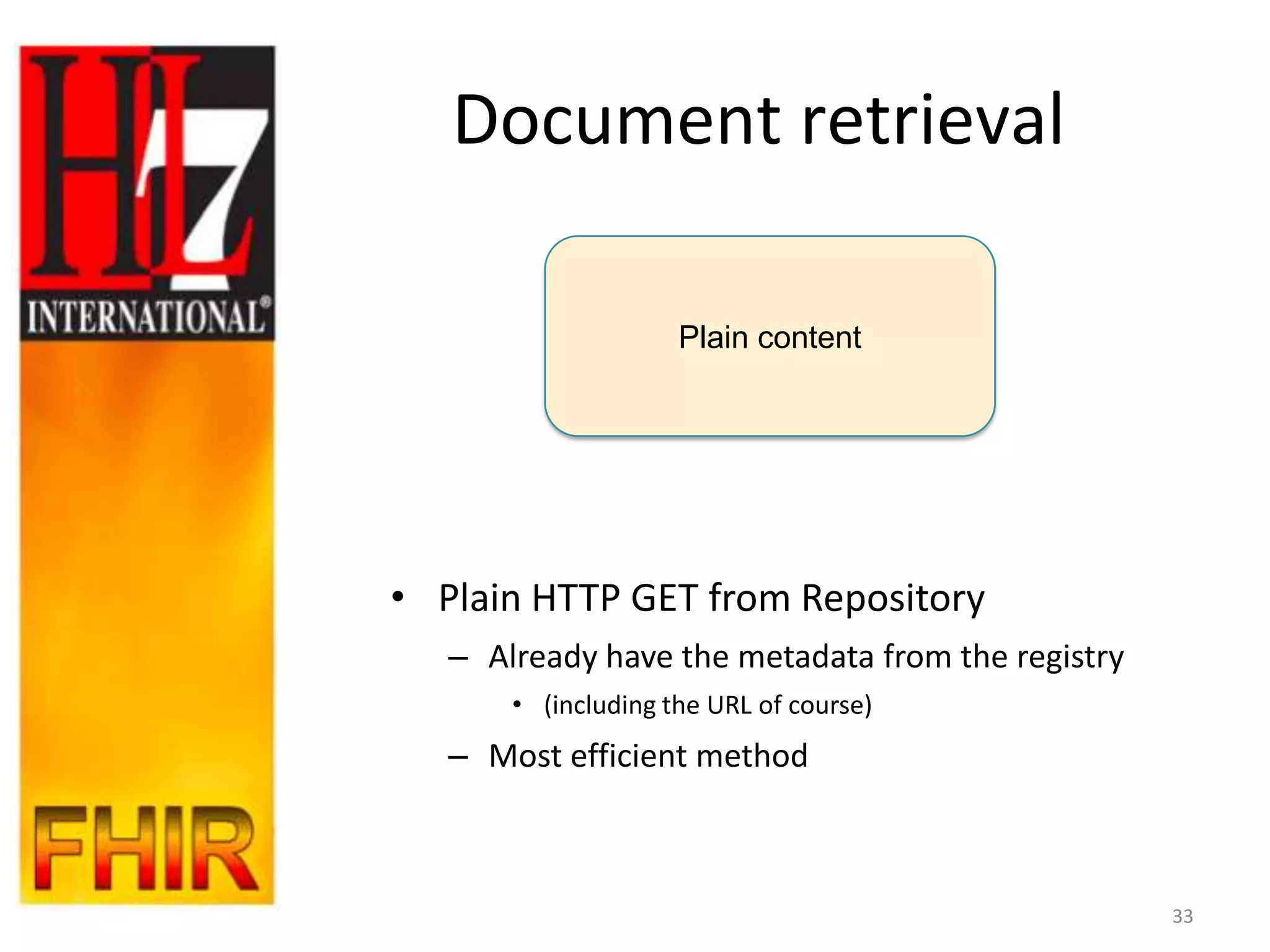
Document retrieval

                     Plain content


• Plain HTTP GET from Repository
   – Already have the metadata from the registry
       • (including the URL of course)
   – Most efficient method


                                                   33
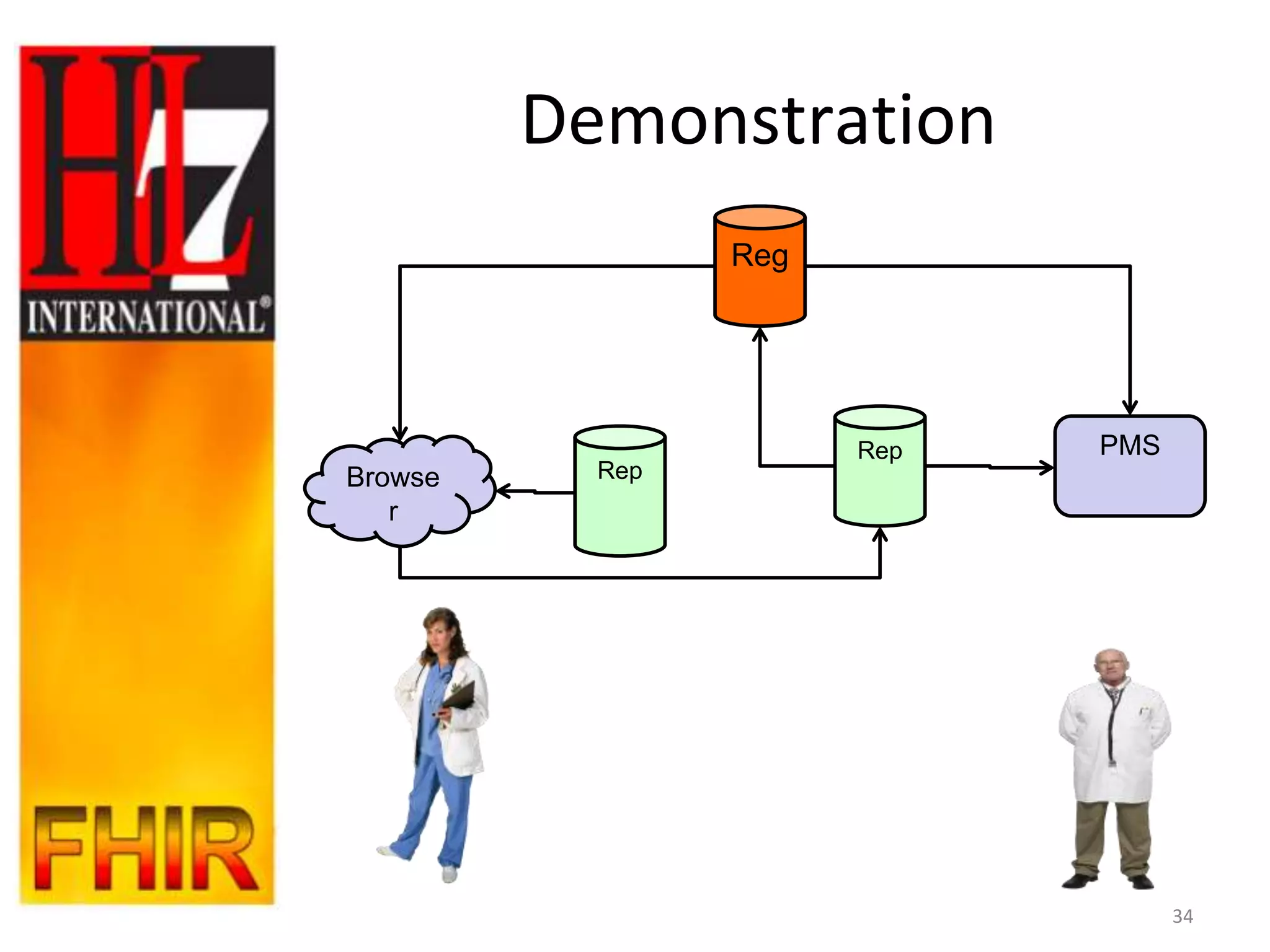
Demonstration
                 Reg


                       Rep   PMS
Browse     Rep
   r


                                   34
Conclusion
• FHIR is a very exciting new standard
• We can expect selected
  ‘production/pilot’ deployments within a
  year
  – It would be great in NZ was one of them
     • Great international exposure!


• References
  – List server : lists.hl7.org
  – Web site: www.hl7.org/fhir
                                              35

An Introduction to HL7 FHIR

  • 1.
    An introduction tohl7 FHIR A progress Report
  • 2.
    Agenda • Background • KeyConcepts • Using FHIR in: – RESTful exchanges – Documents – Messages – Services – XDS 2
  • 3.
    Executive Summary • Implementerfriendly new standard • Enormous interest within HL7 Internationally – NZ has representative on the Management Board • About a year old • Collaborating with IHE, openEHR • Using connectathons (IHE) • Core infrastructure (resource format, REST, atom feeds etc) in DFC (draft for comment) • Pharmacy, Patient Administration & Devices actively working on resources • Aiming for general ballot in May 2013 for „CCDA‟ section level resources • Aiming for DSTU (Draft Standard Trial Use) in 2014, normative 2 years after that. 3
  • 4.
    Background: History ofFHIR • HL7 v2 around since 1981 - very successful • HL7 v3 about 10 years old, but apart from CDA has poor adoption • FHIR grew out of frustration with v3 – too hard for implementers (More for modellers) – too long to develop • inclusive – CDA good, but documents not enough • Need a transition off v2 • Take all good ideas from v2/v3/CDA • Mobile needs simple technology • Fast Healthcare Interoperability Resources
  • 5.
    Scope of FHIR •All aspects of healthcare interoperability – Within a facility – Between facilities – Mobile • All specs on-line – Including examples • Different „modalities‟ – On-line (REST) – HATEOS – Messaging (like v2) – Documents (like CDA) – Services • XDS 5
  • 6.
    Relation to currentstandards • Should I wait for FHIR – (and stop using v2 / CDA / etc) • No: – FHIR is a work in progress – It’ll take time to mature – If it ain‟t broke... • But: – If you are doing something new where FHIR will make it easier… • Spoiler alert: like XDS!!! • So: – FHIR and other HL7 standards will co-exist for a long time 6
  • 7.
  • 8.
    Resources • Granular Clinicalor Administrative Concept – Person, lab result, prescription, problem – imagine 100-150 of them – define by HL7 committees, with as much input from implementers as possible • All resources can have Narrative • All resources can have Extensions • 80/20 with extensions – Core has attributes used by 80% of implementers – Built in Extension mechanism • XML & JSON • (Not just REST)
  • 9.
    FHIR Resource Base Resource Resources Extension Extension • Represented as XML or JSON • Eg Person with local and HL7 extensions 9
  • 10.
  • 11.
  • 12.
  • 13.
    Bundling • Combining multipleresource – Search results – Document – Message Atom „wrapper‟ – XDS Atom Header • uses Atom Resource 1 Resource 2
  • 14.
    Profiles • Another keyconcept – What „our jurisdiction‟ needs to store in this resource / bundle – Defined by HL7, Country, Region, Project – Accessible on-line – via URL – Can be imported, re-used • Extensions – Extensions defined in profiles – Reference from resource (instance) to Profile (class) • Slicing – „refining‟ a resource (plus extensions) 14
  • 15.
  • 16.
  • 17.
    Definition of REST • REpresentational State Transfer – Roy Feilding • Precise usage can be controversial, but: – Use HTTP as transport – Concept of identified resources – Use HTTP verbs • GET - retrieve a resource • POST - create a new one • PUT - update an existing resource • DELETE - remove a resource – Use HTTP Headers (eg resource format) – Use HTTP status codes • Important: FHIR supports, but is not limited to, REST 17
  • 18.
    Server Responsibilities • ManageResources – Create, Read, Update, „Delete‟ – Search • Versioning – VRead • Root Bundle processing – XDS, Batch update • Conformance Statement
  • 19.
  • 20.
  • 21.
  • 22.
    FHIR Document Atom Document Header Resource 1 Resource 2 Document spec • A point in time collection of resources • Can be a „stand alone‟ document (like CDA) or a aggregated resource type (often profiled) • „child‟ resources are like CDA sections 22
  • 23.
  • 24.
    FHIR Message Atom Message Header Resource 1 Resource 2 Document spec  Collection of resources sent as a result of some real-world event intended to accomplish a particular purpose  Event Codes & Definitions, like HL7 v2  V2 segments broadly map to resources  Includes a “Message” resource, similar in purpose to Message wrapper and MSH segment  May have associated behavior  Can be conveyed via MLLP, SOAP or other means 24
  • 25.
  • 26.
    SOAP Services • Formore sophisticated requirements – security – business process – working with hData • Still use FHIR resources & packaging... • Example of Person & Contacts 26
  • 27.
    XDS 27
  • 28.
  • 29.
    XDS Affinity Domain •The users (regional / national / specialist) – Define what documents are stored and the meta data / processes • Eg – Security, Auditing, Access controls – Privacy mechanisms and levels – Folders – Document metadata • Format • Class 29
  • 30.
    FHIR XDS • aFHIR front end to XDS – work with MHD • simplify access to XDS Server – XDS XML is hard! • Others have taken this approach – This one will be standard • Working with IHE MHD (Mobile Health Data) 30
  • 31.
    IHE XDS • FHIRservices „in front‟ of XDS calls • Could augment / replace in some cases 31
  • 32.
    Submission Package Atom „wrapper‟ XdsEntry resource Base64 encoded content • Standard FHIR Atom feed • Has 2 resources: • xdsEntry „Header‟ (metadata) • Base64 content 32
  • 33.
    Document retrieval Plain content • Plain HTTP GET from Repository – Already have the metadata from the registry • (including the URL of course) – Most efficient method 33
  • 34.
    Demonstration Reg Rep PMS Browse Rep r 34
  • 35.
    Conclusion • FHIR isa very exciting new standard • We can expect selected ‘production/pilot’ deployments within a year – It would be great in NZ was one of them • Great international exposure! • References – List server : lists.hl7.org – Web site: www.hl7.org/fhir 35