HL7 FHIR BASICS – SESSION 4
Conformance & Terminology
Kumar Satyam
https://www.linkedin.com/in/kumarsatyam/
https://twitter.com/kr_satyam
5-June-2021
Presentation by Kumar Satyam
Acknowledgements & Credits
This Presentation borrows from the content of presentations by
➢Grahame Grieve
➢Lloyd McKenzie
➢Ewout Kramer
➢David Hay
➢Michel Rutten
➢ and other members of HL7 FHIR Community.
5-June-2021
Presentation by Kumar Satyam
Agenda
➢Recap
➢Conformance
➢Terminology
➢Exercise
➢Pre-work for next session
5-June-2021
Presentation by Kumar Satyam
FHIR India Community
• Open community of HL7 FHIR & Interoperability enthusiasts.
• #fhirIndia – social media tag.
• https://fhirindia.zulipchat.com/ - Discussion forum
• https://www.linkedin.com/groups/13932672/ - LinkedIn Group
10K by Dec 2021.
5-June-2021
Presentation by Kumar Satyam
Glimpse of some of the community activities
✓Review and feedback digital healthcare initiatives like NDHB
✓FHIR India Connectathon – July 2020
✓NDHM FHIR Profiles
✓Concept papers
✓Education & Implementer support
✓Connect with global community
✓Projects of common interest
5-June-2021 Presentation by Kumar Satyam
House Keeping
• Please be on mute while the session is in progress
• Please use your full name in zoom participant's profile.
• Ask questions on zoom chat .
• Follow up & discussions on zulip.
• Everyone please ensure that you are on zulip.
https://fhirindia.zulipchat.com/#narrow/stream/272723-Training-.26.20Conferences/topic/FHIR.20Basics.20Training
5-June-2021
Presentation by Kumar Satyam
Recap
5-June-2021
Presentation by Kumar Satyam
Fast Healthcare Interoperability Resources
5-June-2021
Presentation by Kumar Satyam
FHIR RESTFul Paradigm
➢“REpresentational State Transfer”
➢Represent your data as “resources”
➢Make “Resource” URI addressable
➢Use HTTP methods to perform CRUD operations
➢FHIR extends the HTTP methods for additional base operations
➢Resources may be exchanged using different formatted representations
▪ XML, JSON, RDF,ND-JSON .
*RESTFul because loosely follows REST.
5-June-2021
Presentation by Kumar Satyam
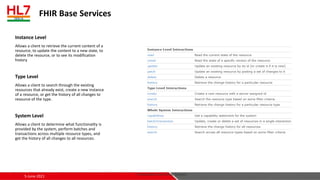
Instance Level
Allows a client to retrieve the current content of a
resource, to update the content to a new state, to
delete the resource, or to see its modification
history
Type Level
Allows a client to search through the existing
resources that already exist, create a new instance
of a resource, or get the history of all changes to
resource of the type.
System Level
Allows a client to determine what functionality is
provided by the system, perform batches and
transactions across multiple resource types, and
get the history of all changes to all resources.
5-June-2021 Presentation by Kumar Satyam
FHIR Base Services
Resources in FHIR
• “Resources” are:
• Small logically discrete units of exchange
• Defined behavior and meaning
• Known identity / location
• Smallest unit of transaction
A resource is an entity that:
• has a known identity (a URL) by which it can be addressed
• identifies itself as one of the types of resource defined in this specification
• contains a set of structured data items as described by the definition of the resource
type
• has an identified version that changes if the contents of the resource change
29-May-2021
Presentation by Kumar Satyam
What is a Resource
Examples
•Patient, Practitioner, Organization
•Location, Coverage, Invoice
•AllergyIntolerance, Condition, FamilyHistory, CarePlan
•Bundle, Binary, Composition
29-May-2021
Presentation by Kumar Satyam
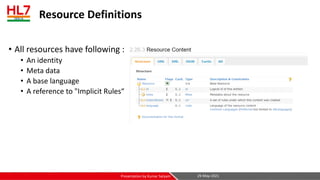
Resource Definitions
• All resources have following :
• An identity
• Meta data
• A base language
• A reference to "Implicit Rules“
29-May-2021
Presentation by Kumar Satyam
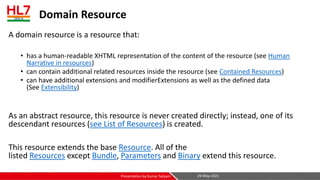
Domain Resource
A domain resource is a resource that:
• has a human-readable XHTML representation of the content of the resource (see Human
Narrative in resources)
• can contain additional related resources inside the resource (see Contained Resources)
• can have additional extensions and modifierExtensions as well as the defined data
(See Extensibility)
As an abstract resource, this resource is never created directly; instead, one of its
descendant resources (see List of Resources) is created.
This resource extends the base Resource. All of the
listed Resources except Bundle, Parameters and Binary extend this resource.
29-May-2021
Presentation by Kumar Satyam
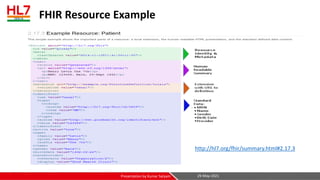
FHIR Resource Example
http://hl7.org/fhir/summary.html#2.17.3
29-May-2021
Presentation by Kumar Satyam
The FHIR Manifesto
• Focus on Implementers.
• Target support for common scenarios.
• Leverage cross- industry web technologies.
• Require human readability as base level of interoperability.
• Make content freely available.
• Support multiple paradigms & architectures
Source : Principles of Health Interoperability_ SNOMED CT, HL7 and FHIR 3rd edition
Support “Common” Scenarios
• Inclusion of content in core specification is based on “80%” rule
• Only include data elements we are confident that most (~80%) of normal
implementations using that resource will make use of
• Other content in extensions
• Easy to say, governance challenge to achieve
• Resources are simple and easy to understand & use
Conformance
5-June-2021
Presentation by Kumar Satyam
Conformance
How a system works, or how it should work
Document / Describe
5-June-2021
Presentation by Kumar Satyam
Context
•FHIR is a standard for interoperability
Therefore:
If two systems both comply with FHIR, they’ll fully interoperate
•True or false?
•Why not?
5-June-2021
Presentation by Kumar Satyam
Context
5-June-2021
Presentation by Kumar Satyam
• 140+ resources
• Do all systems support all resources ?
Most Resource elements are optional
Data type components optional
Terminologies unconstrained
Then there are operations and behaviors.
The Need
Need to be able to describe adaptations based on use and context.
• What resources and elements are used?
• What API features are used?
• What terminologies are used?
• How to map these to local requirements/implementations?
In a structured computable way that can be basis for validation, code, report
and UI generation etc.
5-June-2021
Presentation by Kumar Satyam
Use of conformance
• To create implementation guides that document expected behavior
• To test that systems conform to a set of documented behavior
• To generate code for reading and writing resources, or search forms or input
screens
• Comparing implementations to see if they are compatible
5-June-2021
Presentation by Kumar Satyam
Categories of conformance resources
• Terminology – these resources deal with describing how terminologies are
used.
• Content – these resources describe the content of other resources. In other
specifi cations, these are sometimes called ‘profiles’ or ‘ templates’.
• Behavior – these resources describe the system operations that can or will be
used.
• Management – these resources deal with publishing an implementation guide
(a set of conformance resource.es) and specifying testable behavior.
5-June-2021
Presentation by Kumar Satyam
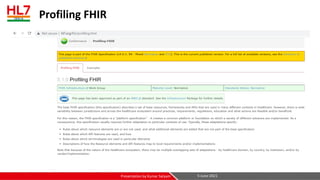
Profiling FHIR
5-June-2021
Presentation by Kumar Satyam
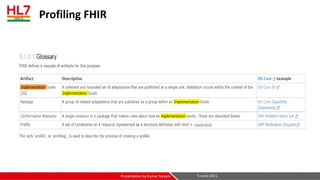
Profiling FHIR
5-June-2021
Presentation by Kumar Satyam
FHIR Profile
•A set of constraints on a FHIR resource
•A set of constraints on another FHIR profile
5-June-2021
Presentation by Kumar Satyam
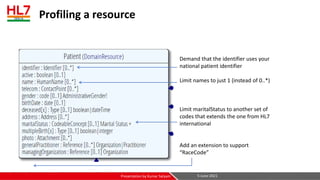
Profiling a resource
5-June-2021
Presentation by Kumar Satyam
Demand that the identifier uses your
national patient identifier
Limit names to just 1 (instead of 0..*)
Limit maritalStatus to another set of
codes that extends the one from HL7
international
Add an extension to support
“RaceCode”
Profiling Terminology
•Terminology Bindings
•Binding Strengths
5-June-2021
Presentation by Kumar Satyam
Terminology
5-June-2021
Presentation by Kumar Satyam
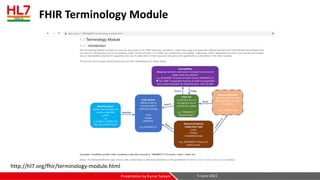
FHIR Terminology Module
5-June-2021
Presentation by Kumar Satyam
http://hl7.org/fhir/terminology-module.html
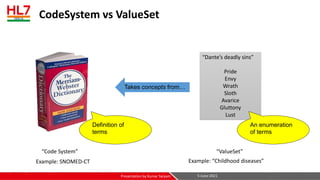
CodeSystem vs ValueSet
5-June-2021
Presentation by Kumar Satyam
“Code System”
“Dante’s deadly sins”
Pride
Envy
Wrath
Sloth
Avarice
Gluttony
Lust
“ValueSet”
Takes concepts from…
An enumeration
of terms
Definition of
terms
Example: SNOMED-CT Example: “Childhood diseases”
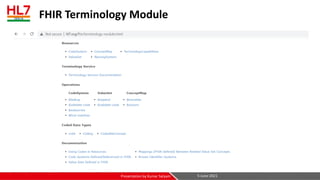
FHIR Terminology Module
5-June-2021
Presentation by Kumar Satyam
Coded Datatypes
• Code
• Just the ‘code’ itself - code system and value set are fixed
• Coding
• ‘code’ + ‘system’ (both are optional, but are both generally present)
• Plus ‘display’, ‘version’, ‘userSelected’ (also optional)
• CodeableConcept
• One or more Coding instances plus optional text
5-June-2021
Presentation by Kumar Satyam
Use in Resource
Let’s take a look at Patient Resource
5-June-2021
Presentation by Kumar Satyam
Conformance Resources
• Capability Statement
• OperationDefinition
• StructureDefinition
• Value Set
• Concept Map
• NamingSystem
5-June-2021
Presentation by Kumar Satyam
Pre-work for next session
5-June-2021
Presentation by Kumar Satyam
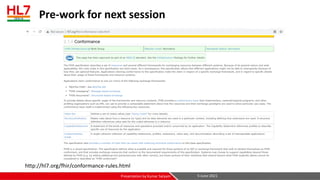
http://hl7.org/fhir/conformance-rules.html

Fhir basics session4_conformance_and_terminology

  • 1.
    HL7 FHIR BASICS– SESSION 4 Conformance & Terminology Kumar Satyam https://www.linkedin.com/in/kumarsatyam/ https://twitter.com/kr_satyam 5-June-2021 Presentation by Kumar Satyam
  • 2.
    Acknowledgements & Credits ThisPresentation borrows from the content of presentations by ➢Grahame Grieve ➢Lloyd McKenzie ➢Ewout Kramer ➢David Hay ➢Michel Rutten ➢ and other members of HL7 FHIR Community. 5-June-2021 Presentation by Kumar Satyam
  • 3.
  • 4.
    FHIR India Community •Open community of HL7 FHIR & Interoperability enthusiasts. • #fhirIndia – social media tag. • https://fhirindia.zulipchat.com/ - Discussion forum • https://www.linkedin.com/groups/13932672/ - LinkedIn Group 10K by Dec 2021. 5-June-2021 Presentation by Kumar Satyam
  • 5.
    Glimpse of someof the community activities ✓Review and feedback digital healthcare initiatives like NDHB ✓FHIR India Connectathon – July 2020 ✓NDHM FHIR Profiles ✓Concept papers ✓Education & Implementer support ✓Connect with global community ✓Projects of common interest 5-June-2021 Presentation by Kumar Satyam
  • 6.
    House Keeping • Pleasebe on mute while the session is in progress • Please use your full name in zoom participant's profile. • Ask questions on zoom chat . • Follow up & discussions on zulip. • Everyone please ensure that you are on zulip. https://fhirindia.zulipchat.com/#narrow/stream/272723-Training-.26.20Conferences/topic/FHIR.20Basics.20Training 5-June-2021 Presentation by Kumar Satyam
  • 7.
  • 8.
    Fast Healthcare InteroperabilityResources 5-June-2021 Presentation by Kumar Satyam
  • 9.
    FHIR RESTFul Paradigm ➢“REpresentationalState Transfer” ➢Represent your data as “resources” ➢Make “Resource” URI addressable ➢Use HTTP methods to perform CRUD operations ➢FHIR extends the HTTP methods for additional base operations ➢Resources may be exchanged using different formatted representations ▪ XML, JSON, RDF,ND-JSON . *RESTFul because loosely follows REST. 5-June-2021 Presentation by Kumar Satyam
  • 10.
    Instance Level Allows aclient to retrieve the current content of a resource, to update the content to a new state, to delete the resource, or to see its modification history Type Level Allows a client to search through the existing resources that already exist, create a new instance of a resource, or get the history of all changes to resource of the type. System Level Allows a client to determine what functionality is provided by the system, perform batches and transactions across multiple resource types, and get the history of all changes to all resources. 5-June-2021 Presentation by Kumar Satyam FHIR Base Services
  • 11.
    Resources in FHIR •“Resources” are: • Small logically discrete units of exchange • Defined behavior and meaning • Known identity / location • Smallest unit of transaction A resource is an entity that: • has a known identity (a URL) by which it can be addressed • identifies itself as one of the types of resource defined in this specification • contains a set of structured data items as described by the definition of the resource type • has an identified version that changes if the contents of the resource change 29-May-2021 Presentation by Kumar Satyam
  • 12.
    What is aResource Examples •Patient, Practitioner, Organization •Location, Coverage, Invoice •AllergyIntolerance, Condition, FamilyHistory, CarePlan •Bundle, Binary, Composition 29-May-2021 Presentation by Kumar Satyam
  • 13.
    Resource Definitions • Allresources have following : • An identity • Meta data • A base language • A reference to "Implicit Rules“ 29-May-2021 Presentation by Kumar Satyam
  • 14.
    Domain Resource A domainresource is a resource that: • has a human-readable XHTML representation of the content of the resource (see Human Narrative in resources) • can contain additional related resources inside the resource (see Contained Resources) • can have additional extensions and modifierExtensions as well as the defined data (See Extensibility) As an abstract resource, this resource is never created directly; instead, one of its descendant resources (see List of Resources) is created. This resource extends the base Resource. All of the listed Resources except Bundle, Parameters and Binary extend this resource. 29-May-2021 Presentation by Kumar Satyam
  • 15.
  • 16.
    The FHIR Manifesto •Focus on Implementers. • Target support for common scenarios. • Leverage cross- industry web technologies. • Require human readability as base level of interoperability. • Make content freely available. • Support multiple paradigms & architectures Source : Principles of Health Interoperability_ SNOMED CT, HL7 and FHIR 3rd edition
  • 17.
    Support “Common” Scenarios •Inclusion of content in core specification is based on “80%” rule • Only include data elements we are confident that most (~80%) of normal implementations using that resource will make use of • Other content in extensions • Easy to say, governance challenge to achieve • Resources are simple and easy to understand & use
  • 18.
  • 19.
    Conformance How a systemworks, or how it should work Document / Describe 5-June-2021 Presentation by Kumar Satyam
  • 20.
    Context •FHIR is astandard for interoperability Therefore: If two systems both comply with FHIR, they’ll fully interoperate •True or false? •Why not? 5-June-2021 Presentation by Kumar Satyam
  • 21.
    Context 5-June-2021 Presentation by KumarSatyam • 140+ resources • Do all systems support all resources ? Most Resource elements are optional Data type components optional Terminologies unconstrained Then there are operations and behaviors.
  • 22.
    The Need Need tobe able to describe adaptations based on use and context. • What resources and elements are used? • What API features are used? • What terminologies are used? • How to map these to local requirements/implementations? In a structured computable way that can be basis for validation, code, report and UI generation etc. 5-June-2021 Presentation by Kumar Satyam
  • 23.
    Use of conformance •To create implementation guides that document expected behavior • To test that systems conform to a set of documented behavior • To generate code for reading and writing resources, or search forms or input screens • Comparing implementations to see if they are compatible 5-June-2021 Presentation by Kumar Satyam
  • 24.
    Categories of conformanceresources • Terminology – these resources deal with describing how terminologies are used. • Content – these resources describe the content of other resources. In other specifi cations, these are sometimes called ‘profiles’ or ‘ templates’. • Behavior – these resources describe the system operations that can or will be used. • Management – these resources deal with publishing an implementation guide (a set of conformance resource.es) and specifying testable behavior. 5-June-2021 Presentation by Kumar Satyam
  • 25.
  • 26.
  • 27.
    FHIR Profile •A setof constraints on a FHIR resource •A set of constraints on another FHIR profile 5-June-2021 Presentation by Kumar Satyam
  • 28.
    Profiling a resource 5-June-2021 Presentationby Kumar Satyam Demand that the identifier uses your national patient identifier Limit names to just 1 (instead of 0..*) Limit maritalStatus to another set of codes that extends the one from HL7 international Add an extension to support “RaceCode”
  • 29.
    Profiling Terminology •Terminology Bindings •BindingStrengths 5-June-2021 Presentation by Kumar Satyam
  • 30.
  • 31.
    FHIR Terminology Module 5-June-2021 Presentationby Kumar Satyam http://hl7.org/fhir/terminology-module.html
  • 32.
    CodeSystem vs ValueSet 5-June-2021 Presentationby Kumar Satyam “Code System” “Dante’s deadly sins” Pride Envy Wrath Sloth Avarice Gluttony Lust “ValueSet” Takes concepts from… An enumeration of terms Definition of terms Example: SNOMED-CT Example: “Childhood diseases”
  • 33.
  • 34.
    Coded Datatypes • Code •Just the ‘code’ itself - code system and value set are fixed • Coding • ‘code’ + ‘system’ (both are optional, but are both generally present) • Plus ‘display’, ‘version’, ‘userSelected’ (also optional) • CodeableConcept • One or more Coding instances plus optional text 5-June-2021 Presentation by Kumar Satyam
  • 35.
    Use in Resource Let’stake a look at Patient Resource 5-June-2021 Presentation by Kumar Satyam
  • 36.
    Conformance Resources • CapabilityStatement • OperationDefinition • StructureDefinition • Value Set • Concept Map • NamingSystem 5-June-2021 Presentation by Kumar Satyam
  • 37.
    Pre-work for nextsession 5-June-2021 Presentation by Kumar Satyam http://hl7.org/fhir/conformance-rules.html