Project Risk Management
Basic Introduction
Definitions
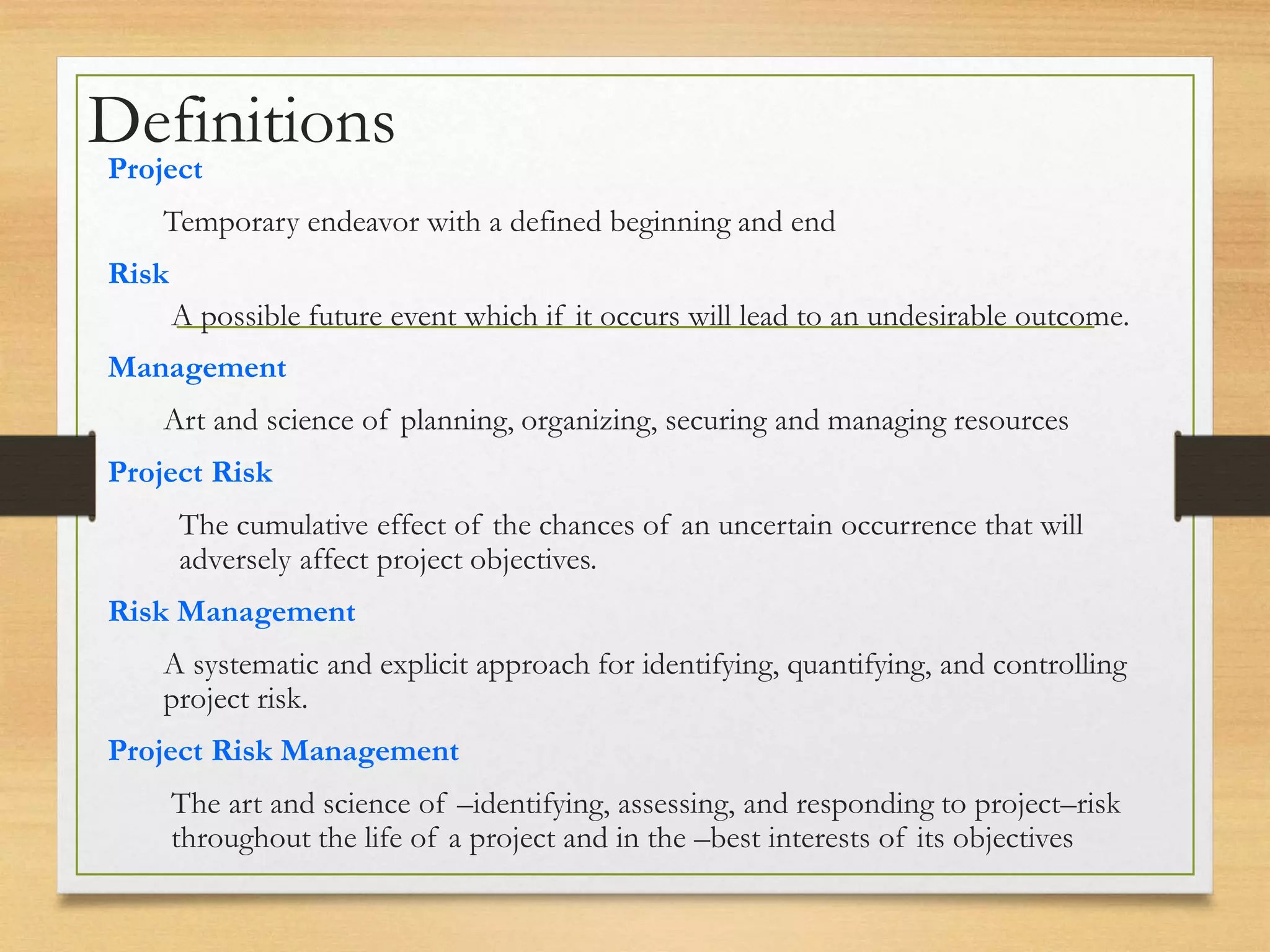
Project
Temporary endeavor with a defined beginning and end
Risk
A possible future event which if it occurs will lead to an undesirable outcome.
Management
Art and science of planning, organizing, securing and managing resources
Project Risk
The cumulative effect of the chances of an uncertain occurrence that will
adversely affect project objectives.
Risk Management
A systematic and explicit approach for identifying, quantifying, and controlling
project risk.
Project Risk Management
The art and science of –identifying, assessing, and responding to project–risk
throughout the life of a project and in the –best interests of its objectives
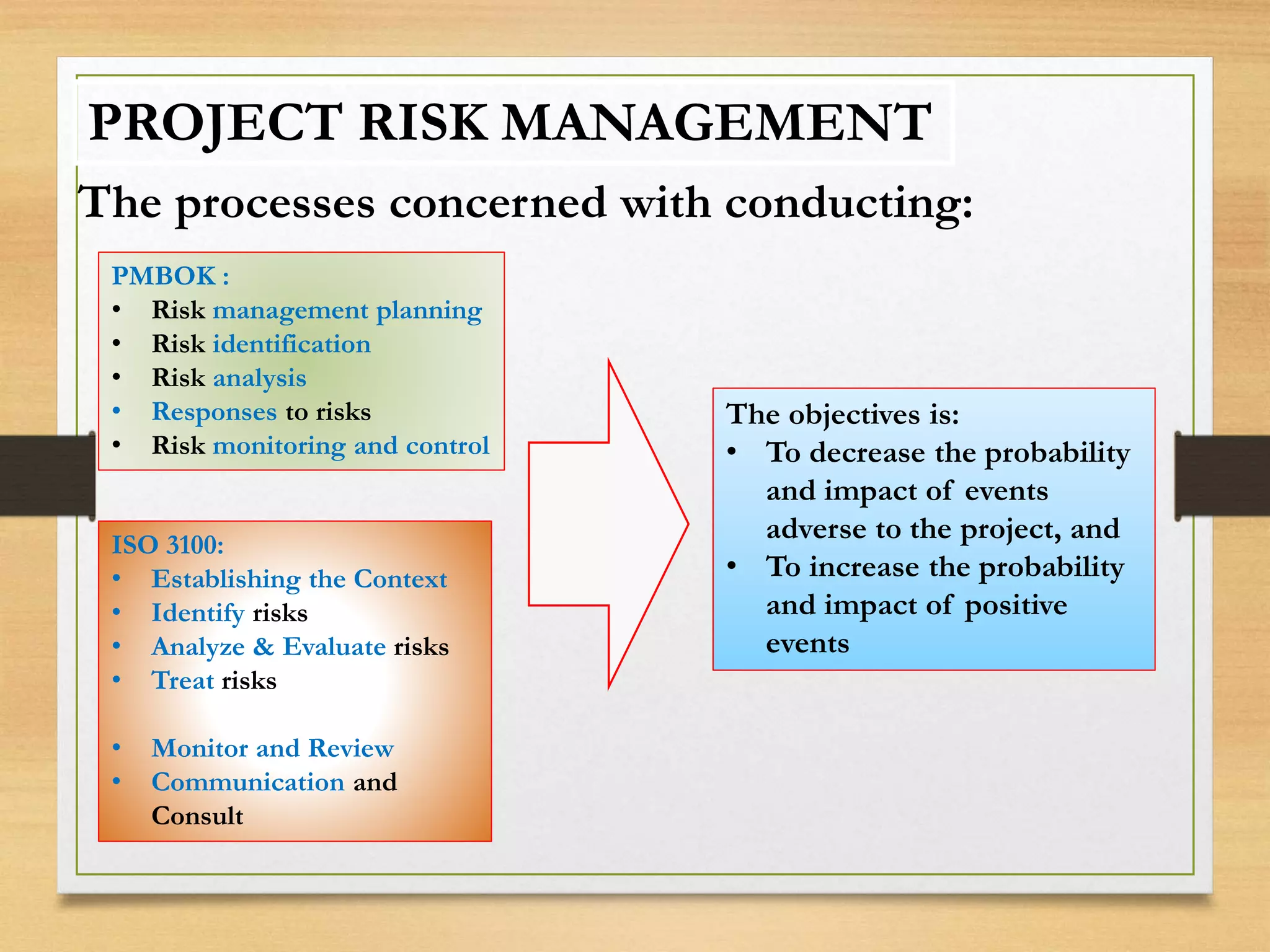
The processes concerned with conducting:
PROJECT RISK MANAGEMENT
The objectives is:
• To decrease the probability
and impact of events
adverse to the project, and
• To increase the probability
and impact of positive
events
PMBOK :
• Risk management planning
• Risk identification
• Risk analysis
• Responses to risks
• Risk monitoring and control
ISO 3100:
• Establishing the Context
• Identify risks
• Analyze & Evaluate risks
• Treat risks
• Monitor and Review
• Communication and
Consult
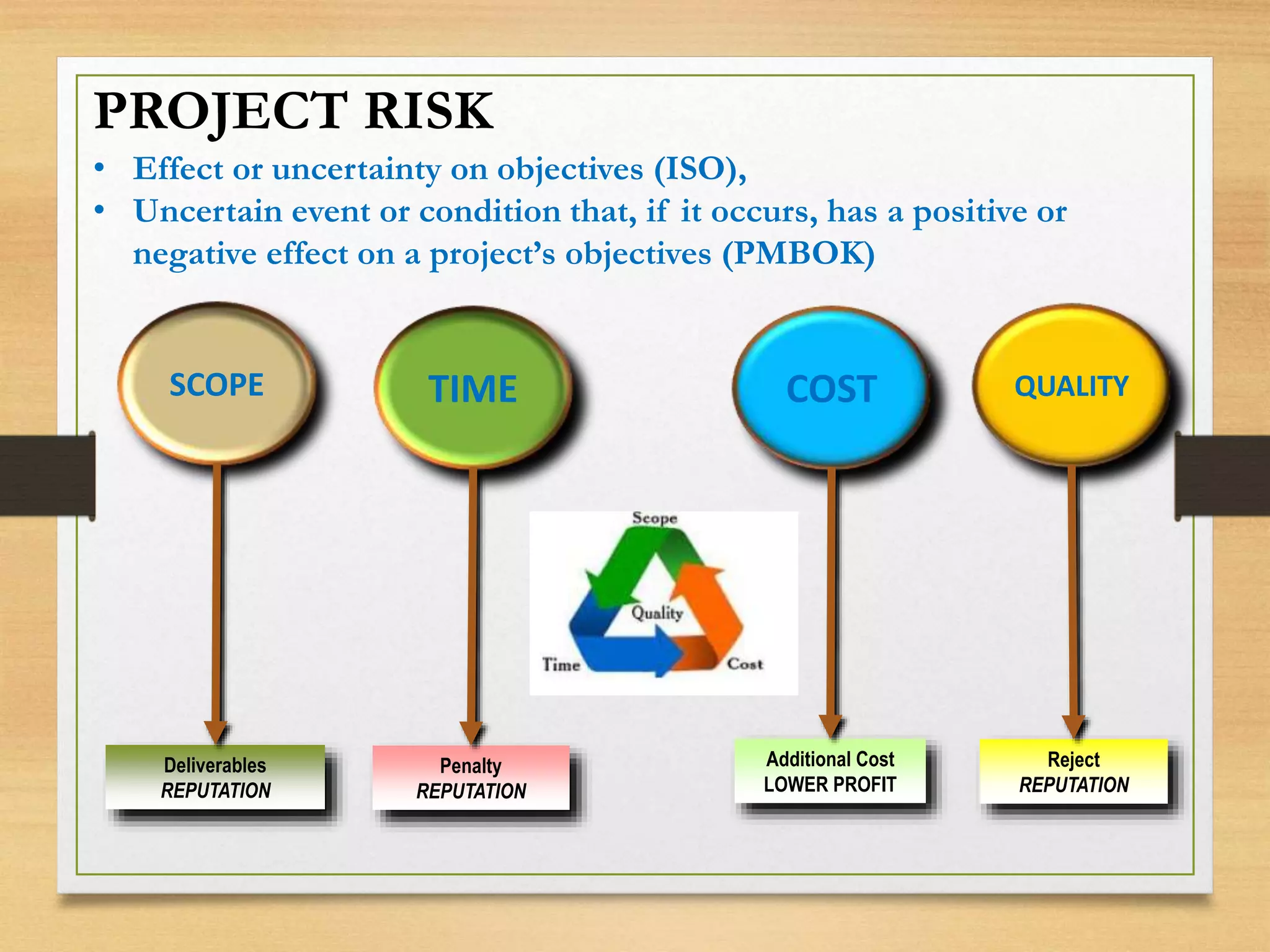
SCOPE TIME COST QUALITY
Deliverables
REPUTATION
Penalty
REPUTATION
Additional Cost
LOWER PROFIT
Reject
REPUTATION
PROJECT RISK
• Effect or uncertainty on objectives (ISO),
• Uncertain event or condition that, if it occurs, has a positive or
negative effect on a project’s objectives (PMBOK)
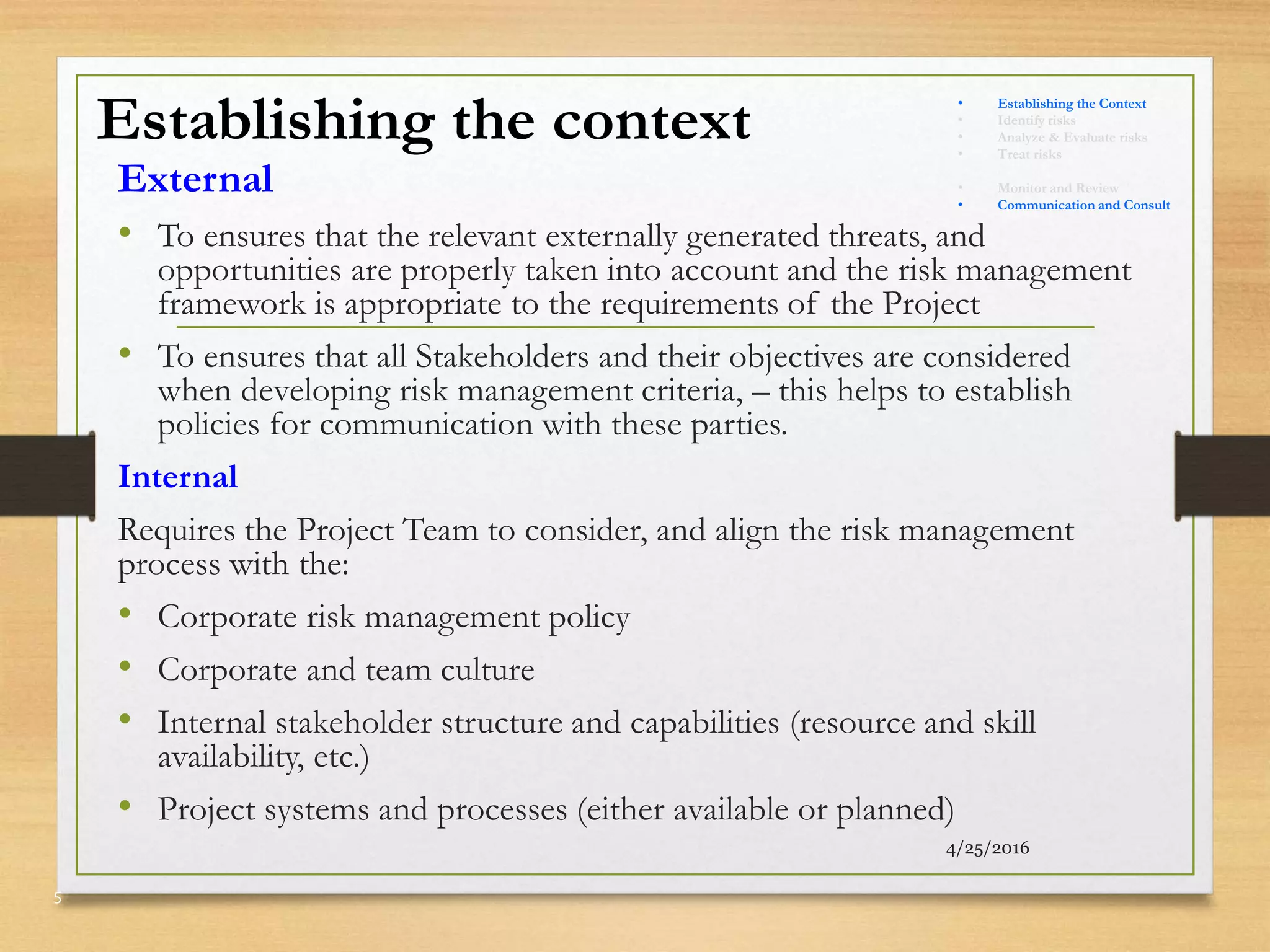
Establishing the context
External
• To ensures that the relevant externally generated threats, and
opportunities are properly taken into account and the risk management
framework is appropriate to the requirements of the Project
• To ensures that all Stakeholders and their objectives are considered
when developing risk management criteria, – this helps to establish
policies for communication with these parties.
Internal
Requires the Project Team to consider, and align the risk management
process with the:
• Corporate risk management policy
• Corporate and team culture
• Internal stakeholder structure and capabilities (resource and skill
availability, etc.)
• Project systems and processes (either available or planned)
4/25/2016
5
• Establishing the Context
• Identify risks
• Analyze & Evaluate risks
• Treat risks
• Monitor and Review
• Communication and Consult
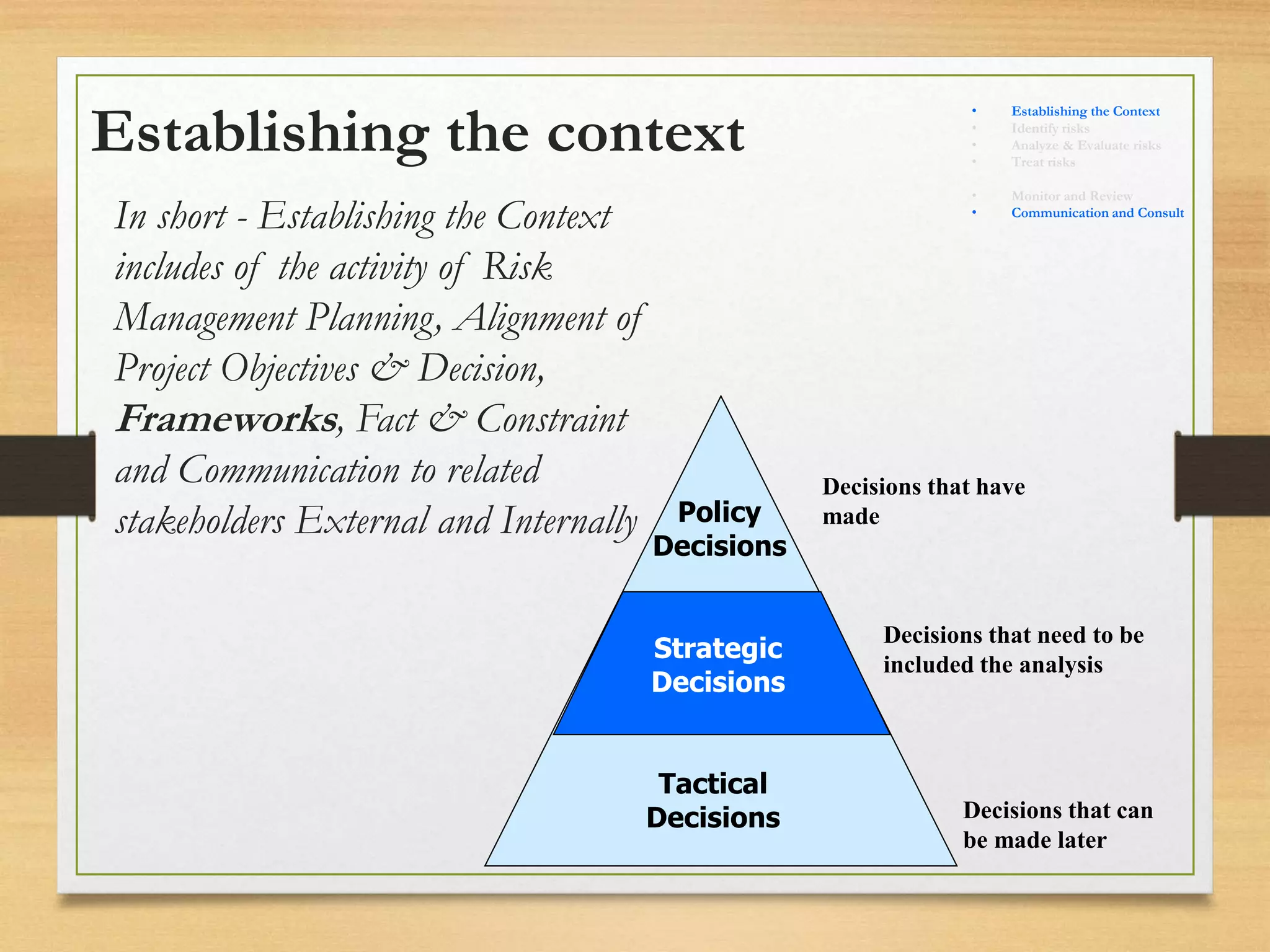
Establishing the context
In short - Establishing the Context
includes of the activity of Risk
Management Planning, Alignment of
Project Objectives & Decision,
Frameworks, Fact & Constraint
and Communication to related
stakeholders External and Internally Policy
Decisions
Strategic
Decisions
Tactical
Decisions
Decisions that have
made
Decisions that need to be
included the analysis
Decisions that can
be made later
• Establishing the Context
• Identify risks
• Analyze & Evaluate risks
• Treat risks
• Monitor and Review
• Communication and Consult
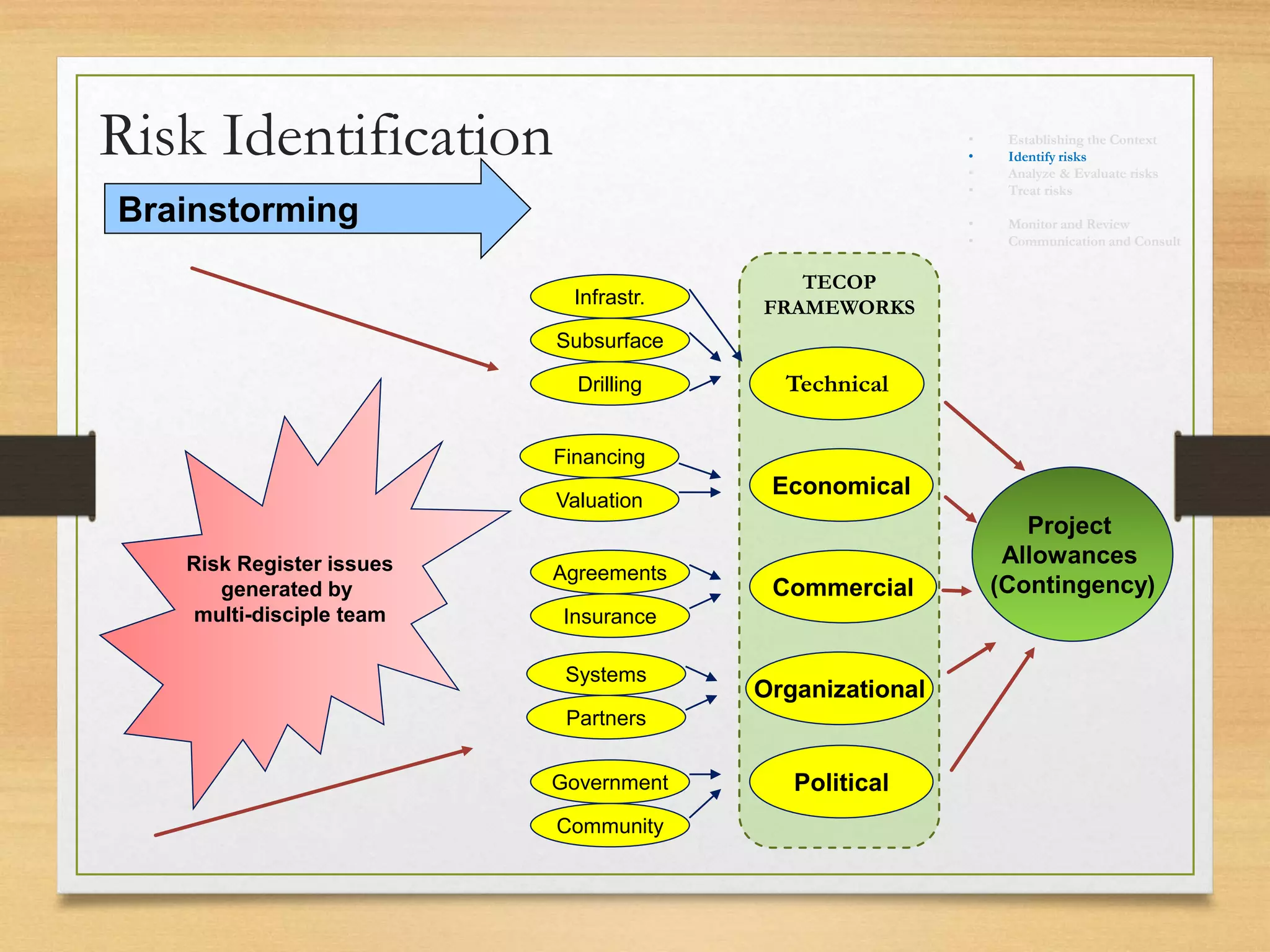
TECOP
FRAMEWORKS
Risk Identification
Risk Register issues
generated by
multi-disciple team
Project
Allowances
(Contingency)
Technical
Commercial
Economical
PoliticalGovernment
Community
Agreements
Drilling
Subsurface
Insurance
Valuation
Financing
Infrastr.
Brainstorming
Organizational
Systems
Partners
• Establishing the Context
• Identify risks
• Analyze & Evaluate risks
• Treat risks
• Monitor and Review
• Communication and Consult
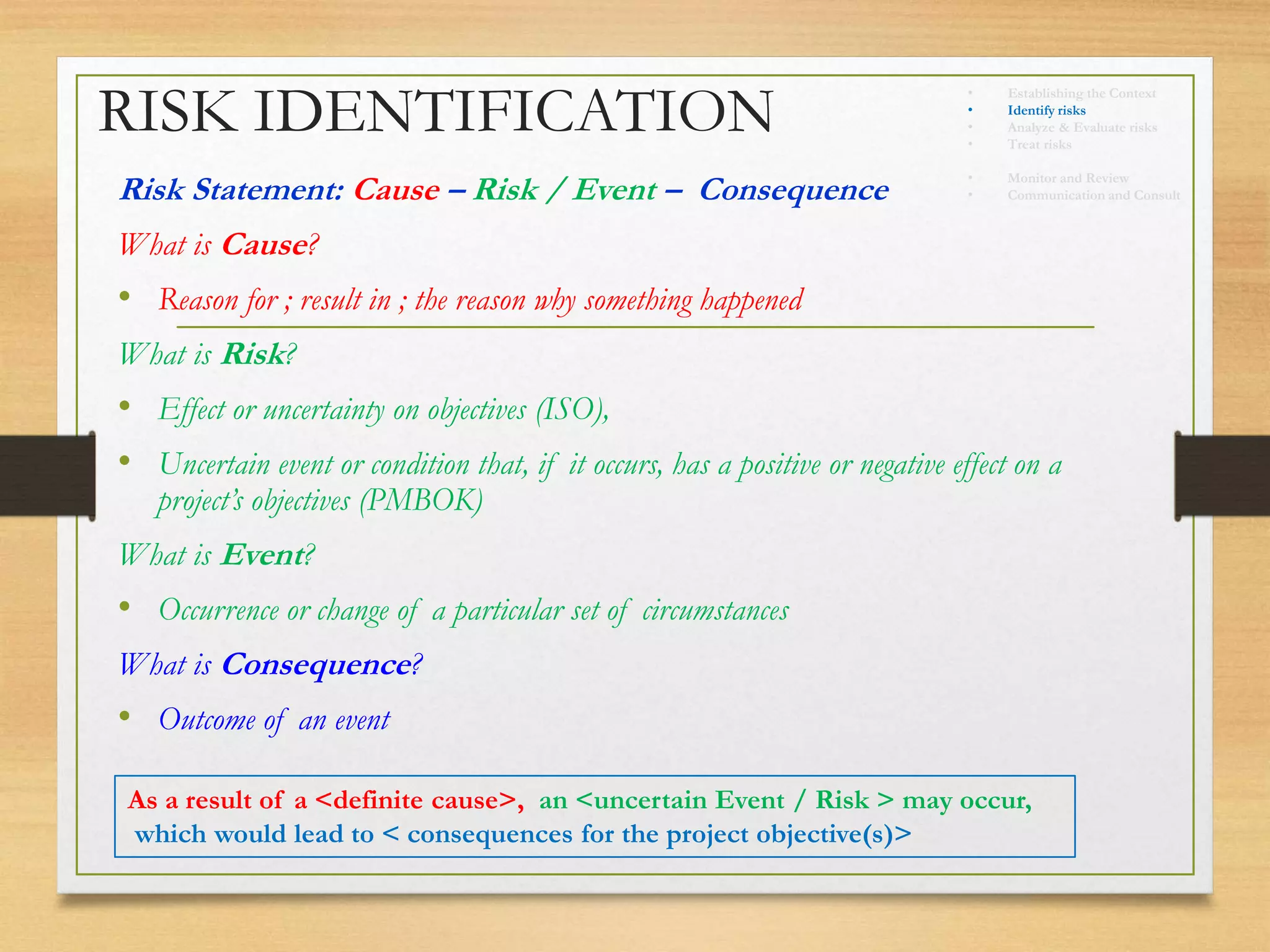
RISK IDENTIFICATION
Risk Statement: Cause – Risk / Event – Consequence
What is Cause?
• Reason for ; result in ; the reason why something happened
What is Risk?
• Effect or uncertainty on objectives (ISO),
• Uncertain event or condition that, if it occurs, has a positive or negative effect on a
project’s objectives (PMBOK)
What is Event?
• Occurrence or change of a particular set of circumstances
What is Consequence?
• Outcome of an event
As a result of a <definite cause>, an <uncertain Event / Risk > may occur,
which would lead to < consequences for the project objective(s)>
• Establishing the Context
• Identify risks
• Analyze & Evaluate risks
• Treat risks
• Monitor and Review
• Communication and Consult
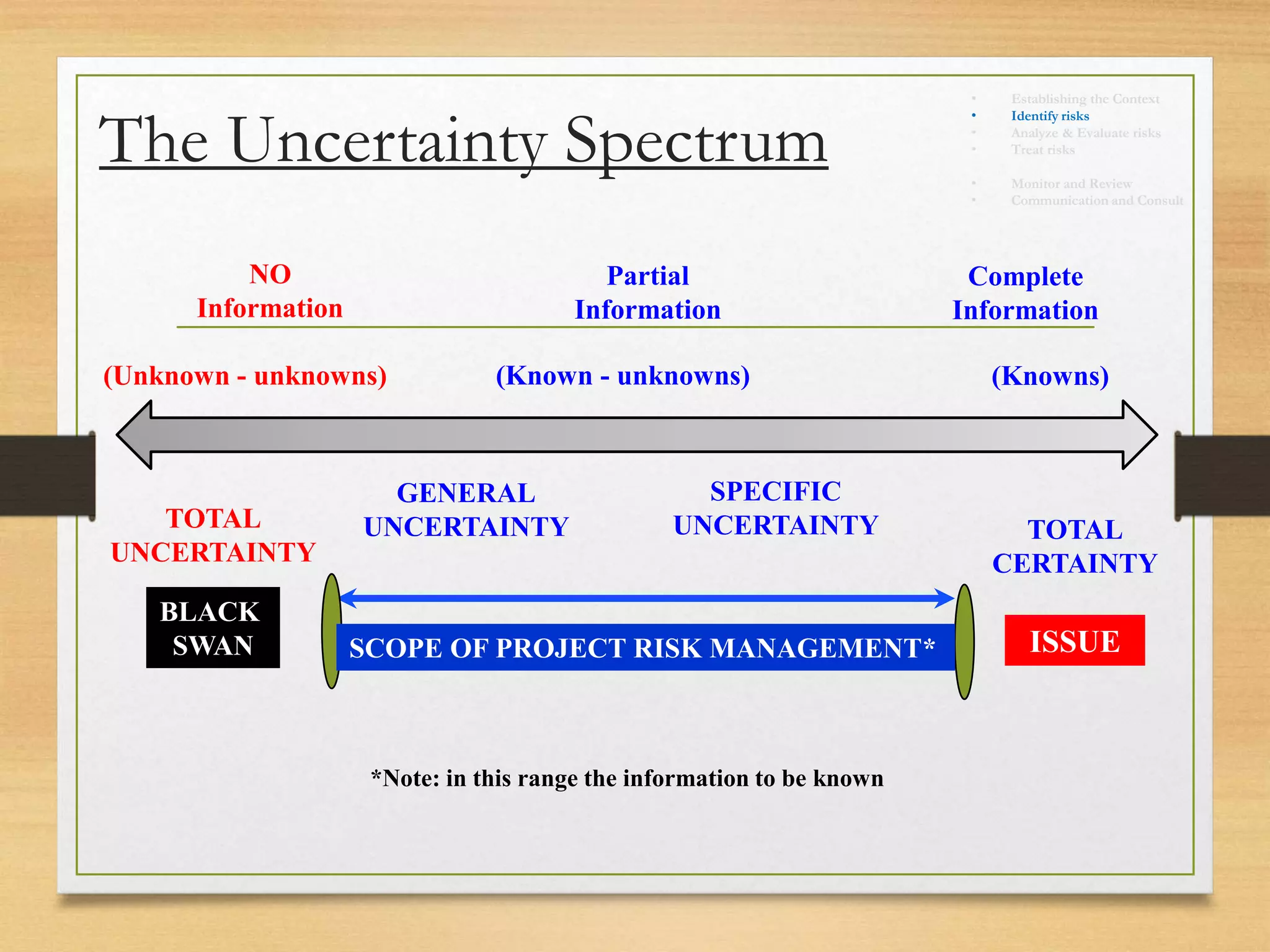
The Uncertainty Spectrum
TOTAL
CERTAINTY
TOTAL
UNCERTAINTY
GENERAL
UNCERTAINTY
SPECIFIC
UNCERTAINTY
(Unknown - unknowns) (Knowns)
NO
Information
Complete
Information
Partial
Information
(Known - unknowns)
SCOPE OF PROJECT RISK MANAGEMENT*
*Note: in this range the information to be known
• Establishing the Context
• Identify risks
• Analyze & Evaluate risks
• Treat risks
• Monitor and Review
• Communication and Consult
ISSUE
BLACK
SWAN
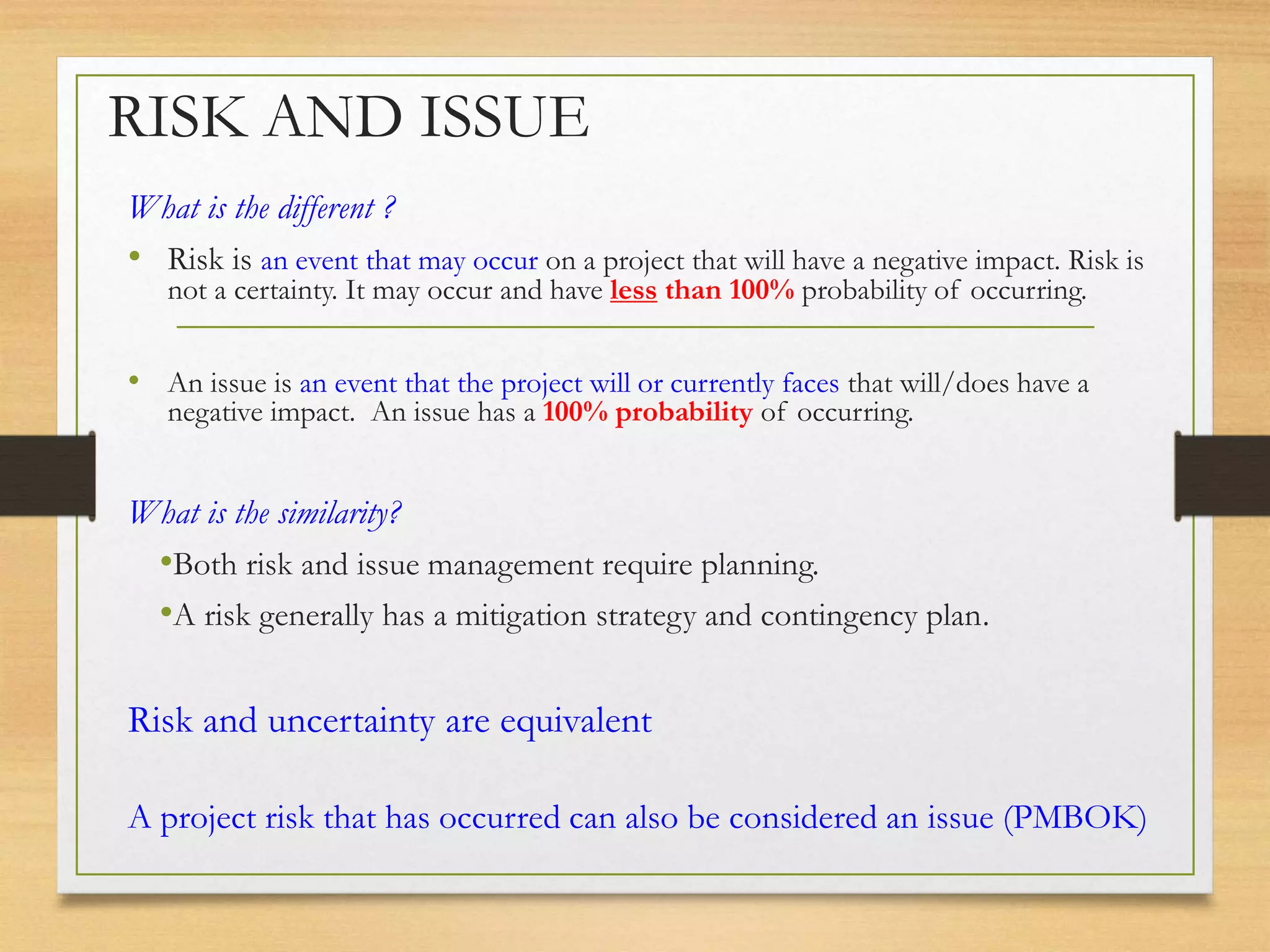
RISK AND ISSUE
What is the different ?
• Risk is an event that may occur on a project that will have a negative impact. Risk is
not a certainty. It may occur and have less than 100% probability of occurring.
• An issue is an event that the project will or currently faces that will/does have a
negative impact. An issue has a 100% probability of occurring.
What is the similarity?
•Both risk and issue management require planning.
•A risk generally has a mitigation strategy and contingency plan.
Risk and uncertainty are equivalent
A project risk that has occurred can also be considered an issue (PMBOK)
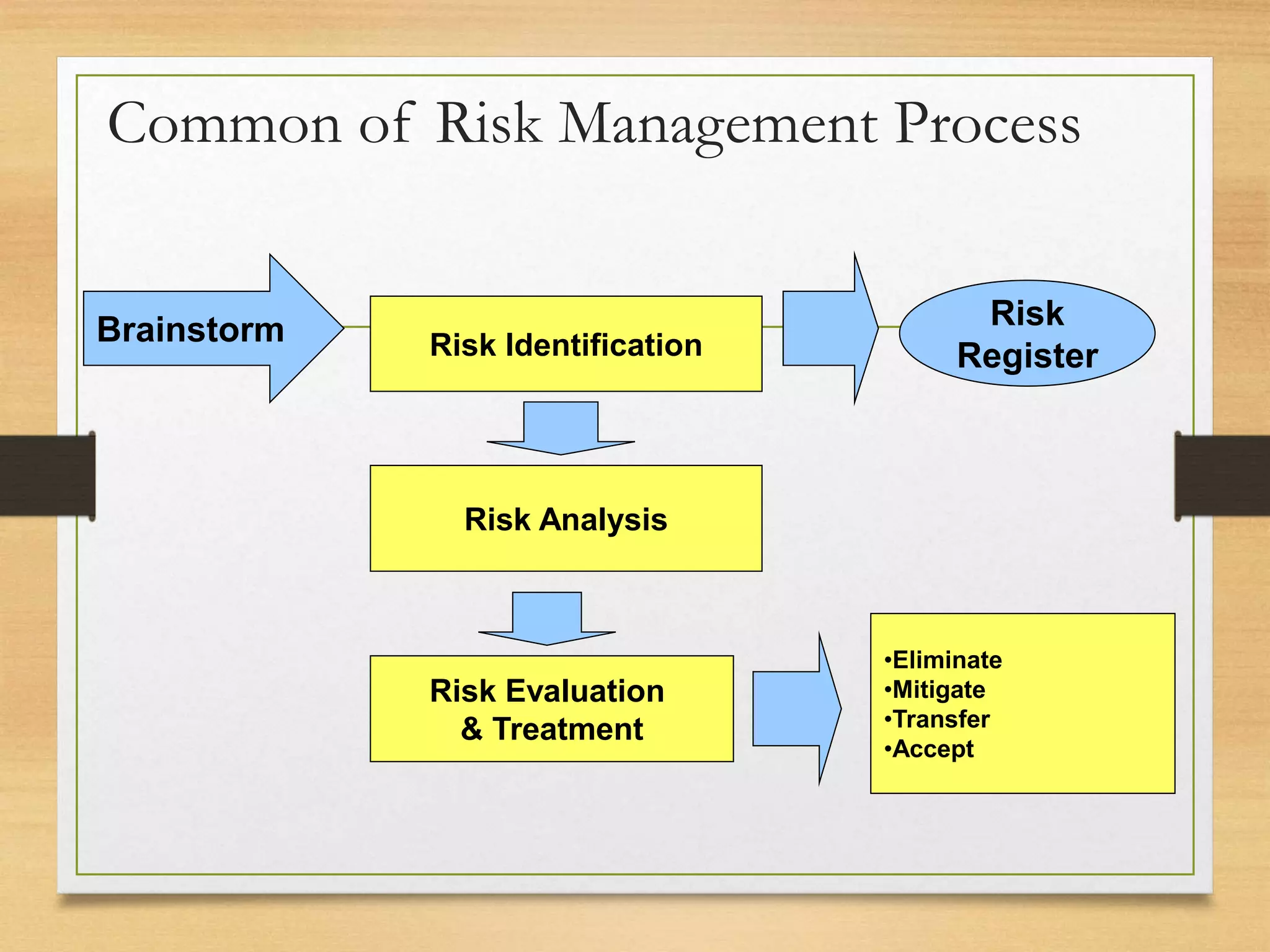
Common of Risk Management Process
Brainstorm Risk Identification
Risk
Register
Risk Analysis
Risk Evaluation
& Treatment
•Eliminate
•Mitigate
•Transfer
•Accept
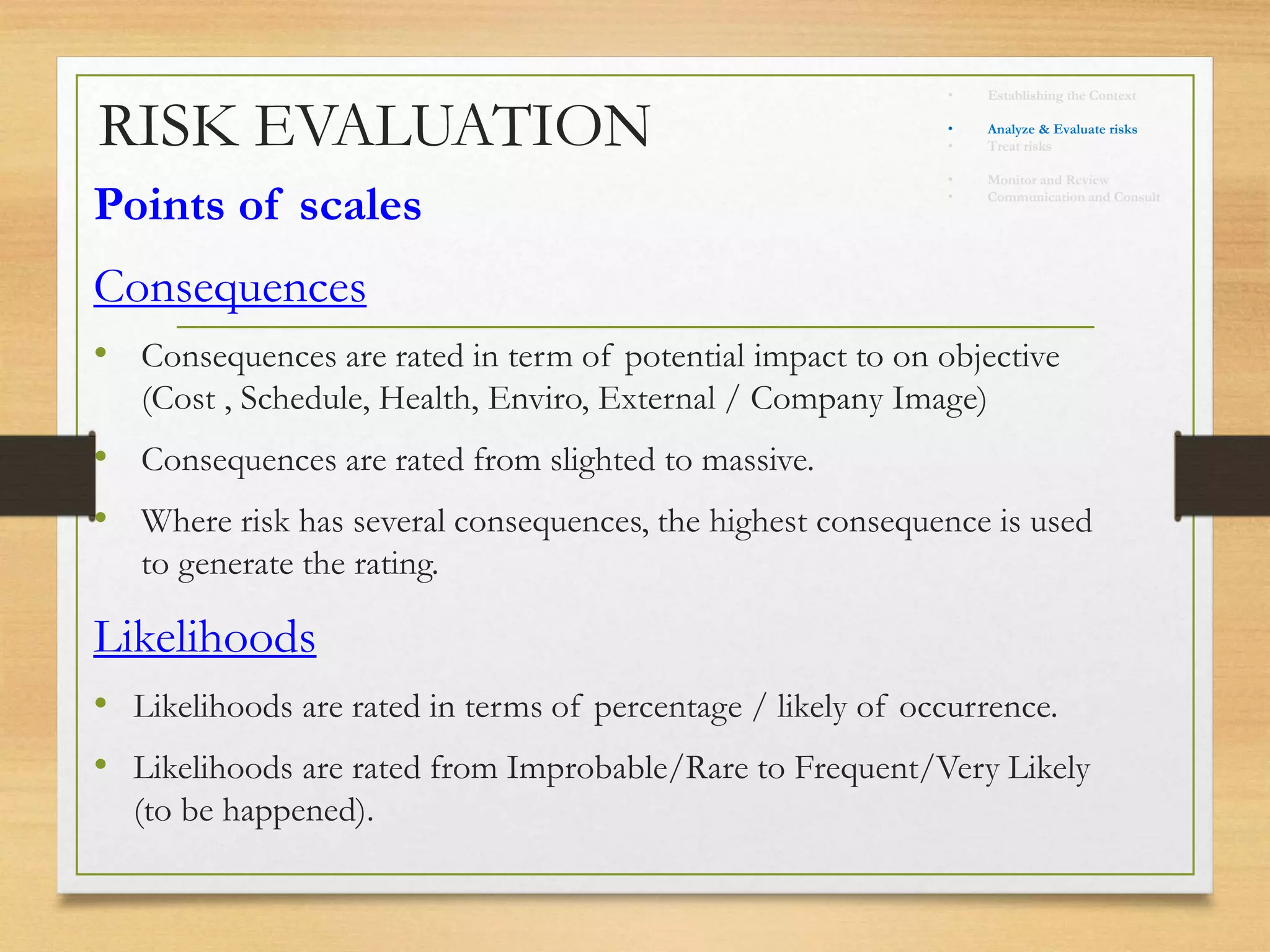
RISK EVALUATION
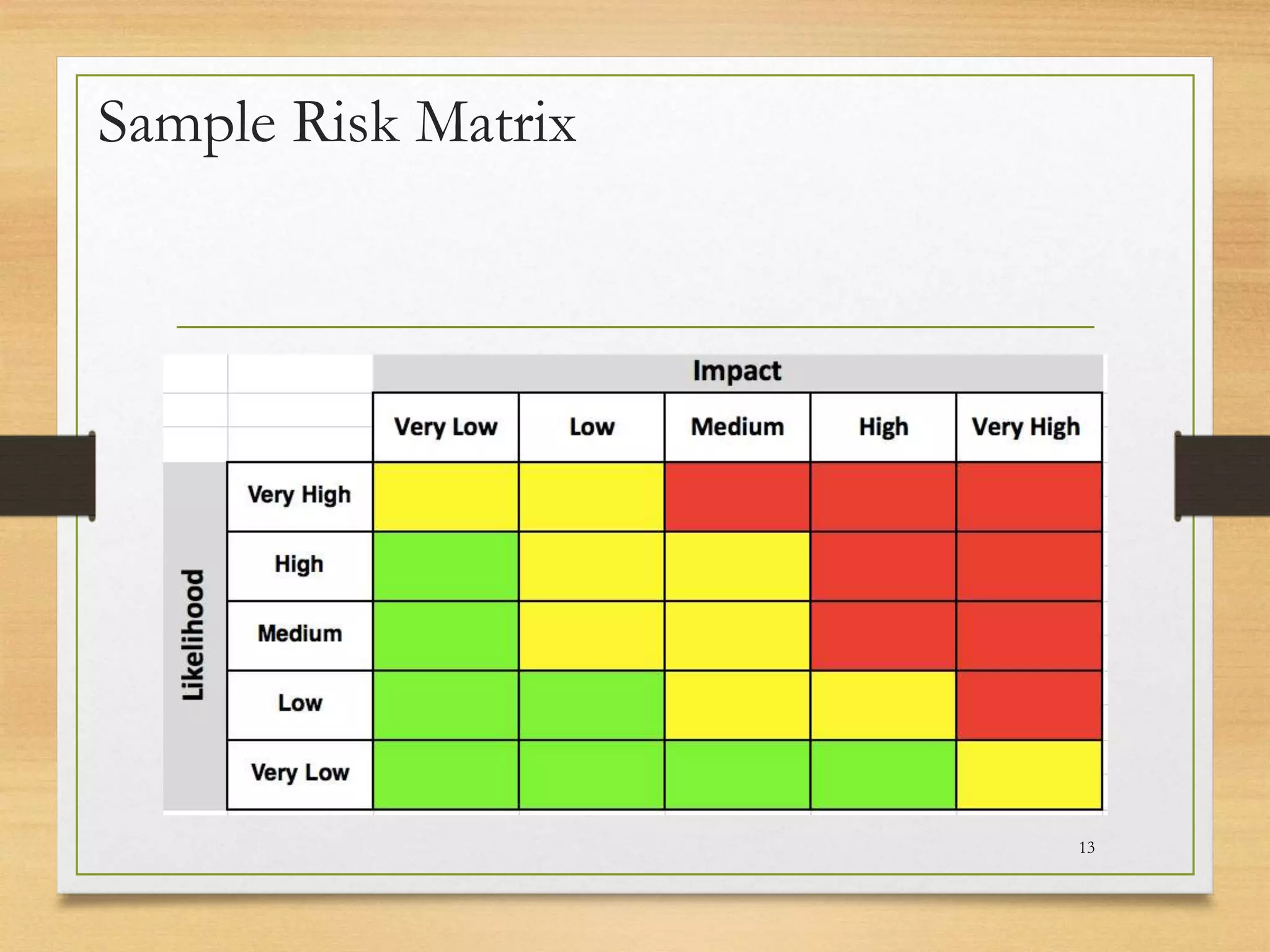
Points of scales
Consequences
• Consequences are rated in term of potential impact to on objective
(Cost , Schedule, Health, Enviro, External / Company Image)
• Consequences are rated from slighted to massive.
• Where risk has several consequences, the highest consequence is used
to generate the rating.
Likelihoods
• Likelihoods are rated in terms of percentage / likely of occurrence.
• Likelihoods are rated from Improbable/Rare to Frequent/Very Likely
(to be happened).
• Establishing the Context
• Identify risks
• Analyze & Evaluate risks
• Treat risks
• Monitor and Review
• Communication and Consult
Sample Risk Matrix
13
SETTING THE PRIORITIES
Rationale
Agreed priorities are used to determine where the greatest
attention, planning and detail risk assessment should be
focus.
• Using the control effectiveness
• (High Risk without control, High risk with control that are not fully
effective, etc.)
• Using the potential exposure
• Using Milestones
Using the level of risk
• Establishing the Context
• Identify risks
• Analyze & Evaluate risks
• Treat risks
• Monitor and Review
• Communication and Consult
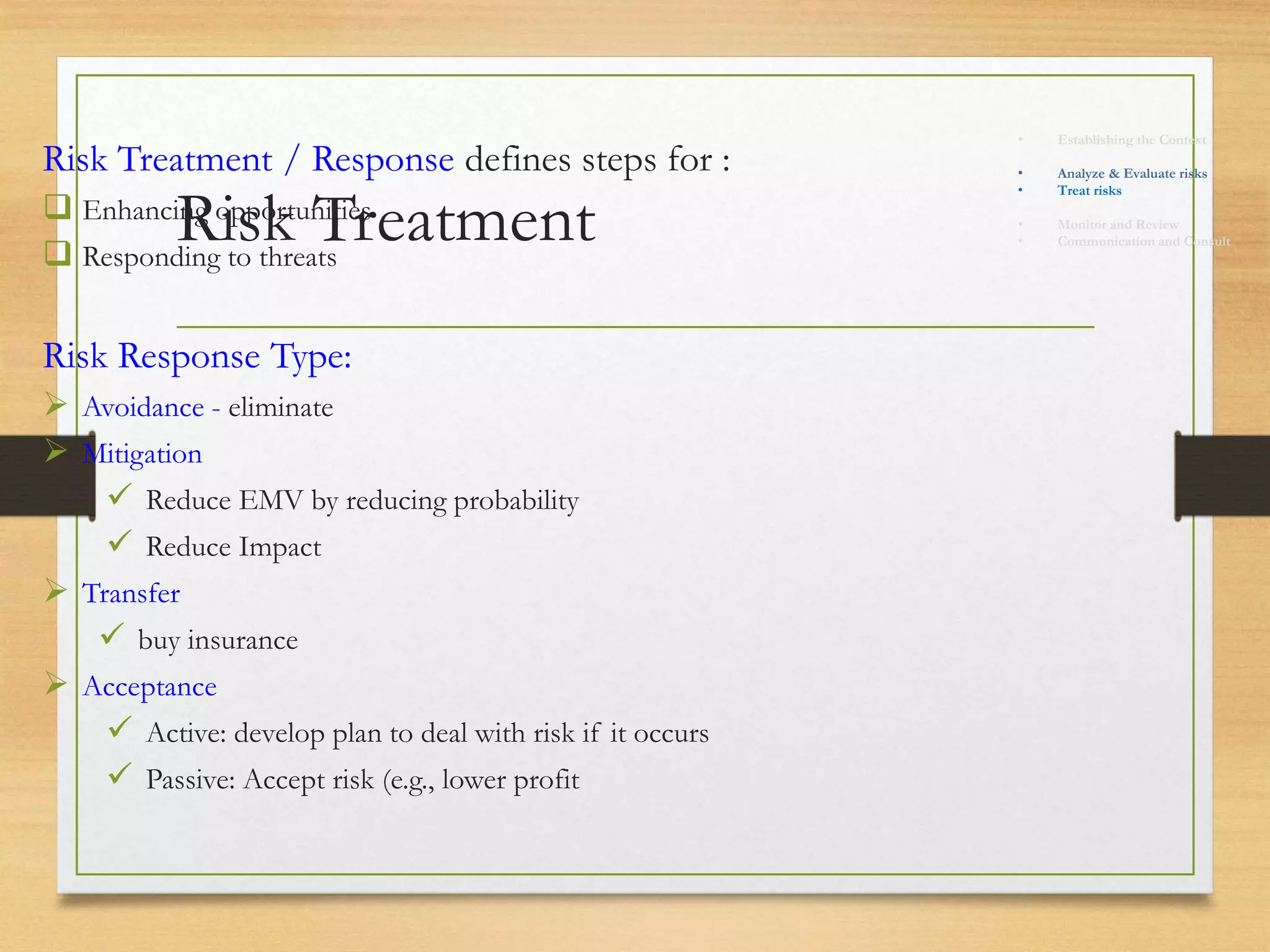
Risk Treatment
Risk Treatment / Response defines steps for :
 Enhancing opportunities
 Responding to threats
Risk Response Type:
 Avoidance - eliminate
 Mitigation
 Reduce EMV by reducing probability
 Reduce Impact
 Transfer
 buy insurance
 Acceptance
 Active: develop plan to deal with risk if it occurs
 Passive: Accept risk (e.g., lower profit
• Establishing the Context
• Identify risks
• Analyze & Evaluate risks
• Treat risks
• Monitor and Review
• Communication and Consult
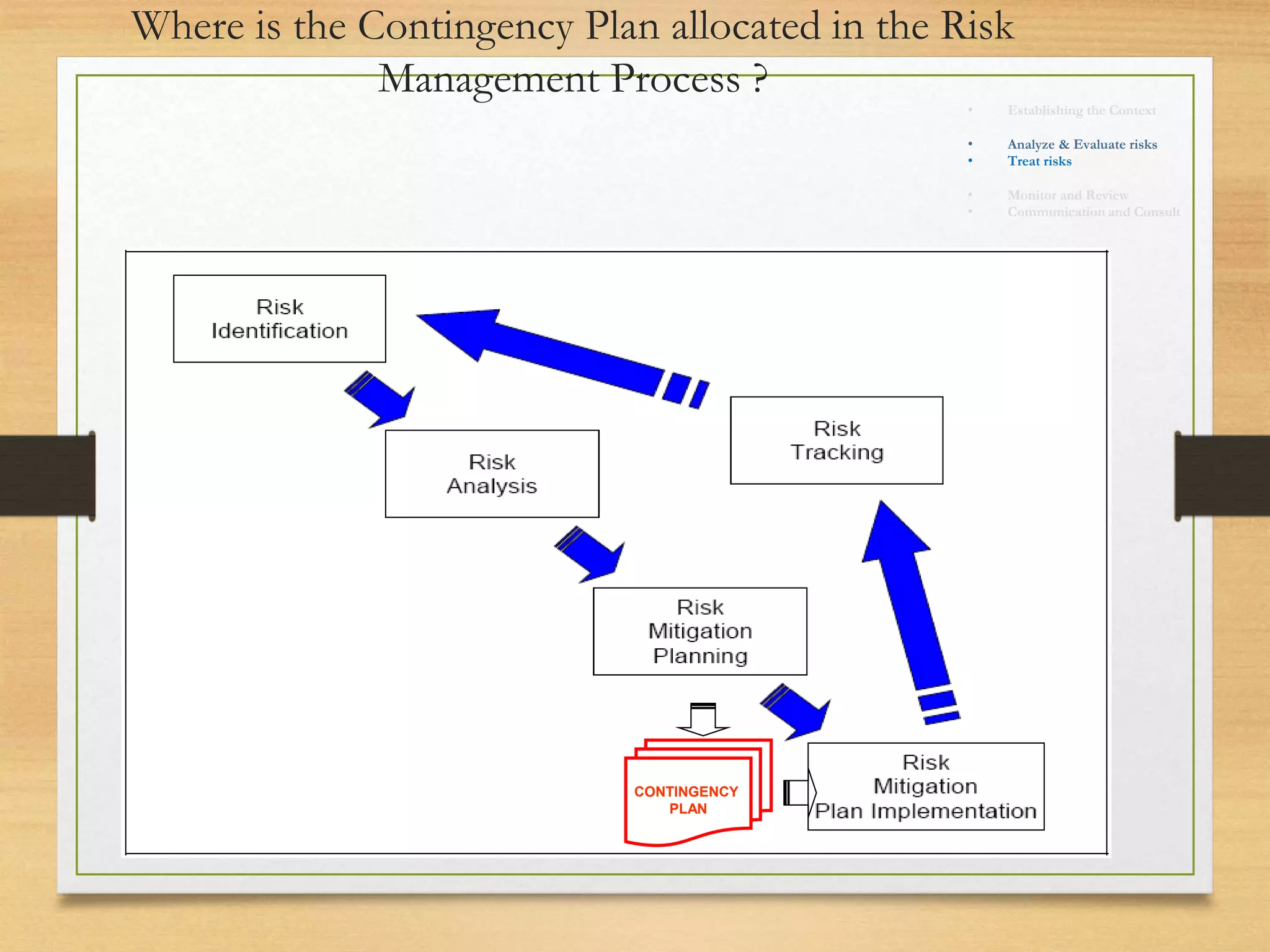
Where is the Contingency Plan allocated in the Risk
Management Process ?
CONTINGENCY
PLAN
• Establishing the Context
• Identify risks
• Analyze & Evaluate risks
• Treat risks
• Monitor and Review
• Communication and Consult
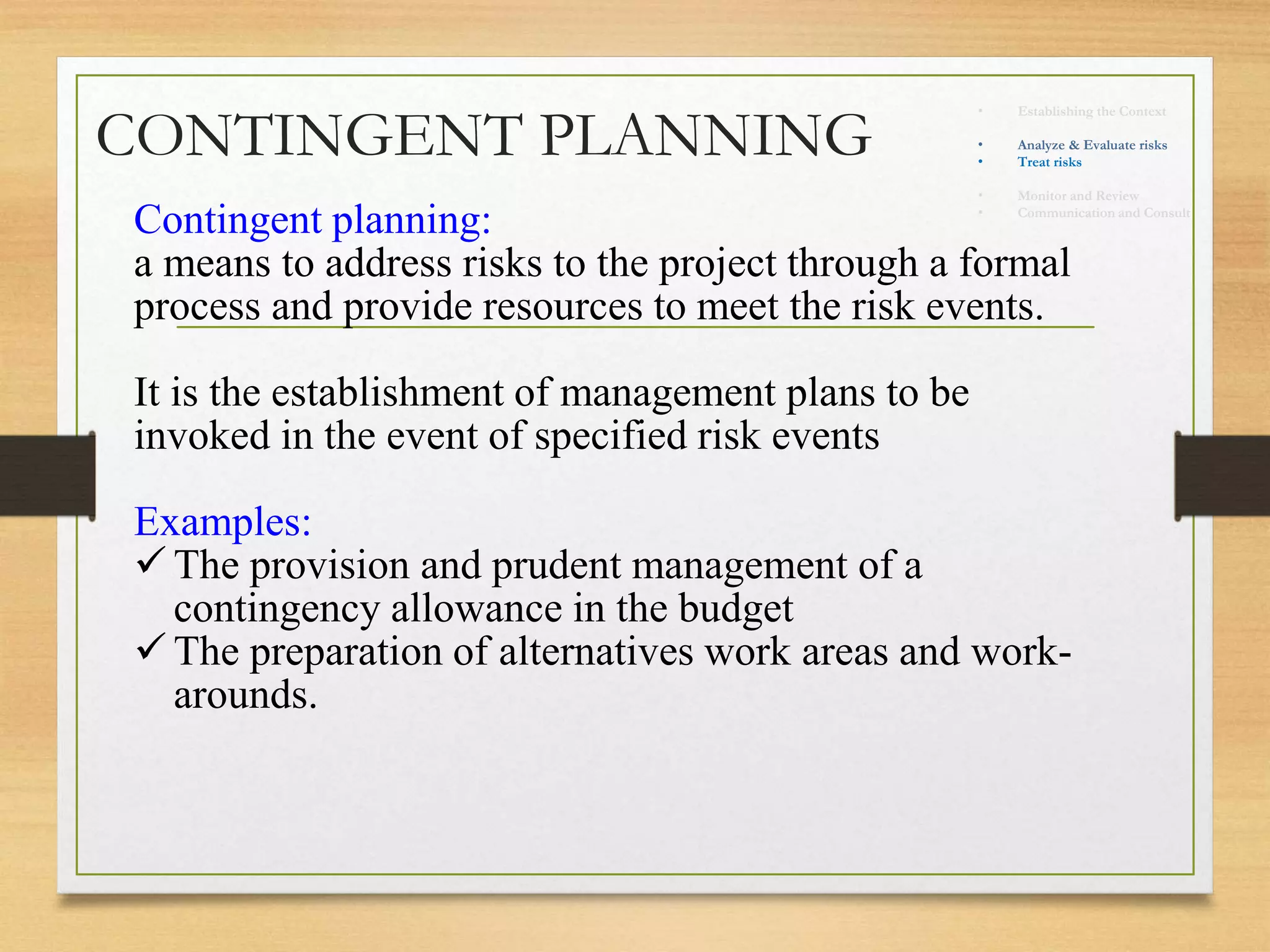
CONTINGENT PLANNING
Contingent planning:
a means to address risks to the project through a formal
process and provide resources to meet the risk events.
It is the establishment of management plans to be
invoked in the event of specified risk events
Examples:
 The provision and prudent management of a
contingency allowance in the budget
 The preparation of alternatives work areas and work-
arounds.
• Establishing the Context
• Identify risks
• Analyze & Evaluate risks
• Treat risks
• Monitor and Review
• Communication and Consult
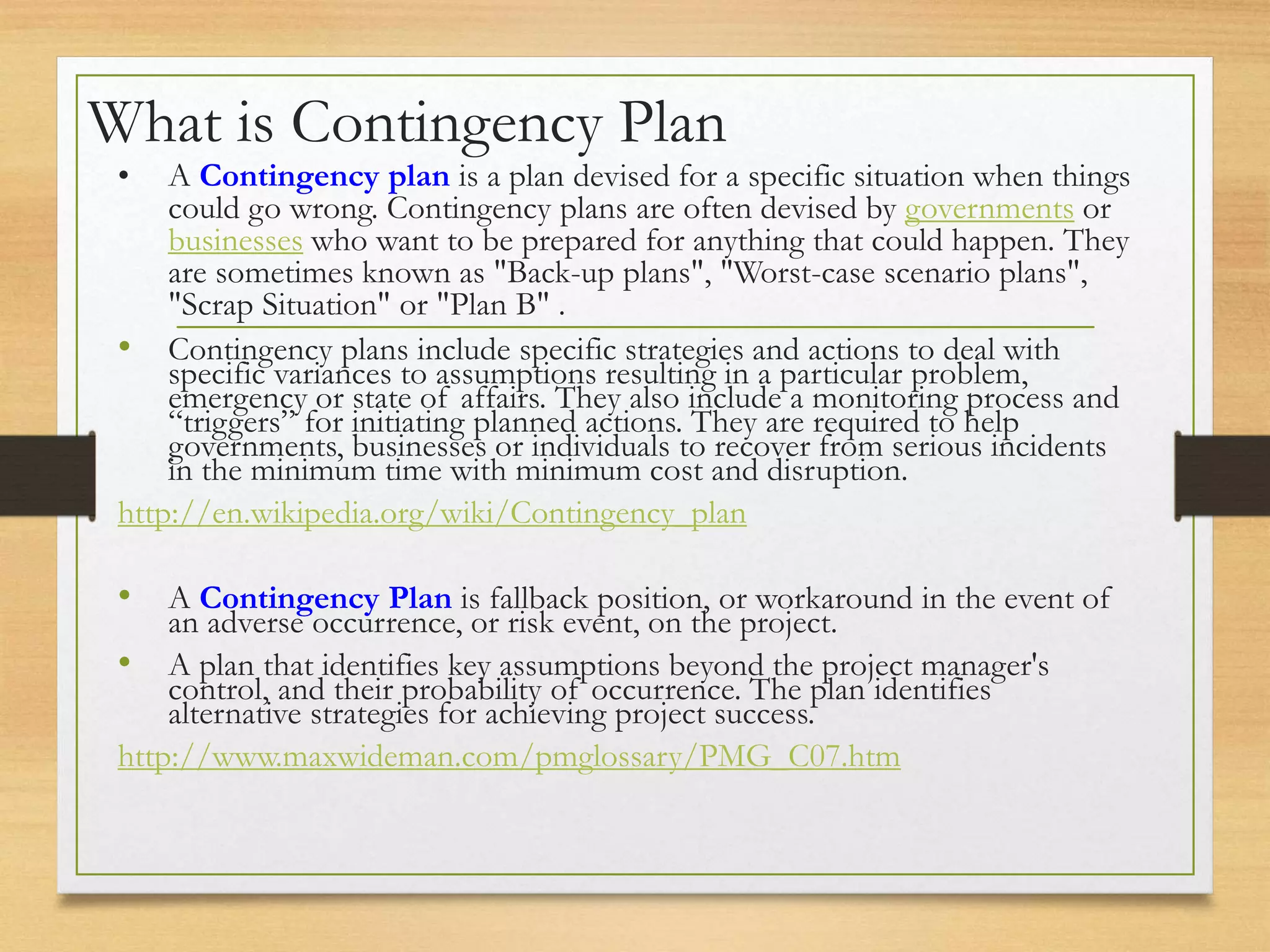
What is Contingency Plan
• A Contingency plan is a plan devised for a specific situation when things
could go wrong. Contingency plans are often devised by governments or
businesses who want to be prepared for anything that could happen. They
are sometimes known as "Back-up plans", "Worst-case scenario plans",
"Scrap Situation" or "Plan B" .
• Contingency plans include specific strategies and actions to deal with
specific variances to assumptions resulting in a particular problem,
emergency or state of affairs. They also include a monitoring process and
“triggers” for initiating planned actions. They are required to help
governments, businesses or individuals to recover from serious incidents
in the minimum time with minimum cost and disruption.
http://en.wikipedia.org/wiki/Contingency_plan
• A Contingency Plan is fallback position, or workaround in the event of
an adverse occurrence, or risk event, on the project.
• A plan that identifies key assumptions beyond the project manager's
control, and their probability of occurrence. The plan identifies
alternative strategies for achieving project success.
http://www.maxwideman.com/pmglossary/PMG_C07.htm
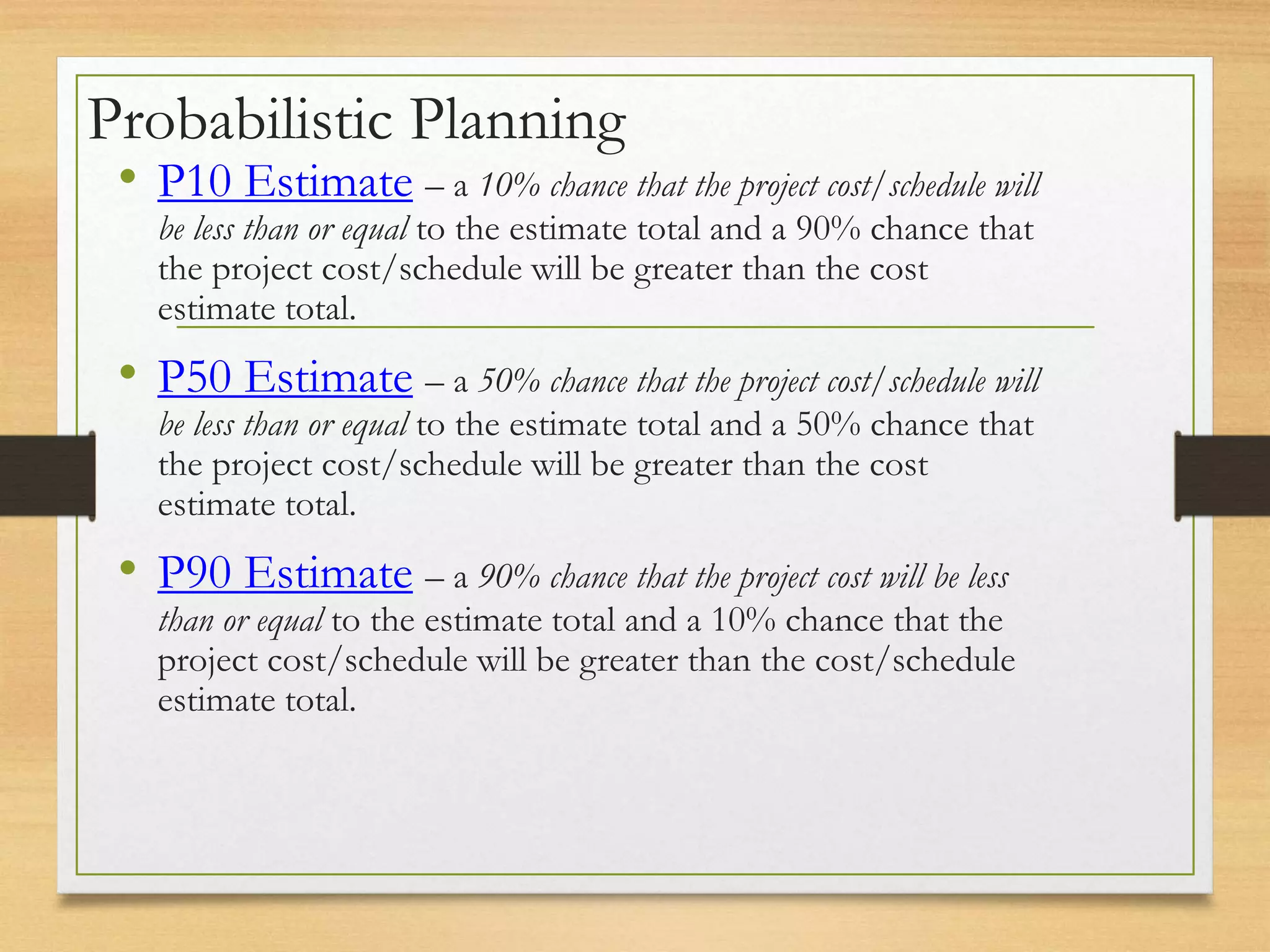
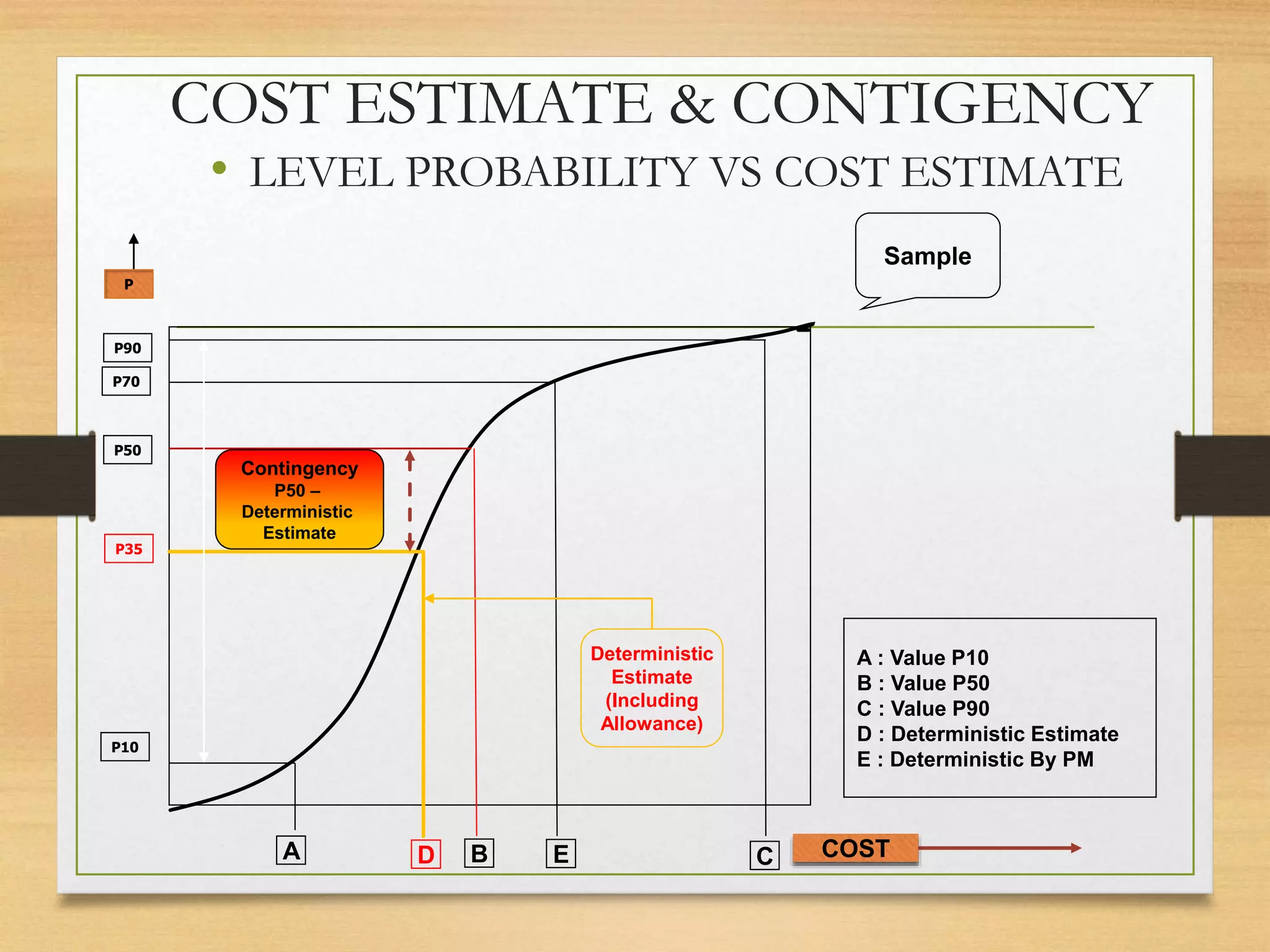
Probabilistic Planning
• P10 Estimate – a 10% chance that the project cost/schedule will
be less than or equal to the estimate total and a 90% chance that
the project cost/schedule will be greater than the cost
estimate total.
• P50 Estimate – a 50% chance that the project cost/schedule will
be less than or equal to the estimate total and a 50% chance that
the project cost/schedule will be greater than the cost
estimate total.
• P90 Estimate – a 90% chance that the project cost will be less
than or equal to the estimate total and a 10% chance that the
project cost/schedule will be greater than the cost/schedule
estimate total.
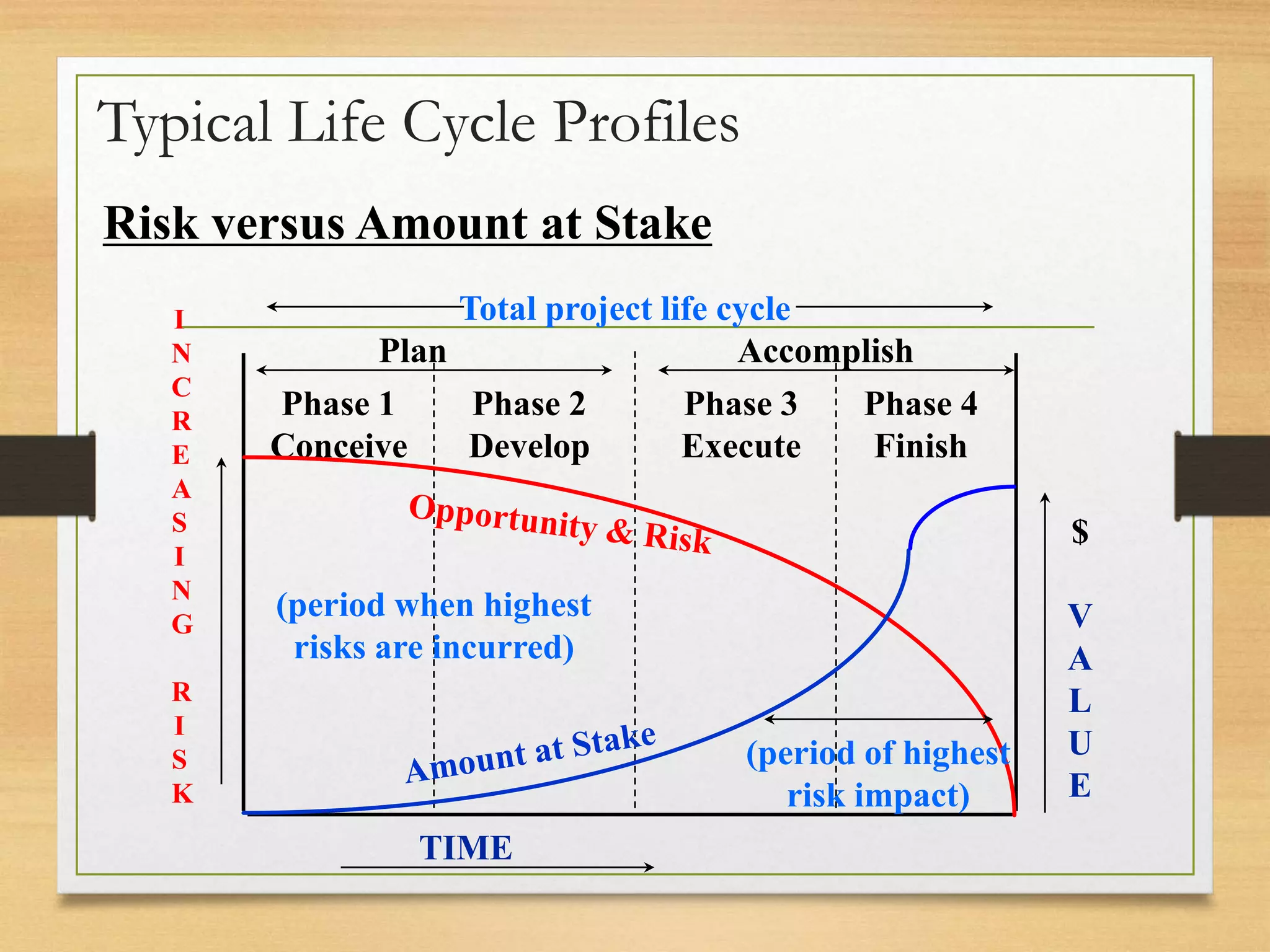
Typical Life Cycle Profiles
Total project life cycleI
N
C
R
E
A
S
I
N
G
R
I
S
K
$
V
A
L
U
E
TIME
Plan Accomplish
Phase 1
Conceive
Phase 2
Develop
Phase 3
Execute
Phase 4
Finish
(period when highest
risks are incurred)
(period of highest
risk impact)
Risk versus Amount at Stake
COST ESTIMATE & CONTIGENCY
• LEVEL PROBABILITY VS COST ESTIMATE
A D B CE
P90
P70
P50
P35
P10
A : Value P10
B : Value P50
C : Value P90
D : Deterministic Estimate
E : Deterministic By PM
Deterministic
Estimate
(Including
Allowance)
Contingency
P50 –
Deterministic
Estimate
COST
P
Sample
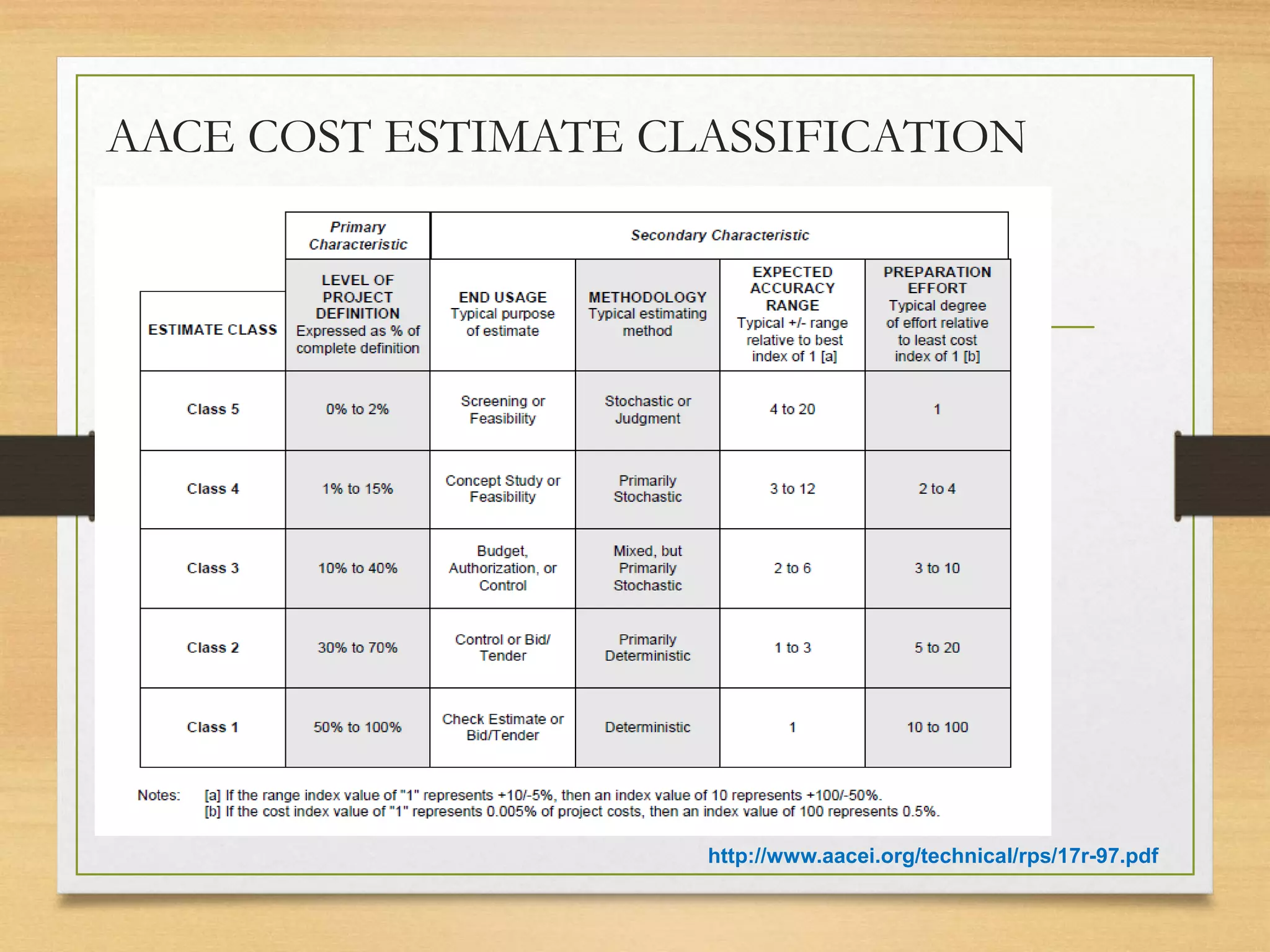
AACE COST ESTIMATE CLASSIFICATION
http://www.aacei.org/technical/rps/17r-97.pdf
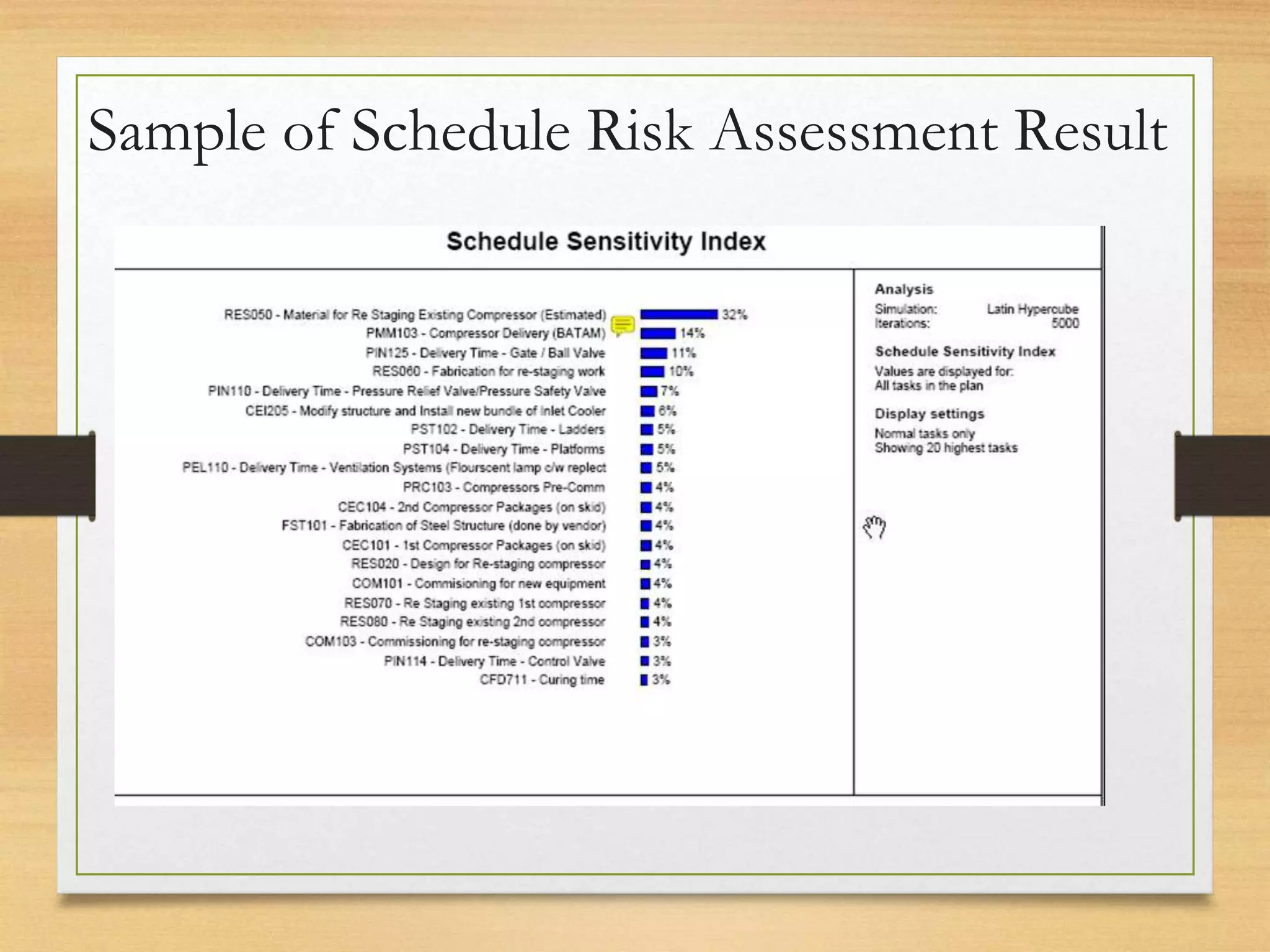
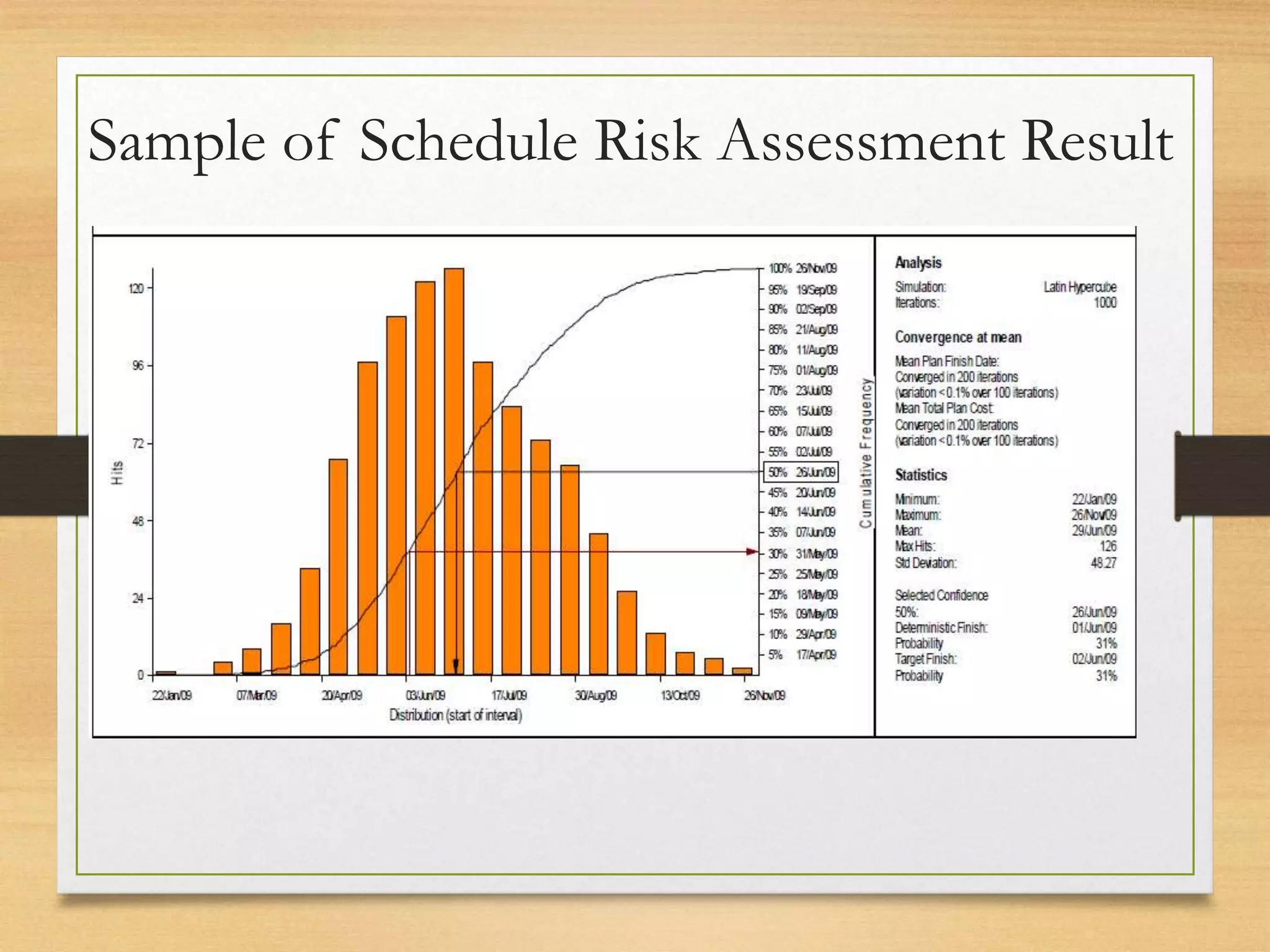
Sample of Schedule Risk Assessment Result

Project Risk Management_intro

  • 1.
  • 2.
    Definitions Project Temporary endeavor witha defined beginning and end Risk A possible future event which if it occurs will lead to an undesirable outcome. Management Art and science of planning, organizing, securing and managing resources Project Risk The cumulative effect of the chances of an uncertain occurrence that will adversely affect project objectives. Risk Management A systematic and explicit approach for identifying, quantifying, and controlling project risk. Project Risk Management The art and science of –identifying, assessing, and responding to project–risk throughout the life of a project and in the –best interests of its objectives
  • 3.
    The processes concernedwith conducting: PROJECT RISK MANAGEMENT The objectives is: • To decrease the probability and impact of events adverse to the project, and • To increase the probability and impact of positive events PMBOK : • Risk management planning • Risk identification • Risk analysis • Responses to risks • Risk monitoring and control ISO 3100: • Establishing the Context • Identify risks • Analyze & Evaluate risks • Treat risks • Monitor and Review • Communication and Consult
  • 4.
    SCOPE TIME COSTQUALITY Deliverables REPUTATION Penalty REPUTATION Additional Cost LOWER PROFIT Reject REPUTATION PROJECT RISK • Effect or uncertainty on objectives (ISO), • Uncertain event or condition that, if it occurs, has a positive or negative effect on a project’s objectives (PMBOK)
  • 5.
    Establishing the context External •To ensures that the relevant externally generated threats, and opportunities are properly taken into account and the risk management framework is appropriate to the requirements of the Project • To ensures that all Stakeholders and their objectives are considered when developing risk management criteria, – this helps to establish policies for communication with these parties. Internal Requires the Project Team to consider, and align the risk management process with the: • Corporate risk management policy • Corporate and team culture • Internal stakeholder structure and capabilities (resource and skill availability, etc.) • Project systems and processes (either available or planned) 4/25/2016 5 • Establishing the Context • Identify risks • Analyze & Evaluate risks • Treat risks • Monitor and Review • Communication and Consult
  • 6.
    Establishing the context Inshort - Establishing the Context includes of the activity of Risk Management Planning, Alignment of Project Objectives & Decision, Frameworks, Fact & Constraint and Communication to related stakeholders External and Internally Policy Decisions Strategic Decisions Tactical Decisions Decisions that have made Decisions that need to be included the analysis Decisions that can be made later • Establishing the Context • Identify risks • Analyze & Evaluate risks • Treat risks • Monitor and Review • Communication and Consult
  • 7.
    TECOP FRAMEWORKS Risk Identification Risk Registerissues generated by multi-disciple team Project Allowances (Contingency) Technical Commercial Economical PoliticalGovernment Community Agreements Drilling Subsurface Insurance Valuation Financing Infrastr. Brainstorming Organizational Systems Partners • Establishing the Context • Identify risks • Analyze & Evaluate risks • Treat risks • Monitor and Review • Communication and Consult
  • 8.
    RISK IDENTIFICATION Risk Statement:Cause – Risk / Event – Consequence What is Cause? • Reason for ; result in ; the reason why something happened What is Risk? • Effect or uncertainty on objectives (ISO), • Uncertain event or condition that, if it occurs, has a positive or negative effect on a project’s objectives (PMBOK) What is Event? • Occurrence or change of a particular set of circumstances What is Consequence? • Outcome of an event As a result of a <definite cause>, an <uncertain Event / Risk > may occur, which would lead to < consequences for the project objective(s)> • Establishing the Context • Identify risks • Analyze & Evaluate risks • Treat risks • Monitor and Review • Communication and Consult
  • 9.
    The Uncertainty Spectrum TOTAL CERTAINTY TOTAL UNCERTAINTY GENERAL UNCERTAINTY SPECIFIC UNCERTAINTY (Unknown- unknowns) (Knowns) NO Information Complete Information Partial Information (Known - unknowns) SCOPE OF PROJECT RISK MANAGEMENT* *Note: in this range the information to be known • Establishing the Context • Identify risks • Analyze & Evaluate risks • Treat risks • Monitor and Review • Communication and Consult ISSUE BLACK SWAN
  • 10.
    RISK AND ISSUE Whatis the different ? • Risk is an event that may occur on a project that will have a negative impact. Risk is not a certainty. It may occur and have less than 100% probability of occurring. • An issue is an event that the project will or currently faces that will/does have a negative impact. An issue has a 100% probability of occurring. What is the similarity? •Both risk and issue management require planning. •A risk generally has a mitigation strategy and contingency plan. Risk and uncertainty are equivalent A project risk that has occurred can also be considered an issue (PMBOK)
  • 11.
    Common of RiskManagement Process Brainstorm Risk Identification Risk Register Risk Analysis Risk Evaluation & Treatment •Eliminate •Mitigate •Transfer •Accept
  • 12.
    RISK EVALUATION Points ofscales Consequences • Consequences are rated in term of potential impact to on objective (Cost , Schedule, Health, Enviro, External / Company Image) • Consequences are rated from slighted to massive. • Where risk has several consequences, the highest consequence is used to generate the rating. Likelihoods • Likelihoods are rated in terms of percentage / likely of occurrence. • Likelihoods are rated from Improbable/Rare to Frequent/Very Likely (to be happened). • Establishing the Context • Identify risks • Analyze & Evaluate risks • Treat risks • Monitor and Review • Communication and Consult
  • 13.
  • 14.
    SETTING THE PRIORITIES Rationale Agreedpriorities are used to determine where the greatest attention, planning and detail risk assessment should be focus. • Using the control effectiveness • (High Risk without control, High risk with control that are not fully effective, etc.) • Using the potential exposure • Using Milestones Using the level of risk • Establishing the Context • Identify risks • Analyze & Evaluate risks • Treat risks • Monitor and Review • Communication and Consult
  • 15.
    Risk Treatment Risk Treatment/ Response defines steps for :  Enhancing opportunities  Responding to threats Risk Response Type:  Avoidance - eliminate  Mitigation  Reduce EMV by reducing probability  Reduce Impact  Transfer  buy insurance  Acceptance  Active: develop plan to deal with risk if it occurs  Passive: Accept risk (e.g., lower profit • Establishing the Context • Identify risks • Analyze & Evaluate risks • Treat risks • Monitor and Review • Communication and Consult
  • 16.
    Where is theContingency Plan allocated in the Risk Management Process ? CONTINGENCY PLAN • Establishing the Context • Identify risks • Analyze & Evaluate risks • Treat risks • Monitor and Review • Communication and Consult
  • 17.
    CONTINGENT PLANNING Contingent planning: ameans to address risks to the project through a formal process and provide resources to meet the risk events. It is the establishment of management plans to be invoked in the event of specified risk events Examples:  The provision and prudent management of a contingency allowance in the budget  The preparation of alternatives work areas and work- arounds. • Establishing the Context • Identify risks • Analyze & Evaluate risks • Treat risks • Monitor and Review • Communication and Consult
  • 18.
    What is ContingencyPlan • A Contingency plan is a plan devised for a specific situation when things could go wrong. Contingency plans are often devised by governments or businesses who want to be prepared for anything that could happen. They are sometimes known as "Back-up plans", "Worst-case scenario plans", "Scrap Situation" or "Plan B" . • Contingency plans include specific strategies and actions to deal with specific variances to assumptions resulting in a particular problem, emergency or state of affairs. They also include a monitoring process and “triggers” for initiating planned actions. They are required to help governments, businesses or individuals to recover from serious incidents in the minimum time with minimum cost and disruption. http://en.wikipedia.org/wiki/Contingency_plan • A Contingency Plan is fallback position, or workaround in the event of an adverse occurrence, or risk event, on the project. • A plan that identifies key assumptions beyond the project manager's control, and their probability of occurrence. The plan identifies alternative strategies for achieving project success. http://www.maxwideman.com/pmglossary/PMG_C07.htm
  • 19.
    Probabilistic Planning • P10Estimate – a 10% chance that the project cost/schedule will be less than or equal to the estimate total and a 90% chance that the project cost/schedule will be greater than the cost estimate total. • P50 Estimate – a 50% chance that the project cost/schedule will be less than or equal to the estimate total and a 50% chance that the project cost/schedule will be greater than the cost estimate total. • P90 Estimate – a 90% chance that the project cost will be less than or equal to the estimate total and a 10% chance that the project cost/schedule will be greater than the cost/schedule estimate total.
  • 20.
    Typical Life CycleProfiles Total project life cycleI N C R E A S I N G R I S K $ V A L U E TIME Plan Accomplish Phase 1 Conceive Phase 2 Develop Phase 3 Execute Phase 4 Finish (period when highest risks are incurred) (period of highest risk impact) Risk versus Amount at Stake
  • 21.
    COST ESTIMATE &CONTIGENCY • LEVEL PROBABILITY VS COST ESTIMATE A D B CE P90 P70 P50 P35 P10 A : Value P10 B : Value P50 C : Value P90 D : Deterministic Estimate E : Deterministic By PM Deterministic Estimate (Including Allowance) Contingency P50 – Deterministic Estimate COST P Sample
  • 22.
    AACE COST ESTIMATECLASSIFICATION http://www.aacei.org/technical/rps/17r-97.pdf
  • 23.
    Sample of ScheduleRisk Assessment Result
  • 24.
    Sample of ScheduleRisk Assessment Result