DEPARTMENT OF 
CONSERVATIVE 
DENTIST 
AND 
ENDODONTICS 
PRESENTED BY:- 
DR. ADITYA SHINDE 
GUIDED BY:- 
DR.LALITAGUARI MANDKE 
TOOTH 
ERUPTION 
& 
SHEDDING
CONTENTS 
 DEFINITION 
 PHYSIOLOGIC 
TOOTH MOVEMENTS 
 STAGES OF 
ERUPTION 
 PATTERN AND 
HISTOLOGY 
 THEORIES OF 
ERUPTION 
 CHRONOLOGY OF 
ERUPTION 
 CONTINUOUS TOOTH 
ERUPTION 
 CLINICAL 
CONSIDERATIONS 
 SHEDDING OF 
PRIMARY TEETH
TTOOOOTTHH EERRUUPPTTIIOONN 
DEFINITION:- 
It is the axial or occlusal movement of 
the tooth from its developmental position 
within the jaws to functional position in 
the occlusal plane.- (orban’s) 
Eruption is the movement of the 
developing teeth within and through the 
bone and the overlying mucosa of the jaws 
to appear in the oral cavity and reach the 
occlusal plane.-(james k. avery)
PPHHYYSSIIOOLLOOGGIICC TTOOOOTTHH 
MMOOVVEEMMEENNTTSS 
These are of various types :- 
1) Axial or vertical 
2) Drifting 
3) Torsion 
4) Tipping
SSTTAAGGEESS OOFF TTOOOOTTHH 
EERRUUPPTTIIOONN 
1) Pre – eruptive tooth 
movements. 
1) Eruptive / Prefunctional tooth 
movements 
2) Posteruptive tooth movements
PPAATTTTEERRNN AANNDD HHIISSTTOOLLOOGGYY OOFF 
VVAARRIIOOUUSS SSTTAAGGEESS OOFF EERRUUPPTTIIOONN 
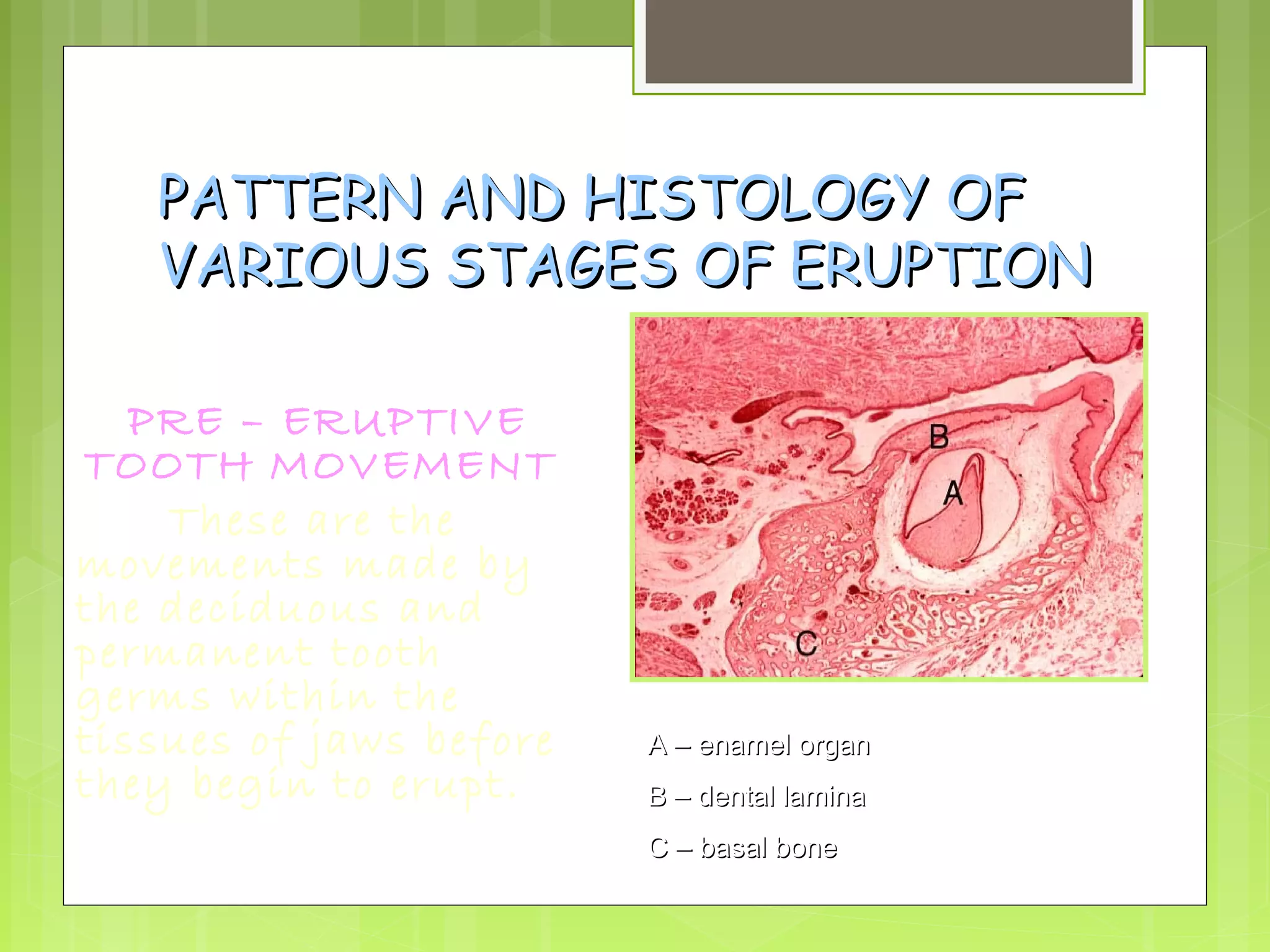
PRE – ERUPTIVE 
TOOTH MOVEMENT 
These are the 
movements made by 
the deciduous and 
permanent tooth 
germs within the 
tissues of jaws before 
they begin to erupt. 
AA –– eennaammeell oorrggaann 
BB –– ddeennttaall llaammiinnaa 
CC –– bbaassaall bboonnee
DDeecciidduuoouuss TTeeeetthh 
WWhheenn ddeecciidduuoouuss ttooootthh ggeerrmmss ddiiffffeerreennttiiaattee ,, tthheerree iiss 
ggoooodd ddeeaall ooff ssppaaccee bbeettwweeeenn tthheemm.. 
AAss TTooootthh ggeerrmmss ggrrooww mmoorree rraappiiddllyy tthhaann bboonnee –– tthhiiss 
aavvaaiillaabbllee ssppaaccee iiss uuttiilliizzeedd aanndd ddeevveellooppiinngg tteeeetthh 
bbeeccoommee ccrroowwddeedd ttooggeetthheerr eessppeecciiaallllyy iinn tthhee iinncciissoorr 
aanndd ccaanniinnee rreeggiioonn.. 
TThhiiss ccrroowwddiinngg iiss rreelliieevveedd bbyy ::-- 
-- ggrroowwtthh iinn lleennggtthh ooff iinnffaanntt jjaaww 
-- iinnccrreeaassee iinn wwiiddtthh 
-- iinnccrreeaassee iinn hheeiigghhtt
PPeerrmmaanneenntt TTeeeetthh 
 PPeerrmmaanneenntt tteeeetthh wwiitthh ddeecciidduuoouuss pprreeddeecceessssoorrss aallssoo 
uunnddeerrggoo ccoommpplleexx mmoovveemmeennttss bbeeffoorree tthheeyy rreeaacchh tthhee 
ffiinnaall ppoossiittiioonn ffrroomm wwhhiicchh tthheeyy wwiillll eerruupptt.. 
TThheessee cchhaannggeess iinn tthhee rreellaattiivvee ppoossiittiioonn aarree bbaassiiccaallllyy 
bbeeccaauussee ooff ggrroowwtthh ooff tthhee ppeerrmmaanneenntt ttooootthh ggeerrmmss aanndd 
eerruuppttiivvee mmoovveemmeenntt ooff tthhee ddeecciidduuoouuss ttooootthh..
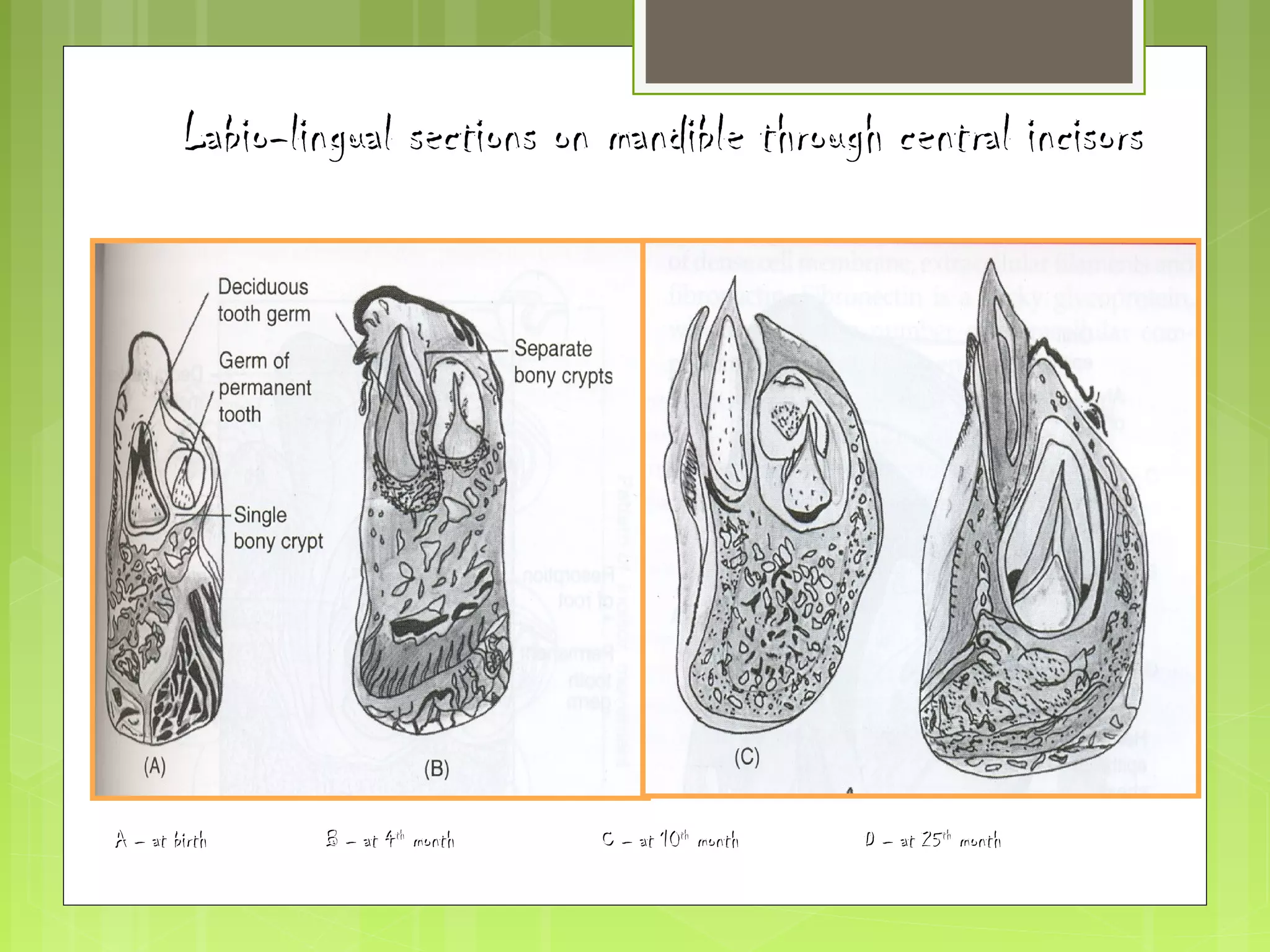
Labio-lingual sections on mmaannddiibbllee tthhrroouugghh cceennttrraall iinncciissoorrss 
AA –– aatt bbiirrtthh BB –– aatt 44tthh mmoonntthh CC –– aatt 1100tthh mmoonntthh DD –– aatt 2255tthh mmoonntthh
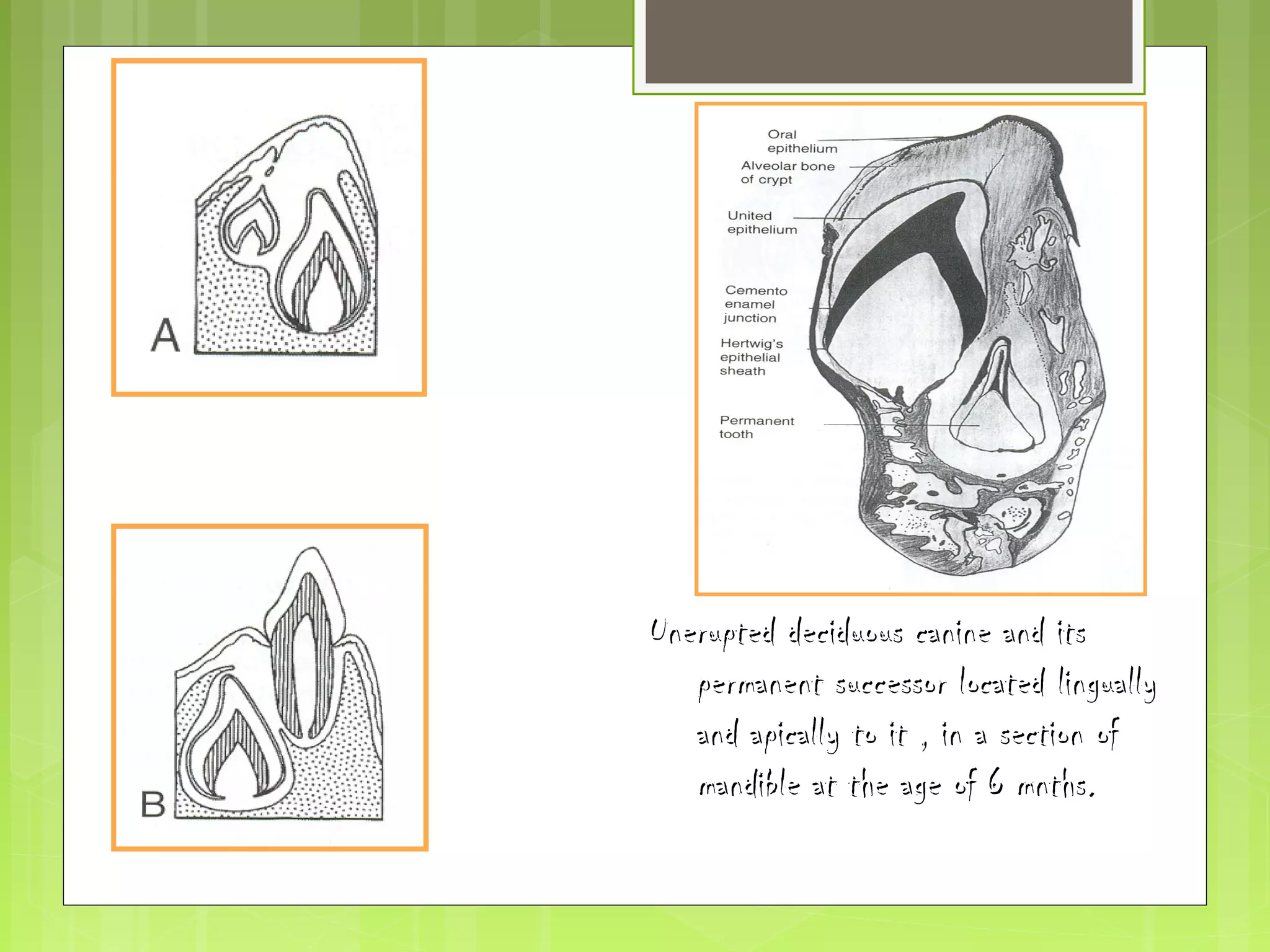
Unerupted ddeecciidduuoouuss ccaanniinnee aanndd iittss 
ppeerrmmaanneenntt ssuucccceessssoorr llooccaatteedd lliinngguuaallllyy 
aanndd aappiiccaallllyy ttoo iitt ,, iinn aa sseeccttiioonn ooff 
mmaannddiibbllee aatt tthhee aaggee ooff 66 mmnntthhss..
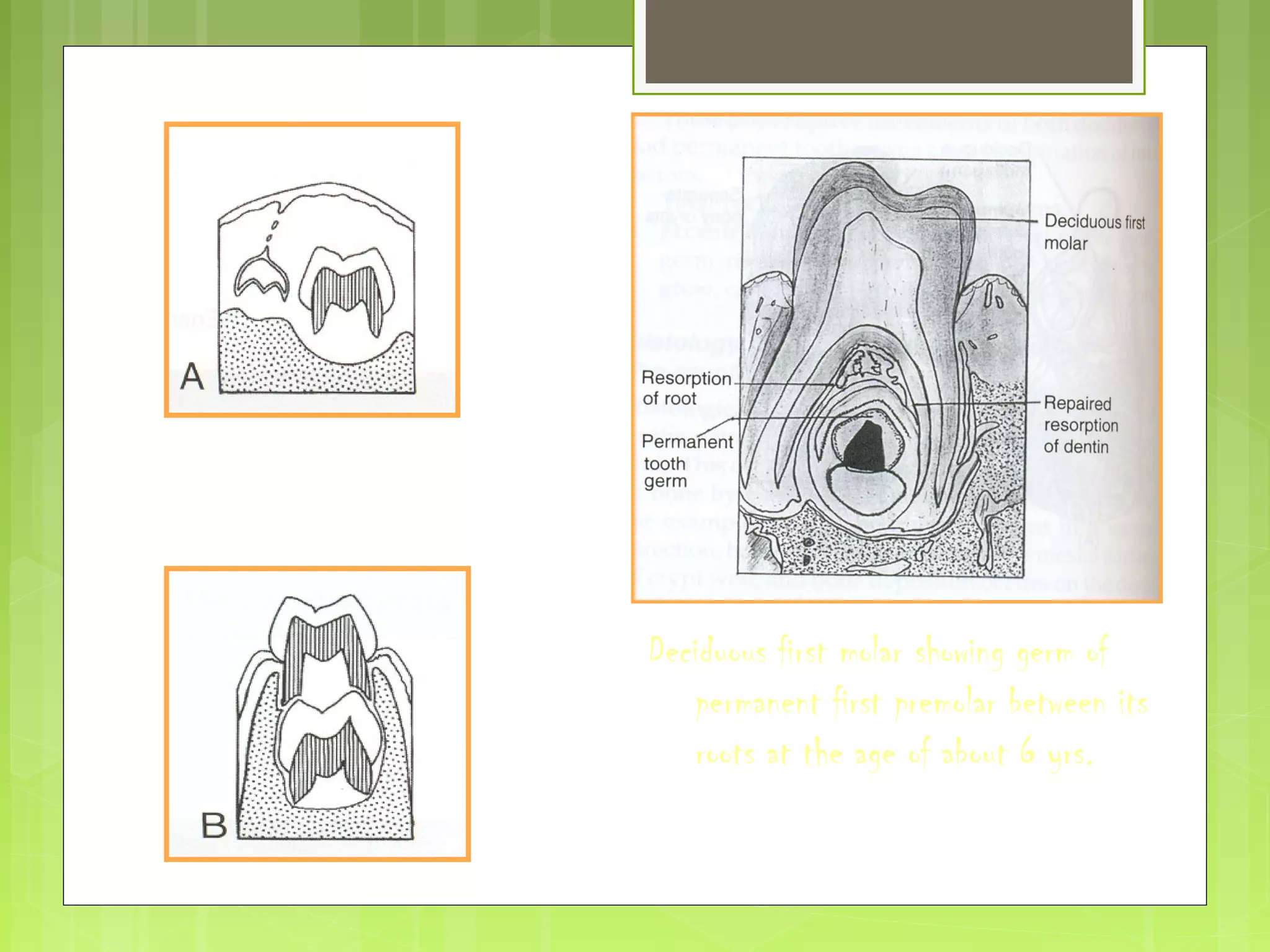
Deciduous first molar showing germ of 
permanent first premolar between its 
roots at the age of about 6 yrs.
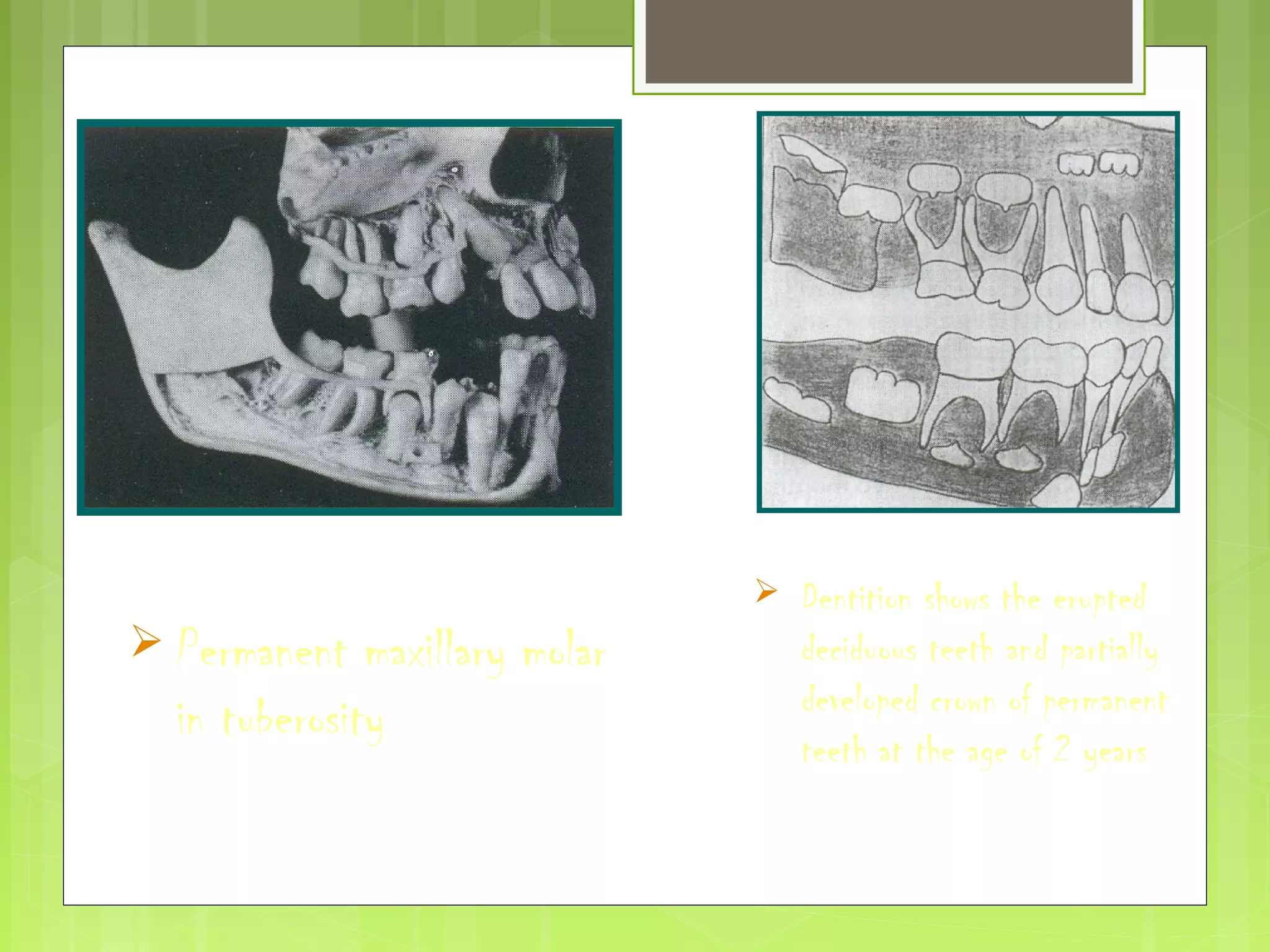
 Permanent maxillary molar 
in tuberosity 
 Dentition shows the erupted 
deciduous teeth and partially 
developed crown of permanent 
teeth at the age of 2 years
HISTOLOGY OF TOOTH 
MOVEMENT 
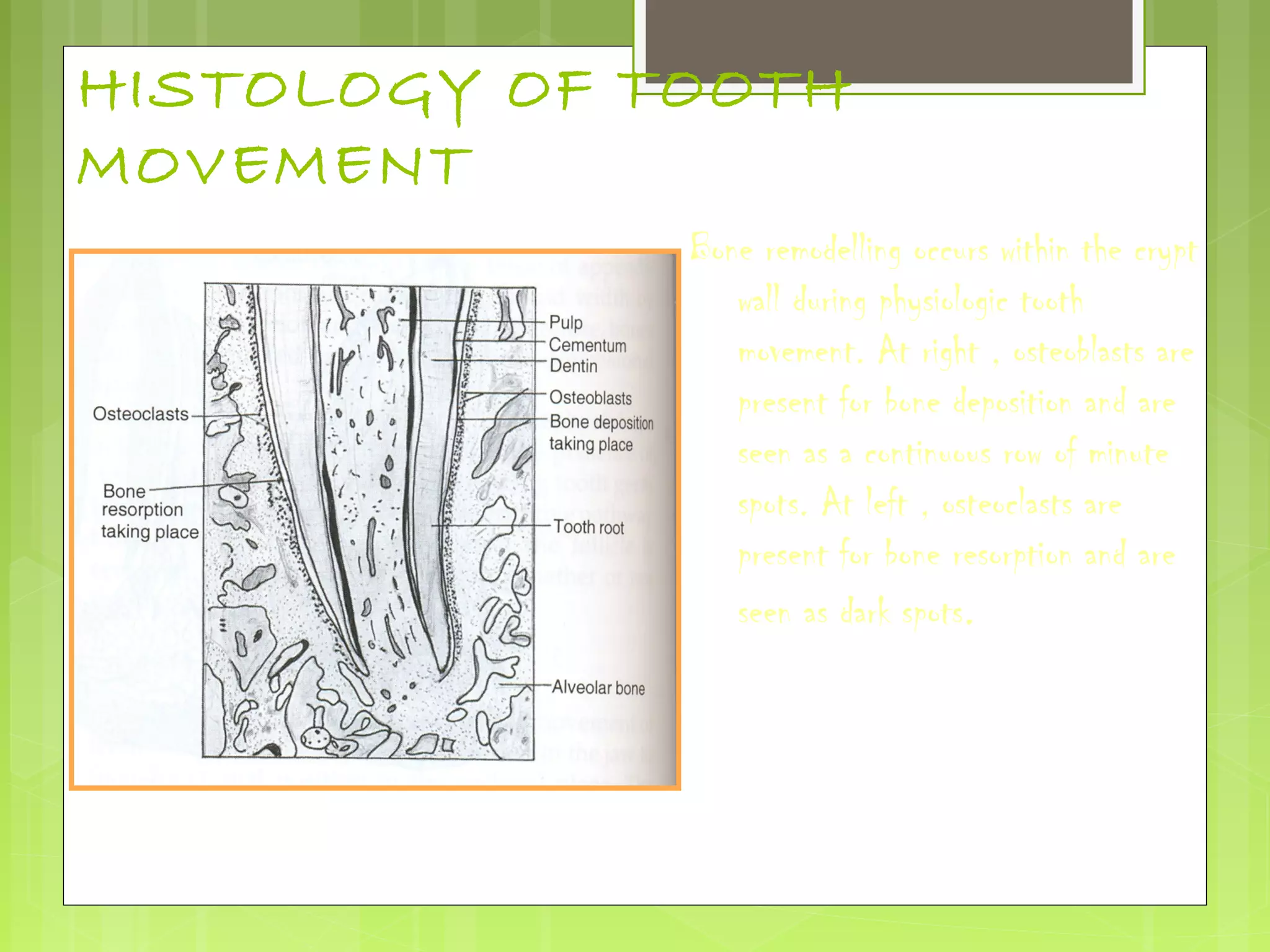
Bone remodelling occurs within the crypt 
wall during physiologic tooth 
movement. At right , osteoblasts are 
present for bone deposition and are 
seen as a continuous row of minute 
spots. At left , osteoclasts are 
present for bone resorption and are 
seen as dark spots.
Bone remodelling – selective deposition and removal 
of bone by osteoblastic and osteoclastic activity. 
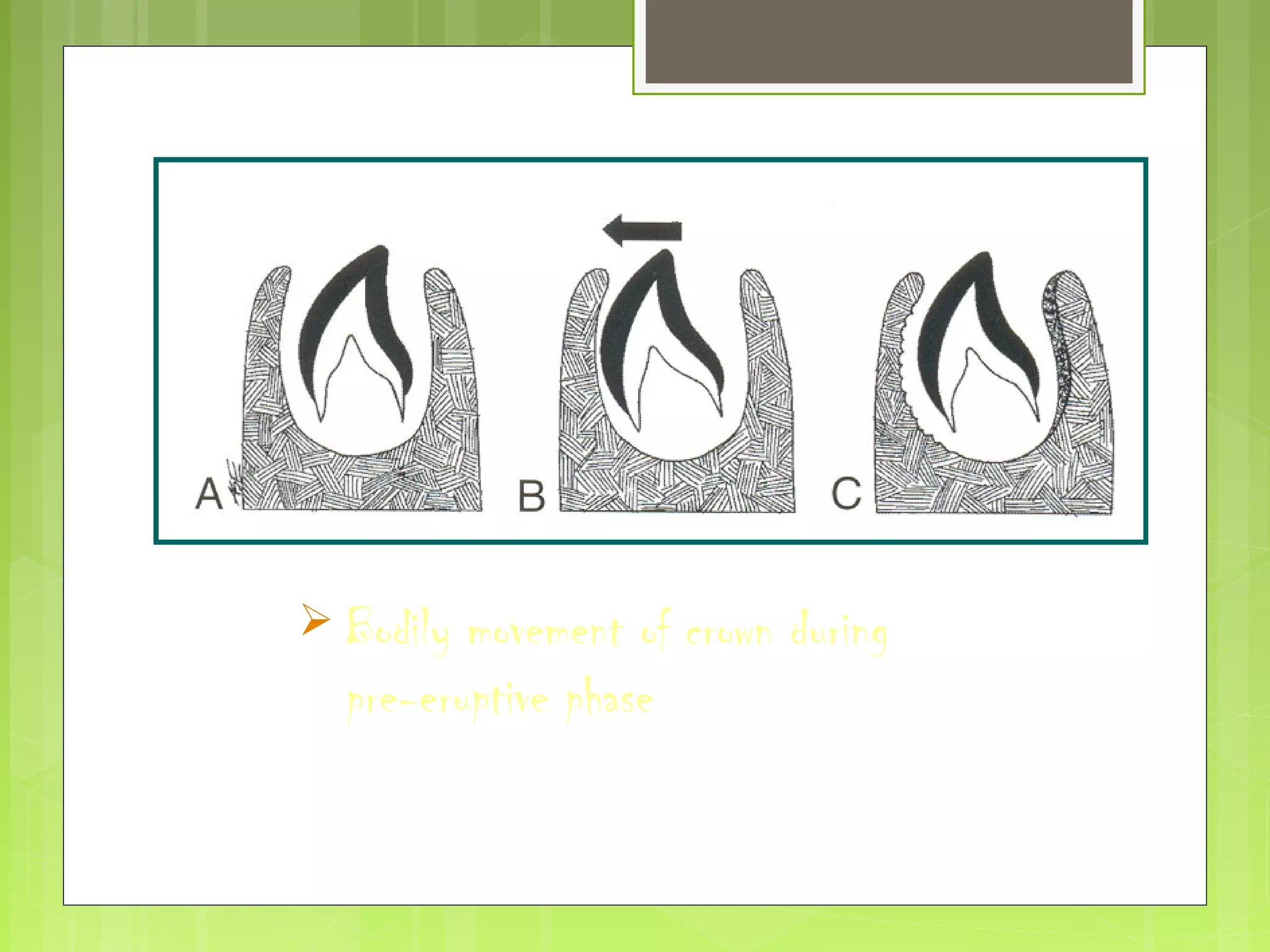
These movements of both deciduous and permanent 
tooth germs are a combination of 2 factors :- 
1)Total bodily movement 
2)Eccentric growth 
Presence of dental follicle.
 Bodily movement of crown during 
pre-eruptive phase
2)ERUPTIVE / PREFUNCTIONAL 
TOOTH MOVEMENT 
PATTERN OF TOOTH MOVEMENT 
The tooth moves from its position within the bone of the jaw 
to its functional position in occlusion , and the principal 
direction of movement is occlusal or axial. 
However , it is important to recognize that jaw growth is 
normally occurring while most teeth are erupting , so that 
movements in planes other than axial are superimposed on 
eruptive movement.
HISTOLOGY OF TOOTH 
MOVEMENT 
55 mmaajjoorr eevveennttss ttaakkeess ppllaaccee ::-- 
1) The secretory phase of amelogenesis is 
completed just before the onset of root 
formation and prefunctional eruption. 
There is a relation between the cessation of 
mineralisation and activation of the 
epithelial cells beyond the enamel – forming 
area.
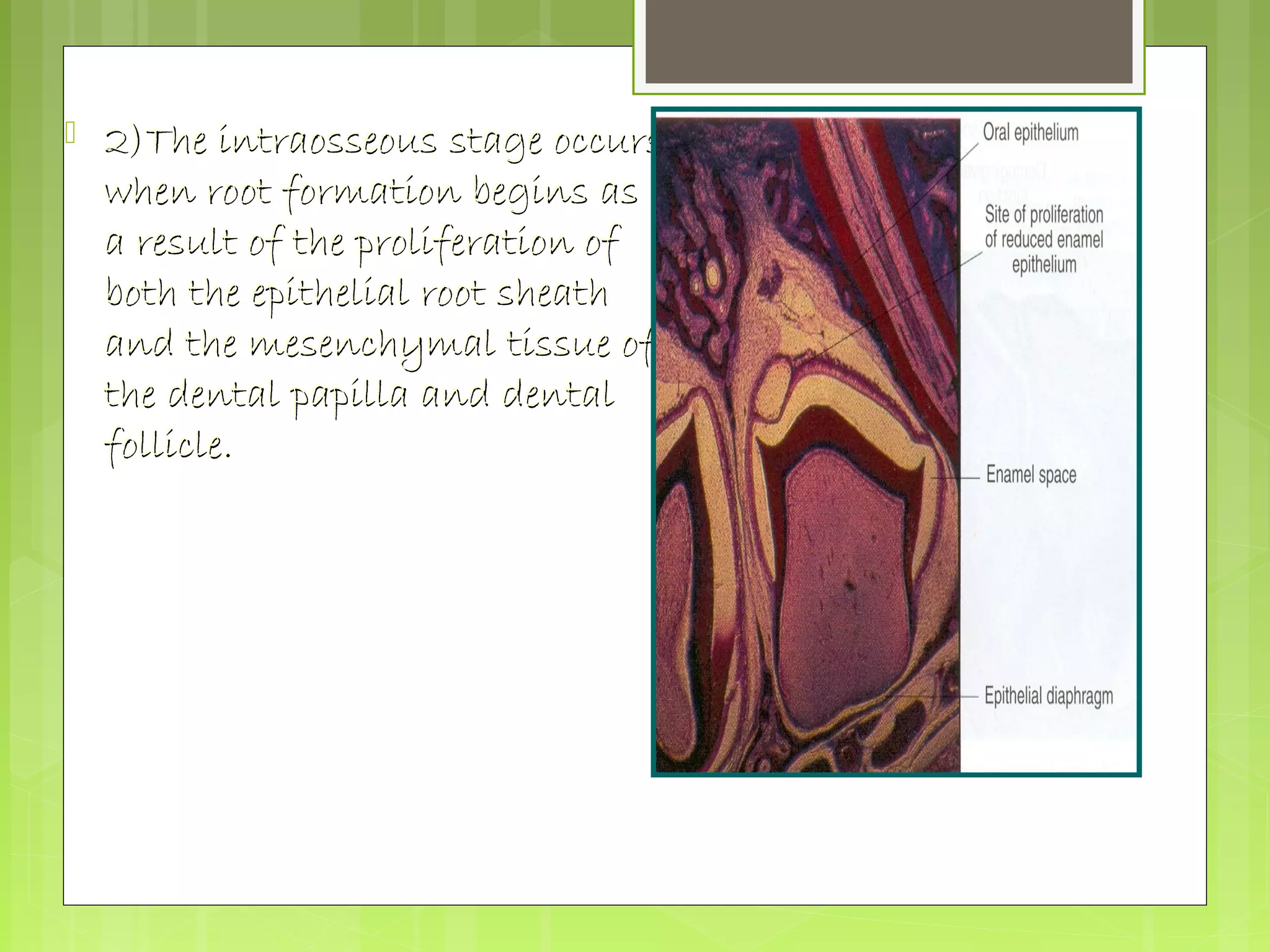
 22))TThhee iinnttrraaoosssseeoouuss ssttaaggee ooccccuurrss 
wwhheenn rroooott ffoorrmmaattiioonn bbeeggiinnss aass 
aa rreessuulltt ooff tthhee pprroolliiffeerraattiioonn ooff 
bbootthh tthhee eeppiitthheelliiaall rroooott sshheeaatthh 
aanndd tthhee mmeesseenncchhyymmaall ttiissssuuee ooff 
tthhee ddeennttaall ppaappiillllaa aanndd ddeennttaall 
ffoolllliiccllee.. 
Prefunctional eruptive stage in formation of 
root
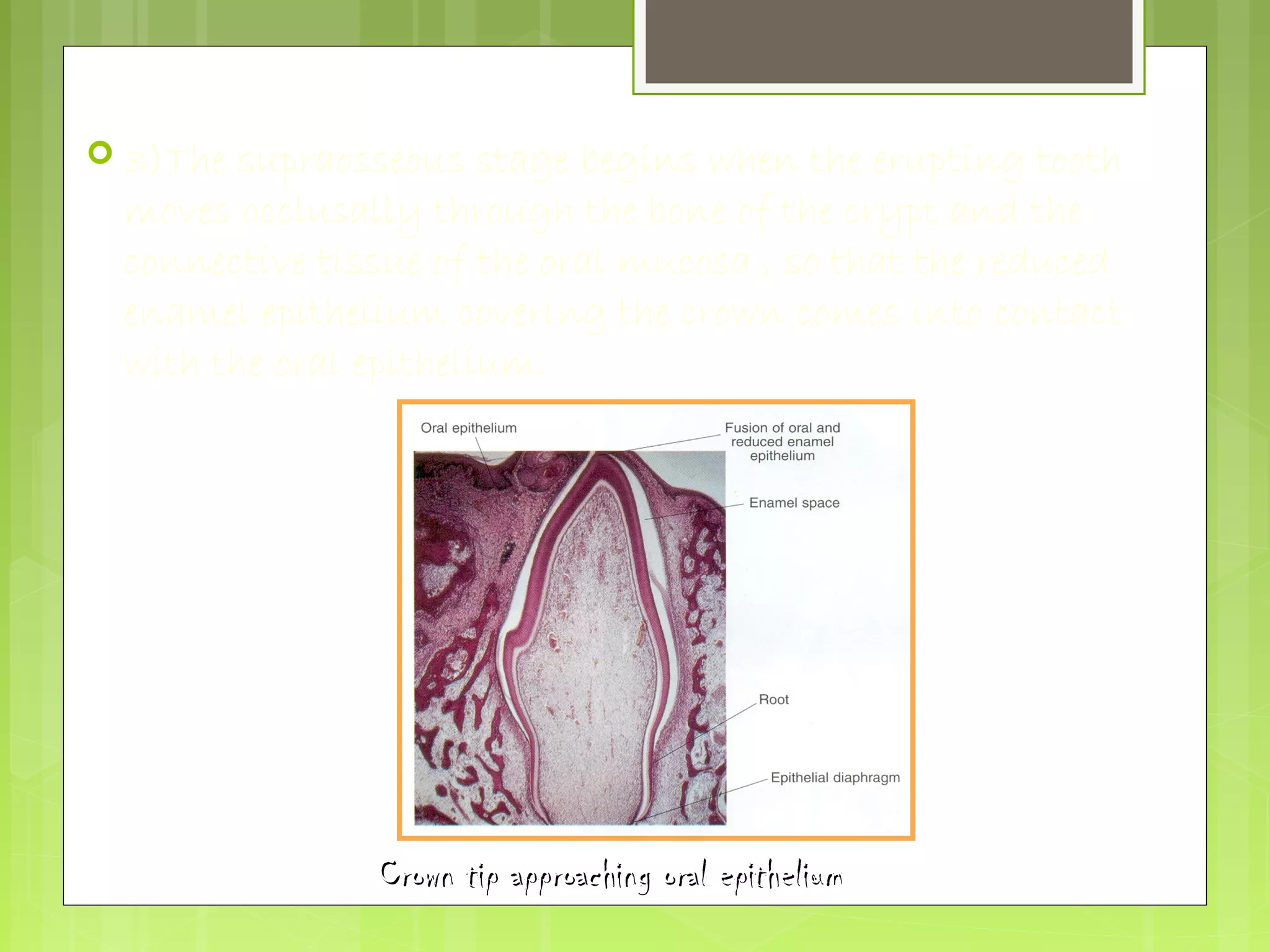
 3)The supraosseous stage begins when the erupting tooth 
moves occlusally through the bone of the crypt and the 
connective tissue of the oral mucosa , so that the reduced 
enamel epithelium covering the crown comes into contact 
with the oral epithelium. 
Crown tip aapppprrooaacchhiinngg oorraall eeppiitthheelliiuumm
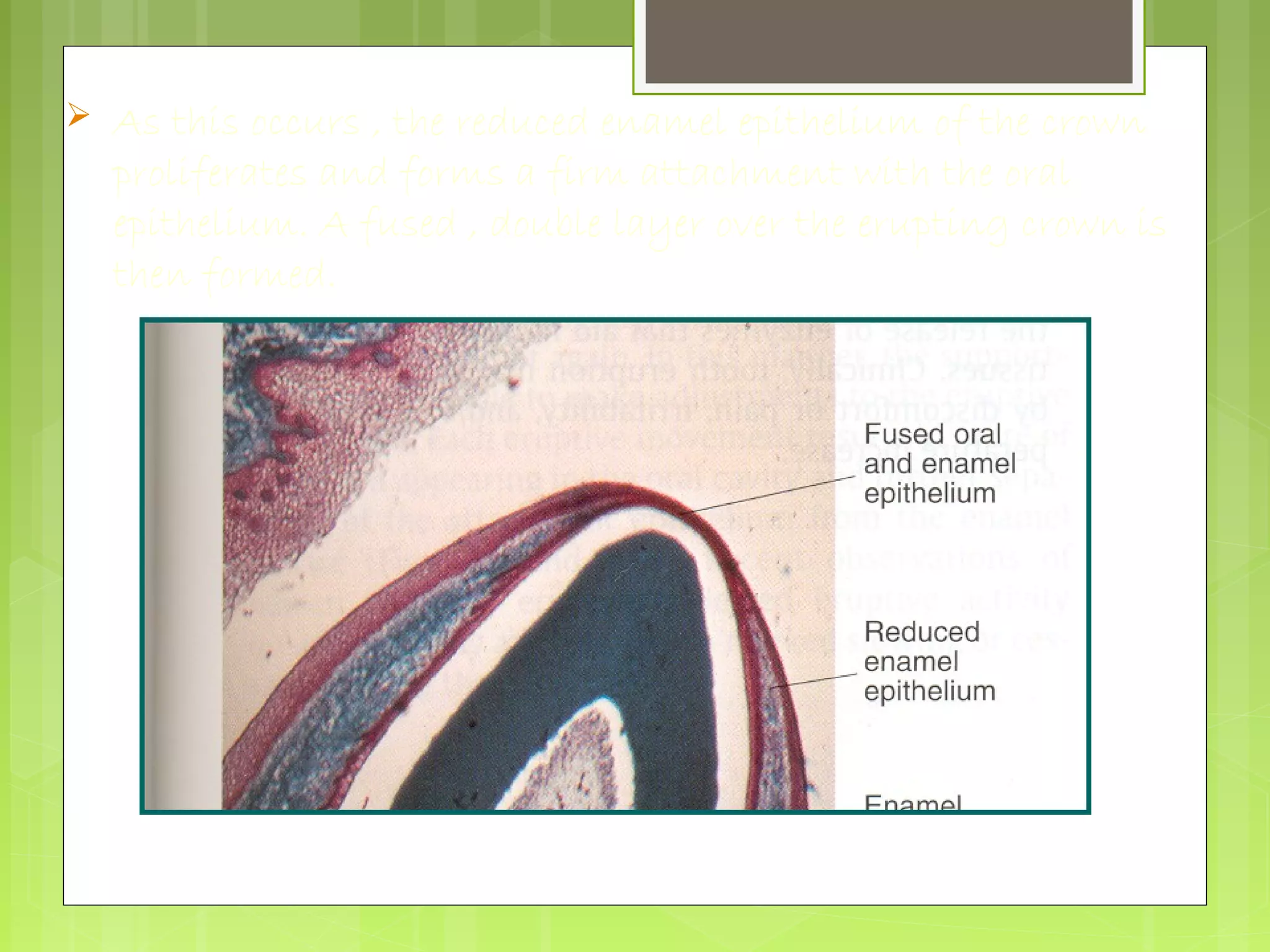
 As this occurs , the reduced enamel epithelium of the crown 
proliferates and forms a firm attachment with the oral 
epithelium. A fused , double layer over the erupting crown is 
then formed. 
Contact and fusion of REE and oral mucosa
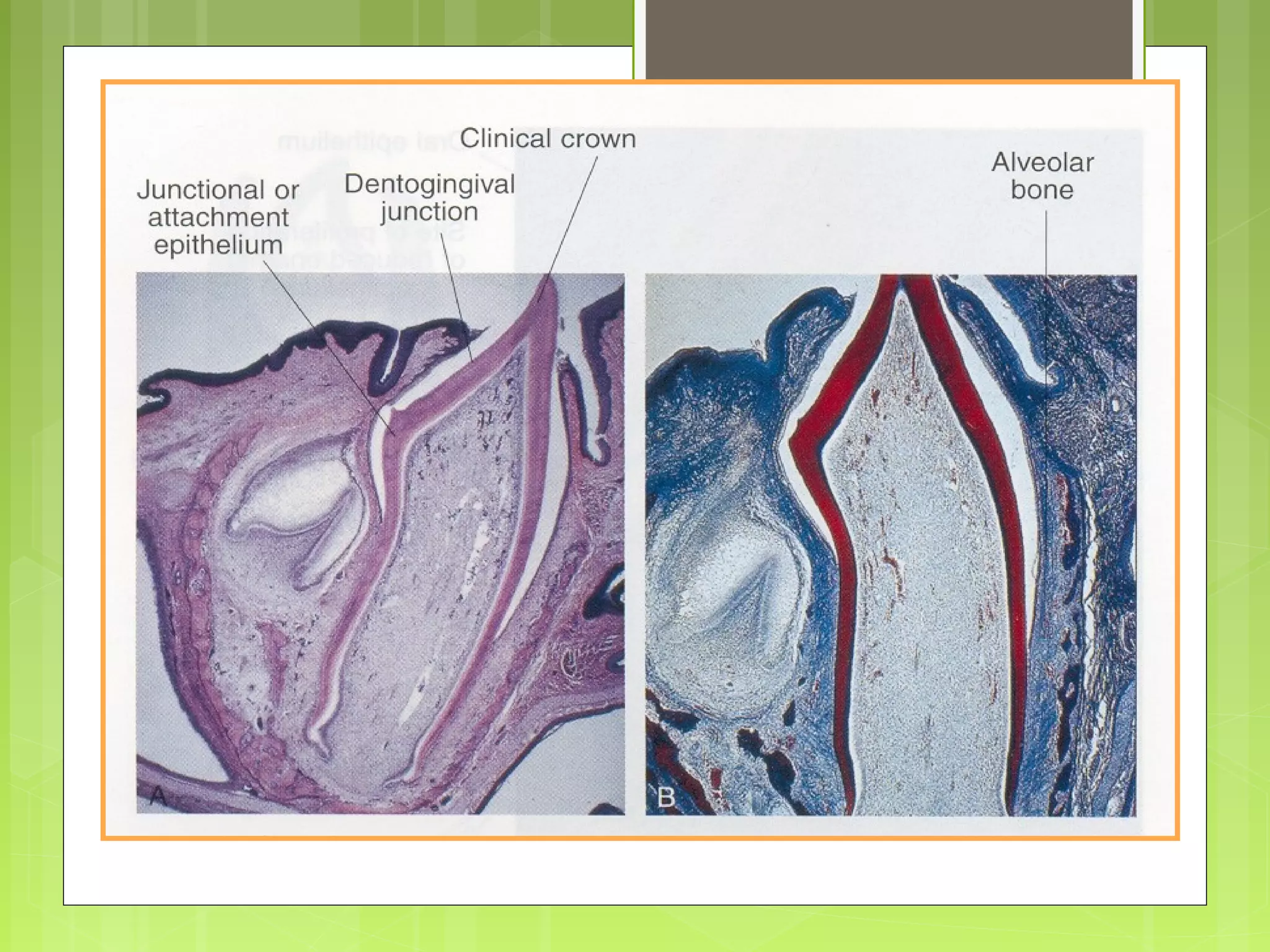
4)The tip of the crown eenntteerrss tthhee oorraall ccaavviittyy bbyy 
bbrreeaakkiinngg tthhrroouugghh tthhee cceenntteerr ooff tthhee ddoouubbllee –– llaayyeerreedd 
eeppiitthheelliiaall cceellllss.. 
 tthhee ccuusspp ttiipp ccaauusseess ddeeggeenneerraattiioonn ooff tthhee mmeemmbbrraannee –– 
bbeeggiinnnniinngg ssttaaggee ooff cclliinniiccaall eerruuppttiioonn.. 
 -- DDeennttooggiinnggiivvaall jjuunnccttiioonn –– llaatteerraall bboorrddeerrss ooff oorraall 
mmuuccoossaa 
 -- JJuunnccttiioonnaall oorr aattttaacchhmmeenntt eeppiitthheelliiuumm –– RREEEE--rreesstt ooff 
eennaammeell eeppiitthheelliiuumm 
 -- OOnnee -- hhaallff ttoo ttwwoo -- tthhiirrddss ooff tthhee rroooottss aarree ffoorrmmeedd..
Clinical appearance of crown
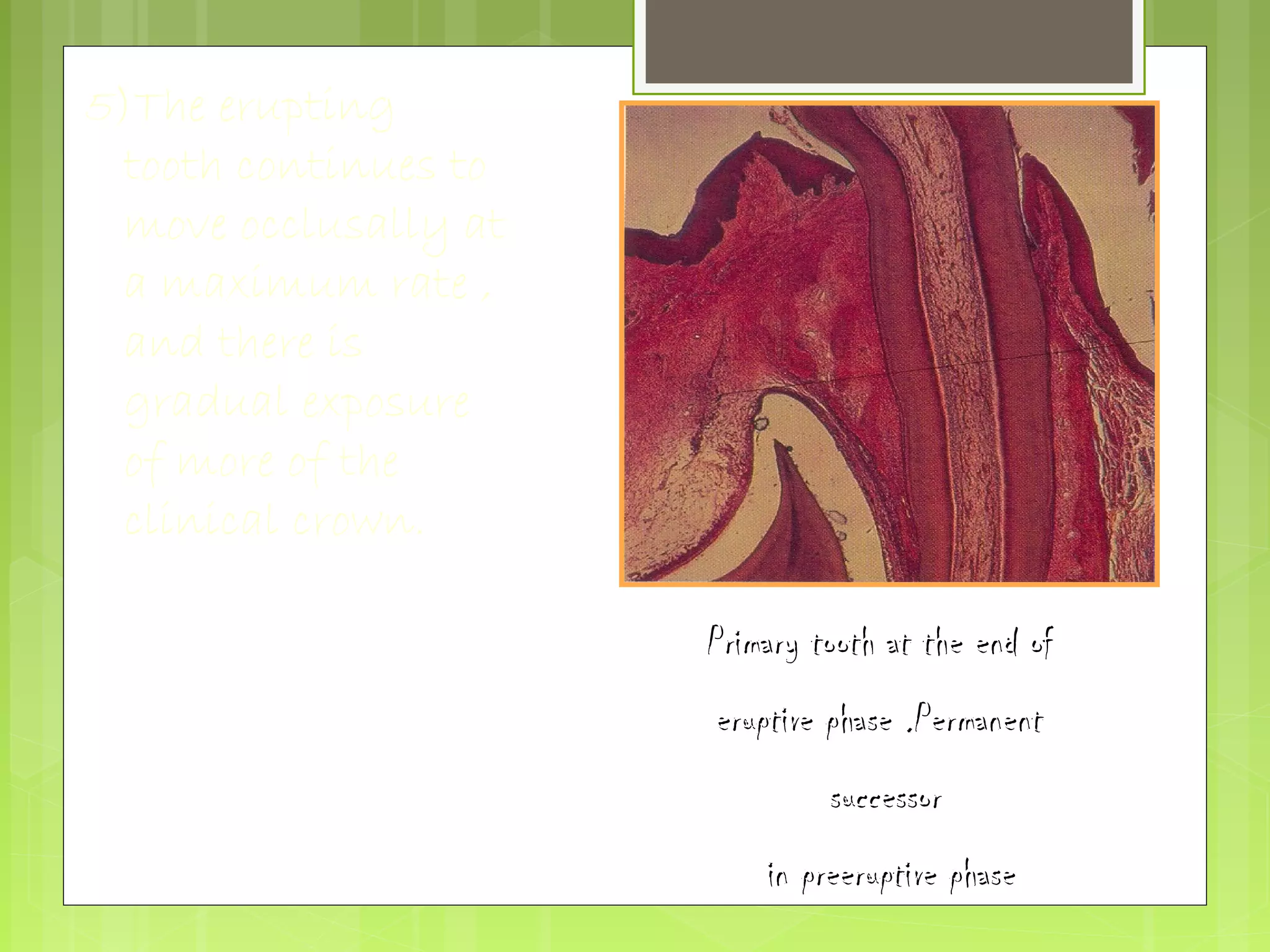
5)The erupting 
tooth continues to 
move occlusally at 
a maximum rate , 
and there is 
gradual exposure 
of more of the 
clinical crown. 
PPrriimmaarryy ttooootthh aatt tthhee eenndd ooff 
eerruuppttiivvee pphhaassee ..PPeerrmmaanneenntt 
ssuucccceessssoorr 
iinn pprreeeerruuppttiivvee pphhaassee
Significant changes also occur in :- 
- the tissues overlying the teeth 
- the tissues around the teeth 
- the tissues underlying the teeth 
CHANGES IN TISSUES OVERLYING TEETH 
Initial change – alteration of the connective tissue of 
the dental follicle – forms pathway for eruption.
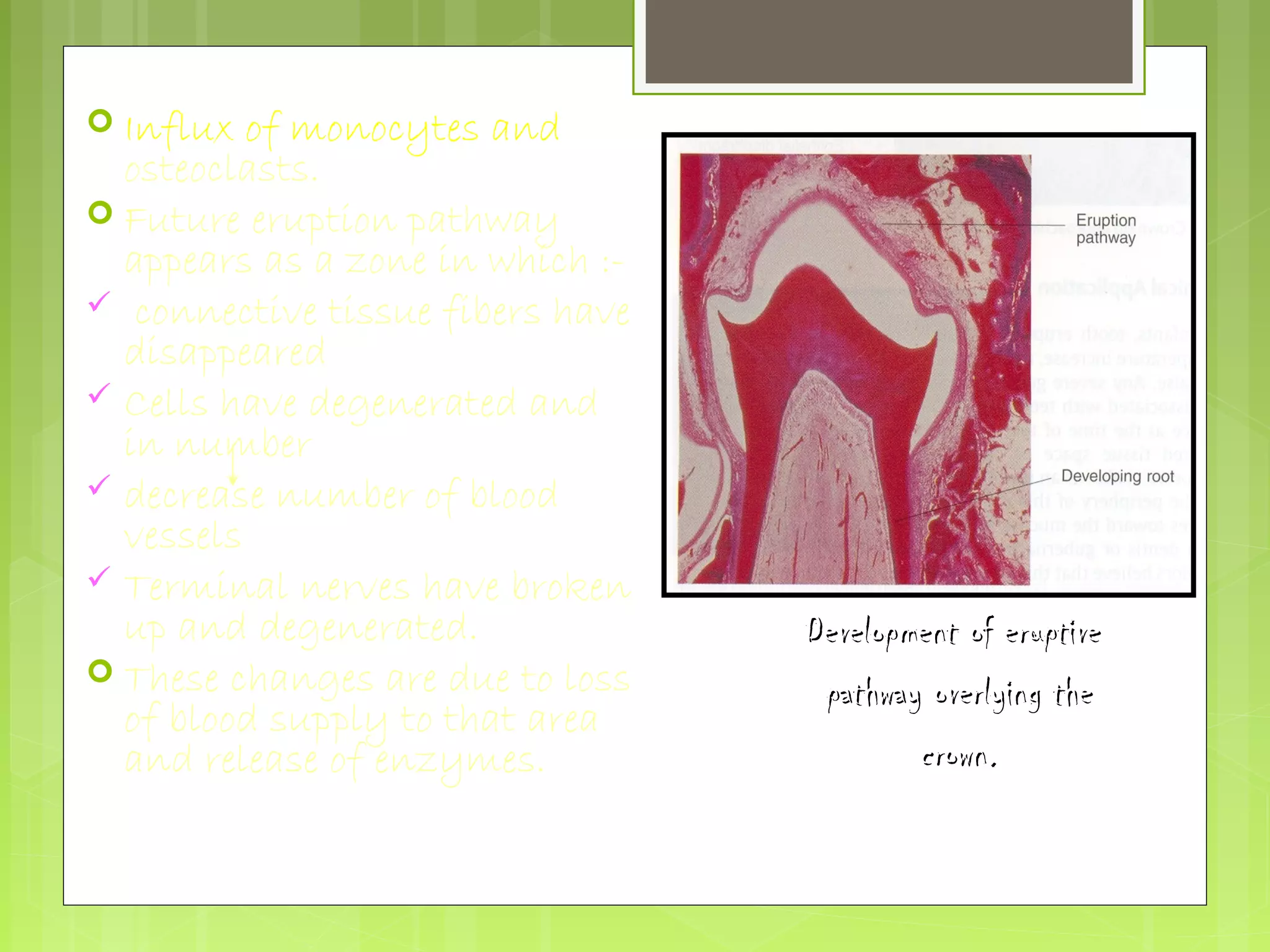
 Influx of monocytes and 
osteoclasts. 
 Future eruption pathway 
appears as a zone in which :- 
 connective tissue fibers have 
disappeared 
 Cells have degenerated and 
in number 
 decrease number of blood 
vessels 
 Terminal nerves have broken 
up and degenerated. 
 These changes are due to loss 
of blood supply to that area 
and release of enzymes. 
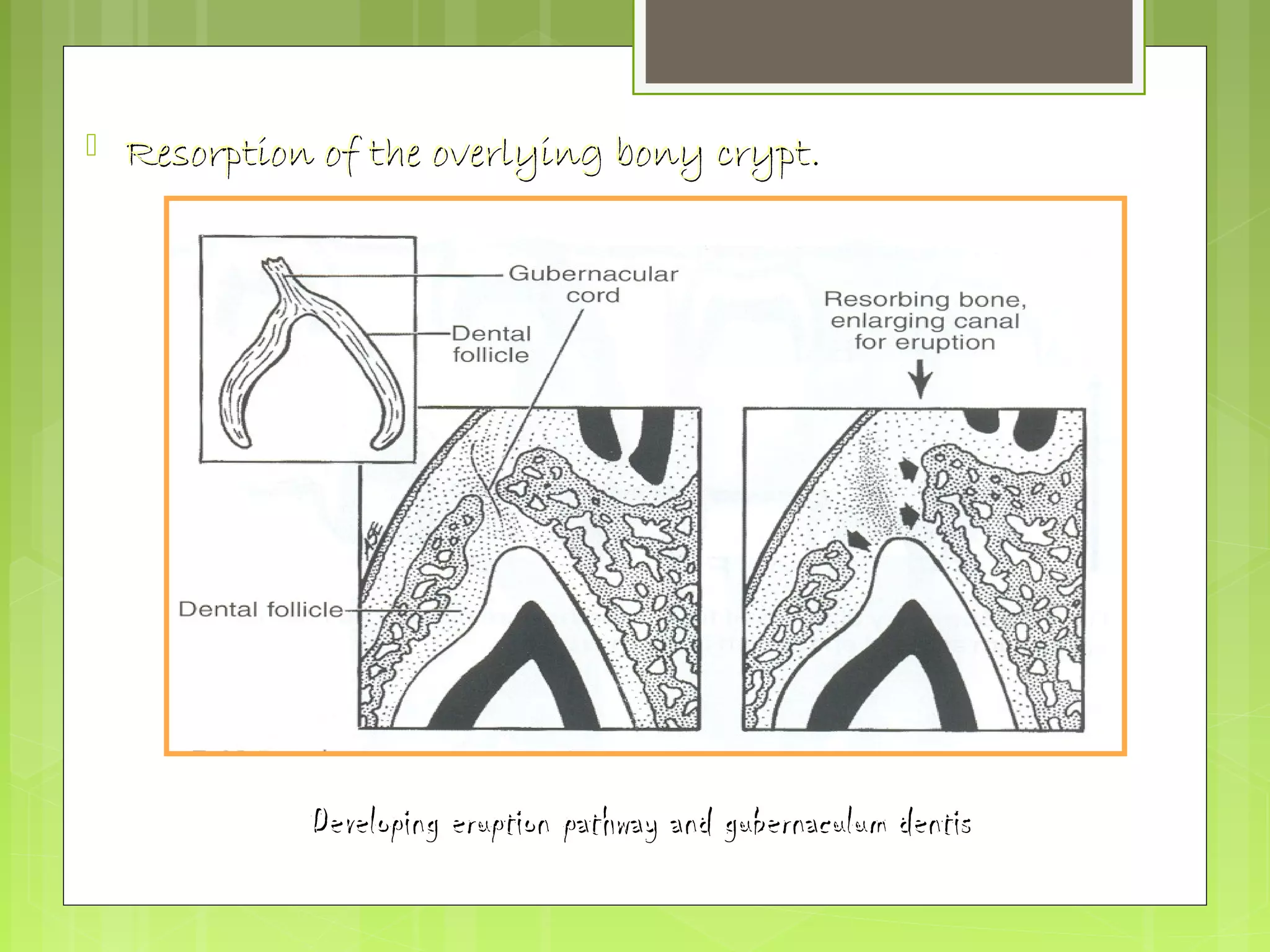
DDeevveellooppmmeenntt ooff eerruuppttiivvee 
ppaatthhwwaayy oovveerrllyyiinngg tthhee 
ccrroowwnn..
 Resorption ooff tthhee oovveerrllyyiinngg bboonnyy ccrryypptt.. 
DDeevveellooppiinngg eerruuppttiioonn ppaatthhwwaayy aanndd gguubbeerrnnaaccuulluumm ddeennttiiss
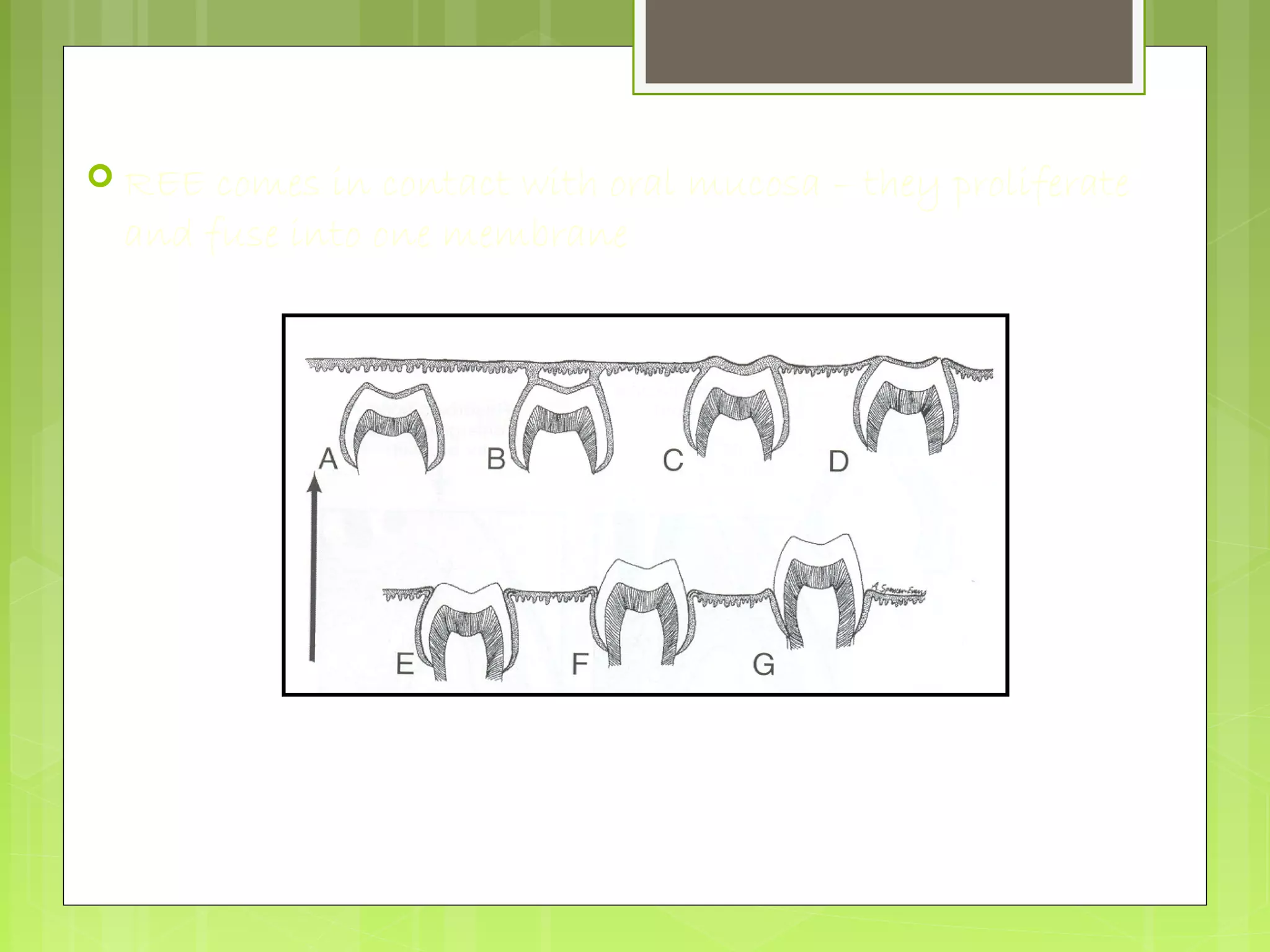
 REE comes in contact with oral mucosa – they proliferate 
and fuse into one membrane 
Fusion and rupture of REE and oral epithelium
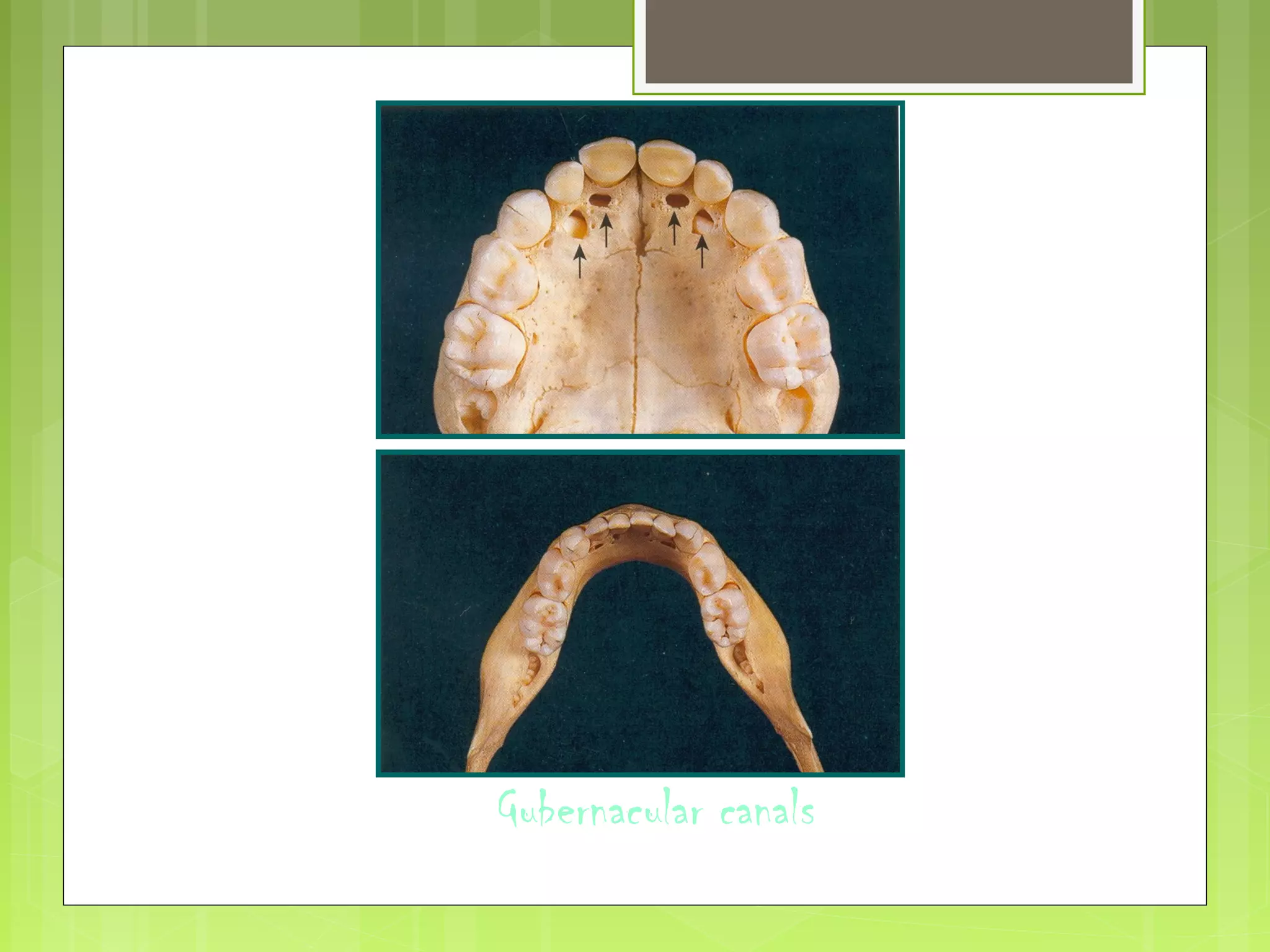
Gubernacular canals
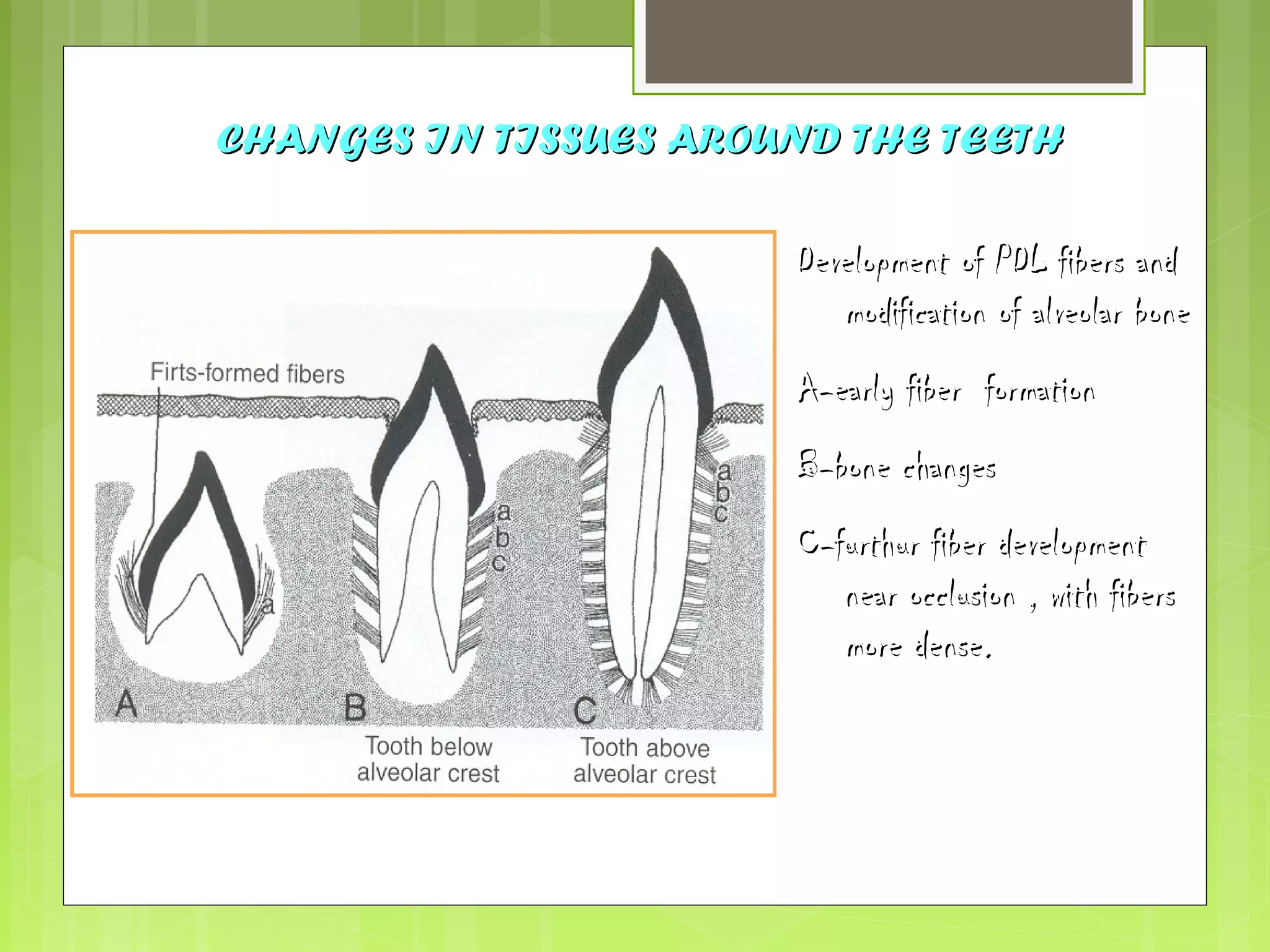
CHANGES IN TTIISSSSUUEESS AARROOUUNNDD TTHHEE TTEEEETTHH 
DDeevveellooppmmeenntt ooff PPDDLL ffiibbeerrss aanndd 
mmooddiiffiiccaattiioonn ooff aallvveeoollaarr bboonnee 
AA--eeaarrllyy ffiibbeerr ffoorrmmaattiioonn 
BB--bboonnee cchhaannggeess 
CC--ffuurrtthhuurr ffiibbeerr ddeevveellooppmmeenntt 
nneeaarr oocccclluussiioonn ,, wwiitthh ffiibbeerrss 
mmoorree ddeennssee..
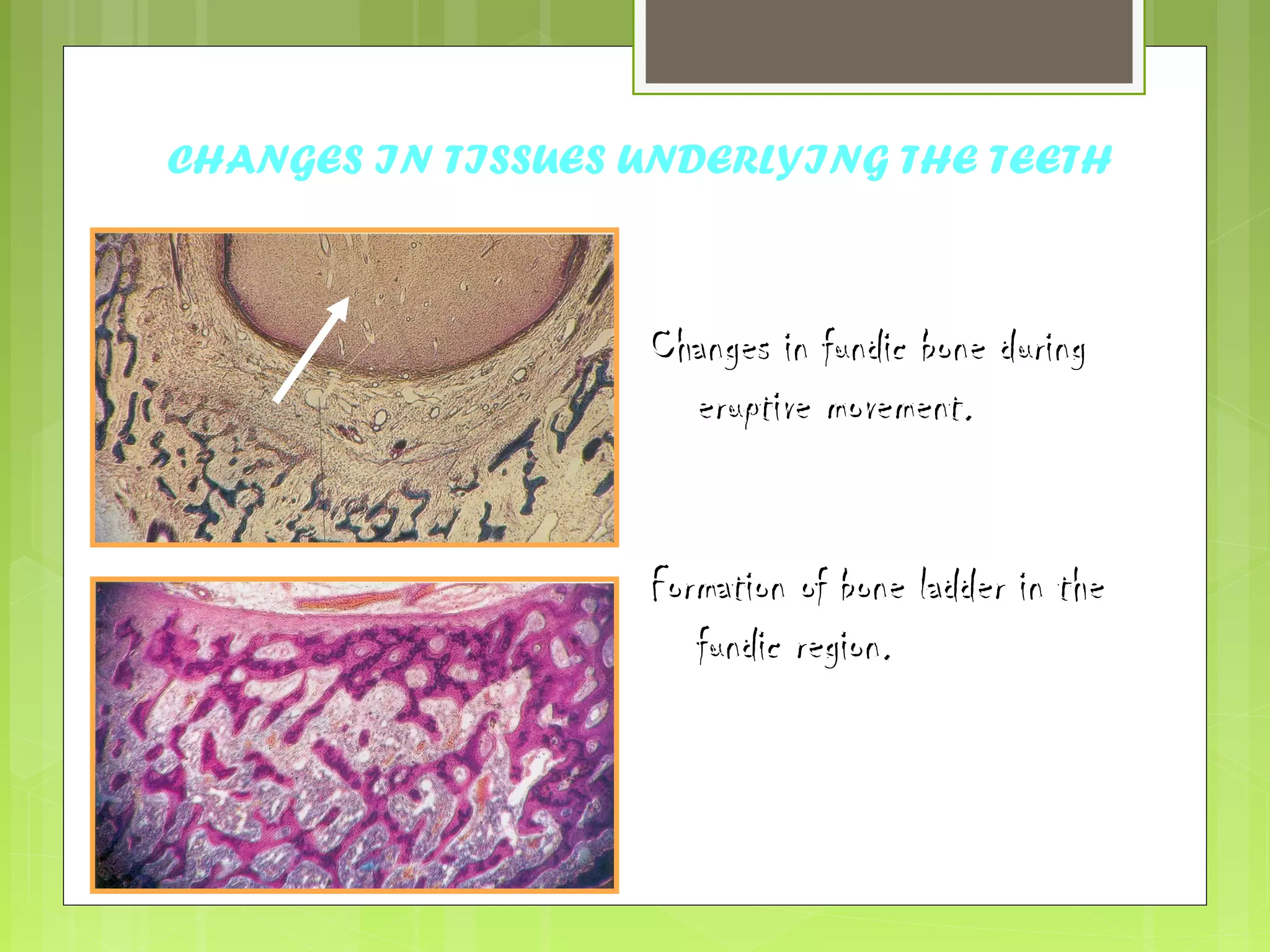
CHANGES IN TISSUES UNDERLYING THE TEETH 
CChhaannggeess iinn ffuunnddiicc bboonnee dduurriinngg 
eerruuppttiivvee mmoovveemmeenntt.. 
FFoorrmmaattiioonn ooff bboonnee llaaddddeerr iinn tthhee 
ffuunnddiicc rreeggiioonn..
3)POST-ERUPTIVE / 
PREFUNCTIONAL TOOTH 
MOVEMENT 
PATTERN OF TOOTH MOVEMENT 
Are those that :- 
1) Maintain the 
position of erupted tooth while the 
jaw continues to grow. 2) 
compensates for occlusal and 
proximal wear.
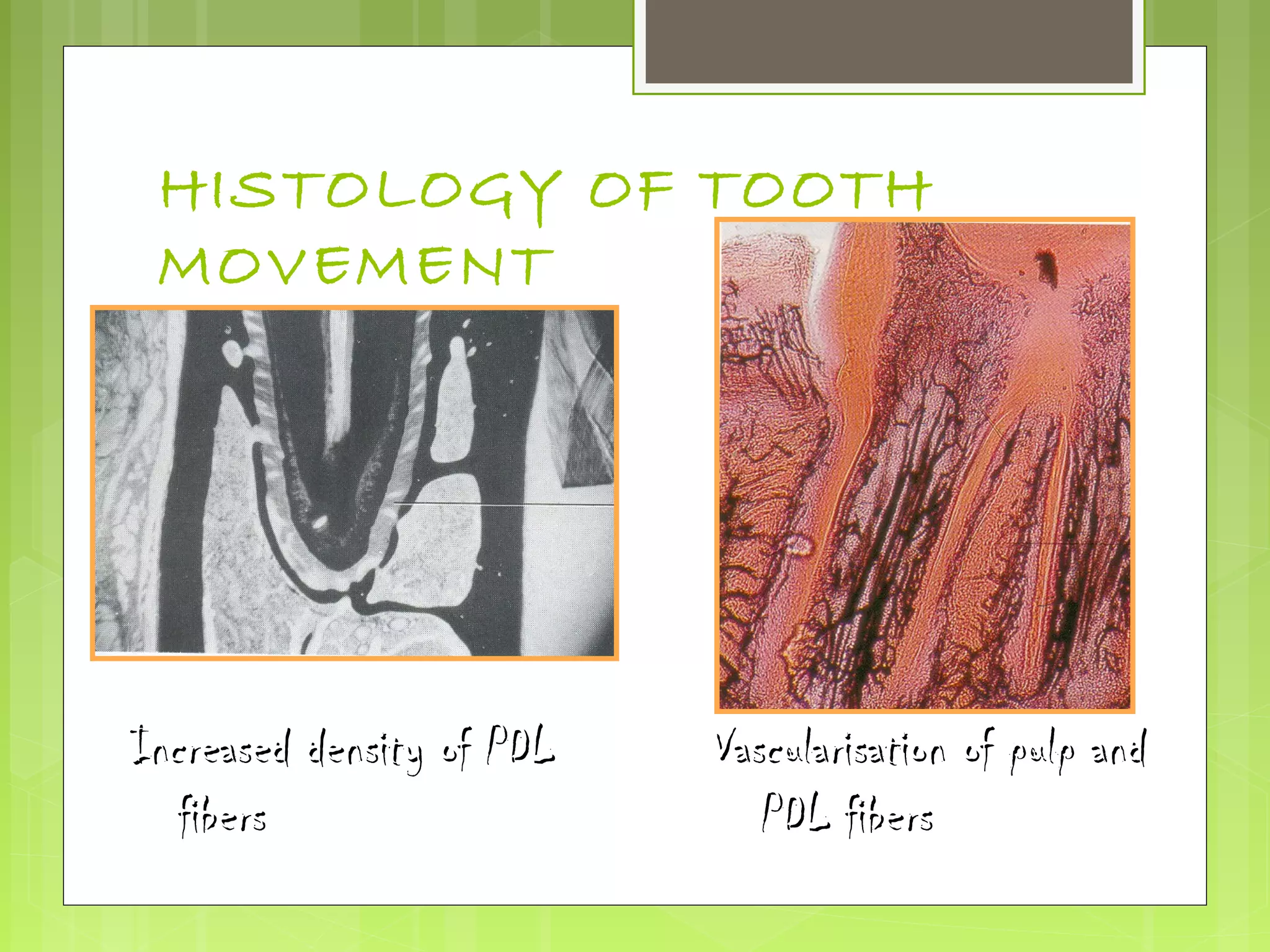
HISTOLOGY OF TOOTH 
MOVEMENT 
IInnccrreeaasseedd ddeennssiittyy ooff PPDDLL 
ffiibbeerrss 
VVaassccuullaarriissaattiioonn ooff ppuullpp aanndd 
PPDDLL ffiibbeerrss
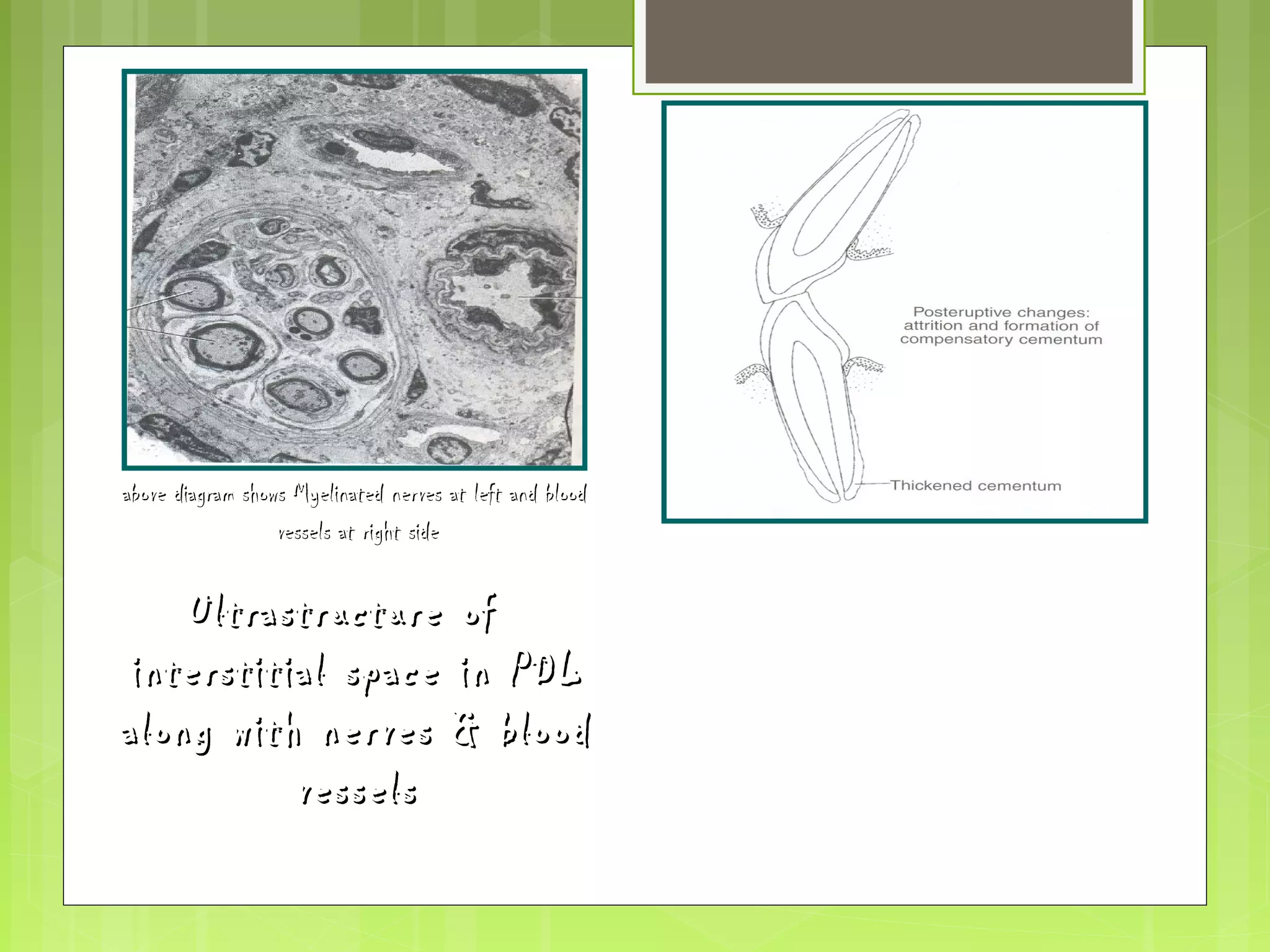
aabboovvee ddiiaaggrraamm sshhoowwss MMyyeelliinnaatteedd nneerrvveess aatt lleefftt aanndd bblloooodd 
vveesssseellss aatt rriigghhtt ssiiddee 
UUllttrraassttrruuccttuurree ooff 
iinntteerrssttiittiiaall ssppaaccee iinn PPDDLL 
aalloonngg wwiitthh nneerrvveess && bblloooodd 
vveesssseellss 
Posteruptive changes : attrition 
and compensative formation of 
cementum
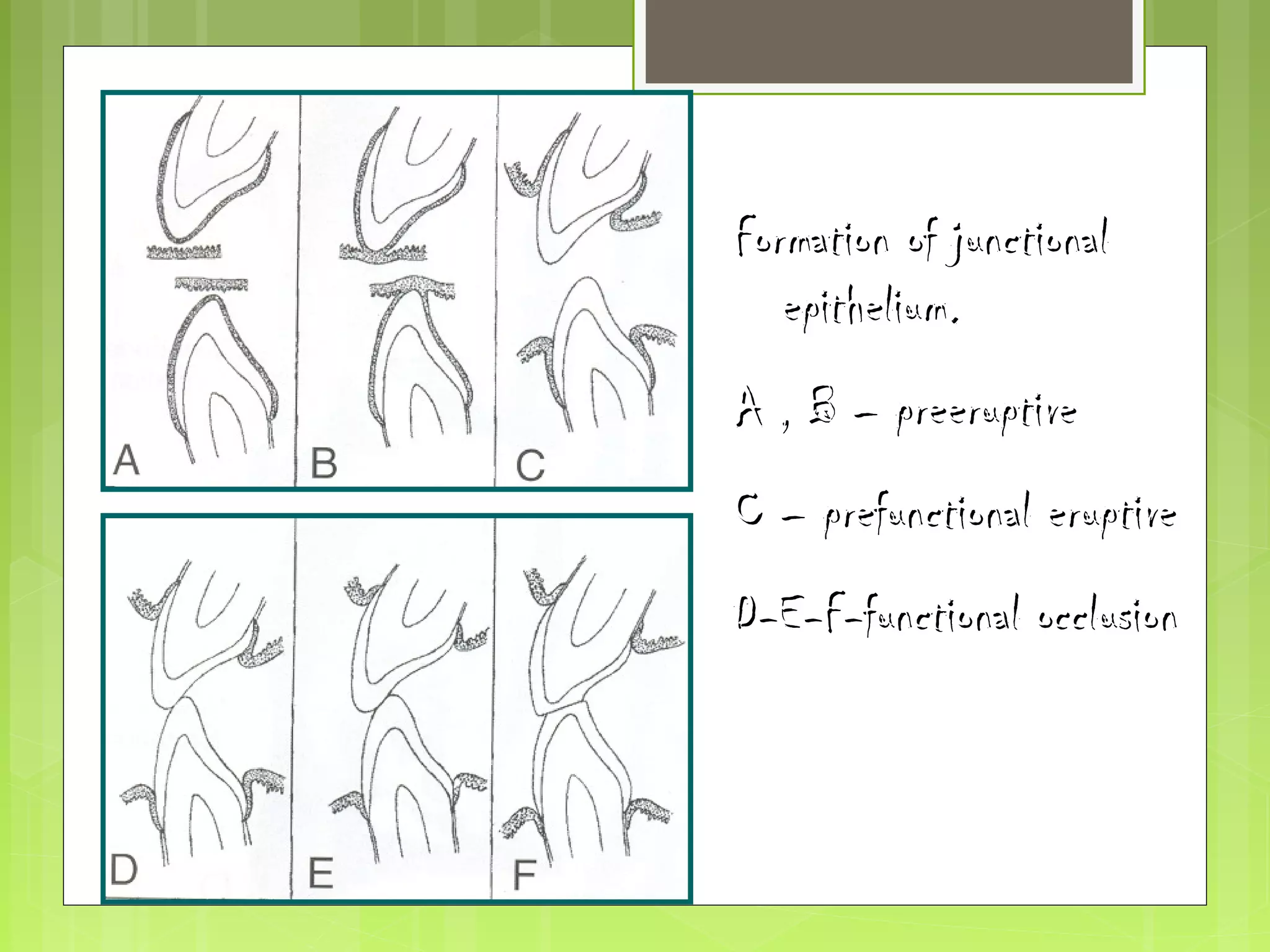
FFoorrmmaattiioonn ooff jjuunnccttiioonnaall 
eeppiitthheelliiuumm.. 
AA ,, BB –– pprreeeerruuppttiivvee 
CC –– pprreeffuunnccttiioonnaall eerruuppttiivvee 
DD--EE--FF--ffuunnccttiioonnaall oocccclluussiioonn
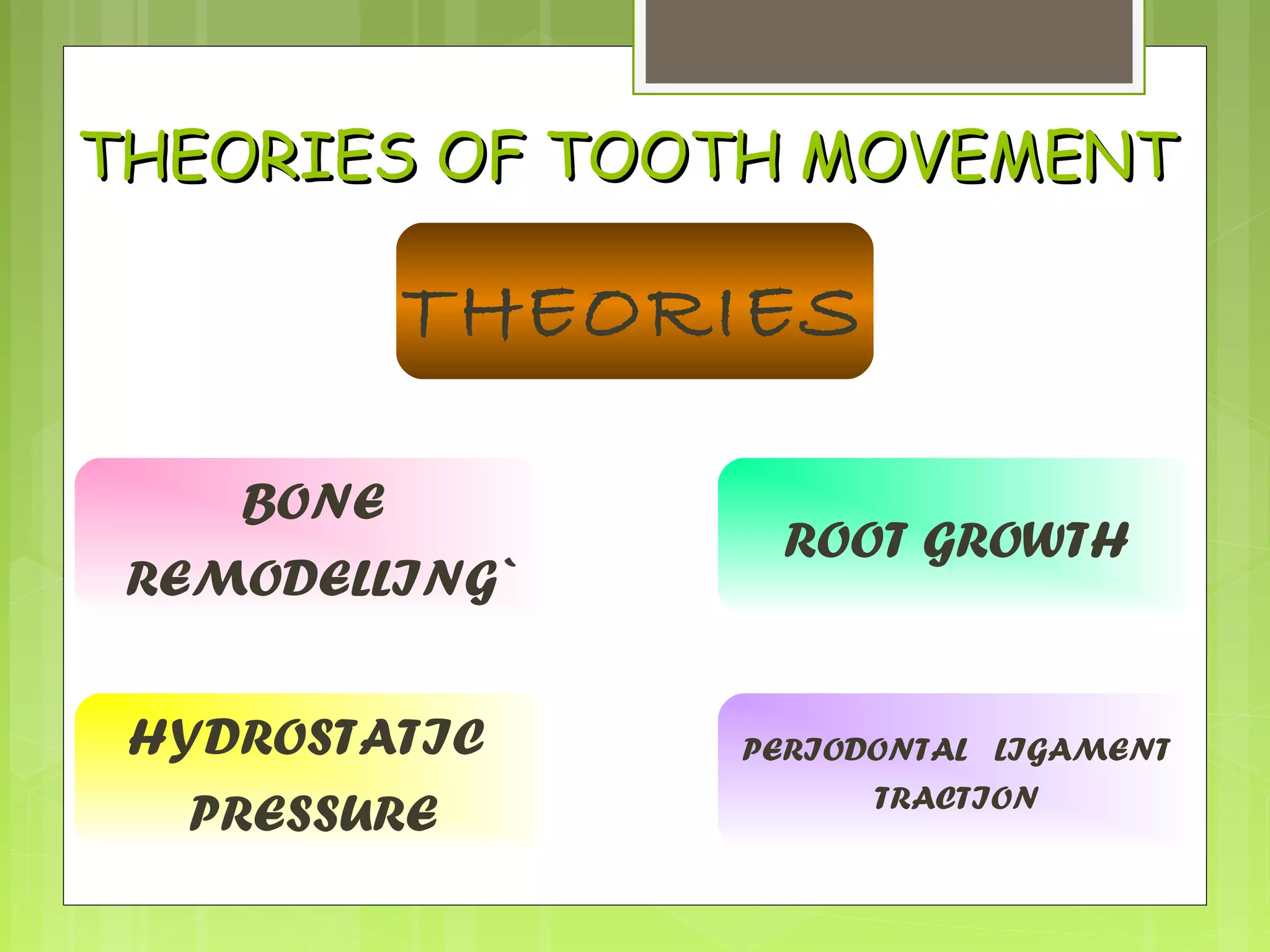
THEORIES OOFF TTOOOOTTHH MMOOVVEEMMEENNTT 
THEORIES 
BONE 
REMODELLING` 
ROOT GROWTH 
HYDROSTATIC 
PRESSURE 
PERIODONTAL LIGAMENT 
TRACTION
BBOONNEE RREEMMOODDEELLLLIINNGG 
 Selective deposition and resorption of bone brings about 
eruption. 
 Bone remodelling of the crypt wall , clearly is important to 
achieve tooth eruption. 
 The intense metabolic activity in the alveolar bone taking 
place around the moving tooth requires the presence of 
dental follicle. 
 Experiments have shown that when tooth germ is removed 
but the follicle is left in position , the eruptive pathway still 
forms in bone indicating dental follicle and not bone as the 
major determinant in tooth eruption.
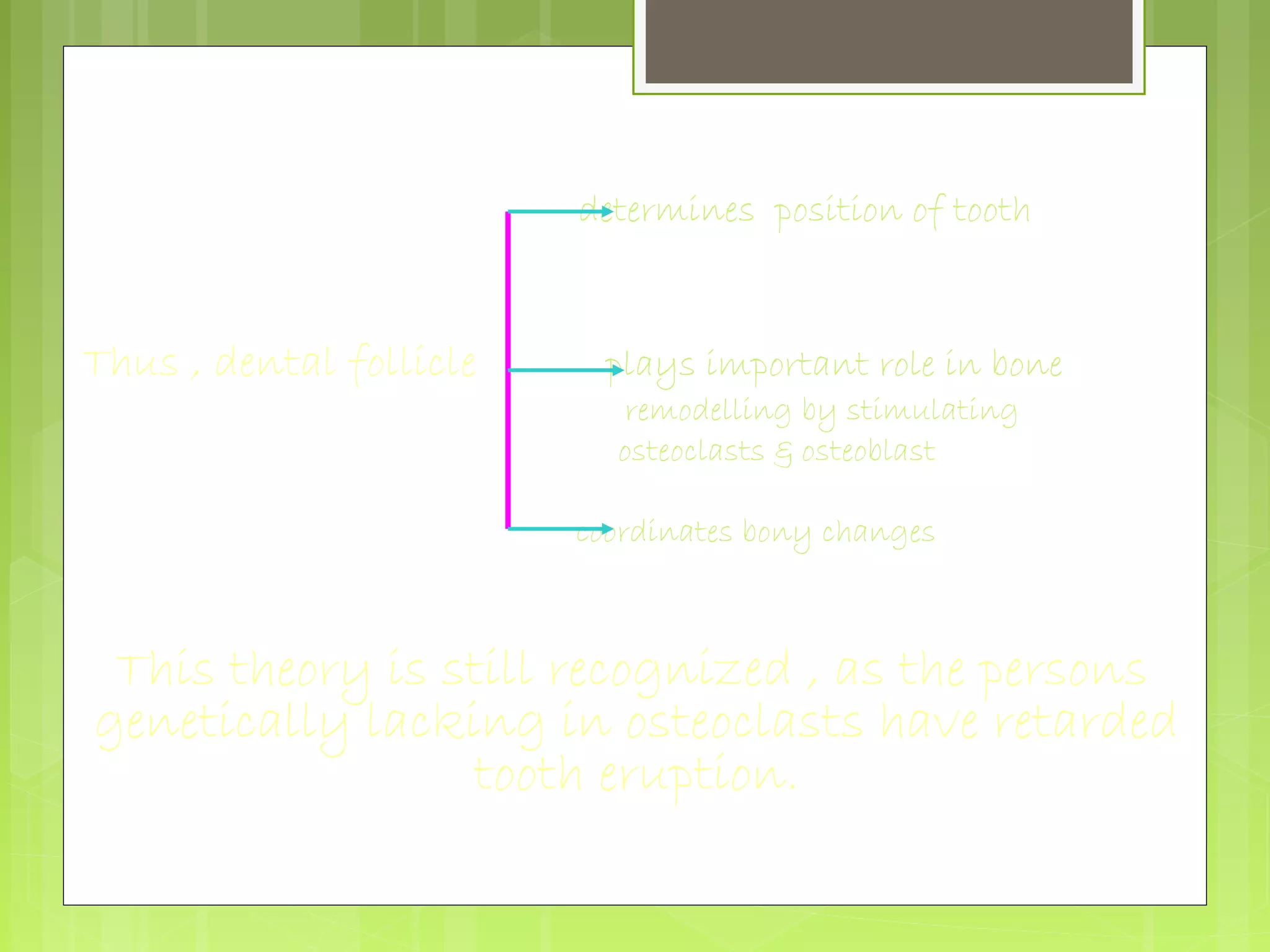
determines position of tooth 
Thus , dental follicle plays important role in bone 
remodelling by stimulating 
osteoclasts & osteoblast 
coordinates bony changes 
This theory is still recognized , as the persons 
genetically lacking in osteoclasts have retarded 
tooth eruption.
RROOOOTT GGRROOWWTTHH 
 Root growth theory considers growth in root 
length to be responsible for tooth eruption , as 
the growing root presses against the socket 
base & opposite force pushes the tooth to erupt. 
 Although at first glance this may seem an 
obvious mechanism , root formation is 
unlikely to be the cause of tooth eruption.
the basis of this theory is questionable due to 
certain facts :- 
Some teeth move a greater distance than the length 
of their fully formed roots. 
Some teeth still erupt after root formation has been 
completed. 
Rootless teeth also erupt. 
If root formation is responsible for eruption , it 
would be expected that the onset of root formation and 
eruptive movement would coincide.
If root formation results in an eruptive force , there 
is the requirement of a fixed base , but the bone at 
the base of the root cannot act as a fixed base as 
pressure on the bone results in its resorption. 
Presence of CUSHION – HAMMOCK LIGAMENT. 
Root growth theory is now considered to be 
unimportant for tooth eruption , but it is true that 
root growth is necessary for eruption as it gives 
attachment to periodontal fibers.
HYDROSTATIC // VVAASSCCUULLAARR PPRREESSSSUURREE 
This theory is based on the fact that dental papilla is highly 
vascular. 
It is known that teeth move in synchrony with the arterial pulse 
, so local volume changes can produce limited tooth movement. 
Ground substance can swell upto 50% with the addition of water 
, and a differential pressure sufficient to cause tooth movement 
between the tissues above and below the erupting tooth has been 
reported in the dog. 
Again, whether such pressures are the prime movers of teeth is 
debatable because surgical excision of the root , and therefore the 
local vasculature , does not prevent tooth eruption.
PPEERRIIOODDNNTTAALL LLIIGGAAMMEENNTT 
TTRRAACCTTIIOONN 
 AAmmoonnggsstt aallll 4 tthheeoorriieess PPDDLL ttrraaccttiioonn tthheeoorryy hhaass 
ssttrroonnggeesstt eevviiddeennccee iinn iittss ffaavvoorr.. 
 TThhee ttrraannsssseeppttaall ffiibbeerrss rruunnnniinngg bbeettwweeeenn aaddjjaacceenntt tteeeetthh 
aaccrroossss tthhee aallvveeoollaarr pprroocceessss ddrraaww nneeiigghhbboorriinngg tteeeetthh 
ttooggeetthheerr && mmaaiinnttaaiinn tthheemm iinn ccoonnttaacctt.. 
 AAss lloonngg aass PPDDLL iiss vviiaabbllee ttooootthh mmoovveemmeenntt ooccccuurrss.. 
 SSppeecciiaalliizzeedd ffiibbrroobbllaassttss pprreesseenntt iinn PPDDLL –– mmyyooffiibbrroobbllaassttss.. 
 TThheessee bbyy vviirrttuuee ooff tthheeiirr ccoonnttrraaccttiillee ffoorrcceess eexxhhiibbiitt 
ffiibbrroonneexxuuss..
Through fibronexus they transmit forces to the 
collagen bundles. 
These collagen bundles apart from undergoing 
remodelling are also inclined at the correct angle to 
bring about eruptive movement – basic requirement 
for tooth movement 
It is concluded that the force for tooth eruption is 
most probably generated by the contractile property 
of fibroblast of ligament along with other 
conditions (presence of follicle) which must be 
present so that this contraction can be used for tooth 
eruption. 
Hence eruption is a multifactorial phenomenon.
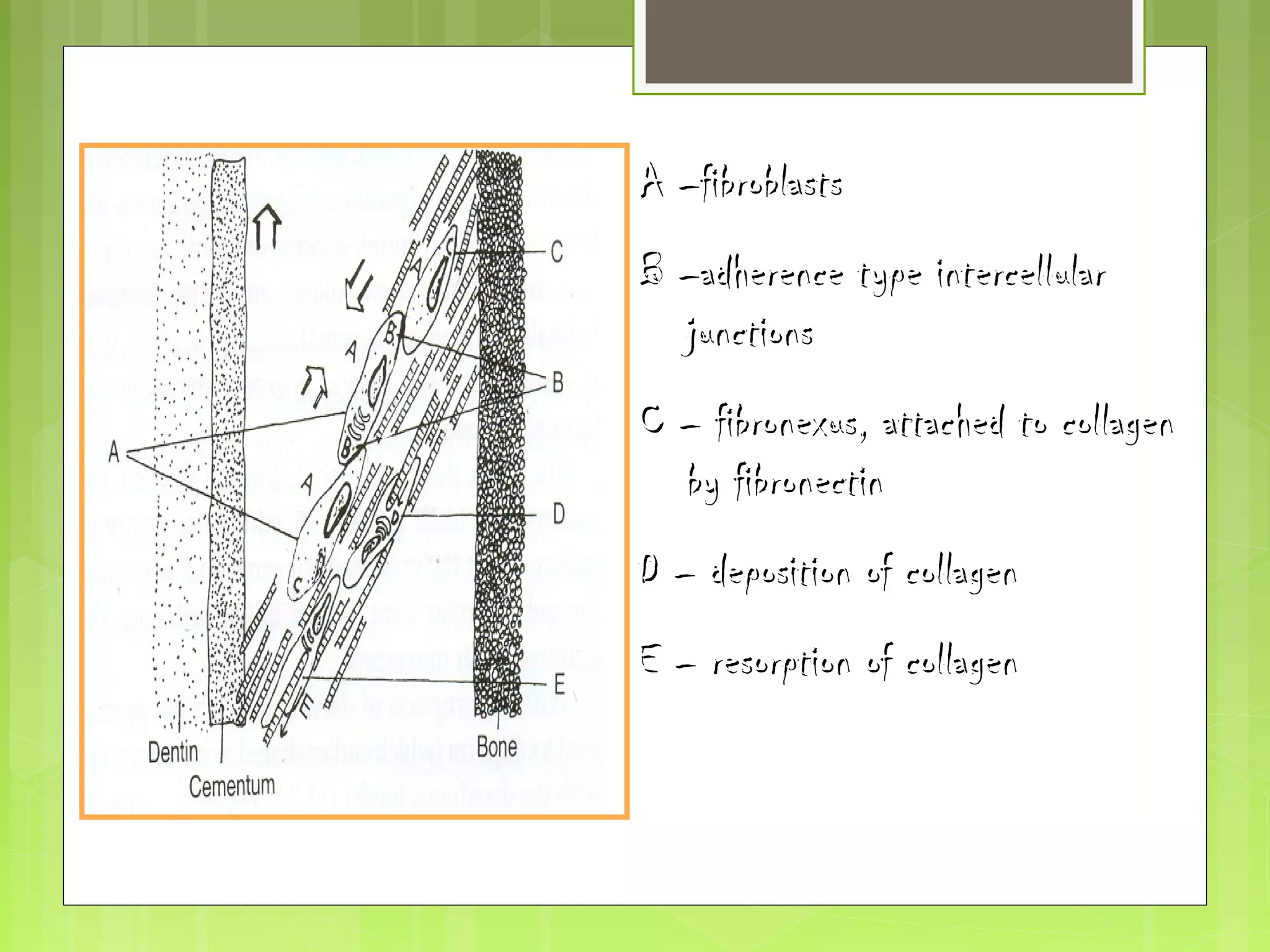
AA ––ffiibbrroobbllaassttss 
BB ––aaddhheerreennccee ttyyppee iinntteerrcceelllluullaarr 
jjuunnccttiioonnss 
CC –– ffiibbrroonneexxuuss,, aattttaacchheedd ttoo ccoollllaaggeenn 
bbyy ffiibbrroonneeccttiinn 
DD –– ddeeppoossiittiioonn ooff ccoollllaaggeenn 
EE –– rreessoorrppttiioonn ooff ccoollllaaggeenn
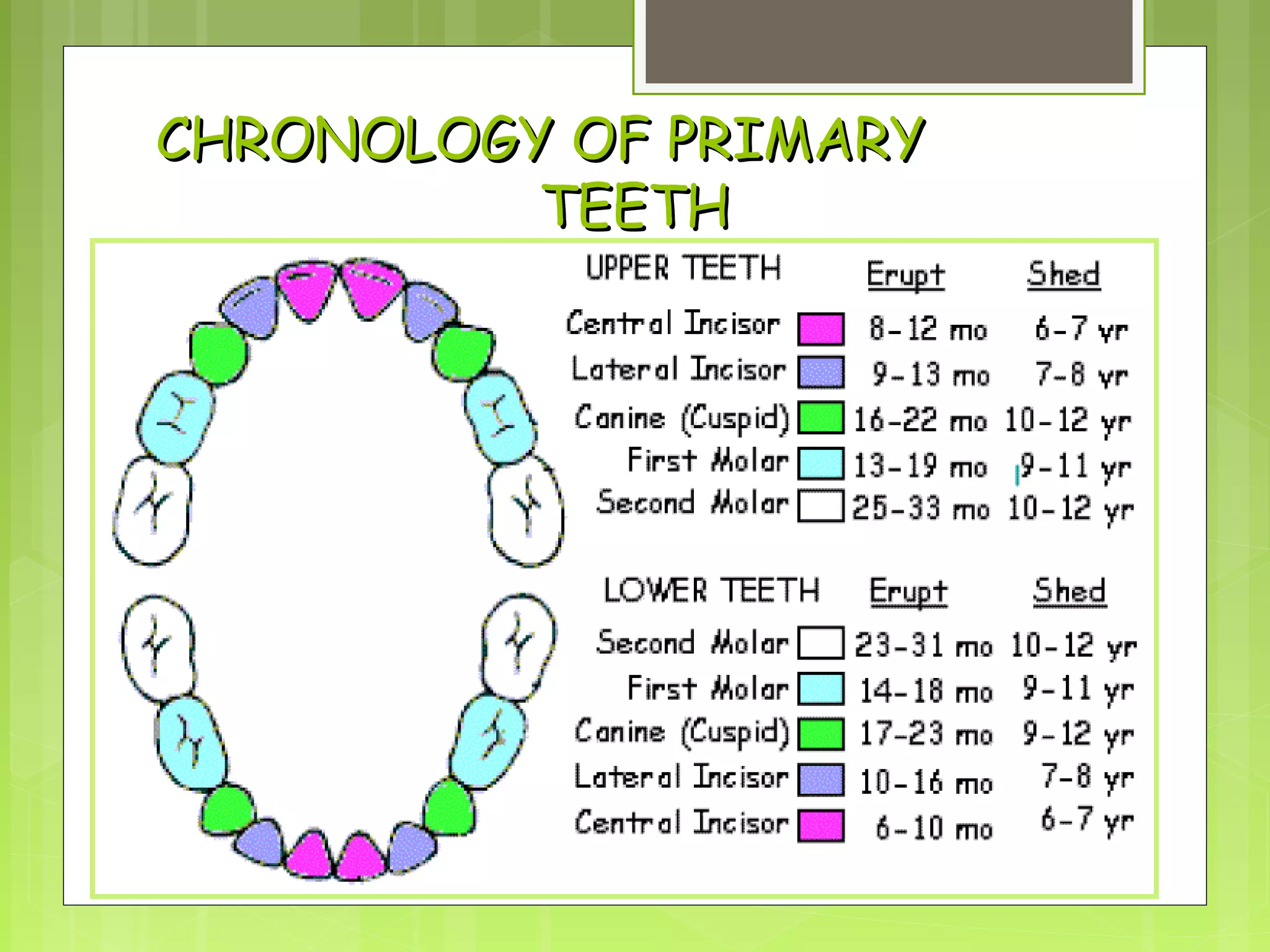
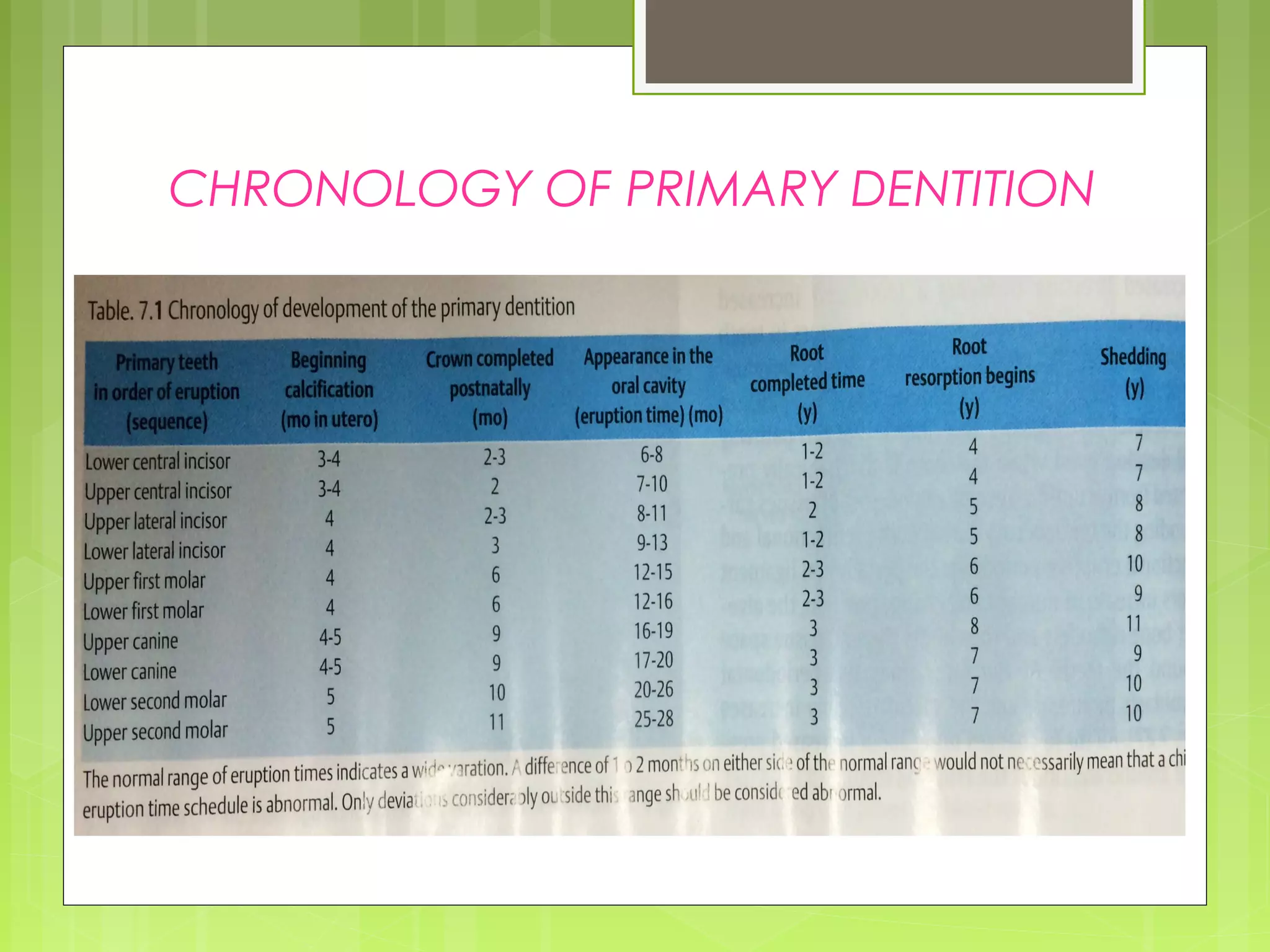
CHRONOLOGY OOFF PPRRIIMMAARRYY 
TTEEEETTHH
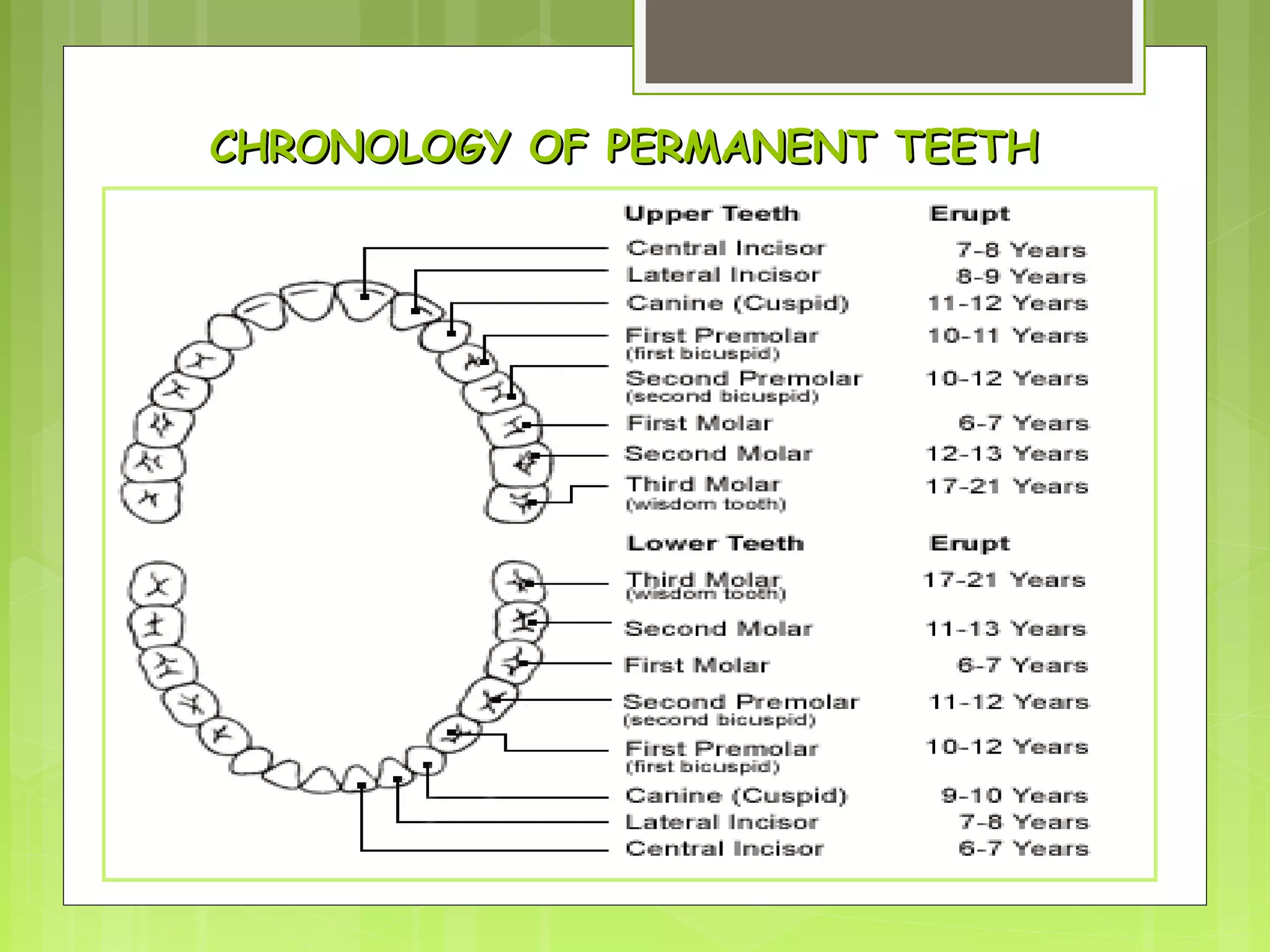
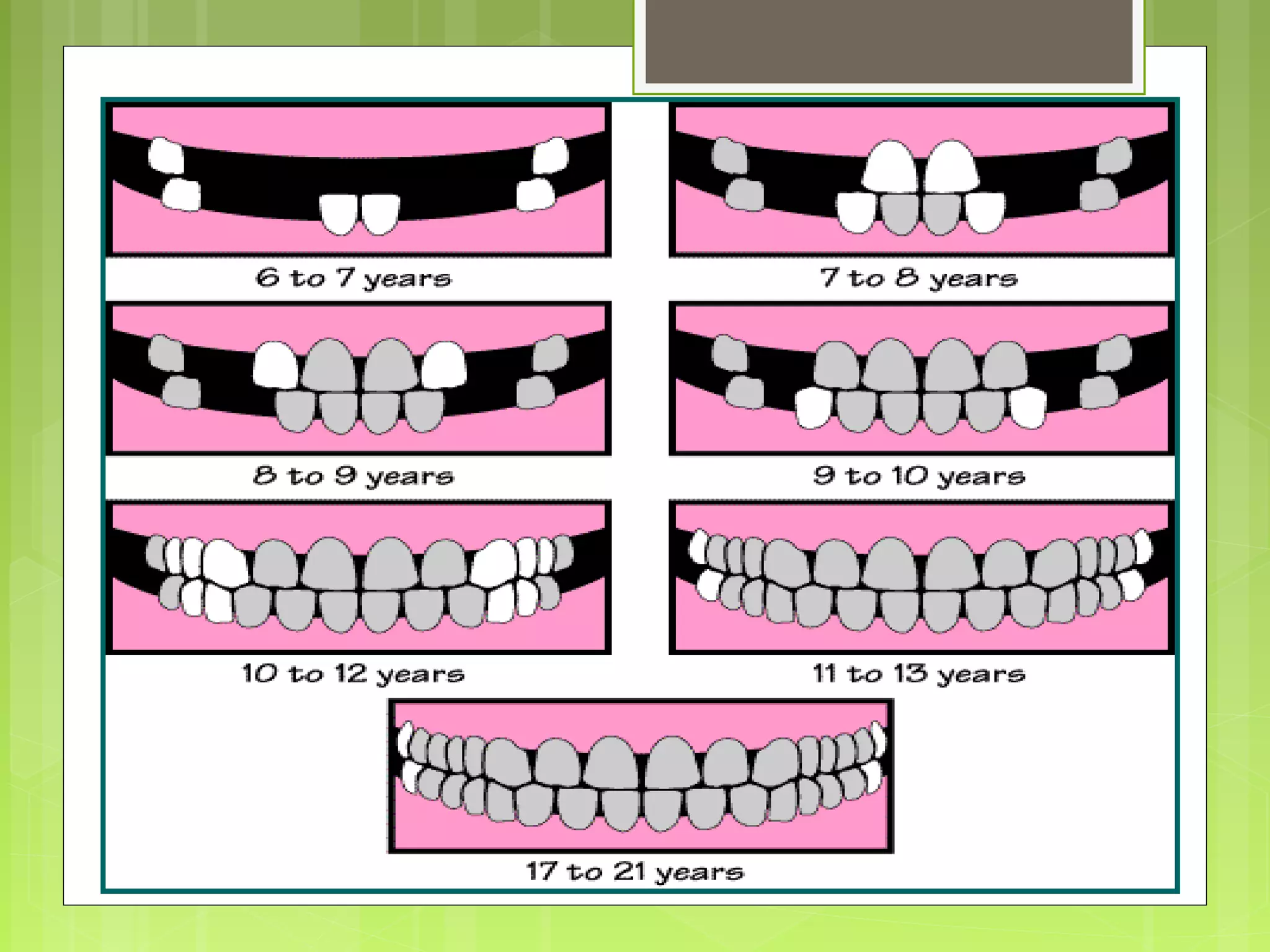
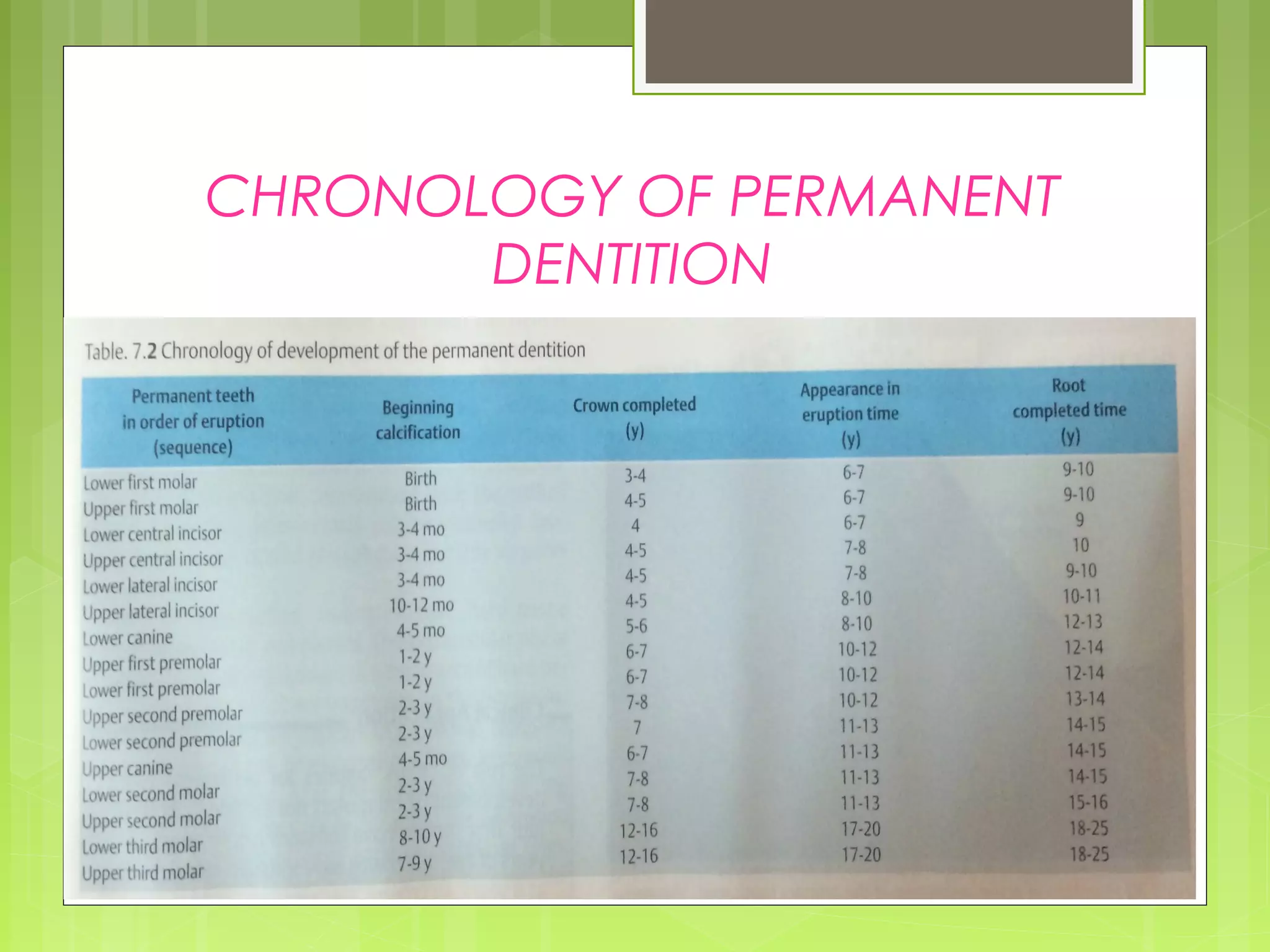
CCHHRROONNOOLLOOGGYY OOFF PPEERRMMAANNEENNTT TTEEEETTHH
CHRONOLOGY OF PRIMARY DENTITION
CHRONOLOGY OF PERMANENT 
DENTITION
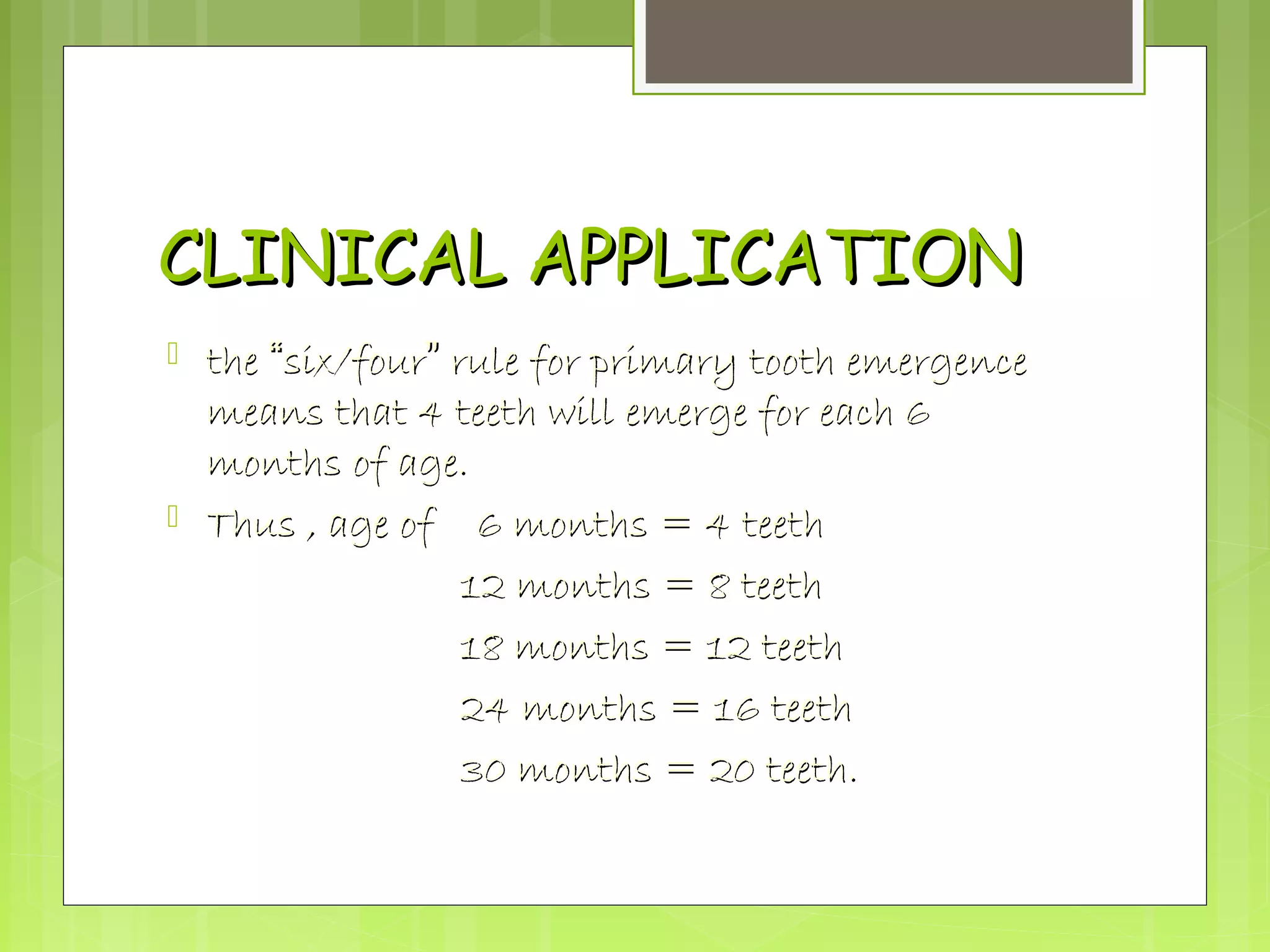
CCLLIINNIICCAALL AAPPPPLLIICCAATTIIOONN 
 tthhee ““ssiixx//ffoouurr”” rruullee ffoorr pprriimmaarryy ttooootthh eemmeerrggeennccee 
mmeeaannss tthhaatt 4 tteeeetthh wwiillll eemmeerrggee ffoorr eeaacchh 66 
mmoonntthhss ooff aaggee.. 
 TThhuuss ,, aaggee ooff 66 mmoonntthhss == 4 tteeeetthh 
1122 mmoonntthhss == 88 tteeeetthh 
1188 mmoonntthhss == 1122 tteeeetthh 
224 mmoonntthhss == 1166 tteeeetthh 
3300 mmoonntthhss == 2200 tteeeetthh..
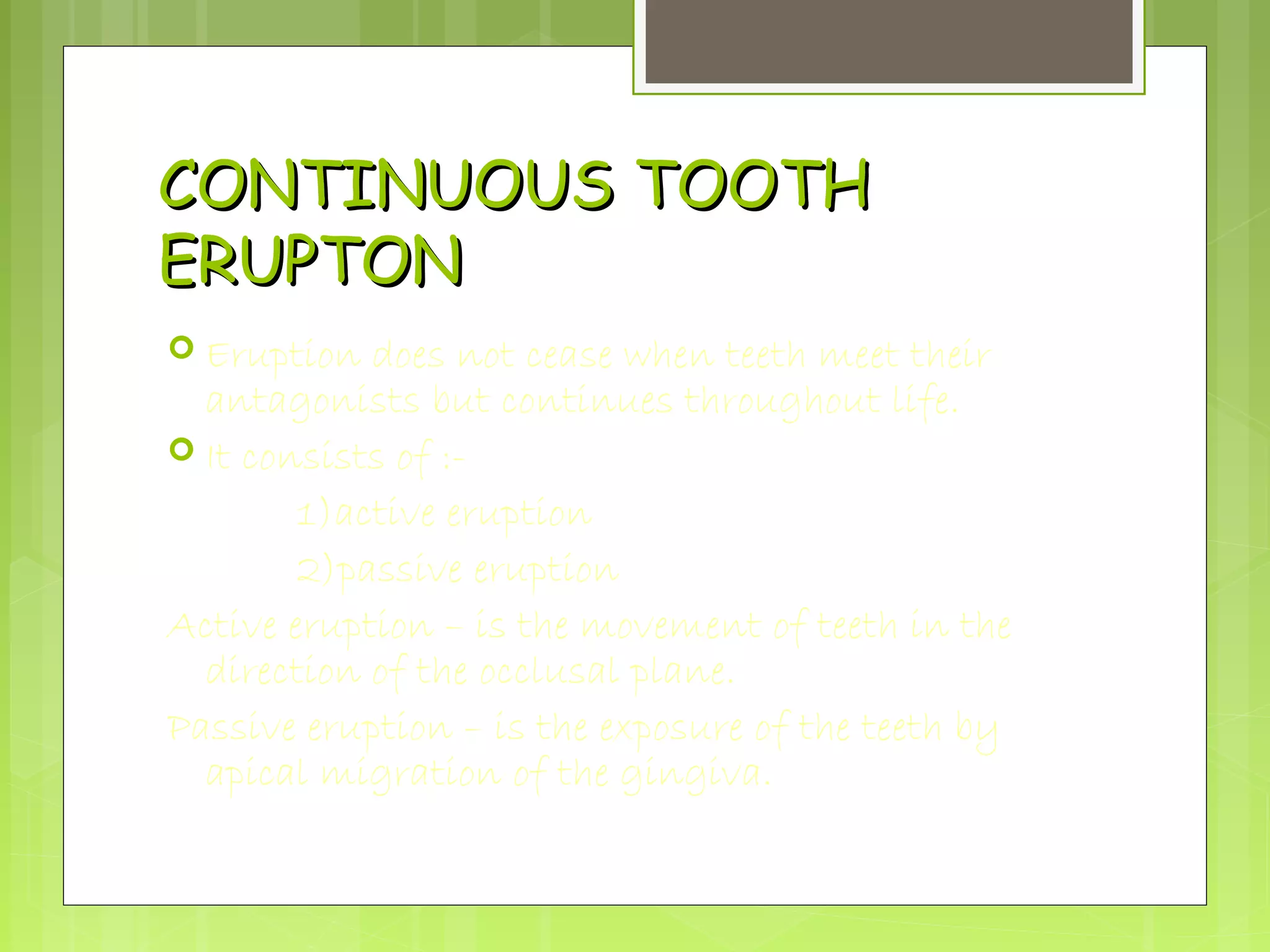
CCOONNTTIINNUUOOUUSS TTOOOOTTHH 
EERRUUPPTTOONN 
 Eruption does not cease when teeth meet their 
antagonists but continues throughout life. 
 It consists of :- 
1)active eruption 
2)passive eruption 
Active eruption – is the movement of teeth in the 
direction of the occlusal plane. 
Passive eruption – is the exposure of the teeth by 
apical migration of the gingiva.
Anatomic crown – the portion of the tooth covered by enamel. 
Anatomic root – the portion of the tooth covered by cementum. 
Clinical crown – the part of the tooth that has been denuded of its 
gingiva and projects into the oral cavity. 
Clinical root – the portion of the tooth covered by periodontal 
tissues. 
When the teeth reach their functional antagonists , the gingival 
sulcus and junctional epithelium are still on enamel and the 
clinical crown is approximately 2/3rds of the anatomic crown. 
“Gottlieb” believed that active and passive eruption proceed 
together. 
Active eruption is coordinated with attrition
CLINICAL CONSIDERATION 
1) DEFICIENCY OF VITAMIN C 
Necessary for the formation of collagen 
fibers 
& Cross – linkages between collagen fibers. 
Deficiency – collagen fibers poorly formed in 
the pdl and tooth fails to erupt or 
erupts slowly and very late.
2) TEETHING PROBLEMS 
Gum adjacent to erupting teeth shows acute 
reaction and pain – acute inflammatory 
response 
Systemic manifestations – as general malaise 
, fever , and sometimes diarrhea.
PPRREEMMAATTUURREE EERRUUPPTTIIOONN 
PPRRIIMMAARRYY TTEEEETTHH 
Occurs infrequently 
1)Natal teeth & Neonatal teeth – ( Massler and 
Savara 1950)- 
Taking only time of eruption as 
reference , natal teeth are those observed in the 
oral cavity at birth. Neonatal teeth are those that 
erupt during the first 30 days of life.
22)) OOsstteeppbbllaassttiicc aaccttiivviittiieess iinnssiiddee tthhee ttooootthh ggeerrmm 
aarreeaa rreellaatteedd ttoo bboonnee rreemmooddeelllliinngg pphheennoommeennaa 
33)) HHyyppoovviittaammiinnoossiiss 
44))SSyysstteemmiicc ccoonnddiittiioonnss oorr ssyynnddrroommeess ssuucchh aass –– 
EElllliiss –– VVaann CCrreevveelldd ssyynnddrroommee 
HHaalllleemmaannnn –– SStteerriiffff ssyynnddrroommee 
CClleefftt ppaallaattee 
55)) EEnnvviirrnnmmeennttaall ffaaccttoorrss eegg ppoollyycchhlloorriinnaatteedd 
bbiipphheennyyllss
DIAGNOSIS –is important ffoorr mmaaiinntteennaannccee 
ooff nnaattaall aanndd nneeoonnaattaall tteeeetthh ooff tthhee nnoorrmmaall 
ddeennttiittiioonn.. 
PPrreemmaattuurree lloossss ooff pprriimmaarryy ddeennttiittiioonn mmaayy 
ccaauussee lloossss ooff ssppaaccee aanndd ccoollllaappssee ooff ddeevveellooppiinngg 
mmaannddiibbuullaarr aarrcchh wwiitthh ccoonnsseeqquueenntt 
mmaalloocccclluussiioonn iinn ppeerrmmaanneenntt ddeennttiittiioonn..
PPEERRMMAANNEENNTT TTEEEETTHH 
 PPrreemmaattuurree eerruuppttiioonn ooff ppeerrmmaanneenntt tteeeetthh iiss 
uussuuaallllyy aa sseeqquueell ooff pprreemmaattuurree lloossss ooff 
ddeecciidduuoouuss ttooootthh.. 
 OOccccaassiioonnaallllyy ,,ccaasseess ooccccuurr iinnvvoollvviinngg tthhee 
eennttiirree ddeennttiittiioonn –– ppoossssiibbiilliittyy ooff aann eennddooccrriinnee 
ddyyssffuunnccttiioonn –– hhyyppeerrtthhyyrrooiiddiissmm..
DELAYED ERUPTION 
Associated with systemic conditions like rickets , cretinism , 
endocrine deficiencies and cleidocranial dysplasia or may be 
genetic 
Sometimes local factors – act as barrier 
Retained deciduous tooth-ankylosed due to trauma 
Fibrosis of gingiva 
Loss of deciduous tooth and drifting of adjacent teeth
PREMATURE LOSS 
WWiitthhoouutt cclloossuurree –– eeaarrllyy eerruuppttiioonn ooff iittss ssuucccceessssoorr.. 
CClloossuurree dduuee ttoo ddrriiffttiinngg ooff aaddjjaacceenntt tteeeetthh –– ddeellaayyeedd 
oorr nnoo eerruuppttiioonn.. 
IMPACTED TEETH 
33rrdd mmoollaarrss dduuee ttoo llaacckk ooff ssppaaccee 
ccaanniinneess dduuee ttoo tthheeiirr llaattee eerruuppttiioonn ttiimmee..
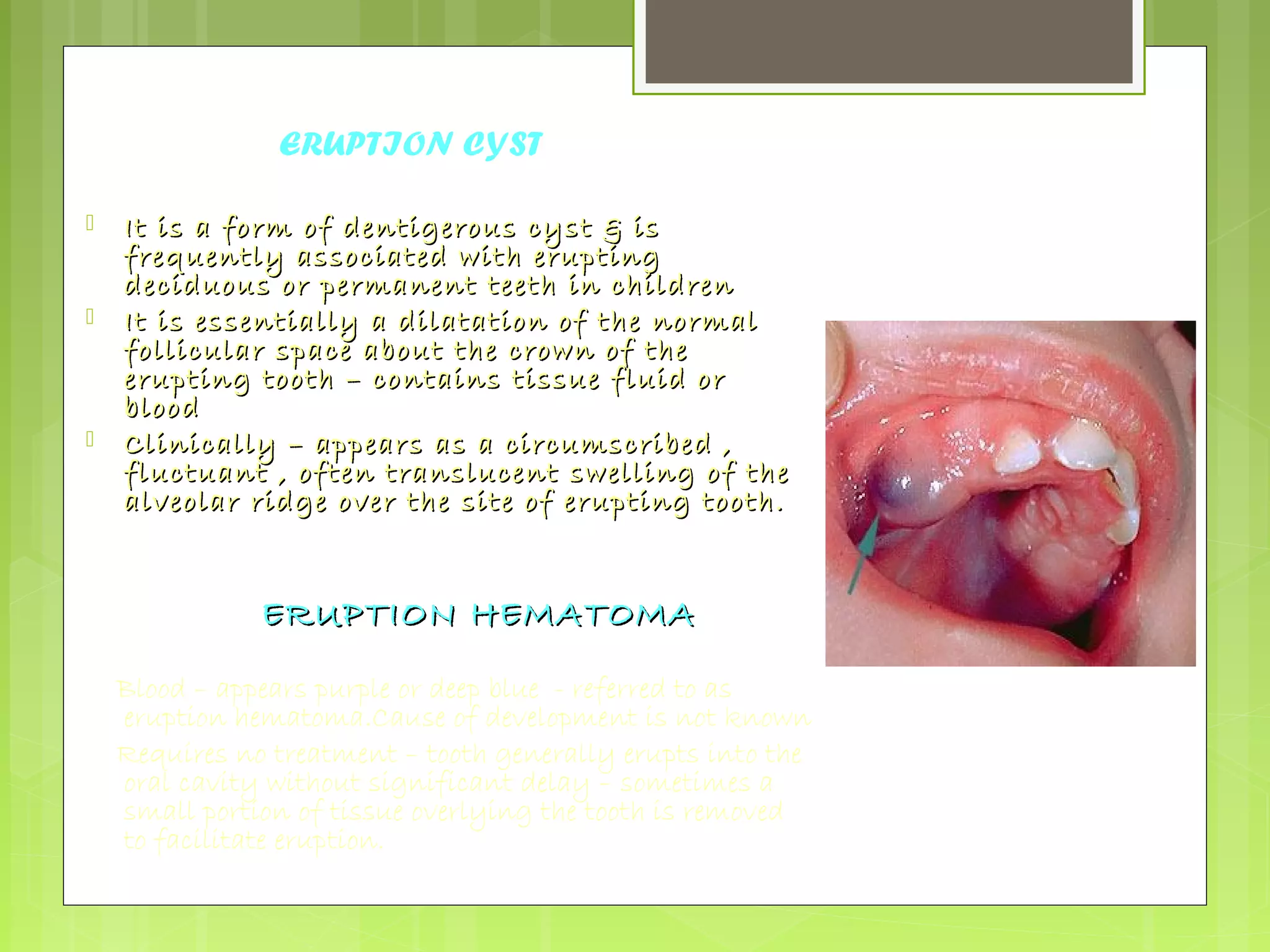
ERUPTION CYST 
 It is a form of dentigerous ccyysstt && iiss 
ffrreeqquueennttllyy aassssoocciiaatteedd wwiitthh eerruuppttiinngg 
ddeecciidduuoouuss oorr ppeerrmmaanneenntt tteeeetthh iinn cchhiillddrreenn 
 IItt iiss eesssseennttiiaallllyy aa ddiillaattaattiioonn ooff tthhee nnoorrmmaall 
ffoolllliiccuullaarr ssppaaccee aabboouutt tthhee ccrroowwnn ooff tthhee 
eerruuppttiinngg ttooootthh –– ccoonnttaaiinnss ttiissssuuee fflluuiidd oorr 
bblloooodd 
 CClliinniiccaallllyy –– aappppeeaarrss aass aa cciirrccuummssccrriibbeedd ,, 
fflluuccttuuaanntt ,, oofftteenn ttrraannsslluucceenntt sswweelllliinngg ooff tthhee 
aallvveeoollaarr rriiddggee oovveerr tthhee ssiittee ooff eerruuppttiinngg ttooootthh.. 
EERRUUPPTTIIOONN HHEEMMAATTOOMMAA 
Blood – appears purple or deep blue - referred to as 
eruption hematoma.Cause of development is not known 
Requires no treatment – tooth generally erupts into the 
oral cavity without significant delay – sometimes a 
small portion of tissue overlying the tooth is removed 
to facilitate eruption.
SHEDDING OF PRIMARY 
TEETH 
Definition : 
Shedding is the exfoliation of the primary 
teeth caused by physiological resorption 
of their roots.(James k. Avery) 
Causes : 
1.Loss of root 
2.Loss of bone 
3.Increased force
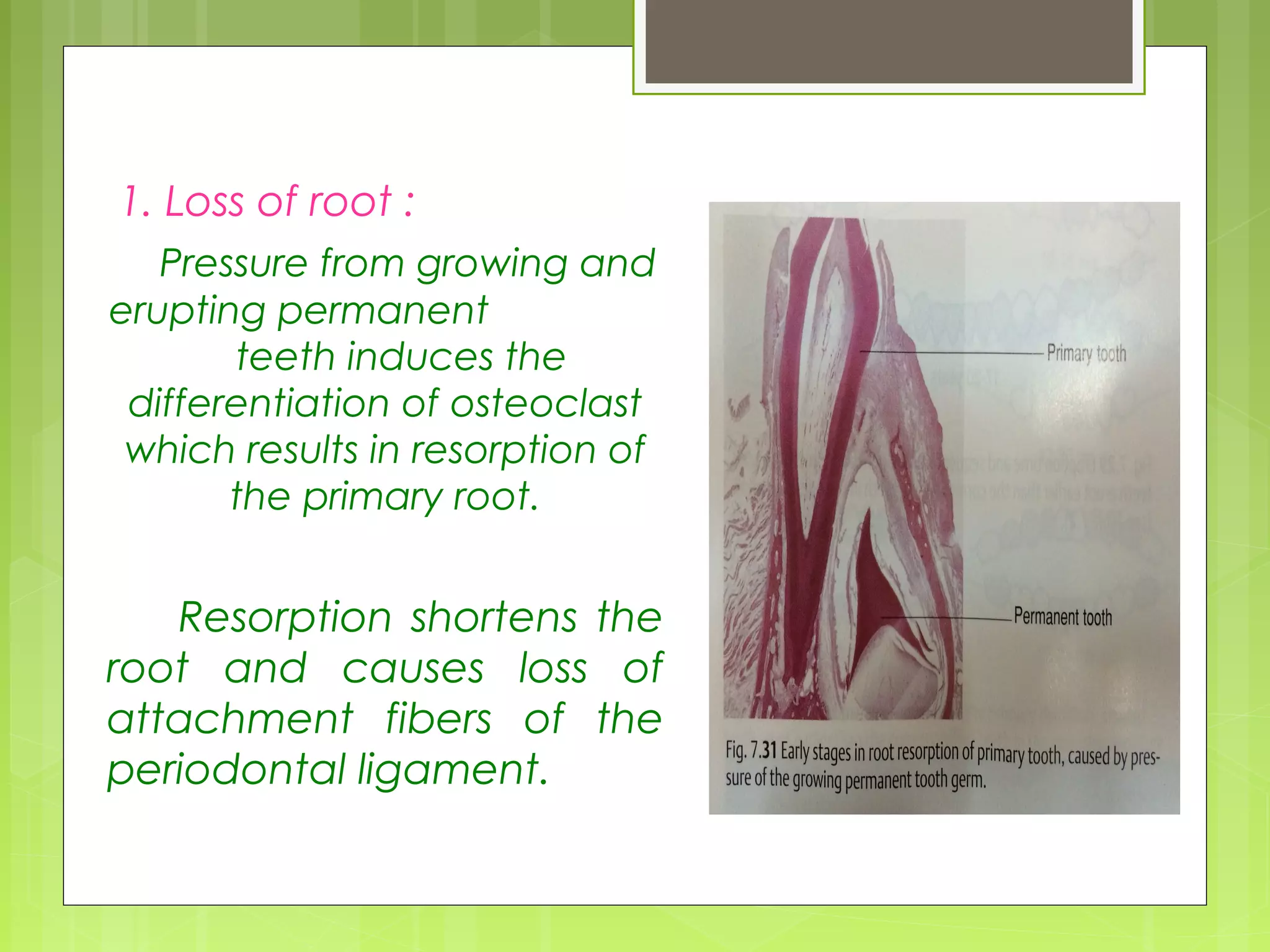
1. Loss of root : 
Pressure from growing and 
erupting permanent 
teeth induces the 
differentiation of osteoclast 
which results in resorption of 
the primary root. 
Resorption shortens the 
root and causes loss of 
attachment fibers of the 
periodontal ligament.
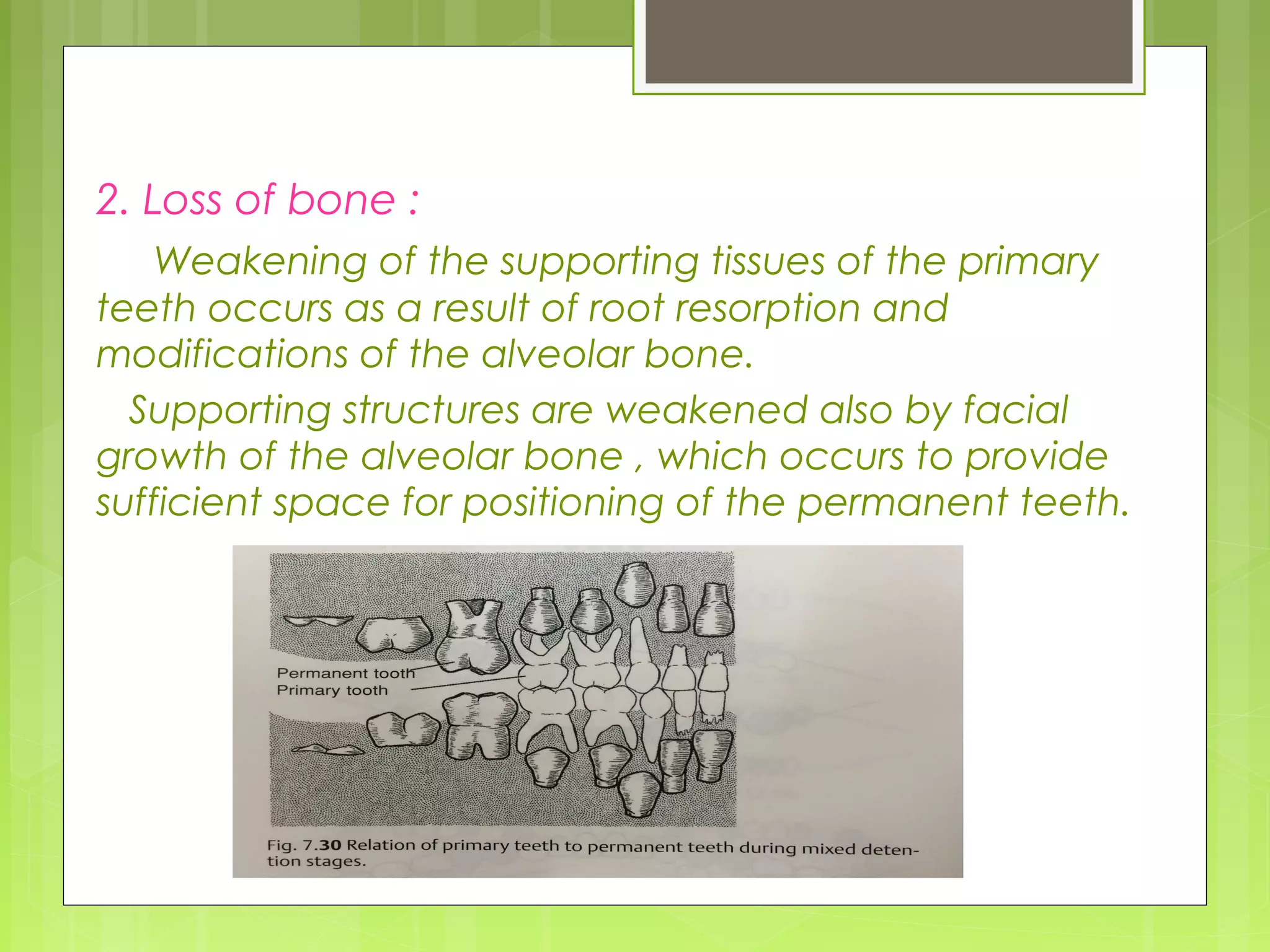
2. Loss of bone : 
Weakening of the supporting tissues of the primary 
teeth occurs as a result of root resorption and 
modifications of the alveolar bone. 
Supporting structures are weakened also by facial 
growth of the alveolar bone , which occurs to provide 
sufficient space for positioning of the permanent teeth.
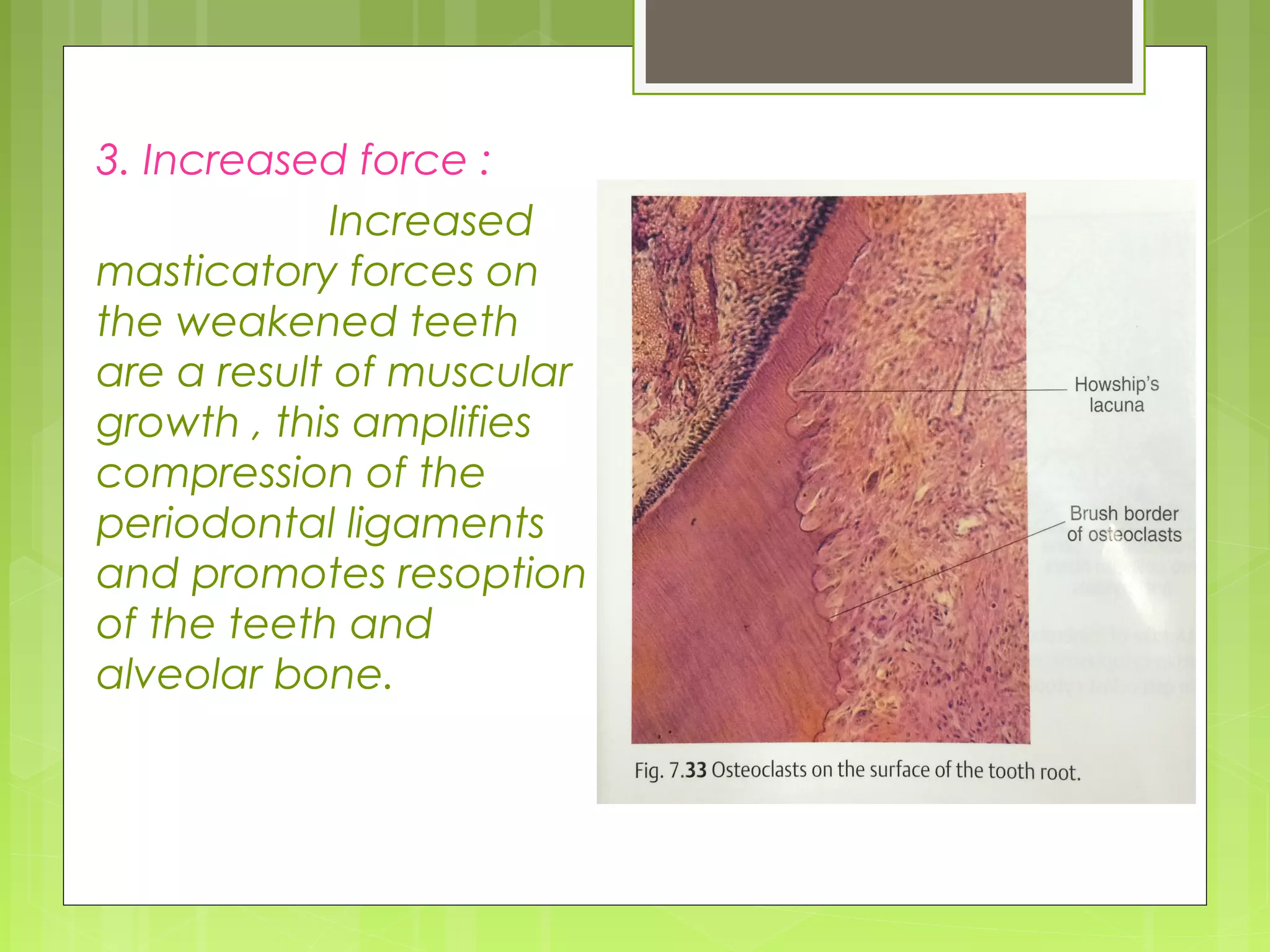
3. Increased force : 
Increased 
masticatory forces on 
the weakened teeth 
are a result of muscular 
growth , this amplifies 
compression of the 
periodontal ligaments 
and promotes resoption 
of the teeth and 
alveolar bone.
CONCLUSION 
 Eruption is the movement of the teeth through the bone of the jaw 
and the overlying mucosa, to appear and functional in the oral 
cavity. 
 Active eruption is the result of occlusal movement of the tooth. 
 Clinical eruption begins with the appearance of the crown tip in 
the oral cavity and continues until the tooth comes into occlusion. 
 The periodontal fibers are organizing to stabilize the erupting 
tooth, the root dentinogenesis follows as the bone in the fundic 
region organizes in response to the change in root length. 
 Shedding of the primary teeth is the result of progressive resorption 
of their root through the activity of the osteoclast or odontoclast. 
 Disturbance of the resorption process results in abnormal behavior 
of the primary teeth, some primary teeth may be retained 
because of the absence or impaction of their permanent 
successors, others may be ankylosed and submerged. 
 In rare cases, teeth may appear in the oral cavity of newborn or 
neonatal infants, and are called preprimary teeth.
REFERENCES 
1 – Oral development and histology, James k Avery , 
thieme publications (3rd edition) . 
2 - Oral Histology – A.R. Ten Cate, Mosby 
Publications (3rd edition). 
3 - Orban’s Oral Histology and Embryology – Mosby 
Publications(10th edition). 
4 - Principles of Anatomy and Oral Anatomy for 
Dental Students – M.E. Atkinson and F.H. White (1st 
edition) Churchill Livingstone Publishers.
Tooth eruption and shedding

Tooth eruption and shedding

  • 1.
    DEPARTMENT OF CONSERVATIVE DENTIST AND ENDODONTICS PRESENTED BY:- DR. ADITYA SHINDE GUIDED BY:- DR.LALITAGUARI MANDKE TOOTH ERUPTION & SHEDDING
  • 2.
    CONTENTS  DEFINITION  PHYSIOLOGIC TOOTH MOVEMENTS  STAGES OF ERUPTION  PATTERN AND HISTOLOGY  THEORIES OF ERUPTION  CHRONOLOGY OF ERUPTION  CONTINUOUS TOOTH ERUPTION  CLINICAL CONSIDERATIONS  SHEDDING OF PRIMARY TEETH
  • 3.
    TTOOOOTTHH EERRUUPPTTIIOONN DEFINITION:- It is the axial or occlusal movement of the tooth from its developmental position within the jaws to functional position in the occlusal plane.- (orban’s) Eruption is the movement of the developing teeth within and through the bone and the overlying mucosa of the jaws to appear in the oral cavity and reach the occlusal plane.-(james k. avery)
  • 4.
    PPHHYYSSIIOOLLOOGGIICC TTOOOOTTHH MMOOVVEEMMEENNTTSS These are of various types :- 1) Axial or vertical 2) Drifting 3) Torsion 4) Tipping
  • 5.
    SSTTAAGGEESS OOFF TTOOOOTTHH EERRUUPPTTIIOONN 1) Pre – eruptive tooth movements. 1) Eruptive / Prefunctional tooth movements 2) Posteruptive tooth movements
  • 6.
    PPAATTTTEERRNN AANNDD HHIISSTTOOLLOOGGYYOOFF VVAARRIIOOUUSS SSTTAAGGEESS OOFF EERRUUPPTTIIOONN PRE – ERUPTIVE TOOTH MOVEMENT These are the movements made by the deciduous and permanent tooth germs within the tissues of jaws before they begin to erupt. AA –– eennaammeell oorrggaann BB –– ddeennttaall llaammiinnaa CC –– bbaassaall bboonnee
  • 7.
    DDeecciidduuoouuss TTeeeetthh WWhheennddeecciidduuoouuss ttooootthh ggeerrmmss ddiiffffeerreennttiiaattee ,, tthheerree iiss ggoooodd ddeeaall ooff ssppaaccee bbeettwweeeenn tthheemm.. AAss TTooootthh ggeerrmmss ggrrooww mmoorree rraappiiddllyy tthhaann bboonnee –– tthhiiss aavvaaiillaabbllee ssppaaccee iiss uuttiilliizzeedd aanndd ddeevveellooppiinngg tteeeetthh bbeeccoommee ccrroowwddeedd ttooggeetthheerr eessppeecciiaallllyy iinn tthhee iinncciissoorr aanndd ccaanniinnee rreeggiioonn.. TThhiiss ccrroowwddiinngg iiss rreelliieevveedd bbyy ::-- -- ggrroowwtthh iinn lleennggtthh ooff iinnffaanntt jjaaww -- iinnccrreeaassee iinn wwiiddtthh -- iinnccrreeaassee iinn hheeiigghhtt
  • 8.
    PPeerrmmaanneenntt TTeeeetthh PPeerrmmaanneenntt tteeeetthh wwiitthh ddeecciidduuoouuss pprreeddeecceessssoorrss aallssoo uunnddeerrggoo ccoommpplleexx mmoovveemmeennttss bbeeffoorree tthheeyy rreeaacchh tthhee ffiinnaall ppoossiittiioonn ffrroomm wwhhiicchh tthheeyy wwiillll eerruupptt.. TThheessee cchhaannggeess iinn tthhee rreellaattiivvee ppoossiittiioonn aarree bbaassiiccaallllyy bbeeccaauussee ooff ggrroowwtthh ooff tthhee ppeerrmmaanneenntt ttooootthh ggeerrmmss aanndd eerruuppttiivvee mmoovveemmeenntt ooff tthhee ddeecciidduuoouuss ttooootthh..
  • 9.
    Labio-lingual sections onmmaannddiibbllee tthhrroouugghh cceennttrraall iinncciissoorrss AA –– aatt bbiirrtthh BB –– aatt 44tthh mmoonntthh CC –– aatt 1100tthh mmoonntthh DD –– aatt 2255tthh mmoonntthh
  • 10.
    Unerupted ddeecciidduuoouuss ccaanniinneeaanndd iittss ppeerrmmaanneenntt ssuucccceessssoorr llooccaatteedd lliinngguuaallllyy aanndd aappiiccaallllyy ttoo iitt ,, iinn aa sseeccttiioonn ooff mmaannddiibbllee aatt tthhee aaggee ooff 66 mmnntthhss..
  • 11.
    Deciduous first molarshowing germ of permanent first premolar between its roots at the age of about 6 yrs.
  • 12.
     Permanent maxillarymolar in tuberosity  Dentition shows the erupted deciduous teeth and partially developed crown of permanent teeth at the age of 2 years
  • 13.
    HISTOLOGY OF TOOTH MOVEMENT Bone remodelling occurs within the crypt wall during physiologic tooth movement. At right , osteoblasts are present for bone deposition and are seen as a continuous row of minute spots. At left , osteoclasts are present for bone resorption and are seen as dark spots.
  • 14.
    Bone remodelling –selective deposition and removal of bone by osteoblastic and osteoclastic activity. These movements of both deciduous and permanent tooth germs are a combination of 2 factors :- 1)Total bodily movement 2)Eccentric growth Presence of dental follicle.
  • 15.
     Bodily movementof crown during pre-eruptive phase
  • 16.
    2)ERUPTIVE / PREFUNCTIONAL TOOTH MOVEMENT PATTERN OF TOOTH MOVEMENT The tooth moves from its position within the bone of the jaw to its functional position in occlusion , and the principal direction of movement is occlusal or axial. However , it is important to recognize that jaw growth is normally occurring while most teeth are erupting , so that movements in planes other than axial are superimposed on eruptive movement.
  • 17.
    HISTOLOGY OF TOOTH MOVEMENT 55 mmaajjoorr eevveennttss ttaakkeess ppllaaccee ::-- 1) The secretory phase of amelogenesis is completed just before the onset of root formation and prefunctional eruption. There is a relation between the cessation of mineralisation and activation of the epithelial cells beyond the enamel – forming area.
  • 18.
     22))TThhee iinnttrraaoosssseeoouussssttaaggee ooccccuurrss wwhheenn rroooott ffoorrmmaattiioonn bbeeggiinnss aass aa rreessuulltt ooff tthhee pprroolliiffeerraattiioonn ooff bbootthh tthhee eeppiitthheelliiaall rroooott sshheeaatthh aanndd tthhee mmeesseenncchhyymmaall ttiissssuuee ooff tthhee ddeennttaall ppaappiillllaa aanndd ddeennttaall ffoolllliiccllee.. Prefunctional eruptive stage in formation of root
  • 19.
     3)The supraosseousstage begins when the erupting tooth moves occlusally through the bone of the crypt and the connective tissue of the oral mucosa , so that the reduced enamel epithelium covering the crown comes into contact with the oral epithelium. Crown tip aapppprrooaacchhiinngg oorraall eeppiitthheelliiuumm
  • 20.
     As thisoccurs , the reduced enamel epithelium of the crown proliferates and forms a firm attachment with the oral epithelium. A fused , double layer over the erupting crown is then formed. Contact and fusion of REE and oral mucosa
  • 21.
    4)The tip ofthe crown eenntteerrss tthhee oorraall ccaavviittyy bbyy bbrreeaakkiinngg tthhrroouugghh tthhee cceenntteerr ooff tthhee ddoouubbllee –– llaayyeerreedd eeppiitthheelliiaall cceellllss..  tthhee ccuusspp ttiipp ccaauusseess ddeeggeenneerraattiioonn ooff tthhee mmeemmbbrraannee –– bbeeggiinnnniinngg ssttaaggee ooff cclliinniiccaall eerruuppttiioonn..  -- DDeennttooggiinnggiivvaall jjuunnccttiioonn –– llaatteerraall bboorrddeerrss ooff oorraall mmuuccoossaa  -- JJuunnccttiioonnaall oorr aattttaacchhmmeenntt eeppiitthheelliiuumm –– RREEEE--rreesstt ooff eennaammeell eeppiitthheelliiuumm  -- OOnnee -- hhaallff ttoo ttwwoo -- tthhiirrddss ooff tthhee rroooottss aarree ffoorrmmeedd..
  • 22.
  • 23.
    5)The erupting toothcontinues to move occlusally at a maximum rate , and there is gradual exposure of more of the clinical crown. PPrriimmaarryy ttooootthh aatt tthhee eenndd ooff eerruuppttiivvee pphhaassee ..PPeerrmmaanneenntt ssuucccceessssoorr iinn pprreeeerruuppttiivvee pphhaassee
  • 24.
    Significant changes alsooccur in :- - the tissues overlying the teeth - the tissues around the teeth - the tissues underlying the teeth CHANGES IN TISSUES OVERLYING TEETH Initial change – alteration of the connective tissue of the dental follicle – forms pathway for eruption.
  • 25.
     Influx ofmonocytes and osteoclasts.  Future eruption pathway appears as a zone in which :-  connective tissue fibers have disappeared  Cells have degenerated and in number  decrease number of blood vessels  Terminal nerves have broken up and degenerated.  These changes are due to loss of blood supply to that area and release of enzymes. DDeevveellooppmmeenntt ooff eerruuppttiivvee ppaatthhwwaayy oovveerrllyyiinngg tthhee ccrroowwnn..
  • 26.
     Resorption oofftthhee oovveerrllyyiinngg bboonnyy ccrryypptt.. DDeevveellooppiinngg eerruuppttiioonn ppaatthhwwaayy aanndd gguubbeerrnnaaccuulluumm ddeennttiiss
  • 27.
     REE comesin contact with oral mucosa – they proliferate and fuse into one membrane Fusion and rupture of REE and oral epithelium
  • 28.
  • 29.
    CHANGES IN TTIISSSSUUEESSAARROOUUNNDD TTHHEE TTEEEETTHH DDeevveellooppmmeenntt ooff PPDDLL ffiibbeerrss aanndd mmooddiiffiiccaattiioonn ooff aallvveeoollaarr bboonnee AA--eeaarrllyy ffiibbeerr ffoorrmmaattiioonn BB--bboonnee cchhaannggeess CC--ffuurrtthhuurr ffiibbeerr ddeevveellooppmmeenntt nneeaarr oocccclluussiioonn ,, wwiitthh ffiibbeerrss mmoorree ddeennssee..
  • 30.
    CHANGES IN TISSUESUNDERLYING THE TEETH CChhaannggeess iinn ffuunnddiicc bboonnee dduurriinngg eerruuppttiivvee mmoovveemmeenntt.. FFoorrmmaattiioonn ooff bboonnee llaaddddeerr iinn tthhee ffuunnddiicc rreeggiioonn..
  • 31.
    3)POST-ERUPTIVE / PREFUNCTIONALTOOTH MOVEMENT PATTERN OF TOOTH MOVEMENT Are those that :- 1) Maintain the position of erupted tooth while the jaw continues to grow. 2) compensates for occlusal and proximal wear.
  • 32.
    HISTOLOGY OF TOOTH MOVEMENT IInnccrreeaasseedd ddeennssiittyy ooff PPDDLL ffiibbeerrss VVaassccuullaarriissaattiioonn ooff ppuullpp aanndd PPDDLL ffiibbeerrss
  • 33.
    aabboovvee ddiiaaggrraamm sshhoowwssMMyyeelliinnaatteedd nneerrvveess aatt lleefftt aanndd bblloooodd vveesssseellss aatt rriigghhtt ssiiddee UUllttrraassttrruuccttuurree ooff iinntteerrssttiittiiaall ssppaaccee iinn PPDDLL aalloonngg wwiitthh nneerrvveess && bblloooodd vveesssseellss Posteruptive changes : attrition and compensative formation of cementum
  • 34.
    FFoorrmmaattiioonn ooff jjuunnccttiioonnaall eeppiitthheelliiuumm.. AA ,, BB –– pprreeeerruuppttiivvee CC –– pprreeffuunnccttiioonnaall eerruuppttiivvee DD--EE--FF--ffuunnccttiioonnaall oocccclluussiioonn
  • 35.
    THEORIES OOFF TTOOOOTTHHMMOOVVEEMMEENNTT THEORIES BONE REMODELLING` ROOT GROWTH HYDROSTATIC PRESSURE PERIODONTAL LIGAMENT TRACTION
  • 36.
    BBOONNEE RREEMMOODDEELLLLIINNGG Selective deposition and resorption of bone brings about eruption.  Bone remodelling of the crypt wall , clearly is important to achieve tooth eruption.  The intense metabolic activity in the alveolar bone taking place around the moving tooth requires the presence of dental follicle.  Experiments have shown that when tooth germ is removed but the follicle is left in position , the eruptive pathway still forms in bone indicating dental follicle and not bone as the major determinant in tooth eruption.
  • 37.
    determines position oftooth Thus , dental follicle plays important role in bone remodelling by stimulating osteoclasts & osteoblast coordinates bony changes This theory is still recognized , as the persons genetically lacking in osteoclasts have retarded tooth eruption.
  • 38.
    RROOOOTT GGRROOWWTTHH Root growth theory considers growth in root length to be responsible for tooth eruption , as the growing root presses against the socket base & opposite force pushes the tooth to erupt.  Although at first glance this may seem an obvious mechanism , root formation is unlikely to be the cause of tooth eruption.
  • 39.
    the basis ofthis theory is questionable due to certain facts :- Some teeth move a greater distance than the length of their fully formed roots. Some teeth still erupt after root formation has been completed. Rootless teeth also erupt. If root formation is responsible for eruption , it would be expected that the onset of root formation and eruptive movement would coincide.
  • 40.
    If root formationresults in an eruptive force , there is the requirement of a fixed base , but the bone at the base of the root cannot act as a fixed base as pressure on the bone results in its resorption. Presence of CUSHION – HAMMOCK LIGAMENT. Root growth theory is now considered to be unimportant for tooth eruption , but it is true that root growth is necessary for eruption as it gives attachment to periodontal fibers.
  • 41.
    HYDROSTATIC // VVAASSCCUULLAARRPPRREESSSSUURREE This theory is based on the fact that dental papilla is highly vascular. It is known that teeth move in synchrony with the arterial pulse , so local volume changes can produce limited tooth movement. Ground substance can swell upto 50% with the addition of water , and a differential pressure sufficient to cause tooth movement between the tissues above and below the erupting tooth has been reported in the dog. Again, whether such pressures are the prime movers of teeth is debatable because surgical excision of the root , and therefore the local vasculature , does not prevent tooth eruption.
  • 42.
    PPEERRIIOODDNNTTAALL LLIIGGAAMMEENNTT TTRRAACCTTIIOONN  AAmmoonnggsstt aallll 4 tthheeoorriieess PPDDLL ttrraaccttiioonn tthheeoorryy hhaass ssttrroonnggeesstt eevviiddeennccee iinn iittss ffaavvoorr..  TThhee ttrraannsssseeppttaall ffiibbeerrss rruunnnniinngg bbeettwweeeenn aaddjjaacceenntt tteeeetthh aaccrroossss tthhee aallvveeoollaarr pprroocceessss ddrraaww nneeiigghhbboorriinngg tteeeetthh ttooggeetthheerr && mmaaiinnttaaiinn tthheemm iinn ccoonnttaacctt..  AAss lloonngg aass PPDDLL iiss vviiaabbllee ttooootthh mmoovveemmeenntt ooccccuurrss..  SSppeecciiaalliizzeedd ffiibbrroobbllaassttss pprreesseenntt iinn PPDDLL –– mmyyooffiibbrroobbllaassttss..  TThheessee bbyy vviirrttuuee ooff tthheeiirr ccoonnttrraaccttiillee ffoorrcceess eexxhhiibbiitt ffiibbrroonneexxuuss..
  • 43.
    Through fibronexus theytransmit forces to the collagen bundles. These collagen bundles apart from undergoing remodelling are also inclined at the correct angle to bring about eruptive movement – basic requirement for tooth movement It is concluded that the force for tooth eruption is most probably generated by the contractile property of fibroblast of ligament along with other conditions (presence of follicle) which must be present so that this contraction can be used for tooth eruption. Hence eruption is a multifactorial phenomenon.
  • 44.
    AA ––ffiibbrroobbllaassttss BB––aaddhheerreennccee ttyyppee iinntteerrcceelllluullaarr jjuunnccttiioonnss CC –– ffiibbrroonneexxuuss,, aattttaacchheedd ttoo ccoollllaaggeenn bbyy ffiibbrroonneeccttiinn DD –– ddeeppoossiittiioonn ooff ccoollllaaggeenn EE –– rreessoorrppttiioonn ooff ccoollllaaggeenn
  • 45.
  • 46.
  • 48.
  • 49.
  • 50.
    CCLLIINNIICCAALL AAPPPPLLIICCAATTIIOONN tthhee ““ssiixx//ffoouurr”” rruullee ffoorr pprriimmaarryy ttooootthh eemmeerrggeennccee mmeeaannss tthhaatt 4 tteeeetthh wwiillll eemmeerrggee ffoorr eeaacchh 66 mmoonntthhss ooff aaggee..  TThhuuss ,, aaggee ooff 66 mmoonntthhss == 4 tteeeetthh 1122 mmoonntthhss == 88 tteeeetthh 1188 mmoonntthhss == 1122 tteeeetthh 224 mmoonntthhss == 1166 tteeeetthh 3300 mmoonntthhss == 2200 tteeeetthh..
  • 51.
    CCOONNTTIINNUUOOUUSS TTOOOOTTHH EERRUUPPTTOONN  Eruption does not cease when teeth meet their antagonists but continues throughout life.  It consists of :- 1)active eruption 2)passive eruption Active eruption – is the movement of teeth in the direction of the occlusal plane. Passive eruption – is the exposure of the teeth by apical migration of the gingiva.
  • 52.
    Anatomic crown –the portion of the tooth covered by enamel. Anatomic root – the portion of the tooth covered by cementum. Clinical crown – the part of the tooth that has been denuded of its gingiva and projects into the oral cavity. Clinical root – the portion of the tooth covered by periodontal tissues. When the teeth reach their functional antagonists , the gingival sulcus and junctional epithelium are still on enamel and the clinical crown is approximately 2/3rds of the anatomic crown. “Gottlieb” believed that active and passive eruption proceed together. Active eruption is coordinated with attrition
  • 53.
    CLINICAL CONSIDERATION 1)DEFICIENCY OF VITAMIN C Necessary for the formation of collagen fibers & Cross – linkages between collagen fibers. Deficiency – collagen fibers poorly formed in the pdl and tooth fails to erupt or erupts slowly and very late.
  • 54.
    2) TEETHING PROBLEMS Gum adjacent to erupting teeth shows acute reaction and pain – acute inflammatory response Systemic manifestations – as general malaise , fever , and sometimes diarrhea.
  • 55.
    PPRREEMMAATTUURREE EERRUUPPTTIIOONN PPRRIIMMAARRYYTTEEEETTHH Occurs infrequently 1)Natal teeth & Neonatal teeth – ( Massler and Savara 1950)- Taking only time of eruption as reference , natal teeth are those observed in the oral cavity at birth. Neonatal teeth are those that erupt during the first 30 days of life.
  • 56.
    22)) OOsstteeppbbllaassttiicc aaccttiivviittiieessiinnssiiddee tthhee ttooootthh ggeerrmm aarreeaa rreellaatteedd ttoo bboonnee rreemmooddeelllliinngg pphheennoommeennaa 33)) HHyyppoovviittaammiinnoossiiss 44))SSyysstteemmiicc ccoonnddiittiioonnss oorr ssyynnddrroommeess ssuucchh aass –– EElllliiss –– VVaann CCrreevveelldd ssyynnddrroommee HHaalllleemmaannnn –– SStteerriiffff ssyynnddrroommee CClleefftt ppaallaattee 55)) EEnnvviirrnnmmeennttaall ffaaccttoorrss eegg ppoollyycchhlloorriinnaatteedd bbiipphheennyyllss
  • 57.
    DIAGNOSIS –is importantffoorr mmaaiinntteennaannccee ooff nnaattaall aanndd nneeoonnaattaall tteeeetthh ooff tthhee nnoorrmmaall ddeennttiittiioonn.. PPrreemmaattuurree lloossss ooff pprriimmaarryy ddeennttiittiioonn mmaayy ccaauussee lloossss ooff ssppaaccee aanndd ccoollllaappssee ooff ddeevveellooppiinngg mmaannddiibbuullaarr aarrcchh wwiitthh ccoonnsseeqquueenntt mmaalloocccclluussiioonn iinn ppeerrmmaanneenntt ddeennttiittiioonn..
  • 58.
    PPEERRMMAANNEENNTT TTEEEETTHH PPrreemmaattuurree eerruuppttiioonn ooff ppeerrmmaanneenntt tteeeetthh iiss uussuuaallllyy aa sseeqquueell ooff pprreemmaattuurree lloossss ooff ddeecciidduuoouuss ttooootthh..  OOccccaassiioonnaallllyy ,,ccaasseess ooccccuurr iinnvvoollvviinngg tthhee eennttiirree ddeennttiittiioonn –– ppoossssiibbiilliittyy ooff aann eennddooccrriinnee ddyyssffuunnccttiioonn –– hhyyppeerrtthhyyrrooiiddiissmm..
  • 59.
    DELAYED ERUPTION Associatedwith systemic conditions like rickets , cretinism , endocrine deficiencies and cleidocranial dysplasia or may be genetic Sometimes local factors – act as barrier Retained deciduous tooth-ankylosed due to trauma Fibrosis of gingiva Loss of deciduous tooth and drifting of adjacent teeth
  • 60.
    PREMATURE LOSS WWiitthhoouuttcclloossuurree –– eeaarrllyy eerruuppttiioonn ooff iittss ssuucccceessssoorr.. CClloossuurree dduuee ttoo ddrriiffttiinngg ooff aaddjjaacceenntt tteeeetthh –– ddeellaayyeedd oorr nnoo eerruuppttiioonn.. IMPACTED TEETH 33rrdd mmoollaarrss dduuee ttoo llaacckk ooff ssppaaccee ccaanniinneess dduuee ttoo tthheeiirr llaattee eerruuppttiioonn ttiimmee..
  • 61.
    ERUPTION CYST It is a form of dentigerous ccyysstt && iiss ffrreeqquueennttllyy aassssoocciiaatteedd wwiitthh eerruuppttiinngg ddeecciidduuoouuss oorr ppeerrmmaanneenntt tteeeetthh iinn cchhiillddrreenn  IItt iiss eesssseennttiiaallllyy aa ddiillaattaattiioonn ooff tthhee nnoorrmmaall ffoolllliiccuullaarr ssppaaccee aabboouutt tthhee ccrroowwnn ooff tthhee eerruuppttiinngg ttooootthh –– ccoonnttaaiinnss ttiissssuuee fflluuiidd oorr bblloooodd  CClliinniiccaallllyy –– aappppeeaarrss aass aa cciirrccuummssccrriibbeedd ,, fflluuccttuuaanntt ,, oofftteenn ttrraannsslluucceenntt sswweelllliinngg ooff tthhee aallvveeoollaarr rriiddggee oovveerr tthhee ssiittee ooff eerruuppttiinngg ttooootthh.. EERRUUPPTTIIOONN HHEEMMAATTOOMMAA Blood – appears purple or deep blue - referred to as eruption hematoma.Cause of development is not known Requires no treatment – tooth generally erupts into the oral cavity without significant delay – sometimes a small portion of tissue overlying the tooth is removed to facilitate eruption.
  • 63.
    SHEDDING OF PRIMARY TEETH Definition : Shedding is the exfoliation of the primary teeth caused by physiological resorption of their roots.(James k. Avery) Causes : 1.Loss of root 2.Loss of bone 3.Increased force
  • 64.
    1. Loss ofroot : Pressure from growing and erupting permanent teeth induces the differentiation of osteoclast which results in resorption of the primary root. Resorption shortens the root and causes loss of attachment fibers of the periodontal ligament.
  • 65.
    2. Loss ofbone : Weakening of the supporting tissues of the primary teeth occurs as a result of root resorption and modifications of the alveolar bone. Supporting structures are weakened also by facial growth of the alveolar bone , which occurs to provide sufficient space for positioning of the permanent teeth.
  • 66.
    3. Increased force: Increased masticatory forces on the weakened teeth are a result of muscular growth , this amplifies compression of the periodontal ligaments and promotes resoption of the teeth and alveolar bone.
  • 67.
    CONCLUSION  Eruptionis the movement of the teeth through the bone of the jaw and the overlying mucosa, to appear and functional in the oral cavity.  Active eruption is the result of occlusal movement of the tooth.  Clinical eruption begins with the appearance of the crown tip in the oral cavity and continues until the tooth comes into occlusion.  The periodontal fibers are organizing to stabilize the erupting tooth, the root dentinogenesis follows as the bone in the fundic region organizes in response to the change in root length.  Shedding of the primary teeth is the result of progressive resorption of their root through the activity of the osteoclast or odontoclast.  Disturbance of the resorption process results in abnormal behavior of the primary teeth, some primary teeth may be retained because of the absence or impaction of their permanent successors, others may be ankylosed and submerged.  In rare cases, teeth may appear in the oral cavity of newborn or neonatal infants, and are called preprimary teeth.
  • 68.
    REFERENCES 1 –Oral development and histology, James k Avery , thieme publications (3rd edition) . 2 - Oral Histology – A.R. Ten Cate, Mosby Publications (3rd edition). 3 - Orban’s Oral Histology and Embryology – Mosby Publications(10th edition). 4 - Principles of Anatomy and Oral Anatomy for Dental Students – M.E. Atkinson and F.H. White (1st edition) Churchill Livingstone Publishers.