ADOLF LOOS
SCHUE HOUSE
–Adolf Loos
“Be not afraid of being called un-fashionable.”
ARCHITECT’s BACKGROUND
ADOLF LOOS
Architecture arouses sentiments in man. The architect's task therefore,
is to make those sentiments more precise.
Born in 1870,

Brunn, Czech Republic
1870
earlylife
Studied In:

Royal and Imperial State College in Rechendberg, Bohemia.
College of Technology, Dresden.
Left school without graduating.
Travelled to United States 

Worked as: 

Mason 

Floor- layer

Dish-Washer
1886
1889
1890
1893-1896
occupation
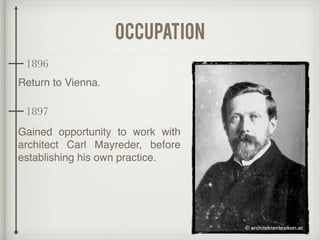
Return to Vienna.
Gained opportunity to work with
architect Carl Mayreder, before
establishing his own practice.
1896
1897
style
• Rejection of decorative elements.
• Combination of dandy, artist , architect, art critic.
• Most brilliant and multitalented personalities of 20th
century architecture
• Believed in the merging of crafts and architecture.
• Spatial planning.
• Room of different heights.
“True vocabulary of architecture lies in the
materials themselves”
-Adolf Loos-
1898
principlesofbuildings
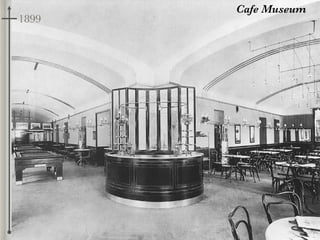
1899
Cafe Museum
His theories culminated in a
s h o r t e s s a y e n t i t l e d ,
"Ornament And Crime,"
published in 1908. This book
was translated in Esprit
Nouveau, a publication edited
by Le Corbusier , Paul Dermee
and Ozenfant in the year
1920.
1908
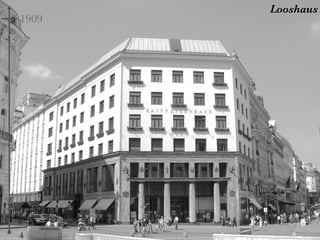
1909
Looshaus
1910
Steiner House
1912 - 1913
Scheu House
1922
Refer House
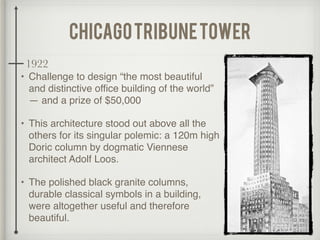
chicagotribunetower
• Challenge to design “the most beautiful
and distinctive office building of the world”
— and a prize of $50,000
• This architecture stood out above all the
others for its singular polemic: a 120m high
Doric column by dogmatic Viennese
architect Adolf Loos.
• The polished black granite columns,
durable classical symbols in a building,
were altogether useful and therefore
beautiful.
1922
Tzara House
1926-1927
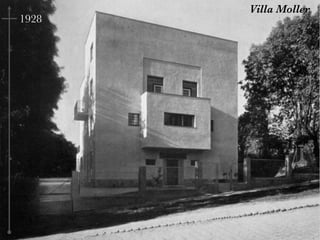
Villa Moller
1928
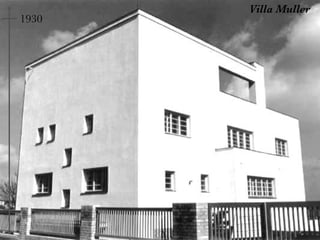
1930
Villa Muller
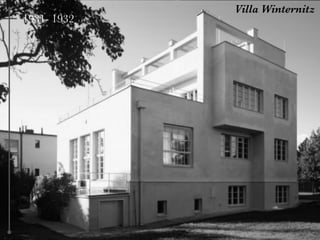
1931- 1932
Villa Winternitz
latestage
• Recognised as Master in Architecture.
• He was bestowed with an annual honorific income by the
president of the Czechoslovakian Republic
• Passed away
1930
1933
CONTEXT
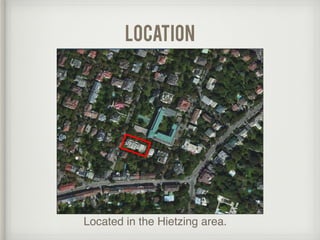
location
Located in the Hietzing area.
scheuhouse
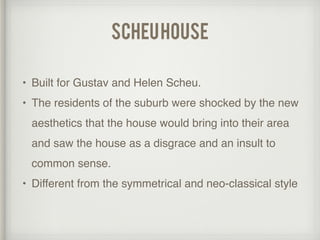
• Built for Gustav and Helen Scheu.
• The residents of the suburb were shocked by the new
aesthetics that the house would bring into their area
and saw the house as a disgrace and an insult to
common sense.
• Different from the symmetrical and neo-classical style
concept
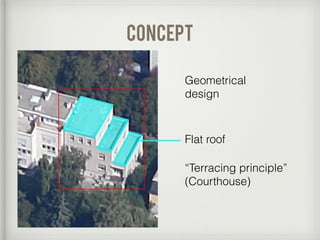
Geometrical
design
Flat roof
“Terracing principle”
(Courthouse)
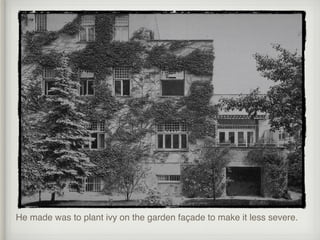
He made was to plant ivy on the garden façade to make it less severe.
FORM AND SPACE
formandspace
Unadorned architecture
(plain white wall)
Repetition of 3
Cuboids in different size
3D massing
Repetition of
Rectangles/
Squares in different size
first
Flat Roof as
Outdoor Terrace
Bedroom faces east
enjoys a generous balcony
Different sized
windows
based on the combination of a single
module (living room, bed room…)
asymmetricaltieredvolumeplacement of windows, sizes, entrance, structure
Second Floor
Rental Apartment
First Floor
Bedrooms
Ground Floor
Main Floor & Public
Semi Basement
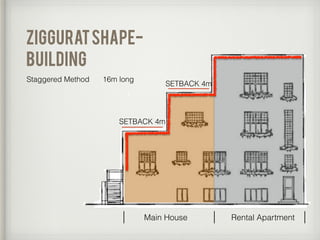
ZigguratShape-
Building
Staggered Method 16m long
SETBACK 4m
SETBACK 4m
Main House Rental Apartment
Interiors
Richardsonian
atmosphere
social areas :
walls covered in dark,
unpolished oak
Spatial Domesticity
created by Loos
bedrooms :
white painted
wood
Public Private
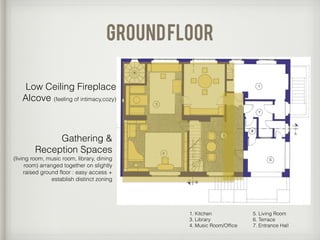
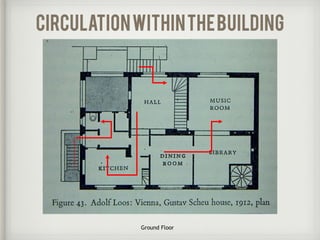
groundfloor
1. Kitchen
3. Library
4. Music Room/Office
5. Living Room
6. Terrace
7. Entrance Hall
Low Ceiling Fireplace
Alcove (feeling of intimacy,cozy)
Gathering &
Reception Spaces
(living room, music room, library, dining
room) arranged together on slightly
raised ground floor : easy access +
establish distinct zoning
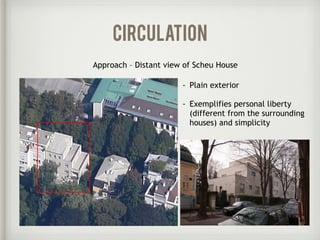
CIRCULATION
Approach – Distant view of Scheu House
circulation
- Plain exterior
- Exemplifies personal liberty
(different from the surrounding
houses) and simplicity
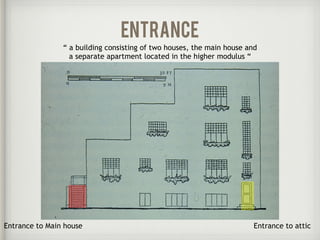
Entrance to atticEntrance to Main house
“ a building consisting of two houses, the main house and
a separate apartment located in the higher modulus “
entrance
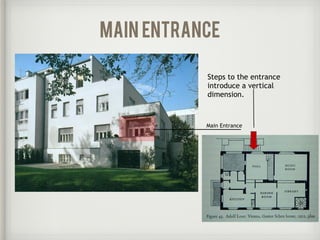
Main Entrance
Steps to the entrance
introduce a vertical
dimension.
main entrance
Ground Floor
circulationwithinthebuilding
First Floor and Second Floor
circulationwithinthebuilding
Spiral Staircase that connect
the attic and the main house
Straight run stair and L-shaped
stairs connect the basement,
ground floor and first floor.
formofcirculationspace
ELEMENTS
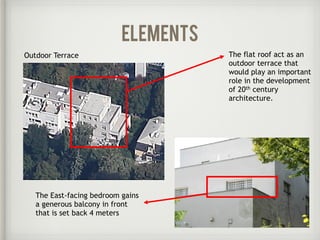
Outdoor Terrace The flat roof act as an
outdoor terrace that
would play an important
role in the development
of 20th century
architecture.
The East-facing bedroom gains
a generous balcony in front
that is set back 4 meters
elements
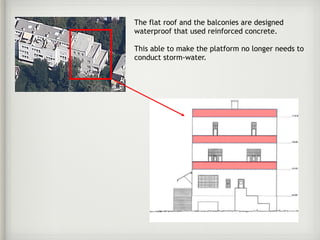
The flat roof and the balconies are designed
waterproof that used reinforced concrete.
This able to make the platform no longer needs to
conduct storm-water.
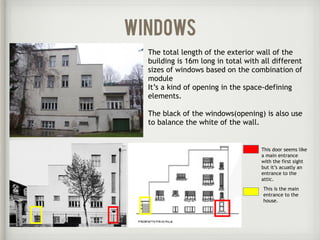
The total length of the exterior wall of the
building is 16m long in total with all different
sizes of windows based on the combination of
module
It’s a kind of opening in the space-defining
elements.
The black of the windows(opening) is also use
to balance the white of the wall.
Doors
This door seems like
a main entrance
with the first sight
but it’s acuatly an
entrance to the
attic.
This is the main
entrance to the
house.
windows
Dark & unpolished oak
was used in the day area
White , painted wood
wasa used in bedroom
Reflects a notion
domestic space develop
by Adolf Loos.
Ornamental wood beams
also use in the interior of
the scheu house.
walls
Vertical elements
defining space :
Walls
The main element is the
four planes - closure
which form by four
planes (walls) to
establish the boundaries
of an introverted space.
There is also U-shaped
plane and others.
walls
The windows that allow sunlight goes through into the basement is to ensure future
development of the basement that might become a gym in the future.
basementopening
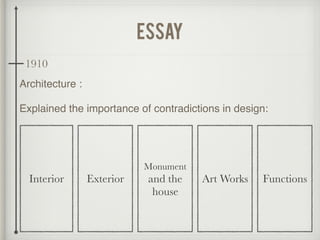
essay
Architecture :
Explained the importance of contradictions in design:
Interior Exterior
Monument
and the
house
Art Works Functions
1910
–Adolf Loos
“Architecture arouses sentiments in man. The
architect's task therefore, is to make those
sentiments more precise.”
REFERENCES
• http://www.archdaily.com/576187/spotlight-adolf-loos
• http://architect.architecture.sk/adolf-loos-architect/adolf-loos-architect.php
• http://en.wikiarquitectura.com/index.php/Scheu_House
• http://www.galinsky.com/buildings/scheu/
• https://books.google.com.my/books?id=kq2MVwHOyCkC&lpg=PA82&ots=AOf3dZ-Y3L&dq=scheu%20house&pg=PA81#v=onepage&q=scheu%20house&f=false
• http://socks-studio.com/2014/03/03/i-do-not-draw-plans-facades-or-sections-adolf-loos-and-the-villa-muller/
• http://en.wikiarquitectura.com/index.php/Scheu_House
• http://www.worldcat.org/title/adolf-loos/oclc/185858811/viewport
• http://www.galinsky.com/buildings/scheu/
• https://books.google.com.my/books?id=kq2MVwHOyCkC&pg=PA82&lpg=PA82&dq=scheu+house&source=bl&ots=AOf3d-XZ2G&sig=MV7pgcwA3SoKFuy3O2hx-
rpURNU&hl=en&sa=X&redir_esc=y#v=onepage&q=scheu%20house&f=false
• Modern Architecture by Alan Colquhoun [P.g 73-86]
• http://www.galinsky.com/buildings/scheu/
• http://www.adolf-loos.com

Studio final

  • 1.
  • 2.
    –Adolf Loos “Be notafraid of being called un-fashionable.”
  • 3.
    ARCHITECT’s BACKGROUND ADOLF LOOS Architecturearouses sentiments in man. The architect's task therefore, is to make those sentiments more precise. Born in 1870,
 Brunn, Czech Republic 1870
  • 4.
    earlylife Studied In:
 Royal andImperial State College in Rechendberg, Bohemia. College of Technology, Dresden. Left school without graduating. Travelled to United States 
 Worked as: 
 Mason 
 Floor- layer
 Dish-Washer 1886 1889 1890 1893-1896
  • 5.
    occupation Return to Vienna. Gainedopportunity to work with architect Carl Mayreder, before establishing his own practice. 1896 1897
  • 6.
    style • Rejection ofdecorative elements. • Combination of dandy, artist , architect, art critic. • Most brilliant and multitalented personalities of 20th century architecture • Believed in the merging of crafts and architecture. • Spatial planning. • Room of different heights.
  • 7.
    “True vocabulary ofarchitecture lies in the materials themselves” -Adolf Loos- 1898 principlesofbuildings
  • 8.
  • 9.
    His theories culminatedin a s h o r t e s s a y e n t i t l e d , "Ornament And Crime," published in 1908. This book was translated in Esprit Nouveau, a publication edited by Le Corbusier , Paul Dermee and Ozenfant in the year 1920. 1908
  • 10.
  • 11.
  • 12.
  • 13.
  • 14.
    chicagotribunetower • Challenge todesign “the most beautiful and distinctive office building of the world” — and a prize of $50,000 • This architecture stood out above all the others for its singular polemic: a 120m high Doric column by dogmatic Viennese architect Adolf Loos. • The polished black granite columns, durable classical symbols in a building, were altogether useful and therefore beautiful. 1922
  • 15.
  • 16.
  • 17.
  • 18.
  • 19.
    latestage • Recognised asMaster in Architecture. • He was bestowed with an annual honorific income by the president of the Czechoslovakian Republic • Passed away 1930 1933
  • 20.
  • 21.
  • 22.
    scheuhouse • Built forGustav and Helen Scheu. • The residents of the suburb were shocked by the new aesthetics that the house would bring into their area and saw the house as a disgrace and an insult to common sense. • Different from the symmetrical and neo-classical style
  • 23.
  • 24.
    He made wasto plant ivy on the garden façade to make it less severe.
  • 25.
  • 26.
    formandspace Unadorned architecture (plain whitewall) Repetition of 3 Cuboids in different size 3D massing Repetition of Rectangles/ Squares in different size
  • 27.
    first Flat Roof as OutdoorTerrace Bedroom faces east enjoys a generous balcony Different sized windows based on the combination of a single module (living room, bed room…)
  • 28.
    asymmetricaltieredvolumeplacement of windows,sizes, entrance, structure Second Floor Rental Apartment First Floor Bedrooms Ground Floor Main Floor & Public Semi Basement
  • 29.
    ZigguratShape- Building Staggered Method 16mlong SETBACK 4m SETBACK 4m Main House Rental Apartment
  • 30.
    Interiors Richardsonian atmosphere social areas : wallscovered in dark, unpolished oak Spatial Domesticity created by Loos bedrooms : white painted wood Public Private
  • 31.
    groundfloor 1. Kitchen 3. Library 4.Music Room/Office 5. Living Room 6. Terrace 7. Entrance Hall Low Ceiling Fireplace Alcove (feeling of intimacy,cozy) Gathering & Reception Spaces (living room, music room, library, dining room) arranged together on slightly raised ground floor : easy access + establish distinct zoning
  • 32.
  • 33.
    Approach – Distantview of Scheu House circulation - Plain exterior - Exemplifies personal liberty (different from the surrounding houses) and simplicity
  • 34.
    Entrance to atticEntranceto Main house “ a building consisting of two houses, the main house and a separate apartment located in the higher modulus “ entrance
  • 35.
    Main Entrance Steps tothe entrance introduce a vertical dimension. main entrance
  • 36.
  • 37.
    First Floor andSecond Floor circulationwithinthebuilding
  • 38.
    Spiral Staircase thatconnect the attic and the main house Straight run stair and L-shaped stairs connect the basement, ground floor and first floor. formofcirculationspace
  • 39.
  • 40.
    Outdoor Terrace Theflat roof act as an outdoor terrace that would play an important role in the development of 20th century architecture. The East-facing bedroom gains a generous balcony in front that is set back 4 meters elements
  • 41.
    The flat roofand the balconies are designed waterproof that used reinforced concrete. This able to make the platform no longer needs to conduct storm-water.
  • 42.
    The total lengthof the exterior wall of the building is 16m long in total with all different sizes of windows based on the combination of module It’s a kind of opening in the space-defining elements. The black of the windows(opening) is also use to balance the white of the wall. Doors This door seems like a main entrance with the first sight but it’s acuatly an entrance to the attic. This is the main entrance to the house. windows
  • 43.
    Dark & unpolishedoak was used in the day area White , painted wood wasa used in bedroom Reflects a notion domestic space develop by Adolf Loos. Ornamental wood beams also use in the interior of the scheu house. walls
  • 44.
    Vertical elements defining space: Walls The main element is the four planes - closure which form by four planes (walls) to establish the boundaries of an introverted space. There is also U-shaped plane and others. walls
  • 45.
    The windows thatallow sunlight goes through into the basement is to ensure future development of the basement that might become a gym in the future. basementopening
  • 46.
    essay Architecture : Explained theimportance of contradictions in design: Interior Exterior Monument and the house Art Works Functions 1910
  • 47.
    –Adolf Loos “Architecture arousessentiments in man. The architect's task therefore, is to make those sentiments more precise.”
  • 48.
    REFERENCES • http://www.archdaily.com/576187/spotlight-adolf-loos • http://architect.architecture.sk/adolf-loos-architect/adolf-loos-architect.php •http://en.wikiarquitectura.com/index.php/Scheu_House • http://www.galinsky.com/buildings/scheu/ • https://books.google.com.my/books?id=kq2MVwHOyCkC&lpg=PA82&ots=AOf3dZ-Y3L&dq=scheu%20house&pg=PA81#v=onepage&q=scheu%20house&f=false • http://socks-studio.com/2014/03/03/i-do-not-draw-plans-facades-or-sections-adolf-loos-and-the-villa-muller/ • http://en.wikiarquitectura.com/index.php/Scheu_House • http://www.worldcat.org/title/adolf-loos/oclc/185858811/viewport • http://www.galinsky.com/buildings/scheu/ • https://books.google.com.my/books?id=kq2MVwHOyCkC&pg=PA82&lpg=PA82&dq=scheu+house&source=bl&ots=AOf3d-XZ2G&sig=MV7pgcwA3SoKFuy3O2hx- rpURNU&hl=en&sa=X&redir_esc=y#v=onepage&q=scheu%20house&f=false • Modern Architecture by Alan Colquhoun [P.g 73-86] • http://www.galinsky.com/buildings/scheu/ • http://www.adolf-loos.com