Foe
- J. M. Coetzee
Yesha Bhatt
Department of English,
M. K. Bhavnagar University
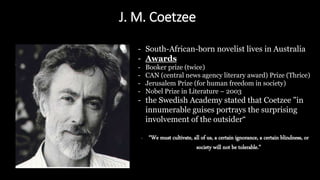
J. M. Coetzee
- South-African-born novelist lives in Australia
- Awards
- Booker prize (twice)
- CAN (central news agency literary award) Prize (Thrice)
- Jerusalem Prize (for human freedom in society)
- Nobel Prize in Literature – 2003
- the Swedish Academy stated that Coetzee "in
innumerable guises portrays the surprising
involvement of the outsider“
- “We must cultivate, all of us, a certain ignorance, a certain blindness, or
society will not be tolerable.”
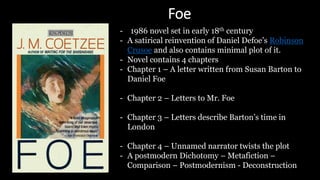
Foe
- 1986 novel set in early 18th century
- A satirical reinvention of Daniel Defoe’s Robinson
Crusoe and also contains minimal plot of it.
- Novel contains 4 chapters
- Chapter 1 – A letter written from Susan Barton to
Daniel Foe
- Chapter 2 – Letters to Mr. Foe
- Chapter 3 – Letters describe Barton’s time in
London
- Chapter 4 – Unnamed narrator twists the plot
- A postmodern Dichotomy – Metafiction –
Comparison – Postmodernism - Deconstruction
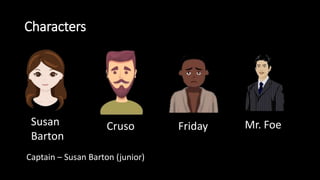
Characters
Susan
Barton
Mr. Foe
Friday
Cruso
Captain – Susan Barton (junior)
Plot construction
- Chapter 1 (with quotation marks) – A letter
written from Susan Barton to Mr. Foe
- Susan’s arrival on island – meeting with Friday
and Cruso
- Susan tries to observe Cruso and Friday and their
way of living
- Friday’s silent history
- Barton’s story to find her daughter - England to
Brazil - Sailing back across the Atlantic – Munity
– island
- Rescue – Cruso died
• Chapter – 2 (with quotation marks) – letters of
Susan to Mr. Foe
- Story of her life and her experiences and her life
with Friday
- Asks for promise from Mr. Foe to write her story
- Mr. Foe denies to write such simple story
- She lives with Friday and comes to know about him
more – She tries to send him back to SA but later
because of fear she decides to keep Friday with her.
– started living in Mr. Foe’s house
- A young woman named Susan Barton claimed to be
the daughter of Susan
- A big question on the ‘Reliability of the narrative’ of
Susan
• Chapter – 3-4 (without quotation marks)
- Chapter 3 includes one evening of Friday and Susan on Mr.
Foe’s house and Mr. Foe asks Susan about her time in Brazil.
- She insists of telling and publishing the story of her
experience on island rather than in Brazil
- A young woman entered again and claimed to be the
daughter of Susan – Barton defines her suspicions by telling
that the eye colour of the girl is different than her daughter’s
- Mr. Foe and Susan debate upon the authorship of Susan’s life
- Foe and Susan discuss about Friday and decides to teach him
to write
- Friday is unable to learn and Susan also believes that Friday
cannot learn to write
- Foe forces Susan to teach Friday to write
• Chapter 4 – unnamed narrator entered and
observes all the characters
- Shipwreck on the shore and characters are
seen there.
- Protagonist opens Friday’s mouth, and he
finally "speaks," emitting a stream of water,
“Soft and cold, dark and unending, it beats
against my eyelids, against the skin of my
face.”
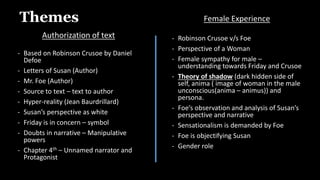
Themes
Authorization of text
- Based on Robinson Crusoe by Daniel
Defoe
- Letters of Susan (Author)
- Mr. Foe (Author)
- Source to text – text to author
- Hyper-reality (Jean Baurdrillard)
- Susan’s perspective as white
- Friday is in concern – symbol
- Doubts in narrative – Manipulative
powers
- Chapter 4th – Unnamed narrator and
Protagonist
Female Experience
- Robinson Crusoe v/s Foe
- Perspective of a Woman
- Female sympathy for male –
understanding towards Friday and Crusoe
- Theory of shadow (dark hidden side of
self, anima ( image of woman in the male
unconscious(anima – animus)) and
persona.
- Foe’s observation and analysis of Susan’s
perspective and narrative
- Sensationalism is demanded by Foe
- Foe is objectifying Susan
- Gender role
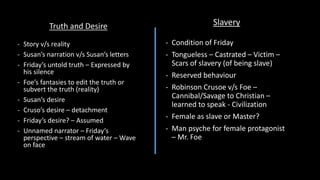
Truth and Desire
- Story v/s reality
- Susan’s narration v/s Susan’s letters
- Friday’s untold truth – Expressed by
his silence
- Foe’s fantasies to edit the truth or
subvert the truth (reality)
- Susan’s desire
- Cruso’s desire – detachment
- Friday’s desire? – Assumed
- Unnamed narrator – Friday’s
perspective – stream of water – Wave
on face
Slavery
- Condition of Friday
- Tongueless – Castrated – Victim –
Scars of slavery (of being slave)
- Reserved behaviour
- Robinson Crusoe v/s Foe –
Cannibal/Savage to Christian –
learned to speak - Civilization
- Female as slave or Master?
- Man psyche for female protagonist
– Mr. Foe
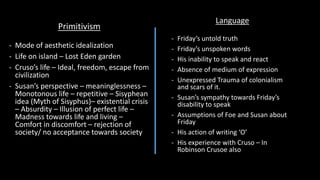
Primitivism
- Mode of aesthetic idealization
- Life on island – Lost Eden garden
- Cruso’s life – Ideal, freedom, escape from
civilization
- Susan’s perspective – meaninglessness –
Monotonous life – repetitive – Sisyphean
idea (Myth of Sisyphus)– existential crisis
– Absurdity – Illusion of perfect life –
Madness towards life and living –
Comfort in discomfort – rejection of
society/ no acceptance towards society
Language
- Friday’s untold truth
- Friday’s unspoken words
- His inability to speak and react
- Absence of medium of expression
- Unexpressed Trauma of colonialism
and scars of it.
- Susan’s sympathy towards Friday’s
disability to speak
- Assumptions of Foe and Susan about
Friday
- His action of writing ‘O’
- His experience with Cruso – In
Robinson Crusoe also
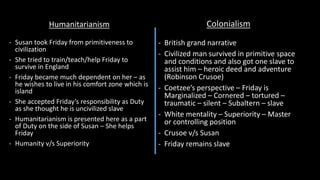
Humanitarianism
- Susan took Friday from primitiveness to
civilization
- She tried to train/teach/help Friday to
survive in England
- Friday became much dependent on her – as
he wishes to live in his comfort zone which is
island
- She accepted Friday’s responsibility as Duty
as she thought he is uncivilized slave
- Humanitarianism is presented here as a part
of Duty on the side of Susan – She helps
Friday
- Humanity v/s Superiority
Colonialism
- British grand narrative
- Civilized man survived in primitive space
and conditions and also got one slave to
assist him – heroic deed and adventure
(Robinson Crusoe)
- Coetzee’s perspective – Friday is
Marginalized – Cornered – tortured –
traumatic – silent – Subaltern – slave
- White mentality – Superiority – Master
or controlling position
- Crusoe v/s Susan
- Friday remains slave
Post-modern Dichotomy
• Satiric reinvention of Daniel Defoe’s Robinson Crusoe
• Pains of Colonialism – Suffering of Friday
• Shifting of Master’s Position
• Condition of Friday – (Foe vs Robinson Crusoe)
• Friday’s voice - (Foe vs Robinson Crusoe)
• Friday’s learning for his purpose vs training for being slave
• Friday (Caribbean) vs Friday (Negro)
• Crusoe vs Cruso
• Susan vs Crusoe
• Mr. Foe (Sensationalism) vs Daniel Defoe (Heroism of a White
man)
Deconstruction – Foe (Nationalism)
• Robinson Crusoe – Colonizer Crusoe, Englishness and Euro-centricism
• Male castaway vs female castaway
• Foe and Defoe (De Beau Faux) (Deconstruction of Identity)
• Superiority of Europeans was made up by European themselves
• From national imagination of England to National imagination of
Africa
• Spirit of English people to colonize ‘others’ (inferior)
• Spirit of Cruso is opposite (antithesis) to Crusoe (Deconstruction)
• Robinson Crusoe’s language – Description of England
• Friday’s silence – Description of Africa – ( Coetzee is Shifting the
centre)
Power positions - Colonialism
• Native colonial subject Friday – Prototype colonial fiction –
Mythification of Crusoe’s story into European culture
• The Western imagery on the new world
• Friday silently aroused a question of colonial history
• “Crusoe himself as acquired a kind of ‘semi-historical status’,
and his tale seems to fall more naturally into place with Faust,
Don Juan and Don Quixote, the great myths of our civilization”
– Ian Watt
• White man – foreign island – fertile, liveable environment
through intelligence and hard labour
• Foe- intertextual approach of a postcolonial deconstruction of
the Robinson myth
Marginalization – Subaltern identity
• Metafiction – authorship
• Man – centre of cultural, political and linguistic world
• Whiteman marginalized Friday (Native) – (Friday is still in Margin)
• Cultural native – political oppression
• Robinson Crusoe – Story of capital – no room for women
• Foe – focuses on gender and empire – “The Female Castaway”
• Susan (object of knowledge in novel) Construction of the marginal –
Cruso and Friday
• Susan – Freedom of choice in writing her own history vs Foe’s
arguments
Symbol
• Friday’s Tongue and his Castration –
reshaping of a person – his story is forever
unknown – Silencing of a history
• Cruso’s character – female version of
history – female as subaltern – Susan is
overpowering Cruso
• Foe’s novel – retelling of truths with
muted history of Friday – Twice removed
reality is demanded – Fiction to selling
• Island – Idealized space in RC – boring
tedious place in Foe – place of freedom for
Friday – from colonizers and slave identity
Dialogues
• “In a world of chance is there a better and a worse? We yield to a stranger's
embrace or give ourselves to the waves; for the blink of an eyelid our vigilance
relaxes; we are asleep; and when we awake, we have lost the direction of our
lives. What are these blinks of an eyelid, against which the only defence is an
eternal and inhuman wakefulness? Might they not be the cracks and chinks
through which another voice, other voices, speak in our lives? By what right
do we close our ears to them?”
• “He does not know what freedom is. Freedom is a word, less than a word, a
noise, one of the multitude of noises I make when I open my mouth.”
• “I stretched out my arms and laid my palms on the earth, and, yes, the
rocking persisted, the rocking of the island as it sailed through the sea and
the night bearing into the future its freight of gulls and sparrows and fleas
and apes and castaways, all unconscious now, save me. I fell asleep smiling.”
• “His mouth opens. From inside him comes a slow stream, without breath,
without interruption. It flows up through his body and out upon me; it
passes through the cabin, through the wreck; washing the cliffs and shores of
the island, it runs northward and southward to the ends of the earth. Soft
and cold, dark and unending, it beats against my eyelids, against the skin of
my face.”
• “It seemed to me that all things were possible on the island, all tyrannies and
cruelties, though in small; and if, in despite of what was possible, we lived at
peace with another, surely this was proof that certain laws unknown to us
held sway, or else that we had been following the promptings of our hearts
all this time, and our hearts had not betrayed us.”
• “as to who among us is a ghost and who not I have nothing to say: it is a
question we can only stare at in silence, like a bird before a snake, hoping it
will not swallow us.”

Foe - J. M. Coetzee

  • 1.
    Foe - J. M.Coetzee Yesha Bhatt Department of English, M. K. Bhavnagar University
  • 2.
    J. M. Coetzee -South-African-born novelist lives in Australia - Awards - Booker prize (twice) - CAN (central news agency literary award) Prize (Thrice) - Jerusalem Prize (for human freedom in society) - Nobel Prize in Literature – 2003 - the Swedish Academy stated that Coetzee "in innumerable guises portrays the surprising involvement of the outsider“ - “We must cultivate, all of us, a certain ignorance, a certain blindness, or society will not be tolerable.”
  • 3.
    Foe - 1986 novelset in early 18th century - A satirical reinvention of Daniel Defoe’s Robinson Crusoe and also contains minimal plot of it. - Novel contains 4 chapters - Chapter 1 – A letter written from Susan Barton to Daniel Foe - Chapter 2 – Letters to Mr. Foe - Chapter 3 – Letters describe Barton’s time in London - Chapter 4 – Unnamed narrator twists the plot - A postmodern Dichotomy – Metafiction – Comparison – Postmodernism - Deconstruction
  • 4.
  • 5.
    Plot construction - Chapter1 (with quotation marks) – A letter written from Susan Barton to Mr. Foe - Susan’s arrival on island – meeting with Friday and Cruso - Susan tries to observe Cruso and Friday and their way of living - Friday’s silent history - Barton’s story to find her daughter - England to Brazil - Sailing back across the Atlantic – Munity – island - Rescue – Cruso died
  • 6.
    • Chapter –2 (with quotation marks) – letters of Susan to Mr. Foe - Story of her life and her experiences and her life with Friday - Asks for promise from Mr. Foe to write her story - Mr. Foe denies to write such simple story - She lives with Friday and comes to know about him more – She tries to send him back to SA but later because of fear she decides to keep Friday with her. – started living in Mr. Foe’s house - A young woman named Susan Barton claimed to be the daughter of Susan - A big question on the ‘Reliability of the narrative’ of Susan
  • 7.
    • Chapter –3-4 (without quotation marks) - Chapter 3 includes one evening of Friday and Susan on Mr. Foe’s house and Mr. Foe asks Susan about her time in Brazil. - She insists of telling and publishing the story of her experience on island rather than in Brazil - A young woman entered again and claimed to be the daughter of Susan – Barton defines her suspicions by telling that the eye colour of the girl is different than her daughter’s - Mr. Foe and Susan debate upon the authorship of Susan’s life - Foe and Susan discuss about Friday and decides to teach him to write - Friday is unable to learn and Susan also believes that Friday cannot learn to write - Foe forces Susan to teach Friday to write
  • 8.
    • Chapter 4– unnamed narrator entered and observes all the characters - Shipwreck on the shore and characters are seen there. - Protagonist opens Friday’s mouth, and he finally "speaks," emitting a stream of water, “Soft and cold, dark and unending, it beats against my eyelids, against the skin of my face.”
  • 9.
    Themes Authorization of text -Based on Robinson Crusoe by Daniel Defoe - Letters of Susan (Author) - Mr. Foe (Author) - Source to text – text to author - Hyper-reality (Jean Baurdrillard) - Susan’s perspective as white - Friday is in concern – symbol - Doubts in narrative – Manipulative powers - Chapter 4th – Unnamed narrator and Protagonist Female Experience - Robinson Crusoe v/s Foe - Perspective of a Woman - Female sympathy for male – understanding towards Friday and Crusoe - Theory of shadow (dark hidden side of self, anima ( image of woman in the male unconscious(anima – animus)) and persona. - Foe’s observation and analysis of Susan’s perspective and narrative - Sensationalism is demanded by Foe - Foe is objectifying Susan - Gender role
  • 10.
    Truth and Desire -Story v/s reality - Susan’s narration v/s Susan’s letters - Friday’s untold truth – Expressed by his silence - Foe’s fantasies to edit the truth or subvert the truth (reality) - Susan’s desire - Cruso’s desire – detachment - Friday’s desire? – Assumed - Unnamed narrator – Friday’s perspective – stream of water – Wave on face Slavery - Condition of Friday - Tongueless – Castrated – Victim – Scars of slavery (of being slave) - Reserved behaviour - Robinson Crusoe v/s Foe – Cannibal/Savage to Christian – learned to speak - Civilization - Female as slave or Master? - Man psyche for female protagonist – Mr. Foe
  • 11.
    Primitivism - Mode ofaesthetic idealization - Life on island – Lost Eden garden - Cruso’s life – Ideal, freedom, escape from civilization - Susan’s perspective – meaninglessness – Monotonous life – repetitive – Sisyphean idea (Myth of Sisyphus)– existential crisis – Absurdity – Illusion of perfect life – Madness towards life and living – Comfort in discomfort – rejection of society/ no acceptance towards society Language - Friday’s untold truth - Friday’s unspoken words - His inability to speak and react - Absence of medium of expression - Unexpressed Trauma of colonialism and scars of it. - Susan’s sympathy towards Friday’s disability to speak - Assumptions of Foe and Susan about Friday - His action of writing ‘O’ - His experience with Cruso – In Robinson Crusoe also
  • 12.
    Humanitarianism - Susan tookFriday from primitiveness to civilization - She tried to train/teach/help Friday to survive in England - Friday became much dependent on her – as he wishes to live in his comfort zone which is island - She accepted Friday’s responsibility as Duty as she thought he is uncivilized slave - Humanitarianism is presented here as a part of Duty on the side of Susan – She helps Friday - Humanity v/s Superiority Colonialism - British grand narrative - Civilized man survived in primitive space and conditions and also got one slave to assist him – heroic deed and adventure (Robinson Crusoe) - Coetzee’s perspective – Friday is Marginalized – Cornered – tortured – traumatic – silent – Subaltern – slave - White mentality – Superiority – Master or controlling position - Crusoe v/s Susan - Friday remains slave
  • 13.
    Post-modern Dichotomy • Satiricreinvention of Daniel Defoe’s Robinson Crusoe • Pains of Colonialism – Suffering of Friday • Shifting of Master’s Position • Condition of Friday – (Foe vs Robinson Crusoe) • Friday’s voice - (Foe vs Robinson Crusoe) • Friday’s learning for his purpose vs training for being slave • Friday (Caribbean) vs Friday (Negro) • Crusoe vs Cruso • Susan vs Crusoe • Mr. Foe (Sensationalism) vs Daniel Defoe (Heroism of a White man)
  • 14.
    Deconstruction – Foe(Nationalism) • Robinson Crusoe – Colonizer Crusoe, Englishness and Euro-centricism • Male castaway vs female castaway • Foe and Defoe (De Beau Faux) (Deconstruction of Identity) • Superiority of Europeans was made up by European themselves • From national imagination of England to National imagination of Africa • Spirit of English people to colonize ‘others’ (inferior) • Spirit of Cruso is opposite (antithesis) to Crusoe (Deconstruction) • Robinson Crusoe’s language – Description of England • Friday’s silence – Description of Africa – ( Coetzee is Shifting the centre)
  • 15.
    Power positions -Colonialism • Native colonial subject Friday – Prototype colonial fiction – Mythification of Crusoe’s story into European culture • The Western imagery on the new world • Friday silently aroused a question of colonial history • “Crusoe himself as acquired a kind of ‘semi-historical status’, and his tale seems to fall more naturally into place with Faust, Don Juan and Don Quixote, the great myths of our civilization” – Ian Watt • White man – foreign island – fertile, liveable environment through intelligence and hard labour • Foe- intertextual approach of a postcolonial deconstruction of the Robinson myth
  • 16.
    Marginalization – Subalternidentity • Metafiction – authorship • Man – centre of cultural, political and linguistic world • Whiteman marginalized Friday (Native) – (Friday is still in Margin) • Cultural native – political oppression • Robinson Crusoe – Story of capital – no room for women • Foe – focuses on gender and empire – “The Female Castaway” • Susan (object of knowledge in novel) Construction of the marginal – Cruso and Friday • Susan – Freedom of choice in writing her own history vs Foe’s arguments
  • 17.
    Symbol • Friday’s Tongueand his Castration – reshaping of a person – his story is forever unknown – Silencing of a history • Cruso’s character – female version of history – female as subaltern – Susan is overpowering Cruso • Foe’s novel – retelling of truths with muted history of Friday – Twice removed reality is demanded – Fiction to selling • Island – Idealized space in RC – boring tedious place in Foe – place of freedom for Friday – from colonizers and slave identity
  • 18.
    Dialogues • “In aworld of chance is there a better and a worse? We yield to a stranger's embrace or give ourselves to the waves; for the blink of an eyelid our vigilance relaxes; we are asleep; and when we awake, we have lost the direction of our lives. What are these blinks of an eyelid, against which the only defence is an eternal and inhuman wakefulness? Might they not be the cracks and chinks through which another voice, other voices, speak in our lives? By what right do we close our ears to them?” • “He does not know what freedom is. Freedom is a word, less than a word, a noise, one of the multitude of noises I make when I open my mouth.” • “I stretched out my arms and laid my palms on the earth, and, yes, the rocking persisted, the rocking of the island as it sailed through the sea and the night bearing into the future its freight of gulls and sparrows and fleas and apes and castaways, all unconscious now, save me. I fell asleep smiling.”
  • 19.
    • “His mouthopens. From inside him comes a slow stream, without breath, without interruption. It flows up through his body and out upon me; it passes through the cabin, through the wreck; washing the cliffs and shores of the island, it runs northward and southward to the ends of the earth. Soft and cold, dark and unending, it beats against my eyelids, against the skin of my face.” • “It seemed to me that all things were possible on the island, all tyrannies and cruelties, though in small; and if, in despite of what was possible, we lived at peace with another, surely this was proof that certain laws unknown to us held sway, or else that we had been following the promptings of our hearts all this time, and our hearts had not betrayed us.” • “as to who among us is a ghost and who not I have nothing to say: it is a question we can only stare at in silence, like a bird before a snake, hoping it will not swallow us.”